


Community hub
Recent from talks
Contribute something
Nothing was collected or created yet.
Lunar deity
View on Wikipedia
| Part of a series on |
| Anthropology of religion |
|---|
 |
| Social and cultural anthropology |
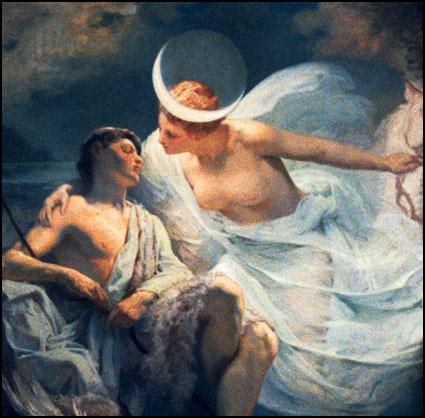
A lunar deity or moon deity is a deity who represents the Moon, or an aspect of it. These deities can have a variety of functions and traditions depending upon the culture, but they are often related. Lunar deities and Moon worship can be found throughout most of recorded history in various forms.
Moon in religion and mythology
[edit]Many cultures have implicitly linked the 29.5-day lunar cycle to women's menstrual cycles, as evident in the shared linguistic roots of "menstruation" and "moon" words in multiple language families.[1] This identification was not universal, as demonstrated by the fact that not all moon deities are female. Still, many well-known mythologies feature moon goddesses, including the Greek goddess Selene, the Roman goddess Luna, the Chinese goddess Chang'e, and the Aztec goddess Coyolxāuhqui, whose decapitation may represent a lunar eclipse.[2] Several goddesses including Artemis, Hecate, Melinoë, Phoebe, Theia and Isis did not originally have lunar aspects, and only acquired them late in antiquity due to syncretism with the de facto Greco-Roman lunar deity Selene/Luna.[3][4]


Male lunar gods are also common, such as Sin of the Mesopotamians, Khonsu of the Egyptians (or the earlier Egyptian lunar deity Iah), Mani of the Germanic tribes, Tsukuyomi of the Japanese, Igaluk/Alignak of the Inuit, and the Hindu god Chandra. The original Proto-Indo-European lunar deity, *Meh₁not appears to have been male, with many possible derivatives including the Homeric figure of Menelaus.[5] Cultures with male moon gods often feature sun goddesses. An exception are Hinduism and Philippine animism featuring both male and female aspects of the solar divine. Pre-colonial Philippine societies practiced animism, in which nature was imbued with spirits and deities with both male and female moon gods prevalence of many male moon gods in Philippine mythology, unlike in many other cultures where the moon is typically personified as female. As the Philippines absorbed influences from Hindu-Buddhist, indigenous beliefs sometimes merged or adapted.[6][7][8]The Philippines has multiple moon deities because of its diverse ethnolinguistic groups and rich pre-colonial unified belief systems.[9]
The ancient Egyptians had several moon gods including Khonsu and Thoth, although Thoth is a considerably more complex deity.[10] Set represented the moon in the ancient Egyptian calendar.[11] In Bakongo religion, the earth and moon goddess Nzambici is the female counterpart of the sun god Nzambi Mpungu.[12] Metztli, Coyolxauhqui and Tēcciztēcatl are all lunar deities in the Aztec religion.
.jpg)
Archaeologist Hugo Winckler and Historian Philip K. Hitti consider Allah as a Moon Deity in pre-Islamic Arabian Religion before Islam, many Arab tribes practiced polytheism. They worshipped deities connected to the sun, stars, and moon. Among these gods were Hubal, al-Lāt, al-‘Uzzā, and Manāt, as well as astral deities. The moon played a central role in Arabian religion and calendars, so some historians connect early Arab worship with lunar traditions.[13][14]The name “Allah” comes from al-Ilāh, meaning “The God” (the supreme god). Allah was originally linked with a moon deity, partly because Arab tribes often used the crescent moon as a religious and timekeeping symbol.Most academic research stresses that Allah was understood as a high creator god, not just a lunar spirit.[15][16][17]The crescent moon and star is widely seen as a symbol of Islam. adding belief that Allah is a “moon god.” Historically, the crescent was a Byzantine and Near Eastern symbol adopted centuries after Islam’s beginning, not originally Islamic.[18][19][20] In the Manichean religion, Jesus Christ was worshipped as a lunar deity, often being called the King of the Moon, or simply Jesus the Moon.
Many cultures are oriented chronologically by the Moon, as opposed to the Sun. The Hindu calendar maintains the integrity of the lunar month and the moon god Chandra has religious significance during many Hindu festivals (e.g. Karwa Chauth, Sankashti Chaturthi, and during eclipses).[21] Ancient Germanic tribes and the peoples they were in contact with, such as the Baltic Finnic peoples, were also known to have a lunar calendar.[22] Calendars such as the Runic calendar fixing the beginning of the year at the first full moon after winter solstice.[23]
The Moon features prominently in art and literature, often with a purported influence on human affairs.
Moon gods in Hinduism
[edit].jpg)
Chandra is the principal Moon god in Hinduism. He is a male deity described as a handsome, radiant god riding a chariot drawn by white horses or antelopes.[24][25][26][27] He is also called Chandradeva or Soma. Chandra is the personification of the Moon, symbolizing tranquility, coolness, fertility, and the passage of time. He is married to the 27 Nakshatras (the daughters of Daksha, who represent the stars in the sky). He is also one of the Navagraha, the nine planetary deities in Hindu astrology.[28]
Anumati is a goddess of the Moon and spirituality. In mythology, when she descends from the heavens to the earth, she rides a black antelope. She is often described as a very beautiful young woman with fair skin. In Sanskrit and Hindi, her name means “permission” or “granting consent.”[29][30]
Moon gods in Buddhism
[edit]In Buddhism, the moon itself is not usually worshipped as a god, but it plays an important symbolic role. There are gods connected to the moon and the full moon is very sacred: The Buddha’s birth, enlightenment, and passing into Nirvana (Parinirvāṇa) are all said to have happened on full moon days. Buddhist festivals (like Vesak, Magha Puja, Asalha Puja) are held on full moon nights.[31][32][33][34]
In Buddhism, there is not one single universal “moon god” figure, but rather a few different deities, spirits, and symbolic figures connected to the moon, depending on the tradition (Indian, Tibetan, Chinese, Japanese, etc.)[35][36]

- Candra
Candra (Chandra / Candimā) In Indian Buddhism, the moon is personified as Candra, a deva (god) associated with coolness, calm, and purity. Candra is often depicted as having fair skin and very black hair riding a chariot across the night sky, paralleling his role in Hinduism. He appears in the Sutta Nipāta of the Pali Canon, where he praises the Buddha after being freed from a demon’s grasp.In Indian art, Candra (the moon god adopted into Buddhist cosmology) is shown holding a lotus or a club. He is often depicted as fair or pale white in complexion, symbolizing moonlight.Sometimes shown with a crescent moon on his forehead. In Buddhist reliefs (e.g., Gandhāra), Candra and Sūrya appear flanking the Buddha as astral guardians.[35][37][38]
- Candimā Devaputta
Candimā Devaputta is a Moon deity In Theravāda texts, specifically the Candimā Sutta (SN 2.9), the moon deity is trapped by a demon named Rāhu. He calls out for refuge in the Buddha, who intervenes and forces Rāhu to release him. in commentaries and art influenced by Indian cosmology, moon deities are depicted like other devas: youthful, radiant, dressed in celestial ornaments.In Hindu-Buddhist iconography, Candra rides a chariot drawn by 10 white horses or an antelope. This story is an example of how Buddhist texts synconized existing Indian astral mythology into a Buddhist framework.[39][31][32]
Candraprabha Bodhisattva is a deity of Moonlight or a Moonlight Bodhisattva. A Mahāyāna figure, usually paired with Sūryaprabha (Sunlight Bodhisattva). Appearances based on East Asian sutras and iconography often wears a celestial crown often bearing a moon disk and holds a moon-shaped jewel or white lotus. Radiates a soft white or silvery aura. He is often depicted as youthful, elegant, and dressed in flowing silk robes, similar to Avalokiteśvara. Common in Chinese and Japanese temple art, especially with Bhaiṣajyaguru (Medicine Buddha).[39][31][32][40]
Shinto
[edit]
Tsukuyomi-no-Mikoto (月読命 / 月夜見尊) is the main moon kami (deity) in Shintō. The name means “moon reader” or “moonlight viewer.” Considered one of the three important kami born from the god Izanagi’s purification ritual (alongside Amaterasu, the sun goddess, and Susanoo, the storm god).Usually seen as a male deity though sometimes gender is not emphasized and is often depicted in Japanese paintings and in arts as beautiful man with fair skin and long black hair. In Shinto beliefs he governs the night, time cycles, and tides.He is also connected with agriculture and calendars, since Japanese life followed the lunar calendar.[41][42] In the Kojiki (Records of Ancient Matters) and Nihon Shoki (Chronicles of Japan):Tsukuyomi once killed the goddess of food, Ukemochi, after seeing her create food in a way he found offensive. Because of this, Amaterasu (sun) refused to ever see him again this is said to explain why day and night are separated. In Japanese art and poetry (heavily influenced by Shintō and Buddhism), the full moon is a symbol of purity and contemplation.[43][44][45][46]
Japanese mythology
[edit]

- Tsukuyomi-no-Mikoto
The main Moon god in the Shinto religion and Japanese mythology. He is the brother of Susanoo and Amaterasu. [47] He is often called Tsukuyomi (ツクヨミ, 月読) or Tsukiyomi and described as a very handsome man, sometimes referred to as a youth who “reads” or “watches” from the moon.[48][49][44]
Kaguya is the maiden from the Moon, a princess renowned for her beauty, fair skin, and long black hair, from the ancient and famous folktale *The Tale of the Bamboo Cutter*. She is considered the spiritual symbol of the beauty and purity of the moon.[50][51][52]
- Gakkō Bosatsu
Gakkō Bosatsu (or Gaku Bustatsu) is a minor deity of moonlight in Shinto and Buddhist religion and mythology, known as the “Bodhisattva of Moonlight” from Buddhist tradition. He is often depicted in human form as a young boy with silk-like fair skin and long black hair, holding a blue padma (lotus). [53][54][55]
Chinese mythology
[edit]

- Chang’e (嫦娥)
Chang’e is the Moon Goddess and the most famous lunar deity in China. She is the wife of the archer Hou Yi. After Hou Yi shot down the extra suns, he received an elixir of immortality. Chang’e drank the elixir and flew to the moon, where she became a goddess. She is worshipped during the Mid-Autumn Festival, when people eat mooncakes and admire the full moon. She is depicted as a beautiful woman with fair skin and long black hair, dressed in luxurious silk garments. For the Chinese, she is a symbol of beauty, immortality, and longing.[56][57][58][59]
- Tu’er Ye (兔兒爺)
Tu’er Ye, the Moon Rabbit, is a sacred rabbit said to live with Chang’e on the moon. He uses a mortar and pestle to grind herbs in order to make the elixir of life. He is worshipped as a protective deity in Beijing and northern China, especially during the Mid-Autumn Festival.[59][60][61]
- Yue Lao (月老)
Yue Lao is a moon deity associated with love and marriage. He is known as the Old Man under the Moon or the Man on the Moon. He is believed to bind couples together with the red thread of fate. Even today, many still pray to him in temples across China and Taiwan for love or good fortune in marriage.[61][62][63][64][65]


Moon gods in Philippine mythology
[edit]- Kabigat (Bontok mythology): the goddess of the moon who cut off the head of Chal-chal's son; her action is the origin of headhunting[66]
- Bulan (Ifugao mythology): the moon deity of the night in charge of nighttime[67]
- Moon Deity (Ibaloi mythology): the deity who teased Kabunian for not yet having a spouse[68]
- Delan (Bugkalot mythology): deity of the moon, worshiped with the sun and stars; congenial with Elag; during quarrels, Elag sometimes covers Delan's face, causing the different phases of the moon; giver of light and growth[69]
- Bulan (Ilocano mythology): the moon god of peace who comforted the grieving Abra[70]
- Bulan (Pangasinense mythology): the playful and youthful moon god of Pangasinan, whose dim palace was the source of the perpetual light which became the stars; guides the ways of thieves[71]
- Wife of Mangetchay (Kapampangan mythology): wife of Mangetchay who gave birth to their daughter whose beauty sparked the great war; lives in the Moon[72]
- Mayari (Kapampangan mythology): the moon goddess who battled her brother, Apolaqui[73]
- Apûng Malyari (Kapampangan mythology): moon god who lives in Mount Pinatubo and ruler of the eight rivers[74]
- Mayari (Tagalog mythology): Most well-known moon goddess in Philippine mythology and contemporary Tagalog mythology goddess of the moon;[75] sometimes identified as having one eye;[76] ruler of the world during nighttime and daughter of Bathala[77]
- Dalagang nasa Buwan (Tagalog mythology): the maiden of the moon[78]
- Dalagang Binubukot (Tagalog mythology): the cloistered maiden in the moon[78]
- Unnamed Moon God (Tagalog mythology): the night watchman who tattled on Rajo's theft, leading to an eclipse[79]
- Bulan-hari (Tagalog mythology): one of the deities sent by Bathala to aid the people of Pinak; can command rain to fall; married to Bitu-in[80]
- Bulan (Bicolano mythology): The god of the pale moon, he is depicted as a pubescent boy with uncommon comeliness that made savage beast and the vicious mermaids tamed.[81]Son of Dagat and Paros; joined Daga's rebellion; his body became the Moon;[82] in another myth, he was alive and from his cut arm, the earth was established, and from his tears, the rivers and seas were established[83]
- Haliya (Bicolano mythology): the goddess of the moon,[84] often depicted with a golden mask on her face
- Libulan (Bisaya mythology): the copper-bodied son of Lidagat and Lihangin; killed by Kaptan's rage during the great revolt; his body became the moon[85]
- Bulan (Bisaya mythology): the moon deity who gives light to sinners and guides them in the night[86]
- Launsina (Capiznon mythology): the goddess of the Sun, Moon, stars, and seas, and the most beloved because people seek forgiveness from her[87]
- Diwata na Magbabaya (Bukidnon mythology): simply referred as Magbabaya; the good supreme deity and supreme planner who looks like a man; created the Earth and the first eight elements, namely bronze, gold, coins, rock, clouds, rain, iron, and water; using the elements, he also created the sea, sky, Moon, and stars; also known as the pure god who wills all things; one of three deities living in the realm called Banting[88]
- Bulon La Mogoaw (T'boli mythology): one of the two supreme deities; married to Kadaw La Sambad; lives in the seventh layer of the universe[89]
- Moon Deity (Maranao mythology): divine being depicted in an anthropomorphic form as a beautiful young woman; angels serve as her charioteers[90]
Maori and Polynesian mythology
[edit]
Avatea is the male Moon god and main Moon deity in Cook Islands mythology, Avatea (also called Vatea) is a creator deity associated with the sky, light, and the moon. He is sometimes depicted as a being with a dual form half man and half fish symbolizing the connection between the heavens and the sea. Avatea is considered the father of gods and mortals, and in some traditions, he is directly linked with the sun and moon’s light.[91][92]
- Fati
Fati is a lesser-known male moon god mentioned in some Polynesian traditions. In certain genealogies, Fati is associated with the movement of the moon and celestial order, ensuring that lunar cycles remain constant. His role highlights the importance of predictability of time for planting, fishing, and rituals.[93][94][95]
- Hina
Hina is one of the most widespread and important moon goddesses in Polynesia, known across Hawaiian, Tahitian, and Māori traditions. In many myths, Hina is a beautiful woman who resides on the moon, often portrayed as weaving tapa cloth or guiding tides and fertility. She is associated with feminine energy, love, creativity, and transformation. Hina is also connected to legends of escape and independence, sometimes leaving the earth to live eternally in the moon.[91][92]
In Hawaiian mythology, Mahina is another name for the Moon Goddess, often identified with Hina herself. The name Mahina literally means “moon” in Hawaiian. Mahina is linked with cycles of time, fertility, and guidance for fishing and farming, since Hawaiians relied heavily on lunar calendars.[93][94][95]
- Marama
Marama a male moon god in Māori mythology (New Zealand), Marama is the male personification of the moon.He is sometimes said to be the husband of various star goddesses, linking the moon with the stars in the night sky. Marama is also connected with the measurement of months and time, as the Māori lunar calendar (maramataka) is named after him. Aside from being a lunar deity he is associated with the rhythms of life, death, and rebirth.[93][94][95]
Inuit mythology
[edit]- Alignak
Alignak is a male lunar god and one of the most important figures in Inuit cosmology. He is the god of the moon, weather, tides, and eclipses. Alignak is sometimes feared because of his power to control storms, floods, and the cycles of the sea that hunters and fishers depend upon.In Inuit mythology and beliefs Alignak the moon god represents both order and danger, showing how the moon could bring balance but also hardship to human life.[96][97]
- Igaluk
Igaluk (sometimes called Aningan) is a male moon deity and a central figure in Inuit lunar myths. His most famous story is tied to his sister, the sun goddess Malina. According to legend, after a violent conflict between them, Malina became the sun and Igaluk became the moon. The myth explains why the moon chases the sun across the sky, reflecting the eternal tension between them.Igaluk in Inuit mythology and beliefs is associated with cycles of light and darkness, and his pursuit symbolizes renewal and the passage of time.[98][99]
- Tarqiup Inua
Tarqiup Inua literally means “the spirit (Inua) of the Moon” Inuit language. He is a male lunar spirit or god who embodies the supernatural power of the moon itself.Tarqiup Inua is believed to watch over human behavior, especially regarding taboos and moral conduct.In Inuit tradition, breaking taboos could anger Tarqiup Inua, leading to punishment through illness, bad hunting luck, or harsh weather. According to Inuit beliefs and mythology Tarquip represents the moon’s role as a guardian of morality and enforcer of cosmic law.[96][97][100]
Anatolian moon gods
[edit].jpg)


- Arma (Luwian religion)
Arma was the male moon god in the Luwian religion of Anatolia. His name is connected to the word for “moon” in Luwian and related Anatolian languages. Arma was often associated with fertility, cycles of time, and protection. He was worshipped in several cities of Anatolia, and his cult spread widely, especially among the Hittites, who absorbed elements of Luwian belief. In mythology, Arma was also linked with healing and guidance, reflecting the moon’s importance for agriculture, navigation, and ritual timing.[101]
- Kašku (Hittite mythology)
Kašku was the male moon god in Hittite mythology. He is described as a celestial deity who controls the moon’s movements and rhythms. In some myths, Kašku is depicted as a wandering god, reflecting the moon’s changing phases and its journey across the night sky. His divine role emphasized order in timekeeping, especially in connection with the agricultural and ritual calendars. Kašku also had associations with cosmic balance, showing the importance of the moon in regulating both divine and human affairs.[102]
- Men (Phrygian mythology)
Men was the male moon god in Phrygian mythology and one of the most prominent Anatolian lunar deities. He was depicted with a crescent moon behind his shoulders and often wore a Phrygian cap, symbolizing his cultural origins. Men was closely linked with time, fate, and the cycles of nature. Inscriptions and temples dedicated to Men show that he was widely worshipped during the Phrygian and later Roman periods, often associated with healing, protection, and divine justice. His cult spread beyond Anatolia, influencing lunar worship in neighboring regions.[103]
Middle Eastern Mythology
[edit]- Sin (Nanna)
Sin or Nanna is the Mesopotamian or Sumerian-Akkadian-Babylonian moon god. He worshipped in Sumerian, Akkadian, and Babylonian traditions. He was depicted having milk white skin and long hair like the night with a crescent moon and associated with wisdom, fertility, and divination. His main cult centers were in Ur and Harran, where temples dedicated to him served as major religious and astronomical centers. Sin was also regarded as the father of the sun god Shamash and the goddess Ishtar, linking lunar, solar, and planetary worship.[104][105][106]
- Yarikh
Yarikh also called Jerach is the Canaanite and Ugaritic moon god. He was considered the protector of the night, fertility, and travelers, and was sometimes portrayed as the husband of the goddess Nikkal. The Moon and Yarikh and his wife Nikkal is a pairing of fertility goddess in the agricultural significance of lunar cycles in Ancient Canaanite religion. In many Ugaritic texts from ancient Canaan, the male moon god appears as Yarikh (Jerach).[106][107][108]
- Almaqah
Almaqah is South Arabian (Sabaean) moon god.Before the rise of Islam, lunar worship was also practiced in Arabia. Archaeological evidence from South Arabia shows that the moon god Almaqah held a prominent place, especially in Sabaean culture. Almaqah was regarded as a patron of irrigation, fertility, and agriculture. In North Arabia, inscriptions and temples also point to the worship of astral deities, including moon gods, alongside the veneration of the sun and Venus[109][110] [111]
- Kašku and Arma
Kašku Hittite moon god while Arma Luwian moon god. In Anatolia, particularly among the Hittites and Luwians, the moon was also venerated. The Hittite moon god Kašku and the Luwian god Arma embodied the celestial and agricultural importance of the moon. These deities were invoked for fertility, protection, and the regulation of sacred calendars.[109][110][111]
- Mah
Mah is the name of the lunar deity in Zoroastrianism. The Iranian word is masculine.[112] Although Mah is not a prominent deity in the Avestan scripture, his crescent was an important symbol of royalty throughout the Parthian and Sassanid periods.
Egyptian mythology
[edit]
Khonsu (meaning “traveler”) is the male moon god in ancient Egypt and was one of the most important Moon gods. He was associated with the passage of time, healing, and protection. Represented as a young man with a sidelock of youth, often holding a crook and flail, or depicted with a falcon head crowned with a lunar disk and crescent, Khonsu was worshipped at Thebes in the great temple complex of Karnak. In myth, he was the son of Amun and Mut, forming the Theban triad. Khonsu was believed to have control over the length of the night and the movement of the Moon across the sky[113][114][115][116]
- Iah (Yah)
Iah was an early personification of the Moon, He is the male moon god that preceded Khonsu, Iah whose name simply means “Moon.” He appears in texts from the Middle Kingdom and later became associated with Thoth and Khonsu. Iah is depicted in human form as a beautiful young man with skin as fair and white as milk in stories as could be represented as a human figure wearing a lunar disk and crescent. In later times, his role diminished as Khonsu absorbed many[117][118][119][120][121][122]
See also
[edit]References
[edit]
- ^ Harding, Esther M., 'Woman's Mysteries: Ancient and Modern', London: Rider, 1971, p. 24.
- ^ Milbrath, Susan (1997). "Decapitated Lunar Goddesses in Aztec Art, Myth, and Ritual". Ancient Mesoamerica. 8 (2): 185–206. doi:10.1017/S095653610000167X. ISSN 0956-5361. JSTOR 26307242.
- ^ Adler, Margot (1986). Drawing Down the Moon: Witches, Druids, Goddess-Worshippers, and Other Pagans in America Today, Revised and Expanded Edition. Beacon Press. ISBN 978-0-8070-3253-4.
- ^ Sfameni Gasparro, Giulia (2007). "The Hellenistic Face of Isis: Cosmic and Saviour Goddess". In Bricault, Laurent; Versluys, Miguel John; Meyboom, Paul G. P. (eds.). Nile into Tiber: Egypt in the Roman World. Proceedings of the IIIrd International Conference of Isis Studies, Faculty of Archaeology, Leiden University, May 11–14 2005. Brill. pp. 40–72. ISBN 978-90-04-15420-9.
- ^ "Table S4: Spatial correlation analysis of each environmental variable (see Table S1)". doi:10.7717/peerj.6263/supp-10.
{{cite web}}: Missing or empty|url=(help) - ^ Nogueira Guastavino, María Magdalena (2020). "La aplicación de los tratados internacionales sobre derechos fundamentales por parte del Tribunal Constitucional". Aplicación prevalente de la Carta de los Derechos Fundamentales de la Unión Europea y de los convenios de la Organización Internacional del Trabajo: 1–56. doi:10.62659/cf2001604.
- ^ Ortega Pérez, Marta (2018-07-09). "La labor lexicográfica bilingüe de Fray Domingo de los Santos: Vocabulario de la lengua Tagala". RILEX. Revista sobre investigaciones léxicas. 1 (1): 29–53. doi:10.17561/rilex.v1.n1.2. ISSN 2605-3136.
- ^ Potet, Jean-Paul (2017). Ancient beliefs and customs of the Tagalogs. Clichy: Jean-Paul G. Potet. ISBN 978-0-244-34873-1.
- ^ Daniélou, Alain (1991). The myths and gods of India: the classic work on Hindu polytheism from the Princeton Bollingen series. Rochester, Vt. : [s.l.]: Inner Traditions International ; Distributed to the book trade in the U.S. by American International Distribution Corp. ISBN 978-0-89281-354-4.
- ^ Thoth, the Hermes of Egypt: a study of some aspects of theological thought in ancient Egypt, page 75
- ^ Jetsu, L.; Porceddu, S. (2015). "Shifting Milestones of Natural Sciences: The Ancient Egyptian Discovery of Algol's Period Confirmed". PLOS ONE. 10 (12): e.0144140 (23pp). arXiv:1601.06990. Bibcode:2015PLoSO..1044140J. doi:10.1371/journal.pone.0144140. PMC 4683080. PMID 26679699.
- ^ Scheub, Harold (2000). A Dictionary of African Mythology: The Mythmaker as Storyteller (1st ed.). Oxford University Press. pp. 92, 93, 114, 115. ISBN 9780195124569.
- ^ Ben-Torr, A. (1993). "Hazor". In Stern, E. (ed.). The New Encyclopedia of Archaeological Excavations in the Holy Land. Vol. 2. Simon & Schuster. p. 596.
- ^ Keller, W. (1964). The Bible as History in Pictures. Hodder and Stoughton. p. 128.
- ^ Bell, Richard (1953). The Origin of Islam in Its Christian Environment. London: Frank Cass & Co. Ltd. pp. 35–42.
- ^ Wellhausen, Julius (1887). Reste Arabischen Heidentums (in German) (2nd ed.). Hildesheim: Georg Olms Verlag. pp. 23–29.
- ^ Peters, F. E. (1994). A Reader on Classical Islam. Princeton: Princeton University Press. pp. 3–12. ISBN 978-0691001840.
{{cite book}}: Check|isbn=value: checksum (help) - ^ Hoyland, Robert G. (2001). Arabia and the Arabs: From the Bronze Age to the Coming of Islam. London: Routledge. pp. 145–152. ISBN 978-0415195355.
- ^ Armstrong, Karen (1991). Muhammad: A Biography of the Prophet. New York: HarperCollins. pp. 36–39. ISBN 978-0062504864.
{{cite book}}: Check|isbn=value: checksum (help) - ^ Brown, Daniel W. (2009). A New Introduction to Islam. Oxford: Wiley-Blackwell. pp. 15–22. ISBN 978-1405158077.
- ^ Christopher John Fuller (2004). The Camphor Flame: Popular Hinduism and Society in India. Princeton University Press. pp. 109–110. ISBN 978-0-69112-04-85.
- ^ Hasala, Kasperi (October 2018). "The first workday or the Moon's day? Germanic and Slavic traditions in naming the days of the week in the Finnic languages" (PDF). Studia Uralo-Altaica. 51: 6 – via CORE.
- ^ Cucina, Carla (2020). "A Runic Calendar in the Vatican Library". Futhark: International Journal of Runic Studies. 9–10: 261–274. doi:10.33063/diva-401070. hdl:11393/259088.
- ^ Monier Monier-Williams (1872). A Sanskrit-English Dictionary. Oxford University Press (Reprint: 2001). p. 1137.
- ^ Usha, K R. "Why Ganesha has a Broken Tusk or Why the Moon has a Crater". The University of Iowa. Archived from the original on 2 July 2017. Retrieved 30 June 2017.
- ^ John C. Huntington; Dina Bangdel (2003). The Circle of Bliss: Buddhist Meditational Art. Serindia. p. 76. ISBN 978-1-932476-01-9.
- ^ R. T. Vyas; Umakant Premanand Shah (1995). Studies in Jaina Art and Iconography. Abhinav Publications. p. 23. ISBN 978-81-7017-316-8.
- ^ "Chandra Grahan 2023: Chant these names of Moon during lunar eclipse". The Times of India. 19 October 2023. Retrieved 7 July 2025.
- ^ Search results for अनुमति spokensanskrit.org
- ^ "SB 6.18.3, SB 6.18.4, SB 6.18.3-4 Srimad-Bhagavatam".
- ^ a b c Faure, Bernard (2015). The Fluid Pantheon: Gods of Medieval Japan, Volume 1. Honolulu: University of Hawai‘i Press. ISBN 9780824856932.
{{cite book}}: Check|isbn=value: checksum (help) - ^ a b c Wayman, Alex (1973). The Buddhist Tantras: Light on Indo-Tibetan Esotericism. New York: Samuel Weiser. ISBN 9780877280642.
{{cite book}}: Check|isbn=value: checksum (help) - ^ Doniger, Wendy (1975). Hindu Myths: A Sourcebook. London: Penguin Classics. ISBN 9780140443066.
- ^ Knipe, David M. (2015). Vedic Voices: Intimate Narratives of a Living Andhra Tradition. Oxford: Oxford University Press. ISBN 9780199341189.
{{cite book}}: Check|isbn=value: checksum (help) - ^ a b Bodhi, Bhikkhu (2000). The Connected Discourses of the Buddha: A Translation of the Saṃyutta Nikāya. Boston: Wisdom Publications. ISBN 9780861713318.
- ^ Gokhale, Balkrishna Govind (1962). Buddhist Cosmology: From Single World System to Pure Land. Delhi: Motilal Banarsidass.
- ^ Fausbøll, V. (1881). Max Müller, F. (ed.). The Sutta-Nipāta: A Collection of Discourses. Sacred Books of the East, Vol. 10. Oxford: Clarendon Press.
- ^ Müller, F. Max (1899). Dialogues of the Buddha: The Dīgha Nikāya. Oxford: Clarendon Press.
- ^ a b Moerman, D. Max (2005). Localizing Paradise: Kumano Pilgrimage and the Religious Landscape of Premodern Japan. Cambridge: Harvard University Asia Center. ISBN 9780674011999.
{{cite book}}: Check|isbn=value: checksum (help) - ^ Buswell, Robert E. Jr.; Lopez, Donald S. Jr. (2013). The Princeton Dictionary of Buddhism. Princeton: Princeton University Press. ISBN 9780691157863.
- ^ 平藤喜久子 (February 2013). "スサノオ 建速須佐之男命(記)、素戔嗚尊(紀)". In 松村一男ほか編 (ed.). 神の文化史事典. 白水社. p. 285. ISBN 978-4-560-08265-2.
- ^ "ツキヨミノミコト(月読尊)". ブリタニカ国際大百科事典 小項目事典. コトバンク. Retrieved 2016-09-18.
- ^ c. 759: Man'yōshū, volume 7, poem 1372; in Old Japanese. Text available online here Archived 2010-12-06 at the Wayback Machine.
- ^ a b 1988, 国語大辞典(新装版) (Kokugo Dai Jiten, Revised Edition) (in Japanese), Tōkyō: Shogakukan
- ^ 『式内社調査報告』山口麻太郎
- ^ Shikinaisha Survey Report, by Matataro Yamaguchi
- ^ 平藤喜久子 (February 2013). "スサノオ 建速須佐之男命(記)、素戔嗚尊(紀)". In 松村一男ほか編 (ed.). 神の文化史事典. 白水社. p. 285. ISBN 978-4-560-08265-2.
- ^ "ツキヨミノミコト(月読尊)". ブリタニカ国際大百科事典 小項目事典. コトバンク. Retrieved 2016-09-18.
- ^ c. 759: Man'yōshū, volume 7, poem 1372; in Old Japanese. Text available online here Archived 2010-12-06 at the Wayback Machine.
- ^ Katagiri et al. 1994: 81.
- ^ Keene, Donald (1999). Seeds in the Heart: Japanese Literature from Earliest Times to the Late Sixteenth Century. Columbia University Press. pp. 434–441. ISBN 978-0-231-11441-7. Archived from the original on 2023-09-15. Retrieved 2020-11-23.
- ^ 細田, 広人 (2021). "中学校における古文・漢文と現代的視点との総合化による 「竹取物語」 の授業" (PDF). 人文科教育研究 (48): 265–278.
- ^ 中国传统文化基本知识——佛教基本信仰与常识 (in Chinese). Beijing Book Co. Inc. 1 May 2012. ISBN 978-7-999201-99-1.
- ^ "中秋说月:道教中有月宫女神太阴星君,佛教中的月光菩萨又指谁?". 安阳源易缘 (in Chinese). 10 September 2019.
- ^ "农历八月十五月光菩萨圣诞 祈愿众生远离一切苦厄". Phoenix Television (in Chinese). 13 September 2019.
- ^ Birrell, Anne (1993). Chinese Mythology: An Introduction. Baltimore: Johns Hopkins University Press. ISBN 978-0801847516.
- ^ Christie, Anthony (1968). Chinese Mythology. London: Hamlyn Publishing. ISBN 978-0600005572.
- ^ Yang, Lihui; An, Deming; Turner, Jessica Anderson (2005). Handbook of Chinese Mythology. New York: Oxford University Press. ISBN 978-0195332636.
- ^ a b Littleton, C. Scott (ed.) (2005). Gods, Goddesses, and Mythology. New York: Marshall Cavendish. ISBN 978-0761475635.
- ^ Wu, K.C. (1982). The Chinese Heritage. New York: Crown Publishers. ISBN 978-0517363001.
- ^ a b Yuan, Haiwang (2006). The Magic Lotus Lantern and Other Tales from the Han Chinese. Westport, CT: Libraries Unlimited. ISBN 978-1591582946.
- ^ Werner, E.T.C. (1994) [1922]. Myths and Legends of China. Mineola, NY: Dover Publications. ISBN 978-0486280922.
- ^ Schafer, Edward H. (1977). Pacing the Void: T’ang Approaches to the Stars. Berkeley: University of California Press. ISBN 978-0520031010.
- ^ Lagerwey, John (ed.) (2009). Early Chinese Religion: Part One. Leiden: Brill. ISBN 978-9004176226.
- ^ Eberhard, Wolfram (2006). A Dictionary of Chinese Symbols: Hidden Symbols in Chinese Life and Thought. London: Routledge. ISBN 978-0415419944.
- ^ Jenks, A. (1905). The Bontoc Igorot. Manila: Bureau of Printing.
- ^ Bimmolog, H., Sallong, L., Montemayor, L. (2005). The Deities of the Animistic Religion of Mayaoyao, Ifugao.
- ^ Moss, C. R. (1924). Nabaloi Tales. University of California Publications in American Archaeology, 227–353.
- ^ Wilson, L. L. (1947). Ilongot Life and Legends. Southeast Asia Institute.
- ^ Alacacin, C. (1952). The Gods and Goddesses. Historical and Cultural Data of Provinces.
- ^ Eugenio, D. L. (2007). Philippine Folk Literature: An Anthology. University of the Philippines Press.
- ^ Jose, V. R. (1974). Creation and Flood Myths in Philippine Folk Literature. UP .
- ^ Fansler, D. S. (1921). 1965 Filipino Popular Tales. Hatboro, Pennsylvania: Folklore Assosciates Inc.
- ^ Nicdao, A. (1917). Pampangan Folklore. Manila.
- ^ Calderon, S. G. (1947). Mga alamat ng Pilipinas. Manila : M. Colcol & Co.
- ^ Jocano, F. L. (1969). Philippine Mythology. Quezon City: Capitol Publishing House Inc.
- ^ Ramos, M. (1990). Philippine Myths, Legends, and Folktales. CreateSpace Independent Publishing Platform
- ^ a b Pardo, F. (1686–1688). Carte [...] sobre la idolatria de los naturales de la provincia de Zambales, y de los del pueblo de Santo Tomas y otros cicunvecinos [...]. Sevilla, Spain: Archivo de la Indias.
- ^ Beyer, H. O. (1912–30). H. Otley Beyer Ethnographic Collection. National Library of the Philippines.
- ^ Eugenio, D. L. (2013). Philippine Folk Literature: The Legends. Quezon City: University of the Philippines Press
- ^ "GMANews: Eclipse; Bakunawa eats the sun behind a curtain of clouds". January 15, 2010. Retrieved April 3, 2010.
- ^ Beyer, H. O. (1923). Ethnography of the Bikol People. vii.
- ^ Arcilla, A. M. (1923). The Origin of Earth and of Man. Ethnography of the Bikol People, vii.
- ^ Tiongson, N. G., Barrios, J. (1994). CCP Encyclopedia of Philippine Art: Peoples of the Philippines. Cultural Center of the Philippines.
- ^ Miller, J. M. (1904). Philippine folklore stories. Boston, Ginn.
- ^ Buyser, F. (1913). Mga Sugilanong Karaan.
- ^ Cruz-Lucero, R., Pototanon, R. M. (2018). Capiznon. With contributions by E. Arsenio Manuel. In Our Islands, Our People: The Histories and Cultures of the Filipino Nation, edited by Cruz-Lucero, R.
- ^ Unabia, C. C. (1986). THe Bukidnon Batbatonon and Pamuhay: A Socio-Literary Study. Quezon City : UP Press.
- ^ Casal, G. (1978). The T'boli Creation Myth and Religion. T'boli Art: in its Socio-Cultural Context, pp. 122–123
- ^ Talaguit, C. J. N. (2019). Folk-Islam in Maranao Society. History Department, De La Salle University – Manila.
- ^ a b Beckwith, Martha (1970). Hawaiian Mythology. Honolulu: University of Hawaii Press. pp. 183–190. ISBN 978-0-87022-248-1.
- ^ a b Buck, Te Rangi Hīroa (Sir Peter) (1934). Mangaian Society. Bernice P. Bishop Museum Bulletin. Vol. 122. Honolulu: B. P. Bishop Museum Press. pp. 71–75.
- ^ a b c Handy, E. S. Craighill (1927). Polynesian Religion. Bernice P. Bishop Museum Bulletin. Vol. 34. Honolulu: B. P. Bishop Museum Press. pp. 45–52.
- ^ a b c Tregear, Edward (1891). Maori-Polynesian Comparative Dictionary. Wellington: Lyon and Blair. pp. 227, 355.
- ^ a b c Henry, Teuira (1928). Ancient Tahiti. Bernice P. Bishop Museum Bulletin. Vol. 48. Honolulu: B. P. Bishop Museum Press. pp. 367–372.
- ^ a b Boas, Franz (1888). The Central Eskimo. Annual Report of the Bureau of Ethnology to the Secretary of the Smithsonian Institution. Vol. 6. Washington, D.C.: Bureau of American Ethnology, Smithsonian Institution. pp. 399–400. Retrieved 9 September 2025.
- ^ a b Rasmussen, Knud (1929). Intellectual Culture of the Iglulik Eskimos. Report of the Fifth Thule Expedition 1921–24. Vol. 7, Part 1. Copenhagen: Gyldendalske Boghandel, Nordisk Forlag. pp. 103–112. Retrieved 9 September 2025.
- ^ Merkur, Daniel (1985). Becoming Half Hidden: Shamanism and Initiation among the Inuit. Stockholm: Acta Universitatis Stockholmiensis. pp. 54–58. ISBN 978-9122007762.
{{cite book}}: Check|isbn=value: checksum (help) - ^ Laugrand, Frédéric; Jarich G. Oosten (2001). Inuit Shamanism and Christianity: Transitions and Transformations in the Twentieth Century. Montreal: McGill-Queen’s University Press. pp. 22–25. ISBN 978-0773521169.
{{cite book}}: Check|isbn=value: checksum (help) - ^ Lowenstein, Tom (1992). The Things That Were Said of Them: Shaman Stories and Oral Histories of the Tunit and Inuit of the Canadian Arctic. Berkeley: University of California Press. pp. 77–82. ISBN 978-0520072693.
{{cite book}}: Check|isbn=value: checksum (help) - ^ Kloekhorst, Alwin. Etymological Dictionary of the Hittite Inherited Lexicon. Leiden Indo-European Etymological Dictionary Series 5. Leiden, The Netherlands; Boston, 2008. pp. 247–248.
- ^ Otten, Heinrich. "Kašku." In Dietz Otto Edzard (Ed.): Reallexikon der Assyriologie und Vorderasiatischen Archäologie. Volume 5, Walter de Gruyter, Berlin/New York 1976–1980, p. 464.
- ^ Talloen, Peter. Cult in Pisidia: Studies in Eastern Mediterranean Archaeology. p. 123.
- ^ Black, Jeremy; Anthony Green (1998). Gods, Demons and Symbols of Ancient Mesopotamia: An Illustrated Dictionary. London: British Museum Press. pp. 145–147. ISBN 978-0292751709.
{{cite book}}: Check|isbn=value: checksum (help) - ^ Kramer, Samuel Noah (1961). History Begins at Sumer: Thirty-Nine Firsts in Recorded History. Philadelphia: University of Pennsylvania Press. pp. 72–74. ISBN 978-0812212761.
{{cite book}}: ISBN / Date incompatibility (help) - ^ a b Wyatt, Nicholas (2002). Religious Texts from Ugarit. London: Sheffield Academic Press. pp. 99–101. ISBN 978-0826468306.
{{cite book}}: Check|isbn=value: checksum (help) - ^ Pardee, Dennis (2002). Ritual and Cult at Ugarit. Atlanta: Society of Biblical Literature. pp. 27–30. ISBN 978-1589830517.
{{cite book}}: Check|isbn=value: checksum (help) - ^ Otten, Heinrich (1976–1980). Dietz Otto Edzard (ed.). "Kašku". Reallexikon der Assyriologie und Vorderasiatischen Archäologie. 5. Walter de Gruyter: 464.
- ^ a b Bryce, Trevor (2002). Life and Society in the Hittite World. Oxford: Oxford University Press. pp. 181–182. ISBN 978-0199240104.
- ^ a b Kitchen, Kenneth A. (1994). Documentation for Ancient Arabia, Part I. Liverpool: Liverpool University Press. pp. 211–214. ISBN 978-0853233688.
- ^ a b Robin, Christian Julien (1992). "The Ancient Kingdom of Maʿīn in South Arabia". Arabian Archaeology and Epigraphy. 3: 26–56. doi:10.1111/j.1600-0471.1992.tb00025.x (inactive 15 October 2025).
{{cite journal}}: CS1 maint: DOI inactive as of October 2025 (link) - ^ Kanga, Kavasji Edalji (1909). An English-Avesta Dictionary (in Persian). Printed at the Fort Printing Press.
- ^ Hornung, Erik (1996). Conceptions of God in Ancient Egypt: The One and the Many. Ithaca: Cornell University Press. pp. 104–107. ISBN 978-0801483843.
{{cite book}}: Check|isbn=value: checksum (help) - ^ Teeter, Emily (2011). Religion and Ritual in Ancient Egypt. Cambridge: Cambridge University Press. pp. 75–80. ISBN 978-0521613002.
- ^ Assmann, Jan (2001). The Search for God in Ancient Egypt. Ithaca: Cornell University Press. pp. 152–156. ISBN 978-0801487292.
{{cite book}}: Check|isbn=value: checksum (help) - ^ Pinch, Geraldine (2002). Handbook of Egyptian Mythology. Santa Barbara: ABC-CLIO. pp. 123–128. ISBN 978-0874367505.
{{cite book}}: Check|isbn=value: checksum (help) - ^ Allen, James P. (2005). The Ancient Egyptian Pyramid Texts. Atlanta: Society of Biblical Literature. pp. 212–215. ISBN 978-1589831828.
{{cite book}}: Check|isbn=value: checksum (help) - ^ Hart, George (2005). The Routledge Dictionary of Egyptian Gods and Goddesses. London: Routledge. pp. 92–95. ISBN 978-0415344954.
{{cite book}}: Check|isbn=value: checksum (help) - ^ Faulkner, Raymond O. (1972). A Concise Dictionary of Middle Egyptian. Oxford: Griffith Institute. pp. 35, 146. ISBN 978-0900416354.
- ^ Quirke, Stephen (1992). Ancient Egyptian Religion. London: British Museum Press. pp. 54–58. ISBN 978-0714119073.
{{cite book}}: Check|isbn=value: checksum (help) - ^ Silverman, David P. (1991). Religion in Ancient Egypt: Gods, Myths, and Personal Practice. Ithaca: Cornell University Press. pp. 78–82. ISBN 978-0801427823.
{{cite book}}: Check|isbn=value: checksum (help) - ^ Frankfort, Henri (1948). Kingship and the Gods: A Study of Ancient Near Eastern Religion as the Integration of Society and Nature. Chicago: University of Chicago Press. pp. 160–163. ISBN 978-0226260110.
{{cite book}}: ISBN / Date incompatibility (help)
| Physical properties |  | |
|---|---|---|
| Orbit | ||
| Surface and features | ||
| Science | ||
| Exploration | ||
| Time-telling and navigation | ||
| Phases and names | ||
| Daily phenomena | ||
| Related |
| |


| International | |
|---|---|
| National | |
| Other | |
