

Wikipedia
Norway
View on Wikipedia
Norway,[a] officially the Kingdom of Norway,[b] is a Nordic country located on the Scandinavian Peninsula in Northern Europe. The remote Arctic island of Jan Mayen and the archipelago of Svalbard also form part of the Kingdom of Norway.[note 5] Bouvet Island, located in the Subantarctic, is a dependency, and not a part of the Kingdom; Norway also claims the Antarctic territories of Peter I Island and Queen Maud Land. Norway has a population of 5.6 million. Its capital and largest city is Oslo. The country has a total area of 385,207 square kilometres (148,729 sq mi).[15] The country shares a long eastern border with Sweden, and is bordered by Finland and Russia to the northeast. Norway has an extensive coastline facing the Skagerrak strait, the North Atlantic Ocean, and the Barents Sea. In 2024, Norway was ranked the seventh happiest country in the world.
Key Information


.svg)

_cropped.svg)


The unified kingdom of Norway was established in 872 as a merger of petty kingdoms and has existed continuously for 1,152–1,153 years. From 1537 to 1814, Norway was part of Denmark–Norway, and, from 1814 to 1905, it was in a personal union with Sweden. Norway was neutral during the First World War, and in the Second World War until April 1940 when it was invaded and occupied by Nazi Germany until the end of the war.
Harald V of the House of Glücksburg is the current King of Norway. Jonas Gahr Støre has been Prime Minister of Norway since 2021. As a unitary state with a constitutional monarchy, Norway divides state power between the parliament, the cabinet, and the supreme court, as determined by the 1814 constitution. Norway has both administrative and political subdivisions on two levels: counties and municipalities. The Sámi people have a certain amount of self-determination and influence over traditional territories through the Sámi Parliament and the Finnmark Act. Norway maintains close ties with the European Union and the United States. Norway is a founding member of the United Nations, NATO, the European Free Trade Association, the Council of Europe, the Antarctic Treaty, and the Nordic Council; a member of the European Economic Area, the WTO, and the OECD; and a part of the Schengen Area. The Norwegian dialects share mutual intelligibility with Danish and Swedish.
Norway maintains the Nordic welfare model with universal health care and a comprehensive social security system, and its values are rooted in egalitarian ideals.[25] The Norwegian state has large ownership positions in key industrial sectors, having extensive reserves of petroleum, natural gas, minerals, lumber, seafood, and fresh water. The petroleum industry accounts for around a quarter of the country's gross domestic product (GDP).[26] On a per-capita basis, Norway is the world's largest producer of oil and natural gas outside of the Middle East.[27][28] The country has the fourth- and eighth-highest per-capita income in the world on the World Bank's and IMF's list, respectively.[29] It has the world's largest sovereign wealth fund, with a value of US$1.3 trillion.[30][31]
Etymology
[edit]
Norway has two official names: Norge in Bokmål and Noreg in Nynorsk. The English name Norway comes from the Old English word Norþweg in the account provided by Ohthere of Hålogaland around 890, meaning "northern way" or "way leading to the north", which is how the Anglo-Saxons referred to the coastline of Atlantic Norway.[32][33][34] The Anglo-Saxons of Britain also referred to Norway in 890 as Norðmanna land.[32][33]
There is some disagreement about whether the native name of Norway originally had the same etymology as the English form. According to the traditional dominant view, the first component was originally norðr, a cognate of English north, so the full name was Norðr vegr, "the way northwards", referring to the sailing route along the Norwegian coast, and contrasting with suðrvegar "southern way" (from Old Norse suðr) for (Germany), and austrvegr "eastern way" (from austr) for the Baltic.[35]
History
[edit]Prehistory
[edit]
The earliest traces of human occupation in Norway are found along the coast, where the huge ice shelf of the last ice age first melted between 11,000 and 8000 BC. The oldest finds are stone tools dating from 9500 to 6000 BC, discovered in Finnmark (Komsa culture) in the north and Rogaland (Fosna culture) in the southwest. Theories about the two cultures being separate were deemed obsolete in the 1970s.[36]
Between 3000 and 2500 BC, new settlers (Corded Ware culture) arrived in eastern Norway. They were Indo-European farmers who grew grain and kept livestock, and gradually replaced the hunting-fishing population of the west coast.
Metal Ages
[edit]From about 1500 BC, bronze was gradually introduced. Burial cairns built close to the sea as far north as Harstad and also inland in the south are characteristic of this period, with rock carving motifs that differ from those of the Stone Age, depicting ships resembling the Hjortspring boat, while large stone burial monuments known as stone ships were also erected.[37]
There is little archaeological evidence dating to the early Iron Age, which were the last 500 years B.C. The dead were cremated, and their graves contained little goods. During the first four centuries AD, the people of Norway were in contact with Roman-occupied Gaul; about 70 Roman bronze cauldrons, often used as burial urns, have been found. Contact with countries farther south brought a knowledge of runes; the oldest known Norwegian runic inscription dates from the third century.[38]
Viking Age
[edit].jpg)

By the time of the first historical records of Scandinavia, about the 8th century, several small political entities existed in Norway. It has been estimated that there were nine petty realms in Western Norway during the early Viking Age.[39] Archaeologist Bergljot Solberg on this basis estimates that there would have been at least 20 in the whole country.[40]
In the Viking period, Norwegian Viking explorers discovered Iceland by accident in the ninth century when heading for the Faroe Islands, and eventually came across Vinland, known today as Newfoundland, in Canada. The Vikings from Norway were most active in the northern and western British Isles and eastern North America isles.[41]

According to tradition, Harald Fairhair unified them into one in 872 after the Battle of Hafrsfjord in Stavanger, thus becoming the first king of a united Norway.[42] Harald's realm was mainly a South Norwegian coastal state. Fairhair ruled with a strong hand and according to the sagas, many Norwegians left the country to live in Iceland, the Faroe Islands, Greenland, and parts of Britain and Ireland.[43]
Haakon I the Good was Norway's first Christian king, in the mid-10th century, though his attempt to introduce the religion was rejected. Norse traditions were replaced slowly by Christian ones in the late 10th and early 11th centuries. This is largely attributed to the missionary kings Olaf I Tryggvasson and Olaf II Haraldsson (St. Olaf). Olaf Tryggvasson conducted raids in England, including attacking London. Arriving back in Norway in 995, Olaf landed in Moster where he built a church which became the first Christian church in Norway. From Moster, Olaf sailed north to Trondheim where he was proclaimed King of Norway by the Eyrathing in 995.[44] One of the most important sources for the history of the 11th century Vikings is the treaty between the Icelanders and Olaf II Haraldsson, king of Norway circa 1015 to 1028.[45]
Feudalism never really developed in Norway or Sweden, as it did in the rest of Europe. However, the administration of government took on a very conservative feudal character. The Hanseatic League forced royalty to cede to them greater and greater concessions over foreign trade and the economy, because of the loans the Hansa had made to the royals and the large debt the kings were carrying. The League's monopolistic control over the economy of Norway put pressure on all classes, especially the peasantry, to the degree that no real burgher class existed in Norway.[46]
High Middle Ages
[edit]
From the 1040s to 1130, the country was at peace.[47] In 1130, the civil war era broke out on the basis of unclear succession laws, which allowed the king's sons to rule jointly. The Archdiocese of Nidaros was created in 1152 and attempted to control the appointment of kings.[48] The church inevitably had to take sides in the conflicts. The wars ended in 1217 with the appointment of Håkon IV Håkonsson, who introduced clear laws of succession.[49]
From 1000 to 1300, the population increased from 150,000 to 400,000, resulting both in more land being cleared and the subdivision of farms. While in the Viking Age farmers owned their own land, by 1300, seventy per cent of the land was owned by the king, the church, or the aristocracy, and about twenty per cent of yields went to these landowners.[50]
The 14th century is described as Norway's golden age, with peace and increase in trade, especially with the British Islands, although Germany became increasingly important towards the end of the century. Throughout the High Middle Ages, the king established Norway as a sovereign state with a central administration and local representatives.[51]
In 1349, the Black Death spread to Norway and within a year killed a third of the population. Later plagues reduced the population to half the starting point by 1400. Many communities were entirely wiped out, resulting in an abundance of land, allowing farmers to switch to more animal husbandry. The reduction in taxes weakened the king's position,[52] and many aristocrats lost the basis for their surplus. High tithes to church made it increasingly powerful and the archbishop became a member of the Council of State.[53]

The Hanseatic League took control over Norwegian trade during the 14th century and established a trading centre in Bergen. In 1380, Olaf Haakonsson inherited both the Norwegian (as Olaf IV) and Danish thrones (as Olaf II), creating a union between the two countries.[53] In 1397, under Margaret I, the Kalmar Union was created between the three Scandinavian countries. She waged war against the Germans, resulting in a trade blockade and higher taxation on Norwegian goods, which led to a rebellion. However, the Norwegian Council of State was too weak to pull out of the union.[54]
Margaret pursued a centralising policy which inevitably favoured Denmark because of its greater population.[55] Margaret also granted trade privileges to the Hanseatic merchants of Lübeck in Bergen in return for recognition of her rule, and these hurt the Norwegian economy. The Hanseatic merchants formed a state within a state in Bergen for generations.[56] The "Victual Brothers" launched three devastating pirate raids on the port (the last in 1427).[57]
Norway slipped ever more to the background under the Oldenburg dynasty (established 1448). There was one revolt under Knut Alvsson in 1502.[58] Norway took no part in the events which led to Swedish independence from Denmark in the 1520s.[59]
Kalmar Union
[edit]Upon the death of King Haakon V in 1319, Magnus Eriksson, at just three years old, inherited the throne as King Magnus VII. A simultaneous movement to make Magnus King of Sweden proved successful (he was a grandson of King Magnus Ladulås of Sweden), and both the kings of Sweden and of Denmark were elected to the throne by their respective nobles. Thus Sweden and Norway were united under King Magnus VII.[60]
In 1349, the Black Death killed between 50% and 60% of Norway's population[61] and led to a period of social and economic decline.[62] Although the death rate was comparable with the rest of Europe, economic recovery took much longer because of the small, scattered population.[62] Even before the plague, the population was only about 500,000.[63] After the plague, many farms lay idle while the population slowly increased.[62] However, the few surviving farms' tenants found their bargaining positions with their landlords greatly strengthened.[62]
.svg)
King Magnus VII ruled Norway until 1350, when his son, Haakon, was placed on the throne as Haakon VI.[64] In 1363, Haakon married Margaret, daughter of King Valdemar IV of Denmark.[62] Upon the death of Haakon in 1379, his 10-year-old son Olaf IV acceded to the throne.[62] As Olaf had already been elected to the throne of Denmark in 1376,[62] Denmark and Norway entered a personal union.[65] Olaf's mother and Haakon's widow, Queen Margaret, managed the foreign affairs of Denmark and Norway during Olaf's minority.[62]
Margaret was on the verge of achieving a union of Sweden with Denmark and Norway when Olaf IV suddenly died.[62] Denmark made Margaret temporary ruler on the death of Olaf. On 2 February 1388, Norway followed suit and crowned Margaret.[62] Queen Margaret knew that her power would be more secure if she were able to find a king to rule in her place. She settled on Eric of Pomerania, grandson of her sister. Thus at an all-Scandinavian meeting held at Kalmar, Erik of Pomerania was crowned king of all three Scandinavian countries, bringing the thrones of Norway, Denmark, and Sweden under the control of Queen Margaret when the country entered into the Kalmar Union.
Early modern period
[edit]After Sweden broke out of the Kalmar Union in 1521, Norway tried to follow suit,[citation needed] but the subsequent rebellion was defeated, and Norway remained in a union with Denmark until 1814. This period was by some referred to as the "400-Year Night", since all of the kingdom's intellectual and administrative power was centred in Copenhagen.
.jpg)
With the introduction of Protestantism in 1536, the archbishopric in Trondheim was dissolved; Norway lost its independence and effectually became a colony of Denmark. The Church's income and possessions were instead redirected to the court in Copenhagen. Norway lost the steady stream of pilgrims to the relics of St. Olav at the Nidaros shrine and, with them, much of the contact with cultural and economic life in the rest of Europe.
Eventually restored as a kingdom (albeit in legislative union with Denmark) in 1661, Norway saw its land area decrease in the 17th century with the loss of the provinces Båhuslen, Jemtland, and Herjedalen to Sweden, as the result of a number of disastrous wars. In the north, its territory was increased by the acquisition of the provinces of Troms and Finnmark, at the expense of Sweden and Russia.
The famine of 1695–1696 killed roughly 10% of Norway's population.[66] The harvest failed in Scandinavia at least nine times between 1740 and 1800, with great loss of life.[67]
Later modern period
[edit]
After Denmark–Norway was attacked by the United Kingdom at the 1807 Battle of Copenhagen, it entered into an alliance with Napoleon, with the war leading to dire conditions and mass starvation in 1812. As the Danish kingdom was on the losing side in 1814, it was forced by the Treaty of Kiel to cede Norway to Sweden, while the old Norwegian provinces of Iceland, Greenland, and the Faroe Islands remained with the Danish crown.[68] Norway took this opportunity to declare independence, adopted a constitution based on American and French models, and elected the Crown Prince of Denmark and Norway, Christian Frederick, as king on 17 May 1814 – celebrated as the Syttende mai (Seventeenth of May) holiday.
Norwegian opposition to the decision to link Norway with Sweden caused the Norwegian–Swedish War to break out as Sweden tried to subdue Norway by military means. As Sweden's military was not strong enough to defeat the Norwegian forces outright, and Norway's treasury was not large enough to support a protracted war, and as British and Russian navies blockaded the Norwegian coast,[69] the belligerents were forced to negotiate the Convention of Moss. Christian Frederik abdicated the Norwegian throne and authorised the Parliament of Norway to make the necessary constitutional amendments to allow for the personal union that Norway was forced to accept. On 4 November 1814, the Parliament (Storting) elected Charles XIII of Sweden as king of Norway, thereby establishing the union with Sweden.[70] Under this arrangement, Norway kept its liberal constitution and its own independent institutions, though it shared a monarch and foreign policy with Sweden. Following the recession caused by the Napoleonic Wars, economic development of Norway remained slow until 1830.[71]
This period also saw the rise of Norwegian romantic nationalism, as Norwegians sought to define and express a distinct national character. The movement covered all branches of culture, including literature (Henrik Wergeland, Bjørnstjerne Bjørnson, Peter Christen Asbjørnsen, Jørgen Moe), painting (Hans Gude, Adolph Tidemand), music (Edvard Grieg), and even language policy, where attempts to define a native written language for Norway led to today's two official written forms for Norwegian: Bokmål and Nynorsk.
King Charles III John came to the throne of Norway and Sweden in 1818 and reigned to 1844. He protected the constitution and liberties of Norway and Sweden during the age of Metternich.[neutrality is disputed] As such, he was regarded as a liberal monarch. However, he was ruthless in his use of paid informers, secret police and restrictions on the freedom of the press to put down public movements for reform—especially the Norwegian national independence movement.[72]
The Romantic Era that followed the reign of Charles III John brought some significant social and political reforms. In 1854, women won the right to inherit property. In 1863, the last trace of keeping unmarried women in the status of minors was removed. Furthermore, women were eligible for different occupations, particularly the common school teacher.[73] By mid-century, Norway's democracy was limited; voting was limited to officials, property owners, leaseholders and burghers of incorporated towns.[74]

Norway remained a conservative society. Life in Norway (especially economic life) was "dominated by the aristocracy of professional men who filled most of the important posts in the central government".[75] There was no strong bourgeois class to demand a breakdown of this aristocratic control.[76] Thus, even while revolution swept over most of the countries of Europe in 1848, Norway was largely unaffected.[76]
Marcus Thrane was a Utopian socialist who in 1848 organised a labour society in Drammen. In just a few months, this society had a membership of 500 and was publishing its own newspaper. Within two years, 300 societies had been organised all over Norway, with a total membership of 20,000 drawn from the lower classes of both urban and rural areas.[77] In the end, the revolt was easily crushed; Thrane was captured and jailed.[78]
In 1898, all men were granted universal suffrage, followed by all women in 1913.
Dissolution of the union and the First World War
[edit]
Christian Michelsen, Prime Minister of Norway from 1905 to 1907, played a central role in the peaceful separation of Norway from Sweden on 7 June 1905. A national referendum confirmed the people's preference for a monarchy over a republic. However, no Norwegian could legitimately claim the throne, since none of Norway's noble families could claim royal descent.
The government then offered the throne of Norway to Prince Carl of Denmark, a prince of the Dano-German royal house of Schleswig-Holstein-Sonderburg-Glücksburg and a distant relative of Norway's medieval kings. Following the plebiscite, he was unanimously elected king by the Norwegian Parliament; he took the name Haakon VII.
Throughout the First World War, Norway remained neutral; however, diplomatic pressure from the British government meant that it heavily favoured the Allies. During the war, Norway exported fish to both Germany and Britain, until an ultimatum from the British government and anti-German sentiments as a result of German submarines targeting Norwegian merchantmen led to a termination of trade with Germany. 436 Norwegian merchantmen were sunk by the Kaiserliche Marine, with 1,150 Norwegian sailors killed.[79][disputed – discuss]
Second World War
[edit]
Norway once more proclaimed its neutrality during the Second World War, but was invaded by German forces on 9 April 1940. Although Norway was unprepared for the German surprise attack (see: Battle of Drøbak Sound, Norwegian campaign, and Invasion of Norway), military and naval resistance lasted for two months. Norwegian armed forces in the north launched an offensive against the German forces in the Battles of Narvik, but were forced to surrender on 10 June after losing British support which had been diverted to France during the German invasion of France.
King Haakon and the Norwegian government escaped to Rotherhithe in London. Throughout the war they sent radio speeches and supported clandestine military actions against the Germans. On the day of the invasion, the leader of the small National-Socialist party Nasjonal Samling, Vidkun Quisling, tried to seize power, but was forced by the German occupiers to step aside. Real power was wielded by the leader of the German occupation authority, Josef Terboven. Quisling, as minister president, later formed a collaborationist government under German control. Up to 15,000 Norwegians volunteered to fight in German units, including the Waffen-SS.[80]

Many Norwegians and persons of Norwegian descent joined the Allied forces as well as the Free Norwegian Forces. In June 1940, a small group had left Norway following their king to Britain. This group included 13 ships, five aircraft, and 500 men from the Royal Norwegian Navy. By the end of the war, the force had grown to 58 ships and 7,500 men in service in the Royal Norwegian Navy, 5 squadrons of aircraft in the newly formed Norwegian Air Force, and land forces including the Norwegian Independent Company 1 and 5 Troop as well as No. 10 Commandos.[citation needed]
During German occupation, Norwegians built a resistance movement which incorporated civil disobedience and armed resistance including the destruction of Norsk Hydro's heavy water plant and stockpile of heavy water at Vemork, which crippled the German nuclear programme. More important to the Allied war effort, however, was the role of the Norwegian Merchant Marine, the fourth-largest merchant marine fleet in the world. It was led by the Norwegian shipping company Nortraship under the Allies throughout the war and took part in every war operation from the evacuation of Dunkirk to the Normandy landings. Every December Norway gives a Christmas tree to the United Kingdom as thanks for the British assistance during the war.[81]
Svalbard was not occupied by German troops, but Germany secretly established a meteorological station there in 1944.[82]
Post–World War II history
[edit].jpg)
From 1945 to 1962, the Labour Party held an absolute majority in the parliament. The government, led by prime minister Einar Gerhardsen, embarked on a programme inspired by Keynesian economics, emphasising state financed industrialisation and co-operation between trade unions and employers' organisations. Many measures of state control of the economy imposed during the war were continued, although the rationing of dairy products was lifted in 1949, while price controls and rationing of housing and cars continued until 1960.
The wartime alliance with the United Kingdom and the United States continued in the post-war years. Although pursuing the goal of a socialist economy, the Labour Party distanced itself from the Communists, especially after the Communists' seizure of power in Czechoslovakia in 1948, and strengthened its foreign policy and defence policy ties with the US. Norway received Marshall Plan aid from the United States starting in 1947, joined the Organisation for Economic Co-operation and Development (OECD) one year later, and became a founding member of the North Atlantic Treaty Organization (NATO) in 1949.
Oil was discovered at the small Balder field in 1967, but production only began in 1999.[83] In 1969, the Phillips Petroleum Company discovered petroleum resources at the Ekofisk field west of Norway. In 1973, the Norwegian government founded the State oil company, Statoil (now Equinor). Oil production did not provide net income until the early 1980s because of the large capital investment required. Around 1975, both the proportion and absolute number of workers in industry peaked. Since then labour-intensive industries and services like factory mass production and shipping have largely been outsourced.
Norway was a founding member of the European Free Trade Association (EFTA). Norway was twice invited to join the European Union, but ultimately declined after referendums that failed by narrow margins in 1972 and 1994.[84]

In 1981, a Conservative Party government led by Kåre Willoch replaced the Labour Party with a policy of stimulating the stagflated economy with tax cuts, economic liberalisation, deregulation of markets, and measures to curb record-high inflation (13.6% in 1981).
Norway's first female prime minister Gro Harlem Brundtland of the Labour Party continued many of the reforms, while backing traditional Labour concerns such as social security, high taxes, the industrialisation of nature, and feminism. By the late 1990s, Norway had paid off its foreign debt and had started accumulating a sovereign wealth fund. Since the 1990s, a divisive question in politics has been how much of the income from petroleum production the government should spend, and how much it should save.
In 2011, Norway suffered two terrorist attacks by Anders Behring Breivik which struck the government quarter in Oslo and a summer camp of the Labour party's youth movement at Utøya island, resulting in 77 deaths and 319 wounded.[85]
Jens Stoltenberg led Norway as prime minister for eight years from 2005 to 2013.[86] The 2013 Norwegian parliamentary election brought a more conservative government to power, with the Conservative Party and the Progress Party winning 43% of the electorate's votes.[87] In the Norwegian parliamentary election 2017 the centre-right government of Prime Minister Erna Solberg won re-election.[88] The 2021 Norwegian parliamentary election saw a big win for the left-wing opposition in an election fought on climate change, inequality, and oil;[89] Labour leader Jonas Gahr Støre was sworn in as prime minister.[90]
In 2024, Norway was ranked the seventh happiest country in the world.[91]
Geography
[edit]
Norway's core territory comprises the western and northernmost portion of the Scandinavian Peninsula; the remote island of Jan Mayen and the archipelago of Svalbard are also included.[note 5] The Antarctic Peter I Island and the sub-Antarctic Bouvet Island are dependent territories and thus not considered part of the Kingdom. Norway also claims a section of Antarctica known as Queen Maud Land.[92] Norwegian possessions in the North Atlantic, Faroe Islands, Greenland, and Iceland, remained Danish when Norway was passed to Sweden at the Treaty of Kiel.[93] Norway also comprised Bohuslän until 1658, Jämtland and Härjedalen until 1645,[92] Shetland and Orkney until 1468,[94] and the Hebrides and Isle of Man until the Treaty of Perth in 1266.[95]
Norway comprises the western and northernmost part of Scandinavia in Northern Europe,[96] between latitudes 57° and 81° N, and longitudes 4° and 32° E. Norway is the northernmost of the Nordic countries and if Svalbard is included also the easternmost.[97] Norway includes the northernmost point on the European mainland.[98] The rugged coastline is broken by huge fjords and thousands of islands. The coastal baseline is 2,532 kilometres (1,573 mi). The coastline of the mainland including fjords stretches 28,953 kilometres (17,991 mi), when islands are included the coastline has been estimated to 100,915 kilometres (62,706 mi).[99] Norway shares a 1,619-kilometre (1,006 mi) land border with Sweden, 727 kilometres (452 mi) with Finland, and 196 kilometres (122 mi) with Russia to the east. To the north, west and south, Norway is bordered by the Barents Sea, the Norwegian Sea, the North Sea, and Skagerrak.[100] The Scandinavian Mountains form much of the border with Sweden.

At 385,207 square kilometres (148,729 sq mi) (including Svalbard and Jan Mayen; 323,808 square kilometres (125,023 sq mi) without),[15] much of the country is dominated by mountainous or high terrain, with a great variety of natural features caused by prehistoric glaciers and varied topography. The most noticeable of these are the fjords. Sognefjorden is the world's second deepest fjord, and the world's longest at 204 kilometres (127 mi). The lake Hornindalsvatnet is the deepest lake in Europe.[101] Norway has about 400,000 lakes[102][103] and 239,057 registered islands.[96] Permafrost can be found all year in the higher mountain areas and in the interior of Finnmark county. Numerous glaciers are found in Norway. The land is mostly made of hard granite and gneiss rock, but slate, sandstone, and limestone are also common, and the lowest elevations contain marine deposits.
Climate
[edit]

Because of the Gulf Stream and prevailing westerlies, Norway experiences higher temperatures and more precipitation than expected at such northern latitudes, especially along the coast. The mainland experiences four distinct seasons, with colder winters and less precipitation inland. The northernmost part has a mostly maritime Subarctic climate, while Svalbard has an Arctic tundra climate. The southern and western parts of Norway, fully exposed to Atlantic storm fronts, experience more precipitation and have milder winters than the eastern and far northern parts. Areas to the east of the coastal mountains are in a rain shadow, and have lower rain and snow totals than the west. The lowlands around Oslo have the warmest summers, but also cold weather and snow in wintertime. The sunniest weather is along the south coast, but sometimes even the coast far north can be very sunny – the sunniest month with 430 sun hours was recorded in Tromsø.[104][105]
Because of Norway's high latitude, there are large seasonal variations in daylight. From late May to late July, the sun never completely descends beneath the horizon in areas north of the Arctic Circle, and the rest of the country experiences up to 20 hours of daylight per day. Conversely, from late November to late January, the sun never rises above the horizon in the north, and daylight hours are very short in the rest of the country.
Temperature anomalies found in coastal locations are exceptional, with southern Lofoten and Bø Municipality having all monthly means above freezing in spite of being north of the Arctic Circle. The very northernmost coast of Norway would be ice-covered in winter if not for the Gulf Stream.[106] The east of the country has a more continental climate, and the mountain ranges have subarctic and tundra climates. There is also higher rainfall in areas exposed to the Atlantic, especially the western slopes of the mountain ranges and areas close, such as Bergen. The valleys east of the mountain ranges are the driest; some of the valleys are sheltered by mountains in most directions. Saltdal Municipality in Nordland is the driest place with 211 millimetres (8.3 inches) precipitation annually (1991–2020). In southern Norway, Skjåk Municipality in Innlandet county gets 295 millimetres (11.6 inches) precipitation. Finnmarksvidda and some interior valleys of Troms county receive around 400 millimetres (16 inches) annually, and the high Arctic Longyearbyen 217 millimetres (8.5 inches).[107]
Parts of southeastern Norway including parts of Mjøsa have a humid continental climate (Köppen Dfb), the southern and western coasts and also the coast north to Bodø have an oceanic climate (Cfb), and the outer coast further north almost to North Cape has a subpolar oceanic climate (Cfc). Further inland in the south and at higher altitudes, and also in much of Northern Norway, the subarctic climate (Dfc) dominates. A small strip of land along the coast east of North Cape (including Vardø) earlier had tundra/alpine/polar climate (ET), but this is mostly gone with the updated 1991–2020 climate normals, making this also subarctic. Large parts of Norway are covered by mountains and high altitude plateaus, and about one third of the land is above the treeline and thus exhibit tundra/alpine/polar climate (ET).[104][108][109][105][110]
Biodiversity
[edit]Norway has a larger number of different habitats than almost any other European country. There are approximately 60,000 species in Norway and adjacent waters (excluding bacteria and viruses). The Norwegian Shelf large marine ecosystem is considered highly productive.[111] The total number of species include 16,000 species of insects (probably 4,000 more species yet to be described), 20,000 species of algae, 1,800 species of lichen, 1,050 species of mosses, 2,800 species of vascular plants, up to 7,000 species of fungi, 450 species of birds (250 species nesting in Norway), 90 species of mammals, 45 fresh-water species of fish, 150 salt-water species of fish, 1,000 species of fresh-water invertebrates, and 3,500 species of salt-water invertebrates.[112] About 40,000 of these species have been described by science. The red list of 2010 encompasses 4,599 species.[113] Norway contains five terrestrial ecoregions: Sarmatic mixed forests, Scandinavian coastal conifer forests, Scandinavian and Russian taiga, Kola Peninsula tundra, and Scandinavian montane birch forest and grasslands.[114]
Seventeen species are listed mainly because they are endangered on a global scale, such as the European beaver, even if the population in Norway is not seen as endangered. The number of threatened and near-threatened species equals to 3,682; it includes 418 fungi species, many of which are closely associated with the small remaining old-growth forests,[115] 36 bird species, and 16 species of mammals. In 2010, 2,398 species were listed as endangered or vulnerable; of these 1,250 were listed as vulnerable (VU), 871 as endangered (EN), and 276 species as critically endangered (CR), among which were the grey wolf, the Arctic fox, and the pool frog.[113]
The largest predator in Norwegian waters is the sperm whale, and the largest fish is the basking shark. The largest predator on land is the polar bear, while the brown bear is the largest predator on the Norwegian mainland. The largest land animal on the mainland is the elk (American English: moose).
Environment
[edit]Attractive and dramatic scenery and landscape are found throughout Norway.[116] The west coast of southern Norway and the coast of northern Norway present some of the most visually impressive coastal sceneries in the world. National Geographic has listed the Norwegian fjords as the world's top tourist attraction.[117] The country is also home to the natural phenomena of the midnight sun (during summer), as well as the aurora borealis known also as the northern lights.[118]
The 2024 Environmental Performance Index from Yale University, Columbia University and the World Economic Forum put Norway in seventh place, immediately below United Kingdom and Sweden.[119] The index is based on environmental risks to human health, habitat loss, and changes in CO2 emissions. The index notes over-exploitation of fisheries, but not Norway's whaling or oil exports.[120] Norway had a 2019 Forest Landscape Integrity Index mean score of 6.98/10, ranking it 60th globally out of 172 countries.[121]
Politics and government
[edit].jpg)

(reigning since 17 January 1991)
.jpg)
(since 14 October 2021)

Norway is considered to be one of the most developed democracies and states of justice in the world. According to International IDEA’s Global State of Democracy (GSoD) Indices and Democracy Tracker, Norway performs in the high range on overall democratic measures, with particular strengths in elected government and gender equality.[122][123][124] Since 2010, Norway has been classified as the world's most democratic country by the Democracy Index.[125][126][127]
According to the Constitution of Norway, which was adopted on 17 May 1814[128] and was inspired by the United States Declaration of Independence and French Revolution, Norway is a unitary constitutional monarchy with a parliamentary system of government, wherein the King of Norway is the head of state and the prime minister is the head of government. Power is separated among the legislative, executive, and judicial branches of government, as defined by the Constitution, which serves as the country's supreme legal document.
The monarch officially retains executive power. But following the introduction of a parliamentary system of government, the duties of the monarch became strictly representative and ceremonial.[129] The Monarch is commander-in-chief of the Norwegian Armed Forces, and serves as chief diplomatic official abroad and as a symbol of unity. Harald V of the House of Schleswig-Holstein-Sonderburg-Glücksburg ascended to the Norwegian throne in 1991, the first since the 14th century who has been born in the country.[130] Haakon, Crown Prince of Norway, is the heir to the throne.
In practice, the Prime Minister exercises the executive powers. Constitutionally, legislative power is vested with both the government and the Parliament of Norway, but the latter is the supreme legislature and a unicameral body.[131] Norway is fundamentally structured as a representative democracy. The Parliament can pass a law by simple majority of the 169 representatives, of which 150 are elected directly from 19 constituencies, and an additional 19 seats ("levelling seats") are allocated on a nationwide basis to make the representation in parliament correspond better with the popular vote for the political parties. A 4% election threshold is required for a party to gain levelling seats in Parliament.[132]
The Parliament of Norway, called the Storting, ratifies national treaties developed by the executive branch. It can impeach members of the government if their acts are declared unconstitutional. If an indicted suspect is impeached, Parliament has the power to remove the person from office.
The position of prime minister is allocated to the member of Parliament who can obtain the confidence of a majority in Parliament, usually the current leader of the largest political party or, more effectively, through a coalition of parties; Norway has often been ruled by minority governments. The prime minister nominates the cabinet, traditionally drawn from members of the same political party or parties in the Storting, making up the government. The PM organises the executive government and exercises its power as vested by the Constitution.[133]
Norway has a state church, the Lutheran Church of Norway, which has gradually been granted more internal autonomy in day-to-day affairs, but which still has a special constitutional status. Formerly, the PM had to have more than half the members of cabinet be members of the Church of Norway; this rule was removed in 2012. The issue of separation of church and state in Norway has been increasingly controversial. A part of this is the evolution of the public school subject Christianity, a required subject since 1739. Even the state's loss in a battle at the European Court of Human Rights at Strasbourg[134] in 2007 did not settle the matter. As of 1 January 2017, the Church of Norway is a separate legal entity, and no longer a branch of the civil service.[135] Through the Council of State, a privy council presided over by the monarch, the prime minister and the cabinet meet at the Royal Palace and formally consult the Monarch. All government bills need formal approval by the monarch before and after introduction to Parliament. The Council approves all of the monarch's actions as head of state.[130]
Members of the Storting are directly elected from party-list proportional representation in nineteen multiwinner voting constituencies in a national multi-party system.[136] Historically, both the Norwegian Labour Party and Conservative Party have played leading political roles. In the early 21st century, the Labour Party has been in power since the 2005 election, in a Red–Green Coalition with the Socialist Left Party and the Centre Party.[137] Since 2005, both the Conservative Party and the Progress Party have won numerous seats in the Parliament.[138]
In national elections in September 2013, two political parties, Høyre and Fremskrittspartiet, were elected on promises of tax cuts, more spending on infrastructure and education, better services and stricter rules on immigration, formed a government. Erna Solberg became prime minister, the second female prime minister after Gro Harlem Brundtland and the first conservative prime minister since Jan P. Syse. Solberg said her win was "a historic election victory for the right-wing parties".[139] Her centre-right government won re-election in the 2017 Norwegian parliamentary election.[88] Norway's new centre-left cabinet under Prime Minister Jonas Gahr Støre, the leader of the Labour Party, took office on 14 October 2021.[140]
Administrative divisions
[edit]
Norway, a unitary state, is divided into fifteen first-level administrative counties (fylke).[141] The counties are administered through directly elected county councils who elect the County Mayor. Additionally, the King and government are represented in every county by a County Governor (Norwegian: statsforvalteren).[142] The counties are then sub-divided into 357 second-level municipalities (Norwegian: kommuner), which in turn are administered by directly elected municipal council, headed by a mayor and a small executive cabinet. The capital of Oslo is considered both a county and a municipality. Norway has two integral overseas territories out of mainland: Jan Mayen and Svalbard, the only developed island in the archipelago of the same name, located far to the north of the Norwegian mainland.[143]
There are 108 settlements that have town/city status in Norway (the Norwegian word by is used to represent these places and that word can be translated as either town or city in English). Cities/towns in Norway were historically designated by the King and used to have special rules and privileges under the law. This was changed in the late 20th century, so now towns/cities have no special rights and a municipality can designate an urban settlement as a city/town. Towns and cities in Norway do not have to be large. Some cities have over a million residents such as Oslo, while others are much smaller such as Honningsvåg with about 2,200 residents. Usually, there is only one town within a municipality, but there are some municipalities that have more than one town within it (such as Larvik Municipality which has the town of Larvik and the town of Stavern.[144]
Dependencies of Norway
[edit]There are three Antarctic and Subantarctic dependencies: Bouvet Island, Peter I Island, and Queen Maud Land. On most maps, there was an unclaimed area between Queen Maud Land and the South Pole until 12 June 2015 when Norway formally annexed that area.[145]
,_administrative_divisions_-_english.svg)
Largest populated areas
[edit]| Rank | Name | County | Pop. | Rank | Name | County | Pop. | ||
|---|---|---|---|---|---|---|---|---|---|
| 1 | Oslo | Oslo | 1,000,467 | 11 | Moss | Østfold | 46,618 | ||
| 2 | Bergen | Vestland | 255,464 | 12 | Haugesund | Rogaland | 44,830 | ||
| 3 | Stavanger/Sandnes | Rogaland | 222,697 | 13 | Sandefjord | Vestfold | 43,595 | ||
| 4 | Trondheim | Trøndelag | 183,378 | 14 | Arendal | Agder | 43,084 | ||
| 5 | Drammen | Buskerud | 117,510 | 15 | Bodø | Nordland | 40,705 | ||
| 6 | Fredrikstad/Sarpsborg | Østfold | 111,267 | 16 | Tromsø | Troms | 38,980 | ||
| 7 | Porsgrunn/Skien | Telemark | 92,753 | 17 | Hamar | Innlandet | 27,324 | ||
| 8 | Kristiansand | Agder | 61,536 | 18 | Halden | Østfold | 25,300 | ||
| 9 | Ålesund | Møre og Romsdal | 52,163 | 19 | Larvik | Vestfold | 24,208 | ||
| 10 | Tønsberg | Vestfold | 51,571 | 20 | Askøy | Vestland | 23,194 | ||
Judicial system and law enforcement
[edit]Norway uses a civil law system where laws are created and amended in Parliament and the system regulated through the Courts of justice of Norway. It consists of the Supreme Court of 20 permanent judges and a Chief Justice, appellate courts, city and district courts, and conciliation councils.[146] The judiciary is independent of executive and legislative branches. While the Prime Minister nominates Supreme Court Justices for office, their nomination must be approved by Parliament and formally confirmed by the Monarch. Usually, judges attached to regular courts are formally appointed by the Monarch on the advice of the Prime Minister.
The Courts' formal mission is to regulate the Norwegian judicial system, interpret the Constitution, and implement the legislation adopted by Parliament. In its judicial reviews, it monitors the legislative and executive branches to ensure that they comply with provisions of enacted legislation.[146]
The law is enforced in Norway by the Norwegian Police Service. It is a Unified National Police Service made up of 27 Police Districts and several specialist agencies, such as Norwegian National Authority for the Investigation and Prosecution of Economic and Environmental Crime, known as Økokrim; and the National Criminal Investigation Service, known as Kripos, each headed by a chief of police. The Police Service is headed by the National Police Directorate, which reports to the Ministry of Justice and the Police. The Police Directorate is headed by a National Police Commissioner. The only exception is the Norwegian Police Security Agency, whose head answers directly to the Ministry of Justice and the Police.
Norway abolished the death penalty for regular criminal acts in 1902 and for high treason in war and war-crimes in 1979. Norwegian prisons are humane, rather than tough, with emphasis on rehabilitation. At 20%, Norway's re-conviction rate is among the lowest in the world.[147]
Reporters Without Borders, in its 2024 World Press Freedom Index, ranked Norway in first place out of 180 countries.[148] In general, the legal and institutional framework in Norway is characterised by a high degree of transparency, accountability and integrity, and the perception and the occurrence of corruption are very low.[149]
Human rights
[edit]Norway has long been considered a progressive country, and has adopted legislation and policies to support women's rights, minority rights, and LGBT rights. As early as 1884, 171 of the leading figures, among them five Prime Ministers, co-founded the Norwegian Association for Women's Rights.[150] They successfully campaigned for women's right to education, women's suffrage, the right to work, and other gender equality policies. From the 1970s, gender equality also came high on the state agenda, with the establishment of a public body to promote gender equality, which evolved into the Gender Equality and Anti-Discrimination Ombud. In the 21st century intersectional feminists have organized in the Initiative for Inclusive Feminism, which seeks to build a broad, intersectional feminist movement rooted in the universality and indivisibility of human rights.[151]
In 1990, the Norwegian constitution was amended to grant absolute primogeniture to the Norwegian throne, meaning that the eldest child, regardless of gender, takes precedence in the line of succession. As it was not retroactive, the current successor to the throne is the eldest son of the King, rather than his eldest child.[152]
The Sámi people have for centuries been the subject of discrimination and abuse by the dominant cultures in Scandinavia and Russia, those countries claiming possession of Sámi lands.[153] Norway has been greatly criticised by the international community for the politics of Norwegianization of and discrimination against the indigenous population of the country.[154] Nevertheless, Norway was, in 1990, the first country to recognise ILO-convention 169 on indigenous people recommended by the UN.
Norway was the first country in the world to enact an anti-discrimination law protecting the rights of gay men and lesbians. In 1993, Norway became the second country to legalise civil union partnerships for same-sex couples, and on 1 January 2009, Norway became the sixth country to legalise same-sex marriage.[155] As a promoter of human rights, Norway has held the annual Oslo Freedom Forum conference, a gathering described by The Economist as "on its way to becoming a human-rights equivalent of the Davos economic forum".[156]
Foreign relations
[edit]
Norway maintains embassies in 75 countries.[157] 73 countries maintain an embassy in Norway, all of them in the capital, Oslo.
Norway is a founding member of the United Nations (UN), the North Atlantic Treaty Organization (NATO), the Council of Europe and the European Free Trade Association (EFTA). Norway issued applications for accession to the European Union (EU) and its predecessors in 1962, 1967 and 1992, respectively. While Denmark, Sweden and Finland obtained membership, the Norwegian electorate rejected the treaties of accession in referendums in 1972 and 1994.
After the 1994 referendum, Norway maintained its membership in the European Economic Area (EEA), granting the country access to the internal market of the Union, on the condition that Norway implements the Union's pieces of legislation which are deemed relevant.[158] Successive Norwegian governments have, since 1994, requested participation in parts of the EU's co-operation that go beyond the provisions of the EEA agreement. Non-voting participation by Norway has been granted in, for instance, the Union's Common Security and Defence Policy, the Schengen Agreement, and the European Defence Agency, as well as 19 separate programmes.[159]
Norway participated in the 1990s brokering of the Oslo Accords, an unsuccessful attempt to resolve the Israeli–Palestinian conflict.
Military
[edit]
The Norwegian Armed Forces numbers about 25,000 personnel, including civilian employees. According to 2009 mobilisation plans, full mobilisation produces approximately 83,000 combatant personnel. Norway has conscription (including 6–12 months of training);[160] in 2013, the country became the first in Europe and NATO to draft women as well as men. However, due to less need for conscripts after the Cold War, few people have to serve if they are not motivated.[161] The Armed Forces are subordinate to the Norwegian Ministry of Defence. The Commander-in-Chief is King Harald V. The military of Norway is divided into the Norwegian Army, the Royal Norwegian Navy, the Royal Norwegian Air Force, the Norwegian Cyber Defence Force and the Home Guard.
The country was one of the founding nations of the North Atlantic Treaty Organization (NATO) on 4 April 1949. Norway contributed in the International Security Assistance Force (ISAF) in Afghanistan.[162] Additionally, Norway has contributed in several missions in contexts of the United Nations, NATO, and the Common Security and Defence Policy of the European Union.
Economy
[edit]

Norwegians enjoy the second-highest GDP per capita among European countries (after Luxembourg), and the sixth-highest GDP (PPP) per capita in the world. Norway ranks as the second-wealthiest country in monetary value, with the largest capital reserve per capita of any nation.[163] According to the CIA World Factbook, Norway is a net external creditor of debt.[100] Norway reclaimed first place in the world in the UNDP Human Development Index (HDI) in 2009.[164] The standard of living in Norway is among the highest in the world. Foreign Policy magazine ranks Norway last in its Failed States Index for 2009 and 2023, judging Norway to be the world's most well-functioning and stable country. The OECD ranks Norway fourth in the 2013 equalised Better Life Index and third in intergenerational earnings elasticity according to a 2010 study.[165][166]
The Norwegian economy is an example of a mixed economy; a prosperous capitalist welfare state, it features a combination of free market activity and large state ownership in certain key sectors, influenced by both liberal governments from the late 19th century and later by social democratic governments in the postwar era.[citation needed] Public healthcare in Norway is free (after an annual charge of around 2000 kroner for those over 16), and parents have 46 weeks paid[167] parental leave. The state income derived from natural resources includes a significant contribution from petroleum production. As of February 2025[update], Norway has an unemployment rate of 3.9%, with 69.7% of the population aged 15–74 employed.[168] People in the labour force are either employed or looking for work.[169] As of 2023[update], 10.6% of the population aged 18–67 receive a disability benefit[170] and 30% of the labour force are employed by the government, the highest in the OECD.[171] The hourly productivity levels, as well as average hourly wages in Norway, are among the highest in the world.[172][173]
The egalitarian values of Norwegian society have kept the wage difference between the lowest paid worker and the CEO of most companies as much less than in comparable western economies.[174] This is also evident in Norway's low Gini coefficient.
The state has large ownership positions in key industrial sectors, such as the strategic petroleum sector (Equinor), hydroelectric energy production (Statkraft), aluminium production (Norsk Hydro), the largest Norwegian bank (DNB), and telecommunication provider (Telenor). Through these big companies, the government controls approximately 30% of the stock values at the Oslo Stock Exchange.[175] When non-listed companies are included, the state has even higher share in ownership (mainly from direct oil licence ownership).[citation needed] Norway is a major shipping nation and has the world's sixth largest merchant fleet, with 1,412 Norwegian-owned merchant vessels.[176]
By referendums in 1972 and 1994, Norwegians rejected proposals to join the European Union (EU). However, Norway, together with Iceland and Liechtenstein, participates in the European Union's single market through the European Economic Area (EEA) agreement. The EEA Treaty between the European Union countries and the EFTA countries—transposed into Norwegian law via "EØS-loven"[177]—describes the procedures for implementing European Union rules in Norway and the other EFTA countries. Norway is a highly integrated member of most sectors of the EU internal market. Some sectors, such as agriculture, oil and fish, are not wholly covered by the EEA Treaty. Norway has also acceded to the Schengen Agreement and several other intergovernmental agreements among the EU member states.
The country is richly endowed with natural resources including petroleum, hydropower, fish, forests, and minerals. Large reserves of petroleum and natural gas were discovered in the 1960s, which led to an economic boom.[178] Norway has obtained one of the highest standards of living in the world in part by having a large amount of natural resources compared to the size of the population.[179] In 2011, 28% of state revenues were generated from the petroleum industry.[180][failed verification]
Norway was the first country to ban deforestation, with a view to preventing its rain forests from vanishing. The country declared its intention at the UN Climate Summit in 2014 alongside Great Britain and Germany.[181]
Resources
[edit]

Oil industry
[edit].jpg)
Export revenues from oil and gas have risen to over 40% of total exports and constitute almost 20% of the GDP.[182] Norway is the fifth-largest oil exporter and third-largest gas exporter in the world, but it is not a member of OPEC. In 1995, the Norwegian government established the sovereign wealth fund ("Government Pension Fund – Global") to be funded with oil revenues.
The government controls its petroleum resources through a combination of state ownership in major operators in the oil fields (with approximately 62% ownership in Equinor in 2007) and the fully state-owned Petoro, which has a market value of about twice Equinor, and SDFI. Finally, the government controls licensing of exploration and production of fields. The fund invests in developed financial markets outside Norway. Spending from the fund is constrained by the budgetary rule (Handlingsregelen), which limits spending over time to no more than the real value yield of the fund, lowered in 2017 to 3% of the fund's total value.[183]
Between 1966 and 2013, Norwegian companies drilled 5,085 oil wells, mostly in the North Sea.[184] Oil fields not yet in the production phase include: Wisting Central—calculated size in 2013 at 65–156 million barrels of oil and 10 to 40 billion cubic feet (0.28 to 1.13 billion cubic metres), (utvinnbar) of gas.[185] and the Castberg Oil Field (Castberg-feltet[185])—calculated size at 540 million barrels of oil, and 2 to 7 billion cubic feet (57 to 198 million cubic metres) (utvinnbar) of gas.[186] Both oil fields are located in the Barents Sea.
Norway is also the world's second-largest exporter of fish (in value, after China).[187][188] Fish from fish farms and catch constitutes the second largest (behind oil/natural gas) export product measured in value.[189][190] Norway is the world's largest producer of salmon, followed by Chile.[191]
Hydroelectric plants generate roughly 98–99% of Norway's electric power, more than any other country in the world.[192]
Norway contains significant mineral resources, and in 2013, its mineral production was valued at US$1.5 billion (Norwegian Geological Survey data). The most valuable minerals are calcium carbonate (limestone), building stone, nepheline syenite, olivine, iron, titanium, and nickel.[193]
In 2017, the Government Pension Fund controlled assets surpassed a value of US$1 trillion (equal to US$190,000 per capita),[194] about 250% of Norway's 2017 GDP.[195] It is the largest sovereign wealth fund in the world.[196]
Other nations with economies based on natural resources, such as Russia, are trying to learn from Norway by establishing similar funds. The investment choices of the Norwegian fund are directed by ethical guidelines; for example, the fund is not allowed to invest in companies that produce parts for nuclear weapons. Norway's highly transparent investment scheme[197] is lauded by the international community.[198]
Transport
[edit]Due to the low population density, narrow shape and long coastlines of Norway, its public transport is less developed than in many European countries, especially outside the major cities. The country has long-standing water transport traditions, but the Norwegian Ministry of Transport and Communications has in recent years implemented rail, road, and air transport through numerous subsidiaries to develop the country's infrastructure.[199] Under discussion is development of a new high-speed rail system between the nation's largest cities.[200][201]
Norway's main railway network consists of 4,114 kilometres (2,556 mi) of standard gauge lines, of which 242 kilometres (150 mi) is double track and 64 kilometres (40 mi) high-speed rail (210 km/h) while 62% is electrified at 15 kV 16.7 Hz AC. In 2023, the railways transported 78,220,000 passengers, 3,153 million passenger-kilometres, and 32,230,000 tonnes of cargo for 3,928 million tonne-kilometres.[202] The entire network is owned by Bane NOR.[203] Domestic passenger trains are operated by various companies, including Vy, SJ, Go-Ahead and Flytoget, while freight trains are operated by CargoNet and OnRail.[204]
Investment in new infrastructure and maintenance is financed through the state budget,[205] and subsidies are provided for passenger train operations.[206] NSB operates long-haul trains, including night trains, regional services and four commuter train systems, around Oslo, Trondheim, Bergen and Stavanger.[207]

Norway has approximately 95,120 kilometres (59,100 mi) of road network, of which 72,033 kilometres (44,759 mi) are paved and 664 kilometres (413 mi) are motorway.[100] The four tiers of road routes are national, county, municipal and private, with national and primary county roads numbered en route. The most important national routes are part of the European route scheme. The two most prominent are the European route E6 going north–south through the entire country, and the E39, which follows the West Coast. National and county roads are managed by the Norwegian Public Roads Administration.[208]
Norway has the world's largest registered stock of plug-in electric vehicles per capita.[209][210][211] In March 2014, Norway became the first country where over 1 in every 100 passenger cars on the roads is a plug-in electric.[212] The plug-in electric segment market share of new car sales is also the highest in the world.[213] According to a report by Dagens Næringsliv in June 2016, the country would like to ban sales of gasoline and diesel powered vehicles as early as 2025.[214]
Of the 146 airports in Norway,[100] 52 are public,[215] and 43 are operated by the state-owned Avinor.[216] Seven airports have more than one million passengers annually.[215] A total of 41,089,675 passengers passed through Norwegian airports in 2007, of whom 13,397,458 were international.[215]
The central gateway to Norway by air is Oslo Airport, Gardermoen.[215] Located about 35 kilometres (22 mi) northeast of Oslo, it is hub for the two major Norwegian airlines: Scandinavian Airlines[217] and Norwegian Air Shuttle,[218] and for regional aircraft from Western Norway.[219] There are departures to most European countries and some intercontinental destinations.[220][221] A direct high-speed train connects to Oslo Central Station every 10 minutes for a 20 min ride.
Research
[edit]
Norway has a rich history of contributions to science, mathematics, and technology, with several internationally recognized scientists and innovators.
In mathematics, Niels Henrik Abel and Sophus Lie made groundbreaking contributions to analysis and group theory. Caspar Wessel was the first to describe vectors and complex numbers in the complex plane, laying the foundation for modern vector and complex analysis. Thoralf Skolem made revolutionary contributions to mathematical logic, while Øystein Ore and Ludwig Sylow advanced group theory. Atle Selberg, a major figure in 20th-century mathematics, was honored with the Fields Medal, Wolf Prize, and Abel Prize. Ernst S. Selmer's work significantly influenced modern cryptographic algorithms.
In physics, notable figures include Kristian Birkeland, known for his work on the aurora borealis, and Ivar Giaever, a Nobel laureate in physics. Carl Anton Bjerknes and Christopher Hansteen made contributions to hydrodynamics and geomagnetism, respectively. The meteorologists Vilhelm Bjerknes and Ragnar Fjørtoft were instrumental in the development of numerical weather prediction.
Norwegian chemists like Lars Onsager, a Nobel laureate, and Odd Hassel, recognized for his work in stereochemistry, have left a lasting legacy. Peter Waage and Cato Maximilian Guldberg formulated the law of mass action, fundamental to chemical reaction theory.
In technology, Victor Goldschmidt is regarded as a founder of modern geochemistry. Håkon Wium Lie pioneered Cascading Style Sheets (CSS), a cornerstone of web design. Pål Spilling contributed to the development of the Internet Protocol, bringing the Internet to Europe. Computer scientists Ole-Johan Dahl and Kristen Nygaard developed Simula, the first object-oriented programming language, earning them the prestigious Turing Award.
Norwegian academics have also advanced social sciences. Arne Næss founded deep ecology, while Johan Galtung established the field of peace studies. Criminologists Nils Christie and Thomas Mathiesen, sociologists Vilhelm Aubert, Harriet Holter, and Erik Grønseth, and political scientist Stein Rokkan made pioneering contributions to their fields. Economists Ragnar Frisch, Trygve Haavelmo, and Finn E. Kydland were honored with Nobel Prizes for their work in econometrics and macroeconomics.
As of 2025, Norway is ranked 20th in the Global Innovation Index in 2025.[222][223]The country has produced fourteen Nobel laureates across various disciplines.
Tourism
[edit]
In 2019, Norway ranked 20th in the World Economic Forum's Travel and Tourism Competitiveness Report.[224] Tourism in Norway contributed to 4.2% of the gross domestic product as reported in 2016.[225] Every one in fifteen people throughout the country work in the tourism industry.[225] Tourism is seasonal in Norway, with more than half of total tourists visiting between the months of May and August.[225]
The main attractions of Norway are the varied landscapes that extend across the Arctic Circle. It is famous for its coastline and its mountains, ski resorts, lakes and woods. Popular tourist destinations in Norway include Oslo, Ålesund, Bergen, Stavanger, Trondheim, Kristiansand, Arendal, Tromsø, Fredrikstad, and Tønsberg. Much of the nature of Norway remains unspoiled, and thus attracts numerous hikers and skiers. The fjords, mountains and waterfalls in Western Norway and Northern Norway attract several hundred thousand foreign tourists each year. In the cities, cultural idiosyncrasies such as the Holmenkollen ski jump in Oslo and Saga Oseberg in Tønsberg attract many visitors, as do landmarks such as Bryggen in Bergen, Vigeland installation in Frogner Park in Oslo, Nidaros Cathedral in Trondheim, Fredrikstad Fortress (Gamlebyen) in Fredrikstad, and the ruin park of Tønsberg Fortress in Tønsberg.
Demographics
[edit]Population
[edit]
Norway's population was 5,585,044 people in the fourth quarter of 2024.[226] Norwegians are an ethnic North Germanic people. The total fertility rate (TFR) in 2023 was estimated at 1.40 children born per woman,[227] below the replacement rate of 2.1, it remains considerably below the high of 4.69 children born per woman in 1877.[228] In 2024 the median age of the Norwegian population was 40 years.[229]
The Sámi people are indigenous to the Far North and have traditionally inhabited central and northern parts of Norway and Sweden, as well as areas in northern Finland and in Russia on the Kola Peninsula. Another national minority are the Kven people, descendants of Finnish-speaking people who migrated to northern Norway from the 18th up to the 20th century. From the 19th century up to the 1970s, the Norwegian government tried to assimilate both the Sámi and the Kven, encouraging them to adopt the majority language, culture and religion.[230] Because of this "Norwegianization process", many families of Sámi or Kven ancestry now identify as ethnic Norwegian.[231]
The national minorities of Norway are Kvens, Jews, Forest Finns, and Romani people.[232]
In 2017, Norway's population ranked first on the World Happiness Report, and in 2025, it ranked seventh.[233][234]
Migration
[edit]
Particularly in the 19th century, when economic conditions were difficult in Norway, tens of thousands of people migrated to the United States and Canada, where they could work and buy land in frontier areas. Many went to the Midwest and Pacific Northwest. In 2006, according to the US Census Bureau, almost 4.7 million persons identified as Norwegian Americans,[235] which was larger than the population of ethnic Norwegians in Norway itself.[236] In the 2021 Canadian census, 466,500 Canadian citizens identified as having Norwegian ancestry.[237]
In 2024, approximately 931,081 individuals (16.8% of the population) of the population of Norway were immigrants. Of these, 386,559 (41.5%) had a Western background (Europe, USA, Canada, Australia and New Zealand), while 544,521 (58.5%) had a non-Western background (Asia, Africa, South and Central America). 221,459 individuals (4% of the population) were children of immigrants, born in Norway.[238]
The largest groups of immigrants are from Poland, Lithuania, Sweden, Syria, as well as Ukraine following the 2022 Russian invasion of Ukraine.[238]
Immigrants have settled in all Norwegian municipalities. In 2013, the cities with the highest share of immigrants were Oslo (32%) and Drammen (27%).[239] According to Reuters, Oslo is the "fastest growing city in Europe because of increased immigration".[240] In recent years, immigration has accounted for most of Norway's population growth.[241]
Religion
[edit]Church of Norway
[edit]
Separation of church and state happened significantly later in Norway than in most of Europe, and remains incomplete. In 2012, the Norwegian parliament voted to grant the Church of Norway greater autonomy,[242] a decision which was confirmed in a constitutional amendment on 21 May 2012.[243]
Until 2012 parliamentary officials were required to be members of the Evangelical-Lutheran Church of Norway, and at least half of all government ministers had to be a member of the state church. As state church, the Church of Norway's clergy were viewed as state employees, and the central and regional church administrations were part of the state administration. Members of the Royal family are required to be members of the Lutheran church. On 1 January 2017, Norway made the church independent of the state, but retained the Church's status as the "people's church".[244][245]
Most Norwegians are registered at baptism as members of the Church of Norway. Many remain in the church to participate in the community and practices such as baptism, confirmation, marriage, and burial rites. About 61.7% of Norwegians were members of the Church of Norway in 2024. In the same year, approximately 50.4% of all newborns were baptised and about 47.6% of all 15-year-olds were confirmed in the church.[246]
Religious affiliation
[edit]- Evangelical Lutheran Church of Norway (68.7%)
- Catholic Church (3.08%)
- Pentecostal congregations (0.76%)
- Eastern Orthodox and Oriental Orthodox (0.53%)
- Evangelical Lutheran Free Church (0.36%)
- Other Christian denominations (2.21%)
- Islam (3.41%)
- Buddhism (0.40%)
- Hinduism (0.21%)
- Secular Humanism (1.85%)
- Unaffiliated (18.3%)
- Other Religion (0.09%)
According to the 2010 Eurobarometer Poll, 22% of Norwegian citizens responded that "they believe there is a God", 44% responded that "they believe there is some sort of spirit or life force" and 29% responded that "they don't believe there is any sort of spirit, God or life force". Five per cent gave no response.[250] In the early 1990s, studies estimated that between 4.7% and 5.3% of Norwegians attended church on a weekly basis.[251] This figure has dropped to about 2%.[252][253]
In 2010, 10% of the population was religiously unaffiliated, while another 9% were members of religious communities outside the Church of Norway.[254] Other Christian denominations total about 4.9%[254] of the population, the largest of which is the Roman Catholic Church, with 83,000 members, according to 2009 government statistics.[255] The Aftenposten (Evening Post) in October 2012 reported there were about 115,234 registered Roman Catholics in Norway; the reporter estimated that the total number of people with a Roman Catholic background may be 170,000–200,000 or higher.[256]
Others include Pentecostals (39,600),[255] the Evangelical Lutheran Free Church of Norway (19,600),[255] the United Methodist Church in Norway (11,000),[255] Baptists (9,900),[255] Eastern Orthodox (9,900),[255] Brunstad Christian Church (6,800),[255] Seventh-day Adventists (5,100),[255] Assyrians of the ACOE and the Chaldean Catholic Church, and others. The Swedish, Finnish and Icelandic Lutheran congregations in Norway have about 27,500 members in total.[255] Other Christian denominations comprise less than 1% each, including 4,000 members in the Church of Jesus Christ of Latter-day Saints and 12,000 Jehovah's Witnesses.[255] Among non-Christian religions, Islam is the largest, with 166,861 registered members (2018), and probably fewer than 200,000 in total.[257]
Other religions comprise less than 1% each, including 819 adherents of Judaism.[258] Indian immigrants introduced Hinduism to Norway, which in 2011 has slightly more than 5,900 adherents, or 1% of non-Lutheran Norwegians.[258] Sikhism has approximately 3,000 adherents, with most living in Oslo, which has two gurdwaras. Drammen also has a sizeable population of Sikhs; the largest gurdwara in north Europe was built in Lier. There are eleven Buddhist organisations, grouped under the Buddhistforbundet organisation, with slightly over 14,000 members,[258] which make up 0.2% of the population. The Baháʼí Faith religion has slightly more than 1,000 adherents.[258] Around 1.7% (84,500) of Norwegians belong to the secular Norwegian Humanist Association.
From 2006 to 2011, the fastest-growing religious communities in Norway were Eastern Orthodox Christianity and Oriental Orthodox Christianity, which grew in membership by 80%; however, their share of the total population remains small, at 0.2%. It is associated with the immigration from Eritrea and Ethiopia, and to a lesser extent from Central and Eastern European and Middle Eastern countries. Other fast-growing religions were Roman Catholicism (78.7%), Hinduism (59.6%), Islam (48.1%), and Buddhism (46.7%).[259]
Indigenous religions
[edit]As in other Scandinavian countries, the ancient Norse followed a form of Germanic paganism known as Norse paganism. By the end of the 11th century, when Norway had been Christianised, the indigenous Norse religion and practices were prohibited. Remnants of the native religion and beliefs of Norway survive today in the form of names, referential names of cities and locations, the days of the week, and everyday language. Modern interest in the old ways has led to a revival of pagan religious practices in the form of Åsatru. The Norwegian Åsatrufellesskapet Bifrost formed in 1996; in 2011, the fellowship had about 300 members. Foreningen Forn Sed was formed in 1999 and has been recognised by the Norwegian government.
The Sámi minority retained their shamanistic religion well into the 18th century, when most converted to Christianity under the influence of Dano-Norwegian Lutheran missionaries. Today there is a renewed appreciation for the Sámi traditional way of life, which has led to a revival of Noaidevuohta.[260] Some Norwegian and Sámi celebrities are reported to visit shamans for guidance.[261][262]
Health
[edit]
Norway was awarded first place according to the UN's Human Development Index (HDI) for 2013.[263] From the 1900s, improvements in public health occurred as a result of development in several areas such as social and living conditions, changes in disease and medical outbreaks, establishment of the health care system, and emphasis on public health matters. Vaccination and increased treatment opportunities with antibiotics resulted in great improvements within the Norwegian population. Improved hygiene and better nutrition were factors that contributed to improved health.
The disease pattern in Norway changed from communicable diseases to non-communicable diseases and chronic diseases as cardiovascular disease. Inequalities and social differences are still present in public health in Norway.[264]
In 2024 the infant mortality rate was 2.1 per 1,000 live births among children under the age of one. For girls it was 1.7 and for boys 2.4, which is the lowest infant mortality rate for boys ever recorded in Norway.[265]
Education
[edit]
Higher education in Norway is offered by a range of seven universities, five specialised colleges, 25 university colleges as well as a range of private colleges. Education follows the Bologna Process involving Bachelor (3 years), Master (2 years) and PhD (3 years) degrees.[266] Acceptance is offered after finishing upper secondary school with general study competence.
Public education is virtually free for citizens from EU/EEA and Switzerland, but other nationalities need to pay tuition fees.[267][268][269] Higher education has historically been free for everyone regardless of nationality, but tuition fees for all students from outside EU/EEA and Switzerland was implemented in 2023.[270][271]
The academic year has two semesters, from August to December and from January to June. The ultimate responsibility for the education lies with the Norwegian Ministry of Education and Research.
Languages
[edit]
Norwegian in its two forms, Bokmål and Nynorsk, is the main national official language of all of Norway. Sámi, a group which includes three separate languages, is recognised as a minority language on the national level and is a co-official language alongside Norwegian in the Sámi administrative linguistic area (Forvaltningsområdet for samisk språk) in Northern Norway.[2] Kven is a minority language and is a co-official language alongside Norwegian in one municipality, also in Northern Norway.[272][273][274]
Norwegian
[edit]Norwegian is a North Germanic language descended from Old Norse. It is the main national language of Norway and is spoken throughout the country. Norwegian is spoken natively by over 5 million people mainly in Norway, but is generally understood throughout Scandinavia and to a lesser degree other Nordic countries. It has two official written forms, Bokmål and Nynorsk. Both are used in public administration, schools, churches, and media. Bokmål is the written language used by a majority of about 85%. Around 95% of the population speak Norwegian as their first or native language, although many speak dialects that may differ significantly from the written languages. Norwegian dialects are mutually intelligible, although listeners with limited exposure to dialects other than their own may struggle with certain phrases and pronunciations.
Norwegian is closely related to and generally mutually intelligible with its neighbour Scandinavian languages; Danish and Swedish, and the three main Scandinavian languages thus form both a dialect continuum and a larger language community with about 25 million speakers. All three languages are commonly employed in communication among inhabitants of the Scandinavian countries. As a result of the co-operation within the Nordic Council, inhabitants of all Nordic countries always have the right to communicate with Norwegian authorities in Danish or Swedish as equal alternatives to Norwegian.[275] In the 19th and 20th centuries, the Norwegian language was subject to strong political and cultural controversies. This led to the development of Nynorsk in the 19th century and to the formation of alternative spelling standards in the 20th century.
Sámi and Kven
[edit]Several Uralic Sámi languages, which are related but not generally mutually intelligible, are traditionally spoken by the Sámi people primarily in Northern Norway and to much lesser extent in some parts of Central Norway. Around 15,000 people have officially registered as Sámi in the Sámi census (Samemanntallet), but the number of people of recent Sámi heritage is often estimated at 50,000 people. The number of people who have some knowledge of Northern Sámi, including as a second language, is estimated at 25,000 people, but only a minority are native speakers. The other Sámi languages are heavily endangered and spoken by at most a few hundred people. Most people of Sámi heritage are today native speakers of Norwegian as a result of past assimilation policies.[276]
Speakers have a right to be educated and to receive communication from the government in their own language in a special forvaltningsområde (administrative area) for Sámi languages.[277][278] The Kven minority historically spoke the Uralic Kven language (considered a separate language in Norway, but generally perceived as a Finnish dialect in Finland). Today the majority of ethnic Kven have little or no knowledge of the language.[279] As Norway has ratified the European Charter for Regional or Minority Languages (ECRML) the Kven language together with Romani and Scandoromani language has become officially recognised minority languages.[280][281]
Other languages
[edit]Some supporters have also advocated making Norwegian Sign Language an official language.[282][283]
The primary foreign language taught in Norwegian schools is English, and the majority of the population, especially those born after World War II, is fairly fluent in English. German, French and Spanish are also commonly taught as second or, more often, third languages. Russian, Japanese, Italian, Latin, and rarely Chinese (Mandarin) are offered in some schools, mostly in the cities. Traditionally, English, German and French were considered the main foreign languages in Norway. These languages, for instance, were used on Norwegian passports until the 1990s, and university students have a general right to use these languages when submitting their theses.
90% of Norwegians are fluent in English.[284]
Culture
[edit]
The Norwegian farm culture continues to play a role in contemporary Norwegian culture. In the 19th century, it inspired a strong romantic nationalistic movement, which is still visible in the Norwegian language and media. Norwegian culture expanded with nationalist efforts to achieve an independent identity in the areas of literature, art and music. This continues today in the performing arts and as a result of government support for exhibitions, cultural projects and artwork.[285]
Cinema
[edit]Norwegian cinema has received international recognition. The documentary film Kon-Tiki (1950) won an Academy Award. Another notable film is The Pinchcliffe Grand Prix, an animated feature film directed by Ivo Caprino. The film was released in 1975 and is the most widely seen Norwegian film of all time.[286] Nils Gaup's Pathfinder (1987), the story of the Sámi, was nominated for an Oscar. Berit Nesheim's The Other Side of Sunday was nominated for an Oscar in 1997.
_-_Egil_Monn-Iversen.jpg)
Since the 1990s, the film industry has expanded, producing up to 20 feature films each year. Particular successes were Kristin Lavransdatter, based on a novel by a Nobel Prize winner; The Telegraphist and Gurin with the Foxtail. Knut Erik Jensen was among the more successful new directors, together with Erik Skjoldbjærg, who is remembered for Insomnia.[287] Elling and the 2012 adaption of Kon-Tiki was nominated for an Oscar for the best foreign language film. The TV-series Skam created by Julie Andem received a cult following and international recognition, with many countries making their own adaptations.
Norwegian directors such as Joachim Rønning, Anja Breien, Espen Sandberg, Liv Ullmann and Morten Tyldum have made internationally successful movies such as The Imitation Game, Passengers, Pirates of the Caribbean: Salazar's Revenge and Maleficent: Mistress of Evil, as well as the TV series Jack Ryan and Marco Polo. Composers include Thomas Bergersen, who composed for Avatar, The Dark Knight, Harry Potter and Narnia. Egil Monn-Iversen has been one of the most influential modern composers in Norway, having composed scores to over 100 Norwegian movies and TV series.
Norway has been used as filming location for Hollywood and other international productions, including Star Wars The Empire Strikes Back (1980). Among the thousands of movies filmed in Norway include Die Another Day, No Time to Die, The Golden Compass, Spies Like Us, Mission: Impossible – Fallout and Mission: Impossible – Dead Reckoning Part One, Black Widow, Tenet, Harry Potter and the Half-Blood Prince and Heroes of Telemark, as well as the TV series Lilyhammer and Vikings.[288]
Music
[edit]_by_Elliot_and_Fry_-_02.jpg)
The classical music of the romantic composers Edvard Grieg, Rikard Nordraak and Johan Svendsen is internationally known, as is the modern music of Arne Nordheim. Norway's classical performers include Leif Ove Andsnes, a pianist; Truls Mørk, an outstanding cellist; and the Wagnerian soprano Kirsten Flagstad.[citation needed]
The Norwegian ballad tradition, known as the "ballad wave" (Norwegian: visebølgen), started as a cultural movement in the 1960s, greatly inspired by the Swedish ballad tradition and its modern representatives such as Olle Adolphson and Cornelis Vreeswijk. Some of its prominent representatives are Ole Paus, Lillebjørn Nilsen and Finn Kalvik.[289]
The jazz scene is thriving. Jan Garbarek, Terje Rypdal, Mari Boine, Arild Andersen and Bugge Wesseltoft are internationally recognised while Paal Nilssen-Love, Supersilent, Jaga Jazzist and Wibutee are becoming world-class artists.[290]
Norway has a strong folk music tradition which remains popular.[291] Among the most prominent folk musicians are Hardanger fiddlers Andrea Een, Olav Jørgen Hegge and Annbjørg Lien, and the vocalists Agnes Buen Garnås, Kirsten Bråten Berg and Odd Nordstoga.
Norwegian black metal, a form of rock music in Norway, has been an influence in world music since the late 20th century.[citation needed] Since the 1990s, Norway's export of black metal has been developed by such bands as Emperor, Darkthrone, Gorgoroth, Mayhem, Burzum and Immortal. Bands such as Enslaved, Kvelertak, Dimmu Borgir and Satyricon have evolved the genre while still garnering worldwide fans.
Notable female solo artists from Norway include Susanne Sundfør, Sigrid, Astrid S, Adelén, Julie Bergan, Maria Mena, Tone Damli, Margaret Berger, Lene Marlin, Christel Alsos, Maria Arredondo, Marion Raven and Marit Larsen (both former members of the defunct pop-rock band M2M), Lene Nystrøm (vocalist of the Danish Eurodance group Aqua), Anni-Frid Lyngstad (vocalist of the Swedish pop group ABBA), and Aurora Aksnes. Norwegian songwriters and producers for international artists include Stargate, Espen Lind, Lene Marlin and Ina Wroldsen.
Norway has been a constant competitor in the Eurovision Song Contest, participating 62 times. Since its first participation in 1960, Norway has won the competition three times: Bobbysocks's win in 1985, Secret Garden's win in 1995 and Alexander Rybak's win in 2009.[292] Alexander Rybak's win in 2009 with his song Fairytale was a major win in Eurovision's history as it scored the biggest margin of victory ever.[293] The song was an international hit, peaking at number one in several countries.[294]
Norway enjoys many music festivals throughout the year, all over the country. Norway is the host of one of the world's biggest extreme sport festivals with music, Ekstremsportveko—a festival held annually in Voss. Oslo is the host of many festivals, such as Øyafestivalen and by:Larm. Oslo used to have a summer parade similar to the German Love Parade. In 1992, the city of Oslo wanted to adopt the French music festival Fête de la Musique. Fredrik Carl Størmer established the festival. From its first year, "Musikkens Dag" gathered thousands of people and artists in the streets of Oslo. "Musikkens Dag" is now renamed Musikkfest Oslo.[citation needed]
Literature
[edit] |

The history of Norwegian literature starts with the pagan Eddaic poems and skaldic verse of the ninth and tenth centuries, with poets such as Bragi Boddason and Eyvindr skáldaspillir. The arrival of Christianity around the year 1000 brought Norway into contact with European medieval learning, hagiography and history writing. Merged with native oral tradition and Icelandic influence, this influenced the literature written in the late 12th and early 13th centuries. Major works of that period include Historia Norwegiæ, Þiðrekssaga and Konungs skuggsjá.
Little Norwegian literature came out of the period of the Scandinavian Union and the subsequent Dano-Norwegian union (1387–1814), with some notable exceptions such as Petter Dass and Ludvig Holberg. During the union with Denmark, the government imposed using only written Danish, which decreased the writing of Norwegian literature.
Two major events precipitated a major resurgence in Norwegian literature: in 1811 a Norwegian university was established in Christiania, and in 1814 the Norwegians created their first Constitution. Authors were inspired and became recognised first in Scandinavia, and then worldwide; among them were Henrik Wergeland, Peter Christen Asbjørnsen, Jørgen Moe and Camilla Collett.
By the late 19th century, in the Golden Age of Norwegian literature, the so-called "Great Four" emerged: Henrik Ibsen, Bjørnstjerne Bjørnson, Alexander Kielland, and Jonas Lie. Bjørnson's "peasant novels", such as Ein glad gut (A Happy Boy) and Synnøve Solbakken, are typical of the Norwegian romantic nationalism of their day. Kielland's novels and short stories are mostly naturalistic. Although an important contributor to early romantic nationalism, (especially Peer Gynt), Henrik Ibsen is better known for his pioneering realistic dramas such as The Wild Duck and A Doll's House.
In the 20th century, three Norwegian novelists were awarded the Nobel Prize in Literature: Bjørnstjerne Bjørnson in 1903, Knut Hamsun for the book Markens grøde ("Growth of the Soil") in 1920, and Sigrid Undset (known for Kristin Lavransdatter) in 1928.
Architecture
[edit]

With expansive forests, Norway has long had a tradition of building in wood. Many of today's most interesting new buildings are made of wood, reflecting the strong appeal that this material continues to hold for Norwegian designers and builders.[295]
With Norway's conversion to Christianity, churches were built. Stonework architecture was introduced from Europe for the most important structures, beginning with the construction of Nidaros Cathedral in Trondheim. In the early Middle Ages, wooden stave churches were constructed throughout Norway. Some of them have survived; they represent Norway's most unusual contribution to architectural history. Urnes Stave Church in inner Sognefjord is on UNESCO's World Heritage List. Another notable example of wooden architecture is the buildings at Bryggen Wharf in Bergen, also on the list for World Cultural Heritage sites, consisting of a row of tall, narrow wooden structures along the quayside.
In the 17th century, under the Danish monarchy, cities and villages such as Kongsberg and Røros were established. The city Kongsberg had a church built in the Baroque style. Traditional wooden buildings that were constructed in Røros have survived.
After Norway's union with Denmark was dissolved in 1814, Oslo became the capital. The architect Christian H. Grosch designed the earliest parts of the University of Oslo, the Oslo Stock Exchange, and many other buildings and churches constructed in that early national period.
At the beginning of the 20th century, the city of Ålesund was rebuilt in the Art Nouveau style, influenced by styles of France. The 1930s, when functionalism dominated, became a strong period for Norwegian architecture. It is only since the late 20th century that Norwegian architects have achieved international renown. One of the most striking modern buildings in Norway is the Sámi Parliament in Kárášjohka, designed by Stein Halvorson and Christian Sundby. Its debating chamber, in timber, is an abstract version of a lavvo, the traditional tent used by the nomadic Sámi people.[296]
Art
[edit]
For an extended period, the Norwegian art scene was dominated by artwork from Germany and Holland as well as by the influence of Copenhagen. It was in the 19th century that a truly Norwegian era began, first with portraits, later with impressive landscapes. Johan Christian Dahl, originally from the Dresden school, eventually returned to paint the landscapes of western Norway, defining Norwegian painting for the first time."[297]
Norway's newly found independence from Denmark encouraged painters to develop their Norwegian identity, especially with landscape painting by artists such as Kitty Kielland, a female painter who studied under Hans Gude, and Harriet Backer, another pioneer among female artists, influenced by impressionism. Frits Thaulow, an impressionist, was influenced by the art scene in Paris as was Christian Krohg, a realist painter, famous for his paintings of prostitutes.[298]
Of particular note is Edvard Munch, a symbolist/expressionist painter who became world-famous for The Scream which is said to represent the anxiety of modern man. Other notable works from Munch includes The Sick Child, Madonna and Puberty.
Other artists of note include Harald Sohlberg, a neo-romantic painter remembered for his paintings of Røros, and Odd Nerdrum, a figurative painter who maintains that his work is not art, but kitsch.
Cuisine
[edit]Norway's culinary traditions show the influence of long seafaring and farming traditions, with salmon (fresh and cured), herring (pickled or marinated), trout, codfish, and other seafood, balanced by cheeses (such as brunost, Jarlsberg cheese, and gamalost), dairy products, and breads (predominantly dark/darker).
Lefse is a Norwegian potato flatbread, usually topped with large amounts of butter and sugar, most commonly eaten around Christmas. Traditional Norwegian dishes include lutefisk, smalahove, pinnekjøtt, raspeball, and fårikål.[299] A Norwegian speciality is rakefisk, which is fermented trout, consumed with thin flatbread and sour cream. The most popular pastry is vaffel.
Sports
[edit] | This section needs to be updated. The reason given is: Lacks info on handball from the late 2010's onward.. (March 2025) |

Sports are a central part of Norwegian culture, and popular sports include cross-country skiing, ski jumping, mountaineering, hiking, association football, handball, biathlon, speed skating, and, to a lesser degree, ice hockey.
Norway is known internationally for its role in the development of modern winter sports, particularly skiing. From the 19th century Norway also became a premier mountaineering destination, with books such as William Cecil Slingsby's Norway, the Northern Playground contributing to the country's popularity among early mountain climbers.[300]
Association football is the most popular sport in Norway in terms of active membership. In 2014–2015 polling, football ranked far behind biathlon and cross-country skiing in terms of popularity as spectator sports.[301] Ice hockey was the biggest indoor sport as of 2013.[302] The women's handball national team has won several titles, including two Summer Olympics championships (2008, 2012), three World Championships (1999, 2011, 2015), and six European Championship (1998, 2004, 2006, 2008, 2010, 2014).[needs update] Men's handball experienced a boom in the late 2010s and early 2020s, with star players including Sander Sagosen and Magnus Abelvik Rød, the Norway national handball team reaching the finals of the 2017 and 2019 IHF World Men's Handball Championships, and Kolstad Håndball having among the highest group stage average crowds in the 2023–24 and 2024–25 EHF Champions League seasons.
In association football, the women's national team has won the FIFA Women's World Cup in 1995 and the Olympic Football Tournament in 2000. The women's team also has two UEFA European Women's Championship titles (1987, 1993). The men's national football team has participated three times in the FIFA World Cup (1938, 1994, and 1998), and once in the European Championship (2000). The highest FIFA ranking Norway has achieved is second, a position it has held twice, in 1993 and in 1995.[303]
Norwegian players in the National Football League in American football include Halvor Hagen, Bill Irgens, Leif Olve Dolonen Larsen, Mike Mock, and Jan Stenerud.[304]
Bandy is a traditional sport in Norway and the country is one of the four founders of Federation of International Bandy. As of January 2018, the men's national team has captured one silver and one bronze, while the women's national team has managed five bronzes at the World Championships.
Norway first participated at the Olympic Games in 1900, and has sent athletes to compete in every Games since then, except for the sparsely attended 1904 Games and the 1980 Summer Olympics in Moscow when they participated in the American-led boycott. Norway leads the overall medal tables at the Winter Olympic Games by a considerable margin. Norway has hosted the Games on two occasions:
- 1952 Winter Olympics in Oslo
- 1994 Winter Olympics in Lillehammer
It also hosted the 2016 Winter Youth Olympics in Lillehammer, making Norway the first country to host both Winter regular and Youth Olympics.
Norway featured a women's national team in beach volleyball that competed at the 2018–2020 CEV Beach Volleyball Continental Cup,[305] and later a men's national team in beach volleyball at the 2020 Summer Olympics that won gold metal.
Chess has gained huge popularity in Norway. Magnus Carlsen, a Norwegian, was the world chess champion between 2013 and 2023.[306] Many of the biggest chess tournaments are broadcast live on national television, with the World Rapid and Blitz Chess Championships airing on the country's biggest television channel NRK1.[307]
Norway has produced many track and field athletes at the highest international levels, including, but not limited to, Egil Danielsen and Andreas Thorkildsen (Men's javelin throw), Grete Waitz (Women's long-distance running), Vebjørn Rodal, Jakob Ingebrigtsen, and Henrik Ingebrigtsen (Men's middle-distance running), Karsten Warholm (Men's 400m running and hurdles), Sander Skotheim and Markus Rooth (Men's pentathlon), and Kristian Blummenfelt (Men's triathlon).
See also
[edit]
Notes
[edit]- ^ Bokmål: Norge, Nynorsk: Noreg, Northern Sami: Norga, Lule Sami: Vuodna, Southern Sami: Nöörje, Kven: Norja
- ^ Names in the official and recognised languages: Bokmål: Norge [ˈnɔ̂rɡə] ⓘ; Nynorsk: ⓘ; official names in minority languages: Northern Sami: Norga; Lule Sami: Vuodna; Southern Sami: Nöörje; Kven: Norja.
- ^ Written Bokmål and Nynorsk
- ^ Northern, Lule, and Southern
- ^ Including indigenous group Sámi, and minority groups Jewish, Traveller, Forest Finn, Romani, and Kven.
- ^ Until the 2012 constitutional amendment the Evangelical-Lutheran religion was the public religion of the State.[12]
- ^ a b The Spitsbergen Treaty (also known as the Svalbard Treaty) of 9 February 1920 recognises Norway's full and absolute sovereignty over the arctic archipelago of Spitsbergen (now called Svalbard).[24]
References
[edit]Citations
[edit]- ^ "Sak". 12 March 2024.
- ^ a b "Offisiell status for samisk". Language Council of Norway. Archived from the original on 15 August 2023. Retrieved 19 August 2021.
Samisk har status som minoritetsspråk i Noreg, Sverige og Finland, og i alle tre landa har samisk status som offisielt språk i dei samiske forvaltningsområda.
[Sámi is recognised as a minority language in Norway, Sweden and Finland, and is an official language within the Sámi administrative areas in all three countries.] - ^ "Minoritetsspråk". Språkrådet. Archived from the original on 15 January 2018. Retrieved 8 January 2018.
- ^ "Statistics and analysis of immigrants in Norway 2023". Statistics Norway. 29 April 2024. Retrieved 10 August 2025.
- ^ "Immigrants and their children as of 1 January 2020". Statistics Norway. 9 March 2020. Archived from the original on 3 January 2021. Retrieved 26 December 2020.
- ^ "Immigrants and Norwegian-born to immigrant parents". Statistics Norway. 9 March 2021. Archived from the original on 10 April 2021. Retrieved 30 March 2021.
- ^ "Samer". Regjeringen.no. Fornyings- administrasjons- og kirkedepartementet. 16 June 2006. Archived from the original on 9 January 2018. Retrieved 8 January 2018.
- ^ inkluderingsdepartementet, Arbeids- og (16 June 2006). "Nasjonale minoriteter". Regjeringen.no. Archived from the original on 5 December 2017. Retrieved 8 January 2018.
- ^ "05183: Immigrants and Norwegian-born to immigrant parents, by sex and country background 1970 – 2021-PX-Web SSB". SSB.[permanent dead link]
- ^ Church of Norway Archived 27 March 2025 at archive.today Statistics Norway (17 March 2025).
- ^ Members of religious and life stance communities outside the Church of Norway, by religion/life stance. Archived 23 January 2025 at the Wayback Machine Statistics Norway (5 June 2024).
- ^ "The Constitution of Norway, Article 16 (English translation, published by the Norwegian Parliament)" (PDF). Archived from the original (PDF) on 8 September 2015.
- ^ "The Re-establishing of a Norwegian State". regjeringen.no. 5 July 2020. Archived from the original on 18 April 2017. Retrieved 17 April 2017.
- ^ "Surface water and surface water change". Organisation for Economic Co-operation and Development (OECD). Archived from the original on 24 March 2021. Retrieved 11 October 2020.
- ^ a b c d "Arealstatistics for Norway 2019". Kartverket, mapping directory for Norway. 20 December 2019. Archived from the original on 8 June 2019. Retrieved 1 March 2020.
- ^ "Population, 2025-01-01". Statistics Norway. 25 February 2025. Retrieved 26 February 2025.
- ^ "World Economic Outlook Database, April 2025".
- ^ "World Economic Outlook Database, April 2025".
- ^ "World Economic Outlook Database, April 2025".
- ^ "World Economic Outlook Database, April 2025".
- ^ "Gini coefficient of equivalised disposable income – EU-SILC survey". ec.europa.eu. Eurostat. Archived from the original on 9 October 2020. Retrieved 22 June 2022.
- ^ "Human Development Report 2025" (PDF). United Nations Development Programme. 6 May 2025. Archived (PDF) from the original on 6 May 2025. Retrieved 6 May 2025.
- ^ "Norway". CIA World fact. 26 October 2021. Archived from the original on 11 January 2021. Retrieved 12 February 2021.
- ^ National Research Council (U.S.). Polar Research Board (1986). Antarctic treaty system: an assessment. National Academies Press. ISBN 978-0309036405. Retrieved 24 July 2011.
- ^ "Norwegian Society / Living in Norway". Study in Norway. Archived from the original on 21 March 2018. Retrieved 21 March 2018.
- ^ "Statistics Norway raises '07 GDP outlook, cuts '08". Reuters. 6 September 2007. Archived from the original on 22 September 2020. Retrieved 8 March 2009.
- ^ "Country Comparison :: Crude oil – production". CIA – The World Factbook. Archived from the original on 7 March 2017. Retrieved 16 March 2016.
- ^ "Country Comparison :: Natural gas – production". CIA – The World Factbook. Archived from the original on 15 March 2016. Retrieved 16 March 2016.
- ^ "The World's Richest Countries". forbes.com. Archived from the original on 31 January 2018. Retrieved 12 December 2014.
- ^ Holter, Mikael (27 June 2017). "The World's Biggest Wealth Fund Hits $1 Trillion". Bloomberg L.P. Archived from the original on 19 September 2017. Retrieved 19 September 2017.
- ^ Meredith, Sam (31 January 2023). "Norway's gigantic sovereign wealth fund loses a record $164 billion, citing 'very unusual' year". CNBC. Archived from the original on 26 April 2023. Retrieved 26 April 2023.
- ^ a b "Nomino 6:6". Nomino. Season 2 (in Norwegian). 4 October 2016. Event occurs at 22:18. NRK. Archived from the original on 6 October 2016. Retrieved 5 October 2016.
- ^ a b "Sår tvil om Norges opphav" (in Norwegian). Forskning.no for Universitetet i Agder. 29 February 2016. Archived from the original on 22 August 2017. Retrieved 1 November 2016.
- ^ Skre, Dagfinn (2020). Rulership in 1st to 14th century Scandinavia. De Gruyter. pp. 3, 5–10. hdl:20.500.12657/23221. ISBN 978-1-193-55787-8. Archived from the original on 24 June 2021. Retrieved 22 June 2021.
- ^ Heide, Eldar (2016). "Noregr tyder nok vegen mot nord, likevel". Namn og Nemne (in Norwegian Bokmål). 33. ISSN 2703-7371. Archived from the original on 22 February 2017. Retrieved 14 August 2023.
- ^ Klavs Randsborg (14 September 2009). The Anatomy of Denmark: Archaeology and History from the Ice Age to AD 2000. Bloomsbury Academic. ISBN 978-0-7156-3842-2. OCLC 1114604682.
- ^ Ling 2008. Elevated Rock Art. GOTARC Serie B. Gothenburg Archaeological Thesis 49. Department of Archaeology and Ancient History, University of Gothenburg, Goumlteborg, 2008. ISBN 978-9185245345.
- ^ "Norway - Vikings, Fjords, Sami | Britannica". www.britannica.com. 23 August 2025. Retrieved 23 August 2025.
- ^ Bjørn Ringstad, Vestlandets største gravminner. Et forsøk på lokalisering av forhistoriske maktsentra, (Bergen, 1986)
- ^ Bergljot Solberg, Jernalderen i Norge, (Oslo, 2000)
- ^ "Vinland Archeology". naturalhistory.si.edu. Archived from the original on 8 March 2018. Retrieved 11 April 2017.
- ^ Larsen, p. 83.
- ^ Foster, R. F. (2001) The Oxford History of Ireland. Oxford University Press. ISBN 019280202X
- ^ Larsen, p. 95.
- ^ Jones, Gwyn, A history of the Vikings (Oxford 2001).
- ^ Larsen, p. 201.
- ^ Stenersen: 36
- ^ Stenersen: 38
- ^ Stenersen: 39
- ^ Stenersen: 37
- ^ Stenersen: 41
- ^ Stenersen: 44
- ^ a b Stenersen: 45
- ^ Stenersen: 46
- ^ Derry p. 75
- ^ Derry pp. 77–78
- ^ Derry p. 77
- ^ Derry pp. 81–82
- ^ Derry pp. 83–84
- ^ Larsen, p. 192.
- ^ Oeding, P (1990). "The black death in Norway". Tidsskrift for den Norske Laegeforening. 110 (17): 2204–08. PMID 2197762.
- ^ a b c d e f g h i j "Black Death (pandemic)". Encyclopædia Britannica. Archived from the original on 18 July 2011. Retrieved 23 July 2011.
- ^ Larsen, pp. 202–03.
- ^ Larsen, p. 195
- ^ Larsen, p. 197
- ^ "Finding the family in medieval and early modern Scotland Archived 17 April 2023 at the Wayback Machine". Elizabeth Ewan, Janay Nugent (2008). Ashgate Publishing. p. 153. ISBN 0754660494
- ^ "The savage wars of peace: England, Japan and the Malthusian trap Archived 28 January 2022 at the Wayback Machine". Alan Macfarlane (1997). p. 63. ISBN 0631181172
- ^ Treaty of Kiel, 14 January 1814.
- ^ Nicolson, Harold (1946). The Congress of Vienna; a study in allied unity, 1812–1822. Constable & co. ltd. p. 295.
The British Government sought to overcome this reluctance by assisting Russia in blockading the coast of Norway
- ^ Larsen, p. 572.
- ^ Larsen, p. 423.
- ^ Franklin D. Scott, Sweden: the Nation's History (University of Minnesota Press: Minneapolis, 1977) p. 380.
- ^ Larsen, p. 432.
- ^ Larsen, p. 431.
- ^ Larsen, p. 412.
- ^ a b See "The Civil War in Switzerland" by Frederick Engels contained in Marx & Engels, Collected Works: Volume 6 (International Publishers, New York, 1976) p. 368.
- ^ Larsen, p. 433.
- ^ "Marcus Møller Thrane – Norwegian journalist and socialist". Encyclopædia Britannica. 11 April 2024. Archived from the original on 9 October 2014. Retrieved 23 June 2022.
- ^ Riste, Olav. The Neutral Ally: Norway's relations with belligerent powers in the First World War (1995)
- ^ "Norwegian volunteers in the Wehrmacht and SS". Nuav.net. 9 April 1940. Archived from the original on 3 October 2018. Retrieved 5 April 2010.
- ^ PM to light London tree. Aftenposten. 5 December 2007
- ^ Frenzel, Eike (3 September 2010). "Kriegsende in der Arktis: Die vergessenen Haudegen". Spiegel Online. Archived from the original on 25 November 2017. Retrieved 4 November 2018.
- ^ "Balder – Norsk Oljemuseum". www.norskolje.museum.no. Archived from the original on 7 October 2017. Retrieved 6 October 2017.
- ^ "Norwegian minister Espen Eide urges UK caution on quitting EU". BBC News. 23 December 2012. Archived from the original on 23 December 2012. Retrieved 23 December 2012.
- ^ "Norway mourns 77 dead a decade after terrorist attack". PBS NewsHour. 22 July 2021. Archived from the original on 13 December 2021. Retrieved 13 December 2021.
- ^ "'Iron Erna' replaces Stoltenberg as Norway's prime minister as centre-right bloc takes power". canadianbusiness.com. 9 September 2013. Archived from the original on 13 December 2021. Retrieved 13 December 2021.
- ^ "Norway election: Conservative Erna Solberg triumphs". BBC News. 10 September 2013. Archived from the original on 18 October 2017. Retrieved 30 August 2022.
- ^ a b Stolen, Henrik; Dagenborg, Joachim (12 September 2017). "Norway's right-wing government wins re-election fought on oil, tax". Reuters. Archived from the original on 27 May 2020. Retrieved 5 March 2021.
- ^ Buli, Nora; Klesty, Victoria (14 September 2021). "Norway's left-wing opposition wins in a landslide, coalition talks next". Reuters. Archived from the original on 19 October 2021. Retrieved 19 October 2021.
- ^ "Norway's prime minister presents his new government". ABC News. Archived from the original on 26 October 2021. Retrieved 26 October 2021.
- ^ "Happiest Countries in the World 2025". World Population Review. Retrieved 19 October 2025.
- ^ a b Holmesland, Arthur m.fl.: Norge, Oslo: Aschehoug, 1973.
- ^ Kiel-traktaten. Danish translation 1814. Nasjonalbiblioteket/National Library of Norway, read 2 February 2014.
- ^ Schei, Liv K.: Orkenøyene, Oslo: Grøndahl, 1985.
- ^ Helle, Knut & Knut Mykland: Norge blir en stat. 1130–1319. Bergen: Universitetsforlaget, 1964.
- ^ a b Thuesen, Nils Petter; Thorsnæs, Geir; Røvik, Sissel (14 May 2018), "Norge", Store norske leksikon (in Norwegian), archived from the original on 6 July 2018, retrieved 5 July 2018
- ^ "Norge i nord, sør, øst og vest". Kartverket (in Norwegian Bokmål). 8 March 2013. Archived from the original on 5 July 2018. Retrieved 5 July 2018.
- ^ "Explore North Cape, Europe's northernmost point". The Independent. 14 December 2017. Archived from the original on 21 June 2022. Retrieved 5 July 2018.
- ^ "Statistisk årbok 2013: Geografisk oversikt". www.ssb.no. Archived from the original on 30 September 2013. Retrieved 5 July 2018.
- ^ a b c d Central Intelligence Agency. "Norway". The World Factbook. Archived from the original on 11 January 2021. Retrieved 20 June 2013.
- ^ "Minifacts about Norway 2009: 2. Geography, climate and environment". Statistics Norway. Archived from the original on 16 February 2013. Retrieved 25 October 2009.
- ^ Strøm, Kaare (1959). Innsjøenes verden. Oslo: Universitetsforlaget.
- ^ Rogstad, Lars (1985). Opplegg For Ressursregnskp For Vann notat. Oslo: SSB/Statistics Norway.
- ^ a b Met.no. "Climate in Norway(English)". Archived from the original on 20 March 2017. Retrieved 20 March 2017.
- ^ a b Muller, M. J. (6 December 2012). Selected climatic data for a global set of standard stations for vegetation. Springer. ISBN 978-9400980402.
- ^ "The Gulf Stream Myth". ocp.ldeo.columbia.edu. Archived from the original on 30 December 2016. Retrieved 30 November 2016.
- ^ NRK (21 August 2016). "Norske steder blant de tørreste i Europa (Places in Norway among the driest in Europe)". NRK. Archived from the original on 26 August 2016. Retrieved 26 August 2016.
- ^ "Climate of Norway: Temperature, Climate graph, Climate table for Norway". Climate-Data.org. Archived from the original on 21 March 2017. Retrieved 20 March 2017.
- ^ A study behind the updated maps of Köppen-Geiger climate classification (2007). "Updated world map of the Koppen-Geiger climate classification". Hydrology and Earth System Sciences. 11 (5): 1633–1644. Bibcode:2007HESS...11.1633P. doi:10.5194/HESS-11-1633-2007. ISSN 1027-5606. S2CID 9654551.
{{cite journal}}:|last=has generic name (help) - ^ Website with maps (2006). "World map of Köppen-Geiger climate classification updated". Meteorologische Zeitschrift. 15 (3): 259–263. Bibcode:2006MetZe..15..259K. doi:10.1127/0941-2948/2006/0130. Archived from the original on 5 April 2017.
- ^ "Norwegian Shelf ecosystem". Eoearth.org. Archived from the original on 1 November 2012. Retrieved 30 May 2010.
- ^ "NOU 2004". Regjeringen.no. Archived from the original on 11 May 2008. Retrieved 30 May 2010.
- ^ a b Norwegian Red List 2010. Artsdatabanken.no
- ^ Dinerstein, Eric; et al. (2017). "An Ecoregion-Based Approach to Protecting Half the Terrestrial Realm". BioScience. 67 (6): 534–545. doi:10.1093/biosci/bix014. ISSN 0006-3568. PMC 5451287. PMID 28608869.
- ^ "WWF – Norway's forest heritage under threat" Archived 18 October 2015 at the Wayback Machine. panda.org. 15 April 2003
- ^ "25 Reasons Norway Is The Greatest Place On Earth" Archived 10 October 2017 at the Wayback Machine. The Huffington Post. 7 January 2014.
- ^ Hamashige, Hope. "Best, Worst World Heritage Sites Ranked". National Geographic News. Archived from the original on 17 November 2006. Retrieved 25 October 2009.
- ^ "Norway: come for the sun, stay for the light show". Lonely Planet. 2 August 2010. Archived from the original on 30 April 2017. Retrieved 11 April 2017.
- ^ "Environmental Performance Index 2024" (PDF). epi.yale.edu. Archived (PDF) from the original on 4 October 2017. Retrieved 29 March 2025.
- ^ "2016 Environmental Performance Index (excel/xls)". epi.yale.edu. January 2016. Retrieved 23 December 2017. [permanent dead link]
- ^ Grantham, H. S.; et al. (2020). "Anthropogenic modification of forests means only 40% of remaining forests have high ecosystem integrity – Supplementary Material". Nature Communications. 11 (1): 5978. Bibcode:2020NatCo..11.5978G. doi:10.1038/s41467-020-19493-3. ISSN 2041-1723. PMC 7723057. PMID 33293507.
- ^ "Norway | The Global State of Democracy". www.idea.int. Retrieved 6 October 2025.
- ^ "Global State of Democracy Indices | The Global State of Democracy". www.idea.int. Retrieved 6 October 2025.
- ^ "Home | The Global State of Democracy". www.idea.int. Retrieved 6 October 2025.
- ^ Wong, Curtis M. (14 December 2010). World's Top Democratic Governments: Economist Intelligence Unit's Democracy Index 2010 (PHOTOS) Archived 10 October 2017 at the Wayback Machine. The Huffington Post. Retrieved 27 August 2013.
- ^ Sida/Så arbetar vi/EIU_Democracy_Index_Dec2011.pdf Democracy index 2011 [dead link]. Economist Intelligence Unit Retrieved 27 August 2013.
- ^ Davidson, Kavitha A. (21 March 2013). Democracy Index 2013: Global Democracy At A Standstill, The Economist Intelligence Unit's Annual Report Shows Archived 10 October 2017 at the Wayback Machine. The Huffington Post. Retrieved 27 August 2013.
- ^ "The Constitution – Complete text". The Storting's Information Corner. 2011. Archived from the original on 29 August 2011. Retrieved 9 September 2011.
- ^ "The King's constitutional role". The Royal Court of Norway. Archived from the original on 14 July 2010. Retrieved 24 April 2009.
- ^ a b "The Monarchy". Norway.org. 24 June 2010. Archived from the original on 22 February 2012.
- ^ "The Storting". Norway.org. 10 June 2009. Archived from the original on 26 January 2012.
- ^ Nordsieck, Wolfram (2011). "Parties and Elections in Europe". parties-and-elections.de. Archived from the original on 3 September 2011. Retrieved 10 September 2011.
Storting, 4-year term, 4% threshold (supplementary seats)
- ^ "The Government". Norway.org. 10 June 2009. Archived from the original on 3 September 2010.
- ^ "Case of Folgerø and Others v. Norway". European Court of Human Rights. 29 June 2007. Archived from the original on 8 February 2016. Retrieved 17 March 2015.
- ^ "På statskirkens siste dag". Dagen.no (in Norwegian). Archived from the original on 5 February 2017. Retrieved 4 February 2017.
- ^ "Form of Government". Norway.org. 10 September 2009. Archived from the original on 22 February 2012.
- ^ "Political System of Norway". 123independenceday.com. Archived from the original on 25 February 2010. Retrieved 27 January 2010.
- ^ "Political System". Norway.org. 18 November 2009. Archived from the original on 12 April 2010. Retrieved 27 January 2010.
- ^ Bevanger, Lars (10 September 2013). "Norway election: Erna Solberg to form new government". BBC. Archived from the original on 23 October 2017. Retrieved 15 February 2014.
- ^ "Norway's Prime Minister Presents His New Government". U.S. News & World Report. Associated Press. 14 October 2021. Archived from the original on 26 October 2021. Retrieved 9 December 2021.
- ^ "Fylkesinndelingen fra 2024" (in Norwegian Bokmål). regjeringen.no. 5 July 2022. Archived from the original on 17 March 2023. Retrieved 11 January 2024.
- ^ "Local Government". Norway.org. 10 June 2009. Archived from the original on 11 June 2010. Retrieved 27 January 2010.
- ^ "An Introduction to Norway » Government & Politics". Life in Norway. 5 February 2017. Archived from the original on 16 August 2023. Retrieved 8 March 2021.
- ^ Thorsnæs, Geir, ed. (8 April 2024). "Byer i Norge". Store norske leksikon (in Norwegian). Kunnskapsforlaget. Retrieved 1 July 2024.
- ^ Rapp, Ole Magnus (21 September 2015). "Norge utvider Dronning Maud Land helt frem til Sydpolen". Aftenposten (in Norwegian). Oslo, Norway. Archived from the original on 4 March 2016. Retrieved 22 September 2015.
…formålet med anneksjonen var å legge under seg det landet som til nå ligger herreløst og som ingen andre enn nordmenn har kartlagt og gransket. Norske myndigheter har derfor ikke motsatt seg at noen tolker det norske kravet slik at det går helt opp til og inkluderer polpunktet.
- ^ a b "The Judiciary". Norway.org. 10 June 2009. Archived from the original on 26 January 2012.
- ^ Anders Breivik: Just how cushy are Norwegian prisons? Archived 22 September 2018 at the Wayback Machine BBC
- ^ "Index 2023 – Global score". Reporters Without Borders. Archived from the original on 10 May 2023. Retrieved 22 March 2025.
- ^ "Global Corruption Barometer 2013-Norway". Transparency International. Archived from the original on 21 October 2014. Retrieved 17 November 2013.
- ^ Aslaug Moksnes. Likestilling eller særstilling? Norsk kvinnesaksforening 1884–1913 (p. 35), Gyldendal Norsk Forlag, 1984, ISBN 8205153566
- ^ Støle-Nilsen, Marianne (2023). "Mot en inkluderende feminisme". Fett (1): 65–69.
- ^ "The Constitution – Complete text". Stortinget.no. Archived from the original on 29 June 2011. Retrieved 23 July 2011.
- ^ Toivanen, Reetta; et al. (2003). Götz, Norbert (ed.). Civil Society in the Baltic Sea Region. Ashgate Publishing, Ltd. pp. 205–216. ISBN 978-0754633174.
- ^ "Journal of Indigenous People Rights. Issue No. 3/2005" (PDF). Archived from the original (PDF) on 12 February 2015. Retrieved 31 March 2015.
- ^ "Same-Sex Marriage Around the World". Pew Research Center. 9 June 2023. Archived from the original on 16 January 2023. Retrieved 26 October 2023.
- ^ "Human rights: A crowded field". The Economist. 27 May 2010. Archived from the original on 29 June 2011. Retrieved 23 July 2011.
- ^ "Norway - Embassies and consulates". 26 March 2025. Archived from the original on 6 February 2008. Retrieved 30 March 2025.
- ^ "Refleksjoner fra Brussel – Hospitering ved Sørlandets Europakontor – Vest-Agder Fylkeskommune". Intportal.vaf.no. 4 January 2010. Archived from the original on 6 June 2013. Retrieved 15 August 2010.
- ^ "EU-programmer". Eu-norge.org. 30 June 2009. Archived from the original on 1 May 2011. Retrieved 29 August 2010.
- ^ "NDF official numbers". NDF. Archived from the original on 12 April 2009. Retrieved 22 April 2009.
- ^ Gwladys Fouche and Balazs Koranyi (14 June 2013): "Norway becomes first NATO country to draft women into military" Archived 28 February 2019 at the Wayback Machine, Reuters. Retrieved 15 June 2013.
- ^ "Forsvarsnett: Norwegian forces abroad". mil.no. Archived from the original on 29 September 2008. Retrieved 2 September 2008.
- ^ Baltais, Simon (2010). "Environment And Economy: Can They Co-Exist In The "Smart State"?". Issues. 91: 21–24. Archived from the original on 7 April 2015. Retrieved 20 March 2015.
- ^ "Human development indices 2008" (PDF). Human Development Report. hdr.undp.org. 18 December 2008. Archived from the original (PDF) on 19 December 2008. Retrieved 12 May 2009.
- ^ A Family Affair: Intergenerational Social Mobility across OECD Countries Archived 16 October 2011 at the Wayback Machine. OECD, 2010. Retrieved 27 August 2013.
- ^ "OECD Better Life Index". OECD. Archived from the original on 1 September 2013. Retrieved 27 August 2013.
- ^ "NAV – Foreldrepenger ved fødsel". Nav.no. 2011. Archived from the original on 26 February 2010. Retrieved 18 April 2011.
- ^ "Labour force survey". Statistics Norway. March 2025. Archived from the original on 17 December 2016. Retrieved 29 March 2025.
- ^ "Labour force survey – About the statistics". Ssb.no. 30 October 2013. Archived from the original on 24 December 2013. Retrieved 15 February 2014.
- ^ "Recipients of disability benefit". Statistics Norway. 3 July 2024. Archived from the original on 24 December 2013. Retrieved 29 March 2025.
- ^ "Dette er Norge" (in Norwegian). Statistics Norway. Archived from the original on 21 February 2005. Retrieved 2 January 2013.
- ^ Bureau of Labor Statistics. "International Comparisons of GDP per Capita and per Hour, 1960–2010" (PDF). Division of International Labor Comparisons. Archived (PDF) from the original on 8 June 2019. Retrieved 16 March 2016.
- ^ "Hourly Compensation Costs, U.S. Dollars and U.S. = 100." Archived 26 September 2012 at the Wayback Machine United States Department of Labor: Bureau of Labor Statistics, 21 December 2011. Web. 18 September 2012.
- ^ Central Intelligence Agency. "Country Comparison: Distribution of Family Income – GINI Index". The World Factbook. Archived from the original on 4 June 2011. Retrieved 20 June 2013.
- ^ Christensen, Sverre August (27 August 2018), "Chapter 9: The capitalist state or the state as private owner", At the Forefront, Looking Ahead, Books, Universitetsforlaget, pp. 134–158, doi:10.18261/9788215031583-2018-10, ISBN 978-82-15-03140-8
- ^ "Green Islands". www.globalislands.net. Retrieved 11 June 2025.
- ^ "EØS-loven – EØSl. Lov om gjennomføring i norsk rett av hoveddelen i avtale om Det europeiske økonomiske samarbeidsområde (EØS) m.v. (EØS-loven)". Lovdata.no. Archived from the original on 20 October 2013. Retrieved 14 February 2009.
- ^ "Norway threatened by GDP decline". Retrieved 11 June 2025.
- ^ "Norway - Economy and Banking Sector". thebanks.eu. Retrieved 11 June 2025.
- ^ "Norway Archived 4 June 2019 at the Wayback Machine," U.S. Department of State
- ^ Farida Fawzy (8 June 2016). "Norway first in world to ban deforestation". CNN. Archived from the original on 27 July 2019. Retrieved 27 July 2019.
- ^ "Secondary Industries". This is Norway. Statistics Norway. 14 October 2019. p. 75. Archived from the original on 7 February 2020. Retrieved 14 January 2020.
- ^ "The Norwegian Fiscal Policy Framework". Government.no. 20 March 2019. Archived from the original on 14 January 2020. Retrieved 14 January 2020.
- ^ Ole Mathismoen (5 August 2013) Aftenposten p. 5
- ^ a b Lindeberg, Anne (6 September 2013). "Her er Norges nye oljeprovins". Dn.no. Archived from the original on 11 October 2013. Retrieved 12 October 2013.
- ^ "Gass- og oljefunn nord for Snøhvitfeltet i Barentshavet – 7220/8-1". Npd.no. 1 April 2011. Archived from the original on 14 October 2013. Retrieved 12 October 2013.
- ^ "FAO Globefish global trends 2006". Archived from the original on 10 October 2017. Retrieved 8 March 2009.
- ^ "Mener Norge bør satse på våpen når oljen tar slutt – VG Nett om Stoltenberg-regjeringen" [They think Norway should invest in weapons when the oil runs out – VG Nett about the Stoltenberg government]. vg.no (in Norwegian). Verdens Gang. 28 January 2011. Archived from the original on 4 February 2011. Retrieved 7 March 2011.
- ^ handelsdepartementet, Nærings- og (18 May 2000). "Norsk næringsvirksomhet – Strukturen i norsk økonomi". Regjeringen.no (in Norwegian). Archived from the original on 3 October 2018. Retrieved 3 October 2018.
- ^ "Norsk næringsliv". ssb.no (in Norwegian Bokmål). Archived from the original on 3 October 2018. Retrieved 3 October 2018.
- ^ "Algas nocivas matam mais de 4,2 mil toneladas de salmão no Chile". Archived from the original on 24 October 2022. Retrieved 4 September 2022.
- ^ "Binge and purge". The Economist. 22 January 2009. Archived from the original on 6 January 2019. Retrieved 30 January 2009.
98–99% of Norway's electricity comes from hydroelectric plants.
- ^ "Mineral Resources in Norway in 2013" (PDF). Archived (PDF) from the original on 17 November 2015. Retrieved 14 November 2015.
- ^ "The fund". Norges Bank Investment Management. Archived from the original on 21 November 2018. Retrieved 4 June 2019.
2017 The fund's value reaches 1 trillion dollars
- ^ "National accounts – SSB". Statistics Norway. Archived from the original on 11 January 2020. Retrieved 14 January 2020.
Statistics Norway national accounts
- ^ Stanley Reed (24 June 2014). "Norway's Sovereign Wealth Fund Ramps Up Investment Plans". The New York Times. Archived from the original on 22 June 2015. Retrieved 27 April 2015.
The fund, the world's largest sovereign wealth fund ...
- ^ "Transparency". www.nbim.no. Archived from the original on 21 November 2018. Retrieved 22 November 2018.
- ^ "Investment: Norway's nest egg". Financial Times. 19 August 2012. Archived from the original on 10 December 2022. Retrieved 22 November 2018.
- ^ Norwegian Ministry of Transport and Communication, 2003: 3
- ^ "Majority in Favor of High-Speed Trains". Theforeigner.no. Archived from the original on 24 July 2011. Retrieved 23 July 2011.
- ^ Skjeggestad, Sveinung Berg Bentzrød Helene (7 March 2011). "De aller fleste sier ja takk til lyntog". Aftenposten (in Norwegian Bokmål). Archived from the original on 24 February 2019. Retrieved 23 February 2019.
- ^ Rail transport Statistics Norway (2023). Retrieved 29 March 2025
- ^ "Slik er norsk jernbane organisert". 3 July 2023. Archived from the original on 6 February 2024. Retrieved 29 March 2024.
- ^ "Slik er norsk jernbane organisert". Regjeringen.no (in Norwegian Bokmål). Norwegian Government. 3 July 2023. Retrieved 9 August 2024.
- ^ Norwegian National Rail Administration. "About". Archived from the original on 16 December 2007. Retrieved 15 July 2008.
- ^ Norwegian Ministry of Transport (16 June 2006). "Kollektivtransport" (in Norwegian). Archived from the original on 20 June 2008. Retrieved 15 July 2008.
- ^ Norges Statsbaner. "Train facts". Archived from the original on 12 June 2008. Retrieved 15 July 2008.
- ^ Norwegian Ministry of Transport and Communications, 2003: 15
- ^ "Electric cars take off in Norway". The Independent. Agence France-Presse. 15 May 2011. Archived from the original on 17 May 2011. Retrieved 9 October 2011.
- ^ European Association for Battery, Hybrid and Fuel Cell Electric Vehicles (AVERE) (3 September 2012). "Norwegian Parliament extends electric car initiatives until 2018". AVERE. Archived from the original on 3 February 2017. Retrieved 10 April 2013.
- ^ Hannisdahl, Ole Henrik (9 January 2012). "Eventyrlig elbilsalg i 2011" [Adventurous electric vehicle sales in 2011] (in Norwegian). Grønn bil. Archived from the original on 7 February 2012. Retrieved 14 January 2012. See table "Elbilsalg i 2011 fordelt på måned og merke" (Electric vehicle sales in 2011, by month and brand) to see monthly sales for 2011.
- ^ "Elbilsalget i mars slo alle rekorder" [Electric vehicle sales in March broke all records] (in Norwegian). Grønn bil. 2 April 2014. Archived from the original on 5 April 2014. Retrieved 3 April 2014.
- ^ Cobb, Jeff (16 January 2014). "Top 6 Plug-In Vehicle Adopting Countries". HybridCars.com. Archived from the original on 21 February 2015. Retrieved 28 January 2015.
- ^ Siu, Jason (6 June 2016). "Norway Wants to Make Gas-Powered Cars Illegal by 2025". AutoGuide.com. VerticalScope Inc. Archived from the original on 7 June 2016. Retrieved 7 June 2016.
- ^ a b c d Avinor (2008). "2007 Passasjerer" (in Norwegian). Archived from the original on 28 December 2010. Retrieved 15 July 2008.
- ^ Avinor. "About Avinor". Archived from the original on 31 March 2008. Retrieved 15 July 2008.
- ^ Scandinavian Airlines System. "Rutekart". Archived from the original on 28 June 2012. Retrieved 15 July 2008.
- ^ Norwegian Air Shuttle. "Route Map". Archived from the original on 14 July 2008. Retrieved 15 July 2008.
- ^ Widerøe. "Våre destinasjoner". Archived from the original on 15 August 2008. Retrieved 15 July 2008.
- ^ Oslo Lufthavn. "Car". Archived from the original on 1 June 2008. Retrieved 15 July 2008.
- ^ Oslo Lufthavn. "International scheduled routes from Oslo". Archived from the original on 14 July 2008. Retrieved 15 July 2008.
- ^ "GII Innovation Ecosystems & Data Explorer 2025". WIPO. Retrieved 16 October 2025.
- ^ Dutta, Soumitra; Lanvin, Bruno (2025). Global Innovation Index 2025: Innovation at a Crossroads. World Intellectual Property Organization. p. 19. doi:10.34667/tind.58864. ISBN 978-92-805-3797-0. Retrieved 17 October 2025.
- ^ "The Travel & Tourism Competitiveness Report 2019 Travel and Tourism at a Tipping Point" (PDF). World Economic Forum. 2019. Archived from the original on 7 March 2008. Retrieved 29 March 2025.
- ^ a b c Statistics Norway (2016). "Key Figures for Norwegian travel and tourism" (PDF). Innovation Norway. Archived from the original (PDF) on 4 April 2018. Retrieved 3 April 2018.
- ^ "Befolkningen". ssb.no (in Norwegian). Archived from the original on 23 March 2021. Retrieved 25 November 2020.
- ^ "Key figures". ssb.no. Archived from the original on 6 July 2019. Retrieved 26 June 2019.
- ^ Max Roser (2014), "Total Fertility Rate around the world over the last centuries", Our World In Data, Gapminder Foundation, archived from the original on 7 August 2018, retrieved 7 May 2019
- ^ "Mean and median age in municipalities, counties and the entire populace (M) 2000 - 2025". Statistics Norway. 25 February 2025. Retrieved 29 March 2025.
- ^ Eivind Bråstad Jensen. 1991. Fra fornorskningspolitikk mot kulturelt mangfold. Nordkalott-Forlaget.
- ^ I. Bjørklund, T. Brantenberg, H. Eidheim, J.A. Kalstad and D. Storm. 2002. Australian Indigenous Law Reporter (AILR) 1 7(1)
- ^ "National minorities - regjeringen.no". 11 January 2007. Archived from the original on 3 February 2024. Retrieved 4 January 2024.
- ^ Rankin, Jennifer (20 March 2017). "Happiness is on the wane in the US, UN global report finds". the Guardian. Archived from the original on 16 August 2023. Retrieved 22 March 2023.
- ^ Hunter, Marnie (20 March 2025). "These are the world's happiest countries in 2025". CNN. Retrieved 20 March 2025.
- ^ "American FactFinder – Results". factfinder.census.gov. Retrieved 8 August 2017. [permanent dead link]
- ^ "Population: Key figures for the population". ssb.no. Archived from the original on 6 August 2016. Retrieved 4 September 2016.
- ^ Statistics Canada (10 May 2023). "Religion by ethnic or cultural origins: Canada, provinces and territories and census metropolitan areas with parts". Archived from the original on 24 December 2018. Retrieved 29 March 2025.
- ^ a b "Facts about immigration". SSB. Retrieved 9 October 2024.
- ^ Innvandrere og norskfødte med innvandrerforeldre, 25 April 2013 Archived 23 November 2020 at the Wayback Machine Statistics Norway. Retrieved 30 December 2013
- ^ Hare, Sophie. "Factbox – facts about Norway", Reuters. 22 July 2011. Retrieved 22 July 2011.
- ^ "14 per cent of population are immigrants". ssb.no. 5 March 2018. Archived from the original on 29 December 2022. Retrieved 29 December 2022.
- ^ Fraser, Sean (15 May 2012). "Norway abolishes state-sponsored Church of Norway". Digital Journal. Archived from the original on 14 June 2013. Retrieved 20 June 2013.
- ^ "Norway and its national church part ways". 5 January 2017. Archived from the original on 1 April 2019. Retrieved 5 January 2017.
- ^ På vei mot ny kirkeordning Archived 13 December 2017 at the Wayback Machine Den Norske Kirke. Retrieved 12 December 2017.
- ^ Norwegian Church passes milestone in modification of its links with State Archived 13 December 2017 at the Wayback Machine Church Times, 6 January 2017.
- ^ Den norske kirke Archived 25 November 2017 at the Wayback Machine 17 March 2025 Statistics Norway
- ^ Church of Norway Archived 25 November 2017 at the Wayback Machine Statistics Norway 17 May 2020
- ^ Members of religious and life stance communities outside the Church of Norway, by religion/life stance. Archived 1 May 2022 at the Wayback Machine Statistics Norway 8 December 2019
- ^ Members of Christian communities outside the Church of Norway. Archived 5 May 2022 at the Wayback Machine Statistics Norway 8 December 2020
- ^ "Special Eurobarometer, biotechnology" (PDF). October 2010. p. 204. Archived from the original (PDF) on 30 April 2011.
- ^ "The People in the Church". dawnnorge.no. Archived from the original on 15 August 2007.
- ^ "KOSTRA (Municipality-State-Reporting): Church". Statistics Norway. Archived from the original on 28 April 2011. Retrieved 29 August 2010.
- ^ "Church of Norway. Church services and participants, by diocese. 2005–2009 (Corrected 28 June 2010)". Statistics Norway. 28 June 2010. Archived from the original on 16 October 2011. Retrieved 7 March 2011.
- ^ a b "More members in religious and philosophical communities". Statistics Norway. Archived from the original on 13 November 2012. Retrieved 8 March 2009.
- ^ a b c d e f g h i j "Members of Christian communities outside the Church of Norway". Statistics Norway. Archived from the original on 17 October 2011. Retrieved 21 August 2010.
- ^ Andreas Sletteholm: "Nå er det flere katolikker enn muslimer i Norge" Archived 5 December 2012 at the Wayback Machine, Aftenposten, 3 December 2012
- ^ "Religious communities and life stance communities". Statistics Norway. Archived from the original on 11 August 2013. Retrieved 9 December 2011.
- ^ a b c d "Members of religious and life-stance communities outside the Church of Norway, by religion/life stance". Statistics Norway. Archived from the original on 17 October 2011. Retrieved 21 August 2010.
- ^ "Religious communities and life stance communities". Statistics Norway. Archived from the original on 20 November 2012. Retrieved 9 December 2011.
- ^ "Shamanism Approved as a Religion in Norway". Tnp.no. 15 March 2012. Archived from the original on 15 October 2013. Retrieved 12 October 2013.
- ^ "Geir Kvarme gikk til sjaman for å få balanse". Kjendis.no. 8 May 2012. Archived from the original on 15 July 2012. Retrieved 22 September 2012.
- ^ AV: ellen kongsnes. "Samisk sjaman skapte oljefeber". Aftenbladet.no. Archived from the original on 5 September 2012. Retrieved 22 September 2012.
- ^ United Nations (November 2012). Human Development Report 2013. United Nations Development Programme (UNDP). ISBN 978-9211263404.
- ^ Nordhagen, R; Major, E; Tverdal, A; Irgens, L; Graff-Iversen, S (2014). "Folkehelse i Norge 1814–2014". Folkehelseinstituttet. Archived from the original on 4 September 2014. Retrieved 2 September 2014.
- ^ "Deaths – SSB" Archived 9 March 2015 at the Wayback Machine. ssb.no.
- ^ "Norway – Implementation of the elements of the Bologna Process" (PDF). Archived from the original (PDF) on 6 February 2004. Retrieved 30 May 2010.
- ^ "Are University Degrees Free In Norway? (Updated With New 2023 Information!) – The Norway Guide". thenorwayguide.com. 15 March 2022. Archived from the original on 11 February 2023. Retrieved 11 February 2023.
- ^ "Tuition Fees In Norway: Detailed Guide For 2023 – The Norway Guide". thenorwayguide.com. 30 January 2023. Archived from the original on 11 February 2023. Retrieved 11 February 2023.
- ^ "Tuition fees for students from outside EU/EEA and Switzerland | Study in Norway". studyinnorway.no. Archived from the original on 11 February 2023. Retrieved 11 February 2023.
- ^ Kunnskapsdepartementet (6 October 2022). "Utanlandske studentar skal betale for å studere i Noreg". Regjeringa.no (in Norwegian Nynorsk). Retrieved 11 February 2023.
- ^ "Norway Abolishes Free University Education For People Outside Of EU/EEA – The Norway Guide". thenorwayguide.com. 7 October 2022. Archived from the original on 11 February 2023. Retrieved 11 February 2023.
- ^ Vikør, Lars S.; Jahr, Ernst Håkon; Berg-Nordlie, Mikkel (22 May 2019), "språk i Norge", Store norske leksikon (in Norwegian), archived from the original on 8 June 2019, retrieved 26 June 2019
- ^ Norges grunnlov, § 108 (Constitution of Norway, article 108, mention the Sámi language specifically)
- ^ kirkedepartementet, Kultur- og (27 June 2008). "St.meld. nr. 35 (2007–2008)". Archived from the original on 5 March 2017. Retrieved 5 March 2017.
- ^ "Interesting Facts About the Norwegian Language (Norsk)". Nordictrans.com. 26 January 2017. Archived from the original on 24 October 2020. Retrieved 17 November 2020.
- ^ "Nordens språk med røtter og føtter–Samiske språk". Eplads.norden.org. Archived from the original on 10 April 2013. Retrieved 26 March 2013.
- ^ "Lov om Sametinget og andre samiske rettsforhold (sameloven) – Lovdata" Archived 25 February 2014 at the Wayback Machine. lovdata.no.
- ^ "NOU 1995: 18 – Ny lovgivning om opplæring". Kunnskapsdepartementet. 4 July 1995. Archived from the original on 27 October 2014.
- ^ "Kvener – Kainun institutti". Kvenskinstitutt.no. Archived from the original on 19 January 2013. Retrieved 26 March 2013.
- ^ "Minoritetsspråkpakten". Fornyings-, administrasjons- og kirkedepartementet. 26 October 2018. Archived from the original on 3 December 2013. Retrieved 27 October 2014.
- ^ "St.meld. nr. 35 (2007–2008) – Mål og meining". Kulturdepartementet. Archived from the original on 27 October 2014.
- ^ "St.meld. nr. 35. Mål og meining : Ein heilskapleg norsk språkpolitikk". Kultur- og kirkedepartementet. 27 June 2008. Archived from the original on 27 October 2014. Retrieved 27 October 2014.
- ^ "Tegnspråk blir offisielt språk". NRK. 26 June 2008.
- ^ Leiro, Eivind (9 May 2023). "Is English Language Spoken In Norway? (Is It ACTUALLY Used)". Norwegian Community. Archived from the original on 31 May 2024. Retrieved 30 May 2024.
- ^ "Norway's Culture", Encarta. Webcitation.org. Archived from the original on 28 October 2009. Retrieved 15 February 2014.
- ^ Aune, Oddvin (16 January 2009). "Mest sette kinofilm på 33 år". NRK (in Norwegian Bokmål). Retrieved 19 May 2025.
- ^ "A brief history of Norwegian film"
- ^ "Norwegian Film Commission". Norwegianfilm.com. Archived from the original on 26 April 2012. Retrieved 22 September 2012.
- ^ Rigmor Falla: Tone, tekst og trubadur: 60 år med Visens Venner. Andresen & Butenschøn. Oslo 2003. ISBN 978-82-8089-216-4
- ^ "Culture". Studyinnorway.no. 26 March 2007. Archived from the original on 19 February 2012. Retrieved 16 November 2009.
- ^ Folk Music from Norway
- ^ "Norway in Eurovision". Eurovision.tv. Archived from the original on 21 June 2022. Retrieved 2 August 2023.
- ^ "Norway in Eurovision". Eurovision.tv. Archived from the original on 21 June 2022. Retrieved 2 August 2023.
Norway has won the contest 3 times and scored the biggest margin of victory ever in 2009.
- ^ Hung, Steffen (24 April 2009). "Alexander Rybak Fairytale". swedishcharts.com. Archived from the original on 16 August 2023. Retrieved 3 August 2023.
- ^ "The evolution of Norwegian architecture". The official site of Norway. Archived from the original on 6 June 2013. Retrieved 20 June 2013.
- ^ Burgher, Leslie. "Norwegian Architecture". Leslie Burgher website. Archived from the original on 12 October 2010. Retrieved 30 May 2010.
- ^ Haverkamp, Frode. Hans Fredrik Gude: From National Romanticism to Realism in Landscape (in Norwegian).
- ^ "Norwegian Artists". Artcyclopedia.com. Archived from the original on 10 October 2017. Retrieved 23 July 2011.
- ^ "Countries and Their Cultures, Norway". Everyculture.com. 4 September 2010. Archived from the original on 6 October 2020. Retrieved 23 July 2011.
- ^ Neate, Jill (1986). Mountaineering Literature. The Mountaineers Books. p. 145. ISBN 0938567047.
- ^ "Knock-out fra Northug & co". Dagbladet. 22 June 2015. Archived from the original on 22 June 2015. Retrieved 22 June 2015.
- ^ "Stor interesse for ishockey". NRK. 13 April 2013. Archived from the original on 18 August 2016. Retrieved 11 June 2016.
- ^ "FIFA/Coca-Cola World Ranking". FIFA. 22 June 2015. Archived from the original on 19 February 2015. Retrieved 22 June 2015.
- ^ Grasso, John (2013). Historical Dictionary of Football. Scarecrow Press. 490 pp. ISBN 978-0810878570.
- ^ "Continental Cup Finals start in Africa". FIVB. 22 June 2021. Archived from the original on 7 August 2021. Retrieved 7 August 2021.
- ^ "Carlsen er verdensmester – Jeg er lykkelig og lettet". NRK. 22 June 2015. Archived from the original on 16 October 2015. Retrieved 22 June 2015.
- ^ "Slik blir sjakk-VM på NRK" (in Norwegian Bokmål). NRK. 26 December 2024. Retrieved 13 March 2025.
Sources
[edit]- Larsen, Karen (1948). A History of Norway. Princeton, New Jersey: Princeton University Press.
External links
[edit] Definitions from Wiktionary
 Media from Commons
 News from Wikinews
 Quotations from Wikiquote
 Texts from Wikisource
 Textbooks from Wikibooks
 Resources from Wikiversity
 Travel information from Wikivoyage
 Data from Wikidata


- regjeringen.no Archived 24 September 2022 at the Wayback Machine, official Norwegian government website
- Norway.no, Norway's official portal
- Statistics Norway Archived 26 February 2011 at the Wayback Machine
- State of the Environment Norway
- Norway Archived 11 January 2021 at the Wayback Machine. The World Factbook. Central Intelligence Agency.
- Norway Archived 2 May 2015 at the Wayback Machine entry at Britannica.com
- Gosse, Edmund William (1884). . Encyclopædia Britannica. Vol. XVII (9th ed.). pp. 575–592.
- Gosse, Edmund William; and four others (1911). . Encyclopædia Britannica. Vol. 19 (11th ed.). pp. 799–818.
- Hammer, Simon Christian (1922). . Encyclopædia Britannica. Vol. 31 (12th ed.).
- Norway from UCB Libraries GovPubs
- Norway profile Archived 29 November 2018 at the Wayback Machine from the BBC News
- Norway.info Archived 26 March 2021 at the Wayback Machine, official foreign portal of the Norwegian Ministry of Foreign Affairs
 Wikimedia Atlas of Norway
 Geographic data related to Norway at OpenStreetMap
- Official facts about Norway Archived 19 April 2014 at the Wayback Machine
- VisitNorway.com, official travel guide to Norway.
- National Anthem of Norway on YouTube
- Key Development Forecasts for Norway Archived 12 May 2012 at the Wayback Machine from International Futures
- World Bank Summary Trade Statistics Norway


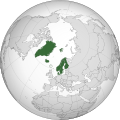


| International | |
|---|---|
| National | |
| Geographic | |
| Academics | |
| Artists | |
| People | |
| Other | |

Grokipedia
Norway
View on GrokipediaEtymology
Name Origin and Historical Usage
The name "Norway" originates from the Old Norse Norðvegr or Norvegr, translating to "northern way" or "the way leading to the north," a designation that alluded to the vital coastal shipping route along the Scandinavian peninsula's western edge, necessitated by the inland mountains and fjords that impeded overland travel. This maritime connotation highlights how early Norse seafarers conceptualized the region's geography as a navigable pathway rather than a unified territorial entity.[10][11] The term's earliest attestation occurs in the late 9th century, recorded in Old English as Norþweg in the travel account of Ohthere of Hålogaland, a Norwegian explorer whose description to King Alfred the Great around 890 AD detailed voyages northward along this route, marking the first documented external reference to the name in written sources. Subsequent Norse literature, including 12th- and 13th-century sagas and annals, employed variants such as Noregr or Norðrland, adapting the root while retaining its directional essence amid evolving orthography and poetic usage.[10] In modern Norwegian, Bokmål renders the endonym as Norge while Nynorsk uses Noreg, preserving the phonetic and semantic core of the Old Norse predecessor.[12] Among the Sámi peoples indigenous to northern Scandinavia, equivalents include Northern Sami Norga, Lule Sami Vuodna, and Southern Sami Nöörje, while Kven uses Norja; these reflect parallel linguistic evolution, maintaining continuity in denoting the same geographic expanse despite distinct cultural contexts.[11]History
Prehistory and Early Settlement
Human presence in Norway began following the retreat of the Fennoscandia Ice Sheet at the end of the last glacial period, with the earliest archaeological evidence dating to approximately 11,000 years ago during the Early Mesolithic period (c. 9500–8000 cal BC). Initial settlements were predominantly coastal, as hunter-gatherer groups exploited marine resources in fjords and archipelagos, utilizing territories freed from ice cover in a dynamic process influenced by rising sea levels and climatic warming. Sites reveal adaptations such as marine-oriented toolkits, including quartzite implements for fishing and sealing, indicating a pioneer colonization from southern Scandinavian refugia rather than direct post-glacial arrival.[13][14] Rock art provides key insights into these early societies, with the Alta petroglyphs in northern Norway representing one of the largest concentrations of prehistoric carvings in Fennoscandia, inscribed between c. 4200 BC and 500 BC. Over 5,000 figures depict scenes of hunting, trapping, and possible shamanistic rituals, executed by pecking techniques on sandstone panels exposed by post-glacial isostatic rebound, reflecting a worldview centered on animal-human interactions and seasonal mobility. Designated a UNESCO World Heritage site in 1985, these carvings demonstrate cultural continuity in Arctic hunter-gatherer practices, with stylistic phases indicating evolving symbolic expressions tied to environmental exploitation.[15][16] The Neolithic transition around 4000 BC introduced elements of agriculture and pastoralism to southern and western Norway, evidenced by pollen records showing cereal cultivation and domesticated animal remains at coastal farmsteads, though adoption was uneven due to marginal soils and climate. Megalithic structures, including dolmens and passage graves, appeared in southeast Norway, often reused over centuries and linked to communal burial practices among early farmers. Genetic analyses of Late Neolithic remains indicate influxes from Corded Ware culture-related groups bearing steppe ancestry, blending with local forager lineages to form hybrid economies, as seen in Battle Axe Culture contexts where admixed individuals practiced mixed subsistence. This period marks a shift toward sedentary patterns, with longhouses and field systems emerging by c. 3000 BC, though hunter-gathering persisted in northern interiors.[17][18][19]Bronze and Iron Ages
The Bronze Age in Norway, dated roughly from 1700 to 500 BCE, marked the adoption of bronze-working technologies alongside continued reliance on local resources like amber and hides for exchange. Archaeological evidence from burial mounds and rock art panels in regions such as western Norway reveals maritime-oriented societies engaged in long-distance trade, with motifs of ships and warriors indicating seafaring prowess and contacts extending to the Baltic and, indirectly, Mediterranean areas through intermediary networks.[20][21] Hierarchical structures emerged, as evidenced by elite burials featuring imported bronze axes, swords, and jewelry, suggesting chieftain dominance over labor and tribute systems that facilitated metal acquisition from southern Europe via overland and sea routes.[22][23] Rock art concentrations, including ship engravings at sites like those in Rogaland, underscore ritual and economic ties to maritime mobility, with over 2,000 documented panels depicting processions and vessels up to 30 figures long, likely symbolizing trade voyages or elite processions.[24] Boat-shaped stone settings around burial cairns further imply symbolic ship burials for high-status individuals, reflecting social stratification where access to exotic goods denoted power.[25] While lur horns—curved bronze instruments—are more abundant in Denmark, similar ceremonial uses may have occurred in Norwegian contexts linked to rock art rituals, though direct finds remain scarce.[26] The Iron Age, from approximately 500 BCE to 793 CE, saw the widespread adoption of iron smelting, enabled by bog iron deposits and charcoal production, which pollen analyses from southwestern Norwegian sites attribute to localized deforestation and expanded arable land during the Roman Warm Period (c. 250 BCE–400 CE).[27][28] This climatic amelioration, with temperatures 1–2°C warmer than preceding centuries, supported greater cereal cultivation (barley and oats) and pastoralism, as macrofossil evidence from farmsteads indicates intensified settlement in previously marginal fjord and coastal zones.[29] Trade networks intensified, incorporating Roman imports like glass beads, coins, and silver, with hoards exceeding 100 items found in eastern and southern Norway, signaling indirect exchange via Germanic intermediaries rather than direct imperial contact.[30][31] Social organization shifted toward more defined chieftain territories, inferred from fortified hillforts and weapon-rich graves containing iron swords and spears, which comprised up to 20% of adult male burials in some areas, hinting at competitive warfare among local leaders.[32] Early rune inscriptions on artifacts, dating from the 2nd century CE Migration Period subset of the Iron Age, record personal names and ownership, providing nascent evidence of proto-governance and lineage claims in petty chiefdoms.[33] Silver hoards, often buried in farm contexts, reflect wealth accumulation from fur, walrus ivory, and slave trade to the Roman world, with over 50 such deposits documented, peaking around 200–400 CE.[30] These patterns underscore a transition to more interconnected, resource-driven societies without centralized polities.[34]Viking Age
The Viking Age in Norway, conventionally dated from 793 to 1066 CE, involved widespread maritime raiding, trading, and colonization motivated by resource constraints and enabled by advanced shipbuilding. Norway's steep fjords and limited fertile land supported a growing population estimated to have increased due to improved agricultural techniques, exerting pressure on available resources and prompting emigration and plunder expeditions. The clinker-built longships, lightweight and shallow-drafted for beaching on coasts and navigating rivers, allowed Norsemen to strike swiftly and retreat, turning Scandinavia's seafaring expertise into a strategic advantage over land-bound European societies.[35][36][37] The period's onset is marked by the raid on Lindisfarne monastery off England's coast in 793 CE, where Norse warriors looted the site and killed monks, an event chronicled as presaging widespread incursions. Norwegian Vikings primarily targeted the British Isles and Ireland, establishing bases like Dublin around 841 CE, while also venturing to Francia. Settlements followed raids: Iceland was colonized by Norwegian chieftains fleeing Harald Fairhair's unification efforts starting in the 870s CE, with landnám records indicating over 400 farms founded by 930 CE; Erik the Red's expedition reached Greenland in 986 CE, sustaining Norse presence until the 15th century; in 911 CE, Rollo secured Normandy through a treaty with Frankish king Charles the Simple, blending Norse and Frankish elements. Genetic studies reveal Norse Y-chromosome haplogroups in up to 20-30% of modern populations in parts of Britain, Ireland, and the Scottish Isles, corroborating admixture from settlers and thralls. Trade complemented violence, with Norwegian exports of walrus ivory, furs, and slaves exchanged for Frankish silver at emporia like Hedeby and Birka.[38][39][40] Pagan Norse society gradually adopted Christianity amid external influences and royal initiatives, culminating under Olaf II Haraldsson (r. 1015–1028 CE), who imposed baptisms and destroyed heathen sites to consolidate power. Olaf's campaign faced resistance from entrenched chieftains, leading to his exile in 1028 CE and failed return; he died fighting at Stiklestad on 29 July 1030 CE against a peasant-Danish coalition, but his relics' reported miracles elevated him to sainthood, accelerating Norway's Christianization by the mid-11th century. The age's terminus is tied to Harald Hardrada's (r. 1046–1066 CE) death by arrow at the Battle of Stamford Bridge on 25 September 1066 CE, where his invasion force of some 10,000 was routed by English king Harold Godwinson, symbolizing the decline of large-scale Norse overseas aggression as feudal states strengthened defenses.[41][42][43]Medieval Kingdoms and Unions
The period following the Viking Age saw the consolidation of royal authority in Norway amid persistent internal strife. From 1130 to 1240, a series of civil wars erupted due to disputes over succession and the lack of clear primogeniture laws, involving rival claimants from factions such as the Birkebeiners and Baglers.[44] These conflicts, documented in contemporary sagas, weakened the kingdom's cohesion but culminated in the victory of Haakon IV (r. 1217–1263), who defeated his rival Skule Bårdsson in 1240, effectively ending the era of anarchy.[45] Haakon IV centralized power through administrative reforms, including the codification of laws and the establishment of a more structured royal bureaucracy, expanding Norwegian influence to include Iceland (1262) and Greenland.[45] The Black Death struck Norway in 1349, arriving via trading ships from England and Bergen, devastating the population estimated at around 350,000–400,000 beforehand. Contemporary annals reported mortality rates of up to two-thirds, though modern estimates suggest 40–50% perished, with some regions like Oslo losing nearly all inhabitants.[46] This catastrophe exacerbated economic vulnerabilities, leading to abandoned farms, labor shortages, and a decline in feudal obligations; Norway lacked widespread serfdom, but the plague accelerated the erosion of manorial dependencies and church estates, fostering greater peasant autonomy.[47] Population recovery was gradual, reaching only about 200,000–250,000 by the early 15th century, as recorded in tax rolls and ecclesiastical records, hindering centralized governance.[48] In 1397, Queen Margaret I of Denmark orchestrated the Kalmar Union, nominally uniting Denmark, Norway, and Sweden under a single monarch to counter external threats like the Hanseatic League. However, Danish dominance prevailed, with Norwegian sovereignty eroded as key decisions emanated from Copenhagen; Sweden's repeated rebellions culminated in its exit by 1523, leaving Norway subordinated within a Danish-Norwegian realm.[49] Concurrently, the Hanseatic League, a confederation of German merchants, seized control of Bergen's trade—serving as their primary trading hub in Norway, with the kontor centered at Bryggen, the historic wharf district—from the mid-14th century, monopolizing the export of stockfish from northern fisheries and restricting local Norwegian commerce through exclusive privileges granted by weakened Norwegian kings.[50] This economic dependency stifled indigenous mercantile development, with Hansa kontors dominating Bryggen wharves until the 18th century.[51] The Reformation marked a pivotal shift in 1536–1537, when King Christian III imposed Lutheranism via royal decree, dissolving the Catholic Church's autonomy in Norway. Episcopal sees were suppressed, and vast church lands—comprising up to one-third of arable territory—were confiscated by the crown, bolstering Danish royal finances amid Norway's diminished status.[52] This transition, enforced top-down without widespread popular support, integrated Norwegian ecclesiastical structures into the Danish Lutheran framework, further entrenching unionist dependencies while curtailing medieval monastic influences.[53]Early Modern Period and Danish Rule
Following the Reformation, enacted in Denmark-Norway in 1536–1537, Norway's political autonomy diminished further, with the Norwegian Council abolished and governance centralized in Copenhagen, reducing Norway to a subordinate realm reliant on Danish administration.[54] The introduction of hereditary absolutism in 1660, formalized by the King's Law of 1665, entrenched monarchical control, sidelining Norwegian institutions and treating the territory as a resource periphery for Danish interests, including timber exports and naval provisioning.[55] This structure fostered economic stagnation, as mercantilist policies channeled trade through Copenhagen monopolies, restricting Norwegian merchants and prioritizing Danish shipping lanes over local development.[56] Social controls intensified under absolutism, exemplified by widespread witch trials in the 17th century, influenced by demonological doctrines from European handbooks; in Finnmark alone, 135 individuals—primarily women—faced prosecution between 1593 and 1695, with executions peaking during the Vardø trials of 1662–1663, where 91 were burned at the stake amid accusations of pacts with the Devil and sabbaths.[57] These persecutions, driven by clerical and judicial zeal in remote northern districts, reflected broader efforts to enforce Lutheran orthodoxy against perceived pagan remnants.[58] Denmark-Norway's involvement in protracted conflicts, notably the Great Northern War (1700–1721), strained Norwegian resources; allied against Sweden, Danish forces withdrew early, leaving Norway vulnerable to Swedish invasions in 1716–1718 that devastated border regions, destroyed farms, and imposed heavy levies without territorial concessions but exacerbating rural poverty.[59] Population nonetheless expanded from around 400,000 in the mid-17th century to approximately 883,000 by 1801, fueled by high birth rates amid rudimentary agriculture, though recurrent crises like the 1740–1743 famine—triggered by harsh winters and crop failures—claimed thousands through starvation and disease, prompting reliance on wild foods such as bistorta roots for survival.[60][61] Intellectual influences from the Enlightenment penetrated unevenly, hampered by absolutist censorship that suppressed dissenting publications until a brief interlude of press freedom from 1770–1773 under Johann Friedrich Struensee, which unleashed critical pamphlets but ended with his execution and restored controls.[62] Parallel policies targeted the Sámi, with Danish-Norwegian missionaries enforcing Christianization from the 17th century onward through church decrees and itinerant priests, prohibiting shamanic practices like noaidi rituals and promoting Lutheran conversion to integrate northern indigenous groups into the realm's religious framework, often via coercive taxation and settlement restrictions.[63] These measures laid groundwork for cultural assimilation, prioritizing state unity over indigenous traditions.Nineteenth-Century Nationalism and Unions
Following the Treaty of Kiel on January 14, 1814, which ceded Norway from Denmark to Sweden after the Napoleonic Wars, Prince Christian Frederik, viceroy of Norway and Danish prince, convened Norwegian leaders at Eidsvoll to draft a constitution, organizing the constituent assembly and being elected king on May 17, 1814, the day it was adopted; his actions asserted Norwegian sovereignty, complicating Sweden's immediate enforcement of the treaty by establishing a constitutional monarchy before Swedish recognition.[64] This document established a constitutional monarchy with principles of popular sovereignty, participatory democracy, and individual rights, drawing inspiration from the United States Constitution and French revolutionary ideals.[65] It limited monarchical powers, including veto rights subject to parliamentary override, and prioritized Norwegian autonomy despite the imposed personal union with Sweden under King Charles XIII, elected on November 4, 1814.[4] Sweden recognized the constitution but retained influence over foreign affairs, creating ongoing tensions. Nineteenth-century Norwegian nationalism surged through cultural revival, emphasizing folklore, language standardization, and historical myths to foster national identity separate from Danish and Swedish dominance. Intellectuals promoted the use of Landsmål (later Nynorsk) alongside Riksmål to preserve rural dialects against urban Danish-influenced Norwegian, while artists and historians romanticized Viking heritage and medieval sagas.[66] This movement intertwined with political demands for equality in the union, such as separate consulates and a unified national flag, culminating in parliamentary conflicts over consular services in the 1890s. Economic developments bolstered nationalist sentiments, with shipping emerging as a pillar of growth; by the late nineteenth century, Norwegian merchant fleets ranked among the world's largest, facilitating exports of timber, fish, and ore.[67] Early hydropower utilization began in the 1880s, powering nascent industries like electrochemical production, though full industrialization accelerated post-1900.[68] Land scarcity and overpopulation in rural areas drove massive emigration, with approximately 800,000 Norwegians departing for the United States between 1825 and 1925, seeking arable land and economic opportunity amid limited domestic inheritance systems.[69] This exodus, peaking after the 1860s, reflected structural agrarian constraints rather than acute poverty. Parliamentary struggles intensified in the union era, as the Storting asserted control over domestic policy, fostering a labor movement amid urbanization and industrial shifts.[70] Women's suffrage advocates, organized through groups like the Norwegian Association for Women's Rights, secured universal voting rights on June 11, 1913, after decades of campaigning that aligned with broader democratic reforms.[71] The crisis peaked in 1905 when the Storting unilaterally dissolved the union on June 7, confirmed by a referendum yielding 368,208 votes in favor and only 184 against, achieving near-unanimous approval.[72] Sweden, facing mobilization risks but prioritizing peace, negotiated amicable separation on October 27, 1905, allowing Norway to elect Prince Carl of Denmark as King Haakon VII.[64]World Wars and Occupation
with Adolf Hitler and Albert Viljam Hagelin, February 13, 1942](./assets/Albert_Viljam_Hagelin_with_Adolf_Hitler_and_Vidkun_Quisling%252C_13_February_1942.png) Norway upheld neutrality during World War I, leveraging its extensive merchant fleet to profit from Allied and Central Powers' trade demands, yet incurred heavy losses from German U-boat attacks, totaling about 1.3 million tons of shipping sunk and 11,050 seamen killed.[73][74] These vulnerabilities highlighted Norway's exposed maritime position despite formal non-alignment. In the interwar era, the nation grappled with economic downturns exacerbated by the Great Depression, featuring stagnant growth and elevated unemployment, though recovery efforts included fiscal expansions under emerging Labour policies.[75] World War II shattered Norway's neutrality ambitions when Germany launched Operation Weserübung on April 9, 1940, targeting key ports like Narvik and Oslo to safeguard Swedish iron ore shipments and establish Atlantic naval footholds amid fears of Allied preemption.[76] Norwegian forces, though outnumbered, delayed the invaders at sites such as Oslofjord, where coastal defenses sank the German cruiser Blücher, but organized resistance collapsed by early June after Allied expeditions faltered. King Haakon VII and Prime Minister Johan Nygaardsvold's cabinet rejected Nazi demands for capitulation, fleeing north and ultimately establishing a government-in-exile in London on June 7, 1940, to coordinate Free Norwegian Forces and maintain legal continuity.[77][76] Vidkun Quisling, head of the pro-Nazi Nasjonal Samling party, seized the invasion's chaos to declare himself prime minister on April 9, 1940, in a bid for power that initially faltered due to public repudiation and German hesitance; full puppet authority came only on February 1, 1942, under Reichskommissar Josef Terboven's oversight, enforcing collaborationist policies including forced labor and suppression of dissent.[78] Underground resistance, primarily through the Milorg network linked to the exile government, executed intelligence gathering, strikes, and targeted sabotage, most notably the February 1943 Operation Gunnerside at Vemork, led by Joachim Rønneberg, where Norwegian commandos destroyed 500 kilograms of heavy water, severely impeding German atomic weapon development by eliminating a critical deuterium source.[79] Germany's capitulation on May 8, 1945, enabled swift liberation via Operation Doomsday, with British forces aiding Norwegian troops in disarming 400,000 German personnel while avoiding widespread combat; infrastructure damage remained limited relative to continental occupations, though approximately 10,000 Norwegians perished, including 2,000 military personnel and over 7,000 civilians from executions, deportations, and privations.[80] The ensuing legal purge prosecuted over 90,000 collaborators, culminating in Quisling's treason trial and execution by firing squad on October 24, 1945, which defined high treason precedents under Norwegian law, emphasizing accountability for aiding the occupier against national sovereignty.[78]Post-War Reconstruction and Oil Discovery
Following the German occupation ending in May 1945, Norway faced significant infrastructure damage and economic disruption, with industrial capacity reduced by approximately 40% in key sectors. The Labour Party-led government, under Prime Minister Einar Gerhardsen, implemented social democratic policies emphasizing state-coordinated reconstruction, including national planning for housing, electrification, and industrialization to achieve self-sufficiency. These efforts were bolstered by Marshall Plan aid, totaling around 2.5 billion Norwegian kroner (equivalent to roughly $500 million in contemporary U.S. dollars), which facilitated imports of machinery and raw materials, enabling gross national product recovery to pre-war levels by 1950.[81] Despite a historical tradition of neutrality, Norway joined NATO on April 4, 1949, motivated by perceived Soviet threats in the Arctic and Baltic regions, as Western allies sought to prevent communist influence in Scandinavia.[82] The discovery of the Ekofisk oil field in December 1969 by Phillips Petroleum marked a pivotal shift, confirming vast reserves on the Norwegian Continental Shelf and initiating offshore production in 1971. State intervention played a central role, with the government establishing a 50-50 licensing regime requiring foreign firms to share technology and creating Statoil (now Equinor) in 1972 as a national oil company to secure domestic control over revenues, averting full privatization. This policy framework channeled oil rents into public coffers, contributing decisively to economic expansion; petroleum activities accounted for up to 25% of GDP by the late 1970s and drove annual growth rates averaging over 3% through the decade, transforming Norway from a net importer to a major exporter.[83][84] However, the 1970s oil boom exacerbated inflationary pressures through wage-price spirals, fueled by strong unions negotiating rapid pay hikes amid rising energy prices, pushing inflation above 10% annually by mid-decade. Resolution came via coordinated wage settlements, temporary price controls, and a shift toward stricter monetary policy in the early 1980s, which curbed excesses without full adoption of monetarist orthodoxy. To manage windfall gains prudently, the Government Pension Fund Global was established in 1990, investing surplus revenues abroad to mitigate Dutch disease effects on non-oil sectors; by mid-2025, its value exceeded 20 trillion Norwegian kroner (approximately $1.9 trillion USD).[8][85] While state oversight of the fund has preserved wealth across generations, critics argue it reflects resource luck more than superior intervention, with high taxation and regulatory burdens potentially hindering diversification beyond hydrocarbons.[86] Norway rejected full European Economic Community (later EU) membership in referendums in 1972 (53.5% against) and 1994 (52.2% against), prioritizing sovereignty over fisheries and oil resources, while joining the European Economic Area in 1994 for market access without deeper integration. As oil fields mature, mainland GDP growth has moderated, with projections for 2025 at around 1.5%, supported by fiscal stimulus but constrained by global energy transitions and domestic productivity challenges.[87][88]Geography
Physical Features and Terrain
Norway covers a total land area of approximately 385,207 square kilometers, including the mainland and overseas dependencies Svalbard and Jan Mayen, with the mainland alone spanning 323,802 square kilometers.[1] Roughly 70 percent of the terrain consists of mountains and fjords, dominated by the Scandinavian Mountains (Scandes), which form a rugged spine along the country's eastern and central regions, rising to peaks exceeding 2,000 meters in elevation.[89] Norway's geography features several extremes that illustrate its dramatic natural conditions and shape national identity, settlement patterns, climate variation, outdoor culture, and economic activities such as hydropower and tourism. Metrics like the height of its highest mountain and the scale of its fjords and glaciers provide concrete reference points for the mountainous terrain, extensive glaciation, and fjord-dominated coastline.[90]| Extreme | Location | Measurement |
|---|---|---|
| Highest mountain | Galdhøpiggen | 2,469 m above sea level |
| Second-highest mountain | Glittertind | 2,465 m (including glacier; ~2,452 m rock height) |
| Longest fjord | Sognefjord | 205 km long |
| Deepest fjord | Sognefjord | 1,308 m deep |
| Highest waterfall | Vinnufossen | 865 m total drop |
| Largest glacier (mainland Europe) | Jostedalsbreen | 487 km² area |
| Longest river | Glomma River | 621 km |
| Northernmost town | Hammerfest | 70°39′ N latitude |
| Southernmost point (mainland) | Lindesnes Lighthouse | 57°59′ N latitude |
| Northernmost point (mainland Europe) | Nordkapp | 71°10′ N latitude |
Climate Patterns
Norway's climate spans temperate oceanic conditions in the south and west to subarctic in the north and interior highlands, with the Norwegian Current—an extension of the Gulf Stream—transporting warm Atlantic waters northward to moderate coastal temperatures, preventing widespread sea ice formation despite high latitudes.[98][99] This oceanic influence results in milder winters along the western fjords compared to continental interiors at similar latitudes, where temperatures drop more sharply due to radiative cooling and elevation.[100] Meteorological records from stations like those operated by the Norwegian Meteorological Institute (MET Norway) document annual variability tied to atmospheric patterns, including the North Atlantic Oscillation (NAO), which modulates westerly winds and storm tracks, leading to wetter, milder phases during positive NAO indices. In Oslo, representative of southeastern continental influences, mean January temperatures average around -2°C, rising to about 17°C in July, based on long-term observations from 1961–1990 standardized data, with diurnal ranges widening inland due to less maritime moderation.[101] Recent winters, such as 2024–2025, have shown mild anomalies; MET Norway classified January 2025 as "normal, mild" in eastern regions, with temperatures above seasonal norms amid positive NAO influences, contributing to reduced snowfall in lowlands.[102] Precipitation exhibits sharp east-west gradients, exceeding 2,000 mm annually on the exposed western coast—reaching over 3,000 mm in Vestland county due to orographic lift from prevailing southwesterlies—while eastern interiors receive under 800 mm, fostering drier continental conditions.[103][104] Northern regions like Finnmark feature discontinuous permafrost in peat plateaus and palsas, where ground temperatures remain below 0°C for two or more years, as monitored at sites such as Iškoras (591 m elevation), influencing local hydrology and vegetation but thawing variably with air temperature cycles. In northern Norway, the midnight sun means the sun does not set for up to two months in summer.[105][106] Ice-core proxies from Svalbard and northern Norway reveal historical variability, including warmer winter surface air temperatures during the Medieval Warm Period (circa 950–1250 CE), reconstructed from oxygen isotopes showing anomalies up to 1–2°C above subsequent means, prior to cooler Little Ice Age conditions.[107] Observed climate patterns in Norway reflect decadal oscillations rather than monotonic trends, with the NAO driving interannual fluctuations in sea surface temperatures and plankton productivity in the Norwegian Sea, which in turn affect cod and herring fisheries recruitment—positive NAO phases correlating with stronger westerly inflows and higher biological productivity.[108] Solar cycles, with 11-year periodicity, exert subtle influences on North Atlantic atmospheric circulation, modulating NAO-like patterns and contributing to multi-decadal temperature variances evident in instrumental records from MET stations since the 19th century.[109] These natural forcings underscore cyclical variability, as precipitation totals rose about 20% from 1900 to 2022 but with pronounced wet/dry episodes tied to circulation shifts rather than uniform progression.Biodiversity and Environmental Management
Norway hosts approximately 60,000 species, encompassing a diverse array of flora and fauna adapted to its varied terrains, including large mammals such as moose (Alces alces) and reindeer (Rangifer tarandus), the latter integral to indigenous Sami pastoralism. Fjord ecosystems support rich marine biodiversity, with species like Atlantic salmon (Salmo salar) and various seabirds, though these habitats face pressures from aquaculture expansion. Forests, covering about 37% of the land area, harbor around two-thirds of the nation's species, functioning as a significant carbon sink that sequesters CO₂ equivalent to roughly half of Norway's annual greenhouse gas emissions.[110][111][112] Conservation efforts designate 17% of mainland Norway as protected areas, including national parks and nature reserves, aimed at preserving habitats amid historical land-use intensification. The Sami Parliament advocates for reindeer herding rights within designated areas, where only Sami individuals with familial ties to the practice may obtain earmarks, though competing land uses like wind farms have led to legal challenges affirming cultural protections under international law. These measures have stabilized some populations, yet empirical data indicate over 2,700 species remain threatened, prompting prioritization of habitat restoration.[113][114][115] In Svalbard, polar bears outnumber humans in parts of the archipelago, where it is required by law to carry firearms or suitable deterrents outside settlements for protection against encounters.[116] Norway leads global Atlantic salmon aquaculture production, but escaped farmed fish—numbering 1.73 million reported incidents from 2011 to 2021—have caused genetic introgression in wild stocks, affecting 71% of rivers and reducing fitness through hybridization. Management responses include triploidy trials to induce sterility, yet efficacy remains debated due to incomplete containment and ecological ripple effects on fjord food webs. Commercial whaling persists under national quotas, with 2025 allocations increased despite international moratorium objections and ethical critiques over hunt humaneness, as domestic meat demand stagnates.[117][118][119] Forest management balances biodiversity mandates with timber harvesting, where regulations limit clear-cutting to sustain old-growth habitats, though some analyses highlight potential over-restriction constraining economic output without proportional ecological gains. Empirical assessments confirm net carbon uptake persists despite logging, underscoring sustainable yield models' viability, but bureaucratic hurdles have slowed adaptive practices in peripheral regions.[120][121]Government and Politics
Constitutional Monarchy and Institutions
Norway operates under the Constitution of 1814, which establishes a framework of limited hereditary monarchy dividing sovereignty among the legislative, executive, and judicial branches to balance popular rule with institutional restraints.[122] The document, adopted on 17 May 1814 amid separation from Denmark, affirms the kingdom as "free, independent, indivisible and inalienable" with executive power vested in the monarch, legislative authority in the Storting, and judicial independence to prevent arbitrary governance.[123] This structure privileges causal stability over unchecked majoritarianism, as evidenced by provisions allowing parliamentary override of royal vetoes only after repeated passage, a mechanism rarely invoked historically.[124] The monarchy remains hereditary, descending through the male line of the House of Glücksburg, with King Harald V holding the throne since 17 January 1991 upon the death of his father, Olav V.[125] The key members of the Royal House, central to the hereditary succession, include HM Queen Sonja as consort; HRH Crown Prince Haakon, the king's son and heir apparent; HRH Crown Princess Mette-Marit; and HRH Princess Ingrid Alexandra, Crown Prince Haakon's daughter and next in line after him. Other members comprise HH Prince Sverre Magnus, Crown Prince Haakon's son, and HH Princess Märtha Louise, the king's daughter.[126] The king's role is now largely ceremonial, encompassing formal duties like appointing the prime minister based on Storting confidence and sanctioning laws, but real executive direction resides with the Council of State led by the prime minister.[127] Jonas Gahr Støre, of the Labour Party, has served as prime minister since 14 October 2021, heading a minority center-left coalition reliant on ad hoc parliamentary support.[128] The royal veto power, while theoretically available under Article 79, has not been exercised in modern practice; overrides, requiring the Storting to repass bills twice, underscore parliamentary primacy while empirically deterring hasty legislation through the prospect of monarchical delay.[129] Legislative power centers on the Storting, a unicameral body of 169 members elected every four years via proportional representation across 19 multi-member constituencies, a system formalized in the late 19th century to reflect diverse electoral strengths.[130] This setup, rooted in the 1814 Constitution's indirect election origins but evolved to direct list-based voting, ensures broad representation while subjecting governments to frequent confidence tests.[131] Judicial independence, mandated by Article 95, forms a key check, with the Supreme Court (Høyesterett) established on 30 June 1815 as the apex tribunal to adjudicate constitutional matters and review executive acts.[132] Comprising 20 justices appointed for life, the court operates without legislative interference, upholding rule-of-law principles amid Norway's empirically low corruption environment—tied for fifth globally at 81 points on the 2024 Corruption Perceptions Index.[133] Such rankings reflect systemic transparency, with rare veto-related disputes and judicial precedents reinforcing the 1814 framework's resilience against democratic excesses.[134]Executive and Legislative Branches
The executive power in Norway is exercised by the Council of State, comprising the Prime Minister and ministers, with the monarch serving in a ceremonial role. The Prime Minister, currently Jonas Gahr Støre of the Labour Party, is formally appointed by the King but must command the confidence of the Storting to govern; following the September 8, 2025, parliamentary election, Støre leads a minority Labour government after his party secured the largest share of votes amid a surge in support for right-wing parties emphasizing immigration restrictions. Coalition or minority cabinets predominate due to the fragmented multiparty system, where no single party has achieved an absolute majority since 1961, necessitating negotiations for legislative support; the government's veto authority over bills is constrained, as the Storting can override royal assent withholdings with a subsequent simple majority vote. Previous prime ministers include Einar Gerhardsen of the Labour Party, who served multiple terms from 1945 to 1965 shaping post-war Norway;[135] Gro Harlem Brundtland, also Labour, with three non-consecutive terms in the 1980s and 1990s;[136] and Jens Stoltenberg of the Labour Party, who served from 17 March 2000 to 19 October 2001 and from 17 October 2005 to 16 October 2013.[122][137][138][139] The legislative branch centers on the Storting, a unicameral parliament of 169 members elected every four years through proportional representation across 19 multi-member constituencies, with seats allocated by the modified Sainte-Laguë method to favor larger parties while enabling smaller ones to gain representation. The September 2025 election reinforced multiparty dynamics, with the center-left bloc led by Labour obtaining around 89 seats for a slim majority, yet compelling reliance on ad hoc alliances; this follows patterns seen in prior contests, such as the 2021 vote where right-leaning parties like the Progress Party amplified calls for tighter immigration controls, contributing to policy shifts toward stricter asylum rules despite center-left governance. Fiscal discipline is embedded via Storting-mandated rules for the Government Pension Fund Global, limiting annual withdrawals to approximately 3% of its value to sustain long-term intergenerational equity amid oil revenue volatility.[130][140][137] Accountability mechanisms include the Parliamentary Ombudsman for Public Administration (Sivilombudet), appointed by the Storting for a four-year term to scrutinize executive decisions and ensure compliance with legal standards in citizen interactions with bureaucracy. While this institution handles thousands of complaints annually to curb maladministration, observers have noted instances of regulatory expansion—such as in environmental and welfare mandates—prompting debates over bureaucratic discretion encroaching on private enterprise and local autonomy, though empirical data on systemic overreach remains limited compared to peer nations.[141][142]Administrative Structure and Local Governance
Norway's mainland is administratively divided into 15 counties (fylker) and 357 municipalities (kommuner) as of January 1, 2024, following partial reversals of the 2017–2020 regional reforms that initially consolidated counties from 19 to 11 before restoring some traditional divisions.[143] Counties manage regional responsibilities such as secondary education, public transport, cultural heritage, and regional development planning, while municipalities handle core local services including primary and lower secondary education, primary health care, social welfare, and infrastructure maintenance. This two-tier structure promotes decentralized decision-making, with municipalities enjoying significant autonomy in budgeting and service delivery, subject to national standards enforced through legislation like the Local Government Act of 1992. Local governments derive approximately 56 percent of their revenues from own sources such as income and property taxes, supplemented by user fees, with the balance from central government transfers including general-purpose grants for fiscal equalization and earmarked grants for specific priorities like education and health.[144] The equalization system, revised periodically, allocates funds based on demographic and economic factors to mitigate disparities, ensuring smaller or rural municipalities can maintain comparable service levels to urban ones; for instance, general grants constituted about 31 percent of municipal revenues in recent assessments, adjustable via parliamentary budgets.[145] This fiscal federalism underscores Norway's commitment to subsidiarity, though debates persist on over-reliance on transfers potentially eroding local incentives for efficiency.[146] Special administrative arrangements govern indigenous and overseas territories. The Sámi Parliament (Sámediggi), established by the Sámi Act of 1987 and operational since 1989, functions as an elected advisory body representing Sámi interests across cultural, linguistic, and land rights issues, seated in Karasjok; it lacks binding authority but influences policy through consultations on matters like reindeer herding and environmental impacts in Sápmi. Discussions on enhancing its role highlight tensions between greater cultural autonomy—such as expanded veto rights on resource extraction—and Norway's unitary integration framework, with critics arguing advisory status limits effective self-determination while supporters emphasize its role in avoiding separatist fragmentation.[147] Svalbard, an archipelago north of mainland Norway, falls under Norwegian sovereignty per the 1920 Svalbard Treaty, which demilitarizes the area, bans war-related activities, and ensures equal economic access for citizens of signatory states; administration is vested in the Governor of Svalbard (sysselmester), appointed by the central government, overseeing civil matters, environmental protection, and research without full local elective bodies.[148] Norway's uninhabited dependencies—Bouvet Island, Peter I Island, and the Queen Maud Land Antarctic claim—are regulated under the 1930 Dependency Act and administered by the Norwegian Polar Institute within the Ministry of Justice and Public Security, focusing on scientific stations, conservation, and international treaty compliance rather than local governance structures.[149]Foreign Relations and Security Policy
Norway maintains a network of approximately 90 diplomatic missions worldwide, including embassies, consulates, and representative offices, to advance foreign policy objectives and safeguard national interests.[150] Norway joined the North Atlantic Treaty Organization (NATO) as a founding member on April 4, 1949, committing to collective defense under Article 5 of the treaty, which stipulates that an armed attack against one member is considered an attack against all. Jens Stoltenberg, a former Norwegian Prime Minister, served as NATO Secretary General from 2014 to 2024.[82][151] This alliance membership marked a departure from Norway's traditional policy of neutrality, prioritizing integration with Western security structures amid Cold War threats from the Soviet Union.[152] Norway acceded to the European Economic Area (EEA) on January 1, 1994, enabling access to the European Union's single market without adopting the euro or full EU political integration, following a national referendum that rejected EU membership by 52.2% to 47.8%.[153] As a longstanding contributor to United Nations peacekeeping operations since 1956, Norway has deployed personnel to missions worldwide, including 43 uniformed personnel across six operations as of 2023, emphasizing multilateral conflict resolution and stabilization efforts.[154] Norway is a leading provider of official development assistance (ODA), allocating approximately 1% of its gross national income (GNI) to aid—exceeding the OECD target of 0.7%—channeled through agencies like the Norwegian Agency for Development Cooperation (Norad) and partnerships with the United Nations for humanitarian relief, climate initiatives, peacebuilding, and bilateral cooperation, which supports its diplomatic presence in developing countries.[155][156] In response to Russia's invasion of Ukraine beginning February 24, 2022, Norway has provided substantial bilateral and multilateral aid, totaling over NOK 141.6 billion (approximately $13 billion USD) by mid-2025, encompassing military equipment, financial support, and energy infrastructure assistance channeled through NATO and EU frameworks.[157] This includes NOK 84.9 billion allocated for 2025 alone, reflecting a more than doubling of annual commitments to bolster Ukraine's defense capabilities and deter Russian aggression.[158] Norway maintains historically cooperative ties with Israel, notably facilitating the 1993 Oslo Accords, but relations have deteriorated since October 7, 2023, due to Norway's recognition of Palestine as a state in May 2024 and divestments from over 20 Israeli companies by its sovereign wealth fund amid the Gaza conflict.[159] With China, tensions have escalated over cybersecurity incidents, including a 2021 attribution of a cyberattack on Norway's parliament to actors in China, alongside restrictions on Huawei equipment in 5G networks citing national security risks, despite ongoing technological research collaborations.[160] Norway's security policy emphasizes the High North as a strategic priority, with the August 2025 strategy "Norway in the High North – Arctic Policy for a New Reality" underscoring adherence to the United Nations Convention on the Law of the Sea (UNCLOS) for maritime jurisdiction and resource rights, while enhancing deterrence against Russian militarization along shared borders.[161] This approach integrates NATO reinforcements and abandons peacetime restrictions on foreign bases in northern regions, debunking lingering notions of Norwegian neutrality—which were effectively abandoned upon NATO accession in 1949—amid Russia's invasion of Ukraine and hybrid threats in the Arctic.[162] The policy balances reassurance through bilateral fisheries agreements with Russia against heightened surveillance and allied exercises to prevent escalation.[163]Military Capabilities and Defense Strategy
Norway maintains a modern, technology-intensive military force integrated within NATO frameworks, emphasizing deterrence in the High North and maritime domains. The Norwegian Armed Forces consist of approximately 25,000 active personnel, supplemented by conscription that yields around 9,000-10,000 annual recruits and a reserve of about 45,000.[164][165] Defense expenditures reached 2.2% of GDP in 2024, exceeding NATO's 2% guideline originally met in the 2010s, with projections for 2.16% in 2025 amid plans to allocate up to 5% including broader security investments driven by regional threats.[166][167] Conscription, mandatory since 2015 for both genders in a gender-neutral system—the first such in NATO—ensures a broad pool of trained personnel, with about one-third of conscripts now female.[168][169] This policy supports operational flexibility but has drawn critiques for potential mismatches in physical demands across roles, though empirical data shows sustained recruitment without significant readiness drops. The Army fields around 15,000 personnel focused on mechanized infantry and artillery, while the Air Force operates a fleet of 52 F-35A Lightning II stealth fighters, fully delivered by April 2025, enhancing multi-role capabilities including Arctic surveillance.[170][171] Naval assets prioritize anti-submarine warfare (ASW) for Arctic deterrence, with five Fridtjof Nansen-class frigates and six Ula-class submarines operational as of 2025, the latter undergoing replacement planning. In August 2025, Norway selected five British Type 26 ASW frigates in a $13.5 billion deal, aiming for a joint UK-Norway fleet of 13 such vessels by the 2030s to counter submarine threats under ice.[172][173] Strategy centers on high-readiness forces per NATO metrics, with emphasis on rapid mobilization and interoperability; annual exercises like Joint Viking 2025, involving 10,000 troops including U.S. forces, test cold-weather operations in northern Norway.[174] Historically, Norway rejected Cold War-era proposals for nuclear alternatives, including storage of U.S. weapons (Alternative B policy), opting instead for conventional deterrence under NATO's extended umbrella without hosting atomic assets.[175] While technologically advanced, the forces exhibit limited recent combat experience beyond small-scale Afghanistan deployments (2001-2020), relying on simulations for readiness; critiques highlight structural inefficiencies, such as a top-heavy command diverting resources from frontline capabilities, compounded by pre-2022 underinvestment tied to expansive welfare priorities that prioritized social spending over sustained military scaling.[176] NATO evaluations affirm high equipment modernity but note ongoing needs for personnel depth amid these opportunity costs.[177]Economy
Economic Structure and Performance
Norway's economy is characterized by a high-income mixed model, with a nominal GDP of $504.3 billion in 2024 and a per capita GDP of approximately $89,000, placing it among the world's wealthiest nations on a purchasing power basis. The International Monetary Fund projects continued strength, while the OECD forecasts mainland GDP growth of 1.7% in 2025, driven by solid household disposable income supporting private consumption amid moderating inflation.[178] This structure reflects a blend of market mechanisms and state intervention, including substantial public ownership in key sectors, though the Heritage Foundation rates it as "mostly free" with a score of 78.3 out of 100 in 2024, highlighting strong property rights and judicial effectiveness offset by regulatory burdens.[179] GDP composition shows services contributing around 52% of value added, industry (including manufacturing and extractives) approximately 30%, and agriculture under 2%, though employment is heavily skewed toward services at over 78%.[180] Norway's principal regulated securities market is the Euronext Oslo Børs, which facilitates trading of equities, bonds, and other instruments for major companies particularly in the energy, shipping, and seafood sectors.[181] As of January 2026, its market capitalization was approximately $463 billion.[182] Oil and gas, while comprising about 20-25% of GDP, dominate exports at roughly 61% of total value in 2024, underscoring vulnerability to commodity price fluctuations despite diversification efforts in fisheries, shipping, and technology.[183] Unemployment remains low at around 4% in 2024, reflecting labor market flexibility and high participation rates, with the rate averaging 3.97% annually.[184] The economy demonstrated resilience following the COVID-19 downturn, rebounding swiftly due to fiscal buffers from the sovereign wealth fund and supportive monetary policy, which limited output gaps and supported recovery without excessive debt accumulation.[185] Household saving rates rose to 9.4% in early 2025 from prior levels, bolstering financial stability amid interest rate normalization, though challenges persist from global energy transitions and domestic cost pressures.[186]Natural Resources and Energy Sector
Norway's natural resources are dominated by petroleum deposits in the North Sea and Barents Sea, alongside substantial hydropower potential, which have underpinned the country's economic expansion since the late 1960s.[183] The discovery of oil at the Ekofisk field in 1969 marked the onset of extraction, with first production commencing in 1971, transforming Norway from a modest fishing and shipping economy into a high-income petroleum exporter.[83] Empirical analysis attributes the bulk of Norway's GDP growth from the 1970s to the 2000s to petroleum revenues, which financed infrastructure, industrialization, and welfare expansion, with oil and gas accounting for over 20% of GDP at peaks and driving real GDP per capita increases exceeding 150% in that period.[83][75] Oil production peaked in 2001 at 3.4 million barrels of oil equivalents per day (including crude, NGL, and condensate), but has since declined due to maturing fields, reaching approximately 1.96 million barrels per day of crude in July 2025.[183][187] The state holds a 67% ownership stake in Equinor ASA, the primary operator, which manages most offshore developments and emphasizes efficient recovery from aging reservoirs.[188] Exploration persists in the Barents Sea, where Equinor ASA announced a gas discovery estimated at 0.3-0.5 billion standard cubic meters recoverable in July 2025, amid ongoing licensing rounds offering additional blocks south of 74°30' N latitude.[189][190] Natural gas production has offset oil declines, with Norway exporting 117.6 billion cubic meters in 2024—equivalent to over 30% of EU and UK gas consumption—positioning it as Europe's largest supplier and the world's third-largest gas exporter.[191][183] Hydropower constitutes the backbone of Norway's electricity sector, generating approximately 89% of total output in 2024 from over 1,600 plants harnessing fjords, rivers, and glacial melt, with the remainder from wind and minor thermal sources, yielding nearly 100% renewable electricity.[192] Petroleum revenues have enabled investments in energy diversification, including offshore wind; in 2025, Norway's inaugural floating wind tender for the Utsira Nord sites received bids from two consortia for up to 1 gigawatt capacity, with awards planned for 2026.[193] Despite such initiatives, fossil fuel extraction remains central, with critiques from environmental groups highlighting Barents Sea drilling's potential ecological risks, though government assessments prioritize economic viability and technological safeguards over cessation.[194][190]Sovereign Wealth Management
The Government Pension Fund Global (GPFG), commonly known as the Oil Fund, was established in 1990 to invest surplus revenues from Norway's petroleum sector, aiming to preserve wealth for future generations while insulating the domestic economy from oil price fluctuations.[8] As of October 2025, the fund's assets under management exceeded $2 trillion USD, representing ownership stakes in over 9,000 companies across more than 70 countries and equating to roughly 1.5% of global listed equities.[195] Managed by Norges Bank Investment Management (NBIM), the fund's strategy emphasizes broad global diversification to achieve the highest possible long-term returns with acceptable risk, benchmarked against a strategic index.[196] NBIM operates as a specialized unit within Norges Bank, Norway's central bank established in 1816 and headquartered in Oslo, which is responsible for monetary policy, financial stability, and managing foreign exchange reserves; its Executive Board provides oversight, with Ida Wolden Bache serving as Governor since 2022.[197] Norway's fiscal rule, introduced in 2001, limits annual government withdrawals to the expected real return on the fund, calibrated at approximately 3% of its value to sustain intergenerational equity without depleting principal.[198] This cap on the structural non-oil budget deficit has enabled the fund to buffer economic downturns, such as recessions, by providing fiscal space without drawing down capital excessively; for instance, diversification across asset classes helped mitigate losses during market volatility.[199] The fund's asset allocation as of mid-2025 comprised about 70.6% equities, 27.1% fixed income, and 1.9% unlisted real estate, reflecting a tilt toward higher-return equities over time amid low bond yields.[195] Since inception in 1998, the GPFG has delivered an annualized real return of 6.44%, slightly outperforming its benchmark by 0.25 percentage points through active management and broad exposure.[200] Ethical guidelines, enforced since 2004, mandate exclusions for companies deriving significant revenue from tobacco production, coal mining (over 30% of sales), or weapons violating humanitarian norms, as well as those implicated in severe human rights abuses or corruption; the Council on Ethics advises NBIM on such decisions, leading to divestments like recent exclusions of firms tied to Israeli settlements.[201] While proponents argue these screens align investments with societal values, critics contend they impose inconsistent or politically driven restrictions—such as bans on defensive armaments amid rising geopolitical threats—that could forgo returns, though empirical analyses indicate minimal long-term performance drag, with some exclusions even correlating to outperformance elsewhere.[202][203] Governance operates through a delegated structure: the Ministry of Finance sets the investment mandate, Norges Bank's Executive Board provides oversight, and NBIM executes operations with arm's-length independence to prioritize returns over short-term political influence.[204] Risks include prolonged low interest rates eroding fixed-income yields, which have prompted gradual shifts toward equities, and over-reliance on diversification mandates that, while reducing volatility, expose the fund to global fragmentation or correlated downturns without fully eliminating drawdowns.[205][206]Labor Market and Welfare Economics
Norway's labor market features high union density, with approximately 50% of employees belonging to trade unions, a figure that has remained stable over the past decade despite broader Nordic declines.[207] [208] Collective bargaining covers most workers through industry-level agreements, contributing to low unemployment rates around 3.9% in late 2024 and an employment rate of about 69%.[209] [210] Labor force participation stands at roughly 72% for the working-age population, supported by policies promoting female workforce entry, though average annual hours worked per employee are low at around 1,407, below the OECD average of 1,736.[211] [212] Gender representation requirements mandate at least 40% of each sex on corporate boards of public limited companies, a quota enacted in 2003 and fully implemented by 2008, extending in 2023 to larger private firms with rules allowing up to 60% of one gender only for boards of nine or more members.[213] [214] Sick leave policies provide full wage replacement from day one for up to 52 weeks, but rates have risen steadily, prompting 2025 reforms including restrictions on hiring temporary workers from staffing agencies to fill long-term absences and enhanced employer follow-up duties to curb abuse.[215] [216] These measures aim to reduce sickness absence, which exceeds OECD norms, by tightening eligibility and promoting partial work capacity.[217] The welfare system delivers universal healthcare, free education through tertiary levels, and income transfers, with public social spending encompassing pensions and health at about 25% of GDP, including 10.4% for health alone.[218] Pensions, primarily public with mandatory occupational supplements, face pressure from demographic shifts, as the population aged 65+ is projected to double by 2075, potentially straining replacement rates despite 2011 reforms linking benefits to life expectancy.[219] Labour productivity remains high, with GDP per hour worked at $162 in recent estimates, among the top globally, reflecting efficient capital use in resource sectors despite shorter hours.[220] Critiques highlight that generous benefits, such as 100% sick pay and high replacement rates in unemployment insurance, may erode work incentives by reducing the financial penalty for non-employment, evidenced by studies showing increased social assistance uptake following benefit expansions and lower labor engagement among recipients.[221] [222] Analyses from bodies like the OECD argue for recalibrating generosity to prioritize activation, as high marginal effective tax rates on low earners—combining transfers and payroll taxes—discourage part-time work or re-entry, though empirical outcomes show sustained high participation overall.[223] These tensions underscore debates on balancing security with productivity in a high-trust, high-cost environment.[224]Economic Challenges and Policy Debates
Norway's economy exhibits symptoms of Dutch disease, characterized by the appreciation of the Norwegian krone (introduced in 1875 as Norway joined the Scandinavian Monetary Union under the gold standard, shaped by the Bretton Woods system post-World War II, and transitioning to a floating exchange rate managed by Norges Bank since the early 1990s) due to oil and gas revenues, which has eroded the competitiveness of non-oil export sectors such as manufacturing.[225] Manufacturing's share of mainland GDP has declined from around 15% in the 1990s to approximately 7% by 2023, as higher wage costs and currency strength deterred investment in tradable goods industries.[226] Efforts to diversify away from petroleum dependency have yielded limited success, with oil and gas still accounting for over 50% of exports in 2024 despite government initiatives like the "Longship" carbon capture project.[227] Recent fiscal policies have intensified debates over sustainability, including 2025 increases in the wealth tax rate from 0.3% to 0.475% on net wealth exceeding NOK 1.7 million, prompting capital flight among high-net-worth individuals and businesses.[228] Corporate tax remains at 22%, but combined with dividend taxation, effective rates on business profits exceed 48%, critics argue this discourages entrepreneurship and exacerbates the exodus of firms to lower-tax jurisdictions like Switzerland.[229] Oslo's status as one of the world's most expensive cities—ranking 13th in Numbeo's 2025 mid-year cost-of-living index—stems from high housing, food, and service prices, with monthly costs for a single person excluding rent estimated at NOK 14,420 as of October 2025.[230] Innovation performance lags behind OECD peers, with Norway's intellectual assets at 58.3% of the EU average in 2024, reflected in lower patent filings per capita compared to Sweden or Denmark.[231] The OECD notes that while public R&D spending is robust, private sector innovation investment remains subdued relative to Nordic averages, partly due to a welfare system that reduces incentives for risk-taking.[232] The IMF has cautioned against rising non-oil deficits financed by the Government Pension Fund Global, recommending a ceiling on central government non-oil spending growth aligned with potential mainland GDP to preserve fiscal buffers amid projected oil production declines.[233] Empirical analyses indicate that generous welfare benefits may crowd out private R&D, with public subsidies showing low additionality for established firms and potential displacement of firm-financed innovation efforts.[234] Right-leaning economists, such as those affiliated with Norway's Progress Party (Fremskrittspartiet, FrP), critique excessive statism for stifling private initiative, advocating reduced government intervention to foster broader economic dynamism.[235]Demographics
Population Trends and Distribution
As of 2025, Norway's population is estimated at 5.6 million, reflecting modest growth primarily driven by net migration amid stagnant natural increase.[236] The country maintains a low population density of approximately 15 people per square kilometer, concentrated along the southern and western coasts due to its rugged terrain and harsh northern climates.[237] Norway's native population dynamics exhibit below-replacement fertility, with the total fertility rate at 1.4 children per woman in recent years, contributing to an aging demographic structure.[238] The median age stands at around 40 years, underscoring a shift toward an older populace, while life expectancy reaches 83 years, exerting pressure on pension systems through a shrinking working-age cohort relative to retirees.[239] [240] Ethnic Norwegians, who self-identify as the core native majority exceeding 80 percent of the total, face these trends acutely, as sustained low birth rates among this group amplify dependency ratios and strain public finances without offsetting inflows.[241] [242] Urbanization has accelerated, with over 80 percent of the population residing in urban areas, fueled by rural-to-urban migration patterns where younger natives seek employment and services in cities like Oslo and Bergen.[243] This exodus has hollowed out peripheral regions, particularly in the Arctic north, where counties such as Finnmark have seen population declines of over 20 percent since the 1970s due to youth out-migration and limited economic retention.[244] Regional disparities persist, with northern areas experiencing faster aging and depopulation compared to the more vibrant south, challenging local service viability and infrastructure maintenance.[245]Ethnic Composition and Native Identity
Norway's native population consists predominantly of ethnic Norwegians, who form a Germanic ethnic group originating from Nordic tribes during the Iron Age and Viking Age. Genetic analyses of modern Norwegians reveal substantial continuity with Viking-era inhabitants, characterized by mitochondrial DNA lineages similar to those found in ancient Norwegian samples and clustering with other Scandinavian populations, alongside affinities to central European groups such as Germans.[246][247][248] This genetic profile underscores a historical homogeneity, with regional variations primarily in the north due to limited admixture from indigenous groups. The Sámi people represent Norway's primary indigenous minority, recognized for their pre-Norse presence in the northern territories, with an estimated population of 50,000 to 65,000 individuals concentrated in Finnmark and adjacent areas.[249][250] The Kven, a Finnic ethnic minority descending from 18th- and 19th-century settlers from Finland, number approximately 10,000 to 15,000, mainly in the same northern regions, maintaining distinct cultural traditions alongside assimilation into broader Norwegian society.[251] Following World War II, Norway exhibited high ethnic homogeneity, with 93% of the population in 1990 comprising native-born individuals with two native parents and four native grandparents, reflecting stability from the post-war era through the 1970s before significant external changes.[252] Native identity has been preserved through legal frameworks emphasizing cultural heritage, such as the 1978 Cultural Heritage Act, which protects archaeological sites and environments tied to historical Norwegian continuity.[253] This identity remains anchored in Lutheran Christian heritage, which functioned as the state religion until its separation from the state in 2012, fostering cohesion via shared moral and communal values historically reinforced by low rates of inter-ethnic marriage among native groups.[254]Immigration Policies and Integration Outcomes
Norway implemented an immigration stop in 1975, effectively halting labor migration from non-Western countries to curb unskilled inflows amid economic concerns, though family reunification and asylum channels persisted.[255][256] Asylum applications peaked in 2015 at 31,145, driven by the European migrant crisis, prompting subsequent border controls and processing reforms.[257] By 2024, immigrants and their Norwegian-born children comprised nearly 21% of the population, with non-EU/EEA origins—primarily from Asia, Africa, and the Middle East—forming a significant share, exceeding 10% when excluding high-income sources.[258] Net migration remained positive into 2025, but policies tightened, including stricter work visa requirements mandating six months abroad between applications and proposals for zero net inflows from high-risk countries.[259][260] Integration outcomes reveal persistent gaps in labor market participation and fiscal self-sufficiency. In 2024, employment rates for immigrants aged 20-66 stood at 67.7%, compared to 79.7% for natives, with larger disparities for non-Western women and refugees, where rates often lag by 20-30 percentage points after several years.[261] Immigrants from non-Western regions exhibit higher reliance on social assistance, with government analyses indicating transfer shares 2-3 times those of natives when controlling for age and family structure, straining public finances amid Norway's generous welfare state.[262] Official reports, such as NOU 2017:2, project that sustained high non-Western immigration could impose net long-term costs on the welfare state, potentially undermining fiscal sustainability due to lower lifetime contributions relative to benefits received.[263][264] Non-Western immigrants are overrepresented in crime statistics, particularly for violent offenses and property crimes, with rates 2-4 times higher than natives according to Statistics Norway data from 1998-2017, a pattern persisting across family immigrants and refugees from Africa and the Middle East.[265] This overrepresentation, documented in official analyses, correlates with socioeconomic factors like unemployment but remains elevated even after adjustments, contributing to public debates on integration failures.[266] The Progress Party's advocacy for stricter restrictions gained traction in the 2021 elections, securing 11.6% of votes on platforms emphasizing reduced asylum and deportation of criminal non-citizens, influencing subsequent policy discourse despite the center-left's retention of power. Recent government measures reflect this pressure, prioritizing skilled labor over humanitarian inflows to mitigate integration challenges.[258]Immigration and residency for retirees
Norway does not offer a dedicated retirement visa. Non-EEA citizens, including US citizens, can visit visa-free for 90 days in 180. For longer stays, residence permits are required, typically through work, family, study, or self-sufficiency with proof of sufficient funds (often high annual income thresholds like NOK 325,000+). Permanent residency may require language proficiency and integration. This makes retirement relocation bureaucratic and restrictive compared to some European countries.Cost of living for expats and retirees
Norway, particularly Oslo, has one of the world's highest costs of living. A comfortable monthly budget for a single expat/retiree in Oslo (2026 estimates) ranges from $3,000–4,500+, including:- Rent for a nice 1-bedroom apartment: $1,400–2,000
- Groceries and dining: $600–1,000
- Utilities/internet: $250–400
- Transport: $80–150
- Socializing/drinks: High due to taxes; bar pint often $10–15