


Community hub
Recent from talks
Contribute something
Nothing was collected or created yet.
Parables of Jesus
View on Wikipedia
| Events in the |
| Life of Jesus according to the canonical gospels |
|---|
 |
Portals:  Christianity Christianity  Bible Bible |
The parables of Jesus are found in the Synoptic Gospels and some of the non-canonical gospels. They form approximately one third of his recorded teachings. Christians place great emphasis on these parables, which they generally regard as the words of Jesus.[1][2]
Jesus's parables are seemingly simple and memorable stories, often with imagery, and all teach a lesson in daily life. Scholars have commented that although these parables seem simple, the messages they convey are deep, and central to the teachings of Jesus. Christian authors view them not as mere similitudes that serve the purpose of illustration, but as internal analogies in which nature becomes a witness for the spiritual world.[3]
Many of Jesus's parables refer to simple everyday things, such as a woman baking bread (the parable of the Leaven), a man knocking on his neighbor's door at night (the parable of the Friend at Night), or the aftermath of a roadside mugging (the parable of the Good Samaritan); yet they deal with major religious themes, such as the growth of the Kingdom of God, the importance of prayer, and the meaning of love.
In Western civilization, these parables formed the prototype for the term parable and in the modern age, even among those who know little of the Bible, the parables of Jesus remain some of the best-known stories in the world.[4]
Roots and sources
[edit]![[icon]](https://en.wikipedia.org/wiki/File:Wiki_letter_w_cropped.svg) | This section needs expansion. You can help by adding to it. (May 2021) |
As a translation of the Hebrew word מָשָׁל, mashal, the word parable can also refer to a riddle. At all times in their history the Jews were familiar with teaching by means of parables and a number of parables also exist in the Old Testament. The use of parables by Jesus was hence a natural teaching method that fit into the tradition of his time.[5] Tom Wright observes that his parables are similar to the dreams recounted in the Old Testament, which are presented "in search of meanings".[6] The parables of Jesus have been quoted, taught, and discussed since the very beginnings of Christianity.
Nature of the parables
[edit]Parables are one of the many literary forms in the Bible, but are especially seen in the gospels of the New Testament. Parables are generally considered to be short stories such as the Good Samaritan, and are differentiated from metaphorical statements such as, "You are the salt of the earth." A true parable may be regarded as an extended simile.[7] Adolf Jülicher viewed parables as extended metaphors with a picture part (Bildhälfte), a reality part (Sachhälfte), and a point of comparison (tertium comparationis) between the picture part and the reality part.[8] For example, the following parable in Luke 7:31–32 illustrates Jülicher's approach to parables:
To what then will I compare the people of this generation, and what are they like? They are like children sitting in the marketplace and calling to one another: "We played the flute for you, and you did not dance; we wailed, and you did not weep."[9]
Although some suggest parables are essentially extended allegories, others emphatically argue the opposite.[10] Dr. Kenneth Boa states that "Parables are extended figures of comparison that often use short stories to teach a truth or answer a question. While the story in a parable is not historical, it is true to life, not a fairy tale. As a form of oral literature, the parable exploits realistic situations but makes effective use of the imagination... Some of the parables [of Christ] were designed to reveal mysteries to those on the inside and to conceal the truth to those on the outside who would not hear."[11]
Canonical gospels
[edit]The three synoptic gospels contain the parables of Jesus. There are a growing number of scholars who also find parables in the Gospel of John, such as the little stories of the Good Shepherd (John 10:1–5) or the childbearing woman (John 16:21).[a] Otherwise, John includes allegories but no parables. Several authors such as Barbara Reid, Arland Hultgren or Donald Griggs comment that "parables are noticeably absent from the Gospel of John".[12][13][14][b]
William Barry states in the Catholic Encyclopedia (1913) "There are no parables in St. John's Gospel. In the Synoptics [...] we reckon thirty-three in all; but some have raised the number even to sixty, by including proverbial expressions".[15] The Gospel of Luke contains both the largest total number of parables (24) and eighteen unique parables; the Gospel of Matthew contains 23 parables of which eleven are unique; and the Gospel of Mark contains eight parables of which two are unique.
In Harmony of the Gospels, Cox and Easley provide a Gospel harmony for the parables based on the following counts: only in Matthew: 11; only in Mark: 2; only in Luke: 18; Matthew and Luke: 4; Matthew, Mark and Luke: 6. They list no parables for the Gospel of John.[16]
Other documents
[edit]Parables attributed to Jesus are also found in other documents apart from the Bible. Some of these overlap those in the canonical gospels and some are not part of the Bible. The non-canonical Gospel of Thomas contains up to fifteen parables, eleven of which have parallels in the four canonical Gospels. The unknown author of the Gospel of Thomas did not have a special word for 'parable', making it difficult to know what they considered a parable.[17][c] Those unique to Thomas include the Parable of the Assassin and the Parable of the Empty Jar.
The noncanonical Apocryphon of James also contains three unique parables attributed to Jesus.[18] They are known as "The Parable of the Ear of Grain", "The Parable of the Grain of Wheat", and "The Parable of the Date-Palm Shoot".[19]
The hypothetical Q document is seen as a source for some of the parables in Matthew, Luke, and Thomas.[20]
Purpose and motive
[edit]In the Gospel of Matthew (13:10–17) Jesus provides an answer when asked about his use of parables:[21]
Then his disciples asked him what this parable meant. He said, "To you it has been given to know the secrets of the kingdom of God; but to others I speak in parables, so that 'looking they may not perceive, and listening they may not understand.'"
— Luke 8:9–10, New Revised Standard Version[22]
While Mark 4:33–34[23] and Matthew 13:34–35[24] may suggest that Jesus would only speak to the "crowds" in parables, while in private explaining everything to his disciples, some modern scholars do not support the private explanations argument and surmise that Jesus used parables as a teaching method.[25] Dwight Pentecost suggests that given that Jesus often preached to a mixed audience of believers and non-believers, he used parables to reveal the truth to some, but hide it from others.[1]
The Anglican bishop of Montreal, Ashton Oxenden, suggests that Jesus constructed his parables based on his divine knowledge of how man can be taught:
This was a mode of teaching, which our blessed Lord seemed to take special delight in employing. And we may be quite sure, that as "He knew what was in man" better than we know, He would not have taught by Parables, if He had not felt that this was the kind of teaching best suited to our wants.
— Oxenden 1864, p. 1
In the 19th century, Lisco and Fairbairn stated that in the parables of Jesus, "the image borrowed from the visible world is accompanied by a truth from the invisible (spiritual) world" and that the parables of Jesus are not "mere similitudes which serve the purpose of illustration, but are internal analogies where nature becomes a witness for the spiritual world".[3]
Similarly, in the 20th century, calling a parable "an earthly story with a heavenly meaning",[26] William Barclay states that the parables of Jesus use familiar examples to lead men's minds towards heavenly concepts. He suggests that Jesus did not form his parables merely as analogies but based on an "inward affinity between the natural and the spiritual order."[26]
Themes
[edit]A number of parables that are adjacent in one or more gospels have similar themes. The parable of the Leaven follows the parable of the Mustard Seed in Matthew and Luke, and shares the theme of the Kingdom of Heaven growing from small beginnings.[27] The parable of the Hidden Treasure and parable of the Pearl form a pair illustrating the great value of the Kingdom of Heaven, and the need for action in attaining it.[28]
The parables of the Lost Sheep, Lost Coin, and Lost (Prodigal) Son form a trio in Luke dealing with loss and redemption.[29]
The parable of the Faithful Servant and parable of the Ten Virgins, adjacent in Matthew, involve waiting for a bridegroom, and have an eschatological theme of being prepared for the day of reckoning.[30] The parable of the Tares[31] the parable of the Rich Fool,[32] the parable of the budding fig tree,[33] and the parable of the barren fig tree[34] also have eschatological themes.
Other parables stand alone, such as the parable of the unforgiving servant, dealing with forgiveness;[35] the parable of the Good Samaritan, dealing with practical love;[36] and the parable of the Friend at Night, dealing with persistence in prayer.[37]
Kingdom of Heaven: hearing, seeking, and growing
[edit] |
 |
 |
 |
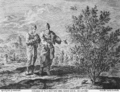 |
 |
| Sower | Hidden Treasure | Pearl | Growing Seed | Mustard Seed | Leaven |
Loss and redemption
[edit] |
 |
 |
| Lost Sheep | Lost Coin | Prodigal (Lost) Son |
Love and forgiveness
[edit] |
 |
 |
| Good Samaritan | Two Debtors | Unforgiving Servant |
Prayer
[edit]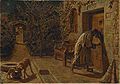 |
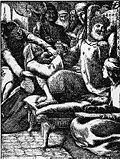 |
 |
| Friend at Night | Unjust Judge | Pharisee & Publican |
Eschatology
[edit] |
 |
 |
 |
 |
 |
| Faithful Servant | Ten Virgins | Great Banquet | Rich Fool | Wicked Husbandmen | Tares |
 |
 |
 | |||
| The Net | Budding Fig Tree | Barren Fig Tree |
Other parables
[edit] |
 |
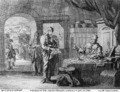 |
 |
 |
 | |
| Wise & Foolish Builders | Lamp under a Bushel | Unjust Steward | Rich Man and Lazarus | Talents (Minas) | Parable of the Workers in the Vineyard |
Art
[edit]
Of the thirty or so parables in the canonical Gospels, four were shown in medieval art almost to the exclusion of the others, but not mixed in with the narrative scenes of the Life of Christ. These were: the Ten Virgins, the Rich man and Lazarus, the Prodigal Son and the Good Samaritan.[38] Artists famous for depicting parables include Martin Schongauer, Pieter Bruegel the Elder and Albrecht Dürer. The Workers in the Vineyard also appears in Early Medieval works. From the Renaissance, the number of parables depicted increased slightly, and the Prodigal Son became a clear favorite, appearing in various scenes, with the Good Samaritan also being popular. Albrecht Dürer made a famous engraving of the Prodigal Son among the pigs (1496), a popular subject in the Northern Renaissance, and Rembrandt depicted the story several times, although at least one of his works, The Prodigal Son in the Tavern, a portrait of himself as the Son revelling with his wife, is like many artists' depictions, a way of dignifying a genre tavern scene. His late The Return of the Prodigal Son (Hermitage Museum, St Petersburg) is one of his most popular works. In 1857, the Brothers Dalziel commissioned John Everett Millais to illustrate the parables, and his work was published in 1864 in London.[39]
Poetry and hymns
[edit]As well as being depicted in art and discussed in prose, a number of parables form the inspiration for religious poetry and hymns. For example, the hymn "The Ninety and Nine" by Elizabeth C. Clephane (1868) is inspired by the parable of the Lost Sheep:
There were ninety and nine that safely lay
In the shelter of the fold.
But one was out on the hills away,
Far off from the gates of gold.
Away on the mountains wild and bare.
Away from the tender Shepherd's care.
Away from the tender Shepherd's care.
Similarly, "My Hope Is Built" (Edward Mote, c. 1834) is inspired by the parable of the Wise and the Foolish Builders, and "How Kind the Good Samaritan" (John Newton, c. 1779) is inspired by the parable of the Good Samaritan.
Harmony of parables
[edit]A sample gospel harmony for the parables based on the list of key episodes in the Canonical Gospels is presented in the table below. For the sake of consistency, this table is automatically sub-selected from the main harmony table in the Gospel harmony article, based on the list of key episodes in the Canonical Gospels. Usually, no parables are associated with the Gospel of John, just allegories.[16]
| Number | Event | Matthew | Mark | Luke | John |
|---|---|---|---|---|---|
| 1 | The Wise and the Foolish Builders | Matthew 7:24–27[40] | Luke 6:46–49[41] | ||
| 2 | New Wine into Old Wineskins | Matthew 9:16–17[42] | Mark 2:21–22[43] | Luke 5:37–39[44] | |
| 3 | The Strong Man | Matthew 12:29[45] | Mark 3:27[46] | Luke 11:21–22[47] | |
| 4 | The Two Debtors | Luke 7:41–43[48] | |||
| 5 | The Sower | Matthew 13:3–9[49] | Mark 4:3–9[50] | Luke 8:5–8[51] | |
| 6 | The Lamp Under a Bushel | Matthew 5:14–15[52] | Mark 4:21–25[53] | Luke 8:16–18[54] | |
| 7 | The Growing Seed | Mark 4:26–29[55] | |||
| 8 | The Tares | Matthew 13:24–30[56] | |||
| 9 | The Good Samaritan | Luke 10:25–37[57] | |||
| 10 | The Friend at Night | Luke 11:5–8[58] | |||
| 11 | The Rich Fool | Luke 12:16–21[59] | |||
| 12 | The Barren Fig Tree | Luke 13:6–9[60] | |||
| 13 | The Mustard Seed | Matthew 13:31–32[61] | Mark 4:30–32[62] | Luke 13:18–19[63] | |
| 14 | The Leaven | Matthew 13:33[64] | Luke 13:20–21[65] | ||
| 15 | The Hidden Treasure | Matthew 13:44[66] | |||
| 16 | The Pearl | Matthew 13:45–46[67] | |||
| 17 | Drawing in the Net | Matthew 13:47–50[68] | |||
| 18 | Parable of the Householder's Treasure | Matthew 13:51–52[69] | |||
| 19 | The Wedding Feast | Luke 14:7–14[70] | |||
| 20 | Counting the Cost | Luke 14:28–33[71] | |||
| 21 | The Lost Sheep | Matthew 18:10–14[72] | Luke 15:4–6[73] | ||
| 22 | The Unforgiving Servant | Matthew 18:23–35[74] | |||
| 23 | The Lost Coin | Luke 15:8–9[75] | |||
| 24 | The Prodigal Son | Luke 15:11–32[76] | |||
| 25 | The Unjust Steward | Luke 16:1–13[77] | |||
| 26 | The Rich Man and Lazarus | Luke 16:19–31[78] | |||
| 27 | The Master and Servant | Luke 17:7–10[79] | |||
| 28 | The Unjust Judge | Luke 18:1–8[80] | |||
| 29 | The Pharisee and the Publican | Luke 18:9–14[81] | |||
| 30 | The Workers in the Vineyard | Matthew 20:1–16[82] | |||
| 31 | The Two Sons | Matthew 21:28–32[83] | |||
| 32 | The Wicked Husbandmen | Matthew 21:33–41[84] | Mark 12:1–9[85] | Luke 20:9–16[86] | |
| 33 | The Great Banquet | Matthew 22:1–14[87] | Luke 14:15–24[88] | ||
| 34 | The Budding Fig Tree | Matthew 24:32–35[89] | Mark 13:28–31[90] | Luke 21:29–33[91] | |
| 35 | The Faithful Servant | Matthew 24:42–51[92] | Mark 13:34–37[93] | Luke 12:35–48[94] | |
| 36 | The Ten Virgins | Matthew 25:1–13[95] | |||
| 37 | The Talents or Minas | Matthew 25:14–30[96] | Luke 19:12–27[97] | ||
| 38 | The Sheep and the Goats | Matthew 25:31–46[98] |
Parallels outside the canonical gospels
[edit]A number of parables have parallels in non-canonical gospels, the Didache, and the letters of Apostolic Fathers. However, given that the non-canonical gospels generally have no time sequence, this table is not a gospel harmony.
| # | Parable | Matthew | Mark | Luke | Other parallels[99][100][101] |
|---|---|---|---|---|---|
| 3 | The Strong Man | Matthew 12:29[45] | Mark 3:27[46] | Luke 11:21–22[47] | Thomas 35 |
| 5 | The Sower | Matthew 13:1–23[102] | Mark 4:1–25[103] | Luke 8:4–18[104] | |
| 6 | The Growing Seed | Mark 4:26–29[55] | Thomas 21 | ||
| 7 | The Tares | Matthew 13:24–30[56] | Thomas 57 | ||
| 11 | The Rich Fool | Luke 12:16–21[59] | Thomas 63 | ||
| 13 | The Mustard Seed | Matthew 13:31–32[61] | Mark 4:30–32[62] | Luke 13:18–19[63] | Thomas 20 |
| 14 | The Leaven | Matthew 13:33[64] | Luke 13:20–21[65] | Thomas 96 | |
| 15 | The Hidden Treasure | Matthew 13:44[66] | Thomas 109 | ||
| 16 | The Pearl | Matthew 13:45[105] | Thomas 76 | ||
| 17 | Drawing in the Net | Matthew 13:47–53[106] | Thomas 8 | ||
| 20 | The Lost Sheep | Matthew 18:12–14[107] | Luke 15:1–7[108] |
| |
| 31 | The Wicked Husbandmen | Matthew 21:33–46[109] | Mark 12:1–12[110] | Luke 20:9–19[111] | Thomas 65 |
| 32 | The Great Banquet | Matthew 22:1–14[87] | Luke 14:15–24[88] | Thomas 64 | |
| 34 | The Faithful Servant | Matthew 24:42–51[92] | Mark 13:33–37[112] | Luke 12:35–48[94] | |
| 36 | The Talents or Minas | Matthew 25:14–30[96] | Luke 19:13–24[113] | Nazoraeans 18 |
Parables noted in the Catholic Encyclopedia of 1913
[edit]| Parable Title | Matthew | Mark | Luke |
|---|---|---|---|
| The Sower | Matthew 13:3–8 | Mark 4:3–8 | Luke 8:5–8 |
| The Tares or Cockle | Matthew 13:24–30 | ||
| The Mustard Seed | Matthew 13:31–32 | Mark 4:31–32 | Luke 13:18–19 |
| The Leaven | Matthew 13:33 | Luke 13:20–21 | |
| The Hidden Treasure | Matthew 13:44 | ||
| The Pearl of Price | Matthew 13:45 | ||
| The Draw Net | Matthew 13:47–50 | ||
| The Unmerciful Servant | Matthew 18:21–35 | ||
| The Labourers in the Vineyard | Matthew 20:1–16 | ||
| The Two Sons | Matthew 21:28–32 | ||
| The Wicked Husbandmen | Matthew 21:33–45 | Mark 12:1–12 | Luke 20:9–19 |
| The Marriage of the King's Son | Matthew 12:1–14 | ||
| The Ten Virgins | Matthew 25:1–13 | ||
| The Talents | Matthew 25:14–30 | ||
| The Pounds or the Minae | Luke 19:11–27 | ||
| The Two Debtors | Luke 7:41–43 | ||
| The Good Samaritan | Luke 10:37 | ||
| The Friend at Midnight | Luke 11:5–8 | ||
| The Unjust Judge | Luke 18:1–8 | ||
| The Rich Fool | Luke 12:16–21 | ||
| Dives and Lazarus | Luke 16:19–31 | ||
| The Great Supper | Luke 14:15–24 | ||
| The Prodigal Son | Luke 15:11–32 | ||
| The Unjust Steward | Luke 16:1–9 | ||
| The Unprofitable Servants | Luke 17:7–10 | ||
| The Pharisee and the Publican | Luke 18:9–14 |
See also
[edit]References
[edit]Notes
[edit]- ^ See, for instance, Zimmermann 2015, pp. 333–360; see the German-For-Neutestamentler-BLOG The Vine and the Branches by David Tryon, as others have throughout history including Calvin 1847, p. 106
- ^ Barry 1911 states "There are no parables in St. John's Gospel", and von Hügel 1911 states "Here Jesus' teaching contains no parables and but three allegories, the Synoptists present it as parabolic through and through".
- ^ The actual number of parables in Thomas is fluid. John Dominic Crossan counts 15, Ron Cameron 14, and Bernard Brandon Scott 13. See also Crossan 1992 and Cameron 1986
Citations
[edit]- ^ a b Pentecost 1998, p. 10.
- ^ Osborn 1993, p. 98.
- ^ a b Lisco 1846, pp. 9–10.
- ^ Barclay 1999, p. 9.
- ^ Perkins 2007, p. 105.
- ^ Wright, T. (2001), Mark for Everyone, Society for Promoting Christian Knowledge, page 42
- ^ Blomberg 2009.
- ^ Jülicher 1888.
- ^ "Luke 7:31–32 NKJV - And the Lord said, "To…". Biblia. Retrieved 2022-01-20.
- ^ Kulikovsky, Andrew S. "The Interpretation of Parables, Allegories and Types". Biblical Hermeneutics. Retrieved 25 September 2015.
- ^ Boa, Kenneth. "Literary Forms in the Bible". Bible. Retrieved 25 September 2015.
- ^ Reid 2001, p. 3.
- ^ Hultgren 2000, p. 2.
- ^ Griggs 2003, p. 52.
- ^ Barry 1911.
- ^ a b Cox & Easley 2006, p. 348.
- ^ Scott 1989, pp. 33–34.
- ^ Koester 2013, p. 196–200.
- ^ Cameron 2004, pp. 8–30.
- ^ Theissen & Merz 1998, p. 339.
- ^ Matthew 13:10–17, Mark 4:10–12, Luke 8:9–10
- ^ Luke 8:9–10
- ^ Mark 4:33–34
- ^ Matthew 13:34–35
- ^ Harris 2003.
- ^ a b Barclay 1999, p. 12.
- ^ Witherington 1987, pp. 40–41.
- ^ Nolland 2005, pp. 565–566.
- ^ Longenecker 2000, p. 201–204.
- ^ France 1985, pp. 348–352.
- ^ France 1985, p. 225.
- ^ Purdy 1985, pp. 41–43.
- ^ Scott 1989, pp. 338–340.
- ^ Jones 1999, pp. 123–133.
- ^ Keener 1999, p. 456.
- ^ Green 1997, p. 432.
- ^ Marshall 1978, pp. 462–465.
- ^ Mâle 1972, p. 195.
- ^ Millais 1975.
- ^ Matthew 7:24–27
- ^ Luke 6:46–49
- ^ Matthew 9:16–17
- ^ Mark 2:21–22
- ^ Luke 5:37–39
- ^ a b Matthew 12:29
- ^ a b Mark 3:27
- ^ a b Luke 11:21–22
- ^ Luke 7:41–43
- ^ Matthew 13:3–9
- ^ Mark 4:3–9
- ^ Luke 8:5–8
- ^ Matthew 5:14–15
- ^ Mark 4:21–25
- ^ Luke 8:16–18
- ^ a b Mark 4:26–29
- ^ a b Matthew 13:24–30
- ^ Luke 10:25–37
- ^ Luke 11:5–8
- ^ a b Luke 12:16–21
- ^ Luke 13:6–9
- ^ a b Matthew 13:31–32
- ^ a b Mark 4:30–32
- ^ a b Luke 13:18–19
- ^ a b Matthew 13:33
- ^ a b Luke 13:20–21
- ^ a b Matthew 13:44
- ^ Matthew 13:45–46
- ^ Matthew 13:47–50
- ^ Matthew 13:51–52
- ^ Luke 14:7–14
- ^ Luke 14:28–33
- ^ Matthew 18:10–14
- ^ Luke 15:4–6
- ^ Matthew 18:23–35
- ^ Luke 15:8–9
- ^ Luke 15:11–32
- ^ Luke 16:1–13
- ^ Luke 16:19–31
- ^ Luke 17:7–10
- ^ Luke 18:1–8
- ^ Luke 18:9–14
- ^ Matthew 20:1–16
- ^ Matthew 21:28–32
- ^ Matthew 21:33–41
- ^ Mark 12:1–9
- ^ Luke 20:9–16
- ^ a b Matthew 22:1–14
- ^ a b Luke 14:15–24
- ^ Matthew 24:32–35
- ^ Mark 13:28–31
- ^ Luke 21:29–33
- ^ a b Matthew 24:42–51
- ^ Mark 13:34–37
- ^ a b Luke 12:35–48
- ^ Matthew 25:1–13
- ^ a b Matthew 25:14–30
- ^ Luke 19:12–27
- ^ Matthew 25:31–46
- ^ Funk, Scott & Butts 1988, p. 74–75.
- ^ Throckmorton 1992, pp. xxx–xxxi.
- ^ Hultgren 2000.
- ^ Matthew 13:1–23
- ^ Mark 4:1–25
- ^ Luke 8:4–18
- ^ Matthew 13:45
- ^ Matthew 13:47–53
- ^ Matthew 18:12–14
- ^ Luke 15:01–7
- ^ Matthew 21:33–46
- ^ Mark 12:1–12
- ^ Luke 20:9–19
- ^ Mark 13:33–37
- ^ Luke 19:13–24
Sources
[edit] Bacher, William (1905). "Parable". In Singer, Isidore; et al. (eds.). The Jewish Encyclopedia. Vol. 9. New York: Funk & Wagnalls. pp. 512–514.
- Barclay, William (1999). The Parables of Jesus. Westminster John Knox Press. ISBN 978-0-664-25828-3.
- Barry, William (1911). . In Herbermann, Charles (ed.). Catholic Encyclopedia. Vol. 11. New York: Robert Appleton Company.
- Blomberg, Craig L. (2009). Interpreting the Parables. InterVarsity Press. ISBN 978-0-8308-7572-6.
- Calvin, Jean (1847). Commentary on a Gospel According to John. Vol. 2. Translated by Rev. William Pringle. Edinburgh: Calvin Translation Society.
- Cox, Steven L.; Easley, Kendell H. (2006). Harmony of the Gospels. Nashville: B&H Publishing Group. ISBN 978-0-8054-9444-0.
- Cameron, Ron (1986), "Parable and Interpretation in the Gospel of Thomas", Forum 2/2.
- Cameron, Ron (2004). Sayings Traditions in the Apocryphon of James. Harvard University Press. ISBN 978-0-674-01789-4.
- Clephane, Elizabeth Cecilia Douglas (1910), There Were Ninety and Nine, Toronto: Anglo-Canadian Music Publishers' Association
- Crossan, John Dominic (1992). In Parables: The Challenge of the Historical Jesus. Polebridge Press. ISBN 978-0-944344-22-4.
- France, R. T. (1985). The Gospel According to Matthew: An Introduction and Commentary. Wm. B. Eerdmans. ISBN 978-0-8028-0063-3.
- Funk, Robert Walter; Scott, Bernard Brandon; Butts, James R. (1988). The Parables of Jesus: Red Letter Edition : a Report of the Jesus Seminar. Polebridge Press. ISBN 978-0-944344-07-1.
- Green, Joel B. (1997). The Gospel of Luke. Wm. B. Eerdmans. ISBN 978-0-8028-2315-1.
- Griggs, Donald L. (2003). The Bible from Scratch: The New Testament for Beginners. Westminster John Knox Press. ISBN 978-0-664-22577-3.
- Harris, Stephen L. (2003). Understanding the Bible. McGraw-Hill. ISBN 978-0-7674-2916-0.
- Hultgren, Arland J. (2000). The Parables of Jesus: A Commentary. Wm. B. Eerdmans. ISBN 978-0-8028-6077-4.
- Jones, Peter Rhea (1999). Studying the Parables of Jesus. Smyth & Helwys. ISBN 978-1-57312-167-5.
- Jülicher, Adolf (1888). Die Gleichnisreden Jesu. J.C.B. Mohr (P. Siebeck).
- Keener, Craig S. (1999). A Commentary on the Gospel of Matthew. Wm. B. Eerdmans. ISBN 978-0-8028-3821-6.
- Koester, Helmut (April 2013). Ancient Christian Gospels: Their History and Development. SCM Press. ISBN 978-0-334-04961-6.
- Lisco, Friedrich Gustav (1846). The Parables of Jesus: Explained and Illustrated. Massachusetts Sabbath School Society.
- Longenecker, Richard N. (2000). The Challenge of Jesus' Parables. Wm. B. Eerdmans. ISBN 978-0-8028-4638-9.
- Mâle, Emile (1972). The Gothic Image: Religious Art In France Of The Thirteenth Century. New York: Harper & Row. ISBN 9780064300322.
- Marshall, I . Howard (1978). The Gospel of Luke. Wm. B. Eerdmans. ISBN 978-0-8028-3512-3.
- Millais, John Everett (1975) [1864]. The parables of Our Lord and Saviour Jesus Christ. New York: Dover Publications. ISBN 9780486204949.
- Nolland, John (2005). The Gospel of Matthew. Wm. B. Eerdmans. ISBN 978-0-8028-2389-2.
- Osborn, Eric (1993). The Emergence of Christian Theology. Cambridge University Press. ISBN 978-0-521-43078-4.
- Oxenden, Ashton (1864). The Parables of Our Lord. William Macintosh.
- Pentecost, J. Dwight (1998). The Parables of Jesus: Lessons in Life from the Master Teacher. Kregel. ISBN 978-0-8254-9715-5.
- Perkins, Pheme (2007). Introduction to the Synoptic Gospels. Wm. B. Eerdmans. ISBN 978-0-8028-1770-9.
- Purdy, John C. (1985). Parables at Work. Westminster John Knox Press. ISBN 978-0-664-24640-2.
- Reid, Barbara E. (2001). Parables for Preachers: The Gospel of Matthew : Year A. Liturgical Press. ISBN 978-0-8146-2550-7.
- Scott, Bernard Brandon (1989). Hear Then the Parable: A Commentary on the Parables of Jesus. Fortress Press. ISBN 978-1-4514-0418-0.
- Theissen, Gerd; Merz, Annette (1998). The Historical Jesus: A Comprehensive Guide. Fortress Press. ISBN 978-0-8006-3123-9.
- Throckmorton, Burton Hamilton (1992). Gospel Parallels: A Comparison of the Synoptic Gospels : with Alternative Readings from the Manuscripts and Noncanonical Parallels. T. Nelson. ISBN 978-0-8407-7484-2.
- von Hügel, Friedrich (1911). . In Chisholm, Hugh (ed.). Encyclopædia Britannica. Vol. 15 (11th ed.). Cambridge University Press. pp. 452–458.
- Witherington, Ben (1987). Women in the Ministry of Jesus: A Study of Jesus' Attitudes to Women and Their Roles as Reflected in His Earthly Life. Cambridge University Press. ISBN 978-0-521-34781-5.
- Zimmermann, Ruben (2015). Puzzling the Parables of Jesus: Methods and Interpretation. Fortress. ISBN 978-0-8006-9975-8.

Further reading
[edit]- C. H. Dodd, The Parables of the Kingdom ISBN 0-02330460-X.
- Gowler, David B., 2000. What Are They Saying About the Parables? Mahweh, NJ: Paulist Press. ISBN 978-0809139620
- Joachim Jeremias, The Parables of Jesus ISBN 0-33402917-1.
- Schottroff, Luise, 2006. The parables of Jesus ISBN 0-8006-3699-6
- Sumner, John Bird, 1850. The parables of our lord and saviour Jesus Christ C. Cox Publishers, London.
- Trinder, William Martin, 1816. Sermons on the parables of Jesus Christ Baldwin, Cradock and Joy Publishers, London.
External links
[edit]
- Another list, slightly different and only of the synoptic Gospels
- PBS: Frontline: From Jesus to Christ: The Parables
| Chronology of Jesus's life |
|
|---|---|
| New Testament | |
| Historical Jesus | |
| Depictions | |
| Christianity | |
| In other faiths | |
| Family |
|
| Related | |

| International | |
|---|---|
| National | |
| Other | |

Parables of Jesus
View on GrokipediaOrigins and Sources
Biblical Foundations
The parables of Jesus are defined as short, fictitious narratives drawn from everyday life that illustrate moral or religious principles through metaphorical comparison.[9] These teachings, often involving agricultural, domestic, or social scenarios, served as a primary method for Jesus to convey spiritual truths to diverse audiences.[10] The primary scriptural attestation of Jesus' parables appears exclusively in the Synoptic Gospels—Matthew, Mark, and Luke—which collectively preserve approximately 33 such stories, while the Gospel of John contains none explicitly identified as parables.[11] Mark includes the fewest at six, Matthew expands to 21, and Luke features 29, with overlaps such as those from the hypothetical Q source accounting for shared material across the three.[12] This distribution reflects the Synoptics' emphasis on Jesus' public ministry in Galilee and Judea, where parables formed a significant portion—about one-third—of his recorded sayings.[13] One foundational example is the Parable of the Sower, recorded in Mark 4:1-20 as an early instance of Jesus explaining the reception of his message through the metaphor of seeds falling on different soils. Parallel versions appear in Matthew 13:1-23 and Luke 8:4-15, highlighting its centrality in the oral teachings attributed to Jesus. This parable, like others, often includes an explanation provided privately to disciples, underscoring its layered interpretive structure.[14] Before their incorporation into written texts, Jesus' parables circulated through oral tradition within early Christian communities, preserving them from roughly 30 CE until the Gospels' composition around 70-100 CE. Scholarly consensus dates Mark to circa 70 CE, shortly after the Temple's destruction, with Matthew and Luke following in the 80s-90s CE, during which time these stories were transmitted verbally to maintain Jesus' authoritative voice.[15] This pre-literary phase allowed for mnemonic repetition and adaptation, ensuring the parables' endurance amid persecution and dispersion.[16]Historical and Cultural Context
The parables of Jesus emerged within the rich tradition of 1st-century Jewish storytelling, deeply influenced by the prophetic literature of the Hebrew Bible, where narratives served as indirect confrontations to provoke moral reflection. A prominent example is the prophet Nathan's parable to King David in 2 Samuel 12:1–4, which uses a simple story of injustice to expose David's sin without direct accusation, a technique that mirrors the indirect yet piercing style later employed by Jesus.[17] This prophetic use of parables, or mashal in Hebrew, extended to other biblical instances, such as the allegorical vineyard in Isaiah 5:1–7, emphasizing themes of divine judgment and covenant faithfulness. Complementing these were the wisdom traditions in books like Proverbs and Sirach, which employed concise similitudes and riddles to impart ethical guidance; for instance, Sirach 39:3 describes the sage as delving into "the enigmas found in parables," highlighting their role in uncovering deeper truths about righteous living.[18] These antecedents provided Jesus with a framework for using everyday imagery to convey spiritual insights, rooted in a shared Jewish hermeneutic of layered meaning.[8] Rabbinic literature further illustrates parallels to Jesus' parables through the widespread use of mashal, a term encompassing proverbs, allegories, and narrative similitudes employed for teaching and exegesis, though most extant examples postdate Jesus in the Talmud and Midrash. Pre-Christian precedents appear in the Hebrew Bible's mashalim, which influenced intertestamental Jewish writings, including potential similitudes in the Dead Sea Scrolls' interpretive texts like the Habakkuk Commentary, where metaphorical language elucidates prophetic fulfillment. In rabbinic contexts, such as the Mishnah and later Talmudic collections compiled from oral traditions originating in the 1st–2nd centuries CE, mashalim often featured kings, weddings, and agricultural scenes to illustrate Torah observance, echoing Jesus' thematic choices while adapting them to emerging rabbinic pedagogy.[8] These parallels underscore the parables' embedding in a dynamic Jewish oral tradition, where stories bridged legal discourse and ethical instruction. While primarily Jewish in form, Jesus' parables also intersected with Greco-Roman rhetorical devices, particularly the fables of Aesop and similitudes (parabolai) used in philosophical and oratorical education, which circulated widely in the Hellenistic world of 1st-century Palestine. Aesopic fables, short tales with animal protagonists delivering moral lessons, influenced popular storytelling, yet Jesus infused his narratives with a distinctive moral-theological dimension, transforming secular exempla into revelations of God's kingdom and human response, rather than mere behavioral admonitions.[19] Scholarly analysis highlights this contrast: Greco-Roman fables aimed at civic virtue or cautionary wit, whereas Jesus' parables provoked transformative faith, often subverting expectations to challenge social norms.[8] The socio-economic milieu of Galilee around 30 CE profoundly shaped the parables' content, reflecting an agrarian society dominated by small-scale farming, fishing, and familial labor under Roman provincial rule via Herod Antipas. In this embedded economy, where 90% of the population subsisted on agriculture and related trades, parables drew from daily realities like sowing seeds, tending vineyards, and managing household debts, capturing the tensions of tenancy, taxation, and communal interdependence.[20] Fishing, a key industry around the Sea of Galilee, involved family-based operations with boats and nets, providing imagery for themes of abundance and risk amid elite exploitation of resources.[21] Family dynamics, including inheritance disputes and patriarchal authority, further informed these stories, grounding abstract teachings in the lived experiences of Galilean peasants navigating poverty and social hierarchy.[22]Characteristics and Form
Literary Style and Structure
The parables of Jesus exhibit a concise narrative structure designed for oral delivery, typically featuring a brief setup that introduces a familiar scenario, followed by metaphorical action depicting everyday activities, a twist or reversal that subverts expectations, and an implied application often conveyed through open-ended questions or direct challenges to the listener. This pattern emphasizes surprise and reflection, as seen in the Parable of the Good Samaritan, where the setup describes a traveler assaulted on a road, the action shows indifferent religious figures passing by, the reversal reveals a despised Samaritan as the compassionate hero, and the implied application arises from Jesus' question: "Which of these three do you think was a neighbor to the man who fell into the hands of robbers?"[23] Such structures draw from Jewish storytelling traditions, adapting rabbinic mashal forms with a fivefold pattern—situation, complication, development, climax, and resolution—while streamlining for accessibility.[8] Jesus' parables encompass diverse types, ranging from simple similes that use a single comparison to extended narratives and allegories with layered symbolism. Simple similes, like the Mustard Seed, equate the kingdom of God to "the smallest of all seeds" that grows into a expansive tree, relying on vivid, natural imagery for immediate impact.[24] Extended narratives, such as the Prodigal Son, unfold as compact stories with developed characters—a wayward son, a resentful brother, and a forgiving father—to explore relational dynamics. Allegories introduce symbolic elements, where narrative components represent abstract ideas, though scholars debate the extent to which Jesus intended full allegorization versus metaphorical suggestion.[25] Rhetorical devices enhance the parables' persuasive power, including hyperbole for emphasis, irony to highlight contrasts, and ambiguity to invite personal engagement. Hyperbole amplifies scale, as in the laborers in the vineyard receiving equal pay regardless of hours worked, underscoring divine generosity. Irony appears in reversals where the lowly or unexpected prevail, such as the Samaritan aiding the victim while priests and Levites ignore him. Ambiguity arises from open-ended conclusions, prompting listeners to discern applications amid familiar settings like agricultural fields, wedding feasts, and household disputes, which mirrored the agrarian life of first-century Judea.[26] These elements, rooted in Semitic rhetorical traditions, provoke reflection on ethical reversals tied to themes of love and redemption.[25] The parables' brevity—most spanning fewer than 100 words—prioritizes memorability and symmetry, excluding extraneous details to suit oral transmission in a largely illiterate society. This compactness, combined with rhythmic repetition and balanced contrasts, facilitated easy recall and retelling, as evidenced by their preservation across Synoptic traditions despite variations in wording.[4]Distribution in the Gospels
The parables of Jesus are primarily found in the Synoptic Gospels—Matthew, Mark, and Luke—with varying distributions that reflect each evangelist's theological emphases and sources. Counts vary among scholars based on criteria for identifying parables, ranging from brief similes to extended stories. The Gospel of Mark, considered the earliest and foundational for the Synoptics, records approximately eight parables, mostly clustered in chapter 4, where Jesus teaches by the Sea of Galilee. These include unique instances like the Parable of the Growing Seed (Mark 4:26-29), which illustrates the mysterious, autonomous growth of the kingdom of God without human intervention.[27] The Gospel of Matthew expands significantly on Markan material while adding its own, totaling about 23 parables often organized into extended discourse blocks, such as the seven parables in chapter 13 that extend themes from the Sermon on the Mount. For example, the Parable of the Wheat and the Tares (Matthew 13:24-30) addresses the coexistence of good and evil in the world until the final judgment. Matthew's arrangement highlights kingdom ethics and eschatology, drawing from both shared traditions and special Matthean sources.[28] The Gospel of Luke contains the largest number, about 24 parables, with a pronounced focus on social inversion, mercy, and outreach to the marginalized, frequently using material from the unique "L" source alongside Q and Markan elements. Notable exclusives include the Parable of the Rich Man and Lazarus (Luke 16:19-31), which warns of reversal in the afterlife for the wealthy who ignore the poor. Luke's parables often appear in travel narrative settings or as responses to Pharisaic critiques, emphasizing practical discipleship.[29] Overlaps among the Gospels reveal shared oral traditions: the triple tradition includes about six or seven parables common to all three, such as the Parable of the Mustard Seed (Mark 4:30-32; Matthew 13:31-32; Luke 13:18-19), depicting the kingdom's expansive growth from humble beginnings. Double traditions feature four to thirteen parables unique to Matthew and Luke (likely from Q), like the Parable of the Leaven (Matthew 13:33; Luke 13:20-21), while single-gospel exclusives dominate, with Mark having one or two unique, Matthew about eleven, and Luke about eighteen. This distribution underscores the evangelists' selective use of Jesus' teachings to address their communities' needs.[24]Purpose and Interpretation
Pedagogical Role
Jesus employed parables as a versatile teaching tool to connect with diverse audiences, ranging from vast public crowds to his intimate circle of disciples, by embedding profound spiritual insights within relatable narratives drawn from daily life. This method enabled him to disseminate his message effectively, allowing listeners to grapple with ideas on their own terms.[30][31] Central to their pedagogical function was the promotion of inductive learning, whereby audiences actively derived conclusions from the narratives, fostering personal reflection and application rather than rote memorization. Parables transformed ordinary scenarios—such as farming, fishing, or family dynamics—into vehicles for uncovering divine principles, thereby making abstract truths accessible and memorable.[32] This approach mirrored constructivist principles, building on listeners' existing knowledge to encourage critical thinking and self-discovery.[30] Parables often disrupted conventional expectations to illuminate spiritual realities, compelling hearers to reassess their assumptions and embrace transformative insights. In the Parable of the Workers in the Vineyard (Matthew 20:1-16), the landowner's equal payment to laborers hired at different hours defies norms of proportional reward, subverting ideas of merit-based justice and instead highlighting unmerited generosity as a reflection of divine equity.[33] Such twists provoked discomfort and dialogue, deepening engagement with the material. The early church recognized and extended this pedagogical value, incorporating parables into catechetical instruction to educate converts on faith and morality through allegorical exegesis that unpacked their layered meanings. Documents from the late first century onward, including those attributed to apostolic traditions, demonstrate how these stories were adapted for teaching ethical living and communal formation, preserving their role in spiritual nurture.[34][35]Theological Motives
The parables of Jesus served a dual theological purpose, revealing profound truths about the kingdom of God to those receptive to his message while simultaneously concealing them from those hardened against it. In Matthew 13:11, Jesus explicitly states to his disciples, "To you it has been given to know the secrets of the kingdom of heaven, but to them it has not been given," distinguishing between insiders who perceive the divine realities and outsiders who remain blinded. This motif draws directly from Isaiah 6:9-10, where God commissions the prophet to declare that the people will hear but not understand, see but not perceive, ensuring their hearts remain calloused and unresponsive—a prophecy Jesus cites as fulfilled in his ministry (Matthew 13:14-15). In Matthew 13:10-17, Jesus explains to the disciples why he speaks in parables: the mysteries of the kingdom are granted to those open to understanding, while they remain hidden from those whose hearts are hardened, fulfilling Isaiah's prophecy of spiritual blindness and deafness. The recurring phrase "Whoever has ears, let them hear," which concludes several parables including the Parable of the Sower (Matthew 13:9), functions as a call to spiritual listening—urging not mere physical hearing but profound comprehension, open-hearted reception of the kingdom's truth, and readiness for repentance and faith. Scholar Ardel Caneday argues that this dual function is epitomized in Mark 4:10-12, where the parables dramatize both revelation for believers and judgment through incomprehension for opponents, underscoring Jesus' sovereign control over spiritual perception. A key Christological motive in the parables lies in their subtle illumination of Jesus' identity and mission, avoiding direct messianic proclamations that might provoke premature political expectations among first-century Jews. Rather than explicit claims, the stories indirectly portray Jesus as the inaugurator of God's reign, with figures like the sower or the shepherd symbolizing his authoritative role in gathering and nurturing the flock without inviting revolutionary fervor. This veiled approach allowed Jesus to fulfill his vocation amid opposition, as the parables invited discernment of his divine sonship through narrative indirection. Theological scholar David Gowler notes that such Christological undertones in the parables align with the broader Synoptic portrayal of Jesus as the enigmatic revealer whose words demand active engagement to uncover his true nature.[36][8] The parables also conveyed eschatological urgency, compelling hearers to immediate response as the kingdom irrupted into the present age. By depicting the kingdom's arrival through everyday crises—like a mustard seed's unexpected growth or a banquet's sudden invitation—Jesus emphasized that God's rule was not a distant prospect but a transformative reality demanding decision now. This sense of imminence motivated ethical and spiritual realignment, warning of judgment for delay while promising inclusion for the responsive. Scholarly debates on these motives have evolved significantly. In the mid-20th century, C.H. Dodd advanced "realized eschatology," interpreting the parables as proclaiming the kingdom's full actualization in Jesus' ministry, with future-oriented elements reinterpreted as present crises rather than apocalyptic delays; this view freed the parables from overly futuristic readings but was critiqued for downplaying their prophetic horizon.[37] Modern relational interpretations, building on narrative and reader-response approaches, counter Dodd by emphasizing the parables' ongoing invitation to personal and communal transformation, viewing them as dynamic encounters that foster relationship with God and others rather than static doctrinal statements. These perspectives highlight how the parables bridge historical context and contemporary application, prioritizing participatory faith over mere eschatological timing.Core Themes
Kingdom of God and Its Dynamics
The parables of Jesus frequently employ everyday imagery to convey the nature of the Kingdom of God, portraying it as a dynamic reality that begins modestly, expands unexpectedly, and demands active response from individuals. These teachings emphasize the kingdom's present accessibility while hinting at its transformative power, distinguishing it from earthly realms through themes of growth, value, and inclusion. Scholars note that such parables served as Jesus' primary method for revealing the kingdom's mechanics to diverse audiences, using agricultural and domestic metaphors familiar to first-century listeners.[38] Central to this depiction are the parables of the mustard seed and the leaven, which highlight the kingdom's explosive growth from humble origins. In the mustard seed parable, the kingdom is likened to a tiny seed planted in a field that grows into a large tree, providing shelter for birds of the air, symbolizing how God's reign starts small but achieves vast influence (Matthew 13:31-32). This imagery underscores the kingdom's organic expansion despite apparent insignificance, as analyzed in social-scientific readings that connect it to Jesus' expectation of the kingdom's full revelation through his ministry.[39] Similarly, the leaven parable compares the kingdom to a woman mixing leaven into three measures of flour until the entire batch is leavened, illustrating its pervasive, transformative effect on society (Matthew 13:33). Here, leaven represents the kingdom's subtle yet unstoppable infiltration of human affairs, akin to a contaminant that ultimately renews the whole, as explored in interpretations emphasizing its positive, diffusive power.[40] Other parables stress the personal pursuit and receptivity required to enter and participate in the kingdom. The parable of the pearl of great price depicts the kingdom as a merchant's ultimate treasure, for which he sells everything to acquire it, emphasizing the supreme value and sacrificial seeking demanded (Matthew 13:45-46). This narrative invites hearers to recognize the kingdom's worth above all possessions, aligning with broader Matthean themes of discernment in kingdom entry.[41] Complementing this, the parable of the sower illustrates varying responses to the kingdom's message, with seeds falling on different soils—path, rocks, thorns, and good ground—yielding disparate results, where only receptive hearts produce abundant fruit (Mark 4:3-8). Interpretations highlight how this parable models the kingdom's dependence on human openness, with the "good soil" signifying disciples who hear and act on the word.[42] The kingdom's inclusive dynamics emerge vividly in the banquet parables, which portray God's invitation extending beyond expected recipients to the marginalized. In Matthew's wedding banquet parable, a king prepares a feast for his son's wedding but finds the invited guests unwilling; he thus summons passersby from the streets, both good and bad, to fill the hall, though one improperly attired is cast out (Matthew 22:1-14). This reflects the kingdom's openness to Gentiles and outcasts after Israel's rejection, while underscoring the need for proper response. Likewise, Luke's great dinner parable features a man inviting the poor, crippled, blind, and lame from the city, and even compelling outsiders from highways when initial invitees excuse themselves (Luke 14:15-24). Social-scientific analysis views these meals as honor-shame ceremonies inverting social hierarchies, promoting reciprocity and inclusion in the kingdom's communal vision.[43] Socio-economic readings, such as those by William Herzog, frame Jesus' teachings as critiques of oppressive systems—including exploitative household dynamics.[44] This approach briefly overlaps with eschatological themes of judgment but focuses primarily on the kingdom's present, transformative presence.[45]Ethics of Love, Forgiveness, and Redemption
The parables of Jesus emphasize the ethics of love as an active, boundary-transcending commitment to others' well-being, exemplified in narratives that prioritize compassion over ritual or social convention. In the Parable of the Good Samaritan (Luke 10:25-37), a traveler is beaten and left for dead on the road from Jerusalem to Jericho; a priest and a Levite pass by without aiding him, but a Samaritan—despised by Jews for ethnic and religious differences—stops, binds his wounds, transports him to an inn, and pays for his care. This story redefines neighborly duty not by proximity or affinity but by merciful action, challenging listeners to embody love that fulfills the greatest commandments of loving God and neighbor.[46] Scholars interpret it as a virtue ethics model, where the Samaritan's compassion integrates justice and benevolence, countering exclusionary interpretations of Jewish law.[47] The Parable of the Unforgiving Servant (Matthew 18:23-35) further illustrates love through the lens of reciprocal mercy, as Jesus responds to Peter's inquiry about forgiveness limits. A king forgives a servant's immense debt of ten thousand talents—equivalent to millions in modern terms—out of compassion, yet the servant seizes a fellow servant owing a mere hundred denarii, throttling him until forgiven. The king, upon hearing, revokes the pardon and imprisons the unforgiving servant. This narrative underscores conditional mercy: divine forgiveness demands emulation in human relations, warning that withholding compassion undermines one's own reception of grace. It promotes forgiveness as a societal ethic, fostering peace by breaking cycles of resentment and debt-based oppression.[48] Redemption in Jesus' parables portrays divine initiative in restoring the wayward, celebrating repentance with unearned joy and reintegration. The Parable of the Prodigal Son (Luke 15:11-32) depicts a younger son demanding his inheritance, squandering it in dissipation, and returning home humbled, intending to beg as a hired hand; instead, the father runs to embrace him, clothes him in finery, and hosts a feast, while the older son resents the mercy. This illustrates restorative grace, where repentance prompts immediate reconciliation without probation, highlighting God's preferential welcome of the lost over the self-righteous.[49] Complementing this, the Parables of the Lost Sheep and the Lost Coin (Luke 15:3-10) show a shepherd leaving ninety-nine sheep to retrieve one stray and a woman sweeping her house to find a lost silver coin, each rejoicing with friends and neighbors upon success. These domestic analogies equate heavenly joy over one repentant sinner to the value of every individual, emphasizing redemption as proactive pursuit rather than passive waiting.[50] Jesus' parables also critique social structures through ethics of generosity, condemning wealth hoarding that isolates individuals from communal good. In the Parable of the Rich Fool (Luke 12:16-21), a prosperous landowner harvests abundantly and plans larger barns to store his grain and goods, soliloquizing, "Soul, you have ample goods laid up for many years; relax, eat, drink, be merry," but God declares him a fool whose life ends that night, rendering his riches meaningless. This exposes the folly of self-reliant accumulation, urging richness toward God through almsgiving and neighborly sharing over material security.[51] The narrative promotes generosity as ethical counter to greed, aligning life with divine priorities of justice and interdependence.[52] In contemporary interpretations, particularly within liberation theology, these parables serve as anti-oppression narratives, reframing love, forgiveness, and redemption as tools for dismantling systemic injustices. The Good Samaritan, for instance, embodies solidarity with the marginalized, urging active resistance to exclusionary powers that "pass by" the suffering, as seen in cross-cultural hermeneutics from oppressed communities.[53] The Rich Fool critiques economic exploitation, portraying wealth hoarding as complicity in poverty, while the Prodigal Son's restoration models liberation from patriarchal and material bondage.[54] Such readings, rooted in praxis among the poor, highlight underemphasized aspects of Jesus' teachings as calls for structural mercy against 21st-century oppressions like inequality and racism.[55]Eschatology and Judgment
Several parables of Jesus emphasize eschatological themes of final judgment and the ultimate consummation of God's reign, portraying a future reckoning where human actions face divine evaluation. These narratives draw on everyday imagery to convey the urgency of preparedness and the inevitability of accountability, often blending present ethical imperatives with apocalyptic visions of separation and reward. Scholars note that such parables reflect Jesus' proclamation of the kingdom's arrival, which includes both realized and future dimensions, urging listeners to align their lives with God's impending rule.[56] The Parable of the Sheep and the Goats (Matthew 25:31-46) depicts the Son of Man seated on his glorious throne, separating nations like a shepherd divides sheep from goats based on their treatment of the "least of these"—acts of feeding the hungry, clothing the naked, and visiting the imprisoned, which equate to service rendered to Jesus himself. The righteous sheep inherit the kingdom prepared for them since the foundation of the world, while the goats depart into eternal fire prepared for the devil and his angels, underscoring judgment by deeds of mercy rather than mere belief. This separation motif highlights eschatological justice, where compassionate actions determine eternal destiny.[57][58] Closely linked, the Parable of the Ten Virgins (Matthew 25:1-13) illustrates the need for vigilance in awaiting the bridegroom, symbolizing Christ's return. Ten virgins prepare for the wedding feast, but only the five wise ones, who brought extra oil for their lamps, enter the banquet when the bridegroom arrives at midnight; the foolish, scrambling for oil, find the door shut with the words, "Truly I tell you, I do not know you." This narrative warns of sudden eschatological arrival, emphasizing spiritual preparedness over procrastination, as the kingdom will come unexpectedly like a thief in the night.[59] Warnings of radical reversal feature prominently in parables depicting post-mortem or final accountability. In the Parable of the Rich Man and Lazarus (Luke 16:19-31), a wealthy man who ignored the beggar at his gate suffers torment in Hades after death, while Lazarus receives comfort in Abraham's bosom; a great chasm prevents crossing, affirming irreversible eschatological justice where earthly neglect leads to eternal separation. This story critiques wealth hoarding and underscores the reversal of fortunes at judgment, rooted in prophetic traditions of divine vindication for the oppressed.[60] The Parable of the Talents (Matthew 25:14-30) further stresses accountability, as a master entrusts servants with varying sums of money (talents) before departing; upon return, the faithful who invest and multiply their shares enter the master's joy, but the fearful servant who buries his talent faces condemnation and loss of even what he has. Interpreted as divine gifts or opportunities, the talents symbolize stewardship responsibilities, with judgment hinging on productive faithfulness rather than excuses, leading to reward or outer darkness for the unfruitful.[58] An apocalyptic tone permeates the Parable of the Weeds among the Wheat (Matthew 13:24-30, 36-43), where an enemy sows weeds (darnel) amid good seed in a field representing the world; the owner instructs servants to let both grow until harvest, when weeds are burned and wheat gathered into the barn, evoking the end of the age with angels as reapers. This imagery links to Danielic eschatology, particularly the harvest judgment in Daniel 12:3 where the righteous shine like the sun, portraying the consummation of God's reign as a purifying separation of good and evil at history's close.[61] Recent scholarly works post-2020 have advanced eco-eschatological interpretations of these parables, viewing their harvest and stewardship motifs as urgent calls for environmental responsibility amid climate crises. For instance, analyses of growth parables like the Weeds reframe the apocalyptic harvest as a metaphor for ecological justice, urging biodiversity preservation and sustainable practices to align with God's reign over creation, transforming judgment imagery into motivation for present-day planetary stewardship.[62][63]Prayer, Faith, and Discipleship
The Parable of the Friend at Midnight emphasizes bold importunity in prayer, portraying a man who disturbs his sleeping neighbor at midnight to request bread for an unexpected guest, receiving aid not out of friendship but due to the requester's shameless persistence (Greek anaideia). Scholars interpret this as an encouragement for disciples to approach God with unreserved audacity, assuring that a responsive Father will provide the Holy Spirit to those who ask, seek, and knock, in contrast to human reluctance.[64][65] Likewise, the Parable of the Unjust Judge highlights God's assured responsiveness to persistent prayer, depicting a widow who continually pleads for justice against her adversary before an uncaring judge, who eventually grants her request to avoid further annoyance. Jesus contrasts this indifferent authority with God, who will swiftly vindicate his elect as they cry out day and night, though questioning if faith will endure until his return. This narrative underscores prayer as a vital discipline against discouragement, reinforcing divine attentiveness to the faithful.[66][67] In addressing faith challenges, the Parable of the Barren Fig Tree calls for expected fruitfulness as evidence of genuine faith, where a vineyard owner seeks figs from a tree that has yielded none for three years and intends to cut it down, but the gardener intercedes for one more year of cultivation and manure. This illustrates God's merciful patience toward Israel—or believers generally—granting time for repentance and spiritual productivity before judgment, urging active faith that bears lasting results.[68][69] The Parable of the Hidden Treasure further exemplifies total commitment as the essence of faith, describing a man who discovers treasure in a field, conceals it, and joyfully sells all his possessions to purchase the field outright. This act symbolizes the surpassing value of the kingdom of heaven, demanding radical renunciation of worldly attachments for the incomparable joy of divine possession.[70] Regarding discipleship costs, the Parables of the Tower Builder and the Warring King stress prudent calculation before committing to follow Jesus, warning against superficial allegiance. In the first, a builder assesses resources to complete a tower lest he face ridicule for an unfinished project; in the second, a king evaluates his army's strength against a superior force before engaging in battle, opting for peace if outmatched. Together, these illustrate that true discipleship requires hating family ties by comparison, renouncing all possessions, and carrying one's cross daily, ensuring followers count the full price of loyalty to Christ.[71][72]Catalog and Comparisons
Canonical Parables and Parallels
The canonical parables of Jesus appear primarily in the Synoptic Gospels (Matthew, Mark, and Luke), comprising approximately one-third of his recorded teachings, with no extended parables in John though some metaphorical elements exist. Scholars identify around 38 distinct parables, though counts vary slightly due to debates over short sayings versus full narratives; these are drawn from the Greek New Testament texts, with parallels reflecting shared source material like the hypothetical Q document or Markan priority. The following table catalogs key parables alphabetically, noting their locations and parallels where applicable, based on standard scholarly classifications.| Parable Name | Matthew Reference | Mark Reference | Luke Reference | John Reference | Notes on Parallels or Uniqueness |
|---|---|---|---|---|---|
| Barren Fig Tree | - | - | 13:6-9 | - | Unique to Luke; emphasizes judgment and repentance. |
| Good Samaritan | - | - | 10:29-37 | - | Unique to Luke; highlights compassion across social boundaries. |
| Great Banquet | - | - | 14:16-24 | - | Unique to Luke; variant of wedding banquet theme. |
| Hidden Treasure | 13:44 | - | - | - | Unique to Matthew; kingdom as valuable discovery. |
| Householder (Scribe) | 13:52 | - | - | - | Unique to Matthew; portrays disciple as householder bringing old and new treasures. |
| Laborers in the Vineyard | 20:1-16 | - | - | - | Unique to Matthew; stresses generosity in kingdom rewards. |
| Leaven (Yeast) | 13:33 | - | 13:20-21 | - | Parallel in Matthew and Luke; kingdom's subtle growth; absent in Mark. |
| Lost Coin | - | - | 15:8-10 | - | Unique to Luke; part of lost items trio emphasizing joy over repentance. |
| Lost Sheep | 18:12-14 | - | 15:4-7 | - | Parallel but with differences: Matthew focuses on not losing one of a hundred, Luke on seeking the lost. |
| Mustard Seed | 13:31-32 | 4:30-32 | 13:18-19 | - | Triple parallel; kingdom's growth from small beginnings, with minor wording variations (e.g., bird details). |
| Pearl of Great Price | 13:45-46 | - | - | - | Unique to Matthew; similar to hidden treasure in valuing the kingdom. |
| Persistent Widow | - | - | 18:2-8 | - | Unique to Luke; illustrates persistent prayer. |
| Pharisee and Tax Collector | - | - | 18:9-14 | - | Unique to Luke; contrasts humble and self-righteous prayer. |
| Prodigal Son | - | - | 15:11-32 | - | Unique to Luke; themes of forgiveness and reconciliation. |
| Rich Fool | - | - | 12:16-21 | - | Unique to Luke; warns against material greed. |
| Rich Man and Lazarus | - | - | 16:19-31 | - | Unique to Luke; eschatological reversal of fortunes. |
| Sower | 13:3-9, 18-23 | 4:3-9, 14-20 | 8:5-8, 11-15 | - | Triple parallel; soil types represent responses to the word; explanations follow in each. |
| Talents / Minas | 25:14-30 | - | 19:12-27 | - | Parallel with differences: Matthew uses talents and two servants plus one, Luke uses minas and ten servants. |
| Ten Virgins | 25:1-13 | - | - | - | Unique to Matthew; readiness for the bridegroom's arrival. |
| Two Builders | 7:24-27 | - | 6:47-49 | - | Parallel; wise and foolish builders on rock vs. sand. |
| Two Debtors | - | - | 7:41-43 | - | Unique to Luke; illustrates forgiveness proportionality. |
| Two Sons | 21:28-32 | - | - | - | Unique to Matthew; obedience through actions. |
| Unforgiving Servant | 18:23-35 | - | - | - | Unique to Matthew; kingdom ethic of forgiveness. |
| Unjust Steward | - | - | 16:1-13 | - | Unique to Luke; shrewdness in using resources. |
| Vineyard Owner | 21:33-46 | 12:1-12 | 20:9-19 | - | Triple parallel; tenants reject owner's son, symbolizing rejection of prophets and Jesus. |
| Wedding Banquet | 22:2-14 | - | 14:16-24 | - | Unique to Matthew; guests refuse invitation, focus on garment. |
| Weeds (Tares) | 13:24-30, 36-43 | - | - | - | Unique to Matthew; kingdom coexistence of good and evil until harvest. |
| Wicked Tenants | See Vineyard Owner | See Vineyard Owner | See Vineyard Owner | - | (As above) |