


Community hub
Recent from talks
Contribute something
Nothing was collected or created yet.
Puri (food)
View on Wikipedia
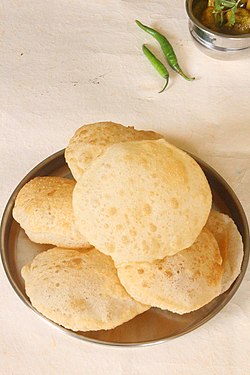
 Puri on a plate | |
| Place of origin | Northern Indian subcontinent |
|---|---|
| Associated cuisine | India (North India), Bangladesh, Pakistan |
| Serving temperature | Hot or cold |
| Main ingredients | Atta |
| Variations | Bhatoora, Luchi, Sevpuri, Panipuri |

Puri, also poori, is a type of deep-fried flatbread, made from unleavened whole-wheat flour, although leavened varieties also exist.[citation needed] Puri originated from the Indian subcontinent.
Puris are most commonly served as breakfast or snacks. It is also served at special or ceremonial functions as part of ceremonial rituals along with other vegetarian food offered[citation needed] in Hindu prayer as prasadam. When hosting guests it is common in some households to serve puri in place of roti, as a small gesture of formality.[citation needed] Puri is often eaten in place of roti[citation needed] on special holidays.
Name
[edit]The word puri or poori, entered English from Hindi (पूरी). It originates from the Sanskrit word पूर (purah), meaning 'cake'.[1] The Sanskrit word purika described a fried food more similar to modern papadam than puri.[2] Terminology varies; food writer Madhur Jaffrey wrote that the bread that she called poori may also be called bevdi or—in the Gali Paranthe Wali neighbourhood of Delhi—paratha.[3]
Preparation and serving
[edit].jpg)
Puris are flatbreads prepared wheat flour[4] along with either oil or ghee, enough water to form a stiff dough,[5] and a small amount of salt.[6] The flour is commonly atta; maida is used in some regions, though its use is often viewed as inferior.[7] After kneading,[5] the dough is rolled out in circles, about 10 to 12 cm across and 1 to 3 mm thick.[4] This may also be done using a chapati press or using a dough sheeting machine that may produce thousands of puris per hour.[8]
The circles of dough are deep fried in ghee or vegetable oil in a karahi,[4][5] a type of pot whose shape uses less oil and avoids spillage.[9] Common frying oils include rice bran oil[10] and soybean oil.[11] The dough is fried for about 30–40 seconds at about 200–220 °C (390–430 °F).[12] While deep frying, puris puff up because moisture in the dough changes into steam, expanding to ten times the initial volume.[13] As steam forms, a puri floats to the top of the oil, causing it to cook on one side at a time. This requires it to be flipped,[14] and it is often pushed down to be coated in oil.[15] The steam pushes the crust away from the crumb and results in partial starch gelatinisation between the layers,[16] which is high due to the high temperature.[17] Puri has a much denser crumb than yeast breads.[16]
Puri is served hot.[18] The texture is soft;[4] Madhur Jaffrey writes, "it takes years of practice to make really fine, soft pooris. It is said in Benares that if twenty five pooris were stacked on a plate and a coin dropped on the lot, the sound of the coin hitting the plate should be heard with clarity."[5]
_with_Maida_Poori_(_Deep_Fried_Puffy_Bread).jpg)
Puri is categorised as a single-layer, unleavened flatbread.[19] It resembles chapati in its ingredients and shape,[20] but is instead fried and puffy,[5] whereas chapati and phulka are toasted over a flame.[12] A bread similar to puri, popular in Bengali cuisine, is luchi, which is made using white flour and deep fried.[21] Another similar bread is bhatura, which is made with yeast and yogurt in the dough, while puri is made from unleavened dough.[22]
Puri may be a breakfast, a light meal, or a snack.[23] Like other Indian breads, puri is usually eaten with other foods, though it may be eaten on its own.[24] It may be eaten with sweet or savoury foods.[25] The most common accompaniments are chickpea curry or potato curry.[26] Sweets that are commonly served with puri include pua, shrikhand, and jalebi, the latter of which is often eaten alongside puri and vegetables for breakfast.[27]
Nutrition and chemistry
[edit]| Nutritional value per 100 g (3.5 oz) | |||||||||||||||||||||
|---|---|---|---|---|---|---|---|---|---|---|---|---|---|---|---|---|---|---|---|---|---|
44 g | |||||||||||||||||||||
22.3 g | |||||||||||||||||||||
7.2 g | |||||||||||||||||||||
| |||||||||||||||||||||
| Other constituents | Quantity | ||||||||||||||||||||
| Water | 25 g | ||||||||||||||||||||
| †Percentages estimated using US recommendations for adults.[29] | |||||||||||||||||||||
A typical Bangladeshi puri, which is made of 50 grams of atta and 5 grams of oil, contains 219 calories.[30] Due to being deep fried, puri contains more fat than other South Asian flatbreads, with a fat content of about 24%[31] or up to 30%,[4] including about 7.6% of trans fats.[32] The fat content makes it high in calories.[4] Puri has a protein content of about 12% and a starch content of about 40%,[33] including a high level of insoluble dietary fibre.[34] A puri contains about 300 milligrams of sodium.[35]
Compared to chapati, puri is low in minerals, though this may be increased using fortifications such as amaranth.[36] Though the flour used in puri contains vitamins, the cooking process results in a loss of 50% of folate and 40% of other vitamins, including riboflavin and niacin.[37] Loss of water as steam results in significant loss of vitamin B12 as well as fast degradation of vitamin D3.[38]

Puris may vary in size, method, and oil uptake.[39] Oil uptake is high in puris,[40] and it is higher in puris with lower water content.[41] As puri floats to the top of the frying oil, it absorbs less oil than foods that are fully immersed while frying (as with a deep fryer).[14] Puri is often cooked at a temperature above the smoke point of the oil, resulting in the formation of contaiminatns such as 4-Hydroxynonenal and acrolein. It is also common for the oil to be reused, causing buildup of such contaminants and further lowering the smoke point.[15] The loss of water content is higher in white-flour puris than wheat-flour puris, the latter containing more fibre.[40] Finer grains and more damaged starch are also correlated with higher water content.[42]
The colour, flavour, and scent of puri are a result of the Maillard reaction during cooking.[43] Compared to chapati, puri undergoes a faster Maillard reaction and contains a higher level of acrylamide.[42] According to Mehrajfatema Z. Mulla et al., the Maillard reaction does not fully account for the level of acrylamides, which may partly result from lipid oxidation.[44] The flour milling method influences this process as higher levels of acrylamide are correlated with higher levels of reducing sugar, more damaged starch, and finer grains.[45]
Qualities desired by consumers of puri include moist texture, pliability, tearability, height, and yellow colour.[46] According to Veeranna Hitlamani and Aashitosh Ashok Inamdar, flour milled using a chakki produces the optimal qualities.[47] A study by S. R. Shurpalekar and V. K. Shukla found that mixing flours of multiple starches results in acceptable puris, especially using gram flour.[7] A study by M. L. Sudha and G. Venkateshwara Rao found that adding hydroxypropyl methylcellulose to puri dough results in increased oil uptake and storage stability as well as improved textural qualities.[48] A study by K. R. Parimala and M. L. Sudha found that adding guar gum increased water retention and decreased oil uptake.[49] According to studies by Sukumar Debnath, the type of oil used for frying and the number of times it is reused do not significantly change sensory qualities.[50]
History
[edit]According to chef Manjit Gill, puri has existed since the Vedic period.[14] In ancient Buddhist India, a food called gulalalāvaniya was recorded, which historian K. T. Achaya describes as a small, round puri that may have had both sweet and salty varieties.[51] Hindus in the Mughal Empire consumed puri and bhatura with vegetables such as spinach, but these breads were not adopted by the Muslim population.[52] The sixteenth-century text Padmavat lists puri as one of the foods served by the titular queen at an elaborate dinner.[53] The Mughal cookbook Khulasat-i Makulat u Mashrubat, written during the reign of Aurangzeb, includes a recipe for puri.[54] In 19th-century British India, North Indian snack foods such as puri were eaten as tiffin snacks as part of an early form of Indian fast food.[55] Puri and other flour-based foods became part of the cuisine of the Malabar Coast in the first half of the 20th century, when the region faced a famine and introduced wheat imports from the United States.[56]
Consumption
[edit]
Puri is from the northern part of the South Asia,[20] and it is consumed in countries such as India, Pakistan, and Bangladesh.[4] It is a staple food in much of the region.[43] It is the second-most consumed flatbread in the region, behind chapati.[7] Like chapati and paratha, it is often homemade.[57]
According to the 2005 Bangladesh Household Income and Expenditure Survey, 28.5% of the country's households consume puri.[58] It is a popular snack from street food vendors in the country.[59] In the Indian state of Himachal Pradesh, puri may be served alongside rice as part of a dham meal.[60] In the South Indian region of Coastal Andhra, puri, served with potato curry or chutney, is eaten as breakfast, but is less common than idli or dosa.[61] Puri is known in Burmese cuisine as a food served at tea shops.[62] Puri is also commonly eaten by the Indian-Ugandan community of Kampala.[63]
In North Indian Hindu culture, puri is traditionally classified as pukka, a type of food that is made with ghee, which is associated with purity, and is served when hosting guests or during festivals.[64] In North India and West India, puri is served with sweets during Diwali.[65] As some Hindu observances involve abstaining from typical grains, adherents of these fasts may make puri using amaranth grain.[66] Puris, as well as sweet puris, are sometimes given as offerings to deities.[67] In the folk religion of the Jad people of the Himalayas, puri is offered to certain deities who do not receive animal sacrifices, including Rengali.[68] Puri is also eaten at weddings across India.[69]
Types and variants
[edit]

There are many variants of puri.[5]
The type of flour used in puri may vary.[5] In regions where wheat is not common, wheat flour is mixed with local maize flour, jowar, or gram flour.[7] Puri may also be made of millet flour.[70] In some recipes, purées of spinach, tomatoes, carrots, or legumes are added to the dough.[71] Kadak puri is made with a mixture of whole wheat flour and gram flour, as well as turmeric and chili powder.[5] In the cuisine of Chhattisgarh, a type of puri called chausela is made of rice flour, and puris may also be made of a dough with wheat flour, rice flour, and leaf vegetables.[72] In Kerala, rice flour and coconut are used to make a type of puri called nai-patthiri, eaten for breakfast.[73] In some rural parts of North India, sweet puris are made of a dough with wheat flour and the flowers of the mahura trees.[74]
In stuffed puri variants, the dough is rolled out, folded over a filling of vegetables and spices, then rolled out again. Masala puri is stuffed with spices and vegetables such as potatoes. Puran puri has a sweet stuffing with lentils, cardamom, and saffron. Gujhia is a sweet puri stuffed with milk, wheat, coconut, and nuts, and folded into a crescent.[5] Another variant, largely popular in North India, is bedmi puri or bedai. It is prepared using stuffing of urad dal or moong dal paste.[75] In the Indian state of Odisha, a large puri is made during Bali Yatra which is called thunka puri (Odia: ଠୁଙ୍କା ପୁରି).[76]
Many types of chaat that are served as street food consist of puri mixed with other ingredients.[77][78] The puris used for panipuri are smaller and rounder, and are sometimes made crisper by the addition of semolina to the dough.[78] They have a filling that may include chutney, potatoes, and chickpeas;[77] different ingredients are used for regional variants such as golgappa and phuchka.[78] Sev puri is another version offered as chaat, similarly consisting of a puri with a filling. Other chaats use thin puris, such as bhelpuri and papri chaat. In papri chaat, flat puris are topped with other ingredients.[78] In bhelpuri, thin puris are combined with onions, puffed rice, and fried lentils. Bhelpuri is one of the most popular snacks served by street vendors in Mumbai.[5][77]
Gallery
[edit]-
 Puri Bhajji in Mumbai restaurant, served with potato bhaaji and coriander leaf chutney
 -
 Poori or Puri, traditionally deep fried from most Indian restaurants
 -
 Dal puri, a traditional Bengali version
 -
 Mini-puris are part of a panipuri snack. It is crunchier in texture.
 -
 Daal puri, Bangladesh
 -
 Thin bread is fried in oil and eaten with a salty curry of chickpeas, potatoes and sweet pudding.


,_fried_dough_food_at_Wikipedia%27s_16th_Birthday_celebration_in_Chittagong_(01).jpg)

See also
[edit]
References
[edit]- ^ Ayto, John (2012). "Puri". The Diner's Dictionary (2nd ed.). Oxford Reference. ISBN 978-0-19-174443-3.
- ^ Achaya 1998, p. 90.
- ^ Bigot 2019, p. 803.
- ^ a b c d e f g Kumar 2016, p. 30.
- ^ a b c d e f g h i j Saberi, Helen (2014). "Puri". In Davidson, Alan; Jaine, Tom (eds.). The Oxford Companion to Food (3rd ed.). doi:10.1093/acref/9780199677337.001.0001. ISBN 978-0-19-175627-6.
- ^ Parimala & Sudha 2015, p. 75; Mir & Shah 2018, p. 5.
- ^ a b c d Parimala & Sudha 2015, p. 75.
- ^ Banerji, Ananthanarayan & Lele 2020, p. 143.
- ^ Jaffrey 1983, pp. 132, 135.
- ^ Debnath et al. 2012, p. 250.
- ^ Sudo et al. 2004, p. 502.
- ^ a b Tharanathan & Tharanathan 2001, p. 74.
- ^ Aguilera 2018, p. 1028.
- ^ a b c Sanghvi, Vir (16 August 2013). "Rude Food: fear of frying". Hindustan Times. Retrieved 31 October 2025.
- ^ a b Kumar Roy, Prasanto (12 August 2013). "No, a poori isn't healthier than a paratha". Times of India. Retrieved 31 October 2025.
- ^ a b Mir & Shah 2018, p. 5.
- ^ Tharanathan & Tharanathan 2001, pp. 77–78.
- ^ Jaffrey 1983, p. 135.
- ^ Fayaz et al. 2021, p. 1.
- ^ a b Rubel 2011, p. 141.
- ^ Davidson, Alan; Jaine, Tom, eds. (2014). "Luchi". The Oxford Companion to Food (3rd ed.). doi:10.1093/acref/9780199677337.001.0001. ISBN 978-0-19-175627-6.
- ^ Ramineni 2012, p. 76.
- ^ Parimala & Sudha 2015, p. 75; Kumar 2016, p. 30.
- ^ Tharanathan & Tharanathan 2001, p. 76.
- ^ Parimala & Sudha 2015, p. 70.
- ^ Banerji, Ananthanarayan & Lele 2020, p. 8.
- ^ Tamang 2020, pp. 107, 110, 170.
- ^ Chen, Gilbert & Khokhar 2009, pp. 829–830.
- ^ United States Food and Drug Administration (2024). "Daily Value on the Nutrition and Supplement Facts Labels". FDA. Archived from the original on 27 March 2024. Retrieved 28 March 2024.
- ^ Sudo et al. 2004, p. 502, 504.
- ^ Sharavathy, Urooj & Puttaraj 2001; Parimala & Sudha 2015, p. 76.
- ^ Butt & Sultan 2009, p. 1279.
- ^ Sharavathy, Urooj & Puttaraj 2001, p. 244; Parimala & Sudha 2015, p. 76.
- ^ Sharavathy, Urooj & Puttaraj 2001, p. 245.
- ^ Daugirdas 2013, p. 2.
- ^ Parimala & Sudha 2015, p. 76.
- ^ Chen, Gilbert & Khokhar 2009, p. 828.
- ^ Bajaj & Singhal 2021, p. 6.
- ^ Vatsala, Saxena & Rao 2001, p. 407.
- ^ a b Chen, Gilbert & Khokhar 2009, p. 829.
- ^ Vatsala, Saxena & Rao 2001, p. 412; Tharanathan & Tharanathan 2001, p. 78.
- ^ a b Hitlamani & Ashok Inamdar 2025, p. 9.
- ^ a b Mulla et al. 2010, p. 805.
- ^ Mulla et al. 2010, p. 807.
- ^ Hitlamani & Ashok Inamdar 2025, pp. 7.
- ^ Sudha & Rao 2009, pp. 179–180; Hitlamani & Ashok Inamdar 2025, p. 11.
- ^ Hitlamani & Ashok Inamdar 2025, p. 11.
- ^ Sudha & Rao 2009, pp. 176–177, 182–183; Parimala & Sudha 2015, p. 75; Salehi 2020, pp. 8–9.
- ^ Salehi 2020, pp. 9–10.
- ^ Debnath, Raghavarao & Lokesh 2011; Debnath et al. 2012, pp. 252, 254.
- ^ Achaya 1998, p. 39.
- ^ Achaya 1998, p. 162.
- ^ Achaya 1998, p. 92.
- ^ Antani & Mahapatra 2022, p. 8.
- ^ Nandy 2004, pp. 12–13.
- ^ Khamarunnisa 2016, p. 730.
- ^ Banerji, Ananthanarayan & Lele 2020, p. 9.
- ^ Fiedler et al. 2015, p. 71.
- ^ Barnett et al. 2025, p. 3.
- ^ Tanwar et al. 2018, p. 102.
- ^ Staples 2020, p. 57.
- ^ Keeler 2017, p. 49.
- ^ Shaper & Jones 2012, p. 1222.
- ^ Sen 2009, p. 404.
- ^ Banerji, Chitrita (2015). "Diwali". In Goldstein, Darra; Mintz, Sidney; Krondl, Michael; Rath, Eric; Mason, Laura; Quinzio, Geraldine; Heinzelmann, Ursula (eds.). The Oxford Companion to Sugar and Sweets. Oxford University Press. doi:10.1093/acref/9780199313396.001.0001. ISBN 978-0-19-931339-6.
- ^ Singhal & Kulkarni 1988, p. 129.
- ^ Ferro-Luzzi 1978, pp. 106–107.
- ^ Mitra Channa 2013, pp. 147, 163.
- ^ Nandy 2004, p. 13.
- ^ Mishra & Mishra 2024, p. 365.
- ^ Thanuja & Ravindra 2014, p. 421.
- ^ Shukla 2021, pp. 3, 8.
- ^ Achaya 1998, p. 124.
- ^ Kashyap & Kumar 2023, p. 30.
- ^ Gupta, Akarshit (27 January 2024). "Tehri To Bedai Poori: 7 Local Dishes To Try When In Ayodhya". Outlook Traveller. Retrieved 31 October 2025.
- ^ "A day at the fair". Orissa Post. 12 November 2019. Retrieved 31 October 2025.
- ^ a b c Ouhgton & Smith 2011, p. 193.
- ^ a b c d Elsa, Evangeline (17 May 2021). "Pani puri and chaat: Everything you need to know about the great Indian leveller". Gulf News. Retrieved 31 October 2025.
Works cited
[edit]- Achaya, K. T. (1998). Indian food : a historical companion. Delhi: Oxford University Press. ISBN 978-0-19-564416-6 – via Internet Archive.
- Aguilera, José Miguel (July 2018). "Relating Food Engineering to Cooking and Gastronomy". Comprehensive Reviews in Food Science and Food Safety. 17 (4): 1021–1039. doi:10.1111/1541-4337.12361. ISSN 1541-4337.
- Antani, Vishu; Mahapatra, Santosh (28 April 2022). "Evolution of Indian cuisine: a socio-historical review". Journal of Ethnic Foods. 9 (1). doi:10.1186/s42779-022-00129-4. ISSN 2352-6181.
- Bajaj, Seema R.; Singhal, Rekha S. (March 2021). "Fortification of wheat flour and oil with vitamins B12 and D3: Effect of processing and storage". Journal of Food Composition and Analysis. 96 103703. doi:10.1016/j.jfca.2020.103703.
- Banerji, Anamika; Ananthanarayan, Laxmi; Lele, Smita S. (2020). The science and technology of chapatti and other Indian flatbreads. Boca Raton: CRC Press. ISBN 978-0-367-46209-3.
- Barnett, Inka; Tranchant, Jean-Pierre; Prieto-Martin, Pedro; Barai, Anindya; Sultana, Sabiha; Wouabe, Eric Djimeu; Khondker, Rudaba; Salm, Leah; Gonzalez, Wendy (August 2025). "Factors shaping adolescent snack choices in urban Bangladeshi schools: a mixed methods study". Appetite. 212 108019. doi:10.1016/j.appet.2025.108019.
- Bigot, Corinne (27 December 2019). "Diasporic culinary trajectories: Mapping food zones and food routes in first-generation South Asian and Caribbean culinary memoirs". Journal of Postcolonial Writing. 55 (6): 795–807. doi:10.1080/17449855.2019.1680154. ISSN 1744-9855.
- Butt, Masood Sadiq; Sultan, Muhammad Tauseef (2009). "Levels of trans fats in diets consumed in developing economies". Journal of AOAC International. 92 (5): 1277–1283. doi:10.1093/jaoac/92.5.1277. ISSN 1060-3271. PMID 19916365.
- Chen, Alice; Gilbert, Penelope; Khokhar, Santosh (1 April 2009). "Estimating the nutrient composition of South Asian foods using a recipe calculation method". Food Chemistry. 113 (3): 825–831. doi:10.1016/j.foodchem.2008.05.063.
- Daugirdas, John T. (January 2013). "Potential Importance of Low-Sodium Bread and Breakfast Cereal to a Reduced Sodium Diet". Journal of Renal Nutrition. 23 (1): 1–3. doi:10.1053/j.jrn.2012.03.002.
- Debnath, Sukumar; Raghavarao, K.S.M.S.; Lokesh, Belur R. (August 2011). "Hydrodynamic, thermo-analytical and molecular structural investigations of enzyme interesterified oil and its thermo-oxidative stability by thermogravimetric analysis". Journal of Food Engineering. 105 (4): 671–679. doi:10.1016/j.jfoodeng.2011.03.010.
- Debnath, Sukumar; Rastogi, Navin K.; Gopala Krishna, A.G.; Lokesh, B.R. (April 2012). "Effect of frying cycles on physical, chemical and heat transfer quality of rice bran oil during deep-fat frying of poori: An Indian traditional fried food". Food and Bioproducts Processing. 90 (2): 249–256. doi:10.1016/j.fbp.2011.05.001.
- Fayaz, Ufaq; Dar, Aamir Hussain; Kumar, Navneet; Junaid, Pir Mohammad; Shams, Rafeeya; Khan, Shafat Ahmad (June 2021). "Formulations and quality characterization of low salt flat bread: Effects on functionality, rheological and sensory properties". Applied Food Research. 1 (1) 100005. doi:10.1016/j.afres.2021.100005.
- Ferro-Luzzi, G. Eichinger (1978). "Food for the Gods in South India: An Exposition of Data". Zeitschrift für Ethnologie. 103 (1): 86–108. ISSN 0044-2666. JSTOR 25841633.
- Fiedler, John L.; Lividini, Keith; Guyondet, Christophe; Bermudez, Odilia I. (1 March 2015). "Assessing Alternative Industrial Fortification Portfolios: A Bangladesh Case Study". Food and Nutrition Bulletin. 36 (1): 57–74. doi:10.1177/156482651503600106. ISSN 0379-5721.
- Hitlamani, Veeranna; Ashok Inamdar, Aashitosh (30 October 2025). "Effect of milling methods on acrylamide levels in chapatti and poori". Food Chemistry. 490 145195. doi:10.1016/j.foodchem.2025.145195.
- Kashyap, Hema; Kumar, Sajiwan (2023). "Madhuca indica: A Potential Species for Livelihood Support of Rural Population in Central Bastar Region of Chhattisgarh, India" (PDF). Plant Archives: 29–35. doi:10.51470/PLANTARCHIVES.2023.v23.no1.004.
- Keeler, Ward (30 September 2017). "A Description of the Shweigyin Monastery". The Traffic in Hierarchy. University of Hawaiʻi Press. doi:10.21313/hawaii/9780824865948.003.0003. ISBN 978-0-8248-6594-8.
- Khamarunnisa, K. K. (2016). "Acculturation Through Colonialism: Exchange of Food Habits in Malabar". Proceedings of the Indian History Congress. 77: 727–734. doi:10.2307/26552702. ISSN 2249-1937. JSTOR 26552702.
- Kumar, A. (2016). "Chapatis and Related Products". Encyclopedia of Food and Health. Elsevier. pp. 724–734. doi:10.1016/b978-0-12-384947-2.00131-8. ISBN 978-0-12-384953-3.
- Mishra, Shruti; Mishra, Shivang (2024). "Food Processing Techniques to Conserve Millet-Based Ethnic Food Products of India". In Thakur, Monika (ed.). Sustainable Food Systems. Vol. 1. Cham: Springer Nature. pp. 363–380. doi:10.1007/978-3-031-47122-3_17. ISBN 978-3-031-47121-6.
- Mitra Channa, Subhadra (1 September 2013). "The Sacred". The Inner and Outer Selves: Cosmology, Gender, and Ecology in the Himalayas. Oxford University Press. pp. 135–177. doi:10.1093/acprof:oso/9780198079422.003.0005. ISBN 978-0-19-807942-2.
- Mulla, Mehrajfatema Z.; Bharadwaj, Vikas R.; Annapure, Uday S.; Singhal, Rekha S. (1 June 2010). "Effect of damaged starch on acrylamide formation in whole wheat flour based Indian traditional staples, chapattis and pooris". Food Chemistry. 120 (3): 805–809. doi:10.1016/j.foodchem.2009.11.016.
- Nandy, Ashis (May 2004). "The Changing Popular Culture of Indian Food: Preliminary Notes". South Asia Research. 24 (1): 9–19. doi:10.1177/0262728004042760. ISSN 0262-7280.
- Oughton, Julie; Smith, Sadie, eds. (2011). Ultimate food journeys : the world's best dishes & where to eat them. DK. ISBN 9781405358668 – via Internet Archive.
- Parimala, K. R.; Sudha, M. L. (2 January 2015). "Wheat-Based Traditional Flat Breads of India". Critical Reviews in Food Science and Nutrition. 55 (1): 67–81. doi:10.1080/10408398.2011.647121. ISSN 1040-8398. PMID 24915406.
- Ramineni, Shubhra (2012). Entice With Spice: Easy Indian Recipes for Busy People. Tuttle. ISBN 978-1-4629-0527-0.
- Rubel, William (2011). Bread: a global history. London: Reaktion Books. ISBN 978-1-86189-854-8 – via Internet Archive.
- Salehi, Fakhreddin (16 August 2020). "Effect of coatings made by new hydrocolloids on the oil uptake during deep‐fat frying: A review". Journal of Food Processing and Preservation. 44 (11). doi:10.1111/jfpp.14879. ISSN 0145-8892.
- Sen, C.T. (2009). "Indian meals". Meals in Science and Practice. Elsevier. pp. 394–412. doi:10.1533/9781845695712.6.394. ISBN 978-1-84569-403-6.
- Singhal, R. S.; Kulkarni, P. R. (April 1988). "Amaranths—an underutilized resource". International Journal of Food Science & Technology. 23 (2): 125–139. doi:10.1111/j.1365-2621.1988.tb00559.x. ISSN 0950-5423.
- Shaper, A. G.; Jones, K. W. (1 October 2012) [1959]. "Serum-cholesterol, diet, and coronary heart-disease in Africans and Asians in Uganda". International Journal of Epidemiology. 41 (5): 1221–1225. doi:10.1093/ije/dys137. ISSN 0300-5771.
- Sharavathy, M. K.; Urooj, Asna; Puttaraj, Shashikala (November 2001). "Nutritionally important starch fractions in cereal based Indian food preparations". Food Chemistry. 75 (2): 241–247. doi:10.1016/S0308-8146(01)00120-0.
- Shukla, Akhilesh (18 October 2021). "Ethnic food culture of Chhattisgarh state of India". Journal of Ethnic Foods. 8 (1). doi:10.1186/s42779-021-00103-6. ISSN 2352-6181.
- Staples, James (2020). "Everyday South Indian Foodways". Sacred Cows and Chicken Manchurian. University of Washington Press. ISBN 978-0-295-74789-7. Project MUSE book 81795.
- Sudha, M. L.; Rao, G. Venkateswara (April 2009). "Influence of Hydroxypropyl Methylcellulose on the Rheological and Microstructural Characteristics of Whole Wheat Flour Dough and Quality of Puri". Journal of Texture Studies. 40 (2): 172–191. doi:10.1111/j.1745-4603.2009.00175.x. ISSN 0022-4901.
- Sudo, Noriko; Sekiyama, Makiko; Watanabe, Chiho; Mozammel Haque Bokul, A. T. M.; Ohtsuka, Ryutaro (September 2004). "Gender differences in food and energy intake among adult villagers in northwestern Bangladesh: a food frequency questionnaire survey". International Journal of Food Sciences and Nutrition. 55 (6): 499–509. doi:10.1080/09637480400015844. ISSN 0963-7486.
- Tamang, Jyoti Prakash, ed. (2020). Ethnic Fermented Foods and Beverages of India: Science History and Culture. Singapore: Springer Nature. doi:10.1007/978-981-15-1486-9. ISBN 978-981-15-1485-2.
- Thanuja, D.; Ravindra, M.R. (27 January 2014). "Thermodynamic Analysis of Moisture Sorption Characteristics of Cheese- Puri Mix: Sorption Analysis of Cheese-Puri Mix". Journal of Food Processing and Preservation. 38 (1): 420–429. doi:10.1111/j.1745-4549.2012.00790.x.
- Tanwar, Monica; Tanwar, Beenu; Tanwar, Rattan S.; Kumar, Vikas; Goyal, Ankit (June 2018). "Himachali dham: Food, culture, and heritage". Journal of Ethnic Foods. 5 (2): 99–104. doi:10.1016/j.jef.2017.10.006.
- Tharanathan, M.; Tharanathan, R.N. (July 2001). "Resistant Starch in Wheat-based Products: Isolation and Characterisation". Journal of Cereal Science. 34 (1): 73–84. doi:10.1006/jcrs.2000.0383.
- Vatsala, C. N.; Saxena, C. Dharmesh; Rao, P. Haridas (20 December 2001). "Optimization of ingredients and process conditions for the preparation of puri using response surface methodology". International Journal of Food Science and Technology. 36 (4): 407–414. doi:10.1046/j.1365-2621.2001.00474.x. ISSN 0950-5423.
External links
[edit]


| Sweet |  | ||||
|---|---|---|---|---|---|
| Savory |
| ||||
| Companies | |||||
| Lists | |||||
| See also |
| ||||
| Main and side dishes |
| ||||||
|---|---|---|---|---|---|---|---|
| Snacks and sauces | |||||||
| Breads | |||||||
| Beverages | |||||||
| Sweetmeats | |||||||
| Bangladeshi diaspora | |||||||


| Balochi |  | ||||
|---|---|---|---|---|---|
| Kashmiri | |||||
| Muhajir |
| ||||
| Pashtun | |||||
| Punjabi |
| ||||
| Saraiki | |||||
| Sindhi | |||||
| Common dishes |
| ||||
| Pakistani diaspora | |||||

| Common dishes |
| ||||||||||||
|---|---|---|---|---|---|---|---|---|---|---|---|---|---|
| Snacks |
| ||||||||||||
| Desserts | |||||||||||||
| Drinks |
| ||||||||||||
| Condiments | |||||||||||||

| Salads | |
|---|---|
| Rice dishes | |
| Noodle dishes | |
| Other dishes | |
| Snacks |
|
| Drinks and beverages | |
| Seasonings and ingredients | |
| Miscellaneous | |
| Foods |
|  |
|---|---|---|
| By location | ||
| Mobile catering | ||
| Lists |
| |
Puri (food)
View on GrokipediaEtymology and nomenclature
Name origins
The term "puri" originates from the Sanskrit word pūrikā (पूरिका), referring to a thin pancake or flatbread fried in oil or ghee, derived from the root pura (पुर), meaning "filled" or "complete," which alludes to the bread's tendency to puff up during frying.[6][7] This etymology reflects the dish's ancient conceptual association with fullness and expansion in Indian culinary traditions.[8] The word evolved through medieval Indian literature, with one of the earliest detailed references appearing in the 12th-century Sanskrit encyclopedia Manasollasa, composed by the Chalukya king Someshvara III. In this text, purika is described as a preparation involving a ball of pure wheat flour dough, rolled thin and deep-fried to achieve a light, puffed texture, marking it as a precursor to the modern puri.[9] By the Mughal period (16th–19th centuries), the term had adapted in northern Indian languages, commonly rendered as pūrī (पूरी) in Hindi and Urdu, with the elongated "oo" pronunciation (poori) becoming prevalent, though the fundamental Sanskrit root persisted unchanged.[7][10]Regional names
In Hindi and Urdu, the bread is typically referred to as "poori," a common spelling and pronunciation that emphasizes its puffed form.[11] In Telugu-speaking regions of South India, it is known as "purulu," the plural form denoting the fried discs.[12] Bengali nomenclature often uses "poori" for the wheat-based version, while a refined maida variant is called luchi.[11] In Punjabi, it is commonly known as "puri" or "poori."[13] In Tamil-speaking regions, it is called "poori" (பூரி), and in Kannada, "purī" (ಪೂರಿ). Colonial influences from the 19th century introduced anglicized forms like "pooris" in English texts documenting Indian cuisine, as seen in British accounts of subcontinental meals.[14] These adaptations stemmed from transliterations of the Sanskrit root "purika," meaning puffed or filled, which underlies many regional terms.[14] In modern Western contexts, puri is frequently described as "Indian fried bread" to convey its deep-fried, unleavened nature to global audiences unfamiliar with Indian subcontinental culinary specifics.[13] This generic labeling appears in international cookbooks and menus, simplifying its cultural nuances for broader accessibility.[13]Description and ingredients
Physical characteristics
Puri is characterized by its round, flat shape, typically measuring 4 to 6 inches (10 to 15 cm) in diameter and about 1 to 2 mm in thickness before frying. Upon deep-frying, it develops a golden-brown color. This exterior hue contrasts with the pale interior, contributing to its visually appealing, balloon-like appearance.[15] The defining feature of puri is its puffed-up structure, which arises from the rapid conversion of moisture in the dough to steam during frying at temperatures around 180°C. This steam expands within the sealed layers of the unleavened wheat dough, creating a hollow interior while forming a crisp, flaky exterior. The role of water in the dough is crucial for generating this steam, enabling the characteristic separation of layers without collapsing.[16] In terms of sensory qualities, freshly fried puri offers a light and airy texture, with a satisfying crunch on the outside and a soft, steam-filled cavity inside, often accompanied by a subtle wheat aroma. However, upon cooling, it loses moisture and becomes chewy or slightly hard, emphasizing the importance of serving it hot. Puri typically absorbs 28-30% of its weight in oil under standard frying conditions, with improper or excessive frying leading to higher absorption and a greasier mouthfeel with diminished crispness.[15][17]Primary ingredients
The primary ingredient in puri dough is whole wheat flour, known as atta in Hindi, which provides the bread's characteristic structure and ability to puff during frying.[18] For a standard batch yielding approximately 15-20 puris, the typical proportions include 2 cups (about 240 grams) of whole wheat flour, ½ teaspoon of salt for flavor enhancement, and roughly ¾ cup of water for kneading, adjusted slightly based on flour absorbency to form the dough.[18] An optional addition of 1 tablespoon of oil or ghee is often incorporated during kneading to improve dough pliability and contribute to the final softness of the puri.[15] The resulting dough should be semi-stiff—firmer than chapati dough but not crumbly—to ensure even rolling and optimal puffing.[18] It is then rested for about 30 minutes, covered with a damp cloth, allowing the gluten to relax and develop, which facilitates easier rolling and promotes better steam formation for the bread's signature inflation during frying.[19]Preparation methods
Traditional techniques
The traditional preparation of puri begins with making a stiff dough using whole wheat flour, salt, and water, often with a small amount of oil or ghee added for texture. The flour is sifted and combined with salt, then water is gradually incorporated while kneading vigorously for about 5-10 minutes until the dough becomes smooth, firm, and slightly elastic, without being soft like chapati dough. This kneading process develops gluten to help the puri puff during frying. The dough is then covered and allowed to rest for 10-30 minutes, which relaxes the gluten and makes rolling easier without excessive tearing.[15][20][18] Once rested, the dough is divided into small lemon-sized balls, each lightly oiled or dusted to prevent sticking, and rolled out using a rolling pin into thin, even circles approximately 4-5 inches in diameter and about 1-2 mm thick. The rolling must be uniform to ensure even cooking and puffing; too thin, and the puri may become crisp but fragile, while too thick results in undercooked centers. Minimal additional flour is used during rolling to avoid a dry, powdery texture in the final product.[15][20][18] For frying, oil—typically neutral vegetable oil like sunflower or canola—is heated in a deep kadai or wok to 350-375°F (175-190°C), tested by dropping a small piece of dough that should sizzle and rise immediately without browning too quickly. Each rolled puri is gently slid into the hot oil from the side to minimize splatter, then lightly pressed with a slotted spoon to encourage puffing as steam forms inside the dough. It is fried for 1-2 minutes per side, flipping once, until it expands into a golden, puffed sphere with a crisp exterior. Overcrowding the pan is avoided to maintain oil temperature.[18][21][15] Success in traditional puri frying relies on consistent oil temperature; if too low, the puri absorbs excess oil and becomes soggy, while too high causes burning without proper puffing. Fried puris are immediately removed using a slotted spoon and drained on absorbent paper towels or a wire rack to eliminate residual oil, ensuring they remain light and crisp for serving.[18][20][15]Modern variations in cooking
In response to growing health awareness, modern preparations of puri have shifted toward methods that minimize oil use while preserving the bread's characteristic puffiness. Air fryers enable cooking with just a light oil spray, significantly reducing oil use compared to deep-frying. Puris are typically arranged in a single layer, preheated at 360-400°F, and air-fried for 3-5 minutes until golden and inflated, flipping halfway for even crisping. Similarly, shallow pans with 1-2 inches of oil allow for reduced absorption, where the dough is fried at medium-high heat. These adaptations maintain the core frying principle of rapid heat exposure but prioritize lower calorie intake. Dietary inclusivity has driven flour substitutions in puri dough, particularly for whole grains and gluten-free options. Incorporating millets, such as finger millet (ragi) or kodo millet, enhances nutritional value with higher fiber and mineral content, but may require adjusting water amounts due to the grains' higher absorption rate compared to wheat flour. A typical ratio might involve 50% millet flour blended with wheat or rice flour, kneaded into a stiff dough with warm water for better binding.[22][23] For gluten-free versions, specialized blends like gluten-free chapati flour are used, necessitating a gradual addition of water to form a pliable yet firm dough that holds during rolling and cooking (e.g., about 2/3 cup water per cup of dry mix, adjusted as needed). These changes ensure puffing without gluten's elasticity.[24][25] Convenience has been bolstered by commercial products emerging since the early 2000s, amid India's expanding frozen food sector valued at over INR 191 billion by 2024. Pre-made dough mixes, often sold in supermarkets, simplify kneading by providing pre-blended flours with measured water instructions. Frozen puris, ready-to-fry or bake from brands like Haldiram's, became widely available around this period, driven by urbanization and cold chain improvements, allowing consumers to prepare meals in under 5 minutes.[26][27][28]Types and regional variants
Classic puri
Classic puri refers to the standard, unleavened deep-fried bread made primarily from whole wheat flour, forming a light, puffed round that is best enjoyed hot. This baseline version, devoid of fillings or additional flavors, serves as a versatile staple in Indian meals, often paired with potato curry in the iconic dish puri bhaji, which holds particular prominence in Maharashtrian cuisine as a comforting breakfast or brunch option.[15][29] The preparation begins with a simple dough of whole wheat flour, water, salt, and a touch of oil or ghee for pliability, kneaded to a firm texture and rested briefly. It is then divided into small balls and rolled into thin discs, typically 1-2 mm thick, to promote even puffing during frying; this moderate thinness prevents the bread from becoming overly crisp like a papad while allowing steam to inflate it into a hollow, airy sphere. Fried in hot oil at medium-high heat, the puri sinks initially before rising and expanding when gently pressed with a ladle.[15] From a nutritional standpoint, one classic puri yields about 101 calories, with carbohydrates from the wheat flour comprising roughly 30 calories (7.5 grams), protein at 5 calories (1.3 grams), and the remainder from fat (7.35 grams) absorbed during deep-frying, making it a high-carb, energy-dense food suitable for hearty meals.[30]Stuffed and flavored variants
Stuffed puri variants incorporate fillings or infused spices into the traditional dough, enhancing flavor and texture while maintaining the deep-fried, puffed form. These modifications allow for diverse taste profiles, often tailored to regional preferences or festive occasions. Common fillings include mashed potatoes seasoned with spices for aloo puri, a popular Punjabi breakfast item where the dough encases a spiced potato mixture before frying.[31] Paneer puri features a filling of crumbled Indian cottage cheese (paneer) mixed with herbs and spices, providing a creamy contrast to the crisp exterior; this variant is prepared by dividing the dough, stuffing it, and carefully sealing to prevent leakage during frying.[32] Masala puri, on the other hand, integrates flavors directly into the dough with additions like cumin, chili powder, coriander, and turmeric, resulting in a subtly spiced bread without a distinct filling, ideal for pairing with curries.[33] Preparation for stuffed variants differs from the classic method by using a slightly thicker dough to accommodate the filling, which is placed in the center of a rolled disc before the edges are gathered, pinched, and sealed tightly to contain the contents during deep-frying.[34] This sealing technique ensures even puffing and prevents the filling from escaping, often requiring the dough to rest briefly after stuffing for better cohesion. Regionally, Rajasthani dal puri exemplifies a lentil-filled subtype, where soaked and spiced urad or moong dal paste is stuffed into whole wheat dough, yielding a hearty, protein-rich bread commonly served with potato curry in arid climates for sustenance.[34] Another Rajasthani variant is sooji puri, made by incorporating semolina into the dough for added texture. In Uttar Pradesh, bedmi puri features urad dal ground and mixed into the dough rather than stuffed, creating a spiced, filling bread often paired with spicy potato gravy. In Bengal, luchi represents a lighter counterpart to puri, made with refined flour (maida) for a flakier texture, though stuffed versions like radhaballabhi incorporate urad dal filling for added savoriness during festivals.[35] These adaptations highlight how stuffed and flavored puris evolve from the base rolled dough to suit local ingredients and culinary traditions.[36][11]Cultural significance
Role in Indian cuisine
Puri occupies a central place in North Indian cuisine as a versatile staple bread integrated into daily meals, often featured in breakfasts and thalis for its ability to complement a range of dishes. Commonly paired with hearty curries like chole (spiced chickpea curry) or aloo sabzi (potato vegetable preparation), it forms iconic combinations such as puri chole, providing a balance of textures and flavors in routine household cooking. For breakfast, puri is frequently served with sweets like suji halwa as part of the traditional dish known as halwa puri, which typically includes deep-fried puri bread alongside sweet semolina halwa and often chole or aloo bhujia, offering a satisfying balance of sweet and savory elements popular in Indian and Pakistani cuisines, particularly for breakfast and festive occasions.[37][38][5][39] In the context of the traditional North Indian thali, puri serves as a primary carbohydrate source, delivering quick energy through its deep-fried, unleavened wheat flour base, which makes it a go-to option for nourishing midday or evening meals. Its simplicity and low cost ensure widespread consumption among all socioeconomic groups, from rural households to urban dwellers, underscoring its role as an accessible everyday food that supports balanced vegetarian diets alongside dals, vegetables, and yogurt. The bread's crisp exterior enhances its pairing with gravies, allowing it to absorb flavors effectively without becoming soggy.[37][38] Puri has evolved in urban Indian settings into a prominent street food, providing a quick and affordable snack option for various groups.[38]Use in festivals and rituals
Puri holds a prominent place in Hindu festivals, where it is prepared as both a savory treat and an offering, embodying joy and communal feasting. During Diwali, the festival of lights symbolizing the triumph of good over evil, puri is commonly served alongside vegetable curries or chole, representing abundance and the sharing of prosperity among family and friends.[40] Variations like masala puri or pumpkin-infused versions add a festive flair, often enjoyed as part of the elaborate meals that mark the end of the monsoon and the onset of winter.[41] In the celebrations of Holi, the festival of colors heralding spring, puri accompanies spiced potato dishes or chickpea stew, enhancing the playful atmosphere with its light, puffed texture that pairs well with the sweet and savory treats like gujiya.[42] Colorful iterations, such as rainbow puri made with natural dyes from beets or spinach, align with Holi's theme of vibrancy and renewal, sometimes served with malpua for a sweet contrast.[43] Janmashtami, commemorating Lord Krishna's birth, features puri as part of the chappan bhog, the 56 offerings presented to the deity during midnight rituals, where it symbolizes devotion through simple yet pure vegetarian fare.[44] In Hindu traditions, puri's preparation with ghee classifies it as a sattvic food associated with purity and spiritual clarity, often offered to deities like Krishna to invoke blessings of prosperity and protection.[8] Regionally, in South Indian poojas dedicated to goddesses such as Durga or Lakshmi, puri is offered alongside halwa in naivedya plates, signifying gratitude and the invocation of divine grace during rituals like Navratri or Varalakshmi Vratam.[45] In Indian diaspora communities, particularly in the Caribbean since the 19th century and in North America, adaptations include stuffed variants like dal puri, integrated into global festival menus to preserve cultural ties while incorporating local ingredients for Diwali or Holi gatherings.[46]References
- https://en.wiktionary.org/wiki/%25E0%25A4%25AA%25E0%25A5%2582%25E0%25A4%25B0%25E0%25A5%2580