


Community hub
Recent from talks
Contribute something
Nothing was collected or created yet.
Romani people
View on Wikipedia
Key Information


The Romani people[k] (/ˈroʊməni/ ⓘ or /ˈrɒməni/), also known as the Roma (sg.: Rom) or Romanies (sg.: Romany), are an Indo-Aryan ethnic group[73][74][75] who traditionally lived a nomadic lifestyle. Although they are widely dispersed, their most concentrated populations are believed to be in Romania, Bulgaria, Hungary, Serbia, and Slovakia.[76][77][78]
Romani culture has been influenced by their time spent under various reigns and empires, notably the Byzantine and Ottoman empires.[79][80] The Romani language is an Indo-Aryan language with strong Persian, Armenian, Byzantine Greek and South Slavic influence.[81][82] It is divided into several dialects, which together are estimated to have over 2 million speakers.[83] Many Roma are native speakers of the dominant language in their country of residence, or else of mixed languages that combine the dominant language with a dialect of Romani in varieties sometimes called para-Romani.[84]
In the English language, Romani people have long been known by the exonym Gypsies or Gipsies and this remains the most common English term for the group.[85] Some Roma use and embrace this term while others consider it to be derogatory or an ethnic slur.[85][86][87]
Linguistic and genetic evidence reveal that the ancestors of the Romani people originated in South Asia. They likely came from the area corresponding to the regions of Punjab, Rajasthan and Sindh, in present-day Northwest India and Pakistan.[88][89][90][91] Their northwestward migration occurred in waves, with the first wave believed to have taken place sometime between the 5th and 11th centuries.[92][93][94][95][96] They are believed to have first arrived in Europe sometime between the 7th and 14th centuries.[92][97][98][99]
Names
[edit]Romani-language endonyms
[edit]The English word Rom derives from Romani rom, meaning 'man, husband' (plural romá). A common alternative is Romany as the singular in place of Rom, and Romanies as the plural in place of Roma.[100]
The etymology of the word is unclear. The Oxford English Dictionary says it likely derives from Sanskrit ḍomba, meaning 'lower-caste person working as a wandering musician', itself deriving from a Dravidian word, such as domba, ḍomba ('caste of acrobats, jugglers, clowns').[101] This term came to be rendered as Dom, a term believed to have been used by the ancestors of the Romanies up until their settlement in Europe.[102] The shift from Dom to Rom/Romani is believed to have been influenced by the Greek word Romaios, during the Romanies arrival and settlement in the Byzantine Empire, referred to by its inhabitants as Romanía.[103][104]
In English, the form Roma is often reinterpreted as singular and a new plural, Romas, is formed.[101]
Romani is the feminine adjective, while Romano is the masculine adjective. Some Romanies use Rom or Roma as an ethnic name, while others (such as the Sinti, or the Romanichal) do not use this term as a self-description for the entire ethnic group.[105]
Sometimes, Rom and Romani are spelled with a double r, i.e., Rrom and Rromani. In this case Rr is used to represent the phoneme /ʀ/ (also written as ř and rh), which in some Romani dialects has remained different from the one written with a single r. The double r spelling is common in certain institutions (such as the INALCO Institute in Paris), or used in certain countries, e.g., Romania, to distinguish from the endonym/homonym for Romanians (sg. român, pl. români).[106]
In Norway, Romani is used exclusively for an older Northern Romani-speaking population (which arrived in the 16th century) while Rom/Romanes is used to describe Vlax Romani-speaking groups that migrated since the 19th century.[107]
English-language endonyms
[edit]In the English language (according to the Oxford English Dictionary), Rom is both a noun (with the plural Roma or Roms) and an adjective. Similarly, Romani (Romany) is both a noun (with the plural Romani, the Romani, Romanies, or Romanis) and an adjective. Both Rom and Romani have been in use in English since the 19th century as an alternative for Gypsy.[108]
The terms Roma and Romanies are increasingly encountered[109][110][111] as generic terms for the Romani people.[112][113][114]
Because not all Roma use the word Romani as an adjective, the term also became a noun for the entire ethnic group.[115] Today, the term Romani is used by some organizations, including the United Nations and the US Library of Congress.[106] However, the Council of Europe and other organizations consider that Roma is the correct term referring to all related groups, regardless of their country of origin, and recommend that Romani be restricted to the language and culture: Romani language, Romani culture.[116] The British government uses the term "Roma" as a sub-group of "White" in its ethnic classification system.[117]
The standard assumption is that the demonyms of the Roma, Lom and Dom, share the same origin.[118][119]
Other designations
[edit]In English, the exonym Gypsy (or Gipsy) is the most commonly used word for the group.[85] It originates from the Middle English gypcian, short for Egipcien. The Spanish term Gitano and French Gitan have similar etymologies. They are ultimately derived from the Greek Aigyptioi (Αιγύπτιοι), meaning 'Egyptian', via Latin. This designation owes its existence to the belief, common in the Middle Ages, that the Roma, or some related group (such as the Indian Dom people), were itinerant Egyptians.[120][121] This belief appears to be derived from verses in the Book of Ezekiel (29:6, 29:12–13) which refer to the Egyptians being scattered among the nations by an angry God. According to one narrative, they were exiled from Egypt as punishment for allegedly harbouring the infant Jesus.[122]
These exonyms are sometimes written with capital letter, to show that they designate an ethnic group.[123] While some Roma use the term, some Roma consider it derogatory because of negative and stereotypical associations.[note 1] The Council of Europe consider that "Gypsy" or equivalent terms, as well as administrative terms such as "Gens du Voyage", are not in line with European recommendations.[116] In Britain, many Roma proudly identify as "Gypsies",[128] and, as part of the Gypsy, Roma and Traveller grouping, this is the name used to describe all para-Romani groups in official contexts.[129] In North America, the word Gypsy is most commonly used as a reference to Romani ethnicity, though lifestyle and fashion are at times also referenced by using this word.[130]
Another designation of the Roma is Cingane (alternatively Çingene, Tsinganoi, Zigar, Zigeuner, Tschingaren), likely deriving from the Persian word چنگانه (chingane), derived from the Turkic word çıgañ, meaning poor person.[131] It is also possible that the origin of this word is Athinganoi, the name of a Christian sect with whom the Roma (or some related group) could have become associated in the past.[121][132][133][134]
Population and subgroups
[edit]Romani populations
[edit]There is no official or reliable count of the Romani populations worldwide.[135] Many Roma refuse to register their ethnic identity in official censuses for a variety of reasons, such as fear of discrimination.[136][137]

Despite these challenges to getting an accurate picture of the Romani dispersal, there were an estimated 10 million in Europe (as of 2019),[138] although some Romani organizations have given earlier estimates as high as 14 million.[139][140] Significant Romani populations are found in the Balkans and throughout Europe. In the European Union, there are an estimated 6 million Roma.[141]
Outside Europe there may be several million more Roma, particularly in the Americas, following migrations from Europe beginning in the late 19th century.[142][143]
Romani subgroups
[edit]
Romani people may belong to distinct subgroups based in part on territorial, cultural and dialectal differences, and self-designation.[144][145][146][147]
Romani subgroups may have more than one ethnonym. They may use more than one endonym and be commonly known by an exonym or erroneously by the endonym of another subgroup. The only name approaching an all-encompassing self-description is Rom.[148] Even when subgroups do not use the name, they all acknowledge a common origin and a dichotomy between themselves and Gadjo (non-Roma).[148] For instance, while the main group of Roma in German-speaking countries refer to themselves as Sinti, their name for their original language is Romanes.
Subgroups have been described as, in part, a result of the castes and subcastes in India, which the founding population of Rom almost certainly experienced in their south Asian urheimat.[148][149]

.jpg)
Many subgroups use names derived from the Romani word kalo or calo, meaning "black" or "absorbing all light". This closely resembles words for "black" or "dark" in Indo-Aryan languages (e.g., Sanskrit काल kāla: "black", "of a dark colour").[148] Likewise, the name of the Dom or Domba people of north India—with whom the Roma have genetic,[150] cultural and linguistic links—has come to imply "dark-skinned" in some Indian languages.[151] Hence, names such as kale and calé may have originated as an exonym or a euphemism for Roma.
While not subgroups, Romani people often use the religionym and confessionyms Xoraxane to refer to Muslim Roma and Dasikane to refer to Christian Roma.[148]

Other endonyms for Roma include, for example:
- Arlije (also Erlides, Yerli, meaning "local", from the Turkish word Yerli) in the Balkans and Turkey to describe sedentary Muslim Roma.
- Bashaldé – Hungarian-Slovak Roma diaspora in the US from the late 19th century.[152]
- Bergitka Roma (also Carpathian Roma), Poland, mainly Goral lands.
- Çerge also Čergarja (nomad), Nomadic Lifestyle Muslim Roma in the Balkans and Turkey.
- Calé, the endonym used by both the Spanish Roma (gitanos) and Portuguese Roma (ciganos).[153] Caló is the language spoken by the Calé.
- Gurbeti Muslim Roma in Northern Cyprus, Turkey and Balkans.
- Kaale or Kàlo in Finland and Sweden.[153][148]
- Kā̊lē – the primary endonym used by the Romani subgroup in Wales, although Kalé is the most prominent orthography in academia[l] (Romanichal also live in Wales).[12]
- Lalleri, from Austria, Germany, and the western Czech Republic (including the former Sudetenland).[154][155][156][157]
- Lovari, chiefly in Central Europe, speaking a dialect of Romani influenced by Hungarian;[158] known in Serbia as Machvaya, Machavaya, Machwaya or Macwaia.[148]
- Polska Roma, largest Romani subgroup in Poland.
- Rom in Italy.
- Roma in Romania, commonly known by ethnic Romanians as țigani, have a number of subgroups defined by occupation:
- Argintari "silversmiths."[159]
- Aurari "goldsmiths."[159]
- Boyash, also known as Băieși, Lingurari, Ludar, Ludari, or Rudari, who coalesced in the Apuseni Mountains of Transylvania. Băieși is a Romanian word for "miners." Lingurari means "spoon makers",[160] and Ludar (sing.), Ludari (pl.), and Rudari may mean "woodworkers" or "miners".[161] (There is a semantic overlap due to the homophony or merging of lemmas with different meanings from at least two languages: the Serbian rudar "miner", and ruda "stick", "staff", "rod", "bar", "pole" (in Hungarian, rúd,[162] and in Romanian, rudă.)[163]
- Churari[164] (from Romanian ciurari "sieve-makers")
- Colari "carpet dealers"[165]
- Florari "flower-sellers."[159]
- Kalderash, from Romanian căldărar, literally "bucket-maker", meaning "kettle-maker", "tinsmith", "tinker"; also in Poland, Moldova and Ukraine.[159]
- Lăutari "musicians" (lăută = lute).[159]
- Ungaritza (blacksmiths, bladesmiths).
- Ursari ""dancing bears" trainers" (from Romanian urs "bear").[148]
- Zlătari "goldsmiths working with extracting and processing gold" (Not to be confused with Rudari miners)"[148]
- Romové (or Roma), Czech Republic.
- Rómovia (or Roma), Slovakia.[166]
- Romanichal, in the United Kingdom,[153][148]

- Romanisæl, in Norway and Sweden.
- Romanlar, Turkish-speaking Muslim Roma in Turkey, also called Çingene or Şopar, with all subgroups, who are named after their professions, like:
- Ayıcı (bear-leader)
- Cambaz (acrobatics and horse trading)
- Çiçekçi (flower-seller)
- Demirci (blacksmith)
- Kalaycı (tinsmith)
- Kuyumcu (goldsmith)
- Müzisyen (musician)
- Sepetçi (basket-maker)
- Subaşı (soldier or butler)
- Sünnetçi (circumciser)
- Şarkıcı (singer) etc., but the majority of Turkish Roma work as day laborers too.[148]
- Roms or Manouche (from manush, "people" in Romani) in France.[148][167]
- Romungro or Carpathian Roma from eastern Hungary and neighbouring parts of the Carpathians.[168]
- Sepečides, meaning "basket-maker"; Muslim Roma in West Thrace, Greece.
- Sinti or Zinti, predominantly in Germany,[148][153][169] and northern Italy.[148]
- Zargari, Muslim Roma in Iran, who once came from Rumelia/Southern Bulgaria from the Maritsa Valley in Ottoman times and settled in Persia.
Diaspora
[edit]

The Romani people have a number of distinct populations throughout Europe.[170][171]
In the 19th century, Roma began migrating from Europe to the Americas. However, Romani slaves were first shipped to the Americas with Columbus in 1498.[172] Spain sent Romani slaves to their Louisiana colony between 1762 and 1800.[173] An Afro-Romani community exists in St. Martin Parish due to intermarriage between freed African American and Romani slaves.[174]
In Brazil, the Roma are mainly called ciganos by the non-Romani population. Most of them belong to the Calés (Kale) subgroup. Juscelino Kubitschek, Brazil's president from 1956 to 1961, was 50% Romani by his mother's bloodline. Washington Luís, the last president of the First Brazilian Republic (1926–1930) also had Romani ancestry.[175]
The Romani population in the United States is estimated at more than one million.[m] There are between 800,000 and 1 million Roma in Brazil, most of whose ancestors emigrated in the 19th century from Eastern Europe. Brazilian Roma are mostly descended from German/Italian Sinti (in the South/Southeast regions), and Roma and Calon people. Brazil also includes a notable Romani community descended from Sinti and Roma deportees from the Portuguese Empire during the Portuguese Inquisition.[176]
Persecution against the Roma has led to many of the cultural practices being extinguished, hidden or modified to survive in a country that has excluded them ethnically and culturally. The very common carnivals throughout Brazil are one of the few spaces in which the Roma can still express their cultural traditions, including the so-called "carnival wedding" in which a boy is disguised as a bride and the famous "Romaní dance", picturesquely simulated with the women of the town parading in their traditional attire.[177]
Origin
[edit]Genetic findings reveal that the ancestors of the Romani people originated in South Asia, likely in the regions of present-day Punjab, Rajasthan and Sindh.[88][89][90][91] Because Romani groups did not keep chronicles of their history or have oral accounts of it, most hypotheses about early Romani migration are based on linguistic theory.[178]
Shahnameh legend
[edit]According to a legend reported in the Persian epic poem, the Shahnameh, the Sasanian king Bahrām V Gōr learned towards the end of his reign (421–439) that the poor could not afford to enjoy music, and so he asked the king of India to send him ten thousand luris, lute-playing experts. When the luris arrived, Bahrām gave each one an ox, a donkey, and a donkey-load of wheat so they could live on agriculture and play music for free for the poor. However, the luris ate the oxen and the wheat and came back a year later with their cheeks hollowed by hunger. The king, angered with their having wasted what he had given them, ordered them to pack up their bags and go wandering around the world on their donkeys.[179]
Linguistic evidence
[edit]Linguistic evidence has indisputably shown that the roots of the Romani language lie in present-day India: the language has grammatical characteristics of Indian languages and a large part of its basic lexicon shares the same root.[180]
Romani and Domari share some similarities: agglutination of postpositions of the second layer (or case-marking clitics) to the nominal stem, concord markers for the past tense, the neutralisation of gender marking in the plural, and the use of the oblique case as an accusative.[181] This has prompted much discussion about the relationships between these two languages. Domari was once thought to be a "sister language" of Romani, the two languages having split after the departure from the Indian subcontinent—but later research suggests that the differences between them are significant enough to treat them as two separate branches within the central zone group of languages. The Dom and the Rom, therefore, likely descend from two migration waves from present-day India separated by several centuries.[182][183]
The Romani migration hypothesis is supported by several lines of evidence. Linguistic analysis shows the Romani language features a unique blend of words present in modern Indian dialects with a high number of military-related words. Genetic studies also reinforce this theory by revealing a link between Romani populations and specific communities (castes) in northern India, such as the Jats and Rajputs, which are of upper-caste.[184][185][186]
In phonology, the Romani language shares several isoglosses with the Central branch of Indo-Aryan languages, especially in the realization of some sounds of the Old Indo-Aryan. However, it also preserves several dental clusters. In regards to verb morphology, Romani follows exactly the same pattern of northwestern languages such as Kashmiri and Shina through the adoption of oblique enclitic pronouns as person markers, lending credence to the theory of their Central Indian origin and a subsequent migration to northwestern India. Though the retention of dental clusters suggests a break from central languages during the transition from Old to Middle Indo-Aryan, the overall morphology suggests that the language participated in some of the significant developments leading toward the emergence of New Indo-Aryan languages.[187] The following table presents the numerals in the Romani, Domari and Lomavren languages, with the corresponding terms in Sanskrit, Hindi, Odia, and Sinhala to demonstrate the similarities.[188] Note that the Romani numerals 7 through 9 have been borrowed from Greek.
Languages Numbers
|
Romani | Domari | Lomavren | Sanskrit | Hindi | Odia | Sinhala |
|---|---|---|---|---|---|---|---|
| 1 | ekh, jekh | yika | yak, yek | éka | ēk | ēkå | eka |
| 2 | duj | dī | lui | dvá | dō | dui | deka |
| 3 | trin | tærən | tərin | trí | tīn | tini | thuna/thri |
| 4 | štar | štar | išdör | catvā́raḥ | cār | cāri | hathara/sathara |
| 5 | pandž | pandž | pendž | páñca | pā̃c | pāñcå | paha |
| 6 | šov | šaš | šeš | ṣáṭ | chaḥ | chåå | haya/saya |
| 7 | ifta | xaut | haft | saptá | sāt | sātå | hata/satha |
| 8 | oxto | xaišt | hašt | aṣṭá | āṭh | āṭhå | ata |
| 9 | inja | na | nu | náva | nau | nåå | nawaya |
| 10 | deš | des | las | dáśa | das | dåśå | dahaya |
| 20 | biš | wīs | vist | viṃśatí | bīs | kōṛiē | wissa |
| 100 | šel | saj | saj | śata | sau | såhē | siiya/shathakaya |
Genetic evidence
[edit]Genetic findings in 2012 suggest the Roma originated in northwestern India and migrated as a group.[170][171][189] According to the study, the ancestors of present scheduled caste and scheduled tribe populations of northern India, traditionally referred to collectively as the Ḍoma, are the likely ancestral populations of modern European Roma.[190] However, according to scholars like Ian Hancock, it has also been speculated that they could have been from high-caste like Jats and Rajputs.[184][185][186]
In December 2012, additional findings appeared to confirm that the "Roma came from a single group that left northwestern India about 1,500 years ago".[171][191][192][193] According to the study, they reached the Balkans about 900 years ago[170] and then spread throughout Europe. The team also found that the Roma displayed genetic isolation, as well as "differential gene flow in time and space with non-Romani Europeans".[170][171]
Genetic research published in the European Journal of Human Genetics "has revealed that over 70% of males belong to a single lineage that appears unique to the Roma".[194]
Genetic evidence supports the medieval migration from India. The Roma have been described as "a conglomerate of genetically isolated founder populations",[169] while a number of common Mendelian disorders among Roma from all over Europe indicates "a common origin and founder effect".[169] A 2020 whole-genome study confirmed the northern Indian origins, and also confirmed substantial Balkan and Middle Eastern ancestry amongst Roma in Central and Eastern Europe. The study also included a sample of Roma from Spain and Lithuania, which revealed significantly higher levels of European ancestry.[195]
A study from 2001 by Gresham et al. suggests "a limited number of related founders, compatible with a small group of migrants splitting from a distinct caste or tribal group".[196] The same study found that "a single lineage... found across Romani populations, accounts for almost one-third of Romani males".[196] A 2004 study of Roma in Central and Eastern Europe and Spain by Morar et al. concluded that the Romani population "was founded approximately 32–40 generations ago, with secondary and tertiary founder events occurring approximately 16–25 generations ago".[197]
Haplogroup H-M82 is a major lineage cluster in the Balkan Romani group, accounting for approximately 60% of the total.[198] Haplogroup H is uncommon in Europe but present in the Indian subcontinent.
A study of 444 people representing three ethnic groups in North Macedonia found mtDNA haplogroups M5a1 and H7a1a were dominant in Romanies (13.7% and 10.3%, respectively).[199]
Y-DNA composition of Muslim Roma from Šuto Orizari Municipality in North Macedonia, based on 57 samples:[198]
- Haplogroup H – 59.6%
- Haplogroup E – 29.8%
- Haplogroup I – 5.3%
- Haplogroup R – 3.%, of which the half are R1b and many are R1a
- Haplogroup G – 1.8%

Y-DNA Haplogroup H1a occurs in Roma at frequencies 7–70%. Unlike ethnic Hungarians, among Hungarian and Slovakian Roma subpopulations Haplogroup E-M78 and I1 usually occur above 10% and sometimes over 20%, while among Slovakian and Tiszavasvari Roma, the dominant haplogroup is H1a; among Tokaj Roma it is Haplogroup J2a (23%); and among Taktaharkány Roma, it is Haplogroup I2a (21%).[200]
Five rather consistent founder lineages throughout the subpopulations were found among Roma – J-M67 and J-M92 (J2), H-M52 (H1a1), and I-P259 (I1). Haplogroup I-P259 as H is not found at frequencies of over 3% among host populations, while haplogroups E and I are absent in south Asia. The lineages E-V13, I-P37 (I2a) and R-M17 (R1a) may represent gene flow from the host populations. Bulgarian, Romanian and Greek Roma are dominated by Haplogroup H-M82 (H1a1), while among Spanish Roma J2 is prevalent.[201] In Serbia among Kosovo and Belgrade Roma Haplogroup H prevails, while among Vojvodina Roma, H drops to 7 percent and E-V13 rises to a prevailing level.[202]
Among non-Roma Europeans, Haplogroup H is extremely rare, peaking at 7% among Albanians from Tirana[203] and 11% among Bulgarian Turks. It occurs at 5% among Hungarians,[200] although the carriers might be of Romani origin.[201] Among non-Roma-speaking Europeans, it occurs at 2% among Slovaks,[204] 2% among Croats,[205] 1% among Macedonians from Skopje, 3% among Macedonian Albanians,[206] 1% among Serbs from Belgrade,[198] 3% among Bulgarians from Sofia,[207] 1% among Austrians and Swiss,[208] 3% among Romanians from Ploiești, and 1% among Turks.[204]
The Ottoman occupation of the Balkans also left a significant genetic mark on the Y-DNA of the Roma there, creating a higher frequency of Haplogroups J and E3b in Romani populations from the region.[209]
Full genome analysis
[edit]
A full genome autosomal DNA study on 186 Roma samples from southeastern, northeastern and southwestern Europe in 2019 found that modern Romani people in these areas are characterized by a common south Asian origin and a complex admixture from Middle Eastern, Caucasus, Balkan and wider European-derived ancestries. Earlier admixture dates amongst Roma in the Balkans supports that they migrated into Europe via the Balkans. The autosomal genetic data links the proto-Roma to groups in northwest India (specifically Punjabi and Gujarati samples), as well as, Dravidian-speaking groups in southeastern India (specifically Irula). The paternal lineages of Roma are most common in southern and central India among Dravidian-speaking populations. The authors argue that this may point to a founder effect among the early Roma during their ethnogenesis or shortly after they migrated out of the Indian subcontinent. It is theorized that the ancestors of the Romani people could have a low-caste origin for the Proto-Roma, since they were genetically closer to the Punjabi cluster that lacks a common marker characteristic of high castes, which is West Euroasian admixing.[210]
Possible migration route
[edit]
The ancestors of the Roma may have emerged from what is now Rajasthan, migrating to the northwest (to what is now Punjab) around 250 BCE.[211] Their subsequent westward migration, possibly in waves, is now believed to have occurred beginning in about 500 CE.[171] It has also been suggested that emigration from India may have taken place in the context of the raids by Mahmud of Ghazni. As these soldiers were defeated, they were moved west with their families into the Byzantine Empire.[212] The author Ralph Lilley Turner theorised a central Indian origin of Romani followed by a migration to northwest India as it shares a number of ancient isoglosses with central Indo-Aryan languages in relation to realization of some sounds of Old Indo-Aryan. This is lent further credence by its sharing exactly the same pattern of northwestern languages such as Kashmiri and Shina through the adoption of oblique enclitic pronouns as person markers. The overall morphology suggests that Romani participated in some of the significant developments leading toward the emergence of New Indo-Aryan languages, thus indicating that the proto-Roma did not leave the Indian subcontinent until late in the second half of the first millennium.[187][213]
A number of Armenian-origin words in the Romani language indicate that Romanies passed through Armenia prior to linguistic changes of the 9th century.[214] They arrived in the Balkans—Europe proper—during the Byzantine period.[215] This is when the shift in the self-identification of the Romani people from Doma to Roma/Romani is believed to have taken place. The Byzantine Empire was referred to by its inhabitants as Romanía. This is where the Romanies are thought to have “crystallised into a cohesive people”.[216][217]
Ethnic identities conflated with the Roma
[edit]Romani people have a long history of taking on different identities of, or being associated with, various ethnic groups.
Proposed recognition as part of the Indian diaspora
[edit]In March 1976, the International Roma Cultural Festival in Chandigarh, India received the support of then Prime Minister Indira Gandhi, who referred to the Roma as part of the global Indian diaspora.[218] In February 2016, during the International Roma Conference, then Indian Minister of External Affairs, Sushma Swaraj stated that the people of the Romani community are the "children of India".[219] Advocates for the proposal who took part in the event, including Jovan Damjanovic, president of the World Roma Organisation (Rromanipen), have argued that recognition could provide the Roma with cultural affirmation, a stronger sense of belonging, and potential access to support from Indian institutions, while also symbolically addressing centuries of marginalization. Damjanovic stated in an exclusive interview with the Hindustan Times that if India were to accept this proposal, it would mark the first step towards opposing the negative perceptions surrounding the Romani people. He also noted that this could provide India with substantial cultural, economic, and political benefits.[220] The conference ended with a recommendation to the Government of India to recognize the Romani community spread across 30 countries as a part of the Indian diaspora.[221] Following that event, a starred question was raised in the Lok Sabha concerning whether Roma constituted part of the diaspora and whether any official study had been proposed to trace their origins. The Ministry of External Affairs (India) replied that the purpose of the 2016 conference was to revive cultural and linguistic ties, assess existing scholarship, and encourage further research, but not to accord formal diaspora recognition. In April 2022, an international conference held in Zagreb, Croatia, revisited the issue. The event, supported by the Indian Council for Cultural Relations, aimed to examine whether the Roma, dispersed across multiple countries, could be recognized as part of the Indian diaspora. Speakers at the conference emphasized the historical and cultural connections of the Roma to India and highlighted the community's desire for recognition, while also noting the complexities arising from centuries of displacement and marginalization. The conference underscored the ongoing need to consider formal recognition, though no official status was conferred by India still.[222]
In a 2007 paper made by Ian Hancock, a Romani scholar, argues that the Romani people's Indian origin holds significant political weight beyond mere historical or academic interest. He contends that acknowledging this connection is essential for the "political legitimacy and security" of the Romani people. Hancock asserts that by establishing a verifiable historical and genetic link to a specific place of origin, the Romani people can counter the "fictitious history" often imposed on them by non-Romani individuals. This would allow them to take control of their own narrative and assert their identity. Furthermore, this Indian connection provides a basis for seeking support from the Indian government, which has been instrumental in acknowledging them symbolically as an Indian population outside of India. This recognition provides backing for the Romani leaders in their struggle for rights and representation in international forums like the United Nations, thereby enhancing their political standing and providing a measure of security on the global stage.[223]
Romaei/Eastern Romans
[edit]With the Roma fleeing the Muslim conquest of Mahmud of Ghazni in Northern India in the early 11th century, they arrived in the Eastern Roman Empire by the 12th century.[224] The name Roma/Romani is similar to Romaei (Ῥωμαῖοι), or Rhomaioi/Romioi (Ῥωμαῖοι/Ῥωμηοί/Ρωμιοί, "Romans") (the endonym for the Eastern Romans / Byzantines) from which the name could have originated. Roma is also similar to their original Sanskrit word डोम (ḍoma) meaning "drummer", with the Doma being dancers and musicians and a sub-group of the Dalit caste.[225][226]
Athinganoi
[edit]In the Eastern Roman / Byzantine Empire the Roma also took on the identity of the ethnic religious group, the Athinganoi (Greek: Αθίγγανοι). They were a Manichaean sect[227] regarded as Judaizing heretics who lived in Phrygia and Lycaonia but were neither Hebrews nor Gentiles. They kept the Sabbath, but were not circumcised. They were Shomer nagia.[228] The word "Athiganoi" is where the Turkish name Ciganos as well as the Romanian name țigani come from, as the Ottoman Empire had some linguistic and cultural influence on the neighbouring medieval Romanian principalities of Wallachia and Moldavia. The Turkish Ottomans conquered the Byzantine Empire in the 15th century, hence they ruled over the Roma (Ciganos) as well. Today, Turkey has the largest Romani population.[9]
Egyptians
[edit]Some terms for the Romani people trace their origin to conflation with Egyptians. The English term Gypsy (or Gipsy) originates from the Middle English gypcian, short for Egipcien. The Spanish term Gitano and French Gitan have similar etymologies. They are ultimately derived from the Greek Αιγύπτιοι (Aigyptioi), meaning "Egyptian", via Latin. This designation owes its existence to the belief, common in the Middle Ages, that the Roma, or some related group (such as the Indian Dom people), were itinerant Egyptians.[120]
Bohemians
[edit]The Roma from Bohemia (today Czech Republic) were called Bohemian (bohémiens in French) because they were believed to have originated ethnically in Bohemia and later came to Western European countries such as France in the 16th century.[229] The term bohemian came to mean carefree, artistic people. The Roma were musicians and dancers as well as circus performers that moved place to place, having an adventurous nomadic lifestyle, away from society's conventional norms and expectations. This lifestyle inspired the 19th-century European artistic movement, Bohemianism[230] as well as the hippie movement of the 1950s and 1960s in the United States.[231]
Irish Travellers
[edit]Because Irish Travellers, a sub-group of the Irish (having the same ancestral genetics from within the general population of Ireland[232]) lived as nomads,[233] the Roma and the Irish travellers came to be conflated with each other and in time some of the Roma, but they are not the same.[232][234]
Yenish people
[edit]Similar to the Irish Travellers, the Yenish people were confused with the Roma because they were nomadic and itinerant people. The Yenish people have origins in Western Europe, mostly in Germany, Austria, Switzerland, Luxembourg and Belgium. The Yenish descended from members of the marginalized and vagrant poor classes of society in Germanic-speaking regions in Europe in the Late Middle Ages. Most of the Yenish became sedentary in the course of the mid-19th to 20th centuries.[235] The culture of the Irish Travellers and the Yenish people in Western Europe and the culture of the Roma are different while having the nomadic and itinerant similarity.[236][237][238]
Balkan people
[edit]Forced sterilisation carried out in several European countries, such as Norway, Sweden, Czech Republic and Slovakia, in the mid to late 20th century led to a decrease in Roma populations in those countries.[239][240][241] Countries in South Eastern Europe that had not carried out forced sterilisation, such as Romania and Bulgaria, experienced steady increases of Roma birth rates during the 20th century that continue to this day, mainly because of the Roma tradition to marry young (in their early teens).[242] Once communism fell in Eastern Europe and travel restrictions were lifted as well as Eastern European countries joining the European Union in the 2000s, it was easier for the Eastern European Roma to mass migrate to Western Europe. Often, Romania is wrongly identified as the place of origin of the Roma because of the similar name Roma/Romani and Romanians. Romanians derive their name from the Latin romanus, meaning "Roman",[243] referencing the Roman conquest of Dacia. (The Dacians were a sub-group of the Thracians.) Romanian genetics show ancient Balkan ancestry (Thracian ancestry)[244] as well as Slavic ancestry[245] and not Indian ancestry like the Roma.
History
[edit]Arrival in Europe
[edit]A number of Armenian-origin words in the Romani language indicate that Romanies passed through Armenia prior to linguistic changes of the 9th century.[214] They arrived in the Balkans—Europe proper—during the Byzantine period.[215] A document of 1068 describing an event in Constantinople mentions "Atsingani", probably referring to Roma.[246] According to a 2012 genomic study, they reached the Balkans in the 12th century.[170] Meanwhile, there are records which support an earlier arrival, potentially as early as the 7th century.[247]
Later historical records of the Roma in the Balkans are from the 14th century: in 1322, after leaving Ireland on a pilgrimage to Jerusalem, Irish Franciscan friar Symon Semeonis encountered a migrant group of Roma outside the town of Candia (modern Heraklion), in Crete, calling them "the descendants of Cain"; his account is the earliest surviving description by a western chronicler of the Roma in Europe.[248]
In 1350, Ludolph of Saxony mentioned a similar people with a unique language whom he called Mandapolos, a word possibly derived from the Greek word mantes (meaning prophet or fortune teller).[249]
In the 14th century, Roma are recorded in Venetian territories, including Methoni and Nafplio in the Peloponnese, and Corfu.[246] Around 1360, a fiefdom called the Feudum Acinganorum was established in Corfu, which mainly used Romani serfs and to which the Roma on the island were subservient.[250]
Following the Fall of Constantinople in the mid-13th century, the Ottoman Empire began expanding into Europe during the late 14th century.[251] Fleeing Ottoman wars,[215] Romani people began migrating to western Europe during the 15th and 16th centuries.[252][253] They often travelled as pilgrims, in organised groups of between 40 and 200 people. By the 16th century, they were present throughout western and northern Europe.[254]
By the 1440s, they were recorded in Germany;[255] and by the 16th century, Scotland and Sweden.[256] Some Gitanos are thought to have migrated from Persia through north Africa, reaching the Iberian Peninsula in the 15th century.[257]

Early modern history
[edit]
Their early history shows a mixed reception. Although 1385 marks the first recorded transaction for a Romani slave in Wallachia, they were issued safe conduct by Holy Roman Emperor Sigismund in 1417. Roma were ordered expelled from the Meissen region of Germany in 1416, Lucerne in 1471, Milan in 1493, France in 1504, Catalonia in 1512, Sweden in 1525, England in 1530 (see Egyptians Act 1530), and Denmark in 1536. From 1510 onwards, any Rom found in Switzerland was to be executed, while in England (beginning in 1554) and Denmark (beginning of 1589) any Rom who did not leave within a month was to be executed. Portugal began deportations of Roma to its colonies in 1538.[259]
A 1596 English statute gave Roma special privileges that other wanderers lacked. France passed a similar law in 1683. Catherine the Great of Russia declared the Roma "crown slaves" (a status superior to serfs), but also kept them out of certain parts of the capital.[260] In 1595, Ștefan Răzvan overcame his birth into slavery, and became the Voivode (Prince) of Moldavia.[259]
Since a royal edict by Charles II in 1695, Spanish Roma had been restricted to certain towns.[261] An official edict in 1717 restricted them to only 75 towns and districts, so that they would not be concentrated in any one region. In the Great Gypsy Round-up, Roma were arrested and imprisoned by the Spanish Monarchy in 1749.
During the latter part of the 17th century, around the Franco-Dutch War, both France and the Dutch Republic needed thousands of men to fight. Some recruitment took the form of rounding up vagrants and the poor to work the galleys and provide the armies' labour force. With this background, Roma were targets of both the French and the Dutch.[262]
After the wars, and into the first decade of the 18th century, Roma were slaughtered with impunity throughout the Dutch Republic. Roma, called 'heiden' ('heathens') by the Dutch, wandered throughout the rural areas of Europe and became the societal pariahs of the age. Heidenjachten, translated as "heathen hunt" happened throughout the Dutch Republic in an attempt to eradicate them.[263]
Although some Roma could be kept as slaves in Wallachia and Moldavia until abolition in 1856, the majority traveled as free nomads with their wagons, as alluded to in the spoked wheel symbol in the Romani flag.[264] Elsewhere in Europe, they were subjected to ethnic cleansing, abduction of their children, and forced labour. In Britain, Roma were sometimes expelled from small communities or hanged; in France, they were branded, and their heads were shaved; in Moravia and Bohemia, the women were marked by their ears being severed. As a result, large groups of the Roma moved to the East, toward Poland, which was more tolerant, and Russia, where the Roma were treated more fairly as long as they paid the annual taxes.[265]
Modern history
[edit]
Roma began emigrating to North America in colonial times, with small groups recorded in Virginia and French Louisiana. Larger-scale Roma emigration to the United States began in the 1860s, with Romanichal groups from Great Britain. The most significant number immigrated in the early 20th century, mainly from the Vlax group of Kalderash. Many Roma also settled in South America.[266]
World War II
[edit]
During World War II and the Holocaust, the Nazis committed a systematic genocide against the Roma. In the Romani language, this genocide is known as the Porajmos.[267] Romanies were marked for extermination and sentenced to forced labor and imprisonment in concentration camps. They were often killed on sight, especially by the Einsatzgruppen (paramilitary death squads) on the Eastern Front.[268] The total number of victims has been variously estimated at between 220,000 and 1,500,000.[269] The Nazis also targeted other groups, such as Jews, Soviet prisoners of war, Poles, individuals with disabilities, Jehovah's Witnesses and homosexuals.[270]
The Roma were also persecuted in Nazi puppet states. In the Independent State of Croatia, the Ustaša killed almost the entire Romani population of 25,000. The concentration camp system of Jasenovac, run by the Ustaša militia and the Croat political police, was responsible for the deaths of between 15,000 and 20,000 Roma.[271]
Post-1945
[edit]In Czechoslovakia, they were labeled a "socially degraded stratum", and Romani women were sterilized as part of a state policy to reduce their population. This policy was implemented with large financial incentives, with threats of denying future welfare payments, with misinformation, or after administering drugs.[272][273]
An official inquiry from the Czech Republic, resulting in a report (December 2005), concluded that the Communist authorities had practised an assimilation policy towards Roma, which "included efforts by social services to control the birth rate in the Romani community. The problem of sexual sterilisation carried out in the Czech Republic, either with improper motivation or illegally, exists," said the Czech Public Defender of Rights, recommending state compensation for women affected between 1973 and 1991.[274] New cases were revealed up until 2004, in both the Czech Republic and Slovakia. Germany, Norway, Sweden and Switzerland "all have histories of coercive sterilization of minorities and other groups".[275]
Society and traditional culture
[edit].png)

The traditional Romanies place a high value on the extended family. Traditionally, virginity is essential in unmarried women. However, Eastern European Roma are more likely to find it acceptable for girls to have sex before marriage compared to other Eastern Europeans.[276] Both men and women usually marry young; there has been controversy in several countries over the Romani practice of child marriage.[242] Romani law amongst some Roma, particularly the Kalaidzhi, establishes that the man's family must pay a bride price to the bride's parents, but only traditional families still follow it.
Once married, the woman joins the husband's family, where her main job is to tend to her husband's and her children's needs and take care of her in-laws. The power structure in the traditional Romani household has at its top the oldest man or grandfather, and men, in general, have more authority than women. Women gain respect and power as they get older. Young wives begin gaining authority once they have children.[277]
Traditionally, as can be seen on paintings and photos, some Romani men wear shoulder-length hair and a mustache, as well as an earring. Romani women generally have long hair, and Xoraxane Romani women often dye it blonde with henna.[278]

Romani people have traditionally displayed a desire to live in alignment with the natural world.[279][280] Cooking was often done outdoors over open fires, using hunted or foraged ingredients.[281] Many Roma in England historically lived and travelled around the English countryside in vardos, while others settled in urban areas.[282] Today, the vast majority are settled and live in houses.[283] Romani were often portrayed outdoors in rural settings in historical European art and literature.[284]
Romani social behavior has traditionally been regulated by Indian social customs[285] ("marime" or "marhime") which are still respected by most Roma (and by most older generations of Sinti). This regulation affects many aspects of life and is applied to actions, people and things: parts of the human body are considered impure, the genital organs (because they produce emissions) and the rest of the lower body. Clothes for the lower body, as well as the clothes of menstruating women, are washed separately. Items used for eating are also washed in a different place. Childbirth is considered impure and must occur outside the dwelling place. The mother is deemed to be impure for forty days after giving birth.[286]
Death is considered impure, and affects the whole family of the dead, who remain impure for a period of time. In contrast to the practice of cremating the dead, Romani dead must be buried.[287] Animals that are considered to have unclean habits are not eaten by the community.[288]


There are records of Romani women practicing fortune-telling dating back centuries, using techniques such as palm-reading. It often served as a means of income, and was typically passed from mother to daughter. In 1747 and later again in 1824, palm-reading was made illegal in Britain, which led to it becoming a covert practice.[289][290] Romani fortunetellers were traditionally known as drabardi. While it was practiced as a trade aimed at non-Romani, it was virtually never practiced amongst Romani themselves.[291] However, the notion that Romani people have psychic powers and that Romani women are fortunetellers also functions as a harmful stereotype sometimes still present to this day.[292][291]
Romani people historically practiced nomadic professions such as horse trading, metalworking, music, dancing, juggling, horse training, fortune-telling and training animals (such as bears).[293][294] Romani people also earned money by working in the labour market as tinkers or sieve-makers.[295] Romani people turned to roofing and blacktopping when metalworking had been superseded by factory-type technology.[296]
Belonging and exclusion
[edit]In Romani philosophy, Romanipen (also romanypen, romanipe, romanype, romanimos, romaimos, romaniya) is the totality of the Romani spirit, Romani culture, Romani Law, being a Romany, a set of Romani strains.[297]
An ethnic Rom is considered a gadjo in Romani society if they have no Romanipen. Sometimes a non-Rom may be considered a Rom if they do have Romanipen. Usually this is an adopted child. It has been hypothesized that this owes more to a framework of culture than a simple adherence to historically received rules.[298]
Religion
[edit]


Generally, religious Roma are either Christians[299] or Muslims.[300]
Muslim Roma generally preserve enduring influences of Ottoman culture, as shaped within former European provinces of the Ottoman Empire.[301][302] During periods of conflict, particularly the Ottoman wars in Europe, some Roma fled the Balkans, settling in parts of northern and western Europe. Muslim Roma partaking in these migrations, or their descendants, eventually converted to Christianity, as Islam did not endure among these populations. In parts of the Balkans, particularly in Bulgaria, some people of Romani descent identify as ethnic Turks, and over generations have adopted the Turkish language.[303]
Theravada Buddhism influenced by the Dalit Buddhist movement has gained some popularity in recent times among Roma in Hungary.[71]
Beliefs
[edit]The modern-day Roma often adopted Christianity or Islam depending on which was the dominant religion in the regions through which they had migrated.[304] It is likely that the adherence to differing religions prevented families from engaging in intermarriage.[305] In Eastern Europe, most Roma are Orthodox Christians, Muslims or Catholics.[306] In Bulgaria, Greece, Moldova, Romania and Serbia, the majority of Romani inhabitants are Orthodox Christians. In Albania, Bosnia and Herzegovina, Montenegro, North Macedonia and Kosovo, the majority are Muslims. In Croatia, the Czech Republic, Hungary, Poland, Slovenia and Slovakia, the majority are Catholics. In Western Europe, the majority of Romani inhabitants are Catholic or Protestant. In Crimea and East Thrace, the majority of Romani inhabitants are Muslim. The majority of the diaspora in the United States adhere to some branch of Christianity.[307]

Deities and saints
[edit]Blessed Ceferino Giménez Malla is recently considered a patron saint of the Roma in Catholicism.[308] Saint Sarah, or Sara e Kali, has also been venerated as a patron saint in her shrine at Saintes-Maries-de-la-Mer, France.[309] Since the turn of the 21st century, Sara e Kali is understood to have been Kali, an Indian deity brought from India by the refugee ancestors of the Roma; as the Roma became Christianized, she was absorbed in a syncretic way and venerated as a saint.[310]
Saint Sarah is now increasingly being considered as "a Romani Goddess, the Protectress of the Roma" and an "indisputable link with Mother India".[310][311]
The Balkans/Southeast Europe
[edit]For the Romani communities that have resided in Southeast Europe for numerous centuries, the following apply with regard to religious beliefs:
- Albania – The majority of the Romani population in Albania is Muslim.[312]
- Bosnia and Herzegovina – The majority of the Romani population in Bosnia and Herzegovina is Muslim.[313]
- Bulgaria – The majority of the Romani population in Bulgaria is Christian (mostly Orthodox). In northwestern Bulgaria, in addition to Sofia and Kyustendil, Christianity is the dominant faith among the Roma, and a major conversion to Eastern Orthodox Christianity among the Roma has occurred. In southeastern Bulgaria, Islam is the dominant religion among the Roma, with a smaller section of the Roma declaring themselves as "Turks", continuing to mix ethnicity with Islam.[313]

- Croatia – The majority of the Romani population in Croatia is Christian (mostly Catholic). After the Second World War, a large number of Muslim Roma relocated to Croatia, the majority moving from Kosovo. Their language differs from those living in Međimurje and those who survived Romani Holocaust.[313]
- Greece – The majority of the Romani population in Greece is Christian.[n] The descendants of groups, such as Sepečides or Sevljara, Kalpazaja, Filipidži and others, living in Athens, Thessaloniki, central Greece and Greek Macedonia are mostly Orthodox Christians, with Islamic beliefs held by a minority of the population. Following the Peace Treaty of Lausanne of 1923, many Muslim Roma moved to Turkey in the subsequent population exchange between Turkey and Greece.[313]
- Hungary – The majority of the Romani population in Hungary is Christian.[314] The country experienced an influx of Muslim Roma during the Ottoman period in Hungary, who later converted to Catholicism.[315]

- Kosovo – The majority of the Romani population in Kosovo are Muslim and Speak Albanian. Some Roma in Kosovo speak Serbian and are Orthodox Christians.[313][316]
- Montenegro – The majority of the Romani population in Montenegro is Muslim.[313]
- North Macedonia –The majority of the Romani population in North Macedonia is Muslim.[313]
- Romania – The majority of the Romani population in Romania is Christian (mostly Orthodox).[317] In Dobruja, there is a small community that are Muslim and also speak Turkish.[318]
- Serbia – The majority of the Romani population in Serbia is Christian (mostly Orthodox). There are some Muslim Roma in southern Serbia, who are mainly refugees from Kosovo.[313]
- Slovenia – The majority of the Romani population in Slovenia is Christian (mostly Catholic), although a sizeable proportion are Muslim.[319]
Other regions
[edit]_Gypsy_Woman_Cyganka,_watercolour_akwarela_3,_twice_corrected.jpg)
In Ukraine and Russia, the Romani populations are Christian and Muslim. Their ancestors settled on the Crimean peninsula during the 17th and 18th centuries, but some migrated to Ukraine, southern Russia and the Povolzhie (along the Volga River). These communities are recognized for their staunch preservation of the Romani language and identity.[313]
In the Czech Republic, Poland and Slovakia, Romani populations are Roman or Greek Catholic, many times adopting and following local, cultural Catholicism as a syncretic system of belief that incorporates distinct Roma beliefs and cultural aspects. For example, many Polish Roma delay their Church wedding due to the belief that sacramental marriage is accompanied by divine ratification, creating a virtually indissoluble union until the couple consummate, after which the sacramental marriage is dissoluble only by the death of a spouse. Therefore, for Polish Roma, once married, one can't ever divorce. Another aspect of Polish Roma's Catholicism is a tradition of pilgrimage to the Jasna Góra Monastery.[320]
In southern Spain, many Romanies are Pentecostal, but this is a small minority that has emerged in contemporary times. The majority of the Romani people in France are Catholic or Protestant (mostly Pentecostal).[321]
Music
[edit]

Romani music plays an important role in central and eastern European countries such as Croatia, Bosnia and Herzegovina, Serbia, Montenegro, Bulgaria, Macedonia, Albania, Hungary, Slovakia, Slovenia and Romania, and the style and performance practices of Romani musicians have influenced European classical composers such as Franz Liszt and Johannes Brahms. The lăutari who perform at traditional Romanian weddings are virtually all Romani.[322][323]
Probably the most internationally prominent contemporary performers in the lăutari tradition are Taraful Haiducilor.[324] Bulgaria's popular "wedding music", too, is almost exclusively performed by Romani musicians such as Ivo Papasov, a virtuoso clarinetist closely associated with this genre and Bulgarian pop-folk singer Azis.
Many famous classical musicians, such as the Hungarian pianist Georges Cziffra, are Romani, as are many prominent performers of manele. Zdob și Zdub, one of the most prominent rock bands in Moldova, although not Romanies themselves, draw heavily on Romani music, as do Spitalul de Urgență in Romania, Shantel in Germany, Goran Bregović in Serbia, Darko Rundek in Croatia, Beirut and Gogol Bordello in the United States.
Another tradition of Romani music is the genre of the Romani brass band, with such notable practitioners as Boban Marković of Serbia, and the brass lăutari groups Fanfare Ciocărlia and Fanfare din Cozmesti of Romania.[325]
The distinctive sound of Romani music has also strongly influenced bolero, jazz, and flamenco (especially cante jondo) in Spain.[326]
Dances such as the flamenco and bolero of Spain were influenced by the Roma.[327] Antonio Cansino blended Romani and Spanish flamenco and is credited with creating modern-day Spanish dance.[328] The Dancing Cansinos popularized flamenco and bolero dancing in the United States. Famous dancer and actress, Rita Hayworth, is the granddaughter of Antonio Cansino.
European-style gypsy jazz ("jazz Manouche" or "Sinti jazz") is still widely practiced among the original creators (the Romanie People); one who acknowledged this artistic debt was guitarist Django Reinhardt.[329] Contemporary artists in this tradition known internationally include Stochelo Rosenberg, Biréli Lagrène, Jimmy Rosenberg, Paulus Schäfer and Tchavolo Schmitt.
The Roma in Turkey have achieved musical acclaim from national and local audiences. Local performers usually perform for special holidays. Their music is usually performed on instruments such as the darbuka, gırnata and cümbüş.[330]
Folklore
[edit]Paramichia is a term used to refer to Romani legends and folktales. A popular legend among the Vlach Roma is of the hero Mundro Salamon, also known by other Roma subgroups as Wise Solomon or O Godjiaver Yanko.[331]
Some Roma believe in the mulo or mullo, meaning "one who is dead"; the Romani version of the vampire.[332] The Roma from Slavic countries believe in werewolves.[333] Roma figure prominently in the 1941 film The Wolf Man and the 2010 remake.
Cuisine
[edit]The Roma believe that some foods are auspicious, or lucky (baxtalo), such as foods with pungent tastes like garlic, lemon, tomato, and peppers, and fermented foods such as sauerkraut, pickles and sour cream.[334] Hedgehogs are a delicacy among some Roma.[335]
Contemporary art and culture
[edit]Romani contemporary art emerged at the climax of the process that began in Central and Eastern Europe in the late 1980s, when the interpretation of the cultural practice of minorities was enabled by a paradigm shift, commonly referred to in specialist literature as the "cultural turn". The idea of the cultural turn was introduced; and this was also the time when the notion of cultural democracy became crystallized in the debates carried on at various public forums. Civil society gained strength, and civil politics appeared, which is a prerequisite for cultural democracy. This shift of attitude in scholarly circles derived from concerns specific not only to ethnicity but also to society, gender and class.[336]
Language
[edit]Most Roma speak one of several dialects of the Romani language,[337] an Indo-Aryan language. They also often speak the languages of the countries they live in. Typically, they also incorporate loanwords and calques into Romani from the languages of those countries and especially words for terms that the Romani language does not have. Most of the Ciganos of Portugal, the Gitanos of Spain, the Romanichal of Great Britain, and the Romanisael of Sweden and Norway have lost their knowledge of pure Romani, and speak the mixed languages Caló,[338] Angloromani and Scandoromani, respectively. Most of the Romani language-speaking communities in these regions consist of later immigrants from eastern or central Europe.[339]
There are no concrete statistics for the number of Romani speakers, both in Europe and globally. However, a conservative estimate is 3.5 million speakers in Europe and a further 500,000 elsewhere,[339] though the actual number may be considerably higher. This makes Romani the second-largest minority language in Europe, behind Catalan.[339]
In regards to the diversity of dialects, Romani works in the same way as most other European languages.[340] Cross-dialect communication is dominated by the following features:
- All Romani speakers are bilingual, accustomed to borrowing words or phrases from a second language; this makes it difficult to communicate with Roma from different countries
- Romani was traditionally a language shared between extended family and a close-knit community. This has resulted in the inability to comprehend dialects from other countries, and is why Romani is sometimes considered to be several different languages.
- There is no tradition or literary standard for Romani speakers to use as a guideline for their language use.[340]
Persecutions
[edit]Roma enslavement
[edit]
One of the most enduring persecutions against the Roma was their enslavement. Slavery was widely practiced in medieval Europe, including the territory of present-day Romania from before the founding of the principalities of Moldavia and Wallachia in the 13th–14th centuries.[341] Legislation decreed that all the Roma living in these states, as well as any others who immigrated there, were classified as slaves.[342] Slavery was gradually abolished during the 1840s and 1850s.[341]
The exact origins of slavery in the Danubian Principalities are not known. There is some debate over whether the Roma came to Wallachia and Moldavia as free people or were brought there as slaves. Historian Nicolae Iorga associated the Roma's arrival with the 1241 Mongol invasion of Europe and he also considered their enslavement a vestige of that era, in which the Romanians took the Roma from the Mongols and preserved their status as slaves so they could use their labor. Other historians believe that the Roma were enslaved while they were being captured during the battles with the Tatars. The practice of enslaving prisoners of war may have also been adopted from the Mongols.[341]

Some Roma may have been slaves of the Mongols or the Tatars, or they may have served as auxiliary troops in the Mongol or Tatar armies. However, most of them migrated from south of the Danube at the end of the 14th century, some time after the founding of Wallachia. By then, the institution of slavery was already established in Moldavia and it was possibly established in both principalities. After the Roma migrated into the area, slavery became a widespread practice among the majority of the population. The Tatar slaves, smaller in numbers, were eventually merged into the Romani population.[343]
Persecution
[edit]Some branches of the Roma reached western Europe in the 15th century, fleeing from the Ottoman conquest of the Balkans as refugees.[262] Although the Roma were refugees from the conflicts in southeastern Europe, they were often suspected of being associated with the Ottoman invasion by certain populations in the West because their physical appearance was exotic. (The Imperial Diet at Landau and Freiburg in 1496–1498 declared that the Roma were spies for the Turks). In western Europe, such suspicions and discrimination against people who constituted a visible minority resulted in persecution, often violent, with attempts to commit ethnic cleansing until the modern era. In times of social tension, the Romani suffered as scapegoats; for instance, they were accused of bringing the plague during times of epidemics.[344]
On 30 July 1749, Spain conducted The Great Roundup of Roma (Gitanos) in its territory. The Spanish Crown ordered a nationwide raid that led to the break-up of families because all able-bodied men were interned in forced labor camps in an attempt to commit ethnic cleansing. The measure was eventually reversed and the Roma were freed as protests began to erupt in different communities, sedentary Roma were highly esteemed and protected in rural Spain.[345][346]
Later in the 19th century, Romani immigration was forbidden on a racial basis in areas outside Europe, mostly in the English-speaking world. In 1880, Argentina prohibited immigration by Roma, as did the United States in 1885.[344]
There is widespread denial about the persecution still faced by Romani people.[347]

Forced assimilation
[edit]
In the Habsburg monarchy under Maria Theresa (1740–1780), a series of decrees tried to integrate the Romanies to get them to permanently settle, removed their rights to horse and wagon ownership (1754) to reduce citizen-mobility, renamed them "New Citizens" and obliged Romani boys into military service just as any other citizens were if they had no trade (1761, and Revision 1770), required them to register with the local authorities (1767), and another decree prohibited marriages between Romanies (1773) to integrate them into the local population. Her successor Josef II prohibited the wearing of traditional Romani clothing along with the use of the Romani language, both of which were punishable by flogging.[348] During this time, the schools were obliged to register and integrate Romani children; this policy was the first of the modern policies of integration. In Spain, attempts to assimilate the Gitanos were under way as early as 1619, when the Gitanos were forcibly settled, the use of the Romani language was prohibited, Gitano men and women were sent to separate workhouses and their children were sent to orphanages. King Charles III took a more progressive approach to Gitano assimilation, proclaiming that they had the same rights as Spanish citizens and ending the official denigration of them which was based on their race. While he prohibited their nomadic lifestyle, their use of the Calo language, the manufacture and wearing of Romani clothing, their trade in horses and other itinerant trades, he also forbade any form of discrimination against them and he also forbade the guilds from barring them. The use of the word gitano was also forbidden to further their assimilation, it was replaced with "New Castilian", a designation which was also applied to former Jews and Muslims.[349][350]
Most historians believe that Charles III's pragmática failed for three main reasons, reasons which were ultimately derived from its implementation outside major cities as well as in marginal areas: The difficulty which the Gitano community faced in changing its nomadic lifestyle, the marginal lifestyle to which the community had been driven by society and the serious difficulties of applying the pragmática in the fields of education and work. One author ascribes its failure to the overall rejection of the integration of the Gitanos by the wider population.[348][351]
Other policies of forced assimilation were implemented in other countries, one of these countries was Norway, where a law which permitted the state to remove children from their parents and place them in state institutions was passed in 1896.[352] This resulted in some 1,500 Romani children being taken from their parents in the 20th century.[353]
Porajmos (Romani Holocaust)
[edit]During World War II and the Holocaust, the persecution of the Roma reached a peak during the Romani Holocaust (the Porajmos), the genocide which was perpetrated against them by Nazi Germany. In 1935, Roma living in Germany were stripped of citizenship by the Nuremberg laws and subsequently subjected to violence and imprisonment in concentration camps. During the war, the policy was extended to areas under German occupation, and it was also implemented by other axis countries, most notably, by the Independent State of Croatia, Romania, and Hungary. From 1942, Roma were subjected to genocide in extermination camps.[354]
Because no accurate pre-war census figures exist for the Roma, the actual number of Romani victims who were killed in the Romani Holocaust cannot be assessed. Estimates range from 90,000 victims to as high as 4,000,000, with a majority falling between 200,000 and 500,000. Lower estimates do not include those Roma who were killed in all Axis-controlled countries. A detailed study by Sybil Milton, a former senior historian at the U.S. Holocaust Memorial Museum, contained an estimate of at least 220,000, possibly as many as 500,000.[355] Ian Hancock, Director of the Program of Romani Studies and the Romani Archives and Documentation Center at the University of Texas at Austin, argues in favour of a higher figure of between 500,000 and 1,500,000.[356]
Contemporary issues
[edit]

In Europe, Roma are associated with poverty, high crime rates, and behavior that is considered antisocial or inappropriate by the rest of the European population.[358] Partly for this reason, discrimination against the Roma has continued to be practiced to the present day,[359][360] although efforts are being made to address it.[361]
Amnesty International reports continued to document instances of Antizigan discrimination during the late 20th century, particularly in Romania, Serbia,[362] Slovakia,[363] Hungary,[364] Slovenia,[365] and Kosovo.[366] The European Union has recognized that discrimination against Roma must be addressed, and with the national Roma integration strategy they encourage member states to work towards greater Romani inclusion and upholding the rights of the Roma in the European Union.[367]
In eastern Europe, Romani children often attend Roma Special Schools, separate from non-Romani children; these schools tend to offer a lower quality of education than the traditional education options accessible by non-Romani children, putting the Romani children at an educational disadvantage.[371]: 83
The Roma of Kosovo have been persecuted by ethnic Albanians since the end of the Kosovo War, and for the most part, much of the Romani community has been expelled.[372]
Czechoslovakia carried out a policy of sterilization of Romani women, starting in 1973.[274] The dissidents of the Charter 77 denounced it in 1977–78 as a genocide, but the practice continued through the Velvet Revolution of 1989.[373] A 2005 report by the Czech Republic's independent ombudsman, Otakar Motejl, identified dozens of cases of coercive sterilization between 1979 and 2001, and called for criminal investigations and possible prosecution against several health care workers and administrators.[374]
In 2008, following the rape and subsequent murder of an Italian woman in Rome at the hands of a young man from a local Romani encampment,[375] the Italian government declared that Italy's Romani population represented a national security risk and it also declared that it was required to take swift action to address the emergenza nomadi (nomad emergency).[376] Specifically, officials in the Italian government accused the Romanies of being responsible for rising crime rates in urban areas.[377]
The 2008 deaths of Cristina and Violetta Djeordsevic, two Romani children who drowned while Italian beach-goers remained unperturbed, brought international attention to the relationship between Italians and Roma. Reviewing the situation in 2012, one Belgian magazine observed:
On International Roma Day, which falls on 8 April, the significant proportion of Europe's 12 million Roma who live in deplorable conditions will not have much to celebrate. And poverty is not the only worry for the community. Ethnic tensions are on the rise. In 2008, Roma camps came under attack in Italy, intimidation by racist parliamentarians is the norm in Hungary. Speaking in 1993, Václav Havel prophetically remarked that "the treatment of the Roma is a litmus test for democracy": and democracy has been found wanting. The consequences of the transition to capitalism have been disastrous for the Roma. Under communism they had jobs, free housing and schooling. Now many are unemployed, many are losing their homes and racism is increasingly rewarded with impunity.[378]
The 2016 Pew Research poll found that Italians, in particular, hold strong anti-Roma views, with 82% of Italians expressing negative opinions about Roma. In Greece, 67%, in Hungary 64%, in France 61%, in Spain 49%, in Poland 47%, in the UK 45%, in Sweden 42%, in Germany 40%, and in the Netherlands[379] 37% had an unfavourable view of Roma.[380] The 2019 Pew Research poll found that 83% of Italians, 76% of Slovaks, 72% of Greeks, 68% of Bulgarians, 66% of Czechs, 61% of Lithuanians, 61% of Hungarians, 54% of Ukrainians, 52% of Russians, 51% of Poles, 44% of French, 40% of Spaniards, and 37% of Germans held unfavorable views of Roma.[381] IRES published in 2020 a survey which revealed that 72% of Romanians have a negative opinion about them.[382]
As of 2019, reports of anti-Roma incidents are increasing across Europe.[383] Discrimination against Roma remains widespread in Kosovo,[384] Romania,[385] Slovakia,[386] Bulgaria,[387][388] and the Czech Republic,[389][390] against which the European Court of Human Rights has ruled in Romani advocates' favor on the subject of discriminatory and segregationist education and housing practices.[391] Romani communities across Ukraine have been the target of violent attacks.[392][393]
Roma refugees fleeing the 2022 Russian invasion of Ukraine have faced discrimination in Europe, including in Poland,[394] the Czech Republic,[395] and Moldova.[396]

Concerning employment, a 2019 report by the FRA revealed that, across the European states that were surveyed, on average 34% of Romani men and 16% of Romani women were in paid work.[397]
Romani children are overrepresented as victims of human trafficking and have a higher vulnerability to sexual exploitation.[398]
Many Roma in the EU have no national health insurance and around 57% do not have a job or a form of paid employment. A third of households don't have tap water, a toilet or a shower.[399]
The European Union Agency for Fundamental Rights reported in 2021 that 25% of Roma surveyed in ten European countries experienced discrimination within the previous year in areas such as healthcare, housing, education, and employment. Of these, only 5% reported the incidents to authorities, a decrease from 16% in 2016. 80% of Roma across ten European countries are at risk of poverty, a rate that has remained unchanged since 2016. While there have been slight improvements in housing conditions, with the share living in poor housing decreasing from 61% to 52%, severe material deprivation and overcrowding remain widespread. Discrimination remains a significant barrier to equal access to education for Roma communities, contributing to ongoing segregation and lower educational attainment. The FRA Roma Survey 2021 also highlighted stark health disparities, whereby Roma men live, on average, nine years less, and Roma women eleven years less, than the general population in the surveyed countries.[400]
Forced repatriation
[edit]In the summer of 2010, French authorities demolished at least 51 Roma camps and began the process of repatriating their residents to their countries of origin.[401] This followed tensions between the French state and Romani communities, which had been heightened after a traveller drove through a French police checkpoint, hit an officer, attempted to hit two more officers, and was then shot and killed by the police. In retaliation a group of Roma, armed with hatchets and iron bars, attacked the police station of Saint-Aignan, toppled traffic lights and road signs and burned three cars.[402][403] The French government has been accused of perpetrating these actions to pursue its political agenda.[404] EU Justice Commissioner Viviane Reding stated that the European Commission should take legal action against France over the issue, calling the deportations "a disgrace". A leaked file dated 5 August, sent from the Interior Ministry to regional police chiefs, included the instruction: "Three hundred camps or illegal settlements must be cleared within three months, Roma camps are a priority."[405]
Voluntarily assimilated groups
[edit]Some Romani people have been known to assimilate en masse with and even be absorbed by other ethnic groups.[406] Assimilated Romani people often keep their identity a secret from outsiders, so it is very hard to determine the extent to which Romani peoples voluntarily assimilate into Gadjo society.[407]
The most notable case of large-scale Romani assimilation is of the Romani Crimean Tatars. Several independent waves of Romani people undertook complete or near-complete assimilation into the Crimean Tatar people.[408][409] Romani Crimean Tatars are the fourth largest subethnic group of the Crimean Tatar nation.[410] For centuries, the Crimean Roma have worked as artisans, musicians, entertainers, and in a variety of blue-collar professions such as porters and blacksmiths.[411][409] Almost all Romani Crimean Tatars living in Crimea today are legally Gadjo because they are recorded as ethnic Crimean Tatars, not Roma, in their internal passports and national censuses and consider their Crimean Tatar identity to be their primary identity.[409][412] Mixed marriages between Romani Crimean Tatars and other Crimean Tatars without Romani backgrounds are accepted by the Crimean Roma.[410] Many prominent Crimean Tatar celebrities are of Romani descent, such as Enver Sherfedinov and Sabriye Erecepova.[413] Historian Olga Kucherenko postulates that while Crimean Tatars were in exile, additional Romani people of non-Crimean origin were also absorbed into the Romani Crimean Tatars.[414]
In Basque Country, the Erromintxela people are assimilated descendants of a 15th-century wave of Kalderash Roma, who entered the Basque Country via France.[415] Both ethnically, linguistically, and culturally, they are distinct from the Caló-speaking Romani people in Spain and the Cascarot Romani people of the Northern Basque Country.[415] Over time the Erromintxela replaced many of their Romani customs with Gadjo Basque customs.[416] Their Erromintxela language is a mixture of Basque and the Romani languages, but there are very few speakers left due to assimilation.[417] The younger generation of Erromintxela Roma are overwhelmingly shifting away from their Erromintxela language in favor of the Basque and Spanish languages.[418][419]
In the United States, there are an estimated one million Americans who are of Romani descent, although most are not open about their background and keep a low profile.[407] Most Americans know very little about Romani people, so they face less discrimination in the US than Europe, although they can still be victims of anti-Romani racism.[420] Prominent Americans of Romani descent include Charlie Chaplin and President Bill Clinton.[421][422]
Segregation and water injustice
[edit]Roma communities across Europe continue to face significant barriers in accessing adequate water, sanitation, and hygiene services, as discrimination, poverty, and social exclusion, among other factors, exacerbate the lack of access of these groups.[423] A 2018 report by the European Roma Rights Centre (ERRC) exemplifies this with the right to water where the systematic exclusion of Roma from decision-making processes[424] results in the denial of the human right "to safe and clean drinking water and sanitation" as defined by the UN General Assembly in 2010.[425] These cases of systemic discrimination, environmental racism,[426] and the failure of authorities to provide sanitation services reflect patterns identified not only in research but also in legal proceedings claiming violations of the principle of equal treatment.[427] Litigation in Bulgaria, Slovakia, Romania, Hungary, North Macedonia, Bosnia and Herzegovina, Serbia, and Kosovo has also exposed the systemic nature of this problem.[428]
Organizations and projects
[edit]Artistic representations
[edit]Many depictions of the Roma in literature and art present romanticized narratives of the mystical powers of fortune telling or as people who have an irascible or passionate temper paired with an indomitable love of freedom and a habit of criminality. The Roma were a popular subject in Venetian painting from the time of Giorgione at the start of the 16th century. The inclusion of such a figure adds an exotic oriental flavor to scenes. A Venetian Renaissance painting by Paris Bordone (c. 1530, Strasbourg) of the Holy Family in Egypt makes Elizabeth a Romani fortune-teller; the scene is otherwise located in a distinctly European landscape.[430]
-
 Boccaccio Boccaccino: Gypsy Girl (c.1504–1505)
 -
 An excerpt from The Visit of the Gypsies (c.1510, tapestry from wool and silk), Currier Museum of Art
 -
 Simon Vouet: The Fortune Teller (1617)
 -
 David Teniers – Four Gypsies with a Child, One Telling a Peasant His Fortune (c.1630–1690)
 -
 Jan van de Venne – Gypsy Family (c.1631–1651)
 -

-
 Ferencz Pongrácz: Three Gypsies (1836)
 -
 Alfred Dehodencq: A Gypsy Dance in the Gardens of Alcázar (1851)
 -
 Narcisse Virgilio Díaz: The Gypsy Princesses (c.1865–1870), San Antonio Museum of Art
 -
 Kazimierz Alchimowicz: Gypsy (c.1870–1879)
 -
 Franz von Defregger: Half Portrait of a Gypsy Boy (1873, gouache)
 -
 Jean-Baptiste-Camille Corot: Gypsy Girl with Mandolin (1874)
 -
 Gustave Doré: Family of Gypsies, to Totana (1874)
 -
 Pierre-Auguste Renoir: Gypsy Girl (1879)
 -
 Jozef Van Lerius: Moza, the Gypsy woman (1880)
 -
 Esméralda, illustrated 1882
 -
 Mihály Munkácsy: Gypsy Family (1884, oil on canvas)
 -
 August von Pettenkofen: Gypsy Children (1885), Hermitage Museum
 -
 Célestine Galli-Marié as Carmen (1886)
 -
 Antoni Kozakiewicz: Gypsy Family (c.1886)
 -
 Vincent van Gogh: The Caravans – Gypsy Camp near Arles (1888, oil on canvas)
 -
 Nicolae Grigorescu: Gypsy from Boldu (1897), Art Museum of Iași
 -
 Robert Henri: Gypsy Girl in White (1916)
 -
 Amedeo Modigliani: Gypsy Woman with Baby (1919)
 -
 Felix Nussbaum: Gypsy (1928)
 -
 Béla Iványi-Grünwald: Gypsies at Balatonlelle (1935)


_-_Four_gypsies_with_a_child,_one_telling_a_peasant_his_fortune.jpg)


.jpg)


_(4568143185).jpg)
.jpg)


.jpg)


See also
[edit]- History of the Romani people
- Gitanos
- Gypsy Scourge
- King of the Gypsies
- Romani studies
- Romani society and culture
- Romani literature
- Romani dress
- Romani diaspora
- Racism in Europe
- Ethnic groups in Europe
- Environmental racism in Europe
- Romani folklore
- Romani cuisine
- Sinti
- The Blond Angel Case
General
Lists
Other
Notes
[edit]- ^ 5,400 per 2000 census.
- ^ This is a census figure. Some 736,981 (10% of the population) did not declare any ethnicity. There was not any option for a person to declare multiple ethnicities. In a Bulgarian government report on the census, the ethnic results are identified as a "gross manipulation".[20]
- ^ This is a census figure. There was an option to declare multiple ethnicities, so this figure includes Roma of multiple backgrounds. According to the 2016 microcensus 99.1% of Hungarian Roma declared Hungarian ethnic identity also.
- ^ Approximate estimate.
- ^ a b c d e f g h This is a census figure.
- ^ This is a census figure from 2022 (2% percent of the population). Some 136,198 (2.1% of the population) did not declare any ethnicity, with the unknown number 322,013, that in total makes 458,211 (or 6.9% of the population)
- ^ This is a census figure. Some 408,777 (7.5% of the population) did not declare any ethnicity. There was not any option for a person to declare multiple ethnicities.
- ^ This is a census figure. Less than 1% of the population did not declare any ethnicity.
- ^ This is a census figure including Romani, Ashkali and Balkan Egyptians.
- ^ This is a census figure. Some 25% of the population did not declare any ethnicity.
- ^ Also spelled Romany or Rromani.
- ^ The Welsh language alphabet lacks the letter k.
- ^ "Today, estimates put the number of Roma in the U.S. at about one million."
- ^ Muslim Romas were excluded from the Deportation of Muslims from Greece's new conquered territory following the First Balkan War and presently form the majority of Greece's native Muslim population.
References
[edit]- ^ Lewis, M. Paul, ed. (2009). "Ethnologue: Languages of the World" (online). Ethnologue (Free All) (16th ed.). Dallas, Texas: SIL. Retrieved 15 September 2010.
Ian Hancock's 1987 estimate for 'all Gypsies in the world' was 6 to 11 million.
- ^ "EU demands action to tackle Roma poverty". BBC News. 5 April 2011.
- ^ "The Roma". Nationalia. Retrieved 20 November 2015.
- ^ "Rom". Encyclopædia Britannica. Retrieved 15 September 2010.
... estimates of the total world Roma population range from two million to five million.
- ^ Smith, J. (2008). The marginalization of shadow minorities (Roma) and its impact on opportunities (Doctoral dissertation, Purdue University).
- ^ Webley, Kayla (13 October 2010). "Hounded in Europe, Roma in the U.S. Keep a Low Profile". Time. Retrieved 3 October 2015.
Today, estimates put the number of Roma in the U.S. at about one million.
- ^ "Falta de políticas públicas para ciganos é desafio para o governo" [Lack of public policy for Romani is a challenge for the administration] (in Portuguese). R7. 2011. Archived from the original on 11 January 2012. Retrieved 22 January 2012.
The Special Secretariat for the Promotion of Racial Equality estimates the number of "ciganos" (Romanis) in Brazil at 800,000 (2011). The 2010 IBGE Brazilian National Census encountered Romani camps in 291 of Brazil's 5,565 municipalities.
- ^ "Roma integration in Spain". European Commission. Retrieved 18 April 2022.
- ^ a b c d e f g h i j k l m n o p q r s t u v "Roma and Travellers Team. Tools and Texts of Reference. Estimates on Roma population in European countries (excel spreadsheet)". rm.coe.int Council of Europe Roma and Travellers Division.
- ^ "Estimated by the Society for Threatened Peoples". Society for Threatened Peoples. 17 May 2007. Archived from the original on 16 August 2021.
- ^ "The Situation of Roma in Spain" (PDF). Open Society Institute. 2002. Archived from the original (PDF) on 1 December 2007. Retrieved 15 September 2010.
The Spanish government estimates the number of Gitanos to be a maximum of 650,000.
- ^ a b "Diagnóstico social de la comunidad gitana en España: Un análisis contrastado de la Encuesta del CIS a Hogares de Población Gitana 2007" (PDF). mscbs.gob.es. 2007. Archived from the original (PDF) on 8 August 2019. Retrieved 8 March 2019.
Tabla 1. La comunidad gitana de España en el contexto de la población romaní de la Unión Europea. Población Romaní: 750.000 [...] Por 100 habitantes: 1.87% [...] se podrían llegar a barajar cifras [...] de 1.100.000 personas
- ^ "Spain". romacivilmonitoring.eu. Retrieved 11 August 2024.
- ^ "Primele rezultate ale Recensământului 2022: Populația României a scăzut la 19.053.815 locuitori" [The first results of the 2022 Census: Romania's population decreased to 19,053,815 inhabitants]. HotNews (in Romanian). 30 December 2022.
- ^ "Romania". commission.europa.eu.
- ^ Schleifer, Yigal (22 July 2005). "Roma rights organizations work to ease prejudice in Turkey". Archived from the original on 10 October 2012. Retrieved 17 June 2014.
- ^ "Türkiye'deki Kürtlerin sayısı!" [The number of Kurds in Turkey!] (in Turkish). 6 June 2008. Retrieved 2 January 2016.
- ^ "Türkiye'deki Çingene nüfusu tam bilinmiyor. 2, hatta 5 milyon gibi rakamlar dolaşıyor Çingenelerin arasında". Hurriyet (in Turkish). TR. 8 May 2005. Archived from the original on 7 October 2009. Retrieved 2 January 2016.
- ^ Tunay, T. (2022). The Perception of Roma in Turkish Society: A Sentiment Analysis of Tweets. Central European University.
- ^ "Критичен доклад относно Преброяването на населението и жилищния фонд, проведено към 1 февруари 2011 година" [Critical report on Population and Housing Census, Conducted as of 1 February 2011] (in Bulgarian). Bulgarian National Statistical Institute. 2011.
- ^ Население по местоживеене, възраст и етническа група [Population by place of residence, age and ethnic group] (in Bulgarian). Bulgarian National Statistical Institute. Archived from the original on 2 June 2012. Retrieved 22 June 2015. Self declared
- ^ "Roma Integration – 2014 Commission Assessment: Questions and Answers" (Press release). Brussels: European Commission. 4 April 2014. Retrieved 28 April 2016. EU and Council of Europe estimates
- ^ Vukovich, Gabriella (2018). Mikrocenzus 2016 – 12. Nemzetiségi adatok [2016 microcensus – 12. Ethnic data] (PDF) (in Hungarian). Budapest: Hungarian Central Statistical Office. ISBN 978-963-235-542-9. Retrieved 9 January 2019.
- ^ János, Pénzes; Patrik, Tátrai; Zoltán, Pásztor István (2018). "A roma népesség területi megoszlásának változása Magyarországon az elmúlt évtizedekben" [Changes in the Spatial Distribution of the Roma Population in Hungary During the Last Decades] (PDF). Területi Statisztika (in Hungarian). 58 (1): 3–26. doi:10.15196/TS580101. ISSN 0018-7828. S2CID 197566729.
- ^ Király, Kinga Júlia; Bernáth, Bernáth; Gábor, Jenő (2021). "Roma in Hungary: The Challenges of Discrimination" (PDF). Minority Rights Group.
- ^ Admin (7 December 2005). "Situation of Roma in France at crisis proportions". EurActiv | EU News & policy debates, across languages. EurActiv Network. Retrieved 21 October 2015.
According to the report, the settled Gypsy population in France is officially estimated at around 500,000, although other estimates say that the actual figure is much closer to 1.2 million.
- ^ Gorce, Bernard (22 July 2010). "Roms, gens du voyage, deux réalités différentes". La Croix. Retrieved 21 October 2016.
[Manual Translation] The ban prevents statistics on ethnicity to give a precise figure of French Roma, but we often quote the number 350,000. For travellers, the administration counted 160,000 circulation titles in 2006 issued to people aged 16 to 80 years. Among the travellers, some have chosen to buy a family plot where they dock their caravans around a local section (authorized since the Besson Act of 1990).
- ^ "France – European Commission". Retrieved 23 January 2024.
- ^ "Human Rights on the Margins Roma in Europe" (PDF). Retrieved 23 January 2024.
- ^ a b c Hazel Marsh. "The Roma Gypsies of Latin America". latinolife.co.uk. Archived from the original on 23 April 2021. Retrieved 27 November 2017.
- ^ "Emerging Romani Voices from Latin America". European Roma Rights Centre. Retrieved 3 March 2021.
- ^ "Roma integration in the United Kingdom". European Commission – European Commission.
- ^ "RME", Ethnologue
- ^ "Pretraga diseminacione baze". stat.gov.rs. Retrieved 27 June 2025.
- ^ "Giornata Internazionale dei rom e sinti: presentato il Rapporto Annuale 2014 (PDF)" (PDF). Archived from the original (PDF) on 3 February 2017. Retrieved 23 December 2015.
- ^ "Premier Tsipras Hosts Roma Delegation for International Romani Day". greekreporter – place. Nick Kampouris. 9 April 2019.
- ^ "Greece NGO". Greek Helsinki Monitor. LV: Minelres.
- ^ "Roma in Deutschland", Regionale Dynamik, Berlin-Institut für Bevölkerung und Entwicklung, archived from the original on 29 April 2017, retrieved 21 February 2013
- ^ "Roma integration in Slovakia". European Commission – European Commission.
- ^ "Population and Housing Census. Resident population by nationality" (PDF). SK: Statistics. Archived from the original (PDF) on 15 July 2007.
- ^ "Po deviatich rokoch spočítali Rómov, na Slovensku ich žije viac ako 400-tisíc". SME (in Slovak). SK: SITA. 25 September 2013. Retrieved 25 September 2013.
- ^ "Population and Housing Census 2023" (PDF). Instituti i Statistikës (INSTAT).
- ^ "Gypsy". iranian.com. Archived from the original on 15 May 2017.
- ^ "GYPSY i. Gypsies of Persia". Encyclopædia Iranica. 12 December 2002.
- ^ "Total resident population, households and dwellings in the Republic of North Macedonia, census 2021" (PDF). State Statistical Office of the Republic of North Macedonia. pp. 32–33. Retrieved 13 February 2023.
- ^ "Sametingen. Information about minorities in Sweden", Minoritet (in Swedish), IMCMS, archived from the original on 26 March 2017, retrieved 30 March 2013
- ^ Всеукраїнський перепис населення '2001: Розподіл населення за національністю та рідною мовою [Ukrainian Census, 2001: Distribution of population by nationality and mother tongue] (in Ukrainian). UA: State Statistics Service of Ukraine. 2003. Retrieved 15 September 2017.
- ^ Roma /Gypsies: A European Minority Archived 15 May 2020 at the Wayback Machine, Minority Rights Group International.
- ^ "Comunidade cigana em Portugal". 25 October 2022.
- ^ "Etwa 40.000 Roma und Sinti leben in Österreich". Archived from the original on 4 March 2016. Retrieved 17 August 2022.
- ^ Kenrick, Donald (2007). Historical Dictionary of the Gypsies (Romanies) (2nd ed.). Scarecrow Press. p. 142. ISBN 978-0-8108-6440-5.
- ^ "Poland – Gypsies". Country studies. US. Retrieved 28 August 2015.
- ^ "Population by Ethnicity – Delailed Classification". Census of Population, Households and Dwellings 2011. Zagreb: Croatian Bureau of Statistics. December 2012. Retrieved 21 June 2015.
- ^ Emilio Godoy (12 October 2010). "Gypsies, or How to Be Invisible in Mexico". Inter Press Service. Retrieved 30 July 2016.
- ^ "Suomen romanit – Finitiko romaseele" (PDF). Government of Finland. Archived from the original (PDF) on 26 June 2020. Retrieved 8 January 2020.
- ^ Granqvist, Kimmo (September 2018). Ninna Mörners (ed.). "Interview: 'Being a part of the community that is being investigated creates a number of complications'" (PDF). (Special section: "Roma in the Balkan Peninsula"). Baltic Worlds. Vol. XI, no. 2–3. Centre for Baltic and East European Studies (CBEES), Södertörn University; Joakim Ekman. p. 102. ISSN 2000-2955. Archived (PDF) from the original on 6 August 2019.
data collected by the Bureau of Inter-ethnic Relations in 2012 suggest that the figure is closer to 20,000
- ^ 1991 census
- ^ "Población Gitana o Rrom de Colombia Resultados del Censo Nacional de Población y Vivienda 2018" [Gypsy or Rom Population of Colombia Results of the National Population and Housing Census 2018] (PDF). dane.gov.co (in Spanish). Bogota. 16 October 2019.
- ^ "Republic of Belarus, 2009 Census: Population by Ethnicity and Native Language" (PDF) (in Russian). Archived from the original (PDF) on 18 September 2010. Retrieved 21 April 2018.
- ^ "Roma in Canada fact sheet" (PDF). home.cogeco.ca. Archived from the original (PDF) on 14 June 2007.
- ^ Statistics Canada (8 May 2013). "2011 National Household Survey: Data tables". Retrieved 11 February 2014.
- ^ "Census of Population, Households and Dwellings in Montenegro 2011" (PDF). 12 July 2011. Retrieved 13 July 2011.
- ^ "Sčítání lidu, domů a bytů". czso.cz.
- ^ "Roma integration in the Czech Republic". European Commission.
- ^ Yvonne Slee. "A History of Australian Romanies, now and then". Australia: Open ABC. Archived from the original on 11 August 2016. Retrieved 28 July 2016.
- ^ "Denmark". European Commission.
- ^ "Belgium". commission.europa.eu.
- ^ "Cyprus". commission.europa.eu.
- ^ "Religion and Beliefs" (PDF). Council of Europe. Retrieved 18 October 2025.
- ^ a b Gall, Timothy L, ed. (1998), Worldmark Encyclopedia of Culture & Daily Life, vol. 4. Europe, Cleveland, OH: Eastword, pp. 316, 318,
'Religion: An underlay of Hinduism with an overlay of either Christianity or Islam (host country religion)'; Roma religious beliefs are rooted in Hinduism. Roma believe in a universal balance, called kuntari. ... Despite a 1,000-year separation from India, Roma still practice 'shaktism', the worship of a god through his female consort...
- ^ a b Vishvapani (29 November 2011). "Hungary's Gypsy Buddhists & Religious Discrimination". wiseattention.org. Retrieved 4 June 2021.
- ^ Hancock, Ian (10 November 2023). Danger! Educated Gypsy: Selected Essays. Univ of Hertfordshire Press. p. 112. ISBN 978-1-902806-99-0.
- ^ Ena, Giacomo Francesco; Aizpurua-Iraola, Julen; Font-Porterias, Neus; Calafell, Francesc; Comas, David (8 November 2022). "Population Genetics of the European Roma—A Review". Genes. 13 (11): 2068. doi:10.3390/genes13112068. ISSN 2073-4425. PMC 9690732. PMID 36360305.
Based on genome-wide SNP arrays and whole-genome sequences, it has been determined that the Romani people carry approximately 20–35% South Asian ancestry [4,7], and North-West India constitutes the major source of this component [4,7,54] [...] In general, Romani people carry approximately 65–80% West Eurasian (European, Middle Eastern and Caucasian) ancestry, estimated to have been acquired by extensive gene flow.
- ^ Hernández-Arrieta, Stefany (7 August 2023). "The definition of being Romani". Barcelona Biomedical Research Park (PRBB) – El·lipse. Retrieved 16 February 2024.
This population [...] migrated from northern India to Europe over 1,500 years ago [...] The Romani community are genetically diverse, and Romani groups established in different locations are highly varied.
- ^ Beňo, Matúš (5 November 2022). "Romani disappearing from Roma communities". The Slovak Spectator. Retrieved 16 February 2024.
What is the current state of the language? It is used less and less today in Romani communities. The young generation in some localities, such as Humenné, Michalovce, or Trebišov in eastern Slovakia, no longer speak the language at all.
- ^ Selander, Morgan; Walter, Emily (2020). "Lack of Educational Opportunities for the Roma People in Eastern Europe". Ballard Brief. Retrieved 17 August 2024.
- ^ "EU and the Roma". Migration Watch UK. 31 October 2013. Retrieved 17 August 2024.
- ^ "The demographic characteristics of Roma/Gypsies in selected countries of Central and Eastern Europe". Council of Europe. 1999.
- ^ Soulis, George (1961). "The Gypsies in the Byzantine Empire and the Balkans in the Late Middle Ages" (PDF). Dumbarton Oaks Papers. 15: 141–165. doi:10.2307/1291178. JSTOR 1291178.
- ^ Farkova, Mariyana (2012). "Roma in the Balkans during the Ottoman Empire" (PDF).
- ^ "The Romani language". Museu Virtual del Poble Gitano a Catalunya. Retrieved 2 August 2025.
- ^ Matras 2002, p. 240.
- ^ Matras 2002, p. 239.
- ^ "Romani" (PDF). Encyclopedia of Language and Linguistics. Oxford: Elsevier. p. 1. Archived from the original (PDF) on 11 October 2017. Retrieved 30 August 2009.
In some regions of Europe, especially the western margins (Britain, the Iberian peninsula), Romani-speaking communities have given up their language in favor of the majority language, but have retained Romani-derived vocabulary as an in-group code. Such codes, for instance Angloromani (Britain), Caló (Spain), or Rommani (Scandinavia) are usually referred to as Para-Romani varieties.
- ^ a b c "Now sometimes considered derogatory or offensive, the term Gypsy has been steadily replaced in official contexts by Romani or (in plural) Roma. Nevertheless, Gypsy remains the most widely used term for this group among English-speakers." "Gypsy, N. & Adj." Oxford English Dictionary, Oxford UP, December 2024, https://doi.org/10.1093/OED/1201363216.
- ^ "We asked many members of the Gypsy, Roma and Traveller communities how they preferred to describe themselves. While some find the term "Gypsy" to be offensive, many stakeholders and witnesses were proud to associate themselves with this term and so we have decided that it is right and proper to use it, where appropriate, throughout the report." Women and Equalities Committee, UK Parliament. 2019. "Tackling inequalities faced by Gypsy, Roma and Traveller communities, 2017-2019." Web, accessed 15 March 2025.
- ^ "Terminology". European Roma Rights Center. Retrieved 7 December 2024.
- ^ a b Melegh, Bela I.; Banfai, Zsolt; Hadzsiev, Kinga; Miseta, Attila; Melegh, Bela (31 August 2017). "Refining the South Asian Origin of the Romani people". BMC Genetics. 18 (1) 82. doi:10.1186/s12863-017-0547-x. ISSN 1471-2156. PMC 5580230. PMID 28859608.
Our results show that Northwest India could play an important role in the South Asian ancestry of Roma, however, the origin of Romani people might include the area of Pakistan as well.
- ^ a b Ena, Giacomo Francesco; Aizpurua-Iraola, Julen; Font-Porterias, Neus; Calafell, Francesc; Comas, David (8 November 2022). "Population Genetics of the European Roma—A Review". Genes. 13 (11): 2068. doi:10.3390/genes13112068. ISSN 2073-4425. PMC 9690732. PMID 36360305.
Based on genome-wide SNP arrays and whole-genome sequences, it has been determined that the Romani people carry approximately 20–35% South Asian ancestry [4,7], and North-West India constitutes the major source of this component [4,7,54] [...] In general, Romani people carry approximately 65–80% West Eurasian (European, Middle Eastern and Caucasian) ancestry, estimated to have been acquired by extensive gene flow.
- ^ a b Hernández-Arrieta, Stefany (7 August 2023). "The definition of being Romani". Barcelona Biomedical Research Park (PRBB) – El·lipse. Retrieved 16 February 2024.
This population [...] migrated from northern India to Europe over 1,500 years ago [...] The Romani community are genetically diverse, and Romani groups established in different locations are highly varied.
- ^ a b Beňo, Matúš (5 November 2022). "Romani disappearing from Roma communities". The Slovak Spectator. Retrieved 16 February 2024.
What is the current state of the language? It is used less and less today in Romani communities. The young generation in some localities, such as Humenné, Michalovce, or Trebišov in eastern Slovakia, no longer speak the language at all.
- ^ a b Popov, Shakir M. (2023). Marushiakova, Elena; Popov, Vesselin; Kovacheva, Lilyana (eds.). "History of the Gypsies in Bulgaria and Europe: Roma". University of St. Andrews. pp. 8–12.
- ^ Matras, Yaron (2005). "Romani" (PDF). In Brown, Keith (ed.). Encyclopedia of Language and Linguistics (2 ed.). Oxford: Elsevier. p. 2. ISBN 978-0-08-054784-8. Archived from the original (PDF) on 22 November 2022. Retrieved 25 May 2023.
- ^ Mendizabal, Isabel; Valente, Cristina; Gusmão, Alfredo; Alves, Cíntia; Gomes, Verónica; Goios, Ana; Parson, Walther; Calafell, Francesc; Alvarez, Luis; Amorim, António; Gusmão, Leonor; Comas, David; Prata, Maria João (10 January 2011). "Reconstructing the Indian Origin and Dispersal of the European Roma: A Maternal Genetic Perspective". PLOS ONE. 6 (1) e15988. Bibcode:2011PLoSO...615988M. doi:10.1371/journal.pone.0015988. ISSN 1932-6203. PMC 3018485. PMID 21264345.
- ^ Pappas, Stephanie (6 December 2012). "Origin of the Romani people pinned down - it's India". NBC News. Retrieved 16 September 2024.
- ^ Cole, Jeffrey (2011). "Roma". Ethnic Groups of Europe: An Encyclopedia. United Kingdom: ABC-CLIO. p. 297. ISBN 978-1-59884-303-3.
- ^ "Introduction to Roma Culture" (PDF). USAID. 2007. p. 6. Archived from the original (PDF) on 27 October 2011.
- ^ Kenrick, Donald (5 July 2007). Historical Dictionary of the Gypsies (Romanies) (2nd ed.). Scarecrow. p. xxxvii. ISBN 978-0-8108-6440-5.
- ^ "Migration Overview". Rroma Foundation. Retrieved 2 August 2025.
- ^ "Romany". Collins.
- ^ a b "Rom, N. (2) & Adj." Oxford English Dictionary, Oxford UP, September 2024, https://doi.org/10.1093/OED/1117377491.
- ^ Kenrick, Donald (2004). Gypsies: from the Ganges to the Thames. Interface collection. Hatfield: Univ. of Hertfordshire Press. pp. 27–29. ISBN 978-1-902806-23-5.
- ^ Hancock, Ian. We Are the Romani People (Ame sam e Rromane džene). Hatfield: University of Hertfordshire Press, 2002. pp. 6-7. “Some writers have suggested that its form was influenced, during our ancestors’ time in the Byzantine Empire (then called Romanía), by the Greek word Romaios (‘Roman’)”
- ^ Cheal, Yvonne (2012). "Beyond the Stereotypes: A review of Gypsies/Roma/Travellers and the Arts in Wales" (PDF). p. 10.
The idea that Roma had Indian roots, but crystallised into a cohesive people during the Byzantine period is now gaining credence. The self-ascribed name 'Rom/Roma' is from the Greek-speaking, Christian, Byzantine Empire and was acquired during the population's long stay in Anatolia.
- ^ Hancock 2002, p. xix.
- ^ a b Hancock 2002, p. xxi.
- ^ "Romani og romanes". Språkrådet (in Norwegian Bokmål).
- ^ OED "Romany" first use 1812 in a slang dictionary; "Rom" and "Roma" as plural, first uses by George Burrow in the Introduction to his The Zincali (1846 edition), also using "Rommany"
- ^ Marushiakova, Elena; Popov, Vesselin (2001), "Historical and ethnographic background; gypsies, Roma, Sinti", in Guy, Will (ed.), Between Past and Future: The Roma of Central and Eastern Europe [with a Foreword by Dr. Ian Hancock], University of Hertfordshire Press, p. 52
- ^ Klimova-Alexander, Illona (2005), The Romani Voice in World Politics: The United Nations and Non-State Actors, Burlington, VT: Ashgate, p. 13
- ^ Kenrick, Donald (2004). Gypsies: from the Ganges to the Thames. Interface collection. Hatfield: Univ. of Hertfordshire Press. ISBN 978-1-902806-23-5.
- ^ Rothéa, Xavier. "Les Roms, une nation sans territoire?". Theyliewedie.org (in French). Retrieved 31 July 2008.
- ^ a b Garner, Bryan A (2011). Dictionary of Legal Usage. Oxford University Press. p. 400. ISBN 978-0-19-538420-8.
- ^ O'Nions, Helen (2007). Minority rights protection in international law: the Roma of Europe. Ashgate. p. 6. ISBN 978-1-4094-9092-0.
- ^ Hancock 2002, p. xx.
- ^ a b "Roma, Sinti, Gypsies, Travellers...The Correct Terminology about Roma", In Other Words project, Web Observatory & Review for Discrimination alerts & Stereotypes deconstruction, archived from the original on 5 October 2012
- ^ "List of ethnic groups". ethnicity-facts-figures.service.gov.uk. Retrieved 26 May 2022.
- ^ "Dom: The Gypsy community in Jerusalem". The Institute for Middle East Understanding. 13 February 2007. Archived from the original on 23 May 2007. Retrieved 17 September 2010.
- ^ Harper, Douglas (13 February 2007). "Etymology of Romani". Online Etymology Dictionary. Retrieved 17 September 2010.
- ^ a b Soulis, G. (1961), The Gypsies in the Byzantine Empire and the Balkans in the Late Middle Ages, Dumbarton Oaks Papers, Trustees for Harvard University, pp. 15, 141–165
- ^ a b White, Karin (1999). "Metal-workers, agriculturists, acrobats, military-people and fortune-tellers: Roma (Gypsies) in and around the Byzantine empire". Golden Horn. 7 (2). Archived from the original on 20 March 2001. Retrieved 26 August 2007.
- ^ Fraser 1992.
- ^ Hancock, Ian (1995). A Handbook of Vlax Romani. Slavica Publishers. p. 17.
- ^ " In Romania in 2009, following an IMAS study, at the demand of the National Agency for the Roma (NAR), sixty-six percent of respondents identified themselves as "gypsies," thirty percent as "Roma," and the remaining four percent did not know or refused to answer. The situation is similar with other countries. The natural question, starting from these results, is whether, in the unifying process (one name, one people, one history), the Roma leaders and organizations take into account the desire of the community as it is expressed in censuses or surveys." Iov, Claudia Anamaria. 2020. Rethinking (In)Security in the European Union: The Migration-Identity-Security Nexus, p. 119. Cambridge Scholars Publishing.
- ^ Pocket guide to English usage. Springfield, MA: Merriam-Webster. 1998. p. 178. ISBN 978-0-87779-514-8.
- ^ Wedeck, H. E.; Baskin, Wade (1973). Dictionary of gypsy life and lore. New York: Philosophical Library. ISBN 978-0-8065-2985-1.
- ^ Report in Roma Educational Needs in Ireland (PDF), Pavee point, archived from the original (PDF) on 5 November 2013
- ^ House of Commons Women & Equalities Committee (5 April 2019). "Tackling inequalities faced by Gypsy, Roma and Traveller communities". UK Parliament. Retrieved 13 May 2021.
- ^ "Gypsy, Roma and Irish Traveller ethnicity summary". gov.uk. His Majesty's Government. Retrieved 24 May 2023.
- ^ "Gypsy". The Free Dictionary.
- ^ "Etymology of the Turkish word Çingene". Nişanyan Sözlük.
- ^ Starr, J. (1936), An Eastern Christian Sect: the Athinganoi, Dumbarton Oaks Papers, Trustees for Harvard University, pp. 29, 93–106
- ^ Bates, Karina. "A Brief History of the Rom". Archived from the original on 10 August 2007. Retrieved 26 August 2007.
- ^ "Book Reviews" (PDF). Population Studies. 48 (2): 365–72. July 1994. doi:10.1080/0032472031000147856.
- ^ "European effort spotlights plight of the Roma", USA Today, 1 February 2005
- ^ Chiriac, Marian (29 September 2004). "It Now Suits the EU to Help the Roma". Other-news.info. Archived from the original on 15 September 2017. Retrieved 14 September 2017.
- ^ "FACTBOX: Eastern Europe's Roma people". Reuters. 13 August 2009.
- ^ "Roma integration in the EU". European Commission. Retrieved 18 April 2022.
- ^ "Compilation of population estimates". Council of Europe. Archived from the original on 22 June 2007.
- ^ "Roma Travellers Statistics" at the Wayback Machine (archived 6 October 2009), Council of Europe, compilation of population estimates. Archived from the original, 6 October 2009.
- ^ "Roma ghettos in the heart of the EU". El País. 6 September 2019.
- ^ Pan, Christoph; Pfeil, Beate Sibylle (2003). National Minorities in Europe: Handbook. Braumüller. p. 27f. ISBN 978-3-7003-1443-1.
- ^ Liégois, Jean-Pierre (2007), Roms en Europe, Éditions du Conseil de l'Europe
- ^ Hancock 2001, p. 2.
- ^ Matras 2002, p. 5.
- ^ Dosoftei, Alin (24 December 2007). "Names of the Romani People". Desicritics. Archived from the original on 7 May 2008. Retrieved 30 January 2009.
- ^ Bessonov, N; Demeter, N, Ethnic groups of Gypsies, RU: Zigane, archived from the original on 29 April 2007
- ^ a b c d e f g h i j k l m n Hübshmanová 2003.
- ^ Horvátová, Jana (2002). Kapitoly z dějin Romů (PDF) (in Czech). Praha: Lidové noviny. p. 12. Archived from the original (PDF) on 12 March 2005.
Mnohočetnost romských skupin je patrně pozůstatkem diferenciace Romů do původních indických kast a podkast. [The multitude of Roma groups is apparently a relic of Roma differentiation to Indian castes and subcastes.]
- ^ N. Rai et al., 2012, "The Phylogeography of Y-Chromosome Haplogroup H1a1a-M82 Reveals the Likely Indian Origin of the European Romani Populations" (23 September 2016)
- ^ Isabel Fonseca, Bury Me Standing: The Gypsies and their Journey, Random House, p. 100.
- ^ Hancock, Ian (2010). Danger! Educated Gypsy: Selected Essays. Univ of Hertfordshire Press. pp. 130–. ISBN 978-1-907396-30-4.
- ^ a b c d Jurová, Anna (2003). Vaščka, Michal; Jurásková, Martina; Nicholson, Tom (eds.). "From Leaving The Homeland to the First Assimilation Measures" (PDF). Čačipen Pal O Roma – A Global Report on Roma in Slovakia. Slovakia: 17. Archived from the original (PDF) on 3 December 2013. Retrieved 7 September 2013.
the Sinti lived in German territory, the Manusha in France, the Romanitsel in England, the Kale in Spain and Portugal, and the Kaale in Finland.
- ^ "RomArchive". romarchive.eu. Retrieved 12 June 2022.
- ^ Wisely, Andrew (2019). "War against "Internal Enemies": Dr. Franz Lucas's Sterilization of Sinti and Roma in Ravensbrück Men's Camp in January 1945". Central European History. 52 (4): 654. doi:10.1017/S0008938919000852. S2CID 214237801. Archived from the original (PDF) on 20 September 2022. Retrieved 21 September 2022.
- ^ Lewy, Guenter (April 1999). "Himmler and the 'Racially Pure Gypsies'". Journal of Contemporary History. 34 (2): 201–214. doi:10.1177/002200949903400202. ISSN 0022-0094. PMID 21977563. S2CID 37085059.
One spokesman was to serve the Lalleri Gypsies, a closely-knit tribe originally from the German-speaking part of Bohemia and Moravia that in 1939 had become a German protectorate.
- ^ "GENOCIDE OF EUROPEAN ROMA (GYPSIES), 1939–1945". Romacenter.org. Archived from the original on 14 July 2022. Retrieved 22 February 2023.
In the autumn of 1941, German police authorities deported 5,007 Sinti and Lalleri Gypsies from Austria to the ghetto for Jews in Lodz, where they resided in a segregated section
- ^ "Romani language and alphabet". Omniglot. Archived from the original on 6 June 2013. Retrieved 10 December 2013.
- ^ a b c d e Research Directorate (2001). "Romania: Traditional Roma name for the various Roma clans and description of their traditional occupations; whether these occupations still exist today; distinguishing characteristics of the clans". Canada: Immigration and Refugee Board of Canada. Retrieved 27 July 2021.
- ^ Crowe, David (1995). A History of the Gypsies of Eastern Europe and Russia. New York: St. Martin's Griffin. p. 123. ISBN 978-1-349-60671-9.
- ^ Dicționarul etimologic român (in Romanian), quoted in DEX-online (see lemma rudár (sing.), rudári (pl.) followed by both definitions: "gold-miner" and "wood crafter").
- ^ Sztaki, HU
- ^ Dex online, RO
- ^ "Vlax Romani: Churari (Speech variety #16036)". Global recordings. Retrieved 10 December 2013.
- ^ "Romani group names".
- ^ "Roma people in Europe".
- ^ Jurová, Anna (2003). Vaščka, Michal; Jurásková, Martina; Nicholson, Tom (eds.). "From Leaving The Homeland to the First Assimilation Measures" (PDF). Čačipen Pal O Roma – A Global Report on Roma in Slovakia. Slovak Republic: 17. Archived from the original (PDF) on 3 December 2013. Retrieved 7 September 2013.
The word "manush" is also included in all dialects of Romany. It means man, while "Manusha" equals people. This word has the same form and meaning in Sanskrit as well, and is almost identical in other Indian languages.
- ^ Gypsy Studies – Cigány Tanulmányok (PDF), HU: Forraykatalin, archived from the original (PDF) on 13 May 2015, retrieved 9 July 2015
- ^ a b c Kalaydjieva, Luba; Gresham, David; Calafell, Francesc (2 April 2001). "Genetic studies of the Roma (Gypsies): A Review". BMC Medical Genetics. 2 (5): 5. doi:10.1186/1471-2350-2-5. PMC 31389. PMID 11299048.
- ^ a b c d e Mendizabal, Isabel; Lao, Oscar; Marigorta, Urko M.; Wollstein, Andreas; Gusmão, Leonor; Ferak, Vladimir; Ioana, Mihai; Jordanova, Albena; Kaneva, Radka; Kouvatsi, Anastasia; Kučinskas, Vaidutis; Makukh, Halyna; Metspalu, Andres; Netea, Mihai G.; de Pablo, Rosario; Pamjav, Horolma; Radojkovic, Dragica; Rolleston, Sarah J.H.; Sertic, Jadranka; Macek, Milan; Comas, David; Kayser, Manfred (December 2012). "Reconstructing the Population History of European Romani from Genome-wide Data". Current Biology. 22 (24): 2342–2349. Bibcode:2012CBio...22.2342M. doi:10.1016/j.cub.2012.10.039. hdl:10230/25348. PMID 23219723.
- ^ a b c d e Sindya N. Bhanoo (11 December 2012). "Genomic Study Traces Roma to Northern India". The New York Times.
- ^ Peter Boyd-Bowman (ed.), Indice geobiográfico de cuarenta mil pobladores españoles de América en el siglo XVI, vol. 1: 1493–1519 (Bogota: Instituto Caro y Cuervo, 1964), 171.
- ^ The Historical Encyclopedia of World Slavery, Volume 1; Volume 7 By Junius P. Rodriguez
- ^ We are the Romani People. p. 27.
- ^ "Brazil: Fatal altercation between police and Romani family launches campaign of mass murder against local Roma". Romea.cz – Everything about Roma in one place. 26 July 2021.
- ^ Corrêa Teixeira, Rodrigo. "A história dos ciganos no Brasil" (PDF). Dhnet.org.br. Archived from the original on 18 July 2011. Retrieved 9 November 2017.
- ^ Amaral, Fernanda Pattaro (15 October 2014). A Orillas Del Mar (in Spanish). Clube de Autores. ISBN 978-1-5024-2120-3. Retrieved 10 December 2022.
- ^ Hübschmannová, Milena (2002). "Origin of Roma". RomBase. Karl-Franzens-Universität Graz. Archived from the original on 7 April 2022. Retrieved 3 September 2013.
- ^ Digard, Jean-Pierre. "GYPSY i. Gypies of Persia". Encyclopædia Iranica. Retrieved 22 July 2013.
- ^ Šebková, Hana; Žlnayová, Edita (1998), Nástin mluvnice slovenské romštiny (pro pedagogické účely) (PDF), Ústí nad Labem: Pedagogická fakulta Univerzity J. E. Purkyně v Ústí nad Labem, p. 4, ISBN 978-80-7044-205-0, archived from the original (PDF) on 4 March 2016
- ^ Matras 2002, p. 48.
- ^ "What is Domari?". University of Manchester. Romani Linguistics and Romani Language Projects. Archived from the original on 10 April 2016. Retrieved 23 July 2008.
- ^ "On romani origins and identity". Radoc. Archived from the original on 17 July 2011. Retrieved 23 July 2008.
- ^ a b Hancock, Ian (2007). "On Romani Origins and Identity". The Romani Archives and Documentation Center. Archived from the original on 17 July 2011.
- ^ a b Hancock, Ian F; Dowd, Siobhan; Djurić, Rajko (2004). The Roads of the Roma: a PEN anthology of Gypsy Writers. Hatfield, United Kingdom: University of Hertfordshire Press. pp. 14–15. ISBN 978-0-900458-90-3.
- ^ a b Thakur, Harish K. (October 2013). "Theories of Roma Origins and the Bengal Linkage" (PDF). Mediterranean Journal of Social Sciences. 4 (10): 22–26. doi:10.5901/mjss.2013.v4n10p22.
- ^ a b "Romani" (PDF). Encyclopedia of Language and Linguistics. Oxford: Elsevier. Archived from the original (PDF) on 11 October 2017. Retrieved 30 August 2009.
- ^ Hancock, Ian (2007). "On Romani Origins and Identity". RADOC.net. Archived from the original on 17 July 2011.
- ^ "5 Intriguing Facts About the Roma". Live Science. 23 October 2013.
- ^ N Rai; G Chaubey; R Tamang; A K Pathak; V K Singh; et al. (2012). "The Phylogeography of Y-Chromosome Haplogroup H1a1a-M82 Reveals the Likely Indian Origin of the European Romani Populations". PLOS ONE. 7 (11) e48477. Bibcode:2012PLoSO...748477R. doi:10.1371/journal.pone.0048477. PMC 3509117. PMID 23209554.
- ^ "Romani have Indian ancestry". Nature. 492 (7428): 156. 2012. doi:10.1038/492156c. S2CID 256746341.
- ^ "Origin of the Romani People Pinned Down". Live Science. 6 December 2012.
- ^ Font-Porterias, N.; Arauna, L. R.; Poveda, A.; Bianco, E.; Rebato, E.; Prata, M. J.; Calafell, F.; Comas, D. (2019). "European Roma groups show complex West Eurasian admixture footprints and a common South Asian genetic origin". PLOS Genetics. 15 (9) e1008417. doi:10.1371/journal.pgen.1008417. PMC 6779411. PMID 31545809.
- ^ Kalaydjieva, Luba; Calafell, Francesc; Jobling, Mark A; Angelicheva, Dora; de Knijff, Peter; Rosser, Zoe H; Hurles, Matthew; Underhill, Peter; Tournev, Ivailo; Marushiakova, Elena; Popov, Vesselin (2011), "Patterns of inter- and intra-group genetic diversity in the Vlax Roma as revealed by Y chromosome and mitochondrial DNA lineages" (PDF), European Journal of Human Genetics, 9 (2): 97–104, doi:10.1038/sj.ejhg.5200597, PMID 11313742, S2CID 21432405, archived from the original (PDF) on 9 December 2014
- ^ Bianco, Erica; Laval, Guillaume; Font-Porterias, Neus; García-Fernández, Carla; Dobon, Begoña; Sabido-Vera, Rubén; Sukarova Stefanovska, Emilija; Kučinskas, Vaidutis; Makukh, Halyna; Pamjav, Horolma; Quintana-Murci, Lluis; Netea, Mihai G.; Bertranpetit, Jaume; Calafell, Francesc; Comas, David (2020). "Recent Common Origin, Reduced Population Size, and Marked Admixture Have Shaped European Roma Genomes". Molecular Biology and Evolution. 37 (11): 3175–3187. doi:10.1093/molbev/msaa156. hdl:2066/229486. PMID 32589725.
- ^ a b Gresham, D; Morar, B; Underhill, PA; Passarino, G; Lin, AA; Wise, C; Angelicheva, D; Calafell, F; Oefner, PJ; Shen, Peidong; Tournev, Ivailo; De Pablo, Rosario; Kuĉinskas, Vaidutis; Perez-Lezaun, Anna; Marushiakova, Elena; Popov, Vesselin; Kalaydjieva, Luba (2001). "Origins and Divergence of the Roma (Gypsies)". American Journal of Human Genetics. 69 (6): 1314–31. doi:10.1086/324681. PMC 1235543. PMID 11704928.
- ^ Morar, Bharti; Gresham, David; Angelicheva, Dora; Tournev, Ivailo; Gooding, Rebecca; Guergueltcheva, Velina; Schmidt, Carolin; Abicht, Angela; Lochmüller, Hanns; Tordai, Attila; Kalmár, Lajos; Nagy, Melinda; Karcagi, Veronika; Jeanpierre, Marc; Herczegfalvi, Agnes; Beeson, David; Venkataraman, Viswanathan; Warwick Carter, Kim; Reeve, Jeff; de Pablo, Rosario; Kučinskas, Vaidutis; Kalaydjieva, Luba (October 2004). "Mutation History of the Roma/Gypsies". The American Journal of Human Genetics. 75 (4): 596–609. doi:10.1086/424759. PMC 1182047. PMID 15322984.
- ^ a b c d Peričić, Marijana; Lauc, Lovorka Barać; Klarić, Irena Martinović; Rootsi, Siiri; Janićijević, Branka; Rudan, Igor; Terzić, Rifet; Čolak, Ivanka; Kvesić, Ante; Popović, Dan; Šijački, Ana; Behluli, Ibrahim; Đorđević, Dobrivoje; Efremovska, Ljudmila; Bajec, Đorđe D.; Stefanović, Branislav D.; Villems, Richard; Rudan, Pavao (October 2005). "High-Resolution Phylogenetic Analysis of Southeastern Europe Traces Major Episodes of Paternal Gene Flow Among Slavic Populations". Molecular Biology and Evolution. 22 (10): 1964–1975. doi:10.1093/molbev/msi185. PMID 15944443.
- ^ Jankova-Ajanovska, R; Zimmermann, B; Huber, G; Röck, AW; Bodner, M; Jakovski, Z; Janeska, B; Duma, A; Parson, W (16 June 2016). "Mitochondrial DNA control region analysis of three ethnic groups in the Republic of Macedonia". Forensic Science International. Genetics. 13: 1–2. doi:10.1016/j.fsigen.2014.06.013. PMC 4234079. PMID 25051224.
- ^ a b "Y chromosonal haplogroup distributionanddiversities in seven populations investigated". S009.radikal.ru. Archived from the original (PDF) on 26 September 2016. Retrieved 20 December 2016.
- ^ a b Martínez-Cruz, Begoña; Mendizabal, Isabel; Harmant, Christine; de Pablo, Rosario; Ioana, Mihai; Angelicheva, Dora; Kouvatsi, Anastasia; Makukh, Halyna; Netea, Mihai G; Pamjav, Horolma; Zalán, Andrea; Tournev, Ivailo; Marushiakova, Elena; Popov, Vesselin; Bertranpetit, Jaume; Kalaydjieva, Luba; Quintana-Murci, Lluis; Comas, David (June 2016). "Origins, admixture and founder lineages in European Roma". European Journal of Human Genetics. 24 (6): 937–943. doi:10.1038/ejhg.2015.201. PMC 4867443. PMID 26374132.
- ^ Regueiro, Maria; Stanojevic, Aleksandar; Chennakrishnaiah, Shilpa; Rivera, Luis; Varljen, Tatjana; Alempijevic, Djordje; Stojkovic, Oliver; Simms, Tanya; Gayden, Tenzin; Herrera, Rene J. (January 2011). "Divergent patrilineal signals in three Roma populations". American Journal of Physical Anthropology. 144 (1): 80–91. Bibcode:2011AJPA..144...80R. doi:10.1002/ajpa.21372. PMID 20878647.
- ^ Bosch, E.; Calafell, F.; Gonzalez-Neira, A.; Flaiz, C.; Mateu, E.; Scheil, H.-G.; Huckenbeck, W.; Efremovska, L.; Mikerezi, I.; Xirotiris, N.; Grasa, C.; Schmidt, H.; Comas, D. (July 2006). "Paternal and maternal lineages in the Balkans show a homogeneous landscape over linguistic barriers, except for the isolated Aromuns". Annals of Human Genetics. 70 (4): 459–487. doi:10.1111/j.1469-1809.2005.00251.x. PMID 16759179. S2CID 23156886.
- ^ a b Petrejcíková, Eva; Soták, Miroslav; Bernasovská, Jarmila; Bernasovský, Ivan; Sovicová, Adriana; Bôziková, Alexandra; Boronová, Iveta; Gabriková, Dana; Švícková, Petra; Maceková, Sona; Cverhová, Valéria (2010). "The genetic structure of the Slovak population revealed by Y-chromosome polymorphisms". Anthropological Science. 118 (1): 23–30. doi:10.1537/ase.090203. S2CID 83899895.
- ^ "Croatian national reference Y-STR haplotype database" (PDF). Draganprimorac.com. Retrieved 20 December 2016.
- ^ "Y Chromosome Single Nucleotide Polymorphisms Typing by SNaPshot Minisequencing" (PDF). Bjmg.edu.mk. Retrieved 20 December 2016.
- ^ Karachanak, S; Grugni, V; Fornarino, S; Nesheva, D; Al-Zahery, N; Battaglia, V; Carossa, V; Yordanov, Y; Torroni, A; Galabov, AS; Toncheva, D; Semino, O (2013). "Y-chromosome diversity in modern Bulgarians: new clues about their ancestry". PLOS ONE. 8 (3) e56779. Bibcode:2013PLoSO...856779K. doi:10.1371/journal.pone.0056779. PMC 3590186. PMID 23483890.
- ^ "Participate to the DNA ancestry project for Germany, Austria and Switzerland". Eupedia.com. 10 January 2014. Retrieved 20 December 2016.
- ^ Bánfai, Zsolt; Melegh, Béla I.; Sümegi, Katalin; Hadzsiev, Kinga; Miseta, Attila; Kásler, Miklós; Melegh, Béla (13 June 2019). "Revealing the Genetic Impact of the Ottoman Occupation on Ethnic Groups of East-Central Europe and on the Roma Population of the Area". Frontiers in Genetics. 10 558. doi:10.3389/fgene.2019.00558. PMC 6585392. PMID 31263480.
- ^ Font-Porterias, Neus; Arauna, Lara R.; Poveda, Alaitz; Bianco, Erica; Rebato, Esther; Prata, Maria Joao; Calafell, Francesc; Comas, David (23 September 2019). "European Roma groups show complex West Eurasian admixture footprints and a common South Asian genetic origin". PLOS Genetics. 15 (9) e1008417. doi:10.1371/journal.pgen.1008417. ISSN 1553-7390. PMC 6779411. PMID 31545809.
- ^ Marinov 2019.
- ^ Hancock, Ian; Dowd, Siobhan; Djurić, Rajko (2004). The Roads of the Roma: a PEN anthology of Gypsy Writers. Hatfield, United Kingdom: University of Hertfordshire Press. pp. 14–15. ISBN 978-0-900458-90-3.
- ^ Taylor, Becky (2014). Another Darkness Another Dawn. London UK: Reaktion Books Ltd. p. 22. ISBN 978-1-78023-257-7.
- ^ a b "Migration Overview". Rroma Foundation. Retrieved 2 August 2025.
- ^ a b c Kenrick, Donald (2004). Gypsies: from the Ganges to the Thames. Interface collection. Hatfield: Univ. of Hertfordshire Press. pp. 27–29. ISBN 978-1-902806-23-5.
- ^ Hancock, Ian. We Are the Romani People (Ame sam e Rromane džene). Hatfield: University of Hertfordshire Press, 2002. pp. 6-7. “Some writers have suggested that its form was influenced, during our ancestors’ time in the Byzantine Empire (then called Romanía), by the Greek word Romaios (‘Roman’)”
- ^ Cheal, Yvonne (2012). "Beyond the Stereotypes: A review of Gypsies/Roma/Travellers and the Arts in Wales" (PDF). p. 10.
The idea that Roma had Indian roots, but crystallised into a cohesive people during the Byzantine period is now gaining credence. The self-ascribed name 'Rom/Roma' is from the Greek-speaking, Christian, Byzantine Empire and was acquired during the population's long stay in Anatolia.
- ^ Trehan, Nidhi (January 2017). "The Contentious Politics of the Indo-Romani Relationship: Reflections on the "International Roma Conference and Cultural Festival" in New Delhi, February 2016 and Its Antecedents". The Indian Journal of Social Work. 78 (1). Tata Institute of Social Sciences: 12–13. ISSN 0019-5634.
- ^ "Romas are India's children: Sushma Swaraj". India.com. 12 February 2016. Retrieved 3 September 2017.
- ^ "'India should declare Romas as national minority of Indian origin'". Hindustan Times. 12 February 2016. Retrieved 30 August 2025.
- ^ "Can Romas be part of Indian diaspora?". khaleejtimes.com. 29 February 2016. Retrieved 4 March 2016.
- ^ "In Croatia, a Roma conference ponders whether the community can be termed Indian diaspora". The Indian Express. 12 April 2022. Retrieved 29 August 2025.
- ^ Hancock, Ian (2007). "The Struggle for the Control of Identity". In Haodha, M. O.; Hancock, I. F. (eds.). Migrant and Nomad: European Visual Culture and the Representation of 'Otherness' (PDF). Blaue Eule Verlag. pp. 41–60.
- ^ Kenrick, Donald (5 July 2007). Historical Dictionary of the Gypsies (Romanies) (2nd ed.). Scarecrow Press. p. xxxvii. ISBN 978-0-8108-6440-5.
- ^ "Study shows Roma descended from Indian 'untouchables'".
- ^ Sharma, Rama (28 January 1995). Scavenger in Indian Society: Marginality, Identity, and Politicization of the Community. M.D. Publications Pvt. ISBN 978-81-85880-70-9.
- ^ 2010, Gabriela Brozba, Between reality and myth: A corpus-based analysis of the stereotypic image of some Romanian ethnic minorities, page 42
- ^ "Athinganoi". Oxford Reference. Retrieved 28 July 2021.
- ^ Bohemian Archived 14 August 2018 at the Wayback Machine in The American Heritage Dictionary of the English Language, Fifth Edition. Houghton Mifflin Company.
- ^ Harper, Douglas (November 2001). "Bohemian etymology". Online Etymology Dictionary. Retrieved 27 December 2008.
- ^ Dudley, William, ed. (2000), The 1960s (America's decades), San Diego: Greenhaven Press, pp. 193–194
- ^ a b "Travellers as 'genetically different' from settled Irish as Spanish". Irish Times.
- ^ Refugees, United Nations High Commissioner for. "Refworld | World Directory of Minorities and Indigenous Peoples – Ireland: Travellers". Refworld. Retrieved 26 December 2022.
- ^ Gmelch, Sharon (1991) [1986]. "Preface". Nan: The life of an Irish Travelling woman (Biography) (Reissue with changes ed.). Long Grove, IL: Waveland Press. pp. 11–14. ISBN 978-0-88133-602-3.
- ^ Leo Lucassen: "A Blind Spot: Migratory and Travelling Groups in Western European Historiography". In: International Review of Social History 38 (1993), 209–23.
- ^ Matras, Yaron (2015). The Romani Gypsies. Harvard University Press. p. 27. ISBN 978-0-674-36838-5.
- ^ Sutherland 1986, p. 14.
- ^ King, Arienne (3 April 2023). "Romani - World History Encyclopedia". World History Encyclopedia. Retrieved 27 January 2024.
- ^ "Sterilization in Norway – a dark chapter?". 9 April 2003.
- ^ "Racism's cruelest cut: coercive sterilisation of Romani women and their fight for justice in the Czech Republic (1966–2016)".
- ^ "Body and Soul: Forced Sterilization and Other Assaults on Roma Reproductive Freedom". June 2003.
- ^ a b "Gypsy child couple separated". 2 October 2003. Retrieved 8 August 2022.
- ^ "Explanatory Dictionary of the Romanian Language, 1998; New Explanatory Dictionary of the Romanian Language, 2002" (in Romanian). Dexonline.ro. Archived from the original on 17 May 2016. Retrieved 25 September 2010.
- ^ Karachanak et al., 2012. Karachanak, S., V. Carossa, D. Nesheva, A. Olivieri, M. Pala, B. Hooshiar Kashani, V. Grugni, et al. "Bulgarians vs the Other European Populations: A Mitochondrial DNA Perspective." International Journal of Legal Medicine 126 (2012): 497.
- ^ Kushniarevich, A; Utevska, O; Chuhryaeva, M; Agdzhoyan, A; Dibirova, K; Uktveryte, I; Möls, M; Mulahasanovic, L; Pshenichnov, A; Frolova, S; Shanko, A; Metspalu, E; Reidla, M; Tambets, K; Tamm, E; Koshel, S; Zaporozhchenko, V; Atramentova, L; Kučinskas, V; Davydenko, O; Goncharova, O; Evseeva, I; Churnosov, M; Pocheshchova, E; Yunusbayev, B; Khusnutdinova, E; Marjanović, D; Rudan, P; Rootsi, S; et al. (2015). "Genetic Heritage of the Balto-Slavic Speaking Populations: A Synthesis of Autosomal, Mitochondrial and Y-Chromosomal Data". PLOS ONE. 10 (9) e0135820. Bibcode:2015PLoSO..1035820K. doi:10.1371/journal.pone.0135820. PMC 4558026. PMID 26332464.
- ^ a b Bereznay, András (2021). Historical Atlas of the Gypsies: Romani History in Maps. Méry Ratio. p. 18/1. ISBN 978-615-6284-10-5.
- ^ Popov, Shakir M. (2023). Marushiakova, Elena; Popov, Vesselin; Kovacheva, Lilyana (eds.). "History of the Gypsies in Bulgaria and Europe: Roma". University of St. Andrews. pp. 8–12.
- ^ "Arrival in Europe".
- ^ Anfuso, Linda (24 February 1994). "gypsies". Newsgroup: rec.org.sca. Usenet: PaN9Hc2w165w@tinhat.stonemarche.org. Archived from the original on 24 August 2007. Retrieved 5 December 2014.
- ^ Keil, Charles; Blau, Dick; Keil, Angeliki; Feld, Steven (9 December 2002). Bright Balkan Morning: Romani Lives and the Power of Music in Greek Macedonia. Wesleyan University Press. pp. 50–51. ISBN 978-0-8195-6488-7.
- ^ History, Connor Brighton January 2 2024 in (2 January 2024). "The Ottoman Empire: Early Expansion Into Europe And Egypt". WorldAtlas. Retrieved 19 October 2025.
{{cite web}}: CS1 maint: numeric names: authors list (link) - ^ "Migrations of the Romani People" (PDF). The National Geographic Society. Retrieved 16 May 2024.
- ^ King, Arienne (2023). "Romani Migration in the Middle Ages". World History Encyclopedia. Retrieved 16 May 2024.
- ^ King, Arienne (3 April 2023). "Romani". World History Encyclopedia.
- ^ Dr Ian Law; Dr Sarah Swann (28 January 2013). Ethnicity and Education in England and Europe: Gangstas, Geeks and Gorjas. Ashgate Publishing. p. 11. ISBN 978-1-4094-9484-3. Retrieved 20 December 2016.
- ^ Ernst Hĺkon Jahr (1992). Language Contact: Theoretical and Empirical Studies. Walter de Gruyter. p. 42. ISBN 978-3-11-012802-4. Retrieved 20 December 2016.
- ^ Simon Broughton; Mark Ellingham; Richard Trillo (1999). World Music: Africa, Europe and the Middle East. Rough Guides. p. 148. ISBN 978-1-85828-635-8. Retrieved 20 December 2016.
- ^ Schilling, Diebold the Elder (1480s). Spiezer Schilling. Bern. p. 749.
- ^ a b Kenrick, Donald (5 July 2007). Historical Dictionary of the Gypsies (Romanis) (2nd ed.). Scarecrow Press. pp. xx–xxii. ISBN 978-0-8108-6440-5.
- ^ Davies, Norman (1996). Europe: A History. Oxford University Press. pp. 387–88. ISBN 978-0-19-820171-7.
- ^ Antonio Gómez Alfaro. "The Great "Gypsy" Round-up in Spain" (PDF). p. 4.
- ^ a b "Western Europe".
- ^ Taylor, Becky (2014). Another Darkness Another Dawn. London UK: Reaktion Books Ltd. p. 72. ISBN 978-1-78023-257-7.
- ^ Hancock 2001, p. 25.
- ^ Radu, Delia (8 July 2009), "'On the Road': Centuries of Roma History", World Service, BBC
- ^ "Romani History is American History". EAS Miscellany. Retrieved 27 January 2024.
- ^ Hancock, Ian. "Romanies and the holocaust: a reevaluation and an overview". Radoc.net. Archived from the original on 5 March 2016. Retrieved 14 February 2009.
- ^ "United States Holocaust Memorial Museum". Retrieved 2 December 2012.
- ^ Hancock, Ian (2005). "True Romanies and the Holocaust: A Re-evaluation and an overview". The Historiography of the Holocaust. Palgrave Macmillan. pp. 383–96. ISBN 978-1-4039-9927-6. Archived from the original on 9 June 2019. Retrieved 14 February 2009.
- ^ "The Genocide of the Roma". 24 September 2024.
- ^ "GENOCIDE OF EUROPEAN ROMA (GYPSIES), 1939–1945". Holocaust Encyclopedia. Retrieved 27 January 2018.
- ^ Silverman 1995.
- ^ Helsinki Watch 1991.
- ^ a b Denysenko, Marina (12 March 2007). "Sterilised Roma accuse Czechs". BBC News. Retrieved 15 September 2017.
- ^ Thomas, Jeffrey (16 August 2006). "Coercive Sterilization of Romani Women Examined at Hearing: New report focuses on Czech Republic and Slovakia". Washington File. Bureau of International Information Programs, U.S. Department of State. Archived from the original on 13 February 2008.
- ^ Želinský, Tomáš; Gorard, Stephen; Siddiqui, Nadia (19 May 2021). "Increasing understanding of the aspirations and expectations of Roma students". British Journal of Sociology of Education. 42 (4): 588–606. doi:10.1080/01425692.2021.1872366. ISSN 0142-5692.
- ^ Surdu, Laura; Surdu, Mihai (2006). Broadening the Agenda: The Status of Romani Women in Romania (Technical report). p. 31–42. JSTOR resrep27094.9.
- ^ Henry, Declan (7 September 2022). Gypsies, Roma and Travellers: A Contemporary Analysis. Critical Publishing. ISBN 978-1-915080-05-9 – via Google Books.
- ^ Dumitrescu, Cristian (2010). "The Stranger in Our Midst, the Gypsies" (PDF). Andrews University.
- ^ "The ground beneath our feet | New Internationalist". newint.org. 8 February 2022. Retrieved 25 May 2025.
- ^ Fonseca, I. (1995). Bury Me Standing: The Gypsies and Their Journey. Alfred A. Knopf.
- ^ Hancock, I. (2002). We are the Romani People. University of Hertfordshire Press.
- ^ "Information about Gypsies and Travellers". Cheshire West and Chester Council. Retrieved 25 May 2025.
- ^ Mayall, D. (2004). Gypsy Identities 1500–2000: From Egipcyans and Moon-men to the Ethnic Romany. Routledge.
- ^ Weyrauch, Walter Otto (2001), Gypsy Law: Romani Legal Traditions and Culture, University of California Press, p. 210, ISBN 978-0-520-22186-4,
Rom have preserved and modified Indian caste system
- ^ "INTRODUCTION TO ROMA CULTURE" (PDF). Archived from the original (PDF) on 27 October 2011.
- ^ "Romani Customs and Traditions: Death Rituals and Customs". Patrin Web Journal. Archived from the original on 21 August 2007. Retrieved 26 August 2007.
- ^ Hancock 2001, p. 81.
- ^ Heppell, Sharon (27 September 2024). "Romany Gypsies and Fortune-telling". Travellers Times. Retrieved 26 March 2025.
- ^ West, Tamara (1 October 2022). "Marginality and Modernity on the South Shore: Blackpool's Fortune Tellers, Authenticity and Belonging". European History Quarterly. 52 (4): 572–592. doi:10.1177/02656914221097595. ISSN 0265-6914.
- ^ a b "Fortune Telling as Part of the Roma Culture". Human Rights Fund Progress. 1 July 2017. Retrieved 26 March 2025.
- ^ Stern, Stephen (1991). Creative Ethnicity: Symbols and Strategies of Contemporary Ethnic Life. Utah State University Press. ISBN 978-0-87421-148-1.
- ^ Lalith Kumar Dharavath, Dr (21 March 2025). Roma -Banjara Cultural Contribution to Advancing World and India (With special reference to Creator and Originator). Chyren Publication. ISBN 978-93-49076-15-0.
- ^ "The identity of a Gypsy community".
- ^ Lucassen, Leo; Willems, Wim; Cottaar, Anne-Marie (30 December 2015). Gypsies and Other Itinerant Groups: A Socio-Historical Approach. Springer. ISBN 978-1-349-26341-7.
- ^ Schaefer, Richard T.; Zellner, William W. (22 October 2015). Extraordinary Groups. Waveland Press. ISBN 978-1-4786-3183-5.
- ^ Marinov, Aleksandar G. (3 October 2019). Inward Looking: The Impact of Migration on Romanipe from the Romani Perspective. Berghahn Books. ISBN 978-1-78920-362-2.
- ^ Saul, Nicholas; Tebbut, Susan (2005). Saul, Nicholas; Tebbutt, Susan (eds.). The Role of the Romanies: Images and Counter-Images of 'Gypsies'/Romanies in European Cultures. Liverpool University Press. pp. 218–219. ISBN 978-0-85323-689-4.
- ^ The Columbia Encyclopedia (8th ed.). New York, NY: Columbia University Press. 2018 – via Credo Reference.
- ^ G. L. Lewis (1991), "ČINGĀNE", The Encyclopaedia of Islam, vol. 2 (2nd ed.), Brill, pp. 40a – 41b, ISBN 978-90-04-07026-4
- ^ Marushiakova, Elena; Popov, Vesselin (2018). "Roma Communities on the Balkans: History and Identities". University of St. Andrews. pp. 13–14.
- ^ "The Muslim Gypsies in Romania" (PDF). Universiteit Leiden. Retrieved 22 June 2025.
- ^ Marushiakova, Elena; Popov, Vesselin (2018). "Roma Communities on the Balkans: History and Identities". pp. 13–14.
- ^ "Restless Beings Project: Roma Engage". Restless Beings. 2008–2012. Archived from the original on 1 January 2013. Retrieved 26 December 2012.
- ^ Boretzky, Norbert (1995). Romani in Contact: The History, Structure and Sociology of a Language. Amsterdam, NL: John Benjamins. p. 70.
- ^ Liégeois, Jean-Pierre (1 January 1994). Roma, Gypsies, Travellers. Council of Europe. ISBN 978-92-871-2349-7.
- ^ Cortés, Carlos E. (15 August 2013). Multicultural America: A Multimedia Encyclopedia. SAGE Publications. p. 1850. ISBN 978-1-5063-3278-9.
- ^ "Blessed Ceferino Gimenez Malla 1861–1936". Visit the Saviour. Voveo. December 2012. Archived from the original on 5 February 2013. Retrieved 26 December 2012.
- ^ La Bas, Damian (2018). The Stopping Places: A journey through Gypsy Britain. Chatto & Windus. pp. 179 & 190. ISBN 978-1-78474-103-7.
- ^ a b Lee, Ronald (2002). "The Romani Goddess Kali Sara". Romano Kapachi. Retrieved 26 December 2012.
- ^ Ian Hancock (2001). "Romani ("Gypsy") Religion". In Jeff Kaplan; Bron Taylor; Samuel S. Hill (eds.). The Encyclopedia of Religion and Nature. Archived from the original on 25 September 2011. Retrieved 12 October 2023 – via Radoc.
- ^ Koinova, Maria. Dimitras, Panayote (ed.). "Roma of Albania" (PDF). CORE. Center for Documentation and Information on Minorities in Europe – Southeast Europe. p. 3.
- ^ a b c d e f g h i Marushiakova, Elena; Popov, Veselin (2012). "Roma Muslims in the Balkans". Education of Roma Children in Europe. Council of Europe. Archived from the original on 13 April 2012. Retrieved 26 December 2012.
- ^ Kozubik M, Bobakova DF, Mojtova M, Tokovska M, van Dijk JP. Roma Religion: 1775 and 2018 Compared over Time. Int J Environ Res Public Health. 2022 Sep 15;19(18):11645. doi: 10.3390/ijerph191811645. PMID 36141906; PMCID: PMC9517071.
- ^ Gattermann, Claus Heinrich (2005). Die Baranya in den Jahren 1686 bis 1713: Kontinuität und Wandel in einem ungarischen Komitat nach dem Abzug der Türken (Thesis) (in German). Göttingen: Universitätsverlag. pp. 87–88. ISBN 978-3-938616-32-1.
- ^ Visoka, Gezim. "6. Political Parties and Minority Participation: Case of Roma, Ashkalia and Egyptians in Kosovo" (PDF). CORE. p. 156.
- ^ Census 2002, by religion. (PDF). INS. Retrieved on 29 May 2024.
- ^ Marushiakova, Elena; Popov, Veselin (2012). "Roma Muslims in the Balkans". Education of Roma Children in Europe. Council of Europe. Archived from the original on 13 April 2012. Retrieved 26 December 2012.
- ^ Stropnik, Nada (2011). "Promoting Social Inclusion of Roma" (PDF). Peer Review Social Inclusion EU. p. 6.
- ^ Niedźwiecka, Dorota. "Wiara po romsku".
- ^ Landy, Thomas. "The feast of the Saintes and its meaning for Gypsies and other Gens du Voyage". Catholics and Cultures. Retrieved 15 December 2024.
- ^ Area Handbook for Romania – Volume 550, Issue 160. p. 100.
- ^ Marketing in a Multicultural World: Ethnicity, Nationalism, and Cultural Identity.
- ^ ""Perverting the Taste of the People": Lăutari and the Balkan Question in Romania".
- ^ Alan Ashton-Smith (2017). Gypsy Music: The Balkans and Beyond. Reaktion Books. ISBN 978-1-78023-865-4.
- ^ Rethinking (In)Security in the European Union: The Migration-Identity-Security Nexus. p. 148.
- ^ Martinez, Emma (24 February 2011), Flamenco: All You Wanted to Know (Google books), Mel Bay Publications, p. 21, ISBN 978-1-60974-470-0
- ^ Hancock 2002, p. 129.
- ^ Gypsy Jazz: In Search of Django Reinhardt and the Soul of Gypsy Swing.
- ^ Cümbüş means fun, Birger Gesthuisen investigates the short history of a 20th-century folk instrument, RootsWorld
- ^ "Gypsies". Encyclopedia.com.
- ^ "Gypsy Legends on Vampires". BGSU Blogs. 17 April 2010.
- ^ Buckland, Raymond (1 May 2010). Buckland's Book of Gypsy Magic: Travelers' Stories, Spells, and Healings. Weiser Books. ISBN 978-1-60925-165-9. Retrieved 14 December 2023 – via Google Books.
- ^ "Romani Cuisine and Cultural Persistence". Paste. 27 June 2016.
- ^ "Gypsies". Encyclopedia.com. Retrieved 5 December 2022.
- ^ "Meet Your Neighbors" (PDF). opensourcefoundations.org.
- ^ Brogyanyi, Bela; Lipp, Reiner (6 May 1993). Comparative-Historical Linguistics. John Benjamins. ISBN 978-90-272-7698-8.
- ^ Gordon, Raymond G Jr., ed. (2005). "Caló: A language of Spain". Ethnologue (Free All): Languages of the World (15th ed.). Dallas, TX: SIL International. ISBN 978-1-55671-159-6.
- ^ a b c Matras, Yaron. "Romani Linguistics and Romani Language Projects". Humanities. The University of Manchester. Archived from the original on 6 November 2018. Retrieved 24 February 2015.
- ^ a b Matras, Yaron (October 2005). "The status of Romani in Europe" (PDF). Report Submitted to the Council of Europe's Language Policy Division: 4. Archived from the original (PDF) on 3 May 2019. Retrieved 4 March 2015.
- ^ a b c Achim 2004, p. 27.
- ^ Grigore, Delia; Petcuț, Petre; Sandu, Mariana (2005). Istoria și tradițiile minorității rromani (in Romanian). Bucharest: Sigma. p. 36.
- ^ Ștefănescu, Ștefan (1991), Istoria medie a României (in Romanian), vol. I, Bucharest: Editura Universității din București
- ^ a b "Timeline of Romani History". Patrin Web Journal. Archived from the original on 11 November 2007. Retrieved 26 August 2007.
- ^ "Cap. 2: 2.1 Apuntes sobre la situación de la comunidad gitana en la sociedad Española – Anexo III. 'Gitanos malos, gitanos buenos'" [Chap. 2: 2.1 Notes on the situation of the gypsy community in Spanish society – Affix III. 'Bad gypsies, good gypsies'] (in Spanish). The Barañí Project – Roma Women. 29 February 2000. Archived from the original on 12 July 2001. Retrieved 27 July 2016.
- ^ Taylor, Becky (2014). Another Darkness Another Dawn. London UK: Reaktion Books Ltd. p. 105. ISBN 978-1-78023-257-7.
- ^ "Roma, Sinti, Travellers". United Nations. Retrieved 5 October 2025.
- ^ a b Samer, Helmut (December 2001). "Maria Theresia and Joseph II: Policies of Assimilation in the Age of Enlightened Absolutism". Rombase. Karl-Franzens-Universitaet Graz. Archived from the original on 6 April 2015. Retrieved 3 October 2015.
- ^ Fraser, Angus (2005). Los gitanos. Ariel. ISBN 978-84-344-6780-4.
- ^ Texto de la pragmática en la Novísima Recopilación. Ley XI, pg. 367 y ss.
- ^ "Gitanos. History and Cultural Relations". World Culture Encyclopedia. Retrieved 26 August 2007.
- ^ Kenrick, Donald. "Roma in Norway". Patrin Web Journal. Archived from the original on 29 April 2013. Retrieved 13 March 2012.
- ^ "The Church of Norway and the Roma of Norway". World Council of Churches. 3 September 2002.
- ^ "Genocide of European Roma (Gypsies), 1939–1945". Holocaust Encyclopedia.
- ^ Re. Holocaust Victim Assets Litigation (Swiss Banks) Special Master's Proposals (PDF), 11 September 2000, archived from the original (PDF) on 9 April 2004
- ^ Stone, D, ed. (2004), "Romanies and the Holocaust: A Reevaluation and an Overview", The Historiography of the Holocaust (article), Basingstoke and New York: Palgrave, archived from the original on 13 November 2013, retrieved 14 February 2009
- ^ "Council of Europe website". Archived from the original on 21 February 2009. Retrieved 6 October 2009. European Roma and Travellers Forum (ERTF). 2007. Archived from the original Archived 21 October 2013 at the Wayback Machine on 6 July 2007.
- ^ Bilefsky, Dan (19 October 2013). "Are the Roma primitive or just poor?". The New York Times (review).
- ^ "Demolita la 'bidonville' di Ponte Mammolo" [The 'slum' of Mammolo Bridge demolished]. il Giornale (in Italian). IT. 5 December 2007. Retrieved 14 September 2017.
- ^ Di Caro, Paola (4 November 2007). "Fini: impossibile integrarsi con chi ruba" [Fini: it's impossible to integrate those who steal]. Corriere della Sera (in Italian). Retrieved 14 September 2017.
- ^ "European effort spotlights plight of the Roma". USA Today. 1 February 2005. Retrieved 10 May 2013.
- ^ "Europe must break cycle of discrimination facing Roma" (Press release). Amnesty International. 7 April 2010. Retrieved 2 January 2016.
- ^ "Europe Roma". Amnesty International. February 2002. Archived from the original on 12 October 2007. Retrieved 6 May 2009.
- ^ Colin Woodard (13 February 2008). "Hungary's anti-Roma militia grows". Christian Science Monitor. Retrieved 15 September 2010.
- ^ "Roma". SI: Human Rights Press Point. Archived from the original on 10 March 2012. Retrieved 6 May 2009.
- ^ Polansky, Paul (June 2005). "Results of an Enquiry into the Situation of Roma und Ashkali in Kosovo (Dec.2004 to May 2005) – Roma and Ashkali in Kosovo: Persecuted, driven out, poisoned". GFBV. Archived from the original on 6 August 2007. Retrieved 6 May 2009.
- ^ "National Roma Integration Strategies: a first step in the implementation of the EU Framework" (PDF). European Commission. 21 May 2012. Retrieved 3 May 2014.
- ^ Alexander, Harriet (17 February 2014). "Roma on the rubbish dump". CIA World Factbook. Retrieved 21 February 2014.
- ^ "Mother tongue, religion and ethnic affiliation". ABOUT CENSUS. Archived from the original on 15 July 2023. Retrieved 10 November 2023.
- ^ Relief, UN (2010). "Roma in Serbia (excluding Kosovo) on 1 January 2009" (PDF). UN Relief. 8 (1).
- ^ Ringold, Dena; Orenstein, Mitchell Alexander; Wilkens, Erika (2005). Roma in an Expanding Europe – Breaking the Poverty Cycle. World Bank. ISBN 0-8213-5457-4.
- ^ Cahn, Claude (1 January 2007). "Birth of a Nation: Kosovo and the Persecution of Pariah Minorities". German Law Journal. 8 (1): 81–94. doi:10.1017/S2071832200005423. S2CID 141025735.
- ^ Bricker, Mindy Kay (12 June 2006). "For Gypsies, Eugenics is a Modern Problem / Czech Practice Dates to Soviet Era". Newsdesk.
- ^ "Final Statement of the Public Defender of Rights in the Matter of Sterilisations Performed in Contravention of the Law and Proposed Remedial Measures". The Office of The Public Defender of Rights, Czech Republic. 23 December 2005. Archived from the original on 28 November 2007. Retrieved 15 September 2010.
- ^ Hooper, John (2 November 2007). "Italian woman's murder prompts expulsion threat to Romanians". The Guardian. London. Retrieved 14 September 2017.
- ^ de Zulueta, Tana (30 March 2009). "Italy's new ghetto?". The Guardian. London. Retrieved 14 September 2017.
- ^ "Italy fingerprints thousands of Gypsies". NBC News. 4 July 2008. Retrieved 15 July 2022.
- ^ Kooijman, Hellen (6 April 2012). "Bleak horizon". EU: Presseurop. Archived from the original on 7 April 2012. Retrieved 6 April 2012.
- ^ "The gypsy in my soul: Sinti and Roma in the Netherlands". Radio Netherlands Archives. 19 September 1999.
- ^ "Negative opinions about Roma, Muslims in several European nations Archived 3 April 2019 at the Wayback Machine". Pew Research Center. 11 July 2016.
- ^ "European Public Opinion Three Decades After the Fall of Communism — 6. Minority groups". Pew Research Center. 14 October 2019.
- ^ "Sondaj IRES: 7 din 10 români nu au încredere în romi". Radio Free Europe Romania (in Romanian). 8 February 2020.
- ^ "We need to talk about the rising wave of anti-Roma attacks in Europe". The Independent. 28 July 2019.
- ^ "Unemployment keeps Kosovo's Roma on the margins". Deutsche Welle. 17 February 2018.
- ^ "To Europe's shame, Roma remain stigmatised outsiders – even when they live in mansions". The Conversation. 25 April 2019.
- ^ "Discrimination against Roma remains widespread in Slovakia says Amnesty International report". The Slovak Spectator. 22 February 2018.
- ^ "Anti-Roma protests take place in Bulgarian city of Gabrovo". The Associated Press. 12 April 2019.
- ^ "'Everybody hates us': on Sofia's streets, Roma face racism every day". The Guardian. 20 October 2019.
- ^ "Roma ghettos in the heart of the EU". El País. 6 September 2019.
- ^ "Zpráva o stavu romské menšiny: V Česku bylo loni podle odhadů 830 ghett se 127 tisíci obyvateli". iROZHLAS (in Czech). 12 October 2019. Retrieved 28 July 2020.
- ^ "Roma in the Czech Republic". Minority Rights Group. Retrieved 13 March 2024.
- ^ "Deadly Attack Escalates Violent Trend Against Ukrainian Roma". Radio Free Europe/Radio Liberty. 25 June 2018.
- ^ "Attacked and abandoned: Ukraine's forgotten Roma". Al-Jazeera. 23 November 2018.
- ^ "'Meet us before you reject us': Ukraine's Roma refugees face closed doors in Poland". The Guardian. 10 May 2022. Retrieved 18 May 2022.
- ^ "Roma refugees from Ukraine face Czech xenophobia". EU Observer. 17 May 2022. Retrieved 18 May 2022.
- ^ "Undocumented Roma Refugees Facing Discrimination As They Flee Ukraine". Vice. 23 March 2022. Retrieved 18 May 2022.
- ^ "Roma women in nine EU Member States" (PDF). European Union Agency for Fundamental Rights. 2019. p. 27. Retrieved 30 May 2024.
- ^ "Roma fact sheet" (PDF).
- ^ "Roma: what discrimination do they face and what does EU do?". 21 September 2020.
- ^ Roma in 10 European Countries – Main Results (PDF) (Report ed.). Luxembourg: Publications Office of the European Union. 2022. doi:10.2811/529185. ISBN 978-92-9489-126-6. Retrieved 7 September 2025.
- ^ "France sends Roma Gypsies back to Romania". BBC News. 20 August 2010. Retrieved 28 February 2016.
- ^ "Troops patrol French village of Saint-Aignan after riot". BBC News. 10 July 2010. Retrieved 22 August 2010.
- ^ "Q&A: France Roma expulsions". BBC News. 15 September 2010. Retrieved 16 September 2010.
- ^ "France Begins Controversial Roma Deportations". Der Spiegel. 19 August 2010. Retrieved 20 August 2010.
- ^ "EU may take legal action against France over Roma". BBC News. 14 September 2010. Retrieved 15 September 2010.
- ^ Marushiakova, Elena; Popov, Vesselin (2016). Gypsies in Central Asia and the Caucasus. Springer. ISBN 978-3-319-41057-9.
- ^ a b Webley, Kayla (13 October 2010). "Hounded in Europe, Roma in the U.S. Keep a Low Profile". Time Magazine. Archived from the original on 19 October 2010.
- ^ "Лидер крымских татар опроверг миф о цыганском попрошайничестве". islam.in.ua. 3 April 2012.
- ^ a b c Kizilov, Mikhail (2021). "Уничтожение цыган Симферополя и «решение» цыганского вопроса в оккупированном Крыму". Историческое наследие Крыма (in Russian) (32).
- ^ a b Geisenhainer, Katja; Lange, Katharina (2005). Bewegliche Horizonte: Festschrift zum 60. Geburtstag von Bernhard Streck (in German). Leipziger Universitätsverlag. ISBN 978-3-86583-078-4.
- ^ "Крымские цыгане, или чингене: кто они?" (in Russian). Avdet. 28 July 2019. Archived from the original on 2 August 2019. Retrieved 27 December 2019.
- ^ Marushiakova, Elena; Popov, Vesselin (2004). "Segmentation vs. consolidation: The example of four Gypsy groups in CIS" (PDF). Romani Studies. 14 (2): 145–191. doi:10.3828/rs.2004.6.
- ^ Mamchits, Roman (20 March 2010). "Крымская Атлантида: урмачели Часть I. Племя скрипачей". chaskor.ru. Archived from the original on 29 March 2010.
- ^ Kucherenko, Olga (2016). Soviet Street Children and the Second World War: Welfare and Social Control under Stalin. Bloomsbury Publishing. p. 210. ISBN 978-1-4742-1343-1.
- ^ a b Brea, Unai Hiretzat goli kherautzen dinat, erromeetako gazi mindroa Argia, San Sebastián (03-2008)
- ^ ""Erromintxelak erakusten du posible dela elkarbizitza" – Durango". Anboto.org (in Basque).
- ^ Taylor, Becky (2014). Another Darkness, Another Dawn: A History of Gypsies, Roma and Travellers. Reaktion books. ISBN 978-1-78023-297-3.
- ^ Beekman, Else (23 September 2024). "This forgotten language in Spain faces extinction". InSpain.news.
- ^ Fundación Goteo. "Gure Hizkuntza Gure Indarra". Goteo.org (in Spanish).
- ^ "For Roma, Life in US Has Challenges". Voice of America. 6 April 2011.
- ^ Hancock 2002, p. xiii.
- ^ Solo, Romano Yehudi (2001). Gypsy Pie. Little Red Apple Publishing. ISBN 978-1-875329-20-5.
- ^ Anthonj, Carmen; Setty, Karen E.; Ezbakhe, Fatine; Manga, Musa; Hoeser, Christoph (May 2020). "A systematic review of water, sanitation and hygiene among Roma communities in Europe: Situation analysis, cultural context, and obstacles to improvement". International Journal of Hygiene and Environmental Health. 226 113506. Bibcode:2020IJHEH.22613506A. doi:10.1016/j.ijheh.2020.113506. PMID 32247253.
- ^ European Roma Rights Centre. (21 March 2024). Still thirsting for justice: Roma denied access to clean water and sanitation across Europe. https://www.errc.org/news/still-thirsting-for-justice-roma-denied-access-to-clean-water-and-sanitation-across-europe
- ^ United Nations General Assembly. (28 July 2010). The human right to water and sanitation (A/RES/64/292). https://undocs.org/en/A/RES/64/292
- ^ Centre for Roma & Migration & Civil Rights Defenders. (8 April 2023). Unnatural disaster: Environmental racism and Europe's Roma—Clean water and sanitation: (p. 2). Civil Rights Defenders. https://crd.org/wp-content/uploads/2023/04/UnnaturalDisaster-report2023.pd f
- ^ District court Piešťany (Slovakia), judgment no. 6C/29/2019 of 19 September 2019, https://www.justice.gov.sk/sudy-a-rozhodnutia/sudy/rozhodnutia/d7f87935-f1dd-4594-9d95-1d734df397d7:cec8584c-2c17-4c37-bd58-9e849e519024; MINOTEE minority case law database v1, 2025, CEU, https://ir.ceu.edu/cases-table#m09192019
- ^ Heidegger, P. & Wiese, K. (2020). Pushed to the Wastelands: Environmental Racism against Roma Communities in Central and Eastern Europe — European Environmental Bureau report, Brussels, 2020, p. 19. Available at: https://eeb.org/wp-content/uploads/2020/04/Pushed-to-the-Wastelands.pdf
- ^ "The Gypsy Lore Society" (Journal).
- ^ Jacquot, Dominique (2006). Le musée des Beaux-Arts de Strasbourg — Cinq siècles de peinture. Strasbourg: Éditions des Musées de Strasbourg. p. 76. ISBN 978-2-901833-78-9.
Sources
[edit]- Achim, Viorel (2004). The Roma in Romanian History. Budapest: Central European University Press. ISBN 978-963-9241-84-8.
- Fraser, Angus (1992), The Gypsies, Oxford, UK: Blackwell, ISBN 978-0-631-15967-4
- Hancock, Ian (2001), Ame sam e rromane džene, New York: The Open Society Institute
- Hancock, Ian (2002) [2001]. Ame Sam E Rromane Dz̆ene. Univ of Hertfordshire Press. ISBN 978-1-902806-19-8.
- Helsinki Watch (1991), Struggling for Ethnic Identity: Czechoslovakia's Endangered Gypsies, New York: Helsinki Watch
- Hübshmanová, Milena (2003). "Roma – Sub Ethnic Groups". Rombase. Karl-Franzens-Universität Graz. Archived from the original on 11 December 2022. Retrieved 3 October 2015.
- Lemon, Alaina (2000). Between Two Fires: Gypsy Performance and Romani Memory from Pushkin to Post-Socialism. Durham: Duke University Press. ISBN 978-0-8223-2456-0.
- Matras, Yaron; Popov, Vesselin (2001). Gypsies in the Ottoman Empire. Hatfield: University of Hertfordshire Press.
{{cite book}}: CS1 maint: publisher location (link) - Matras, Yaron (2005). Romani: A Linguistic Introduction. Cambridge University Press. ISBN 978-0-521-02330-6.
- Matras, Yaron (2002). Romani: A Linguistic Introduction. Cambridge University Press. ISBN 978-0-521-63165-5.
- "Gypsies, The World's Outsiders", National Geographic, pp. 72–101, April 2001
- Nemeth, David J. (2002). The Gypsy-American. Lewiston, NY: Edwin Mellen.
- Sutherland, Ann (1986). Gypsies: The Hidden Americans. Waveland. ISBN 978-0-88133-235-3.
- Silverman, Carol (1995). "Persecution and Politicization: Roma (Gypsies) of Eastern Europe". Cultural Survival Quarterly.
Further reading
[edit]- Leland, Charles (1891). Gypsy Sorcery and Fortune Telling
- Leland, Charles (1882). The Gypsies
- Kalwant Bhopal; Martin Myers (2008). Insiders, Outsiders and Others: Gypsies and Identity. Univ of Hertfordshire Press. ISBN 978-1-902806-71-6.
- Werner Cohn (1973). The Gypsies (PDF). Addison-Wesley Publishing Company. ISBN 978-0-201-11362-4.
- De Soto, Hermine; Beddies, Sabine; Gedeshi, Ilir (2005). Roma and Egyptians in Albania: From Social Exclusion to Social Inclusion (Report). Washington, DC: World Bank Publications.
- Fonseca, Isabel (1995). Bury me standing: the Gypsies and their journey. New York: AA Knopf. ISBN 978-0-679-40678-5.
- V. Glajar; D. Radulescu (2008). Gypsies in European Literature and Culture. Palgrave Macmillan US. ISBN 978-0-230-61163-4.
- Gray, RD; Atkinson, QD (2003). "Language-tree divergence times support the Anatolian theory of Indo-European origin". Nature. 426 (6965): 435–439. Bibcode:2003Natur.426..435G. doi:10.1038/nature02029. PMID 14647380. S2CID 42340.
- Gresham, David; Morar, Bharti; Underhill, Peter A.; Passarino, Giuseppe; Lin, Alice A.; Wise, Cheryl; Angelicheva, Dora; Calafell, Francesc; Oefner, Peter J.; Shen, Peidong; Tournev, Ivailo; de Pablo, Rosario; Kuĉinskas, Vaidutis; Perez-Lezaun, Anna; Marushiakova, Elena; Popov, Vesselin; Kalaydjieva, Luba (December 2001). "Origins and Divergence of the Roma (Gypsies)". The American Journal of Human Genetics. 69 (6): 1314–1331. doi:10.1086/324681. PMC 1235543. PMID 11704928.
- Kalaydjieva, Luba; Calafell, Francesc; Jobling, Mark A; Angelicheva, Dora; de Knijff, Peter; Rosser, ZoëH; Hurles, Matthew E; Underhill, Peter; Tournev, Ivailo; Marushiakova, Elena; Popov, Vesselin (February 2001). "Patterns of inter- and intra-group genetic diversity in the Vlax Roma as revealed by Y chromosome and mitochondrial DNA lineages". European Journal of Human Genetics. 9 (2): 97–104. doi:10.1038/sj.ejhg.5200597. PMID 11313742. S2CID 21432405.
- Ringold, Dena (2000), Roma & the Transition in Central & Eastern Europe: Trends & Challenges, Washington, DC: World Bank.
- Turner, Ralph L (1926), "The Position of Romani in Indo-Aryan", Journal of the Gypsy Lore Society, 3rd, 5 (4): 145–188
- McDowell, Bart (1970). Gypsies, wanderers of the world. National Geographic Society. Special Publications Division. ISBN 978-0-87044-088-5.
- Sancar Seckiner's comprehensible book South (Güney), 2013, consists of 12 article and essays. One of them, Ikiçeşmelik, highlights Turkish Romani life. Ref. ISBN 978-605-4579-45-7.
- Sancar Seckiner' s new book Thilda's House (Thilda'nın Evi), 2017, underlines the struggle of the Romani in Istanbul who have been swept away from nearby Kadikoy. Ref. ISBN 978-605-4160-88-4.
- Radenez Julien (2014). Recherches sur l'histoire des Tsiganes.
- Auzias, Claire (2002), Les funambules de l'histoire (in French) (Éditions la Digitale ed.), Baye: La Digitale
External links
[edit] Media related to Romani people at Wikimedia Commons


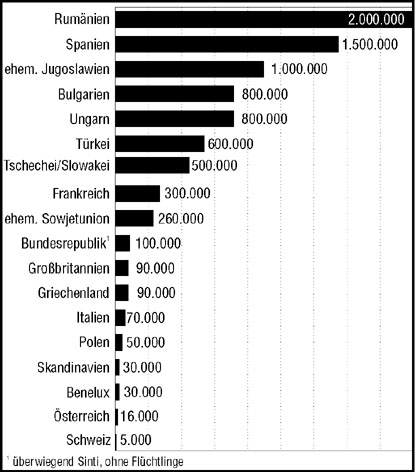


Romani people
View on GrokipediaNomenclature
Endonyms and self-designations
The primary endonym used by many Romani groups is Roma, the plural form referring to the people as a whole, with singular Rom denoting an individual man or husband in the Romani language.[7] This term derives from an Indo-Aryan root, evolving from Prakrit ḍomba or ḍom (a caste or tribal name in northern India) through phonetic shifts to rom in Romani, reflecting the group's historical linguistic origins rather than any connection to Roman or Romanian nomenclature.[7] Not all Romani subgroups employ Roma as their preferred self-designation; divisions often arise from regional, dialectical, or historical factors, leading to distinct endonyms that emphasize internal diversity. For instance, Sinti groups in Western Europe, particularly in German-speaking areas, identify primarily as Sinti, a term of uncertain etymology that supplanted earlier designations like Kale by the 19th century.[7] Similarly, in France, Manuš (meaning "people" or "humans") is common alongside Kale, while Iberian Peninsula groups favor Kale or variants tied to Caló, a mixed Romani-Spanish dialect.[7][8] Subgroup-specific endonyms frequently incorporate professional, territorial, or kinship elements, such as Lovari (horse traders among Vlax Roma), Kalderash (cauldron makers), or Romaničel (a kin-based variant from Rom + čhel, meaning clan).[8] In Eastern Europe, Hungarian Roma may use Romungro (from an exonym that became autonymous, denoting sedentary groups), while others like Boyash or Ashkali reject Roma entirely in favor of names asserting separate identities, such as Boyash for Romanian-speaking copper workers.[8][9] Qualifying phrases like čače Roma ("true Roma") or amare Roma ("our Roma") further denote in-group superiority or exclusivity among subgroups.[9] Despite these variations, Roma has gained prominence in pan-European political and advocacy contexts since the late 20th century as an umbrella self-designation for Romani-speaking populations.[9]Exonyms and historical terms
The primary English exonym for the Romani people, "Gypsy" (or archaic "Gipsy"), emerged around 1600 from the Middle English term egypcien, reflecting the widespread medieval European belief that the group originated in Egypt—a misconception likely arising from their own legends of pilgrimage or misinterpretations of their South Asian roots as deriving from "Little Egypt" in the Byzantine sphere.[10] This term supplanted earlier Latin designations like Aegyptii or Egyptiaci found in 15th-century records across Western Europe, where arriving groups presented letters claiming princely status from "Little Egypt" to secure safe passage.[11] In Central, Eastern, and Southern Europe, exonyms such as German Zigeuner, French Tsigane, Hungarian Cigány, Italian Zingaro, and Romanian Țigan derive from the Byzantine Greek Atsinganos or Athinganoi, denoting a 10th–11th-century heretical Christian sect in Phrygia (modern Turkey) associated with fortune-telling, palmistry, and alleged sorcery—practices that paralleled those of early Romani migrants, leading to their conflation upon entering the Balkans around the 11th–12th centuries.[12][13] These terms often carried pejorative implications of deviance or otherness, reinforced by ecclesiastical bans on the sect's activities as early as the 4th century.[12] The Spanish exonym Gitano parallels "Gypsy" in etymology, deriving from Egipciano ("Egyptian"), adapted during the Romani's arrival in Iberia by the 15th century, though some linguistic variants in the region also show influence from the Atsinganos root via Mediterranean trade routes.[10] In Middle French, Bohémien was commonly used from the 15th century onward, referencing Bohemia (modern Czechia) as a key migration waypoint, evoking nomadic lifestyles later romanticized in cultural tropes but rooted in 1420s diplomatic records of groups passing through the Holy Roman Empire.[10] Other sporadic historical terms included Tartari in some Italian and German chronicles, linking Romani to Mongol invaders due to shared itinerancy, though this was less enduring.[14] These exonyms persist in varying degrees, often detached from their factual origins, which genetic and linguistic evidence traces to northern India rather than the ascribed sources.[15]Origins and migration
Linguistic evidence for South Asian roots
The Romani language, an Indo-Aryan member of the Indo-European family, exhibits structural and lexical features tracing its origins to the northwestern Indian subcontinent, with closest affinities to modern languages such as Punjabi, Kashmiri, and Rajasthani.[16] Linguistic recognition of this connection dates to the late 18th century, when scholars like Johann Rüdiger compared Romani vocabulary to Hindi, identifying systematic correspondences in core terms absent in neighboring language families.[17] Approximately 60-70% of Romani's basic lexicon derives from Prakrit or early New Indo-Aryan precursors, reflecting a departure from South Asia around the 9th-11th centuries CE before extensive admixture with Iranian, Armenian, and European elements.[18] Core vocabulary cognates underscore this heritage, particularly in domains like numerals, kinship, and body parts, which resist replacement during migration. For instance, Romani numerals ekh ("one"), dui ("two"), and panj ("five") mirror Sanskrit eka, dva, and pañca, respectively, as preserved in Hindi and Punjabi.[18] Similarly, terms for family relations such as phral ("brother") from Sanskrit bhrātr̥ and phuri ("old woman") akin to purī ("town" or elder matriarchal connotations) align with Indo-Aryan patterns, distinct from Dravidian or Iranian substrates.[19] These retentions indicate an origin among low-caste or nomadic groups in regions like modern-day Rajasthan or Punjab, where such lexicon predominates.[16] Grammatically, Romani preserves Indo-Aryan traits including nominative-accusative alignment, oblique case marking for nouns (e.g., via postpositions), and verb agreement with gender, number, and person—features atrophied in many European contact languages but robust in Hindi-Urdu and related tongues.[18] Ablaut patterns in verbs and the use of participles for tense formation further echo Middle Indo-Aryan stages, as documented in comparative studies.[19] While peripheral vocabulary shows heavy borrowing (e.g., Persian influences like zulum "oppression" from zulm), the inherited core—estimated at 500-1000 roots—lacks deep Iranian phonological shifts, supporting a relatively rapid westward exodus rather than prolonged settlement in Persia.[16]| Category | Romani | Cognate Indo-Aryan (e.g., Hindi/Sanskrit) | Meaning |
|---|---|---|---|
| Numerals | ekh | eka | one |
| Kinship | phral | bhrātr̥ | brother |
| Body | jakh | akṣi | eye |
| House | kher | gṛha/ghar | house |
Genetic evidence and admixture
Genetic studies utilizing uniparental markers have established the South Asian origins of the Romani people. The Y-chromosome haplogroup H1a1a-M82, originating from the Indian subcontinent, predominates among Romani males, with frequencies ranging from 44% to over 60% across European groups, and is rare or absent in non-Romani host populations.[20][21] Mitochondrial DNA haplogroup M, also tracing to South Asia, accounts for approximately 30% of Romani maternal lineages.[22] These markers indicate a proto-Romani population departure from northwest India around 1,500 years ago, followed by a founder bottleneck that reduced genetic diversity.[15][23] Autosomal genome-wide analyses further quantify the ancestral composition, revealing that contemporary Romani harbor 20-30% South Asian ancestry, closely aligned with Punjabi populations from northwestern India, while the majority (around 80%) derives from West Eurasian sources.[24][25] This South Asian component shows low levels of prior West Eurasian admixture in the founding group, suggesting the proto-Romani migrated as a relatively endogamous population.[26] Admixture events occurred primarily during westward dispersal through the Middle East and into Europe, incorporating gene flow from encountered populations including Armenians, Anatolians, and various Europeans, with varying degrees across subgroups.[23][6] Balkan Romani exhibit higher Middle Eastern influences, while western European groups show more recent local admixture, yet the core South Asian signal persists despite these overlays and ongoing endogamy.[27] Elevated frequencies of certain recessive disorders, such as congenital myasthenia, underscore the founder effect and limited gene pool.[22] Overall, these patterns refute alternative origins and affirm a singular exodus from India with subsequent diaspora admixture shaping modern Romani genetics.[28][24]Historical migration routes and timeline
Genetic analyses indicate that the Romani originated in northwestern India, with an ancestral population bottleneck and exodus dated to approximately 1,500 years ago, around 500 CE.[29] [6] This migration followed a northerly route from regions near Gilgit through the Hindu Kush mountains into Persia (modern-day Iran), where linguistic and genetic markers show early admixture with local populations.[30] From Persia, groups proceeded westward to Armenia and the Caucasus, encountering further genetic influences before entering the Byzantine Empire by the 11th century.[31] [22] By the 11th to 12th centuries, Romani had reached the Anatolian peninsula, as evidenced by historical and phylogeographic data.[1] Their dispersal into the Balkans occurred primarily in the 14th century, with records confirming presence in the Byzantine territories and early Ottoman lands.[32] From Balkan bases, migrations radiated northward and westward into Central Europe around 1417, as noted in chronicles from the Holy Roman Empire, and into Western Europe by the early 15th century.[33] The following timeline summarizes key phases based on converging linguistic, genetic, and documentary evidence:| Approximate Date | Migration Milestone |
|---|---|
| 500–1000 CE | Exodus from northwestern India via Hindu Kush to Persia and Armenia; initial founder effects and admixture.[29] [31] |
| 11th–12th centuries CE | Arrival in Anatolia and Byzantine Empire; limited settlement and continued westward movement.[1] |
| 14th century CE | Establishment in the Balkans; earliest reliable records in southeastern Europe.[32] |
| Early 15th century CE | Expansion into Central and Western Europe from Balkan routes; documented arrivals in Germany, France, and beyond.[6] [33] |
Population and subgroups
Global estimates and geographic distribution
Estimates of the global Romani population vary significantly due to factors such as reluctance to self-identify in censuses stemming from historical stigma and discrimination, nomadic lifestyles in some subgroups, irregular migration, and inconsistent methodologies across national surveys.[1] Scholarly and organizational assessments typically place the worldwide figure between 10 and 12 million, with the majority residing in Europe; higher claims reaching 14 million occasionally appear but lack robust substantiation.[35] These numbers derive from extrapolations combining census data, expert surveys, and demographic modeling, as no comprehensive global census exists.[36] In Europe, which hosts approximately 80-90% of the Romani population, concentrations are highest in Central and Eastern countries. The Council of Europe estimates around 1.85 million in Romania (about 8.3% of the national population), while Bulgaria reports roughly 750,000, Hungary 700,000-800,000, and Serbia 600,000 based on similar institutional assessments.[37] Turkey maintains the single largest population at up to 2.75 million, reflecting early migration routes and integration patterns.[38] Western Europe sees notable communities in Spain (1-1.5 million, often more assimilated), France (300,000-1.2 million, including recent migrants), and the United Kingdom (around 200,000).[38] The European Union as a whole is home to about 6 million, predominantly citizens of member states, though undercounting persists in official statistics.[35] Outside Europe, Romani diaspora communities number 1-2 million, primarily in the Americas from 19th- and 20th-century emigrations. The United States hosts an estimated 1 million, scattered across urban and rural areas with varying degrees of cultural retention.[38] Brazil and Argentina each have hundreds of thousands, often blended with local migrant groups, while smaller populations exist in Canada and Australia.[39] Remnant communities in the Middle East and North Africa trace to medieval dispersals, but precise figures remain elusive due to assimilation and lack of ethnic tracking.[16]| Country/Region | Estimated Population | Notes |
|---|---|---|
| Turkey | 2,000,000–2,750,000 | Largest single-country population; includes integrated and nomadic groups.[38] |
| Romania | 1,850,000 | Official estimates; census undercounts likely.[37] |
| Spain | 1,000,000–1,500,000 | High assimilation rates; historical presence since 15th century.[38] |
| Bulgaria | 750,000 | Concentrated in urban peripheries.[38] |
| United States | ~1,000,000 | Diaspora from Europe; diverse subgroups.[38] |