Recent from talks
Nothing was collected or created yet.
Space warfare
View on Wikipedia
This article needs additional citations for verification. (October 2011) |

| Part of a series on |
| War (outline) |
|---|
Space warfare is combat in which one or more belligerents are in outer space. The scope of space warfare includes ground-to-space warfare, such as attacking satellites from the Earth; space-to-space warfare, such as satellites attacking satellites; and space-to-ground warfare, such as satellites attacking Earth-based targets. There exist international treaties, which are in place to attempt to regulate conflicts in space and limit the installation of space weapon systems, especially nuclear weapons.
On October 31, 2023, during a Yemeni missile strike on Israel, Israel's Arrow 2 system intercepted a ballistic missile launched from Yemen by Houthi rebels; this successful interception occurred outside of Earth's atmosphere thus making it the first recorded practical instance of space warfare during an active conflict.[1][2] On April 14, 2024, Iran launched more than 120 ballistic missiles at Israel, making it the first large-scale incident in which a space weapon was used.[3]
From 1985 to 2002, there was a United States Space Command, which in 2002 merged with the United States Strategic Command, leaving the United States Space Force (formerly Air Force Space Command until 2019) as the primary American military space force. The Russian Space Force, established on August 10, 1992, which became an independent section of the Russian Armed Forces on June 1, 2001, was replaced by the Russian Aerospace Defence Forces starting December 1, 2011, but was reestablished as a component of the Russian Aerospace Forces on August 1, 2015. In 2019, India conducted a test of the ASAT missile; this made out the fourth country with that capability. In April of the same year, the Indian Armed Forces established the Defence Space Agency.
History
[edit]1950s
[edit]During the early Cold War, a survivable reconnaissance asset was considered highly valuable. In a time before satellites, this meant building an aircraft that could fly higher or faster, or both, compared to any interceptor that would try to bring it down. Notably, the United States would introduce the U-2 spy plane in 1956. It was thought, at the time of its introduction, that the plane’s service ceiling of 24,000 metres (80,000 ft) would render it immune to Soviet aircraft, missiles, and radar. That was the case until the 1960 U-2 incident, where a United States U-2 spy plane was shot down by the Soviet Air Defense Forces’ S-75 Dvina (SA-2 Guideline) surface-to-air missile while conducting photographic aerial reconnaissance deep inside Soviet territory.
Three years before the incident, in 1957, a modified R-7 rocket carried the world's first artificial satellite, Sputnik 1, into an orbit hundreds of kilometers above sea level, notably beyond the reach of any existing weapons system. While Sputnik 1 held no military value, only transmitting radio signals back to Earth for three weeks, its launch sparked the beginning of the Space Race. This spurred the United States to hasten and re-emphasize its space programs, culminating in the Explorer program, which launched the first American satellite into orbit in 1958. In tandem with the effort to achieve superior spaceflight capability over the other, the United States and the Soviet Union began to develop space warfare capabilities.
1960s
[edit]Early efforts to conduct space warfare were directed at space-to-space warfare, as ground-to-space systems were considered to be too slow and too isolated by Earth's atmosphere and gravity to be effective at the time. The history of active space warfare development goes back to the 1960s when the Soviet Union began the Almaz project, a project designed to give them the ability to do on-orbit inspections of satellites and destroy them if needed. Similar planning in the United States took the form of the Blue Gemini project, which consisted of modified Gemini capsules that would be able to deploy weapons and perform surveillance.
One early test of electronic space warfare, the so-called Starfish Prime test, took place in 1962 when the United States exploded a ground-launched nuclear weapon in space to test the effects of an electromagnetic pulse. The result was a deactivation of many then-orbiting satellites, both American and Soviet. The deleterious and unfocused effects of the EMP test led to the banning of nuclear weapons in space in the Outer Space Treaty of 1967. (See high-altitude nuclear explosion.)
In the early 1960s, the U.S. military produced a film called Space and National Security which depicted space warfare.[4]
1970s–1990s
[edit]
Through the 1970s, the Soviet Union continued their project and test-fired a cannon to test space station defense. This was considered too dangerous to do with a crew on board, however, so the test was conducted after the crew had returned to Earth.
A 1976 Soviet report suggested that the design of the Space Shuttle had been guided by a requirement to deliver a payload- such as a bomb- over Russia and return to land after a single orbit. This may have been a confusion based on requirements 3A and 3B for the shuttle's design, which required the craft to be able to deploy or retrieve an object from a polar orbit in a single pass.[5]
Both the Soviets and the United States developed anti-satellite weaponry designed to shoot down satellites. While early efforts paralleled other space-to-space warfare concepts, the United States was able in the 1980s to develop ground-to-space laser anti-satellite weapons. None of these systems are known to be active today; however, a less powerful civilian version of the ground-to-space laser system is commonly used in the astronomical technique of adaptive optics.
In 1984, the Strategic Defence Initiative (SDI) was proposed. It was nicknamed Star Wars after the popular science fiction franchise Star Wars.
In 1985, the United States demonstrated its conventional ASAT capabilities by launching an ASM-135 ASAT from an F-15 to shoot down the Solwind P78-1, an American research satellite, from its 555-kilometre (345 mi) orbit.
Since 2000
[edit]
The People's Republic of China successfully tested (see 2007 Chinese anti-satellite missile test) a ballistic missile-launched anti-satellite weapon on January 11, 2007. This resulted in harsh criticism from the United States of America, Britain, and Japan.
The U.S. developed an interceptor missile, the SM-3, testing it by hitting ballistic test targets while they were in space. On February 21, 2008, the U.S. used an SM-3 missile to destroy a spy satellite, USA-193, while it was 247 kilometers (133 nautical miles) above the Pacific Ocean.[6][7][8][9]
Japan fields the U.S.-made SM-3 missile, and there have been plans to base the land-based version in Romania and Vietnam.[citation needed]
In March 2019, India shot down a satellite orbiting in a low Earth orbit using an ASAT missile during an operation code named Mission Shakti,[10] thus making its way to the list of space warfare nations,[11] establishing the Defense Space Agency the following month, followed by its first-ever simulated space warfare exercise on July 25 which would inform a joint military space doctrine.[12]
In July 2019, Emmanuel Macron "called for a space high command to protect" France's satellites. This was followed by a plan released by military officials. French Defense Minister, Florence Parly, announced a space weapons program that would move the country's space surveillance strategy towards active protection of its assets in space, e.g., satellites. The projects outlined include: patrolling nano-satellites swarms, ground-based laser systems to blind spying satellites, and machine guns mounted on satellites.[13]
Starlink, SpaceX's large low Earth orbit satellite constellation, was extensively used for warfare following Russia's invasion of Ukraine after the country's previous satcom provider Viasat were cyberattacked in the first few days of the invasion.[14][15] Starlink was used for defense and attacks on Russian positions, with Starlink terminals being namely strapped on strike drones and sea drones.[16][17][18] SpaceX vowed and acted against the use of their Starlink service for active warfare,[19] while Russia launched cyberattacks against Starlink and threatened of striking Starlink satellites directly in retaliation.[16][20]
On October 31, 2023, as part of the Gaza war, Israel intercepted a Houthi ballistic missile with its Arrow 2 missile defense system. According to Israeli officials, the interception occurred above Earth's atmosphere above the Negev Desert, making it the first instance of space combat in history.[21][22]
On November 21, 2024, as part of the Russian invasion of Ukraine, Russia launched a new Oreshnik intermediate-range ballistic missile, striking Dnipro.[23] Ukraine's air force initially claimed an intercontinental ballistic missile (range greater than 5,500 km) was used, and Ukrainian media initially reported it was an RS-26 Rubezh ICBM with range 5,800 km. The US and Russia confirmed it was intermediate-range (3,000–5,500 km),[24] but the Pentagon stated it was based on the RS-26 ICBM. It was fired from the Astrakhan region 700 km away. Analysts stated the missile used a multiple independently targetable reentry vehicle (MIRV), likely marking their first use in combat.[25][26] The night attack was reported to see six sequential vertical flashes, each comprising a cluster of up to six individual projectiles.[27] UN spokesperson Stéphane Dujarric called the use of the intermediate-range weapon "concerning and worrying".[28]
As of 2025, space situational awareness is generally limited between countries.[29]: 269 Countries rely on doctrinal statements, media reports, international treaties and codes of conduct, and the like to signal their approaches to the development and use of counterspace capabilities.[29]: 269
Theoretical space weaponry
[edit]A counterspace attack is one which inhibits an adversary's ability to use space for civilian purposes or national security purposes.[29]: 244
Ballistic warfare
[edit]
In the late 1970s and through the 1980s, the Soviet Union and the United States theorized, designed and in some cases tested a variety of weaponry designed for warfare in outer space. Space warfare was seen primarily as an extension of nuclear warfare, and many theoretical systems were based around the destruction or defense of ground and sea-based missiles. Space-based missiles were not attempted due to the Outer Space Treaty, which banned the use, testing or storage of nuclear weapons outside the Earth's atmosphere. When the U.S. gained "interest in utilizing space-based lasers for ballistic missile defense", two facts emerged. One being that the ballistic missiles are fragile and two, chemical lasers project missile killing energy (3,000 kilometers). This meant that lasers could be put into space to intercept a ballistic missile.[30]
Systems proposed ranged from measures as simple as ground and space-based anti-missiles to railguns, space based lasers, orbital mines and similar weaponry. Deployment of these systems was seriously considered in the mid-1980s under the banner of the Strategic Defense Initiative announced by Ronald Reagan in 1983, using the term "evil empire" to describe the Soviets (hence the popular nickname "Star Wars").[31] If the Cold War had continued, many of these systems could potentially have seen deployment: the United States developed working railguns, and a laser that could destroy missiles at range, though the power requirements, range, and firing cycles of both were impractical. Weapons like the space-based laser was rejected, not just by the government, but by universities, moral thinkers, and religious people because it would have increased the waging of the arms race and questioned the United States' role in the Cold War.[32]
Electronic warfare
[edit]With the end of the Cold War and continued development of satellite and electronics technology, attention was focused on space as a supporting theatre for conventional warfare. Currently, military operations in space primarily concern either the vast tactical advantages of satellite-based surveillance, communications, and positioning systems or mechanisms used to deprive an opponent of said tactical advantages.
Accordingly, most space-borne proposals which would traditionally be considered "weapons" (a communications or reconnaissance satellite may be useful in warfare but isn't generally classified as a weapon) are designed to jam, sabotage, and outright destroy enemy satellites, and conversely to protect friendly satellites against such attacks. To this end, the US (and presumably other countries) is researching groups of small, highly mobile satellites called "microsats" (about the size of a refrigerator) and "picosats" (approximately 1 cubic foot (≈27 litres) in volume) nimble enough to maneuver around and interact with other orbiting objects to repair, sabotage, hijack, or simply collide with them. [citation needed]

Kinetic bombardment
[edit]Kinetic weapons collide with their targets.[29]: 244 In the context of space warfare, kinetic weapons could include missiles launched from earth (direct ascent weapons) or co-orbital weapons fired by satellites or other spacecraft in orbit.[29]: 244
A theorized use involves the extension of conventional weaponry into orbit for deployment against ground targets. Though international treaties ban the deployment of nuclear missiles outside the atmosphere, other categories of weapons are largely unregulated. Traditional ground-based weapons are generally not useful in orbital environments, and few if any would survive re-entry even if they were, but as early as the 1950s, the United States has toyed with kinetic bombardment, i.e. orbiting magazines of non-explosive projectiles to be dropped onto hardened targets from low Earth orbit.

Kinetic weapons have always been widespread in conventional warfare—bullets, arrows, swords, clubs, etc.—but the energy a projectile would gain while falling from orbit would make such a weapon rival all but the most powerful explosives.[citation needed] A direct hit would presumably destroy all but the most hardened targets without the need for nuclear weapons.
Such a system would involve a 'spotter' satellite, which would identify targets from orbit with high-power sensors, and a nearby 'magazine' satellite to de-orbit a long, needle-like tungsten dart onto it with a small rocket motor or dropping a large rock from orbit (such as an asteroid, cf. Ivan's hammer).[citation needed] This would be more useful against a larger but less hardened target (such as a city). Though a common device in science fiction, there is no publicly available evidence that any such systems have actually been deployed by any nation.
Directed-energy weapons
[edit]

Weapon systems that fall under this category include lasers, linear particle accelerators or particle-beam based weaponry, microwaves and plasma-based weaponry. Particle beams involve the acceleration of charged or neutral particles in a stream towards a target at extremely high velocities, the impact of which creates a reaction causing immense damage. Most of these weapons are theoretical or impractical to implement currently, aside from lasers which have been used to blind satellites[33] and are starting to be used in terrestrial warfare. That said, directed-energy weapons are more practical and more effective in a vacuum (i.e. space) than in the Earth's atmosphere, as in the atmosphere the particles of air interfere with and disperse the directed energy.
In the context of space-based deployment, directed-energy weapons can be distinguished as either “high-powered” or “dazzler.” High-powered satellite-operated lasers are intended to deal irreversible damage to the sensitive parts, mainly optics, on satellites and have the advantage of being difficult to attribute to an actor. Though, it is difficult to confirm the success of an attack. Dazzlers are not intended to deal irreversible damage but rather disable a target satellite. It maintains the same advantages and disadvantages as the high-powered variant. Though such systems not yet functional, the US Defense Intelligence Agency notes that several actors, including the United States, PRC, Russia, and France, are actively pursuing these capabilities.[33]
Practical considerations
[edit]This section possibly contains original research. (April 2014) |
Space warfare is likely to be done at far larger distances and speeds than combat on Earth. The vast distances pose big challenges for targeting and tracking, as even light requires a few seconds to cover hundreds of thousands of kilometers. For example, if trying to fire on a target at the distance of the Moon from the Earth, one sees the position of the target slightly more than a second earlier. Thus even a laser would need ~1.28 seconds, meaning a laser-based weapon system would need to lead a target's apparent position by 1.28×2 = 2.56 seconds. A projectile from a railgun recently tested by the US Navy would take over 18 hours to cross that distance, if it travels in a straight line at a constant velocity of 5.8 km/s along its entire trajectory.
Three factors make engaging targets in space very difficult. First, the vast distances mean that an error of even a fraction of a degree in the firing solution can mean a miss by thousands of kilometers. Second, spaceflight involves tremendous speeds by terrestrial standards—a geostationary satellite moves at 3.07 km/s, and objects in low Earth orbit move at ~8 km/s. Third, though distances are huge, targets remain relatively small. The International Space Station, currently the largest artificial object in Earth orbit, measures slightly over 100m at its largest span. Other satellites can be vastly smaller, e.g., Quickbird measures only 3.04m. External ballistics for stationary terrestrial targets is enormously complicated—some of the earliest analog computers were used to calculate firing solutions for naval artillery, as the problems were already beyond manual solutions in any reasonable time—and targeting objects in space is far harder. And, though not a problem for orbital kinetic weapons, any directed energy weapon would need huge amounts of electricity. So far the most practical batteries are lithium, and the most practical means of generating electricity in space is photovoltaic modules, which are currently only up to 30% efficient,[34] and fuel cells, which have limited fuel. Current technology might not be practical for powering effective lasers, particle beams, and railguns in space. In the context of the Strategic Defense Initiative, the Lawrence Livermore National Laboratory in the United States worked on a project for expandable space-based x-ray lasers powered by a nuclear explosion, Project Excalibur, a project canceled in 1992 for lack of results.[35] SDI projects included Zenith Star, using the Alpha chemical laser.
General William L. Shelton has said that in order to protect against attacks, Space Situational Awareness is much more important than additional hardening or armoring of satellites.[36] The Air Force Space Command has indicated that their defensive focus will be on "Disaggregated Space Architectures".[37]
Space debris
[edit]Anti-satellite attacks, especially ones with kinetic kill vehicles, can form space debris which can stay in orbit for many years and could interfere with future space activity or in a worst case trigger Kessler syndrome.[38] In the worst-case scenario of Kessler syndrome, collisions among debris and space objects become self-sustaining, although this scenario would require a vast amount of debris and a long time period.[29]: 245
In January 2007 China did a satellite knock out whose detonation alone caused more than 40,000 new chunks of debris with a diameter > 1 cm and a sudden increase in the total amount of debris in orbit.[39] The PRC is reported to be developing "soft-kill" techniques such as jamming and vision kills that do not generate much debris.[40]
Risk to other activities
[edit]Space warfare creates risks to other activities, including risks to human beings in orbit, risks to commercial space activity, and creating difficulties for launching payloads to higher orbits.[29]: 244
Political considerations
[edit]Countries which engage in space warfare would presumably face reputational costs for violating the 1967 Outer Space Treaty.[29]: 244–245
Possible warfare over space
[edit]
Most of the world's communications systems rely heavily on the presence of satellites in orbit around Earth. Protecting these assets might seriously motivate nations dependent upon them to consider deploying more space-based weaponry, especially in conflicts involving advanced countries with access to space.
Since 2017, the United States Air Force has run an annual military exercise called "Space Flag" at Peterson Space Force Base, which involves a red team simulating attacks on U.S. satellites.[41]
Robert Zubrin, aerospace engineer and advocate for human exploration of Mars, stated that anti-satellite weapons capabilities of nations increases, space infrastructures must be able to defend itself using other satellites that can destroy such weapons. Or else, he states, satellite-based navigation, communications and reconnaissance capabilities would be severely limited and easily influenced by adversaries.[42]: 63–66
Direct Ascent
[edit]The modern incarnations of the ASM-135 ASAT program are the so-called direct-ascent anti-satellite weapons. These weapons are usually either ballistic or anti-ballistic interceptor missiles, which ascend directly from Earth to intercept their target and have been adapted to the anti-satellite role. To date, four countries have demonstrated their ability to launch these weapons, the USA, the PRC, India, and Russia, but so far none have conducted such an attack on another country’s satellites.[43]
Direct-ascent ASATs leverage existing technologies and launch platforms to neutralize both space-based and ground-based targets. This option tends to be highly destructive and indiscriminate as any attack will produce space debris, which can indiscriminately affect other satellites in similar orbits. While this option comes with the benefit of leveraging existing technologies and a certain element of surprise, as an attack cannot be detected until a missile has exited its silo, there are significant downsides. Firstly, there is the cost disparity of using an ICBM or ABM to kill a small and inexpensive satellite. Additionally, these missiles are not designed to send payloads out to geocentric orbit, as such they can only affect targets in low earth orbit and only in a target area centered around the static location of the missile itself.
Co-Orbital
[edit]Co-orbital systems come with a few potential kill mechanisms: in guided kinetic vehicles, like the Multiple Kill Vehicle, or in the form of a satellite that can release a kinetic interceptor or a cloud of debris. The first co-orbital system, Istrebitel Sputnikov, was developed by the Soviet Union in the 1970s and reportedly utilized one of these mechanisms.
There are allegations that Russia continues to test co-orbital ASAT weapons as recently as 2020. In 2020 the U.S. State Department claimed that a Russian satellite, Cosmos-2519, exhibited behavior “inconsistent” with its intended mission. While in orbit, Kosmos-2519 deployed a smaller satellite, which Russian state media claimed: “conducted autonomous flight, a change in orbit, and a satellite inspection before returning to the base station”.[44] Another incident back in 2019 involved two Russian satellites, Kosmos 2542 and 2543, one of which appeared to begin following a U.S. national security satellite.[45] Such “inspector” satellites can be armed with lasers to provide non-destructive interference or deadly kinetic interceptors.
While these co-orbital systems provide more utility when compared to more direct and destructive options, their advantages are contingent on being maneuverable and inconspicuous. Given the increasing paranoia surrounding co-orbital anti-satellite, it is hard to believe that the major players in space will fail to notice the deployment of “research” satellites.
Space warfare in science fiction
[edit]Space warfare is a staple of science fiction, where it is shown with a wide range of realism and plausibility. Fictional space warfare includes anticipated future technology and tactics, and fantasy- or history-based scenarios in a scifi setting. Some portray a space military as like an air force; others depict a more naval framework. Still others suggest forces more like space marine: highly mobile forces doing interplanetary and interstellar war but most of the conflict happens in terrestrial environments. The main sub-genres of the Space warfare in science fiction thematic genre are space opera, Military and Space Western. Though sword and planet stories like Finisterre universe by C. J. Cherryh might be considered, they rarely feature such technologies. These three genres often intertwine and have themes that are common to all. Written Space Westerns are often based directly on existing established scifi space opera franchises with expanded universes like Star Wars and Star Trek,[46] including Warhammer 40,000: the most popular space opera military miniature wargame which spawned successful spin-off media: novels, video-games and on-going live adaption based on books by Dan Abnett.[47]
Both kinetic and directed energy weapons are often seen, along with various military space vessels. E. E. Smith's Lensman is an early example, which also inspired the term space opera due to the grandiose scale of the stories. Orson Scott Card's Ender's Game series is a notable example in that it makes a conjecture as to what sort of tactics and training would be needed for war in outer space. Other scifi authors have also delved into the tactics of space combat, such as David Weber in his Honorverse series, and Larry Niven and Jerry Pournelle in their Mote in God's Eye series. A more recent example is Alastair Reynolds' Revelation Space universe, which explores combat at relativistic speed. Robert A. Heinlein's Starship Troopers is perhaps one of the best-known and earliest explorations of the "space marine" idea.
Space-based vehicular combat is portrayed in many movies and video games, most notably Star Wars, Stargate, Halo, Descent, Gundam, Macross, Babylon 5, Star Trek, and Star Citizen. Games such as the Homeworld series have interesting concepts for space warfare, such as 3D battle formations, plasma-based projectors that get their energy from a ship's propulsion system, and automated uncrewed space combat vehicles. Other series, such as Gundam, prominently show vehicular combat in and among many near future concepts, such as O'Neill cylinders.
Fictional galaxies with space warfare are far too many to list, but popular examples include Star Trek (in all of its forms), Star Wars, Halo, Stargate, Warhammer 40,000, Babylon 5, Buck Rogers, Flash Gordon, Battlestar Galactica, Mass Effect, Freespace and many comic book franchises. Video games often touch the subject; the Wing Commander franchise is a prototypical example. Few games try to simulate realistic distance and speed, though Independence War and Frontier: Elite II both do, as does the board game Attack Vector: Tactical.
Many authors have either used a galaxy-spanning fictional empire as background or written about the growth and/or decline of such an empire. Said empire's capital is often a core world, such as a planet relatively close to a galaxy's supermassive black hole. Characterization can vary wildly from malevolent forces attacking sympathetic victims to apathetic bureaucracies to more reasonable entities focused on social progress, and anywhere in between. Scifi writers generally posit some form of faster-than-light drive in order to facilitate interstellar war. Writers such as Larry Niven have developed plausible interplanetary conflict based on human colonization of the asteroid belt and outer planets via technologies using currently known physics.
See also
[edit]- Asteroid impact avoidance
- Beijing–Washington space hotline
- Militarisation of space
- Schriever wargame
- Space force
- Space weapon
- Starlink satellite services in Ukraine, instance of a satellite constellation being used for warfare
- Sun outage
Related to specific countries and facilities:
- Department of Defense Manned Space Flight Support Office
- European Aeronautic Defense and Space Company
- Joint Functional Component Command for Space and Global Strike (US Strategic Command)
- National Missile Defense
- Pine Gap (Australia)
- United States Air Force Space Command
- United States Army Space and Missile Defense Command
References
[edit]- ^ "Israel downing Houthi missile is first instance of space warfare". The Jerusalem Post. November 6, 2023. Archived from the original on January 21, 2024. Retrieved February 24, 2024.
- ^ Barber, Harriet (November 4, 2023). "How Israel shot down a ballistic missile in space for the first time". The Telegraph. Archived from the original on November 23, 2023. Retrieved November 6, 2023.
- ^ "How Israel foiled Iran's ballistic missiles as they headed to an F-35 airbase". The Times of Israel. April 14, 2024.
- ^ "Astrospies". www.pbs.org. Archived from the original on January 12, 2024. Retrieved February 24, 2024.
- ^ "The Space Review: Nuking Moscow with a Space Shuttle". Archived from the original on January 14, 2024. Retrieved February 24, 2024.
- ^ "Satellite Shoot Down: How It Will Work". Space.com. February 19, 2008. Archived from the original on September 11, 2010. Retrieved February 21, 2008.
- ^ "Navy Hits Satellite With Heat-Seeking Missile". Space.com. February 21, 2008. Archived from the original on November 28, 2010. Retrieved February 21, 2008.
- ^ "Navy Succeeds In Intercepting Non-Functioning Satellite (Release NNS080220-19)" (Press release). U.S. Navy. February 20, 2008. Archived from the original on February 25, 2008. Retrieved February 20, 2008.
- ^ Koshy, Jacob (March 27, 2019). "The Hindu Explains: What is significant about Mission Shakti?". The Hindu. ISSN 0971-751X. Archived from the original on January 29, 2020. Retrieved December 5, 2019.
- ^ "India tests anti-satellite missile by destroying one of its satellites". New Scientist. March 27, 2019. Archived from the original on March 27, 2019. Retrieved March 27, 2019.
- ^ "India to begin first-ever simulated space warfare exercise". Archived from the original on October 3, 2023. Retrieved February 24, 2024.
- ^ Berger, Eric (July 25, 2019). "To protect its satellites, France outlines ambitious space-weapons program". ars Technica. Archived from the original on August 11, 2019. Retrieved August 11, 2019.
- ^ Sheetz, Michael (February 28, 2022). "Viasat believes 'cyber event' is disrupting its satellite-internet service in Ukraine". CNBC. Archived from the original on September 18, 2023. Retrieved September 9, 2023.
- ^ Sheetz, Amanda Macias, Michael (June 1, 2023). "Pentagon awards SpaceX with Ukraine contract for Starlink satellite internet". CNBC. Archived from the original on September 15, 2023. Retrieved September 16, 2023.
{{cite web}}: CS1 maint: multiple names: authors list (link) - ^ a b "How Elon Musk's satellites have saved Ukraine and changed warfare". The Economist. ISSN 0013-0613. Archived from the original on September 23, 2023. Retrieved June 6, 2023.
- ^ Luxmoore, Matthew (February 10, 2023). "Soldiers in Ukraine Say Some Drones Affected After SpaceX Limits Starlink". Wall Street Journal. ISSN 0099-9660. Archived from the original on September 27, 2023. Retrieved September 27, 2023.
- ^ Gault, Matthew (September 26, 2022). "Mysterious Sea Drone Surfaces in Crimea". Vice. Archived from the original on February 24, 2024. Retrieved September 10, 2023.
- ^ Kay, Grace. "SpaceX president was reportedly upset that Elon Musk kept financing Starlink in Ukraine before Pentagon deal: 'Elon succumbed to the bullshit on Twitter'". Business Insider. Archived from the original on September 18, 2023. Retrieved September 10, 2023.
- ^ "Russia warns West: We can target your commercial satellites". Reuters. October 27, 2022. Archived from the original on October 27, 2022. Retrieved September 27, 2023.
- ^ "The deadly missile race in the Middle East". The Economist. November 7, 2023. Archived from the original on November 8, 2023. Retrieved November 8, 2023.
- ^ Barber, Harriet (November 5, 2023). "How Israel shot down a ballistic missile in space for the first time". The Telegraph. Archived from the original on November 23, 2023. Retrieved November 8, 2023.
- ^ "Putin says Russia hit Ukraine with new intermediate-range ballistic missile". BBC News. November 20, 2024. Retrieved November 21, 2024.
- ^ Sauer, Pjotr (November 21, 2024). "Putin says Russia fired experimental ballistic missile into Ukraine". The Guardian. ISSN 0261-3077. Retrieved November 21, 2024.
- ^ Edwards, Christian; Nicholls, Catherine; Radford, Antoinette; Sangal, Aditi (November 21, 2024). "Russian ballistic missile carried multiple warheads, US and Western officials say". CNN. Retrieved November 21, 2024.
- ^ "Russia fired experimental ballistic missile at Ukraine, Putin says". Reuters. November 21, 2024. Retrieved November 21, 2024.
- ^ "Videos circulating online show impact of Dnipro strike". BBC News. November 20, 2024. Retrieved November 21, 2024.
- ^ "UN says Russia's use of intermediate-range missile 'worrying'". BBC News. November 20, 2024. Retrieved November 21, 2024.
- ^ a b c d e f g h Cunningham, Fiona S. (2025). Under the Nuclear Shadow: China's Information-Age Weapons in International Security. Princeton University Press. doi:10.2307/jj.16040335. ISBN 978-0-691-26103-4. JSTOR jj.16040335.
- ^ Mowthorpe, Matthews (2004). The Militarization and Weaponization of Space. Lanham, Maryland: Lexington Books. pp. 140–141. ISBN 0-7391-0713-5.
- ^ Hoffman, David (2009). The Dead Hand. New York, New York: DoubleDay. pp. 71. ISBN 978-0-385-52437-7.
- ^ Bracken, Paul (2012). The Second Nuclear Age. New York, New York: Times Books, Henry Holt and Company, LLC. pp. 37–38. ISBN 978-0-8050-9430-5.
- ^ a b Challenges_Security_Space_2022.pdf (dia.mil) https://www.dia.mil/Portals/110/Documents/News/Military_Power_Publications/Challenges_Security_Space_2022.pdf Archived February 20, 2024, at the Wayback Machine
- ^ "photovoltaics". Spectrolab. Spectrolab, Inc. 2009. Archived from the original on May 27, 2014. Retrieved April 4, 2014.
- ^ Gordon, Michael (July 20, 1992). "'Star Wars' X-Ray Laser Weapon Dies as Its Final Test Is Canceled". The New York Times. Archived from the original on May 22, 2015. Retrieved February 24, 2024.
- ^ "Future of USAF Space Command." Archived October 2, 2012, at the Wayback Machine Defense News, September 30, 2012.
- ^ "Inside DOD". U.S. Department of Defense. Archived from the original on May 24, 2019. Retrieved February 24, 2024.
- ^ Covault, Craig (January 21, 2007). "China's Asat Test Will Intensify U.S.-Chinese Faceoff in Space". Aviation Week. Archived from the original on January 27, 2007. Retrieved January 21, 2007.
- ^ Seidler, Christoph (April 22, 2017). "Problem Weltraumschrott: Die kosmische Müllkippe". Spiegel Online. Archived from the original on April 23, 2017. Retrieved April 22, 2017.
- ^ Grady, John (January 29, 2014). "U.S. Dependence on Space Assets Could be a Liability in a Conflict with China". usni.org. United States Naval Institute. Archived from the original on January 30, 2014. Retrieved January 29, 2014.
- ^ Risen, Tom (July 3, 2018). "U.S. Air Force to expand Space Flag satellite war game". American Institute of Aeronautics and Astronautics. Archived from the original on October 3, 2023. Retrieved February 24, 2024.
- ^ Zubrin, Robert (May 14, 2019). The Case for Space: How the Revolution in Spaceflight Opens Up a Future of Limitless Possibility. Amherst, New York: Prometheus Books. ISBN 978-1-63388-534-9. OCLC 1053572666.
- ^ 230414_Bingen_SpaceThreatAssessment_2023_UPDATED-min.pdf (csis.org) http://aerospace.csis.org/wp-content/uploads/2023/04/230414_Bingen_SpaceThreatAssessment_2023_UPDATED-min.pdf Archived February 22, 2024, at the Wayback Machine
- ^ "Is Russia's Mysterious New Satellite a Space Weapon?". Popular Mechanics. August 15, 2018. Archived from the original on June 26, 2023. Retrieved June 26, 2023.
- ^ "Exclusive: Russian Craft Shadowing U.S. Spy Satellite, Space Force Commander Says". Time. February 10, 2020. Archived from the original on June 28, 2023. Retrieved June 26, 2023.
- ^ "Tabletop RPGs With Space Western Settings & Themes | Screen Rant". Screen Rant. March 10, 2021. Archived from the original on July 21, 2023. Retrieved February 24, 2024.
- ^ "REVIEW: Alpharius: Head of the Hydra - Grimdark Magazine". May 11, 2021. Archived from the original on January 18, 2024. Retrieved February 24, 2024.
Further reading
[edit]- Hobbes, D (1986): An Illustrated Guide to Space Warfare Salamander Books Ltd. ISBN 0-86101-204-6.
- Macvey, John W.: Space Weapons, Space War. New York: 1979 Stein and Day (written by a professional astronomer). ISBN 978-0812861112.
- David Jordan: Air and Space Warfare, pp. 178–223, in:Understanding modern warfare. Cambridge Univ. Press, Cambridge 2008, ISBN 978-0-521-87698-8.
- John J. Klein: Space Warfare: Strategy, Principles and Policy. Routledge, Oxford 2006, ISBN 978-0-415-40796-0.
- Joan Johnson-Freese: Space Warfare in the 21st Century – Arming the Heavens. Routledge, Oxford 2016, ISBN 978-1-138-69388-3.
Space warfare
View on GrokipediaStrategic Foundations
Definition and Conceptual Framework
Space warfare encompasses military operations aimed at achieving or denying advantages in the outer space domain, including actions conducted from ground, air, or sea against space assets, as well as space-to-space and space-to-ground engagements.[1] These operations involve offensive counterspace capabilities, such as kinetic strikes, directed energy, or electronic warfare to disrupt, degrade, or destroy adversary satellites, and defensive measures to protect friendly space infrastructure.[2] The U.S. Space Force doctrine frames space as a warfighting domain where superiority—defined as the degree of control over space enabling joint force operations while limiting adversary access—is a prerequisite for broader military success, pursued across competition, crisis, and conflict phases.[2] [8] Conceptually, space warfare derives from classical strategic theory, adapted to the unique attributes of the space environment: its global reach, low friction for persistent operations, and vulnerability to cascading disruptions due to interconnected satellite networks supporting intelligence, surveillance, reconnaissance (ISR), communications, and precision navigation.[9] Unlike terrestrial domains, space lacks atmosphere, enabling high-speed orbits and line-of-sight propagation, which amplify the effects of disruptions—such as orbital debris from kinetic intercepts potentially rendering regions unusable for years via Kessler syndrome dynamics.[10] Doctrinal frameworks emphasize spacepower's infrastructural nature, where control subordinates to terrestrial objectives, integrating space effects into multi-domain operations rather than standalone battles, with principles like economy of force dictating selective engagements to avoid mutual assured degradation.[11] This approach recognizes space's dual-use character, where commercial and military assets blur, heightening escalation risks from inadvertent or deliberate interference.[12] Legally, the 1967 Outer Space Treaty provides the foundational framework, prohibiting the placement of nuclear weapons or other weapons of mass destruction in orbit, on celestial bodies, or in outer space, while permitting military activities short of such armaments, including reconnaissance satellites and testing of conventional systems.[13] However, the treaty's ambiguities—such as non-interference clauses and lack of enforcement mechanisms—have not precluded militarization, as evidenced by ongoing development of anti-satellite (ASAT) capabilities by major powers, underscoring a conceptual tension between aspirational peaceful use and pragmatic power projection.[9] Deterrence in this framework draws from nuclear analogies, stressing credible denial capabilities, stability through resilient architectures, and proportionality to manage escalation ladders inherent to space's transparency and irreversibility.[10] Empirical assessments, including simulations of peer conflicts, indicate that space warfare's character favors automation and rapid decision cycles, with human oversight constrained by orbital mechanics and attribution challenges.[2]Critical Role in National Security and Deterrence
Space assets underpin modern military operations by enabling critical functions such as intelligence, surveillance, and reconnaissance (ISR), secure communications, and positioning, navigation, and timing (PNT) services, which are integral to national security and operational effectiveness.[1] For instance, the U.S. Department of Defense relies on space-based PNT for precision-guided munitions, troop movements, and logistics, where even brief disruptions could degrade combat capabilities across air, land, sea, and cyber domains.[14] This dependence has elevated the space domain to a strategic battlespace, where control or denial directly influences warfighting outcomes and national sovereignty.[15] The vulnerabilities of these assets—to kinetic anti-satellite (ASAT) weapons, directed energy systems, cyber intrusions, and electronic jamming—amplify their role in deterrence, as adversaries could exploit them to achieve asymmetric advantages in conflict.[16] Nations like the United States counter this through doctrines emphasizing space superiority, defined as ensuring freedom of action for friendly forces while denying it to enemies, thereby deterring aggression by raising the costs of space-enabled attacks.[15] U.S. Space Force publications outline sustainment and operations strategies that integrate resilient architectures, such as proliferated low-Earth orbit constellations, to maintain deterrence via denial rather than solely punishment, avoiding escalation spirals from debris-generating strikes.[17] This approach aligns with broader integrated deterrence frameworks, leveraging space alongside terrestrial assets to signal resolve and capability.[18] In practice, space deterrence manifests through demonstrated capabilities and alliances; for example, NATO's 2022 Strategic Concept recognizes space threats to Allied security, prompting collective defense measures to protect shared assets like GPS, which underpin transatlantic operations.[19] Empirical assessments, including simulations of peer conflicts, indicate that space denial could extend battlefields and prolong wars by impairing command-and-control, underscoring the need for offensive counterspace options to restore equilibrium.[16] Official U.S. strategies prioritize non-kinetic reversible effects—such as jamming or spoofing—over destructive ones to preserve domain stability while deterring routine interference, as seen in ongoing exercises by the People's Republic of China and Russian Federation against U.S. satellites.[14] Failure to achieve credible deterrence risks normalizing space as a contested domain, eroding the qualitative edges that space provides in conventional superiority.[20]Geopolitical Realities Driving Militarization
The United States military relies extensively on space-based assets for critical functions including global positioning via GPS, secure communications, intelligence surveillance, and precision targeting, rendering operations vulnerable to disruption in contested environments.[21][22] This dependence, which exceeds that of any other nation, has intensified geopolitical pressures as adversaries recognize space denial as a means to offset U.S. conventional advantages, prompting defensive militarization to ensure resilience.[23][7] China's demonstration of anti-satellite (ASAT) capabilities escalated these dynamics, particularly with its January 11, 2007, test that destroyed the Fengyun-1C weather satellite using a direct-ascent kinetic kill vehicle, generating over 3,000 trackable debris fragments and marking the largest such field in history.[24] This action, interpreted by U.S. analysts as a signal of intent to challenge American space dominance amid rising tensions over Taiwan and the South China Sea, accelerated investments in counterspace defenses and contributed to the doctrinal shift toward treating space as a warfighting domain.[25] Russia's resumption of destructive ASAT testing on November 15, 2021, further heightened risks by obliterating the defunct Cosmos 1408 satellite with a Nudol missile, producing approximately 1,500 pieces of debris threatening international orbits and underscoring Moscow's asymmetric strategy to hedge against NATO superiority, especially evident in its Ukraine operations where space assets enable real-time targeting.[4][3] These developments, coupled with Sino-Russian collaboration on space technologies to counter U.S. primacy—including joint proposals for arms control treaties that exempt their offensive systems—have driven the establishment of the U.S. Space Force on December 20, 2019, via the National Defense Authorization Act, to consolidate command over national security space and develop specialized forces amid great-power competition.[26] In scenarios like a Taiwan contingency, simulations indicate that Chinese counterspace operations could degrade U.S. satellite networks by up to 80% within hours, compelling proactive militarization to deter aggression and maintain deterrence credibility.[27] Such realities reflect a causal progression from mutual vulnerabilities to an arms race, where failure to militarize space risks ceding strategic initiative to revisionist powers pursuing regional hegemony.[28]Historical Evolution
Cold War Origins and Early Tests (1950s-1980s)
The militarization of space during the Cold War originated from the strategic imperative to deny adversaries reconnaissance advantages following the Soviet Union's launch of Sputnik 1 on October 4, 1957, which demonstrated the potential for satellites in surveillance and ballistic missile guidance.[29] Both the United States and Soviet Union recognized space as an extension of terrestrial conflict domains, prompting early conceptual work on anti-satellite (ASAT) capabilities to counter satellite-dependent intelligence and communication systems.[30] This era saw initial focus on air-launched and nuclear-based interception methods, driven by fears of space-enabled nuclear superiority rather than immediate offensive doctrines. In the late 1950s, the U.S. Air Force pursued ASAT prototypes under Weapons System 199, including the Lockheed High Virgo (WS-199C), an air-launched ballistic missile designed for direct-ascent intercepts.[31] On September 9, 1959, a B-58 Hustler bomber dropped a High Virgo prototype over the Atlantic, but the solid-fuel motor failed to ignite, marking an early unsuccessful test amid broader efforts like Bold Orion and nuclear-armed concepts.[30] These programs reflected first-principles reasoning that satellite vulnerability necessitated kinetic denial options, though technological limitations delayed operational viability until the 1980s. The Soviet Union initiated ASAT development concurrently, achieving the first orbital intercept test on November 1, 1963, with the Polyot-1 (Iskander) satellite, which approached but did not destroy a target, followed by a confirmed kill in 1968.[32] Throughout the 1960s and 1970s, the USSR conducted over two dozen co-orbital tests using modified satellites to rendezvous and disrupt U.S. assets, emphasizing non-explosive interference initially before kinetic escalations.[32] High-altitude nuclear tests, such as the U.S. Starfish Prime detonation on July 9, 1962, at 400 km altitude, inadvertently highlighted EMP effects on satellites, generating auroras and damaging early U.S. systems while informing ASAT weaponization debates.[33] By the 1980s, U.S. efforts advanced with the ASM-135A missile, tested successfully against the Solwind P78-1 satellite on September 13, 1985, from an F-15 fighter, producing over 250 trackable debris pieces and validating direct-ascent kinetics.[30] The Soviet response included intensified co-orbital operations, with annual intercepts from 1978 to 1982 using the Istrebitel Sputnikov (IS) system.[32] President Ronald Reagan's Strategic Defense Initiative (SDI), announced on March 23, 1983, expanded space warfare paradigms by proposing layered defenses including ground- and space-based interceptors against Soviet ICBMs, though critics noted its dual-use potential for offensive ASAT roles amid mutual suspicions.[34] These developments underscored deterrence through capability demonstration, yet arms control constraints like the 1972 SALT I treaty limited deployments, preserving space as a contested but non-weaponized domain until the decade's end.[35]Post-Cold War Dormancy and Resurgence (1990s-2010)
Following the dissolution of the Soviet Union in 1991, interest in offensive space weapons diminished amid reduced superpower tensions and fiscal constraints on military programs. The United States shifted emphasis toward space's supportive roles in intelligence, navigation, and communications, as demonstrated by the pivotal use of GPS during the 1991 Gulf War, which enhanced precision-guided munitions without necessitating weaponization of orbit. Budget reductions in the 1990s constrained NASA's civil efforts and military space initiatives, fostering a period of relative dormancy in explicit space warfare development, though underlying vulnerabilities from growing reliance on satellites for modern operations were increasingly noted in policy reviews.[36] By the late 1990s and early 2000s, assessments highlighted risks to U.S. space assets, including potential denial through jamming or physical attacks, prompting warnings of a "space Pearl Harbor." The 2001 Commission to Assess United States National Security Space Management and Organization, chaired by Donald Rumsfeld, urged proactive measures against threats like interference with satellites and microsatellite-based actions, reflecting concerns over emerging competitors' capabilities. Russia's space programs suffered from economic decline, leading to deteriorated constellations and limited advancement in anti-satellite (ASAT) systems during the 1990s, with alleged discontinuation of certain co-orbital projects by the early 1990s.[37][38] Resurgence accelerated with China's demonstration of ASAT prowess on January 11, 2007, when it launched a modified DF-21 ballistic missile to destroy its own Fengyun-1C weather satellite at approximately 865 kilometers altitude, generating over 3,000 trackable debris fragments—the largest such field in history—and raising global concerns over orbital congestion and collision risks. This test, conducted without prior international notification, underscored Beijing's intent to counter U.S. space dominance, particularly reconnaissance and navigation systems critical to military operations. In response, the United States executed Operation Burnt Frost on February 21, 2008, firing a Standard Missile-3 from the USS Lake Erie to intercept the malfunctioning USA-193 satellite at about 247 kilometers, mitigating risks from its toxic hydrazine fuel reentry while validating the adaptability of sea-based missile defenses for ASAT roles; the action produced around 175 trackable debris pieces, mostly decaying quickly due to low altitude.[39][40][41] These events marked a pivot toward renewed focus on space domain awareness and resilience, as nations recognized the strategic imperative to protect assets amid proliferating threats, though no space-based kinetic weapons were deployed, preserving a norm against orbital bombardment while non-kinetic options like electronic warfare gained tacit attention.[24]Recent Developments and Demonstrations (2010s-2025)
The 2010s marked a resurgence in overt demonstrations of anti-satellite (ASAT) capabilities, driven by geopolitical tensions and the increasing reliance on space assets for military operations. Nations including China, India, and Russia conducted tests highlighting both kinetic and non-kinetic methods, underscoring the vulnerability of orbital infrastructure. These activities generated international concern over space debris proliferation, yet proceeded amid assertions of defensive necessity and technological sovereignty.[39] India's Mission Shakti on March 27, 2019, represented its entry into the ASAT domain, with a ground-launched missile intercepting the Microsat-R satellite at approximately 300 kilometers altitude in low Earth orbit. The test utilized an indigenous Ballistic Missile Defence interceptor modified for ASAT role, destroying the target without producing long-lived debris due to the low orbital regime, where fragments re-enter the atmosphere rapidly. Conducted from Dr. A.P.J. Abdul Kalam Island, the operation demonstrated precision targeting and elevated India to the ranks of nations possessing such capabilities, as declared by its government.[42][43][44] Russia escalated demonstrations with a direct-ascent ASAT test on November 15, 2021 (Moscow Standard Time), employing a Nudol missile to destroy the defunct Cosmos 1408 satellite, launched in 1982 for electronic intelligence. The kinetic intercept at around 480 kilometers altitude produced over 1,500 trackable debris fragments, many in orbits posing collision risks to the International Space Station and other assets, forcing evasive maneuvers by crew. This marked Russia's first destructive satellite shoot-down since the Soviet era, conducted despite global debris mitigation norms, and was criticized by the U.S. State Department as irresponsible.[45][46][47] China advanced co-orbital ASAT techniques through satellite maneuvering demonstrations, including the 2014 non-destructive test accused by the U.S. of simulating kinetic engagement. Subsequent activities involved Shijian-series satellites exhibiting rendezvous and proximity operations, such as SJ-17 in 2016 and SJ-21 in 2021, capable of inspecting or potentially neutralizing targets via grappling or directed energy. By 2025, joint Russia-China maneuvers displayed sophisticated orbital adjustments, interpreted as rehearsals for on-orbit "dogfighting" tactics to contest adversary satellites without debris-generating destruction. These developments reflect China's expansion from 36 satellites in 2010 to over 1,000 by 2024, with hundreds supporting military functions like precision warfare.[48][49][50] The United States maintained a moratorium on destructive DA-ASAT testing since 1985, reaffirmed in 2022, prioritizing non-kinetic counterspace options like cyber and electronic warfare from ground-based systems. The establishment of the U.S. Space Force in December 2019 enhanced focus on orbital warfare, including proliferated low-Earth orbit architectures for resilience, though no public destructive demonstrations occurred in this period. These restraint contrasted with adversaries' overt tests, prompting debates on deterrence credibility amid rising threats.[51][52][53]Current Military Capabilities
Anti-Satellite (ASAT) Systems
Anti-satellite (ASAT) systems comprise technologies designed to incapacitate or destroy enemy satellites, thereby denying adversaries critical space-based intelligence, navigation, and communication capabilities during conflict. These systems are categorized into kinetic physical effectors, which cause direct structural damage through collision or explosion; non-kinetic physical effectors, such as directed-energy weapons that induce thermal or electromagnetic damage; electronic warfare tools that jam or spoof signals; and cyber operations that infiltrate satellite control networks.[54] Kinetic ASATs, particularly direct-ascent variants launched from terrestrial platforms, remain the most proven for destructive effects, though they produce long-lasting orbital debris that threatens all space users, including the operator's own assets.[55] China possesses operational direct-ascent ASAT missiles, including variants of the SC-19 system, capable of targeting satellites in low Earth orbit (LEO) up to approximately 1,200 kilometers altitude, as demonstrated in its 2007 test that obliterated the defunct Fengyun-1C satellite and created over 3,000 pieces of trackable debris persisting into 2025. Beijing has since advanced to geosynchronous orbit (GEO) capabilities, with a 2013 test and ongoing development of fractional orbital bombardment systems incorporating hypersonic glide vehicles tested in 2021, enhancing reach against higher-altitude assets. Chinese ground-based directed-energy systems, including lasers for temporary dazzling of optical sensors, and electronic warfare units for signal disruption, including jammers, are deployed and integrated into People's Liberation Army Rocket Force operations.[56][3][57] This counterspace arsenal benefits from China's high launch cadence, exceeding 60 annually and reaching 92 orbital launches in 2025, supporting rapid asset replenishment.[58] Russia maintains a robust ASAT arsenal, featuring direct-ascent missiles like the PL-19 Nudol, tested destructively in November 2021 against the defunct Cosmos 1408 satellite in LEO, generating about 1,500 debris fragments that posed collision risks to the International Space Station. Moscow also fields co-orbital ASATs, exemplified by the 2018-2019 Cosmos 2542/2543 mission, where an inspector satellite demonstrated rendezvous and proximity operations suggestive of kinetic or non-kinetic attack potential against GEO targets. Reports indicate Russia is developing a nuclear-armed co-orbital platform, COSMOS 2553 variant, to generate electromagnetic pulses disrupting multiple satellites over wide areas, though deployment status remains unconfirmed as of 2025. Russian electronic warfare systems, such as the Kalinka jammer, can deny GPS signals regionally, while ground-based lasers target satellite sensors.[55][3][59] The United States demonstrated ASAT capability in 2008's Operation Burnt Frost, using a modified SM-3 missile from USS Lake Erie to destroy the malfunctioning USA-193 satellite at 247 kilometers altitude, validating sea-based direct-ascent interception. Current U.S. systems emphasize reversible non-kinetic effects, with the Space Force developing counterspace prototypes like the Meadowlands electronic warfare payload for signal denial and directed-energy demonstrators for sensor impairment, though kinetic options persist via Aegis and Ground-Based Midcourse Defense interceptors adaptable for ASAT roles. In 2022, the U.S. adopted a unilateral moratorium on destructive direct-ascent ASAT tests, joined by over 38 nations by late 2024, aiming to curb debris proliferation; however, this policy does not constrain co-orbital or non-kinetic pursuits, and critics argue it cedes deterrence against non-compliant adversaries like China and Russia.[60][61] India conducted its first successful ASAT test, Mission Shakti, on March 27, 2019, employing a Prithvi Defense Vehicle Mark-II interceptor to neutralize the Microsat-R satellite at 300 kilometers, establishing indigenous kinetic capability focused on LEO threats from regional rivals. New Delhi has since emphasized debris-mitigating altitudes and non-destructive alternatives, but lacks confirmed operational deployments beyond demonstration. Other nations, including France with its 2020 VMaX-2 suborbital test and experimental laser systems, and Israel with rumored kinetic interceptors, are advancing ASAT research, though none match the scale of major powers' inventories as of 2025.[44][62]Space-Based Weapons and Platforms
Space-based weapons encompass systems deployed in Earth orbit designed to engage targets either in space or on the surface, including kinetic interceptors, directed-energy devices such as lasers or particle beams, and co-orbital platforms capable of rendezvous and proximity operations (RPO) for inspection, manipulation, or destruction.[63] These platforms differ from ground- or air-launched systems by their persistent orbital positioning, enabling rapid response but also exposing them to counterspace threats. The 1967 Outer Space Treaty prohibits placing nuclear weapons or other weapons of mass destruction in orbit, on celestial bodies, or in outer space in any manner, yet permits conventional armaments, creating ambiguities exploited in dual-use satellite designs.[5] [64] The United States pursued space-based platforms primarily through the Strategic Defense Initiative (SDI), announced by President Ronald Reagan on March 23, 1983, which envisioned orbital kinetic kill vehicles like "Brilliant Pebbles"—small, maneuverable interceptors for ballistic missile defense—and directed-energy weapons including space-based lasers and neutral particle beams.[34] SDI allocated over $30 billion by the early 1990s but faced technical hurdles, such as power generation for lasers and vulnerability to saturation attacks, leading to program cancellation under President George H.W. Bush in 1993, with remnants shifting to ground-based systems.[65] Soviet counterparts explored similar concepts, including co-orbital ASAT prototypes like the 1960s Polyot system, which tested explosive rendezvous but generated no operational deployments.[66] Russia has advanced co-orbital platforms, with Cosmos-2542 and Cosmos-2543 satellites in 2019 demonstrating RPO maneuvers approaching U.S. reconnaissance satellites in low Earth orbit, capabilities assessed as foundational for non-kinetic or kinetic ASAT effects like grappling or directed-energy disruption.[67] U.S. intelligence reports indicate Russia is developing a nuclear-armed co-orbital anti-satellite weapon, potentially capable of emitting electromagnetic pulses to disable hundreds of satellites across orbits, echoing Cold War fractional orbital bombardment concepts banned under treaty but adaptable to non-nuclear payloads.[68] [69] These systems leverage modular "inspector" satellites for dual civilian-military roles, enhancing deniability amid international norms against debris-generating tests.[55] China's space-based efforts focus on co-orbital maneuvering technologies, with the Shijian series satellites, such as Shijian-17 (launched 2016), exhibiting robotic arm extensions and on-orbit robotics for potential satellite servicing, interference, or rendezvous and proximity operations, alongside RPO demonstrations prompting concerns over covert weaponization.[70] Beijing invests in directed-energy research, including ground-up scaling to orbital platforms, as part of broader counterspace doctrine emphasizing space superiority, supported by a rapid buildup exceeding 1,000 satellites including more than 500 intelligence, surveillance, and reconnaissance (ISR)-capable assets. Planned megaconstellations like Qianfan, aiming for approximately 14,000 satellites in low Earth orbit, enhance resilient ISR and communication networks with potential dual-use for counterspace operations.[71][72] No nation deploys acknowledged offensive space-based weapons as of 2025, constrained by escalation risks, orbital vulnerability to direct-ascent ASATs, and debris proliferation; however, dual-use platforms enable reversible effects like jamming or dazzling, blurring lines with inspection missions.[73] U.S. policy prioritizes resilience over offensive basing, with Space Force doctrine warning that adversary advancements could degrade global satellite-dependent operations in conflict.[55]Defensive Measures and Resilience Strategies
Defensive measures in space warfare emphasize resilience to ensure continuity of operations amid threats like kinetic strikes, directed energy, cyber intrusions, and electronic jamming. The U.S. Department of Defense prioritizes architectural resilience as the core strategy to deny adversaries the advantages of attacks, focusing on designs that allow systems to absorb, adapt to, or recover from disruptions without relying solely on offensive countermeasures.[74] This approach draws from first-principles engineering, where redundancy and distribution mitigate single points of failure, as single large satellites remain vulnerable to precise targeting.[75] Key passive strategies include hardening satellite components against environmental and adversarial threats. Radiation shielding and fault-tolerant electronics protect against nuclear electromagnetic pulses or high-altitude bursts, with the U.S. Space Force exploring "nuclear-proof" designs for missile-tracking satellites as of 2024 to withstand such effects.[76] Cybersecurity enhancements involve segmenting networks and employing zero-trust architectures to limit breach propagation, integrated into programs like the Proliferated Warfighter Space Architecture (PWSA).[74] Physical maneuvers, enabled by onboard propulsion, allow satellites to evade predictable orbits, with U.S. efforts targeting unpredictable trajectories by 2025 to counter co-orbital threats.[77] Resilience architectures favor proliferated low-Earth orbit (LEO) constellations over monolithic geostationary assets, distributing functions across hundreds of small satellites to ensure partial functionality persists post-attack. The Space Development Agency's Tranche 0 and 1 satellites, launched starting in 2023 and operational by September 2025, exemplify this with mesh networking for resilient data relay and missile warning.[78] Similarly, the U.S. Space Force's 2025 Boeing contract for protected tactical communications satellites incorporates cyber-hardened, jam-resistant waveforms to sustain command links through interference.[79] Ground infrastructure complements orbital efforts via hardened command nodes, cloud-based software for dynamic retasking, and rapid reconstitution through pre-positioned launch vehicles, reducing downtime from months to days.[80] Active defensive elements, though secondary to resilience, include space domain awareness for early threat detection and potential interception, integrated into frameworks like the U.S. Space Force's 2025 Space Warfighting doctrine, which outlines peacetime hardening and wartime adaptation.[2] These measures collectively form a defense-in-depth paradigm, where layered redundancies—such as allied system integration—complicate attacker calculus without escalating to arms races. Empirical testing, including simulations of ASAT scenarios, validates that proliferated designs maintain 70-90% capability under partial losses, per RAND analyses.[75] Comparable strategies appear in other powers, though details remain classified; for instance, NATO emphasizes shared infrastructure protection against counterspace risks.[81]Methods and Tactics
Kinetic and Direct-Ascent Attacks
Kinetic and direct-ascent attacks in space warfare employ ground- or sea-launched missiles equipped with kinetic kill vehicles to physically intercept and destroy adversary satellites through high-velocity collisions, relying on the satellites' orbital speeds of approximately 7-8 km/s for destructive impact without explosives.[4] These systems target low Earth orbit (LEO) assets primarily, with interception altitudes typically ranging from 200 to 1,000 km, and require precise guidance for hit-to-kill maneuvers.[51] China demonstrated direct-ascent capability on January 11, 2007, launching a SC-19 missile from Xichang to destroy its FY-1C weather satellite at 865 km altitude, generating over 2,000 tracked debris pieces larger than 10 cm and an estimated 35,000 fragments exceeding 1 cm, many persisting for decades and increasing collision risks across LEO.[39] [40] The United States conducted Operation Burnt Frost on February 20, 2008, using a Standard Missile-3 (SM-3) fired from USS Lake Erie to intercept the malfunctioning USA-193 satellite at 247 km, mitigating potential hydrazine fuel hazards upon reentry; the lower altitude ensured most debris reentered within days, producing fewer long-term threats than higher-altitude tests.[41] India's Mission Shakti on March 27, 2019, involved a Prithvi Defence Vehicle Mark-II interceptor launched from Abdul Kalam Island, destroying the Microsat-R satellite at about 300 km and creating over 400 tracked debris pieces, with Indian officials asserting controlled generation to limit environmental impact, though independent analyses noted risks to nearby constellations.[43] [44] Russia executed a direct-ascent test on November 15, 2021, striking its defunct Kosmos-1408 satellite and yielding 1,500 tracked debris objects across 300-1,100 km orbits, forcing multiple International Space Station maneuvers and heightening fragmentation risks in populated LEO regimes.[45] [82] As of 2025, China, Russia, India, and the United States maintain operational direct-ascent ASAT systems, with Russia and China advancing fractional orbital bombardment derivatives for broader reach, while the U.S. has refrained from destructive tests since 2022 under policy commitments but retains latent SM-3 and ground-based interceptor capabilities.[55] [51] These weapons pose dual-use challenges, as missile defenses like India's PDV or U.S. Ground-Based Midcourse Defense share technological overlaps with ASAT interceptors. Kinetic tests exacerbate space debris hazards, with models indicating potential for cascading collisions under Kessler syndrome dynamics, particularly from high-altitude events like China's 2007 test, which contributed significantly to LEO fragmentation density.[83] [84]Non-Kinetic and Co-Orbital Operations
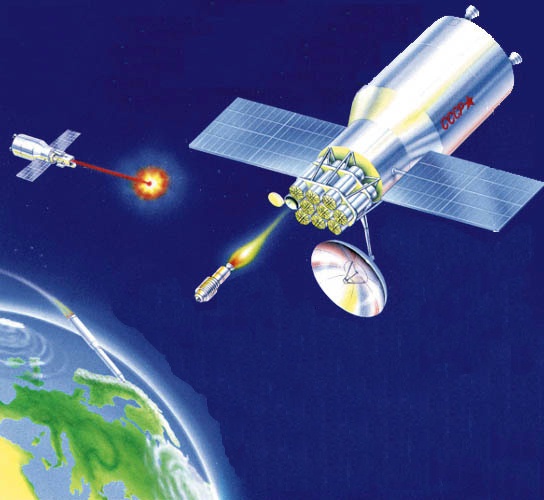
![DASATsCoOrbitalSpaceLaser.jpg][float-right] Non-kinetic operations in space warfare disable or degrade adversary satellites through reversible or semi-permanent effects without generating significant debris, including directed energy weapons, electronic jamming, and cyber intrusions. Directed energy systems, such as ground- or space-based lasers, can dazzle or blind optical sensors, while high-power microwaves disrupt onboard electronics.[54] [85] Nuclear detonations in space produce electromagnetic pulses that can disable multiple satellites across wide areas via radiation effects, as demonstrated historically by the 1962 Starfish Prime test which affected satellites over 1,300 kilometers away.[85] Co-orbital operations employ satellites launched into similar orbits as targets to perform rendezvous and proximity operations (RPO), enabling inspection, shadowing, or non-kinetic interference without direct ascent. These capabilities allow for persistent monitoring or targeted disruption, such as deploying sub-satellites for close inspection or potential jamming. Russia has conducted multiple co-orbital demonstrations, including Cosmos-2543 in 2019, which maneuvered within 100 meters of the U.S. reconnaissance satellite USA-224 before releasing a high-speed sub-satellite, and subsequent prototypes in 2022, 2024, and 2025 matching orbits of U.S. National Reconnaissance Office assets.[73] [63] China's Shijian-17 satellite, launched in 2017, exhibited co-orbital capabilities with a robotic arm for potential grappling or servicing, conducting RPO maneuvers that suggest dual-use for counterspace roles. The United States has developed experimental co-orbital systems like the XSS-10 and XSS-11 satellites in the early 2000s for autonomous rendezvous testing, informing current programs such as DARPA's Robotic Servicing of Geosynchronous Satellites (RSGS), which demonstrate precision maneuvering but are primarily for maintenance with inherent counterspace potential.[63] [27] Integration of non-kinetic effects in co-orbital platforms, such as space-based radiofrequency weapons, is under development by Russia and China, aiming to jam or spoof signals without kinetic impact. These operations offer deniability and escalation control compared to kinetic alternatives, though attribution challenges persist due to dual-use nature of RPO technologies. U.S. assessments indicate that such capabilities threaten resilient satellite architectures by enabling reversible attacks that complicate response attribution.[86] [73]Cyber, Electronic, and Directed-Energy Warfare
Cyber warfare in space targets satellite command, control, and communication systems, often through ground station infiltration or on-orbit software exploitation. On February 24, 2022, Russian actors launched a cyberattack on Viasat's KA-SAT network, disabling thousands of modems and disrupting Ukrainian military communications on the eve of the invasion.[87] [88] Such operations exploit unencrypted signals or man-in-the-middle intercepts to monitor, alter, or deny satellite functions, with potential for espionage or weaponization.[89] [90] In June 2023, actors linked to Russia's Wagner group hacked a satellite provider serving federal security services, demonstrating intra-adversary risks in contested environments.[91] These tactics enable reversible disruptions but require sophisticated access, as military satcom employs hardened protocols reducing vulnerability compared to commercial systems.[92] Electronic warfare encompasses jamming and spoofing to interfere with satellite signals, providing non-destructive denial without kinetic effects. Russian forces have deployed ground-based jammers since 2022 to spoof GPS signals in Ukraine, degrading precision-guided munitions and extending interference to low-Earth orbit assets up to 1,200 miles altitude.[93] [94] Uplink jamming targets satellite control links from Earth, exploiting the space domain's vast distances for selective disruption, while spoofing injects false signals to mislead receivers.[95] [96] The U.S. Space Force introduced remote ground-based jammers in 2025 capable of precise satellite targeting, enhancing offensive options in electronic attacks.[97] Ukraine countered Russian drone reliance on satellites with its own jammers and spoofers, illustrating tactical electronic measures in hybrid conflicts.[98] These methods preserve satellite hardware but can cascade to ground users dependent on navigation and reconnaissance feeds. Directed-energy weapons, including lasers and high-power microwaves, aim to dazzle, damage, or destroy satellite sensors and electronics from ground, air, or space platforms. China has fielded ground-based lasers since at least 2020 capable of blinding or damaging low-Earth orbit satellites, as assessed in U.S. intelligence reports.[99] Russia and China have researched space-deployed radiofrequency directed-energy systems for three decades, with potential to disrupt multiple targets via electromagnetic pulses.[86] [56] These non-kinetic tools offer reversible effects like temporary sensor overload or irreversible hardening failures, depending on power and dwell time, without orbital debris generation.[100] U.S. assessments note both nations' integration of directed-energy into counterspace doctrines, alongside electronic warfare, to challenge satellite constellations asymmetrically.[101] Operational challenges include atmospheric attenuation for ground-based systems and energy demands for orbital variants, limiting current deployments to demonstration phases.[102]Legal and Normative Frameworks
Outer Space Treaty and Its Ambiguities
The Outer Space Treaty, officially the Treaty on Principles Governing the Activities of States in the Exploration and Use of Outer Space, including the Moon and Other Celestial Bodies, opened for signature on January 27, 1967, in Washington, London, and Moscow, and entered into force on October 10, 1967, following ratification by the depositary governments of the United States, the United Kingdom, and the Soviet Union.[103] As of June 2024, 115 states are parties to the treaty, with an additional 23 signatories that have not ratified it.[104] The treaty establishes foundational principles for space activities, including freedom of exploration for all states, prohibition of national appropriation of outer space or celestial bodies, and requirements for international consultations on potentially harmful interference.[103] Article IV specifically addresses military aspects, obligating states parties not to place in orbit around Earth any objects carrying nuclear weapons or other kinds of weapons of mass destruction (WMDs), not to install such weapons on celestial bodies, and not to station them in outer space in any other manner; it further requires that the Moon and other celestial bodies be used exclusively for peaceful purposes, barring any bases, installations, or fortifications with military objectives.[105] This provision reflects Cold War-era compromises, banning the orbital deployment of nuclear-armed systems that could threaten strategic stability but omitting explicit restrictions on conventional armaments or kinetic anti-satellite (ASAT) systems launched from Earth. The treaty's preamble and Article I emphasize "peaceful purposes" for space exploration and use, yet this term lacks a precise definition, allowing interpretations that permit passive military applications such as reconnaissance satellites or navigation aids while debating active offensive capabilities.[103] These ambiguities foster ongoing debates over the boundary between militarization—integrating space into military operations without deploying weapons—and weaponization, which involves placing destructive systems in orbit.[106] For instance, ground- or air-launched ASAT weapons, which destroy satellites without orbiting WMDs, fall outside Article IV's scope, as confirmed by legal analyses noting the treaty's silence on terrestrial-origin attacks or non-WMD orbital interceptors.[59] The absence of verification mechanisms or enforcement provisions exacerbates this gap, relying instead on voluntary compliance and diplomatic pressure, which has proven insufficient against demonstrated ASAT capabilities by states like the United States, Russia, China, and India since the treaty's inception.[107] Critics argue that such loopholes incentivize an arms race in conventional space weapons, as the treaty's WMD focus does not deter advancements in co-orbital killers or directed-energy systems that evade its textual prohibitions.[108] Proponents of stricter interpretations, often from arms control perspectives, contend that "peaceful purposes" implicitly bars all weaponization, though this view lacks consensus and has not prevented military space programs under treaty parties.[104]Enforcement Challenges and Violations
The Outer Space Treaty (OST) of 1967 lacks formal verification mechanisms and an independent enforcement body, relying instead on state self-reporting and diplomatic pressure through forums like the United Nations Committee on the Peaceful Uses of Outer Space (COPUOS).[109] This structure poses significant challenges in monitoring compliance with prohibitions on weapons of mass destruction in orbit, as space activities occur beyond national jurisdictions, complicating attribution of potentially prohibited actions.[5] Verification is further hindered by the dual-use nature of many space technologies, where peaceful satellites and military capabilities overlap, making clandestine weaponization difficult to detect without intrusive inspections, which the OST does not mandate.[110] Enforcement is exacerbated by the absence of a dedicated international court for space law disputes, with recourse limited to the International Court of Justice (ICJ) only if states consent to jurisdiction, or the UN Security Council, where veto powers by permanent members often stall action.[111] Article IX of the OST requires states to avoid harmful interference with other nations' space activities, including contamination from debris, yet penalties for non-compliance are undefined, leading to reliance on customary international law and bilateral negotiations rather than binding sanctions.[112] These gaps have allowed major powers to interpret the treaty's ambiguities—such as the lack of explicit bans on conventional anti-satellite (ASAT) weapons or ground-launched systems—to justify testing and development programs.[59] Notable alleged violations include China's 2007 ASAT test, which destroyed the Fengyun-1C weather satellite at approximately 865 km altitude, generating over 3,000 trackable debris fragments that persist and threaten operational satellites, arguably breaching Article IX's anti-interference provisions despite not placing weapons in orbit.[113] Russia's November 15, 2021, direct-ascent ASAT test against the defunct Kosmos-1408 satellite at 480 km produced more than 1,500 debris pieces, forcing astronauts on the International Space Station to shelter and drawing widespread condemnation for endangering human spaceflight, though Russia maintained it complied with international law.[47] [114] India's March 27, 2019, test destroyed a Microsat-R target at under 300 km to limit debris, but still created fragments criticized by some as unnecessary interference, while the U.S. 2008 interception of USA-193 used a sea-launched missile with debris mitigation.[115] These incidents highlight interpretive disputes, with no formal adjudication, as the OST does not prohibit destructive ASAT testing outright, prompting calls for norms against debris-generating tests amid ongoing U.S. allegations of Russia's pursuit of nuclear space-based ASAT systems that would explicitly violate Article IV if deployed.[116] [117]Debates on Revision for Strategic Necessity
Proponents of revising the Outer Space Treaty (OST) argue that its ambiguities, rooted in 1967 Cold War-era assumptions, fail to address the strategic imperatives of modern space dependencies, where satellites underpin military command, intelligence, and precision strikes. The treaty prohibits only the stationing of nuclear weapons or other weapons of mass destruction in orbit and military bases on celestial bodies, leaving conventional anti-satellite (ASAT) capabilities and non-stationed kinetic or directed-energy systems unregulated. This gap has enabled demonstrable threats, such as China's 2007 direct-ascent ASAT test, which generated over 3,000 trackable debris fragments endangering international assets, and Russia's 2021 test destroying the Kosmos-1408 satellite, producing more than 1,500 pieces of debris that forced astronauts on the International Space Station to shelter. These actions, while not outright OST violations, exploit interpretive loopholes in Article IV's "peaceful purposes" clause, which the U.S. interprets as permitting military overflight and reconnaissance but not aggressive interference—a distinction blurred by adversarial doctrines emphasizing space denial.[110][47] Strategic necessity drives calls for revision from U.S.-aligned analysts, who contend that unaddressed vulnerabilities—exacerbated by proliferated low-Earth orbit constellations like Starlink—necessitate codified allowances for defensive architectures to deter or counter co-orbital killers, electronic jamming, or cyber intrusions that could blind forces in multi-domain conflicts. For instance, the U.S. Space Force's 2020 doctrine frames space as a warfighting domain requiring superiority, yet bilateral proposals like the Russia-China Prevention of Placement of Weapons in Outer Space Treaty (PPWT), reintroduced in 2014 and revised through 2024, seek broader bans that would constrain U.S. missile defenses and resilient satellite networks while ignoring verified non-compliance by signatories, such as Russia's Nudol ASAT series. Amending the OST to define permissible "use of force" thresholds, mandate debris mitigation verification, or permit reversible counterspace tests could stabilize escalation risks without inviting an unchecked arms race, as argued in policy analyses emphasizing causal links between treaty inertia and adversarial testing incentives. The U.S. government, while upholding the OST as foundational, has rejected PPWT as unverifiable and asymmetric, implicitly supporting evolutionary updates through norms like the 2022 moratorium on destructive ASAT tests—adopted by over 150 states but opposed by China and Russia—to preserve operational freedom amid rising domain threats.[118][110][119] Opponents of revision, including arms control advocates, warn that alterations could erode the OST's demilitarization ethos, accelerating proliferation in an environment where empirical data shows kinetic ASATs already fragmenting the orbital regime—Russia's 2021 test alone heightened collision probabilities for 1,500 objects. They favor non-binding confidence-building measures, such as transparency in satellite maneuvers, over revisions that might legitimize offensive platforms, citing the treaty's proven restraint on nuclear orbital deployment despite technological feasibility. Nonetheless, strategic realists counter that causal realism demands adaptation: with space assets integral to nuclear command-and-control and conventional deterrence, as evidenced by U.S. GPS reliance in operations from Desert Storm (1991) onward, forgoing revisions risks unilateral disadvantage against states like China, whose 2024 orbital maneuvers simulated satellite captures. Debates persist in forums like the UN Conference on Disarmament, where U.S. delegates in 2024 affirmed the OST's enduring relevance but highlighted enforcement gaps exposed by adversarial ASAT programs, underscoring the tension between normative stasis and operational imperatives.[120][121][60]Operational Challenges and Risks
Space Debris and Environmental Consequences
Kinetic anti-satellite (ASAT) operations, particularly direct-ascent intercepts, generate substantial orbital debris by fragmenting target satellites into high-velocity shards that persist in orbit for extended periods. These events exacerbate the existing space debris population, which as of 2024 exceeds 36,000 trackable objects larger than 10 cm, alongside millions of smaller fragments posing collision hazards to operational satellites.[122] In a warfare context, such deliberate destructions prioritize short-term tactical gains over long-term orbital sustainability, creating shared risks for all spacefaring entities regardless of intent.[123] Major historical ASAT tests illustrate the scale: China's January 2007 destruction of its Fengyun-1C weather satellite at approximately 865 km altitude produced over 3,000 trackable debris pieces greater than 10 cm, many of which remain in orbit today and have contributed to near-misses with other satellites.[83] The United States' February 2008 intercept of the malfunctioning USA-193 satellite at 247 km using an SM-3 missile generated more than 2,500 tracked fragments, though the lower altitude led to rapid atmospheric reentry for most, limiting long-term persistence compared to higher-orbit tests.[124] India's March 2019 test targeted a Microsat-R satellite at 300 km, yielding fewer than 60 trackable pieces, with Indian officials claiming near-complete reentry within weeks to minimize environmental impact.[47] Russia's November 2021 destruction of Kosmos-1408 at 480 km created approximately 1,500 trackable fragments greater than 10 cm, plus hundreds of thousands of smaller ones, forcing International Space Station crew to shelter due to collision risks.[84] [125]| ASAT Test | Date | Altitude (km) | Trackable Debris (>10 cm) | Notes |
|---|---|---|---|---|
| China (Fengyun-1C) | Jan 2007 | ~865 | >3,000 | Persistent high-altitude fragments; ongoing collision risks.[83] |
| USA (USA-193) | Feb 2008 | 247 | >2,500 (initial) | Most reentered quickly; reduced long-term addition.[124] |
| India (Microsat-R) | Mar 2019 | 300 | <60 | Low orbit minimized persistence.[47] |
| Russia (Kosmos-1408) | Nov 2021 | 480 | ~1,500 | Immediate threats to crewed assets; smaller fragments untracked but hazardous.[84] |
