


Community hub
Recent from talks
Contribute something
Nothing was collected or created yet.
Royal Fusiliers
View on Wikipedia
| 7th Regiment of Foot Royal Fusiliers (City of London Regiment) | |
|---|---|
 Cap badge | |
| Active | 1685–1968 |
| Country |  Kingdom of England (1685–1707) Kingdom of England (1685–1707) Kingdom of Great Britain (1707–1800) Kingdom of Great Britain (1707–1800) United Kingdom (1801–1968) United Kingdom (1801–1968) |
| Branch |  British Army British Army |
| Type | Infantry |
| Role | Line infantry |
| Size | 1–4 Regular battalions Up to 3 Militia and Special Reserve battalions |
| Garrison/HQ | Tower of London |
| Nickname | The Elegant Extracts |
| Motto | Honi soit qui mal y pense |
| March | The Seventh Royal Fusiliers |
| Anniversaries | Albuhera Day (16 May) |
| Insignia | |
| Hackle | White |
The Royal Fusiliers (City of London Regiment) was a line infantry regiment of the British Army in continuous existence for 283 years. It was known as the 7th Regiment of Foot until the Childers Reforms of 1881.[1]
The regiment served in many wars and conflicts throughout its long existence, including the Second Boer War, the First World War and the Second World War. In 1968, the regiment was amalgamated with the other regiments of the Fusilier Brigade – the Royal Northumberland Fusiliers, the Royal Warwickshire Fusiliers and the Lancashire Fusiliers – to form a new large regiment, the Royal Regiment of Fusiliers.
The Royal Fusiliers War Memorial, a monument dedicated to the almost 22,000 Royal Fusiliers who died during the First World War, stands on Holborn in the City of London.
History
[edit]
Formation
[edit]It was formed as a fusilier regiment in 1685 by George Legge, 1st Baron Dartmouth, from two companies of the Tower of London guard, and was originally called the Ordnance Regiment, later the Royal Regiment of Fuziliers[2] (a variety of spellings of the word "fusilier" persisted until the 1780s, when the modern spelling was formalised[3]). Most regiments were equipped with matchlock muskets at the time, but the Ordnance Regiment were armed with flintlock fusils. This was because their task was to be an escort for the artillery, for which matchlocks would have carried the risk of igniting the open-topped barrels of gunpowder.[4] The regiment was also known by the names of its colonels until 1751.[2]
The regiment went to Holland in February 1689 for service in the Nine Years' War and fought at the Battle of Walcourt in August 1689[5] before returning home in 1690.[6] It embarked for Flanders later that year and fought at the Battle of Steenkerque in August 1692[7] and the Battle of Landen in July 1693[8] and the Siege of Namur in summer 1695 before returning home.[9]
The regiment took part in an expedition which captured the town of Rota in Spain in spring 1702[10] and then saw action at the Battle of Vigo Bay in October 1702 during the War of the Spanish Succession.[11] The regiment served as Marines aboard Royal Navy ships in 1703 (and again in 1718–18, April 1742 (details only), and 1756–57).[2]
In 1747 the regiment was known as the Royal English Fuziliers and was given the precedence of 7th in the Infantry of the Line. On 1 July 1751 it was redesignated as the 7th Regiment of Foot (Royal Fusiliers). When county titles were added in August 1782 the subtitle '(Derbyshire)' was added, but this was never used and was later given to a different regiment.[2]
American War of Independence
[edit]The Royal Fusiliers were sent to Canada in April 1773.[12] The regiment was broken up into detachments that served at Montreal, Quebec, Fort Chambly and Fort St Johns (Saint-Jean-sur-Richelieu). In the face of the American invasion of Canada in 1775/76, the 80 man garrison of Fort Chambly attempted to resist a 400-man Rebel force but ultimately had to surrender, losing its regimental colours as a result. The bulk of the regiment was captured when St John's fell. A 70-man detachment under the command of Captain Humphrey Owens assisted with the Battle of Quebec in December 1775.[13]
The men taken prisoner during the defence of Canada were exchanged in British held New York City in December 1776. Here, the regiment was rebuilt and garrisoned New York and New Jersey. In October 1777, the 7th participated in the successful assaults on Fort Clinton and Fort Montgomery and the destruction of enemy stores at Continental Village. In late November, 1777 the regiment reinforced the garrison of Philadelphia. During the British evacuation back to New York City, the regiment participated in a diversionary raid in the days leading up to the Battle of Monmouth in June 1778.[14] The 7th participated in Tryon's raid in July 1779.[15]
In April 1780, the Royal Fusiliers took part in the capture of Charleston.[16] Once Charleston fell, the regiment helped garrison the city.[4] Three companies were sent to Ninety-Six to assist with the training of Loyalist militia companies. An 80-man detachment also sent to Camden, South Carolina to help build that town's defences. The detachments were recalled to Charleston for refitting in late August 1780. They were then mounted and sent to join Charles Cornwallis's Army as it advanced towards Charlotte, North Carolina in early September 1780. The 7th, mounted on horses, along with two regiments of Loyalist militia, cleared the region north of Georgetown, South Carolina of partisans while en route. The Royal Fusiliers turned the horses over to Lieutenant Colonel Banastre Tarleton's British Legion upon uniting with Cornwallis in late September and then served as the Army's rearguard.[17]
Between October 1780 and early January 1781, the regiment, having lost about one third of its officers and men to sickness and disease, protected the communication and supply lines between Camden and Winnsboro, South Carolina. On 7 January 7, 1781, a contingent of 171 men from the Royal Fusiliers was detached from Cornwallis's Army and fought under the command of Tarleton at the Battle of Cowpens in January 1781.[18] The Royal Fusiliers were on the left of the line of battle: Tarleton was defeated and the regiment's colours were once again captured, stored in the baggage wagons.[19] A 19-man detachment from the regiment fought through North Carolina participating in the Battle of Guilford Court House in March 1781 and ultimately the Siege of Yorktown, where it served with the regiment's Light Infantry Company.[20] There was another detachment, composed largely of men recovered from the hospital and recruits, which remained in the South under the command of Lt Col. Alured Clarke: these men remained in garrison in Charleston, until they were transferred to Savannah, Georgia in December 1781.[21] The regiment returned to England in 1783.[22]
Napoleonic Wars
[edit]
The regiment embarked for Holland and saw action at the Battle of Copenhagen in August 1807 during the Gunboat War.[23] It was then sent to the West Indies and took part in the capture of Martinique in 1809.[24] It embarked for Portugal later that year for service in the Peninsular War and fought at the Battle of Talavera in July 1809,[25] the Battle of Bussaco in September 1810.[26] and the Battle of Albuera in May 1811.[27][28]
The regiment then took part in the Siege of Ciudad Rodrigo in January 1812,[29] the Siege of Badajoz in spring 1812[30] and the Battle of Salamanca in July 1812[31] as well as the Battle of Vitoria in June 1813.[32] It then pursued the French Army into France and fought at the Battle of the Pyrenees in July 1813,[33] the Battle of Orthez in February 1814[34] and the Battle of Toulouse in April 1814.[35] It returned to England later that year[36] before embarking for Canada and seeing action at the capture of Fort Bowyer in February 1815 during the War of 1812.[37]
A 2nd Battalion was formed in 1804 and also took part in the Peninsular Campaign from 1809 to 1811. Both battalions took part in the 1811 Battle of Albuera. The 2nd Battalion was disbanded after the war.[38]
Victorian and Edwardian eras
[edit]_officers_in_Bermuda_1905.jpg)

The single-battalion Regiment embarked for Scutari for service in the Crimean War on 5 April 1854 (with the Depot at Winchester), and saw action at the Battle of Alma in September 1854, the Battle of Inkerman in November 1854 and the Siege of Sebastopol in winter 1854.[4] It returned to Britain from the Crimea on 27 June 1856, embarked for India on 21 July 1857, and took part in the Ambela Campaign in 1863.[4] In 1865 it was at Ferozepore. It returned to Britain from India on the 27 December 1870. It embarked for Gibraltar in 1885, and in 1886 and 1887 was at Egypt. From 1888 'til 1901, it was posted to various locations in India, including Poona, Karachi (now in Pakistan), Mhow, Nusseerabad, Bombay, Quetta, Bengal, Neemuch, and Nusserabad.[39]
The newly re-formed 2nd battalion, which had been at Preston, embarked for Gibraltar on 27 May 1858 (the Depot at this point was at Chatham, moving to Walmer). It was deployed from Malta to Upper Canada in October 1866 and helped suppress the Fenian raids and then embarked for India on 1 October 1873, and saw action at the Battle of Kandahar in September 1880 during the Second Anglo-Afghan War.[4] It was subsequently stationed at various locations in India, including Cannanore, Madras, Wellington, before returning to Britain from India on 29 March 1889, when it was posted to Dover. In 1892 it moved to Woolwich. In 1894 it was posted to Guernsey, and in 1896 to Belfast, Ireland. In 1898 it moved to the Curragh, Ireland.[39]

The regiment was not fundamentally affected by the Cardwell Reforms of the 1870s, which gave it a depot at Hounslow Barracks from 1873, or by the Childers reforms of 1881 – as it already possessed two battalions, there was no need for it to amalgamate with another regiment.[40] Under the reforms, the regiment became The Royal Fusiliers (City of London Regiment) on 1 July 1881.[2][41][42] The regiment was now organised into the following:[43][44][45]
Regulars
- 1st Battalion, in 1881 based at Defensible Barracks, Pembroke Dock
- 2nd Battalion, in 1881 based in Madras
Militia
- 3rd (later 5th) (Militia) Battalion based in Brentford, formerly 3rd Royal Westminster Middlesex Militia
- 4th (later 6th) (Militia) Battalion based in Finsbury, formerly Royal London Militia
- 5th (later 7th) (Militia) Battalion based in Hounslow, formerly 4th Royal South Middlesex Militia
Volunteer Infantry
- 10th Middlesex Rifle Volunteer Corps based in Bloomsbury, formerly under command of The King's Royal Rifle Corps, but transferred in 1883, and subsequently renamed as 1st Volunteer Btn
- 23rd Middlesex Rifle Volunteer Corps based in Westminster renamed 2nd Volunteer Btn in 1883
In 1901 the 1st Battalion moved from India to Mandalay, Burma.[46]
The regiment's 2nd regular battalion took part in the Second Boer War from 1899 to 1902.[47] The battalion, which had previously been stationed the Curragh in Ireland, embarked for South Africa on the 22 October 1899, and served there throughout the war, which ended with the Peace of Vereeniging in June 1902. Four months later 350 officers and men of the 2nd battalion left Cape Town on the SS Salamis in late September 1902, arriving at Southampton in late October, when the battalion was posted to Aldershot.[48]
A 3rd regular battalion was formed on 6 April 1898 at Dover[2] and embarked for the Imperial fortress of Malta on 1 December 1898, then moved to Crete, the Imperial fortress of Gibraltar in 1900, and Egypt and Sudan in 1901. It was subsequently posted to the Bermuda Garrison, with 16 officers, 1 warrant officer, and 937 NCOs and men arriving at the Imperial fortress of Bermuda under Lieutenant-Colonel R. B. Gaisford, CMG, from Egypt aboard the SS Dunera, and Majors CJ Stanton, FMF Scoones, Lieutenant F. Moore, and Second-Lieutenant GE Hawes arriving aboard the SS Dominion, in the week ending Saturday, 5 December 1903. the battalion replaced the Royal Warwickshire Regiment at Boaz Island, and departed Bermuda again for Cape Town, South Africa, aboard the HMT Soudan on the 18 December 1905 (minus Private David FW Dobson, absent without leave).[49][50][51][39] The battalion was in South Africa and Mauritius until the First World War.[52]
A 4th regular battalion was formed on 31 February 1900 at Dover,[2][53] and received colours from the Prince of Wales (Colonel-in-Chief of the regiment) in July 1902.[54] In 1903 it was at Woolwich.[39]
In 1908, the Volunteers and Militia were reorganised nationally, with the former becoming the Territorial Force and the latter the Special Reserve. The Royal Fusiliers' 1st to 4th Volunteer Battalions were transferred to the new all-territorial London Regiment, with the Royal Fusiliers itself now consisting of: [2][43][44]
Regulars
- 1st Battalion in 1908 based at Albany Barracks, thereafter sent to Kinsale.
- 2nd Battalion in 1908 based in Jubbulpore
- 3rd Battalion formed in 1898, in 1908 based in Mauritius and South Africa, thereafter sent to Meerut.
- 4th Battalion formed in 1900, in 1908 based at Columb Barracks. Thereafter sent to Aldershot, then garrisoned Albany Barracks at Parkhurst from 27 January 1913.
Special Reserve
- 5th (Reserve) Battalion, based in Hounslow, former 5th (Militia) Battalion
- 6th (Reserve) Battalion, based in Hounslow, former 7th (Militia) Battalion
- 7th (Extra Reserve) Battalion, based in Finsbury, former 6th (Militia) Battalion
First World War
[edit]Regular Army
[edit]
The 1st Battalion landed at Saint-Nazaire as part of the 17th Brigade in the 6th Division in September 1914 for service on the Western Front; [55][56] major engagements involving the battalion included the Battle of the Somme in autumn 1916 and the Battle of Passchendaele in autumn 1917.[57]
The 2nd Battalion landed at Gallipoli as part of the 86th Brigade in the 29th Division in April 1915; after being evacuated in December 1915, it moved to Egypt in March 1916 and then landed in Marseille in March 1916 for service on the Western Front;[55][56] major engagements involving the battalion included the Battle of the Somme in autumn 1916 and the Battle of Arras in spring 1917.[57]
The 3rd Battalion landed at Le Havre as part of the 85th Brigade in the 28th Division in January 1915;[55][56] major engagements involving the battalion included the Second Battle of Ypres in April 1915 and the Battle of Loos in September 1915.[57] The battalion moved to Egypt in October 1915 and then to Salonika in July 1918, before returning to the Western Front.[55][56]
The 4th Battalion landed at Le Havre as part of the 9th Brigade in the 3rd Division in August 1914 for service on the Western Front;[55][56] major engagements involving the battalion included the Battle of Mons and the Battle of Le Cateau in August 1914, the First Battle of the Marne and the First Battle of the Aisne in September 1914 and the Battle of La Bassée, the Battle of Messines and the First Battle of Ypres in October 1914.[57] Members of the Battalion won the first two Victoria Crosses of the war near Mons in August 1914 (Lieutenant Maurice Dease[58] and Private Sidney Godley).[59]
New Armies
[edit]

The 8th and 9th (Service) Battalions landed in France; they both saw action on the Western Front as part of the 36th Brigade of the 12th (Eastern) Division.[56] The 10th (Service) Battalion, better known as the Stockbrokers' Battalion, was formed in August 1914 when 1,600 members of the London Stock Exchange and others from the area joined up: 742 were killed or missing in action on the Western Front.[60] The battalion was originally part of the 54th Brigade of the 18th (Eastern) Division, transferring to the 111th Brigade, 37th Division.[56] The 11th, 12th, 13th and 17th (Service) Battalions landed in France; all four battalions saw action on the Western Front: the 11th Battalion being part of the 54th Brigade, 18th (Eastern) Division, the 12th with the 73rd Brigade, later the 17th Brigade, 24th Division, the 13th with the 111th Brigade, 37th Division and the 17th with the 99th Brigade, 33rd Division, later transferring to the 5th and 6th Brigades of the 2nd Division.[56]
The 18th–21st (Service) Battalions (1st–4th Public Schools) of the regiment were recruited from public schools; all four battalions saw action on the Western Front, all originally serving with the 98th Brigade in the 33rd Division, the 18th and 20th Battalions transferring to the 19th Brigade in the same division.[56] The 22nd (Service) Battalion, which was recruited from the citizens of Kensington, also landed in France and saw action on the Western Front.[56] The 23rd and 24th (Service) Battalion, better known as the Sportsmen's Battalions, also landed in France and saw action on the Western Front:[56] they were among the Pals battalions and were both part of the 99th Brigade of the 33rd Division, later transferring to command of the 2nd Division, with the 24th Battalion joining the 5th Brigade in the same division.[61] The 25th (Frontiersmen) Battalion, Royal Fusiliers, formed in February 1915, served in East Africa.[56]
The 26th (Service) Battalion was recruited from the banking community; it saw action on the Western Front as part of the 124th Brigade of the 41st Division.[56] The 32nd (Service) Battalion, which was recruited from the citizens of East Ham, also landed in France and saw action on the Western Front as part of the 124th Brigade of the 41st Division.[56] The 38th through 42nd Battalions of the regiment served as the Jewish Legion[62] in Palestine; many of its surviving members went on to be part of the founding of the State of Israel in 1948.[56] The Royal Fusiliers War Memorial, stands on High Holborn, near Chancery Lane Underground station, surmounted by the lifesize statue of a First World War soldier, and its regimental chapel is at St Sepulchre-without-Newgate.[63]
Russian Civil War
[edit]The 45th and 46th Battalions of the Royal Fusiliers were part of the North Russia Relief Force, which landed in early 1919 to support the withdrawal of international forces assisting "White" (anti-Bolshevik) Russian forces during the Russian Civil War. The understrength 45th Battalion was composed mainly of former members of the Australian Imperial Force – many of them veterans of the Western Front – who had volunteered for service in Russia.[64]
Interwar
[edit]The 3rd and 4th Battalions were disbanded at Aldershot on 15 July 1922. The London Regiment having fallen into abeyance, the 1st–4th Londons reverted to their Royal Fusiluers affiliation. When the London Regiment was formally abolished they became the 8th (1st City of London), 9th (2nd City of London) and 10th (3rd City of London) Battalions (the 4th Londons had already been converted into 60th (City of London) Heavy Anti-Aircraft Regiment, Royal Artillery). In the period of rearmament before the outbreak of World War II, the 8th and 9th Battalions each formed a duplicate battalion (11th and 12th respectively) while 10th Battalion was converted into 69th (3rd City of London) Searchlight Regiment, Royal Artillery.[2][65]
Second World War
[edit]
For most of the Second World War, the 1st Battalion was part of the 17th Indian Infantry Brigade, 8th Indian Infantry Division. It served with them in the Italian Campaign.[66]
The 2nd Battalion was attached to the 12th Infantry Brigade, 4th Infantry Division and was sent to France in 1939 after the outbreak of war to join the British Expeditionary Force (BEF). In May 1940, it fought in the Battle of France and was forced to retreat to Dunkirk, where it was then evacuated from France. With the brigade and division, the battalion spent the next two years in the United Kingdom, before being sent overseas to fight in the Tunisia Campaign, part of the final stages of the North African Campaign. Alongside the 1st, 8th and 9th battalions, the 2nd Battalion also saw active service in the Italian Campaign from March 1944, in particular during the Battle of Monte Cassino, fighting later on the Gothic Line before being airlifted to fight in the Greek Civil War.[67]
The 8th and 9th Battalions, the two Territorial Army (TA) units, were part of the 1st London Infantry Brigade, attached to 1st London Infantry Division. These later became the 167th (London) Infantry Brigade and 56th (London) Infantry Division. Both battalions saw service in the final stages of the Tunisian campaign, where each suffered over 100 casualties in their first battle. In September 1943, both battalions were heavily involved in the landings at Salerno, as part of the Allied invasion of Italy, later crossing the Volturno Line, before, in December, being held up at the Winter Line.[68] Both battalions then fought in the Battle of Monte Cassino and were sent to the Anzio beachhead in February 1944.[69]
The duplicate TA battalions, the 11th and 12th, were both assigned to 4th London Infantry Brigade, part of 2nd London Infantry Division, later 140th (London) Infantry Brigade and 47th (London) Infantry Division respectively.[70] Both battalions remained in the United Kingdom on home defence duties. In 1943, the 12th Battalion was transferred to the 80th Infantry (Reserve) Division and later to the 47th Infantry (Reserve) Division.[71]
The regiment raised many other battalions during the war, although none of them saw active service overseas in their original roles, instead some were converted. The 20th Battalion, for example, formed soon after the Dunkirk evacuation, was sent to India in the summer of 1942 and later became part of the 52nd Infantry Brigade, acting in a training capacity to train British troops in jungle warfare for service in the Burma Campaign. The 21st and 23rd Battalions, also created in June/July 1940, were later converted into 54th and 46th Battalions, Reconnaissance Corps, assigned to the 54th (East Anglian) and 46th Infantry Divisions respectively; the 54th later formed the bulk of 15th Scottish Reconnaissance Regiment, while the 46th servied with its parent division for the rest of the war. 14th (Overseas Defence) and 22nd Battalions became 107th Light Anti-Aircraft and 94th Anti-Tank Regiments respectively of the Royal Artillery.[2][72][73]
Korean War
[edit]In August 1952, the regiment, now reduced to a single Regular battalion, served in the Korean War as part of the 28th Commonwealth Infantry Brigade. A 19-year-old Michael Caine served with the battalion during the conflict; on several occasions his unit had to defend itself from Chinese human wave attacks.[74]
Amalgamation
[edit]On 23 April 1968, the regiment was merged with the Royal Northumberland Fusiliers (5th Foot), the Royal Warwickshire Fusiliers (6th Foot) and the Lancashire Fusiliers (20th Foot) to form the 3rd Battalion, Royal Regiment of Fusiliers.[2][65][75]
Regimental museum
[edit]
The Fusilier Museum is located in the Royal Regiment of Fusiliers Headquarters at HM Tower of London. It also represents World War One soldiers of six London Regiment battalions (1st, 2nd, 3rd, 4th, 29th and 30th) which had been attached to the Royal Fusiliers prior to 1908.[76]
Battle honours
[edit]
The regiment's battle honours included:[65]
- Earlier Wars: Namur 1695, Martinique 1809, Talavera, Busaco, Albuhera, Badajoz, Salamanca, Vittoria, Pyrenees, Orthes, Toulouse, Peninsula, Alma, Inkerman, Sevastopol, Kandahar 1880, Afghanistan 1879–80, Relief of Ladysmith, South Africa 1899–1902
- The First World War (47 battalions): Mons, Le Cateau, Retreat from Mons, Marne 1914, Aisne 1914, La Bassée 1914, Messines 1914 '17, Armentières 1914, Ypres 1914 '15 '17 '18, Nonne Bosschen, Gravenstafel, St. Julien, Frezenberg, Bellewaarde, Hooge 1915, Loos, Somme 1916 '18, Albert 1916 '18, Bazentin, Delville Wood, Pozières, Flers-Courcelette, Thiepval, Le Transloy, Ancre Heights, Ancre 1916 '18, Arras 1917 '18, Vimy 1917, Scarpe 1917, Arleux, Pilckem, Langemarck 1917, Menin Road, Polygon Wood, Broodseinde, Poelcappelle, Passchendaele, Cambrai 1917 '18, St. Quentin, Bapaume 1918, Rosières, Avre, Villers Bretonneux, Lys, Estaires, Hazebrouck, Béthune, Amiens, Drocourt-Quéant, Hindenburg Line, Havrincourt, Épéhy, Canal du Nord, St. Quentin Canal, Beaurevoir, Courtrai, Selle, Sambre, France and Flanders 1914–18, Italy 1917–18, Struma, Macedonia 1915–18, Helles, Landing at Helles, Krithia, Suvla, Scimitar Hill, Gallipoli 1915–16, Egypt 1916, Megiddo, Nablus, Palestine 1918, Troitsa, Archangel 1919, Kilimanjaro, Behobeho, Nyangao, East Africa 1915–17
- The Second World War: Dunkirk 1940, North-West Europe 1940, Agordat, Keren, Syria 1941, Sidi Barrani, Djebel Tebaga, Peter's Corner, North Africa 1940 '43, Sangro, Mozzagrogna, Caldari, Salerno, St. Lucia, Battipaglia, Teano, Monte Camino, Garigliano Crossing, Damiano, Anzio, Cassino II, Ripa Ridge, Gabbiano, Advance to Florence, Monte Scalari, Gothic Line, Coriano, Croce, Casa Fortis, Savio Bridgehead, Valli di Commacchio, Senio, Argenta Gap, Italy 1943–45, Athens, Greece 1944–45
- Korea 1952–53
Colonels
[edit]Colonels-in-Chief
[edit]Colonels-in-Chief have included:[65]
- 1900–1937: King George V
- 1937–1942: Prince George, Duke of Kent
Colonels
[edit]
The colonels of the regiment included:[2][77]
- 1685–1689: Lieutenant-General George Legge, 1st Baron Dartmouth
- 1689–1692: General John Churchill, 1st Duke of Marlborough
- January–July 1692 Field Marshal George Hamilton, 1st Earl of Orkney
- 1692–1696: Brigadier-General Edward Fitzpatrick
- 1696–1713: General Charles O'Hara, 1st Baron Tyrawley
- 1713–1739: Field Marshal James O'Hara, 2nd Baron Tyrawley
- 1739–1751: Lieutenant-General William Hargrave
- 7th Regiment of Foot (Royal Fuzileers) (1751)
- 1751–1754: General John Mostyn
- 1754–1776: Lord Robert Bertie
- 1776–1788: Lieutenant-General Richard Prescott
- 7th (Derbyshire) Regiment of Foot (1782)
- 1788–1789: General William Gordon
- 1789–1801: Field Marshal Prince Edward, Duke of Kent and Strathearn
- 1801–1832: Field Marshal Sir Alured Clarke
- 1832–1854: Field Marshal Sir Edward Blakeney
- 1854–1855: General Sir George Brown
- 1855–1868: General Sir Samuel Auchmuty[78]
- 1868–1881: General Sir Richard Airey[79]
- The Royal Fusiliers (City of London Regiment) (1881)
- 1881–1900: General Sir Richard Wilbraham
- 1900–1922: Major-General Sir Geoffrey Barton
- 1922–1924: Major-General Colin Donald
- 1924–1933: Major-General Sir Reginald Pinney
- 1933–1942: Major-General Walter Hill
- July–October 1942 Brigadier Reginald Howlett
- 1942–1947: General Sir Reginald May
- 1947–1954: Major-General James Francis Harter
- 1954–1963: Major-General Francis David Rome
- 1963–1968: General Sir Kenneth Darling (to Royal Regiment of Fusiliers)
- 1968: Amalgamated with the Royal Northumberland Fusiliers, Royal Warwickshire Fusiliers and Lancashire Fusiliers to form the Royal Regiment of Fusiliers
Victoria Cross
[edit]Victoria Crosses awarded to members of the regiment were:
- Private Thomas Elsdon Ashford, Second Afghan War (16 August 1880)
- Lieutenant Maurice Dease, First World War (23 August 1914)
- Temp. Lieutenant-Colonel Neville Elliott-Cooper, First World War (30 November 1917)
- Captain Charles Fitzclarence, Second Boer War (14 October 1899)
- Assistant Surgeon Thomas Egerton Hale, Crimean War (8 September 1855)
- Lieutenant William Hope, Crimean War (18 June 1855)
- Private Mathew Hughes, Crimean War (7 June 1855 and 18 June 1855)
- Captain Henry Mitchell Jones, Crimean War (7 June 1855)
- Temp. Captain Robert Gee, First World War (30 November 1917)
- Private Sidney Frank Godley, First World War (23 August 1914)
- Corporal George Jarratt, First World War (3 May 1917)
- Sergeant John Molyneux, First World War (9 October 1917)
- Private William Norman, Crimean War (19 December 1854)
- Lance-Sergeant Frederick William Palmer, First World War (16/17 February 1917)
- Sergeant Samuel George Pearse, North Russia Relief Force (29 August 1919)
- Lance-Corporal Charles Graham Robertson, First World War (8/9 March 1918)
- Acting Captain Walter Napleton Stone, First World War (30 November 1917)
- Corporal Arthur Percy Sullivan, North Russia Relief Force (10 August 1919)
Gallery
[edit]-
 Band of the 3rd Battalion of The Royal Fusiliers in Bermuda circa 1903, while the battalion was part of the Bermuda Garrison
 -
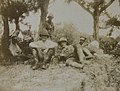 Officers of the 3rd Battalion Royal Fusiliers during Battalion Training at Tucker's Town, Bermuda, in 1904
 -
 Officers of the 3rd Battalion during Battalion Training at Tucker's Town, Bermuda, 1905


,_at_Battalion_Training_at_Tucker%27s_Town,_Bermuda,_1905.jpg)
References
[edit]- ^ Westlake, R. English and Welsh Infantry Regiments: An illustrated Record of Service (195) Stroud, GLS, UK (Spellmount) ISBN 1-873376-24-3
- ^ a b c d e f g h i j k l Frederick, pp. 284–9.
- ^ "Universal Register; London, Birth Day". The Times. 6 June 1785. p. 2.
Orders are given for a camp to be formed on Ashford-Common, near Winsor, for the 7th regiment of foot, who are to be employed in making new roads, and repairing others; the private men are to have 1s. per day extra for their labour.
- ^ a b c d e "Royal Fusiliers". British Empire. Retrieved 17 January 2016.
- ^ Cannon, p. 8
- ^ Cannon, p. 9
- ^ Cannon, p. 11
- ^ Cannon, p. 13
- ^ Cannon, p. 16
- ^ Cannon, p. 19
- ^ Cannon, p. 20
- ^ Cannon, p. 24
- ^ Cannon, p. 26
- ^ Cannon, p. 30
- ^ Cannon, p. 31
- ^ Cannon, p. 32
- ^ "The American Revolution in South Carolina". Retrieved 9 October 2017.
- ^ "The Battle of Cowpens" (PDF). The Florida Society of the Sons of the Revolution. Retrieved 17 January 2016.
- ^ Graham, James (1856). The Life of General Daniel Morgan of the Virginia Line of the Army of the United States. Derby and Jackson. p. 310.
cowpens.
- ^ "The Battle of Guilford Court House". The American Revolution in North Carolina. Retrieved 17 January 2016.
- ^ "Field Marshal Sir Alured Clarke GCB". British Empire. Retrieved 17 January 2016.
- ^ Cannon, p. 34
- ^ Cannon, p. 37
- ^ Cannon, p. 38
- ^ Cannon, p. 46
- ^ Cannon, p. 50
- ^ Cannon, p. 54
- ^ "Lisbon Papers; Cadiz, May 7". The Times. 29 May 1811. p. 2.
Lord Wellington has also sent two divisions of his army, the 3d and 7th, that way... Intelligence is just received that the battle is fought, and we are again victorious. The affair took place at Albuhera, on the 16th: Soult attacked, and was defeated with immense loss on both sides.
- ^ Cannon, p. 66
- ^ Cannon, p. 67
- ^ Cannon, p. 71
- ^ Cannon, p. 75
- ^ Cannon, p. 76
- ^ Cannon, p. 80
- ^ Cannon, p. 81
- ^ Cannon, p. 82
- ^ Cannon, p. 87
- ^ National Army Museum: The Royal Fusiliers (City of London Regiment)
- ^ a b c d Hart's New Annual Army Lists
- ^ "Training Depots 1873–1881". Regiments.org. Archived from the original on 10 February 2006. Retrieved 16 October 2016.
{{cite web}}: CS1 maint: bot: original URL status unknown (link) The depot was the 49th Brigade Depot from 1873 to 1881, and the 7th Regimental District depot thereafter - ^ "House of Commons, Thursday, June 23". The Times. 24 June 1881. p. 6.
- ^ "No. 24992". The London Gazette. 1 July 1881. pp. 3300–3301.
- ^ a b "The Royal Fusiliers (City of London Regiment) [UK]". 13 October 2007. Archived from the original on 13 October 2007. Retrieved 12 April 2020.
- ^ a b Frederick, pp. 284–6.
- ^ Ray Westlake, Tracing the Rifle Volunteers, (Many pages)
- ^ "1st Battalion Royal Fusiliers". Regiments.org. Archived from the original on 16 December 2007.
- ^ "Royal Fusiliers (City of London Regiment)". Anglo-Boer War. Retrieved 14 July 2016.
- ^ "The Army in South Africa - Troops returning Home". The Times. No. 36890. London. 4 October 1902. p. 10.
- ^ The Royal Gazette, Hamilton, Bermuda. 5 December 1903
- ^ The Royal Gazette, Hamilton, Bermuda. 19 December 1903
- ^ The Royal Gazette, Hamilton, Bermuda. 23 December 1903
- ^ An Empire Building Battalion: Being a History, with Reminiscences, of the 3rd Battalion Royal Fusiliers. Formed 1898. Disbanded 1922. By Lieutenant-Colonel EC Packe, DSO, OBE. Privately printed for the author by Edgar Backus, Leicester.
- ^ "Increase in the Army". The Times. No. 36067. London. 16 February 1900. p. 10.
- ^ "The Prince of Wales and the Royal Fusiliers". The Times. No. 36812. London. 5 July 1902. p. 9.
- ^ a b c d e James, pp. 49–51.
- ^ a b c d e f g h i j k l m n o "Royal Fusiliers (City of London) Regiment". The Long, Long Trail. Retrieved 17 January 2016.
- ^ a b c d "Royal Fusiliers during the Great War". The Wartime Memories Project. Retrieved 17 January 2016.
- ^ "No. 28985". The London Gazette (Supplement). 24 November 1914. p. 9957. Original citation
- ^ "No. 28985". The London Gazette (Supplement). 24 November 1914. p. 9957.
- ^ Carter, David, The Stockbrokers’ Battalion in the Great War: A History of the 10th (Service) Battalion Royal Fusiliers, Pen and Sword Books, Barnsley, 2014, p.266
- ^ Mullen, Peter, Tearing down religious standards Northern Echo 19 Mar 2002
- ^ Klinger, Jerry. "the Jewish Legion and the Israeli Army". Jewish Magazine. Retrieved 17 January 2016.
- ^ "Royal Fusiliers". St Sepulchre-without-Newgate. Archived from the original on 19 January 2016. Retrieved 17 January 2016.
- ^ "Aussies in the Russian Revolution". Digger History. Retrieved 21 September 2018.
- ^ a b c d "The Royal Fusiliers (City of London Regiment)". Regiments.org. Archived from the original on 3 January 2006. Retrieved 17 January 2016.
{{cite web}}: CS1 maint: bot: original URL status unknown (link) - ^ "17th Indian Infantry Brigade". Order of Battle. Retrieved 17 January 2016.
- ^ "History of 12 Mech Bde HQ and Sig Sqn (228)" (PDF). Retrieved 7 August 2013.
- ^ "56th Division". 50megs.com. Retrieved 3 August 2015.
- ^ Paule, Edward D. "A History of the Royal Fusiliers Company Z". Retrieved 28 August 2016.
- ^ Joslen, pp. 235, 374
- ^ Joslen, p. 374
- ^ Northcote Parkinson, pp. 29–32.
- ^ Doherty, Richard (2007). "The British Reconnaissance Corps in World War II" (PDF). Osprey. p. 52. Retrieved 17 January 2016.
- ^ "Listen to Actor Michael Caine Talk About Fighting in Korea". www.military.com. Retrieved 4 February 2021.
- ^ "New Fusilier Regiment". The Times. 17 April 1968. p. 12.
The Royal Regiment of Fusiliers, a new regiment, with national rather than regional loyalties, is to be formed on St. George's Day, April 23, the Ministry of Defence announced yesterday.
- ^ "Raised at the Tower of London in 1685". The Fusilier Museum. Retrieved 17 January 2016.
- ^ "Royal Fusiliers Colonels". British Empire. Retrieved 17 January 2016.
- ^ "No. 21676". The London Gazette. 13 March 1855. p. 1054.
- ^ "No. 23379". The London Gazette. 15 May 1868. p. 2804.
Sources
[edit]- Cannon, Richard (1847). "Historical Record of the Seventh Regiment, Or the Royal Fusiliers: Containing an Account of the Formation of the Regiment in 1685, and of Its Subsequent Services to 1846". Parker, Furnivall and Parker.
- J.B.M. Frederick, Lineage Book of British Land Forces 1660–1978, Vol I, Wakefield: Microform Academic, 1984, ISBN 1-85117-007-3.
- Brig E.A. James, British Regiments 1914–18, London: Samson Books, 1978, ISBN 0-906304-03-2/Uckfield: Naval & Military Press, 2001, ISBN 978-1-84342-197-9.
- Lt-Col H.F. Joslen, Orders of Battle, United Kingdom and Colonial Formations and Units in the Second World War, 1939–1945, London: HM Stationery Office, 1960/London: London Stamp Exchange, 1990, ISBN 0-948130-03-2/Uckfield: Naval & Military Press, 2003, ISBN 1-843424-74-6.
- C. Northcote Parkinson, Always a Fusilier: The War History of The Royal Fusiliers (City of London Regiment) 1939–1945, London: Sampson Low, 1949.
External links
[edit]

Royal Fusiliers
View on GrokipediaHistory
Formation and Williamite War
The Royal Fusiliers, originally known as the Ordnance Regiment, were raised on 11 June 1685 by order of King James II to provide guards for the royal artillery train and stores at the Tower of London.[5] The regiment was formed under the command of George Legge, Lord Dartmouth, who served as its first colonel, drawing initial recruits from two existing companies of the Tower Guard to rapidly augment the army in response to the Monmouth Rebellion.[1] This establishment marked one of several new infantry units created that year to bolster royalist forces amid political unrest in England.[5] As a fusilier regiment, the Royal Fusiliers were distinguished from standard line infantry by their specialized equipment and role. All ranks were armed exclusively with light flintlock fusils of approximately three feet eight inches in length—lighter muskets suited for rapid fire and guarding duties—along with swords and bayonets, eschewing the pikes carried by traditional foot regiments for closer-order drill and firepower in guarding artillery positions.[5] The unit comprised 13 companies: 12 of fusiliers and one of miners, each initially organized with three officers, three sergeants, three corporals, two drummers, and 100 privates, emphasizing mobility and rapid deployment over the heavier armament of line troops.[5] The regiment's initial muster strength totaled around 1,300 men, but following the suppression of the Monmouth Rebellion in July 1685, it faced significant challenges, including widespread desertions among officers and enlisted men who sympathized with the Protestant cause or fled the aftermath of the Bloody Assizes.[5] Company sizes were consequently reduced to 50 privates each, bringing effective strength to approximately 800, with recruitment efforts focused on London to maintain cohesion despite these early losses.[1] These desertions highlighted the political divisions within the army under James II, yet the unit remained intact as a core element of the standing forces. Following the Glorious Revolution of 1688, the regiment transferred allegiance to the new monarchs, William III and Mary II, continuing as the Royal Fusiliers.[5] These changes underscored the regiment's alignment with the Williamite regime amid the ongoing Jacobite threats. The Royal Fusiliers saw their first major combat during the Williamite War in Ireland (1689–1691), deploying to support William III's campaign against Jacobite forces led by James II. In 1690, the regiment participated in the Battle of the Boyne on 1 July, where it fought in the allied lines against Irish and French troops, contributing to the decisive Protestant victory that broke Jacobite resistance in the north.[5] Later that year, elements of the unit joined the sieges of Cork and Kinsale, securing southern ports, and took part in the first Siege of Limerick in August–October 1690, enduring artillery fire and skirmishes during the failed attempt to capture the city.[5] In 1691, the regiment engaged at the Battle of Aughrim on 12 July, a bloody encounter that effectively ended organized Jacobite opposition, with fusilier firepower playing a key role in the infantry assaults that routed the defenders.[5] The unit also supported the second Siege of Limerick in September–October 1691, culminating in the city's surrender and the Treaty of Limerick, which concluded the war and solidified Williamite control over Ireland.[5] These engagements established the regiment's reputation for reliability in prolonged campaigning, though they suffered moderate casualties from disease and combat in the harsh Irish terrain.Wars of the Early 18th Century
The Royal Fusiliers, designated as the 7th Regiment of Foot, saw extensive service during the War of the Spanish Succession (1701–1714), transitioning from its origins as an ordnance guard to a frontline infantry unit in continental campaigns. Under the command of the Duke of Marlborough, the regiment deployed to the Low Countries, where it participated in pivotal engagements that checked French dominance in Europe. At the Battle of Blenheim in 1704, the Fusiliers formed part of the Allied forces led by the Earl of Orkney, helping to secure a decisive victory by assaulting French positions along the Danube.[1][6] The regiment continued its service in subsequent actions, including the rapid triumph at Ramillies in 1706, which expelled French forces from much of the Spanish Netherlands, and the grueling Battle of Malplaquet in 1709, a costly Allied success marked by intense woodland fighting and high infantry losses across British units.[1][6] Following the Treaty of Utrecht in 1713, the regiment shifted focus to garrison duties and minor operations, including rotations in Ireland and deployments to Mediterranean outposts such as Minorca (1710–1719) and later Gibraltar, reflecting Britain's growing imperial commitments. During the War of the Quadruple Alliance (1718–1720), the Fusiliers contributed to limited land actions in support of Allied efforts against Spanish incursions in Italy and Sicily, though primary engagements remained naval. In response to the 1715 Jacobite Rising in Scotland, elements of the regiment were mobilized for internal security, aiding in the suppression of rebel forces without major combat involvement. These years also saw the regiment's formal adoption of fusilier equipment, including lighter flintlock muskets suited for rapid fire in line formations.[6][1] The outbreak of the War of the Austrian Succession (1740–1748) drew the Fusiliers back to active campaigning in Europe, where they joined British and Hanoverian forces under King George II. The regiment fought at the Battle of Dettingen in 1743, the last engagement in which a British monarch personally led troops into battle, helping to repel French advances along the Main River and earning praise for its disciplined volleys. Amid concurrent domestic unrest, the Fusiliers supported operations against the 1745–1746 Jacobite Rising, contributing to the government victory at Culloden in 1746 that effectively ended Stuart claims to the throne. The Fusiliers also garrisoned key Scottish fortresses and participated in pursuits of Jacobite forces following the battle, contributing to the pacification of the Highlands. By the war's close, the regiment had expanded its establishment with additional companies and established enduring garrisons in Gibraltar and Minorca, bolstering British strategic positions in the Mediterranean; promotions were frequent among surviving officers, rewarding valor in these prolonged conflicts.[1][6]Mid-18th Century Conflicts
In 1751, a royal warrant dated 1 July reorganized the British infantry by assigning numerical precedence to regiments, designating the unit as the 7th Regiment of Foot while retaining its longstanding title of Royal Fusiliers; this warrant also authorized distinctive insignia, including a rose and crown device on the regimental colors and the motto "Nec aspera terrent" on grenadier caps and drums.[7] The renaming reflected broader reforms to standardize army structure following the War of the Austrian Succession, emphasizing the regiment's unique fusilier heritage originating from its 1685 formation as an ordnance guard armed with lighter fusils rather than heavy matchlocks.[7] The Royal Fusiliers entered the Seven Years' War in a naval capacity, embarking from England in March 1756 as marines aboard Admiral John Byng's Mediterranean fleet to reinforce the British garrison at Minorca against French forces.[7] On 20 May 1756, the regiment participated in the Battle of Minorca, where Byng's squadron engaged a superior French fleet under the Marquis de la Galissonière; the inconclusive action failed to prevent the French capture of the island, leading to Byng's court-martial and execution, though the Fusiliers suffered minimal direct combat losses in the engagement.[7] Following the defeat, the regiment disembarked at Gibraltar in June 1756 and remained there as garrison troops throughout the war, contributing to the defense of the strategic Rock against potential Spanish incursions amid Britain's global conflict with France and its allies.[7] This prolonged stationary service, lasting until the regiment's return to England in 1763, exposed the men to harsh conditions, with cumulative losses from disease and attrition exceeding 500 over the period, though no major field battles were fought.[7] As fusiliers, the 7th Regiment specialized in versatile infantry tactics suited to the era's evolving warfare, with its companies trained for light infantry skirmishing using the fusil's accuracy for aimed fire in loose formations, distinct from the volley discipline of standard line infantry. The regiment's grenadier company, like those in other foot regiments, functioned as an elite shock force for assaults and bayonet charges, often detached for independent operations, reflecting tactical innovations in combined arms during mid-18th-century conflicts. No formal battle honors were inscribed on the colors for Minorca or Gibraltar from this war, but the regiment's steadfast garrison duty underscored its role in securing British Mediterranean interests against Franco-Spanish threats.[7]American Revolutionary War
The Royal Fusiliers, having served in colonial garrisons during earlier mid-18th century conflicts, were stationed in Canada when the American Revolutionary War erupted in 1775. Detachments of the regiment formed part of the garrisons at St. John's and Fort Chambly, where they resisted American invasions; the St. John's garrison of 550 men from the 7th and 26th Regiments surrendered after a prolonged siege on November 3, while Major Stopford's 80-man force at Fort Chambly capitulated on October 20. A 60-man detachment also contributed to the defense of Quebec, repelling an American assault on December 31 that resulted in the death of General Richard Montgomery and wounding of Benedict Arnold, with the Fusiliers suffering one officer and four men killed and seven wounded. In 1776, following the American retreat from Canada, exchanged prisoners and reinforcements reformed the regiment, which arrived in New York to join General William Howe's forces for the New York and New Jersey campaign, wintering at Amboy after operations that included the Battle of Long Island on August 27. Under Howe and later Sir Henry Clinton, the Fusiliers participated in the 1777 Philadelphia campaign, fighting at Brandywine on September 11—where they helped secure a British victory—and a December skirmish near the city that cost one man killed. The regiment endured the harsh winter of 1777–78 in Philadelphia while pursuing Washington's forces during maneuvers around Valley Forge, then engaged at Monmouth on June 28, 1778, as part of the British rear guard in a fierce but inconclusive battle under Clinton's command.[8] In 1780, the regiment shifted to the southern theater, contributing to the capture of Charleston on May 11 with minimal losses of one killed and two wounded, and sending an 80-man detachment to fortify Camden as a British base. Later that year, elements joined Lord Cornwallis's army for the campaign culminating in the victory at Camden on August 16, though the regiment's role was supportive amid broader Loyalist and regular forces. By January 1781, a 171-man contingent under Major Banastre Tarleton suffered heavy defeats at Cowpens on January 17, losing over 100 men killed, wounded, or captured, including the regimental colors; remnants continued with Cornwallis, facing further attrition before surrendering with the British army at Yorktown on October 19. High desertion rates plagued the regiment throughout the war, particularly among recent Irish and German recruits enticed by land promises or sympathetic to the Patriot cause, contributing to chronic understrength units.[9][10] Following the Treaty of Paris in 1783, the depleted Royal Fusiliers—reduced to under 400 effectives by war's end due to battle casualties, disease, and desertions—were repatriated to England, where the regiment's establishment was cut to eight companies for peacetime service.[11]Napoleonic Wars
The Napoleonic Wars (1803–1815) saw the Royal Fusiliers, designated as the 7th Regiment of Foot, actively engaged in several key campaigns against French forces, contributing to British efforts in northern Europe and the Iberian Peninsula. In response to the escalating conflict, a 2nd Battalion was raised on 15 August 1804 in West Yorkshire to bolster the regiment's strength, allowing for expanded deployments while the 1st Battalion continued its established role.[12] This augmentation enabled the regiment to participate in early expeditions, including the British campaign against Denmark in 1807, where both battalions supported the bombardment and capture of Copenhagen to neutralize the Danish fleet as a potential ally to Napoleon.[12] The following year, elements of the regiment joined the ill-fated Walcheren Expedition in 1809, an amphibious operation aimed at disrupting French naval power in the Scheldt estuary, though it resulted in heavy losses from disease rather than combat.[12] The regiment's most sustained involvement came during the Peninsular War, where both battalions deployed to Portugal starting in late 1809, though major actions began in 1810 under the command of Lieutenant-General Arthur Wellesley (later Duke of Wellington). The 1st Battalion, part of the 4th Division, played a defensive role at the Battle of Busaco on 27 September 1810, holding key ridges against Marshal André Masséna's advance and earning the battle honor "Busaco" for repelling repeated French assaults.[12][13] In May 1811, the Fusiliers formed a critical part of the Fusilier Brigade at the Battle of Albuera, where they endured devastating French attacks led by Marshal Nicolas Soult, suffering severe casualties—including the death of their commander, Lieutenant-Colonel Sir William Myers—but ultimately helping to secure a hard-fought Allied victory; the battle honor "Albuera" was subsequently awarded.[12][1] The 2nd Battalion, merging survivors into the 1st after heavy losses, saw further action in 1813, including the Battle of Nivelle on 10 November, where the regiment advanced across the River Nivelle to dislodge entrenched French positions, contributing to Wellington's push into southwestern France and earning the corresponding battle honor.[12] In the climactic Waterloo Campaign of 1815, the 1st Battalion, now under Major Robert Douglas, formed part of the Anglo-Allied army in the Netherlands. Although arriving after the initial clashes, the regiment reinforced positions ahead of the Battle of Waterloo on 18 June, enduring the intense artillery barrage and holding the line during the French assaults before participating in the final advance that broke Napoleon's Imperial Guard columns.[12] This effort helped secure the decisive Allied victory, for which the regiment received the battle honor "Waterloo." The collective service in the Iberian theater from 1808 to 1814 earned the overarching honor "Peninsula," recognizing the regiment's role in liberating Spain and Portugal from French occupation.[14] Following Napoleon's defeat, the 1st Battalion joined the Army of Occupation in France, stationed in Paris and northern regions until 1818 to enforce the peace terms of the Treaty of Paris.[12] The 2nd Battalion was disbanded in December 1815 at Winchester as part of postwar reductions. Later, the 1st Battalion rotated to garrison duties in India, arriving in 1819 to maintain British interests amid regional instability, marking a transition from European warfare to imperial security roles.[12] Throughout the wars, the Royal Fusiliers incurred approximately 1,200 casualties across all theaters, with particularly heavy tolls at Albuera (over 200 killed or wounded in the brigade) underscoring their resilience in grueling infantry combat.[15]Victorian Era Campaigns
During the Victorian era, the Royal Fusiliers, then designated as the 7th (Royal Fusiliers) Regiment of Foot, played a significant role in Britain's imperial expansion and colonial conflicts, reflecting the regiment's transition from European warfare to policing a global empire. The 1st Battalion, after routine garrison duties across the British Isles and overseas stations, was deployed to key theaters in Asia, Africa, and the Black Sea region, contributing to the maintenance of British influence amid rising colonial tensions. This period marked increased regimental involvement in expeditionary forces, where the Fusiliers earned battle honors for their actions in major engagements, while enduring high rates of disease and combat losses typical of 19th-century campaigning.[1] The regiment's first major Victorian commitment was the Crimean War (1854-1856), where the 1st Battalion joined the Light Division under Sir George Brown, landing in the Crimea in September 1854. At the Battle of Alma on 20 September, the Fusiliers advanced up the rugged heights against entrenched Russian positions, capturing key earthworks alongside the 23rd Royal Welch Fusiliers and supporting the allied breakthrough that routed Prince Menshikov's army. The regiment then participated in the Siege of Sevastopol, enduring the harsh winter of 1854-1855 and fighting at the Battle of Inkerman on 5 November, where dense fog led to fierce close-quarters combat and the Fusiliers helped repulse multiple Russian assaults on the British right flank, suffering 5 officers and 62 other ranks as casualties in the "Soldiers' Battle." Although not directly involved in the Charge of the Light Brigade at Balaclava on 25 October, the Fusiliers provided infantry support to stabilize the allied lines following the cavalry action, preventing a Russian breakthrough toward the port. The prolonged siege culminated in the storming of the Redan on 8 September 1855, earning the battle honor "Sevastopol"; overall, the regiment recorded over 800 deaths from combat, wounds, and disease during the campaign, highlighting the grueling conditions of trench warfare and inadequate logistics.[16][17][14] Following the Crimea, the 1st Battalion was redeployed to India amid the Indian Mutiny (1857-1859), arriving in 1857 to reinforce British control in the volatile northwest. Stationed initially in Scinde (Sindh), the Fusiliers joined operations in Central India under Sir Hugh Rose, pursuing rebel forces and securing strategic towns like Jhansi and Kalpi in a series of hard-fought engagements against Rani Lakshmibai's confederates. Their role focused on rapid marches and skirmishes to suppress mutinous sepoy units and local levies, contributing to the restoration of order without direct involvement in the sieges of Delhi or Lucknow; the regiment earned the battle honor "Central India" for these actions, which involved suppressing guerrilla warfare in arid terrain and resulted in moderate casualties from combat and tropical fevers.[1][18] In the 1870s, the Fusiliers shifted to African campaigns, first in the Third Anglo-Ashanti War (1873-1874). The 1st Battalion formed part of Sir Garnet Wolseley's expeditionary force of 2,500 troops that advanced through dense jungle from the Gold Coast to confront the Ashanti Empire at Kumasi. Departing England in late 1873, the regiment endured torrential rains and supply shortages during the 140-mile march, engaging in minor skirmishes before the decisive battle on 4 February 1874, where disciplined volley fire from the Fusiliers and allies routed King Kofi Karikari's warriors, leading to the destruction of the Ashanti capital and the imposition of a British protectorate. The campaign earned the battle honor "Ashantee 1873-1874," with the regiment suffering few combat deaths but significant non-battle losses from malaria and exhaustion.[1] The regiment's African service continued with the Anglo-Zulu War (1879), where detachments from the 1st Battalion, under officers like Major Geoffrey Barton, joined the central column invading Zululand. After the disaster at Isandlwana, the Fusiliers helped reinforce the British defenses and participated in the final offensive, fighting at the Battle of Ulundi on 4 July as part of the mounted infantry and square formation that encircled and decimated King Cetshwayo's impis with coordinated rifle and artillery fire. This victory ended Zulu resistance and earned the battle honor "Ulundi," though the regiment's losses were limited compared to earlier Zulu encounters, emphasizing the shift toward overwhelming firepower in imperial warfare.[1][19] Amid these deployments, the regiment adapted to structural changes under the Cardwell and Childers Reforms (1870-1881), which aimed to modernize the army by abolishing purchase of commissions and establishing a territorial depot system. In 1873, the 7th Foot received a regimental depot at Hounslow Barracks in Middlesex, facilitating localized recruitment from the City of London and linked counties; by 1881, the Childers Reforms redesignated it as The Royal Fusiliers (City of London Regiment), pairing it administratively with the 20th Regiment of Foot to create a two-battalion structure, with one battalion typically abroad while the other trained at home. This system enhanced efficiency and regimental identity, preparing the Fusiliers for late-Victorian imperial duties.[1][20]Edwardian Era and Boer War
The 2nd Battalion of the Royal Fusiliers arrived in South Africa in November 1899, shortly after the outbreak of the Second Boer War, and was promptly deployed to Durban before joining the Natal Field Force under Lieutenant-General Sir Redvers Buller. The battalion played a key role in the prolonged campaign to relieve the besieged town of Ladysmith, participating in several grueling engagements along the Tugela River. On 15 December 1899, at the Battle of Colenso, the Royal Fusiliers formed part of the assault force attempting to secure river crossings, suffering heavy casualties from Boer artillery fire while supporting the struggling Royal Dublin Fusiliers in their doomed advance; the action resulted in the loss of numerous officers and men, highlighting the challenges of fighting entrenched Boer positions.[21] Subsequent operations included the failed assault at Spion Kop on 24 January 1900, where the battalion endured intense combat amid foggy conditions and Boer counterattacks, and the final push at Pieter's Hill and Tugela Heights in early February, which enabled the relief of Ladysmith on 28 February 1900 after 118 days of siege.[22] Elements of the Royal Fusiliers also contributed to broader operations elsewhere in the theater, with detachments serving in mounted infantry companies to counter the Boers' mobility advantage in the vast South African landscape. These units, including men from the 20th Mounted Infantry Company, took part in the pivotal Battle of Paardeberg from 18 to 27 February 1900, where British forces under Field Marshal Lord Roberts encircled and compelled the surrender of General Piet Cronjé's Boer army along the Modder River, marking a turning point in the conventional phase of the war. Later in the campaign, the 2nd Battalion joined the advance into the Transvaal, engaging at the Battle of Belfast (also known as Bergendal) on 26–27 August 1900; positioned in the 11th Brigade, the Fusiliers helped dislodge Boer forces from their defensive heights through coordinated infantry assaults, contributing to the British capture of Machadodorp and the flight of President Paul Kruger. The formation of mounted infantry companies from the regiment's ranks underscored adaptations to guerrilla-style warfare, with volunteers trained in horsemanship and dismounted tactics to pursue Boer commandos effectively.[23][21] The regiment's efforts in the Second Boer War earned it the battle honor "South Africa 1900–1902," reflecting participation across multiple phases of the conflict. Overall, the Royal Fusiliers incurred approximately 400 casualties, including killed, wounded, and those lost to disease, a toll that emphasized the war's attritional nature. Following the war's conclusion in 1902, the 2nd Battalion remained in South Africa for garrison duties, maintaining order amid post-conflict reconstruction until 1903, after which it transferred to India for routine imperial garrison responsibilities, including security in key colonial outposts.[1][21] In the Edwardian era, the Royal Fusiliers underwent significant restructuring under Secretary of State for War Richard Burdon Haldane's army reforms of 1907–1908, which aimed to modernize Britain's land forces in response to imperial commitments and European tensions. The regiment's existing militia battalions were redesignated as Special Reserve units—the 3rd and 4th Battalions—tasked primarily with providing trained reinforcements to the regular battalions during mobilization, through annual camps and specialized drills focused on rapid deployment and reserve integration. Concurrently, the volunteer battalions affiliated with the Royal Fusiliers, particularly those from the City of London, were consolidated into the Territorial Force, forming the nucleus of units like the 1st, 2nd, 3rd, and 4th (City of London) Battalions of the London Regiment, which emphasized home defense while fostering associations with local civic traditions. Pre-World War I training for these formations incorporated rifle ranges, field exercises, and tactical maneuvers influenced by Boer War lessons, such as improved scouting and entrenchment, to prepare for potential continental conflicts.First World War
The Royal Fusiliers (City of London Regiment) expanded dramatically during the First World War, raising a total of 47 battalions comprising regular, reserve, New Army (Kitchener's), and affiliated Territorial Force units, with over 235,000 men serving in the regiment.[24][25] These formations saw action across multiple fronts, including the Western Front in France and Belgium, Gallipoli, Salonika, and Palestine, contributing to 80 battle honours awarded to the regiment for the war.[26] The regiment suffered heavy losses, with 21,941 men killed in action.[25] The four regular battalions (1st to 4th) were among the first British units deployed to the Western Front in 1914. The 4th Battalion, part of the 3rd Division, arrived in France in August 1914 and played a pivotal role in the Battle of Mons, where it defended the Nimy Railway Bridge along the Condé Canal against overwhelming German forces on 23 August, earning two Victoria Crosses for Lieutenants Maurice Dease and Sidney Godley for their machine-gun defense that delayed the enemy advance.[27][25] The battalion suffered approximately 150 casualties during this action but continued through the Retreat from Mons and the Battle of the Marne in September 1914.[25] The 1st Battalion, with the 6th Division, landed at St Nazaire in September 1914 and fought at Ypres (1914–1915), while the 2nd Battalion, initially in India, joined the 29th Division for the Gallipoli landings in April 1915 before transferring to the Western Front in 1916 for the Somme offensive.[27] The 3rd Battalion served with the 28th Division from January 1915, participating in the Second Battle of Ypres and later in Salonika from October 1915 before returning to France in 1918.[27] Kitchener's New Armies formed the bulk of the regiment's expansion, with service battalions numbered 8th to 23rd (and beyond) recruited primarily in London, including specialized units like the 10th (Stockbrokers'), 17th to 21st (Public Schools'), and 23rd (1st Sportsmen's).[27] These battalions arrived in France from May 1915, with the 8th and 9th (12th Division) fighting at Loos in September 1915, suffering heavy casualties in the assault on German positions.[27] The 10th to 13th Battalions (initially 18th and 37th Divisions) endured the Somme in 1916, while units like the 23rd participated in the Battle of Cambrai in November 1917, supporting the tank assault with infantry advances.[27] In 1918, several battalions, including remnants of the 17th and 23rd, helped repel the German Spring Offensive and contributed to the Hundred Days Offensive, earning honours such as "Ypres 1915" and "Somme 1916."[27][26] Territorial Force expansions were facilitated through affiliated battalions of the London Regiment, badged as Royal Fusiliers, which provided additional manpower for overseas service.[28] The 2/1st to 2/4th (City of London) Battalions deployed to Gallipoli in late 1915, enduring the harsh conditions of the Suvla Bay sector until the evacuation in January 1916, before moving to Egypt and then the Western Front.[28] Other affiliated units, such as the 2/13th (Kensington) and 2/17th (Poplar and Stepney Rifles), served in Salonika from November 1916, conducting operations against Bulgarian forces in Macedonia until 1918.[28] Later in the war, battalions like the 38th to 42nd (Jewish Legion) were raised specifically for service in Palestine, participating in the Sinai and Palestine Campaign from 1917 to 1918, including the capture of Jerusalem.[27] These efforts underscored the regiment's global commitment, with the regiment winning 12 Victoria Crosses during the war.[26]Russian Civil War and Interwar Period
Following the Armistice of 1918, remnants of the Royal Fusiliers' wartime battalions were reorganized into new units for the North Russian Relief Force, part of the Allied intervention against the Bolsheviks during the Russian Civil War. The 45th and 46th Battalions, Royal Fusiliers (City of London Regiment), both service battalions raised specifically for this campaign, deployed to the Archangel area in May 1919 as part of Major-General C. J. Deverell's 6th Division. These units, comprising largely young recruits and garrison-trained soldiers, were assigned to Sadlier-Jackson's Brigade and conducted defensive operations along the Dvina River and railway lines, securing supply routes and supporting White Russian forces amid harsh Arctic conditions.[29] The battalions participated in skirmishes around Archangel, including patrols and minor engagements to counter Bolshevik advances, though they saw limited major combat compared to earlier fronts. One notable area of operation was the Vaga River sector near Shenkursk, where Allied forces, including elements of the Royal Fusiliers, faced intense Bolshevik pressure in late 1918 and early 1919, leading to retreats and the eventual abandonment of forward positions like Shenkursk after heavy fighting. The mission's objectives—initially to protect military stores, support anti-Bolshevik forces, and potentially reopen the Eastern Front—remained ambiguous and shifted toward evacuation as Bolshevik momentum grew, sparking controversies over the intervention's strategic value and the risks to under-equipped troops in winter warfare. By September 1919, with Allied withdrawal accelerating, the 45th and 46th Battalions were evacuated from Archangel amid logistical chaos and morale strains, returning to England by October; the campaign cost the regiment approximately 139 casualties, including killed, wounded, and missing.[30][29][14] In recognition of their service, the Royal Fusiliers earned the battle honour "Archangel 1919," one of the few post-Armistice honours awarded to British infantry. Post-intervention, the regiment underwent significant restructuring under the 1922 Haldane reforms, with its extra battalions disbanded: the 3rd and 4th Regular Battalions were stood down at Aldershot on 15 July 1922, reducing the establishment to two regular battalions to align with peacetime economies.[1][14] During the interwar years, the Royal Fusiliers' regular battalions undertook garrison duties across the British Empire, focusing on internal security and colonial policing. The 1st Battalion deployed to Ireland in 1920, serving through the Irish War of Independence and the ensuing troubles until 1922, where it conducted patrols, protected convoys, and responded to ambushes by Irish Republican Army units amid escalating sectarian violence. Following the Anglo-Irish Treaty, the battalion rotated to England for reorganization. Meanwhile, the 2nd Battalion garrisoned in Egypt during the early 1920s, maintaining order in Alexandria and the Suez Canal Zone amid local unrest, before transferring to India in 1921 for a prolonged posting involving frontier security and training exercises.[31][32][33] By the 1930s, as international tensions rose, the regiment integrated with the expanding Territorial Army, forming the 8th (City of London) Battalion, Royal Fusiliers (TA) in 1937 as part of the army's mobilization efforts. Both regular battalions participated in mechanization trials, experimenting with motorized transport and light armored vehicles at bases like Tidworth to transition from horse-drawn to vehicle-supported infantry tactics, reflecting broader British Army reforms ahead of potential conflict. These activities emphasized rapid deployment and combined arms operations, preparing the force for modern warfare while maintaining traditional fusilier drill and marksmanship standards.[34][35]Second World War
The Royal Fusiliers (City of London Regiment) played a significant role in the Second World War, with multiple battalions serving across various theaters from 1939 to 1945. The regiment's regular battalions, along with territorial and wartime-raised units, contributed to the British Expeditionary Force in Europe, operations in the Middle East and North Africa, and the Italian campaign. Several battalions were converted to specialized roles, reflecting the evolving demands of mechanized warfare. Overall, the regiment earned numerous battle honors for its actions, including defensive stands in France and assaults in Italy.[1] The 2nd Battalion deployed to France with the 12th Infantry Brigade, 4th Division, as part of the British Expeditionary Force in September 1939. It engaged in defensive operations during the German invasion of May 1940, participating in the Battle of the Ypres-Comines Canal on 27–29 May, where it helped cover the Allied retreat to the Channel ports. The battalion suffered heavy casualties but was successfully evacuated from Dunkirk during Operation Dynamo between 26 May and 4 June 1940, earning the battle honor "Dunkirk 1940." Following refitting in the United Kingdom, the 2nd Battalion later joined the Italian campaign in 1944, linking up with the 1st Battalion.[1][36] The 1st Battalion, converted to a machine-gun battalion in 1937, served initially in East Africa against Italian forces in Abyssinia from 1940 to 1941. It then moved to Syria, where it was captured by Vichy French troops in June 1941 during operations to secure the Middle East. Re-formed in Palestine later that month, the battalion participated in operations in Iraq before transferring to Italy in 1943, supporting infantry advances with its Vickers machine guns.[1][37] Territorial battalions, such as the 8th (originally from the London Rifle Brigade), formed part of the 36th Infantry Brigade, 12th Infantry Division, and saw extensive service in the Italian campaign from September 1943. The 8th Battalion landed at Salerno during Operation Avalanche and endured grueling mountain fighting at the Volturno River crossings in October 1943. It played a key role in the Battle of Anzio (Operation Shingle) from January to May 1944, holding defensive positions against German counterattacks amid heavy artillery and infantry assaults; the battalion suffered significant losses, including during the fierce fighting around Aprilia in February. The unit advanced through central Italy, contributing to the capture of Rome in June 1944 and subsequent operations until the end of hostilities in Europe. Battle honors awarded included "Anzio" and "Italy 1943–1945."[38][39][40] Several wartime-raised battalions adapted to non-infantry roles to meet operational needs. The 14th Battalion converted to the 107th Light Anti-Aircraft Regiment, Royal Artillery, providing air defense in the United Kingdom and later overseas. The 22nd Battalion became the 94th Anti-Tank Regiment, Royal Artillery, equipping with 25-pounder guns and supporting infantry against armored threats in defensive positions. Additionally, elements from the 17th, 18th, 19th, 20th, and 21st Battalions contributed to reconnaissance formations; for instance, anti-tank companies from various brigades were reorganized into units like the 46th Reconnaissance Regiment, which conducted screening and flanking patrols in North Africa and Europe. These specialized units enhanced the regiment's versatility across theaters. (Note: Used for structure only, not claims; primary verification from NAM and IWM) The regiment's battalions also participated in the occupation of Germany following VE Day in May 1945, with elements of the 1st and 2nd Battalions stationed in northwest Europe to maintain order and support demobilization efforts. Throughout the war, over 10,000 officers and men served with the Royal Fusiliers, sustaining approximately 1,691 fatalities from combat and related causes, alongside thousands more wounded or captured. The regiment received 35 battle honors for its World War II service, underscoring its contributions to major Allied victories.[14]Korean War and Post-War Service
The 1st Battalion, Royal Fusiliers (City of London Regiment), deployed to Korea in October 1952 as part of the 29th Infantry Brigade within the British Commonwealth Division of the United Nations Command.[1] The battalion relieved the King's Own Scottish Borderers and took up positions in the static frontline between the Imjin and Samichon rivers, conducting patrols into no-man's land and manning defensive positions including Hill 355, the Bowling Alley, and the Samichon Valley.[41] Their service involved trench warfare amid ongoing armistice negotiations, with the unit later moving to the Hook feature to guard the main supply route to Seoul.[41] In November 1952, the battalion launched Operation Pimlico, a company-scale raid on a Chinese-held hill known as the Mound, aimed at capturing prisoners and disrupting enemy positions; the operation succeeded despite heavy fire, with Fusilier George Hodgkinson awarded the Distinguished Conduct Medal for maintaining communications while wounded.[41] From May to June 1953, the battalion defended the Hook against intense Chinese artillery and infantry assaults, enduring seven days of bombardment before the armistice on 27 July 1953.[41] For its actions, the regiment received the battle honour "Korea 1952-53."[41] The battalion suffered around 50 casualties during its deployment.[42] Following the Korean War, the 1st Battalion returned to the United Kingdom before deploying to Sudan in 1954 for garrison duties.[1] It then served in Kenya from 1955 to 1956 during the Mau Mau Emergency, conducting counter-insurgency operations against Kikuyu rebels in the Aberdare Forest and Central Province areas as part of the British response to the uprising.[1] In the late 1950s, the battalion rotated to Germany as part of the British Army of the Rhine (BAOR), where it undertook training and readiness exercises in support of NATO's forward defense strategy against the Warsaw Pact.[1] Throughout the 1960s, the Royal Fusiliers maintained its single-battalion structure amid broader British Army reorganizations, including the 1958 infantry review that reduced regiments and emphasized mechanized capabilities.[1] The battalion continued BAOR commitments, participating in NATO maneuvers such as Exercise Spearpoint in 1967, which tested rapid reinforcement from the UK to the continent.[43] These deployments underscored the regiment's role in Cold War deterrence until its amalgamation in 1968.[1]Amalgamation
The 1966 Defence Review, initiated by the Labour government under Prime Minister Harold Wilson, sought to curtail rising defence expenditures and streamline the British Army's structure amid economic pressures and the withdrawal from commitments east of Suez. This policy, outlined in the Defence White Paper of February 1966, mandated the consolidation of infantry regiments to form larger, more efficient units, reducing the total number of regiments from over 30 to fewer than 20. As part of these reforms, the Fusilier Brigade—comprising the Royal Northumberland Fusiliers, the Royal Warwickshire Fusiliers, the Lancashire Fusiliers, and the Royal Fusiliers (City of London Regiment)—underwent amalgamation to create a single multi-battalion entity.[44] On 23 April 1968, St George's Day, the Royal Fusiliers formally merged with the other three regiments at a ceremony held at Watchet Camp in Somerset, attended by Field Marshal Bernard Montgomery, who symbolically "christened" the new formation. The resulting Royal Regiment of Fusiliers began with four regular battalions: the 1st Battalion (formed from the 1st Battalions of the Royal Northumberland Fusiliers and Royal Warwickshire Fusiliers), the 2nd Battalion (from the 1st Battalions of the Lancashire Fusiliers and Royal Fusiliers), the 3rd Battalion (from the 2nd Battalions of the Royal Northumberland Fusiliers and Royal Warwickshire Fusiliers), and the 4th Battalion (from the 2nd Battalions of the Lancashire Fusiliers and Royal Fusiliers). The 3rd Battalion specifically inherited the "City of London" title from the Royal Fusiliers, maintaining the connection to the regiment's historic ties with the capital. Personnel from the amalgamating units, including serving soldiers, officers, and support staff, were seamlessly transferred to the new structure, ensuring continuity in operational readiness.[44][3] The amalgamation preserved key fusilier traditions across the new regiment, including the distinctive red and white hackle worn on the fusilier cap, originally from the Royal Northumberland Fusiliers but adopted universally. The regimental cap badge, featuring a flaming grenade emblem symbolic of fusilier origins, was retained without alteration, alongside the quick march "The British Grenadiers," which had long been associated with the Royal Fusiliers. The Hackney march, a ceremonial route through east London reflecting the regiment's recruitment heartland, continued as part of freedom of the City of London parades. The regimental depot at the Tower of London, the Royal Fusiliers' home since 1881, transitioned from an independent training facility to the ceremonial headquarters of the Royal Regiment of Fusiliers, with formal handover ceremonies marking the end of the standalone regiment after 283 years of service.[1][45][4]Organization and Traditions
Regimental Structure and Battalions
The Royal Fusiliers, originally formed in June 1685 as a single-battalion regiment known as the Ordnance Regiment at the Tower of London, represented an early example of specialized infantry tasked with guarding the Royal Arsenal.[1] This initial structure reflected the ad hoc nature of 17th-century British Army organization, where regiments were raised for specific purposes and often disbanded after campaigns. By the early 19th century, the regiment had expanded to include a second battalion, raised in 1804 to meet demands during the Napoleonic Wars, though this unit was disbanded in 1815 before being re-raised in 1857.[34] The two-battalion model became standard for line infantry regiments, allowing one battalion to serve overseas while the other trained recruits at home. The Childers Reforms of 1881 significantly altered the regiment's administrative framework by abolishing numerical designations and territorializing units, transforming the 7th (Royal Fusiliers) Regiment of Foot into the Royal Fusiliers (City of London Regiment).[46] Unlike many regiments paired with others to form linked depots, the Royal Fusiliers remained a standalone entity but gained a strong association with the City of London, reflecting its historical ties to the capital and facilitating recruitment from urban areas.[1] The reforms established a regimental depot initially at Hounslow Barracks, though the Tower of London retained ceremonial importance and served as a symbolic headquarters, with the regiment maintaining a presence there for administrative and training purposes.[4] This structure emphasized localized recruitment and record-keeping, enhancing the regiment's identity as London's own infantry unit. During the First World War, the regiment's organization expanded dramatically to support the mass mobilization, growing from two regular battalions to a peak of 47 battalions, including four regular, multiple Territorial Force units, and numerous New Army (Kitchener) battalions raised for frontline service.[1][27] These additional battalions, such as the 17th (Public Schools) and 23rd (1st Sportsman's), were formed at the Hounslow depot and deployed across theaters like the Western Front and Gallipoli, with reserve units providing reinforcements. Post-war demobilization reduced the regiment back to two regular battalions by the interwar period, supplemented by Territorial Army formations that maintained volunteer readiness. In the Second World War, the two regular battalions formed the core, with the 1st Battalion serving in North Africa and Italy while the 2nd Battalion fought in France and Northwest Europe; additional wartime battalions were raised but disbanded as needs shifted.[1] Following the war, broader Army reductions in 1947-1948 consolidated the regiment to a single regular battalion, with Territorial units like the 5th Battalion providing auxiliary support until further reforms.[1] This streamlined structure persisted until the 1968 amalgamation into the Royal Regiment of Fusiliers, which inherited the Tower of London depot and City of London traditions.[47]Uniforms, Insignia, and Symbols
The Royal Fusiliers, originally designated as the 7th Regiment of Foot, adopted a distinctive uniform in the 18th century that reflected their status as an elite fusilier regiment. Pursuant to the 1768 Royal Clothing Warrant, soldiers wore scarlet red coats with blue facings on the lapels, cuffs, and collar, paired with white lace loops and buttons. Fusilier companies were equipped with black bearskin caps of a lower height than those of grenadiers, approximately 9 inches tall without the fur, featuring regimental insignia and emphasizing their role as specialist musketeers armed with lighter fusils. This attire, including white breeches and black gaiters, remained standard for ceremonial and full dress until the late 19th century.[48] As British military doctrine evolved in response to colonial warfare, the Royal Fusiliers transitioned from scarlet to practical field uniforms. During the Second Boer War (1899–1902), the regiment adopted khaki service dress, including cloth badges on khaki helmets, to provide camouflage in arid environments and reduce visibility to Boer marksmen. In the 20th century, particularly during the First and Second World Wars, they wore battledress—a khaki woolen tunic and trousers designed for mobility and durability in trench and mechanized combat—supplementing it with steel helmets and webbing equipment. These changes prioritized functionality over tradition while retaining blue facings on dress uniforms where possible.[49][1] The regiment's insignia centered on a cap badge depicting a flaming grenade, symbolizing their fusilier heritage, with a Tudor rose at its core encircled by a garter bearing the motto Honi soit qui mal y pense ("Shame on him who thinks evil of it"), surmounted by a crown; this design was formalized in the early 19th century and worn on headdresses from the shako era onward. Fusiliers distinguished themselves with a white hackle or feather plume positioned on the right side of their bearskin or fusilier cap, a tradition linked to their City of London affiliation and denoting seniority among fusilier regiments. The regimental quick march, "The British Grenadiers," evoked their grenadier-like discipline and was played during parades and ceremonial duties. Regimental colors featured blue silk with gold embroidery, incorporating the grenade emblem and battle honors.[50][51][45]Recruitment and Training Practices
The Royal Fusiliers, established in 1685 as an infantry regiment based at the Tower of London, initially relied on voluntary enlistment from London volunteers to fill its ranks, drawing primarily from the city's working population and including elements from existing guard companies.[1] Recruitment in the 18th century often involved cash bounties to attract enlistees, alongside occasional coercive measures akin to impressment, though the regiment emphasized appeals to local patriotism in the metropolis.[52] Training for these early recruits focused on basic drill, musketry, and grenade use—reflecting the regiment's designation as fusiliers—conducted at the Tower and nearby barracks to prepare for rapid deployment.[6] By the 19th century, recruitment drives targeted London's East End and surrounding areas, leveraging the regiment's status as the City of London Regiment to foster local loyalty among urban dwellers.[53] The Cardwell Reforms of the 1870s linked the regiment to a depot at Hounslow Barracks in Middlesex, formalizing territorial recruitment ties and enabling more structured enlistment from the county's population, which included a mix of laborers and tradesmen. Training during this era emphasized linked battalion systems, with recruits undergoing instruction in marksmanship, marching, and field exercises at regimental depots, aiming to build cohesive units for imperial service.[54] During the First World War, the regiment experienced mass voluntary enlistment, raising numerous service and reserve battalions through local drives that echoed the pals battalion model, particularly among Londoners forming community-based units.[1] Officer candidates were typically trained at the Royal Military Academy Sandhurst, where they received a curriculum in leadership, tactics, and military law over several months to commission into the expanding force.[55] In the interwar period and Second World War, recruitment integrated conscription under the Military Training Act of 1939 and subsequent National Service Acts, supplementing voluntary enlistees with compulsory levies from across the UK, though the regiment retained a core of London recruits.[56] Specialist training occurred at major centers like Aldershot, where fusiliers practiced infantry maneuvers, weapons handling, and combined arms operations to adapt to mechanized warfare. Post-1945, the regiment incorporated national servicemen during the period of compulsory service from 1947 to 1963, with a continued emphasis on enlisting urban working-class individuals from London and the Home Counties, reflecting its historical recruiting grounds.[1] Training for these conscripts involved basic soldiering at regimental establishments, including physical fitness, drill, and role-specific skills, to maintain readiness amid Cold War commitments.[57]Leadership
Colonels-in-Chief
The position of Colonel-in-Chief of the Royal Fusiliers was an honorary appointment, typically held by a member of the British royal family, serving as a ceremonial patron of the regiment. The role involved no operational or command responsibilities but focused on symbolic duties, such as presenting regimental colours, conducting inspections, and attending events to enhance morale and maintain the link between the regiment and the monarchy.[58] The appointment of a Colonel-in-Chief began in the early 20th century as part of broader reforms to formalize royal patronage in the British Army. The first holder for the Royal Fusiliers was King George V, who was appointed on 18 July 1900 while serving as Duke of York; he retained the position upon ascending the throne in 1910 until his death in 1936.[59] Following his passing, the role passed to his fourth son, Prince George, Duke of Kent, who assumed it in 1937 and fulfilled ceremonial functions, including inspections of battalions, until his death in a wartime air crash on 25 August 1942. The position remained vacant thereafter until the regiment's amalgamation in 1968.| Name | Tenure | Notes |
|---|---|---|
| King George V (as Duke of York from 1900; King from 1910) | 1900–1936 | First Colonel-in-Chief; presented colours to battalions and wore the regiment's full dress uniform during visits.[59][60] |
| Prince George, Duke of Kent | 1937–1942 | Also Colonel-in-Chief of the Queen's Own Royal West Kent Regiment; conducted his first inspection of the Royal Fusiliers in July 1937.[61] |
Colonels and Commandants
The position of Colonel of the Royal Fusiliers was an honorary role held by distinguished military leaders or members of the royal family, providing symbolic leadership, patronage, and guidance to the regiment since its formation in 1685 as an Ordnance regiment tasked with protecting the artillery train. The first colonel, George Legge, 1st Baron Dartmouth, raised the unit from two companies of the Tower of London guard on 11 June 1685, establishing its initial structure and role in defending key royal assets during a period of political instability under James II.[6] His tenure ended in 1689, after which the regiment saw action in the Nine Years' War under subsequent colonels.[6] Early colonels played pivotal roles in the regiment's formative wars. John Churchill, 1st Duke of Marlborough, appointed in 1689, commanded the Fusiliers at the Battle of Walcourt in 1689, where they earned their first battle honour for repelling French forces, and during the Williamite War in Ireland, including the sieges of Cork and Kinsale in 1690.[6] Edward Fitzpatrick, appointed later in 1692, led the regiment at the Battle of Landen in 1693, where he was wounded while the unit suffered heavy casualties but held its ground against superior French numbers.[6] Sir Charles O’Hara, from 1696, oversaw service in the War of the Spanish Succession, contributing to the regiment's reputation for discipline in Flanders campaigns.[6] These leaders linked the regiment's early operations to major European conflicts, fostering traditions of resilience and firepower with the fusil muskets that defined fusilier units.[6] In the 18th century, colonels focused on colonial and European deployments. The Duke of Kent, appointed in 1789, emphasized discipline during the regiment's service in Canada and the West Indies, introducing regimental schools and improving efficiency amid harsh garrison duties; his tenure until 1801 marked a shift toward professionalization.[6] Sir Alured Clarke, from 1801 to 1832, guided the regiment through the Napoleonic Wars, including Peninsular campaigns where the Fusiliers fought at Busaco (1810) and Albuera (1811), earning honours for steadfast defense against French assaults.[6] Sir Edward Blakeney, appointed in 1832, oversaw post-Napoleonic stability and inspections, maintaining the regiment's readiness during peacetime occupations like Paris (1815–1818).[6] Post-1751, when the regiment was officially numbered the 7th Foot, the succession of colonels reflected the regiment's growing involvement in imperial conflicts. The following table summarizes key appointments, tenures, and linked achievements, drawing from official records:| Year Appointed | Colonel | Tenure | Key Achievements and Linked Battles |
|---|---|---|---|
| 1751 | John Mostyn | 1751–1754 | Led during Seven Years' War preparations; wounded at Fontenoy (1745, pre-appointment service).[6] |
| 1754 | Lord Robert Bertie | 1754–1776 | Commanded at Minorca (1756) and Belle Île (1761); regiment captured French standards.[6] |
| 1776 | Richard Prescott | 1776–1788 | Oversaw American Revolutionary War service; regiment defended Quebec (1775–1776).[6] |
| 1789 | Prince Edward, Duke of Kent | 1789–1801 | Enhanced training in Canada; regiment active in West Indies expeditions (1793–1796).[6] |
| 1801 | Sir Alured Clarke | 1801–1832 | Guided Peninsular War efforts; honours at Salamanca (1812).[6] |
| 1832 | Sir Edward Blakeney | 1832–1854 | Maintained readiness post-Napoleon; regiment in Canada and West Indies garrisons.[6] |
| 1855 | Sir George Brown | 1855–1865 | Led Light Division in Crimean War; Alma (1854) honour under his prior command influence. (Note: Death date verified via official biography sources; role honorary post-Crimea.) |
| 1865 | Sir Samuel Benjamin Auchmuty | 1865–1868 | Stabilized regiment after Crimean losses; focused on colonial rotations in India and Gibraltar.[62] |
| 1868 | Lord Richard Airey | 1868–1881 | Oversaw Cardwell Reforms integration; regiment in Ashanti War (1873–1874) under depot oversight.[63] |
Heritage
Battle Honours
The Royal Fusiliers (City of London Regiment), originally raised as the 7th Regiment of Foot in 1685, accumulated battle honours through distinguished service in major campaigns spanning over two centuries, reflecting its role in key British military operations. These honours were officially recognized by the War Office and later the Ministry of Defence, with awards based on the regiment's effective presence in theatres of war, typically requiring the unit's headquarters and at least 50% of a unit's strength to be present in the theatre. The regiment's total of 80 battle honours encompassed contributions from regular and territorial battalions, culminating in its amalgamation in 1968.[1][65][66] From 1836 onward, selected battle honours were emblazoned on the regiment's King's Colour (and later Queen's Colour), a tradition formalized to highlight emblematic achievements on the silk standards carried by colour parties. This practice limited the number of honours displayed to maintain visual clarity, prioritizing those with strategic significance, while all awarded honours could be referenced in regimental records and drums. The criteria for awarding and selecting honours evolved, with post-1945 recognitions governed by Army Order 70 of 1958 for World War II and similar directives like the 1954 Army Order for Korea, emphasizing collective regimental citations unique to fusilier units for their aggressive infantry tactics.[1][65] 17th–18th Century HonoursThe regiment's early honours stem from the Nine Years' War, War of the Spanish Succession, and Seven Years' War, where it served in Europe and North America. Representative emblazoned honours include Boyne (1690, for the defeat of James II's forces in Ireland), Blenheim (1704, Marlborough's victory over the Franco-Bavarian army), Dettingen (1743, the last battle fought by a British king in person during the War of the Austrian Succession), Louisbourg (1758, the capture of the French fortress in Nova Scotia), and Quebec (1759, Wolfe's triumph leading to the fall of New France). These honours symbolize the regiment's foundational role in establishing British dominance.[1] 19th Century Honours
During the Napoleonic Wars and Victorian era, the Royal Fusiliers participated in the Peninsular War, Waterloo Campaign, Crimean War, Indian Mutiny, and Anglo-Zulu War, earning honours for sustained combat endurance. Key examples emblazoned are Peninsula (1808–1814, collective for Iberian Peninsula battles including Albuera), Waterloo (1815, the decisive defeat of Napoleon), Alma (1854, the river crossing in Crimea), Lucknow (1857, relief of the besieged residency during the Indian Mutiny), and Ulundi (1879, the final battle against the Zulus). These reflect the regiment's adaptation to colonial and line infantry warfare.[1] 20th Century Honours
The World Wars and Korean War added modern honours, with the regiment deploying multiple battalions across global fronts, from trench warfare to desert campaigns. Emblazoned representatives include Ypres 1915 (Second Ypres, for gas attack defenses), Somme 1916 (the July offensive breakthrough attempts), Anzio (1944, the Allied beachhead in Italy), and Korea 1952–53 (UN counteroffensives against Chinese forces). These honours, awarded under standardized nomenclature committees, underscore the fusiliers' versatility in mechanized and defensive operations.[1][66][14]