Hubbry Logo
LiquoriceLiquoriceMain
Open search
Liquorice
Community hub
Liquorice
logo
8 pages, 0 posts
0 subscribers
Be the first to start a discussion here.
Liquorice
Liquorice
from Wikipedia

Liquorice
Scientific classification Edit this classification
Kingdom: Plantae
Clade: Tracheophytes
Clade: Angiosperms
Clade: Eudicots
Clade: Rosids
Order: Fabales
Family: Fabaceae
Subfamily: Faboideae
Clade: Inverted repeat-lacking clade
Genus: Glycyrrhiza
Species:
G. glabra
Binomial name
Glycyrrhiza glabra
Synonyms[3][4][5]
  • Glycyrrhiza brachycarpa (Boiss.)
  • Glycyrrhiza glandulifera Waldst. & Kit.)
  • Glycyrrhiza hirsuta (Pall.)
  • Glycyrrhiza pallida (Boiss.)
  • Glycyrrhiza violacea (Boiss.)

Liquorice (Commonwealth English) or licorice (American English; see spelling differences; IPA: /ˈlɪkərɪʃ, -ɪs/ LIK-ər-ish, -⁠iss)[6][7] is the common name of Glycyrrhiza glabra, a flowering plant of the bean family Fabaceae, from the root of which a sweet, aromatic flavouring is extracted.[8]

The liquorice plant is an herbaceous perennial legume native to West Asia, North Africa, and Southern Europe.[2] Liquorice is used as a flavouring in confectionery, tobacco, beverages, and pharmaceuticals, and is marketed as a dietary supplement.[8][9]

Liquorice extracts have been used in herbalism and traditional medicine.[8] Excessive consumption of liquorice (more than 2 mg/kg [0.91 mg/lb] per day of pure glycyrrhizinic acid, a key component of liquorice) can lead to undesirable consequences. Clinically, it is suspected that overindulgence in liquorice may manifest as unexplained hypertension, low blood potassium levels (hypokalemia), and muscle weakness in individuals.[8][9][10] Consuming liquorice root extract should be avoided during pregnancy.[8][9][10]

Etymology

[edit]

The word liquorice (UK, CAN), or licorice (US), is derived via the Anglo-French lycorys, from Late Latin liquiritia,[11] itself ultimately derived from Greek γλυκύρριζα, glykyrrhiza (the Modern Greek spelling of the genus is γλυκόριζα, glykoriza)[12] literally meaning 'sweet root' and referring to Glycyrrhiza glabra.[13]

The latter gives the plant binomial name with glabra meaning smooth[14] and referring to the plant's smooth husks; the former came to being via the influence of liquere, 'to become fluid', reflecting the method of extracting the sweet component from the roots.[15]

As of 2021, its English common name is spelled 'liquorice' in most of the Commonwealth, but 'licorice' is also used in some countries.[8][16][17]

Description

[edit]

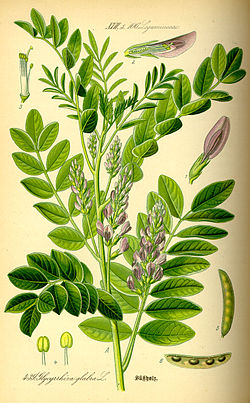
Liquorice is a herbaceous perennial, growing to 1 metre (40 in) in height, with pinnate leaves about 7–15 cm (3–6 in) long, with 9–17 leaflets. The flowers are 8–12 mm (51612 in) long, purple to pale whitish blue, produced in a loose inflorescence. The fruit is an oblong pod, 20–30 mm (341+18 in) long, containing several seeds.[18] The roots are stoloniferous.[19]

Chemistry

[edit]
Much of the sweetness in liquorice comes from glycyrrhizin.
Sections of liquorice root

Liquorice root contains triterpenoids, polyphenols, and polysaccharides.[9] Flavonoids account for the yellow root colour.[9] The principal glycoside, glycyrrhizin, exists in content of 7% to 10%, depending on cultivation practices.[9] The isoflavene glabrene and the isoflavane glabridin, found in the roots of liquorice, are phytoestrogens.[20][21]

The scent of liquorice root comes from a complex and variable combination of compounds, of which anethole is some 3% of total volatiles.[citation needed] Much of the sweetness in liquorice comes from glycyrrhizin, which has 30–50 times the sweetness of sugar.[citation needed] The sweetness is different from sugar, being less instant, tart, and lasting longer.

Cultivation and uses

[edit]

Liquorice grows best in well-drained soils in deep valleys with full sun. It is harvested in the autumn two to three years after planting.[18] Countries producing liquorice include Turkey, Greece, Iran, and Iraq.[9]

Tobacco

[edit]

Liquorice is used as a flavouring agent for tobacco, for flavour-enhancing and moistening agents in the manufacture of American blend cigarettes, moist snuff, chewing tobacco, and pipe tobacco.[8][9][22] Liquorice provides tobacco products with a natural sweetness and a distinctive flavour that blends readily with the natural and imitation flavouring components employed in the tobacco industry.[9] Liquorice can also be added to cigarette rolling papers. As of 2009, the US Food and Drug Administration banned the use of any "characterizing flavors" other than menthol from cigarettes, but not other manufactured tobacco products.[23]

Food and confectionery

[edit]
Dried sticks of liquorice root

Liquorice flavour is found in a wide variety of candies or sweets. In most of these candies, the taste is reinforced by aniseed oil so the actual content of liquorice is low.

In the Netherlands, liquorice confectionery (drop) is a common sweet sold in many forms. Mixing it with mint, menthol, aniseed, or laurel is common. It is also mixed with ammonium chloride (salmiak); salmiak liquorice in the Netherlands is known as zoute drop ('salty liquorice'). Strong, salty sweets are also consumed in Nordic countries where liquorice flavoured alcohols are sold, particularly in Denmark and Finland.[citation needed]

Dried sticks of the liquorice root are a traditional confectionery in the Netherlands as were they once in Britain. They were sold simply as sticks of zoethout ('sweet wood') to chew on as a candy.

Liquorice root chips

Pontefract in Yorkshire, England, is where liquorice mixed with sugar began to be used as a sweet in the contemporary way.[24] Pontefract cakes were originally made there.[25] In Cumbria, County Durham, Yorkshire and Lancashire, it is colloquially known as 'Spanish', supposedly because Spanish monks grew liquorice root at Rievaulx Abbey near Thirsk.[26]

In Italy, Spain, and France, liquorice is used in its natural form. The root of the plant is simply harvested, washed, dried, and chewed as a mouth freshener. Throughout Italy, unsweetened liquorice is consumed in the form of small black pieces made only from 100% pure liquorice extract. In Calabria, a liqueur is made from pure liquorice extract and in Reggio Emilia a soft drink called acqua d'orcio is made. In some parts of the Arab world, including Egypt and the Levant, the root of the liquorice plant is used to make a cold drink with a sweet and mildly bitter taste, called Erk al-sous. This beverage is especially popular during Ramadan.[27]

In southeastern Turkey, such as in Diyarbakır, liquorice root is traditionally made into a chilled beverage that is most commonly consumed in summer.[28]

Research

[edit]

Properties of glycyrrhizin are under preliminary research, such as for hepatitis C or topical treatment of psoriasis, but the low quality of studies as of 2017 prevents conclusions about efficacy and safety.[8][9][29]

Traditional medicine

[edit]

In traditional Chinese medicine, a related species G. uralensis (often translated as "liquorice") is known as gancao (Chinese: 甘草; lit. 'sweet grass'), and is believed to "harmonize" the ingredients in a formula.[30] although there is no high-quality clinical research to indicate it is safe or effective for any medicinal purpose. The European Medical Agency added liquorice to their list of herbal medicine.[31]

Fungicide

[edit]

The essential oils inhibit the growth of Aspergillus flavus.[32]

Adverse effects

[edit]

Consumption levels

[edit]

The United States Food and Drug Administration regards that foods containing liquorice and its derivatives (including glycyrrhizin) are generally recognized as safe for use as a food ingredient, if not consumed excessively.[8][9][10] Other jurisdictions have suggested no more than 100–200 mg (1.5–3.1 grains) of glycyrrhizin per day, the equivalent of about 70–150 g (2+125+14 oz) of liquorice confectionery.[10] Although liquorice is considered safe as a food ingredient, glycyrrhizin can cause serious side effects if consumed in large amounts (above 0.2 mg per kg per day).[8][9][10] One estimate is that a normal healthy person can consume 10 mg (0.15 grains) of glycyrrhizic acid per day.[33]

Because the composition of liquorice extracts in various products may exist in a broad range, there is not enough scientific information to determine that a specific level of intake is safe or unsafe.[8][9]

Physiological effects

[edit]

The effects of excessive liquorice consumption on lowering potassium levels in the blood and increasing blood pressure are a particular concern for people with hypertension (high blood pressure) or heart or kidney disease.[8]

Some adverse effects of liquorice consumed in amounts of 50 to 200 g per day over four weeks appear to be caused by glycyrrhizic acid (75 to 540 mg per day glycyrrhetinic acid) causing increases in blood pressure.[9]

Apparent mineralocorticoid excess syndrome can occur when the body retains sodium, and loses potassium, altering biochemical and hormonal regulation.[10] Some of these activities may include raised aldosterone levels, decline of the renin–angiotensin system and increased levels of the atrial natriuretic hormone in order to compensate the variations in homoeostasis.[10][34]

Other adverse effects may include electrolyte imbalance, oedema, increased blood pressure, weight gain, heart problems, and weakness. Symptoms depend on the severity of toxicity. Some other complaints include fatigue, shortness of breath, kidney failure, and paralysis.[35][36]

Potential for toxicity

[edit]

The major dose-limiting toxicities of liquorice are corticosteroid in nature, because of the inhibitory effect that its chief active constituents, glycyrrhizin and enoxolone, have on cortisol degradation, and include oedema, hypokalaemia, weight gain or loss, and hypertension.[9][10][37][38]

Pregnancy

[edit]

Due to the possibility of premature birth and health problems in children whose mothers consumed large amounts (about 250 g (8.8 oz)) of liquorice extract per week, it is variously advised that during pregnancy "oral licorice extract in large amounts should be avoided",[8] liquorice "should be avoided"[9] and "Liquorice is safe to eat. But you should avoid liquorice root."[39]

[edit]

References

[edit]
[edit]
Revisions and contributorsEdit on WikipediaRead on Wikipedia
from Grokipedia
Liquorice refers to the root and rhizome of Glycyrrhiza glabra, a herbaceous in the family , native to the Mediterranean region, , , and parts of , where it grows as a multi-stemmed plant reaching up to 1 meter (3 feet) in height with pinnate leaves and pale blue to violet flowers. The plant's roots contain , a triterpenoid that imparts an intensely sweet flavor—about 50 times sweeter than —and accounts for 5-9% of the root's dry weight, making liquorice a key natural sweetener and flavoring agent. Harvested after 3-4 years, the unpeeled, dried roots are processed into extracts used globally in food, beverages, products, , and pharmaceuticals. Historically, liquorice has been utilized for over 4,000 years in across ancient Egyptian, Greek, Roman, Chinese, and Ayurvedic systems to treat respiratory ailments, digestive disorders, and inflammatory conditions, often as a to soothe mucous membranes and an expectorant for coughs and . Its therapeutic value stems from bioactive compounds including (such as glabridin and liquiritigenin), , and , which exhibit , , antiviral, and effects, with clinical supporting its efficacy in managing peptic ulcers (up to 90% success rate in some studies) and upper respiratory infections. Today, liquorice is commercially cultivated in regions like , , , , and , with global production focused on its role in (e.g., black licorice candies) and as a natural alternative to artificial sweeteners, though deglycyrrhizinated liquorice (DGL) is preferred in supplements to minimize side effects. While generally safe in moderate amounts, excessive consumption of liquorice containing (over 20 grams daily) can lead to pseudoaldosteronism, characterized by , , and , particularly in individuals with liver or issues, necessitating contraindications and limited use to 4-6 weeks without supervision. Liquorice is not recommended even occasionally for people with kidney problems due to potential risks including water-sodium retention (causing edema and hypertension), hypokalemia (leading to muscle weakness and arrhythmias), and increased kidney burden that may worsen the condition or accelerate decline in patients with impaired function like chronic kidney disease. Ongoing research highlights its potential in modern applications, including anticancer and hepatoprotective therapies, underscoring liquorice's enduring significance as both a culinary staple and a versatile medicinal .

Etymology and History

Etymology

The English term "liquorice" originates from the late 13th century, derived from Anglo-French "lycorys" or "licoresse," which in turn stems from "liquiritia." This Latin form is a corruption of the "γλυκύρριζα" (glykyr rhiza), a compound of "γλυκύς" (glykys, meaning "") and "ῥίζα" (rhiza, meaning "root"), reflecting the plant's notably sweet root. In modern usage, spelling variations persist across English dialects, with "liquorice" preferred in British and English, while favors "licorice," a simplification that emerged in the . Similar linguistic adaptations appear in other European languages, such as French "réglisse," derived from a metathesized form of "licoresse," and Finnish "lakritsi," which echoes the Germanic and Scandinavian influences on the term. The plant's naming has been shaped by ancient trade routes, with the Arabic "as-sūṣ" (السوس) tracing back to Semitic roots attested in Akkadian "šûšu," indicating early dissemination through Mediterranean and Near Eastern commerce as early as the 2nd millennium BCE. Independently in East Asia, the Chinese name "gān cǎo" (甘草), literally "sweet herb," has been used for millennia in traditional contexts, highlighting parallel cultural recognition of its sweetness without direct Greek influence.

Historical Uses

The earliest documented uses of liquorice (Glycyrrhiza glabra) date back to around 1400 BCE, where it was employed as a medicinal agent for treating coughs, , and wounds through poultices, as well as a natural sweetener in beverages. Large quantities of liquorice root were discovered in the tomb of , underscoring its cultural and pharmaceutical significance in Egyptian society. Liquorice gained prominence in and for its therapeutic properties. (c. 460–370 BCE) praised liquorice for its benefits in managing various ailments, including digestive disorders, while (c. 371–287 BCE) documented its application for respiratory conditions such as coughs and , as well as thirst-quenching and treatments. In , (23–79 CE) extensively described liquorice's virtues in his , recommending it as an expectorant and for issues like , throat inflammations, mouth ulcers, and urinary complaints. During the medieval period, liquorice featured prominently in Islamic pharmacopeias, with (Ibn Sina, c. 980–1037 CE) detailing its uses in his for respiratory, gastrointestinal, cardiovascular, and urogenital disorders, building on Greco-Roman traditions. This knowledge spread to through translations, where apothecaries in the medieval and eras commonly incorporated liquorice into remedies for throat irritations and coughs, valuing its soothing and expectorant qualities. By the , liquorice played a key role in British , particularly in , , where apothecary George Dunhill developed liquorice lozenges or "cakes" by mixing the extract with , transforming it from a pure medicinal into a sweetened treat while retaining its throat-soothing reputation. Much of the raw liquorice was exported from Mediterranean regions like and , establishing vital trade routes that supported Europe's growing demand for both medicinal and culinary applications.

Botanical Description

Plant Morphology

Liquorice, scientifically classified as Glycyrrhiza glabra L., belongs to the family and is a that typically grows to a height of 1-2 meters. The plant features upright, hairy stems that arise from an extensive underground root system, forming a multi-stemmed, clumping habit. It is characterized by its ability to fix through with bacteria, contributing to its persistence in suitable environments. The root system is robust and extensive, consisting of a primary that can penetrate deeply into the , often exceeding 1 meter in depth, along with branching lateral and horizontal rhizomes that may extend up to 1-2 meters in length. These rhizomes, which serve as the primary propagative structures, have a , wrinkled exterior and a bright yellow, fibrous interior that is soft and flexible when fresh. The s and rhizomes are the harvested portions, valued for their high content of bioactive compounds, though the themselves do not produce flowers or leaves directly. Above ground, the plant bears compound, pinnate leaves arranged alternately on the stems, each leaf measuring 7-15 cm long and consisting of 9-17 ovate to lanceolate leaflets, each 2-5 cm in length and pubescent on the underside. The flowers are papilionaceous, resembling those of sweet peas, and appear in axillary racemes or that are 4-10 cm long, containing 10 or more blooms; they range from pale blue to violet in color, measure 1-1.5 cm long, and bloom during summer, typically from to August. Following pollination, the plant produces oblong, reddish-brown pods that are 1-3 cm long and 4-5 mm wide, each containing 2-5 reniform seeds. As a , G. glabra follows a seasonal life cycle: occurs in spring from scarified seeds sown in warm conditions, leading to vegetative growth through summer when flowering takes place. The plant enters during winter, with above-ground parts dying back while the root system persists underground. is achieved primarily through seeds, which require pre-soaking for 24 hours to improve rates, or vegetatively via division of rhizomes or cuttings in early spring.

Habitat and Distribution

The liquorice plant, Glycyrrhiza glabra, is native to the Mediterranean Basin, southwestern Asia, and the , where it occurs in dry open scrublands, steppes, semideserts, and damp ditches near streams or in saline areas. It thrives in deep, fertile, sandy or loamy soils with good drainage and a pH range of 6.0 to 8.0, though it tolerates slightly acidic to alkaline conditions down to pH 5.5; heavy clay soils are unsuitable as they impede root development. The plant prefers temperate to subtropical climates with daytime temperatures between 5°C and 25°C, showing strong but requiring 300–500 mm of annual rainfall for optimal growth, though it can endure up to 1,200 mm. Above-ground parts are frost-sensitive and damaged at 0°C, but the roots remain hardy to -15°C during , allowing survival in cooler regions. In the wild, G. glabra forms natural stands in countries such as , , and , extending across from to and northwestern at elevations up to 1,300 m. It was introduced to the and during the for cultivation, where it now grows in suitable temperate areas. Today, minor wild populations persist in , while major global production occurs in , , , and , with contributing significantly to the world's supply through both wild harvesting and cultivation.

Chemical Composition

Primary Compounds

The primary compounds in liquorice (Glycyrrhiza glabra) root are dominated by , particularly , which constitutes 2-15% of the root's dry weight and is responsible for its characteristic sweetness, being approximately 50 times sweeter than . , chemically known as glycyrrhizic acid, has the molecular formula C₄₂H₆₂O₁₆ and exists as a mixture of potassium and calcium salts of the formed from the aglycone glycyrrhetinic acid and a . Flavonoids represent another key group of primary compounds, with liquiritin and isoliquiritin being prominent glycosides that account for up to 1% of the dry root weight and contribute to the root's yellow coloration as well as its antioxidant properties. These flavonoids, derived from liquiritigenin and isoliquiritigenin respectively, are part of a broader class including chalcones and flavanones that enhance the root's overall phenolic profile. In addition to , other such as derivatives of glycyrrhizic acid (including licorice acid A3 and other triterpenoid glucuronides) are present, alongside that form part of the root's structural carbohydrates. Coumarins, including (also known as 7-hydroxycoumarin), occur as minor phenolic constituents, adding to the diversity of the root's extractable compounds. Liquorice roots typically yield approximately 20% water-soluble extracts upon , encompassing these primary compounds, with overall composition varying based on age—older roots often showing higher levels—and soil conditions such as and availability.

Pharmacological Properties

Liquorice's primary triterpenoid , , undergoes hydrolysis in the gut by bacterial β-glucuronidases to form glycyrrhetinic acid, its active aglycone . This potently inhibits type 2 (11β-HSD2), an enzyme that inactivates in the , leading to elevated levels that mimic aldosterone activity and promote sodium retention. Flavonoids in liquorice, such as isoliquiritigenin and licochalcone A, exert effects by inhibiting key pathways including (COX-2) and (NF-κB). For instance, licochalcone A suppresses COX-2-dependent production in -stimulated fibroblasts and chondrocytes at concentrations of 5–20 μM. Isoliquiritigenin attenuates activation in lipopolysaccharide-stimulated macrophages, reducing phosphorylation of upstream kinases like ERK1/2 and IKK, thereby lowering proinflammatory expression. Additionally, liquorice's properties, attributed to its content and , soothe irritated membranes and stimulate tracheal mucus secretion, contributing to expectorant effects that facilitate the expulsion of respiratory secretions. The capacity of liquorice extracts stems from their polyphenolic and triterpenes, which scavenge free radicals effectively. assays demonstrate this through 2,2-diphenyl-1-picrylhydrazyl () radical scavenging, with ethanolic extracts of liquorice roots showing IC50 values around 51 μg/mL, indicating moderate to strong activity comparable to some synthetic antioxidants. Liquorice contains phytoestrogens like isoliquiritigenin, a that exhibits estrogenic activity by binding to receptors (ERs) . Isoliquiritigenin displays equipotent affinity for ERα and ERβ subtypes, with binding energies as low as -8.2 kcal/mol for ERβ, enabling partial and modulation of estrogen-responsive .

Cultivation and Production

Growing Conditions

Liquorice (Glycyrrhiza glabra) requires well-drained loamy or sandy soils with a of 6.5–7.5 for optimal development, as heavier clay soils can impede growth and increase susceptibility to waterlogging. should prioritize deep, fertile locations with moisture-retentive properties but excellent drainage to avoid ; with cereals is a recommended practice to disrupt pest cycles, particularly nematodes that target perennial . These conditions mirror the plant's natural riverbank habitats, where sandy substrates support extensive root systems. Liquorice is commercially cultivated primarily in , , , , , and , with global production estimated at around 180,000 metric tons of roots as of 2024. Planting typically occurs in spring using cuttings or pre-soaked sown in a before , with a of 20,000–24,000 per —achieved by spacing 20–50 cm apart within rows and rows 30–80 cm apart. Initial is crucial during establishment to promote anchoring, especially in the first when the plant is vulnerable to stress. The plant favors a temperate to subtropical with optimal daytime temperatures of 15–25°C and full sun exposure for vigorous growth, tolerating annual rainfall between 500–1,000 mm but requiring supplemental in drier periods. A , liquorice follows a 3–4 year growth cycle before the roots are mature enough for initial harvest, during which it fixes atmospheric through , reducing some fertilizer needs. Fertilization focuses on balanced nutrient application based on soil tests, with at 40–100 kg/ha, at similar levels, and as needed to support expansion; amendments, such as , are incorporated to improve and enhance microbial activity for better development.

Harvesting and Processing

Liquorice roots (Glycyrrhiza glabra) are harvested after 3-4 years of growth, typically in autumn during plant dormancy when foliage has died back, to ensure optimal active compound concentration and root quality. Harvesting is performed manually with spades or mechanically using excavators or specialized , targeting depths of 0.3-0.9 meters where 75-93% of the root mass is concentrated, though deeper excavation up to 1-2 meters may be needed for extensive rhizomes. Yields vary by region, density, and conditions but commonly reach 17-28 tons per of fresh roots, equivalent to approximately 10-20 tons per of dry roots after processing. Post-harvest, the roots are cleaned to remove , debris, and extraneous material, then thoroughly washed and cut or ground into smaller pieces to facilitate extraction. may occur naturally in the sun or artificially at controlled low temperatures to reduce moisture content and prevent microbial growth before storage in ventilated facilities. The primary extraction process involves : the prepared roots are boiled in (typically at a ratio of about 1:8 to 1:10) for 1-3 hours, often repeated twice to achieve comprehensive recovery of soluble compounds like . The resulting is filtered to separate solids, then concentrated through evaporation under reduced pressure or open conditions to form a thick . Commercial products derive from this extract in various forms: block liquorice, a solid mass molded from the evaporated for long-term storage; powdered liquorice, obtained by spray-drying the extract; and extracts used directly in formulations. Deglycyrrhizinated liquorice (DGL), a modified form with reduced content (typically to less than 3% in the final product) to minimize side effects, is produced by enzymatic of the extract to remove most of the while preserving .

Culinary and Industrial Uses

Confectionery and Food

Liquorice plays a prominent role in as a natural flavoring agent derived from the root of Glycyrrhiza glabra, imparting a distinctive sweet and slightly bitter taste to various sweets. In the , traditional liquorice confections include Allsorts, which originated in 1899 when a salesman accidentally mixed samples of liquorice pieces, , and jelly, leading to the creation of this multicolored assortment. Other classics are liquorice twists, elongated chewy strips flavored with the root extract, dating back to the . Pipes, small tubular candies mimicking smoking pipes, originated in in the 1920s. These developed from 18th-century innovations when apothecaries like George Dunhill began adding sugar to liquorice for palatable lozenges in 1760. In , salted liquorice represents a unique variation, combining the root's sweetness with the sharp saltiness of , an expectorant historically used in remedies. This confection emerged in the 1930s, initially in where pharmacies incorporated into liquorice syrups, evolving into popular candies like salmiakki that vary in salt intensity based on the compound's concentration. Modern applications extend liquorice's use beyond traditional sweets into beverages and baked goods, where its extract enhances flavor without added sugars. It flavors herbal teas for natural sweetness, soft drinks such as —where it complements sarsaparilla and for an earthy profile—and baked items like cookies and breads for depth. Typically, liquorice extract comprises 2-10% of formulations to achieve desired sweetness, leveraging , a compound 50-100 times sweeter than . Global production underscores liquorice's scale in the industry, with annual output reaching approximately 36,000 metric tons as of recent years (FAO ), a portion dedicated to uses including sweets. The global licorice market was valued at USD 1,052.52 million in 2025. serves as a common substitute due to its similar licorice-like flavor, often used in recipes to mimic the profile at equivalent extract ratios. Cultural variations highlight liquorice's adaptability, such as in where imported varieties like soft twists are gaining popularity amid global trends, despite traditional aversion to the flavor. Its plant-based origin makes liquorice inherently vegan-friendly, appealing to dietary-conscious consumers in confections free of animal-derived gelatins.

Tobacco and Other Products

Liquorice extract is widely used in the tobacco industry, where it is applied to cigarette tobacco at levels of 1–4% to enhance flavor characteristics, provide smoothness, and mask the harshness of smoke. This addition harmonizes the overall taste profile of the product. In cosmetics and pharmaceuticals, liquorice extract serves as a natural emulsifier in lotions and creams, facilitating the blending of water- and oil-based ingredients for stable formulations. It is also incorporated as a base in herbal toothpastes, where its saponins act as foaming agents to produce lather without synthetic surfactants. The glycyrrhizin component, a key saponin glycoside, contributes to this surfactant-like foaming effect. Beyond these applications, liquorice extract functions as an additive in to improve and stimulate appetite in and . In , it is employed as a , with solutions at concentrations of 0.5–1% demonstrating efficacy against soil pathogens such as by inhibiting zoospore release and acting as a direct agent.

Medicinal Uses

Traditional Medicine

In Traditional Chinese Medicine, liquorice root, known as Gan Cao, has been employed for over two millennia as a harmonizing agent in herbal formulas, moderating the actions of other ingredients to enhance their therapeutic effects and mitigate potential toxicity. It is particularly valued for treating respiratory conditions such as coughs accompanied by phlegm and dyspnea, as well as gastrointestinal issues including peptic ulcers, where it soothes inflammation and promotes mucosal protection. Typical administration involves decoctions at dosages of 3-9 g per day, reflecting its role in tonifying the spleen and heart qi while addressing disharmonies in the body. In Ayurvedic traditions of , liquorice, referred to as Yashtimadhu or Mulethi, serves as a key remedy for respiratory ailments, acting as an expectorant and antitussive to alleviate (including dry cough), , and by loosening and clearing accumulated from the lungs while pacifying aggravated Kapha dosha. Its demulcent properties form a protective layer over the mucous membranes, soothing sore throat, reducing throat irritation and inflammation, lubricating the throat, and relieving hoarseness to help restore voice tone. It is often combined with to form a soothing paste or gargle for these throat benefits. Additionally, it addresses skin conditions such as eczema, , and through topical applications, where its anti-inflammatory effects help calm inflamed tissues and promote healing. European herbalism from the 16th to 19th centuries incorporated liquorice into teas and infusions primarily as a digestive aid to alleviate discomfort and "concoct raw humors," as described by herbalist in the . It functioned as an expectorant for roughness and coughs, with pharmacopeias like the Pharmaceutical Code of (1790) listing it in compound remedies for respiratory relief. Recommendations in period texts also extended to management, highlighting its role in easing bronchial spasms and supporting lung function. In indigenous practices of the , particularly within the Unani system of Greco-Arabic medicine, liquorice root has been utilized for tonifying vital energy and nerves, aiding in the treatment of fatigue, weakness, and conditions related to energy depletion. African traditional medicine employs imported roots of Glycyrrhiza glabra for , often applied topically in poultices mixed with butter or oils to accelerate tissue repair, reduce , and prevent infection in burns and cuts.

Modern Applications

In modern pharmaceutical applications, standardized extracts of liquorice (Glycyrrhiza glabra) are widely utilized for their and soothing properties. Deglycyrrhizinated liquorice (DGL), which removes to minimize side effects, is commonly prescribed for (GERD) at dosages of 380-760 mg per day, typically taken as chewable tablets before meals to promote mucus production and protect the esophageal lining. Similarly, -containing lozenges are employed for symptomatic relief of sore throats, leveraging the compound's and effects to reduce irritation in the upper . Regulatory bodies have recognized specific indications for liquorice in contemporary therapeutics. The (EMA) acknowledges liquorice root for its expectorant and actions in managing catarrhs and upper complaints, as detailed in its , supporting its use in medicinal products for and clearance. In , from liquorice is integrated into formulas, such as intravenous preparations like Stronger Neo-Minophagen C, for hepatoprotective effects in chronic liver conditions including , where it inhibits and reduces inflammation. Liquorice extracts appear in diverse formulations to enhance and targeted delivery. Oral options include tablets for digestive support, syrups formulated with licorice alongside and for suppression, and lozenges for relief. Topical creams and gels incorporate liquorice for dermatological applications, such as reducing redness and itching in eczema when applied three times daily. A 2025 pharmaco-metabolomics study confirmed the soothing and curative effects of Glycyrrhiza glabra extract against allergic . These are often combined with complementary herbs; for instance, DGL tablets frequently pair with slippery elm bark to bolster gastrointestinal mucosal integrity and alleviate . Regarding regulatory oversight, the U.S. Food and Drug Administration (FDA) classifies liquorice and its derivatives, including ammoniated , as (GRAS) for food use, but medicinal claims remain unapproved as a , limiting promotions to contexts. In the 2020s, emerging clinical trials have explored liquorice extracts for symptom management; for example, a 2024 randomized study found adjunctive liquorice tablets reduced ICU stay duration and improved respiratory symptoms in critically ill patients by modulating inflammation.

Health Research

Potential Benefits

Liquorice, derived from the root of Glycyrrhiza glabra, has been investigated for its potential role in supporting digestive health, primarily through its anti-ulcer properties. The compound in liquorice promotes increased gastric mucus production, which strengthens the protective mucosal barrier in the stomach and aids in ulcer healing. Clinical studies have demonstrated that liquorice extracts can lead to significant symptom reduction in , with systematic reviews indicating trends toward improved pain and ulcer healing. In terms of antiviral activity, exhibits inhibitory effects against type 1 (HSV-1) by interfering with . Research has established an value of 0.5 mM for this inhibition, highlighting its potency at low concentrations. Liquorice demonstrates mild adaptogenic effects that may help balance hormonal responses to stress, particularly through modulation of levels. By inhibiting the enzyme 11β-hydroxysteroid dehydrogenase type 2, prolongs 's activity, which can support adrenal function and reduce stress-related symptoms in certain contexts. studies suggest this mechanism contributes to improved outcomes in conditions involving HPA axis dysregulation. Additionally, liquorice compounds offer potential benefits for skin lightening by inhibiting , the key enzyme in synthesis. Constituents such as glabrene and isoliquiritigenin have shown varying degrees of tyrosinase inhibition in biochemical assays, reducing without . For oral health, liquorice extracts display antibacterial activity against , a primary contributor to dental caries, with minimum inhibitory concentrations as low as 781 µg/mL in planktonic cells and efficacy against biofilms.

Clinical Studies

Clinical studies on liquorice have primarily focused on its potential therapeutic effects in treating ulcers, respiratory conditions, and inflammatory diseases, with mixed results from randomized controlled trials (RCTs) and pilot studies. Early research in the examined deglycyrrhizinated liquorice (DGL) for aphthous s. In a involving 20 patients, DGL led to 50-75% improvement in symptoms for 15 participants within one day, with complete healing by the third day. Subsequent systematic reviews of RCTs, including those using licorice extracts in patches or pastes, have confirmed significant reductions in size and compared to , with healing times shortened to 4-8 days across studies with sample sizes of 15-70. In the 2010s, intravenous from liquorice was investigated for chronic hepatitis C in non-responders to therapy. A phase II RCT with 363 patients showed a 29% reduction in ALT levels after 12 weeks of treatment three times weekly, compared to 7% in the group, though no significant viral load changes were observed. For cough relief in respiratory conditions, studies on licorice-based gargle for postoperative and have reported reduced incidence of symptoms compared to controls, supporting its antitussive potential; however, broader meta-analyses incorporating licorice in herbal formulations for upper respiratory infections have noted inconsistent evidence due to heterogeneous study designs. Post-2020 pilot and RCT studies have explored liquorice's role in COVID-19. In a double-blind RCT of 52 critically ill patients, adjunctive oral liquorice reduced ICU stay duration significantly (P=0.015) compared to , with improvements in oxygenation but no changes in mortality or ventilation needs. Another RCT (n=60 moderate cases) found licorice improved levels toward baseline, indicating effects, though overall symptom scores like SpO2 and showed no significant differences from controls. Many clinical studies on liquorice suffer from limitations, including small sample sizes (often n<50), short durations, and variability in extract standardization, necessitating larger RCTs for robust efficacy confirmation; a 2023 systematic review highlighted these issues in trials for oral conditions, emphasizing the need for better-powered studies to validate benefits.

Adverse Effects and Safety

Physiological Impacts

Liquorice, primarily through its active compound , exerts mineralocorticoid-like effects by inhibiting the enzyme 11β-hydroxysteroid dehydrogenase type 2 (11β-HSD2) in the kidneys. This inhibition reduces the conversion of to its inactive form, , allowing excess cortisol to activate mineralocorticoid receptors and promote sodium reabsorption while increasing potassium excretion. As a result, regular consumption can lead to sodium retention, hypokalemia, and mild hypertension, particularly in sensitive individuals. These effects are particularly concerning for individuals with kidney problems, such as chronic kidney disease, where even occasional intake of liquorice tablets is not recommended due to risks of water-sodium retention causing edema and hypertension, hypokalemia leading to muscle weakness and arrhythmias, and increased kidney burden that may worsen the condition or accelerate decline in renal function. The same mechanism contributes to hormonal changes, including elevated levels of active cortisol throughout the body. In women, these alterations may manifest as disruptions in sex hormone balance, such as reduced serum testosterone via inhibition of 17-hydroxysteroid dehydrogenase, potentially leading to menstrual irregularities. Such effects underscore liquorice's influence on the endocrine system beyond mineralocorticoid pathways. Gastrointestinally, liquorice functions as a demulcent, forming a protective mucilaginous layer that soothes irritated mucous membranes in the throat and digestive tract. This property, attributed to its polysaccharides and flavonoids, also stimulates saliva production, which can relieve dry mouth and support oral lubrication. Metabolically, small doses of liquorice may aid in blood sugar stabilization due to the slow absorption of its glycyrrhizin and other constituents, which can modulate glucose uptake without rapid spikes. Flavonoids like glabridin further contribute by enhancing insulin sensitivity and GLUT4 translocation in cellular models.

Toxicity Risks

Excessive consumption of liquorice, primarily due to its glycyrrhizin content, can induce pseudoaldosteronism, a condition mimicking hyperaldosteronism through inhibition of the enzyme 11β-hydroxysteroid dehydrogenase type 2 (11β-HSD2), leading to cortisol accumulation and mineralocorticoid receptor activation. This results in symptoms such as hypertension, peripheral edema, and severe hypokalemia (serum potassium levels below 3.5 mmol/L). Hypokalemia from liquorice-induced pseudoaldosteronism has been associated with cardiac arrhythmias, including prolonged QT interval, ventricular tachycardia, ventricular fibrillation, and polymorphic ventricular tachycardia, potentially leading to life-threatening events. Case reports document severe complications like rhabdomyolysis secondary to profound hypokalemia following chronic or acute high-dose liquorice intake, with muscle breakdown evidenced by elevated creatine kinase levels and renal impairment in affected individuals. In one instance, a patient consuming excessive liquorice developed hypokalemic paralysis alongside rhabdomyolysis, resolving only after potassium supplementation and cessation of exposure. Liquorice exhibits estrogenic activity, primarily attributed to flavonoids and isoflavonoids like liquiritigenin, which bind to estrogen receptors α and β, potentially disrupting reproductive health. This estrogen-like effect has been linked to increased risks of preterm birth; a study found that heavy liquorice consumption (>500 mg /week) during was associated with more than a twofold elevated (OR 2.0) for preterm delivery before 37 weeks. Liquorice interacts adversely with several medications, potentiating the effects of by inducing , which heightens the risk of and arrhythmias. It also diminishes the efficacy of diuretics such as and amiloride by promoting sodium retention and loss. Additionally, and liquorice extracts inhibit , an enzyme involved in metabolism, potentially prolonging the activity of corticosteroids and exacerbating mineralocorticoid-like effects. Liquorice is contraindicated in due to its estrogenic properties and association with risks. Individuals with face heightened s, as pseudoaldosteronism can worsen control through sodium retention and volume expansion. It is also contraindicated for people with kidney problems, including chronic kidney disease, where even occasional consumption is not recommended due to the potential for water-sodium retention leading to edema and hypertension, hypokalemia causing muscle weakness and arrhythmias, and increased kidney burden that may exacerbate the condition or accelerate renal decline. Animal studies indicate low acute , with oral LD50 values for exceeding 15 g/kg in rats, though chronic exposure amplifies adverse effects in vulnerable populations. The (WHO) and the Joint FAO/WHO Expert Committee on Food Additives (JECFA) recommend that daily intake of glycyrrhizinic acid from liquorice should not exceed 100 mg for adults, as higher amounts may lead to adverse effects in sensitive individuals. This limit is equivalent to approximately 50-70 grams of liquorice candy, depending on the product's concentration, which typically ranges from 2-4% in confectionery. The (EFSA), through its Scientific Committee on Food, concurs with this upper limit of 100 mg per day for regular consumption to ensure safety for the majority of the adult population. Deglycyrrhizinated liquorice (DGL), which has most removed, is considered safer for therapeutic use and can be consumed up to 2 grams per day without the associated risks of or . Chronic users of any liquorice form, including DGL, should monitor regularly, as even trace amounts of or other compounds may influence cardiovascular parameters in susceptible individuals. Liquorice consumption is not recommended for individuals with kidney problems, even occasionally, due to the risks of exacerbating fluid retention, electrolyte imbalances, and renal function decline; consultation with a healthcare provider is advised. Liquorice consumption should be avoided or used with caution in children due to their lower body weight and higher sensitivity to glycyrrhizin's effects on and hormones; consultation with a healthcare provider is essential for any use. In , intake should be limited to no more than 50 mg of daily to minimize risks such as or developmental issues in the offspring, though complete avoidance of glycyrrhizin-containing products is often advised. Individuals with heart conditions, including or , should consult a physician before consuming liquorice, as it can exacerbate fluid retention and cardiac strain. In the 2020s, the U.S. (FDA) has issued warnings about excessive black liquorice candy consumption, particularly for adults over 40, noting that 2 ounces (about 57 grams) daily for two weeks can disrupt heart rhythm due to 's potassium-lowering effects; this includes scrutiny of imported candies with high levels. For those seeking a similar anise-like flavor without risks, seeds or provide a safe alternative, as their primary compound does not affect or electrolytes.

References

Add your contribution
Related Hubs
User Avatar
No comments yet.