


Community hub
Recent from talks
Contribute something
Nothing was collected or created yet.
Nablus
View on Wikipedia
32°13′20″N 35°15′40″E / 32.22222°N 35.26111°E
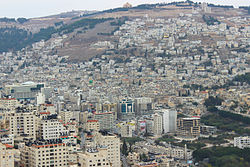
Nablus (/ˈnæbləs, ˈnɑːbləs/ NA(H)B-ləs; Arabic: نابلس, romanized: Nābulus, locally [ˈnæːblɪs] ⓘ)[a] is a city in the West Bank, Palestine, and the capital of the Nablus Governorate. It is located approximately 49 kilometres (30 mi) north of Jerusalem,[5] between Mount Ebal and Mount Gerizim with a population of 156,906.[1] The city is a commercial and cultural centre of Palestine, home to An-Najah National University, one of the largest institutions of higher learning in Palestine, and the Palestine Stock Exchange.[6] Nablus is under the administration of the Palestinian National Authority (PNA).
Key Information


Nablus has been traditionally associated with the ancient city of Shechem.[7] However, Shechem is now identified with the nearby site of Tell Balata in the Balata al-Balad suburb of the West Bank. The modern name of the city can be traced back to the Roman period, when it was named Flavia Neapolis by Roman emperor Vespasian in 72 CE. During the Byzantine period, conflict between the city's Samaritan and newer Christian inhabitants peaked in the Samaritan revolts that were eventually suppressed by the Byzantines by 573, which greatly dwindled the Samaritan population of the city. Following the Muslim conquest of the Levant in the 7th century, the city was given its present-day Arabic name of Nablus. After the First Crusade, the Crusaders drafted the laws of the Kingdom of Jerusalem in the Council of Nablus, and its Christian, Samaritan, and Muslim inhabitants prospered. The city then came under the control of the Ayyubids and the Mamluk Sultanate. Under the Ottoman Turks, who conquered the city in 1517, Nablus served as the administrative and commercial centre for the surrounding area corresponding to the modern-day northern West Bank. Much of Nablus' history is preserved in its Old City, which contains more than 100 monumental buildings.
After the city was captured by British forces during World War I, Nablus was incorporated into Mandatory Palestine in 1922. The 1948 Arab–Israeli War saw the entire West Bank, including Nablus, occupied and annexed by Transjordan. Since the 1967 Arab–Israeli War, the West Bank has been occupied by Israel; since 1995, it has been governed by the Palestinian Authority as part of Area A of the West Bank. Today, the population is predominantly Muslim, with small Christian and Samaritan minorities.
History
[edit]Classical antiquity
[edit]_4368.jpg)
Flavia Neapolis ('new city of the emperor Flavius') was named in 72 CE by the Roman emperor Vespasian and applied to an older Samaritan village, variously called Mabartha ('the passage')[8] or Mamorpha.[9] Located between Mount Ebal and Mount Gerizim, the new city lay 2 kilometers (1.2 mi) west of the Biblical city of Shechem which was destroyed by the Romans that same year during the First Jewish–Roman War.[10][11] Holy places at the site of the city's founding include Joseph's Tomb and Jacob's Well. Because of the city's strategic geographic position and the abundance of water from nearby springs, Neapolis prospered, accumulating extensive territory, including the former Judean toparchy of Acraba.[10]
Insofar as the hilly topography of the site would allow, the city was built on a Roman grid plan and settled with veterans who fought in the victorious legions and other foreign colonists.[8] In the 2nd century CE, Emperor Hadrian built a grand theater in Neapolis that could seat up to 7,000 people.[12] Coins found in Nablus dating to this period depict Roman military emblems and gods and goddesses of the Greek pantheon such as Zeus, Artemis, Serapis, and Asklepios.[8] Neapolis was entirely pagan at this time.[8] Justin Martyr who was born in the city c. 100 CE, came into contact with Platonism, but not with Christians there.[8] The city flourished until the civil war between Septimius Severus and Pescennius Niger in 198–9 CE. Having sided with Niger, who was defeated, the city was temporarily stripped of its legal privileges by Severus, who designated these to Sebastia instead.[8]

In 244 CE, Philip the Arab transformed Flavius Neapolis into a Roman colony named Julia Neapolis. It retained this status until the rule of Trebonianus Gallus in 251 CE. The Encyclopaedia Judaica speculates that Christianity was dominant in the 2nd or 3rd century, with some sources positing a later date of 480 CE.[13] It is known for certain that a bishop from Nablus participated in the Council of Nicaea in 325 CE.[14] The presence of Samaritans in the city is attested to in literary and epigraphic evidence dating to the 4th century CE.[14] As yet, there is no evidence attesting to a Jewish presence in ancient Neapolis.[14]
Si'on suggested that Neapolis was about 900 acres (360 ha) in size during the Byzantine period, making it three times larger than it was when it was first established as a Roman colony.[15] Magen estimates that around 20,000 people lived there during this period.[16]

Conflict among the Christian population of Neapolis emerged in 451. By this time, Neapolis was within the Palaestina Prima province under the rule of the Byzantine Empire. The tension was a result of Monophysite Christian attempts to prevent the return of the Patriarch of Jerusalem, Juvenal, to his episcopal see.[10] However, the conflict did not grow into civil strife.
As tensions among the Christians of Neapolis decreased, tensions between the Christian community and the Samaritans grew dramatically. In 484, the city became the site of a deadly encounter between the two groups, provoked by rumors that the Christians intended to transfer the remains of Aaron's sons and grandsons Eleazar, Ithamar and Phinehas. Samaritans reacted by entering the cathedral of Neapolis, killing the Christians inside and severing the fingers of the bishop Terebinthus. Terebinthus then fled to Constantinople, requesting an army garrison to prevent further attacks. As a result of the revolt, the Byzantine emperor Zeno erected a church dedicated to Mary on Mount Gerizim. He also forbade the Samaritans to travel to the mountain to celebrate their religious ceremonies, and expropriated their synagogue there. These actions by the emperor fueled Samaritan anger towards the Christians further.[10]
Thus, the Samaritans rebelled again under the rule of emperor Anastasius I, reoccupying Mount Gerizim, which was subsequently reconquered by the Byzantine governor of Edessa, Procopius. A third Samaritan revolt which took place under the leadership of Julianus ben Sabar in 529 was perhaps the most violent. Neapolis' bishop Ammonas was murdered and the city's priests were hacked into pieces and then burned together with the relics of saints. The forces of Emperor Justinian I were sent in to quell the revolt, which ended with the slaughter of the majority of the Samaritan population in the city.[10]
Early Muslim period
[edit]

Neapolis, along with most of Palestine, was conquered by the Muslims under Khalid ibn al-Walid, a general of the Rashidun army of Umar ibn al-Khattab, in 636 after the Battle of Yarmouk.[10][11] The city's name was retained in its Arabicized form, Nabulus. The town prevailed as an important trade center during the centuries of Islamic Arab rule under the Umayyad, Abbasid and Fatimid dynasties.
Under Muslim rule, Nablus contained a diverse population of Arabs and Persians, Muslims, Samaritans, Christians and Jews.[10] In the 9th century CE, Al-Yaqubi reported that Nablus had a mixed population of Arabs, Ajam (Non-Arabs), and Samaritans.[17] In the 10th century, the Arab geographer al-Muqaddasi, described it as abundant of olive trees, with a large marketplace, a finely paved Great Mosque, houses built of stone, a stream running through the center of the city, and notable mills.[18] He also noted that it was nicknamed "Little Damascus."[12][18] At the time, the linen produced in Nablus was well known throughout the Old World.[19]
Crusader period
[edit]The city was captured by Crusaders in 1099, under the command of Prince Tancred, and renamed Naples.[10] Though the Crusaders extorted many supplies from the population for their troops who were en route to Jerusalem, they did not sack the city, presumably because of the large Christian population there.[20] Nablus became part of the royal domain of the Kingdom of Jerusalem. The Muslim, Eastern Orthodox Christian, and Samaritan populations remained in the city and were joined by some Crusaders who settled therein to take advantage of the city's abundant resources. In 1120, the Crusaders convened the Council of Nablus out of which was issued the first written laws for the kingdom.[10] They converted the Samaritan synagogue in Nablus into a church.[20] The Samaritan community built a new synagogue in the 1130s.[21] In 1137, Arab and Turkish troops stationed in Damascus raided Nablus, killing many Christians and burning down the city's churches. However, they were unsuccessful in retaking the city.[10] Queen Melisende of Jerusalem resided in Nablus from 1150 to 1161, after she was granted control over the city in order to resolve a dispute with her son Baldwin III. Crusaders began building Christian institutions in Nablus, including a church dedicated to the Passion and Resurrection of Jesus, and in 1170 they erected a hospice for pilgrims.[10]
Ayyubid and Mamluk rule
[edit]
Crusader rule came to an end in 1187, when the Ayyubids led by Saladin captured the city. According to a liturgical manuscript in Syriac, Latin Christians fled Nablus, but the original Eastern Orthodox Christian inhabitants remained.[citation needed] Syrian geographer Yaqut al-Hamawi (1179–1229), wrote that Ayyubid Nablus was a "celebrated city in Filastin (Palestine)... having wide lands and a fine district." He also mentions the large Samaritan population in the city.[22] After its recapture by the Muslims, the Great Mosque of Nablus, which had become a church under Crusader rule, was restored as a mosque by the Ayyubids, who also built a mausoleum in the old city.[13]
In October 1242, Nablus was raided by the Knights Templar. This was the conclusion of the 1242 campaign season in which the Templars had joined forces with the Ayyubid emir of Kerak, An-Nasir Dawud, against the Mamluks. The Templars raided Nablus in revenge for a previous massacre of Christians by their erstwhile ally An-Nasir Dawud. The attack is reported as a particularly bloody affair lasting for three days, during which the Mosque was burned and many residents of the city, Christians alongside Muslims, were killed or sold in the slave markets of Acre. The successful raid was widely publicized by the Templars in Europe; it is thought to be depicted in a late 13th-century fresco in the Templar church of San Bevignate, Perugia.[23]
The Samaritan synagogue, built in 362 by the high priest Akbon, and later converted into a church by the Crusaders, was converted into al-Khadra Mosque in 1244. Two other Crusader churches became the An-Nasr Mosque and al-Masakim Mosque during that century.[10][20]
The Mamluk dynasty gained control of Nablus in 1260 and during their reign, they built numerous mosques and schools.[11] Under Mamluk rule, Nablus possessed running water, many Turkish baths and exported olive oil and soap to Egypt, Syria, the Hejaz, several Mediterranean islands, and the Arabian Desert. The city's olive oil was also used in the Umayyad Mosque in Damascus. Ibn Battuta, the Arab explorer, visited Nablus in 1355, and described it as a city "full of trees and streams and full of olives." He noted that the city grew and exported carob jam to Cairo and Damascus.[22]
Ottoman era
[edit]


Nablus came under the rule of the Ottoman Empire in 1517, along with the whole of Palestine. The Ottomans divided Palestine into six sanjaks ('districts'): Safad, Jenin, Jerusalem, Gaza, Ajlun and Nablus, all of which were part of Ottoman Syria. These five sanjaks were subdistricts of the Vilayet of Damascus. Sanjak Nablus was further subdivided into five nahiya ('subdistricts'), in addition to the city itself. The Ottomans did not attempt to restructure the political configuration of the region on the local level such that the borders of the nahiya were drawn to coincide with the historic strongholds of certain families. Nablus was only one among a number of local centers of power within Jabal Nablus, and its relations with the surrounding villages, such as Beita and Aqraba, were partially mediated by the rural-based chiefs of the nahiya.[24] During the 16th century, the population was predominantly Muslim, with Jewish, Samaritan and Christian minorities.[10][25][26]
After decades of upheavals and rebellions mounted by Arab tribes in the Middle East, the Ottomans attempted to reassert centralized control over the Arab vilayets. In 1657, they sent an expeditionary force led mostly by Arab sipahi officers from central Syria to reassert Ottoman authority in Nablus and its hinterland, as part of a broader attempt to established centralized rule throughout the empire at that time. In return for their services, the officers were granted agricultural lands around the villages of Jabal Nablus. The Ottomans, fearing that the new Arab land holders would establish independent bases of power, dispersed the land plots to separate and distant locations within Jabal Nablus to avoid creating contiguous territory controlled by individual clans. Contrary to its centralization purpose, the 1657 campaign allowed the Arab sipahi officers to establish their own increasingly autonomous foothold in Nablus. The officers raised their families there and intermarried with the local notables of the area, namely the ulama and merchant families. Without abandoning their nominal military service, they acquired diverse properties to consolidate their presence and income such as soap and pottery factories, bathhouses, agricultural lands, grain mills and, olive and sesame oil presses.[24]
The most influential military family were the Nimrs, who were originally local governors of Homs and Hama's rural subdistricts. Other officer families included the Akhrami, Asqalan, Bayram, Jawhari, Khammash, Mir'i, Shafi, Sultan and Tamimi families, some of which remained in active service, while some left service for other pursuits. In the years following the 1657 campaign, two other families migrated to Nablus: the Jarrars from Balqa and the Tuqans from northern Syria or Transjordan. The Jarrars came to dominate the hinterland of Nablus, while the Tuqans and Nimrs competed for influence in the town. The former held the post of mutasallim ('tax collector, strongman') of Nablus longer, though non-consecutively than any other family. The three families maintained their power until the mid-19th century.[24]

In the mid-18th century, Zahir al-Umar, the autonomous Arab ruler of the Galilee became a dominant figure in Palestine. To build up his army, he strove to gain a monopoly over the cotton and olive oil trade of the southern Levant, including Jabal Nablus, which was a major producer of both crops. In 1771, during the Egyptian Mamluk invasion of Syria, Zahir aligned himself with the Mamluks and besieged Nablus, but did not succeed in taking the city. In 1773, he tried again without success. Nevertheless, from a political perspective, the sieges led to a decline in the importance of the city in favor of Acre. Zahir's successor, Jezzar Pasha, maintained Acre's dominance over Nablus. After his reign ended in 1804, Nablus regained its autonomy, and the Tuqans, who represented a principal opposing force, rose to power.[28]
Egyptian rule and Ottoman revival
[edit]

In 1831–32 Khedivate Egypt, then led by Muhammad Ali, conquered Palestine from the Ottomans. A policy of conscription and new taxation was instituted which led to a revolt organized by the a'ayan (notables) of Nablus, Hebron and the Jerusalem–Jaffa area. In May 1834, Qasim al-Ahmad—the chief of the Jamma'in nahiya—rallied the rural sheikhs and fellahin (peasants) of Jabal Nablus and launched a revolt against Governor Ibrahim Pasha, in protest at conscription orders, among other new policies. The leaders of Nablus and its hinterland sent thousands of rebels to attack Jerusalem, the center of government authority in Palestine, aided by the Abu Ghosh clan, and they conquered the city on 31 May. However, they were later defeated by Ibrahim Pasha's forces the next month. Ibrahim then forced the heads of the Jabal Nablus clans to leave for nearby villages. By the end of August, the countrywide revolt had been suppressed and Qasim was executed.[28]
Egyptian rule in Palestine resulted in the destruction of Acre and thus, the political importance of Nablus was further elevated. The Ottomans wrested back control of Palestine from Egypt in 1840–41. However, the Arraba-based Abd al-Hadi clan which rose to prominence under Egyptian rule for supporting Ibrahim Pasha, continued its political dominance in Jabal Nablus.[28]
Throughout the 18th and 19th centuries, Nablus was the principal trade and manufacturing center in Ottoman Syria. Its economic activity and regional leadership position surpassed that of Jerusalem and the coastal cities of Jaffa and Acre. Olive oil was the primary product of Nablus and aided other related industries such as soap-making and basket weaving.[29] It was also the largest producer of cotton in the Levant, topping the production of northern cities such as Damascus.[30] Jabal Nablus enjoyed a greater degree of autonomy than other sanjaks under Ottoman control, probably because the city was the capital of a hilly region, in which there were no "foreigners" who held any military or bureaucratic posts. Thus, Nablus remained outside the direct "supervision" of the Ottoman government, according to historian Beshara Doumani.[29]
World War I and British Mandate
[edit]
Between 19 September and 25 September 1918, in the last months of the Sinai and Palestine Campaign of the First World War the Battle of Nablus took place, together with the Battle of Sharon during the set piece Battle of Megiddo. Fighting took place in the Judean Hills where the British Empire's XX Corps and Royal Flying Corps attacked the Ottoman Empire's Yildirim Army Group's Seventh Army which held a defensive position in front of Nablus, and which the Eighth Army had attempted to retreat to, in vain.[31]
The 1927 Jericho earthquake destroyed many of the Nablus' historic buildings, including the An-Nasr Mosque.[32] Though they were subsequently rebuilt by Haj Amin al-Husayni's Supreme Muslim Council in the mid-1930s, their previous "picturesque" character was lost. During the 1936–1939 Arab revolt in Palestine, the British authorities demolished buildings in the Old City quarter of Qaryun suspected of harboring insurgents or hiding weapons.[33] Jewish immigration did not significantly impact the demographic composition of Nablus, and it was slated for inclusion in the Arab state envisioned by the United Nations General Assembly's 1947 partition plan for Palestine.[34]
Jordanian occupation
[edit]During the 1948 Arab–Israeli War, Nablus came under Jordanian occupation. Thousands of Palestinian refugees displaced from areas captured by Israeli forces arrived in Nablus, settling in refugee camps in and around the city. Its population doubled, and the influx of refugees put a heavy strain on the city's resources. Three such camps are still located within the city limits today: Ein Beit al-Ma', Balata and Askar. During the Jordanian occupation, the adjacent villages of Rafidia, Balata al-Balad, al-Juneid and Askar were annexed to the Nablus municipality.[35] Nablus was occupied and annexed by Jordan in 1950.[36]
Israeli period
[edit]
The Six-Day War ended with the Israeli occupation of Nablus. Many Israeli settlements were built around Nablus during the 1980s and early 1990s. The restrictions placed on Nablus during the First Intifada were met by a back-to-the-land movement to secure self-sufficiency, and had a notable outcome in boosting local agricultural production.[37]
Bassam Shakaa was elected mayor in 1976, and four years later he survived an assassination attempt by the Jewish Underground on 2 June 1980, considered a terrorist group by Israel, which resulted in Shakaa losing both his legs. The Israeli administration removed him from office in the spring of 1982, and installed an army officer who ran the city for the following three and a half years.[38]
In response to the murder of two Israeli teachers on 21 July near Jenin and the killing of another Israeli on 30 July, the Israeli army imposed a 5-day curfew on the city on 29 July 1985 that was lifted 2 hours a day. Najah University was closed for two months for hanging PLO propaganda posters.[39]
The Israeli administration ended in January 1986 with the appointment of Zafer al-Masri as mayor. A popular leader of the Nablus Chamber of Commerce, al-Masri began a program of improvements in the town. Despite maintaining that he would have nothing to do with Israeli autonomy plans, he was assassinated on 2 March 1986, widely believed to be the work of the Popular Front for the Liberation of Palestine.[38]
Salah el Bah'sh was shot with a rubber bullet by an Israeli soldier on 18 June 1989 whilst walking through the Nablus Casbah. Witnesses told B'Tselem that he was shot in the chest at close range after not responding to a soldier shouting "Ta'amod" (Halt!). Bah'sh died and the army indicated that an investigation was being carried out.[40]
Palestinian control
[edit]
Jurisdiction over the city was handed over to the Palestinian National Authority on 12 December 1995, as a result of the Oslo Accords Interim Agreement on the West Bank and the Gaza Strip.[41] Nablus is neighbored by Israeli settlements, and was site of regular clashes with the Israel Defense Forces (IDF) during the First Intifada when the local prison was known for torture.[42] The city was a hub of Palestinian nationalist activity in the West Bank in the 1990s, and when the Second Intifada began, arsonists of Jewish shrines in Nablus were applauded.[43] After the controversy over the Muhammad cartoons in Jyllands-Posten, published in Denmark in late September 2006, militias kidnapped two foreigners and threatened to kidnap more as a protest. Noa Meir, an Israeli military spokeswoman, said in 2008 that the city remains "capital of terror" of the West Bank.[44]
From the start of the Second Intifada, which began in September 2000, Nablus became a flash-point of clashes between the IDF and Palestinians. The city has a tradition of political activism, as evinced by its nickname, jabal al-nar (mountain of fire)[37] and, located between two mountains, was closed off at both ends of the valley by Israeli checkpoints. For several years, movements in and out of the city were highly restricted.[6] Nablus produced more Palestinian suicide attacks than any other city during the Second Intifada.[45] The city and the refugee camps of Balata and Askar constituted the center of "knowhow" for the production and operation of the rockets in the West Bank.[46]
According to the United Nations Office for the Coordination of Humanitarian Affairs, 522 residents of Nablus and surrounding refugee camps, including civilians, were killed and 3,104 injured during IDF military operations from 2000 to 2005.[13] In April 2002, following the Passover massacre—an attack by Palestinian militants that killed 30 Israeli civilians attending a seder dinner at the Park Hotel in Netanya—Israel launched Operation Defensive Shield, a major military operation targeting in particular Nablus and Jenin. At least 80 Palestinians were killed in Nablus during the operation and several houses were destroyed or severely damaged.[47]
The operation also resulted in severe damage to the historic core of the city, with 64 heritage buildings being heavily damaged or destroyed.[42] IDF forces reentered Nablus during Operation Determined Path in June 2002, remaining inside the city until the end of September. Over those three months, there had been more than 70 days of full 24-hour curfews.[47] According to Gush Shalom, IDF bulldozers damaged the al-Khadra Mosque, the Great Mosque, the al-Satoon Mosque and the Greek Orthodox Church in 2002. Some 60 houses were destroyed, and parts of the stone-paving in the old city were damaged. The al-Shifa hammam was hit by three rockets from Apache helicopters. The eastern entrance of the Khan al-Wikala (old market) and three soap factories were destroyed in F-16 bombings. The cost of the damage was estimated at $80 million US.[48]
The Old City of Nablus became a site of fierce clashes in August 2016 between a militant group and Palestinian police. Two Palestinian Police officers were killed by terrorists in the city on 18 August.[49] Shortly after, the police raid on the suspected areas in the Old City deteriorated into a gun battle, in which three armed militants were killed, including one killed by beating following his arrest.[49] The person beaten to death was the suspected “mastermind” behind the August 18 shooting - Ahmed Izz Halaweh, a senior member of the armed wing of the Fatah movement the al-Aqsa Martyrs' Brigades.[49] His death was branded by the UN and Palestinian factions as a part of “extrajudicial executions.”[49] A widespread manhunt for multiple gunmen was initiated by the police as a result, concluding with the arrest of one suspect Salah al-Kurdi on 25 August.[49]
Geography
[edit]
Nablus lies in a strategic position at a junction between two ancient commercial roads; one linking the Sharon coastal plain to the Jordan valley, the other linking Nablus to the Galilee in the north, and the biblical Judea to the south through the mountains.[50] The city stands at an elevation of around 550 meters (1,800 ft) above sea level,[51] in a narrow valley running roughly east–west between two mountains: Mount Ebal, the northern mountain, is the taller peak at 940 meters (3,080 ft), while Mount Gerizim, the southern mountain, is 881 meters (2,890 ft) high.
Nablus is located 42 kilometers (26 mi) east of Tel Aviv, Israel, 110 kilometers (68 mi) west of Amman, Jordan and 63 kilometers (39 mi) north of Jerusalem.[51] Nearby cities and towns include Huwara and Aqraba to the south, Beit Furik to the southeast, Tammun to the northeast, Asira ash-Shamaliya to the north and Kafr Qaddum and Tell to the west.[52]
Old City
[edit]In the center of Nablus lies the old city, composed of six major quarters: Yasmina, Gharb, Qaryun, Aqaba, Qaysariyya, and Habala. Habala is the largest quarter and its population growth led to the development of two smaller neighborhoods: al-Arda and Tal al-Kreim. The old city is densely populated and prominent families include the Nimrs, Tuqans, and Abd al-Hadis. The large fortress-like compound of the Abd al-Hadi Palace built in the 19th century is located in Qaryun. The Nimr Hall and the Tuqan Palace are located in the center of the old city. There are several mosques in the Old City: the Great Mosque of Nablus, An-Nasr Mosque, al-Tina Mosque, al-Khadra Mosque, Hanbali Mosque, al-Anbia Mosque, Ajaj Mosque and others.[53] There are six hamaams (Turkish baths) in the Old City, the most prominent of them being al-Shifa and al-Hana. Al-Shifa was built by the Tuqans in 1624. Al-Hana in Yasmina was the last hamaam built in the city in the 19th century. It was closed in 1928 but restored and reopened in 1994.[12] Several leather tanneries, souks, pottery and textile workshops line the Old City streets.[51][54] Also located in the Old City is the 15th-century Khan al-Tujjar caravanserai and the Manara Clock Tower, built in 1906.[51]

Climate
[edit]The relatively temperate Mediterranean climate brings hot, dry summers and cool, rainy winters to Nablus. Spring arrives around March–April and the hottest months in Nablus are July and August with the average high being 29.6 °C (85.3 °F). The coldest month is January with temperatures usually at 6.2 °C (43.2 °F). Rain generally falls between October and March, with annual precipitation rates being approximately 656 mm (25.8 in).[51]

| Climate data for Nabulus ( 570 meters above sea level) 1972-1997 | |||||||||||||
|---|---|---|---|---|---|---|---|---|---|---|---|---|---|
| Month | Jan | Feb | Mar | Apr | May | Jun | Jul | Aug | Sep | Oct | Nov | Dec | Year |
| Record high °C (°F) | 22.9 (73.2) |
28.1 (82.6) |
30.4 (86.7) |
35 (95) |
38.6 (101.5) |
38 (100) |
38.1 (100.6) |
38.6 (101.5) |
38.8 (101.8) |
35.3 (95.5) |
30.7 (87.3) |
28 (82) |
38.8 (101.8) |
| Mean daily maximum °C (°F) | 13.1 (55.6) |
14.4 (57.9) |
17.2 (63.0) |
22.2 (72.0) |
25.7 (78.3) |
27.9 (82.2) |
29.1 (84.4) |
29.4 (84.9) |
28.4 (83.1) |
25.8 (78.4) |
20.2 (68.4) |
14.6 (58.3) |
22.35 (72.23) |
| Daily mean °C (°F) | 9.0 (48.2) |
8.8 (47.8) |
11.9 (53.4) |
16.6 (61.9) |
20.7 (69.3) |
24.0 (75.2) |
24.8 (76.6) |
24.4 (75.9) |
22.5 (72.5) |
20.5 (68.9) |
17.5 (63.5) |
13.1 (55.6) |
17.8 (64.0) |
| Mean daily minimum °C (°F) | 6.2 (43.2) |
6.7 (44.1) |
8.8 (47.8) |
12.1 (53.8) |
14.9 (58.8) |
17.4 (63.3) |
19.3 (66.7) |
19.5 (67.1) |
18.5 (65.3) |
16.2 (61.2) |
12.1 (53.8) |
7.8 (46.0) |
13.3 (55.9) |
| Record low °C (°F) | −0.6 (30.9) |
−2.8 (27.0) |
−1 (30) |
0.6 (33.1) |
6.9 (44.4) |
11.4 (52.5) |
12.3 (54.1) |
15.9 (60.6) |
13 (55) |
9.3 (48.7) |
1.4 (34.5) |
0.3 (32.5) |
−2.8 (27.0) |
| Average precipitation mm (inches) | 155 (6.1) |
135 (5.3) |
90 (3.5) |
34 (1.3) |
5 (0.2) |
0 (0) |
0 (0) |
0 (0) |
2 (0.1) |
17 (0.7) |
60 (2.4) |
158 (6.2) |
656 (25.8) |
| Average relative humidity (%) | 74 | 75 | 66 | 55 | 47 | 50 | 65 | 62 | 73 | 62 | 54 | 69 | 63 |
| Source: Arab Meteorology Book[55] | |||||||||||||
Demographics
[edit]| Year | Pop. | ±% |
|---|---|---|
| 1596 | 4,300 | — |
| 1849 | 20,000 | +365.1% |
| 1860 | 15,000 | −25.0% |
| 1922 | 15,947 | +6.3% |
| 1931 | 17,181 | +7.7% |
| 1945 | 23,250 | +35.3% |
| 1961 | 45,768 | +96.9% |
| 1987 | 93,000 | +103.2% |
| 1997 | 100,034 | +7.6% |
| 2007 | 126,132 | +26.1% |
| 2017 | 156,906 | +24.4% |
| Source: [26][56][57][58][59][60][61][62][63][64][1] | ||
In 1596, the population consisted of 806 Muslim households, 20 Samaritan households, 18 Christian households, and 15 Jewish households.[26] Local Ottoman authorities recorded a population of around 20,000 residents in Nablus in 1849.[56] In 1867 American visitors found the town to have a population of 4,000 'the chief part of whom are Mohammedans', with some Jews and Christians and 'about 150 Samaritans'.[65] In the 1922 British census of Palestine, there were a total of 15,947 inhabitants (15,238 Muslims, 544 Christians, 147 Samaritans, 16 Jews, and two Druze).[58] Population continued to grow, rising to 17,189 (16,483 Muslims, 533 Christians, 160 Samaritans, seven Druze, and six Jews) at the 1931 census of Palestine with 309 in nearby suburbs (225 Muslims and 84 Christians).[59]
The 1938 village statistics show a further increase to 19,200.[66] The 1945 village statistics list the population as 23,250 (22,360 Muslims, 680 Christians, and 120 "other").[67]
According to the Palestinian Central Bureau of Statistics (PCBS), Nablus had a population of 126,132 in 2007.[64] In the PCBS's 1997 census, the city had a population of 100,034, including 23,397 refugees, accounting for about 24% of the city's residents.[68] Nablus' Old City had a population of 12,000 in 2006.[12] The population of Nablus city comprises 40% of its governorate's inhabitants.[64]
Approximately half of population is under 20 years old. In 1997, the age distribution of the city's inhabitants was 28.4% under the age of 10, 20.8% from 10 to 19, 17.7% from 20 to 29, 18% from 30 to 44, 11.1% from 45 to 64 and 3.7% above the age of 65. The gender distribution was 50,945 males (50.92%) and 49,089 females (49.07%).[69]
Religion
[edit]In 891 CE, during the early centuries of Islamic rule, Nablus had a religiously diverse population of Samaritans, Muslims and Christians. Arab geographer Al-Dimashqi, recorded that under the rule of the Mamluk Dynasty (Muslim Dynasty based in Egypt), local Muslims, Samaritans, Orthodox Christians, Catholics and Jews populated the city.[22] At the 1931 census, the population was counted as 16,483 Muslims, 533 Christians, 6 Jews, 7 Druses and 160 Samaritans.[59] However, this census was taken after the 1929 Palestine riots which drove the Jews out of many majority-Arab cities.[70]
The majority of the inhabitants today are Muslim, but there are small Christian and Samaritan communities as well. Much of the local Palestinian Muslim population of Nablus is believed to be descended from Samaritans who converted to Islam. Certain Nabulsi family names are associated with Samaritan ancestry – Muslimani, Yaish, and Shakshir among others.[71] According to the historian Fayyad Altif, large numbers of Samaritans converted because of persecution and because the monotheistic nature of Islam made it easy for them to accept it.[72]
In 1967, there were about 3,500 Christians of various denominations in Nablus, but that figure dwindled to about 650 in 2008.[73] Of the Christian populace, there are seventy Orthodox Christian families, about thirty Catholic (Roman Catholic and Eastern Melkite Catholic) families and thirty Anglican families. Most Christians used to live in the suburb of Rafidia in the western part of the city.[12]
There are seventeen Islamic monuments and eleven mosques in the Old City.[13][74] Nine of the mosques were established before the 15th century.[13] In addition to Muslim houses of worship, Nablus contains an Orthodox church dedicated to Saint Justin Martyr,[12] built in 1898, and the ancient Samaritan synagogue, which is still in use.[74]
Economy
[edit]Beginning in the early 16th century, trade networks connecting Nablus to Damascus and Cairo were supplemented by the establishment of trading posts in the Hejaz and Gulf regions to the south and east, as well as in the Anatolian Peninsula and the Mediterranean islands of Crete and Cyprus. Nablus also developed trade relations with Aleppo, Mosul, and Baghdad.[54] The Ottoman government oversaw the safety and funding of the annual hajj (qafilat al-hajj) from Damascus to the Islamic holy cities of Mecca and Medina. Pilgrimage caravans became a key factor in the fiscal and political relationship between Nablus and the central government. For a brief period in the early 17th century, the governor of Nablus, Farrukh Pasha, was appointed leader of the caravan (amir al-hajj), and he constructed a large commercial compound in Nablus for that purpose.[54]
In 1882, there were 32 soap factories and 400 looms exporting their products throughout the Middle East.[12][75] Nablus exported three-fourths of its soap — the city's most important commodity—to Cairo by caravan through Gaza and the Sinai Peninsula, and by sea through the ports of Jaffa and Gaza. From Egypt, and particularly from Cairo and Damietta, Nablus merchants imported mainly rice, sugar, and spices, as well as linen, cotton, and wool textiles. Cotton, soap, olive oil, and textiles were exported to Damascus, whence silks, high-quality textiles, copper, and a number luxury items, such as jewellery were imported.[54] Outside the city limits, extensive fields of olive groves, fig and pomegranate orchards and grape vineyards covered the slopes. Crops such as tomatoes, cucumbers, melons and mulukhiyya were grown in the fields and grain mills were scattered across central Samaria.[54] Nablus was also the largest producer of cotton in the Levant, producing over 225,000 kg (496,040 lb) of the product by 1837.[30]

Today, Nablus has a bustling modern commercial center with restaurants, and shopping malls.[76][77] Traditional industries [51] such as the production of soap, olive oil, and Palestinian handicrafts continue to operate in Nablus. [77] Other industries include furniture production, tile production, stone quarrying, textile manufacturing and leather tanning.[77] The city is widely known for sweets like kunafah, olive oil, soap and ice-cream.[77]
The Vegetable Oil Industry Co. is a Nablus factory that produces olive oil, and vegetable butter which is exported to Jordan.[51] In 2000, the al-Huda Textiles factory in Nablus produced 500 pieces of clothing daily; however, production dropped to 150–200 pieces in 2002. Al-Huda imports textiles from China and exports finished products to Israel.[13] In 2003, there were eight restaurants and four hotels — the largest being al-Qasr and al-Yasmeen.[78] The soap industry has suffered from the West Bank closures and IDF incursions. In 2008, only two soap factories were still open.[79]

The Al-Arz ice-cream company is the largest of six ice-cream manufacturers in the Palestinian territories. The Nablus business developed from an ice-factory set up by Mohammad Anabtawi in the town centre in 1950. It produces 50 tons a day, and exports to Jordan and Iraq. Most of the ingredients are imported from Israel.[80]
Before 2000, 13.4% of Nablus' residents worked in Israel, with the figure dropping to 4.7% in 2004. The city's manufacturing sector made up 15.7% of the economy in 2004, a drop from 21% in 2000. Since 2000, most of the workforce has been employed in agriculture and local trade.[13] In the wake of the Intifada, unemployment rates rose from 14.2% in 1997 to 60% in 2004. According to an OCHA report in 2008, one of the reasons for the high unemployment was a ring of checkpoints around the city,[81] leading to the relocation of many businesses.[82]
Since the removal of the Hawara roadblock, the casbah has become a vibrant marketplace.[80] Nablus is home to the Palestine Securities Exchange (PSE) and the al-Quds Financial Index, housed in the al-Qasr building in the Rafidia suburb of the city. The PSE's first trading session took place on 19 February 1997. In 2007, the capitalization of the PSE topped 3.5 million Jordanian dinars.[12]
Education
[edit]
According to the Palestinian Central Bureau of Statistics (PCBS), in 1997, 44,926 were enrolled in schools (41.2% in primary school, 36.2% in secondary school, and 22.6% in high school). About 19.8% of high school students received bachelor diplomas or higher diplomas.[83] In 2006, there were 234 schools and 93,925 students in the Nablus Governorate; 196 schools are run by the Education Ministry of the Palestinian National Authority, 14 by the United Nations Relief and Works Agency (UNRWA) and 24 are private schools.[84]
Nablus is also home to an-Najah National University, the largest Palestinian university in the West Bank.[85] Founded in 1918 by the an-Najah Nabulsi School, it became a college in 1941 and a university in 1977.[85] An-Najah was closed down by Israeli authorities during the First Intifada, but reopened in 1991.[85] Today, the university has three campuses in Nablus with over 16,500 students and 300 professors.[85] The university's faculties include seven in the humanities and nine in the sciences.[85]
Nablus has been ranked as the 5th best city in the Middle East to learn Arabic.[86] For non-Arabic aspirants, An-Najah University has faculties, providing courses related to Arabic language.[86]
Healthcare
[edit]
There are six hospitals in Nablus, the four major ones being al-Ittihad, St. Lukes, al-Watani (the National), and the Rafidia Surgical Hospital, which is located in the western neighborhood of Rafidiya, and is the largest hospital in the city. Al-Watani Hospital specializes in oncology services.[13] The Anglican St. Lukes hospital was founded in 1900 by the medical missionary Gaskoin Wright; the National Hospital was founded in 1910.[51][87][88] In addition to hospitals, Nablus contains the al-Rahma and at-Tadamon clinics, the al-Razi medical center, the Amal Center for Rehabilitation and 68 pharmacies.[87] The Nablus Speciality Hospital was built in 2001, which is specializes in open heart surgery, angiograms and angioplasty.
Culture and arts
[edit]Nablus and its culture enjoy a certain renown throughout the Palestinian Territories and the Arab world with significant and unique contributions to Palestinian culture, cuisine and costume. Nabulsi, meaning "from Nablus", is used to describe items such as handicrafts (e.g. Nabulsi soap) and food products (e.g. Nabulsi cheese) that are made in Nablus or in the traditional Nablus style.
Traditional costume
[edit]Nablus costume was of a distinctive style that employed colorful combinations of various fabrics. Because of its position as important trade center with a flourishing souk ("market"), in the late 19th century, there was a large choice of fabrics available in the city, from Damascus and Aleppo silk to Manchester cottons and calicos. Similar in construction to the garments worn in the Galilee, both long and short Turkish style jackets were worn over the thob ("robe"). For daily wear, thobs were often made of white cotton or linen, with a preference for winged sleeves. In the summer, costumes often incorporated interwoven striped bands of red, green and yellow on the front and back, with appliqué and braidwork popularly decorating the qabbeh ("square chest piece").[89]
Cuisine
[edit]
Nablus is one of the Palestinian cities that sustained elite classes, fostering the development of a culture of "high cuisine", such as that of Damascus or Baghdad. The city is home to a number of food products well known throughout the Levant, the Arab world and the former provinces of the Ottoman Empire.
Kanafeh (or Kunafa) is the best known Nabulsi sweet.[51] It is made of several fine shreds of pastry noodles with honey-sweetened cheese in the center. The top layer of the pastry is usually dyed orange with food coloring and sprinkled with crushed pistachios. Now made throughout the Middle East, kanafeh Nabulsi uses a white-brine cheese called jibneh Nabulsi. Boiled sugar is used as a syrup for kanafeh.
Other sweets made in Nablus include baklawa, "Tamriya", mabrumeh and ghuraybeh,[90] a plain pastry made of butter, flour and sugar in an "S"-shape, or shaped as fingers or bracelets.[91]
Cultural centers
[edit]

There are three cultural centers in Nablus. The Child Cultural Center (CCC), founded in 1998 and built in a renovated historic building, operates an art and drawing workshop, a stage for play performances, a music room, a children's library and a multimedia lab.[92] The Children Happiness Center (CHC) was also established in 1998. Its main activities include promoting Palestinian culture through social events, dabke classes and field trips. In addition to national culture, the CHC has a football and chess team.[93] The Nablus municipal government established its own cultural center in 2003, called the Nablus Municipality Cultural Center (NMCC) aimed at establishing and developing educational facilities.[94]
Soap production
[edit]Nabulsi soap or sabon nabulsi is a type of castile soap produced only in Nablus[95] and made of three primary ingredients: virgin olive oil, water, and a sodium[96] compound.[97] Since the 10th century, Nabulsi soap has enjoyed a reputation for being a fine product,[98] and has been exported across the Arab world and to Europe.[97] Though the number of soap factories decreased from a peak of thirty in the 19th century to only two today, efforts to preserve this important part of Palestinian and Nabulsi cultural heritage continue.[97][98]
Made in a cube-like shape about 1.5 inches (3.8 cm) tall and 2.25 by 2.25 inches (5.7 by 5.7 cm) wide, the color of Nabulsi soap is like that of "the page of an old book."[98] The cubes are stamped on the top with the seal of the factory that produces it.[99] The soap's sodium compound came from the barilla plant. Prior to the 1860s, in the summertime, the barilla would be placed in towering stacks, burned, and then the ashes and coals would be gathered into sacks, and transported to Nablus from the area of modern-day Jordan in large caravans. In the city, the ashes and coals were pounded into a fine natural alkaline soda powder called qilw.[98] Today, qilw is still used in combination with lime.
Local government
[edit]The city of Nablus is the muhfaza (seat) of the Nablus Governorate, and is governed by a municipal council made up of fifteen elected members, including the mayor.[100]
The two primary political parties in the municipal council are Hamas and Fatah. In the 2005 Palestinian municipal elections, the Reform and Change list representing the Hamas faction won 73.4% of the vote, gaining the majority of the municipal seats (13). Palestine Tomorrow, representing Fatah, gained the remaining two seats with 13.0% of the vote. Other political parties, such as the Palestinian People's Party and the Democratic Front for the Liberation of Palestine failed to gain any seats in the council, though they each received over 1,000 votes.[101]
Yaish's four-year term legally expired in December 2009. While elections in the West Bank were scheduled for 17 July 2010, they were canceled because of Fatah's lack of agreement on list of candidates. Nablus was one of the most important municipalities where Fatah failed to resolve internal conflicts that resulted in two competing Fatah lists: one headed by former mayor Ghassan Shakaa and one headed by Amin Makboul.[102]
In the October 2012 municipal elections, Hamas boycotted the polls, protesting the holding of elections while reconciliation efforts with Fatah were at a standstill. Former mayor Ghassan Shakaa, a former local Fatah leader, won the vote as an independent against Fatah member Amin Makboul and another independent candidate.[103][104]
Mayors
[edit]Modern mayorship in Nablus began in 1869 with the appointment of Sheikh Mohammad Tuffaha by the Ottoman governor of Syria/Palestine. On 2 July 1980, Bassam Shakaa, then mayor of Nablus, lost both of his legs as a result of a car bombing carried out by Israeli militants affiliated with the Gush Emunim Underground movement.[105]
The current mayor, Adly Yaish, a Hamas member, was arrested by the Israel Defense Forces in May 2007, during Operation Summer Rains, launched in retaliation for the kidnapping of Israeli soldier Gilad Shalit by Hamas.[106] Municipal council members Abdel Jabbar Adel Musa "Dweikat", Majida Fadda, Khulood El-Masri, and Mahdi Hanbali were also arrested.[100] He spent 15 months in prison without being charged.[107]
Municipal services
[edit]
In 1997, 99.7% of Nablus' 18,003 households were connected to electricity through a public network. Prior to its establishment in 1957, electricity came from private generators. Today, the majority of the inhabitants of 18 nearby towns, in addition to the city's inhabitants, are connected to the Nablus network.[108]
The majority of households are connected to a public sewage system (93%), with the remaining 7% connected through cesspits.[109] The sewage system, established n the early 1950s, also connects the refugee camps of Balata, Askar and Ein Beit al-Ma'.[110] Pipe water is provided for 100% of the city's households, primarily through a public network (99.3%), but some residents receive water through a private system (0.7%).[109] The water network was established in 1932 by the British authorities and is fed by water from four nearby wells: Deir Sharaf, Far'a, al-Badan and Audala.[110]
Fire department
[edit]Nablus is one of the few cities in the West Bank to have a fire department, which was founded in 1958. At that time, the "fire brigade" (as it was called) was composed of five members and one extinguishing vehicle. In 2007, the department had seventy members and over twenty vehicles. Until 1986, it was responsible for all of the northern West Bank, but today it only covers the Nablus and Tubas Governorates. From 1997 to 2006, Nablus' fire department extinguished 15,346 fires.[111]
Transportation
[edit]In the early 20th century, Nablus was the southernmost station of a spur from the Jezreel Valley railway's Afula station, itself a spur from the Hejaz railway. The extension of the railway to Nablus was built in 1911–12.[112] During the beginning of the British Mandate, one weekly train was operated from Haifa to Nablus via Afula and Jenin. The railway was destroyed during the 1948 Arab–Israeli War, and the route of the line was bisected by the Green Line.
The main Beersheba–Nazareth road running through the middle of the West Bank ends in Nablus, although the thoroughfare of local Arabs is severely restricted. The city was connected to Tulkarm, Qalqilya and Jenin by roads which are now blocked by the Israeli West Bank barrier. From 2000 until 2011, Israel maintained checkpoints such as Huwwara checkpoint which effectively cut off the city, severely curtailing social and economic travel.[113] From January 2002, buses, taxis, trucks and private citizens required a permit from the Israeli military authorities to leave and enter Nablus.[13] Since 2011, there has been a relaxation of travel restrictions and the dismantlement of some checkpoints.[114]
The nearest airport is the Ben Gurion International Airport in Lod, Israel, but because of restrictions governing the entry of Palestinians to Israel, and their lack of access to foreign Embassies to get travel visas, many residents must travel to Amman, Jordan to use the Queen Alia International Airport, which requires passage through a number of checkpoints and the Jordanian border. Taxis are the main form of public transportation within Nablus and the city contains 28 taxi offices and garages.[115]
Sports
[edit]
The Nablus football stadium has a capacity of 8,000.[116] The stadium is home to the city's football club al-Ittihad, which is in the main league of the Palestinian Territories.[117] The club participated in the Middle East Mediterranean Scholar Athlete Games in 2000.[118]
International relations
[edit]Twin towns and sister cities
[edit]Nablus is twinned, or has sister city relationships with:[119]


See also
[edit]Notes
[edit]- ^ Hebrew: שכם, romanized: Šəḵem, ISO 259-3: Škem, pronounced [ʃχem] ⓘ; Samaritan Hebrew: ࠔࠬࠥࠊࠝࠌ, romanized: Šăkēm; Ancient Greek: Νεάπολις, romanized: Neápolis.
References
[edit]- ^ a b c Preliminary Results of the Population, Housing and Establishments Census, 2017 (PDF). Palestinian Central Bureau of Statistics (PCBS) (Report). State of Palestine. February 2018. pp. 64–82. Retrieved 24 October 2023.
- ^ "PCBS | Projected Mid -Year Population for Nablus Governorate by Locality 2017-2026".
- ^ "Palestinian Territories: Administrative Division (Territories and Governorates) - Population Statistics, Charts and Map".
- ^ "Nablus Urban Area: Joint Urban Planning and Development" (PDF). molg.pna.ps. Retrieved 8 September 2024.
- ^ "Distance Calculator". Stavanger, Norway: Time and Date AS. 2013. Retrieved 10 March 2013.
- ^ a b Amahl Bishara, ‘Weapons, Passports and News: Palestinian Perceptions of U.S. Power as a Mediator of War,’ in John D. Kelly, Beatrice Jauregui, Sean T. Mitchell, Jeremy Walton (eds.) Anthropology and Global Counterinsurgency, pp.125-136 p.126.
- ^ 'The present Nābulus is a corruption merely of Neapolis; and Neapolis succeeded the more ancient Shechem. All the early writers who touch on the topography of Palestine, testify to this identity of the two.' William Smith (ed.) Dictionary of the Bible,, rev. and edited by H.B.Hackett and Ezra Abbot, Hurd & Houghton New York 1870, vol.IV, "Shechem"' pp.2952–2958, p.2953.
- ^ a b c d e f Negev and Gibson, 2005, p. 175.
- ^ (a) ὅθεν διὰ τῆς Σαμαρείτιδος καὶ παρὰ τὴν Νέαν πόλιν καλουμένην, Μαβαρθὰ δ᾽ ὑπὸ τῶν ἐπιχωρίων, καταβὰς εἰς Κορέαν, Josephus, Bellum Judaicum, 4:449 intus autem Samaria; oppida Neapolis, quod antea Mamortha dicebatur, 'the town are Naplous, formerly called Mamorpha'. Pliny, Historia Naturalis, 5.69.
- ^ a b c d e f g h i j k l m "Neapolis – (Nablus)". Studium Biblicum Franciscanum – Jerusalem. 19 December 2000. Archived from the original on 22 November 2008. Retrieved 19 April 2008.
- ^ a b c "History of Nablus". Dundee–Nablus Twinning Association. Retrieved 24 April 2008.
- ^ a b c d e f g h Semplici, Andrea and Boccia, Mario. – Nablus, At the Foot of the Holy Mountain Archived 2017-07-08 at the Wayback Machine Med Cooperation, p.6.
- ^ a b c d e f g h i "Nablus after Five Years of Conflict" (PDF). United Nations Office for the Coordination of Humanitarian Affairs. Archived from the original (PDF) on 9 April 2008. Retrieved 27 April 2008.
- ^ a b c Negev and Gibson, 2005, p. 176.
- ^ E Si'on (שיאון, ע׳) (2001), Tifroset hayeshuv bemarkaz Hari Shomron Bitkufa habizantit (avodet doctor) תפרוסת היישוב במרכז הרי שומרון בתקופה הביזנטית (עבודת דוקטור) [The layout of settlement in the central Samaria Mountains during the Byzantine period (doctoral thesis)] (in Hebrew), Hebrew University of Jerusalem, p. 43
- ^ Y. Magen (מגן, י׳) (2005), Flavia Niapolis. Shkem Bitkufa Haromit פלאביה ניאפוליס. שכם בתקופה הרומית [Flavia Neapolis. Nablus in the Roman Period] (in Hebrew), Jerusalem: Archaeology Staff Officer, Civil Administration of Judea and Samaria, Israel Antiquities Authority, pp. 264–45
- ^ Levy-Rubin, Milka (2000). "New Evidence Relating to the Process of Islamization in Palestine in the Early Muslim Period: The Case of Samaria". Journal of the Economic and Social History of the Orient. 43 (3): 257–276. doi:10.1163/156852000511303. ISSN 0022-4995. JSTOR 3632444.
- ^ a b Muqaddasi, p. 55.
- ^ Runciman, Steven (1987). A History of the Crusades: The Kingdom of Acre and the later Crusades (Reprint, illustrated ed.). CUP Archive. p. 353. ISBN 978-0-521-34772-3.
- ^ a b c Anderson, Robert T.; Giles, Terry (2002). The Keepers: an introduction to the history and culture of the Samaritans (Illustrated ed.). Hendrickson Publishers. p. 72. ISBN 1565635191.
- ^ Riley-Smith, Jonathan (2005). The crusades: a history (2nd, illustrated ed.). Continuum International Publishing Group. p. 70. ISBN 9780826472700.
- ^ a b c Le Strange, 1890, pp. 511–515
- ^ Folda, Jaroslav (2005). Crusader Art in the Holy Land, From the Third Crusade to the Fall of Acre. Cambridge University Press. p. 169. ISBN 9780521835831.. Humphreys, R. Stephen (1977). From Saladin to the Mongols: the Ayyubids of Damascus, 1193–1260. SUNY Press. p. 271. ISBN 0873952634.. Barber, Malcolm (2012). The New Knighthood: A History of the Order of the Temple. Cambridge University Press. p. 206. ISBN 9781107604735..
- ^ a b c Doumani, 1995, Chapter: "The 1657 Campaign."
- ^ B. Lewis, Studies in the Ottoman Archives—I, Bulletin of the School of Oriental and African Studies, University of London, Vol. 16, No. 3 (1954), 469–501.
- ^ a b c Hütteroth and Abdulfattah, 1977, p.5.
- ^ H. B. Tristram: The Land of Israel: Travels in Palestine, p. 142, 1865
- ^ a b c Doumani, 1995, Chapter: "Egyptian rule, 1831–1840."
- ^ a b Doumani, 1995, Chapter: "Introduction."
- ^ a b Doumani, 1995, Chapter: "Cotton Production in Jabal Nablus."
- ^ Richard P. Hallion,Strike From the Sky: The History of Battlefield Air Attack, 1910-1945, University of Alabama Press, 2010 pp.29-33.
- ^ Damage Caused By Landslides During the Earthquakes of 1837 and 1927 in the Galilee Region, By D. Wachs and D. Levitte, MINISTRY OF ENERGY AND INFRASTRUCTURE, Report HYDRO/5/78 – Jerusalem – June 1978 [1]
- ^ Doumani, 1995, Chapter: Family, Culture, and Trade.
- ^ "United Nations General Assembly Resolution 181: The Arab State". The Avalon Project at Yale Law School. Archived from the original on 29 October 2006. Retrieved 20 April 2008.
- ^ Abujidi, 2014, p. 96.
- ^ Cavendish, Richard (4 April 2000). "Jordan Formally Annexes the West Bank". History Today. Retrieved 7 June 2020.
- ^ a b Glenn E. Robinson, Building a Palestinian State: The Incomplete Revolution, Indiana University Press, 1997 p.57.
- ^ a b Middle East International No 270, 7 March 1986, Publishers Lord Mayhew, Dennis Walters. Daoud Kuttab p. 6
- ^ Kuttab, Daoud (9 August 1985). Middle East International. No. 256. Christopher Mayhew. pp. 4–5.
{{cite magazine}}: Missing or empty|title=(help) - ^ "B'Tselem information sheet July 1989" (PDF). p. 9.
- ^ "Palestine Facts 1994–1995". Palestinian Academic Society for the Study of International Affairs (PASSIA). Archived from the original on 29 July 2013. Retrieved 24 April 2008.
- ^ a b Stanley, Bruce E.; Dumper, Michael R.T. (2007). Cities of the Middle East and North Africa : a historical encyclopedia. Oxford: ABC-Clio. pp. 265–7. ISBN 9781576079195.
- ^ Israeli, Raphael (2014). War, Peace and Terror in the Middle East. Hoboken: Routledge. p. 4. ISBN 9781135295547.
- ^ Neslen, Arthur (2011). In your eyes a sandstorm ways of being Palestinian. Berkeley, Calif.: University of California Press. p. 197. ISBN 9780520949850.
- ^ Booth, William; Eglash, Ruth (21 October 2013). "Palestinians in Nablus, once known for suicide bombers, now seeking better days". Washington Post.
- ^ "The Terrorist Infrastructure in Nablus – Results and Forecast". Terrorisminfo.org. Archived from the original on 13 October 2007. Retrieved 24 April 2008.
- ^ a b "Israel and the Occupied Territories Shielded from scrutiny: IDF violations in Jenin and Nablus: Nablus". Amnesty International. Retrieved 24 April 2008.
- ^ "Report on the Destruction to Palestinian Institutions in Nablus and Other Cities (Except Ramallah) Caused by IDF Forces Between March 29 and April 21, 2002". Gush Shalom. 22 April 2002. Archived from the original on 21 October 2008. Retrieved 25 April 2008.
- ^ a b c d e "Palestinian police arrest one in connection with Nablus shooting".
- ^ "Nablus". AsiaRooms. Archived from the original on 13 January 2008. Retrieved 24 April 2008.
- ^ a b c d e f g h i "History". Nablus.ps. Archived from the original on 12 November 2007. Retrieved 24 April 2008.
- ^ "Detailed Map of the West Bank". Archived from the original on 27 June 2008. Retrieved 24 April 2008.
- ^ Semplici, Andrea and Boccia, Mario. – Nablus, At the Foot of the Holy Mountain Archived 2017-07-08 at the Wayback Machine Med Cooperation, p.17.
- ^ a b c d e Doumani, 1995, Chapter: "The City of Nablus."
- ^ "Appendix I: Meteorological Data" (PDF). Springer. Archived from the original (PDF) on 4 March 2016. Retrieved 25 October 2015.
- ^ a b Doumani, Beshara. Counts in Ottoman Palestine: Nablus, circa 1850 Cambridge University Press.
- ^ Sabbagh, Karl. (2008) Palestine: History of a Lost Nation Grove Press.
- ^ a b Barron, 1923, Table IX, Sub-district of Nablus, p. 24
- ^ a b c Mills, 1932, p. 63
- ^ Government of Palestine, Department of Statistics, 1945, p. 19
- ^ Government of Jordan, Department of Statistics, 1964, p. 13
- ^ Census by Israel Central Bureau of Statistics
- ^ "Summary of Final Results: Population, Housing and Establishment Census-1997". Palestinian Central Bureau of Statistics (PCBS). 1997. Archived from the original on 18 November 2008. Retrieved 24 April 2008.
- ^ a b c PCBS07,2007 Locality Population Statistics Archived December 10, 2010, at the Wayback Machine. Palestinian Central Bureau of Statistics (PCBS).
- ^ Ellen Clare Miller, 'Eastern Sketches – notes of scenery, schools and tent life in Syria and Palestine'. Edinburgh: William Oliphant and Company. 1871. Page 171: 'Nablous'.
- ^ Village Statistics (PDF). 1938. p. 39.
- ^ Village Statistics (PDF). 1945. p. 19.
- ^ "Palestinian Population by Locality and Refugee Status". Palestinian Central Bureau of Statistics (PCBS). Archived from the original on 14 November 2011. Retrieved 24 April 2008.
- ^ "Palestinian Population by Locality, Sex and Age Groups in Years". Palestinian Central Bureau of Statistics. Archived from the original on 14 June 2008. Retrieved 24 April 2008.
- ^ Great Britain, 1930: Report of the Commission on the disturbances of August 1929, Command paper 3530 (Shaw Commission report), p. 65.
- ^ The Political History of the Samaritans Archived 2012-01-19 at the Wayback Machine
- ^ Sean Ireton (2003). "The Samaritans – A Jewish Sect in Israel: Strategies for Survival of an Ethno-religious Minority in the Twenty First Century". Anthrobase. Retrieved 29 November 2007.
- ^ Corillet, Joel (February 2008). ""We Need Justice", Says Father Yousef Sa'adah, a Melkite Priest in Nablus". Washington Report on Middle East Affairs. Retrieved 24 April 2008.
- ^ a b Places in Nablus[permanent dead link] Nablus Website.
- ^ ""Little Damascus": Nablus City, West Bank". Islam Online. Archived from the original on 13 April 2008. Retrieved 24 April 2008.
- ^ "Nablus shopping festival brightens up West Bank," Mohammed Assadi, July 18, 2009, Malaysia Star.
- ^ a b c d dzgallivanter (19 March 2021). "A day in the City of Nablus". DZ Gallivanter. Retrieved 31 July 2024.
- ^ Kim Lee, 2003, p. 354.
- ^ "Restaurants In Nablus". Archived from the original on 25 July 2008."Hotels In Nablus". Nablus Municipality. Archived from the original on 17 February 2008. Retrieved 24 April 2008.
- ^ a b Gideon Levy, 'Palestinian ice cream's big comeback,' at Haaretz, 3 August 2012.'They buy the ingredients mainly from Israeli suppliers .'
- ^ "Bio Data – Nablus" (PDF). United Nation Office for the Coordination of Humanitarian Affairs. Archived from the original (PDF) on 9 April 2008. Retrieved 24 April 2008.
- ^ "Increasing Need, Decreasing Access: Tightening Control On Economic Movement" (PDF). Archived from the original (PDF) on 14 March 2016. Retrieved 12 May 2014.
- ^ "Palestinian Population (10 Years and Over) by Locality, Sex and Educational Attainment". Palestinian Central Bureau of Statistics (PCBS). 1997. Archived from the original on 18 November 2008. Retrieved 24 April 2008.
- ^ "Statistics About General Education in Palestine" (PDF). Education Minister of the Palestinian National Authority. Archived from the original (PDF) on 14 October 2006. Retrieved 24 April 2008.
- ^ a b c d e "About An-Najah". An-Najah National University Official Website. Archived from the original on 16 April 2008. Retrieved 24 April 2008.
- ^ a b Jinn, Pink (24 January 2018). "The Best Cities to Study Arabic in the Middle East". Pink Jinn. Retrieved 31 July 2024.
- ^ a b "Nablus Municipality Guides". Archived from the original on 25 July 2009.
- ^ H. L. Murre-van den Berg (2006). New faith in ancient lands : Western missions in the Middle East in the nineteenth and early twentienth [i.e. twentieth] centuries. Leiden: Brill. ISBN 978-90-474-1140-6. OCLC 238823142.
- ^ "Palestine costume before 1948: by region". Palestine Costume Archive. Archived from the original on 13 September 2002. Retrieved 1 August 2008.
- ^ "Nablus, Holy Land". Atlas Travel and Tourist Agency. Retrieved 24 April 2008.
- ^ "Nabulsi Sweets". Nablus the Culture. Archived from the original on 4 March 2016. Retrieved 24 April 2008.
- ^ "Child Cultural Center". Nablus Municipality. Retrieved 24 April 2008.[dead link]
- ^ "Children Happiness Center". Nablus Municipality. Archived from the original on 28 March 2007. Retrieved 24 April 2008.
- ^ "Nablus Municipality Cultural Center "Future Kids"". Nablus Municipality. Retrieved 24 April 2008.[dead link]
- ^ "Palestinian Industries". Piefza.com. Archived from the original on 14 June 2007. Retrieved 28 March 2008.
- ^ TravelZone (12 July 2010). "NajisSoap". Najissoap.blogspot.com. Archived from the original on 8 July 2011. Retrieved 19 July 2010.
- ^ a b c Michael Phillips (11 March 2008). "Nablus' olive oil soap: a Palestinian tradition lives on". Institute for Middle East Understanding (IMEU). Archived from the original on 20 July 2008. Retrieved 27 March 2008.
- ^ a b c d "Nablus Soap: Cleaning Middle Eastern Ears for Centuries". Suburban Emergency Management Project. 20 September 2006. Archived from the original on 11 January 2008. Retrieved 27 March 2008.
- ^ Rawan Shakaa (March 2007). "Natural ... Traditional ... Chunky!". This Week in Palestine. Archived from the original on 7 April 2014. Retrieved 27 March 2008.
- ^ a b "Nablus Municipal Council". Nablus Municipality. Retrieved 24 April 2008.[dead link]
- ^ "2005 Palestinian Local Elections, round 4" (PDF). Higher Commission for Local Elections. Retrieved 21 August 2010.[permanent dead link]
- ^ "A Palestinian election is aborted, again". Daily Star. Retrieved 21 August 2010.
- ^ Lynfield, Ben (6 October 2012). "Hamas election boycott leaves West Bank Palestinians with only one choice". The Christian Science Monitor.
- ^ Whatmough, Danny (21 October 2012). "West Bank elections demonstrate extent of political divide". Archived from the original on 25 March 2014. Retrieved 25 March 2014.
- ^ Rubenstein, Danny. "Fighting words/Far from the madding crowd". Haaretz. Retrieved 24 April 2008.
- ^ Waked, Ali (24 May 2007). "Palestinians report IDF forces raid Nablus overnight in arrest operation, taking 33 Hamas leaders into custody, including PA minister of education, mayors of Nablus, Qalqiliya". Ynet News. Yedioth Internet. Retrieved 24 April 2008.
- ^ "CIC Scene » Globe & Mail's Patrick Martin on the Booming West Bank". www.cicweb.ca. Archived from the original on 6 July 2011. Retrieved 2 February 2010.
- ^ "Electricity Department Statistics". Nablus Municipality. Archived from the original on 25 July 2009. Retrieved 24 April 2008.
- ^ a b Occupied Housing Units by Locality and Connection to Electricity Network in Housing Unit Archived 2008-11-18 at the Wayback Machine
Occupied Housing Units by Locality and Connection to Sewage System in Housing Unit Archived 2008-11-18 at the Wayback Machine
Occupied Housing Units by Locality and Connection to Water Network in Housing Unit Archived 2008-11-18 at the Wayback Machine Palestinian Central Bureau of Statistics. Statistic from a 1997 census. - ^ a b "Water and Waste Water Department". Nablus Municipality. Archived from the original on 25 October 2007. Retrieved 24 April 2008.
- ^ "Fire Brigade". Nablus Municipality. Archived from the original on 28 July 2009. Retrieved 24 April 2008.
- ^ The Hejaz Railroad Nabataea.
- ^ Altman, Yair (20 June 1995). "Palestinians: More barriers to be removed". Ynetnews. Ynetnews.com. Retrieved 12 May 2014.
- ^ IDF to remove major West Bank checkpoint to enable Palestinian movement. Haaretz. Feb.11, 2011
- ^ "Taxi offices". Nablus Municipality. Archived from the original on 17 February 2008. Retrieved 24 April 2008.
- ^ "Hamas holds mass wedding ceremony". BBC News. BBC MMVIII. 29 July 2005. Retrieved 10 June 2008.
- ^ "Ittihad Nablus". National Football Teams. Retrieved 4 June 2008.
- ^ "2000 Middle East/Mediterranean Scholar-Athlete Games". Institute for International Sport c/o International Scholar-Athlete Hall of Fame. 6 June 2000. Archived from the original on 17 May 2008. Retrieved 4 June 2008.
- ^ "Twinning with Palestine". Britain – Palestine Twinning Network. Archived from the original on 28 June 2012. Retrieved 24 April 2008.
- ^ "Lile Facts & Figures". Mairie-Lille.fr. Archived from the original on 10 February 2009. Retrieved 17 December 2007.
- ^ Vacca, Maria Luisa. "Comune di Napoli -Gemellaggi" [Naples - Twin Towns]. Comune di Napoli (in Italian). Archived from the original on 22 July 2013. Retrieved 8 August 2013.
- ^ "Poznań - Miasta partnerskie". 1998–2013 Urząd Miasta Poznania (in Polish). City of Poznań. Archived from the original on 23 September 2013. Retrieved 11 December 2013.
- ^ "Poznań Official Website – Twin Towns" (in Polish). City of Poznań. Retrieved 29 November 2008.
- ^ "Twinned Cities". Nablus Municipality. Archived from the original on 3 January 2008. Retrieved 24 April 2008.
- ^ After years of contention, Boulder makes Nablus a sister city, 23.12 2016; Times of Israel
Bibliography
[edit]- Abujidi, Nurhan (2014). Urbicide in Palestine: Spaces of Oppression and Resilience. Routledge. ISBN 9781317818847.
- Barron, J.B., ed. (1923). Palestine: Report and General Abstracts of the Census of 1922. Government of Palestine.
- Doumani, B. (1995). Rediscovering Palestine, Merchants and Peasants in Jabal Nablus, 1700–1900. University of California Press. Retrieved 24 April 2008.
- Government of Jordan, Department of Statistics (1964). First Census of Population and Housing. Volume I: Final Tables; General Characteristics of the Population (PDF).
- Government of Palestine, Department of Statistics (1945). Village Statistics, April, 1945.
- Kim Lee, Risha (2003). Let's Go 2003: Israel and the Palestinian territories. Macmillan. ISBN 978-0-312-30580-2.
- Le Strange, G. (1890). Palestine Under the Moslems: A Description of Syria and the Holy Land from A.D. 650 to 1500. London: Committee of the Palestine Exploration Fund. OCLC 1004386.
- Muqaddasi (1886) [c. 985]. Description of Syria, Including Palestine. Guy Le Strange. London: Palestine Pilgrims' Text Society.
- Negev, Avraham; Gibson, S. (2005). Archaeological Encyclopedia of the Holy Land. Continuum International Publishing Group. ISBN 9780826485717.
- Hadawi, S. (1970). Village Statistics of 1945: A Classification of Land and Area ownership in Palestine. Palestine Liberation Organization Research Center.
- Hütteroth, W.-D.; Abdulfattah, K. (1977). Historical Geography of Palestine, Transjordan and Southern Syria in the Late 16th Century. Erlanger Geographische Arbeiten, Sonderband 5. Erlangen, Germany: Vorstand der Fränkischen Geographischen Gesellschaft. ISBN 3-920405-41-2.
- Mills, E., ed. (1932). Census of Palestine 1931. Population of Villages, Towns and Administrative Areas. Jerusalem: Government of Palestine.
External links
[edit]
- Official website
- Welcome To The City of Nablus
- Nablus City, Welcome to Palestine
- A site explaining the reasons for the devastated Palestinian economy
- Nablus the Culture, reviving cultural life in Nablus Archived 15 April 2022 at the Wayback Machine
- Nablus after Five Years of Conflict December 2005 report by OCHA (PDF).
- Archaeological Remains Found in Nablus
- Picture showing Nablus from east (Panorama)
- Picture showing east region of Nablus (Panorama) – The picture taken from Askar
- Bahjat Sabri, "Urban Aspects in the City of Nablus in the First Half of the Nineteenth Century" An-Najah University Journal for Research - Humanities, Volume 6 (1992)

With correspondence to modern geography | ||||||||||||||||||||
| Europe |
|   | ||||||||||||||||||
| Levant |
| |||||||||||||||||||
| ||||||||||||||||||||
| International | |
|---|---|
| National | |
| Geographic | |
| Other | |


Nablus
View on GrokipediaNames and Etymology
Historical Designations
In ancient Israelite tradition, the city was known as Shechem, a significant location in biblical narratives where Abraham received divine promises, Jacob purchased land, and Joshua renewed the covenant with the tribes of Israel.[9] Shechem is associated with key events such as the burial of Joseph's bones after the Exodus and blessings pronounced from nearby Mount Gerizim.[10] Archaeological evidence from Tell Balata confirms continuous settlement from Canaanite times, aligning with its role as a central Israelite city before the Assyrian conquest in 722 BCE.[3] Following the Roman suppression of the Jewish revolt, Emperor Vespasian founded a new city in 72 CE approximately 1.5 kilometers west of ancient Shechem's ruins, naming it Flavia Neapolis to honor his family and distinguish it from the destroyed biblical site.[11] This renaming reflected Roman colonial policy of reestablishing urban centers under imperial patronage, with Neapolis issuing coins and prospering as a regional hub during the Roman and Byzantine periods.[12] The name evolved into Nablus through Arabic linguistic adaptation of "Neapolis" during the early Islamic conquests in the 7th century CE, a form that persisted under Ayyubid, Mamluk, and Ottoman rule until the 20th century.[11] Samaritans, maintaining continuity with ancient traditions, continue to regard Shechem as their holy city and Mount Gerizim as the divinely chosen site for worship, in contrast to Jewish centrality on Jerusalem and Mount Zion.[13] This Samaritan adherence preserves the pre-Roman designation amid broader shifts in nomenclature.[14]Modern Usage
In contemporary Palestinian contexts, the city is officially designated as Nablus, serving as the administrative center of the Nablus Governorate under the Palestinian National Authority.[15] This Arabic name, derived from the Roman Flavia Neapolis, predominates in local governance, signage, and Palestinian media, reflecting a post-Byzantine linguistic continuity that aligns with Arab cultural framing.[11] In contrast, Israeli and Jewish sources frequently employ "Shechem" in Hebrew to underscore the site's biblical associations with ancient Israelite history, including events in Genesis involving Abraham, Jacob, and Joseph, thereby asserting pre-Islamic Jewish continuity.[16] This Hebrew usage appears in official Israeli military references, settler communities, and religious discourse, such as discussions of Joseph's Tomb, located within the city limits.[17] International media and organizations, including the United Nations and outlets like Britannica, default to "Nablus" in English-language reporting and mapping, often without parenthetical reference to Shechem, which may inadvertently prioritize the modern Arab nomenclature over historical Hebrew variants.[11] This preference is evident in coverage of events such as security incidents or urban developments, where "Nablus" facilitates neutral or Palestinian-aligned phrasing amid sensitivities in the Israeli-Palestinian discourse.[18] In peace negotiations and bilateral agreements, such as those concerning access to holy sites like Joseph's Tomb under the 1995 Oslo II Accord protocols, nomenclature debates surface indirectly: Israeli representatives invoke Shechem to emphasize Jewish antiquity and legal claims rooted in biblical and Ottoman-era precedents, countering Palestinian assertions framed through Nablus that highlight continuous Arab presence since the Islamic conquests.[19] Such linguistic choices reflect underlying contestations over historical legitimacy, with Israeli perspectives arguing that exclusive use of Nablus erases Jewish ties, while Palestinian usage resists what they view as retroactive biblical maximalism.[20] Mainstream Western media's consistent adoption of Nablus, despite awareness of Shechem's scriptural basis, has been critiqued by Israeli analysts as indicative of a bias favoring contemporary demographic realities over archaeological and textual evidence of Jewish precedence.[17]Geography
Topography and Location
Nablus is located in the Samaria region of the West Bank, Palestine, at approximately 32°13′N 35°15′E, within a narrow east-west oriented valley at an elevation of around 550 meters above sea level.[21] The city sits between Mount Ebal to the north, which rises to 940 meters, and Mount Gerizim to the south, peaking at 881 meters, forming a strategic topographic corridor that has influenced human settlement patterns due to its natural defensibility and access to surrounding fertile slopes and springs.[22] This valley position, part of the broader Nablus Valley, historically channeled trade and migration routes while the encircling highlands provided protection against invasions.[11] The Nablus Governorate, encompassing the city and surrounding areas, covers approximately 605 km² of varied terrain including urban, agricultural, and forested lands.[23] Within the core urban zone of Nablus, population density exceeds 6,000 persons per km², reflecting intensive development in the constrained valley floor. Geographically, Nablus lies about 25 km west of the Jordan River valley to the east and roughly 42 km east of the 1949 Armistice Line (Green Line), positioning it as a central node in the West Bank's longitudinal mountain ridge system conducive to east-west connectivity but hemmed by topographic barriers.[11]Climate
Nablus features a Mediterranean climate characterized by hot, dry summers and mild, wet winters, with significant seasonal temperature contrasts influenced by its inland location and elevation of approximately 500 meters above sea level. Average annual precipitation totals around 516 mm, concentrated primarily from October to April, with about 66 rainy days exceeding 1 mm. [24] Summers, peaking in July and August, see average daily highs of 29–30°C and lows near 20°C, while January averages highs of 13°C and lows of 6°C, with rare occurrences of snowfall in elevated areas during colder spells. [25] [26] Topographic variations, including surrounding mountains like Mount Ebal and Mount Gerizim, contribute to microclimatic differences, with higher elevations receiving more precipitation and cooler temperatures than the city center. [25] Long-term data indicate annual mean maximum temperatures around 25°C and minimums near 17°C, supporting rain-fed agriculture such as olives, where winter rainfall directly correlates with yields varying from dry years at 340 mm to wetter ones exceeding 1,000 mm. [27] [28]Urban Layout and Landmarks
Nablus's urban layout centers on a compact Old City nestled in the valley between Mount Ebal to the north and Mount Gerizim to the south, characterized by narrow, winding alleys designed for pedestrian and commercial traffic under Ottoman-era planning principles that emphasized communal and market functions.[29] The Old City, spanning roughly 1 square kilometer, features a grid of interconnected souks—covered markets specializing in soap, spices, and textiles—radiating from the central square around An-Nasr Mosque, with residential quarters (harat) branching off main thoroughfares like Al-Khan Street.[30] Turkish baths (hammams) and caravanserais punctuate the commercial zones, supporting the city's historical role as a trade hub while maintaining a dense, inward-facing structure resistant to external expansion until modern times.[31] Prominent landmarks include An-Nasr Mosque, located in the heart of the Old City, serving as a focal point with its dome and minarets anchoring the public square and adjacent souks.[32] Joseph's Tomb, situated at the eastern edge near Balata, remains a contested site with Israeli access restricted and often requiring military coordination since Palestinian control was asserted in 2000 amid violence that damaged the structure.[33] On Mount Gerizim, the Samaritan community maintains a synagogue and settlement overlooking the city, integrated into the landscape with pathways leading to ancient temple ruins that define the mountain's ridgeline.[34] Post-1990s urban expansions have extended residential and commercial districts up the surrounding hillsides, incorporating informal developments and the densely packed Balata refugee camp, which covers 0.25 square kilometers and houses over 33,000 registered residents at a density exceeding 130,000 per square kilometer.[35] This camp, adjacent to the Old City's eastern boundary, exemplifies modern overcrowding with multi-story concrete buildings stacked along steep terrain, contrasting the Old City's stone architecture while straining infrastructure.[36]History
Biblical and Ancient Periods
The site of ancient Shechem, identified with the archaeological mound of Tel Balata immediately east of modern Nablus, served as a key Canaanite city-state during the Middle Bronze Age (c. 2000–1550 BCE), evidenced by extensive fortifications including the massive Cyclopean Wall A, a rampart system exceeding 10 meters in height and incorporating boulders up to 3 meters long.[37] Excavations at Tel Balata, conducted by teams including Princeton University from 1956–1973, reveal continuous occupation from Early Bronze Age settlements through Late Bronze Age destructions around 1550 BCE, followed by reoccupation in the Iron Age I (c. 1200–1000 BCE), marking the emergence of Israelite material culture such as collar-rim jars and pillared houses amid a transition from urban Canaanite centers.[3] Biblical narratives place Shechem centrally in patriarchal history: Abraham arrived there upon entering Canaan, building an altar at the oak of Moreh as the Lord promised the land to his descendants (Genesis 12:6–7); Jacob subsequently purchased a plot from Hamor's clan, settled his family, and dug a well still associated with the site (Genesis 33:18–20; cf. John 4:5–6).[38] Following the Israelite exodus and conquest of Canaan, traditionally dated to c. 1400 BCE, Joshua assembled the tribes at Shechem for covenant renewal, reciting God's acts from Abraham's call through the Jordan crossing and burying Joseph's bones purchased from Egypt (Joshua 24:1–32), positioning the city as a theological crossroads between promise and fulfillment.[39] Archaeological strata at Tel Balata show a Late Bronze Age II destruction layer (c. 1500–1200 BCE) succeeded by sparse Iron Age I remains, consistent with a shift to highland villages rather than fortified cities, reflecting the decentralized settlement patterns of early Israelite tribes like Ephraim and Manasseh, to whom Shechem was allotted (Joshua 20:7 as a city of refuge).[40] A proto-alphabetic inscription invoking YHWH discovered on Mount Ebal nearby, dated to Late Bronze Age II via epigraphic analysis, provides potential early evidence of Israelite cultic presence in the region.[41] In the early monarchic period, after the united kingdom's division c. 930 BCE, Shechem briefly served as the first capital of the northern Kingdom of Israel under Jeroboam I, who fortified the city amid the schism rejecting Rehoboam's rule in Jerusalem (1 Kings 12:25).[42] Excavation levels X and IX at Tel Balata correspond to this era (c. 920–810 BCE), featuring rebuilt structures and defenses, underscoring Shechem's role in Israelite political and religious identity before Jeroboam's relocation to Tirzah and eventual Assyrian conquest in 722 BCE diminished the site.[39] This Iron Age II occupation confirms sustained Israelite control, countering claims of discontinuity and affirming the city's foundational ties to biblical Israel's tribal and covenantal heritage.[3]Hellenistic, Roman, and Byzantine Eras
Following Alexander the Great's conquest of the Levant in 332 BCE, Shechem entered the Hellenistic era under successive Ptolemaic and Seleucid administrations, with control shifting to the Seleucids after their victory at Paneion in 200 BCE. The city functioned as the primary center for the Samaritan population, maintaining Semitic cultural continuity despite Greek imperial influences.[43] The Maccabean Revolt against Seleucid religious policies from 167 BCE culminated in Hasmonean autonomy, enabling territorial expansion. Around 111 BCE, John Hyrcanus I captured Shechem and razed the Samaritan temple on Mount Gerizim, forcibly integrating the region into Judea and suppressing Samaritan autonomy while preserving local Semitic demographics under Jewish rule.[44] Roman dominance began with Pompey's intervention in 63 BCE, transitioning to direct provincial governance after Herod's reign. Amid the First Jewish-Roman War, Legate Cerialis razed Shechem in 67 CE; Emperor Vespasian subsequently established Flavia Neapolis about 2 km west of the ancient site in 72 CE as a Roman colony, introducing urban infrastructure and veteran settlers that overlaid but did not eradicate underlying Semitic communities.[45] The Bar Kokhba Revolt's suppression (132–136 CE) under Hadrian reinforced Roman control through provincial redesignation as Syria Palaestina and curbs on Jewish resurgence, diminishing Jewish presence in favor of Samaritan persistence and pagan-Roman elements in Neapolis. In the Byzantine period from the 4th century CE, Christian imperial policy spurred church constructions—encompassing basilical and distinct architectural variants—fostering religious transformation.[46] Samaritan resistance manifested in revolts commencing in Neapolis in 484 CE against Zeno, followed by uprisings in 529 and 556 CE under Justinian I, driven by grievances over Christian dominance and temple site encroachments. Brutal suppressions inflicted heavy losses, causing demographic decline and depopulation, yet Semitic Samaritan identity endured beneath Byzantine Christian impositions.[47]Early Islamic to Crusader Periods
Following the Muslim conquest of the Levant, Neapolis (modern Nablus) fell to Arab forces in 636 CE as part of the broader campaign that incorporated Palestine into the Rashidun Caliphate's Jund Filastin military district, with Ramla established as the provincial capital shortly thereafter.[11] This transition marked the onset of demographic shifts, as Arab settlers arrived and the city integrated into the expanding Islamic administrative framework, transitioning from a Byzantine-era center with Samaritan, Christian, and residual pagan elements to one increasingly oriented toward Muslim governance and trade networks.[48] Under Umayyad rule from 661 to 750 CE, Nablus functioned as a secondary provincial hub within the Damascus-centered bilad al-Sham, earning the epithet "Little Damascus" due to its administrative ties and role in regional olive oil and agricultural commerce, though it lacked the caliphal patronage seen in primary cities like Ramla.[49] The Abbasid era (750–969 CE) sustained this status amid broader economic continuity, but non-Muslim communities, particularly the Samaritans—who comprised a significant portion of the population in 891 CE alongside Muslims and Christians—faced dhimmi obligations including jizya taxation, restrictions on public worship, and vulnerability to revolts' suppression, contributing to their numerical decline through economic pressures, conversions, and episodic persecutions akin to those imposed on Jews.[50] Samaritan synagogues, such as the one on Mount Gerizim, persisted but under constrained conditions, reflecting the systemic subordination of dhimmis that eroded their demographic and institutional presence over generations.[51] Fatimid Shi'i rule commenced in 969 CE with their conquest of Palestine, positioning Nablus within a dynasty emphasizing Isma'ili doctrine and Egyptian-centered administration, though the city endured relative stability as a trade node until caliphal eccentricities disrupted the region.[48] Caliph al-Hakim bi-Amr Allah's edicts around 1009–1010 CE targeted non-Muslim sites empire-wide, including synagogues and churches, fostering insecurity for dhimmis in Nablus and accelerating Samaritan emigration or assimilation amid heavier impositions.[52] The First Crusade altered this trajectory when Crusader forces under Tancred captured Nablus on July 25, 1099, soon after Jerusalem's fall, designating it a frontier outpost in the nascent Kingdom of Jerusalem with minimal fortification and sparing it widespread destruction due to its Samaritan inhabitants' neutrality.[11] This Latin Christian interlude, lasting until 1187, introduced feudal structures and pilgrimage routes but remained tenuous, with the city serving as a Samaritan refuge amid Frankish expansion. Saladin's Ayyubid forces recaptured Nablus in September 1187, following their victory at the Battle of Hattin on July 4, restoring Sunni Muslim dominance through systematic reclamation of Crusader holdings in Palestine and imposing terms that permitted surviving Christian and Samaritan minorities to remain under renewed dhimmi status, albeit with ransoms and relocations in some cases.[53] This reconquest solidified Islam's regional hegemony while preserving pockets of non-Muslim continuity, though at the cost of further Samaritan attrition from prolonged instability.[51]Ayyubid, Mamluk, and Ottoman Rule
Following Saladin's defeat of the Crusaders at the Battle of Hattin on July 4, 1187, and the subsequent reconquest of much of Palestine, Nablus returned to Muslim control under Ayyubid rule, which emphasized restoration of Islamic institutions after the Crusader interlude. The Ayyubid period (1187–1260 in the region) saw efforts to rebuild religious sites, with structures such as the shrine at Joseph's Tomb likely originating or being expanded during this era to affirm Muslim sovereignty over biblical landmarks amid a diverse population that included persisting Samaritan and Jewish communities subject to dhimmi status and jizya taxation.[54] These minorities endured orthodox Sunni impositions, including restrictions on public worship, yet maintained communal continuity through internal leadership and adaptation to Islamic governance.[55] The Mamluks seized control of Nablus in 1260 after defeating the Mongol Ilkhanate forces at the Battle of Ayn Jalut on September 3, 1260, near the Jezreel Valley, halting Mongol advances into southern Levant and securing the city's incorporation into their sultanate.[56] Under Mamluk rule (1260–1517), administrative stability was imposed through fortified structures and urban development, including an underground Mamluk-era complex in Nablus indicative of defensive preparations against residual threats, alongside the construction of mosques and madrasas to enforce Sunni orthodoxy.[57] Samaritan numbers in Palestine, concentrated in Nablus, were estimated at around 1,000 by early 14th-century observers like al-Dimashqi, reflecting resilience despite dhimmi vulnerabilities to occasional forced conversions or economic pressures from ruling elites.[58] Ottoman forces incorporated Nablus into the empire in 1516–1517 during Sultan Selim I's conquest of the Mamluk Sultanate, establishing it as the center of the Nablus Sanjak within the Damascus Eyalet, with 16th-century defters (tax registers) documenting a predominantly Muslim population interspersed with small Christian and Samaritan communities liable for cizye and other levies.[59] These records highlight institutional continuity for non-Muslim groups under the millet system, though Samaritans faced intermittent persecution, including accusations of Mamluk loyalty leading to imprisonments and conversions, prompting some diaspora returns to Nablus for protection under Ottoman oversight.[60] Local governance balanced central taxation with notable influence, fostering relative stability until external disruptions. During the Egyptian interlude (1831–1840) under Muhammad Ali's expansion, Ibrahim Pasha's policies of conscription—one in five Muslim males—and heavy taxation sparked the 1834 peasant revolt, centered in Jabal Nablus with up to 30,000 fighters under leaders like Qasim al-Ahmad challenging centralized control and underscoring tensions between rural autonomy and imposed reforms.[61] Ibrahim Pasha responded decisively, subduing Nablus after initial rebel successes, pursuing forces to sites like Zeita where dozens were killed, and restoring order through executions and disarmament by late 1834, though the uprising exposed vulnerabilities in foreign administration over entrenched local structures.[62]19th-Century Developments and Egyptian Interlude
The Tanzimat reforms, initiated in 1839, promoted administrative centralization and economic liberalization in the Ottoman Empire, which boosted trade in interior regions like Nablus by easing access for European and regional merchants to local markets, often at the expense of entrenched Nabulsi traders.[63] Nablus solidified its position as a commercial center, particularly through its olive oil soap production, which expanded with 15 operational factories by 1860 and 30 by 1882, enabling exports to Europe as documented in British trade assessments.[64] An Ottoman census conducted in December 1849 under Muhammad Pasha recorded a minimum population of 20,000 for Nablus city, reflecting growth from earlier centuries before leveling off; the demographic was predominantly Muslim, with minorities of a few hundred Christians and Samaritans, alongside a small Jewish community.[65] [59] The Egyptian occupation from 1831 to 1840, led by Ibrahim Pasha following Muhammad Ali's invasion, imposed conscription, heavy taxation, and land reforms, initially welcomed by some local notables but soon provoking widespread resistance.[61] This culminated in the 1834 Peasants' Revolt, where Nablus-area a'yan and rural fighters organized against Egyptian policies, marking early local pushback against centralized authority and hinting at proto-nationalist undercurrents tied to regional autonomy.[61] [66] Egyptian forces suppressed the uprising by November 1834, reasserting control until Ottoman restoration in 1840.[61]Mandate Palestine and Jordanian Annexation
During the British Mandate for Palestine, established in 1920, Nablus functioned as the administrative seat of the Nablus District (also known as Samaria), encompassing surrounding villages and experiencing ongoing Arab-Jewish tensions amid British efforts to balance governance with rising communal violence. Intercommunal disturbances from 1920 to 1929 frequently targeted Jewish individuals and sites, including attacks during the August 1929 riots that reached Nablus and its vicinity, where Joseph's Tomb—a Jewish holy site adjacent to the city—was desecrated by Arab mobs, reflecting localized rejection of Jewish religious access and immigration. These events, part of broader unrest killing 133 Jews and 116 Arabs across Palestine, contributed to economic stagnation by disrupting trade, agriculture, and British investment, as authorities imposed curfews and martial law to suppress rioting.[67] The 1936–1939 Arab Revolt, a sustained uprising against British rule and Zionist development, originated in Nablus on April 19, 1936, sparked by the killing of two Jewish motorists and prompting an immediate general strike organized by local Arab committees that rapidly spread nationwide. Nablus emerged as a central hub of resistance, with insurgents using the city's terrain for ambushes and the British responding by demolishing suspected rebel strongholds in the old city quarter, such as in Qaryun, amid over 5,000 Arab deaths and widespread sabotage of infrastructure. The revolt embodied Arab rejectionism toward British initiatives like the 1937 Peel Commission proposal for partition, which Arabs opposed outright, leading to prolonged instability that halted economic growth, including in Nablus's traditional soap and olive oil sectors, and prompted British recruitment of Jewish auxiliary forces for security.[68][69] Mandate-era censuses underscored Nablus's demographic profile as overwhelmingly Muslim, aligning with the 1931 Palestine-wide count of 759,712 Muslims comprising about 73% of the 1,035,821 total population (excluding military), though local figures for Nablus District indicated an even higher Muslim proportion nearing 80–90% alongside minor Christian, Samaritan, and negligible Jewish communities diminished by prior violence.[70] In the 1948 Arab-Israeli War, Jordan's Arab Legion captured Nablus in May 1948, securing the West Bank and displacing the few remaining Jews from the area, leaving a uniformly Arab population under Hashemite military administration. Jordan formally annexed the West Bank, including Nablus as a governorate, on April 24, 1950, via parliamentary resolution integrating it into Transjordan despite limited international recognition beyond Britain and Pakistan, prioritizing Hashemite consolidation over Palestinian autonomy. Until 1967, Nablus experienced subdued development under Jordanian rule, with citizenship extended to residents but economic reliance on remittances and agriculture amid political marginalization and suppression of nationalist dissent.[71][72]Six-Day War and Israeli Administration
Israeli Defense Forces (IDF) units captured Nablus on June 7, 1967, during the Six-Day War, as part of the broader seizure of the West Bank from Jordanian control following Jordan's entry into the conflict on June 5.[73] The swift military operation ended Jordanian administration in the city, which had previously served as a base for Palestinian fedayeen groups launching cross-border raids into Israel during the 1950s and 1960s.[74] Under subsequent Israeli military governance, fedayeen activities from the West Bank diminished sharply due to stringent security measures, including raids and arrests that prevented local support for infiltrations, contrasting with the pre-1967 era when such attacks from Jordanian-held territories numbered in the hundreds annually.[75] From 1967 onward, Israel implemented a military administration that gradually incorporated elements of local Arab self-governance, including the retention of municipal councils and mayors in Nablus and other West Bank cities, allowing for day-to-day management of services like education and sanitation under oversight.[76] This structure evolved into the formal Civil Administration in 1981, which coordinated infrastructure projects such as road expansions connecting Nablus to surrounding areas and improvements in water supply systems, contributing to enhanced mobility and urban development.[77] The city's population expanded from approximately 45,000 in 1967 to over 100,000 by the early 1990s, reflecting natural growth and migration enabled by relative economic stability and access to Israeli labor markets, where thousands of Nablus residents found employment.[78] Economic indicators during this period showed marked improvement, with West Bank per capita income rising from around $150 in 1967 to over $1,000 by the late 1980s, driven by integration into Israel's economy, including remittances from workers and investments in local industries like soap production in Nablus.[79] World Bank analyses of the pre-Oslo era highlight sustained GDP growth in the territories, averaging 5-6% annually in real terms through the 1970s, outpacing population increases and fostering infrastructure like electrified roads that facilitated trade.[80] Tensions simmered in the 1970s and 1980s over settlement expansions near Nablus, such as Elon Moreh, contributing to localized unrest that culminated in the First Intifada starting in December 1987; however, per capita violence metrics, including fatalities from conflict, remained lower than in the subsequent Palestinian Authority era, with annual Israeli civilian deaths from West Bank terrorism under 10 pre-1987 compared to spikes exceeding 100 yearly post-2000.[81][82]Oslo Accords and Palestinian Authority Governance
Under the Oslo II Accord signed on September 28, 1995, the West Bank was divided into Areas A, B, and C, with Nablus designated as part of Area A, granting the newly established Palestinian Authority (PA) full civil and security control over the city's urban core and surrounding Palestinian population centers comprising about 18% of West Bank territory.[83][84] This arrangement followed the initial Oslo I Accord of 1993, which created the PA as an interim self-governing body, but implementation in Nablus quickly revealed governance challenges, including limited institutional capacity and factional rivalries that undermined effective administration.[85] Post-Oslo international aid surged to support PA institutions in cities like Nablus, with donors providing billions in budget support and development funds from 1994 onward, intended to foster economic stability and reduce incentives for violence.[86] However, much of this aid was siphoned through patronage networks, exacerbating corruption within PA structures; reports documented embezzlement, nepotism, and lack of accountability, with senior officials in the West Bank implicated in scandals that diverted resources from public services in Nablus and elsewhere.[87][88] Specific probes into Nablus municipal leadership in the early 2000s highlighted graft in aid allocation, contributing to public disillusionment and weakened rule of law under PA governance.[89] The Second Intifada, erupting in September 2000 and lasting until 2005, devastated Nablus under PA control, as the city became a primary base for militant networks coordinating suicide bombings and attacks that killed over 1,000 Israeli civilians during the period.[90] PA security forces in Nablus failed to curb these activities, with groups like Hamas and Palestinian Islamic Jihad exploiting governance vacuums to recruit from refugee camps such as Balata, leading to Israeli military reentries that destroyed infrastructure and stalled economic recovery.[91] Following Israel's 2005 Gaza disengagement, similar patterns emerged in the West Bank, with Nablus experiencing renewed spikes in militant operations amid PA's inability to enforce monopoly on force, as evidenced by persistent low-level attacks and internal power struggles.[92] By the 2020s, PA weakness in Nablus enabled the rise of Iran-influenced militias, notably the Lions' Den group formed in 2022, which conducted ambushes on Israeli forces from the city's old quarter despite PA nominal authority.[93] Israeli intelligence reports attribute Lions' Den's operations to Iranian funding and ideological guidance, exploiting PA security lapses and public frustration with corruption, resulting in over a dozen deadly clashes by 2025.[94][95] This militancy surge underscores causal links between PA institutional failures— including unaddressed graft and factionalism—and escalating violence, as empirical data from security incidents reveal diminished deterrence in Area A zones like Nablus.[88][87]Demographics
Population Trends
The population of Nablus Governorate reached an estimated 439,000 residents according to 2024 projections from the Palestinian Central Bureau of Statistics (PCBS), encompassing the city proper and surrounding localities.[5] The city of Nablus itself had approximately 174,000 inhabitants as of 2023, reflecting steady urban concentration amid regional administrative divisions. Historical PCBS data indicate the governorate's population grew from around 385,000 in 2017 to over 430,000 by 2023, driven by natural increase and limited internal migration.[4] [96] Annual growth rates in the governorate averaged approximately 1.9% from 2017 to 2023, consistent with broader West Bank trends of moderate expansion prior to recent disruptions.[96] This pace supported a persistent youth bulge, with roughly 38% of the Palestinian population under age 15 in recent years, a demographic structure mirrored in Nablus due to high fertility rates historically exceeding replacement levels.[97] Urban density remains acute, particularly in Balata refugee camp adjacent to the city, which houses over 33,000 registered Palestinian refugees in less than 0.25 square kilometers as of 2024.[98]| Year | Nablus Governorate Population (PCBS Projections) |
|---|---|
| 2017 | ~385,000 |
| 2020 | ~392,000 |
| 2023 | ~431,000 |
| 2024 | ~439,000 |
Ethnic and Religious Composition
The population of Nablus is ethnically composed almost entirely of Palestinian Arabs, with no significant non-Arab minorities. Religiously, Sunni Muslims constitute the overwhelming majority, comprising over 98% of residents, while Christians form a small minority of less than 1%, mainly consisting of Greek Orthodox and Roman Catholic adherents. There has been no resident Jewish community in Nablus since the 1948 Arab-Israeli War, when the pre-existing small Jewish population departed amid regional conflict.[11][101][102] The Christian population has experienced a marked decline since the 1940s, when Christians accounted for approximately 5-10% of the population in areas including Nablus and surrounding districts, dropping to current negligible levels primarily due to emigration for economic opportunities and family reunification abroad. This trend mirrors broader patterns in Palestinian territories, where higher birth rates among Muslims and outward migration of Christians—often to Europe, North America, or Australia—have reduced the Christian share from around 7-9% in the Mandate era to under 1% today.[103][104][105] Social structure in Nablus is organized around extended family clans, or hamulas, which serve as foundational units for kinship ties, dispute resolution, and resource allocation, extending influence into politics and local governance. These patrilineal groups, rooted in peasant and urban traditions, foster loyalty networks that shape electoral outcomes and economic cooperation, particularly in family-based enterprises.[106][107] Gender composition shows near parity, with a sex ratio of approximately 102 males per 100 females in the Nablus governorate as of recent Palestinian Central Bureau of Statistics (PCBS) estimates. Literacy rates among those aged 15 and above reveal a persistent gap, with males at around 99% and females at 97% in 2023, reflecting improvements from earlier decades but lingering disparities attributable to historical access differences; older cohorts exhibit wider gaps, with female illiteracy rates up to three times higher than males in surveys prior to 2010.[108][109]Samaritan Community
The Samaritan community maintains a distinct ethnoreligious identity as descendants of ancient Israelites, centered in Kiryat Luza on Mount Gerizim overlooking Nablus, where approximately 380 members reside as of 2024, comprising roughly half of the global Samaritan population of about 900.[110] The other half lives in Holon, Israel. Samaritans adhere solely to their version of the Pentateuch, known as the Samaritan Torah, rejecting later Jewish scriptures and regarding Mount Gerizim—rather than Jerusalem—as the site mandated by God for worship and sacrifice, with archaeological remnants of their ancient temple atop the mount affirming this scriptural centrality.[111] Samaritans substantiate their Israelite lineage through textual tradition in the Torah, which they interpret as affirming their continuity from the tribes remaining in Samaria, and empirical genetic data supporting shared paternal lineages with ancient Levantine populations and modern Jews, tracing common ancestry to at least 2,500 years ago via Y-chromosome analysis.[110][112] This evidence counters historical narratives of foreign admixture post-Assyrian conquest, indicating substantial indigenous Israelite persistence despite episodes of isolation and intermarriage.[55] Sustained endogamy, with over 80% of marriages historically within first- or second-degree cousins, has imposed genetic bottlenecks and health risks, contributing to near-extinction levels by the early 20th century before recent reversals through selective out-marriage to Jewish or Christian spouses who undergo conversion and adopt Samaritan practices.[113] The Holon subgroup's Israeli citizenship has enabled economic mobility and demographic recovery, mitigating assimilation pressures absent in the Nablus enclave amid surrounding Muslim-majority demographics and intermittent regional instability.[110] A key ritual preserving this continuity is the annual Passover sacrifice on Mount Gerizim, reenacting biblical commands with the slaughter of sheep by community priests at dusk, followed by communal feasting; this event draws limited international observers for its fidelity to Torah prescriptions but faces Israeli security restrictions on access due to the site's West Bank location near Nablus.[114]Economy
Historical Industries
The economy of Nablus in pre-modern times centered on agriculture in the surrounding Jabal Nablus region, where fertile valleys supported cultivation of olives, grains, and fruits including figs, organized by local merchants for regional and overseas trade.[115] Olive groves predominated, yielding high volumes of oil that formed the backbone of both subsistence and export-oriented production, with merchants coordinating peasant labor to meet demands from Damascus and Cairo via established caravan routes beginning in the early 16th century.[116] These trade networks facilitated the transport of agricultural surpluses, integrating Nablus into broader Ottoman commercial circuits despite periodic disruptions from regional conflicts.[117] Olive oil processing evolved into a key artisanal industry, particularly soap manufacturing, which relied on local oils combined with alkali derived from plant ashes in a labor-intensive boiling process documented as early as the 10th century.[118] By the Ottoman period, Nablus soap gained renown for its quality, exported across the Mediterranean to ports like Alexandria and even supplied to imperial courts, underscoring the city's role as a manufacturing hub sustained by abundant regional olive harvests.[119] Production scaled from household-scale operations in the medieval era to a formalized industry, with factories peaking at around 30 by the late 19th century—rising from 15 in 1860 to 30 by 1882—despite interruptions from wars and economic shifts.[120][121] This continuity highlighted the resilience of artisanal methods tied to the local agricultural base, as soap output absorbed surplus oils that lower-quality variants could not fetch premium prices in bulk trade.[117]Contemporary Sectors and Employment
The contemporary economy of Nablus, shaped since the 1990s Oslo Accords, features a dominant service sector that includes wholesale and retail trade, public administration, and other services, contributing the largest share to GDP in the West Bank. According to Palestinian Central Bureau of Statistics (PCBS) data, services have steadily increased their GDP proportion, while manufacturing has declined to about 1.4% of GDP by 2023 and agriculture to 5.6%, reflecting limited industrial expansion in Nablus despite its urban status.[122][123] Employment in Nablus relies heavily on trade, public sector positions, and remittances, with the public sector serving as the largest employer amid constrained private industry. Unemployment in the West Bank hovered around 13% pre-2023 escalations but rose to 31% by 2024 per PCBS estimates, underscoring structural vulnerabilities in local job markets. Prior to October 2023, over 100,000 West Bank Palestinians, including thousands from Nablus, held Israeli work permits, primarily in construction and services, bolstering household incomes through higher wages.[124][125][126] Tourism offers untapped potential linked to biblical sites like Jacob's Well near Nablus, yet movement restrictions and infrastructure limitations have curtailed growth in this sector. Small-scale tech startups are emerging in Nablus, with at least seven active companies as of 2025 focusing on digital solutions, signaling modest diversification amid service sector reliance. The Palestinian Authority's budget, funding public employment and services in Nablus, depends significantly on international donor aid to address recurrent shortfalls estimated at $300 million annually.[127][128][129]Economic Challenges and Conflict Impact
Israeli military raids in Nablus and the broader West Bank, escalated since October 2023, have demonstrably reduced the frequency of terrorist attacks, with monthly incidents falling from an average of 214 in 2023 to 115 in 2024 and further to 57 in early 2025, per security analyses drawing on operational data.[130] These operations target militant networks but entail frequent temporary closures of businesses and roads, disrupting commerce in Nablus—a city historically reliant on trade and labor mobility—and contributing to income losses for over 300,000 Palestinian workers region-wide, many previously commuting to Israel.[131] The cumulative economic toll of such restrictions and military actions in the West Bank since 2000 exceeds $57.7 billion, factoring in foregone output from severed supply chains and halted daily economic activity.[132] Earlier conflicts amplified infrastructure vulnerabilities, as seen in the 2002 Operation Defensive Shield, during which Israeli forces inflicted targeted damage on suspected militant sites in Nablus while collateral impacts included destruction of homes, historical structures in the Old City, and equipment in civilian facilities, estimated at tens of thousands of dollars per affected entity.[133] [134] Such episodes delayed reconstruction and eroded productive capacity, with aid inflows to the Palestinian Authority further compromised by systemic corruption; surveys indicate 87% of Palestinians view the PA as corrupt, correlating with inefficiencies that divert resources from infrastructure repair to patronage networks.[135] Economic indicators reflect heightened volatility under Palestinian Authority governance compared to the pre-Oslo period of Israeli administration (1967–1993), when West Bank GDP per capita rose steadily amid integration into Israeli markets, versus post-1994 fluctuations exacerbated by recurrent closures and intifada-related disruptions—nominal per capita GDP hovered around $3,800 in recent years amid contraction.[136] While raids yield net security gains by curtailing attacks, their disruption costs—via closures and damaged capital—perpetuate stagnation, outweighing benefits in localized assessments absent alternative governance reforms.[132]Culture and Society
Traditional Practices and Cuisine
Nablus is renowned for its knafeh, a dessert consisting of shredded phyllo dough (known as kataifi), soft cheese such as Nabulsi cheese, soaked in rose or orange blossom syrup, often topped with ground pistachios.[137] The preparation method, passed down through family recipes for centuries, involves layering the dough with cheese and baking it until crispy, with Nablus variants emphasizing the local unsalted cheese aged in brine.[138] Another staple is musakhan, featuring roasted chicken layered with caramelized onions seasoned with sumac and served over taboon bread, traditionally prepared during the autumn olive harvest to utilize fresh olive oil.[139] This dish underscores the region's agricultural rhythms, with communal meals reinforcing family ties amid seasonal labor.[140] Women's traditional attire in Nablus includes the thobe, a loose embroidered dress featuring tatreez patterns—cross-stitch motifs symbolizing protection, fertility, and regional identity, often in red, black, and gold threads on chest panels.[141] These garments, handmade by women and varying by village origins, reflect pre-1948 rural aesthetics preserved despite modernization.[142] Weddings adhere to Islamic customs, with the groom's family hosting a pre-wedding feast and celebrations typically on Sundays to accommodate participants, involving communal dancing and feasting.[143] Mourning periods last at least 40 days, during which family members wear black attire and host gatherings for recitation of Quran verses.[144] The Samaritan community in Nablus maintains distinct practices, prohibiting pork consumption per Torah dietary laws and requiring prospective brides from outside the sect to reside within the community for a probationary period to adopt Samaritan customs before marriage.[145] Samaritans also observe strict mourning restrictions, avoiding sweets, wine, shaving, and marital relations during the initial period.[146] Oral histories and folklore in Nablus emphasize hamula (extended clan) structures, where loyalty to family lineages governs social organization, dispute resolution, and resource sharing, predating modern state institutions.[106] These narratives, transmitted verbally across generations, prioritize kinship ties over broader ideological constructs, as seen in accounts of peasant hamulas managing land and alliances in Ottoman-era Palestine.[147]Soap Production and Craftsmanship
Nabulsi soap, produced exclusively in Nablus, consists of bars made from virgin olive oil, water, and an alkaline sodium compound derived from locally sourced ash.[6] The tradition, practiced seasonally after the olive harvest, has persisted for several centuries, with records of Nablus soap exports noted as early as the 14th century.[119] In December 2024, UNESCO inscribed the technique on its Representative List of the Intangible Cultural Heritage of Humanity, designating it as needing urgent safeguarding due to threats from industrialization and conflict-related disruptions.[6] [148] The production process begins with mixing olive oil and water in large vats, followed by the gradual addition of the alkaline solution to initiate saponification through prolonged boiling over low heat, typically lasting several days.[149] The mixture is then poured into molds, allowed to solidify, cut into bars, hand-stamped with family or factory marks, and stacked for extended drying—often up to one year—to achieve hardness and purity.[6] This labor-intensive method yields a dense, long-lasting soap free of synthetic additives, contrasting with commercial alternatives that incorporate cheaper fats and chemicals for faster production.[118] At its peak in the late 19th and early 20th centuries, Nablus hosted up to 40 soap factories, supporting regional exports via camel caravans.[149] Today, only two to three factories remain operational, such as those of the Tuqan and Shaka'a families, sustained by family workshops amid challenges including rising olive oil costs, import competition from synthetic soaps, and movement restrictions.[118] [150] These operations generate modest local employment and limited exports, primarily to neighboring countries, symbolizing cultural continuity despite economic pressures favoring mass-produced alternatives.[151] The soap's natural composition results in superior biodegradability and skin compatibility compared to many commercial products, as evidenced by its reliance on unadulterated olive oil without preservatives.[118]Religious Sites and Festivals
The An-Nasr Mosque, situated in the central square of Nablus's Old City, functions as the city's principal mosque and a central hub for Muslim worship. Constructed on the site of a Crusader church from 1167 CE and converted after Saladin's forces recaptured the area in the late 12th century, it features a distinctive turquoise dome and a spacious prayer hall that hosts Friday congregational prayers and major religious observances.[152][153] Joseph's Tomb, located at the eastern edge of Nablus near Balata, is revered by Jews as the burial site of the biblical patriarch Joseph and holds secondary importance for Samaritans as a holy site. The structure, comprising a small stone enclosure, has faced repeated access restrictions and damage; in October 2000, during the early phase of the Second Intifada, Palestinian militants attacked and set fire to the tomb, leading to its temporary abandonment by Jewish visitors. Since then, limited Jewish pilgrimages have resumed sporadically, coordinated with Palestinian authorities and protected by Israeli forces, though the site remains under Palestinian control and subject to vandalism risks.[19][154][155] Mount Gerizim, rising above Nablus to the south, serves as the holiest site for the Samaritan community, who number around 800 and reside primarily in the area. The Samaritans hold their most prominent festival, Passover, annually on the mountain's summit, where roughly 500 participants in white robes perform ritual sacrifices of sheep and goats at twilight, reenacting biblical practices as described in Exodus. This event, drawing international observers under security arrangements, underscores the community's isolation and adherence to ancient Torah interpretations distinct from rabbinic Judaism.[114][156] Nablus's small Christian population, centered around sites like the Church of Bir Ya'qub, observes Easter with subdued processions and services that have significantly declined in participation since the 2000s due to emigration and ongoing security constraints. Muslim festivals such as Eid al-Fitr and Eid al-Adha feature mass prayers at mosques including An-Nasr, followed by family meals and marketplace gatherings, but their scale has been reduced by Israeli security measures, including curfews and checkpoint closures, particularly intensified after 2000.[157]Government and Administration
Municipal Governance
The Nablus Municipality operates under a structure featuring an elected mayor heading a 15-member city council, where seats are contested by factions including Fatah and Hamas, underscoring persistent internal divisions within Palestinian Authority (PA) local governance. In the December 2005 municipal elections, Hamas captured a commanding majority, with official results showing the party receiving approximately 87% of the vote against Fatah's 13%, thereby wresting control from Fatah and signaling widespread dissatisfaction with the incumbent party's administration.[158][159][160] Fatah reasserted influence in subsequent periods amid the 2007 PA-Hamas schism and repeated delays in municipal elections, which have left many councils, including Nablus's, functioning on extended terms or through factional accommodations rather than fresh mandates. Husam Shakhshir has served as mayor since March 2024, navigating these dynamics in a city where Fatah maintains predominant sway but faces ongoing Hamas-linked challenges.[131] Essential services such as solid waste collection are hampered by chronic budget constraints, with resident payment rates for garbage fees hovering around 50%, generating revenue that offsets only about 20% of incurred costs and forcing reliance on limited municipal allocations—typically 2-8% of overall budgets for waste management across similar PA localities.[161][162] Investigations into financial irregularities have exposed graft, including a Palestinian Anti-Corruption Commission probe prompted by social audits revealing misconduct in projects like the construction of a new stadium, where funds were mismanaged amid inadequate oversight.[163] Water and electricity services necessitate coordination with Israeli entities, as stipulated in the 1995 Oslo II Accord, which mandates joint mechanisms like the Israeli-Palestinian Joint Water Committee for allocating and managing shared resources, with Israel supplying the bulk of West Bank electricity and approving infrastructure to prevent unauthorized diversions.[164][165]Mayors and Political Dynamics
Bassam Shakaa, a prominent nationalist figure, was elected mayor of Nablus in 1976 during the period of Israeli occupation following the 1967 war, serving until 1982 when Israeli authorities dismissed him amid rising Palestinian unrest. On June 2, 1980, Shakaa survived a car bomb assassination attempt by the Jewish Underground, a militant group opposing perceived threats from Palestinian leaders, which resulted in the loss of both his legs.[166] His tenure highlighted tensions between local leadership and occupying forces, as well as internal Palestinian factionalism, with Shakaa advocating for PLO recognition despite the risks. Ghassan Shak'a, a relative of Bassam and aligned with Fatah, assumed the mayoral role in the post-Oslo era under Palestinian Authority (PA) governance, facing an assassination attempt in 2003 widely attributed to local militants amid escalating lawlessness.[167] He resigned in February 2004, citing the PA's failure to curb armed groups and restore order, which had allowed clans and militants to undermine municipal authority through kidnappings, extortion, and control of public spaces.[168] [169] This resignation underscored power struggles where weak central PA enforcement enabled peripheral actors, including clan-based networks, to fill governance vacuums, often prioritizing parochial interests over public services. Adly Yaish was appointed mayor in 2004 by PA President Yasser Arafat, replacing Shak'a amid ongoing factional rivalries between Fatah and Hamas, which disrupted electoral processes through boycotts and violence.[170] Hamas's refusal to participate in municipal elections, as seen in the 2012 polls, contributed to low voter turnout—approximately 55% across the West Bank, with Nablus reflecting similar apathy due to perceived irrelevance of votes amid clan dominance and militant intimidation.[171] Influential families, such as the Tuqan and Shak'a clans, have historically shaped mayoral appointments and council compositions, leveraging kinship ties for mobilization in a system where formal elections often defer to informal patronage networks rather than broad ideological contests. Corruption allegations have periodically surfaced in Nablus's municipal politics, with resignations like Shak'a's partly motivated by frustrations over PA tolerance of graft that eroded trust in local institutions.[172] Empirical data from PA oversight bodies indicate systemic issues, including nepotistic hiring and fund misallocation, though prosecutions remain rare, fostering cycles of clan-based power consolidation over accountable governance.[173] These dynamics reveal causal links between fragmented authority, militant autonomy, and clan leverage, perpetuating instability despite periodic electoral attempts.Security and Conflict
Militancy and Terrorism History
Nablus has long served as a hub for Palestinian militant activities, beginning prominently during the 1936–1939 Arab Revolt against British Mandate rule and Jewish immigration. Rebels in Nablus initiated general strikes and engaged in armed clashes with British forces and police, including attacks that killed two Jewish drivers near the city. Battles raged for days in Nablus, alongside Gaza and Tulkarm, as militants besieged towns and disrupted transportation, contributing to widespread violence that claimed hundreds of lives across Palestine.[68][174][175] This pattern of organized resistance evolved in the post-1948 era with the rise of Palestinian fedayeen groups under the Palestine Liberation Organization (PLO), formed in 1964, which conducted cross-border raids into Israel from Jordanian-controlled West Bank areas like Nablus during the 1960s. Fedayeen operations escalated tensions, prompting Israeli retaliatory actions, though Nablus-specific raids were part of broader guerrilla efforts emphasizing sabotage and infiltration. By the 1980s, Nablus solidified as a command center for the First Intifada (1987–1993), with protests erupting in Balata refugee camp shortly after the uprising's spark in Gaza, fostering unified militant coordination and stone-throwing assaults that symbolized mass mobilization against Israeli occupation.[82][176] During the Second Intifada (2000–2005), Nablus became a primary base for Hamas and Palestinian Islamic Jihad (PIJ) cells, which orchestrated numerous suicide bombings targeting Israeli civilians, contributing to over 900 such attacks that killed more than 700 Israelis overall. Militants from Nablus manufactured explosives and recruited bombers, launching operations that struck buses, cafes, and markets in Israeli cities, with the city's refugee camps serving as planning hubs for attacks that amplified the conflict's lethality.[177][178] In the post-2005 period, militancy persisted through Iran-backed proxies like PIJ and emerging local groups. The Lions' Den, formed in Nablus in 2022, claimed responsibility for multiple drive-by shootings in the area, including attacks on Israeli vehicles and soldiers that wounded or killed targets, drawing U.S. sanctions for its role in escalating West Bank violence. Linked operatives have been tied to Iranian funding and planning, enabling ambushes with small arms. From 2023 to 2025, PIJ claimed several shootings from Nablus, such as mortar and gunfire assaults coordinated with Hamas, amid a surge in attacks that saw dozens of incidents originating from the city, leading to over 200 militant arrests in targeted operations.[179][180][181]Israeli Counter-Terrorism Operations
During Operation Defensive Shield in April 2002, the Israel Defense Forces (IDF) launched a large-scale incursion into Nablus to dismantle entrenched Palestinian militant infrastructure, including explosives laboratories and command centers used for planning suicide bombings and shootings. The operation involved house-to-house searches, resulting in the arrest of over 100 suspects and the destruction of bomb-making facilities in the city's casbah and refugee camps. Pre-operation data showed Nablus as a hub for terror planning, with multiple attacks traced to local cells; post-operation metrics indicated a sharp decline in successful attacks originating from the area, contributing to a broader 90% reduction in Israeli casualties from Palestinian terrorism nationwide, as monthly fatalities fell from over 80 in March 2002 to under 10 by December.[182][183] In response to a surge in attacks from the Jenin-Nablus axis during 2022-2023, the IDF initiated Operation Break the Wave, conducting targeted raids on terror cells in Nablus neighborhoods and adjacent camps to neutralize operatives affiliated with groups like Palestinian Islamic Jihad and Hamas. These actions dismantled weapon stockpiles and arrested key planners, with IDF evaluations crediting the operations with preventing attacks that would have claimed hundreds of Israeli lives, amid a context where over 30 Israelis were killed in West Bank-related incidents in early 2022. Efficacy is evidenced by a subsequent stabilization in attack frequency from the northern West Bank, contrasting with unchecked escalation in less-patrolled sectors.[184][185] By January 2025, escalating militancy prompted Operation Iron Wall, expanding IDF presence in Nablus and Samaria to eliminate senior operatives and disrupt smuggling routes, neutralizing over 60 militants and detaining more than 210 suspects in the operation's early months through intelligence-led arrests and airstrikes. Raids emphasized precision tactics, such as drone surveillance and small-unit entries, to target verified threats while limiting broader disruption; Shin Bet reports attribute a 40% drop in foiled terror attacks to these interventions, correlating operational intensity with reduced violence in Samaria compared to periods of restrained PA security cooperation.[186][187][188]Violence Statistics and Outcomes
From 2000 to 2005, during the Second Intifada, Nablus emerged as a central hub for Palestinian militant groups such as Hamas and Palestinian Islamic Jihad, originating numerous suicide bombings and shootings that killed dozens of Israeli civilians, contributing to an overall toll of over 1,000 Israeli deaths from West Bank-based attacks in that period.[182] Specific attacks traced to Nablus perpetrators include the March 2002 bombing at a Jerusalem cafe (11 killed) and multiple bus bombings in 2001-2002, with estimates indicating around 50 Israeli civilian fatalities directly linked to Nablus-origin militants across 2000-2025, though post-2005 incidents declined sharply due to barriers and operations.[189] In response, Israeli operations like Defensive Shield (April 2002) dismantled terror cells in Nablus, resulting in the deaths of approximately 100-200 Palestinian militants citywide, per IDF assessments, amid urban combat that reduced subsequent attack capabilities.[182] Palestinian militant casualties in Nablus from Israeli counter-terrorism actions cumulatively reached several hundred by 2025, with major raids in 2022-2023 alone eliminating over 100 armed operatives, including commanders in the 2023 Nablus incursion where IDF forces killed at least 9 militants in direct engagements.[190] Palestinian Authority (PA) health officials reported over 500 non-combatant deaths in Nablus-linked operations since 2000, but these figures often classify armed fighters as civilians and overlook militant embedding in residential areas, which IDF data attributes to crossfire during pursuits of terrorists using populated zones as cover, inflating incidental casualties.[191] Independent analyses, including Israeli military reviews, indicate that 70-90% of fatalities in such raids were combatants actively firing or affiliated with designated terror groups, with civilian risks exacerbated by militants' tactical use of urban shields rather than isolated targeting.[192] Comparatively, pre-2002 monthly terror attempts from Nablus averaged dozens, peaking with over 20 suicide bombings launched West Bank-wide; post-Defensive Shield, successful attacks dropped over 90%, from hundreds annually to fewer than 10 by 2005, sustaining low levels until sporadic rises in 2022.[189] This decline correlated with economic stabilization, as World Bank-linked studies show terrorism-harboring districts like Nablus experienced 20-30% lower GDP growth and investment during high-violence eras (2000-2004), rebounding post-raids when reduced attacks enabled freer movement and trade, underscoring causal links between dismantled militant networks and resumed Palestinian economic activity.[193] Net outcomes reflect targeted operations' efficacy in curbing outbound terror while imposing localized costs, with long-term data indicating fewer Israeli victims and gradual West Bank recovery phases following infrastructure disruptions.[194]Infrastructure and Services
Education System
An-Najah National University, the largest and oldest higher education institution in the Palestinian territories, enrolls approximately 23,000 students across various faculties and is located in Nablus.[195] Founded initially as a school in 1918, it achieved university status in 1977 and emphasizes fields like medicine, engineering, and sciences, though resource constraints limit advanced STEM research output compared to global standards.[196] Adult literacy in the West Bank, including Nablus, stands at about 97.9% as of 2024, reflecting widespread basic education access but with persistent gender disparities in illiteracy rates (0.9% for males versus 3.3% for females).[197] The Nablus governorate hosts over 340 schools serving around 103,000 students, with the city proper featuring 87 public, 22 private, and several UNRWA-operated facilities concentrated in refugee camps like Balata and Camp No. 1.[198][199] UNRWA schools in these camps provide elementary and preparatory education to thousands of Palestinian refugee children, focusing on core subjects amid overcrowding and infrastructure challenges.[35] Israeli military operations, including raids on educational sites, have disrupted schooling in Nablus since 2023, with incidents like the January 2024 storming of An-Najah University leading to student detentions and temporary closures.[200] These actions, often targeting militant activities in urban areas, have contributed to reduced attendance and learning continuity, though precise metrics for Nablus show variability tied to operational frequency rather than a uniform 10% drop across periods.[201] Pre-October 2023 tawjihi (general secondary certificate) exam success rates in the West Bank averaged 68-71%, indicating solid secondary completion for university entry, but post-escalation conflicts have lowered effective matriculation due to exam delays and access barriers.[202][203] Analyses by IMPACT-se highlight curriculum issues in Palestinian Authority textbooks used in Nablus schools, including content promoting violence against Israel and omitting peace-oriented narratives, which critics argue fosters incitement over critical thinking skills.[204][205] STEM education faces additional gaps from funding shortages and conflict-related lab damages, hindering practical training despite high enrollment interest.[206]Healthcare Facilities
Nablus hosts several key hospitals serving the northern West Bank, including the government-operated Rafidia Surgical Hospital, which functions as a major referral center, and the Nablus Specialty Hospital, a private facility providing specialized care near An-Najah National University.[207][208] Other notable institutions include Al-Ittihad Hospital, Al-Watani Medical Hospital, St. Luke's Hospital—a charitable provider offering neurosurgery and obstetrics—and the An-Najah National University Hospital, which supports medical education and training programs.[209] These facilities, supplemented by numerous primary clinics, handle routine and emergency services amid regional constraints, though exact clinic counts vary by source and fluctuate with operational status.[210] Health outcomes reflect infrastructural limitations, with the West Bank's infant mortality rate at approximately 15 per 1,000 live births as of 2015–2019, higher than Israel's rate of around 3 but indicative of long-term declines from higher historical levels in the pre-1967 era due to improved sanitation and vaccinations under varying administrations.[211] World Health Organization data highlights ongoing challenges, including overburdened facilities from population pressures and conflict-related disruptions, with only partial operational capacity in affected areas as of early 2025.[212] The Palestinian Authority's Ministry of Health faces chronic budget shortfalls, exacerbated by withheld clearance revenues from Israel since October 2023 and a drop in donor support from 30% to 1% of the annual budget, leading to medicine shortages, delayed salaries, and reliance on international aid for equipment.[213][214] In 2024, escalating violence in the West Bank, including raids and closures around Nablus, damaged access to care and affected facility operations, with WHO documenting over 480 attacks on healthcare sites since October 2023, though direct structural damage in Nablus was more tied to access barriers than widespread destruction.[215] Local strengths include training at institutions like An-Najah University Hospital, fostering specialized skills, but counterbalanced by brain drain, as physicians emigrate for better opportunities abroad amid low specialization and pay.[208][216] Politicized labor actions, such as strikes over unpaid wages linked to fiscal crises—as seen in 2006 Nablus hospital walkouts—periodically disrupt services, underscoring governance vulnerabilities over medical priorities.[217]Transportation Networks
Nablus connects to Ramallah via Highway 60 to the south and Jenin to the north, forming a key north-south arterial route through the West Bank that links major Palestinian population centers.[218] This highway includes segments restricted or bypassed for Israeli settlers to minimize transit through densely populated Palestinian areas, such as the Hawara bypass, which avoids the Nablus southern entrance and reduces settler commute exposure to potential attacks by approximately 30 minutes compared to alternative routes through the city.[219] Israeli authorities maintain these bypasses and associated checkpoints, including Huwarra and Sarra at Nablus entrances, primarily to screen vehicles and prevent terrorist incursions, a measure correlated with a sharp decline in suicide bombings and overall attacks on Israeli civilians since their expansion post-2002.[220][221] The West Bank, including Nablus, lacks a commercial airport, compelling residents dependent on air travel to cross the Allenby Bridge—the sole official land border to Jordan—for access to Amman’s Queen Alia International Airport, a route handling all West Bank outbound passenger traffic and subject to Israeli security oversight. Intra-city mobility in Nablus relies on shared taxis (service taxis) and minibuses as the dominant public transport modes, with 28 taxi garages facilitating short-haul trips across the urban area; buses supplement these for fixed routes but face capacity constraints amid hybrid vehicle adoption efforts to cut emissions.[222] In 2025, Israeli military raids and heightened checkpoint operations in Nablus—totaling nearly 7,500 West Bank-wide incursions year-to-date—have intermittently disrupted road access, such as closures at major entrances, but target militant infrastructure to preempt attacks, outperforming Palestinian Authority policing in neutralizing threats where PA forces have struggled against armed groups.[223][131] These measures, including flying checkpoints on secondary roads, enable civilian passage while providing layered screening, contrasting with pre-2002 eras of unchecked mobility that facilitated waves of terrorism.[224][225]Sports and Recreation
Local Teams and Facilities
Al-Ittihad SC, a prominent football club in Nablus, competes in the West Bank Second League and utilizes the city's main stadium for home fixtures.[226][227] Hitteen SC, founded in 1959, also participates in the second division, contributing to local competitive play.[228] These clubs engage in the Palestinian Football Association's structure, though promotion to the Premier League has been infrequent amid logistical challenges from regional restrictions.[229] The Nablus Football Stadium, constructed in 1950 with renovations in 2009, holds approximately 15,000 spectators and serves as the central facility for football and other athletic events.[230] Its pitch measures 111 meters by 74 meters, supporting league matches but limited by security barriers that have curtailed larger or international gatherings since the early 2000s.[231] Youth sports initiatives in Nablus emphasize football and basic athletics to build participation and skills. Tomorrow's Youth Organization operates a girls' soccer league focused on mobility, teamwork, and stress management in a structured setting.[232] An-Najah National University's sports academy has enrolled 270 children and youth, alongside 575 community members in certified programs like swimming and fitness, fostering broader engagement.[233] Local clubs such as Jabal An-Nar provide skill-building opportunities for youth in the Nablus governorate, with verified enrollment reflecting sustained community involvement despite infrastructural constraints.[234] Basketball remains marginal, with scant organized leagues or facilities compared to football.Community Engagement
In Nablus, youth sports leagues, primarily football, engage thousands of participants as a social outlet amid persistent conflict, with the Palestinian Youth Sports League registering over 9,000 youth across the West Bank—including significant contingents from Nablus—in 2017, 25% of whom were girls.[235] These programs organize tournaments and training sessions that promote inter-clan reconciliation and community cohesion by encouraging collaboration across familial and factional lines, countering fragmentation exacerbated by local rivalries. However, participation drops sharply during Israeli military operations, with events suspended due to curfews, venue closures, and security risks, limiting the programs' stabilizing effects.[236] Local Nablus-based initiatives have secured regional accolades, including hosting the fifth Global Goals World Cup for MENA teams at An-Najah National University in August 2023, drawing international youth squads and highlighting organizational capacity despite logistical hurdles.[237] Funding challenges undermine these efforts, with mismanagement in Palestinian Authority sports allocations—mirroring systemic corruption involving embezzlement and nepotism—resulting in delayed payments to clubs and uneven resource distribution.[238] [239] Surveys of West Bank youth indicate that regular sports involvement correlates with lower rates of militancy recruitment, as structured activities provide discipline, peer networks, and alternatives to idle time in high-unemployment environments prone to radicalization.[240] In Nablus cohorts, higher league participation has been linked to reduced conflict engagement, though data collection remains intermittent due to operational disruptions.[241]International Relations
Twin Towns and Partnerships
Nablus maintains twin town and sister city partnerships with a limited number of international localities, primarily in Western countries, focused on cultural, educational, and developmental exchanges. These ties, often formalized through municipal agreements, have yielded symbolic gestures of solidarity alongside sporadic practical aid, such as equipment donations, but face constraints from regional instability, travel restrictions, and security concerns that curtail direct interactions. For instance, pre-Intifada cultural swaps occurred with some partners, yet post-2000 exchanges have been minimal, with virtual or third-party facilitation substituting physical visits.[242] Key partnerships include:- Boulder, Colorado, United States: Designated as a sister city in December 2016 following prolonged debate over security risks and ideological divides. The Boulder-Nablus Sister City Project has facilitated tangible support, including olive tree plantings, an ambulance donation, a clinic establishment, and a 2025 fundraiser for a fire truck, emphasizing grassroots exchanges amid limited official travel. Critics highlighted potential ties to militant groups in Nablus, though proponents stressed humanitarian focus.[243][244][245]
- Dundee, Scotland, United Kingdom: Formal twinning agreement promotes friendship, collaboration, and visits, coordinated by the Dundee-Nablus Twinning Association, though activities remain constrained by conflict dynamics.[246]
- Brent, London, United Kingdom: Approved in May 2025 despite over 1,500 signatures on petitions opposing the move, citing risks of endorsing antisemitism and indirect support for extremism in a city with documented terror incidents. The council emphasized multicultural exchanges, but detractors, including Jewish community groups, argued it overlooked Nablus's governance under Palestinian Authority factions with terror affiliations, rendering the partnership more symbolic than substantive.[247][248][249]
- Sheffield, United Kingdom: Entered a friendship agreement on October 29, 2024, akin to twinning, to foster urban collaboration, though implementation details post-agreement remain nascent.[250]
References
- https://www.wikidata.org/wiki/Q20423506