


Community hub
Recent from talks
Contribute something
Nothing was collected or created yet.
Prime number
View on Wikipedia

A prime number (or a prime) is a natural number greater than 1 that is not a product of two smaller natural numbers. A natural number greater than 1 that is not prime is called a composite number. For example, 5 is prime because the only ways of writing it as a product, 1 × 5 or 5 × 1, involve 5 itself. However, 4 is composite because it is a product (2 × 2) in which both numbers are smaller than 4. Primes are central in number theory because of the fundamental theorem of arithmetic: every natural number greater than 1 is either a prime itself or can be factorized as a product of primes that is unique up to their order.
The property of being prime is called primality. A simple but slow method of checking the primality of a given number , called trial division, tests whether is a multiple of any integer between 2 and . Faster algorithms include the Miller–Rabin primality test, which is fast but has a small chance of error, and the AKS primality test, which always produces the correct answer in polynomial time but is too slow to be practical. Particularly fast methods are available for numbers of special forms, such as Mersenne numbers. As of October 2024[update] the largest known prime number is a Mersenne prime with 41,024,320 decimal digits.[1][2]


There are infinitely many primes, as demonstrated by Euclid around 300 BC. No known simple formula separates prime numbers from composite numbers. However, the distribution of primes within the natural numbers in the large can be statistically modelled. The first result in that direction is the prime number theorem, proven at the end of the 19th century, which says roughly that the probability of a randomly chosen large number being prime is inversely proportional to its number of digits, that is, to its logarithm.
Several historical questions regarding prime numbers are still unsolved. These include Goldbach's conjecture, that every even integer greater than 2 can be expressed as the sum of two primes, and the twin prime conjecture, that there are infinitely many pairs of primes that differ by two. Such questions spurred the development of various branches of number theory, focusing on analytic or algebraic aspects of numbers. Primes are used in several routines in information technology, such as public-key cryptography, which relies on the difficulty of factoring large numbers into their prime factors. In abstract algebra, objects that behave in a generalized way like prime numbers include prime elements and prime ideals.
Definition and examples
[edit]A natural number (1, 2, 3, 4, 5, 6, etc.) is called a prime number (or a prime) if it is greater than 1 and cannot be written as the product of two smaller natural numbers. The numbers greater than 1 that are not prime are called composite numbers.[3] In other words, is prime if items cannot be divided up into smaller equal-size groups of more than one item,[4] or if it is not possible to arrange dots into a rectangular grid that is more than one dot wide and more than one dot high.[5] For example, among the numbers 1 through 6, the numbers 2, 3, and 5 are the prime numbers,[6] as there are no other numbers that divide them evenly (without a remainder). 1 is not prime, as it is specifically excluded in the definition. 4 = 2 × 2 and 6 = 2 × 3 are both composite.

The divisors of a natural number are the natural numbers that divide evenly. Every natural number has both 1 and itself as a divisor. If it has any other divisor, it cannot be prime. This leads to an equivalent definition of prime numbers: they are the numbers with exactly two positive divisors. Those two are 1 and the number itself. As 1 has only one divisor, itself, it is not prime by this definition.[7] Yet another way to express the same thing is that a number is prime if it is greater than one and if none of the numbers divides evenly.[8]

The first 25 prime numbers (all the prime numbers less than 100) are:[9]
- 2, 3, 5, 7, 11, 13, 17, 19, 23, 29, 31, 37, 41, 43, 47, 53, 59, 61, 67, 71, 73, 79, 83, 89, 97 (sequence A000040 in the OEIS).
No even number greater than 2 is prime because any such number can be expressed as the product . Therefore, every prime number other than 2 is an odd number, and is called an odd prime.[10] Similarly, when written in the usual decimal system, all prime numbers larger than 5 end in 1, 3, 7, or 9. The numbers that end with other digits are all composite: decimal numbers that end in 0, 2, 4, 6, or 8 are even, and decimal numbers that end in 0 or 5 are divisible by 5.[11]

The set of all primes is sometimes denoted by (a boldface capital P)[12] or by (a blackboard bold capital P).[13]


History
[edit]
The Rhind Mathematical Papyrus, from around 1550 BC, has Egyptian fraction expansions of different forms for prime and composite numbers.[14] However, the earliest surviving records of the study of prime numbers come from the ancient Greek mathematicians, who called them prōtos arithmòs (πρῶτος ἀριθμὸς). Euclid's Elements (c. 300 BC) proves the infinitude of primes and the fundamental theorem of arithmetic, and shows how to construct a perfect number from a Mersenne prime.[15] Another Greek invention, the Sieve of Eratosthenes, is still used to construct lists of primes.[16][17]
Around 1000 AD, the Islamic mathematician Ibn al-Haytham (Alhazen) found Wilson's theorem, characterizing the prime numbers as the numbers that evenly divide . He also conjectured that all even perfect numbers come from Euclid's construction using Mersenne primes, but was unable to prove it.[18] Another Islamic mathematician, Ibn al-Banna' al-Marrakushi, observed that the sieve of Eratosthenes can be sped up by considering only the prime divisors up to the square root of the upper limit.[17] Fibonacci took the innovations from Islamic mathematics to Europe. His book Liber Abaci (1202) was the first to describe trial division for testing primality, again using divisors only up to the square root.[17]

In 1640 Pierre de Fermat stated (without proof) Fermat's little theorem (later proved by Leibniz and Euler).[19] Fermat also investigated the primality of the Fermat numbers ,[20] and Marin Mersenne studied the Mersenne primes, prime numbers of the form with itself a prime.[21] Christian Goldbach formulated Goldbach's conjecture, that every even number is the sum of two primes, in a 1742 letter to Euler.[22] Euler proved Alhazen's conjecture (now the Euclid–Euler theorem) that all even perfect numbers can be constructed from Mersenne primes.[15] He introduced methods from mathematical analysis to this area in his proofs of the infinitude of the primes and the divergence of the sum of the reciprocals of the primes .[23] At the start of the 19th century, Legendre and Gauss conjectured that as tends to infinity, the number of primes up to is asymptotic to , where is the natural logarithm of . A weaker consequence of this high density of primes was Bertrand's postulate, that for every there is a prime between and , proved in 1852 by Pafnuty Chebyshev.[24] Ideas of Bernhard Riemann in his 1859 paper on the zeta-function sketched an outline for proving the conjecture of Legendre and Gauss. Although the closely related Riemann hypothesis remains unproven, Riemann's outline was completed in 1896 by Hadamard and de la Vallée Poussin, and the result is now known as the prime number theorem.[25] Another important 19th century result was Dirichlet's theorem on arithmetic progressions, that certain arithmetic progressions contain infinitely many primes.[26]





Many mathematicians have worked on primality tests for numbers larger than those where trial division is practicably applicable. Methods that are restricted to specific number forms include Pépin's test for Fermat numbers (1877),[27] Proth's theorem (c. 1878),[28] the Lucas–Lehmer primality test (originated 1856), and the generalized Lucas primality test.[17]
Since 1951 all the largest known primes have been found using these tests on computers.[a] The search for ever larger primes has generated interest outside mathematical circles, through the Great Internet Mersenne Prime Search and other distributed computing projects.[9][30] The idea that prime numbers had few applications outside of pure mathematics[b] was shattered in the 1970s when public-key cryptography and the RSA cryptosystem were invented, using prime numbers as their basis.[33]
The increased practical importance of computerized primality testing and factorization led to the development of improved methods capable of handling large numbers of unrestricted form.[16][34][35] The mathematical theory of prime numbers also moved forward with the Green–Tao theorem (2004) that there are arbitrarily long arithmetic progressions of prime numbers, and Yitang Zhang's 2013 proof that there exist infinitely many prime gaps of bounded size.[36]
Primality of one
[edit]Most early Greeks did not even consider 1 to be a number,[37][38] so they could not consider its primality. A few scholars in the Greek and later Roman tradition, including Nicomachus, Iamblichus, Boethius, and Cassiodorus, also considered the prime numbers to be a subdivision of the odd numbers, so they did not consider to be prime either. However, Euclid and a majority of the other Greek mathematicians considered as prime. The medieval Islamic mathematicians largely followed the Greeks in viewing 1 as not being a number.[37] By the Middle Ages and Renaissance, mathematicians began treating 1 as a number, and by the 17th century some of them included it as the first prime number.[39] In the mid-18th century, Christian Goldbach listed 1 as prime in his correspondence with Leonhard Euler;[40] however, Euler himself did not consider 1 to be prime.[41] Many 19th century mathematicians still considered 1 to be prime,[42] and Derrick Norman Lehmer included 1 in his list of primes less than ten million published in 1914.[43] Lists of primes that included 1 continued to be published as recently as 1956.[44][45] However, by the early 20th century mathematicians began to agree that 1 should not be listed as prime, but rather in its own special category as a "unit".[42]

If 1 were to be considered a prime, many statements involving primes would need to be awkwardly reworded. For example, the fundamental theorem of arithmetic would need to be rephrased in terms of factorizations into primes greater than 1, because every number would have multiple factorizations with any number of copies of 1.[42] Similarly, the sieve of Eratosthenes would not work correctly if it handled 1 as a prime, because it would eliminate all multiples of 1 (that is, all other numbers) and output only the single number 1.[45] Some other more technical properties of prime numbers also do not hold for the number 1: for instance, the formulas for Euler's totient function or for the sum of divisors function are different for prime numbers than they are for 1.[46]
Elementary properties
[edit]Unique factorization
[edit]Writing a number as a product of prime numbers is called a prime factorization of the number. For example:

The terms in the product are called prime factors. The same prime factor may occur more than once; this example has two copies of the prime factor When a prime occurs multiple times, exponentiation can be used to group together multiple copies of the same prime number: for example, in the second way of writing the product above, denotes the square or second power of .


The central importance of prime numbers to number theory and mathematics in general stems from the fundamental theorem of arithmetic.[47] This theorem states that every integer larger than 1 can be written as a product of one or more primes. More strongly, this product is unique in the sense that any two prime factorizations of the same number will have the same numbers of copies of the same primes, although their ordering may differ.[48] So, although there are many different ways of finding a factorization using an integer factorization algorithm, they all must produce the same result. Primes can thus be considered the "basic building blocks" of the natural numbers.[49]
Some proofs of the uniqueness of prime factorizations are based on Euclid's lemma: If is a prime number and divides a product of integers and then divides or divides (or both).[50] Conversely, if a number has the property that when it divides a product it always divides at least one factor of the product, then must be prime.[51]


Infinitude
[edit]There are infinitely many prime numbers. Another way of saying this is that the sequence

of prime numbers never ends. This statement is referred to as Euclid's theorem in honor of the ancient Greek mathematician Euclid, since the first known proof for this statement is attributed to him. Many more proofs of the infinitude of primes are known, including an analytical proof by Euler, Goldbach's proof based on Fermat numbers,[52] Furstenberg's proof using general topology,[53] and Kummer's elegant proof.[54]
Euclid's proof[55] shows that every finite list of primes is incomplete. The key idea is to multiply together the primes in any given list and add If the list consists of the primes this gives the number



By the fundamental theorem, has a prime factorization


with one or more prime factors. is evenly divisible by each of these factors, but has a remainder of one when divided by any of the prime numbers in the given list, so none of the prime factors of can be in the given list. Because there is no finite list of all the primes, there must be infinitely many primes.
The numbers formed by adding one to the products of the smallest primes are called Euclid numbers.[56] The first five of them are prime, but the sixth,

is a composite number.
Formulas for primes
[edit]There is no known efficient formula for primes. For example, there is no non-constant polynomial, even in several variables, that takes only prime values.[57] However, there are numerous expressions that do encode all primes, or only primes. One possible formula is based on Wilson's theorem and generates the number 2 many times and all other primes exactly once.[58] There is also a set of Diophantine equations in nine variables and one parameter with the following property: the parameter is prime if and only if the resulting system of equations has a solution over the natural numbers. This can be used to obtain a single formula with the property that all its positive values are prime.[57]
Other examples of prime-generating formulas come from Mills' theorem and a theorem of Wright. These assert that there are real constants and such that


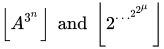
are prime for any natural number in the first formula, and any number of exponents in the second formula.[59] Here represents the floor function, the largest integer less than or equal to the number in question. However, these are not useful for generating primes, as the primes must be generated first in order to compute the values of or [57]


Open questions
[edit]Many conjectures revolving about primes have been posed. Often having an elementary formulation, many of these conjectures have withstood proof for decades: all four of Landau's problems from 1912 are still unsolved.[60] One of them is Goldbach's conjecture, which asserts that every even integer greater than can be written as a sum of two primes.[61] As of 2014[update], this conjecture has been verified for all numbers up to [62] Weaker statements than this have been proven; for example, Vinogradov's theorem says that every sufficiently large odd integer can be written as a sum of three primes.[63] Chen's theorem says that every sufficiently large even number can be expressed as the sum of a prime and a semiprime (the product of two primes).[64] Also, any even integer greater than 10 can be written as the sum of six primes.[65] The branch of number theory studying such questions is called additive number theory.[66]

Another type of problem concerns prime gaps, the differences between consecutive primes. The existence of arbitrarily large prime gaps can be seen by noting that the sequence consists of composite numbers, for any natural number [67] However, large prime gaps occur much earlier than this argument shows.[68] For example, the first prime gap of length 8 is between the primes 89 and 97,[69] much smaller than It is conjectured that there are infinitely many twin primes, pairs of primes with difference 2; this is the twin prime conjecture. Polignac's conjecture states more generally that for every positive integer there are infinitely many pairs of consecutive primes that differ by [70] Andrica's conjecture,[70] Brocard's conjecture,[71] Legendre's conjecture,[72] and Oppermann's conjecture[71] all suggest that the largest gaps between primes from 1 to should be at most approximately a result that is known to follow from the Riemann hypothesis, while the much stronger Cramér conjecture sets the largest gap size at .[70] Prime gaps can be generalized to prime -tuples, patterns in the differences among more than two prime numbers. Their infinitude and density are the subject of the first Hardy–Littlewood conjecture, which can be motivated by the heuristic that the prime numbers behave similarly to a random sequence of numbers with density given by the prime number theorem.[73]


Analytic properties
[edit]Analytic number theory studies number theory through the lens of continuous functions, limits, infinite series, and the related mathematics of the infinite and infinitesimal.
This area of study began with Leonhard Euler and his first major result, the solution to the Basel problem. The problem asked for the value of the infinite sum which today can be recognized as the value of the Riemann zeta function. This function is closely connected to the prime numbers and to one of the most significant unsolved problems in mathematics, the Riemann hypothesis. Euler showed that .[74] The reciprocal of this number, , is the limiting probability that two random numbers selected uniformly from a large range are relatively prime (have no factors in common).[75]



The distribution of primes in the large, such as the question how many primes are smaller than a given, large threshold, is described by the prime number theorem, but no efficient formula for the -th prime is known. Dirichlet's theorem on arithmetic progressions, in its basic form, asserts that linear polynomials
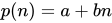
with relatively prime integers and take infinitely many prime values. Stronger forms of the theorem state that the sum of the reciprocals of these prime values diverges, and that different linear polynomials with the same have approximately the same proportions of primes. Although conjectures have been formulated about the proportions of primes in higher-degree polynomials, they remain unproven, and it is unknown whether there exists a quadratic polynomial that (for integer arguments) is prime infinitely often.
Analytical proof of Euclid's theorem
[edit]Euler's proof that there are infinitely many primes considers the sums of reciprocals of primes,
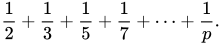
Euler showed that, for any arbitrary real number , there exists a prime for which this sum is greater than .[76] This shows that there are infinitely many primes, because if there were finitely many primes the sum would reach its maximum value at the biggest prime rather than growing past every . The growth rate of this sum is described more precisely by Mertens' second theorem.[77] For comparison, the sum
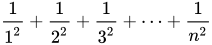
does not grow to infinity as goes to infinity (see the Basel problem). In this sense, prime numbers occur more often than squares of natural numbers, although both sets are infinite.[78] Brun's theorem states that the sum of the reciprocals of twin primes,

is finite. Because of Brun's theorem, it is not possible to use Euler's method to solve the twin prime conjecture, that there exist infinitely many twin primes.[78]
Number of primes below a given bound
[edit]


The prime-counting function is defined as the number of primes not greater than .[79] For example, , since there are five primes less than or equal to 11. Methods such as the Meissel–Lehmer algorithm can compute exact values of faster than it would be possible to list each prime up to .[80] The prime number theorem states that is asymptotic to , which is denoted as


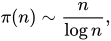
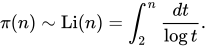
and means that the ratio of to the right-hand fraction approaches 1 as grows to infinity.[81] This implies that the likelihood that a randomly chosen number less than is prime is (approximately) inversely proportional to the number of digits in .[82] It also implies that the th prime number is proportional to [83] and therefore that the average size of a prime gap is proportional to .[68] A more accurate estimate for is given by the offset logarithmic integral[81]


Arithmetic progressions
[edit]An arithmetic progression is a finite or infinite sequence of numbers such that consecutive numbers in the sequence all have the same difference.[84] This difference is called the modulus of the progression.[85] For example,

is an infinite arithmetic progression with modulus 9. In an arithmetic progression, all the numbers have the same remainder when divided by the modulus; in this example, the remainder is 3. Because both the modulus 9 and the remainder 3 are multiples of 3, so is every element in the sequence. Therefore, this progression contains only one prime number, 3 itself. In general, the infinite progression

can have more than one prime only when its remainder and modulus are relatively prime. If they are relatively prime, Dirichlet's theorem on arithmetic progressions asserts that the progression contains infinitely many primes.[86]


The Green–Tao theorem shows that there are arbitrarily long finite arithmetic progressions consisting only of primes.[36][87]
Prime values of quadratic polynomials
[edit]
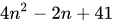
Euler noted that the function

yields prime numbers for , although composite numbers appear among its later values.[88][89] The search for an explanation for this phenomenon led to the deep algebraic number theory of Heegner numbers and the class number problem.[90] The Hardy–Littlewood conjecture F predicts the density of primes among the values of quadratic polynomials with integer coefficients in terms of the logarithmic integral and the polynomial coefficients. No quadratic polynomial has been proven to take infinitely many prime values.[91]

The Ulam spiral[92] arranges the natural numbers in a two-dimensional grid, spiraling in concentric squares surrounding the origin with the prime numbers highlighted. Visually, the primes appear to cluster on certain diagonals and not others, suggesting that some quadratic polynomials take prime values more often than others.[91]
Zeta function and the Riemann hypothesis
[edit]
One of the most famous unsolved questions in mathematics, dating from 1859, and one of the Millennium Prize Problems, is the Riemann hypothesis, which asks where the zeros of the Riemann zeta function are located. This function is an analytic function on the complex numbers. For complex numbers with real part greater than one it equals both an infinite sum over all integers, and an infinite product over the prime numbers,


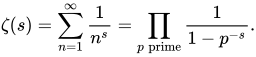
This equality between a sum and a product, discovered by Euler, is called an Euler product.[93] The Euler product can be derived from the fundamental theorem of arithmetic, and shows the close connection between the zeta function and the prime numbers.[94] It leads to another proof that there are infinitely many primes: if there were only finitely many, then the sum-product equality would also be valid at , but the sum would diverge (it is the harmonic series ) while the product would be finite, a contradiction.[95]

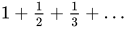
The Riemann hypothesis states that the zeros of the zeta-function are all either negative even numbers, or complex numbers with real part equal to 1/2.[96] The original proof of the prime number theorem was based on a weak form of this hypothesis, that there are no zeros with real part equal to 1,[97][98] although other more elementary proofs have been found.[99] The prime-counting function can be expressed by Riemann's explicit formula as a sum in which each term comes from one of the zeros of the zeta function; the main term of this sum is the logarithmic integral, and the remaining terms cause the sum to fluctuate above and below the main term.[100] In this sense, the zeros control how regularly the prime numbers are distributed. If the Riemann hypothesis is true, these fluctuations will be small, and the asymptotic distribution of primes given by the prime number theorem will also hold over much shorter intervals (of length about the square root of for intervals near a number ).[98]
Abstract algebra
[edit]Modular arithmetic and finite fields
[edit]Modular arithmetic modifies usual arithmetic by only using the numbers , for a natural number called the modulus. Any other natural number can be mapped into this system by replacing it by its remainder after division by .[101] Modular sums, differences and products are calculated by performing the same replacement by the remainder on the result of the usual sum, difference, or product of integers.[102] Equality of integers corresponds to congruence in modular arithmetic: and are congruent (written mod ) when they have the same remainder after division by .[103] However, in this system of numbers, division by all nonzero numbers is possible if and only if the modulus is prime. For instance, with the prime number 7 as modulus, division by 3 is possible: , because clearing denominators by multiplying both sides by 3 gives the valid formula . However, with the composite modulus 6, division by 3 is impossible. There is no valid solution to : clearing denominators by multiplying by 3 causes the left-hand side to become 2 while the right-hand side becomes either 0 or 3. In the terminology of abstract algebra, the ability to perform division means that modular arithmetic modulo a prime number forms a field or, more specifically, a finite field, while other moduli only give a ring but not a field.[104]






Several theorems about primes can be formulated using modular arithmetic. For instance, Fermat's little theorem states that if (mod ), then (mod ).[105] Summing this over all choices of gives the equation



valid whenever is prime. Giuga's conjecture says that this equation is also a sufficient condition for to be prime.[106] Wilson's theorem says that an integer is prime if and only if the factorial is congruent to mod . For a composite number this cannot hold, since one of its factors divides both n and , and so is impossible.[107]



p-adic numbers
[edit]The -adic order of an integer is the number of copies of in the prime factorization of . The same concept can be extended from integers to rational numbers by defining the -adic order of a fraction to be . The -adic absolute value of any rational number is then defined as . Multiplying an integer by its -adic absolute value cancels out the factors of in its factorization, leaving only the other primes. Just as the distance between two real numbers can be measured by the absolute value of their distance, the distance between two rational numbers can be measured by their -adic distance, the -adic absolute value of their difference. For this definition of distance, two numbers are close together (they have a small distance) when their difference is divisible by a high power of . In the same way that the real numbers can be formed from the rational numbers and their distances, by adding extra limiting values to form a complete field, the rational numbers with the -adic distance can be extended to a different complete field, the -adic numbers.[108][109]


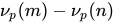


This picture of an order, absolute value, and complete field derived from them can be generalized to algebraic number fields and their valuations (certain mappings from the multiplicative group of the field to a totally ordered additive group, also called orders), absolute values (certain multiplicative mappings from the field to the real numbers, also called norms),[108] and places (extensions to complete fields in which the given field is a dense set, also called completions).[110] The extension from the rational numbers to the real numbers, for instance, is a place in which the distance between numbers is the usual absolute value of their difference. The corresponding mapping to an additive group would be the logarithm of the absolute value, although this does not meet all the requirements of a valuation. According to Ostrowski's theorem, up to a natural notion of equivalence, the real numbers and -adic numbers, with their orders and absolute values, are the only valuations, absolute values, and places on the rational numbers.[108] The local–global principle allows certain problems over the rational numbers to be solved by piecing together solutions from each of their places, again underlining the importance of primes to number theory.[111]
Prime elements of a ring
[edit]
A commutative ring is an algebraic structure where addition, subtraction and multiplication are defined. The integers are a ring, and the prime numbers in the integers have been generalized to rings in two different ways, prime elements and irreducible elements. An element of a ring is called prime if it is nonzero, has no multiplicative inverse (that is, it is not a unit), and satisfies the following requirement: whenever divides the product of two elements of , it also divides at least one of or . An element is irreducible if it is neither a unit nor the product of two other non-unit elements. In the ring of integers, the prime and irreducible elements form the same set,



In an arbitrary ring, all prime elements are irreducible. The converse does not hold in general, but does hold for unique factorization domains.[112]
The fundamental theorem of arithmetic continues to hold (by definition) in unique factorization domains. An example of such a domain is the Gaussian integers , the ring of complex numbers of the form where denotes the imaginary unit and and are arbitrary integers. Its prime elements are known as Gaussian primes. Not every number that is prime among the integers remains prime in the Gaussian integers; for instance, the number 2 can be written as a product of the two Gaussian primes and . Rational primes (the prime elements in the integers) congruent to 3 mod 4 are Gaussian primes, but rational primes congruent to 1 mod 4 are not.[113] This is a consequence of Fermat's theorem on sums of two squares, which states that an odd prime is expressible as the sum of two squares, , and therefore factorable as , exactly when is 1 mod 4.[114]
![{\displaystyle \mathbb {Z} [i]}](https://wikimedia.org/api/rest_v1/media/math/render/svg/9ffa94e9e2e6d9e5e5373d5fafb954b902743fde)



Prime ideals
[edit]Not every ring is a unique factorization domain. For instance, in the ring of numbers (for integers and ) the number has two factorizations , where none of the four factors can be reduced any further, so it does not have a unique factorization. In order to extend unique factorization to a larger class of rings, the notion of a number can be replaced with that of an ideal, a subset of the elements of a ring that contains all sums of pairs of its elements, and all products of its elements with ring elements. Prime ideals, which generalize prime elements in the sense that the principal ideal generated by a prime element is a prime ideal, are an important tool and object of study in commutative algebra, algebraic number theory and algebraic geometry. The prime ideals of the ring of integers are the ideals , , , , , , ... The fundamental theorem of arithmetic generalizes to the Lasker–Noether theorem, which expresses every ideal in a Noetherian commutative ring as an intersection of primary ideals, which are the appropriate generalizations of prime powers.[115]





The spectrum of a ring is a geometric space whose points are the prime ideals of the ring.[116] Arithmetic geometry also benefits from this notion, and many concepts exist in both geometry and number theory. For example, factorization or ramification of prime ideals when lifted to an extension field, a basic problem of algebraic number theory, bears some resemblance with ramification in geometry. These concepts can even assist with in number-theoretic questions solely concerned with integers. For example, prime ideals in the ring of integers of quadratic number fields can be used in proving quadratic reciprocity, a statement that concerns the existence of square roots modulo integer prime numbers.[117] Early attempts to prove Fermat's Last Theorem led to Kummer's introduction of regular primes, integer prime numbers connected with the failure of unique factorization in the cyclotomic integers.[118] The question of how many integer prime numbers factor into a product of multiple prime ideals in an algebraic number field is addressed by Chebotarev's density theorem, which (when applied to the cyclotomic integers) has Dirichlet's theorem on primes in arithmetic progressions as a special case.[119]
Group theory
[edit]In the theory of finite groups the Sylow theorems imply that, if a power of a prime number divides the order of a group, then the group has a subgroup of order . By Lagrange's theorem, any group of prime order is a cyclic group, and by Burnside's theorem any group whose order is divisible by only two primes is solvable.[120]

Computational methods
[edit]
For a long time, number theory in general, and the study of prime numbers in particular, was seen as the canonical example of pure mathematics, with no applications outside of mathematics[b] other than the use of prime numbered gear teeth to distribute wear evenly.[121] In particular, number theorists such as British mathematician G. H. Hardy prided themselves on doing work that had absolutely no military significance.[122]
This vision of the purity of number theory was shattered in the 1970s, when it was publicly announced that prime numbers could be used as the basis for the creation of public-key cryptography algorithms.[33] These applications have led to significant study of algorithms for computing with prime numbers, and in particular of primality testing, methods for determining whether a given number is prime. The most basic primality testing routine, trial division, is too slow to be useful for large numbers. One group of modern primality tests is applicable to arbitrary numbers, while more efficient tests are available for numbers of special types. Most primality tests only tell whether their argument is prime or not. Routines that also provide a prime factor of composite arguments (or all of its prime factors) are called factorization algorithms. Prime numbers are also used in computing for checksums, hash tables, and pseudorandom number generators.
Trial division
[edit]The most basic method of checking the primality of a given integer is called trial division. This method divides by each integer from 2 up to the square root of . Any such integer dividing evenly establishes as composite; otherwise it is prime. Integers larger than the square root do not need to be checked because, whenever , one of the two factors and is less than or equal to the square root of . Another optimization is to check only primes as factors in this range.[123] For instance, to check whether 37 is prime, this method divides it by the primes in the range from 2 to , which are 2, 3, and 5. Each division produces a nonzero remainder, so 37 is indeed prime.


Although this method is simple to describe, it is impractical for testing the primality of large integers, because the number of tests that it performs grows exponentially as a function of the number of digits of these integers.[124] However, trial division is still used, with a smaller limit than the square root on the divisor size, to quickly discover composite numbers with small factors, before using more complicated methods on the numbers that pass this filter.[125]
Sieves
[edit]
Before computers, mathematical tables listing all of the primes or prime factorizations up to a given limit were commonly printed.[126] The oldest known method for generating a list of primes is called the sieve of Eratosthenes.[127] The animation shows an optimized variant of this method.[128] Another more asymptotically efficient sieving method for the same problem is the sieve of Atkin.[129] In advanced mathematics, sieve theory applies similar methods to other problems.[130]
Primality testing versus primality proving
[edit]Some of the fastest modern tests for whether an arbitrary given number is prime are probabilistic (or Monte Carlo) algorithms, meaning that they have a small random chance of producing an incorrect answer.[131] For instance the Solovay–Strassen primality test on a given number chooses a number randomly from 2 through and uses modular exponentiation to check whether is divisible by .[c] If so, it answers yes and otherwise it answers no. If really is prime, it will always answer yes, but if is composite then it answers yes with probability at most 1/2 and no with probability at least 1/2.[132] If this test is repeated times on the same number, the probability that a composite number could pass the test every time is at most . Because this decreases exponentially with the number of tests, it provides high confidence (although not certainty) that a number that passes the repeated test is prime. On the other hand, if the test ever fails, then the number is certainly composite.[133] A composite number that passes such a test is called a pseudoprime.[132]


In contrast, some other algorithms guarantee that their answer will always be correct: primes will always be determined to be prime and composites will always be determined to be composite. For instance, this is true of trial division. The algorithms with guaranteed-correct output include both deterministic (non-random) algorithms, such as the AKS primality test,[134] and randomized Las Vegas algorithms where the random choices made by the algorithm do not affect its final answer, such as some variations of elliptic curve primality proving.[131] When the elliptic curve method concludes that a number is prime, it provides primality certificate that can be verified quickly.[135] The elliptic curve primality test is the fastest in practice of the guaranteed-correct primality tests, but its runtime analysis is based on heuristic arguments rather than rigorous proofs. The AKS primality test has mathematically proven time complexity, but is slower than elliptic curve primality proving in practice.[136] These methods can be used to generate large random prime numbers, by generating and testing random numbers until finding one that is prime; when doing this, a faster probabilistic test can quickly eliminate most composite numbers before a guaranteed-correct algorithm is used to verify that the remaining numbers are prime.[d]
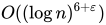
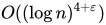
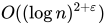
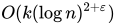
The following table lists some of these tests. Their running time is given in terms of , the number to be tested and, for probabilistic algorithms, the number of tests performed. Moreover, is an arbitrarily small positive number, and log is the logarithm to an unspecified base. The big O notation means that each time bound should be multiplied by a constant factor to convert it from dimensionless units to units of time; this factor depends on implementation details such as the type of computer used to run the algorithm, but not on the input parameters and .

| Test | Developed in | Type | Running time | Notes | References |
|---|---|---|---|---|---|
| AKS primality test | 2002 | deterministic | [134][137] | ||
| Elliptic curve primality proving | 1986 | Las Vegas | heuristically | [136] | |
| Baillie–PSW primality test | 1980 | Monte Carlo | [138][139] | ||
| Miller–Rabin primality test | 1980 | Monte Carlo | error probability | [140] | |
| Solovay–Strassen primality test | 1977 | Monte Carlo | error probability | [140] |


Special-purpose algorithms and the largest known prime
[edit]In addition to the aforementioned tests that apply to any natural number, some numbers of a special form can be tested for primality more quickly. For example, the Lucas–Lehmer primality test can determine whether a Mersenne number (one less than a power of two) is prime, deterministically, in the same time as a single iteration of the Miller–Rabin test.[141] This is why since 1992 (as of October 2024[update]) the largest known prime has always been a Mersenne prime.[142] It is conjectured that there are infinitely many Mersenne primes.[143]
The following table gives the largest known primes of various types. Some of these primes have been found using distributed computing. In 2009, the Great Internet Mersenne Prime Search project was awarded a US$100,000 prize for first discovering a prime with at least 10 million digits.[144] The Electronic Frontier Foundation also offers $150,000 and $250,000 for primes with at least 100 million digits and 1 billion digits, respectively.[145]
| Type | Prime | Number of decimal digits | Date | Found by |
|---|---|---|---|---|
| Mersenne prime | 2136,279,841 − 1 | 41,024,320 | October 21, 2024[1] | Luke Durant, Great Internet Mersenne Prime Search |
| Proth prime | 10,223 × 231,172,165 + 1 | 9,383,761 | October 31, 2016[146] | Péter Szabolcs, PrimeGrid[147] |
| factorial prime | 208,003! − 1 | 1,015,843 | July 2016 | Sou Fukui[148] |
| primorial prime[e] | 1,098,133# − 1 | 476,311 | March 2012 | James P. Burt, PrimeGrid[150] |
| twin primes | 2,996,863,034,895 × 21,290,000 ± 1 | 388,342 | September 2016 | Tom Greer, PrimeGrid[151] |
Integer factorization
[edit]Given a composite integer , the task of providing one (or all) prime factors is referred to as factorization of . It is significantly more difficult than primality testing,[152] and although many factorization algorithms are known, they are slower than the fastest primality testing methods. Trial division and Pollard's rho algorithm can be used to find very small factors of ,[125] and elliptic curve factorization can be effective when has factors of moderate size.[153] Methods suitable for arbitrary large numbers that do not depend on the size of its factors include the quadratic sieve and general number field sieve. As with primality testing, there are also factorization algorithms that require their input to have a special form, including the special number field sieve.[154] As of December 2019[update] the largest number known to have been factored by a general-purpose algorithm is RSA-240, which has 240 decimal digits (795 bits) and is the product of two large primes.[155]
Shor's algorithm can factor any integer in a polynomial number of steps on a quantum computer.[156] However, current technology can only run this algorithm for very small numbers. As of October 2012[update], the largest number that has been factored by a quantum computer running Shor's algorithm is 21.[157]
Other computational applications
[edit]Several public-key cryptography algorithms, such as RSA and the Diffie–Hellman key exchange, are based on large prime numbers (2048-bit primes are common).[158] RSA relies on the assumption that it is much easier (that is, more efficient) to perform the multiplication of two (large) numbers and than to calculate and (assumed coprime) if only the product is known.[33] The Diffie–Hellman key exchange relies on the fact that there are efficient algorithms for modular exponentiation (computing ), while the reverse operation (the discrete logarithm) is thought to be a hard problem.[159]

Prime numbers are frequently used for hash tables. For instance the original method of Carter and Wegman for universal hashing was based on computing hash functions by choosing random linear functions modulo large prime numbers. Carter and Wegman generalized this method to -independent hashing by using higher-degree polynomials, again modulo large primes.[160] As well as in the hash function, prime numbers are used for the hash table size in quadratic probing based hash tables to ensure that the probe sequence covers the whole table.[161]
Some checksum methods are based on the mathematics of prime numbers. For instance the checksums used in International Standard Book Numbers are defined by taking the rest of the number modulo 11, a prime number. Because 11 is prime this method can detect both single-digit errors and transpositions of adjacent digits.[162] Another checksum method, Adler-32, uses arithmetic modulo 65521, the largest prime number less than .[163] Prime numbers are also used in pseudorandom number generators including linear congruential generators[164] and the Mersenne Twister.[165]

Other applications
[edit]Prime numbers are of central importance to number theory but also have many applications to other areas within mathematics, including abstract algebra and elementary geometry. For example, it is possible to place prime numbers of points in a two-dimensional grid so that no three are in a line, or so that every triangle formed by three of the points has large area.[166] Another example is Eisenstein's criterion, a test for whether a polynomial is irreducible based on divisibility of its coefficients by a prime number and its square.[167]

The concept of a prime number is so important that it has been generalized in different ways in various branches of mathematics. Generally, "prime" indicates minimality or indecomposability, in an appropriate sense. For example, the prime field of a given field is its smallest subfield that contains both 0 and 1. It is either the field of rational numbers or a finite field with a prime number of elements, whence the name.[168] Often a second, additional meaning is intended by using the word prime, namely that any object can be, essentially uniquely, decomposed into its prime components. For example, in knot theory, a prime knot is a knot that is indecomposable in the sense that it cannot be written as the connected sum of two nontrivial knots. Any knot can be uniquely expressed as a connected sum of prime knots.[169] The prime decomposition of 3-manifolds is another example of this type.[170]
Beyond mathematics and computing, prime numbers have potential connections to quantum mechanics, and have been used metaphorically in the arts and literature. They have also been used in evolutionary biology to explain the life cycles of cicadas.
Constructible polygons and polygon partitions
[edit]
Fermat primes are primes of the form
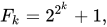
with a nonnegative integer.[171] They are named after Pierre de Fermat, who conjectured that all such numbers are prime. The first five of these numbers – 3, 5, 17, 257, and 65,537 – are prime,[172] but is composite and so are all other Fermat numbers that have been verified as of 2017.[173] A regular -gon is constructible using straightedge and compass if and only if the odd prime factors of (if any) are distinct Fermat primes.[172] Likewise, a regular -gon may be constructed using straightedge, compass, and an angle trisector if and only if the prime factors of are any number of copies of 2 or 3 together with a (possibly empty) set of distinct Pierpont primes, primes of the form .[174]


It is possible to partition any convex polygon into smaller convex polygons of equal area and equal perimeter, when is a power of a prime number, but this is not known for other values of .[175]
Quantum mechanics
[edit]Beginning with the work of Hugh Montgomery and Freeman Dyson in the 1970s, mathematicians and physicists have speculated that the zeros of the Riemann zeta function are connected to the energy levels of quantum systems.[176][177] Prime numbers are also significant in quantum information science, thanks to mathematical structures such as mutually unbiased bases and symmetric informationally complete positive-operator-valued measures.[178][179]
Biology
[edit]The evolutionary strategy used by cicadas of the genus Magicicada makes use of prime numbers.[180] These insects spend most of their lives as grubs underground. They only pupate and then emerge from their burrows after 7, 13 or 17 years, at which point they fly about, breed, and then die after a few weeks at most. Biologists theorize that these prime-numbered breeding cycle lengths have evolved in order to prevent predators from synchronizing with these cycles.[181][182] In contrast, the multi-year periods between flowering in bamboo plants are hypothesized to be smooth numbers, having only small prime numbers in their factorizations.[183]
Arts and literature
[edit]Prime numbers have influenced many artists and writers. The French composer Olivier Messiaen used prime numbers to create ametrical music through "natural phenomena". In works such as La Nativité du Seigneur (1935) and Quatre études de rythme (1949–1950), he simultaneously employs motifs with lengths given by different prime numbers to create unpredictable rhythms: the primes 41, 43, 47 and 53 appear in the third étude, "Neumes rythmiques". According to Messiaen this way of composing was "inspired by the movements of nature, movements of free and unequal durations".[184]
In his science fiction novel Contact, scientist Carl Sagan suggested that prime factorization could be used as a means of establishing two-dimensional image planes in communications with aliens, an idea that he had first developed informally with American astronomer Frank Drake in 1975.[185] In the novel The Curious Incident of the Dog in the Night-Time by Mark Haddon, the narrator arranges the sections of the story by consecutive prime numbers as a way to convey the mental state of its main character, a mathematically gifted teen with Asperger syndrome.[186] Prime numbers are used as a metaphor for loneliness and isolation in the Paolo Giordano novel The Solitude of Prime Numbers, in which they are portrayed as "outsiders" among integers.[187]
Notes
[edit]- ^ A 44-digit prime number found in 1951 by Aimé Ferrier with a mechanical calculator remains the largest prime not to have been found with the aid of electronic computers.[29]
- ^ a b For instance, Beiler writes that number theorist Ernst Kummer loved his ideal numbers, closely related to the primes, "because they had not soiled themselves with any practical applications",[31] and Katz writes that Edmund Landau, known for his work on the distribution of primes, "loathed practical applications of mathematics", and for this reason avoided subjects such as geometry that had already shown themselves to be useful.[32]
- ^ In this test, the term is negative if is a square modulo the given (supposed) prime , and positive otherwise. More generally, for non-prime values of , the term is the (negated) Jacobi symbol, which can be calculated using quadratic reciprocity.
- ^ Indeed, much of the analysis of elliptic curve primality proving is based on the assumption that the input to the algorithm has already passed a probabilistic test.[135]
- ^ The primorial function of , denoted by , yields the product of the prime numbers up to , and a primorial prime is a prime of one of the forms .[149]


References
[edit]- ^ a b "GIMPS Discovers Largest Known Prime Number: 2136,279,841 − 1". Mersenne Research, Inc. 21 October 2024. Archived from the original on 4 November 2024. Retrieved 21 October 2024.
- ^ Sparkes, Matthew (November 2, 2024). "Amateur sleuth finds largest-known prime number". New Scientist: 19.
- ^ Gardiner, Anthony (1997). The Mathematical Olympiad Handbook: An Introduction to Problem Solving Based on the First 32 British Mathematical Olympiads 1965–1996. Oxford University Press. p. 26. ISBN 978-0-19-850105-3.
- ^ Henderson, Anne (2014). Dyslexia, Dyscalculia and Mathematics: A practical guide (2nd ed.). Routledge. p. 62. ISBN 978-1-136-63662-2.
- ^ Adler, Irving (1960). The Giant Golden Book of Mathematics: Exploring the World of Numbers and Space. Golden Press. p. 16. OCLC 6975809.
- ^ Leff, Lawrence S. (2000). Math Workbook for the SAT I. Barron's Educational Series. p. 360. ISBN 978-0-7641-0768-9.
- ^ Dudley, Underwood (1978). "Section 2: Unique factorization". Elementary number theory (2nd ed.). W.H. Freeman and Co. p. 10. ISBN 978-0-7167-0076-0.
- ^ Sierpiński, Wacław (1988). Elementary Theory of Numbers. North-Holland Mathematical Library. Vol. 31 (2nd ed.). Elsevier. p. 113. ISBN 978-0-08-096019-7.
- ^ a b Ziegler, Günter M. (2004). "The great prime number record races". Notices of the American Mathematical Society. 51 (4): 414–416. MR 2039814.
- ^ Stillwell, John (1997). Numbers and Geometry. Undergraduate Texts in Mathematics. Springer. p. 9. ISBN 978-0-387-98289-2.
- ^ Sierpiński, Wacław (1964). A Selection of Problems in the Theory of Numbers. New York: Macmillan. p. 40. MR 0170843.
- ^ Nathanson, Melvyn B. (2000). "Notations and Conventions". Elementary Methods in Number Theory. Graduate Texts in Mathematics. Vol. 195. Springer. ISBN 978-0-387-22738-2. MR 1732941.
- ^ Faticoni, Theodore G. (2012). The Mathematics of Infinity: A Guide to Great Ideas. Pure and Applied Mathematics: A Wiley Series of Texts, Monographs and Tracts. Vol. 111 (2nd ed.). John Wiley & Sons. p. 44. ISBN 978-1-118-24382-4.
- ^ Bruins, Evert Marie, review in Mathematical Reviews of Gillings, R.J. (1974). "The recto of the Rhind Mathematical Papyrus. How did the ancient Egyptian scribe prepare it?". Archive for History of Exact Sciences. 12 (4): 291–298. doi:10.1007/BF01307175. MR 0497458. S2CID 121046003.
- ^ a b Stillwell, John (2010). Mathematics and Its History. Undergraduate Texts in Mathematics (3rd ed.). Springer. p. 40. ISBN 978-1-4419-6052-8.
- ^ a b Pomerance, Carl (December 1982). "The Search for Prime Numbers". Scientific American. 247 (6): 136–147. Bibcode:1982SciAm.247f.136P. doi:10.1038/scientificamerican1282-136. JSTOR 24966751.
- ^ a b c d Mollin, Richard A. (2002). "A brief history of factoring and primality testing B. C. (before computers)". Mathematics Magazine. 75 (1): 18–29. doi:10.2307/3219180. JSTOR 3219180. MR 2107288.
- ^ O'Connor, John J.; Robertson, Edmund F. "Abu Ali al-Hasan ibn al-Haytham". MacTutor History of Mathematics Archive. University of St Andrews.
- ^ Sandifer 2007, 8. Fermat's Little Theorem (November 2003), p. 45
- ^ Sandifer, C. Edward (2014). How Euler Did Even More. Mathematical Association of America. p. 42. ISBN 978-0-88385-584-3.
- ^ Koshy, Thomas (2002). Elementary Number Theory with Applications. Academic Press. p. 369. ISBN 978-0-12-421171-1.
- ^ Yuan, Wang (2002). Goldbach Conjecture. Series In Pure Mathematics. Vol. 4 (2nd ed.). World Scientific. p. 21. ISBN 978-981-4487-52-8.
- ^ Narkiewicz, Wladyslaw (2000). "1.2 Sum of Reciprocals of Primes". The Development of Prime Number Theory: From Euclid to Hardy and Littlewood. Springer Monographs in Mathematics. Springer. p. 11. ISBN 978-3-540-66289-1.
- ^ Tchebychev, P. (1852). "Mémoire sur les nombres premiers" (PDF). Journal de mathématiques pures et appliquées. Série 1 (in French): 366–390. Archived (PDF) from the original on 2022-11-06. Retrieved 2021-02-24.. (Proof of the postulate: 371–382). Also see Mémoires de l'Académie Impériale des Sciences de St. Pétersbourg, vol. 7, pp. 15–33, 1854
- ^ Apostol, Tom M. (2000). "A centennial history of the prime number theorem". In Bambah, R.P.; Dumir, V.C.; Hans-Gill, R.J. (eds.). Number Theory. Trends in Mathematics. Basel: Birkhäuser. pp. 1–14. MR 1764793.
- ^ Apostol, Tom M. (1976). "7. Dirichlet's Theorem on Primes in Arithmetical Progressions". Introduction to Analytic Number Theory. New York; Heidelberg: Springer-Verlag. pp. 146–156. MR 0434929.
- ^ Chabert, Jean-Luc (2012). A History of Algorithms: From the Pebble to the Microchip. Springer. p. 261. ISBN 978-3-642-18192-4.
- ^ Rosen, Kenneth H. (2000). "Theorem 9.20. Proth's Primality Test". Elementary Number Theory and Its Applications (4th ed.). Addison-Wesley. p. 342. ISBN 978-0-201-87073-2.
- ^ Cooper, S. Barry; Hodges, Andrew (2016). The Once and Future Turing. Cambridge University Press. pp. 37–38. ISBN 978-1-107-01083-3.
- ^ Rosen 2000, p. 245.
- ^ Beiler, Albert H. (1999) [1966]. Recreations in the Theory of Numbers: The Queen of Mathematics Entertains. Dover. p. 2. ISBN 978-0-486-21096-4. OCLC 444171535.
- ^ Katz, Shaul (2004). "Berlin roots – Zionist incarnation: the ethos of pure mathematics and the beginnings of the Einstein Institute of Mathematics at the Hebrew University of Jerusalem". Science in Context. 17 (1–2): 199–234. doi:10.1017/S0269889704000092. MR 2089305. S2CID 145575536.
- ^ a b c Kraft, James S.; Washington, Lawrence C. (2014). Elementary Number Theory. Textbooks in mathematics. CRC Press. p. 7. ISBN 978-1-4987-0269-0.
- ^ Bauer, Craig P. (2013). Secret History: The Story of Cryptology. Discrete Mathematics and Its Applications. CRC Press. p. 468. ISBN 978-1-4665-6186-1.
- ^ Klee, Victor; Wagon, Stan (1991). Old and New Unsolved Problems in Plane Geometry and Number Theory. Dolciani mathematical expositions. Vol. 11. Cambridge University Press. p. 224. ISBN 978-0-88385-315-3.
- ^ a b Neale 2017, pp. 18, 47.
- ^ a b Caldwell, Chris K.; Reddick, Angela; Xiong, Yeng; Keller, Wilfrid (2012). "The history of the primality of one: a selection of sources". Journal of Integer Sequences. 15 (9): Article 12.9.8. MR 3005523. Archived from the original on 2018-04-12. Retrieved 2018-01-15. For a selection of quotes from and about the ancient Greek positions on the status of 1 and 2, see in particular pp. 3–4. For the Islamic mathematicians, see p. 6.
- ^ Tarán, Leonardo (1981). Speusippus of Athens: A Critical Study With a Collection of the Related Texts and Commentary. Philosophia Antiqua : A Series of Monographs on Ancient Philosophy. Vol. 39. Brill. pp. 35–38. ISBN 978-90-04-06505-5.
- ^ Caldwell et al. 2012, pp. 7–13. See in particular the entries for Stevin, Brancker, Wallis, and Prestet.
- ^ Caldwell et al. 2012, pp. 6–7.
- ^ Caldwell et al. 2012, p. 15.
- ^ a b c Caldwell, Chris K.; Xiong, Yeng (2012). "What is the smallest prime?" (PDF). Journal of Integer Sequences. 15 (9): Article 12.9.7. MR 3005530. Archived (PDF) from the original on 2018-04-12. Retrieved 2018-01-15.
- ^ Conway & Guy 1996, pp. 130.
- ^ Riesel, Hans (1994). Prime Numbers and Computer Methods for Factorization (2nd ed.). Basel, Switzerland: Birkhäuser. p. 36. doi:10.1007/978-1-4612-0251-6. ISBN 978-0-8176-3743-9. MR 1292250.
- ^ a b Conway, John Horton; Guy, Richard K. (1996). The Book of Numbers. New York: Copernicus. pp. 129–130. doi:10.1007/978-1-4612-4072-3. ISBN 978-0-387-97993-9. MR 1411676.
- ^ For the totient, see Sierpiński 1988, p. 245. For the sum of divisors, see Sandifer, C. Edward (2007). How Euler Did It. MAA Spectrum. Mathematical Association of America. p. 59. ISBN 978-0-88385-563-8.
- ^ Smith, Karl J. (2011). The Nature of Mathematics (12th ed.). Cengage Learning. p. 188. ISBN 978-0-538-73758-6.
- ^ Dudley 1978, Section 2, Theorem 2, p. 16; Neale, Vicky (2017). Closing the Gap: The Quest to Understand Prime Numbers. Oxford University Press. p. 107. ISBN 978-0-19-109243-5.
- ^ du Sautoy, Marcus (2003). The Music of the Primes: Searching to Solve the Greatest Mystery in Mathematics. Harper Collins. p. 23. ISBN 978-0-06-093558-0.
- ^ Dudley 1978, Section 2, Lemma 5, p. 15; Higgins, Peter M. (1998). Mathematics for the Curious. Oxford University Press. pp. 77–78. ISBN 978-0-19-150050-3.
- ^ Rotman, Joseph J. (2000). A First Course in Abstract Algebra (2nd ed.). Prentice Hall. Problem 1.40, p. 56. ISBN 978-0-13-011584-3.
- ^ Letter Archived 2015-06-11 at the Wayback Machine in Latin from Goldbach to Euler, July 1730.
- ^ Furstenberg, Harry (1955). "On the infinitude of primes". American Mathematical Monthly. 62 (5): 353. doi:10.2307/2307043. JSTOR 2307043. MR 0068566.
- ^ Ribenboim, Paulo (2004). The little book of bigger primes. Berlin; New York: Springer-Verlag. p. 4. ISBN 978-0-387-20169-6.
- ^ Euclid's Elements, Book IX, Proposition 20. See David Joyce's English translation of Euclid's proof Archived 2011-01-23 at the Wayback Machine or Williamson, James (1782). The Elements of Euclid, With Dissertations. Oxford: Clarendon Press. p. 63. OCLC 642232959. Archived from the original on 2023-03-26. Retrieved 2018-02-10.
- ^ Vardi, Ilan (1991). Computational Recreations in Mathematica. Addison-Wesley. pp. 82–89. ISBN 978-0-201-52989-0.
- ^ a b c Matiyasevich, Yuri V. (1999). "Formulas for prime numbers". In Tabachnikov, Serge (ed.). Kvant Selecta: Algebra and Analysis. Vol. II. American Mathematical Society. pp. 13–24. ISBN 978-0-8218-1915-9.
- ^ Mackinnon, Nick (June 1987). "Prime number formulae". The Mathematical Gazette. 71 (456): 113–114. doi:10.2307/3616496. JSTOR 3616496. S2CID 171537609.
- ^ Wright, E.M. (1951). "A prime-representing function". American Mathematical Monthly. 58 (9): 616–618. doi:10.2307/2306356. JSTOR 2306356.
- ^ Guy 2013, p. vii.
- ^ Guy 2013, C1 Goldbach's conjecture, pp. 105–107.
- ^ Oliveira e Silva, Tomás; Herzog, Siegfried; Pardi, Silvio (2014). "Empirical verification of the even Goldbach conjecture and computation of prime gaps up to ". Mathematics of Computation. 83 (288): 2033–2060. doi:10.1090/S0025-5718-2013-02787-1. MR 3194140.
- ^ Tao 2009, 3.1 Structure and randomness in the prime numbers, pp. 239–247. See especially p. 239.
- ^ Guy 2013, p. 159.
- ^ Ramaré, Olivier (1995). "On Šnirel'man's constant". Annali della Scuola Normale Superiore di Pisa. 22 (4): 645–706. MR 1375315. Archived from the original on 2022-02-09. Retrieved 2018-01-23.
- ^ Rassias, Michael Th. (2017). Goldbach's Problem: Selected Topics. Cham: Springer. p. vii. doi:10.1007/978-3-319-57914-6. ISBN 978-3-319-57912-2. MR 3674356.
- ^ Koshy 2002, Theorem 2.14, p. 109. Riesel 1994 gives a similar argument using the primorial in place of the factorial.
- ^ a b Riesel 1994, "Large gaps between consecutive primes", pp. 78–79.
- ^ Sloane, N. J. A. (ed.). "Sequence A100964 (Smallest prime number that begins a prime gap of at least 2n)". The On-Line Encyclopedia of Integer Sequences. OEIS Foundation.
- ^ a b c Ribenboim 2004, Gaps between primes, pp. 186–192.
- ^ a b Ribenboim 2004, p. 183.
- ^ Chan, Joel (February 1996). "Prime time!". Math Horizons. 3 (3): 23–25. doi:10.1080/10724117.1996.11974965. JSTOR 25678057. Note that Chan lists Legendre's conjecture as "Sierpinski's Postulate".
- ^ Ribenboim 2004, Prime -tuples conjecture, pp. 201–202.
- ^ Sandifer 2007, Chapter 35, Estimating the Basel problem, pp. 205–208.
- ^ Ogilvy, C.S.; Anderson, J.T. (1988). Excursions in Number Theory. Dover Publications Inc. pp. 29–35. ISBN 978-0-486-25778-5.
- ^ Apostol 1976, Section 1.6, Theorem 1.13
- ^ Apostol 1976, Section 4.8, Theorem 4.12
- ^ a b Miller, Steven J.; Takloo-Bighash, Ramin (2006). An Invitation to Modern Number Theory. Princeton University Press. pp. 43–44. ISBN 978-0-691-12060-7.
- ^ Crandall & Pomerance 2005, p. 6.
- ^ Crandall & Pomerance 2005, Section 3.7, Counting primes, pp. 152–162.
- ^ a b Crandall & Pomerance 2005, p. 10.
- ^ du Sautoy, Marcus (2011). "What are the odds that your telephone number is prime?". The Number Mysteries: A Mathematical Odyssey through Everyday Life. St. Martin's Press. pp. 50–52. ISBN 978-0-230-12028-0.
- ^ Apostol 1976, Section 4.6, Theorem 4.7
- ^ Gelfand, Israel M.; Shen, Alexander (2003). Algebra. Springer. p. 37. ISBN 978-0-8176-3677-7.
- ^ Mollin, Richard A. (1997). Fundamental Number Theory with Applications. Discrete Mathematics and Its Applications. CRC Press. p. 76. ISBN 978-0-8493-3987-5.
- ^ Crandall & Pomerance 2005, Theorem 1.1.5, p. 12.
- ^ Green, Ben; Tao, Terence (2008). "The primes contain arbitrarily long arithmetic progressions". Annals of Mathematics. 167 (2): 481–547. arXiv:math.NT/0404188. doi:10.4007/annals.2008.167.481. S2CID 1883951.
- ^ Hua, L. K. (2009) [1965]. Additive Theory of Prime Numbers. Translations of Mathematical Monographs. Vol. 13. Providence, RI: American Mathematical Society. pp. 176–177. ISBN 978-0-8218-4942-2. MR 0194404. OCLC 824812353.
- ^ The sequence of these primes, starting at rather than , is listed by Lava, Paolo Pietro; Balzarotti, Giorgio (2010). "Chapter 33. Formule fortunate". 103 curiosità matematiche: Teoria dei numeri, delle cifre e delle relazioni nella matematica contemporanea (in Italian). Ulrico Hoepli Editore S.p.A. p. 133. ISBN 978-88-203-5804-4.
- ^ Chamberland, Marc (2015). "The Heegner numbers". Single Digits: In Praise of Small Numbers. Princeton University Press. pp. 213–215. ISBN 978-1-4008-6569-7.
- ^ a b Guy, Richard (2013). "A1 Prime values of quadratic functions". Unsolved Problems in Number Theory. Problem Books in Mathematics (3rd ed.). Springer. pp. 7–10. ISBN 978-0-387-26677-0.
- ^ Stein, M.L.; Ulam, S.M.; Wells, M.B. (1964). "A Visual Display of Some Properties of the Distribution of Primes". The American Mathematical Monthly. 71 (5): 516–520. doi:10.2307/2312588. JSTOR 2312588.
- ^ Patterson, S. J. (1988). An introduction to the theory of the Riemann zeta-function. Cambridge Studies in Advanced Mathematics. Vol. 14. Cambridge University Press, Cambridge. p. 1. doi:10.1017/CBO9780511623707. ISBN 978-0-521-33535-5. MR 0933558.
- ^ Borwein, Peter; Choi, Stephen; Rooney, Brendan; Weirathmueller, Andrea (2008). The Riemann hypothesis: A resource for the afficionado and virtuoso alike. CMS Books in Mathematics/Ouvrages de Mathématiques de la SMC. New York: Springer. pp. 10–11. doi:10.1007/978-0-387-72126-2. ISBN 978-0-387-72125-5. MR 2463715.
- ^ Sandifer 2007, pp. 191–193.
- ^ Borwein et al. 2008, Conjecture 2.7 (the Riemann hypothesis), p. 15.
- ^ Patterson 1988, p. 7.
- ^ a b Borwein et al. 2008, p. 18.
- ^ Nathanson 2000, Chapter 9, The prime number theorem, pp. 289–324.
- ^ Zagier, Don (1977). "The first 50 million prime numbers". The Mathematical Intelligencer. 1 (S2): 7–19. doi:10.1007/bf03351556. S2CID 37866599. See especially pp. 14–16.
- ^ Kraft & Washington (2014), Proposition 5.3, p. 96.
- ^ Shahriari, Shahriar (2017). Algebra in Action: A Course in Groups, Rings, and Fields. Pure and Applied Undergraduate Texts. Vol. 27. American Mathematical Society. pp. 20–21. ISBN 978-1-4704-2849-5.
- ^ Dudley 1978, Theorem 3, p. 28.
- ^ Shahriari 2017, pp. 27–28.
- ^ Ribenboim 2004, Fermat's little theorem and primitive roots modulo a prime, pp. 17–21.
- ^ Ribenboim 2004, The property of Giuga, pp. 21–22.
- ^ Ribenboim 2004, The theorem of Wilson, p. 21.
- ^ a b c Childress, Nancy (2009). Class Field Theory. Universitext. Springer, New York. pp. 8–11. doi:10.1007/978-0-387-72490-4. ISBN 978-0-387-72489-8. MR 2462595. See also p. 64.
- ^ Erickson, Marty; Vazzana, Anthony; Garth, David (2016). Introduction to Number Theory. Textbooks in Mathematics (2nd ed.). Boca Raton, FL: CRC Press. p. 200. ISBN 978-1-4987-1749-6. MR 3468748.
- ^ Weil, André (1995). Basic Number Theory. Classics in Mathematics. Berlin: Springer-Verlag. p. 43. ISBN 978-3-540-58655-5. MR 1344916. Note however that some authors such as Childress (2009) instead use "place" to mean an equivalence class of norms.
- ^ Koch, H. (1997). Algebraic Number Theory. Berlin: Springer-Verlag. p. 136. CiteSeerX 10.1.1.309.8812. doi:10.1007/978-3-642-58095-6. ISBN 978-3-540-63003-6. MR 1474965.
- ^ Lauritzen, Niels (2003). Concrete Abstract Algebra: From numbers to Gröbner bases. Cambridge: Cambridge University Press. p. 127. doi:10.1017/CBO9780511804229. ISBN 978-0-521-53410-9. MR 2014325.
- ^ Lauritzen 2003, Corollary 3.5.14, p. 133; Lemma 3.5.18, p. 136.
- ^ Kraft & Washington 2014, Section 12.1, Sums of two squares, pp. 297–301.
- ^ Eisenbud, David (1995). Commutative Algebra. Graduate Texts in Mathematics. Vol. 150. Berlin; New York: Springer-Verlag. Section 3.3. doi:10.1007/978-1-4612-5350-1. ISBN 978-0-387-94268-1. MR 1322960.
- ^ Shafarevich, Igor R. (2013). "Definition of ". Basic Algebraic Geometry 2: Schemes and Complex Manifolds (3rd ed.). Springer, Heidelberg. p. 5. doi:10.1007/978-3-642-38010-5. ISBN 978-3-642-38009-9. MR 3100288.
- ^ Neukirch, Jürgen (1999). Algebraic Number Theory. Grundlehren der Mathematischen Wissenschaften [Fundamental Principles of Mathematical Sciences]. Vol. 322. Berlin: Springer-Verlag. Section I.8, p. 50. doi:10.1007/978-3-662-03983-0. ISBN 978-3-540-65399-8. MR 1697859.
- ^ Neukirch 1999, Section I.7, p. 38
- ^ Stevenhagen, P.; Lenstra, H.W. Jr. (1996). "Chebotarëv and his density theorem". The Mathematical Intelligencer. 18 (2): 26–37. CiteSeerX 10.1.1.116.9409. doi:10.1007/BF03027290. MR 1395088. S2CID 14089091.
- ^ Hall, Marshall (2018). The Theory of Groups. Dover Books on Mathematics. Courier Dover Publications. ISBN 978-0-486-81690-6. For the Sylow theorems see p. 43; for Lagrange's theorem, see p. 12; for Burnside's theorem see p. 143.
- ^ Bryant, John; Sangwin, Christopher J. (2008). How Round is Your Circle?: Where Engineering and Mathematics Meet. Princeton University Press. p. 178. ISBN 978-0-691-13118-4.
- ^ Hardy, Godfrey Harold (2012) [1940]. A Mathematician's Apology. Cambridge University Press. p. 140. ISBN 978-0-521-42706-7. OCLC 922010634.
No one has yet discovered any warlike purpose to be served by the theory of numbers or relativity, and it seems unlikely that anyone will do so for many years.
- ^ Giblin, Peter (1993). Primes and Programming. Cambridge University Press. p. 39. ISBN 978-0-521-40988-9.
- ^ Giblin 1993, p. 54
- ^ a b Riesel 1994, p. 220.
- ^ Bullynck, Maarten (2010). "A history of factor tables with notes on the birth of number theory 1657–1817". Revue d'Histoire des Mathématiques. 16 (2): 133–216. Archived from the original on 2023-06-04. Retrieved 2018-01-17.
- ^ Wagstaff, Samuel S. Jr. (2013). The Joy of Factoring. Student mathematical library. Vol. 68. American Mathematical Society. p. 191. ISBN 978-1-4704-1048-3.
- ^ Crandall, Richard; Pomerance, Carl (2005). Prime Numbers: A Computational Perspective (2nd ed.). Springer. p. 121. ISBN 978-0-387-25282-7.
- ^ Farach-Colton, Martín; Tsai, Meng-Tsung (2015). "On the complexity of computing prime tables". In Elbassioni, Khaled; Makino, Kazuhisa (eds.). Algorithms and Computation: 26th International Symposium, ISAAC 2015, Nagoya, Japan, December 9-11, 2015, Proceedings. Lecture Notes in Computer Science. Vol. 9472. Springer. pp. 677–688. arXiv:1504.05240. doi:10.1007/978-3-662-48971-0_57. ISBN 978-3-662-48970-3.
- ^ Greaves, George (2013). Sieves in Number Theory. Ergebnisse der Mathematik und ihrer Grenzgebiete (3. Folge). Vol. 43. Springer. p. 1. ISBN 978-3-662-04658-6.
- ^ a b Hromkovič, Juraj (2001). "5.5 Bibliographic Remarks". Algorithmics for Hard Problems. Texts in Theoretical Computer Science. An EATCS Series. Springer-Verlag, Berlin. pp. 383–385. doi:10.1007/978-3-662-04616-6. ISBN 978-3-540-66860-2. MR 1843669. S2CID 31159492.
- ^ a b Koblitz, Neal (1987). "Chapter V. Primality and Factoring". A Course in Number Theory and Cryptography. Graduate Texts in Mathematics. Vol. 114. Springer-Verlag, New York. pp. 112–149. doi:10.1007/978-1-4684-0310-7_5. ISBN 978-0-387-96576-5. MR 0910297.
- ^ Pieprzyk, Josef; Hardjono, Thomas; Seberry, Jennifer (2013). "2.3.9 Probabilistic Computations". Fundamentals of Computer Security. Springer. pp. 51–52. ISBN 978-3-662-07324-7.
- ^ a b Tao, Terence (2010). "1.11 The AKS primality test". An epsilon of room, II: Pages from year three of a mathematical blog. Graduate Studies in Mathematics. Vol. 117. Providence, RI: American Mathematical Society. pp. 82–86. doi:10.1090/gsm/117. ISBN 978-0-8218-5280-4. MR 2780010. Archived from the original on 2018-01-19. Retrieved 2018-01-18.
- ^ a b Atkin, A O.L.; Morain, F. (1993). "Elliptic curves and primality proving" (PDF). Mathematics of Computation. 61 (203): 29–68. Bibcode:1993MaCom..61...29A. doi:10.1090/s0025-5718-1993-1199989-x. JSTOR 2152935. MR 1199989.
- ^ a b Morain, F. (2007). "Implementing the asymptotically fast version of the elliptic curve primality proving algorithm". Mathematics of Computation. 76 (257): 493–505. arXiv:math/0502097. Bibcode:2007MaCom..76..493M. doi:10.1090/S0025-5718-06-01890-4. MR 2261033. S2CID 133193.
- ^ Lenstra, H. W. Jr.; Pomerance, Carl (2019). "Primality testing with Gaussian periods" (PDF). Journal of the European Mathematical Society. 21 (4): 1229–1269. doi:10.4171/JEMS/861. hdl:21.11116/0000-0005-717D-0. MR 3941463. S2CID 127807021. Archived (PDF) from the original on 2023-12-27. Retrieved 2018-01-18.
- ^ Pomerance, Carl; Selfridge, John L.; Wagstaff, Jr., Samuel S. (July 1980). "The pseudoprimes to 25·109" (PDF). Mathematics of Computation. 35 (151): 1003–1026. doi:10.1090/S0025-5718-1980-0572872-7. JSTOR 2006210. Archived (PDF) from the original on 2024-01-17. Retrieved 2023-11-18.
- ^ Baillie, Robert; Wagstaff, Jr., Samuel S. (October 1980). "Lucas Pseudoprimes" (PDF). Mathematics of Computation. 35 (152): 1391–1417. doi:10.1090/S0025-5718-1980-0583518-6. JSTOR 2006406. MR 0583518. Archived (PDF) from the original on 2016-03-04. Retrieved 2019-05-29.
- ^ a b Monier, Louis (1980). "Evaluation and comparison of two efficient probabilistic primality testing algorithms". Theoretical Computer Science. 12 (1): 97–108. doi:10.1016/0304-3975(80)90007-9. MR 0582244.
- ^ Tao, Terence (2009). "1.7 The Lucas–Lehmer test for Mersenne primes". Poincaré's legacies, pages from year two of a mathematical blog. Part I. Providence, RI: American Mathematical Society. pp. 36–41. ISBN 978-0-8218-4883-8. MR 2523047. Archived from the original on 2017-08-07. Retrieved 2018-01-19.
- ^ Kraft & Washington 2014, p. 41.
- ^ For instance see Guy 2013, A3 Mersenne primes. Repunits. Fermat numbers. Primes of shape . pp. 13–21.
- ^ "Record 12-Million-Digit Prime Number Nets $100,000 Prize". Electronic Frontier Foundation. October 14, 2009. Archived from the original on 2011-08-05. Retrieved 2010-01-04.
- ^ "EFF Cooperative Computing Awards". Electronic Frontier Foundation. 2008-02-29. Archived from the original on 2008-11-09. Retrieved 2010-01-04.
- ^ "PrimeGrid's Seventeen or Bust Subproject" (PDF). Archived (PDF) from the original on 2016-11-12. Retrieved 2017-01-03.
- ^ Caldwell, Chris K. "The Top Twenty: Largest Known Primes". The Prime Pages. Archived from the original on 2012-07-16. Retrieved 2017-01-03.
- ^ Caldwell, Chris K. "The Top Twenty: Factorial". The Prime Pages. Archived from the original on 2013-04-10. Retrieved 2017-01-03.
- ^ Ribenboim 2004, p. 4.
- ^ Caldwell, Chris K. "The Top Twenty: Primorial". The Prime Pages. Archived from the original on 2021-05-06. Retrieved 2017-01-03.
- ^ Caldwell, Chris K. "The Top Twenty: Twin Primes". The Prime Pages. Archived from the original on 2013-01-27. Retrieved 2017-01-03.
- ^ Kraft & Washington 2014, p. 275.
- ^ Hoffstein, Jeffrey; Pipher, Jill; Silverman, Joseph H. (2014). An Introduction to Mathematical Cryptography. Undergraduate Texts in Mathematics (2nd ed.). Springer. p. 329. ISBN 978-1-4939-1711-2.
- ^ Pomerance, Carl (1996). "A tale of two sieves". Notices of the American Mathematical Society. 43 (12): 1473–1485. MR 1416721.
- ^ Thomé, Emmanuel (December 2, 2019). "795-bit factoring and discrete logarithms". LISTSERV Archives. Archived from the original on December 8, 2019. Retrieved December 22, 2019.
- ^ Rieffel, Eleanor G.; Polak, Wolfgang H. (2011). "Chapter 8. Shor's Algorithm". Quantum Computing: A Gentle Introduction. MIT Press. pp. 163–176. ISBN 978-0-262-01506-6.
- ^ Martín-López, Enrique; Laing, Anthony; Lawson, Thomas; Alvarez, Roberto; Zhou, Xiao-Qi; O'Brien, Jeremy L. (12 October 2012). "Experimental realization of Shor's quantum factoring algorithm using qubit recycling". Nature Photonics. 6 (11): 773–776. arXiv:1111.4147. Bibcode:2012NaPho...6..773M. doi:10.1038/nphoton.2012.259. S2CID 46546101.
- ^ Chirgwin, Richard (October 9, 2016). "Crypto needs more transparency, researchers warn". The Register. Archived from the original on July 12, 2019. Retrieved January 25, 2018.
- ^ Hoffstein, Pipher & Silverman 2014, Section 2.3, Diffie–Hellman key exchange, pp. 65–67.
- ^ Cormen, Thomas H.; Leiserson, Charles E.; Rivest, Ronald L.; Stein, Clifford (2001) [1990]. "11.3 Universal hashing". Introduction to Algorithms (2nd ed.). MIT Press and McGraw-Hill. pp. 232–236. ISBN 0-262-03293-7. For -independent hashing see problem 11–4, p. 251. For the credit to Carter and Wegman, see the chapter notes, p. 252.
- ^ Goodrich, Michael T.; Tamassia, Roberto (2006). Data Structures & Algorithms in Java (4th ed.). John Wiley & Sons. ISBN 978-0-471-73884-8. See "Quadratic probing", p. 382, and exercise C–9.9, p. 415.
- ^ Kirtland, Joseph (2001). Identification Numbers and Check Digit Schemes. Classroom Resource Materials. Vol. 18. Mathematical Association of America. pp. 43–44. ISBN 978-0-88385-720-5.
- ^ Deutsch, P. (May 1996). ZLIB Compressed Data Format Specification version 3.3. Network Working Group. doi:10.17487/RFC1950. RFC 1950.
- ^ Knuth, Donald E. (1998). "3.2.1 The linear congruential model". The Art of Computer Programming, Vol. 2: Seminumerical algorithms (3rd ed.). Addison-Wesley. pp. 10–26. ISBN 978-0-201-89684-8.
- ^ Matsumoto, Makoto; Nishimura, Takuji (1998). "Mersenne Twister: A 623-dimensionally equidistributed uniform pseudo-random number generator". ACM Transactions on Modeling and Computer Simulation. 8 (1): 3–30. CiteSeerX 10.1.1.215.1141. doi:10.1145/272991.272995. S2CID 3332028.
- ^ Roth, Klaus F. (1951). "On a problem of Heilbronn". Journal of the London Mathematical Society. Second Series. 26 (3): 198–204. doi:10.1112/jlms/s1-26.3.198. MR 0041889.
- ^ Cox, David A. (2011). "Why Eisenstein proved the Eisenstein criterion and why Schönemann discovered it first" (PDF). American Mathematical Monthly. 118 (1): 3–31. CiteSeerX 10.1.1.398.3440. doi:10.4169/amer.math.monthly.118.01.003. S2CID 15978494. Archived from the original (PDF) on 2023-03-26. Retrieved 2018-01-25.
- ^ Lang, Serge (2002). Algebra. Graduate Texts in Mathematics. Vol. 211. Berlin, Germany; New York: Springer-Verlag. doi:10.1007/978-1-4613-0041-0. ISBN 978-0-387-95385-4. MR 1878556. Section II.1, p. 90.
- ^ Schubert, Horst (1949). "Die eindeutige Zerlegbarkeit eines Knotens in Primknoten". S.-B Heidelberger Akad. Wiss. Math.-Nat. Kl. 1949 (3): 57–104. MR 0031733.
- ^ Milnor, J. (1962). "A unique decomposition theorem for 3-manifolds". American Journal of Mathematics. 84 (1): 1–7. doi:10.2307/2372800. JSTOR 2372800. MR 0142125.
- ^ Boklan & Conway (2017) also include , which is not of this form.
- ^ a b Křížek, Michal; Luca, Florian; Somer, Lawrence (2001). 17 Lectures on Fermat Numbers: From Number Theory to Geometry. CMS Books in Mathematics. Vol. 9. New York: Springer-Verlag. pp. 1–2. doi:10.1007/978-0-387-21850-2. ISBN 978-0-387-95332-8. MR 1866957.
- ^ Boklan, Kent D.; Conway, John H. (January 2017). "Expect at most one billionth of a new Fermat prime!". The Mathematical Intelligencer. 39 (1): 3–5. arXiv:1605.01371. doi:10.1007/s00283-016-9644-3. S2CID 119165671.
- ^ Gleason, Andrew M. (1988). "Angle trisection, the heptagon, and the triskaidecagon". American Mathematical Monthly. 95 (3): 185–194. doi:10.2307/2323624. JSTOR 2323624. MR 0935432.
- ^ Ziegler, Günter M. (2015). "Cannons at sparrows". European Mathematical Society Newsletter (95): 25–31. MR 3330472.
- ^ Peterson, Ivars (June 28, 1999). "The Return of Zeta". MAA Online. Archived from the original on October 20, 2007. Retrieved 2008-03-14.
- ^ Hayes, Brian (2003). "Computing science: The spectrum of Riemannium". American Scientist. 91 (4): 296–300. doi:10.1511/2003.26.3349. JSTOR 27858239. S2CID 16785858.
- ^ Bengtsson, Ingemar; Życzkowski, Karol (2017). Geometry of quantum states: an introduction to quantum entanglement (Second ed.). Cambridge: Cambridge University Press. pp. 313–354. ISBN 978-1-107-02625-4. OCLC 967938939.
- ^ Zhu, Huangjun (2010). "SIC POVMs and Clifford groups in prime dimensions". Journal of Physics A: Mathematical and Theoretical. 43 (30) 305305. arXiv:1003.3591. Bibcode:2010JPhA...43D5305Z. doi:10.1088/1751-8113/43/30/305305. S2CID 118363843.
- ^ Goles, E.; Schulz, O.; Markus, M. (2001). "Prime number selection of cycles in a predator-prey model". Complexity. 6 (4): 33–38. Bibcode:2001Cmplx...6d..33G. doi:10.1002/cplx.1040.
- ^ Campos, Paulo R. A.; de Oliveira, Viviane M.; Giro, Ronaldo; Galvão, Douglas S. (2004). "Emergence of prime numbers as the result of evolutionary strategy". Physical Review Letters. 93 (9) 098107. arXiv:q-bio/0406017. Bibcode:2004PhRvL..93i8107C. doi:10.1103/PhysRevLett.93.098107. PMID 15447148. S2CID 88332.
- ^ "Invasion of the Brood". The Economist. May 6, 2004. Archived from the original on 2006-05-15. Retrieved 2006-11-26.
- ^ Zimmer, Carl (May 15, 2015). "Bamboo Mathematicians". Phenomena: The Loom. National Geographic. Archived from the original on May 6, 2021. Retrieved February 22, 2018.
- ^ Hill, Peter Jensen, ed. (1995). The Messiaen companion. Portland, OR: Amadeus Press. Ex. 13.2 Messe de la Pentecôte 1 'Entrée'. ISBN 978-0-931340-95-6.
- ^ Pomerance, Carl (2004). "Prime Numbers and the Search for Extraterrestrial Intelligence" (PDF). In Hayes, David F.; Ross, Peter (eds.). Mathematical Adventures for Students and Amateurs. MAA Spectrum. Washington, DC: Mathematical Association of America. pp. 3–6. ISBN 978-0-88385-548-5. MR 2085842. Archived (PDF) from the original on 2019-03-23. Retrieved 2018-01-27.
- ^ GrrlScientist (September 16, 2010). "The Curious Incident of the Dog in the Night-Time". Science. The Guardian. Archived from the original on September 22, 2010. Retrieved February 22, 2010.
- ^ Schillinger, Liesl (April 9, 2010). "Counting on Each Other". Sunday Book Review. The New York Times. Archived from the original on April 12, 2010. Retrieved January 30, 2018.


External links
[edit] Definitions from Wiktionary
 Media from Commons
 News from Wikinews
 Quotations from Wikiquote
 Texts from Wikisource
 Textbooks from Wikibooks
 Resources from Wikiversity


- "Prime number". Encyclopedia of Mathematics. EMS Press. 2001 [1994].
- Caldwell, Chris, The Prime Pages at primes.utm.edu.
- Prime Numbers on In Our Time at the BBC.
- "Teacher package: Prime numbers" from Plus, December 1, 2008, produced by the Millennium Mathematics Project at the University of Cambridge.
Generators and calculators
[edit]- Prime factors calculator can factorize any positive integer up to 20 digits.
- Fast Online primality test with factorization makes use of the Elliptic Curve Method (up to thousand-digits numbers, requires Java).
- Huge database of prime numbers.
- Prime Numbers up to 1 trillion. Archived 2021-02-27 at the Wayback Machine.
| International | |
|---|---|
| National | |
| Other | |


Divisibility-based sets of integers | ||
|---|---|---|
| Overview |  | |
| Factorization forms | ||
| Constrained divisor sums | ||
| With many divisors | ||
| Aliquot sequence-related | ||
| Base-dependent | ||
| Other sets | ||
Classes of natural numbers | |||||||||||||||||||||||||
|---|---|---|---|---|---|---|---|---|---|---|---|---|---|---|---|---|---|---|---|---|---|---|---|---|---|
| |||||||||||||||||||||||||
| |||||||||||||||||||||||||
| |||||||||||||||||||||||||
| |||||||||||||||||||||||||
| |||||||||||||||||||||||||
| |||||||||||||||||||||||||
| |||||||||||||||||||||||||
| |||||||||||||||||||||||||
| |||||||||||||||||||||||||
| |||||||||||||||||||||||||


Prime number
View on GrokipediaBasic Concepts
Definition
A prime number is a natural number greater than 1 that has no positive divisors other than 1 and itself.[1] Equivalently, if is a prime number, then its only positive divisors satisfy and or .[1] This modern definition evolved from earlier formulations in ancient Greek mathematics. In Euclid's Elements (circa 300 BCE), a prime number was described as "that which is measured by a unit alone," meaning it has no proper divisors other than the unit 1, which aligns conceptually with the contemporary view but is phrased in terms of measurement rather than explicit divisors.[8] Related terminology distinguishes primes within the natural numbers and broader algebraic structures. A composite number is a natural number greater than 1 that is not prime, expressible as a product of two or more prime numbers via the fundamental theorem of arithmetic.[9] The number 1 is neither prime nor composite. In the ring of integers , the units are the elements , which have multiplicative inverses within and are excluded from consideration as primes.[10] In more general commutative rings, irreducible elements are nonzero, non-unit elements that cannot be expressed as a product of two non-unit elements; while all prime elements are irreducible, the converse does not hold in arbitrary integral domains.[11]Examples
Prime numbers, defined as natural numbers greater than 1 with no positive divisors other than 1 and themselves, are best understood through concrete examples that demonstrate their distribution and patterns. The smallest prime is 2, which stands out as the only even prime number, since all other even numbers greater than 2 are divisible by 2 and thus composite.[1] The first 25 prime numbers, comprising all primes less than 100, are as follows:- 2, 3, 5, 7, 11, 13, 17, 19, 23, 29
- 31, 37, 41, 43, 47, 53, 59, 61, 67, 71
- 73, 79, 83, 89, 97
Historical Development
Ancient and Early Modern Periods
The concept of prime numbers emerged in ancient Greece as part of early number theory. In his Elements, composed around 300 BCE, Euclid provided a foundational definition in Book VII: a prime number is one measured by a unit alone, meaning it has no divisors other than itself and one.[16] Euclid further established key properties, such as the Euclidean algorithm for finding greatest common divisors, which relies on the structure of primes.[17] A landmark achievement was Euclid's proof of the infinitude of primes, stated and proved in Proposition 20 of Book IX: there are infinitely many prime numbers.[18] This theorem, argued through contradiction by assuming a finite list of primes and constructing a new one as their product plus one, underscored the endless nature of primes and influenced all subsequent number theory. Around 240 BCE, Eratosthenes of Cyrene developed an efficient method for identifying primes up to a given limit, known as the sieve of Eratosthenes; the earliest surviving description appears in Nicomachus of Gerasa's Introduction to Arithmetic (c. 100 CE), where it is portrayed as a process of sifting odds by eliminating multiples of successive primes starting from 3.[19] Medieval Islamic scholars built upon Greek foundations, integrating primes into broader algebraic and arithmetic studies. Abu Bakr al-Karaji (c. 953–1029), in works like Al-Fakhri fi al-jabr wa al-muqabala, advanced algebraic techniques such as polynomial operations and mathematical induction.[20] These contributions bridged arithmetic and emerging algebra during the Islamic Golden Age.[21] The early modern period saw renewed interest in primes through correspondence and treatises. In 1640, Pierre de Fermat stated in a letter to Bernard Frénicle de Bessy what is now called Fermat's Little Theorem: if is a prime and is an integer not divisible by , then . Fermat offered no proof, but the result highlighted modular arithmetic's connection to primes. Later, in 1736, Leonhard Euler provided the first rigorous proof of Fermat's theorem in his paper "Theorematum quorundam ad numeros primos spectantium demonstratio I," while also advancing factorization methods in number theory, including applications to cyclotomic polynomials and prime distribution.[22] Euler's work solidified primes as central to analytic approaches in the 18th century.[23]Debates on the Primality of One
In ancient Greek mathematics, the concept of prime numbers was introduced without explicitly addressing the status of 1, leading to initial ambiguity. Euclid, in his Elements (circa 300 BCE), defined a prime number as one "measured by a unit alone," a phrasing that technically applies to 1 since it has no divisors other than itself.[24] However, Euclid's treatments, such as his proof of the infinitude of primes in Book IX, Proposition 20, implicitly exclude 1 by considering numbers greater than 1 and listing primes starting from 2, reflecting the Pythagorean view that 1 was not a proper number but a unit of measure. This ambiguity persisted into the medieval period, where 1 was sometimes treated as prime but increasingly excluded for practical reasons. In his Liber Abaci (1202), Fibonacci described "incomposite" numbers—equivalent to primes—starting from 2 and omitting 1, marking an early shift toward exclusion in Western mathematics to align with factorization practices in arithmetic problems.[25] By the 19th century, a consensus emerged to firmly exclude 1 from primes, driven by the need to uphold key theorems in number theory. Carl Friedrich Gauss, in his Disquisitiones Arithmeticae (1801), stated that "a composite number can be resolved into prime factors in only one way," implying that primes must be greater than 1 to ensure the uniqueness of this decomposition, as including 1 would allow trivial multiplications that violate the theorem's intent.[25] Gauss's influence solidified this view, echoed by contemporaries like Legendre, who proved the existence of prime factorizations excluding units like 1.[25] In modern number theory, 1 is classified as neither prime nor composite, a standard adopted by the early 20th century for consistency across theorems. This exclusion stems from 1 having exactly one positive divisor (itself), unlike primes which have exactly two (1 and themselves), and from its status as a unit that would undermine the unique factorization theorem if treated as prime.[25] Dirichlet reinforced this in his Vorlesungen über Zahlentheorie (1863), noting it is "convenient not to include unity among the prime numbers" to simplify analytic results like those on primes in progressions.[25]19th- and 20th-Century Advances
In 1837, Peter Gustav Lejeune Dirichlet proved that if and are positive integers with , then there are infinitely many primes in the arithmetic progression for .[26] This theorem extended Euclid's result on the infinitude of primes by showing their infinite distribution across certain progressions, marking the birth of analytic number theory through Dirichlet's introduction of L-functions and characters.[26] Building on this, Bernhard Riemann's 1859 paper "Ueber die Anzahl der Primzahlen unter einer gegebenen Grösse" analyzed the Riemann zeta function for complex , deriving its functional equation and conjecturing that all nontrivial zeros lie on the line .[27][28] These analytic tools linked the zeros of to the distribution of primes, providing a framework for estimating the prime-counting function and influencing subsequent developments in prime theory.[27] The culmination of these ideas came in 1896, when Jacques Hadamard and Charles Jean de la Vallée Poussin independently proved the Prime Number Theorem, stating that as .[29] Their proofs relied on complex analysis of the zeta function, showing no zeros on the line and confirming the asymptotic density of primes as approximately near .[29] At the 1900 International Congress of Mathematicians, David Hilbert posed his eighth problem, which encompassed the Riemann Hypothesis on zeta zeros, the Goldbach conjecture (every even integer greater than 2 as a sum of two primes), the twin prime conjecture (infinitely many primes differing by 2), and related questions on prime representations.[30][31] Hilbert emphasized resolving these to deepen understanding of prime distribution, including bounds on and applications to algebraic number fields.[31] Throughout the 20th century, the Goldbach and twin prime conjectures persisted as unsolved, despite significant progress via sieve methods.[29] In 1919, Viggo Brun developed his sieve to show that the sum of reciprocals of twin primes converges to Brun's constant (approximately 1.902), implying twin primes are sparser than all primes.[32] For Goldbach, Ivan Vinogradov proved in 1937 that every sufficiently large odd integer is the sum of three primes, advancing a related weak form, while computational verifications extended to enormous even numbers without counterexamples.[33] These efforts highlighted the conjectures' resilience and spurred innovations in sieve theory and computational number theory.[33][32]Elementary Properties
Unique Factorization Theorem
The Fundamental Theorem of Arithmetic, also known as the Unique Factorization Theorem, asserts that every integer greater than 1 can be expressed as a product of prime numbers in a unique way, disregarding the order of the factors.[2] This theorem establishes the primes as the fundamental building blocks of the natural numbers under multiplication.[34] Formally, for any integer , there exist distinct primes and positive integers such that This representation is unique up to the ordering of the primes.[2] The theorem was rigorously proved by Carl Friedrich Gauss in his 1801 work Disquisitiones Arithmeticae, building on earlier ideas from Euclid.[35] The proof consists of two main parts: existence and uniqueness. Existence follows from the well-ordering principle of the natural numbers. Consider the set of integers greater than 1 that cannot be factored into primes; if nonempty, it has a least element . Since is composite (as 1 is excluded and primes factor trivially), it has a divisor with , so factors into primes by minimality, implying does too—a contradiction. Thus, every integer greater than 1 has a prime factorization.[2] Uniqueness relies on Euclid's lemma, which states that if a prime divides a product , then divides or divides . This lemma, proved in Euclid's Elements (Book VII, Proposition 30), extends by induction to products of more factors.[36] Assuming two distinct factorizations for , Euclid's lemma implies one prime from the first must divide the second, leading to identical multisets of primes by contradiction.[34] This theorem underpins many computational tools in number theory, notably the greatest common divisor (gcd) and least common multiple (lcm) of integers. Given prime factorizations and (with exponents zero where primes are absent), the gcd is and the lcm is , satisfying .[37] These operations, efficient via prime factorization, are essential for algorithms like the Euclidean algorithm extensions.[38] While the theorem holds in the ring of integers , it fails in certain other integral domains, such as some rings of algebraic integers, where unique factorization into irreducibles does not occur.[39]Infinitude of Primes
One of the most celebrated results in number theory is the infinitude of prime numbers, first proved by the ancient Greek mathematician Euclid around 300 BCE in Proposition 20 of Book IX of his Elements. Euclid's proof proceeds by contradiction: assume there are only finitely many primes, say , where . Construct the integer . Since , it must have at least one prime factor . However, cannot equal any , because dividing by leaves a remainder of 1 for each . Thus, is a prime not in the original list, contradicting the assumption that the list was complete. Therefore, there must be infinitely many primes.[18] The construction can be expressed formally as where is greater than 1 and hence divisible by some prime outside the set . This argument relies briefly on the fact that every integer greater than 1 has a prime factor, a key step toward the unique factorization of integers.[18] A simple variation of Euclid's proof establishes the infinitude of odd primes. Since 2 is the only even prime and Euclid's argument yields infinitely many primes overall, there must be infinitely many odd primes as well. Alternatively, assuming a finite list of odd primes , one can construct , which is odd and greater than 1, ensuring an odd prime factor not in the list.[40] Euclid's proof laid the foundational cornerstone of number theory, inspiring centuries of research into the distribution and properties of primes and demonstrating the power of deductive reasoning in mathematics. Its geometric presentation in the Elements reflects the era's emphasis on visual and spatial arguments, yet it remains a model of logical clarity more than two millennia later.[41] A common misconception about the proof is that it provides a method to construct or enumerate all primes sequentially; in reality, it only shows that any finite list can be extended by at least one more prime, without specifying how to find it. Another frequent error is assuming itself is always prime, whereas the proof requires only that it has a new prime divisor, which may divide a proper factor of .[40]Prime-Generating Formulas
One notable early attempt at a prime-generating formula is the quadratic polynomial , discovered by Leonhard Euler in 1772. This expression yields prime numbers for , producing 40 consecutive primes, but it fails for , where the value 41^2 = 1681 = 41 \times 41 is composite.[42] Despite its impressive streak, the polynomial generates composites for larger , illustrating the challenges in constructing formulas that produce only primes indefinitely. In 1947, W. H. Mills introduced a prime-representing function based on analytic number theory results about prime gaps. Specifically, Mills proved the existence of a constant such that is prime for every positive integer . The value (known as Mills' constant) was later computed numerically to ensure the formula works for small , but the constant is not explicitly derived and relies on empirical verification for practical use.[43] This formula generates an infinite sequence of primes but is not constructive in a simple algebraic sense, as the choice of depends on deep results like those of Ingham on prime distributions. Another explicit but highly inefficient formula for the th prime was given by C. P. Willans in 1964. Willans' formula is which uses Wilson's theorem to count primes up to a bound and isolates through summation and floor functions. Although it correctly produces the th prime for any positive integer , the computational complexity grows exponentially, making it impractical for large .[44] Despite these efforts, fundamental limitations exist for polynomial-based prime generators. In 1951, Ivan Niven proved that no non-constant polynomial with integer coefficients can produce prime values for all sufficiently large positive integers , as such polynomials will inevitably take composite values infinitely often due to their modular arithmetic properties. This result aligns with broader undecidability insights from Yuri Matiyasevich's 1970 resolution of Hilbert's tenth problem, which implies that no simple single-variable polynomial can enumerate exactly the primes without also producing composites or missing some primes.[45]Unsolved Elementary Problems
One of the most famous unsolved problems in number theory is the Goldbach conjecture, proposed by Christian Goldbach in a 1742 letter to Leonhard Euler, which states that every even integer greater than 2 can be expressed as the sum of two prime numbers. Despite extensive efforts, the conjecture remains unproven, though it has been empirically verified for all even integers up to 4 × 10¹⁸ through computational methods.[46] A significant partial result is Chen's theorem from 1966, which proves that every sufficiently large even integer is the sum of a prime and a number with at most two prime factors.[47] The twin prime conjecture, a special case of Polignac's conjecture proposed by Alphonse de Polignac in 1849, posits that there are infinitely many pairs of primes differing by 2. This remains open as of 2025, with no full proof established. Major progress came in 2013 when Yitang Zhang demonstrated that there are infinitely many pairs of primes differing by at most 70 million, providing the first bounded gap result.[48] Subsequent work by the Polymath project reduced this bound to 246, but the exact difference of 2 for infinitely many pairs is still unresolved. Polignac's conjecture generalizes the twin prime case, asserting that for every positive even integer 2k, there are infinitely many prime pairs (p, p + 2k). Like its special cases, it lacks a proof in 2025, though bounded gap results apply to small fixed differences, and computational searches have identified numerous such pairs for various k up to large values. These elementary conjectures continue to inspire research, with partial theorems like Chen's offering insights into prime distributions without resolving the infinitude questions.Analytic Properties
Advanced Proofs of Infinitude
One of the earliest analytic proofs of the infinitude of prime numbers was provided by Leonhard Euler in 1737, building on the elementary geometric argument attributed to Euclid around 300 BCE. While Euclid's proof relies on constructing a number larger than any finite set of primes to yield a new prime factor, Euler's approach uses infinite series and products to demonstrate that the primes cannot be finite in number. This method marks the inception of analytic number theory and leverages the divergence of the harmonic series to infer the unbounded nature of the primes.[49] Euler introduced the Riemann zeta function, defined for real numbers as the infinite sum This series converges for but diverges as , mirroring the behavior of the harmonic series , which grows like (where is the Euler-Mascheroni constant) and thus tends to infinity. Euler established that this sum equals an infinite product over all primes : where the product converges absolutely for due to the unique factorization of integers into primes. The equality holds because expanding each geometric series factor and multiplying over primes generates all positive integers exactly once in the denominator.[50] To prove the infinitude of primes, consider the limit as . The left side diverges to infinity, as it approaches the divergent harmonic series. If there were only finitely many primes, say , the right side would reduce to a finite product , which converges to a finite nonzero value even at . This contradiction implies there must be infinitely many primes. For a more quantitative insight, take the natural logarithm of the product: Using the Taylor expansion for , the leading term yields as higher powers for become negligible near . Since near (from the integral representation or partial summation), . Thus, diverges, confirming infinitely many primes and providing a stronger result than mere infinitude, as the sum's growth rate relates to prime density.[50][49] This analytic confirmation via sums and products contrasts with Euclid's constructive method by embedding the primes within the global structure of the natural numbers through convergence properties, paving the way for deeper connections in number theory. Euler's argument, though informal in its original presentation, was later rigorized using Weierstrass products for entire functions.[51]Prime Counting Function
The prime counting function, denoted , counts the number of prime numbers less than or equal to a positive real number . It is a step function that increases by 1 at each prime and remains constant in between.[52] The Prime Number Theorem provides the asymptotic behavior of , stating that as . This result, which quantifies the density of primes among the positive integers, was proved independently in 1896 by Jacques Hadamard and Charles Jean de la Vallée Poussin.[53][54][55] Their proofs established that the theorem follows from the non-vanishing of the Riemann zeta function on the line . Specifically, Hadamard and de la Vallée Poussin showed that for using properties of the zeta function's analytic continuation and growth estimates, which imply bounds on the Chebyshev functions and, via Tauberian theorems, the desired asymptotic for .[56] A more precise approximation to is given by the offset logarithmic integral, defined as The Prime Number Theorem implies as , and this integral outperforms the simpler in capturing the distribution of primes. Refinements to the error term in the Prime Number Theorem have been pursued since the original proofs. In 1936, Harald Cramér established an improved bound of the form for some constant . Recent computational and analytic work in the 2020s has further tightened explicit versions of such bounds, verifying them for extremely large through high-precision calculations of and .[57][58]Primes in Arithmetic Progressions
In 1837, Peter Gustav Lejeune Dirichlet proved that if two positive integers and are coprime, then there are infinitely many prime numbers congruent to modulo .[59] This result generalizes Euclid's ancient proof of the infinitude of primes by showing that primes are infinite not only overall but also within specific arithmetic progressions where the common difference and the residue share no common factors.[60] The proof relies on analytic methods involving Dirichlet L-functions, defined for a Dirichlet character modulo as for , which admit Euler product representations .[59] By orthogonality of characters, the sum over primes of can be expressed in terms of these L-functions. Dirichlet showed that the principal L-function corresponds to the Riemann zeta function , which has a pole at , while the non-principal L-functions extend holomorphically to and satisfy for all non-principal .[60] This non-vanishing implies the logarithmic divergence of the relevant prime sum as , establishing the infinitude of such primes.[59] Under the prime number theorem for arithmetic progressions, the primes congruent to modulo have asymptotic density among all primes, where is Euler's totient function counting integers up to coprime to .[61] For example, the primes congruent to 1 modulo 4 and those congruent to 3 modulo 4 each constitute half of all primes asymptotically, illustrating the equitable distribution across coprime residue classes.[61] A key generalization is Linnik's theorem, which addresses the location of the smallest prime in such a progression. It states that for coprime and , the least prime satisfies for some absolute constant .[62] Originally proved in 1944 with a large , modern refinements have reduced to 5.[62] This bound quantifies how quickly primes appear in the progression, with implications for zero-free regions of L-functions.[62]Primes from Quadratic Polynomials
One notable example of a quadratic polynomial that generates many prime numbers is Euler's polynomial , which produces prime values for all integers from 0 to 39, yielding 40 consecutive primes.[63] This polynomial, discovered by Leonhard Euler in 1772, remains the quadratic that generates the longest known sequence of primes for consecutive nonnegative integers, though it fails to produce primes beyond this range, such as at where the value is composite (41 × 41).[64] The Bunyakovsky conjecture, proposed by Viktor Bunyakovsky in 1857, posits that an irreducible polynomial of degree greater than or equal to 1 with integer coefficients, positive leading coefficient, and such that the greatest common divisor of all its values is 1, takes prime values for infinitely many positive integers .[65] For quadratic polynomials satisfying these conditions—irreducibility over the integers, positive leading coefficient, and no fixed prime divisor across all values—the conjecture specifically predicts infinitely many primes.[65] Bunyakovsky's original formulation focused on quadratic forms but extends naturally to higher degrees, generalizing Dirichlet's theorem on primes in arithmetic progressions (which holds for linear polynomials of degree 1).[65] No general proof exists for the Bunyakovsky conjecture when the degree exceeds 1, including for quadratics, though partial results provide asymptotic bounds under additional assumptions.[66] A key limitation arises from the possible existence of Siegel zeros—real zeros close to 1 in Dirichlet L-functions—which obstruct effective error terms in the prime number theorem for polynomials, preventing unconditional proofs of infinitude even for specific quadratics.[67] For instance, assuming the nonexistence of Siegel zeros (or the generalized Riemann hypothesis) allows for positive lower bounds on the number of primes generated by such quadratics up to , but these remain conditional.[68] A prominent open case is the infinitude of primes of the form , where the polynomial satisfies Bunyakovsky's conditions but no proof exists despite numerical evidence of infinitely many such primes.[69] This problem, dating back to Euler's considerations in 1752, illustrates the rarity of such primes compared to linear forms, as their density is heuristically about up to , yet remains unproven.[69] Analytic progress toward the conjecture for quadratics relies on the Hardy-Littlewood circle method, which yields conjectural asymptotic formulas for the count of primes generated by up to .[70] The Bateman-Horn conjecture, building on this method, predicts that the number of for which an irreducible quadratic is prime is asymptotically , where is a positive constant depending on via a product over primes involving the local densities of prime values.[66] This heuristic, derived from singular series in the circle method, aligns with Euler's polynomial producing roughly the expected number of primes in its initial streak and supports infinitude under the conjecture's assumptions.[70]Riemann Zeta Function and Hypothesis
The Riemann zeta function is initially defined for complex numbers with real part by the infinite series This representation converges absolutely in that half-plane and admits an Euler product expansion where the product runs over all prime numbers . The Euler product highlights the intimate connection between the zeta function and the primes, as it encodes the fundamental theorem of arithmetic. The function admits a meromorphic continuation to the entire complex plane, with a single simple pole at and no other singularities.[71][72][71] In his seminal 1859 paper "On the Number of Primes Less Than a Given Magnitude," Bernhard Riemann introduced an analytic continuation of and conjectured that all non-trivial zeros—those not at negative even integers—lie on the critical line . This statement, known as the Riemann hypothesis, posits that if for a non-trivial zero , then . The hypothesis remains one of the Clay Mathematics Institute's Millennium Prize Problems, underscoring its centrality to number theory. The prime number theorem, which describes the asymptotic density of primes, follows from non-vanishing of on , but the hypothesis refines this further.[73][74] The Riemann hypothesis carries significant implications for prime distribution, particularly sharpening the error term in the prime number theorem. Assuming the hypothesis, the prime-counting function satisfies , where is the logarithmic integral; this bound, established by von Koch in 1901, is the strongest known conditional result and reflects the hypothesis's power in controlling oscillations from the zeros. A explicit link between the zeros and primes appears in von Mangoldt's formula for the Chebyshev function , where is the von Mangoldt function: with the sum over all non-trivial zeros . This formula reveals how deviations of from are governed by the zeros, providing a direct analytic bridge to prime powers.[74][75] As of 2025, the Riemann hypothesis remains unproven despite extensive efforts. Computational checks have verified that the first non-trivial zeros lie on the critical line, supporting the conjecture empirically up to immense heights. Recent theoretical advances include refined zero-free regions, such as the 2024 result establishing no zeros in for , and improvements to Korobov-Vinogradov-type bounds, enhancing understanding of the zeta function's behavior near the critical line.[76][77][78]Algebraic Structures
Modular Arithmetic and Finite Fields
Modular arithmetic, the study of integers modulo a fixed integer , reveals profound connections to prime numbers when is prime. In this case, the ring of residue classes modulo forms a field, denoted , where every nonzero element has a multiplicative inverse. This structure arises because being prime ensures that no nonzero residue is a zero divisor, allowing division (except by zero) within the system. The characteristic of is precisely , the smallest positive integer such that in the field, and this prime order underpins the field's finite nature with exactly elements.[79]/22:_Finite_Fields/22.01:_Structure_of_a_Finite_Field) A cornerstone property in this setting is Fermat's Little Theorem, which states that if is prime and is an integer not divisible by , then . This theorem, first stated by Pierre de Fermat in 1640 and proved by Leonhard Euler in 1736, highlights the cyclic multiplicative group of , which has order . An equivalent form, often called Fermat-Euler's theorem, extends to all integers : , holding even when divides since both sides are . These congruences exploit the field's properties to simplify exponentiations and demonstrate the theorem's utility in algebraic manipulations over finite fields.[80][81] Wilson's Theorem provides another characterization: for a prime , . Proposed by John Wilson in the 18th century and proved by Joseph-Louis Lagrange in 1773, it follows from pairing inverses in the multiplicative group , leaving and unpaired. This factorial congruence uniquely identifies primes among integers greater than 1, as the converse also holds.[82][83] These theorems underpin basic primality tests in modular arithmetic. For instance, checking if for bases coprime to can indicate primality via Fermat's Little Theorem, though composites may pseudoprime for specific . Similarly, verifying directly tests the condition from Wilson's Theorem, offering a deterministic but computationally intensive check for small . Such applications leverage the algebraic structure of finite fields without delving into probabilistic or advanced sieving methods./01:_Chapters/1.25:_Primality_Tests)[84]p-adic Numbers
The p-adic numbers arise in number theory as a completion of the rational numbers with respect to a metric defined using a prime , providing a framework where primes play a central role in the topology and algebraic structure. For a fixed prime , the p-adic valuation of a nonzero integer is defined as the highest power of that divides , i.e., where divides but does not, and .[85] This valuation extends multiplicatively to the rationals: for with integers not divisible by , .[86] The associated p-adic absolute value is then given by for , and , inducing a non-Archimedean metric on where distances emphasize divisibility by powers of .[87] The p-adic numbers are the completion of under this metric, while the p-adic integers consist of those elements with . One standard construction of views its elements as formal power series , where each is an integer satisfying .[87] Addition and multiplication are defined componentwise with carry-over, analogous to base- expansions but extending infinitely to the left.[88] In the ring , which is an integral domain with no zero divisors, the prime generates the unique maximal ideal , making a discrete valuation ring where every nonzero element factors uniquely into units and powers of . Elements with are units, while those with are non-units divisible by , and there are no other prime elements beyond associates of . This structure highlights the primacy of the fixed prime in the p-adic setting, contrasting with the integers where multiple primes exist. A key tool connecting modular arithmetic modulo to the p-adics is Hensel's lemma, which allows lifting solutions of polynomial equations from to solutions in under suitable conditions. Specifically, if satisfies and for some , then there exists a unique such that and . More generally, if but , lifting is still possible with multiplicity. This lemma, originally due to Kurt Hensel in 1897, facilitates solving Diophantine equations p-adically by iteratively refining modular solutions.[89][90]Prime Elements in Rings
In a commutative ring with identity, a prime element is defined as a nonzero, non-unit element such that whenever divides a product for , then divides or divides .[91] This generalizes the notion of prime numbers from the integers to broader algebraic structures, where the divisibility condition captures the "prime-like" behavior of not factoring non-trivially without dividing one of the factors. Examples of prime elements abound in specific rings. In the ring of integers , the prime elements are precisely the usual prime numbers (up to units ). In the Gaussian integers , prime elements include (with norm 2), ordinary primes that remain prime, and factors of primes such as and (norm 5).[92] These Gaussian primes illustrate how prime elements can arise in quadratic integer rings beyond , enabling unique factorization up to units. Prime elements are always irreducible, meaning they cannot be expressed as a product of two non-unit elements. However, the converse holds only in certain domains: in a unique factorization domain (UFD), every irreducible element is prime, allowing factorization into irreducibles (equivalently, primes) to be unique up to units and order.[93] For instance, the ring is a UFD where this equivalence applies, as established by the fundamental theorem of arithmetic. Moreover, if is a prime element in an integral domain, the principal ideal it generates is a prime ideal, linking element-level primality to ideal structure without requiring full ideal theory.[94] Principal ideal domains (PIDs) provide a key distinction, as every PID is a UFD, ensuring that prime elements coincide with irreducibles and every nonzero prime ideal is principal, generated by a prime element.[95] In contrast, not all UFDs are PIDs—for example, the polynomial ring is a UFD but not a PID, since the ideal is not principal—yet both retain the prime-irreducible equivalence. This structure highlights how primality in rings extends the integer case while introducing nuances in factorization properties.Prime Ideals
In ring theory, a prime ideal of a commutative ring with identity is a proper ideal such that whenever the product for elements , then either or .[96] This property generalizes the notion of primality from integers to ideals, capturing a form of "irreducibility" in the multiplicative structure of the ring. An equivalent characterization is that is prime if and only if the quotient ring is an integral domain, meaning it has no zero divisors.[97] In the specific case of the ring of integers , the prime ideals are precisely the zero ideal and the principal ideals generated by prime numbers .[98] Here, corresponds to the generic prime in the spectrum, while reflects the usual primes, with being a field, hence an integral domain. Prime elements in integral domains like generate principal prime ideals.[99] The set of all prime ideals of , denoted , forms the prime spectrum of the ring, equipped with the Zariski topology where closed sets are of the form for ideals .[100] This topological space encodes the structure of and serves as the foundation for schemes in algebraic geometry. Hilbert's Nullstellensatz links to algebraic varieties over algebraically closed fields, stating that for an ideal in with algebraically closed, the radical consists of all polynomials vanishing on the variety , establishing a bijection between radical ideals and affine varieties.[101]Primes in Group Theory
In group theory, prime numbers are central to analyzing the structure of finite groups, especially through theorems that link the prime factors of a group's order to the existence of specific subgroups and elements. These results reveal how primes dictate the presence of cyclic components and constrain overall group properties, often leveraging the fact that orders modulo a prime influence subgroup indices. A foundational result is Cauchy's theorem, which states that if a prime divides the order of a finite group , then contains an element of order .[102] Equivalently, has a cyclic subgroup of order .[103] This theorem, originally established by Augustin-Louis Cauchy, provides a partial converse to Lagrange's theorem by guaranteeing elements whose orders match prime divisors of .[104] The Sylow theorems generalize Cauchy's result to powers of primes, offering powerful tools for decomposing groups. For a finite group with where is prime and does not divide , a Sylow -subgroup of is a subgroup of order . The first Sylow theorem asserts that such subgroups exist and that every -subgroup is contained in some Sylow -subgroup.[105] The second theorem states that all Sylow -subgroups are conjugate in . The third theorem specifies that the number of distinct Sylow -subgroups satisfies and divides .[106] These theorems, due to Peter Ludvig Sylow in 1872, enable detailed classification of groups by controlling the distribution of prime-power subgroups.[105] Prime orders yield particularly simple structures. Every group of prime order is cyclic, isomorphic to the additive group , with generators (all non-identity elements).[107] Such groups are also simple, as their only subgroups are the trivial subgroup and the group itself, with no nontrivial normal subgroups.[108] Cyclic groups of prime order exemplify abelian simple groups, and they appear as building blocks in the classification of finite simple groups. Burnside's -theorem further illustrates primes' role in solvability: if for distinct primes and , then is solvable.[109] This 1904 result by William Burnside shows that groups with orders involving only two distinct primes cannot be nonsolvable simple groups (except for prime order itself), relying on Sylow analysis to construct solvable series.[110]Computational Methods
Trial Division
Trial division is a fundamental algorithm for determining the primality of a positive integer or for finding its prime factors by systematically testing potential divisors. The method relies on the basic property that if is composite, it must have a divisor satisfying . Thus, it suffices to check divisibility only up to , as any larger divisor would pair with a smaller one already examined.[111] The algorithm proceeds as follows: First, if , it is prime; if is even and greater than 2, it is composite. For odd , check divisibility by 2 separately to handle the even case efficiently. Then, test successive odd integers up to . If any such divides (i.e., ), then is composite, and is a factor. If no such is found, is prime. This optimization reduces the number of trials by approximately half compared to checking all integers from 2 onward.[112][111] Formally, is composite if there exists an integer such that and ; otherwise, for , it is prime. In pseudocode, the optimized trial division for primality can be expressed as:function is_prime(n):
if n ≤ 1: return false
if n = 2: return true
if n even: return false
for d = 3 to sqrt(n) step 2:
if n mod d = 0: return false
return true
function is_prime(n):
if n ≤ 1: return false
if n = 2: return true
if n even: return false
for d = 3 to sqrt(n) step 2:
if n mod d = 0: return false
return true