Hubbry Logo
Situationist InternationalSituationist InternationalMain
Open search
Situationist International
Community hub
Situationist International
logo
8 pages, 0 posts
0 subscribers
Be the first to start a discussion here.
Situationist International
from Wikipedia

Key Information

The Situationist International (SI) was an international organization of social revolutionaries made up of avant-garde artists, intellectuals, and political theorists. It was prominent in Europe from its formation in 1957 to its dissolution in 1972.[1] The intellectual foundations of the Situationist International were derived primarily from libertarian Marxism and the avant-garde art movements of the early 20th century, particularly Dada and Surrealism.[1] Overall, situationist theory represented an attempt to synthesize this diverse field of theoretical disciplines into a modern and comprehensive critique of mid-20th century advanced capitalism.[1]

Essential to situationist theory was the concept of the spectacle, a unified critique of advanced capitalism of which a primary concern was the progressively increasing tendency towards the expression and mediation of social relations through images.[2] The situationists believed that the shift from individual expression through directly lived experiences, or the first-hand fulfillment of authentic desires, to individual expression by proxy through the exchange or consumption of commodities, or passive second-hand alienation, inflicted significant and far-reaching damage to the quality of human life for both individuals and society.[1] Another important concept of situationist theory was the primary means of counteracting the spectacle; the construction of situations, moments of life deliberately constructed for the purpose of reawakening and pursuing authentic desires, experiencing the feeling of life and adventure, and the liberation of everyday life.[1][3]

The situationists recognized that capitalism had changed since Karl Marx's formative writings, but maintained that his analysis of the capitalist mode of production remained fundamentally correct; they rearticulated and expanded upon several classical Marxist concepts, such as his theory of alienation.[1] In their expanded interpretation of Marxist theory, the situationists asserted that the misery of social alienation and commodity fetishism were no longer limited to the fundamental components of capitalist society, but had now in advanced capitalism spread themselves to every aspect of life and culture.[1] They rejected the idea that advanced capitalism's apparent successes—such as technological advancement, increased productive capacity, and a raised general quality of life when compared to previous systems, such as feudalism—could ever outweigh the social dysfunction and degradation of everyday life that it simultaneously inflicted.[1]

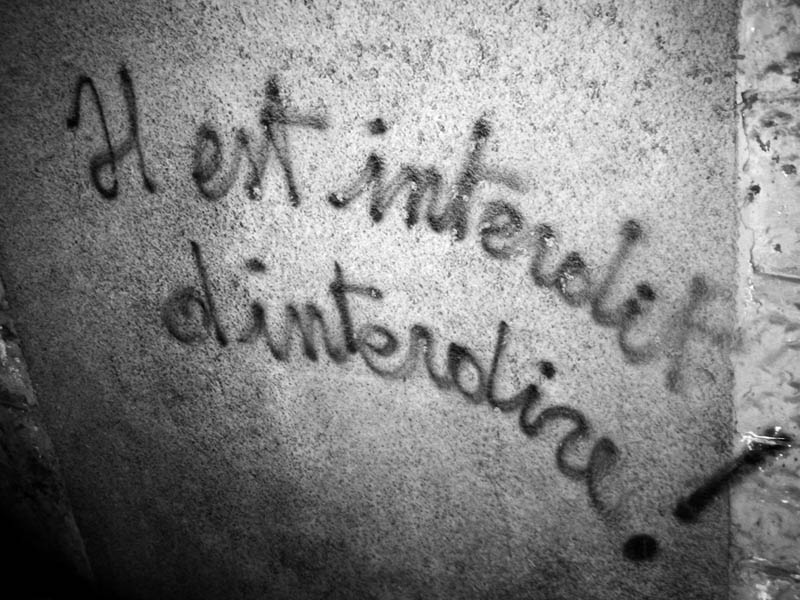
When the Situationist International was first formed, it had a predominantly artistic focus; emphasis was placed on concepts like unitary urbanism and psychogeography.[1] Gradually, however, that focus shifted more towards revolutionary and political theory.[1] The Situationist International reached the apex of its creative output and influence in 1967 and 1968, with the former marking the publication of the two most significant texts of the situationist movement, The Society of the Spectacle by Guy Debord and The Revolution of Everyday Life by Raoul Vaneigem. The expressed writing and political theory of the two aforementioned texts, along with other situationist publications, proved greatly influential in shaping the ideas behind the May 1968 insurrections in France; quotes, phrases, and slogans from situationist texts and publications were ubiquitous on posters and graffiti throughout France during the uprisings.[1]

Etymology and usage

[edit]

The founding manifesto of the Situationist International, Report on the Construction of Situations (1957), defined the construction of situations as "the concrete construction of momentary ambiances of life and their transformation into a superior passional quality."[4] The term "situationist" refers to the construction of situations, one of the early central concepts of the Situationist International; the term also refers to any individuals engaged in the construction of situations, or, more narrowly, to members of the Situationist International.[3] Situationist theory sees the situation as a tool for the liberation of everyday life, a method of negating the pervasive alienation that accompanied the spectacle.[4] Internationale Situationniste No. 1 (June 1958) defined the constructed situation as "a moment of life concretely and deliberately constructed by the collective organization of a unitary ambiance and a game of events".[3] The situationists argued that advanced capitalism manufactured false desires; literally in the sense of ubiquitous advertising and the glorification of accumulated capital, and more broadly in the abstraction and reification of the more ephemeral experiences of authentic life into commodities. The experimental direction of situationist activity consisted of setting up temporary environments favorable to the fulfillment of true and authentic human desires in response.[5]

The Situationist International strongly resisted use of the term "situationism", which Debord called a "meaningless term", adding "[t]here is no such thing as situationism, which would mean a doctrine for interpreting existing conditions".[3] The situationists maintained a philosophical opposition to all ideologies, conceiving of them as abstract superstructures ultimately serving only to justify the economic base of a given society; accordingly, they rejected "situationism" as an absurd and self-contradictory concept.[6] In The Society of the Spectacle, Debord asserted that ideology was "the abstract will to universality and the illusion thereof" which was "legitimated in modern society by universal abstraction and by the effective dictatorship of illusion".[7]

History

[edit]

Origins (1945–1955)

[edit]

The situationist movement had its origins as a left wing tendency within Lettrism,[8][9] an artistic and literary movement led by the Romanian-born French poet and visual artist Isidore Isou, originating in 1940s Paris. The group was heavily influenced by the preceding avant-garde movements of Dadaism and Surrealism, seeking to apply critical theories based on these concepts to all areas of art and culture, most notably in poetry, film, painting and political theory.[4] Among some of the concepts and artistic innovations developed by the Lettrists were the lettrie, a poem reflecting pure form yet devoid of all semantic content, new syntheses of writing and visual art identified as metagraphics and hypergraphics, as well as new creative techniques in filmmaking. Future situationist Guy Debord, who was at that time a significant figure in the Lettrist movement, helped develop these new film techniques, using them in his Lettrist film Howlings for Sade (1952) as well as later in his situationist film Society of the Spectacle (1972).

By 1950, a much younger and more left-wing part of the Lettrist movement began to emerge. This group kept very active in perpetrating public outrages such as the Notre-Dame Affair, where at the Easter High Mass at Notre Dame de Paris, in front of ten thousand people and broadcast on national TV, their member and former Dominican Michel Mourre posed as a monk, "stood in front of the altar and read a pamphlet proclaiming that God was dead".[10][11] André Breton prominently came out in support of the action in a letter that spawned a large debate in the newspaper Combat.[12][13]

In 1952, this left wing of the Lettrist movement, which included Debord, broke off from Isou's group and formed the Letterist International, a new Paris-based collective of avant-garde artists and political theorists. The schism finally erupted when the future members of the radical Lettrists disrupted a Charlie Chaplin press conference for Limelight at the Hôtel Ritz Paris. They distributed a polemic entitled "No More Flat Feet!", which concluded: "The footlights have melted the make-up of the supposedly brilliant mime. All we can see now is a lugubrious and mercenary old man. Go home Mister Chaplin."[14] Isou was upset with this, his own attitude being that Chaplin deserved respect as one of the great creators of the cinematic art. The breakaway group felt that his work was no longer relevant, while having appreciated it "in its own time," and asserted their belief "that the most urgent expression of freedom is the destruction of idols, especially when they claim to represent freedom," in this case, filmmaker Charlie Chaplin.[15]

During this period of the Letterist International, many of the important concepts and ideas that would later be integral in situationist theory were developed. Individuals in the group collaboratively constructed the new field of psychogeography, which they defined as "the study of the specific effects of the geographical environment (whether consciously organized or not) on the emotions and behavior of individuals."[3][16] Debord further expanded this concept of psychogeography with his theory of the dérive, an unplanned tour through an urban landscape directed entirely by the feelings evoked in the individual by their surroundings, serving as the primary means for mapping and investigating the psychogeography of these different areas.[17] During this period the Letterist International also developed the situationist tactic of détournement, which by reworking or re-contextualizing an existing work of art or literature sought to radically shift its meaning to one with revolutionary significance.

Formation (1956–1957)

[edit]

In 1956, Guy Debord, a member of the Lettrist International, and Asger Jorn of the International Movement for an Imaginist Bauhaus, brought together a group of artistic collectives for the First World Congress of Free Artists in Alba, Italy.[18] The meeting established the foundation for the development of the Situationist International, which was officially formed in July 1957 at a meeting in Cosio di Arroscia, Italy.[19] The resulting International was a fusion of these extremely small avant-garde collectives: the Lettrist International, the International Movement for an Imaginist Bauhaus (an offshoot of COBRA), and the London Psychogeographical Association (though, Anselm Jappe has argued that the group pivoted around Jorn and Debord for the first four years).[20] Later, the Situationist International drew ideas from other groups such as Socialisme ou Barbarie.[21]

The most prominent member of the group, Guy Debord, generally became considered the organization's de facto leader and most distinguished theorist. Other members included theorist Raoul Vaneigem, the Dutch painter Constant Nieuwenhuys, the Italo-Scottish writer Alexander Trocchi, the English artist Ralph Rumney (sole member of the London Psychogeographical Association, Rumney suffered expulsion relatively soon after the formation), the Danish artist Asger Jorn (who after parting with the SI also founded the Scandinavian Institute of Comparative Vandalism), the architect and veteran of the Hungarian Uprising Attila Kotanyi, and the French writer Michèle Bernstein. Debord and Bernstein later married.

In June 1957, Debord wrote the manifesto of the Situationist International, titled Report on the Construction of Situations. This manifesto plans a rereading of Karl Marx's Das Kapital and advocates a cultural revolution in western countries.[4]

Artistic period (1958–1962)

[edit]
Danish painter, sculptor, ceramic artist, and author Asger Jorn, founding member of the Situationist International.

During the first few years of the SI's founding, avant-garde artistic groups began collaborating with the SI and joining the organization. Gruppe SPUR, a German artistic collective, collaborated with the Situationist International on projects beginning in 1959, continuing until the group officially joined the SI in 1961. The role of the artists in the SI was of great significance, particularly Asger Jorn, Constant Nieuwenhuys and Pinot Gallizio.[22]

Asger Jorn, who invented Situgraphy and Situlogy, had the social role of catalyst and team leader among the members of the SI between 1957 and 1961. Jorn's role in the situationist movement (as in COBRA) was that of a catalyst and team leader. Guy Debord on his own lacked the personal warmth and persuasiveness to draw people of different nationalities and talents into an active working partnership. As a prototype Marxist intellectual Debord needed an ally who could patch up the petty egoisms and squabbles of the members. When Jorn's leadership was withdrawn in 1961, many simmering quarrels among different sections of the SI flared up, leading to multiple exclusions.

Internationale situationniste

The first major split was the exclusion of Gruppe SPUR, the German section, from the SI on 10 February 1962.[23] Many different disagreements led to the fracture, for example; while at the Fourth SI Conference in London in December 1960, in a discussion about the political nature of the SI, the Gruppe SPUR members disagreed with the core situationist stance of counting on a revolutionary proletariat;[24] the accusation that their activities were based on a "systematic misunderstanding of situationist theses";[23] the understanding that at least one Gruppe SPUR member, sculptor Lothar Fischer, and possibly the rest of the group, were not actually understanding and/or agreeing with the situationist ideas, but were just using the SI to achieve success in the art market;[23][25] and the betrayal, in the Spur #7 issue, of a common agreement on the Gruppe SPUR and SI publications.[26][27]

The exclusion was a recognition that Gruppe SPUR's "principles, methods and goals" were significantly in contrast with those of the SI.[28][29] This split however was not a declaration of hostilities, as in other cases of SI exclusions. A few months after the exclusion, in the context of judicial prosecution against the group by the German state, Debord expressed his esteem to Gruppe SPUR, calling it the only significant artist group in (Germany) since World War II, and regarding it at the level of the avant-gardes in other countries.[30]

The next significant split was in 1962, wherein the "Nashists," the Scandinavian section of the SI led by Jørgen Nash, were excluded from the organization. Nash created the 2nd Situationist International.[31]

Political period (1963–1968)

[edit]

By this point the Situationist International consisted almost exclusively of the Franco-Belgian section, led by Guy Debord and Raoul Vaneigem. These members possessed much more of a tendency towards political theory over the more artistic aspects of the SI. The shift in the intellectual priorities within the SI resulted in more focus on the theoretical, such as the theory of the spectacle and Marxist critical analysis, spending much less time on the more artistic and tangible concepts like unitary urbanism, détournement, and situgraphy.[32]

During this period, the SI began having more and more influence on local university students in France. Taking advantage of the apathy of their colleagues, five "Pro-situs", situationist-influenced students, infiltrated the University of Strasbourg's student union in November 1966 and began scandalising the authorities.[33][34] Their first action was to form an "anarchist appreciation society" called The Society for the Rehabilitation for Karl Marx and Ravachol; next they appropriated union funds to flypost "Return of the Durruti Column", André Bertrand's détourned comic strip.[34] They then invited the situationists to contribute a critique of the University of Strasbourg, and On the Poverty of Student Life, written by Tunisian situationist Mustapha/Omar Khayati was the result.[34] The students promptly proceeded to print 10,000 copies of the pamphlet using university funds and distributed them during a ceremony marking the beginning of the academic year. This provoked an immediate outcry in the local, national and international media.[34]

May events (1968)

[edit]

The Situationists played a preponderant role in the May 1968 uprisings,[35] and to some extent their political perspective and ideas fueled such crisis,[35][36][37] providing a central theoretic foundation.[38][39][40][41][42][43] While SI's member count had been steadily falling for the preceding several years, the ones that remained were able to fill revolutionary roles for which they had patiently anticipated and prepared. The active ideologists ("enragés" and Situationists) behind the revolutionary events in Strasbourg, Nanterre and Paris, numbered only about one or two dozen persons.[44]

This has now been widely acknowledged as a fact by studies of the period,[45][46][47][48][49][50] what is still wide open to interpretation is the "how and why" that happened.[35] Charles de Gaulle, in the aftermath televised speech of 7 June, acknowledged that "This explosion was provoked by groups in revolt against modern consumer and technical society, whether it be the communism of the East or the capitalism of the West."[51]

They also made up the majority in the Occupation Committee of the Sorbonne.[35] An important event leading up to May 1968 was the scandal in Strasbourg in December 1966.[52] The Union Nationale des Étudiants de France declared itself in favor of the SI's theses, and managed to use public funds to publish Mustapha Khayati's pamphlet On the Poverty of Student Life.[53] Thousands of copies of the pamphlet were printed and circulated and helped to make the Situationists well known throughout the nonstalinist left.

Quotations from two key situationist books, Debord's The Society of the Spectacle (1967) and Khayati's On the Poverty of Student Life (1966), were written on the walls of Paris and several provincial cities.[52] This was documented in the collection of photographs published in 1968 by Walter Lewino, L'imagination au pouvoir.[54]

Though the SI were a very small group, they were expert self-propagandists, and their slogans appeared daubed on walls throughout Paris at the time of the revolt. SI member René Viénet's 1968 book Enragés and Situationists in the Occupations Movement, France, May '68 gives an account of the involvement of the SI with the student group of Enragés and the occupation of the Sorbonne.

The occupations of 1968 started at the University of Nanterre and spread to the Sorbonne. The police tried to take back the Sorbonne and a riot ensued. Following this a general strike was declared with up to 10 million workers participating. The SI originally participated in the Sorbonne occupations and defended barricades in the riots. The SI distributed calls for the occupation of factories and the formation of workers' councils,[54] but, disillusioned with the students, left the university to set up the Council for Maintaining the Occupations (CMDO) which distributed the SI's demands on a much wider scale. After the end of the movement, the CMDO disbanded.

Aftermath (1968–1972)

[edit]

By 1972, Gianfranco Sanguinetti and Guy Debord were the only two remaining members of the SI. Working with Debord, in August 1975, Sanguinetti wrote a pamphlet titled Rapporto veridico sulle ultime opportunità di salvare il capitalismo in Italia (The Real Report on the Last Chance to Save Capitalism in Italy),[55] which (inspired by Bruno Bauer) purported to be the cynical writing of "Censor", a powerful industrialist. The pamphlet argued that the ruling class of Italy supported the Piazza Fontana bombing and other covert, false flag mass slaughter for the higher goal of defending the capitalist status quo from communist influence. The pamphlet was mailed to 520 of Italy's most powerful individuals. It was received as genuine and powerful politicians, industrialists and journalists praised its content. After reprinting the tract as a small book, Sanguinetti revealed himself to be the true author. In the outcry that ensued[56] and under pressure from Italian authorities Sanguinetti left Italy in February 1976, and was denied entry to France.[57]

After publishing in the last issue of the magazine, an analysis of the May 1968 revolts and the strategies that will need to be adopted in future revolutions,[54] the SI was dissolved in 1972.[58]

Main concepts

[edit]

The spectacle and its society

[edit]

The Spectacle is a central notion in situationist theory, developed by Guy Debord in his 1967 book The Society of the Spectacle. In a limited sense, spectacle includes the mass media, which are "its most glaring superficial manifestation."[59] Debord said that the society of the spectacle came to existence in the late 1920s.[60][61]

The critique of the spectacle is a development and application of Karl Marx's concept of fetishism of commodities, reification and alienation,[62] and the way it was reprised by György Lukács in 1923. In the society of the spectacle, the commodities rule the workers and the consumers instead of being ruled by them. The consumers are passive subjects that contemplate the reified spectacle.

As early as 1958, in the situationist manifesto, Debord described official culture as a "rigged game", where conservative powers forbid subversive ideas to have direct access to the public discourse. Such ideas get first trivialized and sterilized, and then they are safely incorporated back within mainstream society, where they can be exploited to add new flavors to old dominant ideas.[63] This technique of the spectacle is sometimes called recuperation, and its counter-technique is the détournement.[64]

Détournement

[edit]

A détournement is a technique developed in the 1950s by the Letterist International,[8][9] and consist in "turning expressions of the capitalist system against itself,"[65] like turning slogans and logos against the advertisers or the political status quo.[66] Détournement was prominently used to set up subversive political pranks, an influential tactic called situationist prank that was reprised by the punk movement in the late 1970s[67] and inspired the culture jamming movement in the late 1980s.[65]

Anti-capitalism

[edit]

The Situationist International, in the 15 years from its formation in 1957 and its dissolution in 1972, is characterized by a Marxist and surrealist perspective on aesthetics and politics,[68] without separation between the two: art and politics are faced together and in revolutionary terms.[69] The SI analyzed the modern world from the point of view of everyday life.[70] The core arguments of the Situationist International were an attack on the capitalist degradation of the life of people[4][71][72] and the fake models advertised by the mass media,[4] to which the Situationist responded with alternative life experiences.[4] The alternative life experiences explored by the Situationists were the construction of situations, unitary urbanism, psychogeography, and the union of play, freedom and critical thinking.[22]

A major stance of the SI was to count on the force of a revolutionary proletariat. This stance was reaffirmed very clearly in a discussion on "To what extent is the SI a political movement?", during the Fourth SI Conference in London.[24] The SI remarked that this is a core Situationist principle, and that those that don't understand it and agree with it, are not Situationist.

Art and politics

[edit]

The SI rejected all art that separated itself from politics, the concept of 20th-century art that is separated from topical political events.[4][28] The SI believed that the notion of artistic expression being separated from politics and current events is one proliferated by reactionary considerations to render artwork that expresses comprehensive critiques of society impotent.[4] They recognized there was a precise mechanism followed by reactionaries to defuse the role of subversive artists and intellectuals, that is, to reframe them as separated from the most topical events, and divert from them the taste for the new that may dangerously appeal the masses; after such separation, such artworks are sterilized, banalized, degraded, and can be safely integrated into the official culture and the public discourse, where they can add new flavors to old dominant ideas and play the role of a gear wheel in the mechanism of the society of the spectacle.[4]

According to this theory, artists and intellectuals that accept such compromises are rewarded by the art dealers and praised by the dominant culture.[28] The SI received many offers to sponsor "creations" that would just have a "situationist" label but a diluted political content, that would have brought things back to order and the SI back into the old fold of artistic praxis. The majority of SI continued to refuse such offers and any involvement on the conventional avant-garde artistic plane.[28] This principle was affirmed since the founding of the SI in 1957, but the qualitative step of resolving all the contradictions of having situationists that make concessions to the cultural market, was made with the exclusion of Gruppe SPUR in 1962.[28]

The SI noted how reactionary forces forbid subversive ideas from artists and intellectuals to reach the public discourse, and how they attack the artworks that express comprehensive critique of society, by saying that art should not involve itself into politics.[4]

The construction of situations

[edit]

The first edition of Internationale Situationniste defines the constructed situation as "a moment of life concretely and deliberately constructed by the collective organization of a unitary ambiance and a game of events."

As the SI embraced dialectical Marxism, the situation came to refer less to a specific avant-garde practice than to the dialectical unification of art and life more generally. Beyond this theoretical definition, the situation as a practical manifestation thus slipped between a series of proposals. The SI thus were first led to distinguish the situation from the mere artistic practice of the happening, and later identified it in historical events such as the Paris Commune in which it exhibited itself as the revolutionary moment. The SI's interest in the Paris Commune was expressed in 1962 in their fourteen "Theses on the Paris Commune."

Psychogeography

[edit]

The first edition of Internationale Situationniste defined psychogeography as "the study of the specific effects of the geographical environment (whether consciously organized or not) on the emotions and behavior of individuals."[3] The term was first recognized in 1955 by Guy Debord while still with the Letterist International:

The word psychogeography, suggested by an illiterate Kabyle as a general term for the phenomena a few of us were investigating around the summer of 1953, is not too inappropriate. It does not contradict the materialist perspective of the conditioning of life and thought by objective nature. Geography, for example, deals with the determinant action of general natural forces, such as soil composition or climatic conditions, on the economic structures of a society, and thus on the corresponding conception that such a society can have of the world. Psychogeography could set for itself the study of the precise laws and specific effects of the geographical environment, whether consciously organized or not, on the emotions and behavior of individuals. The charmingly vague adjective psychogeographical can be applied to the findings arrived at by this type of investigation, to their influence on human feelings, and more generally to any situation or conduct that seems to reflect the same spirit of discovery.[16]

Dérive

[edit]

By definition, psychogeography combines subjective and objective knowledge and studies. Debord struggled to stipulate the finer points of this theoretical paradox, ultimately producing "Theory of the Dérive" in 1958, a document which essentially serves as an instruction manual for the psychogeographic procedure, executed through the act of dérive ("drift").

In a dérive one or more persons during a certain period drop their usual motives for movement and action, their relations, their work and leisure activities, and let themselves be drawn by the attractions of the terrain and the encounters they find there... But the dérive includes both this letting go and its necessary contradiction: the domination of psychogeographical variations by the knowledge and calculation of their possibilities.

— Ken Knabb[73]

SI engaged in a play-form that was also practiced by its predecessor organization, the Lettrist International, the art of wandering through urban space, which they termed dérive, whose unique mood is conveyed in Debord's darkly romantic meaning of palindrome. Two excursions organized by Andre Breton serve as the closest cultural precedents to the dérive. The first in 1921, was an excursion to the Church of Saint-Julien-le-Pauvre with the Parisian Dadaists;[74] the second excursion was on 1 May 1923, when a small group of Surrealists walked toward the countryside outside of Blois.[75] Debord was cautious however to differentiate between the derive and such precedents. He emphasized its active character as "a mode of experimental behavior" that reached to Romanticism, the Baroque, and the age of chivalry, with its tradition of long adventures voyages. Such urban roaming was characteristic of Left Bank bohemianism in Paris.[76]

In the SI's 6th issue, Raoul Vaneigem writes in a manifesto of unitary urbanism, "All space is occupied by the enemy. We are living under a permanent curfew. Not just the cops—the geometry".[77] Dérive, as a previously conceptualized tactic in the French military, was "a calculated action determined by the absence of a greater locus", and "a maneuver within the enemy's field of vision".[78] To the SI, whose interest was inhabiting space, the dérive brought appeal in this sense of taking the "fight" to the streets and truly indulging in a determined operation. The dérive was a course of preparation, reconnaissance, a means of shaping situationist psychology among urban explorers for the eventuality of the situationist city.

Political theory

[edit]

Major works

[edit]

Twelve issues of the main French edition of journal Internationale Situationniste were published, each issue edited by a different individual or group, including: Guy Debord, Hadj Mohamed Dahou, Giuseppe Pinot-Gallizio, Maurice Wyckaert, Constant Nieuwenhuys, Asger Jorn, Helmut Sturm, Attila Kotanyi, Jørgen Nash, Uwe Lausen, Raoul Vaneigem, Michèle Bernstein, Jeppesen Victor Martin, Jan Strijbosch, Alexander Trocchi, Théo Frey, Mustapha Khayati, Donald Nicholson-Smith, René Riesel, and René Viénet.[79]

Classic Situationist texts include: On the Poverty of Student Life, Society of the Spectacle by Guy Debord, and The Revolution of Everyday Life by Raoul Vaneigem.

The first English-language collection of SI writings, although poorly and freely translated, was Leaving The 20th century edited by Christopher Gray. The Situationist International Anthology edited and translated by Ken Knabb, collected numerous SI documents which had previously never been seen in English.[80]

Relationship with Marxism

[edit]

Rooted firmly in the Marxist tradition, the Situationist International criticized Trotskyism, Marxism–Leninism, Stalinism and Maoism from a position they believed to be further left and more properly Marxist. The situationists possessed a strong anti-authoritarian current, commonly deriding the centralized bureaucracies of China and the Soviet Union in the same breath as capitalism.

Debord's work The Society of the Spectacle (1967) established situationist analysis as Marxist critical theory. The Society of the Spectacle is widely recognized as the main and most influential Situationist essay.[81]

The concept of revolution created by the Situationist International was anti-capitalist,[82][83][84] Marxist, Young Hegelian,[35] and from the very beginning in the 50s, remarkably differently from the established Left, anti-Stalinist and against all repressive regimes.[85]

Debord starts his 1967 work with a revisited version of the first sentence with which Marx began his critique of classical political economy, Das Kapital.[86][87] In a later essay, Debord will argue that his work was the most important social critique since Marx's work. Drawing from Marx, which argued that under a capitalist society the wealth is degraded to an immense accumulation of commodities, Debord argues that in advanced capitalism, life is reduced to an immense accumulation of spectacles, a triumph of mere appearance where "all that once was directly lived has become mere representation".[88][89] The spectacle, which according to Debord is the core feature of the advanced capitalist societies,[90] has its "most glaring superficial manifestation" in the advertising-mass media-marketing complex.[91]

Elaborating on Marx's argument that under capitalism our lives and our environment are continually depleted, Debord adds that the Spectacle is the system by which capitalism tries to hide such depletion. Debord added that, further than the impoverishment in the quality of life,[22][71] our psychic functions are altered, we get a degradation of mind and also a degradation of knowledge.[92] In the spectacular society, knowledge is not used anymore to question, analyze, or resolve contradictions, but to assuage reality.

Situationist theorists advocated methods of operation that included democratic workers' councils and workers' self-management,[93][94][95][96] interested in empowering the individual, in contrast to the perceived corrupt bureaucratic states of the Eastern bloc. Their anti-authoritarian interpretation of Marxist theory can be identified with the broader council communist and libertarian Marxist movements, themselves more broadly termed as left communism.

The last issue (1969) of the Situationist International journal, featured an editorial analyzing the events of May 1968. The editorial, written by Guy Debord, was titled The Beginning of an Era,[97] probably as a détournement reference of Nachalo (The Beginning), a Russian Marxist monthly magazine.

According to Greil Marcus, some found similarities between the Situationists and the Yippies.[98]

Former situationists T. J. Clark and Donald Nicholson-Smith (British section), argued that the portion of the moderate Left that is the "established Left", and its "Left opinion-makers", usually addressed contemptuously the SI as "hopelessly young-Hegelian".[35]

Relationship with anarchism

[edit]

The Situationist International was differentiated from both anarchists and Marxists. In spite of this, they have frequently been associated with anarchism.[99] Debord did a critical assessment of the anarchists in his 1967 The Society of the Spectacle.[100] In the final, 12th issue of the journal, the situationists rejected spontaneism and the "mystics of nonorganization," labeling them as a form of "sub-anarchism":[101]

The only people who will be excluded from this debate are... those who in the name of some sub-anarchist spontaneism proclaim their opposition to any form of organization, and who only reproduce the defects and confusion of the old movement—mystics of nonorganization, workers discouraged by having been mixed up with Trotskyist sects too long, students imprisoned in their impoverishment who are incapable of escaping from bolshevik organizational schemas. The situationists are obviously partisans of organization—the existence of the situationist organization testifies to that. Those who announce their agreement with our theses while crediting the SI with a vague spontaneism simply don't know how to read.

According to situationist Ken Knabb, Debord pointed out the flaws and merits of both Marxism and anarchism.[102] He argued that "the split between Marxism and anarchism crippled both sides. The anarchists rightly criticized the authoritarian and narrowly economistic tendencies in Marxism, but they generally did so in an undialectical, moralistic, ahistorical manner... and leaving Marx and a few of the more radical Marxists with a virtual monopoly on coherent dialectical analysis—until the situationists finally brought the libertarian and dialectical aspects back together again."

Relationship with the established left

[edit]

The SI poses a challenge to the model of political action of a portion of the left,[103] the "established Left" and "Left opinion-makers".[35] The first challenging aspect is the fueling role that the SI had in the upheavals of the political and social movements of the 1960s,[37][45] upheavals for which much is still at stake and which many foresee as recurring in the 21st century. The second challenging aspect,[37] is the comparison between the Situationist Marxist theory of the Society of the Spectacle, which is still very topical 30 years later,[45] and the current status of the theories supported by leftist establishments in the same period, like Althusserianism, Maoism, Autonomism, Freudo-Marxism and others.[45]

The response to this challenge has been an attempt to silence and misinterpret, to "turn the SI safely into an art movement, and thereby to minimize its role in the political and social movements of the sixties".[37][103]

The core aspect of the revolutionary perspectives, and the political theory, of the Situationist International, has been neglected by some commentators,[104] which either limited themselves to an apolitical reading of the situationist avant-garde art works, or dismissed the Situationist political theory. Examples of this are Simon Sadler's The Situationist City,[104] and the accounts on the SI published by the New Left Review.[35]

The concept of revolution created by the Situationist International was anti-capitalist,[82][83][84] Marxist, Young Hegelian,[35] and from the very beginning in the 1950s, remarkably differently from the established Left, anti-Stalinist and against all repressive regimes.[85] The SI called in May 1968 for the formation of workers' councils.[54]

There was no separation between the artistic and the political perspectives.[69] For instance, Asger Jorn never believed in a conception of the Situationist ideas as exclusively artistic and separated from political involvement. He was at the root and at the core of the Situationist International project, fully sharing the revolutionary intentions with Debord.[105][106]

Reception

[edit]

Criticism

[edit]

Critics of the Situationists frequently assert that their ideas are not in fact complex and difficult to understand, but are at best simple ideas expressed in deliberately difficult language, and at worst actually nonsensical. For example, anarchist Chaz Bufe asserts in Listen Anarchist! that "obscure situationist jargon" is a major problem in the anarchist movement.[107] Andrea Gibbons argues that the Parisian situationists failed to take on board practically or theoretically the experience of their African members, such as is shown by Abdelhafid Khattib's experience of police harassment while conducting psychogeographic research on Les Halles in 1958. She remarks how little the suppression of Algerians in Paris had impacted their activity and thinking – Bernstein and Debord co-signed the Declaration on the Right to Insubordination in the Algerian War in 1961, which led to them being questioned by the police. She cites a letter written by Jacqueline de Jong, Jorgen Nash, and Ansgar Elde protesting the expulsion of the Spur group in 1962 which highlights the political repression in Paris at that time. Gibbons also criticises the lack of mention of the Algerian situationists in either Debord's or Vaneigem's memoirs.[108]

Influence

[edit]

Debord's analysis of the spectacle has been influential among people working on television, particularly in France and Italy;[109][110] in Italy, TV programs produced by situationist intellectuals, like Antonio Ricci's Striscia la notizia, or Carlo Freccero's programming schedule for Italia 1 in the early 1990s.[109]

In the 1960s and 1970s, anarchists, communists, and other leftists offered various interpretations of Situationist concepts in combination with a variety of other perspectives. Examples of these groups include: in Amsterdam, the Provos; in the UK, King Mob, the producers of Heatwave magazine (including Charles Radcliffe who later briefly joined the English Section of the Situationist International), and the Angry Brigade.[111] In the US, groups like Black Mask (later Up Against the Wall Motherfuckers), The Weathermen, and the Rebel Worker group also explicitly employed their ideas.[112]

Anarchist theorists such as Fredy Perlman, Bob Black, Hakim Bey, and John Zerzan, have developed the SI's ideas in various directions away from Marxism. These theorists were predominantly associated with the magazines Fifth Estate, Anarchy: A Journal of Desire Armed, and Green Anarchy. During the early 1980s, English anarchist Larry Law produced the Spectacular Times pocket-books series, which aimed to make Situationist ideas more easily assimilated into the anarchist movement. Later anarchist theorists such as the CrimethInc. collective also claim Situationist influence.[112]

Situationist urban theory, defined initially by the members of the Lettrist International as "Unitary Urbanism," was extensively developed through the behavioural and performance structures of The Workshop for Non-Linear Architecture during the 1990s. The re-emergence of the London Psychogeographical Association also inspired many new psychogeographical groups including Manchester Area Psychogeographic. The LPA and the Neoist Alliance along with the Luther Blissett Project came together to form a New Lettrist International with a specifically Communist perspective. Around this time, Unpopular Books and the LPA released some key texts including new translations of Asger Jorn's work.

Around this time also, groups such as Reclaim the Streets and Adbusters have, respectively, seen themselves as "creating situations" or practicing detournement on advertisements.

Punk and culture

[edit]

In cultural terms, Situationist International's influence has arguably been greater, if more diffuse. In the late 1960s, MC5, the Fugs and Hawkwind were radical situationist bands.

Situationist ideas exerted a strong influence on the design language of the punk rock phenomenon of the 1970s and the post-punk scene of the early 1980s. To a significant extent, this was the result of the adoption of the style, aesthetics and slogans employed by the SI. These were often secondhand influences received through British situationist groups such as King Mob whose associates included Malcolm McLaren and Jamie Reid. Factory Records owner Tony Wilson was influenced by situationist urbanism, and Factory band the Durutti Column took their name from André Bertrand's collage Le Retour de la Colonne Durutti.[113] (Bertrand, in turn, took his title from the eponymous anarchist army during the Spanish Civil War). American punk group the Feederz have been acclaimed as exhibiting a more direct and conscious influence. Formed in the late 1970s, they became known for extensive use of detournement and their intention to provoke their audience through the exposition of situationist themes.[114] Other musical artists whose lyrics and artwork have referenced situationist concepts include the Clash, Pussy Riot,[115] Crass, Tom Robinson Band, Ian Dury, X-Ray Spex, Sham 69, Buzzcocks, the Fall, Patrik Fitzgerald, Conflict, the Royal Family and the Poor, Angelic Upstarts, Chaos UK, Chaotic Dischord, MDC, Dead Kennedys,[116] Reagan Youth, Chumbawamba and Manic Street Preachers. Situationist theory experienced a vogue in the late '90s hardcore punk scene, when it was referenced by Orchid, His Hero Is Gone and CrimethInc.

Situationist ideas may be found within the development of other avant-garde threads such as unilalianism[117][118] and neoism, as well as artists such as Mark Divo and American artist Joey Skaggs who has been compared to Situationist practitioners for his use of staged spectacles and media infiltration to subvert dominant cultural narratives. His satirical hoaxes, such as Cathouse for Dogs and Portofess, reflect Situationist strategies like détournement by exposing media complicity and challenging societal norms.[119]

Writers such as Thomas de Zengotita have echoed situationist theories regarding the spectacle of contemporary society.

See also

[edit]

Notes

[edit]

References

[edit]

Further reading

[edit]
[edit]
Revisions and contributorsEdit on WikipediaRead on Wikipedia
from Grokipedia
The Situationist International (SI) was a small, collective of artists, writers, and theorists founded in and dissolved in 1972, dedicated to creating disruptive "situations" that challenged the commodification of under advanced . Emerging from the merger of the Lettrist International and the International Movement for an Imaginist Bauhaus, the SI's core members included , , and , who advanced concepts like détournement—the hijacking of cultural artifacts for subversive purposes—and , mapping urban environments' emotional impacts to foster spontaneous play over alienated routine. Their journal, Internationale Situationniste, published from 1958 to 1969, disseminated critiques of both Western consumer society and Soviet bureaucracy as manifestations of a unifying "spectacle" that reduced human relations to mere representation. Debord's 1967 book encapsulated their view of capitalism's evolution into a totalizing image-world, where authentic experience yields to passive spectatorship, influencing subsequent cultural analyses despite the group's internal factionalism and frequent expulsions that limited its organizational cohesion. The SI's ideas gained visibility during the French unrest, where situationist slogans appeared on walls and their pamphlet On the Poverty of Student Life (1966) resonated with protesters, though the group itself remained marginal, with fewer than 70 members at its peak and no sustained revolutionary impact beyond theoretical provocation. Their defining characteristic—relentless critique without compromise—led to self-dissolution amid accusations of recuperation by the very spectacle they opposed, underscoring the tension between radical intent and practical efficacy.

Origins and Formation

Intellectual and Artistic Precursors

The primary artistic and intellectual precursors to the Situationist International were the Lettrist International and the International Movement for an Imaginist Bauhaus, which merged in July 1957 at Cosio d'Arroscia, . The Lettrist International originated as a left-wing faction within , an avant-garde movement initiated by Romanian-born poet in around 1945, which prioritized the phonetic and visual deconstruction of language as a means to surpass prior artistic forms like poetry and painting. 's innovations, including hypergraphie (integrating text and image) and early experiments in film and urban drift, directly informed Situationist practices such as and , though the Lettrists' emphasis on infinite artistic renewal clashed with the more politically oriented unitary urbanism developed by figures like , who co-founded the Lettrist International in 1952. Complementing this, the International Movement for an Imaginist formed in 1953 amid the fragmentation of the collective (1948–1951), led by Danish painter , Italian artist Piero Simondo, and others, as a deliberate counter to the rationalist, functionalist legacy of Walter Gropius's school (1919–1933). The Imaginists advocated for "imaginist" architecture and painting that embraced chance, mythology, and spontaneous creation over industrial standardization, exemplified by Jorn's modifications of existing artworks and Giuseppe Pinot-Gallizio's "industrial painting" machines, which produced continuous, immersive canvases as prototypes for non-commodified environments. These efforts rejected post-war design's integration into capitalist production, prefiguring the Situationists' critique of the as a totalizing system of alienated representation. The Situationist International's theoretical framework also drew from Marxist philosopher Henri Lefebvre, with whom members had been in contact since the late 1950s. Lefebvre's writings on revolutionary romanticism and everyday life significantly influenced the early SI. Their interpretation of the Paris Commune of 1871, as articulated in the 1962 "Theses on the Paris Commune," was shaped by this collaboration; in the early 1960s, Guy Debord, Attila Kotányi, and Raoul Vaneigem assisted Lefebvre in preparations for his book on the Commune, published in 1965 as La Proclamation de la Commune. Both groups traced deeper roots to interwar avant-gardes, including Dada's negation of bourgeois (circa 1916–1923) and 's pursuit of unconscious liberation under from 1924 onward, yet the Situationists positioned themselves as rupturing from these by condemning 's accommodation to idealism and institutionalization after . explicitly rebelled against Breton's authoritarian grip on , favoring materialist interventions in daily life over psychic automatism, while Jorn's phase drew from and spontaneous abstraction to challenge rational . This synthesis of Lettrist conceptual rigor and Imaginist painterly exuberance, unmoored from 's lingering mysticism, enabled the Situationists to theorize not as autonomous but as a weapon for constructing revolutionary situations against commodified culture.

Founding Conference and Initial Composition

The founding of the Situationist International took place on July 27–28, 1957, in the remote village of Cosio d'Arroscia in . This gathering united representatives from disparate groups seeking to transcend traditional artistic divisions through a revolutionary critique of modern culture and urban life. The resolved to form the SI as an dedicated to "the construction of situations," rejecting the separation of art from everyday existence and advocating experimental practices like and . The SI emerged primarily from the merger of the Lettrist International (LI), a Paris-based group focused on experimental film, poetry, and urban intervention led by , and the International Movement for an Imaginist (IMIB), a Scandinavian-Italian network emphasizing spontaneous painting and anti-functionalist architecture under Asger Jorn's influence. Joining them was the London Psychogeographical Association, represented by Ralph Rumney, which explored the psychological effects of urban environments. This alliance reflected a shared disdain for artistic and bureaucratic , prioritizing over institutional art. Initial composition consisted of eight core members: from the LI, and Michèle Bernstein; from the IMIB, , Giuseppe Pinot-Gallizio, Piero Simondo, Elena Verrone, and Walter Olmo; and from the Psychogeographical Association, Ralph Rumney. Debord, a theorist and filmmaker, assumed a central coordinating role, while Jorn provided artistic leadership through his networks in and . The group adopted a non-hierarchical structure but emphasized rigorous exclusion of reformist or careerist elements to maintain revolutionary purity, setting the stage for frequent internal purges. Membership spanned , , , and the , underscoring the SI's transnational ambitions amid cultural fragmentation.

Core Theoretical Concepts

The Spectacle as Alienation Mechanism

The concept of the spectacle, as theorized by Guy Debord in his 1967 book The Society of the Spectacle, constitutes a core element of Situationist International doctrine, portraying advanced capitalism as a regime where social relations between individuals are mediated exclusively by images. Debord defined the spectacle as "capital accumulated to the point where it becomes image," an inversion of reality that supplants direct human activity with passive contemplation of commodified representations. This mechanism alienates by severing people from authentic experience, reducing life to a spectacle of consumption where fulfillment appears attainable through commodities and media rather than collective praxis. Building on Karl Marx's analysis of —wherein objects obscure the social labor producing them—the Situationists extended alienation to encompass cultural and perceptual dimensions under postwar consumer abundance. Debord argued that "the is not a collection of images, but a among people, mediated by images," functioning as an apparatus that manufactures separation by channeling human needs into isolated, spectacle-driven pursuits. Economic growth in this system equates to the expansion of alienation's industrial output, with , , and reinforcing a unified of capitalism's totalizing grip on daily existence. By 1967, when Debord's theses were published amid France's economic boom, the had integrated workers into illusory participation, diffusing class antagonisms through televised events and branded lifestyles that mimic revolutionary energy without enabling it. The alienation engendered by the manifests causally through reification: real social conflicts are abstracted into harmonious images, preventing recognition of exploitative structures. Debord's thesis 32 encapsulates this as "the spectacle’s social function is the concrete manufacture of alienation," where individuals, estranged from their own productive capacities, internalize passivity as natural. Situationist critiques, disseminated via the group's journal Internationale Situationniste from onward, applied this to both Western consumer societies and Eastern bureaucratic states, viewing the latter's as a parallel that alienates via state-mediated uniformity rather than market fragmentation. Empirical indicators included rising television penetration—reaching over 50% of French households by the mid-1960s—and the proliferation of advertising expenditures, which Debord and associates like linked to the erosion of unmediated communal bonds. This theoretical apparatus underpinned Situationist interventions, positing that alienation's mechanism could only be disrupted through conscious refusal of spectacular logic, though the group itself dissolved in 1972 amid debates over its practical efficacy against capitalism's adaptive resilience.

Détournement and Subversion Tactics

Détournement, a foundational tactic of the Situationist International, entailed the deliberate diversion, distortion, or hijacking of existing cultural artifacts—ranging from artworks and advertisements to literary texts—to subvert their intended meanings and repurpose them for anti-capitalist critique. Originating in Lettrist circles before the SI's formation, the method was systematically theorized by and Gil J. Wolman in their 1956 essay "Methods of ," which posited that "the literary and artistic heritage of humanity should be used for partisan propaganda purposes" through techniques like reciprocal modification, where juxtaposed elements mutually alter their significance. This approach rejected passive recuperation of culture by commodity society, instead treating as an active negation of alienated production, indifferent to the moral or proprietary claims of originals. The SI classified détournements into minor forms, involving superficial alterations of unimportant elements for ironic or propagandistic effect, and deceptive variants, which profoundly recast source materials to expose underlying ideological recuperation, often achieving "an erosion of the world view" held by the audience. In Internationale Situationniste #3 (December 1959), the group described it as both a destructive prelude to unitary —eroding commodified urban environments—and a subversive against the spectacle's totalizing mediation, where fragmented, pre-packaged experiences alienate individuals from authentic lived relations. Subversion extended beyond isolated artworks to tactical interventions, such as detourned posters and in SI publications that mocked consumerist icons, aiming to provoke recognition of systemic passivity rather than mere aesthetic shock. Practical applications included Debord's films, like Hurlements en faveur de Sade (1952, pre-SI) and later works repurposing commercial footage to critique spectacle-driven consumption, and collaborative projects with artists like , who detourned mass-produced paintings in modifications exhibited in 1959's Scandinavian shows. These tactics influenced broader strategies, such as situationist pranks—hoaxes like the 1960s interventions mimicking official discourse to ridicule bureaucratic authority—intended to rupture the spectacle's seamless reproduction of false needs and hierarchies. Despite limited immediate organizational impact, with the SI prioritizing theoretical rigor over mass dissemination, 's emphasis on causal disruption of cultural commodities prefigured later appropriations in punk and postmodern practices, though the original intent remained rooted in rather than stylistic play.

Psychogeography and Dérive Practices

, as conceptualized within the Situationist International, refers to the study of the precise effects exerted by geographical environments—whether intentionally designed or otherwise—on the affective states and conduct of individuals. first articulated this framework in his 1955 essay "Introduction to a Critique of ," published in the Lettrist journal Les Lèvres nues, where he critiqued the of urban space under and proposed as a means to uncover its subconscious influences. This approach rejected functionalist , emphasizing instead the emotional contours of cities as shaped by historical, social, and architectural forces, with the aim of fostering experimental reconstructions of . The , or "drift," served as the core experimental method for psychogeographical inquiry, involving unstructured passage through diverse urban ambiances to disrupt habitual perceptions and reveal hidden spatial dynamics. Outlined by Debord in his 1958 "Theory of the ," published in Internationale Situationniste No. 2, the practice entailed small groups (typically one to five participants) engaging in playful yet purposive wandering, free from utilitarian goals like work or , often lasting from hours to several days. Participants documented encounters with "constant currents, fixed points, and vortexes" in the urban fabric, using techniques such as questionnaires on ambiance or chance operations to map emotional terrains, thereby challenging the alienating "" of rationalized city layouts. Situationists produced psychogeographical maps to visualize these findings, prioritizing subjective experience over objective . In 1957, Debord and collaborated on , a representation of divided into approximately a dozen discrete zones linked by psychogeographical "desire arrows," illustrating the hypothesis of pivotal "turning points" that concentrate affective intensities while excising commodified peripheries. Such maps critiqued Haussmann's boulevards and reconstructions as instruments of control, advocating "unitary urbanism" to integrate and in service of liberated play. Practical dérives, conducted in cities like and as early as 1953 by Lettrist precursors, yielded data for these visualizations, with reports in Internationale Situationniste detailing phenomena like "vortexes" of attraction or repulsion. Though empirical validation remained anecdotal, the method's causal logic posited that passive urban navigation perpetuated alienation, while active drifting could seed revolutionary awareness of space as a malleable construct.

Construction of Situations

The construction of situations constituted the foundational program of the Situationist International, as outlined by in his "Report on the Construction of Situations," presented during the group's inaugural conference in Cosio di Arroscia, , from July 17 to 24, 1957. In this document, Debord posited the concept as the "concrete construction of momentary ambiences of life and their transformation into a superior passional quality," emphasizing deliberate interventions to integrate artistic creation directly into daily existence rather than confining it to commodified spectacles. This approach sought to dismantle the passive consumption characteristic of modern society by fostering active, playful, and revolutionary moments that liberate human potential from alienated routines. Central to the theory was the rejection of art as a separate domain, advocating instead for its fusion with behavior and environment through experimental methods such as unitary urbanism—a holistic reconfiguration of urban spaces to prioritize human passions over functionalist design. Debord argued that situations must be constructed via collective, transitory setups that provoke authentic emotional responses, contrasting with the "imbecilization" induced by and consumer culture. Practical realization would involve techniques like the —unstructured urban drifts to map psychogeographic effects—but elevated to orchestrated events transcending mere observation into participatory transformation. The Situationists viewed situation as inherently , requiring a of creators unbound by bourgeois norms to pioneer these ambiences, with broader societal adoption contingent on dismantling capitalist structures. While the SI produced theoretical elaborations and minor experiments, such as Giuseppe Pinot-Gallizio's industrial painting sessions in 1958, full-scale implementations remained aspirational, critiqued by members as deferred until conditions allowed genuine rupture from the . This emphasis on situations underscored the group's heterodox , prioritizing qualitative shifts in over quantitative economic reforms.

Organizational Dynamics

Membership Policies and Exclusions

The Situationist International (SI) maintained informal membership policies centered on rigorous adherence to its core principles of anti-spectacular critique and unitary , with decisions typically made by a central council dominated by key figures like . Admission required demonstrated commitment through practical contributions, such as psychogeographic experiments or détournements, rather than formal applications, reflecting the group's rejection of bureaucratic structures. Exclusions were justified as essential for preserving theoretical coherence and preventing compromise with artistic or political recuperation by the spectacle, often announced publicly in the SI's journal Internationale Situationniste without appeal processes. Over its 15-year existence from 1957 to 1972, the SI documented approximately 70 total members, of whom 44 faced exclusions, 16 resigned, and 6 instances involved group splits, underscoring a pattern of high turnover driven by internal purges. Reasons for exclusion frequently included perceived deviations toward traditional art production, personal , or insufficient rigor; for instance, the Dutch section, including Jacqueline de Jong, was expelled in November 1960 for prioritizing artistic exhibitions over anti-spectacular theory, prompting de Jong to form the rival Situationist International of Anti-Situationists. Similarly, the German Gruppe was excluded in February 1962 for compromising with gallery systems and state patronage, which the SI central council deemed a betrayal of commitments. Subsequent exclusions intensified amid growing factionalism, such as the December 1967 ousting of English members Timothy Clark, Christopher Gray, and Donald Nicholson-Smith for allegedly fostering a "" faction detached from SI theory. By 1969, further expulsions targeted figures like Jan Strijbosch and Anton Hartstein for passive participation and failure to combat recuperative tendencies. These actions, while framed by Debord as defensive measures against internal dissolution, often exacerbated isolation, contributing to resignations like that of in 1960 over exclusion disputes and Raoul Vaneigem's 1970 departure amid theoretical disagreements. Critics within and outside the SI, including Debord himself in later reflections, acknowledged that exclusions rarely advanced theoretical clarity and instead reflected power dynamics, ultimately shrinking the active membership to a core of fewer than ten by the group's self-dissolution in 1972.

Central Role of Guy Debord

(1931–1994) co-founded the Situationist International (SI) on July 28, 1957, during a conference in Cosio di Arroscia, , emerging from the Lettrist International as its dominant intellectual force and de facto leader. His prior involvement in circles, including the production of experimental films like Hurlements en faveur de Sade (1952), positioned him to synthesize artistic and revolutionary elements into the SI's heterodox framework. Debord's insistence on rigorous ideological commitment shaped the group's small size, which never exceeded about 70 members at its peak, prioritizing quality over mass appeal. Debord's theoretical preeminence was cemented by his authorship of (1967), a 221-thesis critique arguing that advanced alienates individuals through commodified images and representations, reducing life to passive consumption. This text, distributed in 4,000 copies initially and later influencing events like the uprisings, defined the SI's core concept of the "spectacle" as a mechanism of surpassing mere economic exploitation. As editor of the SI's journal Internationale Situationniste from 1958 to 1969, Debord curated content that propagated these ideas, ensuring theoretical coherence amid diverse artistic inputs from figures like . Organizationally, Debord wielded decisive influence through exclusions that enforced anti-artistic and anti-reformist purity, such as the 1960 expulsion of the German group for perceived compromises with institutional art worlds. These purges, often initiated or led by Debord alongside allies like , reduced the SI to a core of committed revolutionaries by the mid-1960s, reflecting his strategic view of the group as a rather than a broad alliance. Critics within and outside the SI later attributed its internal fractures to Debord's authoritarian style, modeled partly on surrealist precedents, which prioritized revolutionary intransigence over consensus. Despite resigning as secretary-general in 1969 amid post-1968 disillusionment, Debord's writings and decisions remained foundational to the group's identity until its 1972 dissolution.

Internal Factions and Splits

The 's was defined by a commitment to theoretical rigor and rejection of compromise, which precipitated frequent internal conflicts manifested as exclusions, resignations, and factional splits. Over its 15-year existence, approximately 70 individuals passed through the group, with 44 exclusions, 16 resignations, and at least six major splits documented in archival records of SI communiqués and correspondence. These divisions often stemmed from disagreements over the primacy of artistic practice versus revolutionary theory, accusations of "" deviation (i.e., integration into capitalist cultural norms), and centralized decision-making dominated by , who authored many exclusion decrees. Early tensions arose between an artistic faction, emphasizing experimental practices like in painting and sculpture, and a theoretical core advocating the abolition of as a separate domain in favor of "unitary urbanism" and direct revolutionary intervention. In June 1960, Dutch artist resigned following disputes with Debord over the SI's direction, marking an initial fracture in the multinational artistic coalition formed at the 1957 founding conference. This was followed by Danish painter Asger Jorn's resignation in April 1961, officially attributed to "various personal circumstances," though underlying causes included Jorn's resistance to the group's increasing politicization and restrictions on autonomous artistic output. Jorn's departure weakened the Scandinavian and artistic wings, exacerbating quarrels among national sections. The most significant early split occurred in 1962, when the SI's excluded the German on , citing "core divergences" in their continued emphasis on artistic production as reformist and incompatible with principles. This decision, detailed in an SI communiqué, prompted immediate resignations from Jørgen Nash, Jacqueline de Jong, and the bulk of the Scandinavian and Dutch sections in March, who formed the rival Second Situationist International as a defense of artistic experimentation against Parisian centralism. The exclusions extended to associated figures like Helmut Sturm and Uwe Lausen from , solidifying a between "Nashists" and the Paris-aligned faction, which reframed the SI as predominantly theoretical and istic. Further purges in 1963 targeted the Vienna group and Hungarian theorist Attila Kotányi for similar deviations, reducing the SI to a core of about a dozen active members centered in . Post-1968, after the group's heightened visibility during the May events, internal fractures intensified amid accusations of "pro-situ" complacency—non-revolutionary attitudes mimicking SI ideas without commitment—and personal indiscipline. At the 1969 Conference, Mustapha Khayati resigned over political affiliations with the Popular Front for the Liberation of , while departed in November 1970 amid public critiques of his theoretical drift. Early 1970 saw exclusions of six Italian and North American members, including Alain Chevalier and Eduardo Rothe, for organizational lapses and failure to adhere to rotation of tasks. René Viénet resigned in February 1971 for "personal convenience," and René Riesel was excluded in September 1971 for incompetence. These late purges, often justified in SI circulars as necessary to combat recuperation by bourgeois culture, left only Debord and a handful of loyalists, culminating in the group's self-dissolution in 1972.

Political Ideology

Heterodox Marxist Framework

The Situationist International positioned its theoretical framework within by extending core concepts such as and alienation to encompass the totality of social relations under advanced , conceptualizing the "" as an autonomous of commodified images and representations that mediates human activity and supplants direct lived experience. In Guy Debord's (), this is depicted as the ultimate stage of 's development, where economic relations evolve into pervasive ideological domination, rendering genuine social interaction passive and contemplative rather than active and transformative. Drawing from Marx's analysis in Capital (1867) of how commodities obscure underlying labor processes, the Situationists argued that the achieves a similar obfuscation on a societal scale, integrating workers into its logic and neutralizing potential class antagonism through and media. Heterodoxy emerged in their rejection of orthodox Marxist emphases on economic base and proletarian specialization, instead insisting on a unitary that integrated artistic, urban, and psychological dimensions as inseparable from material conditions. Unlike Leninist or Stalinist variants, which prioritized centralized parties and state apparatuses, the Situationists dismissed such structures as inherently recuperable by the , advocating spontaneous, self-organizing "situations" to rupture everyday alienation without hierarchical mediation. This approach echoed councilist traditions, as seen in their alignment with post-1956 critiques of bureaucratic socialism in and the , which they viewed as equally spectacular inversions of rather than authentic . Influences from Georg Lukács's theory of reification and Hegelian dialectics further shaped this framework, but the Situationists subordinated them to immediate practical interventions, critiquing "vulgar" for neglecting the superstructural recuperation of revolutionary energies. Central to their divergence was a attuned to capitalism's internal mutations, positing a transition from structural primacy (e.g., factory discipline) to spectacular diffusion (e.g., leisure and as control mechanisms), which orthodox frameworks overlooked by fixating on invariant class struggle metrics. The Situationists thus framed not as seizure of state power but as the collective construction of non-alienated life, deriding trade unions and as complicit in perpetuating the spectacle's passivity. This heterodox stance, while rooted in Marxist , anticipated postmodern cultural critiques yet maintained a commitment to total , influencing subsequent autonomist and post-Marxist thought without conceding to .

Critiques of Orthodox Leftism and Capitalism

The Situationist International (SI) characterized advanced as a "society of the spectacle," wherein social life is dominated by the autonomous expansion of commodified images and representations that alienate individuals from authentic experiences and direct relations. In (1967), posited that the spectacle emerges as capitalism's ultimate ideological form, extending Marx's analysis of to encompass all cultural and interpersonal domains, where "the spectacle is capital accumulated to the point where it becomes image." This critique emphasized that under postwar consumer abundance—exemplified by the proliferation of , , and leisure industries—exploitation transcends mere wage labor to permeate everyday existence, fostering passive spectatorship rather than active participation in life. Debord argued that the spectacle reconciles alienated elements of production and consumption by staging separations as unity, such as through televised events or that prioritizes circulation over human encounter. The SI's analysis highlighted capitalism's capacity for self-critique and recuperation, wherein even oppositional ideas are commodified and neutralized, as seen in the integration of artistic rebellion into marketable aesthetics by the late 1950s. , in (1967), extended this by decrying how capitalist reduces human needs to survival roles, with roles like or worker becoming interchangeable masks that stifle creative potential. Unlike earlier Marxist emphases on economic base alone, the SI insisted that the constitutes a "diffuse" form in Western democracies, where abundance veils without overt state terror, contrasting with the "concentrated" of bureaucratic regimes. Regarding orthodox leftism, the SI rejected Leninist vanguardism and as perpetuating hierarchical structures akin to the spectacle's own logic, viewing them as incapable of transcending bureaucratic capitalism. Debord critiqued 's "neo-Leninist illusion" as repeatedly falsified by the realities of both Western bourgeois and Eastern bureaucratic societies, which he equated as variants of the same spectacle-dominated order. The group dismissed , , and for their reformist integration into state or market mechanisms, arguing that trade unions and parties recuperate proletarian discontent by channeling it into spectacle-approved forms like wage negotiations or electoralism, as evidenced in their analyses of 1960s French strikes. In Internationale Situationniste journal issues from 1962–1966, SI writers condemned these tendencies for prioritizing organizational survival over the abolition of alienated labor, insisting that true demands the destruction of all spectacular hierarchies rather than their seizure. This heterodox stance positioned the SI against both capitalist and "actually existing socialist" systems, which they saw as converging in their of human activity by the mid-20th century.

Parallels and Divergences with Anarchism

The Situationist International (SI) exhibited several parallels with in its rejection of state , bureaucratic hierarchies, and capitalist commodification of life. Both emphasized self-managed forms of organization, such as workers' councils, as means to proletarian without vanguard parties or representative structures. This affinity manifested practically during the occupations in , where SI members collaborated with the —a group aligned with anarchist currents—through the Council for Maintaining the Occupations (CMDO), issuing calls for factory seizures and anti-bureaucratic self-management that echoed anarchist direct action traditions. The SI's advocacy for the "construction of situations" to rupture everyday alienation also resonated with anarchist valorization of spontaneous revolt and playful , extending critiques of passive consumption into realms of urban experience and cultural subversion. Despite these overlaps, the SI maintained a heterodox Marxist framework that diverged sharply from anarchism's ideological foundations. SI theorists, particularly Guy Debord in The Society of the Spectacle (1967), criticized anarchism as an abstract, moralistic negation of the state and classes, lacking a dialectical method to confront the spectacle—the integrated system of commodity-mediated representations that sustains modern domination. Debord contended that anarchism's insistence on immediate revolution, as in collectivist variants' reliance on general strikes or insurrections, dismissed historical processes and reduced critique to repetitive, undialectical conclusions, rendering it vulnerable to recuperation. This view positioned the SI closer to council communism—a libertarian Marxist strand emphasizing councils over parties—while faulting anarchism for internal informal dominations by ideological specialists and failures to sustain gains, exemplified by the anarchists' role in the 1936 Spanish Revolution, where initial social transformations collapsed amid civil war and statist compromises. The SI explicitly rejected the anarchist label as "recuperated confusionism," prioritizing a total critique of alienated conditions through unitary theory-praxis over anarchism's often individualist or syndicalist emphases. While sharing , the SI's retention of class analysis and underscored divergences, viewing anarchism's unanimity ideals and contempt for methodological development as impediments to transcending spectacle-bound . These tensions persisted despite tactical alliances, as the SI's exclusions and theoretical rigor contrasted with anarchism's broader tolerance for ideological pluralism.

Engagement with Historical Events

Theoretical Agitation Pre-1968

The Situationist International's theoretical agitation before 1968 centered on developing and disseminating radical critiques of modern society through its journal Internationale Situationniste, launched in June 1958 with issue #1 edited by . This publication outlined foundational concepts including , defined as the study of precise laws governing the impact of urban environments on affective states, and , the appropriation and subversion of existing cultural materials to expose their ideological functions. Early issues featured manifestos and definitions rejecting the autonomy of art in favor of its integration into revolutionary practice, as articulated in the group's inaugural declaration positioning itself against recuperated avant-gardes like . Central to this phase was the elaboration of practices like the , a method of unstructured urban wandering to disrupt commodified perceptions of space, detailed in Debord's "Theory of the Dérive" originally published in 1956 and reprinted in Internationale Situationniste #2 (December 1958). The SI contrasted this with unitary urbanism, an holistic urban theory merging aesthetics, architecture, and daily life to counter functionalist planning's alienating effects, as critiqued in "Situationist Theses on " from issue #3 ( 1959), which denounced car culture as perpetuating isolation under . These texts agitated for "situations"—constructed moments of authentic experience—over passive consumption, drawing from heterodox Marxist insights while scorning orthodox parties for their bureaucratic inertia. By the mid-1960s, theoretical output intensified with programmatic statements like the "Preliminaries Toward Defining a Unitary Revolutionary Program" in issue #6 (August 1961), which demanded total critique encompassing work, leisure, and ideology to abolish the —a concept of image-mediated alienation prefigured in journal articles and formalized in Debord's (November 1967). Complementing this, Raoul Vaneigem's (1967) advocated subjective refusal of spectacular constraints through collective self-management. These works, circulated in limited editions amid internal exclusions, represented agitation aimed at theoretical rupture rather than , prioritizing qualitative transformation over quantitative .

Interventions During May 1968 Uprising

The Situationist International (SI), though comprising only a handful of active members in , engaged in the May 1968 uprising by aligning with radical students influenced by their ideas, particularly the group from and universities. These students, having distributed SI texts like On the Poverty of Student Life since 1966, initiated occupations at the Sorbonne starting May 3, 1968, amid protests against university closures and police repression. SI figures including participated directly in the Sorbonne occupation from around May 13, contributing to general assemblies where they advocated for extending unrest to workplaces through factory seizures and workers' councils, bypassing bureaucracies. In mid-May, SI members collaborated with to form the Enragés-SI Committee on May 14, producing posters and leaflets critiquing student illusions of and warning against leftist recuperators. This committee, alongside the newly established Council for the Maintenance of the Occupations (CMDO)—a loose alliance of about 40 radicals including SI adherents—occupied sites like the and disseminated materials such as detourned (e.g., "Workers on Strike," the first CMDO tract) and slogans urging actions. On May 16, the CMDO issued an appeal for factory occupations to sustain the momentum of the general strike, which by late May involved over 10 million workers across hundreds of sites. Debord and others also joined street fighting in the Latin Quarter, where barricades rose on May 10–11, amplifying SI's emphasis on spontaneous revolt over structured negotiations. Further interventions included the May 22 Declaration for the Power of Workers' Councils, co-drafted by SI-influenced groups to promote self-managed production amid occupations of state buildings and ocean liners like the France in . By , the -SI Committee released the "Address to All Workers," calling for rejection of government concessions and union mediation in favor of autonomous councils. , though less visible in street actions, contributed theoretically via prior works like (1967), which echoed in occupation graffiti and tracts. Conflicts arose in assemblies, where SI critics clashed with Trotskyists and Stalinists over tactics, leading to their marginalization; the CMDO dissolved on June 15 amid police repression and the strike's negotiated end. Post-event analyses, such as Viénet's Enragés and Situationists in the Occupation Movement (1968), documented these efforts, highlighting SI's role in ideological agitation rather than mass organization.

Post-1968 Reassessments

Following the uprising in , the Situationist International conducted a theoretical reassessment primarily through the final issue of their journal, Internationale Situationniste no. 12, published in September 1969. In the lead article, " of an Era," the group declared the events of May–June 1968 as inaugurating a prolonged revolutionary epoch, characterized by spontaneous mass contestation against the ""—their term for commodified, alienated social relations under advanced —despite the revolt's ultimate defeat. They argued that the strikes involving over 10 million workers, factory occupations, and student disruptions exposed the obsolescence of traditional leftist institutions, including unions and , which prioritized over of power. This analysis positioned the SI's prior theoretical agitation as prescient, having anticipated such unrest through concepts like (subversion of cultural forms) and the construction of "situations" to rupture everyday passivity. The SI critiqued the uprising's failure as stemming from the absence of a unified revolutionary theory and practice capable of preventing recuperation by the state and capital. They contended that workers' initial and hierarchical organizations demonstrated potential for self-management, but concessions brokered by the Grenelle Accords on May 27, 1968—which granted wage increases of 35% for minimum pay and reduced workweeks—served as a of reform that demobilized the movement without dismantling production relations. Students were faulted for insufficient alliance with proletarian forces, often lapsing into idealistic demands detached from material transformation, while existing communist and socialist groups were dismissed as complicit in restoring order. This reassessment emphasized causal mechanisms of defeat: the 's adaptability absorbed dissent into electoralism and , underscoring the need for ongoing beyond momentary revolt. In parallel, the SI extended their analysis to contemporaneous events like the , viewing the Soviet invasion of in as counter-reform within bureaucratic capitalism, reinforcing their heterodox against both Western and Eastern state planning. These reflections did not prompt strategic pivots toward mass organization; instead, they validated the SI's emphasis on theoretical rigor and exclusion of reformists, interpreting 1968's partial successes—such as the diffusion of slogans like "Be realistic, demand the impossible"—as evidence of their influence amid broader ideological bankruptcy. However, this inward focus contributed to the group's contraction, as they prioritized purity over expansion in the face of co-optation risks.

Dissolution and Immediate Legacy

Final Expulsions and Collapse (1969–1972)

Following the perceived revolutionary opportunities of , the Situationist International (SI) intensified internal purges to exclude members deemed insufficiently committed to practical revolutionary activity, resulting in multiple expulsions and resignations that eroded its structure. In September–October 1969, at the Conference, Mustapha Khayati resigned after aligning with the Popular Front for the Liberation of Palestine, highlighting emerging ideological divergences. That November, tensions in the American section escalated when Chasse and Elwell issued an on November 7 against Tony Verlaan and Jonathan Horelick for inadequate contact; Verlaan was expelled by Chasse and Elwell on November 26 without a full vote, but the pair were themselves expelled by the French section on December 19 for bureaucratic overreach, with their subsequent resignation on December 28 refused and the expulsion reaffirmed at the Wolsfeld Conference on January 19, 1970. These actions exemplified the SI's emphasis on rigorous organizational discipline amid post-1968 influxes of sympathizers. Further fractures occurred in 1970–1971, as the SI's central council excluded Alain Chevalier, Chasse, Elwell, Claudio Pavan, Eduardo Rothe, and Paolo Salvadori for failures in collective work and theoretical rigor. resigned on November 14, 1970, citing disillusionment with the group's direction. René Viénet departed in February 1971 for personal reasons, while the American section effectively dissolved by April 15, 1971, after Horelick severed ties with Verlaan over unreliability. René Riesel was excluded in September 1971 for incompetence and deception, leaving and Gianfranco Sanguinetti as the sole remaining members. The SI formally dissolved in 1972, with Debord and Sanguinetti concluding that its organizational form had exhausted its utility in advancing anti-spectacular and praxis, marking the end of a period defined by escalating sectarian exclusions that prioritized ideological purity over expansion. This collapse reflected the group's insistence on unitary revolutionary coherence, which, while preserving theoretical intensity, isolated it from broader movements.

Key Publications and Dissemination

The Situationist International's principal publication was the journal Internationale Situationniste, issued irregularly from June 1958 to November 1969 across twelve numbers, serving as the group's theoretical and organizational outlet. It contained essays on unitary urbanism, , the , and positions, alongside reports of interventions and expulsions. Early issues reprinted foundational texts such as Ivan Chtcheglov's "Formulary for a New Urbanism" (originally 1953) and Guy Debord's "Introduction to a Critique of Urban Geography" (1955), establishing core situationist themes. Debord's , released in November 1967 by Éditions Buchet-Chastel, synthesized situationist theory into 221 theses critiquing commodity-mediated social relations under . This book, drawing from Marx, Hegel, and Lukács, argued that life had become subordinated to passive consumption of images, influencing subsequent radical discourse. Other notable texts included Raoul Vaneigem's (1967), which complemented Debord by emphasizing individual revolt against alienated existence. Sectional journals supplemented the central organ, such as the German group's (seven issues, 1960–1961) and the Italian section's Internazionale Situationista (one issue, 1969). Dissemination relied on modest print runs circulated among artists, intellectuals, and militants in , with broader exposure during the French uprising, where situationist phrases like "Under the paving stones, the beach!" appeared in street and occupied factories distributed IS-derived leaflets. Post-1969, remaining members produced occasional tracts, but the group's contraction limited new outputs, though reprints and translations amplified reach into the 1970s.

Criticisms and Controversies

Theoretical and Methodological Flaws

The Situationist International's (SI) core theoretical framework, particularly Guy Debord's concept of the as articulated in (1967), has been criticized for inverting Marxist analysis by positing the as an autonomous, totalizing force that supersedes the form, rather than emerging from it. This reversal lacks dialectical rigor, treating as a secondary effect of domination, which undermines the causal primacy of economic relations in capitalist reproduction and fails to provide a mechanism for transcending the beyond abstract negation. Critics argue this approach results in a theory without "centrality or globality," overemphasizing cultural and perceptual alienation at the expense of the material kernel of class exploitation, leading to an incomplete critique that romanticizes diverse social unrest without identifying underlying structural contradictions. Methodologically, the SI's advocacy for "constructed situations"—spontaneous, anti-spectacular interventions—suffered from vagueness and impracticality, offering no scalable procedures for or empirical validation. Techniques like (hijacking cultural artifacts) and (subjective urban drift mapping) prioritized poetic over systematic organization, reflecting a fusion of Nietzschean with leftist rhetoric that eschewed positive programs for revolutionary praxis. , in particular, exhibited fundamental flaws as a purported science, relying on anecdotal impressions rather than reproducible data or causal models, which rendered it ineffective for diagnosing or altering urban alienation on a societal scale. This methodological aversion to structured politics mirrored the SI's own internal dynamics, where theoretical purity supplanted engagement with proletarian movements, culminating in a praxis that remained confined to small-group agitation rather than . Further theoretical shortcomings include the SI's deterministic portrayal of the as an all-encompassing pseudoworld that erodes authentic human relations, yet without accounting for historical contingencies or agency outside its framework, echoing deterministic strains in Lukácsian reification but stripped of dialectical resolution. The absence of falsifiable propositions or engagement with countervailing empirical trends—such as persistent non-spectacular forms of in worker struggles—left the vulnerable to charges of totalizing overreach, prioritizing rhetorical inversion over predictive or . These flaws contributed to the SI's marginal impact, as its critiques, while incisive on commodified culture, failed to bridge theoretical insight with methodological tools capable of fostering sustained revolutionary change.

Elitism, Practical Ineffectiveness, and Sectarianism

The Situationist International (SI) faced accusations of stemming from its self-conception as a capable of piercing the ""—a totalizing of commodified that positioned as passive consumers incapable of self-liberation without SI guidance. This perspective, articulated in works like Guy Debord's (1967), implied a hierarchical enlightenment reserved for the group's intellectuals and artists, diverging from egalitarian traditions such as by prioritizing theoretical purity over broad participation. Critics, including former associates, argued this fostered an insular intellectualism that dismissed everyday cultural practices as irredeemably spectacular, alienating potential allies and reinforcing a disdain for the uninitiated . Sectarianism plagued the SI from its inception in July 1957, manifesting in repeated expulsions that reduced its active membership from around 70 at its peak to a core of fewer than 10 by the late 1960s. Key instances included the 1960 exclusion of the Dutch artist Constant Nieuwenhuys for deviating toward urbanist collaborations deemed insufficiently revolutionary, and the same year's purge of the German SPUR group over artistic compromises with galleries. Asger Jorn resigned in 1961 amid disputes over the group's shift from artistic experimentation to rigid theory, while Raoul Vaneigem faced internal censure before departing in 1970. These purges, often justified by Debord's insistence on absolute coherence, created a cycle of "exiles" who formed splinter groups, underscoring the SI's intolerance for dissent and its failure to sustain collective unity despite anti-authoritarian rhetoric. Ultra-left critic Gilles Dauvé attributed this to Debord's personal authoritarianism, which masked deeper insecurities and prioritized doctrinal control over practical solidarity. The SI's practical ineffectiveness arose from its emphasis on theoretical agitation over organizational building, yielding minimal tangible impact beyond ephemeral interventions. Despite claims of catalyzing the uprisings in —where SI texts influenced student slogans—the group organized no sustained worker councils or mass mobilizations, with its direct involvement limited to a handful of members distributing leaflets amid 10 million striking workers. Post-1968, the SI retreated into publishing critiques like and Situationists in the Occupations Movement (1968), but failed to capitalize on the momentum, as internal fractures and refusal to engage reformist or mass movements led to isolation. By 1972, the group's dissolution reflected this impasse: unable to transcend avant-garde precedents it had condemned, the SI left no enduring structures, with critics noting its experiments in "constructed situations" dissolved into symbolic gestures rather than scalable anti-capitalist practices. This pattern of magnificent but abortive efforts highlighted a causal disconnect between incisive diagnosis of alienation and the prosaic demands of revolutionary praxis.

Ideological Critiques from Diverse Perspectives

Marxist critics, particularly from the ultra-left tradition, have faulted the Situationist International for subordinating a materialist analysis of capital's and production relations to an overemphasis on the as capitalism's dominant mode. Gilles Dauvé argued that Guy Debord's formulation elevated the spectacle to the "subject of capitalism," obscuring how it emerges from the underlying dynamics of commodity production and exploitation, thereby diluting the into a superficial phenomenology of appearances. This approach, Dauvé contended, neglected the concrete processes of class struggle at the point of production, reducing revolutionary potential to aesthetic or interventions rather than systemic transformation. Anarchist perspectives have highlighted the SI's residual , manifested in its rigid expulsions and vanguardist self-conception, which echoed Marxist organizational hierarchies despite the group's anti-Leninist rhetoric. While acknowledging the SI's enrichment of anti-capitalist cultural critique, observers noted its dismissal of as "undialectical and moralistic," positioning the SI as a superior synthesis that alienated potential allies in favor of doctrinal purity. This sectarianism, anarchists argued, undermined broader anti-state communist affinities, as the SI's refusal to fully embrace anarchist traditions limited its appeal to those wary of any hierarchical residue in revolutionary theory. From more pragmatic or individualist viewpoints, the SI has been for fusing Nietzschean subjectivism with leftist , yielding a doctrine devoid of viable collective programs and prone to co-optation by consumerist aesthetics. Architect and theorist Kazys Varnelis described this as an "exacerbation" that prioritized ephemeral individual experiences over structured social alternatives, rendering the SI's legacy a melancholic without constructive outcomes, ultimately aligning with neoliberal patterns of branded . Such analyses portray the SI's utopian calls for generalized self-management as morally prescriptive yet unrealizable absent preconditions, fostering elitist enclaves of "autonomous" insiders rather than scalable praxis. Conservative-leaning commentaries, though sparse amid the SI's primary engagement with radical milieus, have framed its tactics and theory as inherently destructive, promoting cultural that erodes traditional social bonds without offering restorative visions. This perspective views the SI's advocacy for perpetual revolt as a precursor to postmodern fragmentation, prioritizing subversive play over ordered community or institutional continuity, though direct engagements remain limited by the group's marginal penetration into right-wing .

Long-Term Influence and Reception

Cultural and Artistic Appropriations

The Situationist International's techniques of détournement—the hijacking and repurposing of existing cultural elements to subvert their original meanings—and psychogeography influenced subsequent artistic practices aimed at disrupting consumerist spectacles. These methods were appropriated in the punk subculture of the mid-to-late 1970s, where détournement appeared in album artwork and graphics, such as Jamie Reid's collages for the Sex Pistols, which layered cut-up imagery over royal insignia to mock authority and commodification. Malcolm McLaren, manager of the Sex Pistols, drew explicitly from Situationist critiques of alienation, incorporating them into band aesthetics and fashions that emphasized spontaneity over commercial production. In , activists adapted to parody advertisements and media, with magazine, founded in 1989 by , employing altered corporate logos and billboards to expose spectacle-driven consumption, crediting Situationist tactics as foundational. This approach extended to global campaigns, such as subvertisements that "mucked with" ads Situationist-style, aiming to foster anti-consumerist awareness without the SI's revolutionary purity. Street art and graffiti movements post-1972 repurposed psychogeographic dérive—aimless urban wandering to reveal hidden spatial dynamics—and détournement for site-specific interventions, as seen in French scenes connecting to avant-garde resistance against urban commodification. Groups like the Splasher collective in the 2000s used paint splashes on luxury ads to echo Situationist defiance of spectacle, blending transgression with assimilated public critique. In Berlin, street artists invoked these ideas to counter capitalist space-making, creating temporary anti-commercial markings that prioritized play over permanence. Contemporary visual arts continued détournement's legacy through modification techniques, exemplified by exhibitions revisiting Asger Jorn's 1950s-1960s overpaintings of postcards, which prefigured SI strategies and inspired later artists to vandalize cultural artifacts for negationist ends. These appropriations often diluted the SI's stance, integrating into galleries as commodified rebellion rather than total refusal.

Political and Intellectual Impacts

The Situationist International's political influence peaked during the uprising in , where its slogans and critiques resonated among student radicals and workers, contributing to the widespread disruption of capitalist routines through strikes and occupations involving over 10 million participants. Key phrases like "Be realistic, demand the impossible" and analyses from texts such as On the Poverty of Student Life (1966) circulated via pamphlets, framing the events as a revolt against the "" of commodified life rather than mere economic grievances. However, the SI's direct involvement was marginal, limited to a few members like , and post-1968 efforts to sustain revolutionary momentum faltered amid internal purges and the group's dissolution in 1972, yielding no enduring political organizations. Longer-term political impacts have manifested indirectly in anti-authoritarian and anti-consumerist activism, inspiring tactics of disruption and refusal in movements emphasizing over institutional reform. The SI's internationalist stance, evident in critiques of and support for global revolts like the (1965), influenced later libertarian Marxist and autonomist currents, though without establishing scalable models for . Debord's The Society of the Spectacle (1967) provided a framework for understanding media-mediated power, later applied to analyses of "post-truth" and digital , where alienates individuals from authentic agency. Yet, causal assessments suggest limited efficacy, as SI-inspired interventions often prioritized symbolic gestures over material organization, contributing to a legacy more memetic than structurally transformative. Intellectually, the SI extended Marxist critiques by integrating Hegelian dialectics with artistic , influencing media theory and cultural critique through concepts like the as a totalizing system of under advanced . Debord's thesis—that commodities and images mediate social relations, inverting lived experience—shaped subsequent works on and integrated spectacles, informing thinkers like while diverging from by emphasizing over . The group's psychogeographic methods and rejection of passive consumption left traces in and practices, promoting "situations" of spontaneous creativity as antidotes to alienation. Despite this, the SI's anti-academic posture restricted its penetration into formal philosophy, confining legacy to and dissident circles rather than mainstream discourse, with utopian excesses often critiqued as impractical.

Contemporary Assessments and Limitations

Scholars in the early have reassessed the Situationist International's critique of the as enduringly relevant to the digital era, where and algorithms exacerbate the commodification of experience and social relations. Guy Debord's thesis on the , central to SI theory, has been extended to analyze platforms that foster perpetual and pseudo-participation, rendering everyday life a fragmented rather than authentic encounter. This perspective informs contemporary analyses of surveillance capitalism and , positioning SI ideas as a precursor to understanding how digital interfaces integrate with control. In cultural criticism since the , SI has gained prominence in Anglo-American scholarship, with over a dozen monographs and numerous articles invoking its strategies—such as and —for activist ends, emphasizing the fusion of and immediate practice against commodified culture. Figures like T.J. Clark and Nicholson-Smith highlight SI's potential to inspire "untimely" resistance outside institutional constraints, influencing fields from to media . Yet, this reception often mobilizes SI selectively to bridge and , sometimes overlooking its historical specificity. Limitations in SI's framework, however, undermine its applicability today. Theoretically, the group's fixation on as the dominant mode neglected foundational Marxist concerns like value production and labor exploitation, reducing capitalism's analysis to surface appearances and circulation, as argued by ultra-left theorist Gilles Dauve in his critique. This omission left SI without a robust to counter integrated systems where production and spectacle intertwine, evident in modern gig economies and algorithmic . Practically, SI's elitist and repeated expulsions fostered isolation, culminating in its dissolution after failing to scale beyond a core of fewer than 70 members at peak; post-1968 efforts devolved into stylistic posturing rather than organizational innovation. Contemporary evaluations further note SI's vulnerability to co-optation, with techniques absorbed into advertising and markets, diluting their subversive edge— a Dauve terms the rise of "situationism" as mere . In the automation age, as explored in recent monographs, SI's anti-work ethos resonates amid rising , but its councilist leanings toward self-management prove inadequate against global supply chains and state power, lacking adaptive strategies for diffuse, networked resistance. While SI prefigured cultural-political critiques, its negation without constructive program limits it to inspirational fragments rather than a viable for systemic change.

References

Add your contribution
Related Hubs
User Avatar
No comments yet.