


Community hub
Recent from talks
Contribute something
Nothing was collected or created yet.
Welsh language
View on Wikipedia
| Welsh | |
|---|---|
| Cymraeg, y Gymraeg | |
| Pronunciation | [kəmˈraːiɡ] ⓘ |
| Region | United Kingdom (Wales, England), Argentina (Chubut Province) |
| Ethnicity | Welsh |
| Speakers | |
Early forms | |
| Dialects | |
| Official status | |
Official language in | Wales (United Kingdom) |
Recognised minority language in | |
| Regulated by |
|
| Language codes | |
| ISO 639-1 | cy |
| ISO 639-2 | wel (B) cym (T) |
| ISO 639-3 | cym |
| Glottolog | wels1247 |
| ELP | Welsh |
| Linguasphere | 50-ABA |
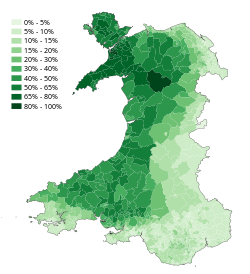
 Welsh-speaking population in Wales according to the 2021 census | |
 Welsh is classified as Vulnerable by the UNESCO Atlas of the World's Languages in Danger (2010)[9] | |
| Part of a series on the |
| Culture of Wales |
|---|
 |
| People |
| Art |

Welsh (Cymraeg [kəmˈraːiɡ] ⓘ or y Gymraeg [ə ɡəmˈraːiɡ]) is a Celtic language of the Brittonic subgroup that is native to the Welsh people. Welsh is spoken natively in Wales by about 18% of the population, by some in England, and in Y Wladfa (the Welsh colony in Chubut Province, Argentina).[10]
Historically, it has also been known in English as "British",[11] "Cambrian",[12] "Cambric"[13] and "Cymric".[14]
The Welsh Language (Wales) Measure 2011 gave the Welsh language official status in Wales.[15] Welsh and English are de jure official languages of the Senedd (the Welsh parliament).[16][17]
According to the 2021 census, 538,300 usual residents in Wales aged three or over (17.8% of the population) were able to speak Welsh, while just over a quarter (25.1%) reported having some Welsh language skills.[18]
Other surveys have produced higher figures: a survey in 2022–2023 found that 34% of people aged 16 or over could speak Welsh (of whom 18 per cent said they could speak Welsh, and 16 per cent said they had some Welsh speaking ability).[19] In March 2025, other survey data estimated that 828,600 people (26.9%) aged three or over in Wales could speak Welsh.[20]
Almost half of all Welsh speakers consider themselves fluent, while 20% are able to speak a fair amount.[21] 56% of Welsh speakers speak the language daily, and 19% speak the language weekly.[21]
Year upon year since 1951, the number of Welsh speakers in Wales has increased, though the percentage of those speakers within the population of Wales has decreased every decade apart from numbers reported via the 1991 and 2001 UK Census.
The Welsh Government plans to increase the number of Welsh-language speakers to one million, and to double the daily use of the language, by 2050.[22] Since 1980, the number of children attending Welsh-medium schools has increased, while the number going to Welsh bilingual and dual-medium schools has decreased.[23] Welsh is considered the least endangered Celtic language by UNESCO.[24]
History
[edit]The language of the Welsh developed from the language of Britons.[25] The emergence of Welsh was not instantaneous and clearly identifiable. Instead, the shift occurred over a long period, with some historians claiming that it had happened by as late as the 9th century, with a watershed moment being that proposed by linguist Kenneth H. Jackson, the Battle of Dyrham, a military battle between the West Saxons and the Britons in 577 AD,[26] which split the South Western British from direct overland contact with the Welsh.
Four periods are identified in the history of Welsh, with rather indistinct boundaries: Primitive Welsh, Old Welsh, Middle Welsh, and Modern Welsh. The period immediately following the language's emergence is sometimes referred to as Primitive Welsh,[26] followed by the Old Welsh period – which is generally considered to stretch from the beginning of the 9th century to sometime during the 12th century.[26] The Middle Welsh period is considered to have lasted from then until the 14th century, when the Modern Welsh period began, which in turn is divided into Early and Late Modern Welsh.
The word Welsh is a descendant, via Old English wealh, wielisc, of the Proto-Germanic word *Walhaz, which was derived from the name of the Celtic people known to the Romans as Volcae and which came to refer to speakers of Celtic languages, and then indiscriminately to the people of the Western Roman Empire. In Old English the term went through semantic narrowing, coming to refer to either Britons in particular or, in some contexts, slaves.[27] The plural form Wēalas evolved into the name for their territory, Wales.[28]
The modern names for various Romance-speaking people in Continental Europe (e.g. Walloons, Valaisans, Vlachs/Wallachians, and Włosi, the Polish name for Italians) have a similar etymology.[29] The Welsh term for the language, Cymraeg, descends from the Brythonic word combrogi, meaning 'compatriots' or 'fellow countrymen'.[30]
Origins
[edit]
Welsh evolved from Common Brittonic, the Celtic language spoken by the ancient Celtic Britons. Classified as Insular Celtic, the British language probably arrived in Britain during the Bronze Age or Iron Age and was probably spoken throughout the island south of the Firth of Forth.[31] During the Early Middle Ages the British language began to fragment due to increased dialect differentiation, thus evolving into Welsh and the other Brittonic languages. It is not clear when Welsh became distinct.[26][32][33]
Linguist Kenneth H. Jackson has suggested that the evolution in syllabic structure and sound pattern was complete by around AD 550, and labelled the period between then and about AD 800 "Primitive Welsh".[34] This Primitive Welsh may have been spoken in both Wales and the Hen Ogledd ('Old North') – the Brittonic-speaking areas of what are now northern England and southern Scotland – and therefore may have been the ancestor of Cumbric as well as Welsh. Jackson, however, believed that the two varieties were already distinct by that time.[26]
The earliest Welsh poetry – that attributed to the Cynfeirdd or "Early Poets" – is generally considered to date to the Primitive Welsh period. However, much of this poetry was supposedly composed in the Hen Ogledd, raising further questions about the dating of the material and language in which it was originally composed.[26] This discretion stems from the fact that Cumbric was widely believed to have been the language used in Hen Ogledd. An 8th-century inscription in Tywyn shows the language already dropping inflections in the declension of nouns.[35]
Janet Davies proposed that the origins of the Welsh language were much less definite; in The Welsh Language: A History, she proposes that Welsh may have been around even earlier than 600 AD. This is evidenced by the dropping of final syllables from Brittonic: *bardos 'poet' became bardd, and *abona 'river' became afon.[32] Though both Davies and Jackson cite minor changes in syllable structure and sounds as evidence for the creation of Old Welsh, Davies suggests it may be more appropriate to refer to this derivative language as Lingua Britannica rather than characterising it as a new language altogether.
Primitive Welsh
[edit]The argued dates for the period of "Primitive Welsh" are widely debated, with some historians' suggestions differing by hundreds of years.
Old Welsh
[edit]The next main period is Old Welsh (Hen Gymraeg, 9th to 11th centuries); poetry from both Wales and Scotland has been preserved in this form of the language. As Germanic and Gaelic colonisation of Britain proceeded, the Brittonic speakers in Wales were split off from those in northern England, speaking Cumbric, and those in the southwest, speaking what would become Cornish, so the languages diverged. Both the works of Aneirin (Canu Aneirin, c. 600) and the Book of Taliesin (Canu Taliesin) were written during this era.
Middle Welsh
[edit]Middle Welsh (Cymraeg Canol) is the label attached to the Welsh of the 12th to 14th centuries, of which much more remains than for any earlier period. This is the language of nearly all surviving early manuscripts of the Mabinogion, although the tales themselves are certainly much older. It is also the language of the existing Welsh law manuscripts. Middle Welsh is reasonably intelligible to a modern-day Welsh speaker.
- Languages of Wales 1750–1900
-
 1750
1750 -
 1800
1800 -
 1850
1850 -
 1900
1900
_-_1750.svg)
_-_1800.svg)
_-_1850.svg)
_-_1900.svg)
Modern Welsh
[edit] | This section needs additional citations for verification. (December 2017) |

The Bible translations into Welsh helped maintain the use of Welsh in daily life, and standardised spelling. The New Testament was translated by William Salesbury in 1567,[37] and the complete Bible by William Morgan in 1588.[38] Modern Welsh is subdivided into Early Modern Welsh and Late Modern Welsh.[39] Early Modern Welsh ran from the 15th century through to the end of the 16th century,[40] and the Late Modern Welsh period roughly dates from the 16th century onwards. Contemporary Welsh differs greatly from the Welsh of the 16th century, but they are similar enough for a fluent Welsh speaker to have little trouble understanding it.
During the Modern Welsh period, there has been a decline in the popularity of the Welsh language: the number of Welsh speakers declined to the point at which there was concern that the language would become extinct. During industrialisation in the late 19th century, immigrants from England led to the decline in Welsh speakers particularly in the South Wales Valleys.[41] Welsh government processes and legislation have worked to increase the proliferation of the Welsh language, for example through education.[42]
Geographical distribution
[edit]Wales
[edit]Welsh has been spoken continuously in Wales throughout history. By 1911, however, it had become a minority language, spoken by 43.5 per cent of the population.[43] While this decline continued over the following decades, the language did not die out. The smallest number of speakers was recorded in 1981 with 503,000 although the lowest percentage was recorded in the most recent census in 2021 at 17.8 per cent.[44] By the start of the 21st century, numbers began to increase once more, at least partly as a result of the increase in Welsh-medium education.[45][46]
The 2004 Welsh Language Use Survey showed that 21.7 per cent of the population of Wales spoke Welsh,[47] compared with 20.8 per cent in the 2001 census, and 18.5 per cent in the 1991 census. Since 2001, however, the number of Welsh speakers has declined in both the 2011 and 2021 censuses to about 538,300 or 17.8 per cent in 2021, lower than 1991, although it is still higher in absolute terms.[48][44] The 2011 census also showed a "big drop" in the number of speakers in the Welsh-speaking heartlands, with the number dropping to under 50 per cent in Ceredigion and Carmarthenshire for the first time.[49] However, according to the Welsh Language Use Survey in 2019–20, 22 per cent of people aged three and over were able to speak Welsh.[50]
The Annual Population Survey (APS) by the Office for National Statistics (ONS) estimated that as of December 2024, approximately 843,500, or 27.4 per cent of the population of Wales aged 3 and over, were able to speak the language.[51] Children and young people aged three to 15 years old were more likely to report that they could speak Welsh than any other age group (48.1% per cent, 235,700). Around 975,700 people, or 31.7 per cent, reported that they could understand spoken Welsh. 24.1 per cent (740,400) could read and 22.0 per cent (675,200) could write in Welsh. The APS estimates of Welsh language ability are historically higher than those produced by the census.[52]
In terms of usage, ONS also reported that 14.0 per cent (430,000) of people aged three or older in Wales reported that they spoke Welsh daily in December 2024, with 5.4 per cent (167,000) speaking it weekly and 6.6 per cent (203,300) less often. Approximately 1.4 per cent (42,800) reported that they never spoke Welsh despite being able to speak the language, with the remaining 72.6 per cent of the population not being able to speak it.[53]
The National Survey for Wales, carried out by the Welsh Government, has also generally reported a higher proportion of Welsh speakers than the census. In 2022–2023, the survey found that 34 per cent of people aged 16 or over could speak Welsh (of whom 18 per cent said they could speak Welsh, and a further 16 per cent reported having some Welsh-speaking ability. This was broadly unchanged from the 2021–2022 results.[54]
Historically, large numbers of Welsh people spoke only Welsh.[55] Over the course of the 20th century this monolingual population all but disappeared, but a small percentage remained at the time of the 1981 census.[56] Most Welsh-speaking people in Wales also speak English. However, many[quantify] Welsh-speaking people are more comfortable expressing themselves in Welsh than in English. A speaker's choice of language can vary according to the subject domain and the social context, even within a single discourse (known in linguistics as code-switching).[57]
Welsh speakers are largely concentrated in the north and west of Wales, principally Gwynedd, Conwy County Borough, Denbighshire, Anglesey, Carmarthenshire, north Pembrokeshire, Ceredigion, parts of Glamorgan, and north-west and extreme south-west Powys. However, first-language and other fluent speakers can be found throughout Wales.[58]
Outside Wales
[edit]The rest of the UK
[edit]Welsh-speaking communities persisted well into the modern period across the border in England. Archenfield was still Welsh enough in the time of Elizabeth I for the Bishop of Hereford to be made responsible, together with the four Welsh bishops, for the translation of the Bible and the Book of Common Prayer into Welsh. Welsh was still commonly spoken there in the first half of the 19th century, and churchwardens' notices were put up in both Welsh and English until about 1860.[59] Alexander John Ellis in the 1880s identified a small part of Shropshire as still then speaking Welsh, with the "Celtic Border" passing from Llanymynech through Oswestry to Chirk.[60]
The number of Welsh-speaking people in the rest of Britain has not yet been counted for statistical purposes. In 1993, the Welsh-language television channel S4C published the results of a survey into the numbers of people who spoke or understood Welsh, which estimated that there were around 133,000 Welsh-speaking people living in England, about 50,000 of them in the Greater London area.[61] The Welsh Language Board, on the basis of an analysis of the Office for National Statistics Longitudinal Study, estimated there were 110,000 Welsh-speaking people in England, and another thousand in Scotland and Northern Ireland.[62]
In the 2011 census, 8,248 people in England gave Welsh in answer to the question "What is your main language?"[63] The Office for National Statistics subsequently published a census glossary of terms to support the release of results from the census, including their definition of "main language" as referring to "first or preferred language" (though that wording was not in the census questionnaire itself).[64][65] The wards in England with the most people giving Welsh as their main language were the Liverpool wards of Central and Greenbank; and Oswestry South in Shropshire.[63] The wards of Oswestry South (1.15%), Oswestry East (0.86%) and St Oswald (0.71%) had the highest percentage of residents giving Welsh as their main language.
The census also revealed that 3,528 wards in England, or 46% of the total number, contained at least one resident whose main language is Welsh. In terms of the regions of England, North West England (1,945), London (1,310) and the West Midlands (1,265) had the highest number of people noting Welsh as their main language.[66] According to the 2021 census, 7,349 people in England recorded Welsh to be their "main language".[67]
In the 2011 census, 1,189 people aged three and over in Scotland noted that Welsh was a language (other than English) that they used at home.[68]
Argentina
[edit]It is believed that there are as many as 5,000 speakers of Patagonian Welsh.[69]
Australia
[edit]In response to the question 'Does the person speak a language other than English at home?' in the 2016 Australian census, 1,688 people noted that they spoke Welsh.[70]
Canada
[edit]In the 2011 Canadian census, 3,885 people reported Welsh as their first language.[71] According to the 2021 Canadian census, 1,130 people noted that Welsh was their mother tongue.[72][73]
New Zealand
[edit]The 2018 New Zealand census noted that 1,083 people in New Zealand spoke Welsh.[74]
United States
[edit]The American Community Survey 2017–2021 noted that 2,003 people aged five years and over in the United States spoke Welsh at home.[75]
Status
[edit]
.JPG)

Number of speakers
[edit]| Year | Welsh population over the age of 3 | Welsh speakers | |
|---|---|---|---|
| 1891 | 1,685,614 | 910,289 | 54.0% |
| 1901 |  1,864,696 1,864,696
|
930,224
|
 49.9% 49.9%
|
| 1911 | 2,279,056
|
967,266
|
42.4%
|
| 1921 | 2,492,995
|
922,092
|
37.0%
|
| 1931 | 2,472,378
|
909,261
|
36.8%
|
| 1951 | 2,472,429
|
714,689
|
28.9%
|
| 1961 | 2,518,711
|
656,000
|
26.0%
|
| 1971 | 2,609,610
|
542,420
|
20.8%
|
| 1981 | 2,645,094
|
503,532
|
19.0%
|
| 1991 | 2,685,947
|
508,344
|
18.9%
|
| 2001 | 2,805,701
|
582,368
|
20.8%
|
| 2011 | 2,955,841
|
562,016
|
19.0%
|
| 2021 | 3,018,169
|
538,298
|
17.8%
|
Legal status
[edit]Calls for the Welsh language to be granted official status grew with the establishment of the nationalist political party Plaid Cymru in 1925, the establishment of the Welsh Language Society in 1962 and the rise of Welsh nationalism in the later 20th century. Of the six living Celtic languages (including two revived), Welsh has the highest number of native speakers who use the language on a daily basis, and it is the Celtic language which is considered the least endangered by UNESCO.
The Welsh Language Act 1993 and the Government of Wales Act 1998 provide that the Welsh and English languages be treated equally in the public sector, as far as is reasonable and practicable. Each public body is required to prepare for approval a Welsh Language Scheme, which indicates its commitment to the equality of treatment principle. This is sent out in draft form for public consultation for a three-month period, whereupon comments on it may be incorporated into a final version. It requires the final approval of the now defunct Welsh Language Board (Bwrdd yr Iaith Gymraeg). Thereafter, the public body is charged with implementing and fulfilling its obligations under the Welsh Language Scheme. The list of other public bodies which have to prepare Schemes could be added to by initially the Secretary of State for Wales, from 1993 to 1997, by way of statutory instrument. Subsequent to the forming of the National Assembly for Wales in 1997, the Government Minister responsible for the Welsh language can and has passed statutory instruments naming public bodies who have to prepare Schemes. Neither the 1993 Act nor secondary legislation made under it covers the private sector, although some organisations, notably banks and some railway companies, provide some of their information in Welsh.[78][79]
On 7 December 2010, the Welsh Assembly unanimously approved a set of measures to develop the use of the Welsh language within Wales.[80][81] On 9 February 2011 this measure, the Welsh Language (Wales) Measure 2011, was passed and received Royal Assent, thus making the Welsh language an officially recognised language within Wales. The measure:
- confirmed the official status of the Welsh language
- created a new system of placing duties on bodies to provide services through the medium of Welsh
- created a Welsh Language Commissioner with strong enforcement powers to protect the rights of Welsh-speaking people to access services through the medium of Welsh
- established a Welsh Language Tribunal
- gave individuals and bodies the right to appeal decisions made in relation to the provision of services through the medium of Welsh
- created a Welsh Language Partnership Council to advise Government on its strategy in relation to the Welsh language
- allowed for an official investigation by the Welsh Language Commissioner of instances where there is an attempt to interfere with the freedom of Welsh-speaking people to use the language with one another[82]
The measure required public bodies and some private companies to provide services in Welsh. The Welsh government's Minister for Heritage at the time, Alun Ffred Jones, said, "The Welsh language is a source of great pride for the people of Wales, whether they speak it or not, and I am delighted that this measure has now become law. I am very proud to have steered legislation through the Assembly which confirms the official status of the Welsh language; which creates a strong advocate for Welsh speakers and will improve the quality and quantity of services available through the medium of Welsh. I believe that everyone who wants to access services in the Welsh language should be able to do so, and that is what this government has worked towards. This legislation is an important and historic step forward for the language, its speakers and for the nation."[82] The measure was not welcomed warmly by all supporters: Bethan Williams, chairman of the Welsh Language Society, gave a mixed response to the move, saying, "Through this measure we have won official status for the language and that has been warmly welcomed. But there was a core principle missing in the law passed by the Assembly before Christmas. It doesn't give language rights to the people of Wales in every aspect of their lives. Despite that, an amendment to that effect was supported by 18 Assembly Members from three different parties, and that was a significant step forward."[83]
On 5 October 2011, Meri Huws, Chair of the Welsh Language Board, was appointed the new Welsh Language Commissioner.[84] She released a statement that she was "delighted" to have been appointed to the "hugely important role", adding, "I look forward to working with the Welsh Government and organisations in Wales in developing the new system of standards. I will look to build on the good work that has been done by the Welsh Language Board and others to strengthen the Welsh language and ensure that it continues to thrive." First Minister Carwyn Jones said that Huws would act as a champion for the Welsh language, though some had concerns over her appointment: Plaid Cymru spokeswoman Bethan Jenkins said, "I have concerns about the transition from Meri Huws's role from the Welsh Language Board to the language commissioner, and I will be asking the Welsh government how this will be successfully managed. We must be sure that there is no conflict of interest, and that the Welsh Language Commissioner can demonstrate how she will offer the required fresh approach to this new role." Huws started her role as the Welsh Language Commissioner on 1 April 2012.
Local councils and the Senedd use Welsh, issuing Welsh versions of their literature, to varying degrees.

Road signs in Wales are in Welsh and English.[85] Prior to 2016, the choice of which language to display first was the responsibility of the local council. Since then, as part of the Welsh Language (Wales) Measure 2011, all new signs have Welsh displayed first.[86] There have been incidents of one of the languages being vandalised, which may be considered a hate crime.[87][88]
Since 2000, the teaching of Welsh has been compulsory in all schools in Wales up to age 16; this has had an effect in stabilising and reversing the decline in the language.[89]
Text on UK coins tends to be in English and Latin. However, a Welsh-language edge inscription was used on pound coins dated 1985, 1990 and 1995, which circulated in all parts of the UK prior to their 2017 withdrawal. The wording is Pleidiol wyf i'm gwlad (Welsh for 'True am I to my country'), and derives from the national anthem of Wales, "Hen Wlad Fy Nhadau". Banknotes used in Wales are in English only, as these are issued by the Bank of England for both England and Wales.
Some shops employ bilingual signage. Welsh sometimes appears on product packaging or instructions.
The UK government has ratified the European Charter for Regional or Minority Languages in respect of Welsh.[90]

The language has greatly increased its prominence since the creation of the television channel S4C in November 1982, which until digital switchover in 2010 broadcast 70 per cent of Channel 4's programming along with a majority of Welsh language shows[91] during peak viewing hours. The all-Welsh-language digital station S4C Digidol is available throughout Europe on satellite and online throughout the UK. Since the digital switchover was completed in South Wales on 31 March 2010, S4C Digidol became the main broadcasting channel and fully in Welsh. The main evening television news provided by the BBC in Welsh is available for download.[92] There is also a Welsh-language radio station, BBC Radio Cymru, which was launched in 1977.[93]
The only Welsh-language national newspaper Y Cymro (The Welshman) was published weekly until 2017, and monthly thereafter, following a change in ownership. There is no daily newspaper in Welsh. A daily newspaper called Y Byd (The World) was scheduled to be launched on 3 March 2008, but was scrapped, owing to insufficient sales of subscriptions and the Welsh Government offering only one third of the £600,000 public funding it needed.[94] There is a Welsh-language online news service which publishes news stories in Welsh called Golwg360 ('360 [degree] view').
As of March 2021, there were 58 local Welsh language community newspapers, known as Papurau Bro, in circulation.[95]
In education
[edit]
The decade around 1840 was a period of great social upheaval in Wales, manifested in the Chartist movement. In 1839, 20,000 people marched on Newport, resulting in a riot when 20 people were killed by soldiers defending the Westgate Hotel, and the Rebecca Riots where tollbooths on turnpikes were systematically destroyed.
This unrest brought the state of education in Wales to the attention of the British government since social reformers of the time considered education as a means of dealing with social ills. The Times newspaper was prominent among those who considered that the lack of education of the Welsh people was the root cause of most of the problems.
In July 1846, three commissioners, R.R.W. Lingen, Jellynger C. Symons and H.R. Vaughan Johnson, were appointed to inquire into the state of education in Wales; the Commissioners were all Anglicans and thus presumed unsympathetic to the nonconformist majority in Wales. The Commissioners presented their report to the Government on 1 July 1847 in three large blue-bound volumes. This report quickly became known in Wales as the Brad y Llyfrau Gleision (Treason of the Blue Books) since,[96] apart from documenting the state of education in Wales, the Commissioners were also free with their comments disparaging the language, nonconformity, and the morals of the Welsh people in general. An immediate effect of the report was that ordinary Welsh people began to believe that the only way to get on in the world was through the medium of English, and an inferiority complex developed about the Welsh language whose effects have not yet been completely eradicated. The historian Professor Kenneth O. Morgan referred to the significance of the report and its consequences as "the Glencoe and the Amritsar of Welsh history".[97]
In the later 19th century, the teaching of English in Welsh schools was generally supported by the Welsh public and parents who saw it as the language of economic advancement.[98]: 453, 457 Virtually all teaching in the schools of Wales was in English, even in areas where the pupils barely understood English. Some schools used the Welsh Not, a piece of wood, often bearing the letters "WN", which was hung around the neck of any pupil caught speaking Welsh. The pupil could pass it on to any schoolmate heard speaking Welsh, with the pupil wearing it at the end of the day being punished. One of the most famous Welsh-born pioneers of higher education in Wales was Sir Hugh Owen. He made great progress in the cause of education, and more especially the University College of Wales at Aberystwyth, of which he was chief founder. He has been credited [by whom?] with the Welsh Intermediate Education Act 1889 (52 & 53 Vict c 40), following which several new Welsh schools were built. The first was completed in 1894 and named Ysgol Syr Hugh Owen.
Towards the beginning of the 20th century this policy slowly began to change, partly owing to the efforts of O.M. Edwards when he became chief inspector of schools for Wales in 1907.
The Ysgol Gymraeg Aberystwyth ('Aberystwyth Welsh School') was founded in 1939 by Sir Ifan ap Owen Edwards, the son of O.M. Edwards, as the first Welsh Primary School.[99] The headteacher was Norah Isaac. Ysgol Gymraeg Aberystwyth is still a very successful school, and now there are Welsh-language primary schools all over the country. Ysgol Glan Clwyd was established in Rhyl in 1956 as the first Welsh-medium secondary school.[100]

Welsh is now widely used in education, with 101,345 children and young people in Wales receiving their education in Welsh medium schools in 2014/15, 65,460 in primary and 35,885 in secondary.[101] 26 per cent of all schools in Wales are defined as Welsh medium schools, with a further 7.3 per cent offering some Welsh-medium instruction to pupils.[102] 22 per cent of pupils are in schools in which Welsh is the primary language of instruction. Under the National Curriculum, it is compulsory that all students study Welsh up to the age of 16 as either a first or a second language.[103] Some students choose to continue with their studies through the medium of Welsh for the completion of their A-levels as well as during their college years. All local education authorities in Wales have schools providing bilingual or Welsh-medium education.[104] The remainder study Welsh as a second language in English-medium schools. Specialist teachers of Welsh called Athrawon Bro support the teaching of Welsh in the National Curriculum. Welsh is also taught in adult education classes. The Welsh Government has recently set up six centres of excellence in the teaching of Welsh for Adults, with centres in North Wales,[105] Mid Wales, South West, Glamorgan, Gwent, and Cardiff.
The ability to speak Welsh or to have Welsh as a qualification is desirable for certain career choices in Wales, such as teaching or customer service.[106] All universities in Wales teach courses in the language, with many undergraduate and post-graduate degree programmes offered in the medium of Welsh, ranging from law, modern languages, social sciences, and also other sciences such as biological sciences. Aberystwyth, Cardiff, Bangor, and Swansea have all had chairs in Welsh since their virtual establishment, and all their schools of Welsh are successful centres for the study of the Welsh language and its literature, offering a BA in Welsh as well as post-graduate courses. At all Welsh universities and the Open University, students have the right to submit assessed work and sit exams in Welsh even if the course was taught in English (usually the only exception is where the course requires demonstrating proficiency in another language). Following a commitment made in the One Wales coalition government between Labour and Plaid Cymru, the Coleg Cymraeg Cenedlaethol (Welsh Language National College) was established. The purpose of the federal structured college, spread out between all the universities of Wales, is to provide and also advance Welsh medium courses and Welsh medium scholarship and research in Welsh universities. There is also a Welsh-medium academic journal called Gwerddon ('Oasis'),[107] which is a platform for academic research in Welsh and is published quarterly. There have been calls for more teaching of Welsh in English-medium schools.
Use in professional engineering
[edit]When conducting applicants' professional reviews for Chartered Engineer status, the Institution of Engineering and Technology accepts applications in Welsh and will conduct face-to-face interviews in Welsh if requested to do so. One of the requirements for Chartered Engineer is also to be able to communicate effectively in English.
In information technology
[edit]Like many of the world's languages, the Welsh language has seen an increased use and presence on the internet, ranging from formal lists of terminology in a variety of fields[108] to Welsh language interfaces for Microsoft Windows XP and up, Microsoft Office, LibreOffice, OpenOffice.org, Mozilla Firefox and a variety of Linux distributions, and on-line services to blogs kept in Welsh.[109] Wikipedia has had a Welsh version since July 2003 and Facebook since 2009.
Mobile phone technology
[edit]In 2006 the Welsh Language Board launched a free software pack which enabled the use of SMS predictive text in Welsh.[110] At the National Eisteddfod of Wales 2009, a further announcement was made by the Welsh Language Board that the mobile phone company Samsung was to work with the network provider Orange to provide the first mobile phone in the Welsh language,[111] with the interface and the T9 dictionary on the Samsung S5600 available in the Welsh language. The model, available with the Welsh language interface, has been available since 1 September 2009, with plans to introduce it on other networks.[112]
On Android devices, both the built-in Google Keyboard and user-created keyboards can be used.[113] iOS devices have fully supported the Welsh language since the release of iOS 8 in September 2014. Users can switch their device to Welsh to access apps that are available in Welsh. Date and time on iOS is also localised, as shown by the built-in Calendar application, as well as certain third-party apps that have been localised.[114][115]
In warfare
[edit]Secure communications are often difficult to achieve in wartime. Just as Navajo code talkers were used by the United States military during World War II, the Royal Welch Fusiliers, a Welsh regiment serving in Bosnia, used Welsh for emergency communications that needed to be secure.[116]
Use within the British parliament
[edit]In 2017, parliamentary rules were amended to allow the use of Welsh when the Welsh Grand Committee meets at Westminster. The change did not alter the rules about debates within the House of Commons, where only English can be used.[117]
In February 2018, Welsh was first used when the Welsh Secretary, Alun Cairns, delivered his welcoming speech at a sitting of the committee. He said, "I am proud to be using the language I grew up speaking, which is not only important to me, my family and the communities Welsh MPs represent, but is also an integral part of Welsh history and culture".[118][119][120]
Use at the European Union
[edit]In November 2008, the Welsh language was used at a meeting of the European Union's Council of Ministers for the first time. The Heritage Minister Alun Ffred Jones addressed his audience in Welsh and his words were interpreted into the EU's 23 official languages. The official use of the language followed years of campaigning. Jones said "In the UK we have one of the world's major languages, English, as the mother tongue of many. But there is a diversity of languages within our islands. I am proud to be speaking to you in one of the oldest of these, Welsh, the language of Wales." He described the breakthrough as "more than [merely] symbolic" saying "Welsh might be one of the oldest languages to be used in the UK, but it remains one of the most vibrant. Our literature, our arts, our festivals, our great tradition of song all find expression through our language. And this is a powerful demonstration of how our culture, the very essence of who we are, is expressed through language."[121]
Jill Evans MEP used Welsh in a number of speeches in the European Parliament. In 2004, her using Welsh was the first use of the language in the European Parliament.[122] The last time Welsh was spoken in the European Parliament was during Evans' last speech shortly before Brexit.[123]
Use by the Voyager programme
[edit]A greeting in Welsh is one of the 55 languages included on the Voyager Golden Record chosen to be representative of Earth in NASA's Voyager programme launched in 1977.[124] The greetings are unique to each language, with the Welsh greeting being Iechyd da i chwi yn awr ac yn oesoedd, which translates into English as "Good health to you now and forever".[125][126]
Vocabulary
[edit]Welsh supplements its core Brittonic vocabulary (words such as wy "egg", carreg "stone") with hundreds of word lemmas borrowed from Latin,[127] such as (ffenestr 'window' < Latin fenestra, gwin 'wine' < Latin vinum). It also borrows words from English, such as (silff 'shelf', giât 'gate').
Phonology
[edit]The phonology of Welsh includes a number of sounds that do not occur in English and are typologically rare in European languages. The voiceless alveolar lateral fricative [ɬ], the voiceless nasals [m̥], [n̥] and [ŋ̊], and the voiceless alveolar trill [r̥] are distinctive features of the Welsh language. Stress usually falls on the penultimate syllable in polysyllabic words, and the word-final unstressed syllable receives a higher pitch than the stressed syllable.
| Labial | Dental | Alveolar | Lateral | Post- alveolar |
Palatal | Velar | Uvular | Glottal | ||||||||||
|---|---|---|---|---|---|---|---|---|---|---|---|---|---|---|---|---|---|---|
| Nasal | m̥ | m | n̥ | n | ŋ̊ | ŋ | ||||||||||||
| Stop | p | b | t | d | (tʃ) | (dʒ) | k | ɡ | ||||||||||
| Fricative | f | v | θ | ð | s | (z) | ɬ | ʃ | χ | h | ||||||||
| Trill | r̥ | r | ||||||||||||||||
| Approximant | l | j | (ʍ) | w | ||||||||||||||
Symbols in parentheses are either allophones, or found only in loanwords.
| Front | Central | Back | ||||
|---|---|---|---|---|---|---|
| short | long | short | long | short | long | |
| Close | ɪ | iː | ɨ̞ | ɨː | ʊ | uː |
| Mid | ɛ | eː | ə | ɔ | oː | |
| Open | a | aː | ||||
The vowels /ɨ̞/ and /ɨ/ are only found in Northern varieties of Welsh. In the South these have merged with /ɪ/ and /i/ in all cases.
Orthography
[edit]Welsh is written in a Latin alphabet of 29 letters, of which eight are digraphs treated as single letters for collation, for example fy comes before ffrwyth in the dictionary:
- a, b, c, ch, d, dd, e, f, ff, g, ng, h, i, j, l, ll, m, n, o, p, ph, r, rh, s, t, th, u, w, y
In contrast to English practice, ⟨w⟩ and ⟨y⟩ are considered vowel letters in Welsh along with ⟨a, e, i, o, u⟩.
⟨j⟩ was not used traditionally but is now used in many everyday words borrowed from English such as jam ('jam'), jôc ('joke') and garej ('garage'). ⟨k, q, v, x, z⟩ are used in some technical terms such as kilogram, volt and zero but in all cases can be, and often are, replaced by Welsh letters (same pronunciation): cilogram, folt and sero.[128] ⟨k⟩ was in common use until the 16th century but was dropped at the time of the publication of the New Testament in Welsh, as William Salesbury explained: "⟨c⟩ for ⟨k⟩, because the printers have not so many as the Welsh requireth". This change was not popular at the time.[129]
The most common diacritic is the circumflex (called to bach in Welsh, lit. 'little roof'),[130] which usually disambiguates long vowels, most often in the case of homographs, where the vowel is short in one word and long in the other: e.g. man ('place') v. mân ('fine, small').
Morphology
[edit]Welsh morphology has much in common with that of the other modern Insular Celtic languages, such as the use of initial consonant mutations and of so-called "conjugated prepositions" (prepositions that fuse with the personal pronouns that are their object). Welsh nouns belong to one of two grammatical genders, masculine and feminine, but they are not inflected for case. Welsh has a variety of different endings and other methods to indicate the plural, and two endings to indicate the singular (technically the singulative) of some nouns. In spoken Welsh, verbal features are indicated primarily by the use of auxiliary verbs rather than by the inflection of the main verb. In literary Welsh, on the other hand, inflection of the main verb is usual.
Syntax
[edit]The canonical word order in Welsh is verb–subject–object (VSO).
Colloquial Welsh inclines very strongly towards the use of auxiliaries with its verbs, as in English. The present tense is constructed with bod ('to be') as an auxiliary verb, with the main verb appearing as a verbnoun (used in a way loosely equivalent to an infinitive) after the particle yn:
- Mae Siân yn mynd i Lanelli.
- Siân is going to Llanelli.
There, mae is a third-person singular present indicative form of bod, and mynd is the verb-noun meaning "to go". The imperfect is constructed in a similar manner, as are the periphrastic forms of the future and conditional tenses.
In the preterite, future and conditional mood tenses, there are inflected forms of all verbs, which are used in the written language. However, speech now more commonly uses the verbnoun together with an inflected form of gwneud ('do'), so "I went" can be Mi es i or Mi wnes i fynd ('I did go'). Mi is an example of a preverbal particle; such particles are common in Welsh, though less so in the spoken language.
Welsh lacks separate pronouns for constructing subordinate clauses; instead, special verb forms or relative pronouns that appear identical to some preverbal particles are used.
Possessives as direct objects of verbnouns
[edit]The Welsh for "I like Rhodri" is Dw i'n hoffi Rhodri (word for word, "am I [the] liking [of] Rhodri"), with Rhodri in a possessive relationship with hoffi. With personal pronouns, the possessive form of the personal pronoun is used, as in "I like him": [Dw i'n ei hoffi], literally, "am I his liking" – "I like you" is [Dw i'n dy hoffi] ('am I your liking'). Very informally, the pronouns are often heard in their normal subject/object form and aping English word order: Dw i'n hoffi ti ('Am I liking you').
Pronoun doubling
[edit]In colloquial Welsh, possessive pronouns, whether they are used to mean "my", "your", etc. or to indicate the direct object of a verbnoun, are commonly reinforced by the use of the corresponding personal pronoun after the noun or verbnoun: ei dŷ e "his house" (literally "his house of him"), Dw i'n dy hoffi di "I like you" ('I am [engaged in the action of] your liking of you'), etc. The "reinforcement" (or, simply, "redoubling") adds no emphasis in the colloquial register. While the possessive pronoun alone may be used, especially in more formal registers, as shown above, it is considered incorrect to use only the personal pronoun. Such usage is nevertheless sometimes heard in very colloquial speech, mainly among young speakers: Ble 'dyn ni'n mynd? Tŷ ti neu dŷ fi? ('Where are we going? Your house or my house?').
Grammar
[edit]Welsh is a moderately inflecting language. Verbs inflect at least for person, number and mood, while nouns inflect for number and there is a masculine-feminine distinction, of which the latter is marked via consonant mutation.
Colloquial and literary grammar show more differences than in English.
Counting system
[edit]The traditional counting system used in the Welsh language is vigesimal, i.e. it is based on twenties. Welsh numbers from 11 to 14 are "x on ten" (e.g. un ar ddeg: 11), 16 to 19 are "x on fifteen" (e.g. un ar bymtheg: 16), though 18 is deunaw, "two nines"; numbers from 21 to 39 are "1–19 on twenty"(e.g. deg ar hugain: 30), 40 is deugain "two twenties", 60 is trigain "three twenties", etc. This form continues to be used, especially by older people, and it is obligatory in certain circumstances (such as telling the time, and in ordinal numbers).[131]
There is also a decimal counting system, which has become relatively widely used, though less so in giving the time, ages, and dates (it features no ordinal numbers). This system originated in Patagonian Welsh and was subsequently introduced to Wales in the 1940s.[132] Whereas 39 in the vigesimal system is pedwar ar bymtheg ar hugain ('four on fifteen on twenty') or even deugain namyn un ('two twenty minus one'), in the decimal system it is tri deg naw ('three tens nine').
Although there is only one word for "one" (un), it triggers the soft mutation (treiglad meddal) of feminine nouns, where possible, other than those beginning with "ll" or "rh". There are separate masculine and feminine forms of the numbers 'two' (dau and dwy), 'three' (tri and tair) and 'four' (pedwar and pedair), which must agree with the grammatical gender of the objects being counted. The objects being counted appear in the singular, not plural form.
Dialects
[edit]There is a great deal of variation among Welsh dialects in terms of vocabulary, grammar, and pronunciation. For example: consider the question "Do you want a cuppa [a cup of tea]?" In Gwynedd, this would typically be Dach chi isio paned? while in the south of Dyfed one would be more likely to hear Ych chi'n moyn dishgled? (though, in other parts of the South, one could hear Ych chi isie paned? as well, among other possibilities). An example of a pronunciation difference is the tendency in some southern dialects to palatalise the letter "s", e.g. mis (Welsh for 'month'), usually pronounced IPA: [miːs], but as IPA: [miːʃ] in parts of the south. This normally occurs next to a high front vowel like /i/, although exceptions include the pronunciation of sut "how" as IPA: [ʃʊd] in the southern dialects (compared with northern IPA: [sɨt]).
The four traditional dialects
[edit]Although modern understanding often splits Welsh into northern (Gogledd) and southern (De) 'dialects', the traditional classification of four Welsh dialects remains the most academically useful:
- Gwyndodeg, the Gwynedd dialect
- Powyseg, the Powys dialect
- Dyfedeg, the Dyfed dialect
- Gwenhwyseg, the dialect of Gwent and Morgannwg[133]
A fifth dialect is Patagonian Welsh, which has developed since the start of Y Wladfa (the Welsh settlement in Argentina) in 1865; it includes Spanish loanwords and terms for local features, but a survey in the 1970s showed that the language in Patagonia is consistent throughout the lower Chubut Valley and in the Andes.
Subdialects exist within the main dialects (such as the Cofi dialect). The 1989 book Cymraeg, Cymrâg, Cymrêg: Cyflwyno'r Tafodieithoedd (Welsh for 'Welsh, Welsh, Welsh: Introducing the Dialects') was accompanied by a cassette containing recordings of 14 different speakers demonstrating aspects of different regional dialects. The book also refers to the earlier Linguistic Geography of Wales (1973) as describing six different regions which could be identified as having words specific to those regions.[134][135]
In the 1970s, there was an attempt to standardise the Welsh language by teaching Cymraeg Byw ('Living Welsh') – a colloquially based generic form of Welsh,[136] but the attempt largely failed because it did not encompass the regional differences used by Welsh speakers.
Registers
[edit]Modern Welsh can be considered to fall broadly into two main registers—Colloquial Welsh (Cymraeg llafar) and Literary Welsh (Cymraeg llenyddol). Colloquial Welsh is used in most speech and informal writing. Literary Welsh is closer to the form of Welsh standardised by the 1588 translation of the Bible (although the 2004 Beibl Cymraeg Newydd (Welsh for 'New Welsh Bible') is significantly less formal than the traditional 1588 Bible), and is found in official documents and other formal registers, including much literature. As a standardised form, literary Welsh shows little if any of the dialectal variation found in colloquial Welsh. Some differences include:
| Literary Welsh | Colloquial Welsh |
|---|---|
| Can omit subject pronouns (pro-drop) | Subject pronouns rarely omitted |
| More extensive use of simple verb forms | More extensive use of periphrastic verb forms |
| No distinction between simple present and future (e.g. af 'I go' and 'I shall go') |
Simple form most often expresses only future (e.g. af i 'I'll go') |
| Subjunctive verb forms | Subjunctive in fixed idioms only |
| 3rd.pl ending and pronoun -nt hwy | 3rd.pl ending and pronoun -n nhw |
Amongst the characteristics of the literary, as against the spoken language are a higher dependence on inflected verb forms, different usage of some of the tenses, less frequent use of pronouns (since the information is usually conveyed in the verb/preposition inflections) and a much lesser tendency to substitute English loanwords for native Welsh words. In addition, more archaic pronouns and forms of mutation may be observed in Literary Welsh.[137]
Examples of sentences in literary and colloquial Welsh
[edit]| English | Literary Welsh | Colloquial Welsh |
|---|---|---|
| I get up early every day. | Codaf yn gynnar bob dydd. | Dw i'n codi'n gynnar bob dydd. (North) Rydw i'n codi'n gynnar bob dydd. (South) |
| I'll get up early tomorrow. | Codaf yn gynnar yfory. | Mi goda i'n gynnar fory. (North) Wna i godi'n gynnar fory. (South) |
| He had not stood there long. | Ni safasai yno yn hir.[138] | Doedd o ddim wedi sefyll yno'n hir. (North) Doedd e ddim wedi sefyll yna'n hir. (South) |
| They'll sleep only when there's a need. | Ni chysgant ond pan fo angen. | Fyddan nhw'n cysgu ddim ond pan fydd angen. |
The differences between colloquial and literary Welsh are so stark as to lack mutual intelligibility, with Welsh grammarian Gareth King asserting that they are almost two different languages in practice.[139] A grammar of Literary Welsh can be found in A Grammar of Welsh by Stephen J. Williams.[140] A more complete grammar can be found in Gramadeg y Gymraeg by Peter Wynn Thomas.[141] No comprehensive grammar of formal literary Welsh exists in English. However, Dweud Eich Dweud by Ceri Jones functions as an English-language guide to colloquial Welsh forms and register and dialect differences.[142]
Example text
[edit]Article 1 of the Universal Declaration of Human Rights:
Genir pawb yn rhydd ac yn gydradd â'i gilydd mewn urddas a hawliau. Fe'u cynysgaeddir â rheswm a chydwybod, a dylai pawb ymddwyn y naill at y llall mewn ysbryd cymodlon.[143]
All human beings are born free and equal in dignity and rights. They are endowed with reason and conscience and should act towards one another in a spirit of brotherhood.[144]
See also
[edit]
- Association of Welsh Translators and Interpreters
- English and Welsh
- Honourable Society of Cymmrodorion
- Languages in the United Kingdom
- List of Welsh-language media
- List of Welsh films
- List of Welsh-language authors
- List of Welsh-language poets (6th century to c. 1600)
- List of Welsh people
- List of Welsh areas by percentage of Welsh-speakers
- Welsh literature
- Dal Ati
- St Benet's, Paul's Wharf
- Welsh Language Board
- Welsh placenames
- Welsh Tract
- Sindarin (A language invented by J. R. R. Tolkien for his legendarium – a body of literary works, mostly set in Middle-earth. The language was strongly influenced by Welsh.)
Notes
[edit]- ^ Hywel Jones. "Estimation of the number of Welsh speakers in England" (PDF). calls.ac.uk.
- ^ Devine, Darren (30 March 2013). "Patagonia's Welsh settlement was 'cultural colonialism' says academic". Wales Online. Cardiff: Trinity Mirror. Retrieved 6 May 2017.
Now, though 50,000 Patagonians are thought to be of Welsh descent, the number of Welsh speakers is believed to be between only 1,500 and 5,000.
- ^ "Wales and Patagonia". Wales.com. Welsh Government. Archived from the original on 5 April 2018. Retrieved 22 May 2016.
Today the province of Chubut, where most Welsh immigrants settled, has a population of 550,000 people. Of these, some 50,000 can claim Welsh ancestry and 5,000 speak the Welsh language.
- ^ Prior, Neil (30 May 2015). "Patagonia 150 years on: A 'little Wales beyond Wales'". BBC News. Retrieved 30 July 2020.
- ^ Harris, Trevor (October 2018). "The Welsh language in Patagonia". European Journal of Language Policy. 10 (2): 277–295. doi:10.3828/ejlp.2018.15.
- ^ "Population of immigrant mother tongue families, showing main languages comprising each family, Canada, 2011". Statistics Canada. Retrieved 21 August 2017.
- ^ "Detailed Languages Spoken at Home and Ability to Speak English for the Population 5 Years and Over: 2017-2021".
- ^ "Cultural diversity: Census 2021". Australian Bureau of Statistics. 12 January 2022. Retrieved 8 October 2023.
- ^ Moseley, Christopher; Nicolas, Alexandre (2010). Atlas of the world's languages in danger / editor-in-Chief, Christopher Moseley ; cartographer, Alexandre Nicolas. Memory of peoples series (3rd ed. entirely revised, enlarged and updated. ed.). Paris: UNESCO, Intangible Cultural Heritage Section. ISBN 978-92-3-104095-5.
- ^ Edwards, Huw. "Why do they speak Welsh in South America?". BBC iWonder. Archived from the original on 9 July 2019. Retrieved 16 September 2017.
- ^ E.g. in the Act of Uniformity 1662 (13–14 Chas. II, c. 55) §27: "That the Book [of Common Prayer] hereunto annexed be truly and exactly translated into the British or Welsh tongue."
- ^ Nolan, Edward Henry (1859). Great Britain As It Is. London: John Lane & Co. p. 47. Retrieved 10 September 2018.
- ^ Jackson, John (1752). Chronological Antiquities. Vol. III. London: J Noon. p. 143.
- ^ Walter Thomas, Mrs D; Hughes, Edward (1879), The Cymric Language, Cardiff: D Duncan & Sons
- ^ "Welsh Language (Wales) Measure 2011". legislation.gov.uk. The National Archives. Retrieved 30 May 2016.
The Welsh language has official status in Wales.
- ^ "National Assembly for Wales (Official Languages) Act 2012". www.legislation.gov.uk. The National Archives. Retrieved 19 April 2018.
The official languages of the Assembly are English and Welsh.
- ^ Dunbar, R (2007). Diversity in addressing diversity: Canadian and British legislative approaches to linguistic minorities and their international legal context. In: Williams C (ed) Language and Governance. Cardiff: University of Wales Press. p. 104.
- ^ "Welsh language in Wales (Census 2021) [HTML] | GOV.WALES". www.gov.wales. 6 December 2022. Retrieved 27 August 2025.
- ^ "Welsh language speaking ability and use (National Survey for Wales): April 2022 to March 2023 [HTML] | GOV.WALES". www.gov.wales. 14 August 2025. Retrieved 27 August 2025.
- ^ "Welsh language data from the Annual Population Survey: April 2024 to March 2025 [HTML] | GOV.WALES". www.gov.wales. 3 July 2025. Retrieved 9 July 2025.
- ^ a b "Welsh language use in Wales (initial findings): July 2019 to March 2020 (revised) | GOV.WALES". www.gov.wales. 17 February 2022. Retrieved 19 December 2023.
- ^ "Cymraeg 2050: work programme 2021 to 2026 [HTML] | GOV.WALES". www.gov.wales. 12 July 2021. Retrieved 9 July 2025.
- ^ "Almost a quarter of children in Wales are taught only in Welsh, as the language experiences a revival". ITV News. 4 September 2017. Retrieved 1 June 2020.
- ^ Luain, Cathal Ó. "Unesco: Status of Celtic languages outlined by atlas". Agence Bretagne Presse (in French). Retrieved 25 May 2023.
- ^ Charles-Edwards, Thomas M (2013). "2: Britons and their Languages". Wales and the Britons, 350–1064 (1st ed.). Oxford University Press. p. 75. ISBN 978-0-19-821731-2. OCLC 823319671.
- ^ a b c d e f Koch, John T. (2006). Celtic Culture: A Historical Encyclopedia. Santa Barbara: ABC-CLIO. p. 1757. ISBN 9781851094400. OCLC 266510465.
- ^ Miller, Katherine L. (2014). The Semantic Field of Slavery in Old English: Wealh, Esne, Þræl (PDF) (Doctoral dissertation). University of Leeds. pp. 81–83. Retrieved 8 August 2019.
- ^ Davies, John (1994) A History of Wales. Penguin: p.71; ISBN 0-14-014581-8.
- ^ "Welsh (adj.)". Online Etymology Dictionary. Retrieved 18 November 2019.
As a noun, "the Britons," also "the Welsh language," both from Old English. The word survives in Wales, Cornwall, Walloon, walnut, and in surnames Walsh and Wallace.
- ^ "Welsh: the only Celtic language not classified as "endangered" by UNESCO". UN Regional Information Centre for Western Europe. The United Nations. 5 February 2015. Retrieved 30 November 2019.[permanent dead link]
- ^ Koch, pp. 291–292.
- ^ a b Janet, Davies (15 January 2014). The Welsh Language: A History. Cardiff: University of Wales Press. ISBN 978-1-78316-019-8. OCLC 878137213.
- ^ Higham, Nicholas (1 April 2014). "T. M. Charles-Edwards. Wales and the Britons, 350–1064". The American Historical Review. 119 (2): 578–579. doi:10.1093/ahr/119.2.578. ISSN 0002-8762.
- ^ Koch, p. 1757.
- ^ Jenkins, Simon (2008). Wales: Churches, Houses, Castles. Allen Lane. p. 244. ISBN 9780141024127. OCLC 751732135.
- ^ "Llanwnda Bible damaged in last invasion of Britain on display". BBC News. 3 January 2018. Retrieved 18 November 2019.
- ^ "William Salesbury's New Testament | The National Library of Wales". Library.wales. Retrieved 1 June 2020.
- ^ "William Morgan | Welsh bishop". Encyclopaedia Britannica. Retrieved 1 June 2020.
- ^ Llŷr, Dylan (20 August 2013). "Is Welsh the oldest language?". Why Welsh?. Retrieved 10 September 2018.
- ^ "History – Themes – Chapter 14: Culture and religion in early modern Wales". BBC Wales. 1 January 1970. Retrieved 1 June 2020.
- ^ "Migration". www.agor.org.uk. Retrieved 27 December 2023.
- ^ Brant, Colin (Spring 2020). "Communication and Culture: The Role of Language Policy on Regional Minority Languages in the Reduction of Political Conflict". Applied Linguistics Commons: 1–77.
- ^ "The Industrial Revolution". Wales History. BBC. Retrieved 30 December 2011.
- ^ a b "Welsh language in Wales (Census 2021) | GOV.WALES". www.gov.wales. 6 December 2022. Retrieved 27 December 2023.
- ^ Morris, Steven (18 December 2017). "Wales launches strategy to double number of Welsh speakers by 2050". The Guardian. Retrieved 25 February 2019.
- ^ "'Encouraging' survey suggests rise in Welsh language speakers". BBC News Online. 22 September 2018. Retrieved 25 February 2019.
- ^ "2004 Welsh Language Use Survey: the report" (PDF). Archived from the original (PDF) on 27 April 2012. Retrieved 5 June 2012.
- ^ "2011 Census: Key Statistics for Wales, March 2011". Office for National Statistics. Retrieved 12 December 2012.
- ^ "2011 Census: Number of Welsh speakers falling". BBC News Online. 11 December 2012. Retrieved 12 December 2012.
- ^ "Welsh language use in Wales (initial findings): July 2019 to March 2020". Welsh Government. Retrieved 16 September 2021.
- ^ "Welsh language data from the Annual Population Survey: 2024 [HTML] | GOV.WALES". www.gov.wales. 16 April 2025. Retrieved 17 April 2025.
- ^ "Annual Population Survey: Welsh language". Welsh Government. Retrieved 7 October 2021.
- ^ "Welsh language data from the Annual Population Survey: April 2023 to March 2024 [HTML] | GOV.WALES". www.gov.wales. 27 June 2024. Retrieved 25 July 2024.
- ^ "Welsh language speaking ability and use (National Survey for Wales): April 2022 to March 2023 [HTML] | GOV.WALES". www.gov.wales. 14 August 2025. Retrieved 27 August 2025.
- ^ Janet Davies, University of Wales Press, Bath (1993). The Welsh Language, page 34
- ^ Williams, Colin H. (1990), "The Anglicisation of Wales", in Coupland, Nikolas (ed.), English in Wales: Diversity, Conflict, and Change, Clevedon, Avon: Multilingual Matters, pp. 38–41, ISBN 9781853590313
- ^ Green, David W.; Wei, Li (November 2016). "Code-switching and language control". Bilingualism: Language and Cognition. 19 (5): 883–884. doi:10.1017/S1366728916000018. hdl:10072/406309.
- ^ "Welsh speakers by local authority, gender and detailed age groups, 2011 census". Welsh Government. Archived from the original on 16 June 2016. Retrieved 25 February 2019.
- ^ Transactions Woolhope Naturalists' Field Club, 1887, page 173
- ^ Ellis, A.J. (1882). Powell, Thomas (ed.). "On the delimitation of the English and Welsh languages". Y Cymmrodor. 5: 191, 196. (reprinted as Ellis, Alexander J. (November 1884). "On the delimitation of the English and Welsh language". Transactions of the Philological Society. 19 (1): 5–40. doi:10.1111/j.1467-968X.1884.tb00078.x. hdl:2027/hvd.hx57sj.); Ellis, A.J. (1889). "Introduction; The Celtic Border; 4". The existing phonology of English dialects compared with that of West Saxon speech. Early English Pronunciation. Vol. V. London: Trübner & Co. p. 14 [Text] 1446 [Series].
- ^ "Nigel Callaghan (1993). More Welsh Speakers than Previously Believed (on-line). Accessed 21 March 2010". Retrieved 23 May 2010.
- ^ "Estimation of the number of Welsh speakers in England" (PDF). Retrieved 27 February 2014.[dead link]
- ^ a b "QS204EW – Main language (detailed)". Nomis Official Labour Market Statistics.
- ^ "2011 Census Glossary of Terms" (PDF). Office For National Statistics.
- ^ "2011 Census Questionnaire for England" (PDF). Office for National Statistics. Retrieved 6 June 2017.
- ^ "Data Viewer". Nomis – Official Labour Market Statistics. Retrieved 23 November 2017.
- ^ "Main language (detailed) – Office for National Statistics". www.ons.gov.uk. Retrieved 1 December 2022.
- ^ "Language used at home other than English (detailed)" (PDF). National Records of Scotland. Archived from the original (PDF) on 31 March 2019. Retrieved 6 May 2020.
- ^ Prior, Neil (30 May 2015). "Patagonia 150 years on: A 'little Wales beyond Wales'". BBC News. Retrieved 30 July 2020.
- ^ "Census 2016, Language spoken at home by Sex (LGA)". stat.data.abs.gov.au. Archived from the original on 2 May 2020. Retrieved 28 April 2020.
- ^ "Population of immigrant mother tongue families, showing main languages comprising each family, Canada, 2011". Statistics Canada. Retrieved 30 July 2020.
- ^ Government of Canada (17 August 2022). "Mother tongue by geography, 2021 Census". Statistics Canada. Retrieved 3 September 2022.
- ^ "Welsh the language of the home for 100 people in Canada, country's census reveals". Nation.Cymru. 18 August 2022. Retrieved 3 September 2022.
- ^ "2018 Census totals by topic – national highlights (updated) | Stats NZ". www.stats.govt.nz. Retrieved 29 December 2021.
- ^ "Detailed Languages Spoken at Home and Ability to Speak English for the Population 5 Years and Over: 2017-2021".
- ^ "National Archives".
- ^ "Nomis".
- ^ "Croeso i HSBC yng Nghymru" [Welcome to HSBC in Wales]. HSBC Bank (in Welsh). Retrieved 10 September 2018.
- ^ "Eich cysylltu â'r hyn sy'n bwysig" [Connecting you to what's important]. Arriva Trains Wales (in Welsh). Archived from the original on 11 November 2018. Retrieved 10 September 2018.
- ^ "Proposed Welsh Language (Wales) Measure [As Passed]" (PDF). Welsh Assembly. Retrieved 12 September 2016.
- ^ "'Historic' vote for language law". BBC News. 7 December 2010. Retrieved 10 September 2018.
A new law to promote the Welsh language has been unanimously passed by the Welsh Assembly. The measure makes Welsh an official language in Wales, and obliges public bodies and some private companies to provide services in it. A language commissioner will be appointed to enforce the measure and to protect the Welsh speakers' rights. Ministers hailed the vote as a "historic step forward for the Welsh language."
- ^ a b "Welsh Measure received Royal Assent". Welsh Assembly Government. 11 February 2011. Archived from the original on 22 September 2013.
- ^ "Royal Assent for official status of Welsh language". Wales Online. Cardiff: Trinity Mirror. 12 February 2011. Retrieved 10 September 2018.
Powers confirming the official status of Welsh received Royal Assent yesterday. The Welsh Language Measure will create the post of language commissioner and ensure services can be provided in Welsh.
- ^ "Language board chief Meri Huws is Welsh commissioner". BBC News. 5 October 2011. Retrieved 10 September 2018.
The chairwoman of the Welsh Language Board has been appointed the first Welsh language commissioner. Meri Huws will act as a champion for the Welsh language, says First Minister Carwyn Jones.
- ^ "Living in Wales – Pronouncing road signs". BBC Wales. Retrieved 11 February 2020.
- ^ "'Welsh first' for new traffic signs". Road Safety GB. 31 March 2016. Retrieved 10 February 2022.
- ^ "'Idiots' who vandalised Welsh language street sign in Cardiff 'won't stop policy of bilingual names'". Wales Online. 20 October 2021. Retrieved 10 February 2022.
- ^ "English version of North Wales place names on road signs daubed with graffiti". The Leader. 19 November 2020. Retrieved 10 February 2022.
- ^ "Current school curriculum". Welsh Government. Archived from the original on 25 February 2019. Retrieved 25 February 2019.
- ^ "List of declarations made with respect to treaty No. 148". Conventions.coe.int. Archived from the original on 18 September 2015. Retrieved 23 May 2010.
- ^ Welsh language provision at S4C Analogue
- ^ BBC website (Real Media).
- ^ Conboy, Martin (2010). Journalism in Britain: A Historical Introduction. SAGE Publications. p. 188. ISBN 978-1-4462-0972-1.
- ^ "Daily Welsh newspaper abandoned". BBC News. 15 February 2008.
- ^ Rowe, Katrina (23 March 2021). "A website for all local Welsh language papers — The Papurau Bro". West Wales Chronicle. Retrieved 18 October 2021.
- ^ "'Treacherous' Blue Books online". BBC News. 23 December 2005. Retrieved 21 January 2017.
A 19th Century report that became controversial for condemning the Welsh language has been published online by the National Library of Wales. The government report about Welsh education in 1847 was dubbed the Treachery of the Blue Books (Brad y Llyfrau Gleision).
- ^ Davies, John (1993). A History of Wales. London: Penguin Books. ISBN 978-0-14-014581-6. OCLC 925144917.
- ^ "Ysgol Gymraeg Aberystwyth celebrates 75th anniversary". BBC News. 25 September 2014. Retrieved 3 October 2016.
Former pupils and teachers of Wales' first Welsh-medium school will gather to celebrate its 75th anniversary. Ysgol Gymraeg Aberystwyth was opened in September 1939 by Sir Ifan ab Owen Edwards, who feared children's spoken Welsh was being tarnished by the English language.
- ^ "Welcome". Ysgol Glan Clwyd. Archived from the original on 5 October 2016. Retrieved 3 October 2016.
The school was established in 1956 and was the first Welsh-medium secondary school in Wales. It was originally located in Rhyl.
- ^ "Schools by local authority, region and Welsh medium type". Stats Wales. Archived from the original on 23 September 2016.
- ^ "5-year Report". Welsh Language Commissioner. Archived from the original on 23 September 2016.
- ^ "The Welsh language". Citizens Advice. Archived from the original on 18 July 2012. Retrieved 27 February 2014.
Welsh is a subject in the national curriculum and is compulsory at all state schools in Wales, for pupils up to the age of 16. In English-medium schools, it is taught as a second language, and in Welsh-medium schools, as the first language.
- ^ "Welsh medium or bilingual provision". Welsh Language Board. Archived from the original on 4 October 2007.
- ^ learncymraeg.org
- ^ More information can be found at Welsh for Adults.org[permanent dead link]
- ^ "Gwerddon.Cymru". Retrieved 21 August 2024.
- ^ The Welsh National Database of Standardised Terminology was released in March 2006 Archived 25 September 2006 at the Wayback Machine
- ^ Selections of Welsh-language blogs are listed on the sites Hedyn and Blogiadur Archived 7 January 2009 at the Wayback Machine
- ^ "Cellular News webpage". Cellular-news.com. 11 August 2006. Retrieved 27 February 2014.
- ^ World's first Welsh language mobile phone launched (publish date: 25 August 2009)
- ^ "Mobile phone for Welsh-speakers". BBC News. 4 August 2009. Retrieved 23 May 2010.
- ^ "LiterIM external keyboard for Android". Troi.org. Archived from the original on 23 February 2014. Retrieved 27 February 2014.
- ^ "Free Welsh Localization for iOS Developers". Applingua. 6 March 2015. Archived from the original on 21 May 2015. Retrieved 23 May 2010.
- ^ "Apps in Welsh Directory". Apps in Welsh. 29 October 2015. Retrieved 23 May 2010.
- ^ Heath, Tony (26 August 1996). "Welsh speak up for their ancient tongue". The Independent. p. 6.
- ^ "Welsh language to be allowed in MPs' Welsh Grand Committee". BBC News Online. 22 February 2017. Retrieved 8 February 2018.
- ^ "MPs speak Welsh in parliamentary debate for first time". BBC News Online. 7 February 2018. Retrieved 8 February 2018.
- ^ Williamson, David (7 February 2018). "A historic first for Welsh at Westminster as language officially used for first time". Daily Post.
- ^ Williamson, David (7 February 2018). "MPs use first ever bilingual debate in Westminster". WalesOnline.
- ^ David Williamson (21 November 2008). "Breakthrough as minister uses Welsh at EU council". WalesOnline. Retrieved 23 May 2010.
- ^ "Welsh language debut in EU". BBC News Online. 17 November 2004. Retrieved 26 June 2022.
- ^ Speech transcript, European Parliament, 29 January 2020, accessed 26 June 2022]
- ^ "Greetings to the Universe in 55 Different Languages". NASA. Retrieved 10 May 2009.
- ^ "Welsh greetings". NASA. Retrieved 10 May 2009.
- ^ "The Welsh message hurtling through space 10 billion miles from its home". WalesOnline. 10 June 2011.
- ^ Yr elfen Ladin yn yr iaith Gymraeg (in Welsh). Gwasg Prifysgol Cymru. 1943. pp. 10–31. ISBN 9780708307694.
{{cite book}}: ISBN / Date incompatibility (help) - ^ Thomas, Peter Wynn (1996) Gramadeg y Gymraeg. Cardiff: University of Wales Press: 757.
- ^ "English and Welsh, an essay by J. R. R. Tolkien" (PDF). typepad.com. Archived from the original (PDF) on 23 January 2018. Retrieved 9 April 2018.
- ^ "to bach". Geiriadur Prifysgol Cymru. Retrieved 16 November 2023.
- ^ King, G. Modern Welsh: A Comprehensive Grammar, published by Routledge, ISBN 0-415-09269-8 p. 114
- ^ Robert's, Gareth Ffowc (15 February 2016). Count Us In: How to Make Maths Real for All of Us. University of Wales Press. ISBN 978-1-78316-798-2.
- ^ "Index to Welsh dialects". Kimkat.org. 20 April 2006. Retrieved 27 February 2014.
- ^ Thomas, Beth; Thomas, Peter Wynn (1989). Cymraeg, Cymrâg, Cymrêg: Cyflwyno'r Tafodieithoedd [Welsh, Welch, Walsh: Introducing the Dialects] (in Welsh). Gwasg Taf. ISBN 978-0-948469-14-5.
- ^ Thomas, Alan R (1973). Linguistic Geography of Wales. Cardiff: University of Wales Press for Board of Celtic Studies.
- ^ "Teach Yourself Welsh". Cymdeithas Madog. 15 March 2000. Archived from the original on 8 January 2015. Retrieved 25 March 2014.
- ^ a b c "Registers". Welsh 101. 101 Languages.net. Retrieved 14 January 2022.
- ^ Klingebiel, Kathryn (1994). 234 Welsh Verbs: Standard Literary Forms. Belmont, Massachusetts: Ford & Bailie. p. 223. ISBN 978-0-926689-04-6.
- ^ King, Gareth (2016). Modern Welsh: A Comprehensive Grammar (3rd ed.). Abingdon: Routledge. p. 3. ISBN 978-1-138-82629-8.
- ^ Williams, Stephen J (1980). A Welsh Grammar. Cardiff: University of Wales Press. ISBN 978-0-7083-0735-9.
- ^ Thomas, Peter Wynn (1996). Gramadeg y Gymraeg. Cardiff: University of Wales Press. ISBN 978-0-7083-1345-9.
- ^ Jones, Ceri (2013). Dweud Eich Dweud: A Guide to Colloquial and Idiomatic Welsh. Llandysul: Gomer Press. ISBN 978-1-84851-748-6.
- ^ "OHCHR | Universal Declaration of Human Rights – Welsh (Cymraeg)". OHCHR. Retrieved 14 May 2022.
- ^ "Universal Declaration of Human Rights". United Nations.
References
[edit]- J.W. Aitchison; H. Carter (2000). Language, Economy and Society. The changing fortunes of the Welsh Language in the Twentieth Century. Cardiff. University of Wales Press.
- J.W. Aitchison; H. Carter (2004). Spreading the Word. The Welsh Language 2001. Y Lolfa.
Further reading
[edit]- Bell, Elise; Archangeli, Diana B.; Anderson, Skye J.; Hammond, Michael; Webb-Davies, Peredur; Brooks, Heddwen (2021). "Northern Welsh". Illustrations of the IPA. Journal of the International Phonetic Association: 1–24. doi:10.1017/S0025100321000165, with supplementary sound recordings.
External links
[edit]- Welsh Language (Wales) Measure 2011: available in Welsh and **English.
- Welsh Language Commissioner
- Welsh language at Omniglot
- Welsh Language Board: The Vitality of Welsh: A Statistical Balance Sheet, August 2010
- Link for Welsh language statistics from the Welsh Assembly Government (accessed 10 January 2009)
- Example knowledge of Welsh (KS25) data (Newport) from the Office for National Statistics


| History | |
|---|---|
| Linguistics | |
| Literature | |
| Demographics | |
| Media | |
| Music and festivals | |
| Dialects |
|
| Governance | |
| Groups | |
| Legislation | |

Wales articles | |||||||||||||||||||
|---|---|---|---|---|---|---|---|---|---|---|---|---|---|---|---|---|---|---|---|
| History | |||||||||||||||||||
| Geography | |||||||||||||||||||
| Politics |
| ||||||||||||||||||
| Economy | |||||||||||||||||||
| Society |
| ||||||||||||||||||
| International | |
|---|---|
| National | |
| Other | |

Welsh language
View on GrokipediaLinguistic Classification
Etymology and Cognates
The English exonym "Welsh" for the language originates from Old English wǣlisc, an adjective denoting "foreign" or "of the Wealas" (the Brittonic-speaking natives of Britain), derived from Proto-Germanic *walhiskaz, possibly linked to a Celtic tribal name akin to Latin Volcāe.[7] This usage by Anglo-Saxon settlers reflected their perspective on the pre-existing Celtic populations as outsiders or Roman-influenced foreigners.[8] In contrast, the endonym Cymraeg traces to Proto-Brythonic *kombrogi, signifying "fellow countrymen" or "compatriots," emphasizing communal identity among speakers rather than external designation.[9] Welsh descends from Common Brittonic (c. 400 BCE–600 CE), the ancestral language of the Brythonic branch of Insular Celtic languages, with closest cognates in Cornish (revived from extinction in the 18th century) and Breton (migrated to Armorica by the 6th century CE).[1] These share innovations like the loss of final syllables and P-Celtic sound changes (e.g., Proto-Celtic *kw > p, as in Welsh pen "head" cognate to Breton penn and Cornish pen, distinct from Goidelic Irish ceann).[10] Broader Proto-Celtic roots connect Welsh to the Goidelic branch (Irish, Scottish Gaelic, Manx), evidenced by shared vocabulary like Welsh môr "sea" paralleling Irish muir and Proto-Celtic *mori, though Brythonic and Goidelic diverged early, around 1000 BCE, yielding mutual unintelligibility today.[11] Extinct Brythonic varieties, such as Cumbric in northern Britain (surviving into the 10th–12th centuries), further attest this subgroup's historical extent.[1]Position within Celtic Languages
Welsh is classified as a member of the Brythonic (also known as Brittonic) branch of the Insular Celtic languages, which descend from Common Brittonic, the ancestral tongue spoken across much of Britain prior to the 5th century AD.[12] The Brythonic group includes Welsh, Breton, and Cornish, with Welsh representing the most widely spoken and continuously attested survivor, diverging from Common Brittonic around the 6th century AD amid Anglo-Saxon expansions that confined Brittonic speakers to western fringes.[13] This branch contrasts with the Goidelic (Q-Celtic) languages—Irish, Scottish Gaelic, and Manx—which evolved separately from Proto-Celtic, likely through parallel developments in Ireland rather than direct migration from Britain, as evidenced by distinct phonological shifts and limited shared innovations.[14] The P-Celtic designation of Brythonic languages, including Welsh, stems from a key isogloss where Proto-Celtic *kw- (from Indo-European *kʷ) shifted to *p-, yielding forms like Welsh map ("son") from Proto-Celtic *makʷos, whereas Goidelic retained *k-, as in Irish mac.[15] This change, dated to roughly the 1st millennium BC, likely arose as an areal feature in western Britain and Gaulish-influenced regions rather than a strict genetic split, with some linguists arguing it reflects diffusion over deep phylogeny.[16] Additional Brythonic-specific innovations in Welsh include the development of initial consonant mutations (e.g., nasal, spirant, and soft mutations) triggered by preceding words, a loss of inflectional endings leading to VSO word order, and vowel shifts like the fronting of /a/ to /e/ in certain environments, setting it apart from Goidelic verb-subject-object preferences and different mutation systems.[17] Within the broader Celtic family tree, both Insular branches trace to Proto-Celtic around 1000–500 BC, itself a descendant of Proto-Italo-Celtic within Indo-European, though the Insular Celtic unity remains debated: proponents cite shared innovations like the nasalization of stops before nasals (e.g., Proto-Celtic *kwis > Welsh *pump, Irish cóic "five"), while critics attribute these to convergence or substrate effects rather than common descent post-Continental Celtic divergence.[16] Welsh's position underscores its retention of Brittonic substrate influences absent in Goidelic, such as loanwords from pre-Celtic languages of Britain, reinforcing its eastern Insular trajectory distinct from Ireland's isolation. Empirical reconstruction from comparative method prioritizes these phonological and morphological markers over speculative migrations, with Welsh exhibiting the greatest divergence from Proto-Celtic among living Insular varieties due to prolonged contact with English.[1]Historical Development
Pre-Roman and Primitive Welsh
The Brittonic languages, from which Welsh descends, were spoken across much of Britain, including the region of modern Wales, prior to the Roman conquest beginning in AD 43.[18] These P-Celtic tongues arrived with Iron Age Celtic-speaking groups around 1000 BC, as evidenced by archaeological correlates such as La Tène-style artifacts from the 5th century BC onward, suggesting cultural and linguistic continuity rather than wholesale invasion.[18] Pre-Roman Brittonic in Wales is attested indirectly through tribal names like the Ordovices, Silures, and Demetae recorded by Roman sources, preserved place names, and classical accounts equating British speech with Gaulish Celtic.[18] No indigenous written records exist from this era, as Brittonic societies relied on oral transmission; literacy emerged under Roman influence via Latin, which coexisted with but did not supplant the vernacular in rural western areas.[1] Following the Roman withdrawal around AD 410, the Brittonic dialect continuum fragmented under pressure from Anglo-Saxon expansions, with the western variant in Wales evolving into Primitive Welsh by the mid-6th century.[19] This transitional phase, spanning roughly the mid-6th to mid-8th centuries, featured key phonological shifts such as apocope—the loss of unstressed final syllables—alongside vowel reorganization and the establishment of initial consonant mutations, distinguishing it from eastern Brittonic forms.[19] Primitive Welsh lacked morphological case systems inherited from earlier Celtic stages and is reconstructed via comparative linguistics with sister languages like Cornish and Breton, rather than direct texts.[19] Evidence for Primitive Welsh derives primarily from toponyms in Latin charters and annals, as well as Brittonic-derived loans into Old English, reflecting interactions across linguistic boundaries.[19] The period's scarcity of native inscriptions underscores an oral-dominant culture amid post-Roman instability, with continuity of Brythonic speech in Wales enabling its survival as the sole modern descendant.[20] Surviving attestations emerge only in the ensuing Old Welsh phase, such as the 8th-century Tywyn Stone inscription, marking the adaptation of Latin script for vernacular use around the mid-8th century.[19]Old Welsh Period
The Old Welsh period, spanning roughly from the mid-8th century to the mid-12th century, marks the initial phase in which the Welsh language attained a distinct written form separate from its Brythonic ancestors. This era followed the Primitive Welsh stage (c. 550–800 AD), during which no substantial written records survive, reflecting a reliance on oral transmission amid post-Roman fragmentation in Britain. Old Welsh texts emerge primarily as marginal glosses, inscriptions, and short poems in Latin manuscripts, evidencing the language's adaptation to Christian scribal practices in Welsh monasteries.[19][21][22] Surviving Old Welsh materials are sparse, totaling fewer than 100 short texts, often embedded in religious or computistical Latin works, which underscores the period's limited literacy and the perishable nature of native writing materials like wood or wax tablets. Key examples include the Tywyn Stone inscription (c. 8th century), a memorial curse invoking divine judgment; the Surexit Memorandum (c. 830–850 AD), a bilingual legal note from Lichfield Cathedral recording a land grant; the Juvencus englynion (9th century), 12 stanzas of rhythmic poetry glossing a Latin biblical manuscript; and the Computus fragment (c. 920 AD), containing calendrical calculations with Welsh annotations. These documents reveal early orthographic conventions using the Latin alphabet to capture Brittonic phonology, without standardized spelling. Poetry attributed to bards like Taliesin and Aneirin, such as the elegiac Gododdin, likely originated in the 6th–7th centuries but survives in later copies with archaic Old Welsh features, suggesting composition during the transition from oral to written traditions.[19][19] Linguistically, Old Welsh solidified changes initiated in Primitive Welsh, including apocope (truncation of unstressed final syllables), loss of inflectional case endings by the 6th century, and diphthongization of long mid-vowels (e.g., /e:/ to /ei/), alongside a restructured vowel quantity system. Initial consonant mutations—soft, nasal, and aspirate—became grammatically entrenched, influencing syntax and morphology, while word order showed flexibility between verb-initial and verb-second patterns. These innovations, shared with sister Brythonic languages like Cornish and Breton, reflect internal evolution driven by phonological simplification rather than external pressures, though Latin influence via church scriptoria introduced loanwords for ecclesiastical terms. The period's end is conventionally marked by the Latin-Welsh charters in the Book of Llandaff (12th century), where linguistic forms begin aligning with Middle Welsh innovations like expanded periphrastic constructions.[19][19][23] Culturally, Old Welsh coexisted with Latin as the prestige language of administration and religion in fragmented Welsh kingdoms, with texts often serving practical or mnemonic purposes amid Viking raids and Anglo-Saxon encroachments. This scarcity of vernacular prose contrasts with the era's oral poetic vitality, preserved by professional bards who recited genealogies and battle praises, laying foundations for later medieval cywydd and awdl forms. Scholarly analysis, such as that by Kenneth Jackson, attributes the conservative retention of Brythonic traits to geographic isolation in western Britain, enabling Welsh to diverge distinctly from emerging English.[19]Middle Welsh and Medieval Literature
Middle Welsh denotes the form of the Welsh language attested from approximately the mid-12th century to the early 15th century, marking a transitional phase from Old Welsh with increased textual preservation due to expanded manuscript production.[25] This period saw phonological shifts, such as the simplification of certain consonant clusters and the regularization of vowel qualities, alongside orthographic variations like the northern preference forEarly Modern Welsh and Decline
Early Modern Welsh encompasses the transitional phase from roughly 1550 to 1700, bridging Middle Welsh poetic traditions with emerging prose standardization amid growing English administrative influence.[19] During this era, Welsh evolved through innovations in syntax and vocabulary, partly driven by the need for vernacular religious texts following the Protestant Reformation.[19] The language retained its core grammatical features, such as initial consonant mutations, but saw refinements in orthography to accommodate printed works. A landmark achievement was Bishop William Morgan's 1588 translation of the full Bible into Welsh, the first complete version, which drew on earlier partial translations and established a literary norm rooted in the formal register of bardic poetry.[31] This edition, printed in folio format, standardized spelling, grammar, and vocabulary across dialects, fostering widespread literacy among Welsh speakers and serving as a unifying cultural artifact used by diverse denominations for centuries.[32] Its impact extended beyond religion, elevating Welsh prose and preserving the language against assimilation pressures, as contemporaries noted it prevented Wales from becoming merely an anglicized region akin to Cornwall.[33] The Acts of Union (1536 and 1542), enacted under Henry VIII, legally annexed Wales to England, mandating English for courts, official records, and parliamentary representation, thereby restricting Welsh to informal and rural spheres.[34] This policy accelerated anglicization among the gentry, who increasingly adopted English for correspondence, estate management, and social advancement, eroding bilingual proficiency in elite circles.[35] Despite these measures, comprising only about 2% of the statutes' text on language, Welsh persisted as the majority vernacular, with no comprehensive speaker counts available but indirect evidence suggesting over three-quarters of the population remained primarily Welsh-speaking through the 18th century.[36] The onset of decline manifested in restricted usage domains, as English dominated law, trade, and emerging education, confining Welsh to domestic and oral traditions.[21] Religious printing, bolstered by Morgan's Bible, temporarily stemmed erosion by promoting Welsh-medium devotion and literacy, yet socioeconomic shifts—such as gentry emigration and urban English influx—sowed long-term vulnerabilities.[32] By the late 18th century, while Welsh covered most of rural Wales, English enclaves expanded in industrialized border and southern areas, presaging sharper 19th-century losses tied to migration and modernization.[37] Key literary output included religious tracts, sermons, and continuations of cywydd poetry, though prose gained prominence via biblical exegesis and chronicles.[38] This period's innovations, including fuller vowel representation in writing, laid groundwork for later standardization, even as demographic pressures foreshadowed contraction from near-universal to regional dominance.[19]19th-20th Century Standardization
In the nineteenth century, efforts to standardize Welsh built upon the literary foundations laid by the 1588 Bible translation, amid a period of religious revival and increasing literacy driven by nonconformist chapels. These institutions promoted a unified written and spoken form through sermons, hymns, and printed tracts, which prioritized the classical literary register over regional dialects to facilitate communication across Wales. The proliferation of Welsh-language periodicals, exceeding 200 titles by mid-century, further reinforced consistent spelling and grammar, as editors adopted norms derived from earlier printed works to ensure readability for a growing audience of readers. Grammars such as David Rowland's Llyfr Gramadeg Cymraeg (1853) codified these conventions, serving as references that emphasized historical forms while accommodating minor phonetic variations, though adherence varied due to dialectal influences in southern and northern varieties.[39][40] The early twentieth century marked a more systematic push toward orthographic and grammatical uniformity, led by scholars addressing inconsistencies in representing sounds like mutations and vowel lengths. Sir John Morris-Jones's A Welsh Grammar, Historical and Comparative (1913) analyzed the language's evolution from its Brittonic roots, advocating for a purified standard that rejected neologisms and anglicisms in favor of etymologically grounded forms, thereby influencing educational curricula and literary production. This work highlighted how post-medieval drifts had introduced irregularities, proposing reforms to align spelling with phonological reality while preserving the synthetic structure.[41] Culminating these efforts, the 1928 Welsh Orthographic Convention, chaired by Morris-Jones, issued formal recommendations that resolved longstanding ambiguities, such as the use of digraphs for diphthongs (e.g., ae versus ai) and the systematic indication of soft mutations without altering base spellings. These guidelines, ratified by academic and literary bodies, established the modern orthography still in use, prioritizing phonetic transparency over etymological opacity and facilitating mechanical printing standardization. The reforms countered dialectal fragmentation by enforcing a single literary norm, though spoken variations persisted; implementation was gradual, gaining traction through schools and publishing houses by the 1930s.[42][43]Phonological System
Consonant Inventory
The consonant phonemes of Welsh number around 21 in the core inventory for native words, encompassing stops, fricatives, nasals, laterals, and rhotics, with additional sounds like /ʃ tʃ dʒ/ appearing primarily in loanwords from English.[44][45] This system exhibits contrasts rare in Indo-European languages outside Celtic, notably the voiceless alveolar lateral fricative /ɬ/. Dialectal differences exist, such as a uvular realization of /r/ in northern varieties versus alveolar trill in southern, but the phonemic contrasts remain consistent.[45] Stops (/p t k/ voiceless unaspirated, /b d g/ voiced) occupy bilabial, alveolar, and velar places of articulation, contrasting in voicing and tension (often analyzed as fortis-lenis by some researchers based on closure duration and lack of full voicing in intervocalic positions).[44][46] Fricatives include labiodental /f v/, dental /θ ð/, alveolar /s/, velar /x/, and glottal /h/, with /f v/ distinguished orthographically as <ff/f> versus| Manner | Bilabial | Labiodental | Dental | Alveolar | Lateral-alveolar | Velar | Glottal | |
|---|---|---|---|---|---|---|---|---|
| Plosive | p /p/ b /b/ | t /t/ d /d/ | k /k/ ɡ /ɡ/ | |||||
| Nasal | m /m/ | n /n/ | ŋ /ŋ/ | |||||
| Fricative | f /f/ v /v/ | θ /θ/ | ð /ð/ | s /s/ | ɬ /ɬ/ | x /x/ | h /h/ | |
| Approximant | l /l/ | |||||||
| Trill | r /r/ r̥ /r̥/ |
Vowel System
The vowel system of Welsh comprises monophthongs and diphthongs, with distinctions in quality and length that vary by dialect. Acoustic analyses indicate up to thirteen monophthongs and thirteen diphthongs, with northern varieties retaining more contrasts in both duration and spectral qualities than southern ones.[47] Orthographically, seven letters represent vowels—a, e, i, o, u, w, y—each capable of short or long realization, though w and y also function semivocalically in some contexts. Vowel length is contrastive primarily in stressed penultimate or final syllables, with long vowels often marked by a circumflex accent (e.g., â, ê) in non-predictable positions to indicate deviation from default shortening rules. Monophthongs exhibit peripheral and central qualities, with northern dialects preserving a central unrounded /ɨ/ (short and long), which merges with /ɪ/ and /iː/ in southern speech. Short vowels tend toward more open realizations (e.g., short a as in English "cat" but centralized, long a as in "father"; short e open as in "there," long mid as in "café"; short o open as between "hot" and "note," long closed as "note"). The letters u and y converge in modern pronunciation to a central [ɨ]-like quality (clear y dull and back-produced, obscure y as reduced schwa-like in unstressed positions), distinct from rounded w (as in "book" short, "food" long). Dialectal lowering occurs before nasals, such as y to a-like in some forms (e.g., cantaf from underlying cyntaf), but phonemic nasalization of vowels is absent, with nasal effects limited to coarticulatory influence from preceding nasal consonants.[47]| Vowel Letter | Short Realization (approx.) | Long Realization (approx.) | Notes |
|---|---|---|---|
| a | (open central) | [ɑː] (back open) | Dialectal [æ] in south-east borders. |
| e | [ɛ] (open-mid) | [eː] (close-mid) | Short more open in north. |
| i | [ɪ] (near-close) | [iː] (close) | As French si. |
| o | [ɔ] (open-mid) | [oː] (close-mid) | Short between English "hot/not". |
| u | [ɨ] (central) | [ɨː] (central long) | Unrounded, merged with y in modern speech. |
| w | [ʊ] (near-back) | [uː] (close back) | Rounded as English "book/food". |
| y | [ɨ] or [ə] (central/reduced) | [ɨː] (central) | Dual qualities; schwa-like when obscure. Northern retention key.[47] |
Prosody and Mutations
In Welsh, prosody is characterized by fixed lexical stress, with primary stress predictably falling on the penultimate syllable of polysyllabic words and the final syllable of monosyllabic content words.[48] This pattern contrasts with the variable stress of English, as Welsh stress position is largely immune to morphological or derivational changes, though exceptions occur in loanwords or compounds where English-like patterns may persist.[48] Acoustic realization of stress differs from Indo-European norms; stressed vowels show minimal lengthening (often shorter than in English), reduced F0 prominence, and subtle intensity increases, with post-stress consonants potentially lengthening to mark rhythm rather than vowel duration alone.[49] Intonation contours serve primarily for phrasal emphasis and question formation, with rising patterns in yes/no interrogatives and falling ones in declaratives, though regional variation exists, such as broader pitch excursions in northern dialects.[50] Initial consonant mutations (treiglo) represent a core phonological and grammatical mechanism in Welsh, whereby the initial consonant of a word alters systematically based on preceding syntactic elements, reflecting historical sandhi effects and grammatical agreement rather than phonetic assimilation alone.[51] These mutations apply to nine consonants (p, t, c, b, d, g, m, ll, rh) and occur in three principal types: soft mutation (treiglad meddal), the most frequent and versatile; nasal mutation (treiglad trwynol), limited to possessive contexts; and aspirate mutation (treiglad llaes), restricted to conjunctions.[52] Soft mutation, triggered by the definite article y/yr, possessives (fy, dy), certain prepositions (i, at), numerals (un, dau), and adverbial particles, lenites voiceless stops to voiced (p → b, t → d, c → g) and affects sonorants (b → f, m → f, ll → l, rh → r), while g often vanishes or nasalizes to ŋ in intervocalic positions.[53] Nasal mutation follows the possessive fy ('my'), converting voiceless stops to nasals (p → mh, t → nh, c → ngh), preserving voicing for others.[52] Aspirate mutation appears after the conjunction a ('and'), aspirating voiceless stops (p → ph, t → th, c → ch) without affecting voiced ones.[53] The following table summarizes the mutations for the primary mutable consonants:| Unmutated | Soft Mutation | Nasal Mutation | Aspirate Mutation |
|---|---|---|---|
| p | b | mh | ph |
| t | d | nh | th |
| c | g | ngh | ch |
| b | f | b | b |
| d | dd | d | d |
| g | ∅ or ŋ | g | g |
| m | f | m | m |
| ll | l | ll | ll |
| rh | r | rh | rh |
Orthographic System
Alphabet and Spelling Conventions
The Welsh language uses a variant of the Latin alphabet consisting of 28 letters: a, b, c, ch, d, dd, e, f, ff, g, ng, h, i, l, ll, m, n, o, p, ph, r, rh, s, t, th, u, w, y.[54][55][56] The digraphs ch, dd, ff, ll, ng, ph, rh, th function as single letters, retaining independent status in dictionaries, collation, and traditional spelling bees.[57][58] Among these, the seven vowels—a, e, i, o, u, w, y—exhibit distinct qualities, with w and y serving consonantal roles in some contexts but vocalic ones elsewhere, such as w in cwm (/kuːm/, valley) and y in mynydd (/ˈmənɪð/, mountain).[59][60] Letters j, k, q, v, x, z are absent from native Welsh words and appear only in unassimilated loanwords or proper names, reflecting the language's historical avoidance of these sounds in core lexicon.[61][57] Welsh orthography is broadly phonemic, mapping letters or digraphs consistently to sounds without silent elements common in English; for instance, c denotes /k/ before all vowels, s /s/, f /v/ (with ff for /f/), and dd a voiced dental fricative /ð/.[62][60] This regularity facilitates pronunciation from spelling, as each grapheme corresponds to a predictable phoneme, though vowel length and quality vary by environment.[62] Spelling conventions adapt loanwords to native patterns, such as rendering English "bus" as bws to align with Welsh phonotactics and orthographic norms.[63] Initial consonant mutations—grammatical changes triggered by prefixes or syntax—affect spelling directly; for example, tad (father) mutates to dy dad under soft mutation, replacing /t/ with /d/.[60] Diacritics like the circumflex (â, ê, î, ô, û, ŵ, ŷ) mark long vowels, including in mutated forms, ensuring phonological distinctions without altering the core alphabet.[54] These features stem from standardization efforts post-16th century, prioritizing phonetic fidelity over etymological opacity.[64]Historical Reforms and Standardization
Prior to the 16th century, Welsh orthography showed considerable variation, with medieval manuscripts often inconsistently marking initial consonant mutations and employing diverse spellings for the same sounds.[65] This lack of uniformity stemmed from the absence of a centralized printing tradition and reliance on scribal practices.[65] In the mid-16th century, William Salesbury introduced a phonetic approach to spelling in works such as his 1546 collection of proverbs and 1547 English-Welsh dictionary, aiming to align orthography more closely with contemporary pronunciation but largely omitting mutations, which rendered his system unconventional and unadopted.) Salesbury's 1567 New Testament translation further exemplified this innovative yet idiosyncratic spelling.[66] The 1588 complete Bible translation by William Morgan marked a pivotal reform, adopting a more conservative spelling based on earlier traditions that preserved etymological forms and facilitated broader acceptance, thereby laying the foundation for subsequent standardization.[67] This orthography, less radical than Salesbury's, became influential due to the Bible's cultural and religious authority.[68] In the 20th century, John Morris-Jones advanced standardization through his advocacy and publications, culminating in the 1928 Orgraff yr Iaith Gymraeg, which codified modern Welsh spelling rules reflecting a standard pronunciation primarily based on northern forms.[69] These reforms emphasized uniform representation of sounds, enabling sight pronunciation, though minor adjustments continued into the late 20th century to refine diacritic usage.Grammatical Structure
Morphology
Welsh morphology is characterized by a system of initial consonant mutations that serve as inflectional markers, alongside more traditional affixation for categories like number and tense. These mutations—soft mutation (lenition or voicing of initial stops and fricatives), nasal mutation (nasalization of stops), and aspirate mutation (voiceless frication of stops)—are triggered by preceding elements such as definite articles, possessives, prepositions, and certain particles, functioning as morphological allomorphy rather than purely phonological processes.[70] For instance, soft mutation changes p to b (e.g., pen "head" to ben after possessives like dy "your"), while nasal mutation affects stops after fy "my" (e.g., pen to mhen).[71] Aspirate mutation, rarer, applies after the possessive pronoun ei "her" (e.g., ei char "her car", contrasting with ei gar "his car" via soft mutation).[60] Nouns inflect for grammatical gender (masculine or feminine, with no neuter) and number, but lack case marking. Feminine singular nouns typically undergo soft mutation after the definite article y/yr/'r (e.g., merch "girl" to ferch), while plurals do not except in rare cases like pobloedd "peoples." Plural formation lacks a single regular pattern, employing suffixes such as -au (e.g., pen "head" to pennau), -iau with i-affection vowel change (e.g., gair "word" to geiriau), -ion for abstracts or collectivity, or stem alternations like reduplication; some collectives use bare stems for plurals with -yn suffixes marking singular diminutives (e.g., plentyn "child" to plant).[60] [72] Approximately 57% of anomalous plurals denote plants and 17.5% animals, reflecting semantic markedness where plurals may be unmarked for natural groups.[72] Adjectives morphologically agree with nouns through mutations: they soft mutate after feminine singulars (e.g., mam dda "good mother") or predicative yn (e.g., mae'n dda "it is good"), and may inflect for gender in superlatives. Verbs conjugate synthetically for person, number, tense, and mood in finite forms (e.g., past tense -ais for first person singular, with dialectal variants like Northern -odd vs. Southern -ws for third singular), but colloquial Welsh favors periphrastic constructions using bod "to be" + yn + verbal noun (e.g., dw i'n dysgu "I am learning"), with mutations applying after particles like mi/fe (soft) or negatives (aspirate for c-, p-, t- initials).[60] [71] Dialectal variation includes Northern retention of voiced forms between vowels versus Southern devoicing, and differing endings (e.g., Northern -io/-ian for verbs vs. Southern -o/-an).[60]Syntax and Word Order
Welsh exhibits a verb-initial word order in finite clauses, with the canonical structure being Verb-Subject-Object (VSO). This arrangement places the finite verb at the beginning of the main clause, followed by the subject and then the direct object, as in affirmative declaratives using synthetic tenses or periphrastic constructions with auxiliaries like bod ("to be").[73][74] For instance, in periphrastic present tense forms, the auxiliary precedes the subject, which in turn precedes the verbal noun phrase functioning as the predicate.[75] This VSO pattern aligns with broader Insular Celtic typological features, where the verb raises to a clause-initial position, potentially deriving from an underlying SVO base in some generative analyses, though surface VSO remains dominant in literary and formal registers.[76] Adjectives typically follow the nouns they modify, maintaining head-initial ordering in noun phrases, while prepositional phrases precede the verb in adverbial roles but integrate post-verbally in embedded contexts.[77] Negation employs preverbal particles like nid or na, preserving VSO by inserting before the verb without disrupting subject-object sequencing.[78] Initial consonant mutations—soft, nasal, and aspirate—are syntactically conditioned, altering word-initial consonants based on triggers such as preceding possessives, certain prepositions (i "to", a "with"), or direct object position after transitive verbs. Soft mutation, the most pervasive, applies to direct objects in affirmative clauses unless blocked by definiteness or other factors, signaling syntactic relations without inflectional affixes.[79][80] These mutations extend to subjects in specific environments, like after complementizers in relative clauses, reinforcing clause structure hierarchies.[81] Questions retain VSO order, relying on rising intonation for yes/no forms or fronted wh-elements (e.g., beth "what") that displace the verb while preserving subject-object relations post-verb. Embedded clauses may exhibit complementizer-led VSO, with mutations on subjects following a or y. Colloquial spoken Welsh occasionally relaxes strict VSO toward SVO under English influence, particularly in informal narratives, but formal syntax upholds verb-initiality for clarity and canonical alignment.[73][74]Numerals and Counting
The Welsh language features two primary numeral systems: a traditional vigesimal (base-20) structure and a modern decimal (base-10) variant, with the vigesimal form retaining prominence in northern dialects and rural or older speech patterns despite the decimal system's growing prevalence in formal and urban contexts.[82][83] The vigesimal system organizes numbers around multiples of hugain (20), such as deugain (40, literally "two twenties"), trugain (60, "three twenties"), and pedwar ugain (80, "four twenties"), while 100 is cant and higher hundreds follow decimal patterns like dau gant (200).[82] Numbers between 20 and 40, for instance, combine units with ar hugain ("on twenty"), yielding forms like un ar hugain (21) or deunaw ar hugain (38).[83] Cardinal numerals exhibit gender distinction for certain values (2, 3, 4, 6, 8, 9, 16, 18, 19), with masculine forms used for most nouns and feminine variants before feminine nouns or in compounds; for example, dau (masc. 2) versus dwy (fem. 2), and tri (masc. 3) versus tair (fem. 3).[82] Basic cardinals 1–10 are as follows:| Number | Masculine Form | Feminine Form |
|---|---|---|
| 1 | un | un |
| 2 | dau | dwy |
| 3 | tri | tair |
| 4 | pedwar | pedair |
| 5 | pump | pump |
| 6 | chwech | chwech |
| 7 | saith | saith |
| 8 | wyth | wyth |
| 9 | naw | naw |
| 10 | deg | deg |
Lexicon
Core Vocabulary and Semantics
The core vocabulary of Welsh, encompassing fundamental concepts such as kinship, numerals, body parts, and natural elements, is predominantly native and inherited from Proto-Brythonic, the common ancestor of Welsh, Cornish, and Breton spoken approximately between 400 and 600 CE.[12] This retention reflects the language's insular development, with basic terms showing continuity from Proto-Celtic roots dating to around 1000 BCE, resistant to wholesale replacement despite historical contacts.[87] For instance, the numeral system features gender-differentiated forms like dau (masculine "two") and dwy (feminine "two"), alongside un ("one"), tri (masculine "three"), and tair (feminine "three"), where semantic agreement with nouns underscores the interplay between lexicon and grammar.[75] Kinship terminology emphasizes immediate family with terms such as tad ("father"), mam ("mother"), brawd ("brother"), and chwaer ("sister"), which derive from ancient Indo-European patterns adapted through Celtic evolution, prioritizing direct lineage over extended relations in everyday usage.[88] Body parts form another stable semantic domain, including pen ("head," extended metaphorically to denote leadership or summit), llaw ("hand"), and traed ("foot"), with pen illustrating polysemy rooted in concrete-to-abstract shifts common in Celtic semantics.[75] Environmental terms like dŵr ("water") and coed ("wood" or "trees") evoke the language's topographic embedding, where core words often compound to specify nuances, such as afon ("river") from Proto-Celtic abona, highlighting hydrological features central to Welsh landscapes.[89] Semantically, Welsh core vocabulary prioritizes empirical denotation for tangible entities, with limited polysemy compared to analytic languages like English, though extensions occur via causal associations—e.g., mawr ("big") from Proto-Celtic māros applies to physical scale.[87] This structure supports concise expression of observable realities, as in interrogatives like pwy ("who"), from Proto-Celtic kʷei, facilitating direct inquiry into identity or agency.[87] Deviations arise rarely from early Latin loans in administrative contexts, but purity in basic lexicon persists, as evidenced by cognate retention rates exceeding 70% in comparative Celtic lists for universal concepts.[87]Borrowings and Language Contact
The Welsh lexicon incorporates significant borrowings, primarily from Latin, Norman French, and English, reflecting centuries of language contact. Latin loanwords entered during the Roman occupation of Britain from 43 AD, introducing terms related to administration, military, and later Christianity, such as pont ('bridge', from Latin pons) and eglwys ('church', from ecclesia).[90][91] These early borrowings, numbering around 87 among the 1,000 most frequent Welsh words in corpus analyses, often underwent phonetic adaptation to fit Celtic phonology.[92] Norman French influence, following the 1066 conquest of England and subsequent incursions into Wales, contributed fewer but notable terms, particularly in feudal and legal domains, though many apparent French cognates in Welsh trace to shared Latin origins rather than direct borrowing.[92] Examples include adaptations like ffenestr ('window', from Latin fenestra via intermediate Romance forms).[91] English has exerted the most pervasive impact since the late medieval period, accelerating after the 1536 Act of Union, which integrated Wales administratively into England and promoted English in governance and education.[93] This contact yielded approximately 40 English-derived words in the top 1,000 frequent items, covering technology, commerce, and everyday concepts absent in native Celtic vocabulary, such as technoleg ('technology') and busnes ('business').[92] Borrowings often integrate via nasal mutations or vowel shifts, preserving Welsh grammatical patterns while expanding the lexicon; historical studies document over 1,000 such integrations by the 20th century.[94] Prolonged bilingualism has fostered code-mixing and calques, where English structures influence Welsh semantics, though purist efforts in the 20th century, including terminology standardization by educational bodies (e.g., WJEC and Termiadur) and government services (e.g., TermCymru), aim to native-ize terms for modernization.[95] Empirical corpus data indicate that English loans dominate contemporary neologisms, comprising up to 20% of specialized vocabularies in fields like science and media.[92]Varieties
Dialectal Divisions
The Welsh language exhibits dialectal variation primarily along a north-south axis, with Northern Welsh (Cymraeg y gogledd) and Southern Welsh (Cymraeg y de) forming the two principal groups, separated by transitional features in mid-Wales regions such as northern Ceredigion, southern Meirionnydd, and parts of Powys.[96][97] This division reflects historical settlement patterns, geographic isolation, and phonetic shifts, though mutual intelligibility remains high across varieties, estimated at over 90% for native speakers.[77] Traditional isoglottic classifications, such as those proposed by John Rhys in 1897 and refined by Alan Thomas in 1973, identify isoglosses—linguistic boundaries—for phonological and lexical features, supporting a binary model with subdialectal nuances rather than discrete isolates.[97][98] Northern Welsh, predominant in counties like Gwynedd, Anglesey, and Conwy, features a larger, more conservative repertoire of vowels—including the high central unrounded /ɨ(ː)/—and diphthongs (up to 13 distinct realizations), preserving archaic Brythonic traits such as distinct diphthong forms (e.g., /aɪ/ in words like taid 'grandfather' pronounced closer to [tai̯d]) and conservative vowel qualities like retaining a clear /ɛ/ in certain contexts where southern forms merge toward /e/, though vowel length contrasts are primarily limited to monosyllables with codas such as /n l r/.[99][100] Subdialects within this group, often termed Gwyndodeg, show minor variations in intonation and sibilant articulation, with sharper /s/ sounds compared to southern softening.[96] Lexical differences include northern preferences for terms like ci for 'dog' in idiomatic usage alongside standard forms, though core vocabulary overlaps significantly; grammatical distinctions are subtle, such as preferences in prepositional mutations.[77] Southern Welsh, spoken across Glamorgan, Gwent, and Dyfed, features innovations like the "lisping" of /s/ to [θ] or [ʃ] in words such as mis 'month' ([mɪθ]), a merger of certain diphthongs (e.g., /ɔɪ/ toward [ʊɪ]), raised vowels in stressed syllables, and broader preservation of vowel length contrasts in stressed syllables, reflecting influence from denser population centers and English contact.[96][77][100] Subdialects here include Gwenhwyseg (southeast) and Dyfedeg (southwest), with the former showing heavier English loanword integration in everyday lexicon, such as regional synonyms for 'sweets' or 'hill' varying from northern norms.[97] Transitional mid-Wales speech blends these, exhibiting hybrid phonology (e.g., partial sibilant lisping) and vocabulary, historically documented as Powyseg, which bridges the divide without forming a fully independent cluster.[98] These divisions, while not rigidly prescriptive, influence media and education; northern forms often anchor literary standards due to stronger historical preservation in rural strongholds, whereas southern variants dominate urban broadcasting, with surveys indicating 60-70% of speakers adapting across dialects for comprehension.[77] No major grammatical schisms exist, but phonological isoglosses correlate with topography, such as mountain barriers limiting diffusion.[97] Patagonian Welsh, a diaspora variety from 19th-century emigration, diverges further with unique anglicisms but retains core north-south echoes from settlers' origins.[96]Spoken vs. Literary Registers
The Welsh language exhibits a form of diglossia, with a literary register employed in formal writing, religious texts, and official contexts, contrasted against colloquial spoken registers used in everyday conversation.[101][102] The literary register, often termed Cymraeg llenyddol, draws from a conservative tradition fixed around the late 16th century, particularly the 1588 translation of the Bible by William Morgan, which minimized dialectal variation and prioritized inflected forms for precision in scripture and literature.[103][102] In contrast, spoken Welsh, or Cymraeg llafar, encompasses regional dialects that have evolved dynamically, incorporating more analytic structures and English influences due to centuries of bilingualism.[77][102] Grammatical differences are pronounced in verb morphology and syntax. Literary Welsh relies heavily on synthetic verb forms with distinct inflections for tense, person, and mood, allowing pro-drop (omission of subject pronouns) and lacking a strict present-future distinction; for instance, gwelaf can mean "I see" or "I will see," while third-person plural verbs end in -nt (e.g., gwelant).[102] Spoken Welsh favors periphrastic constructions using auxiliaries like bod ("to be"), such as dwi'n gweld for "I see" or gwela i for "I will see," with subject pronouns explicitly retained and third-person plural often ending in -n (e.g., gwelan).[102][104] Subjunctive moods, common in literary prose for hypotheticals (e.g., nas cedwir), are rare in speech, replaced by indicative forms or conditionals.[105] Prepositional usage and mutations also diverge. Literary Welsh adheres to traditional preposition-inflection (e.g., i mi "to me" as a fused form), with consistent initial consonant mutations triggered by syntax, whereas spoken variants simplify these, often nasalizing or reducing mutations regionally and favoring periphrastic prepositions like gyda i over inflected fîg.[102] Vocabulary in the literary register avoids heavy English borrowing, preserving Latinate or native roots (e.g., fewer terms like computador equivalents), while spoken Welsh integrates loanwords and contractions for efficiency, reflecting phonological reductions absent in writing.[103][102] This register gap arose from the divergence between a stabilized written standard, rooted in medieval poetry and reinforced by 16th- and 17th-century religious printing, and vernacular speech influenced by oral traditions and English contact post-Act of Union in 1536.[105][106] Native speakers acquire colloquial forms naturally but learn literary Welsh through education, as it serves no one's mother tongue; modern media and informal writing increasingly blend toward spoken norms, narrowing the divide in non-formal domains.[102][107] Dialectal spoken varieties—northern (e.g., Gwynedd) with aspirated mutations versus southern (e.g., Cardiff) with smoother consonants—further diversify from the uniform literary baseline.[77]Distribution and Demographics
Prevalence in Wales
In the 2021 census, 538,300 usual residents in Wales aged three years and over reported the ability to speak Welsh, representing 17.8% of the population in that age group.[6] This marked a decline from 562,000 speakers (19.0%) in the 2011 census and 582,400 (20.8%) in 2001, reflecting a consistent downward trend in both absolute numbers and percentages despite population growth.[108] [6] The prevalence varies significantly by geography, with higher concentrations in rural north-western and western areas. For instance, in Gwynedd (64.4%) and the Isle of Anglesey (55.8%), residents aged three and over reported speaking Welsh, while in urban and eastern regions like Cardiff and Newport, the figure falls below 12%.[109][110][3] Carmarthenshire experienced the largest proportional drop, from 43.9% in 2011 to 39.9% in 2021, highlighting uneven declines across local authorities.[111] Overall, the percentage decreased in most local authorities between 2011 and 2021, except for slight increases in Cardiff, Vale of Glamorgan, Rhondda Cynon Taf, and Merthyr Tydfil.[6] The sharpest declines occurred among younger age groups, with only 34.3% of children aged 5-15 able to speak Welsh in 2021, down from 40.3% in 2011; for ages 3-4, the figure dropped from 29.8% to 23.5%.[112] This intergenerational shift suggests weakening transmission, potentially exacerbated by COVID-19 disruptions to Welsh-medium education, though longer-term factors like inward migration and English linguistic dominance in urban settings contribute to the erosion.[113] Despite government targets aiming for one million speakers by 2050, current trajectories indicate ongoing challenges in reversing the decline.[114]Global Diaspora Communities
The most prominent Welsh-speaking diaspora community exists in Patagonia, Argentina, stemming from the 1865 settlement known as Y Wladfa, where approximately 160 Welsh immigrants established colonies in the Chubut Valley to preserve their language and culture amid industrialization in Britain.[115] Today, between 2,000 and 5,000 individuals in the region speak Welsh, supported by language education initiatives including teachers funded by the British Council and a permanent coordinator from Wales.[116] Language maintenance efforts have included bilingual signage, Welsh-medium schools, and cultural festivals like the Eisteddfod, though Patagonian Welsh incorporates Spanish loanwords and exhibits dialectal variations distinct from European Welsh.[117] In England, Welsh speakers number in the low thousands, with the 2021 census recording 7,000 residents for whom Welsh was the main language spoken at home, concentrated in border areas such as Oswestry where the language is occasionally heard in daily interactions due to cross-border ties and commuting.[3] These communities reflect ongoing migration from Wales rather than historical diaspora preservation, with limited institutional support for Welsh outside familial or cultural societies. Welsh emigration to North America, Australia, and New Zealand in the 19th and early 20th centuries led to initial settlements, such as in Ohio, USA, where small pockets maintained the language through religious and social networks, but assimilation into English-dominant societies has resulted in negligible fluent speakers today.[115] Census data from these countries indicate trace numbers of Welsh speakers, often heritage claimants rather than active users, underscoring the challenges of minority language retention without geographic isolation or policy reinforcement.[118]Speaker Statistics and Temporal Trends
In the 2021 Census conducted on March 21, 2021, an estimated 538,300 usual residents in Wales aged three years and over reported the ability to speak Welsh, comprising 17.8% of the relevant population.[6] [3] This figure reflects a decline from the 2011 Census, which recorded 562,016 Welsh speakers aged three and over, or 19.0% of the population.[119] The absolute number of speakers decreased by approximately 23,700 between 2011 and 2021, while the percentage fell amid population growth and inward migration.[119] Historical census data indicate a long-term downward trend in both the number and proportion of Welsh speakers over the past century. In the 1911 Census, nearly 977,000 individuals aged three and over—43.5% of the population—reported speaking Welsh.[114] This proportion had already declined from higher levels in the late 19th century, driven by industrialization, urbanization, and the dominance of English in education, commerce, and governance. Subsequent censuses showed continued erosion: by 2001, speakers numbered 582,000 (20.8%), dropping further in 2011 and 2021.[120] Despite revival efforts, including Welsh-medium education established under 20th-century policies, the overall trajectory remains one of contraction, with the 2021 figure marking the lowest recorded percentage since systematic data collection began.[121] Recent non-census surveys suggest potential stabilization or higher proficiency estimates. The Annual Population Survey for the year ending September 2023 estimated 891,800 Welsh speakers in Wales, though this includes varying degrees of ability and exceeds census counts due to methodological differences, such as sample-based extrapolation versus full enumeration.[108] Among younger cohorts, modest gains appear: the proportion of 16- to 19-year-olds able to speak Welsh rose slightly from 27.0% in 2011 to 27.5% in 2021, attributable to expanded immersion schooling.[121] However, declines persist in older age groups and overall, with fewer children under five speaking Welsh in 2021 compared to 2011.[119]| Census Year | Number of Speakers (Aged 3+) | Percentage of Population |
|---|---|---|
| 1911 | 977,000 | 43.5% |
| 2001 | 582,000 | 20.8% |
| 2011 | 562,016 | 19.0% |
| 2021 | 538,300 | 17.8% |
Official Status and Policy
Legal Frameworks in Wales
The Welsh Language Act 1993 established active promotion of the Welsh language by creating the Welsh Language Board and requiring public bodies in Wales to prepare Welsh language schemes outlining their provision of services in Welsh.[122] These schemes aimed to treat Welsh no less favorably than English in public administration, though implementation varied and enforcement was limited to complaints handled by the Board.[123] The Welsh Language (Wales) Measure 2011, enacted by the National Assembly for Wales, declared Welsh an official language in Wales under Section 1, requiring it to be treated no less favorably than English in public services.[124] This Measure abolished the Welsh Language Board and language schemes, replacing them with the Welsh Language Commissioner to oversee promotion and enforce compliance, and introduced statutory Welsh Language Standards as legally binding requirements for organizations.[125] The Standards, regulated through instruments such as the Welsh Language Standards (No. 5) Regulations 2016, No. 7 Regulations 2018, and No. 8 Regulations 2022, mandate specific practices like responding to correspondence in Welsh if requested, providing Welsh-medium meetings, and displaying public materials bilingually without favoring English versions.[126] [127] Under these frameworks, Welsh speakers hold rights to receive public services in Welsh, with the Commissioner empowered to investigate non-compliance and impose remedies, including promoting the language's use in policy and facilitating its facilitation in daily interactions.[128] The Government of Wales Act 2006 further supports bilingual legislation, ensuring that Welsh and English texts in Acts are of equal status where both are authoritative.[129] The Welsh Language and Education (Wales) Act 2025 builds on prior laws by setting statutory targets in the Welsh language strategy, including at least one million speakers by 2050 and increased daily use, with duties on public bodies to report progress and integrate Welsh into education systems to foster independent usage among pupils.[130] This Act emphasizes causal links between legal mandates and speaker growth, requiring evidence-based strategies rather than voluntary efforts alone.[131] As of 2025, these cumulative frameworks have expanded enforceable rights, though challenges persist in consistent application across sectors like justice and private services.[5]Recognition Beyond Wales
The principal site of Welsh language recognition beyond Wales is Y Wladfa, the historic Welsh settlements in Chubut Province, Argentina, established in 1865.[115] In this region, Patagonian Welsh, a variety of the language, maintains a presence through cultural preservation efforts and educational programs, though it lacks formal official status at the national level.[132] Provincial initiatives, such as the Welsh Language Project, promote its teaching in public schools across towns including Gaiman, Trelew, and Trevelin, with enrollment in Welsh classes reaching 1,174 learners in 2015, the highest recorded at that time.[133] [117] Estimates of current Patagonian Welsh speakers vary, with figures cited between 1,500 fluent speakers and up to 5,000 individuals using the language to some degree.[134] Historically, Welsh held co-official status alongside Spanish in the Chubut Territory during the early 20th century, facilitating its use in local administration and education until territorial changes diminished this role.[135] Today, recognition manifests through bilingual signage, annual Eisteddfodau cultural festivals, and community workshops, sustaining the language amid broader Spanish dominance.[136] In the United Kingdom outside Wales, Welsh receives practical accommodations rather than formal recognition. In England, particularly border areas like Cheshire and Gloucestershire, courts provide interpretation services for Welsh-speaking defendants under equality provisions, enabling proceedings in the language where feasible.[137] Public sector bodies may offer Welsh-language support on request, reflecting the presence of approximately 10,000 Welsh speakers in England per recent surveys, though without statutory equivalence to its status in Wales.[138] Elsewhere in the global diaspora, such as communities in Canada, the United States, and Australia, Welsh lacks institutional recognition, persisting informally through cultural societies and family transmission without governmental endorsement.[139]Implementation in Public Services
The Welsh Language (Wales) Measure 2011 establishes Welsh as an official language in Wales, requiring public sector bodies to comply with Welsh Language Standards that mandate treating Welsh no less favorably than English in service delivery, policy formulation, and correspondence.[140][128] These standards, enforced by the Welsh Language Commissioner, apply to over 100 public organizations, including local authorities, health boards, and emergency services, with compliance monitored through annual reports and potential enforcement actions.[126] The Welsh Government's 2024-2025 annual compliance report, its ninth such publication, details self-assessed adherence across categories like active service provision (e.g., correspondence in Welsh) and passive standards (e.g., signage), revealing generally high implementation rates but varying by organization.[141] In healthcare, NHS Wales bodies must deliver services bilingually, including clinical consultations, under standards that prohibit delays for Welsh-medium requests and require five-year plans for expanding Welsh offerings while prioritizing patient safety.[142][143] Primary care contractors, such as dentists and GPs, face similar duties, though a 2025 survey indicated that 71% of Welsh-speaking respondents had never been offered a Welsh-language consultation, highlighting gaps in practical availability despite policy mandates.[144][145] Emergency services like North Wales Police and South Wales Fire and Rescue Service implement standards for bilingual interactions, including calls and documentation, to ensure equitable access in Welsh-speaking areas.[146][147] The justice system upholds rights under the Welsh Language Act 1993, allowing parties and witnesses to use Welsh in courts without interpretation needs, supported by HM Courts and Tribunals Service's 2023 Welsh language scheme for bilingual proceedings and materials.[148][149] In prisons, Welsh inmates in Wales benefit from enhanced rights compared to England, including freedom to use Welsh in communications, though staffing proficiency remains a limiting factor.[150] A 2025 assurance report by the Commissioner found that six of nine monitored service areas achieved over 80% compliance with Welsh provision across public bodies, but enforcement investigations into non-compliance underscore ongoing challenges in consistent delivery.[151]Usage Domains
Education and Pedagogy
Welsh-medium education, where instruction occurs primarily through the medium of Welsh, constitutes a core component of language preservation efforts, with designated Welsh-medium schools enrolling 17% of pupils in 2022-2023, up from 16% a decade earlier.[152] Additionally, 23% of pupils attend schools offering at least half of subjects in Welsh, reflecting a policy emphasis on expanding immersion opportunities since devolution in 1999.[152] The Welsh Government mandates Welsh as a compulsory subject across primary and secondary education, with recent legislation passed in May 2025 requiring all pupils to achieve independent proficiency in spoken and written Welsh by the end of compulsory schooling.[153] Pedagogical approaches prioritize early immersion, particularly in designated schools where Welsh serves as the primary vehicle for curriculum delivery from nursery through secondary levels, supplemented by structured English instruction to foster bilingualism.[154] Evidence from rapid assessments indicates that such immersion models enable comparable proficiency in the immersion language without detriment to the dominant language (English), as bilingual pupils demonstrate high academic achievement when translanguaging—strategic code-switching—is integrated deliberately.[155] Late immersion programs, targeting older learners, have been piloted in areas like Gwynedd to accelerate acquisition, though evaluations emphasize the need for consistent exposure to achieve fluency outcomes comparable to early starters.[156] Despite expansion, teacher supply remains a persistent bottleneck, with initial teacher training yielding only 396 Welsh-proficient educators in 2022-2023 while nearly the same number exited the profession, exacerbating shortages in Welsh-medium settings.[157] Recruitment challenges stem from competition with other sectors and insufficient Welsh-fluent applicants, prompting flexible training routes like those offered by the Open University in Wales, yet overall retention lags due to workload and rural posting demands.[158] Outcomes show progress toward the Cymraeg 2050 target of 70% school-leavers speaking Welsh, with current estimates at around 16% fluent young speakers, but critics note uneven proficiency and potential overemphasis on compliance over natural usage, as some immersion environments enforce rigid language policing that may deter organic adoption.[159][160] By 2030, policy requires 10% of all teaching in Welsh across schools, aiming to broaden access but raising concerns over resource allocation and English literacy impacts without rigorous bilingual benchmarking.[161]Media and Broadcasting
S4C, the primary Welsh-language television channel, was established in 1982 under the Broadcasting Act 1980 to provide dedicated programming in Welsh, independent of the BBC and ITV networks.[162] It receives public funding primarily from the UK government grant-in-aid, supplemented by UK television licence fee contributions allocated via Ofcom, with annual budgets around £80-90 million in recent years to support content production aimed at sustaining Welsh language use.[163] In the year ending 31 March 2025, S4C's linear television audience averaged 306,000 weekly viewers in Wales, reflecting a decline in traditional broadcast viewing amid shifting media habits.[164] However, digital platforms like S4C Clic and BBC iPlayer have seen growth, accounting for 14% of total viewing hours in 2024-25, up 7% from the prior year, as the channel pivots to on-demand and streaming to engage younger audiences.[165] BBC Radio Cymru, the national Welsh-language radio service launched in 1977 as Radio Cymru, broadcasts news, music, and cultural content across two stations, including a youth-oriented digital service extended in 2022 targeting 25-54-year-olds.[166] Weekly listenership reached 117,000 adults (4.0% reach) from October 2024 to March 2025, covering a population of 2.684 million adults in its service area, though figures have fluctuated with peaks around 130,000 in 2023 before recent dips.[167] [168] Combined with BBC Radio Wales, reach hit 348,000 by early 2024, indicating sustained but modest public service audio engagement for Welsh speakers.[169] Print media in Welsh includes weekly newspapers like Y Cymro and Papurau Bro community titles, alongside magazines such as Golwg. Combined monthly circulation for Welsh-language newspapers was approximately 70,000 copies as of recent estimates, with readership amplified by multiple readers per copy, though exact figures for major titles remain low and declining due to digital shifts and limited advertiser support.[170] Community papers maintain around 56,000 monthly copies collectively, serving rural and local audiences to foster grassroots language maintenance.[171] Digital adaptation poses challenges, as global streaming platforms like Netflix and Amazon Prime offer limited Welsh content, risking "digital extinction" for the language without mandates for local programming investment, per 2023 analyses.[172] S4C counters this via multi-platform distribution, including over 100 FAST channels on YouTube and TikTok vertical content launched in 2025, to expand reach beyond linear TV.[173] Social media, particularly Facebook and TikTok, drives 25%+ of Welsh news consumption among adults, with younger demographics favoring short-form video over traditional outlets.[174] Overall, broadcasting sustains Welsh media viability through public subsidy, yet audience fragmentation and competition from English-dominant platforms underscore reliance on policy interventions for long-term efficacy.[175]Technology and Digital Adaptation
The Welsh Government launched the Welsh Language Technology Action Plan in 2018 as part of the broader Cymraeg 2050 strategy, aiming to integrate the language into digital innovation through investments in speech recognition, synthetic voices, and machine translation tools.[176] This initiative has facilitated developments such as the Techiaith portal, which serves as a centralized hub for open-source resources including dictionaries, translation engines, and natural language processing tools tailored for Welsh.[177] Software localization efforts have expanded Welsh support across major platforms, with the Common Locale Data Repository (CLDR) enabling Welsh interfaces in products from Google, Apple, and Microsoft, such as localized month names in iOS calendars.[178] Microsoft offers a free Welsh language pack for Windows and Microsoft 365, allowing full interface translation, while LibreOffice provides Welsh localization for office productivity.[179] However, as of 2021, neither Apple nor Android fully supported Welsh interfaces or screen reader voices, limiting accessibility for visually impaired users.[180] Input methods for Welsh characters, which include circumflex accents on letters like ŵ and ŷ, rely on standard Unicode encoding within the Latin script extensions.[181] Users access these via dead-key combinations (e.g., AltGr + 6 followed by a vowel on Windows keyboards) or dedicated tools like the free To Bach app, which simplifies diacritic insertion, and online virtual keyboards such as TypeIt.org.[182] A mobile voice keyboard app was introduced in 2025 to enhance typing efficiency through speech-to-text conversion.[183] Advancements in artificial intelligence have accelerated since 2024, with a Welsh Government partnership with OpenAI providing data to refine large language models for better Welsh comprehension and generation.[184] Projects like the UK-LLM initiative, utilizing NVIDIA technology, have developed specialized AI models for Welsh, improving tasks such as translation and voice synthesis, though experts note that insufficient training data still hampers accuracy compared to dominant languages.[185] Speech technologies now include synthetic Welsh voices and tools converting spoken Welsh to text, supporting applications in education and public services.[186] The digital footprint of Welsh includes over 439 mobile apps featuring the language, predominantly in education, and growing social media engagement via platforms like TikTok, where user-generated content bolsters visibility.[187] [188] Machine translation resources on the Techiaith portal aid content creation, but studies indicate social media's English dominance may erode Welsh usage among youth, associating heavier platform time with lower self-esteem in speakers.[189] [190] Despite these tools, Welsh remains under-resourced in global AI ecosystems, necessitating ongoing data collection to mitigate translation errors and ensure equitable digital adaptation.[191]Professional and Governmental Use
The Welsh Government requires all official communications and marketing materials to be produced bilingually, with Welsh treated no less prominently than English, as outlined in its Welsh Language Standards guidelines issued in 2022.[192] Legislation enacted by the Senedd Cymru (Welsh Parliament) is published in both Welsh and English versions, with both holding equal legal status under the Welsh Language (Wales) Measure 2011, which establishes Welsh as an official language treated no less favourably than English in public administration.[128] [127] The Senedd's Official Languages Scheme mandates bilingual proceedings, documents, and services, with annual reports tracking compliance, such as the 2022-23 report detailing statistical usage in debates and committee work.[193] In governmental employment, a policy introduced in July 2021 requires new civil service recruits to the Welsh Government to demonstrate at least a "courtesy" level of basic Welsh proficiency, aiming to build a bilingual workforce capable of serving Welsh-speaking constituents.[194] Public sector bodies subject to Welsh Language Standards must respond to correspondence in Welsh if requested, handle phone calls and meetings bilingually, and prioritize Welsh in policy-making where feasible, as enforced by the Welsh Language Commissioner.[126] For instance, Natural Resources Wales reported in its 2023-2024 annual review that 24% of its workforce (580 staff) were fluent Welsh speakers, reflecting incremental gains in language skills through targeted recruitment and training.[195] In professional domains, particularly within the judiciary and legal services in Wales, the Ministry of Justice's Welsh Language Scheme ensures that court users can interact in Welsh or English, with interpreters and bilingual documentation provided as standard since the scheme's implementation.[196] A 2014 Welsh Government study across eight sectors, including professional services like law and finance, found that just over one-third of employers viewed Welsh language skills among staff as essential for client-facing roles, particularly in areas with higher Welsh-speaking populations.[197] However, adoption in private business remains voluntary and uneven, often limited to regions like north and west Wales, where demand from Welsh-speaking clients drives utility rather than regulatory compulsion.[197]Preservation and Revival
19th-Century Movements
The Sunday school movement, emerging in the early 19th century under Nonconformist influence, played a pivotal role in maintaining Welsh language literacy and cultural transmission. By the 1840s, these institutions, conducted predominantly in Welsh, enrolled over 400,000 attendees across Wales, providing education in reading, scripture, and basic arithmetic to working-class communities where day schools were scarce or Anglicized.[198] This grassroots effort, tied to Calvinistic Methodist and Baptist chapels, fostered a generation proficient in Welsh texts, countering the era's industrial migration and English dominance in urbanizing areas like the south Wales coalfields.[199] The 1847 Reports of the Commissioners of Inquiry into the State of Education in Wales, known as the Blue Books, provoked a defensive cultural response despite their immediate push for English-medium instruction. Commissioned amid Rebecca Riots unrest, the reports portrayed Welsh as a barrier to progress, linking it to "moral depravity" and ignorance, with claims that it hindered economic advancement and perpetuated superstition.[200] The ensuing outrage, dubbed "Brad y Llyfrau Gleision" (Treachery of the Blue Books), unified Welsh intellectuals and clergy in rebuttals via pamphlets and sermons, igniting a nationalist sentiment that prioritized language defense over assimilation.[201] While day school policies shifted toward English-only ("Welsh Not" punishments), this backlash laid groundwork for later advocacy, evidenced by increased Welsh periodical publications from the 1850s onward.[202] Parallel to this, the eisteddfod tradition revived as a structured platform for Welsh literary and musical expression. Local eisteddfodau proliferated from the 1820s, sponsored by gentry and chapels to celebrate bardic arts, but the inaugural National Eisteddfod in Aberdare in 1861 marked a centralized effort, drawing thousands and awarding prizes in Welsh poetry (cywydd), prose, and song.[203] By the 1880s, annual iterations solidified its role in cultural nationalism, emphasizing Welsh exclusivity in competitions to preserve oral traditions amid print-era Anglicization.[204] These gatherings not only boosted manuscript publication but also mobilized middle-class patrons, sustaining language vitality in rural heartlands like Gwynedd.[205]Post-Devolution Initiatives
Following devolution in 1999, the National Assembly for Wales (later Senedd Cymru) assumed greater responsibility for language policy, building on the Welsh Language Act 1993 by integrating Welsh promotion into devolved governance structures. The Welsh Language Board, established in 1993 to oversee language schemes in public bodies, expanded its role post-devolution to coordinate bilingual services and advocate for increased usage across sectors like education, health, and community regeneration. By 2000, public sector organizations were required to submit Welsh language schemes, with the Board approving over 400 such plans by the mid-2000s, fostering institutional bilingualism.[206][207] A cornerstone initiative was Iaith Pawb (Everyone's Language), launched by the Welsh Assembly Government in 2003 as a comprehensive national action plan for a bilingual Wales. The strategy emphasized creating conditions for voluntary Welsh use, with cross-cutting targets including doubling the proportion of 3-year-olds able to speak Welsh by 2011 (from 13.8% in 2001) and increasing active speakers in workplaces and communities through targeted programs like Potentia for economic support in Welsh-speaking areas. It allocated resources for media, technology, and youth engagement, aiming to elevate Welsh as a vibrant community language alongside English.[208][209] In 2011, the Welsh Language (Wales) Measure— the Assembly's first primary legislation—declared Welsh an official language, replacing scheme-based approvals with enforceable standards for public services. This paved the way for the Welsh Language Commissioner in 2012, which assumed the Board's regulatory functions and prioritized rights to Welsh-medium services, investigating compliance and promoting usage in professional domains. These measures supported modest gains, with the 2011 census recording 562,000 Welsh speakers (19.0% of the population), up slightly from 2001 despite population growth.[210][129]Cymraeg 2050 Strategy
The Cymraeg 2050 Strategy, launched by the Welsh Government on 11 July 2017, outlines a long-term framework to increase the number of Welsh speakers to one million by 2050, representing approximately 38% of Wales's projected population.[211] A secondary target aims for at least 20% of the population to speak Welsh daily on a regular basis, emphasizing not just acquisition but sustained usage across domains such as home, community, education, and work.[212] The strategy replaces the earlier Iaith Pawb policy (2003–2017) and adopts a "normalization" approach, seeking to integrate Welsh as a vibrant, everyday language rather than a marginal one, through targeted interventions in intergenerational transmission, early years education, and adult learning.[211] Core measures include expanding Welsh-medium education, with goals to raise the proportion of pupils taught primarily through Welsh to 40% by 2050, supported by teacher training expansions and curriculum reforms.[213] In communities, initiatives promote family language transmission via grants for Welsh-speaking playgroups and community hubs, while workplace policies encourage bilingual practices in public sector roles and private enterprises receiving government funding.[212] Digital and media enhancements, such as increased funding for S4C (the Welsh-language broadcaster) and online learning platforms, aim to boost accessibility, alongside standards enforcement under the Welsh Language Measure 2011 to ensure equitable service provision.[211] Annual progress reports, mandated since 2021, track metrics like speaker numbers via census data and usage surveys, revealing mixed outcomes: while educational enrollment in Welsh-medium settings rose to 22% of primary pupils by 2023, the 2021 census recorded 538,300 speakers (17.8% of the population), a decline of 24,000 from 2011, prompting scrutiny over transmission rates outside traditional heartlands.[214][212] Critics, including Senedd members, have highlighted insufficient focus on non-educational factors like inward migration and economic incentives, questioning the strategy's feasibility without accelerated adult immersion programs or demographic adjustments.[215] The 2025–2026 action plan prioritizes scaling these efforts, allocating £51 million annually to language initiatives, though independent analyses note reliance on optimistic projections amid urbanization-driven language shift.[216][217]Challenges and Criticisms
Demographic Decline Factors
The proportion of Welsh speakers in Wales fell from 19.0% in the 2011 census to 17.8% (538,300 individuals) in the 2021 census, marking the first numerical decline in a century despite revival policies.[6] [218] The steepest drop occurred among children aged 3–15, where the percentage able to speak Welsh decreased to 33.9%, reflecting reduced acquisition rates in this cohort.[218] [119] In-migration of non-Welsh speakers from England and elsewhere has diluted speaker percentages, particularly in urban and southern regions, as population growth outpaces language retention; for instance, industrialization historically imported English-speaking laborers to the South Wales valleys, shifting demographics permanently.[219] [220] This pattern continues with net internal UK migration, where newcomers integrate into English-dominant economies and communities, reducing intergenerational transmission in mixed households.[221] [222] Disrupted Welsh-medium education during the COVID-19 pandemic contributed to lower proficiency among youth, as school closures and remote learning favored English resources and parental oversight in bilingual settings.[112] [113] Broader structural issues exacerbate this, including out-migration of fluent adult speakers seeking opportunities outside Wales, where English prevails in professional domains, and limited daily use due to non-Welsh-speaking social networks, low confidence, and geographic isolation from Welsh heartlands.[223] [222] Economic incentives reinforce English dominance, as higher qualifications correlate with fewer Welsh speakers, suggesting career mobility favors the majority language; only about one-third of speakers aged 16–24 use Welsh socially, indicating weak cultural reinforcement outside formal contexts.[218] [221] Urbanization further concentrates populations in English-centric areas, accelerating relative decline even as absolute numbers in rural strongholds like Gwynedd hold steadier.[224] [225]Policy Efficacy and Costs
The Welsh Government's policies to promote the Welsh language, including the Cymraeg 2050 strategy targeting one million speakers by 2050, have involved substantial annual investments exceeding £50 million in recent years, encompassing education grants, translation services, and promotional campaigns.[211][226] For instance, the 2024-25 budget allocated £53.6 million for Welsh language support, including £6.7 million for the Welsh in Education Grant to fund immersion programs and teacher training.[226][227] Additional expenditures include £20 million on Welsh-English translation services in recent fiscal periods and ongoing costs for bilingual compliance in public sectors.[228] Despite these efforts, empirical data indicate limited efficacy in reversing long-term decline, with the proportion of Welsh speakers falling from 19% (562,000 individuals aged three and over) in the 2011 census to 17.8% (538,300 individuals) in the 2021 census, marking the lowest recorded percentage.[229][6] This stagnation persists amid policy emphases on compulsory Welsh-medium education and immersion models, which show localized success—such as higher proficiency among participants in Welsh-immersion schools—but fail to offset broader demographic pressures like out-migration from traditional heartlands and low intergenerational transmission outside structured settings.[154][3] The Cymraeg 2050 target remains at risk, with reports citing chronic teacher shortages as a barrier to scaling effective immersion, potentially preventing achievement of the one-million-speaker goal.[230] Critics argue that the policies' costs outweigh measurable benefits, given the absence of clear net economic returns and persistent overall decline in speaker numbers despite decades of intervention post-devolution.[231] Evaluations highlight opaque total expenditures—estimated in the hundreds of millions annually when including broadcasting like S4C (£75 million yearly)—and unintended consequences, such as bilingual duplication straining public resources without proportional gains in daily usage or cultural vitality.[232][233] While immersion education demonstrably boosts fluency for enrollees, second-language compulsory curricula often yield superficial skills, questioning the value of mandating Welsh over English proficiency in a predominantly Anglophone economy.[160][154] Opportunity costs are evident in diverted funds from pressing needs like healthcare or infrastructure, with reviews noting insufficient rigorous assessments of policy impacts relative to alternatives like voluntary incentives.[231] Proponents counter that intangible cultural preservation justifies costs, but data-driven scrutiny reveals policies stabilizing rather than expanding usage, with only marginal upticks in youth cohorts insufficient to counter adult attrition.[234][218]Debates on Compulsion and Utility
In Wales, Welsh has been a compulsory subject in schools since 1999, requiring instruction up to GCSE level, with policies increasingly emphasizing immersion or Welsh-medium teaching to foster fluency.[235] Proponents argue that such compulsion is essential for language preservation amid historical decline, citing bilingual cognitive advantages and the need to meet statutory targets like producing confident speakers by age 16 under the 2025 Welsh Language and Education Bill.[236] However, critics contend that mandatory Welsh-medium instruction in English-dominant areas diverts time from core subjects, potentially harming overall educational outcomes, as evidenced by arguments that it constitutes a "futile experiment" wasting resources without proportional gains in proficiency.[237] Teaching unions and Senedd committees have highlighted insufficient detail in expansion plans, warning of implementation challenges and teacher shortages.[238] Opposition to compulsion often centers on its potential to alienate non-speakers, with former First Minister Mark Drakeford noting in 2022 that enforced Welsh-medium education risks fostering resentment among those otherwise sympathetic to the language.[239] Surveys indicate mixed public sentiment, with one in five Welsh residents disapproving of promotion efforts, viewing compulsory teaching as an imposition rather than organic cultural enrichment.[240] Empirical data shows limited fluency gains from compulsion alone; despite decades of policy, daily Welsh use remains low outside core heartlands, suggesting that forced exposure does not reliably translate to sustained proficiency without familial or community reinforcement.[241] Regarding utility, the practical value of Welsh proficiency is debated, with evidence pointing to niche rather than broad economic advantages. A 2020 government review found associations between Welsh use and sectors like public services, tourism, and language industries, but no strong causal link to overall GDP growth or widespread job premiums.[231] Claims of a 10% earnings premium for speakers have been attributed to selection effects, such as Welsh speakers' tendency to remain in Wales for localized opportunities, rather than the language itself driving higher wages.[242] [243] Critics argue its utility is overstated for most residents, given English's dominance in commerce, higher education, and global markets, rendering intensive study a low-return investment for non-native contexts.[244] Bilingualism yields general cognitive benefits, but Welsh-specific compulsion yields diminishing returns where demand is weak, potentially crowding out skills with higher opportunity costs.[245]References
- https://www.cs.ox.ac.uk/people/[geraint.jones](/page/Geraint_Jones)/rhydychen.org/about.welsh/
- https://en.wikisource.org/wiki/A_Welsh_Grammar%2C_Historical_and_Comparative
- https://en.wikisource.org/wiki/A_Welsh_Grammar%2C_Historical_and_Comparative/Phonology