
.svg/250px-Flag_of_Yugoslavia_(1946-1992).svg.png)


.svg/2000px-Flag_of_Yugoslavia_(1946-1992).svg.png)
Community hub
Recent from talks
Contribute something
Nothing was collected or created yet.
Socialist Federal Republic of Yugoslavia
View on Wikipedia
 | This article may be too long to read and navigate comfortably. When this tag was added, its readable prose size was 19,000 words. (July 2025) |
The Socialist Federal Republic of Yugoslavia (commonly abbreviated as SFRY or SFR Yugoslavia), known from 1945 to 1963 as the Federal People's Republic of Yugoslavia, commonly referred to as Socialist Yugoslavia or simply Yugoslavia, was a country in Central and Southeast Europe. It was established in 1945, following World War II, and lasted until 1992, dissolving amid the onset of the Yugoslav Wars. Spanning an area of 255,804 square kilometres (98,766 sq mi) in the Balkans, Yugoslavia was bordered by the Adriatic Sea and Italy to the west, Austria and Hungary to the north, Bulgaria and Romania to the east, and Albania and Greece to the south. It was a one-party socialist state and federation governed by the League of Communists of Yugoslavia, and had six constituent republics: Bosnia and Herzegovina, Croatia, Macedonia, Montenegro, Serbia, and Slovenia. Within Serbia was the Yugoslav capital city of Belgrade as well as two autonomous Yugoslav provinces: Kosovo and Vojvodina.
Key Information

.svg)
.svg)
.svg)


The country emerged as Democratic Federal Yugoslavia on 29 November 1943, during the second session of the Anti-Fascist Council for the National Liberation of Yugoslavia midst World War II in Yugoslavia. Recognised by the Allies of World War II at the Tehran Conference as the legal successor state to Kingdom of Yugoslavia, it was a provisionally governed state formed to unite the Yugoslav resistance movement. Following the country's liberation, King Peter II was deposed, the monarchical rule was ended, and on 29 November 1945, the Federal People's Republic of Yugoslavia was proclaimed. Led by Josip Broz Tito, the new communist government sided with the Eastern Bloc at the beginning of the Cold War but pursued a policy of neutrality following the 1948 Tito–Stalin split; it became a founding member of the Non-Aligned Movement, and transitioned from a command economy to market-based socialism. The country was renamed Socialist Federal Republic of Yugoslavia in 1963.
After Tito died on 4 May 1980, the Yugoslav economy began to collapse, which increased unemployment and inflation.[9][10] The economic crisis led to rising ethnic nationalism and political dissidence in the late 1980s and early 1990s. With the fall of communism in Eastern Europe, efforts to transition into a confederation failed; the two wealthiest republics, Croatia and Slovenia, seceded and gained some international recognition in 1991. The federation dissolved along the borders of federated republics, hastened by the start of the Yugoslav Wars, and formally broke up on 27 April 1992. Two republics, Serbia and Montenegro, remained within a reconstituted state known as the Federal Republic of Yugoslavia, or FR Yugoslavia, but this state was not recognized internationally as the sole successor state to SFR Yugoslavia. "Former Yugoslavia" is now commonly used retrospectively.
The FPR Yugoslavia and, later SFRY, was a founding member of the United Nations, the Non-Aligned Movement and the Organization for Security and Co-operation in Europe.
Name
[edit]The name Yugoslavia, an anglicised transcription of Jugoslavija, is a compound word made up of jug ('yug'; with the 'j' pronounced like an English 'y') and slavija. The Slavic word jug means 'south', while slavija ("Slavia") denotes a 'land of the Slavs'. Thus, a translation of Jugoslavija would be 'South-Slavia' or 'Land of the South Slavs'. The federation's official name varied considerably between 1945 and 1992.[11] Yugoslavia was formed in 1918 under the name Kingdom of Serbs, Croats and Slovenes. In January 1929, King Alexander I assumed dictatorship of the kingdom and renamed it the Kingdom of Yugoslavia, for the first time making "Yugoslavia"—which had been used colloquially for decades (even before the country was formed)—the state's official name.[11] After the Axis occupied the kingdom during World War II, the Anti-Fascist Council for the National Liberation of Yugoslavia (AVNOJ) announced in 1943 the formation of the Democratic Federal Yugoslavia (DF Yugoslavia or DFY) in the country's substantial resistance-controlled areas. The name deliberately left the republic-or-kingdom question open. In 1945, King Peter II was officially deposed, with the state reorganized as a republic, and accordingly renamed the Federal People's Republic of Yugoslavia (FPR Yugoslavia or FPRY), with the constitution coming into force in 1946.[12] In 1963, amid pervasive liberal constitutional reforms, the name Socialist Federal Republic of Yugoslavia was introduced. The state is most commonly called by that name, which it held for the longest period. Of the three main Yugoslav languages, the Serbo-Croatian and Macedonian names for the state were identical, while Slovene slightly differed in capitalization and the spelling of the adjective Socialist. The names are as follows:
- Serbo-Croatian and Macedonian
- Latin: Socijalistička Federativna Republika Jugoslavija
- Cyrillic: Социјалистичка Федеративна Република Југославија
- Serbo-Croatian pronunciation: [sot͡sijalǐstit͡ʃkaː fêderatiːʋnaː repǔblika juɡǒslaːʋija]
- Macedonian pronunciation: [sɔt͡sijaˈlistit͡ʃka fɛdɛraˈtivna rɛˈpublika juɡɔˈsɫavija]
- Slovene
- Socialistična federativna republika Jugoslavija
- Slovene pronunciation: [sɔtsijaˈlìːstitʃna fɛdɛraˈtíːwna rɛˈpùːblika juɡɔˈslàːʋija]
Due to the name's length, abbreviations were often used for the Socialist Federal Republic of Yugoslavia, though it was most commonly known simply as Yugoslavia. The most common abbreviation is SFRY, though "SFR Yugoslavia" was also used in an official capacity, particularly by the media.
History
[edit]World War II
[edit]
On 6 April 1941, Yugoslavia was invaded by the Axis powers led by Nazi Germany; by 17 April 1941, the country was fully occupied and was soon carved up by the Axis. Yugoslav resistance was soon established in two forms, the Royal Yugoslav Army in the Homeland and the Communist Yugoslav Partisans.[13] The Partisan supreme commander was Josip Broz Tito. Under his command, the movement soon began establishing "liberated territories" that attracted the occupying forces' attention. Unlike the various nationalist militias operating in occupied Yugoslavia, the Partisans were a pan-Yugoslav movement promoting the "brotherhood and unity" of Yugoslav nations and representing the Yugoslav political spectrum's republican, left-wing, and socialist elements. The coalition of political parties, factions, and prominent individuals behind the movement was the People's Liberation Front (Jedinstveni narodnooslobodilački front, JNOF), led by the Communist Party of Yugoslavia (KPJ).
The Front formed a representative political body, the Anti-Fascist Council for the People's Liberation of Yugoslavia (AVNOJ, Antifašističko Veće Narodnog Oslobođenja Jugoslavije).[14] The AVNOJ met for the first time in Partisan-liberated Bihać on 26 November 1942 (First Session of the AVNOJ) and claimed the status of Yugoslavia's deliberative assembly (parliament).[11][14][15]
In 1943, the Yugoslav Partisans began attracting serious attention from the Germans. In two major operations, Fall Weiss (January to April 1943) and Fall Schwartz (15 May to 16 June 1943), the Axis attempted to stamp out the Yugoslav resistance once and for all. In the Battle of the Neretva and the Battle of the Sutjeska, the 20,000-strong Partisan Main Operational Group engaged a force of around 150,000 combined Axis troops.[14] In both battles, despite heavy casualties, the Group evaded the trap and retreated to safety. The Partisans emerged stronger than before, occupying a more significant portion of Yugoslavia. The events greatly increased the Partisans' standing and granted them a favourable reputation among the Yugoslav populace, leading to increased recruitment. On 8 September 1943, Fascist Italy capitulated to the Allies, leaving their occupation zone in Yugoslavia open to the Partisans. Tito took advantage of this by briefly liberating the Dalmatian shore and its cities. This secured Italian weaponry and supplies for the Partisans, volunteers from the cities previously annexed by Italy, and Italian recruits crossing over to the Allies (the Garibaldi Division).[11][15] After this favourable chain of events, the AVNOJ decided to meet for the second time, in Partisan-liberated Jajce. The Second Session of the AVNOJ lasted from 21 to 29 November 1943 (right before and during the Tehran Conference) and came to a number of conclusions. The most significant of these was the establishment of the Democratic Federal Yugoslavia, a state that would be a federation of six equal South Slavic republics (as opposed to the allegedly Serb predominance in pre-war Yugoslavia). The council decided on a "neutral" name and deliberately left the question of "monarchy vs. republic" open, ruling that Peter II would be allowed to return from exile in London only upon a favourable result of a pan-Yugoslav referendum on the question.[15] Among other decisions, the AVNOJ formed a provisional executive body, the National Committee for the Liberation of Yugoslavia (NKOJ, Nacionalni komitet oslobođenja Jugoslavije), appointing Tito as prime minister. Having achieved success in the 1943 engagements, Tito was also granted the rank of Marshal of Yugoslavia. Favourable news also came from the Tehran Conference when the Allies concluded that the Partisans would be recognized as the Allied Yugoslav resistance movement and granted supplies and wartime support against the Axis occupation.[15]
As the war turned decisively against the Axis in 1944, the Partisans continued to hold significant chunks of Yugoslav territory.[clarification needed] With the Allies in Italy, the Yugoslav islands of the Adriatic Sea were a haven for the resistance. On 17 June 1944, the Partisan base on the island of Vis housed a conference between Prime Minister Tito of the NKOJ (representing the AVNOJ) and Prime Minister Ivan Šubašić of the royalist Yugoslav government-in-exile in London.[16] The conclusions, known as the Tito-Šubašić Agreement, granted the King's recognition to the AVNOJ and the Democratic Federal Yugoslavia (DFY) and provided for the establishment of a joint Yugoslav coalition government headed by Tito with Šubašić as the foreign minister, with the AVNOJ confirmed as the provisional Yugoslav parliament.[15] Peter II's government-in-exile in London, partly due to pressure from the United Kingdom,[17] recognized the state in the agreement, signed by Šubašić and Tito on 17 June 1944.[17] The DFY's legislature, after November 1944, was the Provisional Assembly.[18] The Tito-Šubašić agreement of 1944 declared that the state was a pluralist democracy that guaranteed democratic liberties; personal freedom; freedom of speech, assembly, and religion; and a free press.[19] But by January 1945, Tito had shifted his government's emphasis away from pluralist democracy, claiming that though he accepted democracy, multiple parties were unnecessarily divisive amid Yugoslavia's war effort, and that the People's Front represented all the Yugoslav people.[19] The People's Front coalition, headed by the KPJ and its general secretary Tito, was a major movement within the government. Other political movements that joined the government included the "Napred" movement represented by Milivoje Marković.[18] Belgrade, Yugoslavia's capital, was liberated with the Soviet Red Army's help in October 1944, and the formation of a new Yugoslav government was postponed until 2 November 1944, when the Belgrade Agreement was signed. The agreements also provided for postwar elections to determine the state's future system of government and economy.[15]
By 1945, the Partisans were clearing out Axis forces and liberating the remaining parts of occupied territory. On 20 March, the Partisans launched their General Offensive in a drive to completely oust the Germans and the remaining collaborating forces.[14] By the end of April, the remaining northern parts of Yugoslavia were liberated, and Yugoslav troops occupied chunks of southern German (Austrian) territory and Italian territory around Trieste. Yugoslavia was now once more a fully intact state, with its borders closely resembling their pre-1941 form, and was envisioned by the Partisans as a "Democratic Federation", including six federated states: the Federated State of Bosnia and Herzegovina (FS Bosnia and Herzegovina), Federated State of Croatia (FS Croatia), Federated State of Macedonia (FS Macedonia), Federated State of Montenegro (FS Montenegro), Federated State of Serbia (FS Serbia), and Federated State of Slovenia (FS Slovenia).[15][20] But the nature of its government remained unclear, and Tito was reluctant to include the exiled King Peter II in post-war Yugoslavia, as Winston Churchill demanded. In February 1945, Tito acknowledged the existence of a Regency Council representing the King, but the council's first and only act was to proclaim a new government under Tito's premiership.[21] The nature of the state was still unclear immediately after the war, and on 26 June 1945, the government signed the United Nations Charter using only Yugoslavia as an official name, with no reference to either a kingdom or a republic.[22][23] Acting as head of state on 7 March, the King appointed to his Regency Council constitutional lawyers Srđan Budisavljević, Ante Mandić, and Dušan Sernec. In doing so, he empowered his council to form a common temporary government with NKOJ and accept Tito's nomination as prime minister of the first normal government. The Regency Council thus accepted Tito's nomination on 29 November 1945 when FPRY was declared. With this unconditional transfer of power, King Peter II abdicated to Tito.[24] This date, when the second Yugoslavia was born under international law, was thereafter marked as Yugoslavia's national holiday Day of the Republic, but after the Communists' switch to authoritarianism, this holiday officially marked the 1943 Session of AVNOJ that coincidentally[clarification needed][citation needed] fell on the same date.[25]
In the first months after the end of the war, the Partisans were ruthless in executing alleged collaborators along with anyone perceived to be their enemy.[26] An American OSS officer reported from Dubrovnik: "The inhabitants were living in a state of mortal terror...The Partisan attitude was that anybody who had stayed in town during the occupation and didn't work in the Partisan underground was ipso facto a collaborator. The dreaded secret police was going to work and people were being taken from their homes to the old castle and shot everyday".[27] One witness reported in the early summer of 1945: "In Crnogrob there are mass graves. Trucks are bringing men with bound hands and feet every evening from the prison in Škofja Loka and none are ever seen again. Every evening one hears shots from Crnogrob".[26] In July 1945, Tito ordered a stop to summary executions, but it was not until the fall of 1945 that the mass executions finally stopped.[26] In Kosovo, there was an uprising that was only put down in the summer of 1945 as many Albanians did not want to rejoin Yugoslavia, and much preferred to join Albania.[28] In attempt to settle the long-standing "Macedonian question", Tito declared the Macedonians to be one of the official nationalities of Yugoslavia and created a republic for Macedonia.[29] It was declared that Macedonians did not speak Bulgarian, but rather their own language, leading to the publication of several books meant to promote standard Macedonian.[30]
Postwar period
[edit]The first Yugoslav post-World War II elections were set for 11 November 1945. By that time, the coalition of parties backing the Partisans, the People's Liberation Front (Jedinstveni narodnooslobodilački front, JNOF), had been renamed the People's Front (Narodni front, NOF) and was primarily led by the KPJ and represented by Tito. The reputation of both benefited greatly from their wartime exploits and decisive success, and they enjoyed genuine support among the populace. But the old pre-war political parties were also reestablished.[20] As early as January 1945, while the enemy was still occupying the northwest, Tito commented:
I am not in principle against political parties because democracy also presupposes the freedom to express one's principles and one's ideas. But to create parties for the sake of parties, now, when all of us, as one, must direct all our strength in the direction of driving the occupying forces from our country, when the homeland has been razed to the ground when we have nothing but our awareness and our hands ... we have no time for that now. And here is a popular movement [the People's Front]. Everyone is welcome within it, both communists and those who were Democrats and radicals, etc., whatever they were called before. This movement is the force, the only force which can now lead our country out of this horror and misery and bring it to complete freedom.
— Marshal Josip Broz Tito, January 1945[20]

While the elections themselves were fairly conducted by a secret ballot, the campaign that preceded them was highly irregular.[15] Opposition newspapers were banned on more than one occasion, and in Serbia, opposition leaders such as Milan Grol received threats via the press. The opposition withdrew from the election in protest, which caused the three royalist representatives, Grol, Šubašić, and Juraj Šutej, to secede from the provisional government. Indeed, voting was on a single list of People's Front candidates with provision for opposition votes to be cast in separate voting boxes, a procedure that made electors identifiable by OZNA agents.[31][32] The election results of 11 November 1945 were decisively in favour of the People's Front, which received an average of 85% of the vote in each federated state.[15] On 29 November, the second anniversary of the Second Session of the AVNOJ, the Constituent Assembly of Yugoslavia formally abolished the monarchy and declared the state a republic. The country's official name became the Federal People's Republic of Yugoslavia (FPR Yugoslavia, FPRY), and the six federated states became "People's Republics".[20][33] Yugoslavia became a one-party state and was considered in its earliest years a model of Communist orthodoxy.[34] The principle concern of the new regime was rebuilding a country devastated by the war under the slogan "No rest while we're rebuilding!"[35] During the war, over a million people had been killed in Yugoslavia while 3.5 million were homeless in 1945 and 289,000 businesses had been completely wrecked.[36] One-third of Yugoslav industries had been destroyed in the war and every single mine in the country had been wrecked.[36] In 1944–1945, the Wehrmacht staged its standard "scorched earth" policy while retreating, and systematically destroyed bridges, railroads, telephone lines, electrical plants, roads, factories and mines, leaving Yugoslavia in ruins.[36] The new regime mobilised thousands of people, especially young people, into work brigades that saw to rebuild the country.[36] Between 1945 and 1953, Yugoslavia received a sum equal to $553.8 million US dollars to help rebuild from various sources, including $419 million from the United Nations.[36]
In 1947, Tito launched an ambitious Five-Year Plan, closely modelled after the First Five-Year Plan in the Soviet Union, that placed the first emphasis on investing in shipyards, machine manufacturing, and the electrical industry along with reopening the iron and coal mines with the aim of making Yugoslavia into a major producer of steel.[37] A major weakness for the old Kingdom of Yugoslavia was a lack of an arms industry, and Tito intended for Communist Yugoslavia to be self-sufficient in arms, leading for dozens upon of arms factories being opened in Bosnia and Serbia in the late 1940s-early 1950s.[38] By the mid-1950s, Tito had nearly achieved his aim of military autarky with virtually all the weapons being used by the Yugoslav People's Army being manufactured in Yugoslavia and the country later became a major exporter of arms to the Third World.[39] Between 1947 and 1949, a third of the national income was invested in heavy industry and the number of Yugoslav workers increased fourfold to two million.[39] Between 1953 and 1960, Yugoslavia's industrial production increased by 13.83% annually, which gave Yugoslavia a higher rate of industrialization than Japan during the same decade, albeit Yugoslavia was starting from a much lower basis than Japan.[39] Between 1947 and 1957, the population of Belgrade and Sarajevo increased by 18%, the population of Skopje by 36% and Zenica, which had been chosen as a new industrial by 53%.[39]
The post-war era saw the flight or expulsions of the Italian and German minorities.[40] Before the war, Yugoslavia had a population of half-million volksdeutsche (ethnic Germans), of whom the majority fled to the Reich in 1944–1945.[40] The volksdeutsche were favored during the occupation, and many had served in the SS Prinz Eugen division that had been used to hunt down partisans, making the volksdeutsche the object of much hatred and distrust from the new regime.[40] Of the remaining 200,000 volksdeutsche living in Yugoslavia in 1945, the entire community had all of its assets confiscated by the new regime (including those volksdeutsch who joined the Partisans) and the volksdeutsche were placed into camps prior to their expulsion.[30] In Dalmatia and Istria, there were massacres known as the foibe massacres of Italians who were suspected of supporting the Fascist regime, and the remaining Italians all either fled or were expelled.[26]
Women had played a prominent role in the Partisans with about 100,000 having served in the Partisans between 1941 and 1945 as messengers, saboteurs, commissars, nurses, doctors, and soldiers.[41] The female veterans insisted that they would expect equality in new Yugoslavia.[41] In 1945, women were given the right to vote and hold office.[42] The new regime favored giving Partisan veterans positions in the civil service, through this often caused problems.[43] About two-thirds of the Communist party members in 1945 came from working class or peasant families, and many were barely literate.[43] In October 1945, the Ministry of Forestry issued a memo saying that food and cigarettes were not to be tossed out of windows; spitting in the hallways was not acceptable and there was a "purpose and a proper way to use toilets".[42] The memory of the Second World War was ubiquitous in post-war Yugoslavia with most of the holidays such as Fighters' Day on 4 July and Army Day on 22 December having something to do with the war, and most of the local holidays likewise had something to do with the war.[44] Over 200 feature films were released in post-war Yugoslavia about the Partisans, several of which became massive hits such as Walter Defends Sarajevo and Battle on the Neretva.[45] The Communist regime constructed a legend under which depicted almost all of the Yugoslav peoples rallying under the leadership of Tito in the People's Liberation War as the war was called in Yugoslavia to resist the occupation.[44] At least for a time, this legend served as an unifying factor.[44]

The Yugoslav government allied with the Soviet Union under Stalin and early in the Cold War shot down two American airplanes flying in Yugoslav airspace, on 9 and 19 August 1946. These were the first aerial shootdowns of western aircraft during the Cold War and caused deep distrust of Tito in the United States and even calls for military intervention against Yugoslavia.[46] The new Yugoslavia also closely followed the Stalinist Soviet model of economic development in this period, some aspects of which achieved considerable success. In particular, the public works of the period organized by the government rebuilt and even improved Yugoslav infrastructure (in particular the road system) with little cost to the state. Tensions with the West were high as Yugoslavia joined the Cominform, and the early phase of the Cold War began with Yugoslavia pursuing an aggressive foreign policy.[15] Having liberated most of the Julian March and Carinthia, and with historic claims to both those regions, the Yugoslav government began diplomatic maneuvering to include them in Yugoslavia. The West opposed both these demands. The greatest point of contention was the port city of Trieste. The city and its hinterland were liberated mostly by the Partisans in 1945, but pressure from the western Allies forced them to withdraw to the so-called "Morgan Line". The Free Territory of Trieste was established and separated into Zones A and B, administered by the western Allies and Yugoslavia, respectively. Yugoslavia was initially backed by Stalin, but by 1947 he had begun to cool toward its ambitions. The crisis eventually dissolved as the Tito–Stalin split started, with Zone A granted to Italy and Zone B to Yugoslavia.[15][20]
Meanwhile, civil war raged in Greece – Yugoslavia's southern neighbour – between Communists and the right-wing government, and the Yugoslav government was determined to bring about a Communist victory.[15][20] Yugoslavia dispatched significant assistance—arms and ammunition, supplies, and military experts on partisan warfare (such as General Vladimir Dapčević)—and even allowed the Greek Communist forces to use Yugoslav territory as a safe haven. Although the Soviet Union, Bulgaria, and (Yugoslav-dominated) Albania had also granted military support, Yugoslav assistance was far more substantial. But this Yugoslav foreign adventure also came to an end with the Tito–Stalin split, as the Greek Communists, expecting Tito's overthrow, refused any assistance from his government. Without it, they were greatly disadvantaged, and were defeated in 1949.[20] As Yugoslavia was the country's only Communist neighbour in the immediate postwar period, the People's Republic of Albania was effectively a Yugoslav satellite. Neighboring Bulgaria was under increasing Yugoslav influence as well, and talks began to negotiate the political unification of Albania and Bulgaria with Yugoslavia. The major point of contention was that Yugoslavia wanted to absorb the two and transform them into additional federated republics. Albania was in no position to object, but the Bulgarian view was that a new Balkan Federation would see Bulgaria and Yugoslavia as a whole uniting on equal terms. As these negotiations began, Yugoslav representatives Edvard Kardelj and Milovan Đilas were summoned to Moscow alongside a Bulgarian delegation, where Stalin and Vyacheslav Molotov attempted to browbeat them into accepting Soviet control over the merger between the countries, and generally tried to force them into subordination.[20] The Soviets did not express a specific view on Yugoslav-Bulgarian unification but wanted to ensure Moscow approved every decision by both parties. The Bulgarians did not object, but the Yugoslav delegation withdrew from the Moscow meeting. Recognizing the level of Bulgarian subordination to Moscow, Yugoslavia withdrew from the unification talks and shelved plans for the annexation of Albania in anticipation of a confrontation with the Soviet Union.[20]
From the beginning, the foreign policy of the Yugoslav government under Tito assigned high importance to developing strong diplomatic relations with other nations, including those outside the Balkans and Europe. Yugoslavia quickly established formal relations with India, Burma, and Indonesia following their independence from the British and Dutch colonial empires. Official relations between Yugoslavia and the Republic of China were established with the Soviet Union's permission. Simultaneously, Yugoslavia maintained close contacts with the Chinese Communist Party and supported its cause in the Chinese Civil War.[47]
Informbiro period
[edit]| Eastern Bloc |
|---|
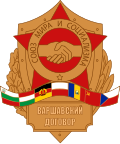 |
The Tito–Stalin, or Yugoslav–Soviet split, took place in the spring and early summer of 1948. Its title pertains to Tito, at the time the Yugoslav Prime Minister (President of the Federal Assembly), and Soviet Premier Joseph Stalin. In the West, Tito was thought of as a loyal Communist leader, second only to Stalin in the Eastern Bloc. However, having largely liberated itself with only limited Red Army support,[14] Yugoslavia steered an independent course and was constantly experiencing tensions with the Soviet Union. Yugoslavia and the Yugoslav government considered themselves allies of Moscow, while Moscow considered Yugoslavia a satellite and often treated it as such. Previous tensions erupted over a number of issues, but after the Moscow meeting, an open confrontation was beginning.[20] Next came an exchange of letters directly between the Communist Party of the Soviet Union (CPSU), and the Communist Party of Yugoslavia (KPJ). In the first CPSU letter of 27 March 1948, the Soviets accused the Yugoslavs of denigrating Soviet socialism via statements such as "socialism in the Soviet Union has ceased to be revolutionary". It also claimed that the KPJ was not "democratic enough", and that it was not acting as a vanguard that would lead the country to socialism. The Soviets said that they "could not consider such a Communist party organization to be Marxist-Leninist, Bolshevik". The letter also named a number of high-ranking officials as "dubious Marxists" (Milovan Đilas, Aleksandar Ranković, Boris Kidrič, and Svetozar Vukmanović-Tempo) inviting Tito to purge them, and thus cause a rift in his own party. Communist officials Andrija Hebrang and Sreten Žujović supported the Soviet view.[15][20] Tito, however, saw through it, refused to compromise his own party, and soon responded with his own letter. The KPJ response on 13 April 1948 was a strong denial of the Soviet accusations, both defending the revolutionary nature of the party and re-asserting its high opinion of the Soviet Union. However, the KPJ noted also that "no matter how much each of us loves the land of socialism, the Soviet Union, he can in no case love his own country less".[20] In a speech, the Yugoslav Prime Minister stated:
We are not going to pay the balance on others' accounts, we are not going to serve as pocket money in anyone's currency exchange, we are not going to allow ourselves to become entangled in political spheres of interest. Why should it be held against our peoples that they want to be completely independent? And why should autonomy be restricted, or the subject of dispute? We will not be dependent on anyone ever again!
— Prime Minister Josip Broz Tito[20]
The 31-page-long Soviet answer of 4 May 1948 admonished the KPJ for failing to admit and correct its mistakes, and went on to accuse it of being too proud of their successes against the Germans, maintaining that the Red Army had "saved them from destruction" (an implausible statement, as Tito's partisans had successfully campaigned against Axis forces for four years before the appearance of the Red Army there).[14][20] This time, the Soviets named Tito and Edvard Kardelj as the principal "heretics", while defending Hebrang and Žujović. The letter suggested that the Yugoslavs bring their "case" before the Cominform. The KPJ responded by expelling Hebrang and Žujović from the party, and by answering the Soviets on 17 May 1948 with a letter which sharply criticized Soviet attempts to devalue the successes of the Yugoslav resistance movement.[20] On 19 May 1948, a correspondence by Mikhail Suslov informed Tito that the Cominform (Informbiro in Serbo-Croatian), would be holding a session on 28 June 1948 in Bucharest almost completely dedicated to the "Yugoslav issue". The Cominform was an association of Communist parties that was the primary Soviet tool for controlling the political developments in the Eastern Bloc. The date of the meeting, 28 June, was carefully chosen by the Soviets as the triple anniversary of the Battle of Kosovo Field (1389), the assassination of Archduke Ferdinand in Sarajevo (1914), and the adoption of the Vidovdan Constitution (1921).[20] Tito, personally invited, refused to attend under a dubious excuse of illness. When an official invitation arrived on 19 June 1948, Tito again refused. On the first day of the meeting, 28 June, the Cominform adopted the prepared text of a resolution, known in Yugoslavia as the "Resolution of the Informbiro" (Rezolucija Informbiroa). In it, the other Cominform (Informbiro) members expelled Yugoslavia, citing "nationalist elements" that had "managed in the course of the past five or six months to reach a dominant position in the leadership" of the KPJ. The resolution warned Yugoslavia that it was on the path back to bourgeois capitalism due to its nationalist, independence-minded positions, and accused the party itself of "Trotskyism".[20] This was followed by the severing of relations between Yugoslavia and the Soviet Union, beginning the period of Soviet–Yugoslav conflict between 1948 and 1955 known as the Informbiro Period.[20]
After the break with the Soviet Union, Yugoslavia found itself economically and politically isolated as the country's Eastern Bloc-oriented economy began to falter. At the same time, Stalinist Yugoslavs, known in Yugoslavia as "cominformists", began fomenting civil and military unrest. A number of cominformist rebellions and military insurrections took place, along with acts of sabotage. However, the Yugoslav security service (UDBA) led by Aleksandar Ranković, was quick and efficient in cracking down on insurgent activity. Much of the Yugoslav Communist Party membership was loyal to the Soviet Union and between 1948 and 1955 over 55,600 party members were expelled as "Cominformists".[48] The two most prominent pro-Soviet members to be expelled were the Croat Andrija Hebrang and the Serb Sreten Žujović.[48] Invasion appeared imminent, as Soviet military units massed along the border with the Hungarian People's Republic, while the Hungarian People's Army was quickly increased in size from 2 to 15 divisions. The UDBA began arresting alleged Cominformists even under suspicion of being pro-Soviet. However, from the start of the crisis, Tito began making overtures to the United States and the West. Consequently, Stalin's plans were thwarted as Yugoslavia began shifting its alignment. About approximately 16,000 people were convicted of being "Cominformists" and/or of being "suspicious" and sent to the concentration camp on the island of Goli Otok to be "reeducated".[48] Most of those convicted of being "Cominformists" and sent to Goli Otok were party members who fought with the Partisans during the Second World War, and were for this reason treated in an especially harsh manner for siding with Stalin against Tito.[48] However, Tito's defiant stance against the Soviet Union won him much popular respect that lasted for decades with a librarian from Zagreb saying in the early 1970s: "I don't like him, but I guess we all respect him for having stood up to the Russians and having kept us out of their clutches".[48]
The West welcomed the Yugoslav-Soviet rift and, in 1949 commenced a flow of economic aid, assisted in averting famine in 1950, and covered much of Yugoslavia's trade deficit for the next decade. The United States began shipping weapons to Yugoslavia in 1951. Tito, however, was wary of becoming too dependent on the West as well, and military security arrangements concluded in 1953 as Yugoslavia refused to join NATO and began developing a significant military industry of its own.[49][50] With the American response in the Korean War serving as an example of the West's commitment, Stalin began backing down from war with Yugoslavia. The Truman administration misunderstood the Tito-Stalin split as a sign that Yugoslavia would ally with the West, and it took some time for those in positions in power in Washington to understand that Tito wanted Yugoslavia to be neutral in the Cold War.[48]
Reform
[edit]

| This section may be too long to read and navigate comfortably. (July 2025) |
Yugoslavia began a number of fundamental reforms in the early 1950s, bringing about change in three major directions: rapid liberalization and decentralization of the country's political system, the institution of a new, unique economic system, and a diplomatic policy of non-alignment. Edvard Kardelj, the chief ideologue of the Communist regime, in a 1949 article "On People's Democracy", harshly criticised the Stalinist regimes in the Soviet Union for becoming a bureaucratic dictatorship that had merged party and state into one, and had elevated itself over Soviet society.[51] Taking a phrase from Frederich Engels, Kardeji called for a "withering state", arguing that ordinary people should placed in charge of their workplaces to create the sort of society that Karl Marx and Engels had envisioned in the 19th century.[51] In 1950, Kardeji along with Milovan Djilas, Moša Pijade, Boris Kidrič and Vladimir Bakarić drafted the "Basic Law on the Management of State Economic Enterprises" that called for councils elected by the workers to manage businesses along with a decentralisation of state management of the economy.[51] Yugoslavia refused to take part in the Communist Warsaw Pact and instead took a neutral stance in the Cold War, becoming a founding member of the Non-Aligned Movement along with countries like India, Egypt and Indonesia, and pursuing centre-left influences that promoted a non-confrontational policy towards the United States. The country distanced itself from the Soviets in 1948 and started to build its own way to socialism under the strong political leadership of Tito, sometimes informally called "Titoism". Tito reveled in the role of a world leader, and between 1944 and 1980 made 169 official visits to 92 nations, and in the process he met 175 heads of state along with 110 prime ministers.[52] These frequent visits abroad served an important propaganda function, namely to show that Tito as one of the leaders of the non-aligned movement was an important world leader because Yugoslavia was an important nation.[52]
The economic reforms began with the introduction of workers' self-management in June 1950. In this system, profits were shared among the workers themselves as workers' councils controlled production and the profits. An industrial sector began to emerge thanks to the government's implementation of industrial and infrastructure development programs.[15][20] Exports of industrial products, led by heavy machinery, transportation machines (especially in the shipbuilding industry), and military technology and equipment rose by a yearly increase of 11%. All in all, the annual growth of the gross domestic product (GDP) through to the early 1980s averaged 6.1%.[15][20] Political liberalization began with the reduction of the massive state (and party) bureaucratic apparatus, a process described as the "whittling down of the state" by Boris Kidrič, President of the Yugoslav Economic Council (economics minister). On 2 November 1952, the Sixth Congress of the Communist Party of Yugoslavia introduced the "Basic Law", which emphasized the "personal freedom and rights of man" and the freedom of "free associations of working people". The Communist Party of Yugoslavia (KPJ) changed its name at this time to the League of Communists of Yugoslavia (LCY/SKJ), becoming a federation of six republican Communist parties. The result was a regime that was somewhat more humane than other Communist states. However, the LCY retained absolute power; as in all Communist regimes, the legislature did little more than rubber-stamp decisions already made by the LCY's Politburo. The UDBA, while operating with considerably more restraint than its counterparts in the rest of Eastern Europe, was nonetheless a feared tool of government control. UDBA was particularly notorious for assassinating suspected "enemies of the state" who lived in exile overseas.[53][unreliable source?] The media remained under restrictions that were somewhat onerous by Western standards, but still had somewhat more latitude than their counterparts in other Communist countries. Nationalist groups were a particular target of the authorities, with numerous arrests and prison sentences handed down over the years for separatist activities.[citation needed] Dissent from a radical faction within the party led by Milovan Đilas, advocating the near-complete annihilation of the state apparatus, was at this time put down by Tito's intervention.[15][20]
The post-war period saw a rapid urbanization with some 5.5 million people leaving the countryside for the cities between 1945 and 1970.[54] By 1969, the population of Belgrade passed the one million mark for the first time; that year, it was estimated that two of three Belgradians had been born in the countryside.[54] In the late 1950s, the car manufacturer Zastava in Kragujevac began the production under license from Fiat of a small car, known officially as the Fiat 600 and unofficially as the fiċo that become ubiquitous in Yugoslavia for decades afterward.[55] By 1968, about 8% of the Yugoslav population owned a car, and the majority were the fiċo, which became a symbol of Yugoslavia itself.[55] In 1947, it was estimated that one radio set was shared by an average of 70 people; by 1965, the typical radio set was shared by an average of 7 people.[54] Increased literacy led to a massive demand for books with an average of 13,000 books being published annually in the 1960s.[54] In 1945, one out of every two Yugoslavs were illiterate; by 1961 the illiteracy rate had fallen to 20% of the population.[56] By 1953, 71% of all Yugoslav children finished elementary school and by 1981, 97% of all Yugoslav children finished school.[56] In 1945, Yugoslavia had three universities and two institutions of higher learning.[57] By 1965, Yugoslavia had 158 universities and colleges.[57] With the exceptions of the Soviet Union, Sweden, and the Netherlands, no European country had quite as many university students.[57] By 1960, about 500, 000 Yugoslavs were attending university and by 1970 the number had reached 650, 000.[57] The composition of the Communist Party/League of Communists changed during the post-war decades.[57] Of the 12,000 people who were party members in 1941, only 3, 000 survived World War Two with the rest all being killed.[57] After 1945, the party took in a massive number of new members, the majority of whom came from either a peasant or working-class background.[57] In 1945, every second party member had a peasant background, every third member had a working-class background and every tenth member had a white collar background.[57] By 1966, the membership of the League of Communists was mostly made up of people from a middle-class background with 39% of all league members having a white collar job while league members with a peasant background made up 7% of the membership.[57] By the early 1960s, the so-called "socialist bourgeoise" had emerged as the dominant class both politically and economically.[57] The typical "socialist bourgeoise" was someone with a university education who held a management job; or worked as an engineer or some other technical skilled trade; or was a member of the new capitalist class, usually a restaurant owner or someone who became rich as a result of the tourism trade.[57] By the mid-1960s, the League of Communists had by large and ceased to be an ideological party committed to Marxism, and instead become just a vehicle for social advancement of ambitious careerists.[58] League members were more interested in obtaining status symbols such as luxury cars, large houses, expensive clothing and the vikendica (weekend cottage) than in creating a Marxist society.[59] One League member told a Western journalist in 1965: "We go to Trieste about twice a year to buy clothes and cosmetics, Italian clothing is really not of a better quality than ours, but we want something others don't have, even if it costs us a lot of money".[59] In 1962, a group of dissenting Marxist intellectuals founded the journal Praxis, which was discreetly critical of the regime.[60] The major theme of the Praxis group was "alienation" and "humanity" with the argument that people were becoming more "alienated" from society and the solution was they proposed was freedom of speech, multiparty democracy, and more decentralization of the federation.[61]
Increased prosperity led to higher television ownership. In 1960, there were 30,000 television sets in operation in all of Yugoslavia.[62] By 1964, there were 440, 000 television sets in operation in Yugoslavia.[62] The greater number of people who owned televisions led to the end of the traditional evening get-together known as the sijelo that once formed the focus of social life in Yugoslavia as people were too busy watching television in the evening.[62] Censorship was less extreme than elsewhere in Eastern Europe in the 1960s, not the less because the authorities could only prosecute a journalist after an article had been published, not just for writing an article as was the case in the rest of Eastern Europe.[63] Likewise, censorship was generally only enforced by the republics rather than by the federal government, so it was quite common for an article to be banned in one republic while being allowed in other republics.[63] Starting in the early 1960s, Yugoslavs were permitted to travel to Western Europe without visas, and by the early 1960s, an average of 300,000 Yugoslavs visited Western Europe as tourists.[64] During the same period, it became common for Yugoslavs to go to Western Europe, especially West Germany, to work abroad as "guest workers".[64] By 1971, about 775,000 people (about 3.8% of the total Yugoslav population) were living abroad as "guest workers".[64] The remittances sent home by the "guest workers" led to a significant rise in the standard of living, and by the 1960s it became common for those whose family members were working abroad to own a car and electrical appliances such as a refrigerator.[64] The socialist regime championed women's rights and allowed equal legal rights to both legitimate and illegitimate children.[65] Abortion and birth control were both legal in Yugoslavia, which led to a rapid decline in population growth in 1960s-1970s.[65] Between 1948 and 1981, the population growth rate fell from 14.7% in 1947 to 7.4% in 1981.[66] In particular, the Communist regime attacked what it considered to be sexist traditions in the Muslim communities, banning polygamy, women being veiled and the "sale" of girls who were married off to the man best able to afford the bride-price.[67] An young Bosnian Muslim women stated: "Things used to be very different. Girls were not free...Today a girl can chose whom she wants to be with and where she wants to go...When I cut off my braids and got a permanent wave there was a lot of disapproval and gossip. I was one of the first girls in the village to stop wearing dimija [harem pants] and put on a dress...And today almost every girl has modern cloths in addition to her dimija".[67] The Partisan movement in the World War Two was very puritanical, which was carried on into the late 1940s and 1950s, but starting in the 1960s the regime embraced the values of the "permissive society" and the "sexual revolution".[56] In the 1960s, pornographic magazines were permitted and the Yugoslav newspapers devoted much coverage to gossip about the sex lives of celebrities, through not senior members of the League of Communists.[56] Likewise, the regime sought to encourage women to work and by 1964 about 29% of all Yugoslav women were working.[67] The female labor participation varied sharply from region to region. In Slovenia, 42% of all women were working in 1964 while in Kosovo region only 18% of women worked in 1964.[67] Western music was allowed in Yugoslavia, and music by groups popular in the West such as the Beatles and the Rolling Stones was frequently played on Yugoslav radio.[68] Officially, Yugoslavia was neutral in the Cold War, but in a cultural sense, Yugoslavia belonged to the West as Western films, TV shows and music were all very popular in the 1960s.[68] Because of the low value of the dinar, Western films were often shot in Yugoslavia in the 1960s.[68] In the arts, a genre known as the "black wave" emerged in the 1960s that saw novels, plays and films that depicted modern Yugoslavia as corrupt and dehumanizing.[61] Several "black wave" works such as the novel Dad su cvetale tikve (When Pumpkins Blossomed) by Dragolav Milailović about his imprisonment at the Goli Otok camp in the early 1950s were banned, but others such as the novel Memoari Pere Bogaljia (Memoirs of Pera the Cripple) by Slobadan Selenić which depicted the League of Communist members as vulgar, corrupt and self-serving were awarded first prize at the Belgrade literary festival.[61]
In the early 1960s concern over problems such as the building of economically irrational "political" factories and inflation led a group within the Communist leadership to advocate greater decentralization.[69] These liberals were opposed by a group around Aleksandar Ranković.[70] Ranković as secret police chief was known as an advocate of an repressive line, especially against the Albanians of Kosovo, and tended to favor Serbs over the other peoples.[71] In 1966 the liberals (the most important being Edvard Kardelj, Vladimir Bakarić of Croatia and Petar Stambolić of Serbia) gained the support of Tito. At a party meeting in Brijuni, Ranković faced a fully prepared dossier of accusations and a denunciation from Tito that he had formed a clique with the intention of taking power. That year (1966), more than 3,700 Yugoslavs fled to Trieste[72] with the intention to seek political asylum in North America, United Kingdom or Australia. Ranković was forced to resign all party posts and some of his supporters were expelled from the party.[73] Throughout the 1950s and '60s, the economic development and liberalization continued at a rapid pace.[15][20] The introduction of further reforms introduced a variant of market socialism, which now entailed a policy of open borders. In 1965, most of the state controls on production, pricing and wages were ended and allowed small businesses to open, albeit with the proviso that no small enterprise could employ more than five people at a time.[74] Many of the older Communist leaders were uncomfortable with the "socialist market economy" that was being created, and were forced by Tito to take early retirement.[75] With heavy federal investment, tourism in SR Croatia was revived, expanded, and transformed into a major source of income. In particular, the 745-mile coastline of Dalmatia and Istria with its bright, sunny weather, beaches and more 1, 000 islands, and Italianate architecture became extremely popular with tourists in the 1960s.[76] In 1965, three million foreign tourists visited Dalmatia and by 1970 4.75 million foreign tourists came to visit Dalmatia.[76] Some of the other tourists came from Czechoslovakia and Hungary, but the majority came from Western Europe, especially from Italy, Austria and West Germany as the low value of the dinar made vacationing in Yugoslavia extremely cheap.[76] By 1969, the federal government made $275 million US dollars from tourism, which comprised some 10% of all revenue.[66] Dalmatia and Istria, which had once been poor regions, were almost overnight transformed into wealthy areas as about 30% of all people in Istria and Dalmatia were employed in the tourism industry by the end of the 1960s.[66]
With these successful measures, the Yugoslav economy achieved relative self-sufficiency and traded extensively with both the West and the East. By the early 1960s, foreign observers noted that the country was "booming", and that all the while the Yugoslav citizens enjoyed far greater liberties than the Soviet Union and Eastern Bloc states.[77] Literacy was increased dramatically and reached 91%, medical care was free on all levels, and life expectancy was 72 years.[15][20][78] The German historian Marie-Janine Calic noted that the 1960s are remembered as the time of the "economic miracle" when living standards were rising for most Yugoslavs and the prosperity had "a politically pacifying and socially integrating effect".[79] Some of the republics became more wealthier than others. In 1965, Slovenia had an index value of 177.3% of Yugoslavia's per capital income, followed by Croatia at 120.7%, and Serbia at 94.9% while Bosnia-Herzegovina had 69.1% and the poorest region being Kosovo at 38.6%.[80] At least part of the reason for the regional differences was Tito's policy until 1965 of keeping the prices of raw materials and agricultural goods artificially low, which hurt the poorer republics in the south as most people there were employed in either agriculture or mining while Slovenia and Croatia were more industrialised.[80] To address the regional disparity, Tito created a regional development fund in 1965 intended to help the poorer republics of Bosnia-Herzegovina, Montenegro, and Macedonia along with the Kosovo region of Serbia "catch up" with the richer republics to the north.[71]
In 1965, the Bosnian Muslims were upgraded to a sixth nationality, defined somewhat paradoxically as an ethnic rather than a religious group, and the 1971 census for the first time included the category "Muslim an ethnic sense".[81] The recognition of Bosnian Muslims as an ethnicity allowed for greater Muslim involvement in the politics of Bosnia with the numbers of Muslims on the Bosnian Central Committee raising from 19% of the membership in 1965 to 33% in 1974.[82] However, the recognition of Bosnian Muslims as an official nationality led to sharp disputes about whatever Bosnia-Herzegovina was the republic of the Muslims or if the Muslims were one of the three nations of Bosnia alongside the Serbs and the Croats.[82] The Croats and the Serbs tended to favor the "three nations" theory of Bosnia while the Muslims argued that the Serbs and the Croats already had their own republics and Bosnia was the special homeland of the Serbo-Croatian speaking Muslims.[82] On 2 June 1968, student demonstrations led to wider mass youth protests in capital cities across Yugoslavia. They were gradually stopped a week later by Tito on 9 June during his televised speech.[83] The student demonstrations of 1968 were an important turning point in Yugoslav history as for the first street protests had forced a change in policy, and in the coming decades, successive leaders within the League of Communists were to mobilize street protests as a way of forcing change.[83] In August 1968, Tito was opposed to the Soviet invasion of Czechoslovakia.[84] The invasion of Czechoslovakia badly frightened Tito, whom believed that Yugoslavia would also soon be invaded by the Soviet Union.[85] In 1968–1969, Tito embarked upon major military reforms with the aim of preparing for the expected Soviet invasion.[85] Tito decided that the Yugoslav People's Army would stage a fighting retreat into the interior of the country and then revert over to guerrilla warfare, a doctrine Tito called "all-people's defense".[85] As part of the planned guerrilla war, Tito sought to enroll as much of the population into the military as possible.[85] The defense forces in 1969 were reorganized with 250, 000 professional soldiers of the People's Army along with 250, 000 reservists forming the core of the military and the territorial defense forces of the six republics, which collectively made up another 900, 000 men to serve as a nucleus of a guerilla force.[85] In the process, much of the population was armed and Tito in effect by creating the territorial defense forces on the republic level gave each republic its own army, which was later to play a major role in the break-up of Yugoslavia in the early 1990s.[85] In October–November 1968, a series of riots erupted in Yugoslav Macedonia and the Kosovo region by Albanians who demanded that the regions where Albanians were a majority be turned into a new republic.[86] Some of the more radical Albanians called for the session of Kosovo and the Albanian regions of Macedonia to join Albania to form a greater Albania.[86] Tito rejected the demand for a 7th republic with an Albanian majority, but did grant demands for greater Albanian participation in public life.[86] In 1969, the University of Pristina was opened, becoming the first Albanian language university in Yugoslavia.[86] Likewise, Tito allowed for a greater number of Albanians to be recruited into the League of Communists and into the government, which in turn caused complaints from the Serbs that the Albanians were dominating the political life of Kosovo at their expense.[87]

In 1971 the leadership of the League of Communists of Yugoslavia, notably Miko Tripalo and Savka Dabčević-Kučar, allied with nationalist non-party groups, began a movement to increase the powers of the individual federated republics. The movement was referred to as MASPOK, a portmanteau of masovni pokret meaning mass movement, and led to the Croatian Spring.[88] Tito responded to the incident by purging the League of Communists of Croatia, while Yugoslav authorities arrested large numbers of the Croatian protesters. To avert ethnically driven protests in the future, Tito began to initiate some of the reforms demanded by the protesters.[89] At this time, Ustaše-sympathizers outside Yugoslavia tried through terrorism and guerrilla actions to create a separatist momentum,[90] but they were unsuccessful, sometimes even gaining the animosity of fellow Roman Catholic Croatian Yugoslavs.[91] From 1971 on, the republics had control over their economic plans. This led to a wave of investment, which in turn was accompanied by a growing level of debt and a growing trend of imports not covered by exports.[92] After the "Croatian Spring", Tito turned towards a more repressive leadership style, bringing in a new law in 1973 that restricted media freedom.[93] By 1975, Yugoslavia had 4, 000 political prisoners, a figure that was only exceeded in Europe by Albania and the Soviet Union.[94] The journal Praxis, which was the main organ of criticism of the regime was shut down while a number of the "Black Wave" films were banned.[94] The 1973-1974 oil shock badly hurt the Yugoslav economy as Yugoslavia had no oil of its own while the global recession sharply decreased the demand for raw materials and manufactured goods from Yugoslavia.[95] To compensate, Yugoslavia went on a spree of borrowing money, creating an illusion of prosperity as the 1970s saw the greatest period of construction as thousands of new hotels, sports arenas, libraries, and streets were built that decade.[96] The average annual economic rate after the 1973-1974 oil shock crisis was 8%, but the growth was largely fueled with money borrowed from the West.[97]
Many of the demands made in the Croatian Spring movement in 1971, such as giving more autonomy to the individual republics, became reality with the 1974 Yugoslav Constitution. While the constitution gave the republics more autonomy, it also awarded a similar status to two autonomous provinces within Serbia: Kosovo, a largely ethnic Albanian populated region, and Vojvodina, a region with Serb majority but large numbers of ethnic minorities, such as Hungarians. These reforms satisfied most of the republics, especially Croatia and the Albanians of Kosovo and the minorities of Vojvodina. But the 1974 constitution deeply aggravated Serbian Communist officials and Serbs themselves who distrusted the motives of the proponents of the reforms. Many Serbs saw the reforms as concessions to Croatian and Albanian nationalists, as no similar autonomous provinces were made to represent the large numbers of Serbs of Croatia or Bosnia and Herzegovina. Serb nationalists were frustrated over Tito's support for the recognition of Montenegrins and Macedonians as independent nationalities, as Serbian nationalists had claimed that there was no ethnic or cultural difference separating these two nations from the Serbs that could verify that such nationalities truly existed. Tito maintained a busy, active travelling schedule despite his advancing age. His 85th birthday in May 1977 was marked by huge celebrations. That year, he visited Libya, the Soviet Union, North Korea and finally China, where the post-Mao leadership finally made peace with him after more than 20 years of denouncing the SFRY as "revisionists in the pay of capitalism". This was followed by a tour of France, Portugal, and Algeria after which the president's doctors advised him to rest. In August 1978, Chinese leader Hua Guofeng visited Belgrade, reciprocating Tito's China trip the year before. This event was sharply criticized in the Soviet press, especially as Tito used it as an excuse to indirectly attack Moscow's ally Cuba for "promoting divisiveness in the Non-Aligned Movement". When China launched a military campaign against Vietnam the following February, Yugoslavia openly took Beijing's side in the dispute. The effect was a rather adverse decline in Soviet Union-Yugoslavia relations. During this time, Yugoslavia's first nuclear reactor was under construction in Krško, built by US-based Westinghouse. The project ultimately took until 1980 to complete because of disputes with the United States about certain guarantees that Belgrade had to sign off on before it could receive nuclear materials (which included the promise that they would not be sold to third parties or used for anything but peaceful purposes).
In 1979, seven selection criteria comprising Ohrid, Dubrovnik, Split, Plitvice Lakes National Park, Kotor, Stari Ras and Sopoćani were designated as UNESCO World Heritage Sites, making it the first inscription of cultural and natural landmarks in Yugoslavia.
Post-Tito period
[edit]

Tito died on 4 May 1980 due to complications after surgery. While it had been known for some time that the 87-year-old president's health had been failing, his death nonetheless came as a shock to the country. This was because Tito was looked upon as the country's hero in World War II and had been the country's dominant figure and identity for over three decades. His loss marked a significant alteration, and it was reported that many Yugoslavs openly mourned his death. In the Split soccer stadium, Serbs and Croats visited the coffin among other spontaneous outpourings of grief, and a funeral was organized by the League of Communists with hundreds of world leaders in attendance (See Tito's state funeral).[98] After Tito's death in 1980, a new collective presidency of the Communist leadership from each republic was adopted. At the time of Tito's death the Federal government was headed by Veselin Đuranović (who had held the post since 1977). He had come into conflict with the leaders of the republics, arguing that Yugoslavia needed to economize due to the growing problem of foreign debt. Đuranović argued that a devaluation was needed which Tito refused to countenance for reasons of national prestige.[99][page needed] Post-Tito Yugoslavia faced significant fiscal debt in the 1980s, but its good relations with the United States led to an American-led group of organizations called the "Friends of Yugoslavia" to endorse and achieve significant debt relief for Yugoslavia in 1983 and 1984, though economic problems would continue until the state's dissolution in the 1990s.[100] Yugoslavia was the host nation of the 1984 Winter Olympics in Sarajevo. For Yugoslavia, the games demonstrated Tito's continued vision of Brotherhood and Unity, as the multiple nationalities of Yugoslavia remained united in one team, and Yugoslavia became the second Communist state to hold the Olympic Games (the Soviet Union held them in 1980). However, Yugoslavia's games had Western countries participating, while the Soviet Union's Olympics were boycotted by some. In the late 1980s, the Yugoslav government began to deviate from communism as it attempted to transform to a market economy under the leadership of Prime Minister Ante Marković, who advocated shock therapy tactics to privatize sections of the Yugoslav economy. Marković was popular, as he was seen as the most capable politician to be able to transform the country to a liberalized democratic federation, though he later lost his popularity, mainly due to rising unemployment. His work was left incomplete as Yugoslavia broke apart in the 1990s.
Dissolution and war
[edit]After a period of political and economic crisis in the 1980s, the constituent republics of Yugoslavia split apart in the early 1990s. Unresolved issues from the breakup caused a series of inter-ethnic Yugoslav Wars from 1991 to 2001 which primarily affected Bosnia and Herzegovina, neighbouring parts of Croatia and, some years later, Kosovo.
Following the Allied victory in World War II, Yugoslavia was set up as a federation of six republics, with borders drawn along ethnic and historical lines: Bosnia and Herzegovina, Croatia, Macedonia, Montenegro, Serbia, and Slovenia. In addition, two autonomous provinces were established within Serbia: Vojvodina and Kosovo. Each of the republics had its own branch of the League of Communists of Yugoslavia party and a ruling elite, and any tensions were solved on the federal level. The Yugoslav model of state organisation, as well as a "middle way" between planned and liberal economy, had been a relative success, and the country experienced a period of strong economic growth and relative political stability up to the 1980s, under Josip Broz Tito.[101] After his death in 1980, the weakened system of federal government was left unable to cope with rising economic and political challenges.

In the 1980s, Kosovo Albanians started to demand that their autonomous province be granted the status of a full constituent republic, starting with the 1981 protests. Ethnic tensions between Albanians and Kosovo Serbs remained high over the whole decade, which resulted in the growth of Serb opposition to the high autonomy of provinces and ineffective system of consensus at the federal level across Yugoslavia, which were seen as an obstacle for Serb interests. In 1987, Slobodan Milošević came to power in Serbia, and through a series of populist moves acquired de facto control over Kosovo, Vojvodina, and Montenegro, garnering a high level of support among Serbs for his centralist policies. Milošević was met with opposition by party leaders of the western constituent republics of Slovenia and Croatia, who also advocated greater democratisation of the country in line with the Revolutions of 1989 in Eastern Europe. The League of Communists of Yugoslavia dissolved in January 1990 along federal lines. Republican communist organisations became the separate socialist parties.
During 1990, the socialists (former communists) lost power to ethnic separatist parties in the first multi-party elections held across the country, except in Montenegro and in Serbia, where Milošević and his allies won. Nationalist rhetoric on all sides became increasingly heated. Between June 1991 and April 1992, four constituent republics declared independence while Montenegro and Serbia remained federated. Germany took the initiative and recognized the independence of Croatia and Slovenia, but the status of ethnic Serbs outside Serbia and Montenegro, and that of ethnic Croats outside Croatia, remained unsolved. After a string of inter-ethnic incidents, the Yugoslav Wars ensued, with the most severe conflicts being in Croatia, Bosnia and Herzegovina and Kosovo. The wars left economic and political damage in the region that is still felt decades later.[102] On April 27, 1992, the Federal Council of the Assembly of the SFRY, based on the decision of the Assembly of the Republic of Serbia and the Assembly of Montenegro, adopted the Constitution of the Federal Republic of Yugoslavia, which formally ended the breakup. The SFR Yugoslavia had, de facto, dissolved into five successor states: Bosnia and Herzegovina, Croatia, Macedonia, Slovenia and the Federal Republic of Yugoslavia (later renamed "Serbia and Montenegro"). The Badinter Commission later (1991–93) noted that Yugoslavia disintegrated into several independent states, so it is not possible to talk about the secession of Slovenia and Croatia from Yugoslavia.[11]
Post-1992 UN membership
[edit]In September 1992, the Federal Republic of Yugoslavia (consisting of Serbia and Montenegro) failed to achieve de jure recognition as the continuation of the Socialist Federal Republic in the United Nations. It was separately recognised as a successor alongside Slovenia, Croatia, Bosnia and Herzegovina, and Macedonia. Before 2000, the Federal Republic of Yugoslavia declined to re-apply for membership in the United Nations and the United Nations Secretariat allowed the mission from the SFRY to continue to operate and accredited representatives of the Federal Republic of Yugoslavia to the SFRY mission, continuing work in various United Nations organs.[103] It was only after the overthrow of Slobodan Milošević, that the government of FR Yugoslavia applied for UN membership in 2000.
Governance
[edit]Constitution
[edit]
The first Yugoslav Constitution was adopted in 1946 and amended in 1953. The second one was adopted in 1963 and the third in 1974.[104] The League of Communists of Yugoslavia won the first elections, and remained in power throughout the state's existence. It was composed of individual Communist parties from each constituent republic. The party would reform its political positions through party congresses in which delegates from each republic were represented and voted on changes to party policy, the last of which was held in 1990. Yugoslavia's parliament was known as the Federal Assembly which was housed in the building which currently houses Serbia's parliament. The Federal Assembly was composed entirely of Communist members. The primary political leader of the state was Josip Broz Tito, but there were several other important politicians, particularly after Tito's death.
In 1974, Tito was elected President-for-life of Yugoslavia.[105] After Tito's death in 1980, the single position of president was divided into a collective Presidency, where representatives of each republic would essentially form a committee where the concerns of each republic would be addressed and from it, collective federal policy goals and objectives would be implemented. The head of the collective presidency was rotated between representatives of the republics. The collective presidency was considered the head of state of Yugoslavia. The collective presidency was ended in 1991, as Yugoslavia fell apart. In 1974, major reforms to Yugoslavia's constitution occurred. Among the changes was the controversial internal division of Serbia, which created two autonomous provinces within it, Vojvodina and Kosovo. Each of these autonomous provinces had voting power equal to that of the republics, and were represented in the Serbian assembly.[106]
Women's rights policy
[edit]The 1946 Yugoslav Constitution aimed to unify family law throughout Yugoslavia and to overcome discriminatory provisions, particularly concerning economic rights, inheritance, child custody and the birth of 'illegitimate' children. Article 24 of the Constitution affirmed the equality of women in society, stating that: "Women have equal rights with men in all areas of state, economic and socio-political life."[107]
At the end of the 1940s, the Women's Antifascist Front of Yugoslavia (AFŽ), an organization founded during the Resistance to involve women in politics, was tasked with implementing a socialist policy for the emancipation of women, targeting in particular the most backward rural areas. AFŽ activists were immediately confronted with the gap between officially proclaimed rights and women's daily lives. The reports drawn up by local AFŽ sections in the late 1940s and 1950s testify to the extent of patriarchal domination, physical exploitation and poor access to education faced by the majority of women, particularly in the countryside.[107]
AFŽ also led a campaign against the full veil, which covered the whole body and face, until it was banned in the 1950s.[107]
By the 1970s, thirty years after women's rights were enshrined in the Yugoslav Constitution, the country had undergone a rapid process of modernisation and urbanisation. Women's literacy and access to the labour market had reached unprecedented levels, and inequalities in women's rights had been considerably reduced compared to the inter-war period. Yet full equality was far from being achieved.[107]
Federal units
[edit]Internally, the Yugoslav federation was divided into six constituent states. Their formation was initiated during the war years, and finalized in 1944–1946. They were initially designated as federated states, but after the adoption of the first federal Constitution, on 31 January 1946, they were officially named people's republics (1946–1963), and later socialist republics (from 1963 forward). They were constitutionally defined as mutually equal in rights and duties within the federation. Initially, there were initiatives to create several autonomous units within some federal units, but that was enforced only in Serbia, where two autonomous units (Vojvodina and Kosovo) were created (1945).[108][99]
In alphabetical order, the republics and provinces were:
| Name | Capital | Flag | Coat of arms | Location |
|---|---|---|---|---|
| Socialist Republic of Bosnia and Herzegovina | Sarajevo | .svg) |
 |
|
| Socialist Republic of Croatia | Zagreb | .svg) |
 | |
| Socialist Republic of Macedonia | Skopje | ;_Flag_of_North_Macedonia_(1991-1992).svg) |
.svg) | |
| Socialist Republic of Montenegro | Titograd (now Podgorica) | ,_Flag_of_Serbia_(1947%E2%80%931992).svg) |
.svg) | |
| Socialist Republic of Serbia | Belgrade | |
.svg) | |
| Socialist Republic of Slovenia | Ljubljana | .svg) |
 |
_location_map.svg)
Foreign policy
[edit]
Under Tito, Yugoslavia adopted a policy of nonalignment in the Cold War. It developed close relations with developing countries by having a leading role in the Non-Aligned Movement, as well as maintaining cordial relations with the United States and Western European countries. Stalin considered Tito a traitor and openly offered condemnation towards him. Yugoslavia provided major assistance to anti-colonialist movements in the Third World. The Yugoslav delegation was the first to bring the demands of the Algerian National Liberation Front to the United Nations. In January 1958, the French Navy boarded the Slovenija cargo ship off Oran, whose holds were filled with weapons for the insurgents. Diplomat Danilo Milic explained that "Tito and the leading nucleus of the League of Communists of Yugoslavia really saw in the Third World's liberation struggles a replica of their own struggle against the fascist occupants. They vibrated to the rhythm of the advances or setbacks of the FLN or Vietcong."[109] Thousands of Yugoslav military advisors travelled to Guinea after its decolonisation and as the French government tried to destabilise the country. Tito also covertly helped left-wing nationalist movements to destabilize the Portuguese colonial empire. Tito saw the murder of Patrice Lumumba by Belgian-backed Katangan separatists in 1961 as the "greatest crime in contemporary history". Yugoslavia's military academies trained left-wing activists from both Swapo (modern Namibia) and the Pan Africanist Congress of Azania as part of Tito's efforts to destabilize South Africa under apartheid. In 1980, the intelligence services of South Africa and Argentina plotted to return the favor by covertly bringing 1,500 anti-communist urban guerrillas to Yugoslavia. The operation was aimed at overthrowing Tito and was planned during the Olympic Games period so that the Soviets would be too busy to react. The operation was finally abandoned due to Tito's death and the Yugoslav armed forces raising their alert level.[109]
After World War II, Yugoslavia became a leader in international tourism among socialist states, motivated by both ideological and financial purposes. In the 1960s, many foreigners were able to get a visa on arrival and, later onward, were issued a tourist card for short stays. Numerous reciprocal agreements for abolishing visas were implemented with other countries (mainly Western European), through the decade. For the International Year of Tourism in 1967 Yugoslavia suspended visa requirements for all countries it had diplomatic relations with.[110][111] In the same year, Tito became active in promoting a peaceful resolution of the Arab–Israeli conflict. His plan called for Arab countries to recognize the State of Israel in exchange for Israel returning territories it had gained.[112] The Arab countries rejected his land for peace concept.[citation needed] However, that same year, Yugoslavia no longer recognized Israel.[citation needed]
In 1968, following the Soviet invasion of Czechoslovakia, Tito added an additional defense line to Yugoslavia's borders with the Warsaw Pact countries.[113] Later in 1968, Tito then offered Czechoslovak leader Alexander Dubček that he would fly to Prague on three hours notice if Dubček needed help in facing down the Soviet Union which was occupying Czechoslovakia at the time.[114]
Yugoslavia had mixed relations towards Enver Hoxha's Albania. Initially Yugoslav-Albanian relations were forthcoming, as Albania adopted a common market with Yugoslavia and required the teaching of Serbo-Croatian to students in high schools.[citation needed] At this time, the concept of creating a Balkan Federation was being discussed between Yugoslavia, Albania and Bulgaria.[citation needed] Albania at this time was heavily dependent on economic support of Yugoslavia to fund its initially weak infrastructure. Trouble between Yugoslavia and Albania began when Albanians began to complain that Yugoslavia was paying too little for Albania's natural resources.[citation needed] Afterward, relations between Yugoslavia and Albania worsened. From 1948 onward, the Soviet Union backed Albania in opposition to Yugoslavia. On the issue of Albanian-populated Kosovo, Yugoslavia and Albania both attempted to neutralize the threat of nationalist conflict, Hoxha opposed Albanian nationalism, as he officially believed in the world communist ideal of international brotherhood of all people, though on a few occasions in the 1980s he made inflammatory speeches in support of Albanians in Kosovo against the Yugoslav government, when public sentiment in Albania was firmly in support of Kosovo's Albanians.[citation needed]
Military
[edit]
The armed forces of SFR Yugoslavia consisted of the Yugoslav People's Army (Jugoslovenska narodna armija, JNA), Territorial Defense (TO), Civil Defense (CZ) and Milicija (police) in wartime. Socialist Yugoslavia maintained a strong military force. The JNA was the main organization of the military forces, and was composed of the ground army, navy and aviation. Militarily, Yugoslavia had a policy of self-sufficiency. Due to its policy of neutrality and non-alignment, efforts were made to develop the country's military industry to provide the military with all its needs, and even for export. Most of its military equipment and pieces were domestically produced, while some was imported both from the East and the West. The regular army mostly originated from the Yugoslav Partisans of World War II.[115]
Yugoslavia had a thriving arms industry and exported to nations, primarily those who were non-aligned as well as others like Iraq, and Ethiopia.[115] Yugoslav companies like Zastava Arms produced Soviet-designed weaponry under license as well as creating weaponry from scratch, ranging from police pistols to airplanes. SOKO was an example of a successful military aircraft design by Yugoslavia before the Yugoslav wars. Beside the federal army, each of the republics had their own respective Territorial Defense Forces.[115] They were a national guard of sorts, established in the frame of a new military doctrine called "General Popular Defense" as an answer to the brutal end of the Prague Spring by the Warsaw Pact in Czechoslovakia in 1968.[116] It was organized on republic, autonomous province, municipality and local community levels. Given that its role was mainly defense, it had no formal officer training regime, no offensive capabilities and little military training.[116] As Yugoslavia splintered, the army factionalized along ethnic lines, and by 1991–92 Serbs made up almost the entire army as the separating states formed their own.
Economy
[edit]

Despite their common origins, the socialist economy of Yugoslavia was much different from the economy of the Soviet Union and the economies of the Eastern Bloc, especially after the Yugoslav–Soviet break-up of 1948. Though they were state-owned enterprises, Yugoslav companies were nominally collectively managed by the employees themselves through workers' self-management, albeit with state oversight dictating wage bills and the hiring and firing of managers.[117] The occupation and liberation struggle in World War II left Yugoslavia's infrastructure devastated. Even the most developed parts of the country were largely rural, and the little industry the country had was largely damaged or destroyed.[citation needed] Unemployment was a chronic problem for Yugoslavia:[118] the unemployment rates were amongst the highest in Europe during its existence and they did not reach critical levels before the 1980s only due to the safety valve provided by sending one million guest workers yearly to advanced industrialized countries in Western Europe.[119] The departure of Yugoslavs seeking work began in the 1950s, when individuals began slipping across the border illegally. In the mid-1960s, Yugoslavia lifted emigration restrictions and the number of emigrants increased rapidly, especially to West Germany. By the early 1970s, 20% of the country's labor force or 1.1 million workers were employed abroad.[120] This was also a source of capital and foreign currency for Yugoslavia.
Due to Yugoslavia's neutrality and its leading role in the Non-Aligned Movement, Yugoslav companies exported to both Western and Eastern markets. Yugoslav companies carried out construction of numerous major infrastructural and industrial projects in Africa, Europe and Asia.[citation needed] In the 1970s, the economy was reorganized according to Edvard Kardelj's theory of associated labor, in which the right to decision-making and a share in profits of worker-run cooperatives is based on the investment of labour. All companies were transformed into organizations of associated labor. The smallest, basic organizations of associated labor, roughly corresponded to a small company or a department in a large company. These were organized into enterprises which in turn associated into composite organizations of associated labor, which could be large companies or even whole-industry branches in a certain area. Most executive decision-making was based in enterprises, so that these continued to compete to an extent, even when they were part of a same composite organization.
In practice, the appointment of managers and the strategic policies of composite organizations were, depending on their size and importance, often subject to political and personal influence-peddling. In order to give all employees, the same access to decision-making, the basic organisations of associated labor were also applied to public services, including health and education. The basic organizations were usually made up of no more than a few dozen people and had their own workers' councils, whose assent was needed for strategic decisions and appointment of managers in enterprises or public institutions.
The results of these reforms however were not satisfactory.[clarification needed] There have been rampant wage-price inflations, substantial rundown of capital plant and consumer shortages, while the income gap between the poorer Southern and the relatively affluent Northern regions of the country remained.[121] The self-management system stimulated the inflationary economy that was needed to support it. Large state-owned enterprises operated as monopolists with unrestricted access to capital that was shared according to political criteria.[119] The oil crisis of 1973 magnified the economic problems, which the government tried to solve with extensive foreign borrowing. Although such actions resulted in a reasonable rate of growth for a few years (GNP grew at 5.1% yearly), such growth was unsustainable since the rate of foreign borrowing grew at an annual rate of 20%.[122]
After the relatively prosperous 1970s, living conditions deteriorated in Yugoslavia in the 1980s, and were reflected in soaring unemployment rates and inflation. In the late 1980s, the unemployment rate in Yugoslavia was over 17%, with another 20% underemployed; with 60% of the unemployed under the age of 25. Real net personal income declined by 19.5%.[118] The nominal GDP per capita of Yugoslavia at current prices in US dollars was at $3,549 in 1990.[123] The central government tried to reform the self-management system and create an open market economy with considerable state ownership of major industrial factories, but strikes in major plants and hyperinflation held back progress.[121]
The Yugoslav wars and consequent loss of market, as well as mismanagement and/or non-transparent privatization, brought further economic trouble for all the former republics of Yugoslavia in the 1990s.[citation needed]
The Yugoslav currency was the Yugoslav dinar.
Various economic indicators around 1990 were:[121]
- Inflation rate (consumer prices): 2,700% (1989 est.)
- Unemployment rate: 15% (1989)
- GNP: $129.5 billion, per capita $5,464; real growth rate – 1.0% (1989 est.)
- Budget: revenues $6.4 billion; expenditures $6.4 billion, including capital expenditures of $NA (1990)
- Exports: $13.1 billion (f.o.b., 1988); commodities—raw materials and semimanufactures 50%, consumer goods 31%, capital goods and equipment 19%; partners—EC 30%, CEMA 45%, less developed countries 14%, US 5%, other 6%
- Imports: $13.8 billion (c.i.f., 1988); commodities—raw materials and semimanufactures 79%, capital goods and equipment 15%, consumer goods 6%; partners—EC 30%, CEMA 45%, less developed countries 14%, US 5%, other 6%
- External debt: $17.0 billion, medium and long term (1989)
- Electricity: 21,000,000 kW capacity; 87,100 million kWh produced, 3,650 kWh per capita (1989)
Transportation
[edit]Air transport
[edit].jpg)
In the interwar period, air transport in Yugoslavia was organised by the privately owned Aeroput company, but its post-war operations were suspended due to nationalization and near-total fleet destruction during the war.[124] The first plan for the post-war public air transport reconstruction was introduced by the Commission for the Economic Reconstruction on 28 December 1944.[124] The plan envisaged a national network which would include Belgrade, Zagreb, Ljubljana, Sarajevo, Titograd, Skopje, Novi Sad, Kraljevo, Niš, Borovo, Rijeka, Zadar, Split, Dubrovnik, Banja Luka, Mostar, Maribor and Trieste.[124]
Initial charter public flights were organised by military planes, while the first regular international line after the war was introduced on 6 October 1945 between Belgrade and Prague.[124] The initial public fleet consisted of four old German planes (Junkers Ju 52) and four Tukans purchased in France in 1945–46.[124] In August 1945 Yugoslavia received 11 Soviet Lisunov Li-2 planes, but their usage was quickly discontinued in international transport, and partially discontinued in domestic transport, due to concerns over inadequate safety.[124] Yugoslavia therefore initiated purchase of 10 American excess and therefore cheap C-47 planes in 1946.[124] However, as Yugoslavia at the time was still a close Soviet ally, the US rejected the proposal pushing Yugoslavia to purchase three Douglas DC-3s in Belgium which would be the basic type of planes in Yugoslav public fleet all up until 1960s.[124] The Yugoslav national public air transport company JAT Airways was established in April 1947.[124]
While being a Communist country, after the Tito–Stalin split Yugoslavia initiated a period of military neutrality and non-alignment. Its airlines were supplied by both the East and the West. JAT Yugoslav Airlines became the flag carrier by absorbing the previous company Aeroput. During its existence it grew to become one of the leading airlines in Europe both by fleet and destinations. Its fleet included most of the Western-built aircraft, and destinations included five continents. By the 1970s more airlines were created, namely Aviogenex, Adria Airways and Pan Adria Airways, mostly focused in the growing tourist industry. The capital Belgrade Airport became the regional hub offering flights, either by the national airline JAT, or by other airlines, to all important destinations worldwide. Aside from Belgrade, most international flights would include a stop in Zagreb Airport, the second national airport in terms of passenger and cargo capacity; the two became the sole international hubs. All secondary airports such as the ones in Sarajevo, Skopje, Split or Ljubljana were directly linked to international flights through either Belgrade or Zagreb, while a number of tourism-oriented destinations were developed, such as Dubrovnik, Rijeka, Ohrid, Tivat and others.
Railways
[edit]
The railway system in Yugoslavia was operated by the Yugoslav Railways.[125] Much of the infrastructure was inherited from the pre-WWII period, and the SFRY period was marked by the extension and electrification of the rails.[126] Electric and diesel locomotives were introduced in number from the 1960s onwards. Much of the early rolling stock were European produced, while with time were being replaced with domestically built locomotives, mostly from Rade Končar and carriages, mostly from GOŠA. The main two projects during SFRY period were electrification of the Zagreb–Belgrade railway, and the building of the highly challenging Belgrade–Bar railway.[126] Yugoslav railways operated a number of international services, such as the Orient Express.
Roads
[edit]The core of the road network in Yugoslavia was the Brotherhood and Unity Highway which was a highway that stretched over 1,182 km (734 mi),[127] from the Austrian border at Rateče near Kranjska Gora in the northwest via Ljubljana, Zagreb, Belgrade and Skopje to Gevgelija on the Greek border in the southeast. It was the main modern highway in the country, connecting four constituent republics. It was the pioneer highway in Central-Eastern Europe, and the main link between Central and Western Europe with South-Eastern Europe and Middle East. Construction began on the initiative of President Tito. The first section between Zagreb and Belgrade was built with the effort of the Yugoslav People's Army and volunteer Youth Work Actions and was opened in 1950. The section between Ljubljana and Zagreb was built by 54,000 volunteers in less than eight months in 1958.[128]
Maritime and river transportation
[edit]With its extensive coast in the Adriatic Sea, Yugoslavia included several large ports such as Split, Rijeka, Zadar or Pula.[129] Ferries providing passenger service were established linking Yugoslav ports with several ports in Italy and Greece. Regarding rivers, the Danube was navigable throughout its entire course in Yugoslavia, linking the ports of Belgrade, Novi Sad, and Vukovar with Central Europe and the Black sea. Long stretches of rivers Sava, Drava and Tisza were also navigable.
Urban
[edit]Accompanying the high urban growth, urban transportation in Yugoslavia was significantly developed in all republic capitals and major cities. Urban bus networks existed in all cities, while many also included trolleybuses and trams. Despite having been planned for decades, Belgrade Metro never materialised, and Belgrade became the only major capital in Europe not to have metro.[130][131] Instead, Belgrade city authorities opted for the development of urban rail transport, Beovoz, and an extensive tram, bus and trolley network. Besides capital Belgrade, other cities developed tram networks as well. The urban rail transport infrastructure in Yugoslavia consisted of:
- Bosnia and Herzegovina:
- Croatia:
- Zagreb tram system[132]
- Osijek tram system[132]
- Dubrovnik tram system up to 1970[133]
- Rijeka tram system up to 1952[132]
- Serbia:
- Belgrade tram system
- Niš tram system up to 1958
- Novi Sad tram system up to 1958[134]
- Subotica tram system up to 1974[135]
- Slovenia:
- Ljubljana tram system up to 1958[136]
- Piran tram system up to 1953
In the Kingdom of Italy, there were also the Opatija tram and trams in Pula in Istria province, after 1947 (de facto 1945) ceded to Yugoslavia.
Communications
[edit]Radio and television
[edit]One of the founding members of the European Broadcasting Union, Yugoslav Radio Television, known as JRT, was the national public broadcasting system in Yugoslavia.[137] It consisted of eight subnational radio and television broadcast centers with each one headquartered in one of the six constituent republics and two autonomous provinces.[138] Each television center created its own programming independently, and some of them operated several channels. This subnational broadcasting centers became public broadcasters of the newly independent states, with altered names, after the break-up of Yugoslavia. Zagreb Radio started broadcasting on 15 May 1926, and was the first public broadcasting facility in Southeast Europe.[139] On the 30th anniversary of the establishment of Zagreb Radio station, on 15 May 1956, the first television programme was broadcast. This was the first TV station in Yugoslavia and would later become a color station in 1972. RT Belgrade and RT Ljubljana started broadcasting its television programmes two years later, in 1958.
Geography
[edit]
Like the Kingdom of Yugoslavia that preceded it, the SFRY bordered Italy and Austria to the northwest, Hungary to the northeast, Romania and Bulgaria to the east, Greece to the south, Albania to the southwest, and the Adriatic Sea to the west. During the socialist period it was common for history and geography teachers to teach their students that Yugoslavia was surrounded with "BRIGAMA", a Serbo-Croatian word meaning worries that was also an acronym of the initials of all the countries Yugoslavia bordered with, transformed into a mnemonic principle used for both easy learning and ironic reminder of the difficult relations Yugoslav people had with its neighbors in the past.[140] The most significant change to the borders of the SFRY occurred in 1954, when the adjacent Free Territory of Trieste was dissolved by the Treaty of Osimo. The Yugoslav Zone B that was under military occupation by the Yugoslav People's Army since 1945, which covered 515.5 square kilometres (199.0 sq mi), became part of the SFRY. In 1991, the SFRY's territory disintegrated as the independent states of Slovenia, Croatia, Macedonia and Bosnia and Herzegovina separated from it, though the Yugoslav military controlled parts of Croatia and Bosnia prior to the state's dissolution. By 1992, the republics of Serbia and Montenegro remained committed to a union, and formed the Federal Republic of Yugoslavia (FRY) in that year.
Demographics
[edit]Ethnic groups
[edit]
The SFRY recognised "nations" (narodi) and "nationalities" (narodnosti) separately;[141] the former included the constituent South Slavic peoples (Croats, Macedonians, Montenegrins, Muslims (from 1971), Serbs and Slovenes), while the latter included other Slavic and non-Slavic ethnic groups. In total, about 26 known sizeable ethnic groups were known to live in Yugoslavia. There was also a Yugoslav ethnic designation, for the people who wanted to identify with the entire country, including people who were born to parents in mixed marriages.[142]
Religion
[edit]During the communist era, the percentage of people identifying as religious declined significantly.[143] On one hand, the share of atheists and non-religious people rose from 12.6% in 1951 to 31.6% in 1987, making them the largest group. On the other hand, the share of Orthodox and Catholic Christians fell from 41.2% and 31.7% to 27.8% and 23.8%, respectively. Meanwhile, the share of Muslims slightly increased from 12.3% to 15.7%.
In 1987, the percentage of atheists was particularly high in Montenegro and particularly low in Kosovo, with 54.2% and 6.5% identifying as non-religious, respectively. Catholicism was most prevalent in Croatia and Slovenia, representing 64.9% and 68.4% of the population (compared to 73.9% and 82.8% in 1951), while Orthodoxy accounted for 39.6% and 54.2% of the population in Serbia and Macedonia (compared to 65.8% and 57.4% in 1951). Muslims were most prevalent in Bosnia and Kosovo, comprising 34.4% and 77.8% of the population, respectively, up from 32.2% and 67.3% in 1951.[143]
However this trend was reversed the breakup of the country and the Yugoslav wars. Thus, in 2002 only 2.7% of the former Yugoslav republics´ population reported having no religion.
Languages
[edit]The population of Yugoslavia spoke mainly three languages: Serbo-Croatian, Slovene and Macedonian.[144] Serbo-Croatian was spoken by the populations in the federated republics of SR Serbia, SR Croatia, SR Bosnia and Herzegovina and SR Montenegro – a total of 17 million people by the late 1980s. Slovene was spoken by approximately 2 million inhabitants of SR Slovenia, while Macedonian was spoken by 1.8 million inhabitants of SR Macedonia. National minorities used their own languages as well, with 506,000 speaking Hungarian (primarily in SAP Vojvodina), and 2,000,000 persons speaking Albanian in SR Serbia (primarily in SAP Kosovo), SR Macedonia and SR Montenegro. Turkish, Romanian (primarily in SAP Vojvodina), and Italian (primarily in Istria and parts of Dalmatia) were also spoken to a lesser extent.[144] The Yugoslav Albanians, almost exclusively Ghegs, chose to use the unified standard language of Albania predominantly based on Tosk Albanian (a different dialect), for political reasons.[145][146] The three main languages all belong to the South Slavic language group and are thus similar, allowing most people from different areas to understand each other. Intellectuals were mostly acquainted with all three languages, while people of more modest means from SR Slovenia and SR Macedonia were provided an opportunity to learn Serbo-Croatian during the compulsory service in the federal military. Serbo-Croatian itself is made-up of three dialects, Shtokavian, Kajkavian, and Chakavian, with Shtokavian used as the standard official dialect of the language. Official Serbo-Croatian (Shtokavian), was divided into two similar variants, the Croatian (Western) variant and Serbian (Eastern) variant, with minor differences telling the two apart.[144] Two alphabets used in Yugoslavia were: the Latin alphabet and the Cyrillic script. Both alphabets were modified for use by Serbo-Croatian in the 19th century, thus the Serbo-Croatian Latin alphabet is more closely known as Gaj's Latin alphabet, while Cyrillic is referred to as the Serbian Cyrillic alphabet. Serbo-Croatian uses both alphabets, Slovene uses only the Latin alphabet, and Macedonian uses only the Cyrillic alphabet. Bosnian and Croatian variants of the language used exclusively Latin, while the Serbian variant used both Latin and Cyrillic.[144]
Emigration
[edit]The small or negative population growth in the former Yugoslavia reflected a high level of emigration. Even before the breakup of the country, during the 1960s and 1970s, Yugoslavia was one of the most important "sending societies" of international migration. An important receiving society was Switzerland, target of an estimated total of 500,000 migrants, who now account for more than 6% of total Swiss population.[citation needed] By the early 1970s, more than one million Yugoslav citizens lived abroad, two-thirds of which were in West Germany, where they were known as Gastarbeiters.[147] Significant numbers emigrated to Austria, Australia, Sweden and to the United States and Canada as well.
Emigration of Yugoslav workers was legalised in 1963, as Yugoslavia experienced an economic recession, a high rate of unemployment and a growing debt in hard currency through the two years prior, although another factor for the decision were the already widespread illegal crossings of Yugoslavs looking for work abroad as 'tourists' throughout the second half of 1950s. Yugoslav leadership would remain dedicated to strengthening and protecting rights of its workers abroad, through embassies, consulates, trade unionists and 'social workers' who among regular workers were responsible for offering them legal and social support.[148]
Education
[edit]Period of the existence of the SFR Yugoslavia was marked by significant development in the field of education.[149] The immediate period after the World War II was marked by the organization of widespread literacy (analfabetism) courses which resulted in decrease in the number of illiterate citizens (particularly women who constituted 70% of students) from 4,408,471 (44.6% of population above 10 years in 1931) to 3,162,941 (25.4% of population above 10 years in 1948), 3,066,165 (21% in 1961), 2,549.571 (15.1% in 1971), and 1,780.902 (9,5% in 1981) and with continuous increasing average age among illiterate population.[149] In 1946 there were 10,666 elementary schools with 1.441.679 students and 23.270 teachers while the number of elementary school students peaked in 1975/76 academic year with 2,856,453 students.[149] The country introduced universal eight year elementary public education in 1958.[149] Between 1946 and 1987 the number of high schools in Yugoslavia rose from 959 to 1248 with 6.6% of population with high school diploma in 1953 and 25.5% in 1981.[149] Only 0.6% of population held higher education degree in 1953 with number rising to 1.3% in 1961, 2.8% in 1971 and 5.6% in 1981.[149] While economy and job market of the interwar kingdom was unable to absorb significantly smaller numbers of qualified workers, post-war Yugoslav economy was despite improvements continually faced with a lack of qualified workforce.[149]
Universities
[edit]


The University of Zagreb (founded 1669), University of Belgrade (founded 1808) and the University of Ljubljana (founded 1919) already existed before the creation of Socialist Yugoslavia. Between 1945 and 1992 numerous universities were established throughout the country:[150]
- University of Sarajevo (1949)
- University of Skopje (1949)
- University of Novi Sad (1960)
- University of Niš (1965)
- University of Pristina (1970)
- University of Arts in Belgrade (1973)
- University of Rijeka (1973)
- University of Split (1974)
- University of Titograd (1974)
- University of Banja Luka (1975)
- University of Maribor (1975)
- University of Osijek (1975)
- University of Kragujevac (1976)
- University of Tuzla (1976)
- University of Mostar (1977)
- University of Bitola (1979)
Arts
[edit]Prior to the collapse of Yugoslavia in the 1990s, Yugoslavia had a modern multicultural society. Characteristic attention was based on the concept of brotherhood and unity and the memory of the Communist Yugoslav Partisans' victory against fascists and nationalists as the rebirth of the Yugoslav people, although all forms of art flourished freely unlike in other socialist countries. In the SFRY the history of Yugoslavia during World War II was omnipresent, and was portrayed as a struggle not only between Yugoslavia and the Axis Powers, but as a struggle between good and evil within Yugoslavia with the multiethnic Yugoslav Partisans were represented as the "good" Yugoslavs fighting against manipulated "evil" Yugoslavs – the Croatian Ustaše and Serbian Chetniks.[151] The SFRY was presented to its people as the leader of the non-aligned movement and that the SFRY was dedicated to creating a just, harmonious, Marxist world.[152] Artists from different ethnicities in the country were popular amongst other ethnicities, and the film industry in Yugoslavia avoided nationalist overtones until the 1990s.[153] Unlike in other socialist societies, Yugoslavia was considered tolerant to a popular and classical art as long as it was not overly critical of the ruling regime, which made Yugoslavia appear to be a free country despite its one-party regime structure.
Literature
[edit]
Significant number of Yugoslav writers supported Yugoslav Partisans efforts during the World War II with some of the most prominent of them being Vladimir Nazor, Oton Župančič, Matej Bor, Kočo Racin, Kajuh, Ivan Goran Kovačić, Skender Kulenović and Branko Ćopić.[154] Socialist realism was a dominant style in the first couple of years after the war yet much more pluralistic attitude developed later.[154] Throughout the period Yugoslav literature was approached as an umbrella term for various local literatures with their own characteristics and inner diversity.[154] The most important international breakthrough for the Yugoslav literature was 1961 Nobel Prize for Literature laureate award to Ivo Andrić.[154] Other prominent Yugoslav writers of the era were Miroslav Krleža, Meša Selimović, Mak Dizdar and others.
Graphic arts
[edit]Notable painters included: Đorđe Andrejević Kun, Petar Lubarda, Mersad Berber, Milić od Mačve and others. Prominent sculptor was Antun Augustinčić who made a monument standing in front of the United Nations Headquarters in New York City.[155]
Film
[edit]Yugoslav cinema featured notable actors such as Danilo Stojković, Mustafa Nadarević, Bata Živojinović, Dragan Nikolić, Ljubiša Samardžić, Boris Dvornik, Milena Dravić, Bekim Fehmiu, Rade Šerbedžija, among many others.[156][157][158] Film directors included: Emir Kusturica, Dušan Makavejev, Duša Počkaj, Goran Marković, Lordan Zafranović, Goran Paskaljević, Živojin Pavlović and Hajrudin Krvavac. Many Yugoslav films featured eminent foreign actors such as Orson Welles, Sergei Bondarchuk, Franco Nero and Yul Brynner in the Academy Award nominated The Battle of Neretva, and Richard Burton in Sutjeska. Also, many foreign films were shot on locations in Yugoslavia including domestic crews, such as Kelly's Heroes, Force 10 from Navarone, Armour of God, as well as Escape from Sobibor.
Music
[edit]Traditional music
[edit]Prominent traditional music artists were the Tanec ensemble, the Romani music performer Esma Redžepova and others. A very popular genre in Yugoslavia, also exported to other neighboring countries, and also popular among the Yugoslav emigration worldwide, was the Narodna muzika. The Slovenian most popular folk music was played by Avsenik brothers (Ansambel bratov Avsenik) and Lojze Slak.The folk music emerged in force during the 1970s and 1980s, and by the 1980s and 1990s the so-called novokomponovana muzika style appeared and gave place to controversial turbo-folk style. Lepa Brena in the 1980s become the most popular singer of the Yugoslavia, and a top-selling female recording artist with more than 40 million records sold.[159][160][161] Folk performers enjoyed great popularity and became constant presence in the tabloids and media. Yugoslav music scene in its diverse genres became known internationally, from traditional folklore music being appreciated worldwide, through rock-pop music being appreciated in Eastern, and lesser extent, Western Europe, to turbo-folk music being widely exported to neighboring countries.
Classical music
[edit]The pianist Ivo Pogorelić and the violinist Stefan Milenković were internationally acclaimed classical music performers, while Jakov Gotovac was a prominent composer and a conductor.
Popular music
[edit]
Yugoslavia had a moderately high degree of artistic and musical freedom, owing in part to the Tito–Stalin split, which saw the country pursue positive relations with many countries outside the Eastern Bloc.[162][163][164]: 862 Popular music in Yugoslavia had a diverse array of stylistic influences from throughout the world.[163] Western-influenced popular music was socially accepted, more so than in Eastern Bloc countries, and was well-covered in the media, which included numerous concerts, music magazines, radio and TV shows. Aspiring artists could travel to the capitalist countries of Western Europe, and bring back musical instruments and equipment.[163]

Prior to World War II, Yugoslavia was among the least developed countries in Europe.[164]: 861 Apart from a small urban elite, much of the population was illiterate, lacked access to musical training, instruments, and radios.[164]: 861 The country also suffered from among the highest degree of losses in Europe from World War II.[164]: 861 During the 1940s, the Communist Party of Yugoslavia actively promoted socialist realism through agitprop, including music.[164]: 865 Many party leaders disparaged Western-style popular music such as jazz, with such music often being stigmatized or censored.[164]: 866 However, due to their geography, the Socialist Republics of Slovenia and Croatia had high exposure to popular music from neighboring Austria and Italy during this time.[164]: 864–865 In lieu of it, music imported from the Soviet Union was commonplace, but Communist Party officials were wary of that too, and many felt belittled by Soviet officials.[164]: 866–867
In 1948, Yugoslavia was expelled from Cominform.[164]: 862 Upon this expulsion, the Communist Party of Yugoslavia no longer felt the need to engage in Stalinist-styled cultural policies which suppressed non-propagandist popular music.[164]: 862 However, throughout the 1950s, some Party officials remained antagonistic towards music from Western countries.[164]: 868–869 As the country sought to foster more relationships outside of the Eastern Bloc, Yugoslavia opened up more and more through the late 1950s.[164]: 862 During the 1950s, Yugoslavia welcomed and hosted many famous international stars.[164]: 862
Yugoslavia's economy grew rapidly during the 1950s, enabling more resources to be allocated to consumer goods, including music.[164]: 870 The number of radios in the country increased dramatically, as did the production of records.[164]: 870 While still tolerant of foreign music, the country's political leaders also sought to develop popular music which they felt embodied Yugoslavia's own national identity,[164]: 862 and many continued to perceive American cultural influence as politically propagandistic.[164]: 863 In the 1950s, domestic popular music festivals and artists' associations were being established and promoted.[164]: 868, 871 Many popular Yugoslav artists emerged during this time, including notable names such as Đorđe Marjanović, Gabi Novak, Majda Sepe, Zdenka Vučković, and Vice Vukov.[164]: 871 During this time, the country had a heightened cultural exchange with Mexico, which led to the emergence of a local genre of music which fused traditional Mexican elements, known as Yu-Mex.[163] The ascendance of Yugoslav popular music became embraced by the state, which would actively promote it abroad.[164]: 871 Yugoslavia entered into the Eurovision Song Contest in 1961, becoming the only self-proclaimed socialist, Eastern European, and predominantly Slavic country to do so.[164]: 871–872 Yugoslavia won the 1989 Eurovision Song Contest following the performance of the song "Rock Me" by the Croatian pop band Riva, marking the country's only first place in the competition prior to its breakup. Following their victory in 1989, Yugoslavia was the host country of the 1990 Eurovision Song Contest, which was held in Zagreb.
Rock music
[edit].jpg)
The Yugoslav rock scene, which emerged in the late 1950s, generally followed Western European and American trends, with influences from local traditional music and poetic tradition. During the 1960s, rock music saw little criticism coming from communist authorities, and much more from conservative cultural circles.[165][166][167] By the end of the decade, Yugoslav rock scene was well-covered in the media, with a number of festivals, music magazines, and radio and TV shows dedicated to Yugoslav and internatinal rock scene.[168] During the 1970s, rock music was accepted by the Yugoslav public as the music of the Yugoslav youth and an artistic form, with a number of bands enjoying large mainstream popularity and attention of the media.[169] In the 1970s, first voices critical of the Yugoslav social reality emerged on the Yugoslav rock scene; the critical voices escalated in the 1980s, with growing liberalization and new tendencies in arts and culture.[170] Working with relative creative liberty, both mainstream and underground rock acts, although generally not questioning the socialist system, the rule of the League of Communists or the authority of president Tito, recorded songs that dealt with negative aspects of Yugoslav socialism.[171]
The 1960s bands like Bijele Strijele, Iskre, Roboti, Siluete, Crveni Koralji, Elipse, Zlatni Dečaci, Crni Biseri, Sanjalice, Kameleoni, Mi, Bele Vrane, Grupa 220 and Žeteoci initially performed mostly covers of international beat, rhythm & blues and soul hits, introducing their own songs into their repertoire in the second half of the decade, achieving large popularity among the country's youth.[172] At the end of the decade, progressive, psychedelic and jazz rock was introduced to the scene through the works of bands like Indexi and Korni Grupa.[173] Progressive and jazz rock would dominate the Yugoslav rock scene throughout the 1970s, with groups like Indexi, Korni Grupa, YU Grupa, Smak, Time, Pop Mašina, Drugi Način, Teška Industrija, Leb i Sol, September, Tako, Igra Staklenih Perli and Galija enjoying large popularity.[174][175] Some of the progressive and jazz rock bands incorporated elements of Balkan traditional music into their work; Bijelo Dugme, formed in 1974, led by guitarist Goran Bregović and fronted by singer Željko Bebek, gained massive popularity with their folk-influenced progressive and hard rock sound.[176] During the decade, the scene also saw the appearance of prominent singer-songwriters like Drago Mlinarec, Jadranka Stojaković, Đorđe Balašević, Andrej Šifrer and Miladin Šobić,[173] popular solo singers, like Josipa Lisac, Zdravko Čolić, Neca Falk and Slađana Milošević,[177] vibrant acoustic rock scene, with acts like Vlada i Bajka, S Vremena Na Vreme and Suncokret,[176] and avant-garde rock acts like Buldožer and Laboratorija Zvuka.[178] The second half of the decade brought the appearance of popular hard rock and heavy metal acts Atomsko Sklonište, Generacija 5, Divlje Jagode, Vatreni Poljubac and Riblja Čorba, the latter achieving huge popularity owing to provocative social- and political-related lyrics of their frontman Bora Đorđević.[179]
The late 1970s brought the emergence of the closely associated Yugoslav punk rock and new wave scenes. The scenes reached their peak in the early 1980s, with acts like Paraf, Azra, Pankrti, Prljavo Kazalište, Film, Pekinška Patka, Haustor, Lačni Franz, Idoli, Električni Orgazam, Šarlo Akrobata, U Škripcu, Piloti and others recording songs which were critical of the Yugoslav social reality, experimenting and conjoining with other art forms, with some veteran acts, like Bijelo Dugme, Buldožer and Parni Valjak, joining in on the new, exuberant scene.[171] By 1983, the scene saw its decline, with some artists, like Prljavo Kazalište, Film, Električni Orgazam and Piloti, turning towards more commercial rock and pop rock sound, while others continued with artistic and experimental approach in newly-formed bands like Disciplina Kičme and Ekatarina Velika.[180]
By the mid-1980s, the Yugoslav rock scene was noted as one of the richest and most vibrant rock scenes in Europe. Yugoslavia was one of seven non-English-speaking countries that took part in the Live Aid initiative, contributing with the all-star charity single "Za milion godina" and the corresponding concert held on the Red Star Stadium.[181] During the 1980s, Yugoslav scene spawned its own authentic movements, like Neue Slowenische Kunst, in which pivotal role was played by the provocative industrial band Laibach,[182] New Primitives, with the bands Zabranjeno Pušenje and Elvis J. Kurtović & His Meteors,[183] and New Partisans, with the bands Bijelo Dugme, Plavi Orkestar and Merlin.[184] During the decade, large album sales and sold-out concerts in sport arenas were enjoyed by mainstream rock and pop rock acts like Bijelo Dugme, Riblja Čorba, Parni Valjak, Plavi Orkestar, Bajaga i Instruktori, Aerodrom, Oliver Mandić, Zana, Poslednja Igra Leptira, Xenia, Bebi Dol, Valentino, Đavoli and Crvena Jabuka, synth-pop bands like Laki Pingvini, Denis & Denis and Videosex, art pop bands like Boa and Dorian Gray, and funk rock acts like Oktobar 1864 and Dino Dvornik.[185] Large popularity was also enjoyed by hard rock and glam metal acts like Divlje Jagode, Kerber, Osmi Putnik and Viktorija, punk rock bands like KUD Idijoti, Partibrejkers and Psihomodo Pop, but also by alternative and avant-garde acts like Laibach, Ekatarina Velika, Let 3 and Rambo Amadeus. During the decade, a strong underground scene also developed, with acts like Mizar and Satan Panonski gaining a strong cult following.[186]
Architectural heritage
[edit]Although Yugoslav cities and towns architecturally resembled and followed the styles of Central and Southeastern Europe, what became most characteristic of the SFRY period was the creation of a modernist or brutalist style architecture buildings and neighborhoods. Yugoslav cities expanded greatly during this period and the government often opted for the creation of modernist planned neighborhoods to accommodate the growing working middle-class. Such typical examples are the Novi Beograd and Novi Zagreb neighborhoods in two major cities.
Sports
[edit]FPR/SFR Yugoslavia developed a strong athletic sports community, notably in team sports such as association football, basketball, handball, water polo, and volleyball.
Football
[edit]The country's biggest footballing achievement came on the club level with Red Star Belgrade winning the 1990–91 European Cup, beating Olympique de Marseille in the final played on 29 May 1991.[187] Later that year, they became world club champions by beating Colo-Colo 3–0 in the Intercontinental Cup.[citation needed]
Previously, Red Star had reached the 1978–79 UEFA Cup two-legged final, while their Belgrade cross-town rivals Partizan had been the 1965–66 European Cup finalists.[188] Dinamo Zagreb won the 1966–67 Inter-Cities Fairs Cup. Furthermore, Čelik Zenica (twice), Red Star Belgrade, Vojvodina, Partizan, Iskra Bugojno, and Borac Banja Luka won the Mitropa Cup; while Velež Mostar, Rijeka, Dinamo Zagreb, and Radnički Niš, each won the Balkans Cup.
On the national team level, FPR/SFR Yugoslavia qualified for seven FIFA World Cups, the best result coming in 1962 in Chile with a 4th-place finish (equalizing the Kingdom of Yugoslavia achievement from 1930).[189] The country also played in four European Championships. The best results came in 1960 and 1968 when the team lost in the finals—in 1960 to Soviet Union and in 1968 to Italy.[190][191] Yugoslavia was also the first non-Western European country to host a European Championship, UEFA Euro 1976.[192]
Additionally, the Yugoslav Olympic team won gold at the 1960 Olympics in Rome, having previously won silver at the three preceding Olympic Games —1948 in London, 1952 in Helsinki, and 1956 in Melbourne. The team additionally won bronze in 1984 in Los Angeles.
In the youth category, Yugoslavia under-20 team qualified for just two FIFA World Youth Championships, but won in 1987 in Chile while the Yugoslav under-21 team qualified for four UEFA European Under-21 Championships winning the inaugural edition in 1978 and coming runners-up in 1990.
On the individual player front, Yugoslavia produced some notable performers on the world stage; such as Rajko Mitić, Stjepan Bobek, Bernard Vukas, Vladimir Beara, Dragoslav Šekularac, Milan Galić, Josip Skoblar, Ivan Ćurković, Velibor Vasović, Dragan Džajić, Safet Sušić, Dragan Stojković, Dejan Savićević, Darko Pančev, Robert Prosinečki, and others.
Basketball
[edit]Unlike football which inherited a lot of its infrastructure and know-how from the pre-World War II Kingdom of Yugoslavia, basketball had very little prior heritage. The sport was thus nurtured and developed from scratch within the Communist Yugoslavia through individual enthusiasts such as Nebojša Popović, Bora Stanković, Radomir Šaper, Aca Nikolić, and Ranko Žeravica. Though a member of FIBA since 1936, the national team did not qualify for a major competition until after World War II. In 1948, the country's umbrella basketball association, Yugoslav Basketball Federation (KSJ), was established.
Following its major competition debut at EuroBasket 1947, Yugoslav national team did not take long to become a contender on world stage with the first medal, a silver, coming at EuroBasket 1961. The country's most notable results were winning three FIBA World Championships (in 1970,[193] 1978,[194] and 1990),[195] a gold medal at the 1980 Olympics in Moscow,[196] in addition to five European Championships (three of them consecutively 1973, 1975, and 1977, followed by two more consecutive ones in 1989 and 1991).[197][198][199] As a result of the 1970 FIBA World Championship win, basketball experienced a significant surge of popularity throughout the country, leading to the authorities initiating construction of a number of indoor sporting facilities. Some of the arenas built during this period include: Zagreb's Dom Sportova (1972), Belgrade's Hala Pionir (1973), Baldekin Sports Hall in Šibenik (1973), Dvorana Mladosti in Rijeka (1973), Hala Pinki in the Belgrade municipality of Zemun (1974), Čair Sports Center in Niš (1974), Kragujevac's Hala Jezero (1978), Morača Sports Center in Titograd (1978), and the Gripe Sports Centre in Split (1979).
Simultaneously, on the club level, a multi-tier league system was established in 1945 with the First Federal League at the top of the pyramid. Initially played outdoors—on concrete and clay surfaces—and contested, due to weather constraints, between early spring and mid autumn within the same calendar year, from October 1967 league games began to be played indoors despite the country still lacking appropriate infrastructure. Initially played in makeshift fair halls and industrial warehouses, club basketball in Yugoslavia experienced a significant organizational upgrade following the 1970 FIBA World Championship win with the country's Communist authorities authorizing construction of dozens of indoor sporting arenas around the country so that many clubs found permanent homes. Yugoslav clubs won the European Champion's Cup, the continent's premiere basketball club competition, on seven occasions—KK Bosna in 1979, KK Cibona in 1985 and 1986, Jugoplastika Split in 1989, 1990, and 1991, and KK Partizan in 1992.
Notable players included Radivoj Korać, Ivo Daneu, Krešimir Ćosić, Zoran Slavnić, Dražen Dalipagić, Dragan Kićanović, Mirza Delibašić, Dražen Petrović, Vlade Divac, Dino Rađa, Toni Kukoč, and Žarko Paspalj.
Water polo
[edit]Water polo is another sport with a strong heritage in the era that predates the creation of Communist Yugoslavia. Throughout the 1950s and early 1960s, the Yugoslav national team had always been a contender, but never quite managed to make the final step. It was in the 1968 Olympics that the generation led by Mirko Sandić and Ozren Bonačić finally got the gold, beating Soviet Union after extra time.[200] The country won two more Olympic golds – in 1984 and 1988. It also won two World Championship titles – in 1986 and 1991, the latter coming without Croatian players who by that time had already left the national team. The team won only one European Championship title, in 1991. The 1980s and early 1990s were the golden age for Yugoslav water polo during which players such as Igor Milanović, Perica Bukić, Veselin Đuho, Deni Lušić, Dubravko Šimenc, Milorad Krivokapić, Aleksandar Šoštar and others established themselves as among the best in the world.
Handball
[edit]Yugoslavia won two Olympic gold medals – 1972 in Munich (handball returned as an Olympic sport following a 36-year absence) and 1984 in Los Angeles. The country also won the World Championships title in 1986. SFR Yugoslavia never got to compete at the European Championship because the competition got established in 1994. Veselin Vujović was voted World Player of the Year in 1988 (first time the vote was held) by IHF. Other notable players over the years included Abaz Arslanagić, Zoran "Tuta" Živković, Branislav Pokrajac, Zlatan Arnautović, Mirko Bašić, Jovica Elezović, Mile Isaković, etc. On the women's side, the game also yielded some notable results – the women's team won Olympic gold in 1984 while it also won World Championship in 1973. Just like Veselin Vujović in 1988 on the men's side, Svetlana Kitić was voted the World Player of the Year for the same year. There was great enthusiasm in Yugoslavia when Sarajevo was selected as the site of the 1984 Winter Olympic Games.[201]
Individual sports
[edit]FPR/SFR Yugoslavia also managed to produce a multitude of successful athletes in individual disciplines. Tennis had always been a popular and well-followed sport in the country. Still, due to lack of financial means for tennis infrastructure and support of individual athletes, the participation rates among the Yugoslav youngsters for tennis were always low compared to other sports. All this meant that talented players determined to make it to pro level mostly had to rely on their own families rather than the country's tennis federation. Yugoslav players still managed to produce some notable results, mostly in the women's game. In 1977, the country got its first Grand Slam champion when clay court specialist Mima Jaušovec won at Roland Garros, beating Florența Mihai; Jaušovec reached two more French Open finals (in 1978 and 1983), but lost both of them.[202][203]
It was with the rise of teenage phenom Monica Seles during the early 1990s that the country became a powerhouse in female tennis: she won five Grand slam events under the flag of SFR Yugoslavia – two French Opens, two Australian Opens, and one US Open. She went on to win three more Grand Slam titles under the flag of FR Yugoslavia (Serbia and Montenegro) as well as yet one more Grand Slam after immigration to the United States. In men's tennis, Yugoslavia never produced a Grand Slam champion, though it had two finalists. In 1970, Željko Franulović reached the French Open final, losing to Jan Kodeš.[204] Three years later, in 1973, Nikola Pilić also reached the French Open final, but lost it to Ilie Năstase.[205]
Skiers have been very successful in World Cup competitions and the Olympics (Bojan Križaj, Jure Franko, Boris Strel, Mateja Svet). Winter-spots had a special boost during the 1984 Winter Olympics held in Sarajevo. Gymnast Miroslav Cerar won a number of accolades, including two Olympic gold medals during the early 1960s. During the 1970s a pair of Yugoslav boxers, heavyweight Mate Parlov and welterweight Marijan Beneš, won multiple championships. During the late 1970s and into the 1980s, their results were matched by heavyweight Slobodan Kačar. For many years, Yugoslavia was considered[by whom?] the second strongest chess nation in the world after the Soviet Union. Arguably the biggest name in Yugoslav chess was Svetozar Gligorić, who played in three Candidates Tournaments between 1953 and 1968 and in 1958 won the Golden Badge as the best athlete in Yugoslavia.
National anthem
[edit]The national anthem of Yugoslavia was the Pan-Slavic anthem "Hej, Sloveni" (transl. Hey, Slavs). First aired and sung on World War II-era sessions of AVNOJ, it first served as a de facto state anthem of Yugoslavia during its provisional establishment in 1943. It was always intended to serve as a temporary anthem until a more Yugoslav-themed replacement was found, which never happened; as a result, it was constitutionally recognized in 1988 (and as temporary in 1977), after 43 years of continued de facto 'temporary' usage and only years prior to the breakup.[206] The Yugoslav anthem was inherited by its successor state union of Serbia and Montenegro and likewise was never replaced during its existence despite similar expectations.
Legacy
[edit]
The present-day states which succeeded Yugoslavia are still today sometimes collectively referred to as the former Yugoslavia (or shortened as Ex-Yu or similar). These countries are, listed chronologically:
- Croatia (since 25 June 1991)
- Slovenia (since 25 June 1991)
- North Macedonia (since 25 September 1991; formerly Macedonia)
- Bosnia and Herzegovina (since 3 March 1992)
- Federal Republic of Yugoslavia (Serbia and Montenegro; 1992–2006)
- Montenegro (since 3 June 2006)
- Serbia (since 5 June 2006)
- Kosovo (since 17 February 2008; independence disputed)
In 2001, former constituent republics reached the partially implemented Agreement on Succession Issues of the Former Socialist Federal Republic of Yugoslavia that became effective on 2 June 2004.[207][208]
All of the successor states are or were candidates for European Union membership, with Slovenia and Croatia being the two who have already joined the union. Slovenia joined in 2004, and Croatia followed in 2013. North Macedonia, Montenegro and Serbia are official candidates. Bosnia and Herzegovina has submitted an application and Kosovo has not submitted an application but is recognized as a potential candidate for a possible future enlargement of the European Union.[209] All states of the former Yugoslavia, with the exception of Kosovo, have subscribed to the Stabilisation and Association Process with the EU. European Union Rule of Law Mission in Kosovo is a deployment of EU police and civilian resources to Kosovo in an attempt to restore rule of law and combat the widespread organized crime.
The successor states of Yugoslavia continue to have a population growth rate that is close to zero or negative. This is mostly due to emigration, which intensified during and after the Yugoslav Wars, during the 1990s to 2000s, but also due to low birth rates. More than 2.5 million refugees were created by the fighting in Bosnia and Herzegovina and Kosovo, which led to a massive surge in North American immigration. Close to 120,000 refugees from the former Yugoslavia were registered in the United States from 1991 to 2002, and 67,000 migrants from the former Yugoslavia were registered in Canada between 1991 and 2001.[210][211][212][213]
Net population growth over the two decades between 1991 and 2011 was thus practically zero (below 0.1% p.a. on average). Broken down by territory:[needs update]
| Country | 1991 | 2011 | Growth rate p.a. (CAGR) |
Growth rate (2011 est.) |
|---|---|---|---|---|
| Bosnia and Herzegovina | 4,377,000 | 3,688,865[214] | –0.9% | N/A |
| Croatia | 4,784,000 | 4,288,000 | −0.6% | −0.08% |
| North Macedonia | 2,034,000 | 2,077,000 | +0.1% | +0.25% |
| Montenegro | 615,000 | 662,000 | +0.4% | −0.71% |
| Serbia | 9,778,991 | 7,310,000[c] | −1.5% | −0.47% |
| Slovenia | 1,913,000 | 2,000,000 | +0.2% | −0.16% |
| Total | 23,229,846[215] | 21,115,000 | −0.5% | N/A |
| Source: The CIA Factbook estimates for the successor states, as of July 2011[update] | ||||
Remembrance of the time of the joint state and its perceived positive attributes, such as the social stability, the possibility to travel freely, the level of education and the welfare system, is typically referred to as Yugo-nostalgia.[216] People who identify with the former Yugoslav state may self-identify as Yugoslavs. The social, linguistic, economic and cultural ties between former Yugoslav countries are sometimes referred to as the "Yugosphere".[217][218]
Notes
[edit]- ^ Historical names:
- 1945-1963: Federal People's Republic of Yugoslavia (Serbo-Croatian: Федеративна Народна Република Југославија / Federativna Narodna Republika Jugoslavija; Macedonian: Федеративна Народна Република Југославија; Slovene: Federativna ljudska republika Jugoslavija)
- ^ For more information, see Governance and Titoism
- ^ Excluding Kosovo.
References
[edit]- ^ Szayna, Thomas S. (ed.). "Annex: Demographic Characteristics of Yugoslavia in the Late 1980s" (PDF). Identifying Potential Ethnic Conflict: Application of a Process Model. Archived from the original (PDF) on 3 March 2016. Retrieved 9 January 2019.
- ^ Avramović 2007, p. 599, Understanding Secularism in a Post-Communist State: Case of Serbia
- ^ Kideckel & Halpern 2000, p. 165, Neighbors at War: Anthropological Perspectives on Yugoslav Ethnicity, Culture, and History
- ^ "Human Development Report 1990" (PDF). HDRO (Human Development Report Office) United Nations Development Programme. January 1990. p. 111. Archived (PDF) from the original on 7 February 2019. Retrieved 8 November 2018.
- ^ a b John Hladczuk (1 January 1992). International Handbook of Reading Education. Greenwood Publishing Group. pp. 454–. ISBN 978-0-313-26253-1. Archived from the original on 9 May 2016. Retrieved 25 October 2015.
- ^ a b Gavro Altman (1978). Yugoslavia: A Multinational Community. Jugoslovenska stvarnost. Archived from the original on 24 June 2016. Retrieved 25 October 2015.
- ^ Jan Bruno Tulasiewicz (1971). Economic Growth and Development: A Case Study. Morris Print. Company. Archived from the original on 18 May 2016. Retrieved 25 October 2015.
- ^ Rock, Jonna (2019). Intergenerational Memory and Language of the Sarajevo Sephardim. Springer International Publishing. p. 86. ISBN 9783030140465. OCLC 1098239772.
- ^ Inflation Rate % 1992. CIA Factbook. 1992. Archived from the original on 1 May 2018. Retrieved 30 April 2018.
- ^ Labor Force 1992. CIA Factbook. 1992. Archived from the original on 1 May 2018. Retrieved 30 April 2018.
- ^ a b c d e Benson, Leslie (2001). Yugoslavia: a concise history. Houndsmills, Basingstoke, Hampshire ; New York: Palgrave. ISBN 978-0-333-79241-4.
- ^ "Proclamation of Constitution of the Federative People's Republic of Yugoslavia". 31 January 1946. Archived from the original on 2 January 2002.
- ^ "History – World Wars: Partisans: War in the Balkans 1941–1945". BBC. Archived from the original on 28 November 2011. Retrieved 12 August 2011.
- ^ a b c d e f Tomašević, Jozo (2001). War and revolution in Yugoslavia, 1941-1945. Stanford (Calif.): Stanford University press. ISBN 978-0-8047-3615-2.
- ^ a b c d e f g h i j k l m n o p q r Lampe, John R. (2003). Yugoslavia as history: twice there was a country (2. ed., transf. to dig. print. 2003 ed.). Cambridge: Cambridge Univ. Press. ISBN 978-0-521-77401-7.
- ^ Martin, David; Ally Betrayed: The Uncensored Story of Tito and Mihailovich; New York: Prentice Hall, 1946
- ^ a b Walter R. Roberts. Tito, Mihailović, and the allies, 1941–1945. Duke University Press, 1987. Pp. 288.
- ^ a b Vojislav Koštunica, Kosta Čavoški. Party pluralism or monism: social movements and the political system in Yugoslavia, 1944–1949. East European Monographs, 1985. Pp. 22.
- ^ a b Sabrina P. Ramet. The three Yugoslavias: state-building and legitimation, 1918–2005. Bloomington, Indiana, USA: Indiana University Press. Pp. 167–168.
- ^ a b c d e f g h i j k l m n o p q r s t u v w Ramet, Sabrina P. (2006). The three Yugoslavias: state-building and legitimation, 1918-2005. Washington, D.C. : Bloomington, IN: Woodrow Wilson Center Press ; Indiana University Press. ISBN 978-0-253-34656-8.
- ^ Walter R. Roberts, Tito, Mihailović, and the allies, 1941–1945, Duke University Press, 1987, pages 312–313
- ^ Reports of Judgments, Advisory Opinions and Orders, United Nations Publications, 2006, page 61
- ^ Konrad G. Bühler, State Succession and Membership in International Organizations: Legal Theories Versus Political Pragmatism, Brill, 2001, page 252
- ^ Pettibone, Charles D. (2014). THE ORGANIZATION AND ORDER OF BATTLE OF MILITARIES IN WORLD WAR II. Trafford Publishing. ISBN 978-1-4907-3386-9.
- ^ "29 November, Yugoslavia: Day of the Republic". www.hf.uio.no. Archived from the original on 18 April 2022. Retrieved 23 July 2025.
- ^ a b c d Calic 2019, p. 161.
- ^ Calic 2019, p. 160.
- ^ Calic 2019, p. 167-168.
- ^ Calic 2019, p. 168.
- ^ a b Calic 2019, p. 167.
- ^ Encyclopædia Britannica, 1967 edition, vol. 23, page 923, article: "Yugoslavia", section: Communist Yugoslavia
- ^ Communist Yugoslavia, 1969, published in Australia by the association of Yugoslav dissident emigrants, pages 4-75-115-208
- ^ John R. Lampe, Yugoslavia as History : twice there was a country, Cambridge University Press, 2000, page 233
- ^ John B. Allcock, Explaining Yugoslavia, C Hurst & Co Publishers, 2000, page 271
- ^ Calic 2019, p. 170-171.
- ^ a b c d e Calic 2019, p. 171.
- ^ Calic 2019, p. 182.
- ^ Calic 2019, p. 182-183.
- ^ a b c d Calic 2019, p. 183.
- ^ a b c Calic 2019, p. 166.
- ^ a b Calic 2019, p. 154.
- ^ a b Calic 2019, p. 164.
- ^ a b Calic 2019, p. 163.
- ^ a b c Calic 2019, p. 189-191.
- ^ Calic 2019, p. 191.
- ^ "Cold War Shootdowns". Archived from the original on 28 June 2011. Retrieved 22 September 2007.
- ^ Čavoški, Jovan (15 April 2011). "Overstepping the Balkan boundaries: The lesser known history of Yugoslavia's early relations with Asian countries (new evidence from Yugoslav/Serbian archives)". Cold War History. 11 (4): 557–577. doi:10.1080/14682741003704223. S2CID 154920965. Archived from the original on 20 February 2023. Retrieved 20 February 2023.
- ^ a b c d e f Calic 2019, p. 178.
- ^ "Military Assistance Agreement Between the United States and Yugoslavia, November 14, 1951". Lillian Goldman Law Library. Archived from the original on 18 March 2012. Retrieved 4 August 2009.
- ^ "Yugoslavia – The Yugoslav-Soviet Rift". Archived from the original on 14 May 2011. Retrieved 4 August 2009.
- ^ a b c Calic 2019, p. 179.
- ^ a b Calic 2019, p. 188.
- ^ Schindler, John (4 February 2010), Doctor of Espionage: The Victims of UDBA, Sarajevo: Slobodna Bosna, pp. 35–38
- ^ a b c d Calic 2019, p. 195.
- ^ a b Calic 2019, p. 209.
- ^ a b c d Calic 2019, p. 206.
- ^ a b c d e f g h i j k Calic 2019, p. 207.
- ^ Calic 2019, p. 207-208.
- ^ a b Calic 2019, p. 208.
- ^ Calic 2019, p. 218-219.
- ^ a b c Calic 2019, p. 219.
- ^ a b c Calic 2019, p. 198.
- ^ a b Calic 2019, p. 198-199.
- ^ a b c d Calic 2019, p. 199.
- ^ a b Calic 2019, p. 204.
- ^ a b c Calic 2019, p. 201.
- ^ a b c d Calic 2019, p. 205.
- ^ a b c Calic 2019, p. 211.
- ^ Nationalism and Federalism in Yugoslavia 1962–1991 S Ramet pp.84–5
- ^ Nationalism and Federalism in Yugoslavia 1962–1991 S Ramet p.85
- ^ a b Calic 2019, p. 217.
- ^ "Review of the Study Centre for Jugoslav Affairs". Study Centre for Jugoslav Affairs. 1968. p. 652. Archived from the original on 26 March 2023. Retrieved 19 March 2023.
- ^ Nationalism and Federalism in Yugoslavia 1962–1991 S Ramet pp.90–91
- ^ Calic 2019, p. 214.
- ^ Calic 2019, p. 215.
- ^ a b c Calic 2019, p. 200.
- ^ Barnett, Neil. 2006 Tito. Hause Publishing. P. 14
- ^ Michel Chossudovsky, International Monetary Fund, World Bank; The Globalisation of Poverty: Impacts of IMF and World Bank Reforms; Zed Books, 2006; (University of California) ISBN 1-85649-401-2
- ^ Calic 2019, p. 210.
- ^ a b Calic 2019, p. 216.
- ^ Calic 2019, p. 227.
- ^ a b c Calic 2019, p. 228.
- ^ a b Calic 2019, p. 221.
- ^ Calic 2019, p. 221-222.
- ^ a b c d e f Calic 2019, p. 222.
- ^ a b c d Calic 2019, p. 232.
- ^ Calic 2019, p. 233.
- ^ "The Specter of Separatism", Time,
- ^ "Yugoslavia: Tito's Daring Experiment", Time, 9 August 1971
- ^ "Conspiratorial Croats" Archived 12 January 2008 at the Wayback Machine, Time, 5 June 1972
- ^ "Battle in Bosnia" Archived 12 January 2008 at the Wayback Machine, Time, 24 July 1972
- ^ Jović 2009, p. 224.
- ^ Calic 2019, p. 242-243.
- ^ a b Calic 2019, p. 243.
- ^ Calic 2019, p. 240-241.
- ^ Calic 2019, p. 2241.
- ^ Calic 2019, p. 241.
- ^ Borneman. 2004. 167
- ^ a b Jović 2009.
- ^ Lampe, John R. 2000. Yugoslavia as History: Twice There Was a Country. Cambridge: Cambridge University Press, p.321
- ^ Caesar, Faisal (23 June 2020). "The forgotten Yugoslavian side of Italia 90". Cricketsoccer. Archived from the original on 2 September 2020.
- ^ "Decades later, Bosnia still struggling with the aftermath of war". PBS NewsHour. 19 November 2017.
- ^ Murphy, Sean D. (2002). United States Practice in International Law: 1999–2001, Volume 1. Cambridge University Press. p. 130. ISBN 978-0-521-75070-7.
- ^ Roberts, Adam (1978). "Yugoslavia: The Constitution and the Succession". The World Today. 34 (4): 136–146. JSTOR 40395044.
- ^ Browne, Malcolm W. (17 May 1974). "Tito Is Named President for Life Under New Government Setup". The New York Times.
- ^ Benson, L. (2003). Yugoslavia: A Concise History. Springer. p. 135. ISBN 9781403997203.
- ^ a b c d "Women's emancipation in socialist Yugoslavia | CITSEE.eu". www.citsee.eu. 24 October 2012.
- ^ Petranović 2002.
- ^ a b "Au temps de la Yougoslavie anticoloniale". August 2018. Archived from the original on 26 June 2019. Retrieved 26 June 2019.
- ^ Tchoukarine, Igor (February 2015). "Yugoslavia's Open-Door Policy and Global Tourism in the 1950s and 1960s". East European Politics and Societies and Cultures. 29 (1). Sage Publishing: 168–188. doi:10.1177/0888325414551167. ISSN 0888-3254.
- ^ "Beyond Dictatorship" Archived 4 June 2011 at the Wayback Machine, Time, 20 January 1967
- ^ "Still a Fever" Archived 6 April 2008 at the Wayback Machine, Time, 25 August 1967.
- ^ Krupnick, Charles. 2003. Almost NATO: Partners and Players in Central and Eastern European Security. Rowman & Littlefield. p. 86
- ^ "Back to the Business of Reform" Archived 6 April 2008 at the Wayback Machine, Time, 16 August 1968.
- ^ a b c Bennett, Christopher (1997). Yugoslavia's Bloody Collapse: Causes, Course and Consequences. New York University Press. pp. 76–77. ISBN 9780814712887.
- ^ a b Niebuhr, Robert Edward (2018). The Search for a Cold War Legitimacy: Foreign Policy and Tito's Yugoslavia. BRILL. p. 145. ISBN 9789004358997.
- ^ Flaherty, Diane (1992). "Self-Management and the Future of Socialism: Lessons from Yugoslavia" (PDF). Science & Society. 56 (1). Guilford Press: 99. JSTOR 40403238.
- ^ a b Mieczyslaw P. Boduszynski: Regime Change in the Yugoslav Successor States: Divergent Paths toward a New Europe Archived 1 May 2016 at the Wayback Machine, p. 66-67
- ^ a b Mieczyslaw P. Boduszynski: Regime Change in the Yugoslav Successor States: Divergent Paths toward a New Europe (2010), p. 63. ISBN 978-0801894299
- ^ "Yugoslavia (former) Guest Workers – Flags, Maps, Economy, History, Climate, Natural Resources, Current Issues, International Agreements, Population, Social Statistics, Political System". Archived from the original on 1 February 2014. Retrieved 19 January 2014.
- ^ a b c "Yugoslavia Economy 1990 – Flags, Maps, Economy, Geography, Climate, Natural Resources, Current Issues, International Agreements, Population, Social Statistics, Political System". Archived from the original on 9 October 2012. Retrieved 19 January 2014.
- ^ Mieczyslaw P. Boduszynski: Regime Change in the Yugoslav Successor States: Divergent Paths toward a New Europe, p. 64
- ^ "United Nations Statistics Division – National Accounts". Archived from the original on 16 January 2014. Retrieved 19 January 2014.
- ^ a b c d e f g h i Kukobat, Ilija (2020). "Počeci vazdušnog saobraćaja u posleratnoj Jugoslaviji 1945-1947". Istorija dvadesetog veka. 38 (2): 173–186. doi:10.29362/ist20veka.2020.2.kuk.173-186. S2CID 225507234.
- ^ Middleton, William D. (2012). On Railways Far Away. Indiana University Press. p. 33. ISBN 9780253005915.
- ^ a b David, Lea (2020). The Past Can't Heal Us. Cambridge University Press. pp. 103–104. ISBN 9781108495189.
- ^ Sić 1990, p. 23.
- ^ Lubej, Uroš (28 November 2008). "Nova razstava v Dolenjskem muzeju: Cesta, ki je spremenila Dolenjsko" [The New Exhibition in the Lower Carniolan Museum: The Road that Transformed the Lower Carniola]. Park.si (in Slovenian). Archived from the original on 15 June 2018. Retrieved 6 June 2018.
- ^ Savezna spoljnotrgovinska komora (1968). Yugoslav Foreign Trade Almanac. Yugoslaviapublic. p. 122.
- ^ Uroš Komlenović (5 July 1997). "Lightly made promises". Vreme. No. 300. Archived from the original on 22 June 2008. Retrieved 19 October 2010.
- ^ Kristensen, Lars, ed. (2013). Postcommunist Film - Russia, Eastern Europe and World Culture: Moving Images of Postcommunism. Routledge. ISBN 9781136475559.
- ^ a b c "Tramvaj". Hrvatska tehnička enciklopedija (in Croatian). Zagreb: Miroslav Krleža Institute of Lexicography. 6 November 2015. Retrieved 2 December 2020.
- ^ "Dubrovački tramvaj". Tehnički muzej - Odjeli (in Croatian). Nikola Tesla Technical Museum. 16 April 2014. Archived from the original on 22 January 2018. Retrieved 28 March 2017.
- ^ JGSP Novi Sad. "History of public transport in Novi Sad". Archived from the original on 10 April 2010. Retrieved 5 April 2010.
- ^ "Tramvaj vozio do Palića - Subotičani žale za ukidanjem šina sa ulica". Blic Online. 30 October 2007. Retrieved 1 May 2010.
- ^ "Historical Highlights: More than a century of memories and experience". Ljubljanski potniški promet [Ljubljana Public Transport]. Javni holding Ljubljana [Ljubljana Public Holding]. Archived from the original on 4 March 2012. Retrieved 9 March 2012.
- ^ Mikkonen, Simo; Koivunen, Pia, eds. (2015). Beyond the Divide: Entangled Histories of Cold War Europe. Berghahn Books. p. 287. ISBN 9781782388678.
- ^ Beard, Danijela Š.; Rasmussen, Ljerka V., eds. (2020). Made in Yugoslavia: Studies in Popular Music. Routledge. ISBN 9781315452319.
- ^ Malović, Stjepan; Selnow, Gary W. (2001). The People, Press, and Politics of Croatia. Greenwood Publishing Group. p. 55. ISBN 978-0-275-96543-3.
- ^ Riječ u koju stane rečenica Archived 21 November 2015 at the Wayback Machine by Krešimir Bagič, Matica hrvatska, retrieved 7-10-2015 (in Croatian)
- ^ Jović, Dejan (2001). "Fear of becoming minority as a motivator of conflict in the former Yugoslavia". Balkanologie. 1–2 (1–2). doi:10.4000/balkanologie.674.
- ^ Ramet, Sabrina P. (1992). Nationalism and Federalism in Yugoslavia, 1962-1991. Indiana University Press. p. 53. ISBN 9780253347947.
- ^ a b Henkel, Reinhard (2009). "Religions and religious institutions in the post‑Yugoslav states between secularization and resurgence" (PDF). Geographica. 2–3: 49–59. Archived from the original (PDF) on 16 July 2021.
- ^ a b c d Rose, Arnold M. (1999). Institutions of Advanced Societies. University of Minnesota Press. ISBN 0-8166-0168-2. Archived from the original on 17 February 2015. Retrieved 12 November 2016.
- ^ Stevan K. Pavlowitch (January 2002). Serbia: The History Behind the Name. C. Hurst & Co. Publishers. p. 164. ISBN 978-1-85065-476-6. Archived from the original on 8 May 2016. Retrieved 17 July 2013.
..an official language along with Serbo-Croat, but it was Albania's official unified standard language rather than the Gheg
- ^ Arshi Pipa (1978). Albanian literature: social perspectives. R. Trofenik. p. 173. ISBN 978-3-87828-106-1. Archived from the original on 27 June 2014. Retrieved 15 July 2013.
Although the Albanian population in Yugoslavia is almost exclusively Gheg, the Albanian writers there have chosen, for sheer political reasons, to write in Tosk
- ^ Brunnbauer, Ulf (2019). "Yugoslav Gastarbeiter and the Ambivalence of Socialism". Journal of Migration History. 5 (3): 413–414. doi:10.1163/23519924-00503001.
- ^ "DEMIG POLICY - Yugoslavia: Determinants of International Migration (DEMIG) POLICY" (XLSX). International Migration Institute. v1.3. June 2015. Archived from the original on 21 April 2023. Retrieved 21 April 2023.
- ^ a b c d e f g Srđan Milošević (2017). "Od stagnacije do revolucije: Društvo Jugoslavije 1918−1991" [From Stagnation to Revolution: Yugoslav Society 1918−1991]. In Latinka Perović; Drago Roksandić; Mitja Velikonja; Wolfgang Hoepken; Florian Bieber (eds.). Jugoslavija u istorijskoj perspektivi [Yugoslavia in Historical Perspective]. Helsinki Federation for Human Rights Serbia. pp. 327–365. ISBN 978-86-7208-207-4.
- ^ Enciklopedija Jugoslavije, 2. Ausg., Band 6, Artikel Jugoslavija, Abschnitt Nauka, S. 510 f.
- ^ Flere, Sergej. "The Broken Covenant of Tito's People: The Problem of Civil Religion in Communist Yugoslavia". East European Politics & Societies, vol. 21, no. 4, November 2007. Sage, California: SAGE Publications. P. 685
- ^ Flere, Sergej. P. 685
- ^ Lampe, John R. P. 342
- ^ a b c d Draško Ređep; Božidar Kovaček (1971). Živan Milisavac (ed.). Jugoslovenski književni leksikon [Yugoslav Literary Lexicon]. Novi Sad (SAP Vojvodina, SR Serbia: Matica srpska. pp. 187–195.
- ^ Videkanić, Bojana (2020). Nonaligned Modernism: Socialist Postcolonial Aesthetics in Yugoslavia, 1945–1985. McGill-Queen's Press. ISBN 9780228000570.
- ^ Kaplan, Mike (1983). Variety International Show Business Reference. Gardland Publishers. p. 422. ISBN 9780824090890.
- ^ "Cinema". Nový život. 34. Ozbor: 560. 1982.
- ^ Djokić, Dejan (2023). A Concise History of Serbia. Cambridge University Press. p. 28. ISBN 9781107028388.
- ^ "Brena, bre". Vreme. 27 October 2011. Archived from the original on 2 April 2015. Retrieved 7 May 2012.
- ^ "Lepa Brena biografija". Story. Archived from the original on 3 May 2012. Retrieved 7 May 2012.
- ^ "Vlasnici muzike i stranih priznanja". Blic. 3 December 2007. Archived from the original on 29 October 2013. Retrieved 7 May 2012.
- ^ Janjatović 2019, p. 478.
- ^ a b c d Magee, Tamlin (12 October 2021). "'It was ridiculous. It was amazing': the lost pop of 80s Yugoslavia". The Guardian. ISSN 0261-3077. Archived from the original on 15 November 2022. Retrieved 14 February 2023.
- ^ a b c d e f g h i j k l m n o p q r s t u Vuletic, Dean (November 2008). "Generation Number One: Politics and Popular Music in Yugoslavia in the 1950s". Nationalities Papers. 36 (5): 861–879. doi:10.1080/00905990802373579. ISSN 0090-5992. S2CID 143869153. Archived from the original on 14 February 2023. Retrieved 14 February 2023.
- ^ Vučetić, Radina (2012). Koka-kola socijalizam. Belgrade: Službeni glasnik. pp. 209–210.
- ^ Fajfrić, Željko; Nenad, Milan (2009). Istorija YU rock muzike od početaka do 1970. Sremska Mitrovica: Tabernakl. pp. 75–79.
- ^ Ivačković 2014, pp. 156–159.
- ^ Vesić, Dušan; Rančić, Sandra (2004). "Strana VI, "Uhvati vetar" Beat u Beogradu 1964-68". Rockovnik. Retrieved 27 March 2018.
- ^ Janjatović 2019, p. 481-487.
- ^ Ivačković 2014, pp. 238–239.
- ^ a b Ivačković 2014, pp. 238–269.
- ^ Janjatović 2019, pp. 478–479.
- ^ a b Janjatović 2019, pp. 481–482.
- ^ Janjatović 2019, pp. 481–487.
- ^ Ivačković 2014, pp. 160–183.
- ^ a b Janjatović 2019, p. 483.
- ^ Ivačković 2014, pp. 186–234.
- ^ Ivačković 2014, pp. 155–234.
- ^ Janjatović 2019, p. 487.
- ^ Ivačković 2014, pp. 346–353.
- ^ Rockovnik, "Pogledaj dom svoj, anđele (Jugoslovenska rock scena 1985)", YouTube.com
- ^ Ivačković 2014, p. 392.
- ^ Ivačković 2014, pp. 312–319.
- ^ Ivačković 2014, p. 378-385.
- ^ Janjatović 2019, pp. 487–497.
- ^ Ivačković 2014, pp. 346–373.
- ^ Aspey, Jonathon (17 August 2015). "Red Star and the immortal triumph of 1991". These Football Times. Archived from the original on 24 January 2021. Retrieved 12 April 2020.
- ^ "Season 1965-66". European Cup & Champions League History 1955-2024. Archived from the original on 15 May 2013. Retrieved 12 April 2020.
- ^ FIFA.com. "1962 FIFA World Cup Chile ™ - Matches". www.fifa.com. Archived from the original on 17 May 2018. Retrieved 12 April 2020.
- ^ uefa.com (11 May 2016). "UEFA EURO 1960 - History". UEFA. Archived from the original on 23 April 2020. Retrieved 12 April 2020.
- ^ uefa.com (11 May 2016). "UEFA EURO 1968 - History". UEFA. Archived from the original on 22 April 2020. Retrieved 12 April 2020.
- ^ UEFA.com (14 February 2020). "EURO 1976: all you need to know". UEFA. Archived from the original on 30 June 2021. Retrieved 12 April 2020.
- ^ "The Best of 1970 World Cup: Yugoslavia Claim First Title as Europe's First Host". fiba.basketball. 11 April 2023.
- ^ "The Best of 1978 World Cup: Yugoslavia win second title after OT Thriller". fiba.basketball. 25 April 2023.
- ^ "The Best of 1990 World Cup: Kukoc, Petrovic, Divac lead Yugoslavia to third title". basketball.fiba. 25 May 2023.
- ^ "Cosic-led Yugoslavia had one of greatest runs in international basketball history". fiba.basketball. 23 July 2020.
- ^ Wolff, Alexander (8 July 1991). "United They Stood". Sports Illustrated. Sports Illustrated.
- ^ Barkas, Aris (16 September 2021). "The Last Coach of Yugoslavia". europhoops.net.
- ^ Conn, Jordan Ritter (21 February 2023). "The Balkans Boom". The Ringer.
- ^ "1968 Summer Olympics - The Results (Water polo)". sport-olympic.gr. 31 March 2019.
- ^ Lampe, John R. Yugoslavia as History: Twice There Was a Country. p. 342
- ^ Amdur, Neil (6 June 1977). "Vilas Trounces Gottfried For First Big 4 Victory". The New York Times.
- ^ Hrastar, Marko (9 June 2017). "Mima Jaušovec ne zna živeti brez tenisa". sportklub.n1info.si.
- ^ Katz, Michael (7 June 1970). "Kodes Vanquishes Franulovic In French Final, 6-2, 6-4, 6-0". The New York Times.
- ^ "Nastase Routs Pilic in French Final". The New York Times. 6 June 1973.
- ^ Đukanović, Maja (2015). Poglavlja iz slovenačke kulture [Chapters from the Slovene culture]. Beograd: University of Belgrade Faculty of Philology. p. 29. ISBN 978-86-6153-254-2. Archived from the original on 15 July 2022. Retrieved 15 July 2022.
- ^ "Odluka o proglašenju Zakona o potvrđivanju Ugovora o pitanjima sukcesije". Narodne novine. 8 March 2004. Archived from the original on 2 October 2022. Retrieved 2 October 2022.
- ^ Nemanja Mitrović (29 June 2021). "Pravo, Jugoslavija i imovina: Dokle se stiglo sa sukcesijom 20 godina od potpisivanja sporazuma". BBC. Archived from the original on 2 October 2022. Retrieved 2 October 2022.
- ^ "European Commission – Enlargement – Candidate and Potential Candidate Countries". Europa web portal. Archived from the original on 26 August 2011. Retrieved 1 August 2009.
- ^ Carl-Ulrik Schierp, 'Former Yugoslavia: Long Waves of International Migration' in: ed. R. Cohen, The Cambridge survey of world migration, Cambridge University Press, 1995, ISBN 978-0-521-44405-7, 285–298.
- ^ Nancy Honovich, Immigration from the Former Yugoslavia: Changing face of North America, Mason Crest Publishers, 2004.
- ^ Dominique M. Gross, Immigration to Switzerland, the case of the former Republic of Yugoslavia, World Bank Publications, 2006.
- ^ Yugoslav immigration Archived 11 February 2012 at the Wayback Machine (Encyclopedia of Immigration).
- ^ Population of BiH in 2011 Archived 20 February 2018 at the Wayback Machine, data.worldbank.org
- ^ The last Yugoslav census in 1991.
- ^ Bancroft, Claire (2009). "Yugonostalgia: The Pain of the Present". Independent Study Project (ISP) Collection. No. 787. Macalester College. Archived from the original on 25 April 2023. Retrieved 25 April 2023.

- ^ "Former Yugoslavia patches itself together: Entering the Yugosphere". The Economist. 20 August 2009. Archived from the original on 4 November 2011. Retrieved 11 November 2011.
- ^ Ljubica Spaskovska (28 September 2009). "The 'Yugo-sphere'". The University of Edinburgh School of Law. Archived from the original on 18 January 2012. Retrieved 11 November 2011.

Sources
[edit]- Bokovoy, Melissa K.; Irvine, Jill A.; Lilly, Carol S., eds. (1997). State-Society Relations in Yugoslavia, 1945-1992. London: Palgrave Macmillan. ISBN 978-0-312-12690-2. Archived from the original on 8 April 2023. Retrieved 25 October 2020.
- Calic, Marie-Janine (2019). A History of Yugoslavia. West Lafayette: Purdue University. ISBN 978-1-55753-838-3.
- Dimić, Ljubodrag (2005). "Ideology and culture in Yugoslavia (1945–1955)". Velike sile i male države u hladnom ratu 1945–1955: Slučaj Jugoslavije. Beograd: Filozofski fakultet. pp. 303–320. Archived from the original on 12 April 2019. Retrieved 14 April 2019.
- Dimić, Ljubodrag (2012). "Josip Broz Tito, Yugoslav policy and the formation of the concept of European security, 1968–1975". From Helsinki to Belgrade: the First CSCE follow-up meeting and the crisis of détente. Bonn: Bonn University Press. pp. 59–81. ISBN 978-3-89971-938-3. Archived from the original on 8 April 2023. Retrieved 10 April 2019.
- Dimić, Ljubodrag (2016). "Yugoslavia and Security in Europe during the 1960s (Views, Attitudes, Initiatives)" (PDF). Токови историје (3): 9–42. Archived (PDF) from the original on 30 April 2019. Retrieved 10 April 2019.
- Ivačković, Ivan (2014). Kako smo propevali: Jugoslavija i njena muzika. Belgrade: Laguna.
- Janjatović, Petar (2019). ""Zvučno ogledalo: Mali revijar ex YU roka"". In Asante, Ernesto (ed.). Rok legende. Data Status. p. 478. ISBN 9788674786000.
- Jović, Dejan (2009). Yugoslavia: A State that Withered Away. West Lafayette: Purdue University Press. ISBN 978-1-55753-495-8.
- Pavlowitch, Stevan K. (2002). Serbia: The History behind the Name. London: Hurst & Company. ISBN 978-1-85065-477-3. Archived from the original on 23 January 2023. Retrieved 2 August 2017.
- Petranović, Branko (2002). The Yugoslav Experience of Serbian National Integration. Boulder: East European Monographs. ISBN 978-0-88033-484-6. Archived from the original on 8 April 2023. Retrieved 25 October 2020.
External links
[edit]
- Orders and Decorations of the SFRY Archived 21 June 2006 at the Wayback Machine
- List of leaders of SFRY
- Yugoslavia Archive at marxists.org
- Yugoslavia's Self-Management by Daniel Jakopovich
- "Yugoslavia: the outworn structure" (CIA) Report from November 1970
- CWIHP at the Wilson Center for Scholars: Primary Document Collection on Yugoslavia in the Cold War


Timeline of Yugoslav statehood | ||||||||||||||||||||||||||||||||||||||||||||||||||||||||||||||||||||||||||||||
|---|---|---|---|---|---|---|---|---|---|---|---|---|---|---|---|---|---|---|---|---|---|---|---|---|---|---|---|---|---|---|---|---|---|---|---|---|---|---|---|---|---|---|---|---|---|---|---|---|---|---|---|---|---|---|---|---|---|---|---|---|---|---|---|---|---|---|---|---|---|---|---|---|---|---|---|---|---|---|
| ||||||||||||||||||||||||||||||||||||||||||||||||||||||||||||||||||||||||||||||


.svg)


| |||||||||||||||


| International | |
|---|---|
| National | |
| Other | |

Socialist Federal Republic of Yugoslavia
View on GrokipediaNomenclature
Official Designations and Evolution
The post-World War II communist state in Yugoslavia was initially proclaimed as the Federal People's Republic of Yugoslavia (FPRY, Serbo-Croatian: Federativna Narodna Republika Jugoslavija, FNRJ) on November 29, 1945, by the Constituent Assembly following the Partisan victory and the abolition of the monarchy.[13] This designation reflected the establishment of a federal structure comprising six republics—Serbia, Croatia, Slovenia, Bosnia and Herzegovina, Montenegro, and Macedonia—along with two autonomous provinces within Serbia (Vojvodina and Kosovo), organized as a union of equal peoples under communist rule.[14] The FPRY name was enshrined in the first postwar constitution, adopted on January 31, 1946, which outlined a Soviet-influenced system of centralized planning and one-party governance while nominally granting republican equality.[15] This constitutional framework persisted amid the 1948 Tito-Stalin split, which prompted Yugoslavia's independent path in socialism, emphasizing non-alignment and market-oriented elements over time.[16] On April 7, 1963, a revised constitution renamed the state the Socialist Federal Republic of Yugoslavia (SFRY, Socijalistička Federativna Republika Jugoslavija, SFRJ), incorporating "socialist" to underscore the regime's ideological commitment to worker self-management and decentralized federalism as distinguishing features from orthodox Marxism-Leninism.[17] The reform aimed to balance central authority with greater republican autonomy, including expanded roles for self-governing enterprises and local decision-making, amid economic liberalization efforts.[18] This designation remained official until the early 1990s, when secessions by Slovenia, Croatia, Bosnia and Herzegovina, and Macedonia led to the SFRY's effective dissolution by 1992, with the remnant states of Serbia and Montenegro reconstituting as the Federal Republic of Yugoslavia.[19]Symbols: Flag, Emblem, and Anthem
The flag of the Socialist Federal Republic of Yugoslavia (SFRY) consisted of three horizontal stripes of blue, white, and red, with a red five-pointed star bordered in yellow positioned in the upper hoist-side corner, occupying the height of the blue stripe and about one-third of the flag's length.[20] This design was adopted on 31 December 1946, following the establishment of the Federal People's Republic of Yugoslavia after World War II, replacing the pre-war tricolour without the star to emphasize the socialist character of the new state.[20] The Pan-Slavic colors derived from the Kingdom of Serbia's flag, while the star symbolized communism and unity under the Partisan victory.[20] The flag remained in use unchanged until the dissolution of the SFRY in 1992.[20] The state emblem of the SFRY from 1963 to 1992 featured six lit torches arranged in a circle, representing the six federal republics, surrounded by sheaves of wheat and topped by a red five-pointed star, all encircled by wreaths of oak leaves and olive branches symbolizing strength, peace, and labor.[19] This design was formally adopted with the 1963 Yugoslav Constitution, which renamed the country the Socialist Federal Republic of Yugoslavia and emphasized federal unity. An earlier emblem from 1945 incorporated similar socialist motifs but was updated in 1963 to reflect the expanded federal structure post the 1953 and 1963 reforms. The emblem underscored the regime's ideology of "Brotherhood and Unity" without explicit monarchist or pre-war royal symbols.[19] The national anthem of the SFRY was "Hej, Slaveni" ("Hey, Slavs"), with lyrics originally written in 1834 by Slovak poet Samo Tomášik and music composed by Slovenian Davorin Jenko in 1846, adapted as a Pan-Slavic rallying song.[21] It was provisionally adopted by the Anti-Fascist Council for the National Liberation of Yugoslavia (AVNOJ) in 1943 during World War II and officially used from 1945 onward as the anthem of the postwar socialist state, reflecting the Partisan emphasis on Slavic solidarity against fascism.[21] Unlike the flag and emblem, which were constitutionally defined earlier, "Hej, Slaveni" was not formally enshrined until amendments in the 1974 Constitution, though it served de facto throughout the SFRY's existence until 1992.[21] The anthem's text promoted unity among Slavs, aligning with Tito's non-aligned socialism rather than strict Soviet orthodoxy.[22]Geography
Territorial Composition
The Socialist Federal Republic of Yugoslavia was a federation of six socialist republics: Bosnia and Herzegovina, Croatia, Macedonia, Montenegro, Serbia, and Slovenia. These republics formed the primary territorial units, with boundaries largely drawn along ethnic lines established during the Anti-Fascist Council for the National Liberation of Yugoslavia (AVNOJ) decrees in 1943–1944 and codified in the 1946 constitution. The republics possessed varying degrees of administrative autonomy, though centralized control persisted under the League of Communists of Yugoslavia until reforms in the 1974 constitution devolved more powers to republican governments.[12] Within the Socialist Republic of Serbia, two socialist autonomous provinces existed: Kosovo in the south and Vojvodina in the north. These provinces, granted enhanced rights equivalent to those of the republics under the 1974 constitution, encompassed Albanian-majority Kosovo (approximately 10,887 km²) and multi-ethnic Vojvodina (approximately 21,506 km²), respectively, to address minority self-governance demands while maintaining Serbian sovereignty. This structure aimed to balance federal unity with regional particularities but sowed seeds of later tensions, as the provinces gained veto powers in federal decisions affecting Serbia.[23] The federation's total land area measured 255,804 km², spanning diverse geographies from Alpine Slovenia to Mediterranean Montenegro and inland plateaus in Macedonia. It shared borders with Italy and Austria to the northwest, Hungary and Romania to the north, Bulgaria to the east, Greece and Albania to the southeast, and the Adriatic Sea to the southwest. Initial postwar territorial claims, including the Free Territory of Trieste, were resolved by the 1954 London Memorandum, awarding Zone A to Italy and Zone B to Yugoslavia, stabilizing the western frontier.[19]Topography, Climate, and Resources
The Socialist Federal Republic of Yugoslavia occupied a diverse topographic landscape spanning approximately 255,804 square kilometers, characterized by rugged mountains in the south and east, extensive plains in the north, and a lengthy Adriatic coastline. The Dinaric Alps dominated the western regions, with peaks exceeding 2,000 meters, including Durmitor at 2,522 meters in Montenegro, while the Pannonian Basin in Vojvodina and northern Serbia featured fertile lowlands drained by the Danube and Sava rivers. Karst formations, such as poljes and underground rivers, were prevalent in Bosnia and Herzegovina and Croatia, contributing to a highly dissected terrain with limited arable land outside the northern plains.[24][25] Climatic conditions varied significantly across the federation due to its latitudinal extent and topographic relief, ranging from Mediterranean influences along the 1,000-kilometer indented Dalmatian coast—marked by mild, wet winters and hot, dry summers—to continental regimes in the interior with cold winters averaging -5°C and summers reaching 25°C. Alpine climates prevailed in higher elevations of Slovenia and Montenegro, featuring heavy snowfall and temperatures dropping below -10°C, while the Vojvodina plains experienced semi-arid summers prone to droughts. Annual precipitation ranged from 500 mm in the east to over 3,000 mm in coastal mountains, influencing agricultural patterns and flood risks along major rivers.[26][25] Yugoslavia possessed substantial natural resources, particularly non-ferrous metals and energy minerals, with bauxite reserves concentrated in Bosnia and Herzegovina and Montenegro supporting aluminum production that ranked the country among global leaders by the 1980s. Coal deposits, predominantly lignite, were abundant in Serbia's Kolubara and Kostolac basins and Bosnia's Zenica region, fueling thermal power plants that generated over 70% of electricity. Iron ore from Ljubija in Bosnia and Vares supplied steel mills, while other minerals included copper from Bor in Serbia, lead-zinc from Trepča in Kosovo, and smaller quantities of antimony, chromium, mercury, nickel, and uranium; timber from vast forests covered 39% of the land, and navigable rivers offered hydropower potential exceeding 20,000 MW. Oil and natural gas fields in the Pannonian Basin provided limited domestic energy, supplemented by imports.[27][28][29][30]Demographics
Population Dynamics and Migration
The population of the Socialist Federal Republic of Yugoslavia expanded steadily from the late 1940s to the early 1990s, driven primarily by high postwar birth rates and declining mortality amid improving healthcare and living standards. Official censuses recorded approximately 15.8 million inhabitants in 1948, rising to 16.9 million in 1953, 18.5 million in 1961, 20.5 million in 1971, 22.4 million in 1981, and peaking at 23.5 million in 1991.[31] [32] Crude birth rates, which exceeded 30 per 1,000 in the early 1950s due to demographic recovery from World War II losses, gradually fell to around 14-15 per 1,000 by the 1980s as urbanization, education, and access to contraception increased.[33] Crude death rates declined from about 12 per 1,000 in the 1950s to 9.3 per 1,000 by 1984, reflecting reduced infant mortality—from over 100 per 1,000 live births postwar to under 30 by the mid-1980s—and better public health measures, though regional disparities persisted with higher rates in less developed republics like Macedonia and Bosnia-Herzegovina.[33] [34] Internal migration patterns shifted the populace from rural agrarian areas to urban industrial centers, fueling rapid urbanization as part of the regime's self-management industrialization drive. The urban population share grew from roughly 18% in 1948 to over 45% by 1981, with major inflows to cities like Belgrade, Zagreb, and Ljubljana from rural republics such as Bosnia-Herzegovina and Macedonia.[35] This movement was encouraged by employment opportunities in state enterprises and worker councils, though it strained housing and infrastructure, leading to informal settlements and self-built housing in peri-urban zones. Regional imbalances emerged, with net out-migration from underdeveloped southern areas to northern republics like Slovenia and Croatia, exacerbating economic disparities despite federal equalization policies.[36] External emigration, particularly temporary labor migration, became a defining feature from the 1960s onward, as economic reforms failed to fully absorb surplus rural labor and consumer goods shortages persisted. Known as gastarbajteri, hundreds of thousands of Yugoslavs—primarily young men from Croatia, Bosnia, and Serbia—migrated to West Germany, Austria, and other Western European countries under bilateral recruitment agreements, with numbers in West Germany alone surging from 16,000 in 1961 to over 410,000 by 1971.[37] The regime initially viewed this outflow as ideologically suspect and a brain drain but later tolerated and organized it through pre-departure training programs, recognizing remittances—which reached up to 10% of GDP by the 1970s—as a vital foreign exchange source.[38] Return migration peaked in the 1980s amid Western recessions and oil crises, though many stayed abroad or brought back skills and capital that influenced private enterprise under market-oriented reforms; by the late 1980s, political tensions spurred increased permanent emigration, particularly among ethnic minorities and dissidents.[39]Ethnic Groups and Nationality Policies
The Socialist Federal Republic of Yugoslavia encompassed a diverse array of ethnic groups, predominantly South Slavs, with the 1981 census recording Serbs as the largest at approximately 36% of the total population of 22.4 million, followed by Croats at 20%, Muslims at 9%, Slovenes at 8%, Albanians at 8%, Macedonians at 6%, and Montenegrins at 3%; smaller minorities included Hungarians, Roma, and Turks, while 5.4% identified as ethnic Yugoslavs, reflecting state efforts to cultivate a supra-national identity.[40][41] These distributions were uneven across republics, with Serbs forming majorities in Serbia and Montenegro but significant minorities in Croatia (12%) and Bosnia-Herzegovina (32%), fostering ongoing disputes over territorial claims and representation.[40] Under Josip Broz Tito, nationality policies centered on the slogan "Brotherhood and Unity," instituted post-World War II to suppress ethnic nationalism and enforce equality among the six constitutive nations—Serbs, Croats, Slovenes, Macedonians, Montenegrins, and Muslims—via a federal system assigning each a republic (Muslims sharing Bosnia-Herzegovina). This framework, rooted in Partisan wartime ideology, prioritized collective Yugoslav identity over ethnic particularism, with mechanisms like proportional quotas in federal institutions, military, and self-management councils to counter Serbian numerical preponderance and historical dominance.[42][43] The policy involved repressive measures, including purges of nationalist elements, as in the 1971 Croatian Spring crackdown that ousted reformist leaders, and media controls to portray inter-ethnic harmony amid suppressed grievances.[43][42] A pivotal adjustment came in 1971 with the constitutional amendment and census recognizing Muslims as a distinct nation, numbering 1.73 million (8.4% of the population) initially and rising to nearly 2 million (8.92%) by 1981, motivated by the need to neutralize Serb-Croat rivalry over Bosnia-Herzegovina by affirming a Slavic-Islamic identity independent of religious categorization.[44] The 1974 Constitution further entrenched this by devolving powers to republics and autonomous provinces (Kosovo for Albanians, Vojvodina for Hungarians and others), guaranteeing linguistic and cultural rights, self-determination within the federation, and veto mechanisms in federal assemblies to enforce consensus, though these exacerbated veto paralysis during economic crises.[43] Albanians, classified as a nationality rather than constitutive nation, benefited from Kosovo's 1974 autonomy upgrades, including university establishment and federal seats, but policies like encouraged Serb emigration ("blood transfusion") amplified Albanian demographic majorities to 77% by 1981, heightening tensions.[42] While these policies maintained stability through Tito's personal authority and coercion, they institutionalized ethnic divisions without addressing causal historical animosities or economic imbalances, as decentralization tied self-management to national lines, weakening federal cohesion and enabling republican elites to exploit identities post-1980.[43][42] Incidents like 1968 Albanian protests in Kosovo and 1981 riots underscored simmering discontent, repressed but unresolved, setting the stage for nationalist resurgence after Tito's death.[42]Religious Composition and State Atheism
The religious composition of the Socialist Federal Republic of Yugoslavia reflected its multi-ethnic structure, with Eastern Orthodoxy predominant among Serbs, Montenegrins, and Macedonians; Roman Catholicism among Croats and Slovenes; and Islam—primarily Sunni—among Bosnian Muslims (officially recognized as a nationality in 1971), Albanians, and smaller Turkish and Roma communities. Other minorities included Protestants (e.g., among Hungarians and Slovaks), Jews, and adherents of traditional faiths like the small Greek Catholic population in Croatia. The 1953 census, the last to comprehensively record religious affiliation, reported 41% Eastern Orthodox, 32% Roman Catholic, 12% Muslim, 13% non-religious, and 2% other or unspecified.[45] Subsequent censuses (1961, 1971, 1981) shifted emphasis to ethnicity and omitted direct religious questions, but indirect indicators showed a rise in secular declarations, from 12.5% non-believers in 1953 to higher levels by the 1970s, driven by urbanization, education, and state pressure.[46] This secularization aligned religion closely with ethnic identity, complicating the regime's goal of supranational Yugoslavism under "brotherhood and unity." State policy enshrined atheism as integral to socialist ideology, rooted in Marxist materialism that deemed religion an opiate diverting workers from class struggle. The 1946 Constitution separated church and state while prohibiting religious influence on education or politics, a stance hardened in the 1974 Constitution, which guaranteed freedom of conscience but banned "abuse of religion...for political purposes" and limited religious communities to individual practice without state funding for non-charitable activities.[47] League of Communists membership—essential for advancement—explicitly required atheism, excluding believers and enforcing ideological conformity; public religious observance, such as holidays, faced discouragement or prohibition to prevent "clericalism."[48] Schools propagated atheistic materialism via mandatory curricula, rejecting religious instruction and portraying faith as superstition incompatible with scientific socialism.[49] Immediate postwar repression targeted religious institutions as collaborators with the Axis or monarchy: from 1945 to 1949, security forces executed or imprisoned thousands of clergy—estimates include over 200 Orthodox priests killed in Serbia alone and widespread Catholic seizures in Croatia—while confiscating churches, monasteries, and properties for secular use like barracks or museums.[50] The 1948 Tito-Stalin split moderated this orthodoxy, allowing limited tolerance to differentiate from Soviet models; by the 1960s, pilgrimages and private rites resumed under surveillance, though proselytism, youth groups, and media access remained curtailed.[51] Islamic communities fared variably, with mosque reconstructions permitted post-1950s but imams monitored for nationalism. Despite policies, religion endured as ethnic marker, fueling latent tensions; by the 1980s, economic stagnation and Tito's 1980 death spurred quiet revival, evident in rising pilgrim numbers and underground circles, presaging dissolution-era nationalist exploitations.[46]Languages and Cultural Federalism
The Socialist Federal Republic of Yugoslavia adopted a multilingual policy aligned with its federal structure, recognizing the languages of its six constituent nations—Serbs, Croats, Slovenes, Macedonians, Montenegrins, and Muslims (later Bosniaks)—as well as those of national minorities. At the federal level, Serbo-Croatian functioned as the primary lingua franca for inter-republic communication and administration, supplemented by Slovenian and Macedonian; however, no single language held exclusive official status union-wide.[52] Each republic defined its own official languages through republican constitutions, with Slovenian designated as official in Slovenia, Macedonian in Macedonia, and variants of Serbo-Croatian (distinguished by dialects such as ijekavian in Croatia and Bosnia-Herzegovina, and ekavian in Serbia and Montenegro) in the remaining republics.[53] This framework extended to autonomous provinces like Kosovo (Albanian and Serbian) and Vojvodina (Serbian alongside Hungarian and other minority languages), ensuring local linguistic rights in education, courts, and media.[54] Standardization efforts underscored the tension between unity and diversity, exemplified by the 1954 Novi Sad Agreement, signed by 25 Serb, Croat, and Bosnian intellectuals under the auspices of cultural institutions like Matica srpska and Matica hrvatska. The agreement declared Serbo-Croatian a single language with two equal variants—eastern (ekavian, predominantly Cyrillic) and western (ijekavian or kajkavian influences, predominantly Latin)—and promoted parity between scripts to bridge ethnic divides.[55] Subsequent policies, including those in the 1963 and 1974 constitutions, mandated mother-tongue education from primary school through university where feasible, state-funded minority-language broadcasting, and bilingual signage in mixed areas, with over 20 minority languages receiving official support in schooling by the 1970s.[54][56] Cultural federalism decentralized authority over heritage, arts, and education to republics and provinces, enabling each to foster national-specific institutions such as theaters, museums, and publishing houses while adhering to the League of Communists' oversight to prevent irredentism. The 1974 Constitution explicitly affirmed citizens' rights to "express their national culture" freely, use their language and alphabet, and participate in self-managed cultural associations, reflecting Tito's "brotherhood and unity" doctrine that prioritized ethnic equality to stabilize the multiethnic state.[53][57] This devolution empowered republics to promote distinct traditions—e.g., Croatian literary revivals or Macedonian folk preservation—but institutionalized ethnic boundaries, as republics' cultural elites increasingly invoked linguistic and historical particularities against perceived Serbo-Croatian hegemony, fueling debates like the 1967 Croatian linguists' declaration challenging unified standardization.[58] In practice, federal funding disparities and central veto powers over "nationalist" content limited full autonomy, though the system sustained relative linguistic pluralism until the 1980s economic strains amplified grievances.[54]History
World War II Origins and Partisan Victory
The Axis invasion of the Kingdom of Yugoslavia commenced on April 6, 1941, involving forces from Germany, Italy, Hungary, and Bulgaria, prompted by Yugoslavia's rejection of the Tripartite Pact following a military coup on March 27. Luftwaffe bombings devastated Belgrade on the first day, killing thousands of civilians, while ground offensives overwhelmed the under-equipped Yugoslav Royal Army. The kingdom capitulated on April 17, 1941, after minimal resistance, leading to its partition: Germany occupied northern Slovenia and key cities; Italy annexed coastal regions and parts of Slovenia and Dalmatia; Hungary seized Vojvodina; Bulgaria took Macedonia and southern Serbia; and puppet states emerged, including the Independent State of Croatia (NDH) under Ustaše leader Ante Pavelić, which encompassed Croatia, Bosnia, and Herzegovina, and Serbia under Milan Nedić. This occupation triggered widespread atrocities, particularly Ustaše massacres of Serbs, Jews, and Roma, fueling ethnic tensions and uprisings.[59][60][61] Resistance fragmented into rival factions amid the ensuing chaos. The Chetniks, a Serb monarchist guerrilla force led by Colonel Draža Mihailović, formed in May 1941 to defend the absent King Peter II and restore the pre-war order, initially engaging Axis forces but prioritizing survival and later selectively collaborating with Italians and Germans against perceived greater threats like communist Partisans and Ustaše. In contrast, the communist-led Partisans, organized by the Communist Party of Yugoslavia (KPJ) under Josip Broz Tito, launched coordinated guerrilla operations from July 1941, exploiting German reprisals—such as the Kragujevac massacre of over 2,300 civilians in October—for recruitment. By late 1941, Partisans established the short-lived Republic of Užice in western Serbia, the first liberated territory, before German offensives dismantled it. The dual resistance quickly devolved into civil war, with Partisans attacking Chetniks to eliminate rivals, while Chetniks viewed communists as a post-war threat to Serbian dominance; internecine clashes claimed thousands, complicating anti-Axis efforts.[62][63] Partisan fortunes reversed through ideological discipline, multi-ethnic recruitment transcending Serb-Croat divides, and relentless mobility, growing from 80,000 fighters in 1941 to over 800,000 by 1945 despite heavy losses. The Anti-Fascist Council for the National Liberation of Yugoslavia (AVNOJ), convened first on November 26–27, 1942, in Bihać, served as a provisional government coordinating liberated zones; its second session in Jajce on November 29–30, 1943, proclaimed a federal democratic republic, abolished the monarchy, and outlined six constituent republics, positioning AVNOJ as the supreme legislative body with Tito as prime minister. Allied intelligence, initially favoring Chetniks for their royalist ties, shifted decisively at the Tehran Conference (November 28–December 1, 1943), where Roosevelt, Churchill, and Stalin endorsed Partisans as the primary anti-Axis force based on reports of Chetnik passivity and tactical Axis pacts, redirecting supplies via air drops and missions that bolstered Partisan offensives like the 1943 Case White repulsion.[64][62] The Partisan victory crystallized in 1944–1945 through coordinated advances. In September 1944, Soviet 3rd Ukrainian Front units, advancing from Romania, linked with Partisan forces for the Belgrade Offensive, capturing the capital on October 20 after encircling German Army Group E remnants, with Yugoslav troops inflicting heavy casualties despite Soviet logistical dominance. By May 1945, Partisans overran remaining Axis holdouts in Slovenia and Istria, coinciding with Germany's surrender; Mihailović's depleted Chetniks surrendered or fled, facing post-war executions. Total Yugoslav war dead exceeded 1 million, including 300,000–500,000 from Partisan-Chetnik and ethnic conflicts, enabling Tito's forces to impose communist control unopposed, dissolving AVNOJ into the provisional assembly that birthed the Socialist Federal Republic on November 29, 1945. This outcome stemmed causally from Partisan adaptability in fusing anti-fascism with socialist revolution, outmaneuvering fragmented royalists amid Axis collapse, though reliant on late Allied validation and Soviet proximity rather than unaided prowess.[65][66][62]Immediate Postwar State-Building (1945–1948)
Following the defeat of Axis forces and their collaborators in spring 1945, Josip Broz Tito's Partisan movement assumed control over Yugoslavia without significant Allied military occupation. The provisional government, formed on March 7, 1945, integrated non-communist figures nominally but remained dominated by the Communist Party of Yugoslavia, with Tito serving as prime minister and minister of national defense. This administration built upon the framework established by the Anti-Fascist Council for the National Liberation of Yugoslavia (AVNOJ), which had declared a federal structure in November 1943 to unify diverse ethnic groups under centralized communist authority.[67][68] Elections for a constituent assembly occurred on November 11, 1945, amid suppression of opposition parties, resulting in a body overwhelmingly favoring the communists. On November 29, 1945, the assembly abolished the monarchy and proclaimed the Federal People's Republic of Yugoslavia (FPRY), comprising six constituent republics: Bosnia and Herzegovina, Croatia, Macedonia, Montenegro, Serbia, and Slovenia. The 1946 Constitution, adopted on January 31, formalized this federal system, emphasizing workers' rights, nationalization of means of production, and one-party rule under the guise of "democratic centralism," while limiting republican sovereignty to federal oversight.[13][69] Economic state-building prioritized rapid socialization. The Agrarian Reform Law of August 23, 1945, expropriated over 1 million hectares from large estates, churches, and war criminals, redistributing approximately 850,000 hectares of arable land to 330,000 peasant families to secure rural support and undermine prewar elites. Industrial nationalization began in 1946, seizing banks, mines, and factories, with state control extending to 80% of industry by 1948, financed partly through reparations from Axis powers totaling $4.5 billion in claims. These measures aimed at central planning but faced shortages and resistance, as collectivization efforts displaced traditional farming structures.[70][71][72] Political consolidation involved brutal purges to eliminate rivals. From late 1944 through 1945, communist forces executed or imprisoned tens of thousands, including Chetnik collaborators and non-communist politicians, with estimates of 50,000-100,000 deaths in Serbia alone during initial postwar reprisals. The regime established people's courts for show trials, such as those against Milan Nedić and Draža Mihailović in 1946, reinforcing Tito's unchallenged leadership. By 1948, internal security apparatus, including the secret police (OZNA/UDba), had arrested over 150,000 suspected opponents, fostering a climate of fear that solidified communist monopoly but sowed seeds of ethnic and ideological tensions.[73][74]Informbiro Crisis and Tito-Stalin Split (1948–1953)
The Informbiro Crisis, also known as the Cominform period, began with escalating frictions between Josip Broz Tito's Communist Party of Yugoslavia (KPJ, later League of Communists) and Joseph Stalin's Soviet leadership over Yugoslavia's assertion of autonomy in foreign and domestic policy. By early 1948, Soviet demands for veto power over Yugoslav decisions, including military command and economic planning, clashed with Tito's refusal to subordinate national interests; for instance, Yugoslavia pursued independent initiatives in Albania and rejected full alignment on the Greek civil war, prompting Stalin to dispatch critical letters accusing Tito of nationalism and deviation from proletarian internationalism.[6] [75] In a March 20, 1948, exchange initiated by Soviet envoys, the KPJ defended its wartime self-reliance and resisted Soviet "fraternal advice" as interference, while Stalin's April 13 reply labeled Yugoslav actions as anti-Soviet and capitulationist.[76] The crisis peaked on June 28, 1948, when the Cominform—comprising nine communist parties—published a resolution in Pravda expelling the KPJ for allegedly fostering "hostility to the Soviet Union," liquidating Bolshevik principles, and tolerating "kulak" and "imperialist" elements within its ranks; the document claimed the KPJ leadership had become isolated from the masses and pursued a "police dictatorship" rather than genuine socialism.[77] Tito, convening the KPJ Central Committee on July 1 in Belgrade, rejected the resolution as a Stalinist forgery aimed at subjugating Yugoslavia, framing it as an attack on national liberation rather than ideological purity; the party unanimously endorsed Tito's stance, initiating a domestic campaign to root out "Cominformists."[75] Post-split, the Soviet bloc imposed economic sanctions, severing trade ties that had constituted up to 70% of Yugoslavia's foreign commerce by mid-1948, leading to acute shortages: industrial output fell by 20-30% in key sectors like steel and machinery, agricultural exports collapsed, and inflation surged amid a 1949-1950 famine affecting over 1 million people with rationing and black markets.[78] Yugoslavia responded by diversifying trade westward; by 1949, it secured $20 million in U.S. emergency food aid under the Truman administration's containment strategy, followed by $300 million in Export-Import Bank credits by 1951, which stabilized the dinar and funded reconstruction without full Marshall Plan integration.[79] Internally, Tito's regime launched purges targeting an estimated 10-15% of KPJ members suspected of pro-Soviet sympathies, arresting over 16,000 "Cominformists" by 1951, including high-profile figures like Andrija Hebrang and Sreten Žujović; trials from 1949 emphasized confessions of espionage and sabotage, resulting in executions (e.g., 32 in 1949-1950) and internment on Goli Otok island, where forced labor conditions caused hundreds of deaths from disease and abuse.[80] These measures mirrored Stalinist tactics Tito had previously criticized, consolidating his authority but fostering a cult of personality and suppressing dissent under the guise of defending sovereignty.[81] Soviet retaliation included border provocations—over 100 incidents in 1949-1950, with troop buildups exceeding 500,000 near Yugoslav frontiers—and support for partisan subversion, funding dissident groups like the "Tiger" units that conducted sabotage until 1951; assassination plots against Tito, including a 1952 Bulgarian-orchestrated attempt, failed amid Yugoslav counterintelligence successes.[6] By Stalin's death on March 5, 1953, Yugoslavia had repelled invasion threats through military mobilization (a 300,000-strong army by 1951) and Western arms deals, paving the way for doctrinal shifts toward worker self-management while maintaining one-party rule; the period entrenched Tito's independent socialism but at the cost of deepened internal repression and economic vulnerability.[82]Introduction of Workers' Self-Management (1953–1965)
The 1953 Constitutional Law marked a pivotal formalization of workers' self-management in Yugoslavia, embedding it as a core principle of the socialist system distinct from Soviet-style central planning. This law, which amended the 1946 Constitution, transformed state property into "social property" managed directly by workers' collectives, granting enterprise-level councils authority over production plans, resource allocation, and income distribution while subordinating them to broader federal economic guidelines. Building on the 1950 Basic Law on the Management of State Economic Enterprises, which had initially established workers' councils as the supreme bodies in firms—elected by all employees and responsible for electing management boards—the 1953 framework decentralized administrative control, reducing direct state intervention in daily operations. By 1953, over 90% of industrial enterprises had implemented council structures, with councils typically comprising 50-200 members depending on firm size, empowered to approve annual plans and dispose of surpluses after obligatory contributions to social funds.[83][84] During the mid-1950s, self-management expanded amid rapid industrialization, with industrial output growing at an average annual rate of 12-15% between 1953 and 1960, fueled by domestic investment and Western aid following Yugoslavia's non-alignment policy. Workers' councils gained further autonomy through the 1954 Law on the Rights and Duties of Workers' Management, which clarified council veto powers over managerial decisions and introduced participatory mechanisms like assemblies for ratifying key policies. However, empirical outcomes revealed tensions: councils often prioritized short-term wage increases—personal income funds rose 20-30% annually in some sectors—over capital accumulation, contributing to chronic trade deficits and inflation rates exceeding 10% by the late 1950s, as surpluses were distributed as bonuses rather than reinvested. State-imposed price controls and soft budget constraints masked inefficiencies, with enterprise debt accumulation signaling misaligned incentives where workers externalized costs to the federation.[85][84] By the early 1960s, self-management's foundational phase exposed structural flaws, prompting debates within the League of Communists over balancing decentralization with macroeconomic stability. The 1963 Constitution elevated self-management to a constitutional pillar, mandating council involvement in national planning via economic chambers, yet implementation data showed persistent regional disparities—Slovenian and Croatian firms outperforming Serbian and Bosnian ones in productivity by 20-40% due to varying council efficacy and local market orientations. Aggregate GDP growth averaged 6.5% yearly from 1953 to 1965, but balance-of-payments crises, with foreign debt tripling to $1.2 billion by 1965, underscored causal links between council-driven consumption biases and external vulnerabilities, setting the stage for market-oriented adjustments. Critics, including internal economists like Branko Horvat, argued that without genuine market signals, self-management devolved into oligarchic capture by enterprise elites, though proponents highlighted its role in fostering worker morale and ideological legitimacy post-Stalin split.[85][86]Liberalization, Reforms, and Growing Tensions (1965–1980)
In July 1965, Yugoslavia implemented major economic reforms to address stagnation, inefficiencies in workers' self-management, and regional disparities, shifting toward a more market-oriented socialist model. These measures included devaluing the dinar from 750 to over 1,200 per U.S. dollar, liberalizing prices and wages, reducing state subsidies, and promoting exports through incentives like profit retention in enterprises. The reforms aimed to integrate Yugoslavia into global trade, supported by an $80 million IMF standby credit, but initially spurred inflation and uneven growth, with northern republics like Slovenia and Croatia benefiting more than southern ones.[87][88][89] The decentralization empowered republican governments and enterprise councils, fostering political liberalization in the late 1960s as intellectuals and students critiqued bureaucratic privileges and demanded greater democracy. Tito endorsed aspects of the reforms to sustain non-aligned socialism, but growing autonomy fueled inter-republican rivalries over federal funds and investment, exacerbating ethnic tensions rooted in economic imbalances—northern per capita incomes twice those in the south by 1970.[90][91] Student protests erupted in Belgrade on June 2, 1968, marking the first mass demonstrations since World War II, with up to 4,000 participants occupying the University of Belgrade and marching against police violence, low living standards, and perceived elite corruption under self-management. Inspired partly by global 1968 revolts and earlier anti-Vietnam campaigns, the unrest spread to other cities before Tito's forces repressed it, arresting leaders and reinforcing party control while conceding minor reforms like expanded student rights.[92][93] Nationalist sentiments intensified in Croatia, culminating in the Croatian Spring (Maspok) from 1970 to 1971, where intellectuals and League of Communists of Croatia (SKH) leaders demanded cultural autonomy, a separate Croatian currency, and reduced federal oversight of the profitable Croatian National Bank. Economic grievances, including remittances from Croatian guest workers funding federal debt, intertwined with calls for republican sovereignty, prompting Tito to purge over 200 SKH officials in December 1971 at Karadjordjevo, reasserting centralized authority to avert confederal drift.[94][95] By the 1970s, external debt surged from $2.4 billion in 1972 to nearly $20 billion by 1980, driven by oil shocks, overborrowing for industrialization, and inefficient self-managed firms resisting restructuring amid inflation exceeding 20% annually. Tito's balancing act—via the 1974 Constitution granting veto powers to republics—stifled reforms but deepened gridlock, as Serbia pushed for federal equity while wealthier republics resisted wealth transfers, sowing seeds of systemic instability.[96][90][97]Post-Tito Era and Systemic Collapse (1980–1991)
Following Josip Broz Tito's death on May 4, 1980, Yugoslavia transitioned to a collective presidency comprising eight members representing the six republics and two autonomous provinces, with leadership rotating annually among them. This mechanism, intended to prevent the emergence of a dominant figure, instead fostered political paralysis as republic leaders prioritized regional interests over federal cohesion. The presidency proved ineffective in addressing mounting crises, with decisions often stalled by vetoes and inter-republic disputes.[98] Economic stagnation deepened immediately after Tito's death, exacerbated by structural inefficiencies in the worker self-management system, which encouraged short-termism and overinvestment in the 1970s. Foreign debt, accumulated through Western borrowing to finance industrialization and imports, reached approximately $21 billion by 1988. Inflation, already in double digits through the 1970s and early 1980s, surged to 217% in 1988 amid failed stabilization efforts. The government sought International Monetary Fund (IMF) assistance, implementing austerity measures from 1982 onward, including wage freezes and expenditure cuts, but these fueled resentment as wealthier republics like Slovenia and Croatia resisted subsidizing poorer ones through federal transfers.[99][100][101] Inter-republic economic disagreements intensified, with the federal system devolving into a zero-sum competition where republics blocked reforms to protect local privileges. By 1989, hyperinflation erupted, with annual rates exceeding 1,255% and monthly peaks around 60% in December, driven by a wage-price-exchange rate spiral and monetary expansion to cover deficits. GDP contracted, unemployment hit 15%, and strikes proliferated, undermining the legitimacy of the League of Communists of Yugoslavia (LCY). These pressures exposed the system's inability to enforce fiscal discipline or allocate resources efficiently, as self-managed enterprises prioritized political alliances over productivity.[100][102] Ethnic tensions, suppressed under Tito's personal authority, resurfaced amid economic distress, with nationalism serving as a scapegoat for federal failures. In April 1981, Albanian-majority protests in Kosovo demanded republic status, met with military suppression that highlighted Serbian grievances over the province's autonomy. The 1986 draft Memorandum of the Serbian Academy of Sciences and Arts (SANU), leaked publicly, articulated Serbian intellectuals' view that the 1974 Constitution had institutionalized discrimination against Serbia by diluting its influence through autonomous provinces and favoring other republics economically. Slobodan Milošević, rising within the Serbian LCY, capitalized on these sentiments; in April 1987, he addressed Kosovo Serb demonstrations, shifting focus to ethnic mobilization.[103][104] Milošević's ascent accelerated the federation's unraveling. In 1988-1989, he orchestrated the replacement of reformist leaders in Montenegro and Vojvodina, consolidating Serbian control and effectively neutralizing the collective presidency's rotation. On June 28, 1989, at the Gazimestan monument commemorating the 600th anniversary of the Battle of Kosovo, Milošević addressed over a million Serbs, warning of threats to the nation and emphasizing unity, which critics interpreted as inciting confrontation while supporters saw it as redressing historical imbalances. That September, Serbia revoked Kosovo's autonomy, deploying police to quell Albanian resistance, prompting boycotts and emigration that further destabilized the province. Similar centralizing moves alienated Slovenia and Croatia, where calls for confederalism grew.[105][106] By 1990, the LCY's monopoly fractured as multi-party elections swept reformist and nationalist parties to power in Slovenia, Croatia, and Bosnia-Herzegovina, while Milošević retained dominance in Serbia. The federal government under Prime Minister Ante Marković attempted stabilization with a January 1990 program introducing a convertible dinar and market-oriented reforms, briefly curbing hyperinflation. However, republican intransigence—Serbia blocking federal initiatives while northern republics pursued secession—rendered these efforts futile. The systemic collapse culminated in June 1991 declarations of independence by Slovenia and Croatia, exposing the federation's irreparable divisions rooted in economic interdependence without political trust and a decentralized structure vulnerable to asymmetric nationalism.[100][98]Dissolution Wars and International Intervention (1991–1995)
The declarations of independence by Slovenia and Croatia on June 25, 1991, precipitated armed conflicts with the Yugoslav People's Army (JNA), which was increasingly aligned with Serbian interests under President Slobodan Milošević. In Slovenia, the Ten-Day War ensued as JNA units sought to assert federal control, resulting in approximately 60 deaths before a ceasefire via the Brioni Agreement on July 7, 1991, led to JNA withdrawal and de facto Slovenian sovereignty.[2][107] In Croatia, the conflict intensified with JNA support for local Serb rebels in regions like Krajina and Slavonia, who opposed Zagreb's rule; key events included the siege of Vukovar from August to November 1991, where Croatian forces surrendered after heavy bombardment, and the shelling of Dubrovnik starting in October 1991.[12][2] Bosnia and Herzegovina's independence referendum in March 1992, boycotted by most Serbs, triggered war in April 1992 amid multi-ethnic divisions, with Bosnian Serb forces under Radovan Karadžić rapidly seizing over 60% of territory through offensives backed by JNA remnants repurposed as the Army of Republika Srpska (VRS). The siege of Sarajevo, initiated on April 5, 1992, by VRS artillery and snipers, lasted until 1996 and resulted in around 10,000 civilian deaths from shelling and starvation.[107][12] Concurrently, Croatian forces under Franjo Tuđman allied variably with Bosniak authorities before clashing in 1993–1994 over territories like Herzegovina, while Bosniak-led Army of the Republic of Bosnia and Herzegovina (ARBiH) engaged both Serb and Croat factions.[12] The wars involved widespread atrocities, including ethnic cleansing campaigns by Serb forces in Croatia and Bosnia—such as forced expulsions, detention camps like Omarska, and systematic rape estimated at 20,000–50,000 victims primarily Bosniak women—to create homogeneous territories.[107][12] Croatian forces conducted expulsions of Serbs during 1995 offensives like Operation Storm, displacing over 150,000, while ARBiH committed attacks on Serb civilians in villages around Sarajevo and Goražde; overall casualties exceeded 100,000 deaths in Bosnia alone, with roughly 62% Bosniaks, 24% Serbs, and 8% Croats among confirmed fatalities per demographic research.[12][108] The Srebrenica enclave fell to VRS forces in July 1995, leading to the execution of over 8,000 Bosniak men and boys, later adjudicated as genocide.[107][12] International responses began with European Community (EC) mediation and the Badinter Arbitration Commission assessing secession legitimacy, culminating in recognition of Slovenia and Croatia in January 1992 and Bosnia in April.[2] The UN Security Council imposed an arms embargo via Resolution 713 on September 25, 1991, which disadvantaged non-Serb republics lacking JNA stockpiles, followed by sanctions on the Federal Republic of Yugoslavia (Serbia-Montenegro) in May 1992 and deployment of UNPROFOR peacekeepers in March 1992 to protect humanitarian corridors.[109] NATO enforced a no-fly zone over Bosnia from April 1993 per UN Resolution 816 and conducted limited airstrikes in 1994 against VRS positions violating safe areas like Goražde.[12] Escalation peaked in 1995 with Croatian Operation Storm in August recapturing Krajina, prompting mass Serb flight, and NATO's [Operation Deliberate Force](/page/Operation_Deliberate Force) airstrikes from August 30 to September 20 targeting VRS infrastructure after Sarajevo market shelling killed 43 civilians.[107] These pressures facilitated U.S.-brokered talks, yielding the Dayton Agreement on November 21, 1995, which partitioned Bosnia into a 51% Bosniak-Croat federation and 49% Republika Srpska, deployed IFOR peacekeepers, and halted major hostilities while deferring constitutional disputes.[107][12] The conflicts displaced over 2 million and devastated infrastructure, with UN estimates of total war-related deaths across 1991–1995 approaching 140,000.[12]Government and Politics
One-Party Rule under the League of Communists
The League of Communists of Yugoslavia (LCY), formerly the Communist Party of Yugoslavia until its renaming at the 6th Party Congress in 1952, exercised unchallenged dominance over the Socialist Federal Republic of Yugoslavia from the end of World War II in 1945 until the introduction of multi-party systems in the early 1990s.[110] As the vanguard of the working class, the LCY positioned itself as the guiding ideological and political force, a role that precluded the formation or operation of competing political organizations and ensured its monopoly on state power.[111] This one-party structure was rooted in Leninist principles of democratic centralism, whereby lower party organs were subordinate to higher ones, culminating in centralized decision-making by the party's Central Committee and Politburo under Josip Broz Tito's lifelong presidency of the LCY from 1939 to 1980.[112][110] The 1974 Constitution formalized the LCY's preeminence by designating it the "leading force of the working class and of our society as a whole," embedding party oversight into all branches of government, including the Federal Assembly, executive bodies, and judiciary.[111] [113] Elections to the Federal Assembly, held periodically such as in 1953, 1958, and thereafter every four years, were non-competitive, with candidates selected through the Socialist Alliance of Working People— a mass organization effectively controlled by the LCY—and approved without opposition, yielding near-unanimous results for party-endorsed slates.[114] Internal party discipline was enforced through purges and expulsions; for instance, following the 1948 Tito-Stalin split, the LCY expelled pro-Soviet factions, leading to the imprisonment of approximately 52,000 individuals in labor camps like Goli Otok by 1951, where political opponents, including Stalinist dissidents and alleged spies, faced forced labor under harsh conditions.[114] Repression extended beyond ideological rivals to encompass ethnic nationalists, religious figures, and independent intellectuals, managed by the State Security Administration (UDBA), which conducted surveillance, arrests, and executions without due process.[115] Notable cases included the 1949-1950 trials of Catholic clergy in Slovenia and Croatia, resulting in over 200 executions and thousands of imprisonments for alleged collaboration or anti-communism.[116] While the LCY devolved some authority to republican branches after 1952—creating six parallel party organizations loosely federated at the federal level—this decentralization masked persistent central control, as federal veto powers and Tito's personal authority overrode republican divergences, preventing any erosion of the one-party monopoly.[114][110] By the 1980s, amid economic decline, intra-party factionalism emerged, but the LCY's grip endured until its 14th Congress in January 1990, when republican splits effectively dissolved the federal structure.Federal Structure and Republican Autonomy
The Socialist Federal Republic of Yugoslavia (SFRY) operated as a federation of six constituent socialist republics—Bosnia and Herzegovina, Croatia, Macedonia, Montenegro, Serbia, and Slovenia—along with two autonomous provinces, Kosovo and Vojvodina, embedded within Serbia.[12][17] This structure was enshrined in the 1946 Constitution, adopted on January 31, 1946, which designated the state as the Federal People's Republic of Yugoslavia and allocated competencies: the federal level controlled foreign affairs, defense, and monetary policy, while republics managed education, health, and local economies under the overarching guidance of the League of Communists of Yugoslavia (LCY).) In practice, republican autonomy was constrained by the LCY's centralized party apparatus, which enforced ideological and policy uniformity across units, rendering the federation more unitary than genuinely devolved during Josip Broz Tito's tenure.[117] Evolutions in the federal framework reflected efforts to balance ethnic nationalities and mitigate centralist tendencies. The 1963 Constitution renamed the state the Socialist Federal Republic of Yugoslavia and elevated the autonomous provinces' status, granting them representation in federal bodies equivalent to republics in certain legislative matters.[118] However, real decentralization accelerated with the 1974 Constitution, promulgated on February 21, 1974, which expanded republican and provincial veto rights over federal legislation, devolved substantial economic decision-making to local levels via self-management councils, and instituted a collective Federal Presidency with one representative from each republic and province, rotating leadership annually.[113][119] This shift empowered republics to pursue divergent fiscal policies—wealthier units like Slovenia and Croatia retaining more revenues—fostering inter-republican bargaining but also exacerbating economic disparities and administrative gridlock.[120] Republican autonomy, while constitutionally affirmed, was inherently limited by the one-party monopoly and Tito's personal authority, who mediated disputes through the LCY's central committee and ad hoc interventions to prevent secessionist drifts.[121] Post-1974 reforms, intended to institutionalize consensus among nationalities, instead amplified centrifugal pressures: republics developed proto-sovereign institutions, including separate banking systems and trade agreements, undermining federal cohesion without mechanisms for resolving deadlocks beyond unanimous agreement.[122] By the 1980s, this hyper-decentralized federalism, coupled with veto-prone decision-making, contributed to policy paralysis, as evidenced by stalled federal budgets and stalled reforms amid mounting debt, highlighting the structure's unsustainability absent Tito's unifying force.[123]Centralized Leadership: Tito's Role and Succession
Josip Broz Tito served as the paramount leader of the Socialist Federal Republic of Yugoslavia from its formation in 1945 until his death on May 4, 1980, exercising de facto control over the state's political, military, and economic affairs despite the nominal federal structure.[124] Initially appointed prime minister in 1945 following the Partisan victory in World War II, Tito transitioned to the presidency on January 13, 1953, consolidating authority through purges of rivals within the Communist Party and the establishment of a one-party system under the League of Communists of Yugoslavia.[125] His leadership centralized power in Belgrade, where he personally directed foreign policy, including the 1948 split with Stalin that positioned Yugoslavia as a non-aligned state, and maintained loyalty in the Yugoslav People's Army, which he commanded as marshal.[126] The 1974 Constitution formalized Tito's dominance by designating him President for Life, granting him veto powers over federal decisions and oversight of the collective presidency, while embedding mechanisms for post-Tito governance that emphasized rotation among representatives from the six republics and two autonomous provinces to prevent dominance by any single ethnicity.[127] This document, adopted on February 21, 1974, aimed to balance federal unity with republican autonomy but preserved Tito's singular role, allowing him to appoint key officials and mediate inter-republican disputes until his final years. Under Tito, the system operated as a personalist autocracy, with dissent suppressed through secret police operations and media control, ensuring policy coherence but fostering dependency on his arbitration amid underlying ethnic and economic tensions.[128] Following Tito's death, the succession mechanism outlined in the 1974 Constitution activated a collective presidency comprising eight members—one from each republic and province—intended to rotate annually and make decisions by consensus to sustain unity without a dominant figure.[128] This body, chaired initially by Lazar Mojsov from Macedonia, lacked the decisive authority Tito wielded, as veto rights for any member often resulted in paralysis on critical issues like debt management and republican budget disputes, exacerbating centrifugal forces.[129] The absence of a designated successor, a deliberate choice to avoid factionalism during Tito's lifetime, instead amplified rivalries within the League of Communists, contributing to policy stagnation and the erosion of federal cohesion by the mid-1980s.[101] Empirical outcomes included stalled reforms and rising inter-ethnic grievances, as the rotating leadership failed to enforce binding resolutions, setting the stage for the state's fragmentation.[2]Constitutional Developments and Legal Framework
The Federal People's Republic of Yugoslavia was established under the 1946 Constitution, adopted on January 31, 1946, which defined it as a federal people's state comprising six republics—Serbia, Croatia, Slovenia, Bosnia-Herzegovina, Macedonia, and Montenegro—plus two autonomous provinces within Serbia: Vojvodina and Kosovo-Metohija.[130] Article 1 proclaimed it a "federal peoples' state, republican in form, a community of peoples equal in all respects," while Article 2 emphasized its federal structure with equal republics.[130] Modeled on Soviet centralism, the constitution vested sovereignty primarily in federal institutions, with republics holding limited powers subordinate to the one-party League of Communists of Yugoslavia (LCY), reflecting democratic centralism and socialist principles.[131] Following the 1948 Tito-Stalin split, the 1953 Constitutional Law amended the 1946 framework to introduce workers' self-management, decentralizing economic decision-making from state organs to enterprise councils while retaining LCY political monopoly and federal oversight.[130] This marked an initial shift toward ideological independence from Soviet orthodoxy, embedding self-governance as a core principle without altering the one-party structure.[18] The 1963 Constitution, effective April 7, 1963, renamed the state the Socialist Federal Republic of Yugoslavia and represented a compromise between lingering centralism and emerging federalism, defining it under Article 1 as a "federal state of voluntarily united and equal peoples" and a "socialist democratic community based on the power of the working people and self-management."[132] [18] It recognized republics as sovereign socialist democratic communities with enumerated rights, confining federal authority to delegated powers such as defense and foreign affairs, thus promoting greater republican autonomy compared to the 1946 model's unitary emphasis.[18] Amendments in 1967, 1968, and 1971 further enhanced decentralization, including provincial equality and self-management integration.[18] The constitution established a Constitutional Court to review federal laws for constitutionality, though its independence remained constrained by LCY influence.[132] The 1974 Constitution, proclaimed on February 21, 1974, expanded to 406 articles—one of the world's longest—emphasizing self-management, collective leadership, and explicit republican sovereignty, with its preamble affirming nations' rights to self-determination, including secession.[118] It restructured the Federal Assembly into a bicameral body with a Chamber of Republics and Provinces for parity representation and a Federal Chamber for population-based seats, while elevating autonomous provinces to near-republican status and curtailing federal competencies to areas like currency and defense.[118] [131] This confederal tilt empowered republican elites and deepened veto mechanisms, fostering inter-republican paralysis and serving as a legal precursor to the 1980s disintegration amid economic strains and nationalist revivals.[118] Throughout, the legal framework enshrined LCY one-party rule as the vanguard of socialism, with constitutions mandating its leading role in state organs, subordinating the judiciary—including the Federal Supreme Court and Constitutional Court—to party directives despite formal protections for self-management and rights.[131] [132] In practice, this yielded a centralized dictatorship under Tito's personal authority, where decentralization on paper masked LCY control, limiting judicial independence and enabling suppression of dissent through administrative measures rather than rule-of-law adjudication.[131] Minor revisions in 1981 and 1988 failed to resolve systemic vetoes that exacerbated federal gridlock.[118]Economy
Centralized Planning to Decentralized Self-Management
Following World War II, the Socialist Federal Republic of Yugoslavia adopted a centralized planning model heavily influenced by the Soviet system to facilitate rapid industrialization and reconstruction. A law enacted on May 25, 1946, established state control over economic enterprises, resource allocation, and production targets through mandatory plans, with the Federal Planning Institute directing output quotas across sectors like heavy industry and agriculture.[86] This approach prioritized accumulation of capital for investment, often at the expense of consumption, and involved direct administrative commands rather than market mechanisms, mirroring the Stalinist framework prevalent in Eastern Bloc states until the 1948 Tito-Stalin split disrupted Soviet aid and trade, exposing vulnerabilities in the rigid central apparatus.[86] The 1948 rupture prompted Yugoslav leaders to seek economic autonomy, leading to initial de-Stalinization experiments that culminated in the introduction of workers' self-management as a decentralized alternative. On June 27, 1950, the Federal Assembly passed the Basic Law on the Management of State Economic Enterprises and Higher Economic Associations by Working Collectives, which abolished appointed managers in favor of elected workers' councils as the supreme decision-making bodies in enterprises.[133] [134] These councils, comprising all full-time employees and elected via secret ballot for one-year terms with rotation principles, gained authority over production plans, investment decisions, pricing within limits, and distribution of enterprise income after deducting taxes and social contributions—shifting control from central bureaucrats to workplace collectives while retaining public ownership of means of production.[84] The reform aimed to harness worker initiative for efficiency, theoretically aligning incentives through participatory democracy, though implementation retained federal oversight on macroeconomic aggregates and foreign trade.[85] Subsequent constitutional and legal adjustments in the early 1950s entrenched this decentralization. The 1953 Constitution formalized self-management by prohibiting private ownership of productive assets beyond small-scale farming and artisan work, while devolving planning from national five-year plans to annual social plans negotiated at enterprise and republican levels, introducing elements of competition via bank credit allocation based on performance.[135] By 1954, laws on workers' councils and management boards further empowered collectives to appoint directors and veto state directives conflicting with self-interest, progressively reducing direct administrative interference in daily operations until roughly 1957–1958, when enterprises operated more autonomously amid emerging market signals like differential wage funds tied to profitability.[84] This transition marked a causal departure from command economies, positing self-managed firms as units responsive to internal democracy and external demand, though persistent state monopolies on imports and investment preserved hybrid features between planning and markets.[136]Phases of Industrialization and Relative Growth
The initial phase of industrialization in the Socialist Federal Republic of Yugoslavia (1945–1952) followed a Soviet-style model of rigid central planning, prioritizing heavy industry and infrastructure reconstruction after World War II devastation.[90] The First Five-Year Plan (1947–1951) allocated investments heavily toward steel, mining, energy, and machinery, financed by forced savings from agriculture and limited foreign aid, resulting in industrial output expanding rapidly from near-zero post-war levels.[137] This period saw average annual GDP growth exceeding 10% in the late 1940s, though agricultural collectivization efforts collapsed by 1951, contributing to food shortages and a brief output decline in 1950–1952 amid the Tito-Stalin split and Western blockade.[90][138] Reforms introduced in 1952 marked a shift to decentralized worker self-management, where enterprises operated under labor councils with reduced state directives, fostering market elements while retaining socialist ownership.[90] This phase (1952–1965) sustained high growth, with GDP per capita rising at an average annual rate of 5.4% from 1952 to 1960, driven by capital accumulation, integration into Western trade, and structural shifts from agriculture to manufacturing.[90] Industrial production multiplied, reaching 7.8 times the 1939 level by 1966, outpacing many European economies and positioning Yugoslavia as the fastest-growing socialist state post-World War II.[137][90] The 1965 economic reforms liberalized prices, encouraged exports, and deepened self-management toward market socialism, enabling Yugoslavia's entry into the General Agreement on Tariffs and Trade in 1966.[90] Growth moderated to 3.1% annual GDP per capita from 1960 to 1970 and 3.5% from 1970 to 1980, supported by total factor productivity gains from technological catch-up and foreign investment, though labor-managed firms increasingly prioritized income per worker over employment expansion, sowing inefficiencies.[90][138] Relative to the Soviet Union and Eastern Bloc peers, Yugoslavia maintained superior performance through the 1960s, achieving per capita GDP convergence toward the world average by the decade's end, but trailed Western Europe in productivity due to institutional frictions.[90] Post-1974 decentralization under the new constitution amplified republican autonomy in investment but intensified coordination failures, leading to overinvestment in unprofitable heavy industry and vulnerability to external shocks like the 1979 oil crisis.[90] Annual GDP per capita growth turned negative at -1.4% from 1980 to 1989, with industrial stagnation reflecting distorted incentives in self-managed firms that favored hoarding labor and capital over efficiency.[90][138] By the late 1980s, Yugoslavia's relative growth had eroded, lagging behind Southern European comparators like Greece and Spain, as total factor productivity stalled amid rising debt and policy reversals away from market reforms.[90]| Period | Avg. Annual GDP per Capita Growth | Key Drivers | Relative Performance |
|---|---|---|---|
| 1945–1952 | >10% (late 1940s) | Central planning, heavy industry focus | Rapid catch-up from war destruction; faster than pre-war baselines |
| 1952–1965 | 5.4% (1952–1960) | Self-management, Western trade | Fastest socialist economy; outpaced USSR |
| 1965–1980 | 3.1–3.5% | Market liberalization, TFP gains | Converged to world avg.; superior to Eastern Bloc but below West Europe |
| 1980–1989 | -1.4% | Decentralization failures, shocks | Lagged Southern Europe; stagnation vs. global trends |
Structural Flaws: Inefficiencies and Debt Accumulation
The decentralized system of worker self-management, introduced in the 1950s and expanded through constitutional reforms in the 1970s, engendered inefficiencies by vesting control in enterprise councils that favored immediate income distribution over capital accumulation and innovation. Workers' decisions, influenced by egalitarian norms and lack of residual claimancy on future profits, systematically underinvested in productive capacity, resulting in stagnant productivity growth rates averaging under 2% annually from the mid-1970s onward. [139] [135] Compounding this was the prevalence of soft budget constraints, wherein state-owned banks routinely refinanced loss-making firms under political pressure, eroding managerial discipline and incentivizing X-inefficiency—manifest in hoarding labor, excess inventories, and suboptimal resource allocation rather than cost minimization. [140] Empirical analyses of Yugoslav firms revealed pervasive bailout expectations, with inter-enterprise and bank credits serving as de facto subsidies that masked underlying uncompetitiveness, particularly in export-oriented sectors. [141] These operational flaws fueled chronic external imbalances, as inefficient domestic production failed to generate sufficient export earnings to cover imports of capital goods and energy, necessitating foreign borrowing to sustain growth. Yugoslavia's external debt escalated from $3.4 billion in 1970 to $18.5 billion by 1981, driven by decentralized lending to republics and enterprises amid the 1973 and 1979 oil price shocks that widened current account deficits to 5-7% of GDP annually. [142] [143] By the late 1970s, total indebtedness hovered near $20 billion, with debt service consuming over 20% of export revenues and exposing the economy to volatile international interest rates, which rose sharply post-1979. [144] [145] The absence of coordinated fiscal restraint across federal units amplified vulnerabilities, as republics pursued autonomous borrowing for prestige projects, perpetuating a cycle of inefficiency-financed expansion that eroded reserves and presaged the 1980s austerity crises.Hyperinflation, Stagflation, and Collapse Precursors
Following Josip Broz Tito's death in 1980, the Yugoslav economy entered a prolonged period of stagnation marked by declining growth rates and rising unemployment, with real GDP growth averaging near zero through the decade.[90] This stagnation stemmed from structural rigidities in the worker self-management system, which incentivized short-termism and inefficient resource allocation, compounded by external shocks such as the 1970s oil crises that inflated import costs for an energy-dependent economy.[146] By the mid-1980s, unemployment exceeded 15 percent, while industrial output failed to match consumption demands, fostering inter-republical resentments over resource transfers from wealthier northern republics to poorer southern ones.[147] External debt ballooned from $2.4 billion in 1972 to $20.3 billion by 1982, driven by heavy borrowing to finance industrialization and imports during the 1970s expansion.[96] A severe foreign exchange crisis erupted in 1982, prompting Yugoslavia to seek IMF assistance, which provided standby credits totaling $1.8 billion from 1981 to 1983 but imposed austerity measures including wage freezes and expenditure cuts.[148] These reforms, intended to stabilize finances, instead deepened recessionary pressures, as decentralized enterprises resisted central directives, leading to reduced investment and productivity declines.[143] Persistent fiscal deficits, financed through monetary expansion, accelerated inflation, with consumer prices rising at an annual average of 38 percent from 1965 to 1988, while base money supply grew at 50 percent annually.[100] Stagflation intensified in the late 1980s as high inflation coexisted with economic contraction; annual inflation rates surged toward triple digits, reaching estimates of 2,700 percent by 1989, eroding savings and real wages.[100] A vicious wage-price-exchange rate spiral, wherein indexed wages chased prices and the dinar depreciated rapidly against hard currencies, undermined monetary policy efficacy, with the National Bank resorting to seigniorage to cover deficits.[100] Hyperinflation precursors manifested in accelerating money creation to service debt and fund social expenditures, alongside supply shortages from distorted price signals and black market proliferation, which by 1989 printed banknotes up to 2 million dinars to accommodate nominal values.[149] These dynamics precipitated systemic collapse signals, including capital flight, strikes, and republican secessionist pressures, as federal authority weakened amid blame-shifting over austerity burdens.[150] Total factor productivity plummeted due to the non-market system's inability to adapt, with the 1980s debt rescheduling failing to restore creditor confidence, setting the stage for the federation's dissolution by 1991.[146] Empirical evidence from IMF analyses attributes the crisis primarily to endogenous policy failures—excessive monetary accommodation and fiscal indiscipline—rather than solely external factors, highlighting causal links between decentralized socialism's incentive misalignments and macroeconomic instability.[100]Society
Social Welfare, Healthcare, and Living Standards
The Socialist Federal Republic of Yugoslavia established a comprehensive social welfare system rooted in worker self-management principles, providing universal access to pensions, disability benefits, and family allowances funded primarily through enterprise contributions and state oversight. By the 1970s, pension coverage extended to over 90% of the elderly population, with average benefits equivalent to 60-70% of prior wages, though regional variations persisted due to economic disparities among republics. Unemployment benefits, introduced in the 1960s amid acknowledged joblessness—uncommon in other socialist states—covered only a fraction of the workforce, often at low levels (around 50% of minimum wage), reflecting the system's emphasis on full employment through state-directed labor allocation rather than robust safety nets.[151][152][153] Healthcare was delivered through a decentralized, publicly funded network emphasizing preventive care and primary services, achieving free access at the point of use for all citizens via compulsory insurance tied to employment or residency. Life expectancy at birth rose from approximately 52 years in 1947 to 72 years by 1981, driven by reductions in infectious diseases through sanitation improvements and vaccination campaigns, while infant mortality declined from 183 per 1,000 live births in 1945 to 27 per 1,000 by 1981. However, outcomes varied sharply by republic—Slovenia and Croatia recorded rates comparable to Western Europe, whereas in Macedonia and Bosnia, higher rural poverty and uneven infrastructure contributed to persistently elevated infant mortality into the 1980s. Hospital bed availability reached 5.5 per 1,000 inhabitants by 1980, but shortages of advanced equipment and pharmaceuticals, exacerbated by foreign debt, limited specialized care.[34][154][155] Living standards improved markedly from the 1950s to the mid-1970s, with per capita GDP growing at an average annual rate of 6% in real terms, enabling widespread access to basic housing, utilities, and consumer goods like automobiles (one per 10-15 households by 1980) through socially allocated apartments and remittances from guest workers in Western Europe. Food availability stabilized post-1950s shortages, with caloric intake averaging 3,000 per day by the 1970s, supported by agricultural collectivization and imports, though periodic rationing occurred during economic slumps. Inequality, measured by Gini coefficients around 0.25-0.30 in the 1970s, remained lower than in market economies but widened due to urban-rural divides and republican imbalances, with urban workers in northern republics enjoying higher real wages (equivalent to $300-400 monthly by 1980) than agrarian southern populations. By the late 1980s, stagflation eroded gains, as inflation exceeded 100% annually and unemployment hit 15%, reducing real consumption per capita by 20-30% from peak levels and straining welfare provisions amid mounting external debt.[90][34][156]Education System and Ideological Indoctrination
The education system in the Socialist Federal Republic of Yugoslavia was centralized under state control, providing free public instruction from elementary through higher levels, with eight years of compulsory elementary schooling established post-1945 to eradicate pre-war illiteracy rates that exceeded 50 percent overall and reached 83.8 percent in regions like Macedonia.[157][34] By 1990, literacy had risen to approximately 90 percent, reflecting extensive infrastructure expansion and mandatory enrollment drives amid rapid urbanization and industrialization.[33] Secondary education diversified into vocational tracks and gymnasiums, while universities grew from fewer than 20,000 students in 1945 to over 200,000 by the 1980s, prioritizing technical fields aligned with self-management ideology.[158] Ideological indoctrination permeated the curriculum, integrating Marxist principles adapted to Titoism—emphasizing worker self-management, anti-fascist partisanship, and "brotherhood and unity" across ethnic lines—to forge a supranational Yugoslav identity and suppress nationalist sentiments.[159] Social studies and history lessons, mandatory from early grades, portrayed the partisan struggle as a monolithic socialist triumph while downplaying inter-ethnic conflicts or pre-1945 royalist contributions, with textbooks revised post-1948 Tito-Stalin split to reject Soviet orthodoxy in favor of domestic innovation.[160] Marxism-Leninism courses, introduced as compulsory in secondary and higher education by the 1950s, functioned primarily as vehicles for party loyalty rather than critical inquiry, often prioritizing rote memorization of Tito's writings over empirical analysis.[159] The Union of Pioneers of Yugoslavia, encompassing nearly all children aged 7–15 and integrated into school routines, reinforced indoctrination through rituals like red-star oaths, collective labor projects, and celebrations of Tito's birthday, politicizing daily education to instill socialist ethics and vigilance against "cominformist" deviations.[161] Teachers, vetted by League of Communists affiliates, faced purges for ideological nonconformity, ensuring curricula aligned with state narratives; dissent, as in the 1960s Praxis group's humanistic Marxism critiques, was marginalized despite nominal academic freedoms.[159] This system yielded high functional literacy and technical skills but fostered conformity, limiting exposure to unfiltered historical data or alternative ideologies, which contributed to underlying ethnic resentments surfacing after Tito's 1980 death.[162]Women's Emancipation Policies and Outcomes
The Socialist Federal Republic of Yugoslavia pursued women's emancipation through constitutional and legal measures rooted in its partisan legacy and socialist ideology. The 1946 Constitution established formal equality between men and women in political, economic, social, and cultural rights, building on women's wartime roles where approximately 100,000 served as combatants in the Partisan forces and two million provided rear support via the Anti-Fascist Front for Women (AFŽ).[163] [164] Labor laws mandated equal pay for equal work, one-year paid maternity leave, and state-supported childcare to facilitate female workforce entry, while the 1953 Basic Law on Labor further protected women's employment rights.[165] Reproductive policies advanced notably: abortion was decriminalized in 1952 for medical and social reasons, and the 1974 Constitution enshrined women's right to freely decide on the number and spacing of children—the first such constitutional provision globally—permitting unrestricted abortions up to ten weeks gestation from 1977.[166] [167] These initiatives yielded measurable gains in education and employment. Female illiteracy, which reached 87% in regions like Bosnia-Herzegovina in 1931, declined sharply alongside overall literacy improvements, achieving near gender parity by the 1980s as universal compulsory education expanded access.[168] [169] Women comprised 40.3% of university students by the late socialist period, reflecting broadened higher education opportunities.[170] In the labor market, women's share of the nonagricultural workforce rose to 38% by 1987 from 26% three decades earlier, with active female participation rates among working-age women reaching around 88% in surveyed cohorts by the 1980s.[171] [167] Despite formal advances, outcomes revealed persistent limitations tied to cultural norms, inadequate infrastructure, and incomplete institutional support. Women bore a "double burden" of paid employment and unpaid domestic labor, performing the majority of household tasks—such as cooking, cleaning, and childcare—in a context of limited household mechanization and traditional gender expectations, even as this issue was publicly debated in official women's organizations.[172] [167] Political underrepresentation endured, with women holding disproportionately few leadership positions in party and state structures relative to their workforce presence, underscoring a gap between legal equality and substantive power.[173] The emergence of autonomous feminist groups in 1978, critiquing state-managed "emancipation" as superficial, highlighted how policies prioritized propaganda and labor mobilization over addressing patriarchal family dynamics or workplace discrimination.[167] Regional disparities exacerbated these challenges, with rural and southern areas lagging in implementation due to entrenched traditions and economic underdevelopment.[174]Urbanization, Gastarbeiter Emigration, and Inequality
Rapid urbanization characterized the Socialist Federal Republic of Yugoslavia following World War II, as state-driven industrialization drew rural populations to emerging industrial centers. Between 1945 and 1953, approximately 1.5 million individuals migrated from villages to urban areas, fueling the growth of cities like Belgrade, Zagreb, and Ljubljana.[169] By 1961, the urban population constituted 28.3 percent of the total, reflecting an absolute increase of 1.55 million urban residents from 1953 levels.[175] This process intensified through the 1970s, supported by self-managed enterprises and public housing initiatives, though it strained infrastructure and led to informal settlements amid housing shortages.[176] Parallel to internal urbanization, large-scale gastarbeiter emigration to Western Europe addressed domestic unemployment while generating remittances. Yugoslavia signed its first guest worker agreement with West Germany in 1965, facilitating the influx of around 500,000 Yugoslav laborers over the subsequent five years.[177] By the early 1970s, over one million Yugoslav citizens resided abroad, primarily in Germany, with the figure encompassing nearly 770,000 workers and family members in 1971, rising to more than 870,000 by 1981.[178][179] These transfers peaked as a crucial source of foreign currency, stabilizing the balance of payments and comprising up to 10 percent of GDP in the late 1970s, though they disproportionately originated from underdeveloped rural regions like Bosnia and Macedonia.[180] Inequality persisted and widened under Yugoslavia's market-socialist model, manifesting in urban-rural divides, class stratifications, and acute regional disparities. The national Gini coefficient hovered between 0.32 and 0.35, driven largely by inter-republican income gaps rather than interpersonal variation within regions.[181] Regional inequality, as measured by a Gini index across republics and provinces, escalated from the 1950s, reaching a peak of approximately 0.26 in 1979 before stagnating amid 1980s stagnation.[182] By 1989, Slovenia's per capita social product stood at double the Yugoslav average, while Kosovo's was one-eighth, underscoring failed convergence despite federal redistribution efforts.[183] Gastarbeiter remittances and urban opportunities often amplified local inequalities, as return migrants invested in private housing, highlighting tensions between egalitarian rhetoric and material realities evident in workers' critiques by the 1960s.[184][185]Culture and Media
Literary and Artistic Production under Censorship
Literary and artistic production in the Socialist Federal Republic of Yugoslavia was shaped by ideological oversight from the League of Communists, which prioritized works promoting socialist self-management, partisan heroism, and unity among ethnic groups while suppressing dissent, nationalism, or criticism of the regime. Unlike the Soviet Union, Yugoslavia lacked a centralized pre-publication censorship office after the early 1950s, relying instead on decentralized mechanisms such as influence over publishers, editors, cultural associations, and self-censorship by creators anticipating political repercussions.[186][187] This system evolved from strict enforcement in the immediate post-war era to relative liberalization following the 1948 Tito-Stalin split, though periodic crackdowns—such as the 1971 response to the Croatian Spring—intensified controls, leading to purges of intellectuals and artists perceived as threats to federal cohesion.[188] In literature, the initial 1945–1948 period mandated socialist realism, with texts glorifying class struggle and collectivization; deviations risked bans or author blacklisting, as the regime settled scores with perceived fascist collaborators through cultural purges. Post-1948, greater pluralism emerged, allowing critiques of bureaucracy in works by authors like Miroslav Krleža, but self-censorship persisted to avoid offending party orthodoxy, particularly on ethnic tensions or Tito's cult of personality. Foreign imports faced scrutiny, exemplified by the banning of Jack London's The Call of the Wild for its perceived individualism incompatible with collectivist ideology; domestically, writers exploring nationalism, such as Dobrica Ćosić, encountered marginalization after initial promotion, with his historical novels drawing regime ire during the 1960s liberalization backlash.[188][189] Visual arts followed a parallel trajectory, starting with socialist realist monuments and murals depicting workers and partisans in the late 1940s, but the 1948 schism prompted an "uncomfortable" rejection of Soviet dogma, fostering modernist and abstract experimentation by the mid-1950s through groups like the Zagreb-based EXAT 51 collective. State funding via unions supported production, yet unofficial censorship targeted politically sensitive content, with harsher repression in the early 1970s against avant-garde works challenging social norms. Theatre and performance arts navigated similar constraints, where plays risking scandal—such as those satirizing power structures—faced withdrawal or bans without formal decrees, relying on directors' and troupes' preemptive adjustments.[190][191][187] Overall, while Yugoslavia's model permitted more diversity than Eastern bloc counterparts, production remained tethered to regime priorities, stifling unapproved explorations of historical traumas or systemic flaws.[192]Film, Music, and Popular Culture
The film industry in the Socialist Federal Republic of Yugoslavia received state funding through entities like Avala Film in Belgrade and Jadran Film in Zagreb, producing over 200 feature films annually by the 1970s, often blending socialist themes with artistic experimentation.[193] Early postwar productions, such as those from the late 1940s to 1950s, emphasized partisan war epics like In the Mountains of Yugoslavia (1946), co-produced with Soviet Mosfilm to promote solidarity and glorify the communist resistance against Axis occupation.[194] This era's output prioritized ideological conformity, with scripts vetted by party committees to align with self-management socialism, though the 1960s "Black Wave" movement—exemplified by directors like Živojin Pavlović and Kiril Cvetković—introduced critical realism depicting urban alienation, corruption, and bureaucratic failures, prompting backlash and bans after 1972 when authorities deemed them "anti-socialist."[195] [196] Yugoslav cinema benefited from relative openness compared to Soviet bloc counterparts, hosting festivals like the Pula Film Festival (established 1954) that showcased international works and facilitated co-productions, contributing to exports like Dušan Makavejev's WR: Mysteries of the Organism (1971), which satirized repression through experimental montage but faced domestic censorship for its provocative blend of politics and sexuality.[197] Censorship operated via informal "self-censorship" mechanisms rather than overt pre-approval, allowing filmmakers to navigate restrictions through allegory, yet escalating economic crises in the 1980s curtailed production, with output dropping amid funding shortages and ideological purges.[192] [193] Music in Yugoslavia evolved from state-orchestrated partisan anthems in the 1940s—such as those composed by Josip Ciampor for Radio Belgrade—to a burgeoning rock scene by the late 1950s, influenced by Western imports permitted under Tito's non-aligned policy.[198] The 1970s saw punk emerge as the first in a socialist state, with bands like Pekinška Patka (formed 1979 in Novi Sad) channeling anti-authoritarian sentiments through raw lyrics critiquing consumerism and conformity, though performances faced venue bans and police interventions for perceived threats to social order.[199] [200] New Wave (Novi Talas) dominated the 1980s, with Ljubljana's Borghesia and Zagreb's Parafrenični Puž promoting synth-driven experimentation and irony to evade censors, as in their veiled jabs at economic stagnation; this era produced hits broadcast on state radio like Radio Television Belgrade, reaching millions despite occasional blacklisting of overtly dissident tracks.[201] [202] Popular culture reflected Yugoslavia's hybrid system, where market mechanisms enabled youth magazines like Džuboks (launched 1966) to popularize Western genres, fostering subcultures that contrasted with official propaganda.[203] Television, starting experimentally in 1958 and expanding nationally by 1970, featured entertainment like music programs and imported series, achieving near-universal household penetration by the 1980s and serving as a venue for light critique through satire shows, though content adhered to "socialist pluralism" limits prohibiting direct attacks on the regime.[204] This vibrancy stemmed from decentralization allowing republican studios autonomy, yet underlying tensions—evident in suppressed Black Wave films and punk censorship—highlighted how cultural outputs often masked systemic inefficiencies, with artists resorting to euphemism to sustain careers amid ideological oversight.[205] [202]Media Control, Propaganda, and Dissent Suppression
The media apparatus in the Socialist Federal Republic of Yugoslavia functioned primarily as an extension of the League of Communists of Yugoslavia (LCY), disseminating state-approved narratives on socialist self-management, ethnic harmony under bratstvo i jedinstvo, and non-alignment. Major outlets, including the official LCY newspaper Borba, republican dailies like Politika in Serbia, and state broadcasters such as Radio Television Belgrade, prioritized ideological conformity over independent reporting, with content shaped by party guidelines to reinforce regime legitimacy.[206] [207] Although decentralized across republics allowing some regional variation, media operations remained subordinate to LCY oversight, fostering self-censorship among journalists wary of UDBA scrutiny or professional repercussions.[208] Propaganda mechanisms emphasized Josip Broz Tito's personal authority and the successes of Yugoslav socialism, employing youth relays, posters, and mass media campaigns to instill loyalty from an early age. Post-World War II efforts targeted children and youth organizations to combat perceived foes and promote communist mobilization, evolving into broader ideological indoctrination via state media.[209] [210] By the 1960s, over 40 publicity agencies supported economic propaganda glorifying self-management and worker participation, often obscuring inefficiencies through selective reporting.[211] These tools portrayed Yugoslavia as a bridge between East and West, downplaying internal ethnic tensions and external criticisms while cultivating a cult around Tito's unifying role. Suppression of dissent integrated media control with UDBA operations, which surveilled reporters, editors, and dissident writers, leading to arrests, dismissals, and extraterritorial eliminations. The UDBA, responsible for thousands of domestic and international "eliminations" of regime opponents, including over 80 assassinations of émigrés, enforced compliance through intimidation and torture in facilities like Goli Otok prison camp, where post-1948 purges targeted Stalinists and other nonconformists.[212] [213] Prominent cases included multiple imprisonments of Milovan Đilas in the 1950s and 1960s for exposing elite privileges in works like The New Class, and the 1971 crackdown on the Croatian Spring, which reversed media liberalization and purged nationalist-leaning outlets.[214] [192] Such measures, while less overt than in Soviet states, effectively curtailed challenges to one-party rule, with interpersonal networks amplifying censorship's reach beyond formal bans.[208]Preservation of Architectural and Folk Heritage
The Socialist Federal Republic of Yugoslavia enacted legal measures for the protection of cultural monuments following World War II, with individual republics adopting specific laws on the safeguarding of historic sites, museums, and related institutions to maintain structures predating the socialist era.[215] These frameworks emphasized state oversight of restoration and conservation, though implementation varied by republic and was influenced by ideological priorities, including the selective appropriation of Ottoman-era architecture, where prominent buildings were often isolated for preservation while surrounding vernacular structures were cleared to highlight monumental significance over contextual urban fabric.[216] Efforts focused on sites valuable for tourism and national identity, such as medieval fortresses and coastal old towns, amid broader postwar reconstruction that prioritized modernist developments but did not entirely supplant traditional forms. Folk heritage preservation involved institutional collection and public promotion to reinforce ethnic diversity within a unified Yugoslav framework, exemplified by the Ethnographic Museum in Belgrade, which maintained permanent exhibitions of over 3,000 traditional costumes, jewelry, and household artifacts from Balkan regions, continuing prewar efforts to document rural material culture.[217] Similar institutions in other republics, such as ethnographic collections tied to national museums, archived tools, textiles, and ceremonial items, framing them as expressions of communal labor compatible with socialist values rather than feudal remnants.[218] State-sponsored festivals and recordings further disseminated folk traditions, including the 1951 Opatija International Folk Dancing Festival, which showcased dances and music from across republics to foster intercultural exchange, and Smithsonian Folkways' compilation of Yugoslav songs and dances from field recordings that year, highlighting instruments like the gusle and regional variants of kolo dances.[219][220] These initiatives secularized and collectivized folklore, emphasizing its role in anti-fascist resistance narratives while downplaying religious or nationalist elements, though they preserved performative practices amid urbanization that eroded rural customs. Preservation was thus instrumental, serving ideological cohesion over comprehensive authenticity, with tangible outputs in museums and events but limited by resource constraints and postwar destruction of heritage sites.[221]Military and Internal Security
Yugoslav People's Army: Structure and Doctrine
The Yugoslav People's Army (JNA) served as the primary regular military force of the Socialist Federal Republic of Yugoslavia from 1945 until its dissolution in the early 1990s, evolving from the World War II partisan formations into a structured conventional army complemented by auxiliary forces.[222] It comprised three main branches: the Ground Forces, which formed the core with infantry divisions, armored brigades, and artillery units; the Air Force and Air Defense, responsible for aerial operations and anti-aircraft systems; and the Navy, focused on coastal defense and Adriatic Sea operations.[222] Organizationally, the JNA was divided into three military regions (later adjusted to four in some reforms), subdivided into corps and district commands, enabling decentralized command while maintaining federal oversight through the General Staff in Belgrade.[223] This structure emphasized ethnic proportionality in officer corps, with Serbs comprising approximately 60.5% of officers despite representing 41.7% of the population, reflecting efforts to balance republican influences under League of Communists of Yugoslavia (LCY) control.[222] Personnel strength in the JNA's active operational army stood at around 140,000 to 200,000 during the 1970s and 1980s, including 65% to 90,000 conscripts serving 12-18 months depending on branch, with a focus on mobilizing reserves up to 450,000 in wartime.[223][222] Conscription was universal for males, supplemented by training in basic combat units, while the officer cadre, numbering in the thousands, underwent ideological education to ensure loyalty to socialist self-management principles.[222] Equipment procurement drew from domestic production covering 80% of needs, including small arms, tanks, and aircraft, alongside imports from both Western and Soviet sources post-1960s non-alignment diversification, though maintenance challenges persisted due to economic constraints.[222] The JNA's doctrine centered on Total People's Defense (Opštenarodna odbrana), formalized in the 1969 and 1974 defense laws, which integrated regular forces with Territorial Defense Forces (TDF) and civil defense to create a layered, protracted resistance strategy against potential invasion, particularly from the Soviet-led Warsaw Pact following the 1968 Prague Spring.[224] This approach combined conventional "open" warfare by the JNA to blunt initial assaults—employing mobile infantry, anti-tank weapons, and depth defenses—with guerrilla "partisan" tactics drawing from World War II experiences, where TDF units (mobilizable to 1.5-3 million within 48 hours) would harass occupiers in decentralized, commune-level operations.[224][222] Non-aggressive by design, the doctrine prioritized deterrence through high occupation costs, estimating that subduing Yugoslavia would require 2 million enemy troops, while prohibiting capitulation or territorial concessions under constitutional mandates.[224] Politically, the JNA functioned as a guarantor of LCY-led unity, with its structure reinforcing federal cohesion amid republican TDF autonomy, though this dualism sowed seeds for later ethnic fractures.[222]Territorial Defense and Non-Alignment Strategy
The Territorial Defense (TO) forces, established in 1968 and operational by 1969, formed the core of Yugoslavia's "Total People's Defense" doctrine, emphasizing widespread civilian mobilization for guerrilla warfare in the event of invasion. This system divided responsibilities between the regular Yugoslav People's Army (YPA), tasked with initial conventional resistance, and the TO as a light infantry reserve focused on protracted defense in the rear areas, drawing from World War II partisan experiences to ensure national survival without external aid.[225] By the 1970s, the TO comprised approximately 1 million personnel, with mobilization goals reaching 3 million—about 15% of the population—equipped with small arms and organized into republican and local units under dual federal-republican command to balance central control with regional responsiveness.[226][227] This defense strategy was inextricably linked to Yugoslavia's non-alignment policy, adopted after the 1948 Tito-Stalin split, which rejected dependence on either the Soviet bloc or Western alliances, necessitating self-reliant military preparedness against potential aggression from Warsaw Pact forces or NATO.[7] The doctrine explicitly prohibited stationing foreign troops on Yugoslav soil and prioritized asymmetric warfare to exploit terrain and popular resistance, deterring invasion by promising high costs rather than matching conventional superiority. Non-alignment extended to active military diplomacy, with Yugoslavia exporting arms and training to Non-Aligned Movement (NAM) partners—founded at the 1961 Belgrade Summit under Tito's initiative—to bolster third-world defenses and counter superpower influence, including support for liberation movements in Africa and Asia through technical aid and doctrine sharing.[228][229] In practice, the strategy maintained strategic ambiguity, positioning Yugoslavia as a buffer state while fostering internal cohesion through mandatory military training and civil defense integration, though it faced challenges from uneven republican implementation and ethnic tensions that later undermined unified command in the 1980s.[222] Economic constraints limited heavy armament for TO units, relying instead on ideological motivation and stockpiled reserves, which proved effective in simulations but vulnerable to blocades or internal fragmentation.[226] Tito's personal oversight ensured alignment with non-aligned principles, as evidenced by balanced relations with both superpowers, including U.S. military credits post-1950s while rejecting Soviet reintegration.[7]Secret Police (UDBA) and Repressive Apparatus
The UDBA, or State Security Administration (Uprava državne bezbednosti), was established on March 13, 1946, as the primary internal security organ of the Federal People's Republic of Yugoslavia, succeeding the wartime OZNA (Department for Protection of the People) and tasked with suppressing political dissent, counterintelligence, and protecting the communist regime from internal and external threats.[230] Following the 1948 Tito-Stalin split, the UDBA intensified operations against perceived Stalinist sympathizers (informbiroovci), conducting mass arrests and interrogations to eliminate factional opposition within the Communist Party and society.[231] It operated with broad autonomy under direct party control, employing surveillance networks, informants, and extrajudicial measures, which extended to all republics and included collaboration with republican-level security services.[232] The repressive apparatus centered on UDBA's use of administrative detention, torture, and forced labor camps, with Goli Otok serving as a flagship facility from 1949 to 1956 for "re-education" of political prisoners, primarily Stalinists but also other dissidents, clergy, and nationalists.[233] Official figures indicate 52,506 political prisoners in 1949, declining to 15,484 by 1952 amid amnesty efforts, though independent estimates suggest over 60,000 passed through UDBA facilities with at least 5,000 deaths from brutal conditions including beatings, starvation, and exposure.[234] Between 1948 and 1963, at least 55,633 individuals were arrested for political reasons, with roughly one-fifth interned at Goli Otok or similar sites like Bare Island, where methods included psychological coercion and physical violence to extract confessions and loyalty oaths.[73] These operations were justified as defensive against "hostile elements," but they systematically violated due process, with many convictions issued by security organs without trials.[235] Internationally, the UDBA extended its reach through assassinations and kidnappings of émigré dissidents, particularly Croatian nationalists and Stalinist exiles in Western Europe, with operations documented in West Germany involving hired agents and poisonings from the 1950s onward.[236] Notable cases include the 1983 killing of arms dealer Stjepan Đureković in Germany, orchestrated by UDBA operatives under orders from high-ranking officials, and an estimated dozens of such targeted actions to neutralize exile networks posing propaganda or infiltration risks.[237] This extraterritorial repression, often unacknowledged by Yugoslav authorities, strained relations with host countries and highlighted the apparatus's prioritization of regime survival over legal norms, with post-1990 trials in Germany confirming UDBA involvement in at least 20-30 murders abroad.[238][239] By the 1960s, amid decentralization reforms, UDBA's structure fragmented into republican services while retaining federal oversight, but its legacy of fear persisted through pervasive informant networks—estimated at hundreds of thousands—and ongoing suppression of ethnic or ideological challenges, contributing to the regime's authoritarian stability at the cost of widespread civil liberties erosion.[240][241]Foreign Policy
Non-Aligned Movement and Third World Alliances
The Non-Aligned Movement (NAM) emerged as a cornerstone of Yugoslav foreign policy after the 1948 Tito-Stalin split, which isolated the country from the Soviet bloc and prompted Josip Broz Tito to pursue independence from both superpowers. This shift culminated in the first NAM summit, convened in Belgrade from September 1 to 6, 1961, where 25 nations adopted a declaration emphasizing sovereignty, territorial integrity, non-interference in internal affairs, and peaceful coexistence as alternatives to bloc alignment.[242][243] Yugoslavia's hosting of the conference, orchestrated by Tito alongside figures like India's Jawaharlal Nehru, Egypt's Gamal Abdel Nasser, and Indonesia's Sukarno, positioned the federation as a leader among newly independent states wary of neocolonialism and Cold War polarization. Preceding this were foundational meetings, such as the 1956 Brioni Declaration signed by Tito, Nehru, and Nasser, which laid groundwork for collective non-alignment.[244][245] Yugoslav diplomacy extended beyond rhetoric into tangible alliances with Third World countries, fostering economic, technical, and military cooperation to build influence. Starting with commercial arms agreements in 1953–1954, such as supplies to Burma upon request, Yugoslavia provided weapons, training, and equipment to non-aligned states and liberation movements, viewing military aid as a tool to elevate its global standing without formal bloc commitments.[228][246] These ties included technical assistance in agriculture, industry, and infrastructure projects across Africa and Asia, often framed as solidarity against imperialism but serving Yugoslavia's need for export markets amid domestic economic strains post-Soviet embargo. By the 1970s, such engagements had expanded to include debt relief negotiations and joint ventures, with NAM membership growing to over 100 countries by the time Yugoslavia hosted its final summit in Belgrade in September 1989.[247] While non-alignment yielded diplomatic prestige and facilitated Yugoslavia's receipt of Western economic aid—totaling hundreds of millions in U.S. assistance from 1951 onward to counter Soviet pressure—it masked underlying dependencies and internal contradictions.[248] Critics, including some Yugoslav policymakers, later noted that the policy diverted resources from European integration and perpetuated a facade of equidistance, as Belgrade leaned economically westward while rhetorically championing Global South causes, ultimately failing to insulate the federation from superpower rivalries or resolve its fiscal imbalances.[7][243] Empirical assessments highlight that NAM participation boosted Tito's personal stature but provided limited concrete economic uplift, with Yugoslavia's foreign debt reaching $20 billion by 1980 despite Third World outreach.[249]Relations with Soviet Bloc and Western Powers
The Tito-Stalin split, formalized by the Cominform's expulsion of the Communist Party of Yugoslavia on June 28, 1948, marked the beginning of Yugoslavia's estrangement from the Soviet bloc, stemming from disputes over foreign policy independence, economic control, and military integration.[6] Stalin sought to subordinate Tito's regime through advisors and veto power, but Tito resisted, prioritizing national sovereignty and rejecting Soviet hegemony. This rupture led to economic sanctions, severed trade (reduced to one-eighth of 1948 levels by 1949), and Soviet-backed subversion attempts, including assassination plots against Tito.[250][251] Facing isolation and economic hardship, Yugoslavia pivoted toward Western powers for survival. The United States initiated aid in 1949 with loans, escalating to substantial economic and military assistance by 1950, including President Truman's 1951 request to Congress for support to bolster Yugoslavia against Soviet pressure.[252] By 1961, Western aid, predominantly from the US, totaled over $3.5 billion, enabling industrialization and averting collapse while conditioning support on Yugoslavia's non-alignment and resistance to bloc reintegration.[248][253] Relations with Britain and France also warmed, with coordinated short-term economic packages discussed as early as June 1951.[254] This Western lifeline contrasted with COMECON's limited, non-binding cooperation from 1964, where Yugoslavia participated selectively in trade and technical exchanges without full membership or dependency.[255] Post-Stalin normalization in 1955 restored diplomatic ties, but Yugoslavia maintained distance from the Warsaw Pact, refusing military alliances amid ongoing ideological frictions.[256] Tito's regime criticized the Soviet suppression of the 1956 Hungarian Revolution, initially denouncing intervention but pragmatically accepting the outcome to preserve détente, reflecting a pattern of verbal independence without direct confrontation.[257] Tensions peaked again during the 1968 Prague Spring, where Yugoslavia vocally supported reforms and condemned the Warsaw Pact invasion on August 21, 1968, as a violation of sovereignty, reinforcing its non-aligned stance against bloc orthodoxy.[258][259] By the 1970s, Yugoslavia balanced deepened Western economic ties—evident in trade with the European Economic Community, where it became the second-largest Mediterranean partner by volume—with cautious Soviet engagement. President Nixon's historic visit to Belgrade on September 30, 1970, symbolized US recognition of Tito as a counterweight to Soviet expansion, yielding agreements on credits and jets while affirming bilateral growth.[260][261] Trade patterns underscored this: exports to Western Europe far outpaced COMECON volumes, with bilateral barter limitations hindering deeper Eastern integration.[262] Yugoslavia's geopolitical maneuvering thus preserved autonomy, leveraging aid and markets from both sides to mitigate bloc pressures, though underlying economic vulnerabilities persisted.[228]Economic Aid, Trade, and Geopolitical Balancing
Following the 1948 Tito-Stalin split and subsequent expulsion from the Cominform, Yugoslavia faced a Soviet-led economic blockade by Eastern Bloc countries, exacerbating food shortages and industrial disruptions. In response, the United States initiated emergency economic assistance in 1949 through the Export-Import Bank, providing approximately $20 million in credits for essential imports, followed by food aid under the Mutual Security Act.[263] On November 14, 1951, President Harry Truman requested Congress to authorize $229 million in combined economic and military aid to bolster Yugoslavia's independence from Soviet influence, marking a pivotal shift in Western policy toward communist states.[248] [264] This support, totaling over $1.5 billion in economic assistance from the U.S. alone between 1949 and 1961, enabled Yugoslavia to import raw materials, machinery, and foodstuffs, averting collapse while fostering gradual market-oriented reforms.[265] To mitigate over-reliance on Western donors and maintain non-alignment, Yugoslavia pursued geopolitical balancing by normalizing relations with the Soviet Union after the 1955 Belgrade Declaration, which restored diplomatic ties and facilitated limited trade credits from Moscow and Eastern Bloc nations. By the late 1950s, Yugoslav exports to the Soviet Bloc recovered to pre-1948 levels, comprising about 30% of total foreign trade, primarily raw materials and agricultural goods in exchange for machinery and fuels.[250] Concurrently, trade with Western Europe expanded significantly, reaching 60-70% of Yugoslavia's total commerce by the 1960s, driven by agreements with the European Economic Community (EEC) for preferential access to markets for manufactured goods and textiles.[266] This diversification reduced vulnerability to bloc-specific pressures, though it highlighted structural dependencies on imported technology from the West and energy from the East. In the 1970s, amid global oil shocks, Yugoslavia deepened economic ties with international financial institutions, securing bilateral loans from Western banks and governments totaling billions, while avoiding full integration into Comecon to preserve autonomy. Relations with China emphasized diplomatic solidarity over substantial trade, with limited exchanges of industrial goods and technical expertise, reflecting ideological divergences post-Sino-Soviet split.[267] Engagement with Third World nations involved exporting self-management models and providing modest development aid, but imports from developing countries remained marginal, focused on commodities like tropical products. This multifaceted approach—leveraging Western capital for growth while hedging with Eastern and Southern partnerships—sustained Yugoslavia's non-aligned stance, though mounting foreign debt by the 1980s, exceeding $20 billion, underscored the limits of such balancing amid domestic inefficiencies.[268][269]Human Rights and Controversies
Political Repression and Labor Camps (Goli Otok)
Following the 1948 Tito-Stalin split, the Yugoslav regime under Josip Broz Tito initiated widespread political repression targeting individuals suspected of loyalty to the Soviet Union or the Cominform resolution condemning Yugoslavia. The State Security Administration (UDBA), the country's secret police, spearheaded arrests, interrogations, and purges, detaining an estimated 15,737 people across various prisons and camps on charges of supporting the Informbiro (the Soviet-led bloc).[270] [271] This campaign, framed by authorities as a defense against external subversion, involved systematic use of torture, forced confessions, and isolation to extract loyalty oaths and information on associates, affecting Communist Party members, military officers, intellectuals, and even family members of suspects.[272] [233] Goli Otok, a barren island in the northern Adriatic Sea off Croatia's coast, served as the regime's primary labor camp for these political prisoners from 1949 to 1956. Established in early 1949 by the federal UDBA with logistical support from its Croatian branch, the camp received its first inmates in July of that year, transferred from overflowing mainland facilities amid escalating arrests.[272] [273] Primarily housing "Cominformists"—those deemed sympathetic to Stalinist ideology—the facility combined forced quarry labor, rock-breaking, and construction projects with a system of "re-education" enforced through physical beatings, psychological degradation, and inmate self-policing under UDBA oversight.[274] [275] UDBA agents rarely entered the camp directly but mandated regular confessions from inmates about their "crimes" and reports on fellow prisoners or external contacts, profiting from camp industries like marble extraction and workshops.[233] [270] Conditions at Goli Otok were deliberately punitive, with inmates enduring malnutrition, exposure to extreme weather, and infectious diseases; a typhus epidemic in spring 1951 claimed approximately 150 lives.[233] Between 13,000 and 16,000 individuals passed through the camp during its political phase, with 287 to 400 deaths recorded from exhaustion, violence, illness, or execution, though exact figures remain disputed due to suppressed records and the topic's taboo status under Tito.[276] [277] [233] Released prisoners faced oaths of silence enforced by UDBA threats, perpetuating social stigma and preventing public discourse until after Yugoslavia's dissolution.[278] After 1956, as Stalinist threats waned, Goli Otok transitioned to a facility for common criminals and juvenile offenders, closing entirely on December 30, 1988.[276] The camp exemplified the regime's authoritarian consolidation, prioritizing ideological conformity over due process amid perceived existential risks from Soviet influence.[272] [271]Suppression of Ethnic Nationalism and Free Expression
The Yugoslav communist regime, led by Josip Broz Tito, systematically suppressed expressions of ethnic nationalism to preserve the federation's unity under the doctrine of "Brotherhood and Unity" (Bratstvo i jedinstvo), which prioritized a supra-ethnic Yugoslav identity over constituent national identities. This policy involved monitoring and punishing perceived nationalist activities through the state security apparatus, judicial proceedings, and media controls, as ethnic fragmentation was seen as a existential threat rooted in historical inter-ethnic conflicts during World War II. The regime's approach reflected a causal prioritization of centralized control to avert centrifugal forces, though it often conflated legitimate cultural assertions with irredentism, leading to overreach in repression.[279] A prominent example occurred during the Croatian Spring (Hrvatsko proljeće, or Maspok) of 1968–1971, when Croatian intellectuals, writers, and League of Communists of Croatia (SKH) reformers advocated for greater economic decentralization, Croatian linguistic purity in media, and cultural autonomy, including demands to reduce federal oversight of republican finances. By mid-1971, these movements had gained traction through organizations like Matica hrvatska, prompting Tito to intervene decisively; on December 3, 1971, he summoned Croatian leaders to Karađorđevo and issued an ultimatum demanding their resignation, framing the unrest as a covert nationalist plot undermining socialism. The crackdown ensued with purges of over 200 SKH officials, dissolution of Matica hrvatska, arrests of hundreds of participants, and deployment of police from other republics to Zagreb, enforcing a period of enforced quiescence known as the "Croatian Silence" until the late 1980s.[280][94] Similar suppression targeted Albanian nationalism in Kosovo, where ethnic Albanians, comprising over 75% of the population by 1981, protested for upgraded status to a full republic amid economic grievances and perceived Serb dominance. The 1981 demonstrations, erupting in March–April in Priština and other cities, involved clashes with security forces, resulting in at least 11 deaths, hundreds injured, and over 5,000 arrests, with a state of emergency declared and Yugoslav People's Army units mobilized to quell riots. Authorities prosecuted over 300 individuals for "counter-revolutionary" activities, including calls for Kosovo's separation, and curtailed Albanian-language education and media to curb irredentist ties to Albania, reflecting the regime's view that such unrest threatened federal stability.[281][282] Free expression faced parallel restrictions, with no formal pre-publication censorship after 1963 but pervasive self-censorship enforced via party oversight of media, court-ordered bans on "hostile propaganda," and UDBA surveillance of dissidents. Publishers and editors received internal directives to avoid content glorifying ethnic histories or critiquing federal policies, leading to the withdrawal of books like those by Croatian writers Miroslav Krleža for nationalist undertones; punk and alternative cultural scenes in the 1970s–1980s encountered bans or raids for lyrics deemed subversive. Trials of intellectuals, such as the 1970s prosecutions of Slovenian and Serbian critics for "anti-state" writings, underscored that expression challenging the monolithic socialist narrative—particularly ethnic exceptionalism—was criminalized under Article 133 of the penal code for "hostile agitation," resulting in prison terms for dozens annually. This system maintained surface-level pluralism compared to Soviet bloc states but prioritized ideological conformity, delaying but not resolving underlying ethnic resentments.[186][200][283]Economic Myths: Self-Management vs. Bureaucratic Reality
The concept of workers' self-management, introduced in Yugoslavia in 1950 through the Basic Law on the Management of State Economic Enterprises and Working Communities, was promoted as a decentralized alternative to Soviet central planning, ostensibly granting workers' councils authority over enterprise decisions including production, investment, and distribution of income.[86] Proponents argued this system empowered direct producers, fostering efficiency and democratic participation at the firm level while avoiding bureaucratic overreach.[134] In practice, self-management masked persistent bureaucratic and partisan control, with the League of Communists of Yugoslavia (LCY) exerting influence through the nomenklatura system, whereby party elites vetted and appointed key managers and council representatives, undermining genuine worker autonomy.[284] Workers' councils, comprising 15 to 120 elected members, often deferred to technocratic managers and engineers, who prioritized short-term wage hikes over long-term productivity, resulting in a wage-price spiral where labor costs outpaced output gains.[134] [86] This dynamic empowered skilled white-collar staff over lower-skilled laborers, exacerbating internal hierarchies rather than democratizing control.[134] Empirical outcomes revealed systemic inefficiencies inherent to the model's collective investment funds, which lacked personal property rights and incentivized overmanning, surplus labor retention, and aversion to mergers, leading to suboptimal firm scales and low innovation.[285] Frequent strikes—thousands annually by the late 1980s—centered on wage demands rather than strategic governance, highlighting apathy toward collective decision-making.[285] External debt ballooned from approximately $2.4 billion in 1972 to $20.3 billion by 1982, fueled by subsidized inefficient enterprises and administrative price interventions covering 90% of industrial goods since 1965.[96] [285] By the 1980s, these distortions culminated in economic stagnation, with unemployment exceeding 15% nationally (over 30% in regions like Kosovo and Macedonia), and inflation escalating from 40% in 1981 to hyperinflation exceeding 2,000% by 1990, driven by monetary expansion to finance deficits and worker income distributions.[134] [285] [286] Federal and republican bureaucracies imposed additional layers of coordination via banks and chambers, diluting enterprise discretion through ideological and social mandates, as evidenced by cumbersome committee processes that delayed decisions and prioritized political conformity over market signals.[86] Thus, self-management functioned less as participatory socialism and more as a veneer for LCY-dominated authoritarianism, where decentralized forms concealed centralized veto power and contributed causally to fiscal imbalances and output declines.[285]Authoritarianism Masked as Decentralization
The Socialist Federal Republic of Yugoslavia (SFRY) adopted a federal structure comprising six republics—Bosnia and Herzegovina, Croatia, Macedonia, Montenegro, Serbia, and Slovenia—and two autonomous provinces within Serbia (Kosovo and Vojvodina), which was presented as a mechanism for ethnic and regional autonomy following the ethnic conflicts of World War II. This arrangement, formalized in the 1946 constitution and refined in subsequent versions, including the 1974 constitution, emphasized "self-management" in economic and political spheres, allowing republics and enterprises nominal control over local decisions. However, this decentralization was superficial, as ultimate authority remained centralized under Josip Broz Tito and the League of Communists of Yugoslavia (LCY), which enforced ideological conformity across all levels.[121][121] The LCY, reorganized from the Communist Party of Yugoslavia in 1952, functioned as a monolithic entity despite its federal branches, dominating republican communist organizations and suppressing independent political activity. Republican leaders were appointed and overseen by Tito, ensuring that local autonomy did not challenge the party's monopoly on power; for instance, each republic's communist league operated under the LCY's central committee directives, with dissent equated to threats against "brotherhood and unity." Economic self-management, introduced in the 1950s through worker councils in enterprises, created an illusion of grassroots control, but these bodies were constrained by federal planning of investments, prices, and foreign trade, while the party's nomenklatura system vetted managerial appointments. This hybrid system masked authoritarian control, as worker participation rarely extended to challenging overarching party policies, resulting in a politically monopolistic framework despite economic decentralization.[121][287][287] Tito's personal authority further underscored the facade, with his role as LCY president-for-life until 1980 allowing him to arbitrate inter-republican disputes and maintain symmetry through "collective leadership" rituals, such as rotating presidencies post-1974. The 1974 constitution devolved fiscal and administrative powers to republics, ostensibly to balance centrifugal tendencies, but required unanimous consensus for federal decisions, paralyzing effective governance while preserving LCY veto power over nationalist or reformist deviations. Empirical evidence of this masked authoritarianism includes the party's unchallenged rule until its splintering in 1990, with no multiparty elections permitted and opposition figures routinely marginalized or imprisoned under laws protecting socialist self-management.[288][121][135] Post-Tito, the system's inherent contradictions intensified, as the rotational collective presidency—intended to perpetuate balanced federalism—lacked his charismatic enforcement, leading to deadlock and exposing the decentralization's reliance on centralized coercion rather than genuine institutional autonomy. Critics, drawing from economic data showing stagnant growth amid bureaucratic fragmentation by the 1980s, argue that self-management's participatory elements coexisted with authoritarian oversight, where local vetoes on federal reforms exacerbated debt crises without democratizing power. This structure prioritized ideological unity over functional decentralization, ultimately contributing to the federation's dissolution amid resurgent ethnic nationalisms.[2][135][43]Legacy
Successor States and Ethnic Conflicts' Aftermath
The Socialist Federal Republic of Yugoslavia formally dissolved on 27 April 1992, when Serbia and Montenegro proclaimed the Federal Republic of Yugoslavia, while the other republics had already declared independence: Slovenia and Croatia on 25 June 1991, North Macedonia on 8 September 1991, and Bosnia and Herzegovina following a 1 March 1992 independence referendum.[2][289] These secessions triggered the Yugoslav Wars (1991–2001), a series of ethnic conflicts exacerbated by post-Tito economic stagnation, unresolved historical grievances from World War II massacres, and opportunistic nationalist leadership that exploited federal weaknesses after Tito's 1980 death suppressed but did not eradicate inter-ethnic animosities.[2][279] The conflicts began with Slovenia's Ten-Day War in June–July 1991, resulting in fewer than 100 deaths, followed by the Croatian War of Independence (1991–1995), where Serb forces, backed by the Yugoslav People's Army, seized about one-third of Croatia, leading to the Vukovar massacre in November 1991 with over 200 civilians executed and the prolonged Siege of Dubrovnik.[12] The Bosnian War (1992–1995) was the deadliest, pitting Bosniak Muslims, Croats, and Serbs against each other in a multi-sided struggle marked by systematic ethnic cleansing, including the Srebrenica genocide in July 1995 where over 8,000 Bosniak men and boys were killed by Bosnian Serb forces; total war casualties across all phases reached approximately 140,000 deaths and displaced over 2 million people.[12][290] The Kosovo War (1998–1999) involved Albanian insurgents against Serb security forces, culminating in NATO intervention and the withdrawal of Yugoslav troops, with estimates of 13,000 deaths.[291] Peace efforts included the 1995 Dayton Agreement, brokered by the United States, which ended the Bosnian War by establishing Bosnia and Herzegovina as a single state with two entities—the Bosniak-Croat Federation and the Serb-dominated Republika Srpska—dividing the country along ethnic lines and mandating a complex power-sharing system that has perpetuated political gridlock and ethnic segregation.[292] The International Criminal Tribunal for the former Yugoslavia (ICTY), established in 1993, prosecuted over 160 individuals for war crimes, crimes against humanity, and genocide, convicting figures like Bosnian Serb leaders Radovan Karadžić and Ratko Mladić for Srebrenica, though critics note selective enforcement and limited reconciliation impact.[12] Montenegro separated from Serbia in 2006 via referendum, completing the fragmentation into seven states (including Kosovo's 2008 unilateral declaration, recognized by over 100 countries but not Serbia).[289] Economically, the successor states endured severe contractions: collective GDP fell by up to 40% in the early 1990s due to disrupted trade, hyperinflation (peaking at 313 million percent monthly in FR Yugoslavia in 1993), and sanctions, with recovery uneven—Slovenia achieving EU membership and relative prosperity by 2004, while others like Serbia and Bosnia faced prolonged stagnation, corruption, and reliance on remittances.[293] Persistent ethnic divisions, evidenced by Bosnia's stalled reforms and Kosovo-Serbia tensions, underscore how the federation's collapse amplified rather than resolved underlying incompatibilities among groups with divergent national aspirations, histories of collaboration in Axis-era atrocities, and no shared supra-ethnic identity beyond Tito's coercive balancing.[2][294]Economic Lessons: Socialism's Inherent Failures
The Yugoslav economy, structured around worker self-management after the 1952 reforms, initially achieved rapid growth through centralized investment and reconstruction, with average annual GDP expansion exceeding 6% from 1953 to 1965, driven by heavy industry prioritization and foreign aid.[182] However, this masked underlying distortions, as official statistics overstated productivity gains by up to 2 percentage points annually due to methodological biases favoring reported outputs over actual value.[90] By the 1970s, growth decelerated to around 3-4% amid falling total factor productivity, attributable to self-management's incentive misalignments where worker councils favored short-term wage hikes over reinvestment, leading to chronic undercapitalization and inefficiency.[138] Self-management, intended as a socialist alternative to Soviet central planning, devolved into bureaucratic capture and rent-seeking, with enterprise decisions subordinated to political directives from republican elites rather than market signals.[135] Workers' basic organizations, empowered by the 1974 Constitution to control income distribution, systematically inflated personal incomes—rising 15-20% annually in the late 1970s—eroding enterprise reserves and fueling a wage-price spiral that suppressed exports and competitiveness.[100] Empirical analyses reveal that this system failed to resolve principal-agent problems inherent in collective ownership, as diffuse worker control diluted accountability, resulting in productivity growth lagging Western Europe by factors of 2-3 times during comparable periods.[295] External vulnerabilities compounded domestic flaws, with Yugoslavia accumulating $20 billion in foreign debt by 1980 through Western loans to finance import-dependent consumption, enabled by non-aligned status but undermined by overexpansionary fiscal policies under Tito.[148] The 1973 and 1979 oil shocks exposed structural rigidities, as self-managed firms resisted price adjustments, leading to balance-of-payments deficits averaging 5-7% of GDP in the early 1980s; attempts at export reorientation faltered due to uncompetitive pricing and lack of innovation incentives.[150] By 1982, a currency crisis necessitated IMF intervention, imposing austerity that contracted GDP by 5% in 1983 alone, yet socialist institutional constraints—such as veto powers by republican assemblies over federal reforms—prevented decisive liberalization.[143] The 1980s culminated in hyperinflation exceeding 2,500% annually by 1989, triggered by quasi-fiscal deficits from subsidized credits and indexed wage adjustments that perpetuated monetary expansion without productivity backing.[100] Regional disparities amplified failures, with underdeveloped republics like Bosnia receiving disproportionate transfers (up to 10% of federal budget), distorting resource allocation and breeding inter-republican vetoes that paralyzed adjustment; per capita GDP in Slovenia was double that of Macedonia by 1989, reflecting self-management's inability to enforce efficiency across heterogeneous units.[182] These outcomes underscore socialism's core deficiencies: absence of genuine profit-loss accountability, suppression of price mechanisms for rational allocation, and persistent soft budget constraints that incentivize inefficiency over adaptation, as evidenced by Yugoslavia's per capita income stagnating at 5,000 (in 1990 dollars) while market-oriented peers like South Korea surged ahead.[295][296]Historiographical Debates: Nostalgia vs. Causal Analysis
Historiographical interpretations of the Socialist Federal Republic of Yugoslavia's dissolution often contrast pervasive nostalgia among populations in successor states with analyses emphasizing systemic causal factors rooted in the regime's socialist structures. Yugonostalgia, manifesting as emotional longing for the perceived stability, multiculturalism, and relative prosperity under Josip Broz Tito, surged in the 1990s amid post-breakup economic hardships and ethnic conflicts. Surveys indicate significant sentiment: a 2012 poll across former republics found 48% of respondents believing life was better in Yugoslavia, with easier job access cited by 60%, though support varied, highest among Serbs (68%) and lowest among Croats (34%) and Kosovo Albanians (28%).[297] A 2016 Gallup survey similarly revealed age and ethnic divides, with older generations and certain minorities expressing higher attachment to the federal era's unity narrative over current national identities.[298] This nostalgia, often cultural or consumerist—evident in merchandise, music revivals, and media—tends to idealize Tito's personalist rule while downplaying institutional fragilities.[299] Causal analyses, prioritizing empirical economic indicators and institutional incentives, attribute the federation's collapse to inherent flaws in Yugoslav socialism rather than mere contingencies like Tito's 1980 death or resurgent nationalism. Self-management, introduced in the 1950s as worker councils ostensibly controlling enterprises, devolved into bureaucratic inefficiencies and soft budget constraints, where political patronage supplanted market signals, leading to misallocated investments and productivity stagnation.[285] By the late 1970s, external debt ballooned from negligible levels to $20 billion by 1981, fueled by import-dependent growth and failed export restructuring, culminating in 1980s hyperinflation exceeding 2,500% annually and a 1989 GDP contraction of 1.6%.[300] These dynamics exacerbated regional disparities—Slovenia and Croatia generated 60% of federal exports by 1989 while subsidizing underdeveloped republics—eroding solidarity and incentivizing republican separatism under the 1974 Constitution's decentralized veto powers.[301] Analysts contend that suppressing ethnic grievances through coercive federalism merely deferred explosions, as economic decline provided nationalists like Slobodan Milošević leverage to mobilize resentments absent genuine integrative growth.[302] The debate pits nostalgic retrospectives, which frame dissolution as a tragic loss of "brotherly unity" disrupted by external meddling or irrational hatreds, against causal frameworks underscoring socialism's incentive incompatibilities and failure to foster organic cohesion.[303] Pro-nostalgia historiography, prevalent in popular media and some Balkan academia, selectively recalls 1960s-1970s growth (averaging 6% annually) while omitting how it relied on Western loans and tourism, not sustainable self-management innovations.[96] Rigorous critiques, drawing on declassified data, highlight how the system's aversion to private property and price mechanisms engendered corruption and black markets, with enterprise managers prioritizing political alliances over efficiency, ultimately rendering the federation ungovernable amid 1980s austerity.[296] This causal lens views nostalgia as a psychological response to transition shocks—successor states' initial GDP drops of 20-50%—rather than evidence of viability, cautioning against romanticizing a model whose empirical trajectory from post-1974 debt spiral to 1991 fragmentation reveals predictive institutional decay.[304] Such analyses, less common in left-leaning scholarship prone to attributing failures to "uneven development," prioritize verifiable metrics over affective memory to explain why federal bonds frayed under pressure.[305]Global Impact on Non-Alignment and Federalism Models
Yugoslavia's adoption of non-alignment following its 1948 rift with the Soviet Union positioned it as a pioneer in rejecting bloc politics, culminating in the 1961 Belgrade Conference where Josip Broz Tito co-founded the Non-Aligned Movement (NAM) alongside leaders like Jawaharlal Nehru, Gamal Abdel Nasser, and Sukarno. This initiative drew 25 founding members, primarily newly independent states from Asia, Africa, and Latin America, establishing a forum for pursuing foreign policies independent of the U.S.-led Western bloc and Soviet Eastern bloc.[306][243] By providing diplomatic cover for decolonization efforts and critiquing superpower interventions, such as in the Congo Crisis of 1960, Yugoslavia's model encouraged over 120 countries to join NAM by the 1970s, fostering South-South cooperation on issues like nuclear disarmament and trade preferences.[229][245] The policy's global reach amplified Yugoslavia's influence in the Third World, enabling Tito's regime to secure economic aid and loans from both Western and Eastern sources—totaling billions in the 1950s-1970s—while exporting its self-management system as an alternative to Soviet central planning. However, non-alignment's practical successes were limited; it enhanced rhetorical solidarity but failed to deliver collective economic self-reliance or a new international economic order, as evidenced by persistent dependency on Western markets and loans that contributed to Yugoslavia's 1980s debt crisis exceeding $20 billion. Critics, including some former NAM participants, argue the movement devolved into ideological posturing without binding mechanisms, diminishing its post-Cold War relevance after Yugoslavia's 1991 dissolution excluded it from NAM activities.[7][307][308] Yugoslavia's federal structure, evolving from the 1946 constitution's six republics and two autonomous provinces to the highly decentralized 1974 constitution granting veto powers to each unit, offered a socialist variant of federalism aimed at balancing ethnic diversity in a multi-ethnic state comprising Serbs, Croats, Slovenes, Bosniaks, Macedonians, Montenegrins, and others. This model influenced theoretical debates on managing pluralism under communism, with elements like rotational leadership and economic parity clauses inspiring discussions in other multi-ethnic socialist experiments, though direct adoptions were rare due to its centralized origins under Tito's one-party rule.[121][309] Internationally, the system's collapse into separatism and war from 1991-1995—resulting in over 100,000 deaths and the creation of seven successor states—served as a cautionary example against ethnic-based federalism without robust supranational institutions or cultural assimilation. Analysts contrast it with enduring federations like Switzerland, where civic nationalism overrides ethnic divisions, highlighting how Yugoslavia's suppression of nationalism via federal subunits inadvertently institutionalized ethnic competition, leading to veto-induced paralysis and elite-driven fragmentation post-Tito in 1980. While some post-communist states, such as Bosnia's 1995 Dayton framework, incorporated diluted Yugoslav federal elements for power-sharing, the overall legacy underscored federalism's risks in contexts of uneven development and historical grievances, influencing skepticism toward similar arrangements in places like Ethiopia or Iraq.[310][311][312]References
- https://en.wikisource.org/wiki/The_World_Factbook_%281990%29/Yugoslavia
- https://en.wikisource.org/wiki/The_World_Factbook_%281982%29/Yugoslavia
- https://en.wikisource.org/wiki/Constitution_of_Yugoslavia_%281974%29