


Community hub
Recent from talks
Contribute something
Nothing was collected or created yet.
Apollo–Soyuz
View on Wikipedia
 A 1973 artist's conception of the docking of the two spacecraft | |
| Mission type | Cooperative/scientific |
|---|---|
| Operator | NASA Soviet space program |
| COSPAR ID | |
| SATCAT no. |
|
| Mission duration |
|
| Orbits completed |
|
| Spacecraft properties | |
| Spacecraft |
|
| Manufacturer | NPO Energia North American Rockwell |
| Launch mass |
|
| Crew | |
| Crew size | Soyuz: 2 Apollo: 3 |
| Members | |
| Start of mission | |
| Launch date |
|
| Rocket | Soyuz: Soyuz-U Apollo: Saturn IB (SA-210) |
| Launch site | |
| End of mission | |
| Recovered by |
|
| Landing date |
|
| Landing site |
|
| Orbital parameters | |
| Reference system | Geocentric orbit |
| Regime | Low Earth orbit |
| Perigee altitude | 217 km (134.8 mi; 117.2 nmi) |
| Apogee altitude | 231 km (143.5 mi; 124.7 nmi) |
| Inclination | 51.8°[1] |
| Period | 88.91 minutes |
| Docking | |
| Docking date | 17 July 1975, 16:09:09 UTC |
| Undocking date | 19 July 1975, 12:12:00 UTC |
| Time docked | 44 hours, 2 minutes and 51 seconds |
| Docking | |
| Docking date | 19 July 1975, 12:33:39 UTC |
| Undocking date | 19 July 1975, 15:26:12 UTC |
| Time docked | 2 hours, 52 minutes and 33 seconds |
 Back Row: Stafford, Leonov Front Row: Slayton, Brand, Kubasov | |
Apollo–Soyuz was the first crewed international space mission, conducted jointly by the United States and the Soviet Union in July 1975. Millions watched on television as an American Apollo spacecraft docked with a Soviet Soyuz capsule. The mission and its symbolic "handshake in space" became an emblem of détente during the Cold War.
The Americans referred to the flight as the Apollo–Soyuz Test Project (ASTP), while the Soviets called it Experimental flight "Soyuz"–"Apollo" (Russian: Экспериментальный полёт «Союз»–«Аполлон», romanized: Eksperimentalniy polyot "Soyuz"–"Apollon") and designated the spacecraft Soyuz 19. The unnumbered Apollo vehicle was a leftover from the canceled Apollo missions program and was the final Apollo module to fly.
The crew consisted of American astronauts Thomas P. Stafford, Vance D. Brand, and Deke Slayton, and Soviet cosmonauts Alexei Leonov and Valery Kubasov. They carried out joint and independent experiments, including an arranged solar eclipse created by the Apollo spacecraft to allow Soyuz instruments to photograph the solar corona. Preparations for the mission provided experience for later joint American–Russian space flights, such as the Shuttle–Mir program and the International Space Station.
Apollo–Soyuz was the last crewed U.S. spaceflight for nearly six years until STS-1, the first launch of the Space Shuttle on 12 April 1981, and the last crewed U.S. spaceflight in a space capsule until Crew Dragon Demo-2 on 30 May 2020.
Historical background
[edit]
The purpose and catalyst of Apollo–Soyuz was the policy of détente between the two Cold War superpowers: the United States and the Soviet Union. Tensions ran high between the two world superpowers while the United States was engaged in the Vietnam War. Meanwhile, the Soviet press was highly critical of the Apollo space missions, printing "the armed intrusion of the United States and Saigon puppets into Laos is a shameless trampling underfoot of international law" over a photograph of the Apollo 14 launch in 1971.[2] Although Soviet leader Nikita Khrushchev made the Soviet Union's policy of détente official in his 1956 doctrine of peaceful coexistence at the 20th Congress of the Communist Party of the Soviet Union, the two nations seemed to be in perpetual conflict.[citation needed]
After John Glenn's 1962 orbital flight, an exchange of letters between President John F. Kennedy and Soviet Premier Nikita Khrushchev led to a series of discussions led by NASA Deputy Administrator Hugh Dryden and Soviet scientist Anatoly Blagonravov. Their 1962 talks led to the Dryden–Blagonravov agreement, which was formalized in October of that year, the same time the two countries were in the midst of the Cuban Missile Crisis. The agreement was formally announced at the United Nations on 5 December 1962. It called for cooperation on the exchange of data from weather satellites, a study of the Earth's magnetic field, and joint tracking of the NASA Echo II balloon satellite.[3] Kennedy interested Khrushchev in a joint crewed Moon landing,[4] but after the assassination of Kennedy in November 1963 and Khrushchev's removal from office in October 1964, the competition between the two nations' crewed space programs heated up, and talk of cooperation became less common, due to tense relations and military implications.
On 19 April, 1971, the USSR launched the first piloted orbital space station, Salyut 1. Meanwhile, the United States had launched the Apollo 14 mission several months prior, the third mission to land on the Moon. Each side gave the other little coverage of their achievements.[2]
With the close of the Vietnam War, relations between the United States and the USSR began to improve, as did the prognosis for a potential cooperative space mission.[2] Apollo–Soyuz was made possible by the thaw in these relations, and the project itself endeavoured to amplify and solidify the improving relations between the United States and the Soviet Union. According to Soviet leader Leonid Brezhnev: [2]
The Soviet and American spacemen will go up into outer space for the first major joint scientific experiment in the history of mankind. They know that from outer space our planet looks even more beautiful. It is big enough for us to live peacefully on it, but it is too small to be threatened by nuclear war.
Thus, both sides recognized ASTP as a political act of peace.[5]
In October 1970, Soviet Academy of Sciences president Mstislav Keldysh responded to NASA Administrator Thomas O. Paine's letter proposing a cooperative space mission, and there was subsequently a meeting to discuss technical details. At a meeting in January 1971, U.S. President Richard Nixon's Foreign Policy Adviser Henry Kissinger enthusiastically espoused plans for the mission, and expressed these views to NASA administrator George Low: "As long as you stick to space, do anything you want to do. You are free to commit – in fact, I want you to tell your counterparts in Moscow that the President has sent you on this mission".[6]
Both sides had severe criticisms of the other side's engineering. Soviet spacecraft were designed with automation in mind; the Lunokhod 1 and Luna 16 were both uncrewed probes, and each Soyuz spacecraft had been designed to minimize risk due to human error by having fewer manual controls with which human operators would have to contend during flight. By contrast, the Apollo spacecraft was designed to be operated by humans and required highly trained astronauts to operate. The Soviet Union criticized the Apollo spacecraft as being "extremely complex and dangerous".[2]
The Americans also had concerns about Soviet spacecraft. Christopher C. Kraft, director of the Johnson Space Center, criticized the design of the Soyuz:
"We in NASA rely on redundant components – if an instrument fails during flight, our crews switch to another in an attempt to continue the mission. Each Soyuz component, however, is designed for a specific function; if one fails, the cosmonauts land as soon as possible. The Apollo vehicle also relied on astronaut piloting to a much greater extent than did the Soyuz machine."[7]
The American astronauts had a very low opinion for the Soyuz spacecraft as it was a craft that was designed to be controlled from the ground. This was in contrast with the Apollo module that was meant to be flown from the capsule. Eventually Glynn Lunney, the Manager of the Apollo–Soyuz Test Program, warned them about talking to the press about their dissatisfaction as they had offended the Soviets.[7] NASA was worried that any slight would cause the Soviets to pull out and the mission to be scrapped.
American and Soviet engineers settled their differences for a possible docking of American and Soviet spacecraft in meetings between June and December 1971 in Houston and Moscow, including Bill Creasy's design of the Androgynous Peripheral Attach System (APAS) between the two ships that would allow either to be active or passive during docking.[5]
By April 1972, both the United States and the USSR signed an Agreement Concerning Cooperation in the Exploration and Use of Outer Space for Peaceful Purposes,[8] committing both the USSR and the United States to the launch of the Apollo–Soyuz Test Project in 1975.[9]
ASTP was particularly significant for the USSR's policy of keeping the details of their space program secret from the Soviet people and the world at large, especially Americans. The ASTP was the first Soviet space mission to be televised live during the launch, while in space, and during the landing.[2] Soyuz 19 was also the first Soviet spacecraft to which a foreign flight crew had access before flight; the Apollo crew were permitted to inspect it and the launch and crew training site, which was an unprecedented sharing of information with Americans about any Soviet space program.[7]
Not all reactions to ASTP were positive. Many Americans feared[7] that ASTP was giving the USSR too much credit in their space program, putting them on equal footing with the sophisticated space exploration efforts of NASA. More feared that the apparent peaceful cooperation between the USSR and the United States would lull people into believing there was no conflict at all between the two superpowers.[2] Some Soviet publicists called American critics of the mission "demagogues who stand against scientific cooperation with the USSR".[2] In general, tensions between the United States and the USSR had softened, and the project set a precedent for future cooperative projects in space.[8]
Apollo crew
[edit]

| Position | Astronaut | |
|---|---|---|
| Commander | Thomas P. Stafford Fourth and last spaceflight | |
| Command module pilot | Vance D. Brand First spaceflight | |
| Docking module pilot | Deke Slayton Only spaceflight | |
Backup crew
[edit]| Position | Astronaut | |
|---|---|---|
| Commander | Alan Bean | |
| Command Module Pilot | Ronald Evans | |
| Docking Module Pilot | Jack Lousma | |
Crew notes
[edit]It was American astronaut Deke Slayton's only space flight. He was chosen as one of the original Mercury Seven astronauts in April 1959, but had been grounded until 1972 for medical reasons.[10]
Jack Swigert had originally been assigned as the command module pilot for the ASTP prime crew, but he was removed before the official announcement as punishment for his involvement in the Apollo 15 postal covers incident.[11]
- Support crew
- Karol J. Bobko, Robert Crippen, Robert F. Overmyer, Richard H. Truly
- Flight directors
- Pete Frank (Orange team), Neil Hutchinson (Silver team), Don Puddy (Crimson team), Frank Littleton (Amber team)
Soyuz crew
[edit]
| Position | Cosmonaut | |
|---|---|---|
| Commander | Alexei Leonov Second and last spaceflight | |
| Flight engineer | Valery Kubasov Second spaceflight | |
It was the last space mission for Soviet cosmonaut Alexei Leonov, who had become the first person to walk in space during the March 1965 Voskhod 2 mission.
Backup crew
[edit]| Position | Cosmonaut | |
|---|---|---|
| Commander | Anatoly Filipchenko | |
| Flight engineer | Nikolai Rukavishnikov | |
Mission summary
[edit]Background
[edit]

The ASTP entailed the docking of an American Apollo command and service module (CSM) with a Soviet Soyuz 7K-TM spacecraft. Although the Soyuz was given a mission designation number (Soyuz 19) as part of the ongoing Soyuz programme, its radio call sign was simply "Soyuz" for the duration of the joint mission. The Apollo mission was not a numbered mission of the Apollo program, and similarly bore the call sign "Apollo." Despite this, the press and NASA have referred to the mission as "Apollo 18," but this should not be confused with the canceled lunar mission.[12][13][14][15][16]
The Apollo spacecraft was launched with a docking module specially designed to enable the two spacecraft to dock with each other, used only once for this mission. The Saturn IB launch vehicle and CSM were surplus material. Like the Apollo Lunar Module, the docking module had to be retrieved from the S-IVB upper-stage of the Saturn IB rocket after launch. The docking module was designed as both an airlock – as the Apollo was pressurized at about 5 psi (34 kPa) using pure oxygen, while the Soyuz used a nitrogen/oxygen atmosphere at sea level pressure (about 15 psi (100 kPa)) – and an adapter, since the surplus Apollo hardware used for the ASTP mission was not equipped with the APAS docking collar jointly developed by NASA and the Academy of Sciences of the Soviet Union for the mission. One end of the docking module was attached to the Apollo using the same "probe-and-drogue" docking mechanism used on the Lunar Module and the Skylab space station, while its other end had the APAS docking collar, which Soyuz 19 carried in place of the standard Soyuz/Salyut system of the time. The APAS collar fitted onto Soyuz 19 was releasable, allowing the two spacecraft to separate in case of malfunction.
The Apollo flew with a three-man crew on board: Tom Stafford, Vance Brand, and Deke Slayton. Stafford had already flown into space three times, including within eight nautical miles of the lunar surface as Commander of Apollo 10, and was the first general officer to fly into space. He was a brigadier general in the United States Air Force at the time of the flight; he would retire with three stars in 1979. Slayton was one of the original Mercury Seven astronauts selected in 1959, but an irregular heartbeat grounded him until 1972. He became head of NASA's astronaut office and, after a lengthy medical program, selected himself for this mission. At the time, Slayton was the oldest person to fly in space and the one with the longest gap between selection as an astronaut and first flight into space. Brand, meanwhile, had trained with the Apollo spacecraft during his time as a backup Apollo 15 command module pilot, and had served two stints as a backup Skylab commander. The closest he had come to flying prior to ASTP was as commander for the Skylab Rescue mission mustered to potentially retrieve the crew of Skylab 3 due to a fuel leak on that mission's Apollo CSM.
The Soyuz flew with two men: Alexei Leonov and Valery Kubasov. Leonov became the first man to walk in space on Voskhod 2 in March 1965. Kubasov, who flew on Soyuz 6 in 1969, ran some of the earliest space manufacturing experiments. Both were to have flown on the ill-fated Soyuz 11 in 1971 (Leonov as commander, Kubasov as the flight engineer), but were grounded because Kubasov was suspected of having tuberculosis. The two-man crew on the Soyuz was a result of the modifications needed to allow the cosmonauts to wear the Sokol space suit during launch, docking, and reentry.
The ASTP-class Soyuz 7K-TM spacecraft used was a variation of the post-Soyuz 11 two-man design, with the batteries replaced by solar panels enabling "solo" flights (missions not docking to one of the Salyut space stations). It was designed to operate, during the docking phase, at a reduced nitrogen/oxygen pressure of 10.2 psi (70 kPa), allowing easier transfers between the Apollo and Soyuz. Six ASTP-class Soyuz spacecraft were built in total, including the one used. Before the actual mission, two craft were launched uncrewed as Kosmos satellites. The third was launched as the crewed Soyuz 16 flight as a rehearsal in order to test the APAS docking mechanism. Another craft was used fully fueled as a "hot backup" at the launch site – later it was disassembled. And the sixth craft was available as a "cold" backup; it was later used on the last "solo" Soyuz flight in 1976, but with the APAS docking adapter replaced by the MKF-6 multispectral camera.
Launch and mission
[edit]The Soyuz and Apollo flights launched within seven-and-a-half hours of each other on 15 July 1975, and docked on 17 July 1975. Three hours later, the two mission commanders, Stafford and Leonov, exchanged the first international handshake in space through the open hatch of the Soyuz. NASA had calculated that the historic handshake would have taken place over the British seaside resort of Bognor Regis,[17] but a delay resulted in its occurrence being over the city of Metz in France.[18] During the first crew exchange, the crews were read a statement from Soviet General Secretary Leonid Brezhnev, and received a phone call from U.S. President Gerald Ford.
While the two ships were docked, the three Americans and two Soviets conducted joint scientific experiments, exchanged flags and gifts (including tree seeds which were later planted in the two countries), listened to each other's music (examples include "Tenderness" by Maya Kristalinskaya[19] and "Why Can't We Be Friends?" by War[20]), signed certificates, visited each other's ships, ate together, and conversed in each other's languages. (Because of Stafford's pronounced drawl when speaking Russian, Leonov later joked that there were three languages spoken on the mission: Russian, English, and "Oklahomski".) There were also docking and redocking maneuvers, during which the two spacecraft reversed roles and the Soyuz became the "active" ship.
American scientists developed four of the experiments performed during the mission. Embryologist Jane Oppenheimer analyzed the effects of weightlessness on fish eggs at various stages of development.[21]
The ships were docked for 1 day, 23 hours, seven minutes, and three seconds.[22] After 44 hours together, the two ships separated, and maneuvered to use the Apollo to create an artificial solar eclipse to allow the crew of the Soyuz to take photographs of the solar corona. Another brief docking was made before the ships went their separate ways. The Soviets remained in space for two more days, and the Americans for five, during which the Apollo crew also conducted Earth observation experiments.
-
 Soyuz 19 as seen from the Apollo
 -
 Mission control center in Houston during ASTP
 -
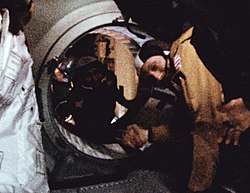 The historic handshake between Stafford and Leonov
 -
 U.S. President Gerald Ford speaks to the Soviet and American crews on 18 July 1975.
 -
 Deke Slayton (right) with Leonov in the Soyuz spacecraft
 -
 The astronauts and cosmonauts assembled this commemorative plaque in orbit as a symbol of the international cooperation.
_spacecraft.jpg)


Re-entry and aftermath
[edit]The mission was considered a great success, both technically and as a public-relations exercise for both nations. The only serious problem was during reentry and splashdown of the Apollo craft, during which the crew were accidentally exposed to toxic monomethylhydrazine and nitrogen tetroxide fumes, caused by unignited reaction control system (RCS) hypergolic propellants venting from the spacecraft and reentering a cabin air intake. The RCS was inadvertently left on during descent, and the toxic fumes were sucked into the spacecraft as it drew in outside air. Brand briefly lost consciousness, while Stafford retrieved emergency oxygen masks, put one on Brand, and gave one to Slayton. The three astronauts were hospitalized for two weeks in Honolulu, Hawaii.[23] Brand took responsibility for the mishap; because of high noise levels in the cabin during reentry, he believed he was unable to hear Stafford call off one item of the reentry checklist, the closure of two switches which would have automatically shut off the RCS and begun drogue parachute deployment. These procedures were manually performed later than usual, allowing the ingestion of the propellant fumes through the ventilation system.[24]
The ASTP was the final flight of an Apollo spacecraft. Immediately after the launch of the Apollo spacecraft, preparations began to convert LC-39B and the Vehicle Assembly Building at Kennedy Space Center for use by the Space Shuttle, the United States' next crewed spacecraft program. LC-39A had already been closed after the launch of Skylab.[citation needed]
Legacy
[edit]Technical
[edit]
A derivative (but mechanically incompatible) docking collar, APAS-89, was launched as part of the Kristall module of the Soviet Mir space station. Originally intended as the docking port for the Buran Soviet space shuttle, the APAS-89 unit was used for the next Russian–American docking mission, STS-71, twenty years later as part of the Shuttle–Mir program (though not before the docking port was tested by the last APAS-equipped Soyuz, Soyuz TM-16, in 1993).
The American Space Shuttle continued to use the same APAS-89 docking hardware through the end of the Space Shuttle program to dock to Mir and then the International Space Station, the latter through the Pressurized Mating Adapters (PMAs).
The PMAs are equipped with the later APAS-95 adapters, which differ from the APAS-89 adapters in that they are no longer androgynous; while compatible with the APAS-89 docking collars, they are not capable of acting as the "active" partner in docking.
The first PMA, PMA-1, remains in use as the interface connecting the Russian-built, NASA-owned Zarya module to the US segment of the ISS (USOS), and so the APAS continues in use to this day (2024).[25]
Political
[edit]).jpg)
Apollo–Soyuz was the first joint US–Soviet space mission. At the time it was thought that space would become either more international or competitive as a result, but it became both. The mission became symbolic of each country's goals of scientific cooperation, while their news reports downplayed the technical prowess of the other. Soviet press implied that it was leading the United States in space flight, tying it to the Marxist–Leninist ideology, while the United States reported that the Soyuz was technically primitive.[26] High-profile space cooperation declined after the successful mission and became entangled in linkage politics, but it set a precedent of cooperation that continued in the Shuttle–Mir Program.[27][28]
Cultural
[edit]The American and Soviet commanders, Stafford and Leonov, became lasting friends. Leonov was the godfather of Stafford's younger children.[27][29] Stafford gave a eulogy at Leonov's funeral in October 2019.[30]
An asteroid, 2228 Soyuz-Apollo, discovered in 1977 by Soviet astronomer Nikolai Chernykh, is named after the mission.[31]
To commemorate Apollo–Soyuz, renowned British/Irish bartender Joe Gilmore of The Savoy Hotel's American Bar created the 'Link-Up' cocktail. When the astronauts were told the cocktail was being flown out from London to be enjoyed on their return, they said, "Tell Joe we want it up here".[32]
Scientific
[edit]The Apollo craft carried the SAG telescope designed to observe in the extreme ultraviolet.[33] Across several orbits of observing the instrument discovered two ultraviolet sources, HZ 43 and FEIGE 24, both of which were white dwarfs.[33][34] Other stars observed included, Proxima Centauri (a Red Dwarf), SS Cygni (a Binary star), and Sirius (also a Binary star). A third possible discovery was an unknown object in the Pavo constellation.[34] The star HD 192273 was later suggested as a candidate for the Pavo observation but further study concluded that the star's distance and spectral class made this unlikely.[35]
Spacecraft locations
[edit]


The Apollo command module from the mission is on display at the California Science Center in Los Angeles.[36] The descent module of Soyuz 19 is on display at the RKK Energiya museum in Korolyov, Russia.
A display at the National Air and Space Museum in Washington, D.C. shows the docked Apollo/Soyuz configuration. The display is made up of the unflown Apollo Command and Service Module 105 (used for vibration testing for the Skylab program), the back-up Docking Module, and an unflown Soyuz spacecraft, on loan from the Russian government.[29]
._Mission_Control_Center,_Korolyov._Two_crews,_zodiac._Soyuz-Apollo_flight_scheme._Emblem)_1200dpi.jpg)
Commemorations
[edit]The United States Postal Service issued the Apollo–Soyuz commemorative stamps, honoring the United States–Soviet link up in space, on 15 July 1975, the day of the launch.
The remaining crew's most recent reunion was on 16 July 2010, when Leonov, Kubasov, Stafford, and Brand met at an Omega timepiece store in New York City. All except Leonov participated in a public roundtable that evening. Omega had produced several watches to be used on the mission.[37]

Monument
[edit] | This section needs to be updated. (March 2019) |
A large Soyuz–Apollo monument was constructed outside the Soviet (now Russian) space control center RKA Mission Control Center (Russian acronym: TsUP) in Moscow. It consisted of a metal scale model of Earth overarched by an arc terminating in the joined Soyuz–Apollo spacecraft. It was damaged when a vehicle collided with it in the late 1990s,[citation needed] and was removed for repairs.
Mission Control Center
[edit]The mission control room that hosted the Americans in Korolyov, Russia, was preserved as a memorial to the Soyuz–Apollo mission.[29]
Program cost
[edit]The United States spent US$245 million (equal to $1,430,000,000 today)[38] on the Apollo–Soyuz project and spacecraft.[39]
The amount of money the Soviet Union spent on the ASTP is unknown but reportedly constituted a "significant portion."[40]
See also
[edit]
- Interkosmos, a Soviet space program from 1967 to 1994, designed to give foreign nations access to space missions.
- For All Mankind, an alternate history streaming series that depicts a fictionalized Apollo–Soyuz mission in its second season
References
[edit]- ^ "Apollo Soyuz Program Summary". mannedspaceops.org. Retrieved 15 May 2023.
- ^ a b c d e f g h Committee on Aeronautical and Space Sciences, Soviet Space Programs, 1971–75. Washington: U.S. Govt. Print. Off., 1976.
 This article incorporates text from this source, which is in the public domain.
- ^ "The First Dryden–Blagonravov Agreement – 1962". NASA History Series. NASA. Archived from the original on 1 August 2020. Retrieved 14 March 2019. This article incorporates text from this source, which is in the public domain.
- ^ Launius, Roger D. (10 July 2019). "First Moon landing was nearly a US–Soviet mission". Nature. 571 (7764): 167–168. Bibcode:2019Natur.571..167L. doi:10.1038/d41586-019-02088-4. PMID 31292553. S2CID 195873630.
- ^ a b Debbora Battaglia, "Arresting Hospitality: the Case of the 'Handshake in Space'," Journal of the Royal Anthropological Institute vol. 18 issue 1 June 2012. pp. S76–S89
- ^ Ezell, Edward; Ezell, Linda (1978). "Chapter 5. Proposal for a Test Flight". The Partnership: A History of the Apollo–Soyuz Test Project. Washington, D.C.: NASA. This article incorporates text from this source, which is in the public domain.
- ^ a b c d Ezell, Edward; Ezell, Linda (1978). "Foreword". The Partnership: A History of the Apollo–Soyuz Test Project. Washington, D.C.: NASA. This article incorporates text from this source, which is in the public domain.
- ^ a b Jennifer Ross-Nazzal,"Détente on Earth and in Space: The Apollo–Soyuz Test Project", Organization of American Historians Magazine of History, September 2010, Volume 24, Issue 3, pp. 29–34.
- ^ Agreement Concerning Cooperation in the Exploration and Use of Outer Space for Peaceful Purposes: Moscow, 24 May 1972. Moscow: NASA, 1972. This article incorporates text from this source, which is in the public domain.
- ^ Slayton, Donald K. (1994). Deke!. Forge. ISBN 978-0-312-85503-1 – via Internet Archive.
- ^ Slayton, Donald; Cassutt, Michael (1994). Deke! U.S. Manned Space: From Mercury to the Shuttle. New York: Forge. pp. 278–279. ISBN 0-312-85503-6. LCCN 94-2463. OCLC 29845663.
- ^ "Apollo–Soyuz". nasa.gov. This article incorporates text from this source, which is in the public domain.
- ^ "HEASARC Missions". nasa.gov. This article incorporates text from this source, which is in the public domain.
- ^ NASA.gov This article incorporates text from this source, which is in the public domain.
- ^ NASA.gov This article incorporates text from this source, which is in the public domain.
- ^ Kennedy, J. Michael (29 April 1985). "Shuttle Flight Is Lind's First Mission : Astronaut's 19-Year Wait for Space Trip Ends Today". Los Angeles Times. Retrieved 7 July 2020.
- ^ Jones, Phillip. "Blast-off to Bognor". Retrieved 4 May 2011.
- ^ Edward Clinton Ezell; Linda Neuman Ezell (1978). "The Partnership: A History of the Apollo–Soyuz Test Project". NASA. Archived from the original on 24 May 2011. Retrieved 4 May 2011. This article incorporates text from this source, which is in the public domain.
- ^ "From Amur Waves to Pink Floyd: The music preferences of Soviet cosmonauts". Moscow City official website. Archived from the original on 30 November 2021. Retrieved 30 November 2021.
- ^ Gabriel San Roman (23 December 2010). "WAR Is the Answer (and the Question) for Lonnie Jordan". OC Weekly. Archived from the original on 2 October 2015. Retrieved 30 November 2021.
- ^ Saxon, Wolfgang (23 March 1996). "Jane Oppenheimer Dies at 84; Expert on Embryos and Space". The New York Times – via NYTimes.com.
- ^ Suzanne Deffree. Apollo-Soyuz Test Project ends Space Race, July 17, 1975 // EDN, July 17, 2019
- ^ Ezell, Edward Clinton; Ezell, Linda Neuman (1978). "The Partnership: A History of the Apollo–Soyuz Test Project". NASA History Series (NASA Special Publication 4209). NASA. Archived from the original on 23 August 2007. Retrieved 17 March 2009. This article incorporates text from this source, which is in the public domain.
- ^ "Brand Takes Blame For Apollo Gas Leak", Florence, AL – Times Daily newspaper, 10 August 1975
- ^ "A timeline of ISS missions". www.russianspaceweb.com. Retrieved 5 August 2024.
- ^ U.S.–Soviet Cooperation in Space (PDF) (Report). US Congress, Office of Technology Assessment. July 1985. pp. 80–81. Retrieved 13 June 2018. This article incorporates text from this source, which is in the public domain.
- ^ a b Kellie Morgan (15 July 2015). "How historic handshake in space brought superpowers closer". CNN. Retrieved 13 June 2018.
- ^ James Moltz (29 June 2011). The Politics of Space Security: Strategic Restraint and the Pursuit of National Interests. Stanford University Press. p. 181. ISBN 978-0-8047-7858-9.
- ^ a b c "Apollo–Soyuz: A cold war handshake in space, 40 years on". New Scientist. 17 July 2015. Retrieved 13 June 2018.
- ^ "Russia bids farewell to first man who walked in space". MSN. 15 October 2019. Archived from the original on 1 November 2019.
- ^ Schmadel, Lutz D. (2003). Dictionary of Minor Planet Names (5th ed.). New York: Springer Verlag. p. 181. ISBN 3-540-00238-3.
- ^ "Cocktail king Joe Gilmore, Belfast's barman to the stars". The Irish News. 16 January 2016. Archived from the original on 10 February 2023. Retrieved 10 February 2023.
- ^ a b Harvey, Brian (2018). Discovering the Cosmos with Small Spacecraft The American Explorer Program. Springer Praxis. pp. 168–169. ISBN 9783319681382.
- ^ a b Bowyer, C.Stuart (15 January 1978). "Apollo–Soyuz test project Extreme Ultraviolet Telescope MA-083". UCBSSL. 18 (76). Bibcode:1978ucb..reptR....B. Retrieved 13 April 2023.
- ^ Walborn, Nolan R; Panek, Robert J (December 1980). "Some optical observations of HD 192273 - A proposed identification for a possible EUV source". Publications of the Astronomical Society of the Pacific. 92 (550): 803–805. Bibcode:1980PASP...92..803W. doi:10.1086/130753. S2CID 120428265.
- ^ "Apollo-Soyuz command module". California Science Center. Retrieved 5 January 2025.
- ^ "First International Space Crew Reunites for Mission's 35th Anniversary". Space.com. 16 July 2010. Retrieved 31 December 2022.
- ^ 1634–1699: McCusker, J. J. (1997). How Much Is That in Real Money? A Historical Price Index for Use as a Deflator of Money Values in the Economy of the United States: Addenda et Corrigenda (PDF). American Antiquarian Society. 1700–1799: McCusker, J. J. (1992). How Much Is That in Real Money? A Historical Price Index for Use as a Deflator of Money Values in the Economy of the United States (PDF). American Antiquarian Society. 1800–present: Federal Reserve Bank of Minneapolis. "Consumer Price Index (estimate) 1800–". Retrieved 29 February 2024.
- ^ Lafleur, Claude (8 March 2010). "Costs of US piloted programs". The Space Review. Retrieved 18 February 2012.
- ^ NATIONAL AERONAUTICS AND SPACE ADMINISTRATION APOLLO SOYUZ TEST PROJECT p. 8.

External links
[edit]
- ASTP Chronology Archived 16 June 2013 at the Wayback Machine
- Apollo-Soyuz Test Project Overview
- ASTP NASA site archived
- Apollo–Soyuz Archived 25 February 2021 at the Wayback Machine
- The Partnership: A History of the Apollo–Soyuz Test Project Archived 23 January 2011 at the Wayback Machine – official NASA history of the mission
- International rendezvous and docking mission (Apollo–Soyuz/Salyut) 1971 – NASA report (PDF)
- Apollo/Soyuz test project operational data book. Volume 2: ASTP mass properties data book – NASA report (PDF)
- Apollo–Soyuz test project operation handbook command service docking modules systems operating procedures – NASA flight operations manual (PDF)
- NASA History Series Publications (many of which are on-line)
- «Apollo–Soyuz» – tell Soviet scientists, engineers and astronauts – participants of the joint work of American specialists, Politizdat 1976, with a circulation of 100,000 copies.
- Apollo Soyuz Collection, The University of Alabama in Huntsville Archives and Special Collections
- Media
- A film clip of ASTP Highlights is available for viewing at the Internet Archive
- The short film The Apollo–Soyuz Mission is available for free viewing and download at the Internet Archive.
- The short film Apollo Soyuz (1975) is available for free viewing and download at the Internet Archive.
- The short film MISSION OF Apollo–Soyuz (1975) is available for free viewing and download at the Internet Archive.
- The short film 25 Years of Progress, Episode 9: Transition Years (1983) is available for free viewing and download at the Internet Archive.
- The short film Apollo–Soyuz Test Project Facts (1975) is available for free viewing and download at the Internet Archive.
- The short film Apollo–Soyuz Test Project Facts, Part B (1975) is available for free viewing and download at the Internet Archive.
- The short film Apollo–Soyuz Test Project Facts, Part C (1975) is available for free viewing and download at the Internet Archive.
- The short film History of Space Travel, Episode 13: The Mission of Apollo–Soyuz is available for free viewing and download at the Internet Archive.
- The short film Our Laboratories in Space, episode 7 is available for free viewing and download at the Internet Archive. (several types of media formats are available)
- The short film Apollo17 On The Shoulders Of Giants is available for free viewing and download at the Internet Archive. (several types of media formats are available)
- Apollo-Soyuz Test Project (1973) Film, Texas Archive of the Moving Image
| Main topics |  | ||||||||||||||||||||||||||
|---|---|---|---|---|---|---|---|---|---|---|---|---|---|---|---|---|---|---|---|---|---|---|---|---|---|---|---|
| Past missions (by spacecraft type) |
| ||||||||||||||||||||||||||
| Current missions | |||||||||||||||||||||||||||
| Future missions | |||||||||||||||||||||||||||
Uncrewed missions are designated as Kosmos instead of Soyuz; exceptions are noted "(uncrewed)". The † sign designates failed missions. Italics designates cancelled missions. | |||||||||||||||||||||||||||
| Launch complexes |  | ||||||||||
|---|---|---|---|---|---|---|---|---|---|---|---|
| Ground facilities | |||||||||||
| Launch vehicles | |||||||||||
| Spacecraft and rover | |||||||||||
| Flights |
| ||||||||||
| Apollo 8 specific | |||||||||||
| Apollo 11 specific | |||||||||||
| Apollo 12 specific | |||||||||||
| Apollo 13 specific | |||||||||||
| Apollo 14 specific | |||||||||||
| Apollo 15 specific | |||||||||||
| Apollo 16 specific | |||||||||||
| Apollo 17 specific | |||||||||||
| Post-Apollo capsule use | |||||||||||
| Related | |||||||||||
| |||||||||||
| Launch sites |  | ||||||||
|---|---|---|---|---|---|---|---|---|---|
| Launch vehicles | |||||||||
| Human spaceflight programs |
| ||||||||
| Robotic programs |
| ||||||||
| Communications |
| ||||||||
| Concepts | |||||||||
| Images and artwork | |||||||||
| Related | |||||||||

| Diplomatic posts |
|
|---|---|
| Diplomacy |
|
| Cold War |
|
| Incidents |
|
| Military relations |
|
| Legislation | |
| Treaties |
|
| Organizations |
|
| Related |
|


| National | |
|---|---|
| Other | |

Apollo–Soyuz
View on GrokipediaGeopolitical Context
Origins in the Space Race
The Space Race emerged as a prominent dimension of Cold War rivalry following the Soviet Union's launch of Sputnik 1 on October 4, 1957, which demonstrated their technological prowess and spurred the United States to accelerate its space program. This competition intensified with the Soviet achievement of the first human spaceflight by Yuri Gagarin on April 12, 1961, prompting President John F. Kennedy to commit the U.S. to landing humans on the Moon before the decade's end. The U.S. realized this goal with Apollo 11 on July 20, 1969, establishing a lead in manned lunar exploration that the Soviets could not match despite parallel efforts. Post-Apollo 11, the competitive fervor waned as U.S. space budgets contracted amid domestic priorities, while Soviet programs focused on space stations and reusable spacecraft. The technological parity and mutual recognition of space's dual military-civilian value, honed through rivalry, created preconditions for collaboration, though ideological distrust persisted. Early U.S. proposals for joint ventures, including Kennedy's 1961 suggestion of a cooperative lunar landing rejected by Nikita Khrushchev, underscored the Space Race's barrier to partnership.[6] In April 1970, amid emerging détente, the Soviet Academy of Sciences proposed bilateral discussions on space cooperation to the U.S., marking a reversal from prior rejections.[7] This initiative, building on technical advancements from the Space Race, led to NASA delegations visiting Soviet facilities in October 1970 and reciprocal exchanges in 1971, where a standardized docking mechanism for Apollo and Soyuz was conceptualized.[8] These efforts culminated in the May 24, 1972, agreement signed by President Richard Nixon and Premier Alexei Kosygin, formalizing the Apollo-Soyuz Test Project as a symbolic endpoint to the era of unbridled competition.[8]Détente Negotiations and Agreement
The Apollo–Soyuz Test Project originated amid the policy of détente, which sought to reduce Cold War tensions through diplomatic engagement, including arms control treaties like the Strategic Arms Limitation Talks (SALT I) ratified in 1972.[9] In this context, space cooperation symbolized potential for superpower collaboration beyond rivalry, with preliminary Soviet authorization for talks with NASA occurring in May 1970 following internal Communist Party decisions to explore joint missions.[10] Negotiations gained momentum during U.S. President Richard Nixon's summit visit to Moscow from May 22 to 30, 1972, where discussions addressed broader bilateral agreements amid ongoing U.S.-Soviet efforts to stabilize relations after the 1960s space race.[11] On May 24, 1972, Nixon and Soviet Premier Alexei Kosygin signed the Agreement Concerning Cooperation in the Exploration and Use of Outer Space for Peaceful Purposes, formalizing commitments to joint projects including the docking of American and Soviet spacecraft.[8] [12] This pact built on earlier preparatory accords from April 1972 and specified the Apollo–Soyuz mission targeted for 1975, involving compatible docking systems and crew exchanges to test interoperability.[8] The agreement reflected pragmatic mutual interests: for the U.S., advancing post-Apollo space policy amid budget constraints; for the USSR, gaining technical insights and diplomatic prestige without conceding ideological ground.[7] While the signing marked a détente milestone, it faced domestic U.S. skepticism, with critics arguing it prematurely legitimized Soviet technological parity despite ongoing geopolitical frictions like the Vietnam War.[9] Nonetheless, the accord established working groups for implementation, paving the way for technical protocols ratified later that year and underscoring space as a controlled arena for controlled rivalry-to-cooperation transition.[13] The project's diplomatic framework prioritized verifiable milestones over abstract goodwill, aligning with first-hand accounts from negotiators emphasizing engineering feasibility as a trust-building mechanism.[7]Technical Preparations
Apollo Spacecraft Modifications
The Apollo Command and Service Module (CSM-111) for the Apollo-Soyuz Test Project utilized a Block II configuration similar to that of earlier lunar and Skylab missions, but incorporated targeted modifications to enable compatibility with the Docking Module, support extended rendezvous operations, and accommodate joint mission experiments.[14] These changes ensured the spacecraft could interface with the Soviet Soyuz via the intermediary Docking Module while maintaining operational autonomy.[15] Key alterations to the Service Module focused on propulsion enhancements, including the addition of extra propellant tanks to the Reaction Control System (RCS), which provided the precise thrust vectors needed for multiple docking attempts, attitude adjustments during crew transfers, and post-undocking maneuvers over the nine-day mission duration.[14] This increased RCS capacity addressed the demands of Earth-orbital rendezvous sequences differing from translunar trajectories, allowing for finer control without depleting primary Service Propulsion System reserves.[16] In the Command Module, modifications included new controls, displays, and instrumentation panels dedicated to Docking Module operations and docking system monitoring, such as pressure equalization valves and alignment indicators to manage the transition between Apollo's 100% oxygen atmosphere at 5 psi and the Docking Module's nitrogen-oxygen mix compatible with Soyuz.[14] Communication subsystems were upgraded with additional VHF antennas and transceivers to establish hardwired and radio links for real-time coordination between crews during hatch openings and transfers.[14] The CSM also featured structural adaptations in the forward docking compartment to integrate with the Docking Module's attachment mechanism, utilizing the standard probe-and-drogue system but with reinforced seals and sensors for launch vibrations and orbital deployment.[15] Provisions for ASTP-specific experiments—such as biological specimen storage, materials processing units, and ultraviolet stellar photography instruments—required dedicated mounting brackets, power allocations from the fuel cells, and data interfaces in both modules, drawing on the Service Module's quadrant bays without altering core environmental or thermal systems.[14] These modifications, verified through ground tests at Kennedy Space Center in 1974–1975, prioritized reliability for the symbolic joint flight while minimizing deviations from proven hardware.Soyuz Spacecraft Adaptations
The Soyuz spacecraft for the Apollo-Soyuz Test Project (ASTP) utilized the specialized 7K-TM variant, custom-designed to accommodate joint operations with the American Apollo spacecraft and the NASA-provided docking module. This version departed from the standard Soyuz 7K-T configuration primarily through the integration of an androgynous docking mechanism and enhancements for extended mission endurance.[17][18] The most critical adaptation was the docking system, where the conventional Igla probe-and-drogue mechanism was replaced with the APAS-75 androgynous peripheral attach system, developed collaboratively by NASA and Soviet engineers. This enabled the Soyuz 19 to serve as the active docking partner, latching securely into the passive APAS port on the docking module, which itself connected to Apollo via a standard probe-and-drogue interface.[17] The APAS design facilitated reliable capture, alignment, and structural integrity during rendezvous, with the Soyuz initiating contact at a relative speed not exceeding 0.3 m/s.[17] To support the mission's timeline, which required Soyuz 19 to remain in orbit for up to nine days—longer than typical battery-limited flights—the service module incorporated deployable solar panels generating approximately 700 watts, replacing the short-duration chemical batteries of earlier models.[17] These panels, along with improved thermal control systems, ensured sustained power for propulsion, life support, and communication during the extended solo phase before and after docking.[17] Crew transfer compatibility necessitated adjustments to the Soyuz's atmospheric environment; the nominal 14.7 psi (760 mm Hg) mixed nitrogen-oxygen cabin pressure was reduced to 9.9 psi (510 mm Hg) during hatch opening and transfer operations, minimizing decompression risks in the docking module's intermediate-pressure airlock pressurized to around 5.7 psi with 65% oxygen.[18] No fundamental changes were made to the propulsion or reentry systems, which retained the standard Soyuz layout of the orbital, descent, and instrument modules.[17] Validation of these adaptations occurred through rigorous testing: uncrewed launches of Kosmos 638 on April 3, 1974, and Kosmos 672 on August 12, 1974, demonstrated the docking and orbital systems, while the crewed Soyuz 16 mission from December 2 to 8, 1974, simulated the full rendezvous profile, pressure adjustments, and systems integration without actual docking.[19][18] These efforts confirmed the 7K-TM's reliability for the July 15, 1975, launch of Soyuz 19.[17]Docking Mechanism and Compatibility Standards
The inherent incompatibility between the Apollo and Soyuz docking systems—stemming from differences in probe-and-drogue configurations, alignment tolerances, and structural dimensions—necessitated a bespoke solution for the Apollo-Soyuz Test Project (ASTP).[20] The Soyuz employed an Igla probe-and-drogue mechanism optimized for Soviet orbital stations, while Apollo's system, derived from lunar module heritage, featured mismatched capture envelopes and latching profiles.[21] To resolve this, U.S. and Soviet engineers jointly developed the Androgynous Peripheral Attach System (APAS-75), a symmetrical docking interface that permitted either spacecraft to act as the active (probe) or passive (drogue) partner without requiring vehicle-specific modifications beyond adapter collars.[20] This androgynous design utilized three structural "petals" or leaves for initial soft capture via peripheral latches, followed by rigidization through twelve hooks and a central probe extension for fine alignment, achieving a capture radius of approximately 1 meter.[21] The APAS-75 mechanism was integrated via a dedicated NASA-built Docking Module (DM), a cylindrical pressurized tunnel approximately 3.05 meters long and 1.52 meters in diameter, which attached to the Apollo Command Module's forward hatch using its standard probe-and-drogue adapter.[1] The DM's opposite end housed the APAS-75 docking adapter, modified with a Soviet-compatible collar on the Soyuz side to ensure mechanical and electrical interface compatibility.[20] Electrical connectors provided for relative navigation data transfer, docking aid illumination, and safety interlocks, while hydraulic actuators on the active vehicle drove the probe extension and latch engagement at rates up to 0.3 meters per second.[21] Compatibility standards, formalized in bilateral protocols post the May 24, 1972, U.S.-USSR space agreement, emphasized mutual rendezvous parameters (e.g., orbital insertion accuracy within 10 km), docking loads under 2 g, and airtight seals tested to 1 atm differential pressure.[2] Development involved over 1,000 hours of joint ground simulations at facilities like NASA's Langley Research Center and the Soviet Zvezda complex, validating the system's performance across thermal, vacuum, and dynamic misalignment scenarios up to 0.5 degrees.[20] In orbit on July 17, 1975, the mechanism executed two dockings: first with Apollo as active (closing at 0.12 m/s), followed by undocking and a second with Soyuz active, confirming bidirectional operability and structural integrity with no leaks or anomalies.[5] These standards laid groundwork for future international docking protocols, prioritizing mechanical universality over proprietary designs to enable emergency crew transfers.[2]Crew Selection and Training
American Crew Details
NASA selected the prime American crew for the Apollo-Soyuz Test Project (ASTP) on January 13, 1973, consisting of Commander Thomas P. Stafford, Command Module Pilot Vance D. Brand, and Docking Module Pilot Donald K. Slayton.[22] The backup crew included Commander Alan L. Bean, Command Module Pilot Ronald E. Evans, and Docking Module Pilot Jack R. Lousma.[23] Selection criteria emphasized prior spaceflight experience for command roles and technical proficiency for docking operations, given the mission's international compatibility challenges.[24] Thomas P. Stafford, born September 17, 1930, in Weatherford, Oklahoma, served as mission commander. A U.S. Air Force lieutenant general and test pilot, Stafford was selected as an astronaut in 1962 (NASA Group 2). His prior missions included Gemini 6A (December 1965, first U.S. spacecraft rendezvous), Gemini 9A (June 1966, extravehicular activity), and Apollo 10 (May 1969, lunar module dress rehearsal). Stafford's extensive orbital maneuvering expertise made him suitable for leading the rendezvous and docking with Soyuz.[24][25] Vance D. Brand, born May 15, 1931, in Longmont, Colorado, acted as command module pilot. A civilian aeronautical engineer and former Navy aviator, Brand joined NASA in 1966 (Group 5). ASTP marked his first spaceflight, following service as backup command module pilot for Apollo 15. Brand's responsibilities included managing Apollo's systems during joint operations and biological experiments.[24][24] Donald K. "Deke" Slayton, born March 1, 1924, in Sparta, Wisconsin, piloted the docking module. An original Mercury astronaut (selected 1959), Slayton was grounded in 1962 due to a heart arrhythmia but cleared for flight in 1972 after medical reevaluation. As NASA's Director of Flight Crew Operations from 1962 to 1973, he oversaw astronaut assignments. At age 51 during launch, Slayton handled the Androgynous Peripheral Attach System (APAS) interface and transferred to Soyuz for joint activities.[26][27]| Role | Prime Crew Member | Backup Crew Member |
|---|---|---|
| Commander | Thomas P. Stafford | Alan L. Bean |
| Command Module Pilot | Vance D. Brand | Ronald E. Evans |
| Docking Module Pilot | Donald K. Slayton | Jack R. Lousma |
Soviet Crew Details
The Soviet prime crew for the Apollo-Soyuz Test Project consisted of Aleksey A. Leonov as commander and Valery N. Kubasov as flight engineer.[1] Leonov, a Soviet Air Force pilot selected for cosmonaut training in the early 1960s, achieved fame as the first human to perform an extravehicular activity during the Voskhod 2 mission on March 18, 1965, spending approximately 12 minutes outside the spacecraft.[28] His selection for ASTP reflected his extensive experience and symbolic role in international cooperation, having commanded Soyuz 19 during the July 15, 1975 launch from Baikonur Cosmodrome.[29] Kubasov, an engineer selected as a cosmonaut in 1968, brought technical expertise from his prior flight as flight engineer on Soyuz 6, launched October 11, 1969, as part of the Soviet Union's first concurrent three-spacecraft mission supporting docking tests.[22] This experience prepared him for handling Soyuz systems during the joint mission, where he monitored engineering parameters and participated in joint activities after docking.[30] The backup crew included Anatoly V. Filipchenko as commander and Nikolai N. Rukavishnikov as flight engineer.[22] Filipchenko, who had commanded Soyuz 7 in October 1969 during the same triple mission as Kubasov, later flew Soyuz 16 in December 1974 as a dress rehearsal for ASTP procedures.[31] Rukavishnikov, an engineer-cosmonaut, gained docking experience on Soyuz 10 in April 1971, attempting the first crewed visit to Salyut 1, and co-piloted the Soyuz 16 rehearsal flight.[32] These assignments ensured redundancy in operational knowledge for the high-stakes international docking.[33]Joint Training Protocols and Challenges
The joint training protocols for the Apollo-Soyuz Test Project (ASTP) encompassed cross-familiarization sessions for the American and Soviet crews at respective training facilities, spanning from July 1973 to April 1975, to ensure operational compatibility during rendezvous, docking, and crew transfers.[34] These protocols included spacecraft simulator exercises, language instruction, scientific experiment briefings, and integrated mission rehearsals coordinated through bilateral working groups.[35] In the United States, the Soviet prime crew (Alexei Leonov and Valeri Kubasov) and backups conducted two-week sessions at NASA's Johnson Space Center (JSC) in Houston, Texas, from February 8 to 13, 1975, utilizing Apollo Command Module, Docking Module, and Soyuz mockups for hands-on transfer drills and procedural walkthroughs.[23] The American prime crew (Thomas Stafford, Vance Brand, and Deke Slayton) and backups mirrored this with sessions at the Soviet Yuri Gagarin Cosmonaut Training Center in Star City near Moscow in late April 1975, focusing on Soyuz systems and emergency protocols.[36] Language training formed a foundational element, with U.S. astronauts receiving approximately 18 months of Russian instruction starting in 1973 to achieve functional proficiency for technical exchanges, while Soviet cosmonauts underwent English training emphasizing mission-specific terminology like docking commands and system nomenclature.[37] Protocols mandated bilingual phrasebooks, standardized terminology (e.g., English as the primary docking language), and real-time translation support from ground control to mitigate miscommunications.[38] Joint simulations, including three full-scale integrated exercises and multiple shorter rehearsals, simulated the 44-hour docked phase, incorporating both Houston and Moscow mission control centers to validate timelines, such as the 7-hour 31-minute rendezvous window and crew transfers.[39] These efforts extended to ground personnel, with six joint control center training sessions and 11 hardware compatibility tests verifying audio-video links and docking interfaces.[40] Challenges in these protocols stemmed primarily from linguistic and procedural disparities, as the crews' training revealed persistent communication hurdles despite preparatory efforts; for instance, during simulations, accents and technical jargon necessitated repeated clarifications, with post-mission accounts noting that real-time exchanges in orbit required simplified phrasing to avoid errors.[41] Cultural variances in operational tempo—NASA's emphasis on detailed checklists versus the Soviets' more adaptive approach—led to friction in aligning emergency response protocols, such as cabin depressurization drills, which were refined through iterative working group meetings from January to February 1975.[35] Logistical and security constraints further complicated training, including restricted access to proprietary spacecraft data due to ongoing Cold War sensitivities, limiting full systems disclosure and requiring neutral third-party verification for docking adapters.[42] Nevertheless, these sessions fostered interpersonal rapport, as evidenced by informal activities like geological field trips in Texas and mutual facility tours, which indirectly addressed cultural barriers by building trust between the crews.[23]Mission Execution
Launch Sequences
The Soyuz 19 spacecraft launched first on July 15, 1975, at 12:20 UTC (8:20 a.m. EDT) from the Baikonur Cosmodrome in Kazakhstan aboard a Soyuz-11A511 two-stage launch vehicle.[3] The prime crew consisted of Commander Alexei Leonov and Flight Engineer Valery Kubasov. The launch sequence proceeded nominally, with the first stage (core booster and four boosters) igniting at liftoff and separating approximately 118 seconds later, followed by the second stage burnout and separation at T+156 seconds, and the third stage (Block I) inserting the spacecraft into a 175 by 219 kilometer parking orbit inclined at 51.8 degrees.[3] No significant anomalies were reported during ascent, and the crew confirmed systems functionality shortly after orbital insertion.[3] Approximately seven hours and thirty minutes later, the American Apollo spacecraft lifted off at 19:50 UTC (3:50 p.m. EDT) from Launch Complex 39B at NASA's Kennedy Space Center in Florida, propelled by the Saturn IB vehicle designated AS-210.[3] The crew included Commander Thomas P. Stafford, Command Module Pilot Vance D. Brand, and Docking Module Pilot Donald K. Slayton. The launch sequence followed standard Saturn IB procedures: the S-IB first stage's eight H-1 engines ignited at T-0, achieving liftoff and burning for 135 seconds until main engine cutoff at T+2:12, followed by stage separation at T+2:26; the single J-2 engine of the S-IVB second stage then ignited for orbital insertion, with translunar injection-like burn placing Apollo into a 167 by 185 kilometer orbit inclined at 28.9 degrees, compatible for rendezvous.[43] The ascent was nominal, with the launch escape system jettisoned post-S-IVB ignition and the spacecraft separating from the S-IVB after two orbits to prepare for rendezvous operations.[3]Rendezvous and Docking Procedures
The rendezvous and docking procedures for the Apollo-Soyuz Test Project (ASTP) initiated with the extraction of the Docking Module (DM) by the Apollo crew approximately two hours after launch on July 15, 1975. The DM, stowed in the Saturn IB's spacecraft-to-payload adapter, was retrieved through a specialized maneuver where the Command and Service Module (CSM) used its probe-and-drogue system to dock with the DM's interface, effectively integrating it into the Apollo stack for subsequent operations.[14] This step ensured compatibility with the Soyuz spacecraft, as the DM served as an airlock and adapter between the differing atmospheric pressures and docking ports of the two vehicles.[1] Following the Soyuz 19 launch at 19:20:24 UTC on July 15, Apollo, already in a parking orbit of approximately 185 by 221 kilometers at 51.8° inclination, executed a series of rendezvous maneuvers using its Service Propulsion System (SPS) engine and Reaction Control System (RCS) thrusters.[44] These included phasing burns to adjust altitude and plane, aligning Apollo's orbit with Soyuz's nominal 187 by 225 kilometer parameters, enabling a co-elliptic approach sequence over the next 48 hours.[45] Ground-based tracking from NASA's Mission Control in Houston and Soviet facilities provided real-time orbital data, while Apollo's onboard radar and optical systems facilitated autonomous corrections.[46] On July 17, 1975, at approximately 51 hours 49 minutes into the Apollo mission (16:09 UTC), the spacecraft achieved visual contact at a range of about 15 kilometers, followed by station-keeping maneuvers at 100 meters separation.[47] Apollo then initiated the final approach along the velocity vector, extending its probe to contact Soyuz's Androgynous Peripheral Attach System (APAS-75) docking ring. The soft capture latched the probe, after which retraction mechanisms drew the vehicles together for a hard dock, completing the structural connection at 16:12 UTC.[48] Post-docking procedures involved pressurization checks, a 30-minute leak test confirming no pressure loss beyond 0.2 psi, and equalization of cabin atmospheres—Apollo's pure oxygen at 5 psi interfacing via the DM's mixed gas environment at 10.2 psi to match Soyuz's 14.7 psi air-nitrogen mix—prior to hatch opening.[21] These steps validated the interoperability of U.S. and Soviet rendezvous navigation, docking hardware, and life support systems under joint operational protocols.[1]In-Orbit Joint Activities
Following successful docking on July 17, 1975, at 12:12 p.m. EDT, the hatches between the Apollo docking module and Soyuz were opened at 3:17 p.m. EDT, allowing the crews to meet face-to-face.[45] American commander Thomas P. Stafford and Soviet commander Aleksey A. Leonov exchanged the first handshake between representatives of the two nations in space, symbolizing détente amid Cold War tensions.[49] The crews then exchanged gifts, including U.S. flags signed by American crew members presented to the Soviets and Soviet flags to the Americans, along with medals, pins, and tree seeds intended for planting on Earth.[49] They shared a ceremonial meal featuring foods from both countries, such as American steak and Soviet borscht, and received congratulatory telephone calls from U.S. President Gerald Ford and Soviet leader Leonid Brezhnev.[45] Over the subsequent two days of docked operations, totaling 19 hours and 55 minutes, the five crew members conducted mutual visits and transfers between spacecraft to facilitate joint tasks.[45] On July 18, Apollo command module pilot Vance D. Brand joined Soyuz flight engineer Valeriy N. Kubasov in Soyuz, while Leonov transferred to Apollo with Stafford and docking module pilot Donald K. Slayton.[45] Later that day, Kubasov and Brand moved to Apollo, and Leonov accompanied Stafford back to Soyuz for further activities.[45] These transfers enabled cross-training observations, such as Slayton experiencing Soyuz's interior alongside Leonov.[49] The joint activities included a televised tour of both spacecraft interiors broadcast to Earth audiences on July 18, highlighting technical differences and crew interactions.[45] Crews also collaborated on five joint experiments, encompassing Earth observations, biological samples, and materials testing, though primary scientific results were documented separately.[47] In orbit, they assembled a commemorative plaque bearing flags of both nations and inscriptions in Russian and English, stating "From the people of the United States of America and the Union of Soviet Socialist Republics," as a token of cooperation.[49] Prior to undocking on July 19 at 11:26 a.m. EDT, Apollo maneuvered to create an artificial solar eclipse by positioning itself between Soyuz and the Sun, allowing the Soyuz crew to photograph the Sun's corona unobstructed by atmospheric interference.[45] This demonstration underscored compatible orbital maneuvers post-separation, with Soyuz remaining in space for additional independent operations before re-entry.[50] The activities, while largely ceremonial, verified essential procedures for international spacecraft interoperability, including atmosphere equalization via the docking module's nitrogen purge to mitigate toxicity risks from differing cabin gases.[35]Undocking, Re-Entry, and Immediate Aftermath
The Apollo and Soyuz spacecraft undocked on July 19, 1975, at 8:02 a.m. EDT, concluding two days of joint operations.[45] A brief second docking occurred shortly after for procedural demonstration, with final separation at 11:26 a.m. EDT.[43] Following undocking, the Soyuz 19 crew of Aleksei Leonov and Valeri Kubasov performed Earth observation photography, solar imaging, and a fungal growth experiment, while also conducting a televised tour of their spacecraft.[51] Soyuz 19 initiated re-entry on July 21, 1975, with a deorbit burn lasting 4.5 minutes, followed by separation of the descent module from the orbital and instrument modules approximately nine minutes later.[51] The landing occurred at 10:51 GMT near Arkalyk in Soviet Kazakhstan, about 9.6 km from the target point, marked by the first live Soviet television broadcast of a crewed landing, including parachute deployment and soft touchdown via retrorockets firing one meter above the ground.[52] Recovery teams reached the capsule within minutes; the crew emerged in good health, albeit unsteady, and proceeded to Baikonur Cosmodrome for a press conference before resting and returning to Moscow on July 23 amid public celebrations.[51] Meanwhile, the Apollo crew of Thomas Stafford, Vance Brand, and Donald Slayton extended their mission, completing 23 independent experiments over five additional days, including materials processing and Earth photography, with the docking module jettisoned on July 23 for a Doppler tracking test before its atmospheric re-entry on August 2.[53] Apollo's re-entry began on July 24 with a service propulsion system burn to deorbit, followed by service module jettison, heat shield orientation, and deceleration at approximately 3g; drogue parachutes deployed at 24,000 feet, and main parachutes at 10,000 feet.[53] Splashdown occurred at 5:18 p.m. EDT in the Pacific Ocean, less than one mile from the recovery ship USS New Orleans northwest of Hawaii, after 217 hours and 28 minutes in flight.[53] During splashdown recovery, the crew experienced irritation from inhaling nitrogen tetroxide fumes due to an unclosed thruster valve on the command module, leading to immediate medical evaluation aboard the USS New Orleans and subsequent hospitalization at Tripler Army Medical Center in Hawaii from July 24 to 30.[53] The crew recovered fully at a rest facility in Kaneohe Bay, with no long-term effects reported, affirming the mission's technical success despite this minor anomaly.[53]Scientific and Engineering Outcomes
Conducted Experiments
The Apollo-Soyuz Test Project incorporated five joint experiments executed by both crews during the approximately 48-hour docked interval from July 17 to 19, 1975, alongside 28 unilateral experiments primarily managed by the Apollo crew over the mission's duration.[54] These efforts spanned disciplines including life sciences, Earth observations, materials processing, astronomy, and technology demonstrations, yielding data on microgravity effects, radiation exposure, and environmental monitoring.[4] Joint experiments emphasized collaborative utilization of the spacecraft pair. One involved engineering an artificial solar eclipse, wherein the Apollo command module maneuvered to occult the Sun relative to Soyuz, facilitating high-resolution photography of the solar corona in visible and ultraviolet wavelengths to study its structure and dynamics.[55] Another was the biological experiment (MK-007), exposing shared samples of plant seeds (such as Arabidopsis thaliana), bacterial spores, and animal eggs to orbital conditions before exchanging them between crews for post-flight genetic and viability assessments, revealing minimal mutation rates attributable to spaceflight.[56] Additional joint activities included coordinated Earth resources photography using multispectral cameras to document terrestrial features like urban sprawl, agricultural patterns, and atmospheric phenomena, as well as materials exposure tests tracking surface degradation from atomic oxygen and micrometeoroids.[1] Apollo's unilateral experiments, denoted by MA- codes, provided independent data collection post-undocking on July 19 and during solo phases. In life sciences, the Light Flash Experiment (MA-106) documented crew perceptions of phosphenes—brief visual flashes—induced by heavy cosmic ray particles traversing the retina, confirming thresholds around 10-20 particles per event without protective shielding.[57] The Biostack III payload (MA-107) layered biological specimens in detector stacks to map radiation track interactions, identifying differential damage in seeds, fungi, and shrimp eggs from galactic cosmic rays.[57] Materials science tests utilized the Multipurpose Electric Furnace (MA-010) for melting and directional solidification of metals and semiconductors, producing ingots analyzed for microgravity-induced purity improvements over ground controls.[44] Astronomical contributions featured the Extreme Ultraviolet Survey (MA-083), deploying a grazing-incidence telescope/spectrometer to catalog 14 stellar sources and the Cygnus Loop supernova remnant in the 100-1000 Ångström band, achieving first orbital detections of hot plasma emissions unobservable from Earth's atmosphere. Earth sciences emphasized the Observation and Photography Experiment (EOPE), capturing over 25,000 images with hand-held and fixed cameras to map geological formations, vegetation indices, and pollution plumes, supporting applications in hydrology and land-use planning.[58] Technology validations included Doppler tracking (MA-089) for precise orbital parameter refinements and geodynamics laser ranging (MA-128) using retroreflectors for tectonic displacement measurements.[44] Soviet unilateral experiments paralleled these in biology and Earth monitoring but focused on proprietary payloads like protein crystallization and cardiovascular monitoring, with limited cross-shared results.[59] Overall, the experiments generated preliminary datasets processed by December 1975, validating microgravity research techniques despite constraints from the short mission profile.[4]Technical Achievements and Data
The Apollo-Soyuz Test Project demonstrated the feasibility of compatible rendezvous and docking systems between dissimilar spacecraft, marking the first international standardization of such interfaces. The Soviet Soyuz 19 featured the Androgynous Peripheral Attach System (APAS), a peripheral docking mechanism using eight latches derived from prior Soyuz designs, enabling both active and passive roles without dedicated probe or drogue components on the Soyuz side.[60] The U.S. Apollo command module connected via a dedicated docking module, which employed the existing probe-and-drogue system to interface with the APAS, ensuring mechanical compatibility across differing spacecraft architectures.[46] This hybrid approach achieved hard docking on July 17, 1975, after Apollo's rendezvous maneuvers, with a total of two dockings and undockings completed without structural failure. Life support system interoperability required reconciling Apollo's pure-oxygen atmosphere at 5 psi (0.34 atm) with Soyuz's nitrogen-oxygen mixture at approximately 14.7 psi (1 atm). The docking module served as an intermediary airlock, initially pressurized to Apollo levels and gradually enriched with nitrogen to reach two-thirds atmosphere (about 10 psi), facilitating safe crew transfer over 7.5 hours of equalization without physiological distress.[46] [61] Electrical and communication interfaces were adapted with compatible umbilicals for power, telemetry, and voice links, including unified radio ranging signals that allowed Apollo's ground-based radar to track Soyuz optically supplemented by onboard systems.[14] Orbital parameters were synchronized to a 51.8° inclination low Earth orbit, with Soyuz achieving circularization at approximately 222 km altitude on its 17th orbit following launch on July 15, 1975, at 12:20 UTC. Apollo launched 7.5 hours later at 19:50 UTC from Kennedy Space Center, attaining a similar perigee of 217 km and apogee enabling phased rendezvous over two days.[14] [55] Mission durations recorded Soyuz at 5 days 23 hours and Apollo at 9 days 1 hour, yielding over 44 hours of docked operations with joint activities. Telemetry data confirmed structural loads under 1 g during docking, with no significant contamination or thermal issues from attitude control thrusters.| Parameter | Apollo | Soyuz 19 | Docking Module |
|---|---|---|---|
| Cabin Pressure (nominal) | 5 psi (pure O₂) | 14.7 psi (N₂/O₂) | Transitional (up to 10 psi) |
| Docking Interface | Probe-and-drogue | APAS (8 latches) | Adapter to APAS |
| Orbit Altitude (km) | 217–225 | ~222 (circular) | N/A |
Limitations and Unresolved Issues
Despite achieving docking and crew transfer, the Apollo-Soyuz Test Project (ASTP) highlighted fundamental incompatibilities in spacecraft design that necessitated a specialized docking module to bridge the U.S. probe-and-drogue system with the Soviet cone-based mechanism, rather than establishing a universal standard. This adapter, pressurized with nitrogen to mitigate the Apollo's pure-oxygen environment against the Soyuz's nitrogen-oxygen mix, exposed crews to potential toxicity risks during transfer, as the sudden atmosphere shift could cause physiological strain without full equalization.[41] The module's one-time use underscored the absence of scalable interoperability, leaving rescue scenarios in orbit unresolved for dissimilar vehicles.[62] In-orbit operations revealed operational vulnerabilities, including an accidental thruster firing by Apollo crew member Deke Slayton that jarred the docked vehicles and nearly damaged the Soyuz, exploiting the lack of robust collision safeguards between the differing spacecraft masses and propulsion systems.[41] Experiment execution was constrained by the brief two-day docking window and incompatible power systems—Soyuz lacked initial solar arrays, relying on batteries that limited endurance—preventing extended joint scientific work.[63] Data sharing protocols remained ad hoc, with unresolved discrepancies in measurement units (metric vs. imperial) and telemetry formats hindering real-time analysis.[9] Post-mission reentry exposed design flaws: the Apollo crew encountered toxic cadmium-plated particle fumes from reaction control system firings in the upper atmosphere on July 24, 1975, causing respiratory irritation that required medical monitoring, a risk unmitigated by pre-mission testing of combined propulsion effects.[41] Broader engineering outcomes failed to yield enduring standards; the androgynous docking concept tested was not adopted bilaterally, perpetuating proprietary systems until later International Space Station adaptations.[62] Soviet critiques of Apollo's complexity versus Soyuz's simplicity highlighted unaddressed reliability gaps, as Soyuz's historical failure rate exceeded Apollo's, yet no mutual redundancy protocols emerged.[41]Political and Symbolic Analysis
Strategic Motivations
The Apollo-Soyuz Test Project (ASTP) was conceived amid the U.S.-Soviet policy of détente, aimed at reducing Cold War hostilities through diplomatic and cooperative initiatives. On May 24, 1972, U.S. President Richard Nixon and Soviet Premier Alexei Kosygin signed the Agreement Concerning Cooperation in the Exploration and Use of Outer Space for Peaceful Purposes during Nixon's summit visit to Moscow, explicitly calling for joint development of docking systems to enable a rendezvous mission by 1975. This accord formed part of a broader Nixon-Kissinger strategy to link space cooperation with progress in arms control, including the simultaneous signing of the SALT I treaty, thereby using symbolic gestures to foster mutual trust and avert escalation in strategic competition.[8][7][64] For the United States, ASTP's strategic rationale centered on leveraging post-Apollo program momentum for geopolitical advantage without substantial additional investment, as NASA's manned flights were shifting toward the Space Shuttle. The mission was positioned as a "showpiece of détente," intended to demonstrate U.S. leadership in international collaboration while mitigating risks of inadvertent conflict in space, such as incompatible rescue operations during orbital encounters. Nixon's administration anticipated that visible cooperation would bolster domestic support for détente and facilitate further negotiations on limiting antiballistic missiles and nuclear arsenals, though skeptics in the U.S. military and Congress raised concerns over potential technology leakage to the Soviets via shared engineering data.[65][66] Soviet strategic interests aligned with détente's mutual de-escalation but emphasized prestige and parity following the U.S. Apollo lunar successes, which had underscored Soviet shortfalls in manned deep-space capabilities. By agreeing to ASTP, Soviet leadership under Leonid Brezhnev sought to project an image of equivalence in spacefaring prowess, enhancing propaganda value domestically and internationally while accessing American docking and environmental control technologies through bilateral working groups established post-1972. However, Moscow's participation was strategically circumscribed, prioritizing ideological security by restricting exchanges to non-military applications and using the mission to test U.S. reliability in joint endeavors amid ongoing proxy conflicts like Vietnam.[6][7]Achievements in Diplomacy
The Apollo-Soyuz Test Project (ASTP) represented a pivotal diplomatic milestone in US-Soviet relations during the era of détente, demonstrating that ideological adversaries could collaborate on high-stakes technical endeavors despite ongoing Cold War tensions. Formalized by an agreement signed on May 24, 1972, between US President Richard Nixon and Soviet Premier Alexei Kosygin in Moscow, the mission aimed to foster mutual understanding through joint space exploration, aligning with broader efforts to reduce nuclear risks via treaties like SALT I.[67] This initiative built on earlier informal contacts, such as Soviet Premier Leonid Brezhnev's 1971 proposal to NASA Administrator James Fletcher, signaling a thaw in superpower rivalry that enabled unprecedented bilateral cooperation.[7] A defining symbolic achievement occurred on July 17, 1975, when Apollo commander Thomas P. Stafford and Soyuz commander Aleksey Leonov executed the first international handshake in space following docking at 225 kilometers altitude, an event broadcast live to global audiences and hailed as a gesture of reconciliation.[49] This moment, accompanied by the crews exchanging gifts like tree seeds and flags, underscored the mission's role in humanizing the opposing sides and promoting peaceful competition over confrontation.[49] US President Gerald Ford's direct radio address to the crews further amplified the diplomatic resonance, emphasizing shared human aspirations beyond terrestrial divides.[68] The mission's success validated interoperable docking standards, culminating in the 1975 ratification of an international rescue agreement that obligated mutual aid for stranded astronauts or cosmonauts, thereby establishing protocols for future emergencies and laying groundwork for sustained space partnerships.[62] By proving technical compatibility—such as the androgynous docking system—ASTP not only symbolized détente but also engendered practical trust, influencing subsequent collaborations like the Space Shuttle-Mir program and the International Space Station, where former rivals integrated operations without incident.[7] These outcomes highlighted how targeted scientific diplomacy could yield enduring geopolitical benefits, transcending the mission's immediate context of easing strains from events like the Vietnam War and Yom Kippur War.[68]Criticisms and Controversies
The Apollo-Soyuz Test Project faced political opposition in the United States, particularly from Senator William Proxmire, who criticized the mission for exposing American astronauts to undue safety risks associated with Soviet spacecraft reliability.[9] This reflected broader Cold War-era skepticism about cooperating with the Soviet Union, amid ongoing ideological tensions and fears that the collaboration could legitimize a regime viewed by some as adversarial.[7] Technical compromises were a source of contention, as the incompatible docking mechanisms—Apollo's probe-and-drogue versus Soyuz's probe-only—necessitated modifications, including the development of an androgynous peripheral attach system limited by existing Soyuz port diameters, which some engineers saw as suboptimal for future interoperability.[69] Soviet Soyuz upgrades, such as the ionic attitude control system, proved unreliable during pre-mission testing, contributing to delays and internal critiques of design oversight.[9] Concerns over technology transfer also arose, with U.S. officials wary of inadvertently sharing advanced rendezvous and docking expertise that could benefit Soviet military applications, though safeguards were implemented to mitigate sensitive disclosures.[69] A post-docking safety incident underscored these risks: during Apollo's re-entry on July 24, 1975, inadvertent firing of reaction control system thrusters exposed the crew to nitrogen tetroxide fumes for approximately 4 minutes and 40 seconds, with peak concentrations estimated at 700 ppm, resulting in chemical pneumonitis, respiratory irritation, and brief loss of consciousness for one crew member.[70] The astronauts were hospitalized and treated with oxygen and corticosteroids, achieving full recovery within nine days, but the event highlighted vulnerabilities in spacecraft environmental controls during atmospheric descent.[70]Enduring Legacy
Influence on International Space Standards
The Apollo-Soyuz Test Project introduced the Androgynous Peripheral Attach System (APAS), a docking mechanism designed to enable compatibility between dissimilar spacecraft from the United States and Soviet Union, marking the first implementation of an androgynous docking interface where both vehicles featured identical, symmetrical ports without distinct active and passive roles.[21] This system, tested successfully on July 17, 1975, during the rendezvous and docking of Apollo and Soyuz 19, prioritized structural integrity, electrical connectivity, and pressure equalization to facilitate crew transfer and potential rescue operations in orbit.[21][71] Post-mission, Soviet engineers refined APAS into variants such as APAS-89, which were incorporated into the Mir space station for compatibility with the U.S. Space Shuttle during the Shuttle-Mir program from 1994 to 1998, allowing nine successful dockings and technology exchanges that validated long-duration international operations.[21] These adaptations extended to the International Space Station (ISS), where APAS-derived ports on modules like Zarya (launched 1998) and Zvezda (launched 2000) enabled Shuttle access to the Russian segment until the program's retirement in 2011.[21] The system's emphasis on interoperability influenced the development of the International Docking System Standard (IDSS) in 2010, a collaborative framework among NASA, Roscosmos, ESA, and JAXA that standardizes soft-capture probes, hard-capture mechanisms, and data interfaces for future crewed vehicles, including NASA's Orion and the Commercial Crew Program.[72][71] ASTP's docking protocols also contributed to early guidelines on orbital rendezvous procedures, atmospheric compatibility (e.g., bridging differing cabin pressures via a dedicated docking module), and emergency evacuation standards, which informed bilateral agreements like the 1972 U.S.-USSR space rescue pact and later multilateral frameworks under the Interagency Operations Advisory Group for ISS assembly.[21] While proprietary national systems persisted—such as Russia's Probe-and-Drogue on Soyuz—the APAS legacy underscored the feasibility of unified standards for multinational missions, reducing redundancy in hardware development and enhancing safety through verifiable cross-verification of designs.[71] This technical precedent has been cited in discussions of docking for lunar gateways and Mars exploration architectures, where compatible interfaces are projected to support joint operations by 2030.[72]Long-Term Impacts on Cooperation
The Apollo–Soyuz Test Project (ASTP) established technical precedents for spacecraft interoperability, particularly through the development and testing of the Androgynous Peripheral Attach System (APAS), a docking mechanism that allowed safe rendezvous and crew transfer between dissimilar vehicles. This system proved critical for emergency rescue protocols and was later refined into variants used on the Soviet Buran shuttle program and, ultimately, the International Space Station (ISS), where it enables docking of Russian Soyuz and Progress craft with the US Orbital Segment.[1][73] Despite these engineering advancements, geopolitical frictions halted immediate follow-on joint missions; renewed US-Soviet antagonism, exacerbated by the Soviet invasion of Afghanistan in 1979, precluded sustained collaboration during the late Cold War era.[62] Cooperation resumed in the post-Soviet period, with the Shuttle–Mir program from 1994 to 1998 marking the first extended US-Russia space partnership, involving seven US Space Shuttle dockings to the Mir station and long-duration astronaut stays aboard Russian hardware. This built directly on ASTP's demonstrated compatibility and trust-building, transitioning to the ISS assembly starting in 1998, where Russia provides key launch and crew transport capabilities under a framework agreement ratified in 1993.[41][33] ASTP's legacy in fostering cooperation extends to procedural norms, such as bilingual crew training and unified airlock pressure equalization protocols, which mitigated cultural and linguistic barriers and informed multinational operations on the ISS involving 15 partner nations. While political strains persist—evident in Russia's 2024 announcement to withdraw from ISS participation after 2028—the mission's emphasis on pragmatic, apolitical technical alignment has sustained selective collaboration, including joint biomedical research and debris mitigation standards, underscoring its role in prioritizing human spaceflight safety over rivalry.[74][62]Recent Commemorations and Reflections
In July 2025, marking the 50th anniversary of the Apollo-Soyuz Test Project's docking on July 17, 1975, NASA-affiliated sites hosted commemorative events, including a presentation at the Kennedy Space Center Visitor Complex led by a space expert highlighting the mission's role in pioneering international spaceflight.[75] The Deke Slayton Museum in Sparta, Wisconsin, organized a public gathering on the same date, featuring displays and discussions on the historic U.S.-Soviet rendezvous as a symbol of détente-era collaboration.[76] Yuri's Night celebrations in Los Angeles incorporated the anniversary, framing the mission as a foundational act of cross-ideological partnership in human space exploration.[77] Roscosmos contributed to the observances by launching commemorative medallions aboard the Progress MS-31 resupply mission to the International Space Station on July 3, 2025; these items bore the Apollo-Soyuz logo and were intended for distribution in orbit, underscoring the mission's technical docking standards still influencing joint operations.[78] Aerospace firms like Odyssey Space Research issued statements on July 17, 2025, reflecting on the crews' orbital handshake as a pivotal détente milestone that enabled subsequent U.S.-Russia ventures, despite contemporary geopolitical strains.[79] Analyses in 2025 publications emphasized the mission's enduring diplomatic value amid renewed U.S.-Russia tensions, with a Center for Strategic and International Studies report citing former NASA Deputy Administrator George Low's observation that Apollo-Soyuz demonstrated cooperation's necessity in a "rather dangerous world," a lesson invoked for potential future alignments beyond the strained International Space Station partnership.[62] Space.com contributors noted on July 17, 2025, that the project's docking protocols directly informed the ISS's architecture, though reflections acknowledged disruptions from events like Russia's 2022 invasion of Ukraine, which prompted NASA to accelerate independent crew capabilities via Commercial Crew Program flights.[74] A New York Times feature on July 14, 2025, quoted Fordham University experts expressing cautious optimism for renewed collaboration, attributing Apollo-Soyuz's legacy to fostering technical interoperability that outlasted Cold War rivalries.[80]Economic Evaluation
Program Costs and Funding
The United States funded its share of the Apollo-Soyuz Test Project through congressional appropriations to the National Aeronautics and Space Administration (NASA), with total expenditures estimated at $245 million in then-year dollars.[81] This figure covered modifications to existing Apollo hardware, development of the docking module, experiments, launch operations, and support activities, leveraging surplus Saturn IB rockets and Apollo command/service modules from prior programs to minimize new investments.[14] NASA's budget requests for the project spanned fiscal years 1973–1975, with allocations broken down as follows:| Fiscal Year | Command and Service Module | Docking Module and System | Experiments | Launch Vehicle | Launch Operations | Flight Support and Operations | Total |
|---|---|---|---|---|---|---|---|
| 1973 | $12.6 million | $21.0 million | $16.0 million (reprogrammed) | $9.6 million | $32.5 million | $33.5 million | $114.6 million |
| 1974 | $32.3 million | $21.7 million | $3.9 million | $3.4 million | $45.0 million | $90.0 million | $196.4 million |
| 1975 (partial) | $3.0 million | $3.0 million | $4.9 million | $5.0 million | $20.7 million | Not specified | $36.6 million |