


Community hub
Atlanta
View on Wikipedia
Atlanta[a] is the capital and most populous city of the U.S. state of Georgia. It is the county seat of Fulton County and extends into neighboring DeKalb County. With a population of 498,715 at the 2020 census and an estimated 520,070 in 2024, Atlanta is the eighth-most populous city in the Southeast and the 36th-most populous city in the United States.[16] Atlanta is classified as a Beta+ global city. The Atlanta metropolitan area has an estimated population of over 6.4 million and is the eighth-largest metropolitan area in the United States.[17] Situated among the foothills of the Appalachian Mountains at an elevation of just over 1,000 feet (300 m) above sea level, Atlanta features a unique topography that includes rolling hills, lush greenery, and the densest urban tree coverage of any major city in the United States.[18]
Key Information


.jpg)


.jpg)


Atlanta was originally founded as the terminus of a major state-sponsored railroad, but soon became the convergence point for several railroad lines, spurring its rapid growth. The largest of these was the Western and Atlantic Railroad, from which the name "Atlanta" is derived, reflecting the city's growing reputation as a major transportation hub.[19] During the American Civil War, the city served a strategically important role for the Confederacy until it was captured in 1864. Atlanta was almost entirely burned to the ground during General William T. Sherman's March to the Sea. However, it rebounded dramatically in the post-war period and quickly became a national industrial center and the unofficial capital of the "New South". After World War II, Atlanta emerged as a manufacturing and technology hub.[20] During the 1950s and 1960s, it became a major organizing center of the American civil rights movement, with Martin Luther King Jr., Ralph Abernathy, and many other locals serving as prominent leaders.[21] In the modern era, Atlanta has remained a major transportation center, with Hartsfield-Jackson International Airport becoming the world's busiest airport by passenger traffic in 1998. It has maintained this position every year since, except in 2020, with an estimated 93.7 million passengers in 2022.[22][23][24]
With a nominal gross domestic product (GDP) of $473 billion in 2021, Atlanta has the 11th-largest economy among U.S. cities and the 22nd-largest in the world.[25] Its economy is diverse, with dominant sectors including transportation, aerospace, logistics, healthcare, news and media operations, film and television production, information technology, finance, and biomedical research and public policy. Atlanta established itself on the world stage when it won the bid to host the 1996 Summer Olympics. The Games had a lasting impact on Atlanta's development into the 21st century, leading to significant investment in the city's universities, parks, and tourism industry.[26] The gentrification of some of its neighborhoods has intensified in the 21st century with the growth of the Atlanta Beltline, altering Atlanta's demographics, politics, aesthetics, and culture.[27][28][29]
History
[edit]Native American settlements
[edit]For thousands of years prior to the arrival of European settlers in North Georgia, the indigenous Creek people, Cherokee people, and their ancestors inhabited the area.[30] Standing Peachtree, a Creek village where Peachtree Creek flows into the Chattahoochee River, was the closest Native American settlement to what is now Atlanta.[31] Through the early 19th century, European Americans systematically encroached on the Creek of northern Georgia, forcing them out of the area from 1802 to 1825.[32] The Creek were forced to leave the area in 1821, under Indian Removal by the federal government, and European American settlers arrived the following year.[33]
Western and Atlantic Railroad
[edit]In 1836, the Georgia General Assembly voted to build the Western and Atlantic Railroad in order to provide a link between the port of Savannah and the Midwest.[34] The initial route was to run southward from Chattanooga to a terminus east of the Chattahoochee River, which would be linked to Savannah. After engineers surveyed various possible locations for the terminus, the "zero milepost" was driven into the ground in what is now Foundry Street, Five Points. When asked in 1837 about the future of the little village, Stephen Harriman Long, the railroad's chief engineer said the place would be good "for one tavern, a blacksmith shop, a grocery store, and nothing else".[35] A year later, the area around the milepost had developed into a settlement, first known as Terminus, and later Thrasherville, after a local merchant who built homes and a general store in the area.[36] By 1842, the town had six buildings and 30 residents and was renamed Marthasville to honor Governor Wilson Lumpkin's daughter Martha. Later, John Edgar Thomson, Chief Engineer of the Georgia Railroad, suggested the town be renamed Atlanta, supposedly a feminine version of the word "Atlantic", referring to the Western and Atlantic Railroad.[19] (Atalanta was also Martha Lumpkin's middle name.) The residents approved, and the town was incorporated as Atlanta on December 29, 1847.[37]
American Civil War
[edit]
By 1860, Atlanta's population had grown to 9,554.[38][39] During the American Civil War, the nexus of multiple railroads in Atlanta made the city a strategic hub for the distribution of military supplies.[40]
In 1864, the Union Army moved southward following the capture of Chattanooga and began its invasion of north Georgia. The region surrounding Atlanta was the location of several major army battles, culminating with the Battle of Atlanta and a four-month-long siege of the city by the Union Army under the command of General William Tecumseh Sherman. On September 1, 1864, Confederate General John Bell Hood decided to retreat from Atlanta, and he ordered the destruction of all public buildings and possible assets that could be of use to the Union Army. On the next day, Mayor James Calhoun surrendered Atlanta to the Union Army, and on September 7, Sherman ordered the city's civilian population to evacuate. On November 11, 1864, Sherman prepared for the Union Army's March to the Sea by ordering the destruction of Atlanta's remaining military assets.[41]
Reconstruction and late 19th century
[edit]
After the Civil War ended in 1865, Atlanta was gradually rebuilt during the Reconstruction era. The work attracted many new residents. Due to the city's superior rail transportation network, the state capital was moved from Milledgeville to Atlanta in 1868.[42] In the 1880 Census, Atlanta had surpassed Savannah as Georgia's largest city.[43]
Beginning in the 1880s, Henry W. Grady, the editor of the Atlanta Constitution newspaper, promoted Atlanta to potential investors as a city of the "New South" that would be based upon a modern economy and less reliant on agriculture. By 1885, the founding of the Georgia School of Technology (now the Georgia Institute of Technology) and the Atlanta University Center, a consortium of historically black colleges made up of units for men and women, had established Atlanta as a center for higher education. In 1895, Atlanta hosted the Cotton States and International Exposition, which attracted nearly 800,000 attendees and successfully promoted the New South's development to the world.[44]
20th century
[edit]
During the first decades of the 20th century, Atlanta enjoyed a period of unprecedented growth. In three decades' time, Atlanta's population tripled as the city limits expanded to include nearby streetcar suburbs. The city's skyline grew taller with the construction of the Equitable, Flatiron, Empire, and Candler buildings. Sweet Auburn emerged as a center of Black commerce. The period was also marked by strife and tragedy. Increased racial tensions led to the Atlanta Race Riot of 1906, when Whites attacked Blacks, leaving at least 27 people dead and over 70 injured, with extensive damage in Black neighborhoods. In 1913, Leo Frank, a Jewish-American factory superintendent, was convicted of the murder of a 13-year-old girl in a highly publicized trial. He was sentenced to death, but the governor commuted his sentence to life. An enraged and organized lynch mob took him from jail in 1915 and hanged him in Marietta. The Jewish community in Atlanta and across the country were horrified.[45][46] On May 21, 1917, the Great Atlanta Fire destroyed 1,938 buildings in what is now the Old Fourth Ward, resulting in one fatality and the displacement of 10,000 people.[19]
On December 15, 1939, Atlanta hosted the premiere of Gone with the Wind, the epic film based on the best-selling novel by Atlanta's Margaret Mitchell. The gala event at Loew's Grand Theatre was attended by the film's legendary producer, David O. Selznick, and the film's stars Clark Gable, Vivien Leigh, and Olivia de Havilland, but Oscar winner Hattie McDaniel, an African-American actress, was barred from the event due to racial segregation laws.[47]
Atlanta played a vital role in the Allied effort during World War II. Colonel Blake Van Leer, the president of Georgia Tech, played a significant part by lobbying war-related manufacturing companies like Lockheed Martin to move to Atlanta, successfully lobbying the Government to build military bases, in turn helping attract thousands of new residents through new jobs. Van Leer also launched major research centers, which included Neely Nuclear Research Center and funds to help make Georgia Tech the "MIT" of the south while also founding Southern Polytechnic State University.[48][49][50]
These new defense industries attracted thousands of new residents and generated revenues, resulting in rapid population and economic growth. In the 1950s, the city's newly constructed highway system, supported by federal subsidies, allowed middle class Atlantans the ability to relocate to the suburbs. As a result, the city began to make up an ever-smaller proportion of the metropolitan area's population.[19]
Civil rights movement
[edit]
African-American veterans returned from World War II seeking full rights in their country and began heightened activism. In exchange for support by that portion of the Black community that could vote, in 1948 the mayor ordered the hiring of the first eight African-American police officers in the city.[51]
Much controversy preceded the 1956 Sugar Bowl, when the Pitt Panthers, with African-American fullback Bobby Grier on the roster, met the Georgia Tech Yellow Jackets.[52] There had been controversy over whether Grier should be allowed to play due to his race, and whether Georgia Tech should even play at all due to Georgia's Governor Marvin Griffin's opposition to racial integration.[53][54][55] After Griffin publicly sent a telegram to the state's Board of Regents requesting Georgia Tech not to engage in racially integrated events, Georgia Tech's president Blake R. Van Leer rejected the request and threatened to resign. Later, students from both Georgia Tech and the University of Georgia held a protest against Griffin's stance, which soon turned into a riot. The students broke windows, upturned parking meters, hung Griffin in effigy, and marched all the way to the governor's mansion, surrounding it until 3:30 a.m. Griffin publicly blamed Georgia Tech's president for the "riots" and requested he be replaced and Georgia Tech's state funding be cut off. On December 5 the Georgia Tech board of regents voted 13–1 in favor of allowing the game to proceed as scheduled.[56]
In the 1960s, Atlanta became a major organizing center of the civil rights movement, with Martin Luther King Jr., Ralph Abernathy, and students from Atlanta's historically black colleges and universities playing major roles in the movement's leadership. While Atlanta in the postwar years had relatively minimal racial strife compared to other cities, Blacks were limited by discrimination, segregation, and continued disenfranchisement of most voters.[57] In 1961, the city attempted to thwart blockbusting by realtors by erecting road barriers in Cascade Heights, countering the efforts of civic and business leaders to foster Atlanta as the "city too busy to hate."[57][58]
Desegregation of the public sphere came in stages, with public transportation desegregated by 1959,[59] the restaurant at Rich's department store by 1961,[60] movie theaters by 1963,[61] and public schools by 1973 (nearly 20 years after the US Supreme Court ruled that segregated public schools were unconstitutional).[62]
In 1960, Whites comprised 61.7% of the city's population.[63] During the 1950s–70s, suburbanization and White flight from urban areas led to a significant demographic shift.[57] By 1970, African Americans were the majority of the city's population and exercised their recently enforced voting rights and political influence by electing Atlanta's first Black mayor, Maynard Jackson, in 1973. Under Mayor Jackson's tenure, Atlanta's airport was modernized, strengthening the city's role as a transportation center. The opening of the Georgia World Congress Center in 1976 further confirmed Atlanta's rise as a convention city.[64] Construction of the city's subway system began in 1975, with rail service commencing in 1979.[65] Despite these improvements, Atlanta lost more than 100,000 residents between 1970 and 1990, over 20% of its population.[66] At the same time, it developed new office space after attracting numerous corporations, with an increasing portion of workers from northern areas.[67]
1996 Summer Olympic games
[edit]
Atlanta was selected as the site for the 1996 Summer Olympic Games. Following the announcement, the city government undertook several major construction projects to improve Atlanta's parks, sporting venues, and transportation infrastructure; however, for the first time, none of the $1.7 billion cost of the games was governmentally funded. While the games experienced transportation and accommodation problems and the Centennial Olympic Park bombing occurred despite extra security precautions,[68] the spectacle was still a watershed event in Atlanta's history. According to former Mayor Kasim Reed, the Olympic Games generated "a direct economic impact of at least USD 5 billion".[69][70] For the first time in Olympic history, every one of the record 197 national Olympic committees invited to compete sent athletes, sending more than 10,000 contestants participating in a record 271 events. The related projects such as Atlanta's Olympic Legacy Program and civic effort initiated a fundamental transformation of the city in the following decade.[66]
21st century
[edit]
During the 2000s, the city of Atlanta underwent a profound physical, cultural, and demographic change. As some of the African-American middle and upper classes also began to move to the suburbs, a booming economy drew numerous new migrants from other cities in the United States, who contributed to changes in the city's demographics. African Americans made up a decreasing portion of the population, from a high of 67% in 1990 to 54% in 2010.[71] From 2000 to 2010, Atlanta gained 22,763 white residents, 5,142 Asian residents, and 3,095 Hispanic residents, while the city's Black population decreased by 31,678.[72][73] Much of the city's demographic change during the decade was driven by young, college-educated professionals: from 2000 to 2009, the three-mile radius surrounding Downtown Atlanta gained 9,722 residents aged 25 to 34 and holding at least a four-year degree, an increase of 61%.[74] This was similar to the tendency in other cities for young, college educated, single or married couples to live in downtown areas.[75]
In the lead-up to the 1996 Summer Olympics, the Atlanta Housing Authority demolished nearly all of its public housing.[76][77][78] Residents instead received vouchers to pay for private housing; a wave of mixed housing was built using funding from the HOPE VI program under CEO Renee Lewis Glover (1994–2013).[79]
In 2005, the city approved the $2.8 billion BeltLine project. It was intended to convert a disused 22-mile freight railroad loop that surrounds the central city into an art-filled multi-use trail and light rail transit line, which would increase the city's park space by 40%.[80] The project stimulated retail and residential development along the loop, but has been criticized for its adverse effects on some Black communities.[81] In 2013, the project received a federal grant of $18 million to develop the southwest corridor. In September 2019, the James M. Cox Foundation gave $6 million to the PATH Foundation which will connect the Silver Comet Trail to The Atlanta BeltLine, which was expected to be completed by 2022. Upon completion, the total combined interconnected trail distance around Atlanta for the Atlanta BeltLine and Silver Comet Trail will be the longest paved trail surface in the U.S., totaling about 300 miles (480 km).[80]
Atlanta's cultural offerings expanded during the 2000s: the High Museum of Art doubled in size; the Alliance Theatre won a Tony Award; and art galleries were established on the once-industrial Westside.[82] The College Football Hall of Fame relocated to Atlanta and the National Center for Civil and Human Rights museum was constructed. The city of Atlanta was the subject of a massive cyberattack which began in March 2018.[83] In December 2019, Atlanta hosted the Miss Universe 2019 pageant competition.[84][85][86] On June 16, 2022, Atlanta was selected as a host city for the 2026 FIFA World Cup.[87]
Geography
[edit]
Atlanta encompasses 134.0 square miles (347.1 km2), of which 133.2 square miles (344.9 km2) is land and 0.85 square miles (2.2 km2) is water.[88] The city is situated in the Deep South of the southeastern United States among the foothills of the Appalachian Mountains. At 1,050 feet (320 m) above mean sea level, Atlanta has the highest elevation among major cities east of the Mississippi River.[89] Atlanta straddles the Eastern Continental Divide. Rainwater that falls on the south and east side of the divide flows into the Atlantic Ocean, while rainwater on the north and west side of the divide flows into the Gulf of Mexico.[90] Atlanta developed on a ridge south of the Chattahoochee River, which is part of the ACF River Basin. The river borders the far northwestern edge of the city, and much of its natural habitat has been preserved, in part by the Chattahoochee River National Recreation Area.[91]
Atlanta is 21 miles (34 km) southeast of Marietta,[92] 27 miles (43 km) southwest of Alpharetta, 146 miles (235 km) southwest of Greenville, South Carolina,[93] 147 miles (237 km) east of Birmingham, Alabama,[94] and 245 miles (394 km) southwest of Charlotte, North Carolina.[95]
Despite having lost significant tree canopy coverage between 1973 and 1999, Atlanta now has the densest urban tree coverage of any major city in the United States and is often called "City of Trees" or "The City in a Forest".[18][96][97][98]
Cityscape
[edit]
.jpg)

Neighborhoods
[edit]
Atlanta is divided into 242 officially defined neighborhoods.[99] The city contains three major high-rise districts, which form a north–south axis along Peachtree: Downtown, Midtown, and Buckhead.[100] Surrounding these high-density districts are leafy, low-density neighborhoods, most of which are dominated by single-family homes.[101]
Downtown contains the most office space in the metro area, much of it occupied by government entities. Downtown is home to the city's sporting venues and many of its tourist attractions.[102] Midtown is the city's second-largest business district, containing the offices of many of the region's law firms. Midtown is known for its art institutions, cultural attractions, institutions of higher education, and dense form.[103][104][105][106][107] Buckhead, the city's uptown district, is eight miles (13 km) north of Downtown and the city's third-largest business district. The district is marked by an urbanized core along Peachtree Road, surrounded by suburban single-family neighborhoods situated among woods and rolling hills.[108][109][110][111]

Surrounding Atlanta's three high-rise districts are the city's low- and medium-density neighborhoods,[108] where the craftsman bungalow single-family home is dominant.[112] The eastside is marked by historic streetcar suburbs, built from the 1890s to the 1930s as havens for the upper middle class. These neighborhoods, many of which contain their own villages encircled by shaded, architecturally distinct residential streets, include the Victorian Inman Park, Bohemian East Atlanta, and eclectic Old Fourth Ward.[113][114] On the westside and along the BeltLine on the eastside, former warehouses and factories have been converted into housing, retail space, and art galleries, transforming the once-industrial areas such as West Midtown into model neighborhoods for smart growth, historic rehabilitation, and infill construction.[115]
In southwest Atlanta, neighborhoods closer to downtown originated as streetcar suburbs, including the historic West End, while those farther from downtown retain a postwar suburban layout. These include Collier Heights and Cascade Heights, historically home to most of the city's upper middle-class African-American population.[116][117][118] Northwest Atlanta contains the areas of the city to west of Marietta Boulevard and to the north of Martin Luther King Jr. Drive, including those neighborhoods remote to downtown, such as Riverside, Bolton and Whittier Mill. The latter is one of Atlanta's designated Landmark Historical Neighborhoods. Vine City, though technically Northwest, adjoins the city's Downtown area and has recently been the target of community outreach programs and economic development initiatives.[119]
Gentrification of the city's neighborhoods is one of the more controversial and transformative forces shaping contemporary Atlanta. The gentrification of Atlanta has its origins in the 1970s, after many of Atlanta's neighborhoods had declined and suffered the urban decay that affected other major American cities in the mid-20th century. When neighborhood opposition successfully prevented two freeways from being built through the city's east side in 1975, the area became the starting point for Atlanta's gentrification. After Atlanta was awarded the Olympic games in 1990, gentrification expanded into other parts of the city, stimulated by infrastructure improvements undertaken in preparation for the games. New development post-2000 has been aided by the Atlanta Housing Authority's eradication of the city's public housing. As noted above, it allowed development of these sites for mixed-income housing, requiring developers to reserve a considerable portion for affordable housing units. It has also provided for other former residents to be given vouchers to gain housing in other areas.[120] Construction of the Beltline has stimulated new and related development along its path.[121]
Architecture
[edit]Most of Atlanta was burned in the final months of the American Civil War, depleting the city of a large stock of its historic architecture. Yet architecturally, the city had never been traditionally "southern": Atlanta originated as a railroad town rather than a southern seaport dominated by the planter class, such as Savannah or Charleston. Because of its later development, many of the city's landmarks share architectural characteristics with buildings in the Northeast or Midwest, as they were designed at a time of shared national architectural styles.[113]

During the late 20th century, Atlanta embraced the global trend of modern architecture, especially for commercial and institutional structures. Examples include the State of Georgia Building built in 1966, and the Georgia-Pacific Tower in 1982. Many of the most notable examples from this period were designed by world renowned Atlanta architect John Portman. Most of the buildings that define the downtown skyline were designed by Portman during this period, including the Westin Peachtree Plaza and the Atlanta Marriott Marquis. In the latter half of the 1980s, Atlanta became one of the early homes of postmodern buildings that reintroduced classical elements to their designs. Many of Atlanta's tallest skyscrapers were built in this period and style, displaying tapering spires or otherwise ornamented crowns, such as One Atlantic Center (1987), 191 Peachtree Tower (1991), and the Four Seasons Hotel Atlanta (1992). Also completed during the era was the Bank of America Plaza built-in 1992. At 1,023 feet (312 m), it is the tallest building in the city and the 14th-tallest in the United States.[122]
The city's embrace of modern architecture has often translated into an ambivalent approach toward historic preservation, leading to the destruction of many notable architectural landmarks. These include the Equitable Building (1892–1971), Terminal Station (1905–1972), and the Carnegie Library (1902–1977).[123] In the mid-1970s, the Fox Theatre, now a cultural icon of the city, would have met the same fate if not for a grassroots effort to save it.[113] More recently, preservationists may have made some inroads. For example, in 2016 activists convinced the Atlanta City Council not to demolish the Atlanta-Fulton Central Library, the last building designed by noted architect Marcel Breuer.[124]
Climate
[edit]
.jpg)
Under the Köppen classification, Atlanta has a humid subtropical climate (Cfa)[125] with generous precipitation year-round, typical for the Upland South. The city is situated in USDA Plant Hardiness Zone 8a, with the northern and western suburbs, as well as part of Midtown transitioning to 7b.[126] Summers are hot and humid, with temperatures somewhat moderated by the city's elevation. Winters are overall mild but variable, occasionally susceptible to snowstorms even if in small quantities on several occasions, unlike the central and southern portions of the state.[127][128] Warm air from the Gulf of Mexico can bring spring-like highs while strong Arctic air masses can push lows into the teens °F (−7 to −12 °C).
July averages 80.9 °F (27.2 °C), with high temperatures reaching 90 °F (32 °C) on an average of 47 days per year, though 100 °F (38 °C) readings are not seen most years.[129] January averages 44.8 °F (7.1 °C), with temperatures in the suburbs slightly cooler due largely to the urban heat island effect. Lows at or below freezing can be expected 36 nights annually,[130] but the last occurrences of temperatures below 10 °F (−12 °C) were December 24, 2022,[130] and January 2014, eight years apart. Extremes range from −9 °F (−23 °C) on February 13, 1899 to 106 °F (41 °C) on June 30, 2012.[130] Average dewpoints in the summer range from 63.7 °F (17.6 °C) in June to 67.8 °F (19.9 °C) in July.[131]
Typical of the southeastern U.S., Atlanta receives abundant rainfall that is evenly distributed throughout the year, though late spring and early fall are somewhat drier. The average annual precipitation is 50.43 in (1,281 mm), while snowfall is typically light and rare with a normal of 2.2 inches (5.6 cm) per winter.[130] The heaviest single snowfall occurred on January 23, 1940, with around 10 inches (25 cm) of snow.[132] However, ice storms usually cause more problems than snowfall does, the most severe occurring on January 7, 1973.[133] Tornadoes are rare in the city itself, but the March 14, 2008, EF2 tornado damaged prominent structures in downtown Atlanta.[134]
| Climate data for Atlanta (Hartsfield–Jackson Int'l), 1991–2020 normals,[b] extremes 1878–present[c] | |||||||||||||
|---|---|---|---|---|---|---|---|---|---|---|---|---|---|
| Month | Jan | Feb | Mar | Apr | May | Jun | Jul | Aug | Sep | Oct | Nov | Dec | Year |
| Record high °F (°C) | 79 (26) |
81 (27) |
89 (32) |
93 (34) |
97 (36) |
106 (41) |
105 (41) |
104 (40) |
102 (39) |
98 (37) |
84 (29) |
79 (26) |
106 (41) |
| Mean maximum °F (°C) | 70.3 (21.3) |
73.5 (23.1) |
80.8 (27.1) |
84.7 (29.3) |
89.6 (32.0) |
94.3 (34.6) |
95.8 (35.4) |
95.9 (35.5) |
91.9 (33.3) |
85.0 (29.4) |
77.5 (25.3) |
71.5 (21.9) |
97.3 (36.3) |
| Mean daily maximum °F (°C) | 54.0 (12.2) |
58.2 (14.6) |
65.9 (18.8) |
73.8 (23.2) |
81.1 (27.3) |
87.1 (30.6) |
90.1 (32.3) |
89.0 (31.7) |
83.9 (28.8) |
74.4 (23.6) |
64.1 (17.8) |
56.2 (13.4) |
73.2 (22.9) |
| Daily mean °F (°C) | 44.8 (7.1) |
48.5 (9.2) |
55.6 (13.1) |
63.2 (17.3) |
71.2 (21.8) |
77.9 (25.5) |
80.9 (27.2) |
80.2 (26.8) |
74.9 (23.8) |
64.7 (18.2) |
54.2 (12.3) |
47.3 (8.5) |
63.6 (17.6) |
| Mean daily minimum °F (°C) | 35.6 (2.0) |
38.9 (3.8) |
45.3 (7.4) |
52.5 (11.4) |
61.3 (16.3) |
68.6 (20.3) |
71.8 (22.1) |
71.3 (21.8) |
65.9 (18.8) |
54.9 (12.7) |
44.2 (6.8) |
38.4 (3.6) |
54.1 (12.3) |
| Mean minimum °F (°C) | 17.3 (−8.2) |
23.2 (−4.9) |
28.1 (−2.2) |
36.9 (2.7) |
47.6 (8.7) |
59.9 (15.5) |
65.6 (18.7) |
64.5 (18.1) |
53.4 (11.9) |
38.7 (3.7) |
29.2 (−1.6) |
23.8 (−4.6) |
15.2 (−9.3) |
| Record low °F (°C) | −8 (−22) |
−9 (−23) |
10 (−12) |
25 (−4) |
37 (3) |
39 (4) |
53 (12) |
55 (13) |
36 (2) |
28 (−2) |
3 (−16) |
0 (−18) |
−9 (−23) |
| Average precipitation inches (mm) | 4.59 (117) |
4.55 (116) |
4.68 (119) |
3.81 (97) |
3.56 (90) |
4.54 (115) |
4.75 (121) |
4.30 (109) |
3.82 (97) |
3.28 (83) |
3.98 (101) |
4.57 (116) |
50.43 (1,281) |
| Average snowfall inches (cm) | 1.0 (2.5) |
0.4 (1.0) |
0.4 (1.0) |
0.0 (0.0) |
0.0 (0.0) |
0.0 (0.0) |
0.0 (0.0) |
0.0 (0.0) |
0.0 (0.0) |
0.0 (0.0) |
0.0 (0.0) |
0.4 (1.0) |
2.2 (5.6) |
| Average precipitation days (≥ 0.01 in) | 11.1 | 10.4 | 10.5 | 8.9 | 9.4 | 11.1 | 12.0 | 10.2 | 7.3 | 6.8 | 7.9 | 10.7 | 116.3 |
| Average snowy days (≥ 0.01 in) | 0.7 | 0.3 | 0.1 | 0.0 | 0.0 | 0.0 | 0.0 | 0.0 | 0.0 | 0.0 | 0.0 | 0.4 | 1.5 |
| Average relative humidity (%) | 67.6 | 63.4 | 62.4 | 61.0 | 67.2 | 69.8 | 74.4 | 74.8 | 73.9 | 68.5 | 68.1 | 68.4 | 68.3 |
| Average dew point °F (°C) | 29.3 (−1.5) |
30.9 (−0.6) |
38.5 (3.6) |
45.7 (7.6) |
56.1 (13.4) |
63.7 (17.6) |
67.8 (19.9) |
67.5 (19.7) |
62.1 (16.7) |
49.6 (9.8) |
41.0 (5.0) |
33.1 (0.6) |
48.8 (9.3) |
| Mean monthly sunshine hours | 164.0 | 171.7 | 220.5 | 261.2 | 288.6 | 284.8 | 273.8 | 258.6 | 227.5 | 238.5 | 185.1 | 164.0 | 2,738.3 |
| Percentage possible sunshine | 52 | 56 | 59 | 67 | 67 | 66 | 63 | 62 | 61 | 68 | 59 | 53 | 62 |
| Average ultraviolet index | 2.8 | 4.1 | 6.1 | 7.9 | 9.1 | 9.7 | 9.9 | 9.2 | 7.4 | 5.2 | 3.3 | 2.5 | 6.4 |
| Source 1: NOAA (relative humidity, dew point and sun 1961–1990)[129][130][131] | |||||||||||||
| Source 2: Extremes[136] UV Index Today (1995 to 2022)[137] | |||||||||||||
| Climate data for Atlanta | |||||||||||||
|---|---|---|---|---|---|---|---|---|---|---|---|---|---|
| Month | Jan | Feb | Mar | Apr | May | Jun | Jul | Aug | Sep | Oct | Nov | Dec | Year |
| Mean daily daylight hours | 10.2 | 11.0 | 12.0 | 13.1 | 13.9 | 14.4 | 14.1 | 13.4 | 12.4 | 11.3 | 10.4 | 9.9 | 12.175 |
| Average Ultraviolet index | 3 | 5 | 6 | 8 | 10 | 11 | 11 | 10 | 8 | 6 | 4 | 3 | 6.8 |
| Source: Weather Atlas[138] | |||||||||||||
Demographics
[edit]Population
[edit]| Census | Pop. | Note | %± |
|---|---|---|---|
| 1850 | 2,572 | — | |
| 1860 | 9,554 | 271.5% | |
| 1870 | 21,789 | 128.1% | |
| 1880 | 37,409 | 71.7% | |
| 1890 | 65,533 | 75.2% | |
| 1900 | 89,872 | 37.1% | |
| 1910 | 154,839 | 72.3% | |
| 1920 | 200,616 | 29.6% | |
| 1930 | 270,366 | 34.8% | |
| 1940 | 302,288 | 11.8% | |
| 1950 | 331,314 | 9.6% | |
| 1960 | 487,455 | 47.1% | |
| 1970 | 495,039 | 1.6% | |
| 1980 | 425,022 | −14.1% | |
| 1990 | 394,017 | −7.3% | |
| 2000 | 416,474 | 5.7% | |
| 2010 | 420,003 | 0.8% | |
| 2020 | 498,715 | 18.7% | |
| 2024 (est.) | 520,070 | 4.3% | |
| U.S. Decennial Census[139] 1850–1870[140] 1870–1880[141] 1890–1910[142] 1920–1930[143] 1940[144] 1950[145] 1960[146] 1970[147] 1980[148] 1990[149] 2000[150] 2010[151] 2020[152] 2024 estimate:[153] | |||
| Racial-ethnic composition | 2020[154] | 2010[154][155] | 2000 | 1990[63] | 1980[63] | 1970[63] | 1940[63] |
|---|---|---|---|---|---|---|---|
| Black or African American | 46.7% | 54.0% | 61.4% | 67.1% | 66.6% | 54.3% | 39.6% |
| White (Non-Hispanic) | 38.5% | 38.4% | 33.2% | 30.3% | 31.9% | 39.4% | 65.4% |
| Asian | 4.5% | 3.9% | 0.9% | 1.9% | 0.5% | 0.9% | 0.1% |
| Hispanic or Latino (of any race) | 6.0% | 5.2% | 4.5% | 1.9% | 1.4% | 1.2% | n/a |
The 2020 United States census reported that Atlanta had a population of 498,715. The population density was 3,685.45 persons per square mile (1,422.95/km2). The racial and ethnic makeup of Atlanta (including Hispanics) was 51.0% Black or African American, 40.9% non-Hispanic white, 4.2% Asian and 0.3% Native American, and 1.0% from other races. 2.4% of the population reported two or more races.[156] Hispanics and Latinos of any race made up 6.0% of the city's population.[157] The median income for a household in the city was $77,655 in 2022.[158] The per capita income for the city was $60,778 in 2022.[158] Approximately 17.7% percent of the population was living below the poverty line in 2022.[158] Circa 2024, of the Atlanta residents, 391,711 of them lived in Fulton County and 28,292 of them lived in DeKalb County.[159]
.png)
In the 1920s, the Black population began to grow in Southern metropolitan cities like Atlanta, Birmingham, Houston, and Memphis.[160] Since the 1970s, Atlanta has been widely recognized as a hub of African American political activism, education, entrepreneurship, and culture—earning it the reputation of being a Black mecca.[161][162][163] However, in the 1990s, Atlanta started to experience Black flight.[164][165] African Americans have moved outside the city seeking a lower cost of living or better public schools. The African American share of Atlanta's population has declined faster than any racial group.[166] The city's share of Black residents shrank from 67% in 1990 to 47% in 2020. Blacks made up nine percent of new Atlanta residents between 2010 and 2020.[166][71][72] At the same time, Atlanta is home to a sizable foreign-born Black population,[167] notably from Eritrea, Ethiopia, Ghana, Somalia, Liberia, and Nigeria.[168]
With many notable investments occurring in Atlanta initiated by the 1996 Summer Olympics, the non-Hispanic White population of Atlanta began to rebound after several decades of White flight to Atlanta's suburbs.[169][170] Between 2000 and 2020, the proportion of Whites in the city had strong growth. In two decades, Atlanta's White population grew from 33% to 39% of the city's population. Whites made up the majority of new Atlanta residents between 2010 and 2020.[166][171]
The Hispanic and Latino populations of metro Atlanta have grown significantly in recent years.[172] The largest Hispanic ancestries in Atlanta are Mexican, Puerto Rican and Cuban.[173] There is a growing population of Mexican ancestry throughout the region, with notable concentrations along the Buford Highway and I-85 corridor, and now extending into Gwinnett County.[174] In 2013, Metro Atlanta had the 19th largest Hispanic population in the United States.[175]
The Atlanta area also has a fast growing Asian American population. The largest groups of Asian origin are those of Indian, Vietnamese, Chinese, Korean, Filipino, Pakistani and Japanese descent.[176] Pew Research Center ranks the Atlanta area among the top 10 U.S. metropolitan areas by Indian population in 2019.[177]
Early immigrants in the Atlanta area were mostly Jews and Greeks. Since 2010, the Atlanta area has experienced notable immigration from India, China, South Korea, and Jamaica.[178][179] Other notable source countries of immigrants are Vietnam, Eritrea, Nigeria, the Arabian gulf, Ukraine and Poland.[180] Within a few decades, and in keeping with national trends, immigrants from England, Ireland, and German-speaking central Europe were no longer the majority of Atlanta's foreign-born population. The city's Italians included immigrants from northern Italy, many of whom had been in Atlanta since the 1890s; more recent arrivals from southern Italy; and Sephardic Jews from the Isle of Rhodes, which Italy had seized from Turkey in 1912.[181] Europeans from Great Britain, Ireland and Germany settled in the city as early as the 1840s.[182] Most of Atlanta's European population are from the United Kingdom and Germany. Bosnian refugees settled in Atlanta.[183]
Vietnamese people, Cambodians, Ethiopians and Eritreans were the earliest refugees formally brought to the city.[184]
Of the total population five years and older, 83.3% spoke only English at home, while 8.8% spoke Spanish, 3.9% another Indo-European language, and 2.8% an Asian language.[185] Among them, 7.3% of Atlantans were born abroad (86th in the US).[157][186] Atlanta's dialect has traditionally been a variation of Southern American English. The Chattahoochee River long formed a border between the Coastal Southern and Southern Appalachian dialects.[187] Because of the development of corporate headquarters in the region, attracting migrants from other areas of the country, by 2003, Atlanta magazine concluded that Atlanta had become significantly "de-Southernized". A Southern accent was considered a handicap in some circumstances.[188] In general, Southern accents are less prevalent among residents of the city and inner suburbs and among younger people; they are more common in the outer suburbs and among older people.[187] At the same time, some residents of the city speak in Southern variations of African-American English.[189]
Sexual orientation and gender identity
[edit]
Atlanta has a thriving and diverse lesbian, gay, bisexual, and transgender (LGBT) community. According to a survey by the Williams Institute, Atlanta ranked third among major American cities, behind San Francisco and slightly behind Seattle, with 12.8% of the city's total population identifying as LGB.[190] The Midtown and Cheshire Bridge areas have historically been the epicenters of LGBT culture in Atlanta.[191] Atlanta formed a reputation for being a place inclusive to LGBT people after former mayor Ivan Allen Jr. dubbed it "the city too busy to hate" in the 1960s (referring to racial relations).[192][193][194][195] Atlanta has consistently scored 100% on the Human Rights Campaign's Municipal Equality Index that measures how inclusive a city's laws, policies and services are for LGBT people who live or work there.[196]
Religion
[edit]Religion in Atlanta, while historically centered on Protestant Christianity, now encompasses many faiths, as a result of the city and metro area's increasingly international population. Some 63% of residents identified as some type of Protestant according to the Pew Research Center in 2014,[197][198] but in recent decades the Roman Catholic Church has increased in numbers and influence because of new migrants to the region. Metro Atlanta also has numerous ethnic or national Christian congregations, including Korean and Indian churches. Per the Public Religion Research Institute in 2020, overall, 73% of the population identify with some tradition or denomination of Christianity;[199] despite continuing religious diversification, historically African-American Protestant churches continue prevalence in the whole metropolitan area alongside historic Black Catholic churches. The larger non-Christian faiths according to both studies are Judaism, Islam, and Hinduism. Overall, there are over 1,000 places of worship within Atlanta.[200]
Economy
[edit]

With a GDP of $385 billion,[201] the Atlanta metropolitan area's economy is the 8th-largest in the country and the 15th-largest in the world. Corporate operations play a major role in Atlanta's economy, as the city claims the nation's third-largest concentration of Fortune 500 companies (tied for third with Chicago).[202][203] It also hosts the global headquarters of several corporations such as The Coca-Cola Company,[204] The Home Depot,[205] Delta Air Lines,[206] Arby's,[207] AT&T Mobility,[208] Georgia-Pacific,[209] Chick-fil-A,[210] Church's Chicken,[211] Dunkin' Donuts,[212] Norfolk Southern Railway,[213] Mercedes-Benz USA,[214] NAPA Auto Parts, Papa John's,[215] Porsche AG,[216] Newell Brands, Rollins, Inc., Marble Slab Creamery, and UPS.[217] Over 75% of Fortune 1000 companies conduct business operations in the city's metro area, and the region hosts offices of over 1,250 multinational corporations.[218] Many corporations are drawn to the city by its educated workforce; as of 2014[update], 45% of adults aged 25 or older residing in the city have at least four-year college degrees, compared to the national average of 28%.[219][220][221]
Atlanta was born as a railroad town, and logistics continue to represent an important part of the city's economy to this day. In 2021, major freight railroad Norfolk Southern moved their headquarters to Atlanta,[222] and the city hosts major classification yards for Norfolk Southern and CSX. Hartsfield–Jackson Atlanta International Airport is the world's busiest airport,[223] and the headquarters of Delta Air Lines. Delta operates the world's largest airline hub at Hartsfield-Jackson and is metro Atlanta's largest employer.[224] UPS, the world's largest courier company, operates an air cargo hub at Hartsfield-Jackson, and has their headquarters in neighboring Sandy Springs.
Media is also an important aspect of Atlanta's economy. In the 1980s, media mogul Ted Turner founded the Cable News Network (CNN), Turner Network Television (TNT),[225] HLN (HLN), Turner Classic Movies (TCM), The Cartoon Network, Inc. and its namesake television network, TruTV (truTV) and the Turner Broadcasting System (TBS) in the city.[226] Around the same time, Cox Enterprises, now the nation's third-largest cable television service and the publisher of over a dozen American newspapers, moved its headquarters to the city.[227] Notable sports networks headquartered in Atlanta include TNT Sports, NBA TV, Bally Sports South, and Bally Sports Southeast.[228][229] The Weather Channel is also based just outside of the city in suburban Cobb County.[230]
Information technology (IT) has become an increasingly important part of Atlanta's economic output, earning the city the nickname the "Silicon peach". As of 2013[update], Atlanta contains the fourth-largest concentration of IT jobs in the US, numbering 85,000+. The city is also ranked as the sixth fastest-growing for IT jobs, with an employment growth of 4.8% in 2012 and a three-year growth near 9%, or 16,000 jobs. Companies are drawn to Atlanta's lower costs and educated workforce.[231][232][233][234]
Recently, Atlanta has been the center for film and television production, largely because of the Georgia Entertainment Industry Investment Act, which awards qualified productions a transferable income tax credit of 20% of all in-state costs for film and television investments of $500,000 or more.[235][236] Film and television production facilities based in Atlanta include Techwood Studios, Pinewood Atlanta Studios, Tyler Perry Studios, Williams Street Productions, and the EUE/Screen Gems soundstages. Film and television production injected $9.5 billion into Georgia's economy in 2017, with Atlanta garnering most of the projects.[237] Atlanta has emerged as the all-time most popular destination for film production in the United States and one of the 10 most popular destinations globally.[235][238]
Compared to other American cities, Atlanta's economy was disproportionately affected by the Great Recession, with the city's economy being ranked 68th among 100 American cities in a September 2014 report due to an elevated unemployment rate, declining real income levels, and a depressed housing market.[239][240][241][242] From 2010 to 2011, Atlanta saw a 0.9% contraction in employment and plateauing income growth at 0.4%. Although unemployment had decreased to 7% by late 2014, this was still higher than the national unemployment rate of 5.8%.[243] Atlanta's housing market has also struggled, with home prices dropping by 2.1% in January 2012, reaching levels not seen since 1996. Compared with a year earlier, the average home price in Atlanta plummeted to 17.3% in February 2012, thus becoming the largest annual drop in the history of the index for any American or global city.[244][245] The decline in home prices prompted some economists to deem Atlanta the worst housing market in the nation at the height of the depression.[246] Nevertheless, the city's real estate market has resurged since 2012, so much median home value and rent growth significantly outpaced the national average by 2018, thanks to a rapidly-growing regional economy.[247][248][249]
Arts and culture
[edit]
Atlanta has drawn residents from many other parts of the U.S., in addition to many recent immigrants to the U.S. who have made the metropolitan area their home, establishing Atlanta as the cultural and economic hub of an increasingly multi-cultural metropolitan area.[250][251] This unique cultural combination reveals itself in the arts district of Midtown, the quirky neighborhoods on the city's eastside, and the multi-ethnic enclaves found along Buford Highway.[252]
Arts and theater
[edit]Atlanta is one of few United States cities with permanent, professional, and resident companies in all major performing arts disciplines: opera (Atlanta Opera), ballet (Atlanta Ballet), orchestral music (Atlanta Symphony Orchestra), and theater (the Alliance Theatre).[253][254][255][256] Atlanta attracts many touring Broadway acts, concerts, shows, and exhibitions catering to a variety of interests. Atlanta's performing arts district is concentrated in Midtown Atlanta at the Woodruff Arts Center, which is home to the Atlanta Symphony Orchestra and the Alliance Theatre. The city frequently hosts touring Broadway acts, especially at The Fox Theatre, a historic landmark among the highest-grossing theaters of its size.[257]
As a national center for the arts,[258] Atlanta is home to significant art museums and institutions. The renowned High Museum of Art is arguably the South's leading art museum. The Museum of Design Atlanta (MODA) and the SCAD FASH Museum of Fashion + Film are the only such museums in the Southeast.[259][260] Contemporary art museums include the Atlanta Contemporary Art Center and the Museum of Contemporary Art of Georgia. A recent arts addition is known as The Warehouse, a storage facility that was turned into a world-class art gallery featuring more than 400 works of art collected over more than 40 years, the collection open to the public for free.[261] Institutions of higher education contribute to Atlanta's art scene, with the Savannah College of Art and Design's Atlanta campus providing the city's arts community with a steady stream of curators. Emory University's Michael C. Carlos Museum contains the largest collection of ancient art in the Southeast.[262] The Spelman College Museum of Fine Art is the only museum in the nation to focus on art by women of the African diaspora.[263] Georgia Tech's Robert C. Williams Museum of Papermaking features the largest collection of paper and paper-related artifacts in the world.[264]
Atlanta has become one of the U.S.'s best cities for street art in recent years.[265] It is home to Living Walls, an annual street art conference and the Outerspace Project, an annual event series that merges public art, live music, design, action sports, and culture. Examples of street art in Atlanta can be found on the Atlanta Street Art Map.[266]
Music
[edit]
Atlanta is home to the nationally known Atlanta Symphony Orchestra, whose music directors have included Robert Shaw (1967–1988), Yoel Levi (1988–2000), Robert Spano (2001–2021), and Nathalie Stutzmann (2022–present). The orchestra presents a season-long series of concerts including prominent world soloists such as pianists Kirill Gerstein, Yeol Eum Son, Inon Barnatan, Lang Lang, Francesco Piemontesi, cellist Alisa Weilerstein, singer Andrea Bocelli and many others.
Atlanta has played a major or contributing role in the development of various genres of American music at different points in the city's history. Beginning as early as the 1920s, Atlanta emerged as a center for country music, which was brought to the city by migrants from Appalachia.[267] During the countercultural 1960s, Atlanta hosted the Atlanta International Pop Festival, with the 1969 festival taking place more than a month before Woodstock and featuring many of the same bands. The city was also a center for Southern rock during its 1970s heyday: the Allman Brothers Band's hit instrumental "Hot 'Lanta" is an ode to the city, while Lynyrd Skynyrd's famous live rendition of "Free Bird" was recorded at the Fox Theatre in 1976, with lead singer Ronnie Van Zant directing the band to "play it pretty for Atlanta".[268] During the 1980s, Atlanta had an active punk rock scene centered on two of the city's music venues, 688 Club and the Metroplex, and Atlanta famously played host to the Sex Pistols' first U.S. show, which was performed at the Great Southeastern Music Hall.[269] The 1990s saw the city produce major mainstream acts across many different musical genres. Country music artist Travis Tritt, and R&B sensations Xscape, TLC, Usher and Toni Braxton, were just some of the musicians who call Atlanta home. The city also gave birth to Atlanta hip hop, a sub-genre that gained relevance and success with the introduction of the home-grown Atlantans known as Outkast, along with other Dungeon Family artists such as Organized Noize and Goodie Mob; however, it was not until the 2000s that Atlanta moved "from the margins to becoming hip-hop's center of gravity with another sub-genre called Crunk, part of a larger shift in hip-hop innovation to the South and East".[270][271][272][273] In the 2000s, Atlanta was recognized by the Brooklyn-based Vice magazine for its indie rock scene, which revolves around the various live music venues found on the city's alternative eastside.[274][275] To facilitate further local development, the state government provides qualified businesses and productions a 15% transferable income tax credit for in-state costs of music investments.[276]
Film and television
[edit]As the national leader for motion picture and television production,[235][277] and a top ten global leader,[238][235] Atlanta plays a significant role in the entertainment industry. Atlanta is home to the Tyler Perry Studios which is one of the largest film production studios in the U.S.[278][279] Atlanta doubles for other parts of the world and fictional settlements in blockbuster productions, among them the newer titles from The Fast and the Furious franchise and Marvel features such as Ant-Man (2015), Captain America: Civil War (2016), The Change Up (2011), Black Panther and Avengers: Infinity War (both 2018).[280][281] On the other hand, Gone With the Wind (1939), Smokey and the Bandit (1977), The Dukes of Hazzard (1979), Sharky's Machine (1981), The Slugger's Wife (1985), Driving Miss Daisy (1989),[282] ATL (2006), Ride Along (2014) and Baby Driver (2017) are among several notable examples of films actually set in Atlanta.[283][284] It was announced in 2022 a film about the 1956 Sugar Bowl and '56 Atlanta riots would be produced here.[285][286]
TV shows
[edit]The city also provides the backdrop for shows such as Ozark, Watchmen, The Walking Dead, Stranger Things, Love Is Blind, Star, Dolly Parton's Heartstrings, The Outsider, The Vampire Diaries, The Real Housewives of Atlanta, Love & Hip Hop: Atlanta and Atlanta, in addition to a myriad of animated and reality television programming.[235][287][288]
Festivals
[edit]Atlanta's festival season stretches from January through November.[289] Atlanta has more festivals than any city in the southeastern United States.[290] Some notable festivals in Atlanta include the Atlanta Dogwood Festival, Shaky Knees Music Festival, Dragon Con, the Peachtree Road Race, Music Midtown, the Atlanta Film Festival, National Black Arts Festival, Festival Peachtree Latino, the neighborhood festivals in Inman Park, Atkins Park, Virginia-Highland (Summerfest), and the Little Five Points Halloween festival.[291][292]
Tourism
[edit]

As of 2010[update], Atlanta is the seventh-most visited city in the United States, with over 35 million visitors per year.[293] Although the most popular attraction among visitors to Atlanta is the Georgia Aquarium,[294] and until 2012, the world's largest indoor aquarium, Atlanta's tourism industry is mostly driven by the city's history museums and outdoor attractions. Atlanta contains a notable number of historical museums and sites, including the Martin Luther King Jr. National Historical Park, which includes the preserved childhood home of Dr. Martin Luther King Jr., as well as his final resting place; the Atlanta Cyclorama & Civil War Museum, which houses a massive painting and diorama in-the-round, depicting the Battle of Atlanta in the Civil War; the World of Coca-Cola, featuring the history of the world-famous soft drink brand and its well-known advertising; the College Football Hall of Fame, which honors college football and its athletes; the National Center for Civil and Human Rights, which explores the civil rights movement and its connection to contemporary human rights movements throughout the world; the Carter Center and Presidential Library, housing U.S. President Jimmy Carter's papers and other material relating to the Carter administration and the Carter family's life; and the Margaret Mitchell House and Museum, where Mitchell wrote the best-selling novel Gone with the Wind.[295]
Atlanta contains several outdoor attractions.[296] The Atlanta Botanical Garden, adjacent to Piedmont Park, is home to the 600-foot-long (180 m) Kendeda Canopy Walk, a skywalk that allows visitors to tour one of the city's last remaining urban forests from 40 feet (12 m) above the ground. The Canopy Walk is the only canopy-level pathway of its kind in the United States.[297] Zoo Atlanta, in Grant Park, accommodates over 1,300 animals representing more than 220 species. Home to the nation's largest collections of gorillas and orangutans, the zoo is one of only four zoos in the U.S. to house giant pandas.[298] Festivals showcasing arts and crafts, film, and music, including the Atlanta Dogwood Festival, the Atlanta Film Festival, and Music Midtown, respectively, are also popular with tourists.[299]
Tourists are drawn to the city's culinary scene,[300] which comprises a mix of urban establishments garnering national attention, ethnic restaurants serving cuisine from every corner of the world, and traditional eateries specializing in Southern dining. Since the turn of the 21st century, Atlanta has emerged as a sophisticated restaurant town.[301] Many restaurants opened in the city's gentrifying neighborhoods have received praise at the national level, including Bocado, Bacchanalia, and Miller Union in West Midtown, Empire State South in Midtown, and Two Urban Licks and Rathbun's on the east side.[82][302][303][304] In 2011, The New York Times characterized Empire State South and Miller Union as reflecting "a new kind of sophisticated Southern sensibility centered on the farm but experienced in the city".[305] Visitors seeking to sample international Atlanta are directed to Buford Highway, the city's international corridor, and suburban Gwinnett County. There, the nearly-million immigrants that make Atlanta home have established various authentic ethnic restaurants representing virtually every nationality on the globe.[306][307] For traditional Southern fare, one of the city's most famous establishments is The Varsity, a long-lived fast food chain and the world's largest drive-in restaurant.[308] Mary Mac's Tea Room and Paschal's are more formal destinations for Southern food.[309][310]
Cuisine
[edit]Atlanta is best known for its barbecue, hamburgers, Southern fried chicken, and lemon pepper wings.[311][312] Buford Highway (immediately northeast of Atlanta) is home to many authentic ethnic cuisines such as Mexican and Asian foods.[313] Atlanta's culinary landscape is highlighted by its inclusion in the prestigious Michelin Guide, featuring several restaurants recognized for their exceptional cuisine and premier dining destination in the Southeast.[314] Atlanta's rapidly expanding food scene is marked by a notable diversity, particularly with the increasing variety and number of Indian restaurants across the city and its metropolitan area,[315] including Chai Pani, a Michelin Guide restaurant.
Sports
[edit]


Sports are an important part of the culture of Atlanta. The city is home to professional franchises for four major team sports: the Atlanta Braves of Major League Baseball,[316] the Atlanta Hawks of the National Basketball Association,[317] the Atlanta Falcons of the National Football League,[318] and Atlanta United FC of Major League Soccer.[319] In addition, many of the city's universities participate in collegiate sports. The city also regularly hosts international, professional, and collegiate sporting events.[320]
The Braves moved to Atlanta in 1966. Originally established as the Boston Red Stockings in 1871, they are the oldest continually operating professional sports franchise in the United States.[321] The Braves franchise overall has won eighteen National League pennants and four World Series championships in three different cities, with their first in 1914 as the Boston Braves, in 1957 as the Milwaukee Braves, and in 1995 and 2021 as the Atlanta Braves.[322] The 1995 title occurred during an unprecedented run of 14 straight divisional championships from 1991 to 2005.[323][324] The team plays at Truist Park, having moved from Turner Field for the 2017 season. The new stadium is outside the city limits, located 10 miles (16 km) northwest of downtown in the Cumberland/Galleria area of Cobb County.[325]
The Atlanta Falcons have played in Atlanta since their inception in 1966. The team plays its home games at Mercedes-Benz Stadium, having moved from the Georgia Dome in 2017. The Falcons have won the division title six times (1980, 1998, 2004, 2010, 2012, 2016) and the NFC championship in 1998 and 2016. They have been unsuccessful in both of their Super Bowl trips, losing to the Denver Broncos in Super Bowl XXXIII in 1999 and to the New England Patriots in Super Bowl LI in 2017,[326] the largest comeback in Super Bowl history.[327] In 2019, Atlanta also briefly hosted an Alliance of American Football team, the Atlanta Legends, but the league was suspended during its first season and the team folded.
The Atlanta Hawks were founded in 1946 as the Tri-Cities Blackhawks, playing in Moline, Illinois. They moved to Atlanta from St. Louis in 1968 and play their games in State Farm Arena.[328] The Atlanta Dream of the Women's National Basketball Association shared an arena with the Hawks for most of their existence; however the WNBA team moved to a smaller arena in the southern Atlanta suburb of College Park in 2021.[329]
Professional soccer has been played in some form in Atlanta since 1967. Atlanta's first professional soccer team was the Atlanta Chiefs of the original North American Soccer League which won the 1968 NASL Championship and defeated English first division club Manchester City F.C. twice in international friendlies. In 1998 the Atlanta Silverbacks were formed, playing the new North American Soccer League. They now play as an amateur club in the National Premier Soccer League. In 2017, Atlanta United FC began play as Atlanta's first premier-division professional soccer club since the Chiefs.[330] They won MLS Cup 2018, defeating the Portland Timbers 2–0. Fan reception has been very positive; the team has broken several single-game and season attendance records for both MLS and the U.S. Open Cup. The club is estimated by Forbes to be the most valuable club in Major League Soccer.[331] The United States Soccer Federation moved their headquarters from Chicago to Atlanta in 2023 with the help of Falcons and Atlanta United owner Arthur Blank, with the new training center bearing his name.
In ice hockey, Atlanta has had two National Hockey League franchises, both of which relocated to a city in Canada after playing in Atlanta for fewer than 15 years. The Atlanta Flames (now the Calgary Flames) played from 1972 to 1980, and the Atlanta Thrashers (now the Winnipeg Jets) played from 1999 to 2011. The Atlanta Gladiators, a minor league hockey team in the ECHL, have played in the Atlanta suburb of Duluth since 2003.[332]
The ASUN Conference moved its headquarters to Atlanta in 2019.[333]
Several other emerging sports also have professional franchises in Atlanta. The Georgia Swarm compete in the National Lacrosse League. The Atlanta Vibe compete in the Pro Volleyball Federation. In Rugby union, on September 21, 2018, Major League Rugby announced that Atlanta was one of the expansion teams joining the league for the 2020 season[334] named Rugby ATL.[335] while in Rugby league, on March 31, 2021, Atlanta Rhinos left the USA Rugby League and turned fully professional for the first time, joining the new North American Rugby League.[336]
Atlanta has long been known as the "capital" of college football in America.[337] It is home to four-time national champion Georgia Tech Yellow Jackets football and the Georgia State Panthers. Also, Atlanta is within a few hours driving distance of many of the universities that make up the Southeastern Conference, college football's most profitable and popular conference,[338] and annually hosts the SEC Championship Game. Other annual college football events include the Aflac Kickoff Game, the Celebration Bowl, the MEAC/SWAC Challenge, and the Chick-fil-A Peach Bowl which is one of College Football's major New Year's Six Bowl games and a College Football Playoff bowl.[339] Atlanta additionally hosted the 2018 College Football Playoff National Championship and eventually would the host the 2025 event in the city as well.
Atlanta regularly hosts a variety of sporting events. Most famous was the Centennial 1996 Summer Olympics.[340][341][342][343] The city has hosted the Super Bowl three times: Super Bowl XXVIII in 1994, Super Bowl XXXIV in 2000, and Super Bowl LIII in 2019.[344] In professional golf, The Tour Championship, the final PGA Tour event of the season, is played annually at East Lake Golf Club. In 2001 and 2011, Atlanta hosted the PGA Championship, one of the four major championships in men's professional golf, at the Atlanta Athletic Club. In 2011, Atlanta hosted professional wrestling's annual WrestleMania.[345] In soccer, Atlanta has hosted numerous international friendlies and CONCACAF Gold Cup matches. The city has hosted the NCAA Final Four Men's Basketball Championship five times, most recently in 2020.[citation needed] Atlanta will serve as one of the eleven US host cities for the 2026 FIFA World Cup.[346] Every summer, Atlanta hosts the Atlanta Open, a men's professional tennis tournament.
Running is a popular local sport, and the city declares itself to be "Running City USA".[347] The city hosts the Peachtree Road Race, the world's largest 10 km race, annually on Independence Day.[348] Atlanta also hosts the nation's largest Thanksgiving day half marathon, which starts and ends at Center Parc Stadium.[349] The Atlanta Marathon, which starts and ends at Centennial Olympic Park, routes through many of the city's historic landmarks.[350]
Parks and recreation
[edit]
Atlanta's 343 parks, nature preserves, and gardens cover 3,622 acres (14.66 km2),[351] which amounts to only 5.6% of the city's total acreage, compared to the national average of just over 10%.[352][353] However, 77% of Atlantans live within a 10-minute walk of a park, a percentage slightly better than the national average of 76%.[354] In its 2023 ParkScore ranking, The Trust for Public Land reported that among the park systems of the 100 most populous U.S. cities, Atlanta's park system received a ranking of 28.[354] Piedmont Park, in Midtown, is Atlanta's most iconic green space.[355][356] The park, which underwent a major renovation and expansion in recent years, attracts visitors from across the region and hosts cultural events throughout the year. Shirley Clarke Franklin Park, a 280-acre green space and reservoir, opened in 2021 and is the city's largest park. Other notable city parks include Centennial Olympic Park, a legacy of the 1996 Summer Olympics that forms the centerpiece of the city's tourist district; Woodruff Park, which anchors the campus of Georgia State University; Grant Park, home to Zoo Atlanta; and Chastain Park, which houses an amphitheater used for live music concerts.[357] The Chattahoochee River National Recreation Area, in the northwestern corner of the city, preserves a 48 mi (77 km) stretch of the river for public recreation opportunities.[358]
The Atlanta Botanical Garden, adjacent to Piedmont Park, contains formal gardens, including a Japanese garden and a rose garden, woodland areas, and a conservatory that includes indoor exhibits of plants from tropical rainforests and deserts. The BeltLine, a former rail corridor that forms a 22 mi (35 km) loop around Atlanta's core, has been transformed into a series of parks, connected by a multi-use trail, increasing Atlanta's park space by 40%.[359]
Atlanta offers resources and opportunities for amateur and participatory sports and recreation. Golf and tennis are popular in Atlanta, and the city contains six public golf courses and 182 tennis courts. Facilities along the Chattahoochee River cater to watersports enthusiasts, providing the opportunity for kayaking, canoeing, fishing, boating, or tubing. The city's only skate park, a 15,000 square feet (1,400 m2) facility that offers bowls, curbs, and smooth-rolling concrete mounds, is at Historic Fourth Ward Park.[360]
Tree canopy
[edit]For a sprawling city with the nation's ninth-largest metro area, Atlanta is surprisingly lush with trees—magnolias, dogwoods, Southern pines, and magnificent oaks.
Atlanta has a reputation as a "city in a forest" due to an abundance of trees that is rare among major cities.[362][363][364] The city's main street is named after a tree, and beyond the Downtown, Midtown, and Buckhead business districts, the skyline gives way to a dense canopy of woods that spreads into the suburbs. The city is home to the Atlanta Dogwood Festival, an annual arts and crafts festival held one weekend during early April, when the native dogwoods are in bloom. The nickname is factually accurate, as vegetation covers 47.9% of the city as of 2017,[365] the highest among all major American cities, and well above the national average of 27%.[366] Atlanta's tree coverage does not go unnoticed—it was the main reason cited by National Geographic in naming Atlanta a "Place of a Lifetime".[361][367]
The city's lush tree canopy, which filters out pollutants and cools sidewalks and buildings, has increasingly been under assault from man and nature due to heavy rains, drought, aged forests, new pests, and urban construction. A 2001 study found Atlanta's heavy tree cover declined from 48% in 1974 to 38% in 1996.[368] Community organizations and the city government are addressing the problem. Trees Atlanta, a non-profit organization founded in 1985, has planted and distributed over 113,000 shade trees in the city,[369] and Atlanta's government has awarded $130,000 in grants to neighborhood groups to plant trees.[363] Fees are additionally imposed on developers that remove trees on their property per a citywide ordinance, active since 1993.[370]
Government
[edit]| Year | Democratic | Republican | Others |
|---|---|---|---|
| 2020 | 82.6% 200,717 | 16.2% 39,372 | 1.2% 2,972 |
| 2016 | 80.6% 164,643 | 15.7% 32,092 | 3.6% 7,452 |
.jpg)

Atlanta is governed by a mayor and the 15-member Atlanta City Council. The city council consists of one member from each of the city's 12 districts and three at-large members. The mayor may veto a bill passed by the council, but the council can override the veto with a two-thirds majority.[372] The mayor of Atlanta is Andre Dickens, a Democrat elected on a nonpartisan ballot whose first term in office began on January 3, 2022.[373][374] Every mayor elected since 1973 has been Black.[375] In 2001, Shirley Franklin became the first woman to be elected mayor of Atlanta, and the first African-American woman to serve as mayor of a major Southern city.[376] Atlanta city politics suffered from a notorious reputation for corruption during the 1990s administration of Mayor Bill Campbell, who was convicted by a federal jury in 2006 on three counts of tax evasion in connection with gambling winnings during trips he took with city contractors.[377]
As the state capital, Atlanta is the site of most of Georgia's state government. The Georgia State Capitol building, located downtown, houses the offices of the governor, lieutenant governor and secretary of state, as well as the General Assembly. The Governor's Mansion is in a residential section of Buckhead. Atlanta serves as the regional hub for many arms of the federal bureaucracy, including the Federal Reserve Bank of Atlanta and the Centers for Disease Control and Prevention (CDC).[378][379] The City of Atlanta annexed the CDC into its territory effective January 1, 2018.[380] Atlanta also plays an important role in the federal judiciary system, containing the United States Court of Appeals for the Eleventh Circuit and the United States District Court for the Northern District of Georgia.[381]
Historically, Atlanta has been a stronghold for the Democratic Party. Although municipal elections are officially nonpartisan, nearly all of the city's elected officials are registered Democrats. The city is split among 14 state house districts and four state senate districts, all held by Democrats. At the federal level, Atlanta is split between three congressional districts. Most of the city is in the 5th district, represented by Democrat Nikema Williams. Much of southern Atlanta is in the 13th district, represented by Democrat David Scott. A small portion in the north is in the 11th district, represented by Republican Barry Loudermilk.[382]
Emergency services
[edit]
.jpg)
The city is served by the Atlanta Police Department (APD), which numbers 2,000 officers[383] and oversaw a 40% decrease in the city's crime rate between 2001 and 2009. In 2012, Forbes ranked Atlanta as the 6th most dangerous American city but by 2023 the city dropped out of its top 10.[384][385] Despite some improvement in crime, street gangs have continued to plague the city since the 1980s.[386][387][388][389] In 2022, there was a 200% increase in gang-related charges in the city.[388] In 2023, Money Inc named Atlanta the third worst gang city in the U.S.[390] Also in 2023, it was estimated that about 1,000 gangs in the Atlanta area were responsible for at least 70% of all crime including identity theft, credit card fraud, drug trafficking, and human trafficking. The Georgia Bureau of Investigation Gang Task Force in partnership with the APD is leading efforts in dismantling gang activity and arresting culprits.[391]
The Atlanta Fire Rescue Department provides fire protection and first responder emergency medical services to the city from its 35 fire stations. In 2017, AFRD responded to over 100,000 calls for service over a coverage area of 135.7 square miles (351.5 square kilometers). The department also protects Hartsfield–Jackson with five fire stations on the property, serving over 1 million passengers from over 100 countries. The department protects over 3000 high-rise buildings, 23 miles (37 kilometers) of the rapid rail system, and 60 miles (97 kilometers) of interstate highway.[392]
The Georgia National Guard is based in the city.[393]
Emergency ambulance services are provided to city residents by hospital-based Grady EMS (Fulton County),[394] and American Medical Response (DeKalb County).[395]
Atlanta in January 2017 declared the city was a "welcoming city" and "will remain open and welcoming to all". Nonetheless, Atlanta does not consider itself to be a "sanctuary city".[396] Atlanta Mayor Keisha Lance Bottoms said: "Our city does not support ICE. We don't have a relationship with the U.S. Marshal's Service. We closed our detention center to ICE detainees, and we would not pick up people on an immigration violation."[397]
In 2025, Atlanta Public Safety Training Center opened a $118 million training center for police and firefighters.[398][399]
Education
[edit]Tertiary education
[edit]With more than 15 colleges and universities, including three law schools and two medical schools, Atlanta is considered one of the nation's largest hubs for higher education. Three universities have earned the highest classification of "R1: Doctoral Universities – Very high research activity".[400][401]

The Georgia Institute of Technology, commonly referred to as Georgia Tech, is a prominent public research university in Midtown. It offers highly ranked degree programs in engineering, design, industrial management, the sciences, business, and architecture.[402][403]
Georgia State University is a major public research university based in Downtown Atlanta; it is the second largest in student population of the 26 public colleges and universities in the University System of Georgia and is a significant contributor to the revitalization of the city's central business district.[404]
Atlanta is home to nationally renowned private colleges and universities, most notably Emory University, a leading liberal arts and research institution that operates Emory Healthcare, the largest health care system in Georgia.[405] The City of Atlanta annexed Emory into its territory effective January 1, 2018.[380]
The Atlanta University Center is also in the city; it is the nation's only contiguous consortium of historically black colleges, comprising Spelman College, Clark Atlanta University, Morehouse College, and Morehouse School of Medicine.[406][407][408][409] Atlanta contains a campus of the Savannah College of Art and Design, a private art and design university that has proven to be a major factor in the recent growth of Atlanta's visual art community. Atlanta also boasts American Bar Association accredited law schools: Atlanta's John Marshall Law School, Emory University School of Law, and Georgia State University College of Law.[410]
The University of Georgia's Terry College of Business operates a satellite campus in Atlanta's Buckhead district, a major financial center in the city.[411] This location facilitates Executive and Professional MBA programs plus executive education offerings. The Buckhead campus also serves as a hub where Terry students, alumni, faculty, and staff can engage with the business community.[412]
The Atlanta Regional Council of Higher Education (ARCHE) is dedicated to strengthening synergy among 19 public and private colleges and universities in the Atlanta region. Participating Atlanta region colleges and universities partner on joint-degree programs, cross-registration, library services, and cultural events.[413]
Primary and secondary education
[edit]Approximately 49,000 students are enrolled in 106 schools in Atlanta Public Schools (APS), some of which are operated as charter schools.[414][415] Atlanta is served by many private schools including, without limitation, Atlanta Jewish Academy,[416] Atlanta International School,[417] The Westminster Schools,[418] Pace Academy,[419] The Lovett School,[420] The Paideia School,[421] Holy Innocents' Episcopal School[422] and Roman Catholic parochial schools operated by the Archdiocese of Atlanta.
In 2018 the City of Atlanta annexed a portion of DeKalb County containing the Centers for Disease Control and Emory University; this portion was to be zoned to the DeKalb County School District until 2024, when it was to transition into APS.[423] In 2017 the number of children living in the annexed territory who attended public schools was nine.[424]
Media
[edit]The primary network-affiliated television stations in Atlanta are WSB-TV 2 (ABC),[425], WAGA-TV 5 (Fox).[426], WXIA-TV 11 (NBC),[427], WPXA-TV 14 (Ion), WPCH-TV 17, (CW),[428], WUVG-TV 34 (Univision/UniMás), WATL 36 (MyNetworkTV), WANF 46 (Independent),[429], WKTB-CD 47 (Telemundo) and WUPA 69 (CBS). The Atlanta metropolitan area is served by two public television stations (both PBS member stations), and two public radio stations. WGTV 8 is the flagship station of the statewide Georgia Public Television network, while WABE-TV 30 is owned by Atlanta Public Schools. Georgia Public Radio is listener-funded and comprises one NPR member station, WABE, a classical music station also operated by Atlanta Public Schools. The second public radio, listener-funded NPR member station is WCLK, a jazz music station owned and operated by Clark Atlanta University.[430]
Atlanta is served by The Atlanta Journal-Constitution, its only major daily newspaper with wide distribution. The Atlanta Journal-Constitution is the result of a 1950 merger between The Atlanta Journal and The Atlanta Constitution, with staff consolidation occurring in 1982 and separate publication of the morning Constitution and afternoon Journal ceasing in 2001.[431] Alternative weekly newspapers include Creative Loafing, which has a weekly print circulation of 80,000. Atlanta Daily World is the oldest Black newspaper in Atlanta and one of the earliest Black newspapers in American history.[432] Atlanta magazine is a monthly general-interest magazine based in and covering Atlanta.[433]
Transportation
[edit]
![The [[Metropolitan Atlanta Rapid Transit Authority] serves the city.](https://en.wikipedia.org/wiki/File:Marta_Rail_Breda.jpg)


Atlanta's transportation infrastructure comprises a complex network that includes a heavy rail rapid transit system, a light rail streetcar loop, a multi-county bus system, Amtrak service via the Crescent, multiple freight train lines, an Interstate Highway System, several airports, including the world's busiest, and over 45 miles (72 km) of bike paths.[434]
Atlanta has a network of freeways that radiate out from the city, and automobiles are the dominant means of transportation in the region.[435] Three major interstate highways converge in Atlanta: I-20 (east-west), I-75 (northwest-southeast), and I-85 (northeast-southwest). The latter two combine in the middle of the city to form the Downtown Connector (I-75/85), which carries more than 340,000 vehicles per day and is one of the most congested segments of interstate highway in the United States.[436] Atlanta is mostly encircled by Interstate 285, a beltway locally known as "the Perimeter" that has come to mark the boundary between "Inside the Perimeter" (ITP), the city and close-in suburbs, and "Outside the Perimeter" (OTP), the outer suburbs and exurbs. The heavy reliance on automobiles for transportation in Atlanta has resulted in traffic, commute, and air pollution rates that rank among the worst in the country.[437][438][439] The City of Atlanta has a higher than average percentage of households without a car. In 2015, 15.2 percent of Atlanta households lacked a car, and increased slightly to 16.4 percent in 2016. The national average is 8.7 percent in 2016. Atlanta averaged 1.31 cars per household in 2016, compared to a national average of 1.8.[440]
The Metropolitan Atlanta Rapid Transit Authority (MARTA) provides public transportation in the form of buses, heavy rail, and a downtown light rail loop.[441] Notwithstanding heavy automotive usage in Atlanta, the city's subway system is the eighth busiest in the country.[442] MARTA rail lines connect key destinations, such as the airport, Downtown, Midtown, Buckhead, and Perimeter Center. However, significant destinations, such as Emory University and Cumberland, remain unserved. As a result, a 2011 Brookings Institution study placed Atlanta 91st of 100 metro areas for transit accessibility.[443] Emory University operates its Cliff shuttle buses with 200,000 boardings per month, while private minibuses supply Buford Highway. Amtrak, the national rail passenger system, provides service to Atlanta via the Crescent train (New York–New Orleans), which stops at Peachtree Station. In 2014, the Atlanta Streetcar opened to the public. The streetcar's line, which is also known as the Downtown Loop, runs 2.7 miles (4.3 km) around the downtown tourist areas of Peachtree Center, Centennial Olympic Park, the Martin Luther King Jr. National Historical Park, and Sweet Auburn.[444] The Atlanta Streetcar line is also being expanded on in the coming years to include a wider range of Atlanta's neighborhoods and important places of interest, with a total of over 50 miles (80 km) of track in the plan.[445]
Hartsfield–Jackson Atlanta International Airport is the world's busiest airport as measured by passenger traffic and aircraft traffic.[446] The facility offers air service to over 150 U.S. destinations and more than 75 international destinations in 50 countries, with over 2,500 arrivals and departures daily.[447] Delta Air Lines maintains its largest hub at the airport.[448] Situated 10 miles (16 km) south of downtown in Clayton and Fulton counties, the airport covers most of the land inside a wedge formed by Interstate 75, Interstate 85, and Interstate 285.[449]
Cycling is a growing mode of transportation in Atlanta, more than doubling since 2009, when it comprised 1.1% of all commutes (up from 0.3% in 2000).[450][451] Although Atlanta's lack of bike lanes and hilly topography may deter many residents from cycling,[450][452] the city's transportation plan calls for the construction of 226 miles (364 km) of bike lanes by 2020, with the BeltLine helping to achieve this goal.[453] In 2012, Atlanta's first "bike track" was constructed on 10th Street in Midtown. The two lane bike track runs from Monroe Drive west to Charles Allen Drive, with connections to the Beltline and Piedmont Park.[454] Starting in June 2016, Atlanta received a bike sharing program, known as Relay Bike Share, with 100 bikes in Downtown and Midtown, which expanded to 500 bikes at 65 stations as of April 2017.[455][456]
According to the 2016 American Community Survey (five-year average), 68.6% of working city of Atlanta residents commuted by driving alone, 7% carpooled, 10% used public transportation, and 4.6% walked. About 2.1% used all other forms of transportation, including taxi, bicycle, and motorcycle. About 7.6% worked at home.[457]
The city has also become one of a handful of "scooter capitals", where companies like Lime[458] and Bird[459][460] have gained a major foothold by placing electric scooters on street corners and byways.
Notable people
[edit]Sister cities
[edit]Atlanta's sister cities are:[461]
 Montego Bay, Jamaica (1972)
 Rio de Janeiro, Brazil (1972)
 Lagos, Nigeria (1974)
 Toulouse, France (1974)
 Newcastle upon Tyne, England, UK (1977)
 Taipei, Taiwan (1979)
 Daegu, South Korea (1981)
 Brussels, Belgium (1983)
 Port of Spain, Trinidad and Tobago (1987)
 Tbilisi, Georgia (1988)
 Olympia, Greece (1994)
 Bucharest, Romania (1994)
 Cotonou, Benin (1995)
 Salcedo, Dominican Republic (1996)
 Torrejon de Ardoz, Spain (1996)
 Nuremberg, Germany (1998)
 Ra'anana, Israel (2000)
 Addis Ababa, Ethiopia (2004)
 Fukuoka, Japan (2005)
 Sassari, Italy (2020)


See also
[edit]- USS Atlanta, 5 ships
Notes
[edit]- ^ /ætˈlæntə/ ⓘ at-LAN-ə[15]
- ^ Mean monthly maxima and minima (i.e. the highest and lowest temperature readings during an entire month or year) calculated based on data at said location from 1991 to 2020.
- ^ Official records for Atlanta were kept at the Weather Bureau in downtown from October 1878 to August 1928, and at Hartsfield–Jackson Int'l since September 1928.[135]
References
[edit]- ^ "Atlanta May No Longer Be the City in a Forest". WSB-TV. Archived from the original on October 28, 2014. Retrieved October 28, 2014.
- ^ "Buses to link tourist favorites". nl.newsbank.com. Archived from the original on November 17, 2018. Retrieved January 6, 2022.
- ^ "Because we're the only city easily identified by just one letter". Creative Loafing. November 23, 2011. Archived from the original on May 12, 2012. Retrieved October 7, 2012.
- ^ "Love it or loathe it, the city's nickname is accurate for the summer". The Atlanta Journal-Constitution. June 16, 2008. Retrieved June 4, 2021.
- ^ "Our Quiz Column". Sunny South. p. 5. Archived from the original on December 18, 2014. Retrieved November 10, 2011.
- ^ "How Atlanta became the Hollywood of the South". The Washington Times. August 29, 2015. Retrieved May 25, 2016.
- ^ "2020 U.S. Gazetteer Files". United States Census Bureau. Retrieved December 18, 2021.
- ^ a b "Geographic Names Information System". edits.nationalmap.gov. Retrieved May 5, 2023.
- ^ "QuickFacts: Atlanta city, Georgia". census.gov. United States Census Bureau. Retrieved May 17, 2024.
- ^ "2024 City and town population estimates: Georgia". U.S. Census Bureau. May 15, 2025. Retrieved May 15, 2024.
- ^ "List of 2020 Census Urban Areas". census.gov. United States Census Bureau. Retrieved July 22, 2023.
- ^ "Metropolitan and Micropolitan Statistical Areas Population Totals: 2020-2024". United States Census Bureau, Population Division. March 13, 2025. Retrieved March 14, 2025.
- ^ "Total Gross Domestic Product for Atlanta-Sandy Springs-Roswell, GA (MSA)". Federal Reserve Economic Data.
- ^ "U.S. Census website". United States Census Bureau. Retrieved January 31, 2008.
- ^ Magazine, Atlanta (November 6, 2020). "It's "duh-CAB," and other things out-of-towners need to know about Atlanta and Georgia". Atlanta Magazine. Retrieved February 20, 2024.
- ^ "2024 City and town population estimates: Georgia". U.S. Census Bureau. May 15, 2025. Retrieved May 15, 2024.
- ^ "Vintage 2020–2024 Metropolitan Statistical Areas". U.S. Census Bureau. March 13, 2025. Retrieved March 24, 2025.
- ^ a b Gournay, Isabelle (1993). AIA Guide to the Architecture of Atlanta. University of Georgia Press. ISBN 0820314390.
- ^ a b c d Ambrose, Andy. "Atlanta". New Georgia Encyclopedia. Georgia Humanities Council. Retrieved February 6, 2017.
- ^ Hair, William I. (1985). "Engineering the New South: Georgia Tech, 1885–1985". The Georgia Historical Quarterly. 69 (4): 509–517. JSTOR 40581436. Retrieved November 29, 2020.
- ^ Stirgus, Eric (June 28, 2011). "Who's right? Cities lay claim to civil rights "cradle" mantle". Politifact. Retrieved May 17, 2012.
- ^ Hinz, Greg (January 26, 2017). "World's busiest airport title slips further from O'Hare's grasp". Crain's Chicago Business. Retrieved February 14, 2017.
- ^ "Top Industry Publications Rank Atlanta as a LeadingCity for Business". AllBusiness.com. Archived from the original on April 19, 2009. Retrieved April 5, 2010.
- ^ "Doing Business in Atlanta, Georgia". Business.gov. Archived from the original on April 2, 2010. Retrieved April 5, 2010.
- ^ "CAGDP2 Gross domestic product (GDP) by county and metropolitan area". Bureau of Economic Analysis, U.S. Department of Commerce. Archived from the original on June 14, 2023. Retrieved June 13, 2023.
- ^ "Atlanta: Economy – Major Industries and Commercial Activity". City-data.com. Retrieved July 16, 2012.
- ^ Robert, Cochran (May 22, 2012), IDEALS @ Illinois: Governmentality: the new urbanism and the creative class within Atlanta, Georgia, University of Illinois at Urbana-Champaign, hdl:2142/31169
- ^ Pooley, Karen Beck (April 15, 2015). "Segregation's New Geography: The Atlanta Metro Region, Race, and the Declining Prospects for Upward Mobility". Southern Spaces. doi:10.18737/M74S47. ISSN 1551-2754. Retrieved May 26, 2015.
- ^ Lartey, Jamiles (October 23, 2018). "Nowhere for people to go: who will survive the gentrification of Atlanta?". The Guardian.
- ^ "Northwest Georgia's Native American History". Chieftains Trail. Archived from the original on July 8, 2011. Retrieved June 27, 2011.
- ^ "Fort Peachtree". Buckhead.net. Archived from the original on October 26, 2017. Retrieved February 19, 2017.
- ^ "Land Cessions of American Indians in Georgia". Ngeorgia.com. June 5, 2007. Archived from the original on May 14, 2011. Retrieved June 27, 2011.
- ^ Owens, Sue Ellen. "DeKalb County". New Georgia Encyclopedia. University of Georgia Press. Retrieved February 28, 2024.
- ^ "Creation of the Western and Atlantic Railroad". About North Georgia. Golden Ink. Archived from the original on October 3, 2007. Retrieved November 12, 2007.
- ^ McQuigg, Jackson (January 9, 2022). "Atlanta didn't build the railroad – The railroads built Atlanta". The Atlanta Journal-Constitution. p. 6.
- ^ "Thrasherville". Georgia Info. Retrieved February 6, 2017.
- ^ "Georgia History Timeline Chronology for December 29". Our Georgia History. Archived from the original on September 27, 2007. Retrieved August 30, 2007.
- ^ Storey, Steve. "Atlanta & West Point Railroad". Georgia's Railroad History & Heritage. Retrieved September 28, 2007.
- ^ "Atlanta Old and New: 1848 to 1868". Roadside Georgia. Golden Ink. Archived from the original on October 21, 2007. Retrieved November 13, 2007.
- ^ "Atlanta's Role in the Civil War". americaslibrary.gov. Library of Congress. Retrieved January 12, 2022.
Because of its location and commercial importance, Atlanta was used as a center for military operations and as a supply route by the Confederate army during the Civil War. Therefore, it also became a target for the Union army.
- ^ "Sherman's March Chronology". civilwarlibrary.org.
- ^ Jackson, Edwin L. "The Story of Georgia's Capitols and Capital Cities". Carl Vinson Institute of Government, University of Georgia. Archived from the original on October 9, 2007. Retrieved November 13, 2007.
- ^ "1880 Census: Volume 1. Statistics of the Population of the United States" (PDF). Archived (PDF) from the original on October 9, 2022. Retrieved July 2, 2022.
- ^ "The South: Vast Resources, Rapid Development, Wonderful Opportunities for Capital and Labor ..." (PDF). The New York Times. June 8, 1895. Archived (PDF) from the original on October 9, 2022.
- ^ "The Jewish Community of Atlanta". Beit Hatfutsot Open Databases Project. The Museum of the Jewish People at Beit Hatfutsot. Archived from the original on July 18, 2018. Retrieved July 19, 2018.
- ^ "Teachinghistory.org". teachinghistory.org. Retrieved January 6, 2022.
- ^ "Atlanta Premiere of Gone with the Wind". Ngeorgia.com. Archived from the original on January 15, 2010. Retrieved April 5, 2010.
- ^ Richard S Combes (February 26, 1999). "The Case of Scientific Atlanta" (PDF). Stanford. Archived (PDF) from the original on October 9, 2022.
- ^ Hair, William I. (1985). "Engineering the New South: Georgia Tech, 1885-1985". The Georgia Historical Quarterly. 69 (4): 509–517. JSTOR 40581436.
- ^ "New Microscope For Experiment Installed at Tech". The Technique. January 19, 1946. Archived from the original on December 15, 2008. Retrieved January 26, 2010.
- ^ admin (February 7, 2021). "The "YMCA" Cops". National Law Enforcement Officers Memorial Fund. Retrieved April 6, 2024.
- ^ Sell, Jack (December 30, 1955). "Panthers defeat flu; face Ga. Tech next". Pittsburgh Post-Gazette. p. 1.
- ^ Mulé, Marty – "A Time For Change: Bobby Grier And The 1956 Sugar Bowl". Black Athlete Sports Network, December 28, 2005
- ^ "Bobby Grier broke bowl's color line". old.post-gazette.com. Archived from the original on January 6, 2022. Retrieved January 6, 2022.
- ^ Thamel, Pete (January 1, 2006). "Grier Integrated a Game and Earned the World's Respect". The New York Times. ISSN 0362-4331. Retrieved January 6, 2022.
- ^ Jake Grantl (November 14, 2019). "Rearview Revisited: Segregation and the Sugar Bowl". Georgia Tech. Retrieved November 14, 2019.
- ^ a b c Kevin Michael Kruse (February 1, 2008). White Flight: Atlanta and the Making of Modern Conservatism. Princeton University Press. ISBN 978-0-691-09260-7.
- ^ "The South: Divided City". Time. January 18, 1963. Archived from the original on December 20, 2008. Retrieved June 27, 2011.
- ^ Hatfield, Edward. "Bus Desegregation in Atlanta". New Georgia Encyclopedia. Georgia Humanities Council. Retrieved February 6, 2017.
- ^ "Rich's Department Store". New Georgia Encyclopedia.
- ^ "Negroes Attend Atlanta Theaters". Atlanta Journal. May 15, 1962.
- ^ "APS Timeline". Atlanta Regional Council for Higher Education. Archived from the original on January 13, 2016. Retrieved February 5, 2016.
- ^ a b c d e "Race and Hispanic Origin for Selected Cities and Other Places: Earliest Census to 1990". U.S. Census Bureau. Archived from the original on August 12, 2012. Retrieved January 2, 2012.
- ^ "Campus Development". gwcca.org. Georgia World Congress Center Authority. Retrieved February 6, 2017.
- ^ "History of MARTA – 1970–1979". Metropolitan Atlanta Rapid Transit Authority. Archived from the original on February 4, 2005. Retrieved March 2, 2008.
- ^ a b "Do Olympic Host Cities Ever Win?". The New York Times. October 2, 2009. Retrieved July 16, 2012.
- ^ Green, Josh (October 10, 2022). "Report: Atlanta just packed on most new office space in 20+ years". Urbanize Atlanta. Retrieved April 6, 2024.
- ^ "Olympic Games Atlanta, Georgia, U.S., 1996". Encyclopædia Britannica online. Encyclopædia Britannica. Retrieved January 2, 2008.
- ^ International Olympic Committee (January 3, 2024). "Improving the Atlanta brand". Olympics.com. Retrieved August 7, 2025.
- ^ Lohr, Kathy (August 4, 2011). "The Economic Legacy Of Atlanta's Olympics". NPR. Retrieved August 7, 2025.
- ^ a b Tiffany Davis, B.A. (January 22, 2009). "The U.S. Census in the Past and Present" (PDF). Spelman College. Archived from the original (PDF) on December 8, 2011.
- ^ a b Galloway, Jim (March 23, 2011). "A census speeds Atlanta toward racially neutral ground". The Atlanta Journal-Constitution. Retrieved June 4, 2021.
- ^ Dewan, Shaila (March 11, 2006). "Gentrification Changing Face of New Atlanta". The New York Times.
- ^ "Urban centers draw more young, educated adults". USA Today. April 1, 2011.
- ^ Schneider, Craig (April 13, 2011). "Young professionals lead surge of intown living". ajc.com. Retrieved June 4, 2021.
- ^ Deirdre Oakley; Erin Ruel; G. Elton Wilson. "A Choice with No Options: Atlanta Public Housing Residents' Lived Experiences in the Face of Relocation" (PDF). Georgia State University. Archived from the original (PDF) on December 18, 2014.
- ^ Garlock, Stephanie. "By 2011, Atlanta Had Demolished All of Its Public Housing Projects. Where Did All Those People Go?". www.bloomberg.com. Retrieved February 2, 2025.
- ^ Douglas, Cassandra (July 19, 2016). "The '96 Olympics: Techwood And The New Face Of Public Housing". WABE. Retrieved February 2, 2025.
- ^ Trubey, J. Scott (August 6, 2018). "Ex-Atlanta Housing Authority chief Glover sues agency for legal fees". The Atlanta Journal-Constitution. Retrieved August 29, 2019.
- ^ a b "The Atlanta BeltLine in 5". Atlanta Beltline. Atlanta Beltline Inc. Archived from the original on February 7, 2017. Retrieved February 6, 2017.
- ^ Walker, Alissa (July 16, 2020). "Urbanism Hasn't Worked for Everyone". Curbed. Retrieved November 7, 2020.
- ^ a b Martin, Timothy W. (April 16, 2011). "The New New South". The Wall Street Journal.
- ^ Perlroth, Nicole; Benner, Katie (November 28, 2018). "Iranians Accused in Cyberattacks, Including One That Hobbled Atlanta". The New York Times. Archived from the original on January 1, 2022.
- ^ Coyne, Amanda (October 31, 2019). "Miss Universe 2019 pageant to be held in Atlanta". The Atlanta Journal-Constitution. Retrieved February 5, 2023.
- ^ "Tyler Perry's new studio to host 2019 Miss Universe pageant". Associated Press. October 31, 2019. Retrieved February 5, 2023.
- ^ "Miss Universe 2019 crowned, Steve Harvey blunders again". Fox 5 Atlanta. December 8, 2019. Retrieved February 5, 2023.
- ^ "FIFA unveils stellar line-up of FIFA World Cup 2026 Host Cities". FIFA. June 16, 2022. Retrieved June 16, 2022.
- ^ "Geographic Identifiers: 2010 Demographic Profile Data (G001): Atlanta city, Georgia". U.S. Census Bureau, American Factfinder. Retrieved October 21, 2015.[dead link]
- ^ Champlin, Eric (October 4, 2018). "Get high in Atlanta: great high-elevation spots for a summer chill". The Atlanta Journal-Constitution. Retrieved May 28, 2021.
- ^ Yeazel, Jack (March 23, 2007). "Eastern Continental Divide in Georgia". Retrieved July 5, 2007.
- ^ "Florida, Alabama, Georgia water sharing". WaterWebster. Archived from the original (news archive) on June 24, 2007. Retrieved July 5, 2007.
- ^ "Distance between Marietta, GA and Atlanta, GA". distance-cities.com. Retrieved February 5, 2023.
- ^ "Distance between Greenville, SC and Atlanta, GA". distance-cities.com. Retrieved February 5, 2023.
- ^ "Distance between Birmingham, AL and Atlanta, GA". distance-cities.com. Retrieved February 5, 2023.
- ^ "Distance between Charlotte, NC and Atlanta, GA". distance-cities.com. Retrieved February 6, 2023.
- ^ Balch, Oliver (November 5, 2019). "Green streets: which city has the most trees?". The Guardian. Retrieved March 1, 2021.
- ^ Feaster, Felicia (August 19, 2020). "Atlanta's moniker, City of Trees, focus of new book". ajc. Retrieved March 1, 2021.
- ^ "Preserving the City of Trees". geospatial.gatech.edu. Retrieved March 1, 2021.
- ^ "NPU by Neighborhood". City of Atlanta. Retrieved May 15, 2020.
- ^ "Districts and Zones of Atlanta". Emporis.com. Archived from the original on June 2, 2004. Retrieved June 26, 2007.
- ^ Joseph F. Thompson; Robert Isbell (1994). Atlanta: A City of Neighborhoods. University of South Carolina Press. ISBN 978-0-87249-979-9.
- ^ Wheatley, Thomas (June 10, 2022). "The Megaprojects that will redefine downtown". Axios Atlanta. Retrieved November 16, 2023.
- ^ Southerland, Randy (November 19, 2004). "What do Atlanta's big law firms see in Midtown?". Atlanta Business Chronicle. Retrieved December 1, 2008.
- ^ Green, Josh (June 9, 2023). "Before/After: Decade of growth has transformed Midtown Atlanta". Urbanize Atlanta. Retrieved November 16, 2023.
- ^ Sams, Douglas (February 9, 2023). "Midtown Atlanta continues to set pace, has room for more transformation". BizJournals.com. Atlanta Business Chronicle. Retrieved November 16, 2023.
- ^ Richards, Makayla (July 27, 2023). "Midtown's newest high-rise expect to be tallest mixed-use development in city: Developers". 11Alive.com. Retrieved November 16, 2023.
- ^ McKillips, Gary (February 4, 2022). "Midtown's allure sparks record growth". BizJournals.com. Atlanta Business Chronicle. Retrieved November 16, 2023.
- ^ a b Kirby, David (November 2, 2003). "A Tab of Two Cities: Atlanta, Old And New". The New York Times. Retrieved July 16, 2012.
- ^ Sams, Douglas (September 11, 2023). "You can't say no to growth: After cityhood fails, Buckhead looks to future". BizJournals.com. Retrieved November 16, 2023.
- ^ Capelouto, J.D. (April 25, 2021). "What would 'Buckhead City' look like? We crunched the numbers". The Atlanta Journal-Constitution. Retrieved November 16, 2023.
- ^ McWhirter, Cameron (January 20, 2022). "In Atlanta's Buckhead Neighborhood, Rising Crime Fuels Move to Secede". Wall Street Journal. Retrieved November 16, 2023.
- ^ [AIA guide to the architecture of Atlanta, edited by Gerald W. Sams, University of Georgia Press, 1993, p. 195]
- ^ a b c Gournay, Isabelle (1993). AIA Guide to the Architecture of Atlanta. University of Georgia Press. ISBN 0820314501.
- ^ Greenfield, Beth (May 29, 2005). "Surfacing – East Atlanta – The Signs of Chic Are Emerging". The New York Times. Atlanta (Ga); Georgia. Retrieved October 16, 2012.
- ^ Dewan, Shaila (November 19, 2009). "An Upstart Art Scene, on Atlanta's West Side". The New York Times. Atlanta (Ga). Retrieved July 16, 2012.
- ^ Stirgus, Eric; Torpy, Bill (November 1, 2009). "Atlanta mayor's race: Words of support". Atlanta Journal-Constitution. Retrieved June 4, 2021.
- ^ "The Black Middle Class: Where It Lives". Johnson Publishing Company. August 1987. Retrieved October 28, 2014.
- ^ "Atlanta's minorities see dramatic rise in homeownership". Chicago Tribune. June 27, 2004. Retrieved October 28, 2014.
- ^ Wheatley, Thomas (December 15, 2010). "Wal-Mart and Prince Charles give Vine City a boost". Creative Loafing. Retrieved July 16, 2012.
- ^ Husock, Howard (Autumn 2010). "Atlanta's Public-Housing Revolution". City Journal. Retrieved July 16, 2012.
- ^ Powers, Benjamin (November 10, 2017). "Putting the Brakes on Runaway Gentrification in Atlanta". CityLab. Archived from the original on September 29, 2018. Retrieved September 28, 2018.
- ^ "World's Tallest Buildings". Infoplease.com. Retrieved June 26, 2007.
- ^ Van Mead, Nick (October 23, 2018). "The lost city of Atlanta". The Guardian. Retrieved May 16, 2020.
- ^ Jason, Sayer (July 21, 2016). "Marcel Breuer's Central Library in Atlanta to be renovated and NOT demolished". The Architect's Newspaper. The Architect's Newspaper, LLC. Retrieved May 16, 2020.
- ^ "Impact of Climate Change on Buildings". ResearchGate. Retrieved December 2, 2018.
- ^ "View Maps – USDA Plant Hardiness Zone Map". planthardiness.ars.usda.gov. Archived from the original on March 30, 2019. Retrieved June 28, 2019.
- ^ "Climate of the Southeast of the United States" (PDF). National Climate Assessment Regional Technical Input Report Series. p. 27. Archived from the original (PDF) on March 28, 2019. Retrieved July 18, 2020.
- ^ "Average Total Snowfall (inches) for Selected Cities in the Southeast | Welcome – Southeast Regional Climate Center". Sercc.com. Archived from the original on April 17, 2013. Retrieved June 10, 2013.
- ^ a b "Summary of Monthly Normals 1991–2020". National Oceanic and Atmospheric Administration. Archived from the original on May 4, 2021. Retrieved May 4, 2021.
- ^ a b c d e "NowData – NOAA Online Weather Data". National Oceanic and Atmospheric Administration. Retrieved May 4, 2021.
- ^ a b "WMO Climatological Normals of Atlanta/Hartsfield INTL AP, GA". National Oceanic and Atmospheric Administration. Retrieved July 18, 2020.
- ^ "Atlanta, Georgia (1900–2000)". Our Georgia History. Archived from the original on March 27, 2006. Retrieved April 2, 2006.
- ^ Goldberg, Steve (February 14, 2014). "This is how bad it could have been: Atlanta's crippling ice storm of 1973". CNN. Retrieved August 13, 2022.
- ^ "14 years ago, a deadly tornado tore through downtown Atlanta". 11alive.com. March 14, 2022. Retrieved August 13, 2022.
- ^ ThreadEx
- ^
"Climatological Normals (CLINO) . for the Period 1961-1990" (PDF). World Meteorological Orgniaztion. 1996. pp. 435, 440. ISBN 92-63-0084 7-7. Retrieved April 23, 2024.
Atlanta/Mun. GA 72219
- ^ "Historical UV Index Data - Atlanta, GA". UV Index Today. Retrieved April 20, 2023.
- ^ "Atlanta, Georgia, USA – Monthly weather forecast and Climate data". Weather Atlas. Retrieved January 23, 2019.
- ^ "Decennial Census of Population and Housing by Decade". US Census Bureau.
- ^ "1870 Census of Population – Georgia – Population of Civil Divisions less than Counties" (PDF). US Census Bureau. 1870.
- ^ "1880 Census of Population – Georgia – Population of Civil Divisions less than Counties" (PDF). US Census Bureau. 1880.
- ^ "1910 Census of Population – Georgia" (PDF). US Census Bureau. 1930. Archived from the original (PDF) on January 16, 2024.
- ^ "1930 Census of Population – Georgia" (PDF). US Census Bureau. 1930. pp. 251–256.
- ^ "1940 Census of Population – Georgia" (PDF). US Census Bureau. 1940.
- ^ "1950 Census of Population – Georgia" (PDF). US Census Bureau. 1980.
- ^ "1960 Census of Population – Population of County Subdivisions – Georgia" (PDF). US Census Bureau. 1960.
- ^ "1970 Census of Population – Population of County Subdivisions – Georgia" (PDF). US Census Bureau. 1970.
- ^ "1980 Census of Population – Number of Inhabitants – Georgia" (PDF). US Census Bureau. 1980.
- ^ "1990 Census of Population – Summary Social, Economic, and Housing Characteristics – Georgia" (PDF). US Census Bureau. 1990.
- ^ "2000 Census of Population – General Population Characteristics – Georgia" (PDF). US Census Bureau. 2000.
- ^ "P2 Hispanic or Latino, and Not Hispanic or Latino by Race – 2010: DEC Redistricting Data (PL 94-171) – Atlanta city, Georgia". United States Census Bureau.
- ^ "P2 Hispanic or Latino, and Not Hispanic or Latino by Race – 2020: DEC Redistricting Data (PL 94-171) – Atlanta city, Georgia". United States Census Bureau.
- ^ "2024 City and town population estimates: Georgia". U.S. Census Bureau. May 15, 2025. Retrieved May 15, 2025.
- ^ a b "Explore Census Data". data.census.gov. Retrieved June 23, 2022.
- ^ "Atlanta (city), Georgia". Archived from the original on February 14, 2020.
- ^ "U.S. Census Bureau QuickFacts: Atlanta city, Georgia". Census.gov. Retrieved January 6, 2022.
- ^ a b "Profile of General Population and Housing Characteristics: 2010" (Select Atlanta (city), Georgia)". US Census Bureau. Retrieved October 28, 2014.
- ^ a b c "QuickFacts: Atlanta city, Georgia". census.gov. Retrieved July 10, 2024.
- ^ "General Highway Map DeKalb County Georgia" (PDF). Georgia Department of Transportation. Retrieved September 24, 2024.
- ^ "The African-American Migration Story". PBS (WNET). 2013. Retrieved November 7, 2020.
- ^ Poole, Shelia; Paul, Peralte (June 29, 2003). "A Champion for Atlanta: Maynard Jackson: 'Black mecca' burgeoned under leader". The Atlanta Journal-Constitution. Retrieved June 4, 2021.
- ^ "the city that calls itself America's 'Black Mecca'" in "Atlanta Is Less Than Festive on Eve of Another 'Freaknik'", The Washington Post, April 18, 1996
- ^ Severson, Kim (November 26, 2011). "Stars Flock to Atlanta, Reshaping a Center of Black Culture". The New York Times. ISSN 0362-4331. Retrieved January 6, 2022.
- ^ Barry, Ellen (February 27, 2004). "Atlanta Suburbs Bloom for Blacks". Los Angeles Times.
- ^ Whittler, Alex (February 23, 2023). "'Black Mecca' expanding to north Metro Atlanta suburbs". Fox 5 Atlanta.
- ^ a b c "Census: No more Black majority in Atlanta". 11Alive.com. August 26, 2021.
- ^ Grinspan, Lautaro. "Atlanta's foreign-born Black population soars, new study shows". The Atlanta Journal-Constitution.
- ^ McDermott, Monica (July 28, 2006). Working-Class White: The Making and Unmaking of Race Relations. University of California Press. ISBN 9780520248090.
- ^ "How The Olympics Changed Atlanta, And What Boston Could Learn". Wbur.org. June 3, 2015.
- ^ Grinspan, Lautaro. "White populations decline in diversifying Atlanta suburbs". The Atlanta Journal-Constitution – via AJC.com.
- ^ Gurwitt, Rob (July 1, 2008). "Atlanta and the Urban Future". Governing. Governing.com. Retrieved February 2, 2017.
- ^ "Hispanic population shows strong growth across metro ATL". Arc.
- ^ "Explore Census Data". Data.census.gov.
- ^ "Mexicans" (PDF). Documents.atlantaregional.com. Retrieved July 28, 2023.
- ^ "Metro Atlanta No. 19 for Hispanic population". August 30, 2013.
- ^ "Data Dive: Metro Atlanta's Fast-Growing Asian Community". Arc.
- ^ "Top 10 U.S. metropolitan areas by Indian population, 2019". Pew Research Center. April 29, 2021. Retrieved September 2, 2024.
- ^ Frazier, John W.; Darden, Joe T.; Henry, Norah F. (September 2010). African Diaspora in the United States and Canada at the Dawn of the 21st Century, the. Global Academic. ISBN 9781438436852.
- ^ "Metro Atlanta population growth fueled by minorities". AJC. June 24, 2019. Retrieved November 7, 2020.
- ^ Pillsbury, Richard (February 2014). The New Encyclopedia of Southern Culture: Volume 2: Geography. Univ of North Carolina Press. ISBN 9780807877210.
- ^ Davis, Marni (December 17, 2019). "Toward an "Immigrant Turn" in Jewish Entrepreneurial History: A View from the New South". American Jewish History. 103 (4): 429–456. doi:10.1353/ajh.2019.0046. S2CID 213779756 – via Project MUSE.
- ^ "Immigrant Atlanta: How Newcomers Have Enriched the City". Archived from the original on January 26, 2024. Retrieved January 26, 2024.
- ^ Gozdziak, Elzbieta M.; Goździak, Elżbieta M.; Martin, Susan Forbes (January 28, 2024). Beyond the Gateway: Immigrants in a Changing America. Lexington Books. p. 95. ISBN 978-0-7391-0636-5.
- ^ "Atlanta: Immigrant gateway of the globalized South". February 19, 2020.
- ^ U.S. Census 2008 American Community Survey
- ^ Pillsbury, Richard (February 2014). The New Encyclopedia of Southern Culture: Volume 2: Geography. Univ of North Carolina Press. ISBN 9780807877210.
- ^ a b ""Tongue Twisters"". Atlanta magazine. December 2003. Retrieved May 17, 2012.
- ^ ""Too Southern for Atlanta"". Atlanta magazine. February 2003. Retrieved May 17, 2012.
- ^ Bonesteel, Amy (November 1, 2012). "Is There an Atlanta Accent?". Atlanta. Retrieved July 31, 2017.
- ^ Gary J. Gates (October 2006). "Same-sex Couples and the Gay, Lesbian, Bisexual Population: New Estimates from the American Community Survey" (PDF). The Williams Institute. Archived from the original (PDF) on June 9, 2013. Retrieved June 30, 2013.
- ^ Aguirre, Holly. "Atlanta Gay-Friendly Neighborhoods". Great American Country. Archived from the original on November 29, 2020. Retrieved November 7, 2020.
- ^ Thompson, Taylor (April 9, 2020). "Atlanta: 'The City Too Busy To Hate'". The Atlanta 100. Retrieved November 7, 2020.
- ^ Bentley, Rosalind (August 7, 2020). "Preserving Atlanta's gay history". AJC. Retrieved November 7, 2020.
- ^ Henry, Scott (August 23, 2019). "How long can we keep Cheshire Bridge weird?". Atlanta. Retrieved November 7, 2020.
- ^ Calfas, Jennifer (June 18, 2017). "This Rainbow Crosswalk Is Now a Permanent Fixture of LGBTQ Pride". Time. Retrieved November 7, 2020.
- ^ "MEI 2022, Atlanta,Georgia" (PDF). Hrc-prod-requests.s3-us-west-2.amazonaws.com. Retrieved July 28, 2023.
- ^ Lipka, Michael (July 29, 2015). "Major U.S. metropolitan areas differ in their religious profiles". Pew Research Center. Retrieved January 6, 2022.
- ^ "America's Changing Religious Landscape". Pew Research Center: Religion & Public Life. May 12, 2015.
- ^ "PRRI – American Values Atlas". ava.prri.org. Archived from the original on April 4, 2017. Retrieved July 14, 2022.
- ^ "Atlanta, Ga". Infoplease.com. Pearson Education, Inc. Retrieved May 17, 2006.
- ^ "Gross Domestic Product by Metropolitan Area, 2017" (PDF). Bureau of Economic Analysis. September 20, 2018. Archived (PDF) from the original on October 9, 2022. Retrieved September 2, 2018.
- ^ "Georgia companies make up 2020 Fortune 500 and 1000 rankings". Georgia.org. Retrieved February 5, 2023.
- ^ Saporta, Maria (June 7, 2021). "Atlanta region maintains its spot as a Fortune 500 HQ city". saportareport.com. Retrieved February 5, 2023.
- ^ "Locations: Our home in Atlanta". The Coca Cola Company. Retrieved August 12, 2022.
- ^ "The Official website of Home Depot". The Home Depot. Retrieved February 5, 2023.
- ^ "Imprint – Delta Air lines". delta.com. Delta Air Lines. Retrieved August 12, 2022.
- ^ "About Arby's: Who We Are And What We Do". Arby's. Retrieved June 26, 2022.
- ^ "Explore AT&T Wireless". att.com. Retrieved February 8, 2023.
- ^ "Overview – Georgia Pacific". gp.com. Retrieved February 8, 2023.
- ^ "Who we are – More Than The Original Chicken Sandwich". Chick-fil-A. Retrieved June 26, 2022.
- ^ "Contact Us". churchs.com. Church's Chicken. Retrieved February 5, 2023.
- ^ "Atlanta-based company buys Dunkin' Donuts for $11.3 billion". WSBTV.com. October 31, 2020. Retrieved February 5, 2023.
- ^ "Norfolk Southern opens new headquarters building in Atlanta". Norfolk Southern. November 10, 2021. Retrieved February 5, 2023.
- ^ "Contact us: Mercedes-Benz USA". Mercedes-Benz. Retrieved June 26, 2022.
- ^ "Papa John's New Atlanta Headquarters Headed to Three Ballpark Center in the Battery Atlanta". Papa John's. November 17, 2020. Archived from the original on February 8, 2023. Retrieved February 8, 2023.
- ^ "Porsche opens new headquarters in Atlanta". newsroom.porsche.com. Porsche AG. August 5, 2015. Retrieved February 8, 2023.
- ^ "Contact Us – About UPS". UPS. Retrieved August 12, 2022.
- ^ "Fortune 500 2011: Cities with most companies". Fortune.
- ^ "Educational Attainment 2010–2014 American Community Survey 5-Year Estimates Atlanta, Georgia". U.S. Census Bureau. Archived from the original on February 13, 2020. Retrieved September 9, 2016.
- ^ "Educational Attainment 2010–2014 American Community Survey 5-Year Estimates U.S". U.S. Census Bureau. Retrieved September 9, 2016.[dead link]
- ^ Glaeser, Edward L. (March 9, 2010). "Betting on Atlanta". The New York Times.
- ^ "Norfolk Southern opens new Atlanta headquarters". International Railway Journal. Simmons-Boardman Publishing, Inc. November 14, 2021. Retrieved February 26, 2024.
- ^ "THE BUSIEST AIRPORTS OF 2023". oag.com. OAG. Retrieved February 26, 2024.
- ^ Conn, Patsy. "Atlanta's 25 Largest Employers". Atlanta Business Chronicle. American City Business Journals. Retrieved February 26, 2024.
- ^ "TNT Home Page". tntdrama.com. Retrieved February 8, 2023.
- ^ "About CNN Digital". CNN. Retrieved August 12, 2022.
- ^ "Atlanta Headquarters". cox.com. Cox Communications, Inc. Archived from the original on January 28, 2017. Retrieved February 6, 2017.
- ^ "South & Southeast". ballysports.com. Bally Sports. Retrieved February 5, 2023.
- ^ "Turner Sports". WarnerMedia For Brands. WarnerMedia. Archived from the original on February 3, 2023. Retrieved February 5, 2023.
- ^ "The Official website of The Weather Channel". weather.com. The Weather Channel. Retrieved April 23, 2022.
- ^ Kotkin, Joel (April 18, 2012). "The Cities Winning The Battle For Information Jobs". Forbes. Retrieved June 2, 2013.
- ^ Hyland, Donna (October 28, 2011). "Growing our region as high-tech hub". Atlanta Business Chronicle. Archived from the original on April 20, 2014. Retrieved June 2, 2013.
- ^ tsabulis; Marston, J. Ed; Williams, Sam (December 19, 2012). "Technology thriving | Atlanta Forward". Blogs.ajc.com. Archived from the original on December 24, 2012. Retrieved June 2, 2013.
- ^ "Atlanta becoming Southeast "Silicon Valley"". 11alive.com. June 6, 2013. Archived from the original on June 16, 2013. Retrieved June 10, 2013.
- ^ a b c d e Watson, Andrea V. (August 4, 2020). "Georgia Ranks No. 1 In Film Production With Perry, 'Ozark,' More". Patch. Patch Media. Archived from the original on August 9, 2020. Retrieved August 9, 2020.
- ^ "Film in Georgia". Georgia Department of Economic Development. Archived from the original on February 13, 2012.
- ^ "Georgia's film industry generates $9.5 billion economic impact in fiscal 2017". Atlanta Business Chronicle. July 10, 2017. Retrieved September 28, 2018.
- ^ a b Ho, Rodney. "Atlanta is the 10th most popular city for TV and film production in the world". myajc.com. Cox Media Group. Retrieved July 1, 2018. Alt URL
- ^ ""Metro Monitor – September 2014 – Atlanta – Sandy Springs – Marietta Georgia", Brookings Institution". September 26, 2014. Archived from the original on October 29, 2012.
- ^ Bluestein, Greg (June 25, 2012). "Business boosters admit Atlanta in 'crisis' amid effort to boost city's economy". Atlanta Journal-Constitution. Retrieved June 4, 2021.
- ^ Leinberger, Christopher B. (May 28, 2012). "New Olympic moment". Atlanta Journal-Constitution. Retrieved June 4, 2021.
- ^ Leinberger, Christopher B. (January 25, 2012). "'Hotlanta' isn't what it once was". Atlanta Journal-Constitution. Retrieved June 4, 2021.
- ^ "Metro Atlanta unemployment rate falls to 7 percent". Atlanta Business Chronicle. November 27, 2014. Retrieved June 12, 2015.
- ^ ""US home prices drop for 6th straight month", Christopher s. Rugaber, Associated Press". Yahoo Finance. April 24, 2012. Retrieved October 28, 2014.
- ^ "In Atlanta, Housing Woes Reflect Nation's Pain". The New York Times. February 1, 2012. Archived from the original on January 1, 2022.
- ^ Platt, Eric (March 27, 2012). "Presenting: The Worst Housing Market in the Country". Business Insider. Retrieved October 28, 2014.
- ^ Kanell, Michael (March 26, 2018). "Atlanta rent growth among nation's fastest". The Atlanta Journal-Constitution. Retrieved September 29, 2018.
- ^ Green, Josh (April 17, 2018). "Atlanta housing price gains have (yikes) nearly doubled national average". Curbed. Retrieved September 29, 2018.
- ^ Pirani, Fiza (October 3, 2017). "Atlanta named among America's fastest-growing economies in new ranking". The Atlanta Journal-Constitution. Retrieved September 29, 2018.
- ^ "Census.gov". Census.gov. Retrieved January 6, 2022.
- ^ Garner, Marcus K.; Schneider, Craig (December 18, 2010). "Foreign-born population continues to grow in metro Atlanta". Atlanta Journal-Constitution. Retrieved June 4, 2021.
- ^ "Introduction in Atlanta at Frommer's". Frommers.com. Archived from the original on June 18, 2007. Retrieved June 27, 2011.
- ^ "The Atlanta Opera: About the Company". Atlanta Opera. Retrieved February 5, 2023.
- ^ "About us – Atlanta Ballet". Atlanta Ballet. Retrieved February 6, 2023.
- ^ "Mission and History of the ASO". ASO.org. Retrieved February 6, 2023.
- ^ "Alliance Theatre Season – Atlanta's National Treasure". Alliancetheatre.org. Retrieved February 6, 2023.
- ^ "Fox Timeline". Fox Theatre. Archived from the original on March 14, 2014. Retrieved February 19, 2017.
1988: Performance magazine names the Fox Theatre the number one grossing theater in the 3,000–5,000 seat category with the most events, the greatest box office receipts, and the highest attendance in the U.S. and 2009: Billboard magazine names the Fox the No. 1 non-residency theater for the decade with 5,000 seats or less.
- ^ Clary, Jennifer (Summer 2010). "Top 25 Big Cities". AmericanStyle (72).
- ^ "History – MODA". Museum of Design Atlanta. Archived from the original on February 2, 2017. Retrieved February 13, 2017.
- ^ Feaster, Felicia (August 28, 2015). "New SCAD-Atlanta museum dedicated to fashion to open in October". The Atlanta Journal-Constitution. Retrieved September 29, 2018.
- ^ Liss, Bill (August 7, 2025). "400 plus art pieces available for viewing at art gallery free to public". 11alive.com. WXIA-TV. Retrieved August 11, 2025.
- ^ "Michael C. Carlos Museum Pictures, Atlanta, GA – AOL Travel". Travel.aol.com. Retrieved June 27, 2011.
- ^ ""Black American Portraits" travels to Spelman College Museum of Fine Art Featuring New Acquisitions, Including a New Work by Calida Rawles". Archived from the original on June 1, 2024. Retrieved June 1, 2024.
- ^ "Robert C. Williams Museum of Papermaking Website". Archived from the original on January 13, 2019. Retrieved June 1, 2024.
- ^ Brooks, Katherine (June 16, 2015). "The 19 Best Cities To See Street Art In The United States". Huffington Post. Retrieved January 24, 2018.
- ^ "New website provides street art map to murals all over Atlanta". accessatlanta. Archived from the original on January 15, 2018. Retrieved January 24, 2018.
- ^ Wayne W. Daniel (2001). Pickin' on Peachtree: A History of Country Music in Atlanta, Georgia. University of Illinois Press. ISBN 978-0-252-06968-0.
- ^ "Rock's Top Southern Sound Viewed as Lynyrd Skynyrd". The Robesonian. Lumberton, N.C. November 7, 1976. Retrieved October 28, 2014.
- ^ Henry, Scott (October 1, 2008). "Atlanta punk! A reunion for 688 and Metroplex". Creative Loafing. Retrieved October 28, 2014.
- ^ Caramanica, Jon (December 11, 2009). "Gucci Mane, No Holds Barred". The New York Times. ISSN 0362-4331. Retrieved January 6, 2022.
- ^ "20 Reasons Why Atlanta is America's Music Capital". Atlanta. May 11, 2018. p. 1. Retrieved November 7, 2020.
- ^ Northam, Mitchell (July 13, 2018). "Remember 2 Chainz's Pink Trap House? It's going to be torn down". AJC. Retrieved November 7, 2020.
- ^ Saunders, Luke (February 4, 2020). "The rise and fall and rise again of Atlanta trap music". HappyMag.tv. Retrieved November 7, 2020.
- ^ Radford, Chad (February 25, 2009). "Damn hipsters: Is Atlanta falling prey to its indie cachet?". Creative Loafing. Retrieved February 25, 2012.
- ^ Hines, Jack (January 2000). "The VICE Guide to Atlanta". VICE. Retrieved July 16, 2012.
- ^ Wicker, Jewel (October 11, 2017). "Can Atlanta Become the Music Industry's Next Business Hub?". Billboard. Retrieved September 29, 2018.
- ^ "Here are the movies being filmed in Atlanta right now". AtlantaFi.com. Archived from the original on March 28, 2019. Retrieved April 2, 2019.
- ^ "Tyler Perry Studios Creative Offices".
- ^ Ellis, Nicquel Terry (March 1, 2020). "'Hollywood of the South:' After a decade, industry leaders succeed in making Atlanta a hub for filmmakers of color". USA Today. Retrieved March 1, 2020.
- ^ Hensley, Ellie (April 13, 2017). "How much did 'Fast & Furious 8' spend filming in Georgia?". Atlanta Business Chronicle. Retrieved September 29, 2018.
- ^ D'Alessandro, Anthony (April 18, 2017). "Marvel Boss Says He'd 'Love To' Shoot Blockbuster Films In California, But Tax Incentives 'A Big Part' Why They're Not". Deadline Hollywood. Retrieved September 29, 2018.
- ^ Kueppers, Courtney (March 12, 2020). "House with Driving Miss Daisy ties listed for sale in Druid Hills". The Atlanta Journal-Constitution. Retrieved February 5, 2023.
- ^ Barth, Jack (1991) Roadside Hollywood: The Movie Lover's State-By-State Guide to Film Locations, Celebrity Hangouts, Celluloid Tourist Attractions, and More. Contemporary Books. Page 157. ISBN 9780809243266.
- ^ Days, Justin (June 28, 2017). "'Baby Driver' Is a High Octane Love Letter to Atlanta". Complex. Archived from the original on December 1, 2018. Retrieved September 29, 2018.
- ^ "Pitt football player changed course of history at 1956 Sugar Bowl".
- ^ "Investors". Archived from the original on November 30, 2022. Retrieved December 20, 2022.
- ^ Marquez, Jennifer (May 9, 2017). "Here's why reality TV shows keep flocking to Atlanta". Atlanta. Retrieved September 29, 2018.
- ^ Watson, Melanie (April 1, 2015). "Four animated shows you didn't know were made in Atlanta". The Atlanta Journal-Constitution. Retrieved September 29, 2018.
- ^ "Best Things To Do In Atlanta This Weekend". AtlantaFi.com. January 24, 2024.
- ^ "All the 2019 Atlanta festivals". AtlantaFi.com. June 19, 2019. Retrieved June 27, 2019.
- ^ "Little 5 Points Halloween Festival & Parade". Little 5 Points Halloween Festival & Parade.
- ^ "Home – 365 Atlanta Traveler". 365atlantatraveler.com.
- ^ Murray, Valaer. "List: America's Most-Visited Cities". Forbes.
- ^ "Members & Donors | About Us". Georgia Aquarium. November 23, 2005. Archived from the original on October 9, 2010. Retrieved June 27, 2011.
- ^ "Atlanta History Center Midtown". Atlanta History Center. Archived from the original on May 26, 2024. Retrieved April 6, 2024.
- ^ Nancy Wigston (March 2, 2012). "Many quiet delights to be found in Atlanta". The Canadian Jewish News. Archived from the original on September 18, 2012. Retrieved July 16, 2012.
- ^ "Arborguard Tree Specialists | Botanical Garden". www.arborguard.com. Retrieved April 6, 2024.
- ^ "1999–2017: Pandas to Present". Zoo Atlanta. Retrieved June 27, 2011.
- ^ "Park History". Piedmont Park Conservancy. Archived from the original on July 4, 2007. Retrieved July 7, 2007.
- ^ "Best new Atlanta restaurants in 2019". AtlantaFi.com. Archived from the original on July 30, 2019. Retrieved July 27, 2019.
- ^ "Frommer's best bets for dining in Atlanta". NBC News. May 30, 2006. Retrieved June 27, 2011.
- ^ "About two". TWO urban licks. Retrieved June 27, 2011.
- ^ "Details Magazine – Official Site". Kevinrathbun.com. Archived from the original on November 1, 2011. Retrieved June 27, 2011.
- ^ "America's Hottest New Restaurants". The Daily Beast. November 18, 2010. Retrieved June 27, 2011.
- ^ Severson, Kim (May 6, 2011). "Atlanta serves sophisticated Southern". Atlanta (Ga). The New York Times. Retrieved May 17, 2012.
- ^ Stuart, Gwynedd (June 24, 2004). "Highway to heaven". Creative Loafing. Retrieved June 27, 2011.
- ^ Yeomans, Curt (April 18, 2016). "Gwinnett a large draw for Koreans in Georgia". Gwinnett Daily Post. Retrieved September 29, 2018.
- ^ "Welcome to the Varsity: What'll Ya Have?". The Varsity. Retrieved July 7, 2007.
- ^ "Mary Mac's Tea Room Homepage: Welcome to Atlanta's Dining Room!". marymacs.com. Retrieved February 5, 2023.
- ^ "Welcome to Paschal's Restaurant & Event Space". paschalsatlanta.com. Retrieved February 5, 2023.
- ^ Weiss, Joey (November 1, 2021). "Why lemon pepper wings reign supreme in Atlanta". atlantaeats.com.
- ^ "What Food is Atlanta Known For? Try These". Discover Atlanta. Retrieved July 24, 2022.
- ^ "Where to Eat on Atlanta's Buford Highway". Discover Atlanta. Retrieved July 24, 2022.
- ^ "This Southern U.S. City Now Has Michelin-star Restaurants for the First Time". Travel + Leisure. Retrieved September 2, 2024.
- ^ Godbole, Nandita (November 16, 2022). "12 Must-Try Indian Restaurants Around Atlanta". Eater Atlanta. Retrieved September 2, 2024.
- ^ "Official Atlanta Braves Website". Atlanta Braves. MLB Advanced Media. Retrieved August 12, 2022.
- ^ "The Official website of the Atlanta Hawks". Hawks.com. Atlanta Hawks. Retrieved August 12, 2022.
- ^ "Atlanta Falcons Homepage". Atlantafalcons.com. Atlanta Falcons. Retrieved August 12, 2022.
- ^ "Atlanta United FC Official website". atlutd.com. Retrieved August 12, 2022.
- ^ "Sporting Events in Atlanta". Discover Atlanta. Retrieved October 14, 2022.
- ^ Stirgus, Eric (December 14, 2010). "Braves go back, back, back". Politifact. Retrieved October 13, 2016.
- ^ "Atlanta Braves Team History & Encyclopedia". Baseball-Reference.Com. Retrieved July 8, 2022.
- ^ "The Story of the Braves Archived October 30, 2015, at the Wayback Machine." Atlanta Braves. Retrieved on April 29, 2008.
- ^ "Braves win 1st World Series title since 1995". MLB.com. Retrieved November 8, 2021.
- ^ O'Brien, Dave (March 31, 2017). "Braves break in new ballpark with 8–5 win over Yankees". Atlanta Journal-Constitution. Archived from the original on April 1, 2017. Retrieved April 2, 2017.
- ^ "History: Atlanta Falcons". Atlanta Falcons. Archived from the original on February 25, 2009. Retrieved April 29, 2008.
- ^ "Super Bowl LI Box Score". The Football Database. Patrick Gilligan. February 5, 2017. Retrieved February 7, 2017.
- ^ "Atlanta Hawks Franchise Index". Basketball-Reference.Com. Retrieved August 14, 2022.
- ^ "Welcome to the Official Home of the Atlanta Dream". WNBA.com. WNBA Enterprises, LLC. January 22, 2008. Retrieved February 19, 2017.
- ^ "Atlanta gets MLS franchise". ajc. Retrieved November 22, 2018.
- ^ Smith, Chris. "Major League Soccer's Most Valuable Teams 2018: Atlanta United Debuts On Top". Forbes. Retrieved November 22, 2018.
- ^ "Official Website – Gwinnett Gladiators". September 14, 2015. Archived from the original on September 14, 2015. Retrieved December 8, 2021.
- ^ "ASUN Conference Headquarters Relocates to Atlanta". Archived from the original on November 26, 2022. Retrieved January 29, 2021.
- ^ "Major League Rugby confirms Boston and Atlanta for 2020 – Americas Rugby News". Americasrugbynews.com. September 21, 2018.
- ^ "Atlanta's New Major League Rugby Team Picks a Name". USMLR.com. February 26, 2019. Archived from the original on August 9, 2019. Retrieved August 9, 2019.
- ^ Gordon, James (April 15, 2021). "New North American rugby league 'not sanctioned' by governing body". LoveRugbyLeague.
- ^ "How Atlanta Became The College Football Capital of America". Forbes.
- ^ Berkes, Peter (April 26, 2016). "The SEC makes more money than every other conference, and it's not close". SB Nation. Retrieved November 7, 2020.
- ^ Corso, Dan (April 29, 2011). "Atlanta has what it takes to host major events". Atlanta Business Chronicle. Retrieved February 1, 2011.
- ^ Harvey, Randy (September 19, 1990). "Atlanta Selected to Host Olympic Games in 1996". Los Angeles Times. Retrieved August 12, 2022.
- ^ Hallerman, Tamar (August 7, 2021). "1996 Olympics energized Atlanta, but uneven legacy lives on". Atlanta Journal-Constitution. Retrieved August 12, 2022.
- ^ Abdulahi, Neima (July 16, 2021). "The Olympification of Atlanta: Transformation of the Black Mecca". 11Alive.com. Retrieved November 14, 2023.
- ^ Corona, Wendy (July 11, 2023). "A Lasting Legacy: the 1996 Olympics and the park that pushed Atlanta into the spotlight". WSBTV.com. Retrieved November 14, 2023.
- ^ Culpepper, JuliaKate. "Atlanta Super Bowl date announced". The Atlanta Journal-Constitution. Retrieved October 10, 2018.
- ^ "Atlanta to Host WrestleMania XXVII". corporate.wwe.com. WWE. February 1, 2010. Retrieved August 12, 2022.
- ^ "FIFA announces hosts cities for FIFA World Cup 2026". Fifa.com. Retrieved July 28, 2023.
- ^ "Atlanta Track Club Declares; Atlanta is Running City USA". Atlanta Track Club. July 2, 2018. Retrieved November 23, 2018.
- ^ Shirreffs, Allison (November 14, 2005). "Peachtree race director deflects praise to others". Atlanta Business Chronicle. Retrieved January 1, 2008.
- ^ "11,000 to participate in Invesco QQQ Thanksgiving Day Half Marathon, nation's largest". Northside Neighbor. November 20, 2018. Retrieved November 23, 2018.
- ^ Moore, Maghen (March 18, 2018). "Nearly 10,000 participate in 12th annual Publix Georgia Marathon, Half Marathon and 5K". The Atlanta Journal-Constitution. Retrieved November 23, 2018.
- ^ "List of parks, alphabetical". City of Atlanta Online. November 27, 2011. Archived from the original on May 12, 2012. Retrieved May 17, 2012.
- ^ McWilliams, Jeremiah (May 28, 2012). "Atlanta parks system ranks below average". ajc.com. Retrieved June 4, 2021.
- ^ "Atlanta parks get low marks in national survey". Old Fourth Ward News. July 6, 2012. Archived from the original on January 16, 2013. Retrieved July 16, 2012.
- ^ a b "Despite park additions, Atlanta slips in national ParkScore ranking". May 30, 2023.
- ^ Kahn, Michael (May 4, 2016). "Atlanta's Parks: Then and Now – Curbed Atlanta". Atlanta.curbed.com. Retrieved May 18, 2022.
- ^ "Tours, Attractions and Sightseeing in Atlanta's Piedmont Park". Piedmontpark.org. February 16, 2022. Retrieved May 18, 2022.
- ^ "Westside Reservoir Park, Fulton".
- ^ "Plan Your Visit – Chattahoochee River National Recreation Area (U.S. National Park Service)".
- ^ Benfield, Kaid (July 27, 2011). "The Atlanta BeltLine: The country's most ambitious smart growth project". Grist. Retrieved July 16, 2012.
- ^ "Old Fourth Ward Skate Park". Retrieved February 14, 2017.
- ^ a b Gumbrecht, Jamie (September 17, 2009). "Atlanta a National Geographic Traveler 'Place of a Lifetime'". Inside Access. Archived from the original on December 30, 2011. Retrieved June 27, 2011.
- ^ Brown, Robbie (July 21, 2011). "Atlanta Finds Its Identity as Tree Haven Is Threatened". The New York Times. Archived from the original on January 1, 2022.
- ^ a b Bonner, Jeanne (March 4, 2010). "WABE: Atlanta's tree canopy at risk (March 4, 2010)". WABE. Archived from the original on June 23, 2011. Retrieved June 27, 2011.
- ^ Warhop, Bill. "City Observed: Power Plants". Atlanta. Archived from the original on June 7, 2007. Retrieved September 28, 2007.
- ^ Saporta, Maria (May 7, 2017). "Atlanta's urban tree canopy leads the nation; but most trees are not protected". Saporta Report. Retrieved September 28, 2018.
- ^ "Tree Cover % – How Does Your City Measure Up?". DeepRoot Blog. April 25, 2010. Retrieved June 27, 2011.
- ^ "Atlanta, Georgia – National Geographic's Ultimate City Guides". National Geographic Society. Archived from the original on July 25, 2011. Retrieved June 27, 2011.
- ^ "Changes in Atlanta's Tree Canopy". Treenextdoor.org. October 30, 2008. Retrieved June 27, 2011.
- ^ "About Us". Trees Atlanta. Archived from the original on September 22, 2007. Retrieved September 28, 2007.
- ^ Smith, Matt (May 16, 2018). "Atlanta's Building Boom Is Destroying Its Famous Forests". The Daily Beast. Retrieved September 28, 2018.
- ^ "Dave's Redistricting". Retrieved April 14, 2022.
- ^ "Atlanta City Councilman H Lamar Willis". H Lamar Willis. Archived from the original on August 24, 2009. Retrieved June 19, 2009.
- ^ "Keisha Lance Bottoms sworn in as the new Mayor of Atlanta". Atlanta Journal-Constitution.
- ^ Fausset, Richard (November 30, 2021). "Andre Dickens, a Veteran City Council Member Is Elected Mayor of Atlanta". The New York Times. Retrieved February 5, 2023.
- ^ Kestenbaum, Lawrence. "Mayors of Atlanta, Georgia". The Political Graveyard. Archived from the original on February 18, 2008. Retrieved March 7, 2008.
- ^ Josh Fecht & Andrew Stevens (November 14, 2007). "Shirley Franklin: Mayor of Atlanta". City Mayors. Archived from the original on February 16, 2008. Retrieved January 27, 2008.
- ^ "Atlanta's former mayor sentenced to prison". CNN. June 13, 2006. Retrieved January 2, 2008.
- ^ "Commemorating CDC's 60th Anniversary". CDC Website. Centers for Disease Control and Prevention (CDC). Archived from the original on March 6, 2008. Retrieved April 18, 2008.
- ^ "Georgia Federal Buildings". Gsa.gov. Archived from the original on March 22, 2012. Retrieved May 17, 2012.
- ^ a b Niesse, Mark. "City of Atlanta's expansion to Emory and CDC approved". Atlanta Journal-Constitution. Retrieved December 5, 2017.
- ^ "Georgia Federal Buildings". www.gsa.gov. Retrieved April 6, 2024.
- ^ "Georgia Senators, Representatives, and Congressional District Maps". GovTrack.us. Retrieved May 11, 2020.
- ^ Leslie, Katie (October 25, 2013). "APD reaches a once-elusive goal of 2,000 officers". Atlanta Journal-Constitution. Retrieved February 13, 2017.
- ^ "6. Atlanta – 2017-10-04 – Most Dangerous Cities". Forbes. Retrieved October 26, 2023.
- ^ Bloom, Laura Begley. "Report Ranks America's 15 Safest (And Most Dangerous) Cities For 2023". Forbes. Retrieved October 26, 2023.
- ^ Torpy, Bill; Visser, Steve. "30 Deep gang roams far, wide". The Atlanta Journal-Constitution. ISSN 1539-7459. Retrieved October 26, 2023.
- ^ "Gang violence is responsible for nearly 75%–80% percent of crime in Atlanta, Fulton County DA says". WSB-TV Channel 2 – Atlanta. May 11, 2022. Retrieved October 26, 2023.
- ^ a b Whittler, Alex (November 21, 2022). "Atlanta police say tactics in fight against rising gang activity are working". Fox 5 Atlanta. Retrieved October 26, 2023.
- ^ "3 gang members arrested after opening fire on rival in broad daylight". WSB-TV Channel 2 – Atlanta. October 22, 2022. Retrieved October 26, 2023.
- ^ Hanson, Dana (March 19, 2023). "The 20 Worst Gang Cities in the U.S." Money Inc.
- ^ Kousouris, Abby (June 7, 2023). "Gang Task Force cracking down on gangs in Georgia". Retrieved October 26, 2023.
- ^ "Atlanta, GA : Fire". City of Atlanta Online. Retrieved April 16, 2018.
- ^ "Georgia National Guard Armory | Georgia Department of Public Safety". dps.georgia.gov. Archived from the original on October 7, 2023. Retrieved January 18, 2025.
- ^ "Services – Grady EMS". Grady-ems.org. Retrieved April 16, 2018.
- ^ "American Medical Response – AMR Medical Transportation". Amr.net. Archived from the original on April 2, 2018. Retrieved April 16, 2018.
- ^ "As Trump enacts ban on refugees, Atlanta doubles down as a 'welcoming city' – SaportaReport". January 30, 2017.
- ^ "U.S. Cities Prepare For Planned ICE Raids". NPR. July 13, 2019.
- ^ "Atlanta Public Safety Training Center".
- ^ "Open for business Atlanta training center".
- ^ "Atlanta a magnet for young, single, educated – Atlanta Business Chronicle". Bizjournals.com. November 3, 2003. Retrieved July 16, 2012.
- ^ "Visit Atlanta Colleges – Take a Tour of Atlanta, GA Colleges". Atlanta.net. Retrieved June 28, 2019.
- ^ "Georgia Institute of Technology". August 10, 2021.
- ^ "About Georgia Tech". GATech.com. Retrieved February 5, 2023.
- ^ Sinderman, Martin (March 10, 2017). "GSU impact on downtown all-encompassing". Atlanta Business Chronicle. Retrieved November 16, 2021.
- ^ "About Emory Healthcare". Emory Healthcare. Retrieved August 3, 2011.
- ^ "Spelman College Homepage". spelman.edu. Retrieved February 5, 2023.
- ^ "About CAU". Clark Atlanta University. Retrieved February 5, 2023.
- ^ "Morehouse College: Our History". morehouse.edu. Archived from the original on February 7, 2023. Retrieved February 5, 2023.
- ^ "The official website of Morehouse School of Medicine". msm.edu. Retrieved February 5, 2023.
- ^ "List of ABA Accredited Law Schools". July 2020.
- ^ "Campuses – Atlanta Buckhead | Terry College of Business". Terry.uga.edu. Archived from the original on February 18, 2022. Retrieved February 18, 2022.
- ^ "A Peek at the Past: 1912–2002, Celebrating the First State-Chartered Business School, 90 Years in Business". Terry Magazine. Terry College of Business, University of Georgia. Fall 2009. Archived from the original on February 3, 2013. Retrieved April 7, 2022.
- ^ "About". Atlanta Regional Council for Higher Education. Retrieved November 7, 2020.
- ^ "About Our Schools / About Our Schools".
- ^ "Atlanta". School-stats.com. Retrieved January 6, 2022.
- ^ "Welcome – About JLA". atljjewishacademy.org. Retrieved August 17, 2022.
- ^ "Atlanta International School website". aischool.org. Retrieved August 17, 2022.
- ^ "The Westminster Schools Homepage". westminster.net. Retrieved August 16, 2022.
- ^ "Pace Academy – Atlanta". pace academy.org. Retrieved August 16, 2022.
- ^ "The Lovett School Official webpage". lovett.org. Retrieved August 17, 2022.
- ^ "The Paideia School: At-a-Glance". paideiaschool.org. Retrieved August 17, 2022.
- ^ "Holy Innocents Episcopal School – Atlanta". hies.org. Retrieved August 17, 2022.
- ^ McCray, Vanessa (December 10, 2019). "APS, DeKalb annexation deal could pay for six school health clinics". Atlanta Journal-Constitution. Retrieved March 11, 2020.
- ^ Niesse, Mark (October 16, 2017). "9 students and $2.3M stand in the way of Emory's annexation to Atlanta". Atlanta Journal-Constitution. Retrieved March 10, 2020.
- ^ "WSB-TV: Atlanta News, Weather, Sports and more". wsbtv.com. Retrieved August 16, 2022.
- ^ "Fox 5 Atlanta". fox5atlanta.com. Retrieved August 16, 2022.
- ^ "11Alive News Homepage". 11alive.com. Retrieved August 14, 2022.
- ^ Bouma, Luke (August 30, 2023). "Nexstar & Gray Television Extend Their CW Partnership & Launch a New The CW Channel in Atlanta". Cord Cutters News. Retrieved August 30, 2023.
- ^ "CBS 46 News". cbs46.com. Retrieved August 16, 2022.
- ^ "The Inaugural Jazz Music Awards: Celebrating the Spirit of Jazz is Set for October 2022 in Atlanta". November 12, 2021. Archived from the original on March 31, 2022. Retrieved March 19, 2022.
- ^ "New Georgia Encyclopedia: Atlanta Journal-Constitution". New Georgia Encyclopedia. Archived from the original on January 21, 2013. Retrieved July 16, 2012.
- ^ "Atlanta Daily World – New Georgia Encyclopedia". New Georgia Encyclopedia. December 18, 2009. Retrieved May 11, 2022.
- ^ "About Us". Atlanta Magazine. Retrieved May 15, 2022.
- ^ "Intercity Visit to Atlanta, GA – 2018". charlotteregion.com. Archived from the original on February 22, 2022. Retrieved February 22, 2022.
- ^ "Atlanta: Smart Travel Tips". Fodor's. Fodor's Travel. Archived from the original on October 18, 2007. Retrieved September 28, 2007.
- ^ "Atlanta, I-75 at I-85". Worst City Choke Points, Forbes. February 6, 2006. Retrieved April 2, 2006.
- ^ Copeland, Larry (January 31, 2001). "Atlanta pollution going nowhere". USA Today. Archived from the original on October 19, 2007. Retrieved September 28, 2007.
- ^ "Atlanta traffic the worst in America". May 1, 2008.
- ^ "Forbes says Atlanta now most polluted city in U.S." Bryancountynews.net. November 11, 2009. Archived from the original on December 1, 2012. Retrieved July 16, 2012.
- ^ "Car Ownership in U.S. Cities Data and Map". Governing. December 9, 2014. Archived from the original on May 11, 2018. Retrieved May 3, 2018.
- ^ "The Official website of MARTA: Atlanta's Transportation Authority". itsmarta.com. Retrieved February 6, 2023.
- ^ "Transit Ridership Report – First Quarter 2011" (PDF). American Public Transportation Association. May 13, 2011. Archived (PDF) from the original on July 9, 2011. Retrieved February 13, 2017.
- ^ ""Atlanta-Sandy Springs-Marietta, GA Metro Area", part of "Missed Opportunity: Transit and Jobs in Metropolitan America", Brookings Institution" (PDF). May 2011. Archived (PDF) from the original on October 9, 2022. Retrieved February 13, 2017.
- ^ "Atlanta Streetcar". Atlanta Streetcar. Archived from the original on March 8, 2018. Retrieved April 16, 2018.
- ^ Flynn, Jason (December 10, 2015). "Atlanta Streetcar Plan Approval May Not Matter Much". Curbed Atlanta. Vox Media. Retrieved October 13, 2016.
- ^ Tharpe, Jim (January 4, 2007). "Atlanta airport still the "busiest": Hartsfield-Jackson nips Chicago's O'Hare for second year in a row". Atlanta Journal-Constitution. Retrieved June 4, 2021.
- ^ ""ATL Fact Sheet", Hartsfield-Jackson Atlanta International Airport". Atlanta-airport.com. January 27, 2016. Retrieved February 13, 2017.
- ^ "Delta Invites Customers to Improve Their Handicap with New Service to Hilton Head, Expanded Service to Myrtle Beach". News.delta.com. Retrieved April 5, 2010.
- ^ "Interstate 285 Georgia". Interstate-Guide. January 19, 2019. Archived from the original on October 23, 2021. Retrieved October 23, 2021. The map is on the sidebar which you can click & see the airport wedge.
- ^ a b Duda, Clay (November 23, 2011). "Atlanta is on the road to becoming a bike-friendly city". Creative Loafing. Retrieved October 16, 2012.
- ^ "Is Bicycle Commuting Really Catching On? And if So, Where? – Commute". The Atlantic Cities. September 16, 2011. Archived from the original on October 21, 2012. Retrieved October 16, 2012.
- ^ Duda, Clay (June 30, 2010). "Atlanta's cycling community needs some help". Creative Loafing. Retrieved October 16, 2012.
- ^ Duda, Clay (July 1, 2010). "Atlanta cycling statistics". Creative Loafing. Retrieved October 16, 2012.
- ^ "10th Street Cycle Track". July 24, 2013.
- ^ "Atlanta launches first major expansion of Relay Bike Share program". Bizjournals.com. Retrieved April 26, 2017.
- ^ Corson, Pete (June 9, 2016). "Atlanta kicks off bike sharing with a ride through downtown". Atlanta Journal-Constitution. Retrieved June 4, 2021.
- ^ "Means of Transportation to Work by Age". Census Reporter. Retrieved May 10, 2018.
- ^ "How to operate a Lime scooter". AtlantaFi.com. Retrieved May 2, 2019.
- ^ "How to operate a Bird scooter". AtlantaFi.com. Retrieved June 7, 2019.
- ^ Green, Josh (May 3, 2018). "Rentable commute option Bird scooters have now landed in Atlanta". Curbed Atlanta. Retrieved November 25, 2019.
- ^ "List of Atlanta's 17 Sister Cities". atlantaga.gov. City of Atlanta. Archived from the original on August 13, 2021. Retrieved January 20, 2021.
Further reading
[edit]- Atlanta and Environs: A Chronicle of Its People and Events: Years of Change and Challenge, 1940–1976 by Franklin M. Garrett, Harold H. Martin
- Craig, Robert (1995). Atlanta Architecture: Art Deco to Modern Classic, 1929–1959. Gretna, LA: Pelican. ISBN 0-88289-961-9.
- Darlene R. Roth and Andy Ambrose. Metropolitan Frontiers: A Short History of Atlanta. Atlanta: Longstreet Press, 1996. An overview of the city's history with an emphasis on its growth.
- Sjoquist, Dave (ed.) The Atlanta Paradox. New York: Russell Sage Foundation. 2000.
- Stone, Clarence. Regime Politics: Governing Atlanta, 1946–1988. University Press of Kansas. 1989.
- Elise Reid Boylston. Atlanta: Its Lore, Legends and Laughter. Doraville: privately printed, 1968. Many anecdotes about the history of the city.
- Frederick Allen. Atlanta Rising. Atlanta: Longstreet Press, 1996. A detailed history of Atlanta from 1946 to 1996, with much about City Councilman, later Mayor, William B. Hartsfield's work in making Atlanta a major air transport hub, and about the civil rights movement as it affected (and was affected by) Atlanta.
- McMahan, C. A. (1950). The people of Atlanta : a demographic study of Georgia's capital city. Athens, Georgia: University of Georgia Press. ISBN 9780820334493. Retrieved February 20, 2018.
{{cite book}}: ISBN / Date incompatibility (help)
External links
[edit] Media from Commons
 News from Wikinews
 Texts from Wikisource
 Travel information from Wikivoyage


- Official website
- Atlanta Convention and Visitors Bureau
- Atlanta entry in the New Georgia Encyclopedia
- Atlanta History Photograph Collection from the Atlanta History Center
- Atlanta, Georgia, a National Park Service Discover Our Shared Heritage Travel Itinerary
- Scientific American, "The Atlanta Exposition", October 22, 1881, pp. 257
| Topics |  | |
|---|---|---|
| Education | ||
| Government | ||
| Sports | ||
| Related | ||

|  | |||||
|
| ||||||
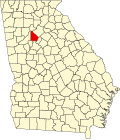


.svg)

.svg)

Atlanta
View on GrokipediaHistory
Pre-Columbian and Colonial Periods
The region now comprising Atlanta was inhabited by indigenous peoples for thousands of years before European contact, with archaeological evidence of settlements dating to the Archaic Period (approximately 3000–1500 BC), including over 100 sites in DeKalb County featuring tools and remnants of hunter-gatherer activities.[9] By the Mississippian Period (circa 1000–1550 AD), mound-building societies dominated the Georgia Piedmont, constructing earthen platforms for ceremonial and residential purposes; nearby examples include the Etowah Indian Mounds in Bartow County, about 30 miles northwest of Atlanta, which housed several thousand people and featured six major mounds.[10] After the collapse of these chiefdoms around 1550 AD, the Atlanta area lay at the contested boundary between Cherokee villages to the north and Muscogee (Creek) territories to the south, with both groups relying on agriculture, hunting, and trade networks.[9][11] European diseases introduced via early expeditions, such as Hernando de Soto's 1540 traversal of Cherokee lands, caused significant population declines among indigenous groups, estimated at up to 90% in some southeastern tribes by the 1700s.[12] Successive treaties ceded vast tracts, including the 1817 Treaty of Fort Mitchell from the Creeks and the 1835 Treaty of New Echota from the Cherokee, but gold discoveries in north Georgia from 1828 onward fueled white encroachment and led to the Indian Removal Act of 1830.[13] This culminated in the forced expulsion of approximately 16,000 Cherokee from Georgia along the Trail of Tears between 1831 and 1838, with mortality rates exceeding 15% due to disease, exposure, and malnutrition, effectively vacating the Atlanta vicinity of its native occupants.[13] Georgia's land lotteries, conducted eight times between 1805 and 1833, redistributed over 35 million acres of former indigenous holdings to white settlers via random draws, with the 1820, 1827 (post-Creek cessions), and 1832 (Cherokee territory) lotteries encompassing future Fulton and DeKalb Counties in 40- and 160-acre parcels.[14] In December 1837, state engineers drove a stake marking "Zero Mile Post" as the intended western endpoint of the Western and Atlantic Railroad, establishing Terminus as a rudimentary settlement of shanties and stores by 1839.[15] The site was renamed Marthasville in 1843 to honor Governor Wilson Lumpkin's daughter and rechartered as Atlanta in 1845, reflecting its mythic nomenclature inspired by the Western and Atlantic line.[3]19th-Century Foundations and Civil War
The site of modern Atlanta originated in 1837 as the designated terminus of the state-chartered Western and Atlantic Railroad (W&A), selected for its strategic location on the Piedmont ridge to connect Georgia's interior with Chattanooga, Tennessee.[16] Initially known as Terminus, the settlement facilitated the exchange of goods between the railroad and local traffic, laying the foundation for its development as a transportation nexus. By 1843, the town was incorporated and renamed Marthasville in honor of Governor Wilson Lumpkin's daughter, before adopting the name Atlanta in 1845, a feminine version of "Atlantic" proposed by John Edgar Thomson of the Georgia Railroad to designate the depot, reflecting its role as a key rail hub connected to broader networks.[3] Additional rail connections, including the Georgia Railroad in 1845 and the Central Railroad, converged on Atlanta during the 1840s and 1850s, catalyzing population growth from a few hundred in the early 1840s to 9,554 by 1860, establishing it as Georgia's fourth-largest city and a vital hub for cotton shipping and manufacturing.[17][3] Atlanta's centrality as a rail junction made it indispensable to the Confederate war effort, serving as a primary depot for supplies, munitions, and troop movements across multiple lines linking the Deep South to Virginia. Union General William T. Sherman's Atlanta Campaign targeted these rail arteries, culminating in the city's fall on September 2, 1864, after Confederate General John Bell Hood's evacuation amid prolonged siege operations.[18] Prior to departing for the March to the Sea on November 15, 1864, Sherman ordered the systematic destruction of military-related infrastructure, including railroads, foundries, and warehouses, executed from November 11 to 14 by Union troops under his command.[19] This targeted demolition, combined with fires from Confederate explosives during evacuation and accidental conflagrations, resulted in approximately 40 percent of the city's structures being razed, severely disrupting Confederate logistics but sparing residential areas to a greater degree than popularly mythologized.[20] Immediate postwar recovery hinged on reconstructing the rail network, with the W&A line repaired by 1866 to restore connectivity to Chattanooga and broader markets.[21] Cotton trade, which had underpinned antebellum prosperity, rapidly reemerged as planters and merchants leveraged repaired tracks to export crops, fueling Atlanta's resurgence as a commercial center despite the loss of enslaved labor and wartime devastation. By 1870, the city's population had climbed to over 21,000, underscoring the causal primacy of rail infrastructure in enabling economic rebound through efficient transport of agricultural staples.[22][3]Reconstruction and Jim Crow Era
Following the Civil War, Atlanta underwent rapid rebuilding as Georgia's economy shifted toward industrialization, with the city's rail connections facilitating recovery from Sherman's 1864 destruction. In 1868, the new state constitution designated Atlanta as the permanent capital, relocating government operations from Milledgeville to leverage the city's central transportation hub and growing commercial prominence.[23] This move coincided with Reconstruction policies under Republican control, enabling initial African American political involvement; between 1867 and 1872, thirty-seven Black delegates participated in Georgia's constitutional convention and legislature, with Atlanta serving as a relatively tolerant base for Republican gatherings due to its Unionist leanings and demographic shifts.[24] Black voters in Atlanta exercised suffrage, influencing local referendums amid federal oversight from the Freedmen's Bureau and military reconstruction.[25] Reconstruction ended in Georgia by 1871 as Democrats, often former Confederates, regained legislative dominance through intimidation tactics including Ku Klux Klan violence, leading to the ouster of Black and Republican officeholders.[26] The national Compromise of 1877 withdrew federal troops, allowing Southern states to impose Jim Crow laws that institutionalized racial segregation in public facilities, transportation, and schools, while disenfranchising Black voters via poll taxes, literacy tests, and grandfather clauses implemented progressively from the 1890s.[27] In Atlanta, these measures manifested in ordinances mandating separate streetcars by 1900 and segregated business districts, enforcing spatial and social separation that restricted Black access to integrated markets and public resources.[27] Such legal barriers causally limited Black economic advancement by denying equal educational opportunities and capital access, as evidenced by stagnant relative income gains for Southern Blacks compared to pre-Jim Crow trajectories, though Atlanta's urban setting mitigated some rural poverty extremes.[28] Amid these constraints, Atlanta's Black population, which grew to over 28,000 by 1890, fostered self-reliant economic enclaves to circumvent discrimination. Auburn Avenue, renamed "Sweet Auburn" in the early 20th century by civic leader John Wesley Dobbs for its vitality, emerged as a premier Black commercial corridor with ten businesses and two physicians by 1900, later hosting banks, insurance firms, and enterprises like the Atlanta Life Insurance Company founded in 1905.[29] This district exemplified adaptive entrepreneurship under segregation, channeling limited capital into community-serving institutions, yet overall mobility remained curtailed by exclusion from white-dominated sectors and credit networks.[27]20th-Century Industrialization and Suburbanization
During World War II, Atlanta's metropolitan area experienced significant industrial expansion, particularly in aerospace manufacturing. The Bell Aircraft Corporation established a massive plant in Marietta, just northwest of Atlanta, in 1942, which became operational in early 1943 and produced 663 B-29 Superfortress bombers by war's end, employing up to 28,000 workers at its peak.[30][31] This facility, the largest industrial site in the Deep South, drew labor from across Georgia and stimulated ancillary growth in logistics and support industries, transforming the region into a wartime production hub.[32] Concurrently, Atlanta's airport, originally Candler Field and redesignated the Atlanta Municipal Airport in 1925, served as the Atlanta Army Air Field, a key U.S. Army Air Corps training base that underwent expansions including runway lengthening and land acquisitions to support military aviation operations. These developments positioned Atlanta as a critical node in national defense logistics, with the airport handling increased cargo and personnel transport.[33] Postwar economic momentum accelerated with federal infrastructure investments, notably the Interstate Highway System authorized by the 1956 Federal-Aid Highway Act. Construction of I-75 and I-85, which converge as the Downtown Connector through central Atlanta, began in the late 1950s, with demolition for elevated sections southeast of downtown commencing around 1954 and major segments opening by the early 1960s.[34][35] These routes, linking Atlanta to northern and eastern markets, facilitated rapid commuter access and commercial trucking, spurring manufacturing diversification into textiles, food processing, and early electronics while enabling outward residential expansion.[36] By the 1960s and 1970s, completion of these interstates and the I-285 perimeter loop amplified suburban development in counties like Cobb and DeKalb, where affordable land and new housing subdivisions attracted businesses and families seeking distance from the urban core.[37] This suburbanization drove pronounced demographic shifts, characterized by white flight from the city proper amid rising suburban opportunities and social changes. Atlanta's white population peaked at approximately 300,000 in 1960, comprising about 62% of the city's total residents, but plummeted to 122,000 by 1990 as families relocated to northern and eastern suburbs.[38][39] The city proper's population, which had surged to 487,455 in 1960 following 1950s annexations, began declining thereafter, losing over 100,000 residents by 2000—a 16% drop—due to limited further annexation powers and preferences for suburban living. In contrast, the metropolitan area expanded dramatically, with regional population growing nearly tenfold since 1950 to over 6 million by the late 20th century, as interstate access fueled sprawl and economic decentralization outpacing central city retention.[40] This divergence highlighted Atlanta's transition to a polycentric metro economy, where core depopulation contrasted with peripheral vitality.[41]Civil Rights Movement and Desegregation
The Southern Christian Leadership Conference (SCLC) was founded in Atlanta on January 10-11, 1957, by Martin Luther King Jr. and other black ministers following the Montgomery Bus Boycott, with King elected as its first president headquartered in the city.[42][43] King relocated to Atlanta in 1960 to co-pastor Ebenezer Baptist Church, intensifying local organizing against segregation.[44] The SCLC coordinated nonviolent protests, emphasizing moral suasion to dismantle Jim Crow practices in public accommodations and facilities. Atlanta's civil rights activism escalated with student-led sit-ins beginning March 15, 1960, when over 200 students from historically black colleges targeted segregated lunch counters at stores like Rich's department store, Davison's, and Woolworth's.[45][46] Led by figures including Lonnie King and Julian Bond, the protests persisted through arrests and negotiations, culminating in the desegregation of downtown lunch counters by October 1961 after elite black and white leaders agreed to voluntary compliance to avert violence.[46] Mayor William B. Hartsfield facilitated this "Atlanta Way" of negotiated integration, including earlier desegregation of the city airport's Dobbs House restaurant via court order in 1960.[47][48] Public school desegregation occurred on August 30, 1961, when the "Atlanta Nine"—nine black students—enrolled in four previously all-white high schools: Bass, Grady, Northside, and West Fulton, under a court-mandated plan following the 1954 Brown v. Board of Education ruling.[49][50] Integration proceeded with relatively little unrest due to pre-arranged compromises between civic leaders, contrasting with more volatile desegregations elsewhere in the South.[51] These efforts removed formal legal barriers to segregation in Atlanta's public spheres by the mid-1960s, enabling black access to education, commerce, and transit. However, socioeconomic disparities persisted, with black median household income in Atlanta remaining approximately one-third of white levels as of 2023, and over one-third of black households holding zero net worth.[52] Empirical analyses attribute enduring gaps in wealth and elevated crime rates—such as Atlanta's disproportionate homicides in black neighborhoods—not primarily to residual discrimination but to factors including family structure variations, with higher single-parent household rates correlating with reduced economic mobility and increased violence independent of race.[53][54] Policy choices post-desegregation, such as expansive welfare systems, have been critiqued for incentivizing family fragmentation, exacerbating these outcomes over legal equality alone.[55]Late 20th-Century Boom and 1996 Olympics
Atlanta experienced significant economic expansion from the 1970s through the 1990s, driven by its appeal as a corporate hub. The city's business-friendly environment, characterized by relatively low taxes and supportive state policies, facilitated the influx of major companies.[56] By the late 20th century, Atlanta hosted headquarters for numerous Fortune 500 firms, including eight industrial companies and additional service-oriented entities like Coca-Cola and Delta Air Lines, which bolstered employment and regional GDP contributions.[57] Annual job growth in the city accelerated from approximately 1,700 positions in the 1970s to 3,700 in the 1980s and 4,500 in the 1990s, outpacing broader national trends in service and logistics sectors.[58] The selection of Atlanta to host the 1996 Summer Olympics amplified this momentum, with preparations involving substantial public and private investments exceeding $2 billion in infrastructure.[59] Key developments included expansions to the Metropolitan Atlanta Rapid Transit Authority (MARTA) system, enhancing rail connectivity to Olympic venues and supporting long-term urban mobility.[60] The event generated an estimated $5 billion in economic impact through tourism, construction, and related spending, stimulating real estate development and elevating Atlanta's global profile.[61] Metro-area GDP growth during the 1990s exceeded national averages, with per capita income rising notably amid population and business influxes.[62] However, the Olympic preparations drew criticism for inefficiencies in government spending and social costs. Direct displacements affected thousands of low-income residents, particularly in areas near venues, through evictions and eminent domain, with estimates of up to 30,000 people impacted between 1990 and 1996.[63] Over 9,000 arrests targeted homeless individuals, often African American, as part of efforts to present a polished city image, raising concerns about disproportionate enforcement and human rights.[64] While infrastructure legacies like Centennial Olympic Park persist, analyses question the net efficiency, noting that short-term boosts masked uneven benefits and contributed to gentrification without proportional gains for displaced communities.[65] These outcomes highlight causal trade-offs in event-driven development, where empirical economic gains coexisted with uncompensated social displacements.[66]21st-Century Developments and Challenges
The Atlanta metropolitan area's population grew to 6.1 million by 2023, reflecting sustained expansion driven by economic diversification into technology and entertainment sectors.[2] The film industry, bolstered by Georgia's tax credit program offering up to 30% reimbursements on qualified spending since 2008, transformed the region into the "Hollywood of the South," drawing major studio productions and infrastructure investments that generated thousands of jobs.[67] Complementing this, the tech sector advanced, with fintech alone supporting 30,000 to 40,000 direct jobs amid broader innovation in software and cybersecurity, though growth rates lagged national leaders like San Francisco at 5% versus 15% in recent years.[68][69] These developments strained urban infrastructure, as inbound migration outpaced housing and transit capacity expansions. Civil unrest during 2020 Black Lives Matter protests, sparked by George Floyd's death, escalated into riots that inflicted notable property damage on downtown and Buckhead businesses, prompting concerns over insurance coverage and economic recovery timelines.[70] In the aftermath, homicides rose sharply to 157 in 2020—a 62% increase from 2019—attributable in part to disrupted policing and social disruptions, with rates remaining elevated above pre-pandemic levels into 2024 despite subsequent declines of about 6% annually.[71][72] By fiscal year 2025, Georgia recorded 423 new business expansions and facilities statewide, fueling $26.3 billion in investments that disproportionately benefited the Atlanta metro through logistics and manufacturing hubs.[73] Yet policy-driven growth amplified housing pressures, with median home prices exceeding $400,000 and rents nearing $1,700 monthly; the Atlanta Regional Commission's 2025 Metro Atlanta Speaks survey pinpointed affordability as the paramount regional issue, nominated by 28% of respondents for the first time atop the list, linked to insufficient supply amid zoning restrictions and demand surges.[74][75] This disequilibrium underscores causal tensions between incentivized economic inflows and lagging regulatory adaptations for residential development.Geography
Physical Geography and Topography
Atlanta is situated in the Piedmont physiographic region of northern Georgia, at the southern edge of the Appalachian foothills, where elevations average approximately 1,050 feet (320 meters) above sea level, ranging from about 725 feet to over 1,200 feet across the city limits.[76][77] This upland plateau terrain consists of rolling hills and gentle ridges, formed by ancient weathering of metamorphic and igneous rocks, which impose natural constraints on drainage and infrastructure placement by directing surface runoff into steep valleys and streams.[78] The dominant soil type is red clay, an Ultisol derived from residual weathering of feldspar-rich bedrock, characterized by high iron oxide content that imparts its distinctive color and fine, cohesive particles that compact tightly while exhibiting poor permeability and fertility.[79] This soil's low infiltration rate and susceptibility to slaking during rainfall contribute to accelerated erosion on slopes, particularly in areas disturbed by development, leading to sediment transport into waterways and heightened risks of landslides or foundation instability.[80][81] Hydrologically, the Chattahoochee River demarcates the city's western boundary and supplies roughly 72% of metropolitan Atlanta's drinking water via impoundments such as Lake Lanier, while local tributaries like Proctor Creek drain much of the urban core, channeling stormwater from impervious surfaces into flood-prone lowlands.[82] The city's land area spans 135.31 square miles, encompassing varied topographies that amplify flood vulnerabilities, as demonstrated by the September 2009 event when prolonged heavy rains caused Proctor Creek and adjacent streams to overflow, resulting in widespread inundation and residential displacement across affected watersheds.[83][84][85]Urban Layout and Neighborhoods
Atlanta's urban layout centers on three primary commercial districts: Downtown, Midtown, and Buckhead, which form the backbone of its spatial organization along major corridors like Peachtree Street and Interstate 75/85. Downtown serves as the historic core for government, finance, and convention activities, encompassing areas like Five Points and Castleberry Hill. Midtown functions as a secondary business and cultural hub with high-density office and residential towers, while Buckhead represents an upscale extension to the north, blending luxury retail, high-rises, and suburban-style estates.[86][87] The city's neighborhoods exhibit stark socioeconomic diversity, ranging from affluent enclaves like Buckhead—characterized by high-end shopping districts and mansion-filled suburbs—to distressed areas such as English Avenue on the Westside, a formerly working-class zone that experienced population decline, elevated crime, and abandonment after mid-20th-century shifts. English Avenue, adjacent to Vine City, features aging housing stock and long-vacant lots, contrasting with Buckhead's stable, high-value properties. This patchwork reflects fragmented zoning practices that historically prioritized separation over integration.[88][89] Early 20th-century zoning in Atlanta explicitly aimed at racial segregation through ordinances prohibiting Black occupancy in white-majority blocks, though these were invalidated by courts in the 1920s; subsequent redlining by federal agencies like the Home Owners' Loan Corporation reinforced disinvestment in minority areas, creating enduring barriers to wealth-building via property. These policies contributed to persistent homeownership disparities, with 2019 data showing a 74% rate among white residents compared to 48% among Black residents in the city proper, gaps widened by exclusionary single-family zoning that limits affordable housing supply and perpetuates economic divides.[90][91][92] Contemporary patterns show gentrification concentrating around Downtown and Midtown through infill projects and investor-driven renovations, displacing lower-income residents in 22% of at-risk neighborhoods as of 2017, while suburban exodus sustains sprawl with job growth in peripheral "edgeless" locations. Vacancy rates underscore these tensions: English Avenue reported a 25.6% rental vacancy in 2023 amid stalled revitalization, versus Buckhead's lower 12.5% average, highlighting uneven recovery amid broader metro housing shortages.[93][94][95][96]Architecture and Cityscape Evolution
Atlanta's post-Civil War reconstruction emphasized fire-resistant brick and masonry structures in Victorian styles, replacing wooden buildings destroyed in 1864, as the city's rail hub status spurred commercial density. By the late 19th century, economic growth enabled the shift to taller forms, exemplified by the Equitable Building completed in 1892 at eight stories and 118 feet, Atlanta's first skyscraper in Chicago School style designed by John Wellborn Root for developer Joel Hurt.[97][98] This structure, with its steel frame and terra-cotta facade, symbolized the transition from low-rise commercial blocks to vertical expansion driven by land scarcity and rising real estate values.[97] The early 20th century saw further skyline growth with skyscrapers like the 1902 Flatiron Building, the 1910 Candler Building at 17 stories, and the 1920s Empire Building, reflecting industrialization and population influx that necessitated office space for banking and trade.[3] Mid-century modernism introduced simpler concrete and glass designs amid suburban flight, but the 1980s-1990s corporate boom—fueled by headquarters relocations from Northern firms—produced a wave of Postmodern towers with ornamental spires, such as the 1987 One Atlantic Center and the 1992 Bank of America Plaza, a 55-story, 1,023-foot structure by Roche Dinkeloo & Associates featuring a spire-enclosed cooling tower.[99][100] These developments, totaling over 20 major high-rises by 2000, elevated Atlanta's profile as a Sun Belt hub but prioritized functional density over stylistic variety.[101] Post-1996 Olympics infrastructure investments accelerated glass-and-steel tower construction, yet this era highlighted tensions between progress and heritage, with economic imperatives often favoring demolition of pre-1930s fabric for parking or new builds.[102] Atlanta's record shows frequent losses, including the 1971 razing of the 1892 Equitable for urban renewal, contributing to a cityscape critics describe as lacking distinct identity due to repetitive corporate modernism.[98][103] Preservation successes, however, underscore causal links to grassroots mobilization: the 1929 Fox Theatre, initially a Shriners temple with Moorish Revival interiors, faced 1970s demolition for office space but was saved by Atlanta Landmarks Inc. through $3 million in public donations and loans, reopening in 1975 after restoration and earning National Historic Landmark status in 1976.[104][105] Such efforts reveal how market-driven demolitions erode historical continuity, while rare interventions preserve artifacts of earlier economic phases amid unchecked growth.[106]Climate and Environment
Climatic Patterns and Weather Events
Atlanta possesses a humid subtropical climate (Köppen Cfa), featuring hot, humid summers, mild winters, and precipitation distributed across all seasons. Average high temperatures range from approximately 52°F in January to 89°F in July, with lows typically falling to 35°F during the coldest months and rarely below 22°F. Annual precipitation averages around 50 inches, occurring on about 117 days per year, supporting lush vegetation but contributing to occasional flooding.[107][108][109] The following table presents monthly averages for temperature, precipitation, and sunshine:| Month | Average Maximum (°F) | Mean (°F) | Average Minimum (°F) | Average Precipitation (inches) | Total Sunshine Hours | Average % Possible Sunshine |
|---|---|---|---|---|---|---|
| Jan | 52 | 43 | 34 | 4.8 | 158 | 52 |
| Feb | 56 | 47 | 37 | 4.6 | 162 | 55 |
| Mar | 64 | 54 | 44 | 4.5 | 217 | 57 |
| Apr | 73 | 62 | 52 | 3.6 | 228 | 61 |
| May | 80 | 70 | 61 | 3.7 | 255 | 63 |
| Jun | 87 | 78 | 68 | 3.9 | 255 | 67 |
| Jul | 89 | 80 | 72 | 4.4 | 272 | 69 |
| Aug | 88 | 80 | 71 | 3.7 | 257 | 66 |
| Sep | 82 | 73 | 64 | 3.5 | 219 | 64 |
| Oct | 73 | 63 | 53 | 3.1 | 217 | 62 |
| Nov | 64 | 53 | 43 | 3.8 | 165 | 57 |
| Dec | 55 | 46 | 36 | 4.3 | 144 | 52 |
Environmental Issues and Sustainability Efforts
Atlanta faces persistent air pollution challenges primarily driven by vehicular traffic, with ground-level ozone levels earning the metro area an F grade in 2025 according to the American Lung Association, reflecting 5.5 unhealthy days per year compared to 1.8 in the prior assessment.[117] Transportation emissions remain a key contributor to elevated pollutants in the region, exacerbating respiratory health risks despite some improvements in overall air quality metrics from EPA monitoring.[118] [119] Stormwater management issues compound environmental pressures through frequent combined sewer overflows (CSOs), which discharge untreated wastewater into local waterways during heavy rains, violating federal standards and contributing to bacterial contamination.[120] Under a 1998 EPA consent decree, Atlanta committed to reducing CSOs to no more than four events annually, yet chronic spills persist due to inadequate sewer maintenance, with over 550 sanitary sewer overflows reported in some periods alongside hundreds of CSO discharges.[121] [122] The Atlanta BeltLine, initiated in 2005 as a repurposed 22-mile rail corridor into multi-use trails and green spaces, exemplifies sustainability efforts aimed at enhancing urban connectivity and recreation, but empirical outcomes reveal trade-offs including accelerated gentrification.[123] Property values near the BeltLine rose 17.9% to 26.6% from 2011 to 2015, outpacing citywide trends and pricing out lower-income residents through displacement in adjacent neighborhoods.[124] While boosting economic redevelopment, the project has drawn criticism for prioritizing green amenities over affordable housing safeguards, with studies linking such initiatives to broader patterns of environmental gentrification that exacerbate socioeconomic inequities without mitigating underlying pollution drivers.[125] [126] Water infrastructure decay underscores maintenance shortfalls amid sustainability rhetoric, as evidenced by multiple major main breaks in 2024 that disrupted service for thousands and highlighted neglected valves and pipes despite ongoing federal consent decree investments exceeding billions in the Clean Water Atlanta program.[127] [128] In May 2024, failures in Midtown created prolonged outages and geysers, attributable to decades of deferred routine upkeep rather than catastrophic events, revealing causal gaps between capital expenditures on large-scale projects and essential operational reliability.[129] [130] Such incidents impose economic costs through boil-water advisories and business closures, questioning the efficacy of green-focused policies that divert resources from core infrastructural resilience.[131]Demographics
Population Growth and Trends
Atlanta's city proper population stood at 331,314 according to the 1950 United States Census, reflecting a postwar boom fueled by industrial expansion and boundary annexations that nearly doubled the city's land area between 1940 and 1960. Major annexations ceased after the 1970s amid suburban resistance and political shifts, contributing to periods of stagnation or decline in the city core as residents moved outward, with the population falling from 496,973 in 1970 to 425,022 by 1990. This contrasted sharply with the metro area's rapid expansion, driven by net domestic in-migration seeking economic opportunities in sectors like logistics and finance. The 2020 Census recorded Atlanta's city population at 498,715, followed by steady but moderated growth to an estimated 542,715 in 2025 per Atlanta Regional Commission (ARC) projections, representing an average annual increase of about 1.7% since 2020. [132] The broader 11-county metro region reached 5,285,474 residents in 2025, up from 4,967,514 in 2020, with growth averaging 1.2% annually in the post-2020 period—down from 1.5% in the 2010s and over 2% in prior decades.[132] This slowdown reflects a reversal in net domestic migration trends, with the metro experiencing its first net loss of U.S. residents (approximately 1,330) in over 30 years between mid-2023 and mid-2024, attributed to factors including rising living costs and quality-of-life concerns amid persistent inbound international migration sustaining overall gains.[133] [134] Looking ahead, ARC forecasts project the 21-county Atlanta region's population to reach 7.9 million by 2050, a roughly 30% increase from 2020 levels, primarily propelled by continued net in-migration, though at tempered rates compared to pre-2020 projections due to adjusted assumptions on fertility, mortality, and domestic mobility patterns.[135] These estimates underscore Atlanta's resilience as a migration magnet for domestic relocators from higher-cost coastal metros, even as recent data signals cautionary shifts in urban-suburban balance post-pandemic.[136]Racial, Ethnic, and Socioeconomic Composition
As of the 2023 American Community Survey estimates, Atlanta's population of approximately 499,000 is composed of 46.3% Black or African American residents, 38.3% non-Hispanic White residents, 6.3% Hispanic or Latino residents of any race, and 4.9% Asian residents, with the remainder including smaller shares of multiracial, Native American, and other groups.[137][138] This marks a shift from majority-Black status in prior decades, driven by inflows of White and Asian professionals alongside slower Black population growth within city limits.[139] Socioeconomic indicators reveal stark disparities along racial lines. The city's overall poverty rate stands at 17.7-18.4%, more than double the national average of about 11.5%, with Black residents facing a rate of 26.6% compared to lower figures for Whites and Asians.[140][83] Median household income citywide reached $81,938 in 2023, but Black households averaged $47,937—less than half that of Asian households at $103,459—reflecting differences in employment sectors, family structures, and educational outcomes rather than solely historical discrimination.[137][141] High rates of single-parent households, particularly among Black families (nationally exceeding 50% and contributing to intergenerational poverty cycles in urban settings like Atlanta), correlate strongly with these income gaps, as two-parent families typically command higher earnings and stability.[142] Educational attainment underscores these divides: about 35-40% of Atlanta adults over 25 hold a bachelor's degree or higher citywide, with Whites and Asians achieving rates above 50% while Black rates lag at around 25-30%, influenced by family stability, school quality variances, and cultural emphases on academic persistence.[143] These patterns align with broader evidence that intact family units and behavioral factors like work ethic and delayed childbearing drive upward mobility more than policy interventions alone.[144]| Demographic Group | Share of Population (2023) | Median Household Income (2023) | Poverty Rate |
|---|---|---|---|
| Black/African American | 46.3% | $47,937 | 26.6% |
| White (non-Hispanic) | 38.3% | ~$100,000+ (inferred from aggregates) | <10% |
| Asian | 4.9% | $103,459 | Low single digits |
| Hispanic/Latino | 6.3% | Variable, mid-range | ~15-20% |
Migration Patterns and Urban Flight
Following the civil rights era, Atlanta experienced significant white flight, with the city's white population declining sharply from over 300,000 in 1960 to approximately 122,000 by 1990 as residents relocated to suburbs amid rising urban tensions and demographic shifts.[39] This exodus contributed to the black population proportion increasing from 38% in 1960 to 51% by 1970, establishing a black majority in the city during the 1970s.[145] Such patterns reflected rational preferences for suburban environments offering perceived safety, lower taxes, and separation from urban governance challenges. In recent decades, black middle-class out-migration has accelerated, with many relocating to Atlanta's suburbs in pursuit of better schools, reduced crime exposure, and fiscal advantages over city taxes and services.[146] By 2010, 87% of the metro region's African American population resided in suburban areas, a trend driven by upward mobility and aversion to inner-city deterioration.[41] This suburbanization mirrors earlier white flight dynamics, as middle-income households prioritize environments with stronger property value stability and lower public service burdens. Atlanta long benefited from net domestic inflows as a Sun Belt hub, attracting migrants with its economic opportunities and milder climate, sustaining population growth through the 2010s.[147] However, this reversed in the 2020s, with net domestic out-migration turning negative by mid-2023 to mid-2024 at approximately 1,330 people, signaling a broader Sun Belt slowdown amid urban quality-of-life concerns.[148] Contributing causally were post-2020 crime surges, including a nearly 60% homicide increase in 2020—the city's deadliest year in decades—tied to unrest following George Floyd's death, prompting rational exits by families and professionals seeking safer locales.[149] [150] International immigration has offset some domestic losses, enhancing Atlanta's diversity through inflows of foreign-born residents, particularly from Latin America and Asia, which helped sustain metro growth despite native outflows.[147] Yet, rapid arrivals have strained local services, including housing, schools, and public infrastructure, exacerbating wait times and resource allocation pressures in a metro already grappling with suburban sprawl and urban fiscal limits.[151]Government and Public Administration
Municipal Structure and Leadership
Atlanta employs a mayor-council form of government, with the mayor functioning as the chief executive responsible for administering city operations, preparing the budget, and appointing department heads subject to council confirmation.[152] The Atlanta City Council, the legislative body, consists of 15 members: 12 elected from single-member districts and 3 at-large representatives, including a council president elected citywide who presides over meetings but holds no vote except to break ties.[153] This structure, refined by a 1996 charter amendment effective in 1998, emphasizes checks and balances, granting the mayor veto power over ordinances while requiring council approval for major appointments and fiscal decisions.[153] The mayor serves a four-year term with a limit of two consecutive terms; Andre Dickens, a Democrat, has held the office since January 6, 2022, following his 2021 election victory over Felicia Moore in a runoff.[154] Democratic Party dominance characterizes Atlanta's municipal leadership, with every mayor since Maynard Jackson's 1973 election identifying as a Democrat, reflecting the city's overwhelmingly Democratic voter base in local contests.[155] This partisan continuity has coincided with periods of administrative stability but also vulnerability to internal factionalism. Governance is further complicated by jurisdictional overlaps with Fulton County, where Atlanta is primarily located, leading to duplicated services in areas like water management and public health; for instance, the Atlanta-Fulton County Water Resources Commission jointly operates utilities serving both entities.[156] Persistent debates over deeper integration or consolidation aim to address inefficiencies, such as redundant bureaucracies and conflicting priorities, though proposals have faced resistance amid concerns over loss of local control, exemplified by Buckhead's unsuccessful cityhood push in the 2010s and 2020s.[156] Historical patterns reveal accountability challenges, including elevated corruption risks; during the 1990s under Mayor Bill Campbell (1994–2002), federal investigations uncovered bribery schemes involving city contracts, resulting in Campbell's 2006 conviction on tax evasion charges tied to unreported kickbacks, alongside guilty pleas from several aides and council members.[157] Such scandals, spanning multiple administrations, underscore inefficiencies in oversight mechanisms, where strong mayoral authority has not consistently curbed insider dealing or ensured transparent decision-making, contributing to public distrust and calls for structural reforms.[158]Political Dynamics and Elections
Atlanta has maintained uninterrupted Democratic control of its mayoralty since the election of Maynard Jackson in 1973, marking the beginning of sustained one-party dominance in city governance.) This pattern reflects the city's overwhelmingly liberal electorate, with Democratic candidates routinely securing over 80% of the vote in presidential elections within city limits, contrasting sharply with surrounding Fulton and DeKalb County suburbs that have historically leaned Republican.[159] While recent demographic shifts have pushed some northern suburbs leftward, areas like Forsyth and Gwinnett Counties remain strongholds for GOP voters, contributing to partisan divides in metro Atlanta politics.[160] This one-party rule in the core city has been associated with policy inertia, as limited electoral competition reduces incentives for innovation on persistent challenges like public safety. The 2021 mayoral election exemplified these dynamics, occurring amid a surge in violent crime that reached levels not seen since the 1990s, with homicides up 30% from 2020 under outgoing Mayor Keisha Lance Bottoms.[161] Candidates Andre Dickens and Felicia Moore advanced to a runoff after neither secured a majority in the November 2 primary, with crime reduction emerging as the dominant issue; Dickens campaigned on hiring more officers and community policing, defeating Moore 64% to 36% on November 30.) [162] Bottoms' decision not to seek re-election stemmed partly from public backlash over the "COVID crime wave," highlighting voter frustration with entrenched leadership amid rising carjackings and murders.[161] Tensions between Atlanta's Democratic municipal government and Georgia's Republican-controlled state legislature have intensified over policy divergences, particularly on immigration enforcement. Georgia law has prohibited sanctuary city policies since 2009, requiring local compliance with federal detainers, yet state lawmakers have repeatedly advanced bills to strip sovereign immunity from non-compliant localities, targeting perceived liberal resistance in urban centers like Atlanta.[163] In 2025, the U.S. Department of Homeland Security initially listed Atlanta among jurisdictions flagged for immigration noncooperation, though Georgia as a whole was later removed after certification efforts.[164] These clashes underscore Atlanta's role as a liberal outlier in a conservative state, where city votes bolster Democratic statewide margins but provoke legislative pushback on issues like funding and preemption. Voter turnout in Atlanta's municipal elections remains chronically low, averaging below 33% over the past two decades, with the 2021 mayoral race seeing participation rates around 25-30% of registered voters.[165] This apathy correlates with governance disconnects, as low engagement entrenches incumbents and insider networks, potentially exacerbating policy stagnation under one-party rule by diminishing accountability for outcomes like sustained crime elevations.[166] Higher turnout in national elections, such as Georgia's 64% in 2024, highlights the disparity, suggesting local races suffer from perceived irrelevance or dissatisfaction.[167]Fiscal Policies and Economic Governance
Atlanta's municipal budgeting process centers on an annual operating budget approved by the City Council, with the Fiscal Year 2025 (FY2025) total reaching approximately $2.75 billion, including a $975 million general fund.[168] Property taxes constitute a primary revenue source, levied at a city millage rate of about 11.95 mills on 40% of assessed fair market value, yielding an effective city rate of roughly 0.48%; combined with Fulton County and school district levies, the total effective local property tax rate for Atlanta residents approximates 1.1%.[169] [170] Revenue projections for FY2025 rely heavily on ad valorem taxes, fees, and state-shared funds, though recent audits highlight vulnerabilities from overreliance on volatile sources amid rising expenditures.[171] The city's pension systems for general employees, police, and firefighters face underfunding challenges, with the General Employees Pension Fund historically operating at around 60% solvency based on actuarial valuations incorporating unfunded liabilities.[172] Despite investment gains of 11.1% in FY2025 for the general fund—below its benchmark—the aggregate taxpayer burden from unfunded pensions and other liabilities reached $4,089 per taxpayer in recent assessments, signaling sustainability risks without reforms.[173] [174] Economic governance includes economic development incentives, notably Georgia's film tax credits, which cost the state over $1.3 billion annually and disproportionately benefit Atlanta as a production hub; critics argue the return on investment is negative at about 19%, as credits subsidize activities that may occur without them, diverting funds from core infrastructure.[175] [176] Fiscal critiques center on expanding expenditures for social and equity-focused programs, which have contributed to deficits, including a $33 million shortfall in FY2025 addressed via cuts and a projected $20 million gap for FY2026 driven by overtime and security costs.[177] [178] City audits reveal inefficiencies, such as slow deployment of infrastructure funds under the Moving Atlanta Forward program—less than 10% spent despite allocations for poverty-impacted areas—and overstated minority business contracting, underscoring progressive spending priorities amid fiscal strain.[179] [180] Forecasts for 2025 indicate potential economic slowdown risks from national trends, exacerbating debt sustainability concerns given the absence of a city-level GDP metric but evident per-taxpayer burdens.[171]Public Safety and Crime
Historical Crime Trends
Atlanta's violent crime rates escalated sharply during the 1980s and early 1990s amid the crack cocaine epidemic, which introduced highly addictive, low-cost drugs into urban markets and intensified gang conflicts, territorial disputes, and retaliatory homicides. Homicide rates in the city doubled from approximately 5 per 100,000 residents in the early 1980s to around 10 per 100,000 by the mid-decade, with peaks exceeding 40 per 100,000 in the worst-affected years around 1990, driven primarily by young Black males involved in drug trade violence.[181] [182] This surge aligned with broader socioeconomic disruptions, including high rates of family breakdown—marked by rising illegitimacy and single-parent households—which empirical studies link causally to elevated youth involvement in crime, as absent fathers correlate with reduced social controls and higher impulsivity in at-risk communities.[183] [184] Following the peak, homicides and overall violent crime declined steadily from the mid-1990s through the 2000s, dropping by more than half in many metrics as crack markets waned due to market saturation, user burnout, and generational shifts away from open-air dealing.[185] This downturn occurred alongside national tough-on-crime measures like increased incarceration, but causal analysis attributes much of the reduction to the epidemic's exhaustion rather than policing alone, with Atlanta's rates falling faster than in some peer cities. Property crimes, including burglary and larceny, also trended downward over this period per FBI Uniform Crime Reporting (UCR) aggregates for Georgia urban areas, reflecting stabilized economic conditions and reduced desperation-fueled theft.[186] However, underlying structural issues like persistent family instability— with Atlanta's single-parent household rates remaining above 50% in majority-Black neighborhoods—sustained vulnerability to localized violence spikes.[187] A reversal emerged post-2010, with violent crime, particularly homicides, rising amid resurgent gang activity in predominantly Black areas such as southwest Atlanta, where groups like Bloods and Crips fragments engage in drug trafficking, robberies, and feuds accounting for 75-80% of serious incidents.[188] [189] Homicide counts, averaging around 85 annually in the early 2010s, nearly doubled to over 150 by the late 2010s and into the 2020s, representing increases exceeding 20% in peak years per city data aligned with FBI UCR trends.[190] This uptick correlates with socioeconomic persistence, including unemployment rates over 10% in affected zones and family metrics where out-of-wedlock births exceed 70%, fostering environments conducive to gang recruitment over stable upbringing.[191] [183] In contrast, property crime continued its long-term decline, underscoring that the recent challenges center on interpersonal and gang-driven violence rather than broad theft.[192]| Period | Homicide Rate (per 100,000) | Key Driver |
|---|---|---|
| 1980s-Early 1990s | Peaked ~40+ | Crack epidemic, gang turf wars[181] [182] |
| Mid-1990s-2000s | Declined >50% | Waning crack markets[185] |
| Post-2010 | Rose 20%+ in spikes | Gang resurgence, family instability[188] [190] |
Recent Crime Waves and Policy Responses
In 2020, Atlanta experienced a sharp spike in homicides, rising from 99 in 2019 to 157, the highest in over two decades, coinciding with nationwide protests against police and subsequent reductions in proactive policing often termed the "Ferguson effect."[149][193] This de-policing, amplified by local calls to defund the police amid the George Floyd unrest, correlated with heightened victimization in vulnerable, predominantly Black neighborhoods, where gang-related shootings and retaliatory violence surged without sufficient deterrence.[194][195] Critics argue that such movements, by fostering officer pullback and recruitment shortfalls, empirically worsened outcomes for the communities they purported to protect, as evidenced by the homicide rate climbing to 170 in 2022 before modest declines.[196][197] Despite increased hiring efforts and targeted interventions, elevated crime persisted into 2024-2025, with Atlanta's per-capita violent crime rate remaining substantially above the national average—around 48 incidents per 1,000 residents versus lower U.S. benchmarks.[198][199] Atlanta Regional Commission surveys highlight public unease, ranking safety as the third major concern after housing affordability and traffic, reflecting ongoing resident fears despite year-over-year homicide reductions of about 6% in 2024 and 30% mid-2025.[200][201] Policy responses like municipal cash bond reforms, which eliminated bail for certain low-level offenses to avoid criminalizing poverty, faced scrutiny for lacking evidence of reduced recidivism or crime, potentially contributing to repeat offending in high-risk areas amid the spike.[202][203] Some successes emerged from community-oriented approaches, including policing pilots emphasizing neighborhood partnerships, which Atlanta officials credit for recent drops in shootings (21%) and homicides through proactive interventions like the Group Project targeting gang hotspots.[204][205] However, these gains have not fully reversed the 2020s excesses, with overall rates still exceeding pre-spike levels and national norms, underscoring the limitations of initial defund-inspired hesitancy and the need for sustained enforcement over ideological reforms.[72][206]Policing Controversies and Effectiveness
Following the fatal shooting of Rayshard Brooks on June 12, 2020, during an arrest for driving under the influence at a Wendy's restaurant, public distrust in the Atlanta Police Department (APD) intensified, contributing to a wave of officer resignations and retirements. Officer Garrett Rolfe fired three shots at Brooks after he resisted arrest, seized a Taser, and fired it toward officers while fleeing; Rolfe was initially fired and charged with murder, though charges were later dropped in 2022 amid findings that the use of force was reasonable given the Taser threat.[207][208] This incident, amid national unrest over police conduct, eroded morale and prompted hundreds of officers to leave, exacerbating a staffing crisis.[209] By 2023, APD faced approximately 451 sworn officer vacancies against an authorized strength of over 2,000, representing a roughly 22% shortfall that persisted into 2025 despite recruitment drives.[210] This decline, down from fuller staffing pre-2020, reduced patrol presence and response capabilities, with department leaders attributing it partly to post-Floyd era scrutiny and local reform pressures that deterred applicants and accelerated exits.[211][212] Fewer officers logically undermine deterrence, as visible policing patrols—supported by broken windows theory and empirical studies on proactive enforcement—correlate with lower crime incidence; Atlanta's shortages have thus been linked by analysts to sustained high violent crime volumes despite overall declines.[213] APD's homicide clearance rate stood at 59.5% in 2022, above the national average of around 52% but below historical peaks and insufficient to deter repeat offenders, as unsolved cases signal impunity.[214][215] Pre-2020, national rates hovered near 60-65%, with declines attributed to resource strains and investigative hurdles like witness reluctance in high-crime areas; Atlanta's rates lag peers like Charlotte-Mecklenburg, where clearance exceeds national benchmarks due to more consistent staffing and leadership emphasis on solvability.[216] Low clearances perpetuate cycles of violence, as perpetrators face minimal risk of apprehension, a causal dynamic evident in Atlanta's higher unsolved violent crime proportions compared to comparably sized cities.[217][218] Reform efforts, including enhanced civilian oversight via the Atlanta Civilian Review Board and internal policy shifts post-2020, have drawn criticism for prioritizing public relations and de-escalation training over core enforcement, potentially hampering effectiveness amid staffing woes.[219] Unlike federal consent decrees imposed on some departments for patterns of misconduct, APD operates under local agreements emphasizing transparency, yet skeptics argue these divert resources from street-level policing, contributing to hesitancy in aggressive tactics that could boost clearances and deterrence.[220] Atlanta's per capita policing expenditures exceed many peers, but outcomes in accountability and crime resolution remain suboptimal, highlighting tensions between reform imperatives and operational realities.[217]Economy
Key Industries and Corporate Hubs
Atlanta's economy prominently features logistics and transportation, underpinned by Hartsfield-Jackson Atlanta International Airport, which processed 110.5 million passengers in 2019 and ranked as the world's busiest airport by passenger volume.[221] This facility acts as the primary hub for Delta Air Lines, headquartered in the city since 1941, supporting extensive domestic and international connectivity that drives freight movement and supply chain efficiency.[222] Complementing aviation, Atlanta's central location facilitates intermodal logistics through rail lines operated by CSX and Norfolk Southern, alongside truck access to the Port of Savannah, positioning the region as a critical node for goods distribution across the southeastern United States.[223] United Parcel Service (UPS), another Fortune 500 headquarters in Atlanta, leverages this infrastructure for global package handling.[222] The presence of multinational corporate headquarters underscores Atlanta's appeal as a business center, with The Coca-Cola Company establishing its global base there in 1892 and remaining a cornerstone of the beverage industry.[222] Other anchors include Home Depot, focused on retail and home improvement, drawn historically to Georgia's favorable regulatory climate, including right-to-work status and competitive tax structures that have facilitated low operational barriers for expansion.[224] This environment has supported the clustering of 17 Fortune 500 firms in the metro area, spanning consumer products, logistics, and beyond.[224] The film and television production sector has emerged as a key industry, fueled by Georgia's transferable tax credits offering up to 30% on qualified expenditures, which generated $8.55 billion in statewide economic activity in fiscal year 2022, with Atlanta hosting the majority of studios, soundstages, and post-production facilities.[225] Productions such as major Marvel films and network series utilize the city's infrastructure and incentives, contributing to a "Hollywood of the South" designation.[226] Professional services, encompassing consulting, finance, and legal operations, represent a vital pillar, with metro Atlanta's business services segment leading regional job expansion through firms like Deloitte and PwC maintaining substantial presences.[227] While sectors like technology and biotechnology show growth—particularly around Emory University and Centennial Olympic Park areas—these remain secondary to Atlanta's entrenched strengths in logistics, aviation, and established corporate operations.[228]Labor Market and Employment Data
The Atlanta-Sandy Springs-Roswell metropolitan statistical area (MSA) had an unemployment rate of 3.5 percent in August 2025, lower than the U.S. national rate of 4.3 percent for the same month.[229][230] Total nonfarm employment in the MSA reached 3,136,200 jobs in June 2025, up from prior periods amid steady labor force participation.[231] The MSA's gross domestic product stood at $570.7 billion in 2023, surpassing $500 billion and underscoring its scale as one of the largest regional economies.[232] Supporting this, the metro population grew by 1.28 percent to 6,272,000 residents in 2025 from 2024, exceeding the national population growth rate of under 1 percent.[2] Post-2020 recovery featured notable shifts toward healthcare and logistics sectors, driven by demographic aging, supply chain demands, and the MSA's role as a transportation hub via Hartsfield-Jackson Atlanta International Airport.[231] In Georgia, healthcare and social assistance led job gains with projections for 122,000 additional positions and a 24.2 percent growth rate through the decade, reflecting national trends amplified locally.[233] Wage structures reveal disparities, with service-oriented roles averaging lower earnings tied to educational attainment gaps; for example, Atlanta's racial disparity in bachelor's degree holders exceeds 22 percent, constraining upward mobility in low-skill sectors compared to U.S. averages.[234] Overall, metro wages in professional services outpace leisure and hospitality by factors linked to skill levels, per BLS occupational data.[235]Wealth and High-Net-Worth Individuals
Atlanta's metropolitan area, as a major business hub in the southeastern United States, has a notable concentration of high-net-worth individuals, though it does not rank among the top U.S. cities for overall millionaire population according to reports like Henley & Partners' World's Wealthiest Cities and USA Wealth Reports (which lead with New York, the Bay Area, and Los Angeles). No precise, publicly available figure exists for the number of decamillionaires (individuals with net worth of $10 million or more) specifically in Atlanta, as wealth data at this granularity is typically aggregated at the state level (e.g., via IRS Personal Wealth Statistics) or focused on broader HNWI ($1M+) or UHNWI ($30M+) thresholds by commercial reports. Related statistics include:- Older estimates from Wealth-X (circa 2018) placed approximately 1,590 ultra-high-net-worth individuals ($30 million+ net worth) in the Atlanta metro area, ranking it around 19th among U.S. cities at the time.
- Henley & Partners data (from the Centi-Millionaire Report 2024) indicates Atlanta has about 65 centi-millionaires (individuals with $100 million+ in liquid investable wealth).
- Atlanta is frequently cited as leading the U.S. in the number of Black millionaires, with varying estimates (e.g., around 123,000 in some 2023 unofficial figures, though such numbers are disputed and lack official sourcing).
- Broader state-level context: Georgia had approximately 239,287 millionaire households (investable assets $1M+) as of 2020 data.