


Community hub
Recent from talks
Contribute something
Nothing was collected or created yet.
Biofuel
View on Wikipedia

| Part of a series on |
| Renewable energy |
|---|
 |
Biofuel is a fuel that is produced over a short time span from biomass, rather than by the very slow natural processes involved in the formation of fossil fuels such as oil.[1] Biofuel can be produced from plants or from agricultural, domestic or industrial bio waste.[2][3][4][5] Biofuels are mostly used for transportation, but can also be used for heating and electricity.[6]: 173 [7] Biofuels (and bio energy in general) are regarded as a renewable energy source.[8]: 11 The use of biofuel has been subject to criticism regarding the "food vs fuel" debate, varied assessments of their sustainability, and ongoing deforestation and biodiversity loss as a result of biofuel production.[9]
In general, biofuels emit fewer greenhouse gas emissions when burned in an engine and are generally considered carbon-neutral fuels as the carbon emitted has been captured from the atmosphere by the crops used in production.[10] However, life-cycle assessments of biofuels have shown large emissions associated with the potential land-use change required to produce additional biofuel feedstocks.[11][12] The outcomes of lifecycle assessments (LCAs) for biofuels are highly situational and dependent on many factors including the type of feedstock, production routes, data variations, and methodological choices.[13] Estimates about the climate impact from biofuels vary widely based on the methodology and exact situation examined.[11] Therefore, the climate change mitigation potential of biofuel varies considerably: in some scenarios emission levels are comparable to fossil fuels, and in other scenarios the biofuel emissions result in negative emissions.
Global demand for biofuels is predicted to increase by 56% over 2022–2027.[14] By 2027 worldwide biofuel production is expected to supply 5.4% of the world's fuels for transport including 1% of aviation fuel.[15] Demand for aviation biofuel is forecast to increase.[16][17] However some policy has been criticised for favoring ground transportation over aviation.[18]
The two most common types of biofuel are bioethanol and biodiesel. Brazil is the largest producer of bioethanol, while the EU is the largest producer of biodiesel. The energy content in the global production of bioethanol and biodiesel is 2.2 and 1.8 EJ per year, respectively.[19]
Bioethanol is an alcohol made by fermentation, mostly from carbohydrates produced in sugar or starch crops such as maize, sugarcane, or sweet sorghum. Cellulosic biomass, derived from non-food sources, such as trees and grasses, is also being developed as a feedstock for ethanol production. Ethanol can be used as a fuel for vehicles in its pure form (E100), but it is usually used as a gasoline additive to increase octane ratings and improve vehicle emissions.
Biodiesel is produced from oils or fats using transesterification. It can be used as a fuel for vehicles in its pure form (B100), but it is usually used as a diesel additive to reduce levels of particulates, carbon monoxide, and hydrocarbons from diesel-powered vehicles.[20]
Terminology
[edit]
The term biofuel is used in different ways. One definition is "Biofuels are biobased products, in solid, liquid, or gaseous forms. They are produced from crops or natural products, such as wood, or agricultural residues, such as molasses and bagasse."[6]: 173
Other publications reserve the term biofuel for liquid or gaseous fuels, used for transportation.[7]
The IPCC Sixth Assessment Report defines biofuel as "A fuel, generally in liquid form, produced from biomass. Biofuels include bioethanol from sugarcane, sugar beet or maize, and biodiesel from canola or soybeans.".[21]: 1795 It goes on to define biomass in this context as "organic material excluding the material that is fossilised or embedded in geological formations".[21]: 1795 This means that coal or other fossil fuels is not a form of biomass in this context.
Conventional biofuels (first generation)
[edit]First-generation biofuels (also denoted as "conventional biofuels") are made from food crops grown on arable land.[22][23]: 447 The crop's sugar, starch, or oil content is converted into biodiesel or ethanol, using transesterification, or yeast fermentation.[24]
Advanced biofuels
[edit]To avoid a "food versus fuel" dilemma, second-generation biofuels and third-generation biofuels (also called advanced biofuels or sustainable biofuels or drop-in biofuels) are made from feedstocks which do not directly compete with food or feed crop such as waste products and energy crops.[25] A wide range of renewable residue feedstocks such as those derived from agriculture and forestry activities like rice straw, rice husk, wood chips, and sawdust can be used to produce advanced biofuels through biochemical and thermochemical processes.[23]: 448 [26]
The feedstock used to make the fuels either grow on arable land but are byproducts of the main crop, or they are grown on marginal land. Second-generation feedstocks also include straw, bagasse, perennial grasses, jatropha, waste vegetable oil, municipal solid waste and so forth.[27]
Types
[edit]Liquid
[edit]Ethanol
[edit]Biologically produced alcohols, most commonly ethanol, and less commonly propanol and butanol, are produced by the action of microorganisms and enzymes through the fermentation of sugars or starches (easiest to produce) or cellulose (more difficult to produce).The IEA estimates that ethanol production used 20% of sugar supplies and 13% of corn supplies in 2021.[28]
Ethanol fuel is the most common biofuel worldwide, particularly in Brazil. Alcohol fuels are produced by fermentation of sugars derived from wheat, corn, sugar beets, sugar cane, molasses and any sugar or starch from which alcoholic beverages such as whiskey, can be made (such as potato and fruit waste, etc.). Production methods used are enzyme digestion (to release sugars from stored starches), fermentation of the sugars, distillation and drying. The distillation process requires significant energy input to generate heat. Heat is sometimes generated with unsustainable natural gas fossil fuel, but cellulosic biomass such as bagasse is the most common fuel in Brazil, while pellets, wood chips and also waste heat are more common in Europe. Corn-to-ethanol and other food stocks has led to the development of cellulosic ethanol.[29]
Other biofuels
[edit]Methanol is currently produced from natural gas, a non-renewable fossil fuel. In the future it is hoped to be produced from biomass as biomethanol. This is technically feasible, but the production is currently being postponed for concerns that the economic viability is still pending.[30] The methanol economy is an alternative to the hydrogen economy to be contrasted with today's hydrogen production from natural gas.
Butanol (C
4H
9OH) is formed by ABE fermentation (acetone, butanol, ethanol) and experimental modifications of the process show potentially high net energy gains with biobutanol as the only liquid product. Biobutanol is often claimed to provide a direct replacement for gasoline, because it will produce more energy than ethanol and allegedly can be burned "straight" in existing gasoline engines (without modification to the engine or car),[31] is less corrosive and less water-soluble than ethanol, and could be distributed via existing infrastructures. Escherichia coli strains have also been successfully engineered to produce butanol by modifying their amino acid metabolism.[32] One drawback to butanol production in E. coli remains the high cost of nutrient rich media, however, recent work has demonstrated E. coli can produce butanol with minimal nutritional supplementation.[33] Biobutanol is sometimes called biogasoline, which is incorrect as it is chemically different, being an alcohol and not a hydrocarbon like gasoline.
Biodiesel
[edit]
Biodiesel is the most common biofuel in Europe. It is produced from oils or fats using transesterification and is a liquid similar in composition to fossil/mineral diesel. Chemically, it consists mostly of fatty acid methyl (or ethyl) esters (FAMEs).[34] Feedstocks for biodiesel include animal fats, vegetable oils, soy, rapeseed, jatropha, mahua, mustard, flax, sunflower, palm oil, hemp, field pennycress, Pongamia pinnata and algae. Pure biodiesel (B100, also known as "neat" biodiesel) currently reduces emissions with up to 60% compared to diesel Second generation B100.[35] As of 2020[update], researchers at Australia's CSIRO have been studying safflower oil as an engine lubricant, and researchers at Montana State University's Advanced Fuels Center in the US have been studying the oil's performance in a large diesel engine, with results described as a "breakthrough".[36]

Biodiesel can be used in any diesel engine and modified equipment when mixed with mineral diesel. It can also be used in its pure form (B100) in diesel engines, but some maintenance and performance problems may occur during wintertime utilization, since the fuel becomes somewhat more viscous at lower temperatures, depending on the feedstock used.[37]
Electronically controlled 'common rail' and 'Unit Injector' type systems from the late 1990s onwards can only use biodiesel blended with conventional diesel fuel. These engines have finely metered and atomized multiple-stage injection systems that are very sensitive to the viscosity of the fuel. Many current-generation diesel engines are designed to run on B100 without altering the engine itself, although this depends on the fuel rail design. Since biodiesel is an effective solvent and cleans residues deposited by mineral diesel, engine filters may need to be replaced more often, as the biofuel dissolves old deposits in the fuel tank and pipes. It also effectively cleans the engine combustion chamber of carbon deposits, helping to maintain efficiency.
Biodiesel is an oxygenated fuel, meaning it contains a reduced amount of carbon and higher hydrogen and oxygen content than fossil diesel. This improves the combustion of biodiesel and reduces the particulate emissions from unburnt carbon. However, using pure biodiesel may increase NOx-emissions[38] Biodiesel is also safe to handle and transport because it is non-toxic and biodegradable, and has a high flash point of about 300 °F (148 °C) compared to petroleum diesel fuel, which has a flash point of 125 °F (52 °C).[39]
In many European countries, a 5% biodiesel blend is widely used and is available at thousands of gas stations.[40][41] In France, biodiesel is incorporated at a rate of 8% in the fuel used by all French diesel vehicles.[42] Avril Group produces under the brand Diester, a fifth of 11 million tons of biodiesel consumed annually by the European Union.[43] It is the leading European producer of biodiesel.[42]
Green diesel
[edit]Green diesel can be produced from a combination of biochemical and thermochemical processes. Conventional green diesel is produced through hydroprocessing biological oil feedstocks, such as vegetable oils and animal fats.[44][45] Recently, it is produced using series of thermochemical processes such as pyrolysis and hydroprocessing. In the thermochemical route, syngas produced from gasification, bio-oil produced from pyrolysis or biocrude produced from hydrothermal liquefaction is upgraded to green diesel using hydroprocessing.[46][47][48] Hydroprocessing is the process of using hydrogen to reform a molecular structure. For example, hydrocracking which is a widely used hydroprocessing technique in refineries is used at elevated temperatures and pressure in the presence of a catalyst to break down larger molecules, such as those found in vegetable oils, into shorter hydrocarbon chains used in diesel engines.[49] Green diesel may also be called renewable diesel, drop-in biodiesel, hydrotreated vegetable oil (HVO fuel)[49] or hydrogen-derived renewable diesel.[45] Unlike biodiesel, green diesel has exactly the same chemical properties as petroleum-based diesel.[49][50] It does not require new engines, pipelines or infrastructure to distribute and use, but has not been produced at a cost that is competitive with petroleum.[45] Gasoline versions are also being developed.[51] Green diesel is being developed in Louisiana and Singapore by ConocoPhillips, Neste Oil, Valero, Dynamic Fuels, and Honeywell UOP[45][52] as well as Preem in Gothenburg, Sweden, creating what is known as Evolution Diesel.[53]
Straight vegetable oil
[edit].jpg)
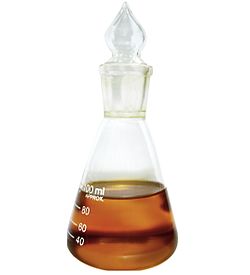
Straight unmodified edible vegetable oil is generally not used as fuel, but lower-quality oil has been used for this purpose. Used vegetable oil is increasingly being processed into biodiesel, or (more rarely) cleaned of water and particulates and then used as a fuel. The IEA estimates that biodiesel production used 17% of global vegetable oil supplies in 2021.[28]
Oils and fats reacted with 10 pounds of a short-chain alcohol (usually methanol) in the presence of a catalyst (usually sodium hydroxide [NaOH] can be hydrogenated to give a diesel substitute.[55] The resulting product is a straight-chain hydrocarbon with a high cetane number, low in aromatics and sulfur and does not contain oxygen. Hydrogenated oils can be blended with diesel in all proportions. They have several advantages over biodiesel, including good performance at low temperatures, no storage stability problems and no susceptibility to microbial attack.[56]
Biogasoline
[edit]Biogasoline can be produced biologically and thermochemically. Using biological methods, a study led by Professor Lee Sang-yup at the Korea Advanced Institute of Science and Technology (KAIST) and published in the international science journal Nature used modified E. coli fed with glucose found in plants or other non-food crops to produce biogasoline with the produced enzymes. The enzymes converted the sugar into fatty acids and then turned these into hydrocarbons that were chemically and structurally identical to those found in commercial gasoline fuel.[57] The thermochemical approach of producing biogasoline are similar to those used to produce biodiesel.[46][47][48] Biogasoline may also be called drop-in gasoline or renewable gasoline.
Bioethers
[edit]
Bioethers (also referred to as fuel ethers or oxygenated fuels) are cost-effective compounds that act as octane rating enhancers. "Bioethers are produced by the reaction of reactive iso-olefins, such as iso-butylene, with bioethanol."[58][attribution needed] Bioethers are created from wheat or sugar beets, and also be produced from the waste glycerol that results from the production of biodiesel.[59] They also enhance engine performance, while significantly reducing engine wear and toxic exhaust emissions. By greatly reducing the amount of ground-level ozone emissions, they contribute to improved air quality.[61][62]
In transportation fuel there are six ether additives: dimethyl ether (DME), diethyl ether (DEE), methyl tert-butyl ether (MTBE), ethyl tert-butyl ether (ETBE), tert-amyl methyl ether (TAME), and tert-amyl ethyl ether (TAEE).[63]
The European Fuel Oxygenates Association identifies MTBE and ETBE as the most commonly used ethers in fuel to replace lead. Ethers were introduced in Europe in the 1970s to replace the highly toxic compound.[64] Although Europeans still use bioether additives, the U.S. Energy Policy Act of 2005 lifted a requirement for reformulated gasoline to include an oxygenate, leading to less MTBE being added to fuel.[65] Although bioethers are likely to replace ethers produced from petroleum in the UK, it is highly unlikely they will become a fuel in and of itself due to the low energy density.[66]
Aviation biofuel
[edit].jpg)
An aviation biofuel (also known as bio-jet fuel,[67] sustainable aviation fuel (SAF), or bio-aviation fuel (BAF)[68]) is a biofuel used to power aircraft. The International Air Transport Association (IATA) considers it a key element in reducing the environmental impact of aviation.[69] Aviation biofuel is used to decarbonize medium and long-haul air travel. These types of travel generate the most emissions and could extend the life of older aircraft types by lowering their carbon footprint. Synthetic paraffinic kerosene (SPK) refers to any non-petroleum-based fuel designed to replace kerosene jet fuel, which is often, but not always, made from biomass.
Biofuels are biomass-derived fuels from plants, animals, or waste; depending on which type of biomass is used, they could lower CO2 emissions by 20–98% compared to conventional jet fuel.[70] The first test flight using blended biofuel was in 2008, and in 2011, blended fuels with 50% biofuels were allowed on commercial flights. In 2023 SAF production was 600 million liters, representing 0.2% of global jet fuel use.[71] By 2024, SAF production was to increase to 1.3 billion liters (1 million tonnes), representing 0.3% of global jet fuel consumption and 11% of global renewable fuel production.[72] This increase came as major US production facilities delayed their ramp-up until 2025, having initially been expected to reach 1.9 billion liters.
Aviation biofuel can be produced from plant or animal sources such as Jatropha, algae, tallows, waste oils, palm oil, Babassu, and Camelina (bio-SPK); from solid biomass using pyrolysis processed with a Fischer–Tropsch process (FT-SPK); with an alcohol-to-jet (ATJ) process from waste fermentation; or from synthetic biology through a solar reactor. Small piston engines can be modified to burn ethanol.
Sustainable biofuels are an alternative to electrofuels.[73] Sustainable aviation fuel is certified as being sustainable by a third-party organisation.
SAF technology faces significant challenges due to feedstock constraints. The oils and fats known as hydrotreated esters and fatty acids (Hefa), crucial for SAF production, are in limited supply as demand increases. Although advanced e-fuels technology, which combines waste CO2 with clean hydrogen, presents a promising solution, it is still under development and comes with high costs. To overcome these issues, SAF developers are exploring more readily available feedstocks such as woody biomass and agricultural and municipal waste, aiming to produce lower-carbon jet fuel more sustainably and efficiently.[74][75]Gaseous
[edit]Biogas and biomethane
[edit]
Biogas is a mixture composed primarily of methane and carbon dioxide produced by the process of anaerobic digestion of organic material by micro-organisms. Other trace components of this mixture includes water vapor, hydrogen sulfide, siloxanes, hydrocarbons, ammonia, oxygen, carbon monoxide, and nitrogen.[76][77] It can be produced either from biodegradable waste materials or by the use of energy crops fed into anaerobic digesters to supplement gas yields. The solid byproduct, digestate, can be used as a biofuel or a fertilizer. When CO2 and other impurities are removed from biogas, it is called biomethane. The CO2 can also be combined with hydrogen in methanation to form more methane.
Biogas can be recovered from mechanical biological treatment waste processing systems. Landfill gas, a less clean form of biogas, is produced in landfills through naturally occurring anaerobic digestion. If it escapes into the atmosphere, it acts as a greenhouse gas.
In Sweden, "waste-to-energy" power plants capture methane biogas from garbage and use it to power transport systems.[78] Farmers can produce biogas from cattle manure via anaerobic digesters.[79]
Syngas
[edit]Syngas, a mixture of carbon monoxide, hydrogen and various hydrocarbons, is produced by partial combustion of biomass (combustion with an amount of oxygen that is not sufficient to convert the biomass completely to carbon dioxide and water).[56] Before partial combustion the biomass is dried and sometimes pyrolysed. Syngas is more efficient than direct combustion of the original biofuel; more of the energy contained in the fuel is extracted.
Syngas may be burned directly in internal combustion engines, turbines or high-temperature fuel cells.[80] The wood gas generator, a wood-fueled gasification reactor, can be connected to an internal combustion engine.
Syngas can be used to produce methanol, dimethyl ether and hydrogen, or converted via the Fischer–Tropsch process to produce a diesel substitute, or a mixture of alcohols that can be blended into gasoline. Gasification normally relies on temperatures greater than 700 °C.
Lower-temperature gasification is desirable when co-producing biochar, but results in syngas polluted with tar.
Solid
[edit]The term "biofuels" is also used for solid fuels that are made from biomass, even though this is less common.[7]
Research into other types
[edit]Algae-based biofuels
[edit]Algae can be produced in ponds or tanks on land, and out at sea.[81][82] Algal fuels have high yields,[83] a high ignition point,[84] can be grown with minimal impact on fresh water resources,[85][86][87] can be produced using saline water and wastewater, and are biodegradable and relatively harmless to the environment if spilled.[88][89] However, production requires large amounts of energy and fertilizer, the produced fuel degrades faster than other biofuels, and it does not flow well in cold temperatures.[81][90]
By 2017, due to economic considerations, most efforts to produce fuel from algae have been abandoned or changed to other applications.[91]
Third and fourth-generation biofuels also include biofuels that are produced by bioengineered organisms i.e. algae and cyanobacteria.[92] Algae and cyanobacteria will use water, carbon dioxide, and solar energy to produce biofuels.[92] This method of biofuel production is still at the research level. The biofuels that are secreted by the bioengineered organisms are expected to have higher photon-to-fuel conversion efficiency, compared to older generations of biofuels.[92] One of the advantages of this class of biofuels is that the cultivation of the organisms that produce the biofuels does not require the use of arable land.[93] The disadvantages include the cost of cultivating the biofuel-producing organisms being very high.[93]
Electrofuels and solar fuels
[edit]Electrofuels[citation needed] and solar fuels may or may not be biofuels, depending on whether they contain biological elements. Electrofuels are made by storing electrical energy in the chemical bonds of liquids and gases. The primary targets are butanol, biodiesel, and hydrogen, but include other alcohols and carbon-containing gases such as methane and butane. A solar fuel is a synthetic chemical fuel produced from solar energy. Light is converted to chemical energy, typically by reducing protons to hydrogen, or carbon dioxide to organic compounds.[94]
Bio-digesters
[edit]A bio-digester is a mechanized toilet that uses decomposition and sedimentation to turn human waste into a renewable fuel called biogas. Biogas can be made from substances like agricultural waste and sewage.[95][96] The bio-digester uses a process called anaerobic digestion to produce biogas. Anaerobic digestion uses a chemical process to break down organic matter with the use of microorganisms in the absence of oxygen to produce biogas.[97] The processes involved in anaerobic respiration are hydrolysis, acidogenesis, acetogenesis, and methanogenesis.[98]
Extent of production and use
[edit]
Global biofuel production was 81 Mtoe in 2017 which represented an annual increase of about 3% compared to 2010.[8]: 12 In 2017, the US was the largest biofuel producer in the world producing 37 Mtoe, followed by Brazil and South America at 23 Mtoe and Europe (mainly Germany) at 12 Mtoe.[8]: 12
An assessment from 2017 found that: "Biofuels will never be a major transport fuel as there is just not enough land in the world to grow plants to make biofuel for all vehicles. It can however, be part of an energy mix to take us into a future of renewable energy."[8]: 11
In 2021, worldwide biofuel production provided 4.3% of the world's fuels for transport, including a very small amount of aviation biofuel.[15] By 2027, worldwide biofuel production is expected to supply 5.4% of the world's fuels for transport including 1% of aviation fuel.[15]
The US, Europe, Brazil and Indonesia are driving the majority of biofuel consumption growth. This demand for biodiesel, renewable diesel and biojet fuel is projected to increase by 44% (21 billion litres) over 2022-2027.[99]
Issues
[edit]
Issues relating to biofuel are social, economic, environmental and technical problems that may arise from biofuel production and use. Social and economic issues include the "food vs fuel" debate and the need to develop responsible policies and economic instruments to ensure sustainable biofuel production. Farming for biofuels feedstock can be detrimental to the environment if not done sustainably. Environmental concerns include deforestation, biodiversity loss and soil erosion as a result of land clearing for biofuels agriculture. While biofuels can contribute to reduction in global carbon emissions, indirect land use change for biofuel production can have the inverse effect. Technical issues include possible modifications necessary to run the engine on biofuel, as well as energy balance and efficiency.
The International Resource Panel outlined the wider and interrelated factors that need to be considered when deciding on the relative merits of pursuing one biofuel over another.[100] The IRP concluded that not all biofuels perform equally in terms of their effect on climate, energy security and ecosystems, and suggested that environmental and social effects need to be assessed throughout the entire life-cycle.Environmental impacts
[edit]
Estimates about the climate impact from biofuels vary widely based on the methodology and exact situation examined.[11]
In general, biofuels emit fewer greenhouse gas emissions when burned in an engine and are generally considered carbon-neutral fuels as the carbon they emit has been captured from the atmosphere by the crops used in biofuel production.[10] They can have greenhouse gas emissions ranging from as low as -127.1 gCO2eq per MJ when carbon capture is incorporated into their production to those exceeding 95 gCO2eq per MJ when land-use change is significant.[47][48] Several factors are responsible for the variation in emission numbers of biofuel, such as feedstock and its origin, fuel production technique, system boundary definitions, and energy sources.[48] However, many government policies, such as those by the European Union and the UK, require that biofuels have at least 65% greenhouse gas emissions savings (or 70% if it is renewable fuels of non-biological origins) relative to fossil fuels.[102][103]
The growing demand for biofuels has raised concerns about land use and food security. Many biofuel crops are grown on land that could otherwise be used for food production. This shift in land use can lead to several problems:
- Competition with Food Crops: The cultivation of biofuels, especially in food-insecure regions, can drive up the cost of food and reduce the amount of land available for growing essential crops. This can exacerbate global food insecurity, especially in developing countries.
- Deforestation and Habitat Loss: To meet the increasing demand for biofuels, large areas of forests and natural habitats are being cleared for agriculture. This deforestation leads to the loss of biodiversity, threatens wildlife species, and disrupts ecosystems.
Biodiversity Loss
[edit]The expansion of biofuel production, particularly through monoculture farming (growing a single crop on a large scale), poses a significant threat to biodiversity. Large-scale biofuel crop production can lead to:
- Habitat Destruction: The conversion of natural ecosystems into agricultural land can result in the loss of habitats for many plant and animal species, leading to decreased biodiversity.
- Soil Degradation: Monoculture farming can deplete soil nutrients, reduce soil fertility, and increase the need for chemical inputs like fertilizers and pesticides, which can further harm surrounding ecosystems
- Soil Fertility: Continuous cultivation of biofuel crops without proper crop rotation or sustainable farming practices can lead to soil depletion. Over time, the soil may lose vital nutrients, making it less suitable for farming.
Life-cycle assessments of first-generation biofuels have shown large emissions associated with the potential land-use change required to produce additional biofuel feedstocks.[11][12] If no land-use change is involved, first-generation biofuels can—on average—have lower emissions than fossil fuels.[11] However, biofuel production can compete with food crop production. Up to 40% of corn produced in the United States is used to make ethanol[104] and worldwide 10% of all grain is turned into biofuel.[105] A 50% reduction in grain used for biofuels in the US and Europe would replace all of Ukraine's grain exports.[106] Several studies have shown that reductions in emissions from biofuels are achieved at the expense of other impacts, such as acidification, eutrophication, water footprint and biodiversity loss.[11]
Second-generation biofuels are thought to increase environmental sustainability since the non-food part of plants is being used to produce second-generation biofuels instead of being disposed of.[107] But the use of second-generation biofuels increases the competition for lignocellulosic biomass, increasing the cost of these biofuels.[108]
In theory, third-generation biofuels, produced from algae, shouldn't harm the environment more than first- or second-generation biofuels due to lower changes in land use and the fact that they do not require pesticide use for production.[109] When looking at the data however, it has been shown that the environmental cost to produce the infrastructure and energy required for third generation biofuel production, are higher than the benefits provided from the biofuels use.[110][111]
The European Commission has officially approved a measure to phase out palm oil-based biofuels by 2030.[112][113] Unsustainable palm oil agriculture has caused significant environmental and social problems, including deforestation and pollution.
The production of biofuels can be very energy intensive, which, if generated from non-renewable sources, can heavily mitigate the benefits gained through biofuel use. A solution proposed to solve this issue is to supply biofuel production facilities with excess nuclear energy, which can supplement the power provided by fossil fuels.[114] This can provide a carbon inexpensive solution to help reduce the environmental impacts of biofuel production.
Indirect land use change impacts of biofuels
[edit] | This article needs to be updated. (August 2021) |


The indirect land use change impacts of biofuels, also known as ILUC or iLUC (pronounced as i-luck), relates to the unintended consequence of releasing more carbon emissions due to land-use changes around the world induced by the expansion of croplands for ethanol or biodiesel production in response to the increased global demand for biofuels.[115][116]
As farmers worldwide respond to higher crop prices in order to maintain the global food supply-and-demand balance, pristine lands are cleared to replace the food crops that were diverted elsewhere to biofuels' production. Because natural lands, such as rainforests and grasslands, store carbon in their soil and biomass as plants grow each year, clearance of wilderness for new farms translates to a net increase in greenhouse gas emissions. Due to this off-site change in the carbon stock of the soil and the biomass, indirect land use change has consequences in the greenhouse gas (GHG) balance of a biofuel.[115][116][117][118]
Other authors have also argued that indirect land use changes produce other significant social and environmental impacts, affecting biodiversity, water quality, food prices and supply, land tenure, worker migration, and community and cultural stability.[117][119][120][121]See also
[edit]


- Aviation biofuel
- Bioenergy Europe
- BioEthanol for Sustainable Transport
- Biofuels by region
- Biofuels Center of North Carolina
- Biogas powerplant
- International Renewable Energy Agency
- List of biofuel companies and researchers
- List of vegetable oils used for biofuel
- Renewable energy by country
- Residue-to-product ratio
- Sustainable aviation fuel
- Sustainable transport
- Table of biofuel crop yields
References
[edit]- ^ Priya A, Hu Y, Mou J, Du C, Wilson K, Luque R, et al. (2023). "Chapter 1 - Introduction: An overview of biofuels and production technologies". In Luque R, Sze Ki Lin C, Wilson K, Du C (eds.). Handbook of Biofuels Production (Third ed.). Woodhead Publishing. pp. 3–24. doi:10.1016/B978-0-323-91193-1.00002-0. ISBN 978-0-323-91193-1.
- ^ "Biofuel | Definition, Types, & Pros and Cons | Britannica". www.britannica.com. 18 March 2024. Retrieved 2 April 2024.
- ^ Mahapatra S, Kumar D, Singh B, Sachan PK (2021). "Biofuels and their sources of production: A review on cleaner sustainable alternative against conventional fuel, in the framework of the food and energy nexus". Energy Nexus. 4 100036. Bibcode:2021EnNex...4j0036M. doi:10.1016/j.nexus.2021.100036.
- ^ Malode SJ, Prabhu KK, Mascarenhas RJ, Shetti NP, Aminabhavi TM (2021). "Recent advances and viability in biofuel production". Energy Conversion and Management: X. 10 100070. Bibcode:2021ECMX...1000070M. doi:10.1016/j.ecmx.2020.100070.
- ^ Cherwoo L, Gupta I, Flora G, Verma R, Kapil M, Arya SK, et al. (2023). "Biofuels an alternative to traditional fossil fuels: A comprehensive review". Sustainable Energy Technologies and Assessments. 60 103503. Bibcode:2023SETA...6003503C. doi:10.1016/j.seta.2023.103503.
- ^ a b T. M. Letcher, ed. (2020). "Chapter 9: Biofuels for transport". Future energy: improved, sustainable and clean options for our planet (3rd ed.). Amsterdam, Netherlands. ISBN 978-0-08-102887-2. OCLC 1137604985.
{{cite book}}: CS1 maint: location missing publisher (link) - ^ a b c "Biofuels explained - U.S. Energy Information Administration (EIA)". www.eia.gov. Retrieved 24 January 2023.
- ^ a b c d T. M. Letcher, ed. (2020). "Chapter1: Introduction With a Focus on Atmospheric Carbon Dioxide and Climate Change". Future energy: improved, sustainable and clean options for our planet (3rd ed.). Amsterdam, Netherlands. ISBN 978-0-08-102887-2. OCLC 1137604985.
{{cite book}}: CS1 maint: location missing publisher (link) - ^ Lade GE, Smith A (2025). "Biofuels: Past, Present, and Future". Annual Review of Resource Economics. 17: 105–125. doi:10.1146/annurev-resource-011724-082950.
- ^ a b Lewandrowski J, Rosenfeld J, Pape D, Hendrickson T, Jaglo K, Moffroid K (25 March 2019). "The greenhouse gas benefits of corn ethanol – assessing recent evidence". Biofuels. 11 (3). Informa UK Limited: 361–375. doi:10.1080/17597269.2018.1546488. ISSN 1759-7269. S2CID 134824935.
- ^ a b c d e f Jeswani HK, Chilvers A, Azapagic A (November 2020). "Environmental sustainability of biofuels: a review". Proceedings of the Royal Society A: Mathematical, Physical and Engineering Sciences. 476 (2243) 20200351. Bibcode:2020RSPSA.47600351J. doi:10.1098/rspa.2020.0351. PMC 7735313. PMID 33363439.
- ^ a b Lark TJ, Hendricks NP, Smith A, Pates N, Spawn-Lee SA, Bougie M, et al. (March 2022). "Environmental outcomes of the US Renewable Fuel Standard". Proceedings of the National Academy of Sciences of the United States of America. 119 (9) e2101084119. Bibcode:2022PNAS..11901084L. doi:10.1073/pnas.2101084119. PMC 8892349. PMID 35165202.
- ^ Jeswani HK, Chilvers A, Azapagic A (November 2020). "Environmental sustainability of biofuels: a review". Proceedings of the Royal Society A: Mathematical, Physical and Engineering Sciences. 476 (2243) 20200351. Bibcode:2020RSPSA.47600351J. doi:10.1098/rspa.2020.0351. ISSN 1364-5021. PMC 7735313. PMID 33363439.
- ^ "Biofuel is approaching a feedstock crunch. How bad? And what must be done?". Energy Post. 23 January 2023. Retrieved 14 March 2024.
- ^ a b c "Transport biofuels – Renewables 2022 – Analysis". IEA. Retrieved 30 January 2023.
- ^ "Biofuel is approaching a feedstock crunch. How bad? And what must be done?". Energy Post. 23 January 2023. Retrieved 30 January 2023.
- ^ "How to scale Sustainable Aviation Fuel in the next decade". World Economic Forum. Retrieved 30 January 2023.
- ^ "More Electric Cars Are Key To Meeting SAF Targets, Boeing Says | Aviation Week Network". aviationweek.com. Retrieved 16 September 2024.
- ^ "Renewables Report 2022". IEA. 6 December 2022.
- ^ Bayetero CM, Yépez CM, Cevallos IB, Rueda EH (January 2022). "Effect of the use of additives in biodiesel blends on the performance and opacity of a diesel engine". Materials Today: Proceedings. Advances in Mechanical Engineering Trends. 49: 93–99. doi:10.1016/j.matpr.2021.07.478. ISSN 2214-7853. S2CID 238787289.
- ^ a b IPCC, 2022: Annex I: Glossary [van Diemen, R., J.B.R. Matthews, V. Möller, J.S. Fuglestvedt, V. Masson-Delmotte, C. Méndez, A. Reisinger, S. Semenov (eds)]. In IPCC, 2022: Climate Change 2022: Mitigation of Climate Change. Contribution of Working Group III to the Sixth Assessment Report of the Intergovernmental Panel on Climate Change [P.R. Shukla, J. Skea, R. Slade, A. Al Khourdajie, R. van Diemen, D. McCollum, M. Pathak, S. Some, P. Vyas, R. Fradera, M. Belkacemi, A. Hasija, G. Lisboa, S. Luz, J. Malley, (eds.)]. Cambridge University Press, Cambridge, UK and New York, NY, USA. doi: 10.1017/9781009157926.020
- ^ Cavelius P, Engelhart-Straub S, Mehlmer N, Lercher J, Awad D, Brück T (30 March 2023). "The potential of biofuels from first to fourth generation". PLOS Biology. 21 (3) e3002063. doi:10.1371/journal.pbio.3002063. ISSN 1545-7885. PMC 10063169. PMID 36996247.
- ^ a b T. M. Letcher, ed. (2020). "Chapter 21: Energy from biomass". Future energy: improved, sustainable and clean options for our planet (3rd ed.). Amsterdam, Netherlands. ISBN 978-0-08-102887-2. OCLC 1137604985.
{{cite book}}: CS1 maint: location missing publisher (link) - ^ "What are – and who's making – 2G, 3G and 4G biofuels?: Biofuels Digest - biofuels, biodiesel, ethanol, algae, jatropha, green gasoline, green diesel, and biocrude daily news". 21 May 2010. Archived from the original on 21 May 2010.
- ^ European Parliament. "Advanced biofuels" (PDF). Retrieved 19 April 2024.
- ^ Flores LF, Osorio-Gonzalez CS, Saini R, Brar SK (2024). "Renewable Residues as Feedstock for Drop-in Biofuel Production". The Microbiology of the Drop-in Biofuel Production. Biofuel and Biorefinery Technologies. Vol. 15. Springer. pp. 41–74. doi:10.1007/978-3-031-61637-2_3. ISBN 978-3-031-61636-5.
- ^ "Biofuels – Second Generation Biofuels". biofuel.org.uk. Archived from the original on 15 July 2019. Retrieved 18 January 2018.
- ^ a b "Is the biofuel industry approaching a feedstock crunch? – Analysis". IEA. 6 December 2022. Retrieved 2 January 2023.
- ^ Houghton J, Weatherwax S, Ferrell J (7 June 2006). Breaking the biological barriers to cellulosic ethanol: a joint research agenda (Report). Washington, DC (United States): EERE Publication and Product Library. doi:10.2172/1218382.
- ^ Börjesson P, Lundgren J, Ahlgren S, Nyström I (18 June 2013). Dagens och framtidens hållbara biodrivmedel: underlagsrapport från f3 till utredningen om fossilfri fordonstrafik [Today's and the future's sustainable biofuels: background report from f3 to the inquiry into fossil-free vehicle traffic.] (Report) (in Swedish). Vol. 13. The Swedish Knowledge Centre for Renewable Transportation Fuels. p. 170.
- ^ "ButylFuel, LLC Main Page". Butanol.com. 15 August 2005. Archived from the original on 10 July 2019. Retrieved 14 July 2010.
- ^ Evans J (14 January 2008). "Biofuels aim higher". Biofuels, Bioproducts and Biorefining (BioFPR). Archived from the original on 10 August 2009. Retrieved 3 December 2008.
- ^ Pontrelli S, Fricke RC, Sakurai SS, Putri SP, Fitz-Gibbon S, Chung M, et al. (September 2018). "Directed strain evolution restructures metabolism for 1-butanol production in minimal media". Metabolic Engineering. 49: 153–163. doi:10.1016/j.ymben.2018.08.004. PMID 30107263.
- ^ Fukuda H, Kondo A, Noda H (January 2001). "Biodiesel fuel production by transesterification of oils". Journal of Bioscience and Bioengineering. 92 (5): 405–416. doi:10.1016/s1389-1723(01)80288-7. PMID 16233120.
- ^ "Perstop Press release: Verdis Polaris Aura – second generation B100 – The advanced green one". Archived from the original on 4 August 2014. Retrieved 21 June 2014.
- ^ Lee T (7 June 2020). "Safflower oil hailed by scientists as possible recyclable, biodegradable replacement for petroleum". ABC News. Landline. Australian Broadcasting Corporation. Archived from the original on 7 June 2020. Retrieved 7 June 2020.
- ^ "Alternative Fuels Data Center: Biodiesel Blends". afdc.energy.gov. Retrieved 31 March 2022.
- ^ Nylund NO, Koponen K (2012). Fuel and Technology Alternatives for Buses. Overall Energy Efficiency and Emission Performance. IEA Bioenergy Task 46 (PDF) (Report). VTT Technical Research Centre of Finland. Archived from the original (PDF) on 16 February 2020.. Possibly the new emission standards Euro VI/EPA 10 will lead to reduced NOx-levels also when using B100.
- ^ "Biofuels Facts". Hempcar.org. Archived from the original on 20 May 2011. Retrieved 14 July 2010.
- ^ "ADM Biodiesel: Hamburg, Leer, Mainz". Biodiesel.de. Archived from the original on 2 August 2009. Retrieved 14 July 2010.
- ^ RRI Limited for Biodiesel Filling Stations. "Welcome to Biodiesel Filling Stations". Biodieselfillingstations.co.uk. Archived from the original on 14 July 2018. Retrieved 14 July 2010.
- ^ a b Avril Group : Activity Report 2014, p. 58
- ^ EurObserv 2014, p. 4
- ^ Brown R, Holmgren J. "Fast Pyrolysis and Bio-Oil Upgrading" (PDF). Archived (PDF) from the original on 5 January 2012. Retrieved 15 March 2012.
- ^ a b c d "Alternative & Advanced Fuels". US Department of Energy. Archived from the original on 27 October 2012. Retrieved 7 March 2012.
- ^ a b "Technology | Comsyn". www.comsynproject.eu. Retrieved 19 April 2024.
- ^ a b c Lilonfe S, Dimitriou I, Davies B, Abdul-Manan AF, McKechnie J (1 January 2024). "Comparative techno-economic and life cycle analyses of synthetic "drop-in" fuel production from UK wet biomass". Chemical Engineering Journal. 479 147516. Bibcode:2024ChEnJ.47947516L. doi:10.1016/j.cej.2023.147516. ISSN 1385-8947.
- ^ a b c d Lilonfe S, Davies B, Abdul-Manan AF, Dimitriou I, McKechnie J (17 April 2024). "A review of techno-economic analyses and life cycle greenhouse gas emissions of biomass-to-hydrocarbon "drop-in" fuels". Sustainable Production and Consumption. 47: 425–444. Bibcode:2024SusPC..47..425L. doi:10.1016/j.spc.2024.04.016. ISSN 2352-5509.
- ^ a b c Knothe G (June 2010). "Biodiesel and renewable diesel: a comparison". Progress in Energy and Combustion Science. 36 (3): 364–373. Bibcode:2010PECS...36..364K. doi:10.1016/j.pecs.2009.11.004. Archived from the original on 6 November 2012. Retrieved 23 August 2012.
- ^ "Green Diesel v. Biodiesel". Archived from the original on 5 August 2018. Retrieved 5 August 2018.
- ^ Jessica E. "Breakthroughs in Green Gasoline Production". Biomass Magazine. Archived from the original on 11 March 2012. Retrieved 14 August 2012.
- ^ Albrecht KO, Hallen RT (March 2011). A Brief Literature Overview of Various Routes to Biorenewable Fuels from Lipids for the National Alliance of Advanced Biofuels and Bio-products NAAB Consortium (PDF) (Report). Prepared by the US Department of Energy. Archived (PDF) from the original on 12 July 2012. Retrieved 23 August 2012.
- ^ "Preem makes major investment in green diesel at the Port of Gothenburg – Port of Gothenburg". August 2014. Archived from the original on 1 August 2014.
- ^ "Wal-Mart To Test Hybrid Trucks". Sustainable Business. 3 February 2009. Archived from the original on 8 May 2014. Retrieved 8 May 2014.
- ^ "Alternative Fuels Data Center: Biodiesel Production and Distribution". afdc.energy.gov. Retrieved 31 March 2022.
- ^ a b Evans G (14 April 2008). Liquid Transport Biofuels – Technology Status Report (Report). National Non-Food Crops Centre. Archived from the original on 11 June 2008.
- ^ Liquid Transport Fuels&Lubes - South Korean scientists use E. coli to make gasoline (Report). Fuels&Lubes Daily. 4 November 2013. Archived from the original on 7 September 2022.
- ^ Rock K, Korpelshoek M (2007). "Bioethers Impact on the Gasoline Pool". Digital Refining. Archived from the original on 14 November 2016. Retrieved 15 February 2014.
- ^ "Biofuels - Types of Biofuels - Bioethers". biofuel.org.uk. Archived from the original on 1 February 2016.
- ^ Consolidated text: Directive 98/70/EC of the European Parliament and of the Council of 13 October 1998 relating to the quality of petrol and diesel fuels and amending Council Directive 93/12/EEC
- ^ Council Directive 85/536/EEC of 5 December 1985 on crude-oil savings through the use of substitute fuel components in petrol. No longer in force, Date of end of validity: 31/12/1999; Repealed by 31998L0070.[60]
- ^ "Impact Assessment of the Proposal for a Directive of the European Parliament and of the Council modifying Directive 98/70/EC relating to the quality of petrol and diesel fuels" (PDF). Brussels: Commission of the European Communities. 31 January 2007. Archived (PDF) from the original on 15 July 2011. Retrieved 14 July 2010.
- ^ Sukla MK, Bhaskar T, Jain AK, Singal SK, Garg MO. "Bio-Ethers as Transportation Fuel: A Review" (PDF). Indian Institute of Petroleum Dehradun. Archived (PDF) from the original on 14 October 2011. Retrieved 15 February 2014.
- ^ "What are Bio-Ethers?" (PDF). . The European Fuel Oxygenates Association. Archived from the original (PDF) on 6 March 2014.
- ^ "Gasoline". Environmental Protection Agency. Archived from the original on 6 December 2013. Retrieved 6 March 2014.
- ^ "Biofuels – Types of Biofuels – Bioethers". Archived from the original on 1 February 2016. Retrieved 30 May 2015.
- ^ "Sustainable aviation fuel market demand drives new product launches". Investable Universe. 4 December 2020. Retrieved 12 December 2022. Note: Investable Universe>About
- ^ Doliente SS, et al. (10 July 2020). "Bio-aviation Fuel: A Comprehensive Review and Analysis of the Supply Chain Components" (PDF). Frontiers in Energy Research. 8 110. Bibcode:2020FrER....8..110D. doi:10.3389/fenrg.2020.00110.
- ^ "Developing Sustainable Aviation Fuel (SAF)". IATA.
- ^ Bauen A, Howes J, Bertuccioli L, Chudziak C (August 2009). "Review of the potential for biofuels in aviation". CiteSeerX 10.1.1.170.8750.
- ^ IATA (December 2023). "Net zero 2050: sustainable aviation fuels – December 2023". www.iata.org/flynetzero. Archived from the original on 24 February 2024.
- ^ "Disappointingly Slow Growth in SAF Production". www.iata.org. Retrieved 31 March 2025.
- ^ Mark Pilling (25 March 2021). "How sustainable fuel will help power aviation's green revolution". FlightGlobal.
- ^ "New Technology Helps Advance Non-Hefa SAF Projects". Energy Intelligence. 10 May 2024. Retrieved 14 May 2024.
- ^ "New SAF Process Could Transform Industry". Aviation Industry News. 14 August 2024. Retrieved 14 August 2024.
- ^ Ryckebosch E, Drouillon M, Vervaeren H (1 May 2011). "Techniques for transformation of biogas to biomethane". Biomass and Bioenergy. 35 (5): 1633–1645. Bibcode:2011BmBe...35.1633R. doi:10.1016/j.biombioe.2011.02.033. ISSN 0961-9534.
- ^ "A Detailed Economic Assessment of Anaerobic Digestion Technology and its Suitability to UK Farming and Waste Systems (Andersons)". National Non-Food Crops Centre. 4 October 2008. NNFCC 08-006. Archived from the original on 4 October 2008. Retrieved 2 January 2023.
- ^ Yee A (21 September 2018). "In Sweden, Trash Heats Homes, Powers Buses and Fuels Taxi Fleets". The New York Times. ISSN 0362-4331. Retrieved 14 March 2024.
- ^ "BIOGAS: No bull, manure can power your farm." Farmers Guardian (25 September 2009): 12. General OneFile. Gale.
- ^ Nagel F (2008). Electricity from wood through the combination of gasification and solid oxide fuel cells (PhD thesis). Swiss Federal Institute of Technology Zurich. Archived from the original on 13 March 2011.
- ^ a b "Biofuel from Algae: The Pros and Cons of Pond Scum". Thomasnet®. 29 January 2020. Archived from the original on 6 April 2020. Retrieved 25 October 2020.
- ^ "Biomass - Offshore wind farms = seaweed = biofuel". Renewable Energy Magazine, at the heart of clean energy journalism. 14 September 2020. Archived from the original on 27 July 2020. Retrieved 16 October 2020.
- ^ Greenwell HC, Laurens LM, Shields RJ, Lovitt RW, Flynn KJ (May 2010). "Placing microalgae on the biofuels priority list: a review of the technological challenges". Journal of the Royal Society, Interface. 7 (46): 703–726. doi:10.1098/rsif.2009.0322. PMC 2874236. PMID 20031983.
- ^ Dinh LT, Guo Y, Mannan MS (2009). "Sustainability evaluation of biodiesel production using multicriteria decision-making". Environmental Progress & Sustainable Energy. 28 (1): 38–46. Bibcode:2009EPSE...28...38D. doi:10.1002/ep.10335. S2CID 111115884.
- ^ Ajayebi A, Gnansounou E, Kenthorai Raman J (1 December 2013). "Comparative life cycle assessment of biodiesel from algae and jatropha: A case study of India". Bioresource Technology. 150: 429–437. Bibcode:2013BiTec.150..429A. doi:10.1016/j.biortech.2013.09.118. ISSN 0960-8524. PMID 24140355.
- ^ Yang J, Xu M, Zhang X, Hu Q, Sommerfeld M, Chen Y (January 2011). "Life-cycle analysis on biodiesel production from microalgae: water footprint and nutrients balance" (PDF). Bioresource Technology. 102 (1): 159–165. Bibcode:2011BiTec.102..159Y. doi:10.1016/j.biortech.2010.07.017. PMID 20675125. Archived from the original (PDF) on 27 February 2012.
- ^ Cornell CB (29 March 2008). "First Algae Biodiesel Plant Goes Online: 1 April 2008". Gas 2.0. Archived from the original on 18 June 2019. Retrieved 10 June 2008.
- ^ Demirbas AH (2011). "Biodiesel from oilgae, biofixation of carbon dioxide by microalgae: A solution to pollution problems". Applied Energy. 88 (10): 3541–3547. Bibcode:2011ApEn...88.3541D. doi:10.1016/j.apenergy.2010.12.050. hdl:11503/1330.
- ^ Demirbas AH (2009). "Inexpensive oil and fats feedstocks for production of biodiesel". Energy Education Science and Technology Part A: Energy Science and Research. 23: 1–13.
- ^ Rodionova M, Poudyal R, Tiwari I, Voloshin R, Zharmukhamedov S, Nam H, et al. (March 2017). "Biofuel production: Challenges and opportunities". International Journal of Hydrogen Energy. 42 (12): 8450–8461. Bibcode:2017IJHE...42.8450R. doi:10.1016/j.ijhydene.2016.11.125.
- ^ Wesoff E (19 April 2017). "Hard Lessons From the Great Algae Biofuel Bubble". Archived from the original on 5 July 2017. Retrieved 5 August 2017.
- ^ a b c Aro EM (January 2016). "From first generation biofuels to advanced solar biofuels". Ambio. 45 (Supplement 1): S24 – S31. Bibcode:2016Ambio..45S..24A. doi:10.1007/s13280-015-0730-0. PMC 4678123. PMID 26667057.
- ^ a b Abdullah B, Muhammad SA, Shokravi Z, Ismail S, Kassim KA, Mahmood AN, et al. (June 2019). "Fourth generation biofuel: A review on risks and mitigation strategies". Renewable and Sustainable Energy Reviews. 107: 37–50. Bibcode:2019RSERv.107...37A. doi:10.1016/j.rser.2019.02.018. S2CID 116245776.
- ^ Lü J, Sheahan C, Fu P (2011). "Metabolic engineering of algae for fourth generation biofuels production". Energy & Environmental Science. 4 (7): 2451. Bibcode:2011EnEnS...4.2451L. doi:10.1039/c0ee00593b. ISSN 1754-5692.
- ^ Xu F, Li Y, Ge X, Yang L, Li Y (1 January 2018). "Anaerobic digestion of food waste – Challenges and opportunities". Bioresource Technology. 247: 1047–1058. Bibcode:2018BiTec.247.1047X. doi:10.1016/j.biortech.2017.09.020. ISSN 0960-8524. PMID 28965912.
- ^ Mahmudul HM, Rasul MG, Akbar D, Narayanan R, Mofijur M (20 January 2021). "A comprehensive review of the recent development and challenges of a solar-assisted biodigester system". Science of the Total Environment. 753 141920. Bibcode:2021ScTEn.75341920M. doi:10.1016/j.scitotenv.2020.141920. ISSN 0048-9697. PMID 32889316.
- ^ Kougias PG, Angelidaki I (30 April 2018). "Biogas and its opportunities—A review". Frontiers of Environmental Science & Engineering. 12 (3): 14. Bibcode:2018FrESE..12...14K. doi:10.1007/s11783-018-1037-8. ISSN 2095-221X.
- ^ Zhang C, Su H, Baeyens J, Tan T (1 October 2014). "Reviewing the anaerobic digestion of food waste for biogas production". Renewable and Sustainable Energy Reviews. 38: 383–392. Bibcode:2014RSERv..38..383Z. doi:10.1016/j.rser.2014.05.038. ISSN 1364-0321.
- ^ "Is the biofuel industry approaching a feedstock crunch? – Analysis". IEA. 6 December 2022. Retrieved 13 March 2024.
- ^ Towards sustainable production and use of resources: Assessing Biofuels Archived 2016-05-13 at the Portuguese Web Archive, 2009, International Resource Panel, United Nations Environment Programme
- ^ "Indonesia's biodiesel drive is leading to deforestation". BBC News. 8 December 2021.
- ^ "Press corner". European Commission - European Commission. Retrieved 19 April 2024.
- ^ "Biomass Strategy 2023". GOV.UK. Retrieved 19 April 2024.
- ^ "Food vs fuel: Ukraine war sharpens debate on use of crops for energy". Financial Times. 12 June 2022. Archived from the original on 10 December 2022.
- ^ "Guest view: Global hunger fight means no biofuel". Reuters. 6 June 2022.
- ^ "Cutting biofuels can help avoid global food shock from Ukraine war". New Scientist. 14 March 2022.
- ^ Antizar-Ladislao B, Turrion-Gomez JL (September 2008). "Second-generation biofuels and local bioenergy systems". Biofuels, Bioproducts and Biorefining. 2 (5): 455–469. doi:10.1002/bbb.97. S2CID 84426763.
- ^ Bryngemark E (December 2019). "Second generation biofuels and the competition for forest raw materials: A partial equilibrium analysis of Sweden". Forest Policy and Economics. 109 102022. Bibcode:2019ForPE.10902022B. doi:10.1016/j.forpol.2019.102022. ISSN 1389-9341. S2CID 212954432.
- ^ Jacob-Lopes E, Zepka LQ, Severo IA, Maroneze MM, eds. (2022). 3rd generation biofuels: disruptive technologies to enable commercial production. Woodhead Publishing series in energy. Cambridge, MA Kidlington: Woodhead Publishing, an imprint of Elsevier. ISBN 978-0-323-90971-6.
- ^ Magazine H. "Biofuel Made from Algae Isn't the Holy Grail We Expected". Hakai Magazine. Retrieved 31 March 2024.
- ^ Rodionova MV, Poudyal RS, Tiwari I, Voloshin RA, Zharmukhamedov SK, Nam HG, et al. (2017). "Biofuel production: Challenges and opportunities". International Journal of Hydrogen Energy. 42 (12): 8450–8461. Bibcode:2017IJHE...42.8450R. doi:10.1016/j.ijhydene.2016.11.125.
- ^ "Palm Oil Exporter Indonesia Concerned by EU's Deforestation Law". Jakarta Globe. 22 May 2022.
- ^ "EU palm oil use and imports seen plummeting by 2032". Reuters. 8 December 2022.
- ^ Forsberg C (January 2009). "The Real Path to Green Energy: Hybrid Nuclear-Renewable Power". Bulletin of the Atomic Scientists. 65 (6): 65–71. Bibcode:2009BuAtS..65f..65F. doi:10.2968/065006007. ISSN 0096-3402.
- ^ a b Timothy Searchinger, et al. (29 February 2008). "Use of U.S. Croplands for Biofuels Increases Greenhouse Gases Through Emissions from Land-Use Change". Science. 319 (5867): 1238–1240. Bibcode:2008Sci...319.1238S. doi:10.1126/science.1151861. PMID 18258860. S2CID 52810681. Originally published online in Science Express on 7 February 2008 available here Archived 2009-12-11 at the Wayback Machine
- ^ a b Michael Wang, Zia Haq (14 March 2008). "Letter to Science about Searchinger et al. article" (PDF). Argonne National Laboratory. Archived from the original (PDF) on 15 February 2013. Retrieved 7 June 2009. The published version on Science Letters is included in Searchinger E-Letter responses 2008-08-12
- ^ a b Gnansounou, et al. (March 2008). "Accounting for indirect land-use changes in GHG balances of biofuels: Review of current approaches" (PDF). École Polytechnique Fédérale de Lausanne. Retrieved 7 June 2009. Working Paper REF. 437.101
- ^ Alexander E. Farrell (13 February 2008). "Better biofuels before more biofuels". San Francisco Chronicle. Retrieved 7 June 2009.
- ^ Donald Sawyer (27 May 2008). "Climate change, biofuels and eco-social impacts in the Brazilian Amazon and Cerrado". Philosophical Transactions of the Royal Society. 363 (1498): 1747–1752. doi:10.1098/rstb.2007.0030. PMC 2373893. PMID 18267903. Published on line 2008-02-11.
- ^ Naylor, et al. (November 2007). "The Ripple Effect: Biofuels, Food Security, and the Environment". Environment. Retrieved 7 June 2009.
- ^ Renton Righelato, Dominick V. Spracklen (17 August 2007). "Carbon Mitigation by Biofuels or by Saving and Restoring Forests?". Science. 317 (5840): 902. doi:10.1126/science.1141361. PMID 17702929. S2CID 40785300.
Sources
[edit]- Avril Group, ed. (2015). A new springtime for the oils and proteins sectors: Activity Report 2014 (PDF) (Report). Paris: Avril. p. 65. Archived from the original (PDF) on 26 October 2020. Retrieved 11 August 2022.
- EurObserv (July 2014). Biofuel barometer (PDF) (Report).
External links
[edit]
- Biofuels Journal
- Alternative Fueling Station Locator Archived 14 July 2008 at the Wayback Machine (EERE)
- Towards Sustainable Production and Use of Resources: Assessing Biofuels by the United Nations Environment Programme, October 2009.
- Biofuels guidance for businesses, including permits and licences required on NetRegs.gov.uk
- How Much Water Does It Take to Make Electricity?—Natural gas requires the least water to produce energy, some biofuels the most, according to a new study.
- International Conference on Biofuels Standards – European Union Biofuels Standardization
- Biofuels from Biomass: Technology and Policy Considerations Thorough overview from MIT
- The Guardian news on biofuels
- The US DOE Clean Cities Program – links to the 87 US Clean Cities coalitions, as of 2004.
- Biofuels Factsheet by the University of Michigan's Center for Sustainable Systems
- Learn Biofuels – Educational Resource for Students
| Biofuels | |
|---|---|
| Energy from foodstock | |
| Non-food energy crops | |
| Technology | |
| Concepts | |


| Principles | |
|---|---|
| Consumption |
|
| World population | |
| Technology | |
| Biodiversity | |
| Energy | |
| Food | |
| Water |
|
| Accountability | |
| Economic | |
| Applications |
|
| Sustainable management | |
| Agreements and conferences |
|
| Fields |
| ||||||||
|---|---|---|---|---|---|---|---|---|---|
| International | |
|---|---|
| National | |
| Other | |

Biofuel
View on GrokipediaHistory
Early Uses and Developments
The utilization of biomass for energy dates to prehistoric eras, with evidence of controlled wood burning for heating, cooking, and light among early human societies spanning tens of thousands of years.[12] Charcoal, formed through the slow pyrolysis of wood in low-oxygen conditions, constituted one of the earliest engineered biofuels, with archaeological traces including residues in cave paintings estimated at around 30,000 years old.[13] Liquid biofuels appeared in rudimentary forms during antiquity and the early modern period, primarily as distilled alcohols from fermented grains, fruits, or sugarcane juices, though initial applications focused on illumination and solvents rather than propulsion.[14] In the 19th century United States, rural distillers produced ethanol from corn and other crop residues for lamp fuel and small engines, a practice that supported local energy needs until the imposition of a $2-per-gallon federal excise tax in 1862, which effectively suppressed non-beverage alcohol production.[15] The advent of internal combustion engines in the late 19th century catalyzed biofuel developments for mechanical power. In 1892, Rudolf Diesel patented his compression-ignition engine, which achieved 75% thermal efficiency in prototypes and was demonstrated in 1900 at the Paris Exposition Universelle running on pure peanut oil, underscoring its compatibility with vegetable oils as high-energy-density alternatives to coal dust or petroleum.[16] Diesel explicitly envisioned diverse fuels, including plant-derived oils from regions like the tropics, to enable decentralized energy production.[17] Concurrently, Henry Ford promoted ethanol from farm crops as a domestic fuel to counter petroleum dependence; by 1908, his Model T's flexible carburetor permitted operation on gasoline-ethanol mixtures up to 50%, though production scaled primarily on gasoline due to cost and supply factors.[18] These innovations laid groundwork for biofuels amid early concerns over fossil fuel finitude, though adoption waned with cheap oil post-1910s.[14]20th Century Advancements
In 1900, Rudolf Diesel demonstrated a compression-ignition engine at the Paris Exposition that operated successfully on peanut oil, illustrating the potential for vegetable oils as diesel substitutes and highlighting early recognition of biofuels' viability in internal combustion engines.[19] Diesel's design, patented in 1892 and first operational in 1897, aimed for fuel flexibility beyond petroleum, including plant-based oils, though cheap fossil fuels later overshadowed these applications.[19] Henry Ford incorporated ethanol compatibility into some early automobile designs, with the 1908 Model T capable of running on gasoline or ethanol blends after minor adjustments, reflecting Ford's advocacy for farm-derived alcohol fuels to support rural economies amid concerns over petroleum scarcity.[20] By the 1920s, Ford publicly promoted ethanol from corn as a scalable alternative, establishing demonstration distilleries, though widespread adoption stalled due to Prohibition-era restrictions on alcohol production and the dominance of inexpensive gasoline.[20] During World War II, biofuel use expanded in resource-constrained regions; for instance, Germany produced synthetic fuels from biomass via gasification processes to offset oil shortages, achieving limited but notable deployment in military vehicles.[21] Post-war, however, surging global oil supplies suppressed biofuel development, confining it to niche agricultural or stationary engine uses until the 1970s energy crises. The 1973 Arab oil embargo, which quadrupled crude prices and exposed vulnerabilities to imported petroleum, catalyzed renewed biofuel initiatives worldwide.[22] In the United States, this prompted federal incentives for gasohol—a 10% ethanol-gasoline blend—leading to commercial production starting in 1978, with output reaching 20 million gallons annually by 1979 to mitigate fuel shortages.[23] Brazil's Proálcool program, enacted on November 14, 1975, represented the era's most ambitious biofuel policy, mandating ethanol blending and subsidizing sugarcane-derived fuel to reduce gasoline imports amid the crisis.[24] Initial production surged from 0.6 billion liters in the 1975-1976 harvest to 3.4 billion liters by 1980-1981, enabling over 90% of new vehicles to run on hydrated ethanol by the early 1980s and establishing Brazil as a pioneer in large-scale biofuel integration.[25] The program's success stemmed from leveraging abundant sugarcane resources and state-backed infrastructure, though it faced challenges from fluctuating world sugar prices and the 1979 oil shock's temporary price relief.[26] Late-century advancements included biodiesel process refinements, such as improved transesterification techniques for converting vegetable oils into esters compatible with diesel engines, spurred by ongoing oil volatility and environmental pressures.[21] By the 1990s, pilot projects in Europe and the U.S. demonstrated biodiesel's lubricity benefits for engines, setting the stage for commercialization, though production remained under 100 million gallons globally until policy expansions in the early 2000s.[27] These developments underscored biofuels' role as a strategic hedge against fossil fuel dependence, driven by economic imperatives rather than unsubstantiated environmental claims prevalent in some academic narratives.[28]Modern Expansion and Policy Drivers
The expansion of biofuel production accelerated in the 1970s following the 1973 oil crisis, which quadrupled global petroleum prices and exposed dependencies on imported oil, prompting governments to pursue domestic renewable alternatives for energy security and supply diversification.[29] In response, Brazil initiated the National Alcohol Program (Proálcool) on November 14, 1975, subsidizing ethanol production from sugarcane to blend with or substitute gasoline, which by the early 1980s supported over 10 million vehicles and reduced oil imports by an estimated 40% during peak implementation.[24] This program, backed by low-interest loans, price guarantees, and mandatory blending targets, marked one of the earliest large-scale policy-driven biofuel expansions, with ethanol output rising from 0.6 billion liters in 1975 to over 10 billion liters annually by the mid-1980s.[30] In the United States, biofuel growth gained momentum through agricultural subsidies and mandates tied to farm policy, but modern scaling occurred via the Renewable Fuel Standard (RFS), established under the Energy Policy Act of 2005 and expanded by the Energy Independence and Security Act of 2007, which required annual increases in biofuel volumes blended into transportation fuels, reaching 36 billion gallons by 2022.[31] Primarily driven by corn-based ethanol to support domestic agriculture and reduce oil imports, the RFS correlated with U.S. ethanol production surging from 1.6 billion gallons in 2000 to 15.4 billion gallons in 2022, though critics note its reliance on food crops amid variable oil prices.[32] Policy incentives included tax credits, such as the volumetric ethanol excise tax credit extended through 2011, which lowered blending costs and boosted Midwest corn demand by about 40% of total U.S. output.[33] European Union policies emphasized greenhouse gas reduction and renewable energy targets, with the 2003 Biofuels Directive setting initial blending goals of 2% by 2005 and 5.75% by 2010, later refined under the Renewable Energy Directive (2009/28/EC) to cap first-generation biofuels at 7% of transport energy to address indirect land-use change concerns.[34] These mandates, coupled with national subsidies and import tariffs, drove EU biofuel consumption from negligible levels in the 1990s to 14 million tonnes of oil equivalent by 2020, though growth slowed post-2010 due to sustainability criteria prioritizing advanced biofuels.[35] Globally, policy blends of mandates and subsidies propelled biofuel supply to approximately 140 billion liters by 2022, led by the Americas (over 80% share), with the International Energy Agency attributing expansion primarily to blending obligations rather than pure market forces.[36]Definition and Classification
Core Definitions
Biofuels are fuels produced from biomass, encompassing liquid, solid, and gaseous forms derived directly or indirectly from organic materials of biological origin.[37] The term typically emphasizes liquid transportation fuels such as bioethanol and biodiesel, which serve as substitutes or blendstocks for petroleum-derived fuels in vehicles and engines.[1] These fuels are generated through biological or thermochemical processes applied to feedstocks like crops, forestry residues, or waste materials, distinguishing them from fossil fuels by their reliance on renewable, short-cycle carbon sources rather than ancient, non-renewable deposits.[38] Biomass, the foundational feedstock for biofuels, refers to organic matter from recently living plants, animals, or microorganisms, including dedicated energy crops (e.g., switchgrass or miscanthus), agricultural byproducts (e.g., corn stover), forestry residues, and municipal or industrial wastes.[7] This material captures solar energy via photosynthesis and stores it as chemical energy in carbohydrates, lipids, or proteins, which can then be converted into usable fuel energy.[2] Unlike fossil fuels, which result from biomass subjected to millions of years of geological pressure and heat, biomass for biofuels operates within annual or decadal harvest cycles, enabling regeneration and theoretically sustainable supply if managed to avoid soil depletion or ecosystem disruption.[1] Key attributes of biofuels include their potential for carbon neutrality in closed-loop systems, where emissions from combustion approximate the carbon dioxide absorbed during biomass growth, though actual lifecycle greenhouse gas reductions depend on production efficiency, land use changes, and indirect effects like displacement of food crops.[38] Standards bodies and agencies often classify biofuels by feedstock type or production method, but core definitions prioritize renewability and biomass origin over specific performance metrics, with regulatory thresholds (e.g., U.S. Renewable Fuel Standard requiring at least 20% lifecycle GHG savings for certain biofuels) applied to qualify them as advanced or cellulosic variants.Generations and Types
Biofuels are classified into generations primarily based on the type of feedstock and the technological maturity of their production processes. First-generation biofuels are derived from edible crops rich in sugars, starches, or vegetable oils, such as sugarcane ethanol or soybean biodiesel. These were the earliest to be commercialized, with global production dominated by corn-based ethanol in the United States, reaching approximately 15 billion gallons annually by 2020, and sugarcane ethanol in Brazil.[39] [11] However, their expansion has raised concerns over competition with food production and indirect land-use changes, as evidenced by studies showing increased commodity prices correlated with biofuel mandates post-2000.[10] Second-generation biofuels utilize non-edible lignocellulosic biomass, including agricultural residues, forestry waste, and energy crops like switchgrass or miscanthus. Production involves advanced processes such as enzymatic hydrolysis and fermentation to convert complex carbohydrates into fuels like cellulosic ethanol. Commercial-scale facilities, such as those operational since 2014 in the US, have demonstrated yields up to 80 gallons per dry ton of biomass, though high costs and pretreatment challenges limit widespread adoption.[39] [40] These biofuels aim to mitigate food-versus-fuel trade-offs while utilizing underemployed land resources.[41] Third-generation biofuels focus on microalgae and cyanobacteria, which offer higher productivity—up to 10 times that of terrestrial crops—due to rapid growth and oil content exceeding 50% of dry weight. Pilot-scale production has achieved biodiesel yields of 5,000-20,000 gallons per acre annually in controlled systems, but scalability remains hindered by harvesting inefficiencies and nutrient demands.[39] [42] Fourth-generation biofuels incorporate synthetic biology, genetic engineering, and hybrid systems like photobiological solar fuels or electrofuels produced via microbial electrosynthesis, potentially integrating carbon capture for net-negative emissions; however, these remain largely in research phases with no commercial output as of 2023.[39] [43] In parallel, biofuels are categorized by physical state: solid forms such as wood pellets and briquettes, primarily used for heat and power generation; liquid variants including bioethanol, biodiesel, and hydrotreated vegetable oils for transportation; and gaseous types like biogas (methane from anaerobic digestion) and syngas from gasification. Solid biofuels accounted for over 70% of global biomass energy use in 2022, mainly in residential heating, while liquids comprised the bulk of transport fuel blends.[44] [37] This dual classification highlights both evolutionary advancements in sustainability and practical applications across energy sectors.[11]Feedstocks and Production
Primary Feedstocks
The primary feedstocks for biofuel production consist mainly of conventional agricultural crops, including starchy grains like maize, sugar crops such as sugarcane, and oilseeds like soybeans, rapeseed, and oil palm, which together supplied approximately 660 million metric tons—or 7% of global primary crop production—in 2023 for biofuel conversion. These feedstocks dominate first-generation biofuel output due to their established supply chains, high yields of fermentable sugars or extractable oils, and compatibility with existing conversion technologies, though their use competes with food and feed demands.[45] Maize (corn) serves as the predominant feedstock for ethanol production in the United States, where it accounts for the starch source in nearly all fuel ethanol, with U.S. ethanol output reaching 15.4 billion gallons in 2022 primarily from corn kernel processing.[32] Globally, maize contributes significantly to starch-based ethanol, forming part of the "other crops" category alongside wheat and cassava in biofuel balances projected through 2027.[46] Sugarcane, conversely, is the leading sugar-based feedstock, especially in Brazil, where it underpins over 90% of ethanol production and is expected to consume about 12% of national sugarcane output by 2034.[47] For biodiesel and renewable diesel, vegetable oils from oilseeds predominate, with soybean oil as the chief input in the U.S., supporting biodiesel and renewable diesel varieties that comprised the bulk of domestic biofuel capacity expansions in 2023.[48] Rapeseed oil holds a key role in Europe, accounting for 14% of global biodiesel feedstocks, while palm oil supplies 29%, primarily from Southeast Asia, though its expansion has raised concerns over land-use competition.[49] These oil crops collectively form about 70% of biodiesel inputs, with soybean oil at 23% globally, reflecting regional agricultural strengths but also exposing vulnerabilities to price volatility and yield variability.[49]| Feedstock | Primary Biofuel Type | Key Regions | Approximate Global Share in Production (2021-2027 projection) |
|---|---|---|---|
| Maize | Ethanol (starch-based) | United States | Significant in starch category[46] |
| Sugarcane | Ethanol (sugar-based) | Brazil | Dominant in sugars[46] |
| Soybean oil | Biodiesel/Renewable diesel | United States, South America | 23% of biodiesel oils[49] |
| Rapeseed oil | Biodiesel | Europe | 14% of biodiesel oils[49] |
| Palm oil | Biodiesel | Southeast Asia | 29% of biodiesel oils[49] |
Key Production Processes
Biofuel production relies on biochemical and thermochemical conversion methods to transform biomass feedstocks into usable fuels. Biochemical processes, which leverage microorganisms or enzymes, dominate first-generation biofuel output and include fermentation for ethanol and anaerobic digestion for biogas. Thermochemical processes, such as pyrolysis and gasification, are applied to lignocellulosic materials for advanced biofuels, offering higher yields from non-food sources but requiring more energy input.[2][11] Fermentation converts fermentable sugars from crops like sugarcane or starches from corn into ethanol. In the process, yeast or bacteria metabolize carbohydrates under anaerobic conditions, producing ethanol and carbon dioxide; subsequent distillation separates the ethanol, achieving concentrations up to 95% before dehydration to fuel-grade purity. For corn-based ethanol in the U.S., dry-milling mills kernels into flour, liquefies starch with enzymes, saccharifies it to glucose, and ferments the mash, yielding approximately 2.9 gallons of ethanol per bushel of corn as of recent industrial averages. Wet-milling separates components first, enabling co-products like corn oil for biodiesel feedstock. Efficiency improvements, including enzyme enhancements, have increased yields by integrating fiber processing, boosting output by 2.5% in U.S. facilities around 2017.[2][51] Transesterification produces biodiesel (fatty acid methyl esters) from vegetable oils, animal fats, or recycled greases. The reaction mixes triglycerides with methanol in the presence of a catalyst like sodium hydroxide, forming biodiesel and glycerol byproduct; excess methanol is recovered via distillation, and the mixture is washed to remove impurities. Industrial plants process feedstocks at ratios of 100:6-20 (oil:alcohol by weight), achieving conversion efficiencies over 95% under optimized conditions of 50-60°C and atmospheric pressure. Base-catalyzed methods are standard for low-free-fatty-acid feedstocks, while acid catalysis handles higher acidity, though slower. Yields typically reach 90-98% of theoretical, with glycerol comprising 10% of output mass.[52][53] Anaerobic digestion generates biogas, primarily methane, from wet biomass wastes like manure or crop residues. Microbes in oxygen-free digesters hydrolyze organics, acidify them, acetogenize to acetate, and methanogenize to CH4 and CO2, with retention times of 15-30 days at mesophilic (35-40°C) or thermophilic (50-55°C) temperatures. Biogas yields vary by feedstock; for example, dairy manure produces 20-30 m³ per ton, with 55-65% methane content upgradeable via purification to biomethane. Co-digestion of multiple wastes enhances stability and output by 20-50%.[11][54] Advanced thermochemical processes like pyrolysis heat biomass to 400-600°C without oxygen, yielding bio-oil (50-70% by weight), char, and syngas; fast pyrolysis maximizes liquids for upgrading to hydrocarbons. Gasification partially oxidizes biomass at 700-1000°C to produce syngas (CO, H2) for Fischer-Tropsch synthesis into diesel or alcohols, with efficiencies of 40-60% on energy basis from woody feedstocks. These methods suit second-generation biofuels, circumventing food competition but facing scale-up challenges in catalyst durability and tar removal.[11][36]Major Biofuel Types
Liquid Biofuels
Liquid biofuels consist of fuels in liquid form derived from biomass feedstocks, primarily serving as substitutes or blendstocks for petroleum-based transportation fuels such as gasoline and diesel.[1] These fuels include alcohols like ethanol and butanol, as well as fatty acid esters like biodiesel, produced through biochemical or thermochemical conversion processes.[2] Unlike solid or gaseous biofuels, liquid variants offer compatibility with existing internal combustion engines and infrastructure, facilitating their adoption in road vehicles, aviation, and shipping.[36] Production volumes in 2023 totaled approximately 116 billion liters for ethanol alone, representing about 70% of global liquid biofuel output, with biodiesel contributing the remainder. Bioethanol, the most widely produced liquid biofuel, results from the fermentation of fermentable sugars extracted from starch- or sugar-rich crops such as corn, sugarcane, or wheat.[2] In the United States, dry-mill facilities predominate, grinding corn kernels to produce starch hydrolysates that yeast ferments into ethanol, followed by distillation and dehydration to achieve fuel-grade purity exceeding 99%.[1] Global production leaders include the United States, with over 15 billion gallons annually as of 2022, and Brazil, leveraging sugarcane for efficient yields of up to 8,000 liters per hectare.[55] Lifecycle analyses indicate that corn-based ethanol reduces greenhouse gas emissions by about 12% compared to gasoline, though this figure varies with farming practices and coproduct credits; sugarcane ethanol achieves 40-60% reductions due to higher biomass yields and no-till methods.[56] [7] Biodiesel production involves transesterification, where triglycerides from vegetable oils (e.g., soybean, rapeseed) or animal fats react with methanol in the presence of a catalyst like sodium hydroxide to form fatty acid methyl esters and glycerol byproduct.[2] This process yields a drop-in fuel blendable with petroleum diesel at ratios up to 20% (B20) without engine modifications.[1] U.S. biodiesel capacity expanded 7% in 2023 to support over 3 billion gallons annually, primarily from soybean oil amid rising demand for renewable diesel variants produced via hydrotreating.[57] Relative to fossil diesel, biodiesel combustion cuts particulate matter, sulfur dioxide, and air toxics, with lifecycle GHG savings of 41-86% depending on feedstock; however, soy-based variants can increase NOx emissions and face criticism for indirect land-use changes exacerbating deforestation when scaled.[58] [56] [7] Advanced liquid biofuels, such as cellulosic ethanol and hydrotreated esters and fatty acids (HEFA), address limitations of first-generation fuels by utilizing non-food lignocellulosic feedstocks like agricultural residues, forestry waste, or algae.[36] Cellulosic ethanol employs enzymatic hydrolysis to break down cellulose and hemicellulose into sugars for fermentation, followed by distillation; commercial-scale facilities, though limited, achieved yields of 250-300 liters per dry ton of biomass in pilots as of 2022.[2] HEFA pathways hydrotreat oils to produce renewable diesel or jet fuel, offering superior cold-flow properties and up to 90% GHG reductions versus petroleum equivalents, but scalability hinges on waste oil availability amid competition from food sectors.[59] These second- and third-generation options mitigate food-versus-fuel trade-offs but incur higher upfront costs, with enzymatic pretreatments adding 20-50% to production expenses compared to conventional routes.[60] Empirical data from lifecycle assessments underscore that indirect effects, such as fertilizer runoff and habitat loss, can erode net environmental gains unless managed through sustainable sourcing.[7] [61]Gaseous Biofuels
Gaseous biofuels encompass fuels derived from biomass via biochemical or thermochemical conversion processes, primarily including biogas, biomethane, and syngas.[1][2] These gases serve as renewable alternatives to fossil natural gas for applications in heating, electricity generation, and transportation.[62] Biogas results from the anaerobic digestion of organic feedstocks such as agricultural residues, animal manure, municipal waste, and energy crops, where microbial decomposition produces a mixture typically containing 50-70% methane (CH₄), 30-50% carbon dioxide (CO₂), and trace amounts of hydrogen sulfide (H₂S) and other impurities.[63] This process occurs in digesters under oxygen-free conditions at mesophilic (30-40°C) or thermophilic (50-60°C) temperatures, with retention times of 15-30 days depending on feedstock and design.[64] Globally, biogas production in 2023 supported an installed capacity of 11 GW for power generation, concentrated in Europe, China, and the United States, which together account for 90% of output.[63][65] Biomethane, also known as renewable natural gas, is produced by upgrading raw biogas to remove CO₂, H₂S, water vapor, and siloxanes, achieving methane purity exceeding 96% for compatibility with natural gas infrastructure.[66] Common upgrading technologies include pressure swing adsorption (PSA), water scrubbing, chemical absorption (e.g., using amines or selexol), and membrane separation, with PSA and water scrubbing dominating due to their efficiency and cost-effectiveness for medium-scale plants.[67][68] The resulting biomethane can be injected into gas grids or compressed for use as vehicle fuel, contributing to decarbonization in sectors hard to electrify.[63] Syngas, or synthesis gas, is generated through thermochemical gasification of solid biomass feedstocks like wood chips, agricultural residues, or municipal solid waste at temperatures above 700°C in the presence of limited oxygen, steam, or CO₂, yielding a combustible mixture primarily of carbon monoxide (CO), hydrogen (H₂), methane (CH₄), and CO₂.[2][69] Gasification occurs in reactors such as fixed-bed, fluidized-bed, or entrained-flow types, with syngas composition varying by feedstock, temperature, and gasifying agent—typically 20-30% CO, 10-20% H₂, and lower fractions of CH₄ and CO₂ for air-blown processes.[70] This syngas serves as a precursor for biofuels via Fischer-Tropsch synthesis or methanol production, or directly for power via gas turbines after cleaning to remove tar, particulates, and sulfur compounds.[71][72] Global demand for biogases, including both biogas and biomethane, is projected to rise by approximately 30% from 2024 to 2030, reaching nearly 2 billion cubic meters equivalent amid policy support for waste management and renewable gas targets.[73] However, commercialization faces challenges such as feedstock variability, process efficiency (e.g., gasification cold gas efficiency of 50-70%), and the need for robust gas cleaning to meet end-use specifications.[69][64] Sustainable production potential from agriculture and waste could supply up to a quarter of current global natural gas demand if fully realized.[62]Solid Biofuels
Solid biofuels encompass densified or unprocessed biomass materials, such as wood pellets, chips, briquettes, and agricultural residues like straw or husks, derived from forestry, agricultural, and dedicated energy crops. These fuels are combusted directly to produce heat, steam, or electricity, distinguishing them from liquid or gaseous biofuels that require conversion into transportable forms.[74] Primary feedstocks include logging residues, sawmill byproducts, and herbaceous plants such as switchgrass or miscanthus, which are harvested, dried to moisture contents below 15-20% for efficient combustion, and processed mechanically.[74] Production involves minimal chemical alteration, focusing on size reduction via chipping or grinding, followed by optional densification through pelletizing—where biomass is extruded under high pressure (up to 100 MPa) at temperatures of 80-200°C to form uniform cylinders 6-8 mm in diameter—or briquetting for larger blocks.[74] Torrefaction, a mild pyrolysis at 200-300°C in low-oxygen conditions, enhances energy density by removing volatiles and improving hydrophobicity, yielding a coal-like product with higher calorific values (20-25 MJ/kg versus 15-18 MJ/kg for untreated wood).[74] Global output relies on abundant residues; for instance, forestry provides over 50% of solid biofuel feedstocks in Europe, with pellet production exceeding 50 million tonnes annually as of 2022.[75] Applications center on stationary uses, including residential stoves, industrial boilers, and co-firing in coal plants (up to 20-30% substitution rates without major retrofits), as well as district heating systems.[76] In power generation, solid biofuels enable baseload renewable output due to their storability and high energy density post-densification (e.g., pellets at 16-18 MJ/kg).[74] The European Union produced 87.6 TWh of electricity from solid biofuels in 2022, led by Finland (19 TWh), Sweden (17 TWh), and Germany (12 TWh), reflecting mature district heating infrastructure.[77] Globally, modern solid bioenergy constitutes approximately 75% of renewable fuel demand, with total biomass energy equivalent to 1.4 billion tonnes of oil equivalent annually, though modern processed forms represent a growing subset amid stabilizing traditional wood use.[73][78] While solid biofuels offer dispatchable energy with lower sulfur and nitrogen content than coal (typically <0.1% sulfur versus 1-3% in coal), combustion generates particulate matter and NOx unless mitigated by filters or advanced boilers.[79] Lifecycle greenhouse gas reductions of 70-90% versus fossil fuels are achievable with sustainable sourcing, but vary with transport distances and land use; unsustainably harvested biomass can increase net emissions due to soil carbon loss.[10] Economic viability hinges on local supply chains, with pellet costs ranging $150-250 per tonne in 2023, competitive in regions with subsidies or carbon pricing.[80] Challenges include seasonal availability and moisture variability, addressed through storage silos and preprocessing, positioning solid biofuels as a bridge fuel in decarbonizing heat and power sectors.[74]Global Production and Consumption
Production Statistics
Global liquid biofuel production totaled approximately 166 billion liters in 2023, comprising 116 billion liters of ethanol (70% of the total) and nearly 50 billion liters of fatty acid methyl ester (FAME) biodiesel.[81] Ethanol output was led by the United States and Brazil, which together accounted for 80% of global production, with the U.S. producing around 58 billion liters and Brazil 32 billion liters.[81] India emerged as the third-largest ethanol producer at about 11 billion liters, driven by policy mandates for blending with gasoline.[81] Biodiesel production was more regionally diverse, with Indonesia at the forefront using palm oil feedstocks to yield 14 billion liters, followed by the European Union at 13 billion liters from rapeseed and other oils.[81] The U.S. contributed around 8 billion liters of biodiesel and renewable diesel combined, supported by federal blending incentives.[57] Argentina and Malaysia rounded out key producers, with volumes of approximately 4 billion and 3 billion liters, respectively, reflecting reliance on soy and palm oil.[81] Production growth has moderated in recent years, with global volumes rising about 5% annually from 2020 to 2023, compared to double-digit gains in the prior decade, amid feedstock constraints and competition from electric vehicles.[36] In the U.S., biofuel capacity expanded 7% in 2023 to 24 billion gallons (91 billion liters) by early 2024, primarily from renewable diesel additions, though actual output lagged capacity utilization at around 80%.[57] Projections indicate total biofuel production approaching 200 billion liters by 2028, with advanced biofuels like hydrotreated vegetable oil (HVO) gaining share in Europe and North America.| Biofuel Type | Global Production (2023, billion liters) | Top Producers (billion liters) |
|---|---|---|
| Ethanol | 116 | U.S. (58), Brazil (32), India (11)[81] |
| Biodiesel (FAME) | ~50 | Indonesia (14), EU (13), U.S. (8)[81][57] |
Consumption Patterns and Trade
Liquid biofuels are predominantly consumed in the transport sector, accounting for over 90% of global biofuel use, with road transport vehicles utilizing blended fuels such as ethanol in gasoline and biodiesel in diesel.[50] In 2023, global biofuel demand stood at approximately 162 billion litres, driven mainly by policy mandates in major economies.[50] Demand is projected to grow by 38 billion litres between 2023 and 2028, representing a 23% increase, with ethanol and renewable diesel comprising two-thirds of this expansion.[50] The United States, Brazil, and the European Union dominate consumption patterns, together accounting for over 70% of global liquid biofuel use.[85] In the United States, ethanol consumption reached about 15 billion gallons in 2023, primarily through E10 blends in gasoline vehicles, supported by the Renewable Fuel Standard.[86] Brazil's consumption, heavily reliant on sugarcane ethanol, exceeded 30 billion litres in 2023, facilitated by widespread flex-fuel vehicles and mandatory blending up to 27%.[80] The European Union consumed around 15 million tonnes of biodiesel in 2022, with Germany leading at approximately 49,000 barrels per day, driven by Renewable Energy Directive targets.[87] Emerging markets like India and Indonesia are increasing consumption through higher blending mandates, contributing to growth in advanced biofuels like renewable diesel.[50] Biofuel trade volumes remain modest relative to production, typically 10-20% internationally traded, limited by local production incentives and import tariffs.[80] The United States emerged as the leading ethanol exporter in 2024, shipping a record 1.9 billion gallons valued at $4 billion, with Canada (35%), the United Kingdom (13%), and the European Union (10%) as primary destinations.[88][89] For biodiesel, the Netherlands ranked as the top global exporter in 2023, followed by Belgium and traditional producers like Argentina supplying the EU market.[90] U.S. biodiesel exports in 2024 targeted Mexico, Peru, and South Korea, totaling over $570 million, while imports fell to near 10 million barrels amid domestic policy changes.[91] Brazil occasionally imports ethanol during shortages but remains a net exporter overall, underscoring trade's role in balancing regional supply-demand imbalances. In early 2026, Brazilian corn ethanol producer Inpasa ramped up exports of dried distillers grains with solubles (DDGS), a co-product of biofuel production, to China, securing contracts for up to 1.5 million tons.[92][80]| Top Ethanol Exporting Country (2024) | Volume (billion gallons) |
|---|---|
| United States | 1.9 |
| Top Biodiesel Consuming Countries (latest available) | Thousand Barrels per Day |
|---|---|
| United States | 60,000 |
| Germany | 49,000 |
| Brazil | 48,000 |
Economic Analysis
Production Costs and Competitiveness
Biofuel production costs are dominated by feedstock expenses, which typically comprise 60-90% of total outlays for first-generation variants, with additional contributions from conversion processes, capital depreciation, and logistics. For bioethanol, sugarcane-based production in Brazil achieves low costs of 0.20-0.30 USD per liter, leveraging high agricultural yields, efficient milling, and revenue from bagasse co-products for energy self-sufficiency. Corn-based ethanol in the United States, by contrast, incurs higher expenses, with recent estimates placing production at approximately 0.40-0.53 USD per liter (equivalent to 1.50-2.00 USD per gallon), sensitive to corn price volatility and dry-grind processing efficiencies.[93] Biodiesel from vegetable oils like soybean or palm exhibits costs of 1.00-1.24 USD per liter in commercial settings, exceeding fossil diesel production by 20-50% under typical crude oil prices of 70-90 USD per barrel.[94][95] Advanced biofuels, such as cellulosic ethanol or hydrotreated vegetable oil (HVO), face elevated upfront capital and enzymatic/pre-treatment costs, often 1.5-3 times those of first-generation equivalents, though experience curves suggest potential declines—ethanol production costs have historically reduced at a 21.8% learning rate with cumulative output scaling.[96][97] Feedstock sourcing remains a key variability factor; waste oils or residues lower biodiesel expenses to as little as 0.80 USD per liter in optimized cases, but supply constraints limit scalability.[98]| Biofuel Type | Primary Feedstock/Region | Estimated Production Cost (USD/L) | Key Cost Drivers |
|---|---|---|---|
| Sugarcane Bioethanol | Sugarcane/Brazil | 0.20-0.30 | Low feedstock yield costs, co-products |
| Corn Bioethanol | Corn/United States | 0.40-0.53 | Grain prices (70-80% of total), fermentation |
| Vegetable Oil Biodiesel | Soy/Palm/Global | 1.00-1.24 | Oil extraction (60-80%), transesterification |
| HVO/Renewable Diesel | Waste oils/Europe | 1.50-2.00 | Hydrogenation, refinery integration |
Subsidies, Incentives, and Market Distortions
Governments have deployed various subsidies, tax credits, and blending mandates to bolster biofuel adoption, ostensibly to enhance energy security, reduce emissions, and support rural economies. In the United States, the Renewable Fuel Standard (RFS), enacted via the Energy Policy Act of 2005 and expanded in 2007, mandates minimum volumes of renewable fuels in transportation, escalating to 36 billion gallons annually by 2022, with ongoing adjustments for subsequent years.[31] These mandates generate implicit subsidies through enforced demand, imposing compliance costs on refiners estimated at $2.84 billion for certain periods, equivalent to about 2.2 cents per gallon of blended gasoline.[100] The 2022 Inflation Reduction Act further allocates roughly $9.4 billion in production and investment tax credits for biofuels through 2031.[36] In the European Union, the Renewable Energy Directive (RED), revised as RED III in 2023, targets at least 42.5% renewable energy in final consumption by 2030, including biofuel blending requirements that drive market uptake and correlate with emissions reductions in transport.[101][102] Brazil enforces ethanol blending up to 27% and biodiesel up to 14% (as of 2024), underpinned by tax incentives and low-interest loans from the National Biofuels Program, contributing to record production of 7.5 billion liters of biodiesel in 2023.[103] These mechanisms distort markets by subsidizing production costs and compelling consumption, often rendering biofuels competitive only through policy intervention rather than intrinsic efficiency. Mandates and credits divert agricultural feedstocks from food and feed markets, elevating crop prices; U.S. ethanol policies, for example, have increased corn prices by approximately 24% while reducing gasoline prices by 8% in modeled 2022 scenarios.[104] This feedstock competition amplifies global food price volatility, as observed during the 2007-2008 crisis and persisting in subsequent periods, disproportionately burdening low-income households in developing regions.[105][106] Subsidies also incentivize suboptimal land use, prompting conversion of arable land to biofuel monocultures and indirect expansion into forests or marginal areas, which can negate greenhouse gas savings and harm biodiversity.[107] Economic analyses indicate that without such interventions, biofuel expansion would contract due to higher production costs relative to fossil alternatives, leading to resource misallocation where capital and labor shift from potentially higher-value uses.[108] Consumer burdens from RFS compliance alone have been estimated in the tens of billions over program lifetimes, underscoring opportunity costs for unsubsidized low-carbon alternatives.[109] Overall, these policies foster dependency on government support, with critics noting that biofuels' viability hinges on distortions that elevate systemic inefficiencies rather than genuine market signals.[106]Environmental and Resource Impacts
Lifecycle Greenhouse Gas Emissions
Lifecycle greenhouse gas (GHG) emissions for biofuels encompass emissions across the full supply chain, including feedstock cultivation, harvesting, processing, transportation, distribution, and end-use combustion, as well as upstream effects like fertilizer production and downstream credits from co-products. Unlike tailpipe-only assessments, this approach accounts for biogenic carbon neutrality assumptions, where CO2 absorbed during plant growth offsets combustion releases, but net savings depend on non-CO2 emissions such as methane, nitrous oxide (N2O), and those from land use change (LUC). Direct LUC from clearing forests or grasslands for biofuel crops can release stored carbon, while indirect LUC (ILUC) arises from displaced food production leading to expansion elsewhere; modeling ILUC remains contentious due to economic assumptions and data uncertainties.[110][111] Empirical assessments show biofuel GHG reductions relative to fossil fuels vary widely by feedstock, yield, and practices, often ranging from negligible to over 80% savings, but many first-generation pathways fail to achieve substantial net benefits when ILUC is included. For U.S. corn ethanol, updated lifecycle models incorporating improved farming efficiency and lower ILUC estimates project 39-43% reductions compared to gasoline as of 2018 data extended to recent trends, though earlier EPA analyses under the Renewable Fuel Standard pegged average savings at 21% including ILUC. Sugarcane ethanol from Brazil demonstrates stronger performance, with lifecycle savings of 78% versus gasoline, driven by high yields, bagasse cogeneration for process energy, and minimal ILUC in established plantations.[112][110][113] Biodiesel and renewable diesel from oilseeds like soy or palm exhibit 40-86% reductions when sourced from waste greases or low-impact crops, but palm oil biodiesel frequently underperforms or increases emissions due to peatland drainage and deforestation; a 2020 field study in Indonesia found measured emissions from palm plantations exceeded fossil diesel equivalents by up to 50% when including soil and LUC fluxes. N2O emissions from nitrogen fertilizers, which can comprise 50-90% of agricultural GHG, further erode savings in crop-based pathways, while advanced feedstocks like algae or cellulosic residues promise 80-90% cuts but remain commercially limited as of 2025. Regulatory thresholds, such as the EU Renewable Energy Directive's 50-65% savings requirement, highlight that only select pathways qualify without ILUC adjustments, underscoring model sensitivities.[114][111][115]| Biofuel Type | Feedstock Example | Lifecycle GHG Savings vs. Fossil Fuel (%) | Key Factors Influencing Emissions | Source |
|---|---|---|---|---|
| Ethanol | Corn (U.S.) | 21-43 | ILUC modeling, fertilizer N2O | [110] [112] |
| Ethanol | Sugarcane (Brazil) | 78 | High yield, biomass energy use | [113] |
| Biodiesel | Soy/Waste Oils | 40-86 | Allocation methods, waste vs. crop | [114] |
| Biodiesel | Palm Oil | -50 to +50 (net increase possible) | Deforestation, peat oxidation | [111] |
Land Use Change and Biodiversity Effects
The expansion of biofuel feedstocks, particularly first-generation crops such as oil palm, soybeans, and corn, has driven significant direct and indirect land use changes (LUC), converting forests, grasslands, and other natural habitats into monoculture plantations and arable land.[10] This process releases stored carbon, erodes soil, and fragments ecosystems, with global analyses indicating that replacing natural vegetation with bioenergy crops results in net biodiversity declines across most assessed locations.[116] For instance, a spatially explicit assessment found that first-generation biofuel expansion causes relative species loss exceeding that of fossil fuel production in over 90% of global sites, due to the lower productivity and higher habitat demands of crop-based systems compared to native vegetation.[117] In tropical regions, biofuel demand has accelerated deforestation, notably for palm oil in Indonesia and Malaysia, where plantations supplied feedstocks for biodiesel meeting EU renewable targets. Between 2018 and 2022, industrial palm oil expansion accounted for an average of 32,406 hectares of annual deforestation in Indonesia, down from peaks over 100,000 hectares per year a decade earlier but still contributing to habitat loss for species like orangutans and Sumatran tigers.[118] Soybean cultivation for biodiesel in Brazil's Amazon and Cerrado biomes historically linked to 13-18% of direct deforestation, though recent data show decoupling in the Amazon since 2006, with agricultural intensification on existing lands reducing clearance rates to 30% of prior averages by 2010.[119][120] Indirect LUC from displaced food production, however, persists, as biofuel mandates elevate commodity prices and incentivize expansion into uncleared areas.[121] In the United States, corn ethanol production under the Renewable Fuel Standard has expanded corn acreage by approximately 884 acres per million gallons of additional capacity, intensifying farming on marginal lands and contributing to grassland conversion, which harbors higher native biodiversity than row crops.[122] Empirical studies estimate negligible overall ILUC for U.S. corn ethanol, with total cropland increase limited despite 15 billion gallons produced annually, but critics highlight unmeasured biodiversity costs from habitat fragmentation and pesticide runoff.[123] These effects compound globally, as supply chain analyses from 1995 to 2022 link agricultural demand—including biofuels—to biodiversity erosion via habitat loss exceeding natural regeneration rates in high-conversion zones.[124] Mitigation efforts, such as certification schemes, have slowed but not eliminated these impacts, underscoring the causal tension between biofuel scale-up and ecosystem integrity.[118]Water Usage and Pollution
Biofuel production, especially first-generation variants reliant on crops like corn and sugarcane, imposes a substantial water footprint, predominantly from irrigation and evapotranspiration during feedstock cultivation. Lifecycle assessments indicate that corn ethanol requires 10-17 liters of blue water (withdrawn from surface or groundwater) per liter of ethanol, though total footprints including green water (rainfall) can reach 263-784 liters per liter from farm to pump, or up to 2,854 liters globally when accounting for all inputs.[125][126][127] Sugarcane ethanol similarly demands high volumes, with estimates of 2,860 liters per liter in water-stressed regions like India, driven by the crop's irrigation needs in dry seasons.[128] These demands can strain local aquifers and rivers, particularly in arid production areas, where only 4% of U.S. corn for ethanol is irrigated but still consumes an average of 785 gallons of irrigation water per gallon of ethanol in those cases.[129] Process water at conversion facilities adds 3-4 gallons per gallon of ethanol, often recycled but still contributing to overall consumption.[129] Water footprints vary by feedstock and region; cellulosic biofuels from residues or perennials generally require less, with estimates of 1.9-9.8 liters per liter for switchgrass ethanol, compared to gasoline's 2.8-6.6 liters per liter equivalent.[125][130] However, scaling biofuel mandates amplifies aggregate use: global biofuel production's water footprint reached 0.028 billion cubic meters in 2010, projected to rise with expanded output.[131] In water-scarce contexts, this competes with food production and ecosystems, potentially exacerbating shortages without efficient irrigation or drought-resistant varieties.[132] Pollution from biofuel feedstocks arises mainly from agricultural practices, including fertilizer and pesticide application, which generate runoff into waterways. Nitrogen and phosphorus from fertilizers cause eutrophication, leading to hypoxic zones; corn ethanol production, for instance, releases higher levels of these nutrients per energy unit than biodiesel or gasoline.[133][56] Pesticides and herbicides contaminate surface and groundwater, harming aquatic life and biodiversity, with intensive monoculture systems amplifying risks through soil erosion and chemical leaching.[134][135] Processing stages contribute additional pollutants: untreated wastewater from ethanol or biodiesel facilities discharges organic matter, boosting biochemical oxygen demand and further eutrophication risks.[133] Soy-based biodiesel mitigates some impacts, emitting only 1-13% of ethanol's agricultural nitrogen, phosphorus, and pesticides per net energy gained.[56] Empirical data underscore that while biofuels reduce tailpipe emissions, upstream pollution often offsets gains unless mitigated by precision farming or wastewater treatment, as evidenced in U.S. Midwest watersheds affected by corn expansion.[136][137]Key Criticisms and Debates
Net Energy Return and Efficiency
Net energy return, often quantified as energy return on investment (EROI), measures the ratio of usable energy output from a fuel to the energy input required for its production, processing, and delivery. For biofuels, EROI calculations typically encompass the full lifecycle, including agriculture, harvesting, conversion, and distribution, revealing frequent challenges in achieving positive net gains. Empirical assessments indicate that many first-generation biofuels yield EROIs below 4:1, a threshold some analysts deem insufficient for scalable societal energy systems, as it implies limited surplus energy after accounting for production costs.[4] [138] Specific EROI values vary by feedstock and methodology but consistently show lower returns for crop-based biofuels compared to fossil fuels. Corn-based ethanol in the United States has an EROI of approximately 1.04:1, while sugarcane ethanol reaches about 1.80:1, and palm oil biodiesel around 3.05:1.[5] A meta-analysis of biofuel studies estimates an average EROI of 3.92:1 across generations, categorizing it as marginally positive yet the lowest among renewables like wind or solar.[4] These figures arise from energy-intensive inputs such as fertilizers, irrigation, and distillation, which can exceed outputs in inefficient systems; for instance, cellulosic ethanol from wood residues yields only 0.74:1 under certain conditions.[5]| Biofuel Type | Feedstock Example | EROI Ratio |
|---|---|---|
| Ethanol | Corn | 1.04:1 |
| Ethanol | Sugarcane | 1.80:1 |
| Biodiesel | Palm oil | 3.05:1 |
| Ethanol | Wood residues | 0.74:1 |