


Community hub
Recent from talks
Contribute something
Nothing was collected or created yet.
Tourmaline
View on Wikipedia| Tourmaline | |
|---|---|
 | |
| General | |
| Category | Cyclosilicate |
| Formula | (Ca,K,Na, ▢)(Al,Fe,Li,Mg,Mn)3(Al,Cr,Fe,V)6 (BO3)3(Si,Al,B)6O18(OH,F)4[1][2] |
| IMA symbol | Tur[3] |
| Crystal system | Trigonal |
| Crystal class | Ditrigonal pyramidal (3m) H-M symbol: (3m) |
| Space group | R3m (no. 160) |
| Identification | |
| Color | Most commonly black, but can range from colorless to brown, red, orange, yellow, green, blue, violet, pink, or hues in-between. It can also be bi-colored, or even tri-colored. Rarely, it can be found as neon green or electric blue. |
| Crystal habit | Parallel and elongated; acicular prisms, sometimes radiating; massive; scattered grains (in granite) |
| Cleavage | Indistinct |
| Fracture | Uneven, small conchoidal |
| Tenacity | Brittle |
| Mohs scale hardness | 7.0–7.5 |
| Luster | Vitreous, sometimes resinous |
| Streak | White |
| Diaphaneity | Translucent to opaque |
| Specific gravity | 3.06+0.20–0.06[1] |
| Density | 2.82–3.32 |
| Polish luster | Vitreous[1] |
| Optical properties | Double-refractive, uniaxial negative[1] |
| Refractive index | nω = 1.635–1.675 nε = 1.610–1.650 |
| Birefringence | −0.018 to −0.040; typically about −0.020 but in dark stones it may reach −0.040[1] |
| Pleochroism |
|
| Dispersion | 0.017[1] |
| Ultraviolet fluorescence | Pink stones; inert to very weak red to violet in long and short wave[1] |
| Absorption spectra | Strong narrow band at 498 nm, and almost complete absorption of red down to 640 nm in blue and green stones; red and pink stones show lines at 458 and 451 nm, as well as a broad band in the green spectrum[1] |

Tourmaline (/ˈtʊərməlɪn, -ˌliːn/ ⓘ TOOR-mə-lin, -leen) is a crystalline silicate mineral group in which boron is compounded with elements such as aluminium, iron, magnesium, sodium, lithium, or potassium. This gemstone comes in a wide variety of colors.
The name is derived from the Sinhalese tōramalli (ටෝරමල්ලි), which refers to the carnelian gemstones.[4]
History
[edit]Brightly colored Ceylonese gem tourmalines were brought to Europe in great quantities by the Dutch East India Company to satisfy a demand for curiosities and gems. Tourmaline was sometimes called the "Ceylonese Magnet" because it could attract and then repel hot ashes due to its pyroelectric properties.[5]
Tourmalines were used by chemists in the 19th century to polarize light by shining rays onto a cut and polished surface of the gem.[6]
Species and varieties
[edit]Commonly encountered species and varieties of tourmaline include the following:
- Schorl species
- Brownish-black to black—schorl
- Dravite species (from the Drave district of Carinthia)
- Dark yellow to brownish-black—dravite
- Elbaite species (named after the island of Elba, Italy)
- Red or pinkish-red—rubellite variety
- Light blue to bluish-green—indicolite variety (from indigo)
- Green—verdelite variety
- Colorless—achroite variety (from Ancient Greek άχρωμος (ákhrōmos) 'colorless')
Schorl
[edit]

The most common species of tourmaline is schorl, the sodium iron (divalent) endmember of the group. It may account for 95% or more of all tourmaline in nature. The early history of the mineral schorl shows that the name "schorl" was in use prior to 1400 because a village known today as Zschorlau (in Saxony, Germany) was then named "Schorl" (or minor variants of this name), and the village had a nearby tin mine where, in addition to cassiterite, black tourmaline was found. The first description of schorl with the name "schürl" and its occurrence (various tin mines in the Ore Mountains) was written by Johannes Mathesius (1504–1565) in 1562 under the title "Sarepta oder Bergpostill".[7] Up to about 1600, additional names used in the German language were "Schurel", "Schörle", and "Schurl". Beginning in the 18th century, the name Schörl was mainly used in the German-speaking area. In English, the names shorl and shirl were used in the 18th century. In the 19th century the names common schorl, schörl, schorl and iron tourmaline were the English words used for this mineral.[7]
Dravite
[edit]
Dravite, also called brown tourmaline, is the sodium magnesium rich tourmaline endmember. Uvite, in comparison, is a calcium magnesium tourmaline. Dravite forms multiple series, with other tourmaline members, including schorl and elbaite.[8]
The name dravite was used for the first time by Gustav Tschermak (1836–1927), Professor of Mineralogy and Petrography at the University of Vienna, in his book Lehrbuch der Mineralogie (published in 1884) for magnesium-rich (and sodium-rich) tourmaline from village Dobrova near Unterdrauburg in the Drava river area, Carinthia, Austro-Hungarian Empire. Today this tourmaline locality (type locality for dravite) at Dobrova (near Dravograd), is a part of the Republic of Slovenia.[9] Tschermak gave this tourmaline the name dravite, for the Drava river area, which is the district along the Drava River (in German: Drau, in Latin: Drave) in Austria and Slovenia. The chemical composition which was given by Tschermak in 1884 for this dravite approximately corresponds to the formula NaMg3(Al,Mg)6B3Si6O27(OH), which is in good agreement (except for the OH content) with the endmember formula of dravite as known today.[9]
Dravite varieties include the deep green chromium dravite and the vanadium dravite.[10]
Elbaite
[edit]
A lithium-tourmaline elbaite was one of three pegmatitic minerals from Utö, Sweden, in which the new alkali element lithium (Li) was determined in 1818 by Johan August Arfwedson for the first time.[11] Elba Island, Italy, was one of the first localities where colored and colorless Li-tourmalines were extensively chemically analysed. In 1850, Karl Friedrich August Rammelsberg described fluorine (F) in tourmaline for the first time. In 1870, he proved that all varieties of tourmaline contain chemically bound water. In 1889, Scharitzer proposed the substitution of (OH) by F in red Li-tourmaline from Sušice, Czech Republic. In 1914, Vladimir Vernadsky proposed the name Elbait for lithium-, sodium-, and aluminum-rich tourmaline from Elba Island, Italy, with the simplified formula (Li,Na)HAl6B2Si4O21.[11] Most likely the type material for elbaite was found at Fonte del Prete, San Piero in Campo, Campo nell'Elba, Elba Island, Province of Livorno, Tuscany, Italy.[11] In 1933 Winchell published an updated formula for elbaite, H8Na2Li3Al3B6Al12Si12O62, which is commonly used to date written as Na(Li1.5Al1.5)Al6(BO3)3[Si6O18](OH)3(OH).[11] The first crystal structure determination of a Li-rich tourmaline was published in 1972 by Donnay and Barton, performed on a pink elbaite from San Diego County, California, United States.[citation needed]
Chemical composition
[edit]
The tourmaline mineral group is chemically one of the most complicated groups of silicate minerals. Its composition varies widely because of isomorphous replacement (solid solution), and its general formula can be written as XY3Z6(T6O18)(BO3)3V3W, where:[12]
- X = Ca, Na, K, ▢ = vacancy
- Y = Li, Mg, Fe2+, Mn2+, Zn, Al, Cr3+, V3+, Fe3+, Ti4+, ▢ = vacancy
- Z = Mg, Al, Fe3+, Cr3+, V3+
- T = Si, Al, B
- B = B, ▢ = vacancy
- V = OH, O
- W = OH, F, O
| Species Name | Ideal Endmember Formula | IMA Number | Symbol |
|---|---|---|---|
| Adachiite | CaFe2+3Al6(Si5AlO18)(BO3)3(OH)3OH | 2012-101 | Adc |
| Alumino-oxy-rossmanite | ▢Al3Al6(Si5AlO18)(BO3)3(OH)3O | 2020-008 | Aorsm |
| Bosiite | NaFe3+3(Al4Mg2)Si6O18(BO3)3(OH)3O | 2014-094 | Bos |
| Celleriite | ▢(Mn2+2Al)Al6(Si6O18)(BO3)3(OH)3(OH) | 2019-089 | Cll |
| Chromium-dravite | NaMg3Cr6Si6O18(BO3)3(OH)3OH | 1982-055 | Cdrv |
| Chromo-alumino-povondraite | NaCr3(Al4Mg2)Si6O18(BO3)3(OH)3O | 2013-089 | Capov |
| Darrellhenryite | NaLiAl2Al6Si6O18(BO3)3(OH)3O | 2012-026 | Dhry |
| Dravite | NaMg3Al6Si6O18(BO3)3(OH)3OH | - 1884 - | Drv |
| Dutrowite | Na(Fe2.5Ti0.5)Al6Si6O18(BO3)3(OH)3O | 2019-082 | Dtw |
| Elbaite | Na(Li1.5,Al1.5)Al6Si6O18(BO3)3(OH)3OH | - 1913 - | Elb |
| Ertlite | NaAl3Al6(Si4B2O18)(BO3)3(OH)3O | 2023-086 | Etl |
| Ferro-bosiite | NaFe3+3(Al4Fe2+2)Si6O18(BO3)3(OH)3O | 2022-069 | Fbos |
| Feruvite | CaFe2+3(MgAl5)Si6O18(BO3)3(OH)3OH | 1987-057 | Fer |
| Fluor-buergerite | NaFe3+3Al6Si6O18(BO3)3O3F | 1965-005 | Fbu |
| Fluor-dravite | NaMg3Al6Si6O18(BO3)3(OH)3F | 2009-089 | Fdrv |
| Fluor-elbaite | Na(Li1.5,Al1.5)Al6Si6O18(BO3)3(OH)3F | 2011-071 | Felb |
| Fluor-liddicoatite | Ca(Li2,Al)Al6Si6O18(BO3)3(OH)3F | 1976-041[a] | Fld |
| Fluor-rossmanite | ▢(LiAl2)Al6Si6O18(BO3)3(OH)3F | 2023-111 | Frsm |
| Fluor-schorl | NaFe2+3Al6Si6O18(BO3)3(OH)3F | 2010-067 | Fsrl |
| Fluor-tsilaisite | NaMn2+3Al6Si6O18(BO3)3(OH)3F | 2012-044 | Ftl |
| Fluor-uvite | CaMg3(Al5Mg)Si6O18(BO3)3(OH)3F | - 1930 - | Fluvt |
| Foitite | ▢(Fe2+2Al)Al6Si6O18(BO3)3(OH)3OH | 1992-034 | Foi |
| Lucchesiite | Ca(Fe2+)3Al6Si6O18(BO3)3(OH)3O | 2015-043 | Lcc |
| Magnesio-dutrowite | Na(Mg2.5Ti0.5)Al6Si6O18(BO3)3(OH)3O | 2023-015 | Mdtw |
| Magnesio-foitite | ▢(Mg2Al)Al6Si6O18(BO3)3(OH)3OH | 1998-037 | Mfoi |
| Magnesio-lucchesite | Ca(Mg3Al6Si6O18(BO3)3(OH)3O | 2019-025 | Mlcc |
| Maruyamaite | K(MgAl2)(Al5Mg)Si6O18(BO3)3(OH)3O | 2013-123 | Mry |
| Olenite | NaAl3Al6Si6O18(BO3)3O3OH | 1985-006 | Ole |
| Oxy-chromium-dravite | NaCr3(Mg2Cr4)Si6O18(BO3)3(OH)3O | 2011-097 | Ocdrv |
| Oxy-dravite | Na(Al2Mg)(Al5Mg)Si6O18(BO3)3(OH)3O | 2012-004 | Odrv |
| Oxy-foitite | ▢(Fe2+Al2)Al6Si6O18(BO3)3(OH)3O | 2016-069 | Ofoi |
| Oxy-schorl | Na(Fe2+2Al)Al6Si6O18(BO3)3(OH)3O | 2011-011 | Osrl |
| Oxy-vanadium-dravite | NaV3(V4Mg2)Si6O18(BO3)3(OH)3O | 1999-050 | Ovdrv |
| Povondraite | NaFe3+3(Fe3+4Mg2)Si6O18(BO3)3(OH)3O | 1979[b] | Pov |
| Princivalleite | Na(Mn2Al)Al6Si6O18(BO3)3(OH)3O | 2020-056 | Pva |
| Rossmanite | ▢(LiAl2)Al6Si6O18(BO3)3(OH)3OH | 1996-018 | Rsm |
| Schorl | NaFe2+3Al6Si6O18(BO3)3(OH)3OH | - 1505 - | Srl |
| Tsilaisite | NaMn2+3Al6Si6O18(BO3)3(OH)3OH | 2011-047 | Tsl |
| Uvite | CaMg3(Al5Mg)Si6O18(BO3)3(OH)3OH | 2000-030 | Uvt |
| Vanadio-oxy-chromium-dravite | NaV3(Cr4Mg2)Si6O18(BO3)3(OH)3O | 2012-034 | Vocdrv |
| Vanadio-oxy-dravite | NaV3(Al4Mg2)Si6O18(BO3)3(OH)3O | 2012-074 | Vodrv |
Mineral species that were named before the IMA was founded in 1958 do not have an IMA number.
The IMA commission on new mineral names published a list of approved symbols for each mineral species in 2021.[13]
A revised nomenclature for the tourmaline group was published in 2011.[14][15][16]
Physical properties
[edit]Crystal structure
[edit]
Tourmaline is a six-member ring cyclosilicate having a trigonal crystal system. It occurs as long, slender to thick prismatic and columnar crystals that are usually triangular in cross-section, often with curved striated faces. The style of termination at the ends of crystals is sometimes asymmetrical, called hemimorphism. Small slender prismatic crystals are common in a fine-grained granite called aplite, often forming radial daisy-like patterns. Tourmaline is distinguished by its three-sided prisms; no other common mineral has three sides. Prisms faces often have heavy vertical striations that produce a rounded triangular effect. Tourmaline is rarely perfectly euhedral. An exception was the fine dravite tourmalines of Yinnietharra, in western Australia. The deposit was discovered in the 1970s, but is now exhausted. All hemimorphic crystals are piezoelectric, and are often pyroelectric as well.[citation needed]
A crystal of tourmaline is built up of units consisting of a six-member silica ring that binds above to a large cation, such as sodium. The ring binds below to a layer of metal ions and hydroxyls or halogens, which structurally resembles a fragment of kaolin. This in turn binds to three triangular borate ions. Units joined end to end form columns running the length of the crystal. Each column binds with two other columns offset one-third and two-thirds of the vertical length of a single unit to form bundles of three columns. Bundles are packed together to form the final crystal structure. Because the neighboring columns are offset, the basic structural unit is not a unit cell: The actual unit cell of this structure includes portions of several units belonging to adjacent columns.[17][18]
-
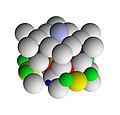 Oblique view of a single unit of the tourmaline crystal structure.
 -
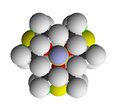 View of single unit of tourmaline structure along the axis of the crystal
 -
 View along a axis of three columns of tourmaline units forming a bundle
 -
 Structure of a tourmaline crystal viewed looking along the c axis of the crystal


Color
[edit]


Tourmaline has a variety of colors. Iron-rich tourmalines are usually black to bluish-black to deep brown, while magnesium-rich varieties are brown to yellow, and lithium-rich tourmalines are almost any color: blue, green, red, yellow, pink, etc. Rarely, it is colorless. Bi-colored and multicolored crystals are common, reflecting variations of fluid chemistry during crystallization. Crystals may be green at one end and pink at the other, or green on the outside and pink inside; this type is called watermelon tourmaline and is prized in jewelry. An excellent example of watermelon tourmaline jewelry is a brooch piece (1969, gold, watermelon tourmaline, diamonds) by Andrew Grima (British, b. Italy, 1921–2007), in the collection of Kimberly Klosterman and on display at the Cincinnati Art Museum.[19] Some forms of tourmaline are dichroic; they change color when viewed from different directions.[20]
The pink color of tourmalines from many localities is the result of prolonged natural irradiation. During their growth, these tourmaline crystals incorporated Mn2+ and were initially very pale. Due to natural gamma ray exposure from radioactive decay of 40K in their granitic environment, gradual formation of Mn3+ ions occurs, which is responsible for the deepening of the pink to red color.[21]
Magnetism
[edit]Opaque black schorl and yellow tsilaisite are idiochromatic tourmaline species that have high magnetic susceptibilities due to high concentrations of iron and manganese respectively. Most gem-quality tourmalines are of the elbaite species. Elbaite tourmalines are allochromatic, deriving most of their color and magnetic susceptibility from schorl (which imparts iron) and tsilaisite (which imparts manganese).[citation needed]
Red and pink tourmalines have the lowest magnetic susceptibilities among the elbaites, while tourmalines with bright yellow, green and blue colors are the most magnetic elbaites. Dravite species such as green chromium dravite and brown dravite are diamagnetic. A handheld neodymium magnet can be used to identify or separate some types of tourmaline gems from others. For example, blue indicolite tourmaline is the only blue gemstone of any kind that will show a drag response when a neodymium magnet is applied. Any blue tourmaline that is diamagnetic can be identified as paraiba tourmaline colored by copper in contrast to magnetic blue tourmaline colored by iron.[22]
Treatments
[edit]Some tourmaline gems, especially pink to red colored stones, are altered by heat treatment to improve their color. Overly dark red stones can be lightened by careful heat treatment. The pink color in manganese-containing near-colorless to pale pink stones can be greatly increased by irradiation with gamma-rays or electron beams. Irradiation is almost impossible to detect in tourmalines, and does not, currently, affect the value. Heavily included tourmalines, such as rubellite and Brazilian paraiba, are sometimes clarity-enhanced. A clarity-enhanced tourmaline (especially the paraiba variety) is worth much less than an untreated gem of equal clarity.[23]
Geology
[edit]Tourmaline is found in granite and granite pegmatites and in metamorphic rocks such as schist and marble. Schorl and lithium-rich tourmalines are usually found in granite and granite pegmatite. Magnesium-rich tourmalines, dravites, are generally restricted to schists and marble. Tourmaline is a durable mineral and can be found in minor amounts as grains in sandstone and conglomerate, and is part of the ZTR index for highly weathered sediments.[24]
Localities
[edit]Gem and specimen tourmaline is mined chiefly in Brazil and many parts of Africa, including Tanzania, Nigeria, Kenya, Madagascar, Mozambique, Malawi, and Namibia. It is also mined in Asia, notably in Pakistan, Afghanistan, and Indonesia as well as in Sri Lanka and India,[25] where some placer deposit material suitable for gem use is found.
United States
[edit]Some fine gems and specimen material have been produced in the United States, with the first discoveries in 1822, in the state of Maine. California became a large producer of tourmaline in the early 1900s. The Maine deposits tend to produce crystals in raspberry pink-red as well as minty greens. The California deposits are known for bright pinks, as well as bicolors. During the early 1900s, Maine and California were the world's largest producers of gem tourmalines. The Empress Dowager Cixi of China loved pink tourmaline and bought large quantities for gemstones and carvings from the then new Himalaya Mine, located in San Diego County, California.[26] It is not clear when the first tourmaline was found in California. Native Americans have used pink and green tourmaline as funeral gifts for centuries. The first documented case was in 1890 when Charles Russel Orcutt found pink tourmaline at what later became the Stewart Mine at Pala, California in San Diego County.[27]
Brazil
[edit]
Almost every color of tourmaline can be found in Brazil, especially in Minas Gerais and Bahia. The new type of tourmaline, which soon became known as paraiba tourmaline, came in blue and green. Brazilian paraiba tourmaline usually contains abundant inclusions. Much of the paraiba tourmaline from Brazil does not actually come from Paraíba, but the neighboring state of Rio Grande do Norte. Material from Rio Grande do Norte is often somewhat less intense in color, but many fine gems are found there. It was determined that the element copper was important in the coloration of the stone.[28]
A large bluish-green tourmaline from Paraiba, measuring 36.44 mm × 33.75 mm × 21.85 mm (1.43 in × 1.33 in × 0.86 in) and weighing 191.87 carats (1.3536 oz; 38.374 g), is the world's largest cut tourmaline.[29][30] Owned by Billionaire Business Enterprises,[29] it was presented in Montreal, Quebec, Canada, on 14 October 2009.[30]
Africa
[edit]
In the late 1990s, copper-containing tourmaline was found in Nigeria. The material was generally paler and less saturated than the Brazilian materials, although the material generally was much less included. A more recent African discovery from Mozambique has also produced tourmaline colored by copper, similar to the Brazilian paraiba. The Mozambique paraiba material usually is more intensely colored than the Nigerian and Mozambique Paraiba tourmaline have similar colors to the Brazilian Paraiba, but the prices are relatively cheaper, better clarity and larger sizes. In recent years the pricing of these beautiful gemstones has increased significantly.[31]
Another highly valuable variety is chrome tourmaline, a rare type of dravite tourmaline from Tanzania. Chrome tourmaline is a rich green color due to the presence of chromium atoms in the crystal. Of the standard elbaite colors, blue indicolite gems are typically the most valuable,[32] followed by green verdelite and pink to red rubellite.[33]
See also
[edit]- Benjamin Wilson – experimented with the electrical properties of tourmaline
References
[edit]Citations
[edit]- ^ a b c d e f g h i GIA Gem Reference Guide. Gemological Institute of America. 1995. ISBN 0-87311-019-6.
- ^ "Tourmaline". Mindat.org. Archived from the original on 2005-12-28. Retrieved 2005-09-12. This website details specifically and clearly how the complicated chemical formula is structured.
{{cite web}}: CS1 maint: postscript (link) - ^ Warr, L. N. (2021). "IMA–CNMNC approved mineral symbols". Mineralogical Magazine. 85 (3): 291–320. Bibcode:2021MinM...85..291W. doi:10.1180/mgm.2021.43. S2CID 235729616.
- ^ "tourmaline". Oxford Dictionaries. Archived from the original on October 16, 2021. Retrieved 2021-03-19.
- ^ Erhart, Jiri; Kittinger, Erwin; Prívratská, Jana (2010). Fundamentals of Piezoelectric Sensorics: Mechanical, Dielectric, and Thermodynamical Properties of Piezoelectric Materials. Springer. p. 4. ISBN 9783540684275.
- ^ Draper, John William (1861). A Textbook on chemistry. New York: Harper and Brothers. p. 93.
- ^ a b Ertl, 2006.
- ^ "What is Tourmaline? – GIA".
- ^ a b Ertl, 2007.
- ^ "Tourmaline Information – Gemstone Education".
- ^ a b c d Ertl, 2008.
- ^ Hawthorne, F.C. & Henry, D.J. (1999). "Classification of the minerals of the tourmaline group" Archived 2007-10-16 at the Wayback Machine. European Journal of Mineralogy, 11, pp. 201–215.
- ^ Warr, L.N. "IMA–CNMNC approved mineral symbols." Mineralogical Magazine, 2021, v. 85, p. 291–320. doi:10.1180/mgm.2021.43.
- ^ Darrell J. Henry, Milan Novák, Frank C. Hawthorne, Andreas Ertl, Barbara L. Dutrow, Pavel Uher, and Federico Pezzotta (2011). "Nomenclature of the tourmaline-supergroup minerals" (PDF). American Mineralogist. 96 (5–6): 895–913. Bibcode:2011AmMin..96..895H. doi:10.2138/am.2011.3636. S2CID 38696645. Archived (PDF) from the original on 2012-03-26.
{{cite journal}}: CS1 maint: multiple names: authors list (link) - ^ Erratum: American Mineralogist (2013), Volume 98, page 524.
- ^ Frank C. Hawthorne and Dona M. Dirlam. "Tourmaline: Tourmaline the Indicator Mineral: From Atomic Arrangement to Viking Navigation." Elements, October 2011, v. 7, p. (5): 307–312, doi:10.2113/gselements.7.5.307.
- ^ Hamburger, Gabrielle E.; Buerger, M.J. (1948). "The structure of tourmaline". American Mineralogist. 33 (9–10): 532–540. Retrieved 15 February 2021.
- ^ Nesse, William D. (2000). Introduction to mineralogy. New York: Oxford University Press. pp. 303–304. ISBN 9780195106916.
- ^ "Simply Brilliant – An Exceptional Collection of Fine Jewelry with Outstanding Stones and Crystals | GeoRarities". 2022-01-19. Retrieved 2022-01-27.
- ^ "Tourmaline | mineral". Encyclopedia Britannica. Retrieved 2021-06-03.
- ^ Reinitz & Rossman, 1988.
- ^ Kirk Feral Magnetism in Gemstones Archived 2013-12-03 at the Wayback Machine
- ^ Kurt Nassau (1984), Gemstone Enhancement: Heat, Irradiation, Impregnation, Dyeing, and Other Treatments, Butterworth Publishers
- ^ Hubert, John F. (1962-09-01). "A zircon-tourmaline-rutile maturity index and the interdependence of the composition of heavy mineral assemblages with the gross composition and texture of sandstones". Journal of Sedimentary Research. 32 (3). doi:10.1306/74D70CE5-2B21-11D7-8648000102C1865D. ISSN 1527-1404. Archived from the original on 2018-01-04.
- ^ Dana, James Dwight; Klien, Cornelis; Hurlbut, Cornelius Searle (1977). Manual of Mineralogy (19th ed.). John Wiley and Sons. ISBN 9780471032885.
- ^ Rynerson, Fred (1977). Exploring and Mining Gems and Gold in the West. Naturegraph. ISBN 9780911010602.
- ^ Johnson, Paul Willard (Winter 1968–69). "Common Gems of San Diego". Gems and Gemology. XII: 358.
- ^ Rossman et al. 1991.
- ^ a b "Largest cut Paraiba Tourmaline". Guinness World Records. 2014. Archived from the original on 26 September 2014. Retrieved 29 April 2018.
- ^ a b King, Mike (October 17, 2009). "Giant jewel breaks record". Montreal Gazette. Canwest News Service. Archived from the original on 2013-04-02 – via canada.com.
- ^ ""Paraiba Tourmaline"-type Copper-bearing Tourmaline from Brazil, Nigeria, and Mozambique".
- ^ Augustyn, Allison; Grande, Lance (2009). Gems and Gemstones: Timeless Natural Beauty of the Mineral World. University of Chicago Press. p. 152. ISBN 978-0226305110. Archived from the original on 2018-04-29 – via Google Books.
- ^ "Tourmaline: The gemstone Tourmaline information and pictures". minerals.net. Archived from the original on 2017-10-16. Retrieved 2018-01-04.
General and cited sources
[edit]- Ertl, A.; Pertlik, F.; Bernhardt, H.-J. (1997). "Investigations on Olenite with Excess Boron from the Koralpe, Styria, Austria" (PDF). Österreichische Akademie der Wissenschaften, Mathematisch-Naturwissenschaftliche Klasse. Abt. I (134). Anzeiger: 3–10.
- Ertl, A. (2006). "About the Etymology and the Type Localities of Schorl" (PDF). Mitteilungen der Österreichischen Mineralogischen Gesellschaft. 152: 7–16.
- Ertl, A. (2007). "About the Type Locality and the Nomenclature of Dravite" (PDF). Mitteilungen der Österreichischen Mineralogischen Gesellschaft. 153: 265–271.
- Ertl, A. (2008). "About the Nomenclature and the Type Locality of Elbaite: A Historical Review" (PDF). Mitteilungen der Österreichischen Mineralogischen Gesellschaft. 154: 35–44.
- Reinitz, I. M.; Rossman, G. R. (1988). "Role of Natural Radiation in Tourmaline Coloration" (PDF). American Mineralogist. 73: 822–825.
- Rossman, G. R.; Fritsch, E.; Shigley, J. E. (1991). "Origin of Color in Cuprian Elbaite from São José de Batalha, Paraíba, Brazil" (PDF). American Mineralogist. 76: 1479–1484.
- Schumann, Walter (2006). Gemstones of the World (3rd ed.). New York: Sterling Publishing. pp. 126–127.
Further reading
[edit]- Henry, Darrell J.; Novák, Milan; Hawthorne, Frank C.; Ertl, Andreas; Dutrow, Barbara L.; Uher, Pavel; Pezzotta, Federico (2011). "Nomenclature of the Tourmaline-Supergroup Minerals". American Mineralogist. 96 (5–6): 895–913. Bibcode:2011AmMin..96..895H. doi:10.2138/am.2011.3636. S2CID 38696645.
External links
[edit]

- Tourmaline classification Archived 2010-07-17 at the Wayback Machine
- Mindat tourmaline group
- ICA's tourmaline page International Colored Gemstone Association on Tourmaline
- Farlang historical tourmaline references Archived 2010-04-18 at the Wayback Machine US localities, antique references
- Webmineral elbaite page, crystallographic and mineral information on elbaite
- Tourmaline History and Lore at GIA.edu
| Borates | |||||
|---|---|---|---|---|---|
| Carbonates | |||||
| Oxides |
| ||||
| Phosphates | |||||
| Silicates | |||||
| Sulfides | |||||
| Other |
| ||||

Gemmological classifications by E. Ya. Kievlenko (1980), updated | |||||||||
| Jewelry stones |
| ||||||||
| Jewelry-Industrial stones |
| ||||||||
| Industrial stones |
| ||||||||
| Related | |||||||||

| International | |
|---|---|
| National | |
| Other | |

Tourmaline
View on GrokipediaHistory
Etymology and Early References
The name "tourmaline" derives from the Sinhalese term tūramali (or turamali), a generic word used in Sri Lanka (then known as Ceylon) to describe multicolored pebbles, often resembling carnelian or other mixed gems, extracted from alluvial gem gravels.[5] This term encompassed a variety of unidentified colored stones, including what are now recognized as tourmalines, and was applied broadly without distinguishing specific mineral species.[6] Dutch traders, operating through the Dutch East India Company, first encountered these gems in Ceylon during the late 1600s and began importing them to Europe in significant quantities by the early 1700s.[7] Records from the company's activities in Ceylon document the shipment of parcels of these multicolored stones around 1703, often mistakenly identified as zircons or other known gems due to their similar appearance and the limited understanding of mineral diversity at the time.[6] The confusion arose because the stones' vibrant hues and water-worn forms mimicked more familiar varieties like hyacinth zircon, leading to their inclusion in trade inventories without separate classification.[8] The first scientific description of tourmaline, highlighting its notable pyroelectric properties, was provided by Swedish naturalist Carl Linnaeus in 1747.[9] Linnaeus named it lapis electrica (electric stone), observing that heating the crystal caused it to attract lightweight particles like ash or dust, a phenomenon he linked to electricity—marking an early recognition of its unique thermal behavior in European scientific literature.[10] This account built on informal Dutch observations from pipe-cleaning applications but formalized the mineral's distinctive traits for broader study.Historical Significance and Use
Tourmaline has been valued in ancient civilizations for its aesthetic qualities, often incorporated into jewelry despite frequent misidentification with more renowned gems. In ancient Egypt, the stone was believed to acquire its vibrant colors by passing through a rainbow, and it was used in amulets and decorative objects for its supposed protective properties.[11] In ancient Rome, black schorl tourmaline appeared in jewelry, such as a 3rd-century CE gold ring featuring a schorl intaglio depicting Daedalus, highlighting its role in classical adornment.[12] Similarly, in ancient China, tourmaline was employed in sculptures and jewelry, prized for its durability and color variety.[5] During the Age of Exploration, Brazilian tourmaline entered European markets in the 1500s through Spanish conquistadors, who exported green specimens mistaken for emeralds, thereby introducing the gem to Western lapidaries under false pretenses.[5] This confusion persisted until the 1800s, when mineralogists distinguished tourmaline as a unique species, though its multicolored forms had long been known in Sri Lanka and traded via the Dutch East India Company.[11] In the 19th century, tourmaline's pyroelectric properties—generating electric charges when heated or cooled—sparked scientific interest, with early experiments by Dutch gem cutters in the early 1700s observing the stone attracting ash, leading Carl Linnaeus to name it "lapis electricus" in 1747.[10] In Victorian England, black schorl gained popularity in mourning jewelry, symbolizing grief and loss amid the era's elaborate commemorative customs.[12] Concurrently, discoveries during California's late 1870s to early 1880s gold rush activities uncovered significant tourmaline deposits in San Diego and Riverside Counties, boosting American interest and exports, particularly of pink varieties to China.[13]Classification
Mineral Species
The tourmaline supergroup comprises trigonal borosilicates classified within the cyclosilicate group, distinguished by a complex ring structure consisting of six corner-sharing SiO₄ tetrahedra (T₆O₁₈) interlinked with three BO₃ triangular units, along with additional anionic sites occupied by OH, O, or F. The International Mineralogical Association (IMA) approves species nomenclature based on dominant-valence occupancy at the X (9-fold), Y (6-fold), and Z (6-fold octahedral) sites in the general formula XY₃Z₆(T₆O₁₈)(BO₃)₃V₃W, where T is primarily Si (with possible Al substitution), V₃ represents three OH⁻ groups, and W is OH⁻, O²⁻, or F⁻. As of 2025, the tourmaline supergroup includes more than 40 IMA-approved species, classified into alkali, calcic, X-site vacant, and oxy groups.[1] This structural framework allows for extensive solid-solution series, but species are delineated by the prevailing cations, such as Na or Ca at X, and varying combinations of Li, Mg, Fe²⁺, Fe³⁺, Al, or other divalent/trivalent metals at Y and Z sites.[14] Key end-members, representing common species, are defined by distinct cation dominance that facilitates basic mineral identification through chemical analysis or spectroscopy. Schorl, the iron-dominant alkali tourmaline, has the end-member formula NaFe₃Al₆(BO₃)₃Si₆O₁₈(OH)₄, where Fe²⁺ occupies the Y site, imparting typically black coloration and distinguishing it from magnesium-rich variants. Dravite, with Mg dominant at Y, features the formula NaMg₃Al₆(BO₃)₃Si₆O₁₈(OH)₄, often appearing brown and identified by its higher Mg/Fe ratio compared to schorl. Elbaite, lithium-bearing and gem-relevant, is Na(Li_{1.5}Al_{1.5})Al₆(BO₃)₃Si₆O₁₈(OH)₄, where partial Li substitution at Y enables vibrant colors due to trace elements. Uvite, a calcic species, is characterized by Ca at X and Mg at Y, with formula CaMg₃(Al₅Mg)Si₆O₁₈(BO₃)₃(OH)₄ (the F analog is fluor-uvite), differing from alkali species in its calcium content and frequent fluorine enrichment. Rossmanite, an X-site vacant tourmaline, has the end-member ◻(LiAl₂)Al₆Si₆O₁₈(BO₃)₃(OH)₄, notable for its alkali deficiency and Al dominance at Y. Olenite, an oxy variant, is NaAl₃Al₆Si₆O₁₈(BO₃)₃(OH)₃O, identified by oxygen at the W site and high Al content, leading to colorless to pale forms. These differences in dominant cations, particularly Fe²⁺ versus Mg at Y or Na versus Ca at X, underpin IMA classification and enable differentiation via electron microprobe or wet chemistry.[15][16] Gem varieties used in jewelry are primarily derived from elbaite and schorl series members, showcasing color diversity from these species.[3]Gem Varieties
Tourmaline gem varieties are primarily drawn from the elbaite species, which dominates the market due to its vibrant colors and suitability for faceting.[3] These varieties are distinguished commercially and aesthetically by their dominant hues, with naming conventions based on perceived color saturation and tone rather than strict chemical distinctions.[12] Rubellite refers to tourmalines exhibiting pink, red, purplish red, orangy red, or brownish red colors, typically with medium to dark tones and reasonable saturation; however, some trade experts exclude lighter pink shades from this category to preserve the term for more vivid examples.[3][12] Indicolite denotes blue varieties, ranging from dark violetish blue to pure blue or greenish blue, often prized for their depth and clarity in jewelry settings.[3][17] Verdelite describes intense green tourmalines, sometimes specified as chrome tourmaline when colored by vanadium, offering a lush, emerald-like appeal without the latter's typical inclusions.[3][18] Watermelon tourmaline is a distinctive zoned variety featuring a pink or red core surrounded by a green rind, reminiscent of the fruit's cross-section; it is usually cut as thin slices or cabochons to highlight the dramatic color banding.[3][12] Paraíba tourmaline stands out for its neon-like violetish blue, greenish blue, or blue hues, caused by copper impurities, making it one of the most sought-after varieties for its electric glow. Color is the primary value driver for Paraíba tourmaline, with clarity secondary.[19] Inclusions are common and generally tolerated, eye-clean stones command a premium, but the price impact of inclusions is relatively minor compared to other gems. Eye-visible inclusions typically cause only slight value reductions, while heavy inclusions can reduce value more noticeably if they affect transparency.[19] However, synthetics lack the matching glow intensity of this electric neon blue due to challenges in replicating the precise copper and manganese content.[3][19][20] Rarity significantly influences value across these varieties, but Paraíba tourmaline exemplifies extreme scarcity, discovered in 1989 in Brazil's Paraíba state and initially yielding only small quantities from pegmatite pockets.[19] Subsequent sourcing has expanded to Mozambique, Nigeria, and other global localities; it is considered rarer than diamonds due to its extremely limited sources, primarily in Brazil's Paraíba region, with only limited additional finds in Mozambique and Nigeria.[21] As a result, supply remains limited, driving prices for fine Brazilian specimens to $20,000–$50,000 per carat or higher due to demand in high-end jewelry.[3][22] In contrast, rubellite and indicolite command premium values for deep, saturated colors, while verdelite and watermelon varieties are valued for their aesthetic uniqueness but are generally more accessible than Paraíba.[12][17]Chemical Composition
Tourmaline belongs to the cyclosilicate class and is characterized by the general structural formula , where the letters represent distinct crystallographic sites occupied by various cations and anions.[2]- X site: Typically occupied by Na⁺, Ca²⁺, K⁺, or vacancy (□).
- Y site: Accommodates a mix of divalent and trivalent cations, including Li⁺, Mg²⁺, Fe²⁺, Mn²⁺, Al³⁺, Fe³⁺, Cr³⁺, V³⁺, and Ti⁴⁺.
- Z site: Primarily Al³⁺, with possible Fe³⁺, Cr³⁺, V³⁺, or Mg²⁺.
- T site: Dominated by Si⁴⁺, with minor substitutions by Al³⁺ or B³⁺.
- B site: Exclusively B³⁺ in three isolated borate groups.
- V site: OH⁻ or O²⁻.
- W site: OH⁻, F⁻, or O²⁻.
- Schorl (alkali group, Fe-dominant): NaFe²⁺₃Al₆(Si₆O₁₈)(BO₃)₃(OH)₃(OH).[1]
- Dravite (alkali group, Mg-dominant): NaMg₃Al₆(Si₆O₁₈)(BO₃)₃(OH)₃(OH).[1]
- Elbaite (alkali group, Li-dominant): Na(Li₁.₅Al₁.₅)Al₆(Si₆O₁₈)(BO₃)₃(OH)₃(OH).[3]
- Uvite (calcic group): CaMg₃(Al₅Mg)(Si₆O₁₈)(BO₃)₃(OH)₃(OH).[3]