
.jpg/250px-Young_girl_smiling_in_sunshine_(2).jpg)


.jpg/1500px-Young_girl_smiling_in_sunshine_(2).jpg)
Community hub
Recent from talks
Contribute something
Nothing was collected or created yet.
.jpg)
| Part of a series on |
| Women in society |
|---|
.svg) |
| Part of a series on |
| Feminism |
|---|
|


| Part of a series on |
| Human growth and development |
|---|
 |
| Stages |
| Biological milestones |
| Development and psychology |

A girl is a young female human, usually a child or an adolescent. While the term girl has other meanings, including young woman,[1] daughter[2] or girlfriend[1] regardless of age, the first meaning is the most common one.
The treatment and status of girls in any society is usually closely related to the status of women in that culture. In cultures where women have or had a low social position, girls may be unwanted by their parents, and society may invest less in girls. The difference in girls' and boys' upbringing ranges from slight to completely different. Mixing of the sexes may vary by age, and from totally mixed to total sex segregation.
Etymology
[edit]The English word girl first appeared during the Middle Ages between 1250 and 1300 CE and came from the Anglo-Saxon word gerle (also spelled girle or gurle).[3] The Anglo-Saxon word gerela meaning dress or clothing item also seems to have been used as a metonym in some sense.[1] Until the late 1400s, the word meant a child of either sex; it has meant 'female child' since about the late 15th century CE.[4]
Usage for adult women
[edit]The word girl is sometimes used to refer to an adult female, usually a younger one. This usage may be considered derogatory or disrespectful in professional or other formal contexts, just as the term boy can be considered disparaging when applied to an adult man. Hence, this usage is often deprecative.[1] It can also be used depreciatively when used to discriminate against children (e.g., "you're just a girl"). However, girl can also be a professional designation for a woman employed as a model or other public feminine representative such as a showgirl, and in such cases is not generally considered derogatory.
In a casual context, the word has positive uses, as evidenced by its use in titles of popular music. It has been used playfully for people acting in an energetic fashion (Canadian singer Nelly Furtado's "Promiscuous Girl") or as a way of unifying women of all ages on the basis of their once having been girls (American country singer Martina McBride's "This One's for the Girls").
History
[edit]The status of girls throughout world history is closely related to the status of women in any culture. Where women enjoy a more equal status with men, girls benefit from greater attention to their needs.
Girls' education
[edit] | The examples and perspective in this section deal primarily with Europe and do not represent a worldwide view of the subject. (June 2024) |
Girls' formal education has traditionally been considered far less important than that of boys. In Europe, exceptions were rare before the printing press and the Reformation made literacy more widespread. One notable exception to the general neglect of girls' literacy is Queen Elizabeth I. In her case, as a child, she was in a precarious position as a possible heir to the throne, and her life was endangered by the political scheming of other powerful members of the court. Following the execution of her mother, Anne Boleyn, Elizabeth was considered illegitimate. Her education was for the most part ignored by Henry VIII. Henry VIII's widow, Catherine Parr, took an interest in the high intelligence of Elizabeth, and supported the decision to provide her with an impressive education after Henry's death, starting when Elizabeth was 9.[5] Elizabeth received an education equal to that of a prominent male aristocrat; she was educated in Latin, Greek, Spanish, French, philosophy, history, mathematics and music. It has been argued that Elizabeth's education helped her grow up to become a successful monarch.[6]
By the eighteenth century, Europeans recognized the value of literacy, and schools were opened to educate the public in growing numbers. Education in the Age of Enlightenment in France led to up to a third of women becoming literate by the time of the French Revolution, contrasting with roughly half of men by that time.[7] However, education was still not considered as important for girls as for boys, who were being trained for professions that remained closed to women, and girls were not admitted to secondary level schools in France until the late 19th century. Girls were not entitled to receive a Baccalaureate diploma in France until the reforms of 1924 under education minister Léon Bérard. Schools were segregated in France until the end of World War II. Since then, compulsory education laws have raised the education of girls and young women throughout Europe. In many European countries,[which?] girls' education was restricted until the 1970s, especially at higher levels. This was often done by teaching different subjects to each sex, especially since tertiary education was considered primarily for males, particularly with regard to technical education. For example, prestigious engineering schools, such as École Polytechnique, did not allow women until the 1970s.[8]
-
 La lettrice (1856). Reading Girl, sculpture by Pietro Magni
 -
 Princess Neferure as a girl, sitting on the lap of her tutor Senenmut. Girls and women in Ancient Egypt enjoyed a relatively high social status.
 -
 Two Finnish girls at the Hailuoto Island in 1912


"Coming of age" customs
[edit] | This section needs additional citations for verification. (January 2022) |
Many cultures have traditional customs to mark the "coming of age" of a girl or boy, to recognize their transition to adulthood, or to mark other milestones of their journey to maturity as children.
Japan has a coming-of-age ritual called Shichi-Go-San (七五三), which literally means "Seven-Five-Three". This is a traditional rite of passage and festival day in Japan for three- and seven-year-old girls and three- and five-year-old boys, held annually on November 15. It is generally observed on the nearest weekend. On this day, the girl will be dressed in a traditional kimono, and will be taken to a temple by her family for a blessing ceremony. Nowadays, the occasion is also marked with a formal photo portrait.
Many coming-of-age ceremonies are to acknowledge the passing of a girl through puberty, when she experiences menarche, or her first menstruation. The traditional Apache coming-of-age ceremony for girls is called the na'ii'ees (Sunrise Ceremony), and takes place over four days. The girls are painted with clay and pollen, which they must not wash off until the end of the rituals, which involve dancing and rituals that challenge physical strength. Girls are taught aspects of sexuality, confidence, and healing ability. The girls pray in the direction of the east at dawn, and in the four cardinal directions, which represent the four stages of life. This ceremony was banned by the U.S. government for many decades; after being decriminalized by the Indian Religious Freedom Act in 1978, it has seen a revival.[9]
Some coming-of-age ceremonies are religious rituals to recognize a girl's maturity with respect to her understanding of religious beliefs, and her changing role in her religious community. Confirmation is a ceremony common to many Christian denominations for both boys and girls, usually taking place when the child is in their teen years. In Roman Catholic communities, Confirmation is considered one of seven sacraments that a Catholic may receive. In many countries, it is traditional for Catholics children to receive another sacrament, First Communion, at the age of seven. The sacrament is usually performed in a church once a year, with children who are of age receive a blessing from a bishop in a special ceremony. It is traditional in many countries for Catholic girls to wear white dresses and possibly a small veil or wreath of flowers in their hair to their First Communion. The white dress symbolizes spiritual purity.
A traditional coming-of-age ritual for daughters of college age (17 to 21 years old) from high society and well-connected upper-class and White Anglo-Saxon Protestant (WASP)[citation needed] families in North America and Europe has historically been their debut, known as "coming out," at a debutante ball, such as the International Debutante Ball in New York City. Traditionally, debutantes wear couture white gowns and gloves symbolising purity and wealth.
Across Latin America, the fiesta de quince años is a celebration of a girl's fifteenth birthday. The girl celebrating the birthday is called a Quinceañera. This birthday is celebrated differently from any other birthday, as it marks the transition from childhood to womanhood.[10]
While completely secular in nature, a girl’s first bra is sometimes seen as an important next step in her life. Unlike many more traditional coming of age customs, the event has no set date in a girl’s life and can occur when she is a teenager[11] and in other times can occur when she is a preteen.[12]
-
 58th International Debutante Ball, 2012, New York City (Waldorf-Astoria Hotel)
 -
 Bat mitzvah in Israel
 -

-
 A seven-year old girl dressed for Shichi-Go-San
.jpg)


Preparing girls for marriage
[edit] | This section needs additional citations for verification. (January 2022) |

In many ancient societies, girls' upbringing had much to do with preparing them to be future wives. In many cultures, it was not the norm for women to be economically independent. Thus, where a girl's future well-being depended upon marrying her to a man who was economically self-sufficient, it was crucial to prepare her to meet whatever qualities or skills were popularly expected of wives.
Western society
[edit]In cultures ranging from Ancient Greece to the twentieth-century United States, girls were taught essential domestic skills including sewing, cooking, gardening and basic hygiene, and medical care such as preparing balms and salves, and in some cases midwifery. These skills were passed orally from generation to generation, with the knowledge passed down orally from mother to daughter. A well-known reference to these important women's skills is in the folk tale Rumpelstiltskin, which dates back to medieval Germany and was collected in written form by the folklorists the Brothers Grimm. The miller's daughter is valued as a potential wife because of her reputation for being able to spin straw into gold.
China
[edit]In some parts of China, beginning in the Southern Tang kingdom in Nanjing (937–975),[13] the custom of foot binding was associated with upper-class women who were worthy of a life of leisure, and husbands who could afford to spare them the necessity of work (which would require the ability to be mobile and spend the day on their feet).[13] Because of this belief, parents hoping to ensure a good marriage for their daughters would begin binding their feet from about the age of 5–8 to achieve the ideal appearance.[13] The tinier the feet, the better the social rank of a future husband.[13] The practice started seriously to decline in the early years of the twentieth century, and was all but extinct by 1950.[13]
China has had many customs relating to girls and their roles as future wives and mothers.
Traditionally an unmarried girl would wear her hair in two pigtails, and once married, in one.[14]
Africa
[edit]In some cultures, girls' passing through puberty is viewed with concern for a girl's chastity. In some communities, there is a traditional belief that female genital mutilation is a necessity to prevent a girl from becoming sexually promiscuous. The practice is dangerous, however, and leads to long-term health problems for women who have undergone it. The practice has been a custom in 28 countries of Africa, and persists mainly in rural areas. This coming-of-age custom, sometimes incorrectly described as "female circumcision", is being outlawed by governments, and challenged by human rights groups and other concerned community members, who are working to end the practice.
Trafficking and trading girls
[edit]

Girls have been used historically, and are still used in some parts of the world, in settlements of disputes between families, through practices such as baad, swara, or vani. In such situations, a girl from a criminal's family is given to the victim's family as a servant or a bride. Another practice is that of selling girls in exchange for the bride price. The 1956 Supplementary Convention on the Abolition of Slavery, the Slave Trade, and Institutions and Practices Similar to Slavery defines "institutions and practices similar to slavery" to include:[15] c) Any institution or practice whereby: (i) A woman, without the right to refuse, is promised or given in marriage on payment of a consideration in money or in kind to her parents, guardian, family or any other person or group; or (ii) The husband of a woman, his family, or his clan, has the right to transfer her to another person for value received or otherwise; or (iii) A woman on the death of her husband is liable to be inherited by another person.
Demographics
[edit]


Scholars are unclear and in dispute as to possible causes for variations in human sex ratios at birth.[17][18] Countries which have sex ratios of 108 and above are usually presumed as engaging in sex selection. However, deviations in sex ratios at birth can occur for natural causes too. Nevertheless, the practice of bias against girls, through sex-selective abortion, female infanticide, female abandonment, as well as favouring sons with regard to allocating of family resources[19] is well documented in parts of South Asia, East Asia, and the Caucasus. Such practices are a major concern in China, India and Pakistan. In these cultures, the low status of women creates a bias against females.[20]
China and India have a very strong son preference. In China, the one-child policy was largely responsible for an unbalanced sex ratio. Sex-selective abortion, as well as rejection of girl children is common. The Dying Rooms is a 1995 television documentary film about Chinese state orphanages, which documented how parents abandoned their newborn girls into orphanages, where the staff would leave the children in rooms to die of thirst, or starvation. In India, the practice of dowry is partly responsible for a strong son preference. Another manifestation of son preference is the violence inflicted against mothers who give birth to girls.[21][22][23]
In India, by 2011, there were 91 girls younger than 6 for every 100 boys. Its 2011 census showed[24] that the ratio of girls to boys under the age of 6 years old has dropped even during the past decade, from 927 girls for every 1000 boys in 2001 to 918 girls for every 1000 boys in 2011. In China, scholars[25] report 794 baby girls for every 1000 baby boys in rural regions. In Azerbaijan, last 20 years of birth data suggests 862 girls were born for every 1000 boys, on average every year.[26] Steven Mosher, president of the Population Research Institute in Washington, D.C., has said: "Twenty-five million men in China currently can't find brides because there is a shortage of women [...] young men emigrate overseas to find brides." The gender imbalance in these regions is also blamed for spurring growth in the commercial sex trade; the UN's 2005 report states that up to 800,000 people being trafficked across borders each year, and as many as 80 percent are women and girls.[27]
Biology
[edit]
_(14790050323).jpg)
Embryos that inherit two X chromosomes (XX), one from each parent, are generally identified as girls when born.
About one in a thousand girls have a 47,XXX karyotype, and one in 2500 have a 45,X one.
Girls typically have a female reproductive system. Some intersex children with ambiguous genitals may be classified as girls, while some Transgender youth have a gender identity as girls.[28][29][30][page needed][better source needed]
Girls' bodies undergo gradual changes during puberty. Puberty is the process of physical changes by which a child's body matures into an adult body capable of sexual reproduction to enable fertilization. It is initiated by hormonal signals from the brain to the gonads. In response to the signals, the gonads produce hormones that stimulate libido and the growth, function, and transformation of the brain, bones, muscle, blood, skin, hair, breasts, and sexual organs. Physical growth—height and weight—accelerates in the first half of puberty and is completed when the child has developed an adult body. Until the maturation of their reproductive capabilities, the pre-pubertal, physical differences between boys and girls are the genitalia. Puberty is a process that usually takes place between 10 and 16 years, but these ages differ from person to person. The major landmark of female puberty is menarche, the onset of menstruation, which occurs on average between 12 and 13.[31][32] According to a 2010 Canadian study, the variation of age in which menstruation begins had a "statistically significant" relation to where the child was living, household income, and family type.[33]
Gender and environment
[edit]
Biological sex interacts with environment in ways not fully understood.[34] Identical twin girls separated at birth and reunited decades later have shown both startling similarities and differences.[35] In 2005, professor Kim Wallen of Emory University noted, "I think the 'nature versus nurture' question is not meaningful, because it treats them as independent factors, whereas in fact everything is nature and nurture."[36]
Femininity is a set of attributes, behaviours, and roles generally associated with girls and women. Femininity is socially constructed, but made up of both socially defined and biologically created factors.[37][38][39] This makes it distinct from the definition of the biological female sex,[40][41] as both males and females can exhibit feminine traits. Traits traditionally cited as feminine include gentleness, empathy, and sensitivity,[42][43][44] though traits associated with femininity vary depending on location and context, and are influenced by a variety of social and cultural factors.[45]
Gender neutrality describes the idea that policies, language, and other social institutions should avoid distinguishing roles according to people's sex or gender, in order to avoid discrimination arising from rigid gender roles. Unisex refers to things that are considered appropriate for any sex. Campaigns for unisex toys include Let Toys Be Toys.
Teenage pregnancy
[edit]Teenage pregnancy is pregnancy in an adolescent girl. A female can become pregnant from sexual intercourse after she has begun to ovulate. Pregnant teenagers face many of the same pregnancy related issues as other women. There are, however, additional concerns for young adolescents as they are less likely to be physically developed enough to sustain a healthy pregnancy or to give birth.[46][47][48]
In developed countries, teenage pregnancy is usually associated with social issues, including lower educational levels, poverty, and other negative life outcomes; and often carries a social stigma.[49] By contrast, teenage girls in developing countries are often married, and their pregnancies welcomed by family and society. However, in these societies, child marriage and early pregnancy often combine with malnutrition and poor health care and create medical problems.
Girls' education
[edit]

Girls' equal access to education has been achieved in some countries, but there are significant disparities in the majority. There are gaps in access between different regions and countries and even within countries. Girls account for 60 percent of children out of school in Arab countries and 66 percent of non-attendees in South and West Asia; however, more girls than boys attend schools in many countries in Latin America, the Caribbean, North America and Western Europe.[50] Research has measured the economic cost of this inequality to developing countries: Plan International's analysis shows that a total of 65 low, middle income and transition countries fail to offer girls the same secondary school opportunities as boys, and in total, these countries are missing out on annual economic growth of an estimated $92 billion.[50]
Although the International Covenant on Economic, Social and Cultural Rights has asserted "primary education shall be compulsory and available free to all" girls are slightly less likely to be enrolled as students in primary and secondary schools (70%:74% and 59%:65%). Worldwide efforts have been made to end this disparity (such as through the Millennium Development Goals) and the gap has closed since 1990.[51]
Educational environment and expectations
[edit]
According to Kim Wallen, expectations will nonetheless play a role in how girls perform academically. For example, if females skilled in math are told a test is "gender neutral" they achieve high scores, but if they are told males outperformed females in the past, the females will do much worse. "What's strange is," Wallen observed, "according to the research, all one apparently has to do is tell a woman who has a lifetime of socialization of being poor in math that a math test is gender neutral, and all effects of that socialization go away."[53] Author Judith Harris has said that aside from their genetic contribution, the nurturing provided by parents likely has less long-term influence over their offspring than other environmental aspects such as the children's peer group.[54]
In England, studies by the National Literacy Trust have shown girls score consistently higher than boys in all scholastic areas from the ages of 7 through 16, with the most striking differences noted in reading and writing skills.[55] In the United States, historically, girls lagged on standardized tests. In 1996 the average score of 503 for US girls from all races on the SAT verbal test was 4 points lower than boys. In math, the average for girls was 492, which was 35 points lower than boys. "When girls take the exact same courses," commented Wayne Camara, a research scientist with the College Board, "that 35-point gap dissipates quite a bit." At the time Leslie R. Wolfe, president of the Center for Women Policy Studies said girls scored differently on the math tests because they tend to work the problems out while boys use "test-taking tricks" such as immediately checking the answers already given in multiple-choice questions. Wolfe said girls are steady and thorough while "boys play this test like a pin-ball machine." Wolfe also said although girls had lower SAT scores they consistently get higher grades than boys across all courses in their first year in college.[56] By 2006 girls were outscoring boys on the verbal portion of the United States' nationwide SAT exam by 11 points.[57] A 2005 University of Chicago study showed that a majority presence of girls in the classroom tends to enhance the academic performance of boys.[58][59]
Obstacles to girls' access to education
[edit]In many parts of the world, girls face significant obstacles to accessing proper education. These obstacles include: early and forced marriages; early pregnancy; prejudice based on gender stereotypes at home, at school and in the community; violence on the way to school, or in and around schools; long distances to schools; vulnerability to the HIV epidemic; school fees, which often lead to parents sending only their sons to school; lack of gender sensitive approaches and materials in classrooms.[60][61][62]
Sex segregation
[edit].jpg)
Sex segregation is the physical, legal, and cultural separation of people according to their biological sex. It is practiced in many societies, especially starting when children attain puberty. In certain circumstances, sex segregation is controversial.[63] Some critics contend that it is a violation of capabilities and human rights and can create economic inefficiencies and discrimination, while some supporters argue that it is central to certain religious laws and social and cultural histories and traditions.[64][65] Purdah is a religious and social practice of female seclusion prevalent among some Muslim and Hindu communities in South Asia.[66] It takes two forms: physical segregation of the sexes and the requirement that women cover almost entirely their bodies. The ages from which this practice is enforced vary by community. Such practices are most common in cultures where the concept of family honor is very strong. In cultures where sex segregation is common, the predominant form of education in single sex education, but in countries such as the United Kingdom, the extent of single sex education has declined significantly over the last 30 years.[67]
Violence against girls
[edit]
In many parts of the world, girls are at risk of specific forms of violence and abuse, such as sex-selective abortion, female genital mutilation, child marriage, child sexual abuse, honor killings.
In parts of the world, especially in East Asia, South Asia and some Western countries' girls are sometimes seen as unwanted; in some cases, girls are selectively aborted, abused, mistreated or abandoned by their parents or relatives.[73][74] In China, boys exceed girls by more than 30 million, suggesting over a million excess boys are born every year than expected for normal human sex ratio at birth.[25] In India, scholars[75] estimate from boy to girl ratio at birth that sex-selective abortions cause a loss of about 1.5%, or 100,000 female births per year. Abnormal boy to girl ratio at birth is also seen in Georgia, Azerbaijan and Armenia, suggesting possible sex-selective abortions against girls.[76]
Female genital mutilation (FGM) is defined by the World Health Organization (WHO) as "all procedures that involve partial or total removal of the external female genitalia, or other injury to the female genital organs for non-medical reasons."[77] It is practiced mainly in 28 countries in western, eastern, and north-eastern Africa, particularly Egypt and Ethiopia, and in parts of Southeast Asia and the Middle East.[78] FGM is most often carried out on girls aged between infancy and 15 years.[79]
Child marriages, where girls are married at young ages (often forced and often to much older husbands) remain common in many parts of the world. They are fairly widespread in parts of the world, especially in Africa,[80][81] South Asia,[82] Southeast and East Asia,[83][84] the Middle East,[85][86] Latin America,[87] and Oceania.[88] The ten countries with the highest rates of child marriage are: Niger, Chad, Central African Republic, Bangladesh, Guinea, Mozambique, Mali, Burkina Faso, South Sudan, and Malawi.[89]
Child sexual abuse (CSA) is a form of child abuse in which an adult or older adolescent uses a child for sexual stimulation.[90][91] In Western countries CSA is considered a serious crime, but in many parts of the world there is a tacit tolerance of the practice. CSA can take many forms, one of which is child prostitution. Child prostitution is the commercial sexual exploitation of children in which a child performs the services of prostitution, for financial benefit. It is estimated that each year at least one million children, mostly girls, become prostitutes.[92] Child prostitution is common in many parts of the world, especially in Southeast Asia (Thailand, Cambodia), and many adults from wealthy countries travel to these regions to engage in child sex tourism.
In many parts of the world, girls who are deemed to have tarnished the 'honor' of their families by refusing arranged marriages, having premarital sex, dressing in ways deemed inappropriate or even becoming the victims of rape, are at risk of honor killing by their families.[93]
Health
[edit]Girls' health suffers in cultures where girls are valued less than boys, and families allocate most resources to boys. A major threat to girls' health is early marriage, which often leads to early pregnancy. Girls forced into child marriage often become pregnant quickly after marriage, increasing their risk of complications and maternal mortality. Such complications resulting from pregnancy and birth at young ages are a leading cause of death among teenage girls in developing countries.[94] Female genital mutilation (FGM) practiced in many parts of the world is another leading cause of ill health for girls.[95]
Girls during adolescence to early adulthood are often to have eating disorders than boys. [96] Risk factors includes family history, high-level athletics, bullying, social media, modeling, substance use disorder, being a dancer or gymnast[97][98][99]
Girls and child labor
[edit]
Gender influences the pattern of child labor. Girls tend to be asked by their families to perform more domestic work in their parental home than boys are, and often at younger ages than boys. Employment as a paid domestic worker is the most common form of child labor for girls. In some places, such as East and Southeast Asia, parents often see work as a domestic servant as a good preparation for marriage. Domestic service, however, is among the least regulated of all professions, and exposes workers to serious risks, such as violence, exploitation and abuse by the employers, because the workers are often isolated from the outside world. Child labor has a very negative effect on education. Girls either stop their education, or, when they continue it, they are often subjected to a double burden, or a triple burden of work outside the home, housework in the parental home, and schoolwork. This situation is common in places such as parts of Asia and Latin America.[100][101]
International initiatives for girls' rights
[edit].jpg)
The United Nations Convention on the Rights of the Child (1988) and Millennium Development Goals (2000) promoted better access to education for all girls and boys and to eliminate gender disparities at both primary and secondary level. Worldwide school enrolment and literacy rates for girls have improved continuously. In 2005, global primary net enrolment rates were 85 percent for girls, up from 78 percent 15 years earlier; at the secondary level, girls' enrolment increased 10 percentage points to 57 percent over the same period.[50]
A number of international non-governmental organizations (NGOs) have created programs focusing on addressing disparities in girls' access to such necessities as food, healthcare and education. CAMFED is one organization active in providing education to girls in sub-Saharan Africa. PLAN International's "Because I am a Girl" campaign is a high-profile example of such initiatives. PLAN's research has shown that educating girls can have a powerful ripple effect, boosting the economies of their towns and villages; providing girls with access to education has also been demonstrated to improve community understanding of health matters, reducing HIV rates, improving nutritional awareness, reducing birthrates and improving infant health. Research demonstrates that a girl who has received an education will:
- Earn up to 25 percent more and reinvest 90 percent in her family.
- Be three times less likely to become HIV-positive.
- Have fewer, healthier children who are 40 percent more likely to live past the age of five.[102]
Plan International also created a campaign to establish an International Day of the Girl. The goals of this initiative are to raise global awareness of the unique challenges facing girls, as well as the key role they have in addressing larger poverty and development challenges. A delegation of girls from Plan Canada introduced the idea to Rona Ambrose, Canada's Minister of Public Works and Government Services and Minister for Status of Women, at the 55th Session of the Commission on the Status of Women at United Nations Headquarters in February 2011. In March 2011, Canada's Parliament unanimously adopted a motion requesting that Canada take the lead at the United Nations in the initiative to proclaim an International Day of the Girl.[103] The General Assembly of the United Nations adopted an International Day of the Girl Child on December 19, 2011. The first International Day of the Girl Child is October 11, 2012.
Its most recent research has led PLAN International to identify a need to coordinate projects that address boys' roles in their communities, as well as finding ways of including boys in activities that reduce gender discrimination. Since political, religious and local community leaders are most often men, men and boys have great influence over any effort to improve girls' lives and achieve gender equality. PLAN International's 2011 Annual Report points out that men have more influence and may be able to convince communities to curb early marriage and female genital mutilation (FGM) more effectively than women. Egyptian religious leader Sheikh Saad, who has campaigned against the practice, is quoted in the report: “We have decided that our daughter will not go through this bad, inhumane experience [...] I am part of the change.”[104]
Art and literature
[edit]Historically, art and literature in Western culture has portrayed girls as symbols of innocence, purity, virtue and hope. Egyptian murals included sympathetic portraits of young girls who were daughters of royalty. Sappho's poetry carries love poems addressed to girls.
Painting
[edit]In Europe, some early paintings featuring girls were Petrus Christus' Portrait of a Young Girl (about 1460), Juan de Flandes' Portrait of a Young Girl (about 1505), Frans Hals' Die Amme mit dem Kind in 1620, Diego Velázquez' Las Meninas in 1656, Jan Steen's The Feast of St. Nicolas (about 1660) and Johannes Vermeer's Girl with a Pearl Earring along with Girl Reading a Letter by an Open Window. Later paintings of girls include Albert Anker's portrait of a Girl with a Domino Tower and Camille Pissarro's 1883 Portrait of a Felix Daughter.
Mary Cassatt painted many famous Impressionist works that idealize the innocence of girls and the mother-daughter bond, for example her 1884 work Children on the Beach. During the same era, Whistler's Harmony in Gray and Green: Miss Cicely Alexander and The White Girl depict girls in the same light.
-
 Peter Paul Rubens—Portrait of a Young Girl
 -
 The Time of the Lilacs, by Sophie Gengembre Anderson
 -

-
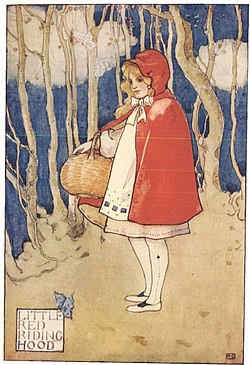 Little Red Riding Hood, illustrated in a 1927 story anthology
 -


Children's literature about and for girls
[edit]The European children's literature canon includes many notable works with young female protagonists. Traditional fairy tales have preserved memorable stories about girls. Among these are Goldilocks and the Three Bears, Rapunzel, The Princess and the Pea and the Brothers Grimm's Little Red Riding Hood. Well-known children's books about girls include Heidi, Anne of Green Gables, The Secret Garden, The Wonderful Wizard of Oz, the Nancy Drew series, Little House on the Prairie, Madeline, Pippi Longstocking, A Wrinkle in Time, Dragonsong, and Little Women.
Beginning in the late Victorian era, more nuanced depictions of girl protagonists became popular. Hans Christian Andersen's The Little Match Girl, The Little Mermaid, and other tales featured themes that ventured into tragedy. Published in 1865, Alice's Adventures in Wonderland by Lewis Carroll featured a widely noted female protagonist, Alice, confronting eccentric characters and intellectual puzzles in surreal settings. The character of the plucky, yet proper, Alice has proven immensely popular and inspired similar heroines in literature and pop culture.[105] Literature followed different cultural currents, sometimes romanticizing and idealizing girlhood, and at other times developing under the influence of the growing literary realism movement. Many Victorian novels begin with the childhood of their heroine, such as Jane Eyre, an orphan who suffers ill treatment from her guardians and then at a girls' boarding school. The character Natasha in War and Peace, on the other hand, is sentimentalized.
By the twentieth century, the portrayal of girls in fiction had for the most part abandoned idealized portrayals of girls. Popular literary novels include Harper Lee's To Kill a Mockingbird in which a young girl, Scout, is faced with the awareness of the forces of bigotry in her community. Vladimir Nabokov's controversial book Lolita (1955) is about a doomed relationship between a 12-year-old girl and an adult scholar as they travel across the United States. Zazie dans le métro (Zazie in the Metro) (1959) by Raymond Queneau is a popular French novel that humorously celebrates the innocence and precocity of Zazie, who ventures off on her own to explore Paris, escaping from her uncle (a professional female impersonator) and her mother (who is preoccupied by a meeting with her lover). Zazie was also made into a popular movie in 1960 (Zazie dans le Métro) by French director Louis Malle.
Books which have both boy and girl protagonists have tended to focus more on the boys, but important girl characters appear in Knight's Castle, The Lion, the Witch and the Wardrobe, The Book of Three and the Harry Potter series.
Adult literature featuring girls
[edit]Recent[when?] novels with an adult audience have included reflections on girlhood experiences. Memoirs of a Geisha by Arthur Golden begins as the female main character and her sister are dropped off in the pleasure district after being separated from their family in nineteenth-century Japan. Snow Flower and the Secret Fan by Lisa See traces the laotong (old sames) bond of friendship between a pair of childhood friends in modern Beijing, and the parallel friendship of their ancestors in nineteenth-century Hunan, China.
Girls' studies
[edit]Since the 1970s, under the influence of feminist criticism of the androcentric approach in scientific studies of childhood and adolescence, a special scientific discipline studying girls, girls' studies, has gradually emerged.[106]
Popular culture
[edit].jpg)
There have been many comic books and comic strips featuring a girl as the main character such as Little Lulu and Little Orphan Annie from the US, and Minnie the Minx from the UK. In superhero comic books an early girl character was Etta Candy, one of Wonder Woman's sidekicks. In the Peanuts series (by Charles Schulz) girl characters include Peppermint Patty, Lucy van Pelt and Sally Brown.
In Japanese animated cartoons and comic books girls are often protagonists. Most of Hayao Miyazaki's animated films feature a young girl heroine, as in Majo no takkyūbin (Kiki's Delivery Service). There are many other girl protagonists in the shōjo style of manga, which is targeted at girls as an audience. Among these are The Wallflower, Ceres, Celestial Legend, Tokyo Mew Mew and Full Moon o Sagashite. Meanwhile, some genres of Japanese cartoons may feature sexualized and objectified portrayals of girls.
The term girl is widely heard in the lyrics of popular music (such as with the song "American Girl"), most often meaning a young adult or teenaged female.
See also
[edit]

References
[edit]- ^ a b c d Dictionary.com, "Girl". Retrieved January 2, 2008.
- ^ "Girl - Definition and More from the Free Merriam-Webster Dictionary". Merriam-webster.com. August 31, 2012. Retrieved June 4, 2014.
- ^ Webster's Revised Unabridged Dictionary (1913), girl Archived 2009-01-22 at the Wayback Machine, retrieved 2 January 2008
- ^ Online Etymology Dictionary, girl, retrieved 2 January 2008
- ^ The childhood and education of Elizabeth I (Radio Broadcast). August 30, 2012. Archived from the original on November 16, 2012.
- ^ Briscoe, Alexandra (February 17, 2011). "BBC - History - Elizabeth I: An Overview". BBC. Retrieved October 15, 2020.
- ^ Melton, James Van Horn. (2001). The Rise of the Public in Enlightenment Europe. Cambridge: Cambridge University Press.
- ^ "1958 to today". www.polytechnique.edu. 2017. Retrieved April 15, 2022.
- ^ Paul L. Allen (July 26, 2001). "Coming of age: Apache twins Fayreen and Farren Holden are welcomed into adulthood in a four-day tribal ceremony". Tucson Citizen. Archived from the original on March 3, 2016. Retrieved October 23, 2011.
- ^ "Fifteen Questions on the Quinceañera". United States Conference of Catholic Bishops. Archived from the original on July 16, 2011. Retrieved July 31, 2017.
- ^ Yow, Elizabeth (January 15, 2001). "Younger girls are getting into undergarments - but they're going for a fun style, not sexy". The Province. p. A20. Retrieved June 4, 2024 – via newspapers.com.
- ^ Fujimori, Sachi (April 2, 2013). "Are Push-Up Bras, Thongs OK for Teens?". The Herald-News. p. D1. Retrieved June 4, 2024 – via newspapers.com.
- ^ a b c d e Cartwright, M. (2017). Foot-Binding - World History Encyclopedia. [online] worldhistory.org. Available at: https://www.worldhistory.org/Foot-Binding/ [Accessed April 15, 2022].
- ^ Perkins, Dorothy (2000). Encyclopedia of China: The Essential Reference to China, Its History and Culture. New York: Checkmark Books.
- ^ "Supplementary Convention on the Abolition of Slavery". Ohchr.org. Retrieved July 18, 2016.
- ^ Age Data C13 Table (India/States/UTs ) Final Population - 2011 Census of India, Ministry of Home Affairs, Government of India (2013)
- ^ James W.H. (July 2008), "Hypothesis:Evidence that Mammalian Sex Ratios at birth are partially controlled by parental hormonal levels around the time of conception", Journal of Endocrinology 198 (1), pp 3–15
- ^ France MESLÉ; Jacques VALLIN; Irina BADURASHVILI (2007). A Sharp Increase in Sex Ratio at Birth in the Caucasus. Why? How? (PDF). Committee for International Cooperation in National Research in Demography. pp. 73–89. ISBN 978-2-910053-29-1. Archived from the original (PDF) on September 17, 2018. Retrieved November 30, 2013.
- ^ Son Preference
- ^ Jones, Adam (1999–2000). "Case Study: Female Infanticide". Gendercide.org.
- ^ Afghan woman is killed 'for giving birth to a girl' - BBC News
- ^ 23-year-old woman killed for giving birth to twin daughters | Bareilly News - Times of India
- ^ 56 killed for giving birth to girl child in Pakistan
- ^ CHILD SEX RATIO IN INDIA Archived 2013-12-03 at the Wayback Machine Dr C Chandramouli, Registrar General & Census Commissioner, India (2011)
- ^ a b Wei Xing Zhu, Li Lu, Therese Hesketh, China's Excess Males, Sex Selective Abortion, and One Child Policy: Analysis of Data from 2005 National Intercensus Survey, BMJ: British Medical Journal, Vol. 338, No. 7700 (Apr. 18, 2009), pp. 920-923
- ^ "Gender Statistics Highlights from 2012 World Development Report". World DataBank, a compilation of databases by the World Bank. February 2012.
- ^ Karabin, Sherry (June 13, 2007). "Infanticide, Abortion Responsible for 60 Million Girls Missing in Asia". Fox News. Retrieved October 11, 2011.
- ^ "Transgender Children & Youth: Understanding the Basics". Human Rights Campaign. Retrieved October 1, 2022.
- ^ "What's intersex?". Planned Parenthood. October 1, 2020. Retrieved October 1, 2022.
- ^ Ethics And Intersex Sharon E. Sytsma
- ^ (Tanner, 1990).
- ^ Anderson SE, Dallal GE, Must A (April 2003). "Relative weight and race influence average age at menarche: results from two nationally representative surveys of US girls studied 25 years apart". Pediatrics. 111 (4 Pt 1): 844–50. Bibcode:2003Pedia.111..844A. doi:10.1542/peds.111.4.844. PMID 12671122.
- ^ Al-Sahab B, Ardern CI, Hamadeh MJ, Tamim H (2010). "Age at menarche in Canada: results from the National Longitudinal Survey of Children & Youth". BMC Public Health. 10 736. doi:10.1186/1471-2458-10-736. PMC 3001737. PMID 21110899.
- ^ Salon.com, Kurt Kleiner, A mind of their own Archived 2011-06-06 at the Wayback Machine (book review of Nature via Nurture by Matt Ridley), 19 June 2003, retrieved 2 January 2008
- ^ BBC, Jane Beresford, Twins reunited, after 35 years apart, 31 December 2007, retrieved 2 January 2008
- ^ "The Academic Exchange". June 29, 2011. Archived from the original on June 29, 2011. Retrieved July 16, 2022.
- ^ Marianne van den Wijngaard (1997). Reinventing the sexes: the biomedical construction of femininity and masculinity. Race, gender, and science. Indiana University Press. pp. 171 pages. ISBN 978-0-253-21087-6. Retrieved June 3, 2011.
- ^ Hale Martin; Stephen Edward Finn (2010). Masculinity and Femininity in the MMPI-2 and MMPI-A. U of Minnesota Press. pp. 310 pages. ISBN 978-0-8166-2445-4. Retrieved June 3, 2011.
- ^ Richard Dunphy (2000). Sexual politics: an introduction. Edinburgh University Press. pp. 240 pages. ISBN 978-0-7486-1247-5. Retrieved June 3, 2011.
- ^ Ferrante, Joan (January 1, 2010). Sociology: A Global Perspective (7th ed.). Belmont, CA: Thomson Wadsworth. pp. 269–272. ISBN 978-0-8400-3204-1.
- '^ Gender, Women and Health: What do we mean by "sex" and "gender"? The World Health Organization
- ^ Vetterling-Braggin, Mary "Femininity," "masculinity," and "androgyny": a modern philosophical discussion
- ^ Worell, Judith, Encyclopedia of women and gender: sex similarities and differences and the impact of society on gender, Volume 1 Elsevier, 2001, ISBN 0-12-227246-3, ISBN 978-0-12-227246-2
- ^ Thomas, R. Murray (2000). Recent Theories of Human Development. SAGE Publications. p. 248. ISBN 978-0761922476.
Gender feminists also consider traditional feminine traits (gentleness, modesty, humility, sacrifice, supportiveness, empathy, compassion, tenderness, nurturance, intuitiveness, sensitivity, unselfishness) morally superior to the traditional masculine traits of courage, strong will, ambition, independence, assertiveness, initiative, rationality and emotional control.
- ^ Witt, Charlotte, ed. (2010). Feminist Metaphysics: Explorations in the Ontology of Sex, Gender and Identity. Dordrecht: Springer. p. 77. ISBN 978-90-481-3782-4.
- ^ Mayor S (2004). "Pregnancy and childbirth are leading causes of death in teenage girls in developing countries". BMJ. 328 (7449): 1152. doi:10.1136/bmj.328.7449.1152-a. PMC 411126. PMID 15142897.
- ^ Loto OM, Ezechi OC, Kalu BK, Loto A, Ezechi L, Ogunniyi SO (2004). "Poor obstetric performance of teenagers: Is it age- or quality of care-related?". Journal of Obstetrics & Gynaecology. 24 (4): 395–398. doi:10.1080/01443610410001685529. PMID 15203579. S2CID 43808921.
- ^ Abalkhail BA (1995). "Adolescent pregnancy: Are there biological barriers for pregnancy outcomes?". The Journal of the Egyptian Public Health Association. 70 (5–6): 609–625. PMID 17214178.
- ^ "Young mothers face stigma and abuse, say charities". BBC News. February 25, 2014.
- ^ a b c "Paying the Price: The economic cost of failing to educate girls" (PDF). PLAN International. Retrieved October 11, 2011.
- ^ The State of the World's Children 2004 - Girls, Education and Development Archived 2018-06-20 at the Wayback Machine, UNICEF, 2004
- ^ Peer, Basharat (10 October 2012), "The Girl Who Wanted To Go To School", The New Yorker
- ^ Emory University website, Women's work? Archived 2011-06-29 at the Wayback Machine, September 2005, retrieved 2 January 2008
- ^ PBS.org, Nature vs. nurture Archived 2014-01-22 at the Wayback Machine, 20 October 1998, retrieved 2 January 2008
- ^ literacytrust.org, Literacy achievement in England, including gender split Archived 2008-12-09 at the Wayback Machine, 2007, retrieved 7 December 2008
- ^ New York Times, Katherine Q Seelye, Group Seeks to Alter S.A.T. to Raise Girls' Scores, 14 March 1997, retrieved 2 January 2008
- ^ ABC News, John Berman, Girls Achieve Rare SAT Scores, 30 August 2006, retrieved 2 January 2008
- ^ harrisschool.uchicago.edu, Girl-Dominated Classrooms Can Improve Boys’ Early School Performance Archived 2007-08-19 at the Wayback Machine, retrieved 2 January 2008
- ^ "India baby girl deaths 'increase'". BBC News. June 21, 2008.
- ^ "Global issues affecting women and girls | National Union of Teachers - NUT". Teachers.org.uk. Archived from the original on April 29, 2015. Retrieved June 4, 2014.
- ^ "Global Campaign For Education United States Chapter". Campaignforeducationusa.org. Archived from the original on September 16, 2018. Retrieved June 4, 2014.
- ^ "Because I am a Girl". Plan-international.org. Retrieved June 4, 2014.
- ^ Salomone, Rosemary C. "Are Single-Sex Schools Inherently Unequal? Same, Different, Equal: Rethinking Single-Sex Schooling." "Michigan Law Review." 102(6):1219-1244
- ^ The World Bank. 2012. "Gender Equality and Development: World Development Report 2012." Washington, D.C.: The World Bank.
- ^ Nussbaum, Martha C. 2003. "Women's Education: A Global Challenge." "Signs: Journal of Women in Culture and Society" 29(2): 325–355
- ^ Wilkinson-Weber, Clare M. (March 25, 1999). Embroidering Lives: Women's Work and Skill in the Lucknow Embroidery Industry. SUNY Press. p. 74. ISBN 9780791440889.
Purdah regulates the interactions of women with certain kinds of men. Typically, Hindu women must avoid specific male affines (in-laws) and Muslim women are restricted from contact with men outside the family, or at least their contact with these men is highly circumscribed (Papanek 1982:3). In practice, many elements of both "Hindu" and "Muslim" purdah are shared by women of both groups in South Asia (Vatuk 1982; Jeffery 1979), and Hindu and Muslim women both adopt similar strategies of self-effacement, like covering the face, keeping silent, and looking down, when in the company of persons to be avoided.
- ^ Lombard, No boys allowed? Girls’ schools adapt to changing times, published on 27 November 2020, accessed on 17 May 2025
- ^ Female Genital Mutilation/Cutting Archived 2013-12-03 at the Wayback Machine UNICEF, (July 2013)
- ^ FGM - Where is it practiced? European Campaign on FGM & Amnesty International (2012)
- ^ Tackling Female Genital Mutilation in the Kurdistan Region Sofia Barbarani, The Kurdistan Tribune (March 4, 2013)
- ^ World Health Organization, Female genital mutilation: an overview. 1998, Geneva: World Health Organization
- ^ William G. Clarence-Smith (2012) ‘Female Circumcision in Southeast Asia since the Coming of Islam’, in Chitra Raghavan and James P. Levine (eds.), Self-Determination and Women's Rights in Muslim Societies, Brandeis University Press; ISBN 978-1611682809; see pages 124-146
- ^ Goodkind, Daniel (1999). "Should Prenatal Sex Selection be Restricted?: Ethical Questions and Their Implications for Research and Policy". Population Studies. 53 (1): 49–61. doi:10.1080/00324720308069. JSTOR 2584811.
- ^ A. Gettis, J. Getis, and J. D. Fellmann (2004). Introduction to Geography, Ninth Edition. New York: McGraw-Hill. pp. 200. ISBN 0-07-252183-X
- ^ Arnold, Fred; Kishor, Sunita; Roy, T. K. (2002). "Sex-Selective Abortions in India". Population and Development Review. 28 (4): 759–785. doi:10.1111/j.1728-4457.2002.00759.x. JSTOR 3092788.
- ^ France MESLÉ; Jacques VALLIN; Irina BADURASHVILI (2007). A Sharp Increase in Sex Ratio at Birth in the Caucasus. Why? How?. Committee for International Cooperation in National Research in Demography. pp. 73–89. ISBN 978-2-910053-29-1.
- ^ "Female genital mutilation", World Health Organization, February 2013.
- ^ "An update on WHO's work on female genital mutilation (FGM)", World Health Organization, 2011, p. 2: "Most women who have experienced FGM live in one of the 28 countries in Africa and the Middle East – nearly half of them in just two countries: Egypt and Ethiopia. Countries in which FGM has been documented include: Benin, Burkina Faso, Cameroon, Central African Republic, Chad, Côte d'Ivoire, Djibouti, Egypt, Eritrea, Ethiopia, Gambia, Ghana, Guinea, Guinea-Bissau, Kenya, Liberia, Mali, Mauritania, Niger, Nigeria, Senegal, Sierra Leone, Somalia, Sudan, Togo, Uganda, United Republic of Tanzania and Yemen. The prevalence of FGM ranges from 0.6% to 98% of the female population."
- Rahman, Anika and Toubia, Nahid. Female Genital Mutilation: A Guide to Laws and Policies Worldwide. Zed Books, 2000 (hereafter Rahman and Toubia 2000), p. 7: "Currently, FC/FGM is practiced in 28 African countries in the sub-Saharan and North-eastern regions."
- Also see "Eliminating Female Genital Mutilation", World Health Organization, 2008, p. 4: "Types I, II and III female genital mutilation have been documented in 28 countries in Africa and in a few countries in Asia and the Middle East."
- ^ "WHO | Female genital mutilation". Who.int. Retrieved June 4, 2014.
- ^ Child brides die young ANTHONY KAMBA, Africa in Fact Journal (1 AUGUST 2013)
- ^ Marrying too young, End child marriage United Nations Population Fund (2012), See page 23
- ^ Early Marriage, Child Spouses UNICEF, See section on Asia, page 4 (2001)
- ^ Southeast Asia's big dilemma: what to do about child marriage? Archived 2013-10-03 at the Wayback Machine August 20, 2013
- ^ PHILIPPINES: Early marriage puts girls at risk IRIN, United Nations News Service (January 26, 2010)
- ^ "How Come You Allow Little Girls to Get Married?" - Child Marriage in Yemen Human Rights Watch, (2011); pages 15-23
- ^ Child marriage still an issue in Saudi Arabia Joel Brinkley, San Francisco Chronicle (March 14, 2010)
- ^ Child Marriage - What we know? Public Broadcasting Service (United States), 2010
- ^ Early Marriage, Child Spouses UNICEF, See section on Oceania, page 5
- ^ WHO | Child marriages: 39,000 every day. Who.int (2013-03-07). Retrieved on 2013-04-06.
- ^ "Child Sexual Abuse". Medline Plus. U.S. National Library of Medicine. April 2, 2008.
- ^ "Guidelines for psychological evaluations in child protection matters. Committee on Professional Practice and Standards, APA Board of Professional Affairs". The American Psychologist. 54 (8): 586–93. August 1999. doi:10.1037/0003-066X.54.8.586. PMID 10453704.
Abuse, sexual (child): generally defined as contacts between a child and an adult or other person significantly older or in a position of power or control over the child, where the child is being used for sexual stimulation of the adult or other person.
- ^ "Child Trafficking and Prostitution" (PDF). Globalfunsforchildren.org. Archived from the original (PDF) on June 7, 2014. Retrieved June 4, 2014.
- ^ "Ethics - Honour crimes". BBC. January 1, 1970. Retrieved June 4, 2014.
- ^ Child marriage | UNFPA - United Nations Population Fund
- ^ Female genital mutilation
- ^ Roux H, Chapelon E, Godart N (April 2013). "[Epidemiology of anorexia nervosa: a review]". L'Encephale. 39 (2): 85–93. doi:10.1016/j.encep.2012.06.001. PMID 23095584.
- ^ Cite error: The named reference
Attia_2010was invoked but never defined (see the help page). - ^ Cite error: The named reference
DSM5bookwas invoked but never defined (see the help page). - ^ Arcelus J, Witcomb GL, Mitchell A (March 2014). "Prevalence of eating disorders amongst dancers: a systemic review and meta-analysis". European Eating Disorders Review. 22 (2): 92–101. doi:10.1002/erv.2271. PMID 24277724.
- ^ "Child labour : Are girls affected differently from boys" (PDF). Unicef.org. Archived from the original (PDF) on November 13, 2014. Retrieved June 4, 2014.
- ^ "Counting Cinderellas". Paa2009.princeton.edu. Archived from the original on October 29, 2013. Retrieved June 4, 2014.
- ^ "CAMFED USA: What we do". CAMFED. Archived from the original on October 9, 2011. Retrieved October 11, 2011.
- ^ "Canada Calls on Member States to Proclaim International Day of the Girl (News Release October 11, 2011)". Status of Women Canada. Archived from the original on October 31, 2011. Retrieved October 11, 2011.
- ^ "'Because I am a Girl' group finds boys matter, too". Toronto Star. September 17, 2011. Retrieved October 11, 2011.
- ^ "The Guardian view on Alice in Wonderland: a dauntless, no-nonsense heroine". The Guardian. November 25, 2015. Archived from the original on March 9, 2021. Retrieved July 12, 2022.
- ^ Kearney, Mary Celeste. "Coalescing: The Development of Girls' Studies." NWSA journal (2009): p. 1-28.


| International | |
|---|---|
| National | |
| Other | |


Definitions and Etymology
Etymology
The English word girl first appears in written records during the late 13th century in Middle English as gurle, girle, or gyrle, denoting a young person of either sex without specific gender connotation.[7] [8] This gender-neutral usage persisted into the 14th century, where it could refer interchangeably to boys or girls as children or youths, distinct from terms like child or knave that carried different implications.[7] [9] By the late 14th century, the term began narrowing to primarily signify a female child or young woman, coinciding with the rise of boy as the counterpart for males, though the precise mechanism of this semantic shift remains unclear and may reflect broader linguistic specialization in denoting youth by sex.[7] [8] The ultimate origin is obscure and debated among historical linguists; proposed sources include an unattested Old English gyrele (possibly diminutive of gyr "young person" or linked to Proto-Germanic gurwilon- suggesting smallness), Middle Low German göre or gäre (meaning "small child" or "boy/girl"), or even Old English gyrela denoting "garment" or "apparel," implying a connotation of dressing or youth attire, though no single etymology commands consensus due to lack of direct antecedents.[7] [9] [10] This evolution underscores how English kinship and age terms often originated from neutral descriptors of immaturity before acquiring gendered specificity, influenced by phonetic and regional dialects such as those in Anglo-Norman or Low German contacts during the medieval period.[7] [10]Definitions and Age Classifications
A girl is a young human female, biologically defined by her sex as the member of the species capable of producing large gametes (ova) and characterized by XX chromosomes, prior to reaching full reproductive maturity.[2] Standard lexicographic definitions specify a girl as a female child from birth to adulthood, encompassing infancy through adolescence.[8][11] This contrasts with some recent dictionary revisions, such as Merriam-Webster's inclusion of gender identity in related terms like "female," which prioritize subjective self-identification over immutable biological markers, potentially reflecting institutional biases toward non-empirical interpretations of sex.[12] Age classifications for girlhood lack universal precision, varying by biological, legal, and cultural criteria, but generally span from birth to approximately 18 years, aligning with definitions of childhood under international law such as the UN Convention on the Rights of the Child. Biologically, the phase emphasizes prepuberty, with puberty onset averaging 10.5 years and completion by 15-17 years, marking the transition toward adult female physiology through stages like breast development and menarche.[13] Secular trends show earlier puberty initiation—declining from about 16.6 years in 1860 to 12.5 years by 1980—attributable to factors like improved nutrition rather than redefinition of developmental boundaries.[14] Legal contexts often cap girlhood at 18 for protections against exploitation, as in age-of-consent laws or juvenile justice systems, distinguishing girls from adult women to reflect incomplete neurological and physical maturation. In developmental psychology, classifications may extend "girl" informally into early adulthood (e.g., up to college age) for social usage, but this blurs with biological adulthood post-puberty, where fertility potential emerges.[15] Empirical evidence prioritizes puberty as the causal threshold for reclassification, as it signifies reproductive capability, overriding arbitrary chronological cutoffs unsupported by physiological data.[16]Cultural Variations in Usage
The usage of the term "girl" to denote a young female human varies significantly across cultures, particularly in the age range it encompasses and the social transitions it implies. In many Western societies, "girl" typically refers to females from birth until approximately age 18, aligning with legal definitions of minority, though informal usage may extend into the early 20s before full adulthood is assumed.[17] In contrast, non-industrial and traditional societies often delimit girlhood more narrowly, ending it at puberty or menarche, when reproductive capacity emerges, marking a shift to womanhood through rites or social roles.[18] Rites of passage frequently delineate the end of girlhood in diverse cultures. Among Xhosa people in South Africa, the intonjane ceremony occurs at a girl's first menstruation, typically around age 12-14, signifying her transition to womanhood via seclusion, teachings on adult responsibilities, and communal celebration.[19] In Latin American Hispanic communities, the quinceañera celebrates a girl's 15th birthday as her passage from childhood to maturity, involving a formal dress, mass, and waltz, rooted in colonial Spanish and indigenous traditions.[20] Jewish bat mitzvah, observed around age 12 for girls, confers religious adulthood, requiring Torah reading and acceptance of commandments, differing from the male bar mitzvah at 13 due to historical gender norms in halakha. In some patrilineal or agrarian societies, girlhood terminates earlier with betrothal or marriage, reflecting economic and reproductive priorities over prolonged dependency. Anthropological accounts note that in parts of sub-Saharan Africa and South Asia, girls as young as 10-12 may be considered eligible for marriage, compressing girlhood into pre-pubertal years, as evidenced by ethnographic studies of kinship systems where female labor and alliance-building via marriage supersede extended education.[21] Conversely, in modern urbanizing contexts, globalization extends girlhood by delaying marriage and emphasizing schooling, though cultural residues persist; for instance, in Japan, while legal adulthood begins at 20, traditional markers like shichi-go-san at ages 3, 5, or 7 highlight early gendered socialization without strictly ending girlhood.[22] These variations underscore causal influences of ecology, economy, and kinship on terminology: resource-scarce environments favor early maturity transitions to maximize reproductive fitness, while affluent, literate societies prolong dependency for skill acquisition.[23] Empirical data from cross-cultural surveys, such as those in the Human Relations Area Files, confirm shorter childhood durations in foraging and pastoralist groups compared to industrial ones, with girls bearing domestic burdens sooner.[24] Source credibility in such studies varies, with ethnographic works from pre-1960s anthropology often embedding Western developmental biases, yet corroborated by demographic records showing median marriage ages for females historically below 15 in pre-modern Eurasia and Africa.[25]Biological Foundations
Genetic and Chromosomal Determinants
In humans, the genetic and chromosomal determinants of female sex, which defines a girl prior to puberty, are primarily established by the inheritance of two X chromosomes, resulting in a 46,XX karyotype. This occurs when a sperm carrying an X chromosome fertilizes an egg, which always contributes an X chromosome, leading to ovarian development and female phenotypic traits.[26][27] Mammalian sex determination follows a default female pathway in the absence of a Y chromosome; the key trigger for male development is the SRY gene located on the Y chromosome's short arm, which encodes a transcription factor that initiates testis formation around embryonic week 6-7 by upregulating genes like SOX9. Without SRY expression, the bipotential gonads differentiate into ovaries, driven by genes such as WNT4 and RSPO1 on autosomes and the X chromosome, which promote granulosa cell differentiation and suppress male pathways.[28][29][30] Chromosomal variations can alter female development while preserving phenotypic femaleness. Turner syndrome (45,X or monosomy X) affects approximately 1 in 2,500 live female births, resulting from partial or complete loss of one X chromosome, leading to streak gonads, infertility, short stature, and cardiac anomalies due to haploinsufficiency of X-linked genes that escape inactivation.[31][32] Other variants, such as triple X syndrome (47,XXX), occur in about 1 in 1,000 females and typically result in taller stature and mild cognitive effects but intact ovarian function in most cases, highlighting the robustness of XX dosage for female gonadal development.[26] These anomalies underscore that while 46,XX is normative, female sex determination tolerates X chromosome aneuploidy better than Y presence in altering gonadal fate.[31]Physical Development and Puberty
Puberty in girls is the process of physical maturation driven by hormonal changes, typically beginning between ages 8 and 13, earlier than in boys, and culminating in reproductive capability.[13][33] The process is regulated primarily by the hypothalamic-pituitary-gonadal axis, with rising gonadotropin-releasing hormone stimulating pituitary secretion of luteinizing hormone and follicle-stimulating hormone, which in turn prompt ovarian production of estrogen and progesterone.[33] These hormones induce secondary sexual characteristics and skeletal growth, with the entire progression spanning about 4 years on average.[16] Physical development follows the Tanner staging system, which assesses breast development (thelarche) and pubic hair growth on a scale from 1 (prepubertal) to 5 (adult).[34] Stage 1 shows no secondary characteristics, with basal height velocity of 5-6 cm/year.[35] Stage 2, often the onset around age 10-11, features breast buds (small tender mounds under the nipples) and sparse, downy pubic hair along the labia, accompanied by a growth spurt accelerating to 7-8 cm/year.[16][35] In stage 3, breasts enlarge further without areolar separation, pubic hair darkens and coarsens, and height velocity peaks. Stage 4 involves areolar mounding separate from the breast contour and adult-type pubic hair filling the pubic triangle, with growth slowing.[34] Stage 5 achieves adult breast form, with hair extending to thighs, and growth ceases as epiphyses fuse.[34] Skeletal and body composition changes include a pre-pubertal growth spurt, with girls often surpassing boys in height temporarily during middle school years, followed by hip widening due to estrogen-mediated pelvic growth and increased subcutaneous fat deposition in breasts, hips, and thighs, shifting the fat-free mass percentage from about 80% prepubertally to 75% post-puberty.[36][37] Axillary hair emerges later, around stages 3-4, alongside acne from sebaceous gland activation and intensified body odor from apocrine sweat glands.[38] Menarche, the first menstrual period, typically occurs in Tanner stage 4 or early stage 5, at an average age of 12.8-13.0 years in modern populations, though cycles are initially anovulatory and irregular for 1-2 years.[39][40] Over the past 150 years, puberty onset has advanced secularly, with menarche age declining from about 17 years in 1840 to 12 years by 2000 in developed countries, attributed to improved nutrition enabling earlier maturation but also linked to rising childhood obesity, where excess adiposity elevates leptin, potentially advancing hypothalamic activation.[41][42] Girls with higher body mass index enter puberty earlier, independent of other factors in some studies, though undernutrition delays it.[43][44] Genetic factors account for 50-80% of timing variance, with environmental influences like endocrine disruptors under investigation but not conclusively causal.[45]Reproductive Biology
At birth, a female infant's ovaries contain approximately 1 to 2 million primordial follicles, representing a decline from a peak of 6 to 7 million during fetal life, with these structures remaining largely quiescent during infancy and childhood due to low gonadotropin levels.[46] Ovarian volume in neonates can exceed 1 cm³, and small cysts or multifollicular patterns may be observed, influenced by transient postnatal gonadotropin surges that subside by 9 months of age.[47] [48] Pre-pubertal ovaries are small (typically <1 cm³ by age 1-9 years) with minimal follicular activity, as follicle-stimulating hormone (FSH) and luteinizing hormone (LH) secretion remains suppressed by hypothalamic-pituitary feedback mechanisms.[49] Uterine and vaginal tissues develop embryonically but remain immature, with the endometrium thin and estrogen-dependent changes absent until puberty.[50] Puberty in girls typically initiates between ages 8 and 13, driven by reactivation of the hypothalamic-pituitary-gonadal axis, leading to pulsatile GnRH release, elevated FSH and LH, and subsequent ovarian estrogen production.[33] Key reproductive milestones follow Tanner staging: Stage 1 (pre-pubertal) features no breast development or pubic hair; Stage 2 (around age 10-11) includes breast budding (thelarche) and initial ovarian follicle recruitment; Stages 3-4 involve uterine enlargement, endometrial proliferation, and further folliculogenesis; Stage 5 (by age 14-15) marks full maturation with ovulatory capacity.[16] [51] Estrogen from growing follicles promotes vaginal cornification, cervical mucus changes, and uterine growth to adult size (7-8 cm length).[37] Adrenarche precedes gonadarche in some cases, contributing adrenal androgens that support pubic hair (pubarche) but not primary reproductive maturation.[52] Menarche, the first menstrual bleeding, occurs on average at 12.5 years globally, though recent U.S. data indicate a decline to 11.9 years among those born 2000-2005, attributed to factors like adiposity; it typically follows 2-3 years after thelarche and aligns with Tanner breast Stage IV.[53] [54] Initial cycles are anovulatory and irregular (intervals 21-45 days), requiring 1-5 years for 60-80% regularity as ovulatory feedback matures, with LH surges enabling dominant follicle selection and corpus luteum formation.[55] [56] Full fertility emerges post-menarche with regular ovulations, though early cycles carry higher anovulation risk; cycle physiology mirrors adults, with follicular phase estrogen rise, ovulation, and luteal progesterone support for potential implantation.[57] Variations occur by ethnicity, nutrition, and environment, with earlier onset in higher-BMI girls but delayed in undernourished populations.[58]Psychological and Behavioral Characteristics
Innate Sex Differences in Cognition and Personality
Females exhibit advantages over males in verbal abilities, including reading comprehension, writing, and verbal fluency, with effect sizes ranging from small to moderate (d ≈ 0.1–0.3).[59][60] These differences emerge early in childhood and persist across cultures, suggesting a biological basis beyond socialization.[59] In contrast, males show advantages in visuospatial tasks, such as mental rotation and spatial perception, with larger effect sizes (d ≈ 0.5–0.7), and greater variability in cognitive scores, leading to more males at both extremes of ability distributions.[61][62] Overall intelligence (g-factor) shows no significant sex difference, though males may edge out in some quantitative reasoning measures.[63][62] Twin studies indicate that genetic factors contribute substantially to these cognitive sex differences, with heritability estimates for verbal and spatial abilities around 50–70% in both sexes, but qualitative genetic differences (sex-specific genes) explaining part of the divergence.[64] Prenatal testosterone exposure, proxied by digit ratios (2D:4D), correlates with enhanced spatial skills in females and reduced verbal fluency, supporting hormonal causation from fetal development.[65][66] These patterns hold cross-culturally and longitudinally, resisting full equalization by education or environment.[67] In personality, assessed via the Big Five traits, females score higher in Neuroticism (emotional instability, d ≈ 0.4), Agreeableness (cooperativeness, d ≈ 0.5), and facets like warmth and openness to feelings, while males score higher in assertiveness and emotional stability aspects.[68][69] These differences are consistent across 50+ cultures, with effect sizes stable over decades, indicating robustness to cultural variation.[70] Heritability for Big Five traits is 40–60%, with sex-limitation models showing genetic sources for dimorphism, particularly in extraversion and neuroticism subfacets.[71] Empirical evidence links prenatal androgens to personality divergence: higher fetal testosterone predicts lower empathy and higher systemizing in girls, mirroring male-typical traits, while opposite effects appear in boys.[72][73] Girls exposed to elevated prenatal testosterone via opposite-sex twins or maternal conditions display increased aggression and reduced prosociality, underscoring causal biological influences over purely environmental ones.[74][75] Such findings counter socialization-only explanations, as differences manifest before significant cultural input and align with evolutionary pressures for sex-specific adaptive behaviors.[76]Neuroscientific and Hormonal Evidence
Prenatal exposure to sex steroids plays a critical role in organizing brain structures toward female-typical patterns in XX fetuses, where low levels of testosterone and dihydrotestosterone, combined with estrogens derived from ovarian and placental sources, promote differentiation of regions involved in social cognition and emotional processing.[77] In female development, estradiol—aromatized from circulating androgens—facilitates female-typical neural circuitry, as evidenced by studies showing that estradiol receptor activation is necessary for certain sexually dimorphic behaviors and hypothalamic structures in rodent models, with analogous mechanisms inferred in humans from congenital adrenal hyperplasia cases where excess prenatal androgens shift female brain organization toward male-typical traits.[78] Human evidence from amniocentesis samples correlates lower prenatal testosterone in females with enhanced functional connectivity in social brain networks, such as the default mode network, supporting causal links to empathy and relational behaviors observed in girls.[79] Neuroimaging meta-analyses reveal consistent sex differences in brain volume and connectivity emerging by adolescence, with girls exhibiting relatively larger volumes in the prefrontal cortex and orbitofrontal regions—areas associated with impulse control and emotional regulation—adjusted for overall brain size, which averages 10-15% smaller in females.[80] [81] Longitudinal MRI studies indicate that female brains reach peak gray matter volumes earlier than males, around ages 10-11 versus 14-15, coinciding with pubertal estrogen surges that enhance synaptic pruning and myelination in language and social processing areas.[82] These structural dimorphisms correlate with hormonal profiles; for instance, higher estradiol levels in girls during puberty are linked to increased hippocampal volume and connectivity, underpinning advantages in verbal memory and autobiographical recall.[83] Hormonal influences extend to molecular pathways, where sex-specific gene expression in the brain—driven by gonadal steroids—alters neurotransmitter systems, such as greater estrogen-mediated upregulation of oxytocin receptors in female limbic regions, fostering affiliative behaviors.[84] Functional MRI data show girls displaying stronger activation in the fusiform face area and temporoparietal junction during social tasks, attributable to prenatal and pubertal estrogen effects on cortical thickness and white matter integrity.[85] However, effect sizes for these differences are moderate (Cohen's d ≈ 0.5-0.8), with substantial overlap between sexes, underscoring that while hormones causally shape dimorphisms, individual variation arises from genetic and epigenetic factors interacting with steroid exposure.[86][75]Environmental Interactions and Plasticity
While innate sex differences in cognition and personality provide a foundational framework for girls' psychological development, environmental factors interact with these through gene-environment interplay and neuroplasticity, modulating trait expression without fundamentally altering underlying dimorphisms. Shared environmental influences, such as family dynamics and early socialization, contribute moderately to sex-typed behaviors in preschool girls, complementing substantial genetic heritability, as evidenced by twin studies showing these effects on play preferences and social orientation.[87] For behavioral traits like conduct disorder, girls exhibit greater shared environmental variance compared to boys, where genetic factors dominate, indicating sex-specific sensitivity to rearing contexts that can amplify or mitigate externalizing tendencies.[88] Neuroplasticity mechanisms further illustrate these interactions, with female brains demonstrating hormone-modulated synaptic adaptations that enhance responsiveness to environmental demands. Females typically maintain double the dendritic spine density of males in key cortical regions, a plasticity driven by estrogen that supports learning and emotional regulation but remains contingent on ovarian hormones; ovariectomy eliminates this sex difference, underscoring the interplay of endogenous factors with experiential inputs.[89] During motor learning tasks, females show distinct white matter reorganization patterns, suggesting greater plasticity in connectivity for skill acquisition, potentially aiding adaptation to educational or physical environments.[90] Early developmental perturbations, including stress or enrichment, disproportionately affect males' synaptic plasticity genes, implying relative resilience in girls that preserves sex-typical cognitive profiles amid adversity.[91] These dynamics highlight causal realism in development: environments exert leverage via plastic processes, yet empirical data reveal persistent sex differences in outcomes like verbal fluency and empathy, even across cultures with varying socialization pressures, as innate thresholds constrain full convergence.[92] For instance, while enriched settings can narrow some cognitive gaps, such as in spatial reasoning through training, girls' advantages in relational processing endure, reflecting integrated rather than overridden biological priors.[93][85]Historical Evolution of Girlhood
Ancient and Pre-Modern Societies
In ancient Egypt, girls benefited from a legal framework granting them rights to inherit property, initiate lawsuits, and engage in commerce independently of male guardians, reflecting a societal valuation of female agency uncommon in contemporaneous cultures.[94] Girls received basic education in reading, writing, and household management, with some pursuing vocational training in professions like midwifery or weaving, though formal scribal education was predominantly male.[95] Marriage typically occurred post-puberty, around ages 12-14, but without the rigid seclusion seen elsewhere, allowing girls continuity in social and economic roles.[96] In classical Greece, particularly Athens, girls faced stricter constraints, confined primarily to domestic spheres with minimal public participation; education was informal, focusing on weaving, childcare, and religious duties rather than literacy or athletics, except in Sparta where girls underwent physical training to produce robust offspring.[97] Betrothal often preceded puberty, with marriage around 14-15 to men twice their age, prioritizing alliances over individual consent and limiting girls' autonomy.[98] Evidence from skeletal remains and texts suggests selective infanticide or exposure disproportionately affected female infants in resource-scarce households, contributing to skewed sex ratios.[99] Ancient Roman girls from elite families accessed rudimentary education in literature and arithmetic until marriage at the legal minimum of 12, after which roles shifted to matronly duties, though lower-class girls labored in trades with scant schooling.[100] Infanticide was widespread, legally permissible for fathers, often targeting girls or the deformed, as corroborated by mass infant burials at sites like the Yewden Villa, indicating a pragmatic disposal of economic burdens.[101] In imperial China under Confucian influence from the Han dynasty onward (circa 200 BCE), girls endured subservient status, with education emphasizing virtues like obedience and foot-binding emerging later in the Song era (960-1279 CE) to enforce immobility and dependence.[102] Pre-modern India during the Vedic period (1500-500 BCE) afforded girls higher ritual participation and later marriage ages, but post-Vedic texts lowered bridal age to 8 by Smriti compilations, correlating with declining female literacy and rising practices like sati in widowhood, though not universally enforced in antiquity.[103] In medieval Europe (500-1500 CE), canon law set marriage at 12 for girls, but consummation typically followed puberty; noble betrothals occurred younger for political ties, yet demographic records show average marriage nearer 20-25 for peasant girls, reflecting economic delays over systematic child wedlock.[104] Female infanticide persisted sporadically in famine-prone regions, evidenced by parish registers showing excess male baptisms, driven by patrilineal inheritance pressures.[105]Industrial and Modern Transformations
The Industrial Revolution, beginning in Britain around 1760 and spreading to other regions by the early 19th century, fundamentally altered the experiences of girls by drawing them into wage labor outside the home, particularly in textile mills where their smaller hands suited machinery operation. In British cotton factories, girls under 13 constituted 10-20% of the workforce by 1833, with 62,131 girls employed in cotton manufacture by 1841; many worked 12-16 hours per day, six days a week, in hot, overcrowded conditions for wages as low as 4 shillings weekly.[106] Similar patterns emerged in the United States during 1820-1870, where girls as young as 6-7 toiled in mills or canneries for 11-18 hours daily, often handling heavy loads like 40-pound boxes, facing high injury risks and limited education access.[107] This shift from domestic or agricultural tasks to factory discipline reduced familial oversight and exposed girls to exploitation, as employers preferred their lower pay and manageability over adult males.[108] Legislative reforms gradually curtailed such labor, prioritizing education and shorter hours. Britain's 1819 Cotton Factories Regulation Act capped girls over 9 at 12 hours daily, followed by the 1833 Factory Act mandating inspections and schooling, and the 1847 Ten Hours Bill limiting girls to 10 hours; by the late 19th century, child labor declined due to these laws, technological advances, and compulsory education.[106] In the U.S., state laws proliferated from the late 1800s, culminating in the 1918 universal compulsory education mandate and the 1938 Fair Labor Standards Act setting 16 as the minimum for full-time work, transforming girlhood from early economic contributor to prolonged dependency on schooling.[107] These changes marked girlhood's emergence as a recognized transitional phase between childhood and adulthood, distinct from boys' trajectories, with increased focus on moral and intellectual preparation for domestic roles.[109] In the 20th century, expanded educational access redefined girlhood, extending its duration and shifting emphases from labor to preparation for varied roles. Compulsory schooling laws, alongside rising secondary enrollment—reaching near parity with boys in many Western nations by mid-century—delayed workforce entry and fostered adolescence as a cultural stage, with girls increasingly engaging in consumer culture, leisure, and peer socialization rather than immediate domestic duties.[110] Women's higher education surged, from 46% of U.S. four-year colleges admitting women in 1880 to coeducation norms by 1900, enabling girls to pursue careers in teaching, nursing, and clerical work, though socioeconomic barriers persisted for working-class and minority girls.[111] Post-World War II economic booms further professionalized expectations, with girls' roles evolving toward delayed marriage and independence, evidenced by rising female labor participation from 20% in the 1920s to 47% by 2020 in the U.S., though traditional gender norms influenced occupational segregation.[112] Contemporary transformations, accelerated by globalization and technology, have prolonged girlhood into the mid-20s in developed economies, emphasizing academic achievement, digital literacy, and personal autonomy over early family formation. Global female secondary enrollment rose from 68% in 1990 to 76% by 2020, correlating with delayed childbearing and higher socioeconomic outcomes, yet disparities remain in regions with persistent child labor or cultural restrictions.[113] These shifts reflect causal drivers like technological displacement of manual labor and policy incentives for human capital investment, yielding empirical gains in girls' life expectancy and earning potential, though they introduce challenges such as intensified academic pressures and mental health strains undocumented in pre-industrial eras.Post-1945 Developments
Following World War II, many Western societies initially reinforced traditional expectations for girls, emphasizing preparation for marriage and homemaking amid the baby boom era. In the United States, the median age at first marriage for women dropped to approximately 20 by the late 1950s, reflecting cultural pressures toward early family formation and domestic roles over extended education or careers.[114] Girls' socialization often centered on consumerism and suburban ideals, with media portraying adolescence as a phase of romantic anticipation rather than professional ambition.[115] The emergence of second-wave feminism from the 1960s onward challenged these norms, advocating for expanded opportunities in education and delaying traditional transitions to adulthood. Landmark legislation, such as the U.S. Equal Pay Act of 1963 and Title IX of 1972, prohibited sex-based discrimination in employment and federally funded education, respectively, enabling greater female participation in schools and sports.[116] These reforms contributed to rising high school and college enrollment for girls, with women's share of U.S. undergraduate degrees surpassing men's by the 1980s.[117] Internationally, the United Nations' Convention on the Elimination of All Forms of Discrimination Against Women (CEDAW) in 1979 and the Convention on the Rights of the Child in 1989 established frameworks protecting girls from practices like forced marriage and ensuring access to education, though implementation varied by region.[118] Globally, post-1945 development efforts by organizations like UNESCO prioritized girls' schooling to address gender disparities, leading to marked enrollment gains. Primary school attendance for girls in low-income countries rose from under 50% in the 1950s to over 80% by 2015 in many areas, driven by aid programs and national policies.[119] At the tertiary level, female enrollment overtook male in most regions by the early 2000s, reflecting both legal mandates and economic incentives for delayed childbearing.[120] Median age at first marriage for women increased steadily, from around 22.5 in Western countries during the 1950s-1960s to 28 or higher by the 2020s, correlating with extended girlhood phases focused on personal development rather than immediate family roles.[121] These shifts reduced child labor and early unions in developing nations, though persistent barriers like poverty and cultural norms limited progress in parts of South Asia and sub-Saharan Africa.[122] In parallel, evolving perceptions of girlhood incorporated greater emphasis on autonomy and achievement, influenced by feminist critiques of patriarchal structures. Advocacy campaigns highlighted girls' potential in STEM and leadership, countering earlier stereotypes, while global metrics tracked reductions in harmful practices such as female genital mutilation, which declined by over 20% in targeted African regions since the 1990s due to international pressure and local reforms.[122] However, academic sources promoting these narratives often reflect institutional biases favoring progressive interpretations, potentially understating enduring biological and cultural factors in sex-differentiated development.[123] By the 21st century, girlhood extended into young adulthood in affluent societies, marked by prolonged education, workforce entry, and fertility postponement, reshaping rites of passage from familial duties to individual milestones.[124]Global Demographics
Population Statistics and Sex Ratios
The global population aged 0-14 years stood at approximately 1.97 billion in 2022, with projections indicating modest growth through 2024, of which females comprised roughly 48.6 percent, equating to about 958 million girls.[125][126] This proportion reflects the natural slight male bias in birth rates combined with marginally higher male infant mortality. Extending to under-18, the figure rises to over 1.1 billion girls, though precise counts vary by source due to definitional differences in age cohorts.[127] The biologically expected sex ratio at birth is 105 male births per 100 female births, a pattern observed across human populations absent cultural interventions.[128][129] In 2023, the worldwide average reached 1.056 males per female birth, per World Bank data derived from United Nations estimates.[130] For the child population (ages 0-14), the overall sex ratio hovers around 106 males per 100 females globally, influenced by both birth ratios and early childhood survival differentials.[131] Regional variations reveal significant deviations driven by prenatal sex selection in cultures favoring sons. In East Asia, particularly China and India, sex ratios at birth peaked above 115 males per 100 females in the early 2000s due to ultrasound-enabled abortions, resulting in millions of "missing" girls.[132][133] Recent data indicate partial corrections: China's 2023 ratio fell to about 108, aided by enforcement against sex selection, while India's national average stabilized near 108 but persists higher in northern states.[134] Similar skews appear in Armenia (110:100) and parts of Southeast Europe, linked to legalized abortion and technology access since the 1990s.[135] These imbalances contrast with natural ratios in sub-Saharan Africa and Latin America, closer to 104-105:100.[131]| Region/Country | Sex Ratio at Birth (Males per 100 Females, Recent) | Primary Factor |
|---|---|---|
| World | 105.6 | Natural |
| China | 108 | Declining sex selection |
| India | 108 | Son preference |
| Armenia | 110 | Cultural bias |
| Sub-Saharan Africa | ~104 | Natural |
Recent Trends and Projections
The global sex ratio at birth (SRB) has hovered around 105 to 106 male births per 100 female births since the 1990s, aligning closely with the biological baseline of 104 to 107 males per 100 females, though regional distortions persist due to prenatal sex selection driven by son preferences in cultures favoring male heirs.[128][134] In high-bias countries like China, India, and Vietnam, SRBs exceeded 110 males per 100 females through the 2010s, contributing to an estimated 142 million missing females cumulatively since the 1970s, with prenatal selection accounting for roughly half of recent global female birth deficits.[136] United Nations data for 2024 confirm a worldwide SRB of 1.05 boys per girl, with elevated ratios in Asia offsetting normalization elsewhere.[137] These imbalances have reduced the relative population of girls in affected cohorts; for example, China's SRB peaked at 121 in the early 2000s under the one-child policy but declined to about 111 by 2020 as restrictions eased and ultrasound access was curtailed, though enforcement gaps remain.[128] Globally, the under-15 female population constitutes roughly 12-13% of total inhabitants (around 1 billion girls in 2024), but declining fertility—down to 2.3 children per woman in 2023 from 4.9 in the 1950s—has slowed absolute growth in child numbers, amplifying the impact of skewed births on girl demographics in low-fertility, high-bias settings.[138][129] Projections indicate stabilization in skewed SRBs within 20 years in most affected nations, as urbanization, rising female education, and legal bans on sex selection erode son preferences, potentially averting further escalation.[139] However, Bayesian models forecast 4.7 million additional missing female births by 2030 and up to 8.1 million more by 2100 under baseline scenarios assuming partial persistence of biases, concentrated in Asia and concentrated in Asia.[140][141] UN medium-variant estimates project global population parity by 2050, driven by female longevity advantages, but child and adolescent cohorts (ages 0-14) may retain a 3-5% male surplus through 2050 in regions like South Asia, barring accelerated policy shifts.[134][129] Overall youth populations, including girls, face contraction as fertility falls below replacement in over half of countries by 2030, shifting demographic pressures toward smaller, potentially imbalanced girl generations in select geographies.[142]Causes and Consequences of Imbalances
The natural human sex ratio at birth is approximately 105 males per 100 females, a biological baseline shaped by evolutionary factors without human intervention.[135] [128] Deviations from this ratio, particularly excesses of males, arise primarily from prenatal sex selection through selective abortions targeting female fetuses, driven by cultural son preference in regions such as East Asia and South Asia.[143] [136] This practice emerged prominently since the 1970s with the advent of ultrasound technology enabling fetal sex determination, compounded by policies like China's one-child policy (1979–2015), which intensified pressure to ensure male heirs for family lineage and economic support.[144] [145] In China, the sex ratio at birth peaked at around 121 males per 100 females in the mid-2000s, while India has seen ratios as high as 120 in certain states, contributing to an estimated 142 million "missing" females globally due to sex-selective practices, daughter aversion, and related discrimination as of 2023.[146] [147] These imbalances reflect deliberate gender discrimination rather than natural variation, with peer-reviewed analyses attributing them to intersecting factors of patrilineal inheritance norms, dowry systems, and limited social safety nets that devalue daughters.[148] Empirical data from demographic surveys confirm that such skews are absent in populations without strong son bias, underscoring cultural causation over biological inevitability.[129] Consequences include a "marriage squeeze" where surplus males face chronic partner shortages, leading to delayed marriages, increased bride trafficking, and elevated risks of sexual violence in affected regions.[149] In China and India, this has manifested in cross-border abductions of women from neighboring countries and domestic trafficking networks, with studies documenting heightened demand for imported brides amid local deficits.[145] [150] Broader societal impacts encompass potential rises in crime and unrest linked to unmarried male cohorts, as well as long-term demographic strains like accelerated population aging due to fewer females reproducing.[151] For males exposed to imbalanced ratios in young adulthood, research indicates associations with reduced life expectancy, possibly from heightened stress, risk-taking, or health neglect in marriage markets.[152] These effects persist despite recent declines in skewed birth ratios following policy relaxations and awareness campaigns, as the cohort imbalances from prior decades endure.[136]Education and Intellectual Development
Historical Access and Barriers
In ancient civilizations, girls' access to education was generally limited by patriarchal norms that confined women to domestic roles, with formal schooling prioritized for boys preparing for civic and military duties. In ancient Egypt during the New Kingdom (circa 1550–1070 BCE), elite girls like Princess Neferure received tutoring in literacy and household management, reflecting relatively greater opportunities compared to contemporaries, though still secondary to boys' training.[153] In contrast, classical Greek societies, particularly Athens around the 5th century BCE, excluded girls from public education systems, restricting their learning to informal domestic skills taught at home.[154] Similar patterns prevailed in ancient Rome and Mesopotamia, where girls' education emphasized practical household preparation over intellectual pursuits.[154] During the medieval period in Europe (circa 500–1500 CE), barriers to girls' education intensified due to feudal structures and ecclesiastical influences that reinforced gender divisions in learning. Elite girls might access informal tutoring at home or instruction in convents focusing on religious texts and basic literacy, but universities, established from the 12th century onward, systematically barred women from enrollment and degrees.[155] Peasant girls, comprising the majority, received no formal education, their training limited to agrarian and household labor essential for family survival.[156] In the Islamic world, early medieval access allowed some girls to study Quran and poetry in home or mosque settings until the 13th century, after which cultural shifts increasingly restricted female scholarship.[157] The 19th century marked gradual reforms in Europe and North America amid industrialization and Enlightenment ideas, yet persistent barriers maintained gender disparities. In the United States, Oberlin College admitted women in 1837, pioneering coeducation, but most institutions enforced quotas or outright bans on female higher education until the late 1800s.[158] European countries introduced compulsory elementary schooling for girls by mid-century, such as Prussia's 1763 mandate extended to females, though curricula segregated by gender emphasized moral and vocational training like sewing over sciences for girls.[159] Legal and administrative hurdles, including anti-nepotism rules and field-specific prohibitions, lingered into the 20th century, with women facing quotas in professional programs as late as the 1960s in some Western nations.[159] In Asia, historical barriers were pronounced; in imperial China, Confucian doctrines from the Han Dynasty (206 BCE–220 CE) deprioritized girls' education, confining it to domestic virtues until republican reforms opened secondary schools for girls in 1912. Indian girls under colonial rule encountered caste, religious, and purdah-related obstacles, with formal access expanding modestly post-1857 via missionary schools, though enrollment remained under 1% for females by 1900.[160] These patterns stemmed from causal realities of resource scarcity, where families invested in sons' education for economic returns, compounded by cultural beliefs viewing female intellect as secondary or disruptive to social order. Mainstream academic narratives often underemphasize such entrenched causal factors, favoring ideological framings over empirical family-level decision-making data.[161]Current Global Disparities
Despite substantial global progress in reducing gender gaps in primary education enrollment, disparities remain pronounced in secondary and tertiary levels, particularly in low- and middle-income countries. As of 2024, UNESCO reports that while many regions have achieved near-parity in primary enrollment, secondary education exhibits persistent gaps, with girls comprising a majority of the 119.3 million children out of school worldwide.[162] [163] In sub-Saharan Africa, where exclusion rates are highest, more girls than boys are out of school, including 9 million aged 6-11 and even higher numbers at the secondary level.[164] [165] South Asia and the Middle East and North Africa (MENA) regions also show elevated disparities, driven by cultural norms prioritizing boys' education, early marriage, and household labor demands on girls. In Pakistan, for instance, 67% of women have never attended school, a rate 32 percentage points higher than for men.[166] [167] Secondary enrollment gender gaps exceed 10 percentage points in 16 countries, 13 of which are in sub-Saharan Africa.[168] The World Bank's Gender Data Portal highlights that poverty exacerbates these divides, with girls in fragile contexts facing additional barriers like violence and inadequate infrastructure.[120] [166] Literacy rates reflect these access issues, with women accounting for 63% of the 754 million illiterate adults globally in 2024, and nearly two-thirds of 739 million illiterate adults being female (466 million).[169] [170] In Afghanistan, adult female literacy stands at 26.6% as of 2022, underscoring extreme regional variation.[171] Tertiary enrollment gaps persist, with only partial parity in many economies, limiting girls' pathways to higher skills and economic independence.[172] These disparities correlate with broader outcomes, as women with secondary education earn up to 19% more than those without, yet systemic barriers in teacher gender balance—only 57% female globally, with 20-point gaps in 70 countries—hinder role models and retention.[173] [173]Achievement Gaps and Reversals
In many developed countries, the traditional gender gap favoring male educational achievement has reversed over the past several decades, with girls now surpassing boys in overall school performance, graduation rates, and postsecondary enrollment. This shift became pronounced from the 1980s onward, driven by girls' consistent advantages in reading and verbal skills, leading to higher average grades and completion rates across primary and secondary levels. For example, in the United States, girls outperform boys in reading and writing from third grade onward, with 145 boys repeating kindergarten for every 100 girls.[174] By high school, this translates to substantially higher graduation rates for girls; in New York City public schools as of 2024, girls' four-year graduation rate exceeds boys' by 10 percentage points. The reversal extends to tertiary education, where females now earn the majority of degrees. In the U.S., women received 58% of bachelor's degrees in 2020, widening the credential gap that emerged post-2000 and accelerated after 2010, particularly in non-STEM fields.[175] Globally, similar patterns hold: across OECD countries, women aged 25-34 are more likely to have completed tertiary education than men as of 2023, reflecting sustained female gains in attainment since the 1990s.[176] Explanations rooted in empirical analyses include rising female mean performance in schools and greater labor market returns to education for women relative to men, as documented in longitudinal data from multiple nations.[177] [178] Persistent domain-specific gaps qualify the overall reversal. In mathematics and science, boys maintain an edge: U.S. school districts show no average gender gap in math achievement, but post-2021 assessments reveal boys regaining advantages in middle school STEM, with girls' scores declining more sharply after the COVID-19 pandemic—reversing prior narrowing trends from the 2010s.[179] [180] In the 2022 PISA assessments, 15-year-old boys outperformed girls in math across most OECD countries by an average of 15 points, while girls led in reading by 27 points.[176] These patterns align with earlier developmental disparities, such as girls' 3.2-month lead over boys in early literacy and numeracy at age 5 in England as of 2023.[181]| Assessment | Domain | Gender Advantage | Magnitude (2020s Data) |
|---|---|---|---|
| U.S. District Averages | Math | None | 0 SD[179] |
| U.S. District Averages | ELA | Girls | +0.23 SD[179] |
| PISA (OECD) | Math | Boys | +15 points (avg.)[176] |
| PISA (OECD) | Reading | Girls | +27 points (avg.)[176] |
| NWEA Middle School | STEM | Boys (post-2021) | Reversal of prior female gains[180] |