


Community hub
Recent from talks
Contribute something
Nothing was collected or created yet.
Frigate
View on Wikipedia
.JPG)


A frigate (/ˈfrɪɡɪt/) is a type of warship. In different eras, the roles and capabilities of ships classified as frigates have varied.
The name frigate in the 17th to early 18th centuries was given to any full-rigged ship built for speed and maneuverability, intended to be used in scouting, escort and patrol roles. The term was applied loosely to ships varying greatly in design. In the second quarter of the 18th century, what is now generally regarded as the 'true frigate' was developed in France. This type of vessel was characterised by possessing only one armed deck, with an unarmed deck below it used for berthing the crew.
Late in the 19th century (British and French prototypes were constructed in 1858), a type of powerful ironclad warships was developed, and because they had a single gun deck, the term 'frigate' was used to describe them. Later developments in ironclad ships rendered the 'frigate' designation obsolete and the term fell out of favour.
During the Second World War, the name 'frigate' was reintroduced to describe a seagoing escort ship that was intermediate in size between a corvette and a destroyer. After World War II, several kinds of ships have been classified as frigates, and the reasons for such classification have not been consistent. While some navies have used the word 'frigate' principally for large ocean-going anti-submarine warfare (ASW) combatants, others have used it to describe ships that are otherwise recognizable as corvettes, destroyers, and even nuclear-powered guided-missile cruisers. Some European navies use the term for ships that would formerly have been called destroyers, as well as for frigates.[1] The rank "frigate captain" derives from the name of this type of ship.
Age of sail
[edit]Origins
[edit]The term "frigate" (Italian: fregata; Dutch: fregat; Spanish/Catalan/Portuguese/Sicilian: fragata; French: frégate) originated in the Mediterranean in the late 15th century, referring to a lighter galley-type warship with oars, sails and a light armament, built for speed and maneuverability.[2]

The etymology of the word remains uncertain, although it may have originated as a corruption of aphractus, a Latin word for an open vessel with no lower deck. Aphractus, in turn, derived from the Ancient Greek phrase ἄφρακτος ναῦς (aphraktos naus) – "undefended ship"[citation needed]. In 1583, during the Eighty Years' War of 1568–1648, Habsburg Spain recovered the southern Netherlands from the Protestant rebels. This soon resulted in the use of the occupied ports as bases for privateers, the "Dunkirkers", to attack the shipping of the Dutch and their allies. To achieve this the Dunkirkers developed small, maneuverable, sailing vessels that came to be referred to as frigates. The success of these Dunkirker vessels influenced the ship design of other navies contending with them, but because most regular navies required ships of greater endurance than the Dunkirker frigates could provide, the term soon came to apply less exclusively to any relatively fast and elegant sail-only warship. In French, the term "frigate" gave rise to a verb – frégater, meaning 'to build long and low', and to an adjective, adding more confusion. Even the huge English Sovereign of the Seas could be described as "a delicate frigate" by a contemporary after her upper decks were reduced in 1651.[3]
The navy of the Dutch Republic became the first navy to build the larger ocean-going frigates. The Dutch navy had three principal tasks in the struggle against Spain: to protect Dutch merchant ships at sea, to blockade the ports of Spanish-held Flanders to damage trade and halt enemy privateering, and to fight the Spanish fleet and prevent troop landings. The first two tasks required speed, shallowness of draft for the shallow waters around the Netherlands, and the ability to carry sufficient supplies to maintain a blockade. The third task required heavy armament, sufficient to stand up to the Spanish fleet. The first of the larger battle-capable frigates were built around 1600 at Hoorn in Holland.[4] By the later stages of the Eighty Years' War (1568–1648) the Dutch had switched entirely from the heavier ships still used by the English and Spanish to the lighter frigates, carrying around 40 guns and weighing around 300 tons.[citation needed] In the 17th century, the term fregat in the Dutch Navy described any oceangoing warship carrying fewer than 40 guns.[5] The effectiveness of the Dutch frigates became most evident in the Battle of the Downs in 1639, encouraging most other navies, especially the English, to adopt similar designs.[6]
The fleets built by the Commonwealth of England in the 1650s generally consisted of ships described as "frigates", the largest of which were two-decker "great frigates" of the third rate. Carrying 60 guns, these vessels were as big and capable as "great ships" of the time; however, most other frigates at the time were used as "cruisers": independent fast ships. The term "frigate" implied a long hull-design, which relates directly to speed (see hull speed) and which also, in turn, helped the development of the broadside tactic in naval warfare.[citation needed]

At this time, a further design evolved, reintroducing oars and resulting in galley frigates such as HMS Charles Galley of 1676, which was rated as a 32-gun fifth-rate but also had a bank of 40 oars set below the upper deck that could propel the ship in the absence of a favorable wind. In Danish, the word "fregat" often applied to warships carrying as few as 16 guns, such as HMS Falcon, which the British classified as a sloop. Under the rating system of the Royal Navy, by the middle of the 18th century, the term "frigate" was technically restricted to single-decked ships of the fifth rate, though small 28-gun frigates classed as sixth rate.[2]
Classic design
[edit]

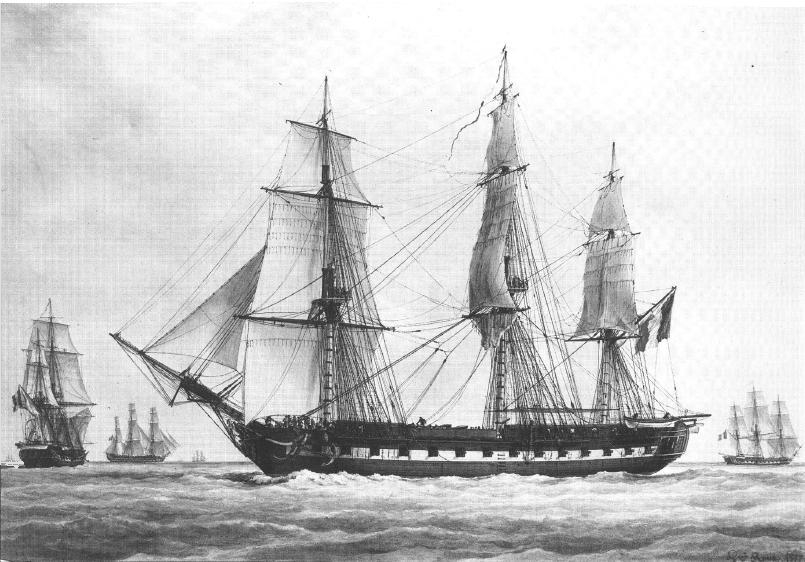
The classic sailing frigate, or 'true frigate', well-known today for its role in the Napoleonic Wars, can be traced back to French developments in the second quarter of the 18th century. The French-built Médée of 1740 is often regarded as the first example of this type. These ships were square-rigged and carried all their main guns on a single continuous upper deck. The lower deck, known as the "gun deck", now carried no armament, and functioned as a "berth deck" where the crew lived, and was in fact placed below the waterline of the new frigates. The typical earlier cruiser had a partially armed lower deck, from which it was known as a 'half-battery' or demi-batterie ship. Removing the guns from this deck allowed the height of the hull upperworks to be lowered, giving the resulting 'true-frigate' much improved sailing qualities. The unarmed deck meant that the frigate's guns were carried comparatively high above the waterline; as a result, when seas were too rough for two-deckers to open their lower deck gunports, frigates were still able to fight with all their guns (see the action of 13 January 1797, for an example when this was decisive).[7][8]
The Royal Navy captured a number of the new French frigates, including Médée, during the War of the Austrian Succession (1740–1748) and were impressed by them, particularly for their inshore handling capabilities. They soon built copies (ordered in 1747), based on a French privateer named Tygre, and started to adapt the type to their own needs, setting the standard for other frigates as the leading naval power. The first British frigates carried 28 guns including an upper deck battery of twenty-four 9-pounder guns (the remaining four smaller guns were carried on the quarterdeck) but soon developed into fifth-rate ships of 32 or 36 guns including an upper deck battery of twenty-six 12-pounder guns, with the remaining six or ten smaller guns carried on the quarterdeck and forecastle.[9] Technically, 'rated ships' with fewer than 28 guns could not be classed as frigates but as "post ships"; however, in common parlance most post ships were often described as "frigates", the same casual misuse of the term being extended to smaller two-decked ships that were too small to stand in the line of battle.
A total of fifty-nine French sailing frigates were built between 1777 and 1790, with a standard design averaging a hull length of 135 ft (41 m) and an average draught of 13 ft (4.0 m). The new frigates recorded sailing speeds of up to 14 knots (26 km/h; 16 mph), significantly faster than their predecessor vessels.[7]
Heavy frigate
[edit]
In 1778, the British Admiralty introduced a larger "heavy" frigate, with a main battery of twenty-six or twenty-eight 18-pounder guns (with smaller guns carried on the quarterdeck and forecastle). This move may reflect the naval conditions at the time, with both France and Spain as enemies the usual British preponderance in ship numbers was no longer the case and there was pressure on the British to produce cruisers of individually greater force. In reply, the first French 18-pounder frigates were laid down in 1781. The 18-pounder frigate eventually became the standard frigate of the French Revolutionary and Napoleonic Wars. The British produced larger, 38-gun, and slightly smaller, 36-gun, versions and also a 32-gun design that can be considered an 'economy version'. The 32-gun frigates also had the advantage that they could be built by the many smaller, less-specialised shipbuilders.[10][11]
Frigates could (and usually did) additionally carry smaller carriage-mounted guns on their quarterdecks and forecastles (the superstructures above the upper deck). In 1778 the Carron Iron Company of Scotland produced a naval gun which would revolutionise the armament of smaller naval vessels, including the frigate. The carronade was a large calibre, short-barrelled naval cannon which was light, quick to reload and needed a smaller crew than a conventional long gun. Due to its lightness it could be mounted on the forecastle and quarterdeck of frigates. It greatly increased the firepower, measured in weight of metal (the combined weight of all projectiles fired in one broadside), of these vessels. The disadvantages of the carronade were that it had a much shorter range and was less accurate than a long gun. The British quickly saw the advantages of the new weapon and soon employed it on a wide scale. The US Navy also copied the design soon after its appearance. The French and other nations eventually adopted variations of the weapon in succeeding decades. The typical heavy frigate had a main armament of 18-pounder long guns, plus 32-pounder carronades mounted on its upper decks.[12]
Super-heavy frigates
[edit]
The first 'super-heavy frigates', armed with 24-pounder long guns, were built by the naval architect F H Chapman for the Swedish navy in 1782. Because of a shortage of ships-of-the-line, the Swedes wanted these frigates, the Bellona class, to be able to stand in the battle line in an emergency. In the 1790s the French built a small number of large 24-pounder frigates, such as Forte and Egyptienne, they also cut-down (reduced the height of the hull to give only one continuous gun deck) a number of older ships-of-the-line (including Diadème) to produce super-heavy frigates; the resulting ship was known as a rasée. It is not known whether the French were seeking to produce very potent cruisers or merely to address stability problems in old ships. The British, alarmed by the prospect of these powerful heavy frigates, responded by rasée-ing three of their smaller 64-gun battleships, including Indefatigable, which went on to have a very successful career as a frigate. At this time the British also built a few 24-pounder-armed large frigates, the most successful of which was HMS Endymion (1,277 tons).[13][14]
In 1797, three of the United States Navy's first six major ships were rated as 44-gun frigates, which operationally carried fifty-six to sixty 24-pounder long guns and 32-pounder or 42-pounder carronades on two decks; they were exceptionally powerful. These ships were so large, at around 1,500 tons, and well-armed that they were often regarded as equal to ships of the line, and after a series of losses at the outbreak of the War of 1812, secret Admiralty instructions ordered British frigates (usually rated at 38 guns or less) to never engage the large American frigates at any less than a 2:1 advantage. USS Constitution, preserved as a museum ship by the US Navy, is the oldest commissioned warship afloat, and is a surviving example of a frigate from the Age of Sail. Constitution and her sister ships President and United States were created in a response to deal with the Barbary Coast pirates and in conjunction with the Naval Act of 1794. Joshua Humphreys proposed that only live oak, a tree that grew only in America, should be used to build these ships.[15]
The Admiralty, concerned by repeated defeats in single-ship actions, responded to the success of the American 44s in three ways. They built a class of conventional 40-gun, 24-pounder armed frigates on the lines of Endymion. They cut down three old 74-gun Ships-of-the-Line into rasées, producing frigates with a 32-pounder main armament, supplemented by 42-pounder carronades. These had an armament that far exceeded the power of the American ships. Finally, Leander and Newcastle, 1,500-ton spar-decked frigates (with an enclosed waist, giving a continuous line of guns from bow to stern at the level of the quarterdeck/forecastle), were built, which were an almost exact match in size and firepower to the American 44-gun frigates.[16]
Role
[edit]
Frigates were perhaps the hardest-worked of warship types during the Age of Sail. While smaller than a ship-of-the-line, they were formidable opponents for the large numbers of sloops and gunboats, not to mention privateers or merchantmen. Able to carry six months' stores, they had very long range; and vessels larger than frigates were considered too valuable to operate independently.
Frigates scouted for the fleet, went on commerce-raiding missions and patrols, and conveyed messages and dignitaries. Usually, frigates would fight in small numbers or singly against other frigates. They would avoid contact with ships-of-the-line; even in the midst of a fleet engagement it was bad etiquette for a ship of the line to fire on an enemy frigate which had not fired first.[17] Frigates were involved in fleet battles, often as "repeating frigates". In the smoke and confusion of battle, signals made by the fleet commander, whose flagship might be in the thick of the fighting, might be missed by the other ships of the fleet.[18] Frigates were therefore stationed to windward or leeward of the main line of battle, and had to maintain a clear line of sight to the commander's flagship. Signals from the flagship were then repeated by the frigates, which themselves standing out of the line and clear from the smoke and disorder of battle, could be more easily seen by the other ships of the fleet.[18] If damage or loss of masts prevented the flagship from making clear conventional signals, the repeating frigates could interpret them and hoist their own in the correct manner, passing on the commander's instructions clearly.[18] For officers in the Royal Navy, a frigate was a desirable posting. Frigates often saw action, which meant a greater chance of glory, promotion, and prize money.
Unlike larger ships that were placed in ordinary, frigates were kept in service in peacetime as a cost-saving measure and to provide experience to frigate captains and officers which would be useful in wartime. Frigates could also carry marines for boarding enemy ships or for operations on shore; in 1832, the frigate USS Potomac landed a party of 282 sailors and Marines ashore in the US Navy's first Sumatran expedition. Frigates remained a crucial element of navies until the mid-19th century. The first ironclads were classified as "frigates" because of the number of guns they carried. However, terminology changed as iron and steam became the norm, and the role of the frigate was assumed first by the protected cruiser and then by the light cruiser.
Frigates are often the vessel of choice in historical naval novels due to their relative freedom compared to ships-of-the-line (kept for fleet actions) and smaller vessels (generally assigned to a home port and less widely ranging). For example, the Patrick O'Brian Aubrey–Maturin series, C. S. Forester's Horatio Hornblower series and Alexander Kent's Richard Bolitho series. The motion picture Master and Commander: The Far Side of the World features a reconstructed historic frigate, HMS Rose, to depict Aubrey's frigate HMS Surprise.
Age of steam
[edit]
Vessels classed as frigates continued to play a great role in navies with the adoption of steam power in the 19th century. In the 1830s, navies experimented with large paddle steamers equipped with large guns mounted on one deck, which were termed "paddle frigates".
From the mid-1840s on, frigates which more closely resembled the traditional sailing frigate were built with steam engines and screw propellers. These "screw frigates", built first of wood and later of iron, continued to perform the traditional role of the frigate until late in the 19th century.
Armoured frigate
[edit]From 1859, armour was added to ships based on existing frigate and ship of the line designs. The additional weight of the armour on these first ironclad warships meant that they could have only one gun deck, and they were technically frigates, even though they were more powerful than existing ships-of-the-line and occupied the same strategic role. The phrase "armoured frigate" remained in use for some time to denote a sail-equipped, broadside-firing type of ironclad. The first such ship was the revolutionary Marine Nationale wooden-hulled Gloire, protected by 12 cm-thick (4.7 in) armour plates. The British response was HMS Warrior of the Warrior-class ironclads, launched in 1860. With her iron hull, steam engines propelling the 9,137 ton vessel to speeds of up to 14 knots and rifled breechloading 110-pdr guns, Warrior is the ancestor of all modern warships.
During the 1880s, as warship design shifted from iron to steel and cruising warships without sails started to appear, the term "frigate" fell out of use. Vessels with armoured sides were designated as "battleships" or "armoured cruisers", while "protected cruisers" only possessed an armoured deck, and unarmoured vessels, including frigates and sloops, were classified as "unprotected cruisers".
Modern era
[edit]World War II
[edit]
.jpg)
Modern frigates are related to earlier frigates only by name. The term "frigate" was readopted during the Second World War by the British Royal Navy to describe an anti-submarine escort vessel that was larger than a corvette (based on a mercantile design), while smaller than a destroyer. The vessels were originally to be termed "twin screw corvettes" until the Royal Canadian Navy suggested to the British re-introducing the term "frigate" for the significantly enlarged vessels. Equal in size and capability to the American destroyer escort, frigates are usually less expensive to build and maintain.[19] Small anti-submarine escorts designed for naval use from scratch had previously been classified as sloops by the Royal Navy, and the Black Swan-class sloops of 1939–1945 (propelled by steam turbines as opposed to cheaper triple-expansion steam engines) were as large as the new types of frigate, and more heavily armed. 22 of these were reclassified as frigates after the war, as were the remaining 24 smaller Castle-class corvettes.
The frigate was introduced to remedy some of the shortcomings inherent in the Flower-class corvette design: limited armament, a hull form not suited to open-ocean work, a single shaft which limited speed and maneuverability, and a lack of range. The frigate was designed and built to the same mercantile construction standards (scantlings) as the corvette, allowing manufacture by yards unused to warship construction. The first frigates of the River class (1941) were essentially two sets of corvette machinery in one larger hull, armed with the latest Hedgehog anti-submarine weapon.
The frigate possessed less offensive firepower and speed than a destroyer, including an escort destroyer, but such qualities were not required for anti-submarine warfare. Submarines were slow while submerged, and ASDIC sets did not operate effectively at speeds of over 20 knots (23 mph; 37 km/h). Rather, the frigate was an austere and weatherly vessel suitable for mass-construction and fitted with the latest innovations in anti-submarine warfare. As the frigate was intended purely for convoy duties, and not to deploy with the fleet, it had limited range and speed.
It was not until the Royal Navy's Bay class of 1944 that a British design classified as a "frigate" was produced for fleet use, although it still suffered from limited speed. These anti-aircraft frigates, built on incomplete Loch-class frigate hulls, were similar to the United States Navy's destroyer escorts (DE), although the latter had greater speed and offensive armament to better suit them to fleet deployments. The destroyer escort concept came from design studies by the General Board of the United States Navy in 1940, as modified by requirements established by a British commission in 1941[20] prior to the American entry into the war, for deep-water escorts. The American-built destroyer escorts serving in the British Royal Navy were rated as Captain-class frigates. The U.S. Navy's two Canadian-built Asheville-class and 96 British-influenced, American-built Tacoma-class frigates that followed originally were classified as "patrol gunboats" (PG) in the U.S. Navy but on 15 April 1943 were all reclassified as patrol frigates (PF).
Modern frigate
[edit]Guided-missile role
[edit]_at_sea_off_San_Diego,_in_May_1978.jpg)

.jpg)

The introduction of the surface-to-air missile after World War II made relatively small ships effective for anti-aircraft warfare: the "guided-missile frigate". In the USN, these vessels were called "ocean escorts" and designated "DE" or "DEG" until 1975 – a holdover from the World War II destroyer escort or "DE". While the Royal Canadian Navy used similar designations for their warships built in the 1950s, the British Royal Navy maintained the use of the term "frigate"; in the 1990s the RCN re-introduced the frigate designation. Likewise, the French Navy refers to missile-equipped ships, up to cruiser-sized ships (Suffren, Tourville, and Horizon classes), by the name of "frégate", while smaller units are named aviso. The Soviet Navy used the term "guard-ship" (сторожевой корабль).
From the 1950s to the 1970s, the United States Navy commissioned ships classed as guided-missile frigates (hull classification symbol DLG or DLGN, literally meaning guided-missile destroyer leaders), which were actually anti-aircraft warfare cruisers built on destroyer-style hulls. These had one or two twin launchers per ship for the RIM-2 Terrier missile, upgraded to the RIM-67 Standard ER missile in the 1980s. This type of ship was intended primarily to defend aircraft carriers against anti-ship cruise missiles, augmenting and eventually replacing converted World War II cruisers (CAG/CLG/CG) in this role. The guided-missile frigates also had an anti-submarine capability that most of the World War II cruiser conversions lacked. Some of these ships – Bainbridge and Truxtun along with the California and Virginia classes – were nuclear-powered (DLGN).[21] These "frigates" were roughly mid-way in size between cruisers and destroyers. This was similar to the use of the term "frigate" during the age of sail during which it referred to a medium-sized warship, but it was inconsistent with conventions used by other contemporary navies which regarded frigates as being smaller than destroyers. During the 1975 ship reclassification, the large American frigates were redesignated as guided-missile cruisers or destroyers (CG/CGN/DDG), while ocean escorts (the American classification for ships smaller than destroyers, with hull symbol DE/DEG (destroyer escort)) such as the Knox-class were reclassified as frigates (FF/FFG), sometimes called "fast frigates". In the late 1970s, as a gradual successor to the Knox frigates, the US Navy introduced the 51-ship Oliver Hazard Perry-class guided-missile frigates (FFG), the last of which was decommissioned in 2015, although some serve in other navies.[22] By 1995 the older guided-missile cruisers and destroyers were replaced by the Ticonderoga-class cruisers and Arleigh Burke-class destroyers.[23]
One of the most successful post-1945 designs was the British Leander-class frigate, which was used by several navies. Laid down in 1959, the Leander class was based on the previous Type 12 anti-submarine frigate but equipped for anti-aircraft use as well. They were used by the UK into the 1990s, at which point some were sold onto other navies. The Leander design, or improved versions of it, were licence-built for other navies as well. Nearly all modern frigates are equipped with some form of offensive or defensive missiles, and as such are rated as guided-missile frigates (FFG). Improvements in surface-to-air missiles (e.g., the Eurosam Aster 15) allow modern guided-missile frigates to form the core of many modern navies and to be used as a fleet defence platform, without the need for specialised anti-air warfare frigates.
,_Himgiri_(F34)_and_Udaygiri_(F35)_sailing_in_unison.jpg)
Modern destroyers and frigates have sufficient endurance and seaworthiness for long voyages and so are considered blue water vessels, while corvettes (even the largest ones capable of carrying an anti-submarine warfare helicopter) are typically deployed in coastal or littoral zones so are regarded as brown-water or green-water vessels.[24] According to Dr. Sidharth Kaushal of the Royal United Services Institute for Defence and Security Studies, describing the difference between 21st century destroyers and frigates, the larger "destroyers can more easily carry and generate the power for more powerful high-resolution radar and a larger number of vertical launch cells. They can thus provide theatre wide air and missile defence for forces such as a carrier battle group and typically serve this function". By contrast the smaller "frigates are thus usually used as escort vessels to protect sea lines of communication or as an auxiliary component of a strike group". The largest and powerful destroyers are often classified as cruisers, such as the Ticonderoga-class cruisers, due to their extra armament and facilities to serve as fleet flagships.[25]
Other uses
[edit]The Royal Navy Type 61 (Salisbury class) were "air direction" frigates equipped to track aircraft. To this end they had reduced armament compared to the Type 41 (Leopard-class) air-defence frigates built on the same hull. Multi-role frigates like the MEKO 200, Anzac and Halifax classes are designed for navies needing warships deployed in a variety of situations that a general frigate class would not be able to fulfill and not requiring the need for deploying destroyers.[citation needed]
Anti-submarine role
[edit].jpg)
At the opposite end of the spectrum, some frigates are specialised for anti-submarine warfare. Increasing submarine speeds towards the end of World War II (see German Type XXI submarine) greatly reduced the margin of speed superiority of frigate over submarine. The frigate could no longer be slow and powered by mercantile machinery and consequently postwar frigates, such as the Whitby class, were faster.
Such ships carry improved sonar equipment, such as the variable depth sonar or towed array, and specialised weapons such as torpedoes, forward-throwing weapons such as Limbo and missile-carried anti-submarine torpedoes such as ASROC or Ikara. The Royal Navy's original Type 22 frigate is an example of a specialised anti-submarine warfare frigate, though it also has Sea Wolf surface-to-air missiles for point defense plus Exocet surface-to-surface missiles for limited offensive capability.
Especially for anti-submarine warfare, most modern frigates have a landing deck and hangar aft to operate helicopters, eliminating the need for the frigate to close with unknown sub-surface threats, and using fast helicopters to attack nuclear submarines which may be faster than surface warships. For this task the helicopter is equipped with sensors such as sonobuoys, wire-mounted dipping sonar and magnetic anomaly detectors to identify possible threats, and torpedoes or depth-charges to attack them.
With their onboard radar helicopters can also be used to reconnoitre over-the-horizon targets and, if equipped with anti-ship missiles such as Penguin or Sea Skua, to attack them. The helicopter is also invaluable for search and rescue operation and has largely replaced the use of small boats or the jackstay rig for such duties as transferring personnel, mail and cargo between ships or to shore. With helicopters these tasks can be accomplished faster and less dangerously, and without the need for the frigate to slow down or change course.
Air defence role
[edit]_underway_in_the_Red_Sea_on_15_April_2019_(190415-N-IL409-0016).JPG)
Frigates designed in the 1960s and 1970s, such as the US Navy's Knox-class frigate, West Germany's Bremen-class frigate, and Royal Navy's Type 22 frigate were equipped with a small number of short-ranged surface-to-air missiles (Sea Sparrow or Sea Wolf) for point defense only.
By contrast newer frigates starting with the Oliver Hazard Perry-class frigate are specialised for "zone-defense" air defence, because of the major developments in fighter jets and ballistic missiles. Recent examples include the De Zeven Provinciën-class air defence and command frigate of the Royal Netherlands Navy. These ships are armed with VL Standard Missile 2 Block IIIA, one or two Goalkeeper CIWS systems, (HNLMS Evertsen has two Goalkeepers, the rest of the ships have the capacity for another one.) VL Evolved Sea Sparrow Missiles, a special SMART-L radar and a Thales Active Phased Array Radar (APAR), all of which are for air defence. Another example is the Iver Huitfeldt class of the Royal Danish Navy.[27]
Littoral combat ship (LCS)
[edit]_(cropped).jpg)
Some new classes of ships similar to corvettes are optimized for high-speed deployment and combat with small craft rather than combat between equal opponents; an example is the U.S. littoral combat ship (LCS). As of 2015, all Oliver Hazard Perry-class frigates in the United States Navy have been decommissioned, and their role partially being assumed by the new LCS. While the LCS class ships are smaller than the frigate class they will replace, they offer a similar degree of weaponry while requiring less than half the crew complement and offering a top speed of over 40 knots (74 km/h; 46 mph). A major advantage for the LCS ships is that they are designed around specific mission modules allowing them to fulfill a variety of roles. The modular system also allows for most upgrades to be performed ashore and installed later into the ship, keeping the ships available for deployment for the maximum time.
The latest U.S. deactivation plans mean that this is the first time that the U.S. Navy has been without a frigate class of ships since 1943 (technically USS Constitution is rated as a frigate and is still in commission, but does not count towards Navy force levels).[28] The remaining 20 LCSs to be acquired from 2019 and onwards that will be enhanced will be designated as frigates, and existing ships given modifications may also have their classification changed to FF as well.[29] However, the United States Navy selected a FREMM multipurpose frigate variant for a new Constellation class of 20 frigates, to be built by Fincantieri beginning in 2024.[30]
Further developments
[edit].jpg)

.jpg)
Stealth technology has been introduced in modern frigate design by the French La Fayette class design.[31] Frigate shapes are designed to offer a minimal radar cross section, which also lends them good air penetration; the maneuverability of these frigates has been compared to that of sailing ships. Examples are the Italian and French Horizon class with the Aster 15 and Aster 30 missile for anti-missile capabilities, the German F125 and Sachsen-class frigates, the Russian Admiral Gorshkov classes with the Zircon missile, the Indian Shivalik, Talwar and Nilgiri classes with the Brahmos missile system and the Malaysian Maharaja Lela class with the Naval Strike Missile.
The modern French Navy applies the term first-class frigate and second-class frigate to both destroyers and frigates in service. Pennant numbers remain divided between F-series numbers for those ships internationally recognised as frigates and D-series pennant numbers for those more traditionally recognised as destroyers. This can result in some confusion as certain classes are referred to as frigates in French service while similar ships in other navies are referred to as destroyers. This also results in some recent classes of French ships such as the Horizon class being among the largest in the world to carry the rating of frigate. The Frégates de Taille Intermédiaire (FTI), which means frigates of intermediate size, is a French military program to design and create a planned class of frigates to be used by the French Navy. At the moment, the program consists of five ships, with commissioning planned from 2023 onwards.[32]
In the German Navy, frigates were used to replace aging destroyers; however in size and role the new German frigates exceed the former class of destroyers. The current German F125 Baden-Württemberg-class frigates are the largest class of frigates worldwide with a displacement of more than 7,200 tons (however the future F126 frigates will be over 10,000 tons, and may be considered destroyers). The same was done in the Spanish Navy, which went ahead with the deployment of the first Aegis frigates, the Álvaro de Bazán-class frigates. The Myanmar Navy is producing modern frigates with a reduced radar cross section known as the Kyan Sittha-class frigate. Before the Kyan Sittha class, the Myanmar Navy also produced an Aung Zeya-class frigate. Although the size of the Myanmar Navy is quite small, it is producing modern guided-missile frigates with the help of Russia, China, and India. However, the fleets of the Myanmar Navy are still expanding with several on-going shipbuilding programmes, including one 135 m (442 ft 11 in), 4,000-tonne frigate with the vertical missile launch systems.[33] The four planned Tamandaré-class frigates of the Brazilian Navy will be responsible for introducing ships with stealth technology in the national navy and the Latin American region, with the first boat expected to be launched in 2024.[34][35]
Frigates in preservation
[edit]A few frigates have survived as museum ships. They are:
Original sailing frigates
[edit]- USS Constitution in Boston, United States; second oldest commissioned warship in the world, oldest commissioned warship afloat[36][37]
- NRP Dom Fernando II e Glória in Almada, Portugal
- HMS Trincomalee in Hartlepool, England, UK
- HMS Unicorn in Dundee, Scotland, UK
Replica sailing frigates
[edit]- Hermione, sailing replica of the 1779 Hermione which carried Lafayette to the United States.
- Étoile du Roy, originally named Grand Turk was built for the TV series Hornblower in 1997. She was sold to France in 2010 and renamed Étoile du Roy.
- Russian frigate Shtandart, a sailing replica of Russia's first warship, homeported in Saint Petersburg, Russia.
- HMS Surprise in San Diego, United States, replica of HMS Rose, used in the film, Master and Commander: The Far Side of the World.
Steam frigates
[edit]- HNLMS Bonaire in Den Helder, Netherlands.
- Danish frigate Jylland in Ebeltoft, Denmark.
- Japanese frigate Kaiyō Maru, replica in Esashi, Japan.
- HMS Warrior in Portsmouth, England.
- ARA Presidente Sarmiento in Buenos Aires, Argentina.
Modern era frigates
[edit]- HDMS Peder Skram in Copenhagen, Denmark.
- HMAS Diamantina in Brisbane, Australia.
- TCG Ege (F256), formerly USS Ainsworth in Izmit, Turkey.
- ROKS Taedong (PF-63), formerly USS Tacoma in South Korea.
- ROKS Ulsan (FF-951), in Ulsan, South Korea.
- ROKS Seoul (FF-952), in Seoul, South Korea.
- HTMS Tachin (PF-1), formerly USS Glendale in Nakhon Nayok, Thailand.
- HTMS Prasase (PF-2), formerly USS Gallup in Rayong Province, Thailand.
- HTMS Phutthaloetla Naphalai in Sattahip, Thailand.
- HTMS Phutthayotfa Chulalok in Sattahip, Thailand.
- CNS Yingtan (FFG-531) in Qingdao, China.
- CNS Xiamen (FFG-515) in Taizhou, China.
- CNS Ji'an (FFG-518) in Wuxue, China.
- CNS Siping (FFG-544) in Xingguo County, China
- CNS Jinhua (FFG-534) in Hengdian, China
- CNS Dangdong (FFG-543) in Dangdong, China
- INS Gomati in Lucknow, India (Planned)
- HMS President in London, England.
- HMS Wellington in London, England.
- HMS Ambuscade in Glasgow, Scotland (planned)[38]
- HNoMS Narvik in Horten, Norway.
- KD Hang Tuah in Lumut, Malaysia.
- UBS Mayu in Yangon, Myanmar
Former museums
[edit]- Dominican frigate Mella was on display in the Dominican Republic from 1998 to 2003, when she was scrapped due to her deteriorating condition.
- KD Rahmat was on display in Lumut, Malaysia from 2011 to 2017. She sank at her moorings due to poor condition, and was later scrapped.
- RFS Druzhnyy was on display in Moscow, Russia from 2002 to 2016, until the museum plans fell through and was sold for scrap.
- HMS Plymouth (F126) was on display in Birkenhead, England from 1990 to 2006, when the museum that operated her was forced to close. She was later scrapped in 2012.
- CNS Nanchong (FF-502) was on display in Qingdao, China from 1988 to 2012, when her faulty material made preservation difficult and was later scrapped.
Operators
[edit]By country
[edit] Algerian National Navy operates three Adhafer-class frigates and two MEKO A-200AN frigates
 Argentine Navy operates six Espora-class frigates/corvettes
 Bangladesh Navy operates a single modified Ulsan-class frigate
 Brazilian Navy operates six Niterói-class frigates
 Bulgarian Navy operates three Wielingen-class frigates purchased from Belgium
 Royal Canadian Navy operates twelve Halifax-class frigates
 China Coast Guard operates three Jiangwei I-class frigates transferred from the navy
 Colombian National Navy operates four Almirante Padilla-class frigates
 Royal Danish Navy operates four Thetis-class frigates and three Iver Huitfeldt-class frigates, two Absalon-class frigates.
 Ecuadorian Navy operates two Condell-class frigates purchased from Chile
 Egyptian Navy operates one MEKO A-200EN frigate and a Black Swan-class frigate used as training ship
 Navy of Equatorial Guinea operates a single Wele Nzas-class frigate
 German Navy operates four Brandenburg-class frigates, four Baden-Württemberg-class frigates and three Sachsen-class frigates with the latter sometimes classed as destroyers.
 Hellenic Navy operates nine Elli-class frigates purchased from the Netherlands, and four Hydra-class frigates
 Indian Navy operates 17 frigates, comprising three Nilgiri-class, three Shivalik-class frigates, eight Talwar-class frigates, and three Brahmaputra-class frigates.
 Indonesian Navy operates two Martadinata-class frigates, five Ahmad Yani-class frigates, purchased from the Netherlands, and three Bung Tomo-class light frigates, purchased from the UK.
 Islamic Republic of Iran Navy operates five Moudge-class frigates and three Alvand-class frigates.
 Italian Navy operates ten Bergamini-class frigates, four Thaon di Revel-class frigates.
 Japan Maritime Self-Defense Force operates four Mogami-class frigates with more under construction and six Abukuma-class frigates.
 Korean People's Navy operates two Najin-class frigates
 Republic of Korea Navy operates six Incheon-class frigates, two Ulsan-class frigates, and eight Daegu-class frigates.
 Royal Malaysian Navy operates two Lekiu-class frigates
 Mexican Navy operates single Reformador-class frigate
 Royal Moroccan Navy operates three Tarik Ben Ziyad-class frigates.
 Myanmar Navy operates one Thalun-class frigate, two Kyan Sittha-class frigates, one Aung Zeya-class frigate and two Type 053H1 (Jianghu-II) class frigate
 Nigerian Navy operates a single Aradu-class frigate, though its operational status is doubtful, and a single Obuma-class frigate used as training hulk.
 Peruvian Navy operates seven Lupo-class frigates, with four being transferred from Italy
 Peru Coast Guard operates a single Lupo-class frigate, transferred from the Navy
 Philippine Navy operates two Jose Rizal-class frigates and two Miguel Malvar-class frigates
 Portuguese Navy operates three Vasco da Gama-class frigates
 Russian Navy operates one Gremyashchiy-class frigates/corvettes, seven Steregushchiy-class frigates/corvettes, three Admiral Gorshkov-class frigates, three admiral Grigorovich-class frigates, two Krivak-class frigates, two Gepard-class frigates and two Neustrashimyy-class frigates.
 Russian Coast Guard operates two Krivak-class frigates
 Royal Saudi Navy operates four Al Madinah-class frigates
 South African Navy operates four Valour-class frigates, made in Germany based on the MEKO A200 design
 Royal Thai Navy operates a single Bhumibol Adulyadej-class frigate and two Naresuan-class frigate and lastly old frigates used as training ships, the Makut Rajakumarn and Pin Klao.
 Turkish Naval Forces operates four Yavuz-class frigates, four Barbaros-class frigates, and one Istanbul-class frigate.
 Bolivarian Navy of Venezuela operates one Lupo-class frigate


By class
[edit]Anzac-class frigate current operator
[edit] Royal Australian Navy operates seven ships
 Royal New Zealand Navy operates two ships


FREMM multipurpose frigate current operator
[edit]- Egyptian Navy operates two Bergamini-class frigates from Italy, one Aquitaine-class frigate from France
 French Navy operates eight Aquitaine-class frigates
- Italian Navy operates ten Bergamini-class frigates
- Royal Moroccan Navy operates one Aquitaine-class frigate ordered from France

Floréal-class frigate current operator
[edit]- French Navy operates six ships
- Royal Moroccan Navy operates two ships ordered from France
Gepard-class frigate current operator
[edit]- Russian Navy operates two ships
 Vietnam People's Navy operates four ships

Hamilton-class patrol frigate current operator
[edit]- Bangladesh Navy operates two Hamilton-class patrol frigates from the United States
- Nigerian Navy operates two Hamilton-class patrol frigates from the United States
 Philippine Navy operates three Hamilton-class patrol frigates from the United States

Karel Doorman-class frigate current operator
[edit] Belgian Navy operates two ships purchased from The Netherlands
 Chilean Navy operates two ships purchased from The Netherlands
 Royal Netherlands Navy operates two ships
- Portuguese Navy operates two ships purchased from the Netherlands


Knox-class frigate current operator
[edit] Republic of China Navy operates five ships purchased from the US
- Egyptian Navy operates two ships purchased from the US

Koni-class frigate current operator
[edit]- Algerian National Navy operates three ships
- Bulgarian Navy operates single ship
 Libyan Navy operates single ship

La Fayette-class frigate current operator
[edit]- Republic of China Navy operates six Kang Ding-class frigates, which are the Taiwanese variant of the French La Fayette class
- French Navy operates five ships
- Royal Saudi Navy operates three Al Riyadh-class frigates, which are the Saudi variant of the French La Fayette class
 Republic of Singapore Navy operates six Formidable-class frigates, these are the Singapore variant of the French La Fayette class

Oliver Hazard Perry-class frigate current operator
[edit] Royal Bahraini Naval Force operates two ships donated from the US
- Chilean Navy operates two Adelaide-class frigates purchased from Australia, these are the Australian variant of the US Oliver Hazard Perry class
- Republic of China Navy operates 10 Cheng Kung-class frigates, which are the Taiwanese variant of the US Oliver Hazard Perry class
- Egyptian Navy operates four ships
 Pakistan Navy operates a single ship purchased from the US
 Polish Navy operates two ships purchased from the US
 Spanish Navy Operates six Santa María-class frigates, these are the Spanish variant of the US Oliver Hazard Perry class
- Turkish Naval Forces operates eight G-class frigates purchased from the US


Petya-class frigate current operator
[edit] Azerbaijani Navy operates single ship
- Vietnam People's Navy operates five ships

Thaon di Revel-class current operator
[edit]- Italian Navy operates four Thaon di Revel-class frigates.
- Indonesian Navy operates two Thaon di Revel-class frigates.
Type 053 frigate current operator
[edit]- Bangladesh Navy operates two Jianghu II-class frigates and two Jianghu III-class frigates purchased from China
 People's Liberation Army Navy operates six Jianghu-class frigates and seven Jiangwei II-class frigates
- Myanmar Navy operates two Jianghu II-class frigates purchased from China
- Royal Thai Navy operates four Chao Phraya-class frigates and two Naresuan-class frigates purchased from China
- Pakistan Navy operates four Zulfiquar-class frigates (a variant of the Chinese Type 053H3 frigate)
 Sri Lanka Navy operates a single Jiangwei I-class frigate purchased from China


Type 054 frigate current operator
[edit]- People's Liberation Army Navy operates 40 Jiangkai II-class frigates and two Jiang kai I-class frigates.
- Pakistan Navy operates four Tughril-class frigates (a variant of the Chinese Type 054A frigate)
Type 22 frigate current operator
[edit]- Brazilian Navy operates single ship purchased from the UK
- Chilean Navy operates single ship purchased from the UK
 Romanian Naval Forces operates two ships purchased from the UK

Type 23 frigate current operator
[edit]- Chilean Navy operates three ships purchased from the UK
 Royal Navy operates eight ship

Disputed classes
[edit]These ships are classified by their respective nations as frigates, but are considered destroyers internationally due to size, armament, and role.
- German Navy operates three Sachsen-class frigates and four Baden-Württemberg-class frigates.
- Royal Netherlands Navy operates four De Zeven Provinciën-class frigates.
 Royal Norwegian Navy operates four Fridtjof Nansen-class frigates.
- Romanian Naval Forces operates the Romanian frigate Mărășești, classified as a destroyer until 2001.
- Spanish Navy operates five Álvaro de Bazán-class frigates.

Former operators
[edit] Cuban Revolutionary Navy decommissioned its last true frigates, the Koni-class frigate in 1998.
 Dominican Navy decommissioned its last River-class frigate in 1998.
 Ethiopian Navy lost its entire fleet, including two Petya-class frigates and the training frigate Ethiopia, following the independence of Eritrea in 1991.
 Estonian Navy decommissioned EML Admiral Pitka in 2013.
 Finnish Navy decommissioned its last Riga-class frigate in 1985.
 Volksmarine decommissioned all three Koni-class frigates upon German Reunification in 1990.
 Iraqi Navy lost its only operational frigate Ibn Khaldoum which was sunk in 2003.
 Israeli Navy decommissioned its last River-class frigate in 1959.
- Mexican Navy decommissioned all three Allende-class frigates in 2016.
 Montenegrin Navy decommissioned both its Kotor-class frigates in 2019.
 Navy of Serbia and Montenegro transferred its two Kotor-class frigates to Montenegro upon their independence in 2006.
 Swedish Navy decommissioned its last two Visby-class frigates in 1982, following defense reviews.
 Syrian Navy decommissioned its last Petya-class frigate in 2018.
 Ukrainian Navy operated a single Krivak-class frigate Hetman Sahaidachny which was scuttled in 2022.
 United States Navy decommissioned its last Oliver Hazard Perry-class frigate in 2015.
 National Navy of Uruguay decommissioned its last João Belo-class frigate in 2022.
 Republic of Vietnam Navy transferred its six remaining Trần Quang Khải-class frigates to the Philippines following the Fall of Saigon in 1975. The seventh ship was captured by North Vietnam and recommissioned into the Vietnam People's Navy.


Future development
[edit]
Steregushchiy-class frigate Algerian National Navy has ordered three Steregushchiy-class frigates from Russia.- Royal Australian Navy has ordered nine Hunter-class frigates. These ships are the Australian variant of the Type 26 frigates, and will carry the AEGIS combat system.
- Belgian Navy is planning to build three Anti-Submarine Warfare frigates to replace the current Karel Doorman-class frigates. It is a joint project with the Netherlands.
- Brazilian Navy has ordered four Tamandaré-class frigates. These ships will replace Brazil's aging Niterói-class frigates.
- Royal Canadian Navy plans to order 15 Type 26 frigates as the design for the Canadian Surface Combatant. These ships will replace the decommissioned Iroquois-class destroyers and Halifax-class frigates.
- People's Liberation Army Navy is continuing to build Jiangkai II-class frigates.
- Republic of China Navy is planning to build 10–15 new frigates to replace the aging Knox class and Cheng Kung class.[39]
- Finnish Navy is planning to build four Pohjanmaa-class corvettes. These vessels, despite their classification, have been described as frigates by the Finnish defense ministry and lead to a debate over the classification in the Finnish Parliament.
- French Navy is building five Amiral Ronarc'h-class frigates.
- German Navy has ordered six F126 frigates to replace the Brandenburg-class frigates. Construction of the first vessel started in December 2023.
- Hellenic Navy is planning to build three Belharra-class frigates as a part of plans for replacing its aging Elli-class frigates. There is an option for a fourth ship.[40]
- Indian Navy is building a total of six frigates, comprising four Nilgiri-class frigates (with three already in service) and two Talwar-class frigate (with eight already in service). Another 7-8 ships of Project 17B are planned.
- Indonesian Navy is currently building one Type 31 frigate with another one planned.[41][42] Indonesia will also order six Bergamini-class frigates and two Maestrale-class frigate.[43]
- Italian Navy is building 3 Thaon di Revel-class frigates, Italy is also commission 2 more Bergamini-class EVO frigates.
- Islamic Republic of Iran Navy is currently building four more Moudge-class frigates.
- Japan Maritime Self-Defense Force is currently building four Mogami-class frigates. These ships will replace the Abukuma-class destroyer escorts.
- Republic of Korea Navy is currently building six Chungnam-class frigates.
- Royal Malaysian Navy is currently building five Maharaja Lela-class frigates and originaly planning for six ships for the class but cut it down to five ships in early 2023 due to financial reasons
- Mexican Navy will commission one more Reformador-class frigate.
- Myanmar Navy is constructing a new frigate which is 135 m (442 ft 11 in) long and displaces 4,000 tonnes.[33]
- Royal Netherlands Navy is planning to build four Anti-Submarine Warfare frigates to replace the current Karel Doorman-class frigates. It is a joint project with Belgium.
- Polish Navy is currently building three Projekt 106 frigates to replace its aging Oliver Hazard Perry-class frigates.[44]
- Russian Navy is currently building ten Admiral Gorshkov-class frigates.
- Royal Saudi Navy ordered four upgraded versions of the Freedom-class littoral combat ship from the United States. These ships are to replace the aging Al Madinah-class frigates.
- Spanish Navy is currently planning to build five F110-class frigates. These ships will replace Spain's Santa María-class frigates.
- Royal Thai Navy is currently building an additional Bhumibol Adulyadej-class frigate.
- Turkish Naval Forces is currently building the Istanbul-class frigates as a part of the MILGEM project.
- Ukrainian Navy was building one Volodymyr Velykyi-class frigate. Construction began in 2011, then suffered delays and was completely stopped in 2014. The Black Sea Shipyard responsible for the program went bankrupt in 2021, the ship was only 17% complete.[45] It was hoped that this class would help rebuild the Ukrainian Navy, which has been depleted since the capture of most of its fleet following the 2014 Russian Annexation of Crimea. The United States has offered to transfer two Oliver Hazard Perry-class frigates to Ukraine.
- Royal Navy is currently building eight Type 26 frigates. These ships, along with five planned Type 31 frigates will replace the Type 23 frigates currently in service. Additionally, five Type 32 frigates are also planned to supplement the Royal Navy's strength.
- United States Navy is currently building 20 Constellation-class frigates. These ships are a variant of the FREMM multipurpose frigate and will replace the decommissioned Oliver Hazard Perry-class frigates. As of 2024, 6 frigates have been funded.

See also
[edit]- Frigate 36, a sailboat design, named in honour of the warship class
- Udaloy-class destroyer, a destroyer design officially named Project 1155 Fregat, which translates to frigate or frigatebird
- List of escorteurs of the French Navy
- List of frigate classes
- List of frigate classes by country
- List of frigates of World War II
- United States Navy 1975 ship reclassification
References
[edit]Citations
[edit]- ^ Husseini, Talal (24 April 2019). "Frigate vs destroyer: What is the difference between the two warships?". www.naval-technology.com. Archived from the original on 19 April 2021. Retrieved 30 March 2021.
- ^ a b Henderson, James: Frigates Sloops & Brigs. Pen & Sword Books, London, 2005. ISBN 1-84415-301-0.
- ^ Rodger (2004), p. 216.
- ^ Geoffrey Parker, The Military Revolution: Military Innovation and the Rise of the West 1500–1800, p. 99
- ^ Allan, Philip K. (1 April 2023). "The Evolution of Frigates in the Age of Sail". U.S. Naval Institute. Retrieved 13 May 2025.
- ^ Briggs, Robin (18 July 2025). The Cambridge History of War. Cambridge, UK: Cambridge University Press. pp. 366–386. ISBN 9780521874281.
- ^ a b Breen, Colin; Forsythe, Wes (2007). "The French Shipwreck La Surveillante, Lost in Bantry Bay, Ireland, in 1797". Historical Archaeology. 41 (3): 41–42. doi:10.1007/BF03377053. JSTOR 25617454. S2CID 162814509.
- ^ Gardiner & Lavery (1992), pp. 36–37.
- ^ Gardiner & Lavery (1992), p. 37.
- ^ Gardiner & Lavery (1992), p. 39.
- ^ Gardiner (2000), p. 19.
- ^ Gardiner & Lavery (1992), p. 153.
- ^ Gardiner (2000), pp. 40–42.
- ^ Gardiner & Lavery (1992), p. 40.
- ^ Archibald, Roger. 1997. Six ships that shook the world. American Heritage of Invention & Technology 13, (2): 24.
- ^ Gardiner (2000), pp. 48–56.
- ^ Lavery (1989), pp. 49, 298–300.
- ^ a b c Encyclopædia Britannica. Vol. 17. p. 469.
- ^ ARG. "Top 10 Frigates". Archived from the original on 29 June 2017. Retrieved 13 July 2017.
- ^ Gardiner (1980), p. 149.
- ^ Bauer & Roberts (1991), pp. 215–217.
- ^ Bauer & Roberts (1991), pp. 251–252.
- ^ Gardiner & Chumbley (1995), pp. 580–585.
- ^ "Question: What is the difference between Frigate and Destroyer? - Naval Post- Naval News and Information". Naval Post. 7 March 2021. Retrieved 3 August 2022.
- ^ "Frigate vs destroyer: What is the difference between the two warships?". Naval-technology.com. 24 April 2019. Archived from the original on 12 July 2022. Retrieved 3 August 2022.
- ^ "Type 23 Frigates". Royal Navy website. Archived from the original on 31 May 2010.
- ^ "De Zeven Provinciën classe (LCF)". Jaime Karreman. Archived from the original on 24 September 2018. Retrieved 24 September 2018.
- ^ Larter, David (2 July 2014). "Decommissioning plan pulls all frigates from fleet by end of FY '15". Militarytimes.com. Archived from the original on 3 July 2014. Retrieved 25 July 2015.
- ^ SNA: Modified Littoral Combat Ships to be Designated Frigates Archived 6 August 2017 at the Wayback Machine – News.USNI.org, 15 January 2015
- ^ "Fincantieri Wins $795M Contract for Navy Frigate Program". USNI News. 30 April 2020. Retrieved 1 May 2020.
- ^ Manaranche, Martin (31 July 2021). "Video: French Navy's La Fayette-class Frigate Mid-Life Update". Naval News. Retrieved 15 June 2025.
- ^ "Update to French Military Planning Law Means New Capabilities for Lafayette Class Frigates". navyrecognition.com. 21 May 2015. Archived from the original on 13 February 2021. Retrieved 19 December 2020.
- ^ a b Mohammad Abdur Razzak (5 February 2021). "Myanmar navy's quick march". Archived from the original on 5 February 2021. Retrieved 4 January 2021.
- ^ "Brasil inicia construcción de fragatas clase Tamandaré". Pucará Defensa (in Spanish). 9 September 2022.
- ^ "Batimento de quilha da Fragata 'Tamandaré' será em março de 2023". Defesa Aérea e Naval (in Portuguese). 11 September 2022.
- ^ USS Constitution launched in 1797HMS Victory is the oldest commissioned (put on active duty) vessel since 1778 by 21 years, but she has been in dry dock since 1922.[citation needed]
- ^ "Old Ironsides Crew". United States Navy. 7 July 2025. Retrieved 8 July 2025.
- ^ "HMS Ambuscade is Coming Home". Archived from the original on 11 January 2022. Retrieved 11 January 2022.
- ^ Hsu, Tso-Juei (12 December 2020). "Taiwan's CSBS Unveils New Frigate Design For ROC Navy". Naval News. Archived from the original on 16 May 2021. Retrieved 25 June 2021.
- ^ "Greece Signs MOU with Naval Group and MBDA for FDI Frigates". 28 September 2021. Archived from the original on 28 September 2021. Retrieved 28 September 2021.
- ^ "Indo Defence 2022: Indonesia prepares to cut steel on first 'Red White' frigate". janes.com. 7 November 2022. Retrieved 19 December 2022.
- ^ "Pemotongan baja pertama Kapal Fregat Merah Putih telah dilakukan oleh PT PAL". airspace-review.com (in Indonesian). 10 December 2022. Retrieved 19 December 2022.
- ^ "WILL PROVIDE 8 VESSELS TO INDONESIA". Fincantieri. 10 June 2021. Archived from the original on 10 February 2022. Retrieved 14 February 2022.
- ^ "Polish Navy chooses Arrowhead 140 design for new frigates". 4 March 2022.
- ^ "У Міноборони опрацьовують питання добудови корабля "Володимир Великий" проекту 58250, – Андрій Таран | Міністерство оборони України". www.mil.gov.ua. Archived from the original on 12 August 2021. Retrieved 15 May 2022.
Sources
[edit]- Bauer, K. Jack; Roberts, Stephen S. (1991). Register of Ships of the U.S. Navy, 1775–1990: Major Combatants. Westport, Connecticut: Greenwood Press. ISBN 978-0-313-26202-9.
- Bennett, G. (2001)The Battle of Trafalgar, Barnsley (2004). ISBN 1-84415-107-7.
- Constam, Angus & Bryan, Tony, British Napoleonic Ship-Of-The-Line, Osprey Publishing, 184176308X
- Gardiner, Robert (2000). Frigates of the Napoleonic Wars. London: Chatham Publishing.
- Gardiner, Robert, ed. (1980). Conway's All the World's Fighting Ships 1922–1946. New York: Mayflower Books. ISBN 0-8317-0303-2.
- Gardiner, Robert; Chumbley, Stephen, eds. (1995). Conway's All the World's Fighting Ships 1947–1995. London: Conway Maritime Press. ISBN 978-1-55750-132-5.
- Gardiner, Robert; Lambert, Andrew, eds. (2001). Steam, Steel and Shellfire: The Steam Warship, 1815–1905. Conway's History of the Ship. Book Sales.
- Gardiner, Robert; Lavery, Brian, eds. (1992). The Line of Battle: The Sailing Warship 1650–1840. London: Conway Maritime Press.
- Gresham, John D. (February 2002). "The swift and sure steeds of the fighting sail fleet were its dashing frigates". Military Heritage. Vol. 3, no. 4. pp. 12–17, 87.
- Lambert, Andrew (1984) Battleships in Transition, the Creation of the Steam Battlefleet 1815–1860, published Conway Maritime Press, ISBN 0-85177-315-X.
- Lavery, Brian (1989). Nelson's Navy: The Ships, Men and Organisation 1793–1815. Annapolis, MD: Naval Institute Press. ISBN 978-1-59114-611-7.
- Lavery, Brian. (1983) The Ship of the Line, Volume 1: The Development of the Battlefleet, 1650–1850. Annapolis, Md.: Naval Institute Press, ISBN 0-87021-631-7.
- Lavery, Brian. (1984) The Ship of the Line, Volume 2: Design, Construction and Fittings. Annapolis, Md.: Naval Institute Press, ISBN 0-87021-953-7.
- Lavery, B. (2004) Ship, Dorling Kindersly, Ltd . ISBN 1-4053-1154-1.
- Mahan, A.T. (2007) The Influence of Sea Power Upon History 1660–1783, Cosimo, Inc.
- Marriott, Leo. Royal Navy Frigates 1945–1983, Ian Allan, 1983, ISBN 0-7110-1322-5.
- Macfarquhar, Colin & Gleig, George (eds.), ((1797)) Encyclopædia Britannica: Or, A Dictionary of Arts, Sciences, and Miscellaneous Literature, London, Volume 17, Third Edition.
- Rodger, N.A.M. (2004). The Command of the Ocean, a Naval History of Britain 1649–1815. London: Allen Lane. ISBN 0-7139-9411-8.
- Sondhaus, L. Naval Warfare, 1815–1914.
- Winfield, Rif. (1997) The 50-Gun Ship. London: Caxton Editions, ISBN 1-84067-365-6, ISBN 1-86176-025-6.
External links
[edit]

- Frigates from battleships-cruisers.co.uk – history and pictures of United Kingdom frigates since World War II
- Frigates from Destroyers OnLine – pictures, history, crews of United States frigates since 1963
- The Development of the Full-Rigged Ship From the Carrack to the Full-Rigger

| International | |
|---|---|
| National | |
| Artists | |
| Other | |

Frigate
View on GrokipediaEtymology and Classification
Origins of the Term
The term "frigate" derives from the Italian frigata and French frégate, both appearing in the 15th century to describe small, swift vessels suited for coastal and Mediterranean operations during the 16th and 17th centuries.[8][4] Its ultimate origin remains uncertain, possibly linked to words implying speed or friction, reflecting the vessel's agile design for quick maneuvers.[9] The earliest documented use of "frigate" in English naval records dates to 1585, in Thomas Washington's translation of Nicolas de Nicolay's The Navigations, Peregrinations and Voyages Made into Turkie, where it refers to a light oared warship accompanying a diplomatic voyage across the Mediterranean to Ottoman territories.[4][10] In this context, the frigate served as a fast escort vessel, propelled primarily by oars for reliability in calm waters and variable winds typical of the region.[8] In the early modern period, "frigate" distinguished light, versatile warships from bulkier types like the galleon, a large multi-decked sailing vessel optimized for transoceanic trade and combat with heavy broadside guns. It also differed from the emerging corvette, a smaller single-decked sailing ship used for scouting and dispatch in the late 17th century.[11] Precursors to the frigate included the Venetian fusta, a narrow oared galley about 35 meters long employed for patrolling and raiding, and similar Ottoman vessels used in 16th-century conflicts like the conquest of Algiers.[12][13] These designs emphasized speed over firepower, laying the groundwork for the term's later application to sailing frigates.Evolution of Naval Classification
In the 17th to 19th centuries, the Royal Navy's rating system classified warships based on the number of guns they carried, with frigates designated as fifth- and sixth-rate vessels. Fifth-rate frigates typically mounted 32 to 40 guns on a single deck, accommodated crews of approximately 300 men, and displaced 700 to 1,450 tons, enabling them to serve as fast scouts for battle fleets or independent cruisers targeting enemy commerce and privateers. Sixth-rate frigates were smaller, carrying 22 to 28 guns, crews of about 150 men, and displacements of 450 to 550 tons, functioning in similar but more limited roles as lightly armed escorts. This system, formalized in the late 17th century and used until the mid-19th century, distinguished frigates from larger ships-of-the-line while emphasizing their speed and versatility.[14] The introduction of steam propulsion in the 19th century marked a significant shift, leading to the obsolescence of the gun-based rating system by the late 1800s, as declared by the Admiralty. Steam-powered warships, including frigates, corvettes, and sloops, were reclassified as unrated vessels despite retaining armament for combat roles, reflecting the emphasis on engine power and hull design over traditional gun counts. These unrated steam frigates continued to perform scouting and escort duties, bridging the gap between sailing eras and the ironclad period, until the term "frigate" largely fell out of formal use by the end of the century in favor of new categories like protected cruisers.[14] Following World War II, NATO standardized naval classifications to facilitate allied interoperability, redefining frigates as multi-role escort vessels positioned between corvettes and destroyers in size and capability. These post-war frigates typically displaced 2,000 to 6,000 tons, with lengths exceeding 350 feet, speeds up to 30 knots, and armaments suited for anti-submarine warfare, air defense, and surface engagements. The Washington Naval Treaty of 1922 influenced this evolution indirectly by imposing strict limits on capital ships, aircraft carriers, cruisers, and destroyers while excluding smaller auxiliary craft under 1,500 tons from major tonnage restrictions, which allowed unrestricted development of frigate precursors like convoy escorts during the interwar and wartime periods.[15][16]Sailing Frigates
Early Development
The early development of sailing frigates emerged in the 17th century from lighter vessels such as sloops, cruisers, and Mediterranean galleys, which were adapted for faster, more maneuverable naval roles during conflicts like the Anglo-Dutch Wars (1652–1674). These wars highlighted the need for ships capable of scouting, convoy escort, and commerce raiding, prompting navies to evolve designs from the heavier galleons of the 16th century into sleeker vessels that could evade larger battle lines. Dutch innovations, including 40-gun ships around 500 tons that performed effectively at battles like the Downs in 1639, influenced British constructors to replicate similar types, such as the 32-gun Warwick frigate launched in 1646 as an early copy.[17][18] Key innovations in these prototype frigates centered on a single continuous gun deck to streamline operations and enhance speed, prioritizing agility over heavy armament with typically 20–40 guns of lighter calibers (e.g., 9- to 18-pounders). This design allowed vessels to achieve speeds exceeding 12 knots, making them ideal for independent cruising rather than fleet actions. Among the first notable examples was the British HMS Rose, a 20-gun sixth-rate sloop launched in 1706, which exemplified the shift toward compact, versatile warships suitable for patrol duties. In France, the Médée, constructed in 1741 at Brest by naval architect Blaise Ollivier, represented a breakthrough with its hydrodynamic hull carrying 26 eight-pounders on a single deck, capable of reaching 14 knots and setting the standard for purpose-built frigates.[19][17][18] Regional differences shaped early frigate builds, reflecting strategic priorities and resources. British designs, like the post-1700 sixth-rates, emphasized deeper holds and robust construction for extended ocean voyages and blockade enforcement, often mounting 28–38 guns as fifth- or sixth-rates. French frigates, such as the Médée class, focused on elegance and speed for guerre de course (commerce warfare), with ornate fittings and lighter drafts for coastal operations, typically arming 24–38 guns of high quality. Spanish and Iberian efforts, influenced by colonial needs, produced adaptable vessels like the late-17th-century 44-gun Nuestra Señora del Rosario y Santiago Apóstol, built in Havana using tropical hardwoods and iron fasteners for multi-role defense in the Americas, differing from European counterparts by prioritizing economic versatility over standardized battlefleet integration.[18][17][20]Classic Designs and Variants
During the height of the Age of Sail in the late 18th and early 19th centuries, classic frigates represented a standardized warship type optimized for speed and versatility, typically mounting 28 to 44 guns on a single continuous gun deck. These vessels measured 120 to 150 feet in length along the gun deck, displacing around 1,000 to 1,500 tons, and required crews of 200 to 300 officers and sailors to operate effectively. Under favorable conditions, they achieved speeds up to 13 knots, making them ideal for independent cruising and scouting duties.[18][17] Variants of the classic frigate included heavy frigates, which were larger and more robustly built to carry heavier armament while maintaining superior sailing qualities. The American USS Constitution, launched in 1797, exemplified this subtype with its 44-gun battery, displacement exceeding 2,000 tons, and reinforced hull capable of withstanding close-quarters combat. Super-heavy variants, such as French 80-gun razees—converted two-deck ships of the line with the upper deck removed to function as oversized frigates—pushed the design further, combining the firepower of up to 50 to 60 guns with frigate-like agility, though they were rarer and often experimental in nature.[18][21][17] Construction emphasized durability and hydrodynamic efficiency, with oak framing providing the structural backbone for most European and American frigates. Live oak, prized for its density and strength, was particularly used in U.S. designs like the Constitution, while European builders favored white oak for its availability and workability. To enhance speed and reduce marine growth, hulls were sheathed in copper plating starting in the 1760s, a technique that extended service life and improved performance in tropical waters.[17][22][18] Influential designers shaped these standardized architectures, with American naval architect Joshua Humphreys pioneering the heavy frigate concept through his specifications for the U.S. Navy's original six frigates, emphasizing longer hulls and heavier scantlings for greater seaworthiness. In France, Jacques-Noël Sané standardized frigate designs in the 1780s, producing efficient 32- to 40-gun vessels like the Sibylle-class, which influenced European naval construction with their balanced proportions and reliable sailing performance. These innovations ensured frigates remained a cornerstone of naval fleets until the advent of steam power.[21][17][23]Operational Roles
Sailing frigates fulfilled critical tactical roles in naval warfare, primarily as scouts for larger battle fleets, where their speed allowed them to approach enemy formations and relay intelligence without risking engagement by superior forces.[24] They also escorted convoys of merchant vessels across vital sea lanes, deterring or repelling smaller raiders to safeguard trade essential to nations like Britain.[25] In offensive operations, frigates conducted commerce raiding, targeting enemy shipping to disrupt economic lifelines, often operating independently under aggressive captains who exploited their autonomy for prize captures.[24] Their slender hulls and extensive sail plans enabled exceptional speed, making them ideal for these versatile missions.[25] During the Napoleonic Wars, frigates excelled in independent cruising and single-ship actions, providing naval officers with opportunities for glory through reconnaissance, convoy protection, and prize-taking against French, Spanish, and other foes.[26] A prominent example occurred in the War of 1812, when the U.S. frigate USS United States, a 44-gun heavy frigate commanded by Stephen Decatur, encountered the British 38-gun HMS Macedonian on October 25, 1812, near Madeira.[27] After a two-hour duel, the American ship's superior 24-pounder guns raked the British vessel, destroying its mizzenmast and inflicting 43 killed and 71 wounded, leading to Macedonian's surrender and subsequent commissioning into the U.S. Navy.[28] Beyond combat, sailing frigates supported non-military endeavors in the early 19th century, including hydrographic surveying to map coasts and rivers for commerce, as well as facilitating diplomacy to negotiate trade agreements. They also enforced anti-piracy patrols in regions like the West Indies and China coast, protecting international shipping from banditry, and participated in efforts to suppress the slave trade, such as operations by the British West Africa Squadron from 1807 onward.[29] Despite their versatility, frigates faced inherent limitations due to lighter armament and hull strength compared to ships-of-the-line, rendering them vulnerable in direct confrontations with these heavier vessels.[30] To counter this, they typically operated in squadrons or supporting lines during fleet actions, using speed for evasion and positioning in indented formations to provide flanking fire without frontline exposure.[30]Steam and Armored Frigates
Introduction of Steam Power
The integration of steam propulsion into frigate designs commenced in the 1830s, primarily through paddle-wheel mechanisms that supplemented or replaced traditional sails. The British Royal Navy pioneered this transition with vessels like HMS Cyclops, launched in 1839 at Pembroke Dockyard as a wooden-hulled paddle-wheel steam frigate displacing 1,960 tons and armed with 6 guns. Fitted with engines by Seaward & Capel producing 320 horsepower, she exemplified early naval experimentation in combining steam power with frigate agility for roles in the Mediterranean and beyond.[31][32] Across the Atlantic, the United States Navy achieved a parallel milestone with the USS Mississippi, commissioned on December 22, 1841, at the Philadelphia Navy Yard as the first ocean-going steam frigate. This side-wheel vessel, displacing 3,220 tons and measuring 229 feet in length, featured large inclined-cylinder engines driving 28-foot-diameter paddle wheels, enabling speeds up to 8 knots under steam alone.[33][34] Her design emphasized reliability for extended deployments, including service in the Mexican-American War and Pacific expeditions. Most early steam frigates adopted hybrid sail-steam configurations, preserving full barque or ship rigs to conserve coal and extend range during long passages. This approach enhanced maneuverability by allowing propulsion independent of wind direction, proving advantageous in tactical scenarios such as blockades or close-quarters engagements where sailing frigates might falter in light airs.[35] However, coal dependency posed critical drawbacks: engines consumed vast quantities of fuel, necessitating bulky bunkers that reduced cargo or armament space and limited operational endurance without resupply, thus requiring global coaling infrastructure that was initially sparse.[36] Engineering underpinnings relied on primitive yet robust systems, including low-pressure box boilers generating steam at 10-15 pounds per square inch to drive side-lever or direct-acting engines rated typically at 200-500 indicated horsepower.[37] A pivotal advancement arrived in the mid-1840s with screw-propeller adoption, as seen in the Royal Navy's HMS Amphion, reordered during construction and launched in 1846 at Woolwich Dockyard with a 300 nominal horsepower engine by Miller and Ravenhill driving a protected screw.[38] This 36-gun wooden frigate, displacing around 2,000 tons, offered superior efficiency and reduced vulnerability compared to exposed paddles, accelerating the evolution toward fully steam-capable warships while retaining sails for auxiliary use.Armored and Ironclad Variants
The development of armored and ironclad frigates marked a pivotal shift in naval architecture during the 1860s, with the French launching the Gloire in 1859 as the world's first ocean-going ironclad warship, technically classified as a frigate with a wooden hull plated in 4.7 inches of iron armor along the waterline and battery.[39] This 5,630-ton vessel, measuring 77.8 meters in length, retained traditional broadside armament but incorporated steam propulsion alongside sails, achieving speeds up to 13 knots and serving as a direct response to advances in gunnery that rendered wooden ships vulnerable.[39] The Gloire's design emphasized protection for its battery of 36 16-cm rifled muzzle-loading guns, positioned with gunports 2 meters above the waterline to balance seaworthiness and defensibility.[39] Britain responded swiftly with the HMS Warrior, laid down in 1859 and launched in 1860, representing the first all-iron-hulled armored frigate and displacing 9,210 tons—nearly double that of the Gloire—with 4.5 inches of iron armor over teak backing.[40] At 128 meters long, Warrior combined steam engines producing 5,627 horsepower for a top speed of 14 knots under power alone (or up to 17.5 knots with sails) with a high length-to-beam ratio for agility, though its iron construction introduced trade-offs like increased weight forward, causing the bow to trim down in rough seas.[40] Initially armed with 40 smoothbore 68-pounder guns, Warrior was quickly refitted in 1861–1862 to carry 10 breech-loading 110-pounders, 26 smoothbore 68-pounders, and 4 saluting guns, prioritizing fewer but more powerful rifled weapons to penetrate armor at greater ranges.[40] Subsequent reconstructions in the 1860s–1870s further evolved her armament to 28 seven-inch and four eight-inch rifled muzzle-loaders, reflecting a broader trend in ironclad frigates toward heavier calibers like nine-inch rifles over numerous lighter smoothbores such as 100-pounder guns, which enhanced destructive power but reduced total gun count for better weight distribution.[39] In the American Civil War, the Union Navy's USS New Ironsides exemplified the broadside ironclad frigate's combat role, commissioned in 1862 as a 3,486-ton wooden-hulled vessel with 4.5 inches of iron plating and a single screw for steam propulsion, drawing on French designs like Gloire for coastal operations.[41] Armed with fourteen nine-inch Dahlgren smoothbores and two 150-pounder Parrott rifles, she delivered devastating broadsides in bombardments, serving as flagship for Rear Admiral Samuel F. Du Pont during the April 1863 attack on Charleston Harbor and supporting assaults on Fort Wagner (July–September 1863) and Fort Fisher (December 1864–January 1865), where her protected firepower shielded wooden blockaders and contributed to the capture of key Confederate strongholds.[41] By the 1870s–1880s, ironclad frigates had evolved into larger vessels exceeding 4,000 tons, such as Spain's Numancia (7,500 tons, launched 1863), trading some speed for enhanced armor and firepower to support extended ocean patrols, with top speeds often limited to 10–12 knots compared to the 13–14 knots of earlier wooden frigates. This displacement growth, driven by thicker iron plating (up to 6 inches) and heavier rifled ordnance, prioritized survivability in fleet actions over the scouting agility of unarmored predecessors, though it strained propulsion systems and increased vulnerability to underwater threats.[42]Transition and Decline
The advent of torpedo boats in the 1880s posed a significant threat to larger warships, prompting navies to develop faster, more agile destroyers specifically to counter these small, swift attackers, while protected cruisers gradually supplanted traditional steam frigates for scouting and commerce protection roles due to their enhanced armor and speed.[43][44] Larger capital ships, such as pre-dreadnought battleships, further shifted priorities toward concentrated battle fleets, rendering the versatile but less specialized frigate obsolete in major fleet actions.[45] Sailing frigates lingered in limited service primarily for training purposes, with the Spanish Navy retaining vessels like the Zaragoza as a cadet training ship into the 1890s, marking one of the last instances of pure sail-powered frigates in active naval use.[46] By this period, most major navies had fully transitioned to steam propulsion, relegating sailing designs to auxiliary or instructional roles amid the industrialization of warfare. Steam frigates saw continued deployment in colonial operations but struggled against modern threats and highlighted the limitations of unarmored wooden-hulled designs in sustained combat.[47] These adaptation challenges underscored the frigates' vulnerability to modern artillery and small-arms fire, accelerating their replacement by more robust cruiser types. Doctrinal changes, profoundly influenced by Alfred Thayer Mahan's seminal work The Influence of Sea Power Upon History (1890), emphasized the primacy of decisive fleet engagements with battleships over dispersed escort duties, further marginalizing frigates in favor of integrated battle groups.[48][49] This shift prioritized command of the sea through concentrated force, diminishing the independent operational niche that frigates had occupied for centuries.20th Century Frigates
World War I and Interwar Periods
During World War I, the German implementation of unrestricted submarine warfare in early 1917 escalated the U-boat threat, sinking over 5,000 Allied merchant ships and prompting the adoption of convoy systems to protect vital supply lines across the Atlantic.[50] These convoys grouped merchant vessels under naval escorts, primarily destroyers, which screened formations against submerged attacks and provided rapid response with gunfire.[51] The system's effectiveness was evident in reduced losses; for instance, transatlantic convoys after mid-1917 experienced far fewer sinkings per sailing compared to independent routes.[52] The United States, upon entering the war, accelerated production of flush-deck destroyers—known as "four-stackers" for their distinctive exhaust arrangement—to bolster escort capabilities.[53] Classes like the Wickes and Clemson, totaling 267 ships built between 1918 and 1922, featured a continuous flush deck for enhanced seaworthiness in heavy seas and were optimized for anti-submarine roles with speeds up to 35 knots.[53] Over 100 of these vessels deployed to European waters, escorting troop transports and merchant convoys while hunting U-boats; notable actions included the protection of the first U.S. troop convoy in June 1918, safeguarded by cruisers and destroyers.[52] Post-armistice, these destroyers comprised the core of the U.S. Navy's surface fleet, performing training and patrol duties. In the interwar years, naval powers shifted toward specialized escorts amid lingering submarine fears and treaty constraints. The Washington Naval Treaty of 1922, while primarily limiting capital ships to ratios like 5:5:3 for the U.S., Britain, and Japan, indirectly affected smaller vessels by enforcing overall tonnage caps and scrapping requirements, leading to the disposal of dozens of aging U.S. flush-deckers to meet limits.[16] Britain, anticipating renewed U-boat risks, introduced the Bridgewater-class sloops in 1927–1929 as long-range convoy escorts, with improved stability, a single twin-screw propulsion for reliability, and armament suited to anti-submarine warfare; these vessels patrolled trade routes and influenced subsequent designs.[54] Similar gunboat and sloop developments, such as early 1920s variants building on World War I precedents, emphasized endurance over speed for ocean protection. Key technological innovations enhanced these escorts' effectiveness against submerged threats. Depth charges, pioneered by the Royal Navy in 1916 and deployed from throwers or stern rails, allowed indirect attacks on detected U-boats by creating underwater explosions to hull depth. ASDIC (Anti-Submarine Detection Investigation Committee) prototypes, developed by British engineers from 1917 using ultrasonic pulses for ranging, achieved initial operational use in late 1918 on select escorts, providing directional bearings to submerged targets up to several thousand yards.[55] Interwar refinements to ASDIC, including dome-mounted transducers on sloops like the Bridgewater class, improved accuracy and integration with hydrophones, setting the stage for standardized anti-submarine equipment.[54]World War II Designs
During World War II, frigates emerged as purpose-built warships optimized for anti-submarine warfare (ASW), particularly in response to the German U-boat threat in the Battle of the Atlantic. These vessels bridged the gap between smaller corvettes and larger destroyers, offering improved seaworthiness, endurance, and sensor capabilities while being quicker and cheaper to produce using merchant shipbuilding techniques. The Royal Navy and United States Navy led the development of such designs, focusing on convoy escort duties to protect vital supply lines from North America to Europe.[56][57] The British River-class frigates, introduced in 1941, represented a key evolution in ASW escorts, with 151 units constructed primarily in the United Kingdom and Canada between 1941 and 1944. Displacing approximately 1,370 tons standard and measuring 301 feet in length, these ships were armed with two single 4-inch (102 mm) dual-purpose guns for surface and anti-aircraft defense, supplemented by ten 20 mm anti-aircraft guns and forward-firing Hedgehog mortars for depth charge attacks against submerged submarines. Their reciprocating steam engines provided a top speed of 20 knots and a range of up to 7,500 nautical miles at 15 knots, enabling long-duration patrols in the harsh North Atlantic conditions.[56][57][58] In the United States, the Buckley-class destroyer escorts—often classified as frigates in Commonwealth navies—entered service in 1943 as a mass-produced ASW platform, with 102 built by war's end. These 306-foot vessels displaced about 1,740 tons standard (approaching 2,500 tons at full load) and featured an innovative turbo-electric propulsion system using General Electric steam turbo-generators to drive electric motors on two shafts, delivering 12,000 shaft horsepower for speeds up to 24 knots. Armament included three 3-inch (76 mm) dual-purpose guns, depth charge racks, and Hedgehog projectors, with the electric drive allowing silent running for sonar operations and rapid maneuverability during hunts.[59][60] The Royal Navy commissioned over 300 frigates across multiple classes during the war, including the River-class and subsequent Loch- and Bay-classes, which played a pivotal role in the Battle of the Atlantic by screening convoys and contributing to the sinking of more than 100 U-boats through coordinated wolfpack countermeasures. These ships operated in escort groups, leveraging improved detection to turn the tide against German submarine operations by mid-1943.[56][57][61] Technological innovations enhanced the frigates' effectiveness, notably the integration of the Type 271 centimetric surface-search radar, first fitted to escort vessels in May 1941 and widely deployed by 1942 on River-class ships for detecting surfaced U-boats at ranges up to 10 miles in poor visibility. Complementing this were early ASW sonar advancements, building on interwar hull-mounted active systems, including precursors to variable-depth sonar such as experimental towed hydrophone arrays tested on British escorts to counter thermocline evasion by submarines. These features, combined with Hedgehog and later Squid mortars, marked a shift toward more precise and standoff ASW tactics.[62][63][64]Post-War and Cold War Evolutions
Following World War II, frigates evolved rapidly to counter the growing threat of advanced submarines, building on wartime sonar foundations to emphasize anti-submarine warfare (ASW) capabilities. In the United States, the Dealey-class frigates, commissioned starting in 1954, represented the first purpose-built ocean escorts for high-performance post-war submarines, with displacements around 1,800 tons and armament including hedgehog mortars and depth charges initially. These ships were later modernized in the 1960s under the Fleet Rehabilitation and Modernization (FRAM) program to incorporate the ASROC (Anti-Submarine ROCket) missile system, which extended ASW range by launching rockets carrying torpedoes or depth charges up to 20,000 yards. The United Kingdom's Type 12 Whitby-class frigates, entering service from 1958, further advanced ASW design with a focus on ocean-going convoy protection; these 2,300-ton vessels featured the innovative Limbo three-barreled anti-submarine mortar, capable of firing 400-pound depth charges up to 1,000 yards with automated aiming via integrated sonar data. Soviet developments paralleled Western efforts, with the Kresta I-class cruisers (Project 1134), operational from 1967, incorporating early helicopter facilities to enhance ASW and missile targeting. These 5,000-ton ships carried a single Ka-25 Hormone helicopter on a fixed platform for over-the-horizon targeting of SS-N-3 Shaddock anti-ship missiles, marking a Soviet shift toward aviation-integrated surface combatants amid the nuclear submarine race. NATO allies pursued standardization initiatives during the Cold War to improve interoperability, including shared ASW protocols and equipment like common sonar frequencies, though full frigate design uniformity proved elusive due to national priorities; these efforts were formalized through bodies like the NATO Military Agency for Standardization, aiming to counter Warsaw Pact threats in the Atlantic. Key technological advancements included the U.S. Navy's Drone Anti-Submarine Helicopter (DASH) program, deploying approximately 400 QH-50 unmanned helicopters starting in 1959 on modified frigates and destroyers, which extended detection ranges to 30 nautical miles while carrying torpedoes for standoff attacks, though high loss rates limited longevity. Towed array sonars emerged in the 1960s, with the Bronstein-class (1963) pioneering the SQS-26 sonar system for bow-mounted active and passive detection of deep-diving submarines, augmenting hull-mounted sonars. Frigate displacements grew from under 2,000 tons in the 1950s to 3,000-4,000 tons by the 1970s, as seen in the Knox-class (commissioned 1969 onward at 4,200 tons full load), allowing space for helicopters, missiles, and advanced sensors to support multi-role operations. Doctrinally, frigates served as vital carrier escorts during the Korean and Vietnam Wars; in Korea, they screened task forces like TF 77 for air operations, while in Vietnam, classes such as the Claud Jones provided ASW protection for carrier strike groups conducting strikes from Yankee Station.Contemporary Frigates
Post-Cold War Multi-Role Ships
Following the end of the Cold War, frigate designs evolved toward versatile multi-role platforms capable of addressing diverse threats in a less predictable geopolitical environment, emphasizing integration into networked battle groups for anti-air, anti-submarine, and anti-surface warfare. This shift was influenced by operational experiences from earlier conflicts, including the 1982 Falklands War, where British frigates demonstrated the value of multi-role capabilities but exposed vulnerabilities in survivability and adaptability, such as inadequate damage control and the need for rapid modular upgrades to counter missile threats like the Exocet.[65] Lessons from the Falklands prompted enhancements in fire-fighting systems, robust construction materials, and aviation integration, such as helicopter-borne missiles, to support flexible mission profiles.[65] Similarly, during the 1991 Gulf War, coalition frigates, including Dutch vessels like HNLMS Pieter Florisz and HNLMS Witte de With, performed multi-role tasks such as enforcing UN embargoes in the Strait of Hormuz, providing carrier protection, and conducting missile defense with systems like the Goalkeeper CIWS, underscoring the demand for adaptable ships in expeditionary operations.[66] A key trend in post-Cold War frigate development was the adoption of modular architectures to enable cost-effective customization for evolving missions, exemplified by the German MEKO 200 design introduced in the 1980s and refined through the 1990s and 2010s. The MEKO 200's open modular system allows for interchangeable combat modules, supporting full-spectrum operations across air, surface, subsurface, and electronic warfare domains, while accommodating helicopters, UAVs, and special forces assets.[67] This modularity facilitated exports to nations like South Africa and Algeria, where ships were tailored for regional threats without full redesigns.[67] European designs further advanced this concept, such as Denmark's StanFlex system on the Iver Huitfeldt-class, which permits quick swaps of mission modules for guns, missiles, or mine countermeasures.[68] Advanced integrations like the Aegis combat system and vertical launch systems (VLS) enhanced the multi-role potency of these frigates, enabling networked operations with superior sensor fusion and strike capabilities. The Spanish Álvaro de Bazán-class (F100) frigates, commissioned starting in 2002, were among the first European vessels to incorporate the U.S.-developed Aegis system with SPY-1D radar, allowing simultaneous tracking of hundreds of targets for air defense.[69] Complementing this, Mk 41 VLS installations became standard, supporting missiles like the SM-2 for medium-range air defense and the Tomahawk for land-attack roles, as seen in the U.S. Constellation-class frigates with 32 cells for flexible loadouts.[70] These features built on Cold War-era missile technologies but emphasized multi-mission flexibility in a post-bipolar world. Displacement trends for these multi-role frigates stabilized in the 4,000-6,000-ton range to balance capability, endurance, and affordability, with maximum speeds exceeding 28 knots to ensure integration with carrier strike groups.[71] For instance, the MEKO A-200 variant displaces approximately 3,500 tons but scales up in configurations approaching 5,000 tons, achieving speeds over 29 knots via combined diesel and gas propulsion.[67] This sizing allowed for enhanced sensor suites and weapon capacities without excessive costs, reflecting a global emphasis on sustainable naval power projection through the 2010s.[68]Major Active Classes
The United States Navy's Constellation-class (FFG-62) multi-mission frigates represent a significant modernization effort, with the program aimed at procuring 20 ships to enhance blue-water capabilities. As of mid-2025, construction of the lead ship, USS Constellation, stands at approximately 10% complete, with delivery delayed from the original 2026 target to April 2029 due to design revisions and supply chain issues.[72][73] These 7,400-ton vessels feature 32 Mk 41 vertical launch system (VLS) cells for SM-2 and ESSM missiles, a 57mm gun, and provisions for MH-60R helicopters, emphasizing anti-air, anti-submarine, and surface warfare roles while serving as a bridge between littoral combatants and larger destroyers like the Arleigh Burke-class.[74] In Europe, the Franco-Italian FREMM (European Multi-Mission Frigate) program has delivered 18 ships by late 2025, with 10 to the Italian Navy (Bergamini-class) and 8 to the French Navy (Aquitaine-class), forming a cornerstone of NATO's surface fleet.[75] These approximately 6,700-ton platforms are equipped with 16-32 Aster 15/30 missile cells in the Sylver VLS, Exocet anti-ship missiles, and advanced sonar suites like the CAPTAS-4 for anti-submarine warfare, enabling versatile operations at speeds exceeding 27 knots.[76] The program's success has spurred variants, including air-defense focused Alsace-class ships for France and ongoing EVO upgrades for Italy, with the final Italian FREMM, Emilio Bianchi, commissioned in July 2025.[75] China's People's Liberation Army Navy operates over 40 Type 054A (Jiangkai II) frigates as of 2025, the most numerous modern frigate class globally and a mainstay for multi-role escort duties in the Indo-Pacific.[77] Displacing around 4,000 tons, these ships carry 32 VLS cells for HHQ-16 surface-to-air missiles and Yu-8 anti-submarine rockets, complemented by YJ-83 anti-ship missiles and a 76mm main gun, providing balanced air defense and patrol capabilities.[78] Production has shifted to the larger Type 054B variant, but the Type 054A fleet remains active, supporting China's expanding carrier strike groups.[79] The Anzac-class frigates, jointly operated by Australia (7 ships) and New Zealand (2 ships) as of 2025, continue to receive upgrades under programs like Australia's Anti-Ship Missile Defence and Ceasing to Sea (AMCAP), extending service life into the 2030s with enhanced radar, combat management systems, and over-the-horizon missile capabilities.[80] These 3,600-ton MEKO 200-derived vessels, originally commissioned in the 1990s, feature Saab 9LV combat systems and Harpoon missiles post-upgrade, maintaining regional security roles despite plans for replacement by Japan's upgraded Mogami-class in Australia.[81][82] In the United Kingdom, the Royal Navy maintains 8 Type 23 (Duke-class) frigates in service as of 2025, though only 6 are at operational readiness amid ongoing retirements and maintenance backlogs.[83] These 4,900-ton anti-submarine specialists, armed with Harpoon missiles and Sea Ceptor VLS, are progressively decommissioning, with over 10 vessels retired since 2021 and the remainder slated for exit by 2035 to avoid capability gaps.[84] Replacement by the Type 26 Global Combat Ship is advancing, with 8 ships under construction; the lead vessel, HMS Glasgow, nears completion for 2028 delivery, featuring 48 Mk 41 VLS cells and advanced sonar for high-end warfare.[85] The Type 26 design gained international traction in August 2025 with Norway's commitment to acquire 5 units, enhancing allied interoperability.[86]Regional Variations
In the Asia-Pacific region, frigate designs emphasize versatility to counter littoral threats amid territorial disputes and maritime tensions, such as those in the Korean Peninsula and East China Sea. South Korea's Daegu-class frigates, displacing approximately 2,800 tons, exemplify this approach with enhanced anti-submarine warfare capabilities suited for coastal operations, building on the smaller Incheon-class predecessors to enable both near-shore defense and limited blue-water missions.[87][88] In the Middle East, particularly among Gulf states, frigates are tailored for asymmetric threats like piracy in the Arabian Sea and Strait of Hormuz, prioritizing stealth and rapid response over extensive blue-water endurance. The United Arab Emirates' Baynunah-class corvettes, often operated in frigate roles, incorporate sloped superstructures and remote-operated weapons to minimize radar signatures, supporting counter-piracy patrols and regional security operations.[89][90] South American navies, facing vast Atlantic coastlines and submarine threats from potential adversaries, favor compact frigates with a strong anti-submarine warfare emphasis to safeguard offshore resources like oil platforms. Brazil's Tamandaré-class frigates reflect this, integrating helicopter facilities for ASW missions and stealth features to address Atlantic operational demands while maintaining affordability for regional budgets.[91][92] Regional variations often stem from export-oriented versus domestic production models, with Asia-Pacific nations like South Korea leveraging high-investment domestic programs for advanced, exportable designs, while Middle Eastern and South American fleets adapt imported technologies to constrained budgets, resulting in simplified sensor suites that prioritize essential threat detection over comprehensive multi-mission integration.[93][92]Specialized Modern Roles
Anti-Submarine Warfare Focus
Modern frigates specialized for anti-submarine warfare (ASW) are designed to detect, track, and neutralize submarine threats in open-ocean and littoral environments, leveraging advanced acoustic sensors and deployable assets to maintain maritime superiority.[94] These vessels build on Cold War-era ASW foundations by incorporating quieter propulsion and integrated sensor networks for enhanced stealth and detection ranges.[95] Central to ASW frigates are towed array sonars, such as the Thales CAPTAS family, which provide long-range active and passive detection capabilities by deploying variable-depth arrays to optimize performance against submerged targets.[96] The CAPTAS-4 variant, for instance, excels in ultra-long-range surveillance and classification, reducing operator workload through automation.[97] Complementing these sonars are embarked helicopters like the MH-60R Seahawk, which extend the detection envelope with dipping sonars and sonobuoys while delivering precision strikes.[98] Armament includes lightweight torpedoes such as the Mk 54, a versatile weapon deployable from ships or aircraft for engaging submarines in both deep and shallow waters.[99] Prominent examples include the United Kingdom's Type 26 frigate, an ASW variant displacing approximately 8,000 tonnes full load, equipped with the Sonar 2087 low-frequency towed array for specialist submarine hunting. In August 2025, the United Kingdom agreed to a £10 billion deal to supply Type 26 ASW frigates to Norway, marking a significant export and alliance enhancement for ASW platforms.[100][101][102] France's Aquitaine-class frigates, at around 6,000 tonnes, integrate the CAPTAS-4 towed sonar alongside hull-mounted systems for offensive ASW operations.[103][104] ASW tactics employed by these frigates emphasize barrier patrols to establish underwater detection lines and hunter-killer groups that proactively seek out and prosecute submarine contacts.[94] Integration with fixed seabed networks like the Sound Surveillance System (SOSUS) enhances situational awareness by fusing shipborne data with broad-area acoustic surveillance.[95] Key challenges in ASW include countering quiet diesel-electric submarines, which operate with minimal acoustic signatures, particularly in littoral zones where ambient noise complicates detection.[105] Submarine countermeasures, such as acoustic decoys that mimic vessel signatures to divert torpedoes, further demand advanced signal processing and multi-sensor fusion for reliable targeting.[106]Air Defense and Multi-Mission Capabilities
Modern frigates with air defense capabilities are designed to protect naval task groups from aerial threats, including fixed-wing aircraft, helicopters, and anti-ship missiles, through advanced sensor and weapon integration. These vessels employ multi-function phased-array radars for simultaneous surveillance, tracking, and fire control, enabling rapid response to multiple targets. For instance, the SAMPSON radar, developed by BAE Systems for the Royal Navy, provides 360-degree coverage and can track over 1,000 targets at ranges up to 400 kilometers, supporting air warfare operations on platforms like the Type 45 destroyer.[107] Surface-to-air missiles (SAMs) form the primary long- and medium-range defense layer, often launched from vertical launch systems (VLS). The Evolved SeaSparrow Missile (ESSM), produced by Raytheon, offers high maneuverability and a range exceeding 50 kilometers, packable in quad configurations within VLS cells for enhanced capacity against saturation attacks. Complementing these are short-range systems like the Sea Ceptor, an active radar-guided missile from MBDA with a 25-kilometer engagement envelope, deployed on Royal Navy Type 23 and Type 26 frigates for point defense against supersonic threats. Close-in weapon systems (CIWS), such as the Phalanx from Raytheon, provide a final automated gun-based layer, firing 20mm rounds at 4,500 per minute to intercept sea-skimming missiles within 2 kilometers.[108][109][110] A prominent example is Spain's Álvaro de Bazán-class (F100) frigates, which integrate the U.S. Aegis combat system with the AN/SPY-1D radar for area air defense, capable of engaging up to 18 simultaneous targets. Equipped with 48 Mk 41 VLS cells, these ships primarily load SM-2 missiles for extended-range intercepts beyond 150 kilometers, while also supporting ESSM for self-defense. Commissioned starting in 1997, the class exemplifies post-Cold War adaptations of Aegis technology to frigate hulls, enhancing fleet protection without the displacement of full destroyers.[111] Beyond pure air defense, these frigates incorporate multi-mission features for versatility in joint operations. Land-attack capabilities are enabled by missiles like the Harpoon anti-ship weapon, with over-the-horizon range, and Tomahawk cruise missiles, as demonstrated by the Dutch De Zeven Provinciën-class frigate HNLMS De Ruyter's successful 2025 test launch of a Tomahawk from Mk 41 VLS cells. Such armaments allow strikes against coastal targets up to 1,600 kilometers away, integrating with NATO strike missions. Additionally, frigates support humanitarian assistance and disaster relief (HADR), leveraging helicopter facilities and modular decks for medical evacuations and supply delivery, as seen in multinational exercises where vessels like the German Sachsen-class provide rapid response in crisis zones.[112] The evolution of frigate air defense traces from Cold War-era anti-air warfare (AAW) focused on Soviet bombers and early missiles, using basic SAMs like Sea Cat, to contemporary integrated air and missile defense (IAMD) concepts under NATO frameworks. Post-Cold War designs shifted toward networked operations, incorporating VLS for flexible missile loads and data links for cooperative engagement, as in NATO's IAMD policy emphasizing layered, persistent protection across domains. Exercises like Formidable Shield 2025, involving more than 16 Allied ships including frigates, test this integration against ballistic and hypersonic threats, ensuring seamless handoff between sensors and effectors for comprehensive airspace control.[113][114]Littoral and Patrol Adaptations
Littoral and patrol adaptations of frigates emphasize lighter, more agile vessels optimized for operations in coastal waters, exclusive economic zones (EEZs), and scenarios involving low-intensity threats such as piracy and smuggling. These designs prioritize shallow drafts and stealth features to enable access to near-shore environments while minimizing detectability, contrasting with larger ocean-going multi-role frigates by focusing on sovereignty enforcement and rapid response rather than extended blue-water engagements.[115] The Sigma-class frigates, developed by the Netherlands' Damen Shipyards, exemplify modular designs tailored for littoral versatility, with displacements around 2,300 to 3,000 tons full load and drafts of approximately 3.75 meters, allowing operations in shallower coastal areas.[116][116] Inherent stealth elements include slab-sided superstructures, enclosed low-profile funnels, and integrated masts to reduce radar cross-sections, enhancing survivability in contested littoral zones.[117] Armament typically features a 76mm OTO Melara main gun for surface engagements, short-range Exocet or Harpoon anti-ship missiles, and Mistral surface-to-air missiles for point defense, with provisions for UAV integration via helicopter decks to extend surveillance capabilities in patrol missions.[118][119] The French Gowind-class corvettes, primarily exported for littoral roles, offer scalable designs from 1,000-ton patrol variants to 2,800-ton multi-mission ships, with drafts up to 5.4 meters suited for EEZ enforcement and counter-piracy.[115][120] These vessels incorporate stealthy hull forms and advanced combat systems supporting UAV operations for threat detection, alongside a 76mm main gun, 20mm remote weapon stations, and short-range MICA vertical-launch missiles for asymmetric threats.[121] Exported to nations like the UAE and Argentina, the Gowind class has been deployed for sovereignty patrols and smuggling interdiction in coastal waters.[122] Israel's Sa'ar 6-class corvettes represent a specialized littoral adaptation for high-threat coastal environments, with a displacement of about 1,900 tons and a compact 90-meter length enabling agile maneuvers in confined waters like the Red Sea.[123] Designed with stealthy features for operations against drone and missile threats from groups like the Houthis, the class mounts a 76mm OTO Melara gun, 32 Barak-8 surface-to-air missile cells for medium-range defense, and 40 C-Dome interceptors for close-in protection, complemented by short-range anti-ship missiles.[124][125] Deployed since 2023 to counter Red Sea threats, these corvettes integrate UAV-compatible systems for enhanced maritime domain awareness during patrols.[126] In roles such as EEZ patrol and counter-smuggling, these adaptations have proven effective in post-2010 responses to piracy surges, particularly off Somalia, where frigates like the Gowind variants supported multinational efforts to secure shipping lanes and deter attacks extending up to 200 nautical miles from shore.[115][127] Such vessels enable rapid interdiction without the logistical demands of heavier multi-role platforms, focusing on persistent presence in littoral hotspots to protect economic interests and maritime traffic.[128]Preservation and Legacy
Surviving Historical Examples
The sailing frigate era is represented by two intact and preserved examples that remain afloat today. The USS Constitution, launched in 1797 by the United States Navy as one of the original six frigates authorized by Congress, is the world's oldest commissioned warship still afloat and capable of limited operations under sail. Preserved as a national historic landmark at the Charlestown Navy Yard in Boston, Massachusetts, within the Boston National Historical Park, it serves as a symbol of early American naval power and undergoes regular maintenance using the yard's historic facilities to address wear from environmental exposure.[129][130] HMS Trincomalee, launched in 1817 in Bombay (now Mumbai) as a Royal Navy Leda-class frigate, is Britain's oldest surviving warship and one of only two intact frigates from the Napoleonic Wars era. Docked as a museum ship at the National Museum of the Royal Navy in Hartlepool, England, it exemplifies teak-built construction from British India and is maintained by dedicated shipwrights, riggers, and conservators who repair structural issues like wood rot and water ingress to ensure long-term preservation.[131] No fully intact steam frigates from the 19th century survive, reflecting the rapid obsolescence and material degradation of wooden steam vessels. Partial remnants and artifacts exist from ships like the USS Hartford, a steam sloop-of-war launched in 1858 that functioned in frigate roles during the American Civil War as Admiral David Farragut's flagship, including its figurehead now displayed at the Connecticut State Capitol and a bell preserved in Hartford, Connecticut; the hull itself sank at its Norfolk berth in 1956 after failed preservation attempts and was not recovered intact.[132][133][134] As of 2025, preservation efforts for these vessels remain active, with the USS Constitution relying on ongoing repairs at Charlestown Navy Yard and HMS Trincomalee receiving continuous conservation work at Hartlepool to sustain their afloat status amid natural deterioration.[129][131]Replicas and Restorations
One prominent example of a modern frigate replica is the HMS Surprise, originally constructed in 1970 in Lunenburg, Nova Scotia, as the HMS Rose to replicate an 18th-century Royal Navy sixth-rate frigate based on historical designs.[135] Renamed HMS Surprise in 2001, the vessel underwent modifications for its role as a prop in the 2003 film Master and Commander: The Far Side of the World, after which it was acquired by the Maritime Museum of San Diego in 2007 and converted into a static museum exhibit.[136] Today, it serves as an educational platform, allowing visitors to explore detailed recreations of crew quarters and gun decks to understand naval life during the Age of Sail.[135] Another notable replica is the Étoile du Roy, formerly known as Grand Turk, a three-masted sixth-rate frigate built in 1996 in Marmaris, Turkey, specifically for the ITV television series Hornblower to represent a Nelson-era warship.[137] Measuring approximately 46 meters in length and armed with replica cannons, the ship was sold in 2010 and relocated to Saint-Malo, France, where it participates in tall ship events and public sailings. Its design draws from historical plans of vessels like HMS Blandford, emphasizing authenticity in rigging and hull form for both cinematic and maritime heritage purposes.[138] A significant French restoration project is the replica of the frigate L'Hermione, an 18th-century Concorde-class vessel, with construction beginning in 1997 at the Arsenal de Rochefort using traditional shipbuilding techniques and oak sourced from French forests.[139] Launched in 2014 after nearly two decades of volunteer-led work, the 65-meter replica retraced the original ship's 1780 voyage to America in 2015. Since 2021, it has been in dry dock in Anglet, France, for major repairs addressing structural damage from fungal decay. As of November 2025, preservation efforts continue with plans for return to Rochefort later in the year, though financial challenges including association receivership in September 2025 have threatened the project.[140][141][142] It supports education on maritime history through public tours when operational and sail training programs. These replicas and restorations primarily serve educational and touristic roles, offering hands-on experiences in sail handling and historical navigation for trainees and visitors alike, while generating revenue through ticketed access and events.[136] Funding often comes from heritage organizations, such as associations like Les Amis de l'Hermione for the French project, supplemented by grants from bodies like the National Lottery Heritage Fund.[143] Key challenges include balancing historical authenticity—such as using period-appropriate oak planking—with modern safety requirements, like non-toxic paints and structural reinforcements to withstand environmental stresses without altering the ship's appearance.[144] For instance, conservation incorporates advanced adhesives and weatherproofing tested for longevity, while adhering to international guidelines that prioritize preserving original fabric where possible.[145]Museums and Former Service Ships
One prominent example of a preserved World War II-era frigate is HMCS Sackville, a Flower-class corvette launched in 1941 for the Royal Canadian Navy. Commissioned as an ocean escort during the Battle of the Atlantic, she participated in convoy protection duties against U-boat threats and was the last of her class to remain operational after the war. Decommissioned in 1945 and later used for research, Sackville was restored in the 1980s and designated Canada's Naval Memorial, now serving as a floating museum berthed at the Naval Museum of Halifax in Nova Scotia. Visitors can explore her decks, armament, and wartime artifacts, with guided tours available seasonally from May to October, emphasizing her role in antisubmarine warfare.[146][147][148] From the Cold War period, the USS Slater (DE-766), a Cannon-class destroyer escort built in 1944 for the United States Navy, exemplifies preserved antisubmarine vessels reclassified as frigates in later service. She escorted convoys in the Atlantic and Mediterranean during World War II, then transferred to the Hellenic Navy as HS Aetos before returning to the US in 1992 for restoration. As the only surviving US destroyer escort in her original World War II configuration, Slater operates as the Destroyer Escort Historical Museum, moored on the Hudson River in Albany, New York. Open to the public year-round with self-guided tours, the site offers insights into radar technology, depth charge operations, and crew life, attracting over 10,000 visitors annually.[149][150][151] In the modern era, preservation efforts for post-Cold War frigates remain limited, though initiatives continue for vessels like the UK's Type 23 Duke-class, with discussions as of 2025 focusing on potential museum conversions for retiring hulls to document advanced sonar and missile systems. In 2025, efforts advanced to repatriate HMS Ambuscade, a Type 21 frigate that served in the Falklands War, from Chile to the UK for preservation as a museum ship, highlighting ongoing interest in Cold War-era vessels.[152] Notable sites for frigate-related exhibits include the National Museum of the Royal Navy in Portsmouth, UK, where visitors access historic dockyards and related artifacts via daily tickets starting at £25, and the Albany site for Slater, with admission at $12 for adults. These locations provide public access to operational histories, often through interactive displays and volunteer-led interpretations.[153][154]Current and Future Operators
Active Naval Operators by Nation
As of November 2025, the United States Navy operates no true frigates, having retired its last Oliver Hazard Perry-class vessels in 2015 and relying instead on Arleigh Burke-class destroyers for similar roles; the Constellation-class frigates are under construction but not expected to commission until 2029 or later.[72][155] China maintains the world's largest frigate fleet, with over 50 vessels primarily consisting of Type 054A and the newer Type 054B classes, emphasizing multi-role capabilities for blue-water operations.[156] India's navy fields approximately 16 frigates as of November 2025, including the Talwar-class (Project 11356) with recent commissions such as INS Tamal in July 2025, the Shivalik-class (3 vessels), and additions from the Nilgiri-class (Project 17A) with INS Nilgiri in January 2025 and INS Udaygiri and INS Himgiri in August 2025, supporting regional power projection in the Indian Ocean.[157][158][159] In Europe, the United Kingdom's Royal Navy operates 8 Type 23 Duke-class frigates, with ongoing transitions to Type 26 and Type 31 replacements still in early build phases. France's Marine Nationale has 8 Aquitaine-class (FREMM) frigates, configured for anti-submarine and multi-mission duties, forming the core of its surface combatant force.[160][161][162] Other notable operators include Australia with 8 Anzac-class frigates undergoing life-extension upgrades, and Japan with at least 7 active new-generation multi-mission frigates from the Mogami-class (30FFM) as of November 2025, alongside a legacy fleet of approximately 36 older vessels across various classes including Abukuma-class frigates and destroyers.[163][164][165]| Nation | Approximate Fleet Size | Primary Classes |
|---|---|---|
| China | 50+ | Type 054A, Type 054B |
| India | 16 | Talwar (Project 11356), Nilgiri (Project 17A), Shivalik |
| United Kingdom | 8 | Type 23 Duke |
| France | 8 | Aquitaine (FREMM) |
| Australia | 8 | Anzac |
| Japan | 40+ (including 7+ new) | Mogami (30FFM), various legacy |
| United States | 0 | None (Constellation-class pending) |