Hubbry Logo
logo
Liberty
Community hub

Liberty

logo
0 subscribers
Read side by side
from Wikipedia
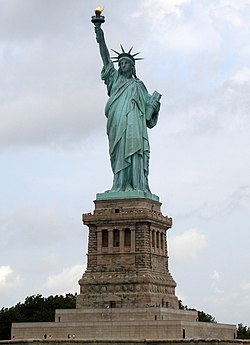
Liberty Enlightening the World (known as the Statue of Liberty), by sculptor Frédéric Auguste Bartholdi, was donated to the US by France in 1886 as an artistic personification of liberty.

Liberty is the state of being free within society from oppressive restrictions imposed by authority on one's way of life, behavior, or political views.[1] The concept of liberty can vary depending on perspective and context. In the Constitutional law of the United States, ordered liberty means creating a balanced society where individuals have the freedom to act without unnecessary interference (negative liberty) and access to opportunities and resources to pursue their goals (positive liberty), all within a fair legal system.

Sometimes liberty is differentiated from freedom by using the word "freedom" primarily, if not exclusively, to mean the ability to do as one wills and what one has the power to do; and using the word "liberty" to mean the absence of arbitrary restraints, taking into account the rights of all involved. In this sense, the exercise of liberty is subject to capability and limited by the rights of others. Thus liberty entails the responsible use of freedom under the rule of law without depriving anyone else of their freedom. Liberty can be taken away as a form of punishment. In many countries, people can be deprived of their liberty if they are convicted of criminal acts.

Liberty's etymology is from the Latin word liber, from Proto-Italic *louðeros, from Proto-Indo-European *h₁léwdʰeros, from *h₁lewdʰ- ('people') (thus cognate to archaic English lede meaning 'man, person').[2] The word "liberty" is commonly used in slogans or quotes, such as in "Life, Liberty and the pursuit of Happiness" from the United States Declaration of Independence,[3] and France's national motto "Liberté, égalité, fraternité".[4]

Philosophy

[edit]
John Stuart Mill

Philosophers from the earliest times have considered the question of liberty. Roman Emperor Marcus Aurelius (121–180 AD) wrote:

a polity in which there is the same law for all, a polity administered with regard to equal rights and equal freedom of speech, and the idea of a kingly government which respects most of all the freedom of the governed.[5]

According to compatibilist Thomas Hobbes (1588–1679):

a free man is he that in those things which by his strength and wit he is able to do is not hindered to do what he hath the will to do.

— Leviathan, Part 2, Ch. XXI.

John Locke (1632–1704) rejected that definition of liberty. While not specifically mentioning Hobbes, he attacks Sir Robert Filmer who had the same definition. According to Locke:

In the state of nature, liberty consists of being free from any superior power on Earth. People are not under the will or lawmaking authority of others but have only the law of nature for their rule. In political society, liberty consists of being under no other lawmaking power except that established by consent in the commonwealth. People are free from the dominion of any will or legal restraint apart from that enacted by their own constituted lawmaking power according to the trust put in it. Thus, freedom is not as Sir Robert Filmer defines it: 'A liberty for everyone to do what he likes, to live as he pleases, and not to be tied by any laws.' Freedom is constrained by laws in both the state of nature and political society. Freedom of nature is to be under no other restraint but the law of nature. Freedom of people under government is to be under no restraint apart from standing rules to live by that are common to everyone in the society and made by the lawmaking power established in it. Persons have a right or liberty to (1) follow their own will in all things that the law has not prohibited and (2) not be subject to the inconstant, uncertain, unknown, and arbitrary wills of others.[6]

John Stuart Mill, in his 1859 work, On Liberty, was the first to recognize the difference between liberty as the freedom to act and liberty as the absence of coercion.[7]

In his 1958 lecture "Two Concepts of Liberty", Isaiah Berlin formally framed the differences between two perspectives as the distinction between two opposite concepts of liberty: positive liberty and negative liberty. The latter designates a negative condition in which an individual is protected from tyranny and the arbitrary exercise of authority, while the former refers to the liberty that comes from self-mastery, the freedom from inner compulsions such as weakness and fear.[8]

Politics

[edit]

History

[edit]
Bust of Aristotle

The modern day concept of political liberty has its origins in the Greek concepts of freedom and slavery.[9] To be free, to the Greeks, was not to have a master, to be independent from a master (to live as one likes).[10][11] That was the original Greek concept of freedom. It is closely linked with the concept of democracy, as Aristotle put it:

"This, then, is one note of liberty which all democrats affirm to be the principle of their state. Another is that a man should live as he likes. This, they say, is the privilege of a freeman, since, on the other hand, not to live as a man likes is the mark of a slave. This is the second characteristic of democracy, whence has arisen the claim of men to be ruled by none, if possible, or, if this is impossible, to rule and be ruled in turns; and so it contributes to the freedom based upon equality."[12]

This applied only to free men. In Athens, for instance, women could not vote or hold office and were legally and socially dependent on a male relative.[13]

The populations of the Persian Empire enjoyed some degree of freedom. Citizens of all religions and ethnic groups were given the same rights and had the same freedom of religion, women had the same rights as men, and slavery was abolished (550 BC). All the palaces of the kings of Persia were built by paid workers in an era when slaves typically did such work.[14]

In the Maurya Empire of ancient India, citizens of all religions and ethnic groups had some rights to freedom, tolerance, and equality. The need for tolerance on an egalitarian basis can be found in the Edicts of Ashoka the Great, which emphasize the importance of tolerance in public policy by the government. The slaughter or capture of prisoners of war also appears to have been condemned by Ashoka.[15] Slavery also appears to have been non-existent in the Maurya Empire.[16] However, according to Hermann Kulke and Dietmar Rothermund, "Ashoka's orders seem to have been resisted right from the beginning."[17]

Roman law also embraced certain limited forms of liberty, even under the rule of the Roman Emperors. However, these liberties were accorded only to Roman citizens. Many liberties established under Roman law endured through the Middle Ages, but were generally limited to the nobility and ruling classes, seldom extending to common people.[18] The idea of inalienable and universal liberties had to wait until the Age of Enlightenment.

Social contract

[edit]
In French Liberty. British Slavery (1792), James Gillray caricatured French "liberty" as the opportunity to starve and British "slavery" as bloated complaints about taxation.

The social contract theory, most influentially formulated by Hobbes, John Locke and Rousseau (though first suggested by Plato in The Republic), was among the first to provide a political classification of rights, in particular through the notion of sovereignty and of natural rights. The thinkers of the Enlightenment reasoned that law governed both heavenly and human affairs, and that law gave the king his power, rather than the king's power giving force to law. This conception of law would find its culmination in the ideas of Montesquieu. The conception of law as a relationship between individuals, rather than families, came to the fore, and with it the increasing focus on individual liberty as a fundamental reality, given by "Nature and Nature's God," which, in the ideal state, would be as universal as possible.

In On Liberty, John Stuart Mill sought to define the "...nature and limits of the power which can be legitimately exercised by society over the individual," and as such, he describes an inherent and continuous antagonism between liberty and authority and thus, the prevailing question becomes "how to make the fitting adjustment between individual independence and social control".[19]

Origins of political freedom

[edit]

According to a 2024 study, a global conception of liberty took form during the late Middle Ages (circa 1000–1600), as "emic terms used across Afro-Eurasia to denote liberty were interconnected through various translingual practices resulting from multilingual governance, courtly encounters, and the spread of religions. Words for liberty in different languages paralleled each other in bilingual legal documents, resonated with each other in different translations of religious texts, and stood next to each other in bureaucratic glossaries and dictionaries."[20] The study concludes, "thus, the concept(s) of liberty, instead of being a product of the West, is more accurately seen as a result of interactions among different parts of the world; the globalization of liberty did not start with the global expansion of the Euro-American empires but has a rich and complex history that predates them."[20]

England and Great Britain

[edit]
Magna Carta (originally known as the Charter of Liberties) of 1215. The British Library.

Timeline:

United States

[edit]
The Liberty Bell is a popular icon of liberty in the US.

According to the 1776 United States Declaration of Independence, all people have a natural right to "Life, Liberty and the pursuit of Happiness". This declaration of liberty was troubled for 90 years by the continued institutionalization of legalized Black slavery, as slave owners argued that their liberty was paramount since it involved property, their slaves, and that Blacks had no rights that any White man was obliged to recognize. The Supreme Court, in the 1857 Dred Scott decision, upheld this principle. In 1866, after the American Civil War, the US Constitution was amended to extend rights to persons of color, and in 1920 voting rights were extended to women.[29]

By the later half of the 20th century, liberty was expanded further to prohibit government interference with personal choices. In the 1965 United States Supreme Court decision Griswold v. Connecticut, Justice William O. Douglas argued that liberties relating to personal relationships, such as marriage, have a unique primacy of place in the hierarchy of freedoms.[30] Jacob M. Appel has summarized this principle:

I am grateful that I have rights in the proverbial public square – but, as a practical matter, my most cherished rights are those that I possess in my bedroom and hospital room and death chamber. Most people are far more concerned that they can control their own bodies than they are about petitioning Congress.[31]

In modern America, various competing ideologies have divergent views about how best to promote liberty. Liberals in the original sense of the word see equality as a necessary component of freedom. Progressives stress freedom from business monopoly as essential. Libertarians disagree, and see economic and individual freedom as best. The Tea Party movement sees "big government" as an enemy of freedom.[32][33] Other major participants in the modern American libertarian movement include the Libertarian Party,[34] the Free State Project,[35][36] and the Mises Institute.[37]

France

[edit]
Eugène DelacroixLiberty Leading the People (La Liberté guidant le peuple) (1830)

France supported the Americans in their revolt against English rule and, in 1789, overthrew their own monarchy, with the cry of "Liberté, égalité, fraternité". The bloodbath that followed, known as the reign of terror, soured many people on the idea of liberty. Edmund Burke, considered one of the fathers of conservatism, wrote "The French had shewn themselves the ablest architects of ruin that had hitherto existed in the world."[38]

Ideologies

[edit]

Liberalism

[edit]

According to the Concise Oxford Dictionary of Politics, liberalism is "the belief that it is the aim of politics to preserve individual rights and to maximize freedom of choice". But they point out that there is considerable discussion about how to achieve those goals. Every discussion of freedom depends on three key components: who is free, what they are free to do, and what forces restrict their freedom.[39] John Gray argues that the core belief of liberalism is toleration. Liberals allow others freedom to do what they want, in exchange for having the same freedom in return. This idea of freedom is personal rather than political.[40] William Safire points out that liberalism is attacked by both the Right and the Left: by the Right for defending such practices as abortion, homosexuality, and atheism, and by the Left for defending free enterprise and the rights of the individual over the collective.[41]

Libertarianism

[edit]

According to the Encyclopædia Britannica, libertarians hold liberty as their primary political value.[42] Their approach to implementing liberty involves opposing any governmental coercion, aside from that which is necessary to prevent individuals from coercing each other.[43]

Libertarianism is guided by the principle commonly known as the Non-Aggression Principle (NAP). The Non-Aggression Principle asserts that aggression against an individual or an individual's property is always an immoral violation of one's life, liberty, and property rights.[44][45] Utilizing deceit instead of consent to achieve ends is also a violation of the Non-Aggression principle. Therefore, under the framework of the Non-Aggression principle, rape, murder, deception, involuntary taxation, government regulation, and other behaviors that initiate aggression against otherwise peaceful individuals are considered violations of this principle.[46] This principle is most commonly adhered to by libertarians. A common elevator pitch for this principle is, "Good ideas don't require force."[47]

Republican liberty

[edit]

According to republican theorists of freedom, like the historian Quentin Skinner[48][49] or the philosopher Philip Pettit,[50] republican liberty consists not simply in the absence of interference (negative liberal freedom), but in the absence of arbitrary dependence on others (as non-domination). A citizen is free when they are not subject to the discretionary will of any other party, public or private. According to this view, which originates in the Roman Digest, to be a free man, means not being subject to another's arbitrary will, that is to say, dominated by another. They cite Machiavelli who asserted that you must be a member of a free self-governing civil association, a republic, if you are to enjoy individual liberty.[51]

While republican ideas of liberty influenced parliamentarians during the English Civil War, Thomas Hobbes developed a distinct conception of liberty in Leviathan, that emphasizes freedom as non-interference, partly in response to the political instability, rather than as a direct continuation of republican non-domination.[52][53]

Socialism

[edit]

Socialists view freedom as a concrete situation as opposed to a purely abstract ideal. Freedom is a state of being where individuals have agency to pursue their creative interests unhindered by coercive social relationships, specifically those they are forced to engage in as a requisite for survival under a given social system. Freedom thus requires both the material economic conditions that make freedom possible alongside social relationships and institutions conducive to freedom.[54]

The socialist conception of freedom is closely related to the socialist view of creativity and individuality. Influenced by Karl Marx's concept of alienated labor, socialists understand freedom to be the ability for an individual to engage in creative work in the absence of alienation, where "alienated labor" refers to work people are forced to perform and un-alienated work refers to individuals pursuing their own creative interests.[55]

Marxism

[edit]

For Karl Marx, meaningful freedom is only attainable in a communist society characterized by superabundance and free access. Such a social arrangement would eliminate the need for alienated labor and enable individuals to pursue their own creative interests, leaving them to develop and maximize their full potentialities. This goes alongside Marx's emphasis on the ability of socialism and communism progressively reducing the average length of the workday to expand the "realm of freedom", or discretionary free time, for each person.[56][57] Marx's notion of communist society and human freedom is thus radically individualistic.[58]

Anarchism

[edit]

While many anarchists see freedom slightly differently, all oppose authority, including the authority of the state, of capitalism, and of nationalism.[59] For the Russian revolutionary anarchist Mikhail Bakunin, liberty did not mean an abstract ideal but a concrete reality based on the equal liberty of others. In a positive sense, liberty consists of "the fullest development of all the faculties and powers of every human being, by education, by scientific training, and by material prosperity." Such a conception of liberty is "eminently social, because it can only be realized in society," not in isolation. In a negative sense, liberty is "the revolt of the individual against all divine, collective, and individual authority."[60]

Historical writings on liberty

[edit]
  • John Locke (1689). Two Treatises of Government: In the Former, the False Principles, and Foundation of Sir Robert Filmer, and His Followers, Are Detected and Overthrown. the Latter Is an Essay Concerning the True Original, Extent, and End of Civil Government. London: Awnsham Churchill.
  • Frédéric Bastiat (1850). The Law. Paris: Guillaumin & Co.
  • John Stuart Mill (1859). On Liberty. London: John W Parker and Son.
  • James Fitzjames Stephen (1874). Liberty, Equality, Fraternity. London: Smith, Elder, & Co.

See also

[edit]

References

[edit]

Bibliography

[edit]

Further reading

[edit]
[edit]
Revisions and contributorsEdit on WikipediaRead on Wikipedia
from Grokipedia
Liberty denotes the condition of individuals being unconstrained by arbitrary coercive interference from others, enabling autonomous action in pursuit of personal ends, a concept rooted in the absence of external impediments to one's will.[1][2] In political philosophy, it is primarily understood as negative liberty—freedom from domination or prevention by external forces—contrasted with positive liberty, which emphasizes self-mastery or realization of potential, though the latter has historically facilitated coercive ideologies by subordinating individual choice to collective or state-defined goods.[3][4] This distinction, articulated by Isaiah Berlin, underscores causal risks where positive conceptions rationalize interference under the guise of empowerment, as evidenced in 20th-century totalitarian regimes.[4][3] The idea traces to ancient civilizations, with early expressions in Mesopotamian codes predating classical Greece, where liberty emerged as participation in self-governing poleis free from tyranny, later evolving through Roman republicanism emphasizing libertas against monarchical overreach.[5][6] Enlightenment thinkers systematized it: John Locke posited liberty as a natural right preceding civil society, protected by government against violations of person and property, influencing constitutional limits on power.[7] John Stuart Mill advanced the harm principle, limiting interference to cases preventing harm to non-consenting others, prioritizing individual experimentation for societal progress.[7] Key manifestations include foundational documents like Magna Carta (1215), curbing royal absolutism and establishing rule-of-law precedents, and the American Declaration of Independence (1776), enshrining liberty alongside life and property pursuit as inalienable.[8] Defining characteristics involve tensions with security and equality; empirical patterns show that expansions of state power ostensibly for welfare often erode liberties through regulatory overreach, while market-ordered societies correlate with higher individual freedoms per indices tracking economic and personal autonomy.[9] Controversies persist over scope—whether liberty extends to economic exchanges or demands positive provisions—yet first-principles analysis affirms that sustainable prosperity arises from voluntary cooperation absent coercive redistribution, as coercive equality undermines the incentives liberty fosters.[8][9]

Conceptual Foundations

Etymology and Core Definitions

The English word liberty derives from the Middle English liberte, which entered the language around 1384, borrowed from Old French liberté and ultimately from Latin libertas, denoting "freedom from restraint" or "condition of a free person."[10][11] The Latin libertas stems from liber, an adjective meaning "free," originally applied to those born free (as opposed to slaves) and linked etymologically to Proto-Indo-European roots associated with "people" or "free-born status," emphasizing independence from bondage rather than mere absence of rules.[10][12] In Roman usage, libertas specifically connoted the civil status of a free citizen, protected by law against arbitrary domination, as exemplified in republican ideals where it contrasted with servitude under kings or tyrants.[12] At its core, liberty denotes the condition of being free from coercive constraints, encompassing the power or capacity of individuals to act according to their own will without external interference.[13][14] This foundational sense aligns with definitions in major lexicons, where it includes freedom from physical restraint, arbitrary authority, or despotic control, often tied to legal protections ensuring autonomy in personal, economic, and political spheres.[13] Philosophically, core conceptions distinguish liberty as the absence of imposed obstacles to voluntary action, presupposing a triadic relation: an agent, potential actions, and barriers (natural or artificial) that must be absent for liberty to obtain.[15] Empirical assessments of liberty thus prioritize measurable reductions in coercion, such as secure property rights and equality under law, over subjective self-realization, as verifiable constraints like taxation or regulation directly impede agency in ways that aspirational capacities do not.[15] While some formulations expand it to include "positive" enablements (e.g., access to resources for self-determination), the primary, restraint-focused definition prevails in classical and legal traditions, avoiding conflation with welfare provisions that may themselves infringe on uncoerced choice.[16]

Negative Liberty

Negative liberty refers to the absence of external obstacles, barriers, or constraints imposed by other individuals or institutions that hinder a person's ability to act according to their choices.[17] This conception emphasizes freedom from interference, focusing on the scope of actions available to an agent without coercion from others.[17] Isaiah Berlin formalized the term in his 1958 inaugural lecture "Two Concepts of Liberty" at Oxford University, defining it as "the area within which a man [or woman] is or should be left to do or be what he is able to do or be."[17][3] The intellectual roots of negative liberty predate Berlin, tracing back to Thomas Hobbes's Leviathan (1651), where liberty is described as the "absence of external impediments" to an agent's motion or will.[18] Jeremy Bentham and John Stuart Mill advanced this idea within utilitarian frameworks; Mill's On Liberty (1859) articulated the harm principle, asserting that the sole justification for restricting individual liberty is to prevent harm to others, thereby preserving a wide sphere of non-interference.[17] Berlin's essay, later published in Four Essays on Liberty (1969), highlighted negative liberty's compatibility with pluralism and limited government, contrasting it with positive liberty's potential for coercive self-realization.[17] In practice, negative liberty is measured by the range of uncoerced options available to individuals, prioritizing protection against arbitrary power through institutions like the rule of law.[17] For instance, legal prohibitions on theft or assault exemplify safeguards that expand negative liberty by preventing private interference, while excessive state regulations can contract it by imposing unnecessary barriers.[17] Critics, including some positive liberty advocates, contend that this view overlooks socio-economic factors as forms of constraint, though proponents maintain that only intentional human interference qualifies as a true obstacle.[17] Berlin emphasized that unchecked pursuit of perfection in positive terms risks totalitarianism, underscoring negative liberty's role in preserving individual autonomy against collective impositions.[3]

Positive Liberty

Positive liberty denotes the capacity of individuals to exercise self-direction and fulfill their rational or higher purposes, often requiring the development of internal faculties or access to enabling conditions rather than mere absence of interference. Isaiah Berlin, in his 1958 Oxford lecture "Two Concepts of Liberty," described it as the freedom "to be one's own master," involving mastery over one's environment and impulses to align actions with an authentic self, distinct from the empirical or desiring self.[17] This conception traces antecedents to ancient Stoic notions of self-control and was elaborated by philosophers like Jean-Jacques Rousseau, who in The Social Contract (1762) posited that true freedom arises from obedience to the general will, which represents the collective rational interest over private appetites.[17][3] In contrast to negative liberty's focus on unimpeded choice amid external obstacles, positive liberty prioritizes empowerment through education, resources, or social structures that cultivate autonomy, such as public provision of education or health services to enable informed decision-making.[17] Thinkers like T.H. Green in his 1881 essay "Liberal Legislation and Freedom of Contract" defended this as "freedom in the positive sense," arguing that state interventions, like regulating working hours, enhance capacities for self-realization by countering deprivations that hinder rational agency.[19] Similarly, G.W.F. Hegel viewed positive freedom as participation in ethical life through the state, where individual will harmonizes with universal reason, transcending mere subjective willfulness.[17] Empirical applications appear in policies aimed at reducing inequality to foster genuine choice, as evidenced by post-World War II welfare states in Europe, where expanded social services correlated with higher human development indices, though causal links to liberty remain debated.[4] Berlin cautioned that positive liberty harbors a "paradox" wherein the divide between higher and lower selves invites authoritarianism: if external authorities claim superior insight into the true self, coercion becomes justified to "liberate" individuals from their misguided desires, as historically manifested in the French Revolution's Reign of Terror (1793–1794), where Robespierre invoked rational sovereignty to execute dissenters, or in Soviet purges under Lenin and Stalin from 1917 onward, rationalized as advancing proletarian self-realization.[17][20] This inversion occurs because positive liberty's emphasis on collective or rational ends can subordinate individual agency to purportedly benevolent forces, empirically linked to regimes where state control expanded under freedom rhetoric, resulting in over 100 million deaths from democide in the 20th century per R.J. Rummel's estimates.[4] Critics like Berlin, prioritizing value pluralism, argued this risks monism—elevating one good (self-mastery) over others—undermining the negative liberty essential for diverse pursuits, a view substantiated by the correlation between high positive-liberty interventions and suppressed dissent in indices like Freedom House reports on authoritarian states.[17] While proponents counter that genuine positive liberty avoids totalitarianism through democratic accountability, historical patterns reveal systemic vulnerabilities when state power interprets the "common good."[21] Liberty and freedom are frequently synonymous in philosophical literature, both referring to the capacity of individuals to act without arbitrary external interference. In Isaiah Berlin's seminal 1958 essay "Two Concepts of Liberty," the terms are employed interchangeably to contrast negative liberty (freedom from coercion by others) with positive liberty (self-realization or mastery over one's environment).[22] However, among American founders influenced by Lockean thought, liberty often denoted an inalienable endowment from natural law or divine origin, antecedent to civil society, while freedom could encompass broader or granted permissions subject to human institutions.[23] This distinction highlights liberty as a protected status under limited government, resilient to revocation, in contrast to freedom as potentially contingent on societal or state tolerance.[24] A critical demarcation exists between liberty and license, the latter signifying unchecked or abusive exercise of power that disregards moral boundaries. John Locke explicitly differentiated them in his Second Treatise of Government (1689), describing the state of nature as one of liberty—where individuals hold "an uncontrollable liberty to dispose of his person or possessions"—but not license, as the natural law forbids harming others' life, health, liberty, or goods.[25] Locke's formulation grounds liberty in reciprocal moral constraints derived from reason and equality, rendering license not true freedom but anarchy that undermines the very conditions for secure individual agency.[26] This view influenced subsequent liberal traditions, emphasizing that genuine liberty requires self-restraint and institutional safeguards against excesses. Liberty further contrasts with rights, which constitute specific moral or legal claims that establish and defend the domain of free action. Rights, such as those to life, property, or conscience, operate as trumps against interference, thereby carving out the practical sphere of liberty.[27] In natural rights theory, as articulated by Locke, liberty emerges as a core right itself—protected through civil government—but rights more broadly encompass duties owed by others to refrain from or remedy violations, enabling liberty's realization.[28] Whereas rights are deontic structures justifying coercion in defense (e.g., via courts or self-defense), liberty denotes the experiential state of unimpeded volition within those bounds, vulnerable without vigilant enforcement of rights.[29]

Historical Development

Ancient and Classical Antecedents

![Aristotle Altemps Inv8575](./assets/Aristotle_Altem ps_Inv8575.jpg) In ancient Greece, the notion of eleutheria (liberty) developed primarily in the context of the fifth-century BCE Athenian democracy, established around 508 BCE by Cleisthenes' reforms, which emphasized collective self-rule free from tyranny or foreign domination. This concept contrasted sharply with subjugation under oligarchs or monarchs, framing liberty as the absence of masters and the right of citizens—free adult males—to live as they pleased within the polity, often invoking participation in assembly and equal rule among equals.[30][31] Scholars trace its political articulation from Homeric epics, where it implied status freedom, to post-Persian War rhetoric celebrating eleutheria as democratic independence, though it excluded slaves, women, and metics, limiting its universality.[32] Philosophers like Aristotle, in his Politics composed circa 350 BCE, analyzed liberty as a core democratic principle, defining it as citizens being free and equal, ruling and being ruled in turn to prevent domination. He cautioned, however, that unchecked liberty devolves into license, prioritizing virtue and the common good over absolute individual autonomy, viewing extreme democracy as unstable and inferior to a mixed constitution balancing liberty with order.[33][34] Plato, in The Republic around 380 BCE, critiqued democratic liberty as chaotic excess leading to tyranny, advocating philosopher-kings to curb passions for true justice over mere freedom. This is illustrated in his design for the guardian class, where communal ownership of property, wives, and children eliminates familial and possessive conflicts that foster factionalism, thereby subordinating personal autonomy to collective harmony and order.[35][36] In the Roman Republic, established traditionally in 509 BCE after expelling the last king Tarquinius Superbus, libertas signified the status of free citizens protected from arbitrary power, embodied in institutions like the Senate, assemblies, and tribunes safeguarding against magisterial overreach. Cicero, in De Re Publica and De Legibus written in the 50s BCE, elaborated libertas as subjection to law rather than men, essential for republican concord (concordia) and equity, warning that its erosion through factionalism invited servitude under demagogues or dictators.[37][38] This ideal contested between optimates emphasizing senatorial authority and populares invoking popular sovereignty, yet unified in opposing dominatio (domination), influencing later conceptions of constitutional liberty.[39]

Medieval and Scholastic Contributions

In the early medieval period, Augustine of Hippo (354–430 CE) laid foundational theological groundwork for liberty through his emphasis on free will as essential to human nature, positing that individuals possess the inherent capacity to choose between obedience to God or deviation into sin, thereby establishing liberty as a divine endowment rather than mere absence of external constraint.[40] This view influenced subsequent scholastic thinkers by reconciling human autonomy with divine providence, rejecting deterministic interpretations of grace while affirming that true liberty aligns with rational pursuit of the good.[41] High scholasticism, peaking in the 13th century, advanced liberty via integration of Aristotelian philosophy with Christian theology, particularly through Thomas Aquinas (1225–1274 CE), who defined free will in the Summa Theologica as the self-moving faculty by which humans elect means to ends apprehended by reason, distinct from coerced necessity yet compatible with divine foreknowledge.[42] Aquinas argued that liberty inheres in the will's capacity for self-determination toward the good, not unhindered whim, thereby grounding moral responsibility in voluntary action rather than fatalism; he rejected both Pelagian overemphasis on unaided human freedom and deterministic views that negate choice.[43][44] Scholastic natural law theory further elaborated liberty as derived from rational human nature ordained by God, with canonists like Gratian (c. 1140 CE) in the Decretum articulating principles of consensual rights and protections against unjust servitude, prefiguring subjective individual liberties by positing a universal "one liberty of all men" incompatible with innate slavery.[45][46] Later scholastics, including those of the School of Salamanca (16th century), extended this to emphasize personal agency in economic and social spheres, defending property rights and voluntary exchange as expressions of natural liberty against coercive monopolies.[47] These contributions shifted liberty from purely theological free will toward proto-political dimensions, influencing canon law's role in limiting arbitrary power and fostering equality under divine order.[48]

Enlightenment and Liberal Foundations

The Enlightenment, spanning roughly from the late 17th to the early 19th century, marked a pivotal shift in conceptions of liberty by prioritizing rational inquiry, individual rights, and limitations on arbitrary power over traditional authorities like monarchy and church dogma. Thinkers challenged absolutist rule, positing that liberty derived from inherent human nature rather than divine grant or social station, laying groundwork for classical liberalism's emphasis on personal autonomy and consent-based governance.[49][50] Thomas Hobbes, in Leviathan (1651), illustrated the tension between liberty and order through social contract theory, depicting the state of nature as a war of all against all driven by self-preservation, where individuals surrender natural freedoms to an absolute sovereign to secure peace and eliminate pervasive conflict.[51][52] John Locke's Two Treatises of Government (1689) articulated a foundational theory of natural liberty, asserting that individuals in the state of nature possess equal rights to life, health, liberty, and possessions, which no one may infringe without consent. Locke argued that civil society forms through mutual agreement to protect these rights via government, but if rulers violate them, the people retain the right of revolution to restore liberty. This framework influenced liberal thought by framing liberty as freedom from coercive interference, contingent on reciprocal obligations rather than unchecked authority.[53][54] Montesquieu's The Spirit of the Laws (1748) advanced liberty through institutional design, defining it as the right to do what laws permit without fear of arbitrary punishment, achievable only via separation of legislative, executive, and judicial powers. He contended that concentrating powers in one body, as in despotic regimes, destroys liberty, while balanced distribution—modeled partly on England's constitution—prevents tyranny and safeguards individual action within legal bounds. Montesquieu's analysis, drawing from historical examples like Rome's decline under consolidated rule, underscored causal links between power structures and personal freedom, informing liberal constitutionalism.[55][56] Voltaire championed civil liberties through advocacy for religious tolerance and critique of fanaticism, arguing in works like his Treatise on Toleration (1763) that intolerance violates natural law and exceeds even animal instincts for predation. Influenced by England's post-1688 settlement, he praised its constitutional limits on monarchy and ecclesiastical power as models for securing thought and expression against persecution, though he stopped short of full separation of church and state. Voltaire's emphasis on empirical observation of tolerant societies versus oppressive ones reinforced liberalism's preference for skepticism toward centralized moral enforcement.[57][58] Adam Smith's An Inquiry into the Nature and Causes of the Wealth of Nations (1776) extended liberty to economic spheres, proposing a "system of natural liberty" where individuals pursue self-interest under minimal regulation, leading to societal prosperity via division of labor and free exchange. Smith warned that mercantilist restrictions and monopolies curtail this liberty, stifling innovation and efficiency, as evidenced by comparative wealth in freer versus controlled economies like France's. This integrated liberty with empirical economic causation, forming liberalism's case for laissez-faire as both moral and utilitarian.[59][60] These ideas coalesced in classical liberalism's core tenets—natural rights, limited government, and rule of law—prioritizing negative liberty (absence of external constraints) over collective impositions, as validated by subsequent institutional successes like the U.S. Constitution's adoption of separated powers in 1787.[61][50]

Political Philosophies Emphasizing Liberty

Classical Liberalism

Classical liberalism emerged in the 17th and 18th centuries as a political philosophy prioritizing individual liberty, understood primarily as negative liberty—freedom from arbitrary coercion by the state or others—grounded in natural rights and limited government. This tradition holds that individuals possess inherent rights to life, liberty, and property, which government exists solely to protect through the rule of law, deriving its authority from the consent of the governed.[62][63] Key to this view is the presumption against state intervention, allowing individuals maximal scope for self-directed action in personal, economic, and intellectual spheres, as long as it does not violate others' equal rights.[64] John Locke (1632–1704), often regarded as a foundational figure, articulated these principles in his Two Treatises of Government (1689), arguing that liberty consists in the natural right to govern one's own actions within the bounds of natural law, with government formed via social contract to secure these rights against aggression.[63] Locke's framework influenced Enlightenment thought by positing that excessive government power leads to tyranny, necessitating separation of powers and protections like habeas corpus to preserve liberty.[65] Similarly, Montesquieu (1689–1755) in The Spirit of the Laws (1748) advocated division of government into legislative, executive, and judicial branches to prevent concentration of authority that could undermine individual freedoms.[66] In the economic domain, Adam Smith (17231790) advanced classical liberal liberty through The Wealth of Nations (1776), contending that unrestricted markets, driven by self-interest and the "invisible hand," generate prosperity and personal autonomy by enabling voluntary exchanges free from mercantilist controls.[65] Smith's ideas underscored how economic liberty correlates with broader societal benefits, such as division of labor boosting productivity—evidenced by Britain's industrial output rising from £43 million in 1688 to £353 million by 1801 in constant prices—without central planning.[67] John Stuart Mill (1806–1873) refined the doctrine in On Liberty (1859), introducing the harm principle: state interference with liberty is justifiable only to prevent harm to others, not to enforce moral conformity or paternalistic ends.[62] Mill extended protections to freedom of speech and thought as essential for truth discovery and personal development, warning that censorship stifles progress, as seen in historical suppressions like Galileo's 1633 trial.[64] This emphasis on intellectual liberty complemented earlier views, forming a cohesive defense of individualism against collectivist encroachments. Classical liberalism's institutional legacy includes constitutional mechanisms like the U.S. Bill of Rights (1791), which enshrined protections for speech, assembly, and due process, reflecting Lockean and Madisonian influences to constrain majority rule and safeguard minority liberties.[63] Empirically, societies adopting these principles, such as 19th-century Britain after repealing the Corn Laws in 1846, experienced sustained GDP growth averaging 2% annually—unprecedented at the time—attributable to expanded trade and property rights rather than coercive redistribution.[67] Critics from utilitarian or socialist perspectives, like those in academia today, often downplay these outcomes, favoring interventionist policies despite evidence from failed experiments such as Soviet central planning, which reduced per capita output relative to liberal economies by factors of 3–5 by 1989.[62]

Libertarianism and Individualist Anarchism

Libertarianism posits individual liberty as the highest political value, defined as the freedom to control one's own body, labor, and property without coercive interference from others.[68] This philosophy emphasizes the non-aggression principle (NAP), which prohibits the initiation of force, fraud, or coercion against persons or their legitimately acquired possessions, allowing only defensive responses to violations.[69] Derived from self-ownership—the axiom that individuals possess absolute rights over their own lives and the fruits of their efforts—the NAP serves as the ethical foundation for rejecting state monopolies on violence, taxation as theft, and regulations as infringements on voluntary exchange.[70] Key formulations appear in Murray Rothbard's For a New Liberty (1973), which argues for deriving all rights from self-ownership and homesteading, and Robert Nozick's Anarchy, State, and Utopia (1974), which defends a minimal night-watchman state as the only legitimate outcome of voluntary processes while critiquing redistributive justice.[71] While some libertarians accept a limited government confined to protecting against aggression—termed minarchism—others extend the logic to individualist anarchism, advocating the complete abolition of the state in favor of voluntary, market-based institutions for defense, arbitration, and insurance.[70] Individualist anarchism, rooted in 19th-century American thought, asserts that true liberty requires dismantling all coercive hierarchies, including government, to enable full self-ownership and contractual relations among sovereign individuals.[72] Proponents like Benjamin Tucker (1854–1939), through his journal Liberty (1881–1908), contended that state privileges such as monopolies on money and land titles suppress competition and liberty, proposing instead "consistent Manchesterism"—free markets without government intervention—to achieve economic equality via voluntary association and mutual banking.[73] Tucker viewed anarchism not as chaos but as the maximization of individual sovereignty, where "the right of contract" supplants natural rights rhetoric, allowing people to exchange services, including protection, without archic authority.[72][74] This tradition influenced later anarcho-capitalists like Rothbard (1926–1995), who in The Ethics of Liberty (1982) formalized self-ownership as entailing property rights derived from unowned resource appropriation, arguing that stateless societies would emerge spontaneously through competing private agencies more efficiently than monopolistic states.[71] Empirical defenses highlight historical precedents like medieval Iceland's voluntary legal systems or modern private arbitration, where decentralized enforcement reduces aggression costs compared to state bureaucracies prone to expansion.[70] Critics from collectivist perspectives often mischaracterize these views as endorsing exploitation, but individualist anarchists counter that state intervention, not markets, creates privilege and inequality, as evidenced by tariffs and subsidies benefiting elites at the expense of voluntary cooperation.[72]

Republican and Civic Traditions

In the republican tradition, liberty is understood primarily as non-domination, denoting the absence of arbitrary power over individuals rather than mere absence of interference. This conception traces to the Roman Republic, established in 509 BCE following the overthrow of the monarchy, where libertas signified freedom from capricious rule through institutions like the Senate, popular assemblies, and tribunes of the plebs, which provided checks against elite dominance and ensured due process rights for citizens. Roman thinkers such as Cicero emphasized libertas as the status of a free citizen under the rule of law, protected from enslavement by arbitrary will, with civic participation in elections and veto powers serving as mechanisms to contest potential domination.[75][39][76] This framework was revived during the Renaissance, particularly by Niccolò Machiavelli in his Discourses on Livy (composed around 1517), who argued that republican liberty depends on civic virtue—citizens' active commitment to the common good—and the productive channeling of social conflicts between classes to prevent corruption and maintain self-governance. Machiavelli contended that republics endure longer than principalities because they foster virtù (political agency) through laws and institutions that balance power, such as Rome's mixed constitution, enabling citizens to resist domination without relying on a benevolent ruler.[77][78] Influenced by Roman models, he viewed liberty not as isolated individual autonomy but as collective self-rule, where participation in public life counters the natural tendency toward factionalism and decay.[79] Civic republicanism, extending these ideas into early modern thought, stresses the interdependence of personal freedom and communal involvement, as articulated by figures like James Harrington and Algernon Sidney in 17th-century England, who linked liberty to agrarian laws and rotation in office to avert oligarchic control. In the American founding era, thinkers such as James Madison in Federalist No. 10 (1787) incorporated republican safeguards against factional domination via federalism and separation of powers, viewing civic engagement as essential to preserving liberty against majority tyranny or elite capture.[80][81] Contemporary neo-republicanism, revived by Quentin Skinner and Philip Pettit, refines liberty as non-domination, where an agent is free if insulated from others' capacity for uncontested interference, achievable through contestatory democracy—empowered citizens and institutions that monitor and challenge power holders—rather than coercive redistribution. Pettit, in Republicanism: A Theory of Freedom and Government (1997), argues this ideal justifies state interventions to equalize status and prevent vulnerability, distinguishing it from liberal non-interference by prioritizing security from potential arbitrary rule over minimal government.[82][81][83] Skinner traces this to neo-Roman theory, where independence from mastery requires vigilance against dependence on patrons or rulers, as in 17th-century debates over absolute monarchy.[84] Critics note that empirical applications, such as in ancient Athens or Rome, often devolved into instability due to unchecked demagoguery, underscoring the tradition's reliance on exceptional civic virtue rarely sustained long-term.[85]

Collectivist Perspectives and Critiques

Socialist and Marxist Conceptions

In socialist thought, liberty is often framed not as the absence of coercion emphasized in liberal traditions, but as the collective emancipation of individuals from the material constraints imposed by class society and capitalist production relations. Early socialists like Robert Owen and Charles Fourier envisioned liberty through communal reorganization of labor and property, aiming to liberate human potential from competitive individualism, though these ideas prefigured more systematic Marxist critiques.[86] Karl Marx, in his 1843 essay "On the Jewish Question," critiqued liberal political emancipation—encompassing rights to liberty, equality, and fraternity—as a superficial form that preserves egoistic isolation and private property as the basis of human relations. Marx argued that such rights, including the "right to liberty" manifested in property ownership, reduce individuals to abstract, self-interested atoms separated from communal life, stating: "The practical application of man’s right to liberty is man’s right to private property." True human emancipation, for Marx, requires transcending this bourgeois framework to achieve species-being, where individuals freely associate in pursuit of collective needs without alienation. Marxist conceptions further posit liberty as emerging from historical materialism, where freedom evolves from necessity under capitalism—workers compelled to sell labor amid exploitation—to genuine self-determination in a classless communist society. In this view, capitalist "liberty" is illusory, as economic coercion undermines formal freedoms; authentic liberty demands proletarian revolution to abolish private ownership of production, enabling the "free development of each" as the condition for all.[87][88] Marx and Engels outlined this in works like The German Ideology (1845–1846), where consciousness and freedom arise from practical activity in a society without division of labor, contrasting liberal negative liberty with a positive, relational freedom rooted in overcoming scarcity and antagonism. Subsequent Marxists, such as Friedrich Engels in Anti-Dühring (1878), reinforced this by linking liberty to the withering away of the state post-revolution, where administrative functions serve universal interests rather than class rule. Lenin adapted this in State and Revolution (1917), viewing transitional "dictatorship of the proletariat" as a phase to smash bourgeois liberty's coercive apparatus, paving the way for socialist freedom—though critics note this subordinates individual rights to collective ends during the interim. Later theorists like Herbert Marcuse critiqued "repressive tolerance" in liberal societies, arguing true liberation requires overcoming false needs imposed by capitalism, prioritizing substantive equality over procedural freedoms. Empirical scrutiny of these conceptions reveals tensions: while theoretically aspiring to universal self-realization, they often deprioritize safeguards for dissenting individuals in favor of class vanguardism, as evidenced in Marxist texts' emphasis on suppressing counter-revolutionary elements to secure collective liberty.[89] This contrasts with liberal individualism but aligns with causal realities of power concentration in revolutionary processes, where abstract collective goals can empirically curtail personal autonomy.[88]

Communitarian and Positive Liberty Variants

Positive liberty, as distinguished by philosopher Isaiah Berlin in his 1958 Oxford lecture "Two Concepts of Liberty," emphasizes an individual's capacity for self-mastery and self-realization, contrasting with negative liberty's focus on absence of external constraints.[17] Berlin defined it as deriving from the desire to be one's own master, involving rational control over passions or the ability to fulfill one's higher potential, often requiring enabling conditions like education or social structures.[17] He cautioned that this concept risks authoritarian inversion, where a ruling elite claims to act on behalf of the "true" self of individuals, justifying coercion—historically evident in Rousseau's general will leading to Jacobin terror in 1793 or Marxist-Leninist dictatorships suppressing dissent under the guise of collective emancipation.[17] Communitarian thinkers, emerging prominently in the 1980s, build on positive liberty by critiquing negative liberty's alleged atomism, which they argue neglects how personal identity and autonomy arise from embedded social relations and shared moral horizons.[90] Philosophers like Charles Taylor, in his 1979 essay "What's Wrong with Negative Liberty," contended that mere absence of obstacles fails to address ordinary unfreedoms, such as lack of recognition or communal support, advocating instead for positive freedom rooted in participatory horizons of meaning provided by communities.[90] Taylor modified Berlin's framework by insisting that negative liberty presupposes positive communal preconditions, like dialogical self-formation through family and society, without which individuals cannot exercise meaningful choice.[90] Similarly, Alasdair MacIntyre in After Virtue (1981) argued that liberal rights discourse fragments moral agency, proposing virtue ethics grounded in narrative traditions sustained by communities over abstract individualism.[90] These variants prioritize collective goods and relational autonomy, viewing liberty as realized through social cohesion rather than isolated rights; Michael Sandel, for instance, in Liberalism and the Limits of Justice (1982), critiqued Rawlsian veils of ignorance for producing unencumbered selves detached from constitutive attachments like nationality or faith.[90] Proponents claim this fosters genuine flourishing, as evidenced in Taylor's endorsement of Quebec's cultural policies in the 1980s to preserve francophone identity against anglophone dominance, framing such measures as enabling authentic self-expression.[90] However, Berlin's warning persists: positive liberty's emphasis on collective self-determination can erode negative protections, as seen in communitarian defenses of group-differentiated rights that subordinate individual dissent to majority or elite-defined communal goods, potentially mirroring historical patterns where "freedom for the people" masked rule by a vanguard.[17] Academic communitarianism, while influential in policy debates like multiculturalism, often overlooks empirical tensions where strong communal enforcement—such as in religious enclaves or welfare states mandating solidarity—correlates with reduced personal exit options, as documented in studies of social capital's trade-offs with mobility.[90]

Empirical Outcomes of Collectivist Approaches

Collectivist approaches emphasizing centralized economic planning and collective ownership have frequently resulted in suboptimal resource allocation, reduced productivity, and humanitarian crises, as evidenced by historical case studies. In the Soviet Union, rapid industrialization under Stalin's Five-Year Plans achieved average annual GDP growth of around 5-6% from 1928 to 1940, but this masked inefficiencies from the absence of market signals and led to stagnation thereafter, with growth averaging under 2% annually from 1970 to 1989—worse than global peers after adjusting for investment and human capital.[91][92] The command economy's reliance on quotas and suppression of private incentives contributed to chronic shortages, culminating in a post-1991 GDP collapse of 40-50% across former republics during the transition from planning.[93] China's Great Leap Forward (1958-1962), a collectivization drive to surpass British steel output, instead triggered the deadliest famine in history, with excess deaths estimated at 30 million from starvation and related causes due to disrupted agriculture, exaggerated production reports, and resource diversion to ineffective backyard furnaces.[94] Food output plummeted by up to 30%, industrial goals failed amid quality collapses, and the episode delayed economic recovery until market-oriented reforms post-1978.[95] Similarly, the Korean Peninsula's division after 1945 illustrates divergent paths: North Korea's juche system of state control yielded GDP per capita of approximately $1,700 in 2024, with chronic malnutrition affecting 40% of the population, while South Korea's export-driven, property-respecting model propelled GDP per capita to $36,000, a 20-fold gap from mid-1970s parity.[96][97] More recent implementations, such as Venezuela's Bolivarian socialism from 1999 onward, demonstrate accelerated decline in resource-dependent economies. Nationalizations of oil, agriculture, and industry under Chávez and Maduro reduced food production by 75% over two decades, triggered hyperinflation peaking at over 1 million percent annually in 2018, and contracted GDP by 75% from 2013 to 2021— the sharpest peacetime collapse on record outside revolution.[98][99] Price controls and currency mismanagement exacerbated shortages, driving over 7 million emigrants and reverting per capita income below 1920s levels by 2020.[100] These outcomes stem from distorted incentives, where state monopolies prioritize political loyalty over efficiency, contrasting with liberty-oriented systems' higher sustained growth via decentralized decision-making.[101] Empirical cross-country analyses confirm that prolonged socialism correlates with lower physical quality-of-life indicators at comparable development levels, including higher infant mortality and reduced life expectancy absent external aid.[102]

Common Law and English Liberties

The foundations of English common law, which underpins many protections of individual liberty, emerged during the reign of Henry II (1154–1189). In 1166, the Assize of Clarendon introduced procedures for criminal trials, including the use of sworn inquests by local juries to identify suspects, marking an early step toward trial by jury and reducing reliance on ordeal or combat.[103] This reform centralized royal justice through itinerant justices, promoting uniformity in law application and limiting feudal lords' arbitrary power, thereby advancing the rule of law as a constraint on executive discretion.[104] The Magna Carta, sealed by King John on June 15, 1215, at Runnymede, further entrenched liberties by prohibiting arbitrary imprisonment and exile without lawful judgment by peers or the law of the land, as stated in Clause 39.[105] This clause laid groundwork for due process protections, influencing habeas corpus by requiring justification for detention and curbing monarchical absolutism through baronial enforcement mechanisms.[106] Though initially a feudal charter favoring nobles, its reissues and judicial interpretations extended principles to broader subjects, emphasizing legal predictability over personal rule.[107] Habeas corpus evolved from common law writs, with roots in the Assize of Clarendon and Magna Carta, compelling authorities to produce a detainee before a court to justify custody.[108] The Habeas Corpus Act of 1679 codified these protections, mandating swift judicial review and penalties for non-compliance, safeguarding personal liberty against unlawful executive detention.[109] The English Bill of Rights, enacted December 16, 1689, following the Glorious Revolution, affirmed parliamentary supremacy and enumerated liberties including freedom of speech in Parliament, prohibition of excessive bail or cruel punishments, and the right to petition the monarch without reprisal.[110] It barred standing armies in peacetime without consent and required frequent parliaments via regular elections, institutionalizing checks on royal power and fostering a presumption of liberty where actions are permitted unless expressly prohibited by law.[111] These developments in common law prioritized individual rights through adversarial proceedings, jury involvement, and judicial precedent, distinguishing English liberties by subordinating governance to established legal norms rather than discretionary authority.[112]

American Constitutional Framework

The United States Constitution, drafted in 1787 and ratified by the ninth state on June 21, 1788, establishes a framework designed to secure liberty through limited government and checks on power.[113] Its Preamble explicitly states the objective to "secure the Blessings of Liberty to ourselves and our Posterity," reflecting the framers' intent to protect individual freedoms from arbitrary authority.[114] This structure draws from Enlightenment influences, including John Locke's emphasis on natural rights to life, liberty, and property, and Montesquieu's advocacy for separation of powers to prevent tyranny.[115][116] Central to this framework is the division of authority into three co-equal branches: legislative (Article I), executive (Article II), and judicial (Article III), each with distinct powers and mechanisms for mutual oversight.[117] Congress holds enumerated legislative powers, the President executes laws, and the judiciary interprets them, ensuring no single branch dominates.[118] Federalism further constrains central authority by reserving non-delegated powers to the states or the people, as affirmed in the Tenth Amendment: "The powers not delegated to the United States by the Constitution, nor prohibited by it to the States, are reserved to the States respectively, or to the people."[119] This reservation principle, articulated in the Federalist Papers by James Madison, limits federal overreach and preserves local autonomy as a bulwark for liberty.[113] The Bill of Rights, comprising the first ten amendments ratified on December 15, 1791, codifies specific protections against federal infringement on individual liberties.[120] The First Amendment prohibits laws abridging freedom of speech, religion, press, assembly, or petition; the Second secures the right to keep and bear arms; the Fourth guards against unreasonable searches and seizures; and the Fifth ensures due process, protection from self-incrimination, and double jeopardy.[120] These provisions embody negative liberties—restraints on government action rather than entitlements to services—aimed at shielding citizens from state coercion, as the framers viewed unchecked power as the primary threat to freedom.[121] Subsequent amendments expanded this framework, with the Thirteenth (1865) abolishing slavery, the Fourteenth (1868) extending due process and equal protection to actions by states, and the Fifteenth (1870) prohibiting voting discrimination by race.[122] Yet the core constitutional design remains oriented toward enumerating and limiting government to safeguard inherent rights, a principle Madison defended in Federalist No. 51 by arguing that liberty requires ambition to counteract ambition through institutional rivalry.[113] This approach prioritizes structural safeguards over expansive positive rights, fostering a system where individual agency prevails against collective impositions.

Continental European Developments

In continental Europe, philosophical foundations for liberty emerged prominently during the Enlightenment, with thinkers like Montesquieu arguing in The Spirit of the Laws (1748) for separation of powers as essential to preventing despotism and securing political liberty.[123] Voltaire, through campaigns against religious intolerance such as the Calas affair in 1762, advanced principles of tolerance and free inquiry, criticizing arbitrary state and ecclesiastical authority as threats to individual freedom.[123] These ideas emphasized rational limits on power, influencing subsequent legal reforms, though Rousseau's conception of liberty subordinated individual rights to the general will, foreshadowing collectivist tensions.[124] The French Revolution marked a pivotal institutional shift, with the National Constituent Assembly adopting the Declaration of the Rights of Man and of the Citizen on August 26, 1789, asserting that "men are born and remain free and equal in rights" and defining liberty as the power to do anything that does not harm others' rights, provided it aligns with societal security.[125] This document enshrined natural rights including liberty, property, and security against arbitrary arrest, drawing from Enlightenment rationalism to challenge absolutism.[126] However, revolutionary application devolved into the Reign of Terror from September 1793 to July 1794, during which the Committee of Public Safety guillotined approximately 17,000 individuals, demonstrating how abstract declarations of liberty could enable tyrannical enforcement under radical egalitarian pretexts.[127] Napoleon's Civil Code of 1804 further codified liberty principles, establishing legal equality for male citizens, abolishing feudal privileges, and protecting property rights while secularizing civil institutions.[128] Promulgated on March 21, 1804, it simplified prior decrees into a unified system emphasizing freedom of contract and religion, influencing civil codes across Europe and Latin America.[129] Yet, its implementation under Napoleon's centralized empire curtailed political dissent and press freedom, revealing a pattern where continental codifications prioritized state-structured equality over robust negative liberties.[128] Subsequent developments included the Revolutions of 1848, which sought constitutional protections for liberty across German and Italian states but largely failed, reverting to monarchical restorations and highlighting the fragility of revolutionary gains amid fragmented polities.[130] In the 20th century, post-World War II frameworks like the German Basic Law of 1949 embedded inviolable human dignity and personal liberty, prohibiting restrictions except by law for public welfare.[131] The European Convention on Human Rights, signed November 4, 1950, by continental states including France, Italy, and West Germany, institutionalized safeguards against arbitrary deprivation of liberty, influencing national jurisprudence through supranational oversight.[132] These instruments reflect a continental emphasis on codified rights within statist frameworks, contrasting with evolutionary common law traditions, though empirical outcomes often showed vulnerability to authoritarian backsliding, as in interwar Europe.[133]

Economic Aspects of Liberty

Property Rights and Free Markets

Property rights form a cornerstone of individual liberty by extending the principle of self-ownership to acquired resources, enabling individuals to control, use, and transfer goods without arbitrary interference.[134] This security against expropriation allows for productive investment and innovation, as individuals bear the risks and reap the rewards of their efforts. Without enforceable property rights, economic activity devolves into predation or stagnation, undermining personal autonomy.[135] Free markets emerge as the institutional embodiment of these rights, where voluntary exchanges occur under rules that protect ownership and contracts. In such systems, prices emerge spontaneously to coordinate supply and demand, fostering efficient resource allocation without central planning. Historical precedents, such as the expansion of property protections in England following the [Glorious Revolution](/page/Glorious Revolution) of 1688, correlated with accelerated industrialization and wealth creation by incentivizing capital accumulation and trade.[136] Similarly, post-World War II reforms in West Germany and Japan, emphasizing market liberalization and property restitution, propelled rapid growth rates exceeding 8% annually in the 1950s and 1960s.[137] Empirical data consistently links robust property rights and economic freedom to prosperity. The Heritage Foundation's Index of Economic Freedom shows that nations scoring in the "free" category (above 80 points) achieve average GDP per capita over $70,000, compared to under $7,000 in "repressed" economies (below 50 points), with causal analyses indicating that freedom reforms precede growth accelerations of 1-2% in GDP per capita over five years.[138] [139] Cross-country regressions confirm a positive coefficient between economic freedom indices and growth, even controlling for initial conditions and institutions.[140] In developing contexts, informal property holdings represent "dead capital" due to lack of formal titles, estimated at $9.3 trillion globally by Peruvian economist Hernando de Soto, who documented how titling programs in Peru mobilized over $1 billion in credit from previously untitled urban assets between 1998 and 2000.[141] Such reforms enhance liberty by converting extralegal possessions into leverageable assets, spurring entrepreneurship while reducing disputes over ownership.[142] Critiques from state-centric perspectives often overlook these dynamics, attributing inequality to markets rather than to barriers like weak enforcement, though evidence favors the latter as the primary causal factor in underdevelopment.[143]

Critiques of State Intervention

Critiques of state intervention in economic affairs emphasize its tendency to undermine individual liberty by coercing resource allocation away from voluntary exchanges, distorting price signals that convey dispersed knowledge, and fostering dependency on government authority. Ludwig von Mises, in his 1929 work Interventionism: An Economic Analysis, argued that partial interventions—such as price controls or subsidies—disrupt market coordination, creating imbalances that necessitate further interventions, ultimately leading to either full socialism or a reversion to laissez-faire, as the intermediate state proves unstable. This dynamic erodes economic liberty, as individuals lose the autonomy to pursue their preferences through free contracts, replaced by bureaucratic directives that prioritize political goals over efficiency. Friedrich Hayek extended this reasoning in The Road to Serfdom (1944), contending that centralized economic planning, even if initially limited, requires suppressing dissent to enforce uniform outcomes, paving the way for authoritarianism. Hayek's "knowledge problem" highlights how no central authority can aggregate the tacit, localized knowledge held by millions of actors, leading to misallocations like resource shortages or innovation stagnation; empirical extensions of this idea, such as Soviet five-year plans from 1928 onward, resulted in famines and industrial inefficiencies, with agricultural output per capita falling 20-30% below pre-intervention levels by the 1930s.[144] Such interventions infringe on liberty by overriding individuals' spontaneous order, substituting top-down commands that concentrate power in the state. Public choice theory, developed by James Buchanan and Gordon Tullock in The Calculus of Consent (1962), critiques state intervention by applying economic incentives to politics, revealing "government failure" where self-interested politicians, bureaucrats, and interest groups pursue rents—transfers benefiting subsets at general expense—rather than public welfare.[145] Rent-seeking behaviors, such as lobbying for subsidies, consume resources equivalent to 10-15% of GDP in advanced economies, diverting productive efforts toward influence peddling and entrenching cronyism over merit-based competition.[146] This framework explains bureaucratic expansion, as agencies like the U.S. Environmental Protection Agency grew regulatory output by over 2,000% since 1970, often yielding diminishing marginal benefits amid rising compliance costs that disproportionately burden small enterprises.[147] Empirical studies quantify intervention's drag on prosperity: U.S. federal regulations imposed costs of $3.079 trillion in 2022, equating to $12,800 per employee and reducing GDP growth by 0.8% annually from 1980-2020.[148] Cross-country analyses show that higher regulatory burdens correlate with slower growth; for instance, nations with lighter product market regulations, like Hong Kong pre-1997, achieved 5-7% annual GDP expansion in the 1980s-1990s, versus 1-2% in heavily intervened economies like France.[149] Deregulation episodes, such as U.S. airline reforms in 1978, lowered fares by 40% in real terms and boosted capacity, demonstrating how curtailing intervention enhances consumer choice and efficiency without sacrificing safety.[150] Unintended consequences further illustrate liberty's erosion: minimum wage hikes, intended to aid workers, elevate youth unemployment rates by 1-3% per 10% increase, as evidenced in U.S. data from 1938-2020, pricing low-skilled labor out of markets and fostering black-market alternatives. Similarly, rent controls in cities like New York since 1943 reduced housing supply by 15-20%, exacerbating shortages and diminishing tenants' mobility, a form of coerced allocation that privileges incumbents over new entrants. These outcomes underscore how interventions, while ostensibly protective, systematically curtail voluntary associations, channeling decisions through coercive state mechanisms prone to capture by vested interests.

Evidence from Economic History

The Industrial Revolution in Great Britain, commencing in the late 18th century, demonstrated the causal link between expanded economic liberty—encompassing secure property rights, sound money, and limited state interference—and sustained prosperity. Britain's relatively hands-off approach, including low tariffs post-1846 Corn Law repeal and enforcement of contracts via common law, facilitated capital accumulation and innovation, propelling GDP per capita growth from about 0.2% annually pre-1760 to over 1% thereafter, transforming a agrarian economy into the world's first industrial powerhouse by 1830.[151][152] This era's emphasis on individual enterprise contrasted with mercantilist restrictions elsewhere, yielding higher living standards as real wages for workers rose steadily after initial adjustments.[153] In the 19th-century United States, adherence to laissez-faire principles under minimal federal regulation amplified economic liberty's effects, fueling rapid industrialization and westward expansion. From 1820 to 1900, U.S. GDP per capita surged approximately 1.8% annually, driven by free trade, patent protections, and private infrastructure like railroads, which integrated markets without central planning.[154] This period's low government spending (under 3% of GDP) and absence of income taxes until 1913 correlated with innovations in steel, electricity, and oil, elevating average incomes from $1,200 to $4,000 (in 1990 dollars) and reducing poverty through voluntary exchange rather than redistribution.[155] Post-World War II recoveries in West Germany and Japan further evidenced economic liberty's role in reversing devastation. In Germany, Economics Minister Ludwig Erhard's 1948 reforms—dismantling Nazi-era price controls, introducing the Deutsche Mark, and liberalizing markets—sparked the Wirtschaftswunder, with industrial production quadrupling by 1955 and unemployment plummeting from 10% to near zero within two years, as free prices allocated resources efficiently.[156][157] Similarly, Japan's post-1945 liberalization, including tax cuts and export incentives under U.S. occupation, achieved 10% annual GDP growth through the 1960s, with economic freedom enabling firms like Toyota to dominate global markets via competition, not subsidies.[158] Hong Kong's trajectory from 1950 to 1997 epitomized laissez-faire success amid adversity. With government spending capped at 10-15% of GDP, no tariffs on most goods, and full capital mobility, the territory's per capita income rocketed from $437 to over $27,000 (in current dollars), outstripping many developed nations through private entrepreneurship in manufacturing and finance.[159][160] Empirical indices corroborate these cases: the Fraser Institute's Economic Freedom of the World dataset, tracking policies since 1950, reveals countries in the top quartile of economic liberty averaging 7.5 times higher GDP per capita than the bottom quartile in 2023, with historical panels showing liberty precedes and predicts growth, not vice versa.[161][162] Conversely, episodes of curtailed liberty, such as Soviet central planning from 1928 onward, yielded stagnation with per capita output lagging the West by factors of 3-5 despite resource advantages.[163]

Modern Challenges and Debates

Liberty Versus Security and Order

The tension between liberty and security arises when governments impose restrictions on individual freedoms to mitigate threats such as terrorism or public health crises, often justified as necessary for collective safety. This debate posits a potential trade-off, where enhanced state powers may reduce risks but erode civil liberties like privacy and due process. Empirical surveys indicate that perceived threats prompt citizens to prioritize security, accepting limitations on rights, though the actual causal impact on threat reduction remains contested.[164] Similarly, maintaining social order through policing strategies involves balancing freedoms of movement and expression against crime prevention, with evidence suggesting targeted interventions can lower disorder without broadly undermining liberties.[165] In national security contexts, the U.S. PATRIOT Act of October 26, 2001, expanded surveillance authorities, including roving wiretaps and access to business records, to intercept terrorism-related communications previously restricted by probable cause requirements. Proponents, including the Department of Justice, argued these tools enabled investigations that preserved lives by disrupting plots, citing over 5,000 terrorism-related convictions facilitated by enhanced intelligence sharing post-9/11.[166] However, academic analyses question the Act's unique efficacy, finding no definitive evidence that its provisions prevented major attacks beyond pre-existing capabilities, while enabling bulk data collection later exposed by Edward Snowden in 2013 as infringing on Fourth Amendment protections without proportional security gains.[167] Stated-choice experiments reveal individuals quantify trade-offs variably, valuing privacy losses against hypothetical threat reductions, but real-world outcomes often show executive bias amplifying powers without commensurate liberty safeguards.[168] Public order policies exemplify efforts to curb crime through visible enforcement, as in broken windows theory, which posits that addressing minor disorders prevents escalation to serious offenses. A 2024 meta-analysis of 37 studies found disorder policing strategies yielded a statistically significant 26% reduction in overall crime rates, including violent incidents, in targeted urban areas like New York City during the 1990s, where misdemeanor arrests correlated with a 50-70% drop in homicides from 1990 to 1999.[165] Critics contend such approaches risk over-policing and civil rights violations, yet the evidence supports causal links to safer environments when focused on high-disorder zones rather than blanket restrictions.[169] During the COVID-19 pandemic, lockdowns restricted assembly, travel, and commerce to contain viral spread, with governments in over 100 countries imposing measures from March 2020 onward. These curbed peak infection rates in some regions, averting an estimated 3.1 million deaths in Europe alone by mid-2020 per modeling, but triggered secondary harms including 14-20% rises in global excess non-COVID mortality from delayed care and mental health declines.[170] Economic fallout exacerbated poverty for 150 million more people, underscoring how prolonged restrictions on liberty yielded diminishing health returns while amplifying inequality and state overreach concerns.[171] Philosophically, the dilemma of eliminating conflict often requires reducing individual freedoms, posing a tension between order or security and liberty. In Plato's Republic, communal structures for the guardians—abolishing private families, homes, and property—aim to prevent factionalism and familial conflicts but limit personal autonomy.[35] Similarly, Thomas Hobbes' Leviathan argues that to escape the conflictual state of nature, individuals must surrender natural freedoms to a sovereign for peace and security.[172] Benjamin Franklin's 1755 statement—"Those who would give up essential Liberty, to purchase a little temporary Safety, deserve neither Liberty nor Safety"—framed colonial resistance to unrepresentative taxation for defense, highlighting that true security requires accountable governance rather than unilateral sacrifices.[173] Modern debates reveal no zero-sum inevitability; empirical data from discrete-choice studies show context-dependent preferences, with liberty often compatible with security via precise, evidence-based measures rather than expansive controls prone to abuse.[174] Overreliance on trade-off rhetoric can entrench biases favoring state expansion, as surveys confirm public support wanes absent proven efficacy.[175]

Digital and Technological Encroachments

The proliferation of digital surveillance technologies has enabled governments and corporations to monitor individuals' communications and behaviors on an unprecedented scale, eroding privacy rights essential to personal liberty. In 2013, Edward Snowden's disclosures revealed the U.S. National Security Agency's PRISM program, which compelled major internet companies to disclose user data, including emails and files, without individualized warrants, leading to a U.S. court ruling in 2020 that aspects of the bulk collection violated the Fourth Amendment.[176][177] Such programs foster "chilling effects," where individuals self-censor due to fear of monitoring, as evidenced by studies showing reduced expression in surveilled environments.[178] Corporate data aggregation exacerbates these encroachments, with platforms tracking user activities to predict and influence behavior, often sharing data with governments under legal pressures. Facial recognition technology, deployed in public spaces and private apps, identifies individuals without consent, raising risks of mass surveillance and erroneous profiling that disproportionately affect minorities, as highlighted in a 2024 National Academies report recommending federal oversight to mitigate equity and civil liberties harms.[179] In China, the social credit system integrates digital tracking of financial, social, and behavioral data to score citizens, enforcing compliance through restrictions on travel and employment for low scores, thereby subordinating individual autonomy to state-defined trustworthiness.[180][181] Content moderation by big tech firms has imposed private censorship regimes, suppressing dissenting views under opaque algorithms and policies. The 2022 Twitter Files, internal documents released post-acquisition, documented systematic suppression of stories like the Hunter Biden laptop in 2020, coordinated with government officials, which U.S. House investigations linked to broader interference in public discourse.[182] Regulatory responses, such as the EU's Digital Services Act enforced from 2024, mandate platforms to remove "illegal" content swiftly, risking over-compliance and collateral censorship of lawful speech to avoid fines up to 6% of global revenue, as critiqued by legal analyses for clashing with free expression standards.[183][184] These mechanisms, while justified as countering harms like misinformation, empirically correlate with reduced platform diversity, as platforms prioritize risk aversion over open exchange.[185] Emerging technologies like AI-driven predictive policing and spyware further threaten liberty by preemptively restricting freedoms based on probabilistic assessments rather than proven acts. UN reports from 2022 warn that spyware proliferation, used against journalists and activists, heightens risks to privacy globally, with state actors deploying tools like Pegasus to access encrypted communications without detection.[186] Empirical disparities in surveillance enforcement enable selective targeting, fostering coercion and discrimination, as outlined in Harvard Law Review analyses of asymmetric information between surveilled subjects and authorities.[187] Countermeasures, including encryption and decentralized networks, offer partial resistance but face regulatory pushback, underscoring the causal tension between technological advancement and unmediated individual agency.

Global and Cultural Variations

Conceptions of liberty diverge significantly across cultures, with Western traditions emphasizing individual autonomy and negative liberty—freedom from external constraints—while many non-Western frameworks prioritize communal harmony, divine order, or cosmic duty over unfettered personal choice.[17] In Confucian-influenced East Asian societies, such as China and Korea, liberty is often subordinated to social roles and relational harmony, where individual actions must align with familial and societal obligations to maintain order, contrasting sharply with Western individualism that views self-determination as paramount.[188] This approach, rooted in texts like the Analects, posits that true freedom emerges from fulfilling one's place in the hierarchy rather than pursuing isolated self-interest.[189] In Islamic thought, liberty is framed within submission to divine law (Sharia), granting freedoms such as belief and expression insofar as they conform to Quranic principles, but restricting actions deemed harmful to the community or faith, as seen in classical jurists' emphasis on public welfare (maslaha).[190] The Quran underscores freedom of conscience, prohibiting coercion in religion (e.g., Surah 2:256), yet empirical implementations in states like Saudi Arabia or Iran often limit political dissent and personal liberties to preserve religious unity, differing from secular Western models.[191][192] Scholars like Mustafa Akyol argue for a voluntary interpretation of Islam compatible with broader liberties, though traditional views tie individual rights to collective moral order.[192] Sub-Saharan African philosophies, exemplified by Ubuntu, conceptualize liberty through interdependence and communal humanity ("I am because we are"), where personal freedom is realized via reciprocal responsibilities rather than isolation, as articulated in Bantu traditions emphasizing solidarity over rugged individualism.[193] This ethic, influential in post-apartheid South Africa, supports voluntary cooperation and can align with market liberties when protecting group dignity, but historically critiques hyper-individualism for eroding social bonds, as in Desmond Tutu's advocacy for restorative justice over punitive isolation.[194] Empirical data from Rwanda's Gacaca courts, drawing on Ubuntu, show community reconciliation prioritizing collective healing over individual vindication, with over 1.2 million cases resolved by 2012 through participatory processes.[195] In Indian philosophy, liberty intersects with dharma (cosmic order and duty), where individual freedom (moksha, liberation from rebirth) requires adherence to varna and life-stage obligations, blending personal spiritual pursuit with societal roles as in the Bhagavad Gita.[196] Post-independence, India's 1950 Constitution incorporates Western-style fundamental rights, yet cultural practice often mediates liberty through familial and caste duties, with surveys indicating 68% of Indians prioritizing family honor over personal autonomy in 2019.[197] This synthesis contrasts with purely individualistic views, positing that unchecked liberty disrupts harmony, as critiqued in traditional texts favoring restrained action (niyama).

Key Thinkers and Texts

Foundational Works from Locke to Hayek

John Locke's Two Treatises of Government, published in 1689, established liberty as a natural right inherent to individuals in the state of nature, alongside life and property, where no one has the authority to harm another in these regards.[198] [199] Locke argued that government arises from consent to safeguard these rights, with tyranny occurring when rulers infringe upon them, justifying resistance to preserve natural liberty.[200] This framework influenced constitutionalism by emphasizing limited government accountable to the governed, rejecting absolute monarchy as incompatible with human freedom.[201] Building on Lockean foundations, John Stuart Mill's On Liberty (1859) advanced individual liberty through the harm principle, asserting that coercive interference with a person's actions is justifiable only to prevent harm to others, not for their own moral improvement or societal uniformity.[202] [203] Mill defended freedoms of thought, speech, and action as essential for personal development and progress, warning against the "tyranny of the majority" where democratic majorities suppress nonconformity.[202] His utilitarian rationale tied liberty to maximizing utility by allowing experimentation in living, provided it does not infringe on others' equal claims.[203] In the 20th century, Ludwig von Mises's Human Action (1949) integrated liberty with economic reasoning, portraying human action as purposeful behavior driven by individual choices in a market order, where interventionism disrupts voluntary cooperation and leads to reduced freedoms.[204] Mises contended that liberalism—defined as a system of private property, free exchange, and sound money—secures prosperity and peace by respecting individuals as ends in themselves, contrasting it with socialism's coercive allocation that subordinates persons to collective goals.[205] Friedrich Hayek extended these ideas in The Road to Serfdom (1944), arguing that central economic planning, even under democratic auspices, necessitates coercion by concentrating knowledge and decision-making in few hands, eroding spontaneous order and individual autonomy.[206] [207] Hayek highlighted how planning's impossibility—due to dispersed, tacit knowledge—prompts arbitrary power, as seen in totalitarian regimes, advocating instead the rule of law and competitive markets to preserve liberty.[206] In The Constitution of Liberty (1960), he further delineated liberty as absence of coercion by arbitrary will, limited by general rules applicable equally, underscoring tradition's role in constraining state overreach.[207]

20th-Century Contributions and Critiques

In his 1958 essay "Two Concepts of Liberty," Isaiah Berlin differentiated negative liberty, defined as protection from external interference in one's actions, from positive liberty, which involves self-mastery and rational control over one's impulses or environment. Berlin contended that while both ideals hold appeal, positive liberty risks perversion when collective notions of the "true self" or general will override individual choices, historically enabling authoritarianism under Rousseauvian or Hegelian influences, as seen in Jacobin France and Bolshevik Russia. This analysis underscored the primacy of negative liberty for pluralism and warned against monistic pursuits of freedom that subordinate persons to abstract ends.[17] Friedrich Hayek's The Constitution of Liberty (1960) advanced a framework where liberty consists in the absence of coercion by arbitrary will, sustained by abstract rules of just conduct rather than specific commands or egalitarian outcomes. Hayek argued that spontaneous order emerges from individual actions coordinated via markets, which harness dispersed knowledge unattainable by central planners, critiquing socialism's epistemic hubris as evidenced by Soviet inefficiencies. He proposed limiting government to enforcing uniform laws, providing basic security, and avoiding redistributive interventions that erode personal responsibility and innovation.[208] Milton Friedman's Capitalism and Freedom (1962) linked economic liberty to broader civil freedoms, asserting that competitive markets decentralize power, foster voluntary exchange, and prevent state monopolies on coercion. Friedman advocated replacing occupational licensing with market-tested skills, introducing school vouchers to enhance choice without universal provision, and implementing a negative income tax to aid the poor efficiently without distorting incentives, drawing on empirical observations of welfare states' disincentives to work.[209] Robert Nozick's Anarchy, State, and Utopia (1974) derived a minimal state from Lockean rights, positing that in a state of nature, individuals would form protective associations leading to a dominant agency via compensation for outsiders, but rejecting expansive redistribution as akin to forced labor violating side-constraints on rights. Nozick critiqued patterned theories of justice, like those prioritizing equality, for ignoring historical entitlements from free transfers, using the Wilt Chamberlain example to illustrate how liberty upsets distributions. These arguments challenged Rawlsian priorities of justice over liberty, though Rawls' veil-of-ignorance construct gained traction in academia, often overlooking real-world motivational asymmetries.[210]

References

User Avatar
No comments yet.