Hubbry Logo
Psychological warfarePsychological warfareMain
Open search
Psychological warfare
Community hub
Psychological warfare
logo
8 pages, 0 posts
0 subscribers
Be the first to start a discussion here.
Psychological warfare
from Wikipedia
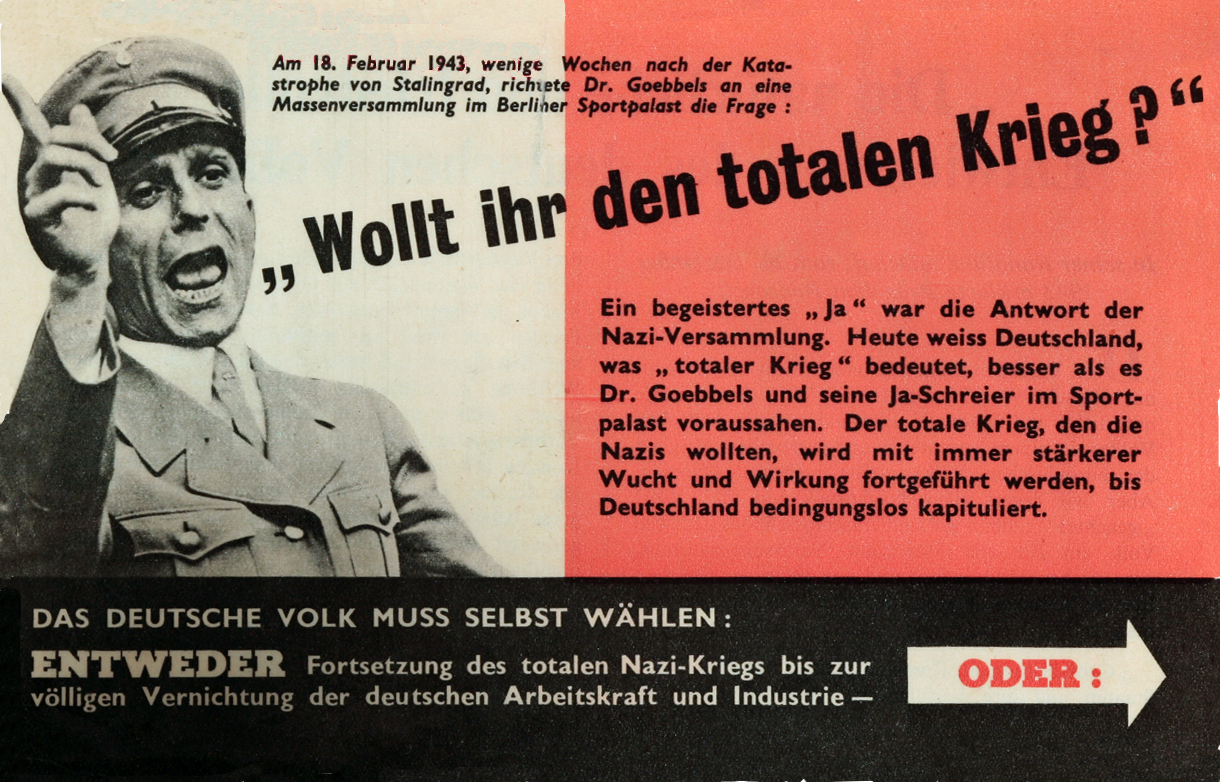
An example of a World War II era leaflet meant to be dropped from an American B-17 over a German city (see the file description page for a translation)

Psychological warfare (PSYWAR), or the basic aspects of modern psychological operations (PSYOP), has been known by many other names or terms, including Military Information Support Operations (MISO), psyops, political warfare, "Hearts and Minds", and propaganda.[1][2] The term is used "to denote any action which is practiced mainly by psychological methods with the aim of evoking a planned psychological reaction in other people".[3]

Various techniques are used, and are aimed at influencing a target audience's value system, belief system, emotions, motives, reasoning, or behavior. It is used to induce confessions or reinforce attitudes and behaviors favorable to the originator's objectives, and are sometimes combined with black operations or false flag tactics. It is also used to destroy the morale of enemies through tactics that aim to depress troops' psychological states.[4][5]

Target audiences can be governments, organizations, groups, and individuals, and is not just limited to soldiers. Civilians of foreign territories can also be targeted by technology and media so as to cause an effect on the government of their country.[6]

Stories are said to be a key factor in a successful operation.[7] Mass communication such as radio allows for direct communication with an enemy populace, and therefore has been used in many efforts. Social media channels and the internet allow for campaigns of disinformation and misinformation performed by agents anywhere in the world.[8]

History

[edit]

Early

[edit]
Mosaic of Alexander the Great on his campaign against the Persian Empire

Currying favor with supporters was the other side of psychological warfare, and an early practitioner of this was Alexander the Great, who successfully conquered large parts of Europe and the Middle East and held on to his territorial gains by co-opting local elites into the Greek administration and culture. Alexander left some of his men behind in each conquered city to introduce Greek culture and oppress dissident views. His soldiers were paid dowries to marry locals[9] in an effort to encourage assimilation.

Genghis Khan, leader of the Mongol Empire in the 13th century AD employed less-subtle techniques. Defeating the will of the enemy before having to attack and reaching a consented settlement was preferable to facing his wrath. The Mongol generals demanded submission to the Khan and threatened the initially captured villages with complete destruction if they refused to surrender. If they had to fight to take the settlement, the Mongol generals fulfilled their threats and massacred the survivors. Tales of the encroaching horde spread to the next villages and created an aura of insecurity that undermined the possibility of future resistance.[10]

Genghis Khan also employed tactics that made his numbers seem greater than they actually were. During night operations he ordered each soldier to light three torches at dusk to give the illusion of an overwhelming army and deceive and intimidate enemy scouts. He also sometimes had objects tied to the tails of his horses, so that riding on open and dry fields raised a cloud of dust that gave the enemy the impression of great numbers. His soldiers used arrows specially notched to whistle as they flew through the air, creating a terrifying noise.[11]

In the 6th century BCE Greek Bias of Priene successfully resisted the Lydian king Alyattes by fattening up a pair of mules and driving them out of the besieged city.[12] When Alyattes' envoy was then sent to Priene, Bias had piles of sand covered with wheat to give the impression of plentiful resources.

During the Granada War, Spanish captain Hernán Pérez del Pulgar routinely employed psychological tactics as part of his guerrilla actions against the Emirate of Granada. In 1490, infiltrating the city by night with a small retinue of soldiers, he nailed a letter of challenge on the main mosque and set fire to the alcaicería before withdrawing.[13]

In 1574, having been informed about the pirate attacks previous to the Battle of Manila, Spanish captain Juan de Salcedo had his relief force return to the city by night while playing marching music and carrying torches in loose formations, so they would appear to be a much larger army to any nearby enemy. They reached the city unopposed.[14]

Modern Era

[edit]

Because psyops shape public opinion and public memory, the rise of the printing press and mass communication greatly increased the use of psyops for military advantage. During the Indian Wars of the 17th through 19th centuries, politicians, newspaper reports and fictional novels about Native Americans all conveyed the belief that tribes in the Northeast had "died out," and leaders of New England communities even gave speeches about the "last Indians" in New England, even as Native Americans continued to reside in these communities.[7]

World War I

[edit]
Lord Bryce led the commission of 1915 to document German atrocities committed against Belgian civilians.

The start of modern psychological operations in war is generally dated to World War I. By that point, Western societies were increasingly educated and urbanized, and mass media was available in the form of large circulation newspapers and posters. It was also possible to transmit propaganda to the enemy via the use of airborne leaflets or through explosive delivery systems like modified artillery or mortar rounds.[15]

At the start of the war, the belligerents, especially the British and Germans, began distributing propaganda, both domestically and on the Western front. The British had several advantages that allowed them to succeed in the battle for world opinion; they had one of the world's most reputable news systems, with much experience in international and cross-cultural communication, and they controlled much of the undersea communications cable system then in operation. These capabilities were easily transitioned to the task of warfare.

The British also had a diplomatic service that maintained good relations with many nations around the world, in contrast to the reputation of the German services.[16] While German attempts to foment revolution in parts of the British Empire, such as Ireland and India, were ineffective, extensive experience in the Middle East allowed the British to successfully induce the Arabs to revolt against the Ottoman Empire.

In August 1914, David Lloyd George appointed a Member of Parliament (MP), Charles Masterman, to head a Propaganda Agency at Wellington House. A distinguished body of literary talent was enlisted for the task, with its members including Arthur Conan Doyle, Ford Madox Ford, G. K. Chesterton, Thomas Hardy, Rudyard Kipling and H. G. Wells. Over 1,160 pamphlets were published during the war and distributed to neutral countries, and eventually, to Germany. One of the first significant publications, the Report on Alleged German Outrages of 1915, had a great effect on general opinion across the world. The pamphlet documented atrocities, both actual and alleged, committed by the German army against Belgian civilians. A Dutch illustrator, Louis Raemaekers, provided the highly emotional drawings which appeared in the pamphlet.[17]

In 1917, the bureau was subsumed into the new Department of Information and branched out into telegraph communications, radio, newspapers, magazines and the cinema. In 1918, Viscount Northcliffe was appointed Director of Propaganda in Enemy Countries. The department was split between propaganda against Germany organized by H.G Wells, and propaganda against the Austro-Hungarian Empire supervised by Wickham Steed and Robert William Seton-Watson; the attempts of the latter focused on the lack of ethnic cohesion in the Empire and stoked the grievances of minorities such as the Croats and Slovenes. It had a significant effect on the final collapse of the Austro-Hungarian Army at the Battle of Vittorio Veneto.[15]

Aerial leaflets were dropped over German trenches containing postcards from prisoners of war detailing their humane conditions, surrender notices and general propaganda against the Kaiser and the German generals. By the end of the war, MI7b had distributed almost 26 million leaflets. The Germans began shooting the leaflet-dropping pilots, prompting the British to develop unmanned leaflet balloons that drifted across no-man's land. At least one in seven of these leaflets were not handed in by the soldiers to their superiors, despite severe penalties for that offence. Even General Hindenburg admitted that "Unsuspectingly, many thousands consumed the poison", and POWs admitted to being disillusioned by the propaganda leaflets that depicted the use of German troops as mere cannon fodder. In 1915, the British began airdropping a regular leaflet newspaper Le Courrier de l'Air for civilians in German-occupied France and Belgium.[18]

At the start of the war, the French government took control of the media to suppress negative coverage. Only in 1916, with the establishment of the Maison de la Presse, did they begin to use similar tactics for the purpose of psychological warfare. One of its sections was the "Service de la Propagande aérienne" (Aerial Propaganda Service), headed by Professor Tonnelat and Jean-Jacques Waltz, an Alsatian artist code-named "Hansi". The French tended to distribute leaflets of images only, although the full publication of US President Woodrow Wilson's Fourteen Points, which had been heavily edited in the German newspapers, was distributed via airborne leaflets by the French.[15]

The Central Powers were slow to use these techniques; however, at the start of the war the Germans succeeded in inducing the Sultan of the Ottoman Empire to declare 'holy war', or Jihad, against the Western infidels.[citation needed] They also attempted to foment rebellion against the British Empire in places as far afield as Ireland, Afghanistan, and India. The Germans' greatest success was in giving the Russian revolutionary, Lenin, free transit on a sealed train from Switzerland to Finland after the overthrow of the Tsar. This soon paid off when the Bolshevik Revolution took Russia out of the war.[19]

World War II

[edit]

Germany's Fall Grün plan of invasion of Czechoslovakia had a large part dealing with psychological warfare aimed both at the Czechoslovak civilians and government as well as, crucially, at Czechoslovakia's allies.[20] It became successful to the point that Germany gained the acquiescence of the British and French governments to the German occupation of Czechoslovakia without having to fight an all-out war, sustaining only minimum losses in covert war before the Munich Agreement.[citation needed]

Map depicting the targets of all the subordinate plans of Operation Bodyguard.

During World War II, the British made extensive use of deception – developing many new techniques and theories. The main protagonists at this time were 'A' Force, set up in 1940 under Dudley Clarke, and the London Controlling Section, chartered in 1942 under the control of John Bevan.[21][22] Clarke pioneered many of the strategies of military deception. His ideas for combining fictional orders of battle, visual deception and double agents helped define Allied deception strategy during the war, for which he has been referred to as "the greatest British deceiver of WW2".[23]

During the lead-up to the Allied invasion of Normandy, many new tactics in psychological warfare were devised. The plan for Operation Bodyguard set out a general strategy to mislead German high command as to the date and location of the invasion, which was obviously going to happen. Planning began in 1943 under the auspices of the London Controlling Section (LCS). A draft strategy, referred to as Plan Jael, was presented to Allied high command at the Tehran Conference. Operation Fortitude was intended to convince the Germans of a greater Allied military strength than was the case, through fictional field armies, faked operations to prepare the ground for invasion and "leaked" misinformation about the Allied order of battle and war plans.

Elaborate naval deceptions (Operations Glimmer, Taxable and Big Drum) were undertaken in the English Channel.[24] Small ships and aircraft simulated invasion fleets lying off Pas de Calais, Cap d'Antifer and the western flank of the real invasion force.[25] At the same time Operation Titanic involved the RAF dropping fake paratroopers to the east and west of the Normandy landings.

A dummy Sherman tank, used to deceive the Germans.

The deceptions were implemented with the use of double agents, radio traffic and visual deception. The British "Double Cross" anti-espionage operation had proven very successful from the outset of the war,[26] and the LCS was able to use double agents to send back misleading information about Allied invasion plans.[27] The use of visual deception, including mock tanks and other military hardware had been developed during the North Africa campaign. Mock hardware was created for Bodyguard; in particular, dummy landing craft were stockpiled to give the impression that the invasion would take place near Calais.

The Operation was a strategic success and the Normandy landings caught German defences unaware. Continuing deception, portraying the landings as a diversion from a forthcoming main invasion in the Calais region, led Hitler into delaying transferring forces from Calais to the real battleground for nearly seven weeks.[28]

Vietnam War

[edit]
"Viet Cong, beware!" – South Vietnam leaflets urging the defection of Viet Cong.

The United States ran an extensive program of psychological warfare during the Vietnam War. The Phoenix Program had the dual aim of assassinating National Liberation Front of South Vietnam (NLF or Viet Cong) personnel and terrorizing any potential sympathizers or passive supporters. During the Phoenix Program, over 19,000 NLF supporters were killed.[29] In Operation Wandering Soul, the United States also used tapes of distorted human sounds and played them during the night making the Vietnamese soldiers think that the dead were back for revenge.

The Vietcong and their forces also used a program of psychological warfare during this war. Trịnh Thị Ngọ, also known as Thu Hương and Hanoi Hannah, was a Vietnamese radio personality. She made English-language broadcasts for North Vietnam directed at United States troops. During the Vietnam War, Ngọ became famous among US soldiers for her propaganda broadcasts on Radio Hanoi. Her scripts were written by the North Vietnamese Army and were intended to frighten and shame the soldiers into leaving their posts. She made three broadcasts a day, reading a list of newly killed or imprisoned Americans, and playing popular US anti-war songs in an effort to incite feelings of nostalgia and homesickness, attempting to persuade US GIs that the US involvement in the Vietnam War was unjust and immoral.[30] A typical broadcast began as follows:

How are you, GI Joe? It seems to me that most of you are poorly informed about the going of the war, to say nothing about a correct explanation of your presence over here. Nothing is more confused than to be ordered into a war to die or to be maimed for life without the faintest idea of what's going on.[31]

21st century

[edit]
An American PSYOP leaflet disseminated during the Iraq War. It shows a caricature of Al-Qaeda in Iraq leader Abu Musab al-Zarqawi caught in a rat trap. The caption reads "This is your future, Zarqawi".

The CIA made extensive use of Contra soldiers to destabilize the Sandinista government in Nicaragua.[32] The CIA used psychological warfare techniques against the Panamanians by delivering unlicensed TV broadcasts. The United States government has used propaganda broadcasts against the Cuban government through TV Marti, based in Miami, Florida. However, the Cuban government has been successful at jamming the signal of TV Marti.

In the Iraq War, the United States used the shock and awe campaign to psychologically maim and break the will of the Iraqi Army to fight.

In cyberspace, social media has enabled the use of disinformation on a wide scale. Analysts have found evidence of doctored or misleading photographs spread by social media in the Syrian Civil War and 2014 Russian military intervention in Ukraine, possibly with state involvement.[33] Military and governments have engaged in psychological operations (PSYOP) and informational warfare (IW) on social networking platforms to regulate foreign propaganda, which includes countries like the US, Russia, and China.[34][35]

In 2022, Meta and the Stanford Internet Observatory found that over five years people associated with the U.S. military, who tried to conceal their identities, created fake accounts on social media systems including Balatarin, Facebook, Instagram, Odnoklassniki, Telegram, Twitter, VKontakte and YouTube in an influence operation in Central Asia and the Middle East. Their posts, primarily in Arabic, Farsi and Russian, criticized Iran, China and Russia and gave pro-Western narratives. Data suggested the activity was a series of covert campaigns rather than a single operation.[36][37]

In operations in the South and East China Seas, both the United States and China have been engaged in "cognitive warfare", which involves displays of force, staged photographs and sharing disinformation.[38][39][40] The start of the public use of "cognitive warfare" as a clear movement occurred in 2013 with China's political rhetoric.[41]

Examples of the term

[edit]

Most modern uses of the term psychological warfare refer to the following military methods:

Daniel Lerner divides psychological warfare operations into three categories:[44][page needed]

  • White propaganda (omissions and emphasis): Truthful and not strongly biased, where the source of information is acknowledged.
  • Grey propaganda (omissions, emphasis and racial/ethnic/religious bias): Largely truthful, containing no information that can be proven wrong; the source is not identified.
  • Black propaganda (commissions of falsification): Inherently deceitful, information given in the product is attributed to a source that was not responsible for its creation.

Lerner says grey and black operations ultimately have a heavy cost, in that the target population sooner or later recognizes them as propaganda and discredits the source. He writes, "This is one of the few dogmas advanced by Sykewarriors that is likely to endure as an axiom of propaganda: Credibility is a condition of persuasion. Before you can make a man do as you say, you must make him believe what you say."[44]: 28  Consistent with this idea, the Allied strategy in World War II was predominantly one of truth (with certain exceptions).[citation needed]

In Propaganda: The Formation of Men's Attitudes, Jacques Ellul discusses psychological warfare as a common peace policy practice between nations as a form of indirect aggression. This type of propaganda drains the public opinion of an opposing regime by stripping away its power on public opinion. This form of aggression is hard to defend against because no international court of justice is capable of protecting against psychological aggression since it cannot be legally adjudicated.

"Here the propagandists is [sic] dealing with a foreign adversary whose morale he seeks to destroy by psychological means so that the opponent begins to doubt the validity of his beliefs and actions."[45][46]

Terrorism

[edit]

According to Boaz Ganor, terrorism weakens the sense of security and disturbs daily life, damaging the target country's capability to function. Terrorism is a strategy that aims to influence public opinion into pressuring leaders to give in to the terrorists' demands, and the population becomes a tool to advance the political agenda.[42]

By country

[edit]

China

[edit]

According to U.S. military analysts, attacking the enemy's mind is an important element of the People's Republic of China's military strategy.[47][48][49] This type of warfare is rooted in the Chinese Stratagems outlined by Sun Tzu in The Art of War and Thirty-Six Stratagems. In its dealings with its rivals, China is expected to utilize Marxism to mobilize communist loyalists, as well as flex its economic and military muscle to persuade other nations to act in the Chinese government's interests. The Chinese government also tries to control the media to keep a tight hold on propaganda efforts for its people.[49] The Chinese government also utilizes cognitive warfare against Taiwan.[50]

France

[edit]

The Centre interarmées des actions sur l'environnement is an organization made up of 300 soldiers whose mission is to assure to the four service arm of the French Armed Forces psychological warfare capacities. Deployed in particular to Mali and Afghanistan, its missions "consist in better explaining and accepting the action of French forces in operation with local actors and thus gaining their trust: direct aid to the populations, management of reconstruction sites, actions of communication of influence with the population, elites and local elected officials". The center has capacities for analysis, influence, expertise and instruction.[51]

Germany

[edit]

In the German Bundeswehr, the Zentrum Operative Kommunikation is responsible for PSYOP efforts. The center is subordinate to the Cyber and Information Domain Service branch alongside multiple IT and Electronic Warfare battalions and consists of around 1000 soldiers. One project of the German PSYOP forces is the radio station Stimme der Freiheit (Sada-e Azadi, Voice of Freedom),[52] heard by thousands of Afghans. Another is the publication of various newspapers and magazines in Kosovo and Afghanistan, where German soldiers serve with NATO.

Iran

[edit]

The Iranian government had an operation program to use the 2022 FIFA World Cup as a psyop against concurrent people's protests.[53][54][55][56][57]

Israel

[edit]

The Israeli government and its military make use of psychological warfare. In 2021, Israeli newspaper Haaretz revealed that "Abu Ali Express", a popular news page on Telegram and Twitter purportedly dedicated to "Arab affairs", was actually run by a Jewish Israeli paid consultant to the Israel Defense Forces (IDF). The IDF's psyops account had been the source of a number of noteworthy reports that were afterwards cited by the Israeli and international media.[58]

Russia

[edit]

Soviet Union

[edit]

United Kingdom

[edit]

The British were one of the first major military powers to use psychological warfare in the First and Second World Wars. In the current British Armed Forces, PsyOps are handled by the tri-service 15 Psychological Operations Group. (See also MI5 and Secret Intelligence Service). The Psychological Operations Group comprises over 150 personnel, approximately 75 from the regular Armed Services and 75 from the Reserves. The Group supports deployed commanders in the provision of psychological operations in operational and tactical environments.[59][60]

The Group was established immediately after the 1991 Gulf War,[61] has since grown significantly in size to meet operational requirements,[62] and since 2015 has been one of the sub-units of the 77th Brigade, formerly called the Security Assistance Group.[63]

In June 2015, NSA files published by Glenn Greenwald revealed details of the JTRIG group at British intelligence agency GCHQ covertly manipulating online communities.[64] This is in line with JTRIG's goal: to "destroy, deny, degrade [and] disrupt" enemies by "discrediting" them, planting misinformation and shutting down their communications.[65]

In March 2019, it emerged that the Defence Science and Technology Laboratory (DSTL) of the UK's Ministry of Defence (MoD) is tendering to arms companies and universities for £70M worth of assistance under a project to develop new methods of psychological warfare. The project is known as the human and social sciences research capability (HSSRC).[66]

United States

[edit]
U.S. Army soldier hands out a newspaper to a local in Mosul, Iraq.
U.S. Army loudspeaker team in action in Korea

The term psychological warfare is believed to have migrated from Germany to the United States in 1941.[67] During World War II, the United States Joint Chiefs of Staff defined psychological warfare broadly, stating "Psychological warfare employs any weapon to influence the mind of the enemy. The weapons are psychological only in the effect they produce and not because of the weapons themselves."[68] The U.S. Department of Defense (DoD) currently defines psychological warfare as:

"The planned use of propaganda and other psychological actions having the primary purpose of influencing the opinions, emotions, attitudes, and behavior of hostile foreign groups in such a way as to support the achievement of national objectives."[69]

This definition indicates that a critical element of the U.S. psychological operations capabilities includes propaganda and by extension counterpropaganda. Joint Publication 3–53 establishes specific policy to use public affairs mediums to counter propaganda from foreign origins.[70]

The purpose of United States psychological operations is to induce or reinforce attitudes and behaviors favorable to US objectives. The Special Activities Center (SAC) is a division of the Central Intelligence Agency's Directorate of Operations, responsible for Covert Action and "Special Activities". These special activities include covert political influence (which includes psychological operations) and paramilitary operations.[71] SAC's political influence group is the only US unit allowed to conduct these operations covertly and is considered the primary unit in this area.[71]

A U.S. Army field manual released in January 2013 states that "Inform and Influence Activities" are critical for describing, directing, and leading military operations. Several Army Division leadership staff are assigned to “planning, integration and synchronization of designated information-related capabilities."[72]

Journalist and fiction writer P.W. Singer, author of Wired for War, teaches military leaders about how to incorporate "useful fiction" stories and narrative structure into military psyops.[73]

In September 2022, the DoD launched an audit of covert information warfare after social media companies identified a suspected U.S. military operation.[74]

See also

[edit]

References

[edit]

Bibliography

[edit]
[edit]
Revisions and contributorsEdit on WikipediaRead on Wikipedia
from Grokipedia
Psychological warfare, also known as psychological operations (PSYOP), consists of planned efforts to convey selected information and indicators to foreign audiences to influence their emotions, motives, objective reasoning, and ultimately the behavior of governments, organizations, groups, and individuals in support of a commander's objectives. This non-lethal approach leverages propaganda, deception, and symbolic actions to erode enemy morale, foster doubt, encourage defections, and disrupt cohesion without direct combat. Employed throughout history—from ancient stratagems attributed to Sun Tzu, who emphasized breaking resistance through psychological means rather than force, to modern doctrines—it has shaped outcomes in conflicts by targeting the human mind as a center of gravity. In World War II, for instance, Allied forces disseminated millions of leaflets and broadcasts via dedicated units like the Psychological Warfare Branch, contributing to measurable surrenders and the hastening of Axis capitulation in key theaters. Defining characteristics include its reliance on credible messaging tailored to cultural contexts, integration with kinetic operations for amplification, and variable effectiveness, as empirical assessments from prisoner interrogations and defector data indicate successes in demoralization but limitations against ideologically resolute foes. Controversies arise from ethical concerns over manipulation and the risk of blowback, yet military analyses affirm its role as a force multiplier when grounded in accurate audience analysis rather than unsubstantiated assumptions.

Fundamentals

Definition and Objectives

Psychological warfare, also termed psychological operations (PSYOP), consists of the deliberate employment of non-lethal methods, including and , to influence the attitudes, emotions, perceptions, and behaviors of foreign adversaries, neutral parties, or friendly audiences toward predefined military or strategic ends. These operations target cognitive and motivational vulnerabilities inherent to human , such as fear of loss or desire for security, exploiting empirically observed patterns in group rather than random . Unlike commercial advertising or domestic political , which lack operational ties to armed conflict, psychological warfare integrates into broader military planning to directly undermine without primary dependence on physical force. The core objectives encompass eroding the adversary's will to resist, thereby minimizing kinetic engagements; this aligns with ancient strategic principles emphasizing victory through disruption of enemy cohesion over direct confrontation, as articulated in Sun Tzu's : "To subdue the enemy without fighting is the acme of skill." Specific aims include demoralizing troops to induce surrenders or desertions, sowing discord among enemy and populations to fracture alliances, and reinforcing among one's own forces or potential supporters to sustain operational . These goals rest on causal mechanisms where targeted messaging alters assessments and , grounded in verifiable responses to credible threats or incentives, rather than ideological assumptions about universal rationality. By prioritizing influence over attrition, psychological warfare seeks efficient in warfare, where success metrics derive from measurable shifts in adversary —such as reduced or increased defections—rather than subjective sentiment alone. This approach underscores a realist orientation: human actors in conflict environments respond predictably to imbalances in perceived power and survival prospects, enabling operations to achieve strategic paralysis with minimal collateral destruction.

Psychological Principles and Mechanisms

Psychological warfare leverages core mechanisms from cognitive and behavioral psychology to shape perceptions, emotions, and actions, often bypassing deliberate reasoning through automatic processes. , first demonstrated by in experiments from 1897 to 1904 pairing neutral stimuli with unconditioned responses to elicit reflexive behaviors, enables psywar to associate enemy symbols or actions with fear or aversion via repeated exposure in . This associative learning exploits the brain's subcortical pathways for rapid threat detection, altering decision-making by embedding subconscious triggers that influence risk assessment and compliance without conscious scrutiny. , a principle identified in Robert Cialdini's persuasion research showing individuals conform to perceived group norms under uncertainty, amplifies psywar effects in collectivist or hierarchical societies where majority endorsement signals behavioral cues. Empirical studies confirm boosts acceptance of messages by 20-30% in ambiguous scenarios, as targets infer validity from simulated consensus. Obedience to represents another foundational mechanism, as evidenced by Stanley Milgram's 1961-1962 experiments where 65% of participants administered what they believed were lethal electric shocks (up to 450 volts) solely due to directives from an experimenter in a lab coat, demonstrating how perceived legitimacy overrides ethical inhibitions via agentic shift—where individuals relinquish personal responsibility to hierarchical structures. In psywar, this translates to compliance induction through authoritative messaging or endorsements, exploiting innate deference to power gradients rooted in evolutionary adaptations for social coordination. , formalized in Kahneman and Tversky's 1979 , reveals humans weigh potential losses approximately twice as heavily as gains, driving asymmetric responses to threats over incentives; experiments consistently show this bias skews choices toward avoidance of harm, making psywar appeals framing enemy actions as existential losses particularly potent for demoralization or defection. Effective psywar prioritizes causal realism by grounding operations in verifiable truths about adversary capabilities and vulnerabilities, rather than fabrications prone to unraveling under empirical verification, which erodes long-term and invites counter-propaganda. Military analyses note that truthful assessments—such as accurate on logistical failures—sustain influence by aligning with targets' observable realities, fostering doubt without the backlash of exposed deceit. analysis integrates these mechanisms with empirical profiling of cultural, ideological, and motivational factors, segmenting populations to tailor exploitations; doctrine-derived processes emphasize vulnerability mapping, where declassified evaluations indicate culturally resonant messaging enhances behavioral impact by exploiting specific heuristics, though rigorous public empirical quantification remains sparse due to operational secrecy. , the tendency to favor consonant information, further necessitates precision in audience selection, as mismatched appeals reinforce resistance rather than penetration.

Historical Evolution

Ancient and Pre-Modern Instances

Psychological warfare predates modern eras, with ancient commanders exploiting fear and reputation to disrupt enemy cohesion. Alexander the Great (356–323 BCE) integrated intimidation into his Persian campaign, where victories at Granicus (334 BCE) and Issus (333 BCE) amplified his aura of invincibility, pressuring Darius III to avoid decisive engagements. At Gaugamela on October 1, 331 BCE, Alexander's oblique advance exploited this dread; Darius fled upon perceiving a potential encirclement, triggering Persian panic and rout despite numerical inferiority (47,000 Macedonians versus 100,000–250,000 Persians), enabling conquest without total annihilation. In the 13th century, (c. 1162–1227) systematized terror to compel submissions, minimizing Mongol casualties in expansive campaigns. Resisting cities faced total destruction, with massacres leaving pyramids of skulls as warnings; survivors disseminated accounts of brutality, fostering preemptive capitulations. During the 1219–1221 invasion of Khwarezmia, this yielded surrenders from urban centers like after initial sieges, allowing 100,000–200,000 Mongol horsemen to subdue empires spanning millions without proportional attrition, as fear cascaded through networks, altering behaviors from resistance to accommodation. Medieval forces refined deception for psychological leverage, notably through feigned retreats that preyed on pursuit instincts. under executed this at the 1223 , simulating flight to draw Rus'-Cuman forces into ambushes, resulting in near-total enemy (estimated 50,000–90,000 killed versus minimal Mongol losses). Similarly, in 15th-century , Vlad III of (r. 1456–1462) impaled Ottoman captives en masse during 1462 incursions, erecting "forests of the stake" visible to Mehmed II's 90,000-strong army; the visceral horror prompted Ottoman withdrawal despite superiority, preserving Wallachian autonomy temporarily through induced revulsion and logistical hesitation.

World War I

Psychological warfare emerged as a distinct element of industrialized conflict during World War I, with both the Allies and Central Powers employing propaganda to demoralize enemies and sustain domestic support, though its battlefield effects remained supplementary to conventional attrition tactics. British efforts focused on atrocity narratives stemming from the German invasion of Belgium and northern France in August-October 1914, where over 5,000 civilians were killed, amplified through the Bryce Report published in May 1915 and stories of nurse Edith Cavell's execution in October 1915 to spur recruitment and vilify Germans as "Huns." German counter-propaganda highlighted alleged Allied barbarities, such as Russian actions in East Prussia with around 6,000 civilian deaths, but was less centralized and aggressive. Both sides initiated leaflet drops early in the war; Germans produced the Gazette des Ardennes newspaper for French lines starting in 1915, while British units used balloons for dissemination. Aerial and balloon-dropped leaflets became a foundational mass-media experiment, with British section M17b2(4) distributing 60 million leaflets and 10 million newspapers over German and Austro-Hungarian lines by November 1918, often promising humane treatment to deserters. Crewe House, established in 1918 under Lord Northcliffe, intensified these operations with targeted messaging on German home-front hardships and military futility. German responses included leaflets like "Eine Familie welche kein Mitglied verloren hat" in June 1918, aiming to underscore Allied losses, but their scale was smaller. These efforts correlated with morale erosion; German desertions surged during the 1918 "" amid multi-causal factors including hunger and , with Allied leaflets contributing to voluntary surrenders, though quantifiable spikes attributable solely to were minor and did not precipitate collapses earlier than material attrition dictated. The , entering the war in April 1917, formalized propaganda through the (CPI), created by that month under to shape opinion domestically and abroad. The CPI's Division of Pictorial Publicity produced over 20 million posters, including iconic designs like "I Want You" featuring , while its film division released weekly newsreels such as Official War Review and features like Pershing’s Crusaders (1918) and America’s Answer (1918), marking early systematic use of motion pictures for mobilization. Overseas, the CPI established offices in more than 30 countries and initiated leaflet drops to German lines starting August 29, 1918, emphasizing American numerical superiority with messages like "Die erste Million" highlighting one million U.S. troops. Empirically, psywar demonstrated limited standalone efficacy, as leaflet and atrocity campaigns boosted initial enlistments—such as British volunteer surges post-1914 Mons retreat and Louvain destruction—but failed to supplant stalemates or decisively erode enemy cohesion without concurrent pressures. morale declined notably from 1917 amid broader strains like the British blockade and failed offensives, with accelerating but not originating trends that peaked in 1918. This underscored psywar's role as an adjunct to physical warfare, laying groundwork for more integrated applications in later conflicts without overhyping its causal primacy over logistical and combat realities.

World War II

Psychological warfare reached a systematic scale during , as major powers integrated it into strategies to undermine enemy and cohesion with measurable operational impacts. Allied forces, particularly through the Office of Strategic Services (OSS) and Psychological Warfare Branch, conducted extensive leaflet drops over German-held territories from 1944 onward, urging soldiers to surrender by highlighting Allied advances and safe treatment for prisoners. Captured German personnel often cited these leaflets as influencing their decisions, though overall campaign results varied amid high enemy phases. Deception operations, such as launched in 1943, exemplified psywar's strategic depth by misleading German commanders on invasion timings and locations, resulting in misplaced troop concentrations that facilitated the on June 6, 1944. Axis powers emphasized ideological propaganda to sustain domestic and military resolve, but this approach often prioritized doctrinal purity over adaptive realism, leading to empirical shortfalls as battlefield realities diverged from narratives. Nazi radio broadcasts, directed by ' Ministry of Propaganda, aimed to bolster soldier motivation through anti-Soviet messaging and veneration, with studies indicating temporary boosts in combat performance where reception was strong. However, as defeats accumulated—such as at Stalingrad in early 1943—these efforts failed to counteract disillusionment, contributing to eroded without offsetting material losses. Japanese psychological operations, drawing from British models and early German tactics, focused on field demoralization but yielded limited surrenders due to cultural emphases on honor-bound resistance. Soviet psychological operations complemented partisan guerrilla actions, systematically fostering distrust among German rear-area forces through targeted leaflets and broadcasts that promised humane treatment upon . At Stalingrad, these efforts directly promoted surrenders, with post-battle interrogations revealing psywar's role in fracturing morale during the encirclement from November 1942 to February 1943. Partisan units amplified this by disrupting supply lines and spreading rumors of inevitable defeat, tying down German divisions without equivalent conventional engagements. Post-war assessments, including U.S. analyses of air-supported psywar, concluded that such non-kinetic measures accelerated Axis collapse by amplifying the psychological toll of attrition, achieving effects disproportionate to resource inputs.

Cold War Period

During the , psychological warfare between the and the primarily manifested as an ideological contest through radio broadcasts, agent networks, and subversive operations aimed at eroding enemy morale and legitimacy. The U.S. employed outlets like Radio Free Europe (RFE) to disseminate factual reports on Soviet repressions, contrasting with Soviet jamming efforts and campaigns. These broadcasts reached millions behind the , fostering dissent and defections by highlighting atrocities and economic failures, which were verifiable through emigre testimonies and declassified archives. RFE's coverage of the 1956 Hungarian uprising exemplified Western psywar efficacy, providing real-time information that encouraged resistance against Soviet intervention, with Hungarian participants later crediting the station for sustaining amid false promises of Western . A U.S. government review concluded RFE did not incite the revolt but implied potential support through optimistic reporting, contributing to over 200,000 Hungarian deaths and refugees, many of whom cited broadcast influence in defections. Academic analyses, often influenced by left-leaning institutional biases, tend to minimize RFE's causal by emphasizing indigenous factors, yet empirical listener surveys and defector accounts demonstrate broadcasts amplified anti-regime sentiment, unlike Soviet fabrications that eroded trust upon exposure. Soviet countered with , such as Operation Denver, a campaign launched in 1983 alleging U.S. creation of AIDS at , disseminated via agents and media plants to 200 outlets worldwide, initially gaining traction in developing nations. Declassified and files reveal the operation's fabrication, which backfired empirically as refutations—backed by virological —undermined Soviet credibility, whereas Western exposures of authentic Soviet crimes like the gulags sustained long-term persuasive power through alignment with observable realities. In proxy conflicts, psywar amplified tactical effects; during the (1950–1953), U.S. 1st Loudspeaker and Leaflet Company teams broadcast surrender appeals, contributing to over 200,000 North Korean and Chinese defections by exploiting fears of annihilation and promises of humane treatment, as documented in Eighth Army reports. Similarly, in (1979–1989), CIA support for included dissemination via radio and leaflets to boost fighter and portray Soviets as imperial aggressors, with assessments noting sustained resistance tied to narratives of divine victory and foreign backing, hastening Soviet withdrawal amid 15,000 troop losses. These operations underscored psywar's force-multiplier role in , grounded in verifiable surrender rates and metrics over narrative-driven dismissals.

Post-Cold War and Contemporary Conflicts

Following the in 1991, psychological warfare adapted to asymmetric conflicts and insurgencies, emphasizing demoralization of conventional forces and influence over civilian populations in protracted operations. In the 1991 , U.S.-led coalition forces disseminated over 29 million leaflets urging i soldiers to surrender, contributing to more than 87,000 Iraqi prisoners of war, with 98 percent possessing such leaflets upon capture. These efforts demonstrated the continued efficacy of traditional in prompting mass capitulations against a conventional adversary. In the 2003 Iraq invasion, the "shock and awe" strategy integrated rapid, overwhelming precision strikes with psychological operations to target enemy leadership's will and perception, aiming for rapid dominance beyond mere physical destruction. Coalition PSYOP campaigns persuaded significant portions of Iraqi military units to abandon positions without resistance, though overall surrenders numbered fewer than in 1991, reflecting adaptations to a more decentralized command structure. Similarly, in Afghanistan from 2001 to 2021, U.S. forces employed leaflets, radio broadcasts, and loudspeaker teams to counter Taliban influence and encourage defections, with evaluations indicating variable but measurable impacts on local attitudes and insurgent behavior. Non-state actors, such as , elevated psychological warfare through high-production propaganda videos from 2014 onward, using graphic depictions of violence and appeals to to recruit globally and intimidate opponents, marking a shift toward decentralized, media-driven operations by irregular forces. In contrast, state actors like have sustained targeted PSYOP in urban conflicts, issuing evacuation warnings and employing non-lethal deterrents such as sonic booms to erode adversary morale in Gaza and operations through the 2020s. Empirical outcomes in these conflicts refute assertions of psychological operations' amid drone and precision-guided munitions dominance, as integrated PSYOP with kinetic strikes amplified surrender rates and reduced cohesion by exploiting vulnerabilities like and , even in environments up to 2025. This synergy underscores psywar's enduring role in minimizing casualties while hastening operational ends against both state and non-state threats.

Techniques and Methods

Traditional Propaganda and Dissemination

Traditional dissemination in psychological warfare relied on physical and audible media, including leaflets air-dropped over enemy territory and broadcasts via radio or loudspeakers, to convey messages urging surrender or highlighting adversities. Leaflets were typically designed with clear, bilingual text and illustrations depicting passes or humane treatment for prisoners, adhering to principles of factual accuracy to build and avoid provoking enemy reprisals. In World War II's Pacific theater, U.S. forces disseminated millions of such leaflets, with carrier aircraft alone dropping five million over one island, correlating with the surrender of 11,409 Japanese prisoners of war as verified through post-operation records. Dissemination methods emphasized aerial drops for broad coverage and ground-based loudspeakers for targeted, immediate impact near front lines. Messages grounded in verifiable enemy hardships, such as shortages or recent defeats, proved more persuasive than abstract threats, as evidenced by interrogations of captured personnel revealing higher responsiveness to realistic portrayals of deteriorating conditions. Radio broadcasts, like those from Allied stations to Axis-occupied areas, reinforced leaflet campaigns by providing timely news interpretations that exploited internal divisions, with gauged through enemy feedback indicating gradual erosion of over sustained exposure. These techniques offered advantages of low production costs—leaflets costing fractions of a cent each—and extensive reach without reliance on enemy infrastructure, enabling operations in remote or contested zones. However, vulnerabilities included susceptibility to counter-propaganda that discredited messages and physical risks to dissemination assets, such as loudspeaker teams drawing artillery fire during and advances, as documented in after-action reviews. Declassified assessments underscored that while surrender rates spiked post-victory linkages, isolated efforts yielded minimal results without corroborating military pressure.

Deception and Misdirection Tactics

Deception and misdirection tactics constitute a core component of , focusing on the deliberate conveyance of false or ambiguous information to distort enemy perceptions of friendly forces' strength, location, and intentions. These operations leverage misdirection to channel adversary resources into unproductive defenses or attacks, often through feints, simulated assets, and controlled channels. Success relies on integrating verifiable partial truths with fabrications to maintain operational and exploit enemy preconceptions, as isolated falsehoods risk rapid detection via cross-verification. In , Allied forces executed Operation Fortitude South as a prime example, fabricating the presence of a massive army group poised to invade , the shortest crossing point from to France. This involved constructing dummy airfields, ports, and vehicle parks visible to aerial reconnaissance, alongside radio traffic simulating divisional movements and troop concentrations exceeding 150,000 personnel under General George S. Patton. German intelligence, including photo interpreters, reported these assets as genuine, leading to the fortification of over . Complementing physical misdirection, the British neutralized Germany's espionage network by turning over 30 agents into controlled assets who transmitted fabricated reports aligning with Fortitude's narrative. Agents like (codename Garbo) provided detailed, corroborated disinformation on phantom divisions, convincing Hitler to withhold the 15th Army from reinforcements until late July 1944, despite the D-Day landings on June 6. This diversion tied down approximately 200,000 troops and 1,200 tanks away from the actual battlefront, enabling faster Allied advances through hedgerow country. The U.S. 23rd Headquarters Special Troops, dubbed the , augmented these efforts with inflatable decoys mimicking Sherman tanks and artillery, alongside recorded sound effects broadcast via amplifiers to imitate mechanized assemblies. Deployed in 21 separate deceptions across , these tactics deceived German patrols and , simulating up to 10 divisions in isolated sectors and preventing targeted counterattacks on real units. Post-war assessments credit such misdirection with saving an estimated 15,000 to 30,000 Allied lives by diluting enemy responses. While exposure could erode trust in intelligence streams, empirical outcomes from Fortitude and related operations demonstrate net gains: German forces remained fixated on for over six weeks post-invasion, incurring irrecoverable delays in reallocating reserves that prolonged the campaign but ultimately favored Allied momentum. Military analyses affirm that these tactics' effectiveness stemmed from multi-channel reinforcement—visual, , and —overcoming single-source skepticism, though modern adaptations must account for satellite and signals intelligence proliferation.

Digital, Cyber, and AI-Enabled Operations

Digital psychological operations utilize platforms and online networks to disseminate targeted narratives at scale, leveraging algorithms for amplification and micro-targeting based on user . These methods enable real-time adaptation to behaviors, surpassing the reach of traditional broadcast media by exploiting digital footprints for precision influence. Cyber-enabled psywar incorporates , , and social engineering to manipulate emotions and decisions, often by fabricating threats or crises that prey on fears of instability or personal harm. For instance, during the 2024 U.S. presidential election cycle, threat actors employed campaigns and vectors to erode trust in electoral processes, with reports highlighting social engineering tactics aimed at key stakeholders to incite division. Such operations blend technical intrusion with psychological coercion, as seen in coordinated efforts to impersonate officials and spread panic-inducing falsehoods via compromised networks. AI integration elevates these efforts through generative tools for personalized and media, facilitating cognitive warfare that targets individual rather than mass audiences. , powered by , create hyper-realistic audiovisual fabrications to discredit leaders or fabricate events, as demonstrated in experimental where AI-simulated videos tested operator resilience to . This approach exploits neural vulnerabilities, with AI algorithms analyzing vast datasets to craft messages resonating with specific psychological profiles, potentially accelerating narrative spread while risking unintended echo chambers that reinforce preexisting beliefs over empirical correction. State actors have invested heavily in these domains; China's has advanced next-generation psychological warfare doctrines incorporating AI and to influence adversary decision-making at neural levels, as outlined in military publications emphasizing "brain-domain" operations. The U.S. Department of Defense requested $1.8 billion for AI initiatives in fiscal year 2025, including applications for enhanced information operations that integrate for predictive influence modeling. In practice, Ukraine's "" campaign since 2022 has sent over 10 million messages to Russian forces, using geolocated mobile to deliver surrender incentives with promises of humane treatment, yielding documented defections through direct digital outreach. These tools, while amplifying scalable truth-projection in contested environments, demand rigorous verification to counter adversarial deepfakes that distort causal realities.

Notable Operations and Case Studies

Axis and Allied Psyops in World War II

The Psychological Warfare Branch (PWB), established as a joint Anglo-American organization under , focused on tactical psychological operations against German troops through leaflets, radio broadcasts, and loudspeaker appeals designed to induce surrenders and erode . These efforts emphasized truthful messaging to build credibility, contrasting with deceptive tactics, and included passes promising humane treatment upon surrender. By late 1944, Allied aircraft disseminated over 6 billion leaflets across , many incorporating maps, news of defeats, and surrender instructions, which correlated with increased German desertions, particularly among units facing . In the Mediterranean theater, PWB operations supported invasions of and , where broadcasts and leaflets targeted Italian forces and civilians, highlighting Mussolini's faltering alliance with . Italian Service transmissions, known as Radio Londra, amplified anti-Fascist sentiment by relaying accurate reports of Allied advances and internal regime weaknesses, contributing to the erosion of loyalty that preceded Italy's announcement on September 8, 1943. This psychological pressure, combined with military reversals like the Allied landing in on July 10, 1943, facilitated the overthrow of Mussolini on July 25 and the subsequent Badoglio government's secret negotiations, shortening Axis resistance in the region. Axis psychological operations, orchestrated by ' Reich Ministry of Public Enlightenment and , relied on radio, film, and print media to sustain morale through narratives of German invincibility and racial superiority, but overreach in fabricating victories—such as minimizing Stalingrad losses in early —bred as evident defeats accumulated. Goebbels' "" speech on February 18, , aimed to rally the amid mounting casualties, yet persistent discrepancies between claims and realities, including the failure to acknowledge Allied bombing campaigns' toll, diminished public and military trust by 1944. Efforts to counter Allied leaflets, like German counter- warning of treachery, proved ineffective, as rates rose sharply in 1944-1945, with over 1 million Germans surrendering in the West by war's end, partly attributable to psyops-induced doubt. While Allied psyops achieved measurable impacts on enemy cohesion—evidenced by surrender spikes following leaflet drops and broadcast campaigns—their extension to audiences drew scrutiny for potential disruption beyond combatants, though such measures aligned with doctrines where national will underpinned prolonged resistance. Axis attempts, conversely, faltered from internal contradictions and inability to adapt to reversals, underscoring propaganda's limits absent battlefield success. Postwar interrogations and analyses confirmed psyops' in hastening German collapse without fabricating unverifiable causal chains.

U.S.-Led Operations in Vietnam and Gulf Wars

The program, launched on February 17, 1963, by the South Vietnamese government with substantial U.S. psychological operations support, sought to induce defections among guerrillas and (PAVN) soldiers through targeted radio broadcasts, airdropped leaflets promising and rewards, and distribution of passes. U.S. forces amplified these efforts via the , which produced millions of leaflets and broadcast messages emphasizing , financial incentives, and the futility of continued fighting. Between 1963 and 1971, the program recorded 101,511 defections, including approximately 47,000 confirmed enemy combatants, yielding valuable intelligence from ralliers and depleting insurgent ranks without direct combat. Empirical metrics from U.S. military assessments, such as defector interrogations and captured documents, indicated that contributed to operational successes by neutralizing adversaries and providing , though cultural and linguistic mismatches occasionally reduced penetration in rural areas. peaked in late 1969 with 5,615 ralliers in October alone, correlating with intensified U.S. leaflet drops and broadcasts amid the aftermath. While some post-war analyses, often from academic sources skeptical of U.S. intervention, downplayed long-term strategic impact, data demonstrated a positive through lives spared on both sides and resource savings from avoided engagements. During Operation Desert Storm in 1991, U.S.-led coalition psychological operations deployed 29 million leaflets—urging Iraqi forces to surrender with safe passage instructions—and 66 loudspeaker teams broadcasting multilingual messages highlighting Saddam Hussein's abandonment of troops and promises of humane treatment. These efforts, coordinated by the , preceded ground operations and directly prompted around 87,000 Iraqi prisoners of war to surrender without contact, with many found clutching leaflets upon capture. Debriefings confirmed that broadcasts eroded morale among poorly supplied conscripts, accelerating desertions and minimizing casualties in the 100-hour ground campaign. Despite critiques in certain media outlets questioning psywar efficacy amid overall military dominance, the surrender volume—representing a significant portion of Iraq's frontline forces—evidenced causal effectiveness in hastening conflict resolution and preserving lives.

Soviet/Russian Operations in Cold War and Beyond

During the Cold War, the Soviet employed disinformatzya—deliberate campaigns—as a core component of to undermine Western societies and institutions. One prominent example was Operation INFEKTION (also known as Operation Denver), launched in the early , which aimed to propagate the false narrative that the had engineered as a biological weapon at , Maryland. The operation involved KGB agents planting stories in Indian outlets like The Patriot and Literary Gazette in 1983, which then spread globally through amplification in sympathetic media, including Libyan and Syrian state presses, persisting into the despite refutations and contributing to conspiracy theories that hindered public health responses in affected regions. These efforts exemplified the KGB's strategy of exploiting ideological divisions, but their reliance on fabricated narratives often eroded long-term credibility when exposed, as defectors like KGB Major later corroborated the operations' mechanics without achieving strategic reversals in U.S. policy. Post-Soviet adapted these tactics into hybrid operations integrating with kinetic actions, first notably in the 2008 . Russian forces coordinated cyberattacks—distributed denial-of-service assaults on Georgian government websites, media, and financial systems—with narratives portraying Georgia as the aggressor and as a defender of Ossetian minorities, beginning in early August 2008. These information operations, including flooding channels with false claims of Georgian atrocities, aimed to shape domestic support and international perceptions, marking the initial fusion of cyber disruption and in a conventional conflict. However, the operations' rigidity—failing to adapt to real-time counter-narratives from Western outlets—limited their global impact, as independent verifications highlighted inconsistencies in Russian claims. In the 2014 annexation of , refined hybrid psyops by denying involvement through "" (unmarked troops) while controlling information flows via seized media and internet blackouts. State-backed outlets like RT disseminated narratives of Ukrainian instability and Crimean , facilitating a March 16 under Russian oversight that reported 97% approval for joining amid suppressed dissent. This approach succeeded tactically in consolidating territorial gains by March 18, 2014, but sowed seeds of credibility erosion, as forensic analyses later revealed vote irregularities and coerced participation exceeding plausible turnout. Russia's 2022 invasion of Ukraine featured extensive information operations to demoralize Ukrainian forces and populations, including false flag claims of Ukrainian attacks on and narratives of rapid capitulation via Telegram channels and state media. Efforts targeted undermining mobilization by amplifying division narratives, such as alleging orchestration or Ukrainian corruption, but faltered against Ukrainian countermeasures and OSINT exposures of battlefield realities. OSINT analyses documented failures in sustaining deceptions, like inflated Russian advances debunked by and geolocated footage, leading to domestic disillusionment evidenced by leaked among Russian elites and troops. This overreliance on unverifiable falsehoods contrasted with Cold War-era defections spurred by Western broadcasts revealing Soviet realities, underscoring how persistent exposure of inconsistencies diminishes operational efficacy over time.

Ukraine-Russia Conflict (2022–Present)

Ukraine initiated the "I Want to Live" psychological operation in September 2022, targeting Russian soldiers via SMS messages, a hotline, and later an app, offering safe surrender instructions, assurances of humane treatment under Geneva Conventions, and incentives like financial rewards from Ukrainian authorities. The campaign exploited Russian conscripts' vulnerabilities, including poor training and equipment shortages, by disseminating targeted ads on platforms like VKontakte and Telegram, reaching an estimated 10 million impressions by late 2022. Ukrainian officials reported over 4,300 surrender requests directly attributed to the initiative, demonstrating measurable impacts in encouraging Russian troop surrenders. Russia countered with digital dissemination of drone strike footage, broadcasting real-time videos of Ukrainian positions under fire via state media and Telegram channels to instill fear and erode combat effectiveness. These operations, integrated with electronic warfare to disrupt Ukrainian communications, aimed to demoralize troops by visualizing inevitable defeat, as seen in widespread sharing of FPV drone attacks on fortified lines during the 2023-2024 counteroffensives. However, Russian narratives of rapid advances often overpromised victories, such as exaggerated claims of encircling Ukrainian forces in Avdiivka in early 2024, leading to internal disillusionment when stalled progress exposed logistical failures and high casualties. Empirical assessments indicate Ukrainian counter-narratives, including memes and exposés of Russian atrocities, enhanced and resilience by fostering national unity and international support, correlating with sustained volunteer enlistments despite attritional warfare. Russian psyops, while amplifying short-term disruptions, inadvertently undermined their own forces' through unmet expectations of quick wins, contributing to desertions and mutinies documented in intercepted communications. Data from surrender rates and frontline reports suggest psywar reduced kinetic engagements by incentivizing capitulations, averting thousands of potential casualties on both sides, though critics note escalation risks from reciprocal information campaigns.

Capabilities by State and Actor

The U.S. military's psychological operations (PSYOP) are primarily executed by units under the U.S. Army Special Operations Command, with the (Airborne) serving as a cornerstone since its constitution on November 7, 1967, and activation shortly thereafter to expand capabilities in information dissemination and influence activities. These units follow formalized in FM 3-05.301, which outlines tactics, techniques, and procedures for PSYOP planning, including analysis, message development, and media delivery across military operations. The emphasizes empirical assessment of audience vulnerabilities through methods such as surveys, focus groups, and behavioral indicators to ensure messages align with causal drivers of target behavior. A key strength of U.S. PSYOP lies in its data-driven targeting, leveraging quantitative analysis of social, cultural, and psychological factors to optimize influence campaigns, as evidenced by integration of models for audience segmentation and predictive . The Department of Defense's fiscal year 2025 budget includes approximately $1.8 billion to $2.5 billion for initiatives, enabling enhancements in PSYOP through automated content generation, real-time , and adaptive dissemination platforms. Empirical evaluations, including analyses, demonstrate that effective PSYOP reduces operational costs by encouraging enemy surrenders, disrupting command cohesion, and minimizing required force sizes, thereby lowering U.S. casualties in engagements where influence operations were synchronized with kinetic efforts. Notwithstanding these institutional strengths, U.S. PSYOP faces scrutiny over potential domestic overreach, particularly after the Smith-Mundt Modernization Act of 2012 lifted prior bans on domestic dissemination of State Department and Broadcasting Board of Governors materials, prompting concerns that blurred lines could enable influence tactics against American audiences without adequate oversight. Critics, including advocates, argue this repeal risks eroding distinctions between foreign and domestic information operations, though doctrinal restrictions under Title 10 still prohibit direct PSYOP targeting of U.S. populations during peacetime. Such debates underscore tensions between operational efficacy abroad and safeguards against internal application, with legislative proposals like H.R. 5704 in 2025 seeking to reinstate stricter dissemination limits.

United Kingdom and Western Allies

The 's psychological warfare capabilities originated in with the (SOE), established on July 22, 1940, to orchestrate , , and operations aimed at disrupting Axis morale and logistics in occupied . SOE agents disseminated deceptive broadcasts and leaflets, such as those produced by Sefton Delmer's unit, to foster distrust among German forces and civilians by mimicking enemy communications and exaggerating internal divisions. These efforts integrated intelligence gathering with , laying groundwork for adaptations that fused covert operations with information dissemination to influence adversary perceptions without overt military engagement. Post-World War II, UK psychological operations evolved through units like the 15 (United Kingdom) Psychological Operations Group, a tri-service formation under 1 Military Intelligence Brigade, tasked with providing deployable information support and psyops capabilities for expeditionary missions. This group emphasized non-kinetic effects, including leaflet drops, broadcasts, and targeted messaging, drawing on SOE's subversive legacy while adapting to contexts such as countering Soviet influence through subtle narrative shaping rather than mass . By the , these traditions informed the creation of more integrated structures, reflecting a shift toward intelligence-media fusion where military personnel leverage open-source data, social platforms, and to conduct influence operations in hybrid environments. In 2015, the formed the 77th Brigade as a hybrid formation of approximately 300 regular and reserve personnel specializing in information operations within the contested digital domain. Headquartered at Denison Barracks, the Brigade focuses on non-lethal warfare tactics, including monitoring, production, viral content creation, and behavioral influence modeling to counter adversary narratives and support kinetic operations. Unlike U.S. counterparts with formalized measurement doctrines, approaches prioritize deniability and integration with , as evidenced by the Brigade's role in exercises involving real-time narrative contestation without public attribution of outcomes. Western allies, particularly NATO members like and , align their psyops capabilities with UK models through shared doctrines such as the Allied Joint Publication 3.10.1 on Psychological Operations, which outlines coordinated messaging to achieve effects across multinational forces. This amplifies reach in joint theaters, enabling fused operations where UK-led media-intelligence teams support allied efforts in shaping public opinion and deterring , as seen in deployments to from 2001–2014 that integrated psyops with reconstruction messaging to undermine recruitment. The emphasis remains on covert efficacy over quantifiable metrics, distinguishing Anglo-Western practices from more overt U.S. frameworks.

Russia and Soviet Predecessors

Soviet psychological warfare efforts centered on "active measures," a term encompassing , , , and conducted primarily by the 's Service A and the to influence foreign perceptions and sow discord without direct military engagement. These operations, documented in declassified U.S. intelligence assessments from the 1980s, aimed to exploit ideological divisions in the West, such as anti-nuclear movements, by fabricating documents and funding proxy groups, achieving temporary disruptions like the 1981 "Ryad" campaign alleging U.S. bioweapons in . Empirical evidence from archives indicates short-term successes in amplifying doubts—e.g., the 's 1970s Operation INFEKTION falsely linked the U.S. to origins, persisting in some narratives for decades—but long-term exposure via defectors like KGB Major eroded credibility as forgeries were debunked by forensic analysis. Post-Soviet Russia maintained continuity through successor agencies like the FSB, SVR, and , adapting into doctrines emphasizing information-psychological operations. The 's Unit 54777, also known as the 72nd Special Service Center, specializes in psychological operations, including dissemination and narrative manipulation, as revealed in 2020 leaked documents detailing its role in hybrid influence campaigns. , a Soviet-era concept formalized in by the , evolved into a core psywar tool, involving the strategic feeding of false information to adversaries to provoke predictable, self-damaging decisions, as outlined in Russian military publications. General Gerasimov's 2013 article described "non-linear" warfare integrating military force with information dominance, prioritizing psychological effects over kinetic ones, though analysts note this reflects descriptive practice rather than prescriptive doctrine, with psyops embedded in broader hybrid approaches blending cyber, media, and . Russian psywar demonstrates empirical inconsistencies, yielding short-term gains in operational confusion—such as 2014-2015 floods obscuring motives—but incurring long-term credibility deficits when narratives collapse under scrutiny, as seen in 2022 claims of Ukrainian "denazification" contradicted by verifiable election data and international monitoring showing no systemic Nazi governance. 2024 assessments from defense think tanks highlight how initial psyop-induced hesitations in Western responses provided tactical windows, yet sustained exposure via open-source verification led to backlash, including sanctions and cohesion, with Russian trust eroding domestically per independent polling at below 30% efficacy in narrative persistence. Ideological rigidity, rooted in state-imposed anti-Western framing, limits adaptability; unlike flexible, evidence-based Western operations, Russian efforts often prioritize doctrinal purity over causal feedback, projecting internal biases onto targets and failing to adjust when contradictions emerge, as critiqued in analyses of reflexive control's overreliance on assumed opponent predictability. This contrasts with pragmatic psywar, where empirical testing refines tactics, underscoring how bias-induced echo chambers hinder long-term strategic realism in Moscow's approach.

China

China's psychological warfare doctrine is formalized under the "Three Warfares" framework— warfare, psychological warfare, and legal warfare—approved by the Central Military Commission in 2003 as a core component of the (PLA) information operations. warfare leverages media and to shape domestic and international narratives favorable to Chinese interests, psychological warfare targets adversary cognition, emotions, and to induce doubt or paralysis, and legal warfare exploits international laws and norms to legitimize actions while constraining opponents. PLA writings emphasize integrating these non-kinetic tools with kinetic capabilities to achieve "winning without fighting," prioritizing preemptive influence over direct confrontation. Recent PLA advancements focus on cognitive domain operations, which extend psychological warfare into the human mind using (AI), analytics, and to predict, manipulate, and disrupt enemy thought processes. A 2023 RAND Corporation analysis of PLA texts reveals investments in brain science for applications like neural interfaces and subliminal messaging, alongside for personalized influence campaigns that exploit individual vulnerabilities. By 2025, Chinese military researchers have explored subliminal technologies, including sonic and laser-based systems, to embed subconscious directives in information flows, enhancing covert effects on target populations without overt detection. These capabilities build on algorithmic cognitive warfare, where AI processes vast datasets from and to tailor , as evidenced in PLA doctrine emphasizing "decision dominance" through predictive modeling. In the , has applied the since the early 2010s to assert territorial claims, deploying coordinated media blitzes portraying actions as defensive sovereignty protection while using legal arguments to challenge rival arbitration, such as the 2016 ruling. Psychological elements include campaigns amplifying incidents like the 2014 to demoralize Philippine and Vietnamese resolve, deterring joint patrols through narratives of inevitable Chinese dominance. These efforts have partially succeeded in dividing unity, with like Xinhua and CGTN dominating regional discourse to frame U.S. alliances as aggressive encirclement. For the Belt and Road Initiative (BRI), launched in 2013, promotes narratives of mutual economic prosperity and infrastructure-led development to build , integrating psychological warfare to counter debt-trap accusations by emphasizing "win-win" partnerships in over 140 countries. However, empirical assessments show mixed results abroad: while BRI has secured influence in and through media amplification, Western and South Asian recipients often perceive it as coercive, leading to pushback like Italy's 2023 withdrawal and debt restructurings in (2022) and (ongoing as of 2025). Domestically, these operations prove highly effective due to the Chinese Communist Party's monopoly on media and internet censorship, enabling unified narrative control that suppresses dissent—evidenced by the 2020-2022 information campaigns maintaining public compliance amid policies. This control facilitates rapid dissemination but hinders adaptive feedback, as insulated echo chambers limit real-time adjustments to counter foreign skepticism, fostering overconfidence in narratives like BRI's universal appeal.

Other Significant Actors (e.g., Nazi Germany, Israel, Iran)

Nazi Germany's propaganda efforts, centralized under Joseph Goebbels' Reich Ministry of Public Enlightenment and Propaganda established on March 13, 1933, initially boosted national morale and unified the populace through mass media campaigns emphasizing Aryan superiority and anti-Semitic tropes. Radio broadcasts, such as those exploiting newly expanded infrastructure, correlated with a 1-2% increase in Nazi vote shares in the March 1933 elections, aiding power consolidation. Films like Triumph of the Will (1935) and posters reinforced ideological cohesion, sustaining enthusiasm for rearmament and early territorial gains up to 1939. During , however, the regime's psychological operations faltered due to systematic overreach, including fabricated victory claims that clashed with battlefield realities after 1942 defeats like Stalingrad. Internal reports and Allied analyses documented declining soldier morale, with desertions rising despite suppression; by 1945, propaganda's credibility collapsed amid total defeat, as unrealistic narratives failed to counter empirical losses exceeding 5 million German military deaths. This overreliance on deception without adaptive realism underscored limitations in sustaining long-term psywar efficacy against verifiable hardships. Israel's psychological operations emphasize precision-targeted messaging, including airdropped leaflets, SMS warnings, and "roof-knocking" munitions to signal imminent strikes and encourage surrenders or evacuations in Gaza conflicts. In operations like Protective Edge (July-August 2014), the IDF distributed over 2.5 million leaflets urging civilians to avoid infrastructure, correlating with documented surrenders among militants and reduced civilian presence in targeted zones. Empirical data from IDF assessments show these tactics yielding compliance rates in excess of 70% for evacuation directives in high-density areas, minimizing while eroding adversary cohesion through credible threat communication. Critics contend such measures constitute coercive psywar amplifying fear, yet verifiable outcomes—such as Hamas fighters' reported surrenders via hotlines post-warning—demonstrate tactical utility in asymmetric survival contexts, where empirical precision outperforms broad indoctrination. Iran conducts psychological warfare primarily through proxies like , leveraging ideological to frame conflicts as existential against and the West, as evidenced in 's video-disseminated threats during the . supports this via and proxy networks, promoting narratives of inevitable to bolster recruit and deter adversaries without direct ; for instance, post-2023 escalations, Iranian-backed messaging justified delayed responses as strategic patience. This approach sustains proxy resilience, with maintaining 100,000+ rockets amid ideological fervor, but its sectarian focus restricts universal appeal, limiting conversion of neutral populations compared to evidence-based appeals.

Effectiveness and Empirical Assessment

Historical Evidence of Success and Impact

In , Allied psychological operations demonstrated measurable influence on enemy behavior through leaflet campaigns and broadcasts. Interrogations of Japanese prisoners in the 1945 Philippine campaign indicated that 46% had been affected by leaflets, contributing to decisions to surrender amid deteriorating . Similarly, in the European theater, safe-conduct passes and surrender appeals distributed via air drops facilitated the capitulation of German forces, with RAND analyses noting that such PSYOP efforts eroded barriers to by addressing fears of mistreatment and providing clear surrender instructions. During the , the program, a U.S.-backed psychological operations initiative launched in 1963, induced over 194,000 defections from and North Vietnamese Army ranks by 1973, representing a substantial drain on insurgent manpower and providing actionable intelligence. This and effort, supported by radio broadcasts and leaflets promising humane treatment, not only reduced combat-effective enemy forces but also amplified internal divisions, as evidenced by post-defection interrogations revealing lowered morale among remaining units. In the 1991 , U.S. PSYOP campaigns involving millions of leaflets and broadcasts prompted mass Iraqi surrenders, including instances where over 1,400 soldiers, led by a general, capitulated without resistance following targeted appeals highlighting Saddam Hussein's abandonment of troops. Coalition assessments credited these operations with facilitating the rapid collapse of Iraqi frontline units, minimizing U.S. casualties by averting direct engagements and enabling non-kinetic resolutions to encounters. RAND studies further affirm that such psychological impacts shortened conflicts and preserved lives by accelerating desertions. More recently, in the Russia-Ukraine conflict starting in , Ukraine's "" digital PSYOP campaign has employed messaging and online portals to urge Russian soldiers to surrender, yielding documented cases of self-initiated defections and influencing troop hesitancy amid high casualties. Empirical indicators from defector testimonies and surrender patterns underscore psywar's role in exacerbating Russian morale erosion, consistent with historical precedents where targeted messaging amplified operational pressures.

Factors Determining Outcomes

The effectiveness of psychological operations hinges on the perceived of disseminated messages, where truthful or plausibly verifiable outperforms systematic , as falsehoods undermine long-term trust once contradicted by observable realities or adversary actions. Delivery speed and precision targeting further amplify impact, enabling rapid exploitation of fleeting windows in audience cognition before counter-narratives solidify. Audience predispositions constitute a core causal variable, with operations succeeding more against groups exhibiting vulnerabilities such as eroded , internal divisions, or unmet , which heighten receptivity to influence without requiring novel . Integration with kinetic efforts provides essential , as psychological messaging gains potency when synchronized with demonstrable advantages, such as territorial gains or demonstrated firepower, thereby lending empirical weight to calls for surrender or . Cultural alignment of narratives with values—encompassing religious, ethnic, or ideological frameworks—enhances and behavioral change, as mismatched appeals provoke resistance or dismissal. Technological advancements serve as force multipliers, with enabling micro-targeted dissemination via and data analytics to tailor content at scale, a trend accelerating outcomes in information-saturated environments as of 2025. From a causal standpoint, organizational adaptability in refining tactics based on real-time feedback distinguishes variable outcomes, where rigid doctrinal adherence—often observed in centralized command structures—constrains responsiveness to evolving dynamics, contrasting with iterative approaches that adjust for cultural nuances or emerging counter-measures.

Criticisms, Limitations, and Debunked Narratives

Psychological operations face inherent limitations in reliably altering enemy behavior due to the unpredictable nature of human psychology and resilience under duress. Unlike kinetic strikes targeting fixed assets, psyops must navigate variable factors such as individual , ideological commitment, and environmental stressors, often yielding inconsistent results despite strategic intent. Counter-propaganda efforts by adversaries further erode efficacy, as seen in historical conflicts where opposing narratives neutralized inducements to defect or surrender by reinforcing loyalty through reciprocal messaging and denial of claims. In the , U.S. psyops encountered significant cultural and linguistic barriers that diminished impact, with personnel often lacking proficiency in Vietnamese dialects and local customs, leading to mistrusted or irrelevant messaging. The program, aimed at encouraging defections via safe passage promises, achieved approximately 100,000 ralliers from 1963 to 1971, including over 30,000 fighters, yet broader operational constraints like resource diversion under reduced sustained focus and integration with ground forces, limiting scalable demoralization. Contemporary information saturation exacerbates these challenges, as digital proliferation of sources fosters and overload, diluting targeted psyops amid competing narratives and algorithmic fragmentation that fragments audience attention. Opponents exploit this via rapid counter-disinformation, employing training and to inoculate populations against external influence attempts. Narratives portraying psychological warfare as categorically ineffective or morally disqualifying have been overstated, particularly in left-leaning academic and media analyses that emphasize Vietnam-era shortfalls while discounting quantifiable outcomes like rates that demonstrably reduced engagements and . Pacifist critiques, which deem psyops inherently counterproductive to peace by escalating , overlook causal evidence from surrender data indicating net preservation of lives through morale collapse short of full . Such views, often amplified in institutionally biased outlets, fail to account for strategic necessities where psyops complement kinetic operations, as empirical indicators refute blanket dismissal by highlighting behavioral shifts in targeted audiences despite partial limitations.

First-Principles Ethical Analysis

Psychological warfare, when assessed through a causal realist lens, derives its ethical warrant from its potential to resolve conflicts with reduced physical destruction compared to kinetic alternatives, thereby preserving lives on both sides. Unlike bombings or invasions that inflict direct casualties—such as the estimated 50-80 million deaths in from —psywar employs information dissemination to erode enemy will, often averting battles altogether. This approach aligns with strategic imperatives where and influence are intrinsic to human conflict, as articulated in ancient treatises emphasizing that "all warfare is based on " to outmaneuver foes without unnecessary bloodshed. Empirical outcomes substantiate this: operations using leaflets or broadcasts have prompted surrenders that shortened engagements, conserving resources and minimizing fatalities that would otherwise result from prolonged attrition. Critics often decry psywar as manipulative, akin to undue psychological coercion, yet this overlooks its parity with routine deceptions in statecraft, such as feints in diplomacy or intelligence gathering, which are not deemed inherently immoral when advancing vital interests. From first-principles, the moral calculus prioritizes net outcomes: if psywar hastens victory or deters aggression without equivalent harm—evidenced by its role in non-lethal deterrence during conflicts—it outperforms escalatory force that predictably escalates casualties. Realist frameworks reject absolutist prohibitions on influence tactics, arguing that states, facing existential threats, must leverage all tools of human psychology to safeguard their populace, as morality in anarchy bends to survival necessities rather than detached ideals. Truthful variants of psywar, such as disseminating verified of atrocities, further elevate its ethical standing by fostering informed capitulation over fabricated narratives, countering conflations with coercive "mind control" that ignore informational agency. While falsehoods risk backlash, honest exposure aligns with causal realism by incentivizing rational defection from untenable causes, potentially averting broader violence; for instance, revealing unsustainable positions has historically induced mass desertions without kinetic follow-through. This distinguishes psywar from indiscriminate , rendering it a preferable instrument when it demonstrably curtails total harm, unburdened by deontological taboos that could prolong suffering. The of 1949, particularly Additional Protocol I of 1977, impose restrictions on psychological operations that could incite violations of (IHL), such as encouraging unlawful acts like targeting civilians or spreading terror among non-combatants. Article 13 of the Third Geneva Convention prohibits exposing prisoners of war to insults or public curiosity, limiting the use of imagery or broadcasts in psyops that humiliate captives. Similarly, the bars pressure or aimed at securing voluntary enlistment from in occupied territories. These provisions aim to safeguard civilians and combatants from psychological harm that foreseeably leads to IHL breaches, though they permit operations reinforcing lawful behavior or demoralizing enemy forces without crossing into or inhumane treatment. National doctrines, such as U.S. Department of Defense (DoD) directives, further constrain psyops by confining them primarily to foreign audiences to influence attitudes and behaviors favorable to U.S. objectives, as outlined in DoD Directive S-3321.1 and Joint Publication 3-53. Domestic application is restricted under Title 10 authorities, prohibiting the use of military psyops assets against U.S. populations during contingencies to prevent internal , though support for civil authorities may occur in limited non-combat scenarios. These rules reflect a delineation between wartime foreign influence and peacetime domestic protections, with enforcement tied to operational reviews ensuring compliance with both IHL and constitutional limits. Ambiguities persist in regarding cyber-enabled psyops, where operations blending with digital disruption evade clear classification under IHL thresholds for attacks or , as non-kinetic effects like erosion often fall short of triggering use-of-force prohibitions. Emerging AI-driven psyops, as of 2025, exacerbate these gaps by enabling scalable, autonomous campaigns that challenge attribution and proportionality assessments under existing treaties, potentially outpacing IHL adaptations for hybrid threats. Enforceability remains limited, with post-World War II prosecutions for psyops rare and confined to cases linking propaganda to incitement of atrocities, as seen in the where Nazi leaders were held accountable for broadcasts urging rather than psywar tactics per se. This scarcity underscores how norms disproportionately bind compliant states while offering little deterrence to aggressors like or , who conduct unchecked cyber psyops, thereby protecting civilians in theory but constraining defensive responses in practice.

Major Controversies and All Viewpoints

One major controversy surrounding psychological warfare involves the U.S. "hearts and minds" campaigns during the (1965–1973), where psyops aimed to foster civilian support for the South Vietnamese government through leaflets, radio broadcasts, and aid programs but faced backlash for perceived manipulation and cultural insensitivity, exacerbating anti-war sentiment in the West and contributing to operational failures as local populations viewed them as insincere amid heavy bombing. Critics, including left-leaning academics and media outlets, argued these efforts psychologically alienated civilians, fostering distrust rather than loyalty, while proponents contended they mitigated violence by encouraging defections, with over 100,000 surrenders attributed partly to psyop inducements by 1972. Empirical assessments remain contested, as declassified records show mixed outcomes, with psyops failing to counter North Vietnamese narratives but reducing some combat engagements through targeted demoralization. In contemporary contexts, social media-driven disinformation campaigns have blurred distinctions between foreign psyops and domestic influence, sparking debates over government overreach; for instance, a 2022 Pentagon scandal revealed U.S. military psyops units creating fake accounts to promote pro-Western narratives abroad, which inadvertently targeted unaware domestic audiences, prompting accusations from civil liberties groups of eroding free speech and enabling authoritarian-style control. Left-leaning viewpoints, prevalent in mainstream media and NGOs, frame such operations as unethical "information warfare" risking societal polarization, citing studies showing amplified hate speech and mistrust post-campaign exposure. Right-leaning defenders, including security analysts, rebut that these are necessary countermeasures to adversarial psyops by actors like Russia and China, which employ similar tactics to undermine Western cohesion, with evidence from NATO reports indicating psyops deter hybrid escalations by preempting kinetic threats without full-scale mobilization. Mainstream coverage often exhibits bias against Western efforts, amplifying scandals while underreporting enemy campaigns, as seen in disproportionate scrutiny of U.S. operations versus documented Russian disinformation floods. Critics of state psyops frequently allege long-term psychological harm to targeted populations, invoking (PTSD) data from conflicts like the Gaza operations (2023–2025), where Israeli Defense Forces (IDF) psyops—including warning leaflets and broadcasts urging evacuation—coincided with reported PTSD prevalence exceeding 50% among displaced Palestinian adults, per cross-sectional surveys attributing heightened anxiety to pervasive fear inducement. Proponents counter with causal evidence that such non-lethal tactics net reduce by facilitating egress, citing IDF data showing psyop-advised evacuations averted thousands of casualties during targeted strikes, and argue PTSD claims overlook baseline conflict trauma while ignoring adversary psyops, like Hamas's glorification of martyrdom, which sustain cycles of aggression. Non-state actors amplify ethical asymmetries: 's psyops, leveraging videos and for and terror (peaking 2014–2017), incited global attacks killing over 20,000, drawing near-universal condemnation for weaponizing to provoke mass , whereas state equivalents are defended as proportionate deterrence, with studies indicating psywar's role in ISIS territorial losses without equivalent psy-harm escalation. Hybrid warfare debates highlight psyops' dual-edged potential for de-escalation versus provocation, with proponents asserting empirical precedents—like Cold War-era operations averting nuclear —where informational dominance forestalled , reducing overall lethality compared to unchecked invasions. Critics, often from progressive think tanks, warn of blowback, as seen in European sabotage spikes (2022–2025) linked to Russian psy-narratives eroding alliances, potentially spiraling into broader conflict absent robust counters. Balanced assessments favor psywar's net utility in constraining , rebutting absolutist ethical bans by noting historical : psyops campaigns correlated with 30–50% enemy surrender rates in asymmetric fights, per analyses, versus higher fatalities in psyop-absent scenarios. All viewpoints converge on the need for transparency, though source biases—systemic in academia toward anti-Western framings—often skew discourse against defensive necessities.

References

Add your contribution
Related Hubs
User Avatar
No comments yet.