Percolation theory
Percolation theory
Main page
2252488

Percolation theory

logo
Community Hub0 subscribers
Read side by side
from Wikipedia

In statistical physics and mathematics, percolation theory describes the behavior of a network when nodes or links are added. This is a geometric type of phase transition, since at a critical fraction of addition the network of small, disconnected clusters merge into significantly larger connected, so-called spanning clusters. The applications of percolation theory to materials science and in many other disciplines are discussed here and in the articles Network theory and Percolation (cognitive psychology).

Introduction

[edit]
A three-dimensional site percolation graph
Bond percolation in a square lattice from p=0.3 to p=0.52

A representative question (and the source of the name) is as follows. Assume that some liquid is poured on top of some porous material. Will the liquid be able to make its way from hole to hole and reach the bottom? This physical question is modelled mathematically as a three-dimensional network of n × n × n vertices, usually called "sites", in which the edge or "bonds" between each two neighbors may be open (allowing the liquid through) with probability p, or closed with probability 1 – p, and they are assumed to be independent. Therefore, for a given p, what is the probability that an open path (meaning a path, each of whose links is an "open" bond) exists from the top to the bottom? The behavior for large n is of primary interest. This problem, called now bond percolation, was introduced in the mathematics literature by Broadbent & Hammersley (1957),[1] and has been studied intensively by mathematicians and physicists since then.

In a slightly different mathematical model for obtaining a random graph, a site is "occupied" with probability p or "empty" (in which case its edges are removed) with probability 1 – p; the corresponding problem is called site percolation. The question is the same: for a given p, what is the probability that a path exists between top and bottom? Similarly, one can ask, given a connected graph at what fraction 1 – p of failures the graph will become disconnected (no large component).

A 3D tube network percolation determination

The same questions can be asked for any lattice dimension. As is quite typical, it is actually easier to examine infinite networks than just large ones. In this case the corresponding question is: does an infinite open cluster exist? That is, is there a path of connected points of infinite length "through" the network? By Kolmogorov's zero–one law, for any given p, the probability that an infinite cluster exists is either zero or one. Since this probability is an increasing function of p (proof via coupling argument), there must be a critical p (denoted by pc) below which the probability is always 0 and above which the probability is always 1. In practice, this criticality is very easy to observe. Even for n as small as 100, the probability of an open path from the top to the bottom increases sharply from very close to zero to very close to one in a short span of values of p.

Detail of a bond percolation on the square lattice in two dimensions with percolation probability p = 0.51

History

[edit]

The Flory–Stockmayer theory was the first theory investigating percolation processes.[2]

The history of the percolation model as we know it has its root in the coal industry. Since the industrial revolution, the economical importance of this source of energy fostered many scientific studies to understand its composition and optimize its use. During the 1930s and 1940s, the qualitative analysis by organic chemistry left more and more room to more quantitative studies. [3]

In this context, the British Coal Utilisation Research Association (BCURA) was created in 1938. It was a research association funded by the coal mines owners. In 1942, Rosalind Franklin, who then recently graduated in chemistry from the university of Cambridge, joined the BCURA. She started research on the density and porosity of coal. During the Second World War, coal was an important strategic resource. It was used as a source of energy, but also was the main constituent of gas masks.

Coal is a porous medium. To measure its 'real' density, one was to sink it in a liquid or a gas whose molecules are small enough to fill its microscopic pores. While trying to measure the density of coal using several gases (helium, methanol, hexane, benzene), and as she found different values depending on the gas used, Rosalind Franklin showed that the pores of coal are made of microstructures of various lengths that act as a microscopic sieve to discriminate the gases. She also discovered that the size of these structures depends on the temperature of carbonation during the coal production. With this research, she obtained a PhD degree and left the BCURA in 1946. [4]

In the mid fifties, Simon Broadbent worked in the BCURA as a statistician. Among other interests, he studied the use of coal in gas masks. One question is to understand how a fluid can diffuse in the coal pores, modeled as a random maze of open or closed tunnels. In 1954, during a symposium on Monte Carlo methods, he asks questions to John Hammersley on the use of numerical methods to analyze this model. [5]

Broadbent and Hammersley introduced in their article of 1957 a mathematical model to model this phenomenon, that is percolation.

Computation of the critical parameter

[edit]

For most infinite lattice graphs, pc cannot be calculated exactly, though in some cases there is an exact value. For example:

  • for the square lattice 2 in two dimensions, pc = 1/2 for bond percolation, a fact which was an open question for more than 20 years and was finally resolved by Harry Kesten in the early 1980s,[6] see Kesten (1982). For site percolation on the square lattice, the value of pc is not known from analytic derivation but only via simulations of large lattices which provide the estimate pc = 0.59274621 ± 0.00000013.[7]  
  • A limit case for lattices in high dimensions is given by the Bethe lattice, whose threshold is at pc = 1/z − 1 for a coordination number z. In other words: for the regular tree of degree , is equal to .
Percolation front
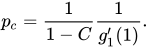
  • For a random tree-like network without degree-degree correlation, it can be shown that such network can have a giant component, and the percolation threshold (transmission probability) is given by , where is the generating function corresponding to the excess degree distribution. So, for random Erdős–Rényi networks of average degree , pc = 1/⟨k⟩.[8][9][10]
  • In networks with low clustering, , the critical point gets scaled by such that:

[11]

This indicates that for a given degree distribution, the clustering leads to a larger percolation threshold, mainly because for a fixed number of links, the clustering structure reinforces the core of the network with the price of diluting the global connections. For networks with high clustering, strong clustering could induce the core–periphery structure, in which the core and periphery might percolate at different critical points, and the above approximate treatment is not applicable.[12]

Phases

[edit]

Subcritical and supercritical

[edit]

The main fact in the subcritical phase is "exponential decay". That is, when p < pc, the probability that a specific point (for example, the origin) is contained in an open cluster (meaning a maximal connected set of "open" edges of the graph) of size r decays to zero exponentially in r. This was proved for percolation in three and more dimensions by Menshikov (1986) and independently by Aizenman & Barsky (1987). In two dimensions, it formed part of Kesten's proof that pc = 1/2.[13]

The dual graph of the square lattice 2 is also the square lattice. It follows that, in two dimensions, the supercritical phase is dual to a subcritical percolation process. This provides essentially full information about the supercritical model with d = 2. The main result for the supercritical phase in three and more dimensions is that, for sufficiently large N, there is almost certainly an infinite open cluster in the two-dimensional slab 2 × [0, N]d − 2. This was proved by Grimmett & Marstrand (1990).[14]

In two dimensions with p < 1/2, there is with probability one a unique infinite closed cluster (a closed cluster is a maximal connected set of "closed" edges of the graph). Thus the subcritical phase may be described as finite open islands in an infinite closed ocean. When p > 1/2 just the opposite occurs, with finite closed islands in an infinite open ocean. The picture is more complicated when d ≥ 3 since pc < 1/2, and there is coexistence of infinite open and closed clusters for p between pc and 1 − pc.

Criticality

[edit]
Zoom in a critical percolation cluster (Click to animate)

Percolation has a singularity at the critical point p = pc and many properties behave as of a power-law with , near . Scaling theory predicts the existence of critical exponents, depending on the number d of dimensions, that determine the class of the singularity. When d = 2 these predictions are backed up by arguments from conformal field theory and Schramm–Loewner evolution, and include predicted numerical values for the exponents. Most of these predictions are conjectural except when the number d of dimensions satisfies either d = 2 or d ≥ 6. They include:

  • There are no infinite clusters (open or closed)
  • The probability that there is an open path from some fixed point (say the origin) to a distance of r decreases polynomially, i.e. is on the order of rα for some α
    • α does not depend on the particular lattice chosen, or on other local parameters. It depends only on the dimension d (this is an instance of the universality principle).
    • αd decreases from d = 2 until d = 6 and then stays fixed.
    • α2 = −5/48
    • α6 = −1.
  • The shape of a large cluster in two dimensions is conformally invariant.

See Grimmett (1999).[15] In 11 or more dimensions, these facts are largely proved using a technique known as the lace expansion. It is believed that a version of the lace expansion should be valid for 7 or more dimensions, perhaps with implications also for the threshold case of 6 dimensions. The connection of percolation to the lace expansion is found in Hara & Slade (1990).[16]

In two dimensions, the first fact ("no percolation in the critical phase") is proved for many lattices, using duality. Substantial progress has been made on two-dimensional percolation through the conjecture of Oded Schramm that the scaling limit of a large cluster may be described in terms of a Schramm–Loewner evolution. This conjecture was proved by Smirnov (2001)[17] in the special case of site percolation on the triangular lattice.

Different models

[edit]

Applications

[edit]

In biology, biochemistry, and physical virology

[edit]

Percolation theory has been used to successfully predict the fragmentation of biological virus shells (capsids),[19][20] with the fragmentation threshold of Hepatitis B virus capsid predicted and detected experimentally.[21] When a critical number of subunits has been randomly removed from the nanoscopic shell, it fragments and this fragmentation may be detected using Charge Detection Mass Spectroscopy (CDMS) among other single-particle techniques. This is a molecular analog to the common board game Jenga, and has relevance to the broader study of virus disassembly. More stable viral particles (tilings with greater fragmentation thresholds) are found in greater abundance in nature.[19]

In ecology

[edit]

Percolation theory has been applied to studies of how environment fragmentation impacts animal habitats[22] and models of how the plague bacterium Yersinia pestis spreads.[23]

See also

[edit]

References

[edit]
[edit]
Revisions and contributorsEdit on WikipediaRead on Wikipedia
from Grokipedia
Percolation theory is a mathematical framework in statistical physics and probability that models the emergence of large-scale connectivity in random media, such as the formation of spanning clusters in lattices where sites or bonds are occupied with independent probability $ p $.[1] Introduced by Simon R. Broadbent and John M. Hammersley in 1957, it originated as a model for fluid infiltration through porous structures like crystals or mazes, contrasting with diffusion by emphasizing randomness in the medium rather than the propagating agent.[2] The theory examines Bernoulli percolation processes, where the probability $ p $ determines whether an infinite connected cluster forms, marking a geometric phase transition at the critical threshold $ p_c $.[3] Central to percolation theory are two primary models: bond percolation, where edges of a lattice (e.g., the integer lattice $ \mathbb{Z}^d $) are present independently with probability $ p $, and site percolation, where vertices are occupied with probability $ p $.[1] Below $ p_c $, clusters are finite and localized; at $ p_c $, a unique infinite cluster emerges with fractal properties, exhibiting scaling behaviors characterized by critical exponents such as the correlation length exponent $ \nu $ (approximately 4/3 in two dimensions).[3] Exact values of $ p_c $ are known for certain cases, including $ p_c = 1/2 $ for bond percolation on the two-dimensional square lattice and $ p_c = 1 $ in one dimension, where no infinite cluster forms for $ p < 1 $.[4] These thresholds connect to broader critical phenomena, analogous to Ising model phase transitions, and have been analyzed using renormalization group methods since the 1970s.[3] Percolation theory finds applications across disciplines, including modeling fluid flow in porous media for oil recovery, where cluster sizes predict extraction efficiency, and electrical conductivity in disordered networks, where the effective conductivity vanishes as $ (p - p_c)^\mu $ near the threshold ($ \mu \approx 1.3 $ in 2D).[4] In materials science, it describes rigidity percolation in elastic composites, with thresholds linked to mechanical stability, as in the central-force model where $ p_c \approx 0.66 $ in 2D for floppy-to-rigid transitions on the bond-diluted triangular lattice.[5] Epidemiological models use it for disease spread on contact networks, while in computer science, it informs fault-tolerant designs in integrated circuits.[1] Extensions include continuum percolation for overlapping particles and bootstrap percolation for dependent occupations, broadening its relevance to complex systems like forest fires or social networks.[1]

Fundamentals

Definition and Scope

Percolation theory is a fundamental framework in statistical physics that examines the connectivity properties of random media, specifically the formation and evolution of connected clusters as elements of the medium become occupied according to a probabilistic rule. In its core setup, consider a lattice or graph where each site or bond is independently occupied (termed "open") with probability $ p \in [0,1] $ through Bernoulli trials, or unoccupied ("closed") with probability $ 1-p $. A cluster is defined as a connected component consisting of open sites or bonds linked via nearest-neighbor adjacency, and the theory investigates how these clusters grow and interconnect as $ p $ varies, particularly the emergence of a spanning cluster that either traverses the entire system or extends infinitely in the thermodynamic limit.[6] The scope of percolation theory encompasses the study of phase transitions in disordered systems, where randomness in the medium leads to abrupt changes in global connectivity properties, such as the percolation threshold beyond which a giant connected component dominates. Unlike deterministic connectivity problems in graph theory, which assume fixed structures, percolation emphasizes stochastic processes in heterogeneous environments, providing insights into emergent phenomena in complex systems. This probabilistic approach distinguishes it as a tool for modeling real-world scenarios involving uncertainty, including the flow of fluids through porous rocks—where open pores allow permeation—and the spread of diseases across a population grid, analogous to infection propagating through connected individuals.[7][8] By focusing on these connectivity thresholds and cluster statistics, percolation theory bridges mathematics, physics, and applied sciences, offering a versatile model for understanding how local randomness yields macroscopic behavior without relying on specific microscopic interactions.

Historical Development

Early ideas in percolation theory were anticipated in the 1940s by Paul Flory's theory of polymer gelation, which modeled the formation of infinite networks in branching polymerization processes, establishing a critical threshold for gel formation.[9] In the late 1940s and early 1950s, John M. Hammersley explored related problems such as the coverage of lines by random intervals, laying groundwork for continuum percolation models. These investigations addressed stochastic distributions in one-dimensional settings, such as the probability of complete coverage or gaps in random placements, which anticipated later applications to fluid flow through disordered media.[10] In the 1950s, the theory gained formal structure through the work of Simon R. Broadbent and Hammersley, who introduced the Bernoulli bond percolation model in 1957 to simulate the flow of fluids or gases through porous materials, such as charcoal in gas masks. This model also served as an analogy for the spread of diseases in lattice-based structures, like plant blight in orchards arranged on a square grid. The framework formalized random occupation of bonds or sites with probability pp, marking the birth of percolation as a probabilistic tool for connectivity in random graphs. The 1960s saw significant formalization, with Hammersley, Harry Kesten, and Robert T. Smythe advancing discrete site and bond percolation on lattices. A pivotal contribution was the introduction of the critical probability pcp_c, the threshold above which an infinite connected cluster emerges with positive probability, rigorously established through bounds and existence proofs. Theodore E. Harris provided a key lower bound for pcp_c in 1960 for the square lattice, demonstrating the phase transition from finite to infinite clusters. Kesten's early work further refined these concepts, proving finiteness of moments and connectivity properties.[11] During the 1970s and 1980s, percolation theory deepened its ties to statistical physics, particularly through connections to the Ising model via the q-state Potts model in the limit q1q \to 1. Researchers like M. P. M. den Nijs applied renormalization group techniques to analyze critical exponents, revealing scaling behaviors akin to magnetic phase transitions. The universality hypothesis, positing that critical phenomena in percolation depend only on dimensionality and not lattice specifics, was explored by Harris and others, aligning percolation with broader classes of phase transitions. A landmark event was Kesten's 1980 proof that pc=1/2p_c = 1/2 exactly for bond percolation on the two-dimensional square lattice, providing the first precise solution in a non-trivial case. Studies in random media around this era, influenced by advances in probability at international conferences, elevated percolation's mathematical rigor.[12] In the modern era, percolation integrated with fractal geometry following Benoit Mandelbrot's 1982 analysis of cluster structures as self-similar fractals, highlighting their scale-invariant properties at criticality. Post-1990s developments emphasized computational methods, with simulations enabling exploration of higher dimensions and scaling limits, alongside exact results like uniqueness of the infinite cluster above pcp_c.

Core Models

Discrete Percolation Models

Discrete percolation models form the foundational framework of percolation theory, focusing on lattice structures where connectivity is determined by random occupations of sites or bonds. These models abstract the flow of fluids through porous media or the spread of information in networks by assigning probabilistic openness to elements of a regular grid. Introduced in the seminal work by Broadbent and Hammersley, they emphasize independent Bernoulli trials for occupation, leading to cluster formations that reveal connectivity patterns.[6] In bond percolation, each edge (bond) of a lattice graph is independently occupied (open) with probability $ p \in [0,1] $, and closed otherwise; two vertices are connected if there exists a path between them consisting entirely of open bonds. This model captures scenarios where connections between sites are probabilistic, such as cracks in a material or links in a communication network. Clusters are defined as the connected components under this openness rule, with percolation occurring when an infinite cluster emerges.[6][13] Site percolation, in contrast, involves independently occupying each vertex (site) of the lattice with probability $ p $, where clusters form from adjacent open sites sharing an edge. Adjacency is typically defined by a neighborhood structure, such as the von Neumann neighborhood (four orthogonal neighbors on a square lattice) or the Moore neighborhood (eight neighbors, including diagonals). This variant models occupations of positions themselves, like occupied pores in a filter or active nodes in a grid-based system.[13][14] These models are studied on various regular lattices, with the square, triangular, and honeycomb lattices serving as canonical examples due to their symmetry and analyzable properties. On the square lattice, bond percolation exhibits self-duality, implying a critical occupation probability of exactly $ p_c = 1/2 $. The triangular and honeycomb lattices form a dual pair, where the bond percolation threshold on one relates inversely to the other via duality relations established by Sykes and Essam.[15][16] Mixed models extend the basic frameworks by introducing dependencies or alternative rules, such as correlated percolation where occupations are not independent, or bootstrap percolation where sites become occupied if they have a sufficient number of already open neighbors, leading to growth dynamics from an initial seed configuration. Bootstrap percolation, introduced by Chalupa, Leath, and Reich, models irreversible activation processes on lattices, with clusters expanding monotonically under threshold rules. Mathematically, these models are formulated using a probability measure $ \mathbb{P}_p $ on the configuration space $ \Omega $, where $ \Omega = {0,1}^E $ for bond percolation (with $ E $ the edge set) or $ \Omega = {0,1}^V $ for site percolation (with $ V $ the vertex set); each element is 1 (open) with probability $ p $ independently. The percolation event is captured by $ \Theta(p) = \mathbb{P}_p(\text{there exists a spanning cluster}) $, quantifying the probability of global connectivity in finite or infinite lattices.[13]

Continuum and Other Variants

Continuum percolation extends the concepts of discrete percolation to continuous spaces, such as Rd\mathbb{R}^d, where connectivity arises from the overlap of randomly placed shapes rather than fixed lattice sites. In this framework, the occupied set is typically formed by the union of grains—such as disks in 2D or spheres in 3D—centered at points drawn from a Poisson point process with intensity λ\lambda. The analog to the occupation probability pp in discrete models is the reduced density η=λ×V\eta = \lambda \times V, where VV is the volume of a typical grain; percolation occurs above a critical ηc\eta_c, with simulations indicating ηc1.13\eta_c \approx 1.13 in 2D for equal-radius disks (corresponding to a covered area fraction of approximately 0.68). This model captures phenomena like the formation of infinite clusters in random media without underlying discreteness. The Boolean model is a foundational instance of continuum percolation, where germs (Poisson points) are each associated with an identical grain, such as a ball of fixed radius rr, and the percolating set is their union; the covered volume fraction at criticality is ϕc=1eηc\phi_c = 1 - e^{-\eta_c}, with ϕc0.68\phi_c \approx 0.68 in 2D and 0.29\approx 0.29 in 3D for spheres. More generally, germ-grain models allow arbitrary grains (possibly random and non-spherical) attached to germs from a point process, encompassing both overlapping and non-overlapping configurations; these generalize the Boolean model by permitting complex grain shapes while preserving the Poisson-driven randomness. Interpretations include the occupancy view (union of grains as occupied) and the vacancy view (complement as unoccupied voids), both yielding phase transitions analogous to discrete cases but in infinite domains.[17] Directed percolation introduces anisotropy by orienting connections, such as arrows on bonds that permit flow only in specified directions (e.g., forward in time-like dimensions), leading to distinct critical behavior from isotropic models. This variant models processes like epidemic spreading or fluid invasion with preferred directions and belongs to its own universality class, characterized by exponents differing from standard percolation, as established through field-theoretic analyses and simulations. Seminal work by Grassberger and Janssen highlighted its role in nonequilibrium phase transitions with absorbing states.[18][19] Other variants include percolation on trees, such as the Bethe lattice with coordination number zz, where exact solvability yields a critical probability pc=1/(z1)p_c = 1/(z-1) via recursive branching arguments, serving as a mean-field benchmark without loops. Long-range percolation modifies connectivity by allowing bonds between sites at distance rr with probability decaying as 1/rd+σ1/r^{d+\sigma} (σ>0\sigma > 0), altering effective dimensionality: for σ<2\sigma < 2, it exhibits mean-field-like behavior with faster cluster growth, while σ>2\sigma > 2 recovers short-range universality. Invasion percolation, a dynamic greedy process, simulates slow displacement by iteratively occupying the lowest-threshold pore among accessible ones, naturally reaching criticality without tuning parameters and producing fractal clusters akin to critical percolation.[3][20][21]

Phase Transitions

Subcritical and Supercritical Regimes

In the subcritical regime, where the occupation probability pp is less than the critical threshold pcp_c, all clusters are finite almost surely, and the probability of an infinite open cluster is zero, denoted θ(p)=0\theta(p) = 0.[22] The distribution of cluster sizes exhibits exponential decay, with the probability that the cluster containing a given site has size at least nn bounded by Pp[C(v)n]C1eC2nP_p[|C(v)| \geq n] \leq C_1 e^{-C_2 n} for positive constants C1,C2>0C_1, C_2 > 0 depending on pp and the lattice.[22] In finite systems of size NN, the largest cluster scales as O(logN)O(\log N) in expectation, reflecting the absence of spanning clusters and the dominance of small, localized components.[23] The mean cluster size χ(p)=Ep[C(v)]\chi(p) = \mathbb{E}_p[|C(v)|] remains finite but diverges as ppcp \to p_c^-, signaling the approach to the phase transition.[22] In the supercritical regime, for p>pcp > p_c, an infinite open cluster emerges with positive probability θ(p)>0\theta(p) > 0, defined as the limiting probability that a given site belongs to the infinite cluster.[22] This infinite cluster is unique almost surely in Zd\mathbb{Z}^d for d2d \geq 2, and the density θ(p)\theta(p) provides a measure of the fraction of sites connected to it.[24] Finite clusters coexist with the infinite one, but their sizes decay exponentially, similar to the subcritical case.[22] Near the critical point, θ(p)(ppc)β\theta(p) \approx (p - p_c)^\beta for p>pcp > p_c, where β>0\beta > 0 is a critical exponent characterizing the order parameter's onset (detailed scaling laws are discussed in the critical phenomena section). The correlation length ξ(p)\xi(p), which governs the typical extent of connectivity, scales as ξ(p)ppcν\xi(p) \sim |p - p_c|^{-\nu} with ν>0\nu > 0, diverging on both sides of pcp_c.[22] Key theoretical insights include the Russo-Seymour-Welsh (RSW) theory in two dimensions, which establishes bounds on crossing probabilities in rectangular regions, ensuring stability of the supercritical phase and uniform percolation probabilities away from boundaries.[25]90037-0) This framework underpins proofs of θ(pc)=0\theta(p_c) = 0 in 2D and facilitates understanding of arm events and interface properties in the supercritical regime.[22]

Critical Phenomena and Exponents

At the percolation threshold $ p = p_c $, the order parameter $ \theta(p_c) = 0 $, and there is almost surely no infinite cluster (proven for $ d = 2 $ and $ d \geq 19 $, conjectured otherwise as of 2025), yet the system exhibits critical fluctuations with diverging susceptibility and power-law cluster size distributions, marking the onset of long-range correlations.[26][27] Simultaneously, the susceptibility $ \chi(p_c) $, defined as the mean size of finite clusters, diverges to infinity, signaling critical fluctuations.[26] These behaviors exemplify the singular critical phenomena central to percolation theory, where geometric and statistical properties exhibit scale-invariant, fractal-like structures.[26] Percolation exhibits universality, wherein critical behaviors depend solely on the spatial dimension $ d $ and the range of interactions, rather than microscopic details like lattice type.[26] Distinct universality classes arise, such as the two-dimensional (2D) class characterized by exact solvability via conformal invariance, contrasting with the three-dimensional (3D) class, which relies on numerical estimates.[28] Hyperscaling, valid below the upper critical dimension $ d = 6 $, relates exponents through $ 2 - \alpha = d \nu $, where $ \alpha $ governs the specific heat analog and $ \nu $ the correlation length; this fails in mean-field regimes for $ d \geq 6 $.[26] Key scaling exponents quantify these singularities. The order parameter exponent $ \beta $ describes $ \theta(p) \sim (p - p_c)^\beta $ for $ p > p_c $, with exact 2D value $ \beta = 5/36 $ and 3D estimate $ \beta \approx 0.41 $.[26] The correlation length exponent $ \nu $ captures $ \xi \sim |p - p_c|^{-\nu} $, yielding $ \nu = 4/3 $ exactly in 2D and $ \nu \approx 0.88 $ in 3D.[26] Susceptibility diverges as $ \chi \sim |p - p_c|^{-\gamma} $, with $ \gamma = 43/18 $ in 2D and $ \gamma \approx 1.8 $ in 3D.[26] For cluster size distribution at criticality, $ P(s) \sim s^{-\tau} $, where $ \tau = 187/91 \approx 2.055 $ in 2D and $ \tau \approx 2.18 $ in 3D.[26] Scaling forms encapsulate these relations, such as the cluster size probability $ P(s,p) \sim s^{-\tau} f((p - p_c) s^\sigma) $, with $ \sigma = 1/(\beta + \gamma) $.[26] Fisher relations link exponents, including $ \tau = 2 + 1/(\delta + 1) $, where $ \delta = \gamma / \beta $ describes the magnetization analog at criticality.90060-7) Renormalization group theory provides insights by identifying the critical fixed point, enabling derivation of universality and hyperscaling through iterative coarse-graining. Critical clusters display fractal geometry, with the incipient infinite cluster having fractal dimension $ d_f = 91/48 \approx 1.896 $ in 2D.[26] The hull, or external perimeter, exhibits dimension $ D_h = 7/4 = 1.75 $ in 2D, reflecting self-similar boundary roughness. These properties underscore the scale-free nature of percolation at $ p_c $, with renormalization group flows confirming the irrelevance of short-range details in determining long-wavelength behavior.

Analytical and Computational Approaches

Threshold Determination

Determining the percolation threshold pcp_c, the critical occupation probability at which an infinite cluster emerges, is a central challenge in percolation theory. Analytical methods provide exact values for select models, bounds for general cases, and approximations via expansions or mean-field treatments. These approaches exploit symmetries, inequalities, and diagrammatic conditions to pinpoint or constrain pcp_c without relying on simulations. Exact results are available for specific low-dimensional lattices due to duality and matching properties. For bond percolation on the two-dimensional square lattice, duality between the lattice and its dual implies that the threshold occurs where the probability of connection equals the probability of blockage, yielding pc=1/2p_c = 1/2. Similarly, for site percolation on the two-dimensional triangular lattice, a star-triangle transformation and matching lattice arguments establish pc=1/2p_c = 1/2. On the Bethe lattice, an infinite tree with coordination number zz, the absence of loops allows an exact recursive solution for the probability of finite clusters, giving pc=1/(z1)p_c = 1/(z-1). In higher dimensions or more complex lattices, exact solutions are rare, so bounds and approximations are employed. The Aizenman-Newman inequality, derived from tree-graph approximations to the cluster expansion, provides a lower bound for bond percolation on the dd-dimensional hypercubic lattice: pc1/(2d1)p_c \geq 1/(2d-1). Self-dual approximations extend duality ideas to non-self-dual lattices by constructing equivalent self-dual hypergraphs, yielding estimates like pc1/2p_c \approx 1/2 for certain quasi-planar models where exact duality does not apply directly. Series expansions offer a perturbative method to locate pcp_c by analyzing the radius of convergence of power series for quantities like the mean cluster size. High-temperature expansions (analogous to low-pp regimes) generate coefficients for the susceptibility χ(p)=ss2ns(p)\chi(p) = \sum_s s^2 n_s(p), where ns(p)n_s(p) is the density of ss-clusters, and singularities indicate pcp_c. Low-temperature expansions (high-pp side) similarly probe the order parameter via cluster connectivity probabilities. These methods, rooted in graph enumerations, have been applied to lattices like the square and honeycomb to refine threshold estimates. Mean-field theory simplifies the problem by neglecting spatial correlations, treating clusters as branching processes on the Bethe lattice, which predicts pc=1/(z1)p_c = 1/(z-1) for coordination number zz. This approximation becomes exact above the upper critical dimension dc=6d_c = 6, where fluctuations are suppressed, and critical behavior matches mean-field values. The triangle condition, a diagrammatic criterion from lace expansion, x,yτ(x)τ(y)τ(xy)<\sum_{x,y} \tau(x)\tau(y)\tau(|x-y|) < \infty near criticality (where τ(r)\tau(r) is the two-point connectivity), confirms mean-field validity when it holds, as in d>6d > 6. Analogies to self-avoiding walks (SAWs) aid in bounding pcp_c, as the percolation susceptibility relates to the SAW generating function, providing inequalities like those from connective constant estimates to constrain thresholds in dimensions where exact duality fails.

Simulation Techniques

Monte Carlo methods form the cornerstone of numerical simulations in percolation theory, enabling the estimation of key quantities such as the percolation strength θ(p)\theta(p), which represents the probability that a site belongs to the infinite cluster, and the susceptibility χ(p)\chi(p), the mean size of finite clusters, through repeated fixed-occupation probability pp runs on finite lattices. These simulations generate random configurations of occupied sites or bonds and identify connected clusters using union-find data structures, averaging observables over many independent realizations to reduce statistical noise.[29] To determine the critical occupation probability pcp_c in the thermodynamic limit, finite-size scaling analysis is applied, leveraging the divergence of the correlation length ξppcν\xi \sim |p - p_c|^{-\nu} near criticality; for finite linear system size LL, quantities like the effective pc(L)p_c(L) shift as pc(L)pcL1/νp_c(L) - p_c \sim L^{-1/\nu}, allowing extrapolation via fits to data from multiple LL values. This approach, pioneered in early studies of lattice percolation, provides high-precision estimates of pcp_c and critical exponents by analyzing how observables scale with LL at fixed pp near pcp_c. Efficient cluster enumeration is crucial for large-scale simulations, and the Newman-Ziff algorithm achieves this by incrementally occupying sites in random order while maintaining a dynamic record of cluster sizes and mergers through a union-find structure with path compression, computing spanning probabilities and moments for all pp from 0 to 1 in linear time O(N)O(N).[29] For dynamical variants, invasion percolation simulates slow fluid invasion by repeatedly selecting the lowest-threshold pore at the cluster boundary, modeling gradient-driven processes without fixed pp, and revealing fractal invasion clusters with the same universality as static percolation. Renormalization simulations approximate the renormalization group flow numerically via block spinning, where coarse-graining transforms a fine lattice of scale bb into an effective coarse lattice by defining a site as occupied if a majority (or other rule) of its bdb^d sub-sites are connected, yielding recursion relations for effective p(p)p'(p) and fixed points to estimate pcp_c and exponents. Large-cell Monte Carlo variants enhance accuracy by averaging over many realizations within each block, mitigating finite-size effects and confirming universality across models. High-performance computing adaptations include parallel cluster labeling algorithms that partition the lattice into subdomains assigned to processors, performing local Hoshen-Kopelman labeling followed by inter-processor resolution of cluster identities via relaxation iterations, enabling simulations on lattices up to 10410^4 sites in high dimensions.[30] Error analysis in these simulations often employs jackknife resampling, where subsets of configurations are omitted to compute variance in estimates like pcp_c, providing unbiased error bars for finite-sample statistics. Recent advances post-2010 include GPU-accelerated implementations that parallelize random number generation, site occupation, and cluster identification across thousands of threads, achieving speedups of 10-100x for 2D lattice percolation studies and enabling analysis of larger systems for threshold estimation. Extensions of the Newman-Ziff algorithm to bootstrap percolation variants, where clusters grow by adding sites meeting a neighborhood threshold, further optimize simulations on complex lattices like Archimedean tilings by tracking activation cascades efficiently.[31]

Applications

In Physics and Materials Science

In physics and materials science, percolation theory provides a framework for understanding transport and structural properties in disordered systems, particularly near the percolation threshold where connectivity emerges. One key application is in modeling electrical conductivity through random resistor networks, where bonds or sites are randomly occupied with conducting or insulating elements. In these networks, the effective conductivity vanishes below the percolation threshold $ p_c $ and follows a power-law behavior above it, σ(ppc)μ\sigma \sim (p - p_c)^\mu, capturing the onset of long-range connectivity.[32] Effective medium theory approximates this conductivity by treating the network as a homogeneous medium with an averaged conductivity, offering reasonable predictions away from the threshold but underestimating the critical behavior near $ p_c $.[32] In two dimensions, numerical studies confirm the critical exponent μ1.3\mu \approx 1.3, highlighting the universality of this scaling in lattice models.[33] Percolation also informs magnetic properties in diluted ferromagnets, where magnetic ions are randomly placed on a lattice. The percolation threshold determines the onset of an infinite magnetic cluster, enabling long-range order, but this geometric transition precedes the thermal Ising transition that governs magnetization below a critical temperature.[34] In such systems, the diluted lattice exhibits a percolation-driven loss of ferromagnetism at $ p_c $, distinct from the Ising model's cooperative spin alignment, as dilution disrupts cluster connectivity before thermal disorder dominates.[34] This distinction is crucial for understanding phase diagrams in materials like transition metal halides, where site or bond dilution shifts the magnetic response.[34] In fluid dynamics through porous media, percolation theory models hydraulic conductivity under Darcy's law, $ \mathbf{q} = -\kappa \nabla h $, where flow emerges only above $ p_c $ due to connected pore pathways. The effective conductivity scales as $ \kappa \sim (p - p_c)^t $, with the exponent $ t \approx 1.3 $ in 2D and $ t \approx 2 $ in 3D, reflecting tortuosity and bottleneck effects in heterogeneous rocks or soils.[33] This scaling aids upscaling from microscopic pore structures to macroscopic flow properties, validated by critical path analysis.[33] Fracture mechanics employs invasion percolation to describe crack propagation in brittle materials, where fluid invasion or stress selects the path of least resistance, mimicking unstable growth. Introduced as a variant of standard percolation, this model simulates dendritic fracture patterns by iteratively filling pores or bonds with the lowest threshold, leading to ramified clusters without loops. In rocks, it captures subcritical crack advance under hydraulic pressure, relevant to enhanced oil recovery or geothermal systems.[35] Representative examples include carbon nanotube (CNT) composites, where percolation governs electrical conductivity in polymer matrices; aligned CNTs lower the threshold to below 1 wt%, enabling lightweight conductors for electronics.[36] In geological reservoirs, percolation quantifies fluid flow connectivity in heterogeneous sandstones, predicting breakthrough times and permeability from porosity distributions, as in fluvial or turbidite formations.[37] Recent applications in the 2020s extend to battery electrode design, where percolation optimizes ion and electron pathways in composite cathodes; for instance, single-walled CNTs as fillers in NCM electrodes enhance conductivity near the threshold, improving energy density and rate performance in lithium-ion systems.[38]

In Biological and Ecological Systems

Percolation theory has been applied to epidemiology by mapping susceptible-infected-recovered (SIR) models on lattices to bond percolation processes, where the occupation probability corresponds to the probability of transmission between neighboring sites.[8] In this framework, the epidemic threshold aligns with the percolation threshold pcp_c, below which isolated infection clusters form without widespread outbreaks, and above which a giant connected component emerges, representing a large-scale epidemic.[39] This analogy allows for the analysis of spatial spread in structured populations, such as on square lattices, where critical exponents from percolation describe the size distribution of outbreak clusters near the threshold.[40] In ecological systems, percolation models habitat fragmentation by treating landscapes as random lattices where occupied sites represent suitable habitat patches, and connectivity determines species dispersal viability.[41] As habitat occupancy approaches the percolation threshold, a spanning cluster forms, enabling long-range dispersal and metapopulation persistence; below this threshold, fragmentation isolates small clusters, increasing extinction risk for species reliant on connectivity.[42] These models predict critical abundance levels for species distributions, where fragmented patches coalesce into viable networks only above specific occupancy fractions, informing conservation strategies against habitat loss.[43] Percolation theory elucidates virus assembly by analyzing protein interaction graphs in capsid formation, where subunits connect via bonds to form stable shells analogous to percolating clusters.[44] In this view, the geometric layout and interaction network of viral proteins exhibit percolation transitions, with the critical probability governing the emergence of a complete capsid structure from incomplete assemblies.[45] Removing subunits disrupts connectivity, leading to fragmentation below the threshold, which mirrors observed instability in virus-like particles and highlights biophysical constraints on assembly efficiency.[44] Biochemical processes in crowded cellular environments leverage percolation to model enzyme diffusion and reaction networks, where macromolecules form disordered lattices that hinder or facilitate connectivity.[46] In such settings, enzyme percolation clusters enhance catalytic efficiency by creating extended networks for substrate access, particularly near the percolation threshold where shredded structures maximize interaction surfaces.[47] Crowding alters diffusion-limited reaction rates, with percolation-based simulations showing reduced enzymatic activity below critical densities due to isolated clusters, underscoring the role of spatial organization in cellular metabolism.[48] Representative applications include forest fire spread models, where trees on a lattice ignite with probability pp, and fire propagates through connected occupied sites until the percolation threshold determines whether the blaze spans the entire forest.[49] In coral reef systems, percolation analogs assess habitat connectivity for larval dispersal, treating reef patches as sites in a marine lattice to identify fragmentation thresholds that isolate populations and reduce genetic exchange.[41] Studies on COVID-19 spatial transmission in the 2020s have used percolation to map epidemic progression across regions, revealing directed percolation waves where case clusters expand critically until containment measures shift occupancy below pcp_c, as observed in Chile's outbreak dynamics.[50]

In Networks and Social Sciences

In network percolation, the emergence of a giant connected component in random graphs serves as a foundational example of phase transitions in abstract structures. In the Erdős–Rényi model, where edges are present independently with probability pp, a giant component spanning a finite fraction of vertices arises when the average degree k=np=1\langle k \rangle = np = 1, marking the percolation threshold; below this value, components remain small and tree-like, while above it, a macroscopic cluster dominates the graph's connectivity.[51] This threshold highlights the abrupt shift from fragmentation to cohesion, analogous to fluidity in physical media but applied to relational ties in networks. k-core percolation extends this by iteratively removing nodes with degree less than kk, revealing the network's resilient backbone; for Erdős–Rényi graphs, the k-core threshold occurs at a critical average degree kc\langle k \rangle_c satisfying the self-consistent equation u=exp(k(uk11))u = \exp(\langle k \rangle (u^{k-1} - 1)) having a solution u<1u < 1, with kcklnk\langle k \rangle_c \sim k \ln k for large kk, and the process yielding a discontinuous transition in heterogeneous networks.[52] Social contagion processes leverage percolation to model the spread of information, behaviors, or diseases across human networks, where adoption depends on local influences rather than random bonds. In Watts' threshold model, individuals adopt a trait if a fraction rr of their neighbors have it, leading to global cascades from a small seed when the network's degree distribution and threshold variance align near the percolation point; simulations on random graphs show cascades spanning up to 75% of nodes for r0.1r \approx 0.1 and broad degree heterogeneity.[53] This framework captures phenomena like viral trends or opinion shifts, distinct from independent percolation by incorporating endogenous activation rules that amplify clustering. In scale-free networks with power-law degree distributions P(k)kγP(k) \sim k^{-\gamma}, robustness against random failures is enhanced for γ<3\gamma < 3, with the bond percolation threshold pc1/(k2/k1)p_c \approx 1/(\langle k^2 \rangle / \langle k \rangle - 1), explaining the Internet's resilience to breakdowns but vulnerability to targeted attacks on hubs. Applications in social sciences underscore percolation's role in dissecting systemic risks and dynamics. Financial contagion during the 2008 crisis has been analogized to percolation cascades in interbank networks, where liquidity shocks propagate through overlapping exposures, leading to widespread defaults if the fraction of failed links exceeds a connectivity threshold; models reveal that dense core structures amplify contagion, with up to 20% node removal triggering systemic collapse in empirical datasets.[54] On social media, echo chambers emerge as densely connected clusters in user interaction graphs, fostering polarized information flow akin to subcritical percolation regimes where low bridge probabilities isolate communities. Studies of misinformation dynamics show false narratives spreading faster than facts in polarized networks, forming giant components more readily due to community structures.[55] Variants like percolation on scale-free networks further adapt these insights, while hybrid discrete-continuum models integrate graph edges with spatial influences for urban social ties, blending bond occupation with density gradients to predict community fragmentation.[56]

References

User Avatar
No comments yet.