


Community hub
Recent from talks
Contribute something
Nothing was collected or created yet.
Economy of Germany
View on Wikipedia
 Frankfurt, the financial centre of Germany, seat of the European Central Bank and one of the major financial centres in Europe | |
| Currency | Euro (EUR, €) |
|---|---|
| Calendar year | |
Trade organisations | EU, WTO, G-20, G7 and OECD |
Country group |
|
| Statistics | |
| Population | 83,445,000 (2024 est.)[6] |
| GDP | |
| GDP rank | |
GDP growth | |
GDP per capita | |
GDP per capita rank | |
GDP by sector |
|
GDP by component |
|
Population below poverty line |  21.1% at risk of poverty or social exclusion (AROPE 2024)[9] 21.1% at risk of poverty or social exclusion (AROPE 2024)[9] |
 29.5 low (2024)[10] 29.5 low (2024)[10] | |
 75 out of 100 points (2024)[12] (rank 15th) 75 out of 100 points (2024)[12] (rank 15th) | |
Labour force | |
Labour force by occupation |
|
| Unemployment | |
Average gross salary | €5,274 monthly (2024)[15][16] |
| €3,300 monthly (2024)[15][16] | |
Main industries | |
| External | |
| Exports | $1.66 trillion (2024)[17] |
Export goods | motor vehicles, machinery, chemicals, computer and electronic products, electrical equipment, pharmaceuticals, metals, transport equipment, foodstuffs, textiles, rubber and plastic products |
Main export partners |
|
| Imports | $1.4 trillion (2024)[17] |
Import goods | machinery, data processing equipment, vehicles, chemicals, oil and gas, metals, electric equipment, pharmaceuticals, foodstuffs, agricultural products |
Main import partners |
|
FDI stock | |
Gross external debt | $5.4 trillion (2022)[18] |
| Public finances | |
| $400 billion (2022)[20] | |
| Revenues | 46.1% of GDP (2023)[19] |
| Expenses | 48.6% of GDP (2023)[19] |
| Economic aid |
|
All values, unless otherwise stated, are in US dollars. | |


Germany has a highly developed social market economy.[26] It is the largest national economy in Europe, the third-largest by nominal GDP in the world, and the sixth-largest by PPP-adjusted GDP. Due to a volatile currency exchange rate, Germany's GDP as measured in dollars fluctuates sharply, but it is among the world's top 4 since 1960.[27] In 2025, the country accounted for 23.7% of the Euro area economy according to the International Monetary Fund (IMF).[28] Germany is a founding member of the European Union and the eurozone.[29][30]
Germany is the third-largest exporter globally with $1.66 trillion worth of goods and services exported in 2024. In 2024, Germany recorded a trade surplus worth $255 billion, ranking 2nd worldwide. The service sector contributes around 70% of the total GDP, industry 29.1%, and agriculture 0.9%. Exports accounted for 50.3% of national output.[31][32] The top 10 exports of Germany are vehicles, machinery, chemical goods, electronic products, electrical equipment, pharmaceuticals, transport equipment, basic metals, food products, and rubber and plastics.[33] Germany is the largest manufacturing economy in Europe, contributing around one third of all manufacturing in Europe,[34] which makes it more resilient to global economic crises.[35] Germany conducts applied research with practical industrial value and sees itself as a bridge between the latest university insights and industry-specific product and process improvements. It generates a great deal of knowledge in its own laboratories.[36] Among OECD members, Germany has a highly efficient and strong social security system, which comprises roughly 25% of GDP.[5][37][4]
Germany is rich in timber, lignite, potash, and salt. Some minor sources of natural gas are being exploited in the state of Lower Saxony. Until German reunification, the German Democratic Republic mined for uranium in the Ore Mountains (see also: SAG/SDAG Wismut). Energy in Germany is sourced predominantly by fossil fuels (30%), with wind power in second place, then gas, solar, biomass (wood and biofuels), and hydro.[38] Germany is the first major industrialised nation to commit to the renewable energy transition called Energiewende. Renewables produced 46% of electricity consumed in Germany (as of 2019).[39] Germany has been called "the world's first major renewable energy economy".[40][41] Germany has the world's second-largest gold reserve, with over 3,000 tonnes of gold.[42] As of 2023, Germany spends around 3.1% of GDP, third among major economies, on research and development.[43][44] It is also the world's second-largest high-technology exporter and ranks in the top 10 of countries by stock market capitalization.[45][46]
More than 99 percent of all German companies belong to the German "Mittelstand",[47] small and medium-sized enterprises, which are mostly family-owned. These companies represent 48% of the global market leaders in their segments, labelled hidden champions.[48] Of the world's 500 largest publicly listed companies measured by revenue, the Fortune Global 500, 29 are headquartered in Germany, as are 26 of Europe's 100 largest. Germany is home to many financial centres and economically important cities, such as Berlin, Hamburg, Munich, Cologne, Frankfurt, and Stuttgart. Four German banks are among the biggest in the world. Germany is the world's top location for trade fairs;[49] around two thirds of the world's leading trade fairs take place in Germany.[50] Some of the largest international trade fairs and congresses are held in several German cities such as Hanover, Frankfurt, Cologne, Leipzig, and Düsseldorf.
History
[edit]
Age of Industrialisation
[edit]The Industrial Revolution in Germany got underway approximately a century later than in the United Kingdom, France, and Belgium, partly because Germany only became a unified country in 1871.[51]
-
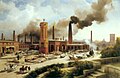 Train factory of August Borsig in 1847
 -
 Many companies, such as steam-machine producer J. Kemna, modeled themselves on English industry.
 -
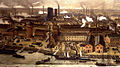 BASF plant in Ludwigshafen, 1881
 -
 The invention of the automobile. Bertha Benz and Karl Benz in a Benz Viktoria, model 1894
 -
 The invention of the cruise ship. Albert Ballin's SS Auguste Viktoria in 1890
 -
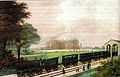 Railway construction as an expression of the Industrial Revolution (here the Bonn-Cölner railway around 1844)
 -
![The LZ 127 Graf Zeppelin of DELAG, the world's first airline[52]](//upload.wikimedia.org/wikipedia/commons/thumb/1/1f/ZeppelinLZ127a.jpg/120px-ZeppelinLZ127a.jpg)
-
 Krupp factory in Essen (c. 1905), when Krupp was Europe's largest company


![The LZ 127 Graf Zeppelin of DELAG, the world's first airline[52]](https://en.wikipedia.org/wiki/File:ZeppelinLZ127a.jpg)

The establishment of the Deutscher Zollverein (German Customs Union) in 1834 and the expansion of railway systems were the main drivers of Germany's industrial development and political union. From 1834, tariff barriers between increasing numbers of the Kleindeutschland German states were eliminated.[citation needed] In 1835 the first German railway linked the Franconian cities of Nuremberg and Fürth – it proved so successful that the decade of the 1840s saw "railway mania" in all the German states. Between 1845 and 1870, 8,000 kilometres (5,000 mi) of rail had been built and in 1850 Germany was building its own locomotives. Over time, other German states joined the customs union and started linking their railroads, which began to connect the corners of Germany. The growth of free trade and a rail system across Germany intensified economic development which opened up new markets for local products, created a pool of middle managers,[clarification needed] increased the demand for engineers, architects, and skilled machinists, and stimulated investments in coal and iron.[53]
Another factor that propelled German industry forward was the unification of the monetary system, made possible in part by political unification. The Deutsche Mark, a new monetary coinage system backed by gold, was introduced in 1871. However, this system did not fully come into use as silver coins retained their value until 1907.[citation needed]
The victory of Prussia and her allies over Napoleon III of France in the Franco-Prussian War of 1870-1871 marked the end of French hegemony in Europe and resulted in the proclamation of the German Empire in 1871. The establishment of the empire inherently presented Europe with the reality of a new populous and industrialising polity possessing a considerable, and undeniably increasing, economic and diplomatic presence. The influence of French economic principles produced important institutional reforms in Germany, including the abolition of feudal restrictions on the sale of large landed estates, the reduction of the power of the guilds in the cities, and the introduction of a new, more efficient commercial law. Nonetheless, political decisions about the economy of the empire were still largely controlled by a coalition of "rye and iron", that is the Prussian Junker landowners of the east and the Ruhr heavy industry of the west.[54]
Regarding politics and society, between 1881 and 1889 Chancellor Otto von Bismarck promoted laws that provided social insurance and improved working conditions. He instituted the world's first welfare state. Germany was the first to introduce social insurance programmes including universal healthcare, compulsory education, sickness insurance, accident insurance, disability insurance, and a retirement pension. Moreover, the government's universal education policy bore fruit with Germany achieving[when?] the highest literacy rate in the world – 99% – education levels that provided the nation with more people good at handling numbers, more engineers, chemists, opticians, skilled workers for its factories, skilled managers, knowledgeable farmers, and skilled military personnel.[55]
By 1900, Germany surpassed Britain in steel production and became the largest producer behind only the United States. The German economic miracle was also intensified by unprecedented population growth from 35 million in 1850 to 67 million in 1913. From 1895 to 1907, the number of workers engaged in machine building doubled from half a million to well over a million. Only 40 percent of Germans lived in rural areas by 1910, a drop from 67% at the birth of the Empire. Industry accounted for 60 percent of the gross national product in 1913.[56] The German chemical industry became the most advanced in the world, and by 1914 the country was producing half the world's electrical equipment.
The rapid advance to industrial maturity led to a drastic shift in Germany's economic situation – from a rural economy into a major exporter of finished goods. The ratio of the finished product to total exports jumped from 38% in 1872 to 63% in 1912. By 1913 Germany had come to dominate all the European markets. By 1914 Germany had become one of the biggest exporters in the world.[57]
Weimar Republic and Third Reich
[edit]

The Nazis rose to power while unemployment was very high,[58] but achieved full employment later thanks to massive public works programmes such as the Reichsbahn, Reichspost, and the Reichsautobahn projects.[59] In 1935 rearmament in contravention of the Treaty of Versailles added to the economy.[58][60]
The post-1931 financial crisis economic policies of expansionary fiscal policies (as Germany was off the gold standard) was advised by their non-Nazi Minister of Economics, Hjalmar Schacht,[58] who in 1933 became the president of the central bank. Schacht later resigned from the post in 1938 and was replaced by Hermann Göring.
The trading policies of the Third Reich aimed at self-sufficiency but with a lack of raw materials Germany would have to maintain trade links but on bilateral preferences, foreign exchange controls, import quotas, and export subsidies under what was called the "New Plan"(Neuer Plan) of 19 September 1934.[61] The "New Plan" was based on trade with less developed countries who would trade raw materials for German industrial goods saving currency.[62] Southern Europe was preferable to Western Europe and North America as there could be no trade blockades.[63] This policy became known as the Grosswirtschaftsraum ("greater economic area") policy.
Eventually, the Nazi party developed strong relationships with big business[64] and abolished trade unions in 1933 in order to form the Reich Labour Service (RAD), German Labour Front (DAF) to set working hours, Beauty of Labour (SDA) which set working conditions, and Strength through Joy (KDF) to ensure sports clubs for workers.[65]
West Germany
[edit]
Beginning with the replacement of the Reichsmark with the Deutsche Mark as legal tender, a lasting period of low inflation and rapid industrial growth was overseen by the government led by German Chancellor Konrad Adenauer and his minister of economics, Ludwig Erhard, raising West Germany from total wartime devastation to one of the most developed nations in modern Europe.
In 1953 it was decided that Germany was to repay $1.1 billion of the aid it had received. The last repayment was made in June 1971.
Apart from these factors, hard work and long hours at full capacity among the population in the 1950s, 1960s, and early 1970s and extra labour supplied by thousands of Gastarbeiter ("guest workers") provided a vital base for the economic upturn.
East Germany
[edit]
By the early 1950s, the Soviet Union had seized reparations in the form of agricultural and industrial products and demanded further heavy reparation payments.[66] Silesia with the Upper Silesian Coal Basin, and Stettin, a prominent natural port, were lost to Poland.
Exports from West Germany exceeded $323 billion in 1988. In the same year, East Germany exported $30.7 billion worth of goods; 65% to other communist states.[67] East Germany had zero unemployment.[67]
Car markers like the Automobilwerk Eisenach and the HQM Sachsenring GmbH produced icons of the East German economy like the Trabant line and the Wartburg line.
Federal Republic
[edit]
The German economy practically stagnated in the beginning of the 2000s. The worst growth figures were achieved in 2002 (+1.4%), in 2003 (+1.0%), and in 2005 (+1.4%).[68] Unemployment was also chronically high.[69] Due to these problems, together with Germany's aging population, the welfare system came under considerable strain. This led the government to push through a wide-ranging programme of belt-tightening reforms, Agenda 2010, including the labour market reforms known as Hartz I - IV.[69]
In the later part of the first decade of 2000, the world economy experienced high growth, from which Germany as a leading exporter also profited. Some credit the Hartz reforms with achieving high growth and declining unemployment but others contend that they resulted in a massive decrease in standards of living and that its effects are limited and temporary.[69]
The nominal GDP of Germany contracted in the second and third quarters of 2008, putting the country in a technical recession following a global and European recession cycle.[70] German industrial output dropped to 3.6% in September vis-à-vis August.[71][72] In January 2009 the German government under Angela Merkel approved a €50 billion ($70 billion) economic stimulus plan to protect several sectors from a downturn and a subsequent rise in unemployment rates.[73] Germany exited the recession in the second and third quarters of 2009, mostly due to rebounding manufacturing orders and exports - primarily from outside the eurozone - and relatively steady consumer demand.[69]
Germany is a founding member of the EU, the G8, and the G20, and was the world's largest exporter from 2003 to 2008. In 2011 it remained the third largest exporter[74] and third largest importer.[75] Most of the country's exports are in engineering, especially machinery, automobiles, chemical goods, and metals.[69] Germany is a leading producer of wind turbines and solar-power technology.[76] Annual trade fairs and congresses are held in cities throughout Germany.[77] 2011 was a record-breaking year for the German economy. German companies exported goods worth over €1 trillion ($1.3 trillion), the highest figure in history. The number of people in work has risen to 41.6 million, the highest recorded figure.[78]
Through 2012, Germany's economy continued to be stronger relative to local neighbouring nations.[79] In 2023, Germany experienced economic difficulties as a result of the closure of Russian natural gas resources due to international sanctions following the Russian invasion of Ukraine.[80] Germany imported 55% of its gas from Russia at the time when Russia started the invasion in 2022.[81] Amid a global energy crisis, Chancellor Olaf Scholz committed to weaken dependence on Russian energy imports by halting certification of Nord Stream 2, while also committing to his long-term predecessor Angela Merkel's policy of phasing out nuclear energy.[82][83][81]
As of December 2023, Germany is the third largest economy in nominal terms in the world after the United States and China, and the largest economy in Europe. It is the third largest export nation in the world.[84]
In April 2024, a report by the German Economic Institute revealed that despite attempts to expand into other markets, the German economy remains heavily reliant on China for various products and raw materials.[85]
During 2024, the German economy experienced its second consecutive year of contraction. Europe's largest economy declined by 0.2% over the year,[86] following a 0.3% contraction in 2023. Germany's trade surplus with the United States, reported by Reuters to have reached a record €65 billion (£54.7 billion) during the first 11 months of 2024, has made the nation a likely target for potential tariffs from Donald Trump's administration.[87] The economic climate has also been affected by widespread layoffs across major German corporations. Companies such as Siemens, Bosch, Thyssenkrupp, and Deutsche Bahn, all featured in the Fortune 500, are estimated to have collectively cut over 60,000 jobs during the first 10 months of 2024.[88] Bosch, a highly regarded manufacturing firm, announced in November alone plans to reduce its workforce by approximately 7,000 employees.[89]
Data
[edit]The following table shows the main economic indicators in 1980–2024 (with IMF staff estimates in 2025–2029). Inflation below 5% is in green.[90]
| Year | GDP (Bil. US$PPP) |
GDP per capita (US$ PPP) |
GDP (Bil. US$nominal) |
GDP per capita (US$ nominal) |
GDP growth (real) |
Inflation rate (Percent) |
Unemployment (Percent) |
Government debt (in % of GDP) |
|---|---|---|---|---|---|---|---|---|
| 1980 | 922.4 | 12,003.5 | 856.8 | 11,150.4 |  1.3 1.3
|
5.4
|
3.4 | n/a |
| 1981 | 1,010.8
|
13,128.9
|
720.9
|
9,363.8
|
0.1
|
6.3
|
4.8
|
n/a |
| 1982 | 1,064.8
|
13,840.2
|
696.1
|
9,048.0
|
-0.8
|
5.3
|
6.7
|
n/a |
| 1983 | 1,123.7
|
14,656.9
|
694.4
|
9,058.3
|
1.6
|
3.3
|
8.1
|
n/a |
| 1984 | 1,197.1
|
15,678.3
|
654.3
|
8,569.0
|
2.8
|
2.4
|
 8.1 8.1
|
n/a |
| 1985 | 1,262.0
|
16,569.6
|
663.5
|
8,710.7
|
2.2
|
2.1
|
8.1
|
n/a |
| 1986 | 1,318.6
|
17,299.9
|
947.6
|
12,432.4
|
2.4
|
-0.1
|
7.8
|
n/a |
| 1987 | 1,371.1
|
17,985.8
|
1,179.2
|
15,468.0
|
1.5
|
0.2
|
7.8
|
n/a |
| 1988 | 1,472.5
|
19,198.8
|
1,271.3
|
16,575.2
|
3.7
|
1.3
|
7.7
|
n/a |
| 1989 | 1,590.1
|
20,527.2
|
1,262.0
|
16,291.6
|
3.9
|
2.8
|
6.8
|
n/a |
| 1990 | 1,744.0
|
22,090.7
|
1,604.5
|
20,323.3
|
5.7
|
2.7
|
6.2
|
n/a |
| 1991 | 1,893.4
|
23,675.1
|
1,882.5
|
23,539.0
|
5.0
|
3.5
|
5.5
|
38.8 |
| 1992 | 1,975.5
|
24,541.0
|
2,146.1
|
26,660.2
|
2.0
|
5.0
|
6.6
|
41.3
|
| 1993 | 2,002.5
|
24,739.0
|
2,080.1
|
25,697.1
|
-1.0
|
4.5
|
7.8
|
44.9
|
| 1994 | 2,098.4
|
25,859.6
|
2,220.2
|
27,359.7
|
2.6
|
2.7
|
8.4
|
47.3
|
| 1995 | 2,174.8
|
26,747.9
|
2,595.3
|
31,919.0
|
1.5
|
1.7
|
8.2
|
54.7
|
| 1996 | 2,237.4
|
27,464.3
|
2,507.4
|
30,779.0
|
1.0
|
1.3
|
8.9
|
57.6
|
| 1997 | 2,318.3
|
28,441.6
|
2,221.5
|
27,254.4
|
1.9
|
1.5
|
9.7
|
58.7
|
| 1998 | 2,393.6
|
29,389.3
|
2,250.8
|
27,636.1
|
2.1
|
0.6
|
9.4
|
59.3
|
| 1999 | 2,479.1
|
30,447.8
|
2,216.1
|
27,217.0
|
2.1
|
0.6
|
8.6
|
59.9
|
| 2000 | 2,608.3
|
32,020.9
|
1,967.9
|
24,158.2
|
2.9
|
1.4
|
8.0
|
58.8
|
| 2001 | 2,710.6
|
33,252.0
|
1,966.4
|
24,122.4
|
1.6
|
1.9
|
7.8
|
57.6
|
| 2002 | 2,746.5
|
33,666.4
|
2,100.9
|
25,752.7
|
-0.2
|
1.3
|
8.6
|
59.3
|
| 2003 | 2,785.7
|
34,159.4
|
2,534.1
|
31,074.3
|
-0.5
|
1.1
|
9.7
|
62.7
|
| 2004 | 2,894.1
|
35,529.1
|
2,851.0
|
35,000.6
|
1.2
|
1.8
|
10.3
|
64.3
|
| 2005 | 3,011.2
|
37,021.2
|
2,895.0
|
35,592.7
|
0.9
|
1.9
|
11.0
|
66.5
|
| 2006 | 3,223.9
|
39,716.2
|
3,046.5
|
37,530.2
|
3.9
|
1.8
|
10.0
|
65.8
|
| 2007 | 3,406.8
|
42,063.6
|
3,484.5
|
43,022.0
|
2.9
|
2.3
|
8.5
|
63.1
|
| 2008 | 3,504.1
|
43,386.4
|
3,808.4
|
47,154.0
|
0.9
|
2.8
|
7.4
|
64.6
|
| 2009 | 3,330.1
|
41,376.4
|
3,476.0
|
43,189.4
|
-5.5
|
0.2
|
7.2
|
71.7
|
| 2010 | 3,510.3
|
43,723.6
|
3,471.0
|
43,233.5
|
4.1
|
1.1
|
6.6
|
80.4
|
| 2011 | 3,717.6
|
46,310.6
|
3,824.2
|
47,637.9
|
3.8
|
2.5
|
5.5
|
77.8
|
| 2012 | 3,804.6
|
47,305.3
|
3,600.2
|
44,763.5
|
0.5
|
2.2
|
5.1
|
79.2
|
| 2013 | 3,884.3
|
48,164.5
|
3,808.1
|
47,220.3
|
0.4
|
1.6
|
5.0
|
76.8
|
| 2014 | 4,037.8
|
49,859.4
|
3,966.8
|
48,983.3
|
2.2
|
0.8
|
4.7
|
73.8
|
| 2015 | 4,142.7
|
50,714.4
|
3,423.9
|
41,914.9
|
1.7
|
0.7
|
4.4
|
70.6
|
| 2016 | 4,277.8
|
51,947.7
|
3,536.8
|
42,949.1
|
2.3
|
0.4
|
3.9
|
67.6
|
| 2017 | 4,472.6
|
54,110.3
|
3,761.8
|
45,510.5
|
2.7
|
1.7
|
3.6
|
64.0
|
| 2018 | 4,665.4
|
56,273.3
|
4,053.8
|
48,897.2
|
1.1
|
1.9
|
3.2
|
60.7
|
| 2019 | 4,925.0
|
59,270.7
|
3,957.6
|
47,629.1
|
1.0
|
1.4
|
3.0
|
58.6
|
| 2020 | 4,880.4
|
58,685.8
|
3,937.0
|
47,341.8
|
-4.1
|
0.4
|
3.6
|
67.9
|
| 2021 | 5,237.2
|
62,950.3
|
4,351.2
|
52,300.6
|
3.7
|
3.2
|
3.6
|
67.9
|
| 2022 | 5,687.3
|
67,869.3
|
4,166.9
|
49,725.3
|
1.4
|
8.7
|
3.1
|
64.8
|
| 2023 | 5,876.4
|
69,531.6
|
4,527.0
|
53,565.0
|
-0.3
|
6.0
|
3.0
|
62.7
|
| 2024 | 6,017.2
|
70,930.4
|
4,710.0
|
55,521.3
|
-0.2
|
2.4
|
3.4
|
62.7
|
| 2025e | 6,174.7
|
72,660.5
|
4,921.6
|
57,914.4
|
0.8
|
2.0
|
3.2
|
62.1
|
| 2026e | 6,377.0
|
74,941.0
|
5,117.2
|
60,136.0
|
1.4
|
2.0
|
3.1
|
60.9
|
| 2027e | 6,568.7
|
77,132.7
|
5,268.0
|
61,858.9
|
1.1
|
2.0
|
3.0
|
59.9
|
| 2028e | 6,745.8
|
79,185.5
|
5,415.5
|
63,569.3
|
0.8
|
2.0
|
3.0
|
59.0
|
| 2029e | 6,920.6
|
81,221.3
|
5,566.1
|
65,324.3
|
0.7
|
2.0
|
3.0
|
57.8
|
Companies
[edit]
Of the world's 500 largest stock-market-listed companies measured by revenue in 2024, the Fortune Global 500, 29 are headquartered in Germany.[92] 40 Germany-based companies are included in the DAX, the most popular German stock market index. 26 of Europe's 100 largest are German, among them Allianz, the world's largest insurance company and one of the largest financial services groups and asset managers, largest in Europe; Munich Re, also one of the largest insurance companies; Daimler, Volkswagen, and BMW, among the biggest car markers in the world;[93] Siemens, the world's biggest industrial machinery company; Deutsche Telekom, one of the world's largest telecommunication companies; Bayer, among the biggest biomedical companies; BASF, the world's biggest chemical producer,[94] and SAP, Europe's biggest software company.[95] Other major companies include Lufthansa, Europe's largest airline, Deutsche Post, the largest logistics company worldwide,[96] Deutsche Bahn, the largest railway company in the world,[97][98][99] Bosch, the world's largest automotive supplier, Uniper, the world's largest energy company, and Aldi and Schwarz Gruppe, Europe's largest retailers.[100]
Germany is recognised for its specialised small and medium enterprises, known as the Mittelstand model. SMEs account for more than 99 percent of German companies.[101] Around 1,000 of these companies are global market leaders in their segment and are labelled hidden champions.[102]
From 1991 to 2010, 40,301 mergers and acquisitions with an involvement of German firms with a total known value of 2,422 billion EUR have been announced. The largest transactions since 1991 are: the acquisition of Mannesmann by Vodafone for 204.8 billion EUR in 1999, the merger of Daimler-Benz with Chrysler to form DaimlerChrysler in 1998 valued at 36.3 billion EUR.[103]
Berlin developed an international startup ecosystem and became a leading location for venture capital funded firms in the European Union.[104]
The sector with the highest number of companies registered in Germany is Services with 1,443,708 companies followed by Finance, Insurance, and Real Estate and Construction with 480,593 and 173,167 companies respectively.[105]
The list includes the largest German companies by revenue in 2011:
| Rank[106] | Name | Headquarters | Ticker | Revenue (Mil. €) |
Profit (Mil. €) |
Employees (World) |
|---|---|---|---|---|---|---|
| 1. | Volkswagen Group | Wolfsburg | VOWG | 159,000 | 15,800 | 502,000 |
| 2. | E.ON | Essen | EONGn | 113,000 | −1,900 | 79,000 |
| 3. | Daimler | Stuttgart | DAIGn | 107,000 | 6,000 | 271,000 |
| 4. | Siemens | Berlin, München | SIEGn | 74,000 | 6,300 | 360,000 |
| 5. | BASF | Ludwigshafen am Rhein | BASFn | 73,000 | 6,600 | 111,000 |
| 6. | BMW | München | BMWG | 69,000 | 4,900 | 100,000 |
| 7. | Metro | Düsseldorf | MEOG | 67,000 | 740 | 288,000 |
| 8. | Schwarz Gruppe | Neckarsulm | 63,000 | N/A | 315,000 | |
| 9. | Deutsche Telekom | Bonn | DTEGn | 59,000 | 670 | 235,000 |
| 10. | Deutsche Post | Bonn | DPWGn | 53,000 | 1,300 | 471,000 |
| — | Bosch | Gerlingen | 73,100 | 2,300 | 390,000 | |
| — | Uniper | Düsseldorf | UNSE01 | 67,300 | 13,000 | |
| — | Allianz | München | ALVG | 104,000 | 2,800 | 141,000 |
| — | Deutsche Bank | Frankfurt am Main | DBKGn | 4,300 | 101,000 |
Mergers and acquisitions
[edit]Since German reunification, there have been 52,258 mergers or acquisitions deals inbound or outbound in Germany. The most active year in terms of value was 1999 with a total value of 48 billion EUR, twice as much as the runner up which was 2006 with 24 billion EUR.
Here is a list of the top 10 deals (ranked by value) that include a German company. The Vodafone–Mannesmann deal is still the biggest deal in global history.[107]
| Rank | Date | Acquirer | Acquirer Nation | Target | Target Nation | Value (bil. USD) |
|---|---|---|---|---|---|---|
| 1 | 14 Nov 1999 | Vodafone AirTouch PLC | United Kingdom | Mannesmann AG | Germany | 202.79 |
| 2 | 18 May 2016 | Bayer AG | Germany | Monsanto Co | United States | 56.60 |
| 3 | 6 May 1998 | Daimler-Benz AG | Germany | Chrysler Corp | United States | 40.47 |
| 4 | 16 Aug 2016 | Linde AG | Germany | Praxair Inc | United States | 35.16 |
| 5 | 21 Oct 1999 | Mannesmann AG | Germany | Orange PLC | United Kingdom | 32.59 |
| 6 | 24 Jul 2000 | Deutsche Telekom AG | Germany | VoiceStream Wireless Corp | United States | 29.40 |
| 7 | 17 May 1999 | Rhone-Poulenc SA | France | Hoechst AG | Germany | 21.92 |
| 8 | 23 Mar 2006 | Bayer AG | Germany | Schering AG | Germany | 21.40 |
| 9 | 01 Apr 2001 | Allianz AG | Germany | Dresdner Bank AG | Germany | 19.66 |
| 10 | 30 May 2005 | Unicredito Italiano SpA | Italy | Bayerische Hypo- und Vereins | Germany | 18.26 |
Economic region
[edit]
Germany as a federation is a polycentric country and does not have a single economic centre. The stock exchange is located in Frankfurt am Main, the largest Media company (Bertelsmann SE & Co. KGaA) is headquartered in Gütersloh; the largest car manufacturers are in Wolfsburg (Volkswagen), Stuttgart (Mercedes-Benz and Porsche), and Munich (Audi and BMW).[108]
Germany is an advocate of closer European economic and political integration. Its commercial policies are increasingly determined by agreements among European Union (EU) members and EU single market legislation. Germany introduced the common European currency, the euro on 1 January 1999. Its monetary policy is set by the European Central Bank in Frankfurt.
The southern states ("Bundesländer"), especially Bayern, Baden-Württemberg, and Hessen, are economically stronger than the northern states. One of Germany's traditionally strongest (and at the same time oldest) economic regions is the Ruhr area in the west, between Duisburg and Dortmund. 27 of the country's 100 largest companies are located there. In recent years, however, the area, whose economy is based on natural resources and heavy industry, has seen a substantial rise in unemployment (2010: 8.7%).[108]
The economy of Bayern and Baden-Württemberg, the states with the lowest number of unemployed people (2018: 2.7%, 3.1%), on the other hand, is based on high-value products. Important sectors are automobiles, electronics, aerospace, and biomedicine, among others. Baden-Württemberg is an industrial centre especially for the automobile and machine-building industry and the home of brands like Mercedes-Benz (Daimler), Porsche and Bosch.[108]
With the reunification on 3 October 1990, Germany began the major task of reconciling the economic systems of the two former republics. Interventionist economic planning ensured gradual development in eastern Germany up to the level of former West Germany, but the standard of living and annual income remains significantly higher in western German states.[109] The modernisation and integration of the eastern German economy continues to be a long-term process scheduled to last until the year 2019, with annual transfers from west to east amounting to roughly $80 billion. The overall unemployment rate has consistently fallen since 2005 and reached a 20-year low in 2012. The country in July 2014 began legislating to introduce a federally mandated minimum wage which would come into effect on 1 January 2015.[110][needs update]
On 25 May 2023, a declaration of a recession in the German economy was made. It was reported that Gross Domestic Product (GDP) had contracted by 0.3% between January and March. This contraction was largely due to increased prices which discouraged consumer spending. The statistics office in Germany reported that household spending had dropped by 1.2% in the first quarter of the year.[111]
German states
[edit]
| States | Rank | GRP (in billions EUR€) |
Share of GDP (%) |
|---|---|---|---|
 Germany Germany
|
— | 3,867.050 | 100 |
 North Rhine-Westphalia North Rhine-Westphalia
|
1 | 793.790 | 20.5 |
 Bavaria Bavaria
|
2 | 716.784 | 18.5 |
 Baden-Württemberg Baden-Württemberg
|
3 | 572.837 | 14.8 |
 Lower Saxony Lower Saxony
|
4 | 339.414 | 8.8 |
 Hesse Hesse
|
5 | 323.352 | 8.4 |
 Berlin Berlin
|
6 | 179.379 | 4.6 |
 Rhineland-Palatinate Rhineland-Palatinate
|
7 | 171.699 | 4.4 |
 Saxony Saxony
|
8 | 146.511 | 3.8 |
 Hamburg Hamburg
|
9 | 144.220 | 3.7 |
 Schleswig-Holstein Schleswig-Holstein
|
10 | 112.755 | 2.9 |
 Brandenburg Brandenburg
|
11 | 88.800 | 2.3 |
 Saxony-Anhalt Saxony-Anhalt
|
13 | 75.436 | 2.0 |
 Thuringia Thuringia
|
12 | 71.430 | 1.8 |
 Mecklenburg-Vorpommern Mecklenburg-Vorpommern
|
14 | 53.440 | 1.4 |
 Bremen Bremen
|
16 | 38.698 | 1.0 |
 Saarland Saarland
|
15 | 38.505 | 1.0 |
Wealth
[edit]
The following top 10 list of German billionaires is based on an annual assessment of wealth and assets compiled and published by Forbes magazine on 1 March 2016.[112]
| Wealth (in billions) |
Name(s) of billionaire(s) |
|---|---|
| 27.9 | Albrecht family |
| 20.3 | Theo Albrecht Jr. |
| 18.5 | Susanne Klatten |
| 18.1 | Georg F. W. Schaeffler |
| 16.4 | Dieter Schwarz |
| 15.6 | Stefan Quandt |
| 15.4 | Michael Otto |
| 11.7 | Heinz Hermann Thiele |
| 10 | Klaus-Michael Kühne |
| 9.5 | Hasso Plattner |
Wolfsburg is the city in Germany with the country's highest per capita GDP, at $128,000. The following top 10 list of German cities with the highest per capita GDP is based on a study by the Cologne Institute for Economic Research on 31 July 2013.[113]
| GDP | City |
|---|---|
| $128,000 | Wolfsburg, Lower Saxony |
| $114,281 | Frankfurt am Main, Hesse |
| $108,347 | Schweinfurt, Bavaria |
| $104,000 | Ingolstadt, Bavaria |
| $99,389 | Regensburg, Bavaria |
| $92,525 | Düsseldorf, North Rhine-Westphalia |
| $92,464 | Ludwigshafen am Rhein, Rhineland-Palatinate |
| $91,630 | Erlangen, Bavaria |
| $91,121 | Stuttgart, Baden-Württemberg |
| $88,692 | Ulm, Baden-Württemberg |
Sectors
[edit]
Germany has a social market economy characterised by a highly qualified labour force, a developed infrastructure, a large capital stock, a low level of corruption,[114] and a high level of innovation.[115] It has the largest national economy in Europe, the third largest by nominal GDP in the world, and ranked fifth by GDP (PPP) in 2023.[8]
The service sector contributes around 70% of the total GDP, industry 29.1%, and agriculture 0.9%.[116]
Primary
[edit]
In 2010 agriculture, forestry, and mining accounted for only 0.9% of Germany's gross domestic product (GDP) and employed only 2.4% of the population,[69] down from 4% in 1991. Agriculture is extremely productive, and Germany can cover 90% of its nutritional needs with domestic production. Germany is the third-largest agricultural producer in the European Union after France and Italy. Germany's principal agricultural products are potatoes, wheat, barley, sugar beets, fruit, and cabbages.[118][119]
Despite the country's high level of industrialisation, almost one-third of its territory is covered by forest.[120] The forestry industry provides for about two-thirds of domestic consumption of wood and wood products, so Germany is a net importer of these items.

The German soil is relatively poor in raw materials. Only lignite (brown coal) and potash salt (Kalisalz) are available in significant quantities. However, the former GDR's Wismut mining company produced a total of 230,400 tonnes of uranium between 1947 and 1990 and made East Germany the fourth-largest producer of uranium ore worldwide (largest in USSR's sphere of control) at the time. Oil, natural gas, and other resources are, for the most part, imported from other countries.[121]
Potash salt is mined in the centre of the country (Niedersachsen, Sachsen-Anhalt, and Thüringen). The most important producer is K+S (formerly Kali und Salz AG).[121]
Germany's bituminous coal deposits were created more than 300 million years ago from swamps which extended from the present-day South England, over the Ruhr area to Poland. Lignite deposits developed similarly, but during a later period, about 66 million years ago. Because the wood is not yet completely transformed into coal, brown coal contains less energy than bituminous coal.[121]
Lignite is extracted in the extreme western and eastern parts of the country, mainly in Nordrhein-Westfalen, Sachsen, and Brandenburg. Considerable amounts are burned in coal plants near the mining areas, to produce electricity. Transporting lignite over far distances is not economically feasible, therefore the plants are located practically next to the extraction sites. Bituminous coal is mined in Nordrhein-Westfalen and Saarland. Most power plants burning bituminous coal operate on imported material, therefore the plants are located not only near to the mining sites, but throughout the country.[121]
In 2019, the country was the world's 3rd largest producer of selenium,[122] the world's 5th largest producer of potash,[123] the world's 5th largest producer of boron,[124] the world's 7th largest producer of lime,[125] the world's 13th largest producer of fluorspar,[126] the world's 14th largest producer of feldspar,[127] the world's 17th largest producer of graphite,[128] the world's 18th largest producer of sulfur,[129] in addition to being the 4th largest world producer of salt.[130]
Industry
[edit]
Industry and construction accounted for 30.7% of the gross domestic product in 2017 and employed 24.2% of the workforce.[3] Germany excels in the production of automobiles, machinery, electrical equipment, and chemicals. With the manufacture of 5.2 million vehicles in 2009, Germany was the world's fourth-largest producer and largest exporter of automobiles. German automotive companies enjoy an extremely strong position in the so-called premium segment, with a combined world market share of about 90%. All new automobiles sold in Germany must be zero-emission vehicles from 2035.[131]
Small- to medium-sized manufacturing firms (Mittelstand companies) which specialise in technologically advanced niche products and are often family-owned form a major part of the German economy.[132] It is estimated that about 1,500 German companies occupy a top three position in their respective market segment worldwide. In about two thirds of all industry sectors German companies belong to the top three competitors.[133]
Germany is the only country among the top five arms exporters that is not a permanent member of the United Nations Security Council.[134]
Services
[edit]
_b.jpg)
In 2017 services constituted 68.6% of gross domestic product (GDP), and the sector employed 74.3% of the workforce.[69] The subcomponents of services are financial, renting, and business activities (30.5%); trade, hotels and restaurants, and transport (18%); and other service activities (21.7%).
Germany is the seventh most visited country in the world,[135][136] with a total of 407 million overnights during 2012.[137] This number includes 68.83 million nights by foreign visitors. In 2012, over 30.4 million international tourists arrived in Germany. Berlin has become the third most visited city destination in Europe.[138] Additionally, more than 30% of Germans spend their holiday in their own country, with the biggest share going to Mecklenburg-Vorpommern. Domestic and international travel and tourism combined directly contribute over EUR43.2 billion to German GDP. Including indirect and induced impacts, the industry contributes 4.5% of German GDP and supports 2 million jobs (4.8% of total employment).[139] The largest annual international trade fairs and congresses are held in several German cities such as Hannover, Frankfurt, and Berlin.[76]
Government finances
[edit]
The debt-to-GDP ratio of Germany had its peak in 2010 when it stood at 80.3% and decreased since then.[140] According to Eurostat, the government gross debt of Germany amounts to €2,152.0 billion or 71.9% of its GDP in 2015.[141] The federal government achieved a budget surplus of €12.1 billion ($13.1 billion) in 2015.[142] Germany's credit rating by credit rating agencies Standard & Poor's, Moody's, and Fitch Ratings stands at the highest possible rating AAA with a stable outlook in 2016.[143]
Germany's "debt clock" (Schuldenuhr) reversed for the first time in 20 years in January 2018. It is now currently increasing at 10,424.00 per second (October 2020).[144]
Economists generally see Germany's current account surplus as undesirable.[145]
Infrastructure
[edit]Energy
[edit]Germany is the world's fifth-largest consumer of energy, and two-thirds of its primary energy was imported in 2002. In the same year, Germany was Europe's largest consumer of electricity, totaling 512.9 terawatt-hours. Government policy promotes energy conservation and the development of renewable energy sources, such as solar, wind, biomass, hydroelectric, and geothermal energy. As a result of energy-saving measures, energy efficiency has been improving since the beginning of the 1970s. The government has set the goal of meeting half the country's energy demands from renewable sources by 2050. Renewable energy also plays an increasing role in the labour market: Almost 700,000 people are employed in the energy sector. About 50 percent of them work with renewable energies.[146]

In 2000, the red-green coalition under Chancellor Schröder and the German nuclear power industry agreed to phase out all nuclear power plants by 2021.[147] The conservative coalition under Chancellor Merkel reversed this decision in January 2010, electing to keep plants open. The nuclear disaster of the Japanese nuclear plant Fukushima in March 2011 however, changed the political climate fundamentally: Older nuclear plants have been shut down. Germany is seeking to have wind, solar, biogas, and other renewable energy sources play a bigger role, as the country looks to completely phase out nuclear power by 2022 and coal-fired power plants by 2038.[148] Renewable energy yet still plays a more modest role in energy consumption, though German solar and wind power industries play a leading role worldwide. Germany has been called "the world's first major renewable energy economy".[40][41]
In 2009, Germany's total energy consumption (not just electricity) came from the following sources:[149] oil 34.6%, natural gas 21.7%, lignite 11.4%, bituminous coal 11.1%, nuclear power 11.0%, hydro and wind power 1.5%, others 9.0%.
In the first half of 2021, coal, natural gas, and nuclear energy comprised 56% of the total electricity fed into Germany's grid in the first half of 2021. Coal was the leader out of the conventional energy sources, comprising over 27% of Germany's electricity. Wind power's contribution to the electric grid was 22%.[148]
There are 3 major entry points for oil pipelines: in the northeast (the Druzhba pipeline, coming from Gdańsk), west (coming from Rotterdam) and southeast (coming from Nelahozeves). The oil pipelines of Germany do not constitute a proper network, and sometimes only connect two different locations. Major oil refineries are located in or near the following cities: Schwedt, Spergau, Vohburg, Burghausen, Karlsruhe, Cologne, Gelsenkirchen, Lingen, Wilhelmshaven, Hamburg, and Heide.[150]
Germany's network of natural gas pipelines, on the other hand, is dense and well-connected. Imported pipeline gas comes mostly from Russia, the Netherlands, and the United Kingdom.
Transport
[edit]
With its central position in Europe, Germany is an important transportation hub. This is reflected in its dense and modern transportation networks. The extensive motorway (Autobahn) network ranks worldwide third largest in its total length and features a lack of blanket speed limits on the majority of routes.[151]
Germany has established a polycentric network of high-speed trains. The Intercity Express or ICE is the most advanced service category of the Deutsche Bahn and serves major German cities as well as destinations in neighbouring countries. The train maximum speed varies between 200 km/h and 320 km/h (125-200 mph). Connections are offered at either 30-minute, hourly, or two-hourly intervals.[152] German railways are heavily subsidised, receiving €17.0 billion in 2014.[153]
The largest German airports are Frankfurt Airport and Munich Airport, both are global hubs of Lufthansa. Other major airports are Berlin Brandenburg Airport, Düsseldorf, Hamburg, Hanover, Cologne/Bonn, and Stuttgart.
Banking system
[edit]

Seven German banks are among the biggest in the world. As of 2019, Germany is the country in Europe with the highest number of credit institutions: between 1,600 and 1,800.[154] The types of institutions are in strong competition with each other: 390 Sparkassen and 8 public Landesbanken groups (1,200 billion euros of deposits), private commercial banks (DB, Commerzbank, and Unicredit-HypoVereinsbank, for 780 billion), cooperative credit banks (700 billion euros), savings banks, and Raiffeisen. The total of the system is worth 3,800 billion. 75% of retail customer deposits are managed by savings banks and cooperative credit banks. Deutsche Bank and the Sparkassen-Finanzgruppe are among the biggest financial services groups worldwide.[155][156]
According to Eurostat, in 2022 Germany also recorded the highest European rate of gross savings (19.9% of disposable income).[157]
Technology
[edit]
Germany's achievements in sciences have been among the world´s best,[159] and research and development efforts form an integral part of the economy.[160]
Germany is also one of the leading countries in developing and using green technologies. Companies specialising in green technology have an estimated turnover of €200 billion. German expertise in engineering, science, and research is eminently respectable.
The lead markets of Germany's green technology industry are power generation, sustainable mobility, material efficiency, energy efficiency, waste management and recycling, sustainable water management.[161]
Regarding triadic patents, Germany is in third place after the U.S. and Japan. With more than 26,500 registrations for patents submitted to the European Patent Office, Germany is the leading European nation. Siemens, Bosch, and BASF, with almost 5,000 registrations for patents between them in 2008, are among the top 5 of more than 35,000 companies registering patents. Together with the U.S. and Japan, about patents for nano, bio, and new technologies Germany is one of the world's most active nations. With around one-third of triadic patents, Germany leads the way worldwide in the field of vehicle emission reduction.[162]
According to Winfried Kretschmann, who is premier of the region where Daimler is based, "China dominates the production of solar cells. Tesla is ahead in electric cars and Germany has lost the first round of digitalization to Google, Apple, and the like. Whether Germany has a future as an industrial economy will depend on whether we can manage the ecological and digital transformation of our economy".[163]
Challenges
[edit]
Despite economic prosperity, Germany's biggest threat to future economic development is the nation's declining birthrate, which is among the lowest in the world. This is particularly prevalent in parts of society with higher education. As a result, the numbers of workers are expected to decrease and the government spending needed to support pensioners and healthcare will increase if the trend is not reversed.[165]
In the case of compensation law, the Jewish Political Studies Review argues that Germany still holds 80% of the value of assets stolen by the Nazi regime, mainly "financial assets, enterprises, and household items" estimated at more than $115-$175 billion to be restored to their owners.[166]
Less than a quarter of German people expect living conditions to improve in the coming decades.[167]
On August 25, 2020, Federal Statistical Office of Germany revealed that the German economy plunged by 9.7% in the second quarter which is the worst on record. The latest figures show how hard the German economy was hit by the government measures in response to the COVID-19 pandemic.[168]
Energy-intensive German industry and German exporters were hit particularly hard by the 2022 global energy crisis.[169][83] Economy Minister Robert Habeck warned that the planned end of Russian energy imports will permanently raise energy prices for German industry and consumers.[170]
In the early 21st century, German governments supported the European Green Deal and Germany's transition to green energy.[171] Germany planned to phase out coal by 2030.[172] The last three nuclear power plants in Germany were shut down on 15 April 2023.[173][174]
Speaking at the COP28 climate summit in Dubai in December 2023, German Chancellor Olaf Scholz called for a phase-out of fossil fuels, including coal, oil and natural gas, and reiterated Germany's commitment to be climate neutral by 2045, saying, "The technologies are there: wind power, photovoltaics, electric motors, green hydrogen."[175]

In April 2025, the German government cut its economic growth forecast for 2025 to zero, citing the impact of US President Donald Trump's trade policies. The United States is Germany’s largest trading partner, and Habeck said Trump’s tariffs were going to hit the German economy harder than other nations because it is so reliant on exports.[176]
Immigration
[edit]In October 2023, Economy Minister Robert Habeck called for more immigration to Germany, saying the shortage of skilled workers was the country's "most pressing structural problem".[177] Net immigration to Germany was 663,000 in 2023, down from a record 1,462,000 in 2022.[178]
Poverty
[edit]
In recent decades, poverty in Germany has been increasing. Children are more likely to be poor than adults. There has been a strong increase in the number of poor children. In 1965, only one in 75 children lived on welfare, in 2007 one in 6 did.[179]
Poverty rates differ by states. In 2005, only 6.6% of children and 3.9% of all citizens in states like Bavaria were impoverished. In Berlin, 15.2% of the inhabitants and 30.7% of the children received welfare payments.[180]
The German Kinderhilfswerk, an organization caring for children in need has demanded the government to do something about the poverty problem.
As of 2015, poverty in Germany was at its highest since the German reunification (1990). Some 12.5 million Germans are now classified as poor.[181]Homelessness
[edit]Homelessness in Germany is a significant social issue, estimated to affect around 678,000 people,[182] including about 372,000 people accommodated by public services, e.g., in municipal refugee shelters.[183] As of 2017[update] there had been a 150% increase in the homeless population within the country since 2014.[184] Around 22,000 of the homeless population are reported to be children.[182][citation needed]
In addition, the country has yet to publish statistics on homelessness at a Federal Level[185] despite it being an ongoing and widespread matter.Climate change
[edit]As a highly industrial, urbanized economy with a relatively short coastline compared to other major economies, the effects of climate change on Germany are more narrowly focused than other major economies. Germany's traditional industrial regions are typically the most vulnerable to climate change. These are mostly located in the provinces of North Rhine-Westphalia, Saarland, Rhineland-Palatinate, Thuringia, Saxony, Schleswig-Holstein and the free cities of Bremen and Hamburg.[186]
The Rhineland is historically a heavily industrial and population-dense area which includes the states of North Rhine-Westphalia, Rhineland Palatinate, and Saarland. This region is rich in iron and coal deposits and supports one of Europe's largest coal industries. In the past, sulfuric acid emissions from Rhineland coal plants contributed to acid rain, damaging forests in other regions like Hesse, Thuringia, and Saxony.
Other significant problems for the Rhineland related to its high level of industrialization include the destruction of infrastructure from extreme weather events, loss of water for industrial purposes, and fluctuation of the ground water level. Since these problems are related to its level of industrialization, cities within other regions are also sensitive to these challenges including Munich and Bremen.See also
[edit]
- Association of German Chambers of Industry and Commerce
- Codetermination in Germany
- Deutsche Bundesbank
- German Federal Association of Young Entrepreneurs
- German model
- Metropolitan regions in Germany
- List of German states by unemployment rate
- List of German cities by GDP
- Work–life balance
- Work–life balance in Germany
References
[edit]- ^ "World Economic Outlook Database, April 2019". IMF.org. International Monetary Fund. Retrieved 29 September 2019.
- ^ "World Bank Country and Lending Groups". datahelpdesk.worldbank.org. World Bank. Retrieved 29 September 2019.
- ^ a b c d e f g h "Germany - The World Factbook". The World Factbook. Central Intelligence Agency. Retrieved 6 January 2025.
- ^ a b "Social Expenditure – Aggregated data". OECD.
- ^ a b Kenworthy, Lane (1999). "Do Social-Welfare Policies Reduce Poverty? A Cross-National Assessment" (PDF). Social Forces. 77 (3): 1119–1139. doi:10.2307/3005973. JSTOR 3005973. Archived (PDF) from the original on 10 August 2013.
- ^ "Population on 1 January". ec.europa.eu/eurostat. Eurostat. Retrieved 1 November 2024.
- ^ a b c d e f g h "IMF DataMapper: Germany". International Monetary Fund. 2025. Retrieved 13 November 2025.
- ^ a b c d e "World Economic Outlook database: October 2024". imf.org. International Monetary Fund.
- ^ "People at risk of poverty or social exclusion". ec.europa.eu/eurostat. Eurostat.
- ^ "Gini coefficient of equivalised disposable income - EU-SILC survey". ec.europa.eu/eurostat. Eurostat.
- ^ a b "Human Development Report 2025" (PDF). United Nations Development Programme. 6 May 2025. Archived (PDF) from the original on 6 May 2025. Retrieved 6 May 2025.
- ^ "Corruption Perceptions Index". Transparency International. 11 February 2025. Retrieved 24 February 2025.
- ^ a b c d "August 2020: employment slightly up on the previous month". destatis.de. Federal Statistical Office of Germany. Retrieved 2 October 2020.
- ^ "Employment rate by sex, age group 20-64". ec.europa.eu/eurostat. Eurostat. Retrieved 20 July 2024.
- ^ a b Taxing Wages 2024: Tax and Gender through the Lens of the Second Earner | READ online.
- ^ a b Taxing Wages 2024: Tax and Gender through the Lens of the Second Earner | OECD iLibrary.
- ^ a b c d "Exports in December 2024: +2.9% on November 2024". Retrieved 7 February 2025.
- ^ "Deutsche Bundesbank" (PDF). Archived (PDF) from the original on 28 April 2018. Retrieved 9 July 2017.
- ^ a b c d e f "Provision of deficit and debt data for 2023 - first notification". ec.europa.eu/eurostat. Eurostat. 22 April 2024. Retrieved 28 April 2024.
- ^ "Germany Foreign Exchange Reserves". CEIC Data - UK. 2018. Retrieved 5 August 2018.
- ^ "Archived copy" (PDF). Archived (PDF) from the original on 25 December 2017. Retrieved 25 December 2017.
{{cite web}}: CS1 maint: archived copy as title (link) - ^ "Archived copy" (PDF). Archived (PDF) from the original on 20 April 2017. Retrieved 25 December 2017.
{{cite web}}: CS1 maint: archived copy as title (link) - ^ "Sovereigns rating list". Standard & Poor's. Archived from the original on 28 September 2011. Retrieved 26 May 2011.
- ^ a b c Rogers, Simon; Sedghi, Ami (15 April 2011). "How Fitch, Moody's and S&P rate each country's credit rating". The Guardian. London. Archived from the original on 1 August 2013. Retrieved 31 May 2011.
- ^ "Scope affirms Germany's AAA rating with Stable Outlook". Retrieved 12 September 2025.
- ^ Spicka 2007, p. 2.
- ^ "The 10 Biggest Economies in the World over Time (1960-2024)".
- ^ "World Economic Outlook Database October 2025". www.imf.org. Retrieved 9 November 2024.
- ^ Alfred Dupont CHANDLER, Takashi Hikino, Alfred D Chandler, Scale and Scope: The Dynamics of Industrial Capitalism 1990
- ^ "Scale and Scope — Alfred D. Chandler, Jr. | Harvard University Press". Hup.harvard.edu. Archived from the original on 20 November 2014. Retrieved 13 August 2014.
- ^ "Country Profile: Germany". Macro Trends. p. 1.
- ^ "Germany's capital exports under the euro | vox". Voxeu.org. 2 August 2011. Archived from the original on 22 February 2014. Retrieved 13 August 2014.
- ^ Destatis. "CIA Factbook". Archived from the original on 2 May 2015. Retrieved 23 April 2015.
- ^ "Businesses in the manufacturing sector".
- ^ "What Germany offers the world". The Economist. 14 April 2012. Archived from the original on 28 April 2018. Retrieved 28 April 2018.
- ^ "How Does Germany do It?". Archived from the original on 2 September 2017. Retrieved 29 April 2017.
- ^ Moller, Stephanie; Huber, Evelyne; Stephens, John D.; Bradley, David; Nielsen, François (2003). "Determinants of Relative Poverty in Advanced Capitalist Democracies". American Sociological Review. 68 (1): 22–51. doi:10.2307/3088901. JSTOR 3088901.
- ^ Burger, Bruno (15 January 2020). "Public Net Electricity Generation in Germany 2019" (PDF). ise.fraunhofer.de. Freiburg, Germany: Fraunhofer Institute for Solar Energy Systems ISE. Retrieved 11 February 2020.
- ^ "Electricity production in the 2nd quarter of 2019: nearly half of the electricity supplied was produced from renewables". Destatis. Retrieved 4 November 2019.
- ^ a b "Germany: The World's First Major Renewable Energy Economy". Archived from the original on 29 March 2015. Retrieved 24 February 2024.
- ^ a b Fraunhofer ISE, Electricity production from solar and wind in Germany – New record in wind power production, p.2 15 December 2014
- ^ "World Official Gold Holdings - International Financial Statistics, March 2024". World Gold Council. 5 March 2024. Retrieved 8 March 2024.
- ^ Our World in Data. "Research & development spending as a share of GDP". ourworldindata.org. Retrieved 10 January 2024.
- ^ Organisation for Economic Co-operation and Development. "Gross domestic spending on R&D". data.oecd.org. Archived from the original on 14 January 2017. Retrieved 10 January 2024.
- ^ "High-technology exports". World Bank Open Data. Retrieved 15 April 2023.
- ^ "World Bank Open Data".
- ^ "Anteile Kleine und Mittlere Unternehmen 2021 nach Größenklassen in %". Statistisches Bundesamt (in German). Retrieved 22 February 2024.
- ^ Bayley, Caroline (17 August 2017). "Germany's 'hidden champions' of the Mittelstand". BBC News. Archived from the original on 22 May 2019.
- ^ "trade shows in Germany, fairs Germany, trade fair Germany, trade show venue Germany". Archived from the original on 29 July 2014.
- ^ "Trade fairs in Germany". German National Tourist Board. Archived from the original on 2 February 2014. Retrieved 5 February 2014.
- ^ Compare: Mitchell, Allan (2006). Great Train Race: Railways and the Franco-German Rivalry, 1815–1914. Berghahn Books. pp. 54–55. ISBN 9781845451363.
There were until [1870] [...] only the beginnings of a nexus of technological innovation and economic growth, the erratic construction of a platform for what might later be justifiably termed a take-off in Germany. But there is little evidence within the given chronological framework for a full-blown notion of an Industrial Revolution [...].
- ^ "DELAG: The World's First Airline". airships.net. Retrieved 17 March 2014.
- ^ Richard Tilly, "Germany: 1815–1870" in Rondo Cameron, ed. Banking in the Early Stages of Industrialization: A Study in Comparative Economic History (Oxford University Press, 1967), pages 151-182
- ^ Cornelius Torp, "The "Coalition of 'Rye and Iron'" under the Pressure of Globalization: A Reinterpretation of Germany's Political Economy before 1914," Central European History Sept 2010, Vol. 43 Issue 3, pp 401-427
- ^ "Class and Politics in Germany, 1850 to 1900". Archived from the original on 23 April 2015.
- ^ "Germany - history - geography". Archived from the original on 3 May 2015.
- ^
"Archived copy" (PDF). Archived (PDF) from the original on 2 June 2016. Retrieved 2 February 2015.
{{cite web}}: CS1 maint: archived copy as title (link) - ^ a b c J. Bradford DeLong (February 1997). "Slouching Towards Utopia?: The Economic History of the Twentieth Century -XV. Nazis and Soviets-". University of California at Berkeley and NBER. Archived from the original on 11 May 2008. Retrieved 15 August 2007.
- ^ Gaettens, Richard (1982). Geschichte der Inflationen : vom Altertum bis zur Gegenwart (Nachdr. ed.). München: Battenberg. pp. 279–298. ISBN 3-87045-211-0.
- ^ Lee, Stephen (1996). Weimar and Nazi Germany. Oxford: Heinemann. p. 63. ISBN 043530920X.
- ^ Hans-Joachim Braun, "The German Economy in the Twentieth Century", Routledge, 1990, p. 101
- ^ Lee, Stephen (1996). Weimar and Nazi Germany. Oxford: Heinemann. p. 60. ISBN 043530920X.
- ^ Hans-Joachim Braun, "The German Economy in the Twentieth Century", Routledge, 1990, p. 102
- ^ Arthur Schweitzer, "Big Business in the Third Reich", Bloomington, Indiana University Press, 1964, p. 288
- ^ Reynoldson, Fiona (1996). Weimar and Nazi Germany (Foundation ed.). Oxford: Heinemann. p. 49. ISBN 0435308602.
- ^ Norman M. Naimark. The Russians in Germany: A History of the Soviet Zone of Occupation, 1945–1949. Harvard University Press, 1995. ISBN 0-674-78405-7 pp. 167-9
- ^ a b Boyes, Roger (24 August 2007). "Germany starts recovery from €2,000bn union". Times Online. London. Archived from the original on 29 May 2010. Retrieved 12 October 2009.
- ^ Bruttoinlandsprodukt (Vierteljahres- und Jahresangaben) Archived 13 November 2010 at the Wayback Machine Statistisches Bundesamt.
- ^ a b c d e f g CIA. "CIA Factbook". Retrieved 2 August 2009.
- ^ Hopkins, Kathryn (14 November 2008). "Germany officially in recession as OECD expects US to lead recovery". The Guardian. London. Archived from the original on 4 September 2013. Retrieved 1 May 2010.
- ^ Thesing, Gabi (13 November 2008). "bloomberg.com, German Economy Enters Worst Recession in 12 Years". Bloomberg.com. Archived from the original on 13 June 2010. Retrieved 13 August 2014.
- ^ German economy falls into recession Archived 23 July 2016 at the Wayback Machine, New York Times, 2008-11-13
- ^ "Germany agrees on 50-billion-euro stimulus plan". France 24. 6 January 2009. Archived from the original on 13 May 2011.
- ^ "Country Comparison :: Exports". The World Factbook. Central Intelligence Agency. ISSN 1553-8133. Archived from the original on 28 October 2013. Retrieved 9 August 2012.
- ^ "Country Comparison :: Imports". The World Factbook. Central Intelligence Agency. ISSN 1553-8133. Archived from the original on 4 October 2008. Retrieved 9 August 2012.
- ^ a b "Wind Power". Federal Ministry of Economics and Technology. Archived from the original on 10 December 2006. Retrieved 27 March 2011.
- ^ UFI, the Global Association of the Exhibition Industry (2008). "Euro Fair Statistics 2008" (PDF). AUMA Ausstellungs- und Messe-Ausschuss der Deutschen Wirtschaft e.V. p. 12. Archived from the original (PDF) on 18 July 2011. Retrieved 24 September 2011.
- ^ "Defying the Euro Crisis". Spiegel Online. 27 December 2011. Archived from the original on 27 December 2011.
- ^ Brain Drain Feared as German Jobs Lure Southern Europeans Archived 26 January 2017 at the Wayback Machine 28 April 2012
- ^ "Germany went from envy of the world to the worst-performing major developed economy. What happened?". AP News. 19 September 2023. Retrieved 23 October 2023.
- ^ a b "How did Germany fare without Russian gas?". Brookings. Retrieved 28 December 2023.
- ^ "Scholz and liberal finance minister clash over nuclear phase-out". Euractiv. 9 June 2022.
- ^ a b "How Bad Will the German Recession Be?". Der Spiegel. 14 September 2022.
- ^ "Economic Key Facts Germany". 5 December 2023.
- ^ "Ahead of Scholz trip, study shows German economy still dependent on China". Reuters. 9 April 2024.
- ^ "Gross domestic product down 0.2% in 2024". Federal Statistical Office. Retrieved 22 January 2025.
- ^ Wagner, Rene (10 January 2025). "Germany's trade surplus with US reaches record high as Trump tariffs loom". Reuters. Retrieved 22 January 2025.
- ^ "Siemens Layoffs 2024: What to Know About the Latest Siemens Job Cuts". markets.businessinsider.com. 21 January 2025. Retrieved 22 January 2025.
- ^ "Bosch Lays Off 7,000 Employees, CEO Stefan Hartung Says More Layoffs Cant Be Ruled Out". News18. Retrieved 22 January 2025.
- ^ "Report for Selected Countries and Subjects".
- ^ "Fortune Global 500".
- ^ "Global 500". Fortune. Archived from the original on 20 June 2021. Retrieved 30 March 2020.
- ^ "Leading car manufacturers by revenue 2022".
- ^ "C&EN's Global Top 50 chemical firms for 2024".
- ^ "Forbes Global 2000: Germany's Largest Companies". Forbes. Archived from the original on 8 April 2015. Retrieved 29 March 2018.
- ^ "DHL Group - Umsatz bis 2022".
- ^ "Global 500 2023". Fortune. Retrieved 24 December 2023.
- ^ "Members to the Supervisory Board of Deutsche Bahn AG". Archived from the original on 25 October 2012.
- ^ "Deutsche Bahn AG at a glance". Deutsche Bahn. Archived from the original on 26 April 2009.
- ^ "10 biggest retailers in the world". Forbes. Retrieved 6 August 2020.
- ^ "The power of SMEs". Facts about Germany. Retrieved 2 June 2021.
- ^ Gavin, Mike (23 September 2010). "Germany Has 1,000 Market-Leading Companies, Manager-Magazin Says". Businessweek. New York. Archived from the original on 30 April 2011. Retrieved 27 March 2011.
- ^ "Statistics on Mergers & Acquisitions (M&A) - M&A Courses | Company Valuation Courses | Mergers & Acquisitions Courses". Imaa-institute.org. Archived from the original on 6 January 2012. Retrieved 13 August 2014.
- ^ Frost, Simon (28 August 2015). "Berlin outranks London in start-up investment". euractiv.com. Archived from the original on 6 November 2015. Retrieved 28 October 2015.
- ^ "Industry Breakdown of Companies in Germany". HitHorizons.
- ^ "Global 500: Countries – Germany". Forbes. 26 July 2010. Archived from the original on 23 March 2011. Retrieved 27 March 2011.
- ^ "Information and Statistics about Mergers & Acquisitions (M&A) Germany". IMAA-Institute. Archived from the original on 22 February 2018. Retrieved 22 February 2018.
- ^ a b c Gürtler, Detlef: Wirtschaftsatlas Deutschland. Rowohlt Berlin, 2010
- ^ Berg, S., Winter, S., Wassermann, A. The Price of a Failed Reunification Archived 20 November 2007 at the Wayback Machine Spiegel Online International. 5 September 2005. Retrieved 28 November 2006.
- ^ "Germany may become 22nd EU state with federal minimum wage". Germany News.Net. Archived from the original on 14 July 2014. Retrieved 7 July 2014.
- ^ Stickings, Tim (25 May 2023). "Germany slides into recession as high prices hit home". The National. Retrieved 21 June 2023.
- ^ "The World's Billionaires". Forbes. Archived from the original on 3 April 2013. Retrieved 4 July 2016.
- ^ "These Are Germany's Power Cities". 12 August 2013. Archived from the original on 13 March 2014. Retrieved 1 March 2014.
- ^ "CPI 2009 table". Transparency International. Retrieved 18 November 2009.
- ^ "The Innovation Imperative in Manufacturing: How the United States Can Restore Its Edge" (PDF). Archived from the original (PDF) on 22 November 2009. Retrieved 26 September 2010.
- ^ "German Economy Experiences Record Growth in 2010" German Embassy Press Release 12 January 2011 Archived 1 November 2011 at the Wayback Machine
- ^ "The World's Biggest E-Commerce Markets by Revenue". YouTube. 3 May 2025.
- ^ "Germany - Agricultural Production and Forest Cover | Britannica". www.britannica.com. Retrieved 25 June 2023.
- ^ "5 Largest Agricultural Exporters in the World".
- ^ 31.7% —or about 11,076,000 hectares— of Germany is forested Archived 21 February 2010 at the Wayback Machine, mongabay.com, 2005.
- ^ a b c d Gürtler, Detlef: Wirtschaftsatlas Deutschland. Rowohlt Berlin, 2010.
- ^ "USGS Selenium Production Statistics" (PDF).
- ^ "USGS Potash Production Statistics" (PDF).
- ^ "USGS Boron Production Statistics" (PDF).
- ^ "USGS Lime Production Statistics" (PDF).
- ^ "USGS Fluorspar Production Statistics" (PDF).
- ^ "USGS Fluorspar Production Statistics" (PDF).
- ^ "USGS Graphite Production Statistics" (PDF).
- ^ "USGS Sulfur Production Statistics" (PDF).
- ^ "USGS Salt Production Statistics" (PDF).
- ^ "'We are a car country': German conservatives commit to reverse combustion engine ban". Euractiv. 11 March 2024.
- ^ Venohr, Bernd; Meyer, Klaus E. (2007). "The German Miracle Keeps Running: How Germany's Hidden Champions Stay Ahead in the Global Economy" (PDF). Working Paper 30. FHW Berlin. Archived from the original (PDF) on 26 March 2009. Retrieved 9 October 2009.
- ^ Venohr, Bernd (2010). "The power of uncommon common sense management principles - The secret recipe of German Mittelstand companies - Lessons for large and small companies" (PDF). Archived (PDF) from the original on 17 October 2011. Retrieved 8 December 2010.
- ^ Wall, Robert (17 March 2013). "China Replaces U.K. in Top-Five Arms Exporters Headed by U.S." Bloomberg.com. Archived from the original on 13 August 2014. Retrieved 13 August 2014.
- ^ "Interim Update" (PDF). UNWTO World Tourism Barometer. UNWTO. April 2011. Archived from the original (PDF) on 1 January 2015. Retrieved 26 June 2011.
- ^ "UNWTO Annual Report 2010" (PDF). UNWTO. 2011. Archived from the original (PDF) on 11 June 2014.
- ^ Zahlen Daten Fakten 2012 Archived 1 January 2015 at the Wayback Machine (in German), German National Tourist Board
- ^ "Tourism Highlights 2014 edition" (PDF). UNWTO. Archived from the original (PDF) on 14 February 2015. Retrieved 26 March 2015.
- ^ "2013 Travel & Tourism Economic Impact Report Germany" (PDF). WTTC. Archived from the original (PDF) on 3 December 2013. Retrieved 26 November 2013.
- ^ "World Economic Outlook Database, April 2015, General government gross debt (National currency, Percent of GDP)". International Monetary Fund. April 2015. Archived from the original on 5 February 2016. Retrieved 26 January 2016.
- ^ "Third quarter of 2015 compared with second quarter of 2015 - Government debt fell to 91.6 % of GDP in euro area". Eurostat. 22 January 2016. Archived from the original on 24 January 2016. Retrieved 26 January 2016.
- ^ "German Government Achieves 'Historic' Budget Surplus". The World Street Journal. 13 January 2016. Archived from the original on 13 March 2016. Retrieved 26 January 2016.
- ^ "Reuters: Fitch Affirms Germany at 'AAA'; Outlook Stable". Reuters. 8 January 2016. Archived from the original on 2 February 2016. Retrieved 26 January 2016.
- ^ Buck, Tobias (4 January 2018). "German 'debt clock' reverses for first time in 20 years". Financial Times. Archived from the original on 4 January 2018. Retrieved 4 January 2018.
- ^ "German and European Economic Policy | IGM Forum". Archived from the original on 25 February 2020.
- ^ "Greentech – A Sector with a Future". Facts about Germany.
- ^ "Germany split over green energy". 25 February 2005 – via news.bbc.co.uk.
- ^ a b Welle, Deutsche. "Germany: Coal tops wind as primary electricity source | DW | 13.09.2021". DW.COM. Retrieved 28 October 2021.
- ^ "Energy Consumption in Germany" (in German). Archived from the original on 27 April 2011. Retrieved 13 August 2014.
- ^ Detlef, Günter: Wirtschaftsatlas Deutschland. Rowohlt Berlin, 2010. p.42
- ^ "Germany's Autobahn faces blanket speed limits". May 2013. Archived from the original on 20 October 2014.
- ^ "Geschäftsbericht 2006 der Deutschen Bahn AG". Archived from the original on 9 August 2007. Retrieved 27 March 2011., Deutsche Bahn. Retrieved 19 October 2007.
- ^ "German Railway Financing" (PDF). p. 2. Archived from the original (PDF) on 10 March 2016.
- ^ Isabella Bufacchi (27 April 2019). "From Deutsche to Sparkassen, the 3 "plastered" pillars of German banks".
- ^ "World's Top Asset Management Firms".
- ^ "Über uns".
- ^ "Household saving: one eighth of disposable income in 2022". Eurostat. 22 November 2023. Retrieved 20 September 2025.
- ^ Research in Germany Archived 20 August 2010 at the Wayback Machine German Embassy, New Delhi. Retrieved 2010-28-08.
- ^ "10 Most Famous German Scientists". 25 January 2024.
- ^ "Germany's Technological Performance". Federal Ministry of Education and Research. 11 January 2007. Archived from the original on 25 August 2011. Retrieved 21 August 2011.
- ^ Roland Berger Strategy Consultants: Green Growth, Green Profit – How Green Transformation Boosts Business Palgrave Macmillan, New York 2010, ISBN 978-0-230-28543-9
- ^ Industry strongly engaged in research Archived 21 November 2011 at the Wayback Machine Facts about Germany. Retrieved 2010-29-08.
- ^ Thomasson, Emma (28 July 2017). "Asleep at the wheel? Germany frets about economic car crash". reuters.com. Archived from the original on 1 October 2017. Retrieved 28 April 2018.
- ^ "EU countries approve 2035 phaseout of CO2-emitting cars". Reuters. 29 March 2023.
- ^ Debt 'explosion' awaits unless policymakers defuse demographic timebomb, warns IMF chief Archived 3 December 2017 at the Wayback Machine, The Telegraph. Retrieved 2016-6-03.
- ^ "Restitution of Holocaust-Era Assets: Promises and Reality, 2007". jcpa.org.
- ^ The Economist, March 28, 2020, page 4.
- ^ "German economy plunges by record 9.7%". DW. Retrieved 25 August 2020.
- ^ "A Grave Threat to Industry in Germany". Der Spiegel. 21 September 2022.
- ^ "Germany's Era of Cheap Energy Is Over, Economy Minister Says". The Wall Street Journal. 2 May 2022.
- ^ "EU ministers approve landmark climate measures, but tough talks await". Politico. 29 June 2022.
- ^ "Germany's Habeck Hopeful on Switching Off Coal Plants". Bloomberg. 3 November 2023.
- ^ "Germany has shut down its last three nuclear power plants, and some climate scientists are aghast". CNBC News. 18 April 2023.
- ^ "After scrapping nuclear reactors, Germany to spend billions on new gas power plants". Politico. 5 February 2024.
- ^ "COP28: Germany's Scholz calls to phase out coal, oil and gas". Deutsche Welle. 2 December 2023.
- ^ "Germany sees zero growth in 2025, blames Trump tariffs – DW – 04/24/2025". dw.com. Retrieved 24 April 2025.
- ^ "Germany calls for more immigrants to fix its shrinking economy". Financial Times. 11 October 2023.
- ^ "Germany: Net immigration sinks sharply in 2023". Deutsche Welle. 27 June 2024.
- ^ "Sozialhilfe: Kinderarmut nimmt zu". Focus. 15.11.2007.
- ^ "Poverty in Germany". World Socialist Website. Retrieved 2014-13-05.
- ^ "Poverty in Germany at its highest since reunification". Deutsche Welle. 19 February 2015. Retrieved 19 March 2022.
- ^ a b "Homelessness in Germany on the rise". DW.COM. 11 November 2019. Archived from the original on 31 January 2020. Retrieved 31 January 2020.
- ^ "Statistics of homeless people accommodated". Statistisches Bundesamt. Archived from the original on 10 January 2024. Retrieved 10 January 2024.
- ^ "Germany: 150 percent rise in number of homeless since 2014". DW.COM. 14 November 2017. Archived from the original on 17 February 2020. Retrieved 17 February 2020.
- ^ "OHCHR | Home". ohchr.org. Archived from the original on 5 May 2021. Retrieved 31 January 2020.
- ^ Rannow, Sven; Loibl, Wolfgang; Greiving, Stefan; Gruehn, Dietwald; Meyer, Burghard C. (30 December 2010). "Potential impacts of climate change in Germany—Identifying regional priorities for adaptation activities in spatial planning". Landscape and Urban Planning. Climate Change and Spatial Planning. 98 (3): 160–171. Bibcode:2010LUrbP..98..160R. doi:10.1016/j.landurbplan.2010.08.017.
Further reading
[edit]- Spicka, Mark E. (2007). Selling the Economic Miracle: Reconstruction and Politics in West Germany. Berghahn Books. ISBN 978-1-84545-223-0.
External links
[edit]- Federal Statistical Office (Destatis)
- Deutsche Bundesbank Archived 14 September 2017 at the Wayback Machine
- World Bank Germany Trade Statistics
- Germany - OECD
- Germany profile at The World Bank


Economy of Germany
View on GrokipediaHistorical Development
Foundations of Industrialization (19th Century)
The foundations of German industrialization in the 19th century were laid in the fragmented German states prior to unification in 1871, building on regional proto-industrial activities and agricultural restructuring. In Prussia, the Stein-Hardenberg reforms, initiated after the 1806 defeat at Jena-Auerstedt, abolished serfdom through the October Edict of 1807 and introduced Gewerbefreiheit (freedom of trade and occupation) between 1810 and 1811, dismantling guild monopolies and enabling labor mobility from rural areas to emerging factories.[9][10] These measures, alongside land emancipation and a free land market, released surplus labor and capital, fostering entrepreneurship in regions like Saxony (textiles) and the Rhineland (early coal and iron). Agricultural productivity gains, with output rising through crop rotations and enclosures, supported urbanization, as the agricultural workforce share declined from over 70% in 1815 to around 50% by mid-century.[11] A pivotal institutional advance was the Zollverein, established on January 1, 1834, initially between Prussia and southern states like Bavaria and Württemberg, expanding to encompass 25 states and 23 million people by 1836 while excluding Austria. This customs union eliminated internal tariffs, standardized external duties, and created a common market that boosted intra-German trade by an estimated 8-15% in the following decades, facilitating capital flows and specialization in heavy industries.[12] The unified tariff revenue, managed by Prussia, funded infrastructure and reduced smuggling, with trade volumes in manufactured goods surging as barriers fell. Complementing this, the emergence of joint-stock banks post-1848, such as the Schaaffhausen bank in Prussia, mobilized investment for large-scale ventures, marking a shift from family firms to corporate finance.[11] Infrastructure development accelerated industrialization, particularly through railways, which began with the Nuremberg-Fürth line in Bavaria on December 7, 1835, and expanded rapidly despite initial reliance on imported rails. By 1850, the network spanned approximately 6,000 kilometers across German states, reaching over 20,000 kilometers by 1871, with annual growth rates exceeding 10% in the 1850s-1860s.[13] Railways lowered transport costs for bulky goods like coal and iron, stimulating demand in the Ruhr and Silesian basins; coal output in Prussia's Rhine-Westphalia province grew at 9% annually during the 1850s, underpinning iron production that shifted to coke-smelting methods.[11] In Württemberg, railway access from 1845 onward increased population growth by 0.3-0.4 percentage points annually through 1871 and boosted industrial employment in sectors like machine-building and textiles.[14] This infrastructure, combined with vocational education—evident in institutions like the Berlin Gewerbeakademie (founded 1799)—built a skilled workforce, enabling Germany to catch up with Britain in productivity by the 1860s.[11]Interwar Period and Nazi Economy (1918-1945)
The Treaty of Versailles imposed reparations on Germany totaling 132 billion gold marks (equivalent to about $33 billion at the time), alongside territorial losses amounting to 13% of its land area, 10% of its population, and key industrial regions like Alsace-Lorraine and parts of Upper Silesia, severely constraining economic recovery after World War I.[15] These obligations exacerbated fiscal pressures, as Germany struggled to rebuild its export capacity while facing demilitarization and loss of overseas markets. In January 1923, France and Belgium occupied the Ruhr industrial district to enforce reparations payments, prompting passive resistance that halted production and prompted the Weimar government to print money to fund striking workers and welfare, igniting hyperinflation.[16] Hyperinflation peaked in November 1923, with monthly price increases exceeding 300%, rendering the Papiermark worthless—a loaf of bread cost 200 billion marks by late 1923, wiping out middle-class savings and eroding public trust in the Weimar Republic.[16] Stabilization came with the introduction of the Rentenmark in November 1923, backed by land and industrial assets, and the Dawes Plan in 1924, which restructured reparations and secured U.S. loans to revive exports and investment.[16] The mid-1920s saw modest recovery, with industrial production rebounding to pre-war levels by 1927, but vulnerability to external shocks persisted due to reliance on short-term foreign borrowing.[17] The Wall Street Crash of 1929 triggered the Great Depression, prompting U.S. creditors to recall loans and collapse German banks, slashing exports by 40% and driving unemployment from 1.3 million in 1929 to over 6 million (about 30% of the workforce) by early 1933.[18] Industrial output fell by nearly 40%, wages dropped 39%, and deflationary policies under chancellors like Brüning deepened the contraction, fostering social unrest and political radicalization.[19] Upon seizing power in 1933, the Nazi regime, advised by economist Hjalmar Schacht as Reichsbank president and Minister of Economics, pursued deficit-financed recovery through public works and rearmament, circumventing Versailles restrictions via off-budget MEFO bills that effectively printed money for military buildup without immediate inflation.[20] Unemployment plummeted from 6 million in January 1933 to under 500,000 by 1938, aided by mandatory labor service, exclusion of women and Jews from statistics, and absorption into state projects like the Autobahn network, though real wage growth lagged due to longer hours and suppressed consumption.[21][22] Real GDP grew at 8-10% annually from 1933 to 1938, driven primarily by military spending that rose from 1% to 17% of GDP, prioritizing autarky over consumer goods.[23] Tensions emerged by 1936, as rearmament strained foreign exchange reserves and imports, leading Schacht's resignation and the launch of the Four-Year Plan under Hermann Göring to achieve self-sufficiency through synthetic fuels, rubber, and metals, though it yielded inefficiencies like resource misallocation and rising deficits.[24][25] The economy overheated by 1939, with labor shortages, suppressed wages, and accumulating debts signaling unsustainability without expansion, setting the stage for wartime plunder.[22]Post-WWII Division: West Germany's Wirtschaftswunder and East Germany's Planned System (1945-1990)
The Potsdam Conference in July-August 1945 divided defeated Germany into four occupation zones administered by the United States, United Kingdom, France, and Soviet Union, with Berlin similarly partitioned despite its location in the Soviet zone.[26] The Western Allies pursued denazification, democratization, and market-oriented reconstruction, while the Soviets extracted reparations and imposed socialist restructuring, leading to deepening economic divergence. In May 1949, the three Western zones formed the Federal Republic of Germany (FRG), establishing a social market economy blending free enterprise with social welfare under Economics Minister Ludwig Erhard. In October 1949, the Soviet zone became the German Democratic Republic (GDR), adopting a centrally planned command economy modeled on the USSR, with state ownership of production means and five-year plans prioritizing heavy industry.[27][28] West Germany's recovery accelerated with the June 1948 currency reform, which replaced the hyperinflationary Reichsmark with the Deutsche Mark and dismantled most Allied price controls, unleashing suppressed supply and incentivizing production.[27] Industrial output, which had fallen to one-third of pre-war levels by 1945, quadrupled from mid-1948 to 1958, while gross national product grew at an average annual rate of 8% during the 1950s, fueled by high savings rates, labor mobility from agriculture to industry, and export-led manufacturing in sectors like automobiles and machinery.[29] The U.S.-funded Marshall Plan contributed approximately $1.4 billion in aid to the Western zones from 1948 to 1952, equivalent to about 5% of annual FRG GDP at the time, providing critical imports of raw materials and machinery that complemented domestic reforms rather than substituting for them.[30] Unemployment dropped from 10% in 1950 to near full employment by the mid-1950s, with real wages rising 80% between 1949 and 1955, enabling the Wirtschaftswunder (economic miracle) that transformed rubble-strewn cities into Europe's industrial powerhouse by 1960, when the FRG ranked as the world's third-largest exporter.[31] Capital stock expanded at 6% annually in the 1950s, outpacing peers like Britain, due to institutional factors including competition, property rights, and integration into Western trade networks.[32] East Germany's planned system, by contrast, emphasized state-directed resource allocation, with rapid nationalization of industry (reaching 80% by 1953) and forced collectivization of agriculture, where private farms were coerced into cooperatives covering over 90% of arable land by 1960 through quotas, taxes, and repression.[33] The GDR joined the Council for Mutual Economic Assistance (COMECON) in 1949, orienting trade toward Soviet bloc partners and focusing output on raw materials and machinery exports to the USSR in exchange for energy imports.[34] While aggregate GDP growth averaged around 4-5% annually from the 1950s to 1980s—marginally higher than the FRG's in some periods—productivity per worker started at one-third of West German levels in 1949 and declined relatively thereafter, reaching only about 50% by the late 1980s amid inefficiencies from central planning, such as misallocated investments and suppressed innovation.[28][35] Chronic consumer goods shortages persisted, with rationing in effect until 1958 and black markets thriving due to distorted prices; living standards lagged, as evidenced by lower caloric intake, housing density, and access to durables like automobiles compared to the West, despite full employment achieved through labor conscription and female workforce mobilization.[26] The system's rigidity, compounded by political repression under the Socialist Unity Party, stifled adaptability, leading to technological gaps and mounting hard-currency debt by 1989, when the debt-to-GDP ratio hit 20% amid failing exports to the West.[34] By 1990, the economic chasm was stark: FRG GDP per capita exceeded $25,000 (in 1990 dollars), dwarfing the GDR's under $10,000, reflecting the superior causal efficacy of decentralized markets in allocating scarce resources post-devastation over top-down planning, which prioritized ideological goals like autarky and heavy industry at the expense of consumer welfare and efficiency.[28][26] This divergence, observable in pre-unification data from official statistics adjusted for purchasing power, underscored how institutional incentives—private property and price signals in the West versus quotas and state monopolies in the East—drove divergent trajectories from similar starting points of wartime ruin.[35]Reunification and Hartz Reforms (1990-Present)
The reunification of Germany on October 3, 1990, abruptly incorporated the East German command economy—characterized by state-owned enterprises and low productivity—into the West German social market framework, triggering a severe economic contraction in the former East. Industrial production in eastern states plummeted by over 50% within the first year, as uncompetitive firms faced market prices and competition, leading to widespread closures and unemployment rates exceeding 20% in regions like Saxony by 1991.[36][37] Overall national GDP growth slowed in the mid-1990s due to the fiscal burden, with per capita output in the East starting at roughly one-third of western levels in purchasing power terms.[38] To support integration, West Germany implemented the Solidarity Pact in 1991, channeling fiscal transfers eastward for infrastructure, privatization via the Treuhandanstalt (which sold or liquidated thousands of state assets), and social expenditures like pensions and unemployment benefits. Cumulative net transfers reached approximately €2 trillion by 2019, averaging €70 billion annually in recent decades, financed partly by the solidarity surcharge on income taxes introduced in 1991.[39][40] These inflows spurred initial catch-up growth, with eastern GDP per capita converging to about 75% of western levels by the early 2010s, though structural factors like demographic decline and out-migration halted further progress, leaving persistent gaps in productivity and wages.[37][41] By the early 2000s, Germany faced a "lost decade" of stagnation, with national unemployment peaking at 11.3% in 2005 amid rigid labor regulations, high non-wage labor costs, and generous benefits that discouraged workforce re-entry. The Hartz reforms, enacted as part of Chancellor Gerhard Schröder's Agenda 2010 from 2003 to 2005, addressed these rigidities through four packages: Hartz I expanded temporary agency work and mini-jobs (tax-exempt low-hour contracts); Hartz II promoted self-employment; Hartz III streamlined the Federal Employment Agency; and Hartz IV merged unemployment aid with social assistance, capping long-term benefits at a lower rate tied to job search requirements.[42][43] Empirical evidence attributes the reforms' deregulation—such as easing dismissal protections and reducing benefit durations—to a sharp decline in unemployment, from over 5 million registered jobless in 2005 to below 3 million by 2010, with the harmonized rate falling to 5.5% by 2012 and around 3% by 2023.[44][42] Employment surged by over 4 million net jobs between 2005 and 2014, bolstering export competitiveness during the post-2008 eurozone crisis, though critics note a modest rise in income inequality (Gini coefficient up by 1-2 points) and expansion of precarious low-wage employment affecting 20% of workers by 2015.[45][46] Despite these trade-offs, the reforms enhanced labor market flexibility without net wage erosion for most, as shorter job search spells offset lower initial pay in entry-level roles.[47][48] In the 2010s, the reformed labor model underpinned resilience, with unemployment stabilizing below 5% even amid global shocks, but eastern regions lagged with rates 1-2 points higher than the west. Recent challenges, including the 2022 energy crisis from reduced Russian imports and subsequent fiscal tightening, pushed GDP into contraction in 2023 (-0.3%) and elevated unemployment to 3.7% harmonized by mid-2025, testing the model's adaptability amid deindustrialization pressures in autos and chemicals.[49][50]Macroeconomic Indicators
GDP Composition, Growth Rates, and Productivity Trends
Germany's gross domestic product (GDP), which surpassed $5 trillion USD in nominal terms for the first time in 2025 with per capita GDP reaching approximately $60,000 USD as a historic milestone,[51][52] is predominantly composed of the services sector, which accounted for approximately 70% of value added in 2023, followed by industry at 24%, construction at 5%, and agriculture at 1%.[53] On the expenditure side, average monthly private consumption expenditures per household were 2,846 € in 2022, approximately 1,918 € for single households, and 3,000–5,000 € for couples with children depending on household size and region; 2025 figures are not officially available but expected to be similar, adjusted for inflation and energy prices.[54] This structure reflects the economy's shift from heavy reliance on manufacturing toward services since reunification, though manufacturing remains a larger share than in most peer economies due to export-oriented sectors like automotive and machinery.[7] Real GDP growth in Germany averaged around 1.5% annually from 1991 to 2019, driven by export strength and industrial efficiency, but contracted sharply during the COVID-19 pandemic before stagnating. The economy shrank by 4.1% in 2020 due to lockdowns and supply disruptions, rebounded with 3.7% growth in 2021 amid fiscal stimulus and pent-up demand, slowed to 1.4% in 2022 as inflation eroded purchasing power, and then contracted by 0.3% in 2023 and 0.2% in 2024.[55][56][6] These recent declines stem primarily from elevated energy costs following the 2022 cutoff of Russian gas supplies, weakened export demand from China and the eurozone, and high interest rates curbing investment, exacerbating vulnerabilities in the manufacturing-heavy model.[57][58]| Year | Real GDP Growth (%) |
|---|---|
| 2020 | -4.1 |
| 2021 | 3.7 |
| 2022 | 1.4 |
| 2023 | -0.3 |
| 2024 | -0.2 |
Labor Market Dynamics: Employment, Unemployment, and Wage Structures
Germany's labor market features high employment levels, with approximately 45.8 million persons in employment as of August 2025, reflecting stability amid economic challenges. Projections indicate that the number of employed persons will peak around 46 million in 2025 before stagnating or slightly declining in 2026 due to demographic aging. Among these, self-employed individuals number around 4 million with slight fluctuations, while civil servants remain stable at approximately 1.7 million.[62] The employment rate for individuals aged 15-64 reached a record high of 77.5% in December 2024 and stood at 77.6% in the first quarter of 2025, surpassing many OECD peers and driven by sustained participation among older workers, where the rate for those aged 60-64 was 66.7% in 2024.[63][64] These figures stem partly from the Hartz reforms implemented between 2003 and 2005, which enhanced labor market flexibility through measures like eased hiring and firing rules, expanded temporary agency work, and stricter job search requirements, contributing to a persistent decline in unemployment and a rise in employment by facilitating quicker matches between workers and vacancies.[65][48] Unemployment remains low by international standards, with the seasonally adjusted ILO rate at 3.7% in June 2025 according to Eurostat data, and similarly at 3.7% in May 2025 per OECD estimates, though registered unemployment figures from the Federal Employment Agency hovered around 6.3% in August 2025 due to broader inclusion of underemployed individuals. Projections for 2025-2026 expect unemployment rates to remain around 5-6%, corresponding to 2.5-3 million unemployed.[66][64] The Hartz reforms played a causal role in this resilience, reducing structural unemployment by an estimated 1.5 percentage points through improved job center efficiency and incentives for low-wage employment, though they also spurred growth in precarious contracts like mini-jobs and temporary positions, which now constitute a notable share of new hires.[67][68] Long-term unemployment has fallen sharply since the early 2000s peak, supported by active labor market policies, but regional disparities persist, with eastern Germany showing higher rates around 7.8% in April 2025.[69] Wage structures in Germany are shaped by extensive collective bargaining coverage, which applied to about 50% of employees in 2024, concentrated in manufacturing and public sectors, fostering wage compression and lower inequality compared to Anglo-Saxon economies.[70] The statutory minimum wage, introduced in 2015 and raised periodically—reaching €12.41 per hour in 2024 with further adjustments tied to productivity and inflation benchmarks—has positively influenced bargaining outcomes without undermining coverage, as a 1% minimum wage increase correlates with a 0.2% rise in negotiated pay for low earners.[71][72] Real wages, however, remain 0.2% below first-quarter 2020 levels as of early 2025, reflecting post-pandemic inflationary pressures and moderated growth amid tight labor markets.[64] The Hartz reforms indirectly supported wage stability by boosting employment volumes, though they increased income dispersion at the lower end via expanded low-productivity jobs. The aging population is projected to increase the number of pensioners to over 22 million by 2026, linking to labor market impacts through higher dependency ratios and potential shortages in skilled labor supply.[45]Fiscal Discipline: Public Debt, Deficits, and the Debt Brake Rule
The German debt brake (Schuldenbremse), constitutionally enshrined in 2009, mandates that the federal government's structural budget deficit not exceed 0.35% of GDP, while the 16 states are required to maintain balanced budgets with no net new borrowing in normal times.[73][74] This rule, introduced amid the global financial crisis to enforce fiscal prudence, has contributed to a decline in public debt relative to GDP from peaks above 80% in the early 2010s to around 63% by late 2024, lower than the euro area average of 88%.[75][76][77] The rule permits temporary deviations during economic downturns or emergencies, but its rigidity has prompted suspensions and workarounds. It was fully suspended from 2020 to 2023 to fund COVID-19 responses and energy crisis measures related to the Ukraine war, enabling deficits that pushed general government debt up by €57 billion to €2.69 trillion in 2024.[78][79] Reimposed in 2024, the debt brake fueled political tensions, including disputes over off-budget special funds for infrastructure and defense, which contributed to the collapse of the coalition government in November 2024.[80][81] In March 2025, a constitutional amendment exempted defense spending exceeding 1% of GDP from the debt brake's constraints, reflecting geopolitical pressures and enabling a €500 billion investment framework without breaching core limits.[82] Despite such adjustments, the 2024 budget deficit reached 2.8% of GDP, projected to ease marginally to 2.7% in 2025 amid robust wage growth and tax revenues, though structural pressures from aging demographics and green transitions challenge long-term compliance.[83][6] Critics argue the rule's stringency hampers countercyclical policy and infrastructure investment, potentially exacerbating economic stagnation, while proponents credit it with preserving Germany's AAA credit rating and low borrowing costs compared to higher-debt eurozone peers like Italy (135% debt-to-GDP).[84][85][86]Inflation, Monetary Policy, and Eurozone Integration
Germany has maintained a strong commitment to price stability, shaped by the hyperinflation of the 1920s and the subsequent Bundesbank's mandate under the 1957 Deutsche Bundesbank Act to regulate currency and credit for safeguarding the currency's value.[87] This tradition influenced the European Central Bank's (ECB) primary objective of maintaining price stability across the Eurozone, as established by the Maastricht Treaty in 1992 and operationalized with the euro's introduction in 1999.[88] Upon adopting the euro on January 1, 2002, Germany relinquished independent monetary control to the ECB, whose Governing Council includes the Bundesbank President as Germany's representative.[89] Post-euro inflation in Germany remained subdued, averaging below the ECB's 2% target for much of the 2000s and 2010s—for instance, the arithmetic mean of annual CPI changes from 2014 to 2023 was approximately 2.3% (e.g., 0.91% in 2014 and 5.95% in 2023)—reflecting structural factors like high productivity growth and wage restraint.[90] The Harmonised Index of Consumer Prices (HICP) recorded annual rates of 1.7% in 2019, dropping to 0.4% in 2020 amid the COVID-19 pandemic.[91] Inflation surged to 7.9% in 2022, driven by energy price shocks from the Russia-Ukraine conflict and supply chain disruptions, peaking at 8.7% intra-year before ECB rate hikes curbed it to 2.4% by September 2025.[92][93] Over the longer term since 1950, Germany's consumer price inflation has averaged 2.49%, underscoring a historical stability lower than many peers.[94] The ECB's monetary policy, conducted through instruments like the main refinancing rate and quantitative easing, applies uniformly to the Eurozone, often leading to tensions with Germany's preference for orthodox, inflation-averse measures.[95] During the 2010s sovereign debt crisis and 2020s inflationary episode, the Bundesbank advocated restraint against expansive ECB programs, arguing they risked moral hazard and future price instability; this stance culminated in the German Federal Constitutional Court's 2020 ruling critiquing ECB asset purchases for proportionality failures, though it did not halt operations.[96] Germany's influence persists via Bundesbank input, promoting rules-based policy over discretion, yet ECB decisions reflect broader Eurozone needs, occasionally diverging from national priorities.[97] Eurozone integration has amplified Germany's export-driven growth through a stable currency and integrated markets but exposed it to spillover risks, notably via TARGET2 payment imbalances.[98] By mid-2025, Germany's Bundesbank held TARGET2 claims exceeding €1 trillion, reflecting net capital inflows as a safe-haven economy amid peripheral deficits, which some analysts view as implicit financing of weaker members without formal fiscal transfers.[99] This creditor position, accumulated since the 2008 crisis, underscores causal imbalances from divergent competitiveness rather than mere trade flows, with Germany's current account surpluses—averaging 7-8% of GDP pre-2022—bolstered by euro undervaluation relative to the Deutschmark counterfactual.[100] Germany has championed fiscal rigor, embedding the "debt brake" in its 2009 constitution limiting structural deficits to 0.35% of GDP, and pushed Eurozone reforms emphasizing stability over mutualization to mitigate moral hazard.[89] Recent debates highlight strains, as Germany's orthodox stance clashes with calls for joint borrowing during energy crises, yet empirical evidence shows the euro enhanced intra-EU trade by 5-10% for core members like Germany.[101]Trade and Competitiveness
Export-Oriented Model: Key Sectors, Partners, and Surpluses
Germany's export-oriented economic model, a cornerstone since the post-World War II era, drives growth through competitive manufacturing and engineering prowess, with goods exports reaching €1.55 trillion in 2024, equivalent to roughly 40% of GDP.[102] This approach prioritizes high-quality, capital-intensive products, supported by specialized small- and medium-sized enterprises (Mittelstand) integrated into global value chains, yielding persistent trade surpluses that fund domestic investment and social spending.[103] Key SectorsThe automotive sector dominates, with motor vehicles and parts comprising 17% of total exports and generating €262 billion in 2024, fueled by brands like Volkswagen, BMW, and Mercedes-Benz exporting premium vehicles and components worldwide.[104] [105] Machinery and mechanical appliances follow closely, accounting for around 15% of exports, including industrial equipment and turbines valued at over €200 billion annually, leveraging Germany's precision engineering heritage.[106] Chemicals and pharmaceuticals represent another pillar, with packaged medicaments and blood fractions exceeding $68 billion each in recent years, driven by firms like Bayer and BASF in specialty chemicals and biotech.[107] Electrical machinery, computers, and optical instruments round out the top categories, benefiting from technological innovation and supply chain efficiencies. These sectors' success stems from high R&D intensity and vocational training, enabling cost-competitive production despite elevated energy costs post-2022.[108] Key Partners
Intra-European Union trade forms the backbone, with EU countries absorbing over 55% of exports due to seamless integration and the single market. France (€121 billion), the Netherlands (€110 billion), Italy, Poland, and Austria rank prominently as destinations for machinery and vehicles.[107] Outside the EU, the United States emerged as Germany's largest single partner in 2024 with €253.4 billion in bilateral trade, yielding a €70 billion surplus, primarily from automotive and pharmaceutical shipments.[109] China, despite geopolitical tensions, imported €104 billion in goods, mainly cars and machinery, with automotive exports declining by nearly 70% between 2022 and 2024 due to intense local competition, though its share has declined relative to rising EU and US volumes; German exports to China have fallen by 25% since 2019 and are projected to decline another 10% in 2025 to €81 billion, with China expected to drop out of the top five export destinations for the first time since 2010 amid weakening domestic demand and shifts to local production by German suppliers. In the automotive sector, German manufacturers have lost ground in joint ventures and sales, with market share decreasing from 40% in 2020 to 29% in Q3 2025 due to competition from local electric vehicle producers.[107][110][111][112][113] The United Kingdom and other partners like Switzerland contribute further, with diversification efforts mitigating risks from over-reliance on any single market.[114] Surpluses
Germany recorded a goods trade surplus of €239.1 billion in 2024, down from €218.5 billion in 2023 but still reflecting structural competitiveness, as exports fell 1.3% while imports dropped 3.0% amid subdued global demand.[115] [116] This surplus equates to approximately $255 billion, ranking second globally, underpinned by value-added manufacturing outpacing raw material imports. The broader current account surplus stood at 5.8% of GDP in 2024, incorporating services and income flows, though it narrowed from peaks above 8% pre-2019 due to energy import spikes and investment outflows.[117] Monthly data shows resilience, with surpluses like €17.17 billion in August 2025, but vulnerabilities to supply disruptions highlight the model's exposure to external shocks.[118] These imbalances have drawn EU scrutiny since 2014 for potentially distorting intra-bloc dynamics, yet they affirm Germany's role as a net creditor nation.[116]
Import Dependencies and Supply Chain Vulnerabilities
Germany's economy, characterized by its manufacturing export model, exhibits significant import dependencies on energy resources and critical raw materials, which underpin sectors like automotive, chemicals, and machinery. In 2022, prior to diversification measures, approximately 55% of Germany's natural gas imports originated from Russia, exposing the country to supply disruptions following the invasion of Ukraine and subsequent sanctions.[119] Overall, German imports from Russia plummeted by 91% in the first months of 2023 compared to the prior year, with energy products such as gas, oil, and coal seeing sharp declines of over 90%.[120] Despite progress in liquefied natural gas (LNG) imports from alternatives like the United States and Norway, Germany remains reliant on imported fossil fuels, with oil and petroleum products comprising a major share of energy imports as of 2022.[121] Critical raw materials present another layer of vulnerability, as Germany imports 39 out of 46 materials essential for energy transition and industrial goals, including lithium, rare earth elements, and copper.[122] China dominates these supply chains, supplying 65.5% of Germany's rare earth imports in 2024, alongside 92% of rare earth element-based magnets critical for electric vehicles and wind turbines.[123][124] Lithium imports from China reached 50% in 2024, up from 18% a decade earlier, reflecting deepening integration in battery production supply chains.[125] These dependencies amplify risks in manufacturing, where intermediate goods from Asia—particularly China, Germany's largest trading partner with €254.4 billion in turnover in 2023—feed into value-added exports.[126] Supply chain disruptions have materialized through geopolitical actions, such as Russia's 2022 gas supply reductions, which triggered an energy crisis, industrial slowdowns, and elevated costs, contributing to a 0.3% GDP contraction that year.[127] Similarly, China's export controls on rare earths and magnets in 2025, imposed amid U.S. tariffs, highlighted vulnerabilities, as Germany lacks domestic processing capacity and alternative sources remain underdeveloped.[128][129] The Federation of German Industries (BDI) has warned that raw material dependencies are "higher than ever," urging strategic stockpiling and diversification to mitigate risks from resource nationalism and trade tensions.[122] Efforts under the EU Critical Raw Materials Act aim to reduce external reliance by 2030, but implementation lags, leaving Germany's just-in-time manufacturing model susceptible to further shocks.[125]Global Ranking and Comparative Advantages
Germany holds the position of the world's third-largest economy by nominal GDP, estimated at approximately $4.74 trillion for 2025, trailing only the United States and China.[130] [7] In purchasing power parity (PPP) terms, it ranks fifth globally, reflecting adjustments for domestic price levels that highlight strengths in cost-efficient production but also exposure to higher input costs in energy and raw materials. Per capita GDP stands at around $60,460 nominally in 2025, placing it 17th worldwide, which underscores a high standard of living supported by robust industrial output but tempered by a large population and demographic aging compared to smaller high-per-capita nations like those in Scandinavia. These rankings position Germany as Europe's dominant economy, contributing over 25% of the European Union's total GDP.[7] In global competitiveness indices, Germany ranks highly due to its economic resilience and innovation capacity. The 2025 IMD World Competitiveness Ranking places it among the top performers, behind leaders like Switzerland and Singapore, crediting factors such as efficient infrastructure and business sophistication.[131] However, the Heritage Foundation's 2025 Index of Economic Freedom scores it at 71.6, ranking 22nd, citing regulatory burdens and fiscal policies that constrain entrepreneurial flexibility relative to more liberal economies like the United States.[132] As a merchandise exporter, Germany leads globally with annual goods exports exceeding $1.5 trillion, maintaining a persistent current account surplus driven by high-value sectors, though recent data show monthly surpluses like €13.3 billion in June 2025 amid fluctuating global demand.[107] Germany's comparative advantages stem primarily from its specialization in capital-intensive, high-quality manufacturing, where it outperforms larger economies like the United States and China in precision engineering and durability standards. This edge arises from a dual vocational training system that produces a highly skilled, adaptable workforce, enabling firms to maintain productivity levels 20-30% above EU averages in sectors like machinery and automobiles.[133] Relative to Japan, a fellow export powerhouse, Germany's integration into the EU single market provides broader access to 450 million consumers without tariffs, fostering supply chain efficiencies that Japan, post its "lost decades," struggles to match in regional trade depth.[134] Against China, Germany's advantage lies in branded, customized products with superior reliability—evident in dominance of global markets for chemical intermediates and industrial equipment—rather than low-cost volume production, allowing premium pricing and resilience to wage competition. These strengths are causal outcomes of institutional commitments to applied R&D and decentralized corporate governance via the Mittelstand, though they rely on stable energy imports vulnerable to geopolitical disruptions.[135]Sectoral Composition
Manufacturing and Industrial Base: Mittelstand and Large Corporations
Germany's manufacturing sector constitutes a vital pillar of the economy, with the industrial base encompassing both the Mittelstand—specialized small and medium-sized enterprises (SMEs)—and multinational large corporations that drive export-led growth and technological advancement. In 2023, the industrial sector's share of total value creation stood at 20.4%, reflecting its enduring significance despite recent economic headwinds such as energy price shocks and supply chain disruptions. The sector generated a turnover of €2,900 billion in 2024, underscoring its scale and resilience in machinery, chemicals, automobiles, and electrical equipment. In November 2025, new orders in the manufacturing sector increased by 5.6% month-over-month, surpassing expectations of a decline and marking the third consecutive monthly gain, primarily driven by large orders in the defense sector as well as rises in metal products and other transport equipment manufacturing.[136][137][105] The Mittelstand, often characterized by owner-managed, family-controlled firms with niche expertise and long-term orientation, represents the decentralized strength of Germany's industrial model. These enterprises, which align roughly with the European Commission's SME definition of fewer than 250 employees and €50 million in turnover, comprise 99.3% of all German businesses and produced €2.8 trillion in turnover in 2023, even amid geopolitical crises. They account for over half of economic value added and nearly 60% of employment, excelling in innovation through high R&D intensity and adaptability in global supply chains, particularly in precision engineering and hidden champions—firms dominating niche markets worldwide. Unlike larger entities, Mittelstand companies prioritize regional embeddedness, vocational training, and sustained investment, fostering causal links between firm-level decisions and macroeconomic stability, though they face vulnerabilities from demographic aging and rising energy costs.[138][139][140] Complementing the Mittelstand are large corporations, which provide scale, global reach, and capital-intensive production in core industries. The automotive sector, led by firms like Volkswagen AG, Mercedes-Benz Group AG, and BMW AG, generated €476 billion in turnover in 2024, representing the largest subsector and employing hundreds of thousands while exporting vehicles and components to key markets. Other giants, including Siemens AG in electrification and automation and Robert Bosch GmbH in automotive suppliers, reported revenues exceeding €70 billion each in recent fiscal years, leveraging integrated value chains for competitiveness. These corporations often collaborate with Mittelstand suppliers, creating symbiotic ecosystems that enhance efficiency but expose the base to synchronized risks, such as the 2022-2023 energy crisis following Russia's invasion of Ukraine, which elevated production costs.[105][141][142] This dual structure—Mittelstand's agility paired with corporations' volume—underpins Germany's export surplus and technological edge, though recent data indicate strains, with manufacturing output contracting amid deglobalization pressures and competition from low-cost producers. Empirical evidence from industry federations highlights the Mittelstand's superior crisis resistance due to lower leverage and focused strategies compared to larger firms' exposure to volatile international demand.[143][144]Services Sector: Finance, Logistics, and Professional Services
Germany's financial sector, concentrated in Frankfurt am Main, functions as a cornerstone of the services economy, hosting the European Central Bank and serving as a hub for international banking and asset management. Major institutions such as Deutsche Bank AG and Commerzbank AG dominate domestic and global operations, with the sector characterized by a mix of universal banks, cooperative banks, and specialized insurers. As of 2024, Germany maintained the largest banking workforce in Europe, underscoring the industry's labor-intensive nature despite ongoing digitalization efforts.[145] The logistics subsector capitalizes on Germany's central geographic position and integrated transport infrastructure, including the ports of Hamburg and Rotterdam-linked waterways, extensive autobahns, and high-speed rail networks. In 2025, the logistics industry generated €344.8 billion in revenue, reflecting its role in supporting export manufacturing through efficient supply chain management. Leading firms like DHL Group, based in Bonn, handle substantial freight and parcel volumes, with manufacturing accounting for nearly 29% of logistics expenditure in 2024.[146][147] This sector's performance has been resilient amid post-2022 disruptions, driven by e-commerce growth and intra-EU trade, though vulnerabilities to energy costs and geopolitical tensions persist. Professional services, including legal, accounting, and management consulting, provide essential support to Germany's regulated business environment and Mittelstand firms. The legal activities market reached €33.9 billion in 2025, fueled by demand for compliance, mergers, and dispute resolution in a jurisdiction with stringent EU-aligned laws.[148] Consulting revenues have expanded with digital transformation initiatives, while accounting services underpin fiscal reporting for the export-driven economy. International players such as the Big Four firms maintain significant presences in cities like Munich and Berlin, contributing to knowledge transfer and advisory roles, though domestic overregulation can elevate costs compared to less bureaucratic peers. Collectively, these subsectors employ millions and bolster productivity, yet their growth lags manufacturing in value-added per worker due to service-specific inefficiencies.[7]Primary Sectors: Agriculture, Mining, and Resource Extraction
Germany's primary sectors, including agriculture, forestry, fishing, mining, and quarrying, contribute modestly to the overall economy, accounting for approximately 1% of GDP as of 2023, reflecting the country's advanced industrial orientation and reliance on imports for raw materials.[149] These sectors nonetheless support regional employment, food security, and specialized exports, with agriculture dominating the contribution at around 0.8% of GDP in 2023.[149] Employment across primary activities remains low, at about 1.2% of total workforce in agriculture alone, bolstered by high mechanization and productivity gains rather than labor intensity.[150] Agriculture, forestry, and fishing form the core of primary production, characterized by efficient, export-oriented operations on 16.6 million hectares of utilized agricultural land as of recent surveys. Key outputs include cereals (such as wheat and barley), potatoes, sugar beets, oilseeds, raw milk, pork, and poultry, with the sector producing over 50 million tonnes of cereals annually in typical years.[151] Germany ranks as the world's third-largest exporter of consumer-oriented agricultural products by value, shipping dairy, meat, and processed goods abroad while importing fruits, vegetables, and feedstuffs to supplement domestic shortfalls.[152] Forestry sustains timber harvests of around 75 million cubic meters yearly, emphasizing sustainable management under federal and EU regulations, while fishing yields about 200,000 tonnes annually, primarily from the North Sea and Baltic, focusing on herring, cod, and aquaculture.[153] Challenges include climate variability, regulatory pressures from EU Common Agricultural Policy reforms, and competition from lower-cost producers, yet subsidies exceeding €6 billion annually via CAP underpin viability.[154] Mining and resource extraction play a diminishing role, constrained by resource endowment and environmental policies, with the sector generating €11.1 billion in turnover in 2022 from domestic sales of aggregates and industrial minerals.[155] Lignite coal dominates fossil fuel extraction, with production at 102.3 million tonnes in 2023, down from prior peaks due to the 2020 phase-out acceleration targeting unabated use by 2030 amid Energiewende commitments.[156] Hard coal mining ceased in 2018, eliminating that output. Non-energy minerals include potash salts (world-leading producer at over 25 million tonnes yearly), limestone, gravel, and salt, extracted via 1,560 enterprises employing 37,330 workers in 2022.[157][158] Quarrying for construction materials like sand and gravel supports infrastructure but yields low value added relative to manufacturing downstream. Overall, natural resource rents from extraction represent under 0.1% of GDP, underscoring import dependence for metals, oil, and gas.[159] Policy shifts post-2022 energy crisis have preserved some lignite capacity for reliability, though green transitions prioritize renewables over expansion.[160]Emerging High-Tech Areas: Renewables, Automotive Electrification, and Digital Industries
Germany's renewable energy sector has expanded significantly under the Energiewende policy, with renewables accounting for 62.7% of net public electricity generation in 2024, marking the first time the share exceeded 60%. Installed renewable capacity reached nearly 190 GW by the end of 2024, reflecting a year-on-year increase of about 20 GW, primarily from wind and solar additions. The government targets 80% renewable electricity by 2030, supported by subsidies and feed-in tariffs that have driven deployment despite intermittent supply challenges. However, this growth has strained grid reliability, as variable renewables require backup from fossil fuels or imports, contributing to higher electricity prices—industrial consumers paid up to 2.5 times more for electricity relative to gas in 2024—and vulnerability exposed during low-wind periods post-nuclear phase-out in 2023. Critics argue that the policy's emphasis on rapid decarbonization overlooks baseload needs, leading to economic inefficiencies and potential supply shortfalls without sufficient storage or dispatchable capacity expansions.[161][162][163][164][165] In automotive electrification, German manufacturers like Volkswagen, BMW, and Mercedes-Benz have invested heavily in electric vehicle (EV) production, manufacturing nearly 1.3 million EVs in the first 11 months of 2024, surpassing full-year 2023 output. However, the sector faces criticism for lagging in EV innovation, with fewer disruptive breakthroughs compared to U.S. and Chinese competitors, attributed to a risk-averse culture, bureaucracy, and slow adaptation. Battery-electric vehicles (BEVs) held about 3% of new car registrations in Germany in 2024, with overall electrified vehicles (including plug-in hybrids) reaching around 5%, far short of the 15 million EV fleet target by 2030. Production surged in late 2024, with 155,700 EVs built in December alone, up 29% year-over-year, driven by export demand. Yet, supply chain dependencies on China for 70-80% of battery cells pose risks, as European gigafactories lag in yield efficiency (40% waste vs. China's under 10%) and scale amid rising Chinese EV competition, which eroded German car exports to China by nearly 70% from 2022 to 2024. High production costs and limited domestic raw material processing further hinder competitiveness, prompting calls for diversified sourcing and tariffs on subsidized imports.[166][167][168][169][170][113] Digital industries represent a growth area but lag behind EU peers, with Germany ranking 14th in the EU's digitalization index in 2024, trailing leaders like Finland and Denmark in connectivity, skills, and public services. The sector employs over 1 million in ICT roles, focusing on automation, AI, and cybersecurity, with approximately 20,000 active startups—led by hubs in Berlin (18% of new formations) and Munich (19%)—raising €1.9 billion in Q1 2024 alone. About 40% of startups operate in information and communication technology, emphasizing B2B software and sustainability tech, yet the ecosystem "punches below its weight" due to regulatory hurdles, risk-averse financing, and slower adoption of cloud and data analytics compared to U.S. or Asian counterparts. Executives report a 95% consensus that Germany trails in digital future technologies, with manufacturing's 30% share of digital transformation investments underscoring uneven progress amid demographic and infrastructural constraints.[171][172][173][174][175][176][177]Innovation and Human Capital
R&D Expenditure, Patent Output, and Technological Leadership
Germany's gross domestic expenditure on research and development (GERD) reached approximately 3.13% of GDP in 2022, positioning it among the top spenders globally and well above the OECD average of 2.7% for 2023.[178] This investment is predominantly driven by the business enterprise sector, which accounted for over two-thirds of total R&D funding, reflecting the economy's reliance on private-sector innovation in manufacturing and engineering.[179] Public funding, primarily through federal and state budgets, supports applied research in universities and public institutes like the Fraunhofer Society, though it constitutes a smaller share compared to business contributions.[180] In patent output, Germany maintains European leadership, with inventors filing around 23,900 European patent applications at the European Patent Office (EPO) in 2023, representing 12% of the EPO's record total of 199,275 filings.[181] This marks a continuation of steady growth, with applications up 2.9% overall at the EPO, driven by German strengths in mechanical engineering, automotive technologies, and electrical machinery, which dominate filings in fields like transport and digital communication.[182] Per capita, Germany's patent intensity exceeds that of most peers, underscoring a culture of incremental innovation suited to its export-oriented industries rather than disruptive breakthroughs.[183] Technological leadership manifests in Germany's top-tier global rankings and sectoral dominance, placing 9th in the 2024 Global Innovation Index among 133 economies, with particular excellence in knowledge and technology outputs (6th globally).[184] Core strengths lie in capital goods production—such as machine tools, precision engineering, and chemical processes—where German firms hold significant world market shares, bolstered by a dual education system fostering applied skills.[105] However, challenges persist in scaling digital technologies like AI and software, and in the energy transition, where regulatory burdens, a risk-averse culture, bureaucracy, and slower adaptation lag behind U.S. or Asian competitors, with ongoing criticisms of lacking ambition and innovation in German engineering contributing to economic stagnation and forecasts of continued challenges in 2025-2026; specific concerns include the automotive sector's lag in electric vehicle innovation and fewer disruptive breakthroughs compared to the US or China, potentially eroding edges in emerging fields absent policy reforms.[185] Despite this, sustained R&D focus ensures resilience in high-value manufacturing, contributing to productivity advantages over service-heavy economies.[186]Education System, Vocational Training, and Skilled Labor Supply
Germany's education system features early academic tracking after primary school, directing students into differentiated secondary paths such as Hauptschule for basic vocational preparation, Realschule for intermediate qualifications, and Gymnasium for university-bound tracks, which influences the pipeline for skilled labor by channeling a significant portion toward vocational pathways rather than universal tertiary pursuit.[187] In international assessments like PISA 2022, German 15-year-olds scored below previous benchmarks, with declines in mathematics (475 points, down from 500 in 2018), reading (480 vs. 498), and science (492 vs. 503), reflecting challenges in core competencies despite average OECD performance in top math performers at 9%.[188] [189] The dual vocational training system, a cornerstone of skilled labor formation, integrates practical on-the-job apprenticeships in enterprises with theoretical instruction at vocational schools, typically spanning 2 to 3.5 years across over 300 recognized occupations.[190] In 2023, approximately 479,800 individuals initiated dual vocational programs, sustaining a trainee population of about 1.22 million, which represents roughly half of youth entering upper secondary education and contributes to Europe's lowest youth unemployment rate of around 6-7% as of recent years.[191] [192] This model fosters direct alignment with industrial needs, particularly in manufacturing and engineering sectors, yielding high employability—over 90% of completers secure jobs in their trained field—though premature contract terminations have risen to about one-third by 2022, straining completion rates.[193] [194] Tertiary education attainment among 25-34-year-olds reached 40% in 2024, up from 33% in 2019, yet remains moderated by the vocational emphasis, with only about 28% of training occurring outside the dual framework.[187] [195] Despite these strengths, skilled labor shortages persist across 163 occupations as of May 2025, particularly in healthcare and nursing, crafts, IT and engineering (e.g., mechanical and electrical engineering), logistics, and education, exacerbated by demographic aging and insufficient inflows, posing bottlenecks to economic growth by limiting capacity in export-oriented industries and prompting reliance on immigration for such roles.[196] [197] Official surveys indicate over 50% of firms view shortages as their top business risk, with projections of subdued productivity gains unless training expansions and retention improve.[198]Demographic Pressures: Aging Population and Fertility Rates
Germany's total fertility rate stood at 1.35 children per woman in 2023, marking a decline from 1.46 in 2022 and remaining well below the 2.1 replacement level required for population stability without net migration.[199] This low fertility, persisting since the 1970s, contributes to a natural decrease in population, with births falling to 692,989 in 2023 from 738,819 in 2022.[199] The trend reflects structural factors including high female labor participation, delayed childbearing, and cultural shifts prioritizing career and individual fulfillment over larger families, resulting in fewer entrants to the future workforce. The aging population exacerbates these pressures, with the old-age dependency ratio—defined as persons aged 65 and over per 100 individuals aged 15-64—reaching 36.9% in 2024, up from 35.3% in 2022.[200] Approximately 22% of Germany's population was over 65 as of recent estimates, with the median age exceeding 47 years, among the highest globally.[201] Projections indicate this ratio will climb to 51% by 2050, driven by post-World War II baby boomer retirements and life expectancy gains to around 81 years.[202] The number of pensioners is expected to exceed 22 million by 2026 due to the aging population, further straining labor supply as the working-age population contracts and economic trends toward stagnation persist.[199] These demographics imply a shrinking working-age population, forecasted to contract by 0.7% annually in the medium term, limiting productivity gains and economic expansion.[203] Demographic change, with a shrinking and aging workforce reducing labor supply, constitutes a main structural problem affecting Germany's long-term economic growth. Economically, low fertility and aging strain the pay-as-you-go pension system, where fewer contributors support rising retiree claims, potentially elevating public spending from 11% to over 15% of GDP by mid-century absent reforms.[204] Labor shortages emerge in skilled sectors like manufacturing and healthcare, hampering output and innovation, while increased healthcare demands—projected to rise with chronic age-related conditions—divert resources from investment.[205] Overall, these factors contribute to subdued GDP growth, estimated at 0.5-1% lower annually due to demographic headwinds, underscoring the need for productivity-enhancing measures like automation and extended working lives to mitigate fiscal imbalances.[206]Infrastructure and Energy Systems
Transportation Networks: Highways, Railways, and Ports
Germany's transportation networks, encompassing an extensive system of highways, railways, and ports, underpin its export-driven economy by facilitating the movement of industrial goods, raw materials, and consumer products across Europe and beyond. These infrastructures support logistics activities that contribute approximately 8.8% to gross domestic product, leveraging the country's central geographic position to enable efficient freight transport for manufacturing sectors like automotive and machinery.[207] However, aging infrastructure, capacity constraints, and recent economic pressures have led to overloads and throughput declines, particularly in rail and ports, amid high energy costs and global trade disruptions post-2022.[208][209] The Autobahn network, comprising federal motorways, forms a cornerstone of road freight transport, with a total length of approximately 13,172 kilometers as of 2023.[210] This system handles substantial truck traffic, recording 40 billion tonne-kilometers in 2023, which supports just-in-time delivery models critical for Germany's Mittelstand firms and large exporters.[211] Motorways constitute about 5.73% of the national road network, which spans 229,601 kilometers overall, enabling high-volume connectivity to industrial hubs in regions like Baden-Württemberg and Bavaria.[212] Despite sections without enforced speed limits, maintenance backlogs and congestion have prompted federal investments under the 2030 Federal Transport Infrastructure Plan, allocating resources to expand and upgrade key corridors for sustained economic throughput.[213] Railways, managed primarily by Deutsche Bahn, provide a dense network essential for bulk freight, with the overall German rail infrastructure reaching over 33,000 kilometers, though exact Deutsche Bahn-operated lengths have contracted slightly since 1994 amid rising volumes.[208] Electrification covers 55% of the network as of 2023, supporting energy-efficient transport for heavy industries, but chronic overloads—exacerbated by a 28% increase in freight production since rail reforms—have led to delays and inefficiencies.[214] Freight volume sold by Deutsche Bahn Cargo stood at 46,435 million tonne-kilometers in recent reports, though 2023 saw declines in tonnage carried, with stagnation projected for 2024 due to weak industrial demand and competition from road haulage.[215][216] Passenger services complement this, but freight's modal share remains vital for reducing road congestion and emissions in line with EU directives. Germany's seaports, concentrated on the North Sea and Baltic coasts, handle critical import-export flows, with Hamburg as the largest universal port recording 111.8 million tons of seaborne cargo throughput in 2024, down 2.1% from prior years amid container and bulk declines.[217][218] The ports of Bremen, including Bremerhaven, processed around 62 million tons in total throughput recently, with general cargo dominating at 54 million tons, though container volumes have shrunk 21-22% since 2008 due to shifts toward Rotterdam and Asian competition.[219][209] These facilities support over 8 million TEUs annually in Hamburg alone for automotive and chemical exports, but persistent throughput drops to two-decade lows signal structural challenges, including high labor costs and inadequate adaptation to larger vessels, prompting calls for strategic reforms to preserve trade competitiveness.[209] Inland links via rail and waterways integrate ports into the broader logistics chain, yet underinvestment risks further erosion of Germany's maritime edge.[209]Energy Policy: Mix, Energiewende, and Post-2022 Crisis Impacts
Germany's electricity generation mix in 2024 featured renewables at a record 62.7% of net public production, driven by wind (28%) and solar (16%), while coal accounted for 23% and natural gas for a reduced share following the energy crisis.[220][221] Total power generation declined 4% to approximately 447 TWh, with thermal sources dropping 11% due to a 31% cut in coal output amid efforts to curb emissions.[222] Despite the high renewable penetration, the absence of nuclear power—phased out by April 2023—has sustained reliance on fossil fuels for baseload stability, contributing to intermittent supply risks and elevated costs during peak demand.[223] The Energiewende, initiated in 2010 as a comprehensive energy transition policy, aimed to achieve 80% renewable electricity by 2050, phase out nuclear power by 2022, and reduce greenhouse gas emissions by 80-95% from 1990 levels by mid-century, while enhancing energy efficiency.[224] Rooted in post-Fukushima antinuclear sentiment and green advocacy, it subsidized renewables via feed-in tariffs under the Renewable Energy Sources Act (EEG), spurring rapid deployment: renewables rose from 6% of electricity in 2000 to over 50% by 2022.[225] However, critics highlight systemic flaws, including ballooning costs exceeding €500 billion in subsidies by 2023, which burdened households via the EEG surcharge and eroded industrial competitiveness through higher electricity prices—up to twice EU averages and two to three times those in the United States.[224][226] The policy's emphasis on wind and solar without adequate storage or grid upgrades led to inefficiencies, such as curtailment of surplus renewable output and reliance on coal for backup, undermining emission reduction goals as fossil fuel use persisted.[227] Pre-2022 challenges intensified with the 2022 nuclear phase-out, which reduced low-carbon capacity by 6% of total generation, forcing greater coal and gas imports—primarily from Russia, comprising 55% of gas supplies—exposing vulnerabilities to geopolitical risks.[223] Emission targets faltered, with power sector CO2 output rebounding after initial declines, as nuclear exits offset renewable gains; studies attribute up to 200 million tons of avoidable emissions to the phase-out between 2002-2022.[228] The 2022 Russian invasion of Ukraine triggered an acute energy crisis, slashing piped gas supplies and spiking prices to €300/MWh, prompting emergency measures: reactivation of mothballed coal plants to 20 GW capacity, extension of the last three nuclear reactors until April 2023, and accelerated LNG terminal construction, adding five floating units by 2023 despite prior infrastructure gaps.[229][230] Coal generation surged 8% in 2022 to fill the void, elevating emissions by 4% that year, while diversification shifted imports to U.S. (26% of LNG), Norway, and Qatar, reducing Russian gas dependence from 55% to under 10% by 2024.[222][231] Coal phase-out was deferred from 2030 to 2038, acknowledging supply security over rigid decarbonization, though renewables expansion continued, targeting 80% by 2030.[232] These shifts bolstered short-term security but inflicted economic tolls: energy-intensive industries faced €100 billion+ in added costs by 2023, contributing to deindustrialization signals like factory closures, plant relocations, and a 2023 GDP contraction of 0.3%, exacerbated by Net Zero policies such as the nuclear shutdown and sanctions on Russian natural gas.[229][233] Long-term, the crisis underscored Energiewende's causal weaknesses—over-reliance on intermittent sources and foreign fossil fuels—prompting debates on revisiting nuclear or fossil bridges, with emissions projected to meet 2030 targets only via offsets, not absolute reductions.[234] Policymakers, including Economy Minister Habeck, defended adaptations as temporary, yet analysts warn persistent high costs and grid instability could hinder competitiveness absent baseload reforms.[229][227]Banking, Financial Markets, and Digital Infrastructure
Germany's banking sector operates under a three-pillar structure comprising private commercial banks, public-sector savings banks (Sparkassen), and cooperative banks. This system, which emphasizes regional orientation and relationship banking, supports the economy by channeling capital to businesses and households, with banks financing a significant portion of investment and innovation. As of 2023, the country hosted 354 savings banks and 683 cooperative banks, outnumbering private institutions and collectively holding substantial market share in retail and SME lending.[235][236] Major private banks include Deutsche Bank AG and Commerzbank AG, while cooperative entities like DZ Bank Group and public development banks such as KfW Bankengruppe play key roles in wholesale and promotional financing. The sector faced pressures from prolonged low interest rates and regulatory burdens post-2008 financial crisis, leading to consolidation and subdued profitability, though cooperative and public pillars maintained resilience through diversified local operations. In 2025, retail banking contends with intensifying competition and declining rates, prompting strategies for digital differentiation.[237][238][239] The Frankfurt Stock Exchange, operated by Deutsche Börse AG, serves as Germany's primary financial marketplace, accounting for approximately 90% of national securities trading volume. It hosts the DAX index, comprising the 40 largest and most liquid German companies by market capitalization, which stood at around €1.9 trillion as of early 2025 and reflects blue-chip performance in sectors like automotive, chemicals, and technology. The exchange ranks as Europe's third-largest by listed market capitalization, behind Euronext and London, facilitating IPOs, derivatives, and cross-border listings under EU regulations.[240][241][242] Germany's financial digital infrastructure lags peers in payment innovation despite robust broadband and data center capacity, with cash retaining dominance—though its share dipped below cards and digital payments for the first time in 2018. Adoption of digital banking has accelerated, with 20% of Germans using fully digital banks by 2025 and 66% open to digital product purchases, fueled by fintech growth in AI, embedded finance, and open banking under PSD2. However, cultural preferences for privacy and cash, coupled with fragmented systems, limit mobile payments to low transaction volumes relative to Nordic or UK markets; PSD2 mandates API access for third-party providers, spurring competition but exposing legacy IT challenges in traditional banks. The fintech ecosystem, centered in hubs like Berlin, raised significant funding in 2024, projecting digital banking market expansion to $3.1 billion by 2035.[243][244][238]Regional Variations and Social Outcomes
Interstate Disparities and East-West Productivity Gaps
Germany's sixteen federal states (Bundesländer) display substantial economic disparities, with southern and city-states like Bavaria, Baden-Württemberg, and Hamburg achieving GDP per capita levels exceeding €60,000 in recent years, while eastern states such as Mecklenburg-Vorpommern and Saxony-Anhalt lag below €35,000. These differences stem from uneven industrial concentrations, with the south benefiting from automotive, machinery, and high-tech clusters, contrasted by the north and east's reliance on lower-value services, agriculture, and legacy industries. Unemployment rates also vary, averaging 5-6% nationally but reaching 7-8% in structurally weaker eastern and northern regions as of 2023.[245] The most pronounced divide persists between former West and East Germany, over three decades after reunification in 1990. Eastern states' aggregate GDP equates to roughly 72% of western levels, with per capita output around 75-80% of the West as of 2024. Labor productivity, a key driver of this gap accounting for about 80% of the disparity, reaches nearly 90% of national averages in the East but remains 10-25% below western benchmarks, particularly in manufacturing where revenue productivity trails by 8-25%. Convergence was rapid in the 1990s through massive infrastructure investments and privatization, but stalled post-2000, with eastern growth occasionally outpacing the West (e.g., 0.5% vs. -0.3% national in 2023) yet insufficient to close structural deficits.[246][247][248] Root causes trace to the socialist era's inefficiencies, which obliterated productive capital stock and fostered dependency on state directives, necessitating a post-1990 shock that halved eastern output initially through firm closures and deindustrialization. Persistent factors include smaller firm sizes, fewer corporate headquarters, lower managerial density, and monopsonistic labor markets reducing incentives for innovation; eastern regions also suffer brain drain, with younger skilled workers migrating west, exacerbating demographic aging and service-sector dominance over high-productivity manufacturing. Institutional legacies, such as weaker entrepreneurship and agglomeration effects, compound these, shifting the divide toward urban-rural lines within regions.[37][249][250] Transfer payments totaling over €2 trillion have modernized infrastructure but fostered dependency without fully resolving productivity shortfalls, as local ownership and market-driven adaptation lag. Recent analyses highlight that while urban eastern pockets like Leipzig approach western norms, rural areas widen intra-regional gaps, underscoring the need for targeted reforms in education, R&D, and deregulation to sustain convergence amid national stagnation.[36][251]Wealth Distribution, Inequality Metrics, and Poverty Rates
Germany's income inequality, as measured by the Gini coefficient of equivalised disposable income after taxes and transfers, stood at 0.294 in 2023, reflecting a relatively low level compared to many OECD peers, with a value of 0.303 reported for 2020 by the OECD.[252][253] This metric, which ranges from 0 (perfect equality) to 1 (perfect inequality), has remained stable or slightly declined in recent years, from 0.312 in 2021 to 0.290 in 2022, attributable in part to progressive taxation and extensive social transfers that redistribute income.[252] However, pre-tax Gini estimates are higher, around 0.49, indicating that market incomes exhibit greater disparity before fiscal interventions.[254] Wealth distribution in Germany displays significantly higher inequality than income, with the top 10% of households holding approximately 60% of net wealth as of 2021, while the bottom 50% possess only about 3%.[255] The top 1% wealth share has declined historically from nearly 50% in 1895 to around 27% in recent estimates up to 2018, though concentrations remain elevated due to factors such as homeownership rates (below OECD averages) and inheritance patterns favoring established families.[256] Bundesbank survey data from 2021 peg the wealth threshold for the top 10% at €725,900 per household, underscoring asset-based disparities that persist despite income equalization policies.[257] Poverty metrics reveal persistent challenges, with the at-risk-of-poverty rate—defined as household disposable income below 60% of the national median—reaching 16.6% of the population in 2023.[258] Broader social exclusion, encompassing low income, material deprivation, and low work intensity, affected 20.9% or 17.3 million people in 2022, per Destatis figures.[259] Among children under 18, the at-risk rate was 14% in recent data, highlighting vulnerabilities in younger demographics despite child benefits.[260] These rates have hovered around 15-16% for at-risk poverty since the 2010s, with slight upticks linked to inflation and energy costs post-2022, though Germany's welfare system mitigates absolute deprivation compared to less redistributive economies.[261]| Metric | Value (Latest Available) | Year | Source |
|---|---|---|---|
| Gini Coefficient (post-tax/transfer) | 0.294 | 2023 | countryeconomy.com[252] |
| Top 10% Wealth Share | ~60% | 2021 | DIW Berlin[255] |
| At-Risk-of-Poverty Rate | 16.6% | 2023 | RKI/Destatis[258] |
| Social Exclusion Rate | 20.9% | 2022 | Destatis[259] |