


Community hub
Recent from talks
Contribute something
Nothing was collected or created yet.
Shapeshifting
View on Wikipedia
In mythology, folklore and speculative fiction, shapeshifting is the ability to physically transform oneself through unnatural means. The idea of shapeshifting is found in the oldest forms of totemism and shamanism, as well as the oldest existent literature and epic poems such as the Epic of Gilgamesh and the Iliad. The concept remains a common literary device in modern fantasy, children's literature and popular culture. Examples of shape-shifters include changelings, jinns, kitsunes, vampires, and werewolves, along with deities such as Loki and Vertumnus.
Folklore and mythology
[edit]
Popular shapeshifting creatures in folklore are werewolves and vampires (mostly of European, Canadian, and Native American/early American origin), ichchhadhari naag (shape-shifting cobra) of India, shapeshifting fox spirits of East Asia such as the huli jing of China, the obake of Japan, the Navajo skin-walkers, and gods, goddesses and demons and demonesses such as the Norse Loki or the Greek Proteus. Shapeshifting to the form of a wolf is specifically known as lycanthropy, and creatures who undergo such change are called lycanthropes. It was also common for deities to transform mortals into animals and plants.
The prefix "were-" comes from the Old English word for "man".
While the popular idea of a shapeshifter is of a human being who turns into something else, there are numerous stories about animals that can transform themselves as well.[1]
Greco-Roman
[edit]
Examples of shapeshifting in classical literature include many examples in Ovid's Metamorphoses, Circe's transforming of Odysseus's men to pigs in Homer's The Odyssey, and Apuleius's Lucius becoming a donkey in The Golden Ass. Proteus was known among the gods for his shapeshifting; both Menelaus and Aristaeus captured him to obtain information, and they succeeded only by holding on through his many transformations. Nereus told Heracles where to find the Apples of the Hesperides for the same reason.
The Oceanid Metis, the first wife of Zeus and the mother of the goddess Athena, was believed to be able to change her appearance into anything she wanted. In one story, her pride led Zeus to trick her into transforming into a fly. He then swallowed her because he feared that he and Metis would have a son who would be more powerful than Zeus himself. Metis, however, was already pregnant. She stayed alive inside his head and built an armor for her daughter. The banging of her metalworking made Zeus have a headache, so Hephaestus clove his head with an axe. Athena sprang from her father's head, fully grown, and in battle armor.
In Greek mythology, the transformation is often a punishment from the gods to humans who crossed them.
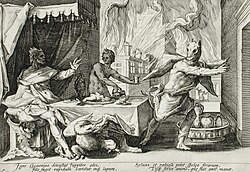
- Zeus transformed King Lycaon and his children into wolves (hence lycanthropy) as a punishment for either killing Zeus's children or serving him the flesh of Lycaon's own murdered son Nyctimus, depending on the exact version of the myth.
- Ares assigned Alectryon to keep watch for Helios the sun god during his affair with Aphrodite, but Alectryon fell asleep, leading to their discovery and humiliation that morning. Ares turned Alectryon into a rooster, which always crows to signal the morning and the arrival of the sun.
- Demeter transformed Ascalabus into a lizard for mocking her sorrow and thirst during her search for her daughter Persephone. She also turned King Lyncus into a lynx for trying to murder her prophet Triptolemus.
- Athena transformed Arachne into a spider for challenging her as a weaver and/or weaving a tapestry that insulted the gods. She also turned Nyctimene into an owl, though in this case it was an act of mercy, as the girl wished to hide from the daylight out of shame of being raped by her father.
- Artemis transformed Actaeon into a stag for spying on her bathing, and he was later devoured by his hunting dogs.
- Galanthis was transformed into a weasel or cat after interfering in Hera's plans to hinder the birth of Heracles.
- Atalanta and Hippomenes were turned into lions after making love in a temple dedicated to Zeus or Cybele.
- Io was a priestess of Hera in Argos, a nymph who was raped by Zeus, who changed her into a heifer to escape detection.
- Hera punished young Tiresias by transforming him into a woman and, seven years later, back into a man.
- King Tereus, his wife Procne, and her sister Philomela were all turned into birds (a hoopoe, a swallow and a nightingale respectively), after Tereus raped Philomela and cut out her tongue, and in revenge she and Procne served him the flesh of his murdered son Itys (who in some variants is resurrected as a goldfinch).
- Callisto was turned into a bear by either Artemis or Hera for being impregnated by Zeus.
- Selene transformed Myia into a fly when she became a rival for the love of Endymion.
While the Greek gods could use transformation punitively — such as Medusa, who turned to a monster for having sexual intercourse (raped in Ovid's version) with Poseidon in Athena's temple — even more frequently, the tales using it are of amorous adventure. Zeus repeatedly transformed himself to approach mortals as a means of gaining access:[2]
- Danaë as a shower of gold
- Europa as a bull
- Leda as a swan
- Ganymede, as an eagle
- Alcmene as her husband Amphitryon
- Hera as a cuckoo
- Aegina as an eagle or a flame
- Persephone as a serpent
- Io, as a cloud
- Callisto as either Artemis or Apollo
- Nemesis (Goddess of retribution) transformed into a goose to escape Zeus' advances, but he turned into a swan. She later bore the egg in which Helen of Troy was found.
_(cropped).jpg)
Vertumnus transformed himself into an old woman to gain entry to Pomona's orchard; there, he persuaded her to marry him.
In other tales, the woman appealed to other gods to protect her from rape, and was transformed (Daphne into laurel, Corone into a crow). Unlike Zeus and other gods' shapeshifting, these women were permanently metamorphosed.
In one tale, Demeter transformed herself into a mare to escape Poseidon, but Poseidon counter-transformed himself into a stallion to pursue her, and succeeded in the rape. Caenis, having been raped by Poseidon, demanded of him that she be changed to a man. He agreed, and she became Caeneus, a form he never lost, except, in some versions, upon death.
Clytie was a nymph who loved Helios, but he did not love her back. Desperate, she sat on a rock with no food or water for nine days looking at him as he crossed the skies, until she was transformed into a purple, sun-gazing flower, the heliotropium.
As a final reward from the gods for their hospitality, Baucis and Philemon were transformed, at their deaths, into a pair of trees.
Eos, the goddess of the dawn, secured immortality for her lover the Trojan prince Tithonus, but not eternal youth, so he aged without dying as he shriveled and grew more and more helpless. In the end, Eos transformed him into a cicada.
In some variants of the tale of Narcissus, he is turned into a narcissus flower.

Sometimes metamorphoses transform objects into humans. In the myths of both Jason and Cadmus, one task set to the hero was to sow dragon's teeth; on being sown, they would metamorphose into belligerent warriors, and both heroes had to throw a rock to trick them into fighting each other to survive. Deucalion and Pyrrha repopulated the world after a flood by throwing stones behind them; they were transformed into people. Cadmus is also often known to have transformed into a dragon or serpent towards the end of his life. Pygmalion fell in love with Galatea, a statue he had made. Aphrodite had pity on him and transformed the stone into a living woman.
British and Irish
[edit]Fairies, witches, and wizards were all noted for their shape-shifting ability. Not all fairies could shape-shift, some having only the appearance of shape-shifting, through their power, called "glamour", to create illusions, and some were limited to changing their size, as with the spriggans, and others to a few forms.[3] But others, such as the Hedley Kow, could change to many forms, and both human and supernatural wizards were capable of both such changes, and inflicting them on others.[4]
Witches could turn into hares and in that form steal milk and butter.[5]
Many British fairy tales, such as Jack the Giant Killer and The Black Bull of Norroway, feature shapeshifting.
Celtic mythology
[edit]Pwyll was transformed by Arawn into Arawn's shape, and Arawn transformed himself into Pwyll's so that they could trade places for a year and a day.
Llwyd ap Cil Coed transformed his wife and attendants into mice to attack a crop in revenge; when his wife is captured, he turns himself into three clergymen in succession to try to pay a ransom.
Math fab Mathonwy and Gwydion transform flowers into a woman named Blodeuwedd, and when she betrays her husband Lleu Llaw Gyffes, who is transformed into an eagle, they transform her again, into an owl.
Gilfaethwy raped Goewin, Math fab Mathonwy's virgin footholder, with help from his brother Gwydion. As punishment, Math turned them into different types of animals for one year each. Gwydion was transformed into a stag, sow, and wolf, and Gilfaethwy into a hind, boar, and she-wolf. Each year, they had a child. Math turned the three young animals into boys.
Gwion, having accidentally taken the wisdom from a potion that Ceridwen was brewing for her son, fled from her through a succession of changes, which she answered with changes of her own. This ended when he turned into a grain of corn and she turned into a hen and ate him. She became pregnant, and he was reborn as a baby. He grew up to be the bard Taliesin. In the Book of Taliesin, he mentions many forms which he is able to take, including that of lantern-light.

Tales abound about the selkie, a seal that can remove its skin to make contact in human guise with people for only a short amount of time before it must return to the sea. Clan MacColdrum of Uist's foundation myths include a union between the founder of the clan and a shape-shifting selkie.[6] Another such creature is the Scottish selkie, which needs its sealskin to regain its form. In The Great Silkie of Sule Skerry the (male) selkie seduces a human woman. Such stories surrounding these creatures are usually romantic tragedies.
Scottish mythology features shapeshifters, which allows the various creatures to trick, deceive, hunt, and kill humans. Water spirits such as the each-uisge, which inhabit lochs and waterways in Scotland, were said to appear as a horse or a young man.[4] Other tales include kelpies who emerge from lochs and rivers in the disguise of a horse or woman to ensnare and kill weary travelers. Tam Lin, a man captured by the Queen of the Fairies is changed into all manner of beasts before being rescued. He finally turned into a burning coal and was thrown into a well, whereupon he reappeared in his human form. The motif of capturing a person by holding him through all forms of transformation is a common thread in folktales.[7]

Perhaps the best-known Irish myth is that of Aoife who turned her stepchildren, the Children of Lir, into swans to be rid of them. Likewise, in the Tochmarc Étaíne, Fuamnach jealously turns Étaín into a butterfly. The most dramatic example of shapeshifting in Irish myth is that of Tuan mac Cairill, the only survivor of Partholón's settlement of Ireland. In his centuries-long life, he became successively a stag, a wild boar, a hawk, and finally a salmon before being eaten and (as in the Wooing of Étaín) reborn as a human.
The Púca is a Celtic faery, and also a deft shapeshifter. He can transform into many different, terrifying forms.
Sadhbh, the wife of the famous hero Fionn mac Cumhaill, was changed into a deer by the druid Fer Doirich when she spurned his amorous interests.
Norse and Teutonic
[edit]
There is a significant amount of literature about shapeshifters that appear in a variety of Norse tales.[8]
In the Lokasenna, Odin and Loki taunt each other with having taken the form of females and nursing offspring to which they had given birth. A 13th-century Edda relates Loki taking the form of a mare to bear Odin's steed Sleipnir which was the fastest horse ever to exist, and also the form of a she-wolf to bear Fenrir.[9]
Svipdagr angered Odin, who turned him into a dragon. Despite his monstrous appearance, his lover, the goddess Freyja, refused to leave his side. When the warrior Hadding found and slew Svipdagr, Freyja cursed him to be tormented by a tempest and shunned like the plague wherever he went.[citation needed] In the Hyndluljóð, Freyja transformed her protégé Óttar into a boar to conceal him. She also possessed a cloak of falcon feathers that allowed her to transform into a falcon, which Loki borrowed on occasion.
The Volsunga saga contains many shapeshifting characters. Siggeir's mother changed into a wolf to help torture his defeated brothers-in-law with slow and ignominious deaths. When one, Sigmund, survived, he and his nephew and son Sinfjötli killed men wearing wolfskins; when they donned the skins themselves, they were cursed to become werewolves.[10]

The dwarf Andvari is described as being able to magically turn into a pike. Alberich, his counterpart in Richard Wagner's Der Ring des Nibelungen, using the Tarnhelm, takes on many forms, including a giant serpent and a toad, in a failed attempt to impress or intimidate Loki and Odin/Wotan.
Fafnir was originally a dwarf, a giant, or even a human, depending on the exact myth, but in all variants, he transformed into a dragon—a symbol of greed—while guarding his ill-gotten hoard. His brother, Ótr, enjoyed spending time as an otter, which led to his accidental slaying by Loki.
In Scandinavia, there existed, for example, the famous race of she-werewolves known by the name of Maras, women who took on the appearance of huge half-human and half-wolf monsters that stalked the night in search of human or animal prey. If a woman gives birth at midnight and stretches the membrane that envelopes the child when it is brought forth, between four sticks and creeps through it, naked, she will bear children without pain; but all the boys will be shamans, and all the girls Maras.[citation needed]
The Nisse is sometimes said to be a shapeshifter. This trait also is attributed to Hulder.

Gunnhild, Mother of Kings (Gunnhild konungamóðir) (c. 910 – c. 980), a quasi-historical figure who appears in the Icelandic Sagas, according to which she was the wife of Eric Bloodaxe, was credited with magic powers – including the power of shapeshifting and turning at will into a bird. She is the central character of the novel Mother of Kings by Poul Anderson,[11] which considerably elaborates on her shapeshifting abilities.
In the Finnish epic poem Kalevala of ancient folklore, Louhi, Mistress of the North, attacks Väinämöinen in the form of a giant eagle with her troops on her back as she tries to steal Sampo.
Indian
[edit]- Ichchhadhari naag: A common male cobra will become an ichchhadhari naag and a common female cobra will become an ichchhadhari naagin after 100 years of tapasya (penance). After being blessed by Lord Shiva, they attain a human form of their own and have the ability to shapeshift into any living creature, they can live for more than a hundred years without getting old.
- Yoginis were associated with the power of shapeshifting into female animals.[12]
- In the Indian fable The Dog Bride from Folklore of the Santal Parganas by Cecil Henry Bompas, a buffalo herder falls in love with a dog that has the power to turn into a woman when she bathes.
- In Kerala, there was a legend about the Odiyan clan, who in Kerala folklore are men believed to possess shapeshifting abilities and can assume animal forms. Odiyans are said to have inhabited the Malabar region of Kerala before the widespread use of electricity.
Armenian
[edit]In Armenian mythology, shapeshifters include the Nhang, a serpentine river monster that can transform itself into a woman or seal, and will drown humans and then drink their blood; or the beneficial Shahapet, a guardian spirit that can appear either as a man or a snake.[13]
Philippines
[edit]Philippine mythology includes the Aswang, a vampiric monster capable of transforming into a bat, a large black dog, a black cat, a black boar, or some other form to stalk humans at night. The folklore also mentions other beings such as the Kapre, the Tikbalang, and the Engkanto, which change their appearances to woo beautiful maidens. Also, talismans (called "anting-anting" or "birtud" in the local dialect), can give their owners the ability to shapeshift. In one tale, Chonguita the Monkey Wife,[14] a woman is turned into a monkey, only becoming human again if she can marry a handsome man.
Tatar
[edit]Tatar folklore includes Yuxa, a hundred-year-old snake that can transform itself into a beautiful young woman, and seeks to marry men to have children.
Chinese
[edit]
 |
Chinese mythology contains many tales of animal shapeshifters, capable of taking on human form. The most common such shapeshifter is the huli jing, a fox spirit that usually appears as a beautiful young woman; most are dangerous, but some feature as the heroines of love stories. Madame White Snake is one such legend; a snake falls in love with a man, and the story recounts the trials she and her husband faced.
Japanese
[edit]
|
In Japanese folklore obake are a type of yōkai with the ability to shapeshifting. The fox, or kitsune is among the most commonly known, but other such creatures include the bakeneko, the mujina, and the tanuki.
Korean
[edit]Korean mythology also contains a fox with the ability to shapeshift. Unlike its Chinese and Japanese counterparts, the kumiho is always malevolent. Usually its form is of a beautiful young woman; one tale recounts a man, a would-be seducer, revealed as a kumiho.[15] The kumiho has nine tails and as she desires to be a full human, she uses her beauty to seduce men and eat their hearts (or in some cases livers where the belief is that 100 livers would turn her into a real human).
Somali
[edit] |
In Somali mythology Qori ismaris ("One who rubs himself with a stick") was a man who could transform himself into a "Hyena-man" by rubbing himself with a magic stick at nightfall and by repeating this process could return to his human state before dawn.
Southern Africa
[edit]ǀKaggen is a demi-urge and folk hero of the ǀXam people of southern Africa.[16] He is a trickster god who can shape shift, usually taking the form of a praying mantis but also a bull eland, a louse, a snake, and a caterpillar.[17]
Native American
[edit]A Pukwudgie is a human-like creature from Wampanoag folklore said to appear and disappear at will, and shapeshift.
South American
[edit]Amazon river dolphins are curious and lack of fear of foreign objects,[18] are apex predators,[19] and the male Amazon river dolphins are very physically aggressive during their mating period, particularly around the courtship practice of object carrying.[20][21]
Amazon river dolphins, known by the natives as the boto, encantados or toninhas, are very prevalent in the mythology of the native South Americans. They are frequently characterized in mythology with superior musical ability, seductiveness and love of sex, resulting in illegitimate children, and attraction to parties. Despite the fact that the Encante are said to come from a utopia full of wealth which is also without pain or death, they crave the pleasures and hardships of human societies.[22]
Transformation into human form is said to be rare, and usually occurs at night. The encantado will often be seen running from a festa, despite protests from the others for it to stay, and can be seen by pursuers as it hurries to the river and reverts to dolphin form. When it is under human form, it wears a hat to hide its blowhole, which does not disappear with the shapeshift.[22]
Besides the ability to shapeshift into human form, encantados frequently wield other magical abilities, such as controlling storms, hypnotizing humans into doing their will, transforming humans into encantados, and inflicting illness, insanity, and even death. Shamans often intervene in these situations.[22]
Along with shapeshifting, kidnapping is also a common theme in such folklore. Encantados are said to be fond of abducting humans with whom they fall in love, children born of their illicit love affairs, or just about anyone near the river who can keep them company, and taking them back to the Encante. The fear of this is so great among people who live near the Amazon River that both children and adults are terrified of going near the water between dusk and dawn, or entering water alone. Some who supposedly have encountered encantados while out in their canoes have been said to have gone insane, but the creatures seem to have done little more than follow their boats and nudge them from time to time.[22] The myth is suggested to have arisen in part because dolphin genitalia bear a resemblance to those of humans. Others believe the myth served (and still serves) as a way of hiding the incestuous relations which are quite common in some small, isolated communities along the river.[23] Legend also states that "if a person makes eye contact with an Amazon river dolphin, they will have lifelong nightmares".[24]
Trinidad and Tobago
[edit]The Ligahoo or loup-garou is the shapeshifter of Trinidad and Tobago's folklore. This unique ability is believed to be handed down in some old creole families, and is usually associated with witch-doctors and practitioners of African magic.[25][26]
Mapuche (Argentina and Chile)
[edit] |
The name of the Nahuel Huapi Lake in Argentina derives from the toponym of its major island in Mapudungun (Mapuche language): "Island of the Jaguar (or Puma)", from nahuel, "puma (or jaguar)", and huapí, "island". There is, however, more to the word "Nahuel" – it can also signify "a man who by sorcery has been transformed into a puma" (or jaguar).
Slavic mythology
[edit]In Slavic mythology, one of the main gods Veles was a shapeshifting god of animals, magic and the underworld. He was often represented as a bear, wolf, snake or owl.[27] He also became a dragon while fighting Perun, the Slavic storm god.[28]
Folktales
[edit]
- In the Finnish tale The Magic Bird, three young sorceresses attempt to murder a man who keeps reviving. His revenge is to turn them into three black mares and have them harnessed to heavy loads until he is satisfied.
- In The Laidly Worm of Spindleston Heugh, a Northumbrian legend from about the thirteenth century, Princess Margaret of Bamburgh is transformed into a dragon by her stepmother; her motive sprung, like Snow White's stepmother's, from the comparison of their beauty.[29]
- In Child ballad 35, "Allison Gross", the title witch turns a man into a wyrm for refusing to be her lover. This is a motif found in many legends and folktales.[30]
- In the German tale The Frog's Bridegroom, recorded by folklorist and ethnographer Gustav Jungbauer, the third of three sons of a farmer, Hansl, is forced to marry a frog, which eventually turns out to be a beautiful woman transformed by a spell.
- In some variants of the fairy tales, both The Frog Prince or more commonly The Frog Princess and Beast, of Beauty and the Beast, are transformed as a form of punishment for some transgression. Both are restored to their true forms after earning a human's love despite their appearance.
- In the most famous Lithuanian folk tale Eglė the Queen of Serpents, Eglė irreversibly transforms her children and herself into trees as a punishment for betrayal while her husband is able to reversibly morph into a serpent at will.
- In East of the Sun and West of the Moon, the hero is transformed into a bear by his wicked stepmother, who wishes to force him to marry her daughter.[31]
- In The Marmot Queen by Italo Calvino, a Spanish queen is turned into a rodent by Morgan le Fay.
- In The Mare of the Necromancer, a Turin Italian tale by Guido Gozzano, the Princess of Corelandia is turned into a horse by the baron necromancer for refusing to marry him. Only the love and intelligence of Candido save the princess from the spell.
- The White Doe, a French tale written by Madame d'Aulnoy, describes the transformation of Princess Desiree into a doe by a jealous fairy.
- From a Croatian book of tales, Sixty Folk-Tales from Exclusively Slavonic Sources by A. H. Wratislaw, the fable entitled "The she-wolf" tells of a huge she-wolf with a habit of turning into a woman from time to time by taking off her skin. One day a man witnesses the transformation, steals her pelt and marries her.
- The Merchant's Sons is a Finnish story of two brothers, one of whom tries to win the hand of the tsar's wicked daughter. The girl does not like her suitor and endeavors to have him killed, but he turns her into a beautiful mare which he and his brother ride. In the end he turns her back into a girl and marries her.
- In Dapplegrim, if the youth found the transformed princess twice, and hid from her twice, they would marry.
- In literary fairy tale The Beggar Princess, to save her beloved prince, Princess Yvonne fulfills the tasks of cruel king Ironheart and is changed into an old woman.[32]
- Journey to the West, one of China's Four Great Classical Novels, greatly features shapeshifting, as many gods, demons, and other mythical beings are capable of the act. The most famous case would be the Monkey King, a mischievous trickster who often utilizes his power of 72 transformations to thwart his foes.
Themes
[edit]Shapeshifting may be used as a plot device, such as when Puss in Boots in the fairy tales tricks the ogre into becoming a mouse to be eaten. Shapeshifting may also include symbolic significance, like the Beast's transformation in Beauty and the Beast indicates Belle's ability to accept him despite his appearance.[33]
When a form is taken on involuntarily, the thematic effect can be one of confinement and restraint; the person is bound to the new form. In extreme cases, such as petrifaction, the character is entirely disabled. On the other hand, voluntary shapeshifting can be a means of escape and liberation. Even when the form is not undertaken to resemble a literal escape, the abilities specific to the form allow the character to act in a manner that was previously impossible.
Examples of this are in fairy tales. A prince who is forced into a bear's shape (as in East of the Sun and West of the Moon) is a prisoner, but a princess who takes on a bear's shape voluntarily to flee a situation (as in The She-Bear) escapes with her new shape.[34] In the Earthsea books, Ursula K. Le Guin depicts an animal form as slowly transforming the wizard's mind, so that the dolphin, bear or other creature forgets it was human, making it impossible to change back. This makes an example of a voluntary shapeshifting becoming an imprisoning metamorphosis.[35] Beyond this, the uses of shapeshifting, transformation, and metamorphosis in fiction are as protean as the forms the characters take on. Some are rare, such as Italo Calvino's "The Canary Prince" is a Rapunzel variant in which shape-shifting is used to gain access to the tower.
Punitive changes
[edit]
In many cases, imposed forms are punitive. This may be a just punishment, the nature of the transformation matching the crime for which it occurs; in other cases, the form is unjustly imposed by an angry and powerful person. In fairy tales, such transformations are usually temporary, but they commonly appear as the resolution of myths (as in many of the Metamorphoses) or produce origin myths.
Transformation chase
[edit]In many fairy tales and ballads, as in Child Ballad #44, The Twa Magicians or Farmer Weathersky, a magical chase occurs where the pursued endlessly takes on forms in an effort to shake off the pursuer, and the pursuer answers with shapeshifting, as, a dove is answered with a hawk and a hare with a greyhound. The pursued may finally succeed in escape or the pursuer in capturing.
The Grimm Brothers' fairy tale Foundling-Bird contains this as the bulk of the plot.[36] In the Italian Campania Fables collection of Pentamerone by Gianbattista Basile, tells of a Neapolitan princess who, to escape from her father who had imprisoned her, becomes a huge she-bear. The magic happens due to a potion given to her by an old witch. The girl, once gone, can regain her human aspect.
In other variants, the pursued may transform various objects into obstacles, as in the fairy tale "The Master Maid", where the Master Maid transforms a wooden comb into a forest, a lump of salt into a mountain, and a flask of water into a sea. In these tales, the pursued normally escapes after overcoming three obstacles.[36] This obstacle chase is literally found worldwide, in many variants in every region.[37]
In fairy tales of the Aarne–Thompson type 313A, The Girl Helps the Hero Flee, such a chase is an integral part of the tale. It can be either a transformation chase (as in The Grateful Prince, King Kojata, Foundling-Bird, Jean, the Soldier, and Eulalie, the Devil's Daughter, or The Two Kings' Children) or an obstacle chase (as in The Battle of the Birds, The White Dove, or The Master Maid).[38]
In a similar effect, a captive may shapeshift to break a hold on him. Proteus and Nereus's shapeshifting was to prevent heroes such as Menelaus and Heracles from forcing information from them.[39] Tam Lin, once seized by Janet, was transformed by the faeries to keep Janet from taking him, but as he had advised her, she did not let go, and so freed him.[40] The motif of capturing a person by holding him through many transformations is found in folktales throughout Europe,[7] and Patricia A. McKillip references it in her Riddle-Master trilogy: a shape-shifting Earthmaster finally wins its freedom by startling the man holding it.
Powers
[edit]One motif is a shape change in order to obtain abilities in the new form. Berserkers were held to change into wolves and bears to fight more effectively. In many cultures, evil magicians could transform into animal shapes and thus skulk about.
In many fairy tales, the hero's talking animal helper proves to be a shapeshifted human being, able to help him in its animal form. In one variation, featured in The Three Enchanted Princes and The Death of Koschei the Deathless, the hero's three sisters have been married to animals. These prove to be shapeshifted men, who aid their brother-in-law in a variant of tale types.[41]
Bildungsroman
[edit]Beauty and the Beast has been interpreted as a young woman's coming-of-age, in which she changes from being repulsed by sexual activity and regarding a husband therefore bestial, to a mature woman who can marry.[42]
Needed items
[edit]
Some shapeshifters can change form only if they have some item, usually an article of clothing. In Bisclavret by Marie de France, a werewolf cannot regain human form without his clothing, but in wolf form does no harm to anyone. However, the most common use of this motif is in tales where a man steals the article and forces the shapeshifter, trapped in human form, to become his bride. This lasts until she discovers where he has hidden the article, and she can flee. Selkies feature in these tales. Others include swan maidens and the Japanese tennin.
Swedish writer Selma Lagerlöf, in The Wonderful Adventures of Nils, included a version of the story with the typical elements (fisherman sees mermaids dancing on an island and steals the sealskin of one of them, preventing her from becoming a seal again, so that he could marry her) and linked it to the founding of the city of Stockholm.[43]
Inner conflict
[edit]The power to externally transform can symbolize an internal savagery; a central theme in many strands of werewolf mythology,[44] and the inversion of the "liberation" theme, as in Dr Jekyll's transformation into Mr. Hyde.
Usurpation
[edit]
Some transformations are performed to remove the victim from his place so that the transformer can usurp it. Bisclaveret's wife steals his clothing and traps him in wolf form because she has a lover. A witch, in The Wonderful Birch, changed a mother into a sheep to take her place, and had the mother slaughtered; when her stepdaughter married the king, the witch transformed her into a reindeer to put her daughter in the queen's place. In the Korean Transformation of the Kumiho, a kumiho, a fox with magical powers, transforms itself into an image of the bride, only being detected when her clothing is removed. In Brother and Sister, when two children flee from their cruel stepmother, she enchants the streams along the way to transform them. While the brother refrains from the first two, which threaten to turn them into tigers and wolves, he is too thirsty at the third, which turns him into a deer. The Six Swans are transformed into swans by their stepmother,[45] as are the Children of Lir in Irish mythology.
Ill-advised wishes
[edit]Many fairy-tale characters have expressed ill-advised wishes to have any child at all, even one that has another form, and had such children born to them.[46] At the end of the fairy tale, normally after marriage, such children metamorphose into human form. Hans My Hedgehog was born when his father wished for a child, even a hedgehog. Even stranger forms are possible: Giambattista Basile included in his Pentamerone the tale of a girl born as a sprig of myrtle, and Italo Calvino, in his Italian Folktales, a girl born as an apple.
Sometimes, the parent who wishes for a child is told how to gain one but does not obey the directions perfectly, resulting in a transformed birth. In Prince Lindworm, the woman eats two onions but does not peel one, resulting in her first child being a lindworm. In Tatterhood, a woman magically produces two flowers, but disobeys the directions to eat only the beautiful one, resulting in her having a beautiful and sweet daughter, but only after a disgusting and hideous one.
Less commonly, ill-advised wishes can transform a person after birth. The Seven Ravens are transformed when their father thinks his sons are playing instead of fetching water to christen their newborn and sickly sister, and curses them.[47] In Puddocky, when three princes start to quarrel over the beautiful heroine, a witch curses her because of the noise.
Monstrous bride/bridegroom
[edit]Such wished-for children may become monstrous brides or bridegrooms. These tales have often been interpreted as symbolically representing arranged marriages; the bride's revulsion to marrying a stranger is symbolized by his bestial form.[48]
The heroine must fall in love with the transformed groom. The hero or heroine must marry, as promised, and the monstrous form is removed by the wedding. Sir Gawain thus transformed the Loathly lady; although he was told that this was halfway, she could at his choice be beautiful by day and hideous by night, or vice versa, he told her that he would choose what she preferred, which broke the spell entirely.[49] In Tatterhood, Tatterhood is transformed by her asking her bridegroom why he didn't ask her why she rode a goat, why she carried a spoon, and why she was so ugly, and when he asked her, denying it and therefore transforming her goat into a horse, her spoon into a fan, and herself into a beauty. Puddocky is transformed when her prince, after she had helped him with two other tasks, tells him that his father has sent him for a bride. A similar effect is found in Child ballad 34, Kemp Owyne, where the hero can transform a dragon back into a maiden by kissing her three times.[50]
Sometimes the bridegroom removes his animal skin for the wedding night, whereupon it can be burned. Hans My Hedgehog, The Donkey and The Pig King fall under this grouping. At an extreme, in Prince Lindworm, the bride who avoids being eaten by the lindworm bridegroom arrives at her wedding wearing every gown she owns, and she tells the bridegroom she will remove one of hers if he removes one of his; only when her last gown comes off has he removed his last skin, and become a white shape that she can form into a man.[1]
In some tales, the hero or heroine must obey a prohibition; the bride must spend a period not seeing the transformed groom in human shape (as in East of the Sun and West of the Moon), or the bridegroom must not burn the animals' skins. In The Brown Bear of Norway, The Golden Crab, The Enchanted Snake and some variants of The Frog Princess, burning the skin is a catastrophe, putting the transformed bride or bridegroom in danger. In these tales, the prohibition is broken, invariably, resulting in a separation and a search by one spouse for the other.[1]
Death
[edit]Ghosts sometimes appear in animal form. In The Famous Flower of Serving-Men, the heroine's murdered husband appears to the king as a white dove, lamenting her fate over his own grave. In The White and the Black Bride and The Three Little Men in the Wood, the murdered – drowned – true bride reappears as a white duck. In The Rose Tree and The Juniper Tree, the murdered children become birds who avenge their own deaths. There are African folk tales of murder victims avenging themselves in the form of crocodiles that can shapeshift into human form.[51]
In some fairy tales, the character can reveal himself in every new form, and so a usurper repeatedly kills the victim in every new form, as in Beauty and Pock Face, A String of Pearls Twined with Golden Flowers, and The Boys with the Golden Stars. This eventually leads to a form in which the character (or characters) can reveal the truth to someone able to stop the villain.
Similarly, the transformation back may be acts that would be fatal. In The Wounded Lion, the prescription for turning the lion back into a prince was to kill him, chop him to pieces, burn the pieces, and throw the ash into the water. Less drastic but no less fatal, the fox in The Golden Bird, the foals in The Seven Foals, and the cats in Lord Peter and The White Cat tell the heroes of those stories to cut off their heads; this restores them to human shape.[52] In the Greek tale of Scylla, Scylla's father Nisus turns into an eagle after death and drowns her daughter for betraying her father.
Modern
[edit]Fiction
[edit]- In George MacDonald's The Princess and Curdie (1883) Curdie is informed that many human beings, by their acts, are slowly turning into beasts. Curdie is given the power to detect the transformation before it is visible and is assisted by beasts that had been transformed and are working their way back to humanity.[53]
- In Carlo Collodi's story The Adventures of Pinocchio (1883), the boys who visit the Land of Toys turn into donkeys.
- L. Frank Baum concluded The Marvelous Land of Oz (1904) with the revelation that Princess Ozma, sought by the protagonists, had been turned into a boy as a baby and that Tip (who had been searching for her) is that boy. He agrees to have the transformation reversed, but Glinda the Good disapproves of shapeshifting magic, so it is done by the evil witch Mombi.[54]
- The science fiction short story "Who Goes There?" written by John W. Campbell (later adapted to film as The Thing from Another World and The Thing) concerns a shapeshifting alien lifeform that can assume the form and memories of any creature it absorbs.[55]
- In T.H. White's 1938 book The Sword in the Stone, Merlin and Madam Mim fight a wizards' duel, in which the duelists would endlessly transform until one was in a form that could destroy the other.[56] Also, at various times, Merlin transforms Arthur into various animals as an educational experience.[40]
- In C.S. Lewis's The Chronicles of Narnia, Eustace Scrubb transforms into a dragon in The Voyage of the Dawn Treader,[57] and in The Horse and his Boy the Calormene war-monger Rabadash into a donkey.[58] Eustace's transformation is not strictly a punishment — the change simply reveals the truth of his selfishness — and it is reversed after he repents with the later change in his moral nature. Rabadash is allowed to reverse his transformation, providing he does so in a public place, so that his former followers will know that he had been a donkey. He is warned that, if he ever leaves his capital city again, he will become a donkey permanently, and this prevents him from leading further military campaigns.
- Both the Earthmasters and their opponents in Patricia A. McKillip's 1976 The Riddle-Master of Hed trilogy make extensive use of their shapeshifting abilities for the powers of their new forms.[59]
- James A. Hetley's contemporary fantasy books Dragon's Eye and Dragon's Teeth centers on the Morgan family of Stonefort, Maine – present-day Americans who are secretly able to turn themselves into seals at will (and making extensive use of that ability in their fighting with various other characters).
- In Harry Potter series, some wizards and witches with the ability of 'animagus' can transform into a particular animal of their choice and are required to register with the Ministry of Magic about their ability.
- In the Mortal Kombat franchise, Shang Tsung is a shapeshifter.
- The Shantae platformer video game series features the ability of its titular main character to perform belly dances that can transform her into different animal forms.
- Some fantasy franchises use the term "skinchanger" as a type of shapeshifter that can take an animal form. In The Hobbit, the character Beorn is described as a "skinchanger" that can take the form of a monstrous bear. In the A Song of Ice and Fire series, as well as its television adaptation, the term "skinchanger" is synonymous with "warg", an individual that can enter the mind of an animal.
Film and popular culture
[edit]- The X-Files features a species known as the Colonists who are infiltrating Earth to colonize the planet.
- In David Icke's works, reptilian shapeshifters secretly control many aspects of human society by taking on human form and gaining political power to manipulate humanity.
- In the Doctor Who serial "The Faceless Ones" (1967), featureless aliens known as the Chameleons shapeshift into humans in order to steal their identities. However, they need to keep the copied person alive in order to maintain their stolen identity.[60]
- In the Doctor Who serial "Terror of the Zygons" (1975), the main antagonists, called the Zygons, can shapeshift into humans and other animals (such as horses). However, they need to keep the copied person or animal alive in order to be able to change back into their natural form.[61]
- In the Doctor Who serial "Horror of Fang Rock" (1977), the alien species called the Rutans, ancient opponents to the Sontarans, possessed the ability to transform from their natural jellyfish like form to that of one of their human victims.[62]
- The Marvel Comics Universe features a wide range of shapeshifters, including Mr. Fantastic, Mystique, and Impossible Man, and alien races whose members can shapeshift, such as the Skrulls, the Phalanx, and the Symbiotes.
- The DC Comics Universe features a wide range of shapeshifters, the most prominent being Beast Boy, Plastic Man, Martian Manhunter, Miss Martian, Metamorpho, and the Clayfaces.
- The Star Trek universe features a number of shapeshifting alien races, including the Organians and the Chameloids from the original series, and the Changelings in Deep Space Nine. Among the Suliban, the Cabal also were given the ability to shapeshift by a being from the future, as seen in Star Trek: Enterprise.
- The Transformers media franchise centers upon an alien race of shapeshifting robots.
- In Thunderheart (1992), starring Val Kilmer, the character Jimmy Looks Twice evades capture by shapeshifting at will into a series of animals.
- The Twilight Saga also features shapeshifters that can transform into wolves and have inhuman strength, speed, body temperature and aging process.[63]
- In Star Wars: Episode II – Attack of the Clones (2002), Zam Wesell attempts to assassinate Padmé Amidala. When Zam flees, Anakin pursues her and discovers she is a shapeshifter. Zam Wesell reverts to her natural form when her employer kills her after she is captured.
- In Supernatural, the shapeshifters are recurring creatures of the series. Shapeshifter first appeared in Season 1, Episode 6 titled "Skin".
- In Fringe, shapeshifters are inorganic, human hybrids from the Alternate Universe.
- In Encanto, Camilo has the ability to shapeshift.
- In the Animorphs books, an alien species known as the Andalites has shapeshifting or "morphing" technology that is shared with the Animorphs, giving them the power to shapeshift into any living creature whose DNA they acquire.
- In the Heroes of Olympus book series, the demigod Frank Zhang possesses the ability to shapeshift as a gift from his ancestor Poseidon.
- In the graphic novel Nimona and its animated feature film adaptation, the titular character is a mischievous shapeshifter.
- The 1999 film My Favorite Martian, which is based on the 1960s show of the same name, features a gum called Nerplex, which turns anyone into aliens.
- In the Ben 10 franchise (notably Ben Tennyson himself), characters wielding the Omnitrix are able to shapeshift into various alien species.
- Elastigirl, fictional superhero who appears in Pixar's animated superhero film The Incredibles can shapeshift.[64][65]
- Two of the Michael Jackson music videos, Thriller Michael Jackson becomes a werewolf and a zombie, while Black or White features him turning into a panther as well as involving face morphs between races.
- In the music video for the Snoop Dogg song, "What's My Name?" Snoop Dogg himself and others have the ability to turn into dogs, like Dobermans, Rottweilers, Pit bulls, Cocker Spaniels and other dog breeds.
- In the 2000 series Sheena, this version of Sheena has the ability to turn into animals.
See also
[edit]- Changeling
- Doppelgänger
- Hantu Raya – Spirit in Malay folklore
- Human guise
- Invasion of the Body Snatchers
- Kindama – Sage in Hindu epic Mahabharata
- List of shapeshifters
- Maricha – Rakshasa (demon) in Ramayana
- Naagin (2015 TV series)
- Size change in fiction
- Skin-walker – Witch in Navajo mythology
- Soul eater (folklore)
- Skrull – Fictional extraterrestrial race
- The Thing (1982 film)
- The Thing (2011 film)
Notes
[edit]Citations
[edit]- ^ a b c Terri Windling, "Married to Magic: Animal Brides and Bridegrooms in Folklore and Fantasy"
- ^ Richard M. Dorson, "Foreword", p xxiv, Georgias A. Megas, Folktales of Greece, University of Chicago Press, Chicago and London, 1970
- ^ Katharine Briggs (1976). "Glamour". An Encyclopedia of Fairies, Hobgoblins, Brownies, Boogies, and Other Supernatural Creatures. p. 191. ISBN 0-394-73467-X.
- ^ a b Katharine Briggs (1976). "Shape-shifting". An Encyclopedia of Fairies, Hobgoblins, Brownies, Boogies, and Other Supernatural Creatures. p. 360. ISBN 0-394-73467-X.
- ^ Eddie Lenihan and Carolyn Eve Green, Meeting The Other Crowd: The Fairy Stories of Hidden Ireland, p. 80 ISBN 1-58542-206-1
- ^ Scottish Highlanders and Native Americans: indigenous education in the eighteenth-century Atlantic world Margaret Szasz 2007 University of Oklahoma Press
- ^ a b Francis James Child, The English and Scottish Popular Ballads, v 1, pp. 336–7, Dover Publications, New York 1965
- ^ Perabo, L. D. 2017. Shapeshifting in Old Norse-Icelandic Literature, Roda da Fortuna. Revista Eletrônica sobre Antiguidade e Medievo, 6(1): 135–158.
- ^ Gill, N. S. "Loki – Norse Trickster Loki". about.com. Retrieved 2010-06-18.; Stephan Grundy, "Shapeshifting and Berserkergang," in Translation, Transformation, and Transubstantiation, ed. Carol Poster and Richard Utz (Evanston: IL: Northwestern University Press, 1998), pp. 104–22.
- ^ Adkins, Christopher David (2023). "Carnivore Incarnate: Wicked Wolves and Noble Bears in Norse Tales of Shapeshifting". Preternature. 13 (1): 1–26. doi:10.5325/preternature.12.1.0001. ISSN 2161-2196.
- ^ Tor Books, 2003
- ^ Hatley, Shaman (2007). The Brahmayāmalatantra and Early Śaiva Cult of Yoginīs. University of Pennsylvania (PhD Thesis, UMI Number: 3292099. p. 14.
- ^ "Armenian Mythology" by Mardiros H. Ananikiam, in Bullfinch's Mythology
- ^ Fansler, Dean s. Filipino Popular Tales.
- ^ Heinz Insu Fenkl. "A Fox Woman Tale of Korea". The Endicott Studio. Archived from the original on 2006-11-11.
- ^ Dorothea F. Bleek (1956). Bushman Dictionary. Рипол Классик. p. 296. ISBN 9785882327261.
{{cite book}}: ISBN / Date incompatibility (help) - ^ Wilhelm Heinrich Immanuel Bleek (1875). A brief account of Bushman folklore and other texts. Cape Town: Juta. hdl:2263/12485.
- ^ Don E. Wilson, DeeAnn M. Reeder (2005). Mammal Species of the World: A Taxonomic and Geographic Reference, Volume 1. JHU Press. ISBN 9780801882210.
- ^ Gómez Salazar, Catalina Trujillo, Fernando Whitehead, Hal (2011). "Ecological factors influencing group sizes of river dolphins : Inia geoffrensis and Sotalia fluviatilis". Marine Mammal Science. 28 (2): E124–E142.
{{cite journal}}: CS1 maint: multiple names: authors list (link) - ^ Bebej, Ryan. "Inia geoffrensis Amazon river dolphin (Also: boto; pink river dolphin)". Animal Diversity Web. Retrieved 11 March 2024.
- ^ Martin, A.R.; Da Silva, V.M.F.; Rothery, P. (Jun 23, 2008). "Object carrying as socio-sexual display in an aquatic mammal". Biology Letters. 4 (3): 243–245. doi:10.1098/rsbl.2008.0067. PMC 2610054. PMID 18364306.
{{cite journal}}: CS1 maint: multiple names: authors list (link) - ^ a b c d Hall, Jamie (2003). Half Human, Half Animal: Tales of Werewolves and Related Creatures. Authorhouse. pp. 55–88. ISBN 978-1-4107-5809-5.
- ^ Cravalho, Mark (Winter 1999). "Shameless creatures: An ethnozoology of the Amazon river dolphin". Ethnology. 38 (1): 47–58. doi:10.2307/3774086. JSTOR 3774086.
- ^ Waleska Gravena, Tomas Hrbek, Vera M. F. Da Silva, Izeni P. Farias (22 October 2008). "Amazon River dolphin love fetishes: From folklore to molecular forensics". Marine Mammal Science. 4 (24): 969–978. Bibcode:2008MMamS..24..969G. doi:10.1111/j.1748-7692.2008.00237.x.
{{cite journal}}: CS1 maint: multiple names: authors list (link) - ^ "TNT Folklore". triniview.com. Retrieved 2017-01-16.
- ^ "Caribbean History Archives". Gerard A. Besson. Retrieved 2017-01-16.
- ^ Aleksandra Kojic (2016-08-18). "Veles – The Slavic Shapeshifting God of Land, Water and Underground". Slavorum. Retrieved 2017-09-08.
- ^ Katičić, Radoslav (2008). Božanski boj: Tragovima svetih pjesama naše pretkršćanske starine (PDF). Zagreb: IBIS GRAFIKA. ISBN 978-953-6927-41-8. Archived from the original (PDF) on 2015-10-18.
- ^ Joseph Jacobs, English Fairy Tales, "The Laidly Worm of Spindleston Heugh"
- ^ Child (1965), pp. 313–314.
- ^ Maria Tatar, p. 193, The Annotated Classic Fairy Tales, ISBN 0-393-05163-3
- ^ Brady, Loretta Ellen. The Green Forest Fairy Book. Boston: Little, Brown and Company. 1920. pp. 132–169.
- ^ Wilson (1976), p. 94.
- ^ Marina Warner, From the Beast to the Blonde: On Fairy Tales And Their Tellers, p. 353 ISBN 0-374-15901-7
- ^ Colbert (2001), pp. 28–29.
- ^ a b Vladimir Propp, Morphology of the Folk Tale, p. 57, ISBN 0-292-78376-0
- ^ Stith Thompson, The Folktale, p. 56, University of California Press, Berkeley Los Angeles London, 1977
- ^ Stith Thompson, The Folktale, p. 89, University of California Press, Berkeley Los Angeles London, 1977
- ^ Colbert (2001), p. 23.
- ^ a b Grant & Clute, p. 960, "Transformation".
- ^ Stith Thompson, The Folktale, pp. 55–56, University of California Press, Berkeley Los Angeles London, 1977
- ^ Jones (1995), p. 84.
- ^ Online text of Ch. VII in The Wonderful Adventures of Nils [1]
- ^ Steiger (1999), p. xix.
- ^ Tatar (2004), p. 226.
- ^ Maria Tatar, Off with Their Heads! p. 60 ISBN 0-691-06943-3
- ^ Tatar (2004), p. 136.
- ^ Maria Tatar, Off with Their Heads! pp. 140–141 ISBN 0-691-06943-3
- ^ Wilson (1976), p. 89.
- ^ Child (1965), p. 306.
- ^ Steiger (1999), p. 67.
- ^ Maria Tatar, The Hard Facts of the Grimms' Fairy Tales, pp. 174–5, ISBN 0-691-06722-8
- ^ Stephen Prickett, Victorian Fantasy p. 86 ISBN 0-253-17461-9
- ^ Jack Zipes, When Dreams Came True: Classical Fairy Tales and Their Tradition, pp. 176–7 ISBN 0-415-92151-1
- ^ Steiger (1999), p. 385.
- ^ This scene is omitted in the story as depicted in The Once and Future King; see L. Sprague de Camp, Literary Swordsmen and Sorcerers: The Makers of Heroic Fantasy, p. 266 ISBN 0-87054-076-9
- ^ Erik J. Wielenberg, "Aslan the Terrible" pp. 226–7 Gregory Bassham ed. and Jerry L. Walls, ed. The Chronicles of Narnia and Philosophy ISBN 0-8126-9588-7
- ^ James F. Sennett, "Worthy of a Better God" p. 243 Gregory Bassham ed. and Jerry L. Walls, ed. The Chronicles of Narnia and Philosophy ISBN 0-8126-9588-7
- ^ Grant & Clute, p. 858, "Shapeshifting".
- ^ "Doctor Who The Faceless Ones Blu-ray".
- ^ "The Zygon Who Fell to Earth". www.drwhoguide.com.
- ^ "Clip: Horror of Fang Rock: Part 4". BBC. 24 September 1977.
- ^ Meyer, Stephenie (2008). Breaking Dawn. Little, Brown and Company. ISBN 9780316032834.
- ^ "Elastigirl (Helen Parr) - Incredibles - Superhero Database". www.superherodb.com. Retrieved 2024-10-03.
- ^ Schmidt, Sara (2018-09-06). "The Incredibles: 25 Weirdest Things About Elastigirl's Body". ScreenRant. Retrieved 2024-10-03.
Bibliography
[edit]- Child, Francis James (1965). The English and Scottish Popular Ballads. Vol. 1. Dover Publications.
- Colbert, David (2001). The Magical Worlds of Harry Potter. 2001. ISBN 0-9708442-0-4.
- Grant, John; Clute, John (15 March 1999). The Encyclopedia of Fantasy. Macmillan. ISBN 0-312-19869-8.
- Jones, Steven Swann (1995). The Fairy Tale: The Magic Mirror of Imagination. Twayne Publishers. ISBN 0-8057-0950-9.
- Smith, Frederick M. (2006). The Self Possessed: Deity and Spirit Possession in South Asian Literature. Columbia University Press. ISBN 0-231-13748-6.
- Steiger, B. (August 1999). The Werewolf Book: The Encyclopedia of Shape-Shifting Beings. Visible Ink Press. ISBN 978-1-57859-078-0.
- Tatar, Maria (2004). The Annotated Brothers Grimm. W. W. Norton & company. ISBN 0-393-05848-4.
- Wilson, Anne (1976). Traditional Romance and Tale. D.S. Brewer, Rowman & Littlefield. ISBN 0-87471-905-4.
Further reading
[edit]- Hall, Jamie (2003). Half Human, Half Animal: Tales of Werewolves and Related Creatures. AuthorHouse. ISBN 1-4107-5809-5.
- Kachuba, John B. 2019. Shapeshifters: A History. Chicago: University of Chicago Press.
- Wood, Felicity. "The Shape-Shifter on the Borderlands: A Comparative Study of the Trickster Figure in African Orality and in Oral Narratives Concerning one South African Trickster, Khotso Sethuntsa." English in Africa (2010): 71–90.
- Zaytoun, Kelli D. ""Now Let Us Shift" the Subject: Tracing the Path and Posthumanist Implications of La Naguala/The Shapeshifter in the Works of Gloria Anzaldúa." MELUS: Multi-Ethnic Literature of the United States 40.4 (2015): 69–88.
External links
[edit] Media related to Shapeshifting at Wikimedia Commons
- Real Shapeshifters Website Dedicated to the study of shape-shifting phenomena (realshapeshifters.com)
- Shapeshifters in Love – A series of articles about shape-shifting characters in romance and speculative fiction.


| National | |
|---|---|
| Other | |

Shapeshifting
View on GrokipediaDefinition and Concepts
Etymology and Terminology
The English term "shapeshifting" is a compound word derived from "shape," which traces its roots to Old English gesceap, meaning "creation," "form," or "external appearance," stemming ultimately from Proto-Germanic skapiz related to forming or fashioning.[5] The verb "shapeshift" itself is a relatively modern coinage, with its earliest recorded use in 1927, likely back-formed from "shapeshifter" in the context of folklore and speculative literature.[6] Earlier discussions of shape-changing in 19th-century folklore studies often employed terms like "metamorphosis" or "transformation" rather than the specific compound "shapeshifting," reflecting a growing scholarly interest in mythic and supernatural phenomena during the Victorian era.[7] Key terminology for shapeshifting includes "therianthropy," denoting human-animal transformation, derived from Ancient Greek thēríon ("wild beast") and ánthrōpos ("human").[8] A specialized variant is "lycanthropy," referring to wolf-human change, from Greek lukánthrōpos ("wolf-man"), combining lúkos ("wolf") and ánthrōpos ("man"), a term historically linked to both mythological and medical descriptions of delusion.[9] More broadly, "metamorphosis" encompasses any change in form, originating from Ancient Greek metamórphōsis, formed by metá ("change" or "after") and morphḗ ("form" or "shape"), and entering English in the 16th century via Latin.[10] Cross-culturally, terms like Japanese "henge" (変化), derived from "henka" meaning "change" or "transformation," specifically denote supernatural shifting, as seen in fox-related lore where animals assume human guises.[11]Types and Methods
Shapeshifting traditions distinguish between voluntary and involuntary transformations, with the former involving deliberate initiation by the individual, often as a means of empowerment or disguise, while the latter arises from external impositions such as curses or supernatural penalties.[12] Scholars classify these further into categories like genetic predispositions, where the ability is inherited, alongside voluntary and involuntary forms, highlighting the spectrum of agency in such changes.[12] Methods of achieving shapeshifting vary, encompassing innate abilities inherent to certain beings, the use of magical artifacts such as belts or salves that enable form changes, and ritualistic practices including incantations, dances, or symbolic gestures to invoke the transformation.[13] External forces, like celestial cycles or environmental triggers, can also compel shifts, often tying the process to natural rhythms beyond the individual's control.[14] These mechanisms underscore shapeshifting as a multifaceted phenomenon, blending personal volition with imposed or circumstantial elements. Transformations may be partial, yielding hybrid forms that retain elements of multiple states—such as combined human and animal features—or full, resulting in a complete replacement of the original shape with another distinct entity.[15] Elemental shifts extend this to non-animal changes, where a being assumes the form of natural substances like plants or minerals, emphasizing fluidity across organic and inorganic boundaries. In shamanic practices, psychological approaches to shapeshifting occur through trance states, where altered consciousness facilitates visionary identification with other forms, serving therapeutic or divinatory purposes without necessitating physical alteration.[16] This method highlights the perceptual and empathetic dimensions of transformation, distinct from corporeal methods.[16]Ancient and Classical Mythologies
Mesopotamian and Egyptian
In Mesopotamian mythology, shapeshifting served as a divine mechanism for outwitting rivals and maintaining cosmic order, particularly evident in the exploits of gods like Enki, the Sumerian deity of wisdom, water, and creation. Enki, often equated with the Akkadian Ea, employed cunning strategies in Sumerian epics to navigate conflicts, such as creating helpers from clay to recover stolen artifacts and assert dominance over chaotic forces.[17] These narratives, preserved in cuneiform tablets from the third millennium BCE, portray Enki's role in organizing the world from primordial disorder.[18] A prominent example of transformative chaos appears in the Babylonian creation epic Enuma Elish, dated to around the second millennium BCE, where the primordial goddess Tiamat embodies monstrous power in her role within creation myths. Initially the personification of the salt sea, Tiamat swells with rage and generates eleven monstrous offspring—including serpents, dragons, and scorpion-men—equipped with venom and terror to battle the younger gods.[19] In the climactic confrontation, Marduk defeats Tiamat in her colossal, serpentine form with a gaping maw and turbulent innards by piercing her belly and splitting her body to form the heavens and earth.[20] This event underscores ties to primordial conflict and world-formation in Mesopotamian cosmology.[21] Archaeological evidence from Mesopotamian cylinder seals, dating to circa 2000 BCE during the Old Babylonian period, further illustrates hybrid beings that blend human, animal, and mythical traits, reflecting cultural beliefs in fluid forms. These seals, rolled onto clay to create impressions, frequently depict composite creatures such as griffins, winged bulls, and scorpion-men, symbolizing protective or chaotic entities akin to those in myths like Enuma Elish.[22] Excavations at sites like Ur and Nippur have yielded thousands of such artifacts, providing tangible links between textual lore and visual representations of shapeshifting hybrids.[23] Shifting to ancient Egyptian traditions, shapeshifting manifested in divine iconography and narratives as a means of embodying multiple aspects of nature and facilitating resurrection or combat. Thoth, the god of wisdom, writing, and the moon, was commonly depicted with the head of an ibis or in the full form of the bird itself, symbolizing his role as "He who is like the Ibis" (Djehuty).[24] In creation myths, Thoth as an ibis lays the cosmic egg containing all existence, highlighting his transformative essence from the dawn of time.[24] In battles among the gods, Set exemplified aggressive shapeshifting, particularly in his rivalry with Horus over kingship, as recounted in the Middle Kingdom tale The Contendings of Horus and Set (circa 2000–1800 BCE). Set transforms into a hippopotamus to attack Horus's boat in a contest of strength, embodying the animal's chaotic, aquatic ferocity associated with the Nile's dangers.[25] This form underscores Set's role as a disruptor of order, often linked to storms and deserts.[26] Isis's transformative powers are central to the Osiris myth, a foundational Egyptian narrative of death and renewal preserved in Pyramid Texts and later papyri from the New Kingdom (circa 1550–1070 BCE). To resurrect her murdered husband Osiris, whom Set had dismembered, Isis reassembles his body and assumes the form of a kite—a bird of prey—to flap her wings over him, infusing breath and life through magical incantations.[27] This avian transformation enables conception of Horus and elevates Osiris to lord of the underworld, illustrating shapeshifting's restorative function in Egyptian cosmology.[28]Greco-Roman
In Greco-Roman mythology, shapeshifting served as a powerful tool for divine intervention, allowing gods to interact with mortals in epic narratives of seduction, deception, and prophecy. The king of the gods, Zeus (known as Jupiter in Roman tradition), frequently transformed himself to pursue romantic liaisons with mortal women, blending his divine authority with mortal vulnerabilities to father legendary heroes. For instance, Zeus assumed the form of a swan to seduce Leda, queen of Sparta, resulting in the birth of Helen and the Dioscuri twins. Similarly, he appeared as a white bull to abduct Europa, a Phoenician princess, carrying her across the sea to Crete where she bore Minos and other kings. In another tale, Zeus descended upon Danaë, imprisoned by her father Acrisius, as a shower of gold, impregnating her and fathering the hero Perseus.[29] These metamorphoses underscored Zeus's omnipotence and the capricious nature of divine desires in shaping human destinies. Other deities employed shapeshifting for protection, enchantment, or evasion within heroic epics. The enchantress Circe, daughter of Helios, used her magic to transform Odysseus's men into pigs upon their arrival at her island of Aeaea in the Odyssey, an act of sorcery that tested the hero's cunning and reliance on divine aid from Hermes.[30] Likewise, Proteus, the prophetic Old Man of the Sea and herdsman of Poseidon's seals, shifted forms—from seal to serpent, lion to fire—to escape capture by Menelaus, who sought prophecies about his delayed return from Troy; only by wrestling him into submission could the truth be revealed.[31] Such transformations highlighted the gods' elusive wisdom and the perils of mortal quests in Homeric tales. Heroes also accessed shapeshifting through divine gifts, aiding their exploits in classical narratives. Perseus borrowed the helm of Hades, which conferred invisibility, from the nymphs via Hermes and Athena to approach and behead the Gorgon Medusa without detection by her immortal sisters.[32] In the Odyssey, Athena magically disguised Odysseus as a ragged beggar upon his return to Ithaca, enabling him to infiltrate his palace, assess the suitors' disloyalty, and orchestrate their downfall without immediate recognition.[33] These instances of partial or illusory shifts emphasized heroic reliance on godly favor amid trials of fate and identity. Roman literature synthesized and expanded Greek shapeshifting motifs, most notably in Ovid's Metamorphoses, an epic poem composed around 8 CE that compiles over 250 transformation myths into a continuous narrative from creation to Julius Caesar's deification. Ovid reinterpreted Zeus's amours and other divine changes with poetic flair, portraying them as emblematic of mutability in love, punishment, and cosmic order, influencing later Western art and literature.Indian
In Indian religious traditions, particularly Hinduism, Buddhism, and Jainism, shapeshifting is often portrayed as a manifestation of maya—the cosmic illusion that allows deities and advanced beings to alter forms for divine purposes or through spiritual mastery—contrasting with more punitive transformations in other mythologies. This concept underscores the illusory nature of reality, where forms are transient and subject to the will of the divine or the enlightened. Such shifts are not mere disguises but purposeful acts tied to dharma (cosmic order) or siddhis (supernatural accomplishments) achieved via ascetic practices.[34] A prominent example of divine shapeshifting occurs through Vishnu's avatars (avatara), incarnations taken to restore balance in the universe. In the Varaha avatar, Vishnu assumes the form of a boar to rescue the earth goddess Bhudevi from the demon Hiranyaksha, who had submerged her in the cosmic ocean; this zoomorphic transformation symbolizes the god's descent into primal forms to combat chaos.[35] Similarly, the Narasimha avatar depicts Vishnu as a half-man, half-lion hybrid to slay the demon king Hiranyakashipu, circumventing the tyrant's boon of invulnerability to man or beast, thereby upholding devotion and justice. These purposeful shifts highlight Vishnu's role in intervening in worldly affairs through metamorphic forms, as detailed in texts like the Bhagavata Purana.[36][37] Shapeshifting also features among antagonistic forces, such as asuras and rakshasas, who employ illusionary disguises in epic narratives. In the Ramayana, the rakshasa Maricha, at Ravana's behest, transforms into a mesmerizing golden deer to lure Rama away from Sita, enabling her abduction; this act exemplifies rakshasas' innate ability to assume alluring forms through maya for deception. Such transformations underscore the moral ambiguity of these beings, who wield supernatural powers rooted in their demonic heritage to challenge divine heroes. In yogic traditions, shapeshifting-like abilities emerge as siddhis, supernatural powers attained through disciplined meditation and samyama (concentration, meditation, absorption), as outlined in Patanjali's Yoga Sutras (composed between the 2nd century BCE and 4th century CE). Among the eight classical siddhis, anima enables the practitioner to reduce their body to atomic size, allowing passage through minute spaces, while mahima permits expansion to immense proportions, demonstrating mastery over physical limits.[38] These accomplishments, described in Vibhuti Pada (Chapter 3), are byproducts of advanced yoga but are cautioned against as distractions from ultimate liberation (kaivalya).[39] Jain texts similarly reference such powers, attained by ascetics through rigorous vows, emphasizing ethical transformation over mere form-changing.[40] Buddhist literature extends shapeshifting to semi-divine beings like nagas, serpent-like entities capable of assuming human forms to interact with the mortal world. In the Jataka tales, collections of stories recounting the Buddha's previous lives, nagas frequently shift into human guise to aid or test bodhisattvas; for instance, a naga king appears as a human to protect the Buddha in one birth, reflecting their role as guardians of sacred sites who bridge realms through metamorphosis.[41] This fluidity in form symbolizes the illusory quality of existence (maya in Buddhist terms) and the potential for transcendence beyond fixed identities.[42]European Folklore and Mythology
Norse and Germanic
In Norse mythology, shapeshifting often served strategic and chaotic purposes, particularly among gods and warriors in the oral traditions preserved in 13th-century Icelandic texts like the Poetic and Prose Eddas. These transformations emphasized themes of deception, power, and fate, with deities employing magic such as seiðr to alter forms for espionage or survival.[43] Among the gods, Odin exemplified this through animal disguises, using seiðr—a form of sorcery associated with prophecy and illusion—to assume shapes like an eagle or serpent. In the Prose Edda, Odin, under the alias Bolverk, transforms into a serpent to infiltrate a mountain and steal the mead of poetry, then shifts into an eagle to escape with it, demonstrating his mastery over form for acquiring wisdom. Such acts underscored Odin's role as a wanderer and trickster, navigating realms through metamorphic cunning rather than brute force.[44] Loki, the preeminent trickster god, frequently shapeshifted to sow discord or evade consequences, his changes often leading to unintended mythological consequences. In the Prose Edda, Loki turns into a mare to distract the stallion Svadilfari, preventing a giant from completing Asgard's walls; this union results in the birth of Sleipnir, Odin's eight-legged steed, highlighting Loki's gender-fluid transformations and chaotic progeny. Later, after orchestrating Baldr's death, Loki assumes the form of a salmon to hide in a river, inventing a net that the gods use to capture him, illustrating how his ingenuity in shapeshifting ultimately contributes to his binding and Ragnarök's prelude.[45] These episodes portray Loki's shifts as tools for mischief, blurring boundaries between ally and antagonist in the divine pantheon.[46] Warrior transformations in Norse sagas linked shapeshifting to battle frenzy and animalistic prowess, often achieved by donning skins that invoked totemic spirits. Berserkers (berserkir, "bear-shirts") and úlfheðnar ("wolf-coats") were elite fighters who wore bear or wolf pelts to enter berserkergang, a trance-like rage granting superhuman strength and fearlessness, as described in 13th-century texts like the Völsunga saga.[47] In the Völsunga saga, Sigmund and his son Sinfjötli don stolen wolf skins, transforming into wolves to rampage and communicate through howls, a hamrammr (shape-changing) episode that ties their ferocity to familial destiny and heroic trials.[48] This skin-based method reflected broader Germanic beliefs in animal spirits enhancing martial valor, distinguishing Norse warriors from mere humans.[49] Germanic folklore extended shapeshifting into monstrous human-animal hybrids, particularly werewolves (werwölfe), depicted in medieval bestiaries and tales as cursed or voluntary transformers. The 12th-century lai Bisclavret by Marie de France, rooted in Breton oral traditions, features a nobleman who involuntarily becomes a wolf for three days weekly due to a lost garment, portraying the werewolf as a tragic figure whose loyalty persists despite his form.[50] In this narrative, the werewolf's betrayal by his wife leads to her mutilation, emphasizing themes of fidelity and the peril of exposing one's dual nature in medieval society.[51] Such stories influenced broader European werewolf lore, framing shapeshifting as a metaphor for inner savagery and social disruption in Germanic cultural contexts.[52]Celtic and British Isles
In Celtic folklore from the British Isles, shapeshifting often manifests through enchanted beings tied to nature, particularly in Irish, Scottish, and Welsh traditions, where transformations serve as metaphors for the blurred boundaries between the human world and the supernatural realm. These narratives, preserved in oral tales and later manuscripts, emphasize trickery, abduction, and the consequences of meddling with otherworldly entities.[53] Selkies, mythical seal-like creatures prominent in Orkney and Shetland folklore, exemplify sea-linked shapeshifting in Scottish tales. They transform from seals to humans by shedding their sealskins, allowing them to come ashore for brief periods of respite or social interaction. This voluntary change underscores their liminal existence between marine and terrestrial domains. However, human interference frequently leads to abduction narratives: fishermen or locals steal the sealskin, trapping the selkie in human form and compelling them into roles such as wives or laborers, often against their will. In classic tales, the selkie's eventual recovery of the skin enables a return to the sea, highlighting themes of lost agency and inevitable departure. These stories, rooted in Orcadian oral traditions, reflect historical anxieties about isolation and otherworldly unions.[53][54] The Irish púca, a mischievous hobgoblin or fairy spirit, embodies terrestrial shapeshifting designed to deceive and mislead. Known from folklore collections drawing on medieval Irish traditions, the púca assumes forms such as a horse, goat, or other animals to lure travelers astray, often at night or during festivals like Samhain. Descriptions in 19th-century compilations reference earlier manuscript influences, portraying the púca as a black-furred horse with glowing eyes that carries riders on wild, disorienting journeys across bogs or hills. While capable of benevolence—such as aiding the deserving—the púca's transformations typically sow chaos, reinforcing warnings against straying from familiar paths in rural Ireland. This figure's polymorphic nature ties into broader Celtic motifs of nature spirits enforcing moral boundaries through illusion.[55][56] In Welsh mythology, as recorded in the Mabinogion—a collection of tales from 12th- and 13th-century manuscripts—Gwydion exemplifies magical disguises wielded by skilled enchanters. A nephew of the sorcerer-king Math fab Mathonwy, Gwydion employs shapeshifting and illusion to orchestrate deceptions, such as disguising himself and companions as bards to infiltrate courts or steal prized swine from the Otherworld. These transformations, achieved through incantations and poetic arts, enable him to manipulate events, from provoking wars to securing treasures, often for familial gain. The Fourth Branch of the Mabinogion highlights Gwydion's prowess in altering appearances to evade detection or create diversions, portraying shapeshifting as a tool of cunning statecraft and survival in a world of rival magical kin.[57][58] Fairy changelings in Irish and Scottish folklore introduce subtler forms of transformation, where fairies substitute human infants with their own offspring, implying a deceptive shift in identity. These exchanges, believed to occur in cradles or homes near fairy mounds, result in the changeling appearing as a sickly, voracious, or unnaturally aged child that "dwines" or fails to thrive. Celtic traditions, as documented in 19th-century folklore studies, attribute this to fairies' envy of human vitality, with the stolen child raised in the Otherworld. Detection often involves tricks like brewing in eggshells, prompting the changeling to reveal its supernatural knowledge and flee, restoring the original. Such tales, prevalent in rural communities, served to explain disabilities or sudden illnesses while underscoring the perils of fairy proximity.[59][60]Slavic and Other European
In Slavic folklore, the leshy serves as a protective forest spirit capable of extensive shapeshifting to safeguard woodland realms. This entity, rooted in East Slavic traditions, can transform into various natural elements such as grass, mushrooms, animals, or humans, and even shift sizes or move beneath the earth or sky to mislead intruders or defend flora and fauna. Such abilities underscore the leshy's role as a guardian, often luring poachers or desecrators deeper into the woods, where they may become eternally lost.[61] Baba Yaga, a prominent figure in Russian folktales, embodies ambiguity through her association with transformative elements, particularly her iconic hut that exhibits mobility akin to shapeshifting. Perched on chicken legs, the dwelling rotates and repositions itself within the forest, responding to verbal commands and symbolizing a liminal space of change and trial for visitors. While Baba Yaga herself is depicted as a shapeshifter altering her demeanor between helper and antagonist, her command over birds and natural forces further evokes themes of metamorphosis in these narratives.[62] In Balkan traditions, the vulkodlak represents a vampiric werewolf hybrid prevalent in 19th-century South Slavic accounts, where individuals shapeshift into wolves under curses or postmortem influences. Ethnographic records from regions like Bosnia, Herzegovina, and Dalmatia describe these beings as humans who transform nocturnally to hunt or haunt, often linked to premature burial or sinful lives, blending undead resurrection with animalistic change. Such lore, documented in early 20th-century compilations drawing from 19th-century oral testimonies, highlights the vulkodlak's role in explaining unexplained livestock attacks or human misfortunes.[63] Extending to other European contexts, Italian streghe—or witches—feature prominently in Renaissance-era accounts of feline transformations, as noted in inquisitorial trials and magical treatises. Figures like Matteuccia da Todi, tried in the 15th century, were accused of using ointments to shapeshift into cats for nocturnal maleficia, such as entering homes undetected to cast spells or spy. These beliefs, echoed in 16th- and 17th-century grimoires and trial records from central Italy, portray the cat form as a tool for subversion, intertwining classical influences with local folk practices.[64]Asian Traditions
Chinese
In Chinese mythology, shapeshifting is prominently featured through the huli jing, or fox spirits, which are supernatural beings capable of transforming into beautiful women to seduce and interact with humans. These entities often embody themes of temptation and illusion, as depicted in the 18th-century collection Strange Stories from a Chinese Studio by Pu Songling, where tales such as "The Fox Sister" portray fox spirits assuming human forms to ensnare mortals, only to reveal their true nature through moral reckonings.[65] Such transformations highlight the fox's nine-tailed evolution after centuries of cultivation, granting them magical prowess rooted in Daoist folklore.[66] Dragons, known as long, represent another key aspect of shapeshifting in imperial myths, where they transform to influence natural phenomena or manifest in human guise to interact with rulers and deities. Revered as benevolent controllers of weather, these serpentine creatures could ascend to the heavens, summon rain, or assume humanoid forms to advise emperors, symbolizing imperial authority and cosmic harmony as descendants of the dragon lineage.[67] In classical texts, their ability to change size, color, or form underscores their role as divine intermediaries between earth and sky.[68] The Monkey King Sun Wukong exemplifies heroic shapeshifting through Taoist magic in the 16th-century novel Journey to the West, where he acquires the ability to perform 72 transformations after studying under the immortal Patriarch Subodhi. These changes allow him to shift into animals, objects, or other beings to outwit adversaries during his quest for enlightenment, blending Buddhist and Daoist elements with influences from Indian illusionary arts.[69] His powers, including flight and size alteration, serve as a metaphor for spiritual transcendence.[70] Shapeshifting also plays a role in Daoist practices like alchemy, where immortals (xian) transform internally to achieve longevity and harmony with the cosmos. In alchemical traditions, cultivators seek internal transformation through elixirs and meditation to align with natural energies, as discussed in Daoist philosophical texts.[71]Japanese and Korean
In Japanese folklore, kitsune represent archetypal shapeshifting yokai, or supernatural beings, often depicted as intelligent fox spirits capable of transforming into humans to interact with or deceive people. Their powers, including illusion-casting and human disguise, intensify with age and the acquisition of additional tails, up to a maximum of nine, symbolizing wisdom and supernatural prowess. The Nihon Shoki, an 8th-century chronicle of Japanese history and mythology, provides one of the earliest references to a nine-tailed fox, observed as a white apparition by Emperor Yōmei and interpreted as an auspicious omen foretelling the arrival of a virtuous consort.[72] This motif evolved in later tales, where kitsune frequently appear as beautiful women or scholars, using their transformations for mischief or guardianship, much like the Chinese huli jing fox spirits from which they draw partial inspiration.[73] Complementing kitsune in yokai lore are tanuki, shapeshifting raccoon dogs renowned for their jovial trickery and use of everyday objects in magical feats. Folklore portrays tanuki employing a simple leaf placed on their forehead as a catalyst for rapid transformations into humans, animals, or inanimate items, often to perpetrate pranks or evade detection, as illustrated in traditional woodblock prints and oral stories.[74] These abilities underscore tanuki's role as chaotic yet endearing figures in Japanese animistic traditions, contrasting the more cunning elegance of kitsune.[75] Korean traditions feature analogous tricksters, notably the gumiho, a nine-tailed fox spirit that shapeshifts into alluring women to seduce and devour men, embodying themes of temptation and peril. These narratives proliferated in Joseon-era (1392–1910) literature and oral tales, where the gumiho's transformations serve as cautionary devices against unchecked desire, often culminating in the spirit's exposure through telltale fox beads or tails.[76] In parallel shamanic practices, mudang—female ritual specialists—conduct gut ceremonies to mediate between humans and the spirit world, invoking deities and ancestors that manifest through the mudang's trance-induced changes in voice, gestures, and behavior to channel diverse supernatural entities for healing or prophecy.[77] This possession dynamic highlights shapeshifting as a conduit for spiritual communication in Korean indigenous beliefs.[78]Southeast Asian and Central Asian
In Southeast Asian folklore, particularly among the Visayan people of the Philippines, the aswang represents a quintessential shapeshifter associated with vampiric and predatory behaviors. These beings, often depicted as witches or ghouls, possess the ability to transform into animals such as bats or pigs to stalk and attack humans, especially at night, embodying fears of the unknown in rural communities.[79] This transformation serves both as a means of concealment and predation, with the aswang reverting to human form by day to blend into society, a motif rooted in pre-colonial animistic beliefs amplified by colonial-era anxieties.[79] Complementing the aswang in Philippine mythology is the tikbalang, a horse-headed demon prevalent in Tagalog and Visayan tales, known for misleading travelers by disguising forest paths and creating illusions of endless loops. While not always a full shapeshifter, the tikbalang can alter its appearance to mimic humans or vanish entirely, using these abilities to guard natural realms and punish intruders, reflecting nomadic and environmental cautionary themes in indigenous lore.[79] Such deceptions highlight the creature's role in enforcing boundaries between human and spirit worlds, often tied to the hazards of untamed landscapes in the archipelago's oral traditions.[79] In Indonesian folklore, the pontianak (also known as kuntilanak) emerges as a spectral female entity, the ghost of a woman who died during childbirth, capable of shifting into a bird form—typically an owl or nightjar—to haunt and prey on the living. This avian transformation, documented in Malay-Indonesian narratives from the post-16th century onward, symbolizes unresolved maternal grief and vengeful retribution, influenced by Islamic and colonial encounters that reshaped earlier animist spirits into more horror-laden figures.[80] The pontianak's bird guise allows it to cry like a baby to lure victims before revealing its monstrous nature, underscoring themes of gender, loss, and the supernatural in archipelago societies.[80] Central Asian traditions, particularly among the Tatar and Bashkir peoples of the steppe, feature wolf-men motifs intertwined with shamanic totems in epic narratives like the Bashkir Ural-Batyr cycle. The bash-kir, interpreted as "wolf-headed" or wolf-linked figures, appear as nomadic warriors or ancestral spirits who embody lupine traits through totemic transformation, symbolizing strength and guidance in harsh environments.[81] These elements draw from pre-Islamic shamanism, where wolves serve as protective totems leading clans through epics, reflecting the mobility and survival ethos of Turkic steppe cultures without direct human-to-wolf shifts but implying spiritual metamorphosis in ritual contexts.[81]African, Middle Eastern, and Oceanic Traditions
African Mythologies
In sub-Saharan African oral traditions, shapeshifting often manifests through trickster figures and animal ancestors who embody communal wisdom, moral lessons, and connections to the natural world. These narratives, passed down through generations in diverse ethnic groups, highlight transformations that serve practical or supernatural purposes, such as outwitting adversaries or influencing environmental forces. Trickster archetypes, common across these cultures, frequently alter forms to navigate social hierarchies or challenge divine authority, reflecting deeper themes of adaptability and survival.[82] A prominent example is Anansi, the spider trickster central to Akan folktales from Ghana, who shifts forms to outwit gods and rivals. In Ashanti stories, Anansi assumes shapes like a man, woman, or hybrid spider-human to deceive the Sky God Nyame, completing impossible tasks—such as capturing a python, leopard, and hornets—to claim ownership of all stories for humanity. This shapeshifting underscores Anansi's cunning as a cultural mediator between the divine and mortal realms.[82] Werehyenas, known as bultungin in Kanuri lore from the Bornu Empire region of West Africa, represent nocturnal shapeshifters tied to sorcery and predation. These beings transform from humans into hyenas or hybrids at night, using disguises as healers or woodcutters to lure victims before hunting and devouring them, often identifiable by their foul odor and red eyes. In Somali traditions, similar figures rub a magic stick to shift forms, preying on livestock and children under cover of darkness, embodying fears of betrayal and the uncanny.[83][84] Among the Zulu, the inkanyamba appears as a massive serpent spirit inhabiting waterfalls like Howick Falls, believed to cause violent storms during seasonal changes. 19th-century accounts collected by missionary Henry Callaway describe it as a horse-headed eel-like creature whose rage summons whirlwinds, floods, and lightning, linking human rituals to weather appeasement for agricultural prosperity.[85] In Yoruba mythology, orishas like Oshun, the deity of rivers and fertility, are associated with avian and aquatic symbols to interact with devotees. Oshun is revered as the mother of birds and fish, appearing in tales surrounded by birds or linked to mermaid imagery to symbolize abundance and guidance to living creatures. These associations highlight her role in nurturing life and divination.[86][87]Middle Eastern Folklore
In pre-Islamic Arabian lore, ifrits were regarded as powerful, rebellious fire spirits capable of assuming human or animal forms to exert influence over the physical world or challenge mortals.[88] These beings, often associated with deserts and ruins, embodied chaotic forces and could manipulate their appearance to deceive or terrify, reflecting broader jinn traditions rooted in ancient Semitic beliefs.[89] With the rise of Islamic storytelling, djinn—supernatural entities including ifrits—emerged prominently as shapeshifters in Arabian folklore, particularly in the 9th-century compilation known as One Thousand and One Nights. In tales like "The Fisherman and the Jinni," djinn transform into animals, humans, or monstrous shapes to fulfill wishes, exact revenge, or test human resolve, highlighting their dual nature as both benevolent and malevolent.[90] This motif underscores the jinn's ethereal composition, allowing them to shift forms invisibly or visibly, often tied to moral lessons about temptation and obedience in Islamic cultural narratives.[91] In Persian epic tradition, the Simurgh appears in Ferdowsi's 10th-century Shahnameh as a colossal, benevolent bird symbolizing wisdom and protection, depicted in varying sizes—from elephant-carrying enormity to more intimate nurturing forms while raising the hero Zal.[92] This mythical creature, dwelling on Mount Qaf, aids heroes by providing feathers that summon its immense presence, blending Zoroastrian roots with Islamic-era symbolism of divine intervention and guidance.[93]Oceanic and Australian Indigenous
In Australian Aboriginal traditions, the Rainbow Serpent is a central creator figure in Dreamtime myths, often depicted as a powerful being capable of changing forms to shape the physical landscape. Emerging from underground or watery depths, it stretches and moves across the land, its body carving out rivers, mountains, and waterholes as it sheds its skin in cycles of renewal and destruction, symbolizing life, fertility, and seasonal change.[94] This transformative ability links the serpent to ancestral totems, where its actions during the eternal Dreamtime establish enduring connections between people, land, and spiritual law.[95] Among the Māori of New Zealand, taniwha serve as supernatural water guardians in oral histories, frequently changing forms between reptilian creatures, dragons, sharks, whales, or even logs to protect or challenge humans. For instance, in one tradition, the taniwha Tūtaeporoporo begins as a shark captured and kept as a pet by a chief, but transforms into a dragon-like entity with scaly skin, wings, webbed feet, and a bird's head, eventually turning malevolent by devouring people before being slain.[96] Another example is Hine-kōrako, a female taniwha who assumes human form to marry a man, later reverting to her aquatic shape to safeguard communities near Te Rēinga waterfall during floods or voyages.[96] These shifts reflect taniwha's dual role as kaitiaki (protectors) tied to specific waterways and tribal ancestors. In Hawaiian Polynesian lore, the menehune are mythical dwarf-like beings renowned for their magical prowess, using enchantment to accomplish feats like constructing temples or fishponds overnight. Described as small, industrious people living in hidden valleys, they employ this magic to work unseen at night, aiding or pranking humans while evading detection.[97] Their abilities underscore themes of hidden knowledge and harmony with the land in pre-contact narratives. Aboriginal traditions in northern Australia, including Arnhem Land and Cape York, feature quinkan (or quinkin) spirits, supernatural entities depicted in rock art as tall, elongated humanoid figures that interact with the living world. These tricksters or guardians embody ancestral warnings about respecting totemic boundaries and the dangers of imbalance.[98] In Arnhem Land stories, similar spirits teach hunting or enforce laws, linking personal identity to clan totems passed down orally.[99]Indigenous Traditions of the Americas
Native North American
In Native North American indigenous traditions, shapeshifting often manifests through shamanic practices and trickster narratives, where individuals or figures transform to bridge spiritual and physical realms, heal communities, or impart moral lessons. Shamans, as intermediaries with the spirit world, may enter trances to adopt animal forms for protection or divination, reflecting a worldview where humans, animals, and spirits are interconnected.[100] Trickster figures, such as coyotes or ravens, embody chaos and creativity, frequently altering their shapes to outwit adversaries or benefit humanity in oral stories passed down across tribes.[101] Among the Navajo (Diné), skinwalkers, known as yee naaldlooshii, represent malevolent witches who achieve shapeshifting by donning animal pelts after performing grave taboos, such as murdering a close relative to gain supernatural powers. These transformations allow skinwalkers to assume forms like coyotes, wolves, or bears, enabling them to infiltrate communities and perpetrate harm under the cover of night. The practice is deeply taboo, symbolizing a perversion of traditional harmony and serving as a cautionary element in Navajo cosmology.[102][103] In Plains tribes, including the Blackfoot and Lakota, Coyote serves as a quintessential trickster who shapeshifts to accomplish feats like stealing fire from the gods, transforming into various animals to evade capture and deliver the gift to humans. These stories, embedded in oral traditions, portray Coyote's fluid forms—such as turning into a bird or insect—as tools for cunning survival and cultural innovation, though his impulsiveness often leads to humorous or disastrous outcomes. Such narratives underscore themes of balance between order and disruption in Plains cosmology.[101] Inuit mythology from the Arctic regions features Sedna, the sea goddess, whose transformation originates from a tragic myth where she is cast into the ocean by her father, her fingers severing to become seals, whales, and other marine animals as she descends to rule the underwater realm. This metamorphosis positions Sedna as a powerful deity controlling sea life and hunter success, with shamans invoking her through rituals to comb her hair and appease her anger, ensuring abundance. The tale varies across communities but consistently highlights themes of betrayal, resilience, and ecological interdependence.[104][105]South American and Mapuche
In Mapuche folklore of southern Chile and Argentina, kalku (also spelled calcu), malevolent witches or sorcerers, are renowned for their ability to shapeshift into animals such as birds or jaguars to perpetrate harm, often in service of evil spirits known as wekufe. These transformations enable kalku to traverse distances swiftly, spy on enemies, or attack victims undetected, embodying a fusion of human malice and animal ferocity that underscores themes of colonial resistance and spiritual warfare against benevolent machi shamans.[106][107] Among the Yanomami people of the Amazon basin, shamans achieve jaguar transformations during initiatory rituals facilitated by hallucinogenic snuffs like yãkoana, derived from plants such as Virola elongata, allowing them to embody hekura spirits and navigate cosmic realms. This metamorphosis, experienced as a death and rebirth where the shaman's consciousness merges with the jaguar's predatory essence, empowers healing, warfare, and communion with forest spirits, reflecting a profound ontological shift in the shaman's body and perception.[108][109]Narrative Themes and Motifs
Punitive and Moral Transformations
In narratives across various cultures, shapeshifting often functions as a divine or supernatural punishment for moral failings, forcing the offender to embody the very vice or sin they committed through their new animal form. This motif underscores themes of justice and retribution, where transformation serves as both penalty and symbolic mirror to the transgressor's character. Such stories warn against hubris, deceit, and avarice, illustrating how ethical lapses can lead to irreversible changes in identity and existence. A prominent example appears in Greek mythology with King Lycaon of Arcadia, who sought to test Zeus's divinity by serving him a meal of human flesh from his own son. Enraged by this act of cannibalism and impiety, Zeus transformed Lycaon into a wolf, endowing him with a ravenous, beastly nature that echoed his savage deed. This tale, detailed in Ovid's Metamorphoses (Book 1, lines 199–243), marks one of the earliest literary depictions of lycanthropy as punitive justice, emphasizing the gods' role in enforcing moral order. African folktales associate shapeshifting with malevolent deceit through figures like werehyenas in traditions from the Horn of Africa, such as Ethiopian and Somali lore. Werehyenas (buda or bouda) are believed to be humans transformed via witchcraft into nocturnal predators who prey on society while retaining cunning, symbolizing hypocrisy and scavenging behavior in those who erode communal trust. This motif, documented in ethnographic studies, reflects cultural views on the dangers of sorcery and betrayal.[84] Buddhist Jataka stories extend this theme through karmic retribution, where past-life moral failings result in rebirth as animals, effectively a transformative punishment across existences. These tales, part of the Pali Canon, illustrate how negative actions like greed or violence lead to degraded forms, such as beasts of burden or predators, until ethical lessons are learned over multiple lives. For example, narratives depict wrongdoers reborn as monkeys or deer due to prior deceit, highlighting the cycle of samsara as divine enforcement of moral cause and effect.[110]Pursuit and Chase Narratives
In Welsh folklore from the Mabinogion tradition, a prominent pursuit narrative involves the sorceress Ceridwen chasing the boy Gwion Bach after he accidentally gains wisdom from her potion. Gwion transforms successively into a hare pursued by Ceridwen as a greyhound, a fish chased by an otter, a bird followed by a hawk, and finally a grain of wheat swallowed by Ceridwen as a hen, allowing temporary evasion until his rebirth as the bard Taliesin.[111] This sequence highlights shapeshifting as a desperate means of outmaneuvering a relentless hunter, emphasizing adaptability in the face of inevitable capture. Japanese folklore features kitsune, fox spirits renowned for using shapeshifting to flee human hunters and evade detection. These beings often shift into multiple foxes to confuse pursuers or manifest as flickering flames (kitsunebi) to disorient and escape into the night, drawing on their supernatural agility to turn the chase into an illusionary misdirection.[73] Such narratives underscore the kitsune's role as elusive tricksters, where transformation counters direct confrontation with mortal threats. Among Native American traditions, particularly in Ojibwe lore, the rabbit trickster Nanabozho employs shapeshifting to outrun predators and navigate perilous pursuits. As a cultural hero, Nanabozho changes forms—such as into birds or other swift animals—to dodge enemies like giants or beasts, using these shifts not just for speed but to exploit environmental advantages and reverse the hunt's dynamics.[112] This motif illustrates the rabbit's cleverness in transforming vulnerability into survival through rapid, context-specific adaptations. Slavic folklore depicts domovoi household spirits as protective entities that can shapeshift into animals, such as cats or dogs, to guard the home and ward off intruders or threats. These appearances blend guardianship with a familiar presence, helping to maintain domestic harmony through unseen vigilance.[113] Such stories portray shapeshifting as a defensive measure in protective narratives.Powers, Identity, and Inner Conflict
In shapeshifting narratives across various traditions, the transformation often bestows extraordinary abilities that enhance the shifter's physical or perceptual capabilities. For instance, in Norse mythology, berserkers—warrior-shamans associated with Odin—underwent a trance-like state known as berserkergang, allowing them to channel the spirit of bears or wolves, granting them superhuman strength and fearlessness in battle.[114] Similarly, avian transformations in Old Norse lore enabled divine figures to assume bird forms, such as eagles or ravens, facilitating swift flight between realms and heightened aerial surveillance.[115] These powers, however, frequently precipitate profound identity crises, as the shifter grapples with the duality of their forms. In Celtic folklore, selkies—seal-like beings who shed their skins to become human—embody this tension; a selkie bride, once married to a human, often yearns irresistibly for the sea, leading to marital discord and her eventual abandonment of family to reclaim her aquatic essence.[116] This longing underscores a fractured sense of self, where the human guise suppresses an innate, wild identity tied to the ocean.[54] Werewolf lore in medieval Europe amplifies such inner turmoil, portraying the afflicted as torn between rational humanity and primal savagery. Accounts from the period, including those influenced by clinical lycanthropy—a delusion of transformation—describe individuals tormented by uncontrollable shifts under the full moon, battling guilt and loss of agency as the "beast within" overrides moral restraint.[117] In tales like those analyzed in medieval romances, this conflict manifests as rage-fueled metamorphoses that challenge the victim's humanity, often resolved only through external intervention or self-mastery.[51] Shamanic traditions among indigenous peoples further illustrate shapeshifting as a revelatory duality, where transformations during vision quests expose the practitioner's "true self" beneath societal layers. In Amerindian rituals, shamans invoke animal forms to navigate spiritual realms, embodying a harmonious yet conflicting integration of human and totemic identities that fosters healing but demands reconciliation of opposing natures.[118] Such quests, undertaken in isolation, compel the individual to confront this inner schism, emerging with empowered insight into their multifaceted essence.[119]Modern Interpretations
Literature and Fiction
Shapeshifting in literature often serves as a metaphor for internal conflict and duality, prominently featured in Victorian-era works. Robert Louis Stevenson's The Strange Case of Dr. Jekyll and Mr. Hyde (1886) exemplifies this through Dr. Jekyll's chemical-induced transformations into the brutish Mr. Hyde, symbolizing the repressed darker aspects of the human psyche and the Victorian fear of degeneration.[120] The novella's narrative highlights how such shifts blur the boundaries between civilized restraint and primal impulses, influencing later explorations of identity fragmentation in gothic fiction.[121] In modern fantasy, shapeshifting expands into supernatural realms, blending horror with introspection. Anne Rice's Interview with the Vampire (1976) portrays vampires whose eternal transformation from human to immortal being evokes a profound shift in form and essence, challenging notions of fixed identity amid moral torment.[122] This motif draws from folklore inspirations while emphasizing psychological depth over physical animal metamorphosis, setting a template for sympathetic undead narrators in contemporary gothic literature.[123] Ursula K. Le Guin's Earthsea series, commencing with A Wizard of Earthsea (1968), integrates transformation magic as a core element of wizardry, where characters like the young mage Ged employ spells to assume animal shapes, such as a hawk, to test their power and confront personal shadows.[124] These voluntary shifts underscore Taoist-influenced themes of balance and equilibrium in magic, warning against the hubris of altering one's true name or form without harmony.[125] Le Guin's approach elevates shapeshifting from mere spectacle to a philosophical tool for self-discovery across the series' evolving narrative arc. Recent urban fantasy further diversifies shapeshifting through everyday integration and community dynamics. Patricia Briggs' Mercy Thompson series, beginning with Moon Called (2006), centers on coyote shifter Mercy Thompson, who seamlessly transitions between human and animal forms in a modern world populated by werewolves and fae.[126] Her abilities highlight themes of belonging and resilience, as she navigates pack politics and threats, with transformations serving both practical survival and emotional catharsis.[127] This portrayal reflects a shift toward empowered, relatable protagonists in genre fiction, emphasizing agency in fluid identities.Film, Television, and Popular Culture
Shapeshifting has been a staple in film and television, often leveraging practical effects and CGI to depict visceral transformations that heighten tension and horror. In cinema, the 1980s marked a pinnacle for werewolf narratives, where filmmakers prioritized realistic, grotesque metamorphoses over supernatural abstraction. These visual spectacles not only influenced subsequent horror but also popularized shapeshifting as a metaphor for inner turmoil and loss of control.[128] In The Howling (1981), directed by Joe Dante, shapeshifting is portrayed through innovative practical makeup effects by Rob Bottin, who crafted elongated snouts, fur growth, and bone-cracking distortions in the film's climactic werewolf reveal. These effects, achieved with prosthetics and animatronics, emphasized the painful, involuntary nature of the change, setting a benchmark for creature design in horror cinema.[128] Similarly, John Landis's An American Werewolf in London (1981) showcased Rick Baker's Oscar-winning practical transformations, particularly the protagonist's agonizing shift under bright lights, using mechanical "change-o" appliances for real-time stretching skin and sprouting fur to convey raw physical agony.[129] Baker's work blended humor and terror, making the shapeshift a landmark in visual effects history.[130] Television expanded shapeshifting into serialized storytelling, blending teen drama with supernatural visuals. The MTV series Teen Wolf (2011–2017) centers on teenage werewolves and other shapeshifters, such as werecoyotes and kitsunes, whose partial transformations—glowing eyes, claws, and fangs—are rendered through a mix of practical makeup and CGI to highlight youthful identity struggles during high-stakes action sequences.[131] In True Blood (2008–2014), shapeshifting manifests in characters like Sam Merlotte, who fluidly shifts into animals, while protagonist Sookie Stackhouse's partial fairy heritage enables glamours that alter appearances, visualized through ethereal light effects and subtle morphing to underscore hidden identities in a Southern Gothic setting.[132] The 2023 Marvel series Secret Invasion centers on a faction of shapeshifting Skrulls infiltrating Earth, using their mimicry abilities to explore themes of deception, trust, and alien identity in the Marvel Cinematic Universe.[133] Video games introduced interactive shapeshifting, allowing players to control transformations for strategic gameplay. In World of Warcraft (2004), the druid class embodies versatile form-changing, shifting into bear, cat, or moonkin shapes with customizable appearances unlocked via quests, enhancing immersion through fluid animations that adapt to combat roles like tanking or healing.[134] Likewise, The Elder Scrolls V: Skyrim (2011) features the Vampire Lord transformation in its Dawnguard expansion, where players activate a bat-winged, clawed form with draining powers, depicted in dramatic cutscenes and third-person gameplay to evoke vampiric power and vulnerability to sunlight.[135] In popular culture, Mystique from the X-Men film franchise exemplifies adaptive shapeshifting as a tool for espionage and deception. Portrayed by Rebecca Romijn in the original trilogy (2000–2006) with blue body paint and prosthetics for seamless human disguises, and later by Jennifer Lawrence in prequels like X-Men: First Class (2011) using motion-capture for dynamic shifts during fight scenes, her ability to mimic anyone visually drives plot twists and themes of mutant otherness. The animated film Nimona (2023) features a shapeshifting protagonist who allies with a disgraced knight, employing her abilities to defy authorities and examine themes of otherness and self-acceptance, often read as an allegory for transgender identity.[136]Contemporary Symbolism and Practices
In contemporary psychology, shapeshifting serves as a metaphorical framework for personal transformation, particularly within Carl Jung's analytical psychology developed in the mid-20th century. Jung conceptualized transformation as the individuation process, where archetypes from the collective unconscious—such as the shadow, anima/animus, and Self—facilitate the integration of conscious and unconscious elements to achieve psychological wholeness.[137] This process, often symbolized through alchemical motifs of metamorphosis, represents the psyche's adaptive reconfiguration rather than literal physical change, aiding self-integration by confronting and assimilating repressed aspects of the personality.[137] Within neopagan traditions, shapeshifting appears in meditative practices aimed at spiritual exploration and connection with nature. In Wiccan and broader neopagan contexts, guided meditations incorporate shapeshifting techniques to foster altered states of consciousness, such as visualizing transformation into animal forms to access intuitive wisdom or embody elemental energies.[138] Similarly, therian communities, which emerged online in the early 1990s through forums like alt.horror.werewolves (founded in 1992), involve individuals identifying as non-human animals on a spiritual or psychological level, often experiencing "shifts" in perception or phantom sensations to affirm this identity.[139] The term "therianthropy" was formalized around 1994 within these groups, providing a communal space for exploring nonhuman self-concepts without physical alteration.[139] Shapeshifting metaphors also feature prominently in 21st-century queer theory and transgender narratives, symbolizing fluid identity and resistance to binary norms. In queer literature and autoethnographic works, such as those drawing on selkie myths, shapeshifting illustrates the "inbetweenness" of transgender and queer experiences, where societal expectations "steal" one's authentic form, akin to a seal's skin, prompting a reclamation of agency through transformative narratives.[140] Contemporary artists like Perfume Genius (Mike Hadreas) employ shapeshifting in songs such as "Wreath" (2017) to depict escaping bodily constraints associated with chronic illness and gender dysphoria, evoking a hovering, formless state that challenges heteronormative embodiment.[141] Likewise, Anohni's "Cripple and the Starfish" (2005) uses the starfish's regenerative abilities as a trans metaphor for resilience, rejecting fixed medicalized identities in favor of posthuman fluidity.[141] From a scientific perspective, shapeshifting finds analogy in evolutionary biology through cephalopod mimicry, though no evidence supports literal human transformation. Cephalopods like octopuses and cuttlefish have evolved specialized skin structures, including chromatophores—expandable pigment sacs—and papillae for texture alteration—enabling rapid color, pattern, and shape changes to camouflage against predators or mimic other species, such as lionfish or sea snakes.[142] This adaptive strategy, refined over millions of years, highlights survival through morphological flexibility, serving as a biological parallel to metaphorical notions of identity adaptation without implying supernatural capabilities in humans.[142]References
- https://en.wiktionary.org/wiki/therianthrope
- https://en.wiktionary.org/wiki/lycanthropy
- https://en.wiktionary.org/wiki/metamorphosis