

Trinity
View on Wikipedia
| Part of a series on |
| Christianity |
|---|
 |
| Part of a series on |
| Theism |
|---|

| Part of a series on the |
| History of Christian theology |
|---|
 |
 Christianity portal Christianity portal |
The Trinity (Latin: Trinitas, lit. 'triad', from trinus 'threefold')[1] is a Christian doctrine concerning the nature of God, which defines one God existing in three coeternal, consubstantial divine persons:[2][3] God the Father, God the Son (Jesus Christ) and God the Holy Spirit, three distinct persons (hypostases) sharing one essence/substance/nature (homoousion).[4]
As the Fourth Lateran Council declared, it is the Father who begets, the Son who is begotten, and the Holy Spirit who proceeds.[5][6][7] In this context, one essence/nature defines what God is, while the three persons define who God is.[8][9] This expresses at once their distinction and their indissoluble unity. Thus, the entire process of creation and grace is viewed as a single shared action of the three divine persons, in which each person manifests the attributes unique to them in the Trinity, thereby proving that everything comes "from the Father", "through the Son", and "in the Holy Spirit".[10]
This doctrine is called Trinitarianism, and its adherents are called Trinitarians, while its opponents are called antitrinitarians or nontrinitarians and are considered non-Christian by many mainline groups.[which?] Nontrinitarian positions include Unitarianism, binitarianism and modalism. The theological study of the Trinity is called "triadology" or "Trinitarian theology".[11][12]
While the developed doctrine of the Trinity is not explicit in the books that constitute the New Testament, it is implicit in John,[13] and the New Testament possesses a triadic understanding of God[14] and contains a number of Trinitarian formulas.[15][16] The doctrine of the Trinity was first formulated among the early Christians (mid-2nd century and later) and fathers of the Church as they attempted to understand the relationship between Jesus and God in their scriptural documents and prior traditions.[17]
Old Testament
[edit]The Old Testament has been interpreted as referring to the Trinity in many places. For example, in the Genesis creation narrative, the first-person plural pronouns in Genesis 1:26–27 and Genesis 3:22 have been used to argue for a Trinitarian understanding of God:
Then God said, 'Let us make man in our image, after our likeness [...]'
— Genesis 1:26
Then the LORD God said, 'Behold, the man has become like one of us in knowing good and evil [...]'
— Genesis 3:22
A traditional Christian interpretation of these pronouns is that they refer to a plurality of persons within the Godhead. Biblical commentator Victor P. Hamilton outlines several interpretations, including the most widely held among Biblical scholars, which is that the pronouns do not refer to other persons within the Godhead but to the 'heavenly court' of Isaiah 6. Theologians Meredith Kline[18] and Gerhard von Rad argue for this view; as von Rad says, 'The extraordinary plural ("Let us") is to prevent one from referring God's image too directly to God the Lord. God includes himself among the heavenly beings of his court and thereby conceals himself in this majority.'[19] Hamilton notes that this interpretation assumes that Genesis 1 is at variance with Isaiah 40:13–14, Who has measured the Spirit of the Lord, or what man shows him his counsel? Whom did he consult, and who made him understand? Who taught him the path of justice, and taught him knowledge, and showed him the way of understanding? That is, if the plural pronouns of Genesis 1 teach that God consults and creates with a 'heavenly court', then it contradicts the statement in Isaiah that God seeks the counsel of nobody. According to Hamilton, the best interpretation 'approaches the Trinitarian understanding but employs less direct terminology'.[20]: 133 Following D. J. A. Clines, he states that the plural reveals a 'duality within the Godhead' that recalls the 'Spirit of God' mentioned in verse 2, And the Spirit of God was hovering over the face of the waters. Hamilton also says that it is unreasonable to assume that the author of Genesis was too theologically primitive to deal with such a concept as 'plurality within unity';[20]: 134 Hamilton thus argues for a framework of progressive revelation, in which the doctrine of the Trinity is revealed at first obscurely then plainly in the New Testament.
Another of these places is Isaiah 9, where, if interpreted to be about the Messiah, the Messiah is called "Wonderful Counselor, Mighty God, Everlasting Father, Prince of Peace". Some Christians see this verse as meaning the Messiah will represent the Trinity on earth. This is because Counselor is a title for the Holy Spirit (John 14:26), the Trinity is God, Father is a title for God the Father, and Prince of Peace is a title for Jesus. This verse is also used to support the Deity of Christ.[21]
The Deity of Christ can also be inferred from certain passages in the Book of Daniel:[22]
I saw in the night visions, and behold, with the clouds of heaven there came one like a son of man, and he came to the Ancient of Days and was presented before him. And to him was given dominion and glory and a kingdom, that all peoples, nations, and languages should serve him; his dominion is an everlasting dominion, which shall not pass away, and his kingdom one that shall not be destroyed.
— Daniel 7:13–14
This is because both the Ancient of Days (God the Father) and the Son of Man (God the Son, Matt 16:13) have an everlasting dominion, which is ascribed to God in Psalm 145:13.[23]
People also see the Trinity when the Old Testament refers to God's word (Psalm 33:6), His Spirit (Isaiah 61:1), and Wisdom (Proverbs 9:1), as well as narratives such as the appearance of the three men to Abraham.[24] However, it is generally agreed among Trinitarian Christian scholars that it would go beyond the intention and spirit of the Old Testament to correlate these notions directly with later Trinitarian doctrine.[25]
Some Church Fathers believed that a knowledge of the mystery was granted to the prophets and saints of the Old Testament and that they identified the divine messenger of Genesis 16:7, Genesis 21:17, Genesis 31:11, Exodus 3:2, and Wisdom of the sapiential books with the Son, and "the spirit of the Lord" with the Holy Spirit.[25]
Other Church Fathers, such as Gregory Nazianzen, argued in his Orations that the revelation was gradual, claiming that the Father was proclaimed in the Old Testament openly, but the Son only obscurely, because "it was not safe, when the Godhead of the Father was not yet acknowledged, plainly to proclaim the Son".[26]
Genesis 18–19 has been interpreted by Christians as a Trinitarian text. The narrative has the Lord appearing to Abraham, who was visited by three men.[27] In Genesis 19, "the two angels" visited Lot at Sodom.[28] The interplay between Abraham on the one hand and the Lord/three men/the two angels on the other was an intriguing text for those who believed in a single God in three persons. Justin Martyr and John Calvin similarly interpreted it as such that Abraham was visited by God, who was accompanied by two angels.[29] Justin supposed that the God who visited Abraham was distinguishable from the God who remains in the heavens but was nevertheless identified as the (monotheistic) God. Justin interpreted the God who visited Abraham as Jesus, the second person of the Trinity.[30]

Augustine, in contrast, held that the three visitors to Abraham were the three persons of the Trinity.[29] He saw no indication that the visitors were unequal, as would be the case in Justin's reading. Then, in Genesis 19, two of the visitors were addressed by Lot in the singular: "Lot said to them, 'Not so, my lord'" (Gen. 19:18).[29] Augustine saw that Lot could address them as one because they had a single substance despite the plurality of persons.[a]
Christians interpret the theophanies, or appearances of the Angel of the Lord, as revelations of a person distinct from God, who is nonetheless called God. This interpretation is found in Christianity as early as Justin Martyr and Melito of Sardis and reflects ideas that were already present in Philo.[31] The Old Testament theophanies were thus seen as Christophanies, each a "preincarnate appearance of the Messiah".[32]
New Testament
[edit]According to Januariy and Fee, while the developed doctrine of the Trinity is not explicit in the books that constitute the New Testament, the New Testament contains several Trinitarian formulas, including Matthew 28:19, 2 Corinthians 13:14, Ephesians 4:4–6, 1 Peter 1:2, and Revelation 1:4–6.[15][33] James Barker argues that important aspects of Trinitarianism are present in the New Testament, with an economic Trinity being present in the Gospel of John.[34] Reflection by early Christians on passages such as the Great Commission: "Go therefore and make disciples of all nations, baptizing them in the name of the Father and of the Son and of the Holy Spirit" and Paul the Apostle's blessing: "The grace of the Lord Jesus Christ and the love of God and the fellowship of the Holy Spirit be with you all", lead to attempts to articulate the relationship between the Father, Son, and Holy Spirit.[35]
Eventually, the diverse references to God, Jesus, and the Spirit found in the New Testament were brought together to form the concept of the Trinity—one Godhead subsisting in three persons and one substance. The concept of the Trinity was used to oppose alternative views of how the three are related and to defend the church against charges of worshiping two or three gods.[36]
1 John 5:7
[edit]Modern Biblical scholarship largely agrees that 1 John 5:7, which was seen in Latin and Greek texts after the 4th century and found in later translations such as the King James Translation due to its inclusion in the Textus Receptus, cannot be found in the oldest Greek and Latin texts. Verse 7 is known as the Johannine Comma, which most scholars agree to be a later addition by a later copyist or what is termed a textual gloss[37] and not part of the original text. This verse reads:
Because there are three in Heaven that testify—the Father, the Word and the Holy Spirit—and these three are one.
— 1 John 5:7
This verse is absent from the Ethiopic, Aramaic, Syriac, early Slavic, early Armenian, Georgian, and Arabic translations of the Greek New Testament. It is primarily found in Latin manuscripts, although a minority of Greek, late Slavonic, and late Armenian manuscripts contain it.[38][39][40]
Perhaps the earliest mention of the Johannine Comma comes from the writings of Cyprian of Carthage (210 - 258ad), although this may have been an allegorical interpretation of the undisputed part of the verse. Nevertheless, the comma was often used in many later Latin-speaking authors such as Priscillian (4th century), Contra Varimadum (5th century), Donation of Constantine (8th), Peter Lombard (12th century), Bernard of Clairvaux (12th century), Thomas Aquinas (13th century) and William of Ockham (14th century), alongside having found its way into the earliest printed editions of the New Testament such as the Complutensian Polyglot and the Textus Receptus in the 16th century, causing the comma to become a part of most Reformation-era vernacular translations.[41][42][43]
Jesus in the New Testament
[edit]
In the Pauline epistles, the public, collective devotional patterns towards Jesus in the early Christian community are reflective of Paul's perspective on the divine status of Jesus in what scholars have termed a "binitarian" pattern or shape of devotional practice (worship) in the New Testament, in which "God" and Jesus are thematized and invoked.[44] Jesus receives prayer (1 Corinthians 1:2; 2 Corinthians 12:8–9), the presence of Jesus is confessionally invoked by believers (1 Corinthians 16:22; Romans 10:9–13; Philippians 2:10–11), people are baptized in Jesus' name (1 Corinthians 6:11; Romans 6:3), Jesus is the reference in Christian fellowship for a religious ritual meal (the Lord's Supper; 1 Corinthians 11:17–34).[45] Jesus is described as "existing in the very form of God" (Philippians 2:6), and having the "fullness of the Deity [living] in bodily form" (Colossians 2:9). Jesus is also in some verses directly called God (Romans 9:5,[46] Titus 2:13, 2 Peter 1:1).
The Gospels depict Jesus as human through most of their narrative, but "[o]ne eventually discovers that he is a divine being manifest in flesh, and the point of the texts is in part to make his higher nature known in a kind of intellectual epiphany".[47] In the Gospels Jesus is described as forgiving sins, leading some theologians to believe Jesus is portrayed as God.[48] This is because Jesus forgives sins on behalf of others; people normally only forgive transgressions against themselves. The teachers of the law next to Jesus recognized this and said:
Why does this man speak like that? He is blaspheming! Who can forgive sins but God alone?
— Mark 2:7
Jesus also receives προσκύνησις (proskynesis) in the aftermath of the resurrection, a Greek term that either expresses the contemporary social gesture of bowing to a superior, either on one's knees or in full prostration (in Matthew 18:26 a slave performs προσκύνησις to his master so that he would not be sold after being unable to pay his debts). The term can also refer to the religious act of devotion towards a deity. While Jesus receives προσκύνησις a number of times in the synoptic Gospels, only a few can be said to refer to divine worship.[49]
This includes Matthew 28:16–20, an account of the resurrected Jesus receiving worship from his disciples after proclaiming his authority over the cosmos and his ever-continuing presence with the disciples (forming an inclusion with the beginning of the Gospel, where Jesus is given the name Emmanuel, "God with us", a name that alludes to the God of Israel's ongoing presence with his followers throughout the Old Testament (Genesis 28:15; Deuteronomy 20:1).[50][51] Whereas some have argued that Matthew 28:19 was an interpolation on account of its absence from the first few centuries of early Christian quotations, scholars largely accept the passage as authentic due to its supporting manuscript evidence and that it does appear to be either quoted in the Didache (7:1–3)[52] or at least reflected in the Didache as part of a common tradition from which both Matthew and the Didache emerged.[53] Jesus receiving divine worship in the post-resurrection accounts is further mirrored in Luke 24:52.[54][55][54]
In Acts, it is common for individual Christians to "call" upon the name of Jesus (9:14, 21; 22:16), an idea precedented in the Old Testament descriptions of calling on the name of YHWH as a form of prayer. The story of Stephen depicts Stephen invoking and crying out to Jesus in the final moments of his life to receive his spirit (7:59–60). Acts further describes a common ritual practice of inducting new members into the early Jesus sect by baptizing them in Jesus' name (2:38; 8:16; 10:48; 19:5).[56] According to Dale Allison, Acts depicts the appearances of Jesus to Paul as a divine theophany, styled on and identified with the God responsible for the theophany of Ezekiel in the Old Testament.[57]
The Gospel of John has been seen as especially aimed at emphasizing Jesus' divinity, presenting Jesus as the Logos, pre-existent and divine, from its first words: "In the beginning was the Word, and the Word was with God, and the Word was God" (John 1:1).[58] The Gospel of John ends with Thomas's declaration that he believed Jesus was God, "My Lord and my God!" (John 20:28).[36] Modern scholars agree that John 1:1 and John 20:28 identify Jesus with God.[59] However, in a 1973 Journal of Biblical Literature article, Philip B. Harner, Professor Emeritus of Religion at Heidelberg College, claimed that the traditional translation of John 1:1c ("and the Word was God") is incorrect. He endorses the New English Bible translation of John 1:1c, "and what God was, the Word was".[60] However, other scholars have criticized Harner's claim.[61] In the same article, Harner also noted that, "Perhaps the clause could be translated, 'the Word had the same nature as God'. This would be one way of representing John's thought, which is, as I understand it, that [the] logos, no less than [the] theos, had the nature of theos", which in his case means the Word is as fully God as the person called "God".[62][63] John also portrays Jesus as the agent of creation of the universe.[64]
Jesus in later Christian theology
[edit]Some have suggested that John presents a hierarchy[65][66] when he quotes Jesus as saying, "The Father is greater than I", a statement which was appealed to by nontrinitarian groups such as Arianism.[67] However, influential theologians such as Augustine of Hippo and Thomas Aquinas argued this statement was to be understood as Jesus speaking about his human nature.[68][69]
Holy Spirit in the New Testament
[edit]Prior Israelite theology held that the Spirit is merely the divine presence of God himself,[70] whereas orthodox Christian theology holds that the Holy Spirit is a distinct person of God the Father himself. This development begins early in the New Testament, as the Spirit of God receives much more emphasis and description comparably than it had in earlier Jewish writing. Whereas there are 75 references to the Spirit within the Old Testament and 35 identified in the non-biblical Dead Sea Scrolls, the New Testament, despite its significantly shorter length, mentions the Spirit 275 times. In addition to its larger emphasis and importance placed on the Spirit in the New Testament, the Spirit is also described in much more personalized and individualized terms than earlier.[71] Larry Hurtado writes:
Moreover, the New Testament references often portray actions that seem to give the Spirit an intensely personal quality, probably more so than in Old Testament or ancient Jewish texts. So, for example, the Spirit "drove" Jesus into the wilderness (Mk 1:12; compare "led" in Mt. 4:1/Lk 4:1), and Paul refers to the Spirit interceding for believers (Romans 8:26–27) and witnessing to believers about their filial status with God (Romans 8:14–16). To cite other examples of this, in Acts the Spirit alerts Peter to the arrival of visitors from Cornelius (10:19), directs the church in Antioch to send forth Barnabas and Saul (13:2–4), guides the Jerusalem council to a decision about Gentile converts (15:28), at one point forbids Paul to missionize in Asia (16:6), and at another point warns Paul (via prophetic oracles) of trouble ahead in Jerusalem (21:11).[71]
The Holy Spirit is described as God in the book of the Acts of the Apostles:
But Peter said, "Ananias, why has Satan filled your heart to lie to the Holy Spirit and to keep back for yourself part of the proceeds of the land? 4 While it remained unsold, did it not remain your own? And after it was sold, was it not at your disposal? Why is it that you have contrived this deed in your heart? You have not lied to man but to God". Acts 5:3–4
In the New Testament, the Spirit is not portrayed as the recipient of cultic devotion, which, instead, is typically offered to God the Father and to the risen/glorified Jesus. Although what became mainstream Christianity subsequently affirmed the propriety of including the Spirit as the recipient of worship as reflected in the developed form of the Nicene Creed, perhaps the closest to this in the New Testament is in Matthew 28:19 and 2 Corinthians 13:14, which describe the Spirit as the subject of religious ritual.[72]
Holy Spirit in later Christian theology
[edit]As the Arian controversy was dissipating, the debate moved from the deity of Jesus Christ to the equality of the Holy Spirit with the Father and Son. On one hand, the Pneumatomachi sect declared that the Holy Spirit was an inferior person to the Father and Son. On the other hand, the Cappadocian Fathers argued that the Holy Spirit was equal to the Father and Son in nature or substance.[73]
Although the main text used in defense of the deity of the Holy Spirit was Matthew 28:19, the Cappadocian Fathers argued from other verses such as: "By the word of the Lord the heavens were made, and by the breath of his mouth all their host" (Psalm 33:6). According to their understanding, because "breath" and "spirit" in Hebrew are both רוּחַ (ruach), Psalm 33:6 is revealing the roles of the Son and Holy Spirit as co-creators. And since, according to them, because only the holy God can create holy beings such as the angels, the Son and Holy Spirit must be God.[74]
Yet another argument from the Cappadocian Fathers to prove that the Holy Spirit is of the same nature as the Father and Son comes from "For who knows a person's thoughts except the spirit of that person, which is in him? So also no one comprehends the thoughts of God except the Spirit of God" (1 Corinthians 2:11). They reasoned that this passage proves that the Holy Spirit has the same relationship to God as the spirit within us has to us.[74]
The Cappadocian Fathers also quoted, "Do you not know that you are God's temple and that God's Spirit dwells in you?" (1 Corinthians 3:16) and reasoned that it would be blasphemous for an inferior being to take up residence in a temple of God, thus proving that the Holy Spirit is equal with the Father and the Son.[75]
They also combined "the servant does not know what his master is doing" (John 15:15) with 1 Corinthians 2:11 in an attempt to show that the Holy Spirit is not the slave of God and therefore, his equal.[76]
The Pneumatomachi contradicted the Cappadocian Fathers by quoting, "Are they not all ministering spirits sent out to serve for the sake of those who are to inherit salvation?" (Hebrews 1:14) in effect arguing that the Holy Spirit is no different from other created angelic spirits.[77] The Church Fathers disagreed, saying that the Holy Spirit is greater than the angels since the Holy Spirit is the one who grants the foreknowledge for prophecy (1 Corinthians 12:8–10) so that the angels could announce events to come.[74]
Early Christianity
[edit]Before the Council of Nicaea
[edit]
The developed doctrine of the Trinity is not explicit in the books that constitute the New Testament, though it is implicit in John,[79] and it was first formulated as early Christians attempted to understand the relationship between Jesus and God in their scriptural documents and prior traditions.[17] According to Margaret Baker, Trinitarian theology has roots in pre-Christian Palestinian beliefs about angels.[80]
An early reference to the three "persons" of later Trinitarian doctrines appears towards the end of the first century, where Clement of Rome rhetorically asks in his epistle as to why corruption exists among some in the Christian community; "Do we not have one God, and one Christ, and one gracious Spirit that has been poured out upon us, and one calling in Christ?" (1 Clement 46:6).[81] A similar example is found in the first-century Didache, which directs Christians to "baptize in the name of the Father and of the Son and of the Holy Spirit".[82]
Ignatius of Antioch similarly refers to all three persons around AD 110, exhorting obedience to "Christ, and to the Father, and to the Spirit".[83]
The pseudonymous Ascension of Isaiah, written sometime between the end of the first century and the beginning of the third century, possesses a "proto-Trinitarian" view, such as in its narrative of how the inhabitants of the sixth heaven sing praises to "the primal Father and his Beloved Christ, and the Holy Spirit".[84]
Justin Martyr (AD 100 – c. 165) also writes, "in the name of God, the Father and Lord of the universe, and of our Saviour Jesus Christ, and of the Holy Spirit".[85] Justin Martyr is the first to use much of the terminology that would later become widespread in codified Trinitarian theology. For example, he describes that the Son and Father are the same "being" (ousia) and yet are also distinct faces (prosopa), anticipating the three persons (hypostases) that come with Tertullian and later authors. Justin describes how Jesus, the Son, is distinguishable from the Father but also derives from the Father, using the analogy of a fire (representing the Son) that is lit from its source, a torch (representing the Father).[86] At another point, Justin Martyr wrote that "we worship him [Jesus Christ] with reason, since we have learned that he is the Son of the living God himself, and believe him to be in second place and the prophetic Spirit in the third" (1 Apology 13, cf. ch. 60). About the Christian Baptism, he wrote that "in the name of God, the Father and Lord of the universe, and of our Saviour Jesus Christ, and of the Holy Spirit, they then receive the washing with water", highlighting the liturgical use of a Trinitarian formula.[87] Justin Martyr produced a rudimentary version of the Trinitarian doctrine.[88][89]
Some authors state that Justin's texts were Binitarian, and the same applies to the texts of Tertullian and Eusebius of Caesarea.[90]
_-_Google_Art_Project.jpg)
The first of the early Church Fathers to be recorded using the word "Trinity" was Theophilus of Antioch, writing in the late 2nd century. He defines the Trinity as God, his Word (Logos), and his Wisdom (Sophia)[91] in the context of a discussion of the first three days of creation, following the early Christian practice of identifying the Holy Spirit as the Wisdom of God.[92]
The first defense of the doctrine of the Trinity was by Tertullian, who was born around AD 150–160, explicitly "defined" the Trinity as Father, Son, and Holy Spirit and defended his theology against Praxeas,[93][94][95] although he noted that the majority of the believers in his day found issue with his doctrine.[96][97] Tertullian confession, although it implies a Trinity, is binitarian in structure.[90]

St. Justin and Clement of Alexandria referenced all three persons of the Trinity in their doxologies and St. Basil likewise, in the evening lighting of lamps.[98]
Origen of Alexandria (AD 185 – c. 253) has often been interpreted as Subordinationist—believing in shared divinity of the three persons but not in co-equality. However, some modern researchers have argued that Origen might have actually been anti-Subordinationist and that his own Trinitarian theology inspired the Trinitarian theology of the later Cappadocian Fathers.[99][100]
The concept of the Trinity can be seen as developing significantly during the first four centuries by the Church Fathers in reaction to theological interpretations known as Adoptionism, Sabellianism, and Arianism. In 269, the Synods of Antioch condemned Paul of Samosata for his Adoptionist theology and also condemned the term homoousios (ὁμοούσιος, "of the same being") in the modalist sense in which he used it.[101]
First Council of Nicaea (325)
[edit],_cropped.png)
In the fourth century, Arianism, as traditionally understood,[b] taught that the Father existed prior to the Son, who was not, by nature, God but rather a changeable creature who was granted the dignity of becoming "Son of God".[102] In 325, the First Council of Nicaea adopted the Nicene Creed which described Christ as "God of God, Light of Light, very God of very God, begotten, not made, being of one substance with the Father", and the "Holy Ghost" as the one by which "was incarnate ... of the Virgin Mary".[103][104] ("the Word was made flesh and dwelled among us"). About the Father and the Son, the creed used the term homoousios (of one substance) to define the relationship between the Father and the Son. After more than fifty years of debate, homoousios was recognized as the hallmark of orthodoxy and was further developed into the formula of "three persons, one being".
The Confession of the First Council of Nicaea, the Nicene Creed, said little about the Holy Spirit.[105] At the First Council of Nicea (325) all attention was focused on the relationship between the Father and the Son, without making any similar statement about the Holy Spirit. In the words of the creed:
We believe in one God, the Father Almighty, Maker of all things visible and invisible. And in one Lord Jesus Christ, the Son of God, begotten of the Father [the only-begotten; that is, of the essence of the Father, God of God,] Light of Light, very God of very God, begotten, not made, being of one substance with the Father; ... And [we believe] in the Holy Ghost.
The Nicene Creed of 325 is also considered binitarian (although it passingly mentions the Holy Spirit).[106][107]
First Council of Constantinople (381)
[edit]Later, at the First Council of Constantinople (381), the Nicene Creed would be expanded, known as Niceno-Constantinopolitan Creed, by saying that the Holy Spirit is worshiped and glorified together with the Father and the Son (συμπροσκυνούμενον καὶ συνδοξαζόμενον), suggesting that he was also consubstantial with them:
We believe in one God, the Father Almighty, Maker of heaven and earth, and of all things visible and invisible. And in one Lord Jesus Christ, the only-begotten Son of God, begotten of the Father before all worlds (æons), Light of Light, very God of very God, begotten, not made, being of one substance with the Father; ... And in the Holy Ghost, the Lord and Giver of life, who proceedeth from the Father, who with the Father and the Son together is worshiped and glorified, who spake by the prophets ...[108]
The doctrine of the divinity and personality of the Holy Spirit was developed by Athanasius in the last decades of his life.[109] He defended and refined the Nicene formula.[105] By the end of the 4th century, under the leadership of Basil of Caesarea, Gregory of Nyssa, and Gregory of Nazianzus (the Cappadocian Fathers), the doctrine had reached substantially its current form.[105]
Middle Ages
[edit]Gregory of Nazianzus, Gregory of Nyssa, and Basil the Great account for the Trinity saw that the distinctions between the three divine persons were solely in their inner divine relations. There are not three gods; God is one divine Being in three persons.[110] Where the Cappadocian Fathers used social analogies to describe the triune nature of God, Augustine of Hippo used psychological analogy. He believed that if man is created in the image of God, he is created in the image of the Trinity. Augustine's analogy for the Trinity is the memory, intelligence, and will in the mind of a man. In short, Christians do not have to think of three persons when they think of God; they may think of one person.[110]
In the late 6th century, some Latin-speaking churches added the words "and from the Son" (Filioque) to the description of the procession of the Holy Spirit, words that were not included in the text by either the Council of Nicaea or that of Constantinople.[111] This was incorporated into the liturgical practice of Rome in 1014.[112] Filioque eventually became one of the main causes for the East–West Schism in 1054 and the failures of the repeated union attempts.[113]
Gregory of Nazianzus would say of the Trinity, "No sooner do I conceive of the One than I am illumined by the splendour of the Three; no sooner do I distinguish Three than I am carried back into the One. When I think of any of the Three, I think of Him as the Whole, and my eyes are filled, and the greater part of what I am thinking escapes me. I cannot grasp the greatness of that One so as to attribute a greater greatness to the rest. When I contemplate the Three together, I see but one torch, and cannot divide or measure out the undivided light."[114]
Theology
[edit]Baptismal formula
[edit]
Baptism is generally conferred with the Trinitarian formula, "in the name of the Father, and of the Son, and of the Holy Spirit".[115] Trinitarians identify this name with the Christian faith into which baptism is an initiation, as seen, for example, in the statement of Basil the Great (330–379): "We are bound to be baptized in the terms we have received, and to profess faith in the terms in which we have been baptized." The First Council of Constantinople (381) also says, "This is the Faith of our baptism that teaches us to believe in the Name of the Father, of the Son and of the Holy Spirit. According to this Faith there is one Godhead, Power, and Being of the Father, of the Son, and of the Holy Spirit."[116] This may be taken to indicate that baptism was associated with this formula from the earliest decades of the Church's existence. Other Trinitarian formulas found in the New Testament include 2 Corinthians 13:14, 1 Corinthians 12:4–6, Ephesians 4:4–6, 1 Peter 1:2, and Revelation 1:4–5.[15][33]
Oneness Pentecostals demur from the Trinitarian view of baptism and emphasize baptism "in the name of Jesus Christ" only, what they hold to be the original apostolic formula.[117] For this reason, they often focus on the baptisms in Acts. Those who place great emphasis on the baptisms in Acts often likewise question the authenticity of Matthew 28:19 in its present form.[118][119] Most scholars of New Testament textual criticism accept the authenticity of the passage since there are no variant manuscripts regarding the formula,[52] and the extant form of the passage is attested in the Didache[120] and other patristic works of the 1st and 2nd centuries: Ignatius,[121] Tertullian,[122] Hippolytus,[123] Cyprian,[124] and Gregory Thaumaturgus.[125]
Commenting on Matthew 28:19, Gerhard Kittel states:
This threefold relation [of Father, Son and Spirit] soon found fixed expression in the triadic formulae in 2 Corinthians 13:14[126] and in 1 Corinthians 12:4–6.[127] The form is first found in the baptismal formula in Matthew 28:19 Did., 7. 1 and 3. ... [I]t is self-evident that Father, Son and Spirit are here linked in an indissoluble threefold relationship.[128]
Economic and immanent Trinity
[edit]The term "immanent Trinity" focuses on who God is; the term "economic Trinity" focuses on what God does. According to the Catechism of the Catholic Church:
The Fathers of the Church distinguish between theology (theologia) and economy (oikonomia). "Theology" refers to the mystery of God's inmost life within the Blessed Trinity and "economy" to all the works by which God reveals himself and communicates his life. Through the oikonomia the theologia is revealed to us; but conversely, the theologia illuminates the whole oikonomia. God's works reveal who he is in himself; the mystery of his inmost being enlightens our understanding of all his works. So it is, analogously, among human persons. A person discloses himself in his actions, and the better we know a person, the better we understand his actions.[129]
The whole divine economy is the common work of the three divine persons. For as the Trinity has only one and the same natures so too does it have only one and the same operation: "The Father, the Son and the Holy Spirit are not three principles of creation but one principle." However, each divine person performs the common work according to his unique personal property. Thus the Church confesses, following the New Testament, "one God and Father from whom all things are, and one Lord Jesus Christ, through whom all things are, and one Holy Spirit in whom all things are". It is above all the divine missions of the Son's Incarnation and the gift of the Holy Spirit that show forth the properties of the divine persons.[130]
The ancient Nicene theologians argued that everything the Trinity does is done by Father, Son, and Spirit working in unity with one will. The three persons of the Trinity always work inseparably, for their work is always the work of the one God. The Son's will cannot be different from the Father's because it is the Father's. They have but one will as they have but one being. Otherwise, they would not be one God. On this point St. Basil said:
When then He says, "I have not spoken of myself", and again, "As the Father said unto me, so I speak", and "The word which ye hear is not mine, but [the Father's] which sent me", and in another place, "As the Father gave me commandment, even so I do", it is not because He lacks deliberate purpose or power of initiation, nor yet because He has to wait for the preconcerted key-note, that he employs language of this kind. His object is to make it plain that His own will is connected in indissoluble union with the Father. Do not then let us understand by what is called a "commandment" a peremptory mandate delivered by organs of speech, and giving orders to the Son, as to a subordinate, concerning what He ought to do. Let us rather, in a sense befitting the Godhead, perceive a transmission of will, like the reflexion of an object in a mirror, passing without note of time from Father to Son.[131]
According to Thomas Aquinas the Son prayed to the Father, became a minor to the angels, became incarnate, obeyed the Father as to his human nature; as to his divine nature the Son remained God: "Thus, then, the fact that the Father glorifies, raises up, and exalts the Son does not show that the Son is less than the Father, except in His human nature. For, in the divine nature by which He is equal to the Father, the power of the Father and the Son is the same and their operation is the same."[69] Aquinas stated that the mystery of the Son cannot be explicitly believed to be true without faith in the Trinity (ST IIa IIae, 2.7 resp. and 8 resp.).[132]

Athanasius of Alexandria explained that the Son is eternally one in being with the Father, temporally and voluntarily subordinate in his incarnate ministry.[133] Such human traits, he argued, were not to be read back into the eternal Trinity. Likewise, the Cappadocian Fathers also insisted there was no economic inequality present within the Trinity. As Basil wrote: "We perceive the operation of the Father, Son, and Holy Spirit to be one and the same, in no respect showing differences or variation; from this identity of operation we necessarily infer the unity of nature."[134]
The traditional theory of "appropriation" consists in attributing certain names, qualities, or operations to one of the Persons of the Trinity, not, however, to the exclusion of the others, but in preference to the others. This theory was established by the Latin Fathers of the fourth and fifth centuries, especially by Hilary of Poitiers, Augustine, and Leo the Great. In the Middle Ages, the theory was systematically taught by the Schoolmen such as Bonaventure.[135]
Love
[edit]Augustine "coupled the doctrine of the Trinity with anthropology. Proceeding from the idea that humans are created by God according to the divine image, he attempted to explain the mystery of the Trinity by uncovering traces of the Trinity in the human personality".[136] The first key of his exegesis is an interpersonal analogy of mutual love. In De trinitate (399–419) he wrote:
We are now eager to see whether that most excellent love is proper to the Holy Spirit, and if it is not so, whether the Father, or the Son, or the Holy Trinity itself is love, since we cannot contradict the most certain faith and the most weighty authority of Scripture which says: "God is love".[c][137]
One must, therefore, ask if love itself is triune. Augustine found that it is, and consists of "three: the lover, the beloved, and the love".[d][138]
Reaffirming the theopaschite formula unus de trinitate passus est carne (meaning "One of the Trinity suffered in the flesh"),[139] Thomas Aquinas wrote that Jesus suffered and died as to his human nature, as to his divine nature he could not suffer or die. "But the commandment to suffer clearly pertains to the Son only in His human nature. ... And the way in which Christ was raised up is like the way He suffered and died, that is, in the flesh. For it says in 1 Peter (4:1): 'Christ having suffered in the flesh' ... then, the fact that the Father glorifies, raises up, and exalts the Son does not show that the Son is less than the Father, except in His human nature. For, in the divine nature by which He is equal to the Father."[140]
In the 1900s the recovery of a substantially different formula of theopaschism took place: at least unus de Trinitate passus est (meaning "not only in the flesh").[141] More specifically, World War II had an impact not only on the theodicy of Judaism with the Holocaust theology, but also on that of Christianity with a profound rethinking of its dogmatic theology. Deeply affected by the atomic bomb event,[142] as early as 1946 the Lutheran theologian Kazoh Kitamori published Theology of the Pain of God,[143] a theology of the Cross pushed up to the immanent Trinity. This concept was later taken by both Reformed and Catholic theology: in 1971 by Jürgen Moltmann's The Crucified God; in the 1972 "Preface to the Second Edition" of his 1969 German book Theologie der drei Tage (English translation: The Mystery of Easter) by Hans Urs von Balthasar, who took a cue from Revelation 13:8 (Vulgate: agni qui occisus est ab origine mundi, NIV: "the Lamb who was slain from the creation of the world") to explore the "God is love" idea as an "eternal super-kenosis".[144] In the words of von Balthasar: "At this point, where the subject undergoing the 'hour' is the Son speaking with the Father, the controversial 'Theopaschist formula' has its proper place: 'One of the Trinity has suffered.' The formula can already be found in Gregory Nazianzen: 'We needed a ... crucified God'."[145] But if theopaschism indicates only a Christological kenosis (or kenotic Christology), instead von Balthasar supports a Trinitarian kenosis:[146] "The persons of the Trinity constitute themselves as who they are through the very act of pouring themselves out for each other".[147] This allows to clearly distinguish his idea from Subordinationism.
Furthermore, following the concepts developed by Scholasticism, the underlying question is whether the three Persons of the Trinity can experience self-love (amor sui), as well as whether for them, with the conciliar dogmatic formulation in terms that today we would call ontotheological, it is possible for aseity (causa sui) to be valid. If the Father is not the Son or the Spirit since the generator/begetter is not the generated/begotten nor the generation/generative process and vice versa, and since the lover is neither the beloved nor the love dynamic between them and vice versa. As a response, Christianity has provided an oblative, sacrificial, martyrizing, crucifying, and precisely kenotic concept of divine ontology.[148][149]
One God in three persons
[edit]In Trinitarian doctrine, God exists as three persons but is one being, having a single divine nature.[150] The members of the Trinity are co-equal and co-eternal, one in essence, nature, power, action, and will. As stated in the Athanasian Creed, the Father is uncreated, the Son is uncreated, and the Holy Spirit is uncreated, and all three are eternal without beginning.[151] "The Father and the Son and the Holy Spirit" are not names for different parts of God, but one name for God[152] because three persons exist in God as one entity.[153] They cannot be separate from one another. Each person is understood as having the identical essence or nature, not merely similar natures.[154]
According to the Eleventh Council of Toledo (675) "For, when we say: He who is the Father is not the Son, we refer to the distinction of persons; but when we say: the Father is that which the Son is, the Son that which the Father is, and the Holy Spirit that which the Father is and the Son is, this clearly refers to the nature or substance".[155]
The Fourth Lateran Council (1215) adds: "Therefore in God there is only a Trinity, not a quaternity, since each of the three persons is that reality—that is to say substance, essence or divine nature-which alone is the principle of all things, besides which no other principle can be found. This reality neither begets nor is begotten nor proceeds; the Father begets, the Son is begotten and the holy Spirit proceeds. Thus there is a distinction of persons but a unity of nature. Although therefore the Father is one person, the Son another person and the holy Spirit another person, they are not different realities, but rather that which is the Father is the Son and the holy Spirit, altogether the same; thus according to the orthodox and catholic faith they are believed to be consubstantial. "[156][157]
Clarification of the relationships among the three Trinitarian Persons (divine persons, different from the sense of a "human self") advanced in the Magisterial statement promulgated by the Council of Florence (1431–1449), though its formulation precedes the council: "These three persons are one God and not three gods, for the three are one substance, one essence, one nature, one Godhead, one infinity, one eternity, and everything (in them) is one where there is no opposition of relationship [relationis oppositio]".[158]
Perichoresis
[edit]
Perichoresis (from Greek, 'going around', 'envelopment') is a term used by some scholars to describe the relationship among the members of the Trinity. The Latin equivalent for this term is circumincessio. This concept refers for its basis to John 10:38,14:11,14:20,[159] where Jesus is instructing the disciples concerning the meaning of his departure. His going to the Father, he says, is for their sake; so that he might come to them when the "other comforter" is given to them. Then, he says, his disciples will dwell in him, as he dwells in the Father, and the Father dwells in him, and the Father will dwell in them. This is so, according to the theory of perichoresis, because the persons of the Trinity "reciprocally contain one another, so that one permanently envelopes and is permanently enveloped by, the other whom he yet envelopes" (Hilary of Poitiers, Concerning the Trinity 3:1).[160] The most prominent exponent of perichoresis was John of Damascus (d. 749) who employed the concept as a technical term to describe both the interpenetration of the divine and human natures of Christ and the relationship between the hypostases of the Trinity.[161]
Perichoresis effectively excludes the idea that God has parts, but rather is a simple being. It also harmonizes well with the doctrine that the Christian's union with the Son in his humanity brings him into union with one who contains in himself, in Paul's words, "all the fullness of deity" and not a part.[e] Perichoresis provides an intuitive figure of what this might mean. The Son, the eternal Word, is from all eternity the dwelling place of God; he is the "Father's house", just as the Son dwells in the Father and the Spirit; so that, when the Spirit is "given", then it happens as Jesus said, "I will not leave you as orphans; for I will come to you."[162]
Relationship between the persons
[edit]Although all Trinitarians agree that there exists one God in three persons, Trinitarian theologians have differed on how to explain the relationships of the persons of the Trinity, among them are the eternal generation of the Son,[163] the functional subordination of the Son,[164] the eternal procession of the Spirit,[165][166] the Filioque[167] and the subordinationism.[168][169]

The doctrine of eternal generation is defined as a necessary and eternal act of God the Father, in which he generates (or begets) God the Son by communicating the whole divine essence to the Son. Generation is not defined as an act of the will, but is by necessity of nature.[170][171] This doctrine has been affirmed by the Athanasian creed,[172] the Nicene creed[173] and by church fathers such as Athanasius of Alexandria, Augustine, and Basil of Caesarea[174][175][176][177] being mentioned explicitly first by Origen of Alexandria.[178] Those who teach the traditional doctrine of eternal generation have often used biblical texts such as Proverbs 8:23,[179] Psalm 2:7, Micah 5:2, John 5:26, John 1:18, 3:16, Colossians 1:15, 2 Corinthians 4:4 and Hebrews 1:3 to establish their understanding of eternal generation.[180][181] However, some modern theologians reject the doctrines of eternal generation and procession, disputing the idea that these texts teach the doctrine of eternal generation. To reject eternal generation, William Lane Craig has argued, is to introduce subordinationism into the Trinity.[182][163]
Among modern Trinitarian debates, the issue of social Trinitarianism is often discussed.[183] Although it is a diverse theological movement, many of its advocates argue that each person of the Trinity has their own center of consciousness and own will united in a loving relationship.[184] Critics argue it risks veering into tritheism (belief in three gods) by overemphasizing the distinctness of the persons, while proponents say it better reflects the biblical portrayal of the Trinity as relational and active in history. Social Trinitarianism is in contrast to what is often called "classical Trinitarianism" due to its association with many classical theologians such as Augustine, which instead distinguishes the persons by their eternal relations of begetting and procession.[185][186]
Nontrinitarianism
[edit]Nontrinitarianism (or antitrinitarianism) refers to Christian belief systems that reject the doctrine of the Trinity as found in the Nicene Creed as not having a scriptural origin. Nontrinitarian views differ widely on the nature of God, Jesus, and the Holy Spirit.
Various nontrinitarian views, such as Adoptionism and Arianism, existed prior to the formal definition of the Trinity doctrine in AD 325, 360, and 431 at the Councils of Nicaea, Constantinople, and Ephesus, respectively.[187] Adoptionists believed that Jesus became divine only at his baptism, resurrection, or ascension.[188] Adherents of Arianism postulated that only God has independent existence. Since the Son is dependent, he should, therefore, be called a creature.[189]
Arianism was condemned as heretical by the First Council of Nicaea and, lastly, with Sabellianism by the Second Ecumenical Council.[190] Adoptionism was declared as heretical by the Ecumenical Council of Frankfurt, convened by the Emperor Charlemagne in 794 for the Latin West Church.[191] Following the adoption of trinitarianism at Constantinople in 381, Arianism was driven from the Empire, retaining a foothold amongst the Germanic tribes. When the Franks converted to Catholicism in 496, however, it gradually faded out.[102] Nontrinitarianism was later renewed in the Gnosticism of the Cathars in the 11th through 13th centuries, in the Age of Enlightenment of the 18th century, and in some groups arising during the Second Great Awakening of the 19th century.[f]
Judaism
[edit]While Judaism traditionally rejects the doctrine of the Trinity, some Jewish mystical texts have expressed ideas that bear a resemblance to trinitarian concepts. For example, the Zohar (AD 1286), a foundational work of Jewish mysticism, states that "God is they, and they are it."[192] This passage has been interpreted by some as referencing a kind of "kabbalistic trinity," describing "three hidden lights" within "the root of all roots"—a unified essence and origin. The parallels between these mystical notions and Christian trinitarianism were striking enough that some medieval Jewish thinkers suggested the Christian Trinity may have arisen from a misinterpretation of Kabbalistic teachings. However, some recent Jewish scholars instead view the Zohar as being influenced by Christian trinitarianism. Nevertheless, some later Jewish Aristotelians borrowed from the trinitarian analogies of Augustine of Hippo, making the claim that God is a thinker, thinking, and thought itself.[192]
According to Philo (20 BC – c. AD 50), the Logos—or divine reason—was the instrument through which God created the world. For Philo, the ultimate Being possesses two primary attributes: goodness and authority. The Logos represents the union of these two powers. As pure being, this ultimate source is called the Father; in relation to goodness, he is called God; and in his rule over creation, he is called Lord. The Logos is sometimes portrayed not only as the combination of goodness and authority within the Father but also as existing above and between them, thereby being identified with the Supreme Being itself. In this way, Philo presents a kind of trinitarian view of the divine, though it differs from the Christian concept of the Trinity. Scholars continue to debate whether Philo viewed the Logos as a distinct person or as an impersonal force.[193]
Architecture
[edit]
Almost every detail of Gothic cathedrals—the cruciform plan, the use of light, the statuary, the representation of the Trinity in trefoils and of the four evangelists in quatrefoils, and so on—reveals design decisions that are explicitly theological. However elaborate or simple the architecture, whether purpose-built for Christian use or not, the spaces used for Christian worship speak of theological meanings and values.[195]
Many Christian churches have three doors symbolizing the Trinity. Other architectural features, such as windows or steps, are also grouped into three for this reason.[196] This practice originated in spolia churches that were built from, and on top of, the remains of ancient pre-Christian holy structures.[197]
Examples are the three royal doors inside Eastern churches and the trio of doors in the façade of many cathedrals. A triangular floor plan can also symbolize the Trinity, as in Heiligen-Geist-Kapelle in Austria.[198]
Artistic depictions
[edit]The Trinity is most commonly seen in Christian art with the Spirit represented by a dove, as specified in the gospel accounts of the baptism of Christ; he is nearly always shown with wings outspread. However, depictions using three human figures appear occasionally in most periods of art.[199]
The Father and the Son are usually differentiated by age and later by dress, but this too is not always the case. The usual depiction of the Father as an older man with a white beard may derive from the biblical Ancient of Days, which is often cited in defense of this sometimes controversial representation. However, in Eastern Orthodoxy, the Ancient of Days is usually understood to be God the Son, not God the Father (see below)—early Byzantine images show Christ as the Ancient of Days,[200] but this iconography became rare. When the Father is depicted in art, he is sometimes shown with a halo shaped like an equilateral triangle instead of a circle. The Son is often shown at the Father's right hand (Acts 7:56). He may be represented by a symbol—typically the Lamb (agnus dei) or a cross—or on a crucifix, so that the Father is the only human figure shown at full size. In early medieval art, the Father may be represented by a hand appearing from a cloud in a blessing gesture, for example, in scenes of the Baptism of Christ. Later, in the West, the Throne of Mercy (or "Throne of Grace") became a common depiction. In this style, the Father (sometimes seated on a throne) is shown supporting either a crucifix[201] or, later, a slumped crucified Son, similar to the Pietà (this type is distinguished in German as the Not Gottes)[202] in his outstretched arms, while the Dove hovers above or in between them. This subject continued to be popular until at least the 18th century.
By the end of the 15th century, larger representations, other than the Throne of Mercy, became effectively standardized, showing an older figure in plain robes for the Father, Christ with his torso partly bare to display the wounds of his Passion, and the dove above or around them. In earlier representations, both Father, especially, and Son often wear elaborate robes and crowns. Sometimes the Father alone wears a crown or even a papal tiara.
In the later part of the Christian Era, in Renaissance European iconography, the Eye of Providence began to be used as an explicit image of the Christian Trinity and associated with the concept of Divine Providence. Seventeenth-century depictions of the Eye of Providence sometimes show it surrounded by clouds or sunbursts.[203]
-
 Depiction of Trinity from Saint Denis Basilica in Paris (12th century)
 -
 The Father, The Holy Spirit, and Christ crucified, depicted in a Welsh manuscript c. 1390–1400
 -
 The Holy Trinity in an angelic glory over a landscape, by Lucas Cranach the Elder (d. 1553)
 -
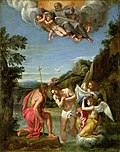 God the Father (top), and the Holy Spirit (represented by a dove) depicted above Jesus Painting by Francesco Albani (d. 1660)
 -
 God the Father (top), the Holy Spirit (a dove), and the child Jesus, painting by Bartolomé Esteban Murillo (d. 1682)
 -
 Pope Clement I prays to the Trinity, in a typical post-Renaissance depiction by Gianbattista Tiepolo (d. 1770).
 -
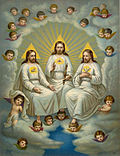 Atypical depiction of the Trinity where the Son is identified by a lamb, the Father an Eye of Providence, and the Spirit a dove
 -
 13th-century depiction of the Trinity from a Roman de la Rose manuscript
 -
 Representation of the Trinity in the form of the mercy seat (epitaph from 1549)
 -
 The Trinity by Russian icon painter Andrei Rublev, early 15th century: this portrayal of the three angels who visited Abraham at the Oak of Mamre (Genesis 18:1-8)
 -
 Renaissance painting by Jerónimo Cosida depicting Jesus as a triple deity Inner text: The Father is God; the Son is God; the Holy Spirit is God
 -
 An anonymous 18th century Catholic painting from the Peruvian Cuzco School. This work depicts the Holy Triune God; one in essence, with three persons.

_God,_The_Holy_Spirit,_and_Christ_Crucified.jpg)


.jpg)


See also
[edit]- Ahuric triad
- Ayyavazhi Trinity
- Formal distinction
- Hypostasis (philosophy and religion)
- Islamic view of the Trinity
- Saint Patrick
- Social trinitarianism
- Three Pure Ones
- Trikaya, the three Buddha bodies
- Trimurti, Hinduism
- Tridevi, Hinduism
- Trinitarian Order
- Trinitarian universalism
- Trinity Sunday, a day to celebrate the doctrine
- Triple deity, an associated term in comparative religion
- Triquetra, a symbol sometimes used to represent the Trinity
- Tritheism
References
[edit]Footnotes
[edit]- ^ Augustine had poor knowledge of the Greek language, and no knowledge of Hebrew. So he trusted the Septuagint, which differentiates between κύριοι ('lords', vocative plural) and κύριε ('lord', vocative singular), even if the Hebrew verbal form, נא-אדני (na-adoni), is exactly the same in both cases.
- ^ Very little of Arius' own writings have survived. We depend largely on quotations made by opponents which reflect what they thought he was saying. Furthermore, there was no single Arian party or agenda but rather various critics of the Nicene formula working from distinct perspectives.(Williams 2001)
- ^ (in Latin) Veluti nunc cupimus videre utrum illa excellentissima caritas proprie Spiritus Sanctus sit. Quod si non est, aut Pater est caritas, aut Filius, aut ipsa Trinitas, quoniam resistere non possumus certissimae fidei, et validissimae auctoritati Scripturae dicentis: 'Deus caritas est'.
- ^ (in Latin) Tria ergo sunt: amans, et quod amatur, et amor.
- ^ See also Divinization (Christian)
- ^ See also binitarianism
Citations
[edit]- ^ "Trinity". Definition of trinity - deity, theology and numbered group (British & World English). Oxford Dictionaries. Archived from the original on 26 December 2012.
- ^ Daley 2009, pp. 323–350.
- ^ Ramelli 2012.
- ^ Definition of the Fourth Lateran Council quoted in Catechism of the Catholic Church § 253 Archived 3 March 2013 at the Wayback Machine. Latin: substantia, essentia seu natura divina (DS 804 Archived 27 September 2007 at the Wayback Machine).
- ^ Fourth Lateran Council (1215) List of Constitutions: 2. On the error of abbot Joachim. Archived from the original on 7 July 2019. Retrieved 7 July 2019.
- ^ "Greek and Latin Traditions Regarding the Procession of the Holy Spirit | EWTN". EWTN Global Catholic Television Network. Archived from the original on 3 September 2004. Retrieved 24 December 2022.
- ^ Fathers, Council (11 November 1215). Fourth Lateran Council: 1215 Council Fathers. Archived from the original on 24 December 2022. Retrieved 24 December 2022.
- ^ "Frank Sheed, Theology and Sanity". Ignatiusinsight.com. Archived from the original on 30 July 2018. Retrieved 3 November 2013.
- ^ Sheed, Frank J. (11 January 1978). Theology & Sanity. Bloomsbury Publishing (published 1978). ISBN 978-0-8264-3882-9. Retrieved 21 December 2021.
Nature answers the question what we are; person answers the question who we are. [...] Nature is the source of our operations, person does them.
- ^ Blanch, Jorge (24 November 2024). "The Trinity: Historical Development and Debates". The Mythic Cross. Archived from the original on 1 December 2024. Retrieved 24 November 2024.
- ^ Januariy, Archimandrite (2003), Stewart, Melville Y. (ed.), "The Elements of Triadology in the New Testament", The Trinity: East/West Dialogue, Dordrecht: Springer Netherlands, pp. 99–106, doi:10.1007/978-94-017-0393-2_10 (inactive 1 July 2025), ISBN 978-94-017-0393-2, retrieved 7 March 2025
{{citation}}: CS1 maint: DOI inactive as of July 2025 (link) - ^ Westhuizen, Henco van der (15 December 2022). Reader in Trinitarian Theology. UJ Press. ISBN 978-1-77641-949-4.
- ^ Attridge, Harold (2018). The Bible and Early Trinitarian Theology. The Catholic University of America Press. p. 83. ISBN 978-0813229959.
- ^ Hurtado 2010, pp. 99–110.
- ^ a b c Januariy 2013, p. 99.
- ^ Archimandrite Janurariy (Ivliev) (9 March 2013) [2003]. "The Elements of Triadology in the New Testament". In Stewart, Melville Y. (ed.). The Trinity: East/West Dialogue. Volume 24 of Studies in Philosophy and Religion. Dordrecht: Springer Science & Business Media (published 2013). p. 100. ISBN 9789401703932. Retrieved 21 December 2021.
Trinitarian formulas are found in New Testament books such as 1 Peter 1:2; and 2 Cor 13:13. But the formula used by John the mystery-seer is unique. Perhaps it shows John's original adaptation of Paul's dual formula.
- ^ a b Hurtado 2005, pp. 644–648.
- ^ Kline, Meredith G. (2016). Genesis: A New Commentary. Peabody, Massachusetts: Hendrickson Publishers Marketing. p. 13. ISBN 978-1-61970-852-5.
- ^ von Rad, Gerhard (1961). Genesis. Translated by Marks, John H. Chatham, Kent: W. L. Jenkins. p. 57.
- ^ a b Hamilton, Victor P. (1990). The Book of Genesis: chapters 1–17. Grand Rapids, Michigan: William B. Eerdmans Publishing Co. ISBN 978-0-8028-2521-6.
- ^ "For to Us a Child Is Born: The Meaning of Isaiah 9:6". Zondervan Academic. Archived from the original on 19 September 2020. Retrieved 15 July 2022.
- ^ "Doctrine of the Last Things (Part 1): The Second Coming of Christ". Reasonable Faith. Archived from the original on 15 July 2022. Retrieved 15 July 2022.
- ^ "Bible Gateway passage: Psalm 145:13 – New International Version". Bible Gateway. Archived from the original on 12 November 2020. Retrieved 31 July 2022.
- ^ Cross & Livingstone 2005, p. 1652.
- ^ a b Joyce 1912.
- ^ Gregory Nazianzen, Orations, 31.26
- ^ Genesis 18:1–2
- ^ Genesis 19
- ^ a b c Watson, Francis. Abraham's Visitors: Prolegomena to a Christian Theological Exegesis of Genesis 18–19 Archived 2 December 2022 at the Wayback Machine
- ^ "Church Fathers: Dialogue with Trypho, Chapters 55-68 (Justin Martyr)". New Advent. Retrieved 7 March 2025.
- ^ Hurtado 2005, pp. 573–578.
- ^ "Baker's Evangelical Dictionary of Biblical Theology: Angel of the Lord". Studylight.org. Archived from the original on 27 January 2014. Retrieved 2 January 2012.
- ^ a b Fee 2002, p. 52.
- ^ Barker, James (2025). Writing and Rewriting the Gospels. Eerdmans. p. 289. ISBN 978-0802874528.
- ^ Margerie, Bertrand de (1982). The Christian Trinity in History. St. Bede's Publications. ISBN 978-0-932506-14-6.
- ^ a b Metzger & Coogan 1993, pp. 782–783.
- ^ Metzger & Ehrman 1968, p. 101.
- ^ McDonald, G. R. (2011). Raising the ghost of Arius: Erasmus, the Johannine comma and religious difference in early modern Europe (Doctoral dissertation). Leiden University. hdl:1887/16486.
- ^ Scrivener, Frederick H. (12 November 1997). A Plain Introduction to the Criticism of the New Testament, 2 Volumes. Wipf and Stock. ISBN 978-1-57910-071-1. Archived from the original on 1 December 2024. Retrieved 27 August 2024.
- ^ "Catholic Encyclopedia: Epistles of Saint John". New Advent. Archived from the original on 29 December 2022. Retrieved 24 May 2024.
The Armenian manuscripts, which favour the reading of the Vulgate, are admitted to represent a Latin influence which dates from the twelfth century
- ^ Scrivener, Frederick Henry Ambrose (1894). A Plain Introduction to the Criticism of the New Testament for the Use of Biblical Students. G. Bell.
- ^ McDonald, G. R (2011). Raising the ghost of Arius : Erasmus, the Johannine comma and religious difference in early modern Europe (Doctoral dissertation). Leiden University. hdl:1887/16486.
- ^ Introduction to the New Testament, p. 372, Vol. 3, 1909.
- ^ Hurtado 2010, pp. [1].
- ^ Hurtado 2005, pp. 134–152.
- ^ "Is Jesus God? (Romans 9:5)". billmounce.com. Archived from the original on 23 June 2021. Retrieved 15 July 2022.
- ^ Litwa 2019, p. 53.
- ^ Lewis, C. S. (2001). Mere Christianity. HarperCollins. pp. 51–52.
- ^ Kupp 1996, p. 226.
- ^ Hays 2014, pp. 44–45.
- ^ Hurtado 2005, pp. 337–338.
- ^ a b Ferguson 2009, pp. 134–135.
- ^ Sim & Repschinski 2008, pp. 124–125.
- ^ a b Hurtado 2005, p. 345.
- ^ Bauckham 2017, pp. 516–519.
- ^ Hurtado 2005, pp. 194–206.
- ^ Allison 2016, pp. 807–826.
- ^ "The Presentation of Jesus in John's Gospel". h2g2 The Hitchhiker's Guide to the Galaxy: Earth Edition. 10 January 2008. Retrieved 2 January 2012.
- ^ Brown 1970, pp. 1026, 1032.
- ^ Harner, Philip B., "Qualitative Anarthrous Predicate Nouns: Mark 15:39 and John 1:1", Journal of Biblical Literature 92, 1 (March 1973),
- ^ Hartley, Donald (7 July 2004). "Revisiting the Colwell Construction in Light of Mass/Count Nouns". bible.org. Archived from the original on 31 October 2022. Retrieved 1 November 2022.
- ^ Harner, Philip B. (March 1973). "Qualitative Anarthrous Predicate Nouns: Mark 15:39 and John 1:1". Journal of Biblical Literature. 92 (1). The Society of Biblical Literature: 75–87. doi:10.2307/3262756. ISSN 0021-9231. JSTOR 3262756.
- ^ Rhodes, Ron. "Reasoning from the Scriptures with the Jehovah's Witnesses" Harvest House Publishers, 2009, p. 104-105.
- ^ Hoskyns 1967, p. 142.
- ^ Clarke 1900, pp. 161ff..
- ^ Polkinghorne 2008, pp. 395–396.
- ^ Simonetti & Oden 2002.
- ^ St. Augustine of Hippo,De Trinitate, Book I, Chapter 3.
- ^ a b Aquinas, Thomas. Summa Contra Gentiles Book Four Chapter 8. Archived from the original on 28 July 2018. Retrieved 11 January 2019.
- ^ Goodman & Blumberg 2002, p. 36.
- ^ a b Hurtado 2018, p. 62.
- ^ Hurtado 2018, p. 64.
- ^ Buck, George (1 January 1960). "A Study of the Trinity in the Cappadocian Fathers". Graduate Thesis Collection.
- ^ a b c Basil of Caesarea 1980, Ch. 16.
- ^ Basil of Caesarea 1980, Ch. 19.
- ^ Basil of Caesarea 1980, Ch. 21.
- ^ Arendzen 1911.
- ^ Milburn 1991, p. 68.
- ^ Attridge, Harold (2018). The Bible and Early Trinitarian Theology. The Catholic University of America Press. p. 83. ISBN 978-0813229959.
- ^ Baker, Margaret (1992). The Great Angel: A Study of Israel's Second God. Westminster John Knox Press. p. 3. ISBN 978-0-664-25395-0.
- ^ Ehrman, Bart D. The Apostolic Fathers. Vol. 1. Loeb Classical Library, 2003, 119. Ehrman further notes (fn. 97) Clement is alluding to Ephesians 4:4–6. Also see 1 Clement 58:2.
- ^ Ehrman, Bart. The Apostolic Fathers, Vol. 1. Harvard University Press, 2003, pp. 411, 429.
- ^ "Ignatius's Letter to the Magnesians, Ch. XIII". Archived from the original on 3 January 2008. Retrieved 21 September 2012.
- ^ Hurtado 2005, pp. 595–599.
- ^ "First Apology, LXI". Ccel.org. 13 July 2005. Archived from the original on 10 October 2023. Retrieved 3 November 2013.
- ^ Hurtado 2005, pp. 646.
- ^ "Church Fathers: The First Apology (St. Justin Martyr)". www.newadvent.org. Archived from the original on 22 April 2018. Retrieved 24 May 2024.
- ^ Lohse, Bernhard (1966). A Short History of Christian Doctrine. Fortress Press. pp. 43–44. ISBN 978-1-4514-0423-4. Retrieved 12 April 2025.
- ^ Bucur, Bogdan Gabriel (2009). Angelomorphic Pneumatology: Clement of Alexandria and Other Early Christian Witnesses. BRILL. p. 139. ISBN 978-90-04-17414-6. Retrieved 12 April 2025.
- ^ a b Kim, Young Richard (7 January 2021). The Cambridge Companion to the Council of Nicaea. Cambridge University Press. pp. 137, 139, 206 fn. 13. ISBN 978-1-108-61746-8. Retrieved 12 April 2025.
- ^ Theophilus, Apologia ad Autolycum, Book II, Chapter 15
- ^ Theophilus, To Autolycus, 1.7 Cf. Irenaeus, Against Heresies, 4.20.1, pg. 3
Demonstration of the Apostolic Preaching, pg. 5 - ^ Tertullian Against Praxeas
- ^ Osborn, Eric (4 December 2003). Tertullian, First Theologian of the West. Cambridge University Press. pp. 121–122. ISBN 978-0-521-52495-7. Retrieved 12 April 2025.
- ^ McGowan, Andrew Brian; Daley, Brian Edward; Gaden, Timothy J. (2009). God in Early Christian Thought: Essays in Memory of Lloyd G. Patterson. BRILL. p. 61. ISBN 978-90-04-17412-2. Retrieved 12 April 2025.
- ^ "Against Praxeas, chapter 2". Ccel.org. 1 June 2005. Archived from the original on 19 November 2020. Retrieved 19 March 2018.
- ^ Still, Todd D.; Wilhite, David E. (20 December 2012). Tertullian and Paul. A&C Black. p. 4. ISBN 978-0-567-55411-6. Retrieved 12 April 2025.
- ^ Mulhern 1967, p. 205.
- ^ Ramelli 2011a.
- ^ Barnard 1970, pp. 172–188.
- ^ Chapman 1913.
- ^ a b Cross & Livingstone 2005, p. 100.
- ^ "Creeds of Christendom, with a History and Critical notes". Christian Classics Ethereal Library. Archived from the original on 6 December 2003. Retrieved 2 June 2014.
- ^ Anderson, Michael. "The Nicaeno-Constantinopolitan Creed". creeds.net. Archived from the original on 17 November 2006. Retrieved 2 June 2014.
- ^ a b c "Trinity". Britannica Encyclopaedia of World Religions. Chicago: Encyclopædia Britannica. 2006.
- ^ Steenberg, M. C. (1 January 2009). Of God and Man: Theology as Anthropology from Irenaeus to Athanasius. Bloomsbury Publishing. p. 106. ISBN 978-0-567-60047-9. Retrieved 12 April 2025.
Thomas Smail's comments on attention to the Spirit in the Constantinopolitan revision of Nicaea seem even more pertinent as to the Nicene original: Attention is so concentrated on the binitarian question of the right relationship of the Father to the Son that the properly trinitarian question that deals with the relating of the Spirit to both the Father and the Son is dealt with in a way that lacks focus and specifi city and that, on any reckoning, is quite inadequate to the rich biblical and especially New Testament material that deals with the pre- and post-Pentecostal activity of the Spirit among God's people.
- ^ Ngong, David Tonghou (2010). The Holy Spirit and Salvation in African Christian Theology: Imagining a More Hopeful Future for Africa. Peter Lang. pp. 131, 153 fn. 35. ISBN 978-1-4331-0941-6. Retrieved 12 April 2025.
That is why the creed drawn at Nicaea in 325 was fundamentally a binitarian creed as it dwelled on the Father and the Son, mentioning the Spirit only in passing.35 35 See, R. P. C. Hanson, The Search for the Christian Doctrine of God (Edinburgh: T & T Clark, 1988), 163-72; John Behr, Formation of Christian Theology: The Way to Nicaea, Vol. 1 (Crestwood, New York: St. Vladimir's Seminary Press, 2001); Oberdorfer, "The Holy Spirit," 29.
- ^ See Creeds of Christendom Archived 6 December 2003 at the Wayback Machine.
- ^ Hornblower, Spawforth & Eidinow 2012, p. 193.
- ^ a b Shelley, Bruce L. (2013). Church History in Plain Language. p. 113.
- ^ For a different view, see e.g. Excursus on the Words πίστιν ἑτέραν Archived 21 July 2015 at the Wayback Machine
- ^ Greek and Latin Traditions on Holy Spirit. Archived from the original on 3 September 2004. Retrieved 18 January 2019.
- ^ Heath, R. G. (1972). "The Western Schism of the Franks and the 'Filioque'". The Journal of Ecclesiastical History. 23 (2): 97–113. doi:10.1017/S0022046900055779. ISSN 0022-0469. S2CID 163123385.
- ^ Gregory of Nazianzus, Orations 40.41
- ^ Mt 28:19
- ^ Matthew 28:19
- ^ Vondey 2012, p. 78.
- ^ Wilson, Jake. (2021). The Supersessionist Forgery of Matthew 28:19.
- ^ Finnegan, Sean (1 January 2018). "Is Matthew 28:19 Authentic or a Forgery?". Restitutio.
- ^ 7:1, 3 online Archived 17 June 2016 at the Wayback Machine
- ^ Epistle to the Philippians, 2:13 online Archived 1 June 2023 at the Wayback Machine
- ^ On Baptism 8:6 online, Against Praxeas, 26:2 online Archived 9 February 2021 at the Wayback Machine
- ^ Against Noetus, 1:14 online Archived 29 December 2022 at the Wayback Machine
- ^ Seventh Council of Carthage "online".
- ^ A Sectional Confession of Faith, 13:2 online
- ^ 2 Cor. 13:14
- ^ 1Cor 12:4–6
- ^ Kittel, G., Friedrich, G., & Bromiley, G. W. (Eds.). (1985). Theological Dictionary of the New Testament: abridged in one volume (Vol. 1). Wm. B. Eerdmans Publishing.
- ^ CCC § 236 Archived 3 March 2013 at the Wayback Machine.
- ^ CCC § 258 Archived 3 March 2013 at the Wayback Machine.
- ^ "Basil the Great, De Spiritu Sancto, NPNF, Vol 8". Ccel.org. 13 July 2005. Archived from the original on 26 April 2023. Retrieved 2 January 2012.
- ^ Took, John (15 May 2016). Conversations with Kenelm: Essays on the Theology of the Commedia. Ubiquity Press. p. 66. ISBN 978-1-909188-08-2. OCLC 1054304886. Quote (in Latin): "mysterium Christi explicite credi non potest sine fide Trinitatis..."
- ^ Athanasius, 3.29 (p. 409)
- ^ Basil "Letters", NPNF, Vol 8, 189.7 (p. 32)
- ^ Sauvage 1907.
- ^ Stefon, Matt (10 December 2015). "Christianity – The Holy Trinity". Encyclopædia Britannica. Attempts to define the Trinity.
- ^ Augustine of Hippo 2002, p. 25.
- ^ Augustine of Hippo 2002, p. 26.
- ^ Pool 2011, p. 398.
- ^ Aquinas 1975, p. 91.
- ^ (in Latin) DS 401 Archived 20 January 2025 at the Wayback Machine (Pope John II, letter Olim quidem addressed to the senators of Constantinople, March 534).
- ^ Yewangoe 1987, p. 273.
- ^ Kitamori 2005, p. v.
- ^ von Balthasar 2000, p. vii.
- ^ von Balthasar 1992, p. 55.
- ^ Mobley 2021, p. 202.
- ^ Dimech 2019, p. 103.
- ^ Carson 2000, chpt. 9.
- ^ Also published in "On Distorting the Love of God" (PDF). Bibliotheca Sacra. 156 (January–March 1999): 3–12. Archived (PDF) from the original on 26 September 2024. Retrieved 9 September 2024.
- ^ Grudem 1994, p. 226.
- ^ "Athanasian Creed". Ccel.org. Archived from the original on 20 June 2023. Retrieved 2 January 2012.
- ^ Barth 1975, pp. 348–349.
- ^ Pegis 1997, pp. 307–309.
- ^ De Smet 2010.
- ^ The Eleventh Council of Toledo (675). Archived from the original on 6 January 2019. Retrieved 11 January 2019.
- ^ Fourth Lateran Council (1215) List of Constitutions: 2. On the error of abbot Joachim. Archived from the original on 7 July 2019. Retrieved 7 July 2019.
- ^ Fathers, Council (11 November 1215). Fourth Lateran Council: 1215 Council Fathers. Archived from the original on 24 December 2022. Retrieved 24 December 2022.
- ^ Denzinger, Heinrich (1911). Enchiridion symbolorum definitionum et declarationum de rebus fidei et morum (in Latin). PIMS – University of Toronto. Friburg: Herder.
- ^ John 10:38,14:11,14:20
- ^ "NPNF2-09. Hilary of Poitiers, John of Damascus | Christian Classics Ethereal Library". Ccel.org. 13 July 2005. Archived from the original on 26 April 2023. Retrieved 2 January 2012.
- ^ Cross, F. L., ed. (1974). "Cicumincession". The Oxford Dictionary of the Christian Church (2nd ed.). Oxford University Press.
- ^ John 14:18
- ^ a b Giles, Kevin (7 May 2012). The Eternal Generation of the Son: Maintaining Orthodoxy in Trinitarian Theology. InterVarsity Press. ISBN 978-0-8308-3965-0.
- ^ Erickson, Millard J. (2009). Who's Tampering with the Trinity?: An Assessment of the Subordination Debate. Kregel Academic. ISBN 978-0-8254-9918-0.
- ^ Ryrie, Charles C. (11 January 1999). Basic Theology: A Popular Systematic Guide to Understanding Biblical Truth. Moody Publishers. ISBN 978-1-57567-498-8.
- ^ Waldron, Sam (7 December 2011). "Who's Tampering with the Trinity? (Part 17) The Eternal Procession of the Holy Spirit Proved". Covenant Baptist Theological Seminary. Archived from the original on 25 December 2024. Retrieved 16 October 2024.
- ^ "Catholic Encyclopedia: Filioque". www.newadvent.org. Archived from the original on 25 December 2024. Retrieved 25 December 2024.
- ^ Beisner, E. Calvin (10 February 2004). God in Three Persons. Wipf and Stock Publishers. ISBN 978-1-59244-545-5.
- ^ Ramelli, Ilaria L. E.; McGuckin, J. A.; Ashwin-Siejkowski, Piotr (16 December 2021). T&T Clark Handbook of the Early Church. Bloomsbury Publishing. ISBN 978-0-567-68039-6.
- ^ "God the Son". Tabletalk. 1 December 2019. Archived from the original on 25 December 2024. Retrieved 20 November 2023.
- ^ Hodge, Charles. Outlines of Theology.
The eternal generation of the Son is commonly defined to be an eternal personal act of the Father, wherein by necessity of nature, not by choice of will, he generates the person (not the essence) of the Son, by communicating to him the whole indivisible substance of the Godhead, without division, alienation, or change, so that the Son is the express image of His Father's person, and eternally continues, not from the Father, but in the Father, and the Father in the Son
- ^ "The Blessed Trinity". Catholic Encyclopedia. Archived from the original on 1 October 2019. Retrieved 20 November 2023 – via New Advent.
- ^ Parkison, Samuel. "The Only Begotten God". Credo. Archived from the original on 28 November 2023. Retrieved 20 November 2023.
- ^ Johnson, Keith E. "Trinitarian Agency and the Eternal Subordination of the Son: An Augustinian Perspective". The Gospel Coalition. Archived from the original on 1 May 2023. Retrieved 20 November 2023.
- ^ Wedgeworth, Steven (15 April 2020). "Athanasius on the Simple God And Eternal Generation". The Gospel Coalition. Archived from the original on 25 December 2024. Retrieved 20 November 2023.
- ^ Graham, Wyatt (13 February 2022). "Impassibility Makes Sense of Our Faith in the Father and Son". The Gospel Coalition | Canada. Archived from the original on 25 December 2024. Retrieved 20 November 2023.
- ^ Giles, Kevin (7 May 2012). The Eternal Generation of the Son: Maintaining Orthodoxy in Trinitarian Theology. InterVarsity Press. ISBN 978-0-8308-3965-0.
- ^ "Bavinck On Eternal Generation". The Heidelblog. 28 August 2014. Archived from the original on 25 December 2024. Retrieved 20 November 2023.
- ^ "Proverbs 8:23, the Eternal Generation of the Son and the History of Reformed Exegesis". reformation21.org. Archived from the original on 25 December 2024. Retrieved 20 November 2023.
- ^ "What is the Doctrine of Eternal Generation?". Phoenix Seminary. Retrieved 20 November 2023.
- ^ Sanders, Fred; Swain, Scott R. (21 November 2017). Retrieving Eternal Generation. Zondervan Academic. ISBN 978-0-310-53788-5. Archived from the original on 19 January 2025. Retrieved 25 December 2024.
- ^ "Is God the Son Begotten in His Divine Nature? | Reasonable Faith". reasonablefaith.org. Archived from the original on 25 December 2024. Retrieved 20 November 2023.
- ^ Holmes, Stephen R.; Molnar, Paul D.; McCall, Thomas H.; Fiddes, Paul (2 September 2014). Two Views on the Doctrine of the Trinity. Zondervan Academic. ISBN 978-0-310-49813-1. Archived from the original on 19 January 2025. Retrieved 1 January 2025.
- ^ "Monothelitism and the Trinity | Reasonable Faith". www.reasonablefaith.org. Archived from the original on 25 December 2024. Retrieved 25 December 2024.
- ^ Barrett, Matthew (2021). Simply Trinity: The Unmanipulated Father, Son, and Spirit. Grand Rapids, Michigan: Baker Books. ISBN 978-1-5409-0007-4.
- ^ Barrett, Matthew (1 October 2024). On Classical Trinitarianism: Retrieving the Nicene Doctrine of the Triune God. InterVarsity Press. ISBN 978-1-5140-0035-9.
- ^ von Harnack, Adolf (1 March 1894). "History of Dogma". Archived from the original on 17 September 2008. Retrieved 15 June 2007.
[In the 2nd century,] Jesus was either regarded as the man whom God hath chosen, in whom the Deity or the Spirit of God dwelt, and who, after being tested, was adopted by God and invested with dominion, (Adoptionist Christology); or Jesus was regarded as a heavenly spiritual being (the highest after God) who took flesh, and again returned to heaven after the completion of his work on earth (pneumatic Christology)
- ^ Coonrad, Sharon Watters (1999). Adoptionism: The History of a Doctrine. University of Iowa.
- ^ Gregg, Robert C. (19 October 2006). Arianism: Historical and Theological Reassessments: Papers from The Ninth International Conference on Patristic Studies. Wipf and Stock Publishers. ISBN 978-1-59752-961-7.
- ^ Olson 1999, p. 173.
- ^ Meens 2016, p. 64.
- ^ a b "Trinity > Judaic and Islamic Objections (Stanford Encyclopedia of Philosophy)". plato.stanford.edu. Retrieved 12 April 2025.
- ^ The Jewish Quarterly Review. Macmillan. 1895.
- ^ "The Front Entrance". The Cathedral of Saint John the Evangelist. Cleveland, Ohio. Archived from the original on 1 March 2023. Retrieved 13 January 2025.
A central doctrine of the Catholic Faith is symbolized in the three arches of the entrance the Three Persons of the Blessed Trinity. The center door symbolizes the Father, the north door the Son, and the south door the Holy Spirit.
- ^ Rae, M. A. (2023). Architecture and Christian Theology. St Andrews.
- ^ Kennedy, Katherine (1919). Christian Symbols: Some Notes on Their Origin and Meaning. A. R. Mowbray. p. 12.
- ^ Hansen, Maria Fabricius (2015). The Spolia Churches of Rome: Recycling Antiquity in the Middle Ages. p. 59.
- ^ "Sanierung Heiligen-Geist-Kapelle, Bruck an der Mur" (in German). Bruck an der Mur. Archived from the original on 22 January 2021. Retrieved 27 May 2020.
- ^ Schiller 1971, figs 1; 5–16.
- ^ Cartlidge & Elliott 2001, p. 240.
- ^ Schiller 1971, pp. 122–124 and figs 409–414.
- ^ Schiller 1971, pp. 219–224 and figs 768–804.
- ^ Potts 1982, pp. 68–78.
Sources
[edit]- Allison, Dale C. Jr (2016). "Acts 9: 1–9, 22: 6–11, 26: 12–18: Paul and Ezekiel". Journal of Biblical Literature. 135 (4): 807–826. doi:10.15699/jbl.1354.2016.3138.
- Aquinas, Thomas (1975). Summa Contra Gentiles: Book 4: Salvation Chapter 4. University of Notre Dame Press. ISBN 978-0-268-07482-1.
- Arendzen, John Peter (1911). . In Herbermann, Charles (ed.). Catholic Encyclopedia. Vol. 12. New York: Robert Appleton Company.
- Augustine of Hippo (2002). Augustine: On the Trinity Books 8–15. Cambridge University Press. ISBN 978-0-521-79665-1.
- Barnard, L. W. (1970). "The Antecedents of Arius". Vigiliae Christianae. 24 (3): 172–188. doi:10.2307/1583070. ISSN 0042-6032. JSTOR 1583070.
- Barth, Karl (1975). The Doctrine of the Word of God: (prolegomena to Church Dogmatics, Being Volume I, 1). T. & T. Clark. ISBN 978-0-567-09013-3.
- Basil of Caesarea (1980). On the Holy Spirit. St Vladimir's Seminary Press. ISBN 978-0-913836-74-3.
- Bauckham, Richard (2017). "Is "High Human Christology" Sufficient? A Critical Response to J. R. Daniel Kirk's A Man Attested by God". Bulletin for Biblical Research. 27 (4). Penn State University Press: 503–525. doi:10.5325/bullbiblrese.27.4.0503. JSTOR 10.5325/bullbiblrese.27.4.0503. S2CID 246577988.
- Brown, Raymond Edward (1970). The Gospel According to John. Vol. 2: XIII to XXI. Doubleday. ISBN 978-0-385-03761-7.
- Carson, Donald Arthur (2000). The Difficult Doctrine of the Love of God. Inter-Varsity. ISBN 978-0-85111-975-5.
- Cartlidge, David R.; Elliott, James Keith (2001). Art and the Christian Apocrypha. Routledge. ISBN 978-0-415-23392-7.
- Chadwick, Henry (1993). The Penguin History of the Church: The Early Church. Penguin. ISBN 978-0-14-023199-1.
- Chapman, Henry Palmer (1913). . In Herbermann, Charles (ed.). Catholic Encyclopedia. New York: Robert Appleton Company.
- Clarke, William Newton (1900). An Outline of Christian Theology (8th ed.). New York: Scribner.
- Cross, Frank Leslie; Livingstone, Elizabeth A. (2005). "Trinity, doctrine of the". The Oxford Dictionary of the Christian Church. Oxford: University Press. ISBN 978-0-19-280290-3.
- Daley, Brian E. (2009). "The Persons in God and the Person of Christ in Patristic Theology: An Argument for Parallel Development". God in Early Christian Thought. Leiden & Boston: Brill. pp. 323–350. ISBN 978-9004174122.
- De Smet, Richard (2010). Ivo Coelho (ed.). Brahman and Person: Essays. Motilal Banarsidass. ISBN 978-8120834590.
- Dimech, Pauline (2019). "9. Von Balthasars Theoaesthetics Applied to Religious Education". In Michael T. Buchanan; Adrian-Mario Gellel (eds.). Global Perspectives on Catholic Religious Education in Schools. Volume II: Learning and Leading in a Pluralist World. Springer. p. 103. doi:10.1007/978-981-13-6127-2. ISBN 978-9811361272.
- Fee, Gordon (2002). "Paul and the Trinity: The experience of Christ and the Spirit for Paul's Understanding of God". In Davis, Stephen (ed.). The Trinity: An Interdisciplinary Symposium on the Trinity. Oxford University Press. ISBN 978-0-19-924612-0.
- Ferguson, Everett (2009). Baptism in the Early Church: History, Theology, and Liturgy in the First Five Centuries. Eerdmans. ISBN 978-0-8028-2748-7.
- Glassé, Cyril; Smith, Huston (2003). The New Encyclopedia of Islam. Rowman Altamira. ISBN 978-0-7591-0190-6.
- Goodman, Roberta Louis; Blumberg, Sherry H. (2002). Teaching about God and Spirituality: A Resource for Jewish Settings. Behrman House. ISBN 978-0-86705-053-0.
- Griffith, Sidney H. (2012). The Church in the Shadow of the Mosque: Christians and Muslims in the World of Islam. Princeton University Press. ISBN 978-1-4008-3402-0.
- Grudem, Wayne (1994). Systematic Theology: An Introduction to Biblical Doctrine. Leicester: Inter-Varsity Press. ISBN 978-0-310-28670-7.
- Harvey, Susan Ashbrook; Hunter, David G. (2008). The Oxford Handbook of Early Christian Studies. Oxford: University Press. ISBN 978-0-19-927156-6.
- Hays, Richard B. (2014). Reading Backwards: Figural Christology and the Fourfold Gospel Witness. Baylor University Press. ISBN 978-1-4813-0232-6.
- Hoskyns, Sir Edwyn Clement (1967). F. N. Davey (ed.). The Fourth Gospel (2nd ed.). London: Faber & Faber.
- Hornblower, Simon; Spawforth, Antony; Eidinow, Esther (2012). "On Athanasius". The Oxford Classical Dictionary. Oxford: University Press. ISBN 978-0-19-954556-8. Archived from the original on 27 September 2024. Retrieved 5 May 2021.
- Hurtado, Larry (2005). Lord Jesus Christ: Devotion to Jesus in Earliest Christianity. Eerdmans. ISBN 978-0-8028-3167-5.
- Hurtado, Larry (2010). God in New Testament Theology. Abingdon Press. ISBN 978-1-4267-1954-7.
- Hurtado, Larry (2018). "Observations on the "Monotheism" Affirmed in the New Testament". In Beeley, Christopher; Weedman, Mark (eds.). The Bible and Early Trinitarian Theology. Catholic University of America Press. ISBN 978-0-8132-2995-9.
- Januariy, Archimandrite (2013). "The Elements of Triadology in the New Testament". In Stewart, M. (ed.). The Trinity: East/West Dialogue. Springer. ISBN 978-9401703932.
- Joyce, George Hayward (1912). . In Herbermann, Charles (ed.). Catholic Encyclopedia. Vol. 15. New York: Robert Appleton Company.
- Kitamori, Kazoh (2005). Theology of the Pain of God. Translated by Graham Harrison from the Japanese Kami no itami no shingaku, revised edition 1958, first edition 1946. Eugene, Oregon: Wipf and Stock. ISBN 978-1-59752-256-4.
- Kupp, David D. (1996). Matthew's Emmanuel: Divine Presence and God's People in the First Gospel. Cambridge: University Press. ISBN 978-0-521-57007-7.
- Litwa, M. David (2019). How the Gospels Became History: Jesus and Mediterranean Myths. Yale University Press. ISBN 978-0-300-24948-4.
- Magliola, Robert (2001). "Two Models of Trinity: French Post-structuralist versus the Historical-critical argued in the Form of a Dialogue". In Oliva Blanchette; Tomonobu Imamichi; George F. McLean (eds.). Philosophical Challenges and Opportunities of Globalization. Vol. 2. Washington, DC: CRVP: Catholic U. of America. ISBN 978-1-56518-129-8.
- Magliola, Robert (2014). Facing Up to Real Doctrinal Difference: How Some Thought-Motifs from Derrida Can Nourish The Catholic-Buddhist Encounter. Angelico Press. ISBN 978-1-62138-079-5.
- Meens, Rob (2016). Religious Franks: Religion and Power in the Frankish Kingdoms: Studies in Honour of Mayke de Jong. Oxford University Press. ISBN 978-0-7190-9763-8.
- Metzger, B. M.; Ehrman, B. D. (1968). The Text of New Testament (2nd ed.). Oxford University Press. ISBN 978-5885009010.
- Metzger, Bruce M.; Coogan, Michael David (1993). The Oxford Companion to the Bible. Oxford University Press. ISBN 978-0-19-974391-9.
- Milburn, Robert (1991). Early Christian Art and Architecture. University of California Press. ISBN 0-520-07412-2.
- Mobley, Joshua (2021). A Brief Systematic Theology of the Symbol. Bloomsbury Publishing. ISBN 978-0-567-70252-4.
- Mulhern, Philip (1967). "Trinity, Holy, Devotion To". In Bernard L. Marthaler (ed.). New Catholic Encyclopedia. McGraw Hill. OCLC 588876554.
- Neuwirth, Angelika; Sells, Michael A. (2016). Qur'ānic Studies Today. Routledge. ISBN 978-1-317-29566-2.
- Olson, Roger (1999). The Story of Christian Theology: Twenty Centuries of Tradition & Reform. InterVarsity Press. p. 173. ISBN 978-0-8308-1505-0.
sabellian heresy council constantinople.
- Pegis, Anton (1997). Basic writings of Saint Thomas Aquinas. Hackett Pub. ISBN 978-0-87220-380-8.
- Polkinghorne, John (September 2008). "Book Review: The Language of God: A Scientist Presents Evidence for Belief". Theology. 111 (863): 395–396. doi:10.1177/0040571x0811100523. ISSN 0040-571X. S2CID 170563171.
- Pool, Jeff B. (2011) [2009]. God's Wounds. Evil and Divine Suffering. Vol. 2. Havertown, Philadelphia: Casemate Publishers. ISBN 978-0-227-17360-2.
- Potts, Albert M. (1982). The World's Eye. University Press of Kentucky. pp. 68–78. ISBN 978-0-8131-3130-6.
- Ramelli, Ilaria (2011a). "Origen's anti-subordinationism and its heritage in the Nicene and Cappadocian line". Vigiliae Christianae. 65 (1): 21–49. doi:10.1163/157007210X508103.
- Ramelli, Ilaria (2012). "Origen, Greek Philosophy, and the Birth of the Trinitarian Meaning of Hypostasis". The Harvard Theological Review. 105 (3): 302–350. doi:10.1017/S0017816012000120. JSTOR 23327679. S2CID 170203381.
- Sauvage, George (1907). . In Herbermann, Charles (ed.). Catholic Encyclopedia. Vol. 1. New York: Robert Appleton Company.
- Schiller, Gertrud (1971). Iconography of Christian Art. Vol. 1: Christ's Incarnation. Childhood. Baptism. Temptation. Transfiguration. Works and miracles. Lund Humphries. ISBN 978-0-85331-270-3.
- Sim, David C.; Repschinski, Boris (2008). Matthew and his Christian Contemporaries. Bloomsbury. ISBN 978-0-567-46231-2.
- Simonetti, Manlio; Oden, Thomas C. (2002). Matthew 14–28. InterVarsity Press. ISBN 978-0-8308-1469-5.
- Sirry, Mun'im (2014). Scriptural Polemics: The Qur'an and Other Religions. Oxford University Press. ISBN 978-0-19-935937-0.
- Thomas, David (2006). "Trinity". Encyclopedia of the Qur'an. Vol. V.
- von Balthasar, Hans (1992). Theo-drama: Theological Dramatic Theory. Vol. 3: Dramatis Personae: Persons in Christ. Ignatius Press. ISBN 978-0-8146-2281-0.
- von Balthasar, Hans Urs (2000) [1990]. "Preface to the Second Edition". Mysterium Paschale. The Mystery of Easter. Translated with an Introduction by Aidan Nichols, O.P. (2nd ed.). San Francisco: Ignatius Press. ISBN 978-1-68149-348-0.
- Vondey, Wolfgang (2012). Pentecostalism: A Guide for the Perplexed. T&T Clark. ISBN 978-0-567-62731-5.
- Warfield, Benjamin B. (1915). "§ 20 Trinity: The Question of Subordination". In James Orr (ed.). The International Standard Bible Encyclopaedia. Vol. 5. Howard-Severance Company.
- Williams, Rowan (2001). Arius: Heresy and Tradition (2nd ed.). SPCK. ISBN 978-0-334-02850-5.
- Yewangoe, Andreas (1987). Theologia Crucis in Asia: Asian Christian Views on Suffering in the Face of Overwhelming Poverty and Multifaceted Religiosity in Asia. Rodopi. ISBN 978-9062036103.
- Zebiri, Kate (2006). "Argumentation". In Rippin, Andrew (ed.). The Blackwell Companion to the Qur'an. Wiley Blackwell. ISBN 978-1-4051-7844-0.
Further reading
[edit]- Alfeyev, Hilarion (2013). "The Trinitarian Teaching of Saint Gregory Nazianzen". In Stewart, M. (ed.). The Trinity: East/West Dialogue. Springer. ISBN 978-9401703932.
- Bates, Matthew W. (2015). The Birth of the Trinity. Oxford University Press. ISBN 978-0-19-104587-5.
- Bellarmine, Robert (1902). . Sermons from the Latins. Benziger Brothers.
- Beeley, Christopher; Weedman, Mark, eds. (2018). The Bible and Early Trinitarian Theology. Catholic University of America Press. ISBN 978-0-8132-2996-6.
- Dupuis, Jacques; Neuner, Josef (2001). The Christian Faith in the Doctrinal Documents of the Catholic Church (7th ed.). Alba House. ISBN 978-0-8189-0893-4.
- Emery, Gilles; Levering, Matthew, eds. (2012). The Oxford Handbook of the Trinity. Oxford University Press. ISBN 978-0-19-955781-3.
- Grillmeier, Aloys (1975) [1965]. Christ in Christian Tradition: From the Apostolic Age to Chalcedon (451). Vol. 1 (2nd revised ed.). Atlanta: John Knox Press. ISBN 978-0-664-22301-4.
- Fiddes, Paul, Participating in God: a pastoral doctrine of the Trinity (London: Darton, Longman, & Todd, 2000).
- Johnson, Thomas K., "What Difference Does the Trinity Make?" (Bonn: Culture and Science Publ., 2009).
- Hillar, Marian, From Logos to Trinity. The Evolution of Religious Beliefs from Pythagoras to Tertullian. (Cambridge University Press, 2012).
- Holmes, Stephen R. (2012). The Quest for the Trinity: The Doctrine of God in Scripture, History and Modernity. InterVarsity Press. ISBN 978-0-8308-3986-5.
- La Due, William J., The Trinity guide to the Trinity (Continuum International Publishing Group, 2003, ISBN 978-1563383953).
- Morrison, M. (2013). Trinitarian Conversations: Interviews With Ten Theologians. CreateSpace Independent Publishing Platform.
- Letham, Robert (2004). The Holy Trinity: In Scripture, History, Theology, and Worship. P & R. ISBN 978-0-87552-000-1.
- O'Collins, Gerald (1999). The Tripersonal God: Understanding and Interpreting the Trinity. Paulist Press. ISBN 978-0-8091-3887-6.
- Olson, Roger E.; Hall, Christopher A. (2002). The Trinity. Wm. B. Eerdmans. ISBN 978-0-8028-4827-7.
- Phan, Peter C., ed. (2011). The Cambridge Companion to the Trinity. Cambridge University Press. ISBN 978-0-521-87739-8.
- Ramelli, Ilaria (2011). "Gregory of Nyssa's Trinitarian Theology in Illud: Tunc et ipse filius. His Polemic against Arian Subordinationism and the ἀποκατάστασις". Gregory of Nyssa: The Minor Treatises on Trinitarian Theology and Apollinarism. Leiden-Boston: Brill. pp. 445–478. ISBN 978-9004194144.
- Reynolds, Gabriel Said (2014). "On the Presentation of Christianity in the Qurʾān and the Many Aspects of Qur'anic Rhetoric". Al-Bayān – Journal of Qurʾān and Ḥadīth Studies. 12 (1): 42–54. doi:10.1163/22321969-12340003. ISSN 2232-1950.
- So, Damon W. K., Jesus' Revelation of His Father: A Narrative-Conceptual Study of the Trinity with Special Reference to Karl Barth. Archived 14 October 2012 at the Wayback Machine (Milton Keynes: Paternoster, 2006). ISBN 184227323X.
- Spirago, Francis (1904). . Anecdotes and Examples Illustrating The Catholic Catechism. Translated by James Baxter. Benzinger Brothers.
- Reeves, Michael (2022), Delighting in the Trinity: An Introduction to the Christian Faith, InterVarsity Press, ISBN 978-0-8308-4707-5
- Tuggy, Dale (Summer 2014), "Trinity (History of Trinitarian Doctrines)", Stanford Encyclopedia of Philosophy
- Weedman, Mark (2007). The Trinitarian Theology of Hilary of Poitiers. Leiden-Boston: Brill. ISBN 978-9004162242.
- Webb, Eugene, In Search of The Triune God: The Christian Paths of East and West (Columbia, MO: University of Missouri Press, 2014)
External links
[edit]

- A Formulation and Defense of the Doctrine of the Trinity – A brief historical survey of patristic Trinitarian thought.
- Doctrine of the Trinity Reading Room: Extensive collection of online sources on the Trinity.
- "Trinity". Internet Encyclopedia of Philosophy.
- "Trinity". Routledge Encyclopedia of Philosophy.
- "Trinity". Stanford Encyclopedia of Philosophy.
- "Trinity". Theopedia.

| Systematic |
| ||||||||||||||||||||||||||||||||||||||||
|---|---|---|---|---|---|---|---|---|---|---|---|---|---|---|---|---|---|---|---|---|---|---|---|---|---|---|---|---|---|---|---|---|---|---|---|---|---|---|---|---|---|
| Historical | |||||||||||||||||||||||||||||||||||||||||
| Practical | |||||||||||||||||||||||||||||||||||||||||
| By tradition |
| ||||||||||||||||||||||||||||||||||||||||
| See also | |||||||||||||||||||||||||||||||||||||||||
| |||||||||||||||||||||||||||||||
| |||||||||||||||||||||||||||||||

| Luther's Small Catechism |  | |
|---|---|---|
| Chief articles of faith in the Augsburg Confession |
| |
| Practices | ||
| Movements | ||

Trinity
View on GrokipediaBiblical Foundations
Trinitarian Interpretations of Old Testament Verses
The Old Testament upholds monotheism unequivocally, declaring in Deuteronomy 6:4, "Hear, O Israel: The LORD our God, the LORD is one," a verse central to Jewish and Christian affirmation of God's singular essence. The Hebrew word translated as "one" is echad (אֶחָד), which in this context denotes a united or compound oneness rather than absolute singularity, a nuance often highlighted by Christian theologians as a linguistic precursor to the Trinitarian concept of plurality within unity.[6][7][8] The Hebrew term translated "our God" is Eloheinu (אֱלֹהֵינוּ), a plural form derived from Elohim, which, while consistently paired with singular verbs to emphasize monotheism, is interpreted by Christian theologians as hinting at a plurality within divine unity.[9][10] This oneness precludes polytheism, yet linguistic features and narrative depictions reveal an internal complexity within God's unity, which Christian theologians interpret as foreshadowing the later doctrine of one God in three persons, though not explicitly articulated as such in the Hebrew Scriptures.[11] These elements include plural forms and pronouns applied to God, alongside distinctions between God and His active agencies like the Spirit and the Angel of the Lord, viewed in retrospect through New Testament revelation as intra-divine relations rather than separate deities.[12] Christian interpretation of the Old Testament in relation to the Trinity began with early church fathers who sought to understand how the one God of the Hebrew Bible relates to the triune God confessed in Christianity. Key figures included Irenaeus (c. 130-202), who used Old Testament texts to defend monotheism while affirming distinctions within God; Tertullian (c. 155-220), who coined the term "Trinity" and drew on plural language in Genesis to argue for three persons in one substance; and Augustine (354-430), who systematically interpreted passages like Genesis 1:26 as evidence of intra-Trinitarian dialogue.[5] These theologians developed approaches to Old Testament references that point toward the Trinity, influencing later formulations. The noun Elohim, God's primary designation in Genesis and over 2,000 occurrences throughout the Old Testament, is morphologically plural (the plural of Eloah, meaning "god" or "deity") but consistently governs singular verbs and adjectives when referring to the singular Yahweh, suggesting an intensive or majestic plural that conveys divine fullness rather than numerical multiplicity.[13] Christian scholars argue this grammatical structure accommodates a plurality within unity, aligning with Trinitarian ontology, though Jewish interpreters typically attribute it to royal majesty, as seen in ancient Near Eastern usage for singular sovereigns.[14] For instance, in Genesis 1:1, Elohim creates singularly ("he created"), yet the term's form hints at inherent complexity, a reading supported by its application to the divine council in passages like Psalm 82:1, where Elohim stands among elohim (lesser divine beings) but remains transcendent.[15] Christian theologians employ several interpretive methods to identify hints of the Trinity in the Old Testament: typology, which finds types or foreshadowings of New Testament concepts in Old Testament texts; allegory, interpreting passages symbolically rather than literally; prefiguration, seeing Old Testament events as precursors of later Christian realities; and analysis of plurality language, examining instances where God is referred to using plural forms or pronouns.[16] Plural pronouns further evoke this intra-divine deliberation, as in Genesis 1:26-27: "Then God said, 'Let us make man in our image, after our likeness'... So God created man in his own image." This divine council language has been interpreted as evidence of multiple persons within the Godhead, with the shift to singular execution in verse 27 emphasizing unity. Early Christian interpreters, including church fathers like Augustine, rejected appeals to angelic consultation here, noting that humanity bears God's image, not angels', and that creation is God's sole prerogative; thus, the plurals signal communication within the Godhead.[17][18] Comparable instances occur in Genesis 3:22 ("Behold, the man has become like one of us"), Genesis 11:7 (at Babel: "let us go down"), and Isaiah 6:8 ("whom shall I send, and who will go for us?"), patterns that underscore a unified yet plural divine agency without implying subordination to creatures.[19] These are not evidence of polytheism, as surrounding context reaffirms monotheism, but they provide grammatical precursors for Trinitarian plurality.[20] Other key passages interpreted as Trinitarian foreshadowings include Isaiah 9:6, which prophesies: "For to us a child is born, to us a son is given... and his name shall be called Wonderful Counselor, Mighty God, Everlasting Father, Prince of Peace." Christian exegesis identifies this as referring to Jesus Christ, with titles like "Mighty God" pointing to His divinity within the Godhead.[21] Psalm 110:1 states, "The LORD says to my Lord: 'Sit at my right hand until I make your enemies a footstool for your feet,'" which some Christian theologians interpret as a dialogue between the Father and the Son, indicating distinction yet shared divine authority.[22] However, Jewish interpreters understand "my Lord" (Hebrew adoni, a term denoting a human master or lord) as referring to a non-divine figure, such as King David or the human Messiah, emphasizing that adoni is never used for God in Scripture. Non-Trinitarian Christians, including Unitarians, argue similarly that the linguistic distinction between adoni and Adonai (used for God) precludes identifying the figure as divine.[23][24] In Exodus 3:14-15, God reveals Himself as "I AM WHO I AM," a self-existent name that Christian theologians link to Jesus' "I AM" statements in the New Testament, hinting at the eternal nature shared by the persons of the Trinity.[25] Additional passages include Psalm 2:7-12, where God declares to the anointed one, "You are my Son; today I have begotten you," which some Christian theologians interpret as indicating the divine sonship of the Messiah. Jewish interpreters view this sonship as metaphorical, denoting God's special covenantal relationship with the Davidic king rather than literal divinity.[26] Psalm 45:6-7, addressing the figure with "Your throne, O God, is forever and ever," is applied in Hebrews 1:8-9 to the Son in Christian exegesis, suggesting divinity. Proverbs 30:4 poses the rhetorical question "What is his name, and what is his son's name?" which some Christian theologians see as hinting at God's eternal Son and the Father-Son distinction within the Godhead.[27] Distinctions within the divine emerge in the Spirit of God (ruach Elohim), portrayed as a personal, active force coextensive with yet separable from Yahweh. In Genesis 1:2, the Spirit hovers over the primordial waters, participating in creation alongside God's word, while Psalm 104:30 attributes life's renewal to the Spirit sent forth by God.[28] Isaiah 63:10-11 depicts Israel grieving the Holy Spirit, who strives with them as a distinct agent alongside Yahweh's arm (often symbolizing the Son) and the Shepherd (the Father), evoking personal volition and relational dynamics.[29] Psalm 51:10-12 pleads "Create in me a clean heart, O God... and do not take Your Holy Spirit from me," portraying the Spirit as a distinct personal agent whose presence can be withdrawn. Though not fully personized as in the New Testament, the Spirit's empowerment of prophets (e.g., Ezekiel 2:2) and kings (1 Samuel 16:13) manifests divine presence independently, hinting at hypostatic differentiation within monadic God.[30] The Angel of the Lord (malak Yahweh) appears in theophanies blending messenger and divine identity, speaking as God in the first person and receiving worship that proper angels refuse. In Genesis 16:7-13, the Angel promises Hagar descendants and is acclaimed by her as "the God who sees me," equating the Angel with Yahweh.[31] Exodus 3:2-6 identifies the Angel in the burning bush as God, who reveals the divine name I AM, while Judges 13:18-22 prompts Manoah's fear of death upon realizing "we have seen God." Christian exegesis, from patristic writers like Athanasius to modern evangelicals, identifies this figure as the pre-incarnate Logos or Son, a visible manifestation of Yahweh distinct from the invisible Father, avoiding anthropomorphism while enabling covenantal interaction.[32][33] Such appearances cease post-Malachi, aligning with the incarnation's fuller revelation, and underscore causal realism in divine self-disclosure: God's unity permits differentiated modes of presence without division.[34] Some Christian theologians interpret Isaiah 48:16 as another potential reference to intra-divine distinctions foreshadowing the Trinity. The verse states: "Come near to me and listen to this: 'From the first announcement I have not spoken in secret; at the time it happens, I am there.' And now the Sovereign LORD has sent me, endowed with his Spirit." In this reading, God (the 'Lord GOD') sends 'Me' (interpreted as the Son/Messiah) 'and His Spirit,' suggesting three distinct divine persons within the Godhead. This interpretation aligns with broader patterns of plural divine agency in the Old Testament. However, many biblical scholars, particularly in Jewish interpretation and academic commentary, argue that the speaker is the prophet Isaiah himself, describing his prophetic commission, and reject Trinitarian implications as anachronistic.[35][36] Additionally, Trinitarian interpreters identify messianic prophecies as further hints to the divine Son's role within the Godhead. Isaiah 7:14 foretells a sign: "Therefore the Lord himself will give you a sign: The virgin will conceive and give birth to a son, and will call him Immanuel," interpreted in Christian theology as prophesying the virgin birth of Jesus, with "Immanuel" meaning "God with us," signifying the incarnation of the second person of the Trinity (Matthew 1:23).[37] Similarly, Micah 5:2-5 describes the Messiah's origins: "But you, Bethlehem Ephrathah, though you are small among the clans of Judah, out of you will come for me one who will be ruler over Israel, whose origins are from of old, from ancient days," affirming the eternal pre-existence of the Son, a core Trinitarian tenet.[38] Another verse interpreted by some Christian theologians as hinting at the Trinity is Isaiah 61:1: "The Spirit of the Sovereign Lord is on me, because the Lord has anointed me to proclaim good news to the poor." According to Luke 4:16–21, Jesus applies this verse to himself, identifying as the "me" in the prophecy. In this Trinitarian reading, the verse references the Sovereign Lord (Yahweh, interpreted as the Father), the Messiah (the Son), and the Spirit (the Holy Spirit), displaying the three persons in relational dynamics. However, many biblical scholars view the original context as referring to the prophet Isaiah or a post-exilic figure announcing restoration, without Trinitarian implications.[39][40][41] Isaiah 63:7-10 is frequently cited in Christian exegesis as an Old Testament passage with Trinitarian overtones. The text recounts God's lovingkindnesses toward Israel: Yahweh (the LORD) as Father who claims them as His people and becomes their Savior; the "angel of His presence" who saves and redeems them (often interpreted as a theophany of the pre-incarnate Christ); and the rebellion that "grieved His Holy Spirit" (portraying the Spirit as a personal divine being capable of grief, cf. Ephesians 4:30). Commentators such as Edward J. Young (NICOT) and Gary V. Smith (NAC) highlight this threefold distinction—Yahweh, the Angel/Messenger, and the Holy Spirit—as an early biblical hint of plurality within the Godhead, though the passage remains poetic and not a systematic Trinitarian formulation. This interpretation aligns with broader patristic and Reformation-era readings that find Trinitarian echoes in OT theophanies and divine actions. Contemporary scholarship provides diverse perspectives on the Trinity in the Old Testament. Stephanus D. Snyman (2022) argues that New Testament authors made use of Old Testament metaphors to conceptualize God as triune, with particular emphasis on the theological link between God's name in Exodus 3 and Jesus' name in Matthew 1.[42] Scott R. Swain (2017) identifies three patterns of divine naming throughout Scripture: a monotheistic pattern identifying persons with YHWH; a relational pattern distinguishing persons through dialogical relations; and a metaphysical pattern indicating transcendence beyond creaturely categories.[43] In Christian theological interpretation, these Old Testament figures—Yahweh, the Angel of Yahweh, and the Spirit of Yahweh—are often viewed as corresponding to the three persons of the Trinity: Yahweh to the Father, the Angel of Yahweh to the pre-incarnate Son, and the Spirit of Yahweh to the Holy Spirit.[44][45]Trinity in New Testament
The New Testament presents the Father, Son, and Holy Spirit as distinct agents in salvation history while maintaining monotheism, laying groundwork for later Trinitarian formulations without using the term "Trinity." Key passages coordinate the three in unified action, such as the baptismal command in Matthew 28:19: "Go therefore and make disciples of all nations, baptizing them in the name of the Father and of the Son and of the Holy Spirit." The singular "name" applied to three persons suggests shared divine authority, distinct from Jewish baptismal practices invoking only God's name.[46] Pauline writings echo this pattern, as in 2 Corinthians 13:14: "The grace of the Lord Jesus Christ and the love of God and the fellowship of the Holy Spirit be with you all." This benediction parallels the three persons in a formula of blessing, attributing grace to Christ, love to the Father, and fellowship to the Spirit, implying personal distinctions within divine unity.[47] Similar triadic references appear in Ephesians 4:4-6, linking one Spirit, one Lord (Christ), and one God (Father). The Gospel of John develops Christ's divinity explicitly, opening with "In the beginning was the Word, and the Word was with God, and the Word was God" (John 1:1), identifying the preexistent Logos as both distinct from and identical in essence to God, incarnate in Jesus (John 1:14). Jesus claims unity with the Father: "I and the Father are one" (John 10:30), prompting accusations of blasphemy for making himself God (John 10:33). Such statements, alongside the Spirit's portrayal as a personal advocate who "will teach you all things" (John 14:26) and "guide you into all the truth" (John 16:13), depict the Spirit not as impersonal force but as a relational entity sent by the Father and Son.[48] In the Synoptic Gospels, Jesus asserts his divine authority through imagery reserved for God in the Old Testament, such as riding on the clouds. During his trial before the high priest, Jesus declares in Mark 14:62: "You will see the Son of Man seated at the right hand of Power, and coming with the clouds of heaven," echoing Daniel 7:13's vision of "one like a son of man... coming with the clouds of heaven" to receive everlasting dominion from the Ancient of Days. Old Testament texts attribute this prerogative exclusively to Yahweh, as in Psalm 68:4, which calls to "extol him who rides on the clouds," and Isaiah 19:1, stating "Behold, the Lord is riding on a swift cloud and comes to Egypt." By claiming this divine motif, Jesus identifies himself with God's sovereignty, providing further evidence of his divinity and supporting the Trinitarian framework of distinction and unity among Father, Son, and Spirit.[49][50] Scenes like Jesus' baptism further illustrate triadic interaction: the Spirit descends as a dove upon the Son while the Father's voice affirms, "This is my beloved Son, with whom I am well pleased" (Matthew 3:16-17). These elements—without resolving ontological questions—affirm plurality within deity, consistent with early Christian worship practices treating Christ and Spirit as divine alongside the Father, as evidenced in doxologies like Romans 9:5 ascribing divinity to Christ. Scholarly analysis notes this implicit Trinitarianism emerges from first-century Jewish monotheism adapted to Christ's resurrection claims and the Spirit's Pentecost outpouring (Acts 2:32-33).[51] While some modern critics argue high Christology evolved post-resurrection, the texts' internal consistency and early manuscript attestation support their origin in apostolic witness.[52]Historical Development
Ante-Nicene Period
In the Apostolic Fathers' writings, dating from the late first to early second century, references to God the Father, Jesus Christ as Son, and the Holy Spirit appear in triadic formulas, often in doxologies or baptismal contexts, reflecting liturgical practices derived from New Testament precedents. Ignatius of Antioch (c. 35–c. 107 AD), in his epistles composed en route to martyrdom around 107 AD, frequently invokes the three together, as in his Letter to the Magnesians where he urges unity "with God the Father and Jesus Christ, our only Son, the Lord of the universe, and with the unity of the Holy Spirit," emphasizing distinction yet harmony. He also affirms Christ's divinity in his Epistle to the Ephesians, describing him as "one Physician who is possessed both of flesh and spirit; both made and not made; God existing in flesh; true life in death; both of Mary and of God; first passible and then impassible, even Jesus Christ our Lord."[53] Similar patterns occur in Polycarp's Epistle to the Philippians (c. 110–140 AD), which praises "God and Father of our Lord Jesus Christ... through the Holy Spirit," but lacks systematic theological elaboration on their relations. These texts prioritize practical exhortation over speculation, presupposing a monotheistic framework with Christ and Spirit as divine agents, though without resolving tensions between unity and plurality. Aristides of Athens (fl. c. 125 AD), in his Apology addressed to Emperor Hadrian, provides an early witness to Christian affirmations of the Son's divinity within a monotheistic context. In Chapter 2, he traces the origins of Christianity to Jesus the Messiah, described as the Son of God Most High who descended from heaven, assumed flesh from a Hebrew virgin, and lived among humanity, fulfilling his incarnate purpose through twelve disciples:“The Christians, then, trace the beginning of their religion from Jesus the Messiah; and he is named the Son of God Most High. And it is said that God came down from heaven, and from a Hebrew virgin assumed and clothed himself with flesh; and the Son of God lived in a daughter of man. This is taught in the gospel, as it is called, which a short time ago was preached among them; and you also if you will read therein, may perceive the power which belongs to it. This Jesus, then, was born of the race of the Hebrews; and he had twelve disciples in order that the purpose of his incarnation might in time be accomplished.”[54]This account emphasizes the Son's divine incarnation and role in salvation, contributing to the proto-Trinitarian trajectory by highlighting Christ's exalted status alongside the Father, though without explicit reference to the Holy Spirit. Mathetes (fl. c. 130 AD), in the Epistle to Diognetus (Chapter 7), offers an early affirmation of the Son's full divinity within a monotheistic framework. The text describes God the Father sending from heaven "Him who is the truth, and the holy and incomprehensible Word," who is the very Creator and Fashioner of all things, not a mere servant, angel, or ruler, but the divine Son:
“God Himself, who is almighty, the Creator of all things, and invisible, has sent from heaven, and placed among men, [Him who is] the truth, and the holy and incomprehensible Word, and has firmly established Him in their hearts. He did not, as one might have imagined, send to men any servant, or angel, or ruler, or any one of those who bear sway over earthly things, or one of those to whom the government of things in the heavens has been entrusted, but the very Creator and Fashioner of all things... As a king sends his son, who is also a king, so sent He Him; as God He sent Him; as to men He sent Him; as a Saviour He sent Him, and as seeking to persuade, not to compel us; for violence has no place in the character of God.”[55]He makes an analogy of a king sending his son, who is also a king, so God sends his Son, who is also God (God the Father sends God the Word/Son), underscoring the Son's co-divinity with the Father, emphasizing divine unity and distinction in the economy of salvation, thus advancing early proto-Trinitarian Christology. The apologists of the mid-second century, defending Christianity against pagan and Jewish critiques, advanced Logos Christology, portraying the Son as the preexistent divine Word begotten from the Father. Justin Martyr (c. 100–165 AD), in his First Apology (c. 155 AD), describes the Son as numerically distinct from the Father yet sharing divine essence, "begotten by Him and from Him,"
“The Father of the universe has a Son; who also, being the first-begotten Word of God, is even God.”[56]active in creation and revelation, while the Spirit inspires prophets; he employs triadic baptismal language but subordinates the Son in the economic Trinity, as the Father alone is unbegotten and fully incomprehensible.
“That God begot before all creatures a Beginning, [who was] a certain rational power [proceeding] from Himself, who is called by the Holy Spirit, now the Glory of the Lord, now the Son, again Wisdom, again an Angel, then God, and then Lord and Logos... For when we give out some word, we beget the word; yet not by abscission, so as to lessen the word [which remains] in us, when we give it out: and just as we see also happening in the case of a fire, which is not lessened when it has kindled [another], but remains the same; and that which has been kindled by it likewise appears to exist by itself, not diminishing that from which it was kindled. The Word of Wisdom, who is Himself this God begotten of the Father of all things, and Word, and Wisdom, and Power, and the Glory of the Begetter.”[57]Athenagoras (c. 133–190 AD), in A Plea for the Christians (c. 177 AD), asserts a triad of Father, Son (Mind/Word), and Spirit (Wisdom) within one Godhead, unified like a sovereign intellect with its reason and spirit, rejecting polytheism while affirming real distinctions.
“For, as we acknowledge a God, and a Son his Logos, and a Holy Spirit, united in essence — the Father, the Son, the Spirit, because the Son is the Intelligence, Reason, Wisdom of the Father, and the Spirit an effluence, as light from fire.”[58]These formulations countered modalism and adoptionism but retained a hierarchical dynamic, with the Son's derivation implying functional subordination. Irenaeus of Lyons (c. 130–202 AD), combating Gnostic dualism in Against Heresies (c. 180 AD), stresses the Creator God's unity manifested through two "hands"—the Son and Spirit—who execute divine works without division, as "the Father planning, the Son carrying out, and the Spirit nourishing."[59] He affirms the Son's eternal generation and full divinity, rejecting separation into multiple gods,
“For I have shown from the Scriptures, that no one of the sons of Adam is as to everything, and absolutely, called God, or named Lord. But that He is Himself in His own right, beyond all men who ever lived, God, and Lord, and King Eternal, and the Incarnate Word, proclaimed by all the prophets, the apostles, and by the Spirit Himself, may be seen by all who have attained to even a small portion of the truth. Now, the Scriptures would not have testified these things of Him, if, like others, He had been a mere man.” “But that He had, beyond all others, in Himself that pre-eminent birth which is from the Most High Father, and also experienced that pre-eminent generation which is from the Virgin, the divine Scriptures do in both respects testify of Him: also, that He was a man without comeliness, and liable to suffering; that He sat upon the foal of an ass; that He received for drink, vinegar and gall; that He was despised among the people, and humbled Himself even to death and that He is the holy Lord, the Wonderful, the Counsellor, the Beautiful in appearance, and the Mighty God, coming on the clouds as the Judge of all men, all these things did the Scriptures prophesy of Him.”[60]yet frames the Spirit as proceeding from Father and Son in economy, prioritizing the Father's monarchy.[61][62] This "recapitulation" theology integrates triadic action in salvation history, drawing from apostolic tradition, but avoids equating the persons' essences, focusing instead on their cooperative roles against heresies fragmenting or collapsing the Godhead. Melito of Sardis (died c. 180 AD), a second-century Christian bishop of Sardis in Asia Minor, contributed to early affirmations of Christ's full divinity through his homily On Pascha (c. 170 AD). In sections 8-9, Melito describes Christ as both God and man: “For the one who was born as Son, and led to slaughter as a lamb, and sacrificed as a sheep, and buried as a man, rose up from the dead as God, since he is by nature both God and man... This is Jesus Christ, to whom be glory for ever and ever. Amen.”[63] In sections 93-96, he vividly portrays the incarnation and crucifixion: “He who hung the earth is hanging. He who fixed the heavens in place has been fixed in place. He who laid the foundations of the universe has been laid on a tree. The master has been profaned. God has been murdered. The king of Israel has been destroyed by an Israelite right hand.” The phrase “God has been murdered” (ὁ θεὸς πεφόνευται) serves as a notable early testimony to the divine Christ's incarnation and crucifixion, reinforcing proto-Trinitarian Christology within a monotheistic framework.[63] Tertullian (c. 155–c. 220 AD), a North African theologian, introduced the Latin term Trinitas in Against Praxeas (c. 213 AD), defining God as one substance (substantia) in three persons (personae): Father, Son, and Spirit, distinct in order and relation yet coeternal and consubstantial, countering modalist confusion of persons.[64]
“Thus the connection of the Father in the Son, and of the Son in the Paraclete, produces three coherent Persons, who are yet distinct One from Another. These Three are one essence, not one Person, as it is said, I and my Father are One, in respect of unity of substance not singularity of number.”[64]He illustrates unity via shared divine attributes like immutability and omnipotence, with the Son's generation from the Father as intra-divine emanation, not creation, while warning against Sabellian blending. Tertullian's framework, influenced by Stoic terminology, marks a pivotal clarification, though he allows economic subordination in the Son's obedience. Hippolytus of Rome (c. 170–235 AD), a contemporary of Tertullian, defended the distinctions among the Father, Son, and Holy Spirit against modalism in works such as Refutation of All Heresies and Against Noetus, emphasizing their real persons within one God while maintaining monotheism. In Refutation of All Heresies (Book 10, Chapter 29), he affirms the Son's divinity as the Logos: “The Logos alone of this God is from God himself; wherefore also the Logos is God, being the substance of God.”[65] In Against Noetus (Section 14), he elaborates on the triadic economy:
“These things then, brethren, are declared by the Scriptures. And the blessed John, in the testimony of his Gospel, gives us an account of this economy (disposition) and acknowledges this Word as God, when he says, In the beginning was the Word, and the Word was with God, and the Word was God. If, then, the Word was with God, and was also God, what follows? Would one say that he speaks of two Gods? I shall not indeed speak of two Gods, but of one; of two Persons however, and of a third economy (disposition), viz., the grace of the Holy Ghost. For the Father indeed is One, but there are two Persons, because there is also the Son; and then there is the third, the Holy Spirit. The Father decrees, the Word executes, and the Son is manifested, through whom the Father is believed on. The economy of harmony is led back to one God; for God is One. It is the Father who commands, and the Son who obeys, and the Holy Spirit who gives understanding: the Father who is above all, and the Son who is through all, and the Holy Spirit who is in all. And we cannot otherwise think of one God, but by believing in truth in Father and Son and Holy Spirit.”[66]Hippolytus's formulations highlight functional distinctions—the Father commands, the Son executes, the Spirit understands—while affirming unity in essence, contributing to anti-modalist proto-Trinitarian thought. Cyprian of Carthage (c. 200–258 AD), in his Treatise 1 On the Unity of the Church (Section 6), employs a triadic formula to affirm divine and ecclesial unity, drawing on scriptural texts:
“The Lord says, I and the Father are one; and again it is written of the Father, and of the Son, and of the Holy Spirit, And these three are one.”[67]This invocation of Father, Son, and Holy Spirit as one reinforces the emerging proto-Trinitarian emphasis on their unified essence amid discussions of church oneness. In the Alexandrian school, Origen (c. 185–253 AD) systematized speculation in On First Principles (c. 225 AD), positing the Son's eternal generation from the Father's will, rendering him divine but subordinate in essence and authority, as the Father is the sole autotheos (self-existent God). The Spirit ranks below the Son, both as images of the Father but with graduated hierarchies in knowledge and glory; Origen's triad preserves monotheism via participation in the Father's divinity, yet his emphasis on the Son's derivation fueled later Arian interpretations, diverging from Tertullian's balance.[68] Origen's subordinationist views were later condemned as heretical in the 6th century. Dionysius of Alexandria (c. 190–264 AD), known as Dionysius the Great, contributed to proto-Trinitarian thought through his epistles, including a triadic doxology in his Epistle to Dionysius Bishop of Rome, which concludes the treatise:
“And to God the Father, and His Son our Lord Jesus Christ, with the Holy Spirit, be glory and dominion for ever and ever. Amen.”[69]This liturgical formula exemplifies the invocation of Father, Son, and Holy Spirit in worship, aligning with the period's emphasis on triadic harmony within monotheism. Such triadic invocations in doxologies indicate the divinity of the Son and Holy Spirit, as Scripture prohibits the worship of any creature (Revelation 19:10; 22:8–9). Gregory of Neocaesarea (c. 213–270 AD), also known as Gregory Thaumaturgus, was a third-century Christian bishop and student of Origen. His Declaration of Faith presented a triadic understanding of the Godhead, confessing one essence shared by three distinct persons in response to heresies fragmenting or collapsing the divine nature:
“There is one God, the Father of the living Word, who is His subsistent Wisdom and Power and Eternal Image: perfect Begetter of the perfect Begotten, Father of the only-begotten Son. There is one Lord, Only of the Only, God of God, Image and Likeness of Deity, Efficient Word, Wisdom comprehensive of the constitution of all things, and Power formative of the whole creation, true Son of true Father, Invisible of Invisible, and Incorruptible of Incorruptible, and Immortal of Immortal and Eternal of Eternal. And there is One Holy Spirit, having His subsistence from God, and being made manifest by the Son, to wit to men: Image of the Son, Perfect Image of the Perfect; Life, the Cause of the living; Holy Fount; Sanctity, the Supplier, of Sanctification; in whom is manifested God the Father, who is above all and in all, and God the Son, who is through all.”[70]Alexander of Alexandria (bishop c. 313–328 AD), in his epistles composed in response to emerging Arianism, advanced proto-Trinitarian formulations by affirming the Son's full divinity while distinguishing his relation to the Father. In Epistle 1, Section 12 (The Creed), he states: “And in one Lord Jesus Christ, the only-begotten Son of God; not begotten of things which are not, but of Him who is the Father... Since that His subsistence no nature which is begotten can investigate, even as the Father can be investigated by none... That He is equally with the Father unchangeable and immutable, wanting in nothing, and the perfect Son, and like to the Father, we have learned; in this alone is He inferior to the Father, that He is not unbegotten. For He is the brightness of His glory, the express image of His person... But let no one take that word 'always' so as to raise suspicion that He is unbegotten.”[71] In his Epistles on Arianism and the Deposition of Arius, Epistle 1, Section 1, Alexander condemns those denying Christ's Godhead: “For since they call in question all pious and apostolic doctrine, after the manner of the Jews, they have constructed a workshop for contending against Christ, denying the Godhead of our Saviour, and preaching that He is only the equal of all others.” He further notes: “And we, indeed, though we discovered rather late, on account of their concealment, their manner of life, and their unholy attempts, by the common suffrage of all have cast them forth from the congregation of the Church which adores the Godhead of Christ.”[71] These writings underscore the Son's co-equality in essence with the Father, except in unbegottenness, while rejecting Arian subordination, thus bridging late Ante-Nicene thought to the Nicene formulation. These Ante-Nicene developments exhibit proto-Trinitarian trajectories—triadic worship, distinct hypostases, divine unity—but with persistent subordinationist elements and varying precision, reflecting ongoing refinement amid heresies like Monarchianism and adoptionism before Nicaea's homoousios resolution. Primary texts reveal no uniform Nicene orthodoxy, but causal progression from biblical motifs toward personal distinctions grounded in scriptural exegesis and anti-heretical polemic.
Ecumenical Councils

Patristic and Medieval Formulations
In the patristic era following the Council of Constantinople in 381, the Cappadocian Fathers—Basil of Caesarea (c. 330–379), Gregory of Nazianzus (c. 329–390), and Gregory of Nyssa (c. 335–395)—refined the Nicene formulation by distinguishing one divine ousia (essence or substance) from three hypostases (persons), emphasizing the Father's monarchy as the unbegotten source while affirming the consubstantiality of the Son and Spirit to counter lingering Arian subordinationism and Sabellian modalism.[76][77] Their works, such as Basil's On the Holy Spirit (c. 375) and Gregory of Nazianzus's Theological Orations (c. 379), established relational distinctions through eternal generation and procession, providing terminological precision that influenced subsequent orthodoxy.[78]

Reformation and Post-Reformation Views

Theological Articulations
Core Doctrine: One Essence, Three Persons
The core doctrine of the Trinity asserts that God exists as one undivided essence (Greek: ousia) subsisting in three distinct persons (Greek: hypostases): the Father, the Son, and the Holy Spirit.[1] This formulation maintains the unity of God's being while preserving the real distinctions among the persons, rejecting both tritheism—three separate gods—and modalism—one God appearing in three modes.[97] The doctrine emphasizes that the three persons share the identical divine nature, with no subordination in essence, though relational distinctions exist, such as the Son being eternally begotten of the Father and the Spirit proceeding from the Father (and, in Western tradition, the Son).[98] This understanding crystallized through early ecumenical councils responding to heretical challenges. At the Council of Nicaea in 325 AD, convened by Emperor Constantine I, bishops affirmed the Son's full divinity against Arianism, which subordinated the Son as a created being, declaring in the Nicene Creed: "We believe in one Lord, Jesus Christ, the only Son of God, eternally begotten of the Father, God from God, Light from Light, true God from true God, begotten, not made, of one Being [homoousios] with the Father."[72] The term homoousios underscored the Son's consubstantiality with the Father, establishing foundational unity of essence.[1] The Council of Constantinople in 381 AD, under Emperor Theodosius I, extended this to the Holy Spirit, countering Pneumatomachian denial of the Spirit's divinity, and revised the Nicene Creed to state: "We believe in the Holy Spirit, the Lord, the giver of life, who proceeds from the Father, who with the Father and the Son is worshiped and glorified."[99] This affirmed the Spirit's co-equality and co-eternity, completing the Trinitarian framework of one God in three co-essential persons.[74] Later creedal statements, such as the Athanasian Creed (attributed to the 5th or 6th century and associated with Athanasius's anti-Arian defense), explicitly articulated: "We worship one God in Trinity, and Trinity in Unity; neither confounding the Persons, nor dividing the Essence."[100] It further specifies: "For there is one Person of the Father; another of the Son; and another of the Holy Ghost. But the Godhead of the Father, of the Son, and of the Holy Ghost, is all one: the Glory equal, the Majesty coeternal," ensuring neither priority nor inequality among the persons.[101] This doctrine, rooted in scriptural implications of divine unity (e.g., Deuteronomy 6:4) and plurality (e.g., Matthew 28:19), has remained normative in orthodox Christianity, demanding assent as essential to salvation per the Athanasian formulation.[102]Economic versus Immanent Trinity
The economic Trinity refers to the ordered missions and roles of the Father, Son, and Holy Spirit in the work of creation, redemption, and sanctification, as revealed in Scripture and history.[103] This concept emphasizes the distinct functions: the Father as sender, the Son as sent in incarnation and atonement (e.g., John 3:16), and the Spirit as the one proceeding to apply salvation (e.g., John 15:26).[104] Early patristic writers, such as Tertullian in Against Praxeas (c. 213 AD), employed the term "economy" (oikonomia) to describe these external appropriations without implying subordination in essence.[105] In contrast, the immanent Trinity describes the eternal, intra-divine relations of the three persons within the Godhead itself, independent of creation—the ontological reality of one essence subsisting in three coequal, consubstantial persons bound by mutual indwelling (perichoresis).[103] This inner life, while not exhaustively knowable, is inferred from revelation rather than speculative philosophy, as articulated by Augustine in De Trinitate (c. 400–426 AD), who analogized it to psychological models like memory, understanding, and will in the human mind.[106] The distinction, though rooted in ante-Nicene and Cappadocian theology, gained explicit terminology in the 20th century through Karl Barth and Karl Rahner, amid efforts to counter liberal reductions of doctrine to mere historical processes.[106] Theological significance lies in maintaining coherence between God's eternal being and historical acts: the economic roles reflect, but do not constitute or alter, the immanent relations, preventing views that subordinate the Son eternally or conflate persons modally.[104] Barth, in Church Dogmatics (1932–1967), insisted that knowledge of the immanent Trinity derives solely from the economic self-revelation in Christ, rejecting autonomous speculation that might impose human categories on God's aseity.[107] Rahner, in his 1954 essay "Remarks on the Dogmatic Treatise 'De Trinitate'", proposed the axiom "the economic Trinity is the immanent Trinity, and the immanent Trinity is the economic Trinity," aiming to integrate salvation history with divine ontology and avert a "God of the philosophers" detached from biblical narrative.[108] [109] Critics, including Barth himself, argue Rahner's formulation risks over-identifying the two, potentially implying that God's inner processions (e.g., eternal generation of the Son) are conditioned by creation or limiting divine freedom by equating revelation with essence exhaustively.[107] [110] Barth critiqued such synthesis as transforming a synthetic biblical "God into the world" into an analytic "God in the world," undermining the Creator-creature distinction (CD I/1, p. 341).[107] Orthodox formulations, as in the Cappadocian Fathers (e.g., Gregory of Nazianzus, Orations 31, c. 380 AD), preserve the taxis (order) in economy mirroring immanent monarchy of the Father without essential hierarchy, ensuring the doctrine aligns with scriptural monarchy (e.g., 1 Corinthians 11:3) and councils like Constantinople I (381 AD).[106] This distinction thus safeguards against Arianism by affirming eternal equality while explaining functional order in divine operations.[104]Perichoresis and Relational Dynamics
![Andrey Rublev's icon of the Trinity, depicting the mutual indwelling of the three persons][float-right] Perichoresis, derived from the Greek peri (around) and choreō (to make room or contain), denotes the mutual indwelling and interpenetration of the three persons of the Trinity—Father, Son, and Holy Spirit—while preserving their distinct personal identities.[111][112] This concept underscores the unity of the divine essence shared by the persons, such that each fully inhabits the others without fusion or division.[111][113] The term gained systematic theological usage in the writings of John of Damascus (c. 675–749), who in his Exact Exposition of the Orthodox Faith described the persons as "established firmly in one another" and mutually indwelling, employing verbs such as cleaving, abiding, dwelling, and indwelling to articulate this coinherence.[114][115] Earlier allusions appear in Cappadocian Fathers like Gregory of Nazianzus, but Damascus formalized it to counter heresies threatening either unity or distinction within the Godhead.[116][117] In relational dynamics, perichoresis illustrates the eternal, dynamic reciprocity among the persons: the Father begets the Son and spirates the Spirit, yet all three interpenetrate such that the actions and presence of one encompass the others.[118][119] This mutual self-giving maintains personal distinctions through relations of origin—paternity, filiation, and spiration—while affirming the single divine will and operation.[111][113] The concept thus resolves potential modalistic collapses by emphasizing real interpersonal relations without compromising monotheism.[120][121]Philosophical Defenses and Models


Criticisms and Alternative Perspectives
Exegetical Challenges from Scripture
Critics of Trinitarian doctrine contend that the Bible lacks any explicit formulation of one God existing eternally as three coequal, consubstantial persons, with the term "Trinity" itself absent from Scripture and the concept requiring inference from disparate texts rather than direct assertion. Jesus did not explicitly preach the doctrine of the Trinity in the Gospels, and the fully developed doctrine—one God in three coequal, coeternal persons: Father, Son, and Holy Spirit—does not appear in the New Testament; it emerged in early Christian theology from the 2nd to 4th centuries through reflection on passages like Matthew 28:19 (baptism in the name of Father, Son, and Holy Spirit) and was formalized at the councils of Nicaea (325 CE) and Constantinople (381 CE).[129][130] This absence poses an exegetical hurdle, as proponents must harmonize passages without a foundational verse articulating the full doctrine, leading some to argue that Trinitarianism represents a post-biblical synthesis rather than apostolic teaching. In the Old Testament, strict monotheism predominates, as in Deuteronomy 6:4, which declares, "Hear, O Israel: The Lord our God, the Lord is one," a verse echoed by Jesus in Mark 12:29 without qualification suggesting plurality of persons within the divine essence.[130][131] Such texts, central to Jewish and early Christian confession, emphasize God's singularity using singular pronouns like "I" throughout prophetic and Torah literature, with rare plural usages (e.g., Genesis 1:26) interpretable as majestic or deliberative rather than indicative of multiple persons.[130] Critics further argue that the doctrine was unknown to Jews and rejected by them primarily because it conflicts with strict monotheism (Deuteronomy 6:4), viewing it as compromising God's absolute unity, introducing plurality or polytheism, and amounting to idolatry by positing divine persons or Jesus' divinity. Trinitarians respond that revelation was gradual, with "hints" or seeds in the Old Testament—such as the compound unity implied by the Hebrew echod in Deuteronomy 6:4 (suggesting a unified plurality) and plural pronouns in Genesis 1:26 ("Let us make man in our image") and Genesis 11:7—culminating in fuller revelation in the New Testament.[132] Additionally, Numbers 23:19 states, "God is not a man, that he should lie, nor a son of man, that he should repent," which critics cite to argue against the incarnation of God in Jesus, implying that God cannot take human form without adopting human frailties like deceit or inconstancy.[133] Trinitarians respond that this verse functions as a comparison rather than a direct prohibition, emphasizing God's unchanging and truthful nature in contrast to fallen humanity, particularly through the phrase "that he should lie," without denying the hypostatic union where the divine Son assumes sinless human nature.[134][135] New Testament passages depicting relational subordination between Jesus and the Father challenge coequality claims; for instance, John 14:28 states, "the Father is greater than I," a statement non-Trinitarians interpret as evidence of the Son's ontological inferiority to the Father, while Trinitarians typically understand it as referring to the Son's positional subordination during his incarnate ministry rather than essential inequality.[136][133] Similarly, Jesus' prayers to the Father, such as in Matthew 26:39 during the agony in Gethsemane—"My Father, if it is possible, may this cup be taken from me. Yet not as I will, but as you will"—are cited by critics as demonstrating a distinction of wills and subordination, suggesting Jesus' dependence on the Father; Trinitarians respond that this reflects the economic Trinity, with the Son's human will submitting to the divine will, illustrating Jesus expressing his human anguish and humanity to the Father in a two-way communication that includes a plea for relief from suffering followed by a definitive statement of faith and obedience ("not as I will, but as you will"), without dividing the Godhead.[137][138][139] Meanwhile, 1 Corinthians 15:28 describes the Son subjecting himself to God so that "God may be all in all," implying a hierarchical order rather than ontological parity.[140][130] Similarly, Mark 13:32 notes that Jesus lacks knowledge of the end times, known only to the Father, undermining assertions of shared omniscience among the persons. Trinitarians respond that this reflects Jesus' human limitations during the incarnation, consistent with his dual nature in the hypostatic union, while his divine nature remains omniscient.[141][142] Trinitarians also point to positive biblical evidence for Jesus' divinity, such as his use of the divine name "I AM" (John 8:58, cf. Exodus 3:14), authority to forgive sins (Matthew 9:6), acceptance of worship (Revelation 5:13–14), and Thomas' declaration "My Lord and my God" (John 20:28).[132] Critics sometimes argue that the Holy Spirit is not a distinct person or divine but rather God's power or influence, citing the absence of explicit personal descriptions in some texts. Trinitarians counter that the New Testament attributes personal actions to the Holy Spirit, such as speaking (Acts 13:2), being grieved (Ephesians 4:30), lied to (Acts 5:3–4, equated with lying to God), teaching (John 14:26), and interceding (Romans 8:26), alongside divine attributes like omniscience (1 Corinthians 2:10) and omnipresence (Psalm 139:7).[132] Discrepancies in baptismal practices further complicate exegesis: Matthew 28:19 instructs baptism "in the name of the Father and of the Son and of the Holy Spirit," yet Acts records immersions solely "in the name of Jesus" (e.g., Acts 2:38, 8:16, 10:48, 19:5), suggesting the triadic formula may reflect later liturgical development rather than primitive uniformity.[130] Textual variants exacerbate these issues, notably the Johannine Comma in 1 John 5:7-8, which in the King James Version reads, "For there are three that bear record in heaven, the Father, the Word, and the Holy Ghost: and these three are one," but is absent from the earliest Greek manuscripts and widely regarded as a later Latin interpolation to bolster Trinitarian prooftexts.[143] This omission in pre-sixth-century witnesses removes a key explicit reference to triune unity, forcing reliance on indirect inferences from texts like John 1:1 or 2 Corinthians 13:14.[143]Logical and Philosophical Objections
Critics of the Trinitarian doctrine contend that its core claim—one divine essence subsisting in three distinct persons, each fully and equally God—entails a logical contradiction, akin to asserting that 1 + 1 + 1 = 1, thereby violating the law of non-contradiction.[127] A related objection is that the doctrine implies three gods, contradicting monotheism. Trinitarians respond that these criticisms misrepresent the doctrine by confusing the distinction between "being" (one divine essence or nature) and "person" (three distinct relations). The objection treats the persons as separate beings added together (1+1+1=3), whereas the Trinity affirms one undivided divine being shared fully by three coequal, coeternal persons. This distinction avoids contradiction: "one Being and three Persons is not a contradiction," as it is not one and three in the same respect. The doctrine is a revealed mystery transcending full human comprehension but not illogical.[132][144] Trinitarians argue that the language of "three-in-one" is used to emphasize the unity of God and the distinctness of the persons, but it is not meant to be taken as a literal mathematical equation. This objection is a common misunderstanding that has been addressed by theologians, who argue that it incorrectly portrays the Trinity as a mathematical sum of separate parts (1+1+1=3), rather than one divine essence shared by three co-equal and co-eternal persons. To illustrate the unity, some Trinitarian apologists propose the analogy of multiplication, where , emphasizing that the three persons are not added together but together constitute the one God without division into parts.[145] Trinitarians respond that this mathematical formulation fails to address the doctrine accurately. It treats God as a sum of three separate parts adding up to a whole (implying 1+1+1=3), whereas the Trinity describes one being in three distinct persons sharing a single divine essence. The analogy misses the concept of "one essence" in three persons, each fully God, and misrepresents the persons as independent entities rather than coexisting in one divine nature. Supporters argue that the Trinity is a divine mystery not reducible to simple arithmetic, and such formulas oversimplify the complexity of the doctrine.[146][147] This objection, formalized in modern philosophical literature as the "Logical Problem of the Trinity," argues that numerical identity requires strict transitivity: if the Father is identical to God, the Son is identical to God, and the Holy Spirit is identical to God, then the three must be identical to each other, undermining their distinctness as persons.[1] Philosophers such as Peter Geach and Richard Cartwright have highlighted how traditional Trinitarian formulas, like those in the Athanasian Creed (circa 5th–6th century), fail to resolve this without resorting to equivocation on terms like "person" (Latin persona) or "essence" (ousia), rendering the doctrine semantically incoherent.[148][127] Further philosophical scrutiny targets the doctrine's implications for divine simplicity and unity. If the three persons are really distinct—possessing unique relations such as the Father's unbegottenness, the Son's generation, and the Spirit's procession—then God's essence must include relational differences, introducing composition or parts into what Trinitarians affirm as simple and indivisible.[1] Objectors argue this either fragments the divine essence into triadic components (partialism) or collapses the distinctions into mere modes of a single person (modalism/Sabellianism), both historically deemed heretical by Trinitarian councils like Nicaea (325 CE) and Constantinople (381 CE).[149] Attempts to employ relative identity theories—positing that the persons are the same God but different persons—face charges of ad hoc revisionism, as they deviate from standard logic where identity is absolute and not context-dependent.[127] Social Trinitarian models, advanced by some contemporary defenders to emphasize interpersonal relations within the Godhead, draw objections of degenerating into tritheism: three centers of consciousness and will imply three gods cooperating rather than one sovereign deity. Critics note that no analogy—water's states, a three-leaf clover, or familial roles—avoids heresy, as each either sacrifices unity (tritheism) or distinctness (modalism), underscoring the doctrine's alleged rational insolvency. Historical precedents, such as Eunomian critiques in the 4th century, echoed these concerns by insisting that begottenness (of the Son) implies inequality or temporal origin, incompatible with coeternal, consubstantial divinity.[149] While Trinitarians invoke mystery or analogical language to transcend human logic, detractors maintain that such appeals abandon rational accountability, leaving the formulation vulnerable to charges of incoherence under first-order predicate logic.[150]Nontrinitarian Christian Traditions
Nontrinitarian Christian traditions encompass theological positions within Christianity that reject the doctrine of the Trinity, asserting instead that God exists as a singular person without internal distinctions of coequal, coeternal persons. These views emphasize strict monotheism, often interpreting biblical texts such as Deuteronomy 6:4 and Mark 12:29 as precluding any division within the divine essence. Adherents typically affirm Jesus Christ's role as Messiah and Son of God but deny his full divinity or equality with the Father, viewing the Holy Spirit as God's power or influence rather than a distinct person.[151][152] Historically, Arianism, originating in the early 4th century with presbyter Arius of Alexandria, taught that Jesus Christ, the Son, was created by God the Father and thus subordinate, not coeternal or of the same substance (homoousios). This position, condemned at the Council of Nicaea in 325 CE, influenced various groups until its suppression, positing the Son as the first and highest creation through whom all else was made. Later, Socinianism, developed in the 16th century by Faustus Socinus and Polish Brethren, rejected the Trinity as unbiblical and philosophically incoherent, advocating unitarian views that Christ was a human prophet empowered by God, denying his preexistence and atonement through divine sacrifice. These movements persisted in remnant forms despite persecution, shaping rationalist critiques of Trinitarian orthodoxy.[153][154] In modern times, Jehovah's Witnesses, founded in the late 19th century by Charles Taze Russell and organized under Joseph Franklin Rutherford, explicitly deny the Trinity, teaching that Jehovah is the one true God, Jesus is his first creation (identified as the archangel Michael), and the holy spirit is God's active force, not a person. Their New World Translation renders John 1:1 as "the Word was a god," supporting subordinationism, with over 8 million active members worldwide as of 2023 reporting door-to-door evangelism. Oneness Pentecostalism, emerging from the 1913 Arroyo Seco Camp Meeting and formalized in denominations like the United Pentecostal Church International (founded 1945), holds a modalistic view where God is one indivisible spirit manifesting successively as Father, Son, and Holy Spirit, with Jesus as the full incarnation of the one God; baptism must be in Jesus' name alone, rejecting Trinitarian formulas.[151][155] Biblical Unitarianism, tracing roots to 16th-century reformers like Michael Servetus and revived in groups like the Christadelphians (established 1848 by John Thomas), maintains that God is solely the Father, Jesus is a fully human descendant of David conceived by the Holy Spirit's power, and the spirit is God's nonpersonal attribute. Christadelphians, with approximately 50,000 members globally, reject immortal souls and hellfire, focusing on conditional immortality and kingdom restoration on earth. These traditions collectively represent a minority within Christianity, often facing exclusion from Trinitarian bodies for deviating from creedal standards like the Nicene Creed, yet they claim fidelity to primitive apostolic monotheism.[152][156]Interfaith Critiques from Judaism and Islam
Jewish critiques of the Christian doctrine of the Trinity primarily arise from its conflict with strict monotheism as expressed in Deuteronomy 6:4 ("Hear, O Israel: The Lord our God, the Lord is one"), viewing it as compromising God's absolute unity, introducing plurality or polytheism, and amounting to idolatry by positing divine persons or Jesus' divinity. Traditional rabbinic thought classifies Trinitarian belief as shittuf (associating secondary entities with God), rendering it incompatible with Judaism's prohibition against idolatry, as it introduces multiple "persons" or hypostases into the divine being.[157][158]
Cultural and Symbolic Impact
Architectural Expressions
Christian architecture has incorporated symbolic elements to express the Trinity, often through tripartite forms that evoke the three persons in one essence. In early Christian basilicas, facades frequently featured three doorways, symbolizing the Father, Son, and Holy Spirit, and inviting entry into divine communion.[166]

Artistic and Liturgical Representations

