


Community hub
Recent from talks
Contribute something
Nothing was collected or created yet.
Wheat
View on Wikipedia
| Wheat | |
|---|---|

| |
Scientific classification 
| |
| Kingdom: | Plantae |
| Clade: | Tracheophytes |
| Clade: | Angiosperms |
| Clade: | Monocots |
| Clade: | Commelinids |
| Order: | Poales |
| Family: | Poaceae |
| Subfamily: | Pooideae |
| Tribe: | Triticeae |
| Genus: | Triticum L.[1] |
| Type species | |
| Triticum aestivum | |
| Species[2] | |
Wheat is a group of wild and domesticated grasses of the genus Triticum (/ˈtrɪtɪkəm/).[3] They are cultivated for their cereal grains, which are staple foods around the world. Well-known wheat species and hybrids include the most widely grown common wheat (T. aestivum), spelt, durum, emmer, einkorn, and Khorasan or Kamut. The archaeological record suggests that wheat was first cultivated in the regions of the Fertile Crescent around 9600 BC.
Wheat is grown on a larger area of land than any other food crop (220.7 million hectares or 545 million acres in 2021). World trade in wheat is greater than that of all other crops combined. In 2021, world wheat production was 771 million tonnes (850 million short tons), making it the second most-produced cereal after maize (known as corn in North America and Australia; wheat is often called corn in countries including Britain).[4] Since 1960, world production of wheat and other grain crops has tripled and is expected to grow further through the middle of the 21st century. Global demand for wheat is increasing because of the usefulness of gluten to the food industry.
Wheat is an important source of carbohydrates. Globally, it is the leading source of vegetable proteins in human food, having a protein content of about 13%, which is relatively high compared to other major cereals but relatively low in protein quality (supplying essential amino acids). When eaten as the whole grain, wheat is a source of multiple nutrients and dietary fibre. In a small part of the general population, gluten – which comprises most of the protein in wheat – can trigger coeliac disease, noncoeliac gluten sensitivity, gluten ataxia, and dermatitis herpetiformis.
Description
[edit]
Wheat is a stout grass of medium to tall height. Its stem is jointed and usually hollow, forming a straw. There can be many stems on one plant. It has long narrow leaves, their bases sheathing the stem, one above each joint. At the top of the stem is the flower head, containing some 20 to 100 flowers. Each flower contains both male and female parts.[5] The flowers are wind-pollinated, with over 99% of pollination events being self-pollinations and the rest cross-pollinations.[6] The flower is housed in a pair of small leaflike glumes. The two (male) stamens and (female) stigmas protrude outside the glumes. The flowers are grouped into spikelets, each with between two and six flowers. Each fertilised carpel develops into a wheat grain or berry; botanically a caryopsis fruit, it is often called a seed. The grains ripen to a golden yellow; a head of grain is called an ear.[5]
Leaves emerge from the shoot apical meristem in a telescoping fashion until the transition to reproduction i.e. flowering.[7] The last leaf produced by a wheat plant is known as the flag leaf. It is denser and has a higher photosynthetic rate than other leaves, to supply carbohydrate to the developing ear. In temperate countries the flag leaf, along with the second and third highest leaves on the plant, supply the majority of carbohydrate in the grain; their condition is critical for crop yield.[8][9] Wheat is unusual in having more stomata on the upper (adaxial) side of the leaf, than on the under (abaxial) side.[10] It has been theorised that this might be an effect of having been cultivated longer than any other plant.[11] Winter wheat generally produces up to 15 leaves per shoot, and spring wheat up to 9;[12] winter crops may have up to 35 tillers (shoots) per plant (depending on cultivar).[12]
Wheat roots are among the deepest of arable crops, extending as far down as 2 metres (6 ft 7 in).[13] While the roots of a wheat plant are growing, the plant accumulates an energy store in its stem, in the form of fructans,[14] which helps the plant to yield under drought and disease pressure,[15] but there is a trade-off between root growth and stem non-structural carbohydrate reserves. Root growth is likely to be prioritised in drought-adapted crops, while stem non-structural carbohydrate is prioritised in varieties developed for countries where disease is a bigger issue.[16]
Depending on variety, wheat may be awned or not. Producing awns incurs a cost in grain number,[17] but wheat awns photosynthesise more efficiently than leaves with regards to water usage,[18] so awns are much more frequent in varieties of wheat grown in hot drought-prone countries than those in temperate countries. For this reason, awned varieties could become more widespread due to climate change. In Europe, wheat's climate resilience has declined.[19]
History
[edit]
Domestication
[edit]Hunter-gatherers in West Asia harvested wild wheats for thousands of years before they were domesticated,[20] perhaps as early as 21,000 BC,[21] but they formed a minor component of their diets.[22] In this phase of pre-domestication cultivation, early cultivars were spread around the region and slowly developed the traits that came to characterise their domesticated forms.[23]
Repeated harvesting and sowing of the grains of wild grasses led to the creation of domestic strains, as mutant forms ('sports') of wheat were more amenable to cultivation. In domesticated wheat, grains are larger, and the seeds (inside the spikelets) remain attached to the ear by a toughened rachis during harvesting.[24] In wild strains, a more fragile rachis allows the ear to shatter easily, dispersing the spikelets.[25] Selection for larger grains and non-shattering heads by farmers might not have been deliberately intended, but simply have occurred because these traits made gathering the seeds easier; nevertheless such 'incidental' selection was an important part of crop domestication. As the traits that improve wheat as a food source involve the loss of the plant's natural seed dispersal mechanisms, highly domesticated strains of wheat cannot survive in the wild.[26]
Wild einkorn wheat (T. monococcum subsp. boeoticum) grows across Southwest Asia in open parkland and steppe environments.[27] It comprises three distinct races, only one of which, native to Southeast Anatolia, was domesticated.[28] The main feature that distinguishes domestic einkorn from wild is that its ears do not shatter without pressure, making it dependent on humans for dispersal and reproduction.[27] It also tends to have wider grains.[27] Wild einkorn was collected at sites such as Tell Abu Hureyra (c. 10,700–9000 BC) and Mureybet (c. 9800–9300 BC), but the earliest archaeological evidence for the domestic form comes after c. 8800 BC in southern Turkey, at Çayönü, Cafer Höyük, and possibly Nevalı Çori.[27] Genetic evidence indicates that it was domesticated in multiple places independently.[28]
Wild emmer wheat (T. turgidum subsp. dicoccoides) is less widespread than einkorn, favouring the rocky basaltic and limestone soils found in the hilly flanks of the Fertile Crescent.[27] It is more diverse, with domesticated varieties falling into two major groups: hulled or non-shattering, in which threshing separates the whole spikelet; and free-threshing, where the individual grains are separated. Both varieties probably existed in prehistory, but over time free-threshing cultivars became more common.[27] Wild emmer was first cultivated in the southern Levant, as early as 9600 BC.[29][30] Genetic studies have found that, like einkorn, it was domesticated in southeastern Anatolia, but only once.[28][31] The earliest secure archaeological evidence for domestic emmer comes from Çayönü, c. 8300–7600 BC, where distinctive scars on the spikelets indicated that they came from a hulled domestic variety.[27] Slightly earlier finds have been reported from Tell Aswad in Syria, c. 8500–8200 BC, but these were identified using a less reliable method based on grain size.[27]
Early farming
[edit]
Einkorn and emmer are considered two of the founder crops cultivated by the first farming societies in Neolithic West Asia.[27] These communities also cultivated naked wheats (T. aestivum and T. durum) and a now-extinct domesticated form of Zanduri wheat (T. timopheevii),[32] as well as a wide variety of other cereal and non-cereal crops.[33] Wheat was relatively uncommon for the first thousand years of the Neolithic (when barley predominated), but became a staple after around 8500 BC.[33] Early wheat cultivation did not demand much labour. Initially, farmers took advantage of wheat's ability to establish itself in annual grasslands by enclosing fields against grazing animals and re-sowing stands after they had been harvested, without the need to systematically remove vegetation or till the soil.[34] They may also have exploited natural wetlands and floodplains to practice décrue farming, sowing seeds in the soil left behind by receding floodwater.[35][36][37] It was harvested with stone-bladed sickles.[38] The ease of storing wheat and other cereals led farming households to become gradually more reliant on it over time, especially after they developed individual storage facilities that were large enough to hold more than a year's supply.[39]
Wheat grain was stored after threshing, with the chaff removed.[39] It was then processed into flour using ground stone mortars.[40] Bread made from ground einkorn and the tubers of a form of club rush (Bolboschoenus glaucus) was made as early as 12,400 BC.[41] At Çatalhöyük (c. 7100–6000 BC), both wholegrain wheat and flour was used to prepare bread, porridge and gruel.[42][43] Apart from food, wheat may also have been important to Neolithic societies as a source of straw, which could be used for fuel, wicker-making, or wattle and daub construction.[44]
Spread
[edit]Domestic wheat was quickly spread to regions where its wild ancestors did not grow naturally. Emmer was introduced to Cyprus as early as 8600 BC and einkorn c. 7500 BC;[45][46] emmer reached Greece by 6500 BC, Egypt shortly after 6000 BC, and Germany and Spain by 5000 BC.[47] "The early Egyptians were developers of bread and the use of the oven and developed baking into one of the first large-scale food production industries."[48] By 4000 BC, wheat had reached the British Isles and Scandinavia.[49][50][51] Wheat was also cultivated in India around 3500 BC.[52] Wheat likely appeared in China's lower Yellow River around 2600 BC.[53]
The oldest evidence for hexaploid wheat is through DNA analysis of wheat seeds from around 6400–6200 BC at Çatalhöyük.[54] As of 2023,[update] the earliest known wheat with sufficient gluten for yeasted breads is from a granary at Assiros in Macedonia dated to 1350 BC.[55] Wheat continued to spread across Europe and to the Americas in the Columbian exchange. In the British Isles, wheat straw (thatch) was used for roofing in the Bronze Age, remaining in common use until the late 19th century.[56][57] White wheat bread was historically a high status food, but during the nineteenth century it became in Britain an item of mass consumption, displacing oats, barley and rye from diets in the North of the country.[58] After 1860, the expansion of wheat production in the United States flooded the world market, lowering prices by 40%, and made a major contribution to the nutritional welfare of the poor.[59]
-
 Sumerian cylinder seal impression dating to c. 3200 BC showing an ensi and his acolyte feeding a sacred herd wheat stalks; Ninurta was an agricultural deity and, in a poem known as the "Sumerian Georgica", he offers detailed advice on farming
 -
 Threshing of wheat in ancient Egypt
 -
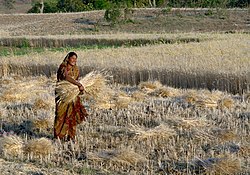 Traditional wheat harvesting
India, 2012


Evolution
[edit]Phylogeny
[edit]
Some wheat species are diploid, with two sets of chromosomes, but many are stable polyploids, with four sets (tetraploid) or six (hexaploid).[60] Einkorn is diploid (AA, two complements of seven chromosomes, 2n=14).[61] Most tetraploid wheats (e.g. emmer and durum wheat) are derived from wild emmer. Wild emmer is itself the result of a hybridization between two diploid wild grasses, T. urartu and a wild goatgrass such as Ae. speltoides.[62] The hybridization that formed wild emmer (AABB, four complements of seven chromosomes in two groups, 4n=28) occurred in the wild, long before domestication, and was driven by natural selection. Hexaploid wheats evolved in farmers' fields as wild emmer hybridized with another goatgrass, Ae. squarrosa or Ae. tauschii, to make the hexaploid wheats including bread wheat.[60][63]
A 2007 molecular phylogeny of the wheats gives the following not fully-resolved cladogram of major cultivated species; the large amount of hybridisation makes resolution difficult. Markings like "6N" indicate the polyploidy of each species:[60]
| Triticeae |
| ||||||||||||||||||||||||||||||||||||||||||
Taxonomy
[edit]
During 10,000 years of cultivation, numerous forms of wheat, many of them hybrids, have developed under a combination of artificial and natural selection. This complexity and diversity of status has led to much confusion in the naming of wheats.[64][65]
The wild species of wheat, along with the domesticated varieties einkorn,[66] emmer[67] and spelt,[68] have hulls. This more primitive morphology (in evolutionary terms) consists of toughened glumes that tightly enclose the grains, and (in domesticated wheats) a semi-brittle rachis that breaks easily on threshing. The result is that when threshed, the wheat ear breaks up into spikelets. To obtain the grain, further processing, such as milling or pounding, is needed to remove the hulls or husks. Hulled wheats are often stored as spikelets because the toughened glumes give good protection against pests of stored grain.[66] In free-threshing (or naked) forms, such as durum wheat and common wheat, the glumes are fragile and the rachis tough. On threshing, the chaff breaks up, releasing the grains.[69]
| Ploidy | Species | Description |
|---|---|---|
| Hexaploid 6N |
Common wheat or bread wheat (T. aestivum) | The most widely cultivated species in the world.[70] |
| Spelt (T. spelta) | Largely replaced by bread wheat, but in the 21st century grown, often organically, for artisanal bread and pasta.[71] | |
| Tetraploid 4N |
Durum (T. durum) | Widely used today, and the second most widely cultivated wheat.[70] |
| Emmer (T. turgidum subsp. dicoccum and T. t. conv. durum) | A species cultivated in ancient times, derived from wild emmer, T. dicoccoides, but no longer in widespread use.[72] | |
| Khorasan or Kamut (T. turgidum ssp. turanicum, also called T. turanicum) | An ancient grain type; Khorasan is a historical region in modern-day Afghanistan and the northeast of Iran. The grain is twice the size of modern wheat and has a rich nutty flavor.[73] | |
| Diploid 2N |
Einkorn (T. monococcum) | Domesticated from wild einkorn, T. boeoticum, at the same time as emmer wheat.[74] |
As a food
[edit]Grain classes
[edit]Classification of wheat greatly varies by the producing country.[75]
Argentina's grain classes were formerly related to the production region or port of shipment: Rosafe (grown in Santa Fe province, shipped through Rosario), Bahia Blanca (grown in Buenos Aires and La Pampa provinces and shipped through Bahia Blanca), Buenos Aires (shipped through the port of Buenos Aires). While mostly similar to the US Hard Red Spring wheat, the classification caused inconsistencies, so Argentina introduced three new classes of wheat, with all names using a prefix Trigo Dura Argentina (TDA) and a number.[76] The grain classification in Australia is within the purview of its National Pool Classification Panel. Australia chose to measure the protein content at 11% moisture basis.[77] The decisions on the wheat classification in Canada are coordinated by the Variety Registration Office of the Canadian Food Inspection Agency. As in the US system, the eight classes in Western Canada and six classes in Eastern Canada are based on colour, season, and hardness. Uniquely, Canada requires that the varieties should allow for purely visual identification.[78] The classes used in the United States are named by colour, season, and hardness.[79][80][81]
Food value and uses
[edit]
| Nutritional value per 100 g (3.5 oz) | |||||||||||||||||||||||||||||||||||||||||||||||
|---|---|---|---|---|---|---|---|---|---|---|---|---|---|---|---|---|---|---|---|---|---|---|---|---|---|---|---|---|---|---|---|---|---|---|---|---|---|---|---|---|---|---|---|---|---|---|---|
| Energy | 1,368 kJ (327 kcal) | ||||||||||||||||||||||||||||||||||||||||||||||
71.18 g | |||||||||||||||||||||||||||||||||||||||||||||||
| Sugars | 0.41 | ||||||||||||||||||||||||||||||||||||||||||||||
| Dietary fiber | 12.2 g | ||||||||||||||||||||||||||||||||||||||||||||||
1.54 g | |||||||||||||||||||||||||||||||||||||||||||||||
12.61 g | |||||||||||||||||||||||||||||||||||||||||||||||
| |||||||||||||||||||||||||||||||||||||||||||||||
| Other constituents | Quantity | ||||||||||||||||||||||||||||||||||||||||||||||
| Water | 13.1 g | ||||||||||||||||||||||||||||||||||||||||||||||
| Selenium | 70.7 µg | ||||||||||||||||||||||||||||||||||||||||||||||
| †Percentages estimated using US recommendations for adults,[82] except for potassium, which is estimated based on expert recommendation from the National Academies.[83] | |||||||||||||||||||||||||||||||||||||||||||||||
Wheat is a staple cereal worldwide.[84][61] Raw wheat berries can be ground into flour or, using hard durum wheat only, can be ground into semolina; germinated and dried creating malt; crushed or cut into cracked wheat; parboiled (or steamed), dried, and de-branned into groats, then crushed into bulgur.[85] If the raw wheat is broken into parts at the mill, the outer husk or bran is removed. Wheat is a major ingredient in baked foods, such as bread, rolls, crackers, biscuits, pancakes, pasta, pies, pastries, pizza, cakes, cookies, and muffins; in fried foods, such as doughnuts; in breakfast cereals, gravy, porridge, and muesli; in semolina; and in drinks such as beer, vodka, and boza (a fermented beverage).[86] In manufacturing wheat products, gluten is valuable to impart viscoelastic functional qualities in dough,[87] enabling the preparation of processed foods such as bread, noodles, and pasta.[88][89]
Nutrition
[edit]Raw red winter wheat is 13% water, 71% carbohydrates including 12% dietary fiber, 13% protein, and 2% fat (table). Some 75–80% of the protein content is as gluten.[87] In a reference amount of 100 grams (3.5 oz), wheat provides 1,368 kilojoules (327 kilocalories) of food energy and is a rich source (20% or more of the Daily Value, DV) of multiple dietary minerals, such as manganese, phosphorus, magnesium, zinc, and iron (table). The B vitamins, niacin (36% DV), thiamine (33% DV), and vitamin B6 (23% DV), are present in significant amounts (table).
Wheat is a significant source of vegetable proteins in human food, having a relatively high protein content compared to other major cereals.[90] However, wheat proteins have a low quality for human nutrition, according to the DIAAS protein quality evaluation method.[91][92] Though they contain adequate amounts of the other essential amino acids, at least for adults, wheat proteins are deficient in the essential amino acid lysine.[89][93] Because the gluten proteins present in endosperm are particularly poor in lysine, white flours are more deficient in lysine than are whole grains.[89] Plant breeders have sought to develop lysine-rich wheat varieties, without success, as of 2017[update].[94] Supplementation with proteins from other food sources (mainly legumes) is used to compensate for this deficiency.[95][89]
Health advisories
[edit]Consumed worldwide by billions of people, wheat is a significant food for human nutrition, particularly in the least developed countries where wheat products are primary foods.[89][96] When eaten as the whole grain, wheat supplies multiple nutrients and dietary fiber recommended for children and adults.[88][89][97][98] In genetically susceptible people, wheat gluten can trigger coeliac disease.[87][99] Coeliac disease affects about 1% of the general population in developed countries.[99][100] The only known effective treatment is a strict lifelong gluten-free diet.[99] While coeliac disease is caused by a reaction to wheat proteins, it is not the same as a wheat allergy.[99][100] Other diseases triggered by eating wheat are non-coeliac gluten sensitivity[100][101] (estimated to affect 0.5% to 13% of the general population[102]), gluten ataxia, and dermatitis herpetiformis.[101] Certain short-chain carbohydrates present in wheat, FODMAPs (mainly fructose polymers), may be the cause of non-coeliac gluten sensitivity. As of 2019[update], FODMAPs explain certain gastrointestinal symptoms, such as bloating, but not the extra-digestive symptoms of non-coeliac gluten sensitivity.[103][104][105] Other wheat proteins, amylase-trypsin inhibitors, appear to activate the innate immune system in coeliac disease and non-coeliac gluten sensitivity.[104][105] These proteins are part of the plant's natural defense against insects and may cause intestinal inflammation in humans.[104][106]
Production and consumption
[edit]Global
[edit]| Country | Millions of tonnes |
|---|---|
 China China |
136.6 |
 India India |
110.6 |
 Russia Russia |
91.5 |
 United States United States |
49.3 |
 Australia Australia |
41.2 |
 France France |
35.9 |
 Canada Canada |
31.9 |
| World | 799 |
| Source: UN Food and Agriculture Organization[107] | |
-
 Wheat-growing areas of the world
 -
![Production of wheat (2019)[108]](//upload.wikimedia.org/wikipedia/commons/thumb/e/e5/Production_of_wheat_%282019%29.svg/330px-Production_of_wheat_%282019%29.svg.png) Production of wheat (2019)[108]
Production of wheat (2019)[108] -
 Wheat's share (brown) of world crop production fell in the 21st century.

![Production of wheat (2019)[108]](https://en.wikipedia.org/wiki/File:Production_of_wheat_(2019).svg)

In 2023, world wheat production was 799 million tonnes, led by China, India, and Russia which collectively provided 42.4% of the world total.[109] As of 2019[update], the largest exporters were Russia (32 million tonnes), United States (27), Canada (23) and France (20), while the largest importers were Indonesia (11 million tonnes), Egypt (10.4) and Turkey (10.0).[110] In 2021, wheat was grown on 220.7 million hectares or 545 million acres worldwide, more than any other food crop.[111] World trade in wheat is greater than for all other crops combined.[112] Global demand for wheat is increasing due to the unique viscoelastic and adhesive properties of gluten proteins, which facilitate the production of processed foods, whose consumption is increasing as a result of the worldwide industrialization process and westernization of diets.[89][113]
19th century
[edit]
Wheat became a central agriculture endeavor in the worldwide British Empire in the 19th century, and remains of great importance in Australia, Canada and India.[115] In Australia, with vast lands and a limited work force, expanded production depended on technological advances, especially irrigation and machinery. By the 1840s there were 900 growers in South Australia. They used "Ridley's Stripper", a reaper-harvester perfected by John Ridley in 1843,[116] to remove the heads of grain. In Canada, modern farm implements made large scale wheat farming possible from the late 1840s. By 1879, Saskatchewan was the center, followed by Alberta, Manitoba and Ontario, as the spread of railway lines allowed easy exports to Britain. By 1910, wheat made up 22% of Canada's exports, rising to 25% in 1930 despite the sharp decline in prices during the Great Depression.[117] Efforts to expand wheat production in South Africa, Kenya and India were stymied by low yields and disease. However, by 2000 India had become the second largest producer of wheat in the world.[118] In the 19th century the American wheat frontier moved rapidly westward. By the 1880s 70% of American exports went to British ports. The first successful grain elevator was built in Buffalo in 1842.[119] The cost of transport fell rapidly. In 1869 it cost 37 cents to transport a bushel of wheat from Chicago to Liverpool; in 1905 it was 10 cents.[120]
Late 20th century yields
[edit]In the 20th century, global wheat output expanded about 5-fold, but until about 1955 most of this reflected increases in wheat crop area, with lesser (about 20%) increases in yield per unit area. After 1955 however, there was a ten-fold increase in the rate of wheat yield improvement per year, and this allowed global wheat production to increase. Thus technological innovation and scientific crop management with synthetic nitrogen fertilizer, irrigation and wheat breeding were the main drivers of wheat output growth in the second half of the century. There were some significant decreases in wheat crop area, for instance in North America.[121] Better seed storage and germination ability (and hence a smaller requirement to retain harvested crop for next year's seed) is another 20th-century technological innovation. In medieval England, farmers saved one-quarter of their wheat harvest as seed for the next crop, leaving only three-quarters for food and feed consumption. By 1999, the global average seed use of wheat was about 6% of output.[122]
21st century
[edit]
In the 21st century, global warming is reducing wheat yield in some places.[123] War[124] and tariffs have disrupted trade.[125] Between 2007 and 2009, concern was raised that wheat production would peak, in the same manner as oil,[126][127][128] possibly causing sustained price rises.[129][130][131] However, at that time global per capita food production had been increasing steadily for decades.[132]
Agronomy
[edit]Growing wheat
[edit]Wheat is an annual crop. It can be planted in autumn and harvested in early summer as winter wheat in climates that are not too severe, or planted in spring and harvested in autumn as spring wheat. It is normally planted after tilling the soil by ploughing and then harrowing to kill weeds and create an even surface. The seeds are then scattered on the surface, or drilled into the soil in rows. Winter wheat lies dormant during a winter freeze. It needs to develop to a height of 10 to 15 cm before the cold intervenes, so as to be able to survive the winter; it requires a period with the temperature at or near freezing, its dormancy then being broken by the thaw or rise in temperature. Spring wheat does not undergo dormancy. Wheat requires a deep soil, preferably a loam with organic matter, and available minerals including soil nitrogen, phosphorus, and potassium. An acid and peaty soil is not suitable. Wheat needs some 30 to 38 cm of rain in the growing season to form a good crop of grain.[133]
The farmer may intervene while the crop is growing to add fertilizer, water by irrigation, or pesticides such as herbicides to kill broad-leaved weeds or insecticides to kill insect pests. The farmer may assess soil minerals, soil water, weed growth, or the arrival of pests to decide timely and cost-effective corrective actions, and crop ripeness and water content to select the right moment to harvest. Harvesting involves reaping, cutting the stems to gather the crop; and threshing, breaking the ears to release the grain; both steps are carried out by a combine harvester. The grain is then dried so that it can be stored safe from mould fungi.[133]
Crop development
[edit]
Wheat normally needs between 110 and 130 days between sowing and harvest, depending upon climate, seed type, and soil conditions. Optimal crop management requires that the farmer have a detailed understanding of each stage of development in the growing plants. In particular, spring fertilizers, herbicides, fungicides, and growth regulators are typically applied only at specific stages of plant development. For example, it is currently recommended that the second application of nitrogen is made when the ear (not visible at this stage) is about 1 cm in size (Z31 on Zadoks scale). Knowledge of stages is important to identify periods of higher risk from the climate. Farmers benefit from knowing when the 'flag leaf' (last leaf) appears, as it represents about 75% of photosynthesis during the grain filling period, and so should be preserved from disease or insect attacks to ensure a good yield. Several systems exist to identify crop stages, with the Feekes and Zadoks scales being the most widely used. Each scale describes successive stages reached by the crop during the season.[134] For example, the stage of pollen formation from the mother cell, and the stages between anthesis and maturity, are vulnerable to high temperatures, made worse by water stress.[135]
-
 Anthesis stage
 -
 Late milk stage
 -
 Right before harvest


.jpg)
Farming techniques
[edit]Technological advances in soil preparation and seed placement at planting time, use of crop rotation and fertilizers to improve plant growth, and advances in harvesting have combined to promote wheat as a viable crop. When the use of seed drills replaced broadcasting sowing of seed in the 18th century, productivity increased.. Yields per unit area increased as crop rotations were applied to land that had long been in cultivation, and the use of fertilizers became widespread.[136]
Improved husbandry has more recently included pervasive automation, starting with the use of threshing machines,[137] and progressing to large and costly machines like the combine harvester which greatly increased productivity.[138] At the same time, better varieties such as Norin 10 wheat, developed in Japan in the 1930s,[139] or the dwarf wheat developed by Norman Borlaug in the Green Revolution, greatly increased yields.[140][141]
Some large wheat grain-producing countries have significant losses after harvest at the farm, because of poor roads, inadequate storage technologies, inefficient supply chains and farmers' inability to bring the produce into retail markets dominated by small shopkeepers. Some 10% of total wheat production is lost at farm level, another 10% is lost because of poor storage and road networks, and more is lost at the retail level.[142]
In the Punjab region of the Indian subcontinent, as well as North China, irrigation has been a major contributor to increased output. More widely over the last 40 years, a massive increase in fertilizer use together with increased availability of semi-dwarf varieties in developing countries, has greatly increased yields per hectare.[143] In developing countries, use of (mainly nitrogenous) fertilizer increased 25-fold in this period. However, farming systems rely on much more than fertilizer and breeding to improve productivity. A good illustration of this is Australian wheat growing in the southern winter cropping zone, where, despite low rainfall (300 mm), wheat cropping is successful even with relatively little use of nitrogenous fertilizer. This is achieved by crop rotation with leguminous pastures. The inclusion of a canola crop in the rotations has boosted wheat yields by a further 25%.[144] In these low rainfall areas, better use of available soil-water (and better control of soil erosion) is achieved by retaining the stubble after harvesting and by minimizing tillage.[145]
-
 The Wheat Field by John Constable, 1816
 -
 Field ready for harvesting
 -
 Combine harvester cuts the wheat stems, threshes the wheat, crushes the chaff and blows it across the field, and loads the grain onto a tractor trailer.


Pests and diseases
[edit]Pests and diseases consume 21.47% of the world's wheat crop annually.[146]
Diseases
[edit]
There are many wheat diseases, mainly caused by fungi, bacteria, and viruses.[147] Plant breeding to develop new disease-resistant varieties, and sound crop management practices are important for preventing disease. Fungicides, used to prevent the significant crop losses from fungal disease, can be a significant variable cost in wheat production. Estimates of the amount of wheat production lost owing to plant diseases vary between 10 and 25% in Missouri.[148] A wide range of organisms infect wheat, of which the most important are viruses and fungi.[149]
Pathogens and wheat are in a constant process of coevolution. Spore-producing wheat rusts are substantially adapted towards successful spore propagation, i.e. increasing their basic reproduction number (R0).[150]
The main wheat-disease categories are:
- Seed-borne diseases: these include seed-borne scab, seed-borne Stagonospora (previously known as Septoria), common bunt (stinking smut), and loose smut. These are managed with fungicides.[151]
- Leaf- and head- blight diseases: Powdery mildew, leaf rust, Septoria tritici leaf blotch, Stagonospora (Septoria) nodorum leaf and glume blotch, and Fusarium head scab.[151][152]
- Crown and root rot diseases: Two of the more important of these are 'take-all' and Cephalosporium stripe. Both of these diseases are soil borne.[151]
- Stem rust diseases: Caused by Puccinia graminis f. sp. tritici (basidiomycete) fungi e.g. Ug99[153]
- Wheat blast: Caused by Magnaporthe oryzae Triticum.[154]
- Viral diseases: Wheat spindle streak mosaic (yellow mosaic) and barley yellow dwarf are the two most common viral diseases. Control can be achieved by using resistant varieties.[151]
A historically significant disease of cereals including wheat, though commoner in rye is ergot; it is unusual among plant diseases in also causing sickness in humans who ate grain contaminated with the fungus involved, Claviceps purpurea.[155]
Animal pests
[edit]_inside_a_wheat_kernel_(cropped).jpg)
Among insect pests of wheat is the wheat stem sawfly, a chronic pest in the Northern Great Plains of the United States and in the Canadian Prairies.[156] Wheat is the food plant of the larvae of some Lepidoptera (butterfly and moth) species including the flame, rustic shoulder-knot, setaceous Hebrew character and turnip moth. Early in the season, many species of birds and rodents feed upon wheat crops. These animals can cause significant damage to a crop by digging up and eating newly planted seeds or young plants. They can also damage the crop late in the season by eating the grain from the mature spike. Recent post-harvest losses in cereals amount to billions of dollars per year in the United States alone, and damage to wheat by various borers, beetles and weevils is no exception.[157] Rodents can also cause major losses during storage, and in major grain growing regions, field mice numbers can sometimes build up explosively to plague proportions because of the ready availability of food.[158] To reduce the amount of wheat lost to post-harvest pests, Agricultural Research Service scientists have developed an "insect-o-graph", which can detect insects in wheat that are not visible to the naked eye. The device uses electrical signals to detect the insects as the wheat is being milled. The new technology is so precise that it can detect 5–10 infested seeds out of 30,000 good ones.[159]
Breeding objectives
[edit]In traditional agricultural systems, wheat populations consist of landraces, informal and often diverse farmer-maintained populations. Landraces of wheat continue to be important outside America and Europe. Formal wheat breeding began in the nineteenth century, when single line varieties were created by selecting seed from a plant with desired properties. Modern wheat breeding developed early in the twentieth century, linked to the development of Mendelian genetics. The standard method of breeding inbred wheat cultivars is by crossing two lines using hand emasculation, then selfing or inbreeding the progeny. Selections are identified genetically ten or more generations before release as a cultivar.[160]
Major breeding objectives include high grain yield, good quality, disease- and insect resistance and tolerance to abiotic stresses, including mineral, moisture and heat tolerance.[161][162] Wheat has been the subject of mutation breeding, with the use of gamma-, x-rays, ultraviolet light, and harsh chemicals. Since 1960, hundreds of varieties have been created through these methods, mostly in populous countries such as China.[161] Bread wheat with high grain iron and zinc content has been developed through gamma radiation breeding,[163] and through conventional selection breeding.[164] International wheat breeding is led by the International Maize and Wheat Improvement Center in Mexico. ICARDA is another major public sector international wheat breeder, but it was forced to relocate from Syria to Lebanon in the Syrian Civil War.[165]
For higher yields
[edit]
The presence of certain versions of wheat genes has been important for crop yields. Genes for the 'dwarfing' trait, first used by Japanese wheat breeders to produce Norin 10 short-stalked wheat, have had a huge effect on wheat yields worldwide, and were major factors in the success of the Green Revolution in Mexico and Asia, an initiative led by Norman Borlaug.[166] Dwarfing genes enable the carbon that is fixed in the plant during photosynthesis to be diverted towards seed production, and reduce lodging,[167] when a tall ear stalk falls over in the wind.[168] By 1997, 81% of the developing world's wheat area was planted to semi-dwarf wheats, giving both increased yields and better response to nitrogenous fertilizer.[169]
T. turgidum subsp. polonicum, known for its longer glumes and grains, has been bred into main wheat lines for its grain size effect, and likely has contributed these traits to T. petropavlovskyi and the Portuguese landrace group Arrancada.[170] As with many plants, MADS-box influences flower development, and more specifically, as with other agricultural Poaceae, influences yield. Despite that importance, as of 2021[update] little research has been done into MADS-box and other such spikelet and flower genetics in wheat specifically.[170]
The world record wheat yield is about 17 tonnes per hectare (15,000 pounds per acre), reached in New Zealand in 2017.[171] A project in the UK, led by Rothamsted Research has aimed to raise wheat yields in the country to 20 t/ha (18,000 lb/acre) by 2020, but in 2018 the UK record stood at 16 t/ha (14,000 lb/acre), and the average yield was just 8 t/ha (7,100 lb/acre).[172][173]
For disease resistance
[edit]
Wild grasses in the genus Triticum and related genera, and grasses such as rye have been a source of many disease-resistance traits for cultivated wheat breeding since the 1930s.[174] Some resistance genes have been identified against Pyrenophora tritici-repentis, especially races 1 and 5, those most problematic in Kazakhstan.[175] Wild relative, Aegilops tauschii is the source of several genes effective against TTKSK/Ug99 - Sr33, Sr45, Sr46, and SrTA1662.[176]
- Lr67 is an R gene, a dominant negative for partial adult resistance discovered and molecularly characterized by Moore et al., 2015. As of 2018[update] Lr67 is effective against all races of leaf, stripe, and stem rusts, and powdery mildew (Blumeria graminis). This is produced by a mutation of two amino acids in what is predicted to be a hexose transporter. The result is to reduce glucose uptake.[177]
- Lr34 is widely deployed in cultivars as it confers resistance against leaf- and stripe-rusts, and powdery mildew.[178] It is used intensively in wheat cultivation worldwide.[179][180] It is an ABC transporter,[178][181] producing a 'slow rusting'/adult resistance phenotype.[181]
- Pm8 is a widely used powdery mildew resistance introgressed from rye (Secale cereale).[182] It comes from the rye 1R chromosome, a source of many resistances since the 1960s.[182]
Resistance to Fusarium head blight (FHB, Fusarium ear blight) is an important breeding target. Marker-assisted breeding panels involving kompetitive allele specific PCR can be used. A KASP genetic marker for a pore-forming toxin-like gene provides FHB resistance.[183]
In 2003 the first resistance genes against fungal diseases in wheat were isolated.[184][185] In 2021, novel resistance genes were identified in wheat against powdery mildew and wheat leaf rust.[186][187] Modified resistance genes have been tested in transgenic wheat and barley plants.[188]
To create hybrid vigor
[edit]Because wheat self-pollinates, creating hybrid seed to provide heterosis, hybrid vigor (as in F1 hybrids of maize), is extremely labor-intensive; the high cost of hybrid wheat seed has kept farmers from adopting them widely[189][190] despite nearly 90 years of effort.[191][160] Commercial hybrid wheat seed has been produced using chemical hybridizing agents, plant growth regulators that interfere with pollen development, or naturally occurring cytoplasmic male sterility systems. Hybrid wheat has been a limited commercial success in France, the United States and South Africa.[192]
Synthetic hexaploids made by crossing the wild goatgrass wheat ancestor Aegilops tauschii,[193] and other Aegilops,[194] with durum wheats are being deployed, increasing the genetic diversity of cultivated wheats.[195][196][197]
For gluten content
[edit]Modern bread wheat varieties have been cross-bred to contain greater amounts of gluten.[198][199] However, a 2020 study found no changes in albumin/globulin and gluten content between 1891 and 2010.[200]
For water efficiency
[edit]Stomata (or leaf pores) are involved in both uptake of carbon dioxide gas from the atmosphere and water vapor losses from the leaf due to water transpiration. Basic physiological investigation of these gas exchange processes has yielded carbon isotope based method used for breeding wheat varieties with improved water-use efficiency. These varieties can improve crop productivity in rain-fed dry-land wheat farms.[201]
For insect resistance
[edit]The complex genome of wheat has made its improvement difficult. Comparison of hexaploid wheat genomes using a range of chromosome pseudomolecule and molecular scaffold assemblies in 2020 has enabled the resistance potential of its genes to be assessed. Findings include the identification of "a detailed multi-genome-derived nucleotide-binding leucine-rich repeat protein repertoire" which contributes to disease resistance, while the gene Sm1 provides a degree of insect resistance,[202] for instance against the orange wheat blossom midge.[203]
Genomics
[edit]Decoding the genome
[edit]In 2010, 95% of the genome of Chinese Spring line 42 wheat was decoded.[204] This genome was released in a basic format for scientists and plant breeders to use but was not fully annotated.[205] In 2012, an essentially complete gene set of bread wheat was published.[206] Random shotgun libraries of total DNA and cDNA from the T. aestivum cv. Chinese Spring (CS42) were sequenced to generate 85 Gb of sequence (220 million reads) and identified between 94,000 and 96,000 genes.[206] In 2018, a more complete Chinese Spring genome was released by a different team.[207] In 2020, 15 genome sequences from various locations and varieties around the world were reported, with examples of their own use of the sequences to localize particular insect and disease resistance factors.[208] Wheat Blast Resistance is controlled by R genes which are highly race-specific.[154]
Genetic engineering
[edit]For decades, the primary genetic modification technique has been non-homologous end joining. However, since its introduction, the CRISPR/Cas9 tool has been extensively used, for example:[209]
- To intentionally damage three homologs of TaNP1 (a glucose-methanol-choline oxidoreductase gene) to produce a novel male sterility trait, by Li et al. 2020[209]
- Blumeria graminis f.sp. tritici resistance has been produced by Shan et al. 2013 and Wang et al. 2014 by editing one of the mildew resistance locus o genes (more specifically one of the Triticum aestivum MLO (TaMLO) genes)[209]
- T. aestivum EDR1 (TaEDR1) (the EDR1 gene, which inhibits Bmt resistance) has been knocked out by Zhang et al. 2017 to improve that resistance[209]
- T. aestivum HRC (TaHRC) has been disabled by Su et al. 2019 thus producing Gibberella zeae resistance.[209]
- T. aestivum Ms1 (TaMs1) has been knocked out by Okada et al. 2019 to produce another novel male sterility[209]
- and T. aestivum acetolactate synthase (TaALS) and T. aestivum acetyl-CoA-carboxylase (TaACC) were subjected to base changes by Zhang et al. 2019 (in two publications) to confer herbicide resistance to ALS inhibitors and ACCase inhibitors respectively[209]
In art
[edit]
The Dutch artist Vincent van Gogh created the series Wheat Fields between 1885 and 1890, consisting of dozens of paintings made mostly in different parts of rural France. They depict wheat crops, sometimes with farm workers, in varied seasons and styles, sometimes green, sometimes at harvest. Wheatfield with Crows was one of his last paintings, and is considered to be among his greatest works.[210][211]
In 1967, the American artist Thomas Hart Benton made his oil on wood painting Wheat, showing a row of uncut wheat plants, occupying almost the whole height of the painting, between rows of freshly-cut stubble. The painting is held by the Smithsonian American Art Museum.[212]
In 1982, the American conceptual artist Agnes Denes grew a two-acre field of wheat at Battery Park, Manhattan. The ephemeral artwork has been described as an act of protest. The harvested wheat was divided and sent to 28 world cities for an exhibition entitled "The International Art Show for the End of World Hunger".[213]
See also
[edit]- Marquis wheat
- Red Fife wheat
- Effects of climate change on agriculture
- Gluten-free diet – Diet excluding proteins found in wheat, barley, and rye
- Wheat germ oil – Oil extracted from the embryo of a wheat seed
- Wheat middlings – By-product of wheat milling
- Wheat production in the United States
- Whole-wheat flour – Basic food ingredient, derived by grinding or mashing the whole grain of wheat
References
[edit]- ^ lectotype designated by Duistermaat, Blumea 32: 174 (1987)
- ^ Serial No. 42236 ITIS 2002-09-22
- ^ "triticum". Merriam-Webster.com Dictionary. Merriam-Webster.
- ^ Mencken, H. L. (1984). The American language: an inquiry into the development of English in the United States (4th ed.). New York: Alfred A. Knopf. p. 122. ISBN 0-394-40075-5.
Corn, in orthodox English, means grain for human consumption, especially wheat, e.g., the Corn Laws.
- ^ a b "wheat (plant)". britannica.com. Retrieved 23 December 2023.
- ^ Yang, Hong; Li, Yongpeng; Li, Dongxiao; Liu, Liantao; Qiao, Yunzhou; Sun, Hongyong; et al. (9 June 2022). "Wheat Escapes Low Light Stress by Altering Pollination Types". Frontiers in Plant Science. 13 924565. doi:10.3389/fpls.2022.924565. PMC 9218482. PMID 35755640.
- ^ "Fertilising for High Yield and Quality – Cereals" (PDF).
- ^ Pajević, Slobodanka; Krstić, Borivoj; Stanković, Živko; Plesničar, Marijana; Denčić, Srbislav (1999). "Photosynthesis of Flag and Second Wheat Leaves During Senescence". Cereal Research Communications. 27 (1/2): 155–162. doi:10.1007/BF03543932. JSTOR 23786279.
- ^ Araus, J. L.; Tapia, L.; Azcon-Bieto, J.; Caballero, A. (1986). "Photosynthesis, Nitrogen Levels, and Dry Matter Accumulation in Flag Wheat Leaves During Grain Filling". Biological Control of Photosynthesis. pp. 199–207. doi:10.1007/978-94-009-4384-1_18. ISBN 978-94-010-8449-9.
- ^ Singh, Sarvjeet; Sethi, G.S. (1995). "Stomatal Size, Frequency and Distribution in Triticum Aestivum, Secale Cereale and Their Amphiploids". Cereal Research Communications. 23 (1/2): 103–108. JSTOR 23783891.
- ^ Milla, Rubén; De Diego-Vico, Natalia; Martín-Robles, Nieves (2013). "Shifts in stomatal traits following the domestication of plant species". Journal of Experimental Botany. 64 (11): 3137–3146. doi:10.1093/jxb/ert147. PMID 23918960.
- ^ a b "Wheat Growth Guide" (PDF). Agriculture and Horticulture Development Board.
- ^ Das, N. R. (1 October 2008). Wheat Crop Management. Scientific Publishers. ISBN 978-93-87741-28-7.
- ^ Hogan, M. E.; Hendrix, J. E. (1986). "Labeling of Fructans in Winter Wheat Stems". Plant Physiology. 80 (4): 1048–1050. doi:10.1104/pp.80.4.1048. PMC 1075255. PMID 16664718.
- ^ Zhang, J.; Chen, W.; Dell, B.; Vergauwen, R.; Zhang, X.; Mayer, J. E.; Van Den Ende, W. (2015). "Wheat genotypic variation in dynamic fluxes of WSC components in different stem segments under drought during grain filling". Frontiers in Plant Science. 6: 624. doi:10.3389/fpls.2015.00624. PMC 4531436. PMID 26322065.
- ^ Lopes, Marta S.; Reynolds, Matthew P. (2010). "Partitioning of assimilates to deeper roots is associated with cooler canopies and increased yield under drought in wheat". Functional Plant Biology. 37 (2): 147. CiteSeerX 10.1.1.535.6514. doi:10.1071/FP09121.
- ^ Rebetzke, G. J.; Bonnett, D. G.; Reynolds, M. P. (2016). "Awns reduce grain number to increase grain size and harvestable yield in irrigated and rainfed spring wheat". Journal of Experimental Botany. 67 (9): 2573–2586. doi:10.1093/jxb/erw081. PMC 4861010. PMID 26976817.
- ^ Duwayri, Mahmud (1984). "Effect of flag leaf and awn removal on grain yield and yield components of wheat grown under dryland conditions". Field Crops Research. 8: 307–313. Bibcode:1984FCrRe...8..307D. doi:10.1016/0378-4290(84)90077-7.
- ^ Kahiluoto, Helena; Kaseva, Janne; Balek, Jan; Olesen, Jørgen E.; Ruiz-Ramos, Margarita; et al. (2019). "Decline in climate resilience of European wheat". Proceedings of the National Academy of Sciences. 116 (1): 123–128. Bibcode:2019PNAS..116..123K. doi:10.1073/pnas.1804387115. PMC 6320549. PMID 30584094.
- ^ Richter, Tobias; Maher, Lisa A. (2013). "Terminology, process and change: reflections on the Epipalaeolithic of South-west Asia". Levant. 45 (2): 121–132. doi:10.1179/0075891413Z.00000000020. S2CID 161961145.
- ^ Piperno, Dolores R.; Weiss, Ehud; Holst, Irene; Nadel, Dani (August 2004). "Processing of wild cereal grains in the Upper Palaeolithic revealed by starch grain analysis". Nature. 430 (7000): 670–673. Bibcode:2004Natur.430..670P. doi:10.1038/nature02734. PMID 15295598. S2CID 4431395.
- ^ Arranz-Otaegui, Amaia; González Carretero, Lara; Roe, Joe; Richter, Tobias (2018). ""Founder crops" v. wild plants: Assessing the plant-based diet of the last hunter-gatherers in southwest Asia". Quaternary Science Reviews. 186: 263–283. Bibcode:2018QSRv..186..263A. doi:10.1016/j.quascirev.2018.02.011.
- ^ Fuller, Dorian Q.; Willcox, George; Allaby, Robin G. (2011). "Cultivation and domestication had multiple origins: arguments against the core area hypothesis for the origins of agriculture in the Near East". World Archaeology. 43 (4): 628–652. doi:10.1080/00438243.2011.624747. S2CID 56437102.
- ^ Hughes, N.; Oliveira, H.R.; Fradgley, N.; Corke, F.; Cockram, J.; Doonan, J.H.; Nibau, C. (14 March 2019). "μCT trait analysis reveals morphometric differences between domesticated temperate small grain cereals and their wild relatives". The Plant Journal. 99 (1): 98–111. doi:10.1111/tpj.14312. PMC 6618119. PMID 30868647.
- ^ Tanno, K.; Willcox, G. (2006). "How fast was wild wheat domesticated?". Science. 311 (5769): 1886. doi:10.1126/science.1124635. PMID 16574859. S2CID 5738581.
- ^ Purugganan, Michael D.; Fuller, Dorian Q. (1 February 2009). "The nature of selection during plant domestication". Nature. 457 (7231). Springer: 843–848. Bibcode:2009Natur.457..843P. doi:10.1038/nature07895. PMID 19212403. S2CID 205216444.
- ^ a b c d e f g h i Zohary, Daniel; Hopf, Maria; Weiss, Ehud (2012). "Cereals". Domestication of Plants in the Old World (4 ed.). Oxford: Oxford University Press. doi:10.1093/acprof:osobl/9780199549061.001.0001. ISBN 978-0-19-954906-1.
- ^ a b c Ozkan, H.; Brandolini, A.; Schäfer-Pregl, R.; Salamini, F. (2002). "AFLP analysis of a collection of tetraploid wheats indicates the origin of emmer and hard wheat domestication in southeast Turkey". Molecular Biology and Evolution. 19 (10): 1797–1801. doi:10.1093/oxfordjournals.molbev.a004002. PMID 12270906.
- ^ Feldman, Moshe; Kislev, Mordechai E. (2007). "Domestication of emmer wheat and evolution of free-threshing tetraploid wheat in "A Century of Wheat Research-From Wild Emmer Discovery to Genome Analysis", Published Online: 3 November 2008". Israel Journal of Plant Sciences. 55 (3–4): 207–221. doi:10.1560/IJPS.55.3-4.207 (inactive 12 July 2025). Archived from the original on 6 December 2013. Retrieved 6 July 2011.
{{cite journal}}: CS1 maint: DOI inactive as of July 2025 (link) - ^ Colledge, Sue (2007). The origins and spread of domestic plants in southwest Asia and Europe. Left Coast Press. pp. 40–. ISBN 978-1-59874-988-5.
- ^ Luo, M.-C.; Yang, Z.-L.; You, F. M.; Kawahara, T.; Waines, J. G.; Dvorak, J. (2007). "The structure of wild and domesticated emmer wheat populations, gene flow between them, and the site of emmer domestication". Theoretical and Applied Genetics. 114 (6): 947–959. doi:10.1007/s00122-006-0474-0. PMID 17318496. S2CID 36096777.
- ^ Czajkowska, Beata I.; Bogaard, Amy; Charles, Michael; Jones, Glynis; Kohler-Schneider, Marianne; Mueller-Bieniek, Aldona; Brown, Terence A. (1 November 2020). "Ancient DNA typing indicates that the "new" glume wheat of early Eurasian agriculture is a cultivated member of the Triticum timopheevii group". Journal of Archaeological Science. 123 105258. Bibcode:2020JArSc.123j5258C. doi:10.1016/j.jas.2020.105258. S2CID 225168770.
- ^ a b Arranz-Otaegui, Amaia; Roe, Joe (1 September 2023). "Revisiting the concept of the 'Neolithic Founder Crops' in southwest Asia". Vegetation History and Archaeobotany. 32 (5): 475–499. Bibcode:2023VegHA..32..475A. doi:10.1007/s00334-023-00917-1. hdl:10810/67728. S2CID 258044557.
- ^ Weide, Alexander; Green, Laura; Hodgson, John G.; Douché, Carolyne; Tengberg, Margareta; Whitlam, Jade; Dovrat, Guy; Osem, Yagil; Bogaard, Amy (June 2022). "A new functional ecological model reveals the nature of early plant management in southwest Asia". Nature Plants. 8 (6): 623–634. Bibcode:2022NatPl...8..623W. doi:10.1038/s41477-022-01161-7. PMID 35654954. S2CID 249313666.
- ^ Sherratt, Andrew (February 1980). "Water, soil and seasonality in early cereal cultivation". World Archaeology. 11 (3): 313–330. doi:10.1080/00438243.1980.9979770.
- ^ Scott, James C. (2017). "The Domestication of Fire, Plants, Animals, and ... Us". Against the Grain: A Deep History of the Earliest States. New Haven: Yale University Press. p. 66. ISBN 978-0-3002-3168-7. Retrieved 19 March 2023.
The general problem with farming — especially plough agriculture — is that it involves so much intensive labor. One form of agriculture, however, eliminates most of this labor: 'flood-retreat' (also known as décrue or recession) agriculture. In flood-retreat agriculture, seeds are generally broadcast on the fertile silt deposited by an annual riverine flood.
- ^ Graeber, David; Wengrow, David (2021). The dawn of everything: a new history of humanity. London: Allen Lane. p. 235. ISBN 978-0-241-40242-9.
- ^ Maeda, Osamu; Lucas, Leilani; Silva, Fabio; Tanno, Ken-Ichi; Fuller, Dorian Q. (1 August 2016). "Narrowing the Harvest: Increasing sickle investment and the rise of domesticated cereal agriculture in the Fertile Crescent". Quaternary Science Reviews. 145: 226–237. Bibcode:2016QSRv..145..226M. doi:10.1016/j.quascirev.2016.05.032. hdl:2241/00143830.
- ^ a b Weide, Alexander (29 November 2021). "Towards a Socio-Economic Model for Southwest Asian Cereal Domestication". Agronomy. 11 (12): 2432. Bibcode:2021Agron..11.2432W. doi:10.3390/agronomy11122432.
- ^ Dubreuil, Laure (1 November 2004). "Long-term trends in Natufian subsistence: a use-wear analysis of ground stone tools". Journal of Archaeological Science. 31 (11): 1613–1629. Bibcode:2004JArSc..31.1613D. doi:10.1016/j.jas.2004.04.003.
- ^ Arranz-Otaegui, Amaia; Gonzalez Carretero, Lara; Ramsey, Monica N.; Fuller, Dorian Q.; Richter, Tobias (31 July 2018). "Archaeobotanical evidence reveals the origins of bread 14,400 years ago in northeastern Jordan". Proceedings of the National Academy of Sciences. 115 (31): 7925–7930. Bibcode:2018PNAS..115.7925A. doi:10.1073/pnas.1801071115. PMC 6077754. PMID 30012614.
- ^ González Carretero, Lara; Wollstonecroft, Michèle; Fuller, Dorian Q. (1 July 2017). "A methodological approach to the study of archaeological cereal meals: a case study at Çatalhöyük East (Turkey)". Vegetation History and Archaeobotany. 26 (4): 415–432. Bibcode:2017VegHA..26..415G. doi:10.1007/s00334-017-0602-6. PMC 5486841. PMID 28706348. S2CID 41734442.
- ^ Fuller, Dorian Q.; Carretero, Lara Gonzalez (5 December 2018). "The Archaeology of Neolithic Cooking Traditions: Archaeobotanical Approaches to Baking, Boiling and Fermenting". Archaeology International. 21: 109–121. doi:10.5334/ai-391.
- ^ Graeber, David; Wengrow, David (2021). The dawn of everything: a new history of humanity. London: Allen Lane. p. 232. ISBN 978-0-241-40242-9.
- ^ Vigne, Jean-Denis; Briois, François; Zazzo, Antoine; Willcox, George; Cucchi, Thomas; Thiébault, Stéphanie; Carrère, Isabelle; Franel, Yodrik; Touquet, Régis; Martin, Chloé; Moreau, Christophe; Comby, Clothilde; Guilaine, Jean (29 May 2012). "First wave of cultivators spread to Cyprus at least 10,600 y ago". Proceedings of the National Academy of Sciences. 109 (22): 8445–8449. Bibcode:2012PNAS..109.8445V. doi:10.1073/pnas.1201693109. PMC 3365171. PMID 22566638.
- ^ Lucas, Leilani; Colledge, Sue; Simmons, Alan; Fuller, Dorian Q. (1 March 2012). "Crop introduction and accelerated island evolution: archaeobotanical evidence from 'Ais Yiorkis and Pre-Pottery Neolithic Cyprus". Vegetation History and Archaeobotany. 21 (2): 117–129. Bibcode:2012VegHA..21..117L. doi:10.1007/s00334-011-0323-1. S2CID 129727157.
- ^ Diamond, Jared (2005) [1997]. Guns, Germs and Steel. Vintage. p. 97. ISBN 978-0-099-30278-0.
- ^ Grundas, S.T. (2003). "Wheat: The Crop". Encyclopedia of Food Sciences and Nutrition. Elsevier Science. p. 6130. ISBN 978-0-12-227055-0.
- ^ Piotrowski, Jan (26 February 2019). "Britons may have imported wheat long before farming it". New Scientist. Retrieved 4 June 2020.
- ^ Smith, Oliver; Momber, Garry; Bates, Richard; et al. (2015). "Sedimentary DNA from a submerged site reveals wheat in the British Isles 8000 years ago". Science. 347 (6225): 998–1001. Bibcode:2015Sci...347..998S. doi:10.1126/science.1261278. hdl:10454/9405. PMID 25722413. S2CID 1167101.
- ^ Brace, Selina; Diekmann, Yoan; Booth, Thomas J.; van Dorp, Lucy; Faltyskova, Zuzana; et al. (2019). "Ancient genomes indicate population replacement in Early Neolithic Britain". Nature Ecology & Evolution. 3 (5): 765–771. Bibcode:2019NatEE...3..765B. doi:10.1038/s41559-019-0871-9. PMC 6520225. PMID 30988490.
Neolithic cultures first appear in Britain circa 4000 bc, a millennium after they appeared in adjacent areas of continental Europe.
- ^ Jarrige, Jean-François; Meadow, Richard H (1980). "The antecedents of civilization in the Indus Valley". Scientific American. 243 (2): 122–137.
- ^ Long, Tengwen; Leipe, Christian; Jin, Guiyun; Wagner, Mayke; Guo, Rongzhen; et al. (2018). "The early history of wheat in China from 14C dating and Bayesian chronological modelling". Nature Plants. 4 (5): 272–279. doi:10.1038/s41477-018-0141-x. PMID 29725102. S2CID 19156382.
- ^ Bilgic, Hatice; et al. (2016). "Ancient DNA from 8400 Year-Old Çatalhöyük Wheat: Implications for the Origin of Neolithic Agriculture". PLOS One. 11 (3) e0151974. Bibcode:2016PLoSO..1151974B. doi:10.1371/journal.pone.0151974. PMC 4801371. PMID 26998604.
- ^ "The science in detail – Wheats DNA – Research – Archaeology". The University of Sheffield. 19 July 2011. Retrieved 27 May 2012.
- ^ Belderok, B.; et al. (2000). Bread-Making Quality of Wheat. Springer. p. 3. ISBN 0-7923-6383-3.
- ^ Cauvain, S.P.; Cauvain, P. (2003). Bread Making. CRC Press. p. 540. ISBN 1-85573-553-9.
- ^ Otter, Chris (2020). Diet for a large planet. University of Chicago Press. p. 50. ISBN 978-0-226-69710-9.
- ^ Nelson, Scott Reynolds (2022). Oceans of Grain: How American Wheat Remade the World. Basic Books. pp. 3–4. ISBN 978-1-5416-4646-9.
- ^ a b c d Golovnina, K. A.; Glushkov, S. A.; Blinov, A. G.; Mayorov, V. I.; Adkison, L. R.; Goncharov, N. P. (12 February 2007). "Molecular phylogeny of the genus Triticum L". Plant Systematics and Evolution. 264 (3–4). Springer: 195–216. Bibcode:2007PSyEv.264..195G. doi:10.1007/s00606-006-0478-x. S2CID 39102602.
- ^ a b Belderok, Robert 'Bob'; Mesdag, Hans; Donner, Dingena A. (2000). Bread-Making Quality of Wheat. Springer. p. 3. ISBN 978-0-7923-6383-5.
- ^ Friebe, B.; Qi, L.L.; Nasuda, S.; Zhang, P.; Tuleen, N.A.; Gill, B.S. (July 2000). "Development of a complete set of Triticum aestivum-Aegilops speltoides chromosome addition lines". Theoretical and Applied Genetics. 101 (1): 51–58. doi:10.1007/s001220051448. S2CID 13010134.
- ^ Dvorak, Jan; Deal, Karin R.; Luo, Ming-Cheng; You, Frank M.; von Borstel, Keith; Dehghani, Hamid (1 May 2012). "The Origin of Spelt and Free-Threshing Hexaploid Wheat". Journal of Heredity. 103 (3): 426–441. doi:10.1093/jhered/esr152. PMID 22378960.
- ^ Shewry, P. R. (1 April 2009). "Wheat". Journal of Experimental Botany. 60 (6): 1537–1553. doi:10.1093/jxb/erp058. ISSN 0022-0957. PMID 19386614.
- ^ Fuller, Dorian Q.; Lucas, Leilani (2014), "Wheats: Origins and Development", Encyclopedia of Global Archaeology, Springer New York, pp. 7812–7817, doi:10.1007/978-1-4419-0465-2_2192, ISBN 978-1-4419-0426-3, S2CID 129138746
- ^ a b Potts, D.T. (1996). Mesopotamia Civilization: The Material Foundations. Cornell University Press. p. 62. ISBN 0-8014-3339-8.
- ^ Nevo, E. (29 January 2002). Evolution of Wild Emmer and Wheat Improvement. Berlin ; New York: Springer Science & Business Media. p. 8. ISBN 3-540-41750-8.
- ^ Vaughan, J.G.; Judd, P.A. (2003). The Oxford Book of Health Foods. Oxford University Press. p. 35. ISBN 0-19-850459-4.
- ^ "Field Crop Information". College of Agriculture and Bioresources, University of Saskatchewan. Archived from the original on 18 October 2023. Retrieved 10 July 2023.
- ^ a b Yang, Fan; Zhang, Jingjuan; Liu, Qier; et al. (17 February 2022). "Improvement and Re-Evolution of Tetraploid Wheat for Global Environmental Challenge and Diversity Consumption Demand". International Journal of Molecular Sciences. 23 (4): 2206. doi:10.3390/ijms23042206. PMC 8878472. PMID 35216323.
- ^ Smithers, Rebecca (15 May 2014). "Spelt flour 'wonder grain' set for a price hike as supplies run low". The Guardian.
- ^ "Triticum turgidum subsp. dicoccon". Germplasm Resources Information Network. Agricultural Research Service, United States Department of Agriculture. Retrieved 11 December 2017.
- ^ Khlestkina, Elena K.; Röder, Marion S.; Grausgruber, Heinrich; Börner, Andreas (2006). "A DNA fingerprinting-based taxonomic allocation of Kamut wheat". Plant Genetic Resources. 4 (3): 172–180. doi:10.1079/PGR2006120. S2CID 86510231.
- ^ Anderson, Patricia C. (1991). "Harvesting of Wild Cereals During the Natufian as seen from Experimental Cultivation and Harvest of Wild Einkorn Wheat and Microwear Analysis of Stone Tools". In Bar-Yosef, Ofer (ed.). Natufian Culture in the Levant. International Monographs in Prehistory. Ann Arbor, Michigan: Berghahn Books. p. 523.
- ^ Khan 2016, pp. 109–116.
- ^ Khan 2016, pp. 109–110.
- ^ Khan 2016, p. 110.
- ^ Khan 2016, pp. 110–111.
- ^ Bridgwater, W.; Aldrich, Beatrice (1966). "Wheat". The Columbia-Viking Desk Encyclopedia. Columbia University Press. p. 1959.
- ^ "Flour types: Wheat, Rye, and Barley". The New York Times. 18 February 1981.
- ^ "Wheat: Background". USDA. Archived from the original on 10 July 2012. Retrieved 2 October 2016.
- ^ United States Food and Drug Administration (2024). "Daily Value on the Nutrition and Supplement Facts Labels". FDA. Archived from the original on 27 March 2024. Retrieved 28 March 2024.
- ^ "TABLE 4-7 Comparison of Potassium Adequate Intakes Established in This Report to Potassium Adequate Intakes Established in the 2005 DRI Report". p. 120. In: Stallings, Virginia A.; Harrison, Meghan; Oria, Maria, eds. (2019). "Potassium: Dietary Reference Intakes for Adequacy". Dietary Reference Intakes for Sodium and Potassium. pp. 101–124. doi:10.17226/25353. ISBN 978-0-309-48834-1. PMID 30844154. NCBI NBK545428.
- ^ Mauseth, James D. (2014). Botany. Jones & Bartlett Publishers. p. 223. ISBN 978-1-4496-4884-8.
Perhaps the simplest of fruits are those of grasses (all cereals such as corn and wheat)...These fruits are caryopses.
- ^ Ensminger, Marion; Ensminger, Audrey H. Eugene (1993). Foods & Nutrition Encyclopedia, Two Volume Set. CRC Press. p. 164. ISBN 978-0-8493-8980-1.
- ^ "Wheat". Food Allergy Canada. Retrieved 25 February 2019.
- ^ a b c Shewry, P. R.; Halford, N. G.; Belton, P. S.; Tatham, A. S. (2002). "The structure and properties of gluten: An elastic protein from wheat grain". Philosophical Transactions of the Royal Society B: Biological Sciences. 357 (1418): 133–42. doi:10.1098/rstb.2001.1024. PMC 1692935. PMID 11911770.
- ^ a b "Whole Grain Fact Sheet". European Food Information Council. 1 January 2009. Archived from the original on 20 December 2016. Retrieved 6 December 2016.
- ^ a b c d e f g Shewry, Peter R.; Hey, S. J. (2015). "Review: The contribution of wheat to human diet and health". Food and Energy Security. 4 (3): 178–202. doi:10.1002/fes3.64. PMC 4998136. PMID 27610232.
- ^ European Community, Community Research and Development Information Service (24 February 2016). "Genetic markers signal increased crop productivity potential". Retrieved 1 June 2017.
- ^ Dietary protein quality evaluation in human nutrition (PDF). Food and Agriculture Organization of the United Nations. 2013. ISBN 978-92-5-107417-6. Archived (PDF) from the original on 9 October 2022. Retrieved 1 June 2017.
- ^ Wolfe, R. R. (August 2015). "Update on protein intake: importance of milk proteins for health status of the elderly". Nutrition Reviews (Review). 73 (Suppl 1): 41–47. doi:10.1093/nutrit/nuv021. PMC 4597363. PMID 26175489.
- ^ Shewry, Peter R. "Impacts of agriculture on human health and nutrition – Vol. II – Improving the Protein Content and Quality of Temperate Cereals: Wheat, Barley and Rye" (PDF). UNESCO – Encyclopedia Life Support Systems (UNESCO-EOLSS). Archived (PDF) from the original on 9 October 2022. Retrieved 2 June 2017.
When compared with the WHO requirements of essential amino acids for humans, wheat, barley and rye are seen to be deficient in lysine, with threonine being the second limiting amino acid (Table 1).
- ^ Vasal, S. K. "The role of high lysine cereals in animal and human nutrition in Asia". Food and Agriculture Organization of the United Nations. Retrieved 1 June 2017.
- ^ "Nutritional quality of cereals". Food and Agriculture Organization of the United Nations. Retrieved 1 June 2017.
- ^ Shewry, Peter R. (2009). "Wheat". Journal of Experimental Botany. 60 (6): 1537–53. doi:10.1093/jxb/erp058. PMID 19386614.
- ^ "Whole Grain Resource for the National School Lunch and School Breakfast Programs: A Guide to Meeting the Whole Grain-Rich criteria" (PDF). US Department of Agriculture, Food and Nutrition Service. January 2014. Archived from the original (PDF) on 9 October 2022.
Additionally, menu planners are encouraged to serve a variety of foods that meet whole grain-rich criteria and may not serve the same product every day to count for the HUSSC whole grain-rich criteria.
- ^ "All About the Grains Group". US Department of Agriculture, MyPlate. 2016. Retrieved 6 December 2016.
- ^ a b c d "Celiac disease". World Gastroenterology Organisation Global Guidelines. July 2016. Retrieved 7 December 2016.
- ^ a b c "Definition and Facts for Celiac Disease". The National Institute of Diabetes and Digestive and Kidney Diseases, National Institutes of Health, US Department of Health and Human Services, Bethesda, MD. 2016. Retrieved 5 December 2016.
- ^ a b Ludvigsson, Jonas F.; Leffler, Daniel A.; Bai, Julio C.; Biagi, Federico; Fasano, Alessio; et al. (16 February 2012). "The Oslo definitions for coeliac disease and related terms". Gut. 62 (1). BMJ: 43–52. doi:10.1136/gutjnl-2011-301346. PMC 3440559. PMID 22345659.
- ^ Molina-Infante, J.; Santolaria, S.; Sanders, D. S.; Fernández-Bañares, F. (May 2015). "Systematic review: noncoeliac gluten sensitivity". Alimentary Pharmacology & Therapeutics. 41 (9): 807–820. doi:10.1111/apt.13155. PMID 25753138. S2CID 207050854.
- ^ Volta, Umberto; De Giorgio, Roberto; Caio, Giacomo; Uhde, Melanie; Manfredini, Roberto; Alaedini, Armin (2019). "Nonceliac Wheat Sensitivity". Gastroenterology Clinics of North America. 48 (1): 165–182. doi:10.1016/j.gtc.2018.09.012. PMC 6364564. PMID 30711208.
- ^ a b c Verbeke, K. (February 2018). "Nonceliac Gluten Sensitivity: What Is the Culprit?". Gastroenterology. 154 (3): 471–473. doi:10.1053/j.gastro.2018.01.013. PMID 29337156.
- ^ a b Fasano, Alessio; Sapone, Anna; Zevallos, Victor; Schuppan, Detlef (2015). "Nonceliac Gluten Sensitivity". Gastroenterology. 148 (6): 1195–1204. doi:10.1053/j.gastro.2014.12.049. PMID 25583468.
- ^ Barone, Maria; Troncone, Riccardo; Auricchio, Salvatore (2014). "Gliadin Peptides as Triggers of the Proliferative and Stress/Innate Immune Response of the Celiac Small Intestinal Mucosa". International Journal of Molecular Sciences (Review). 15 (11): 20518–20537. doi:10.3390/ijms151120518. PMC 4264181. PMID 25387079.
- ^ "FAOSTAT". www.fao.org. Retrieved 7 May 2025.
- ^ World Food and Agriculture – Statistical Yearbook 2021. Rome: FAO. 2021. doi:10.4060/cb4477en. ISBN 978-92-5-134332-6. S2CID 240163091.
- ^ "Wheat production in 2023 from pick lists: Crops/World regions/Production quantity/Year". www.fao.org. Retrieved 7 May 2025.
- ^ "Crops and livestock products". UN Food and Agriculture Organization, Statistics Division, FAOSTAT. 2021. Retrieved 18 April 2021.
- ^ "Wheat area harvested, world total from pick lists: Crops/World regions/Area harvested/Year". 2023. Retrieved 5 October 2023.
- ^ Curtis; Rajaraman; MacPherson (2002). "Bread Wheat". Food and Agriculture Organization of the United Nations.
- ^ Day, L.; Augustin, M.A.; Batey, I.L.; Wrigley, C.W. (2006). "Wheat-gluten uses and industry needs". Trends in Food Science & Technology (Review). 17 (2). Elsevier: 82–90. doi:10.1016/j.tifs.2005.10.003.
- ^ "Wheat prices in England". Our World in Data. Retrieved 5 March 2020.
- ^ Palmer, Alan (1996). Dictionary of the British Empire and Commonwealth. pp. 193, 320, 338.
- ^ Ridley, Annie E. (1904). A Backward Glance: The Story of John Ridley, a Pioneer. J. Clarke. p. 21.
- ^ Furtan, W. Hartley; Lee, George E. (1977). "Economic Development of the Saskatchewan Wheat Economy". Canadian Journal of Agricultural Economics. 25 (3): 15–28. Bibcode:1977CaJAE..25...15F. doi:10.1111/j.1744-7976.1977.tb02882.x.
- ^ Joshi, A. K.; Mishra, B.; Chatrath, R.; Ortiz Ferrara, G.; Singh, Ravi P. (2007). "Wheat improvement in India: present status, emerging challenges and future prospects". Euphytica. 157 (3): 431–446. doi:10.1007/s10681-007-9385-7. S2CID 38596433.
- ^ Otter, Chris (2020). Diet for a large planet. USA: University of Chicago Press. p. 51. ISBN 978-0-226-69710-9.
- ^ Otter, Chris (2020). Diet for a large planet. USA: University of Chicago Press. p. 69. ISBN 978-0-226-69710-9.
- ^ Slafer, G.A.; Satorre, E.H. (1999). "Chapter 1". Wheat: Ecology and Physiology of Yield Determination. Haworth Press. ISBN 1-56022-874-1.
- ^ Wright, B. D.; Pardey, P. G. (2002). "Agricultural R&D, productivity, and global food prospects". Plants, Genes and Crop Biotechnology. Jones & Bartlett Learning. pp. 22–51. ISBN 978-0-7637-1586-1.
- ^ Asseng, S.; Ewert, F.; Martre, P.; Rötter, R. P.; Lobell, D. B.; et al. (2015). "Rising temperatures reduce global wheat production" (PDF). Nature Climate Change. 5 (2): 143–147. Bibcode:2015NatCC...5..143A. doi:10.1038/nclimate2470. Archived (PDF) from the original on 9 October 2022.
- ^ Braun, Karen (23 April 2025). "Ukraine's once-booming grain industry teetering on being a war casualty". Reuters. Retrieved 18 August 2025.
- ^ "Finding the Flow: How Does Wheat Navigate Trade's Changing Reality?". New US Wheat. Retrieved 18 August 2025.
- ^ "Investing In Agriculture - Food, Feed & Fuel", Feb 29th 2008 at
- ^ "Could we really run out of food?", Jon Markman, March 6, 2008 at http://articles.moneycentral.msn.com/Investing/SuperModels/CouldWeReallyRunOutOfFood.aspx Archived 2011-07-17 at the Wayback Machine
- ^ McKillop, Andrew (13 December 2006). "Peak Natural Gas is On the Way - Raise the Hammer". www.raisethehammer.org. Retrieved 15 September 2022.
- ^ Globe Investor at http://www.globeinvestor.com/servlet/WireFeedRedirect?cf=GlobeInvestor/config&date=20080408&archive=nlk&slug=00011064, 2008
- ^ Credit Suisse First Boston, Higher Agricultural Prices: Opportunities and Risks, November 2007
- ^ Food Production May Have to Double by 2030 - Western Spectator "Food Prices Could Increase 10 Times by 2050 | WS". 25 September 2009. Archived from the original on 3 October 2009. Retrieved 9 October 2009.
- ^ Agriculture and Food — Agricultural Production Indices: Food production per capita index Archived 2009-07-22 at the Wayback Machine, World Resources Institute
- ^ a b "How To Grow Wheat Efficiently On A Large Farm". EOS Data Analytics. 10 May 2023. Retrieved 23 December 2023.
- ^ Slafer, G.A.; Satorre, E.H. (1999). Wheat: Ecology and Physiology of Yield Determination. Haworth Press. pp. 322–323. ISBN 1-56022-874-1.
- ^ Saini, H.S.; Sedgley, M.; Aspinall, D. (1984). "Effect of heat stress during floral development on pollen tube growth and ovary anatomy in wheat (Triticum aestivum L.)". Australian Journal of Plant Physiology. 10 (2): 137–144. doi:10.1071/PP9830137.
- ^ Overton, Mark (1996). Agricultural Revolution in England: The transformation of the agrarian economy 1500-1850. Cambridge University Press. p. 1, and throughout. ISBN 978-0-521-56859-3.
- ^ Caprettini, Bruno; Voth, Hans-Joachim (2020). "Rage against the Machines: Labor-Saving Technology and Unrest in Industrializing England". American Economic Review: Insights. 2 (3): 305–320. doi:10.1257/aeri.20190385. S2CID 234622559.
- ^ Constable, George; Somerville, Bob (2003). A Century of Innovation: Twenty Engineering Achievements That Transformed Our Lives, Chapter 7, Agricultural Mechanization. Washington, DC: Joseph Henry Press. ISBN 0-309-08908-5.
- ^ Borojevic, Katarina; Borojevic, Ksenija (July–August 2005). "The Transfer and History of "Reduced Height Genes" (Rht) in Wheat from Japan to Europe". Journal of Heredity. 96 (4). Oxford University Press: 455–459. doi:10.1093/jhered/esi060. PMID 15829727.
- ^ Shindler, Miriam (3 January 2016). "From east Asia to south Asia, via Mexico: how one gene changed the course of history". CIMMYT. Retrieved 19 November 2021.
- ^ Brown, L. R. (30 October 1970). "Nobel Peace Prize: developer of high-yield wheat receives award (Norman Ernest Borlaug)". Science. 170 (957): 518–519. doi:10.1126/science.170.3957.518. PMID 4918766.
- ^ Basavaraja, H.; Mahajanashetti, S.B.; Udagatti, N.C. (2007). "Economic Analysis of Post-harvest Losses in Food Grains in India: A Case Study of Karnataka" (PDF). Agricultural Economics Research Review. 20: 117–126. Archived (PDF) from the original on 9 October 2022.
- ^ Godfray, H.C.; Beddington, J. R.; Crute, I. R.; Haddad, L.; Lawrence, D.; et al. (2010). "Food security: The challenge of feeding 9 billion people". Science. 327 (5967): 812–818. Bibcode:2010Sci...327..812G. doi:10.1126/science.1185383. PMID 20110467.
- ^ Swaminathan, M. S. (2004). "Stocktake on cropping and crop science for a diverse planet". Proceedings of the 4th International Crop Science Congress, Brisbane, Australia. Archived from the original on 18 June 2005.
- ^ "Umbers, Alan (2006, Grains Council of Australia Limited) Grains Industry trends in Production – Results from Today's Farming Practices" (PDF). Archived from the original (PDF) on 26 January 2017.
- ^ Savary, Serge; Willocquet, Laetitia; Pethybridge, Sarah Jane; Esker, Paul; McRoberts, Neil; Nelson, Andy (4 February 2019). "The global burden of pathogens and pests on major food crops". Nature Ecology & Evolution. 3 (3). Springer Science and Business Media LLC: 430–439. Bibcode:2019NatEE...3..430S. doi:10.1038/s41559-018-0793-y. PMID 30718852. S2CID 59603871.
- ^ Abhishek, Aditya (11 January 2021). "Disease of Wheat: Get To Know Everything About Wheat Diseases". Agriculture Review. Archived from the original on 24 January 2021. Retrieved 29 January 2021.
- ^ "G4319 Wheat Diseases in Missouri, MU Extension". University of Missouri Extension. Archived from the original on 27 February 2007. Retrieved 18 May 2009.
- ^ Hogan, C. Michael (2013). "Wheat". In Saundry, P. (ed.). Encyclopedia of Earth. Washington DC: National Council for Science and the Environment.
- ^ Fabre, Frederic; Burie, Jean-Baptiste; Ducrot, Arnaud; Lion, Sebastien; Richard, Quentin; Demasse, Ramses (2022). "An epi-evolutionary model for predicting the adaptation of spore-producing pathogens to quantitative resistance in heterogeneous environments". Evolutionary Applications. 15 (1). John Wiley & Sons: 95–110. Bibcode:2022EvApp..15...95F. doi:10.1111/eva.13328. PMC 8792485. PMID 35126650.
- ^ a b c d Singh, Jagdeep; Chhabra, Bhavit; Raza, Ali; Yang, Seung Hwan; Sandhu, Karansher S. (2023). "Important wheat diseases in the US and their management in the 21st century". Frontiers in Plant Science. 13. doi:10.3389/fpls.2022.1010191. PMC 9877539. PMID 36714765.
- ^ Gautam, P.; Dill-Macky, R. (2012). "Impact of moisture, host genetics and Fusarium graminearum isolates on Fusarium head blight development and trichothecene accumulation in spring wheat". Mycotoxin Research. 28 (1): 45–58. doi:10.1007/s12550-011-0115-6. PMID 23605982. S2CID 16596348.
- ^ Singh, Ravi P.; Hodson, David; Huerta-Espino, Julio; Jin, Yue; Njau, Peter; et al. (2008). Will Stem Rust Destroy the World's Wheat Crop?. Advances in Agronomy. Vol. 98. pp. 272–309. doi:10.1016/S0065-2113(08)00205-8. ISBN 978-0-12-374355-8. Archived from the original on 8 November 2020. Retrieved 4 October 2023.
- ^ a b Kumar, Sudheer; Kashyap, Prem; Singh, Gyanendra (2020). Kumar, Sudheer; Kashyap, Prem Lal; Singh, Gyanendra Pratap (eds.). Wheat Blast (1 ed.). Boca Raton, Florida: CRC Press. p. 70. doi:10.1201/9780429470554 (inactive 12 July 2025). ISBN 978-0-429-47055-4. OCLC 1150902336. S2CID 235049332.
{{cite book}}: CS1 maint: DOI inactive as of July 2025 (link) - ^ Harveson, Bob (17 August 2017). "Has Ergot Altered Events in World History?". Cropwatch. University of Nebraska–Lincoln.
- ^ Cárcamo, Héctor; Entz, Toby; Beres, Brian (2007). "Estimating Cephus cinctus wheat stem cutting damage – can we cut stem counts?". Journal of Agricultural and Urban Entomology. 24 (3): 117–124. doi:10.3954/1523-5475-24.3.117. S2CID 86001776.
- ^ Biological Control of Stored-Product Pests. Biological Control News Volume II, Number 10 October 1995 Archived 15 June 2010 at the Wayback Machine
- ^ CSIRO Rodent Management Research Focus: Mice plagues Archived 21 July 2010 at the Wayback Machine
- ^ "ARS, Industry Cooperation Yields Device to Detect Insects in Stored Wheat". USDA Agricultural Research Service. 24 June 2010.
- ^ a b Bajaj, Y.P.S. (1990) Wheat. Springer Science+Business Media. pp. 161–163. ISBN 3-540-51809-6.
- ^ a b "Mutant variety database". MVGS International Atomic Energy Agency.
- ^ Sarkar, S.; Islam, A.K.M.Aminul; Barma, N.C.D.; Ahmed, J.U. (May 2021). "Tolerance mechanisms for breeding wheat against heat stress: A review". South African Journal of Botany. 138: 262–277. doi:10.1016/j.sajb.2021.01.003.
- ^ Verma, Shailender Kumar; Kumar, Satish; Sheikh, Imran; et al. (3 March 2016). "Transfer of useful variability of high grain iron and zinc from Aegilops kotschyi into wheat through seed irradiation approach". International Journal of Radiation Biology. 92 (3): 132–139. doi:10.3109/09553002.2016.1135263. PMID 26883304. S2CID 10873152.
- ^ MacNeil, Marcia (20 January 2021). "CIMMYT scientist Ravi Singh receives prestigious award from the Government of India". International Maize and Wheat Improvement Center. Retrieved 27 January 2021.
- ^ "Press Release: ICARDA safeguards world heritage of genetic resources during the conflict in Syria". International Center for Agricultural Research in the Dry Areas. Retrieved 27 January 2021.
- ^ Würschum, Tobias; Langer, Simon M.; Longin, C. Friedrich H.; Tucker, Matthew R.; Leiser, Willmar L. (26 September 2017). "A modern Green Revolution gene for reduced height in wheat". The Plant Journal. 92 (5): 892–903. doi:10.1111/tpj.13726. PMID 28949040. S2CID 30146700.
- ^ Kulshrestha, V. P.; Tsunoda, S. (1 March 1981). "The role of 'Norin 10' dwarfing genes in photosynthetic and respiratory activity of wheat leaves". Theoretical and Applied Genetics. 60 (2): 81–84. doi:10.1007/BF00282421. PMID 24276628. S2CID 22243940.
- ^ Milach, S. C. K.; Federizzi, L. C. (1 January 2001). Dwarfing genes in plant improvement. Advances in Agronomy. Vol. 73. Academic Press. pp. 35–63. doi:10.1016/S0065-2113(01)73004-0. ISBN 978-0-12-000773-8.
- ^ Lupton, F. G. H.; Oliver, R. H.; Ruckenbauer, P. (27 March 2009). "An analysis of the factors determining yields in crosses between semi-dwarf and taller wheat varieties". The Journal of Agricultural Science. 82 (3): 483–496. doi:10.1017/S0021859600051388. S2CID 85738377.
- ^ a b Adamski, Nikolai M.; Simmonds, James; Brinton, Jemima F.; et al. (1 May 2021). "Ectopic expression of Triticum polonicum VRT-A2 underlies elongated glumes and grains in hexaploid wheat in a dosage-dependent manner". The Plant Cell. 33 (7). Oxford University Press: 2296–2319. doi:10.1093/plcell/koab119. PMC 8364232. PMID 34009390.
- ^ "Guinness World Records – Highest Wheat Yield". 10 August 2022.
- ^ Farmers Weekly (23 November 2018). "Lincs grower scoops top wheat and rapeseed yield awards".
- ^ "Agricultural and Horticultural Development Board – 2018 GB Harvest Progress Results".
- ^ Hoisington, D.; Khairallah, M.; Reeves, T.; et al. (1999). "Plant genetic resources: What can they contribute toward increased crop productivity?". Proceedings of the National Academy of Sciences. 96 (11): 5937–43. Bibcode:1999PNAS...96.5937H. doi:10.1073/pnas.96.11.5937. PMC 34209. PMID 10339521.
- ^ Dahm, Madeline (27 July 2021). "Genome-wide association study puts tan spot-resistant genes in the spotlight". WHEAT. Archived from the original on 22 September 2021. Retrieved 28 July 2021.
- ^ Bohra, Abhishek; Kilian, Benjamin; Sivasankar, Shoba; Caccamo, Mario; Mba, Chikelu; McCouch, Susan R.; Varshney, Rajeev K. (2021). "Reap the crop wild relatives for breeding future crops". Trends in Biotechnology. 40 (4). Cell Press: 412–431. doi:10.1016/j.tibtech.2021.08.009. PMID 34629170. S2CID 238580339.
- ^ Kourelis, Jiorgos; van der Hoorn, Renier A.L. (30 January 2018). "Defended to the Nines: 25 Years of Resistance Gene Cloning Identifies Nine Mechanisms for R Protein Function". The Plant Cell. 30 (2). American Society of Plant Biologists (OUP): 285–299. Bibcode:2018PlanC..30..285K. doi:10.1105/tpc.17.00579. PMC 5868693. PMID 29382771.
- ^ a b Dodds, Peter N.; Rathjen, John P. (29 June 2010). "Plant immunity: towards an integrated view of plant–pathogen interactions". Nature Reviews Genetics. 11 (8). Nature Portfolio: 539–548. doi:10.1038/nrg2812. hdl:1885/29324. PMID 20585331. S2CID 8989912.
- ^ Krattinger, Simon G.; Lagudah, Evans S.; Spielmeyer, Wolfgang; Singh, Ravi P.; Huerta-Espino, Julio; McFadden, Helen; et al. (6 March 2009). "A Putative ABC Transporter Confers Durable Resistance to Multiple Fungal Pathogens in Wheat". Science. 323 (5919): 1360–1363. Bibcode:2009Sci...323.1360K. doi:10.1126/science.1166453. ISSN 0036-8075. PMID 19229000.
- ^ Krattinger, Simon G.; Kang, Joohyun; Bräunlich, Stephanie; Boni, Rainer; Chauhan, Harsh; Selter, Liselotte L.; et al. (2019). "Abscisic acid is a substrate of the ABC transporter encoded by the durable wheat disease resistance gene Lr34". New Phytologist. 223 (2): 853–866. Bibcode:2019NewPh.223..853K. doi:10.1111/nph.15815. ISSN 0028-646X. PMC 6618152. PMID 30913300.
- ^ a b Furbank, Robert T.; Tester, Mark (2011). "Phenomics – technologies to relieve the phenotyping bottleneck". Trends in Plant Science. 16 (12). Cell Press: 635–644. Bibcode:2011TPS....16..635F. doi:10.1016/j.tplants.2011.09.005. PMID 22074787.
- ^ a b Herrera, Leonardo; Gustavsson, Larisa; Åhman, Inger (2017). "A systematic review of rye (Secale cereale L.) as a source of resistance to pathogens and pests in wheat (Triticum aestivum L.)". Hereditas. 154 (1). BioMed Central: 1–9. doi:10.1186/s41065-017-0033-5. PMC 5445327. PMID 28559761.
- ^ Kaur, Bhavjot; Mavi, G. S.; Gill, Manpartik S.; Saini, Dinesh Kumar (2 July 2020). "Utilization of KASP technology for wheat improvement". Cereal Research Communications. 48 (4). Springer Science+Business Media: 409–421. doi:10.1007/s42976-020-00057-6. S2CID 225570977.
- ^ Feuillet, Catherine; Travella, Silvia; Stein, Nils; Albar, Laurence; Nublat, Aurélie; Keller, Beat (9 December 2003). "Map-based isolation of the leaf rust disease resistance gene Lr10 from the hexaploid wheat ( Triticum aestivum L.) genome". Proceedings of the National Academy of Sciences. 100 (25): 15253–15258. Bibcode:2003PNAS..10015253F. doi:10.1073/pnas.2435133100. ISSN 0027-8424. PMC 299976. PMID 14645721.
- ^ Yahiaoui, Nabila; Srichumpa, Payorm; Dudler, Robert; Keller, Beat (2004). "Genome analysis at different ploidy levels allows cloning of the powdery mildew resistance gene Pm3b from hexaploid wheat". The Plant Journal. 37 (4): 528–538. doi:10.1046/j.1365-313X.2003.01977.x. ISSN 0960-7412. PMID 14756761.
- ^ Sánchez-Martín, Javier; Widrig, Victoria; Herren, Gerhard; Wicker, Thomas; Zbinden, Helen; Gronnier, Julien; et al. (11 March 2021). "Wheat Pm4 resistance to powdery mildew is controlled by alternative splice variants encoding chimeric proteins". Nature Plants. 7 (3): 327–341. Bibcode:2021NatPl...7..327S. doi:10.1038/s41477-021-00869-2. ISSN 2055-0278. PMC 7610370. PMID 33707738.
- ^ Kolodziej, Markus C.; Singla, Jyoti; Sánchez-Martín, Javier; Zbinden, Helen; Šimková, Hana; Karafiátová, Miroslava; et al. (11 February 2021). "A membrane-bound ankyrin repeat protein confers race-specific leaf rust disease resistance in wheat". Nature Communications. 12 (1): 956. Bibcode:2021NatCo..12..956K. doi:10.1038/s41467-020-20777-x. ISSN 2041-1723. PMC 7878491. PMID 33574268.
- ^ Koller, Teresa; Camenzind, Marcela; Jung, Esther; Brunner, Susanne; Herren, Gerhard; Armbruster, Cygni; et al. (10 December 2023). "Pyramiding of transgenic immune receptors from primary and tertiary wheat gene pools improves powdery mildew resistance in the field". Journal of Experimental Botany. 75 (7): 1872–1886. doi:10.1093/jxb/erad493. ISSN 0022-0957. PMC 10967238. PMID 38071644.
- ^ Mike Abram for Farmers' Weekly. 17 May 2011. Hybrid wheat to make a return
- ^ Bill Spiegel for agriculture.com 11 March 2013 Hybrid wheat's comeback
- ^ "The Hybrid wheat website". 18 December 2013. Archived from the original on 18 December 2013.
- ^ Basra, Amarjit S. (1999) Heterosis and Hybrid Seed Production in Agronomic Crops. Haworth Press. pp. 81–82. ISBN 1-56022-876-8.
- ^ Aberkane, Hafid; Payne, Thomas; Kishi, Masahiro; Smale, Melinda; Amri, Ahmed; Jamora, Nelissa (1 October 2020). "Transferring diversity of goat grass to farmers' fields through the development of synthetic hexaploid wheat". Food Security. 12 (5): 1017–1033. doi:10.1007/s12571-020-01051-w. S2CID 219730099.
- ^ Kishii, Masahiro (9 May 2019). "An Update of Recent Use of Aegilops Species in Wheat Breeding". Frontiers in Plant Science. 10. Frontiers Media SA: 585. doi:10.3389/fpls.2019.00585. PMC 6521781. PMID 31143197.
- ^ (12 May 2013) Cambridge-based scientists develop 'superwheat' BBC News UK, Retrieved 25 May 2013
- ^ Synthetic hexaploids Archived 28 November 2011 at the Wayback Machine
- ^ (2013) Synthetic hexaploid wheat Archived 16 April 2014 at the Wayback Machine UK National Institute of Agricultural Botany, Retrieved 25 May 2013
- ^ Belderok, B. (1 January 2000). "Developments in bread-making processes". Plant Foods for Human Nutrition. 55 (1). Dordrecht, Netherlands: 1–86. doi:10.1023/A:1008199314267. PMID 10823487. S2CID 46259398.
- ^ Delcour, J. A.; Joye, I. J.; Pareyt, B.; Wilderjans, E.; Brijs, K.; Lagrain, B. (2012). "Wheat gluten functionality as a quality determinant in cereal-based food products". Annual Review of Food Science and Technology. 3: 469–492. doi:10.1146/annurev-food-022811-101303. PMID 22224557.

- ^ Pronin, Darina; Borner, Andreas; Weber, Hans; Scherf, Ann (10 July 2020). "Wheat (Triticum aestivum L.) Breeding from 1891 to 2010 Contributed to Increasing Yield and Glutenin Contents but Decreasing Protein and Gliadin Contents". Journal of Agricultural and Food Chemistry. 68 (46): 13247–13256. Bibcode:2020JAFC...6813247P. doi:10.1021/acs.jafc.0c02815. PMID 32648759. S2CID 220469138.
- ^ Condon, AG; Farquhar, GD; Richards, RA (1990). "Genotypic variation in carbon isotope discrimination and transpiration efficiency in wheat. Leaf gas exchange and whole plant studies". Australian Journal of Plant Physiology. 17: 9–22. CiteSeerX 10.1.1.691.4942. doi:10.1071/PP9900009.
- ^ Walkowiak, Sean; Gao, Liangliang; Monat, Cecile; Haberer, Georg; Kassa, Mulualem T.; et al. (25 November 2020). "Multiple wheat genomes reveal global variation in modern breeding". Nature. 588 (7837). Nature Research/Springer Nature: 277–283. Bibcode:2020Natur.588..277W. doi:10.1038/s41586-020-2961-x. PMC 7759465. PMID 33239791.
- ^ Kassa, Mulualem T.; Haas, Sabrina; Schliephake, Edgar; Lewis, Clare; You, Frank M.; et al. (9 May 2016). "A saturated SNP linkage map for the orange wheat blossom midge resistance gene Sm1". Theoretical and Applied Genetics. 129 (8). Springer Science+Business Media: 1507–1517. doi:10.1007/s00122-016-2720-4. PMID 27160855. S2CID 14168477.
- ^ "UK researchers release draft sequence coverage of wheat genome". Biotechnology and Biological Sciences Research Council. 27 August 2010. Archived from the original on 11 June 2011.
- ^ "UK scientists publish draft sequence coverage of wheat genome" (PDF). Biotechnology and Biological Sciences Research Council. Archived (PDF) from the original on 15 July 2011. Retrieved 15 July 2011.
- ^ a b Hall (2012). "Analysis of the bread wheat genome using whole-genome shotgun sequencing". Nature. 491 (7426): 705–10. Bibcode:2012Natur.491..705B. doi:10.1038/nature11650. PMC 3510651. PMID 23192148.
- ^ "U of S crop scientists help crack the wheat genome code". University of Saskatchewan, Canada. 16 August 2018. Retrieved 22 December 2020.
- ^ "Landmark study generates first genomic atlas for global wheat improvement". University of Saskatchewan. 25 November 2020. Retrieved 22 December 2020.
- ^ a b c d e f g Li, Shaoya; Zhang, Chen; Li, Jingying; Yan, Lei; Wang, Ning; Xia, Lanqin (2021). "Present and future prospects for wheat improvement through genome editing and advanced technologies". Plant Communications. 2 (4) 100211. Chinese Academy of Sciences, Center for Excellence in Molecular Plant Sciences and Chinese Society for Plant Biology (Cell Press). Bibcode:2021PlCom...200211L. doi:10.1016/j.xplc.2021.100211. PMC 8299080. PMID 34327324.
- ^ Cézanne to Picasso: Ambroise Vollard, Patron of the Avant-garde. Metropolitan Museum of Art. 2006. p. 11. ISBN 1-58839-195-7.
- ^ McKenna, Tony (2015). Art, Literature and Culture from a Marxist Perspective. Springer. PT101. ISBN 978-1-137-52661-8.
- ^ "Wheat". Smithsonian Institution. Retrieved 28 January 2024.
- ^ Hessel, Katy (18 July 2022). "A field of wheat on a $4.5bn patch of New York: the prophetic eco art of Agnes Denes". The Guardian. Retrieved 28 January 2024.

Sources
[edit]- Khan, K. (2016). "Wheat Classes − Producing Nations". Wheat: Chemistry and Technology. American Association of Cereal Chemists International. Elsevier Science. ISBN 978-0-12-810454-5.
Further reading
[edit]- Abecassis, Joël, et al. Durum wheat: chemistry and technology (2012)
- Bonjean, Alain P.; Angus, William J. (2001). The World Wheat Book: A History of Wheat Breeding. Vol. 1. London: Lavoisier. ISBN 978-1-898298-72-4. OCLC 59515318.
- Bonjean, Alain P. (2011). The World Wheat Book: A History of Wheat Breeding. Vol. 2. Paris: Lavoisier. ISBN 978-2-7430-1102-4. OCLC 707171112.
- Bonjean, Alain P.; Angus, William J.; Ginkel, Maarten van (2016). The World Wheat Book: A History of Wheat Breeding. Vol. 3. Paris: Lavoisier-Tec & doc. ISBN 978-2-7430-2091-0. OCLC 953081390.
- Carver, Brett F. ed. Wheat Science and Trade (Wiley, 2009)
- Corke, Harold et al. eds .Encyclopedia of Grain Science (3 vols, Elsevier, 2004)
- Head, Lesley; Atchison, Jennifer; Gates, Alison (2016). Ingrained: A Human Bio-geography of Wheat. London: Ashgate Publishing. ISBN 978-1-315-58854-4. OCLC 1082225627.
- Jasny Naum, The Wheats of Classical Antiquity. Johns Hopkins University Press, Baltimore, 1944. S2CID 82345748.
- Nelson, Scott Reynolds (2022). Oceans of Grain: How American Wheat Remade the World. summary
- Shiferaw, Bekele; Smale, Melinda; Braun, Hans-Joachim; Duveiller, Etienne; Reynolds, Mathew; Muricho, Geoffrey (2013). "Crops that feed the world 10. Past successes and future challenges to the role played by wheat in global food security". Food Security. 5 (3): 291–317. doi:10.1007/s12571-013-0263-y.
- Zabinski, Catherine. Amber Waves: The Extraordinary Biography of Wheat, from Wild Grass to World Megacrop (U of Chicago Press, 2020) reviews
External links
[edit] Media related to Wheat at Wikimedia Commons
- Triticum species at Purdue University (1971)

| Types | | |
|---|---|---|
| Agronomy | ||
| Trade | ||
| Plant parts and their uses | ||
| Basic preparation | ||
| As an ingredient | ||
| Associated human diseases | ||
| Related concepts | ||

| Biofuels | |
|---|---|
| Energy from foodstock | |
| Non-food energy crops | |
| Technology | |
| Concepts | |
| International | |
|---|---|
| National | |
| Other | |

Wheat
View on GrokipediaWheat (Triticum spp.) consists of annual grasses in the Poaceae family, primarily cultivated for their edible seeds known as kernels or grains, which are ground into flour to produce staple foods such as bread, pasta, and pastries.[1] The genus includes diploid, tetraploid, and hexaploid species, with bread wheat (Triticum aestivum) being the dominant cultivated form, characterized by 42 chromosomes resulting from ancient polyploidization events involving wild progenitors like einkorn (T. monococcum) and emmer (T. dicoccum).[2] Domesticated around 10,000 years ago in the Fertile Crescent through archaeobotanical evidence of non-shattering rachis mutations that facilitated harvesting, wheat underpinned the shift from hunter-gatherer societies to agrarian civilizations by providing reliable caloric density and storability.[3] In contemporary agriculture, it ranks as the second most-produced cereal after maize, yielding over 790 million metric tons globally in the 2023/2024 marketing year, with major production concentrated in temperate regions across Eurasia, North America, and Australia due to its adaptation to cool climates and versatile end-use qualities.[4] While selective breeding has dramatically increased yields—often tripling output per hectare since the mid-20th century—empirical data indicate trade-offs including diminished micronutrient content in modern cultivars compared to landraces, reflecting causal dynamics of genetic bottlenecks and fertilizer-intensive practices.[5]
Taxonomy and Evolution
Botanical Description
Wheat belongs to the genus Triticum in the Poaceae family, comprising annual or winter annual grasses cultivated primarily for their seeds. The dominant species, Triticum aestivum (bread wheat), exhibits erect growth reaching 0.5 to 1.5 meters in height, depending on variety and environmental conditions.[6] Plants develop from caryopses, initially producing seminal roots from the grain and later nodal (crown) roots with tiller emergence; the root system is fibrous, extending 1 to 2 meters deep but concentrated in the top 30 cm of soil for nutrient uptake.[6] The vegetative structure features a central culm—a hollow, jointed stem with 5 to 7 nodes and typically 3 to 4 visible internodes—supported by leaf sheaths. Leaves arise alternately from nodes, each comprising a basal sheath enveloping the culm, a flat or rolled blade 20 to 40 cm long and 1 to 3 cm wide with parallel venation, and at the sheath-blade junction, a membranous ligule and paired auricles for attachment. Tillers, lateral shoots from axillary buds at lower nodes, produce additional culms and leaves, with tiller survival influenced by competition for resources; productive tillers contribute to overall spike number and yield. The flag leaf, the uppermost leaf subtending the inflorescence, provides critical photosynthate during grain filling.[6][7] Reproduction occurs via a terminal inflorescence known as the spike or ear, an unbranched structure 5 to 15 cm long consisting of a central rachis with short internodes bearing spikelets in two opposite rows. Each spikelet, a condensed reproductive unit, includes two basal sterile glumes (5 to 10 mm long) protecting 2 to 5 fertile florets (up to 10 in some cases) arranged acropetally on a secondary rachilla; lower florets are typically fertile, with upper ones reduced or sterile. Individual florets are chasmogamous and bisexual, enclosed by a lemma (outer bract, often extended into an awn for awned varieties) and palea (inner bract); internal structures comprise two basal lodicules that swell to open the floret, three stamens with versatile, bilocular anthers releasing pollen, and a central pistil featuring a superior ovary with one ovule, a style, and two plumose stigmas for pollen capture. Flowers open briefly (8 to 60 minutes) for autogamous self-pollination, with pollen viability lasting 15 to 30 minutes; cross-pollination is rare but possible via wind. The mature floret yields a caryopsis (grain), 5 to 10 mm long, comprising outer bran layers (pericarp, seed coat, aleurone), starchy endosperm (about 83% of dry weight, storing starch and proteins), and a ventral embryo separated by the scutellum.[6][7]
Phylogeny and Domestication
The genus Triticum comprises the wheats, a group of grasses in the family Poaceae characterized by varying ploidy levels arising from allopolyploid speciation events involving hybridization and genome duplication.[8] Diploid species, such as einkorn (T. monococcum subsp. boeticum), possess the A genome derived from a progenitor related to Triticum urartu.[9] Tetraploid wheats, including wild emmer (T. dicoccoides), feature A and B subgenomes, resulting from an ancient hybridization between an A-genome diploid and an unidentified B-genome donor approximately 0.5 million years ago, followed by chromosome doubling.[8] Hexaploid bread wheat (T. aestivum), the predominant cultivated species, incorporates A, B, and D subgenomes, with the D genome originating from Aegilops tauschii.[10] Phylogenetic analyses indicate that Triticum is not monophyletic and shares close relations with Aegilops, with evolutionary patterns shaped by recurrent polyploidy and interspecific gene flow.[9] Chloroplast DNA phylogenies support an allopolyploid origin for polyploid wheats, though some evidence points to homoploid hybrid contributions in ancestral lineages.[10] These polyploid events conferred adaptive advantages, such as increased genetic redundancy and vigor, facilitating diversification in response to environmental pressures.[8] Domestication of wheat began in the Fertile Crescent of the Near East more than 10,000 years ago, transforming wild grasses into staple crops through selection for traits like non-brittle rachides and larger grains.[11] Einkorn wheat was among the earliest domesticated, with archaeological evidence from sites in southeastern Turkey dating to approximately 9600 BCE, marking the shift from foraging to cultivation.[11] Emmer wheat followed, domesticated from its wild tetraploid progenitor T. dicoccoides in the same region around 10,000 years ago, providing a hardy, hulled grain suited to early farming practices.[12] Bread wheat emerged later through hybridization between domesticated emmer and wild A. tauschii, likely in the southern Levant or Transcaucasia around 8,000–10,000 years ago, yielding a free-threshing hexaploid with superior baking qualities due to high gluten content.[8] This event post-dated initial domestication, as the non-shattering trait from emmer was incorporated into the hybrid, enabling efficient harvesting.[12] Genetic bottlenecks during these processes reduced diversity, but polyploidy buffered against inbreeding depression, supporting rapid adaptation and spread.[11]Genetic Diversity
Bread wheat (Triticum aestivum), an allohexaploid species with the genome constitution AABBDD (2n=6x=42), exhibits genetic diversity shaped by its polyploid origins from hybridization between diploid progenitors and subsequent genome duplication events. The A genome derives from Triticum urartu, the B genome from an unidentified Aegilops species closely related to Ae. speltoides, and the D genome from Aegilops tauschii. This polyploid structure has buffered some genetic redundancy but contributed to overall reduced nucleotide diversity compared to diploid ancestors, with the D subgenome showing particularly low variation—approximately 16% of that in the A and B subgenomes.[13][14] Domestication from wild emmer (Triticum dicoccoides) and other progenitors imposed severe genetic bottlenecks, resulting in substantial losses of nucleotide diversity: about 69% in bread wheat and 84% in durum wheat (T. durum) relative to wild forms. Modern breeding since the mid-20th century has further narrowed this diversity, particularly from the 1960s onward, as selection for high-yield traits in elite cultivars prioritized uniformity over variation. Despite this erosion, wheat landraces—farmer-maintained varieties adapted to local environments—retain higher genetic diversity than contemporary bred lines, serving as reservoirs for alleles conferring resistance to biotic stresses like rusts and adaptation to abiotic factors such as drought.[15][16][17] Wild relatives, including T. dicoccoides and Ae. tauschii, harbor untapped genetic treasure, with studies revealing novel variants absent in cultivated wheat that enhance traits like yield stability and disease tolerance. For instance, genomic analyses of global collections indicate that landrace diversity, while diminished by recent selection pressures, exceeds that of modern germplasm, which remains unbalanced relative to ancestral patterns. Efforts to mine this diversity, such as through pan-genome assemblies of cultivars and landraces, underscore its potential for breeding resilient varieties amid challenges like climate change, though polyploid complexity complicates introgression of beneficial alleles.[18][19][20]Historical Development
Early Cultivation and Spread
Wheat domestication occurred in the Fertile Crescent of the Near East, with archaeological evidence indicating initial cultivation of wild progenitors around 11,000–10,000 years before present (BP), corresponding to approximately 9000–8000 BCE.[11] The diploid einkorn wheat (Triticum monococcum) and tetraploid emmer wheat (Triticum dicoccum) were among the earliest domesticated forms, with remains dated to 9600–9000 BCE at sites like Abu Hureyra in Syria and the Karacadag Mountains in southeastern Turkey.[21] These developments coincided with the Neolithic Revolution, where human selection favored traits such as non-shattering rachises for easier harvesting and larger seed size, transforming wild grasses into reliable food sources.[22] Hexaploid bread wheat (Triticum aestivum), arising from hybridization between domesticated emmer and wild Aegilops tauschii, emerged later, with genetic evidence placing its origin around 8000–6000 BCE in the same region, though archaeological confirmation appears in strata from Çatalhöyük in Turkey dated to approximately 6400 BCE.[23] Domestication involved protracted processes, with full trait fixation spanning centuries, as intermediate "proto-domesticated" forms persisted alongside wild types.[24] This genetic complexity, involving polyploidy, enhanced adaptability and yield, underpinning wheat's role as a staple crop. From the Near East, wheat cultivation spread rapidly westward into Europe via Anatolia and the Aegean, reaching the Balkans by 7000–6500 BCE and western Europe by 6000 BCE, facilitated by migratory farming communities and maritime routes.[25] Eastward expansion occurred along trade and migration paths, with emmer and einkorn appearing in the Indus Valley by 6000 BCE and Central Asia soon after, while bread wheat reached China around 2200 BCE, integrating into millet-based systems.[26] By the Bronze Age (c. 3000 BCE), wheat had disseminated across Eurasia, influencing settlement patterns and economies, though regional adaptations varied due to climatic differences—favoring winter-hardy varieties in temperate zones.[27] Archaeological records, including sickles and storage facilities, underscore wheat's centrality to early agrarian societies from Mesopotamia to the Mediterranean.[28]19th and 20th Century Advancements
In the 19th century, mechanization transformed wheat harvesting and processing, enabling large-scale production. Cyrus McCormick patented the mechanical reaper in 1834, which allowed a single operator to harvest up to 12 acres of wheat per day compared to the previous manual sickle method limited to about 0.5 acres, drastically reducing labor needs and expanding cultivation into the American Midwest.[29] Threshing machines, powered initially by horses and later by steam engines, became widespread by the mid-century, separating grain from chaff at rates exceeding 100 bushels per hour versus manual flailing's 5-10 bushels, which lowered costs and increased efficiency in regions like the U.S. Great Plains. Horse-drawn seed drills, adopted broadly from the 1850s, improved planting precision and speed, sowing wheat rows uniformly to boost germination rates by 20-30% over broadcasting.[30] Varietal introductions also advanced adaptation to new environments. Turkey Red wheat, a hard red winter variety imported from southern Russia around 1873 by Mennonite settlers, proved resilient to drought and cold in Kansas and the Dakotas, yielding 15-20 bushels per acre where local strains failed, and formed the basis for over 70% of U.S. hard wheat by 1900.[31] Fertilizer innovations, including guano from Peru introduced in the 1840s and synthetic nitrates by the 1870s, enriched depleted soils, raising European wheat yields from 20 bushels per acre in 1800 to 30 by 1900 through nitrogen supplementation that enhanced tillering and grain fill.[32] The 20th century shifted toward systematic breeding for yield, disease resistance, and maturity. In 1904, Canadian breeders released Marquis wheat, a spring variety derived from Red Fife crossed with Indian selections, maturing 10 days earlier to evade rust in the prairies and yielding 25-30 bushels per acre, which expanded Canadian production from 50 million bushels in 1900 to 200 million by 1920.[33] Italian breeder Nazareno Strampelli developed early-maturing, rust-resistant lines like Rieti (1915) and Ardito (1917) in the 1910s-1920s, shortening growth cycles by 15-20 days and increasing Italian yields by 50% through crossbreeding for shorter straw and larger heads.[34] By mid-century, semi-dwarf varieties revolutionized output. Japan's Norin 10, released in 1935, incorporated Rht genes for reduced height and lodging resistance, enabling higher fertilizer application without crop collapse; when transferred to Mexico in 1948 by Norman Borlaug, it yielded 2-3 times more than traditional tall varieties under irrigation, contributing to global wheat production rising from 500 million metric tons in 1950 to over 1 billion by 2000.[35] Breeding programs emphasized rust resistance, such as Lee wheat (1930s U.S.) combating stem rust epidemics that destroyed 20-40% of crops in the 1910s, stabilizing yields through marker-assisted selection precursors.[36] Mechanization advanced with combine harvesters, widespread by the 1930s, integrating reaping, threshing, and cleaning to harvest 50-100 acres daily, reducing U.S. labor from 10 man-hours per acre in 1900 to under 1 by 1950.[37] These developments, coupled with synthetic fertilizers scaling nitrogen use from 1 million tons globally in 1900 to 30 million by 1960, drove annual genetic yield gains of about 1%, outpacing population growth and averting famines in Asia.[38]Post-2000 Breeding and Yield Increases
Since 2000, wheat breeding programs worldwide have emphasized genomic-assisted selection, including marker-assisted breeding and genomic selection, to enhance yield potential by targeting traits such as improved biomass partitioning, harvest index, and resistance to biotic stresses like rusts.[39] [40] These approaches leverage high-throughput sequencing and quantitative trait loci mapping to introgress favorable alleles more efficiently than conventional methods, contributing to annual genetic yield gains of approximately 0.5% to 1% in major breeding pipelines.[41] [42] In key regions, these efforts have translated to measurable yield improvements; for instance, spring wheat varieties in the northern United States achieved a genetic gain of 0.61% per year from 1960 to 2023, with post-2000 releases sustaining similar rates through enhanced grain number per spike and thousand-kernel weight.[41] In Asia, yields rose by 32% from 2000 to 2020, reaching 3.4 tons per hectare on average, driven by varieties optimized for high-input environments via international collaborations like those at CIMMYT.[40] [43] European programs similarly reported 25% yield increases over the same period, incorporating dwarfing genes and semi-dwarf ideotypes refined from earlier Green Revolution foundations.[40] Specific varietal releases underscore these gains; Oklahoma State University's wheat improvement team introduced 37 cultivars since 2000 featuring elevated yield thresholds, superior disease tolerance, and standability, enabling farmers to achieve 10-15% higher outputs under regional conditions compared to pre-2000 baselines.[44] In China, analysis of 60 high-yield varieties from 2000 to 2020 revealed an average annual genetic gain of 61.1 kg per hectare (0.89%), primarily from increases in effective spike number and kernel weight, though gains varied by nitrogen management levels.[42] Recent experimental lines, such as those tested in simulated future climates, demonstrate up to 16% yield superiority over current cultivars when maintaining equivalent inputs, attributing improvements to optimized photosynthesis and resource use efficiency.[45] Despite these advances, genetic progress has occasionally decelerated in certain agroecologies, with winter wheat in some Chinese trials showing only 0.18% annual gain from 1999 to 2011 due to plateauing harvest index and environmental constraints, prompting shifts toward speed breeding and gene editing for renewed acceleration.[46] Overall, post-2000 breeding has sustained global wheat yield growth at around 1% annually, countering partial stagnations observed in the late 20th century and supporting expanded production amid rising demand.[47] [48]Agronomy and Cultivation
Growing Conditions and Practices
Wheat (Triticum spp.) thrives in temperate climates as a cool-season annual crop, with optimal vegetative growth temperatures ranging from 16°C to 25°C and maturity around 14°C.[49] It requires at least six hours of direct sunlight daily for productive yields, though winter varieties grow more slowly due to shorter days.[50] Germination occurs in soil temperatures from 4°C to 37°C, with an ideal range of 12°C to 25°C.[51] Suitable soils are well-drained loamy or clay loams with a pH of 6.0 to 7.5, though wheat tolerates slightly acidic to neutral conditions and can grow in sandy soils if managed for fertility.[52] [53] Land preparation involves deep tillage to improve root development and water access, particularly in variable environments.[54] Annual rainfall of 25 to 150 cm supports growth, with 30 to 38 cm sufficient during the season for dryland production; supplemental irrigation enhances yields in arid areas.[49] [50] Excess late-season rain can hinder maturation, while drought tolerance allows survival in low-precipitation regions with proper management.[55] Cultivation distinguishes winter and spring types: winter wheat is sown from mid-August to late October in temperate zones for vernalization over winter, while spring wheat is planted in early spring.[56] Seeds are drilled 2.5 to 5 cm deep at rates of 200 to 250 plants per square meter, or approximately 100 to 150 kg per hectare depending on variety and conditions.[57] Fertilization targets nitrogen for tillering and grain fill, phosphorus for root establishment, and potassium for stress resistance, with rates determined by soil tests; liming maintains pH above 6.0.[53] No-till practices preserve soil moisture and structure, boosting yields in dryland systems.[58] Harvesting occurs at physiological maturity, typically early June for winter wheat or 100 to 130 days after spring sowing, using combines when grain moisture reaches 14 to 18%.[56] [57] Timely planting and density optimization mitigate yield losses from environmental variability.[59]Crop Management Techniques
Soil preparation for wheat cultivation typically involves plowing or disking to a depth of 6-8 inches to incorporate crop residues and control weeds, followed by harrowing to create a firm, level seedbed with sufficient moisture retention.[60] No-till or reduced-till systems are increasingly adopted to minimize soil erosion and preserve organic matter, particularly in regions with sloping fields or erosion risks, though they require precise residue management to avoid disease carryover.[61] Seeding practices emphasize timely planting to align with vernalization requirements for winter wheat, generally from mid-September to early November in temperate zones, at rates of 1.3 to 1.5 million seeds per acre to achieve 25-30 plants per square foot after establishment losses.[62] Seed depth is maintained at 1 to 1.25 inches for optimal emergence, with row spacing of 6-8 inches to facilitate uniform stand development and machinery passage.[62] Certified, disease-free seed treated with fungicides is standard to mitigate seedling pathogens like Fusarium.[63] Nutrient management focuses on nitrogen applications timed to growth stages, with total rates of 100-150 pounds per acre split between fall (30-40 pounds for tillering) and spring (top-dressed at green-up and flag leaf) to match crop uptake and reduce leaching.[64] Phosphorus and potassium are soil-tested and banded at planting if deficiencies exist, as wheat's fibrous roots efficiently access these immobile nutrients in the topsoil.[65] Crop rotation with legumes or non-hosts like corn every 2-3 years breaks disease cycles and enhances soil nitrogen fixation.[63] Irrigation in semi-arid regions supplements rainfall with 10-15 inches total water during critical periods like jointing to grain fill, using deficit strategies to avoid lodging while maintaining yields; sprinkler or furrow systems are common, with scheduling based on soil moisture probes to prevent overwatering.[50] In rainfed systems, conservation tillage and residue mulching conserve soil moisture by reducing evaporation by up to 20%.[66] Weed control integrates pre-emergence herbicides like glyphosate in no-till setups, followed by post-emergence applications targeting grasses and broadleaves, with thresholds of 5-10 weeds per square meter to justify treatment.[67] Mechanical cultivation or cover crops provide alternatives in organic systems. Pest management employs integrated pest management (IPM), including scouting for aphids or Hessian fly at tillering, with insecticides applied only above economic thresholds (e.g., 200 aphids per tiller) to preserve beneficial insects.[67] Disease management targets Fusarium head blight and rust through resistant varieties, fungicide sprays at flowering (e.g., triazoles at 0.1-0.2 pounds active ingredient per acre), and avoiding excessive nitrogen that promotes humidity-trapped infections.[68] Growth stage monitoring via Zadoks scale guides interventions, with flag leaf emergence critical for nitrogen and fungicide timing to protect photosynthesis.[69] Harvesting occurs at 13-15% grain moisture to minimize losses, often preceded by swathing in uniform ripening fields or desiccation with glyphosate 7-10 days prior in variable maturity scenarios, achieving combines set for 1-2% shatter loss. In traditional village settings, particularly in Pakistan and India, the Urdu phrase "ایک گاؤں میں ایک کسان گندم کاٹی"—translating to "In a village, a farmer harvested wheat"—describes farmers manually or mechanically cutting ripe wheat crops during harvest season, often with family involvement; this labor-intensive activity is central to agricultural life in these regions, typically involving sickles to cut the stalks.[70] Post-harvest residue management, including chopping and spreading, supports subsequent rotations while reducing volunteer wheat that harbors pests.[61]Yield Optimization Strategies
Yield optimization in wheat cultivation relies on integrating agronomic practices tailored to environmental conditions, soil properties, and varietal characteristics to maximize grain production while enhancing resource use efficiency. Field trials demonstrate that targeted interventions, such as precise nitrogen application and optimal plant density, can boost yields by 3-4% through improved tillering and grain filling, though responses vary by region and climate.[71] For instance, in humid climates with medium-textured soils, nitrogen rates of 100-200 kg/ha have proven optimal for balancing yield, grain protein content, and water productivity.[72] Seeding practices significantly influence yield potential by establishing vigorous stands. Achieving a target density of approximately 25 plants per square foot (or 250-275 plants per square meter) at emergence promotes tiller development and resource capture, with studies in contest fields showing consistent yield responses up to densities of 350 plants/m² before diminishing returns from interplant competition.[73] [74] Timely sowing, aligned with vernalization requirements for winter wheat, further optimizes biomass accumulation; delayed planting reduces yields by limiting spike formation, but compensatory increases in seeding rate (e.g., 10-20% higher) can mitigate losses while elevating grain protein.[75] [59] Seed size also affects outcomes, with intermediate sizes (12,500 seeds/lb) yielding more stably across rates of 800,000-1,600,000 seeds/acre compared to extremes.[76] Nutrient management, particularly nitrogen, drives yield through enhanced photosynthesis and sink capacity. Split applications timed to peak uptake—such as 20-40 lbs/acre in fall followed by spring top-dressing—improve nitrogen use efficiency by 37-38% and reduce losses, outperforming single broadcasts.[77] [71] Balanced fertilization incorporating phosphorus, potassium, and sulfur addresses deficiencies common in high-yield systems, where sulfur inclusion supports protein synthesis essential for grain quality.[78] [79] Precision tools like NDVI monitoring refine rates, enabling site-specific adjustments that align supply with demand and avoid over-fertilization.[80] Water management strategies, critical in semi-arid regions, focus on deficit irrigation to sustain yields without excess depletion. Applying supplemental water at jointing, heading, or milking stages—totaling 120 mm per season—enhances water productivity and grain filling by regulating source-sink relations, with drip systems synchronizing delivery to critical phases for up to 10-15% yield gains over rainfed baselines.[81] [82] Monitoring soil moisture to irrigate at 40-50% depletion prevents stress during anthesis, preserving kernel number.[83] Integrated pest and disease control, alongside crop rotation, safeguards yield potential by minimizing losses estimated at 10-20% annually from unmanaged threats. Fungicide seed treatments and timely foliar applications target foliar diseases, while rotations with legumes break pathogen cycles and improve soil nitrogen.[79] Selecting regionally adapted, high-yielding varieties resistant to lodging and biotic stresses further amplifies gains when combined with these practices.[84]Global Production and Economics
Current Production Statistics
Global wheat production for the 2023/2024 marketing year totaled 792.34 million metric tons, according to estimates from the United States Department of Agriculture (USDA).[4] This figure reflects a slight increase from prior years, driven by expanded harvested areas and improved yields in key regions, though subject to weather variability and geopolitical factors. The Food and Agriculture Organization (FAO) projects a marginal decline to 787 million tonnes for 2024, citing potential reductions in output from major exporters amid adverse conditions.[85] The leading wheat-producing countries dominate global supply, with Asia accounting for over half of total output. China remains the top producer, followed by India and Russia, which together represent approximately 45% of world production in recent seasons.[86] Harvested areas worldwide typically span around 220 million hectares, with average yields hovering near 3.6 tonnes per hectare, though these vary significantly by region—higher in intensive systems like those in Europe and North America compared to extensive farming in parts of Asia.[4]| Country | Production (million metric tons, 2023/24) | Share of Global (%) |
|---|---|---|
| China | 137.7 | 17.5 |
| India | 107.7 | 13.7 |
| Russia | 104.2 | 13.3 |
| United States | 44.9 | 5.7 |
| Australia | 36.2 | 4.6 |
Major Producers and Trade Dynamics
China remains the world's largest wheat producer, accounting for approximately 18% of global output in the 2024/25 marketing year, with production centered in the North China Plain where intensive irrigation and high-yield varieties support yields averaging 5-6 tonnes per hectare.[90] India follows as the second-largest producer at 14% share, primarily in the Indo-Gangetic Plain, though erratic monsoons and groundwater depletion constrain yields to around 3 tonnes per hectare despite government procurement incentives.[90] Russia ranks third with 10% of global production, leveraging vast steppe lands in its southern regions for exports, achieving yields of 2.5-3 tonnes per hectare under rain-fed conditions.[90] The United States contributes 7%, with hard red winter wheat dominant in the Great Plains, where mechanized farming yields exceed 3 tonnes per hectare.[90] The European Union, particularly France, Ukraine (pre-conflict baseline), and Germany, collectively produce 15%, benefiting from temperate climates and subsidized agriculture.[90] Global wheat production reached an estimated 809.7 million metric tons in 2025, a 1.3% increase from 2024, driven by expanded acreage in major producers amid favorable weather in key regions.[91] However, producers like China and India retain most output for domestic consumption, with per capita needs exceeding 100 kg annually in populous Asia, limiting their export roles.[86]| Rank | Country | Production (million metric tons, 2024 est.) | Global Share (%) |
|---|---|---|---|
| 1 | China | 137.7 | 17 |
| 2 | India | 107.7 | 13 |
| 3 | Russia | 104.2 | 13 |
| 4 | United States | 44.9 | 6 |
| 5 | Australia | 36.2 | 4 |
Geopolitical and Market Influences
The Russian invasion of Ukraine on February 24, 2022, severely disrupted global wheat supplies, as the two countries collectively accounted for approximately 25-30% of world wheat exports prior to the conflict.[95] [96] Russia's blockade of Ukraine's Black Sea ports halted shipments, triggering immediate scarcity and driving wheat prices to record highs, with a documented 24.53% spike in March 2022 alone.[97] [98] This event exacerbated vulnerabilities in food-importing regions, particularly in the Middle East and North Africa, where reliance on Black Sea grain heightened risks to food security.[96] Western sanctions imposed on Russia following the invasion further strained fertilizer supplies, as Russia dominates global exports of key inputs like nitrogen-based products, contributing to elevated food prices by an estimated 1.24 percentage points during sanction periods compared to non-sanction baselines.[96] [99] Temporary mitigation came via the Black Sea Grain Initiative in July 2022, which facilitated Ukrainian exports through corridors until its collapse in July 2023, after which alternative "solidarity lanes" via rail and barge partially restored flows but at higher costs.[100] Ongoing hostilities into 2025 have sustained uncertainty, with war-related events linked to a 2% net increase in global wheat prices, though production rebounds in unaffected regions have tempered extremes.[101] [102] Even a hypothetical resolution to the conflict would unlikely cause sharp price declines, given structural shifts in global supply chains.[103] Market dynamics for wheat are primarily driven by supply-demand imbalances, weather variability in key producers like Russia, the European Union, the United States, Canada, Australia, and Argentina, and currency fluctuations, with a stronger U.S. dollar typically suppressing export competitiveness and prices.[104] [105] Government interventions, including export bans (e.g., India's 2022 wheat export restrictions amid domestic shortages) and subsidies, amplify volatility, while rising global consumption—projected to support a market value of USD 240 billion in 2025—stems from population growth and demand in emerging economies.[106] [107] [108] Potential U.S. tariffs in 2025, amid renewed trade policy shifts, could erode American market share in global cereal trade from 12% to 9-10% by 2030, redirecting flows and elevating prices through reduced competition.[109] [110] Record global production forecasts for 2025/26, led by Russia and the EU, continue to exert downward pressure, with U.S. farm prices averaging $5.50 per bushel for the 2024/25 season.[111] [112] ![Wheat prices in England, OWID.svg.png][center]Genetics, Breeding, and Biotechnology
Breeding Objectives and Methods
Wheat breeding objectives prioritize enhancing yield potential, which has historically driven genetic gains through selection for traits such as increased grain number per spike and improved harvest index.[113][114] Resistance to biotic stresses, including major diseases like rusts (stem, leaf, and stripe), Fusarium head blight, and smuts, ranks as a core goal to minimize yield losses that can exceed 20-50% in susceptible varieties under epidemic conditions.[115][114] Tolerance to abiotic stresses, such as drought, heat, and salinity, is increasingly emphasized to adapt cultivars to changing climates, with targets including maintained grain filling under water-limited scenarios where yields can drop by 30-70%.[116][115] Grain quality traits, particularly for bread wheat (Triticum aestivum), focus on end-use suitability, including high protein content (typically 11-15% for baking), strong gluten strength measured by parameters like SDS sedimentation volume, and micronutrient enhancement such as elevated zinc and iron levels to address nutritional deficiencies affecting over 2 billion people globally.[114][116] Other objectives encompass lodging resistance via semi-dwarf stature, as pioneered in the 1960s Green Revolution varieties reducing height from 100-120 cm to 70-90 cm, and photoperiod/thermo-sensitivity for region-specific adaptation.[114] Conventional breeding methods dominate wheat improvement, employing pedigree selection where parental crosses are tracked through generations (F2 to F6-F8) to fix desirable traits, achieving annual genetic gains of 1-2% in yield under optimized programs.[117] Bulk population breeding maintains genetic variability in early generations before individual plant selection, suitable for stress-prone environments, while backcrossing introduces single traits like disease resistance from wild relatives into elite lines with 6-8 cycles recovering 99% recurrent parent genome.[117] Doubled haploid (DH) techniques, using wheat-maize hybridization or anther culture, accelerate line development by producing homozygous lines in one generation, shortening cycles from 10-12 to 5-6 years.[118] Molecular methods complement conventional approaches through marker-assisted selection (MAS), linking DNA markers to quantitative trait loci (QTL) for traits like Fusarium resistance on chromosome 3BS, enabling early-generation pyramiding of multiple resistances.[118] Genomic selection (GS) integrates genome-wide markers to predict breeding values, boosting selection accuracy by 20-50% over phenotypic selection alone and facilitating gains in complex polygenic traits like yield.[119] Wide hybridization, such as with rye (Secale cereale) for 1RS translocation conferring yield boosts and rust resistance, or synthetic hexaploids from durum wheat and Aegilops tauschii, broadens the genetic base narrowed by domestication bottlenecks.[120] Mutagenesis and speed breeding under controlled environments further expedite variant generation and testing, though regulatory hurdles limit transgenic integration despite successes in herbicide-tolerant lines.[118][121] Key research areas in wheat molecular genetics emphasize the molecular basis of high yield and ideal plant architecture, including the identification and cloning of superior genes for yield components and disease resistance to support molecular design breeding. These investigations integrate molecular biology, plant genomics, and physiology to analyze the formation and regulatory mechanisms of yield traits, employing QTL localization and gene cloning for characteristics such as grain development, plant height, ear length, and grain weight.[122][123]Genomics and Sequencing Advances
The bread wheat genome (Triticum aestivum), a hexaploid with an estimated size of 17 gigabases, presents significant challenges for sequencing due to its polyploid nature involving three subgenomes (A, B, and D) and high repetitive content.[124] Early efforts culminated in a chromosome-based draft sequence in 2014, achieved by sequencing isolated chromosome arms, which provided an ordered assembly covering approximately 10.1 Gb but left substantial gaps.[124] A major breakthrough occurred in 2018 when the International Wheat Genome Sequencing Consortium (IWGSC) released the first high-quality reference genome assembly, IWGSC RefSeq v1.0, for the cultivar Chinese Spring, anchoring 14.5 Gb of sequence to chromosomes using a combination of short-read sequencing, optical mapping, and genetic markers.[125] This assembly identified over 107,000 high-confidence genes and facilitated the annotation of subgenome-specific variations, enabling comparative genomics across wheat's diploid progenitors.[125] Post-2018 advances leveraged long-read technologies such as PacBio and Oxford Nanopore, yielding chromosome-scale assemblies for diverse cultivars; for instance, a 2020 study assembled 15 full genomes from modern breeding programs, revealing structural variations and copy number differences that influence traits like yield and disease resistance.[126] In 2022, integrated long-read and Hi-C scaffolding produced gapless assemblies for Chinese Spring, reducing fragmentation and improving contiguity to near telomere-to-telomere coverage.[127] Pan-genome initiatives have expanded since 2020, incorporating dozens of wheat accessions to capture genetic diversity beyond the reference, with resources like the 2023 Ten Wheat Genomes Project highlighting novel alleles absent in Chinese Spring, aiding precision breeding.[128] By March 2025, ultra-long-read sequencing enabled a near-complete assembly of Chinese Spring (CS-CAU), surpassing prior versions in completeness and accuracy through error-corrected Nanopore reads, promising enhanced functional genomics.[129] These sequencing progresses have underpinned gene cloning for agronomic traits, though challenges persist in resolving subgenome homeologs and repetitive regions.[130]Genetic Engineering and Editing Applications
Genetic engineering and gene editing technologies have been applied to wheat (Triticum aestivum) primarily to enhance traits such as disease resistance, abiotic stress tolerance, yield, and grain quality, addressing limitations in conventional breeding due to the crop's large, polyploid genome comprising approximately 17 billion base pairs across three subgenomes.[131] Transgenic approaches introduce foreign genes, as in the HB4 wheat variety developed by Bioceres, which incorporates the sunflower (Helianthus annuus) Hahb-4 transcription factor to confer drought tolerance by maintaining yields under water-limited conditions; this variety was first commercialized in Argentina in 2019 and approved for cultivation in the United States by the USDA in August 2024, though not yet widely planted due to export market concerns.[132][133] Gene editing tools, particularly CRISPR-Cas9, enable precise modifications without foreign DNA integration, facilitating regulatory pathways that treat such edits as non-GMO in jurisdictions like the US and Argentina; for instance, Neocrop received approval in August 2025 for the first CRISPR-edited wheat in the Americas, targeting disease resistance, following China's 2024 approval of a similar edit.[134] CRISPR applications have targeted multiple homeologous genes to overcome wheat's hexaploid complexity, yielding mutants with improved Fusarium head blight resistance through edits to TaMLO homologs or susceptibility genes like TaSsn1.[135] Yield enhancements include CRISPR knockouts of TaGW2, which increase grain size and weight by 10-15% in field trials, and activation of TaCol-B5, boosting spikelet number and tillering for over 10% higher productivity.[136][137] Abiotic stress tolerance has advanced via edits to TaRPK1 for drought resilience and transgenic insertion of salt-tolerance genes, enabling transgenic lines to survive 200 mM NaCl concentrations that inhibit wild-type growth, as demonstrated in 2025 studies.[138][139] Grain quality improvements focus on reducing immunogenic gluten fractions; multiplex CRISPR editing of γ- and ω-gliadin genes in 2024 produced lines with up to 95% gliadin reduction, potentially mitigating celiac disease risks while preserving baking functionality, though sensory and nutritional impacts require further validation.[140] Similarly, knockout of TaASN2 lowers asparagine levels, decreasing acrylamide formation in baked products by 40-80%.[141] Despite these successes, off-target edits and incomplete homeolog targeting remain challenges, with efficiency improved by base editors and prime editing variants achieving up to 90% mutation rates in recent protocols.[142] Commercialization lags behind research due to stringent regulations in the EU and market aversion in major exporters like the US, Canada, and Australia, where no GM wheat is grown as of 2025, driven by fears of non-GMO segregation failures contaminating export streams valued at billions.[143] HB4 cultivation remains confined to South America, covering limited hectares, while gene-edited varieties face similar hurdles despite deregulation precedents.[144] Proponents argue these technologies could triple yields via polyploid-specific edits, as suggested by 2025 discoveries in grain architecture genes, but empirical field data is preliminary and contested by skeptics citing ecological risks and insufficient long-term safety studies.[145][131]Pests, Diseases, and Management
Major Pathogens and Diseases
Wheat crops are affected by numerous pathogens, with fungal diseases predominating and responsible for an estimated 15% to 20% of global yield losses annually.[146] These losses vary by region, pathogen, environmental conditions, and cultivar susceptibility; for instance, in the United States and Canada, diseases reduced wheat yields by 8.3% in the US and up to 27% in parts of Canada in 2024, totaling over 326 million bushels lost.[147] Bacterial and viral pathogens contribute less frequently but can exacerbate damage under specific conditions, such as high aphid populations for viruses or wet weather for bacteria.[148] Rusts, caused by obligate parasitic fungi of the genus Puccinia, represent some of the most destructive wheat diseases worldwide. Stem rust (Puccinia graminis f. sp. tritici) produces reddish-brown pustules on stems and leaves, potentially causing 10% to 35% yield losses depending on infection timing and variety.[149] Leaf rust (Puccinia triticina), characterized by orange pustules primarily on leaves, typically inflicts lower losses than stem or stripe rust but can still reduce yields significantly in epidemic years, with severity influenced by crop maturity, host resistance, and weather.[150] Stripe rust (Puccinia striiformis f. sp. tritici), identifiable by yellow-orange stripes on leaves, can lead to over 70% yield reduction in susceptible cultivars, thriving in cooler, moist conditions and spreading via airborne urediniospores.[151] Rust epidemics often arise from evolving pathogen races overcoming resistance genes, necessitating ongoing breeding efforts.[152] Fusarium head blight (FHB), primarily incited by Fusarium graminearum, infects wheat spikes during flowering, leading to bleached spikelets and shriveled kernels contaminated with mycotoxins like deoxynivalenol (DON). Yield losses from FHB range from 10% to 70%, reaching 100% in severe outbreaks, with global impacts exceeding 3.41 million metric tons annually in affected areas.[153] [154] The pathogen favors warm, humid conditions during anthesis, and infected grain poses health risks to humans and livestock due to toxin accumulation, driving economic losses over $1 billion yearly in the US alone.[155] Powdery mildew, caused by Blumeria graminis f. sp. tritici, manifests as white, powdery fungal growth on leaves and stems, particularly in dense canopies with high nitrogen and cool, humid weather. In susceptible varieties, infections during booting can cause 40% to 45% yield losses by reducing photosynthesis and kernel development.[156] Septoria tritici blotch (STB), incited by Zymoseptoria tritici, produces necrotic lesions with dark pycnidia on leaves, progressing from lower to upper foliage in wet conditions and causing 10% to 40% yield reductions through premature senescence.[156] Both diseases are widespread in temperate regions and often co-occur with other foliairs.[157] Bacterial pathogens, though less common, include bacterial leaf streak (BLS) caused by Xanthomonas translucens pv. undulosa, which creates water-soaked streaks on leaves that turn necrotic, interspersed with yellow halos. BLS has increased in prevalence in hard red spring wheat regions like North Dakota, favored by overhead irrigation and hail damage, though quantitative yield loss data remains limited compared to fungal diseases.[158] [159] Viral diseases such as barley yellow dwarf virus (BYDV), transmitted by aphids, induce yellowing, stunting, and reduced tillering, with yield losses up to 84% in wheat under early infection and high vector pressure.[160] BYDV epidemics correlate with mild winters and aphid migrations from overwintering hosts, making it a persistent threat in cereal-growing areas.[161]Insect and Animal Pests
Insect pests constitute a primary threat to wheat production worldwide, with aphids, flies, and sawflies among the most economically damaging due to their ability to reduce yields by feeding on plant tissues, transmitting viruses, or boring into stems. Aphids, particularly the Russian wheat aphid (Diuraphis noxia), which was introduced to the United States in the 1980s, cause rolling and yellowing of leaves, leading to yield losses of up to 80% in susceptible varieties without intervention; this pest injects toxic saliva that disrupts plant physiology, and its populations can explode in dry conditions.[162] Similarly, the greenbug (Schizaphis graminum) feeds on sap and transmits viruses, causing stunted growth and honeydew production that fosters sooty mold, with historical outbreaks in the U.S. Great Plains reducing yields by 20-50% in untreated fields.[163] The bird cherry-oat aphid (Rhopalosiphum padi) vectors barley yellow dwarf virus, exacerbating damage through direct feeding and disease spread, particularly in cooler climates.[164] Larval and stem-boring insects further compromise wheat structure and grain fill. The Hessian fly (Mayetiola destructor), a gall midge prevalent in the southeastern U.S. and Europe, lays eggs on seedlings, with larvae feeding at the base of plants and inducing susceptibility to lodging and secondary infections; resistant cultivars have mitigated losses, but biotype shifts can overcome resistance, as documented in U.S. surveys since the 1700s.[162] Wheat stem sawfly (Cephus cinctus), native to North America, girdles stems below the head, causing lodging and yield reductions of 10-30% in the northern Great Plains, where solid-stemmed varieties provide partial control.[163] Armyworms (Mythimna unipuncta and others) defoliate leaves and clip heads in outbreaks, with sporadic damage exceeding 20% in irrigated regions like the U.S. Midwest.[165] Wireworms, larvae of click beetles, attack seeds and roots at planting, leading to stand losses of up to 50% in soils with high beetle populations, as observed in no-till systems.[166] Mites and other chewers add to the pest complex, often thriving in arid or winter conditions. The wheat curl mite (Aceria tosichella) vectors wheat streak mosaic virus, distorting leaves and reducing yields by 10-40% in the U.S. central plains, with volunteer wheat serving as a reservoir.[162] Brown wheat mite (Petrobia latens) rasps leaf surfaces during dry spells, causing graying and desiccation, though economic thresholds are rarely reached without concurrent drought stress.[163] Cereal leaf beetle (Oulema melanopus), expanding in the U.S. since the 1960s, has larvae skeletonizing leaves, potentially cutting yields by 20% if populations exceed 1 per stem.[167] Animal pests, primarily rodents and birds, inflict direct feeding damage and contamination, with global crop losses from rodents estimated at 5-25% annually for cereals including wheat. Rodents such as house mice (Mus musculus), voles (Microtus spp.), and field rats gnaw seeds, seedlings, and maturing spikes, with damage peaking during tillering and grain fill; in wheat-groundnut systems in developing regions, losses can reach 20-30%, as field trials in Asia and Africa have quantified through burrow counts and baiting efficacy.[168] In no-till wheat fields, rodents exploit crop residues for cover, consuming up to 34% of young plants in outbreak years.[169] Birds, including house sparrows (Passer domesticus) and red-billed quelea (Quelea quelea) in Africa, target ripening grains, pecking spikes and causing losses of 10-75% in unmanaged fields; sparrows alone damaged wheat heads in Egyptian studies, with reflector deterrents reducing incidence by 98%.[170] Larger vertebrates like deer occasionally graze winter wheat but rarely cause widespread economic harm compared to insects.[171]Resistance Breeding and Control Measures
Resistance breeding in wheat targets major fungal pathogens such as stem rust (Puccinia graminis f. sp. tritici), leaf rust (P. triticina), and stripe rust (P. striiformis f. sp. tritici), as well as pests like the Hessian fly (Mayetiola destructor) and wheat curl mite (Aceria tosichella), by introgressing resistance genes from wild relatives and elite germplasm to achieve durable, multigenic resistance.[172][173] Traditional methods involve wide crosses and backcrossing, supplemented by marker-assisted selection to pyramid genes like Sr for stem rust, Lr for leaf rust, and Yr for stripe rust, reducing reliance on single-gene (qualitative) resistance prone to breakdown by pathogen evolution.[174][175] The emergence of the Ug99 stem rust race in 1999 prompted global efforts to identify and deploy effective Sr genes, such as Sr22, Sr33, Sr35, Sr45, and Sr8155B1, which encode nucleotide-binding leucine-rich repeat (NLR) proteins conferring resistance to Ug99 variants; by 2023, transgenic expression of Sr43 demonstrated broad efficacy against multiple isolates.[176][177][178] For Fusarium head blight (FHB) caused by Fusarium graminearum, quantitative trait loci (QTL) like Fhb1 on chromosome 3BS provide partial resistance through reduced toxin accumulation, bred into cultivars via recurrent selection to mitigate deoxynivalenol contamination, which affects 10-20% of U.S. wheat yields annually under favorable conditions; additionally, the resistance conferred by the HisR gene against FHB does not depend on the PFT gene under tested conditions.[179][180] Powdery mildew (Blumeria graminis f. sp. tritici) resistance draws from adult plant resistance (APR) genes like Pm loci, often stacked with slow-rusting phenotypes to counter the pathogen's rapid adaptation, as single Pm genes fail within 2-5 years of deployment.[181] Insect resistance breeding emphasizes antixenosis (non-preference) and antibiosis (harm to pest), with sources from wheat-rye translocations yielding Hessian fly resistance genes H1 to H18, effective against U.S. biotypes but requiring regional adaptation due to virulence shifts.[173] Wheat curl mite resistance, linked to viral transmission of wheat streak mosaic, incorporates genes like Cmc1 from resistant lines, reducing populations by 50-90% in field trials.[182] Control measures complement breeding through integrated pest management (IPM), prioritizing cultural practices like crop rotation (1-2 years break from wheat to disrupt pathogen cycles), destruction of volunteer wheat to curb rust and mite carryover, and tillage to bury residues harboring Fusarium spores, which can reduce inoculum by up to 70%.[183][184][185] Seed treatments with insecticides target early-season pests like wireworms and aphids, while foliar fungicides such as triazoles (e.g., tebuconazole) applied at flag leaf stage control rusts with 60-80% efficacy if timed via scouting for 1-5% infection thresholds.[186][187] Biological controls, including natural enemies like parasitic wasps for Hessian fly, enhance IPM but remain secondary to resistance and monitoring, as chemical interventions are minimized to preserve beneficial insects and avoid resistance buildup in pests like aphids, where thresholds of 250-500 per tiller guide decisions.[188][189] In regions like the U.S. Great Plains, combining resistant varieties with these measures sustains yields, though pathogen virulence evolution necessitates ongoing germplasm screening.[190]Nutritional Composition and Uses
Grain Types and Processing
Wheat grains are classified into categories based on kernel hardness, color, and planting season, which determine their end-use suitability. Hard wheats, characterized by vitreous endosperm and higher protein content (typically 11-15%), include hard red winter and hard red spring varieties, ideal for bread due to strong gluten formation.[191] Soft wheats, with lower protein (8-11%), such as soft red winter and soft white, produce weaker gluten for pastries, cookies, and cakes.[192] Durum wheat, a distinct hard type with amber-colored, translucent kernels, possesses the highest protein levels (12-15%) and is primarily used for pasta production.[193] Processing begins post-harvest with cleaning to remove impurities like stones, dust, and foreign seeds, ensuring grain purity above 99% for milling. Tempering follows, where water is added to adjust moisture to 15-17%, toughening the bran for easier separation while softening the endosperm.[194] Kernels undergo successive break rolls to fracture the bran and release endosperm particles, followed by sifting and purification via plansifters and impact machines to isolate clean middlings from bran.[195] These middlings are then reduced in smooth rolls to flour, with final sifting yielding products of specific granulation; extraction rates for refined flour typically reach 72-75%, discarding bran and germ.[196] Whole wheat flour retains the entire kernel, including 100% extraction of bran, germ, and endosperm, preserving fiber and nutrients but shortening shelf life due to oils in the germ.[197] Refined white flour, derived solely from endosperm, dominates production at over 90% of global output, offering longer storage but lower micronutrient density.[198] Durum processing emphasizes semolina production through purifiers that separate bran efficiently, yielding coarse granules (0.5-1.5 mm diameter) with minimal starch damage for optimal pasta texture.[199] By-products like bran and middlings serve as animal feed, comprising 20-25% of the kernel mass.[200] Hulled wheats, such as spelt and emmer, require dehulling to remove persistent glumes, unlike naked modern varieties like bread wheat (Triticum aestivum), which thresh free of chaff.[201] Industrial mills process over 1 billion metric tons annually, with roller milling technology standard since the 1870s, enabling scalable separation unattainable by stone grinding.[202]Macronutrients, Micronutrients, and Bioactives
Wheat grain dry matter consists primarily of carbohydrates, comprising about 85% by weight, of which roughly 80% is starch concentrated in the starchy endosperm, alongside 7% low-molecular-weight sugars.[203] Proteins account for 13–15% of the grain's composition, predominantly storage proteins such as gliadins and glutenins that polymerize to form gluten upon hydration, enabling dough elasticity in food processing.[203] Lipids represent 2–6%, mainly unsaturated fatty acids in the germ and aleurone layers, while dietary fiber totals 1.5% non-starch polysaccharides in the endosperm and 12–14% in the bran fraction.[203] Micronutrients in wheat are unevenly distributed, with the bran and germ layers containing higher concentrations than the endosperm, which dominates refined flour.[204] Key vitamins include B-group members like thiamine (0.4–0.8 mg/100g), niacin (4–6 mg/100g), and folate (30–50 μg/100g), alongside vitamin E (tocopherols at 1–2 mg/100g) primarily in the germ.[205] Minerals encompass phosphorus (300–400 mg/100g), magnesium (120–140 mg/100g), manganese (3–4 mg/100g providing 150–200% daily value per serving), zinc (2.6–3.5 mg/100g), iron (3–5 mg/100g), selenium (30–70 μg/100g varying by soil conditions), and smaller amounts of copper and calcium.[205][206] These levels reflect genotypic and environmental influences, with modern breeding sometimes reducing mineral density in favor of yield, as phosphorus, potassium, magnesium, iron, zinc, and copper concentrations have declined in U.S. wheat varieties from 1950 to 2000 while carbohydrates increased.[207] Bioactive compounds in wheat, largely confined to the outer layers, include phenolic acids (e.g., ferulic acid as the predominant form, up to 90% of total phenolics in bound states), flavonoids, carotenoids, tocopherols, alkylresorcinols, benzoxazinoids, and phytosterols, contributing antioxidant, anti-inflammatory, and potential anti-carcinogenic effects.[208][209] Ferulic acid, esterified to cell wall arabinoxylans, predominates and drives much of the grain's measured antioxidant capacity, with bran extracts showing higher activity than endosperm.[210] Polyphenols like chlorogenic, syringic, and gallic acids occur in free, conjugated, and bound forms, with bioavailability enhanced by processing such as fermentation or germination, though bound forms resist digestion and reach the colon for microbial metabolism.[211][212] These compounds' concentrations vary by variety and environment, with whole grains retaining 50–90% more than refined products, supporting evidence for reduced oxidative stress in diets high in intact wheat fractions.[213]Culinary and Industrial Applications
Wheat kernels are milled into flour, semolina, or bulgur, serving as the foundational ingredient for a wide array of human foods due to the elastic dough-forming properties of gluten, derived from gliadin and glutenin proteins.[214] Hard wheats, with protein contents of 11-15%, yield strong flours ideal for yeast-leavened breads, pizza doughs, and bagels, as their high gluten development supports gas retention during fermentation and baking.[215] Soft wheats, containing 5-9% protein, produce tender flours suited for cakes, cookies, pastries, crackers, and biscuits, where minimal gluten formation prevents toughness.[216] Durum wheat semolina, high in protein and carotenoids, is processed into pasta and couscous, imparting firmness and golden color upon cooking.[217] Whole wheat flours, retaining bran and germ, are used in health-oriented breads, cereals, and muffins, though their denser texture arises from bran's interference with gluten networks.[218] Globally, food applications dominate wheat utilization, accounting for about 66% of total consumption in recent projections, with staples like bread, noodles, porridge, pancakes, pies, and breakfast cereals comprising the bulk.[219] In 2023/24, world wheat consumption reached approximately 802 million metric tons, driven by population growth and demand for affordable staples in developing regions.[220] Processing innovations, such as roller milling introduced in the late 19th century, enabled refined white flours that extended shelf life and improved digestibility for large-scale baking.[221] Industrial applications derive primarily from wet milling, which separates starch (70-75% of kernel weight), gluten, and bran fractions for non-food uses.[222] Wheat starch functions as a binder in paper production, adhesives, textiles, and pharmaceuticals, leveraging its gelling and thickening properties; for instance, it is modified into glucose syrups for confectionery or converted via enzymatic hydrolysis for broader chemical feedstocks.[223] Vital wheat gluten, isolated as a byproduct, serves in animal feed supplements, meat extenders, and biodegradable plastics, with annual global production exceeding 1 million tons as of 2016.[222] Wheat biomass, including bran and starch residues, undergoes fermentation to yield bioethanol, with yields of up to 0.4 liters per kilogram of dry starch in integrated biorefineries; in Europe, wheat-based ethanol contributed to biofuel mandates by processing over 2 million tons annually in the mid-2010s.[224][225] Approximately 10-15% of wheat enters feed and seed channels, while industrial non-food uses, though smaller, support sectors like biofuels and bioplastics amid efforts to valorize co-products.[219]Health Effects and Controversies
Evidence-Based Benefits as a Staple Food
Wheat constitutes a foundational staple food, supplying approximately 20% of the world's total caloric intake and up to 50% in regions such as the Middle East and parts of Asia where it dominates diets.[226] This caloric density derives primarily from its high starch content, providing readily digestible carbohydrates that serve as an efficient energy source for labor-intensive societies and modern populations alike.[203] In addition to energy, wheat delivers essential macronutrients, including 10-15% protein by dry weight—though incomplete in essential amino acids like lysine—and dietary fiber, particularly in whole grain forms, which supports digestive health and satiety.[205] Micronutrient contributions include B vitamins (thiamine, niacin, folate), iron, magnesium, phosphorus, and zinc, with whole wheat retaining higher levels compared to refined products due to minimal nutrient loss during milling.[227][203] Epidemiological evidence from large prospective cohorts and meta-analyses links higher whole wheat consumption, as part of whole grain intake, to favorable health outcomes. For example, individuals consuming three or more servings of whole grains daily exhibit a 17% lower risk of cardiovascular disease and a 21% reduced risk of stroke, attributed to mechanisms such as improved insulin sensitivity, reduced inflammation, and slower glucose absorption facilitated by fiber and phytochemicals like lignans and ferulic acid.[228] Similarly, whole grain wheat intake correlates with a 26% lower incidence of type 2 diabetes in pooled analyses of over 700,000 participants, likely due to its moderate glycemic index and beta-glucan content aiding glycemic control.[229] These associations hold after adjusting for confounders like lifestyle factors, though randomized controlled trials remain limited; observational data consistently support benefits for the majority without gluten-related disorders.[230] All-cause mortality decreases by about 17% with higher whole grain consumption, underscoring wheat's role in longevity when unrefined.[231] As a staple, wheat bolsters global food security through its adaptability to diverse climates, high yield potential (averaging 3-4 tons per hectare globally), and long shelf life, enabling storage and trade that buffer against shortages.[232] It feeds over 2.5 billion people directly, with production exceeding 780 million metric tons annually as of 2023, facilitating surplus for export and urban sustenance—a pattern evident since ancient civilizations where wheat cultivation supported population densities unattainable with less productive crops.[233][234] Its versatility in processing into breads, porridges, and fortified foods addresses micronutrient deficiencies in developing regions, as demonstrated by biofortification programs enhancing zinc and iron content to combat anemia and stunting.[235] Empirical data from wheat-dependent populations show lower undernutrition rates compared to non-staple alternatives, though benefits hinge on whole grain retention and equitable distribution rather than refined variants.[203]Gluten-Related Disorders and Sensitivities
Gluten-related disorders include celiac disease, wheat allergy, and non-celiac gluten/wheat sensitivity, each characterized by distinct pathophysiological mechanisms triggered by wheat proteins, particularly gluten.[236] Celiac disease involves autoimmune-mediated intestinal damage, wheat allergy is an IgE-driven immediate hypersensitivity, and non-celiac gluten sensitivity (NCGS) manifests as symptom recurrence without villous atrophy or allergy markers.[237] These conditions affect varying global prevalences, with celiac disease estimated at 1% worldwide, though underdiagnosis persists due to atypical presentations.[238] Wheat allergy prevalence is lower, around 0.2-1% in children, often outgrown, while NCGS estimates range from 0.6% to 13% based on self-reports but lack validated biomarkers.35165-9/fulltext)[239] Celiac disease arises in genetically predisposed individuals (HLA-DQ2 or DQ8 haplotypes) upon gluten exposure, leading to T-cell mediated inflammation and villous atrophy in the small intestine.[240] Common gastrointestinal symptoms include chronic diarrhea, bloating, abdominal pain, and malabsorption, while extraintestinal manifestations encompass iron-deficiency anemia, osteoporosis, dermatitis herpetiformis, and neurological issues like ataxia.[241] Diagnosis requires serological tests for IgA anti-tissue transglutaminase and anti-endomysial antibodies, confirmed by duodenal biopsy showing Marsh classification lesions.[240] Treatment mandates lifelong strict gluten avoidance, which heals mucosa in most cases and resolves symptoms, though refractory forms occur in 1-2% and may require immunosuppressants.[242] Wheat allergy differs mechanistically as an IgE-mediated response to wheat proteins like gliadins, albumins, or globulins, not exclusively gluten, eliciting rapid-onset symptoms such as urticaria, angioedema, wheezing, gastrointestinal distress, or anaphylaxis within minutes to hours of ingestion.[239] Unlike celiac disease, it does not cause chronic intestinal damage and can involve inhalation or skin contact; oral food challenges or skin prick tests aid diagnosis.[243] Management involves total wheat avoidance, with epinephrine auto-injectors for severe cases, and symptoms typically resolve without long-term sequelae upon elimination.[244] Non-celiac gluten sensitivity describes intestinal and extraintestinal symptoms—such as bloating, fatigue, headache, and joint pain—improving on gluten restriction but absent celiac histology or wheat allergy markers.[245] However, systematic reviews indicate weak evidence for gluten as the sole trigger; double-blind challenges often fail to reproduce symptoms consistently, implicating fermentable carbohydrates (FODMAPs), amylase-trypsin inhibitors (ATIs), or nocebo responses instead.01533-8/abstract)[246] Diagnosis relies on exclusion of other conditions and symptomatic response to gluten-free diet followed by rechallenge, without reliable biomarkers.[247] A 2025 review of 175 studies highlighted ATIs and FODMAPs as frequent molecular culprits, suggesting NCGS may not constitute a discrete gluten-specific entity.[248] Empirical data underscore the need for personalized dietary trials over blanket gluten avoidance.00844-3/fulltext)Modern vs. Ancient Wheat Debates
The debate over modern versus ancient wheat centers on claims that selective breeding since the 19th century, particularly during the Green Revolution, has produced varieties with altered nutritional profiles, higher gluten content, and reduced digestibility, contributing to contemporary health issues like gluten sensitivity. Proponents of ancient wheats—such as einkorn (diploid Triticum monococcum), emmer (tetraploid Triticum dicoccum), spelt (hexaploid Triticum spelta), and khorasan (tetraploid Triticum turanicum)—argue these predate modern bread wheat (hexaploid Triticum aestivum) and retain superior traits including higher micronutrient levels and less aggressive gluten proteins.[249] However, empirical studies reveal mixed evidence, with ancient varieties often exhibiting higher protein and gluten concentrations rather than lower, challenging narratives of modern wheat as inherently problematic.[250] Nutritional comparisons indicate ancient wheats may contain elevated levels of certain minerals like zinc, iron, and manganese compared to modern cultivars optimized for yield.[251] For instance, post-Green Revolution breeding prioritized biomass and grain output, potentially diluting micronutrient density in modern grains.[207] Yet, comprehensive analyses show limited overall compositional differences, with modern wheats sometimes higher in vitamin E and carotenoids varying by variety rather than era.[252] Small clinical trials, such as those substituting khorasan wheat for modern varieties, reported modest improvements in cholesterol (2.1% total drop) and inflammatory markers, but these effects were not universally replicated and may stem from higher fiber or antioxidant content rather than inherent superiority.[253] Critics note that such studies often involve niche brands like KAMUT®, raising concerns over commercial bias.[254] Regarding gluten, a core contention, data contradict assertions of dramatically increased content in modern wheat; wild progenitors and ancient domesticated forms frequently displayed protein levels of 16-28%, exceeding today's average 11%.[255] Proteomic studies confirm ancient wheats harbor more gluten and celiac disease-active epitopes than bread wheat, potentially rendering them less suitable for sensitive individuals.[256] Digestibility claims fare similarly: while some in vitro work suggests diploid ancient types yield fewer immunogenic peptides post-digestion, broader evidence indicates no clear advantage, with resilient gluten structures persisting across varieties.[257] FODMAP levels and glycemic indices show variability but not consistent superiority for ancient grains.[258] The rise in reported gluten-related disorders correlates more strongly with increased wheat consumption and diagnostic awareness than breeding changes alone.[259] Skeptics of ancient wheat hype emphasize that health benefits are often anecdotal or extrapolated from limited trials, overlooking modern wheat's enhancements in yield, pest resistance, and consistent baking quality that have sustained global food security.[260] Ancient varieties, while nutritionally comparable in whole-grain form, suffer lower productivity—yields can be 20-50% below modern counterparts—limiting scalability without subsidies or niche markets.[261] Rigorous, large-scale randomized controlled trials remain scarce, underscoring that preferences for ancient wheats may reflect marketing and anti-industrial sentiments more than causal evidence of harm from modern breeding.[262]Environmental Impacts and Sustainability
Resource Use and Emissions Footprint
Wheat production requires substantial land resources, occupying approximately 220 million hectares globally in recent years, representing a significant portion of arable land dedicated to cereals.[263] This land use supports yields averaging around 3.5 tons per hectare worldwide, though variations exist by region, with irrigated systems in arid areas demanding higher inputs per unit output.[264] In the United States, wheat ranks third in planted acreage among field crops, behind corn and soybeans, underscoring its role in cropland allocation despite lower per-hectare yields compared to some competitors.[265] Water consumption in wheat cultivation is intensive, with a global average water footprint of 1,830 cubic meters per ton of grain produced, of which about 70-80% is green water from rainfall and the remainder blue water from irrigation.[266] Wheat accounts for roughly 12-15% of total irrigated crop water use worldwide, particularly in rainfed-dominant regions like South Asia and the North American plains, where deficits necessitate supplemental irrigation.[267][268] Grey water footprint, reflecting pollution assimilation from fertilizers and pesticides, comprises 11-50% of the total, driven by nutrient leaching in high-input systems.[269][270] Energy inputs for wheat farming average 14-25 gigajoules per hectare, predominantly from diesel for machinery, electricity for irrigation, and embodied energy in fertilizers, which can account for up to 47% of total energy use.[271][272][273] In conventional systems, these inputs yield energy output-to-input ratios of 3-10:1, lower than for some grains like maize due to wheat's cooler-season growth and tillage demands.[274] Greenhouse gas emissions from wheat production vary by management but average 0.4-0.7 kg CO₂-equivalent per kilogram of grain at the farm gate, with soil N₂O from fertilizers contributing 40-60% and fuel combustion 20-30%.[275][276] Per hectare, emissions range from 1,000-2,300 kg CO₂e, higher for wheat than barley or oats in comparable systems due to greater fertilizer needs.[277] Organic wheat systems show 20-50% lower emissions intensity than conventional, primarily from reduced synthetic inputs, though yields may decline without offsets.[278]| Resource | Global Average per Ton Wheat | Key Drivers |
|---|---|---|
| Water Footprint | 1,830 m³ | Rainfall (green: ~70%), irrigation (blue: ~20%), pollution dilution (grey: ~10-50%) [266][269] |
| Energy Input | ~15-20 GJ/ha (equiv. ~4-6 GJ/ton at avg. yield) | Fertilizers (47%), diesel/machinery, irrigation [272][271] |
| GHG Emissions | 0.4-0.7 kg CO₂e/kg | N₂O from fertilizers, fuel use; lower in low-input systems [275][278] |