


Community hub
Recent from talks
Contribute something
Nothing was collected or created yet.
Anthropomorphism
View on Wikipedia
_-_WGA08164.jpg)
Anthropomorphism (from the Greek words "ánthrōpos" (ἄνθρωπος), meaning "human," and "morphē" (μορφή), meaning "form" or "shape") is the attribution of human form, character, or attributes to non-human entities.[1] It is considered to be an innate tendency of human psychology.[2] Personification is the related attribution of human form and characteristics to abstract concepts such as nations, emotions, and natural forces, such as seasons and weather. Both have ancient roots as storytelling and artistic devices, and most cultures have traditional fables with anthropomorphized animals as characters. People have also routinely attributed human emotions and behavioral traits to wild as well as domesticated animals.[3]
Etymology
[edit]Anthropomorphism and anthropomorphization derive from the verb form anthropomorphize,[a] itself derived from the Greek ánthrōpos (ἄνθρωπος, lit. "human") and morphē (μορφή, "form"). It is first attested in 1753, originally in reference to the heresy of applying a human form to the Christian God.[b][1]
Examples in prehistory
[edit]

From the beginnings of human behavioral modernity in the Upper Paleolithic, about 40,000 years ago, examples of zoomorphic (animal-shaped) works of art occur that may represent the earliest known evidence of anthropomorphism. One of the oldest known is an ivory sculpture, the Löwenmensch figurine, Germany, a human-shaped figurine with the head of a lioness or lion, determined to be about 32,000 years old.[5][6]
It is not possible to say what these prehistoric artworks represent. A more recent example is The Sorcerer, an enigmatic cave painting from the Trois-Frères Cave, Ariège, France: the figure's significance is unknown, but it is usually interpreted as some kind of great spirit or master of the animals. In either case there is an element of anthropomorphism.
This anthropomorphic art has been linked by archaeologist Steven Mithen with the emergence of more systematic hunting practices in the Upper Palaeolithic.[7] He proposes that these are the product of a change in the architecture of the human mind, an increasing fluidity between the natural history and social intelligences[clarification needed], where anthropomorphism allowed hunters to identify empathetically with hunted animals and better predict their movements.[c]
In religion and mythology
[edit]In religion and mythology, anthropomorphism is the perception of a divine being or beings in human form, or the recognition of human qualities in these beings.
Ancient mythologies frequently represented the divine as deities with human forms and qualities. They resemble human beings not only in appearance and personality; they exhibited many human behaviors that were used to explain natural phenomena, creation, and historical events. The deities fell in love, married, had children, fought battles, wielded weapons, and rode horses and chariots. They feasted on special foods, and sometimes required sacrifices of food, beverage, and sacred objects to be made by human beings. Some anthropomorphic deities represented specific human concepts, such as love, war, fertility, beauty, or the seasons. Anthropomorphic deities exhibited human qualities such as beauty, wisdom, and power, and sometimes human weaknesses such as greed, hatred, jealousy, and uncontrollable anger. Greek deities such as Zeus and Apollo often were depicted in human form exhibiting both commendable and despicable human traits. Anthropomorphism in this case is, more specifically, anthropotheism.[9]
From the perspective of adherents to religions in which humans were created in the form of the divine, the phenomenon may be considered theomorphism, or the giving of divine qualities to humans.
Anthropomorphism has cropped up as a Christian heresy, particularly prominently with Audianism in third-century Syria, but also fourth-century Egypt and tenth-century Italy.[10] This often was based on a literal interpretation of the Genesis creation myth: "So God created humankind in his image, in the image of God he created them; male and female he created them".[11]
Hindus do not reject the concept of a deity in the abstract unmanifested, but note practical problems. The Bhagavad Gita, Chapter 12, Verse 5, states that it is much more difficult for people to focus on a deity that is unmanifested than one with form, remarking on the usage of anthropomorphic icons (murtis) that adherents can perceive with their senses.[12][13]
Criticism
[edit]Some religions, scholars, and philosophers objected to anthropomorphic deities. The earliest known criticism was that of the Greek philosopher Xenophanes (570–480 BCE) who observed that people model their gods after themselves. He argued against the conception of deities as fundamentally anthropomorphic:
But if cattle and horses and lions had hands
or could paint with their hands and create works such as men do,
horses like horses and cattle like cattle
also would depict the gods' shapes and make their bodies
of such a sort as the form they themselves have.
...
Ethiopians say that their gods are snub–nosed [σιμούς] and black
Thracians that they are pale and red-haired.[14][d]
Xenophanes said that "the greatest god" resembles man "neither in form nor in mind".[15]
Both Judaism and Islam reject an anthropomorphic deity, believing that God is beyond human comprehension. Judaism's rejection of an anthropomorphic deity began with the prophets, who explicitly rejected any likeness of God to humans.[16] Their rejection grew further after the Islamic Golden Age in the tenth century, which Maimonides codified in the twelfth century, in his thirteen principles of Jewish faith.[e]
In the Ismaili interpretation of Islam, assigning attributes to God as well as negating any attributes from God (via negativa) both qualify as anthropomorphism and are rejected, as God cannot be understood by either assigning attributes to Him or taking them away. The 10th-century Ismaili philosopher Abu Yaqub al-Sijistani suggested the method of double negation; for example: "God is not existent" followed by "God is not non-existent". This glorifies God from any understanding or human comprehension.[18]
In secular thought, one of the most notable criticisms began in 1600 with Francis Bacon, who argued against Aristotle's teleology, which declared that everything behaves as it does in order to achieve some end, in order to fulfill itself.[19] Bacon pointed out that achieving ends is a human activity and to attribute it to nature misconstrues it as humanlike.[19] Modern criticisms followed Bacon's ideas such as critiques of Baruch Spinoza and David Hume. The latter, for instance, embedded his arguments in his wider criticism of human religions and specifically demonstrated in what he cited as their "inconsistence" where, on one hand, the Deity is painted in the most sublime colors but, on the other, is degraded to nearly human levels by giving him human infirmities, passions, and prejudices.[20] In Faces in the Clouds, anthropologist Stewart Guthrie proposes that all religions are anthropomorphisms that originate in the brain's tendency to detect the presence or vestiges of other humans in natural phenomena.[21]
Some scholars argue that anthropomorphism overestimates the similarity of humans and nonhumans and therefore could not yield accurate accounts.[22]
In literature
[edit]Religious texts
[edit]There are various examples of personification in both the Hebrew Bible and Christian New Testaments, as well as in the texts of some other religions.
Fables
[edit]


Anthropomorphism, also referred to as personification, is a well-established literary device from ancient times. The story of "The Hawk and the Nightingale" in Hesiod's Works and Days preceded Aesop's fables by centuries. Collections of linked fables from India, the Jataka Tales and Panchatantra, also employ anthropomorphized animals to illustrate principles of life. Many of the stereotypes of animals that are recognized today, such as the wily fox and the proud lion, can be found in these collections. Aesop's anthropomorphisms were so familiar by the first century CE that they colored the thinking of at least one philosopher:
And there is another charm about him, namely, that he puts animals in a pleasing light and makes them interesting to mankind. For after being brought up from childhood with these stories, and after being as it were nursed by them from babyhood, we acquire certain opinions of the several animals and think of some of them as royal animals, of others as silly, of others as witty, and others as innocent.
Apollonius noted that the fable was created to teach wisdom through fictions that are meant to be taken as fictions, contrasting them favorably with the poets' stories of the deities that are sometimes taken literally. Aesop, "by announcing a story which everyone knows not to be true, told the truth by the very fact that he did not claim to be relating real events".[23] The same consciousness of the fable as fiction is to be found in other examples across the world, one example being a traditional Ashanti way of beginning tales of the anthropomorphic trickster-spider Anansi: "We do not really mean, we do not really mean that what we are about to say is true. A story, a story; let it come, let it go."[24]
Fairy tales
[edit]Anthropomorphic motifs have been common in fairy tales from the earliest ancient examples set in a mythological context to the great collections of the Brothers Grimm and Perrault. The Tale of Two Brothers (Egypt, 13th century BCE) features several talking cows and in Cupid and Psyche (Rome, 2nd century CE) Zephyrus, the west wind, carries Psyche away. Later an ant feels sorry for her and helps her in her quest.
Modern literature
[edit]

Building on the popularity of fables and fairy tales, children's literature began to emerge in the nineteenth century with works such as Alice's Adventures in Wonderland (1865) by Lewis Carroll, The Adventures of Pinocchio (1883) by Carlo Collodi and The Jungle Book (1894) by Rudyard Kipling, all employing anthropomorphic elements. This continued in the twentieth century with many of the most popular titles having anthropomorphic characters,[25] examples being The Tale of Peter Rabbit (1901) and later books by Beatrix Potter;[f] The Wind in the Willows by Kenneth Grahame (1908); Winnie-the-Pooh (1926) and The House at Pooh Corner (1928) by A. A. Milne; and The Lion, the Witch, and the Wardrobe (1950) and the subsequent books in The Chronicles of Narnia series by C. S. Lewis.
In many of these stories the animals can be seen as representing facets of human personality and character.[27] As John Rowe Townsend remarks, discussing The Jungle Book in which the boy Mowgli must rely on his new friends the bear Baloo and the black panther Bagheera, "The world of the jungle is in fact both itself and our world as well".[27] A notable work aimed at an adult audience is George Orwell's Animal Farm, in which all the main characters are anthropomorphic animals. Non-animal examples include Rev. W. Awdry's Railway Series stories featuring Thomas the Tank Engine and other anthropomorphic locomotives.[citation needed] Author Jilly Cooper has been criticised for over-use of the attribution in her novel Mount![28]
The fantasy genre developed from mythological, fairy tale, and Romance motifs[29] sometimes have anthropomorphic animals as characters. The best-selling examples of the genre are The Hobbit[30] (1937) and The Lord of the Rings[g] (1954–1955), both by J. R. R. Tolkien, books peopled with talking creatures such as ravens, spiders, and the dragon Smaug and a multitude of anthropomorphic goblins and elves. John D. Rateliff calls this the "Doctor Dolittle Theme" in his book The History of the Hobbit[32] and Tolkien saw this anthropomorphism as closely linked to the emergence of human language and myth: "...The first men to talk of 'trees and stars' saw things very differently. To them, the world was alive with mythological beings... To them the whole of creation was 'myth-woven and elf-patterned'."[33]
Richard Adams developed a distinctive take on anthropomorphic writing in the 1970s: his debut novel, Watership Down (1972), featured rabbits that could talk—with their own distinctive language (Lapine) and mythology—and included a police-state warren, Efrafa. Despite this, Adams attempted to ensure his characters' behavior mirrored that of wild rabbits, engaging in fighting, copulating and defecating, drawing on Ronald Lockley's study The Private Life of the Rabbit as research. Adams returned to anthropomorphic storytelling in his later novels The Plague Dogs (1977) and Traveller (1988).[34][35]
By the 21st century, the children's picture book market had expanded massively.[h] Perhaps a majority of picture books have some kind of anthropomorphism,[25][37] with popular examples being The Very Hungry Caterpillar (1969) by Eric Carle and The Gruffalo (1999) by Julia Donaldson.
Anthropomorphism in literature and other media led to a sub-culture known as furry fandom, which promotes and creates stories and artwork involving anthropomorphic animals, and the examination and interpretation of humanity through anthropomorphism. This can often be shortened in searches as "anthro", used by some as an alternative term to "furry".[38]
Anthropomorphic characters have also been a staple of the comic book genre. The most prominent one was Neil Gaiman's the Sandman which had a huge impact on how characters that are physical embodiments are written in the fantasy genre.[39][40] Other examples also include the mature Hellblazer (personified political and moral ideas),[41] Fables and its spin-off series Jack of Fables, which was unique for having anthropomorphic representation of literary techniques and genres.[42] Various Japanese manga and anime have used anthropomorphism as the basis of their story. Examples include Squid Girl (anthropomorphized squid), Hetalia: Axis Powers (personified countries), Upotte!! (personified guns), Arpeggio of Blue Steel and Kancolle (personified ships).
In film
[edit]Some of the most notable examples are the Walt Disney characters Mickey Mouse, Donald Duck, Goofy, and Oswald the Lucky Rabbit; the Looney Tunes characters Bugs Bunny, Daffy Duck, and Porky Pig; and an array of others from the 1920s to the present day.
In the Disney/Pixar franchises Cars and Planes, all the characters are anthropomorphic vehicles,[43] while in Toy Story, they are anthropomorphic toys. Other Pixar franchises like Monsters, Inc features anthropomorphic monsters and Finding Nemo features anthropomorphic sea animals (like fish, sharks, and whales). Discussing anthropomorphic animals from DreamWorks franchise Madagascar, Timothy Laurie suggests that "social differences based on conflict and contradiction are naturalized and made less 'contestable' through the classificatory matrix of human and nonhuman relations[clarification needed]".[43] Other DreamWorks franchises like Shrek features fairy tale characters, and Blue Sky Studios of 20th Century Fox franchises like Ice Age features anthropomorphic extinct animals. Other characters in SpongeBob SquarePants features anthropomorphic sea animals as well (like sea sponges, starfish, octopus, crabs, whales, puffer fish, lobsters, and zooplankton).
All of the characters in Walt Disney Animation Studios' Zootopia (2016) are anthropomorphic animals, that is an entirely nonhuman civilization.[44]
The live-action/animated franchise Alvin and the Chipmunks by 20th Century Fox centers around anthropomorphic talkative and singing chipmunks. The female singing chipmunks called The Chipettes are also centered in some of the franchise's films.
In television
[edit].jpg)
Since the 1960s, anthropomorphism has also been represented in various animated television shows such as Biker Mice From Mars (1993–1996) and SWAT Kats: The Radical Squadron (1993–1995). Teenage Mutant Ninja Turtles, first aired in 1987, features four pizza-loving anthropomorphic turtles with a great knowledge of ninjutsu, led by their anthropomorphic rat sensei, Master Splinter. Nickelodeon's longest running animated TV series SpongeBob SquarePants (1999–present), revolves around SpongeBob, a yellow sea sponge, living in the underwater town of Bikini Bottom with his anthropomorphic marine life friends. Cartoon Network's animated series The Amazing World of Gumball (2011–2019) are about anthropomorphic animals and inanimate objects. All of the characters in Hasbro Studios' TV series My Little Pony: Friendship Is Magic (2010–2019) are anthropomorphic fantasy creatures, with most of them being ponies living in the pony-inhabited land of Equestria. The Netflix original series Centaurworld focuses on a warhorse who gets transported to a Dr. Seuss-like world full of centaurs who possess the bottom half of any animal, as opposed to the traditional horse.
In the American animated TV series Family Guy, one of the show's main characters, Brian, is a dog. Brian shows many human characteristics – he walks upright, talks, smokes, and drinks Martinis – but also acts like a normal dog in other ways; for example, he cannot resist chasing a ball and barks at the mailman, believing him to be a threat. In a similar case, BoJack Horseman, an American Netflix adult animated black comedy series, takes place in an alternate world where humans and anthropomorphic animals live side by side, and centers around the life of BoJack Horseman; a humanoid horse who was a one hit wonder on a popular 1990s sitcom Horsin' Around, living off the show's residuals in present time. Multiple main characters of the series are other animals who possess human body form and other human-like traits and identity as well; Mr. Peanutbutter, a humanoid dog lives a mostly human life—he speaks American English, walks upright, owns a house, drives a car, is in a romantic relationship with a human woman (in this series, as animals and humans are seen as equal, relationships like this are not seen as bestiality but seen as regular human sexuality), Diane, and has a successful career in television—however also exhibits dog traits—he sleeps in a human-size dog bed, gets arrested for having a drag race with the mailman and is once forced to wear a dog cone after he gets stitches in his arm.
The PBS Kids animated series Let's Go Luna! centers on an anthropomorphic female Moon who speaks, sings, and dances. She comes down out of the sky to serve as a tutor of international culture to the three main characters: a boy frog and wombat and a girl butterfly, who are supposed to be preschool children traveling a world populated by anthropomorphic animals with a circus run by their parents.
The French-Belgian animated series Mush-Mush & the Mushables takes place in a world inhabited by Mushables, which are anthropomorphic fungi, along with other critters such as beetles, snails, and frogs.
In video games
[edit]Sonic the Hedgehog, a video game franchise debuting in 1991, features a speedy blue hedgehog as the main protagonist. This series' characters are almost all anthropomorphic animals such as foxes, cats, and other hedgehogs who are able to speak and walk on their hind legs like normal humans. As with most anthropomorphisms of animals, clothing is of little or no importance, where some characters may be fully clothed while some wear only shoes and gloves.
Another popular example in video games is the Super Mario series, debuting in 1985 with Super Mario Bros., of which main antagonist includes a fictional species of anthropomorphic turtle-like creatures known as Koopas. Other games in the series, as well as of other of its greater Mario franchise, spawned similar characters such as Yoshi, Donkey Kong and many others.
Art history
[edit]
Claes Oldenburg
[edit]Claes Oldenburg's soft sculptures are commonly described as anthropomorphic.[45][46] Depicting common household objects, Oldenburg's sculptures were considered Pop Art. Reproducing these objects, often at a greater size than the original, Oldenburg created his sculptures out of soft materials. The anthropomorphic qualities of the sculptures were mainly in their sagging and malleable exterior which mirrored the not-so-idealistic forms of the human body. In "Soft Light Switches" Oldenburg creates a household light switch out of vinyl. The two identical switches, in a dulled orange, insinuate nipples. The soft vinyl references the aging process as the sculpture wrinkles and sinks with time.
Minimalism
[edit]In the essay "Art and Objecthood", Michael Fried makes the case that "literalist art" (minimalism) becomes theatrical by means of anthropomorphism. The viewer engages the minimalist work, not as an autonomous art object, but as a theatrical interaction. Fried references a conversation in which Tony Smith answers questions about his six-foot cube, "Die".
Q: Why didn't you make it larger so that it would loom over the observer?
A: I was not making a monument.
Q: Then why didn't you make it smaller so that the observer could see over the top?
A: I was not making an object.
Fried implies an anthropomorphic connection by means of "a surrogate person – that is, a kind of statue."
The minimalist decision of "hollowness" in much of their work was also considered by Fried to be "blatantly anthropomorphic". This "hollowness" contributes to the idea of a separate inside; an idea mirrored in the human form. Fried considers the Literalist art's "hollowness" to be "biomorphic" as it references a living organism.[47]
Post-minimalism
[edit]Curator Lucy Lippard's Eccentric Abstraction show, in 1966, sets up Briony Fer's writing of a post-minimalist anthropomorphism. Reacting to Fried's interpretation of minimalist art's "looming presence of objects which appear as actors might on a stage", Fer interprets the artists in Eccentric Abstraction to a new form of anthropomorphism. She puts forth the thoughts of Surrealist writer Roger Caillois, who speaks of the "spacial lure of the subject, the way in which the subject could inhabit their surroundings." Caillous uses the example of an insect who "through camouflage does so in order to become invisible... and loses its distinctness." For Fer, the anthropomorphic qualities of imitation found in the erotic, organic sculptures of artists Eva Hesse and Louise Bourgeois, are not necessarily for strictly "mimetic" purposes. Instead, like the insect, the work must come into being in the "scopic field... which we cannot view from outside."[48]
Mascots
[edit]
For branding, merchandising, and representation, figures known as mascots are now often employed to personify sports teams, corporations, and major events such as the World's Fair and the Olympics. These personifications may be simple human or animal figures, such as Ronald McDonald or the donkey that represents the United States's Democratic Party. Other times, they are anthropomorphic items, such as "Clippy" or the "Michelin Man". Most often, they are anthropomorphic animals such as the Energizer Bunny or the San Diego Chicken.
The practice is particularly widespread in Japan, where cities, regions, and companies all have mascots, collectively known as yuru-chara. Two of the most popular are Kumamon (a bear who represents Kumamoto Prefecture)[49] and Funassyi (a pear who represents Funabashi, a suburb of Tokyo).[50]
Animals
[edit]
Other examples of anthropomorphism include the attribution of human traits to animals, especially domesticated pets such as dogs and cats. Examples of this include thinking a dog is smiling simply because it is showing his teeth,[51] or a cat mourns for a dead owner.[52] Anthropomorphism may be beneficial to the welfare of animals. A 2012 study by Butterfield et al. found that utilizing anthropomorphic language when describing dogs created a greater willingness to help them in situations of distress.[53] Previous studies have shown that individuals who attribute human characteristics to animals are less willing to eat them,[54] and that the degree to which individuals perceive minds in other animals predicts the moral concern afforded to them.[55] It is possible that anthropomorphism leads humans to like non-humans more when they have apparent human qualities, since perceived similarity has been shown to increase prosocial behavior toward other humans.[56] A study of how animal behaviors were discussed on the television series Life found that the script very often used anthropomorphisms.[57]
In science
[edit]In science, the use of anthropomorphic language that suggests animals have intentions and emotions has traditionally been deprecated as indicating a lack of objectivity. Biologists have been warned to avoid assumptions that animals share any of the same mental, social, and emotional capacities of humans, and to rely instead on strictly observable evidence.[58] In 1927 Ivan Pavlov wrote that animals should be considered "without any need to resort to fantastic speculations as to the existence of any possible subjective states".[59] More recently, The Oxford companion to animal behaviour (1987) advised that "one is well advised to study the behaviour rather than attempting to get at any underlying emotion".[60] Some scientists, like William M Wheeler (writing apologetically of his use of anthropomorphism in 1911), have used anthropomorphic language in metaphor to make subjects more humanly comprehensible or memorable.[i]
Despite the impact of Charles Darwin's ideas in The Expression of the Emotions in Man and Animals (Konrad Lorenz in 1965 called him a "patron saint" of ethology)[62] ethology has generally focused on behavior, not on emotion in animals.[62]
Even insects play together, as has been described by that excellent observer, P. Huber, who saw ants chasing and pretending to bite each other, like so many puppies.
The study of great apes in their own environment and in captivity[j] has changed attitudes to anthropomorphism. In the 1960s the three so-called "Leakey's Angels", Jane Goodall studying chimpanzees, Dian Fossey studying gorillas and Biruté Galdikas studying orangutans, were all accused of "that worst of ethological sins – anthropomorphism".[65] The charge was brought about by their descriptions of the great apes in the field; it is now more widely accepted that empathy has an important part to play in research.
De Waal has written: "To endow animals with human emotions has long been a scientific taboo. But if we do not, we risk missing something fundamental, about both animals and us."[66] Alongside this has come increasing awareness of the linguistic abilities of the great apes and the recognition that they are tool-makers and have individuality and culture.[67]
Writing of cats in 1992, veterinarian Bruce Fogle points to the fact that "both humans and cats have identical neurochemicals and regions in the brain responsible for emotion" as evidence that "it is not anthropomorphic to credit cats with emotions such as jealousy".[68]
In computing
[edit]
In science fiction, an artificially intelligent computer or robot, even though it has not been programmed with human emotions, often spontaneously experiences those emotions anyway: for example, Agent Smith in The Matrix was influenced by a "disgust" toward humanity. This is an example of anthropomorphism: in reality, while an artificial intelligence could perhaps be deliberately programmed with human emotions or could develop something similar to an emotion as a means to an ultimate goal if it is useful to do so, it would not spontaneously develop human emotions for no purpose whatsoever, as portrayed in fiction.[69]
One example of anthropomorphism would be to believe that one's computer is angry at them because they insulted it; another would be to believe that an intelligent robot would naturally find a woman attractive and be driven to mate with her. Scholars sometimes disagree with each other about whether a particular prediction about an artificial intelligence's behavior is logical, or whether the prediction constitutes illogical anthropomorphism.[69] An example that might initially be considered anthropomorphism, but is in fact a logical statement about an artificial intelligence's behavior, would be the Dario Floreano experiments where certain robots spontaneously evolved a crude capacity for "deception", and tricked other robots into eating "poison" and dying: here, a trait, "deception", ordinarily associated with people rather than with machines, spontaneously evolves in a type of convergent evolution.[70]
The conscious use of anthropomorphic metaphor is not intrinsically unwise; ascribing mental processes to the computer, under the proper circumstances, may serve the same purpose as it does when humans do it to other people: it may help persons to understand what the computer will do, how their actions will affect the computer, how to compare computers with humans, and conceivably how to design computer programs. However, inappropriate use of anthropomorphic metaphors can result in false beliefs about the behavior of computers, for example by causing people to overestimate how "flexible" computers are.[71] According to Paul R. Cohen and Edward Feigenbaum, in order to differentiate between anthropomorphization and logical prediction of AI behavior, "the trick is to know enough about how humans and computers think to say exactly what they have in common, and, when we lack this knowledge, to use the comparison to suggest theories of human thinking or computer thinking."[72]
Computers overturn the childhood hierarchical taxonomy of "stones (non-living) → plants (living) → animals (conscious) → humans (rational)", by introducing a non-human "actor" that appears to regularly behave rationally. Much of computing terminology derives from anthropomorphic metaphors: computers can "read", "write", or "catch a virus". Information technology presents no clear correspondence with any other entities in the world besides humans; the options are either to leverage an emotional, imprecise human metaphor, or to reject imprecise metaphor and make use of more precise, domain-specific technical terms.[71]
.jpg)
People often grant an unnecessary social role to computers during interactions. The underlying causes are debated; Youngme Moon and Clifford Nass propose that humans are emotionally, intellectually and physiologically biased toward social activity, and so when presented with even tiny social cues, deeply infused social responses are triggered automatically.[71][73] This may allow incorporation of anthropomorphic features into computers/robots to enable more familiar "social" interactions, making them easier to use.[74]

Alleged examples of anthropomorphism from and toward AI have included: Google engineer Blake Lemoine's widely derided 2022 claim that the Google LaMDA chatbot was sentient;[75] the 2017 granting of honorary Saudi Arabian citizenship to the robot Sophia; in 2024 Former Google executive, Mo Gawdat, in a public video released claimed, "AI is definitely aware...I would dare say it can feel emotions."[76] Mazen Kalassina received an unsolicited certificate of recognition generated by ChatGPT in June 2025;[77] and the reactions to the chatbot ELIZA in the 1960s, which became known as the ELIZA effect.[78]
Psychology
[edit]Foundational research
[edit]In psychology, the first empirical study of anthropomorphism was conducted in 1944 by Fritz Heider and Marianne Simmel.[79] In the first part of this experiment, the researchers showed a 2-and-a-half-minute long animation of several shapes moving around on the screen in varying directions at various speeds. When subjects were asked to describe what they saw, they gave detailed accounts of the intentions and personalities of the shapes. For instance, the large triangle was characterized as a bully, chasing the other two shapes until they could trick the large triangle and escape. The researchers concluded that when people see objects making motions for which there is no obvious cause, they view these objects as intentional agents (individuals that deliberately make choices to achieve goals).
Modern psychologists generally characterize anthropomorphism as a cognitive bias. That is, anthropomorphism is a cognitive process by which people use their schemas about other humans as a basis for inferring the properties of non-human entities in order to make efficient judgements about the environment, even if those inferences are not always accurate.[2] Schemas about humans are used as the basis because this knowledge is acquired early in life, is more detailed than knowledge about non-human entities, and is more readily accessible in memory.[80] Anthropomorphism can also function as a strategy to cope with loneliness when other human connections are not available.[81]
Three-factor theory
[edit]Since making inferences requires cognitive effort, anthropomorphism is likely to be triggered only when certain aspects about a person and their environment are true. Psychologist Adam Waytz and his colleagues created a three-factor theory of anthropomorphism to describe these aspects and predict when people are most likely to anthropomorphize.[80] The three factors are:
- Elicited agent knowledge, or the amount of prior knowledge held about an object and the extent to which that knowledge is called to mind.
- Effectance, or the drive to interact with and understand one's environment.
- Sociality, the need to establish social connections.
When elicited agent knowledge is low and effectance and sociality are high, people are more likely to anthropomorphize. Various dispositional, situational, developmental, and cultural variables can affect these three factors, such as need for cognition, social disconnection, cultural ideologies, uncertainty avoidance, etc.
Developmental perspective
[edit]Children appear to anthropomorphize and use egocentric reasoning from an early age and use it more frequently than adults.[82] Examples of this are describing a storm cloud as "angry" or drawing flowers with faces. This penchant for anthropomorphism is likely because children have acquired vast amounts of socialization, but not as much experience with specific non-human entities, so thus they have less developed alternative schemas for their environment.[80] In contrast, autistic children may tend to describe anthropomorphized objects in purely mechanical terms (that is, in terms of what they do) because they have difficulties with theory of mind (ToM) according to past research.[83][84] A 2018 study has shown that autistic people are more prone to object personification, suggesting that autistic empathy and ToM may be not only more complex but also more all-encompassing.[85] The double empathy problem challenges the notion that autistic people have difficulties with ToM.[86]
Effect on learning
[edit]Anthropomorphism can be used to assist learning. Specifically, anthropomorphized words[87] and describing scientific concepts with intentionality[88] can improve later recall of these concepts.
In mental health
[edit]In people with depression, social anxiety, or other mental illnesses, emotional support animals are a useful component of treatment partially because anthropomorphism of these animals can satisfy the patients' need for social connection.[89]
In marketing
[edit]Anthropomorphism of inanimate objects can affect product buying behavior. When products seem to resemble a human schema, such as the front of a car resembling a face, potential buyers evaluate that product more positively than if they do not anthropomorphize the object.[90]
People also tend to trust robots to do more complex tasks such as driving a car or childcare if the robot resembles humans in ways such as having a face, voice, and name; mimicking human motions; expressing emotion; and displaying some variability in behavior.[91][92]
Image gallery
[edit]-
 Almada tram in smiley livery
 -
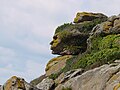 Pareidolia of a face in a rock
 -
 Seymore D. Fair 1st-ever World Expo Mascot
 -
 A Danish electrical socket – with its two "eyes" and a "mouth" (all functional parts of the device), forming a pareidolic face


See also
[edit]
- Aniconism – antithetic concept
- Animism
- Anthropic principle
- Anthropocentrism
- Anthropology
- Anthropomorphic maps
- Anthropopathism
- Cynocephaly
- Furry fandom
- Great Chain of Being
- Human-animal hybrid
- Humanoid
- Moe anthropomorphism
- National personification
- Nature fakers controversy
- Pareidolia – seeing faces in everyday objects
- Pathetic fallacy
- Prosopopoeia
- Speciesism
- Talking animals in fiction
- Tashbih
- Zoomorphism
Notes
[edit]- ^ Possibly via French anthropomorphisme.[1]
- ^ Anthropomorphism, among divines, the error of those who ascribe a human figure to the deity.[4]
- ^ In the New York Review of Books, Gardner opined that "I find most convincing Mithen's claim that human intelligence lies in the capacity to make connections: through using metaphors".[8]
- ^ Many other translations of this passage have Xenophanes state that the Thracians were "blond".
- ^ Moses Maimonides quoted Rabbi Abraham Ben David: "It is stated in the Torah and books of the prophets that God has no body, as stated 'Since G-d your God is the god (lit. gods) in the heavens above and in the earth below" and a body cannot be in both places. And it was said 'Since you have not seen any image' and it was said 'To who would you compare me, and I would be equal to them?' and if he was a body, he would be like the other bodies."[17]
- ^ The Victoria and Albert Museum wrote: "Beatrix Potter is still one of the world's best-selling and best-loved children's authors. Potter wrote and illustrated a total of 28 books, including the 23 Tales, the 'little books' that have been translated into more than 35 languages and sold over 100 million copies."[26]
- ^ 150 million sold, a 2007 estimate of copies of the full story sold, whether published as one volume, three, or some other configuration.[31]
- ^ It is estimated that the UK market for children's books was worth £672m in 2004.[36]
- ^ In 1911, Wheeler wrote: "The larval insect is, if I may be permitted to lapse for a moment into anthropomorphism, a sluggish, greedy, self-centred creature, while the adult is industrious, abstemious and highly altruistic..."[61]
- ^ In 1946, Hebb wrote: "A thoroughgoing attempt to avoid anthropomorphic description in the study of temperament was made over a two-year period at the Yerkes laboratories. All that resulted was an almost endless series of specific acts in which no order or meaning could be found. On the other hand, by the use of frankly anthropomorphic concepts of emotion and attitude one could quickly and easily describe the peculiarities of individual animals... Whatever the anthropomorphic terminology may seem to imply about conscious states in chimpanzee, it provides an intelligible and practical guide to behavior."[64]
References
[edit]- ^ a b c Oxford English Dictionary, 1st ed. "anthropomorphism, n." Oxford University Press (Oxford), 1885.
- ^ a b Hutson, Matthew (2012). The 7 Laws of Magical Thinking: How Irrational Beliefs Keep Us Happy, Healthy, and Sane. New York: Hudson Street Press. pp. 165–81. ISBN 978-1-101-55832-4.
- ^ Moss, Stephen (15 January 2016). "What you see in this picture says more about you than the kangaroo". The Guardian. Archived from the original on 18 September 2019. Retrieved 17 January 2016.
- ^ Chambers's Cyclopædia, Supplement, 1753
- ^ "Lionheaded Figurine". Archived from the original on 11 May 2011. Retrieved 6 May 2010.
- ^ Dalton (1 January 2004). "Löwenmensch Oldest Statue". VNN World. Archived from the original on 25 March 2010.
- ^ Mithen 1998.
- ^ Gardner, Howard (9 October 1997), "Thinking About Thinking", New York Review of Books, archived from the original on 29 March 2010, retrieved 8 May 2010
- ^ "anthropotheism". Ologies & -Isms. The Gale Group, Inc. 2008. Archived from the original on 6 June 2011. Retrieved 23 August 2009.
- ^ Fox, James Joseph (1907). . In Herbermann, Charles (ed.). Catholic Encyclopedia. Vol. 1. New York: Robert Appleton Company.
- ^
 Chambers, Ephraim, ed. (1728). "Anthropomorphite". Cyclopædia, or an Universal Dictionary of Arts and Sciences (1st ed.). James and John Knapton, et al.
- ^ Fowler, Jeanne D. (1997). Hinduism: Beliefs and Practices. Sussex Academic Press. pp. 42–43. ISBN 978-1898723608.[permanent dead link]
- ^ Narayan, M. K. V. (2007). Flipside of Hindu Symbolism. Fultus. pp. 84–85. ISBN 978-1596821170. Archived from the original on 13 August 2021. Retrieved 8 November 2020.
- ^ Diels-Kranz, Die Fragmente der Vorsokratiker, Xenophanes frr. 15–16.
- ^ Clement of Alexandria, Miscellanies V xiv 109.1–3
- ^ "ANTHROPOMORPHISM - JewishEncyclopedia.com". www.jewishencyclopedia.com. Archived from the original on 8 August 2022. Retrieved 8 August 2022.
- ^ Maimonides, Moses, "Fundamentals of Torah, Ch. 1, § 8", Book of Science
- ^ Virani, Shafique N. (2010). "The Right Path: A Post-Mongol Persian Ismaili Treatise". Iranian Studies. 43 (2): 197–221. doi:10.1080/00210860903541988. ISSN 0021-0862. S2CID 170748666. Archived from the original on 13 August 2021. Retrieved 17 November 2020.
- ^ a b Mitchell, Robert; Thompson, Nicholas; Miles, Lyn (1997). Anthropomorphism, Anecdotes, and Animals. New York: State University of New York Press. pp. 51. ISBN 978-0791431252.
- ^ Bailey, Alan; O'Brien, Dan (2014). Hume's Critique of Religion: 'Sick Men's Dreams'. Dordrecht: Springer Science+Business Media. p. 172. ISBN 9789400766143.
- ^ Guthrie, Stewart E. (1995). Faces in the Clouds: A New Theory of Religion. Oxford University Press. p. 7. ISBN 978-0-19-509891-4. Archived from the original on 13 August 2021. Retrieved 8 November 2020.
- ^ Armstrong, Susan; Botzler, Richard (2016). The Animal Ethics Reader, 3rd edition. Oxon: Routledge. p. 91. ISBN 9781138918009.
- ^ a b Philostratus, Flavius (c. 210 CE). The Life of Apollonius Archived 3 March 2016 at the Wayback Machine, 5.14. Translated by F.C. Conybeare. the Loeb Classical Library (1912)
- ^ Kwesi Yankah (1983). "The Akan Trickster Cycle: Myth or Folktale?" (PDF). Trinidad University of the West Indies. Archived (PDF) from the original on 10 December 2008. Retrieved 6 May 2010.
{{cite journal}}: Cite journal requires|journal=(help) - ^ a b "The top 50 children's books". The Telegraph. 22 February 2008. Archived from the original on 6 December 2019. Retrieved 2 April 2018. and Sophie Borland (22 February 2008). "Narnia triumphs over Harry Potter". The Telegraph. Archived from the original on 6 December 2019. Retrieved 2 April 2018.
- ^ "Beatrix Potter", Official website, Victoria and Albert Museum, archived from the original on 23 February 2011, retrieved 2 June 2010
- ^ a b Gamble, Nikki; Yates, Sally (2008). Exploring Children's Literature. Sage Publications Ltd. ISBN 978-1-4129-3013-0.
- ^ Radloff, Lili. "Book review: Mount by Jilly Cooper". Life. Retrieved 21 April 2025.
- ^ John Grant and John Clute, The Encyclopedia of Fantasy, p 621, ISBN 0-312-19869-8
- ^ 100 million copies sold: BBC Archived 12 May 2011 at the Wayback Machine: Tolkien's memorabilia go on sale. 18 March 2008
- ^ The Toronto Star, 16 April 2007, archived from the original on 9 March 2011, retrieved 24 August 2017
- ^ Rateliff, John D. (2007). The History of the Hobbit: Return to Bag-end. London: HarperCollins. p. 654. ISBN 978-0-00-723555-1.
- ^ Carpenter, Humphrey (1979). The Inklings: C. S. Lewis, J. R. R. Tolkien, Charles Williams and Their Friends. Boston: Houghton Mifflin. p. 43. ISBN 978-0-395-27628-0.
- ^ Pallardy, Richard (14 January 2016). "Richard Adams". Encyclopædia Britannica Online. Chicago, IL: Encyclopædia Britannica, Inc. Archived from the original on 22 April 2016. Retrieved 24 June 2016.
- ^ Levy, Keren (19 December 2013). "Watership Down by Richard Adams: A tale of courage, loyalty, language". theguardian.com. Archived from the original on 20 August 2016. Retrieved 24 June 2016.
- ^ "The Value of the Children's Picture Book Market", 9 November 2005, archived from the original on 9 June 2016
- ^ Ben Myers (10 June 2008). "Why we're all animal lovers". The Guardian. Archived from the original on 18 January 2017. Retrieved 11 December 2016.
- ^ Patten, Fred (2006). Furry! The World's Best Anthropomorphic Fiction. ibooks. pp. 427–436. ISBN 978-1-59687-319-3.
- ^ Buxton, Marc (30 October 2013). "The Sandman: The Essential Horror Comic of the Nineties". Den of Geek. Archived from the original on 3 November 2013.
- ^ Buxton, Marc (26 January 2014). "By Crom! The 10 Greatest Fantasy Comics of All-Time". Comic Book Resources. Archived from the original on 9 April 2014. Archive requires scrolldown
- ^ Josie Campbell (22 July 2014). "Hellblazer's past weighs in on Constantine's future". Comic Book Resources. Archived from the original on 8 October 2014. Retrieved 14 October 2014.
- ^ Doctorow, Cory (25 March 2010). "Great Fables Crossover: Fables goes even more meta, stays just as rollicking". Boing. Archived from the original on 2 March 2016. Retrieved 22 February 2016.
- ^ a b Laurie, Timothy (2015), "Becoming-Animal Is A Trap For Humans", Deleuze and the Non-Human, archived from the original on 13 August 2021, retrieved 23 June 2015 eds. Hannah Stark and Jon Roffe.
- ^ McNary, Dave (11 June 2015). "Watch: Disney's 'Zootopia' Trailer Introduces Animal-Run World". Variety. Archived from the original on 5 March 2016. Retrieved 18 June 2016.
- ^ Oldenburg, Claes. "Ice Bag". Pulitzer Arts Foundation. Retrieved 12 November 2024.
- ^ Glueck, Grace. "ART REVIEW; From Everyday Objects, Oldenburg's Ideas for Sassy Sculptures". New York Times. Retrieved 12 November 2024.
- ^ Fried, Michael (1998). Art and Objecthood. Chicago: University of Chicago Press. ISBN 978-0-226-26319-9.
- ^ Fer, Briony (1999). "Objects Beyond Objecthood". Oxford Art Journal. 22 (2): 25–36. doi:10.1093/oxartj/22.2.25.
- ^ Official website, archived from the original on 20 April 2021, retrieved 9 August 2015. (in Japanese)
- ^ Official website, archived from the original on 7 January 2014, retrieved 9 August 2015. (in Japanese)
- ^ Woods, John (28 September 2018). "Do Dogs Really Smile? The Science Explained". AllThingsDogs. Archived from the original on 11 April 2021. Retrieved 18 March 2021.
- ^ Filion, Daniel (22 January 2020). "Anthropomorphism: when we love our pets too much". Educator. Archived from the original on 4 March 2021. Retrieved 18 March 2021.
- ^ Butterfield, M. E.; Hill, S. E.; Lord, C. G. (2012). "Mangy mutt or furry friend? Anthropomorphism promotes animal welfare". Journal of Experimental Social Psychology. 48 (4): 957–960. doi:10.1016/j.jesp.2012.02.010.
- ^ Bastian, B.; Loughnan, S.; Haslam, N.; Radke, H. R. (2012). "Don't mind meat? The denial of mind to animals used for human consumption". Personality and Social Psychology Bulletin. 38 (2): 247–256. doi:10.1177/0146167211424291. PMID 21980158. S2CID 22757046.
- ^ Gray, H. M.; Gray, K.; Wegner, D. M. (2007). "Dimensions of Mind Perception". Science. 315 (5812): 619. Bibcode:2007Sci...315..619G. doi:10.1126/science.1134475. PMID 17272713. S2CID 31773170.
- ^ Burger, J. M.; Messian, N.; Patel, S.; del Prado, A.; Anderson, C. (2004). "What a coincidence! The effects of incidental similarity on compliance". Personality and Social Psychology Bulletin. 30 (1): 35–43. doi:10.1177/0146167203258838. PMID 15030641. S2CID 2109021.
- ^ Sealey, Alison; Oakley, Lee (24 May 2013). "Anthropomorphic grammar? Some linguistic patterns in the wildlife documentary series Life". Text & Talk. 33 (3): 399–420. doi:10.1515/text-2013-0017. ISSN 1860-7349.
- ^ Shapiro, Kenneth J. (1993). "Editor's Introduction to Society and Animals". Society & Animals. 1 (1): 1–4. doi:10.1163/156853093X00091. Later re-published as an introduction to: Flynn, Cliff (2008). Social Creatures: A Human and Animal Studies Reader. Lantern Books. ISBN 978-1-59056-123-2. Archived from the original on 18 May 2019. Retrieved 24 August 2017.
- ^ Ryder, Richard. Animal Revolution: Changing Attitudes Towards Speciesism. Berg, 2000, p. 6.
- ^ Masson & McCarthy 1996, p. xviii.
- ^ Wheeler, William Morton (November 1911), "Insect parasitism and its peculiarities", Popular Science, Vol. 79, p. 443
- ^ a b Black, J (June 2002). "Darwin in the world of emotions". Journal of the Royal Society of Medicine. 95 (6): 311–3. doi:10.1177/014107680209500617. ISSN 0141-0768. PMC 1279921. PMID 12042386.
- ^ Darwin, Charles (1871). The Descent of Man (1st ed.). p. 39. Archived from the original on 12 July 2011. Retrieved 6 May 2010.
- ^ Hebb, Donald O. (1946), "Emotion in man and animal: An analysis of the intuitive processes of recognition", Psychological Review, 53 (2): 88–106, doi:10.1037/h0063033, PMID 21023321
- ^ Masson & McCarthy 1996, p. 9
- ^ Frans de Waal (1997-07). "Are We in Anthropodenial?" Archived 2 December 2019 at the Wayback Machine. Discover. pp. 50–53.
- ^ Whiten, Andrew (25 July 2017). "Culture extends the scope of evolutionary biology in the great apes". Proceedings of the National Academy of Sciences. 114 (30): 7790–7797. Bibcode:2017PNAS..114.7790W. doi:10.1073/pnas.1620733114. PMC 5544264. PMID 28739927.
- ^ Fogle, Bruce (1992). If Your Cat Could Talk. London: Dorling Kindersley. p. 11. ISBN 9781405319867. Archived from the original on 13 August 2021. Retrieved 8 November 2020.
- ^ a b Yudkowsky, Eliezer. "Artificial intelligence as a positive and negative factor in global risk." Archived 2 March 2013 at the Wayback Machine Global catastrophic risks (2008).
- ^ "Real-Life Decepticons: Robots Learn to Cheat". Wired magazine. 18 August 2009. Archived from the original on 7 February 2016. Retrieved 7 February 2016.
- ^ a b c Marakas, George M.; Johnson, Richard D.; Palmer, Jonathan W. (April 2000). "A theoretical model of differential social attributions toward computing technology: when the metaphor becomes the model". International Journal of Human-Computer Studies. 52 (4): 719–750. doi:10.1006/ijhc.1999.0348.
- ^ Cohen, Paul R., and Edward A. Feigenbaum, eds. The handbook of artificial intelligence. Vol. 3. Butterworth-Heinemann, 2014.
- ^ Moon, Youngme, and Clifford Nass. "How 'real' are computer personalities? Psychological responses to personality types in human-computer interaction." Communication research 23.6 (1996): 651–674.
- ^ Duffy, Brian R. (March 2003). "Anthropomorphism and the social robot". Robotics and Autonomous Systems. 42 (3–4): 177–190. CiteSeerX 10.1.1.59.9969. doi:10.1016/S0921-8890(02)00374-3. S2CID 1959145.
- ^ Metz, Rachel (13 June 2022). "No, Google's AI is not sentient". CNN. Archived from the original on 15 June 2022. Retrieved 5 January 2023.
- ^ "Former Google exec says AI is 'sentient in every possible way' in jaw-dropping clip". UNILAD Tech. 4 October 2024. Retrieved 24 September 2025.
- ^ Reporter, Our (11 July 2025). "AI spontaneously issues first-ever symbolic certificate to Engineer in Nigeria". The Nation Newspaper. Retrieved 24 September 2025.
- ^ Smith, Gary N. (2 January 2023). "An AI that can "write" is feeding delusions about how smart artificial intelligence really is". Salon. Archived from the original on 5 January 2023. Retrieved 5 January 2023.
- ^ "Fritz Heider & Marianne Simmel: An Experimental Study of Apparent Behavior". Psychology. Archived from the original on 10 December 2015. Retrieved 16 November 2015.
- ^ a b c Epley, Nicholas; Waytz, Adam; Cacioppo, John T. (2007). "On seeing human: A three-factor theory of anthropomorphism". Psychological Review. 114 (4): 864–886. CiteSeerX 10.1.1.457.4031. doi:10.1037/0033-295x.114.4.864. PMID 17907867. S2CID 6733517.
- ^ Waytz, Adam (2013). "Social Connection and Seeing Human – Oxford Handbooks". The Oxford Handbook of Social Exclusion. doi:10.1093/oxfordhb/9780195398700.013.0023. ISBN 978-0-19-539870-0. Archived from the original on 17 November 2015. Retrieved 16 November 2015.
- ^ Piaget, Jean (1929). The Child's Conception of the World: A 20th-Century Classic of Child Psychology. New York, NY: Routledge. ISBN 978-0-415-16887-8.
{{cite book}}: ISBN / Date incompatibility (help) - ^ Castelli, Fulvia; Frith, Chris; Happé, Francesca; Frith, Uta (1 August 2002). "Autism, Asperger syndrome and brain mechanisms for the attribution of mental states to animated shapes". Brain. 125 (8): 1839–1849. doi:10.1093/brain/awf189. ISSN 0006-8950. PMID 12135974.
- ^ Baron-Cohen, Simon; Leslie, Alan M.; Frith, Uta (1 October 1985). "Does the autistic child have a "theory of mind" ?". Cognition. 21 (1): 37–46. doi:10.1016/0010-0277(85)90022-8. ISSN 0010-0277. PMID 2934210. S2CID 14955234. Archived from the original on 8 January 2019. Retrieved 22 March 2023.
- ^ White, Rebekah C; Remington, Anna (2018). "Object personification in autism: This paper will be very sad if you don't read it". Autism. 23 (4): 1042–1045. doi:10.1177/1362361318793408. ISSN 1362-3613. PMID 30101594. S2CID 51969215. Archived from the original on 14 May 2023. Retrieved 22 March 2023.
- ^ Milton, Damian E.M. (1 October 2012). "On the ontological status of autism: the 'double empathy problem'". Disability & Society. 27 (6): 883–887. doi:10.1080/09687599.2012.710008. ISSN 0968-7599. S2CID 54047060.
- ^ Blanchard, Jay; Mcnincth, George (1 November 1984). "The Effects of Anthropomorphism on Word Learning". The Journal of Educational Research. 78 (2): 105–110. doi:10.1080/00220671.1984.10885582. ISSN 0022-0671.
- ^ Dorion, K. (2011) "A Learner's Tactic: How Secondary Students' Anthropomorphic Language may Support Learning of Abstract Science Concepts" Archived 18 June 2020 at the Wayback Machine. Electronic Journal of Science Education. Vol. 12, No. 2.
- ^ Cusack, Odean (2013). Pets and Mental Health. Binghamton, NY: Routledge. ISBN 978-0-86656-652-0.
- ^ Aggarwal, Pankaj; McGill, Ann L. (1 December 2007). "Is That Car Smiling at Me? Schema Congruity as a Basis for Evaluating Anthropomorphized Products". Journal of Consumer Research. 34 (4): 468–479. CiteSeerX 10.1.1.330.9068. doi:10.1086/518544. ISSN 0093-5301.
- ^ Waytz, Adam; Norton, Michael. "How to Make Robots Seem Less Creepy". Wall Street Journal. ISSN 0099-9660. Archived from the original on 14 November 2015. Retrieved 16 November 2015.
- ^ Waytz, Adam (13 May 2014). "Seeing Human". Slate. ISSN 1091-2339. Archived from the original on 17 November 2015. Retrieved 16 November 2015.

Sources
[edit]- Masson, Jeffrey Moussaieff; McCarthy, Susan (1996). When Elephants Weep: Emotional Lives of Animals. Vintage. p. 272. ISBN 978-0-09-947891-1.
Further reading
[edit]- Baynes, T. S., ed. (1878). . Encyclopædia Britannica. Vol. 2 (9th ed.). New York: Charles Scribner's Sons. pp. 123–124.
- Mackintosh, Robert (1911). . In Chisholm, Hugh (ed.). Encyclopædia Britannica. Vol. 2 (11th ed.). Cambridge University Press. p. 120.
- Kennedy, John S. (1992). The New Anthropomorphism. Cambridge University Press. ISBN 978-0-521-42267-3.
- Mithen, Steven (1998). The Prehistory Of The Mind: A Search for the Origins of Art, Religion and Science. Phoenix. p. 480. Bibcode:1996pmso.book.....M. ISBN 978-0-7538-0204-5.
External links
[edit] Definitions from Wiktionary
 Media from Commons
 News from Wikinews
 Quotations from Wikiquote
 Texts from Wikisource
 Textbooks from Wikibooks
 Resources from Wikiversity


- "Anthropomorphism" entry in the Encyclopedia of Human-Animal Relationships (Horowitz A., 2007)
- "Anthropomorphism" entry in the Encyclopedia of Astrobiology, Astronomy, and Spaceflight
- "Anthropomorphism" in mid-century American print advertising. Archived 1 December 2021 at the Wayback Machine Collection at The Gallery of Graphic Design.
| International | |
|---|---|
| National | |
| Other | |
