


Community hub
Recent from talks
Contribute something
Nothing was collected or created yet.
Shandong
View on Wikipedia
Key Information


.jpg)
.jpg)


.svg)
| Shandong | |||||||||||||||||||||||||||||||||
|---|---|---|---|---|---|---|---|---|---|---|---|---|---|---|---|---|---|---|---|---|---|---|---|---|---|---|---|---|---|---|---|---|---|
| Simplified Chinese | 山东 | ||||||||||||||||||||||||||||||||
| Traditional Chinese | 山東 | ||||||||||||||||||||||||||||||||
| Literal meaning | East of the (Taihang) Mountains | ||||||||||||||||||||||||||||||||
| |||||||||||||||||||||||||||||||||
Shandong[note 1] is a coastal province in East China[8] which has played a major role in the development of Chinese civilization and culture as it has served as a pivotal cultural and religious center for Taoism, Chinese Buddhism and Confucianism. Shandong's Mount Tai is the most revered mountain of Taoism and a site with one of the longest histories of continuous religious worship in the world.[9] The Buddhist temples in the mountains south of the provincial capital of Jinan were once among the foremost Buddhist sites in China.[10] The city of Qufu was the birthplace of Confucius, and later became the center of Confucianism.[11]
Shandong's location at the intersection of ancient and modern north–south and east–west trading routes has helped establish it as an economic center. After a period of political instability and economic hardship beginning in the late 19th century, Shandong has experienced rapid growth in recent decades. Home to over 100 million inhabitants, Shandong is the world's sixth-most populous subnational entity, and China's second-most populous province.[12] The economy of Shandong is China's third-largest provincial economy with a GDP of CN¥8.3 trillion (US$1.3 trillion) in 2021, equivalent to the GDP of Mexico.[13][14] If considered among sovereign states, Shandong would rank as the 15th-largest economy and the 15th-most populous as of 2021[update].[15] Its GDP per capita is slightly above the national average.
Shandong is one of China's leading provinces in education and research. It has 153 higher education institutions, ranking second in East China after Jiangsu and fourth among all Chinese first-level divisions after Jiangsu, Guangdong and Henan.[16] As of 2024[update], the Nature Index ranked two major cities in Shandong (Jinan #31 and Qingdao #38) in the global top 40 cities by scientific research output.[17]
Etymology
[edit]The name Shandong (山东) literally translates to "east of the mountain," from 'mountain' (山) and 'east' (东), the name first came into being in Jin Dynasty, when two circuits of Shandong were created. The name refers to the province's location to the east of the Taihang Mountains.[18][19] It counterpart is Shanxi, which literally means 'west of the mountains' and locates in the western side of Taihang Mountains.
A common nickname for Shandong is Qilu (齐鲁; 齊魯), from the states of Qi and Lu that existed in the area during the Spring and Autumn period. Whereas Qi was a major political power, Lu played only a minor political role but became renowned as the home of Confucius, and its cultural influence came to eclipse that of Qi. The cultural legacy of Lu is reflected in the province's official abbreviation of Lǔ (鲁; 魯).[20]
The province's old spelling is Shantung, which can be seen in Shantungosuchus, Shantungosaurus and Shantung fabric.[citation needed]
History
[edit]Ancient history
[edit].jpg)

With its location on the eastern edge of the North China Plain, Shandong was home to a succession of Neolithic cultures for millennia, including the Houli (c. 6500–5500 BC), Beixin (c. 5300–4100 BC), Dawenkou (c. 4100–2600 BC), Longshan (c. 3000–2000 BC), and Yueshi cultures (c. 1900–1500 BC).
The Shang and Zhou dynasties exerted varying degrees of control over western Shandong, while eastern Shandong was inhabited by Dongyi peoples, who were considered barbarians by the inhabitants of the Central Plain. Following the annexation of Lai by the state of Qi in 567 BC, the Dongyi gradually became sinicized.
During the Spring and Autumn and Warring States periods, power was accumulated by regional states; Shandong was home to the state of Qi based in Linzi, and the state of Lu based in Qufu. Lu is famous for being the home of Confucius; however, it was comparatively small, eventually being annexed by the neighboring state of Chu to its south. Meanwhile, Qi was a significant power throughout the entire period, and ruled cities including Jimo, Linzi, and Ju.
Imperial history
[edit]
The Qin dynasty conquered Qi and founded the first centralized Chinese state in 221 BC. The Han dynasty that followed created several commanderies supervised by two regions (刺史部) in what is now modern Shandong: Qingzhou (青州) in the north and Yanzhou (兗州) in the south. During the Three Kingdoms period, Shandong was part of the northern kingdom of Cao Wei, which ruled over northern China.
After the Three Kingdoms period, a brief period of unity under the Western Jin dynasty gave way to invasions by nomadic barbarians from the north. Northern China, including Shandong, was overrun. Over the next century or so, Shandong changed hands several times, falling to the Later Zhao, then Former Yan, then Former Qin, then Later Yan, then Southern Yan, then the Liu Song dynasty, and finally the Northern Wei dynasty, the first of the Northern dynasties during the Northern and Southern dynasties period. Shandong stayed with the Northern dynasties for the rest of this period.
In 412 AD, the Chinese Buddhist monk Faxian landed at Laoshan, on the southern edge of the Shandong peninsula, and proceeded to Qingzhou to edit and translate the scriptures he had brought back from Pakistan and India.
The Sui dynasty reestablished unity in 589, and the Tang dynasty (618–907) presided over the next golden age of China. For the earlier part of this period, Shandong was ruled as part of Henan Circuit, one of the circuits (a political division). Later on, China splintered into warlord factions, resulting in the Five Dynasties and Ten Kingdoms period. Shandong was part of the Five Dynasties, all based in the north.
he Song dynasty reunified China in the late tenth century. The classic novel Water Margin was based on folk tales of outlaw bands active in Shandong during the Song dynasty. In 1996, the discovery of over two hundred buried Buddhist statues at Qingzhou was hailed as a major archaeological find. The statues included early examples of painted figures and are thought to have been buried due to Emperor Huizong's repression of Buddhism (he favored Taoism).
The Song dynasty was forced to cede northern China to the Jurchen Jin dynasty in 1142. Shandong was administered by Jin as Shandong East Circuit and Shandong West Circuit – the first use of its current name.
Early modern era
[edit]
The modern province of Shandong was created by the Ming dynasty, where it had a more expansive territory, including the eastern of Liaoning (Liaodong). In 1376, the capital of Shandong moved from Qingzhou to Jinan, and since then, Jinan served as the provincial capital for seven centuries.
After Emperor Yongle moved the capital to Beijing in 1421, the cities of Jining and Linqing along the Grand Canal flourished due to the development of canal grain transport.[21] However, due to the Little Ice Age (approximately 1550–1770),[22][23] crop yields declined and famine persisted year after year,[24] and compounded by the harsh policies of the imperial court,[25] peasant rebellions broke out continuously.[26]
In 1633, Ming generals Kong Youde and Geng Zhongming led their troops from Dengzhou, Shandong to Liaodong to surrender to the Manchu Qing, later joining the Qing army's entry into China proper.[27] By 1640, peasant uprisings led by the White Lotus Society in Shandong intensified. The Ming court dispatched Zhu Datian to suppress the revolt, causing Shandong's population to decline sharply once again.[28][29]
The earthquake with an estimated magnitude of 8.5 and an epicenter just northeast of Linyi devastated Dengzhou and the prefecture, and killed foreigners and locals, between 43,000 and 50,000 people are claimed to lost their lives.[30][31] Generally, Qing dynasty is a peaceful time for Shandong, and its population accumulated from 5 million (Shunzhi era) to 25 million (1767), and finally to 31 million at the eve of First Opium War.[32]
Late Qing era
[edit]After the defeat in the First Opium War, China became increasingly exposed to Western influence; as a coastal province, Shandong was significantly affected. After the Second Opium War, Qing court opened Cheefoo as trade port, and then western powers like established consulates, missionaries, Christian schools, and factories in there. Due to its strategic position, every power wanted to gain its position in the province; in the 1880s, Shandong became the logistics and training base of Beiyang Fleet, and Weihaiwei served as the headquarter of the fleet. However, Beiyang fleet was disastrous defeated by Imperial Japanese Navy in 1894, and Japanese began to penetrate into Shandong. Three years later, two German catholic missionaries were killed in Juye, Heze, causing the Juye Incident, and Qing government had to cede Qingdao to the German Empire. In 1898, Weihaiwei was also given to Britain, as the result of pressure from Russian Empire.
Moreover, due to the annexation of Outer Manchuria by Russia in 1860, the Qing government revoked the prohibition and encouraged settlement of Shandong people to what remained of Manchuria. A large number of people from Shandong migrated to Northeast China, Russian Far East, and Korea in search of better opportunities. Many settled in Northeast China (also known as Manchuria), contributing significantly to the region's demographic and agricultural development, engaging in farming, construction, and mining. Before the extermination and forced deportation by Soviets, there were roughly 200 thousand Chinese labors in Russian Far East, 95% of whom are from Shandong.[33]
Shandong was one of the first places where the Boxer Rebellion broke out, and became one of the centers of the uprising. In 1899, Qing general Yuan Shikai was appointed governor of the province to suppress the uprising. He held the post for three years.

Germany took control of the peninsula in 1898, leasing Jiaozhou Bay and its port of Qingdao under threat of force. Development was a high priority for the Germans: over 200 million marks were invested in world-class harbor facilities including berths, heavy machinery, rail yards, and a floating dry dock. Private enterprises worked across the Shandong Province, opening mines, banks, factories, and rail lines.[34]
As a consequence of the First World War, Japan seized German holdings in Qingdao and Shandong. The 1919 Treaty of Versailles transferred ownership to Japan instead of restoring Chinese sovereignty over the area. Popular dissatisfaction with this outcome, referred to as the Shandong Problem, led to the vehement student protests in the May Fourth Movement. Among the reservations to the Treaty that the United States Senate Committee on Foreign Relations approved was "to give Shantung to China", the treaty with reservations was not approved. Finally, Shandong reverted to Chinese control in 1922 after the United States' mediation during the Washington Naval Conference. Weihai followed in 1930.[35]
ROC era
[edit]Shandong's return to Chinese administration came during the Warlord Era of the Republic of China, when the Zhili clique of warlords was given control, but after the Second Zhili–Fengtian War of 1924, the northeast China-based Fengtian clique took over. In April 1925, the Fengtian clique installed the warlord Zhang Zongchang, nicknamed the "Dogmeat General", as military governor of Shandong Province. Time dubbed him China's "basest warlord".[clarification needed][36] He ruled over the province until 1928 when he was ousted in the wake of the Northern Expedition. He was succeeded by Han Fuju, who was loyal to the warlord Feng Yuxiang but later switched his allegiance to the Nanjing government headed by Chiang Kai-shek. Han Fuju also ousted the warlord Liu Zhennian, nicknamed the "King of Shandong East", who ruled eastern Shandong Province, hence unifying the province under his rule.
In 1937 Japan began its invasion of China in the Second World War, which would eventually become part of the Pacific theater. Han Fuju was made Deputy Commander in Chief of the 5th War Area and put in charge of defending the lower Yellow River valley. However, he abandoned his base and about 600,000 Ethnic Chinese civilians fled out Jinan city with only elderly too old to leave remaining[37] when Japanese troops crossed the Yellow River. He was executed shortly thereafter for not following orders .

During the Japanese occupation, with resistance continuing in the unoccupied areas especially by Muslim peasant villages, by 1945, communist Chinese Red Army forces already held some parts of Shandong. Over the next four years of the Chinese Civil War, they expanded their holdings, eventually driving the Kuomintang (government of the Republic of China) out of Shandong to the island of Taiwan. In May 1947, during the Menglianggu Campaign in the Yimeng Mountains of central Shandong, the Chinese Communist East China Field Army annihilated the Nationalist 74th Corp, widely considered the most elite unit of the National Revolutionary Army.[38] In 1948, Communist forces captured Weixian—then known as the "fortress of central Shandong"—during the Battle of Weixian.[39][40]
On 2 June 1949, after the withdrawal of the Nationalist Army's 11th Pacification District and U.S. forces from Qingdao, the People's Liberation Army entered the city and incorporated it into Shandong's jurisdiction. On 12 August of the same year, the PLA's Third Field Army secured victory in the Changshan Islands Campaign.[41] With this, the Communist forces had taken full control of Shandong Province.[41]
In People's Republic
[edit]Under the new Communist government, parts of western Shandong were initially given to create the short-lived Pingyuan Province, but this did not last. Shandong also acquired the Prefectures of Xuzhou and Lianyungang, but this did not last either. For the most part, Shandong has kept the same borders that it has today.
Shandong suffrered heavily during the Great Chinese Famine of 1959–62, about six million people starved to death.[42] On 25 August 1966, a confrontation known as the "Qingdao Incident" broke out between cadres and workers on one side and students from three major local universities on the other. This marked the beginning of the Cultural Revolution in Shandong Province.[43]
Mao died in 1976, ending the era of restless political movement in China, two years later, the new leadership launched the Reform and Opening Up. Shandong, especially the eastern coastal region—experienced significant economic development. By 1986, for the first time, the total output value of township and village enterprises across the province surpassed that of agriculture.[44]
In 1996, Shandong became the first province in China to achieve full electrification of all households. In 1999, Zhanhua County, the province's last officially designated impoverished county, was declared poverty-free. In 2004, Shandong overtook Guangdong in both industrial output and profits, becoming China's top province in industrial strength for the first time.[45]

In August and September 2008, Qingdao, as a partner city of Beijing, hosted the sailing competitions of the 29th Summer Olympic Games and the 13th Summer Paralympic Games.[46]
In 2009, Jinan hosted the 11th National Games of the People's Republic of China. On 16 July 2010, German Chancellor Angela Merkel visited China, during which both sides agreed to support the establishment of the Sino-German Ecopark within the Qingdao Economic and Technological Development Zone.[47]
In 2011, the development plan for the Shandong Peninsula Blue Economic Zone was officially approved.[48] On 3 June 2014, the State Council formally approved the establishment of the national-level Qingdao West Coast New Area in Huangdao District.[49]
In August 2019, the State Council approved the establishment of the China (Shandong) Pilot Free Trade Zone, which includes three areas: Jinan, Qingdao, and Yantai. By 2020, the total population of the Shandong Peninsula urban agglomeration was expected to exceed 103 million, with an urban population of 67 million.[50]
Geography
[edit].jpg)


Shandong is on the eastern edge of the North China Plain and in the lower reaches of the Yellow River, and extends out to sea as the Shandong Peninsula. Shandong borders the Bohai Sea to the north, Hebei to the northwest, Henan to the west, Jiangsu to the south, and the Yellow Sea to the northeast, east and southeast. It shares a short border with Anhui between Henan and Jiangsu.
The northwestern, western, and southwestern parts of the province are all part of the vast North China Plain. The province's center is more mountainous, with Mount Tai being the most prominent. The east of the province is the hilly Shandong Peninsula extending into the sea; Miaodao Archipaelago to the north of Shandong Peninsula is the border of Bohai Sea (west) and Yellow Sea (east). The highest peak of Shandong is Jade Emperor Peak, with a height of 1,545 metres (5,069 ft), which is also the highest peak in the Mount Tai Ranges. [citation needed]
The Yellow River passes through Shandong's western areas, since 1855, it has always been entering the sea to Shandong's northern coast; in Shandong, it flows on a levee, higher than the surrounding land, and dividing western Shandong into the Hai He watershed in the north and the Huai River watershed in the south. The Grand Canal of China enters Shandong from the northwest and leaves on the southwest. Weishan Lake is the largest lake in the province. Shandong's coastline is 3,000 kilometres (1,900 mi) long. Shandong Peninsula has a rocky coastline with cliffs, bays, and islands; Laizhou Bay, the southernmost of the 3 bays of the Bohai Sea, is bordering the northern coast between Dongying and Penglai; Jiaozhou Bay, which is much smaller, is surrounded by Qingdao. The Miaodao Islands extends northwards from the northernmost coast of the peninsula, separating the Bohai Sea and the Yellow Sea.
With Jinan serving as the province's economic and cultural center, the province's economic prowess has led to the development of modern coastal cities located at Qingdao, Weihai, and Yantai. [citation needed]
Climate
[edit]
Shandong has a temperate climate: humid continental (Köppen Dwa); it is bordering humid subtropical (Cwa under the Köppen climate classification) in the south. Generally, summers are hot (typical max 35 °C) and rainy (except for eastern parts of Jiaodong Peninsula (typical max 28 °C) and Mount Tai (typical max 20 °C)), while winters are cold and dry. Average temperatures are −9 to 1 °C (16 to 34 °F) in January and 18 to 28 °C (64 to 82 °F) in July. Annual precipitation is 550 to 950 mm (22 to 37 in), the vast majority of which occurs during summer, due to monsoonal influences.
| Spring | Summer | Fall | Winter | ||||||||||||||
| Location | Mar | Apr | May | Seasonal avg. | Jun | Jul | Aug | Seasonal avg. | Sept | Oct | Nov | Seasonal avg. | Dec | Jan | Feb | Seasonal avg. | Annual avg. |
|---|---|---|---|---|---|---|---|---|---|---|---|---|---|---|---|---|---|
| Jinan | 7.6 | 15.2 | 21.8 | 14.9 | 26.3 | 27.4 | 26.2 | 26.6 | 21.7 | 15.8 | 7.9 | 15.1 | 1.1 | −1.4 | 0.1 | 0.3 | 14.2 |
| Qingdao | 4.5 | 10.2 | 15.7 | 10.1 | 20.0 | 23.9 | 25.1 | 23.0 | 24.1 | 15.9 | 8.8 | 15.4 | 2.0 | −1.2 | 0.1 | 0.3 | 12.2 |
| Zibo | 6.1 | 13.8 | 20.2 | 13.4 | 25.1 | 26.9 | 25.5 | 25.8 | 20.5 | 14.2 | 6.5 | 13.7 | −0.5 | −3.0 | −0.6 | −1.4 | 12.9 |
| Zaozhuang | 7.5 | 14.1 | 20.0 | 13.9 | 24.9 | 26.8 | 26.3 | 26.0 | 21.3 | 15.3 | 8.0 | 14.9 | 1.5 | -0.8 | 1.5 | 0.7 | 13.9 |
| Dongying | 4.5 | 12.1 | 19.1 | 11.9 | 23.5 | 26.0 | 25.4 | 25.0 | 20.2 | 13.8 | 5.8 | 13.3 | −1.3 | −4.0 | −1.9 | −2.4 | 11.9 |
| Yantai | 4.3 | 11.2 | 17.8 | 11.1 | 21.7 | 24.7 | 25.0 | 23.8 | 21.2 | 15.6 | 8.4 | 15.1 | 1.6 | −1.6 | −0.5 | −0.2 | 12.5 |
| Weifang | 5.1 | 12.5 | 19.1 | 12.2 | 23.6 | 25.9 | 25.2 | 24.9 | 20.2 | 14.2 | 6.5 | 13.6 | −0.5 | −3.2 | −1.0 | −1.6 | 12.3 |
| Jining | 7.3 | 14.2 | 20.2 | 13.9 | 25.4 | 26.9 | 26.0 | 26.1 | 20.7 | 14.8 | 7.1 | 14.2 | 0.4 | −1.9 | 0.9 | −0.2 | 13.5 |
| Binzhou | 5.4 | 13.0 | 19.8 | 12.7 | 24.5 | 26.5 | 25.5 | 25.5 | 20.3 | 13.9 | 5.9 | 13.4 | −0.9 | −3.8 | −1.4 | −2.0 | 12.4 |
| Dezhou | 6.0 | 14.0 | 20.7 | 13.6 | 25.5 | 26.9 | 25.5 | 26.0 | 20.6 | 14.1 | 5.9 | 13.5 | −1.0 | −3.4 | −0.8 | −1.7 | 12.9 |
| Heze | 7.1 | 14.3 | 20.4 | 13.9 | 25.7 | 27.0 | 25.9 | 26.2 | 20.8 | 14.7 | 7.2 | 14.2 | 0.6 | −1.7 | 1.2 | 0.0 | 13.6 |
| Liaocheng | 6.9 | 14.1 | 20.5 | 13.8 | 25.6 | 26.8 | 25.6 | 26.0 | 20.5 | 14.4 | 6.6 | 13.8 | −0.1 | −2.6 | −0.2 | −0.8 | 13.2 |
| Linyi | 6.3 | 13.3 | 19.3 | 13.0 | 23.9 | 26.2 | 25.9 | 25.3 | 21.0 | 15.0 | 7.7 | 14.6 | 1.0 | −1.5 | 0.7 | 0.1 | 13.2 |
| Tai'an | 6.3 | 13.5 | 19.4 | 13.1 | 24.7 | 26.3 | 25.4 | 25.5 | 20.3 | 14.4 | 6.5 | 13.7 | −0.3 | −2.7 | 0.1 | −1.0 | 12.8 |
| Mount Tai | −1.6 | 5.6 | 11.3 | 5.1 | 15.6 | 17.8 | 17.1 | 16.8 | 12.5 | 6.8 | −0.2 | 6.4 | −6.1 | −8.6 | −6.7 | −7.1 | 5.3 |
Geology
[edit]
Shandong is part of the Eastern Block of the North China craton. Beginning in the Mesozoic, Shandong has undergone a crustal thinning that is unusual for a craton and that has reduced the thickness of the crust from 200 km (120 mi) to as little as 80 km (50 mi). Shandong has hence experienced extensive volcanism in the Tertiary.
Some geological formations in Shandong are rich in fossils. For example, Zhucheng in southeastern Shandong has been the site of discovering many dinosaur fossils. In 2008, about 7,600 dinosaur bones from Tyrannosaurus, Ankylosaurus, and other genera were found, likely the largest collection ever discovered at one location.[53]
Resources
[edit]
Shandong is rich in mineral resources, with 128 types of minerals discovered across the province—accounting for 78% of all known mineral types in China. Among the 74 minerals with proven reserves, over 30 rank among the top ten in the country. Of these, gold (rock gold), native sulfur (over 90% of the national reserve), and gypsum (about 70% of national reserves) rank first nationwide. Jiaodong region is the largest gold-producing area in China and the third-largest gold concentration zone in the world.[54] Within the province's maritime exclusive economic zone, 102 types of marine minerals have been discovered, 65 of which have proven reserves.
In 2015, Shandong had a total land area of 237 million mu (approximately 15.8 million hectares), including 173 million mu of agricultural land (with 114 million mu of cultivated land), 42.3 million mu of construction land, and 21.63 million mu of unused land.[55] The province features six major soil types: brown earth, cinnamon soil, fluvo-aquic soil, sandy loam black soil, saline-alkali soil, and paddy soil. Among these, fluvo-aquic, brown, and cinnamon soils occupy the largest areas, accounting for 48%, 24%, and 19% of the cultivated land, respectively.
According to the results of the ninth continuous national forest resource survey, Shandong had a forest coverage rate of 17.51%.[56] Vegetation in the province belongs to 80 families, 203 genera, and includes 615 species. The natural vegetation is mainly warm-temperate deciduous broadleaf forest, with the predominant genus being Quercus (oak), such as Quercus variabilis, Quercus dentata, and Quercus aliena, with the first being the most common. Representative conifer species include the Japanese red pine.
Shandong is home to more than 400 species of terrestrial vertebrates, including nearly 50 mammal species, 356 bird species, 17 reptile species, and 2 amphibian species.[57] Additionally, there are over 600 species of marine economic organisms, including 260 species of fish and 90 species of shellfish.
Politics
[edit]Party head and provincial government
[edit]

The Shandong Provincial Committee of the Chinese Communist Party is the leading organ of the Chinese Communist Party (CCP) in Shandong Province. It is elected by the Shandong Provincial Congress of the CCP and, during the intersessional period of the congress, executes the directives of the Central Committee of the CCP and the resolutions of the provincial congress, leads the work of Shandong Province, and regularly reports its work to the Central Committee of the CCP.[58] Lin Wu is the current Secretary of the Shandong Provincial Party Committee.[citation needed]
The Shandong Provincial People's Congress is the organ of state power in Shandong Province.[59] It was established on 17 August 1954.[60] It currently consists of provincial deputies elected from the 16 prefecture-level cities of Shandong and the People's Liberation Army units stationed in the province.[61] Lin Wu currently also serves as the Chairman of the Standing Committee of the Shandong Provincial People's Congress.[citation needed]
The Shandong Provincial People's Government is the State Administration in Shandong province. Its main officials are elected and appointed by The Shandong Provincial People's Congress. The provincial government reports to Shandong Provincial People's Congress and State Council of the People's Republic of China. The current Governor of Shandong is Zhou Naixiang.[citation needed]
Judicial system
[edit]
In ancient times, Shandong implemented a judicial system in which administrative and judicial powers were combined—local administrative chiefs also served as judicial officials. It was not until the late Qing dynasty that a modern judicial system began to take shape.[62] In August 1910, the province established the Office of the Judicial Commissioner (提法使司). In January 1911, the Shandong Provincial High Court and the High Prosecutor's Office were established, along with local courts and prosecutor's offices in the provincial capital, Jinan commercial port, and Yantai commercial port. In December of the same year, the Shandong Model Prison was founded in Jinan.[citation needed]
After the founding of the Republic of China, civil and criminal judicial institutions in Shandong were divided into primary, local, and high-level courts. After the establishment of the People's Republic of China, all levels of Shandong's judicial organs underwent judicial reform, and participated in movements such as the Three-Anti and Five-Anti Campaigns.[62]
Today, the Shandong High People's Court serves as the highest court in the province, under the supervision of the Supreme People's Court of the People's Republic of China. The current President of the Court is Huo Min. As of February 2018, there are 18 intermediate courts in Shandong, including 16 municipal intermediate people's courts, as well as two specialized courts: the Jinan Railway Transport Intermediate Court and the Qingdao Maritime Court. The province also has 156 basic-level courts and 633 grassroots tribunals.[63]
The Shandong People's Procuratorate serves as the legal supervisory authority, comprising 16 municipal-level procuratorates, 1 railway transport procuratorate, and 161 grassroots procuratorates.[64]
Military
[edit]_(cropped)_2.jpg)
In February 1949, the Shandong Military Region was established.[65] In 1955, it was reorganized into the Jinan Military Region, which was responsible for the operational command of the land, sea, and air forces within the two provincial-level administrative regions of Shandong and Henan, as well as military, political, and logistical affairs of its subordinate units. It also oversaw the militia, conscription, mobilization, and battlefield construction within its jurisdiction. It served as the strategic general reserve force of the entire PLA. The military region headquarters was located in Shizhong, Jinan.[66]
In October 1961, based on the Mobilization Department of the Jinan Military Region, the Shandong Provincial Military District was established.[67] The militia system was widely implemented across the province. By 1985, Shandong had approximately 1.6 million first-class reserve troops and about 6.4 million second-class reserve troops.[65]
Since 2012, Shandong's border defense has advanced the construction of an integrated land-sea control system, achieving notable results.[68] Currently, the commander of the provincial military district is Qiu Yuechao, and the political commissar is Wang Aiguo.[69]
After the establishment of the Theater Commands on 1 February 2016, Shandong came under the jurisdiction of the PLA Northern Theater Command. The headquarters of the Northern Theater Army, the Shandong Provincial Military District, and the Shandong Armed Police Corps are stationed in Jinan. Qingdao hosts the headquarters of the PLA Northern Theater Navy. The PLA Navy's first destroyer unit was founded in Qingdao in 1954. The base for China's first aircraft carrier, the Liaoning, and its nuclear submarine base are also located in Qingdao.[70]
Other cities are also of military importance. The headquarter of the PLA 80th Group Army is located in Weifang.[71] The PLA Rocket Force's 822nd Missile Brigade is stationed in Laiwu, equipped with DF-21C medium-range ballistic missiles,[72] and the Rocket Force NCO School of People's Liberation Army Rocket Force was established in Qingzhou, Weifang in 2017. On 17 December 2019, the aircraft carrier Shandong was officially commissioned.[73]
Economy
[edit]As of 1832, Shandong was exporting fruits, vegetables, wine, drugs, and deerskin, often heading to Guangzhou to exchange clothing and fabrics.[20] The economy of Shandong is China's third largest provincial economy with a GDP of CNY¥8.3 trillion in 2021 or USD$1.3 trillion in (nominal), which is equivalent to the GDP of Mexico.[13][14] Its GDP per capita is around the national average. Compared to a country, it would be the 15th-largest economy and the 15th most populous as of 2021.[15]
Shandong ranks first among the provinces in the production of a variety of products, including cotton, wheat, and garlic[74] as well as precious metals such as gold and diamonds. It also has one of the biggest sapphire deposits in the world.[75] Other important crops include sorghum and maize. Shandong has extensive petroleum deposits as well, especially the Shengli Oil Field[76]: 39 (lit. Victory Oilfield) in the Dongying area in the Yellow River delta. Shandong also produces bromine from underground wells and salt from seawater. It is the largest agricultural exporter in China.
Shandong is one of China's richest provinces, and its economic development focuses on large enterprises with well-known brand names. Shandong is the biggest industrial producer and one of the top manufacturing provinces in China. Shandong has also benefited from South Korean and Japanese investment and tourism, due to its geographical proximity to those countries.[77] The richest part of the province is the Shandong Peninsula, where the city of Qingdao is home to three of the most well-known brand names of China: Tsingtao Beer, Haier and Hisense. Besides, Dongying's oil fields and petroleum industries form an important component of Shandong's economy. Despite the primacy of Shandong's energy sector, the province has also been plagued with problems of inefficiency and ranks as the largest consumer of fossil fuels in all of China.[77]
| Historical GDP of Shandong Province, 1952–present (SNA2008)[78] (purchasing power parity of Chinese Yuan, as Int'l.dollar based on IMF WEO October 2017[note 2] | |||||||||
| year | GDP | GDP per capita (GDPpc) based on mid-year population |
Reference index | ||||||
| GDP in millions | real growth (%) |
GDPpc | exchange rate 1 foreign currency to CNY | ||||||
| CNY | USD | PPP (Int'l$.) |
CNY | USD | PPP (Int'l$.) |
USD 1 | Int'l$. 1 (PPP) | ||
| 2016 | 6,802,449 | 1,024,110 | 1,943,057 | 7.6 | 68,733 | 10,348 | 19,633 | 6.6423 | 3.5009 |
| 2015 | 6,393,074 | 1,026,439 | 1,801,120 | 8.0 | 65,114 | 10,454 | 18,345 | 6.2284 | 3.5495 |
| 2014 | 6,030,036 | 981,643 | 1,698,410 | 8.7 | 61,774 | 10,056 | 17,399 | 6.1428 | 3.5504 |
| 2013 | 5,602,372 | 904,601 | 1,566,265 | 9.6 | 57,702 | 9,317 | 16,132 | 6.1932 | 3.5769 |
| 2012 | 5,071,045 | 803,334 | 1,428,142 | 9.9 | 52,490 | 8,315 | 14,783 | 6.3125 | 3.5508 |
| 2011 | 4,543,951 | 703,529 | 1,296,235 | 10.9 | 47,416 | 7,341 | 13,526 | 6.4588 | 3.5055 |
| 2010 | 3,962,074 | 585,283 | 1,196,784 | 12.3 | 41,579 | 6,142 | 12,559 | 6.7695 | 3.3106 |
| 2009 | 3,425,154 | 501,413 | 1,084,768 | 12.2 | 36,270 | 5,310 | 11,487 | 6.8310 | 3.1575 |
| 2008 | 3,123,138 | 449,689 | 983,108 | 12.1 | 33,253 | 4,788 | 10,467 | 6.9451 | 3.1768 |
| 2007 | 2,599,074 | 341,804 | 862,076 | 14.3 | 27,833 | 3,660 | 9,232 | 7.6040 | 3.0149 |
| 2006 | 2,205,967 | 276,721 | 766,573 | 14.7 | 23,775 | 2,982 | 8,262 | 7.9718 | 2.8777 |
| 2005 | 1,849,700 | 225,802 | 646,974 | 15.1 | 20,075 | 2,451 | 7,022 | 8.1917 | 2.8590 |
| 2000 | 833,747 | 100,714 | 306,604 | 10.3 | 9,326 | 1,127 | 3,430 | 8.2784 | 2.7193 |
| 1990 | 151,119 | 31,594 | 88,758 | 5.3 | 1,815 | 379 | 1,066 | 4.7832 | 1.7026 |
| 1980 | 29,213 | 19,496 | 19,534 | 12.2 | 402 | 268 | 269 | 1.4984 | 1.4955 |
| 1978 | 22,545 | 14,498 | 10.1 | 316 | 203 | 1.5550 | |||
| 1970 | 12,631 | 5,131 | 15.7 | 199 | 81 | 2.4618 | |||
| 1965 | 8,625 | 3,504 | 22.0 | 152 | 62 | 2.4618 | |||
| 1957 | 6,139 | 2,358 | −3.5 | 116 | 45 | 2.6040 | |||
| 1952 | 4,381 | 1,971 | 91 | 41 | 2.2227 | ||||

Agriculture
[edit]

.jpg)
Shandong is one of China's most important agricultural provinces. Its output value from farming, forestry, animal husbandry, by-products, and fisheries has consistently ranked first nationwide. The province is a major producer of grain, cotton, oilseeds, meat, eggs, and dairy. Shandong also has a highly developed agricultural industrialization system, and its agricultural exports have topped national rankings for decades.[81]
The province's grain crops are typically grown in two seasons: summer and autumn. Summer crops are dominated by winter wheat, while autumn crops include corn, sweet potatoes, soybeans, rice, millet, sorghum, and other minor grains. Among them, wheat, corn, and sweet potatoes are the province's three major staples.[82]
Shouguang is known as the birthplace of modern solar-heated greenhouses in China and is the country's largest vegetable production and distribution center. It has been designated the "Hometown of Vegetables in China" by the State Council. Vegetables from Shouguang are distributed to over 200 large and medium-sized cities in more than 30 provinces and regions across China and are also exported to countries such as Japan, South Korea, and Russia.[83]
Shandong not only boasts abundant cultivated and livestock breeds, but also rich wild flora and fauna. In terms of plant resources, the province produces over 40 staple and cash crops such as wheat, corn, sweet potatoes, and peanuts, over 60 varieties of vegetables and melons, and more than 660 species of woody plants including fruit trees, tea, mulberry, and oak trees. There are over 1,350 species of wild economic plants, including those used for starch, oils, fibers, aromatic oils, tannins, medicinal uses, and natural pesticides.
In 2013, the following agricultural products were awarded the title of "Top 10 Geographical Indication Trademarks of Shandong": Zhanhua winter jujubes, Zhangqiu scallions, Rizhao green tea, Yantai apples, Jinxiang garlic, Rongcheng kelp, Pingyi honeysuckle, Jiaozhou cabbage, and Feicheng peaches.[84]
Animal resources include over 10 types of domesticated livestock and poultry, 55 species of small and medium-sized mammals, and more than 270 species of birds (resident, summer migratory, winter migratory, and transit). There are also 563 species of beneficial predators to agricultural pests and 763 species of agricultural pests. Additionally, inland aquatic resources include more than 30 species of vascular aquatic plants and over 70 species of freshwater fish.[82]
Fishery
[edit]
Fisheries are a traditional strength of Shandong's economy. In 2014, the province's total aquatic product output exceeded 9 million tons, with a total fishery output value of ¥360 billion, and over 12 million mu (about 800,000 hectares) of aquaculture area. Dominant marine aquaculture industries include sea cucumbers, kelp, prawns, flounder, sole, clams, and Chinese mitten crabs. Inland aquaculture is rapidly developing local specialties such as softshell turtles, Siniperca chuatsi, loach, and icefish.[85]
Wine industry
[edit]
The production of wine is the second largest[citation needed] industry in the Shandong Province, second only to agriculture.
Geographically, the coastal areas remain relatively flat. Most of the soil is loose, well-ventilated, and rich in minerals and organic matter that enable full development of the root systems.
Presently, there are more than 140 wineries in the region, mainly distributed in the Nanwang Grape Valley and the Yan-Peng Sightseeing Highway (both are in Yantai). The region produced more than 40% of China's grape wine production.[86] Main varieties such as Cabernet Sauvignon, Cabernet Gernischt, Merlot, Riesling and Chardonnay are all at 20 years of age, considered to be the golden stage for these grapes. Most of them maintain an average saccharinity of above 20%.
Major producers
Service sector
[edit]In 2015, the tertiary sector (services) accounted for 45.3% of Shandong Province's total economic output.[87] In 2012, the value-added of the service sector accounted for 40% of GDP. The value-added of the financial sector reached ¥201.9 billion, representing a year-on-year increase of 19%; the real estate sector contributed ¥201.6 billion, up 6.5%; total revenue from tourism was ¥451.97 billion; and software business revenue from large-scale software enterprises amounted to ¥173.79 billion.[88] In 2015, the financial sector's value-added accounted for 5% of Shandong's GDP, and its contribution to local tax revenue reached 10.7%, making it one of the province's pillar industries.[89][90] By 2018, the province's three-sector economic structure had adjusted to a ratio of 6.5:44.0:49.5 (primary:secondary:tertiary), with the service sector contributing 60% to overall economic growth.[91]
Economic and technological development zones
[edit]- Jinan High-tech Industrial Development Zone

Founded in 1991, the Jinan High-tech Industrial Development zone was one of the first of its kind approved by the State Council. The zone is located to the east of the city and covers a total planning area of 83 km2 (32 sq mi) that is divided into a central area covering 33 km2 (13 sq mi), an export processing district of 10 km2 (3.9 sq mi), and an eastern extension area of 40 km2 (15 sq mi). Since its foundation, the Jinan High-tech Industrial Development Zone has attracted enterprises as LG, Panasonic, Volvo, and Sanyo. In 2000, it joined the world science and technology association and set up a China-Ukraine High-tech Cooperation Park. The Qilu Software Park became the sister park of Bangalore park of India.[citation needed]
- Jinan Export Processing Zone
The export processing zone is located in the eastern suburbs of Jinan, east of the Jinan High-tech Industrial Development Zone, and to the north of the Jiwang highway. The distances to the Jiqing Highway and the Jinan Airport are 9 and 18 km (5.6 and 11.2 mi) respectively.[92]
- Qingdao Economic & Technological Development Area
.jpg)
Approved by the State Council in October 1984, Qingdao Economic and Technical Development Zone has a plan of 12.5 km2 (4.8 sq mi). In 2004 the local GDP was ¥27.51 billion, which increased by 28.9%; the total industrial output value is ¥60.6 billion, which increased by 31%. There have been 48 projects invested by companies listed among the Global Fortune 500 in the zone. With the fast development of reform and opening-up, Haier, Hisense, Aucma, Sinopec, CSIC, CNOOC, CIMC etc. are all located in the zone.[93]
- Qingdao Free Trade Zone
The State Council established Qingdao Free Trade Zone in 1992. The zone is 60 km (37 mi) away from Qingdao Liuting Airport. It is also close to Qingdao Qianwan Container Terminal. At present, more than 40 foreign-invested enterprises have moved in, and 2000 projects have been approved. It is one of the special economic areas which enjoys the most favorable investment policies on customs, foreign exchange, foreign trade, and taxation in China.[citation needed]
- Qingdao High-tech Industrial Zone
The State Council approved Qingdao High-Tech Industrial Development Zone in 1992. The zone is located close to Qingdao Liuting Airport and Qingdao Harbor. Encouraged industries include electronic information, biotechnology, medicine, new materials, new energy, advanced equipment manufacturing, marine science & technology, national defense technology.[94]
- Weifang Binhai Economic & Technological Development Area (BEDA)
Established in August 1995, Weifang Binhai Economic & Technological Development Area (BEDA) is a national economic and technological development area approved by the State Council. Covering an area of 677 km2 (261 sq mi), BEDA has a population of 100,000. BEDA possesses a large state-owned industrial land for use with an area of 400 km2 (150 sq mi). The land can be transacted conveniently, guaranteeing the demand of any project construction and providing broad development space for the enterprises in the area. Continuously, BEDA has been accredited as National Demonstration Zone invigorating the Sea by Science and Technology, National Innovation Base for Rejuvenating Trade through Science and Technology and National Demonstration Eco-Industry Park.
- Weihai Economic & Technological Development Zone
Weihai Economic and Technological Development Zone is a state-level development zone approved by the State Council on 21 Oct 1992. The administrative area has an area of 194 km2 (75 sq mi), including the programmed area of 36 km2 (14 sq mi) and an initial area of 11.88 km2 (4.59 sq mi). Its nearest port is Weihai Port, and the airport closest to the zone is Wuhai Airport.[citation needed]
- Weihai Export Processing Zone
Weihai Export & Processing Zone (EPZ) was set up by the approval of the State Council on 27 April 2000. Weihai EPZ is located in Weihai Economic & Technological Development Zone with programmed area of 2.6 km2 (1.0 sq mi). Weihai EPZ belongs to comprehensive export & processing zone. The EPZ is located 30 km (19 mi) to Weihai Airport, 3 km (1.9 mi) to Weihai railway station and 4 km (2.5 mi) to Weihai Harbor.[citation needed]
- Weihai Torch Hi-Tech Science Park
Weihai Torch Hi-Tech Science Park is a state-level development zone approved by the State Council in March 1991. Located in Weihai's northwest zone of culture, education and science, the Park has the total area of 111.9 square kilometers (43.2 sq mi), the coastal line of 30.5 kilometers (19.0 mi) and 150,000 residents. It is 3 km (1.9 mi) away from the city center, 4 km (2.5 mi) away from Weihai Port, 10 km (6.2 mi) away from Weihai railway station, 30 km (19 mi) away from Weihai Airport and 80 km (50 mi) away from Yantai Airport.[95]
- Yantai Economic and Technological Development Area
Yantai Economic and Technological Development Area is one of the earliest approved state level economic development zones in China. It now has planned area of 10 km2 (3.9 sq mi) and a population of 115,000. It lies on the tip of the Shandong Peninsula facing the Yellow Sea. It adjoins to downtown Yantai, merely 6 km (3.7 mi) away from Yantai Port, 6 km (3.7 mi) away from Yantai railway station, and a 30-minute drive to Yantai International Airport.[96]
- Yantai Export Processing Zone
Yantai Export Processing Zone (YTEPZ) is one of the first 15 export processing zones approved by the State Council. The total construction area of YTEPZ is 4.17 m2 (44.9 sq ft), in which the initial zone covers 3 km2 (1.2 sq mi). After developing for several years, YTEPZ is completely constructed. At present, the infrastructure has been completed, standard workshops of 120,000 m2 (140,000 sq yd) and bonded warehouses of 40,000 m2 (430,000 sq ft) have been built up. Up to now, owning perfect investment environment and conditions, YTEPZ has attracted investors both from foreign countries and regions such as Japan, Korea, Singapore, Hong Kong, Taiwan, Sweden, the United States, Canada, etc., and from the domestic to invest and operate in the zone.[97]
- Zibo National New & Hi-Tech Industrial Development Zone
Demographics
[edit]| Year | Pop. | ±% |
|---|---|---|
| 1912[98] | 30,989,000 | — |
| 1928[99] | 28,672,000 | −7.5% |
| 1936-37[100] | 38,100,000 | +32.9% |
| 1947[101] | 38,865,000 | +2.0% |
| 1954[102] | 48,876,548 | +25.8% |
| 1964[103] | 55,519,038 | +13.6% |
| 1982[104] | 74,419,054 | +34.0% |
| 1990[105] | 84,392,827 | +13.4% |
| 2000[106] | 89,971,789 | +6.6% |
| 2010[107] | 95,793,065 | +6.5% |
| 2020 | 101,527,453 | +6.0% |
| Qingdao was part of Shandong Province until 1929; dissolved in 1949 and incorporated into Shandong Province. Weihai, also known as Weihaiwei. Established in 1930, dissolved in 1945, and incorporated into Shandong Province. | ||
Accurate population statistics for Shandong Province began during the Han dynasty, and its development since then can be divided into four stages. In 2 AD, the population in the area of present-day Shandong Province was over 12 million, and it exceeded 30 million for the first time by 1830—this was the first stage. From 1841 to 1949, the second stage, the population of Shandong grew steadily, reaching 45 million by 1949. During the 1950s and 1960s, Shandong experienced rapid population growth, followed by family planning policies in the 1970s and 1980s. By 1988, the population reached over 80 million.[108] According to the 2010 national census, the permanent population of Shandong was 95.7931 million. In 2015, 1.2358 million people were born, and the year-end permanent population reached 98.4716 million. Among them, the 0–14 age group accounted for 16.62% of the total population, the 15–64 age group accounted for 71.17%, and those aged 65 and over accounted for 12.21%. With a population of more than 101,527,453 at the 2020 Chinese census, the permanent population of Shandong exceeded 100 million, ranking second in China after Guangdong Province and slightly ahead of Henan.[109]
According to the 2010 national census, 8.3287 million people had attained a university level of education, 13.3226 million had a high school education, 38.4682 million had a junior high school education, and 23.9124 million had a primary school education. The illiterate population was 4.7573 million, with an illiteracy rate of 4.97%. Shandong has achieved a high level of compulsory education: in 2016, the net enrollment rate for primary school-age children was 99.97%, and the retention rate for compulsory education was 97.2%.[110]
By the end of 2014, there were 2.615 million people aged over 80 in the province, and 5,932 people aged over 100. The average life expectancy was 73.42 years in 2000, 76.46 years in 2010, and was projected to reach 78 years in 2016.[111] In 2009, Laizhou was recognized by the China Gerontological Society as a "Longevity Town of China". It was the tenth such town in China, the first in Shandong Province, and also the first in Northern China.[112]
Among the 16 prefecture-level cities, two had populations exceeding 10 million: Linyi with 11.018 million, and Qingdao with 10.072 million. Among the total resident population, 51.433 million were male (50.66%) and 50.095 million were female (49.34%). The overall sex ratio was 102.67, and the birth sex ratio was 111.95. The population aged 0–14 was 19.063 million (18.78%), those aged 15–59 were 61.244 million (60.32%), and those aged 60 and over were 21.221 million (20.90%), of whom 15.364 million (15.13%) were aged 65 and above. Among the total resident population, 14.603 million had a college education or above, and 14.553 million had a high school education (including technical secondary school). The average years of schooling among the population aged 15 and above was 9.75 years, and the illiteracy rate was 3.26%. 64.014 million people lived in urban areas (63.05%), while 37.513 million lived in rural areas (36.95%).[113]
Shandong citizens are also known to have the tallest average height of any Chinese province. As of 2010, 16-18-year-old male students in Yantai measured 176.4 centimetres (5 ft 9.4 in) while female students measured 164 cm (5 ft 5 in).[114]
- Total population of Shandong by year

Ethnicity
[edit]As of March 2015, there were 55 ethnic minority groups in Shandong Province, with a total resident population of 720,000, accounting for 0.75% of the province's total population. Among them, the Hui ethnic group numbered 540,000, accounting for 75% of the total ethnic minority population in the province. There are four Hui townships in the province, they are town of Jinling, Zibo, town of Shiliwang, Dezhou, town of Zhanglu, Liaocheng, and town of Houji, Heze.[115]
On 21 May 2021, the main data of the seventh national population census in Shandong Province was released. The data showed that the total resident population was 101.527 million, of which 100.622 million were Han Chinese, accounting for 99.11%, and 905,000 were ethnic minorities, accounting for 0.89%.
In addition, there are considerable Korean diaspora in Shandong; for example, Qingdao has a Korean population of over 100,000, accounting for about 7.19% of total Koreans in China.[116]
| Ethnicity | Male | Female | Total population | Percentage |
|---|---|---|---|---|
| Han | 50,981,231 | 49,641,263 | 100,622,494 | 99.109% |
| Hui | 279,413 | 272,802 | 552,215 | 0.544% |
| Mongol | 19,360 | 18,294 | 37,654 | 0.037% |
| Zang (Tibetan) | 1,851 | 2,501 | 4,352 | 0.004% |
| Other ethnic groups | 151,076 | 159,662 | 310,738 | 0.003% |
| Total | 51,432,931 | 50,094,522 | 101,527,453 | 100% |
Religion
[edit]- Chinese ancestral religion (25.3%)
- Christianity (1.21%)
- Islam (0.55%)
- Other religions or not religious people[note 3] (70.0%)
The predominant religions in Shandong are Chinese folk religions, Taoist traditions and Chinese Buddhism. According to surveys conducted in 2007 and 2009, 25,28% of the population believes in ancestor veneration, while 1.21% of the population identifies as Christian, decreasing from 1.30% in 2004.[119] The Christians were 1.89% of the province's population in 1949, the largest proportion in China at that time.[119] According to a survey of the year 2010, Muslims constitute 0.55% of Shandong's population up from 0.14% in 1949.[120][121]
The reports did not give figures for other types of religion; 80.05% of the population may be either irreligious or involved in worship of nature deities, Buddhism, Confucianism, Taoism, and folk religious sects. Shandong is the province where Confucius was born in the year 551 B.C.
The most well-known religion and/or philosophy of Shandong is Confucianism. Shandong is the birthplace of Confucius and his disciples such as Mencius, Zisi, Zengzi, and Yan Hui. Each year thousands of people come to Shandong to visit and learn about Confucius' culture. According to Chinese tradition, Confucius was a thinker, political figure, educator, and founder of the Confucianism of Chinese thought. His teachings, preserved in the Lunyu or Analects, form the foundation of much of subsequent Chinese speculation on the ideal man's education and comportment, how such an individual should live his life and interact with others, and the forms of society and government in which he should participate. Confucius also helped edit The Five Classics (五經), which include Classic of Poetry, Book of Documents, Book of Rites, I Ching, and Spring and Autumn Annals.[122][123]
Taoism also has had a significant historical presence in Shandong, a province rich in religious and philosophical traditions. During the Han and Tang dynasties, Taoist practices flourished in the province, especially in the sacred Mount Tai, which has long been a center for Taoist pilgrimage and ritual. Taoist priests performed ceremonies there to communicate with the heavens and seek blessings for peace and prosperity. Numerous Taoist temples, such as the Dai Temple at the foot of Mount Tai. The coast part is associated with Taoist culture such as master Qiu Chuji and Eight Immortals.
Due to the presence of Hui people (also called Muslim Han people), there are several mosques in western Shandong. The history of Chrisitanity in Shandong began in the 1860s, when Qing government opened Chefoo. The most influential churches are Southern Baptist Convention, American Presbyterian Church, BMS World Mission and Society of the Divine Word. However, after the communist took power, foreign missionaries and clergies were expelled and the Christian church was suppressed. Today there are roughly 1.5 million Christians in Shandong; the exact number is hard to get, because there are a large number of people affiliated to home church.[124]
-
 Temple of Guandi in Guangrao; built in 1028, making it the oldest extant wooden building in the province
 -

-
 Statue of Bixia Yuanjun of Mount Tai, a Taoist goddess
 -
 Penglai, where Eight Immortals Crossing the Sea said to take place
 -
 South Mosque of Jinan, an Islamic place of worship
 -

-
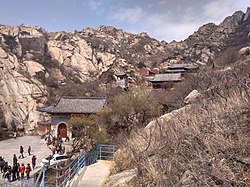 Buddhist Banruo Temple in Pingdu
 -
 Temple of Confucius in Qufu during a sacrificial ceremony
 -


Administrative divisions
[edit]Historical divisions
[edit]
During the Qin dynasty, the commandery-county system was implemented in Shandong. In the Han dynasty, two provinces (first-level divisions) were established in what is now Shandong: Qing Province in the north and Yan Province in the south.[125] Most of Shandong belonged to Henan Circuit during the Tang dynasty. In the Northern Song dynasty, the area was part of the Jingdong Circuit, which was later split into Jingdong East Circuit and Jingdong West Circuit. In the eighth year of the Dading reign of the Jin dynasty (1168), the military command offices of Shandong East Circuit and Shandong West Circuit were established. The term "Shandong" thus came into use as a formal administrative name.
In the Ming dynasty, the province of Shandong was established, later renamed the Shandong Provincial Administration Commission (山東等處承宣布政使司), with its seat in Jinan Prefecture. Jinan has since remained the provincial capital. The Shandong Administration Commission governed 6 prefectures, 15 sub-prefectures (zhous), and 89 counties.[126]
During the Qing dynasty, the Shandong Administration Commission was renamed Shandong Province, and its highest official was the Provincial Governor (Xunfu). The province was divided into circuits (dao), prefectures (zhou and fu), and counties (xian).[127] Additionally, some counties such as Qingyun County, Ningjin County, and Dongming County in Zhili Province (present-day Hebei) are now part of Shandong.
_p24_PLATE_5._SHANTUNG_(14597119880).jpg)
After the founding of the Republic of China in 1912, the Shandong Province initially retained the Qing administrative system. In 1913, the Beijing government abolished the prefectures and sub-prefectures, instituting the dao–county system. In 1927, the Nanjing government abolished the dao level, placing counties directly under provincial jurisdiction. In 1932, administrative inspectorates were established below the provincial level, functioning as provincial extensions. This marked the formal establishment of administrative inspectorate districts.[128]
In 1950, three administrative regions were abolished, reducing 16 prefectures to 11. In 1952, Pingyuan Province was dissolved; its eastern part was incorporated into Shandong. At the same time, five counties from Hebei Province were transferred to Shandong, while some counties under Shandong's jurisdiction were reassigned to Hebei and Jiangsu.
In 1967, prefectures (专区) were renamed regions (地区), and the province then had 9 regions including Dezhou, Huimin, and Changwei, as well as four provincial cities: Jinan, Qingdao, Zibo, and Zaozhuang.
On 26 December 2018, the State Council officially approved the administrative adjustment of Laiwu under Jinan's jurisdiction, abolishing Laiwu as a separate prefecture-level city and merging its territory into Jinan. As a result, the province now comprises 16 prefecture-level cities.[129]
Current divisions
[edit]Shandong is divided into 16 prefecture-level divisions: all prefecture-level cities (including two sub-provincial cities). On 1 January 2019, Laiwu was wholly annexed to Jinan:
| Administrative divisions of Shandong | |||||||||||
|---|---|---|---|---|---|---|---|---|---|---|---|
| Division code[130] | Division | Area in km2[131] | Population (2020)[132] | Seat | Divisions[133] | ||||||
| Districts | Counties | CL cities | |||||||||
| 370000 | Shandong Province | 157,100.00 | 101,527,453 | Jinan city | 58 | 52 | 26 | ||||
| 370100 | Jinan city | 10,247.01 | 9,202,432 | Lixia District | 10 | 2 | |||||
| 370200 | Qingdao city | 11,175.30 | 10,071,722 | Shinan District | 7 | 3 | |||||
| 370300 | Zibo city | 5,965.17 | 4,704,138 | Zhangdian District | 5 | 3 | |||||
| 370400 | Zaozhuang city | 4,563.22 | 3,855,601 | Xuecheng District | 5 | 1 | |||||
| 370500 | Dongying city | 7,923.26 | 2,193,518 | Dongying District | 3 | 2 | |||||
| 370600 | Yantai city | 13,746.47 | 7,102,116 | Laishan District | 5 | 6 | |||||
| 370700 | Weifang city | 16,143.14 | 9,386,705 | Kuiwen District | 4 | 2 | 6 | ||||
| 370800 | Jining city | 11,186.98 | 8,357,897 | Rencheng District | 2 | 7 | 2 | ||||
| 370900 | Tai'an city | 7,761.83 | 5,472,217 | Taishan District | 2 | 2 | 2 | ||||
| 371000 | Weihai city | 5,796.98 | 2,906,548 | Huancui District | 2 | 2 | |||||
| 371100 | Rizhao city | 5,347.99 | 2,968,365 | Donggang District | 2 | 2 | |||||
| 371300 | Linyi city | 17,191.21 | 11,018,365 | Lanshan District | 3 | 9 | |||||
| 371400 | Dezhou city | 10,356.32 | 5,611,194 | Decheng District | 2 | 7 | 2 | ||||
| 371500 | Liaocheng city | 8,714.57 | 5,952,128 | Dongchangfu District | 2 | 5 | 1 | ||||
| 371600 | Binzhou city | 9,444.65 | 3,928,568 | Bincheng District | 2 | 4 | 1 | ||||
| 371700 | Heze city | 12,193.85 | 8,795,939 | Mudan District | 2 | 7 | |||||

| Administrative divisions in Chinese and varieties of romanizations | ||||
|---|---|---|---|---|
| English | Chinese | Pinyin | ||
| Shandong Province | 山东省 | Shāndōng Shěng | ||
| Jinan city | 济南市 | Jǐnán Shì | ||
| Qingdao city | 青岛市 | Qīngdǎo Shì | ||
| Zibo city | 淄博市 | Zībó Shì | ||
| Zaozhuang city | 枣庄市 | Zǎozhuāng Shì | ||
| Dongying city | 东营市 | Dōngyíng Shì | ||
| Yantai city | 烟台市 | Yāntái Shì | ||
| Weifang city | 潍坊市 | Wéifāng Shì | ||
| Jining city | 济宁市 | Jǐníng Shì | ||
| Tai'an city | 泰安市 | Tài'ān Shì | ||
| Weihai city | 威海市 | Wēihǎi Shì | ||
| Rizhao city | 日照市 | Rìzhào Shì | ||
| Linyi city | 临沂市 | Línyí Shì | ||
| Dezhou city | 德州市 | Dézhōu Shì | ||
| Liaocheng city | 聊城市 | Liáochéng Shì | ||
| Binzhou city | 滨州市 | Bīnzhōu Shì | ||
| Heze city | 菏泽市 | Hézé Shì | ||
The 16 prefecture-level cities of Shandong are subdivided into 137 county-level divisions (55 districts, 26 county-level cities, and 56 counties). Those are in turn divided into 1941 township-level divisions (1223 towns, 293 townships, two ethnic townships, and 423 subdistricts).
Urban areas
[edit]As of 2023, the province's urbanization rate reached approximately 64.2% (with 65.55 million people reside in cities), slightly below the national average but showing consistent growth.[134] Shandong features a comprehensive multi-centered urban system with 16 prefecture-level cities, including Jinan, the provincial capital and a key administrative and transportation hub, and Qingdao, a major coastal city with a strong port economy and international presence. The province has made notable progress in narrowing the urban-rural divide through policies promoting integrated development, rural infrastructure extension, and the growth of small towns and county-level cities.
| Population by urban areas of prefecture & county cities | |||||
|---|---|---|---|---|---|
| # | City | Urban area[135] | District area[135] | City total[135] | Census date |
| 1 | Jinan[a] | 3,527,566 | 4,335,989 | 8,396,142 | 2010-11-01 |
| (1) | Jinan (new districts)[a] | 1,261,040 | 2,880,687 | see Jinan | 2010-11-01 |
| 2 | Qingdao[b] | 3,519,919 | 3,718,835 | 8,715,087 | 2010-11-01 |
| (2) | Qingdao (new district)[b] | 1,036,158 | 2,045,549 | see Qingdao | 2010-11-01 |
| 3 | Zibo | 2,261,717 | 3,129,228 | 4,530,597 | 2010-11-01 |
| 4 | Yantai | 1,797,861 | 2,227,733 | 6,968,202 | 2010-11-01 |
| 5 | Linyi | 1,522,488 | 2,303,648 | 10,039,440 | 2010-11-01 |
| 6 | Weifang | 1,261,582 | 2,044,028 | 9,086,241 | 2010-11-01 |
| 7 | Tai'an | 1,123,541 | 1,735,425 | 5,494,207 | 2010-11-01 |
| 8 | Zaozhuang | 980,893 | 2,125,481 | 3,729,140 | 2010-11-01 |
| 9 | Jining[c] | 939,034 | 1,241,012 | 8,081,905 | 2010-11-01 |
| (9) | Jining (new district)[c] | 388,449 | 618,394 | see Jining | 2010-11-01 |
| 10 | Rizhao | 902,272 | 1,320,578 | 2,801,013 | 2010-11-01 |
| 11 | Dongying[d] | 848,958 | 1,004,271 | 2,035,338 | 2010-11-01 |
| (11) | Dongying (new district)[d] | 114,073 | 242,292 | see Dongying | 2010-11-01 |
| 12 | Tengzhou | 783,473 | 1,603,659 | see Zaozhuang | 2010-11-01 |
| 13 | Weihai[e] | 698,863 | 844,310 | 2,804,771 | 2010-11-01 |
| (13) | Weihai (new district)[e] | 310,628 | 673,625 | see Weihai | 2010-11-01 |
| 14 | Xintai | 672,207 | 1,315,942 | see Tai'an | 2010-11-01 |
| 15 | Liaocheng | 606,366 | 1,229,768 | 5,789,863 | 2010-11-01 |
| 16 | Zhucheng | 586,652 | 1,086,222 | see Weifang | 2010-11-01 |
| 17 | Heze[f] | 559,636 | 1,346,717 | 8,287,693 | 2010-11-01 |
| (17) | Heze (new district)[f] | 166,037 | 565,793 | see Heze | 2010-11-01 |
| 18 | Dezhou[g] | 526,232 | 679,535 | 5,568,235 | 2010-11-01 |
| (18) | Dezhou (new district)[g] | 170,317 | 569,007 | see Dezhou | 2010-11-01 |
| 19 | Zoucheng | 513,418 | 1,116,692 | see Jining | 2010-11-01 |
| 20 | Shouguang | 476,274 | 1,139,454 | see Weifang | 2010-11-01 |
| 21 | Feicheng | 472,775 | 946,627 | see Tai'an | 2010-11-01 |
| 22 | Gaomi | 466,786 | 895,582 | see Weifang | 2010-11-01 |
| 23 | Pingdu | 427,694 | 868,348 | see Qingdao | 2010-11-01 |
| 24 | Binzhou[h] | 407,820 | 682,717 | 3,748,474 | 2010-11-01 |
| (24) | Binzhou (new district)[h] | 146,577 | 351,672 | see Binzhou | 2010-11-01 |
| 25 | Jiaozhou | 404,216 | 1357,424 | see Qingdao | 2010-11-01 |
| (26) | Zouping[i] | 389,003 | 778,777 | see Binzhou | 2010-11-01 |
| 27 | Longkou | 388,770 | 688,255 | see Yantai | 2010-11-01 |
| 28 | Qingzhou | 384,358 | 940,355 | see Weifang | 2010-11-01 |
| 29 | Laizhou | 379,789 | 883,896 | see Yantai | 2010-11-01 |
| 30 | Linqing | 376,337 | 719,611 | see Liaocheng | 2010-11-01 |
| 31 | Rongcheng | 363,420 | 714,355 | see Weihai | 2010-11-01 |
| 32 | Laiyang | 358,092 | 878,591 | see Yantai | 2010-11-01 |
| 33 | Laixi | 347,452 | 750,225 | see Qingdao | 2010-11-01 |
| 34 | Qufu | 302,805 | 640,498 | see Jining | 2010-11-01 |
| 35 | Anqiu | 300,160 | 926,894 | see Weifang | 2010-11-01 |
| 36 | Changyi | 287,720 | 603,482 | see Weifang | 2010-11-01 |
| 37 | Zhaoyuan | 281,780 | 566,244 | see Yantai | 2010-11-01 |
| 38 | Rushan | 259,876 | 572,481 | see Weihai | 2010-11-01 |
| 39 | Haiyang | 244,600 | 638,729 | see Yantai | 2010-11-01 |
| 40 | Leling | 214,238 | 652,415 | see Dezhou | 2010-11-01 |
| 41 | Qixia | 204,633 | 589,620 | see Yantai | 2010-11-01 |
| 42 | Yucheng | 203,724 | 490,031 | see Dezhou | 2010-11-01 |
| 43 | Penglai | 185,894 | 451,109 | see Yantai | 2010-11-01 |
- ^ a b Laiwu PLC is currently no longer exist after census it merged with Jinan in 2019. Laiwu PLC's districts merged after census: Laiwu (Laicheng), Gangcheng; and new districts established after census: Zhangqiu (Zhangqiu CLC), Jiyang (Jiyang County). Laiwu PLC's districts and the new districts not included in the urban area & district area count of the pre-expanded city.
- ^ a b New district established after census: Jimo (Jimo CLC); Jiaonan CLC merged into Xihai'an (Huangdao) after census. The new district and annexed area not included in the urban area & district area count of the pre-expanded city.
- ^ a b New district established after census: Yanzhou (Yanzhou CLC). The new district not included in the urban area & district area count of the pre-expanded city.
- ^ a b New district established after census: Kenli (Kenli County). The new district not included in the urban area & district area count of the pre-expanded city.
- ^ a b New district established after census: Wendeng (Wendeng CLC). The new district not included in the urban area & district area count of the pre-expanded city.
- ^ a b New district established after census: Dingtao (Dingtao County). The new district not included in the urban area & district area count of the pre-expanded city.
- ^ a b New district established after census: Lingcheng (Lingxian County). The new district not included in the urban area & district area count of the pre-expanded city.
- ^ a b New district established after census: Zhanhua (Zhanhua County). The new district not included in the urban area & district area count of the pre-expanded city.
- ^ Zouping County is currently known as Zouping CLC after census.
Most populous cities in Shandong
Source: China Urban Construction Statistical Yearbook 2018 Urban Population and Urban Temporary Population[136] | |||||||||
|---|---|---|---|---|---|---|---|---|---|
| Rank | Pop. | Rank | Pop. | ||||||
| 1 | Qingdao | 5,127,000 | 11 | Weihai | 968,500 | ||||
| 2 | Jinan | 4,154,900 | 12 | Heze | 917,900 | ||||
| 3 | Linyi | 2,188,300 | 13 | Dongying | 911,900 | ||||
| 4 | Yantai | 2,186,100 | 14 | Liaocheng | 910,600 | ||||
| 5 | Zibo | 1,824,600 | 15 | Rizhao | 900,000 | ||||
| 6 | Jining | 1,577,400 | 16 | Binzhou | 887,600 | ||||
| 7 | Weifang | 1,497,600 | 17 | Laiwu | 720,000 | ||||
| 8 | Dezhou | 1,074,200 | 18 | Shouguang | 574,900 | ||||
| 9 | Tai'an | 1,027,100 | 19 | Xintai | 555,000 | ||||
| 10 | Zaozhuang | 1,025,800 | 20 | Zhucheng | 496,900 | ||||
Culture
[edit]Dialects
[edit]
Mandarin dialects are spoken in Shandong. Linguists classify these dialects into three broad categories: Ji Lu Mandarin spoken in the northwest (as well as in neighboring Hebei), such as the Jinan dialect; Zhongyuan Mandarin spoken in the southwest (as well as in neighboring Henan); and Jiao Liao Mandarin spoken in the Shandong Peninsula (as well as the Liaodong Peninsula (e.g., Dalian, Dandong) and the southeastern Jilin (e.g., Baishan, Tonghua)), such as the Weihai Dialect. When people speak of the "Shandong dialect" (山東話), it is generally the first or the second that is meant; the Jiao Liao dialects of Shandong are commonly called the "Jiaodong dialect" (膠東話).
Cuisine
[edit]Shandong cuisine (鲁菜) is one of the eight great traditions of Chinese cuisine. It is known for its bread (corn-based) and fish dishes and characterized by its emphasis on fresh seafood, hearty soups, and bold, savory flavors achieved through techniques like braising and roasting, with a focus on preserving the natural taste of ingredients.[137] It can be further divided into three branches: inland branch (e.g. Jinan cuisine (济南菜)), the seafood-oriented Jiaodong branch (e.g. Fushan cuisine (福山菜)) in the peninsula, and Confucius's Family branch (孔府菜), with an elaborate tradition originally intended for imperial and other important feasts.
Shandong cuisine significantly influenced Beijing cuisine due to historical migration and political factors, especially during the Ming and Qing dynasties when imperial chefs and officials in the capital mostly came from Shandong.[138][139][140][141] This influence is evident in Beijing cuisine's emphasis on hearty flavors, wheat-based staples, and cooking techniques such as braising, roasting, and deep-frying.
-

-
 Seafood dumplings
 -
 Wok-fried pork Lliver
 -
 Yellow River sweet and sour fish

.jpg)


Literature and arts
[edit]
The literature of Shandong largely reflects Confucianism; Confucius proposed the poetic theory of "evocation, observation, socialization, and admonition" (興, 觀, 群, 怨), which laid the foundation for traditional Chinese poetic theory. Since the Qin and Han dynasties, notable literary figures from Shandong include Kong Rong and Wang Can of the Jian'an period, Zuo Si of the Western Jin, Wang Xizhi of the Eastern Jin, Bao Zhao and He Xun of the Southern Dynasties, Yan Zhitui of the Northern Qi, Duan Chengshi from the Tang to Five Dynasties period, Chao Buzhi, Li Qingzhao, and Xin Qiji of the Song and Yuan periods, Li Kaixian, Li Panlong, and Kong Shangren of the Ming and Qing dynasties, as well as novelists like Luo Guanzhong and Pu Songling. Classic works from Shandong include the Book of Songs, Spring and Autumn Annals, Discourses of the States, Zuo Zhuan, Analects, and Mencius.[142]
Representative works of Shandong folk songs (a branch of Chinese folk music) include the Han dynasty's Liangfuyin (梁父吟),[143] the Qing dynasty collection Baixue Yiyin (白雪遗音, lit "Echoes of Snow and Sorrow"),[144] and the modern folk song Yimeng Mountain Minor (沂蒙山小调). Local folk performance forms include Shandong Bangzi, Shandong Kuaishu, and Lü opera,[145] while Shandong Drum Song (山东大鼓) was listed in the first batch of National Intangible Cultural Heritage of China. Famous Shandong operatic works include The Precious Sword (宝剑记) by Li Kaixian and The Peach Blossom Fan by Kong Shangren.[146] Shandong Bangzi and Lüju are popular types of Chinese opera in Shandong; both originated from southwestern Shandong.
Notable contemporary Shandong cultural and performing figures include singer Peng Liyuan (from Yuncheng),[147] host Ni Ping (from Rongcheng), actress Gong Li (from Jinan), Huang Bo (from Qingdao), and writers Mo Yan (from Gaomi) and Zhang Wei (from Huang).[148] Peng Liyuan was the first person in mainland China to earn a master's degree in ethnic vocal music and now serves as president of the PLA Academy of Art.[149] Ni Ping hosted the CCTV Spring Festival Gala for 13 consecutive years. In 2000, she shifted her career to film and television and won the Golden Rooster Award for Best Actress for Pretty Big Feet.[150] Gong Li has received the Best Actress Award at the 49th Venice International Film Festival, two Golden Rooster Awards for Best Actress, and the Hong Kong Film Award for Best Actress at the 26th edition, among other domestic and international honors. Huang Bo won the Golden Horse Award for Best Actor in 2009 and 2017 for Cow and The Conformist, respectively, and also won the Hong Kong Film Award for Best Actor in 2015 for Dearest. In 2016, he signed with Sony Music Entertainment as a musician.[151] Mo Yan, a native from Gaomi, won the 2012 Nobel Prize in Literature for combining hallucinatory realism with folk tales, history, and contemporary society,[152] becoming the first Chinese national to receive this honor.[153][154]
Media
[edit]Radio and television broadcasting in Shandong is divided into over-the-air radio, cable radio, and television broadcasting, all of which are state-owned enterprises. In May 1933, the first wireless broadcasting station was established in Jinan and named the Shandong Provincial Capital Broadcasting Station. On 27 October 1950, the Shandong People's Radio Station officially began broadcasting to the entire province. By 1955, some counties and cities began to establish cable broadcasting stations. By the end of 1990, the province had 16 wireless radio stations and 34 television stations.[155] As of the end of 2019, the comprehensive coverage rates of radio and television in Shandong were 99.13% and 99.10%, respectively.[156] Among them, the Shandong Radio and Television Station has 21 channels, including 11 television channels such as Shandong Satellite TV and 10 radio channels.[157] The Jinan Radio and Television Station currently has 8 television channels and 7 radio channels; the Qingdao Radio and Television Station has 7 television channels and 9 radio channels; and the Zibo Radio and Television Station has 5 television channels covering news, science education, public affairs, life, and urban topics, as well as 4 radio channels.[158]
During the late Qing Dynasty, more than 20 newspapers were published successively in Shandong, including Jinan Bulletin (濟南匯報) founded in 1903 by Governor of Shandong Zhou Fu, and later publications such as Jinan Daily (濟南日報), and Shandong Official Gazette (山東官報).
At the beginning of the Cultural Revolution, only Dazhong Daily and seven regional and municipal newspapers remained in circulation.
Following the Reform and opening-up, the newspaper industry in Shandong resumed growth. By the end of 1990, the number of officially registered and approved newspapers in the province had reached 119.[159] Today, some of the most well-known newspapers in Shandong include Qilu Evening News, Jinan Times and Shandong Business Daily.[160]
Transport
[edit]Rail
[edit]

The history of railway in Shandong can be traced back to Jiaozhou–Jinan Railway, which was constructed by Germans between 1899 and 1904 through the Shantung Railway Company (German: Schantung Eisenbahn Gesellschaft). The railroad was backed by German capital and operated under German management; they also built braches linking industrial towns such as Boshan and Fangzi.[161] The line stretched approximately 393 kilometers, connecting Jinan, the provincial capital located in the northwestern interior of Shandong, with the German-controlled port of Qingdao. This railway is still the most important east–west main line across Shandong Province.[162]
As for north–south traffics, Jingjiu railway (Beijing-Kowloon) and Jinghu railway (Beijing-Shanghai) are two major arterial railways that pass through the western part of Shandong. The Jingjiu passes through Liaocheng and Heze; the Jinghu passes through Dezhou, Jinan, Tai'an, Yanzhou (the Jinghu high-speed railway will through Qufu) and Zaozhuang.
The first high-speed railroad, Qingdao–Jinan passenger railway, operated in 2008, with maximum speed of 250 km. In the subsequent years, high-speed lines such as Beijing–Shanghai, Qingdao-Rongcheng, Shijiazhuang–Jinan and Zhengzhou–Jinan were all completed and commenced operation.[163][164]
Jinan West Railway Station is the largest railway hub in Shandong Province, serving as the intersection point of the Jinan hub (comprising the Beijing–Shanghai railway, Jiaoji railway, and Handan–Jinan railway lines). Other major railway hubs include: the Qingdao railway station (connecting the Jiaoji, Jiaoxin, Jiaohuang, and Lanyan railways), the Dezhou hub (connecting the Beijing–Shanghai and Shide railways, under the administration of the Beijing Railway Bureau), the Yanzhou hub (Beijing–Shanghai, Xinyan, and Yanshi railways), and the Heze hub (Beijing–Kowloon and Xinyan railways).
According to the classification of the Ministry of Railways of the People's Republic of China, Shandong currently has four top-tier (special-class) railway stations:
- Jinan Railway Station (passenger and freight)
- Jinxi Railway Station (济西站, one of the nation's top ten network-level freight marshalling yards)
- Jinan West Railway Station (passenger station on the Beijing–Shanghai High-Speed Railway)
- Qingdao Railway Station (passenger station)
The Jinan East Railway Station is the largest railway station in Shandong. The Jinan Railway Bureau, following its 2008 reorganization, manages the majority of Shandong's trunk and branch railway networks, as well as the Bohai Train Ferry.[165]
As of the end of 2024, Qingdao and Jinan are the only two cities in Shandong with a metro system.
Road
[edit]
Shandong has one of the densest and highest quality expressway networks among all Chinese provinces. These National Trunk Highway System (NTHS) expressways pass through or begin in Shandong. Expressways that begin in Shandong are in bold:
- G2 Jinghu Expressway (Beijing–Shanghai)
- G3 Jingtai Expressway (Beijing–Taipei, Taiwan)
- G15 Shenhai Expressway (Shenyang, Liaoning–Haikou, Hainan)
- G18 Rongwu Expressway (Rongcheng–Wuhai, Inner Mongolia)
- G20 Qingyin Expressway (Qingdao–Yinchuan, Ningxia)
- G22 Qinglan Expressway (Qingdao–Lanzhou, Gansu)
- G25 Changshen Expressway (Changchun, Jilin–Shenzhen, Guangdong)
There are also many shorter regional expressways within Shandong.
Sea
[edit]The Shandong Peninsula, with its bays and harbours, has many important ports, including Qingdao, Yantai, Weihai, Rizhao, Dongying and Longkou. Many of these ports have historical significance and the sites of former foreign naval bases or historical battles, such as Jin–Song wars, war of Ming and Manchus, First Sino-Japanese War and the Chinese Civil War.
Ferries link the cities on the north coast of the Shandong with Changshan Islands and Liaodong Peninsula. Eastward, Weidong Ferry links Shandong with Incheon, Republic of Korea, personnels and vehicles can be transported to South Korea and even Japan via this way[166].
Air
[edit]

By 2014, civil aviation in Shandong Province had formed a preliminary structure featuring two trunk airports, Jinan and Qingdao, alongside six regional airports: Yantai, Jining, Linyi, Weihai, Dongying, and Weifang.[167]
Additionally, Penglai Shahekou Airport, which was completed and opened to air traffic in 2002, is primarily used for test flights, training, and tourism.[168] Rizhao Shanzihe Airport opened on 22 December 2015,[169] and Qingdao Jiaodong International Airport officially commenced operations on 12 August 2021.
In 2014, Shandong's total annual passenger throughput exceeded 30 million for the first time, with total cargo and mail volume reaching 350,000 tons. Among them, Qingdao Liuting International Airport alone handled over 10 million passengers.[170]
Direct flights between Shandong and Taiwan were launched in 2008. There are currently four cities with cross-strait direct flights: Jinan, Qingdao, Yantai, and Weihai, operating 10 routes with 52 round-trip flights per week, carrying over 1,000 passengers daily.[167]
Shandong Airlines was founded in 1994 and currently operates more than 220 routes, with over 700 flights per week serving more than 40 major and medium-sized cities across China. As of March 2018, the airline had a fleet of 114 Boeing 737 series aircraft, with an average age of 5.0 years.[citation needed]
Tourism
[edit]Tourist attractions in Shandong include:
- Peninsula
- Qingdao, a beach resort city on the south of the peninsula with German-era heritage architecture and is also famous for its Tsingtao brewery.
- Ba Da Guan, made up of eight streets named after the eight great military forts of ancient times.
- Zhan Qiao, a long strip pier stretches into the sea and was the first wharf at Qingdao.
- Mount Lao, a scenic area and Daoist center to the east of Qingdao.
- Weihai, a former military port played an important in the First Sino-Japanese War. As a British colony, it also has British-era heritage architectures.
- Yantai, a port city on the northeast of Shandong
- Penglai Pavilion, a site heavily associated with Taoism culture, such as Xu Fu, Eight Immortals and Qiu Chuji.
- Changdao Islands, a series of islands stretching from south to north on the mouth of Bohai Bay.
- Rizhao, a port city with a fancy coastline and beaches.
- Heartland
- Jinan, the capital city of Shandong since Ming dynasty, renowned for its 72 Famous Springs.
- Baotu Spring, a culturally significant artesian karst spring, declared as "Number One Spring under the Heaven" (天下第一泉) by the Qianlong Emperor of the Qing dynasty.
- Daming Lake, the largest lake in Jinan, whose water is from the area's springs. Marco Polo described its beauty in his works.
- Thousand Buddha Mountain, renowned for its numerous Buddha images which have been carved out of the hill's rock faces or free-standing structures erect since the times of the Sui dynasty and its Xingguochan Temple.
- Fuxue Confucian Temple of Jinan.
- Lingyan Temple, one of the four most famous temples (四大名刹) in Tang dynasty, in which there is 11th century Pizhi Pagoda and the Thousand Buddha Hall which houses a Ming dynasty bronze Buddha statue as well as 40 painted clay statues of life-size luohan from the Song dynasty.
- remnant of Great Wall of Qi, the oldest existing Great Wall in China, which is built in 685 BCE and stretches from Jinan to Qingdao.
- Weifang, which has numerous natural and historic sites, such as Shihu Garden (from the Late Ming and early Qing dynasty), Fangong Pavilion (from the Song dynasty), fossil sites (including dinosaur fossils, in Shanwang, Linqu), Mount Yi National Forest Park and Mount Qingyun. Yangjiabu has painted New Year woodcuts, which are also famous all around China.
- Qingzhou, former provincial capital, an ancient trading and administrative center with some famous archaeological discoveries.
- Dezhou, a city near the Beijing-Hangzhou Grand Canal.
- Laoling, where the Laoling Film studio is the located in; it is largest film and television production base in Northern China.
- Southwest
- Jining, rich of cultural and historical relics, especially for its association with Confucius and its location along the Grand Canal.
- Qufu, former capital of Lu state, and the home of Confucius.
- Zoucheng, home of Mencius; Prince of Lu of Ming Dynasty also resided here.
- Weishan, where the Weishan Lake is located in.
- Yanzhou, one of Nine Provinces, former administrative center.
- Zaozhuang, Taierzhuang old town is a famous scenic area.
- UNESCO World Heritage Sites
- There are four places in Shandong listed on the UNESCO World Heritage Sites:
- Temple and Cemetery of Confucius and the Kong is a very famous World Heritage Site in China, and it is also a 5A Tourist Attraction. Lying to the Temple's east, the Kong Family Mansion developed from a small family house linked to the temple into an aristocratic mansion. The male direct descendants of Confucius lived and worked.[171][172]
- Tai Shan, sacred mountain, in Tai'an[173]
- Grand Canal (part), runs through south to north in Western part of the province[173]
- Migratory Bird Sanctuaries along the Coast of Yellow Sea-Bohai Gulf of China in Dongying[174]
-

-

-

-
 City Wall, Qufu
 -

-
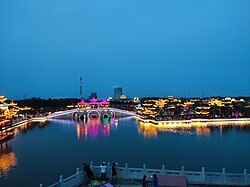
.jpg)


Education
[edit]History of education
[edit]


Shandong is considered one of China's leading provinces in education and research. Shandong hosts 153 higher education institutions, ranking second in the East China region after Jiangsu and fourth among all Chinese provinces/municipalities after Jiangsu, Guangdong and Henan.[16]
Before the late Qing dynasty, Shandong generally enjoyed a flourishing educational tradition, except during a few periods such as the Qin dynasty and the late Jin dynasty. During the Spring and Autumn period, Confucius pioneered private education. In the Northern Song dynasty, Shandong first introduced the "school field" system, which promoted institutional education. In the Ming and Qing periods, private schools, official schools, and academies of classical learning thrived. During the reign of Emperor Yongzheng in the Qing dynasty, there were 75 academies in Shandong, of which 61 were government-run. Following the Hundred Days' Reform, Shandong established the first provincial-level university in China.
During the late Qing period, Western missionary education had a significant influence on Shandong's educational development. For example, in 1866, Presbyterian missionary Calvin Wilson Mateer founded the Wenxian Primary School (for boys) and Huiying Primary School (for girls) in Yuhuangding, Yantai, which were the first modern schools established in Yantai following its opening as a treaty port under the Treaty of Tientsin in 1862. These schools later developed into the Yantai Yuwen Business College, the predecessor of today's Yantai No. 2 High School. Mateer's wife, Julia Mateer, also established the first kindergarten in Yantai at Yuhuangding. Calvin Mateer went on to establish over 40 primary schools in areas including Fushan, Muping, Qixia, Laiyang, Haiyang, Jimo, Jiaozhou, and urban Yantai. Fellow missionaries Hunter Corbett and his wife established the Tengchow College, the first modern higher education institution in China, which also became one of the earliest Christian colleges in the country.
After the Chinese Communist Party came to power, all institutions of higher education in the province ceased enrollment for five years starting in 1966 due to the Cultural Revolution, which severely disrupted educational order. Restoration did not begin until after 1976.[175] As of 2016, the province had 18,853 kindergartens, 12,951 compulsory education schools (including 10,027 elementary schools and 2,924 junior high schools), 580 regular high schools, 428 secondary vocational schools, 146 special education schools, and 155 higher education institutions (144 regular universities and colleges and 11 adult education institutions).[110] There were 25 nationally designated key technical schools, with a provincial enrollment of 148,000 students in technical schools, and a graduate employment rate of 98%. Among them, the Shandong Lanxiang Senior Technical School gained widespread attention after Western media reported its role in training technical non-commissioned officers for the People's Liberation Army.[176]
Colleges and universities
[edit]As of 2016, Shandong had 141 officially accredited higher education institutions offering general degree programs, including 67 regular undergraduate institutions, 73 vocational colleges, and 1 branch campus. Among the regular undergraduate institutions, 44 were public, 12 were private, and 11 were independent colleges. Among the vocational colleges, 60 were public and 13 were private.[177] Shandong is home to three universities included in the Double First-Class University Plan, namely Shandong University (985), Ocean University of China (985), and China University of Petroleum (East China) (211). Additionally, three Double First-Class universities registered in other provinces have campuses in Shandong: Beijing Jiaotong University, Weihai (211), Harbin Institute of Technology, Weihai (985), and China Agricultural University, Yantai (985).[178] Shandong ranks first in the nation in terms of marine science research capacity. As of the end of 2009, the province had nearly 60 national and provincial-level institutions engaged in marine science and education, 29 provincial and ministerial-level marine key laboratories, over 20 scientific research vessels, 10 national-level demonstration bases for marine science and technology, and more than half of China's marine science personnel—including 23 academicians of the Chinese Academy of Sciences and Chinese Academy of Engineering.[179]
As of 2023, two major cities in the province ranked in the top 50 cities in the world (Jinan 32nd and Qingdao 43rd) by scientific research output, as tracked by the Nature Index.[180]
- Jinan
- Shandong University
- University of Jinan
- Shandong University of Finance and Economics
- Shandong Normal University
- Shandong University of Traditional Chinese Medicine
- Qingdao
- Ocean University of China
- China University of Petroleum
- Qingdao Agricultural University
- Qingdao University
- Qingdao University of Technology
- Shandong University of Science and Technology
- Qingdao Binhai University
- Qingdao Technical College
- Yantai
- China Agricultural University
- Shandong Institute of Business and Technology
- Yantai University
- Ludong University
- Weihai
- Harbin University of Science and Technology
- Harbin Institute of Technology
- Beijing Jiaotong University
- Other cities
- Qufu Normal University (Qufu)
- Shandong Agricultural University (Tai'an)
- Weifang University (Weifang)
- Weifang Medical University (Weifang)
- Shandong University of Technology (Zibo)
- Zibo Vocational Institute (Zibo)
- Liaocheng University (Liaocheng)
- Linyi University (Linyi)
- Binzhou Medical College (Binzhou)
- Jining Medical University (Jining)
- Rizhao Polytechnic (Rizhao)
- Shandong Foreign Languages Vocational College (Rizhao)
Sports
[edit].jpeg)
.jpg)
Before the 20th century, traditional sports were the main form of physical activity in Shandong, while modern competitive sports gradually became dominant. The 1903 Hetan Games (阖滩运动会) in Yantai was one of the most prominent early modern athletic competitions in China. After the outbreak of the Second Sino-Japanese War, most sports activities came to a halt. Following the founding of the People's Republic of China, mass sports movements gained momentum in Shandong. In October 1953, the province established the Shandong Provincial Sports Committee. During the Cultural Revolution, all sports activities were suspended and administrative agencies ceased functioning. After the Reform and Opening-Up, Shandong successfully hosted over 70 national competitions, including championships, league matches at various levels, regional tournaments, title contests, and cup competitions.[181] Today, Shandong is home to several professional sports clubs such as Shandong Taishan F.C., Qingdao Hainiu F.C., Qingdao West Coast F.C., Qingdao Red Lions F.C., Shandong Hi-Speed Kirin, and Qingdao Eagles.[182][183][184]
Shandong has hosted numerous major sports events, including the National Games, the World Table Tennis Championships, and the AFC Asian Cup. Qingdao also served as a co-host city for the 2008 Summer Olympics sailing events. In 2009, Shandong hosted the 11th National Games of China, ranking first nationwide in terms of gold medals, total medals, and overall points.[185] The year 2015 is considered the "inaugural year" of marathon events in Shandong. Major marathons have since been held in cities such as Dongying, Yantai, Weifang, Tai'an, Qingdao, Linyi, Zibo (Gaoqing), Tengzhou, and Jining. Among them, Dongying, Yantai, Tai'an, Qingdao (Laixi), Qingdao (High-tech Zone), and Linyi host international marathons.[186]
Prominent athletes from Shandong include table tennis world champion Zhang Jike, billiards player Pan Xiaoting (nine-ball), Olympic shooting champion Du Li, Olympic weightlifter Liu Chunhong, long-distance runner Xing Huina, and gymnast Xing Aowei.[187]
Events held in Shandong
[edit]- 2009 National Games of China
- 2002 Table Tennis World Cup
- 2004 AFC Asian Cup
- 2007 A3 Champions Cup
- Sailing at the 2008 Summer Olympics and Paralympics
- 2011 Sudirman Cup
- 2012 Badminton Asia Championships
- 2012 Asian Beach Games
Professional sports teams based in Shandong
[edit]Former professional sports teams based in Shandong
[edit]Sister regions
[edit]Since October 1979, when Qingdao and Shimonoseki, Yamaguchi Prefecture, Japan established the first pair of sister cities in Shandong Province,[188] by the end of October 2016, Shandong had 211 pairs of international sister provinces/states and cities (including 36 at the provincial level), as well as 214 pairs of international friendly cooperative relationships (28 at the provincial level). The total number of international partnerships ranks among the top in China.[189]
Currently, Shandong's relationships with South Australia and Bavaria have become exemplary models of a new type of international provincial partnerships.[190] As of 2024, Shandong has sister regions as follows:
 Yamaguchi Prefecture, Japan
- Wakayama Prefecture, Japan
 South Hwanghae Province, North Korea
 Brittany, France
 South Australia, Australia
 Connecticut, United States
 Bavaria, Germany
 Marche, Italy
 North Western Province, Sri Lanka
 South Gyeongsang Province, South Korea
- Texas, United States
 North Holland, Netherlands
 Kherson Oblast, Ukraine
 Quảng Nam, Vietnam
 Upper Austria, Austria
 Cluj County, Romania
 East Sepik Province, Papua New Guinea
 Kosrae State, Micronesia
 La Libertad Region, Peru
 Western Cape, South Africa
 Bahia, Brazil
 Ilocos Norte, Philippines
 Sousse Governorate, Tunisia
 Anzoátegui State, Venezuela
- Monagas State, Venezuela
 Quebec, Canada
 Khuzestan Province, Iran
 Republic of Tatarstan, Russia
 Buenos Aires Province, Argentina
- Gyeonggi Province, South Korea
 Ogun State, Nigeria
 Aargau, Switzerland
 Masovian Voivodeship, Poland
 Punjab, Pakistan
 Bangkok, Thailand


See also
[edit]Notes
[edit]- ^ UK: /ʃænˈdʊŋ/ shan-DUUNG,[6] US: /ʃɑːnˈdɔːŋ/ shahn-DAWNG;[7] simplified Chinese: 山东; traditional Chinese: 山東; alternately romanized as Shantung
- ^ Purchasing power parity of Chinese Yuan, as Int'l.dollar based on IMF WEO October 2017. Purchasing power parity (PPP) for Chinese yuan is estimate according to IMF WEO[79] data; Exchange rate of CN¥ to US$ is according to State Administration of Foreign Exchange, published in the China Statistical Yearbook.[80]
- ^ This may include:
- Buddhists
- Confucians
- Deity worshippers
- Taoists
- Members of folk religious sects
- People not bounded to, nor practicing any, institutional or diffuse religion
- ^ The data was collected by the Chinese General Social Survey (CGSS) of 2009 and by the Chinese Spiritual Life Survey (CSLS) of 2007, reported and assembled by Xiuhua Wang (2015)[119] in order to confront the proportion of people identifying with two similar social structures: ① Christian churches, and ② the traditional Chinese religion of the lineage (i.e. people believing and worshipping ancestral deities often organised into lineage "churches" and ancestral shrines). Data for other religions with a significant presence in China (deity cults, Buddhism, Taoism, folk religious sects, Islam, et al.) was not reported by Wang. The number of Muslims is taken from a survey reported in the year 2010.[120]
References
[edit]- ^ Назначены новые секретари парткомов провинций Шаньдун и Шаньси (in Russian). dknews.kz. 30 December 2022. Archived from the original on 30 December 2022.
- ^ "Doing Business in China". Ministry Of Commerce. n.d. Archived from the original on 16 October 2015. Retrieved 5 August 2013.
- ^ "Communiqué of the Seventh National Population Census (No. 3)". National Bureau of Statistics of China. 11 May 2021. Archived from the original on 11 May 2021. Retrieved 11 May 2021.
- ^ "National Data". China NBS. March 2024. Retrieved 22 June 2024. see also "zh: 2023年山东省国民经济和社会发展统计公报". shandong.gov.cn. 3 March 2024. Retrieved 19 June 2024. The average exchange rate of 2024 was CNY 7.1217 to 1 USD dollar "Statistical communiqué of the People's Republic of China on the 2023 national economic and social development" (Press release). China NBS. 29 February 2024. Retrieved 22 June 2024.
- ^ "Human Development Indices (8.0)- China". Global Data Lab. Retrieved 23 September 2024.
- ^ "Shandong". Lexico UK English Dictionary. Oxford University Press. Archived from the original on 18 May 2021.
- ^ "Shandong". Merriam-Webster.com Dictionary. Merriam-Webster.
- ^ Tian Xia; Bai Bo (2005). Atlas of World Heritage—China. Long River. p. 70. ISBN 9781592650606.
- ^ UNESCO World Heritage Centre. "Mount Taishan". whc.unesco.org. Archived from the original on 21 November 2020. Retrieved 24 October 2025.
- ^ Kelly, Margaret, ed. (2007). China. Fodor's Travel Publications. ISBN 978-1-400-01731-7.
- ^ "Confucianism". Asia Society. Archived from the original on 16 November 2020. Retrieved 24 October 2025.
- ^ "Main Data of the Seventh National Population Census". National Bureau of Statistics of China. 11 May 2021. Archived from the original on 11 May 2021.
- ^ a b "Decoding China's 2021 GDP Growth Rate: A Look at Regional Numbers". China Briefing News. 7 February 2022. Archived from the original on 19 August 2022. Retrieved 15 September 2022.
- ^ a b "GDP of Mexico". World Bank. Archived from the original on 15 September 2022. Retrieved 15 September 2022.
- ^ a b "GDP Data". World Bank. Archived from the original on 15 September 2022. Retrieved 15 September 2022.
- ^ a b ""List of National Colleges and Universities - Government Portal of the Ministry of Education of the People's Republic of China"". Ministry of Education of the People's Republic of China. Archived from the original on 19 June 2022. Retrieved 7 November 2022.
- ^ "Leading 200 science cities | | Supplements | Nature Index". www.nature.com. Retrieved 9 December 2024.
- ^ (in Chinese)
- ^ "趣味文字:中国各省及自治区名称历史由来和变化". People's Daily Online (in Chinese). 4 July 2004. Archived from the original on 18 February 2020. Retrieved 9 August 2022.
- ^ a b Roberts, Edmund (1837). Embassy to the eastern courts of Cochin-China, Siam, and Muscat; in the U.S. sloop-of-war Peacock ... during the years 1832-3-4. Harper & Brothers. pp. 122–123. ISBN 978-1-400-01731-7. LCCN 05012055.
{{cite book}}: ISBN / Date incompatibility (help) - ^ "Historical Overview". Shandong Federation of Trade Unions. Archived from the original on 5 March 2017. Retrieved 28 November 2016.
- ^ E.L. Ladurie (1971). Times of Feast, Times of Famine: A History of Climate Since the Year 1000 (Barbara Bray, tr.). New York: Doubleday.
- ^ Zhu Kezhen, "Preliminary Study on the Climate Change in China over the Last Five Thousand Years," Kaogu Xuebao [Acta Archaeologica Sinica], 1972, No. 1
- ^ Bai Yan; Yu Yumei (27 June 2011). "Is the Little Ice Age Coming? Ming and Qing Little Ice Age Cooled for More Than 300 Years". China Economic Net. Modern Express. Archived from the original on 22 February 2017. Retrieved 21 February 2017.
- ^ "The Impact of Harsh Governance in Early Ming on the Outcome of the Jingnan Campaign". Journal of Nanyang Normal University. 8 (11). November 2009.
- ^ Gu Cheng (October 1982). "Background of the Late Ming Peasant Wars". History of the Late Ming Peasant Wars. China Social Sciences Press. ISBN 9787511217257.
- ^ General History of Shandong: Ming and Qing Volume, Chapter 6: The Situation in Shandong at the End of the Ming
- ^ An Zuozhang (2008). General History of Jinan: Ming and Qing Volume. Qilu Publishing House. pp. 64–69. ISBN 978-7-5333-2034-8. Archived from the original on 2 December 2016.
- ^ Gu Yingtai. Chronicle of the Ming Dynasty, Volume 78: The Rebellion of Li Zicheng.
- ^ "Global Historical Earthquake Archive - 25 July 1668". emidius.eu. Archived from the original on 23 July 2021. Retrieved 24 October 2025.
- ^ "CHINA: SHANDONG PROVINCE". National Geophysical Data Center. Archived from the original on 25 July 2021. Retrieved 8 December 2023.
- ^ "社会史". www.qinghistory.cn. Retrieved 24 October 2025.
- ^ 志学, 李 (2006). "试析 1860年 ~1914年间的赴俄华侨" (PDF). 暨南学报 (Journal of Jinan University). 120.
- ^ Burkman, Thomas W. (2008). Japan and the League of Nations: Empire and World Order, 1914–1938. University of Hawaiʻi Press. p. 4. doi:10.2307/j.ctt6wqrcq. ISBN 978-0-824-82982-7. JSTOR j.ctt6wqrcq.
- ^ Craft, Stephen G. (1997). "John Bassett Moore, Robert Lansing, and the Shandong Question". Pacific Historical Review. 66 (2): 231–249. doi:10.2307/3640629. JSTOR 3640629.
- ^ "CHINA: Basest War Lord". Time. 7 March 1927. Archived from the original on 25 November 2010. Retrieved 9 August 2022.
- ^ Wuhan, 1938: War, Refugees, and the Making of Modern China
- ^ "場孤注一擲的豪賭——不可想像的孟良崮戰役". big5.huaxia.com. Archived from the original on 11 May 2016. Retrieved 24 October 2025.
- ^ "Battle of Weixian". Weifang Local History Office. 22 July 2010. Archived from the original on 4 March 2016. Retrieved 21 July 2013.
- ^ "潍县战役——华东战场上的第一个攻坚战——国防部网站". www.mod.gov.cn. Archived from the original on 29 December 2012. Retrieved 24 October 2025.
- ^ a b Shi Qipeng; Shen Hong (19 September 2012). Wang Yao (ed.). "Changshan Islands Campaign: PLA's first major amphibious landing operation". Xinhua News. People's Daily. Archived from the original on 7 October 2012. Retrieved 20 April 2014.
- ^ Gu, Chang-Sheng (2009). Awaken: Memoirs of a Chinese Historian. pp. 130–131.
- ^ Zhang Zhaoxin (30 April 2015). ""Qingdao Incident" opened the Cultural Revolution in Shandong, foreshadowing the power seizure by rebel factions". Qingbao. Archived from the original on 1 December 2016. Retrieved 30 November 2016.
- ^ "纪念改革开放30年:"创新山东"异彩纷呈--中国共产党新闻--中国共产党新闻-人民网". cpc.people.com.cn. Archived from the original on 1 December 2016. Retrieved 24 October 2025.
- ^ "山东VS广东:谁是中国工业第一大省--财经--人民网". finance.people.com.cn. Archived from the original on 15 March 2018. Retrieved 24 October 2025.
- ^ Song Xuechun, Ma Yuefeng (9 August 2008). "Qingdao holds launching ceremony for Olympic sailing events". People's Daily Olympic Channel. Archived from the original on 5 March 2017.
- ^ Memorandum of Understanding signed by China's Ministry of Commerce and Germany's Ministry of Economics and Technology to jointly support the Sino-German Ecopark, Qingdao Sino-German United Group, 1 December 2011, archived from the original on 5 March 2017, retrieved 30 November 2016
- ^ Meng Xuan (26 February 2011). "Shandong Peninsula Blue Economic Zone officially upgraded". China.com. 2011 National People's Congress. Archived from the original on 2 December 2016. Retrieved 1 December 2016.
- ^ State Council (3 June 2014), Reply on the approval for establishing Qingdao West Coast New Area, gov.cn, archived from the original on 11 December 2015
- ^ Li Gong (15 February 2017). "Entire Shandong Province joins the Peninsula Urban Agglomeration to absorb non-capital functions". First Financial Daily. Archived from the original on 15 February 2017. Retrieved 15 February 2017.
- ^ 张茵 (2008). "黄河三角洲 世界上最新鲜的土地". 中国国家地理 (第8期). Archived from the original on 12 January 2017.
- ^ "气候资源数据库". 人地系统主题数据库. 中国科学院地理科学与资源研究所. Archived from the original on 14 December 2021. Retrieved 6 December 2016.
- ^ Jackson, Steve (31 December 2008). "China finds major dinosaur site". BBC News. Archived from the original on 7 October 2023. Retrieved 9 August 2022.
- ^ "喜讯!山东胶东黄金成全球第三大金矿集区". 中金网. 和讯网. 3 May 2017. Archived from the original on 15 March 2018. Retrieved 14 March 2018.
- ^ "解读《山东省土地整治规划(2016-2020年)》发布会". Information Office of the State Council of the People's Republic of China. 中国山东网. 9 February 2018. Archived from the original on 15 March 2018. Retrieved 14 March 2018.
- ^ 李静 (23 January 2018). "山东森林覆盖率17.51% 国家级湿地公园数量全国第一". State Forestry Administration. 齐鲁网. Archived from the original on 17 March 2018. Retrieved 17 March 2018.
- ^ "山东概况_中国网". www.china.com.cn. Archived from the original on 5 March 2017. Retrieved 24 October 2025.
- ^ "中国共产党章程" [Constitution of the Chinese Communist Party]. Xinhua News Agency (in Chinese). 18 November 2012. Archived from the original on 16 January 2017. Retrieved 22 February 2017.
Chapter IV: Local Party Organizations
- ^ "人民代表大会制度". www.gov.cn. Archived from the original on 12 May 2023. Retrieved 24 October 2025.
- ^ "Online Photo Exhibition in Commemoration of the 60th Anniversary of the Shandong Provincial People's Congress". Qilu Net. Standing Committee of the Shandong Provincial People's Congress. Archived from the original on 20 December 2016. Retrieved 9 December 2016.
- ^ "List of the 906 Deputies to the 12th Shandong Provincial People's Congress". People.cn. Standing Committee of the Shandong Provincial People's Congress. 23 January 2013. Archived from the original on 3 December 2016. Retrieved 3 December 2016.
- ^ a b Shandong Provincial Gazetteer: Judicial Volume, Preface
- ^ "山东省高级人民法院简介". www.sdcourt.gov.cn. Archived from the original on 28 December 2021. Retrieved 24 October 2025.
- ^ "Introduction to Municipal Procuratorates". Shandong Provincial People's Procuratorate. Archived from the original on 3 December 2016. Retrieved 2 December 2016.
- ^ a b 山东省志·军事志, 概述
- ^ Zhang Hongyan (30 January 2012). "Why Were There Four Shandong Military Regions in PLA History?". People's Daily. PLA Daily. Archived from the original on 15 June 2015. Retrieved 3 December 2016.
- ^ CPC Shandong Provincial Organization History Data, 1921–1987: Political Power, Military, CPPCC, Mass Organizations, and Enterprise Institutions, 1949–1987. Party History Press. 1991. p. 456.
- ^ "Shandong Advances Integrated Land-Sea Control System for Border Defense". CNR Military. 22 September 2016. Archived from the original on 4 January 2017. Retrieved 4 January 2017.
- ^ Zhang Jiaran (6 August 2016). "New Political Commissar for Shandong Provincial Military District: Shang Zhengui from Hebei Succeeds Lü Minsong". The Paper. Archived from the original on 16 February 2017. Retrieved 29 November 2016.
- ^ "Qingdao's Nuclear Submarine Base Reveals Two Strategic Weapons, Shocking the World". New Frontier Military. Military Frontline. 14 April 2014. Archived from the original on 3 December 2016. Retrieved 2 December 2016.
- ^ "Media: One Month After Formation of Five Theater Commands, Where Are the 18 Group Armies Deployed?". Legal Evening News. 28 February 2016. Archived from the original on 29 February 2016. Retrieved 29 February 2016.
- ^ "10 DF-21Cs Fill the Frame—Shocking Exposure of a Rocket Force Missile Base". ETToday. 1 October 2016. Archived from the original on 12 January 2017. Retrieved 10 January 2017.
- ^ "Remember the Warm Care, Strive to Strengthen the Military—President Xi's Attendance at the Commissioning Ceremony of China's First Domestically Built Aircraft Carrier Resonates Across the Armed Forces". www.xinhuanet.com. Archived from the original on 22 June 2020. Retrieved 22 June 2020.
- ^ Fresh Garlic from China, Inv. 731-TA-683 (Second Review). DIANE Publishing. n.d. p. I-24. ISBN 9781457818745.
- ^ "Location and how discovered". China Sapphire. n.d. Archived from the original on 3 July 2007. Retrieved 5 January 2009.
- ^ Zhan, Jing Vivian (2022). China's Contained Resource Curse: How Minerals Shape State-Capital-Labor Relations. Cambridge, United Kingdom: Cambridge University Press. ISBN 978-1-009-04898-9.
- ^ a b "Shandong Province". The China Perspective. n.d. Archived from the original on 5 March 2012. Retrieved 9 August 2022.
- ^ "关于将研究与开发支出计入生产总值核算修订生产总值核算数据的公告" (in Chinese). Shandong Provincial Bureau of Statistics. 13 October 2017. Archived from the original on 27 December 2017. Retrieved 9 August 2022.
- ^ "The World Economic Outlook Database". International Monetary Fund. 2021. Archived from the original on 26 November 2020. Retrieved 9 August 2022.
- ^ "Annual Data". National Bureau of Statistics of China. n.d. Archived from the original on 20 October 2015. Retrieved 9 August 2022.
- ^ "Yantai apples valued at ¥10.586 billion — Shandong ranks No. 1 in three national agricultural categories". People's Daily. Dazhong Net. 13 September 2016. Archived from the original on 29 November 2016. Retrieved 28 November 2016.
- ^ a b "Overview of Agriculture in Shandong Province". Shandong Agriculture Net. Shandong Agricultural Information Center. 14 May 2011. Archived from the original on 29 November 2016. Retrieved 28 November 2016.
- ^ Phoenix News, Shandong (21 April 2013). "The Vegetable Basket of China—Shouguang Vegetables". Archived from the original on 12 January 2017. Retrieved 10 January 2017.
- ^ "Rizhao green tea ranks third among Shandong's top 10 geographical indication trademarks". Guofang Trademark Net. Dazhong Net. 26 March 2013. Archived from the original on 13 January 2017. Retrieved 10 January 2017.
- ^ 卫计委 (5 February 2015). "行业发展概况". 山东省海洋与渔业厅. Retrieved 14 March 2018.[permanent dead link]
- ^ "The wine output of Yantai will reach 230000 kiloliters in 2008". China Wines Information Website. 30 December 2008. Archived from the original on 15 February 2009. Retrieved 28 June 2009.
- ^ Yu, Xiaozhong; Pan, Linqing; Yuan, Junbao (28 December 2016). "山东经济结构迎二次"序变" 服务业成经济主引擎_投资_财经频道_齐鲁网". caijing.iqilu.com. Archived from the original on 23 February 2017. Retrieved 24 October 2025.
- ^ "山东省服务业发展概况". www.fdi.gov.cn. Archived from the original on 29 November 2016. Retrieved 24 October 2025.
- ^ Hamed, Tarek (17 July 2023). "KJC". kjc79.com. Retrieved 24 October 2025.
- ^ "郭树清山东金改:金融业成山东支柱产业-搜狐财经" [Guo Shuqing's Shandong Financial Reform: Financial Industry Becomes Pillar of Shandong's Economy]. business.sohu.com. Archived from the original on 23 February 2017. Retrieved 24 October 2025.
- ^ Shandong Provincial Bureau of Statistics & National Bureau of Statistics Shandong Survey Team (29 January 2019). "Shandong's Economy Maintained Steady Growth in 2018, Making Solid Progress in High-Quality Development". Archived from the original on 22 June 2020. Retrieved 22 June 2020.
- ^ "Ji'nan Export Processing Zone". RightSite.Asia. n.d. Archived from the original on 11 January 2010. Retrieved 9 August 2022.
- ^ "Qingdao Economic and Technical Development Zone". RightSite.Asia. n.d. Archived from the original on 7 February 2010. Retrieved 9 August 2022.
- ^ "Qingdao Hi-Tech Industrial Development Zone". RightSite.Asia. n.d. Archived from the original on 20 November 2009. Retrieved 9 August 2022.
- ^ "Weihai Torch Hi-Tech Science Park". RightSite.Asia. n.d. Archived from the original on 3 March 2010. Retrieved 9 August 2022.
- ^ "Yantai Economic and Technological Development Area". RightSide.Asia. n.d. Archived from the original on 9 February 2010. Retrieved 9 August 2022.
- ^ "Yantai Export Processing Zone". RightSite.Asia. n.d. Archived from the original on 10 May 2010. Retrieved 9 August 2022.
- ^ "付表2 1912年中国人口(統計)" (in Japanese). ier.hit-u.ac.jp. n.d. Archived from the original on 24 September 2015. Retrieved 6 March 2014.
- ^ "付表3 1928年中国人口(統計)" (in Japanese). ier.hit-u.ac.jp. n.d. Archived from the original on 24 September 2015. Retrieved 6 March 2014.
- ^ "付表4 1936-37年の中国人口(統計)" (in Japanese). ier.hit-u.ac.jp. n.d. Archived from the original on 24 September 2015. Retrieved 6 March 2014.
- ^ "付表5 1947年全国人口(統計)" (in Japanese). ier.hit-u.ac.jp. n.d. Archived from the original on 13 September 2013. Retrieved 6 March 2014.
- ^ "中华人民共和国国家统计局关于第一次全国人口调查登记结果的公报" (in Chinese). National Bureau of Statistics of China. n.d. Archived from the original on 5 August 2009. Retrieved 6 March 2014.
- ^ "第二次全国人口普查结果的几项主要统计数字" (in Chinese). National Bureau of Statistics of China. n.d. Archived from the original on 14 September 2012. Retrieved 6 March 2014.
- ^ "中华人民共和国国家统计局关于一九八二年人口普查主要数字的公报" (in Chinese). National Bureau of Statistics of China. n.d. Archived from the original on 10 May 2012. Retrieved 6 March 2014.
- ^ "中华人民共和国国家统计局关于一九九○年人口普查主要数据的公报" (in Chinese). National Bureau of Statistics of China. n.d. Archived from the original on 19 June 2012. Retrieved 6 March 2014.
- ^ "现将2000年第五次全国人口普查快速汇总的人口地区分布数据公布如下" (in Chinese). National Bureau of Statistics of China. n.d. Archived from the original on 29 August 2012. Retrieved 6 March 2014.
- ^ "Communiqué of the National Bureau of Statistics of People's Republic of China on Major Figures of the 2010 Population Census[1] (No. 2)". National Bureau of Statistics of China. 29 April 2011. Archived from the original on 27 July 2013. Retrieved 6 March 2014.
- ^ 山东省志·人口志, 人口变动
- ^ chinanews. "山东常住人口首次过亿 成中国第二人口大省-中新网". www.chinanews.com. Archived from the original on 9 February 2018. Retrieved 24 October 2025.
- ^ a b "2016年山东省教育事业发展统计公报". 山东省教育厅. 20 November 2018. Archived from the original on 7 August 2022. Retrieved 28 November 2018.
- ^ 郭学军 (27 June 2016). "今年山东老人平均寿命达到78岁 百岁老人菏泽最多". 大众网. 生活日报. Archived from the original on 20 December 2016. Retrieved 3 December 2016.
- ^ "山东莱州跻身中国十大长寿之乡行列". news.xinhuanet.com. Archived from the original on 5 March 2017. Retrieved 24 October 2025.
- ^ 山东省第七次全国人口普查领导小组办公室. "山东省第七次全国人口普查主要数据情况". 山东省统计局. Archived from the original on 22 May 2021. Retrieved 21 May 2021.
- ^ "山东18岁男女平均身高出炉!烟台人竟然5年前就完爆这一数据!" (in Chinese). Chuan Song. 12 August 2016. Archived from the original on 29 April 2018. Retrieved 29 April 2018.
- ^ "山东省四个民族乡镇及简介". 山东民族宗教. 24 May 2016. Archived from the original on 1 December 2016. Retrieved 1 December 2016.
- ^ "深度调查丨青岛住着10万韩国人,背后有你不知道的秘密". www.sohu.com. 12 May 2016. Archived from the original on 31 March 2018. Retrieved 24 October 2025.
- ^ "山东民族宗教". mzw.shandong.gov.cn. Archived from the original on 27 March 2025. Retrieved 7 July 2025.
- ^ "山东省统计局 普查公报 山东省第七次全国人口普查主要数据情况". tjj.shandong.gov.cn. Retrieved 7 July 2025.
- ^ a b c d Wang, Xiuhua (2015). "Four" (PDF). Explaining Christianity in China: Why a Foreign Religion has Taken Root in Unfertile Ground (Master's thesis). Baylor University. p. 15. Archived (PDF) from the original on 9 August 2022. Retrieved 9 August 2022.
- ^ a b Min Junqing (2010). "The Present Situation and Characteristics of Contemporary Islam in China" (PDF). JISMOR: 29. Archived (PDF) from the original on 9 August 2022. Retrieved 9 August 2022.
- ^ Yang Zongde (2010). "Study on Current Muslim Population in China". Jinan Muslim (2).
- ^ Csikszentmihalyi, Mark (31 March 2020). "Confucius". Stanford Encyclopedia of Philosophy. Archived from the original on 20 May 2022. Retrieved 9 August 2022.
- ^ Richey, Jeff (n.d.). "Confucius (551—479 B.C.E.)". Internet Encyclopedia of Philosophy. Archived from the original on 19 November 2016. Retrieved 7 December 2016.
- ^ "Asia Harvest". www.asiaharvest.org. Retrieved 24 October 2025.
- ^ 山东通史·秦汉卷, 典志 政区
- ^ 山东通史·明清卷, 一 政区与户口;三 兵制
- ^ 傅林祥; 林涓; 任玉雪; 王卫东 (1 October 2013). 周振鹤 (ed.). 中国行政区划通史(清代卷) (First ed.). 复旦大学出版社. ISBN 9787309056037.
- ^ "元明清时期的山东政区". www.cnr.cn. Archived from the original on 7 March 2016. Retrieved 24 October 2025.
- ^ "State Council approves adjustment of Jinan and Laiwu administrative divisions in Shandong Province". Xinhua. Archived from the original on 9 January 2019. Retrieved 9 January 2019.
- ^ "2014年12月中华人民共和国县以上行政区划代码" (in Simplified Chinese). Ministry of Civil Affairs. n.d. Archived from the original on 2 April 2015. Retrieved 9 August 2022.
- ^ 深圳统计年鉴2014 (in Chinese). China Statistics Print. 2014. Archived from the original on 12 May 2015.
- ^ "山东省第七次全国人口普查公报(第二号)" [Communiqué of the Seventh National Population Census of Shandong Province (No. 2)]. Shandong Provincial Bureau of Statistics (in Chinese). Retrieved 16 May 2024.
- ^ Ministry of Civil Affairs (2014). 中国民政统计年鉴2014 (in Chinese). China Statistics Print.
- ^ "去年山东常住人口城镇化率达64.54%_地方动态_中国政府网". www.gov.cn. Retrieved 6 July 2025.
- ^ a b c 国务院人口普查办公室、国家统计局人口和社会科技统计司编 (2012). 中国2010年人口普查分县资料 (in Chinese). China Statistics Print. ISBN 978-7-5037-6659-6.
- ^ Ministry of Housing and Urban-Rural Development of the People's Republic of China (2019). 中国城市建设统计年鉴2018 [China Urban Construction Statistical Yearbook 2018] (in Chinese). China Statistics Print. Archived from the original on 10 August 2021. Retrieved 30 November 2021.
- ^ Swanson, Lauren A. (July 1996). "1.19850+ billion mouths to feed: food linguistics and cross-cultural, cross-"national" food consumption habits in China". British Food Journal. 98 (6): 33–44. doi:10.1108/00070709610131357. ISSN 0007-070X. Archived from the original on 30 November 2021. Retrieved 30 November 2021.
- ^ Wang, Juling, Famous Dishes of Famous Restaurant in Beijing, Golden Shield Publishing House in Beijing, December, 2000, ISBN 7-5082-1400-5
- ^ Xu, Chengbei, Ancient Beijing, Customs of the General Populace of Ancient Beijing, Jiangsu Fine Arts Publishing House in Nanjing, September, 1999, ISBN 7-5344-0971-3
- ^ Hua Mengyang and Zhang Hongjie, Lives of the residents of Ancient Beijing, Shandong Pictorial Publishing House in Jinan, June, 2000, ISBN 7-80603-452-8
- ^ Du, Fuxiang and Guo, Yunhui, Famous Restaurants in China, China Tourism Publishing House in Beijing, 1982
- ^ Li Boqi; Wang Yong; Xu Wenjun (1 October 2011). Han Yuqun (ed.). History of Shandong Literature (1st ed.). Shandong People's Publishing House. ISBN 9787209058131.
- ^ "Brief Discussion on Liangfu Yin and the Stone Inscriptions on Mount Liangfu". Qilu Evening News. 24 March 2011. Archived from the original on 2 April 2011. Retrieved 6 July 2014.
- ^ Huang Zhiliang, "A Study on Baixue Yiyin", Master's thesis, Institute of Chinese Literature, Soochow University, July 1992
- ^ "中国华文教育网-文学艺术". www.hwjyw.com. Archived from the original on 5 March 2017. Retrieved 24 October 2025.
- ^ Liu Shuli (March 2016). "Chapter 3: The Development and Evolution of Shandong Drama in the Ming Dynasty; Chapter 4: The Flourishing and Transformation of Shandong Theater in the Qing Dynasty". History of Shandong Theater. Beijing Normal University Press. ISBN 9787303183784.
- ^ "Peng Liyuan's New Mission". Sina Style. Global People Magazine. 6 July 2011. Archived from the original on 20 February 2017. Retrieved 19 February 2017.
- ^ Ye Kai (11 October 2012). "Mo Yan Built a Hidden Literary Kingdom through "Cruel Narrative"". New York Times Chinese Edition. Archived from the original on 13 October 2012. Retrieved 11 October 2012.
- ^ "Peng Liyuan's 9 Defining Firsts: Met Xi Jinping at 24". Sohu Finance. 19 October 2013. Archived from the original on 4 March 2016. Retrieved 24 February 2016.
- ^ "Ni Ping Reveals Why She Quit Hosting: "CCTV Chose Me Because I Was Ugly"". Phoenix News. Archived from the original on 10 May 2012. Retrieved 8 May 2012.
- ^ "Huang Bo Joins Sony Music to Seriously Pursue Music Career". Sina. 5 May 2016. Archived from the original on 13 January 2017. Retrieved 5 May 2016.
- ^ Swedish Academy. "Is Mo Yan Really "Hallucinatory Realism Blended with Folklore, History, and the Contemporary"?". Translated by Jiang Lienong. Yeeyan. Archived from the original on 17 October 2012. Retrieved 14 October 2012.
- ^ "Mo Yan Becomes First Chinese National to Win Nobel Prize in Literature". 11 October 2012. Archived from the original on 2 April 2015. Retrieved 29 March 2015.
- ^ "The Nobel Prize in Literature 2012: Mo Yan". Nobel Media AB. Archived from the original on 9 January 2014. Retrieved 11 October 2012.
- ^ 山东省志·广播电视志, 前言
- ^ "辽宁统计年鉴2012(EXCEL)406". 统计年鉴 (in Chinese (China)). Archived from the original on 19 March 2021. Retrieved 24 October 2025.
- ^ "齐鲁网介绍". 齐鲁网. January 2010. Archived from the original on 26 January 2017. Retrieved 10 January 2017.
- ^ "淄博电视台简介". 齐鲁网. 6 November 2011. Archived from the original on 27 December 2014. Retrieved 28 December 2014.
- ^ 山东省志·报业志, 前言
- ^ 郭全中 郭凤娟 (17 October 2013). "中国报业"大众现象"探析". 中国报协网. 中国报业. Archived from the original on 2 July 2016. Retrieved 22 February 2017.
- ^ Zhu, Xiao Lin; Liu, Juan; Ju, Hong Lei (2011). "History's Continuity and Regeneration of Fangzi, a Modern Town along Jiaoji Railway". Advanced Materials Research. 317–319: 2310–2313. doi:10.4028/www.scientific.net/AMR.317-319.2310. ISSN 1662-8985.
- ^ 朱珍贤; 杨小明 (11 July 2023). "工业遗产视角下的铁路研究——以胶济铁路为例". Open Journal of Historical Studies. 11: 193. doi:10.12677/OJHS.2023.113030.
- ^ 韩家慧. ""四横"收官!石济高铁明天开通运营-新华网". www.xinhuanet.com. Retrieved 12 July 2025.
- ^ "新华全媒+丨济郑高铁全线贯通运营-新华网". www.news.cn. Retrieved 12 July 2025.
- ^ "济南铁路局 - 铁路网". www.tielu.cn. Archived from the original on 29 November 2016. Retrieved 24 October 2025.
- ^ "인천항 여객터미널". www.icferry.or.kr. Retrieved 1 October 2025.
- ^ a b "山东6支线机场全部亏损 青日聊菏将建新机场惹争议". 齐鲁网. 齐鲁晚报. 10 February 2014. Archived from the original on 29 November 2016. Retrieved 28 November 2016.
- ^ "蓬莱沙河口机场". 中国航空运输协会. 快飞网. Archived from the original on 19 December 2017. Retrieved 30 November 2016.
- ^ "2015年全国机场生产统计公报". 31 March 2016. Archived from the original on 23 April 2016. Retrieved 10 July 2015.
- ^ "2014年华东局各大机场吞吐量统计数据出炉". 民航资源网. 中国民用航空华东地区管理局网站. 28 January 2015. Archived from the original on 29 November 2016. Retrieved 28 November 2016.
- ^ "Temple and Cemetery of Confucius and the Kong Family Mansion in Qufu". UNESCO. n.d. Archived from the original on 28 December 2019. Retrieved 7 December 2016.
- ^ "The Confucian Temple, Cemetery and Family Mansion in Qufu". www.china.org.cn. Archived from the original on 8 May 2016. Retrieved 24 October 2025.
- ^ a b Centre, UNESCO World Heritage. "Mount Taishan". UNESCO World Heritage Centre. Retrieved 6 July 2025.
- ^ Centre, UNESCO World Heritage. "Migratory Bird Sanctuaries along the Coast of Yellow Sea-Bohai Gulf of China". UNESCO World Heritage Centre. Retrieved 6 July 2025.
- ^ 山东省志·教育志, 前言
- ^ Markoff, John (4 March 2010). "John Markoff, David Barboza: 2 China Schools Said to Be Tied to Online Attacks, The New York Times, published: 2010-2-18". The New York Times. China. Archived from the original on 9 September 2017. Retrieved 14 August 2017.
- ^ "盘点2016山东141所正规高校 莫被虚假大学蒙骗". 中国教育在线. 济南时报. 18 May 2016. Archived from the original on 13 January 2017. Retrieved 10 January 2017.
- ^ 中国山东, 高等教育
- ^ 杜鹰 (1 December 2012). 中国区域经济发展年鉴. 中国财政经济出版社. ISBN 978-7-5095-4193-7. Archived from the original on 1 December 2016. Retrieved 1 December 2016.
- ^ "Leading 200 science cities | Nature Index 2023 Science Cities | Supplements | Nature Index". www.nature.com. Archived from the original on 22 November 2023. Retrieved 24 October 2025.
- ^ 山东省志·体育志, 前言
- ^ "山东鲁能泰山足球俱乐部". 官方网站. Archived from the original on 21 February 2017. Retrieved 18 February 2017.
- ^ "青岛黄海足球俱乐部". 官方网站. Archived from the original on 3 August 2017. Retrieved 3 August 2017.
- ^ "青岛中能足球俱乐部". 官方网站. Archived from the original on 22 June 2017. Retrieved 18 February 2017.
- ^ "山东队63金居历史次高 江苏0.5金险胜辽宁列第2-搜狐体育". sports.sohu.com. Archived from the original on 17 February 2017. Retrieved 24 October 2025.
- ^ 石念军 (20 May 2016). "马拉松在山东越来越火 你知道办一场到底多赚钱吗?". 新浪竞技风暴. 齐鲁晚报. Archived from the original on 2 December 2016. Retrieved 1 December 2016.
- ^ "山东明星". 山东体育网. Archived from the original on 29 November 2016. Retrieved 29 November 2016.
- ^ 中国山东, 友好关系
- ^ "山东加快外事工作转型 友好省州总量居全国前列". Qilu Net. 1 November 2016. Archived from the original on 29 November 2016. Retrieved 28 November 2016.
- ^ "巴伐利亚州和山东省缔结友好省州关系25周年". Representative Office of Bavaria in China. 21 November 2012. Archived from the original on 29 November 2016. Retrieved 28 November 2016.
Sources
[edit]- China's agricultural export powerhouse faces grim year - Business - Chinadaily.com.cn Archived 30 June 2017 at the Wayback Machine
- Economic profile for Shandong Archived 21 September 2008 at the Wayback Machine at HKTDC
External links
[edit]
 Shandong travel guide from Wikivoyage
- (in Chinese) Shandong Government website
- (in English and Chinese) Complete Map of the Seven Coastal Provinces from 1821 to 1850
- Shandong Article Encyclopædia Britannica


Shandong topics | |||||||||
|---|---|---|---|---|---|---|---|---|---|
| General | |||||||||
| Geography |
| ||||||||
| Education | |||||||||
| Culture | |||||||||
| Cuisine | |||||||||
| Ethno-Linguistic groups |
| ||||||||
| Attractions | |||||||||


| International | |
|---|---|
| National | |
| Geographic | |
| Other | |


Shandong
View on GrokipediaShandong (山东 / 山東) is a coastal province in eastern China, situated along the Yellow Sea (黄海) and Bohai Sea (渤海), with a land area of 157,900 square kilometers.[1] It had a population of 101.7 million in 2021, predominantly Han Chinese, making it one of China's most populous provinces.[2] The provincial capital is Jinan (济南), a major economic and cultural center known for its springs.[3] Historically, Shandong encompasses the ancient states of Qi and Lu, serving as the birthplace of Confucianism in Qufu (曲阜) and hosting Mount Tai (泰山), the foremost of China's Five Sacred Mountains and a site of imperial sacrifices for millennia.[4] Economically, Shandong ranks as a leading provincial economy with a GDP exceeding 8 trillion yuan in recent years, driven by manufacturing, agriculture, and maritime trade. Its coastal position has facilitated ports like Qingdao (青岛), contributing to export-oriented industries, while inland areas support grain production and heavy industry.[5] Shandong's cultural legacy, including Confucian temples and Taoist sites, underscores its enduring influence on Chinese philosophy and governance.[6]
Etymology
Name origins and historical nomenclature
The name Shandong (山东) literally translates to "east of the mountain," derived from its geographical position east of the Taihang Mountains (太行山), a major range forming the western boundary of the North China Plain.[7][8] This nomenclature reflects the province's location relative to these mountains, which separate it from inland regions like Shanxi to the west.[9] Historically, the term Shandong first emerged as an administrative designation during the Jin dynasty (1115–1234 CE), when the region was divided into circuits such as Shandong East and Shandong West for governance purposes.[10] Prior to this, the area lacked a unified provincial name and was instead referred to through fragmented political entities, including the ancient states of Qi (齊國) in the north and Lu (魯國) in the southwest during the Spring and Autumn period (771–476 BCE), where Qi controlled much of the Shandong Peninsula and Lu was the birthplace of Confucius (551–479 BCE).[8] These states gave rise to enduring cultural associations, with the modern province's official abbreviation remaining Lu (盧), honoring the state of Lu.[11] In subsequent dynasties, Shandong evolved from a circuit-level term to a full province. During the Yuan dynasty (1271–1368 CE), it was organized as a route (路), and by the Ming dynasty (1368–1644 CE), it featured a buzhengsi (布政使司) administrative structure approximating its current territorial extent, with further refinements under the Qing dynasty (1644–1912 CE).[12][10] Earlier imperial references often used broader terms like "Eastern Territory" (東域) for the coastal Shandong Peninsula, encompassing commanderies such as Donghai (東海郡) under the Han dynasty (206 BCE–220 CE).[7] This nomenclature underscores the region's longstanding role as an eastern frontier of Chinese civilization, distinct from central and western heartlands.History
Prehistoric and ancient periods
Paleolithic sites in Shandong provide evidence of early human occupation dating back to the Late Pleistocene. The Zhaojia Xuyao site in Zibo, dated to 11,000–15,000 years ago, contains artifacts and features indicating a transition from Paleolithic foraging to early Neolithic practices, including burned soil layers suggestive of controlled fire use for resource management.[13] Other key sites include Huangniliang near the eastern coast, with stone tools from Marine Isotope Stage 3 (approximately 50,000–30,000 years ago), and the Bashan site along the Yi River, revealing consecutive layers of human activity with flaked tools and animal fossils.[14][15] These findings demonstrate that prehistoric humans utilized diverse lithic technologies, including microblades in the Fenghuangling culture (19,000–13,000 years ago), adapted to the region's riverine and coastal environments.[16] Neolithic development in Shandong is marked by the Dawenkou culture, flourishing from approximately 4300 to 2600 BCE, with sites concentrated in the province's eastern areas featuring wheel-thrown pottery, jade artifacts, and stratified burials indicating emerging social complexity.[17] This culture exhibited dietary evidence of millet agriculture and animal husbandry, as seen in stable isotope analyses from tombs showing differentiation in resource access.[17] Succeeding it, the Longshan culture (2600–2000 BCE) expanded across the Shandong peninsula and Yellow River lowlands, known for fine black pottery, fortified settlements, and early urban planning; the Chengziya site near Jinan exemplifies large-scale enclosures and craft specialization in ceramics and tools.[18] Plant remains from sites like Liangchengzhen confirm reliance on foxtail millet, wheat, and rice, supporting population growth and proto-state formation.[19] By the late Neolithic and into the Bronze Age, Shandong's societies transitioned toward complex polities, with influences from the Erlitou culture facilitating metallurgy and ritual practices. During the Western Zhou dynasty (1046–771 BCE), the region fragmented into feudal states under Zhou oversight, notably Qi in the north and Lu in the southwest. Qi, granted to Jiang Shang around 1046 BCE, developed Linzi as a thriving capital with advanced infrastructure, including the oldest known urban sewer systems dating to the 8th–6th centuries BCE, evidencing hydraulic engineering for sanitation and flood control.[20][21] Lu, established for the Duke of Zhou's descendants circa 1042 BCE, preserved orthodox Zhou rituals and produced philosophers like Confucius (551–479 BCE), whose teachings emphasized ethical governance amid the Spring and Autumn period's interstate rivalries.[22] Qi's defensive Great Wall, constructed over 2,600 years ago across the Taiyi Mountains, underscores militarization, stretching from present-day Qingdao eastward.[21] These states fostered Qi-Lu cultural synthesis, blending martial innovation in Qi with Lu's scholarly traditions, laying foundations for classical Chinese philosophy and statecraft.[23]Imperial dynasties
Following the conquest of the state of Qi by the Qin dynasty in 221 BC, the territory encompassing modern Shandong was integrated into the unified Chinese empire as commanderies under centralized imperial rule. The region, previously dominated by the states of Qi in the north-central area with its capital at Linzi and Lu in the southwest centered on Qufu, transitioned from feudal autonomy to bureaucratic administration.[24][25] Under the Han dynasty (202 BC–220 AD), Shandong was divided into two major provinces: Qingzhou in the north and Yanzhou in the south, each comprising multiple commanderies such as Qi, Beihai, and Donghai.[26] This structure facilitated tax collection, military conscription, and Confucian scholarship, with Qufu emerging as a key center for imperial veneration of Confucius, whose descendants received hereditary titles and temple maintenance from the court.[24] The period saw population growth and agricultural development, supported by the region's fertile plains and Yellow River irrigation.[27] During the Three Kingdoms, Jin, and Southern-Northern dynasties (220–589 AD), the area experienced fragmentation and invasions, falling under regimes like Cao Wei's Qing province and later Eastern Wei's control, yet retained cultural continuity through Buddhist and Daoist establishments.[9] The Sui (581–618) and Tang (618–907) dynasties reimposed unity, with Qingzhou serving as a strategic northern hub; the Four Gates Pagoda in Licheng, constructed in 661 AD, exemplifies Tang architectural influence in the region.[27] In the Song dynasty (960–1279), Northern Song rule stabilized Shandong, promoting maritime trade from ports like Dengzhou, though Jurchen Jin conquest in 1127 disrupted this until Mongol Yuan resumption.[9] The Yuan dynasty (1271–1368) administered Shandong via the Jinan Circuit, integrating it into the Mongol postal and taxation systems, with minimal ethnic Han resistance noted in the area.[28] The Ming dynasty (1368–1644) formalized Shandong as a province in 1368, establishing the buzhengsi administrative office with boundaries approximating the modern territory, and designating Jinan as the capital; this era emphasized coastal defense against Japanese wokou raids, fortifying sites like Laizhou.[12][28] The Qing dynasty (1644–1912) maintained the Ming provincial framework, overseeing a population surge from approximately 5 million in the mid-17th century to over 30 million by the late 18th century, driven by agricultural intensification and migration, though punctuated by floods and rebellions like the 1774 Wang Lun uprising in western Shandong.[27] Imperial orthodoxy reinforced Confucian institutions, with Qufu’s temple receiving state funds for expansions, underscoring the region's enduring role in preserving classical learning amid dynastic continuity.[24]Republican era (1912–1949)
Following the establishment of the Republic of China in 1912, Shandong transitioned from Qing provincial administration to republican governance, initially under civilian-military governors such as Sun Baoqi from 1912 to 1913.[29] The province experienced fragmentation during the Warlord Era (1916–1928), with control shifting among cliques; the Zhili clique initially dominated, followed by the Fengtian clique under Zhang Zongchang from 1925 to 1928, whose rule was marked by corruption, opium trade proliferation, and brutal suppression of dissent, exacerbating local instability.[30] Zhang's forces levied heavy taxes and conscripted labor, contributing to economic hardship and banditry across rural areas.[29] The Shandong Problem emerged prominently after World War I, as Japan's 1914 seizure of German-held Jiaozhou Bay and Qingdao during the war led to the Twenty-One Demands in 1915, expanding Japanese influence.[31] The 1919 Treaty of Versailles awarding these concessions to Japan instead of returning them to China ignited the May Fourth Movement, with protests erupting on May 4, 1919, in Beijing and spreading to Jinan, Shandong's capital, where students and merchants demonstrated against perceived national betrayal, demanding sovereignty and modernization.[31] These events pressured the Beijing government, culminating in the 1922 Washington Naval Conference, which restored Shandong to Chinese control, though Japanese economic interests persisted via railways and mines.[31] Japan's full-scale invasion in July 1937 rapidly occupied major Shandong cities, including Jinan and Qingdao, as part of the Second Sino-Japanese War (1937–1945), implementing scorched-earth policies under the "Three Alls" directive—kill all, burn all, loot all—in rural resistance zones.[32] Both Nationalist (Kuomintang) and Communist forces mounted guerrilla resistance; the Chinese Communist Party (CCP) exploited the occupation to establish rural bases, expanding from small cadres to controlling over 90% of Shandong's countryside by 1945 through land reforms and militia organization, which eroded Kuomintang authority.[33] Japanese casualties in Shandong exceeded 100,000 by war's end, with surrender formalized on December 27, 1945, in areas like Weifang.[32] Postwar, Shandong became a pivotal theater in the Chinese Civil War (1945–1949), where CCP forces, leveraging wartime gains and popular support from anti-landlord campaigns, captured key cities including Yantai in 1946 and Qingdao in early 1949 after U.S. Marine withdrawal in May 1949, securing the province for the Communists by September 1949.[34] Kuomintang defenses collapsed amid logistical failures and desertions, with CCP victory in Shandong enabling offensives into northern China, reflecting the province's strategic coastal position and agricultural resources as causal factors in the broader Nationalist defeat.[9]People's Republic era (1949–present)
Following the establishment of the People's Republic of China on October 1, 1949, the People's Liberation Army secured control over Shandong by early June, integrating the province into the new communist state after expelling remaining Nationalist forces from key areas like Qingdao.[35] Initial post-liberation efforts focused on consolidating power through suppression of counter-revolutionaries and establishment of labor camps, which expanded rapidly from 1949 to 1950 to reform former elites and integrate rural populations into the socialist framework.[36] Land reform campaigns in the early 1950s redistributed property from landlords to peasants, affecting millions and dismantling traditional rural hierarchies, though accompanied by violence and class struggle mobilizations that heightened social tensions.[37] By the mid-1950s, collectivization accelerated, forming cooperatives and communes that centralized agricultural production under state directives. The Great Leap Forward, launched in 1958, imposed ambitious targets for steel output and communal farming in Shandong, resulting in widespread resource misallocation, exaggerated production reports, and a catastrophic famine from 1959 to 1961. Empirical studies attribute the excess mortality—estimated nationally at 16.5 to 45 million deaths primarily to policy errors like procurement quotas that stripped rural areas of food, compounded by poor weather and diversion of labor to backyard furnaces—severely impacting Shandong as a major grain-producing region.[38] Recovery began only after 1962, with partial policy reversals allowing private plots and reduced commune rigidity. The Cultural Revolution (1966–1976) brought further upheaval to Shandong, where Red Guard factions seized provincial power in early 1967 amid violent factional struggles between rebel groups and established authorities.[39] Attacks on Confucian heritage sites in Qufu, including the desecration of Confucius's tomb in November 1966, exemplified ideological campaigns against "feudal" traditions, disrupting education, industry, and agriculture while causing thousands of deaths from purges and infighting.[40] Provincial output plummeted, with factories halted and rural productivity stifled by political mobilization over practical work. Economic reforms initiated after 1978 under Deng Xiaoping marked a pivot, introducing the household responsibility system that decollectivized agriculture and boosted Shandong's grain yields—wheat and corn production surged as farmers gained incentives to maximize output on contracted land.[41] Coastal advantages facilitated rapid industrialization, with Qingdao emerging as a hub for foreign investment in brewing, electronics, and shipbuilding; by the 1990s, township enterprises proliferated, transforming rural areas into manufacturing zones.[42] Shandong's GDP grew from modest post-reform levels to CN¥9.2 trillion by 2023, ranking third nationally, driven by secondary industry (value-added output CN¥2.9 trillion in recent years) and major ports handling over 1 billion tons of cargo annually.[43] [1] Population stabilized around 101 million by 2020 after earlier growth, with urbanization rising to over 60% amid one-child policy enforcement, though aging demographics pose future challenges.[44] [45] Recent decades have seen Shandong prioritize high-tech sectors like new energy and petrochemicals, but rapid development exacerbated environmental degradation, including Yellow River sedimentation and coastal pollution from industrial effluents. Provincial policies since the 2010s emphasize "ecological civilization," yet empirical data indicate persistent issues like land-use shifts from farmland to urban-industrial areas between 2000 and 2008.[46] Growth slowed to 5.7% in 2024 amid national economic headwinds, reflecting overreliance on heavy industry and export vulnerabilities.[42]Geography
Location, topography, and borders
Shandong Province is situated on the eastern coast of China, encompassing the Shandong Peninsula that projects into the Yellow Sea. It lies between approximately 34°25' N and 38°23' N latitude and 114°35' E and 122°42' E longitude, covering a total land area of 156,700 square kilometers.[12] The province's position places it at the lower reaches of the Yellow River, which enters the Bohai Sea within its northern territory.[47] To the north and northwest, Shandong shares land borders with Hebei Province, while Henan Province lies to the west, and Jiangsu and Anhui provinces border it to the south. The Bohai Sea adjoins the northern coast, and the Yellow Sea forms the eastern and southeastern maritime boundaries, with a convoluted coastline extending roughly 3,000 kilometers.[48] This extensive shoreline accounts for about one-sixth of China's total coastal length and includes numerous bays and islands.[11] The topography of Shandong features a central upland region with mountains and hills transitioning to low-lying plains in the northwest and a peninsula characterized by undulating terrain in the east. Mount Tai, located in the central Taishan massif, rises to 1,545 meters at Jade Emperor Peak, marking the province's highest elevation.[49] Average provincial elevation stands at 39 meters, with southern hills averaging around 200 meters and coastal plains near sea level.[50] The western portion includes extensions of the North China Plain and the expansive Yellow River Delta, while eastern areas exhibit rocky coastlines and moderate relief shaped by tectonic and erosional processes.[51]Climate and natural hazards
Shandong possesses a temperate monsoon climate, with hot, humid summers and cold, dry winters influenced by the East Asian monsoon system. The province is classified primarily as humid subtropical with dry winters (Köppen Cwa), transitioning to humid continental (Dwa) in northern inland regions.[52] Annual average temperatures range from 11°C to 14°C across the province, with coastal areas like Qingdao experiencing milder winters averaging 0°C to 2°C in January and inland areas like Jinan dipping to -3°C.[53] Summers peak in July with averages of 25°C to 27°C, accompanied by high humidity exceeding 80%.[54] Precipitation totals 550 to 950 mm annually, concentrated from June to August via monsoon rains, while the eastern peninsula receives up to 790 mm with reduced seasonal variability due to maritime influence.[55] Spring brings dry, windy conditions with frequent dust storms from the northwest, raising air quality concerns and agricultural risks. Autumn is brief, cool, and relatively stable, with temperatures dropping from 20°C to 10°C. Winters feature northerly winds and occasional snow, with minimal precipitation under 50 mm monthly.[56] Natural hazards in Shandong include recurrent flooding from the Yellow River, which traverses the northwest and has caused major inundations historically, such as the 1938 deliberate breach during wartime that displaced millions and altered local geography.[57] Coastal eastern regions face typhoon impacts, with events like Typhoon In-fa in 2021 exacerbating floods through heavy rainfall and storm surges, converging with anomalous subtropical high pressure to prolong inundation.[58] Seismic activity occurs moderately, exemplified by a 5.5 magnitude earthquake on August 6, 2023, near Ludian that injured 21 people and collapsed 126 buildings. Droughts periodically strain water resources in the north, while spring sandstorms transport dust from Inner Mongolia, affecting visibility and health.[59] These hazards are compounded by dense population and rapid urbanization, amplifying economic losses estimated in billions annually from disaster events nationwide, with Shandong contributing significantly due to its topography and exposure.[60]Geology and mineral resources
Shandong Province lies on the eastern margin of the North China Craton, where the geological framework is characterized by Precambrian basement rocks overlain by Phanerozoic sedimentary, volcanic, and intrusive sequences. The Archean Taishan Complex, exposed prominently around Mount Tai in central Shandong, forms a key component of this basement, comprising gneisses, migmatites, and supracrustal greenstone belts developed during late Archean crustal evolution around 2.5 billion years ago. Neoarchean mafic dikes and magmatic pulses in western Shandong indicate extensional tectonics and juvenile crustal addition at the craton's close. Paleoproterozoic metamorphism further stabilized the region, with structural evolution progressing through multiple orogenic phases that shaped the craton's margins. Mesozoic tectonism, linked to the Yanshanian orogeny and subsequent lithospheric thinning, produced extensive granitic intrusions and volcanic rocks, particularly Early Cretaceous A-type granites across the Shandong Peninsula. These events facilitated metallogeny and basin formation, including the Bohai Bay Basin's rift-related Cenozoic sediments and basalts. Paleozoic carbonates and clastics underlie much of the interior, while Quaternary alluvial and deltaic deposits dominate the Yellow River plains and coastal zones, contributing to seismic activity along fault systems like the Tan-Lu Fault. Cretaceous strata, such as the Laiyang and Qingshan groups, preserve terrestrial fossils and record transitional Jurassic-Cretaceous environments. The province's mineral resources are abundant and diverse, with gold deposits in the Jiaodong Peninsula forming the world's third-largest metallogenic area, boasting over 5,000 tonnes of cumulative proven reserves tied to Mesozoic tectonics and fluid migration. Petroleum and natural gas from the Shengli Oil Field in Dongying, one of China's largest, have driven extraction since the 1960s, augmented by 2025 discoveries of shale oil exceeding 140 million tonnes in proven geological reserves within the Jiyang Depression. High-grade iron ore, with a 2025 identification of over 100 million tonnes in the Qihe-Yucheng area, underscores emerging metallic resources. Western coalfields, including operations in Yuncheng County producing millions of tonnes annually, support energy needs, while coastal heavy mineral sands—over 100 prospects rich in ilmenite, rutile, and zircon—offer industrial minerals from Quaternary beach and dune deposits.Environmental conditions and degradation
Shandong Province encompasses coastal ecosystems, alluvial plains, and the ecologically sensitive Yellow River Delta, which historically supported wetlands vital for biodiversity and flood control. However, intensive agriculture, heavy industry, and urbanization have imposed severe pressures, resulting in widespread degradation across air, water, soil, and land resources. The province's environmental conditions reflect a tension between natural resilience and anthropogenic overload, with official efforts to mitigate damage often lagging behind economic priorities.[61] Air quality in Shandong has improved since peaking in 2013, driven by stricter emission controls, yet fine particulate matter (PM2.5) concentrations remain elevated in western plains counties due to coal combustion and industrial sources. Black carbon levels in Yellow River Basin cities averaged notable concentrations from 2021 monitoring, contributing to regional haze and health risks. As China's top carbon emitter, Shandong generated 8.0% of national CO2 emissions in 2023, primarily from energy-intensive sectors, exacerbating climate feedbacks that worsen local pollution dispersion.[62][63][64] Water degradation is acute in the Yellow River, which discharges into Shandong's Bohai Sea coast, where perfluoroalkyl acids (PFAAs) exceed safe drinking water thresholds, stemming from industrial effluents and agricultural runoff. The Yellow River Delta faces saltwater intrusion from over-extraction and dam-induced sediment reduction, eroding wetlands and salinizing soils since the 1990s. Comprehensive policies aim to regulate pollution, but enforcement gaps persist, with 2020 data showing the basin's air quality days 7.4% below national averages amid ongoing discharges.[65][61][66] Soil and land degradation manifest in contamination from persistent organic pollutants, with soil-air partitioning declining under warming climates in areas like Yantai County, indicating mobilization risks. Urban expansion has fragmented green spaces, correlating with PM2.5 exposure inequities, while cropland loss to built-up areas—evident in early 2000s shifts—continues, reducing ecological productivity. Greenhouse gas emissions from land-use changes rose to 1017 Mt CO2eq by 2021, underscoring systemic overload.[67][68][69]Demographics
Population dynamics and trends
Shandong's permanent resident population reached 101.53 million as recorded in the 2020 national census, making it China's second-most populous province after Guangdong.[45] This figure marked a deceleration from prior decades, with annual growth rates averaging below 0.5% since 2010 amid national fertility declines. By 2023, the population hovered around 101 million, reflecting negative natural growth as deaths outpaced births, a trend shared by 19 provinces that year despite Shandong's large base.[70][71] The province's birth rate dropped to 6.01 per 1,000 in 2023 before a marginal uptick to 6.42 per 1,000 in 2024, influenced by the end of strict one-child enforcement and subsequent two-child policy relaxations that yielded a temporary 2016 peak but failed to reverse long-term fertility contraction below replacement levels.[72] Death rates, elevated by an aging demographic, contributed to a natural growth rate turning negative, exacerbating labor shortages in rural areas.[73] These shifts stem from sustained low fertility—rooted in urbanization, rising living costs, and delayed marriage—rather than acute policy reversals, as evidenced by persistent declines post-2016 incentives. Urbanization has driven much of the demographic flux, with the urban population share rising from 38.0% in 2000 to 63.1% in 2020, fueled by rural-to-urban migration within the province and outflows to economic hubs like the Yangtze River Delta.[74] This process concentrated growth in coastal cities such as Qingdao and Yantai, while inland prefectures faced depopulation, widening regional imbalances. Projections indicate the urbanization rate could approach 80% by 2037, straining infrastructure but bolstering productivity in secondary and tertiary sectors.[75] Net migration patterns show Shandong as a moderate net exporter of labor, with floating populations exceeding 6 million in 2021, underscoring tensions between industrial demand and demographic stagnation.[71] An intensifying age structure imbalance defines long-term trends, with the proportion of residents aged 60 and older surpassing 20% by 2023, heightening dependency ratios and pressuring pension systems amid shrinking working-age cohorts.[76] This mirrors national patterns but is acute in Shandong due to its historically high birth cohorts from pre-reform eras now retiring, compounded by gender imbalances from past son-preference practices. Without sustained immigration or fertility rebounds—unlikely given economic disincentives—the province faces prospective population contraction, potentially dipping below 100 million by 2030 if current rates persist.[77]Ethnic composition
Shandong's population is predominantly Han Chinese, who accounted for 99.11% of residents according to the Seventh National Population Census of 2020.[78] This high degree of ethnic homogeneity reflects the province's historical role as a core area of Han settlement and cultural development, with minimal large-scale migrations of non-Han groups in modern times. The remaining 0.89% comprises individuals from China's 55 officially recognized ethnic minorities, distributed across small communities rather than forming significant autonomous regions within the province.[78] The largest minority is the Hui, a Sino-Muslim group numbering around 500,000 as of early 2000s estimates, primarily residing in urban centers like Jinan and scattered rural enclaves where they maintain distinct cultural and religious practices centered on Islam.[79] Other notable minorities include the Manchu (descendants of historical Qing-era settlers), Koreans (concentrated near coastal areas with ties to cross-border trade), and Mongols, each comprising less than 0.1% of the total population based on 2000 census data that has shown little proportional change in subsequent decades.[79] These groups often integrate linguistically and economically with the Han majority, speaking Mandarin dialects, though some preserve minority languages in private or familial settings. No ethnic minority exceeds 1% province-wide, and official policies emphasize assimilation alongside protections for cultural practices under China's ethnic autonomy framework, without designating any minority autonomous prefectures or counties in Shandong.[80]Religious practices and beliefs
Confucianism holds profound cultural and philosophical influence in Shandong, originating from the teachings of Confucius (551–479 BCE), who was born in Qufu. The Temple of Confucius in Qufu, constructed in 478 BCE and expanded over centuries, serves as the central site for Confucian worship and rituals, encompassing over 460 ancient buildings and attracting scholars and officials for sacrifices and ceremonies historically mandated by imperial decree. This temple complex, along with the Kong Family Mansion and Cemetery, forms a UNESCO World Heritage site, underscoring its role in preserving rituals emphasizing filial piety, moral governance, and social harmony, which continue to shape local customs despite the Chinese Communist Party's (CCP) framing of Confucianism as a secular philosophy rather than a religion.[81] Taoist practices and Chinese folk religions are prominently featured at Mount Tai (Taishan), revered since the Zhou dynasty (c. 1000 BCE) as a sacred peak linking heaven and earth, where 72 emperors performed fengshan sacrifices to affirm their mandate from heaven. The mountain hosts 22 temples, including the Dai Temple at its base, and features over 1,800 stone inscriptions documenting these rites, blending Taoist cosmology with animistic beliefs in mountain deities and ancestral spirits; modern pilgrims ascend its 6,660 steps for personal devotion, though state oversight limits organized worship.[4] Buddhism maintains a historical presence through sites like Thousand Buddha Mountain near Jinan, originating from Northern Dynasties cliff carvings (c. 5th–6th centuries CE), and active temples such as Baoxiang Temple, which hosts annual Buddha Halo Festivals; however, since 2018, provincial authorities have demolished or repurposed numerous unregistered Buddhist sites under CCP campaigns to curb "superstition" and enforce sinicization, reducing visible monastic communities.[82] Christianity, introduced via 19th-century missionaries, experienced significant revivals in the 1920s–1930s, leading to an estimated 5.3 million adherents by the 2010s amid underground house churches; official venues like St. Michael's Cathedral in Qingdao (built 1932) operate under state-sanctioned bodies, but unregistered groups face arrests and cross demolitions, as documented in U.S. State Department reports citing over 50 detentions in 2019 alone for groups like The Church of Almighty God.[83][84] Islam, practiced mainly by the Hui ethnic minority, traces to Yuan dynasty (1295) establishments like Jinan’s Great Southern Mosque, with current adherents numbering in the tens of thousands amid broader national policies promoting mosque sinicization, including dome removals in Shandong since 2018 to align architecture with "Chinese characteristics."[85] Official surveys report low religious affiliation rates in Shandong, aligning with national figures of approximately 52% unaffiliated per CIA estimates, though underreporting due to CCP restrictions on data collection and penalties for open practice likely understates folk and syncretic beliefs pervasive in rural ancestor veneration and festival observances.[86]Government and Politics
Provincial leadership and CCP structure
The governance of Shandong Province operates under the absolute leadership of the Chinese Communist Party (CCP), with the provincial party committee exercising de facto control over all administrative, economic, and social affairs, superseding the nominally separate provincial people's government. The Shandong Provincial Committee of the CCP, established as the highest party organ in the province, is elected by the provincial party congress, which convenes approximately every five years to align local priorities with national directives from the CCP Central Committee. This structure ensures centralized command, where policy originates from Beijing and is adapted through provincial implementation, with party organs embedded in government bodies to enforce compliance.[87] The committee is led by the party secretary, the paramount leader who directs the Standing Committee and coordinates with the provincial governor on executive matters. As of September 2025, Lin Wu serves as the CCP Shandong Provincial Committee Secretary, a position he has held since succeeding Li Ganjie.[88] The secretary typically holds concurrent roles or influences appointments to maintain party supremacy, including oversight of the provincial discipline inspection commission for anti-corruption enforcement. The Standing Committee, generally consisting of 11 to 13 members, includes deputy secretaries, the provincial governor, heads of the organization department (personnel), propaganda department (ideology), and united front work department, along with secretaries for discipline and political-legal affairs. These members are vetted for loyalty to CCP orthodoxy and often rotate from national or other provincial posts to prevent localism.[89] (noting rotations in similar contexts) The provincial governor, Zhou Naixiang, heads the State Council-affiliated people's government, managing day-to-day administration such as budgeting and infrastructure, but remains subordinate to the party secretary and must adhere to CCP resolutions. Zhou, a deputy party secretary, exemplifies the fused leadership model where government executives are embedded in party structures to align state actions with ideological goals. This dual system, replicated across provinces, minimizes bureaucratic friction but concentrates power in party hands, with the central CCP retaining final authority through inspections and cadre evaluations. Provincial congresses and committees report directly to the central level, ensuring fidelity amid periodic anti-corruption campaigns that have reshaped Shandong's leadership since 2012.[90][88]Administrative and judicial systems
Shandong's administrative system follows the standardized hierarchical framework of mainland China, comprising provincial, prefecture-level, county-level, township-level, and village-level units. The Shandong Provincial People's Government serves as the executive authority at the provincial level, overseeing policy implementation, public services, and local governance across the province. This government manages 16 prefecture-level cities, which function as the primary intermediate administrative layer and coordinate development, infrastructure, and resource allocation.[11] These cities are further subdivided into approximately 137 county-level divisions, including districts, counties, county-level cities, and autonomous counties, responsible for direct local administration such as taxation, education, and public health.[74] Township-level governments, numbering over 1,300, handle grassroots affairs like agricultural management and community services, while villages—often self-governing committees—address rural or urban neighborhood issues at the lowest tier.[91] The judicial system in Shandong integrates into China's four-tier national court structure, with the Shandong High People's Court acting as the apex provincial body for adjudication, appellate review, and judicial supervision. Established under the Organic Law of the People's Courts, this court processes significant civil, criminal, and administrative cases, including enforcement of over 1.35 million judgments since 2016, emphasizing execution rates exceeding 90% in key areas.[92] Intermediate people's courts, one per prefecture-level city, manage first-instance trials for major disputes and appeals from basic courts, while basic people's courts at the county level handle routine litigation involving local populations. The parallel people's procuratorate system, led by the Shandong Provincial People's Procuratorate, conducts prosecutions, approves arrests, and oversees court proceedings to ensure legal fidelity, operating independently yet aligned with national directives from the Supreme People's Procuratorate. This setup prioritizes state policy alignment over adversarial independence, with judicial decisions subject to political-legal committee influence at provincial and local levels.[93]Military district and defense role
The Shandong Provincial Military District, a joint command under the Northern Theater Command, oversees ground force mobilization, militia organization, reserve units, and civil defense operations across the province's 17 prefecture-level divisions. It maintains several reserve formations, including artillery and antiaircraft divisions activated in the late 1980s and reorganized in the 1990s, focused on rapid deployment for coastal and inland security.[94][95] Shandong hosts the headquarters of the PLA Navy's North Sea Fleet (Northern Theater Command Navy) in Qingdao, which commands operations across the Bohai Sea and Yellow Sea, including submarine bases at Qingdao and Lushun, surface action groups, and amphibious capabilities. The fleet supports the domestically built aircraft carrier Shandong (commissioned December 17, 2019), homeported in Qingdao, enabling carrier strike group exercises for power projection beyond the first island chain. This positioning bolsters anti-access/area-denial strategies in the region, with the fleet deploying escort task forces for international missions, such as counter-piracy operations departing Qingdao as recently as October 2025.[96][97][98] The province accommodates key PLA Air Force assets under the Northern Theater Command Air Force, including the Jinan Air Base for command functions and fighter brigades at sites like Weihai Dashuibo (Air Force Brigade 34, equipped with J-10A aircraft) and Qihe in Dezhou (Air Force Brigade 35, also J-10A-equipped), providing air superiority and interception over eastern coastal approaches. Ground force elements, formerly aligned under the Jinan Military Region (disestablished 2016), now integrate into theater group armies for rapid response to contingencies involving the Korean Peninsula or Yellow Sea maritime disputes.[99][100][98] Overall, Shandong's defense posture emphasizes maritime domain awareness and integrated joint operations, leveraging its 3,000-kilometer coastline for surveillance against potential incursions from northeast Asian actors, while contributing to national deterrence through fleet modernization and all-weather combat training validated in 2024-2025 exercises.[98][101]Political controls and dissent
The Chinese Communist Party (CCP) enforces stringent political controls in Shandong province through its provincial committee, which prioritizes "stability maintenance" (weiwen) to preempt and suppress potential threats to authority, including monitoring social media, community grids, and public gatherings. Local authorities implement national surveillance systems, such as extensive CCTV networks under the "Safe City" initiative, alongside informant networks in neighborhoods to identify dissent early. These mechanisms align with broader CCP strategies to maintain ideological conformity, with provincial public security bureaus empowered to detain individuals on vague charges like "picking quarrels and provoking trouble."[102][103] Public dissent in Shandong remains rare and heavily curtailed, often manifesting in localized protests over land expropriations, labor disputes, or environmental issues, which are swiftly dispersed by police using force or administrative detention. For instance, ahead of the 2018 Tiananmen Square anniversary, Shandong authorities detained activists Li Hongwei and Yu Xinyong on suspicion of "picking quarrels and provoking trouble" to prevent commemorative activities. Similarly, in 2017, over a dozen police officers in the province blocked activists from attending a private Tiananmen commemoration at a retired professor's home.[104][105] Notable cases highlight the province's role in national crackdowns on perceived subversives. In April 2023, the Linshu County Court in Shandong sentenced human rights lawyer and New Citizens' Movement co-founder Xu Zhiyong to 14 years in prison for "subversion of state power," citing his advocacy for democratic reforms and criticism of CCP leadership. Xu's trial, conducted in secret, exemplified how provincial courts serve as venues for politically motivated prosecutions under national directives. Blind activist Chen Guangcheng, originating from Yinan County in Shandong, exposed forced abortions and sterilizations under the one-child policy in the early 2000s, leading to his 2006 imprisonment for four years on charges of damaging property and disrupting traffic, followed by years of extralegal house arrest until his 2012 escape.[102][106][107] Censorship in Shandong extends to local media and online platforms, where provincial propaganda departments filter content critical of the CCP, enforcing self-censorship among journalists and netizens. Reports from human rights organizations indicate that while grassroots discontent simmers—fueled by economic pressures and corruption—systematic repression ensures it rarely escalates into organized opposition, with dissidents facing harassment, disappearance, or exile. These controls reflect causal priorities of regime survival over individual rights, as evidenced by the low incidence of sustained movements compared to national averages in dissent monitoring data.[108][109]Economy
GDP growth and sectoral overview
In 2024, Shandong's gross domestic product (GDP) reached 9.86 trillion yuan (approximately 1.34 trillion U.S. dollars), reflecting a year-on-year growth rate of 5.7%, which surpassed the province's pre-set target of over 5%.[110] [111] This marked an expansion from 9.42 trillion yuan in 2023, where growth stood at 5.9%.[44] Over the period from 2020 to 2024, the province's GDP increased from 7.44 trillion yuan to 9.86 trillion yuan, accounting for roughly 7.31% of China's national GDP total.[112] These figures position Shandong as China's third-largest provincial economy by nominal GDP, driven by sustained investments in infrastructure and export-oriented manufacturing amid national economic recovery efforts post-COVID-19.[1] Sectoral composition in 2023 showed the tertiary sector contributing 53.85% to GDP, followed by the secondary sector at 39.09%, and the primary sector at 7.07%.[113] The secondary sector, encompassing manufacturing, mining, and construction, remains the backbone of growth, with value-added industrial output reaching 2,919 billion yuan in 2023, bolstered by heavy industries such as petrochemicals, machinery, and shipbuilding.[1] The tertiary sector's dominance reflects rising contributions from wholesale and retail trade, transportation, and financial services, which grew in tandem with urbanization and port activities at hubs like Qingdao.[1] Meanwhile, the primary sector, focused on agriculture including grain production and aquaculture, provides foundational stability but has diminished in relative share as the economy industrializes.[113]| Sector | Share of GDP (2023) | Key Components |
|---|---|---|
| Primary | 7.07% | Agriculture, forestry, fisheries; leading in peanut and apple output nationally.[1] |
| Secondary | 39.09% | Manufacturing (e.g., electronics, automobiles), construction; equipment manufacturing subsector expanded 13% in first half of 2025.[113] [114] |
| Tertiary | 53.85% | Services including logistics, tourism, and real estate; supported by foreign trade volume exceeding provincial GDP.[1] |
Agriculture, forestry, and fisheries
Shandong Province ranks among China's premier agricultural regions, contributing significantly to national food security through extensive crop cultivation across its fertile plains and river valleys. In 2024, the province's total grain output reached 114.204 billion catties (approximately 57.1 million metric tons), underscoring its role as a key grain basket.[115] The province leads nationally in wheat and cotton production, while also ranking highly in corn, with yields of 27.1 million metric tons reported for 2023.[2][116] Other staples include soybeans, peanuts, sorghum, and tobacco, supported by intensive farming practices in areas like the North China Plain portion within Shandong. Vegetable and fruit production is substantial, with the province holding the top position for total fruit output and serving as a major supplier of apples, pears, and greenhouse vegetables, accounting for about 12% of China's vegetable sown area.[117][118] Livestock and dairy sectors complement crop agriculture, with Shandong emerging as a leading dairy province; raw milk production rose 8.34% year-on-year in 2023, driven by large-scale operations in the northern and central regions.[119] The gross output value encompassing agriculture, forestry, animal husbandry, and fisheries totaled 1,283.2 billion yuan in 2024, reflecting mechanization advances such as unmanned machinery fleets that boosted efficiency amid labor shortages.[1] However, challenges persist, including soil degradation from overuse and water scarcity, prompting shifts toward sustainable practices like precision irrigation along the Yellow River basin. In fisheries, Shandong dominates as China's top producer, leveraging its 3,000-kilometer coastline and Bohai Sea access for both capture and aquaculture. Total aquatic product output stood at 5.56 million tons in 2023, encompassing marine fish, shellfish like scallops and abalone, and inland freshwater species.[120] Aquaculture dominates, with mariculture facilities in areas such as Rongcheng and Weihai contributing over half of production through high-density farming of sea cucumbers and prawns.[121] Wild capture, though declining due to overfishing quotas, remains vital for species like yellow croaker, supported by provincial enforcement of rest periods in fishing grounds. Forestry plays a minor role relative to agriculture and fisheries, constrained by Shandong's historically low forest cover of about 13.4% as of 2009, though afforestation projects have since expanded coverage.[122] The province maintains roughly 2.55 million hectares of forested land, primarily economic plantations of paulownia, poplar, and eucalyptus for timber and pulp, with natural forests limited to 209,000 hectares in 2020.[123][124] Annual timber output contributes modestly to national supply, focusing on fast-growing species amid efforts to combat deforestation rates that saw 433 hectares lost in 2024, equivalent to 24.9 kilotons of CO₂ emissions.[124] Reforestation initiatives, including World Bank-supported programs, aim to enhance ecological services like soil retention in hilly eastern areas, though production remains secondary to economic pressures favoring arable land conversion.[122]Industry and heavy manufacturing
Shandong's industrial sector is dominated by heavy manufacturing, which accounted for approximately 77% of the total business revenue of industrial enterprises above designated size as of recent analyses. The province's secondary industry, encompassing manufacturing and related activities, contributed 3,960.9 billion RMB to GDP in 2024, reflecting a year-over-year increase from 3,598.8 billion RMB in 2023. This emphasis on heavy industry stems from abundant coal resources, coastal access for imports of raw materials like iron ore, and state-supported clusters in machinery, metallurgy, and chemicals, though it has contributed to environmental pressures from coal dependency.[1][125][126] A cornerstone of heavy manufacturing is equipment and machinery production, led by the Shandong Heavy Industry Group, which reported record revenues of 550 billion RMB in 2024, including 92.13 billion RMB in exports and profits of 28.1 billion RMB. The group encompasses subsidiaries like Weichai Power for diesel engines, Sinotruk for heavy-duty trucks, and Shantui for construction machinery, positioning Shandong as a national leader in power systems and commercial vehicles with integrated supply chains from components to assembly. These operations leverage the province's 39,885 industrial enterprises as of December 2024, supporting export-oriented growth amid global demand for reliable heavy equipment.[127][128][129] In metallurgy, steel production remains pivotal, with Shandong outputting 74.559 million metric tons of crude steel in 2023, though subject to national quotas aimed at curbing overcapacity. Major producers like Shandong Iron and Steel Group, with facilities in Rizhao and Laiwu, generated 82.094 billion RMB in revenue for 2024 despite posting a net loss of 2.258 billion RMB amid volatile raw material prices and market saturation. This sector benefits from proximity to ports for iron ore imports but faces challenges from energy-intensive processes and emission regulations.[130][131] Petrochemical and chemical manufacturing further bolsters heavy industry, with clusters in cities like Dongying and Weifang processing crude oil from the nearby Shengli oilfield into ethylene, fertilizers, and synthetic materials. Shipbuilding, concentrated in Qingdao and Weihai, integrates steel and machinery expertise, though specific output figures are tied to national trends where Shandong yards contribute to China's global dominance in commercial vessel construction. These sectors underscore Shandong's role in China's industrial backbone, driven by scale efficiencies but vulnerable to commodity cycles and policy shifts toward greener technologies.[1]Services, trade, and innovation hubs
The services sector in Shandong Province accounted for approximately 53.8% of the province's GDP in 2024, surpassing both the primary and secondary sectors as the largest contributor to economic output.[113] This sector encompasses logistics, finance, tourism, and business services, bolstered by the province's coastal position and infrastructure investments. Modern services, including shipping logistics and financial intermediation, have driven growth amid efforts to shift from heavy industry dominance, with sub-provincial cities like Qingdao emphasizing boutique tourism and professional services.[132] Shandong's trade prominence is anchored in its major ports and the China (Shandong) Pilot Free Trade Zone, established in 2019 across areas in Qingdao, Jinan, and Yantai. The Qingdao Port handled 710 million metric tons of cargo and 30.87 million twenty-foot equivalent units (TEUs) in 2024, ranking fifth globally for container throughput and facilitating northern China's export gateway for commodities and manufactured goods.[133][134] Provincial foreign trade reached a record 3.38 trillion yuan in imports and exports that year, supported by the free trade zone's focus on international trade, shipping logistics, and cross-border services, which include streamlined payments and regulatory pilots for global supply chains.[135][136] Innovation hubs in Shandong concentrate high-tech development in zones like the Qingdao National High-tech Industrial Development Zone, with five provincial high-tech zones ranking among China's top 50 in 2024 for industrial output and R&D intensity.[137] These hubs prioritize sectors such as optoelectronics, biotechnology, and marine technology, integrating with services through platforms like national key laboratories approved in recent years to foster industrial innovation clusters.[138] Jinan and Qingdao areas emphasize data security and software innovation centers, contributing to the province's push for high-quality development via tech-service synergies, though challenges persist in translating R&D into diversified service exports beyond traditional logistics.[139]Energy production and sustainability efforts
Shandong's energy production relies heavily on coal, with Shandong Energy Group producing 277 million metric tons in 2024, positioning it among China's largest coal suppliers.[140] This fuels thermal power plants that dominate electricity generation, underpinning the province's energy consumption of 526 million tons of standard coal equivalent in 2023.[141] Coal's persistence is evident in approvals for five major coal power projects in 2023, reflecting priorities for energy security amid demand growth, even as national policies aim to limit expansions.[142] The province's carbon intensity remains high, driven by this fossil fuel dependence, which accounts for the majority of its power mix.[143] Renewable energy capacity has expanded markedly, with new energy and renewable sources reaching 125 million kilowatts by September 2025, exceeding 51% of the total installed capacity of roughly 245 gigawatts.[144] Wind and solar lead this growth, enabling peak outputs like 66.6 gigawatts from new energy on July 5, 2025, though grid integration poses challenges due to intermittency.[145] Sustainability efforts focus on renewables integration and emissions cuts, including 9.4 gigawatts of energy storage capacity by July 2025 and approval of 18.6 gigawatts more for 2025 deployment.[146][147] Shandong secured 4.856 gigawatts in China's inaugural market-based renewable auction in 2025, primarily solar, to bolster clean generation.[148] Provincial policies synergize with national goals for carbon peaking by 2030 and neutrality by 2060, emphasizing reduced fossil reliance, yet coal phaseout modeling suggests up to 100 gigawatts could be retired by 2050 only with aggressive low-carbon alternatives.[149][150][151] Empirical progress in renewables contrasts with ongoing coal use, indicating incremental rather than transformative decarbonization.Economic inequalities and structural issues
Shandong experiences persistent urban-rural income disparities, with urban per capita disposable income substantially exceeding rural levels. In 2021, urban residents averaged 36,921 yuan annually, compared to 15,118 yuan for rural residents, yielding a ratio of about 2.44; this gap reflects barriers like the household registration (hukou) system, which limits rural access to urban jobs and services, though it has narrowed somewhat amid national poverty alleviation efforts since 2014.[152] [153] Recent data indicate continued divergence driven by economic growth targets that favor urban expansion, widening consumption gaps between residents in prefecture-level cities from 2011 to 2020.[154] [155] Inter-regional inequalities amplify these divides, as GDP per capita varies markedly across the province's 16 prefectures. Coastal hubs like Qingdao boast figures over 100,000 yuan, while inland areas such as Heze lag at approximately 48,294 yuan in 2022, underscoring uneven industrialization and infrastructure access that concentrates wealth eastward.[156] [157] Multidimensional urban poverty incidence, incorporating income, health, and education metrics, declined from 47.62% in 2010 to 36.45% in 2018 but remains elevated in less-developed zones, highlighting spatial heterogeneity in development outcomes.[158] Key structural challenges include elevated local government debt and industrial overcapacity. By 2023, Shandong's general local debt limit hit 154.3 billion yuan, with new additions at 319.5 billion yuan, fueled by infrastructure financing amid declining land revenue and contributing to fiscal vulnerabilities in a province reliant on heavy industry.[159] [160] Overcapacity in steel, chemicals, and refining—sectors dominating output—has triggered defaults, as seen in 2019 when slowing growth and environmental enforcement squeezed cash flows for firms in nonferrous metals and steel.[161] [162] These imbalances, rooted in state-directed expansion, hinder rebalancing toward services and expose the economy to demand shocks, perpetuating unequal resource allocation and growth constraints.[42] [163]Administrative Divisions
Current prefecture-level structure
Shandong Province is administratively divided into 16 prefecture-level cities, which function as the intermediate level of government between the province and county-level units, responsible for coordinating local economic planning, public services, and implementation of provincial policies.[164] These cities encompass the entirety of the province's territory, with Jinan serving as the provincial capital and seat of the Shandong Provincial People's Government.[165] Among them, Jinan and Qingdao hold sub-provincial status, granting them greater administrative autonomy and direct reporting lines to provincial authorities on select matters.[166] The prefecture-level cities are: Jinan, Qingdao, Zibo, Zaozhuang, Dongying, Yantai, Weifang, Jining, Tai'an, Weihai, Rizhao, Linyi, Dezhou, Liaocheng, Binzhou, and Heze.[167] This structure resulted from administrative reforms, including the 2019 merger of the former Laiwu Prefecture-level City into Jinan, reducing the total from 17 to 16 while streamlining governance in central Shandong.[168] These 16 cities collectively govern 136 county-level divisions as of the end of 2023, comprising 58 urban districts (shixiaqu), 26 county-level cities (xianjishi), and 52 counties (xian).[164] Urban districts typically cover core metropolitan areas with dense populations and advanced infrastructure, while counties and county-level cities manage more rural or semi-urban territories focused on agriculture and light industry. This hierarchical setup facilitates localized decision-making, though prefecture-level cities retain oversight for inter-county coordination and resource allocation. No autonomous prefectures or leagues exist within Shandong, reflecting its predominantly Han Chinese demographic and centralized administrative model.[91]Sub-provincial cities and urban clusters
Shandong Province designates two cities with sub-provincial administrative status: Jinan, the provincial capital, and Qingdao. This status, granted to enhance economic autonomy and planning authority beyond standard prefecture-level cities, was conferred on Jinan in February 1994.[169] Jinan serves as the political, cultural, and transportation hub of the province, with a permanent resident population of approximately 9.44 million as of the end of 2023.[169] Qingdao, a coastal economic powerhouse and major international port, holds equivalent sub-provincial privileges, supporting its role in trade, manufacturing, and innovation; its permanent population stood at about 10.07 million in 2023.[170] These cities anchor broader urban clusters driving regional development. The Shandong Peninsula Urban Agglomeration, encompassing 16 prefecture-level cities across the province, functions as a key national growth pole linking northern and southern China, with coordinated infrastructure and industrial integration.[171] By 2020, this cluster's GDP surpassed 7.3 trillion yuan, representing over 7% of China's national total, fueled by sectors like advanced manufacturing and logistics in core nodes such as Jinan and Qingdao metropolitan areas.[172] Supporting sub-clusters include the Yantai-Weihai urban region for marine industries and the southern Shandong economic circle (Linyi, Zaozhuang, Jining, Heze) focused on rural revitalization and agribusiness linkages.[173][174] Provincial guidelines emphasize elevating urbanization rates to around 68% through balanced urban-rural exchanges and smart city initiatives within these formations.[171]Evolution of divisions post-1949
Following the establishment of the People's Republic of China, the Shandong Provincial People's Government was inaugurated on March 30, 1949, in Jinan, initially overseeing a fragmented structure inherited from wartime administrative districts. By the end of 1949, the province administered three intermediate-level administrative districts (鲁中南、渤海、胶东), 16 special districts (专区), one workers' and miners' district (Zibo), 15 cities at various levels, 137 counties, three agencies, and one special zone, reflecting the consolidation of liberated areas amid ongoing civil conflict.[175] This setup emphasized direct control over rural counties while accommodating industrial zones like Zibo.[176] In 1950, national administrative streamlining abolished the three intermediate administrative districts and merged or eliminated several special districts, reducing the total from 16 to 11 to enhance efficiency and reduce bureaucratic layers.[176] Further reforms in 1952 dissolved Pingyuan Province—a short-lived entity formed in 1949 from northwestern Shandong and adjacent areas—integrating its southern portions (including 12 counties such as Cao County and Dingtao County) into Shandong, thereby expanding the province's territory and county count to support centralized planning under the First Five-Year Plan.[176] By 1954, additional mergers reduced special districts to eight, with counties consolidated from over 130 to around 100, prioritizing agricultural collectivization and infrastructural focus in core areas like the Yellow River delta.[177] The late 1950s saw temporary expansions during the Great Leap Forward, but 1959 adjustments reversed some mergers, stabilizing at seven special districts, two provincial-level cities (Jinan and Qingdao), 71 counties, and 10 county-level cities amid post-famine recalibrations.[178] The 1960s and 1970s featured relative stability interspersed with minor boundary tweaks for resource allocation, transitioning special districts into nine regions (地区) by 1975, alongside four provincial direct-controlled cities, 106 counties, five county-level cities, and 18 urban districts.[179] This period reflected Mao-era emphases on self-reliance, with regions like Yantai and Linyi overseeing clusters of counties for militia organization and local industry, though disruptions from the Cultural Revolution prompted temporary suspensions of formal adjustments. By 1981, the structure held at nine regions, four provincial cities, 106 counties, five county-level cities, and 21 urban districts, setting the stage for Deng-era decentralization.[180] Post-1982 reforms shifted toward urban-led administration, converting regions into prefecture-level cities (地级市) under the 1983 city-leading-county system to spur economic growth via municipal governance. By 1990, five regions remained alongside 11 provincial cities, with 76 counties, 23 county-level cities, and 34 urban districts, as entities like Weifang and Jining transitioned to city status.[181] The 1990s accelerated this, establishing additional prefecture-level cities such as Dongying (1983, formalized later) and Rizhao (1994), reaching 12 by mid-decade, while Jinan and Qingdao gained sub-provincial status in 1994 for enhanced autonomy in policy and budgeting.[176] Expansions continued into the 2000s, adding Binzhou (2001 from Huanghua and Bin counties) and others, culminating in 17 prefecture-level cities by 2016; however, Laiwu merged into Jinan in 2019, reducing to 16 to optimize urban clusters and reduce redundancy amid Xi-era streamlining.[182] Today, these 16 cities oversee 136 county-level units (58 districts, 30 county-level cities, 48 counties), emphasizing integrated development in coastal economic zones.[182]Culture
Confucian heritage and philosophical impact
Shandong Province served as the birthplace of Confucianism, the philosophical system founded by Confucius, born in 551 BCE in Qufu, within the ancient state of Lu in what is now southwestern Shandong.[183] This region, encompassing modern Jining Prefecture, hosted the early development of Confucian teachings during the Spring and Autumn Period (770–476 BCE), emphasizing moral virtue, ritual propriety, and hierarchical social harmony as foundations for governance and personal conduct.[184] Key heritage sites include the Temple of Confucius in Qufu, established in 478 BCE shortly after his death to commemorate his legacy through sacrifices and rituals, alongside the adjacent Kong Family Mansion—residence of his descendants—and the surrounding Cemetery, collectively designated a UNESCO World Heritage site in 1994 for their architectural and cultural significance in preserving Confucian traditions.[81] Mencius (c. 372–289 BCE), another pivotal Confucian philosopher from Shandong, originated in the state of Zou near Qufu, now Zoucheng City, where he elaborated on innate human goodness and the right of righteous rebellion against tyrannical rulers, influencing later interpretations of Confucian ethics.[185] The Mencius Temple and Family Mansion in Zoucheng, dating back to the Song Dynasty with expansions over centuries, similarly honor his contributions, underscoring Shandong's role as a cradle for orthodox Confucian thought amid competing schools like Mohism and Legalism in ancient Qi and Lu states.[186] Confucianism's philosophical impact, rooted in Shandong's intellectual milieu, profoundly shaped East Asian civilization by integrating ethics with statecraft; during the Han Dynasty (206 BCE–220 CE), Emperor Wu adopted it as the imperial orthodoxy in 136 BCE, mandating its study via civil service examinations that prioritized Confucian classics until 1905.[187] Core tenets—such as ren (benevolence), li (ritual norms), and filial piety—promoted social stability through education and moral exemplars, extending influence to Korea, Japan, and Vietnam via tributary systems and scholarly exchanges, while adapting to neo-Confucian syntheses in the Song Dynasty (960–1279 CE).[188] In Shandong, these ideas manifested in academies and temples that served as centers for textual exegesis and ethical training, fostering a legacy of scholarly bureaucratism that prioritized merit over aristocracy.[189] Modern preservation efforts in Qufu and Zoucheng, including restorations supported by international organizations, sustain this heritage amid China's contemporary revival of Confucian values for social cohesion.[190]Linguistic variations and dialects
Shandong province's linguistic landscape is dominated by Mandarin Chinese dialects, classified within the Northern Mandarin group, with primary subdivisions into Jilu Mandarin in the west and center, and Jiaoliao Mandarin in the east.[191] These varieties exhibit mutual intelligibility with Standard Mandarin (Putonghua) but feature distinct phonological traits, including variations in tone contours and sandhi rules, that reflect historical migrations and regional isolation.[192] Jilu Mandarin, spoken in areas like Jinan, Tai'an, and Liaocheng, typically preserves a four-tone system akin to Beijing Mandarin, though local implementations differ; for example, Tai'an dialect realizes Tone 4 as a dipping contour (213), contrasting with Liaocheng's rising (35), which results in expanded sandhi patterns such as Tone 3 + Tone 2 → Tone 1 + Tone 2 in Tai'an but not in Liaocheng.[193] Jiaoliao Mandarin prevails along the Jiaodong Peninsula, including Qingdao, Weihai, and Yantai, where some subdialects reduce to a three-tone system, diverging from the four-tone norm of inland varieties and incorporating coastal influences on initials and finals. This eastern subgroup often displays retroflex mergers less pronounced than in central Jilu areas, alongside unique vocabulary tied to maritime culture, such as terms for seafood processing absent or altered in western dialects.[194] Tone sandhi in Jiaoliao can involve progressive changes triggered by high-level tones, contributing to faster speech rhythms compared to the more conservative sandhi in Jilu, where combinations like Tone 3 + Tone 3 → Tone 2 + Tone 3 are common across both but applied with regional phonetic flavors.[193] Vocabulary and grammatical divergences, while subtler than in southern Sinitic languages, include Jilu preferences for certain synonyms (e.g., localized terms for agricultural tools) and Jiaoliao's integration of substrate elements from pre-Han populations, though empirical studies confirm high lexical overlap with Putonghua exceeding 80% in core domains.[192] These dialects' persistence amid national standardization efforts underscores Shandong's role as a dialect continuum bridging Hebei's inland speech and Liaoning's northeastern variants, with intelligibility dropping notably only over distances exceeding 200-300 km within the province.[195]Culinary traditions and local specialties
Shandong cuisine, known as Lu cuisine, represents one of China's four classical culinary traditions, with roots tracing to the ancient Lu state encompassing much of modern Shandong Province and exerting influence on imperial cooking during the Ming and Qing dynasties.[196][197] It prioritizes fresh, seasonal ingredients prepared to highlight natural flavors through techniques that minimize oil absorption, resulting in dishes characterized by salinity, crisp textures, and subtle sweetness or sourness.[197][196] Core ingredients draw from Shandong's coastal and agrarian bounty, including seafood such as prawns, sea cucumbers, and fish from the Bohai and Yellow Seas; pork; and aromatics like Zhangqiu green onions, Cangshan garlic, and ginger, often paired with vinegar, soy sauce, and grains like wheat or millet.[197][196] Common cooking methods encompass bao (high-heat stir-frying to seal juices), pa (flour-dredged frying for crispiness), and braising or stewing in clear or milk-infused broths, reflecting adaptations to the province's temperate climate and resource availability.[197] Regional styles vary: Jinan-style dishes favor robust, meat-centric preparations with richer sauces, while Jiaodong Peninsula variants emphasize lighter, seafood-forward profiles suited to the coastal environment.[196] Prominent specialties include Dezhou braised chicken, a whole bird stewed with honey, fennel, and spices until the meat separates effortlessly from the bone—gaining national acclaim after Chairman Mao Zedong praised it during a 1950s visit to Dezhou; braised sea cucumber with scallions, featuring tender sea cucumbers simmered with golden-fried Zhangqiu onions for a balance of umami and pungency; and sweet-and-sour Yellow River carp, a stir-fried fish dish showcasing technical precision in flavor harmony.[196] Other classics are chicken balls in milk soup (ground chicken and water chestnuts poached in creamy broth) and braised prawns from local seas, valued for their protein content and digestibility.[196] Qingdao beer, brewed since 1903 under initial German colonial influence in the city of Qingdao, holds cultural significance as a staple accompaniment to Lu cuisine's salty profiles, with its crisp pilsner style enhancing seafood and braised meats during local feasts and the annual October Beer Festival.[198][199] Wheat-based staples like scallion-stuffed flatbreads (shaobing) and vegetable gardens yielding high-quality produce further define everyday fare, underscoring Shandong's role as a "vegetable garden" for northern China.[196]Arts, literature, and cultural preservation
Shandong has produced prominent modern literary figures, most notably Mo Yan (pen name of Guan Moye), born in Gaomi County in 1955, who received the Nobel Prize in Literature in 2012 for his hallucinatory realism depicting the harsh rural existence in his native province, as seen in works like Red Sorghum (1987), which draws directly from Shandong's Gaomi landscapes and historical upheavals.[200] [201] Another significant author is Zhang Wei, born in 1950 in Longkou, Yantai Prefecture, whose novels such as The Ancient Ship (1987) explore themes of cultural dislocation and environmental decay in northern Shandong's coastal regions. Classical literature connected to Shandong includes the epic Water Margin (14th century), partially set in the province's Liangshan area, romanticizing bandit resistance against corruption in a landscape mirroring Shandong's marshy terrains.[202] The province's traditional arts encompass diverse folk crafts and performing traditions. Weifang is renowned as China's "kite capital," with kite-making tracing back over 2,000 years and featuring intricate designs symbolizing aspirations, recognized as a national intangible cultural heritage.[203] Yangjiabu woodblock New Year prints, produced since the Ming Dynasty (1368–1644), utilize multicolored engraving techniques to depict auspicious motifs, preserving rural folklore through over 1,000 historical patterns.[203] Rizhao's black pottery, revived from Neolithic origins dating to 5,000 BCE, involves manual wheel-throwing and high-temperature firing to yield durable, glossy vessels emblematic of ancient Shandong craftsmanship.[203] [204] Performing arts include regional operas integral to local identity. Maoqiang opera, originating in Jiaozhou on the Shandong Peninsula during the late Qing Dynasty (1644–1911), blends folk songs with stylized gestures and costumes, emphasizing romantic narratives and listed as a national intangible heritage in 2006. Liuqin opera, named after its signature plucked lute and emerging in the mid-Qing era, thrives in southern Shandong and adjacent areas, featuring rhythmic ballads and comedic skits derived from local storytelling traditions.[205] Other forms, such as Laiwu Bangzi and Gaomi Miaoqiang, rooted in rural percussion and vocal improvisation, serve communal functions like seasonal festivals, with the latter designated China's 67th national intangible heritage item.[206] [207] Cultural preservation initiatives in Shandong emphasize both tangible and intangible heritage amid rapid urbanization. In September 2025, the province launched a public digital heritage campaign involving 22 museums to digitize artifacts and sites, integrating AI for public access and education to counter erosion from development.[208] As of 2024, Shandong supports 186 certified living inheritors of intangible heritage, focusing on transmission through apprenticeships in Tai'an and other areas, where efforts revive practices like Lüju opera from Qing-era folk roots.[209] Provincial policies, including subsidies clarified under the 2024 intangible heritage law, prioritize sustainability, with spatiotemporal assessments showing improved coordination between protection and utilization in cities like Jinan, where 448 key relic sites are monitored against environmental threats.[210][211] These measures address challenges like aging artisan populations and commercial pressures, ensuring continuity of Shandong's artisanal lineages.Infrastructure
Transportation networks
Shandong's transportation infrastructure encompasses an extensive road network, integrated rail systems, civil aviation hubs, and major seaports, enabling efficient connectivity across its urban centers and coastal regions. The province's total road length reaches 296,000 kilometers, including over 8,700 kilometers of expressways that link key cities such as Jinan, Qingdao, and Yantai.[212] Prominent routes include the Jiqing Expressway from Jinan to Qingdao and segments of the Beijing-Shanghai and Beijing-Fuzhou highways traversing the interior.[213] The railway network supports both conventional and high-speed services, with high-speed rail mileage surpassing 3,000 kilometers by 2024, connecting Shandong to national corridors like the Beijing-Shanghai line.[214] This includes lines such as the Jinan-Qingdao high-speed railway, operational since 2009, and extensions facilitating sea-rail intermodal transport to ports.[215]Shandong's ports, concentrated along the Yellow Sea coast, handle substantial international trade; Qingdao Port, the province's primary facility, processed 25.76 million TEUs in the first ten months of 2024, reflecting an 7.8% year-on-year increase.[216] The collective coastal throughput exceeds 2 billion metric tons annually, bolstered by automation and Belt and Road Initiative linkages.[212] [215] Civil aviation is served by major airports including Jinan Yaoqiang International Airport, which recorded over 20 million passengers in 2024, and Qingdao Jiaodong International Airport, operational since August 2021 and handling growing domestic and international traffic.[217] Urban public transit systems, such as metro lines in Jinan and Qingdao, complement these networks, with ongoing integration of highways, railways, and waterways under provincial reforms.[218]