


Chinese unification
View on Wikipedia
| Chinese unification | |||||||
|---|---|---|---|---|---|---|---|
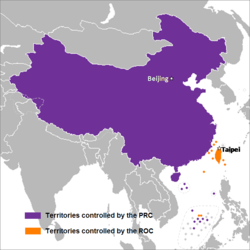
 Territory controlled by the People's Republic of China (purple) and the Republic of China (orange). The size of minor islands has been exaggerated in this map for ease of visibility. | |||||||
| Traditional Chinese | 中國統一 | ||||||
| Simplified Chinese | 中国统一 | ||||||
| Literal meaning | China unification | ||||||
| |||||||
| Cross-Strait unification | |||||||
| Traditional Chinese | 海峽兩岸統一 | ||||||
| Simplified Chinese | 海峡两岸统一 | ||||||
| Literal meaning | Two shores of strait unification | ||||||
| |||||||
| This article is part of a series on |
 |
|---|
 Taiwan portal Taiwan portal |


.svg) |
|---|
State representative
Executive organ Military organ
Supervisory organ |
 China portal China portal |

_cap_insignia.svg)
.png)
Chinese unification, also known as Cross-Strait unification or Chinese reunification, is the potential unification of territories currently controlled, or claimed, by the People's Republic of China ("China" or "Mainland China") and the Republic of China ("Taiwan") under one political entity, possibly the formation of a political union between the two republics. Together with full Taiwan independence, unification is one of the main proposals to address questions on the political status of Taiwan, which is the central focus of Cross-Strait relations.
Background
[edit]In 1895, the Manchu-led Qing dynasty of China lost the First Sino-Japanese War and was forced to cede Taiwan and Penghu to the Empire of Japan after signing the Treaty of Shimonoseki. In 1912, the Qing dynasty was overthrown and was succeeded by the Republic of China (ROC). Based on the theory of the succession of states, the ROC originally lay claim to the entire territory which belonged to the Qing dynasty during the time of its collapse, except for Taiwan, which the ROC recognized as belonging to the Empire of Japan at the time.[citation needed] The ROC managed to attain widespread recognition as the legitimate successor state to the Qing dynasty during the years following the fall of the Qing dynasty.[citation needed]
In the year 1945, the ROC won the Second Sino-Japanese War, which was intertwined with World War II, and took control of Taiwan on behalf of the Allied Powers, following the Japanese surrender. The ROC immediately asserted its claim to Taiwan as "Taiwan Province, Republic of China", basing its claim on the Potsdam Declaration and the Cairo Communique. Around this time, the ROC nullified the Treaty of Shimonoseki, declaring it to be one of the many "Unequal Treaties" imposed on China during the so-called "Century of Humiliation". At the time, the Kuomintang (KMT) was the ruling party of the ROC, and was widely recognized as its legitimate representative, especially due to the collaboration of its leader Chiang Kai-shek with the Allied Powers.[citation needed]
However, throughout much of the rule of the ROC, China had been internally divided during a period called the Warlord Era. According to the common narrative, the ROC was divided into many different ruling cliques and secessionist states, which were in a constant struggle following the power vacuum which was created after the overthrowing of the Qing Dynasty. During this period, two ruling cliques eventually came out on top; that of the KMT, backed by the United States, and that of the Chinese Communist Party (CCP), backed by the Soviet Union. The power struggle between these two specific political parties has come to be known as the Chinese Civil War. The Chinese Civil War was fought sporadically throughout the ROC's history; it was interrupted by the Second Sino-Japanese War.[citation needed]
After the Second Sino-Japanese War concluded, the Chinese Civil War resumed, and the CCP quickly gained a huge advantage over the KMT (ruling the ROC). In 1949, the KMT evacuated its government, its military, and around 1.2–2 million loyal citizens to Taiwan, which had only been ruled by the KMT for around four years by this time. Back in mainland China, the CCP proclaimed the "People's Republic of China (PRC)", effectively creating a reality of Two Chinas. Following the creation of Two Chinas, the PRC began to fight a diplomatic war against the ROC on Taiwan over official recognition as the sole legitimate government of China. Eventually, the PRC (mostly) won this war, and ascended to the position of "China" in the United Nations in 1971, evicting the ROC from that position.[citation needed]
As a result, the ROC still governed Taiwan but was no longer recognized as a member state of the United Nations. In recent years, membership in the United Nations has become almost an essential qualifier of statehood. Most states with limited recognition are not at all recognized by most governments and intergovernmental organizations. However, the ROC is a unique case, given that it has still managed to attain a significant degree of unofficial international recognition, even though most countries do not officially recognize it as a sovereign state. This is mainly due to the fact that the ROC was previously recognized as the legitimate government of China, providing an extensive framework for unofficial diplomatic relations to be conducted between the ROC and other countries.[citation needed]
In the years following the ROC's retreat to Taiwan, Taiwan has gone through a series of significant social, political, economic, and cultural shifts, strengthening the divide between Taiwan and mainland China. This has been further exacerbated by Taiwan's history as a colony of the Japanese Empire, which led to the establishment of a unique Taiwanese identity and the desire for Taiwan independence. The Taiwan independence movement has grown considerably stronger in recent decades, and has especially become a viable force on the island ever since the ROC's transition to a multi-party system, during what has become known as the Democratization of Taiwan.[citation needed]
The PRC has never recognized the sovereignty of Taiwan. PRC asserts that the ROC ceased to exist in the year 1949 when the PRC was proclaimed. Officially, PRC refers to the territory controlled by Taiwan as Taiwan area, and to the government of Taiwan as the Taiwan authorities. PRC continues to claim Taiwan as its 23rd Province, and the Fujianese territories still under Taiwanese control as parts of Fujian Province. PRC has established the one China principle in order to clarify its intention. The CCP classifies Taiwan independence supporters as one of the Five Poisons.[1][2] In 2005, the 10th National People's Congress passed the Anti-Secession Law authorizing military force for unification.[3]
Most Taiwanese people oppose joining PRC for various reasons, including fears of the loss of Taiwan's democracy, human rights, and Taiwanese nationalism. Opponents either favor maintaining the status quo of the Republic of China administrating Taiwan or the pursuit of Taiwan independence.[4] The Constitution of the Republic of China states that its territory includes the mainland,[5] but the official policy of the Taiwanese government is dependent on which coalition is currently in power. The position of the Pan-Blue Coalition, which comprises the Kuomintang, the People First Party and the New Party is to eventually incorporate the mainland into the ROC, while the position of the Pan-Green Coalition, composed of the Democratic Progressive Party (DPP) and the Taiwan Solidarity Union, is to pursue Taiwanese independence.[6]
In 2024, the Chinese government issued a directive to the courts stating that "diehard" independence supporters could be tried in absentia with capital punishment imposed.[7][8]
History
[edit]Mainland China
[edit]The concept of Chinese unification was developed in the 1970s as part of the CCP's strategy to address the "Taiwan issue" as China started to normalize foreign relations with a number of countries including the United States and Japan.[9][10]
According to the state-run China Internet Information Center, in 1979, the National People's Congress published the Message to Compatriots in Taiwan (告台湾同胞书) which included the term "Chinese reunification" as an ideal for Cross-Strait relations.[11][better source needed] In 1981, the chairman of the People's Congress Standing Committee Ye Jianying announced the "Nine Policies" for China's stance on Cross-Strait relations, with "Chinese Peaceful Unification" (祖国和平统一) as the first policy.[12] According to Xinhua, since then, "one country, two systems" and "Chinese reunification" have been emphasized at every National Congress of the Chinese Communist Party as the principles to deal with Hong Kong, Macau and Taiwan. "One Country, Two Systems" is specifically about China's policy towards post-colonial Hong Kong and Macao, and "Chinese Unification" is specifically about Taiwan.[13] Taiwan has also been offered the resolution of "One Country, Two Systems”.[14][15]
Taiwan
[edit]Taiwan has a complicated history of being at least partially occupied and administered by larger powers including the Dutch East India Company, the Kingdom of Tungning (purporting to be a continuation of the Southern Ming), the Qing dynasty and the Empire of Japan. Taiwan first came under direct Chinese control when it was invaded by the Manchu-led Qing dynasty in 1683.[16]
The island remained under Qing rule until 1895 when it was ceded to the Empire of Japan under the Treaty of Shimonoseki. Following the Axis powers' defeat in World War II in 1945, the Kuomintang-led Republic of China gained control of Taiwan.[16] Some Taiwanese resisted ROC rule in the years following World War II. The ROC violently suppressed this resistance which culminated in the February 28 Incident in 1947.[17] At the de facto end of the Chinese Civil War in 1950, KMT and CCP government faced each other across the Strait, with each aiming for a military takeover of the other.
From 1928 to 1942, the CCP maintained that Taiwan was a separate nation.[18] In a 1937 interview with Edgar Snow, Mao Zedong stated "we will extend them (the Koreans) our enthusiastic help in their struggle for independence. The same thing applies for Taiwan."[19]
The irredentist narrative emphasizing the importance of a unified Greater China area, which purportedly include Taiwan, arose in both the Kuomintang and the CCP in the years during and after the civil war. For the PRC, the claim of the Greater China area was part of a nationalist argument for territorial integrity. In the civil war years it set the communist movement apart from the ROC, which had lost Manchuria, the ancestral homeland of the Qing emperors, to Japan in 1932.[20]
Rise of Tangwai and Taiwanese nationalism
[edit]From the end of the Chinese Civil War in 1950 until the mid-1970s the concept of unification was not the main subject of discourse between the governments of the PRC and the ROC. The Kuomintang believed that they would, probably with American help, one day retake mainland China, while Mao Zedong's communist regime would collapse in a popular uprising and the Kuomintang forces would be welcomed.[21]
By the 1970s, the Kuomintang's authoritarian military dictatorship in Taiwan, led by the Chiang family was becoming increasingly untenable due to the popularity of the Tangwai movement and Taiwanese nationalism. In 1970, then-Vice Premier, Chiang Ching-kuo survived an assassination attempt in New York City by Cheng Tzu-tsai and Peter Huang, both members of the World United Formosans for Independence. In 1976, Wang Sing-nan sent a mail bomb to then-Governor of Taiwan Province Hsieh Tung-min, who suffered serious injuries to both hands as a result.[22] The Kuomintang's heavy-handed oppression in the Kaohsiung Incident, alleged involvement in the Lin family massacre and the murders of Chen Wen-chen and Henry Liu, and the self-immolation of Cheng Nan-jung galvanized the Taiwanese community into political actions and eventually led to majority rule and democracy in Taiwan.
The concept of unification replaced the concept of liberation by the PRC in 1979 as it embarked, after Mao's death, on economic reforms and pursued a more pragmatic foreign policy. In Taiwan, the possibility of the ROC retaking mainland China became increasingly remote in the 1970s, particularly after the ROC's expulsion from the United Nations in 1971, the establishment of diplomatic relations between the PRC and United States in 1979, and Chiang Kai-shek's death in 1975.[20]
Majority rule in Taiwan
[edit] |
With the end of authoritarian rule in the 1980s, there was a shift in power within the KMT away from the faction who had accompanied Chiang to Taiwan. Taiwanese who grew up under Japanese rule, which accounted for more than 85% of the population, gained more influence and the KMT began to move away from its ideology of cross-strait unification. After the exposure of 1987 Lieyu massacre in June, martial law was finally lifted in Taiwan on 15 July 1987. Following the Wild Lily student movement, President Lee Teng-hui announced in 1991 that his government no longer disputed the rule of the CCP in China, leading to semi-official peace talks (leading to what would be termed as the "1992 Consensus") between the two sides. The PRC broke off these talks in 1999 when President Lee described relations with the PRC as "Special state-to-state relations".
Until the mid-1990s, unification supporters on Taiwan were bitterly opposed to the CCP. Since the mid-1990s, there has been a considerable warming of relations between the CCP and Taiwanese unification supporters, as both oppose the pro-Taiwan independence bloc. This brought about the accusation that unification supporters were attempting to sell out Taiwan. They responded saying that closer ties with mainland China, especially economic ties, are in Taiwan's interest.
Rise of the Democratic Progressive Party
[edit] |
After the 2000 Taiwanese presidential election, which brought the independence-leaning Democratic Progressive Party's candidate President Chen Shui-bian to power, the Kuomintang, faced with defections to the People First Party, expelled Lee Teng-hui and his supporters and reoriented the party towards unification. At the same time, the People's Republic of China shifted its efforts at unification away from military threats (which it de-emphasized but did not renounce) towards economic incentives designed to encourage Taiwanese businesses to invest in mainland China and aiming to create a pro-Beijing bloc within the Taiwanese electorate.
Within Taiwan, unification supporters tend to see "China" as a larger cultural entity divided by the Chinese Civil War into separate states or governments within the country. In addition, supporters see Taiwanese identity as one piece of a broader Chinese identity rather than as a separate cultural identity. However, supporters do oppose desinicization inherent in Communist ideology such as that seen during the Cultural Revolution, along with the effort to emphasize a Taiwanese identity as separate from a Chinese one. As of the 2008 election of President Ma Ying-jeou, the KMT agreed to the One China principle, but defined it as led by the Republic of China rather than the People's Republic of China.
Military significance
[edit]
Military analysts often point out that control over Taiwan would have geostrategic significance for the PRC, allowing it to break out of the first island chain and increase the country's strategic depth.[23][24]: 138–139 The first island chain is often cited as a natural barrier and perceived constraint to the PRC's access to the Pacific Ocean.[25][23] Radar stations on the eastern side of Taiwan's Central Mountain Range would permit the PRC to more readily monitor activity in the Philippine Sea.[24]: 149 Control over Taiwan and its deeper eastern waters would also provide the People's Liberation Army Navy's ballistic missile submarines with less detectable access to the wider Pacific where they would serve as an important component of a credible second strike capability for the PRC.[26][24]: 148–149
One China, Two Systems proposal
[edit]
Deng Xiaoping developed the principle of one country, two systems in relation to Hong Kong, Macau, and Taiwan.[27]: 176 According to the 1995 proposal outlined by CCP General Secretary and paramount leader Jiang Zemin, Taiwan would lose sovereignty and the right to self-determination, but would keep its armed forces and send a representative to be the "number two leader" in the PRC central government. Thus, under this proposal, the Republic of China would become fully defunct.[citation needed]
In May 1998, the Central Committee of the Chinese Communist Party convened a Work Conference on Taiwan Affairs which stated that the whole party and the whole nation should work together for peaceful unification.[28]: 11
Few Taiwanese are in support of the One Country, Two Systems policy while some unification supporters argued to uphold the status quo until mainland China democratized and industrialized to the same level as Taiwan. In the 2000 presidential election, independent candidate James Soong proposed a European Union-style relation with mainland China (this was echoed by Hsu Hsin-liang in 2004) along with a non-aggression pact. In the 2004 presidential election, Lien Chan proposed a confederation-style relationship. Beijing objected to the plan, claiming that Taiwan was already part of China, and was not a state and, as such, could not form a confederation with it. Developments in Hong Kong have caused the population of Taiwan in recent years to find "One China, Two Systems" to be "unpersuasive, unappealing, and even untrustworthy."[29]
Stasis
[edit]Unification proposals were not actively floated in Taiwan and the issue remained moot under President Chen Shui-bian, who refused to accept talks under Beijing's pre-conditions. Under the PRC administration of Hu Jintao, incorporating Taiwan lost emphasis amid the reality that the DPP presidency in Taiwan would be held by pro-independence President Chen until 2008. Instead, the emphasis shifted to meetings with politicians who opposed independence.[citation needed]
A series of high-profile visits in 2005 to China by the leaders of the three pan-Blue Coalition parties was seen as an implicit recognition of the status quo by the PRC government. Notably, Kuomintang chairman Lien Chan's trip was marked by unedited coverage of his speeches and tours (and some added positive commentary) by government-controlled media and meetings with high level officials including Hu Jintao. Similar treatment (though marked with less historical significance and media attention) was given during subsequent visits by PFP chairman James Soong and New Party chairman Yok Mu-ming. The CCP and the Pan-Blue Coalition parties emphasized their common ground in renewed negotiations under the 1992 consensus, opening the Three Links, and opposing Taiwan's formal independence.[citation needed]
The PRC passed an Anti-Secession Law shortly before Lien's trip. While the Pan-Green Coalition held mass rallies to protest the codification of using military force to retake Taiwan, the Pan-Blue Coalition was largely silent. The language of the Anti-Secession Law was clearly directed at the independence supporters in Taiwan (termed "'Taiwan independence' secessionist forces" in the law) and designed to be somewhat acceptable to the Pan-Blue Coalition. It did not explicitly declare Taiwan to be part of the People's Republic of China but instead used the term "China" on its own, allowing definitional flexibility. It made repeated emphasis of promoting peaceful national unification but left out the concept of "one country, two systems" and called for negotiations in "steps and phases and with flexible and varied modalities" in recognition of the concept of eventual rather than immediate incorporation of Taiwan.[citation needed]
Under both President Chen and President Ma Ying-jeou, the main political changes in cross-straits relationship involved closer economic ties and increased business and personal travel. Such initiatives were met by grassroots oppositions such as the Sunflower Student Movement, which successfully scuttled Cross-Strait Service Trade Agreement in 2014. President Ma Ying-Jeou advocated for the revitalization of Chinese culture, as in the re-introduction of traditional Chinese in texts to mainland China used in Taiwan and historically in China. It expressed willingness to allow the usage simplified Chinese in informal writing.[citation needed]
Starting in 2017, the All-China Federation of Taiwan Compatriots, a group of Taiwanese residing in the PRC, took on a more prominent role in the CCP's united front efforts directed at Taiwan.[30]
Official stance of the People's Republic of China
[edit]The CCP uses the phrase "reunification" instead of "unification" to emphasize its assertion that the island of Taiwan has always belonged to China, or at least that the island Taiwan has been part of China for a long period of time, and that it currently belongs to People's Republic of China, but is currently being sporadically occupied by alleged separatists who support Taiwanese independence.[31]
“Liberation of Taiwan” (Chinese: 解放台湾) is a term used in the PRC to garner public opinion for cross-strait unification with the Republic of China in Taiwan, proposing the use of military force to achieve it. In 1956, CCP Chairman Mao Zedong first introduced the term, which was construed to mean a "peaceful" way to unify with the Republic of China. Despite this, both governments have had numerous long-term military confrontations. The CCP has set the unification of China as the most important political goal since the founding of the PRC.[32]
In January 1979, the Standing Committee of the National People's Congress issued its first appeal to the KMT, which marked the start of the PRC's "peaceful reunification" strategy.[33] In March 2005, the 10th National People's Congress passed the Anti-Secession Law authorizing military force for unification.[34] In 2019, CCP General Secretary Xi Jinping proposed "peaceful reunification" based on the one country, two systems program. The government of the ROC led by President Tsai Ing-wen rejected the proposal.[35]
The PRC does not consider the ROC a sovereign state today, instead believing itself to be the ROC's successor after the PRC's founding in 1949.[36][37]
In 2024, the Chinese government issued a directive to the courts stating that "diehard" separatists could be tried in absentia with capital punishment imposed.[7][8]
Taiwan and Penghu
[edit]Officially, the PRC traces Chinese sovereignty over Taiwan Island, allegedly historically known by the Chinese as "Liuqiu" (which is closely related to the name of the modern Japanese Ryukyu Islands), back to roughly around the 3rd century CE (specifically the year 230 CE).[38] However, most Western sources trace Chinese sovereignty over Taiwan Island back to either 1661–1662 CE (the year(s) when Koxinga established the Kingdom of Tungning in southwestern Taiwan) or 1683 CE (the year when the Qing dynasty absorbed the Kingdom of Tungning into its territory and subsequently lay claim to the entire island).[39]
Official stance of the Republic of China
[edit]Politics in the Republic of China are divided into two main camps, the Pan-Blue and the Pan-Green Coalitions. The former camp is characterized by general Chinese nationalism and ROC nationalism, whereas the latter camp is characterized by Taiwanese nationalism.[citation needed]
ROC official sources note that Qing forces occupied the island of Taiwan's western and northern coasts from 1683, and that Taiwan was declared a Qing province in 1885.[40]
Pan-Blue interpretation
[edit]The Japanese Instrument of Surrender (1945) is seen by the Pan-Blue camp as legitimizing the Chinese claims of sovereignty over Taiwan Island which were made with the 1943 Cairo Declaration and the Potsdam Declaration (1945).[41] The common Pan-Blue view asserts that Taiwan Island was returned to China in 1945. Irredentist in nature, those who possess this view commonly perceive Retrocession Day to be the conclusion to a continuous saga of reunification struggles on both sides of the strait, lasting from 1895, the year that Taiwan Island was ceded to Japan, up until 1945, the end of the Second World War. Hence, there is a common view among the Pan-Blue camp that the island of Taiwan was always a Chinese territory under Japanese occupation and never belonged to Japan, neither legally nor in spirit. The Cairo Declaration, Potsdam Declaration, and Japanese Instrument of Surrender are seen as proofs that the Treaty of Shimonoseki was nullified in its entirety in 1945, hence proving that the island of Taiwan always rightfully belonged to China throughout those fifty years of reunification struggles. Shortly following these events, the island of Taiwan was split from mainland China again, according to the common Pan-Blue view, marking the beginning of another reunification saga. Still, the Pan-Blue camp considers both Taiwan and mainland China to be currently under Chinese rule, with the division between the island of Taiwan and mainland China merely being internal, rather than directly the result of outsider aggression; this view is demonstrated through the 1992 Consensus, which some allege to be an agreement reached between officials of both the Kuomintang and the CCP in 1992. The notion of 1992 Consensus is that there is One China and that the island of Taiwan is part of China, but that the legitimate government of China can be interpreted differently by the two sides of the strait.[citation needed]
ROC singer Teresa Teng performed in many countries around the world, but never in mainland China. During her 1980 TTV concert, when asked about such possibility, she responded by stating that the day she performs on the mainland will be the day the Three Principles of the People are implemented there – in reference to either the pursuit of Chinese democracy or reunification under the banner of the ROC.[42][43][44]
Pan-Green interpretation
[edit]The views of the Pan-Green camp, though they are diverse, tend to be characterized by Taiwanese nationalism. Hence, most within the Pan-Green camp are opposed to the idea of Taiwan being part of China. Still, most within the Pan-Green camp accept certain historical facts which suggest that Taiwan was part of China. The common Pan-Green view accepts that Taiwan was controlled by a regime in mainland China between 1683 and 1895, though many characterize this as a period of constant rebellion, or suppression of identity (or discovery of a new identity), or colonization by the foreign Manchu people. While most among the Pan-Green camp accept that the transition from Chinese to Japanese rule in 1895 was violent and tragic, many believe that rule under the Japanese was either more benevolent than rule under the Chinese (both KMT and Qing) or more productive. Hence, most Pan-Green do not support the notion that Taiwan was part of China between 1895 and 1945, and neither the notion that there was a strong Chinese unification sentiment in Taiwan at that time. "Dark Green" members of the Pan-Green camp generally do not believe that the Treaty of Shimonoseki was ever nullified. Certain sources claim that attempts were made to nullify the treaty, but that these attempts were either illegal or futile,[45] whereas other sources claim that the notion that the treaty was ever nullified is a complete fabrication by the KMT in modern times.[46]
Tibet and Outer Mongolia
[edit]The ROC has the historical claims to Tibet and Outer Mongolia.
The southwestern region of Tibet was governed by the Dalai Lama from 1912 to 1951 as a de facto independent state instead of the Ganden Phodrang. The ROC government has asserted that "Tibet was placed under the sovereignty of China" when the Qing dynasty (1644–1912) ended the brief Nepalese invasion (1788–1792) of parts of Tibet in c. 1793.[47] while the Tibetan Government in Exile asserts that Tibet was an independent state until the PRC invaded Tibet in 1949/1950.[48][49] By that point, the position of the Republic of China with regard to Tibet appeared to become more nuanced as was stated in the following opening speech to the International Symposium on Human Rights in Tibet on 8 September 2007 through the pro-Taiwan independence then ROC President Chen Shui-bian who stated that his offices no longer treated exiled Tibetans as Chinese mainlanders.[50] Today, the region is ruled by the PRC-governed Tibet Autonomous Region with parts of the ROC-claimed Xikang province.
In the northern region, Outer Mongolia, now controlled by the independent Mongolia and the Russian Republic of Tuva, it declared independence from the Qing dynasty in 1911 while China retained its control over the area and reasserted control over Outer Mongolia in 1919.[51][52] Consequently, Mongolia sought Soviet Russian support to reclaim its independence. In 1921, both Chinese and White Russian forces were driven out by the Red Army of the Soviet Union and pro-Soviet Mongolian forces. In 1924, the Mongolian People's Republic was formed.[51] Soviet pressure forced China to recognize the independence of Mongolia in 1946, but the ROC reasserted the claims to Outer Mongolia in 1953. However, the claim was dropped in 2002 as the ROC Ministry of Foreign Affairs opened a representative office in Mongolia in 2002 with reciprocity from Mongolia in the ROC in 2003.[53]
Public opinion
[edit].jpg)


Republic of China in Taiwan
[edit]In 2019, 89% of Taiwanese opposed a 'One Country, Two Systems' unification with the PRC, more than double the opposition at the beginning of the millennium, when polls consistently found 30% to 40% of all residents were opposed, even with more preferential treatments.[54] At that time the majority supported so-called "status quo now".[55][56] While dominating international focus on Taiwanese politics, unification is generally not the deciding issue in Taiwanese political campaigns and elections.[57] A majority of the population supports the status quo, mostly in order to avoid a military confrontation with PRC, but a sizable proportion supports a name rectification campaign.[58]
Opponents of "One Country, Two Systems" cite its implementation in Hong Kong, where despite promises of high levels of autonomy, the PRC government has gradually increased its control of Hong Kong through restricting elections and increasing control over media and policy.[59] The National Security Law and the related crackdowns further diminished Taiwanese support for such a system.[29]
The Taiwanese pro-unification minority has at times been vocal in media and politics. For the 2004 presidential election the unification question gained some attention as different political parties were discussing the issue. A series of demonstrations, some of which were organized by pro-unification minorities, gained significant attention.[60]
Since the 1990s, the share of Taiwanese residents identifying as Chinese has fallen significantly, and the number identifying exclusively as Taiwanese has grown. A majority have identified as Taiwanese-only since 2009. Those identifying exclusively as Chinese fell from 25.5% in 1992 to 4.0% in 2008. Those identifying as both Chinese and Taiwanese fell from 46.4 in 1992 to 31.0% in 2024. Those identifying exclusively as Taiwanese has grown from 17.6% in 1992 to 63.4 in 2024.[61]
Over the same period, the share who support independence has grown slightly from 46.5% to 48.9%, and those who support unification has fallen from 20.0% to 6.9% in 2024. Within those who support independence, the share support independence as soon as possible has fallen. Those who support maintaining the status quo indefinitely has grown from 9.8% to 34.1%.[62]
People's Republic of China
[edit]A 2019 phone survey conducted in nine major cities found that 53.1% of respondents supported military force for unification (武统; wu tong) with Taiwan while 39.1% stated that they would oppose military force for unification under any circumstance.[63]: 37 [64]: 62 The study concluded that education level and unfavorable views of the Taiwan government were the greatest predictors of support for military force for unification.[64]: 46 Politically, economically, and socially privileged respondents, as well as respondents with greater understandings of Taiwan, were also more likely to support military force for unification.[64]: 46 Residents of Xiamen and Guangzhou (on the coast) were less likely to support military force.[64]: 46
A 2020-2021 national public opinion poll conducted in China by academics Adam Y. Liu and Xiaojun Li analyzed public approval for a range of policies, including military force for unification, limited warfare in offshore islands, economic sanctions, maintaining the status quo, and de facto Taiwan independence.[63]: 33–34 The resulting study, published in 2023 in the Journal of Contemporary China, concludes that 55% of respondents support using military force for unification, although that amount was not greater than various less aggressive policy options.[65][66][63]: 34 Approximately one-third of respondents were explicitly opposed to military force for unification.[63]: 45 Respondents with college degrees or more advanced degrees were more likely to endorse the more aggressive policy options.[63]: 43
See also
[edit]References
[edit]- ^ Callick, Rowan (11 March 2007). "China's great firewall". The Australian. Archived from the original on 28 September 2021. Retrieved 21 May 2024.
- ^ Hoffman, Samantha; Mattis, Peter (18 July 2016). "Managing the Power Within: China's State Security Commission". War on the Rocks. Archived from the original on 19 July 2016. Retrieved 22 July 2016.
- ^ Robinson, Dan (16 March 2005). "US House Criticizes China Bill on Taiwan Secession". Voice of America. Archived from the original on 2 April 2005. Retrieved 17 March 2005.
- ^ "政治大學 選舉研究中心". Archived from the original on 7 May 2014. Retrieved 30 June 2019.
- ^ "Taiwan (Republic of China)'s Constitution of 1947 with Amendments through 2005" (PDF). Archived (PDF) from the original on 7 November 2017. Retrieved 1 November 2017.
- ^ 民進黨:台灣是主權獨立國家 叫中華民國 | 政治 | 中央社即時新聞 CNA NEWS. 27 September 2017. Archived from the original on 7 November 2017. Retrieved 7 November 2017.
- ^ a b "China threatens death penalty for 'diehard' Taiwan separatists". Reuters. 21 June 2024. Retrieved 22 June 2024.
- ^ a b "China threatens death penalty for supporters of Taiwan independence". Radio Free Asia. 21 June 2024. Retrieved 22 June 2024.
- ^ "U.S.-China Relations". Council on Foreign Relations. Archived from the original on 7 November 2017. Retrieved 7 November 2017.
- ^ Tao, Xie. "The Politics of History in China-Japan Relations". The Diplomat. Archived from the original on 7 November 2017. Retrieved 7 November 2017.
- ^ "Message to Compatriots in Taiwan". China.org.cn. Archived from the original on 4 October 2018. Retrieved 3 October 2018.
- ^ 1981年9月30日 叶剑英进一步阐明关于台湾回归祖国,实现和平统一的9条方针政策--中国共产党新闻--中国共产党新闻网. cpc.people.com.cn. Archived from the original on 7 November 2017. Retrieved 7 November 2017.
- ^ ""One country, two systems" best institutional guarantee for HK, Macao prosperity, stability: Xi". Beijing: Xinhua. 18 October 2017. Archived from the original on 4 October 2018. Retrieved 3 October 2018.
- ^ "A policy of "one country, two systems" on Taiwan". www.mfa.gov.cn. Archived from the original on 13 September 2022. Retrieved 13 September 2022.
- ^ "Taiwan's president rejects 'one country, two systems' deal with China". France 24. 20 May 2020. Archived from the original on 13 September 2022. Retrieved 13 September 2022.
- ^ a b Franklin., Copper, John (2007). Historical dictionary of Taiwan (Republic of China) (3rd ed.). Lanham, Md.: Scarecrow Press, Inc. ISBN 9780810856004. OCLC 71288776.
{{cite book}}: CS1 maint: multiple names: authors list (link) - ^ Stéphane, Corcuff (2016). Memories of the Future: National Identity Issues and the Search for a New Taiwan. Taylor and Francis. ISBN 9780765607911. OCLC 959428520.
- ^ Hsiao, Frank S. T.; Sullivan, Lawrence R. (1979). "The Chinese Communist Party and the Status of Taiwan, 1928-1943". Pacific Affairs. 52 (3): 446. doi:10.2307/2757657. JSTOR 2757657.
- ^ van der Wees, Gerrit (3 May 2022). "When the CCP Thought Taiwan Should Be Independent". The Diplomat. Archived from the original on 8 November 2023. Retrieved 9 November 2023.
- ^ a b W., Hughes, Christopher (1997). Taiwan and Chinese nationalism : national identity and status in international society. London: Routledge. ISBN 9780203444191. OCLC 52630115.
{{cite book}}: CS1 maint: multiple names: authors list (link) - ^ Goldstein, Steven (2000). The United States and the Republic of China, 1949–1978: Suspicious Allies. Asia/Pacific Research Center. pp. 16–20. ISBN 9780965393591.
- ^ "TaiwanHeadlines – Home – Mail bomb explodes in Taipei office". 29 September 2007. Archived from the original on 29 September 2007. Retrieved 31 October 2017.
{{cite web}}: CS1 maint: bot: original URL status unknown (link) - ^ a b Yoshihara, Toshi (July 2012). "China's Vision of Its Seascape: The First Island Chain and Chinese Seapower". Asian Politics & Policy. 4 (3): 293–314. doi:10.1111/j.1943-0787.2012.01349.x.
- ^ a b c Wachman, Alan M. (1 August 2007). Why Taiwan?: Geostrategic Rationales for China's Territorial Integrity. Stanford University Press. doi:10.1515/9781503626379. ISBN 978-1-5036-2637-9.
- ^ Patton, James (30 April 2012). "Cold War SSN Operations: Lessons for Understanding Chinese Naval Development". China's Future Nuclear Submarine Force. Naval Institute Press. p. 278. ISBN 978-1-61251-150-4.
- ^ Howarth, Peter (18 April 2006). China's Rising Sea Power. Routledge. pp. 28–40. doi:10.4324/9780203029152. ISBN 978-1-134-20395-6.
- ^ Hu, Richard (2023). Reinventing the Chinese City. New York: Columbia University Press. ISBN 978-0-231-21101-7.
- ^ Zhao, Suisheng (2024). "Is Beijing's Long Game on Taiwan about to End? Peaceful Unification, Brinksmanship, and Military Takeover". In Zhao, Suisheng (ed.). The Taiwan Question in Xi Jinping's Era: Beijing's Evolving Taiwan Policy and Taiwan's Internal and External Dynamics. London and New York: Routledge. doi:10.4324/9781003521709. ISBN 9781032861661.
- ^ a b Chong, Ja Ian (20 February 2023). "The Many "One Chinas": Multiple Approaches to Taiwan and China". Archived from the original on 3 May 2023. Retrieved 31 March 2024.
- ^ "Civilian group from mainland China to take more prominent role in cross-strait affairs". South China Morning Post. 7 May 2017. Archived from the original on 15 May 2023. Retrieved 27 August 2023.
- ^ Wang, Amber (7 July 2022). "China puts Taiwan 'reunification' effort at heart of national revival plans". South China Morning Post. Archived from the original on 9 July 2022. Retrieved 9 July 2022.
- ^ Dorothy Perkins (2013). Encyclopedia of China: History and Culture. Routledge. p. 79. ISBN 978-1-135-93562-7. Archived from the original on 19 January 2023. Retrieved 27 January 2022.
- ^ Hsiao, Russell (12 January 2009). "Hu Jintao's 'Six-Points' Proposition to Taiwan". Jamestown Foundation. Archived from the original on 2 July 2024. Retrieved 2 July 2024.
- ^ Bellows, Thomas J. (December 2005). "The anti-secession law, framing, and political change in Taiwan". Asian Journal of Political Science. 13 (2): 103–123. doi:10.1080/02185370508434260. ISSN 0218-5377.
- ^ Horton, Chris (5 January 2019). "Taiwan's President, Defying Xi Jinping, Calls Unification Offer 'Impossible'". The New York Times. Archived from the original on 4 July 2021. Retrieved 27 January 2022.
- ^ Bush, Richard C. (24 January 2013). "Thoughts on the Republic of China and its Significance". Brookings Institution. Archived from the original on 13 September 2022. Retrieved 13 September 2022.
- ^ "White Paper: The Taiwan Question and China's Reunification in the New Era (Full Text)". munich.china-consulate.gov.cn. Archived from the original on 13 September 2022. Retrieved 13 September 2022.
- ^ "What is the reason for saying "Taiwan is an inalienable part of China"?". Ministry of Foreign Affairs of the People's Republic of China. Archived from the original on 4 April 2019. Retrieved 10 June 2019.
- ^ "China and Taiwan: A really simple guide". BBC News. 12 January 2022. Archived from the original on 1 September 2023. Retrieved 5 September 2023.
- ^ Affairs, Ministry of Foreign (11 June 2019). "History of Taiwan". Ministry of Foreign Affairs. Archived from the original on 24 May 2019. Retrieved 11 June 2019.
- ^ Huang, Eric (1 August 2015). "Taiwan's Opposition Must Get Clear on the Country's Sovereignty". The Diplomat. Archived from the original on 9 August 2019. Retrieved 10 August 2019.
- ^ 鄧麗君國父紀念館演唱會 1980年10月4日 (Video file) (published 13 January 2016). 4 October 1980. Archived from the original on 11 December 2021. Retrieved 29 May 2020 – via YouTube.
- ^ "PHOTO ESSAYS Teresa Teng's heavenly voice continues to echo transcendently". Central News Agency (Taiwan). 5 July 2015. Archived from the original on 29 May 2020. Retrieved 29 May 2020.
- ^ "鄧麗君逝世20週年 追憶天使美聲". www.cna.com.tw. Central News Agency (Taiwan). Archived from the original on 29 January 2018. Retrieved 25 April 2017.
- ^ "Treaty of Shimonoseki". Taiwan Civil Society. 22 March 2012. Archived from the original on 15 March 2017. Retrieved 9 August 2019.
- ^ Goah, Kengchi (11 September 2005). "A lie told a thousand times". Taipei Times. Archived from the original on 9 August 2019. Retrieved 9 August 2019.
- ^ Sperling (2004) pp.6,7. Goldstein (1989) p.72. Both cite the ROC's position paper at the 1914 Simla Conference.
- ^ Sperling (2004) p.21
- ^ "Five Point Peace Plan". The Dalai Lama. 21 September 1987. Archived from the original on 17 July 2012. Retrieved 9 July 2012.
- ^ "President Chen Shui-bian's Remarks at the Opening Ceremony of the 2007 International Symposium on Human Rights in Tibet".[dead link]
- ^ a b "China-Mongolia Boundary" (PDF). International Boundary Study (173). The Geographer, Bureau of Intelligence and Research: 2–6. August 1984. Archived from the original (PDF) on 16 September 2006. Retrieved 16 June 2008.
- ^ "Chinese Look To Their Neighbors For New Opportunities To Trade". International Herald Tribune. 4 August 1998. Archived from the original on 20 February 2008. Retrieved 15 June 2008.
- ^ "代表處簡介 – 代表處簡介 – 駐蒙古代表處". Taipei Trade and Economic Representative Office in Ulaanbaatar. Archived from the original on 5 November 2013. Retrieved 22 March 2014.
- ^ Mainland Affairs Council: MAC Press Release No. 94 (2019). "Growing Majority in Taiwan Reject the CCP's "One Country, Two Systems" and Oppose Beijing's Military and Diplomatic Suppression". Mainland Affairs Council. Archived from the original on 29 March 2024. Retrieved 29 March 2024.
{{cite web}}: CS1 maint: numeric names: authors list (link) - ^ "Mainland Affairs Council-How Taiwan People View Cross-Strait Relations (2000–02)". Mainland Affairs Council. 22 March 2009. Archived from the original on 8 November 2017. Retrieved 8 November 2017.
- ^ Flannery, Russell (6 September 1999). "Taiwan Poll Reflects Dissatisfaction With China's Unification Formula". The Wall Street Journal. ISSN 0099-9660. Archived from the original on 8 November 2017. Retrieved 8 November 2017.
- ^ Diplomat, Euhwa Tran, The. "Taiwan's 2016 Elections: It's Not About China". The Diplomat. Archived from the original on 8 November 2017. Retrieved 8 November 2017.
{{cite news}}: CS1 maint: multiple names: authors list (link) - ^ Yu, Ching-hsin (15 March 2017). "The centrality of maintaining the status quo in Taiwan elections". Brookings Institution. Archived from the original on 8 November 2017. Retrieved 8 November 2017.
- ^ "Beijing's crackdown on Hong Kong is alienating Taiwan- Nikkei Asian Review". Nikkei Asia. Archived from the original on 8 November 2017. Retrieved 8 November 2017.
- ^ Corcuff, Stéphane (1 May 2004). "The Supporters of Unification and the Taiwanisation Movement". China Perspectives. 2004 (3). doi:10.4000/chinaperspectives.2942. ISSN 2070-3449.
- ^ "Election Study Center, NCCU-Taiwanese / Chinese Identity". esc.nccu.edu.tw (in Chinese (Taiwan)). Archived from the original on 6 March 2021. Retrieved 29 March 2024.
- ^ "Taiwan Independence vs. Unification with the Mainland(1994/12~2024/12)". esc.nccu.edu.tw (in Chinese (Taiwan)). Archived from the original on 26 October 2021. Retrieved 15 April 2025.
- ^ a b c d e Liu, Adam Y.; Li, Xiaojun (2024). "Assessing Public Support for (Non-)Peaceful Unification with Taiwan: Evidence from a Nationwide Survey in China". In Zhao, Suisheng (ed.). The Taiwan Question in Xi Jinping's Era: Beijing's Evolving Taiwan Policy and Taiwan's Internal and External Dynamics. London and New York: Routledge. ISBN 9781032861661.
- ^ a b c d Qi, Dongtao; Zhang, Suixin; Lin, Shengqiao (2024). "Urban Chinese Support for Armed Unification with Taiwan: Social Status, National Pride, and Understanding of Taiwan". In Zhao, Suisheng (ed.). The Taiwan Question in Xi Jinping's Era: Beijing's Evolving Taiwan Policy and Taiwan's Internal and External Dynamics. London and New York: Routledge. ISBN 9781032861661.
- ^ Tang, Kelly (17 January 2024). "China's Nationalists Urge War to Reunify Taiwan After Presidential Election". Voice of America. Archived from the original on 6 May 2024. Retrieved 17 January 2024.
- ^ Liu, Adam Y.; Li, Xiaojun (14 May 2023). "Assessing Public Support for (Non)Peaceful Unification with Taiwan: Evidence from a Nationwide Survey in China". Journal of Contemporary China. 33 (145): 1–13. doi:10.1080/10670564.2023.2209524. ISSN 1067-0564.
Further reading
[edit]- Bush, Richard C.; O'Hanlon, Michael E. (30 March 2007). A War Like No Other: The Truth About China's Challenge to America. John Wiley & Sons. ISBN 978-0-471-98677-5.
- Bush, R (2006). Untying the Knot: Making Peace in the Taiwan Strait. Brookings Institution Press. ISBN 0-8157-1290-1.
- Carpenter, T. (2006). America's Coming War with China: A Collision Course over Taiwan. Palgrave Macmillan. ISBN 1-4039-6841-1.
- Cole, B. (2006). Taiwan's Security: History and Prospects. Routledge. ISBN 0-415-36581-3.
- Copper, J. (2006). Playing with Fire: The Looming War with China over Taiwan. Praeger Security International General Interest. ISBN 0-275-98888-0.
- Federation of American Scientists; et al. (2006). "Chinese Nuclear Forces and U.S. Nuclear War Planning" (PDF). Federation of American Scientists.
- Gill, B (2007). Rising Star: China's New Security Diplomacy. Brookings Institution Press. ISBN 978-0-8157-3146-7.
- Shirk, S. (2007). China: Fragile Superpower: How China's Internal Politics Could Derail Its Peaceful Rise. Oxford University Press. ISBN 978-0-19-530609-5.
- Tsang, S. (2006). If China Attacks Taiwan: Military Strategy, Politics and Economics. Routledge. ISBN 0-415-40785-0.
- Tucker, N.B. (2005). Dangerous Strait: the U.S.-Taiwan-China Crisis. Columbia University Press. ISBN 0-231-13564-5.


.svg)


| Diplomatic posts | |
|---|---|
| Diplomacy |
|
| Conflicts | |
| Incidents |
|
| Legislation | |
| Organizations |
|
| Concepts |
|
| Related |
|

| Communist Party | | ||||||||||
|---|---|---|---|---|---|---|---|---|---|---|---|
| Central government | |||||||||||
| United front | |||||||||||
| Politics of province-level divisions (current leaders) |
| ||||||||||
| |||||||||||
| |||||||||||||||||
| |||||||||||||||||
| |||||||||||||||||
| |||||||||||||||||


| History |  | |
|---|---|---|
| Founders |
| |
| Ideology | ||
| Leaders | ||
| Party congress | ||
| Leadership elections | ||
| Significant venues | ||
| See also | ||
Notes: Acting leaders italicised ; By-elections denoted with (b) | ||
| National | |
|---|---|
| Other | |


Chinese unification
View on GrokipediaConceptual and Legal Foundations
Definition and Core Principles
Chinese unification refers to the political objective of resolving the territorial and sovereignty division between the People's Republic of China (PRC), which controls the mainland and has governed since its founding on October 1, 1949, and the Republic of China (ROC), which retreated to Taiwan following the Chinese Civil War's effective end in 1949, to establish unified governance over all Chinese territories.[1] This division stems from the unresolved outcome of the civil war between the Chinese Communist Party (CCP) and the Kuomintang (KMT), with both entities initially claiming legitimate authority over the entirety of China, including Taiwan, which had been returned to Chinese control after Japanese occupation ended in 1945.[15] The PRC frames unification as an "indisputable fact rooted in history and law," essential for national rejuvenation and fulfilling the "shared aspiration of all the sons and daughters of the Chinese nation."[1] The core principle underpinning PRC policy is the One China principle, which posits that there is but one China, Taiwan is an inalienable part thereof, and the PRC government is the sole legal representative of China's sovereignty—a stance codified in PRC constitutions and anti-secession legislation passed on March 14, 2005.[5][16] Peaceful reunification is designated as the preferred path, best serving the fundamental interests of the Chinese nation, though non-peaceful means are not precluded if "Taiwan independence" forces or external interference provoke separation.[1] This approach integrates the "One Country, Two Systems" framework, originally proposed in the 1980s for Hong Kong and Macau, which would permit Taiwan to retain its existing socio-economic system, lifestyle, and high degree of autonomy under PRC sovereignty post-reunification, with the central government handling foreign affairs and defense.[1][5] In contrast, the ROC's constitutional framework, rooted in the 1947 constitution, maintains a claim to sovereignty over mainland China but has evolved toward emphasizing democratic governance and the status quo in practice, particularly under administrations rejecting PRC models since the 1990s.[17] Taiwanese public opinion, as reflected in official responses, overwhelmingly resists PRC-proposed unification, viewing it as incompatible with self-determination and citing disparities in political systems, with rejection of "One Country, Two Systems" articulated by ROC bodies like the Mainland Affairs Council.[18] These competing principles highlight a fundamental causal tension: the PRC's emphasis on historical continuity and territorial integrity versus the ROC's focus on effective control, democratic legitimacy, and aversion to subordination, rendering unification contingent on mutual recognition of sovereignty claims that remain irreconcilable without force or concession.[1][10]Historical Sovereignty Claims
Taiwan came under Qing dynasty control in 1683 after the conquest of the Ming loyalist Kingdom of Tungning, marking the beginning of formalized Chinese administrative integration of the island, which lasted until 1895.[19] During this period, Taiwan was governed as a prefecture and later a province, with Han Chinese migration significantly altering its demographics from predominantly indigenous populations.[20] The Qing's sovereignty was interrupted by the Treaty of Shimonoseki on April 17, 1895, in which the defeated Qing government ceded Taiwan and the Penghu Islands to Japan in perpetuity following the First Sino-Japanese War.[21] Japanese rule persisted until 1945, during which Taiwan was treated as a colony, with no restoration of Chinese sovereignty.[22] Post-World War II arrangements shifted control to the Republic of China (ROC). The Cairo Declaration of December 1, 1943, issued by the United States, United Kingdom, and ROC, stipulated the return of Taiwan (then Formosa) to the ROC after Japan's defeat, as compensation for territories previously taken by Japan.[23] This intent was reaffirmed in the Potsdam Proclamation of July 1945 and implemented via Japan's surrender on September 2, 1945, with ROC forces accepting Japanese capitulation in Taiwan on October 25, 1945, establishing de facto ROC administration.[24] The 1951 Treaty of San Francisco formalized Japan's renunciation of Taiwan but omitted designation of a successor sovereign, leaving the island's status unresolved in treaty law while ROC control continued uninterrupted.[25] The People's Republic of China (PRC), proclaimed on October 1, 1949, after the Chinese Civil War, has never exercised governance over Taiwan but asserts historical sovereignty deriving from pre-1949 Chinese entities, deeming Japanese occupation an invalid interruption and viewing itself as the sole legitimate successor to China's territorial integrity, including Taiwan as a province.[26] PRC doctrine invalidates "unequal treaties" like Shimonoseki and emphasizes cultural and ethnic continuity, though empirical control by PRC authorities remains absent since inception.[27] Conversely, the ROC, retreated to Taiwan in 1949, maintains constitutional claims to the mainland as its "national territory" under the 1947 Constitution, supplemented by 1991 Additional Articles that distinguish the "Taiwan area" for practical governance while preserving irredentist sovereignty over the "mainland area."[28] These mutual claims, rooted in overlapping interpretations of Qing-era boundaries and mid-20th-century transfers, underpin unification rhetoric by framing the post-1949 division as a temporary aberration requiring restoration of unified sovereignty.[29]One China Principle and International Law
The One China Principle refers to the position of the People's Republic of China (PRC) that there exists only one sovereign China, encompassing both mainland China and Taiwan as an inalienable province, with the PRC as the sole legitimate government representing all of China.[30] This principle, formalized in PRC domestic law and diplomatic assertions since the 1970s, serves as the foundational claim for unification efforts, positing Taiwan's separation as a temporary civil war remnant rather than a distinct sovereignty.[31] The One China policy, adhered to by most countries, involves recognizing the PRC as the sole legitimate government of China while viewing Taiwan as part of China or its status as undetermined. However, it contrasts with the "One China" policies of other states, such as the United States, which acknowledge the PRC's stance on a single China without endorsing PRC sovereignty over Taiwan and maintain unofficial relations with the island through frameworks like the Taiwan Relations Act of 1979.[32][33] Under international law, the One China Principle lacks binding treaty-based enforcement as a universal norm, deriving primarily from PRC interpretations of historical and political developments rather than explicit multilateral agreements mandating unification. The Cairo Declaration of 1943 and Potsdam Proclamation of 1945 intended Taiwan's return to the Republic of China (ROC) after Japanese rule, but the 1951 San Francisco Peace Treaty, to which neither the PRC nor ROC was a party, saw Japan renounce Taiwan without designating a successor sovereign, leaving its status unsettled in legal terms.[34] Subsequent PRC claims invoke these documents alongside the PRC's 1949 establishment as the effective government on the mainland, but they do not constitute cession or recognition of PRC authority over Taiwan by the international community at large.[35] United Nations General Assembly Resolution 2758, adopted on October 25, 1971, by a vote of 76-35 with 17 abstentions, restored the PRC's representation rights in the UN, expelling the ROC's delegates and recognizing the PRC as the "only legitimate representative of China" to the organization.[36] The resolution's text addresses solely the question of China's seat and does not reference Taiwan's sovereignty, territorial status, or participation rights, contrary to PRC assertions that it affirms Taiwan as part of one indivisible China.[37][38] Legal analyses emphasize that Resolution 2758, as a non-binding GA measure, resolved representational issues amid Cold War realpolitik—driven by shifting recognitions of the PRC over the ROC—without adjudicating underlying sovereignty disputes or precluding Taiwan's de facto statehood under criteria like effective control, population, and international engagement.[39][35] Taiwan's international legal standing remains ambiguous, functioning as a de facto sovereign entity with a population of approximately 23.6 million, defined territory, stable government, and capacity for foreign relations—meeting the Montevideo Convention's statehood thresholds—yet lacking formal recognition by most states due to diplomatic pressures from the PRC.[34] No international court has ruled on Taiwan's status, and unification claims rest on PRC domestic legislation like the 2005 Anti-Secession Law, which authorizes "non-peaceful means" against formal independence but holds no force beyond China's borders absent Security Council enforcement.[40] This framework underscores the principle's political weight over legal compulsion, with states navigating recognition pragmatically: 181 UN members recognize the PRC, but entities like the U.S. preserve Taiwan's autonomy through arms sales and strategic ambiguity to deter unilateral changes to the status quo.[30][31]Historical Evolution
Imperial and Republican Eras
The imperial era of China featured recurring cycles of unification and division, with the first enduring unification achieved by the Qin dynasty in 221 BC when Qin Shi Huang conquered the rival Warring States, establishing a centralized empire that standardized script, weights, measures, laws, and currency across former feudal domains. This model of imperial unity, justified by the Mandate of Heaven—a doctrine positing divine sanction for rule over a cohesive realm—persisted through subsequent dynasties, including the Han (206 BC–220 AD), which expanded bureaucratic administration and Confucian orthodoxy to consolidate control after Qin's collapse.[41] Periods of fragmentation, such as the Three Kingdoms (220–280 AD) or the Five Dynasties and Ten Kingdoms (907–960 AD), were typically followed by reunification efforts, as seen in the Song dynasty's partial restoration or the Ming dynasty's reconquest of Mongol-held territories by 1368 AD, reflecting a cultural and political imperative for centralized authority over the Han core and peripheral regions.[42] The Qing dynasty (1644–1912), despite its Manchu origins, extended this tradition by incorporating Mongolia, Tibet, and Xinjiang through military campaigns, maintaining nominal sovereignty via tributary systems until internal decay and foreign incursions eroded unity by the 19th century.[41] The Republican era began with the Xinhai Revolution of 1911, which overthrew the Qing dynasty and led to the proclamation of the Republic of China on January 1, 1912, with Sun Yat-sen as provisional president in Nanjing, explicitly aiming to unify a warlord-fragmented nation into a modern sovereign state.[43] Sun's Three Principles of the People—nationalism (minzu zhuyi) to rally ethnic unity against imperialism and division, democracy (minquan), and people's livelihood (minsheng)—framed unification as essential for national revival, influencing the Kuomintang (KMT) platform to prioritize territorial consolidation over the Qing's imperial expanse.[44] Under Chiang Kai-shek's leadership after Sun's death in 1925, the KMT launched the Northern Expedition (1926–1928), defeating key warlords like Wu Peifu and Zhang Zuolin to nominally reunify China under the Nanjing government by June 1928, establishing centralized control over most provinces and initiating reforms in administration, currency, and law.[45] Despite this progress, unification remained incomplete due to ongoing KMT campaigns against communist insurgents, Japanese invasion from 1937, and internal corruption, culminating in the Chinese Civil War's intensification after World War II and the KMT's retreat to Taiwan in 1949.[3] The Republic's constitutional framework, enacted in 1947, asserted sovereignty over historical Chinese territories, inheriting imperial claims while adapting them to republican nationalism.[45]Civil War and Post-1949 Division
The Chinese Civil War erupted following the collapse of the First United Front between the Kuomintang (KMT) and the Chinese Communist Party (CCP) in April 1927, when KMT forces under Chiang Kai-shek purged communists in urban centers like Shanghai, initiating a phase of intermittent conflict amid warlord fragmentation and the Northern Expedition.[3] Hostilities paused during the Second United Front against Japanese invasion from 1937 to 1945, but resumed full-scale after World War II, with the CCP leveraging rural guerrilla bases and land reforms to expand the People's Liberation Army (PLA) from approximately 1.2 million troops in 1945 to over 4 million by 1949, while KMT forces, plagued by corruption, inflation, and desertions, dwindled from 4.3 million to under 1.5 million effective combatants.[3] Decisive PLA offensives in 1948–1949, including the Liaoshen Campaign (September–November 1948, capturing 470,000 KMT troops), Huaihai Campaign (November 1948–January 1949, over 550,000 KMT casualties or captures), and Pingjin Campaign (November 1948–January 1949, securing northern China), precipitated the KMT's collapse on the mainland.[46] By mid-1949, the PLA had overrun major cities, including Nanjing in April, prompting Chiang Kai-shek's government to evacuate to Taiwan, where the Republic of China (ROC) administration formally relocated in December 1949, retaining control over Taiwan, Penghu, Kinmen, Matsu, and other offshore islands.[19] On October 1, 1949, Mao Zedong proclaimed the People's Republic of China (PRC) in Beijing, asserting control over the mainland and framing the victory as the culmination of a "people's democratic revolution" against imperialist and feudal elements.[3] The war's toll included an estimated 1.8 to 3.5 million deaths from atrocities alone between 1927 and 1949, with total military and civilian casualties likely exceeding 6 million, though precise figures remain disputed due to incomplete records and varying methodologies.[47] The post-1949 division entrenched dual sovereignty claims, with the PRC viewing itself as the sole legitimate government of China and the ROC maintaining its constitutional continuity as the Republic founded in 1912, both rejecting the other's authority over the entire territory historically encompassed by imperial China.[3] No formal peace treaty was signed, leaving the conflict in a state of armistice punctuated by crises like the 1954–1955 and 1958 Taiwan Strait confrontations, where U.S. intervention preserved ROC holdings.[13] The KMT imposed martial law on Taiwan from 1949 to 1987 to consolidate control amid White Terror suppressions, while the PRC consolidated power through campaigns like land reform and suppression of counter-revolutionaries, solidifying the ideological and territorial schism that underpins ongoing unification tensions.[19] This bifurcation, rooted in the civil war's unresolved outcome, positioned Taiwan as a de facto separate entity under ROC governance, with the PRC prioritizing "liberation" of the island as integral to national reunification.[48]Key Military Engagements
The primary military engagements between the People's Republic of China (PRC) and the Republic of China (ROC) following the 1949 division centered on the Taiwan Strait, particularly disputes over ROC-held offshore islands such as Kinmen (Quemoy) and Matsu. These confrontations, known as the Taiwan Strait Crises, represented PRC efforts to assert control over territories claimed as integral to unification, while ROC forces, supported by the United States, defended them. Bombardments and blockades aimed to isolate and capture these islands but ultimately failed to alter the status quo, highlighting the deterrent role of U.S. intervention under the 1954 Mutual Defense Treaty.[13][49] The First Taiwan Strait Crisis erupted on September 3, 1954, when PRC forces initiated artillery bombardment of Kinmen, escalating to attacks on other ROC-held islands including Dadeng, Yijiangshan, and Tachen. By January 1955, PRC amphibious assaults captured Yijiangshan Islands after intense fighting, prompting ROC evacuation of the Tachen Islands with U.S. naval assistance to avoid further losses. The U.S. Congress responded with the Formosa Resolution on January 28, 1955, authorizing presidential use of force to defend Taiwan and associated islands, which deterred a full PRC invasion. Ceasefire negotiations via intermediaries reduced hostilities by April 1955, though sporadic shelling persisted; PRC casualties exceeded 300 in the Yijiangshan operation alone, while ROC losses included over 500 personnel across engagements.[13][49][50] The Second Taiwan Strait Crisis commenced on August 23, 1958, with PRC artillery unleashing over 40,000 shells on Kinmen in the initial assault, followed by sustained barrages totaling more than 470,000 rounds by October. PRC naval and air forces imposed a blockade, sinking ROC supply ships and attempting to interdict U.S. resupply convoys, but ROC defenders repelled amphibious probes and maintained positions through underground fortifications and counter-battery fire. U.S. carrier groups and airlifts ensured ammunition delivery, neutralizing the blockade by late October; the crisis de-escalated after tacit U.S.-PRC understandings, though PRC shelling of Kinmen continued on odd-numbered days until 1979. ROC forces suffered approximately 440 deaths, with PRC losses estimated in the hundreds from counterfire and failed landings.[51][52][53] The Third Taiwan Strait Crisis, spanning July 1995 to March 1996, involved no direct combat but featured PRC ballistic missile tests and live-fire exercises as coercion against ROC President Lee Teng-hui's perceived independence moves, including his Cornell University visit. On July 21 and August 1995, PRC launched six DF-15 missiles into zones north and south of Taiwan, followed by air and naval maneuvers; escalation peaked in March 1996 with four additional missile firings and amphibious drills simulating invasion, prompting U.S. deployment of two carrier battle groups—the largest since the Vietnam War—to the region. The exercises ceased after Taiwan's March 23 presidential election, affirming deterrence without territorial changes or casualties, though they underscored PRC modernization of precision-strike capabilities.[54][55][56] Beyond these crises, intermittent PRC artillery duels with Kinmen persisted until January 1, 1979, when both sides halted fire amid diplomatic overtures, marking the last sustained cross-strait combat. Smaller incidents, such as ROC commando raids on PRC coastal facilities in the 1960s, occurred but did not escalate to crisis levels. These engagements reinforced the military stalemate central to stalled unification efforts, with PRC objectives frustrated by ROC resilience and U.S. commitments.[49][57]Unification Proposals and Models
Peaceful Reunification Strategies
The People's Republic of China (PRC) has consistently advocated peaceful reunification with Taiwan as its preferred approach since the late 1970s, emphasizing negotiation over coercion while reserving the right to use force if necessary.[1] This policy traces back to Deng Xiaoping's initiatives, including the 1981 nine-point proposal outlined by Ye Jianying, which promised Taiwan retention of its socioeconomic system, military, and administrative autonomy under a "one country, two systems" arrangement, with no deployment of mainland troops or officials to the island.[5] Deng further elaborated in 1983 with six principles, reiterating pledges of non-interference in Taiwan's local affairs and equitable participation in national governance, aiming to foster mutual trust through phased consultations.[58] These frameworks positioned peaceful reunification as a patriotic imperative, leveraging economic incentives and cultural affinity to encourage voluntary integration. Contemporary PRC strategies under Xi Jinping build on this foundation, promoting cross-strait fusion through incremental integration rather than abrupt political merger.[59] In his 2023 New Year's address, Xi described reunification as "inevitable" while prioritizing peaceful means, including enhanced economic cooperation and people-to-people exchanges to erode separatist sentiments.[60] Politically, adherence to the 1992 Consensus—wherein both sides ostensibly agree to "one China" with differing interpretations—serves as a precondition for dialogue, enabling semi-official talks on non-sovereignty issues like trade and aviation.[61] Economically, initiatives focus on interdependence, such as the 2010 Economic Cooperation Framework Agreement (ECFA) signed during Taiwan's Ma Ying-jeou administration, which reduced tariffs on select goods and boosted bilateral trade from $110 billion in 2008 to over $200 billion by 2016, alongside direct flights and tourism surges that increased mainland visitors to Taiwan from 400,000 in 2008 to 4.1 million in 2015.[62] Social strategies emphasize cultural reconnection, including youth exchange programs and media campaigns portraying unification as shared prosperity, though these have yielded limited traction amid Taiwan's democratic evolution. From the Republic of China (ROC) perspective, particularly under Kuomintang (KMT) governance, peaceful strategies have centered on pragmatic engagement to maintain stability without conceding sovereignty, often rejecting PRC preconditions like explicit acceptance of "one China." Ma Ying-jeou's 2008-2016 term exemplified this via "no unification, no independence, no use of force" diplomacy, prioritizing economic benefits from integration—such as supply chain linkages in semiconductors—while insulating political talks.[63] However, empirical data indicates minimal progress toward unification: polls by National Chengchi University's Election Study Center show support for immediate unification hovering below 6% since 1994, with over 80% favoring the status quo or independence by 2024.[9] Taiwan Public Opinion Foundation surveys in 2024-2025 similarly reveal 48% preferring formal independence and only 12% open to eventual unification under unspecified conditions, attributing resistance to PRC governance models exemplified by Hong Kong's post-2019 erosion of autonomy.[8] These outcomes underscore that PRC incentives, while advancing economic ties, have not overcome causal factors like divergent political systems and identity shifts, where 67% identified exclusively as Taiwanese in 2024 NCCU data.[9]One Country, Two Systems Framework
The "One Country, Two Systems" framework was first proposed by Deng Xiaoping in January 1982 during negotiations over Hong Kong's return, with explicit extension to Taiwan as a model for peaceful reunification that preserves the island's capitalist socioeconomic order under PRC sovereignty.[5] Deng elaborated on the concept in a June 1984 speech, emphasizing that Taiwan could retain its armed forces, administrative autonomy, and lifestyle indefinitely, without adopting socialism, while becoming a special administrative region (SAR) of the PRC.[64] The policy, formalized as a core PRC approach in subsequent white papers, posits Taiwan's reunification as subordinate to the "one China" principle, with Beijing retaining control over foreign affairs and defense, though promising no changes to Taiwan's social systems for a "long time."[65] In PRC articulations, the framework allows Taiwan greater autonomy than granted to Hong Kong or Macau, including retention of its military and exclusion from the national tax system, as outlined in Jiang Zemin's 1995 eight-point proposal and reaffirmed in Xi Jinping's 2019 speech commemorating the 40th anniversary of the "Message to Compatriots in Taiwan."[66] Beijing's 2022 white paper on the Taiwan question describes it as the "best approach" for resolving differences, accommodating Taiwan's realities while advancing national rejuvenation, and contrasts it with forcible unification options under the Anti-Secession Law.[67] However, PRC sources maintain that ultimate sovereignty resides in Beijing, with no tolerance for formal independence, and recent academic compilations under Xi's direction propose tailored implementations, such as cross-strait economic integration preceding political unification. The model's application in Hong Kong since the 1997 handover, intended as a 50-year guarantee of high autonomy under the Basic Law, has seen progressive centralization, particularly after the 2019 protests.[68] Beijing's imposition of the 2020 National Security Law enabled prosecution of dissent, disqualification of legislators, and overhaul of electoral systems to ensure "patriots" dominance, resulting in over 10,000 arrests by 2023 and a net emigration of 200,000 residents by mid-2022.[69] These developments, including erosion of judicial independence and suppression of media outlets like Apple Daily, have empirically undermined the promised separation of systems, as documented in analyses of post-2020 governance shifts.[70] Taiwanese authorities and public opinion have consistently rejected the framework, viewing it as incompatible with de facto sovereignty and democratic governance.[71] President Tsai Ing-wen explicitly renounced it in May 2020, arguing it fails to respect Taiwan's democracy and separate identity, a stance echoed across pan-Blue and pan-Green camps amid the Hong Kong precedent.[72] Polls conducted by Taiwan's Mainland Affairs Council indicate over 80% opposition as of 2022, with rejection rates exceeding 90% in some surveys citing fears of subsumed autonomy and loss of military self-defense.[73] Even Kuomintang leaders, historically more amenable to engagement, have distanced from it post-2019, prioritizing status quo preservation over PRC-dictated models.[25] This resistance underscores causal linkages between observed Hong Kong outcomes—systemic curtailment of freedoms despite assurances—and Taiwanese assessments of the framework's credibility.[10]Rejections and Alternative Visions
Taiwanese political leaders and major parties have firmly rejected the People's Republic of China's (PRC) unification proposals, emphasizing the incompatibility of Beijing's authoritarian model with Taiwan's democratic institutions. The Democratic Progressive Party (DPP), in power since 2016, opposes unification outright, arguing that it would undermine Taiwan's sovereignty and freedoms, as evidenced by the post-2019 erosion of autonomy in Hong Kong under "one country, two systems."[10][74] The Kuomintang (KMT), Taiwan's main opposition party, also rejects "one country, two systems" following Hong Kong's experience, though it advocates for cross-strait dialogue based on the 1992 Consensus and opposes forcible unification or formal independence.[74][75] In response to Beijing's August 2022 white paper promoting reunification, Taiwan's Mainland Affairs Council labeled it "highly unacceptable," asserting that unification must respect Taiwan's democracy and public will rather than PRC dictates.[76] Public opinion polls reflect widespread rejection of PRC-led unification, driven by perceptions of the mainland's political system as repressive rather than cultural differences alone. A February 2025 Taiwan Public Opinion Foundation survey found that a majority of respondents preferred Taiwan independence as the ideal future status, though most favored maintaining the current de facto independence to avoid provoking conflict.[8] Election Study Center data from National Chengchi University, tracked since 1994, shows support for unification with the PRC hovering below 10% as of late 2024, with over 80% favoring either the status quo or independence.[9] This aversion stems from empirical observations of PRC governance, including censorship, human rights abuses, and military coercion, which have solidified Taiwanese identity distinct from Chinese nationalism.[77] Alternative visions prioritize preserving Taiwan's autonomy over PRC integration, with the status quo—de facto independence without formal declaration—emerging as the dominant preference to deter invasion risks while sustaining economic ties.[78] Pro-independence advocates, aligned with the DPP and pan-Green camp, push for enhanced international recognition and constitutional reforms to affirm Taiwan's separate status, though polls indicate caution due to anticipated PRC retaliation.[10] The KMT's pan-Blue perspective envisions eventual peaceful reunification under a democratic framework akin to the Republic of China's (ROC) constitutional claims over the mainland, but only with mutual consent and PRC democratization, a scenario deemed improbable given Beijing's trajectory.[75] These alternatives underscore a consensus against submission to PRC sovereignty, favoring strategic ambiguity and alliances like those with the United States to maintain deterrence.[25]Official Positions
People's Republic of China Stance
The People's Republic of China (PRC) maintains that Taiwan is an inalienable part of its territory, asserting the One China principle which holds that there is only one sovereign China, represented by the PRC as the sole legitimate government over all of China, of which Taiwan Province forms a constituent part.[79] This position frames reunification as a fundamental national interest essential to the "great rejuvenation of the Chinese nation," with complete reunification viewed as inevitable and non-negotiable.[1] The PRC's 2022 white paper, "The Taiwan Question and China's Reunification in the New Era," explicitly states that "nothing can stop" this process, emphasizing historical, cultural, and legal grounds for Taiwan's belonging to China since ancient times, and that the Taiwan authorities lack sovereign status and legitimacy.[67] The PRC prioritizes peaceful reunification through dialogue and negotiation, proposing the "one country, two systems" framework adapted for Taiwan, which would preserve its social and economic systems, lifestyle, and high degree of autonomy without interference in local affairs.[5] Under this model, Taiwan residents would enjoy rights and interests safeguarded by China's Constitution, including participation in national governance on equal footing with mainland counterparts.[79] However, the PRC conditions progress on Taiwan's recognition of the 1992 Consensus, which embodies "one China, different interpretations," and opposes any moves toward formal independence.[80] Legally, the PRC's stance is codified in the Anti-Secession Law, enacted on March 14, 2005, which opposes and restrains Taiwan's secession, authorizing "non-peaceful means and other necessary measures" if Taiwan declares independence, peaceful reunification becomes impossible, or major secessionist incidents occur.[81] This law underscores that the state shall never allow Taiwan to secede under any name or means.[82] PRC leaders, including Xi Jinping, have repeatedly affirmed readiness to use force if necessary, with Xi stating in his December 31, 2024, New Year's address that "no one can stop" China's reunification with Taiwan, portraying the two sides as "one family" bound by common interests.[83] In October 2025, top official Wang Huning reiterated that peaceful reunification remains the preferred path, offering Taiwan the backing of a "powerful motherland" post-unification.[84]Republic of China Perspectives
The Republic of China's constitution, as amended through the Additional Articles effective since 1991, defines the national territory within its existing boundaries as of the enactment of the original constitution in 1947, which encompassed mainland China, Taiwan, and associated islands, though effective governance is confined to Taiwan, Penghu, Kinmen, Matsu, and other minor islets.[85] This framework upholds the ROC's claim to legitimacy over all China but prioritizes de facto sovereignty in administered areas amid the post-1949 division.[19] ROC governments consistently reject unification on terms dictated by the People's Republic of China (PRC), deeming such proposals—such as "one country, two systems"—incompatible with Taiwan's multiparty democracy, rule of law, and civil liberties, as evidenced by Hong Kong's post-2019 developments.[10] The Mainland Affairs Council (MAC), the ROC's primary body for cross-strait policy, advocates stable relations through dialogue, economic exchanges, and mutual non-subordination, while opposing any legal or coercive measures like the PRC's 2005 Anti-Secession Law that threaten force against perceived secession.[17] Under President Lai Ching-te's administration since May 2024, the stance emphasizes preserving the status quo of "no unification, no independence, and no use of force," bolstering asymmetric defenses, and deepening alliances with democratic nations to counter PRC military pressures.[86] Lai has articulated that Taiwan must rely on its own capabilities for security, rejecting PRC unification overtures as untenable without reciprocal acceptance of ROC sovereignty and democratic norms.[87] Political interpretations within the ROC diverge along partisan lines, with the Kuomintang (KMT) historically favoring eventual peaceful reunification under the Three Principles of the People and ROC constitutional order, provided the mainland democratizes—a condition unmet under PRC rule.[75] KMT figures like former President Ma Ying-jeou have reaffirmed support for unification in principle but conditioned on mutual consent and absence of coercion, prioritizing cross-strait economic ties and the disputed 1992 Consensus as a basis for talks, though rejecting PRC dominance.[75] In contrast, the Democratic Progressive Party (DPP) views Taiwan as a distinct sovereign entity separate from the PRC, eschewing unification rhetoric in favor of consolidating national identity, enhancing self-reliance, and framing cross-strait dynamics as a systemic clash between democracy and authoritarianism.[18] DPP policy, as outlined in its 1999 resolution, treats the Taiwan Strait as separating two countries, maintaining the status quo without pursuing formal independence to avoid provocation, while critiquing KMT approaches for risking undue concessions to Beijing.[74] Both major parties converge on defending ROC sovereignty against PRC absorption, reflecting broad elite consensus against forced unification amid empirical evidence of the PRC's internal controls and external assertiveness.[25]Pan-Blue and Pan-Green Interpretations
The Pan-Blue coalition, primarily led by the Kuomintang (KMT), interprets Chinese unification as a long-term goal achievable through peaceful means under the framework of the Republic of China (ROC) Constitution, which claims sovereignty over all of China including the mainland.[88] This view upholds the 1992 Consensus as a basis for cross-strait dialogue, emphasizing mutual non-denial of each side's political stance to facilitate economic and cultural exchanges without conceding to the People's Republic of China's (PRC) demands for subordination.[89] Pan-Blue advocates reject PRC-proposed models like "one country, two systems," arguing instead for reunification contingent on democratic reforms in mainland China aligning with the ROC's Three Principles of the People—nationalism, democracy, and social welfare.[88] In practice, this has evolved toward prioritizing Taiwan's de facto independence and civic nationalism, with recent KMT leadership stressing guardrails against PRC coercion, as evidenced by opposition to non-peaceful resolutions and calls for strengthened deterrence.[90] In contrast, the Pan-Green coalition, dominated by the Democratic Progressive Party (DPP), fundamentally rejects unification with the PRC, viewing it as a threat to Taiwan's sovereignty and democratic institutions.[74] Pan-Green interpretations frame Taiwan's identity as distinct, rooted in its post-1949 democratic evolution separate from PRC governance, and prioritize maintaining the status quo or advancing formal independence through enhanced international alliances and domestic resilience.[91] The DPP's platform explicitly opposes any framework implying "one China" absorption, as articulated in resolutions since 1999 that condition cross-strait talks on PRC abandonment of force renunciation, with leaders like Tsai Ing-wen and Lai Ching-te emphasizing Taiwan's self-determination over historical claims of shared ethnicity.[92] This stance aligns with low public support for unification—polls consistently showing 6-12% favorability—driving Pan-Green policies toward economic decoupling from overreliance on China and bolstering U.S.-Taiwan ties.[93] These divergent interpretations reflect Taiwan's polarized politics, where Pan-Blue engagement seeks to mitigate conflict risks via dialogue, while Pan-Green resistance underscores empirical PRC actions—like military incursions post-2016—as evidence against concessions.[94] Both camps adhere to the ROC Constitution's anti-secession provisions but differ causally: Pan-Blue sees economic interdependence as a unification pathway, whereas Pan-Green attributes PRC assertiveness to ideological incompatibility, prioritizing deterrence over rapprochement.[95]Military and Geopolitical Dynamics
Past Conflicts and Lessons
The Chinese Civil War, fought intermittently from 1927 to 1949 between the Kuomintang-led Republic of China (ROC) and the Chinese Communist Party (CCP), culminated in the CCP's victory and the establishment of the People's Republic of China (PRC) on October 1, 1949.[3] The ROC government, under Chiang Kai-shek, relocated its capital to Taipei, Taiwan, on December 7, 1949, retaining control over Taiwan and several offshore islands including Kinmen and Matsu.[96] This division set the stage for ongoing cross-strait tensions, with the PRC viewing the ROC-held territories as unfinished business of unification and launching early military probes to test defenses.[13] A pivotal early conflict was the Battle of Guningtou on Kinmen, beginning October 25, 1949, when approximately 9,000 People's Liberation Army (PLA) troops attempted an amphibious landing from the mainland.[97] ROC forces, numbering around 40,000 and benefiting from established defenses and naval superiority, repelled the assault after intense fighting; PLA casualties exceeded 3,000 killed and over 5,000 captured, with no survivors returning to the mainland.[98] This defeat highlighted the PLA's logistical vulnerabilities in amphibious operations across the 110-mile-wide strait, lacking air cover and facing rough seas that stranded follow-on forces.[99] Subsequent escalations defined the Taiwan Strait Crises. In the First Crisis (September 1954–May 1955), the PLA shelled Kinmen and Matsu with artillery, prompting ROC airstrikes and U.S. intervention; Congress passed the Formosa Resolution in January 1955, authorizing President Eisenhower to use force to defend Taiwan, which deterred further PRC advances and led to a ceasefire.[13] The Second Crisis erupted on August 23, 1958, with the PLA firing over 470,000 shells at Kinmen in the first 10 days alone, aiming to isolate and capture the islands; U.S. resupply convoys under naval escort broke the blockade by October, forcing the PRC to alternate bombardment patterns that persisted until 1979 but failed to dislodge ROC garrisons.[13][51] The Third Crisis (July 1995–March 1996) involved PLA missile tests—six launches targeting areas near Taiwan's ports—in response to ROC President Lee Teng-hui's U.S. visit; the U.S. deployed two carrier battle groups, signaling resolve and contributing to de-escalation without direct combat.[54] These conflicts yielded strategic lessons for cross-strait dynamics. Amphibious invasions across the Taiwan Strait proved extraordinarily difficult due to geographic barriers, weather variability, and the need for unchallenged sea and air control, as evidenced by the PLA's 1949 rout and inability to sustain blockades in 1958.[100] U.S. extended deterrence, through treaties like the 1954 Mutual Defense Treaty (terminated 1979 but with implicit commitments persisting), repeatedly checked PRC escalation by raising invasion costs, though it risked miscalculation without clear red lines.[13] The crises underscored that limited coercion—bombardments or tests—failed to force unification absent decisive military superiority, instead bolstering ROC resilience and international involvement, while exposing PRC constraints in projecting power beyond artillery range until modern capabilities emerged.[101] Politically, they reinforced Taiwan's de facto independence by demonstrating that force alone could not compel submission without broader war, influencing subsequent PRC shifts toward hybrid pressures over outright invasion.[102]Current PRC Military Preparations
The People's Liberation Army (PLA) has undergone rapid modernization under Xi Jinping, with a focus on capabilities for a potential Taiwan contingency, including internal assessments aiming for operational readiness by 2027.[103] As of February 2026, no invasion of Taiwan has occurred, and expert analyses assess the likelihood of an invasion in 2026 as low, due to economic pressures, incomplete military readiness, high potential costs, and recent PLA leadership purges delaying capabilities.[104][105] Xi Jinping's stated motivation emphasizes Taiwan reunification for national rejuvenation and personal legacy, prioritizing combat readiness without a specified timeline.[106] Reunification with Taiwan would enable the PRC to break the first island chain, granting the PLA Navy direct access to the Pacific Ocean and threatening U.S. and Japanese bases in the region.[107] The U.S. Department of Defense assesses that while the PLA has narrowed gaps in joint operations and logistics, it faces persistent challenges in large-scale amphibious assault and sustained combat against determined resistance.[103] China's official defense budget for 2025 stands at approximately 1.78 trillion yuan (about $247 billion), reflecting a 7.2% increase, though independent estimates adjust for underreported expenditures on research, paramilitary forces, and foreign arms purchases, placing actual outlays between $330 billion and $450 billion.[108][109] The PLA Navy (PLAN) is projected to expand to 395 ships by the end of 2025, emphasizing surface combatants, submarines, and power projection assets to support blockade or invasion scenarios.[110] This includes three aircraft carriers: the conventionally powered Liaoning and Shandong, and the advanced Fujian, which completed its fifth sea trial by December 2024 and began testing electromagnetic catapults and aircraft launches in 2025 to enable operations with stealth fighters like the J-35.[111] Amphibious capabilities have advanced through modernization of combined-arms brigades equipped with wheeled assault vehicles capable of speeds up to 100 km/h and integration of shuiqiao-class landing barges for over-the-horizon assaults, as demonstrated in large-scale exercises in February 2025 simulating island seizures.[112][113][114] However, the PLAN's amphibious lift remains constrained, capable of transporting only a fraction of forces needed for a full cross-strait invasion without multiple waves.[103] The PLA Rocket Force (PLARF) maintains the world's largest ground-based missile arsenal, exceeding 2,500 ballistic and cruise missiles, with over 1,700 dedicated to suppressing Taiwanese defenses and deterring U.S. intervention through anti-ship systems like the DF-21D and DF-26 "carrier killers."[115][116] These hypersonic and quasi-ballistic weapons, including the DF-17, enable area-denial strategies across the Taiwan Strait, though their effectiveness depends on targeting accuracy and countermeasures.[103] Recent activities include heightened naval transits around Taiwan, frequent Air Defense Identification Zone incursions, and joint exercises practicing blockades, signaling preparation for gray-zone coercion escalating to kinetic operations.[117]Taiwan Defenses and External Alliances
The Republic of China Armed Forces maintain an active strength of approximately 150,000 personnel, with the capacity to mobilize up to 1.67 million reservists.[118] Taiwan ranks 22nd globally in military power for 2025, with an estimated 500 combat-capable aircraft in its air force and around 90 combat surface ships in its navy.[118][119] The 2025 National Defense Report emphasizes multilayered deterrence and resilient defense, focusing on sustaining operations amid potential attacks.[120] Taiwan has adopted the "porcupine strategy" as its core defense approach, prioritizing asymmetric warfare to impose high costs on a potential Chinese invasion through denial rather than direct confrontation.[121] This includes deploying sea mines, drone swarms, anti-ship missiles, and mobile defenses to exploit geographic advantages and technological edges, aiming to delay and attrit invaders until external aid arrives.[122][123] Recent enhancements sharpen these capabilities, such as layered defenses to block rapid victories by Beijing.[124] In response to escalating threats, Taiwan extended mandatory military service from four months to one year starting in 2024, applying initially to men born in 2005 and later cohorts, with a revamped curriculum emphasizing rigorous training.[125][126] This reform seeks to bolster reserve readiness and overall deterrence, though implementation challenges persist in scaling training infrastructure.[127] Externally, the United States provides the primary support framework via the 1979 Taiwan Relations Act, which commits to supplying defensive arms without a formal mutual defense treaty, maintaining strategic ambiguity on intervention.[128] Since 1950, U.S. arms sales to Taiwan total nearly $50 billion, including recent notifications like a $1.988 billion package for National Advanced Surface-to-Air Missile Systems and radars in 2024.[129][130] Delivery backlogs remain an issue, with undelivered items valued at billions as of 2023 audits, though progress includes HIMARS systems in late 2024.[131][132] Allies like Japan and Australia participate in joint exercises and regional security dialogues but lack binding commitments to defend Taiwan, with U.S. efforts to clarify their roles in a potential conflict yielding no public pledges as of 2025.[133][134] The Pentagon has pressed these partners for defined contributions, amid multinational war games simulating Taiwan scenarios involving U.S., Japan, India, and others.[135][136]Public Opinion and Societal Factors
Taiwanese Views and Polls
Polls conducted in Taiwan consistently show low support for unification with the People's Republic of China (PRC), with preferences skewed toward maintaining the status quo or pursuing formal independence. In a survey by the Taiwan Public Opinion Foundation from December 9-11, 2024, and January 12-14, 2025, involving over 2,000 adults, 13.3 percent favored unification, while 51.8 percent supported independence and 24.2 percent preferred the status quo.[8] This represents a slight uptick in unification support from 12.4 percent in May 2024, though independence preferences rose more sharply amid heightened PRC military activities.[8] Rejection of Beijing's proposed "one country, two systems" framework, modeled after Hong Kong's experience, is even more pronounced. A Mainland Affairs Council (MAC) poll released April 25, 2025, found 84.4 percent of respondents opposed it, consistent with prior surveys showing rejection rates above 80 percent since 2019.[7] An August 2025 MAC survey reported 83.7 percent opposition, attributing the stance to perceptions of eroded autonomy in Hong Kong and PRC authoritarianism.[137] These figures reflect broader empirical resistance, as Taiwanese cite the PRC's political system—characterized by one-party rule and suppression of dissent—as incompatible with Taiwan's democratic institutions and freedoms.[10]| Poll Organization | Date | Unification (%) | Independence (%) | Status Quo (%) | Opposition to "One Country, Two Systems" (%) |
|---|---|---|---|---|---|
| Taiwan Public Opinion Foundation | Dec 2024–Jan 2025 | 13.3 | 51.8 | 24.2 | N/A |
| Mainland Affairs Council | Apr 2025 | N/A | N/A | N/A | 84.4 |
| Mainland Affairs Council | Aug 2025 | N/A | N/A | N/A | 83.7 |
Mainland Chinese Attitudes
A 2025 joint survey by the Carter Center and Chinese think tanks, involving over 2,000 respondents, found that 55.3% of mainland Chinese oppose using military force for unification with Taiwan under any conditions, while 28.6% support force only if peaceful options fail, and 16.1% back it unconditionally.[138][139] This reluctance stems from concerns over economic fallout, including trade disruptions and personal financial impacts, amid China's prioritization of domestic stability and growth since the reform era.[140] Nationalistic sentiment, cultivated through compulsory education curricula that frame Taiwan as a core interest since the 1949 civil war, underpins broad acceptance of unification as a historical imperative for "national rejuvenation." State media, such as CCTV and People's Daily, consistently depict Taiwan's status as unresolved internal affairs, fostering views that independence movements represent foreign interference rather than legitimate self-determination. Surveys indicate near-universal endorsement of the "one China" principle among respondents, with deviations rare due to self-censorship in a controlled informational environment.[141] Demographic patterns show younger urban residents, exposed to online nationalism via platforms like Weibo, expressing stronger impatience for resolution but favoring diplomatic or economic coercion over invasion, influenced by awareness of military risks highlighted in state analyses. Rural and older cohorts prioritize peace to preserve prosperity gains, with only isolated hawkish voices amplified in controlled discourse. These attitudes constrain aggressive policies, as public backlash to casualties—as seen in historical reflections on the Korean War—could undermine Communist Party legitimacy.[142][143] Polling limitations persist, as independent access is restricted and responses may align with official narratives to avoid repercussions, potentially understating private skepticism toward unification's feasibility given Taiwan's democratic divergences. Nonetheless, empirical data affirm a causal link between sustained propaganda and resilient support for the goal, tempered by pragmatic aversion to conflict's tangible costs.[144]Economic and Cultural Interdependence
Taiwan and the People's Republic of China (PRC) exhibit deep economic interdependence, primarily through bilateral trade and investment flows that have grown since the early 1990s. In 2024, Taiwan's exports to the PRC and Hong Kong constituted 31.7% of its total goods exports, a decline from 42.3% in 2020 amid Taiwan's diversification efforts, yet cross-strait trade volume rose 9.4% year-on-year to underscore ongoing integration in sectors like electronics and machinery.[145][146] Taiwanese firms, particularly in manufacturing, have invested heavily in the PRC, with 310 outward investment applications approved in 2024, though this represents only about 5% of Taiwan's total outbound foreign direct investment projects from 2020 to 2023 as companies shift toward Southeast Asia and North America to mitigate risks.[147][148] Conversely, PRC investment into Taiwan reached US$297 million across 36 approved cases in 2024, focused on manufacturing and services, reflecting mutual reliance in global supply chains where Taiwan dominates advanced semiconductors critical to PRC tech industries.[149] This economic linkage influences unification dynamics by creating shared incentives for stability, as disruption could inflict severe reciprocal costs—estimated at trillions in global GDP losses from severed semiconductor flows alone—potentially deterring PRC military escalation despite Beijing's rhetoric framing integration as a unification pathway.[150] However, the PRC has wielded this interdependence as leverage through measures like 2021 import bans on Taiwanese pineapples and wax apples in response to political tensions, highlighting asymmetrical vulnerabilities that Taiwan seeks to reduce via policies like the New Southbound Policy since 2016, which boosted non-PRC trade partners.[151] Culturally, Taiwan and the PRC share a foundational heritage rooted in Han Chinese migration, Confucian values, classical literature, and Mandarin as a lingua franca, fostering intuitive affinities that predate the 1949 split and enable cross-strait exchanges in media, education, and family reunions.[152] People-to-people ties, including tourism peaking at over 4 million PRC visitors to Taiwan annually before 2019 restrictions and student exchanges involving thousands of Taiwanese studying in the PRC as of 2023, have sustained soft connections amid political divides.[153] The PRC actively promotes these bonds through initiatives like cultural tours and media collaborations—such as 2024 Hubei province exchanges showcasing heritage sites to Taiwanese journalists—to cultivate pro-unification sentiment, viewing shared ethnicity as a tool for influence.[154][155] Yet, Taiwan's post-1980s democratization has amplified cultural divergences, with rising indigenous influences, democratic norms, and a distinct "Taiwanese" identity—evident in generational shifts where younger cohorts prioritize local heritage over pan-Chinese narratives—complicating unification appeals despite underlying ties.[156] These interdependencies, while binding economies and evoking historical kinship, underscore tensions: economic mutualism incentivizes status quo preservation, whereas PRC-orchestrated cultural outreach aims at erosion of separatism, though Taiwan's societal evolution resists absorption without consent.[157]Recent Developments and Tensions
2020s Political Shifts
In Taiwan, the 2020 presidential election saw Democratic Progressive Party (DPP) incumbent Tsai Ing-wen secure re-election with 57.1% of the vote, reflecting widespread rejection of Beijing's unification overtures amid heightened cross-strait tensions and the Hong Kong protests' fallout, which eroded faith in "one country, two systems."[158] This outcome reinforced DPP policies prioritizing de facto independence and strengthened ties with the United States, while the Kuomintang (KMT), favoring closer economic engagement with the mainland, suffered losses.[159] The 2024 elections marked a further shift, with DPP candidate Lai Ching-te winning the presidency on January 13 with 40.05% of the vote—enough for a third consecutive DPP term but the party's lowest presidential share since democratization—signaling voter fatigue with prolonged DPP rule amid economic concerns, yet no endorsement of pro-unification stances.[160] In the Legislative Yuan, the DPP lost its majority, securing 51 of 113 seats, while the KMT gained 52 and the emerging Taiwan People's Party (TPP) took 8, creating a fragmented opposition that has led to legislative gridlock and forced compromise on defense and China-related bills.[161] This fragmentation has complicated Lai's agenda of resisting unification through asymmetric defense enhancements and diversified trade, though it has not revived significant support for cross-strait accommodation.[162] Public opinion polls in Taiwan during the decade show a consistent decline in support for unification, with only 1.3% favoring immediate unification with the mainland in a February 2025 Taiwan Public Opinion Foundation survey, compared to 28.6% preferring immediate independence and 54.6% favoring eventual independence after maintaining the status quo.[8] Taiwanese identification has risen to over 60% self-identifying solely as "Taiwanese" by 2023, up from earlier decades, driven by PRC assertiveness, including the 2020 Hong Kong National Security Law, which Taiwanese viewed as a cautionary suppression of autonomy.[10] This attitudinal hardening prioritizes status quo preservation over unification, with resistance rooted in empirical observations of mainland governance contrasts rather than abstract ideology. On the mainland, Xi Jinping's leadership has intensified unification as a non-negotiable "core interest," with policies shifting toward integrated deterrence, including bottom-up economic experimentation for "peaceful reunification" via regional pilots like Fujian province's cross-strait initiatives, while escalating military drills post-2020 to signal readiness for coercion.[59] Xi's rhetoric, as in repeated emphases on resolving Taiwan by mid-century, reflects a strategic urgency tied to perceived peaks in China's relative power, prompting accelerated civilian-military fusion for potential forceful scenarios despite official peaceful preferences. Xi emphasizes Taiwan reunification as essential to national rejuvenation and his personal legacy, prioritizing combat readiness without a specified timeline or public indication of drive for imminent invasion. Despite speculation about nearer-term deadlines such as 2026, as of March 2, 2026, China has not invaded, reclaimed, or pursued military unification of Taiwan, including during the ongoing US-Iran conflict; no official timeline exists for reunification in that year, Xi Jinping has not announced specific plans for it, and China reiterates that reunification is inevitable without providing a date. Analyses indicate mixed strategic implications from the US-Iran conflict: US strikes on Iran may distract resources but also demonstrate resolve, potentially deterring Beijing; analysts deem military action in 2026 unlikely due to economic pressures, incomplete military readiness exacerbated by recent PLA leadership purges, high potential costs, US commitments, and ongoing coercion and rhetoric.[163][104][105] These shifts have narrowed prospects for voluntary unification, as Taiwanese data indicate no reciprocal softening, instead amplifying deterrence demands.Escalating Cross-Strait Activities
Since 2022, the People's Liberation Army (PLA) has intensified military operations across the Taiwan Strait, shifting from sporadic responses to high-profile political events toward sustained, routine patrols and exercises that normalize a persistent presence near Taiwan. This escalation includes record numbers of aircraft entering Taiwan's air defense identification zone (ADIZ), increased naval deployments, and large-scale joint exercises simulating blockades and invasions. Taiwan's Ministry of National Defense (MND) reports daily detections of PLA aircraft and vessels operating around the island, with activities often exceeding previous baselines in frequency and proximity.[164][165] PLA air incursions into Taiwan's ADIZ have surged, with annual totals rising from 972 in 2021 to 1,738 in 2022 following U.S. House Speaker Nancy Pelosi's visit to Taipei, which prompted extensive live-fire drills and missile overflights. In 2023, incursions reached 1,703, while 2024 saw over 3,000, including peaks during President Lai Ching-te's May inauguration that triggered "Joint Sword-2024A" exercises encircling Taiwan with aircraft carriers and amphibious forces. By early 2025, monthly sorties often exceeded 200–300, with February alone recording 362 violations—the highest since October 2024—and January 2025 logging 248, a 1.75-fold increase over prior peaks. These operations frequently involve fighters, bombers, and drones approaching within 20 nautical miles of Taiwan's coast, testing response times without crossing the median line.[165][166][167]| Year | PLA Aircraft ADIZ Incursions |
|---|---|
| 2021 | 972 |
| 2022 | 1,738 |
| 2023 | 1,703 |
| 2024 | 3,615 |