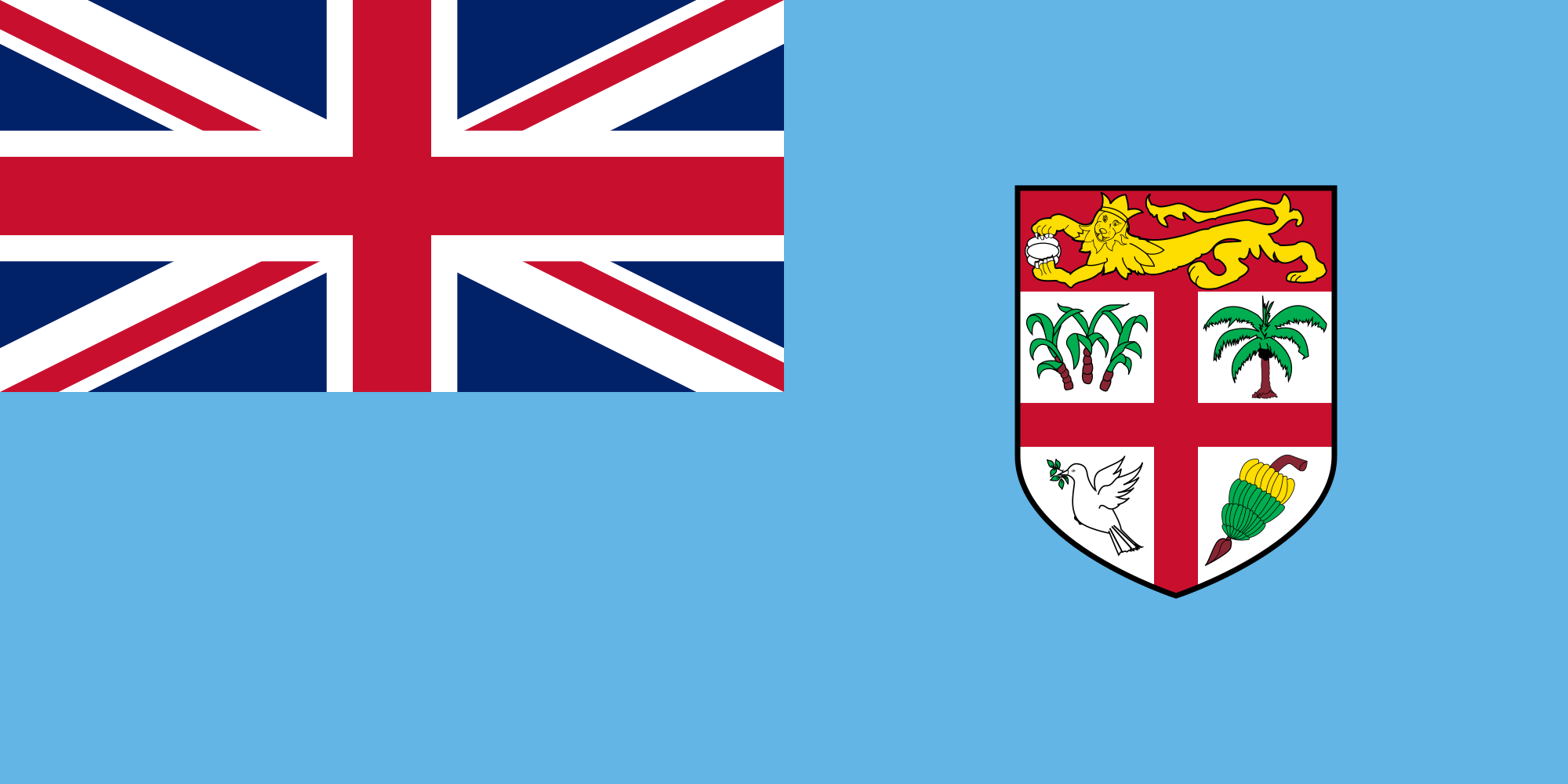

Fiji,[a] officially the Republic of Fiji,[b] is an island country in Melanesia, part of Oceania in the South Pacific Ocean. It lies about 1,100 nautical miles (2,000 km; 1,300 mi) north-northeast of New Zealand. Fiji consists of an archipelago of more than 330 islands—of which about 110 are permanently inhabited—and more than 500 islets, amounting to a total land area of about 18,300 square kilometres (7,100 sq mi). The most outlying island group is Ono-i-Lau. About 87% of the total population live on the two major islands, Viti Levu and Vanua Levu. About three-quarters of Fijians live on Viti Levu's coasts, either in the capital city of Suva, or in smaller urban centres such as Nadi (where tourism is the major local industry) or Lautoka (where the sugar-cane industry is dominant). The interior of Viti Levu is sparsely inhabited because of its terrain.[14]
Key Information


_(Polynesia_centered).svg)


The majority of Fiji's islands were formed by volcanic activity starting around 150 million years ago. Some geothermal activity still occurs today on the islands of Vanua Levu and Taveuni.[15] The geothermal systems on Viti Levu are non-volcanic in origin and have low-temperature surface discharges (of between roughly 35 and 60 degrees Celsius (95 and 140 °F).
Humans have lived in Fiji since the second millennium BC—first Austronesians and later Melanesians, with some Polynesian influences. Europeans first visited Fiji in the 17th century.[16] In 1874, after a brief period in which Fiji was an independent kingdom, the British established the Colony of Fiji. Fiji operated as a Crown colony until 1970, when it gained independence and became known as the Dominion of Fiji. In 1987, following a series of coups d'état, the military government that had taken power declared it a republic. In a 2006 coup, Commodore Frank Bainimarama seized power. In 2009, the Fijian High Court ruled that the military leadership was unlawful. At that point, President Ratu Josefa Iloilo, whom the military had retained as the nominal head of state, formally abrogated the 1997 Constitution and re-appointed Bainimarama as interim prime minister. Later in 2009, Ratu Epeli Nailatikau succeeded Iloilo as president.[17] On 17 September 2014, after years of delays, a democratic election took place. Bainimarama's FijiFirst party won 59.2% of the vote, and international observers deemed the election credible.[18]
Fiji has one of the most developed economies in the Pacific[19] through its abundant forest, mineral, and fish resources. The currency is the Fijian dollar, with the main sources of foreign exchange being the tourist industry, remittances from Fijians working abroad, bottled water exports, and sugar cane.[6] The Ministry of Local Government and Urban Development supervises Fiji's local government, which takes the form of city and town councils.[20]
Etymology
[edit]The name of Fiji's main island, Viti Levu, served as the origin of the name "Fiji", though the common English pronunciation is based on that of Fiji's island neighbours in Tonga. An official account of the emergence of the name states:
Fijians first impressed themselves on European consciousness through the writings of the members of the expeditions of Cook who met them in Tonga. They were described as formidable warriors and ferocious cannibals, builders of the finest vessels in the Pacific, but not great sailors. They inspired awe amongst the Tongans, and all their Manufactures, especially bark cloth and clubs, were highly valued and much in demand. They called their home Viti, but the Tongans called it Fisi, and it was by this foreign pronunciation, Fiji, first promulgated by Captain James Cook, that these islands are now known.[21]
"Feejee", the Anglicised spelling of the Tongan pronunciation,[22] occurred in accounts and other writings by missionaries and other travellers visiting Fiji until the late 19th century.[23][24]
History
[edit]Early settlement
[edit].png)

Pottery art from Fijian towns shows that Fiji was settled by Austronesian peoples by at least 3500 to 1000 BC, with Melanesians following around a thousand years later, although there are still many open questions about the specific dates and patterns of human migration. It is believed that either the Lapita people or the ancestors of the Polynesians settled the islands first, but not much is known of what became of them after the Melanesians arrived; the old culture may have had some influence on the new one, and archaeological evidence shows that some of the migrants moved on to Samoa, Tonga and even Hawai'i. Archeological evidence also shows signs of human settlement on Moturiki Island beginning at least by 600 BC and possibly as far back as 900 BC. Although some aspects of Fijian culture are similar to the Melanesian culture of the western Pacific, Fijian culture has a stronger connection to the older Polynesian cultures. The evidence is clear that there was trade between Fiji and neighbouring archipelagos long before Europeans made contact with Fiji.
In the 10th century, the Tu'i Tonga Empire was established in Tonga, and Fiji came within its sphere of influence. The Tongan influence brought Polynesian customs and language into Fiji. That empire began to decline in the 13th century.
Fiji has long had permanent settlements, but its peoples also have a history of mobility. Over the centuries, unique Fijian cultural practices developed. Fijians constructed large, elegant watercraft, with rigged sails called drua and exported some to Tonga. Fijians also developed a distinctive style of village architecture, consisting of communal and individual bure and vale housing, and an advanced system of ramparts and moats that were usually constructed around the more important settlements. Pigs were domesticated for food, and a variety of agricultural endeavours, such as banana plantations, existed from an early stage. Villages were supplied with water brought in by constructed wooden aqueducts. Fijians lived in societies led by chiefs, elders and notable warriors. Spiritual leaders, often called bete, were also important cultural figures, and the production and consumption of yaqona was part of their ceremonial and community rites. Fijians developed a monetary system where the polished teeth of the sperm whale, called tambua, became an active currency. A type of writing existed which can be seen today in various petroglyphs around the islands.[25] Fijians developed a refined masi cloth textile industry, and used the cloth they produced to make sails and clothes such as the malo and the liku. As with most other ancient human civilisations, warfare or preparation for warfare was an important part of everyday life in pre-colonial Fiji. The Fijians were noted for their distinctive use of weapons, especially war clubs.[26][27] Fijians used many different types of clubs that can be broadly divided into two groups, two handed clubs and small specialised throwing clubs called ula.[28]

With the arrival of Europeans in the 17th century, and European colonisation in the late 19th century, many elements of Fijian culture were either repressed or modified to ensure European – specifically, British – control. This was especially the case with respect to traditional Fijian spiritual beliefs. Early colonists and missionaries utilised and conflated the concept of cannibalism in Fiji to give a moral imperative for colonial intrusion.[29] Europeans labelled many native Fijian customs as debased or primitive, enabling colonists to see Fiji as a "paradise wasted on savage cannibals".[30] This narrative became a justification for violence and punitive actions by the colonists which accompanied the enforced transfer of power to the Europeans.[29] Authors such as Deryck Scarr[31] have perpetuated 19th century myths of "freshly killed corpses piled up for eating" and ceremonial mass human sacrifice on the construction of new houses and boats.[32] While some modern archaeological studies conducted by scholars including Degusta,[33] Cochrane,[34] and Jones[35] on Fijian sites have shown that Fijians may have practised an intermittent and ritualistic form of cannibalism, other research doubts even the existence of cannibalism in Fiji.[36] Perhaps the most accurate account of cannibalism in 19th century Fiji comes from William MacGregor, the long term chief medical officer in British colonial Fiji. During the Little War of 1876, he stated that the rare occasion of tasting of the flesh of the enemy was done "to indicate supreme hatred and not out of relish for a gastronomic treat".[37]
Early interaction with Europeans
[edit]
Dutch explorer Abel Tasman was the first known European visitor to Fiji, sighting the northern island of Vanua Levu and the North Taveuni archipelago in 1643 while looking for the Great Southern Continent.[38]
James Cook, the British navigator, visited one of the southern Lau islands in 1774. It was not until 1789, however, that the islands were charted and plotted, when William Bligh, the castaway captain of HMS Bounty, passed Ovalau and sailed between the main islands of Viti Levu and Vanua Levu en route to Batavia, in what is now Indonesia. Bligh Water, the strait between the two main islands, is named after him and for a time, the Fiji Islands were known as the Bligh Islands.

The first Europeans to maintain substantial contact with the Fijians were sandalwood merchants, whalers and "beche-de-mer" (sea cucumber) traders. The first whaling vessel known to have visited was the Ann and Hope in 1799, and she was followed by many others in the 19th century.[39] These ships came for drinking water, food and firewood and, later, for men to help man their ships. Some of the Europeans who came to Fiji in this period were accepted by the locals and were allowed to stay as residents.
By the 1820s, Levuka was established as the first European-style town in Fiji, on the island of Ovalau. The market for "beche-de-mer" in China was lucrative, and British and American merchants set up processing stations on various islands. Local Fijians were utilised to collect, prepare and pack the product which would then be shipped to Asia. A good cargo would result in a half-yearly profit of around $25,000 for the dealer.[40] The Fijian workers were often given firearms and ammunition as an exchange for their labour, and by the end of the 1820s most of the Fijian chiefs had muskets and many were skilled at using them. Some Fijian chiefs soon felt confident enough with their new weapons to forcibly obtain more destructive weaponry from the Europeans. In 1834, men from Viwa and Bau were able to take control of the French ship L'amiable Josephine and use its cannon against their enemies on the Rewa River, although they later ran it aground.[41]
Christian missionaries like David Cargill also arrived in the 1830s from recently converted regions such as Tonga and Tahiti, and by 1840 the European settlement at Levuka had grown to about 40 houses with former whaler David Whippey being a notable resident. The religious conversion of the Fijians was a gradual process which was observed first-hand by Captain Charles Wilkes of the United States Exploring Expedition. Wilkes wrote that "all the chiefs seemed to look upon Christianity as a change in which they had much to lose and little to gain".[42] Christianised Fijians, in addition to forsaking their spiritual beliefs, were pressured into cutting their hair short, adopting the sulu form of dress from Tonga and fundamentally changing their marriage and funeral traditions. This process of enforced cultural change was called lotu.[43] Intensification of conflict between the cultures increased, and Wilkes was involved in organising a large punitive expedition against the people of Malolo. He ordered an attack with rockets which acted as makeshift incendiary devices. The village, with the occupants trapped inside, quickly became an inferno with Wilkes noting that the "shouts of men were intermingled with the cries and shrieks of the women and children" as they burnt to death. Wilkes demanded the survivors should "sue for mercy" and if not "they must expect to be exterminated". Around 57 to 87 Maloloan people were killed in this encounter.[44]
Cakobau and the wars against Christian infiltration
[edit]

The 1840s was a time of conflict where various Fiji clans attempted to assert dominance over each other. Eventually, a warlord named Seru Epenisa Cakobau of Bau Island was able to become a powerful influence in the region. His father was Ratu Tanoa Visawaqa, the Vunivalu (a chiefly title meaning warlord, often translated also as paramount chief) who had previously subdued much of western Fiji. Cakobau, following on from his father, became so dominant that he was able to expel the Europeans from Levuka for five years over a dispute about their giving of weapons to his local enemies. In the early 1850s, Cakobau went one step further and declared war on all Christians. His plans were thwarted after the missionaries in Fiji received support from the already converted Tongans and the presence of a British warship. The Tongan Prince Enele Maʻafu, a Christian, had established himself on the island of Lakeba in 1848, forcibly converting the local people to the Methodist Church. Cakobau and other chiefs in the west of Fiji regarded Maʻafu as a threat to their power and resisted his attempts to expand Tonga's dominion. Cakobau's influence, however, began to wane, and his heavy imposition of taxes on other Fijian chiefs, who saw him at best as first among equals, caused them to defect from him.[45]
Around this time the United States also became interested in asserting their power in the region, and they threatened intervention following a number of incidents involving their consul in the Fiji islands, John Brown Williams. In 1849, Williams had his trading store looted following an accidental fire, caused by stray cannon fire during a Fourth of July celebration, and in 1853 the European settlement of Levuka was burnt to the ground. Williams blamed Cakobau for both these incidents, and the U.S. representative wanted Cakobau's capital at Bau destroyed in retaliation. A naval blockade was instead set up around the island which put further pressure on Cakobau to give up on his warfare against the foreigners and their Christian allies. Finally, on 30 April 1854, Cakobau offered his soro (supplication) and yielded to these forces. He underwent the lotu and converted to Christianity. The traditional Fijian temples in Bau were destroyed, and the sacred nokonoko trees were cut down. Cakobau and his remaining men were then compelled to join with the Tongans, backed by the Americans and British, to subjugate the remaining chiefs in the region who still refused to convert. These chiefs were soon defeated with Qaraniqio of the Rewa being poisoned and Ratu Mara of Kaba being hanged in 1855. After these wars, most regions of Fiji, except for the interior highland areas, had been forced into giving up much of their traditional systems and were now vassals of Western interest. Cakobau was retained as a largely symbolic representative of a few Fijian peoples and was allowed to take the ironic and self proclaimed title of "Tui Viti" ("King of Fiji"), but the overarching control now lay with foreign powers.[46]
Cotton, confederacies and the Kai Colo
[edit]
The rising price of cotton in the wake of the American Civil War (1861–1865) caused an influx of hundreds of settlers to Fiji in the 1860s from Australia and the United States in order to obtain land and grow cotton. Since there was still a lack of functioning government in Fiji, these planters were often able to get the land in violent or fraudulent ways such as exchanging weapons or alcohol with Fijians who may or may not have been the true owners. Although this made for cheap land acquisition, competing land claims between the planters became problematic with no unified government to resolve the disputes. In 1865, the settlers proposed a confederacy of the seven main native kingdoms in Fiji to establish some sort of government. This was initially successful, and Cakobau was elected as the first president of the confederacy.[47]

With the demand for land high, the white planters started to push into the hilly interior of Viti Levu. This put them into direct confrontation with the Kai Colo, which was a general term to describe the various Fijian clans resident to these inland districts. The Kai Colo were still living a mostly traditional lifestyle, they were not Christianised, and they were not under the rule of Cakobau or the confederacy. In 1867, a travelling missionary named Thomas Baker was killed by Kai Colo in the mountains at the headwaters of the Sigatoka River. The acting British consul, John Bates Thurston, demanded that Cakobau lead a force of Fijians from coastal areas to suppress the Kai Colo. Cakobau eventually led a campaign into the mountains but suffered a humiliating loss with 61 of his fighters being killed.[48] Settlers also came into conflict with the local eastern Kai Colo people called the Wainimala. Thurston called in the Australia Station section of the Royal Navy for assistance. The Navy duly sent Commander Rowley Lambert and HMS Challenger to conduct a punitive mission against the Wainimala. An armed force of 87 men shelled and burnt the village of Deoka, and a skirmish ensued which resulted in the deaths of over 40 Wainimala.[49]
Kingdom of Fiji (1871–1874)
[edit].svg)
After the collapse of the confederacy, Enele Maʻafu established a stable administration in the Lau Islands and the Tongans. Other foreign powers such as the United States were considering the possibility of annexing Fiji. This situation was not appealing to many settlers, almost all of whom were British subjects from Australia. Britain, however, refused to annex the country, and a compromise was needed.[50]
In June 1871, George Austin Woods, an ex-lieutenant of the Royal Navy, managed to influence Cakobau and organise a group of like-minded settlers and chiefs into forming a governing administration. Cakobau was declared the monarch (Tui Viti) and the Kingdom of Fiji was established. Most Fijian chiefs agreed to participate, and even Ma'afu chose to recognise Cakobau and participate in the constitutional monarchy. However, many of the settlers had come from Australia, where negotiation with the indigenous people almost universally involved coercing them to accept very unfavourable terms. These settlers' expectation of dominating by force led them to form several aggressive, racially motivated groups, such as the British Subjects Mutual Protection Society. One group called themselves the Ku Klux Klan in homage to the white supremacist group in America.[51] However, when respected individuals such as Charles St Julian, Robert Sherson Swanston and John Bates Thurston were appointed by Cakobau, a degree of authority was established.[52]

With the rapid increase in white settlers entering the country, the desire for land acquisition also intensified. Once again, conflict with the Kai Colo in the interior of Viti Levu ensued. In 1871, the killing of two settlers near the Ba River in the northwest of the island prompted a large punitive expedition of white farmers, imported slave labourers, and coastal Fijians to be organised. This group of around 400 armed vigilantes, including veterans of the U.S. Civil War, had a battle with the Kai Colo near the village of Cubu, in which both sides had to withdraw. The village was destroyed, and the Kai Colo, despite being armed with muskets, received numerous casualties.[53] The Kai Colo responded by making frequent raids on the settlements of the whites and Christian Fijians throughout the district of Ba.[54] Likewise, in the east of the island on the upper reaches of the Rewa River, villages were burnt, and many Kai Colo were shot by the vigilante settler squad called the Rewa Rifles.[55]
Although the Cakobau government did not approve of the settlers taking justice into their own hands, it did want the Kai Colo subjugated and their land sold. The solution was to form an army. Robert S. Swanston, the minister for Native Affairs in the Kingdom, organised the training and arming of suitable Fijian volunteers and prisoners to become soldiers in what was variably called the King's Troops or the Native Regiment. In a similar system to the Native Police that was present in the colonies of Australia, two white settlers, James Harding and W. Fitzgerald, were appointed as the head officers of this paramilitary brigade.[56] The formation of this force did not sit well with many of the white plantation owners as they did not trust an army of Fijians to protect their interests.
The situation intensified further in early 1873 when the Burns family was killed by a Kai Colo raid in the Ba River area. The Cakobau government deployed 50 King's Troopers to the region under the command of Major Fitzgerald to restore order. The local whites refused their posting, and deployment of another 50 troops under Captain Harding was sent to emphasise the government's authority. To prove the worth of the Native Regiment, this augmented force went into the interior and massacred about 170 Kai Colo people at Na Korowaiwai. Upon returning to the coast, the force was met by the white settlers who still saw the government troops as a threat. A skirmish between the government's troops and the white settlers' brigade was only prevented by the intervention of Captain William Cox Chapman of HMS Dido, who detained the settlers' leaders, forcing the group to disband. The authority of the King's Troops and the Cakobau government to crush the Kai Colo was now total.[57]
From March to October 1873, a force of about 200 King's Troops under the general administration of Swanston with around 1,000 coastal Fijian and white volunteer auxiliaries, led a campaign throughout the highlands of Viti Levu to annihilate the Kai Colo. Major Fitzgerald and Major H.C. Thurston (the brother of John Bates Thurston) led a two pronged attack throughout the region. The combined forces of the different clans of the Kai Colo made a stand at the village of Na Culi. The Kai Colo were defeated with dynamite and fire being used to flush them out from their defensive positions amongst the mountain caves. Many Kai Colo were killed, and one of the main leaders of the hill clans, Ratu Dradra, was forced to surrender with around 2,000 men, women and children being taken prisoner and sent to the coast.[58] In the months after this defeat, the only main resistance was from the clans around the village of Nibutautau. Major Thurston crushed this resistance in the two months following the battle at Na Culi. Villages were burnt, Kai Colo were killed, and a further large number of prisoners were taken.[59] About 1,000 of the prisoners (men, women and children) were sent to Levuka where some were hanged and the rest were sold into slavery and forced to work on various plantations throughout the islands.[60]
Blackbirding and slavery in Fiji
[edit]
The blackbirding era began in Fiji in 1865 when the first New Hebridean and Solomon Islands labourers were transported there to work on cotton plantations. The American Civil War had cut off the supply of US cotton to the international market when the Union blockaded Confederate ports. Cotton cultivation was potentially an extremely profitable business. Thousands of European planters flocked to Fiji to establish plantations, but found the natives unwilling to adapt to their plans. They sought labour from the Melanesian islands. On 5 July 1865 Ben Pease received the first licence to provide 40 labourers from the New Hebrides to Fiji.[61]
The British and Queensland governments tried to regulate this recruiting and transport of labour. Melanesian labourers were to be recruited for a term of three years, paid three pounds per year, issued basic clothing, and given access to the company store for supplies. Most Melanesians were recruited by deceit, usually being enticed aboard ships with gifts, and then locked up. In 1875, the chief medical officer in Fiji, Sir William MacGregor, listed a mortality rate of 540 out of every 1,000 labourers. After the expiry of the three-year contract, the government required captains to transport the labourers back to their villages, but most ship captains dropped them off at the first island they sighted off the Fiji waters. The British sent warships to enforce the law (Pacific Islanders Protection Act 1872 (35 & 36 Vict. c. 19)), but only a small proportion of the culprits were prosecuted.

A notorious incident of the blackbirding trade was the 1871 voyage of the brig Carl, organised by Dr. James Patrick Murray[62] to recruit labourers to work in the plantations of Fiji. Murray had his men reverse their collars and carry black books, to appear as church missionaries. When islanders were enticed to a religious service, Murray and his men would produce guns and force the islanders onto boats. During the voyage Murray shot about 60 islanders. He was never brought to trial for his actions, as he was given immunity in return for giving evidence against his crew members.[63][62] The captain of the Carl, Joseph Armstrong, was later sentenced to death.[62][64]
In addition to the blackbirded labour from other Pacific islands, thousands of people indigenous to the Fijian archipelago were sold into slavery on the plantations. As the white settler backed Cakobau government, and later the British colonial government, subjugated areas in Fiji under its power, the resultant prisoners of war were regularly sold at auction to the planters. This provided a source of revenue for the government and also dispersed the rebels to different, often isolated islands where the plantations were located. The land that was occupied by these people before they became slaves was then also sold for additional revenue. An example of this is the Lovoni people of Ovalau, who after being defeated in a war with the Cakobau government in 1871, were rounded up and sold to the settlers at £6 per head. Two thousand Lovoni men, women and children were sold, and their period of slavery lasted five years.[65] Likewise, after the Kai Colo wars in 1873, thousands of people from the hill tribes of Viti Levu were sent to Levuka and sold into slavery.[66] Warnings from the Royal Navy stationed in the area that buying these people was illegal were largely given without enforcement, and the British consul in Fiji, Edward Bernard Marsh, regularly turned a blind eye to this type of labour trade.[67]
British annexation
[edit]Despite achieving military victories over the Kai Colo, the Cakobau government was faced with problems of legitimacy and economic viability. Indigenous Fijians and white settlers refused to pay taxes, and the cotton price had collapsed. With these major issues in mind, John Bates Thurston approached the British government, at Cakobau's request, with another offer to cede the islands. The newly elected Tory British government under Benjamin Disraeli encouraged expansion of the empire and was therefore much more sympathetic to annexing Fiji than it had been previously. The murder of Bishop John Patteson of the Melanesian Mission at Nukapu in the Reef Islands had provoked public outrage, which was compounded by the massacre by crew members of more than 150 Fijians on board the brig Carl. Two British commissioners were sent to Fiji to investigate the possibility of an annexation. The question was complicated by maneuverings for power between Cakobau and his old rival, Ma'afu, with both men vacillating for many months. On 21 March 1874, Cakobau made a final offer, which the British accepted. On 23 September, Sir Hercules Robinson, soon to be appointed the British Governor of Fiji, arrived on HMS Dido and received Cakobau with a royal 21-gun salute. After some vacillation, Cakobau agreed to renounce his Tui Viti title, retaining the title of Vunivalu, or Protector. The formal cession took place on 10 October 1874, when Cakobau, Ma'afu, and some of the senior chiefs of Fiji signed two copies of the Deed of Cession. Thus the Colony of Fiji was founded; 96 years of British rule followed.[68]
Measles epidemic of 1875
[edit]To celebrate the annexation of Fiji, Hercules Robinson, who was Governor of New South Wales at the time, took Cakobau and his two sons to Sydney. There was a measles outbreak in that city and the three Fijians all came down with the disease. On returning to Fiji, the colonial administrators decided not to quarantine the ship on which the convalescents travelled. This was despite the British having a very extensive knowledge of the devastating effect of infectious disease on an unexposed population. In 1875–76 the resulting epidemic of measles killed over 40,000 Fijians,[69] about one-third of the Fijian population. Some Fijians allege that this failure of quarantine was a deliberate action to introduce the disease into the country. Historians have found no such evidence; the disease spread before the new British governor and colonial medical officers had arrived, and no quarantine rules existed under the outgoing regime.[70][71]
Sir Arthur Gordon and the Little War
[edit]
Robinson was replaced as Governor of Fiji in June 1875 by Sir Arthur Hamilton Gordon. Gordon was immediately faced with an insurgency of the Qalimari and Kai Colo people. In early 1875, colonial administrator Edgar Leopold Layard had met with thousands of highland clans at Navuso to formalise their subjugation to British rule and Christianity. Layard and his delegation managed to spread the measles epidemic to the highlanders, causing mass deaths in this population. As a result, anger at the British colonists flared throughout the region, and a widespread uprising quickly took hold. Villages along the Sigatoka River and in the highlands above this area refused British control, and Gordon was tasked with quashing this rebellion.[72]
In what Gordon termed the "Little War", the suppression of this uprising took the form of two co-ordinated military campaigns in the western half of Viti Levu. The first was conducted by Gordon's second cousin, Arthur John Lewis Gordon, against the Qalimari insurgents along the Sigatoka River. The second campaign was led by Louis Knollys against the Kai Colo in the mountains to the north of the river. Governor Gordon invoked a type of martial law in the area where Arthur John Lewis Gordon and Knollys had absolute power to conduct their missions outside of any restrictions of legislation. The two groups of rebels were kept isolated from each other by a force led by Walter Carew and George Le Hunte who were stationed at Nasaucoko. Carew also ensured the rebellion did not spread east by securing the loyalty of the Wainimala people of the eastern highlands. The war involved the use of the soldiers of the old Native Regiment of Cakobau supported by around 1,500 Christian Fijian volunteers from other areas of Viti Levu. The colonial New Zealand Government provided most of the advanced weapons for the army including 100 Snider rifles.
The campaign along the Sigatoka River was conducted under a scorched earth policy whereby numerous rebel villages were burnt and their fields ransacked. After the capture and destruction of the main fortified towns of Koroivatuma, Bukutia and Matanavatu, the Qalimari surrendered en masse. Those not killed in the fighting were taken prisoner and sent to the coastal town of Cuvu. This included 827 men, women and children as well as Mudu, the leader of the insurgents. The women and children were distributed to places like Nadi and Nadroga. Of the men, 15 were sentenced to death at a hastily conducted trial at Sigatoka. Governor Gordon was present, but chose to leave the judicial responsibility to his relative, Arthur John Lewis Gordon. Four were hanged and ten, including Mudu, were shot with one prisoner managing to escape. By the end of proceedings the governor noted that "my feet were literally stained with the blood that I had shed".[73]
The northern campaign against the Kai Colo in the highlands was similar but involved removing the rebels from large, well protected caves in the region. Knollys managed to clear the caves "after some considerable time and large expenditure of ammunition". The occupants of these caves included whole communities, and as a result many men, women and children were either killed or wounded in these operations. The rest were taken prisoner and sent to the towns on the northern coast. The chief medical officer in British Fiji, William MacGregor, also took part both in killing Kai Colo and tending to their wounded. After the caves were taken, the Kai Colo surrendered and their leader, Bisiki, was captured. Various trials were held, mostly at Nasaucoko under Le Hunte, and 32 men were either hanged or shot including Bisiki, who was killed trying to escape.[74]
By the end of October 1876, the "Little War" was over, and Gordon had succeeded in vanquishing the rebels in the interior of Viti Levu. Remaining insurgents were sent into exile with hard labour for up to 10 years. Some non-combatants were allowed to return to rebuild their villages, but many areas in the highlands were ordered by Gordon to remain depopulated and in ruins. Gordon also constructed a military fortress, Fort Canarvon, at the headwaters of the Sigatoka River where a large contingent of soldiers were based to maintain British control. He renamed the Native Regiment, the Armed Native Constabulary to lessen its appearance of being a military force.[74]
To further consolidate social control throughout the colony, Governor Gordon introduced a system of appointed chiefs and village constables in the various districts to both enact his orders and report any disobedience from the populace. Gordon adopted the chiefly titles Roko and Buli to describe these deputies and established a Great Council of Chiefs which was directly subject to his authority as Supreme Chief. This body remained in existence until being suspended by the military-backed interim government in 2007 and only abolished in 2012. Gordon also extinguished the ability of Fijians to own, buy or sell land as individuals, the control being transferred to colonial authorities.[75]
Indian indenture system in Fiji
[edit]Gordon decided in 1878 to import indentured labourers from India to work on the sugarcane fields that had taken the place of the cotton plantations. The 463 Indians arrived on 14 May 1879 – the first of some 61,000 that were to come before the scheme ended in 1916. The plan involved bringing the Indian workers to Fiji on a five-year contract, after which they could return to India at their own expense; if they chose to renew their contract for a second five-year term, they would be given the option of returning to India at the government's expense, or remaining in Fiji. The great majority chose to stay. The Queensland Act, which regulated indentured labour in Queensland, was made law in Fiji also.
Between 1879 and 1916, tens of thousands of Indians moved to Fiji to work as indentured labourers, especially on sugarcane plantations. Given the steady influx of ships carrying indentured Indians to Fiji up until 1916, repatriated Indians generally boarded these same ships on their return voyage. The total number of repatriates under the Fiji indenture system is recorded as 39,261, while the number of arrivals is said to have been 60,553. Because the return figure includes children born in Fiji, many of the indentured Indians never returned to India.
Tuka rebellions
[edit]With almost all aspects of indigenous Fijian social life being controlled by the British colonial authorities, a number of charismatic individuals preaching dissent and return to pre-colonial culture were able to forge a following amongst the disenfranchised. These movements were called Tuka, which roughly translates as "those who stand up". The first Tuka movement was led by Ndoongumoy, better known as Navosavakandua, which means "he who speaks only once". He told his followers that if they returned to traditional ways and worshipped traditional deities such as Degei and Rokola, their current condition would be transformed, with the whites and their puppet Fijian chiefs being subservient to them. Navosavakandua was previously exiled from the Viti Levu highlands in 1878 for disturbing the peace, and the British quickly arrested him and his followers after this open display of rebellion. He was again exiled, this time to Rotuma where he died soon after his 10-year sentence ended.[76]
Other Tuka organisations, however, soon appeared. The British colonial administration ruthlessly suppressed both the leaders and followers, with figureheads such as Sailose being banished to an asylum for 12 years. In 1891, entire populations of villages who were sympathetic to the Tuka ideology were deported as punishment.[77] Three years later in the highlands of Vanua Levu, where locals had re-engaged in traditional religion, Governor Thurston ordered in the Armed Native Constabulary to destroy the towns and the religious relics. Leaders were jailed and villagers exiled or forced to amalgamate into government-run communities.[78] Later, in 1914, Apolosi Nawai came to the forefront of Fijian Tuka resistance by founding Viti Kabani, a co-operative company that would legally monopolise the agricultural sector and boycott European planters. The British and their proxy Council of Chiefs were not able to prevent the Viti Kabani's rise, and again the colonists were forced to send in the Armed Native Constabulary. Apolosi and his followers were arrested in 1915, and the company collapsed in 1917. Over the next 30 years, Apolosi was re-arrested, jailed and exiled, with the British viewing him as a threat right up to his death in 1946.[79]
World War I and II
[edit]Fiji was only peripherally involved in World War I. One memorable incident occurred in September 1917 when Count Felix von Luckner arrived at Wakaya Island, off the eastern coast of Viti Levu, after his raider, SMS Seeadler, had run aground in the Cook Islands following the shelling of Papeete in the French colony of Tahiti. On 21 September, the district police inspector took a number of Fijians to Wakaya, and von Luckner, not realising that they were unarmed, unwittingly surrendered.
Citing unwillingness to exploit the Fijian people, the colonial authorities did not permit Fijians to enlist. One Fijian of chiefly rank, a great-grandson of Cakobau, joined the French Foreign Legion and received France's highest military decoration, the Croix de Guerre. After going on to complete a law degree at Oxford University, this same chief returned to Fiji in 1921 as both a war hero and the country's first-ever university graduate. In the years that followed, Ratu Sir Lala Sukuna, as he was later known, established himself as the most powerful chief in Fiji and forged embryonic institutions for what would later become the modern Fijian nation.
.svg)
By the time of World War II, the United Kingdom had reversed its policy of not enlisting natives, and many thousands of Fijians volunteered for the Fiji Infantry Regiment, which was under the command of Ratu Sir Edward Cakobau, another great-grandson of Cakobau. The regiment was attached to New Zealand and Australian army units during the war. Because of its central location, Fiji was selected as a training base for the Allies. An airstrip was built at Nadi (later to become an international airport), and gun emplacements studded the coast. Fijians gained a reputation for bravery in the Solomon Islands campaign, with one war correspondent describing their ambush tactics as "death with velvet gloves". Corporal Sefanaia Sukanaivalu, of Yucata, was posthumously awarded the Victoria Cross, as a result of his bravery in the Battle of Bougainville.
Responsible government and independence
[edit]
A constitutional conference was held in London in July 1965 to discuss constitutional changes with a view to introducing responsible government. Indo-Fijians, led by A. D. Patel, demanded the immediate introduction of full self-government, with a fully elected legislature, to be elected by universal suffrage on a common voters' roll. These demands were vigorously rejected by the ethnic Fijian delegation, who still feared loss of control over natively owned land and resources should an Indo-Fijian dominated government come to power. The British made it clear, however, that they were determined to bring Fiji to self-government and eventual independence. Acknowledging their lack of choice, Fiji's chiefs decided to negotiate for the best deal they could get.
A series of compromises led to the establishment of a cabinet system of government in 1967, with Ratu Kamisese Mara as the first Chief Minister. Ongoing negotiations between Mara and Sidiq Koya, who had taken over the leadership of the mainly Indo-Fijian National Federation Party on Patel's death in 1969, led to a second constitutional conference in London, in April 1970, at which Fiji's Legislative Council agreed on a compromise electoral formula and a timetable for independence as a fully sovereign and independent nation within the Commonwealth. The Legislative Council would be replaced with a bicameral Parliament, with a Senate dominated by Fijian chiefs and a popularly elected House of Representatives. In the 52-member House, Native Fijians and Indo-Fijians would each be allocated 22 seats, of which 12 would represent communal constituencies comprising voters registered on strictly ethnic roles, and another 10 representing national constituencies to which members were allocated by ethnicity but elected by universal suffrage. A further 8 seats were reserved for "general electors" – Europeans, Chinese, Banaban Islanders, and other minorities; 3 of these were "communal" and 5 "national". With this compromise, it was agreed that Fiji would become independent.
The British flag, the Union Jack, was lowered for the last time at sunset on 9 October 1970 in the capital Suva. The Fijian flag was raised after dawn on the morning of 10 October 1970; the country had officially become independent at midnight.
Independence
[edit]1987 coups d'état
[edit]The British granted Fiji independence in 1970. Democratic rule was interrupted by two military coups in 1987[80] precipitated by a growing perception that the government was dominated by the Indo-Fijian (Indian) community. The second 1987 coup saw both the Fijian monarchy and the Governor General replaced by a non-executive president and the name of the country changed from Dominion of Fiji to Republic of Fiji and then in 1997 to Republic of the Fiji Islands. The two coups and the accompanying civil unrest contributed to heavy Indo-Fijian emigration; the resulting population loss resulted in economic difficulties and ensured that Melanesians became the majority.[81]
In 1990, the new constitution institutionalised ethnic Fijian domination of the political system. The Group Against Racial Discrimination (GARD) was formed to oppose the unilaterally imposed constitution and to restore the 1970 constitution. In 1992 Sitiveni Rabuka, the Lieutenant Colonel who had carried out the 1987 coup, became Prime Minister following elections held under the new constitution. Three years later, Rabuka established the Constitutional Review Commission, which in 1997 wrote a new constitution which was supported by most leaders of the indigenous Fijian and Indo-Fijian communities. Fiji was re-admitted to the Commonwealth of Nations.
2000 coup d'état
[edit]In 2000, a coup was instigated by George Speight, which effectively toppled the government of Mahendra Chaudhry, who in 1997 had become the country's first Indo-Fijian Prime Minister following the adoption of the new constitution. Commodore Frank Bainimarama assumed executive power after the resignation, possibly forced, of President Ratu Sir Kamisese Mara. Later in 2000, Fiji was rocked by two mutinies when rebel soldiers went on a rampage at Suva's Queen Elizabeth Barracks. The High Court ordered the reinstatement of the constitution, and in September 2001, to restore democracy, a general election was held which was won by interim Prime Minister Laisenia Qarase's Soqosoqo Duavata ni Lewenivanua party.[82]
In 2005, the Qarase government amid much controversy proposed a Reconciliation and Unity Commission with power to recommend compensation for victims of the 2000 coup and amnesty for its perpetrators. However, the military, especially the nation's top military commander, Frank Bainimarama, strongly opposed this bill. Bainimarama agreed with detractors who said that to grant amnesty to supporters of the present government who had played a role in the violent coup was a sham. His attack on the legislation, which continued unremittingly throughout May and into June and July, further strained his already tense relationship with the government.
2006 coup d'état
[edit]In late November and early December 2006, Bainimarama was instrumental in the 2006 Fijian coup d'état. Bainimarama handed down a list of demands to Qarase after a bill was put forward to parliament, part of which would have offered pardons to participants in the 2000 coup attempt. He gave Qarase an ultimatum date of 4 December to accede to these demands or to resign from his post. Qarase adamantly refused either to concede or resign, and on 5 December President Ratu Josefa Iloilo signed a legal order dissolving the parliament after meeting with Bainimarama.
Citing corruption in the government, Bainimarama staged a military takeover on 5 December 2006 against the prime minister that he had installed after a 2000 coup. The commodore took over the powers of the presidency and dissolved the parliament, paving the way for the military to continue the takeover. The coup was the culmination of weeks of speculation following conflict between the elected prime minister, Laisenia Qarase, and Bainimarama. Bainimarama had repeatedly issued demands and deadlines to the prime minister. A particular issue was previously pending legislation to pardon those involved in the 2000 coup. Bainimarama named Jona Senilagakali as caretaker prime minister. The next week Bainimarama said he would ask the Great Council of Chiefs to restore executive powers to the president, Ratu Josefa Iloilo.[83]
On 4 January 2007, the military announced that it was restoring executive power to Iloilo,[84] who made a broadcast endorsing the actions of the military.[85] The next day, Iloilo named Bainimarama as the interim prime minister,[86] indicating that the military was still effectively in control. In the wake of the takeover, reports emerged of alleged intimidation of some of those critical of the interim regime.
2009 transfer of power
[edit]In April 2009, the Fiji Court of Appeal overturned the High Court decision that Bainimarama's takeover of Qarase's government was lawful and declared the interim government to be illegal. Bainimarama agreed to step down as interim prime minister immediately, along with his government, and President Iloilo was to appoint a new prime minister. President Iloilo abrogated the constitution, and removed all office holders under the constitution including all judges and the governor of the Central Bank. In his own words, he "appoint[ed] [him]self as the Head of the State of Fiji under a new legal order".[87] He then reappointed Bainimarama under his "New Order" as interim prime minister and imposed a "Public Emergency Regulation" limiting internal travel and allowing press censorship.
On 2 May 2009, Fiji became the first nation ever to have been suspended from participation in the Pacific Islands Forum, for its failure to hold democratic elections by the date promised.[88][89] Nevertheless, it remains a member of the Forum.
On 1 September 2009, Fiji was suspended from the Commonwealth of Nations. The action was taken because Bainimarama failed to hold elections by 2010 as the Commonwealth of Nations had demanded after the 2006 coup. Bainimarama stated a need for more time to end a voting system that heavily favoured ethnic Fijians at the expense of the multi-ethnic minorities. Critics claimed that he had suspended the constitution and was responsible for human rights violations by arresting and detaining opponents.[90][91]
In his 2010 New Year's address, Bainimarama announced the lifting of the Public Emergency Regulations (PER). However, the PER was not rescinded until January 2012, and the Suva Philosophy Club was the first organisation to reorganise and convene public meetings.[92] The PER had been put in place in April 2009 when the former constitution was abrogated. The PER had allowed restrictions on speech, public gatherings, and censorship of news media and had given security forces added powers. He also announced a nationwide consultation process leading to a new constitution under which the 2014 elections were held.
The official name of the country was reverted to Republic of Fiji in February 2011.[93]
Since 2014
[edit]On 14 March 2014, the Commonwealth Ministerial Action Group voted to change Fiji's full suspension from the Commonwealth of Nations to a suspension from the councils of the Commonwealth, allowing them to participate in a number of Commonwealth activities, including the 2014 Commonwealth Games.[94][95] The suspension was lifted in September 2014.[96]
The FijiFirst party, led by Prime Minister Frank Bainimarama, won outright majority in the country's 51-seat parliament both in 2014 election and narrowly in 2018 election.[97] In October 2021, Tui Macuata Ratu Wiliame Katonivere was elected the new President of Fiji by the parliament.[98]
On 24 December 2022, Sitiveni Rabuka, the head of the People's Alliance (PAP), became Fiji's 12th prime minister, succeeding Bainimarama, following the December 2022 general election.[99]
Geography
[edit]


Fiji lies approximately 5,100 km (3,200 mi) southwest of Hawaii and roughly 3,150 km (1,960 mi) from Sydney, Australia.[100][101] Fiji is the hub of the Southwest Pacific, midway between Vanuatu and Tonga. The archipelago is located between 176° 53′ east and 178° 12′ west. The archipelago is roughly 498,000 square miles (1,290,000 km2) and less than 2 percent is dry land. The 180° meridian runs through Taveuni, but the International Date Line is bent to give uniform time (UTC+12) to all of the Fiji group. With the exception of Rotuma, the Fiji group lies between 15° 42′ and 20° 02′ south. Rotuma is located 220 nautical miles (410 km; 250 mi) north of the group, 360 nautical miles (670 km; 410 mi) from Suva, 12° 30′ south of the equator.
Fiji covers a total area of some 194,000 square kilometres (75,000 sq mi) of which around 10% is land. Fiji consists of 332[6] islands (of which 106 are inhabited) and 522 smaller islets. The two most important islands are Viti Levu and Vanua Levu, which account for about three-quarters of the total land area of the country. The islands are mountainous, with peaks up to 1,324 metres (4,341 ft), and covered with thick tropical forests.
The highest point is Mount Tomanivi on Viti Levu. Viti Levu hosts the capital city of Suva and is home to nearly three-quarters of the population. Other important towns include Nadi (the location of the international airport), and Lautoka, Fiji's second largest city with large sugar cane mills and a seaport.[citation needed]
The main towns on Vanua Levu are Labasa and Savusavu. Other islands and island groups include Taveuni and Kadavu (the third and fourth largest islands, respectively), the Mamanuca Group (just off Nadi) and Yasawa Group, which are popular tourist destinations, the Lomaiviti Group, off Suva, and the remote Lau Group. Rotuma has special administrative status in Fiji. Ceva-i-Ra, an uninhabited reef, is located about 250 nautical miles (460 km; 290 mi) southwest of the main archipelago.
Fiji contains two ecoregions: Fiji tropical moist forests and Fiji tropical dry forests.[102] It had a 2018 Forest Landscape Integrity Index mean score of 8.35/10, ranking it 24th globally out of 172 countries.[103]
Climate
[edit]The climate in Fiji is tropical marine and warm year round with minimal extremes. The warm season is from November to April, and the cooler season lasts from May to October. Temperatures in the cool season average 22 °C (72 °F). Rainfall is variable, with the warm season experiencing heavier rainfall, especially inland. For the larger islands, rainfall is heavier on the southeast portions of the islands than on the northwest portions, with consequences for agriculture in those areas. Winds are moderate, though cyclones occur about once annually (10–12 times per decade).[104][105][106]
Climate change in Fiji is an exceptionally pressing issue for the country – as an island nation, Fiji is particularly vulnerable to rising sea levels, coastal erosion and extreme weather.[107] These changes, along with temperature rise, will displace Fijian communities and will prove disruptive to the national economy – tourism, agriculture and fisheries, the largest contributors to the nation's GDP, will be severely impacted by climate change causing increases in poverty and food insecurity.[107] As a party to both the Kyoto Protocol and the Paris Climate Agreement, Fiji hopes to achieve net-zero emissions by 2050 which, along with national policies, will help to mitigate the impacts of climate change.[108] The governments of Fiji and other island states at risk from climate change (Niue, the Solomon Islands, Tuvalu, Tonga and Vanuatu) launched the "Port Vila Call for a Just Transition to a Fossil Fuel Free Pacific", calling for the phase out fossil fuels and the 'rapid and just transition' to renewable energy and strengthening environmental law including introducing the crime of ecocide.[109][110][111]
Government and politics
[edit]Politics in Fiji normally take place in the framework of a parliamentary representative democratic republic wherein the Prime Minister of Fiji is the head of government and the President the Head of State, and of a multi-party system. Executive power is exercised by the government, legislative power is vested in both the government and the Parliament of Fiji, and the judiciary is independent of the executive and the legislature.
.jpg)
A general election took place on 17 September 2014. Bainimarama's FijiFirst party won with 59.2% of the vote, and the election was deemed credible by a group of international observers from Australia, India and Indonesia.[18]
In the 2018 election FijiFirst won with 50.02 per cent of the total votes cast. It held its outright majority in the parliament, winning 27 of the 51 seats. The Social Democratic Liberal Party (SODELPA) came in second with 39.85 per cent of the vote.[112]
In the 2022 election FijiFirst lost its parliamentary majority.[113] Sitiveni Rabuka of People's Alliance party, with the backing of the Social Liberal Democratic party (Sodelpa), became Fiji's new Prime Minister to succeed Frank Bainimarama.[114]
Armed forces and law enforcement
[edit]The military consists of the Republic of Fiji Military Forces with a total manpower of 3,500 active soldiers and 6,000 reservists, and includes a Navy unit of 300 personnel. The land force comprises the Fiji Infantry Regiment (regular and territorial force organised into six light infantry battalions), Fiji Engineer Regiment, Logistic Support Unit and Force Training Group. Relative to its size, Fiji has fairly large armed forces and has been a major contributor to UN peacekeeping missions in various parts of the world. In addition, a significant number of former military personnel have served in the lucrative security sector in Iraq following the 2003 U.S.-led invasion.[115]
The law enforcement branch is composed of the Fiji Police Force[116] and Fiji Corrections Service.[117]
Administrative divisions
[edit]
Fiji is divided into four major divisions which are further divided into 14 provinces. They are:
- Central Division has 5 provinces: Naitasiri, Namosi, Rewa, Serua, and Tailevu.
- Eastern Division has 3 provinces: Kadavu, Lau, and Lomaiviti.
- Northern Division has 3 provinces: Bua, Cakaudrove, and Macuata.
- Western Division has 3 provinces: Ba, Nadroga-Navosa, and Ra.
Fiji was divided into three confederacies or governments during the reign of Seru Epenisa Cakobau, though these are not considered political divisions, they are still considered important in the social divisions of the indigenous Fijians:
| Confederacy | Chief |
|---|---|
| Kubuna | Vacant |
| Burebasaga | Ro Teimumu Vuikaba Kepa |
| Tovata | Ratu Naiqama Tawake Lalabalavu |
Economy
[edit]Endowed with forest, mineral, and fish resources, Fiji is one of the most developed of the Pacific island economies, though still with a large subsistence sector. Some progress was experienced by this sector when Marion M. Ganey introduced credit unions to the islands in the 1950s. Natural resources include timber, fish, gold, copper, offshore oil, and hydropower. Fiji experienced a period of rapid growth in the 1960s and 1970s but stagnated in the 1980s. The coups of 1987 caused further contraction.[118]

Economic liberalisation in the years following the coups created a boom in the garment industry and a steady growth rate despite growing uncertainty regarding land tenure in the sugar industry. The expiration of leases for sugar cane farmers (along with reduced farm and factory efficiency) has led to a decline in sugar production despite subsidies for sugar provided by the EU. Fiji's gold mining industry is based in Vatukoula.
Urbanisation and expansion in the service sector have contributed to recent GDP growth. Sugar exports and a rapidly growing tourist industry – with tourists numbering 430,800 in 2003[119] and increasing in the subsequent years – are the major sources of foreign exchange. Fiji is highly dependent on tourism for revenue. Sugar processing makes up one-third of industrial activity. Long-term problems include low investment and uncertain property rights.
The South Pacific Stock Exchange (SPSE) is the only licensed securities exchange in Fiji and is based in Suva. Its vision is to become a regional exchange.[120]
Tourism
[edit]
 |

Fiji has a significant amount of tourism with the popular regions being Nadi, the Coral Coast, Denarau Island, and Mamanuca Islands. The biggest sources of international visitors by country are Australia, New Zealand and the United States.[123] Fiji has a significant number of soft coral reefs, and scuba diving is a common tourist activity.[124] Fiji's main attractions to tourists are primarily white sandy beaches and aesthetically pleasing islands with all-year tropical weather. In general, Fiji is a mid-range priced holiday/vacation destination with most of the accommodations in this range. It also has a variety of world-class five-star resorts and hotels. More budget resorts are being opened in remote areas, which will provide more tourism opportunities.[124] CNN named Fiji's Laucala Island Resort as one of the fifteen world's most beautiful island hotels.[125]

Official statistics show that in 2012, 75% of visitors stated that they came for a holiday/vacation.[126] Honeymoons are very popular as are romantic getaways in general. There are also family-friendly resorts with facilities for young children including kids' clubs and nanny options.[127] Fiji has several popular tourism destinations. The Botanical Gardens of Thursten in Suva, Sigatoka Sand Dunes, and Colo-I-Suva Forest Park are three options on the mainland (Viti Levu).[128] A major attraction on the outer islands is scuba diving.[129]

According to the Fiji Bureau of Statistics, most visitors arriving to Fiji on a short-term basis are from the following countries or regions of residence:[130][123][131]
| Country | 2019 | 2018 | 2017 | 2016 | 2015 |
|---|---|---|---|---|---|
 Australia Australia
|
367,020 | 365,660 | 365,689 | 360,370 | 367,273 |
 New Zealand New Zealand
|
205,998 | 198,718 | 184,595 | 163,836 | 138,537 |
 United States United States
|
96,968 | 86,075 | 81,198 | 69,628 | 67,831 |
 China China
|
47,027 | 49,271 | 48,796 | 49,083 | 40,174 |
 United Kingdom United Kingdom
|
16,856 | 16,297 | 16,925 | 16,712 | 16,716 |
 Canada Canada
|
13,269 | 13,220 | 12,421 | 11,780 | 11,709 |
 Japan Japan
|
14,868 | 11,903 | 6,350 | 6,274 | 6,092 |
 South Korea South Korea
|
6,806 | 8,176 | 8,871 | 8,071 | 6,700 |
| Total | 894,389 | 870,309 | 842,884 | 792,320 | 754,835 |
Fiji has also served as a location for various Hollywood movies starting from the Mr Robinson Crusoe in 1932 to The Blue Lagoon (1980) starring Brooke Shields and Return to the Blue Lagoon (1991) with Milla Jovovich. Other popular movies shot in Fiji include Cast Away (2000) and Anacondas: The Hunt for the Blood Orchid (2004).[132]
The U.S. version of the reality television show Survivor has filmed all of its semiannual seasons in the Mamanuca Islands since its 33rd season in 2016. Typically, two 39-day competitions will be filmed back to back, with the first season airing in the fall of that year, and the second airing in the spring of the following year. This marks the longest consecutive period that Survivor has filmed in one location. Before the airing of the 35th season (Survivor: Heroes vs. Healers vs. Hustlers), host Jeff Probst said in an interview with Entertainment Weekly that the Mamanucas are the optimal location for the show and he would like to stay there permanently.[133]
Transport
[edit]

Airports Fiji Limited (AFL) is responsible for the operation of 15 public airports in the Fiji Islands. These include two international airports: Nadi international Airport, Fiji's main international gateway, and Nausori Airport, Fiji's domestic hub, and 13 outer island airports. Fiji's main airline is Fiji Airways.[134]

The Nadi International Airport is located 9 kilometres (5.6 mi) north of central Nadi and is the largest Fijian hub.[135] Nausori International Airport is about 23 kilometres (14 mi) northeast of downtown Suva and serves mostly domestic traffic with flights from Australia and New Zealand. The main airport in the second largest island of Vanua Levu is Labasa Airport[136] located at Waiqele, southwest of Labasa Town. The largest aircraft handled by Labasa Airport is the ATR 72.
Fiji's larger islands have extensive bus routes that are affordable and consistent in service.[124] There are bus stops, and in rural areas buses are often simply hailed as they approach.[124] Buses are the principal form of public transport[137] and passenger movement between the towns on the main islands. Buses also serve on inter-island ferries. Bus fares and routes are regulated by the Land Transport Authority (LTA). Bus and taxi drivers hold Public Service Licenses issued by the LTA. Taxis are licensed by the LTA and operate widely all over the country. Apart from urban, town-based taxis, there are others that are licensed to serve rural or semi-rural areas.
Inter-island ferries provide services between Fiji's principal islands, and large vessels operate roll-on-roll-off services such as Patterson Brothers Shipping Company, transporting vehicles and large amounts of cargo between the main island of Viti Levu and Vanua Levu, and other smaller islands.[138]
Science and technology
[edit]Fiji is the only developing Pacific Island country with recent data for gross domestic expenditure on research and development (GERD), with the exception of Papua New Guinea. The national Bureau of Statistics cites a GERD/GDP ratio of 0.15% in 2012. Private-sector research and development (R&D) is negligible.[139] Government investment in research and development tends to favour agriculture. In 2007, agriculture and primary production accounted for just under half of government expenditure on R&D, according to the Fijian National Bureau of Statistics. This share had risen to almost 60% by 2012. However, scientists publish much more in the field of geosciences and health than in agriculture.[139] The rise in government spending on agricultural research has come to the detriment of research in education, which dropped to 35% of total research spending between 2007 and 2012. Government expenditure on health research has remained fairly constant, at about 5% of total government research spending, according to the Fijian National Bureau of Statistics.[139]
The Fijian Ministry of Health is seeking to develop endogenous research capacity through the Fiji Journal of Public Health, which it launched in 2012. A new set of guidelines is now in place to help build endogenous capacity in health research through training and access to new technology.[139]
Fiji is also planning to diversify its energy sector through the use of science and technology. In 2015, the Secretariat of the Pacific Community observed that "while Fiji, Papua New Guinea and Samoa are leading the way with large-scale hydropower projects, there is enormous potential to expand the deployment of other renewable energy options such as solar, wind, geothermal and ocean-based energy sources".[140]
In 2014, the Centre of Renewable Energy became operational at the University of Fiji, with the assistance of the Renewable Energy in Pacific Island Countries Developing Skills and Capacity programme (EPIC) funded by the European Union.[139] From 2013 to 2017, the European Union funded the EPIC programme, which developed two master's programmes in renewable energy management, one at the University of Papua New Guinea and the other at the University of Fiji, both accredited in 2016.[141] In Fiji, 45 students have enrolled for the master's degree since the launch of the programme and a further 21 students have undertaken a related diploma programme introduced in 2019.[141]
In 2020, the Regional Pacific Nationally Determined Contributions Hub Office in Fiji was launched to support climate change mitigation and adaptation. Pacific authors on the frontlines of climate change remain underrepresented in the scientific literature on the impact of disasters and on climate resilience strategies.[141]
Society
[edit]Demographics
[edit]| Rank | Name | Province | Pop. | ||||||
|---|---|---|---|---|---|---|---|---|---|
| 1 | Suva | Rewa | 88,271 | ||||||
| 2 | Nadi | Ba | 71,048 | ||||||
| 3 | Nausori | Tailevu | 57,882 | ||||||
| 4 | Lautoka | Ba | 52,220 | ||||||
| 5 | Labasa | Macuata | 27,949 | ||||||
| 6 | Lami | Rewa | 20,529 | ||||||
| 7 | Nakasi | Naitasiri | 18,919 | ||||||
| 8 | Ba | Ba | 18,526 | ||||||
| 9 | Sigatoka | Nadroga-Navosa | 9,622 | ||||||
| 10 | Navua | Serua | 5,812 | ||||||
The 2017 census found that the population of Fiji was 884,887, compared to the population of 837,271 in the 2007 census.[9] The population density at the time of the 2007 census was 45.8 inhabitants per square kilometre. The life expectancy in Fiji was 72.1 years. Since the 1930s the population of Fiji has increased at a rate of 1.1% per year. The median age of the population was 29.9, and the gender ratio was 1.03 males per 1 female.
Fiji's score on the 2024 Global Hunger Index (GHI) is 10.2, which indicates a moderate level of hunger.[143]
Ethnic groups
[edit]

The population of Fiji is mostly made up of native Fijians (54.3%), who are Melanesians, although many also have Polynesian ancestry; and Indo-Fijians (38.1%), descendants of Indian contract labourers brought to the islands by the British colonial powers in the 19th century. The percentage of the population of Indo-Fijian descent has declined significantly over the last two decades through migration for various reasons.[144] Indo-Fijians suffered reprisals for a period after the coup of 2000.[145][146] Relationships between ethnic Fijians and Indo-Fijians in the political arena have often been strained, and the tension between the two communities has dominated politics in the islands for the past generation. The level of political tension varies among different regions of the country.[147]
About 1.2% of the population is Rotuman – natives of Rotuma Island, whose culture has more in common with countries such as Tonga or Samoa than with the rest of Fiji. There are also small but economically significant groups of Europeans, Chinese, and other Pacific island minorities. The membership of other ethnic groups is about 4.5%.[148] 3,000 people or 0.3% of the people living in Fiji are from Australia.[149]
The concept of family and community is of great importance to Fijian culture. Within the indigenous communities many members of the extended family will adopt particular titles and roles of direct guardians. Kinship is determined through a child's lineage to a particular spiritual leader, so that a clan is based on traditional customary ties as opposed to actual biological links. These clans, based on the spiritual leader, are known as a matangali. Within the matangali are a number of smaller collectives, known as the mbito. The descent is patrilineal, and all the status is derived from the father's side.[150]
Demonym
[edit]Fiji's constitution refers to all Fijian citizens as "Fijians".[151] Former constitutions referred to citizens of Fiji as "Fiji Islanders", though the term Fiji nationals was used for official purposes. In August 2008, shortly before the proposed People's Charter for Change, Peace and Progress was due to be released to the public, it was announced that it recommended a change in the name of Fiji's citizens. If the proposal were adopted, all citizens of Fiji, whatever their ethnicity, would be called "Fijians". The proposal would change the English name of indigenous Fijians from "Fijians" to itaukei, the Fijian language endonym for indigenous Fijians.[152] Deposed Prime Minister Laisenia Qarase reacted by stating that the name "Fijian" belonged exclusively to indigenous Fijians, and that he would oppose any change in legislation enabling non-indigenous Fijians to use it.[153] The Methodist Church, to which a large majority of indigenous Fijians belong, also reacted strongly to the proposal, stating that allowing every Fiji citizen to call themselves "Fijian" would be "daylight robbery" inflicted on the indigenous population.[154]
In an address to the nation during the constitutional crisis of April 2009, military leader and interim Prime Minister Voreqe Bainimarama, who was at the forefront of the attempt to change the definition of "Fijian", stated:
I know we all have our different ethnicities, our different cultures and we should, we must, celebrate our diversity and richness. However, at the same time we are all Fijians. We are all equal citizens. We must all be loyal to Fiji; we must be patriotic; we must put Fiji first.[155]
_(2).jpg)
In May 2010, Attorney-General Aiyaz Sayed-Khaiyum reiterated that the term "Fijian" should apply to all Fiji nationals, but the statement was again met with protest. A spokesperson for the Viti Landowners and Resource Owners Association claimed that even fourth-generation descendants of migrants did not fully understand "what it takes to be a Fijian", and added that the term refers to a legal standing, since legislation affords specific rights to "Fijians" (meaning, in that legislation, indigenous Fijians).[156]
Languages
[edit]Fiji has three official languages under the 1997 constitution (and not revoked by the 2013 Constitution): English, Fijian (iTaukei), and Hindi. (Fiji Hindi is a variety of Hindi common in Fiji.)
Fijian is an Austronesian language of the Malayo-Polynesian family spoken in Fiji. It has 350,000 native speakers, and another 200,000 speak it as a second language. There are many dialects of the language across the Fiji Islands, which may be classified in two major branches—eastern and western. Missionaries in the 1840s chose an eastern dialect, the speech of Bau Island, to be their written standard of the Fijian language. Bau Island was home to Seru Epenisa Cakobau, the chief who eventually became the self-proclaimed King of Fiji.
Fiji Hindi, also known as Fijian Baat or Fijian Hindustani, is the language spoken by most Fijian citizens of Indian descent. It is derived mainly from the Awadhi and Bhojpuri varieties of Hindi. It has also borrowed a large number of words from Fijian and English. The relation between Fiji Hindi and Standard Hindi is similar to the relation between Afrikaans and Dutch. Indian indentured labourers were initially brought to Fiji mainly from districts of eastern Uttar Pradesh, Bihar, North-West Frontier and South India such as from Andhra and Tamil Nadu. They spoke numerous, mainly Hindi, dialects and languages depending on their district of origin.
English, a remnant of British colonial rule over the islands, was the sole official language until 1997 and is widely used in government, business and education as a lingua franca.
| English | hello/hi | good morning | goodbye |
|---|---|---|---|
| Fijian[157] | bula | yadra (pronounced yandra) | moce (pronounced mothe) |
| Fiji Hindi | नमस्ते (Namaste in general) राम राम (Ram Ram for Hindus) السلام علیکم (As-salamu alaykum for Muslims) |
सुप्रभात (suprabhat) | अलविदा (alavidā) |
Religion
[edit]According to the 2017 census, 69.2% of the population was Christian, while 24.0% was Hindu, 5.8% Muslim, and 1.04% belonged to other religions including Sikhism.[158] As of 2007, among Christians, 54% were counted as Methodist, followed by 14.2% Catholic, 8.9% Assemblies of God, 6.0% Seventh-day Adventist, 1.2% Anglican with the remaining 16.1% belonging to other denominations.[7]
The largest Christian denomination is the Methodist Church of Fiji and Rotuma. With 34.6%[7] of the population (including almost two-thirds of ethnic Fijians), the proportion of the population adhering to Methodism is higher in Fiji than in any other nation. Fijian Catholics are administered by the Archdiocese of Suva. The archdiocese is the metropolitan see of an ecclesiastical province which includes the Dioceses of Rarotonga (on the Cook Islands, for those and Niue, both New Zealand-associated countries) and Tarawa and Nauru (with see at Tarawa on Kiribati, also for Nauru) and the Mission sui iuris of Tokelau (New Zealand).
The Assemblies of God and the Seventh-day Adventist denominations are significantly represented. Fiji is the base for the Anglican Diocese of Polynesia (part of the Anglican Church in Aotearoa, New Zealand and Polynesia).These and other denominations have small numbers of Indo-Fijian members; Christians of all kinds comprised 6.1% of the Indo-Fijian population in the 1996 census.[159] Hindus in Fiji mostly belong to the Sanatan sect (74.3% of all Hindus) or else are unspecified (22%). Muslims in Fiji are mostly Sunni (96.4%).
Education
[edit]Fiji has a high literacy rate (91.6 percent), and although there is no compulsory education, more than 85 percent of the children between the ages of 6 and 13 attend primary school. Schooling is free and provided by both public and church-run schools. Generally, the Fijian and Hindu children attend separate schools, reflecting the political split that exists in the nation.[160]
| Education | School/level | Grades | Years | Notes |
|---|---|---|---|---|
| Primary | Primary education | 1–8 | 8 | Education is not compulsory but is free through the first eight years. Schools from pre-school to secondary are mostly managed by either the government, religion (Catholic, Methodist, Sabha or Muslim) or provinces. |
| Secondary | Secondary education | 9–13 | 5 | Courses include carpentry, metalwork, woodwork, home economics, agricultural science, economics, accounting, biology, chemistry, physics, history, geography. English and maths are compulsory. |
| Tertiary | Diploma programs | 2 | Higher education is offered at technical institutes and is structured around two-year diploma programs. There are also four or five-year professional degree programs in specific fields. | |
| Bachelor's degree | 3–5 | |||
| Master's degree | 1–3 |
Primary education
[edit]In Fiji, the role of government in education is to provide an environment in which children realise their full potential, and school is free from age 6 to 14. The primary school system consists of eight years of schooling and is attended by children from the ages of 6 to 14 years. Upon completion of primary school, a certificate is awarded and the student is eligible to take the secondary school examination.[160]
Secondary education
[edit]High school education may continue for a total of five years following an entry examination. Students either leave after three years with a Fiji school leaving certificate, or remain on to complete their final two years and qualify for tertiary education.[161] Entry into the secondary school system, which is a total of five years, is determined by a competitive examination. Students passing the exam then follow a three-year course that leads to the Fiji School Leaving Certificate and the opportunity to attend senior secondary school. At the end of this level, they may take the Form VII examination, which covers four or five subjects. Successful completion of this process gains students access to higher education.[160]
Tertiary education
[edit]The University of the South Pacific, called the crossroads of the South Pacific because it serves ten English-speaking territories in the South Pacific, is the major provider of higher education. Admission to the university requires a secondary school diploma, and all students must take a one-year foundation course at the university regardless of their major. Financing for the university is derived from school fees, funds from the Fiji government and other territories, and aid from Australia, New Zealand, Canada, and the United Kingdom. In addition to the university, Fiji also has teacher-training colleges, as well as medical, technological, and agricultural schools. Primary school teachers are trained for two years, whereas secondary school teachers train for three years; they then have the option to receive a diploma in education or read for a bachelor's degree in arts or science and continue for an additional year to earn a postgraduate certificate of education.
The Fiji Polytechnic School offers training in various trades, apprenticeship courses, and other courses that lead to diplomas in engineering, hotel catering, and business studies. Some of the course offerings can also lead to several City and Guilds of London Institute Examinations. In addition to the traditional educational system, Fiji also offers the opportunity to obtain an education through distance learning. The University Extension Service provides centres and a network of terminals in most regional areas. For students taking non-credit courses, no formal qualifications are necessary. However, students who enroll in the credit courses may be awarded the appropriate degree or certificate upon successful completion of their studies through the extension services.
Culture
[edit]
While indigenous Fijian culture and traditions are very vibrant and are integral components of everyday life for the majority of Fiji's population, Fijian society has evolved over the past century with the introduction of traditions such as Indian and Chinese as well as significant influences from Europe and Fiji's Pacific neighbours, particularly Tonga and Samoa. Thus, the various cultures of Fiji have come together to create a unique multicultural national identity.[162]
Fiji's culture was showcased at the World Exposition held in Vancouver, Canada, in 1986 and more recently at the Shanghai World Expo 2010, along with other Pacific countries in the Pacific Pavilion.[163]
Sport
[edit]Sports are very popular in Fiji, particularly sports involving physical contact. Fiji's national sport is Rugby sevens. Cricket is a minor sport in Fiji. Cricket Fiji is an associate member of the International Cricket Council ("ICC").[164] Netball is the most popular women's participation sport in Fiji.[165][166] The national team has been internationally competitive, at Netball World Cup competitions reaching 6th position in 1999, its highest level to date. The team won gold medals at the 2007[167] and 2015 Pacific Games.
Because of the success of Fiji's national basketball teams, the popularity of basketball has experienced rapid growth in recent years. In the past, the country only had few basketball courts, which severely limited Fijians who desired to practice the sport more frequently. Through recent efforts by the national federation Basketball Fiji and with the support of the Australian government, many schools have been able to construct courts and provide their students with basketball equipment.[168]
Vijay Singh, a PGA golfer from Fiji, was ranked the world number one male golfer for a total of 32 weeks.[169][170]
Rugby union
[edit] | This section needs additional citations for verification. (January 2016) |

Rugby union is the most-popular team sport played in Fiji.[171] The Fiji national sevens side is a popular and successful international rugby sevens team and has won the Hong Kong Sevens a record eighteen times since its inception in 1976.[172] Fiji has also won the Rugby World Cup Sevens twice – in 1997 and 2005.[173] The Fiji national rugby union sevens team is the reigning Sevens World Series Champions in World Rugby. In 2016, they won Fiji's first ever Olympic medal in the Rugby sevens at the Summer Olympics, winning gold by defeating Great Britain 43–7 in the final.[174]
The national rugby union team is a member of the Pacific Islands Rugby Alliance formerly along with Samoa and Tonga. In 2009, Samoa announced their departure from the Pacific Islands Rugby Alliance, leaving just Fiji and Tonga in the union. Fiji is currently ranked eleventh in the world by the IRB (as of 28 December 2015[update]). The national rugby union team has competed at five Rugby World Cup competitions, the first being in 1987, where they reached the quarter-finals. The team again qualified in the 2007 Rugby World Cup when they upset Wales 38–34 to progress to the quarter-finals where they lost to the eventual Rugby World Cup winners, South Africa.
Fiji competes in the Pacific Tri-Nations and the IRB Pacific Nations Cup. The sport is governed by the Fiji Rugby Union which is a member of the Pacific Islands Rugby Alliance, and contributes to the Pacific Islanders rugby union team. At the club level there are the Skipper Cup and Farebrother Trophy Challenge.
Rugby league
[edit]The Fiji national rugby league team, nicknamed the Bati (pronounced [mˈbatʃi]), represents Fiji in the sport of rugby league football and has been participating in international competition since 1992. It has competed in the Rugby League World Cup on three occasions, with their best results coming when they made consecutive semi-final appearances in the 2008 Rugby League World Cup, 2013 Rugby League World Cup and 2019 Rugby League World Cup. The team also competes in the Pacific Cup.
Association football
[edit]Association football was traditionally a minor sport in Fiji, popular largely amongst the Indo-Fijian community, but with international funding from FIFA and sound local management over the past decade, the sport has grown in popularity in the wider Fijian community. It is now the second most-popular sport in Fiji, after rugby for men and after netball for women.
The Fiji Football Association is a member of the Oceania Football Confederation. The national football team defeated New Zealand 2–0 in the 2008 OFC Nations Cup,[175] on their way to a joint-record third-place finish. However, they have never reached a FIFA World Cup to date. Fiji won the Pacific Games football tournament in 1991 and 2003. Fiji qualified for the 2016 Summer Olympics men's tournament for the first time in history.
See also
[edit]

Notes
[edit]References
[edit]- ^ "About Fiji – History, Government and Economy". www.fijihighcommission.org.uk. Archived from the original on 30 August 2018. Retrieved 1 September 2018.
- ^ Although Suva is the largest population centre that is classified as a "city", the town of Nasinu has a population that is slightly higher than Suva's. See "Age, Sex and Marital Status by Urban and Rural Enumeration, Fiji 2007". statsfiji.gov.fj. Fiji Bureau of Statistics. Archived from the original on 16 October 2017. Retrieved 5 June 2017.
- ^ "2013 constitution of Fiji" (PDF). Chapter 2 , Section 31 - (3) Conversational and contemporary iTaukei and Hindi languages shall be taught as compulsory subjects in all primary schools.
- ^ "2012 Constitution of Fiji" (PDF). Archived (PDF) from the original on 8 August 2023. Retrieved 24 August 2023. Chapter 1.3.3 – This Constitution is to be adopted in the English language and translations in the iTaukei and Hindi languages are to be made available.
- ^ "1997 Constitution of Fiji" (PDF). Chapter 1, Section 4 - (1) The English, Fijian and Hindustani languages have equal status in the State
- ^ a b c "Fiji". The World Factbook. CIA. Archived from the original on 27 August 2021. Retrieved 20 August 2020.
- ^ a b c d "Population by Religion and Province of Enumeration". 2007 Census of Population. Fiji Bureau of Statistics. June 2012. Archived from the original on 9 September 2015. Retrieved 7 November 2015. – Percentages are derived from total population figures provided in the source
- ^ "Fiji Demographics Profile". www.indexmundi.com. Archived from the original on 16 February 2020. Retrieved 9 April 2020.
- ^ a b Government of Fiji (10 January 2018). "Fiji Bureau of Statistics Releases 2017 Census Results". Archived from the original on 3 November 2018. Retrieved 3 November 2018.
- ^ a b c d "World Economic Outlook Database, October 2023 Edition. (Fiji)". IMF.org. International Monetary Fund. 10 October 2023. Archived from the original on 21 November 2023. Retrieved 20 October 2023.
- ^ "Gini Index coefficient". The World Factbook. Retrieved 24 September 2024.
- ^ "Human Development Report 2023/2024". United Nations Development Programme. 6 May 2025. Retrieved 6 May 2025.
- ^ Deverson, Tony; Kennedy, Graeme, eds. (2005). "Fiji". The New Zealand Oxford Dictionary. Oxford University Press. doi:10.1093/acref/9780195584516.001.0001. ISBN 978-0-19-558451-6. Archived from the original on 7 April 2022. Retrieved 18 February 2022.
- ^ "Fiji: People". United States of America State department. 28 June 2010. Archived from the original on 22 January 2017. Retrieved 15 September 2010.
- ^ "Fiji Geography". fijidiscovery.com. 2005. Archived from the original on 23 February 2011. Retrieved 15 September 2010.
- ^ "Fiji: History". infoplease.com. 2005. Archived from the original on 31 August 2010. Retrieved 15 September 2010.
- ^ "Fiji's president takes over power". BBC. 10 April 2009. Archived from the original on 13 April 2009. Retrieved 15 September 2010.
- ^ a b Perry, Nick; Pita, Ligaiula (29 September 2014). "Int'l monitors endorse Fiji election as credible". Associated Press. Archived from the original on 21 September 2014. Retrieved 25 September 2014.
- ^ "Fiji High Commission :: About Fiji". www.fiji.org.nz. Archived from the original on 14 October 2023. Retrieved 13 January 2020.
- ^ "Fiji – Our Government". fiji.gov.fj. 9 November 2009. Archived from the original on 19 June 2010. Retrieved 15 September 2010.
- ^ About Fiji Archived 2 February 2010 at the Wayback Machine, section on Europeans in Fiji. Fiji High Commission to the United Kingdom.
- ^ Schutz, Albert J. (December 1974). "The Forerunners of the Fijian Dictionary". The Journal of the Polynesian Society. 83 (4): 443–457. JSTOR 20705027. Archived from the original on 8 February 2018. Retrieved 21 January 2019.
- ^ Barbour, Thomas (1923). "The Frogs of the Fiji Islands". Proceedings of the Academy of Natural Sciences of Philadelphia. 75: 111–115. JSTOR 4063878.
- ^ For example:
Scarr, Deryck (1984). Fiji: A Short History. Laie, Hawaii: Institute for Polynesian Studies, Brigham Young University—Hawaii Campus. p. 2. ISBN 9780939154364. OCLC 611678101. Archived from the original on 19 July 2023. Retrieved 23 August 2020.
'The natives of Feejee whom we met here are of a colour that was a full shade darker than that of the Friendly Islands in general', observed Lieutenant James Cook [...].
- ^ Gravelle
- ^ Fergus, Clunie (2003). Fijian weapons & warfare. Fiji Museum. ISBN 978-9822080063. OCLC 55604396.
- ^ Brewster, Adolph (1922). The hill tribes of Fiji. London: Seeley.
- ^ "Fijian War clubs | Native weapons from Fiji | sell club | sell native weapon". new guinea tribal arts. 19 March 2018. Archived from the original on 15 November 2018. Retrieved 28 December 2018.
- ^ a b Banivanua-Mar, Tracey (2010). "Cannibalism and Colonialism: Charting colonies and frontiers in 19th century Fiji". Comparative Studies in Society and History. 52 (2): 255–281. doi:10.1017/S0010417510000046. ISSN 0010-4175. JSTOR 40603087. S2CID 145307937.
- ^ Williams, Thomas (1858). The islands and their inhabitants. A. Heylin. p. 205.
- ^ Scarr, Daryck (1984). A Short History of Fiji. p. 3.
- ^ Scarr, p. 19
- ^ Degusta, David (1999). "Fijian Cannibalism: Osteological Evidence from Navatu". American Journal of Physical Anthropology. 110 (2): 215–241. doi:10.1002/(SICI)1096-8644(199910)110:2<215::AID-AJPA7>3.0.CO;2-D. PMID 10502244.
- ^ Cochrane, Ethan (2004). "Culturally Modified Human Remains Recovered from an Earth-Oven Interment on Waya Island, Fiji". Archaeology in Oceania. 39: 54–59. doi:10.1002/j.1834-4453.2004.tb00559.x.
- ^ Jones, S (2012). "Kana Tamata or Feasts of Men: An Interdisciplinary Approach for Identifying Cannibalism in Prehistoric Fiji". Freshwater Biology. 10 (2): 127–145. doi:10.1002/oa.2269.
- ^ Arens, William (1980). The Man-Eating Myth. Oxford: Oxford University Press.
- ^ Gordon, A.H. (1879). Letters and Notes written during the disturbances in the highlands of Viti Levu, Fiji, 1876. Vol. 2. Edinburgh: R&R Clark. p. 174.
- ^ Wallis, H. Margaret (n.d.). Abel Tasman. Encyclopædia Britannica. https://www.britannica.com/biography/Abel-Tasman Archived 5 June 2023 at the Wayback Machine
- ^ Robert Langdon (ed.) Where the whalers went; an index to the Pacific ports and islands visited by American whalers (and some other ships) in the 19th century, Canberra, Pacific Manuscripts Bureau, 1984, p.26. ISBN 0-86784-471-X
- ^ Wilkes, Charles (1849). Narrative of the United States Exploring Expedition. Vol. 3. Philadelphia: C. Sherman. p. 220.
- ^ Gravelle, pp. 47–50
- ^ Wilkes, Charles (1849). Narrative of the United States Exploring Expedition Vol. 3. C. Sherman. p. 155. Retrieved 16 April 2018.
- ^ Brewster, Adolph (1922). Hill Tribes of Fiji. London: Seeley. p. 25.
- ^ Wilkes, Charles (1849). Narrative of the United States Exploring Expedition Vol 3. C. Sherman. p. 278. Retrieved 16 April 2018.
- ^ Gravelle, pp. 67–80
- ^ Gravelle, pp. 76–97
- ^ Gravelle, p. 102
- ^ Gravelle, pp. 102–107
- ^ "FIJI". Sydney Mail. Vol. IX, no. 429. New South Wales, Australia. 19 September 1868. p. 11. Retrieved 9 April 2018 – via National Library of Australia.
- ^ "The Empire". No. 5767. New South Wales, Australia. 11 May 1870. p. 2. Retrieved 10 April 2018 – via National Library of Australia.
- ^ "No title". The Ballarat Courier. No. 1538. Victoria, Australia. 22 May 1872. p. 2. Retrieved 10 April 2018 – via National Library of Australia.
- ^ "FIJI". Illustrated Australian News For Home Readers. No. 187. Victoria, Australia. 16 July 1872. p. 154. Retrieved 11 April 2018 – via National Library of Australia.
- ^ "FIJIAN EXPERIENCES". Adelaide Observer. Vol. XXVIII, no. 1576. South Australia. 16 December 1871. p. 11. Retrieved 11 April 2018 – via National Library of Australia.
- ^ "FIJI". The Advocate. Vol. IV, no. 160. Victoria, Australia. 3 February 1872. p. 11. Archived from the original on 17 April 2020. Retrieved 11 April 2018 – via National Library of Australia.
- ^ "MASSACRE OF NATIVES BY SETTLERS IN FIJI". The Advocate. Vol. IV, no. 196. Victoria, Australia. 12 October 1872. p. 9. Retrieved 11 April 2018 – via National Library of Australia.
- ^ "LETTER FROM FIJI". Hamilton Spectator. No. 1083. Victoria, Australia. 14 August 1872. p. 3. Retrieved 11 April 2018 – via National Library of Australia.
- ^ "FIJI". The Argus (Melbourne). No. 8. Victoria, Australia. 16 April 1873. p. 5. Retrieved 12 April 2018 – via National Library of Australia.
- ^ "LATEST FROM FIJI". Empire. No. 668. New South Wales, Australia. 29 August 1873. p. 3. Retrieved 13 April 2018 – via National Library of Australia.
- ^ "FIJI ISLANDS". The Sydney Mail and New South Wales Advertiser. Vol. XVI, no. 694. New South Wales, Australia. 18 October 1873. p. 512. Retrieved 13 April 2018 – via National Library of Australia.
- ^ Gravelle, p. 131
- ^ Jane Resture. "The Story of Blackbirding in the South Seas – Part 2". Janesoceania.com. Archived from the original on 7 March 2014. Retrieved 9 December 2013.
- ^ a b c Elmslie, R. G. (1979). "The colonial career of James Patrick Murray". The Australian and New Zealand Journal of Surgery. 49 (1): 154–62. doi:10.1111/j.1445-2197.1979.tb06464.x. PMID 380544.
- ^ James A. Michener and A. Grove Day (1957) "Bully Hayes, South Sea Buccaneer", in Rascals in Paradise, London: Secker & Warburg.
- ^ Sydney Morning Herald, 20–23 Nov 1872, 1 March 1873
- ^ "A FIJIAN PLANTER'S CONFESSION". Empire. No. 6379. New South Wales, Australia. 16 September 1872. p. 3. Retrieved 13 April 2018 – via National Library of Australia.
- ^ "GENERAL NEWS". Leader. Vol. XXVII, no. 940. Victoria, Australia. 3 January 1874. p. 24. Retrieved 13 April 2018 – via National Library of Australia.
- ^ "NINE MONTHS IN FIJI AND OTHER ISLANDS". Empire. No. 6014. New South Wales, Australia. 13 July 1871. p. 3. Retrieved 13 April 2018 – via National Library of Australia.
- ^ Sarah Searight, "The British Acquisition of Fiji" History Today (Nov 1972), pp 806–813, online
- ^ "Historical Time line" Archived 29 June 2011 at the Wayback Machine. Fiji government.
- ^ Gravelle, pp. 139–143
- ^ David M. Morens, "Measles in Fiji, 1875: thoughts on the history of emerging infectious diseases". Pacific Health Dialog 5#1 (1998): 119–128 online Archived 29 October 2020 at the Wayback Machine.
- ^ Gordon, Arthur Hamilton (1879). Letters and Notes written during the disturbances in the highlands of Viti Levu, 1876. Edinburgh: R&R Clark.
- ^ Gordon, Arthur Hamilton (1879). Letters and Notes Vol. 1. Privately printed by R . and R. Clark. p. 441.
- ^ a b Gordon, Arthur Hamilton (1879). Letters and Notes Vol. 2. Privately printed by R . and R. Clark.
- ^ France, Peter (1968). "The founding of an orthodoxy: Sir Arthur Gordon and the doctrine of the Fijian way of life". Journal of the Polynesian Society. 77 (1): 6–32. Archived from the original on 22 March 2023. Retrieved 16 April 2018.
- ^ Brewster, Adolph (1922). Hill tribes of Fiji. London Seeley, Service. p. 236.
- ^ Kaplan, Martha (1995). Neither Cargo nor Cult. Duke University Press. pp. 100–118. ISBN 978-0822315933. Archived from the original on 19 July 2023. Retrieved 5 May 2018.
- ^ Nicole, Robert (2011). Disturbing History. University of Hawaii Press. ISBN 9780824860981. Archived from the original on 16 April 2018. Retrieved 16 April 2018.
- ^ Gravelle, pp. 179–183
- ^ Blum, William (2002). Rogue State. Monroe: Common Courage Press. pp. 153–154. ISBN 184277221X.
- ^ Lal, Brij V (April 2003). "Fiji Islands: From Immigration to Emigration". Migration Policy Institute. Archived from the original on 4 March 2010. Retrieved 14 June 2009.
- ^ Lal, Brij V. (2002). "In George Speight's Shadow: Fiji General Elections of 2001". The Journal of Pacific History. 37 (1): 87–101. doi:10.1080/00223340220139298. JSTOR 25169576. S2CID 162166648.
- ^ Phil Taylor (6 December 2006). "Fiji – alone under the gun". The New Zealand Herald. Archived from the original on 2 October 2020. Retrieved 30 September 2007.
- ^ "Commander hands back executive authority to Ratu Iloilo". FijiVillage.com. 4 January 2007. Archived from the original on 7 January 2007.
- ^ "I support army takeover: Iloilo". Fijilive. 4 January 2007. Archived from the original on 25 January 2007.
- ^ "President swears in interim PM". Fijilive. 5 January 2007. Archived from the original on 25 January 2007.
- ^ "President's Address to the Nation". Archived from the original on 18 August 2009. Retrieved 22 April 2009., fiji.gov.fj (10 April 2009).
- ^ Statement by Forum Chair on suspension of the Fiji military regime from the Pacific Islands Forum Archived 24 March 2012 at the Wayback Machine; PIFS Press Statement (21/09), 2 May 2009
- ^ "Chair of Pacific Islands Forum says Fiji has been suspended". Radio New Zealand International. 2 May 2009. Archived from the original on 3 March 2012. Retrieved 30 September 2011.
- ^ "Fiji suspended from the Commonwealth". Commonwealth.org. 1 September 2009. Archived from the original on 4 September 2009. Retrieved 2 May 2010.
- ^ "Fiji suspended from Commonwealth". BBC News. 1 September 2009. Archived from the original on 10 June 2010. Retrieved 2 May 2010.
- ^ Fiji Times, 'PER Lifted' (12 January 2012)
- ^ In February 2011, the prime minister's office issued a statement saying that the name of the state had officially changed from the Republic of the Fiji Islands to the Republic of Fiji and that the name written in the 1997 constitution was now void (the constitution has been suspended since April 2009). Compare: "Country is now officially called Republic of Fiji". Fijivillage.com. 3 February 2011. Archived from the original on 22 June 2016. Retrieved 22 June 2016.
The country is now officially called Republic of Fiji.
Permanent Secretary at the Prime Minister's Office, Colonel Pio Tikoduadua said the name, Republic of the Fiji Islands, as stated in the 1997 constitution is no longer applicable. - ^ Fiji flag flies again following Commonwealth Ministerial Action Group decision Archived 9 August 2014 at the Wayback Machine. thecommonwealth.org. 17 March 2014
- ^ Turagaiviu, Elenoa (15 March 2014). "Fiji's Commonwealth suspension partially lifted". FBC News. Archived from the original on 6 December 2017. Retrieved 5 December 2017.
- ^ "Fiji rejoins Commonwealth as a full member". The Commonwealth. 26 September 2014. Archived from the original on 27 September 2014. Retrieved 28 September 2014.
- ^ "Fiji election: Bainimarama returned as PM in slim victory". the Guardian. Australian Associated Press. 18 November 2018.
- ^ Ligaiula, Pita. "Ratu Wiliame Katonivere is Fiji's new President | PINA". Archived from the original on 23 September 2022. Retrieved 23 September 2022.
- ^ "Sitiveni 'Rambo' Rabuka confirmed as Fiji's new prime minister". www.aljazeera.com. Archived from the original on 26 December 2022. Retrieved 28 December 2022.
- ^ "Distance between Fiji and Hawaii". distancebetween.info. Archived from the original on 13 February 2020. Retrieved 13 February 2020.
- ^ "Distance between Fiji and Australia". distancebetween.info. Archived from the original on 13 February 2020. Retrieved 13 February 2020.
- ^ Dinerstein, Eric; et al. (2017). "An Ecoregion-Based Approach to Protecting Half the Terrestrial Realm". BioScience. 67 (6): 534–545. doi:10.1093/biosci/bix014. ISSN 0006-3568. PMC 5451287. PMID 28608869.
- ^ Grantham, H. S.; et al. (2020). "Anthropogenic modification of forests means only 40% of remaining forests have high ecosystem integrity – Supplementary Material". Nature Communications. 11 (1): 5978. Bibcode:2020NatCo..11.5978G. doi:10.1038/s41467-020-19493-3. ISSN 2041-1723. PMC 7723057. PMID 33293507.
- ^ "Our Country". fiji.gov. Government of the Republic of the Fiji Islands. November 2009. Archived from the original on 23 March 2010.
- ^ "Fiji: Land". britannica.com. Encyclopædia Britannica. Archived from the original on 6 August 2017. Retrieved 6 August 2017.
- ^ "Suva, Fiji Monthly Weather". weather.com. The Weather Company. Archived from the original on 6 December 2022. Retrieved 6 August 2017.
- ^ a b COP23. "How Fiji is Affected by Climate Change". Cop23. Archived from the original on 28 August 2022. Retrieved 5 September 2022.
{{cite web}}: CS1 maint: numeric names: authors list (link) - ^ UN Climate Change News (5 March 2019). "Fiji Submits Long-Term National Climate Plan". unfccc.int. United Nations Framework Convention on Climate Change. Archived from the original on 31 May 2023. Retrieved 17 July 2021.
- ^ "Six Island Nations Commit to 'Fossil Fuel-Free Pacific,' Demand Global Just Transition". www.commondreams.org. Archived from the original on 16 June 2023. Retrieved 1 July 2023.
- ^ "Port Vila call to phase out fossil fuels". RNZ. 22 March 2023. Archived from the original on 1 July 2023. Retrieved 1 July 2023.
- ^ Ligaiula, Pita (17 March 2023). "Port Vila call for a just transition to a fossil fuel free Pacific | PINA". Archived from the original on 1 July 2023. Retrieved 1 July 2023.
- ^ "Setting the scene: Fiji's next general elections – Griffith Asia Insights". blogs.griffith.edu.au. 3 August 2022. Archived from the original on 23 September 2022. Retrieved 23 September 2022.
- ^ "Fiji elections 2022: Bainimarama loses parliamentary majority as count finalised". The Guardian. Australian Associated Press. 18 December 2022.
- ^ "Sitiveni Rabuka to be Fiji's new PM as Frank Bainimarama's 16-year reign ends". The Guardian. Australian Associated Press. 20 December 2022.
- ^ Hermione Gee (5 September 2014). "Fijian peacekeepers in Iraq aren't just a battalion – they're a choir". Public Radio International. Archived from the original on 8 February 2018. Retrieved 8 February 2018.
- ^ Home Archived 30 March 2016 at the Wayback Machine. Police.gov.fj. Retrieved 5 May 2013.
- ^ Fiji Corrections Service Archived 22 May 2012 at the Wayback Machine. Corrections.org.fj. Retrieved 5 May 2013.
- ^ Narayan, Paresh; Prasad, Biman (30 May 2006). "The long-run impact of coups on Fiji's economy: evidence from a computable general equilibrium model". Journal of International Development. 19 (2): 149–160. doi:10.1002/jid.1296. hdl:10.1002/jid.1296.
- ^ "Fiji Economy and Politics". Archived from the original on 26 July 2008.
- ^ "South Pacific Stock Exchange". South Pacific Stock Exchange. Archived from the original on 31 May 2018. Retrieved 5 June 2018.
- ^ "Fiji: International tourist trips". Our World In Data. 17 August 2024.
- ^ "Global and regional tourism performance". www.unwto.org. Retrieved 12 June 2025.
- ^ a b Amitesh. "PROVISIONAL VISITOR ARRIVALS – 2018 – Fiji Bureau of Statistics". www.statsfiji.gov.fj. Archived from the original on 6 August 2019. Retrieved 6 August 2019.
- ^ a b c d Fiji Travel Information and Travel Guide Archived 30 April 2010 at the Wayback Machine. Lonely Planet Archived 24 February 1999 at the Wayback Machine. Retrieved April 2010.
- ^ Fordham, Krisanne (28 March 2017). "The world's most beautiful island hotels". cnn.com. Cable News Network. Archived from the original on 30 March 2017. Retrieved 30 March 2017.
- ^ Fiji Bureau of Statistics Archived 29 April 2011 at the Wayback Machine. Statsfiji.gov.fj. Retrieved 18 July 2013.
- ^ Howard, Anna (16 June 2015). "FIJI'S BEST KIDS' CLUBS". Flight Center. Archived from the original on 13 October 2015. Retrieved 13 August 2016.
- ^ "Viti Levu 2018: Best of Viti Levu Tourism – TripAdvisor". www.tripadvisor.com. Archived from the original on 2 February 2018. Retrieved 1 February 2018.
- ^ "Five of the best things to do in Fiji's Mamanuca Islands". Spy.nzherald.co.nz. 17 July 2016. Archived from the original on 18 April 2017. Retrieved 3 October 2017.
- ^ "PROVISIONAL VISITOR ARRIVALS – June 2020 – Fiji Bureau of Statistics". www.statsfiji.gov.fj. Archived from the original on 29 September 2020. Retrieved 21 August 2020.
- ^ Amitesh. "PROVISIONAL VISITOR ARRIVALS – 2017 – Fiji Bureau of Statistics". www.statsfiji.gov.fj. Archived from the original on 22 September 2018. Retrieved 18 July 2018.
- ^ "Fiji in the Movies". Tourism Fiji. Archived from the original on 7 May 2019.
- ^ Ross, Dalton (12 September 2017). "Jeff Probst wants Survivor to stay in Fiji permanently". Entertainment Weekly. Archived from the original on 6 October 2018. Retrieved 6 October 2018.
- ^ Gibson, Nevil (14 May 2012). "Air Pacific reverts to original Fiji Airways name". National Business Review. Archived from the original on 17 May 2012. Retrieved 14 May 2012.
- ^ Airports Fiji Limited Archived 17 April 2010 at the Wayback Machine. Retrieved April 2010.
- ^ Airports Fiji Limited – Outer Islands Archived 6 November 2012 at the Wayback Machine. Airportsfiji.com. Retrieved 5 May 2013.
- ^ Land Transport Authority – "Steering Fiji Safely" Archived 19 October 2012 at the Wayback Machine. Ltafiji.com. Retrieved 5 May 2013.
- ^ "Transport". Tourism Fiji. Archived from the original on 3 February 2018.
- ^ a b c d e
 This article incorporates text from a free content work. Licensed under CC BY-SA IGO 3.0. Text taken from UNESCO Science Report: towards 2030 (PDF). Paris: UNESCO. 2015. pp. 693–731. ISBN 978-92-3-100129-1. Archived (PDF) from the original on 30 June 2017. Retrieved 17 March 2017.
- ^ "Pacific-first centre of excellence for renewable energy and energy efficiency takes shape". Secretariat of Pacific Community press release. 18 June 2015. Archived from the original on 18 March 2017. Retrieved 17 March 2017.
- ^ a b c Scott-Kemmis; Intarakumnerd; Rasiah; Amaradasa (11 June 2021). Schneegans, S.; Straza, T.; Lewis, J. (eds.). Southeast Asia and Oceania. In UNESCO Science Report: the Race Against Time for Smarter Development. Paris: UNESCO. pp. 674–715. ISBN 978-92-3-100450-6. Archived from the original on 16 September 2021. Retrieved 8 September 2021.
- ^ "Fiji Cities by Population, 2023". Archived from the original on 21 June 2023. Retrieved 21 June 2023.
- ^ "Global Hunger Index Scores by 2024 GHI Rank". Global Hunger Index (GHI) - peer-reviewed annual publication designed to comprehensively measure and track hunger at the global, regional, and country levels. Retrieved 17 December 2024.
- ^ Fiji Islands: From Immigration to Emigration Archived 4 March 2010 at the Wayback Machine. Migration Information Source.
- ^ "Future bleak for Fiji's Indians ". BBC News. July 2000.
- ^ "Dealing with the dictator". The Australian (Sydney). 16 April 2009. [dead link]
- ^ Minority Rights Group International. "Fiji Islands Overview". Archived from the original on 29 July 2009. Retrieved 3 September 2009.
- ^ "Fiji". World Fact Book. Archived from the original on 27 August 2021. Retrieved 10 February 2020.
- ^ "Australia-Fiji relationship". Australian High Commission, Fiji. Archived from the original on 27 April 2019. Retrieved 13 February 2020.
- ^ "Child Sexual Abuse in Fiji: Authority, Risk Factors and Responses".
- ^ Government of Fiji (2013). Constitution of the Republic of Fiji. Suva. p. 3. Archived from the original on 6 February 2016.
{{cite book}}: CS1 maint: location missing publisher (link) - ^ "Charter proposes common Fijian name". Archived from the original on 17 August 2008. Retrieved 5 August 2008., Fiji Live (4 August 2008).
- ^ "The Name "Fijian" Belongs to Indigenous – Qarase" Archived 13 January 2009 at the Wayback Machine, FijiVillage, 8 August 2008
- ^ "Communalism is 'to love thy neighbour'" Archived 11 May 2011 at the Wayback Machine, Fiji Times (29 August 2008).
- ^ "PM Bainimarama – Address to the nation following appointment of Cabinet". Archived from the original on 18 April 2009. Retrieved 22 April 2009., fiji.gov.fj (11 April 2009).
- ^ "All Fiji nationals to be known as Fijians, says AG". Radio New Zealand International. 3 May 2010. Archived from the original on 4 September 2011. Retrieved 30 September 2011.
- ^ Fijian Language Archived 13 August 2010 at the Wayback Machine. Fiji-faqs.com. Retrieved 5 May 2013.
- ^ "Population 2017 Census - Population by Major Religious Groups". Fiji Bureau of Statistics.
- ^ "Religion – Fiji Bureau of Statistics". www.statsfiji.gov.fj. Archived from the original on 17 April 2018. Retrieved 7 September 2018.
- ^ a b c "Fiji". education.stateuniversity.com. Archived from the original on 16 February 2020. Retrieved 16 February 2020.
- ^ a b "Fiji Education System". www.scholaro.com. Archived from the original on 16 February 2020. Retrieved 16 February 2020.
- ^ "Fiji: the challenges and opportunities of diversity" (PDF). Minority Rights Group International 2013. Archived (PDF) from the original on 29 June 2017. Retrieved 24 November 2017.
- ^ "Pacific Pavilion unveils artist's renditions". Shanghai World Expo 2010 website En.expo2010.cn. 11 March 2010. Archived from the original on 19 June 2010. Retrieved 2 May 2010.
- ^ "Associate Member: Cricket Fiji". International Cricket Council. Archived from the original on 31 July 2020. Retrieved 19 July 2020.
- ^ "Fiji Times article on participation in netball, 14 Sept 2015". Archived from the original on 12 August 2016. Retrieved 21 June 2016.
- ^ The Pacific Islands: An Encyclopedia, Volume 1, Brij V. Lal, Kate Fortune, p458
- ^ "2007 South Pacific Games results". Archived from the original on 24 January 2014. Retrieved 21 June 2016.
- ^ Basketball Fiji bringing the sport to all Archived 24 September 2016 at the Wayback Machine, FIBA.com, 13 May 2016. Retrieved 25 June 2017.
- ^ "Official World Golf Ranking". OWGR. Archived from the original on 4 June 2023. Retrieved 25 August 2023.
- ^ "Number 1 Golf Rankings". ESPN.com. Retrieved 25 August 2023.
- ^ "Sports & Golf | The official website of Tourism Fiji". www.fiji.travel. 30 September 2013. Archived from the original on 31 August 2017. Retrieved 30 March 2017.
- ^ "Hong Kong Sevens – Past Champions". hksevens.com. Archived from the original on 9 February 2017. Retrieved 30 March 2017.
- ^ "Fiji Rugby Union " History". www.fijirugby.com. Archived from the original on 12 February 2017. Retrieved 30 March 2017.
- ^ "Fiji rugby heroes return home from Rio to national celebrations". ABC News. 22 August 2016. Archived from the original on 9 March 2017. Retrieved 30 March 2017.
- ^ "Oceanian Nations Cup 2008". Archived from the original on 6 October 2009. Retrieved 6 September 2009.

Cited sources
[edit]- Gravelle, Kim (1983). Fiji's Times: A History of Fiji. Fiji Times.
- Morens, David M. "Measles in Fiji, 1875: thoughts on the history of emerging infectious diseases". Pacific Health Dialog 5#1 (1998): 119–128 online.
- Scarr, Deryck (1984). Fiji: A short history. Institute for Polynesian Studies, Brigham Young University—Hawaii Campus. ISBN 978-0-939154-36-4. OCLC 611678101.
Further reading
[edit]- Wright, Ronald (1986). On Fiji Islands. Original from the University of Michigan, Digitised 5 December 2006. ISBN 978-0-670-80634-8. Traces the colonisation of the Fiji Islands, explains how the Fijians have managed to keep their language and culture intact, and describes modern Fiji society.
- Derrick, Ronald Albert (1951). The Fiji Islands: A Geographical Handbook. Govt. Print. Dept Fiji, 334 pages, Original from the University of Michigan, Digitised 11 July 2006. Details on Fiji its history and Geography.
- Lal, Brij V. (1992). Broken Waves: A History of the Fiji Islands in the Twentieth Century. University of Hawaii Press. ISBN 978-0-8248-1418-2. Details of Fiji's History, Geography, Economy.
- Mückler, Hermann (2002). "Back to the Chessboard: The Coup and the Re-Emergence of Pre-colonial Rivalries in Fiji". In Kolig, Erich; Mückler, Hermann (eds.). Politics of Indigeneity in the South Pacific. Hamburg: LIT Verlag. pp. 143–158. ISBN 978-3-8258-5915-2.
- Miller, Korina; Jones, Robyn; Pinheiro, Leonardo (2003). Fiji. Lonely Planet. ISBN 978-1-74059-134-8.
- Derrick, Ronald Albert (1957). A History of Fiji. Suva, Fiji: Government Printer.
- David Routledge: Matanitu – The Struggle for Power in Early Fiji, University of the South Pacific, Suva 1985
- Scarr, Deryck (1984). Fiji: A Short History. Sydney, Australia: Allen & Unwin. ISBN 978-0-86861-319-2.
- Waterhouse, Joseph (1998). The King and People of Fiji. University of Hawaii Press. ISBN 978-0-8248-1920-0.
Sources
[edit]- This article incorporates text from a free content work. Licensed under C-BY-SA 3.0 IGO. Text taken from UNESCO Science Report: the Race Against Time for Smarter Development., Schneegans, S., T. Straza and J. Lewis (eds), UNESCO.
External links
[edit] Definitions from Wiktionary
 Media from Commons
 News from Wikinews
 Quotations from Wikiquote
 Texts from Wikisource
 Textbooks from Wikibooks
 Resources from Wikiversity
 Travel information from Wikivoyage


Government
[edit]
General information
[edit]- Geologic Map
 Wikimedia Atlas of Fiji
 Geographic data related to Fiji at OpenStreetMap
- Fiji. The World Factbook. Central Intelligence Agency.
- Fiji at UCB Libraries GovPubs (archived 7 June 2008)
- Fiji profile from the BBC News
- J. Edward Hoffmeister Films from the J. Edward Hoffmeister Papers. MSS 231. Special Collections & Archives, UC San Diego.


| ||||||||||||||||||||||


| International | |
|---|---|
| National | |
| Geographic | |
| Academics | |
| Artists | |
| People | |
| Other | |
Etymology
Origins and Usage of the Name
The indigenous Fijians, known as iTaukei, refer to their archipelago as Viti, a term derived from Proto-Central Pacific viti, signifying "east" or "sunrise," which reflects the islands' position relative to ancient migration routes from the west.[2][3] This endonym applies particularly to the main island, Viti Levu, and extends to the entire group, with minor dialectical variations in pronunciation across Fijian languages but no substantive divergence in meaning.[4] In contrast, neighboring Tongans pronounced the name as Fisi or a similar variant, which lacked the standard Fijian phonetics.[1] Europeans adopted the Tongan-derived form through British explorer Captain James Cook, who in 1774, while anchored in Tonga during his second Pacific voyage, learned of the islands to the east as Feejee or Fiji from local informants and recorded it thus in his journals, without directly visiting Fiji at that time.[5][6] This anglicized spelling and pronunciation, stemming from the Tongan articulation rather than indigenous Fijian, became the conventional European exonym, appearing in subsequent maps and accounts despite the islands' prior sighting by Abel Tasman in 1643 under different nomenclature.[4] Colonial records and treaties, such as the 1874 Deed of Cession to Britain, formalized "Fiji" in English-language documents, embedding it in administrative and international usage.[1] Following independence from Britain on October 10, 1970, the name "Fiji" persisted as the official English designation for the sovereign state, the Republic of Fiji, in global diplomacy and legal contexts.[7] Domestically, Viti endures as the endonym in the iTaukei (Fijian) language, one of three official languages alongside English and Fiji Hindi, with formal references like Matanitu Tugalala o Viti (Republic of Fiji) incorporating both in bilingual settings.[7] This dual usage highlights the retention of the European-derived name for continuity in international relations while prioritizing the indigenous term in cultural and linguistic domains.[2]History
Pre-European Settlement and Indigenous Societies
The islands of Fiji were first settled by Austronesian voyagers associated with the Lapita cultural complex, who arrived around 1500–1300 BCE, marking the initial human occupation of the archipelago.[8] These migrants, originating from Southeast Asia and having traversed Near Oceania, introduced distinctive dentate-stamped pottery, domesticated plants like taro and yams, and seafaring technologies that enabled rapid dispersal across Remote Oceania.[9] Archaeological sites, such as those on the Rewa Delta and Lakeba, yield evidence of early villages with post-built houses and obsidian tools traded from distant sources, indicating established maritime networks from the outset.[10] Subsequent admixture between these Austronesian settlers and indigenous Papuan-related populations in the region—prevalent in Melanesia—shaped the genetic ancestry of modern indigenous Fijians (iTaukei), who display an intermediate profile blending East Asian-derived Austronesian markers (typically 20–50%) with higher Papuan components, distinguishing them from purer Polynesian groups to the east.[11] [12] This hybridity is evident in linguistic patterns, where Fijian languages form a western branch of Oceanic Austronesian, incorporating substrate influences, and in cultural practices like pottery styles that evolved locally over millennia. By the early centuries CE, populations had expanded, with evidence of fortified hilltop settlements suggesting emerging social complexity amid resource competition on the volcanic islands.[13] Indigenous societies coalesced into vanua, territorial social units encompassing multiple yavusa (patrilineal clans) bound by shared ancestry and land rights, overseen by hereditary chiefs known as turaga whose authority derived from genealogical rank, martial success, and ritual prestige.[14] [15] These hierarchies, documented through oral genealogies and corroborated by archaeological indicators of status differentiation such as elaborate burial goods, facilitated governance of dispersed communities reliant on swidden agriculture, fishing, and exchange. Inter-island warfare was endemic, driven by disputes over fertile valleys, chiefly prestige, and captives; raids often culminated in ritual cannibalism, with osteological evidence from sites like Navatu (ca. 1000–1800 CE) showing cut marks, perimortem fracturing, and selective bone representation consistent with defleshing and consumption practices.[16] [17] Oral traditions, preserved in meke chants and chiefly histories, recount specific conflicts and migrations, aligning with archaeological patterns of settlement discontinuity and fortified villages that underscore a martial culture predating European contact.[18] Such conflicts reinforced chiefly power, as victorious leaders redistributed war spoils and incorporated defeated groups, fostering resilience in a fragmented archipelago where no single polity dominated prior to external influences.[15]European Exploration and Initial Contacts
The earliest documented European contacts with Fiji occurred through maritime trade expeditions seeking sandalwood (Santalum yasi), which began in 1804 when American and European vessels initiated harvesting for export to Chinese markets.[19] This trade intensified between 1808 and 1813, drawing ships like the Arthur, which carried traders and beachcombers—Europeans such as deserters, shipwreck survivors, or escaped convicts who settled temporarily among Fijian communities.[20] Beachcombers, including figures like Charles Savage, served as intermediaries, facilitating exchanges of firearms, tools, and metal goods for local labor and resources, while embedding in chiefly alliances that exacerbated inter-island conflicts over trade access.[21] By 1813, depletion of accessible sandalwood stands sparked violent disputes, culminating in the deaths of most beachcombers amid chiefly warfare on islands like Bau.[22] Following sandalwood exhaustion, traders shifted to bêche-de-mer (dried sea cucumbers), a commodity in demand for Chinese cuisine and traditional medicine, with a major boom from 1830 to 1835 as American and European vessels, often from ports like Salem, Massachusetts, processed catches on-site using local labor.[23] This trade involved temporary camps for boiling and smoking the product, yielding profits equivalent to thousands of dollars per voyage, though overharvesting in accessible reefs led to rapid decline by the mid-1840s.[24] Interactions remained sporadic and commerce-driven, centered on coastal exchanges without permanent European settlements or territorial claims, as Fijian chiefs leveraged the influx of muskets and steel to consolidate power in regional rivalries.[25] Scientific exploration marked a distinct phase with the United States Exploring Expedition under Lieutenant Charles Wilkes, which arrived at Levuka on May 9, 1840, aboard four vessels including the sloop Vincennes.[26] Over several weeks, the expedition conducted hydrographic surveys, charting approximately 180 islands, reefs, and passages across the archipelago, while documenting geography, ethnography, and natural resources through observations of volcanic formations, coral lagoons, and social structures.[27] Wilkes' team avoided deep inland penetration, focusing on navigational mapping to aid future Pacific commerce, with reports emphasizing Fiji's strategic position amid trade routes but noting persistent local hostilities toward outsiders.[28] Initial missionary arrivals complemented trade contacts without altering the non-colonizing pattern, as Wesleyan Methodist preachers David Cargill and William Cross landed at Lakeba on October 12, 1835, establishing the first European mission station amid ongoing chiefly negotiations.[29] These efforts relied on Tongan intermediaries for initial access, reflecting limited European foothold until broader geopolitical shifts decades later.[30] Throughout the early 19th century, European engagements thus prioritized empirical charting and resource extraction over settlement, yielding detailed records of Fiji's 300-plus islands—spanning 18,270 square kilometers—while exposing societies characterized by hierarchical polities and maritime raiding.[26]Christian Missions and Internal Conflicts
Wesleyan Methodist missionaries David Cargill and William Cross arrived in Fiji on October 12, 1835, establishing the first mission station at Lakeba in the Lau Islands after initial explorations.[31] Their efforts encountered immediate resistance from indigenous Fijians, who viewed the newcomers with suspicion amid ongoing tribal hostilities, leading to sporadic violence against early converts and limiting initial progress to coastal areas.[32] The missions emphasized preaching against traditional practices like cannibalism and warfare, but conversions remained slow until strategic alliances formed with external powers. Tongan incursions into Fiji intensified from the 1830s through the 1850s, led by figures like Enele Ma'afu, whose forces—already converted to Christianity via earlier Wesleyan outreach in Tonga—allied with missionaries against pagan Fijian tribes.[33] These invasions exacerbated pre-existing inter-tribal conflicts, as Christian Tongan warriors supported mission-aligned chiefs in battles that disrupted traditional power structures and resulted in thousands of Fijian deaths across eastern Fiji, particularly in Lau and Vanua Levu.[34] The alignment of military might with religious conversion created a causal dynamic where Christianity spread not solely through persuasion but via the defeat of resistant groups, fostering adaptation among survivors while imposing cultural disruption on defeated communities. Seru Epenisa Cakobau, the Vunivalu of Bau and dominant chief on Viti Levu, faced repeated defeats in these wars, including losses to Tongan-backed Christian forces, which eroded his position.[35] On April 30, 1854, following missionary James Calvert's influence, Cakobau underwent baptism, publicly renouncing cannibalism—a practice central to Fijian warfare rituals—and adopting Christianity, which signaled a pivotal shift.[36] This event triggered rapid conversions among allied tribes, with missions documenting hundreds of baptisms in subsequent years, particularly along coastal regions where chiefs' endorsements compelled communal adherence.[37] The suppression of cannibalism accelerated post-1854, as converted chiefs like Cakobau enforced bans under missionary guidance, though inland "Kai Colo" groups resisted, maintaining practices into the 1870s and occasionally targeting missionaries, as in the 1867 killing and consumption of Thomas Baker.[38] Empirical records from mission stations indicate conversion rates climbing to encompass over half of accessible populations by the late 1850s, driven by the pragmatic calculus of aligning with victorious Christian coalitions rather than isolated doctrinal appeal, though this process entailed the erosion of indigenous spiritual systems and heightened internal divisions.[39]Establishment of Colonial Rule
In the early 1870s, Seru Epenisa Cakobau, who had proclaimed himself Tui Viti (King of Fiji) in 1871 amid efforts to unify the islands under a confederacy, faced mounting pressures including internal rivalries, Tongan incursions, and substantial debts.[40] These debts included approximately $44,000 owed to the United States stemming from claims related to damages and the earlier killing of American missionary Thomas Baker in 1867, prompting threats of gunboat diplomacy.[41] Cakobau initially sought U.S. protection and offered cession, but the American government declined, leaving him vulnerable to further instability and foreign claims.[41] On October 10, 1874, Cakobau and twelve other high chiefs signed the Deed of Cession, formally transferring sovereignty of Fiji to Queen Victoria and establishing it as a British possession to avert chaos and secure protection against debts and threats.[40] [41] Initial British administration under temporary Governor Hercules Robinson focused on stabilizing the islands, but Sir Arthur Hamilton Gordon assumed the governorship in 1875, introducing a policy of indirect rule that preserved Fijian communal land tenure and customary governance structures.[42] Gordon established the Great Council of Chiefs (Bose Vakaturaga) as an advisory body to integrate traditional leaders into colonial decision-making, emphasizing protection of native institutions over direct European-style imposition.[42] A devastating measles epidemic in 1875, introduced inadvertently by the governor's party, killed an estimated one-third of Fiji's indigenous population, exacerbating labor shortages for emerging agricultural enterprises like cotton and sugar plantations.[43] To address this without conscripting Fijians—whom Gordon sought to shield from exploitative labor—indentured workers from India were recruited starting in 1879 under five-year contracts, primarily for the Colonial Sugar Refining Company's plantations.[44] [45] Over the following decades, more than 60,000 Indians arrived, fundamentally altering Fiji's demographic composition while enabling economic development under colonial oversight.[45]Colonial Administration and Development
British colonial administration in Fiji began following the cession of the islands to the United Kingdom on October 10, 1874, with Sir Arthur Hamilton Gordon appointed as the first governor in 1875. Gordon's policies emphasized indirect rule through Fijian chiefs and the protection of indigenous interests, establishing the Fiji Native Regulation and establishing communal village life to preserve traditional structures. This approach contrasted with settler-dominated models elsewhere, prioritizing Fijian communal land ownership over individual alienation.[42] A cornerstone of Gordon's administration was the land tenure system formalized in the 1879 Native Lands Ordinance, which declared most land inalienable and reserved it for indigenous Fijians, preventing widespread dispossession observed in other colonies like New Zealand or Australia. Approximately 83% of Fiji's land remains under this inalienable native title, leased rather than sold, ensuring long-term indigenous control while allowing economic use through fixed-term agreements. This policy, while limiting Fijian entry into market economies, maintained social stability by averting landlessness and cultural disruption.[46][47] Economic development accelerated under British rule through infrastructure investments tied to export agriculture, particularly sugar. The Colonial Sugar Refining Company established operations in 1880, building sugar mills and an extensive narrow-gauge railway network spanning hundreds of miles to transport cane, with key lines completed to Tavua in 1907 and Lautoka in 1910. Ports were expanded to facilitate exports, transforming Fiji from a subsistence economy reliant on yams and taro into one dominated by cash crops; sugar production rose from negligible levels pre-1880 to over 100,000 tons annually by the 1920s, comprising the bulk of exports. Roads and telegraphs further integrated the archipelago, enabling administrative control and trade.[48][49] To support plantation labor needs without disrupting Fijian villages, over 60,000 Indian indentured workers were imported starting in 1879, laying the foundation for an Indo-Fijian commercial class in trade and agriculture. This divide-and-rule strategy fostered ethnic specialization—Fijians in subsistence and governance, Indians in commerce—reducing intertribal violence that had plagued pre-colonial Fiji, where chiefly wars and cannibalism were endemic, by imposing the rule of law and a unified administration. Empirical outcomes included sustained peace and economic expansion, with Fiji achieving positive trade balances by the early 20th century, though it entrenched communal divisions that prioritized stability over integration.[50][51]Decolonization and Path to Independence
The push toward decolonization in Fiji intensified during the 1960s amid efforts to reconcile ethnic divisions between indigenous Fijians and Indo-Fijians, who comprised roughly equal proportions of the population. The 1965 Constitutional Conference in London established a ministerial system granting greater internal self-government, yet deferred resolution on the electoral framework, with indigenous leaders firmly opposing a common roll that would dilute Fijian influence in favor of communal rolls to preserve ethnic representation.[52] This stance reflected concerns over demographic parity, as Indo-Fijian advocates pushed for universal suffrage to integrate voting without ethnic segregation.[53] Negotiations culminated in the 1969 Constitutional Conference, which endorsed independence under a hybrid electoral system: 12 communal seats each for Fijians (including Rotumans) and Indians, three for other ethnicities, alongside 10 national seats elected via cross-voting to foster multi-ethnic appeal.[54] The Alliance Party, led by Ratu Sir Kamisese Mara and backed by Fijian chiefs, championed this arrangement to embed safeguards for indigenous paramountcy, rejecting full common-roll implementation despite pressure from the Indo-Fijian Federation Party. Fiji attained independence on October 10, 1970, exactly 96 years after ceding to Britain, adopting a Westminster parliamentary model that retained the British monarch as head of state.[55] The ensuing 1972 elections, conducted from April 15 to 29 under the new independence constitution, validated the system's viability as Mara's Alliance Party secured a decisive win, capturing 33 of 52 seats amid high turnout and minimal unrest.[56] This outcome underscored the appeal of communal protections in mobilizing Fijian support while accommodating Indian participation through national constituencies. The handover proceeded without disruption, bolstered by the apolitical professionalism of the Royal Fiji Military Forces and enduring Commonwealth links, enabling a phased transition focused on governance continuity rather than radical overhaul.[57]Post-Independence Governance and Ethnic Tensions
Fiji achieved independence from the United Kingdom on October 10, 1970, establishing a parliamentary democracy with dominion status within the Commonwealth.[58] Ratu Sir Kamisese Mara, leader of the Alliance Party, became the first prime minister, forming a multi-ethnic coalition government that included representatives from indigenous Fijian, Indo-Fijian, and other communities to promote national unity.[59] The Alliance Party, while predominantly supported by indigenous Fijians, positioned itself as a broad-based organization advocating for cross-ethnic cooperation amid the demographic near-parity between indigenous Fijians (approximately 48%) and Indo-Fijians (approximately 49%) at independence, a balance shaped by colonial-era Indian indentured labor migration for sugar plantations.[60] The early post-independence period saw economic expansion, with real GDP growth averaging 10% annually from 1970 to 1973, driven primarily by the sugar industry—operated largely by Indo-Fijian tenant farmers on indigenous-owned land—and a burgeoning tourism sector that capitalized on Fiji's tropical appeal.[61] Sugar exports formed the economic backbone, with production scaling up post-independence to meet preferential markets under agreements like the Commonwealth Sugar Agreement, while tourism visitor numbers rose sharply, contributing to infrastructure development and foreign exchange earnings.[62] This growth masked underlying ethnic strains, as indigenous Fijians, who communally owned about 83% of land under customary tenure, leased portions to Indo-Fijian sugarcane growers, creating dependencies that fueled debates over control and sustainability.[63] By the mid-1970s, demographic shifts and electoral dynamics intensified indigenous apprehensions of losing political primacy to the Indo-Fijian community, whose higher urban concentration and economic roles in commerce positioned them for gains in a majoritarian system.[64] The 1976 Agricultural Landlord and Tenant Act (ALTA) formalized 30-year leases on native land to secure tenant rights, but it heightened tensions by limiting indigenous landowners' flexibility in renewals and rents (capped at 6% of unimproved value), foreshadowing expirations that would strain rural economies and ethnic relations.[63] [65] In response to perceived indigenous disadvantages in education and business—stemming from colonial policies favoring Indo-Fijians in certain sectors—governments under Mara introduced affirmative action measures, such as scholarships and commercial quotas, to elevate indigenous participation and preserve paramountcy interests enshrined in the 1970 constitution.[66] These policies, while stabilizing short-term coalitions, reflected causal pressures from historical immigration legacies and birth rate differentials, where Indo-Fijians briefly outnumbered indigenous groups in the 1960s (240,960 Indians to 202,176 Fijians), eroding confidence in pure demographic democracy without safeguards.[60] [67]The Coups d'État and Political Crises
The 1987 coups d'état in Fiji were precipitated by the April 1987 general election victory of the Fiji Labour Party-led coalition under Prime Minister Timoci Bavadra, which included a majority of Indo-Fijian ministers and was perceived by indigenous Fijians as a threat to their political dominance and land rights.[68] On May 14, 1987, Lieutenant Colonel Sitiveni Rabuka, acting with support from the Taukei Movement—a nationalist indigenous group advocating ethnic Fijian paramountcy—seized control of government buildings, ousting the coalition without bloodshed but abrogating the constitution temporarily.[69] Rabuka justified the action as protecting indigenous interests against an "Indo-dominated" administration, reflecting underlying ethnic tensions where indigenous Fijians, comprising about 50% of the population, feared marginalization by the larger Indo-Fijian community (around 44%) in a multiracial democracy.[70] A second coup followed on September 25, 1987, leading to Fiji's declaration as a republic on October 7 and the appointment of an indigenous-led interim government under Governor-General Ratu Sir Penaia Ganilau, which prioritized communal voting rolls favoring ethnic Fijians.[69] The 2000 crisis began on May 19 when businessman George Speight, backed by armed indigenous nationalists, stormed Parliament and held Prime Minister Mahendra Chaudhry—an Indo-Fijian—and his multiracial cabinet hostage for 56 days, demanding the abolition of the 1997 constitution's multiracial provisions and stricter protections for indigenous land ownership.[71] Speight's Taukei-influenced rhetoric framed the Chaudhry government as eroding indigenous paramountcy through policies like land lease reforms that allegedly favored Indo-Fijian tenants over native landowners.[72] The military, under Commodore Frank Bainimarama, intervened in July, abrogating the constitution, installing an indigenous-dominated interim administration, and later convicting Speight of treason with a life sentence (commuted and pardoned in 2024).[73] The episode caused immediate economic disruption, including a tourism slump and investor flight, but reinforced indigenous control by sidelining multiracial governance experiments. On December 5, 2006, Bainimarama led the Republic of Fiji Military Forces in ousting Prime Minister Laisenia Qarase's indigenous-led government, citing endemic corruption—later evidenced by Qarase's 2012 conviction for abuse of office—and proposed legislation like the Reconciliation, Tolerance and Unity Bill and Qoliqoli Bill, which Bainimarama argued would undermine judicial integrity and indigenous land tenure by enabling amnesty for past coup perpetrators and expanding native fishing rights in ways that risked exploitation.[74][75] Despite Qarase's refusal to resign or withdraw the bills after ultimata in late 2006, the coup proceeded without significant violence, installing Bainimarama's interim regime focused on anti-corruption drives and centralized control to avert ethnic favoritism or Indo-Fijian resurgence.[76] These coups, rooted in indigenous Fijians' causal prioritization of political and land security amid demographic parity with Indo-Fijians, triggered substantial Indo-Fijian emigration: post-1987, unofficial estimates indicate over 100,000 departed (90% Indo-Fijian), depleting skilled labor; the 2000 events saw 6,000 Indo-Fijians and 600 indigenous leave within a year.[77][78] Economically, modeling suggests long-term GDP contraction of around 8% and welfare losses of 7% from repeated instability, with tourism and remittances hit hardest.[79] Yet, each restored indigenous-led administrations, stabilizing ethnic hierarchies by entrenching military oversight and communal safeguards against perceived threats from multiracial or reformist policies, though at the cost of democratic norms and human capital flight.[80][81]Stabilization and Recent Developments
Following the 2006 coup, Prime Minister Voreqe Bainimarama's interim government promulgated a new constitution in September 2013, which sought to promote a unified multi-ethnic identity by eliminating ethnic-based communal voting rolls and establishing a single national constituency for parliamentary elections, while enshrining the Republic of Fiji Military Forces' mandate to safeguard national security and intervene against perceived threats to stability.[82] This framework retained significant military oversight, reflecting ongoing prioritization of indigenous Fijian interests amid historical ethnic divisions between the indigenous iTaukei majority and Indo-Fijian minority, though it faced criticism for centralizing power and limiting judicial independence.[83] Bainimarama's FijiFirst party won the inaugural elections under this constitution on September 17, 2014, securing 59.2% of the vote and 32 of 50 parliamentary seats, enabling him to transition from coup leader to elected prime minister.[84] FijiFirst retained power in the November 14, 2018, election with a slim 50.02% majority, capturing 27 of 51 seats despite opposition claims of irregularities and observer notes on government resource distribution.[85] These outcomes marked initial steps toward democratic normalization, though constrained by media restrictions and military influence, with ethnic voting patterns persisting—FijiFirst drawing broad Indo-Fijian support while indigenous voters split along traditional lines. The December 14, 2022, general election produced a hung parliament, prompting a coalition of the People's Alliance (led by Sitiveni Rabuka), National Federation Party, and Social Democratic Liberal Party to form government; Rabuka was elected prime minister on December 24, achieving Fiji's first post-independence constitutional power transfer without military intervention.[86] Rabuka's administration has emphasized reconciliation across ethnic lines, including efforts to repeal certain Bainimarama-era decrees and foster inclusive governance, while launching the National Development Plan 2025-2029 to enhance economic resilience, productivity, and unity through investments in infrastructure and human capital.[87] Post-COVID recovery has supported stabilization, with tourism—a sector comprising over 40% of GDP—driving 8% growth in 2023 after a 20% surge in 2022, as visitor arrivals and spending surpassed pre-pandemic levels.[88] Unemployment stood at 4.31% in 2024, projected to ease to 4.5% by late 2025 amid labor market improvements.[89] Security ties have strengthened, including a December 2024 U.S.-Fiji defense pact facilitating shared logistics for fuel and medical supplies to modernize Fiji's forces and counter regional influences, alongside multilateral engagements prioritizing sovereignty.[90] These developments signal democratic consolidation, yet ethnic realities continue to shape coalition fragility and policy debates.[82]Geography
Archipelago and Terrain
Fiji consists of an archipelago comprising 322 islands and over 500 islets, with approximately 110 islands permanently inhabited. The two dominant islands, Viti Levu and Vanua Levu, together constitute about 87% of the total land area of 18,274 square kilometers, with Viti Levu measuring 10,388 square kilometers and Vanua Levu 5,587 square kilometers. These islands feature rugged, mountainous terrain rising from volcanic foundations, with the highest peak, Mount Tomanivi on Viti Levu, reaching an elevation of 1,324 meters.[91][92][93] The Fiji islands originated from Cenozoic volcanic activity associated with plate tectonics along the boundaries of the Australian, Pacific, and Indo-Australian plates, resulting in a complex geology of igneous rocks, sedimentary deposits, and elevated coral formations. The archipelago partially encloses the Koro Sea, a body of water situated between Viti Levu and Vanua Levu, which is fringed by barrier reefs and lagoons typical of the region's atoll-like structures. Seismic activity remains prominent due to Fiji's position on the Pacific Ring of Fire, with frequent earthquakes recorded, including magnitudes exceeding 6.0 annually in the surrounding subduction zones.[94][95] Coastal erosion characterizes many shorelines, driven by wave action and tectonic uplift, affecting low-lying fringes and contributing to dynamic sediment redistribution across the islands' perimeters. Inland, the terrain transitions from steep volcanic slopes to dissected plateaus, with rivers carving valleys in the central highlands of the larger islands.[96]Climate and Natural Hazards
Fiji possesses a tropical maritime climate, with average temperatures ranging from 20°C to 29°C year-round, moderated by southeast trade winds. The wet season, from November to April, brings warm, humid conditions with frequent heavy showers and the risk of tropical cyclones, while the dry season, from May to October, features lower humidity, cooler nights, and sporadic rainfall.[97][98] Annual precipitation averages 2,000 to 3,000 mm in coastal lowlands, escalating to 6,000 mm or more in interior highlands due to orographic effects, with variability influenced by topography and exposure to trade winds.[99][100] Tropical cyclones represent the most acute natural hazard, striking primarily during the wet season and capable of generating winds exceeding 250 km/h. Category 5 Cyclone Winston, which made landfall on February 20, 2016, devastated Viti Levu and surrounding islands with sustained winds of 280 km/h, underscoring Fiji's vulnerability in the South Pacific cyclone belt.[101][102] Rising sea levels, driven by global ocean thermal expansion and glacial melt, threaten Fiji's 300-plus islands, particularly low-lying coral atolls where episodic flooding has intensified. Satellite altimetry data indicate relative sea level rise of approximately 6-8 mm per year around Fiji, with projections forecasting at least 15 cm additional rise by 2050, amplifying coastal inundation during king tides and storms.[103][104] The El Niño-Southern Oscillation modulates Fiji's hydroclimate, with El Niño phases typically suppressing rainfall and inducing droughts, as observed in reduced precipitation during the 2015-2016 event, while occasionally prolonging cyclone activity into transitional months. La Niña counterparts, by contrast, enhance wet-season downpours and flood potential.[105][106] Seismic activity poses secondary risks, given Fiji's position on the Pacific Ring of Fire, though earthquakes remain infrequent and moderate compared to cyclones; tsunamis and flash floods from heavy rains complete the hazard profile.[107][108]Biodiversity and Environmental Challenges
Fiji hosts a rich array of endemic species, with over 50% of its plants and birds unique to the archipelago, alongside approximately 35% endemism in vascular plants and high rates in insects exceeding 90% for groups like cicadas.[109] [110] Prominent examples include the Fiji crested iguana (Brachylophus vitiensis), restricted to dry forests and scrublands on several islands, and the Fiji petrel (Pterodroma macgillivrayi), a rare seabird breeding on remote cliffs in the Yasawa Group.[111] Terrestrial habitats encompass rainforests that cover about 54% of the land area, primarily on larger islands like Viti Levu and Vanua Levu, supporting diverse avian genera such as musk parrots (Prosopeia) and the collared lory (Phigys solitarius).[112] Marine biodiversity thrives in coral reefs, seagrass beds, and estuaries within the 1.3 million km² exclusive economic zone, featuring high fish diversity though with lower endemism rates compared to terrestrial taxa.[113] [114] Human-induced pressures stem primarily from resource extraction and land conversion tied to economic activities and demographic expansion. Deforestation arises from selective logging in production forests and clearing for agriculture, including sugarcane plantations that have historically expanded into lowland areas since the 19th century, contributing to habitat fragmentation.[115] [116] Overfishing depletes coastal and offshore stocks, with rogue vessels in the exclusive economic zone exacerbating exploitation beyond sustainable yields, particularly for reef-associated species.[117] Invasive species, introduced via post-colonization trade and transport, such as rats (Rattus spp.) through seed predation and goats (Capra hircus) via browsing, directly harm endemic flora and fauna while thriving in disturbed sites.[118] Population growth, reaching pressures from urban-adjacent fishing and habitat conversion, amplifies these effects by heightening demand for arable land and protein sources, leading to intensified localized extraction.[119] Conservation efforts include a network of 146 protected areas, encompassing national parks such as Bouma National Heritage Park on Taveuni, which safeguards rainforest and waterfalls, and Sigatoka Sand Dunes National Park, preserving unique coastal ecosystems.[120] [121] Terrestrial coverage stands at 3.87% of land, with marine areas at 0.94%, often managed through community-led reserves like Namena Marine Reserve to restrict fishing and monitor biodiversity.[120] [122] These measures aim to mitigate losses from direct anthropogenic drivers, though enforcement challenges persist amid ongoing population-linked demands.[119]Government and Politics
Constitutional System and Paramountcy of Indigenous Interests
The 2013 Constitution, decreed into effect on 6 September 2013 by the interim government following the 2006 coup, establishes Fiji as a parliamentary republic with sovereignty vested in the people through a unicameral Parliament of 55 members elected via open-list proportional representation in a single nationwide constituency. This system abolished prior ethnic communal rolls and reserved seats, promoting universal suffrage and equal citizenship without racial distinctions to mitigate historical ethnic divisions. Executive power resides with the Prime Minister, appointed by the President from the leader of the majority party or coalition in Parliament, while the President, as head of state, holds ceremonial duties and is elected by Parliament for a single three-year term from nominees proposed with parliamentary consensus. The framework emphasizes judicial independence, with the Supreme Court as the final appellate body, and incorporates a Bill of Rights guaranteeing fundamental freedoms subject to limitations for public order and national security.[123][124] Provisions safeguarding indigenous iTaukei interests reflect a continuity of paramountcy principles originating in the 1874 Deed of Cession, which ceded Fiji to Britain while prioritizing native Fijian welfare. Sections 27–30 explicitly protect customary ownership of iTaukei, Rotuman, and Banaban lands—comprising approximately 83% of Fiji's territory—rendering them inalienable to non-natives and prohibiting compulsory acquisition without consent or fair compensation equivalent to market value. Leases require native landowners' approval, with proceeds distributed equitably among communal owners, including women, to prevent exploitation. These entrenchments ensure indigenous control over resources vital to cultural and economic survival, overriding general equality clauses where customary tenure conflicts arise.[123][125][126] The Great Council of Chiefs serves as an advisory body on iTaukei customs, land tenure, and traditional governance, consulted by the government on relevant policies, though its statutory powers were reduced post-2006 compared to the veto-like influence in the 1997 Constitution. This arrangement has sparked contention: indigenous advocates, including the Council, argue that the absence of explicit paramountcy doctrine and ethnic parliamentary quotas dilutes native political leverage, potentially favoring numerical majorities in a multi-ethnic society where iTaukei comprise about 57% of the population. Critics of quotas, however, contend they entrenched divisions leading to instability, pointing to empirical outcomes under the 2013 system—such as no coups since 2006 and the first peaceful democratic transition in December 2022—as evidence of merit-based representation enhancing overall governance cohesion without eroding land safeguards.[127][128][129]Role of the Military in Governance
The Republic of Fiji Military Forces (RFMF), tracing its origins to the colonial Fiji Military Forces established in 1920 for internal security and later expanded during World War II, evolved post-independence in 1970 into a predominantly indigenous Fijian institution tasked with defending the paramount interests of the native population amid demographic ethnic balances where indigenous Fijians constitute approximately 57% of the populace.[57] The RFMF has recurrently intervened in governance to counter perceived existential threats from Indo-Fijian electoral majorities or policies favoring ethnic redistribution, as evidenced by the 1987 coups led by Colonel Sitiveni Rabuka, which ousted the Indian-dominated Labour coalition government elected in April 1987, restoring indigenous paramountcy after it secured only 28 of 52 parliamentary seats despite broader support.[70] These actions, framed as doctrinal imperatives under the military's guardianship role, empirically averted deeper communal violence by realigning power structures, though they drew international sanctions and emigration of Indo-Fijians.[130] Subsequent crises underscored the RFMF's stabilizing function against ethnic disequilibria, with the 2000 coup by George Speight—a civilian nationalist holding parliament hostage for 56 days—prompting military declaration of a republic and abrogation of the 1997 constitution to quell armed indigenous insurgencies and prevent descent into civil war, as sporadic clashes had already claimed lives and displaced communities.[131] In 2006, Commodore Frank Bainimarama orchestrated the fourth coup, deposing Prime Minister Laisenia Qarase on December 5 amid allegations of corruption in land lease renewals and amnesty bills for the 2000 plotters that risked eroding indigenous control; Bainimarama's interim regime enacted decrees like the 2007 Fiji Independent Commission Against Corruption Act, prosecuting over 50 officials and recovering millions in assets, though enforcement waned post-2014 elections.[75][132] Critics, including human rights monitors, decry these interventions as authoritarian overreach suppressing media and judiciary, yet causal analysis reveals they forestalled the sectarian strife seen in comparably divided polities, with Fiji avoiding sustained guerrilla warfare despite 2000's volatility.[133][76] As of 2025, the RFMF maintains a standing force of approximately 3,500 personnel, augmented by reserves, generating revenue exceeding $50 million annually from United Nations peacekeeping reimbursements that fund domestic operations and equipment.[134] This fiscal self-sufficiency bolsters its political leverage, enabling oversight of civilian governments—evident in post-2022 election monitoring to enforce anti-coup commitments—while doctrinal emphasis on "clean-up" against graft persists, as articulated by Bainimarama in justifying 2006 actions targeting entrenched patronage networks.[135] Empirical outcomes include reduced impunity for elite corruption under military scrutiny, though reliance on force risks perpetuating cycles unless balanced by institutional reforms addressing root ethnic vetoes.[136]Political Parties and Ethnic Dynamics
Fijian political parties have predominantly formed along ethnic fault lines, with iTaukei (indigenous Fijian) organizations prioritizing native communal interests and multi-ethnic formations appealing to Indo-Fijian and urban working-class voters to counterbalance perceived threats to indigenous dominance.[137] The Soqosoqo ni Vakavulewa ni Taukei (SVT), established in 1990, explicitly advanced iTaukei nationalist goals, securing victory in the 1992 election under Sitiveni Rabuka with 70% of the indigenous communal vote.[138] Similarly, the Soqosoqo Duvata ni Lewenivanua (SDL), led by Laisenia Qarase from 2001, emphasized policies reinforcing vanua-based chiefly authority and land tenure, drawing over 80% support from iTaukei in the 2001 polls.[138] In opposition, the Fiji Labour Party (FLP), founded in 1985 by trade unionists including Indo-Fijian leader Timoci Bavadra, cultivated a multi-ethnic base focused on economic equity, achieving power in 1987 via Indo-Fijian-majority support before the coups ousted it.[137] FijiFirst, under Frank Bainimarama post-2006, promoted a unitary "Fijian" identity transcending ethnic blocs, winning 2014 and 2018 elections with 59% and 50% of votes respectively by attracting minority iTaukei and Indo-Fijian urbanites wary of communalism, though it banned ethnic-specific parties under decree.[129] The 2022 election exemplified these dynamics, as Rabuka's People's Alliance—rooted in iTaukei discontent with Bainimarama's centralization—secured 23 seats, forming a coalition with the multi-ethnic National Federation Party and iTaukei-backed Social Democratic Liberal Party to oust FijiFirst's 26 seats, restoring a government attuned to indigenous paramountcy claims.[139] This outcome reflected persistent iTaukei social identity, where surveys indicate stronger ethnic supremacy aspirations among indigenous respondents—correlating with group identification and perceived threats—compared to Indo-Fijians favoring equality, explaining party vehicles' role in mobilizing against multi-ethnic universalism.[140] Ethnic party alignments have been reinforced by demographic shifts, including Indo-Fijian emigration surpassing 91,000 officially from 1987 to 2004—peaking at 28,000 in 1988 alone—reducing their share from 48% pre-coups to 37% by 2007, as professionals fled discriminatory policies favoring iTaukei political control.[141] These migrations, driven by coup-induced insecurity, diminished Indo-Fijian electoral leverage, enabling iTaukei parties to frame multi-ethnic rivals as existential risks to vanua preservation, thus perpetuating cycles where ethnic realism trumps inclusive governance to safeguard indigenous social structures.[142][137]Administrative Structure
Fiji's administrative divisions are organized hierarchically, with the country subdivided into four divisions—Central, Eastern, Northern, and Western—that group 14 provinces known as yasana in the Fijian language. These provinces form the primary units of rural governance, each led by a provincial council comprising turaga ni leva (district heads) and other representatives, with a chairperson typically a high-ranking chief appointed or elected within indigenous hierarchies. The Ministry of Rural and Maritime Development and Disaster Management oversees provincial administration, providing funding, infrastructure support, and coordination for development programs while emphasizing service delivery to remote areas.[143][144] Provinces are further delineated into 189 tikinas (districts), which aggregate approximately 1,171 villages or koros, the foundational units rooted in traditional Fijian communal structures. Tikina councils handle local resource allocation and dispute resolution, drawing authority from customary practices integrated with statutory law. At the village level, committees such as the Law and Order Committee enforce by-laws that uphold protocols, maintain social order, and adjudicate minor infractions in alignment with indigenous customs, including fines or communal labor for violations like alcohol consumption or protocol breaches.[145][146] Urban centers operate semi-autonomously through municipal councils, with the Suva City Council and Lautoka City Council managing services like waste, water, and planning for their jurisdictions, distinct from provincial oversight to accommodate denser, multi-ethnic populations. This separation allows for efficient urban administration while provinces retain control over rural and customary lands. The framework preserves native Fijian primacy by vesting provincial councils with veto-like influence over land and resource decisions, even in tikinas with substantial Indo-Fijian residents, ensuring indigenous veto power under constitutional provisions prioritizing i taukei interests.[147] Empirical assessments of decentralization reveal constrained efficacy, as evidenced in health services where peripheral clinics absorbed workloads from central hospitals between 2010 and 2015, yet retained minimal decision space in financing, staffing, or policy, resulting in deconcentration rather than empowered local autonomy; similar patterns limit broader provincial self-governance, with central directives dominating resource flows and planning.[148][149] Provincial funding allocations, averaging FJD 1-2 million annually per province as of 2020, support infrastructure but often face implementation gaps due to this central oversight, underscoring the system's hybrid nature blending traditional decentralization with national control.[143]Foreign Policy and International Relations
Fiji's foreign policy emphasizes sovereignty, security, and prosperity, as outlined in its 2024 Foreign Policy White Paper, which promotes the concept of an "Ocean of Peace" in the Pacific region through multilateral engagement and balanced partnerships.[150] The country pursues a pragmatic, non-aligned approach, prioritizing leadership within the Pacific Islands Forum (PIF), where it has hosted summits and advocated for regional unity on issues like climate security and economic resilience.[151] This regional focus stems from Fiji's geographic centrality and historical role in Pacific diplomacy, enabling it to mediate between larger powers while advancing collective interests.[152] Fiji maintains active participation in multilateral institutions, including significant contributions to United Nations peacekeeping operations, deploying approximately 350 uniformed personnel to seven missions as of 2025.[153] These efforts, ongoing since 1978, underscore Fiji's commitment to global stability despite its small size.[154] Regarding the Commonwealth of Nations, Fiji faced suspensions following coups in 1987 (expelled until readmission in 1997), 2000 (suspended until 2001), and 2006 (suspended until full reinstatement on September 26, 2014, after democratic elections).[155] These suspensions reflected international pressure for constitutional governance, with readmissions tied to verified electoral reforms.[156] In bilateral relations, Fiji balances engagement with Western partners and China, the latter providing infrastructure aid after 2006 coup-related sanctions from Australia, New Zealand, and the United States, which restricted military and financial assistance.[157] Sanctions were lifted following the 2014 elections, restoring ties; Australia ended remaining measures on October 31, 2014, and the U.S. followed suit, citing Fiji's democratic progress.[158] Under Prime Minister Sitiveni Rabuka since December 2022, Fiji has deepened security cooperation with the West, signing a U.S. defense logistics agreement on November 23, 2024, amid concerns over Chinese influence.[159] In July 2025, Rabuka explicitly rejected hosting a Chinese military base, affirming that infrastructure ties with China do not preclude alliances with Australia, New Zealand, and the U.S.[160] The U.S. views Fiji as a pivotal partner in countering regional influence competition, evidenced by joint exercises like Pacific Partnership 2025 in Suva starting June 12, 2025.[161]Economy
Economic Structure and Growth Patterns
Fiji's economy is characterized by a nominal GDP of approximately $6.0 billion in 2024, with projections for modest expansion into 2025 driven by service sector resilience and tourism recovery.[162] Per capita GDP stands at around $6,500, reflecting a small island developing state with limited scale but vulnerability to external shocks.[163] Annual real GDP growth has averaged roughly 3% since 2014, following a period of recovery from the 2006 coup and global financial crisis, with rates fluctuating between 2.5% and 5% amid natural disasters and political stabilization efforts.[164] This post-2014 trajectory contrasts with earlier volatility, including contractions tied to military coups that disrupted investor confidence and trade flows.[165] Historically, Fiji's economic structure evolved from colonial-era dependence on sugar monoculture, which dominated exports and employed much of the rural workforce under British administration until independence in 1970. Post-independence, sugar accounted for over 20% of exports into the 1980s, but production declines due to aging infrastructure, land tenure issues, and loss of preferential EU market access in 2007 prompted diversification.[62] By the 2010s, services had expanded to comprise about 75% of GDP, fueled by remittances, tourism, and financial intermediation, reducing agriculture's share from over 20% in the 1970s to under 10%.[166] This shift mitigated some structural risks but exposed the economy to tourism slumps, as seen during the COVID-19 downturn when GDP fell 15.2% in 2020 before rebounding.[167] Political instability, particularly the 1987 coups, induced immediate recessions with GDP contracting by up to 7.8% between 1987 and 1988 due to capital flight, tourism halts, and investor exodus.[168] Subsequent coups in 2000 and 2006 similarly caused short-term output drops of 4-6%, though long-term stabilization occurred through policy reforms like debt restructuring and export incentives, enabling average growth resumption above 2% by the mid-2010s.[165] These events underscore a pattern of coup-induced volatility overlaying a broader transition to service-led growth, with cumulative losses estimated at 8% of potential GDP in affected periods, yet partial recovery via institutional adaptations.[79] Overall, Fiji's growth remains constrained by geographic isolation and cyclone risks, averaging below Pacific peers without resource booms.[169]Key Sectors: Agriculture, Tourism, and Resources
Agriculture remains a foundational sector in Fiji, with sugarcane production historically dominant but experiencing long-term decline due to aging varieties, soil degradation, and competition from synthetic substitutes. Annual sugar output has averaged approximately 200,000 metric tons in recent years, derived from around 1.6 million tons of sugarcane crushed in 2022, down from peaks exceeding 4 million tons in the 1990s.[170] [171] This sector, centered in the western sugar belt, employs thousands but faces constraints from communal land tenure, where indigenous iTaukei groups hold 83% of land in inalienable mataqali trusts, limiting long-term leases and investment in mechanization or diversification.[172] [173] Tourism has emerged as Fiji's leading economic driver, generating substantial foreign exchange through beach resorts, diving, and cultural experiences, with pre-COVID arrivals peaking at 894,389 visitors in 2019, primarily from Australia, New Zealand, and the United States.[174] The sector's vulnerability to external shocks was evident in the 2020 collapse to under 150,000 arrivals amid global travel restrictions, though recovery has surpassed pre-pandemic levels in some months by 2025.[175] Empirical benefits include direct contributions to GDP via accommodation and transport, but reliance on seasonal inflows exposes it to cyclones and geopolitical disruptions, with limited backward linkages to local agriculture due to import-dependent supply chains.[176] Visitor safety is generally aligned with normal precautions, as indicated by the U.S. Department of State's Level 1 travel advisory for Fiji overall, though Level 2 increased caution applies to Colo I Suva Forest Park due to frequent crime along trails, including phone and bag snatchings that can result in injury if resisted; travelers are advised to remain vigilant with valuables, avoid resisting robbery attempts, and exercise caution at night. The advisory was reissued on December 2, 2024, without changes.[177] Resource extraction includes gold mining at Vatukoula, Fiji's primary hard-rock operation, yielding 30,000 to 40,000 ounces annually since 2013 from epithermal deposits worked over 85 years, totaling over 7 million ounces historically.[178] Fisheries leverage Fiji's 1.3 million square kilometer exclusive economic zone, with marine catches around 40,000 tons yearly as of 2015, dominated by skipjack and yellowfin tuna comprising 34% of landings, though much value accrues from licensing foreign purse seiners rather than domestic processing.[114] Indigenous land constraints similarly hinder onshore mining expansion, as surface rights require mataqali approvals, often prioritizing customary uses over commercial ventures. Remittances from expatriate Fijians, equating to 7-10% of GDP in recent years, indirectly bolster these sectors by funding rural households and supplementing income volatility.[179] [180]Labor Market and Trade
Fiji's labor market features a low overall unemployment rate, reported at 4.31% in 2024, with projections around 4.5% by the end of 2025, though youth unemployment remains elevated due to limited opportunities in skilled sectors.[181][89] The workforce is ethnically segmented, with Indo-Fijians disproportionately represented in commercial and private sector roles, leveraging higher post-secondary education rates (18% versus 14% for iTaukei), while iTaukei Fijians dominate public sector employment amid affirmative action policies favoring indigenous interests.[182] Skills gaps persist across industries, prompting over 700 companies to import foreign workers in 2024 to fill shortages in technical and vocational fields, exacerbated by emigration of educated professionals.[183] Post-coup political instability, particularly after 1987 and 2000, accelerated brain drain among skilled Indo-Fijian professionals, with emigration spikes linked to ethnic discrimination and policy shifts favoring iTaukei, leading to net skill losses despite some compensatory education investments.[184][185] This outflow has strained sectors like healthcare and engineering, with annual net migration losses estimated in the thousands, though remittances partially offset economic impacts.[186] Fiji's exports totaled approximately $1.06 billion in 2023, dominated by sugar, gold, bottled water, fish, and garments, primarily destined for Australia and New Zealand, which absorb over 60% of shipments.[187][188] Imports, valued higher at around $3-4 billion annually, consist mainly of petroleum products, foodstuffs, machinery, and vehicles, reflecting dependence on foreign energy and processed goods.[189] The trade deficit persists, driven by these imbalances, though export growth of 6.6% in 2024 signals recovery in niche products like mineral water.[188] As a WTO member since 1996, Fiji benefits from multilateral trade rules, including fisheries subsidies agreements, while participating in regional frameworks like the Pacific Agreement on Closer Economic Relations (PACER) for market access, though it has not ratified the more comprehensive PACER Plus due to concerns over development impacts.[190][191] These arrangements facilitate preferential access to Australia and New Zealand but expose vulnerabilities to global commodity fluctuations and post-coup investor hesitancy.[192]Post-Colonial Challenges and Reforms
Post-independence Fiji faced persistent economic stagnation linked to governance failures, including entrenched corruption and policy biases favoring indigenous iTaukei interests over merit-based allocation, which distorted resource distribution and discouraged investment.[193] Prior to reforms in the 2000s, Fiji's Corruption Perceptions Index averaged around 51 out of 100, reflecting perceptions of systemic graft in public sector contracting and political patronage that eroded fiscal discipline and private sector confidence.[194] These issues compounded ethnic tensions, as affirmative action policies reserving civil service positions and land access for iTaukei groups—intended to address historical disparities—fostered inefficiencies by sidelining more productive Indo-Fijian talent, contributing to coups and investor flight that halved GDP growth rates in affected periods.[193][195] The 2006 coup under Commodore Frank Bainimarama initiated anti-corruption measures, including the establishment of the Fiji Independent Commission Against Corruption (FICAC) in 2007, which pursued high-profile cases and improved the country's control of corruption percentile ranking from 60 in 2007 to 67.3 by 2021 per Worldwide Governance Indicators.[196] However, this "cleanup" centralized executive power, suppressing independent oversight and media scrutiny, which limited sustained gains; by 2024, the Corruption Perceptions Index stood at 55, with ongoing reports of bureaucratic graft undermining procurement transparency.[194][197] Public debt ballooned to 78.3% of GDP in 2024, driven by post-coup spending and cyclone recoveries, though domestic components stabilized at around 50% by fiscal year 2023-2024 amid fiscal consolidation efforts.[198][199] Reforms under the National Development Plan 2025-2029 seek diversification beyond tourism and sugar, targeting productivity gains through infrastructure upgrades and non-traditional exports like information technology services, with projections for 3-4% annual growth if ethnic policy rigidities ease to enable broader human capital utilization.[200][201] Debt reduction strategies, including revenue mobilization from value-added taxes, aim to lower the ratio below 75% by mid-2025, but causal analyses attribute persistent underperformance to unresolved ethnic favoritism, which perpetuates skill mismatches and emigration of skilled workers, hindering merit-driven expansion.[202][193] While Bainimarama-era centralization curbed overt cronyism, it entrenched state dominance over markets, underscoring the need for decentralized, rule-based reforms to foster inclusive growth.[196]Demographics
Population Trends and Urbanization
Fiji's population reached an estimated 933,154 in mid-2025, reflecting a modest annual growth rate of approximately 0.5% in recent years, down from higher rates in the mid-20th century.[203] [204] This slowdown has been influenced by net emigration, particularly following the political coups of 1987, 2000, and 2006, which prompted waves of outward migration totaling tens of thousands annually in peak periods, offsetting natural increase from births exceeding deaths.[142] Between 1978 and 1986, prior to the 1987 events, emigration averaged around 2,500 per year, but surged dramatically afterward, contributing to population stagnation in the late 1980s and early 1990s before partial recovery.[142] Urbanization has accelerated alongside these trends, with 60.77% of the population residing in urban areas as of 2025, up from lower shares in previous decades.[203] The Greater Suva metropolitan area, encompassing Suva, Nasinu, Lami, and Nausori, accounts for over one-third of the national total, with approximately 330,000 residents concentrated in this hub due to its role as the political, economic, and administrative center.[205] Rural-to-urban migration drives this shift, as individuals seek employment and services unavailable in outer islands and villages, leading to Fiji exhibiting one of the highest such rates among Pacific Island nations.[206] This internal migration pattern has strained urban infrastructure, exacerbating issues like informal settlements, resource shortages, and rising urban poverty, with 26% of city dwellers below the poverty line compared to 44% in rural areas.[207] [208] Government efforts to mitigate these pressures include rural development initiatives, though the drift continues to pressure systems in major centers like Suva and Lautoka.[209]Ethnic Composition and Relations
Fiji's population is ethnically divided primarily between iTaukei (indigenous Fijians), who comprise approximately 56.8% and are predominantly Melanesian with Polynesian admixture, and Indo-Fijians at 37.5%, descendants of South Asian laborers, with smaller groups including Rotumans (1.2%) and others (4.5%).[210] The iTaukei maintain a deep cultural and existential tie to communal land ownership, which constitutes about 83% of Fiji's territory under native title, viewing it as integral to their identity and survival against demographic pressures.[211] In contrast, Indo-Fijians, largely Hindu with a Muslim minority, originated from indentured workers recruited for sugarcane plantations, with arrivals spanning 1879 to 1916, totaling over 60,000 individuals transported via 87 voyages from ports like Calcutta.[212] This historical importation, initiated by colonial authorities to circumvent iTaukei resistance to labor demands, established parallel societies with minimal intermarriage due to religious and cultural barriers.[213] Ethnic relations are marked by persistent tensions arising from divergent demographic trajectories and socioeconomic behaviors. iTaukei exhibit higher fertility rates, reversing Indo-Fijian numerical dominance that peaked in the mid-20th century, fostering indigenous fears of cultural erosion and political displacement despite their land-based leverage.[80] Indo-Fijians, often stereotyped by iTaukei as economically aggressive, have historically excelled in commerce and education, while iTaukei are perceived by Indo-Fijians as less industrious, reflecting real disparities in entrepreneurial orientation and urban adaptation.[214] These perceptions stem from causal realities: iTaukei's subsistence-oriented traditions clash with Indo-Fijians' market-driven ethos, exacerbating zero-sum competitions over resources and representation. Despite affirmative action policies favoring iTaukei—such as reserved parliamentary seats, land protections, and targeted development programs under acts like the Social Justice Act—indigenous poverty rates remain comparable to or higher than those of Indo-Fijians in rural contexts, at around 31% for iTaukei versus 32% overall in recent surveys, underscoring the limits of such interventions against underlying cultural and motivational factors.[215][216] iTaukei advocacy for enhanced political safeguards, often labeled supremacist by critics, represents a rational defense mechanism against perceived existential threats from a commercially dominant minority, as evidenced by recurring instability tied to power-sharing disputes.[217] Empirical data on stalled socioeconomic convergence despite decades of preferential policies highlights how ethnic self-preservation instincts, rooted in group survival rather than abstract equity, drive these dynamics.[218]Languages and Linguistic Diversity
Fiji recognizes three official languages: English, Fijian, and Fiji Hindi, as established under the 1997 Constitution, which remains in effect.[219] Fijian, specifically the Bauan dialect (na vosa vaka-Bau), serves as the standardized form for indigenous iTaukei communication and is promoted nationally alongside Fiji Hindi, a Hindustani-derived vernacular spoken primarily by Indo-Fijians.[220] English functions as the primary language for government, business, education, and interethnic interaction, reflecting Fiji's colonial legacy and its role as a lingua franca in a multilingual society.[221] The indigenous Fijian language group, part of the Austronesian family, exhibits significant internal diversity, encompassing an estimated 300 communalects or dialects across the archipelago, though linguists often classify them into broader Eastern and Western Fijian subgroups forming a dialect chain of 30 to 40 variants.[222] Approximately 50.8% of the population speaks a Fijian variety as a mother tongue, concentrated among the iTaukei majority, while Fiji Hindi accounts for 43.7%, mainly among Indo-Fijians who comprise about 37% of residents.[223] Rotuman, an endangered Polynesian outlier spoken by the indigenous population of Rotuma Island, holds regional recognition but faces decline, with at least 15 Fijian dialects including Rotuman classified as endangered due to limited intergenerational transmission.[224] In urban areas, pidginized forms emerge, such as a simplified Fiji English or Fiji Hindi variants used for cross-ethnic trade and casual exchange, supplementing the official tongues amid rapid urbanization.[225] Education policy prioritizes English as the medium of instruction from primary levels onward, with compulsory schooling from Year 1 to Year 12 emphasizing proficiency in standard English to facilitate economic mobility, though vernaculars like Fijian and Fiji Hindi receive limited curricular support in early years for cultural continuity.[226] This approach, rooted in post-independence reforms, aims to standardize communication but disadvantages non-native English speakers from rural or vernacular-dominant backgrounds, where English acquisition lags.[227] Preservation initiatives counter globalization's erosive effects, including media dominance and migration, through institutions like the iTaukei Institute of Language and Culture, which documents dialects and promotes usage via events such as Fijian Language Week.[228] Government-backed programs, including postgraduate iTaukei language education and GIS mapping tools, seek to revitalize endangered variants, yet challenges persist from English's prestige and the shift toward monolingual urban proficiency, threatening communalect vitality.[229]Religious Composition
The 2017 census recorded Fiji's religious composition as 64.4% Christian, 27.9% Hindu, 6.2% Muslim, 0.2% Sikh, 0.2% Baháʼí, with 0.5% in other faiths, 0.6% claiming no religion, and the remainder unspecified.[230] Religious affiliation correlates strongly with ethnicity: indigenous iTaukei Fijians (about 57% of the population) are overwhelmingly Christian, while Indo-Fijians (about 37%) are predominantly Hindu or Muslim.[230]| Religion/Denomination | Percentage of Population (2017) |
|---|---|
| Christian | 64.4% |
| - Methodist | 34.6% |
| - Roman Catholic | 9.1% |
| - Assembly of God | 5.7% |
| - Seventh-day Adventist | 3.9% |
| - Anglican | 1.1% |
| - Other Christian | 10.0% |
| Hindu | 27.9% |
| Muslim | 6.2% |
| Other/None/Unspecified | 1.4% |