



Community hub
Recent from talks
Contribute something
Nothing was collected or created yet.
Autoregressive conditional heteroskedasticity
View on WikipediaIn econometrics, the autoregressive conditional heteroskedasticity (ARCH) model is a statistical model for time series data that describes the variance of the current error term or innovation as a function of the actual sizes of the previous time periods' error terms;[1] often the variance is related to the squares of the previous innovations. The ARCH model is appropriate when the error variance in a time series follows an autoregressive (AR) model; if an autoregressive moving average (ARMA) model is assumed for the error variance, the model is a generalized autoregressive conditional heteroskedasticity (GARCH) model.[2]
ARCH models are commonly employed in modeling financial time series that exhibit time-varying volatility and volatility clustering, i.e. periods of swings interspersed with periods of relative calm (this is, when the time series exhibits heteroskedasticity). ARCH-type models are sometimes considered to be in the family of stochastic volatility models, although this is strictly incorrect since at time t the volatility is completely predetermined (deterministic) given previous values.[3]
Model specification
[edit]To model a time series using an ARCH process, let denote the error terms (return residuals, with respect to a mean process), i.e. the series terms. These are split into a stochastic piece and a time-dependent standard deviation characterizing the typical size of the terms so that


The random variable is a strong white noise process. The series is modeled by

- ,
- where and .



An ARCH(q) model can be estimated using ordinary least squares. A method for testing whether the residuals exhibit time-varying heteroskedasticity using the Lagrange multiplier test was proposed by Engle (1982). This procedure is as follows:

- Estimate the best fitting autoregressive model AR(q) .
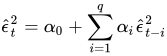
- Obtain the squares of the error and regress them on a constant and q lagged values:
- where q is the length of ARCH lags.
- The null hypothesis is that, in the absence of ARCH components, we have for all . The alternative hypothesis is that, in the presence of ARCH components, at least one of the estimated coefficients must be significant. In a sample of T residuals under the null hypothesis of no ARCH errors, the test statistic T'R² follows distribution with q degrees of freedom, where is the number of equations in the model which fits the residuals vs the lags (i.e. ). If T'R² is greater than the Chi-square table value, we reject the null hypothesis and conclude there is an ARCH effect in the ARMA model. If T'R² is smaller than the Chi-square table value, we do not reject the null hypothesis.




GARCH
[edit]If an autoregressive moving average (ARMA) model is assumed for the error variance, the model is a generalized autoregressive conditional heteroskedasticity (GARCH) model.[2]
In that case, the GARCH (p, q) model (where p is the order of the GARCH terms and q is the order of the ARCH terms ), following the notation of the original paper, is given by


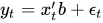


Generally, when testing for heteroskedasticity in econometric models, the best test is the White test. However, when dealing with time series data, this means to test for ARCH and GARCH errors.
Exponentially weighted moving average (EWMA) is an alternative model in a separate class of exponential smoothing models. As an alternative to GARCH modelling it has some attractive properties such as a greater weight upon more recent observations, but also drawbacks such as an arbitrary decay factor that introduces subjectivity into the estimation.
GARCH(p, q) model specification
[edit]The lag length p of a GARCH(p, q) process is established in three steps:
- Estimate the best fitting AR(q) model
- .
- Compute and plot the autocorrelations of by
- The asymptotic, that is for large samples, standard deviation of is . Individual values that are larger than this indicate GARCH errors. To estimate the total number of lags, use the Ljung–Box test until the value of these are less than, say, 10% significant. The Ljung–Box Q-statistic follows distribution with n degrees of freedom if the squared residuals are uncorrelated. It is recommended to consider up to T/4 values of n. The null hypothesis states that there are no ARCH or GARCH errors. Rejecting the null thus means that such errors exist in the conditional variance.


NGARCH
[edit]![[icon]](https://en.wikipedia.org/wiki/File:Wiki_letter_w_cropped.svg) |
NAGARCH
[edit]Nonlinear Asymmetric GARCH(1,1) (NAGARCH) is a model with the specification:[6][7]
- ,
- where and , which ensures the non-negativity and stationarity of the variance process.



For stock returns, parameter is usually estimated to be positive; in this case, it reflects a phenomenon commonly referred to as the "leverage effect", signifying that negative returns increase future volatility by a larger amount than positive returns of the same magnitude.[6][7]

This model should not be confused with the NARCH model, together with the NGARCH extension, introduced by Higgins and Bera in 1992.[8]
IGARCH
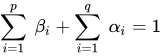
[edit]Integrated Generalized Autoregressive Conditional heteroskedasticity (IGARCH) is a restricted version of the GARCH model, where the persistent parameters sum up to one, and imports a unit root in the GARCH process.[9] The condition for this is
.
EGARCH
[edit]The exponential generalized autoregressive conditional heteroskedastic (EGARCH) model by Nelson & Cao (1991) is another form of the GARCH model. Formally, an EGARCH(p,q):

where , is the conditional variance, , , , and are coefficients. may be a standard normal variable or come from a generalized error distribution. The formulation for allows the sign and the magnitude of to have separate effects on the volatility. This is particularly useful in an asset pricing context.[10][11]



Since may be negative, there are no sign restrictions for the parameters.

GARCH-M
[edit]The GARCH-in-mean (GARCH-M) model adds a heteroskedasticity term into the mean equation. It has the specification:

The residual is defined as:


QGARCH
[edit]The Quadratic GARCH (QGARCH) model by Sentana (1995) is used to model asymmetric effects of positive and negative shocks.
In the example of a GARCH(1,1) model, the residual process is


where is i.i.d. and

GJR-GARCH
[edit]Similar to QGARCH, the Glosten-Jagannathan-Runkle GARCH (GJR-GARCH) model by Glosten, Jagannathan and Runkle (1993) also models asymmetry in the ARCH process. The suggestion is to model where is i.i.d., and

where if , and if .


TGARCH model
[edit]The Threshold GARCH (TGARCH) model by Zakoian (1994) is similar to GJR GARCH. The specification is one on conditional standard deviation instead of conditional variance:

where if , and if . Likewise, if , and if .


fGARCH
[edit]Hentschel's fGARCH model,[12] also known as Family GARCH, is an omnibus model that nests a variety of other popular symmetric and asymmetric GARCH models including APARCH, GJR, AVGARCH, NGARCH, etc.
COGARCH
[edit]In 2004, Claudia Klüppelberg, Alexander Lindner and Ross Maller proposed a continuous-time generalization of the discrete-time GARCH(1,1) process. The idea is to start with the GARCH(1,1) model equations


and then to replace the strong white noise process by the infinitesimal increments of a Lévy process , and the squared noise process by the increments , where


![{\displaystyle \mathrm {d} [L,L]_{t}^{\mathrm {d} }}](https://wikimedia.org/api/rest_v1/media/math/render/svg/bb12354fd1b0514367dc15b7eb19a204c2d9aa5c)
![{\displaystyle [L,L]_{t}^{\mathrm {d} }=\sum _{s\in [0,t]}(\Delta L_{t})^{2},\quad t\geq 0,}](https://wikimedia.org/api/rest_v1/media/math/render/svg/c4a94bedc31d87ce254a87459861fe68b1d62bc1)
is the purely discontinuous part of the quadratic variation process of . The result is the following system of stochastic differential equations:


![{\displaystyle \mathrm {d} \sigma _{t}^{2}=(\beta -\eta \sigma _{t}^{2})\,\mathrm {d} t+\varphi \sigma _{t-}^{2}\,\mathrm {d} [L,L]_{t}^{\mathrm {d} },}](https://wikimedia.org/api/rest_v1/media/math/render/svg/5d115020827105833ca466722c4a2c0f94acfa44)
where the positive parameters , and are determined by , and . Now given some initial condition , the system above has a pathwise unique solution which is then called the continuous-time GARCH (COGARCH) model.[13]


ZD-GARCH
[edit]Unlike GARCH model, the Zero-Drift GARCH (ZD-GARCH) model by Li, Zhang, Zhu and Ling (2018) [14] lets the drift term in the first order GARCH model. The ZD-GARCH model is to model , where is i.i.d., and


The ZD-GARCH model does not require , and hence it nests the Exponentially weighted moving average (EWMA) model in "RiskMetrics". Since the drift term , the ZD-GARCH model is always non-stationary, and its statistical inference methods are quite different from those for the classical GARCH model. Based on the historical data, the parameters and can be estimated by the generalized QMLE method.


Spatial and Spatiotemporal GARCH
[edit]Spatial GARCH processes by Otto, Schmid and Garthoff (2018) [15] are considered as the spatial equivalent to the temporal generalized autoregressive conditional heteroscedasticity (GARCH) models.[16] In contrast to the temporal ARCH model, in which the distribution is known given the full information set for the prior periods, the distribution is not straightforward in the spatial and spatiotemporal setting due to the contemporaneous dependence between neighboring spatial locations. The spatial model is given by and

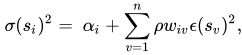
where denotes the -th spatial location and refers to the -th entry of a spatial weight matrix and for . The spatial weight matrix defines which locations are considered to be adjacent.


In spatiotemporal extensions, the conditional variance is modelled as a joint function of spatially lagged past squared observations and temporally lagged volatilities, allowing for both cross-sectional and serial dependence. These models have been applied in fields such as environmental statistics, regional economics, and financial econometrics, where shocks can propagate over space and time. Recent reviews summarise methodological developments, estimation techniques, and applications across disciplines.[16]
Gaussian process-driven GARCH
[edit]In a different vein, the machine learning community has proposed the use of Gaussian process regression models to obtain a GARCH scheme.[17] This results in a nonparametric modelling scheme, which allows for: (i) advanced robustness to overfitting, since the model marginalises over its parameters to perform inference, under a Bayesian inference rationale; and (ii) capturing highly-nonlinear dependencies without increasing model complexity.[citation needed]
References
[edit]- ^ Engle, Robert F. (1982). "Autoregressive Conditional Heteroskedasticity with Estimates of the Variance of United Kingdom Inflation". Econometrica. 50 (4): 987–1007. doi:10.2307/1912773. JSTOR 1912773.
- ^ a b Bollerslev, Tim (1986). "Generalized Autoregressive Conditional Heteroskedasticity". Journal of Econometrics. 31 (3): 307–327. CiteSeerX 10.1.1.468.2892. doi:10.1016/0304-4076(86)90063-1. S2CID 8797625.
- ^ Brooks, Chris (2014). Introductory Econometrics for Finance (3rd ed.). Cambridge: Cambridge University Press. p. 461. ISBN 9781107661455.
- ^ Lanne, Markku; Saikkonen, Pentti (July 2005). "Non-linear GARCH models for highly persistent volatility" (PDF). The Econometrics Journal. 8 (2): 251–276. doi:10.1111/j.1368-423X.2005.00163.x. hdl:10419/65348. JSTOR 23113641. S2CID 15252964.
- ^ Bollerslev, Tim; Russell, Jeffrey; Watson, Mark (May 2010). "Chapter 8: Glossary to ARCH (GARCH)" (PDF). Volatility and Time Series Econometrics: Essays in Honor of Robert Engle (1st ed.). Oxford: Oxford University Press. pp. 137–163. ISBN 9780199549498. Retrieved 27 October 2017.
- ^ a b Engle, Robert F.; Ng, Victor K. (1993). "Measuring and testing the impact of news on volatility" (PDF). Journal of Finance. 48 (5): 1749–1778. doi:10.1111/j.1540-6261.1993.tb05127.x. SSRN 262096.
It is not yet clear in the finance literature that the asymmetric properties of variances are due to changing leverage. The name "leverage effect" is used simply because it is popular among researchers when referring to such a phenomenon.
- ^ a b Posedel, Petra (2006). "Analysis Of The Exchange Rate And Pricing Foreign Currency Options On The Croatian Market: The Ngarch Model As An Alternative To The Black Scholes Model" (PDF). Financial Theory and Practice. 30 (4): 347–368.
Special attention to the model is given by the parameter of asymmetry [theta (θ)] which describes the correlation between returns and variance.6 ...
6 In the case of analyzing stock returns, the positive value of [theta] reflects the empirically well known leverage effect indicating that a downward movement in the price of a stock causes more of an increase in variance more than a same value downward movement in the price of a stock, meaning that returns and variance are negatively correlated - ^ Higgins, M.L; Bera, A.K (1992). "A Class of Nonlinear Arch Models". International Economic Review. 33 (1): 137–158. doi:10.2307/2526988. JSTOR 2526988.
- ^ Caporale, Guglielmo Maria; Pittis, Nikitas; Spagnolo, Nicola (October 2003). "IGARCH models and structural breaks". Applied Economics Letters. 10 (12): 765–768. doi:10.1080/1350485032000138403. ISSN 1350-4851.
- ^ St. Pierre, Eilleen F. (1998). "Estimating EGARCH-M Models: Science or Art". The Quarterly Review of Economics and Finance. 38 (2): 167–180. doi:10.1016/S1062-9769(99)80110-0.
- ^ Chatterjee, Swarn; Hubble, Amy (2016). "Day-Of-The-Whieek Effect In Us Biotechnology Stocks—Do Policy Changes And Economic Cycles Matter?". Annals of Financial Economics. 11 (2): 1–17. doi:10.1142/S2010495216500081.
- ^ Hentschel, Ludger (1995). "All in the family Nesting symmetric and asymmetric GARCH models". Journal of Financial Economics. 39 (1): 71–104. CiteSeerX 10.1.1.557.8941. doi:10.1016/0304-405X(94)00821-H.
- ^ Klüppelberg, C.; Lindner, A.; Maller, R. (2004). "A continuous-time GARCH process driven by a Lévy process: stationarity and second-order behaviour". Journal of Applied Probability. 41 (3): 601–622. doi:10.1239/jap/1091543413. hdl:10419/31047. S2CID 17943198.
- ^ Li, D.; Zhang, X.; Zhu, K.; Ling, S. (2018). "The ZD-GARCH model: A new way to study heteroscedasticity" (PDF). Journal of Econometrics. 202 (1): 1–17. doi:10.1016/j.jeconom.2017.09.003.
- ^ Otto, P.; Schmid, W.; Garthoff, R. (2018). "Generalised spatial and spatiotemporal autoregressive conditional heteroscedasticity". Spatial Statistics. 26 (1): 125–145. arXiv:1609.00711. Bibcode:2018SpaSt..26..125O. doi:10.1016/j.spasta.2018.07.005. S2CID 88521485.
- ^ a b Otto, P.; Dogan, O.; Taspinar, S.; Schmid, W.; Bera, A. K. (2025). "Spatial and Spatiotemporal Volatility Models: A Review". Journal of Economic Surveys. 39 (3). doi:10.1111/joes.12643.
- ^ Platanios, E.; Chatzis, S. (2014). "Gaussian process-mixture conditional heteroscedasticity". IEEE Transactions on Pattern Analysis and Machine Intelligence. 36 (5): 889–900. arXiv:1211.4410. doi:10.1109/TPAMI.2013.183. PMID 26353224. S2CID 10424638.
Further reading
[edit]- Bollerslev, Tim; Russell, Jeffrey; Watson, Mark (May 2010). "Chapter 8: Glossary to ARCH (GARCH)" (PDF). Volatility and Time Series Econometrics: Essays in Honor of Robert Engle (1st ed.). Oxford: Oxford University Press. pp. 137–163. ISBN 9780199549498.
- Enders, W. (2004). "Modelling Volatility". Applied Econometrics Time Series (Second ed.). John-Wiley & Sons. pp. 108–155. ISBN 978-0-471-45173-0.
- Engle, Robert F. (1982). "Autoregressive Conditional Heteroscedasticity with Estimates of Variance of United Kingdom Inflation". Econometrica. 50 (4): 987–1008. doi:10.2307/1912773. JSTOR 1912773. S2CID 18673159. (the paper which sparked the general interest in ARCH models)
- Engle, Robert F. (1995). ARCH: selected readings. Oxford University Press. ISBN 978-0-19-877432-7.
- Engle, Robert F. (2001). "GARCH 101: The Use of ARCH/GARCH Models in Applied Econometrics". Journal of Economic Perspectives. 15 (4): 157–168. doi:10.1257/jep.15.4.157. JSTOR 2696523. (a short, readable introduction)
- Gujarati, D. N. (2003). Basic Econometrics. pp. 856–862.
- Hacker, R. S.; Hatemi-J, A. (2005). "A Test for Multivariate ARCH Effects". Applied Economics Letters. 12 (7): 411–417. doi:10.1080/13504850500092129. S2CID 218639533.
- Nelson, D. B. (1991). "Conditional Heteroskedasticity in Asset Returns: A New Approach". Econometrica. 59 (2): 347–370. doi:10.2307/2938260. JSTOR 2938260.
- Otto, P.; Dogan, O.; Taspinar, S.; Schmid, W.; Bera, A. K. (2025). "Spatial and Spatiotemporal Volatility Models: A Review". Journal of Economic Surveys. 39 (3). doi:10.1111/joes.12643.


Autoregressive conditional heteroskedasticity
View on GrokipediaBackground Concepts
Heteroskedasticity in Time Series
In regression analysis, homoskedasticity assumes that the variance of the error terms remains constant across all observations, enabling reliable statistical inference under models like ordinary least squares (OLS). Heteroskedasticity, by contrast, arises when this variance is not constant, typically varying with the level of one or more independent variables or systematically over the observations. For instance, in a cross-sectional regression of household expenditures on income, the residuals may show larger dispersion for higher-income households, illustrating how heteroskedasticity can distort the perceived reliability of estimates.[7][8] In time series data, heteroskedasticity specifically refers to fluctuations in the variance of errors across different time periods, often observed in economic or financial datasets where stability is not uniform. Under the classical assumption of homoskedasticity, the unconditional variance of these errors is treated as constant—though unknown—over time, supporting the validity of standard OLS procedures. However, when heteroskedasticity violates this, the OLS estimator, while still unbiased, produces inefficient estimates with understated standard errors, leading to invalid hypothesis tests, overly narrow confidence intervals, and inflated Type I error rates.[9][10][7][11] The concept of heteroskedasticity received early attention in econometrics during the 1960s, with Goldfeld and Quandt developing foundational tests to identify departures from constant variance in regression residuals. This laid groundwork for later advancements, including Engle's 1982 recognition of conditional variants in time series contexts.[12][13] Graphically, heteroskedasticity can be detected by plotting squared residuals against time or fitted values from an OLS regression; a pattern of increasing or decreasing spread—such as a funnel shape—indicates non-constant variance, prompting further diagnostic checks.[10]Volatility Clustering and Financial Applications
Volatility clustering is a prominent stylized fact in financial time series, characterized by the tendency for periods of high volatility to be followed by further high volatility, and periods of low volatility by additional low volatility, resulting in persistent clusters of large or small price changes over time.[14] This phenomenon implies that the amplitude of price fluctuations exhibits positive autocorrelation, contrasting with the independence assumed in many classical models. Empirical analyses across various markets consistently reveal this clustering, where absolute or squared returns display slow-decaying autocorrelations, often persisting for weeks or months, with effects typically stronger during periods of market stress such as financial crises.[14] Asset returns further exhibit related stylized facts, including fat tails in their unconditional distributions, where extreme events occur more frequently than predicted by a normal distribution, leverage effects whereby negative returns tend to increase future volatility more than positive returns of equal magnitude, and long memory in volatility, reflected in hyperbolic decay of autocorrelations in absolute returns.[14] These patterns are not isolated to equities; similar evidence appears in exchange rates, where currency volatility clusters during economic announcements, and in interest rates, exhibiting persistence in bond yield fluctuations amid monetary policy shifts.[14] Early empirical studies laid the foundation for recognizing these features. Mandelbrot (1963) analyzed historical cotton prices and rejected normality, finding distributions with heavy tails consistent with stable Paretian processes, implying higher likelihood of extreme movements and non-constant variance.[15] Building on this, Fama (1965) examined daily stock price changes on the New York Stock Exchange and documented leptokurtosis in returns, along with only minor evidence of dependence in the magnitude of successive changes, though overall supporting the independence of price changes and random occurrence of large swings.[16] Such observations challenged traditional random walk models assuming constant variance and independence, highlighting the need to account for time-varying risk in financial applications. Standard econometric models, such as those assuming independent and identically distributed normal errors with constant variance, fail to capture volatility clustering because they overlook the predictability and persistence in the conditional variance of returns, leading to underestimation of risk during turbulent periods.[14] This inadequacy motivates the development of models that incorporate dependence on past shocks to model volatility dynamics in financial applications.ARCH Models
ARCH Model Specification
The autoregressive conditional heteroskedasticity (ARCH) model was introduced by Robert F. Engle in 1982 to address time-varying volatility in economic time series, particularly in the context of inflation forecasting.[17] Engle's framework formalized heteroskedasticity as a conditional property, where the variance of the current error term depends on past squared errors, allowing for volatility clustering observed in financial and macroeconomic data.[17] The ARCH(q) model specifies the process for an observed time series aswhere is a constant mean, and the innovation follows
with being independent and identically distributed (i.i.d.) standard normal random variables, . The conditional variance is then modeled autoregressively as
where is the order of the model, , and for to ensure non-negativity of the variance.[17][6] These parameters capture how recent shocks influence future volatility, with the squared past residuals serving as proxies for information from previous periods.[6] Key assumptions include Gaussian innovations for , which imply conditional normality of given the past information set, and the non-negativity constraints on the coefficients to guarantee a positive conditional variance.[6] This structure intuitively models heteroskedasticity by making the variance a function of lagged squared errors, thereby accommodating periods of high dispersion following large shocks and calmer periods after small ones.[17] For covariance stationarity, which ensures the unconditional variance exists and is finite, the sum of the ARCH coefficients must satisfy .[6]