Hubbry Logo
Greco-Bactrian KingdomGreco-Bactrian KingdomMain
Open search
Greco-Bactrian Kingdom
Community hub
Greco-Bactrian Kingdom
logo
8 pages, 0 posts
0 subscribers
Be the first to start a discussion here.
Greco-Bactrian Kingdom
from Wikipedia

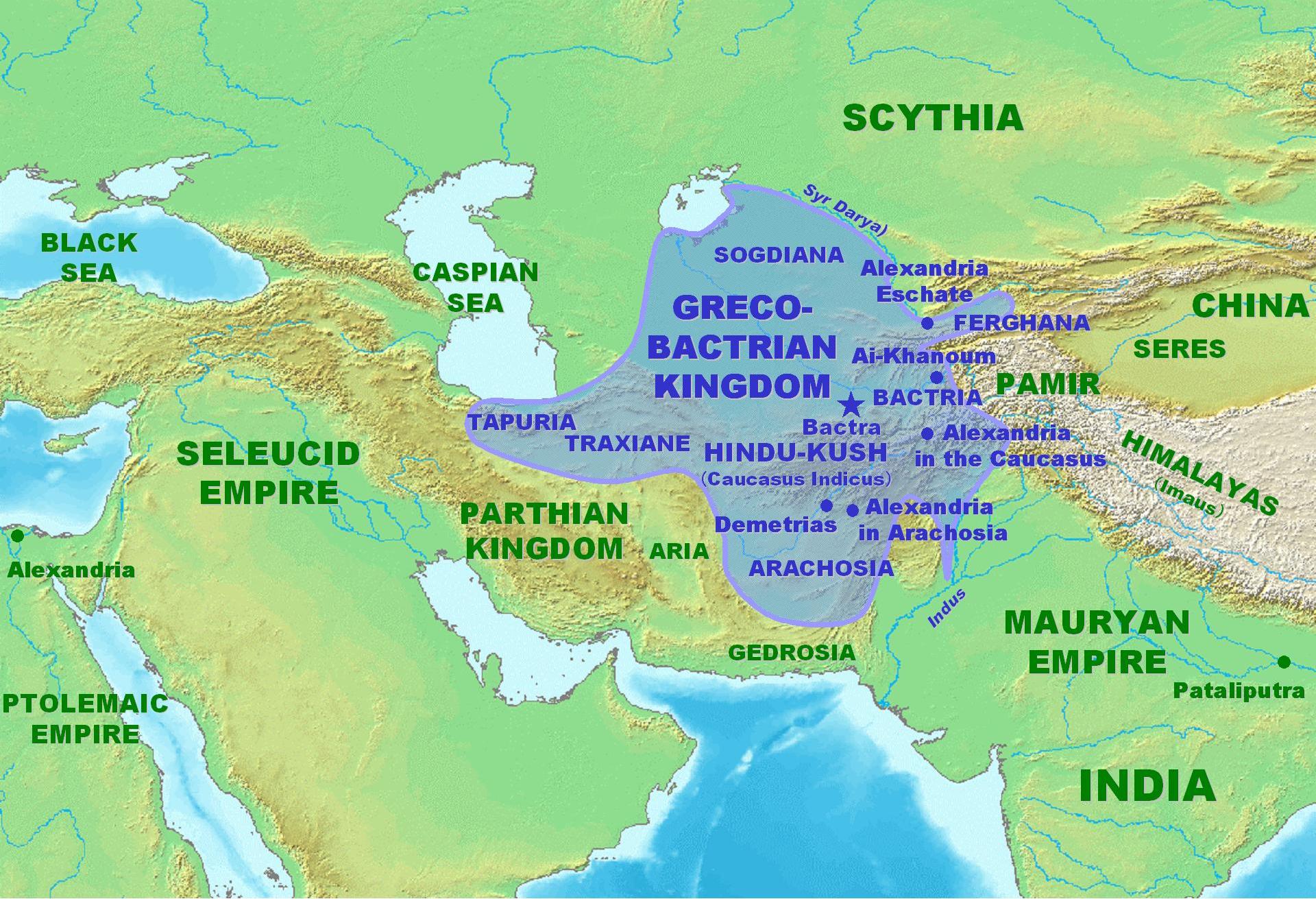
The Greco-Bactrian Kingdom (Greek: Βασιλεία τῆς Βακτριανῆς, romanizedBasileía tês Baktrianês, lit.'Kingdom of Bactria') was a Greek state of the Hellenistic period[2][3][4] located in Central-South Asia. The kingdom was founded by the Seleucid satrap Diodotus I Soter in about 256 BC, and continued to dominate Central Asia until its fall around 120 BC.[a] At its peak the kingdom consisted of present-day Afghanistan, Tajikistan, Uzbekistan and Turkmenistan, and for a short time, small parts of Kazakhstan, Pakistan and Iran. An extension further east, with military campaigns and settlements, may have reached the borders of the Qin State in China by about 230 BC.[5][6]

Key Information

Although a Greek population was already present in Bactria by the 5th century BC, Alexander the Great conquered the region by 327 BC[7] and founded many cities, most of them named Alexandria, and further settled with Macedonians and other Greeks. After the death of Alexander, control of Bactria passed on to his general Seleucus I Nicator.[8] The fertility and the prosperity of the land by the early 3rd century BC led to the creation of the Greco-Bactrian kingdom by Diodotus as a successor state of the Seleucid empire. The Bactrian Greeks grew increasingly more powerful and invaded north-western India between 190 and 180 BC under king Demetrius, the son of Euthydemus. This invasion led to the creation of the Indo-Greek kingdom, as a successor state of the Greco-Bactrian kingdom, and was subsequently ruled by kings Pantaleon and Apollodotus I. Historical records indicate that many rich and prosperous cities were present in the kingdom,[9][10][11] but only a few such cities have been excavated, such as Ai-Khanoum and Bactra. The city of Ai-Khanoum, in north-eastern Afghanistan, had all the hallmarks of a true Hellenistic city with a Greek theater, gymnasium and some houses with colonnaded courtyards.[12]

The kingdom reached its peak under Eucratides the Great, who seems to have seized power through a coup around 171 BC and created his own dynasty. Eucratides also invaded India and successfully fought against the Indo-Greek kings. However, soon the kingdom began to decline. The Parthians and nomadic tribes such as Sakas and Yuezhi became a major threat.[13] Eucratides was killed by his own son in about 145 BC, which may have further destabilised the kingdom. Heliocles was the last Greek king to rule in Bactria.[14]

Even after the fall of the Greco-Bactrian kingdom, their rich Hellenistic influence remained strong for many more centuries. The Yuezhi invaders settled in Bactria and became Hellenized. They subsequently founded the Kushan empire around 30 AD, and adopted the Greek alphabet to write their language and added Greek deities to their pantheon. The Greco-Bactrian city of Ai-Khanoum was at the doorstep of India and known for its high level of Hellenistic sophistication. Greek art travelled from Bactria with the Indo-Greeks and influenced Indian art, religion and culture, leading to new syncretic art called Greco-Buddhist art.

History

[edit]

Origins

[edit]

Bactria was inhabited by Greek settlers since the time of Darius I, when the majority of the population of Barca, in Cyrenaica, was deported to the region for refusing to surrender assassins.[15] Greek influence increased under Xerxes I, after the descendants of Greek priests who had once lived near Didyma (western Asia Minor) were forcibly relocated in Bactria,[16] and later on with other exiled Greeks, most of them prisoners of war. Greek communities and language were already common in the area by the time that Alexander the Great conquered Bactria in 328 BC.[17]

Independence and Diodotid dynasty

[edit]
Gold coin of Diodotus c. 245 BC. The reverse shows Zeus standing, holding aegis and thunderbolt. The Greek inscription reads: ΒΑΣΙΛΕΩΣ ΔΙΟΔΟΤΟΥ, Basileōs Diodotou – "(of) King Diodotus".

Diodotus, the satrap of Bactria (and probably the surrounding provinces) founded the Greco-Bactrian Kingdom when he seceded from the Seleucid Empire around 250 BC and became Basileus, or king Diodotus I of Bactria. The preserved ancient sources (see below) are somewhat contradictory, and the exact date of Bactrian independence has not been settled. Somewhat simplified, there is a high chronology (c. 255 BC) and a low chronology (c. 246 BC) for Diodotus' secession.[18] The high chronology has the advantage of explaining why the Seleucid king Antiochus II issued very few coins in Bactria, as Diodotus would have become independent there early in Antiochus' reign.[19][page needed] On the other hand, the low chronology, from the mid-240s BC, has the advantage of connecting the secession of Diodotus I with the Third Syrian War, a catastrophic conflict for the Seleucid Empire.

Diodotus, the governor of the thousand cities of Bactria (Latin: Theodotus, mille urbium Bactrianarum praefectus), defected and proclaimed himself king; all the other people of the Orient followed his example and seceded from the Macedonians.[20]

The new kingdom, highly urbanized and considered one of the richest of the Orient (opulentissimum illud mille urbium Bactrianum imperium "The extremely prosperous Bactrian empire of the thousand cities", according to the historian Justin[21]), was to further grow in power and engage in territorial expansion to the east and the west:

Corinthian capital, found at Ai-Khanoum, 2nd century BC

The Greeks who caused Bactria to revolt grew so powerful on account of the fertility of the country that they became masters, not only of Ariana, but also of India, as Apollodorus of Artemita says: and more tribes were subdued by them than by Alexander… Their cities were Bactra (also called Zariaspa, through which flows a river bearing the same name and emptying into the Oxus), and Darapsa, and several others. Among these was Eucratidia,[22] which was named after its ruler.[23]

In 247 BC, the Ptolemaic empire (the Greek rulers of Egypt following the death of Alexander the Great) captured the Seleucid capital, Antioch. In the resulting power vacuum, Andragoras, the Seleucid satrap of Parthia, proclaimed independence from the Seleucids, declaring himself king. A decade later, he was defeated and killed by Arsaces of Parthia, leading to the rise of a Parthian Empire. This cut Bactria off from contact with the Greek world. Overland trade continued at a reduced rate, while sea trade between Greek Egypt and Bactria developed.

Diodotus was succeeded by his son Diodotus II, who allied himself with the Parthian Arsaces in his fight against Seleucus II:

Soon after, relieved by the death of Diodotus, Arsaces made peace and concluded an alliance with his son, also by the name of Diodotus; some time later he fought against Seleucos who came to punish the rebels, and he prevailed: the Parthians celebrated this day as the one that marked the beginning of their freedom.[24]

Euthydemid dynasty and Seleucid invasion

[edit]
Coin depicting the Greco-Bactrian king Euthydemus, 230–200 BC. The reverse shows Heracles seated, holding club in right hand. The Greek inscription reads: ΒΑΣΙΛΕΩΣ ΕΥΘΥΔΗΜΟΥ, Basileōs Euthydēmou – "(of) King Euthydemus".

Euthydemus, an Ionian Greek from Magnesia according to Polybius,[25][26] and possibly satrap of Sogdiana, overthrew the dynasty of Diodotus II around 230–220 BC and started his own dynasty. Euthydemus's control extended to Sogdiana, going beyond the city of Alexandria Eschate founded by Alexander the Great in Ferghana:[citation needed]

And they also held Sogdiana, situated above Bactriana towards the east between the Oxus River, which forms the boundary between the Bactrians and the Sogdians, and the Iaxartes River. And the Iaxartes forms also the boundary between the Sogdians and the nomads.[13]

Euthydemus was attacked by the Seleucid ruler Antiochus III around 210 BC. Although he commanded 10,000 horsemen, Euthydemus initially lost a battle on the Arius[27] and had to retreat. He then successfully resisted a three-year siege in the fortified city of Bactra, before Antiochus finally decided to recognize the new ruler, and to offer one of his daughters to Euthydemus's son Demetrius around 206 BC.[28] Classical accounts also relate that Euthydemus negotiated peace with Antiochus III by suggesting that he deserved credit for overthrowing the original rebel Diodotus and that he was protecting Central Asia from nomadic invasions thanks to his defensive efforts:

... for if he did not yield to this demand, neither of them would be safe: Seeing that great hordes of Nomads were close at hand, who were a danger to both; and that if they admitted them into the country, it would certainly be utterly barbarised.[26]

In an inscription found in the Kuliab area of Tajikistan, in eastern Greco-Bactria, and dated to 200–195 BC,[29] a Greek by the name of Heliodotus, dedicating a fire altar to Hestia, mentions Euthydemus as the greatest of all kings, and his son Demetrius I as "Demetrios Kallinikos", meaning "Demetrius the Glorious Conqueror":[30][29]

τόνδε σοι βωμὸν θυώδη, πρέσβα κυδίστη θεῶν Ἑστία, Διὸς κ(α)τ᾽ ἄλσος καλλίδενδρον ἔκτισεν καὶ κλυταῖς ἤσκησε λοιβαῖς ἐμπύροις Ἡλιόδοτος ὄφρα τὸμ πάντων μέγιστον Εὐθύδημον βασιλέων τοῦ τε παῖδα καλλίνικον ἐκπρεπῆ Δημήτριον πρευμενὴς σώιζηις ἐκηδεῖ(ς) σὺν τύχαι θεόφρον[ι].

tónde soi bōmòn thuṓdē, présba kydístē theôn Hestía, Diòs kat' álsos kallídendron éktisen kaì klytaîs ḗskēse loibaîs empýrois Hēliódotos óphra tòm pántōn mégiston Euthýdēmon basiléōn toû te paîda kallínikon ekprepê Dēmḗtrion preumenḕs sṓizēis ekēdeî(s) sỳn Týchai theόphron(i).

"Heliodotus dedicated this fragrant altar for Hestia, venerable goddess, illustrious amongst all, in the grove of Zeus, with beautiful trees; he made libations and sacrifices so that the greatest of all kings Euthydemus, as well as his son, the glorious, victorious and remarkable Demetrius, be preserved of all pains, with the help of Tyche with divine thoughts."[31][32]

Following the departure of the Seleucid army, the Bactrian kingdom seems to have expanded. In the west, areas in north-eastern Iran may have been absorbed, possibly as far as into Parthia, whose ruler had been defeated by Antiochus the Great. These territories possibly are identical with the Bactrian satrapies of Tapuria and Traxiane.

Expansion into the Indian subcontinent (around 180 BC)

[edit]
Silver coin of king Demetrius I of Bactria (reigned c. 200–180 BC), wearing an elephant scalp, symbol of his conquests in northwest Indian subcontinent.

Demetrius, the son of Euthydemus, started an invasion of the subcontinent before 180 BC, and a few years after the Mauryan empire had been overthrown by the Shunga dynasty. Historians differ on the motivations behind the invasion. Some historians suggest that the invasion of the subcontinent was intended to show their support for the Mauryan empire, and to protect the Buddhist faith from the religious persecutions of the Shungas as alleged by Buddhist scriptures (Tarn). Other historians have argued however that the accounts of these persecutions have been exaggerated (Thapar, Lamotte).

Demetrius may have been as far as the imperial capital Pataliputra in today's eastern India (today Patna). However, these campaigns are typically attributed to Menander. His conquests were mentioned along with that of Menander by the historian Strabo, as having "subdued more tribes than Alexander." The invasion was completed by 175 BC. This established in the northwestern Indian Subcontinent what is called the Indo-Greek Kingdom, which lasted for almost two centuries until around 10 AD. The Buddhist faith flourished under the Indo-Greek kings, especially Menander who was arguably the most powerful of them all. It was also a period of great cultural syncretism, exemplified by the development of Greco-Buddhism in the region of Gandhara.

Eucratides the Great

[edit]
Silver tetradrachm of King Eucratides I, reigned c. 171–145 BC. The obverse shows the King wearing a crested helmet with a diadem. The reverse shows the Dioscuri on horseback, with the Greek inscription: ΒΑΣΙΛΕΩΣ ΜΕΓΑΛΟΥ ΕΥΚΡΑΤΙΔΟΥ, Basileōs Megalou Eukratidou – "(of) Great King Eucratides".

Back in Bactria, Eucratides I, either a general of Demetrius or an ally of the Seleucids, managed to overthrow the Euthydemid dynasty and establish his own rule, the short-lived Eucratid dynasty,[33] around 170 BC, probably dethroning Antimachus I and Antimachus II. The Indian branch of the Euthydemids tried to strike back. An Indian king called Demetrius (very likely Demetrius II) is said to have returned to Bactria with 60,000 men to oust the usurper, but he apparently was defeated and killed in the encounter:

Bilingual coin of Eucratides I in the Indian standard, on the obverse Greek inscription reads: ΒΑΣΙΛΕΩΣ ΜΕΓΑΛΟΥ ΕΥΚΡΑΤΙΔΟΥ, Basileōs Megalou Eukratidou – "(of) Great King Eucratides"; on the reverse Pali language in Kharoshthi legend reads: Maharajasa Evukratidasa, "of Great King Eucratides".[34]

Eucratides led many wars with great courage, and, while weakened by them, was put under siege by Demetrius, king of the Indians. He made numerous sorties, and managed to vanquish 60,000 enemies with 300 soldiers, and thus liberated after four months, he put India under his rule.[35]

Eucratides campaigned extensively in present-day northwestern India, and ruled a vast territory, as indicated by his minting of coins in many Indian mints, possibly as far as the Jhelum River in Punjab. In the end, however, he was repulsed by the Indo-Greek king Menander I, who managed to create a huge unified territory.

In a rather confused account, Justin explains that Eucratides was killed on the field by "his son and joint king", who would be his own son, either Eucratides II or Heliocles I (although there are speculations that it could have been his enemy's son Demetrius II). The son drove over Eucratides' bloodied body with his chariot and left him dismembered without a sepulcher:

As Eucratides returned from India, he was killed on the way back by his son, whom he had associated to his rule, and who, without hiding his parricide, as if he didn't kill a father but an enemy, ran with his chariot over the blood of his father, and ordered the corpse to be left without a sepulture.[35]

Defeats by Parthia

[edit]

During or after his Indian campaigns, Eucratides was attacked and defeated by the Parthian king Mithridates I, possibly in alliance with partisans of the Euthydemids:

Gold 20-stater of Eucratides I, the largest gold coin of Antiquity. The coin weighs 169.2 grams, and has a diameter of 58 millimeters. The reverse shows the Dioscuri on horseback.

The Bactrians, involved in various wars, lost not only their rule but also their freedom, as, exhausted by their wars against the Sogdians, the Arachotes, the Dranges, the Arians and the Indians, they were finally crushed, as if drawn of all their blood, by an enemy weaker than them, the Parthians.[35]

Following his victory, Mithridates I gained Bactria's territory west of the Arius, the regions of Tapuria and Traxiane: "The satrapy Turiva and that of Aspionus were taken away from Eucratides by the Parthians."[13]

In the year 141 BC, the Greco-Bactrians seem to have entered in an alliance with the Seleucid king Demetrius II to fight again against Parthia:

The people of the Orient welcomed his (Demetrius II's) arrival, partly because of the cruelty of the Arsacid king of the Parthians, partly because, used to the rule of the Macedonians, they disliked the arrogance of this new people. Thus, Demetrius, supported by the Persians, Elymes and Bactrians, routed the Parthians in numerous battles. At the end, deceived by a false peace treaty, he was taken prisoner.[36]

The 5th century historian Orosius reports that Mithridates I managed to occupy territory between the Indus and the Hydaspes towards the end of his reign (c. 138 BC, before his kingdom was weakened by his death in 136 BC).[b]

Heliocles I ended up ruling what territory remained. The defeat, both in the west and the east, may have left Bactria very weakened and open to nomadic invasions.

Nomadic invasions and fall

[edit]
The migrations of the Yuezhi through Central Asia, from around 176 BC–AD 30

A nomadic steppe people called the Yuezhi inhabited a region thousands of miles to the east of Bactria on the edges of the Han Empire called the Hexi Corridor. Shortly before 176 BC, the Xiongnu invaded the Hexi Corridor, forcing the Yuezhi to flee the region. In 162 BC the Yuezhi were driven west to the Ili River valley by the Xiongnu. In 132 they were driven out of the Ili valley by the Wusun. The surviving Yuezhi migrated again south towards the territory just north of the Oxus River where they encountered and expelled a nomadic steppe nation called Sakastan.[37]

Gold artefacts of the Scythians in Bactria, at the site of Tillia tepe

Around 140 BC, eastern Scythians (the Saka, or Sacaraucae of Greek sources), apparently being pushed forward by the southward migration of the Yuezhi started to invade various parts of Parthia and Bactria. Their invasion of Parthia is well documented: they attacked in the direction of the cities of Merv, Hecatompolis and Ecbatana. They managed to defeat and kill the Parthian king Phraates II, son of Mithridates I, routing the Greek mercenary troops under his command (troops he had acquired during his victory over Antiochus VII). Again in 123 BC, Phraates's successor, his uncle Artabanus I, was killed by the Scythians.[38]

When the Han Chinese diplomat Zhang Qian visited the Yuezhi around 126 BC, trying to obtain their alliance to fight the Xiongnu, he explained that the Yuezhi were settled north of the Oxus but also held under their sway the territory south of Oxus, which makes up the remainder of Bactria.

According to Zhang Qian, the Yuezhi represented a considerable force of between 100,000 and 200,000 mounted archer warriors,[c] with customs identical to those of the Xiongnu, which would probably have easily defeated Greco-Bactrian forces (in 208 BC when the Greco-Bactrian king Euthydemus I confronted the invasion of the Seleucid king Antiochus III the Great, he commanded 10,000 horsemen).[27] Zhang Qian actually visited Bactria (named Daxia in Chinese) in 126 BC, and portrays a country which was totally demoralized and whose political system had vanished, although its urban infrastructure remained:

Daxia (Bactria) is located over 2,000 li southwest of Dayuan, south of the Gui (Oxus) river. Its people cultivate the land and have cities and houses. Their customs are like those of Dayuan. It has no great ruler but only a number of petty chiefs ruling the various cities. The people are poor in the use of arms and afraid of battle, but they are clever at commerce. After the Great Yuezhi moved west and attacked Daxia, the entire country came under their sway. The population of the country is large, numbering some 1,000,000 or more persons. The capital is called the city of Lanshi (Bactra) and has a market where all sorts of goods are bought and sold. (Records of the Great Historian by Sima Qian, quoting Zhang Qian, translation by Burton Watson)

The Yuezhi further expanded southward into Bactria around 120 BC, apparently further pushed out by invasions from the northern Wusun. It seems they also pushed Scythian tribes before them, which continued to India, where they came to be identified as Indo-Scythians.

Silver coin of Plato of Bactria, wearing a diadem. The reverse shows Helios on his chariot facing forward. Greek legend reads: ΒΑΣΙΛΕΩΣ ΕΠΙΦΑΝΟΥΣ ΠΛΑΤΩΝΟΣ, Basileōs Epiphanous Platōnos – "(of) King Plato the God-Manifest."

This invasion of Bactria is also described in western Classical sources from the 1st century BC:

The best known tribes are those who deprived the Greeks of Bactriana, the Asii, Pasiani, Tochari, and Sacarauli, who came from the country on the other side of the Jaxartes, opposite the Sacae and Sogdiani.[40]

Around that time the king Heliocles abandoned Bactria and moved his capital to the Kabul valley, from where he ruled his Indian holdings. Apparently there were two other Greco-Bactrian kings preceding Heliocles in the same region and from the same dynasty, named Eucratides II and Plato Epiphanes, the latter probably being a brother of Eucratides I. Since Heliocles left the Bactrian territory, he is technically the last Greco-Bactrian king, although several of his descendants, moving beyond the Hindu Kush, would form the western part of the Indo-Greek kingdom. The last of these "western" Indo-Greek kings, Hermaeus, would rule until around 70 BC, when the Yuezhi again invaded his territory in the Paropamisadae (while the "eastern" Indo-Greek kings would continue to rule until around AD 10 in the area of the Punjab region).

Silver coin of Heliocles (r. 150–125 BC), the last Greco-Bactrian king. The reverse shows Zeus holding thunderbolt and sceptre. Greek legend reads: ΒΑΣΙΛΕΩΣ ΔΙΚΑΙΟΥ ΗΛΙΟΚΛΕΟΥΣ, Basileōs Dikaiou Hēliokleous – "(of) King Heliocles the Just".

Overall, the Yuezhi remained in Bactria for more than a century. They became Hellenized to some degree, as suggested by their adoption of the Greek alphabet to write their later Iranian court language,[41][42] and by numerous remaining coins, minted in the style of the Greco-Bactrian kings, with the text in Greek.

There is evidence for the persistence of Greek populations in Bactria after the collapse of the Greco-Bactrian kingdom. For example, an obol of a previously unknown ruler called Antigonus has been found and it seems he ruled after the kingdom's collapse, as evidenced by the use of a lunate sigma and the lower art quality of the coin, perhaps dating from the end of the 1st century BC. Antigonus might have briefly won a battle against the Yuezhi or the Saka before he was overrun himself.[43]

Around 12 BC the Yuezhi then moved further to northern India where they established the Kushan Empire.

Military forces

[edit]
Coin showing Eucratides I as a warrior wearing a crested helmet adorned with bull's horn and ear. He also wears a diadem underneath, while holding a spear in his right hand; obverse.

Before the Greek conquest, the armies of Bactria were overwhelmingly composed of cavalry and were well known as effective soldiers, making up large portions of the Achaemenid cavalry contingents. 2,000 Bactrian horsemen fought at the Granicus against Alexander and 9,000 at the Battle of Gaugamela on the left flank of Darius' army. Herodotus also mentions the widespread use of chariots among the Bactrians. After Alexander's conquest of Bactria, Bactrian cavalry units served in his army during the invasion of India and after the Indian campaign, Alexander enlarged his elite companion cavalry by adding Bactrians, Sogdians and other east Iranian cavalrymen.[44] Both Aeschylus (The Persians, v. 318) and Curtius mention that Bactria was able to field a force of 30,000 horse. Most of these horsemen were lightly armed, using bows and javelins before closing with sword and spear. Herodotus describes the Persian cavalry of Mardonius at the Battle of Plataea (which included Bactrians) as horse archers (hippotoxotai). Bactrian infantry is described by Herodotus as wearing caps in the Median style, short spears and reed Scythian style bows.[citation needed]

Alexander and Seleucus I both settled Macedonians and other Greeks in Bactria, and archeological finds in the region have also attested to a major Macedonian presence, as evidenced by the presence of symbols, style of coinage, and epigraphic names.[45][46] Greek garrisons in the satrapy of Bactria were housed in fortresses called phrouria and at major cities. Military colonists were settled in the countryside and were each given an allotment of land called a kleros. These colonists numbered in the tens of thousands, and were trained in the fashion of the Macedonian army. A Greek army in Bactria during the anti-Macedonian revolt of 323 BC numbered 23,000.[44]

The army of the Greco-Bactrian kingdom was then a multi-ethnic force with Greek colonists making up large portions of the infantry as pike phalanxes, supported by light infantry units of local Bactrians and mercenary javelin-wielding Thureophoroi.[47] The cavalry arm was very large for a Hellenistic army and composed mostly of native Bactrian, Sogdian and other Indo-Iranian light horsemen. Polybius mentions 10,000 horse at the Battle of the Arius river in 208 BC. Greco-Bactrian armies also included units of heavily armored cataphracts and small elite units of companion cavalry. The third arm of the Greco-Bactrian army was the Indian war elephants, which are depicted in some coins with a tower (thorakion) or howdah housing men armed with bows and javelins. This force grew as the Greco-Bactrian kingdom expanded into India and was widely depicted in Greco-Bactrian coinage. Other units in the Bactrian military included mercenaries or levies from various surrounding peoples such as the Scythians, Dahae, Indians, and Parthians.[citation needed]

Culture and legacy

[edit]

Greek culture in Bactria

[edit]
Reconstruction of Kampyr Tepe (Alexandria Oxiana)

Greeks first began settling the region long before Alexander conquered it. The Persian Empire had a policy of exiling rebelling Greek communities to that region long before it fell to Greek conquest. Therefore, it had a considerable Greek community that was expanded upon after Macedonian conquest.

The Greco-Bactrians were known for their high level of Hellenistic sophistication, and kept regular contact with both the Mediterranean and neighbouring India. They were on friendly terms with India and exchanged ambassadors.

Their cities, such as Ai-Khanoum in northeastern Afghanistan (probably Alexandria on the Oxus), and Bactra (modern Balkh) where Hellenistic remains have been found, demonstrate a sophisticated Hellenistic urban culture. This site gives a snapshot of Greco-Bactrian culture around 145 BC, as the city was burnt to the ground around that date during nomadic invasions and never re-settled. Ai-Khanoum "has all the hallmarks of a Hellenistic city, with a Greek theater, gymnasium and some Greek houses with colonnaded courtyards" (Boardman). Remains of Classical Corinthian columns were found in excavations of the site, as well as various sculptural fragments. In particular a huge foot fragment in excellent Hellenistic style was recovered, which is estimated to have belonged to a 5–6 meter tall statue.

Stone block with the inscriptions of Kineas in Greek. Ai Khanoum.

One of the inscriptions in Greek found at Ai-Khanoum, the Herôon of Kineas, has been dated to 300–250 BC, and describes Delphic maxims:

παῖς ὢν κόσμιος γίνου
ἡβῶν ἐγκρατής
μέσος δίκαιος
πρεσβύτης εὔβουλος
τελευτῶν ἄλυπος

As children, learn good manners.
As young men, learn to control the passions.
In middle age, be just.
In old age, give good advice.
Then die, without regret.

Many other Greco-Bactrian cities have been identified, for example Alexandria Eschate (in modern Tajikistan), Eucratideia, and another city named Amphipolis. The latter being a previously unknown city which was mentioned on a Bactrian document and was clearly named after Amphipolis in ancient Macedonia.[45] Excavated cities include Kampir Tepe in Uzbekistan, as well as Saksanokhur and Takht-i Sangin in Tajikistan (archaeological searches by a Soviet team under B.A. Litvinski),[48] or in Dal'verzin Tepe.

Takht-i Sangin

[edit]

Takht-i Sangin (Tajik: "Throne of Stone") is an archaeological site located near the confluence of the Vakhsh and Panj rivers, the source of the Amu Darya, in southern Tajikistan. During the Hellenistic period it was a city of the Greco-Bactrian kingdom with a large temple dedicated to the Oxus (Vakhsh river), which remained in use in the following Kushan period, until the third century AD. The site may have been the source of the Oxus Treasure.[49]

Coinage

[edit]

Some of the Greco-Bactrian coins, and those of their successors the Indo-Greeks, are considered the finest examples of Greek numismatic art with "a nice blend of realism and idealization", including the largest coins to be minted in the Hellenistic world: the largest gold coin was minted by Eucratides (reigned 171–145 BC), the largest silver coin by the Indo-Greek king Amyntas Nicator (reigned c. 95–90 BC). The portraits "show a degree of individuality never matched by the often bland depictions of their royal contemporaries further West" (Roger Ling, "Greece and the Hellenistic World").

Coin of king Antimachus I wearing a Macedonian kausia hat. His portrait is oftentimes shown possessing a slight smile, as in this example.

Such portraits show high levels of detail with some kings seen smiling, while others are shown aging throughout their reign, even depicting old age on their coins. Such realistic imagery on coins seems to have been very important to the Greco-Bactrian kings, who wanted to display their individuality or to distinguish themselves from the style of other contemporary Hellenistic kingdoms.[52]

Greco-Bactrian coins also depict the kings wearing distinct headgear, such as helmets modelled on the Boeotian cavalry helmet of Alexander the Great, or the Macedonian kausia. This is unique to the Greco-Bactrian kings, who first featured such designs on their coins as other Hellenistic rulers are shown to only wear the diadem.[53][54] As such the Greco-Bactrians are especially known for their innovative coinage designs. Further examples include the use of different metal alloys for their coins and the issue of bilingual coinage, using Greek on the obverse and an Indian language (such as Pali) in the Kharoshti or Brahmi scripts on the reverse. Local Indian symbols and deities are also depicted, i.e. Buddhist symbols and some Hindu deities (see Influence on Indian art subsection below). This syncretic design was first introduced after king Demetrius I of Bactria conquered areas of the Indian subcontinent between 190 and 180 BC, with king Pantaleon being the first to issue coins of the Indian standard, when the Greeks truly started ruling over Indian populations.[55]

Contacts with Han China

[edit]

To the north, Euthydemus also ruled Sogdiana and Ferghana, and there are indications that from Alexandria Eschate the Greco-Bactrians may have led expeditions as far as Kashgar and Ürümqi in Xinjiang, leading to the first known contacts between China and the West around 220 BC. The Greek historian Strabo too writes that: "they extended their empire even as far as the Seres (Chinese) and the Phryni". (Strabo, XI.XI.I).[23]

Possible statuette of a Greek hoplite, wearing a version of the Greek Phrygian helmet, from a 3rd-century BC burial site north of the Tian Shan, Xinjiang Region Museum, Ürümqi.[56]

Several statuettes and representations of Greek soldiers have been found north of the Tian Shan, on the doorstep to China, and are today on display in the Xinjiang museum at Ürümqi (Boardman).[d] Middle Eastern or Greek influences on Chinese art have also been suggested (Hirth, Rostovtzeff). Designs with rosette flowers, geometric lines, meanders and glass inlays, suggestive of Egyptian, Persian, and/or Hellenistic influences,[e] can be found on some early Han dynasty bronze mirrors.[f]

Some speculate that Greek influence is found in the artworks of the burial site of China's first Emperor Qin Shi Huang, dating back to the 3rd century BC, including in the manufacture of the famous Terracotta Army. This idea suggested that Greek artists may have come to China at that time to train local artisans in making sculptures[59][60] However, this idea is disputed.[61]

Numismatics also suggest that some technology exchanges may have occurred on these occasions: the Greco-Bactrians were the first in the world to issue cupro-nickel (75:25 ratio) coins,[62] an alloy technology only known by the Chinese at the time under the name "White copper" (some weapons from the Warring States period were in copper-nickel alloy).[63] The practice of exporting Chinese metals, in particular iron, for trade is attested around that period. Kings Euthydemus I, Euthydemus II, Agathocles and Pantaleon made these coin issues around 170 BC. An alternative suggestion is that the metal in the coinage derived from a mine where a cupro-nickel alloy occurred naturally, perhaps Anarak in eastern Iran.[64] Copper-nickel would not be used again in coinage until the 19th century.

The presence of Chinese people in India from ancient times is also suggested by the accounts of the "Ciñas" in the Mahabharata and the Manu Smriti. When the famous Han dynasty explorer and ambassador Zhang Qian visited Bactria in approximately 126 BC, he reported the presence of Chinese products in the Bactrian markets:

"When I was in Bactria (Daxia)", Zhang Qian reported, "I saw bamboo canes from Qiong and cloth made in the province of Shu (territories of southwestern China). When I asked the people how they had gotten such articles, they replied, "Our merchants go buy them in the markets of Shendu (India)."

Shiji 123, Sima Qian, translation by Burton Watson).
Map of Asia in c. 200 BC showing the Han dynasty, the Greco-Bactrian Kingdom, the Maurya Empire and the Yuezhi.

The purpose of Zhang Qian's journey was to look for civilizations on the steppe that the Han could ally with against the Xiongnu. Upon his return, Zhang Qian informed the Chinese emperor Han Wudi of the level of sophistication of the urban civilizations of Ferghana, Bactria and Parthia, who became interested in developing commercial relationships with them:

The Son of Heaven on hearing all this reasoned thus: Ferghana (Dayuan) and the possessions of Bactria (Daxia) and Parthia (Anxi) are large countries, full of rare things, with a population living in fixed abodes and given to occupations somewhat identical with those of the Chinese people, and placing great value on the rich produce of China. (Hanshu, Former Han History).

A number of Chinese envoys were then sent to Central Asia, triggering the development of the Silk Road from the end of the 2nd century BC.[65]

Contacts with the Indian subcontinent (250–180 BC)

[edit]

The Indian emperor Chandragupta, founder of the Maurya Empire, conquered the northwestern subcontinent upon the death of Alexander the Great around 323 BC. However, contacts were kept with his Greek neighbours in the Seleucid Empire, a dynastic alliance or the recognition of intermarriage between Greeks and Indians were established (described as an agreement on Epigamia in Ancient sources), and several Greeks, such as the historian Megasthenes, resided at the Mauryan court. Subsequently, each Mauryan emperor had a Greek ambassador at his court.

Kandahar Bilingual Rock Inscription of Ashoka (in Greek and Aramaic), found in Kandahar. c. 250 BC, Kabul Museum.

Chandragupta's grandson Ashoka converted to the Buddhist faith and became a great proselytizer in the line of the traditional Pali canon of Theravada Buddhism, directing his efforts towards the Indo-Iranic and the Hellenistic worlds from around 250 BC. According to the Edicts of Ashoka, set in stone, some of them written in Greek, he sent Buddhist emissaries to the Greek lands in Asia and as far as the Mediterranean. The edicts name each of the rulers of the Hellenistic world at the time.

The conquest by Dharma has been won here, on the borders, and even six hundred yojanas (4,000 miles) away, where the Greek king Antiochos rules, beyond there where the four kings named Ptolemy, Antigonos, Magas and Alexander rule, likewise in the south among the Cholas, the Pandyas, and as far as Tamraparni. (Edicts of Ashoka, 13th Rock Edict, S. Dhammika).

Some of the Greek populations that had remained in northwestern India apparently converted to Buddhism:

Here in the king's domain among the Greeks, the Kambojas, the Nabhakas, the Nabhapamkits, the Bhojas, the Pitinikas, the Andhras and the Palidas, everywhere people are following Beloved-of-the-Gods' instructions in Dharma. (Edicts of Ashoka, 13th Rock Edict, S. Dhammika).

Furthermore, according to Pali sources, some of Ashoka's emissaries were Greek Buddhist monks, indicating close religious exchanges between the two cultures:

When the thera (elder) Moggaliputta, the illuminator of the religion of the Conqueror (Ashoka), had brought the (third) council to an end ... he sent forth theras, one here and one there: ... and to Aparantaka (the "Western countries" corresponding to Gujarat and Sindh) he sent the Greek (Yona) named Dhammarakkhita ... and the thera Maharakkhita he sent into the country of the Yona. (Mahavamsa, XII).

Greco-Bactrians probably received these Buddhist emissaries (at least Maharakkhita, lit. "The Great Saved One", who was "sent to the country of the Yona") and somehow tolerated the Buddhist faith, although little proof remains. In the 2nd century AD, the Christian dogmatist Clement of Alexandria recognized the existence of Buddhist Sramanas among the Bactrians ("Bactrians" meaning "Oriental Greeks" in that period), and even their influence on Greek thought:

Thus philosophy, a thing of the highest utility, flourished in antiquity among the barbarians, shedding its light over the nations. And afterwards it came to Greece. First in its ranks were the prophets of the Egyptians; and the Chaldeans among the Assyrians;[66] and the Druids among the Gauls; and the Sramanas among the Bactrians ("Σαρμαναίοι Βάκτρων"); and the philosophers of the Celts; and the Magi of the Persians, who foretold the Saviour's birth, and came into the land of Judea guided by a star. The Indian gymnosophists are also in the number, and the other barbarian philosophers. And of these there are two classes, some of them called Sramanas ("Σαρμάναι"), and others Brahmins ("Βραφμαναι").[67]

Influence on Indian art during the 3rd century BC

[edit]
One of the Hellenistic-inspired "flame palmettes" and lotus designs, which may have been transmitted through Ai-Khanoum. Rampurva bull capital, India, circa 250 BC.

The Greco-Bactrian city of Ai-Khanoum, being located at the doorstep of India, interacting with the Indian subcontinent, and having a rich Hellenistic culture, was in a unique position to influence Indian culture as well. It is considered that Ai-Khanoum may have been one of the primary actors in transmitting Western artistic influence to India, for example in the creation of the Pillars of Ashoka or the manufacture of the quasi-Ionic Pataliputra capital, all of which were posterior to the establishment of Ai-Khanoum.[68]

The scope of adoption goes from designs such as the bead and reel pattern, the central flame palmette design and a variety of other moldings, to the lifelike rendering of animal sculpture and the design and function of the Ionic anta capital in the palace of Pataliputra.[69]

First visual representations of Indian deities

[edit]
Coin of Agathocles showing Indian deities. Obverse with Greek legend: ΒΑΣΙΛΕΩΣ ΑΓΑΘΟΚΛΕΟΥΣ, Basileōs Agathokleous, "(of) King Agathocles". Reverse with Brahmi legend: 𑀭𑀚𑀦𑁂 𑀅𑀕𑀣𑀼𑀼𑀓𑁆𑀮𑁂𑀬𑁂𑀲, Rajane Agathuklayesa, "King Agathocles".

One of the last Greco-Bactrian kings, Agathocles of Bactria (ruled 190–180 BC), issued remarkable Indian-standard square coins bearing the first known representations of Indian deities, which have been variously interpreted as Vishnu, Shiva, Vasudeva, Buddha or Balarama. Altogether, six such Indian-standard silver drachmas in the name of Agathocles were discovered at Ai-Khanoum in 1970.[70][71][72] These coins seem to be the first known representations of Vedic deities on coins, and they display early Avatars of Vishnu: Balarama-Sankarshana with attributes consisting of the Gada mace and the plow, and Vasudeva-Krishna with the Vishnu attributes of the Shankha (a pear-shaped case or conch) and the Sudarshana Chakra wheel.[71] Some other coins by Agathocles are also thought to represent the Buddhist lion and the Indian goddess Lakshmi, consort of Vishnu.[72] The Indian coinage of Agathocles is few but spectacular. These coins at least demonstrate the readiness of Greek kings to represent deities of foreign origin. The dedication of a Greek envoy to the cult of Garuda at the Heliodorus pillar in Besnagar could also be indicative of some level of religious syncretism.

Legacy in Central Asia and South Asia

[edit]
Commemorative coin of Agathocles of Bactria (reigned 190–180 BC), for Alexander the Great. The obverse shows Alexander as Heracles, with the Greek inscription: ΑΛΕΧΑΝΔΡΟΥ ΤΟΥ ΦΙΛΙΠΠΟΥ, Alexandrou tou Philippou, "Of Alexander, son of Philip". The reverse shows seated Zeus Aëtophoros, and Greek inscription: ΒΑΣΙΛΕΥΟΝΤΟΣ ΔΙΚΑΙΟΥ ΑΓΑΘΟΚΛΕΟΥΣ, Basileuontos Dikaiou Agathokleous, "During the reign of Agathocles the Just".

Overall, the Greco-Bactrians and their successors the Indo-Greeks, created a significant and influential civilisation in the region. During their 250-year-long rule, and with their highly developed Hellenistic tradition, they firmly established the Greek language and religious ideas in both Central Asia and northwestern India. The Greek language and writing was so prominent in Bactria in particular, that the invading tribes who settled in the region adopted the Greek alphabet to write their own language.[73] The Bactrian language used in the region of modern-day Afghanistan continued to be written in the Greek script until the 9th century AD (nearly 1,000 years after the fall of the Greco-Bactrian kingdom). These tribes also heavily incorporated the Greek gods into their own religion and art.[74] The Indo-Scythians, Indo-Parthians and the Yuezhi (who later became the Kushans), extensively copied the coin designs of the Greco-Bactrians (and the Indo-Greeks), but eventually this gave way to more diverse coin designs by the 1st century AD.

To the south, in the region of Arachosia, which was later controlled by the Indo-Greek kings, there is also evidence of persistence of Greek cities and language. For example, in his 1st-century AD Parthian stations itinerary, Isidore of Charax describes an "Alexandropolis, the metropolis of Arachosia", which he said was still Greek even at such a late time.[75] The Kandahar Sophytos inscription from the same city, shows a real refinement of Greek language and culture so far east, and was likely written by a native man who had mastered the Greek language.[76][77] The Greco-Bactrians and especially the Indo-Greeks were highly influential in the creation of syncretic artistic movements in India. The most important example being the Greco-Buddhist art of Gandhara found in the region of modern-day Pakistan and Afghanistan, which includes designs such as the ornate Indo-Corinthian capitals, and the drapery of Buddhist clothing, with some elements later spreading as far as Pataliputra in India.[78]

List of Greco-Bactrian kings

[edit]

The below table lists the known Greek rulers of Bactria, along with their dates and titles or epithets.

Greco-Bactrian Kings
(c. 255 BC–130 BC)
Reign (approx.) King Title
255–239 BC Diodotus I Soter
239–223 BC Diodotus II Theos
230–200 BC Euthydemus I Theos
200–180 BC Demetrius I Anicetus
200–180 BC Pantaleon Soter
190–180 BC Agathocles Dikaios
185–180 BC Euthydemus II
180–170 BC Antimachus I Theos
180–160 BC Apollodotus I Soter
175–160 BC Demetrius II
171–145 BC Eucratides I Megas
145–140 BC Plato Epiphanes
145–140 BC Eucratides II Soter
140–130 BC Heliocles I Dikaios

Dates that overlap show that multiple kings ruled at the same time, but in different regions whose exact details are not known very well. For example, Apollodotus I likely ruled areas south of Bactria and the Indian subcontinent while Antimachus I ruled in Bactria.[79] Eucratides II and Heliocles I would have each ruled smaller parts of southern Bactria.

See also

[edit]

Notes

[edit]

References

[edit]

Sources

[edit]
[edit]
Revisions and contributorsEdit on WikipediaRead on Wikipedia
from Grokipedia
The Greco-Bactrian Kingdom was a Hellenistic state founded around 250 BCE by , the Seleucid of , who rebelled against Antiochus II to establish independence in the region encompassing modern-day northern , southern , and parts of . This kingdom, lasting until approximately 145–130 BCE, represented one of the easternmost extensions of Greek culture following the Great's conquests, blending Macedonian administrative practices with local Central Asian traditions in areas like Sogdiana and the Oxus River valley. Under the , succeeded by the Euthydemids, the kingdom reached its zenith through territorial expansion and economic prosperity along early trade routes. Key rulers included Diodotus II, who continued his father's coinage reforms; , who defended against Seleucid reconquest and founded a new dynasty; and Demetrius I, whose campaigns extended Greco-Bactrian influence into northwestern , introducing bilingual Greek-Kharoshthi coinage featuring local motifs like elephants and deities such as alongside Greek gods like . later seized power around 171–145 BCE, minting the largest known Hellenistic gold coins and adopting Indic titles like mahārājadhirāja ("great king of kings"), reflecting deepening cultural . The kingdom's cultural legacy is evident in archaeological sites like , which reveal Greek-style theaters, gymnasia, and palaces integrated with Persian and Indian elements, fostering a unique Greco-Bactrian artistic koine that later influenced Indo-Greek realms and the . Its decline began in the mid-2nd century BCE amid invasions by nomadic groups, including the Sakas () and , who overran by 130 BCE, fragmenting the kingdom and scattering Greek elites eastward. Despite scarce literary records, numismatic evidence and excavations provide the primary insights into this prosperous yet ephemeral Hellenistic outpost.

Geography and Economy

Territorial Extent

The Greco-Bactrian Kingdom was centered on the historical region of Bactria, which occupied the fertile Oxus River valley (modern Amu Darya) and extended across much of present-day northern and eastern Afghanistan, southern Uzbekistan, and western Tajikistan. This core area, known for its strategic position in Central Asia, formed the political and cultural heartland of the kingdom following its independence from Seleucid control. The kingdom's borders initially spanned from the rugged mountain range in the south, serving as a , to the River in the north, encompassing the expansive Bactrian plain and adjacent Sogdian territories. At its maximal extent during the Euthydemid period, these boundaries pushed eastward to incorporate the Indus Valley in , reflecting territorial ambitions into the . These shifting frontiers were shaped by the kingdom's position amid diverse landscapes, including steppes and highlands. Administrative hubs played a crucial role in governance and Hellenistic settlement, with Bactra (near modern in northern ) functioning as the primary capital and a longstanding regional center. , located in northeastern along the Oxus, emerged as a major outpost exemplifying Greek and cultural fusion. Environmental conditions profoundly influenced human activity, as the arid and semi-desert surroundings were offset by the lush, irrigated river valleys of the Oxus and its tributaries, which sustained agriculture through alluvial soils and oasis cultivation. This fertility supported dense populations and economic viability in an otherwise challenging terrain. The kingdom's geography also facilitated overland trade routes linking to and .

Economic Resources and Trade

The Greco-Bactrian Kingdom's economy was fundamentally supported by in the fertile Oxus valley, where and were primary crops cultivated on irrigated plains, supplemented by and millet. The region's alluvial soils and access enabled extensive farming, with ancient accounts praising Bactria's productivity for nearly all produce except olives, wine grapes in abundance, and figs. This agricultural base provided surplus for local consumption and , sustaining urban centers like and Bactra. Mining constituted a vital resource, particularly extracted from the Sar-e-Sang quarries in , which supplied high-quality blue stone for trade across since antiquity. deposits in the same mountainous region further enriched the kingdom, with veins worked by local labor and exported as raw material or worked into , contributing to Bactria's reputation for mineral wealth. Animal husbandry focused on breeding superior in the expansive pastures of the Oxus , yielding animals prized for their size, speed, and endurance, which were traded eastward into . This pastoral activity complemented agriculture, with large-scale herding of sheep and goats providing wool, leather, and meat for domestic use and commerce. Trade networks formed the backbone of prosperity, with precursors to the facilitating exchanges through emporia like Bactra, the kingdom's capital, which served as a hub linking to and the Mediterranean. Goods flowing westward included Bactrian , leather, and minerals, while imports from encompassed spices and textiles, and early arrivals from via overland routes underscored the kingdom's role in Eurasian connectivity. These networks were bolstered by the introduction of standardized silver drachms and gold staters on the weight system, which streamlined monetized transactions and reduced reliance across diverse regions. Economic policies emphasized infrastructure development, such as the sophisticated canals at , which diverted water from the Kokcha River to reclaim arid lands for cultivation, reflecting Hellenistic engineering adapted to local needs. Royal oversight extended to monopolies on precious metals, ensuring state control over outputs to fund coinage and diplomacy.

Establishment and Early Dynasties

Origins under Seleucid Rule

Following Alexander the Great's conquest of in 329 BC, the region emerged as a vital satrapy in the eastern expanse of the after the diadochi wars culminated in the in 301 BC. Seleucus I Nicator asserted control over around 312 BC, incorporating it into his domain alongside Sogdiana and other upper satrapies to form a strategic buffer against eastern nomadic incursions. To stabilize and Hellenize the area, Seleucus I promoted the settlement of Greek colonists and Macedonian veterans, extending earlier initiatives such as the foundation of military colonies and cities like (modern ). These settlers, often numbering in the thousands, received land grants (kleroi) and established self-governing poleis, fostering a that reinforced Seleucid authority while blending with local populations. Diodotus I, the satrap of Bactria-Sogdiana, around 250 BC rebelled against his overlord and prioritized administrative reforms to enhance local governance and economic output amid growing autonomy. This consolidation occurred against the backdrop of Seleucid decline following the Third Syrian War (246–241 BC), a protracted conflict with Ptolemaic that strained imperial resources and oversight in the distant east. Under Seleucid administration, Greek cultural institutions took root, transforming Bactrian urban landscapes. , established circa 300–280 BC possibly by Seleucus I or Antiochus I, exemplified this with its orthogonal street grid, a sprawling gymnasium for athletic and intellectual pursuits, and a semi-circular theater, hallmarks of Hellenistic civic design imported from the Aegean world. Bactrian elites integrated with Greek settlers through joint councils, military service, and marital alliances, creating a hybrid ruling class that balanced Hellenistic oversight with indigenous traditions. Zoroastrian elements persisted prominently, as seen in fire altars and temple iconography at sites like , where Iranian motifs merged with Greek anthropomorphic styles to form early syncretic religious practices.

Independence and Diodotid Dynasty

The independence of the Greco-Bactrian Kingdom emerged around 250–230 BC when , the Seleucid of Bactria-Sogdiana, revolted against his overlord Antiochus II amid the weakening of Seleucid authority in the east. This secession was facilitated by internal Seleucid conflicts, such as the Third Syrian War, which diverted resources westward, allowing Diodotus to proclaim himself king and establish sovereignty over the region. As a key marker of this break, initiated the minting of independent coinage featuring on the obverse, distinct from Seleucid types, signaling full autonomy and economic control. The Diodotid dynasty began with Diodotus I as its founder, ruling until approximately 239 BC, after which his son Diodotus II succeeded him around 230–225 BC. Diodotus II continued the royal titulature, issuing coins that reinforced dynastic legitimacy. Under their rule, the dynasty focused on consolidating power through the suppression of local tribal revolts in the Bactrian heartland, which had persisted from earlier unrest under Seleucid administration. To secure the kingdom's core territories, the Diodotids invested in the fortification of Bactra, the capital, transforming it into a robust defensive center with enhanced walls and citadels to deter internal dissent and external incursions. Diplomatic efforts included forging ties with the emerging Parthian realm under Arsaces I, including a that repelled Seleucid attempts at reconquest and stabilized the western frontier. Despite these measures, the Diodotid period faced significant challenges, including succession struggles that undermined dynastic continuity during Diodotus II's short reign. Additionally, nomadic threats from groups on the eastern borders posed ongoing risks, pressuring the kingdom's defenses and requiring vigilant border patrols to maintain .

Euthydemid Dynasty and Seleucid Wars

The ascended to the throne of the Greco-Bactrian Kingdom around 225 BC through the coup led by against Diodotus II, marking the end of the short-lived Diodotid line. , originating from Magnesia-on-the-Maeander in western Asia Minor, positioned himself as a legitimate ruler by claiming descent from ancient Greek nobility, thereby appealing to the Hellenistic elite in Bactria-Sogdiana. His reign, spanning approximately 230–200 BC, focused on consolidating power amid regional instability, including nomadic pressures from the north. In 208 BC, Seleucid king Antiochus III initiated a major eastern campaign to reassert control over former satrapies, invading and defeating Euthydemus's forces at the Battle of the River (modern Hari River). Euthydemus withdrew to the fortified capital of Bactra-Zariaspa, where Antiochus laid for two years (208–206 BC), testing the kingdom's defenses but ultimately stalemating the conflict. During this period, Euthydemus's son Demetrius I, who served as co-ruler, played a prominent role in the kingdom's military leadership. To avert total defeat, Euthydemus dispatched the philosopher as envoy to Antiochus, employing shrewd to justify his usurpation by likening it to the foundational conquests of figures like and . emphasized the shared Hellenistic heritage and warned of imminent barbarian (nomadic) invasions that threatened both realms, proposing a to counter such threats. As a gesture of reconciliation, Euthydemus offered his daughter's hand in marriage to one of Antiochus's sons, but Antiochus countered by betrothing his own daughter to , thereby forging a dynastic tie. The negotiations culminated in a peace settlement in 206 BC, under which Antiochus III formally recognized Euthydemus as an independent king, effectively affirming the Greco-Bactrian Kingdom's and halting Seleucid reconquest efforts in the east. This treaty not only secured Euthydemus's rule but also provided the kingdom with a buffer against further western interference, allowing I to succeed his father around 200 BC and reign until circa 180 BC. The alliance briefly aligned Bactrian and Seleucid interests against common foes, though it dissolved after Antiochus's death in 187 BC.

Expansion and Major Conflicts

Conquests in the Indian Subcontinent

The eastward expansion of the Greco-Bactrian Kingdom into the Indian subcontinent began under King Demetrius I around 180 BCE, marking a significant phase of Hellenistic influence in the region. Demetrius I, son of Euthydemus I, led military campaigns that captured Arachosia (modern-day southern Afghanistan and parts of Pakistan), Gandhara (encompassing the Peshawar Valley), and portions of the Punjab up to the Ravi River. These conquests exploited the power vacuum following the decline of the Mauryan Empire after Ashoka's death in 232 BCE, allowing the Greco-Bactrians to establish semi-independent Indo-Greek realms that seceded from the core Bactrian territories. Under Menander I (r. circa 155–130 BCE), the grandson or successor of Demetrius I, these territories were further consolidated and expanded, with his rule extending deep into the Gangetic plain, possibly reaching as far as Pataliputra (modern Patna), the former Mauryan capital. This advance is alluded to in the Buddhist text Milindapañha (Questions of King Milinda), which portrays Menander—known as Milinda in Pali—as a conqueror who controlled vast swathes of northern India before engaging in philosophical dialogues that led to his conversion to Buddhism. Menander's domain included the trade-rich Indus Valley, facilitating control over key routes that linked Central Asia to the subcontinent's markets. The strategic motivations for these conquests centered on securing economic benefits and military advantages amid regional instability. Access to India's abundant wealth, including gold, spices, and , bolstered the Greco-Bactrian through enhanced along the overland routes that would later form part of the . Additionally, the acquisition of Indian war elephants strengthened the kingdom's cavalry and siege capabilities, providing a decisive edge in battles against both local rulers and potential threats from the west. These expansions also served as a buffer against the rising dynasty, successors to the Mauryans, preventing incursions into Bactrian heartlands. To maintain control over these diverse territories, the Indo-Greek rulers implemented a hybrid administrative and military system. Garrisons combined traditional Greek phalanx infantry—equipped with long sarissas and disciplined in Hellenistic tactics—with local levies of Indian archers, , and elephant units, creating a versatile force adapted to the subcontinent's terrain and warfare styles. This integration allowed for effective policing of trade corridors and frontier defenses while minimizing the need for large-scale Greek .

Reign of Eucratides I

ascended to power in the Greco-Bactrian Kingdom around 171–170 BCE through a revolt against the , seizing control of the capital Bactra from King Demetrius II. His rise coincided with the accession of Mithridates I in , as noted by the Roman historian Justin in his of Pompeius Trogus, who described both rulers as great men amid regional turmoil. This coup marked a significant shift, ending the dominance of the Euthydemid line in the core Bactrian territories and initiating a period of internal strife that fragmented the kingdom. Eucratides' reign was dominated by civil conflicts, particularly prolonged wars against Demetrius II, who controlled extensive eastern territories including and , and against rebellious eastern satraps who had declared independence during the expansions under Demetrius' father, Euthydemus II. Justin records that Eucratides faced a grueling by Demetrius, described as king of the Indians, before overcoming him and reclaiming key regions south of the Hindu Kush. These wars resulted in a divided realm, with Heliocles, son of Eucratides, maintaining control over the eastern territories including the Valley and surrounding areas, while Eucratides consolidated power in proper. Among Eucratides' notable achievements were military reconquests that temporarily restored much of the kingdom's former extent, including subjugation of Indo-Greek principalities and expansion beyond the , bringing Indian peoples under Bactrian influence for a time. He implemented significant coinage reforms, issuing high-quality bilingual Greek-Kharosthi tetradrachms and pioneering the largest known coins— staters and octodrachms weighing up to 32 grams—to finance his campaigns and assert royal authority. Reports suggest a temporary alignment or non-aggression with Parthian forces under Mithridates I, allowing Eucratides to focus on internal foes without immediate western threats, though this fragile balance later eroded. Eucratides' rule ended violently around 145 BCE when he was assassinated by his own during a return from campaigns in , an act Justin attributes to patricidal revenge mirroring Eucratides' earlier execution of a co-ruling suspected of . The murderer was an unnamed who shared the throne and desecrated his father's body by trampling it under a , underscoring the dynasty's internal collapse. This murder hastened the Greco-Bactrian Kingdom's fragmentation, as rival claimants and external pressures exploited the power vacuum left by Eucratides' death.

Parthian and Nomadic Pressures

The expansion of the under Mithridates I posed a significant threat to the Greco-Bactrian Kingdom in the mid-2nd century BC. Between approximately 150 and 140 BC, Mithridates I launched invasions into Bactrian territories, capturing the strategic provinces of and Margiana, along with portions of western from the Greco-Bactrian kingdom during the reign of . These losses weakened the kingdom's western defenses and contributed to internal instability following 's assassination by his son around 145 BC. Further Parthian advances in the 140s BC exacerbated the pressure during the brief reign of Eucratides II, who struggled to maintain control amid ongoing conflicts. By this period, the Parthians had consolidated their hold on the lost territories, isolating the core Bactrian regions and limiting the kingdom's access to vital trade routes. The successor Heliocles I, reigning circa 145–130 BC, represented the final phase of Greco-Bactrian rule in the Oxus Valley, as evidenced by his coinage, which abruptly ceases in Bactria proper after this interval. Simultaneously, nomadic migrations intensified the kingdom's collapse. The , precursors to the , were displaced from their homeland in the region by the around 176–162 BC, initiating a westward migration across . After roughly three decades of movement, the Yuezhi arrived in circa 130 BC, overrunning the region and expelling the remaining Greek forces. This incursion defeated and ended centralized Greco-Bactrian authority in the heartland. The combined Parthian and pressures resulted in the kingdom's fragmentation, with surviving Greek rulers retreating eastward into the to form Indo-Greek successor states. The loss of the Oxus heartland marked the definitive end of Greek dominance in , shifting power to nomadic confederations and the rising Parthian state.

Government and Military

Administrative Structure

The Greco-Bactrian Kingdom operated as a centralized where the king held absolute authority, often portrayed with divine attributes in royal and inscriptions, blending Hellenistic ruler cult practices with local Central Asian traditions of sacral kingship. This structure echoed Seleucid models but adapted to Bactria's vast, diverse territories by incorporating indigenous advisory elements from pre-Hellenistic elites. The kingdom employed a satrapal system inherited from Achaemenid precedents, dividing the realm into provinces or satrapies governed by satraps, frequently appointed from royal kin or trusted Greek officials to ensure and efficient oversight. These governors managed local nomes or districts, collecting taxes primarily from —such as wheat and barley production—and trans-regional trade routes linking to and the Mediterranean. Tax mechanisms involved both Hellenistic systems and local , with revenues supporting royal building projects and garrisons, reflecting a pragmatic fusion of Greek fiscal and Bactrian agrarian traditions. Administration utilized a bilingual framework, employing Greek as the language of elite governance and record-keeping in urban areas, alongside —carried over from Achaemenid times—for broader bureaucratic use, and later incorporating Bactrian scripts for rural documentation. Legally, Greek law predominated in Hellenistic-style poleis, regulating contracts, , and civic disputes among settlers, while customary Iranian and Bactrian laws applied in rural hinterlands to handle , , and among indigenous populations. This promoted stability by respecting local norms while imposing Hellenistic legal standards in cosmopolitan centers, as evidenced by ostraca and inscriptions from sites like . Socially, the privileged Greek elites through land grants (kleroi) awarded to veterans and colonists, establishing them as a landowning that controlled urban economies and administration. Integration of Iranian occurred via intermarriage and co-optation into provincial roles, allowing local elites to retain influence over tribal affairs in exchange for allegiance to , thus bridging Hellenistic communities with Bactria's indigenous structures. This layered ensured administrative cohesion across ethnic divides, with dominating high offices while locals filled intermediary positions in tax and judicial enforcement.

Armed Forces and Warfare

The Greco-Bactrian Kingdom's armed forces were structured according to Hellenistic military traditions inherited from the Macedonian model, with a central emphasis on a armed with long sarissas for close-order combat. This formation formed the backbone of the , enabling disciplined engagements against both settled foes and nomadic incursions, as evidenced by archaeological depictions and coinage portraying armored spearmen in tight ranks. Complementing the was a substantial component, drawing on the region's longstanding equestrian expertise from pre-Hellenistic Bactrian and Sogdian traditions, which included both heavy lancers reminiscent of Thessalian units and lighter archers for scouting and flanking maneuvers. Following territorial expansions into the around 180 BCE under kings like I, the army adopted war elephants, integrating them as to disrupt enemy lines and counter opposing . These elephants, typically crewed by three to four handlers and sometimes armored, were sourced from Indian allies and featured in battles alongside the and , enhancing the kingdom's combined-arms capabilities against diverse threats. Local recruitment further diversified the forces, incorporating Bactrian and Sogdian archers skilled in mounted or foot to bolster ranged support, particularly useful in the open steppes. Warfare strategies prioritized logistical resilience over decisive open-field battles, as demonstrated in the Seleucid War of 208 BCE, where King mobilized a predominantly cavalry-based force to engage invaders, ultimately negotiating peace with Antiochus III after a . Clashes with Parthians in the 140s BCE under involved territorial losses to Mithridates I. The kingdom's primary fortress at exemplified this approach, with its extensive walls and strategic citadels serving as bases for sustained operations. Naval elements were minimal, confined to riverine patrols on the Oxus () for transport and local defense, without a dedicated seagoing fleet.

Culture and Society

Hellenization and Local Integration

The Greco-Bactrian Kingdom exemplified urban through the establishment of classical Greek civic institutions in key settlements, particularly evident at the site of , a major Hellenistic city founded in the third century BCE. Excavations reveal a well-planned urban layout featuring a central serving as the and social hub, a gymnasium dedicated to physical training and intellectual pursuits, and a theater capable of seating up to 6,000 spectators for dramatic performances and assemblies. These structures mirrored those of mainland Greek poleis, facilitating the maintenance of Hellenistic cultural practices among the settler population. Greek education for elites was emphasized in these spaces, with the gymnasium promoting —a holistic encompassing , , and —ensuring that the ruling class preserved linguistic and cultural ties to the Hellenistic world. Inscriptions from , such as the dedication by the gymnasiarch Clearchus quoting the Delphic maxim "As children towards parents, as parents towards the gods," underscore the role of these institutions in transmitting Greek ethical and educational values to the elite. Social integration between Greek settlers and local Bactrian populations occurred gradually, marked by intermarriages that bridged ethnic divides and fostered a hybrid society. Historical analyses indicate that Greek colonists, initially a and administrative , increasingly formed familial alliances with indigenous Bactrian families, leading to the emergence of a mixed Greco-Bactrian by the second century BCE. This blending is visually attested on coinage, signaling rulers' adoption of Bactrian customs to legitimize their authority and promote unity. Such adaptations reflect a pragmatic social strategy, where Greek elites integrated local elites into , allowing Bactrian nobles to participate in urban administration while retaining elements of their traditional dress and social norms. Religious syncretism in the Greco-Bactrian Kingdom involved the merging of Greek pantheon figures with local Iranian deities, creating inclusive cults that appealed to diverse populations. , the supreme Greek god, was often equated with , the Zoroastrian , as seen in temple dedications and coin iconography where thunderbolt-wielding figures embody both Hellenistic sovereignty and Bactrian divine kingship. In rural areas, cults of flourished, blending Greek ecstatic rituals with local fertility worship; artifacts from depict Dionysian processions incorporating Bactrian vine motifs, suggesting adaptations to the region's agricultural life. Evidence from inscriptions, erected by Greco-Bactrian merchants in the second century BCE, further illustrates this fusion, with dedications to syncretic deities like the Bactrian Oxus identified with Greek river gods, highlighting how traders propagated blended religious identities across the Hellenistic world. Daily life in the Greco-Bactrian Kingdom reflected a seamless blend of Greek and local elements, as evidenced by bilingual inscriptions that in multicultural settings. Inscriptions at and other sites, often in Greek alongside Bactrian or scripts, recorded administrative decrees, dedications, and personal matters, indicating widespread biliteracy among urban dwellers for practical governance and trade. Residential combined Greek-style villas—characterized by colonnaded courtyards and heating—with Persian-influenced gardens featuring irrigated channels and shaded pavilions, adapting to the arid climate while evoking the opulence of Achaemenid estates. This hybrid domestic environment supported everyday routines where Greek symposia coexisted with Bactrian feasting customs, underscoring a society where cultural integration permeated private spheres.

Art, Architecture, and Religion

The architecture of the Greco-Bactrian Kingdom demonstrated a distinctive synthesis of Hellenistic and local Central Asian building techniques, as evidenced by the excavations at , a major urban center founded in the third century BCE. The site's palace complex, spanning over 1.5 hectares, featured a monumental reception hall supported by Corinthian columns—a hallmark of Greek architectural orders—constructed atop baked brick foundations, while the walls and superstructure utilized sun-dried mud bricks adapted to the regional climate. This hybrid approach extended to other structures, including a gymnasium and theater, which adhered to classical Greek layouts but incorporated indigenous materials and defensive adaptations suited to Bactria's arid environment. At Ai-Khanoum, the principal temple complex, likely dedicated to Apollo, consisted of a square edifice measuring approximately 19 by 19 meters with indented niches reminiscent of Mesopotamian designs, housing a monumental statue of the god and surrounded by chapels influenced by Seleucid prototypes. Further east, the Takht-i Sangin temple exemplified religious architectural fusion, comprising a fortified citadel with a central square sanctuary (51 by 51 meters) that integrated Zoroastrian fire altars within a Hellenistic-style framework, reflecting the kingdom's role as a crossroads of Persian and Greek traditions. These sites underscore how Greco-Bactrian builders prioritized functional durability while importing symbolic elements from the Mediterranean world. Artistic production in the kingdom blended Hellenistic realism with Achaemenid and local motifs, producing sculptures and reliefs that captured dynamic human forms and mythological narratives. Statues of , such as those depicting the hero in vigorous, muscular poses, embodied classical Greek ideals of strength and heroism, often rendered in marble or terracotta with attention to anatomical detail and stance, as seen in fragments from and related hoards. These works prefigured Greco-Buddhist developments in , where early reliefs began incorporating hybrid iconography, such as protective figures akin to flanking emerging Buddhist themes, signaling the kingdom's influence on eastern artistic traditions. Religious practices in the Greco-Bactrian Kingdom reflected between Olympian cults, Zoroastrian rites, and indigenous beliefs, centered on temples that served as focal points for patronage. The sanctuary to Apollo facilitated Greek-style oracles and dedications, including inscriptions echoing , while Zoroastrian elements like fire altars at Takht-i Sangin indicate continuity of Persian veneration of the sacred flame within a multicultural framework. Votive offerings at these sites highlight the integration of local animistic traditions in a Hellenistic context. Notable artifacts from these religious centers include ivory rhyta and silver vessels that fused Achaemenid zoomorphic designs with Greek narrative scenes. Excavations at Takht-i yielded ivory rhyta shaped as animal protomes, such as griffins, carved with intricate Hellenistic friezes depicting gods and hunts, alongside silver phiales engraved with Persian-style lotuses and Greek mythological figures like . The hoard, primarily from this temple, comprises over 180 gold and silver items, including rhyta with hybrid motifs—ram heads echoing Achaemenid prototypes but adorned with classical acanthus leaves—illustrating the kingdom's role in disseminating blended across .

Coinage and Numismatics

The coinage of the Greco-Bactrian Kingdom marked a significant departure from Seleucid precedents, beginning with imitations of tetradrachms featuring Apollo on the obverse under around 250 BC, before transitioning to independent issues bearing the king's portrait and name on silver drachms to assert . These early coins maintained the weight standard of approximately 4.3 grams for drachms, ensuring continuity in economic transactions while symbolizing political independence from the . Over time, the repertoire expanded to include bronze denominations for local use, reflecting a maturing tailored to the region's needs. Iconography on Greco-Bactrian coins blended Hellenistic realism with symbolic elements tied to royal achievements and cultural . For instance, Demetrius I (c. 200–180 BC) is depicted on silver drachms wearing an elephant headdress, evoking ' conquests and commemorating his campaigns into the . Reverses often featured deities like -Mithra, a fusion of Greek and Iranian , shown radiate and holding a scepter, as seen on issues of later rulers, to appeal to diverse populations. Under (c. 170–145 BC), gold staters proliferated, including the exceptional 20-stater piece weighing 169 grams—the largest ancient known—depicting the king in a crested helmet on the obverse and the Dioscuri on the reverse to honor forces. Principal mints operated at Bactra (modern ) and , producing coins with distinct monograms for attribution, and excavations at have yielded hoards confirming active production from the Euthydemid period onward. The diversity of output, encompassing a wide array of types across metals and denominations, underscores the kingdom's economic vitality and artisanal sophistication during its peak. This coinage played a crucial role in facilitating trade by standardizing weights and values compatible with broader Hellenistic networks, enabling exchanges along Central Asian routes. As a medium, it propagated royal legitimacy through divine associations, such as Zeus enthroned or Nike crowning the king, reinforcing claims to god-like status amid territorial expansions. Numismatists rely on die-links, overstriking patterns, and hoard contexts from these coins to establish chronological sequences for the kingdom's rulers, often resolving ambiguities in literary sources.

External Relations and Legacy

Diplomatic Contacts with Han China

The primary diplomatic contact between the Greco-Bactrian Kingdom and Han China occurred through the embassy of , dispatched by in 138 BC to seek alliances against the confederation. After being detained by the Xiongnu for over a decade, Zhang Qian escaped and reached (ancient ) around 128–126 BC, where he found the region recently overrun by the migrations, leaving no central king but numerous independent city-states inhabited by the remnants of the Greco-Bactrian population. His report in the Shiji described Daxia as a prosperous land with over 70 walled cities and a population exceeding a million, where people used oxen and donkeys for transport but lacked superior horses due to the Yuezhi conquest, and recorded events on rather than —a distinctly Hellenistic practice. Zhang noted the Bactrians' cultivation of grapes for wine production and for fodder, highlighting their agricultural sophistication inherited from Greek settlers. From Daxia, Zhang Qian proceeded to Dayuan (Ferghana Valley), a neighboring polity whose customs he observed to be nearly identical to those of the Bactrians, suggesting shared Hellenistic influences in urban organization and material culture. Dayuan's most prized asset was its breed of large, swift "heavenly horses" (tianma), which Zhang reported as tall and capable of covering great distances without tiring, sparking Han interest in acquiring them for military use. These observations prompted subsequent Han diplomatic missions, including large-scale expeditions in 115 BC and the Dayuan Campaign of 104 BC, which secured horses through tribute and coercion, while exchanging Chinese silk for Central Asian commodities like Bactrian gold and lapis lazuli—evidenced by silk fragments found in Bactrian archaeological sites dating to the second century BC. Cultural exchanges facilitated by these contacts included the introduction of Dayuan-Bactrian horses to Han stables, enhancing Chinese capabilities, and the transmission of techniques, as Han texts soon reference wines and cultivation following Zhang's reports. Greek astronomical knowledge likely reached Han China via Bactrian intermediaries during this period, with Hellenistic astral sciences documented in third-century BC influencing later Chinese calendrical systems through Central Asian routes. These interactions peaked between approximately 200 and 100 BC, fostering early precursors, but waned after the consolidation in around 130–100 BC disrupted direct Greco-Bactrian access.

Interactions with Indian Kingdoms

The Greco-Bactrian Kingdom engaged in early diplomatic and commercial interactions with the Mauryan Empire from approximately 250 to 180 BC, facilitated by shared border regions in northwestern and . Trade routes connected Bactrian cities like to Mauryan ports, exchanging goods such as silk, spices, and precious metals, which strengthened economic ties between the Hellenistic rulers and Indian polities. Ashoka's rock edicts explicitly mention the Yonas () as recipients of his dhamma policy, promoting moral governance and non-violence among western neighbors, while bilingual Greek-Aramaic inscriptions at demonstrate direct outreach to Greek elites in the region to integrate with Hellenistic culture. Following the Mauryan collapse around 185 BC and the rise of the dynasty, Greco-Bactrian expansion into under kings like Demetrius I led to complex post-conquest dynamics, including potential alliances amid shared interests against regional instability. The persecution of Buddhists prompted some Indo-Greek rulers to position themselves as protectors of the faith, fostering diplomatic alignments in northwestern . Notably, (r. ca. 155–130 BC), whose realm extended from to the plain, is depicted in the Milindapanha as engaging in profound philosophical dialogues with the monk , ultimately converting to and promoting its spread through edicts and patronage. This text, though compiled in the 1st century AD, draws on earlier traditions reflecting Menander's historical role in bridging Hellenistic and Indian religious spheres. Cultural exchanges during these interactions transmitted Hellenistic astronomical knowledge to , including the zodiac system and calendrical computations, which influenced Indian sidereal astrology. The , a 2nd-century AD versification of a Greek horoscopic attributed to Yavanesvara, adapted zodiac signs and planetary rulerships into frameworks, marking the integration of Greco-Bactrian astrological practices into Indian traditions. Concurrently, Buddhist missions from reached Hellenistic territories, exemplified by the participation of Greek monks in proselytizing efforts; the Mahavamsa chronicles Dhammarakkhita, a Yona (Greek) elder, leading 30,000 monks from Alexandria-on-the-Caucasus to for the third Buddhist council under Ashoka's successor, highlighting the role of converted Greco-Bactrians in disseminating eastward. These missions paralleled the dispatch of Mahinda to , underscoring reciprocal religious diffusion. By the mid- to late , conflicts arose in the shared Indo-Bactrian borderlands due to nomadic migrations from Central Asian steppes, with the overrunning around 130 BC and displacing groups, who later invaded Indo-Greek territories around 100 BC. These invasions fragmented Greek-held areas, contributing to the Greco-Bactrian Kingdom's decline, though remnants persisted in Indo-Greek states until the .

Long-term Cultural Impact

The Greco-Bactrian Kingdom's legacy in manifested in the enduring adoption of Hellenistic , particularly in , where Greek-inspired city layouts, public buildings, and infrastructure influenced local settlements long after the kingdom's decline around 130 BCE. Archaeological evidence from sites in the region reveals grid-planned urban centers and architectural features like colonnaded streets that persisted into the Kushan period (1st–3rd centuries CE), blending with indigenous traditions to shape regional urban development. This influence extended to numismatic traditions, as seen in the Kushan Empire's adoption of Greek-style coin portraits, featuring realistic, individualized depictions of rulers that echoed Greco-Bactrian precedents. Kushan kings, such as , continued the use of Greek script and iconographic elements on their coins, facilitating trade and cultural continuity across into the 3rd century CE. In , the kingdom's cultural reach contributed to the emergence of in the school, which flourished from the 1st century CE and integrated Hellenistic realism with Buddhist , such as draped figures and classical proportions in sculptures. This syncretic style, evident in artifacts from sites like , represented a direct inheritance from Indo-Greek successors of the Greco-Bactrians, influencing across the region for centuries. Furthermore, the Indo-Greeks played a role in the dissemination of , promoting its expansive doctrines through patronage of monasteries and artistic expressions that facilitated its spread from northwestern into . On a broader scale, the Greco-Bactrian era facilitated bidirectional philosophical exchanges, notably the influence of Indian ascetics on during Alexander's campaigns, which shaped Pyrrhonism's skeptical ideas paralleling aspects of Buddhist and Jain thought and contributed to Hellenistic-Indian intellectual dialogues. Similarly, Greek astronomical knowledge reached Persia via , with texts on incorporated into works, such as those preserved in Sassanian compilations that adapted Hellenistic models for local calendars and . Archaeological efforts have underscored this legacy, with excavations at in the 1960s-1970s revealing evidence of Greek philosophical texts and inscriptions, including that highlight the site's role as a center of Hellenistic learning intact until its destruction. These discoveries, including scrolls, affirm the kingdom's role in preserving and exporting Greek intellectual traditions to .

Rulers and Chronology

List of Known Kings

The Greco-Bactrian Kingdom's rulers are known primarily through coinage, inscriptions, and references in ancient historians like Justin and , with chronology reconstructed from numismatic sequences and historical context. The following catalog organizes them by dynasty, noting approximate reigns and any overlaps or disputes based on scholarly consensus.

Diodotid Dynasty

  • Diodotus I Soter (c. 250–235 BC): Founder of the independent kingdom, former Seleucid satrap who rebelled around 250 BC.
  • Diodotus II (c. 235–225 BC): Son and successor of Diodotus I, ruled during Parthian alliances but was overthrown.

Euthydemid Dynasty

  • Euthydemus I Soter (c. 230–200 BC): Usurped the Diodotids around 230 BC, defended against Seleucid invasion in 208 BC, and secured recognition from Antiochus III.
  • I (c. 200–180 BC): Son of Euthydemus I, expanded the realm into and northwestern through conquests.
  • Euthydemus II (c. 180–170 BC): Son of Demetrius I, co-ruler or short-reigning successor, known from coins issued alongside his father.
  • Antimachus I (c. 185–170 BC): Likely a contemporary or rival to Demetrius I, with reign overlapping due to possible rule in western territories; status as Euthydemid is debated.
  • Agathocles (c. 185–170 BC): Son of Demetrius I or related, ruled concurrently in eastern regions, evidenced by bilingual coins.
  • (c. 185–170 BC): Brother or associate of Agathocles, issued early silver coins, position in succession uncertain.

Eucratid Dynasty

  • Eucratides I Megalos (c. 171–145 BC): Overthrew the Euthydemids around 170 BC, waged wars in Sogdiana and , but faced internal strife including a by his son.
  • Heliocles I (c. 145–130 BC): Son and successor of , last significant Greco-Bactrian ruler before invasions fragmented the kingdom.
Later rulers like Plato, who issued coins post-Heliocles, are of uncertain affiliation and may represent Indo-Greek extensions rather than core Bactrian control.

Chronological Disputes and Sources

The reconstruction of the Greco-Bactrian Kingdom's chronology relies heavily on fragmentary primary sources, as no comprehensive native historical records survive. Numismatic evidence forms the cornerstone, with over 1,000 coins attributed to its rulers, offering insights into succession, territorial extent, and economic activity through portraits, titles, and mint marks. Classical Greek and Roman texts provide sparse but crucial narratives; Strabo's Geography (ca. 7 BC–23 AD) describes Bactria's wealth and the kingdom's independence from Seleucid control, while Justin's Epitome of Pompeius Trogus (2nd century AD) recounts key events like Euthydemus I's resistance to Antiochus III and the usurpation by Eucratides I. Chinese annals, particularly Sima Qian's Shiji (ca. 94 BC), indirectly reference the kingdom via accounts of the Da Yuezhi nomads' interactions with the "Great Yuezhi" and western states, confirming nomadic pressures around 130 BC. Scholarly disputes center on precise timelines due to the absence of dated inscriptions and overlapping coin issues. For instance, the date of Demetrius I's campaign into India remains contested, with some reconstructions placing it circa 190 BC based on alignment with Seleucid-Mauryan dynamics, while others favor 180 BC to synchronize with post-Mauryan fragmentation and coin hoards in the Indus region. Eucratides I's parentage is similarly debated; coin types depicting him with parents Heliocles and Laodice suggest ties to the Euthydemid dynasty, but textual hints in Justin imply a Seleucid affiliation or usurpation, with most scholars rejecting a direct link to Antiochus III's sister Laodice and instead proposing connections to local Greco-Bactrian elites or the Diodotid line. Archaeological methodologies have refined but not resolved these timelines. Stratigraphic analysis from excavations at , a key Greco-Bactrian site, reveals layered occupation from the late to mid-2nd century BC, with Hellenistic structures overlying Achaemenid remains and abruptly ending amid destruction layers attributed to nomadic incursions. Limited of organic materials, such as wooden beams and seeds from the site's palace and treasury, supports 2nd-century BC activity peaks, though sample scarcity limits precision to broad ranges (e.g., 200–145 BC for upper layers). Significant gaps persist in the evidence base, exacerbated by the kingdom's geographical isolation and later destructions. No Greco-Bactrian inscriptions in Greek or local languages have been found, forcing reliance on external accounts like Roman-era historians, whose biases—such as Justin's pro-Roman lens—may exaggerate instability or downplay eastern achievements. This scarcity fuels ongoing debates, with often serving as the sole arbiter despite challenges in attributing overstrikes and die-links.

References

Add your contribution
Related Hubs
User Avatar
No comments yet.