


Community hub
Recent from talks
Contribute something
Nothing was collected or created yet.
Hippopotamus
View on Wikipedia
| Hippopotamus Temporal range:
| |
|---|---|

| |
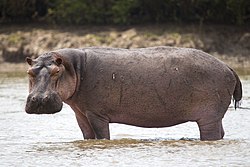
| A hippopotamus in Saadani National Park, Tanzania | |
Scientific classification 
| |
| Kingdom: | Animalia |
| Phylum: | Chordata |
| Class: | Mammalia |
| Order: | Artiodactyla |
| Family: | Hippopotamidae |
| Genus: | Hippopotamus |
| Species: | H. amphibius
|
| Binomial name | |
| Hippopotamus amphibius | |

| |
| Current distribution of the hippopotamus | |

The hippopotamus (Hippopotamus amphibius; /ˌhɪpəˈpɒtəməs/; pl.: hippopotamuses), often shortened to hippo (pl.: hippos), further qualified as the common hippopotamus, Nile hippopotamus and river hippopotamus, is a large semiaquatic mammal native to sub-Saharan Africa. It is one of only two extant species in the family Hippopotamidae, the other being the pygmy hippopotamus (Choeropsis liberiensis or Hexaprotodon liberiensis). Its name comes from the Ancient Greek for "river horse" (ἱπποπόταμος).
After elephants and rhinoceroses, the hippopotamus is the next largest land mammal. It is also the largest extant land artiodactyl. Despite their physical resemblance to pigs and other terrestrial even-toed ungulates, the closest living relatives of the hippopotamids are cetaceans (whales, dolphins, porpoises, etc.), from which they diverged about 55 million years ago. Hippos are recognisable for their barrel-shaped torsos, wide-opening mouths with large canine tusks, nearly hairless bodies, short legs, and large size: adults average 1,500 kg (3,300 lb) for bulls (males) and 1,300 kg (2,900 lb) for cows (females).
Hippos inhabit rivers, lakes, and mangrove swamps. Territorial bulls each preside over a stretch of water and a group of five to thirty cows and calves. Mating and birth both occur in the water. During the day, hippos remain cool by staying in water or mud, emerging at dusk to graze on grasses. While hippos rest near each other in the water, grazing is a solitary activity and hippos typically do not display territorial behaviour on land. Hippos are among the most dangerous animals in the world due to their aggressive and unpredictable nature. They are threatened by habitat loss and poaching for their meat and ivory (canine teeth).
Etymology
[edit]The Latin word hippopotamus is derived from the ancient Greek ἱπποπόταμος (hippopótamos), from ἵππος (híppos) 'horse' and ποταμός (potamós) 'river', together meaning 'horse of the river'.[3][4][5] In English, the plural is "hippopotamuses".[6]
Taxonomy and origins
[edit]Classification
[edit],_parque_nacional_de_Chobe,_Botsuana,_2018-07-28,_DD_60.jpg)


The modern hippopotamus and the pygmy hippopotamus are the only living members of the family Hippopotamidae. Some taxonomists place hippos and anthracotheres in the superfamily Anthracotheroidea. Hippopotamidae are classified along with other even-toed ungulates in the order Artiodactyla.[7]: 39–40
Five subspecies of hippos have been described based on morphological differences in their skulls as well as differences in geographical range:[7]: 3 [8][9][10]
- H. a. amphibius – (the nominate subspecies) ranges from Gambia east to Ethiopia and then south to Mozambique and historically ranged as far north as Egypt; its skull is distinguished by a moderately reduced preorbital region, a bulging dorsal surface, elongated mandibular symphysis and larger chewing teeth.
- H. a. kiboko – found in Kenya and Somalia; was noted to be smaller and more lightly coloured than other hippos with wider nostrils, somewhat longer snout and more rounded and relatively raised orbits with the space between them being incurved.
- H. a. capensis – found in Zambia and South Africa; distinguished by wider orbits.
- H. a. tschadensis – ranges between Chad and Niger; featured a slightly shorter but broader face, and pronounced, forward-facing orbits.
- H. a. constrictus – ranges from the southern Democratic Republic of Congo to Angola and Namibia; skull characterised by a thicker preorbital region, shorter snout, flatter dorsal surface, reduced mandibular symphysis and smaller chewing teeth.
The suggested subspecies above were never widely used or validated by field biologists; the described morphological differences were small enough that they could have resulted from simple variation in nonrepresentative samples.[7]: 2 A study examining mitochondrial DNA from skin biopsies taken from 13 sampling locations found "low, but significant, genetic differentiation" among H. a. amphibius, H. a. capensis, and H. a. kiboko. Neither H. a. tschadensis nor H. a. constrictus have been tested.[9]
Evolution
[edit]
Until 1909, naturalists classified hippos together with pigs based on molar patterns. Several lines of evidence, first from blood proteins, then from molecular systematics,[12] DNA[13][14] and the fossil record, show their closest living relatives are cetaceans (whales, dolphins, and porpoises).[15][16] The common ancestor of hippos and whales branched off from Ruminantia and the rest of the even-toed ungulates; the cetacean and hippo lineages split soon afterwards.[13][16]

The most recent theory of the origins of Hippopotamidae suggests hippos and whales shared a common semiaquatic ancestor that branched off from other artiodactyls around 60 million years ago.[13][15] This hypothesised ancestral group likely split into two branches again around 54 million years ago.[12]
One branch would evolve into cetaceans, possibly beginning about 52 million years ago, with the protowhale Pakicetus and other early whale ancestors collectively known as Archaeoceti. This group eventually underwent aquatic adaptation into the completely aquatic cetaceans.[16] The other branch became the anthracotheres, a large family of four-legged beasts, the earliest of which in the late Eocene would have resembled skinny hippos with comparatively smaller, narrower heads. All branches of the anthracotheres, except that which evolved into Hippopotamidae, became extinct during the Pliocene, leaving no descendants.[15][16]
A rough evolutionary lineage of the hippo can thus be traced from Eocene and Oligocene species: from Anthracotherium and Elomeryx to the Miocene species Merycopotamus and Libycosaurus and finally the very latest anthracotheres in the Pliocene.[17] These groups lived across Eurasia and Africa. The discovery of Epirigenys in East Africa, which was likely a descent of Asian anthracotheres and a sister taxon to Hippopotamidae, suggests that hippo ancestors entered Africa from Asia around 35 million years ago.[18][19] An early hippopotamid is the genus Kenyapotamus, which lived in Africa from 15 to 9 million years ago.[17] Hippopotamid species would spread across Africa and Eurasia, including the modern pygmy hippo. From 7.5 to 1.8 million years ago, a possible ancestor to the modern hippo, Archaeopotamus, lived in Africa and the Middle East.[20] The oldest records of the genus Hippopotamus date to the Pliocene (5.3–2.6 million years ago).[21] The oldest unambiguous records of the modern H. amphibius date to the Middle Pleistocene, though there are possible Early Pleistocene records.[22]

Extinct species
[edit]Three species of Malagasy hippopotamus became extinct during the Holocene on Madagascar, the last of them within the past 1,000 years. The Malagasy hippos were smaller than the modern hippo, likely a result of the process of insular dwarfism.[23] Fossil evidence indicates many Malagasy hippos were hunted by humans, a factor in their eventual extinction.[23] Isolated individual Malagasy hippos may have survived in remote pockets; in 1976, villagers described a living animal called the kilopilopitsofy, which may have been a Malagasy hippo.[24]
Hippopotamus gorgops from the Early Pleistocene to the early Middle Pleistocene of Africa and West Asia grew considerably larger than the living hippopotamus, with an estimated body mass of over 4,000 kg (8,800 lb).[21][25][26] Hippopotamus antiquus ranged throughout Europe, extending as far north as Britain during the Early and Middle Pleistocene epochs, before being replaced by the modern H. amphibius in Europe during the latter part of the Middle Pleistocene.[27] The Pleistocene also saw a number of dwarf species evolve on several Mediterranean islands, including Crete (Hippopotamus creutzburgi), Cyprus (the Cyprus dwarf hippopotamus, Hippopotamus minor), Malta (Hippopotamus melitensis), and Sicily (Hippopotamus pentlandi). Of these, the Cyprus dwarf hippo survived until the end of the Pleistocene or early Holocene. Evidence from the archaeological site Aetokremnos continues to cause debate on whether or not the species was driven to extinction or even encountered by humans.[28][29]
Characteristics
[edit]
The hippopotamus is a megaherbivore and is the third largest land mammal after elephants and some rhinoceros species. The mean adult weight is around 1,480 kg (3,260 lb) for bulls and 1,365 kg (3,009 lb) for cows. Exceptionally large males have been recorded reaching 2,660 kg (5,860 lb).[30] Male hippos appear to continue growing throughout their lives, while females reach maximum weight at around age 25.[31] It is 2.90 to 5.05 m (9 ft 6 in to 16 ft 7 in) long,[32] including a tail of about 35 to 56 cm (14 to 22 in) in length and 1.30 to 1.65 m (4 ft 3 in to 5 ft 5 in) tall at the shoulder,[33][34] with males and females ranging 1.40 to 1.65 m (4 ft 7 in to 5 ft 5 in) and 1.30 to 1.45 m (4 ft 3 in to 4 ft 9 in) tall at the shoulder respectively.[34] The species has a typical head–body length of 3.3–3.45 m (10.8–11.3 ft) and an average standing height of 1.4 m (4 ft 7 in) at the shoulder.[35]
Hippos have barrel-shaped bodies with short tails and legs, and an hourglass-shaped skull with a long snout.[36][7]: 3, 19 Their skeletal structures are graviportal, adapted to carrying their enormous weight,[7]: 8 and their dense bones and low centre of gravity allows them to sink and move along the bottom of the water.[37] Hippopotamuses have small legs (relative to other megafauna) because the water in which they live reduces the weight burden.[38] The toes are webbed and the pelvis rests at an angle of 45 degrees.[7]: 3, 9 Though chubby-looking, hippos have little fat.[7]: 3 The eyes, ears, and nostrils of hippos are placed high on the roof of their skulls. This allows these organs to remain above the surface while the rest of the body is submerged.[39]: 259 The nostrils and ears can close when underwater while nictitating membranes cover the eyes.[7]: 4, 116 The vocal folds of the hippo are more horizontally positioned, much like baleen whales. Underneath are throat tissues, where vibrations are transmitted to produce underwater calls.[40]
,_parque_nacional_de_Chobe,_Botsuana,_2018-07-28,_DD_79.jpg)
The hippo's jaw powered by huge masseter and digastric muscles,[39]: 259 and the hinge is located far back enough so that they can open their mouths at 100–110 degrees.[7]: 17 [41] Extensions at the back of the jaw create more surface area for muscle attachment, which gives them large, droopy cheeks[7]: 19 This allows them to achieve their gape without tearing any tissue.[42][41] On the lower jaw, the incisors and canines grow continuously, the former reaching 40 cm (16 in), while the latter can grow to up to 50 cm (20 in). The lower canines are sharpened through contact with the smaller upper canines.[36] The canines and incisors are used mainly for combat instead of feeding,[39]: 259 and the jaws are too rigid for side to side motion, making them less efficient for chewing.[43] Hippos rely on their flattened, horny lips to grasp and pull grasses which are then passed to the molars,[39]: 263 which have complex enamel folds on their chewing surface.[43] The hippo is considered to be a pseudoruminant; it has a complex three-chambered stomach, but does not "chew cud".[7]: 22

Hippo skin is 6 cm (2.4 in) thick across much of its body with little hair.[36][39]: 260 The animal is mostly purplish-grey or blue-black, but brownish-pink on the underside and around the eyes and ears.[39]: 260 Their skin secretes a natural, red-coloured sunscreen substance that is sometimes referred to as "blood sweat" but is neither blood nor sweat. This secretion is initially colourless and turns red-orange within minutes, eventually becoming brown. Two highly acidic pigments have been identified in the secretions; one red hipposudoric acid and one orange norhipposudoric acid, which inhibit the growth of disease-causing bacteria and their light-absorption profile peaks in the ultraviolet range, creating a sunscreen effect.[44][45] Regardless of diet, all hippos secrete these pigments so food does not appear to be their source; rather, they may be synthesised from precursors such as the amino acid tyrosine.[45] This natural sunscreen cannot prevent the animal's skin from cracking if it stays out of water too long.[46]
The testes of the males do not fully descend and a scrotum is not present. In addition, the penis retracts into the body when not erect. The genitals of the female hippos are unusual in that the vagina is ridged and the vulval vestibule has two large, protruding diverticula. Both of these have an unknown function.[7]: 28–29
A hippo's lifespan is typically 40 to 50 years.[39]: 277 Donna the Hippo was one of the oldest living hippos in captivity. She lived at the Mesker Park Zoo in Evansville, Indiana, in the US[47][48] until her death in 2012 at the age of 61.[49] Two hippos share the record for the oldest hippo ever recorded at 65 years. Bertha, a female Hippo, who lived in the Manila Zoo in the Philippines since it first opened in 1959 until her death in July 2017, and [50] male Hippo Lu, from the Ellie Schiller Homosassa Springs Wildlife State Park, who was born at the San Diego Zoo on January 26th, 1960, and died at Homosassa, where he died in June 2025, also at the age of 65.[51] Two other notably long-lived hippos were the female Tanga (1934–1995) at the Hellabrunn Zoo in Munich, Germany and male Blackie at the Cleveland Metroparks Zoo (1953–2014). Currently, the oldest hippo in captivity is believed to be Mae Mali at the Khao Kheow Open Zoo in Thailand, who will turn 60 in September 2025.
Distribution and status
[edit]

Hippopotamus amphibius arrived in Europe around 560–460,000 years ago, during the Middle Pleistocene.[52] The distribution of Hippopotamus amphibius in Europe during the Pleistocene was largely confined to Southern Europe, including the Iberian Peninsula,[53] Italy,[54][55] and Greece,[56] but extended into northwestern Europe, including Great Britain (as far north as North Yorkshire), the Netherlands, and western Germany during interglacial periods, such as the Last Interglacial (130–115,000 years ago).[57][58][59] Analysis of ancient DNA indicates that Late Pleistocene European hippopotamuses are closely related to and nested within the genetic diversity of living African hippopotamuses.[60] The youngest records of the species in Europe are from the Late Pleistocene of Greece, and the Rhine Graben of southwest Germany, dating to around 40–30,000 years ago.[56][53][60]
Archaeological evidence exists of its presence in the Levant, dating to less than 3,000 years ago.[61][62] The species was common in Egypt's Nile region during antiquity, but it has since been driven out. According to Pliny the Elder, in his time, the best location in Egypt for capturing this animal was in the Saite nome;[63] the animal could still be found along the Damietta branch of the Nile after the Arab conquest in 639. Reports of the slaughter of the last hippo in Natal Province were made at the end of the 19th century.[64] Hippos are still found in the rivers and lakes of the northern Democratic Republic of the Congo, Uganda, Tanzania, and Kenya, north through to Ethiopia, Somalia, and Sudan, west to The Gambia, and south to South Africa.[1]
Genetic evidence suggests common hippos in Africa experienced a marked population expansion during or after the Pleistocene, attributed to an increase in water bodies at the end of the era. These findings have important conservation implications, as hippo populations across the continent are currently threatened by loss of access to fresh water.[9] Hippos are also subject to unregulated hunting and poaching. The species is included in Appendix II of the Convention on International Trade in Endangered Species (CITES) meaning international export/import (including in parts and derivatives) requires CITES documentation to be obtained and presented to border authorities.[1][65]
As of 2017, the IUCN Red List drawn up by the International Union for Conservation of Nature (IUCN) lists the species as vulnerable, with a stable population estimated between 115,000 and 130,000 animals.[1] The hippo population has declined most dramatically in the Democratic Republic of the Congo.[66] By 2005, the population in Virunga National Park had dropped to 800 or 900 from around 29,000 in the mid-1970s.[67] This decline is attributed to the disruptions caused by the Second Congo War.[67] The poachers are believed to be Mai-Mai rebels, underpaid Congolese soldiers, and local militia groups.[67][68] Reasons for poaching include the belief hippos are harmful to society, as well as financial gain.[69] As of 2016, the Virunga hippo population appears to have increased again, possibly due to better protection from park rangers, who have worked with local fishermen.[70] The sale of hippo meat is illegal, but black-market sales are difficult for Virunga National Park officers to track.[68][69] Hippo meat is highly valued in some areas of central Africa and the teeth may be used as a replacement for elephant ivory.[71]
A population of hippos exists in Colombia, descended from captive individuals that escaped from Pablo Escobar's estate after his death in 1993. Their numbers grew to 100 by the 2020s and ecologists believe the population should be eradicated, as they are breeding rapidly and are an increasing menace to humans and the environment. Attempts to control them include sterilisation and culling.[72]
Behaviour and ecology
[edit]Hippos are semiaquatic and require enough water to immerse in, while being close to grass.[36] They mostly live in freshwater habitat, but can be found in estuaries.[1] They prefer relatively still waters with gently sloping shores, though male hippos may also be found in very small numbers in more rapid waters with rocky slopes.[39]: 264 Like most herbivores, hippos will consume a variety of plants if presented with them in captivity, but their diet in nature consists almost entirely of grass, with only minimal consumption of aquatic plants.[73] Hippos spend most of the day in water to stay cool and hydrated. Just before night begins, they leave the water to forage on land. A hippo will travel 3–5 km (1.9–3.1 mi) per night, eating around 40 kg (88 lb) of grass. By dawn, they are back in the water.[36]
Despite being semiaquatic, an adult hippo is not a particularly good swimmer, nor can it float. It rarely enters deep water; when it does, the animal moves by bouncing off the bottom. An adult hippo surfaces every four to six minutes, while young need to breathe every two to three minutes.[7]: 3–4 Hippos move on land by trotting, and limb movements do not change between speeds. They can reach an airborne stage (a stage when all limb are off the ground) when they move fast enough. Hippos are reported to reach 30 km/h (19 mph) but this has not been confirmed.[74] They are incapable of jumping but can walk up steep banks.[36] The hippopotamus sleeps with both hemispheres of the brain resting, as in all land mammals, and usually sleeps on land or in water with the nostrils exposed. Despite this, it can sleep while submerged, intermittently surfacing to breathe seemingly without waking. They appear to transition between different phases of sleep more quickly than other mammals.[75]
Because of their size and their habit of taking the same paths to feed, hippos can have a significant impact on the land across which they walk, keeping the land clear of vegetation and depressing the ground. Over prolonged periods, hippos can divert the paths of swamps and channels.[76] By defecating in the water, the animals also appear to pass on microbes from their gut, affecting the biogeochemical cycle.[77] On occasion, hippos have been filmed eating carrion, usually near the water. There are other reports of meat-eating and even cannibalism and predation.[78] Hippos' stomach anatomy lacks adaptions to carnivory and meat-eating is likely caused by lack of nutrients or just an abnormal behaviour.[7]: 82–84
Social life
[edit]
It is challenging to study the interaction of bulls and cows because hippos are not sexually dimorphic, so cows and young bulls are almost indistinguishable in the field.[79] Hippo pods fluctuate but can contain over 100 hippos. Although they lie close together, adults develop almost no social bonds. Males establish territories in water but not land, and these may range 250–500 m (820–1,640 ft) in lakes and 50–100 m (160–330 ft) in rivers. Territories are abandoned when the water dries up. The bull has breeding access to all the cows in his territory. Younger bachelors are allowed to stay as long as they defer to him. A younger male may challenge the old bull for control of the territory. Within the pods, the hippos tend to segregate by sex and status. Bachelor males lounge near other bachelors, females with other females, and the territorial male is on his own. When hippos emerge from the water to graze, they do so individually.[7]: 4–5, 49–50

Hippos engage in "muck-spreading" which involves defecating while spinning their tails to distribute the faeces over a greater area. Muck-spreading occurs both on land and in water and its function is not well understood. It is unlikely to serve a territorial function, as the animals only establish territories in the water. They may be used as trails between the water and grazing areas.[7]: 5, 51–52 "Yawning" serves as a threat display.[36] When fighting, bulls use their incisors to block each other's attacks and their large canines as offensive weapons.[39]: 259–260 When hippos become over-populated or a habitat shrinks, bulls sometimes attempt infanticide, but this behaviour is not common under normal conditions.[80]
The most common hippo vocalisation is the "wheeze honk", which can travel over long distances in air.[81] This call starts as a high-pitched squeal followed by a deeper, resonant call.[7]: 5 The animals can recognise the calls of other individuals. Hippos are more likely to react to the wheeze honks of strangers than to those they are more familiar with (dear enemy effect).[81] When threatened or alarmed, they produce exhalations,[36] and fighting bulls will bellow loudly.[7]: 5 Hippos are recorded to produce clicks underwater which may have echolocative properties.[82] They have the unique ability to hold their heads partially above the water and send out a cry that travels through both water and air; individuals respond both above and below water.[83]
Reproduction
[edit].jpg)
Cows reach sexual maturity at five to six years of age and have a gestation period of eight months.[84] A study of endocrine systems revealed cows may begin puberty at as early as three or four years.[85] Bulls reach maturity at around 7.5 years. Both conceptions and births are highest during the wet season. Male hippos always have mobile spermatozoa and can breed year-round.[7]: 59–61, 66 After becoming pregnant, a female hippo will typically not begin ovulation again for 17 months.[85] Hippos mate in the water, with the cow remaining under the surface,[7]: 63 her head emerging periodically to draw breath. Cows give birth in seclusion and return within 10 to 14 days. Calves are born on land or shallow water[36] weighing on average 50 kg (110 lb) and at an average length of around 127 cm (50 in). The female lies on her side when nursing, which can occur underwater or on land. The young are carried on their mothers' backs in deep water.[7]: 4, 64
Mother hippos are very protective of their young, not allowing others to get too close.[36] One cow was recorded protecting a calf's carcass after it had died.[86] Calves may be temporarily kept in nurseries, guarded by one or more adults, and will play amongst themselves.[36] Like many other large mammals, hippos are described as K-strategists, in this case typically producing just one large, well-developed infant every couple of years (rather than many small, poorly developed young several times per year, as is common among small mammals such as rodents).[85][80] Calves no longer need to suckle when they are a year old.[7]: 64
Interspecies interactions
[edit]
Hippos coexist alongside a variety of large predators in their habitats. Nile crocodiles, lions, and spotted hyenas are known to prey on young hippos.[36] Beyond these, adult hippos are not usually preyed upon by other animals due to their aggression and size. Cases where large lion prides have successfully preyed on adult hippos have been reported, but it is generally rare.[87] Lions occasionally prey on adults at Gorongosa National Park and calves are sometimes taken at Virunga.[88] Crocodiles are frequent targets of hippo aggression, probably because they often inhabit the same riparian habitats; crocodiles may be either aggressively displaced or killed by hippos,[89] although they will avoid crocodiles larger than 3.5 m (11 ft).[90] In turn, very large Nile crocodiles have been observed preying occasionally on calves, "half-grown" hippos, and possibly also adult female hippos. Groups of crocodiles have also been observed finishing off still-living male hippos that were previously injured in mating battles with other males.[91][92]
Hippos occasionally visit cleaning stations in order to be cleaned of parasites by certain species of fishes. They signal their readiness for this service by opening their mouths wide. This is an example of mutualism, in which the hippo benefits from the cleaning while the fish receive food.[93] Hippo defecation creates allochthonous deposits of organic matter along the river beds. These deposits have an unclear ecological function.[73] A 2015 study concluded hippo dung provides nutrients from terrestrial material for fish and aquatic invertebrates,[94] while a 2018 study found that their dung can be toxic to aquatic life in large quantities, due to absorption of dissolved oxygen in water bodies.[95][96]
The parasitic monogenean flatworm Oculotrema hippopotami infests hippopotamus eyes, mainly the nictitating membrane. It is the only monogenean species (which normally live on fish) documented to live on a mammal.[97]
Hippos and humans
[edit]
Cut marks on bones of H. amphibius found at Bolomor Cave, a site in Spain preserving fossils dating from 230,000 to 120,000 years ago, provides evidence for Neanderthal butchery of hippopotamuses.[98][99] The earliest evidence of modern human interaction with hippos comes from butchery cut marks on hippo bones found at the Bouri Formation and dated to around 160,000 years ago.[100] 4,000–5,000 year art showing hippos being hunted have been found in the Tassili n'Ajjer Mountains of the central Sahara near Djanet.[7]: 1 The ancient Egyptians recognised the hippo as ferocious, and representations on the tombs of nobles show humans hunting them.[101]
The hippo was also known to the Greeks and Romans. The Greek historian Herodotus described the hippo in The Histories (written circa 440 BC) and the Roman naturalist Pliny the Elder wrote about the hippo in his encyclopedia Naturalis Historia (written circa 77 AD).[63][102] The Yoruba people called the hippo erinmi, which means "elephant of the water".[103] Some individual hippos have achieved international fame. Huberta became a celebrity during the Great Depression for trekking a great distance across South Africa.[104][105]: 111–112
Attacks on humans
[edit]The hippo is considered to be extremely aggressive and has frequently been reported charging and attacking boats.[106] Hippos can easily capsize small boats and injure or kill passengers. In one 2014 case in Niger, a boat was capsized by a hippo and 13 people were killed.[107] Hippos will often raid farm crops if the opportunity arises, and humans may come into conflict with them on these occasions. These encounters can be fatal to either humans or hippos.[108]
According to the Ptolemaic historian Manetho, the pharaoh Menes was carried off and then killed by a hippopotamus.[109]
In zoos
[edit]
Hippos have long been popular zoo animals. The first record of hippos taken into captivity for display is dated to 3500 BC in Hierakonpolis, Egypt.[110] The first zoo hippo in modern history was Obaysch, who arrived at the London Zoo on 25 May 1850, where he attracted up to 10,000 visitors a day and inspired a popular song, the "Hippopotamus Polka".[111]
Hippos generally breed well in captivity; birth rates are lower than in the wild, but this can be attributed to zoos' desire to limit births, since hippos are relatively expensive to maintain.[111][112] Starting in 2015, the Cincinnati Zoo built a US$73 million exhibit to house three adult hippos, featuring a 250,000 L (55,000 imp gal; 66,000 US gal) tank. Modern hippo enclosures also have a complex filtration system for waste, an underwater viewing area for the visitors, and glass that may be up to 9 cm (3.5 in) thick and capable of holding water under pressures of 31 kPa (4.5 psi).[105]: 158–159
Cultural significance
[edit]
In Egyptian mythology, the god Set takes the form of a red hippopotamus and fights Horus for control of the land, but is defeated. The goddess Tawaret is depicted as a pregnant woman with a hippo head, representing fierce maternal love.[113] The Ijaw people of the Niger Delta wore masks of aquatic animals like the hippo when practising their water spirit cults,[114] and hippo ivory was used in the divination rituals of the Yoruba.[115] Hippo masks were also used in Nyau funerary rituals of the Chewa of Southern Africa.[105]: 120 According to Robert Baden-Powell, Zulu warriors referred to hippos in war chants.[116] The Behemoth from the Book of Job, 40:15–24 is thought to be based on the hippo.[117]
Hippos have been the subjects of various African folktales. According to a San story, when the Creator assigned each animal its place in nature, the hippos wanted to live in the water, but were refused out of fear they might eat all the fish. After begging and pleading, the hippos were finally allowed to live in the water on the condition they would eat grass instead of fish, and fling their dung so it can be inspected for fish bones. In a Ndebele tale, the hippo originally had long, beautiful hair, but it was set on fire by a jealous hare and the hippo had to jump into a nearby pool. The hippo lost most of his hair and was too embarrassed to leave the water.[118]

Hippopotamuses were rarely depicted in European art during the Renaissance and Baroque periods, due to less access to specimens by Europeans. One notable exception is Peter Paul Rubens' The Hippopotamus and Crocodile Hunt (1615–1616).[105]: 122–123 Ever since Obaysch inspired the "Hippopotamus Polka", hippos have been popular animals in Western culture for their rotund appearance, which many consider comical.[111] The Disney film Fantasia featured a ballerina hippo dancing to the opera La Gioconda. The film Hugo the Hippo is set in Tanzania and involves the title character trying to escape being slaughtered with the help of local children. The Madagascar films feature a hippo named Gloria.[105]: 128–129 Hippos even inspired a popular board game, Hungry Hungry Hippos.[119]
Among the most famous poems about the hippo is "The Hippopotamus" by T. S. Eliot, where he uses a hippo to represent the Catholic Church. Hippos are mentioned in the novelty Christmas song "I Want a Hippopotamus for Christmas" that became a hit for child star Gayla Peevey in 1953. They also featured in the popular "The Hippopotamous Song" by Flanders and Swann.[105]: 128, 136
See also
[edit]
- American Hippo bill - 1910 bill that proposed the introduction of hippos into Louisiana
- List of individual hippos
References
[edit]- ^ a b c d e f Lewison, R.; Pluháček, J. (2017). "Hippopotamus amphibius". IUCN Red List of Threatened Species. 2017 e.T10103A18567364. doi:10.2305/IUCN.UK.2017-2.RLTS.T10103A18567364.en. Retrieved 19 November 2021.
- ^ Linnæus, C. (1758). "Hippopotamus amphibius". Caroli Linnæi Systema naturæ per regna tria naturæ, secundum classes, ordines, genera, species, cum characteribus, differentiis, synonymis, locis. Holmiae: Salvius. p. 74.
- ^ ἱπποπόταμος, ἵππος, ποταμός. Liddell, Henry George; Scott, Robert; A Greek–English Lexicon at the Perseus Project.
- ^ "Hippopotamus". Merriam-Webster's Online Dictionary. Retrieved 18 July 2007.
- ^ Harper, Douglas. "hippopotamus". Online Etymology Dictionary.
- ^ "Plural of hippopotamus". Oxford English Dictionary. Archived from the original on 13 October 2008. Retrieved 18 July 2007.
- ^ a b c d e f g h i j k l m n o p q r s t u v w Eltringham, S. K. (1999). The Hippos: Natural History and Conservation. Poyser Natural History Series. Academic Press. ISBN 978-0-85661-131-5.
- ^ Lydekker, R (1915). Catalogue of the Ungulate Mammals in the British Museum of Natural History, vol. 4. Vol. 4. British Museum. pp. 389–392.
- ^ a b c Okello, J. B. A.; Nyakaana, S.; Masembe, C.; Siegismund, H. R.; Arctander, P. (2005). "Mitochondrial DNA variation of the common hippopotamus: evidence for a recent population expansion". Heredity. 95 (3): 206–215. Bibcode:2005Hered..95..206O. doi:10.1038/sj.hdy.6800711. PMID 16030528.
- ^ Meijaard, Erik, ed. (September 2005). "Suiform Soundings: The IUCN/SSC Pigs, Peccaries, and Hippos Specialist Group (PPHSG) Newsletter" (PDF). IUCN. 5 (1).
- ^ Tsagkogeorga, G.; McGowen, M. R.; Davies, K. T. J.; Jarman, S.; Polanowski, A.; Bertelsen, M. F.; Rossiter, S. J. (2015). "A phylogenomic analysis of the role and timing of molecular adaptation in the aquatic transition of cetartiodactyl mammals". Royal Society Open Science. 2 (9) 150156. Bibcode:2015RSOS....250156T. doi:10.1098/rsos.150156. PMC 4593674. PMID 26473040.
- ^ a b Ursing, B. M.; Arnason U. (1998). "Analyses of mitochondrial genomes strongly support a hippopotamus-whale clade". Proceedings of the Royal Society. 265 (1412): 2251–2255. doi:10.1098/rspb.1998.0567. PMC 1689531. PMID 9881471.
- ^ a b c Gatesy, J. (1997). "More DNA support for a Cetacea/Hippopotamidae clade: the blood-clotting protein gene gamma-fibrinogen". Molecular Biology and Evolution. 14 (5): 537–543. doi:10.1093/oxfordjournals.molbev.a025790. PMID 9159931.
- ^ Geisler, J. H.; Theodor, J. M. (2009). "Hippopotamus and whale phylogeny". Nature. 458 (7236): E1 – E4, discussion E5. Bibcode:2009Natur.458....1G. doi:10.1038/nature07776. PMID 19295550. S2CID 4320261.
- ^ a b c Sanders, R. (2005). "Scientists find missing link between the dolphin, whale and its closest relative, the hippo". Science News Daily. Archived from the original on 26 February 2015. Retrieved 8 January 2011.
- ^ a b c d Boisserie, J.-R.; Lihoreau, F.; Brunet, M. (2005). "The position of Hippopotamidae within Cetartiodactyla". Proceedings of the National Academy of Sciences. 102 (5): 1537–1541. Bibcode:2005PNAS..102.1537B. doi:10.1073/pnas.0409518102. PMC 547867. PMID 15677331.
- ^ a b Boisserie, J.-R.; Lihoreau, F.; Brunet, M. (2005). "Origins of Hippopotamidae (Mammalia, Cetartiodactyla): towards resolution". Zoologica Scripta. 34 (2): 119–143. doi:10.1111/j.1463-6409.2005.00183.x. S2CID 83768668.
- ^ Lihoreau, F.; Boisserie, J.-R.; Manthi, F. K.; Ducrocq. S. (2015). "Hippos stem from the longest sequence of terrestrial cetartiodactyl evolution in Africa". Nature Communications. 6 6264. Bibcode:2015NatCo...6.6264L. doi:10.1038/ncomms7264. PMID 25710445.
- ^ Lihoreau, F. (2015). "New Fossils from Kenya Precise Hippo Origin". Serious Science. Retrieved 5 June 2021.
- ^ Boisserie, J.-R. (2005). "The phylogeny and taxonomy of Hippopotamidae (Mammalia: Artiodactyla): a review based on morphology and cladistic analysis". Zoological Journal of the Linnean Society. 143: 1–26. doi:10.1111/j.1096-3642.2004.00138.x.
- ^ a b van der Made J, Sahnouni M & Boulaghraief K. 2017. Hippopotamus gorgops from El Kherba (Algeria) and the context of its biogeography. In Proceedings of the II Meeting of African Prehistory: Burgos 15–16 April 2015, Sahnouni M, Semaw S, Rios Garaizar J (eds). CENIEH: Burgos; 135–169.
- ^ Pandolfi, L.; Martino, R.; Belvedere, M.; Martínez-Navarro, B.; Medin, T.; Libsekal, Y.; Rook, L. (2023). "The latest Early Pleistocene hippopotami from the human-bearing locality of Buia (Eritrea)". Quaternary Science Reviews. 308 108039. Bibcode:2023QSRv..30808039P. doi:10.1016/j.quascirev.2023.108039. S2CID 258024770.
- ^ a b Stuenes, S. (1989). "Taxonomy, habits and relationships of the sub-fossil Madagascan hippopotamuses Hippopotamus lemerlei and H. madagascariensis". Journal of Vertebrate Paleontology. 9 (3): 241–268. doi:10.1080/02724634.1989.10011761.
- ^ Burney, D. A.; Ramilisonina (1998). "The Kilopilopitsofy, Kidoky, and Bokyboky: Accounts of Strange Animals from Belo-sur-mer, Madagascar, and the Megafaunal "Extinction Window"". American Anthropologist. 100 (4): 957–966. doi:10.1525/aa.1998.100.4.957. JSTOR 681820.
- ^ Chaix L, Faure M, Guérin C, Honegger M. Kaddanarti, a Lower Pleistocene Assemblage from Northern Sudan. In: Krzyżaniak L, Kroeper K, Kobusiewicz M, editors. Recent Research into the Stone Age of Northeastern Africa. Poznań: Poznań Archaeological Museum; 2000. p. 33–46.
- ^ Hutchinson, J. R. (2021). "The evolutionary biomechanics of locomotor function in giant land animals". Journal of Experimental Biology. 224 (11) jeb217463. Bibcode:2021JExpB.224B7463H. doi:10.1242/jeb.217463. ISSN 0022-0949. PMC 8214834. PMID 34100541.
- ^ Adams, N. F.; Candy, I.; Schreve, D. C. (2022). "An Early Pleistocene hippopotamus from Westbury Cave, Somerset, England: support for a previously unrecognized temperate interval in the British Quaternary record". Journal of Quaternary Science. 37 (1): 28–41. Bibcode:2022JQS....37...28A. doi:10.1002/jqs.3375. S2CID 244179438.
- ^ Simmons, A. (2000). "Faunal extinction in an island society: pygmy hippopotamus hunters of Cyprus". Geoarchaeology. 15 (4): 379–381. Bibcode:2000Gearc..15..379G. doi:10.1002/(SICI)1520-6548(200004)15:4<379::AID-GEA7>3.0.CO;2-E.
- ^ Petronio, C. (1995). "Note on the taxonomy of Pleistocene hippopotamuses" (PDF). Ibex. 3: 53–55. Archived from the original (PDF) on 12 September 2008.
- ^ Owen-Smith, R. N. (1992). Megaherbivores: The Influence of Very Large Body Size on Ecology. Cambridge University Press. pp. 6–14. ISBN 978-0-521-42637-4.
- ^ Marshall, P. J.; Sayer, J. A. (1976). "Population ecology and response to cropping of a hippo population in eastern Zambia". The Journal of Applied Ecology. 13 (2): 391–403. doi:10.2307/2401788. JSTOR 2401788.
- ^ "Physical Description". Retrieved 22 October 2020.
- ^ "Hippopotamus amphibius". Retrieved 22 October 2020.
- ^ a b "Hippopotamus". Archived from the original on 8 August 2020. Retrieved 22 October 2020.
- ^ Eltringham, S. K. (2001). "Hippopotamuses". In MacDonald, D. (ed.). The Encyclopedia of Mammals (2nd ed.). Oxford University Press. p. 491. ISBN 978-0-7607-1969-5.
- ^ a b c d e f g h i j k l Estes, R. (1992). The Behavior Guide to African Mammals: including hoofed mammals, carnivores, primates. University of California Press. pp. 222–226. ISBN 978-0-520-08085-0.
- ^ Coughlin, B. L.; Fish, F. E. (2009). "Hippopotamus underwater locomotion: Reduced-gravity movements for a massive mammal". Journal of Mammalogy. 90 (3): 675–679. doi:10.1644/08-MAMM-A-279R.1. S2CID 51686926.
- ^ Exploring Mammals. Marshall Cavendish Corporation. 2008. p. 616. ISBN 978-0-7614-7728-0.
- ^ a b c d e f g h i Kingdon, J. (1988). East African Mammals: An Atlas of Evolution in Africa. Vol. 3, Part B: Large Mammals. University Of Chicago Press. pp. 256–277. ISBN 978-0-226-43722-4.
- ^ Reidenberg, J. S. (2017). "Terrestrial, semiaquatic, and fully aquatic mammal sound production mechanisms" (PDF). Acoustics Today. 13 (2): 35–43.
- ^ a b Herring, S. W.; Herring, S. E. (1975). "The superficial masseter and gape in mammals". The American Naturalist. 108 (962): 561–576. doi:10.1086/282934. JSTOR 2459686.
- ^ Herring, S. W. (1975). "Adaptations for gape in the hippopotamus and its relatives". Forma et Functio. 8: 85–100.
- ^ a b Avedik, A; Clauss, M (2023). "Chewing, dentition and tooth wear in Hippopotamidae (Hippopotamus amphibius and Choeropsis liberiensis)". PLOS ONE. 18 (10) e0291825. Bibcode:2023PLoSO..1891825A. doi:10.1371/journal.pone.0291825. PMC 10550173. PMID 37792716.
- ^ Kean, Sam (2018). "Sweating blood". Distillations. 4 (2): 5. Retrieved 20 August 2018.
- ^ a b Saikawa, Y.; Hashimoto, K.; Nakata, M.; Yoshihara, M.; Nagai, K.; Ida, M.; Komiya, T. (2004). "Pigment chemistry: the red sweat of the hippopotamus". Nature. 429 (6990): 363. Bibcode:2004Natur.429..363S. doi:10.1038/429363a. PMID 15164051. S2CID 4404922.
- ^ Jablonski, N. G. (2013). Skin: A Natural History. University of California Press. p. 34. ISBN 978-0-520-24281-4.
- ^ "Oldest Hippo Turns 55!". Mesker Park Zoo. 2006. Archived from the original on 27 September 2007. Retrieved 21 June 2007.
- ^ "Celebrate with Donna". Evansville Courier & Press. 2007. Archived from the original on 16 January 2014. Retrieved 15 July 2007.
- ^ Fears, D. (2012). "Goodbye, Donna: World's oldest hippo in captivity dies at 61". Today.com. Archived from the original on 4 June 2013. Retrieved 12 September 2013.
- ^ "Bertha, the world's 'oldest' hippo, dies at 65". BBC News. 2017. Retrieved 29 November 2020.
- ^ "Lu, Citrus County's celebrity hippo, dies at 65". Chronicle Online. 8 June 2025. Retrieved 9 June 2025.
- ^ Mecozzi, Beniamino; Iannucci, Alessio; Mancini, Marco; Tentori, Daniel; Cavasinni, Chiara; Conti, Jacopo; Messina, Mattia Yuri; Sarra, Alex; Sardella, Raffaele (22 November 2023). Carnevale, Giorgio (ed.). "Reinforcing the idea of an early dispersal of Hippopotamus amphibius in Europe: Restoration and multidisciplinary study of the skull from the Middle Pleistocene of Cava Montanari (Rome, central Italy)". PLOS ONE. 18 (11) e0293405. Bibcode:2023PLoSO..1893405M. doi:10.1371/journal.pone.0293405. ISSN 1932-6203. PMC 10664965. PMID 37992018.
- ^ a b Fidalgo, Darío; Madurell-Malapeira, Joan; Martino, Roberta; Pandolfi, Luca; Rosas, Antonio (10 January 2024). "An Updated Review of The Quaternary Hippopotamus Fossil Records from the Iberian Peninsula". Quaternary. 7 (1): 4. Bibcode:2024Quat....7....4F. doi:10.3390/quat7010004. hdl:10261/345195. ISSN 2571-550X.
- ^ Briatico, Giuseppe; Gioia, Patrizia; Bocherens, Hervé (10 December 2023). "Diet and habitat of the late Middle Pleistocene mammals from the Casal de' Pazzi site (Rome, Italy) using stable carbon and oxygen isotope ratios". Quaternary International. 676: 53–62. Bibcode:2023QuInt.676...53B. doi:10.1016/j.quaint.2023.11.002. Retrieved 27 April 2024 – via Elsevier Science Direct.
- ^ Martino, R.; Pandolfi, L. (3 July 2022). "The Quaternary Hippopotamus records from Italy". Historical Biology. 34 (7): 1146–1156. Bibcode:2022HBio...34.1146M. doi:10.1080/08912963.2021.1965138. ISSN 0891-2963. S2CID 239713930.
- ^ a b Athanassiou, Athanassios (2022), Vlachos, Evangelos (ed.), "The Fossil Record of Continental Hippopotamids (Mammalia: Artiodactyla: Hippopotamidae) in Greece", Fossil Vertebrates of Greece Vol. 2, Cham: Springer International Publishing, pp. 281–299, doi:10.1007/978-3-030-68442-6_9, ISBN 978-3-030-68441-9, S2CID 239839913, retrieved 26 January 2024
- ^ Pushkina, Diana (July 2007). "The Pleistocene easternmost distribution in Eurasia of the species associated with the Eemian Palaeoloxodon antiquus assemblage". Mammal Review. 37 (3): 224–245. Bibcode:2007MamRv..37..224P. doi:10.1111/j.1365-2907.2007.00109.x. ISSN 0305-1838.
- ^ van Kolfschoten, Th. (August 2000). "The Eemian mammal fauna of central Europe". Netherlands Journal of Geosciences. 79 (2–3): 269–281. Bibcode:2000NJGeo..79..269V. doi:10.1017/S0016774600021752. ISSN 0016-7746.
- ^ Schreve, Danielle C. (January 2009). "A new record of Pleistocene hippopotamus from River Severn terrace deposits, Gloucester, UK—palaeoenvironmental setting and stratigraphical significance". Proceedings of the Geologists' Association. 120 (1): 58–64. Bibcode:2009PrGA..120...58S. doi:10.1016/j.pgeola.2009.03.003.
- ^ a b Arnold, Patrick; Döppes, Doris; Alberti, Federica; Füglistaler, Andreas; Lindauer, Susanne; Hoselmann, Christian; Friedrich, Ronny; Hajdas, Irka; Dickinson, Marc; Menger, Frank; Paijmans, Johanna L.A.; Dalén, Love; Wegmann, Daniel; Penkman, Kirsty E.H.; Barlow, Axel (October 2025). "Ancient DNA and dating evidence for the dispersal of hippos into central Europe during the last glacial". Current Biology. doi:10.1016/j.cub.2025.09.035.
- ^ Horwitz, Liora Kolska; Tchernov, Eitan (1990). "Cultural and Environmental Implications of Hippopotamus Bone Remains in Archaeological Contexts in the Levant". Bulletin of the American Schools of Oriental Research. 280 (280): 67–76. doi:10.2307/1357310. JSTOR 1357310. S2CID 163871070.
- ^ Haas, Georg (1953). "On the Occurrence of Hippopotamus in the Iron Age of the Coastal Area of Israel". Bulletin of the American Schools of Oriental Research. 132 (132): 30–34. doi:10.2307/1355798. JSTOR 1355798. S2CID 163758714.
- ^ a b Pliny the Elder (1 January 1987). "Chapter 15, Book VIII". Naturalis Historia. Vieweg+Teubner Verlag. ISBN 978-3-519-01652-6. (English translation; Latin original)
- ^ "The Hippopotamus Going - Extinction of the huge species at hand". The Sydney Morning Herald. 7 October 1898. Retrieved 14 July 2017.
- ^ "Appendices | CITES". cites.org. Retrieved 13 November 2022.
- ^ "Hippo Haven". Smithsonian Magazine. 1 January 2006. Retrieved 23 January 2007.
- ^ a b c "DR Congo's hippos face extinction". BBC. 13 September 2005. Retrieved 14 November 2005.
- ^ a b Owen, James (24 October 2006). "Hippos Butchered by the Hundreds in Congo Wildlife Park". National Geographic News. Archived from the original on 20 February 2014. Retrieved 11 September 2013.
- ^ a b Sundaram, Anjan (12 September 2005). "Congo's Hippos Fast Disappearing". Toronto Star.
- ^ Delaney, J.; Sautner, S. (3 November 2016). "After a Long Demise Due to Poaching, Virunga's Hippos Climbing Back". Wildlife Conservation Society. Retrieved 25 November 2016.
- ^ Pearce, Fred (2003). "Poaching causes hippo population crash". New Scientist. Retrieved 26 April 2014.
- ^ Charles, Matthew (17 January 2021). "Colombia's rapidly breeding 'cocaine hippos' must be stopped, scientists say". news.yahoo.com. The Telegraph. Retrieved 18 January 2021.
- ^ a b Grey, J.; Harper, D. M. (2002). "Using Stable Isotope Analyses To Identify Allochthonous Inputs to Lake Naivasha Mediated Via the Hippopotamus Gut". Isotopes in Environmental Health Studies. 38 (4): 245–250. Bibcode:2002IEHS...38..245G. doi:10.1080/10256010208033269. PMID 12725427. S2CID 216152807.
- ^ Hutchinson, J. R.; Pringle, E. V. (2024). "Footfall patterns and stride parameters of Common hippopotamus (Hippopotamus amphibius) on land". PeerJ. 12 e17675. doi:10.7717/peerj.17675. PMC 11227274. PMID 38974416.
- ^ Dell, Leigh-Anne; Patzke, Nina; Spocter, Muhammad A.; Bertelsen, Mads F.; Siegel, Jerome M.; Manger, Paul R. (2016). "Organization of the sleep-related neural systems in the brain of the river hippopotamus (Hippopotamus amphibius): A most unusual cetartiodactyl species". Journal of Comparative Neurology. 524 (10): 2036–2058. doi:10.1002/cne.23930. PMC 8716328. PMID 26588600.
- ^ McCarthy, T. S.; Ellery, W. N.; Bloem, A (1998). "Some observations on the geomorphological impact of hippopotamus (Hippopotamus amphibius L.) in the Okavango Delta, Botswana". African Journal of Ecology. 36 (1): 44–56. Bibcode:1998AfJEc..36...44M. doi:10.1046/j.1365-2028.1998.89-89089.x.
- ^ Dutton, C. L.; Subalusky, A. L.; Sanchez, A.; Estrela, S.; Lu, N.; Hamilton, S. K.; Njoroge, L.; Rosi, E. J.; Post, D. M. (2021). "The meta-gut: community coalescence of animal gut and environmental microbiomes". Scientific Reports. 11 (1): 23117. Bibcode:2021NatSR..1123117D. doi:10.1038/s41598-021-02349-1. PMC 8633035. PMID 34848778.
- ^ Dudley, J. P. (January 1998). "Reports of carnivory by the common hippo Hippopotamus amphibius". South African Journal of Wildlife Research. 28 (2): 58–59.
- ^ Beckwitt, R.; Shea, J.; Osborne, D.; Krueger, S.; Barklow, W. (2002). "A PCR-based method for sex identification in Hippopotamus amphibius" (PDF). African Zoology. 37 (2): 127–130. doi:10.1080/15627020.2002.11657167. S2CID 88102117. Archived from the original (PDF) on 17 June 2010.
- ^ a b Lewison, R. (1998). "Infanticide in the hippopotamus: evidence for polygynous ungulates". Ethology, Ecology & Evolution. 10 (3): 277–286. Bibcode:1998EtEcE..10..277L. doi:10.1080/08927014.1998.9522857. Archived from the original on 6 March 2011. Retrieved 11 July 2010.
- ^ a b Thévenet, J.; Grimault, N.; Fonseca, P.; Mathevon, N. (2022). "Voice-mediated interactions in a megaherbivore" (PDF). Current Biology. 32 (2): R70 – R71. Bibcode:2022CBio...32..R70T. doi:10.1016/j.cub.2021.12.017. PMID 35077689. S2CID 246242737. Archived (PDF) from the original on 9 October 2022.
- ^ Maust-Mohl, M; Soltis, J; Reiss, D (2018). "Underwater click train production by the hippopotamus (Hippopotamus amphibius) suggests an echo-ranging function". Behaviour. 155 (2–3): 231–251. doi:10.1163/1568539X-00003484. JSTOR 26488527.
- ^ Barklow, William E. (2004). "Low-frequency sounds and amphibious communication in Hippopotamus amphibious". The Journal of the Acoustical Society of America. 115 (5): 2555. Bibcode:2004ASAJ..115.2555B. doi:10.1121/1.4783854.
- ^ Brown, C. Emerson (November 1924). "Rearing Hippopotamuses in Captivity". Journal of Mammalogy. 5 (4): 243–246. doi:10.2307/1373731. JSTOR 1373731.
- ^ a b c Graham, L. H.; Reid, K.; Webster, T.; Richards, M.; Joseph, S. (2002). "Endocrine patterns associated with reproduction in the Nile hippopotamus (Hippopotamus amphibius) as assessed by fecal progestagen analysis". General and Comparative Endocrinology. 128 (1): 74–81. doi:10.1016/S0016-6480(02)00066-7. PMID 12270790.
- ^ Inman, V. L.; Leggett, K. E. A. (2020). "Observations on the response of a pod of hippos to a dead juvenile hippo (Hippopotamus amphibius, Linnaeus 1758)". African Journal of Ecology. 58 (1): 123–125. Bibcode:2020AfJEc..58..123I. doi:10.1111/aje.12644. S2CID 191169281.
- ^ Hunter, Luke (2011). Carnivores of the World. Princeton University Press. ISBN 978-0-691-15228-8.
- ^ Schaller, George B. (1972). The Serengeti lion: A study of predator–prey relations. University of Chicago Press. pp. 208–209. ISBN 978-0-226-73639-6.
- ^ Ross, Charles A.; Garnett, Stephen (1989). Crocodiles and Alligators. Checkmark Books. ISBN 978-0-8160-2174-1.
- ^ Kofron, Christopher (3 May 1993). "Behavior of Nile Crocodiles in a Seasonal River in Zimbabwe". American Society of Ichthyologists and Herpetologists. 1993 (2): 463–469. doi:10.2307/1447146. JSTOR 1447146.
- ^ Cott, H. B. (2010). "Scientific results of an inquiry into the ecology and economic status of the Nile crocodile (Crocodilus niloticus) in Uganda and Northern Rhodesia". The Transactions of the Zoological Society of London. 29 (4): 211–356. doi:10.1111/j.1096-3642.1961.tb00220.x.
- ^ Guggisberg, C. A. W. (1972). Crocodiles: Their Natural History, Folklore, and Conservation. David & Charles. p. 195. ISBN 978-0-7153-5272-4.
- ^ Balcombe, Jonathan (2006). Pleasurable Kingdom: Animals and the Nature of Feeling Good. Palgrave Macmillan. pp. 132–133. ISBN 978-1-4039-8602-3.
- ^ McCauley, D. J.; et al. (2015). "Carbon stable isotopes suggest that hippopotamus-vectored nutrients subsidize aquatic consumers in an East African river". Ecosphere. 6 (4): 1–11. doi:10.1890/ES14-00514.1.
- ^ Dutton, C. L.; Subalusky, A. L.; Hamilton, S. K.; Rosi, E. J.; Post, D. M. (2018). "Organic matter loading by hippopotami causes subsidy overload resulting in downstream hypoxia and fish kills". Nature Communications. 9 (1951): 1951. Bibcode:2018NatCo...9.1951D. doi:10.1038/s41467-018-04391-6. PMC 5956076. PMID 29769538.
- ^ Yong, Ed (16 May 2018). "Hippos Poop So Much That Sometimes All the Fish Die". The Atlantic. Retrieved 23 June 2021.
- ^ Rubtsova, N. Y.; Heckmann, R. A.; Smit, W. J.; Luus-Powell, W. J.; Halajian, A.; Roux, F. (2018). "Morphological studies of developmental stages of Oculotrema hippopotami (Monogenea: Polystomatidae) infecting the eye of Hippopotamus amphibius (Mammalia: Hippopotamidae) ssing SEM and EDXA with notes on histopathology". The Korean Journal of Parasitology. 56 (5): 463–475. doi:10.3347/kjp.2018.56.5.463. PMC 6243182. PMID 30419732. S2CID 53289954.
- ^ Pawłowska, K. (2017). "Large mammals affected by hominins: Paleogeography of butchering for the European Early and Middle Pleistocene". Quaternary International. 438: 104–115. Bibcode:2017QuInt.438..104P. doi:10.1016/j.quaint.2017.03.043.
- ^ Blasco, Ruth; Rosell, Jordi; Fernández Peris, Josep; Arsuaga, Juan Luis; Bermúdez de Castro, José María; Carbonell, Eudald (June 2013). "Environmental availability, behavioural diversity and diet: a zooarchaeological approach from the TD10-1 sublevel of Gran Dolina (Sierra de Atapuerca, Burgos, Spain) and Bolomor Cave (Valencia, Spain)". Quaternary Science Reviews. 70: 124–144. Bibcode:2013QSRv...70..124B. doi:10.1016/j.quascirev.2013.03.008.
- ^ Clark, J. D.; Beyene, Y.; WoldeGabriel, G.; Hart, W. K.; Renne, P. R.; Gilbert, H.; Defleur, A.; Suwa, G.; Katoh, S.; Ludwig, K. R.; Boisserie, J.-R.; Asfaw, Berhane; White, T. D. (2003). "Stratigraphic, chronological and behavioural contexts of Pleistocene Homo sapiens from Middle Awash, Ethiopia". Nature. 423 (6941): 747–752. Bibcode:2003Natur.423..747C. doi:10.1038/nature01670. PMID 12802333. S2CID 4312418.
- ^ Atiya, F. (2008). Ancient Egypt. The American University in Cairo Press. p. 164. ISBN 978-977-17-4439-9.
- ^ Herodotus (2003). "Chapter 71, Book II". The Histories. Oxford University Press, Incorporated. ISBN 978-0-19-521974-6.
- ^ Drewal, M. T. (1992). Yoruba Ritual: Performers, Play, Agency. Indiana University Press. p. 74. ISBN 978-0-253-11273-6.
- ^ Chilvers, H. A. (1931). Huberta Goes South, a Record of the Lone Trek of the Celebrated Zululand Hippopotamus. London: Gordon & Gotch.
- ^ a b c d e f Willams, E. (2017). Hippopotamus. Reaktion Books. ISBN 978-1-78023-779-4.
- ^ Thomas, Pete (14 January 2015). "Massive hippo charges safari boat in Malawi, Africa". Pete Thomas Outdoor.
- ^ "Hippopotamus attack kills 13 people, including 12 children, in boat near Niger's capital Niamey". Australian Broadcasting Corporation. 20 November 2014.
- ^ Kendall, C. J. (2011). "The spatial and agricultural basis of crop raiding by the Vulnerable common hippopotamus Hippopotamus amphibius around Ruaha National Park, Tanzania". Oryx. 45 (1): 28–34. doi:10.1017/S0030605310000359.
- ^ Elder, E. (1849). Smith, W. (ed.). Dictionary of Greek and Roman biography and mythology. Vol. 2. Boston: Charles C. Little & James Brown.
- ^ Rose, M. (2010). "World's first Zoo-Hierakonpolis, Egypt". Archaeology. 63 (1): 25–32.
- ^ a b c Root, N. J. (1993). "Victorian England's Hippomania". Natural History. 103: 34–39.
- ^ Snyder, K. D. (2015). "The common Hippopotamus in the wild and in captivity: Conservation for less charismatic species". Journal of International Wildlife Law & Policy. 18 (4): 337–354. doi:10.1080/13880292.2015.1096162. S2CID 86295612.
- ^ Sax, B. (2001). The Mythical Zoo: An Encyclopedia of Animals in World Myth, Legend, and Literature. ABC-CLIO. p. 156. ISBN 978-1-57607-612-5.
- ^ Segy, L. (1976). Masks of Black Africa. Courier Corporation. p. 128. ISBN 978-0-486-23181-5.
- ^ Blier, S. P. (2015). Art and Risk in Ancient Yoruba: Ife History, Power, and Identity, ca. 1300. Cambridge University Press. p. 328. ISBN 978-1-107-02166-2.
- ^ Orans, L. P. (1997). "Scouting in South Africa 1884–1890". Pinetreeweb. Archived from the original on 28 July 2014. Retrieved 29 March 2011.
- ^ Metzger, B. M.; Coogan, M. D., eds. (1993). The Oxford Companion to the Bible. Oxford, UK: Oxford University Press. p. 76. ISBN 978-0-19-504645-8.
- ^ Greaves, N.; Clement, R. (2000). When Hippo Was Hairy: And Other Tales from Africa. Struik. pp. 67–71. ISBN 978-1-86872-456-7.
- ^ Robinson, P. T.; Flacke, G. L.; Hentschel, K. M. (2017). The Pygmy Hippo Story: West Africa's Enigma of the Rainforest. Oxford University Press. ISBN 978-0-19-061185-9.
External links
[edit]

- "Hippos: Wildlife summary". African Wildlife Foundation. Archived from the original on 19 November 2010.
- "Hippo Specialist Group of the World Conservation Union". International Union for Conservation of Nature. Archived from the original on 22 November 2014. Retrieved 4 November 2008.
- "11 Things You May Not Know About Ancient Egypt: King Tut may have been killed by a hippopotamus". History. 12 November 2012. Archived from the original on 17 December 2014.
| National | |
|---|---|
| Other | |

Hippopotamus
View on GrokipediaTaxonomy and Evolution
Etymology and Classification
The common name "hippopotamus" derives from the Ancient Greek ἱπποπόταμος (hippopótamos), a compound of ἵππος (híppos, "horse") and ποταμός (potamós, "river"), literally translating to "river horse," reflecting the animal's semi-aquatic lifestyle and large, quadrupedal form reminiscent of a horse despite no close relation to equids.[8][9] The term entered Late Latin as hippopotamus before appearing in English by the mid-16th century, with the first recorded use around 1560 denoting the African mammal.[8] The species epithet amphibius, assigned by Carl Linnaeus in his 1758 Systema Naturae, originates from Latin amphibius, meaning "amphibious" or "living in both water and on land," accurately capturing the animal's dual habitat dependency.[10] In taxonomic classification, the hippopotamus belongs to the family Hippopotamidae within the order Artiodactyla, which encompasses even-toed ungulates such as cetaceans, camels, and ruminants; molecular evidence places it in the clade Whippomorpha alongside cetaceans, diverging from other artiodactyls approximately 55 million years ago based on fossil-calibrated phylogenies.[1][11] The family Hippopotamidae includes two extant genera: Hippopotamus, monotypic with H. amphibius as the sole living species, and Choeropsis containing the pygmy hippopotamus (C. liberiensis), highlighting the common hippopotamus's status as a relict of a once-diverse lineage.[12]| Rank | Taxon |
|---|---|
| Kingdom | Animalia |
| Phylum | Chordata |
| Class | Mammalia |
| Order | Artiodactyla |
| Family | Hippopotamidae |
| Genus | Hippopotamus |
| Species | H. amphibius |