


Community hub
Recent from talks
Contribute something
Nothing was collected or created yet.
Kyrgyzstan
View on Wikipedia
Kyrgyzstan,[a] officially the Kyrgyz Republic,[b][11] is a landlocked country in Central Asia, lying in the Tian Shan and Pamir mountain ranges. It is bordered by Kazakhstan to the north, Uzbekistan to the west, Tajikistan to the south, and China to the east and southeast.[12][13][14] Bishkek is the capital and largest city. Ethnic Kyrgyz make up the majority of the country's over 7 million people, followed by significant minorities of Uzbeks and Russians.[15]
Key Information


.svg)


Kyrgyzstan's history spans a variety of cultures and empires. Although geographically isolated by its highly mountainous terrain, Kyrgyzstan has been at the crossroads of several great civilizations as part of the Silk Road along with other commercial routes. Inhabited by a succession of tribes and clans, Kyrgyzstan has periodically fallen under larger domination, for example the Turkic nomads, who trace their ancestry to many Turkic states. It was first established as the Yenisei Kyrgyz Khaganate. Later, in the 13th century, Kyrgyzstan was conquered by the Mongol Empire and under several Mongol dynasties; it regained independence, but was later invaded by the Dzungar Khanate. After the fall of Dzhungars, Kyrgyz and Kipchaks were an integral part of Kokand Khanate.
In 1876, Kyrgyzstan became part of the Russian Empire, and in 1936, the Kirghiz Soviet Socialist Republic was formed to become a constituent republic of the Soviet Union. Following Mikhail Gorbachev's democratic reforms in the USSR, in 1990 pro-independence candidate Askar Akayev was elected president. On 31 August 1991, Kyrgyzstan declared independence from the USSR and a democratic government was established. Kyrgyzstan attained sovereignty as a nation state after the breakup of the Soviet Union in 1991.
.jpg)
After independence, Kyrgyzstan was officially a unitary presidential republic. Following the Tulip Revolution it became a unitary parliamentary republic; however, it gradually developed an executive president and was governed as a semi-presidential republic before reverting to a presidential system in 2021. Throughout its existence, the country has continued to endure ethnic conflicts,[16][17] revolts,[18] economic troubles,[19] transitional governments[20] and political conflict.[21]
Kyrgyzstan is a member of the Commonwealth of Independent States, the Eurasian Economic Union, the Collective Security Treaty Organization, the Shanghai Cooperation Organisation, the Organisation of Islamic Cooperation, the Organization for Security and Cooperation in Europe, the Organization of Turkic States, the Türksoy community, and the United Nations. It is a developing country ranked 117th in the Human Development Index. Kyrgyzstan's transition economy relies mainly on re-exporting Chinese goods and gold production. The country balances its international trade commitments as a World Trade Organization (WTO) member since 1998 with regional integration through the Eurasian Economic Union (EAEU), which it joined in 2015, and a delegation of parliamentarians sit at the Parliamentary Assembly of the Council of Europe.[22]
Etymology
[edit]There are many theories about the origin of the word Kyrgyz. One proposed etymology is that it means "forty tribes",[23] which may refer to the forty clans of Manas, a legendary hero who united forty regional clans. The Persian suffix -Stan means "place of".[24]
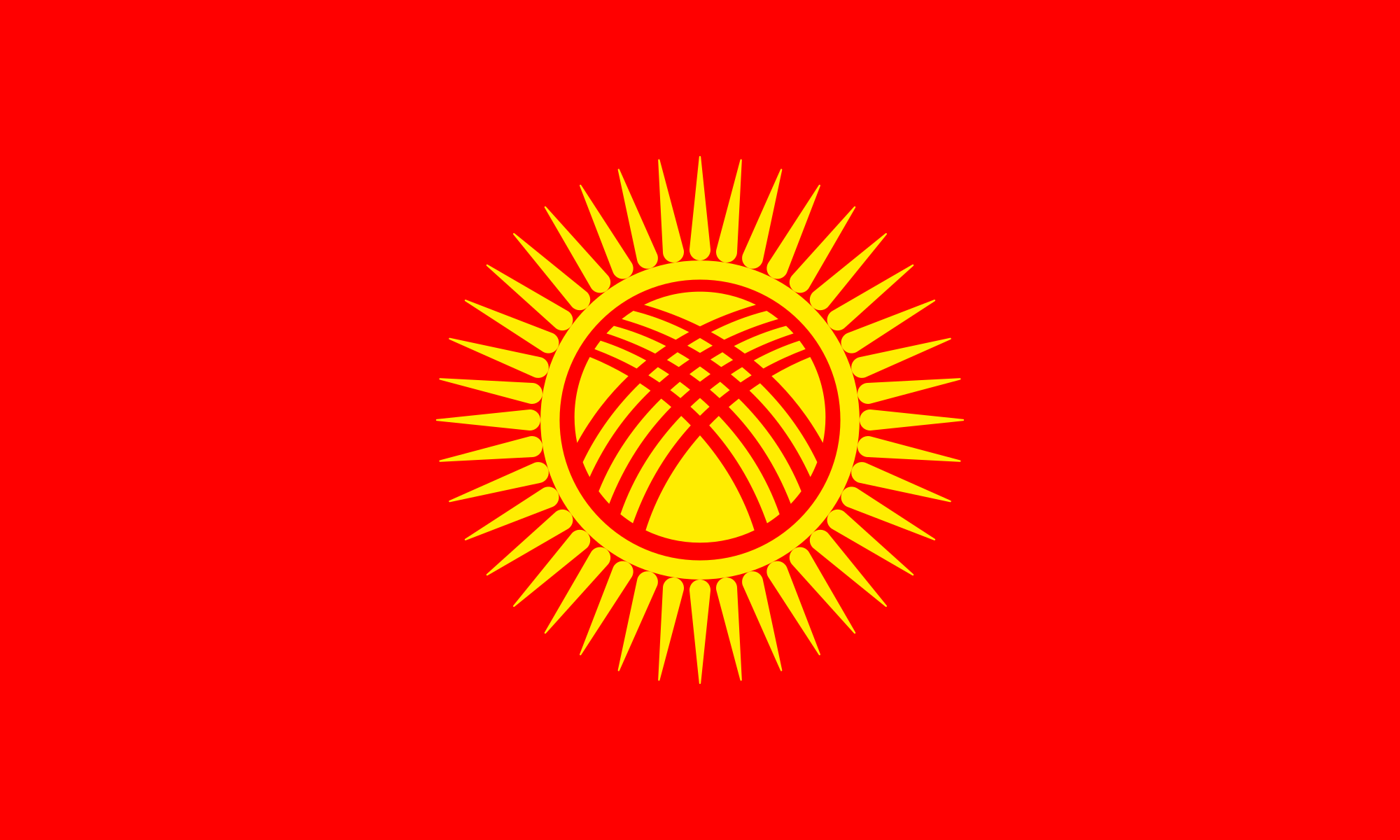
The 40-ray sun on the flag of Kyrgyzstan is a reference to those same forty tribes and the graphical element in the sun's center depicts the wooden crown, called tunduk, of a yurt—a portable dwelling traditionally used by nomads in the steppes of Central Asia.
The country's official name is Kyrgyz Republic, used in international arenas and foreign relations.[25][26] In the English-speaking world, the spelling Kyrgyzstan is commonly used, while its former name Kirghizia[c] is rarely used.[27]
History
[edit]Early history
[edit]
The Kyrgyz state reached its greatest expansion after defeating the Uyghur Khaganate in 840 AD.[28] From the tenth century, the Kyrgyz migrated as far as the Tian Shan range and maintained their dominance over this territory for about 200 years.
There is a storytelling tradition of the Epic of Manas, which involves a warrior who unified all of the scattered tribes into a single nation in the 9th century. The trilogy, an element of the UNESCO Intangible Cultural Heritage List, expresses the memory of the nomadic Kyrgyz people.[29]
In the 12th century, the Kyrgyz dominion had shrunk to the Altay Range and Sayan Mountains as a result of the Mongol expansion. With the rise of the Mongol Empire in the thirteenth century, the Kyrgyz migrated south. The Kyrgyz peacefully became a part of the Mongol Empire in 1207.

Issyk Kul Lake was a stopover on the Silk Road, a land route for traders, merchants, and other travelers from the Far East to Europe. Kyrgyz tribes were overrun in the 17th century by the Mongols, in the mid-18th century by the Manchu-led Qing dynasty of China, and in the early 19th century by the Uzbek Khanate of Kokand.[30] In 1842, the Kyrgyz tribes broke away from Kokand and united into the Kara-Kyrgyz Khanate, led by Ormon Khan. Following Ormon's death in 1854, the khanate disintegrated.[31]
Russian conquest
[edit]In the late nineteenth century, the eastern part of what is today Kyrgyzstan, mainly the Issyk-Kul Region, was ceded to the Russian Empire by Qing China through the Treaty of Tarbagatai.[32] The territory, then known in Russian as "Kirghizia", was formally incorporated into the Empire in 1876. The Russian takeover was met with numerous revolts, and many of the Kyrgyz opted to relocate to the Pamir Mountains and Afghanistan.
In addition, the suppression of the 1916 rebellion against Russian rule in Central Asia caused many Kyrgyz later to migrate to China.[33] Since many ethnic groups in the region were, and still are, split between neighboring states at a time when borders were more porous and less regulated, it was common to move back and forth over the mountains, depending on where life was perceived as better; this might mean better rains for pasture or better government during oppression.
Soviet Kyrgyzstan
[edit]Soviet power was initially established in the region in 1919, and the Kara-Kyrgyz Autonomous Oblast was created within the Russian Soviet Federative Socialist Republic (SFSR). The phrase Kara-Kirghiz was used until the mid-1920s by the Russians to distinguish them from the Kazakhs, who were also referred to as Kirghiz. On 5 December 1936, the Kirghiz Soviet Socialist Republic was established as a constituent Union Republic of the Soviet Union.[d]
After the Russian Civil War, the period of the New Economic Policy (NEP), began, which lasted roughly to 1928.[35] The Bolsheviks made an effort to establish a standardized tax system, with higher taxes for nomads to discourage the wandering livelihood and they divided the Central Asia region into five nation-states.[35][36][37] Kyrgyzstan developed considerably in cultural, educational, and social life, literacy was greatly improved. Economic and social development also was notable.[38] Under Stalin a great focus was put on Kyrgyz national identity. The Soviet state was fighting tribalism: its social organization based on patrilineal kinship contradicted the concept of the modern nation state.[36][38] In a region that did not previously know national institutions or consciousness, the process of nation-building was, from the indigenous perspective, a difficult and ambivalent one.[37]
By the end of the 1920s, the Soviet Union developed a series of five-year plans, centered around industrialization and the collectivization of agriculture, including the creation of huge "kolkhoz" collective farming systems, needed to feed the new workers in the industries.[39] Because of the plan's reliance on rapidity, major economic and cultural changes had to occur, which led to conflicts. In Kyrgyzstan, Russian settlers acquired the best pasture land, creating much hardship for most of its original inhabitants, Kazakh, Kyrgyz and Turkmen nomads, who were also forced to settle down on soil that hadn't enough agricultural potential.[37][40] The changes caused unrest, and between 1928 and 1932, nomads and peasants made it clear through methods like passive resistance that they did not agree with these policies, in the Kirgiziya area also guerrilla opposition occurred.[35][37][40] The region suffered relatively more deaths from collectivization than any other.[35]
.jpg)
The early years of glasnost, in the late 1980s, had little effect on the political climate in Kyrgyzstan.[41] However, the Republic's press was permitted to adopt a more liberal stance and to establish a new publication, Literaturny Kirghizstan, by the Union of Writers. Unofficial political groups were forbidden, but several groups that emerged in 1989 to deal with the acute housing crisis were permitted to function.
According to the last Soviet census in 1989, ethnic Kyrgyz made up only 22% of the residents of the northern city of Frunze (now Bishkek), while more than 60% were Russians, Ukrainians, and people from other Slavic nations. Nearly 10% of the capital's population were Jewish (very unusual in the Soviet Union, the Jewish Autonomous Oblast being an exception).
In June 1990, ethnic tensions between Uzbeks and Kyrgyz surfaced in the Osh Region (southern Kyrgyzstan), where Uzbeks form a minority of the population.[42] The tensions between Kyrgyzs and Uzbeks in Osis led to 186 deaths.[43] Attempts to appropriate Uzbek collective farms for housing development triggered the Osh Riots. A state of emergency and curfew were introduced[44] and Askar Akayev, the youngest of five sons born into a family of collective farm workers (in northern Kyrgyzstan), was elected president in October of that same year. By then, the Kyrgyzstan Democratic Movement (KDM) had developed into a significant political force with support in Parliament. On 15 December 1990, the Supreme Soviet voted to change the republic's name to the Republic of Kyrgyzstan. The following January, Akayev introduced new government structures and appointed a new cabinet composed mainly of younger, reform-oriented politicians. In February 1991, the name of the capital, Frunze, was changed back to its pre-revolutionary name of Bishkek.[45]
Despite these political moves toward independence, economic realities seemed to work against secession from the Soviet Union. In a referendum on the preservation of the Soviet Union in March 1991, 88.7% of the voters approved the proposal to retain the Soviet Union as a "renewed federation".[40] Nevertheless, secessionist forces pushed Kyrgyzstan's independence through in August of that same year.
On 19 August 1991, when the State Emergency Committee assumed power in Moscow, there was an attempt to depose Akayev in Kyrgyzstan. After the coup collapsed the following week, Akayev and Vice President German Kuznetsov announced their resignations from the Communist Party of the Soviet Union (CPSU), and the entire bureau and secretariat resigned. This was followed by the Supreme Soviet vote declaring independence from the Soviet Union on 31 August 1991 as the Republic of Kyrgyzstan.[46]

According to a 2013 Gallup poll, 62% of Kyrgyz people say that the collapse of the Soviet Union harmed their country, while only 16% said that the collapse benefitted it.[47]
Independence
[edit]In October 1991, Akayev ran unopposed and was elected president of the new independent republic by direct ballot, receiving 95 percent of the votes cast. Together with representatives of seven other Republics that same month, he signed the Treaty of the Economic Community. The new leaders of three out of four Soviet Union's founding republics, Russia, Belarus and Ukraine, on 8 December 1991 signed the Belavezha Accords, denouncing the Union Treaty of 1922, declaring that the Union would cease to exist and proclaimed the Commonwealth of Independent States (CIS) in its place.[48]
On 21 December 1991, Kyrgyzstan[e] agreed with the other four Central Asian Republics, Tajikistan,[f] Turkmenistan,[g] Uzbekistan,[h] and Kazakhstan[i] to the Alma-Ata Protocols, formally entering the Commonwealth with Armenia,[j] Azerbaijan,[k] Moldova,[l] and Ukraine.[m] Finally, Kyrgyzstan gained full independence on 25 December 1991. The following day, on 26 December 1991, the Soviet Union ceased to exist. In 1992, Kyrgyzstan joined the United Nations and the Organization for Security and Co-operation in Europe (OSCE). On 5 May 1993, the official name changed from the Republic of Kyrgyzstan to the Kyrgyz Republic following the adoption of a new constitution.[58]
Kyrgyzstan celebrates its Independence Day annually on 31 August, the anniversary of its declaration of independence in 1991.[59]
21st century
[edit]2000–2009
[edit]In February and March 2005, parliamentary elections were held, which the opposition and international observers criticized for alleged irregularities. Widespread protests erupted, leading to the ousting of President Askar Akayev, who fled the country and resigned in April 2005. This series of events became known as the Tulip Revolution. Subsequently, Kurmanbek Bakiyev, a former prime minister and opposition leader, assumed the presidency after winning the July 2005 presidential election with a significant majority.[60][61][62]
After assuming office, President Bakiyev faced challenges, including political unrest and demands for constitutional reforms. In 2006 and 2007, large-scale protests occurred, with citizens calling for a reduction in presidential powers and increased governmental transparency. In response, Bakiyev implemented constitutional amendments and appointed opposition figures to key positions. Despite these measures, tensions persisted throughout his tenure.[61]
Throughout the decade, Kyrgyzstan grappled with economic difficulties, including energy shortages and rising utility prices. In 2009, the government announced significant increases in electricity and heating tariffs, leading to public discontent. Additionally, the country faced challenges related to corruption and organized crime, which impacted its social and economic development.[63][64]
In 2009, Bakiyev announced the eviction of the U.S. military from the Manas Air Base, a strategic transit center supporting operations in Afghanistan.[65] The Manas Air Base, hosting approximately 1,000 U.S. military personnel since 2001, served as a crucial staging post for coalition forces in Afghanistan.[66]
2010–2019
[edit]In April 2010, widespread protests erupted against President Kurmanbek Bakiyev's administration, driven by public discontent over corruption and rising energy prices. These demonstrations culminated in Bakiyev's ousting and the establishment of a provisional government led by Roza Otunbayeva. Subsequently, in June 2010, violent ethnic clashes occurred in the southern cities of Osh and Jalal-Abad between Kyrgyz and Uzbek communities, resulting in over 400 deaths and displacing thousands.[67][68]
Following these events, a referendum was held in June 2010 to adopt a new constitution aimed at reducing presidential powers and enhancing parliamentary authority. The referendum passed with approximately 90% approval and a 70% voter turnout, despite challenges posed by recent unrest. This constitution introduced a single six-year term for the president without the possibility of re-election and limited any single political party to 65 of the 120 parliamentary seats to prevent power concentration.[67]
Under the new constitutional framework, Kyrgyzstan held its first parliamentary elections in October 2010, which were noted for their peaceful conduct and absence of major voting irregularities. In 2011, Almazbek Atambayev was elected president, serving until 2017. His tenure focused on stabilizing the country and implementing democratic reforms, including the introduction of biometric registration to enhance electoral transparency. In 2017, Sooronbay Jeenbekov succeeded Atambayev as president, continuing efforts to strengthen democratic institutions and address ongoing challenges such as corruption and economic development.[46]
Significant reforms were undertaken during this period, including the abolition of military courts in December 2016 to streamline the judicial system and enhance civilian oversight. Additionally, the Ministry of Defense was restructured into the State Committee for Defense Affairs, with operational control of the armed forces transferred to the General Staff to improve military efficiency and accountability.
In 2016, Kyrgyzstan commemorated the centennial of the 1916 uprising against Tsarist Russia, known as Urkun, by unveiling a monument at the Ata-Beyit memorial complex.
Since 2020
[edit]In October 2020, widespread protests erupted in response to disputed parliamentary election results, leading to the annulment of the elections and the resignation of President Sooronbay Jeenbekov. Amid the unrest, Sadyr Japarov, a nationalist politician previously imprisoned, was released and subsequently appointed as interim president and prime minister. His rapid ascent to power was facilitated by parliamentary approval under contentious circumstances. In January 2021, Japarov was elected president in a landslide victory.[67][69][70][71]
Following his election, President Japarov initiated a series of constitutional reforms aimed at shifting the country's governance structure from a parliamentary to a presidential system. A referendum held in January 2021 approved these changes, granting the president expanded powers, including the authority to appoint judges and diminishing the role of parliament. Critics labeled the new constitution the "Khanstitution," expressing concerns over the potential for authoritarian rule.[69][67][70][72]
The period also witnessed increased pressure on independent media and civil society organizations. In 2024, the Kyrgyz government implemented measures to intimidate and silence journalists and critics. The Supreme Court ordered the closure of a leading investigative media outlet, sentencing two journalists to prison terms and placing two others on probation for their reporting. Additionally, a "foreign representatives" law came into effect in April 2024, imposing strict government oversight on NGOs receiving foreign funding.[73][74][70][75]
Kyrgyzstan's longstanding border disputes with neighboring Tajikistan escalated into violent clashes, notably around the town of Batken in 2021 and 2022, culminating in a six-day conflict in September 2022. In March 2025, Presidents Japarov and Emomali Rahmon of Tajikistan signed an agreement to demarcate their shared border, aiming to resolve the territorial conflicts and reopen transportation links that had been closed since the 2022 clashes.[71]
In December 2024, President Japarov dismissed Prime Minister Akylbek Japarov, who had served since 2021, citing a transfer to another position. First Deputy Prime Minister Adylbek Kasymaliyev was appointed as acting prime minister.[72]
Geography
[edit]
.jpg)
Kyrgyzstan is a landlocked country in Central Asia, bordering Kazakhstan, China, Tajikistan and Uzbekistan. It lies between latitudes 39° and 44° N, and longitudes 69° and 81° E. It is farther from the sea than any other individual country, and is an endorheic basin in which all its rivers flow into closed drainage systems which do not reach the sea. The mountainous region of the Tian Shan covers over 80% of the country (Kyrgyzstan is occasionally referred to as "the Switzerland of Central Asia", as a result),[76] with the remainder made up of valleys and basins.

Issyk-Kul Lake, or Ysyk-Köl in Kyrgyz, in the north-eastern Tian Shan is the largest lake in Kyrgyzstan and the second largest mountain lake in the world after Titicaca. The lowest point is in Kara-Daryya (Karadar'ya) at 132 meters and the highest peaks are in the Kakshaal-Too range, forming the Chinese border. Peak Jengish Chokusu, at 7,439 m (24,406 ft), is the highest point and is considered by geologists to be the northernmost peak over 7,000 m (22,966 ft) in the world. Heavy snowfall in winter leads to spring floods which often cause serious damage downstream. The runoff from the mountains is also used for hydro-electricity.
Kyrgyzstan has significant deposits of metals including gold and rare-earth metals. Due to the country's predominantly mountainous terrain, less than 8% of the land is cultivated, and this is concentrated in the northern lowlands and the fringes of the Fergana Valley.
Bishkek in the north is the capital and largest city, with 1,321,900 inhabitants (as of 2025[update]). The second city is the ancient town of Osh, located in the Fergana Valley near the border with Uzbekistan. The principal river is the Kara Darya, which flows west through the Fergana Valley into Uzbekistan. Across the border in Uzbekistan it meets another major Kyrgyz river, the Naryn.
The confluence forms the Syr Darya, which originally flowed into the Aral Sea. As of 2010[update], it no longer reaches the sea, as its water is withdrawn upstream to irrigate cotton fields in Tajikistan, Uzbekistan, and southern Kazakhstan. The Chu River also briefly flows through Kyrgyzstan before entering Kazakhstan.
Kyrgyzstan contains seven terrestrial ecosystems: Tian Shan montane conifer forests, Alai-Western Tian Shan steppe, Gissaro-Alai open woodlands, Tian Shan foothill arid steppe, Pamir alpine desert and tundra, Tian Shan montane steppe and meadows, and Central Asian northern desert.[77] It had a 2019 Forest Landscape Integrity Index mean score of 8.86/10, ranking it 13th globally out of 172 countries.[78]
Climate
[edit]
The climate varies regionally. The low-lying Fergana Valley in the southwest is subtropical and extremely hot in summer, with temperatures reaching 40 °C (104 °F). The northern foothills are temperate and the Tian Shan varies from dry continental to polar climate, depending on elevation. In the coldest areas, winter temperatures drop below freezing for approximately 40 days, and even some desert areas experience constant snowfall during this period. In the lowlands the temperature ranges from around −6 °C (21 °F) in January to 24 °C (75 °F) in July.
Glaciers and climate change
[edit]
 | This article may incorporate text from a large language model. (August 2025) |
Enclaves and exclaves
[edit]There is one exclave, the tiny village of Barak[85] (population 627), in the Fergana Valley. The village is surrounded by Uzbek territory. It is located on the road from Osh (Kyrgyzstan) to Khodjaabad (Uzbekistan) about 4 kilometres (2 miles) north-west from the Kyrgyz–Uzbek border in the direction of Andijan.[86] Barak is administratively part of Kara-Suu District in Kyrgyzstan's Osh Region.
There are four Uzbek enclaves within Kyrgyzstan. Two of them are the towns of Sokh, with an area of 325 km2 (125 sq mi) and a population of 42,800 in 1993, although some estimates go as high as 70,000 (99% are Tajiks, the remainder Uzbeks); and Shakhimardan (also known as Shahimardan, Shohimardon, or Shah-i-Mardan), with an area of 90 km2 (35 sq mi) and a population of 5,100 in 1993; 91% are Uzbeks, and the remaining 9% are Kyrgyz; the other two are the tiny territories of Chong-Kara (roughly 3 km (2 mi) long by 1 km (0.6 mi) wide) and Jangy-ayyl (a dot of land barely 2–3 km (1–2 mi) across). Chong-Kara is on the Sokh river, between the Uzbek border and the Sokh enclave. Jangy-ayyl is about 60 kilometres (37 mi) east of Batken, in a northward projection of the Kyrgyz-Uzbek border near Khalmion.
There are also two enclaves belonging to Tajikistan on the Kyrgyz-Tajik border: Vorukh, and Lolazor. Vorukh has an area between 95–130 km2 (37–50 sq mi), and a population estimated between 23,000 and 29,000, 95% Tajiks and 5% Kyrgyz. It is distributed among 17 villages and is located around 45 kilometres (28 mi) south of Isfara on the right bank of the river Karavshin. Lolazor (Western Qalacha or Kayragach) is a small settlement near the Kyrgyz railway station of Kairagach.
Politics
[edit]Political system
[edit].jpg)


The 1993 constitution defines the form of government as a democratic unicameral republic. The executive branch includes a president and prime minister. The parliament currently is unicameral. The judicial branch comprises a supreme court, local courts and a chief prosecutor.
In March 2002, in the southern district of Aksy, five people protesting the arbitrary arrest of an opposition politician were shot dead by police, sparking nationwide protests. President Askar Akayev initiated a constitutional reform process which initially included the participation of a broad range of government, civil and social representatives in an open dialogue, leading to a February 2003 referendum marred by voting irregularities.
The amendments to the constitution approved by the referendum resulted in stronger control by the president and weakened the parliament and the Constitutional Court. Parliamentary elections for a new, 75-seat unicameral legislature were held on 27 February and 13 March 2005, but were widely viewed as corrupt. The subsequent protests led to a bloodless coup on 24 March 2005, after which Akayev fled the country with his family and was replaced by acting president Kurmanbek Bakiyev.
On 10 July 2005, acting president Bakiyev won the presidential election in a landslide, with 88.9% of the vote, and was inaugurated on 14 August. However, initial public support for the new administration substantially declined in subsequent months as a result of its apparent inability to solve the corruption problems that had plagued the country since its independence from the Soviet Union, along with the murders of several members of parliament. Large-scale protests against president Bakiyev took place in Bishkek in April and November 2006, with opposition leaders accusing the president of failing to live up to his election promises to reform the country's constitution and transfer many of his presidential powers to parliament.[87]
Kyrgyzstan is also a member of the Organization for Security and Cooperation in Europe (OSCE), a league of 57 participating states committed to peace, transparency, and the protection of human rights in Eurasia. As an OSCE participating state, Kyrgyzstan's international commitments are subject to monitoring under the mandate of the U.S. Helsinki Commission.
In December 2008, the state-owned broadcast KTRK announced that it would require prior submission of Radio Free Europe/Radio Liberty programmes, which KTRK are required to retransmit according to a 2005 agreement.[88] KTRK had stopped retransmitting RFE/RL programming in October 2008, a week after it failed to broadcast an RFE/RL programme called Inconvenient Questions which covered the October elections, claiming to have lost the missing material. President Bakiyev had criticised this programme in September 2008, while KTRK told RFE/RL that its programming was too negative. Reporters Without Borders, which ranks Kyrgyzstan 111th out of 173 countries on its Press Freedom Index, strongly criticised the decision.
On 3 February 2009, President Bakiyev announced the imminent closure of the Manas Air Base, the only US military base remaining in Central Asia.[89] The closure was approved by Parliament on 19 February 2009 by a vote of 78–1 for the government-backed bill.[90] However, after much behind-the-scenes negotiation between Kyrgyz, Russian and American diplomats, the decision was reversed in June 2009. The Americans were allowed to remain under a new contract, whereby rent would increase from $17.4 million to $60 million annually.[91] The US military fully withdrew from Manas Air Base in 2014.
_7.jpg)
Kyrgyzstan is among the fifty countries in the world with the highest perceived level of corruption: the 2016 Corruption Perception Index for Kyrgyzstan is 28 on a scale of 0 (most corrupt) to 100 (least corrupt).[92]
In 2010, another revolution erupted in the country (see: April uprising). President Bakiyev, together with his relatives, including his son Maksim[93] and brother Janish—were forced to flee to Kazakhstan and then sought asylum in Belarus. Roza Otunbayeva, who was appointed interim president, announced that she did not intend to run for the Presidential elections in 2011. The election was held in November and won by Prime Minister Almazbek Atambayev, leader of the Social Democratic Party, and Atambayev was sworn in as president on 1 December 2011. Omurbek Babanov was appointed prime minister on the same day and was confirmed on 23 December 2011.[94]
In 2015, Kyrgyzstan became a full-fledged member of the Eurasian Economic Union (EES) after it formally abolished customs controls along its border with Kazakhstan, other members are the former Soviet republics Russia, Kazakhstan, Belarus, and Armenia.

In October 2017, Sooronbay Jeenbekov, a former prime minister backed by incumbent Almazbek Atambayev, was elected as the new President of Kyrgyzstan.[96] In foreign policy he saw the Kremlin as the country's "main strategic partner" and China as an "important strategic and trade partner", but he intended to seek more collaborative bilateral ties with European partners.[97] On 7 August 2019, the Special Forces of Kyrgyzstan launched an operation against the residence of former President Almazbek Atambayev, supposedly based on charges of corruption made against him.[98][99] In a meeting of the Security Council, President Jeenbekov accused Atambayev of violating the constitution.[100] In October 2020, President Sooronbay Jeenbekov resigned after protests caused by irregularities in parliamentary elections on 4 October 2020.[101]
In January 2021, Sadyr Japarov was elected as the new president after winning the presidential election by a landslide.[102]
In April 2021, the majority of voters approved in the constitutional referendum a new constitution that will give new powers to the president, significantly strengthening the power of the presidency.[103]
Administrative divisions
[edit]Kyrgyzstan is divided into seven regions (Kyrgyz: облустар). The regions are subdivided into 44 districts (Kyrgyz: аймактар, aymaqtar;). The districts are further subdivided into rural districts at the lowest level of administration, which include all rural settlements (aýyl ökmötü) and villages without an associated municipal government.
The cities of Bishkek and Osh have status "state importance" and do not belong to any region.
Each region is headed by an akim (regional governor) appointed by the president. District akims are appointed by regional akims.

The regions, and independent cities, are as follows, with subdivisions:
- City of Bishkek
- Batken Region
- Chüy Region
- Jalal-Abad Region
- Naryn Region
- Osh Region
- Talas Region
- Issyk-Kul Region
- City of Osh
Military
[edit]
The armed forces of Kyrgyzstan were formed after the collapse of the Soviet Union and consist of the Land Forces, Air Forces, internal troops, National Guard, and the border guard. The military works with the US Armed Forces, which leased a facility named the Transit Center at Manas at Manas International Airport near Bishkek until June 2014.[104] In recent years, the armed forces have begun developing better relations with Russia including signing modernization deals worth $1.1bn and participating in more exercises with Russian troops.[105] The Agency of National Security works with the military and serves similar purposes to its Soviet predecessor, the KGB. It oversees an elite counterterrorism special forces unit known as "Alfa", the same name used by other former Soviet countries, including Russia and Uzbekistan. The police are commanded by the Ministry of the Interior Affairs, along with the border guard.[106]
Human rights
[edit]Kyrgyzstan is classified as a "hybrid regime" in the Democracy Index, ranking 107th out of 167 for 2020.[107] Kyrgyzstan was also ranked "not free" in the 2021 Freedom in the World report with a score of 28/100. In 2020, it was ranked "partly free" with a score of 39/100.[108] After the installation of a more democratic government, many human rights violations still take place. In a move that alarmed human-rights groups, dozens of prominent Uzbek religious and community leaders were arrested by security forces following the 2010 South Kyrgyzstan riots, including journalist and human-rights activist Azimzhan Askarov.[109] A law banning women under the age of 23 from traveling abroad without a parent or guardian, with the purpose of "increased morality and preservation of the gene pool" passed in the Kyrgyz parliament in June 2013.[110] American diplomats expressed concern in October 2014 when Kyrgyzstan lawmakers passed a law that imposes jail terms on gay-rights activists and others, including journalists, who create "a positive attitude toward non-traditional sexual relations."[111] Kyrgyzstani activist and journalist Azimzhan Askarov was sentenced to life in prison in 2010.[112] On 24 January 2017, a Kyrgyz court has reinstated a sentence of life imprisonment for Askarov.[113] In February 2024, the independent investigative media organization Kloop was ordered shut down by the Kyrgyz courts. This move drew criticism within the country and abroad.[114][115]
Economy
[edit]Kyrgyzstan was among the less economically developed republics of the former Soviet Union and is currently the second-lowest in terms of income levels in Central Asia, after Tajikistan. 22.4% of the country's population lives below the poverty line.[116]
Despite the backing of major Western lenders, including the International Monetary Fund (IMF), the World Bank and the Asian Development Bank, Kyrgyzstan has had economic difficulties following independence. Initially, these were a result of the breakup of the Soviet trade bloc and resulting loss of markets, which impeded the republic's transition to a demand economy. The government reduced public spending, eliminated most price subsidies, and implemented a value-added tax. These measures reflected its commitment to transitioning toward a market-based economy. Through economic stabilization and structural reforms, the government aimed to promote sustained long-term growth. Reforms led to Kyrgyzstan's accession to the World Trade Organization (WTO) on 20 December 1998.
The Kyrgyz economy was severely affected by the collapse of the Soviet Union and the resulting loss of its vast market. In 1990, some 98% of Kyrgyz exports went to other parts of the Soviet Union. Thus, the nation's economic performance in the early 1990s was worse than any other former Soviet republic except war-torn Armenia, Azerbaijan and Tajikistan, as factories and state farms collapsed with the disappearance of their traditional markets in the former Soviet Union. While economic performance has improved considerably in the last few years, and particularly since 1998, difficulties remain in securing adequate fiscal revenues and providing an adequate social safety net. Remittances of around 350,000 Kyrgyz migrants working in Russia contribute to the economy, however in recent years remittances have decreased.[117][118] Reliance on remittances—currently about 15% of GDP—has declined from a previous high of 35%.
Agriculture is an important sector of the economy in Kyrgyzstan (see agriculture in Kyrgyzstan). By the early 1990s, the private agricultural sector provided between one-third and one-half of some harvests. In 2002, agriculture accounted for 35.6% of GDP and about half of employment. Kyrgyzstan's terrain is mountainous, which accommodates livestock raising, the largest agricultural activity, so the resulting wool, meat and dairy products are major commodities. Main crops include wheat, sugar beets, potatoes, cotton, tobacco, vegetables, and fruit. As the prices of imported agrichemicals and petroleum are so high, much farming is being done by hand and by horse, as it was generations ago. Agricultural processing is a key component of the industrial economy as well as one of the most attractive sectors for foreign investment.
Kyrgyzstan is rich in mineral resources but has negligible petroleum and natural gas reserves; it imports petroleum and gas. Among its mineral reserves are substantial deposits of coal, gold, uranium, antimony, and other valuable metals. Metallurgy is an important industry, and the government hopes to attract foreign investment in this field. The government has actively encouraged foreign involvement in extracting and processing gold from the Kumtor Gold Mine and other regions. The country's plentiful water resources and mountainous terrain enable it to produce and export large quantities of hydroelectric energy.
The principal exports are nonferrous metals and minerals, woollen goods and other agricultural products, electric energy and certain engineering goods. Imports include petroleum and natural gas, ferrous metals, chemicals, most machinery, wood and paper products, some foods and some construction materials. Its leading trade partners include Germany, Russia, China, Kazakhstan, and Uzbekistan. After Beijing launched the Belt and Road Initiative (BRI) in 2013, China has expanded its economic presence and initiated a number of sizable infrastructure projects in Kyrgyzstan.[119] After the 2022 sanctions on Russia, several regional supply routes were redirected through Kyrgyzstan, boosting the local economy.
The COVID-19 pandemic is expected to have a negative impact on the Kyrgyz economy that is reliant on services, remittances and natural resources. As a result, to mitigate the economic shock and preserve much of the development progress achieved in recent years the World Bank will provide support by financing several projects in the country.[120]
Kyrgyzstan registered rapid economic growth over 2022–2024, averaging 9% annually in real terms. These changes highlight Kyrgyzstan's strategic importance in Central Asia and its emerging role in regional trade and infrastructure networks.
Kyrgyzstan demonstrated strong macroeconomic performance between 2022 and 2024. The country maintained a fiscal surplus for two consecutive years, in 2023 and 2024, reflecting prudent public financial management and stronger-than-expected revenue collection.
The government is embarking on several large infrastructure megaprojects, notably the Kambarata-1 Hydropower Plant and the China-Kyrgyzstan–Uzbekistan railway, which have the potential to significantly reshape the country's economic landscape.
Tourism
[edit]

One of the most popular tourist destination points in Kyrgyzstan is the lake Issyk-Kul. Numerous hotels, resorts and boarding houses are located along its northern shore. The most popular beach zones are in the city of Cholpon-Ata and the settlements nearby, such as Kara-Oi (Dolinka), Bosteri and Korumdy. The number of tourists visiting the lake was more than a million a year in 2006 and 2007. However, due to the economic and political instability in the region, the number has declined in recent years.[121]
Science and technology
[edit]The headquarters of the Kyrgyz Academy of Sciences is located in Bishkek, where several research institutes are located. Kyrgyz researchers are developing useful technologies based on natural products, such as heavy metal remediation for purifying waste water.[122] Kyrgyzstan was ranked 99th in the Global Innovation Index in 2024.[123]
Demographics
[edit]

Kyrgyzstan's population is estimated at 6,586,600 in August 2020.[125] Of those, 34.4% are under the age of 15 and 6.2% are over 65. The country is rural: only about one-third of the population live in urban areas. The average population density is 25 people per km2.
In the 2024 Global Hunger Index (GHI), Kyrgyzstan has a score of 6.8, ranking 36th among 127 countries with sufficient data. The hunger level is classified as low.[126]
Ethnic groups
[edit]The nation's largest ethnic group are the Kyrgyz, a Turkic people, who comprise 77.8% of the population. Other ethnic groups include the Russians (3.8%) concentrated in the north and the Uzbeks (14.2%) living in the south. Small but noticeable minorities include the Dungans (1.0%), Tajiks (0.9%), Uyghurs (0.5%), Kazakhs (0.4%), and other smaller ethnic minorities.[2] The country has over 80 ethnic groups.[127]
The Kyrgyz have historically been semi-nomadic herders, living in round tents called yurts and tending sheep, horses and yaks. This nomadic tradition continues to function seasonally (see transhumance) as herding families return to the high mountain pasture (or jailoo) in the summer. The sedentary Uzbeks and Tajiks traditionally have farmed lower-lying irrigated land in the Fergana valley.[128]
Kyrgyzstan has undergone a pronounced change in its ethnic composition since independence.[129][130][131] The percentage of ethnic Kyrgyz has increased from around 50% in 1979 to over 70% in 2013, while the percentage of ethnic groups, such as Russians, Ukrainians, Germans and Tatars dropped from 35% to about 7%.[125] Since 1991, a large number of Germans, who in 1989 numbered 101,000 persons, have emigrated to Germany.[132]
| Kyrgyz | Uzbeks | Russians | Ukrainians | ||
|---|---|---|---|---|---|
| 1926 census[133] | Number | 661,171 | 110,463 | 116,436 | 64,128 |
| % | |||||
| 1959 census[134] | Number | 836,831 | 218,640 | 623,562 | 137,031 |
| % | |||||
| 1989 census[135] | Number | 2,229,663 | 550,096 | 916,558 | 108,027 |
| % | |||||
| 1999 census[136] | Number | 3,128,147 | 664,950 | 603,201 | 50,442 |
| % | |||||
| 2009 census[137] | Number | 3,804,788 | 768,405 | 419,583 | 21,924 |
| % | |||||
| 2022 census[137] | Number | 5,379,020 | 986,881 | 282,777 | 3,875 |
| % | |||||
| 2025 estimate[2] | Number | 5,666,100 | 1,039,500 | 272,800 | 2,400 |
| % | |||||

Languages
[edit]
Kyrgyz is the state language of Kyrgyzstan. Russian is additionally an official language. Kyrgyzstan is one of five former Soviet republics to have Russian as a de jure official language, along with Russia, Belarus, Kazakhstan, and Tajikistan.[138] After the dissolution of the Soviet Union, Kyrgyz was adopted as the state language of Kyrgyzstan in 1991. Kyrgyzstan adopted Russian as an official language in 2000.[139] The languages have different legal statuses.
Kyrgyz is a Turkic language of the Kipchak branch, closely related to Kazakh, Karakalpak, and Nogay Tatar. It was written in the Arabic alphabet until the twentieth century. The Latin script was introduced and adopted on Stalin's orders in 1928, and was subsequently replaced by Cyrillic script in 1941.[140] A reformed Perso-Arabic alphabet, created by the Kyrgyz intellectual and scientist Kasym Tynystanov, is the official script of the Kyrgyz language in the People's Republic of China.[141] As a result of the pending language reform in neighboring Kazakhstan, Kyrgyzstan will be the only independent Turkic-speaking country in a few years that exclusively uses the Cyrillic alphabet.[142] In April 2023, Russia suspended dairy exports to Kyrgyzstan after the chairman of Kyrgyzstan's National Commission for the State Language and Language Policies, Kanybek Osmonaliev, proposed to change the official script from Cyrillic to Latin to bring the country in line with other Turkic-speaking nations. Osmonaliev was reprimanded by President Sadyr Japarov who then clarified that Kyrgyzstan had no plans to replace the Cyrillic alphabet.[143]
Russian television media enjoy enormous popularity in Kyrgyzstan, especially in the Russophone city of Bishkek and the Chüy Region, despite the percentage of Russians today being a fraction of that in 1989.[citation needed] According to World Values Survey in 2020, Russian was the language spoken at home for 55.6% of the population of Bishkek, and Kyrgyz was the second with 43.6%. However, the countrywide figure for Russian was only 16.3%, whereas Kyrgyz was the home language of 70.9%. The Uzbek language was the third most spoken home language with 10.7% according to the same survey.[144] Russian media outlets have an enormous influence on public opinion in Kyrgyzstan, especially in areas such as human rights and international political developments.[145]
Many business and political affairs are carried out in Russian. Until recently, Kyrgyz remained a language spoken at home and was rarely used during meetings or other events. However, most parliamentary meetings today are conducted in Kyrgyz, with simultaneous interpretation available for those not speaking Kyrgyz. According to an RFE/RL article from 2014, despite the attempts to raise the status of Kyrgyz, thousands of Kyrgyz are russifying their names every year (around 40,000), mostly for career prospects, and to remove themselves from the Russian blacklists (people who are to be deported upon entrance) by registering different names. There are also many Russian-language medium schools that are supported from the Russian foundations via the embassy of Russia in Bishkek which are better funded than the Kyrgyz language medium schools. Due to this, many ethnic Kyrgyz go to Russian language medium schools. Many high school students change their surnames annually; for example, 800 such changes were recorded in high school students in the region of Naryn.[146]
Urban centres
[edit]| Rank | Name | Region | Pop. | ||||||
|---|---|---|---|---|---|---|---|---|---|
| 1 | Bishkek | Bishkek | 1,074,075 | ||||||
| 2 | Osh | Osh Region | 322,164 | ||||||
| 3 | Jalal-Abad | Jalal-Abad Region | 123,239 | ||||||
| 4 | Karakol | Issyk-Kul Region | 84,351 | ||||||
| 5 | Tokmok | Chüy Region | 71,443 | ||||||
| 6 | Özgön | Osh Region | 62,802 | ||||||
| 7 | Kara-Balta | Chüy Region | 48,278 | ||||||
| 8 | Balykchy | Issyk-Kul Region | 42,875 | ||||||
| 9 | Naryn | Naryn Region | 41,178 | ||||||
| 10 | Talas | Talas Region | 40,308 | ||||||
Religion
[edit]
Islam is the dominant religion in Kyrgyzstan, and most of the Kyrgyz are Muslim. The CIA World Factbook estimates that as of 2017, 90% of the population is Muslim, with the majority being Non-denominational and Sunni; 7% are Christian, including 3% Russian Orthodoxy, and the remainder are other religions.[147] A 2009 Pew Research Center report indicated 86.3% of Kyrgyzstan's population adhering to Islam.[148] The great majority of Muslims are Sunni, adhering to the Hanafi school of thought,[149] although a 2012 Pew survey report showed that only 23% of respondents to a questionnaire chose to identify themselves as Sunni, with 64% volunteering that they were "just a Muslim".[150] There are a few Ahmadiyya Muslims, though unrecognized by the country.[151]
During Soviet times, state atheism was encouraged. Today, however, Kyrgyzstan is a secular state, although Islam has exerted a growing influence in politics.[152] For instance, there has been an attempt to arrange for officials to travel on hajj (the pilgrimage to Mecca) under a tax-free arrangement.
While Islam in Kyrgyzstan is more of a cultural background than a devout daily practice for many, public figures have expressed support for restoring religious values. For example, human rights ombudsman Tursunbay Bakir-Ulu noted, "In this era of independence, it is not surprising that there has been a return to spiritual roots not only in Kyrgyzstan, but also in other post-communist republics. It would be immoral to develop a market-based society without an ethical dimension."[152]

Additionally, Bermet Akayeva, the daughter of Askar Akayev, the former President of Kyrgyzstan, stated during a July 2007 interview that Islam is increasingly taking root across the nation.[153] She emphasized that many mosques have recently been built and that the Kyrgyz are increasingly devoting themselves to Islam, which she noted was "not a bad thing in itself. It keeps our society more moral, cleaner."[153] There is a contemporary Sufi order present which adheres to a somewhat different form of Islam than orthodox Islam.[154]

The other faiths practiced in Kyrgyzstan include Russian Orthodox and Ukrainian Orthodox versions of Christianity, practiced primarily by Russians and Ukrainians respectively. A small minority of ethnic Germans are also Christian, mostly Lutheran and Anabaptist, and there is a Roman Catholic community of approximately 600.[155][156]
As part of the historic Kyrgyzstan German minority, there were around 200 Mennonites in Kyrgyzstan in 2022.[157] One Mennonite community continues in the settlement of Rot-Front.[158]
A community of 5,000 to 10,000 Jehovah's Witnesses gathers in both Kyrgyz and Russian-speaking congregations and some Chinese- and Turkish-speaking groups.[159][160]
A few Animistic traditions survive, as do influences from Buddhism such as the tying of prayer flags onto sacred trees, though some view this practice as rooted within Sufi Islam.[161] There is also a small number of Bukharian Jews living in Kyrgyzstan, but during the collapse of the Soviet Union most fled to other countries, mainly the United States and Israel. In addition, there is a small community of Ashkenazi Jews, who fled to the country from eastern Europe during the Second World War.[162]
On 6 November 2008, the Kyrgyz parliament unanimously passed a law increasing the minimum number of adherents for recognizing a religion from 10 to 200. It also outlawed "aggressive action aimed at proselytism", and banned religious activity in schools and all activity by unregistered organizations. It was signed by President Kurmanbek Bakiyev on 12 January 2009.[163]
There have been several reported police raids against peaceful minority religious meetings,[164] as well as reports of officials planting false evidence,[165] but also some court decisions in favour of religious minorities.[166]

Culture
[edit]Media
[edit]Traditions
[edit]

.jpg)
- Manas, an epic poem; the plot revolves around a series of events that coincide with the history of the region in the 9th century, primarily the interaction of the Kyrgyz people with other Turkic and Chinese people.
- Komuz, a three-stringed lute
- Tush kyiz, large, elaborately embroidered wall hangings
- Shyrdak and Ala-kiyiz carpets, manufactured by the process of felting, used for yurts. Inscribed in 2012 on the UNESCO List of Intangible Cultural Heritage in Need of Urgent Safeguarding.[167][168]
- Other textiles, especially made from felt
- Ala kachuu, "bride kidnapping", traditional form of marriage in Kyrgyzstan
- Falconry
- Various dances
Illegal, but still practiced, is the tradition of bride kidnapping.[169] It is debatable whether bride kidnapping is actually traditional. Some of the confusion may stem from the fact that arranged marriages were traditional, and one of the ways to escape an arranged marriage was to arrange a consensual "kidnapping".[170]
Flag
[edit]The 40-rayed yellow sun in the center of the national flag represent the 40 tribes that once made up the entirety of Kyrgyz culture before the intervention of Russia during the rise of the Soviet Union. The lines inside the sun represent the crown or tündük (Kyrgyz түндүк) of a yurt, a symbol replicated in many facets of Kyrgyz architecture. The red portion of the flag represents peace and openness of Kyrgyzstan.
Under Soviet rule and before 1992, it had the flag of the Soviet Union with two big blue stripes and a white thin stripe in the middle.
Public holidays
[edit]In addition to celebrating the New Year each 1 January, the Kyrgyz observe the traditional New Year festival Nowruz on the vernal equinox. This spring holiday is celebrated with feasts and festivities such as the horse game Ulak Tartish.
This is the list of public holidays in Kyrgyzstan:
- 1 January – New Year's Day
- 7 January – Orthodox Christmas
- 23 February – Fatherland Defender's Day
- 8 March – Women's Day
- 21–23 March – Nooruz Mairamy, Persian New Year (spring festival)
- 7 April – Day of National Revolution
- 1 May – Labor Day
- 5 May – Constitution Day
- 8 May – Remembrance Day
- 9 May – Victory Day
- 31 August – Independence Day
- 7–8 November – Days of History and Commemoration of Ancestors
Two additional Muslim holidays Orozo Ayt and Qurman (or Qurban) Ayt are defined by the lunar calendar.
Sports
[edit]In the 2000 Summer Olympics in Sydney, Kyrgyzstan received its first ever Olympic medal when Aidyn Smagulov won bronze in the men's 60 kg competition final in judo.[171][172]

Football is one of the most popular sports in Kyrgyzstan.[173][174] The official governing body is the Football Federation of Kyrgyz Republic, which was founded in 1992, after the split of the Soviet Union. It administers the Kyrgyzstan national football team.[175]
Wrestling is also very popular. Since the 2008 Summer Olympic Games, Kyrgyzstani wrestlers have won six medals in Greco-Roman and freestyle wrestling: three in 2008 and three in 2020.[176]
Ice hockey was not as popular in Kyrgyzstan until the first Ice Hockey Championship was organized in 2009. In 2011, the Kyrgyzstan men's national ice hockey team won 2011 Asian Winter Games Premier Division dominating in all six games with six wins. It was the first major international event that Kyrgyzstan's ice hockey team took part in.[177] The Kyrgyzstan men's ice hockey team joined the IIHF in July 2011.
Bandy is becoming increasingly popular in the country. The Kyrgyz national team took Kyrgyzstan's first medal at the Asian Winter Games, when they captured the bronze. They played in the Bandy World Championship 2012, their first appearance in that tournament.[178]
Kyrgyzstan's national basketball team had its best performance at the official 1995 Asian Basketball Championship where the team finished ahead of favorites incuding Iran, Philippines and Jordan.
XXI International Issyk-Kul Sports Games (SCO + CIS) was held in 9–17 September 2022 in Baktuu-Dolonotu village (Issyk-Kul).[179] The first three World Nomad Games were held in Cholpon-Ata, Kyrgyzstan. The 6th International Sports Festival Pearl of Kyrgyzstan were held in Issyk-Kul region from 15 June to 3 July 2022.
Horse riding
[edit]
The traditional national sports reflect the importance of horse riding in Kyrgyz culture.
Very popular, as in all of Central Asia, is Ulak Tartysh, a team game resembling a cross between polo and rugby in which two teams of riders wrestle for possession of the headless carcass of a goat, which they attempt to deliver across the opposition's goal line, or into the opposition's goal: a big tub or a circle marked on the ground.
Other popular games on horseback include:
- At Chabysh – a long-distance horse race, sometimes over a distance of more than 50 km
- Jumby Atmai – a large bar of precious metal (the "jumby") is tied to a pole by a thread and contestants attempt to break the thread by shooting at it, while at a gallop
- Kyz Kuumai – a man chases a girl to win a kiss from her, while she gallops away; if he is not successful she may in turn chase him and attempt to beat him with her "kamchi" (horsewhip)
- Oodarysh – two contestants wrestle on horseback, each attempting to be the first to throw the other from his horse
- Tyin Emmei – picking up a coin from the ground at full gallop
Education
[edit]The school system in Kyrgyzstan also includes primary (grades 1 to 4, some schools have optional 0 grade), secondary (grades 5 to 9) and high (grades 10 to 11) divisions within one school.[180] Children are usually accepted to primary schools at the age of 6 or 7. It is required that every child finishes 9 grades of school and receives a certificate of completion. Grades 10–11 are optional, but it is necessary to complete them to graduate and receive a state-accredited school diploma. To graduate, a student must complete the 11-year school course and pass 4 mandatory state exams in writing, maths, history, and a foreign language.
As of 2023, there were 4,989 primary and secondary schools in the country, including 445 in Bishkek;[181][182] the large majority of these (4,537) were public schools.[183] The country also counted 58 higher educational institutions and universities, out of which 42 were public and 16 private.[183]
In September 2016, the University of Central Asia was launched in Naryn, Kyrgyzstan. There are also various Russian-language medium schools in Bishkek, Osh and other areas. Because of the better funding that they receive in comparation with Kyrgyz state schools, many Kyrgyz go there. In March 2021 Russia announced its plans to create approximately 30 new Russian-language schools in Kyrgyzstan. Teachers from Russia are also working here. However, the existence of these schools has been criticised, for reasons such as the fact that Russian language education has flaws compared to the Turkish and American schools in the country, but also because many ethnic Kyrgyz born after Kyrgyz independence in 1991 can't speak Kyrgyz, but only Russian, according to a Bishkek resident.[184]
Libraries
[edit]Kyrgyzstan is home to 1,066 libraries.[185] The National Library of the Kyrgyz Republic is the oldest library in the country, which was established in 1934. Kyrgyz Libraries are working towards expanding access to communities, evident in projects such as the signing of the Marrakesh VIP Treaty and the Open access Portal.[186][187]
Transport
[edit]
Transport in Kyrgyzstan is severely constrained by the country's alpine topography. Roads have to snake up steep valleys, cross passes of 3,000 metres (9,800 ft) altitude and more, and are subject to frequent mudslides and snow avalanches. Winter travel is close to impossible in many of the more remote and high-altitude regions.
Additional problems come from the fact that many roads and railway lines built during the Soviet period are today intersected by international boundaries, requiring time-consuming border formalities to cross where they are not completely closed. Horses are still a much-used transport option, especially in more rural areas; Kyrgyzstan's road infrastructure is not extensive, so horses are able to reach locations that motor vehicles cannot, and they do not require expensive, imported fuel.
Airports
[edit]
At the end of the Soviet period there were about 50 airports and airstrips in Kyrgyzstan, many of them built primarily to serve military purposes in this border region so close to China. Only a few of them remain in service today. The Kyrgyzstan Air Company provides air transport to China, Russia, and other local countries.
- Manas International Airport near Bishkek is the main international airport, with services to Moscow, Tashkent, Almaty, Ürümqi, Istanbul, Baku, and Dubai.
- Osh Airport is the main air terminal in the south of the country, with daily connections to Bishkek, and services to Moscow, Krasnoyarsk, Almaty and more international places.
- Jalal-Abad Airport is linked to Bishkek by daily flights. The national flag carrier, Kyrgyzstan, operates flights on BAe-146 aircraft. During the summer months, a weekly flight links Jalal-Abad with the Issyk-Kul Region.
- Other facilities built during the Soviet era are either closed down, used only occasionally or restricted to military use (e.g., Kant Air Base near Bishkek, which is used by the Russian Air Force).
Banned airline status
[edit]Kyrgyzstan appears on the European Union's list of prohibited countries for the certification of airlines. This means that no airline that is registered in Kyrgyzstan may operate services of any kind within the European Union, due to safety standards that fail to meet European regulations.[188]
Railways
[edit].jpg)
The Chüy Valley in the north and the Fergana valley in the south were endpoints of the Soviet Union's rail system in Central Asia. Following the emergence of independent post-Soviet states, the rail lines which were built without regard for administrative boundaries have been cut by borders, and traffic is therefore severely curtailed. The small bits of rail lines within Kyrgyzstan, about 370 km (230 mi) (1,520 mm (59.8 in) broad gauge) in total, have little economic value in the absence of the former bulk traffic over long distances to and from such centres as Tashkent, Almaty, and the cities of Russia.
In 2022, construction began on a new 186 km extension of the existing railway from Balykchy to Karakeche, primarily meant to carry coal from mines at Karakeche to Bishkek.[189] In June 2023, a railway between Balykchy and Bishkek was officially opened.[190][191]
The planned construction of a 523 km China–Kyrgyzstan–Uzbekistan Railway (CKU) was announced in 2022, comprising 213 km (132 mi) in China, 260 km (162 mi) in Kyrgyzstan and 50 km (31 mi) in Uzbekistan.[192] The railway, conceived as part of China's Belt and Road Initiative, is planned to lead from Kashgar through the Torugart Pass to Jalal-Abad, and further on to the Uzbek city of Andijan.[193] Construction is set to begin in July 2025.[193]
Rail connections with adjacent countries
[edit]Neighboring
countryRail
linked?Rail link name Rail gauge notes Kazakhstan Yes Bishkek branch Same gauge Uzbekistan Yes Osh branch Same gauge Tajikistan No — Same gauge China No — Gauge break: 1524 mm vs. 1435 mm
Highways
[edit].jpg)
With support from the Asian Development Bank, a major road linking the north and southwest of the country from the capital city of Bishkek to Osh has recently been completed. This considerably eases communication between the two major population centres of the country—the Chüy Valley in the north and the Fergana Valley in the South. An offshoot of this road branches off across a 3,500-meter pass into the Talas Valley in the northwest. Plans are now being formulated to build a major road from Osh into China.
- total: 34,000 km (21,127 mi) (including 140 km (87 mi) of expressways)
- paved: 22,600 km (14,043 mi) (includes some all-weather gravel-surfaced roads)
- unpaved: 7,700 km (4,785 mi) (these roads are made of unstabilized earth and are difficult to negotiate in wet weather) (1990)
Ports and harbours
[edit]- Balykchy (Ysyk-Kol or Rybach'ye) on Issyk Kul Lake.
See also
[edit].svg)
Notes
[edit]- ^
- Kyrgyz: Кыргызстан, romanized: Kyrgyzstan, pronounced [qɯrʁɯːˈstɑn];
- Russian: Кыргызстан, romanized: Kyrgyzstan, pronounced [kɨrɡɨˈstan] ⓘ.
- ^ Since 5 May 1993.
- Kyrgyz: Кыргыз Республикасы, romanized: Kyrgyz Respublikasy;
- Russian: Кыргызская Республика, romanized: Kyrgyzskaya Respublika.
- ^ Russian: Киргизия, romanized: Kirgiziya, pronounced [kʲɪrˈɡʲizʲɪjə] ⓘ.[27]
- ^ The Kirghiz Soviet Socialist Republic was initially part of the Russian Soviet Federative Socialist Republic as the Kirghiz Autonomous Socialist Soviet Republic before being elevated to a full Union Republic on 5 December 1936.[34]
- ^ Kyrgyzstan declared independence from the Soviet Union on 31 August 1991, following a vote by its Supreme Soviet.[49]
- ^ Tajikistan declared independence from the Soviet Union on 9 September 1991, by decision of its Supreme Soviet.[50]
- ^ Turkmenistan declared independence from the Soviet Union on 27 October 1991, following a unanimous vote in its Supreme Council.[51]
- ^ Uzbekistan declared independence on 31 August 1991, and the decision was confirmed by a law passed the same day.[52]
- ^ Kazakhstan declared independence on 16 December 1991, becoming the last Soviet republic to do so.[53]
- ^ Armenia declared independence on 21 September 1991, confirmed by a nationwide referendum held on the same day.[54]
- ^ Azerbaijan declared independence on 30 August 1991, through a resolution adopted by its Supreme Soviet.[55]
- ^ Moldova declared independence on 27 August 1991, through a vote of its parliament following the failed Soviet coup.[56]
- ^ Ukraine declared independence on 24 August 1991; this was confirmed by over 90% of voters in a national referendum on 1 December 1991.[57]
References
[edit]- ^ "Kyrgyzstan's Constitution of 2010 with Amendments through 2016" (PDF). Constitute Project. Retrieved 2 September 2020.
- ^ a b c "Statistics of the Kyrgyz Republic" (PDF). National Statistics Committee of the Kyrgyz Republic.
- ^ "2021 Report on International Religious Freedom: Kyrgyz Republic". United States Department of State. Retrieved 18 September 2022.
- ^ "Definition of Kyrgyzstani noun from the Oxford Advanced American Dictionary". Oxford Learner's Dictionaries. Oxford University Press.
- ^ Chisholm, Hugh, ed. (1911). . Encyclopædia Britannica (11th ed.). Cambridge University Press.
- ^ "Безусловно, это победа! Площадь Кыргызстана достигла 20 млн гектаров". 18 November 2022.
- ^ "Statistics of the Kyrgyz Republic". National Statistics Committee of the Kyrgyz Republic.
- ^ a b c d "Report for Selected Countries and Subjects". IMF.
- ^ "GINI index (World Bank estimate) – Kyrgyz Republic". data.worldbank.org. World Bank. Retrieved 26 September 2022.
- ^ "Human Development Report 2023/2024". United Nations Development Programme. 26 May 2025. Retrieved 25 May 2025.
- ^ Article 1 of the Constitution of the Kyrgyz Republic states: "1. Kyrgyzstan (Kyrgyz Republic)...". "2021–жылдын 5-майындагы Кыргыз Республикасынын Конституциясы (2021–жылдын 11-апрелиндеги референдумда (бүткүл элдик добуш берүүдө) кабыл алынган".
- ^ "Constitution of the Kyrgyz Republic". CIS Legislation. Retrieved 31 December 2021.
- ^ "Kyrgyzstan Constitution" (PDF). Constitution Net. Retrieved 31 December 2021.
- ^ "Constitution of the Kyrgyz Republic" (PDF). Legislationline. Archived from the original (PDF) on 21 January 2022. Retrieved 31 December 2021.
- ^ "Total population by nationality – Open Data – Statistics of the Kyrgyz Republic". National Statistics Committee of the Kyrgyz Republic. Retrieved 7 February 2023.
- ^ "Investigating Kyrgyzstan's ethnic violence: Bloody business". The Economist. 12 May 2011. Retrieved 26 March 2013.
- ^ "Foreigners in Kyrgyzstan: 'Will We Be Banned, Too?'". Eurasianet. EurasiaNet.org. 15 June 2011. Retrieved 26 March 2013.
- ^ "Pro-Government Election Victory Sparks Overnight Revolution in Kyrgyzstan". OCCRP. 6 October 2020. Retrieved 10 November 2020.
- ^ "Kyrgyzstan: Economy globalEDGE: Your source for Global Business Knowledge". Globaledge.msu.edu. 20 December 1998. Retrieved 26 March 2013.
- ^ "BBC News – Kyrgyzstan profile – Timeline". BBC. 10 October 2012. Retrieved 26 March 2013.
- ^ "Kyrgyz Unrest". EurasiaNet.org. Retrieved 26 March 2013.
- ^ https://www.coe.int/en/web/un-agenda-2030/goal-16
- ^ Pulleyblank, E. G. (1990). "The Name of the Kirghiz". Central Asiatic Journal. 34 (1/2): 98–108. ISSN 0008-9192. JSTOR 41927731. Archived from the original on 17 January 2021.
- ^ "World Translation Center". worldtranslationcenter.com. Retrieved 8 June 2025.
- ^ Canada, Global Affairs (5 July 2018). "Canada – Kyrgyz Republic Relations". GAC. Canadainternational.gc.ca. Retrieved 20 September 2018.
- ^ "The World Bank in the Kyrgyz Republic". Worldbank.org. 26 October 2016. Retrieved 20 September 2018.
- ^ a b "Vladimir Putin to meet with Azerbaijani delegation". News.Az. 22 February 2018. Archived from the original on 8 March 2018. Retrieved 6 October 2020.
- ^ "Kyrgyzstan timeline". BBC News. 12 June 2010.
- ^ "Browse the Lists of Intangible Cultural Heritage and the Register of good safeguarding practices". unesco.org. Retrieved 1 April 2025.
- ^ "Kyrgyzstan – Mongol Domination". countrystudies.us. Retrieved 19 May 2025.
- ^ Osmonov, Oskon Dzhusupbekovich (2016). A History of Kyrgyzstan: From Stone Age to the Present (2 ed.). Bishkek: Sarybaev TT. ISBN 978-9967-04-680-1. Retrieved 3 October 2022.
- ^ "Chinese Empire". www.davidrumsey.com. Retrieved 19 May 2025.
- ^ "Uzbekistan – The Jadidists and Basmachis". countrystudies.us. Retrieved 19 May 2025.
- ^ "Kirghiz Soviet Socialist Republic". Encyclopedia Britannica. Retrieved 10 June 2025.
- ^ a b c d Thomas, Alun (2019). Nomads and Soviet Rule: Central Asia under Lenin and Stalin (Paperback ed.). Bloomsbury Academic. ISBN 978-1350143685.
- ^ a b Stolberg, Eva-Maria (2004). Book review – Edgar, Adrienne Lynn: Tribal Nation. The Making of Soviet Turkmenistan, Princeton 2004: Princeton University Press. Princeton University Press. ISBN 9780691117751. Retrieved 9 December 2022.
- ^ a b c d Edgar, Adrienne (2004). Tribal Nation. Princeton, NJ: Princeton University Press. p. 296. ISBN 978-0-691-11775-1.
- ^ a b Shelestyuk, Elena (4 November 2019). "National in Form, Socialist in Content: USSR National and Language Policies in the Early Period". SHS Web of Conferences. 69: 00104. doi:10.1051/shsconf/20196900104. ISSN 2261-2424. S2CID 211378423 – via www.shs-conferences.org.
- ^ "1929". Seventeen Moments in Soviet History. 17 June 2015. Retrieved 25 March 2018.
- ^ a b c "Kyrgyz people". Encyclopedia Britannica. 2 May 2025.
- ^ Mandeline Reeves (2016). ""And Our Words Must be Constructive!" On the Discordances of Glasnost' in the Central Asian Press at a Time of Conflict1". Cahiers d'Asie Centrale (in French and English) (26): 77–110. Retrieved 19 May 2025.
- ^ "KYRGYZSTAN: Economic disparities driving inter-ethnic conflict". IRIN Asia. 15 February 2006.
- ^ "Kyrgyzstan". Kyrgyzstan | Communist Crimes. Retrieved 24 November 2020.
- ^ "Ethnic Uzbeks in Kyrgyzstan Voice Complaints Over Discrimination, Corruption Archived 14 June 2010 at the Wayback Machine". EurasiaNet.org. 24 January 2006.
- ^ Refugees, United Nations High Commissioner for. "Refworld | Chronology for Russians in Kyrgyzstan". Refworld. Retrieved 5 January 2021.
- ^ a b Sinor, Denis; Allworth, Edward (16 August 2025). "Kyrgyzstan". Encyclopedia Britannica.
- ^ Esipova, Neli; Ray, Julie (19 December 2013). "Former Soviet Countries See More Harm From Breakup". Gallup.
- ^ Surana, Kavitha; Mellen, Ruby (22 December 2016). "The Last Days of the Soviet Union". Foreign Policy. Retrieved 10 December 2022.
- ^ "25th Anniversary of the Independence of Kyrgyzstan". Kyrgyz Express Post. Retrieved 11 June 2025.
- ^ "September 9: Tajikistan declared independence from the Soviet Union in 1991". Times of India. Retrieved 11 June 2025.
- ^ "Turkmenistan declared independence on 27 October 1991". IPN Moldova. Retrieved 11 June 2025.
- ^ "Uzbekistan declared independence on 31 August 1991". IPN Moldova. Retrieved 11 June 2025.
- ^ "History of Kazakhstan". Encyclopedia Britannica. Retrieved 11 June 2025.
- ^ "Armenia 1991 Independence Referendum Resulted in Overwhelming Vote for Sovereignty". IPN Moldova. Retrieved 11 June 2025.
- ^ "History of Azerbaijan". Encyclopedia Britannica. Retrieved 11 June 2025.
- ^ "History of Moldova". Encyclopedia Britannica. Retrieved 11 June 2025.
- ^ "Ukraine 1991 Independence Referendum". IPN Moldova. Retrieved 11 June 2025.
- ^ Czerewacz-Filipowicz, Katarzyna; Konopelko, Agnieszka (26 November 2016). Regional Integration Processes in the Commonwealth of Independent States: Economic and Political Factors. Springer. p. 103. ISBN 978-3-319-47563-9.
- ^ MINURSO’S PEACEKEEPERS: NATIONAL DAY OF KYRGYZSTAN 31 August 2024. United Nations Mission for the Referendum in Western Sahara
- ^ "A tulip revolution". The Economist. ISSN 0013-0613. Retrieved 1 April 2025.
- ^ a b Marat E. The Tulip Revolution: Kyrgyzstan one year after. The Jamestown Foundation, Washington DC
- ^ "Bakiev sworn in as Kyrgyz leader". 14 August 2005. Retrieved 1 April 2025.
- ^ "Stratfor: The World's Leading Geopolitical Intelligence Platform". worldview.stratfor.com. Retrieved 1 April 2025.
- ^ "Kyrgyzstan: Utility Price Hike Squeezes Citizens". EurasiaNet.org. Archived from the original on 12 October 2017. Retrieved 1 April 2025.
- ^ "Kyrgyzstan – The World Factbook". www.cia.gov. Retrieved 1 April 2025.
- ^ Harding, Luke (4 February 2009). "Kyrgyzstan to close key US military airbase". The Guardian. ISSN 0261-3077. Retrieved 19 May 2025.
- ^ a b c d "Kyrgyzstan: Freedom in the World 2019 Country Report". Freedom House. Retrieved 1 April 2025.
- ^ Society, The Oxus (13 January 2021). "Ten Years Gone: The Legacy of the 2010 Revolution and Ethnic Violence in Kyrgyzstan: A Roundtable – The Oxus Society for Central Asian Affairs". Retrieved 1 April 2025.
- ^ a b guillermo. "Kyrgyzstan: Central Asia's Island of Democracy Sinks Into Authoritarianism – Foreign Policy Research Institute". www.fpri.org. Retrieved 1 April 2025.
- ^ a b c "Au Kirghizistan, la condamnation de journalistes et militants anticorruption confirme le tournant autoritaire du régime" [In Kyrgyzstan, the conviction of journalists and anti-corruption activists confirms the authoritarian shift of the regime.] (in French). 10 October 2024. Retrieved 1 April 2025.
- ^ a b Turgunbayeva, Aigerim; Gordeyeva, Mariya (13 March 2025). "Kyrgyzstan and Tajikistan sign deal to end long-running border dispute". Reuters.
- ^ a b "Kyrgyzstan's president dismisses prime minister". Reuters. 16 December 2024. Retrieved 19 May 2025.
- ^ Human Rights Watch (16 January 2025), "Kyrgyzstan: Events of 2024", Share this via Facebook, retrieved 1 April 2025
- ^ Pikulicka-Wilczewska, Agnieszka (28 October 2024). "'They want to show no one can escape': how the long arm of Russia is reaching out for Putin critics in exile". The Guardian. ISSN 0261-3077. Retrieved 1 April 2025.
- ^ "Kyrgyz court finds four journalists guilty of inciting unrest". Reuters. 10 October 2024.
- ^ Escobar, Pepe (26 March 2005). "The Tulip Revolution takes root". Asia Times Online. Archived from the original on 27 March 2005.
- ^ Dinerstein, Eric; et al. (2017). "An Ecoregion-Based Approach to Protecting Half the Terrestrial Realm". BioScience. 67 (6): 534–545. doi:10.1093/biosci/bix014. ISSN 0006-3568. PMC 5451287. PMID 28608869.
- ^ Grantham, H. S.; et al. (2020). "Anthropogenic modification of forests means only 40% of remaining forests have high ecosystem integrity – Supplementary Material". Nature Communications. 11 (1): 5978. Bibcode:2020NatCo..11.5978G. doi:10.1038/s41467-020-19493-3. ISSN 2041-1723. PMC 7723057. PMID 33293507.
- ^ President; Parliament; Government; Politics; Economy; Society; Analytics; Regions; Culture. "Kyrgyzstan ranks third most vulnerable to climate change impacts in Central Asia". Информационное Агентство Кабар. Retrieved 14 December 2018.
- ^ Isaev, Erkin; Ermanova, Mariiash; Sidle, Roy C.; Zaginaev, Vitalii; Kulikov, Maksim; Chontoev, Dogdurbek (2022). "Reconstruction of Hydrometeorological Data Using Dendrochronology and Machine Learning Approaches to Bias-Correct Climate Models in Northern Tien Shan, Kyrgyzstan". Water. 14 (15): 2297. Bibcode:2022Water..14.2297I. doi:10.3390/w14152297.
- ^ Park, Sugyeong; Lim, Chul-Hee; Kim, Sea Jin; Isaev, Erkin; Choi, Sol-E.; Lee, Sung-Dae; Lee, Woo-Kyun (2021). "Assessing Climate Change Impact on Cropland Suitability in Kyrgyzstan: Where Are Potential High-Quality Cropland and the Way to the Future". Agronomy. 11 (8): 1490. Bibcode:2021Agron..11.1490P. doi:10.3390/agronomy11081490.
- ^ "Kyrgyzstan is one of the most vulnerable countries to climate change in Central Asia". www.unicef.org. Retrieved 14 December 2018.
- ^ Kyrgyz Republic: Overview of Climate Change Activities (PDF) (Report). World Bank. October 2013. pp. 1–17. Retrieved 29 November 2023.
- ^ cajwr. "High-resolution dynamic downscaling of historical and future climate projections over Central Asia – CAJWR". doi:10.29258/cajwr/2024-r1.v10-1/91-114.eng. Retrieved 3 April 2024.
- ^ The exclave of Barak, Kyrgyzstan in Uzbekistan. Retrieved on 2 May 2009
- ^ "Kyrgyzstan". geosite.jankrogh.com. Retrieved 19 May 2025.
- ^ "Clashes erupt in Kyrgyz capital". BBC Online. 7 November 2006. Retrieved 21 November 2007.
- ^ "Refworld | Demand for prior approval of RFE/RL programmes called "intolerable"". United Nations High Commissioner for Refugees. 17 December 2008. Retrieved 17 April 2010.
- ^ "Proposal to close the Manas Air Base". BBC News. 4 February 2009. Retrieved 2 May 2010.
- ^ "Kyrgyzstan's president steps down amid political unrest". Associated Press. 15 October 2020. Retrieved 19 May 2025.
- ^ Schwirtz, Michael; Levy, Clifford J. (23 June 2009). "In Reversal, Kyrgyzstan Won't Close a U.S. Base". The New York Times. ISSN 0362-4331. Retrieved 19 May 2025.
- ^ "2016 official table". 25 January 2017. Archived from the original on 25 January 2017. Retrieved 29 January 2017.
- ^ "Maksim Bakiyev tracked not only in Bishkek, but also in the States?". Fergananews.Com. Archived from the original on 27 September 2020. Retrieved 19 May 2025.
- ^ "New Kyrgyz President Atambayev pledges 'new page'". BBC News. December 2011.
- ^ "Central Asian Presidents Join Putin for May 9 Victory Day Parade". The Diplomat. 10 May 2023.
- ^ "Kyrgyzstan election: Sooronbay Jeenbekov wins historic election". BBC News. 15 October 2017.
- ^ "New Kyrgyz President Vows Balanced Foreign Policy With Russia As Main 'Strategic Partner'". Radio Free Europe – Radio Liberty. 28 November 2017. Retrieved 10 December 2022.
- ^ Putz, Catherine (8 August 2019). "Former Kyrgyz President Detained After Second Raid". The Diplomat. Retrieved 19 May 2025.
- ^ Leonid, Bershidsky (8 August 2019). "A Bloody Raid Shows Why Post-Soviet Leaders Hate to Hand Off Power". The Moscow Times. Retrieved 19 May 2025.
- ^ "Kyrgyzstan's former president detained after violent clashes". The Guardian. 8 August 2019.
- ^ "Kyrgyzstan election: President Jeenbekov resigns after protests". BBC News. 15 October 2020.
- ^ "Kyrgyzstan election: Sadyr Japarov wins presidency with landslide". BBC News. 11 January 2021.
- ^ "Kyrgyzstan voters back presidential rule in referendum". Aljazeera.
- ^ Vandiver, John (5 February 2014). "First troops move through new US transit point in Romania". www.stripes.com. Stars and Stripes. Retrieved 5 February 2014.
- ^ Ott, Stephanie (18 September 2014). "Russia tightens control over Kyrgyzstan". The Guardian. ISSN 0261-3077. Retrieved 19 May 2025.
- ^ "Kyrgyzstan | OSCE POLIS". polis.osce.org. Archived from the original on 21 June 2020. Retrieved 5 January 2021.
- ^ "Global democracy has a very bad year". The Economist. 2 February 2021.
- ^ "Kyrgyzstan: Freedom in the World 2021 Country Report". Freedom House. Retrieved 19 May 2025.
- ^ Kramer, Andrew E. (1 July 2010). "Uzbeks Accused of Inciting Violence in Kyrgyzstan". The New York Times. Retrieved 16 April 2011.
- ^ "Kyrgyzstan Passes Controversial Girl Travel Ban". www.eurasianet.org. 28 March 2014. Retrieved 19 May 2025.
- ^ Trilling, David (16 October 2014). "Kyrgyzstan moves towards adoption of Russia's anti-gay law". The Guardian. ISSN 0261-3077. Retrieved 19 May 2025.
- ^ "Human rights groups condemn Kyrgyzstan activist jailing". BBC News. 16 September 2010.
- ^ "Kyrgyz court confirms life sentence for journalist". Fox News. 24 January 2017.
- ^ Pannier, Bruce (18 February 2024). "Kloop's Closure: A Bad Omen For Independent Kyrgyz Media?". Radio Free Europe/Radio Liberty. Retrieved 18 February 2024.
- ^ "Independent Media Under Attack in Kyrgyzstan as Court Shuts Down OCCRP Member Center Kloop Media". OCCRP. Organized Crime and Corruption Reporting Project. Retrieved 18 February 2024.
- ^ "Нацстатком: 22% кыргызстанцев живут за чертой бедности" [National Statistical Committee: 22% of Kyrgyz live below the poverty line]. Радио Азаттык [Radio Azattyk] (in Russian). 14 June 2019.
- ^ "Kyrgyz unrest plays into regional rivalry". Reuters. 8 April 2010.
- ^ "Kyrgyzstan: Returning Labor Migrants are a Cause for Concern". EurasiaNet.org. 2 April 2009. Archived from the original on 11 May 2011. Retrieved 16 June 2010.
- ^ Vakulchuk, Roman and Indra Overland (2019) "China's Belt and Road Initiative through the Lens of Central Asia", in Fanny M. Cheung and Ying-yi Hong (eds) Regional Connection under the Belt and Road Initiative. The Prospects for Economic and Financial Cooperation. London: Routledge, pp. 115–133.
- ^ "Kyrgyzstan to mitigate pandemic-caused economic shocks for businesses, vulnerable people and communities with World Bank support". akipress.com. Retrieved 19 May 2025.
- ^ "Issyk-Kul: Chasing short-term profit". New Eurasia. Retrieved 3 May 2011.
- ^ Yurishcheva, A.A.; Kydralieva, K.A.; Zaripova, A.A.; Dzhardimalieva, G.I.; Pomogaylo, A.D.; Jorobekova, S.J. (2013). "Sorption of Pb2+ by magnetite coated with humic acids". J. Biol. Phys. Chem. 13 (2): 61–68. doi:10.4024/36FR12A.jbpc.13.02.
- ^ World Intellectual Property Organization (2024). Global Innovation Index 2024: Unlocking the Promise of Social Entrepreneurship. World Intellectual Property Organization. p. 18. doi:10.34667/tind.50062. ISBN 978-92-805-3681-2. Retrieved 6 October 2024.
- ^ "Ethnic composition of the population in Kyrgyzstan 2015" (PDF) (in Russian). National Statistical Committee of the Kyrgyz Republic. Retrieved 1 January 2015.
- ^ a b "Основные итоги естественного движения населения январе-августе 2020г" [Main results of the natural population movement in January–August 2020.]. National Statistics Committee of the Kyrgyz Republic.
- ^ "Global Hunger Index Scores by 2024 GHI Rank". Global Hunger Index (GHI) – peer-reviewed annual publication designed to comprehensively measure and track hunger at the global, regional, and country levels. Retrieved 20 December 2024.
- ^ "10 Things You Need To Know About The Ethnic Unrest In Kyrgyzstan". RFERL. 14 June 2010.
- ^ "Kyrgyzstan – Population". countrystudies.us. Retrieved 19 May 2025.
- ^ "KYRGYZSTAN: Focus on post-Akayev Russian exodus". IRIN Asia. 19 April 2005.
- ^ Spoorenberg, Thomas (2013). "Fertility changes in Central Asia since 1980". Asian Population Studies. 9 (1): 50–77. doi:10.1080/17441730.2012.752238. S2CID 154532617.
- ^ Spoorenberg, Thomas (2015). "Explaining recent fertility increase in Central Asia". Asian Population Studies. 11 (2): 115–133. doi:10.1080/17441730.2015.1027275. S2CID 153924060.
- ^ Kokaisl, Petr; Kokaislova, Pavla (2009). The Kyrgyz – Children of Manas. Кыргыздар – Манастын балдары. NOSTALGIE Praha. p. 132. ISBN 978-80-254-6365-9.
- ^ "Всесоюзная перепись населения 1926 года. Национальный состав населения по регионам РСФСР" [All-Union Census of 1926. The national composition of the population in the republics of the USSR]. Демоскоп Weekly (in Russian). Archived from the original on 21 March 2016. Retrieved 14 February 2016.
- ^ "Всесоюзная перепись населения 1959 года. Национальный состав населения по регионам СССР" [All-Union Census of 1959. The national composition of the population in the republics of the USSR]. Демоскоп Weekly (in Russian). Archived from the original on 16 March 2010. Retrieved 14 February 2016.
- ^ "Всесоюзная перепись населения 1989 года. Национальный состав населения по регионам СССР" [All-Union Census of 1989. The national composition of the population in the republics of the USSR]. Демоскоп Weekly (in Russian). Archived from the original on 16 March 2010. Retrieved 14 February 2016.
- ^ "5.01.00.03 Национальный состав населения" [5.01.00.03 National composition of the population] (PDF) (in Russian). Archived from the original (PDF) on 19 February 2012. Retrieved 25 March 2013.
- ^ a b Население Кыргызстана [Population of Kyrgyzstan] (PDF). Перепись населения и жилищного фонда Кыргызской Республики 2022 года [Population and Housing Census of the Kyrgyz Republic 2022] (in Russian). Bishkek: Национальный статистический комитет Кыргызской Республики [National Statistical Committee of the Kyrgyz Republic]. 2023. ISBN 978-9967-28-708-2. Retrieved 26 August 2025.
- ^ "Constitution of the Republic of Tajikistan" (PDF). UNESCO. Retrieved 8 April 2021.
- ^ "Закон КР от 29 мая 2000 года № 52 Об официальном языке Кыргызской Республики" [Law of the Kyrgyz Republic No. 52 of May 29, 2000 — On the Official Language of the Kyrgyz Republic.]. Централизованный банк данных правовой информации Кыргызской Республики.
- ^ "Kyrgyzstan: Latin (alphabet) fever takes hold | Eurasianet". Eurasianet. Retrieved 5 January 2021.
- ^ "Kyrgyz". Center for Languages of the Central Asian RegionS. Archived from the original on 18 September 2021. Retrieved 18 September 2021.
- ^ "'Only Kyrgyzstan in Central Asia insists on Cyrillic' — Tokayev". FOR.kg. 4 December 2019. Retrieved 26 December 2021.
- ^ Russia Suspends Dairy Products From Kyrgyzstan After Calls In Bishkek To Drop Cyrillic Script. Radio Free Europe, 21 April 2023. Retrieved 22 June 2023
- ^ "WVS Database". www.worldvaluessurvey.org. Retrieved 24 September 2024.
- ^ "Major Russian TV Channel Sidelined in Kyrgyzstan". Jamestown.
- ^ Aidarov, Jenish; Recknagel, Charles (10 December 2014). "In Kyrgyzstan, A New Interest In Russified Names". Radio Free Europe/Radio Liberty. Retrieved 1 August 2022.
- ^ "Central Asia:: KYRGYZSTAN". CIA The World Factbook. 5 November 2021.
- ^ "MAPPING THE GLOBAL MUSLIM POPULATION – A Report on the Size and Distribution of the World's Muslim Population" (PDF). Pew Research Center. October 2009. Archived from the original (PDF) on 28 March 2010.
- ^ "The World's Muslims: Unity and Diversity". Pew Forum on Religious & Public life. Pew Research Center. 9 August 2012.
- ^ "The World's Muslims: Unity and Diversity – Topline Survey Results" (PDF). Pew Research Center's Forum on Religion & Public Life.
- ^ "Kyrgyzstan". United States Department of State. Retrieved 19 May 2025.
- ^ a b "ISN Security Watch – Islam exerts growing influence on Kyrgyz politics". Isn.ethz.ch. Archived from the original on 16 March 2008. Retrieved 2 May 2010.
- ^ a b "EurasiaNet Civil Society – Kyrgyzstan: Time to Ponder a Federal System – Ex-President's Daughter". Eurasianet.org. 17 July 2007. Archived from the original on 6 November 2010. Retrieved 2 May 2010.
- ^ "Religion and expressive culture – Kyrgyz". Everyculture.com. Retrieved 2 May 2010.
- ^ "Kirguistán la Iglesia renace con 600 católicos". ZENIT. 2 October 2008. Archived from the original on 7 October 2008.
- ^ "Religion in Kyrgyzstan". Asia.msu.edu. 4 March 2010. Archived from the original on 2 July 2007. Retrieved 2 May 2010.
- ^ "Mennonite World Conference World Map 2022" (PDF). MWC-CMM. Retrieved 12 August 2024.
- ^ "A Mennonite Town in Muslim Central Asia Holds On Against the Odds". The New York Times. 12 May 2019. Retrieved 12 August 2024.
- ^ "2015 Yearbook of Jehovah's Witnesses". Watchtower Bible & Tract Society. 21 December 2015. p. 182.
- ^ "Congregation Meetings of Jehovah's Witnesses". Watchtower Bible & Tract Society. 21 December 2015.
- ^ Shaikh Muhammad Bin Jamil Zeno, Muhammad Bin Jamil Zeno, 2006, pg. 264
- ^ "Jewish Bishkek: A Brief History and Guide". 3 February 2015. Archived from the original on 17 October 2017. Retrieved 17 October 2017.
- ^ "Human Rights Activists Condemn New Religion Law". Eurasianet.org. 16 January 2009. Archived from the original on 29 April 2009. Retrieved 2 May 2010.
- ^ "KYRGYZSTAN: "His screams of terror and pain could be heard throughout the building"". Forum 18 News Service. 21 December 2015.
- ^ "Kyrgyzstan: Court Confuses Jehovah's Witnesses for Islamic Radicals". eurasianet.org. 3 June 2011.
- ^ "Kyrgyzstan Court Upholds Acquittal of Two Women Convicted Under False Charges". Watch Tower Bible and Tract Society. 3 June 2011.
- ^ Aidar, Iliyas. "Kyrgyz Style – Production – Souvenirs". Kyrgyzstyle.kg. Archived from the original on 11 November 2006. Retrieved 2 May 2010.
- ^ "Ala-kiyiz and Shyrdak, art of Kyrgyz traditional felt carpets". UNESCO.
- ^ Lom, Petr (March 2004). "The Story (Synopsis of Kyrgyzstan – The Kidnapped Bride)". Frontline / World. WGBH Educational Foundation.
- ^ "Reconciled to Violence: State Failure to Stop Domestic Abuse and Abduction of Women in Kyrgyzstan". Human Rights Watch. 26 September 2006. Archived from the original on 4 March 2016.
- ^ "Kyrgyzstan at the Olympic Games". www.topendsports.com. Retrieved 11 June 2024.
- ^ "Sydney 2000 Sydney 2000 Judo – 60 kg men Results". Olympics | Olympic Games, Medals, Results & Latest News. Retrieved 11 June 2024.
- ^ "Build a stadium, FIFA's Infantino urges Kyrgyzstan". Reuters. 6 May 2023. Retrieved 27 February 2025.
- ^ Beshov, Aizatbek (20 April 2012). "Киргизский футбол поставил "антирекорд" ФИФА". BBC (in Russian). Retrieved 27 February 2025.
- ^ "Kyrgyzstan". FIFA. Archived from the original on 9 August 2007. Retrieved 3 May 2011.
- ^ "Кыргызстан завоевал первые с 2008 года медали на Олимпиаде" [Kyrgyzstan won its first Olympic medals since 2008.]. Радио Азаттык (in Russian). 3 August 2021. Retrieved 18 February 2024.
- ^ Lundqvist, Henrik (5 February 2011). "Kyrgyzstan wins the Asian Winter Games Premier Division 2011". EuroHockey.
- ^ "Team picture with Japan after their first meeting in the World Championships". bandy.or.jp. Archived from the original on 19 August 2012.
- ^ "Issyk-Kul region to host International Sports Games –". 25 August 2022.
- ^ Curtis, Glenn E. (1997). "Kazakhstan, Kyrgyzstan, Tajikistan, Turkmenistan, and Uzbekistan : country studies". Library of Congress. Library of Congress, Federal Research Division. Retrieved 2 October 2018.[dead link]
- ^ "Число образовательных организаций по территории" [Number of educational institutions by region.]. National Statistical Committee of Kyrgyz Republic. 2023. Retrieved 19 February 2025.
- ^ "Число образовательных организаций по видам". National Statistical Committee of Kyrgyz Republic. 2023. Retrieved 19 February 2025.
- ^ a b "Число образовательных организаций по видам и формам собственности". National Statistical Committee of Kyrgyz Republic. 2023. Retrieved 19 February 2025.
- ^ Altynbayev, Kanat. "Russia's 'soft power' education push in Kyrgyzstan worries locals". Caravanserai. Retrieved 1 August 2022.
- ^ Library map of the world. (n.d.). Retrieved March 14, 2021, from librarymap.ifla.org
- ^ "Kyrgyzstan | United Nations Educational, Scientific and Cultural Organization". www.unesco.org. Archived from the original on 14 April 2015.
- ^ "The Right to Read in Kyrgyzstan | EIFL". www.eifl.net.
- ^ "List of banned European Union air carriers". Retrieved 2 May 2010.
- ^ "Kyrgyz president launches construction of railway to Kara-Keche". Railway Gazette International.
- ^ "Из Бишкека в Балыкчы начал курсировать пассажирский поезд". Министерство транспорта и коммуникаций Кыргызской Республики. 16 June 2023. Retrieved 19 February 2025.
- ^ Kudryavceva, Tatyana (13 June 2023). "Напоминаем: завтра начнет курсировать поезд Бишкек — Балыкчи". 24.kg. Retrieved 19 February 2025.
- ^ "Work to start next year on China – Kyrgyzstan – Uzbekistan Railway". Railpage. Archived from the original on 10 June 2022. Retrieved 10 June 2022.
- ^ a b Yang, William (9 January 2025). "China aims to deepen Central Asia influence with new railway project". Voice of America. Retrieved 19 February 2025.
Further reading
[edit]- Minahan, James. Miniature Empires: A Historical Dictionary of the Newly Independent States (Routledge, 1998) pp 200–214.
- Historical Dictionary of Kyrgyzstan by Rafis Abazov
- Kyrgyzstan: Central Asia's Island of Democracy? by John Anderson
- Kyrgyzstan: The Growth and Influence of Islam in the Nations of Asia and Central Asia by Daniel E. Harmon
- Lonely Planet Guide: Central Asia by Paul Clammer, Michael Kohn and Bradley Mayhew
- Odyssey Guide: Kyrgyz Republic by Ceri Fairclough, Rowan Stewart and Susie Weldon
- Politics of Language in the Ex-Soviet Muslim States: Azerbaijan, Uzbekistan, Kazakhstan, Kyrgyzstan, Turkmenistan and Tajikistan Archived 19 June 2010 at the Wayback Machine by Jacob M. Landau and Barbara Kellner-Heinkele. Ann Arbor, University of Michigan Press, 2001. ISBN 978-0-472-11226-5
- Kyrgyzstan: Traditions of Nomads by V. Kadyrov, Rarity Ltd., Bishkek, 2005. ISBN 9967-424-42-7
- Cities in Kyrgyzstan
- Bishkek city of Kyrgyzstan
- Osh city of Kyrgyzstan
- Jalal-Abad city of Kyrgyzstan
External links
[edit] Definitions from Wiktionary
 Media from Commons
 News from Wikinews
 Quotations from Wikiquote
 Texts from Wikisource
 Textbooks from Wikibooks
 Resources from Wikiversity
 Travel information from Wikivoyage
 Data from Wikidata


Government
[edit]- President of Kyrgyzstan official site
- Government of Kyrgyzstan official site
- Parliament of Kyrgyzstan Archived 29 November 2020 at the Wayback Machine official site
- Laws of the Kyrgyz Republic
General information
[edit]- Country Profile from BBC News
- Kyrgyzstan. The World Factbook. Central Intelligence Agency.
- Kyrgyzstan at UCB Libraries GovPubs
- Kyrgyz Publishing and Bibliography
- Key Development Forecasts for Kyrgyzstan from International Futures
- Language Policy in Kyrgyzstan from University of Pannonia
- Kyrgyzstan Population
Maps
[edit]


| International | |
|---|---|
| National | |
| Geographic | |
| Academics | |
| Artists | |
| People | |
| Other | |


Kyrgyzstan
View on GrokipediaKyrgyzstan, officially the Kyrgyz Republic, is a landlocked country in Central Asia spanning 199,951 square kilometers, bordered by Kazakhstan to the north, Uzbekistan to the west, Tajikistan to the southwest, and China to the south and east.[1] Its capital and largest city is Bishkek, home to about one-sixth of the population, which totals over 7 million people as of 2025, with ethnic Kyrgyz comprising around 73% and significant minorities including Uzbeks and Russians.[2][1] The terrain is predominantly mountainous, with over 94% of the land above 1,500 meters elevation, dominated by the Tian Shan range that includes peaks exceeding 7,000 meters such as Jengish Chokusu at 7,439 meters, and features the endorheic Issyk-Kul Lake, the world's second-largest saline mountain lake by area, which remains unfrozen year-round due to its depth and mineral content.[1][3] A former Soviet republic, Kyrgyzstan declared independence on August 31, 1991, transitioning from a command economy to a market-oriented one, though it has faced persistent challenges including political instability marked by revolutions in 2005, 2010, and 2020 that ousted leaders amid allegations of corruption and electoral fraud.[1][3] It functions as a unitary presidential republic, with Sadyr Japarov serving as president since January 2021 following protests that led to his rapid ascent from prison to power, during which he has pursued constitutional reforms centralizing authority and aligning closer with Russia and China.[4][3] The economy, classified as lower-middle-income, depends on gold mining—which accounts for over 10% of GDP and half of exports—agriculture, hydropower potential, and remittances from labor migrants abroad comprising about one-third of GDP, yet grapples with poverty affecting nearly 20% of the population, high public debt, and vulnerability to external shocks.[1][3] Culturally, it preserves nomadic Turkic traditions, epic poetry like the Manas, and Islamic influences, while notable environmental assets include vast alpine pastures supporting pastoralism and biodiversity hotspots in the Tian Shan, though climate change exacerbates glacial melt and water scarcity.[1][3]
Etymology and Naming
Origins of the Name
The name Kyrgyzstan derives from the ethnonym Kyrgyz, denoting the Turkic-speaking people indigenous to the region, combined with the Persian suffix -stān, meaning "place of" or "land of".[5] This compound form reflects the country's identity as the territory primarily inhabited by the Kyrgyz, a usage formalized upon independence from the Soviet Union in 1991, replacing the Russian-designated Kirghiz Soviet Socialist Republic.[6] The etymology of Kyrgyz traces to Proto-Turkic roots, with the most prevalent scholarly interpretation linking it to kïrk (or kyrk, meaning "forty") and oğuz or kyz/gyz (meaning "tribe," "clan," or in some contexts "girl"), yielding "forty tribes" or "forty clans".[7][8] This connotation aligns with Kyrgyz patrilineal kinship structures and oral epics, particularly the Manas cycle, where the hero Manas unites forty clans into a cohesive nation, symbolizing ethnic unity amid nomadic confederations; the national flag reflects this motif through its central yellow sun with 40 rays, representing the 40 tribes or clans united by Manas.[9] Historical attestations of the name appear in Chinese records as early as the 2nd century BCE, referring to the Yenisei Kyrgyz Khaganate in southern Siberia, predating the migration of Kyrgyz ancestors to the Tian Shan mountains by over a millennium.[6] Alternative derivations exist but lack broad consensus; one posits kyrgyz from Turkic terms for "battle," "war," or "army," evoking martial nomadic traditions, though this interpretation is tied more to folk etymologies than linguistic reconstruction.[10] Overall, the "forty clans" theory predominates due to its consistency with Turkic numerological motifs in tribal alliances and comparative philology across Central Asian ethnonyms.[11]Historical Designations
The territory of modern Kyrgyzstan was historically subsumed under larger polities without a distinct unified designation tied to its current ethnic composition, as the Kyrgyz tribes predominantly migrated southward from the Yenisei region between the 15th and 17th centuries. In the early 19th century, much of the area fell under the Kokand Khanate, which administered the Fergana Valley and surrounding highlands through local Kyrgyz beks and manaps.[12] Following Russian conquest, completed by 1876, the northern territories were organized as the Semirechye Oblast within the Turkestan Governorate, while southern districts were incorporated into the Fergana Oblast; during this era, the local Kyrgyz population was designated as "Kara-Kyrgyz" (Black or Mountain Kyrgyz) to distinguish them from the steppe-dwelling Kazakhs, who were then broadly termed "Kyrgyz."[13][12] Soviet administrative restructuring began with the establishment of power in the region around 1918–1919, initially integrating it into the Turkestan Autonomous Soviet Socialist Republic. On October 14, 1924, the Kara-Kyrgyz Autonomous Oblast was created as part of the Russian Soviet Federative Socialist Republic (RSFSR), employing the "Kara-Kyrgyz" nomenclature to maintain ethnic differentiation amid Kazakhs' prior claim to the "Kyrgyz" label.[14][13] In May 1925, the prefix was dropped, renaming it the Kyrgyz Autonomous Oblast, followed by its elevation to the Kirghiz Autonomous Soviet Socialist Republic (ASSR) within the RSFSR on February 1, 1926.[15][16] On December 5, 1936, the Kirghiz Soviet Socialist Republic (Kirghiz SSR) was proclaimed, achieving full union republic status within the USSR; it was commonly rendered as "Kirghizia" in Russian-language usage to reflect phonetic conventions.[15][17] This designation persisted until independence in 1991, marking the culmination of formalized Soviet-era boundaries that largely align with contemporary Kyrgyzstan's frontiers, though earlier confusion over nomenclature had hindered Kyrgyz national consolidation by conflating them with Kazakhs.[13]History
Ancient and Medieval Periods
The territory encompassing modern Kyrgyzstan exhibits evidence of human settlement from the Lower Paleolithic era, with stone tools unearthed in the Tian Shan mountains dated to 200,000–300,000 years ago.[8] Bronze Age artifacts from around the 5th century BCE indicate nomadic pastoralism supplemented by iron tools, alongside settled agricultural communities in river valleys.[8] From approximately 500 BCE to 500 CE, the region was primarily inhabited by Iranian-speaking nomadic tribes, including the Saka (Scythians), who practiced herding and participated in nascent overland trade networks that foreshadowed the Silk Road.[8] Chinese chronicles from the 2nd century BCE document the Wusun tribe's dominance around Lake Issyk-Kul, reflecting ongoing nomadic confederations in the area.[8] By the 6th century CE, Turkic expansions under the Göktürk Khaganate integrated the region into broader steppe polities, with local groups contributing to security and trade along emerging Silk Road branches.[18] These routes, active from the 1st century BCE, traversed the Ferghana Valley via Osh and Uzgen, the Chuy Valley through Suyab—a 7th–8th-century commercial center—and the Pamir-Alai path linking to Tash Rabat caravanserai, facilitating exchanges of silk, furs, horses, and metals between China, Persia, and beyond.[18] In the 9th century, the Karakhanid Khanate, a confederation of Turkic tribes such as Karluks, Yagmas, and Chigils in Zhetysu (Semirechye), established the first Muslim-ruled Turkic state, with Balasagun as a key capital; this era saw gradual Islamization between the 9th and 12th centuries.[19][8] The Kyrgyz, a Turkic people originating in the upper Yenisei River basin (modern South Siberia), formed a khaganate there from the 6th century CE, achieving prominence by defeating the Uyghur Khaganate in 840 CE and briefly controlling Mongolia.[20][8] Pressured by Mongol incursions, Kyrgyz tribes migrated southward to the Tian Shan mountains by the 12th century, with fuller settlement by the 16th century.[8] In 1218–1219, Genghis Khan's campaigns against the Qara Khitai and Khwarezmian Empire extended Mongol control over the region, with forces under Jochi subduing local nomadic groups including Kyrgyz; the area subsequently fell under the Chagatai Khanate from the 1220s onward.[21][8] This conquest integrated Kyrgyzstan's territories into the vast Mongol domain, disrupting prior khanates while incorporating them into imperial administrative structures.[21]Russian Empire and Conquest
The Russian Empire's southward expansion from the Kazakh steppe into Kyrgyz-inhabited territories commenced in the mid-19th century, driven by strategic fortification and displacement of Kokand Khanate influence. Between 1847 and 1864, Russian forces advanced across the eastern Kazakh steppe, erecting a chain of forts along the northern Kyrgyz border to secure supply lines and counter Kokand encroachments.[22] Fort Verny was founded in 1854 adjacent to Kyrgyz lands, serving as a base for further operations into the Semirechye region.[22] Control over northern Kyrgyzstan solidified through the seizure of key Kokand outposts in the Chuy Valley. In 1862, a Russian detachment under Colonel A. A. Kolpakovsky, comprising eight infantry companies (including rifle units), two Cossack hundreds, artillery batteries, and mortars, besieged Pishpek (present-day Bishkek) from October 13 to 24.[23] The fort's Kokand garrison of 764 personnel, led by Rakhmatull and Sarvaz Tyube-Kul, capitulated after Russian mining preparations, yielding artillery pieces, powder stores, and supplies with minimal casualties on the Russian side (13 dead, 17 wounded).[23] Tokmok fell concurrently, integrating the northern lowlands into Russian administration and establishing Semirechye as a frontier oblast.[22] Southern Kyrgyz territories, encompassing the Fergana Valley, Osh, and Alai under nominal Kokand suzerainty, faced intensified pressure following the Russian capture of Tashkent on June 29, 1865, by General M. G. Cherniaev's 1,300-man force against 30,000 defenders, which birthed the Turkestan Governor-Generalship in 1867.[24] Kokand's weakening amid revolts, including Pulat-khan's (Iskhak Hasan uulu) 1873–1876 insurgency against khanal oppression and Russian incursions, culminated in his execution on March 1, 1876.[25] Russian troops under General M. D. Skobelev then dismantled Kokand, annexing Fergana in 1876 and dissolving the khanate, thereby subsuming southern Kyrgyzstan.[24] [25] The Alai district submitted, with chieftain Kurmanjan Datka pledging allegiance to Russian authority.[25] [22] Kyrgyz tribal reactions blended submission and opposition; northern clans often acquiesced to evade Kokand's tribute exactions, while southern uprisings reflected resistance to foreign dominion, though fragmented leadership limited coordinated defiance.[25] By 1876, the entirety of Kyrgyz lands fell under imperial rule, reorganizing them into Turkestan administrative units and initiating Slavic settler influxes that displaced pastoral economies.[24]Soviet Integration and Policies
Following the Bolshevik consolidation of power in Central Asia after the Russian Civil War, the territory inhabited by Kyrgyz peoples was initially organized as the Kara-Kyrgyz Autonomous Oblast within the Russian Soviet Federative Socialist Republic (RSFSR) on October 14, 1924, to foster nominal ethnic self-governance while integrating it into Soviet structures.[6] This was renamed the Kyrgyz Autonomous Oblast in 1925 and elevated to the Kirghiz Autonomous Soviet Socialist Republic (ASSR) within the RSFSR on February 1, 1926, reflecting administrative adjustments to distinguish Kyrgyz territories from Kazakh ones.[26] On December 5, 1936, it achieved full union republic status as the Kirghiz Soviet Socialist Republic (Kyrgyz SSR), one of the 11 constituent republics of the USSR, granting it representation in the Soviet government but subordinating its policies to Moscow's central planning.[6] Soviet policies emphasized rapid socioeconomic transformation, beginning with forced sedentarization of nomadic Kyrgyz herders in the late 1920s to align with collectivized agriculture, which drastically reduced livestock numbers—Kyrgyz herds dropped from approximately 8 million head in 1928 to under 1 million by 1933 due to resistance, confiscations, and mismanagement.[12] Collectivization, enforced through kolkhozy (collective farms) and sovkhozy (state farms), prioritized grain and cotton production over traditional pastoralism, leading to famines and uprisings in mountainous regions like Naryn, where local resistance persisted into the early 1930s; these measures were ideologically driven to eradicate "feudal" structures but resulted in widespread hardship and demographic disruptions.[27] Industrialization efforts focused on resource extraction, including antimony, mercury, and uranium mining, alongside light manufacturing in Frunze (now Bishkek), supported by irrigation projects like the Great Chuy Canal completed in the 1930s, which expanded arable land but strained water resources in arid lowlands.[28] The Great Purge of 1937–1938 decimated Kyrgyz communist leadership, with over 40,000 executions or imprisonments across the republic, targeting perceived nationalists and clan-based elites to consolidate Moscow's control and suppress basmachi-style insurgencies that lingered from the 1920s.[29] Stalin's deportations further altered demographics: in 1937, over 170,000 Soviet Koreans were exiled to Kyrgyzstan for alleged espionage; Volga Germans followed in 1941 (around 100,000 resettled); and in 1944, approximately 100,000 Chechens and Ingush, along with smaller groups like Karachays and Meskhetian Turks, were forcibly relocated, with mortality rates exceeding 20% during transit due to starvation and disease, permanently diversifying the ethnic composition while straining local food supplies.[30][31] Social policies promoted universal education and literacy, raising rates from under 5% in 1919 to over 90% by 1959 through Russian-medium schools and campaigns, though this facilitated Russification by prioritizing Russian as the lingua franca of administration and higher education, marginalizing Kyrgyz literary traditions after an initial 1920s promotion of vernacular scripts.[32] Cultural assimilation intensified in the 1930s–1950s, with Soviet authorities suppressing Islamic practices, clan loyalties (tribal identities), and epic oral traditions like Manas, viewing them as bourgeois remnants, while state media glorified proletarian unity; northern urban areas experienced greater linguistic Russification than rural south, fostering bilingualism but eroding Kyrgyz endogamy and nomadic customs.[12] During World War II, the Kyrgyz SSR mobilized over 360,000 soldiers and hosted evacuated industries, contributing to the Soviet war economy despite resource shortages, with post-1945 reconstruction emphasizing hydroelectric projects like the Uch-Kurgan station to support aluminum production.[28] These policies achieved modernization metrics—such as expanded healthcare reducing infant mortality—but at the cost of autonomy, with central directives overriding local ecologies and repeatedly prioritizing ideological conformity over sustainable development.[27]Independence and Early Reforms
Kyrgyzstan declared independence from the Soviet Union on August 31, 1991, when the Supreme Soviet of the Kyrgyz Soviet Socialist Republic adopted the Declaration of State Sovereignty amid the failed August coup in Moscow and the USSR's accelerating dissolution.[14] [33] The republic had previously asserted sovereignty on October 15, 1990, but full independence followed the Soviet collapse, with formal recognition by the international community soon after, including UN membership on March 2, 1992.[14] Askar Akayev, a physicist and former Communist Party leader who had supported perestroika reforms, was elected president on October 12, 1991, in Kyrgyzstan's first direct presidential election, running unopposed with over 95% of the vote.[34] In the immediate post-independence period, Kyrgyzstan adopted a multiparty democratic framework, building on opposition movements like the Kyrgyz Democratic Movement that had emerged in the late Soviet era.[35] [36] A new constitution was enacted on May 5, 1993, establishing a presidential system with separation of powers, though it centralized authority in the executive; it was later amended multiple times, including in 1996 to expand presidential powers via referendum.[14] Akayev's administration pursued political liberalization, allowing opposition parties and media freedoms initially, positioning Kyrgyzstan as relatively progressive among Central Asian states, though underlying ethnic tensions from Soviet-era policies persisted.[37] Economically, the country faced acute crisis after independence, with GDP contracting by over 50% from 1991 to 1995 due to disrupted trade links, hyperinflation peaking at 1,000% in 1993, and the end of Soviet subsidies.[38] Reforms began in 1992 with a "shock therapy" approach, including price liberalization, privatization of small enterprises, and currency convertibility achieved by May 1993, making the som the national currency.[39] Land reform dismantled collective farms in the mid-1990s, redistributing plots to over 400,000 households and enabling private agriculture, which boosted output in staples like wheat.[40] By 2000, privatization had encompassed much of industry and services, though large state assets like utilities lagged, and corruption eroded reform gains; these measures, supported by IMF and World Bank programs, stabilized the economy by the late 1990s, with GDP growth resuming at 5% annually.[41] Despite initial hardships, including poverty rates exceeding 50%, the reforms prioritized market integration over gradualism, reflecting Akayev's vision of rapid transition to avert collapse.[42]Revolutions and Instability (2005–2010)
The parliamentary elections of February 27 and March 13, 2005, triggered widespread protests due to allegations of vote-rigging and favoritism toward President Askar Akayev's family members, who secured seats despite lacking strong regional bases.[43] Demonstrations began in southern regions like Jalal-Abad and Osh, where protesters seized administrative buildings, before spreading to Bishkek; on March 24, 2005, crowds stormed the presidential White House, forcing Akayev to flee to Russia without resigning formally.[44] An interim government, including opposition figures like Kurmanbek Bakiyev and Roza Otunbayeva, assumed control, annulling the election results and scheduling new polls; Akayev resigned on April 4, 2005, from exile.[45] Bakiyev, a southern politician who had mobilized protesters in Osh, was elected president on July 10, 2005, with 88.9% of the vote amid low turnout and irregularities noted by observers. Initial reforms promised democratization, but Bakiyev's administration increasingly centralized power, with his relatives—particularly son Maksim—gaining control over lucrative sectors like energy and customs, exacerbating corruption and clan-based patronage networks that pitted northern and southern elites against each other.[46] A 2007 constitutional referendum expanded presidential authority, while parliamentary elections that year faced criticism for opposition harassment and media restrictions.[47] Economic pressures mounted by 2009–2010, including a hydroelectric crisis and utility price hikes—electricity rates rose 150–400% and gas 30% starting April 1, 2010, following Russia's tariff adjustments—fueling public discontent amid poverty affecting over 40% of the population.[48] Protests erupted in Talas on April 6, 2010, and reached Bishkek the next day, where security forces killed at least 85 demonstrators, including shootings near government buildings; opposition leaders, coordinating loosely, seized key sites, prompting Bakiyev's flight to southern strongholds before his exile to Belarus on April 13.[49][46] Roza Otunbayeva headed a provisional government that scheduled a June constitutional referendum shifting to a parliamentary system, though underlying north-south divisions and elite rivalries persisted, setting the stage for further unrest.[47]Parliamentary Period and Challenges (2010–2020)
Following the April 2010 revolution that ousted President Kurmanbek Bakiyev, Kyrgyzstan adopted a new constitution on June 27, 2010, via referendum, establishing a parliamentary republic with reduced presidential powers and a stronger legislature, marking Central Asia's first such system.[50] Roza Otunbayeva served as interim president until December 2011, overseeing parliamentary elections in October 2010 and a presidential election in October 2011, where Almazbek Atambayev won with 63% of the vote, achieving the country's first peaceful transfer of power between elected leaders.[51] A major early challenge was ethnic violence in southern Kyrgyzstan from June 10 to 14, 2010, primarily between ethnic Kyrgyz and Uzbeks in Osh and Jalal-Abad, resulting in at least 420 deaths, over 1,900 injuries, and the displacement of around 400,000 people, with widespread destruction of Uzbek neighborhoods.[52] The interim government's response drew criticism for inadequate protection of minorities and biased security force actions favoring Kyrgyz perpetrators, exacerbating ethnic tensions that lingered as a governance fault line.[53] Atambayev's presidency (2011–2017) promised anti-corruption reforms but delivered limited progress amid persistent clan-based patronage and weak institutions, with Kyrgyzstan ranking 136th out of 176 on Transparency International's 2016 Corruption Perceptions Index.[54] Economic dependence on remittances from Russia, which constituted over 30% of GDP by 2015, exposed vulnerabilities to external shocks, while poverty rates hovered around 25–30% throughout the decade.[55] Parliamentary fragmentation, with coalitions shifting frequently due to unstable parties, hindered legislative effectiveness and fostered chronic instability.[56] In the 2017 presidential election, Sooronbay Jeenbekov succeeded Atambayev with 54% of the vote, initially maintaining continuity but soon facing rifts with his predecessor over influence and corruption probes.[57] Jeenbekov's term (2017–2020) grappled with escalating protests, including 2019 clashes over the Kambar-Ata-1 hydroelectric project and Atambayev's August 2019 arrest amid a deadly raid on his residence that killed one officer.[58] Systemic corruption, regional clan rivalries, and judicial politicization undermined the parliamentary framework, leading to perceptions of elite capture rather than democratic consolidation.[59] By 2020, these dynamics had eroded public trust, setting the stage for electoral disputes.[55]2020 Political Crisis and Consolidation
Parliamentary elections held on October 4, 2020, resulted in pro-government parties securing a supermajority of seats amid widespread allegations of vote-buying and electoral irregularities.[60] Protests erupted the following day in Bishkek, with thousands of demonstrators storming government buildings, including the White House, and releasing political prisoners such as opposition leader Sadyr Japarov from detention.[61] The unrest, described by participants as a response to systemic corruption and fraud, led to violent clashes, injuries, and the occupation of key institutions.[62] On October 6, 2020, Prime Minister Kubatbek Boronov resigned amid the escalating crisis, and the Central Election Commission annulled the election results.[60] Japarov, a populist nationalist previously convicted of hostage-taking and imprisoned since 2019, was appointed acting prime minister by protesters and interim parliamentary leadership.[61] Demands intensified for President Sooronbay Jeenbekov's resignation, with Japarov supporters dominating the streets and pressuring the government.[63] Jeenbekov initially resisted, deploying security forces and declaring a state of emergency, but relented on October 15, 2020, citing a desire to prevent further bloodshed and affirming he would not cling to power.[64] Japarov then assumed acting presidential duties.[65] Japarov's rapid ascent capitalized on public frustration with elite corruption and economic stagnation, bolstered by his anti-establishment rhetoric and ties to influential regional clans.[66] In a snap presidential election on January 10, 2021, he secured 79% of the vote with approximately 40% turnout, transitioning Kyrgyzstan toward a stronger executive model.[67] A concurrent constitutional referendum failed to pass, prompting a revised draft.[68] Consolidation advanced with a constitutional referendum on April 11, 2021, where 85% of voters approved a new framework reverting to a presidential system, granting the president expanded powers over appointments, legislation, and security forces while reducing parliamentary oversight.[69] The changes, framed by Japarov as necessary for stability and national sovereignty, effectively ended the parliamentary experiment initiated after the 2010 revolution and centralized authority under the executive.[70] Critics, including international observers, raised concerns over procedural haste and media control, though domestic support reflected fatigue with prior instability.[71] Subsequent parliamentary elections in November 2021 yielded a Japarov-aligned majority, further entrenching his influence.[68]Developments Under Japarov (2021–2025)
Sadyr Japarov was sworn in as president on January 28, 2021, consolidating power after the 2020 political crisis through early elections where his supporters dominated.[72] A constitutional referendum on April 11, 2021, passed with 81% approval, shifting Kyrgyzstan to a presidential system modeled on the 1993 Russian constitution, granting the president expanded executive authority including influence over appointments and policy.[73] Under Japarov, ally Kamchybek Tashiev expanded the role of the State Committee for National Security (GKNB), using it to target corruption and opposition figures, with over 200 high-profile arrests reported by 2024.[73] The economy grew robustly, with GDP expanding 3.6% in 2021, 7% in 2022, and 10% year-on-year in the first nine months of 2025, reaching $13.7 billion, driven largely by remittances from Kyrgyz migrants in Russia and re-exports of sanctioned goods amid the Ukraine war rather than domestic reforms.[74] [75] Nationalization of the Kumtor gold mine in May 2021 from Canada's Centerra Gold transferred control to the state-owned Kumtor Gold Company, boosting reported revenues to $1 billion by 2024, though environmental violations and operational challenges persisted; underground mining commenced on August 27, 2025.[76] [77] Infrastructure projects advanced, including roads and hydropower, funded partly by Chinese loans, but fiscal vulnerabilities remained due to external debt exceeding 50% of GDP.[78] [79] Foreign policy emphasized ties with Russia and China; Japarov reaffirmed CSTO membership during Russia's 2022 Ukraine invasion, benefiting from labor migration surges, while a February 2025 state visit to China secured deals elevating bilateral trade to $2.27 billion in 2024 and advancing Belt and Road infrastructure.[80] [81] Relations with Turkey strengthened via Turkic Council engagements, balancing Eurasian integration.[73] Governance saw democratic backsliding, with parliament approving a Russian-style "foreign agents" law on April 2, 2024, requiring NGOs and media with foreign funding to register and disclose, leading to self-censorship and closures; opposition leaders like those from the Social Democrats faced politically motivated prosecutions, and at least 10 journalists were imprisoned by late 2024.[82] [83] [84] In April 2025, parliament reset the next presidential election to January 24, 2027, at Japarov's request, extending his term indirectly.[85] Human Rights Watch documented over 100 cases of arbitrary detentions targeting critics, contrasting official claims of stability.[83] [86]Geography
Physical Location and Borders
Kyrgyzstan is a landlocked country in Central Asia, positioned west of China and south of Kazakhstan.[1] Its central geographic coordinates are 41°00′N, 75°00′E.[1] The total area comprises 199,951 km², including 191,801 km² of land and 8,150 km² of inland water bodies, with no coastline.[1] The country maintains land boundaries totaling 4,573 km with four neighbors: Kazakhstan (1,212 km) to the north and west, Uzbekistan (1,314 km) to the west and southwest, Tajikistan (984 km) to the south, and China (1,063 km) to the east.[1] These frontiers, delineated during the Soviet era, have featured enclaves and undelimited segments, notably in the densely populated Fergana Valley bordering Uzbekistan and Tajikistan, leading to periodic tensions and clashes.[1] In 2025, Kyrgyzstan and Tajikistan finalized delimitation of their shared border on February 21, resolving disputes that had escalated into deadly conflicts in 2021 and 2022.[87] Agreements with Uzbekistan have similarly clarified most segments, while minor issues persist with Kazakhstan.[88]Topography and Hydrography
Kyrgyzstan's terrain consists predominantly of mountains and basins, with the Tian Shan and Pamir-Alay ranges forming the core of its landforms. These systems cover the majority of the country's 199,951 square kilometers, creating a landscape where elevations exceed 1,500 meters over much of the interior. The Kyrgyz Ala-Too range borders the north, while the Kakshaal-Too range lies to the south, enclosing the inner Tian Shan region. In the southwest, the Alai range extends along the Tajikistan border, contributing to the Pamir-Alay extension. The Fergana Valley in the west provides a notable lowland area amid the surrounding highlands.[89][90][91] Elevation varies dramatically, with the national average at approximately 2,750 meters above sea level. The highest point is Jengish Chokusu (also known as Pik Pobedy), reaching 7,439 meters on the Kyrgyzstan-China border within the Tian Shan. The lowest point lies at 132 meters along the Kara-Darya river near the Uzbekistan border. These extremes underscore the country's rugged profile, where glacial features and high plateaus predominate, limiting arable land to about 7 percent of the total area.[92][93][94] Hydrographically, Kyrgyzstan lies in the Aral Sea basin, with most rivers draining into the Syr Darya system. The Naryn River, the longest in the country at 807 kilometers, originates from the confluence of the Big Naryn and Little Naryn rivers and serves as the Syr Darya's chief tributary, flowing westward into Uzbekistan after passing through the Toktogul Reservoir. The Kara-Darya, another key Syr Darya tributary, originates in the Fergana range and joins the Naryn downstream. Smaller basins include the Chu River to the north, draining toward Kazakhstan, and the Talas River.[95][96][97] The Issyk-Kul basin represents an internal drainage system, featuring Lake Issyk-Kul, Central Asia's largest lake at 6,236 square kilometers and depths up to 668 meters. This endorheic, saline lake receives inflows from rivers like the Jeti-Oguz but has no outlet, maintaining its brackish waters. Other significant lakes include Son-Kul (area 275 square kilometers) and Chatyr-Kul (175 square kilometers), both high-altitude freshwater bodies supporting seasonal pastoralism. Glaciers, covering about 4 percent of the land, feed these watercourses, though retreat due to warming has impacted flows.[98][99][100]Climate Patterns
Kyrgyzstan's climate is predominantly continental, characterized by cold, dry winters and hot, dry summers, with extreme variability driven by the country's high elevation and rugged topography. Over 90% of the land exceeds 1,500 meters above sea level, leading to pronounced altitudinal zonation where temperatures decrease by approximately 0.6°C per 100 meters of ascent. Annual precipitation averages 250–500 millimeters in the lowlands and foothills but can exceed 1,000 millimeters in the high mountains, primarily falling as snow in winter and rain in summer thunderstorms.[101][102] Under the Köppen-Geiger classification, the majority of Kyrgyzstan falls into cold, humid continental (Dfc and Dfb) and cold semi-arid (BSk) categories, with tundra (ET) and ice cap (EF) zones in the highest Tian Shan and Pamir-Alai peaks. In the Chu and Talas valleys, including the capital Bishkek, January temperatures average -4°C with lows reaching -20°C, while July highs often exceed 30°C, occasionally surpassing 40°C during heatwaves. Precipitation in these northern regions totals around 400–700 millimeters annually, concentrated in spring and early summer.[101][103] Southern regions like the Fergana Valley and Osh exhibit warmer conditions, with annual averages of 12–14°C and summer highs up to 35–45°C, but remain arid with 300–500 millimeters of rain, influenced by rain shadows from surrounding ranges. The Issyk-Kul basin, moderated by the lake's thermal mass, maintains milder winters (rarely below -10°C) and cooler summers (averaging 24°C), with annual precipitation of 200–400 millimeters, fostering a microclimate distinct from the surrounding arid steppes. High mountain areas, such as around Naryn at 2,000 meters, experience subzero averages year-round, with January lows dipping to -25°C and heavy snowfall accumulating 500–800 millimeters water equivalent.[103][104][105] Seasonal patterns reflect westerly air masses bringing moisture from the Atlantic and Caspian, blocked by mountains to create drier eastern interiors, while föhn winds cause rapid warming on leeward slopes. Diurnal temperature swings can exceed 20°C in valleys due to clear skies and low humidity, exacerbating frost risks even in summer nights at elevation. These patterns underpin the country's agro-climatic zones, from irrigated lowlands to alpine pastures, with minimal coastal moderation given its landlocked position.[101][103]Biodiversity and Environmental Pressures
Kyrgyzstan's biodiversity is concentrated in its mountainous terrain, which encompasses diverse ecosystems from alpine meadows to walnut-fruit forests, supporting over 26,500 species including more than 7,700 plants—representing about 2% of global flora—and 515 vertebrates alongside thousands of invertebrates.[106][107] The Western Tian-Shan region stands out as a global biodiversity hotspot, harboring endemic plants and key species like snow leopards (Panthera uncia), argali sheep (Ovis ammon), and various birds, with at least 1,500 plant species unique to the country.[108][109][110] Protected areas cover approximately 7% of the land, including 35 designated sites and the Ysyk-Köl Biosphere Reserve, which hosts 335 animal species—primarily birds—with 39 listed as threatened; in May 2025, an 800,000-hectare ecological corridor was established to aid snow leopard adaptation to changing conditions.[107][111][112][113] Endangered species face ongoing threats, with the 2007 Red Book documenting 53 vulnerable bird species, 26 mammals, 2 amphibians, 8 reptiles, and 7 fish, exacerbated by habitat loss and poaching; human activities have driven some plants, fungi, and animals to local extinction, particularly in fruit-and-nut forests vital for genetic diversity in crops like apples and tulips.[114][115][116] Kyrgyzstan identifies 12 Key Biodiversity Areas, but protected coverage averages only 24%, highlighting gaps in conservation amid pressures from agriculture and urbanization.[117] Environmental pressures intensify these risks, with climate change causing temperatures to rise at twice the global average—projected to amplify extremes in both maximum and minimum values—leading to glacier retreat, reduced water availability, and shifts in ecosystems that threaten species dependent on high-altitude habitats.[118][119] Mining activities generate toxic waste that pollutes rivers and soils, contributing to land degradation across the country's 90% mountainous territory, while deforestation and improper agricultural practices erode forests covering just 5-6% of land and degrade pastures used by livestock.[120][121] Air pollution, particularly in Bishkek—ranked among the world's most polluted cities in recent years—stems from coal burning and vehicle emissions, further straining rural livelihoods reliant on natural resources; water pollution from industrial effluents and e-waste adds to transboundary contamination risks.[122][123] These factors, compounded by population growth and inefficient resource use, have lowered Kyrgyzstan's scores in global environmental indices, such as 51.8/100 for pesticide pollution risk and 23.9/100 for water resources in the 2024 Environmental Performance Index.[124][125]Water Resources and Transboundary Issues
Kyrgyzstan possesses substantial freshwater resources, with total renewable water resources estimated at 46.5 cubic kilometers per year, primarily derived from high-altitude precipitation, snowmelt, and glacial runoff in the Tian Shan and Pamir-Alai mountain ranges.[126] The country's hydrology features over 3,000 rivers with a combined annual flow of 45-50 billion cubic meters, though only 20-25% is currently utilized due to infrastructure limitations.[127] Glaciers, numbering around 6,500 and storing over 650 billion cubic meters of water, contribute critically to river flows, particularly during dry periods when they can serve as the primary source for major basins.[128] However, these glaciers have diminished by more than 16% over the past 50 years, exacerbating seasonal variability and long-term supply risks.[129] Key water bodies include Lake Issyk-Kul, the world's second-largest saline high-altitude lake, which spans 6,236 square kilometers and maintains a relatively stable water balance influenced by inflows from surrounding rivers, though recent declines in level have prompted management efforts such as wastewater upgrades and irrigation reuse to prevent further degradation.[130] Major rivers like the Naryn (a primary tributary of the Syr Darya), Chu, and Talas originate in Kyrgyzstan's mountains, supporting domestic hydropower—which generates up to 93% of the country's electricity—and limited irrigation for agriculture.[118] Per capita renewable water availability stands at approximately 3,907 cubic meters annually, far exceeding global averages but unevenly distributed, with northern and eastern regions benefiting most from runoff.[131] Transboundary water issues dominate Kyrgyzstan's hydrological challenges, as over 80% of its rivers flow into neighboring states, positioning the country as an upstream supplier in the Syr Darya and Chu-Talas basins shared with Kazakhstan, Uzbekistan, and Tajikistan.[132] The Syr Darya, where the Naryn River contributes 60-70% of total flow, exemplifies tensions: Kyrgyzstan's Toktogul Reservoir, with a capacity of 19.5 billion cubic meters, is optimized for winter hydropower generation, necessitating releases that flood downstream areas in winter while causing summer shortages for irrigation in arid Uzbekistan and Kazakhstan, whose agriculture relies heavily on these waters for cotton and grain production.[133] This seasonal mismatch, inherited from Soviet-era planning that prioritized downstream irrigation over upstream energy, has led to disputes since independence, including unfulfilled compensation for Kyrgyzstan's forgone power revenue and accusations of inefficient downstream water use.[134][135] Efforts to resolve these include the 1992 Almaty Agreement establishing equal rights to rational use and the Interstate Commission for Water Coordination (ICWC), alongside bilateral water-energy swaps.[136] In 2025, Kazakhstan, Kyrgyzstan, and Uzbekistan extended protocols for Toktogul operations, committing to specified water releases in exchange for fuel and electricity deliveries—such as Uzbekistan providing 150 million cubic meters of gas and joint releases of 600 million cubic meters to Kazakhstan—marking improved cooperation amid climate pressures, though enforcement remains contingent on mutual compliance and external funding for infrastructure.[137][138] Persistent challenges involve upstream dam construction critiques from downstream states, despite Kyrgyzstan's underutilization of its resources (e.g., only partial hydropower potential tapped), and broader regional initiatives like Blue Peace Central Asia aiming to enhance data sharing and joint management.[139] Downstream inefficiencies, including high evaporation losses in Soviet-built canals, underscore that conflicts stem not solely from Kyrgyz actions but from systemic overuse in water-scarce lowlands, where per capita availability is far lower.[140]Government and Politics
Constitutional Framework
Kyrgyzstan adopted its first post-independence constitution on May 5, 1993, establishing a presidential system with a bicameral parliament and emphasizing democratic principles, sovereignty, and separation of powers.[141] This framework underwent multiple amendments, including in 1996, 1998, 2003, 2006, and 2007, which adjusted presidential authority and electoral processes amid political instability.[6] Following the 2010 revolution, further changes shifted toward a parliamentary model, reducing presidential powers and strengthening the legislature's role in government formation.[142] The 2020 political crisis, triggered by disputed parliamentary elections, led to the ousting of President Sooronbay Jeenbekov and prompted a constitutional referendum on April 11, 2021, which approved a new constitution by approximately 85% of voters.[142] This document, enacted on May 5, 2021, reverts to a presidential system, designating the president as both head of state and government with expanded executive authority, including the power to appoint and dismiss ministers, dissolve parliament under certain conditions, and issue decrees with legal force.[143] The constitution comprises 116 articles across five sections, affirming the Kyrgyz Republic as an independent, sovereign, democratic, unitary, rule-of-law, secular, and social state, with sovereignty residing in the people exercised through elected bodies and referenda.[144] Under the 2021 framework, the unicameral Jogorku Kenesh (Supreme Council) holds legislative power with 90 members elected for five-year terms, but its oversight is limited compared to the executive; the president can veto laws and initiate referenda on key issues.[145] Judicial independence is enshrined, with a Constitutional Court tasked with reviewing laws for compliance, though critics, including Human Rights Watch, have argued that the reforms weaken checks and balances by concentrating power and potentially undermining human rights protections.[146] The constitution also incorporates provisions reflecting traditional values, such as prioritizing family based on marriage between man and woman, and mandates public participation in budget processes.[147] No further major amendments have been enacted as of 2025, solidifying this presidential structure amid ongoing debates over democratic backsliding.[148]Executive Power and Leadership
The executive power in the Kyrgyz Republic is exercised by the President, who functions as head of state and head of government under the 2021 Constitution.[149] This framework, approved by referendum on April 11, 2021, with over 80 percent voter support, established a presidential system that vests extensive authority in the presidency, including the formation of the government, veto power over legislation, and direct control over key appointments.[69][150] The President's powers encompass appointing the Prime Minister and Cabinet members without parliamentary approval in many cases, directing foreign and domestic policy, serving as Commander-in-Chief of the armed forces, and appointing heads of law enforcement agencies and judges.[149][68] The President also chairs the National Security Council and can dissolve parliament under specified conditions, such as failure to form a government within a mandated timeframe.[148] This super-presidential structure reversed prior parliamentary experiments, concentrating decision-making to enhance executive efficiency amid political instability.[151] Sadyr Japarov assumed the presidency on January 28, 2021, following his victory in the snap election held on January 10, 2021, where he received nearly 79 percent of the votes, avoiding a runoff.[152][153] Elected for a single six-year term without possibility of immediate reelection, Japarov rose to power during the 2020 political crisis, transitioning from acting Prime Minister to the nation's sixth president.[68] Under his leadership, the executive has pursued policies such as resource nationalization and border delineations, including a 2025 agreement with Tajikistan resolving long-standing disputes.[68] The Prime Minister, appointed by the President and confirmed by parliament, heads the Cabinet of Ministers and oversees day-to-day government operations but operates under presidential direction.[149] As of December 18, 2024, Adylbek Kasymaliyev serves in this role, succeeding Akylbek Japarov amid administrative reshuffles.[154][155] This subordination underscores the President's dominant position in the executive hierarchy, with the Cabinet implementing policies aligned with presidential priorities.[156]Legislative and Judicial Systems
The unicameral Jogorku Kenesh serves as the legislative body of Kyrgyzstan, comprising 90 members elected for five-year terms under a mixed electoral system until June 2025, when amendments shifted it to a majoritarian single non-transferable vote system across 30 multi-member districts, each electing three deputies.[157] Legislative powers include adopting laws, approving the national budget, ratifying international treaties, and overseeing the executive, though the 2021 Constitution significantly curtailed parliamentary authority in favor of presidential dominance, such as limiting the body's ability to override vetoes and enabling the president to dissolve it under certain conditions.[143] [144] The November 2021 elections, held under the new framework, resulted in a pro-presidential majority, with parties like Ata-Jurt Kyrgyzstan securing 15 seats and Ishenim 12, reflecting alignment with Sadyr Japarov's agenda amid criticisms of procedural irregularities noted by observers.[158] [159] On September 25, 2025, the Jogorku Kenesh unanimously voted to dissolve itself, prompting President Japarov to schedule snap elections for November 30, 2025, a move analysts attribute to consolidating executive control by refreshing legislative support ahead of potential challenges.[160] [161] This dissolution follows the 2021 constitutional shift from a more balanced semi-presidential model to one emphasizing presidential authority, reducing parliament's role in government formation and judicial appointments.[148] Kyrgyzstan's judicial system operates as a three-tier hierarchy: district and city courts at the base, inter-district and regional appellate courts in the middle, and the Supreme Court at the apex, with a separate Constitutional Court handling constitutional matters since its reestablishment under the 2021 framework.[162] [163] The president appoints judges, including Supreme Court justices upon recommendation, which formalizes executive influence over the judiciary despite constitutional provisions for independence.[71] Recent reforms include a 2025 roadmap for judicial development aimed at optimizing court structures amid a 40% workload increase for Supreme Court judges over 15 years, and a law mandating audio-video recording of all trials to enhance transparency and allow appeals for non-compliance.[164] [165] [166] Judicial independence remains contested, with international observers documenting executive interference, such as the 2023 law enabling the Constitutional Court to revise prior decisions, potentially undermining precedent, and ongoing concerns over politicized appointments post-2021.[167] [168] Efforts like the UNODC-supported Just4All project target rule-of-law compliance through 2025, focusing on due process and anti-corruption, but systemic issues persist, including selective prosecutions and limited access to justice in rural areas.[169][170]Administrative Structure
Kyrgyzstan operates as a unitary presidential republic with a centralized administrative framework divided into seven oblasts (regions)—Batken, Chüy, Jalal-Abad, Issyk-Kul, Naryn, Osh oblast, and Talas—and two cities of republican significance equivalent to oblasts: Bishkek and the city of Osh.[171] [172] These first-level divisions encompass approximately 40 raions (districts), 22 cities subordinate to oblasts or raions, 29 urban-type settlements, and around 470 ayil keneshes (village councils) as of early 2010s assessments, though exact figures have fluctuated with minor boundary adjustments.[173] Oblast and rayon administrations are headed by akims (governors or heads), who function as representatives of the central executive branch and are appointed by the President on the recommendation of the Chairman of the Cabinet of Ministers, often without mandatory local consultation under current practices.[174] [175] Akims oversee state functions including budget allocation, law enforcement coordination, and infrastructure development, exercising authority over subordinate units through a vertical chain of command that extends to city and ayil (village) levels.[176] Parallel to this state apparatus, local self-government operates under the 2011 Law on Local Self-Government, featuring elected keneshes (councils) at rayon, city, settlement, and ayil levels, which approve local budgets, set taxes within limits, and supervise executive organs like ayil okmotus (village administrations).[177] [175] In practice, however, akim oversight and central fiscal dependencies constrain self-government autonomy, with state-appointed executives frequently dominating decision-making on resource distribution and policy execution.[173] The 2021 constitutional referendum centralized further by empowering the President to directly appoint and dismiss akims, diminishing prior requirements for local kenesh consent in some cases.[174] [176] As of 2024, legislative proposals for administrative-territorial reform aim to streamline divisions, potentially merging raions or adjusting boundaries to enhance administrative efficiency amid population shifts and economic pressures.[178]Electoral Processes and Political Parties
Kyrgyzstan's electoral system provides for direct popular elections of the president and members of the unicameral Jogorku Kenesh (Supreme Council), with universal suffrage granted to citizens aged 18 and older.[179] The president is elected by absolute majority vote in a two-round system, serving a single non-renewable six-year term following constitutional amendments ratified in a January 2021 referendum.[153] Parliamentary elections originally employed a mixed system combining proportional representation and single-mandate districts, but on June 9, 2025, President Sadyr Japarov signed legislation reverting to a fully majoritarian system of single-mandate constituencies for the 90 seats in the Jogorku Kenesh, effective for the snap elections scheduled for November 30, 2025.[180] [181] This shift aims to emphasize local representation but has drawn criticism from observers for potentially favoring incumbents and reducing party-list accountability in a context of pervasive clan-based politics and vote-buying allegations.[182] ![Kyrgyz women parliamentarians.jpg][float-right] The Central Election Commission (CEC) administers elections, with provisions for remote voting tested in October 2025 to enhance accessibility.[183] Voter turnout in recent contests has averaged around 35-40%, reflecting disillusionment amid reports of irregularities, including family voting and undue influence by local authorities, as documented in OSCE/ODIHR monitoring of the 2021 parliamentary vote.[184] [159] The November 2021 parliamentary elections, held after the 2020 results were annulled due to fraud protests, resulted in a fragmented assembly dominated by pro-Japarov factions: Ata-Jurt Kyrgyzstan secured 15 seats, Ishenim 12, and other allies like United Kyrgyzstan and Eldik divided the remainder, enabling a presidentially aligned majority.[158] This convocation dissolved itself on September 25, 2025, paving the way for the early poll amid accusations of power consolidation.[182] Kyrgyzstan maintains a multi-party framework legalized post-independence in 1991, with over 200 registered parties as of 2024, though most are small, personality-driven entities lacking ideological coherence and often serving as vehicles for elite patronage networks rather than policy platforms.[151] Dominant groupings align with or oppose President Japarov: pro-government parties such as Ata-Jurt Kyrgyzstan (emphasizing nationalism and anti-corruption rhetoric) and Mekenchil have consolidated influence since 2021, while opposition formations like Ata-Meken and Respublika face repression, including leader arrests and media restrictions.[185] [186] Party formation requires 1,000 members and CEC approval, but thresholds for parliamentary entry under the majoritarian shift favor candidates with regional strongholds over national organizations.[187] Systemic issues, including state capture of media and judicial harassment of rivals, undermine competitive pluralism, as evidenced by the 2020 election annulment and subsequent authoritarian backsliding.[157]Foreign Policy and Alliances
Kyrgyzstan pursues a multi-vector foreign policy aimed at maintaining sovereignty and balancing relations with major powers including Russia, China, the United States, and regional neighbors, without aligning exclusively with any single bloc. This approach, emphasized by President Sadyr Japarov, involves equal cooperation across partners to advance economic development, security, and infrastructure goals, while navigating geopolitical pressures such as the Russia-Ukraine conflict's spillover effects on trade and remittances.[188][189][190] The country is a founding member of the Collective Security Treaty Organization (CSTO), established in 2002 from the 1992 Collective Security Treaty, which provides mutual defense commitments among Armenia, Belarus, Kazakhstan, Kyrgyzstan, Russia, and Tajikistan. CSTO cooperation includes joint military exercises, such as anti-terror drills in September 2025 involving Kyrgyz, Russian, Kazakh, and Tajik forces to counter hypothetical threats. Kyrgyzstan also participates in the Shanghai Cooperation Organization (SCO), founded in 2001, focusing on security, economic ties, and counterterrorism with members including China, Russia, India, and Pakistan; this framework supports multilateral dialogues amid regional instability. Economically, Kyrgyzstan acceded to the Eurasian Economic Union (EAEU) on May 5, 2015, facilitating tariff-free trade, labor mobility, and investment with Russia, Belarus, Kazakhstan, and Armenia, though implementation challenges persist in standards harmonization.[81][191][192] Bilateral ties with Russia remain foundational, encompassing military basing rights at Kant Air Base since 2003, economic dependence via remittances from over 1 million Kyrgyz migrants (contributing about 30% of GDP pre-2022), and energy imports, with deepened strategic partnership affirmed in August 2025 talks. Relations with China emphasize infrastructure under the Belt and Road Initiative, including loans for roads and power plants, though debt levels reached 40% of GDP by 2023, prompting diversification efforts. Engagement with the United States and European Union focuses on aid, counter-narcotics, and democratic support, with U.S. policy backing Kyrgyz multi-vectorism; however, EU sanctions in 2025 on Kyrgyz banks for facilitating Russia-linked transactions highlighted tensions over secondary sanctions compliance.[193][81][194] Regionally, Kyrgyzstan prioritizes border delimitation and resource-sharing, culminating in a March 2025 agreement with Tajikistan resolving most of their 970-kilometer disputed frontier after years of clashes, and enhanced economic ties with Afghanistan via joint projects in August 2025. Membership in the Commonwealth of Independent States (CIS) and Organization of Turkic States further supports subregional stability and cultural-economic links with Kazakhstan, Uzbekistan, and Turkey. This framework has enabled Kyrgyzstan to host or participate in C5+1 dialogues with the U.S., countering potential dominance by Russia or China while addressing transboundary water disputes and migration flows.[195][196][197]Security Apparatus and Military
The Armed Forces of the Kyrgyz Republic, established post-independence in 1992, comprise the Ground Forces and Air Force, with no significant naval component due to the landlocked geography. Active personnel total approximately 23,000, supported by 300,000 reservists, positioning the military primarily for territorial defense and border security rather than power projection.[198] [199] Paramilitary units, including the National Guard and Border Service, add roughly 55,000 personnel focused on internal stability and frontier patrol.[199] Defense spending reached $208.5 million in 2024, equivalent to 1.5% of GDP, reflecting a surge amid regional tensions to fund modernization efforts like drone acquisitions and salary increases for security forces.[200] [201] Equipment inventories remain dominated by Soviet-era systems, including T-72 tanks, BMP infantry vehicles, and Mi-24 helicopters, with limited air assets such as Su-25 ground-attack aircraft and a handful of transport planes. Recent procurements include Turkish Bayraktar TB2 drones, Aksungur, Akıncı models, and Pechora anti-aircraft systems, allocated under a $1.42 billion modernization program initiated in 2023 to enhance surveillance and strike capabilities.[202] The military lacks advanced missile defenses or nuclear arms, emphasizing conventional border patrol over expeditionary operations.[203] Doctrine, updated in recent years, prioritizes countering external threats like terrorism and territorial incursions while addressing internal unrest, driven by perceived neglect of capabilities for budgetary reasons under prior administrations.[204] Internal security is overseen by the State Committee for National Security (SCNS), which handles intelligence, counterterrorism, and organized crime prevention, often collaborating with military units during crises. The SCNS has claimed expenditures in the billions to avert revolutions and suppress plots, including a reported 2025 attempt at mass riots and interethnic strife.[205] [206] An advisory Security Council coordinates threats, integrating military and law enforcement responses. Corruption has historically undermined procurement and operations, as seen in past scandals at foreign-leased air bases, though recent reforms emphasize accountability amid broader governance challenges.[207] Kyrgyzstan maintains membership in the Collective Security Treaty Organization (CSTO) since 1992, participating in joint exercises like Vzaimodeistvie-2024 hosted domestically, which bolster interoperability with Russia, Kazakhstan, and others for collective defense.[208] [209] This alliance provides rapid response mechanisms but has faced tests, such as limited activation during 2021 domestic unrest. Border skirmishes with Tajikistan, escalating in 2022 with Kyrgyz use of drones against positions, culminated in a March 13, 2025, delimitation agreement resolving legacy Soviet-era disputes, reducing immediate military flashpoints.[210] [211] Overall capabilities rank Kyrgyzstan 105th globally in 2025 assessments, constrained by economic limits but adapting to hybrid threats through targeted investments.[198]Governance Achievements and Criticisms
Since the 2020 political upheaval that elevated Sadyr Japarov to the presidency in January 2021, Kyrgyzstan has experienced relative political stability, avoiding the large-scale unrest that characterized previous transitions in 2005 and 2010.[212] This period marks the longest stretch without revolutionary violence since independence, with public support for democratic institutions remaining moderately positive despite governance challenges.[212] The administration has pursued infrastructure developments, including airport modernizations, new international flight routes, and initiation of large-scale projects such as the Kambar-Ata-1 hydroelectric dam.[213] Japarov's government has advanced economic and administrative reforms, enacting a National Development Program through 2030 focused on energy, mining, and transport sectors to bolster state-led growth.[214] [215] In March 2025, reforms targeted public administration inefficiencies, aiming to reduce bureaucracy and enhance service delivery.[216] Diplomatic progress includes resolving border disputes with Uzbekistan and Tajikistan, facilitating regional cooperation on transboundary issues.[217] A January 2024 presidential decree promoted investments in strategic infrastructure for public and economic purposes.[75] Critics, including international observers, highlight an erosion of democratic norms under Japarov, with Kyrgyzstan classified as "Not Free" by Freedom House, scoring 26 out of 100 in 2025 due to consolidated authoritarian practices.[218] The regime has imposed restrictions on media and civil society, evidenced by the 2024 arrests of 11 journalists and activists linked to outlets exposing corruption, such as Temirov Live and Ayt Ayt Dese.[219] [220] Kyrgyzstan's ranking in the Reporters Without Borders Press Freedom Index fell to 144 out of 180 countries in 2025, reflecting intensified crackdowns and proposed laws imposing vague penalties on media.[221] Corruption remains entrenched, with Kyrgyzstan scoring 25 on Transparency International's 2024 Corruption Perceptions Index—indicating high perceived public-sector graft—and ranking 146 out of 180 nations, a slight decline from prior years.[222] [223] Despite claims of anti-corruption recoveries, judicial corruption undermines reforms, as seen in the May 2025 conviction of a whistleblower for revealing court system graft.[224] [225] Public spending lacks transparency, with state projects increasingly awarded to entities linked to presidential allies, exacerbating cronyism concerns.[226] Human rights groups document ongoing violations, including politically motivated prosecutions and suppression of dissent, signaling a shift toward illiberal governance.[86] [151]Economy
Macroeconomic Overview
Kyrgyzstan's economy is classified as lower-middle income by the World Bank, with a gross domestic product (GDP) of approximately $17.48 billion in 2024 and GDP per capita reaching $2,419.[227] The country, landlocked and mountainous, relies heavily on remittances from migrant workers, primarily in Russia, which have historically accounted for a significant portion of GDP—estimated at over 20% in recent years—alongside agriculture, mining, and re-export trade.[228] Economic activity has been characterized by volatility since independence in 1991, transitioning from a Soviet command system to market-oriented reforms, though persistent challenges include informal sectors comprising 25-72% of GDP and dependence on external factors like commodity prices and regional trade dynamics.[229] Real GDP growth averaged 9% annually from 2022 to 2024, driven by robust private consumption, investment surges (up 35% in early 2025), and re-exports to Russia amid geopolitical shifts, with 2024 growth at 9% and first-half 2025 expansion at 11.7%.[3] [230] [231] Projections indicate moderation to 6.8% in 2025 and around 5.25% in the medium term, as export and investment growth eases following reduced re-export volumes.[232] Inflation has stabilized, averaging around 6.5% in recent assessments, while unemployment fell to 4.1% in 2024 amid expanding nominal per capita GDP, which nearly doubled since 2021 to over $2,500.[233] [232] Fiscal performance improved markedly, recording a surplus of 1.8% of GDP in 2024 due to stronger tax and non-tax revenues outpacing expenditures, contrasting with prior deficits.[3] Public debt declined to 37.5% of GDP by end-2024 from 42% in 2023 and peaks above 60% earlier in the decade, reflecting nominal growth and prudent borrowing.[3] [234] However, a large current account deficit—reaching 31% of GDP in 2024—stems from import-heavy re-exports, underscoring vulnerabilities to external shocks, including migrant remittance flows and Russian economic conditions.[235]Primary Sectors: Agriculture and Mining
Agriculture remains a cornerstone of Kyrgyzstan's economy, employing approximately 40 percent of the labor force despite contributing only about 9.5 percent to GDP in 2023.[236] [237] The sector's output grew by 3.0 percent in 2023, driven primarily by livestock expansion, as crop production faces constraints from the country's rugged terrain where arable land constitutes just 6.8 percent of total area, while pastures cover 44 percent.[238] Key crops include wheat, potatoes, maize, and sugar beets, with livestock such as sheep, goats, and cattle providing wool, meat, and dairy; however, vulnerability to climate variability, including droughts and floods, has hindered stable growth, with the sector's GDP share hovering around 10 percent in recent years.[239] Structural challenges persist, including outdated irrigation systems and limited access to modern inputs, prompting reforms focused on water management and crop diversification to enhance resilience and productivity.[240] The mining sector, dominated by gold extraction, accounts for roughly 13 percent of GDP and over 60 percent of merchandise exports, underscoring its pivotal role in fiscal revenues.[241] Gold production reached 25,337 kilograms in 2022, largely from the Kumtor mine, which has faced operational disruptions due to government nationalization in 2021 and subsequent disputes with foreign investors, leading to a chill in foreign direct investment.[242] [243] Other minerals include uranium, coal, and antimony, though gold remains the primary driver; production indices rose 21.6 percent year-over-year in September 2025, reflecting recovery efforts amid efforts to stabilize the sector through legal and environmental reforms.[244] [245] Challenges include resource nationalism, inadequate infrastructure, and environmental concerns at sites like Kumtor, where glacial instability has prompted operational halts, yet the sector's potential for growth hinges on transparent licensing and investor protections to attract capital for exploration and processing.[246]Services, Remittances, and Trade
The services sector accounted for 52.1% of Kyrgyzstan's GDP in 2024, up from 51.3% in 2023, encompassing wholesale and retail trade, transport, communications, and tourism.[247] Transport and logistics play a pivotal role due to the country's position along Central Asian transit routes, with initiatives under the CAREC program enhancing border crossings and customs efficiency to support regional connectivity.[248] The information and communication technology (ICT) subsector is emerging as a growth driver, leveraging digital infrastructure to foster modernization amid limited traditional services capacity.[249] Tourism has expanded notably, generating over 160 million Kyrgyz soms (approximately $1.8 million USD) in tax revenue in the first half of 2025 alone, driven by natural attractions like the Tian Shan mountains and Issyk-Kul lake, though infrastructure constraints such as inadequate roads and language barriers persist.[250] Remittances from Kyrgyz migrant workers, predominantly in Russia, remain a critical economic stabilizer, constituting 18.6% of GDP in 2023, down from 26.6% in 2022 amid fluctuating labor demand and geopolitical shifts.[251] In 2024, inflows equated to about 14-17% of GDP, reflecting robust transfers from Russian markets but vulnerability to external shocks like sanctions and migration policy changes.[252][75] These funds primarily support household consumption and construction, offsetting trade imbalances but exposing the economy to remittance volatility. Kyrgyzstan records a chronic goods trade deficit, with imports vastly exceeding exports due to reliance on imported energy, machinery, and consumer goods. In 2023, key exports included gold ($1.64 billion), coal briquettes ($236 million), and precious metal ores ($197 million), while major trading partners for exports were Kazakhstan, Uzbekistan, and Russia.[253] Imports in 2024 were dominated by China ($5.45 billion), Russia ($2.31 billion), and Kazakhstan ($773 million), comprising electronics, vehicles, and hydrocarbons.[254] The overall trade structure underscores re-export activities via Kyrgyzstan as a transit hub, though this amplifies deficit risks from global commodity prices and supply chain disruptions.[255]| Year | Exports (key items) | Imports (main partners) | Trade Balance Insight |
|---|---|---|---|
| 2023 | Gold ($1.64B), coal ($236M) | China (41%), Russia (25%) | Persistent deficit, ~$4-5B gap estimated from partner data[253][255] |
| 2024 | Similar commodity focus | China ($5.45B), Russia ($2.31B) | Negative balance deepened by import growth[254] |
Economic Reforms and Integration
Following independence from the Soviet Union in 1991, Kyrgyzstan pursued aggressive economic liberalization, including rapid price deregulation and the elimination of most subsidies by 1992, which facilitated a transition from central planning to market mechanisms despite initial hyperinflation exceeding 1,000% in 1992-1993.[256] The government introduced the national currency, the som, in May 1993, replacing the Russian ruble, and dismantled intergovernmental clearing agreements that had constrained trade, enabling foreign exchange convertibility and export growth.[257] These measures, often termed "shock therapy," contrasted with slower reforms in neighboring states and were credited by the International Monetary Fund with stabilizing macroeconomic indicators, though they exacerbated short-term poverty and industrial contraction.[258] Privatization accelerated from 1992, with small- and medium-scale enterprises—representing about 70% of state assets—transferred to private ownership via voucher auctions by 1995, fostering a private sector that produced over 60% of GDP by the late 1990s.[259] Larger state-owned enterprises, including in energy and mining, saw partial denationalization, though incomplete implementation in strategic sectors persisted, limiting efficiency gains due to weak property rights enforcement.[41] Trade policy reforms emphasized openness, with tariffs reduced and non-tariff barriers lifted, positioning Kyrgyzstan as a regional outlier in liberalization speed.[260] Kyrgyzstan acceded to the World Trade Organization on December 20, 1998, as the first post-Soviet Central Asian state, committing to further tariff bindings and intellectual property protections that boosted export competitiveness in textiles and agriculture.[261] Post-accession, GDP per capita tripled from $355 in 1998 to $1,068 by 2011, correlating with expanded market access and poverty reduction from over 50% to around 30%, though causal attribution remains debated amid concurrent remittances growth.[262] Membership in the Eurasian Economic Union, effective January 2015, integrated Kyrgyzstan into a customs union with Russia, Belarus, Kazakhstan, and Armenia, eliminating internal tariffs on over 80% of goods and facilitating labor mobility for remittances, which comprise 30-35% of GDP.[263] Trade with EAEU partners rose by 50% in the first two years, driven by agricultural exports, but non-energy import competition strained domestic manufacturing, with net welfare effects mixed due to higher external tariffs on third-country goods.[264] [265] Under President Sadyr Japarov since 2021, reforms have emphasized state intervention alongside liberalization, including the 2021 nationalization of the Kumtor gold mine—previously operated by Centerra Gold—yielding $300 million in annual revenues by 2023 through Kyrgyz control, though investor disputes persist.[266] The "New Kyrgyzstan" strategy, outlined in 2025, targets $30 billion GDP by 2030 via anti-corruption drives, investment incentives, and infrastructure modernization, with World Bank-supported measures revising utility tariffs for fiscal sustainability while protecting low-income groups.[267] [268] Economic growth averaged 6-7% annually from 2021-2024, attributed to mining revival and regional ties, yet institutional weaknesses, including selective enforcement, undermine long-term integration benefits.[269][73]Fiscal Challenges and Corruption
Kyrgyzstan's public debt declined to 37.5% of GDP by the end of 2024, down from 42% in 2023 and a peak of 63.6% in 2020, reflecting fiscal consolidation amid strong nominal GDP growth driven by re-exports and remittances.[3][270] Despite this improvement, the fiscal position remains exposed to external shocks, with government revenues heavily dependent on volatile gold exports, which constitute a significant share of exports and budget income, and remittances from migrant workers primarily in Russia, accounting for over 20% of GDP in recent years.[271][232] A slowdown in gold production or prices, as seen in periodic export declines, or disruptions to remittance flows—such as those triggered by Russia's 2022 invasion of Ukraine—could widen budget shortfalls, given limited diversification in revenue sources and high public investment needs for infrastructure.[272][273] The consolidated fiscal balance shifted to a surplus of 2.4% of GDP in 2024, reversing prior deficits averaging -2.28% since 2000, supported by higher tax collections from re-exports to Russia and sales taxes.[274][275] However, this surplus masks underlying risks, including a large current account deficit estimated at 30-35% of GDP, partly offset by unrecorded informal trade, and increasing expenditure pressures from social obligations and state-owned enterprise losses.[270] IMF assessments highlight the need for stronger fiscal buffers against commodity price volatility and geopolitical dependencies, as Kyrgyzstan's integration into the Eurasian Economic Union amplifies exposure to Russian economic fluctuations without commensurate diversification benefits.[232] Corruption exacerbates these fiscal vulnerabilities by eroding revenue collection and distorting resource allocation, with Kyrgyzstan scoring 26 on the 2023 Corruption Perceptions Index—indicating high perceived public-sector corruption—ranking 141st out of 180 countries, a deterioration from 27 points and 140th in 2022.[276][277] High-profile scandals, such as the 2020-2021 case involving former deputy customs chief Raimbek Matraimov, who facilitated the laundering of nearly $1 billion through illicit customs schemes, underscore systemic graft in border trade and revenue agencies, leading to significant fiscal leakages estimated in the hundreds of millions annually.[278] Under President Sadyr Japarov, anti-corruption drives have resulted in arrests, including Matraimov allies in 2025 and officials during public meetings, but critics argue these are selective, targeting rivals while shielding allies, as evidenced by the conviction of whistleblowers exposing judicial corruption.[279][280][224] Weak judicial independence and low prosecution rates for elite corruption perpetuate inefficiencies, deterring foreign investment and inflating public procurement costs, where bribes and favoritism inflate budgets by up to 20-30% in sectors like mining and construction.[281] Recent legislative efforts, including a 2025 anti-corruption law passed by parliament, aim to enhance oversight, but implementation remains inconsistent amid ongoing scandals in customs and state enterprises.[282] Overall, entrenched corruption undermines fiscal sustainability by fostering informal economies that evade taxation and enabling patronage networks that prioritize short-term gains over long-term reforms.[283]Performance and Projections (2020s)
Kyrgyzstan's economy experienced a sharp contraction of approximately -8.6% in real GDP growth in 2020 due to the COVID-19 pandemic, which disrupted remittances, tourism, and trade, but rebounded strongly thereafter with annual growth averaging over 6% from 2021 to 2024.[284] Growth accelerated to 9% in 2024, driven by robust domestic consumption, increased exports particularly of gold and energy, and investment in construction and services, amid a recovery in remittances that constitute nearly one-third of GDP.[3] [285] Nominal GDP reached $17.48 billion in 2024, with per capita GDP surpassing $2,500 and unemployment falling to 4.1%.[286] [232]| Year | Real GDP Growth (%) | Key Drivers/Challenges |
|---|---|---|
| 2020 | -8.6 | Pandemic-induced contraction in remittances and services[284] |
| 2021 | ~5.5 | Initial recovery via remittances rebound[3] |
| 2022 | ~7.0 | Export growth and construction boom[287] |
| 2023 | 8.97 | Sustained consumption and remittances[285] |
| 2024 | 9.04 | Exports, investment; inflation at 4.9% by September[285] [288] |
Demographics
Population Trends and Migration
Kyrgyzstan's population stood at approximately 7.03 million as of January 1, 2025, reflecting steady growth from 4.3 million at independence in 1991.[294] Annual population growth averaged around 1.7% in the early 2020s, down from peaks exceeding 2.5% in the late 2010s, driven primarily by natural increase amid declining fertility rates and persistent net out-migration.[295] The total fertility rate fell to about 2.9 births per woman by 2021, contributing to slower expansion despite a crude birth rate of roughly 20-22 per 1,000 population, which outpaces the death rate of 6 per 1,000.[296] Infant mortality has improved markedly, dropping to 15.6 deaths per 1,000 live births as of recent surveys, supporting overall demographic resilience.[297] Emigration has been a defining feature, with net migration rates remaining negative at around -10 per 1,000 annually, offsetting much of the natural surplus.[1] Labor migration outflows peaked post-2022, with 718,414 Kyrgyz workers registered in Russia by early 2023, up from 477,942 in 2021, as economic opportunities drew primarily young males to construction, trade, and services sectors.[298] Kazakhstan and other Eurasian states host smaller contingents, totaling an estimated 600,000-700,000 migrants abroad as of 2025.[299] This exodus, often seasonal or temporary, has led to labor shortages domestically, particularly in rural areas, while remittances—reaching $1.367 billion in the first five months of 2025 alone—bolster household incomes and represent up to 24% of GDP.[300][299] Projections indicate continued moderate growth to 9.6 million by 2050, contingent on sustained fertility above replacement levels and potential migration stabilization, though economic vulnerabilities could exacerbate outflows.[301] Internal migration patterns reinforce urbanization, with rural-to-urban shifts concentrating population in Bishkek and Osh, straining infrastructure but fostering economic hubs. Official data from the National Statistical Committee underscore these trends, highlighting emigration's role in demographic imbalances like gender skews in working-age cohorts.[302]Ethnic Groups and Intergroup Relations
Kyrgyzstan's population, estimated at 7.12 million as of 2023, is ethnically diverse, with Kyrgyz comprising the majority at 73.8%, followed by Uzbeks at 14.8%, Russians at 5.1%, Dungans at 1.1%, and other groups including Uyghurs, Tajiks, Turks, Kazakhs, Tatars, and smaller minorities accounting for 5.2%.[1] The Kyrgyz, a Turkic people with historical nomadic pastoralist traditions, dominate numerically and politically as the titular ethnic group, concentrated across rural and urban areas but particularly in the north and central regions. Uzbeks, also Turkic but with a more sedentary, agricultural heritage tied to the Ferghana Valley, form compact communities in the southern provinces of Osh, Jalal-Abad, and Batken, where they constitute local majorities in some districts. Russians, a Slavic group legacy of Soviet-era settlement, are primarily urban dwellers in Bishkek and other northern cities, though their numbers have declined due to post-independence emigration.[1][303] Interethnic relations have been marked by underlying tensions, particularly between Kyrgyz and Uzbeks in the south, exacerbated by competition over land, resources, and political influence amid economic disparities and weak state institutions. The most severe outbreak occurred in June 2010 following the ouster of President Kurmanbek Bakiyev, when clashes in Osh and Jalal-Abad escalated from initial brawls into widespread violence, resulting in at least 470 deaths—predominantly Uzbeks—over 2,000 injuries, the destruction of thousands of Uzbek homes and businesses, and the displacement of more than 400,000 people, mostly Uzbeks fleeing to Uzbekistan.[52][53] Kyrgyz security forces were accused of complicity or inaction in protecting Uzbek neighborhoods, with limited accountability; by 2020, convictions were rare and often politically motivated against Uzbek leaders rather than perpetrators.[52] Post-2010, relations have stabilized without recurrence of mass violence, but systemic discrimination persists, especially against Uzbeks, including barriers to political representation, employment in state institutions, and access to higher education due to Kyrgyz-language proficiency requirements and informal ethnic quotas.[304][151] In 2024, human rights reports documented disproportionate arrests and harassment of ethnic minorities, particularly Uzbeks, in southern regions on charges like extremism, amid broader crackdowns on dissent.[305] Russians and other European-origin groups face cultural marginalization from de-Russification policies but experience less overt hostility, with emigration driven more by economic factors than ethnic conflict. Smaller groups like Dungans and Tajiks report occasional localized disputes over resources but no widespread intergroup strife. Government efforts, such as interethnic councils established after 2010, have promoted dialogue, yet critics argue they serve symbolic purposes without addressing root causes like unequal development in Uzbek-majority areas.[306][303] Overall, ethnic Kyrgyz dominance in governance reinforces titular privileges, contributing to minority grievances, though shared Turkic identity and Islam mitigate broader fragmentation.[151]Linguistic Landscape
Kyrgyz, a Kipchak branch Turkic language, serves as the state language of Kyrgyzstan, with Russian designated as an official language since 2000, permitting its parallel use in official documents, administration, and interethnic communication.[307][308] This bilingual framework stems from the Soviet legacy of Russification, which elevated Russian as the dominant lingua franca while marginalizing indigenous tongues, though post-independence policies have sought to elevate Kyrgyz.[308] According to 2009 estimates, Kyrgyz is spoken by 71.4% of the population, primarily as a first language among the ethnic Kyrgyz majority (about 74% of residents), while Russian boasts higher overall proficiency at 85.7%, functioning as a second language for most non-ethnic Russians.[309] The linguistic distribution reflects ethnic demographics, with Uzbek—a Karluk Turkic language—prevalent among the 14-15% Uzbek minority in southern regions like Osh and Jalal-Abad, where it serves as a mother tongue for over 770,000 speakers per the 2009 census.[310][311] Smaller minority languages include Dungan (a Mandarin-derived tongue spoken by about 1% in northern villages), Tajik (Iranian, in southwestern border areas), Kazakh, Tatar, Ukrainian, and Korean, but these lack widespread institutional support and are often supplanted by Kyrgyz or Russian in public spheres.[312][303] Urban centers like Bishkek exhibit Russian dominance, where it accounts for over 50% of daily usage and Kyrgyz functions as a minority language despite national promotion, underscoring persistent Soviet-era patterns in elite and commercial domains.[308][313] In education, multilingual models prevail, with Kyrgyz-medium instruction in most schools, Russian options in urban and northern areas (perceived by some as superior in quality), and Uzbek classes in southern enclaves; recent initiatives emphasize Kyrgyz through trilingual programs incorporating English, though Russian retains strong presence in higher education and professional training.[314][315] Media and business similarly favor Russian for its interoperability with Russia and Kazakhstan, but social media campaigns and state broadcasting increasingly prioritize Kyrgyz content.[316][308] Language policies have intensified Kyrgyz promotion since 2023, with laws mandating state language certification for civil servants (effective 2025 without demotions initially) and barring non-proficient individuals from public roles, aiming to reverse de facto Russian hegemony amid concerns over minority rights and implementation feasibility.[308][317][313] These reforms, enacted via 18 bills in July 2025, reflect nationalist efforts to foster cultural sovereignty, yet surveys show Russian's daily use persists at 25-30% nationally, highlighting entrenched bilingualism driven by economic ties and migration rather than coercion.[318][313]| Language | Native Speakers (2009) | Total Speakers (Native + Proficient, 2009) |
|---|---|---|
| Kyrgyz | 3,830,556 | 4,101,743 |
| Russian | 482,243 | 2,591,636 |
| Uzbek | 772,561 | 870,314 |
Religious Composition
Approximately 88.6% of Kyrgyzstan's population adheres to Islam, predominantly the Hanafi school of Sunni Islam, as estimated in 2025 data reflecting a population of roughly 6.8 million.[320] This figure aligns with earlier government estimates placing Muslims at 80-90% of the populace, a demographic pattern rooted in the historical spread of Islam across Central Asia since the 8th century, though practice often blends with pre-Islamic Tengrist elements such as ancestor veneration and nature spirits.[321] [322] Ethnic Kyrgyz, Uzbeks, Kazakhs, and Tajiks overwhelmingly identify with Islam, correlating with their majority status in the population.[323] Christians comprise about 3.8-7% of the population, with Russian Orthodox adherents forming the largest subgroup at roughly 1-3%, reflecting the ethnic Russian minority's heritage from the Soviet era.[320] [324] Protestant denominations, including evangelicals and Baptists, have grown modestly since independence, with the Protestant Church of Jesus Christ estimating 11,000 members as of recent counts, about 40% of whom are ethnic Kyrgyz converts.[321] Other Christian groups, such as Jehovah's Witnesses and Seventh-day Adventists, maintain small communities but face registration hurdles that limit official growth.[324] The remaining 5-10% includes unaffiliated individuals (5.3% agnostics and 1.2% atheists), Jews (concentrated in urban areas like Bishkek), Buddhists, Baha'is, and practitioners of indigenous shamanistic traditions.[320] [322] These minorities are demographically marginal, with Jews numbering in the low thousands due to emigration post-Soviet collapse. Religious identification remains fluid, with post-1991 surveys indicating rising observance amid secular Soviet legacies, though comprehensive census data on belief is absent, relying instead on institutional registrations—2,960 Muslim organizations versus 425 Christian ones as of April 2023.[325]Urbanization and Settlement Patterns
As of 2023, Kyrgyzstan's urban population stood at approximately 2.68 million, representing about 37% of the total population of roughly 7.2 million, with an annual urbanization growth rate of 2.71%.[326] This marks a gradual increase from earlier post-Soviet decades, when rural areas absorbed a disproportionate share of population growth; between 1989 and 2014, the rural population rose 42% to 3.7 million, compared to a 25% urban increase to 2 million.[327] The overall rate of urbanization remains modest at 2.05% annually as of 2024 estimates, constrained by the country's rugged topography and reliance on dispersed rural agriculture and pastoralism.[328] Urban centers are limited and regionally concentrated, with Bishkek in the north dominating as the political, economic, and cultural hub, housing 1,103,562 residents per the 2022 census.[329] Osh, in the Fergana Valley south, follows with 315,881 inhabitants, serving as a key trade and industrial node.[329] Smaller cities like Jalal-Abad (123,239), Karakol (84,351), and Tokmok (71,443) function primarily as regional administrative and service centers, often tied to agriculture or tourism.[330] These urban agglomerations draw internal migrants seeking employment, exacerbating informal expansion; in Bishkek, unregulated "novostroikas" on the periphery have proliferated since the 1990s, housing up to 25% of the city's population in self-built, underserviced dwellings amid rapid influxes.[331][332] Rural settlement patterns dominate the remaining 63% of the population, scattered across fertile valleys like the Chüy and Fergana, high-altitude plateaus, and remote mountain enclaves shaped by the Tian Shan and Pamir-Alai ranges.[333] Villages cluster near water sources and arable land for subsistence farming of grains, cotton, and livestock, while sparse herder communities practice seasonal transhumance to summer "jailoo" pastures above 2,500 meters, preserving semi-nomadic elements despite Soviet-era sedentarization policies.[334] High-altitude rural dwellings, often constructed with local stone and timber, adapt to harsh climates but face depopulation as youth migrate outward.[335] Internal migration fuels urban growth, with rural-to-urban flows peaking between 2010 and 2014 before stabilizing; economic disparities—higher urban wages and jobs in services and trade—direct streams primarily to Bishkek and Osh, offsetting net international outmigration losses that disproportionately affect cities.[336][337] Approximately 25% of Kyrgyzstanis are internal migrants, many temporary laborers commuting seasonally, which strains urban infrastructure while sustaining rural economies through remittances.[338] This pattern underscores causal drivers like agricultural underproductivity and limited rural diversification, rather than policy incentives alone.Society and Culture
Social Structure and Family
Kyrgyz social structure is rooted in patrilineal kinship systems, with society historically organized into tribal confederations divided into "right" (ong) and "left" (sol) wings, comprising numerous uruu lineages that define identity, alliances, and mutual obligations.[339] These clans persist as informal networks influencing politics, economics, and dispute resolution, despite Soviet-era suppression of nomadic tribalism.[340] Post-Soviet revival has reinforced clan-based patronage, where loyalty to lineage often supersedes state institutions, contributing to fragmented governance.[341] The family remains the core unit, characterized by patriarchal authority where the eldest male holds decision-making power, and extended households include multiple generations under one roof, especially in rural areas.[342] Respect for elders (aksakals) enforces hierarchical roles, with obligations to support kin extending beyond nuclear units; this structure derives from nomadic pastoralism, where large families ensured labor for herding and survival.[343] Soviet policies promoted nuclear families and women's workforce participation, temporarily eroding extended forms, but economic pressures post-1991 have revived multigenerational co-residence for resource pooling amid poverty and migration.[344] Marriage customs emphasize endogamy within clans or regions to preserve alliances, often arranged by families with bride price (kalym) negotiations; however, ala kachuu—non-consensual bride kidnapping—affects up to one-third of rural marriages, driven by economic constraints and perceived tradition, despite criminalization in 2013 and 2023 amendments imposing 5–10 year sentences.[345][346] Victim self-reporting understates prevalence due to social stigma and family pressure to accept unions, leading to higher domestic violence rates in abducted brides.[347] Gender roles reinforce male breadwinner and female domestic responsibilities, with women managing household and child-rearing while contributing to agriculture; urban education has increased female labor participation to 45% as of 2020, yet stereotypes limit advancement.[348][349] Fertility has declined from 4.8 births per woman in 1990 to 2.9 in 2023, reflecting urbanization, female education, and labor migration that delays marriage and reduces family sizes in cities like Bishkek, where nuclear units predominate.[350][351] Rural areas retain larger families averaging 4–5 children, supported by remittances, but overall trends signal a shift from high-fertility norms tied to agrarian needs.[352] Migration disrupts structures, as 20–30% of working-age men absent for labor abroad strains women-led households and elevates child poverty risks.[353][354]Cultural Heritage and Traditions
Kyrgyz cultural heritage is deeply rooted in the nomadic lifestyle of Central Asian Turkic peoples, characterized by seasonal migrations across mountainous pastures with portable yurts (known as boz ui in Kyrgyz) serving as primary dwellings.[355] Horses hold central symbolic and practical importance, integral to daily herding, transport, and rituals, with fermented mare's milk (kumis) consumed as a staple beverage believed to confer health benefits.[355] This heritage reflects adaptations to harsh highland environments, emphasizing mobility, communal kinship (ruu-uu), and oral transmission of knowledge over sedentary agriculture.[356] The Epic of Manas, a monumental oral tradition recited by bards (manaschis), stands as the cornerstone of Kyrgyz identity, comprising over one million lines across versions that narrate the hero Manas's unification of tribes against external threats from the 9th to 19th centuries.[357] Recognized by UNESCO as an Intangible Cultural Heritage of Humanity in 2009, it extends into the trilogy including Semetey and Seytek, preserving pre-Islamic cosmology, warrior ethics, and genealogical lore through improvised performances at gatherings.[358] Traditional music accompanies these recitations, featuring the three-stringed lute (komuz) and improvisational poetry by akyns, fostering social cohesion amid historical fragmentation.[359] Craftsmanship embodies geometric symbolism drawn from nature and cosmology, notably in the production of shyrdak (stitched mosaic felt rugs) and ala-kiyiz (appliquéd felt carpets), techniques involving wool felting, dyeing, and patterning passed down matrilineally by women.[360] Inscribed on UNESCO's List in Need of Urgent Safeguarding in 2012 due to declining practitioners, these items adorn yurts and floors, with motifs like interlocking horns signifying fertility and protection.[360] Traditional attire includes the white felt kalpak hat for men, symbolizing status and weather resistance, embroidered robes (chyptama) for women, and leather boots, often showcased in festivals featuring equestrian games (ulak tartysh) and eagle hunting (berkutchi), an ancient practice where trained golden eagles hunt foxes, dating back millennia among nomadic hunters.[355][361] Annual festivals preserve these elements, such as Nowruz on March 21 marking the Persian New Year with communal feasts of beshbarmak (boiled meat and noodles) and symbolic renewal rites, alongside events dedicated to felt-making, folklore, and horse sports in regions like Issyk-Kul.[362][363] Physical heritage includes Silk Road remnants like the 15th-century Tash-Rabat caravanserai, a stone fortress in At-Bashi Valley serving as a trade inn and possible Nestorian monastery site, nominated for UNESCO World Heritage status.[364] Ancient petroglyphs at Sary-Kamysh depict Bronze Age scenes of hunting and rituals, evidencing continuity with proto-Turkic rock art traditions.[365] Soviet-era urbanization eroded some practices, but post-independence revival efforts, including state museums and international recognitions, sustain transmission amid modernization pressures.[360]Literature, Arts, and Media
Kyrgyz literature originates from a rich oral tradition, with the Epic of Manas serving as its foundational work. This epic trilogy—comprising Manas, Semetey, and Seytek—narrates the unification of Kyrgyz tribes and preserves historical memory through performed storytelling by manaschi reciters. Recognized by UNESCO as an Intangible Cultural Heritage of Humanity in 2013, the epic exceeds one million lines in its full form, surpassing all other known epics in length, and exists in over 80 variants recorded since the 19th century.[358][366] Written Kyrgyz literature emerged in the Soviet era from these oral roots, initially poetic and derived from the Manas cycle. Chingiz Aitmatov, a Kyrgyz-Soviet author, achieved international prominence with works blending Kyrgyz folklore and universal themes, such as Jamila (1958), earning him status as the nation's preeminent modern writer. Post-independence, literature has grappled with national identity amid Russian linguistic dominance, though contemporary authors continue exploring themes of migration and tradition.[367] Traditional Kyrgyz arts emphasize nomadic practicality and symbolism, including felt production for yurts and clothing, intricate embroidery on textiles, and jewelry crafted from silver and coral. Wood carving adorns household items, while petroglyphs from sites like Sary-Kamysh depict ancient hunting scenes and rituals, dating back thousands of years. Folk music features sustained pitches and instruments like the komuz lute, often accompanying akyn improvisational poetry. Dance forms involve circular spins by colorfully attired performers, evoking wind and communal rituals.[368][369][370] Contemporary arts maintain ties to heritage while incorporating modern influences; for instance, filmmakers like Aktan Arym Kubat have directed internationally acclaimed works such as The Adopted Son (1998), portraying rural Kyrgyz life. Theater groups like Theater 705 in Bishkek experiment with performance art addressing identity and politics. Visual artists blend traditional motifs with abstraction, though state support remains limited.[371][372] Kyrgyzstan's media landscape features state-dominated television and newspapers alongside private outlets, but press freedom has eroded significantly. In the 2025 World Press Freedom Index by Reporters Without Borders, the country ranked 144th out of 180, a drop of 24 places from prior years, attributed to government control over traditional media and prosecutions of journalists. Internet access has expanded, yet Freedom House reported a decline in online freedom in 2024 due to detentions and false information laws targeting critics. Independent media face closures and legal harassment, particularly after 2020 political unrest.[373][221][374]Education and Literacy
Kyrgyzstan maintains a high adult literacy rate of 99.6 percent for individuals aged 15 and above, reflecting the legacy of Soviet-era universal education policies that prioritized basic reading and writing skills across urban and rural populations.[375] This figure encompasses both males and females, with minimal gender disparities, as confirmed by international assessments measuring functional literacy in everyday contexts.[376] Youth literacy rates similarly approach universality, supported by compulsory schooling that has sustained these outcomes despite post-independence economic strains.[377] The education system is structured around 11 years of compulsory basic education, divided into primary (grades 1-4), basic secondary (grades 5-9), and upper secondary (grades 10-11), with preschool attendance optional but increasingly emphasized for early development.[378] Net enrollment in primary education stands at approximately 89 percent, while lower secondary reaches 98 percent, indicating strong foundational access but with dropout risks emerging in upper secondary levels, where rates fall to 84 percent for boys and 90 percent for girls due to economic pressures and geographic barriers in mountainous regions.[379][380][381] Higher education enrollment has expanded to a gross rate of 43 percent, with over 220,000 students attending 89 institutions, including 28 public universities like Kyrgyz National University and numerous private ones, though public funding covers only a fraction of costs, leading to heavy reliance on tuition fees paid by nearly 90 percent of enrollees.[382][383] Post-Soviet reforms, initiated in the 1990s and accelerated through adoption of the Bologna Process elements like credit-hour systems and bachelor's-master's structures by 2012, aim to align curricula with international standards and enhance employability, yet implementation faces hurdles from centralized governance inherited from the USSR.[383][384] Quality challenges persist, including low per-student expenditures compared to regional peers, outdated teaching methods rooted in rote memorization, and infrastructure deficits affecting over 80 percent of schools deemed structurally unsafe, particularly in rural areas where access and teacher retention are compromised by inadequate salaries and migration.[385][386][387] Recent efforts, such as salary increases for educators since 2011 and digital skill integration, seek to address these gaps, but funding constraints—exacerbated by economic reliance on remittances—limit progress toward sustainable quality improvements.[388][389]Health and Social Welfare
Kyrgyzstan's healthcare system operates under a mandatory health insurance framework managed by the Mandatory Health Insurance Fund (MHIF), which pools revenues from general taxes and contributions to purchase services, though out-of-pocket payments constitute a significant portion of total health expenditure, exacerbating access barriers for low-income populations.[390] The system features a network of primary care facilities, hospitals, and specialized services, but faces challenges including shortages of health workers in rural areas, inadequate infrastructure, and limited essential equipment, contributing to uneven service quality and prompting emigration of medical personnel due to low salaries.[391] Government health spending has risen modestly, reaching about 13% of the national budget in recent years, supporting reforms like enhanced primary care, yet financial protection remains incomplete, with high reliance on private payments for drugs and advanced treatments.[392] Life expectancy at birth stood at 72.25 years in 2023, reflecting gradual improvement from prior decades amid post-Soviet transitions, while healthy life expectancy reached 63.4 years by 2021.[393] [301] Infant mortality has declined to 15.6 deaths per 1,000 live births, with under-five mortality at 16.5 per 1,000, attributable to expanded vaccination coverage and maternal health interventions, though rural-urban disparities persist.[297] Maternal mortality ratio improved to approximately 42 deaths per 100,000 live births by 2023, down from higher rates in the early 2000s, driven by better antenatal care and skilled birth attendance, but preventable causes like hemorrhage and hypertension remain prevalent in remote regions.[394] Cardiovascular diseases account for over 50% of deaths, with more than 18,000 annual fatalities linked to coronary heart disease and hypertension, fueled by risk factors such as obesity (prevalence around 25-26%), high blood pressure (34%), and dietary patterns in both urban and rural settings.[395] [396] Tuberculosis, including multi-drug resistant strains, poses a persistent infectious threat, with Central Asia reporting elevated incidence, necessitating ongoing international aid for detection and treatment programs.[397] Respiratory conditions and non-communicable diseases dominate the morbidity profile, compounded by environmental factors like air pollution in urban centers and seasonal outbreaks. Social welfare provisions center on pensions, which absorb the bulk of expenditures, alongside targeted assistance like the uy-bulogo komok benefit for children in poor households, covering about 5% of the child population but hampered by funding shortfalls that exclude many eligible informal workers.[398] Overall social protection effective coverage lags at 41.7%, with spending at 5.2% of GDP insufficient to address child poverty, as only 0.6% targets direct assistance for minors despite 10.6% GDP allocation to broader programs.[399] [400] Poverty affected 33% of the population in 2022, up sharply from 20% in 2019 due to pandemic shocks and remittances volatility, straining family-based support systems and highlighting gaps in unemployment benefits and disability aid for the informal economy, which employs over 70% of workers.[401] Reforms since 2023, including mandatory insurance expansions, aim to bolster enrollment, but implementation challenges persist amid fiscal constraints.[402]Infrastructure and Technology
Transportation Networks
Kyrgyzstan's transportation infrastructure is dominated by roads, which serve as the primary mode of domestic and regional connectivity in a landlocked, mountainous country. The total road network spans approximately 34,000 km, with 18,810 km of public roads maintained by the Ministry of Transport and Roads, including 4,129 km of international roads.[403] [404] Paved roads constitute a minority, with much of the network unpaved and susceptible to seasonal disruptions from heavy snowfall and landslides in high-altitude passes, limiting year-round access to remote areas. Recent investments have added nearly 300 km of new roads between 2023 and 2024 through major projects aimed at enhancing trade corridors, such as links to Uzbekistan and China.[405] The government prioritizes rehabilitation of key highways like the Bishkek-Osh route, part of the Asian Highway Network, to support transit freight from China to Central Asia, though maintenance gaps persist due to funding constraints and climatic wear.[406] Rail transport remains underdeveloped, with a total track length of 424 km on Russian broad gauge (1,520 mm), divided into two disconnected northern and southern segments lacking direct linkage.[407] Kyrgyz Temir Zholu (Kyrgyz Railways) operates the network, handling primarily freight such as coal and minerals, with limited passenger services focused on industrial routes. Efforts to expand include a proposed China-Kyrgyzstan-Uzbekistan railway, intended to span 523 km and boost connectivity to global markets, though construction delays and geopolitical dependencies have slowed progress since initial agreements in 2024.[408] The sparse rail density—among the lowest in Central Asia—reflects historical Soviet-era prioritization of road over rail in rugged terrain, constraining efficiency for bulk goods transit. Air transport centers on Manas International Airport near Bishkek, which handled about 3.6 million passengers in 2019 before pandemic disruptions, and Osh International Airport, serving southern routes with growing traffic reaching 3.9 million in 2021.[409] National passenger volume exceeded 5 million in 2022, reflecting a 46% increase since 2021 driven by low-cost carriers and labor migration flights to Russia and Turkey.[410] Construction of a third international airport in Jalal-Abad began in 2025 to alleviate congestion and support regional economic hubs, with state-owned Manas International Airport operator managing most facilities. Domestic flights are minimal due to short distances better served by roads. Urban public transport relies heavily on marshrutkas—privately operated minibuses—supplemented by buses and trolleybuses in Bishkek, operating from 6 a.m. to 10 p.m. with fares around 17 Kyrgyz som (approximately 0.20 USD). Modernization initiatives include adding 250 new buses in 2025 to replace aging fleets and reduce overcrowding, though informal operations and traffic congestion challenge reliability. Rural areas depend on shared taxis and seasonal roads, underscoring the network's adaptation to Kyrgyzstan's dispersed population and topography.[411][412]Energy Production and Supply
Kyrgyzstan's electricity generation is predominantly hydroelectric, accounting for approximately 86% of production in recent years, with the remainder from coal-fired thermal plants and minor contributions from natural gas. In 2024, hydropower comprised 68% of the electricity mix, coal 11%, and gas 1%, reflecting some diversification amid seasonal hydro variability. Total electricity production reached 13,839 GWh in 2023, while consumption hit 18.3 billion kWh in 2024, necessitating imports for over 20% of supply, primarily during winter deficits.[413][414][415][416][417] The country's primary energy supply, however, is dominated by fossil fuels at 76% as of 2022, driven by coal for district heating and imported oil products for transport, with hydropower covering most electricity needs but limited overall energy due to its intermittency. Local coal production from mines in the Osh and Jalal-Abad regions supports thermal stations like the Tash-Kuorgon plant, but output remains modest at under 1 million tons annually, insufficient for full self-reliance. Natural gas and oil are almost entirely imported, mainly from Russia and Kazakhstan, exposing the economy to price volatility and supply disruptions.[413][418] Kyrgyzstan exhibits a seasonal trade pattern in electricity: summer surpluses from high river flows enable exports to neighbors like Uzbekistan and Kazakhstan, while winter droughts force imports from the same countries and Russia to avert blackouts. In 2021, net energy exports equated to 40.6% of total supply, largely from hydro exports, but overall dependency on imported fuels persists, with over 90% of oil products and natural gas sourced externally. Aging Soviet-era infrastructure, including the flagship Toktogul Reservoir, exacerbates vulnerabilities, prompting investments in small hydropower plants (HPPs) and emerging solar projects to bolster capacity.[418][419][420]| Energy Source | Share in Electricity Generation (approx. 2022-2024) | Key Notes |
|---|---|---|
| Hydropower | 68-86% | Seasonal; Toktogul HPP dominant; small HPPs expanding.[414][413] |
| Coal | 11% | Local thermal plants; limited reserves.[414] |
| Natural Gas | 1% | Mostly imported; minor thermal use.[414] |
| Other Renewables | <1% | Solar/wind pilots; high untapped potential in mountains.[421] |