Hubbry Logo
Louis Philippe ILouis Philippe IMain
Open search
Louis Philippe I
Community hub
Louis Philippe I
logo
8 pages, 0 posts
0 subscribers
Be the first to start a discussion here.
Louis Philippe I
Louis Philippe I
from Wikipedia

Louis Philippe I (6 October 1773 – 26 August 1850), nicknamed the Citizen King, was King of the French from 1830 to 1848, the penultimate monarch of France, and the last French monarch to bear the title "King". He abdicated from his throne during the French Revolution of 1848, which led to the foundation of the French Second Republic.[2]

Key Information

Louis Philippe was the eldest son of Louis Philippe II, Duke of Orléans (later known as Philippe Égalité). As Duke of Chartres, the younger Louis Philippe distinguished himself commanding troops during the French Revolutionary Wars and was promoted to lieutenant general by the age of 19 but broke with the First French Republic over its decision to execute King Louis XVI. He fled to Switzerland in 1793 after being connected with a plot to restore France's monarchy. His father fell under suspicion and was executed during the Reign of Terror.

Louis Philippe remained in exile for 21 years until the Bourbon Restoration. He was proclaimed king in 1830 after his distant cousin Charles X was forced to abdicate by the July Revolution. The reign of Louis Philippe is known as the July Monarchy and was dominated by wealthy industrialists and bankers. During the 1840–1848 period, he followed conservative policies, especially under the influence of French statesman François Guizot. He also promoted friendship with the United Kingdom and sponsored colonial expansion, notably the French conquest of Algeria. His popularity faded as economic conditions in France deteriorated in 1847, and he was forced to abdicate after the outbreak of the French Revolution of 1848.

Louis Philippe lived for the remainder of his life in exile in the United Kingdom. His supporters were known as Orléanists, while the Legitimists supported the main line of the House of Bourbon, and the Bonapartists supported the Bonaparte family. Among his grandchildren were King Leopold II of Belgium, Empress Carlota of Mexico, Tsar Ferdinand I of Bulgaria, and Queen Mercedes of Spain.

Before the Revolution (1773–1789)

[edit]

Early life

[edit]
Profile of the 13-year-old Louis Philippe d'Orléans, drawn by Carle Vernet (27 August 1787)

Louis Philippe was born in the Palais-Royal, the residence of the Orléans family in Paris, to Louis Philippe, Duke of Chartres (Duke of Orléans, upon the death of his father Louis Philippe I), and Louise Marie Adélaïde de Bourbon. As a member of the reigning House of Bourbon, he was a Prince of the Blood, which entitled him the use of the style "Serene Highness". His mother was an extremely wealthy heiress who was descended from Louis XIV through a legitimized line.[citation needed]

Louis Philippe was the eldest of three sons and a daughter, a family that was to have erratic fortunes from the beginning of the French Revolution to the Bourbon Restoration.[citation needed] The elder branch of the House of Bourbon, to which the kings of France belonged, deeply distrusted the intentions of the cadet branch, which would succeed to the throne of France should the senior branch die out. Louis Philippe's father was exiled from the royal court, and the Orléans confined themselves to studies of the literature and sciences emerging from the Enlightenment.[citation needed]

Education

[edit]

Louis Philippe was tutored by the Countess of Genlis, beginning in 1782. She instilled in him a fondness for liberal thought; it is probably during this period that Louis Philippe picked up his slightly Voltairean[clarification needed] brand of Catholicism. When Louis Philippe's grandfather died in 1785, his father succeeded him as Duke of Orléans and Louis Philippe succeeded his father as Duke of Chartres.

In 1788, with the French Revolution looming, the young Louis Philippe showed his liberal sympathies when he helped break down the door of a prison cell in Mont Saint-Michel, during a visit there with the Countess of Genlis. From October 1788 to October 1789, the Palais Royal was a meeting-place for the revolutionaries.

Revolution (1789–1793)

[edit]

Louis Philippe grew up in a period that changed Europe as a whole, and following his father's strong support for the Revolution he involved himself completely in those changes. In his diary, he reports that he took the initiative to join the Jacobin Club, a move that his father supported.

Military service

[edit]
Louis Philippe, Duke of Chartres, in 1792 by Léon Cogniet (1834)

In June 1791, Louis Philippe got his first opportunity to become involved in the affairs of France. In 1785, he had been given the hereditary appointment of Colonel of the Chartres Dragoons (renamed 14th Dragoons in 1791).[3] With war imminent in 1791, all proprietary colonels were ordered to join their regiments. Louis Philippe was a model officer, and demonstrated his personal bravery in two famous instances. First, three days after Louis XVI's flight to Varennes, a quarrel between two local priests and one of the new constitutional vicars became heated. A crowd surrounded the inn where the priests were staying, demanding blood. The young colonel broke through the crowd and extricated the two priests, who fled. At a river crossing on the same day, another crowd threatened to harm the priests. Louis Philippe put himself between a peasant armed with a carbine and the priests, saving their lives. The next day, Louis Philippe dived into a river to save a drowning local engineer. For this action, he received a civic crown from the local municipality. His regiment was moved north to Flanders at the end of 1791 after the 27 August 1791 Declaration of Pillnitz.

Louis Philippe served under his father's crony, Armand Louis de Gontaut the Duke of Biron, along with several officers who later gained distinction. These included Colonel Louis Alexandre Berthier and Lieutenant Colonel Alexandre de Beauharnais (husband of the future Empress Joséphine). After the Kingdom of France declared war on the Habsburg monarchy on 20 April 1792, Louis Philippe first participated in what became known as the French Revolutionary Wars within the French-occupied Austrian Netherlands at Boussu on about 28 April 1792. He was next engaged at Quaregnon on about 29 April 1792, and then at Quiévrain near Jemappes on about 30 April 1792. There he was instrumental in rallying a unit of retreating soldiers after French forces had been victorious at the Battle of Quiévrain (1792) two days earlier on 28 April 1792. The Duke of Biron wrote to War Minister Pierre Marie de Grave, praising the young colonel, who was promoted to brigadier general; he commanded the 4th Brigade of cavalry in Nicolas Luckner's Army of the North.

In the Army of the North, Louis Philippe served with four future Marshals of France: Étienne-Jacques-Joseph-Alexandre MacDonald, Édouard Adolphe Casimir Joseph Mortier (who would later be killed in an assassination attempt on Louis Philippe), Louis-Nicolas Davout and Nicolas Oudinot. Charles François Dumouriez was appointed to command the Army of the North in August 1792. Louis Philippe continued to command his brigade under him in the Valmy campaign. At the 20 September 1792 Battle of Valmy, Louis Philippe was ordered to place a battery of artillery on the crest of the hill of Valmy. The battle was apparently inconclusive, but the Austrian-Prussian army, short of supplies, was forced back across the Rhine. Dumouriez praised Louis Philippe's performance in a letter after the battle. Louis Philippe was recalled to Paris to give an account of the Battle at Valmy to the French government. He had a rather trying interview with Georges Danton, the Minister of Justice, which he later told his children about. Shortly thereafter, he was made Governor of Strasbourg.

While in Paris, Louis Philippe was promoted to the rank of lieutenant general. In October Louis Philippe returned to the Army of the North, where Dumouriez had begun a march into the Austrian Netherlands (now Belgium). Louis Philippe again commanded a brigade, even though he held the rank of lieutenant general. On 6 November 1792, Dumouriez chose to attack an Austrian force in a strong position on the heights of Cuesmes and Jemappes to the west of Mons. Louis Philippe's division sustained heavy casualties as it attacked through a wood, and retreated in disorder. Lt. General Louis Philippe rallied a group of units, dubbing them "the battalion of Mons", and pushed forward along with other French units, finally overwhelming the outnumbered Austrians.

Events in Paris undermined Louis Philippe's budding military career. The incompetence of Jean-Nicolas Pache, the new Girondist appointee of 3 October 1792, left the Army of the North almost without supplies. Soon thousands of troops were deserting the army. Louis Philippe was alienated by the more radical policies of the Republic. After the National Convention decided to put the deposed king to death, Louis Philippe began to consider leaving France. He was dismayed that his own father, known then as Philippe Égalité, voted in favour of the execution. Louis Philippe was willing to stay to fulfill his duties in the army, but he became implicated in the plot Dumouriez had planned to ally with the Austrians, march his army on Paris, and restore the Constitution of 1791. Dumouriez had met with Louis Philippe on 22 March 1793 and urged his subordinate to join in the attempt.

With the French government falling into the Reign of Terror about the time of the creation of the Revolutionary Tribunal earlier in March 1793, Louis Philippe decided to leave France to save his life. On 4 April, Dumouriez and Louis Philippe left for the Austrian camp. They were intercepted by Lieutenant-Colonel Louis-Nicolas Davout, who had served at the Battle of Jemappes with Louis Philippe. As Dumouriez ordered the Colonel back to the camp, some of his soldiers cried out against the General, now declared a traitor by the National Convention. Shots rang out as the two men fled toward the Austrian camp. The next day, Dumouriez again tried to rally soldiers against the convention; however, he found that the artillery had declared itself in favour of the Republic. He and Louis Philippe had no choice but to go into exile when Philippe Égalité was arrested. At the age of 19, and already ranked as a Lieutenant General, Louis Philippe left France. He did not return for 21 years.

Exile (1793–1815)

[edit]
Early in his exile, Louis Philippe was a teacher of geography, history, mathematics and modern languages, at a boys' boarding school in Reichenau, Switzerland.

The reaction in Paris to Louis Philippe's involvement in Dumouriez's treason inevitably resulted in misfortunes for the Orléans family. Philippe Égalité spoke in the National Convention, condemning his son for his actions, asserting that he would not spare his son, much akin to the Roman consul Brutus and his sons. However, letters from Louis Philippe to his father were discovered in transit and were read out to the Convention. Philippe Égalité was then put under continuous surveillance. Shortly thereafter, the Girondists moved to arrest him and the two younger brothers of Louis Philippe, Louis-Charles and Antoine Philippe; the latter had been serving in the Army of Italy. The three were interned in Fort Saint-Jean (Marseille).

Meanwhile, Louis Philippe was forced to live in the shadows, avoiding both pro-Republican revolutionaries and Legitimist French émigré centres in various parts of Europe and also in the Austrian army. He first moved to Switzerland under an assumed name, and met up with the Countess of Genlis and his sister Adélaïde at Schaffhausen. From there they went to Zürich, where the Swiss authorities decreed that to protect Swiss neutrality, Louis Philippe would have to leave the city. They went to Zug, where Louis Philippe was discovered by a group of émigrés.

It became quite apparent that for the women to settle peacefully anywhere, they would have to separate from Louis Philippe. He then left with his faithful valet Baudouin for the heights of the Alps, and then to Basel, where he sold all but one of his horses. Now moving from town to town throughout Switzerland, he and Baudouin found themselves very much exposed to all the distresses of extended travelling. They were refused entry to a monastery by monks who believed them to be young vagabonds. Another time, he woke up after spending a night in a barn to find himself at the far end of a musket, confronted by a man attempting to keep away thieves.

Throughout this period, Louis Philippe never stayed in one place more than 48 hours. Finally, in October 1793, Louis Philippe was appointed a teacher of geography, history, mathematics and modern languages, at a boys' boarding school. The school, owned by a Monsieur Jost, was in Reichenau, a village on the upper Rhine in the then independent Grisons league state, now part of Switzerland. His salary was 1,400 francs and he taught under the name Monsieur Chabos. He had been at the school for a month when he heard the news from Paris: his father had been guillotined on 6 November 1793 after a trial before the Revolutionary Tribunal.

Travel

[edit]
Portrait of Louis Philippe (age 25) at the time of his stay in New York City (1797), originally painted by James Sharples

After Louis Philippe left Reichenau, he separated the now 16-year-old Adélaïde from the Countess of Genlis, who had fallen out with Louis Philippe. Adélaïde went to live with her great-aunt the Princess of Conti at Fribourg, then to Bavaria and Hungary and, finally, to her mother, who was exiled in Spain. Louis Philippe travelled extensively. He visited Scandinavia in 1795 and then moved on to Finland. For about a year he stayed in Muonio, a remote village in the valley of the Tornio river in Lapland. He lived in the rectory under the name Müller, as a guest of the local Lutheran vicar. While visiting Muonio, he supposedly fathered a child with Beata Caisa Wahlborn (1766–1830) called Erik Kolstrøm (1796–1879).[4]

Somerindyke estate on Bloomingdale Road, near 75th St.

Louis Philippe visited the United States (c. 1796 to 1798), staying in Philadelphia (where his brothers Antoine and Louis Charles were in exile), New York City (where he most likely stayed at the Somerindyck family estate on Broadway north of modern 75th Street with other exiled princes), and Boston. In Boston, he taught French for a time and lived in lodgings over what is now the Union Oyster House, Boston's oldest restaurant.

Commemorative Plaque Louis Philippe Boston Oyster House

During his time in the United States, Louis Philippe met with American politicians and people of high society, including George Clinton, John Jay, Alexander Hamilton, and George Washington.

Louis Philippe's visit to Cape Cod in 1797 coincided with the division of the town of Eastham into two towns, one of which took the name of Orleans, possibly in his honour. During their sojourn, the Orléans princes travelled throughout the country, as far south as Nashville and as far north as Maine. The brothers were even held in Philadelphia briefly during an outbreak of yellow fever. Louis Philippe is also thought to have met Isaac Snow of Orleans, Massachusetts, who had escaped to France from a British prison hulk during the American Revolutionary War. In 1839, while reflecting on his visit to the United States, Louis Philippe explained in a letter to François Guizot that his three years there had a large influence on his political beliefs and judgments when he became king.

In Boston, Louis Philippe learned of the coup of 18 Fructidor (4 September 1797) and of the exile of his mother to Spain. He and his brothers then decided to return to Europe. They went to New Orleans, planning to sail to Havana and thence to Spain. This, however, was a troubled journey, as Spain and Great Britain were then at war. While in colonial Louisiana in 1798, they were entertained by Julien Poydras in the town of Pointe Coupée,[5] as well as by the Marigny de Mandeville family in New Orleans.

The three brothers sailed for Havana in an American corvette, but a British warship intercepted their ship in the Gulf of Mexico. The British seized the brothers, but took them to Havana anyway. Unable to find passage to Europe, the brothers spent a year in Cuba (from spring 1798 to autumn 1799), until they were unexpectedly expelled by the Spanish authorities. They sailed via the Bahamas to Nova Scotia, where they were received by the Duke of Kent, son of King George III and (later) father of Queen Victoria. Louis Philippe struck up a lasting friendship with the British prince. Eventually, the brothers sailed back to New York, and in January 1800, they arrived in England, where they stayed for the next fifteen years. During these years, Louis Philippe taught mathematics and geography at the now-defunct Great Ealing School, reckoned, in its 19th-century heyday, to be "the best private school in England".[6][7]

In British service

[edit]

Louis Philippe and his brothers were not officially received as royals at the British court, but they were able to blend in socially with the English aristocracy, and by November 1801 Louis Philippe admitted to his brothers that he was "putting down roots in the country".[8] By October 1803, his new loyalties led to a clash with Charles Philippe, Count of Artois (the future king Charles X), when he wore the Hanoverian black cockade in place of the French white cockade on inspecting French royalist volunteer troops in London.[9] In July 1804, he wrote to the Bishop of Llandaff that global security and the future of humankind depended on England's resistance to Napoleon.[10] In the summer of 1807, he moved his residence from Twickenham to the Duke of Kent's Castle Hill Lodge.[11]

Maria Amalia, Duchess of Orléans, with her son Ferdinand Philippe

In 1808, Louis Philippe proposed to Princess Elizabeth, daughter of King George III. His Catholicism and the opposition of her mother, Queen Charlotte, meant the Princess reluctantly declined the offer.[12]

On 15 April 1808, Louis Philippe departed from Portsmouth for Palermo in the then British protectorate of Sicily via Gibraltar, Cagliari, Valletta (where his sole surviving brother, Louis Charles, died) and Messina, arriving on 20 June. He remained in Sicily in the pay of the British Foreign Office until the Bourbon First Restoration in 1814; he was last remunerated at the discretion of Lord A'Court, the British representative in Palermo, after July 1814.[13] In his role as a British agent, he initially prepared for a mission in Mexico, where he was to act as the military adviser to Leopold, Prince of Salerno in inciting an anti-French rebellion with British naval support.[14] After the news of the outbreak of the Peninsular War reached Sicily in July 1808, he sailed for Gibraltar of his own initiative with the prince, but was directed to London and prohibited entry into Spain on pain of losing his allowance.[15] He passed the winter in Malta and returned to Sicily in March 1809 upon receiving British authorisation for a military campaign in Italy against Joachim Murat, but instead he spent two months in Cagliari (from April to June 1809) trying to persuade Victor Emmanuel I to launch an attack against Napoleon in the Po Valley.[16] During this time, he finally gave up on marrying Princess Elizabeth and unsuccessfully lobbied the Bourbons of Sicily to obtain the Ionian Islands as a principality for himself.[17]

On 25 November 1809, Louis Philippe married Princess Maria Amalia of Naples and Sicily, daughter of King Ferdinand IV of Naples and Maria Carolina of Austria, in Palermo. The marriage was controversial because her mother's younger sister was Queen Marie Antoinette, and Louis Philippe's father was considered to have a role in Marie Antoinette's execution. The Queen of Naples was opposed to the match for this reason. She had been very close to her sister and devastated by her execution, but she had given her consent after Louis Philippe had convinced her that he was determined to compensate for the mistakes of his father, and after having agreed to answer all her questions regarding his father.[18]

Bourbon Restoration (1815–1830)

[edit]

After the abdication of Napoleon, Louis Philippe, known as Louis Philippe, Duke of Orléans, returned to France during the reign of his distant cousin Louis XVIII, at the time of the Bourbon Restoration. Louis Philippe had reconciled the Orléans family with Louis XVIII in exile, and was once more to be found in the elaborate royal court. However, his resentment at the treatment of his family, the cadet branch of the House of Bourbon under the Ancien Régime, caused friction between him and Louis XVIII, and he openly sided with the liberal opposition.

Upon his return to Paris in May 1814, the Duke of Orléans was restored to the rank of lieutenant-general in the army by Louis XVIII. He was denied the title of Altesse Royale (Royal Highness), although it was accorded to his wife. Louis Philippe had to settle for the lesser Altesse Serenissime (Serene Highness).[19] Less than a year after returning to France, he and his family were uprooted by the return of Napoléon from Elba, known as the Hundred Days. On 6 March 1815, after the news of Napoléon's return to France reached Paris, Louis Philippe was dispatched to Lyon with the Comte d'Artois (the future Charles X) to organize a defense against the Emperor, but the hopelessness of the situation soon became apparent and he was back in the capital by the 12th. Thereafter, Louis XVIII made him commander of the Army of the North. In the days after Napoléon entered Paris (March 20), Louis XVIII fled to Belgium and Louis Philippe resigned his commission, choosing to join his family in exile in England. This brought him further scorn from royalists because he did not join Louis XVIII in Belgium.[20] Napoléon was soon defeated in the Battle of Waterloo and Louis XVIII was restored to power, but Louis Philippe and his family only returned to France in 1817, after the wave of repression and recriminations had faded.

Louis Philippe was on far friendlier terms with Louis XVIII's brother and successor, Charles X, who acceded to the throne in 1824, and with whom he socialized. Charles X granted him the Altesse Royale title, and permitted Louis Henri, Prince of Condé to make Louis Philippe's fourth son, Henri d'Orléans, Duke of Aumale, heir to the domaine of Chantilly.[21] However, Louis Philippe's opposition to the policies of Joseph de Villèle and later of Jules de Polignac caused him to be viewed as a constant threat to the stability of Charles' government. This soon proved to be to his advantage.

King of the French (1830–1848)

[edit]
Louis Philippe d'Orléans leaving the Palais-Royal to go to the Town Hall, 31 July 1830, two days after the July Revolution
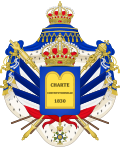
King Louis Philippe I taking the oath to keep the Charter of 1830 on 9 August 1830
King Louis Philippe, Portrait by Louise Adélaïde Desnos (1838)

In 1830, the July Revolution overthrew Charles X, who abdicated in favour of his 10-year-old grandson, Henri, Duke of Bordeaux. Charles X named Louis Philippe Lieutenant général du royaume, and charged him to announce his desire to have his grandson succeed him to the popularly elected Chamber of Deputies. Louis Philippe did not do this, in order to increase his own chances of succession. As a consequence, because the chamber was aware of his liberal policies and of his popularity with the masses, they proclaimed Louis Philippe as the new French king, displacing the senior branch of the House of Bourbon. For the prior eleven days Louis Philippe had been acting as the regent for the young Henri.

Charles X and his family, including his grandson, went into exile in the United Kingdom. The young ex-king, the Duke of Bordeaux, in exile took the title of Comte de Chambord. Later he became the pretender to the throne of France and was supported by the Legitimists. Louis Philippe was sworn in as King Louis Philippe I on 9 August 1830.[22] Upon his accession to the throne, Louis Philippe assumed the title of King of the French, a title previously adopted by Louis XVI in the short-lived Constitution of 1791. Linking the monarchy to a people instead of a territory (as the previous designation King of France and of Navarre) was aimed at undercutting the Legitimist claims of Charles X and his family.

By an ordinance he signed on 13 August 1830,[n 1] the new king defined the manner in which his children, as well as his "beloved" sister, would continue to bear the surname "d'Orléans" and the arms of Orléans, declared that his eldest son, as Prince Royal (not Dauphin), would bear the title Duke of Orléans, that the younger sons would continue to have their previous titles, and that his sister and daughters would be styled Princesses of Orléans, not of France. His ascent to the title of King of the French was seen as a betrayal by Emperor Nicholas I of Russia. Nicholas ended their friendship. In 1832, Louis' daughter, Princess Louise-Marie, married the first ruler of Belgium, King Leopold I. Their descendants include all subsequent Kings of the Belgians, and Empress Carlota of Mexico.

Rule

[edit]
Louis Philippe (1773–1850), Roi Bourgeois by Eugène Lami
The Arrival of Queen Victoria at the Château d'Eu by Eugène Lami. Queen Victoria arrives at the Château d'Eu during her visit in 1843
Louis Philippe I is the only French king to be the subject of a photograph while reigning (1842 daguerreotype)

Louis Philippe ruled in an unpretentious fashion, avoiding the pomp and lavish spending of his predecessors. Despite this outward appearance of simplicity, his support came from the wealthy bourgeoisie. At first, he was much loved and called the "Citizen King" and the "bourgeois monarch", but his popularity suffered as his government was perceived as increasingly conservative and monarchical.

Because he owed his elevation to a revolution in Paris and a faction of liberal deputies in the parliament of Charles X, Louis Philippe's rule "lacked...the mystical appeal of its Divine Right predecessor. Support for it was to a much greater degree conditional."[23][24] Unlike his predecessor, he did not have a dynastic legacy to draw on, so he turned to the glories of Napoleon I to prop up his own regime. He supported the return of Napoleon's remains to France and his son, the Duke of Joinville, brought the remains from Saint Helena for reinterment at Les Invalides. The statue of Napoleon was returned to its spot atop the Vendôme Column in 1833, and the Arc de Triomphe, a monument to Napoleon's victories, was inaugurated in 1836. (The monument includes a memorial to Louis Philippe's own contributions to the Revolutionary wars, as his name being inscribed on the northern pillar of the Arc as "Chartres" because he was Duke of Chartres during his revolutionary military service.) Louis Philippe also commissioned the creation of a national history museum at the Palace of Versailles, where famous Napoleonic battles were painted by important artists.[25]

In parliament, the narrow, property-qualified electorate of the time (only about 1 in every 170 citizens was enfranchised at the beginning of the reign) provided Louis Philippe with consistent support.[26] Under his management, the conditions of the working classes deteriorated, and the income gap widened considerably.[citation needed] According to William Fortescue, "Louis Philippe owed his throne to a popular revolution in Paris, he was the 'King of the Barricades', yet he went on to preside over a regime which rapidly gained notoriety for political repression of the left, class oppression of the poor and rule in the interests of the rich."[27] In foreign affairs, it was a quiet period, with friendship with the United Kingdom.[28] In October 1844 he paid a visit to Queen Victoria at Windsor Castle. This made him the first reigning French king to set foot on English soil since Jean II was imprisoned there after the Battle of Poitiers in 1356.[29]

Throughout his reign, Louis Philippe faced domestic opposition from various factions, ranging from Legitimists, who supported the senior branch of the Bourbons over the Orléans branch, to Republicans. This opposition, however, was weak and fragmented.[23] In the spring of 1832, a terrible outbreak of cholera in Paris fueled resentment against the July Monarchy and reignited revolutionary fervor. Many Parisians blamed Louis Philippe and his government for their perceived inaction in the face of the epidemic. This resentment culminated in the short-lived Republican uprising called the June Rebellion, in which insurrectionists took over a portion of central Paris. The rebellion was quickly crushed by a huge force of soldiers and National Guards who descended on the city. Louis Philippe showed a cool resolve throughout the crisis, coming to Paris as soon as he was informed of the disturbances, greeting the troops, and going amongst the people.[30][31]

An industrial and agricultural depression in 1846 led to the 1848 Revolutions, and Louis Philippe's abdication.[32] The dissonance between his positive early reputation and his late unpopularity was epitomized by Victor Hugo in Les Misérables as an oxymoron describing his reign as "Prince Equality", in which Hugo states:

[Louis Philippe had to] bear in his own person the contradiction of the Restoration and the Revolution, to have that disquieting side of the revolutionary which becomes reassuring in governing power ... He had been proscribed, a wanderer, poor. He had lived by his own labor. In Switzerland, this heir to the richest princely domains in France had sold an old horse in order to obtain bread. At Reichenau, he gave lessons in mathematics, while his sister Adelaide did wool work and sewed. These souvenirs connected with a king rendered the bourgeoisie enthusiastic. He had, with his own hands, demolished the iron cage of Mont-Saint-Michel, built by Louis XI, and used by Louis XV. He was the companion of Dumouriez, he was the friend of Lafayette; he had belonged to the Jacobins' club; Mirabeau had slapped him on the shoulder; Danton had said to him: "Young man!"

What is there against him? That throne. Take away Louis Philippe the king, there remains the man. And the man is good. He is good at times even to the point of being admirable. Often, in the midst of his gravest souvenirs, after a day of conflict with the whole diplomacy of the continent, he returned at night to his apartments, and there, exhausted with fatigue, overwhelmed with sleep, what did he do? He took a death sentence and passed the night in revising a criminal suit, considering it something to hold his own against Europe, but that it was a still greater matter to rescue a man from the executioner.[33]

Assassination attempts

[edit]
Review of the National Guard, attack of Fieschi, 28 July 1835 by Eugène Lami

Louis Philippe survived seven assassination attempts. On 28 July 1835, Louis Philippe survived an assassination attempt by Giuseppe Mario Fieschi and two other conspirators in Paris. During the king's annual review of the Paris National Guard commemorating the revolution, Louis Philippe was passing along the Boulevard du Temple, which connected Place de la République to the Bastille, accompanied by three of his sons, Ferdinand Philippe, Duke of Orléans, Prince Louis, Duke of Nemours, and François d'Orléans, Prince of Joinville, and numerous staff.

Fieschi, a Corsican ex-soldier, attacked the procession with a weapon he built himself, a volley gun that later became known as the Machine infernale. This consisted of 25 gun barrels fastened to a wooden frame that could be fired simultaneously.[34] The device was fired from the third level of n° 50 Boulevard du Temple (a commemorative plaque has since been engraved there), which had been rented by Fieschi. A ball only grazed the King's forehead. Eighteen people were killed, including Lieutenant Colonel Joseph Rieussec [fr] of the 8th Legion together with eight other officers, Marshal Mortier, duc de Trévise, and Colonel Raffet, General Girard, Captain Villate, General La Chasse de Vérigny, a woman, a 14-year-old girl and two men. A further 22 people were injured.[35][36] The King and the princes escaped essentially unharmed. Horace Vernet, the King's painter, was ordered to make a drawing of the event.[37]

Several of the gun barrels of Fieschi's weapon burst when it was fired; he was badly injured and was quickly captured. He was executed by guillotine together with his two co-conspirators the following year.

Abdication and death (1848–1850)

[edit]
1834 caricature of Louis Philippe turning into a pear mirrored the deterioration of his popularity (Honoré Daumier, after Charles Philipon, who was imprisoned for the original)
Alphonse de Lamartine in front of the Town Hall of Paris rejects the red flag on 25 February 1848, during the February 1848 Revolution

On 24 February 1848, during the February 1848 Revolution, King Louis Philippe abdicated in favour of his nine-year-old grandson, Philippe, comte de Paris. Fearful of what had happened to the deposed Louis XVI, Louis Philippe quickly left Paris under disguise. He rode in an ordinary cab under the name of "Mr. Smith". He fled to England with his wife on board a packet boat offered to him by the British consul at Le Havre.[38]

The National Assembly of France initially planned to accept young Philippe as king, but the strong current of public opinion rejected that. On 26 February, the Second Republic was proclaimed. Louis Napoléon Bonaparte was elected president on 10 December 1848; on 2 December 1851, he declared himself president for life and then Emperor Napoleon III in 1852.

Louis Philippe and his family remained in exile in Great Britain in Claremont, Surrey, though a plaque on Angel Hill, Bury St Edmunds, claims that he spent some time there, possibly due to a friendship with the Marquess of Bristol, who lived nearby at Ickworth House. The royal couple spent some time by the sea at St. Leonards[39] and later at the Marquess's home in Brighton. Louis Philippe died at Claremont on 26 August 1850. He was first buried at St. Charles Borromeo Chapel in Weybridge, Surrey. In 1876, his remains and those of his wife were taken to France and buried at the Chapelle royale de Dreux, the Orléans family necropolis his mother had built in 1816, and which he had enlarged and embellished after her death.

Honours

[edit]

National

[edit]
Silver coin of Louis Philippe I, struck 1834
Obverse: (French) LOUIS PHILIPPE I, ROI DES FRANÇAIS, in English: "Louis Philippe I, King of the French" Reverse: 5 FRANCS, 1834

Foreign

[edit]

Arms

[edit]

Territory

[edit]
View of Port Louis Philippe, the oldest French colony in the South Pacific, referred to nowadays by its indigenous name Akaroa

Port Louis Philippe (Akaroa), the oldest French colony in the South Pacific and the oldest town in the Canterbury Region of the New Zealand's South Island was named in honour of Louis Philippe who reigned as King of the French at the time the colony was established on 18 August 1840.[51] Louis Philippe had been instrumental in supporting the settlement project. The company responsible for the endeavour received Louis Philippe's signature on 11 December 1839 as well as his permission to carry out the voyage in line with his policy of supporting colonial expansion and the construction of a second empire which had first commenced under him in Algeria around a decade earlier.[52] The British Lieutenant-Governor Captain William Hobson subsequently went on to claim sovereignty over Port Louis Philippe.

As a further honorific gesture to Louis Philippe and his Orléanist branch of the Bourbons, the ship on which the settlers sailed to found the eponymous colony of Port Louis Philippe was named the Comte de Paris after Louis Philippe's beloved infant grandson, Prince Philippe d'Orléans, Count of Paris who was born on 24 August 1838.[52]

Issue

[edit]
Name Picture Birth Death Notes
Ferdinand Philippe, Duke of Orléans 3 September 1810 13 July 1842 Married Duchess Helene of Mecklenburg-Schwerin, had issue.
Louise d'Orléans 3 April 1812 11 October 1850 Married King Leopold I of Belgium, had issue.
Princess Marie d'Orléans 12 April 1813 6 January 1839 Married Duke Alexander of Württemberg, had issue.
Louis, Duke of Nemours 25 October 1814 26 June 1896 Married Princess Victoria of Saxe-Coburg and Gotha, had issue.
Princess Françoise Louise Caroline d'Orléans 26 March 1816 20 May 1818 Died aged two. Baptised on 20 July 1816, with Emperor Francis I of Austria as her godfather.
Clémentine d'Orléans 6 March 1817 16 February 1907 Married Prince August of Saxe-Coburg and Gotha, had issue.
François, Prince of Joinville 14 August 1818 16 June 1900 Married Princess Francisca of Brazil, had issue.
Charles d'Orléans 1 January 1820 25 July 1828 Died aged eight.
Henri, Duke of Aumale 16 January 1822 7 May 1897 Married Princess Caroline Auguste of the Two Sicilies, had issue-but no descendants survive.
Antoine, Duke of Montpensier 31 July 1824 4 February 1890 Married Infanta Luisa Fernanda, Duchess of Montpensier, had issue.

Ancestry

[edit]

See also

[edit]

Namesakes

[edit]

Notes

[edit]

References

[edit]
[edit]
Revisions and contributorsEdit on WikipediaRead on Wikipedia
from Grokipedia
Louis Philippe I (6 October 1773 – 26 August 1850) was of before the advent of the Second Republic, reigning as King of the French from 1830 to 1848 as head of the Orléans branch of the Bourbon dynasty. Born in as the eldest son of Louis Philippe Joseph d'Orléans, he received a amid the Enlightenment influences and early revolutionary fervor, later serving as a general in the , including at the in 1792, before fleeing into exile during the in 1793. His 21-year exile took him across , , and the , where he tutored and traveled, shaping his pragmatic views on . Ascending the throne on 9 August 1830 after the forced the abdication of the absolutist Charles X, Louis Philippe pledged allegiance to the Charter of 1830, which established a with limited male restricted to the wealthiest citizens, thereby entrenching bourgeois political dominance. His promoted industrialization, railway expansion, and banking reforms that spurred and colonial conquests, notably the full occupation of beginning in 1830, yet these advances disproportionately benefited the elite, fostering ministerial corruption, press censorship, and worker exploitation that alienated republicans, , and the emerging . Dubbed the "" for his umbrella-wielding contrasting royal pomp, Louis Philippe navigated through cautious , including the Belgian independence settlement and entente with Britain, but domestic scandals like the Fieschi attempt in and economic downturns in the eroded support, culminating in the of 1848 that prompted his abdication and flight to .

Early Life (1773–1789)

Birth and Family Background

Louis Philippe was born on 6 October 1773 at the Palais-Royal in Paris, the residence of the Orléans family. He was the eldest surviving son of Louis Philippe Joseph d'Orléans, then Duke of Chartres (later Duke of Orléans, 1747–1793), and his wife Louise Marie Adélaïde de Bourbon (1753–1821), daughter of Louis Jean Marie de Bourbon, Duke of Penthièvre, one of the wealthiest men in France. The Orléans family belonged to a cadet branch of the House of Bourbon, descending from Philippe I, Duke of Orléans (1640–1701), the younger brother of Louis XIV. This lineage positioned the Orléans as the premier princes of the blood after the king's immediate brothers, granting them significant influence and wealth derived from extensive estates and appanages. Louis Philippe's paternal grandfather was Louis Philippe I, Duke of Orléans (1725–1785), known as "le Gros" for his corpulence, who had served as a regent's advisor and maintained the family's liberal-leaning reputation through patronage of Enlightenment figures. The family's Palais-Royal became a hub for political intrigue and public gatherings, reflecting their detachment from the absolutist tendencies of the senior Bourbon line under Louis XVI. Louis Philippe's upbringing amid this aristocratic yet reformist milieu exposed him early to intellectual currents favoring , contrasting with the court's traditionalism; his father, in particular, cultivated a public image as Philippe Égalité, advocating parliamentary reforms while amassing debts through lavish spending. He had several siblings, including (1777–1847), who remained unmarried and close to him, and Louis Charles d'Orléans (1779–1808), but family dynamics were strained by his father's political radicalism and financial imprudence.

Education and Intellectual Formation

Louis Philippe, born on 6 October 1773 at the in , received a privileged education befitting his status as the eldest son of Louis Philippe Joseph d'Orléans, , and Louise Marie Adélaïde de Bourbon, daughter of the Duke of Penthièvre. From infancy, his upbringing emphasized intellectual and moral development, with no expense spared on instructors of high repute, reflecting the Orléans family's progressive leanings amid the Enlightenment era. Formal tutoring commenced in 1782, when Louis Philippe was nine years old, under the direction of Stéphanie Félicité, comtesse de Genlis, appointed gouvernante to the Duke of Orléans's children. De Genlis, a and educator known for innovative methods, instilled a structured regimen that included multilingual proficiency—French for supper, Italian for lunch, English for dinner, and German for breakfast—to foster polyglot capabilities essential for and scholarship. lessons employed visual aids such as a , while botany was taught through guided walks with a specialist, promoting empirical observation. The curriculum extended beyond academics to practical and moral training, incorporating manual skills like cabinet-making, gardening at the family's estate of Saint-Leu, and physical exercises to build , sometimes using weighted boots for endurance. A daily journal of self-examination reinforced ethical reflection, aligning with de Genlis's emphasis on virtue over aristocratic frivolity. Supplementary instruction came from distinguished professors and a German , ensuring a blend of theoretical knowledge and hands-on application. This formation cultivated liberal inclinations, influenced by his father's advocacy for and exposure to Enlightenment principles, though grounded in princely duties; by 1785, at age twelve, Louis Philippe assumed the title Duke of and was commissioned colonel of the 19th of Dragoons, signaling early preparation. De Genlis's approach, while progressive, prioritized disciplined intellect over radicalism, shaping a worldview that balanced aristocratic heritage with rational .

French Revolution Period (1789–1793)

Initial Revolutionary Involvement

At the age of sixteen, Louis Philippe, Duke of , actively embraced the early phases of the in 1789, aligning with reformist and liberal factions influenced by his father, Louis Philippe Joseph d'Orléans, who advocated for and . He took personal initiative to join the Jacobin Club, a key radical political society formed that year from the Breton Club of deputies, which promoted democratic ideals and opposition to absolutism; this affiliation was endorsed by his father despite objections from his mother. Concurrently, he affiliated with , a network associated with Enlightenment thought and fraternal prevalent among early revolutionaries. Louis Philippe publicly proclaimed liberal principles, supporting the transformation of French society through the abolition of feudal privileges and the establishment of a constitutional order, as evidenced by the Orléans family's renunciation of noble rights in the National Assembly's decrees of August 4-11, 1789, which he endorsed as part of broader revolutionary fervor. His diary entries from the period reflect enthusiasm for these changes, positioning him among aristocratic youth who viewed the Revolution as a means to modernize governance without immediate republican rupture. By mid-1790, amid the National Assembly's consolidation of power, he participated in civic oaths affirming loyalty to emerging revolutionary institutions, though his youth limited formal roles to symbolic endorsements rather than legislative influence. This initial engagement reflected a pragmatic adaptation to momentum, driven by familial strategy and personal ideological sympathy, yet it remained distinct from the more Jacobin that intensified post-1791; sources contemporary to the era, such as club records and family correspondence, confirm his membership without evidence of leadership or incendiary rhetoric at this stage.

Military Service and Political Choices

As Duke of Chartres, Louis Philippe entered active military service in the French revolutionary army in April 1792, shortly after France's declaration of war against Austria, joining the Army of the North under General Charles François Dumouriez. He was appointed to command the 4th Brigade and later the 14th Dragoons Regiment, demonstrating competence in cavalry operations during campaigns in the Austrian Netherlands. Louis Philippe distinguished himself at the on November 6, 1792, where his brigade helped rally retreating troops and contributed to the French victory over the Austrians under Albrecht of Austria-Tuscany, resulting in the occupation of . For his performance, he received praise from Dumouriez and was promoted to on December 30, 1792, at age 19, an unusually rapid advancement reflecting both merit and his Orléans family influence amid the Revolution's need for capable officers. Following the French defeat at the Battle of Neerwinden on March 18, 1793, Dumouriez, increasingly at odds with the radical , plotted to arrest its leaders and potentially restore monarchical elements by allying with Austrian forces. Louis Philippe, present in Dumouriez's headquarters, became implicated when the general marched toward but ultimately refused to fully participate in the treasonous scheme. In April 1793, as Dumouriez defected to the , Louis Philippe accompanied him briefly to their lines but then deserted the , fleeing into exile across the to rather than report the plot or continue service under the Convention's purges of suspected moderates like the . This decision stemmed from his disillusionment with the Revolution's radical turn toward terror and his reluctance to betray outright, prioritizing personal safety and family interests over ideological commitment, especially as his father Philippe Égalité's Girondin leanings drew scrutiny. His departure marked a shift from initial revolutionary enthusiasm to pragmatic detachment, avoiding the fate of executed moderates while evading formal treason charges.

Period of Exile (1793–1814)

Flight from France and Early European Wanderings

Following the defection of his superior, General , to Austrian forces on April 5, 1793, Louis Philippe, then Duke of Chartres and to Dumouriez, faced accusations of complicity amid the intensifying and revolutionary purges targeting suspected traitors in the army. He resigned his commission as colonel of the 14th on April 4, 1793, while the French forces were positioned near the border in the , and immediately fled to evade arrest by the . Traveling discreetly with his loyal servant Baudoin, he crossed into neutral , arriving in on April 26, 1793, where he reunited with his sister, , who had also sought refuge there. In , Louis Philippe adopted the assumed name "Jacques Aubert" to conceal his identity, living modestly as an amid growing in . He and Adélaïde undertook walking tours through the Swiss countryside, often sleeping in barns and subsisting on simple rural fare, while avoiding detection by French agents or local authorities wary of revolutionaries. This period of itinerant hardship reflected the precarious position of exiles, as Swiss cantons balanced neutrality with internal divisions over hosting French nobles tainted by their revolutionary ties. By October 1793, to secure a livelihood, Louis Philippe accepted a position as a teacher of , , , and modern languages at a boys' in the canton of Graubünden, supplementing his through private tutoring. On November 6, 1793, he learned of his father Philippe Égalité's execution by in , which elevated him to the title of and intensified the scrutiny on his branch of the as a potential focal point for intrigue. Despite this, he remained in , navigating local hospitality and occasional relocations within the to evade French expansionist pressures, until further travels in 1795.

Scandinavian Travels

In 1795, amid his ongoing exile following the , Louis Philippe, then the , embarked on an extensive northward journey through rather than departing immediately for the . Accompanied by two companions, he adopted a modest and inconspicuous mode of travel, often proceeding on foot or by small boats, lodging at parsonages and inns while using a to evade attention. His route traversed and , emphasizing rugged terrains that allowed for prolonged exploration at minimal expense. Guided by an Icelander named Holm upon entering Lapland, Louis Philippe pushed to the northern extremities of the region, attaining the North Cape—the northernmost point of —on 24 August 1795. This expedition reflected both a pursuit of refuge from political threats and an intellectual curiosity about remote landscapes, as he documented observations of local customs, geography, and natural phenomena during the voyage. The journey's unostentatious character underscored his efforts to sustain financial prudence and personal security in an era of widespread instability for French émigrés. Following the North Cape visit, Louis Philippe extended his stay into Finnish Lapland, residing for roughly one year in , a secluded village along the River valley. There, he quartered in a local rectory, integrating temporarily into the sparse community while continuing his low-profile existence. This prolonged Scandinavian interlude, spanning approximately 1795 to 1796, preceded his and provided a respite before further migrations, with later commissions of paintings preserving visual records of key sites encountered.

Extended Stay in the United States

Louis Philippe arrived in on October 23, 1796, aboard the ship America, traveling incognito as a German merchant after departing from . He was hosted by David Conyngham and lodged modestly in a single room, while receiving hospitality from prominent families such as the Binghams and Morrises. During this initial period, he attended President ' inauguration and maintained frugal expenditures, documenting his daily costs meticulously in journals that later formed the basis of his travel diary. In February 1797, his younger brothers, the Duke de Montpensier (Antoine Philippe) and the Duke de (Louis Charles), joined him after their own arrival in the United States, accompanied by a manservant named Baudoin. Together, the three princes embarked on extensive travels from March to July 1797, covering thousands of miles from northward to and westward to sites including (visited on April 5, 1797, where Louis Philippe observed enslaved laborers and expressed private reservations about the institution of ), Washington, D.C., , , Knoxville, Nashville, and Lexington. They engaged in frontier exploration, interacted with Native American groups, sketched landscapes such as ancient earthworks near , and sought supplies during layovers, including a December 1797 stop in Marietta en route down the . From in late December 1797, the brothers continued southward by along the and Rivers, arriving in New Orleans on , , under Spanish administration. They were welcomed by Creole elites, staying at the Marigny family plantation and visiting Etienne de Boré's sugar plantation, where they received a small from the 12-year-old Marigny to support their . Notable encounters during the American sojourn included meetings with , financier (who provided a $13,000 , repaid with interest years later), and Alexander Baring, alongside observations of American political and economic life that Louis Philippe recorded in detail. The princes departed New Orleans in March 1798, sailing to and subsequently transiting through and Halifax before reaching in February 1800, marking the end of their extended American residence. Throughout the journey, Louis Philippe's diaries emphasized practical assessments of commerce, agriculture, and , reflecting a pragmatic approach to amid financial constraints.

Later European Settlements and Subsistence

Upon returning from the United States in 1800, Louis Philippe settled in Twickenham, a suburb of London, England, where he resided for much of the subsequent decade. This location provided a degree of seclusion, allowing him to avoid political entanglements amid the ongoing Napoleonic Wars and his status as a French émigré. He lived there with his brothers, maintaining a low profile and focusing on private life rather than public agitation against Napoleon. In 1809, after nearly a decade in , Louis Philippe traveled to , , to marry Marie Amélie, daughter of Ferdinand I of the Two Sicilies, on 25 November. The union, arranged through family connections during the Neapolitan court's from mainland Italy due to French occupation, strengthened his ties to European royalty but did not immediately alter his English base. Following the marriage, he and Marie Amélie returned to , continuing their residence there until the Bourbon Restoration in 1814. During this period, their first children were born, including Ferdinand Philippe in 1810, underscoring the establishment of a family household in . Subsistence during these years relied on the remnants of the Orléans family fortune, salvaged from confiscations in , supplemented by occasional hospitality from British and European contacts. Lacking steady from , Louis Philippe avoided and speculation, adhering to a frugal existence that contrasted with his pre-revolutionary wealth; estimates suggest his annual resources were limited to a few thousand pounds, sufficient for a modest gentleman's lifestyle but far below noble standards. He refrained from formal employment, such as earlier tutoring roles in , instead drawing on personal savings and minor publications of his travel accounts, which provided negligible revenue but preserved his dignity. This self-reliant approach reflected a deliberate strategy to evade dependency on émigré networks or British , which many French exiles sought but which carried risks of political compromise.

Bourbon Restoration Era (1814–1830)

Return to France and Social Reintegration

Louis Philippe returned to France on 17 May 1814 following the Bourbon Restoration after Napoleon's abdication, arriving amid the reinstatement of with support from Allied forces. He was welcomed by the king, who granted him the and appointed him colonel-general of hussars, though denied him a formal role owing to his family's revolutionary associations. Instead, Louis Philippe focused on managing his substantial inherited fortune, which positioned him among Europe's wealthiest nobles, with estates valued at approximately $100 million in contemporary terms. The brief resurgence of during the in March 1815 prompted Louis Philippe to flee to once more, where he resided at Orleans House until the second Bourbon Restoration after Waterloo. His family, including wife Maria Amalia and children, joined him permanently in by 1817. He regained control of the in and his Neuilly estate, restoring his pre-revolutionary family seat and facilitating a return to aristocratic circles despite lingering suspicions over his past liberal leanings and . A royal ordinance integrated him into the Chamber of Peers as Duc d', where he advocated against punitive policies toward former revolutionaries, emphasizing mercy in 1815 debates. Socially, he navigated tensions at court, facing hostility from ultraroyalists due to his father's execution and his own earlier republican sympathies, yet cultivated support among moderate liberals who viewed him as a bridge between revolutionary gains and monarchical stability. This reintegration solidified his status as first prince of the blood outside the elder Bourbon line, enabling a discreet but influential presence in Restoration society until the .

Liberal Political Engagement

Upon returning to France in April 1814 following the Bourbon Restoration, Louis Philippe, Duke of Orléans, was restored to his pre-revolutionary titles and appointed a peer of France by Louis XVIII on 11 April 1814, enabling him to sit in the Chamber of Peers. He publicly affirmed loyalty to the Constitutional Charter of 1814, which limited monarchical authority, established a bicameral legislature with an elected Chamber of Deputies, and enshrined freedoms of speech, press, and religion, thereby aligning with moderate liberals known as doctrinaires who sought to prevent a return to absolute rule. This positioned him against ultra-royalists, who, after gaining a majority in the August 1815 elections amid the Second White Terror, advocated policies reinstating noble privileges, compensating émigrés for revolutionary confiscations (totaling over 1 billion francs by 1825), and strengthening clerical influence, moves that liberals viewed as undermining the charter's balance of powers. Residing at the in from 1817, Louis Philippe maintained a low-profile presence that nonetheless served as a symbolic counterpoint to the court, attracting liberal intellectuals, journalists, and opposition figures who saw the Orléans branch—distinguished by its revolutionary-era moderation—as a safeguard for . He refrained from active parliamentary oratory in the Chamber of Peers, delivering few speeches and avoiding direct confrontation to preserve his status within the royal family, yet his tacit support for liberal causes, including resistance to ultra-royalist indemnities and proposals, earned him recognition as a leader of the opposition by the mid-1820s. Under Jean-Baptiste de Villèle's ministry (1822–1828), as ultra policies intensified—such as the 1825 sacrilege law imposing severe penalties for offenses against Catholic symbols—Louis Philippe's alignment with defenders grew evident, fostering perceptions among deputies and the press of him as a viable alternative monarch should the elder Bourbons falter. By Charles X's accession in 1824, escalating tensions over electoral reforms favoring wealthy landowners (raising the threshold to 300 francs in direct taxes, limiting voters to about 100,000) and press restrictions highlighted Louis Philippe's opposition role, as liberals invoked Orléans against Bourbon absolutism. His eldest son, Ferdinand Philippe, Duke of , actively engaged in liberal networks, amplifying the family's profile, though Louis Philippe himself prioritized prudence, declining involvement in clandestine groups like the , which were suppressed after arrests of over 300 members. This strategic restraint, rooted in awareness of post-Napoleonic repression, allowed him to embody constitutional continuity without provoking exile, culminating in liberal overtures during the 1827–1830 ministries of moderates like Martignac, who sought to dilute ultra dominance.

Rise to Power (1830)

Context of the July Revolution

The Bourbon Restoration under Charles X, who ascended the throne in 1824 following the death of Louis XVIII, marked a shift toward more conservative governance compared to the constitutional monarchy established by the Charter of 1814. Charles pursued policies reminiscent of absolute monarchy, including laws punishing sacrilege with death, restrictions on press freedom, and financial compensation to nobles for properties lost during the Revolution, which alienated liberal elements and contributed to growing opposition from the bourgeoisie and intellectuals. By the late 1820s, electoral gains by liberals in the 1827 elections prompted Charles to dismiss his ministry and resist parliamentary influence, fostering perceptions of autocratic rule. Economic conditions exacerbated political tensions, with France experiencing a severe downturn from 1827 to 1830 that affected both industry and agriculture, arguably more acute than the crisis preceding the Revolution. This involved slumps in and domestic production, leading to widespread and hardship among the working classes, which fueled urban unrest in and other centers. Liberal opposition, including figures advocating constitutional limits on royal power, capitalized on this discontent, viewing Charles's regime as unresponsive to demands for civil equality and representative . The immediate catalyst occurred on July 25, 1830, when Charles X issued four ordinances that dissolved the newly elected liberal-dominated , suspended press freedoms, altered electoral laws to favor conservatives, and scheduled new elections under restrictive conditions, directly contravening the Charter's provisions. These measures, intended to reassert royal authority amid liberal electoral successes, instead provoked immediate protests from journalists, republicans, and liberals, escalating into barricade fighting in from July 27 to 29, with over 800 deaths reported among combatants and civilians. The king's refusal to retract the ordinances, coupled with military failures to suppress the uprising, undermined his legitimacy and opened the path for alternative monarchical figures perceived as more aligned with constitutional principles.

Selection as King of the French

In the immediate aftermath of the July Revolution's street fighting from July 27 to 29, 1830, which forced King Charles X to flee Paris, the liberal-dominated Chamber of Deputies assumed de facto authority amid the power vacuum. On July 31, the Chamber, lacking explicit constitutional power to appoint a monarch, elected Louis Philippe, Duke of Orléans, as Lieutenant General of the Kingdom, positioning him as a transitional figure acceptable to both revolutionaries and constitutionalists. This choice reflected the Orléans branch's reputation for liberalism, stemming from Louis Philippe's father Philippe Égalité's revolutionary sympathies, contrasting with the Bourbon hardliners under Charles X. Louis Philippe, residing at the , entered on July 30 and formally accepted the lieutenant generalship the next day, bolstered by support from key figures like Marquis de Lafayette, who commanded the , and banker , president of the Chamber. On August 2, Charles X abdicated in favor of his grandson, Henri, Duke of Bordeaux, but this act was swiftly rejected by the deputies as incompatible with the revolutionary demands for reform. Ignoring the Bourbon succession, the Chamber on August 7 passed a resolution proclaiming Louis Philippe "King of the French," reviving phrasing from the 1791 Constitution to emphasize over divine right, though the selection remained an extralegal maneuver by elite parliamentarians rather than a direct popular vote. The proclamation marginalized republican elements in the uprising, who favored abolishing the monarchy, as bourgeois liberals prioritized stability under a constitutional framework aligned with their interests. On August 9, 1830, Louis Philippe swore an oath to a revised at the , committing to respect legislative powers and , thus formalizing the . This transition, engineered by approximately 300 deputies, secured bourgeois control while averting deeper radical change, with Lafayette's public endorsement—appearing with Louis Philippe on a Hôtel de Ville balcony waving the tricolor flag—symbolizing continuity with revolutionary ideals.

Governance of the July Monarchy (1830–1848)

Constitutional Monarchy Mechanics

The Charter of 1830, promulgated on August 14, established the constitutional framework for Louis Philippe I's monarchy, modifying the 1814 Charter to emphasize national sovereignty over divine right by styling the monarch as "King of the French" rather than "King of France." The king retained executive authority as the supreme , commanding the armed forces, declaring war, negotiating treaties, appointing officials including ministers and peers, and issuing ordinances for law execution, though he could not suspend existing laws or reimpose . His person was declared inviolable and sacred, with ministers bearing responsibility for governmental acts, enabling parliamentary accountability mechanisms where deputies could impeach ministers, to be tried by the Chamber of Peers. Legislative power was exercised collectively by the king and the two chambers: the appointed Chamber of Peers and the elected . The Chamber of Peers, serving as an , comprised members appointed by the king in unlimited numbers, either for life or hereditarily, initially numbering around 154 and including high clergy and nobles to provide a conservative counterbalance. A law shifted new appointments to life terms only, reducing hereditary expansion while preserving the king's influence over composition. The , the , consisted of members elected for five-year terms, proposing laws including all tax measures, which required approval from both chambers and royal sanction to become binding; the king could prorogue or dissolve the Deputies but not the Peers. Elections for deputies operated under a restricted census suffrage system, requiring electors to be at least 25 years old and meet property or tax-paying thresholds equivalent to paying 100-200 francs annually in direct taxes, initially enfranchising about 94,000-100,000 men, or roughly 0.25-0.3% of France's 35 million , predominantly wealthy landowners and . This electorate expanded modestly to around 166,000-250,000 by the mid-1840s due to and lowering effective barriers, yet remained limited to about 1% of the , ensuring dominance by propertied interests and excluding the working classes and most peasants. Voting occurred in indirect colleges, with deputies needing higher qualifications (age 30+ and 500-1,000 francs in taxes), reinforcing elite control over representation. In operation, the system balanced with legislative oversight, as the king's ministers required chamber confidence for stability, fostering a parliamentary regime despite formal royal initiative in policy; dissolutions and peer appointments allowed Louis Philippe to navigate factional divides between and liberals, though this often prioritized bourgeois stability over broader reforms. Judicial power derived from the king but was administered by independent judges, with press freedoms protected against prior , though subsequent laws imposed penalties for offenses.

Domestic Administration and Reforms

The domestic administration of the July Monarchy under Louis Philippe I preserved the centralized prefectural system instituted by Napoleon Bonaparte in 1800, whereby prefects—appointed by the king upon ministerial recommendation—served as the executive agents of the central government in each of France's 83 departments. These officials supervised local administration, enforced national laws, managed , and monitored political activities, enabling the regime to exert tight control over provincial affairs and counter opposition from or republicans. Sub-prefects handled arrondissements, forming a hierarchical structure that prioritized loyalty to over local autonomy, with frequent rotations to prevent entrenched power bases. A key reform targeted , enacted through the Guizot Law of 28 June 1833 under Interior Minister , who also oversaw education policy from 1832 to 1837. This legislation mandated that each commune establish at least one boys' , with funding allocated from municipal budgets supplemented by state subsidies, and required attendance for children aged 6 to 12 where facilities existed. It further instituted écoles normales for training male teachers, emphasizing moral, religious, and patriotic instruction to foster disciplined citizens supportive of the constitutional order. By prioritizing bourgeois values over radical enlightenment ideals, the reform expanded access—resulting in over 30,000 s by the late 1840s—while reinforcing social stability amid industrialization. Efforts to standardize the marked another administrative evolution, with the under Louis Philippe advancing bureaucratic uniformity through codified recruitment and hierarchical grading, though political patronage persisted in appointments. This built on Napoleonic foundations but adapted to the needs of a growing industrial economy, emphasizing efficiency in tax collection and public order maintenance without introducing merit exams until later republican eras. Judicial administration saw no sweeping overhauls, retaining the 1810 with incremental adjustments for procedural fairness, such as expanded roles in assize courts, but prioritizing security over liberalization. Overall, these measures reflected a conservative approach, centralizing power to sustain bourgeois dominance while averting revolutionary upheaval.

Economic Policies and Development

Protectionist Measures and Industrial Growth

The July Monarchy government pursued a protectionist to shield emerging French industries from British competition, maintaining high import duties and outright prohibitions on key manufactured goods such as textiles and iron products. This approach built on post-Napoleonic tariffs reinstated after , converting some prohibitions into ad valorem duties averaging 20-30% on industrial imports by the , which prioritized domestic producers over consumer access to cheaper foreign wares. Under from 1840 onward, these tariffs were further emphasized, generating substantial fiscal revenue—rising at an annual rate of approximately 4% through the —while fostering industrial self-sufficiency amid Britain's mechanized dominance. Such measures reflected a deliberate strategy to cultivate "infant industries," as articulated by protectionist advocates within the regime, who argued that temporary barriers were essential for to achieve technological parity without subsidizing British exports that undercut local wages and capacities. Empirical outcomes included reduced penetration in textiles and metals, enabling French firms to invest in machinery; however, this came at the cost of elevated domestic prices, disproportionately burdening urban workers and rural consumers dependent on imported grains and raw materials. Critics, including free-trade proponents like Say's followers, contended that entrenched inefficiencies and favored entrenched bourgeois interests over broader economic dynamism, though regime data showed revenues funding without immediate fiscal strain. These policies facilitated accelerated industrial growth, particularly in northern and eastern regions, where cotton spinning output expanded markedly after 1830 through mechanized mills in , the Nord department, and , supported by state-backed credit and tariff sheltering. production rose from roughly 1.4 million metric tons in 1830 to over 3.8 million by 1847, fueling steam engines and forges, while output climbed from about 200,000 tons to nearly 500,000 tons over the same period, driven by Anzin and operations. Government concessions for railways—totaling over 1,200 kilometers constructed by 1848—integrated these sectors, with lines like -Saint-Germain (1837) exemplifying public-private partnerships that boosted freight transport for raw materials and finished goods. Overall, correlated with sectoral expansion—industrial growing at 2-3% annually in key branches—but France's aggregate industrialization lagged Britain's, with steam horsepower remaining low due to fragmented enterprise sizes and reliance on artisanal methods; this disparity underscored how tariffs nurtured specific bourgeois gains while deferring wider structural shifts until post-1848 pressures.

Fiscal Prudence and Infrastructure Investments

Under Louis Philippe I's reign, the French government emphasized fiscal orthodoxy, prioritizing budget stability amid post-revolutionary economic recovery. Public debt rose modestly in absolute terms from 4.0 billion francs in 1820 to 4.9 billion francs by 1848, yet the declined from 43% to 33%, attributable to sustained economic expansion outpacing borrowing and limited . This approach involved small-scale debt amortization efforts and legislative oversight of annual fiscal balances, where deficits or surpluses were settled to avoid accumulation. However, military expenditures, particularly for the conquest of starting in 1830 and foreign policy tensions in 1840, eroded potential primary surpluses, constraining deeper reductions. Infrastructure development complemented this prudence through targeted state encouragement of private initiative rather than direct heavy spending. The regime granted concessions to bourgeois investors, subsidizing initial costs to spur industrialization, as France lacked a robust private industrial base for self-financed projects. From 1840 to 1849, approximately 0.5 billion francs were allocated to , marking the onset of France's rail network with lines like Paris-Saint-Germain (opened 1837) symbolizing modernization. Canal expansions, building on 1820s initiatives, and road improvements also received funding, totaling significant portions of sector outlays between 1830 and 1880, though dominated post-1837 state interventions. These measures balanced fiscal restraint with growth-oriented investments, leveraging guarantees to attract capital from financiers like the Rothschilds for key routes such as Paris-Lille.

Outcomes: Expansion vs. Emerging Disparities

The July Monarchy witnessed measurable economic expansion, particularly in industry and infrastructure. National revenues grew at an average annual rate of 4 percent from 1834 to 1846, double the pace of the 1825–1835 period. Industrial capacity advanced, with the number of coke-fired blast furnaces increasing from 41 in 1840 to 107 by 1847, reflecting shifts toward more efficient coal-based production. The sector enabled by 1840, driven by in regions like and , while railway lines expanded to about 1,800 kilometers by 1848, facilitating trade and resource movement despite incomplete national connectivity. Agricultural output reached exceptional levels around 1840, supporting and urban demand, yet the sector's dominance—employing most of the —highlighted uneven modernization, as industrial gains concentrated in northern and eastern regions. , essential for steam power, saw rising output to meet demand exceeding 2.5 million tonnes by , with domestic production covering about 1.5 million tonnes annually at the decade's start. These developments masked deepening disparities, as prosperity favored the and financiers while workers faced stagnant or declining . The economy's agricultural base limited trickle-down effects, leaving rural areas vulnerable and urban laborers exposed to cyclical downturns. The 1846–1847 crisis, triggered by poor harvests, inflated prices to 100–150 percent above 1844 levels in some areas, surging unemployment to 184,000 in alone by and prompting cuts of up to 30 percent in factories amid extended 12-hour workdays. Such conditions, compounded by limited government intervention in labor markets, fueled and class antagonism, eroding support among the despite overall growth.

Foreign Affairs

Doctrine of Non-Intervention and Peace Maintenance

The foreign policy of the July Monarchy under Louis Philippe I emphasized non-intervention in the internal affairs of other states and the preservation of European peace to prioritize domestic consolidation and economic progress. Immediately following the of 1830, Louis Philippe proclaimed a principle of non-intervention, refraining from supporting revolutionary movements abroad that could provoke conflicts with conservative powers like , , and . This approach, articulated by ministers such as Charles-Maurice de Talleyrand and later , stemmed from the regime's vulnerability: any major war risked radicalizing domestic republicans and socialists, potentially transforming into a "war of revolution" that echoed the excesses of 1789. In practice, the doctrine balanced restraint with pragmatic diplomacy, as seen in the response to the that erupted on August 25, 1830. Despite French public pressure for or direct aid to Belgian separatists from Dutch rule, Louis Philippe's government avoided aggressive involvement, fearing it would alienate Britain and ignite a broader European war. Through Talleyrand's negotiations at the Conference starting November 4, 1830, the great powers recognized Belgian independence via the Protocol of November 15, 1830, establishing a neutral under Leopold I, elected on June 4, 1831. French troops, numbering around 60,000 under Marshal Étienne Maurice Gérard, entered on August 2, 1831, only as a defensive measure against a Dutch counter-invasion, withdrawing by December 1832 after the Treaty of London on November 15, 1831, confirmed the status quo without French territorial gains. This limited action upheld non-intervention by rejecting while securing peace. The policy extended to other 1830-1831 uprisings, notably the Polish against Russian domination from November 29, 1830, to October 1831. Despite widespread French sympathy—manifest in volunteer enlistments and press agitation—Louis Philippe refused military or official support, prioritizing avoidance of confrontation with Tsar Nicholas I to prevent a coalition against . Guizot later justified this by noting that intervention would expose the monarchy to domestic upheaval, as "any great war ran the risk of becoming a war of revolution." Similar caution applied to Italian revolts in 1831, where urged Piedmontese restraint and mediated Swiss conflicts in 1833 without troops, reinforcing the "juste milieu" of stability over ideological crusades. This doctrine of peace maintenance, often summarized as "peace without compromising honor" by Périer, enabled 18 years of relative European tranquility, facilitating Anglo-French entente and French colonial focus, but drew criticism for perceived abandonment of liberal principles, eroding public support by the 1840s. Louis Philippe himself affirmed in 1848 memoirs that he rejected "the thirst for conquest" to spare war's calamities, underscoring the policy's roots in realist caution amid post-revolutionary fragility.

Anglo-French Entente and European Balances

Louis Philippe I's foreign policy emphasized close cooperation with Britain to preserve European stability following the of 1830. This Anglo-French entente, often termed the in its early form, aimed to align the two powers against absolutist threats from , , and while avoiding costly continental wars. Under Foreign Minister from 1840, France pursued pragmatic diplomacy with British counterparts like Viscount Palmerston, prioritizing mutual interests in maintaining the post-Napoleonic balance of power. A pivotal demonstration of this partnership occurred during the of 1830, where France and Britain jointly mediated to secure Belgium's independence from the . Louis Philippe's government, newly established, refrained from annexing territory despite French-speaking sympathies in , instead supporting a neutral under international guarantee to prevent Dutch resurgence or Prussian interference. The London Conference of 1830–1831 resulted in Leopold of Saxe-Coburg's election as King of the Belgians on 4 June 1831, with Anglo-French naval forces enforcing the separation treaty against Dutch resistance until the final Treaty of London on 19 April 1839. The entente extended to the Iberian Peninsula through the Quadruple Alliance of 22 April 1834, uniting Britain, France, Spain, and Portugal to bolster liberal constitutional regimes against Carlist absolutists. France contributed 20,000 troops under General Étang to the First Carlist War, aiding Queen Isabella II's cause without direct confrontation with European conservatives, while British naval support targeted Portuguese Miguelite forces. This limited intervention reinforced the alliance's commitment to thwarting dynastic reversals, stabilizing southwestern Europe and countering Holy Alliance influence. In broader European balances, Louis Philippe navigated tensions such as the Polish uprising of 1830–1831 by adhering to non-intervention, deferring to Britain's lead to avoid Russian backlash that could upset the . Personal diplomacy, including Louis Philippe's 1844 to hosted by and Prince Albert, symbolized the entente's warmth, fostering intelligence-sharing and colonial restraint. However, underlying frictions—such as French ambitions in during the 1840 Oriental Crisis—tested the partnership, with Palmerston's fleet deterring French overreach at on 3 November 1840. These maneuvers preserved France's great-power status through alliance rather than aggression, contributing to two decades of relative peace until domestic upheavals eroded the policy's foundations.

Colonial Ventures and Diplomatic Incidents

Under Louis Philippe I's reign, the , initiated in 1830, expanded significantly through sustained military campaigns aimed at securing the territory against Ottoman remnants and local resistance led by Emir Abd el-Kader. By 1834, the government under Prime Minister Louis-Mathieu Molé formalized Algeria's integration by declaring it an integral part of , committing resources to pacify interior regions including the conquest of Constantine in 1837 and Oran expansions. Troops numbered over 100,000 by the mid-1840s, with key victories such as the capture of Abd el-Kader in 1847 marking the effective end of major organized opposition, though persisted. Colonial efforts extended to the Pacific, where established protectorates over the in 1842 and later that year, following naval expeditions under Abel Aubert du Petit-Thouars to counter British missionary influence and secure commercial interests. These moves involved treaties with local rulers like Queen Pomare IV, but faced immediate resistance from Tahitian forces and British consular interference, escalating into the from 1844 to 1847. The protectorate policy reflected a broader strategy of limited, prestige-driven expansion without large-scale territorial commitments, contrasting with more ambitious imperial visions. Diplomatic tensions arose prominently during the Eastern Crisis of 1839–1841, where initially backed Muhammad Ali Pasha of Egypt's expansion into against the , viewing it as a counterweight to British and Russian influence. Foreign Minister advocated arming Ali and mobilizing French forces, prompting a European coalition that bombarded Egyptian ports in 1840 and isolated , leading Louis Philippe to dismiss Thiers and adopt a conciliatory stance under to avoid war. This retreat preserved peace but damaged French prestige and highlighted the monarchy's prioritization of stability over assertive nationalism. The Pritchard Affair in further strained Anglo-French relations, as du Petit-Thouars arrested British Consul George Pritchard in 1843 for alleged incitement against French claims, prompting British demands for compensation and nearly provoking naval confrontation. Pritchard's release and a £2,000 indemnity in 1844 resolved the immediate crisis, but it underscored rivalries over Pacific influence and eroded trust in the entente. Similarly, the Spanish Marriages of 1846, arranging the union of Queen with her cousin de Asís and Louis Philippe's daughter Louise with the Spanish heir, defied British preferences for a Saxe-Coburg match, violating Quadruple understandings and culminating in the abrupt breakdown of the Anglo-French partnership that Guizot had cultivated.

Societal and Cultural Dynamics

Bourgeois Ascendancy and Modernization Efforts

The under Louis Philippe I (1830–1848) entrenched the political dominance of the wealthy , with electoral laws restricting the franchise to male citizens paying at least 200 francs in direct taxes, limiting voters to approximately 250,000 individuals from a population exceeding 35 million. This census system favored industrialists, bankers, and landowners, enabling them to control the and marginalize both aristocratic remnants and the lower classes. The king's self-presentation as the "," adopting middle-class attire and rejecting ostentatious royal pomp, further symbolized this alignment with bourgeois sensibilities of practicality and . Socially, the regime promoted bourgeois values such as industriousness, property ownership, and moral discipline through ministerial directives, exemplified by François Guizot's doctrine of "enrichissez-vous" (enrich yourselves), which urged personal economic advancement as the path to national prosperity. Guizot, as Minister of Public Instruction from 1832, implemented the Law of 28 June 1833, mandating at least one for boys in every commune with more than 500 inhabitants and establishing normal schools for teacher training, thereby expanding access to focused on reading, writing, arithmetic, and civic virtues aligned with Protestant-influenced bourgeois . This reform, while not universal or compulsory for attendance, increased rates and disseminated ideals of and respect for authority, reinforcing the that privileged the propertied classes. Cultural initiatives underscored efforts to legitimize bourgeois ascendancy by reinterpreting national history. In 1837, Louis Philippe transformed the Palace of Versailles into the Musée d'Histoire de France, commissioning galleries such as the to chronicle French military triumphs from Clovis to , inclusively bridging monarchical, revolutionary, and imperial legacies to foster a unified national palatable to middle-class . This project, completed amid extensive renovations costing millions of francs, symbolized modernization by repurposing royal symbols for public edification, though access remained oriented toward educated elites rather than . Collectively, these measures elevated bourgeois influence while maintaining social hierarchies, prioritizing stability and private enterprise over broader egalitarian reforms.

Media Control and Intellectual Climate

The initially expanded press freedoms compared to the Bourbon Restoration, allowing a proliferation of newspapers that reflected bourgeois interests, though this was tempered by financial barriers like caution money deposits required for . In response to assassination attempts, including Giuseppe Fieschi's failed bombing on 28 July 1835, the government under Prime Minister promulgated the September Laws on 9 September 1835, which doubled security deposits for periodicals, imposed higher stamp duties on publications, and criminalized writings or images inciting attacks on the king's life, dynasty, or constitutional form of government, with penalties up to . These measures effectively curtailed radical and oppositional , targeting content deemed seditious while permitting loyalist outlets to thrive. Visual media faced even stricter controls, as authorities viewed caricatures as more incendiary than text due to their and potential for immediate ; a dedicated censor reviewed drawings and engravings, leading to frequent seizures, fines, and imprisonments for publishers like Charles Philipon, whose La Caricature satirized the regime through symbolic depictions such as transforming Louis Philippe's likeness into a to evade direct bans. The laws reinstated pre-publication scrutiny for satirical images after 1834 riots, suppressing over 100 caricature publications by the late 1830s and fostering a climate where prevailed among artists to avoid prosecution. The intellectual environment under Louis Philippe emphasized pragmatic and , with salons and academies serving as hubs for moderate discourse, yet dissent from exiles—such as Polish revolutionaries—and radical thinkers was marginalized through press restrictions and surveillance, constraining the spread of republican or socialist ideas. While universities operated with relative , influence over appointments ensured alignment with the regime's stability-oriented , sidelining overtly subversive amid fears of unrest akin to 1830. This control fostered a bifurcated intellectual scene: vibrant in romantic literature and early positivist thought, but policed to prevent challenges to the bourgeois order, as evidenced by the regime's tolerance for establishment figures like while prosecuting边缘 voices. ![Les Poires caricature][center]

Public Education and Symbolic Projects

The Guizot Law of 28 June 1833, promulgated under Louis Philippe I's July Monarchy, represented the first systematic organization of primary education in France, requiring each commune with more than 500 inhabitants to establish and fund a boys' primary school staffed by a certified teacher. This legislation, driven by Minister of Public Instruction François Guizot, emphasized secular instruction in reading, writing, arithmetic, and moral-civic education to promote social order and loyalty to the constitutional regime, though it excluded girls' education until a supplementary 1836 measure for female primary schooling. The law also mandated the creation of écoles normales primaires for teacher training, leading to a proliferation of such institutions by the late 1830s, with curricula designed to instill bourgeois values of discipline and patriotism amid fears of working-class unrest. Implementation expanded school infrastructure, with over 30,000 primary teachers certified by , though enforcement varied by region, favoring urban and wealthier areas while rural communes often struggled with funding and attendance, resulting in rates rising modestly to around 50% for men by the regime's end. Critics, including republicans, argued the system reinforced class hierarchies by prioritizing over critical inquiry, serving the monarchy's stability rather than egalitarian ideals, as evidenced by Guizot's own writings favoring as a tool for moral restraint. Symbolic projects under Louis Philippe I focused on monumental architecture to legitimize the regime by bridging revolutionary, imperial, and monarchical legacies, fostering national unity. The , initiated by in 1806 but stalled, was resumed in 1832 and completed in 1836, with its friezes and inscriptions honoring victories and generals from 1792 to 1815, inaugurated on 29 July 1836 to evoke martial glory without endorsing radicalism. Similarly, the in , laid in 1831 to commemorate the 1830 revolution, rose to 47 meters topped by a Genie of Liberty statue, completed by 1840 as a bronze-clad Doric column symbolizing liberal triumph over absolutism, though its construction amid economic strain drew accusations of extravagance. In 1833, Louis Philippe commissioned the transformation of Versailles into the Musée de l'Histoire de France, opened in 1837 with 17 galleries depicting 1,000 years of rulers from Clovis to , blending disparate eras to project historical continuity and Orleanist moderation, funded partly by state budgets despite fiscal conservatism elsewhere. These initiatives, while enhancing public pride, prioritized over utilitarian needs, reflecting the king's personal affinity for historical patronage shaped by his Orléans heritage.

Controversies and Internal Challenges

Repeated Assassination Attempts

Louis Philippe I faced numerous attempts throughout his reign, with historical accounts documenting at least seven serious efforts, primarily orchestrated by republican radicals, Bonapartists, or individuals driven by personal grievances against the July Monarchy's bourgeois orientation. These attacks underscored the regime's vulnerability to ideological opposition from both the left and right, amid lingering fervor and economic discontent, though the king personally escaped unharmed in each case. The most notorious attempt occurred on July 28, 1835, when , a Corsican revolutionary and ex-soldier, detonated an "infernal machine"—a improvised consisting of 25 rifle barrels bound together and loaded with over 1,500 projectiles—from a third-story window along the in . Aimed at the king during a commemorating the July Revolution's fifth anniversary, the device exploded prematurely due to mechanical failure, killing 18 bystanders including Marshal Joseph Mortier and wounding 22 others, but Louis Philippe, riding nearby, sustained only minor injuries from debris. Fieschi and two accomplices were arrested shortly after; he was guillotined in February 1836 following a trial that highlighted his motives of anti-monarchical vengeance and debt relief. Subsequent attempts included the June 25, 1836, shooting by Louis Alibaud, a 25-year-old radical who fired a at the king during a troop review at the but missed, striking a nearby officer instead. Alibaud, inspired by republican ideals and the recent Fieschi plot, proclaimed his act as vengeance for Poland's subjugation before his execution on July 11, 1836. Later that year, on December 27, 1836, an assailant named Meunier attempted to shoot the king in , employing a customized , though details of the incident's failure remain sparse beyond the weapon's recovery. Further regicidal efforts persisted into the 1840s, such as Marius Darmès's May 1841 bid during a public event, where his pistol shot ricocheted off the king's ceremonial scepter, sparing his life; Darmès was executed days later on May 31. These repeated threats prompted heightened security measures, including restricted public appearances, yet reflected broader societal polarization rather than coordinated conspiracies, as perpetrators often acted independently or in small, ideologically motivated cells.

Accusations of Corruption and Familial Favoritism

The under Louis Philippe I faced persistent accusations of systemic , particularly in the awarding of government contracts and electoral practices. Critics, including opposition journalists and radicals, charged that ministers and deputies engaged in and influence peddling to favor industrial interests, exemplified by the Teste-Cubières revealed in May 1847. In this affair, former Minister of Public Works Jean-Baptiste Teste and General Jean-Jacques Cubières were accused of accepting bribes totaling over 200,000 francs from entrepreneur Arnaud Mirès in exchange for influencing railway concessions; Teste was convicted by the Chambre des pairs and sentenced to three years' imprisonment, while the implicated broader ministerial venality under François Guizot's conservative cabinet. Such episodes fueled perceptions of a rotten with "pecuniary in high quarters," as contemporaries described, eroding public trust and contributing to unrest ahead of the 1848 revolution. Electoral corruption further tarnished the monarchy's image, with the restricted enabling vote manipulation through and outright in the . Government-aligned deputies were often accused of trading favors for support on key legislation, such as infrastructure projects benefiting the ; opposition sources highlighted how the narrow franchise—limited to about 250,000 wealthy voters—facilitated these abuses without broader . While Louis Philippe himself avoided direct implication, detractors portrayed his administration's tolerance of such practices as complicit, contrasting with the regime's self-image of bourgeois respectability and moral reform. Familial favoritism drew sharp criticism from and republicans, who alleged in assigning high offices to the king's sons despite their youth and limited independent merit. Eldest son Ferdinand Philippe, Duke of Orléans, was appointed lieutenant-general at age 22 and led military expeditions in , including the 1839 capture of Constantine and actions at the Battle of Habrah in 1841, where he was wounded; though hailed as a hero upon return, opponents dismissed these as privileged commands secured through paternal influence rather than solely ability. Similarly, younger sons like Louis, Duke of Nemours, and Henri, Duke of Aumale, received rapid promotions to generalships and governorships, including Aumale's command in in 1847, fueling claims that the Orléans family monopolized prestige roles to bolster dynastic loyalty over national interest. These appointments, while common in European monarchies, were lambasted in opposition press as undermining and exemplifying the regime's elitist bias toward blood ties.

Labor Agitations and Suppression Measures

The July Monarchy coincided with accelerating industrialization, which intensified labor grievances through low wages, extended working hours exceeding 14 hours daily, and precarious employment amid fluctuating silk markets. In Lyon, the epicenter of France's silk industry employing over 100,000 canuts (silk weavers), these conditions fueled the first organized worker uprising on November 21, 1831, when weavers protested a unilateral wage reduction to 8-9 francs per pièce from the demanded minimum of 11 francs, amid market saturation and employer price-fixing. Secret mutual aid societies, evading the 1791 Le Chapelier Law banning worker coalitions and strikes, mobilized approximately 10,000 participants who erected barricades, seized the Guillotière bridge, and proclaimed a provisional government under the slogan "Vivre libre ou mourir." The government's response emphasized military suppression over negotiation; Prime Minister Casimir Périer dispatched Marshal Nicolas Soult with 20,000 troops and artillery, recapturing Lyon by November 23 after street fighting that killed around 170 workers and wounded hundreds more, while inflicting minimal casualties on loyalist forces. Périer justified the crackdown as necessary to prevent republican contagion, framing the unrest as seditious rather than economically driven, with no wage concessions granted and leaders like silk merchant Félix Lagrange arrested. Temporary recognition of mutual aid groups followed to defuse tensions, but core prohibitions on collective bargaining persisted, reinforcing employer dominance. A second, more radical revolt erupted in on February 15, 1834, sparked by ongoing wage disputes, failed petitions to the prefecture, and broader disillusionment with Louis Philippe's bourgeois regime, which workers viewed as favoring industrialists over proletarian demands for fixed pay scales and shorter hours. Up to 30,000 canuts and auxiliaries from other trades joined, raising for the first time as a proletarian emblem, capturing hilltop districts like , and sustaining combat until February 18 despite reinforcements. Suppression was escalated under General Aymar-Jean d'Houdetot's command, with 10,000 troops employing and bayonets, resulting in over 200 worker deaths, 500 wounded, and 170 military casualties; the government attributed the violence to socialist and republican agitators, deploying censors and spies to dismantle networks while maintaining the Le Chapelier framework. Scattered strikes persisted in , , and regions through the 1830s and 1840s—such as the 1833 Boulogne printers' walkout and 1840 coal miners' actions—but faced analogous crackdowns, including troop deployments and convictions under anti-coalition statutes, with no systemic reforms until the limited 1841 child labor law capping shifts for minors under 12 at 8 hours. These measures prioritized order and bourgeois property rights, exacerbating class polarization without addressing root causes like piece-rate dependency and market volatility.

Ideological Polarization: Conservatives, Liberals, and Radicals

The under Louis Philippe I (1830–1848) exhibited sharp ideological divisions, with conservatives defending traditional monarchical legitimacy, liberals upholding or critiquing the constitutional order, and radicals demanding expansive democratic and social changes. These factions reflected underlying causal tensions: the regime's reliance on a narrow bourgeois electorate alienated broader societal groups, while economic prosperity in the early 1840s masked growing frustrations that erupted amid the 1846–1847 crisis. The government's resistance to reform under François Guizot's ministry from October 1840 exacerbated rifts, as conservatives plotted restoration, liberals sought incremental adjustments, and radicals mobilized mass agitation. Conservatives, chiefly Legitimists adhering to the senior Bourbon line headed by the comte de Chambord (Henri V), rejected Louis Philippe's rule as an illegitimate Orléanist interregnum following the 1830 revolution. They viewed the constitutional charter's adaptation to favor the Orléans branch as a betrayal of hereditary divine right, sustaining clandestine networks and provincial unrest to revive absolutist elements of the Restoration era (1814–1830). Legitimist opposition persisted through the and 1840s, often intertwined with Catholic traditionalism in western , though fragmented by the regime's stability and lack of unified leadership after the death of Charles X in 1836. Liberals formed the regime's core support, embodying a doctrinaire that prioritized property-based capacity for over universal participation. Guizot's "Party of Resistance" dominated from , advocating self-enrichment via industrial and commercial expansion as the route to political eligibility, encapsulated in his 1843 exhortation to "get rich" through legitimate enterprise. Yet, by the mid-1840s, a "dynastic opposition" of moderate liberals, including figures like and Odilon Barrot, criticized Guizot's ministerial dominance and electoral manipulations, pressing for lowered tax thresholds to broaden the ~250,000-voter base without republican excesses. This intra-liberal schism highlighted causal realism in the system's design: the 200-franc requirement entrenched bourgeois control, fostering complacency that eroded when prosperity waned. Radicals, encompassing republicans, socialists, and reformist agitators, assailed the monarchy's oligarchic character, attributing social ills like urban and worker unrest to restricted participation. Secret societies such as the Société des Saisons under Armand Barbès attempted insurrections, notably the failed 1839 rising, while broader campaigns targeted the franchise's exclusion of ~99.3% of adult males. The 1847–1848 banquet movement, circumventing bans on assemblies via reform dinners attended by thousands, unified radicals in demands for and parliamentary freedoms, escalating from 70 banquets in late 1847 to clashes in by 1848. This grassroots mobilization, fueled by empirical grievances over stagnant wages and grain shortages, exposed the regime's vulnerability to causal pressures from unenfranchised masses.

Fall from Power (1848–1850)

Triggers of the February Revolution

The economic downturn beginning in 1846, marked by crop failures and poor harvests, severely exacerbated food shortages and price inflation across , with prices rising by over 100% in some regions by late 1846. This agricultural crisis triggered widespread industrial slowdowns, business failures, and unemployment spikes, particularly in urban centers like , where thousands of workers faced destitution amid a broader depression extending into 1847. efforts to mitigate the crisis through railway expansions faltered due to inadequate and overextended credit from the prior decade's boom, leaving the populace increasingly resentful of the July Monarchy's perceived favoritism toward financial elites. Political agitation intensified through the banquet campaign, a series of over 70 reform banquets held from July 1847 to early 1848, organized by liberal opposition figures to circumvent bans on political associations and assemblies by framing gatherings as private dinners. These events demanded expanded —beyond the narrow electorate of roughly 250,000 wealthy males—and criticized François Guizot's repressive policies on press and assembly freedoms. The campaign gained momentum as economic woes fueled participation from middle-class professionals and intellectuals, who viewed the regime's electoral restrictions as entrenching bourgeois under Louis Philippe's rule. The immediate spark occurred on February 22, 1848, when authorities prohibited a massive planned banquet in for 1,500 attendees, prompting crowds to spill onto the streets in protest against Guizot's government. rose rapidly, clashes with troops escalated, and by , Guizot resigned amid gunfire that killed dozens, shifting blame to the king. On , with revolutionaries controlling key points in the capital, Louis Philippe abdicated to avoid further bloodshed, as the defected en masse, reflecting accumulated grievances over economic neglect and political exclusion.

Abdication and Immediate Aftermath

On February 24, 1848, amid escalating unrest in following days of barricade fighting and protests against economic hardship and electoral restrictions, Louis Philippe I formally the throne at the . He signed the abdication decree in favor of his nine-year-old grandson, Philippe, comte de Paris, hoping to preserve the line and avert further bloodshed, though he anticipated rejection by revolutionary crowds. Fearing execution akin to , as had befallen his Bourbon predecessors, Louis Philippe disguised himself as "Monsieur Smith," a commoner, and fled with his family, crossing into by evening via train and boat from . In the immediate hours after the abdication, the briefly proclaimed Louis Philippe's second son, Louis, duc de , as lieutenant-general of the kingdom to act as for the young comte de Paris, but this move was swiftly repudiated by massed protesters demanding a . By late afternoon, revolutionary leaders, including poet , announced the establishment of the Second French from the Hôtel de Ville, dissolving the and forming a composed of moderate republicans, socialists, and liberals to manage the transition. This government, led by Lamartine as foreign minister and including figures like Alexandre Ledru-Rollin and , committed to universal male , national workshops for the unemployed, and abolition of slavery in colonies, though underlying tensions between property-owning reformers and radical workers foreshadowed further conflict. The abdication marked the end of eighteen years of the , characterized by relative economic growth but widening social disparities and suppressed , which had eroded public support amid the 1846-1847 agricultural crises and industrial slumps. Loyalist forces, numbering around 60,000 troops under General Bugeaud, had been ordered to stand down to prevent a bloodier confrontation, reflecting Louis Philippe's pragmatic assessment that military resistance would fail against mobilized urban mobs. In , the ex-king initially resided at Claremont House in , granted by , where he reflected on the revolution's causes in correspondence attributing it to bourgeois greed, working-class agitation, and foreign-inspired rather than monarchical failings per se.

Exile in England and Death

Following his abdication on February 24, 1848, Louis Philippe departed in disguise under the alias "Mr. Smith," accompanied by his wife Marie Amélie, and arrived in shortly thereafter. He took up residence at Claremont House, a Palladian mansion in , , which had previously served as a retreat for British royalty and was made available to him through connections with . During his exile, Louis Philippe maintained a low profile, abstaining from active political engagement while his adherents in pressed claims for the Orleans dynasty against Legitimist rivals supporting the elder Bourbon line. The family resided modestly at Claremont, supported by private means, amid the broader European upheavals of 1848 that saw multiple monarchies toppled. Louis Philippe's health, undermined by years of stress and prior injuries from his , declined steadily in . He died at Claremont House on August 26, 1850, at 8:00 p.m., aged 76 years and 10 months, from natural causes associated with advanced age. His body was initially buried at St. Chapel in nearby , , alongside later family members. In 1876, under arrangements by his son Philippe, comte de Paris, Louis Philippe's remains—joined by those of Marie Amélie, who had predeceased him in 1866—were repatriated to the in , establishing a dynastic for the .

Personal and Dynastic Elements

Marriage, Children, and Family Dynamics

Louis Philippe married Princess Maria Amalia of Naples and on 25 November 1809 in , where both were in amid Napoleonic upheavals; she was the daughter of King Ferdinand I of the Two and Archduchess Maria Carolina of Austria, niece of . The union, arranged during Louis Philippe's residence under British protection in , bridged revolutionary with conservative Bourbon lines, yielding a politically advantageous alliance despite initial contrasts in background. The couple had ten children between 1810 and 1824, five sons and five daughters, with one daughter dying in infancy. Notable offspring included Ferdinand Philippe, Duke of Orléans (born 3 September 1810, died 13 July 1842), the who perished in a carriage accident; Louis, Duke of Nemours (born 25 October 1814, died 26 June 1896); François, Prince de Joinville (born 14 August 1818, died 16 June 1900); Henri, Duke of Aumale (born 16 June 1822, died 7 May 1897); and Antoine, Duke of Montpensier (born 31 July 1824, died 10 February 1890). Daughters comprised Louise Marie (born 3 April 1812, died 11 October 1850), who married in 1832, strengthening Franco-Belgian ties; Marie (born 12 April 1813, died 24 June 1839) from ; Clémentine (born 6 March 1817, died 20 February 1907), who wed Prince Augustus of ; and Françoise, who died aged two in 1818. Family dynamics centered on a stable, affectionate marriage that endured exiles and political trials, with Maria Amalia providing moral and religious guidance as a pious Catholic amid Louis Philippe's pragmatic . Children received blending military discipline, intellectual pursuits, and dynastic preparation, often traveling with parents during early exiles; strategic marriages of daughters and younger sons to European royals—such as Louise to Belgium's founder and Clémentine to the line—extended Orléanist influence but invited criticisms of . Tragedies, including Marie's early death and Ferdinand's fatal 1842 accident, strained succession plans, elevating less favored heirs and contributing to dynastic vulnerabilities exposed in ; post-abdication, the family regrouped in at Claremont House, where Louis Philippe died in 1850, followed by Maria Amalia in 1866, maintaining cohesion in adversity.

Ancestral Lineage

Louis Philippe was the eldest son of Louis Philippe Joseph d'Orléans (13 April 1747 – 6 November 1793), who inherited the title Duke of Orléans in 1785 and adopted the revolutionary name Philippe Égalité, and Louise Marie Adélaïde de Bourbon (13 March 1753 – 23 June 1821), known as Mademoiselle de Penthièvre before her marriage. His father's revolutionary sympathies, including his vote for the in January 1793, contrasted with the family's Bourbon heritage, leading to Philippe Égalité's own guillotining later that year. Paternally, Louis Philippe descended from the House of Orléans, a of the Capetian established by Philippe I, Duke of Orléans (21 September 1640 – 9 June 1701), the only brother of to reach adulthood. Philippe I's son, Philippe II, Duke of Orléans (2 August 1674 – 2 December 1723), served as regent for from 1715 to 1723; Philippe II's son Louis, Duke of Orléans (1703–1752), fathered Louis Philippe's paternal grandfather, Louis Philippe I, Duke of Orléans (12 May 1725 – 18 November 1785), known as "le Gros." The latter married (20 June 1726 – 9 February 1759), daughter of Charles de Bourbon, Count of Charolais. Maternally, Adélaïde was the daughter and sole heiress of Louis Jean Marie de Bourbon, Duke of Penthièvre (4 March 1725 – 4 March 1793), and Maria Teresa Felicita d'Este (6 October 1726 – 13 February 1754). The Duke of Penthièvre was the son of (6 June 1678 – 1 December 1737), who was born illegitimate to and Françoise-Athénaïs de Rochechouart, Marquise de Montespan (5 October 1640 – 27 May 1707), but legitimized in 1681 and granted the title . This line brought immense wealth from Breton estates, making the Penthièvre branch one of France's richest noble families by the . Through both parents, Louis Philippe's ancestry intertwined legitimate Bourbon royalty with legitimized offspring of , positioning the Orléans as rivals to the senior Bourbon line while embodying France's absolutist monarchical traditions.

Honors, Symbols, and Enduring Evaluation

Bestowed Titles and Decorations

Louis Philippe I bore hereditary titles associated with the House of Orléans. At birth on 6 October 1773, he held the title Duke of Valois. In 1785, following the death of his older brother, he succeeded as . After his father Philippe Égalité's execution by on 6 November 1793, he inherited the title Duke of Orléans, which he retained until his accession. Upon election as king following the , his constitutional title became Louis Philippe I, King of the French, explicitly distinguishing it from the absolutist "King of France" of prior Bourbon monarchs and emphasizing alongside divine right. In terms of decorations, Louis Philippe, as a prince of the blood under the , was entitled to the , the premier chivalric order reserved for royalty and high nobility; contemporary portraits depict him wearing its distinctive star and sash. The order, however, was formally abolished by his decree in 1830 as part of efforts to eliminate monarchical symbols incompatible with the July Monarchy's bourgeois orientation. As king, Louis Philippe assumed the role of Grand Master of the , France's surviving national , on 9 August 1830, a position held ex officio by the ; he maintained its structure while ceasing awards of rival royal orders such as Saint Louis. Portraits from his reign show him adorned with the Legion's and collar, underscoring its centrality to his regime's honors system.

Heraldic Representations

As a member of the House of Orléans, Louis Philippe bore arms derived from the ancient royal arms of France, differenced with a label of three points gules to indicate his status as a cadet branch: Azure, three fleurs-de-lis or, a label of three points gules. This blazon reflected the Orléans lineage's subordination to the senior Bourbon line while maintaining the core symbols of French monarchy. Upon his proclamation as King of the French on 9 August 1830, heraldic usage adapted to the July Monarchy's constitutional ethos, prioritizing national sovereignty over divine-right absolutism. An ordinance of 13 August 1830 established initial state seals featuring the differenced Orléans arms (azure, three fleurs-de-lis or, with a label argent) beneath a closed royal crown, crossed by a scepter and hand of justice, with tricolor flags in the background and the inscription "Louis-Philippe Ier, Roi des Français." This design bridged traditional Bourbon iconography with revolutionary symbols, appearing on official documents until early 1831. A subsequent ordinance of 26 February 1831 reformed the state arms to embody liberal principles, replacing the escutcheon with an open book bearing the words "Charte de 1830" (referencing the constitutional charter), surmounted by a and flanked by a scepter, hand of justice, and tricolor accents. This symbolic shift—eschewing fleurs-de-lis altogether—underscored the regime's rejection of Restoration-era in favor of parliamentary legitimacy, though personal and dynastic arms retained the traditional Orléans in non-state contexts. The design persisted until the monarchy's fall in 1848. Louis Philippe's arms also appeared augmented in chivalric contexts, such as when invested in foreign orders: encircled by the collar of the (conferred by Spain in 1837) or the (British, 1832), adapting the Orléans shield to international heraldic conventions. These representations highlighted his diplomatic role but adhered to the core without altering its composition.

Balanced Historical Verdict: Stability and Prosperity Against Rigidity

The reign of Louis Philippe I, spanning to , delivered a period of relative domestic stability amid Europe's revolutionary currents, marked by the avoidance of major interstate wars through a pragmatic of non-intervention and balance-of-power diplomacy. supported Belgian independence in via the Treaty of while restraining expansionist impulses, such as in where conquest proceeded incrementally after but without escalating to continental conflict. This restraint preserved resources for internal consolidation, contrasting with the ' devastation and the Restoration's ideological tensions, enabling administrative continuity under ministries like that of from 1840. Economic prosperity characterized the , with industrialization accelerating via state-backed infrastructure: railway construction began in 1832, reaching approximately 1,725 kilometers by 1848, facilitating trade and output that doubled from 1830 levels to over 4 million tons annually by the decade's end. Agricultural yields rose with and market liberalization, contributing to an economic boom in the that transformed from agrarian dominance toward urban industry, though growth rates averaged 2-3% annually, unevenly distributed toward bourgeois interests. Banking reforms and concessions under Louis Philippe's government spurred , with emerging as a financial hub, yet this material progress masked widening inequalities as proletarian wages lagged behind rising food prices. Counterbalancing these gains was the regime's political rigidity, rooted in the Charter of 1830's , which limited voting to property-owning males paying at least 200 francs in direct taxes—enfranchising only about 250,000 individuals, or under 1% of the , thereby entrenching elite control. Resistance to electoral expansion, exemplified by Guizot's "get rich" mantra and suppression of reform banquets in 1847-1848, alienated republicans, , and an emerging , fostering chronic unrest like the and uprisings. Louis Philippe's obstinacy in dismissing opposition as factionalism, coupled with press and scandals, eroded legitimacy without adapting to social mobilization, culminating in the February Revolution's swift overthrow. In historical evaluation, the July Monarchy's stability and prosperity—evident in sustained peace and infrastructural modernization—outweighed prior eras' volatility, laying foundations for 's industrial era, yet its unyielding conservatism failed causal tests of adaptability, prioritizing bourgeois enrichment over inclusive governance and thus inviting when economic downturns in 1846-1847 exposed fractures. This duality underscores a effective in material terms but deficient in political realism, where rigidity precluded broader coalitions necessary for endurance.

References

Add your contribution
Related Hubs
User Avatar
No comments yet.