Hubbry Logo
NerveNerveMain
Open search
Nerve
Community hub
Nerve
logo
8 pages, 0 posts
0 subscribers
Be the first to start a discussion here.
Nerve
Nerve
from Wikipedia
Nerve
Cross-section of a nerve
Details
SystemNervous system
Identifiers
Latinnervus
TA98A14.2.00.013
TA26154
FMA65132
Anatomical terms of neuroanatomy

A nerve is an enclosed, cable-like bundle of nerve fibers (called axons). Nerves have historically been considered the basic units of the peripheral nervous system. A nerve provides a common pathway for the electrochemical nerve impulses called action potentials that are transmitted along each of the axons to peripheral organs or, in the case of sensory nerves, from the periphery back to the central nervous system. Each axon is an extension of an individual neuron, along with other supportive cells such as some Schwann cells that coat the axons in myelin.

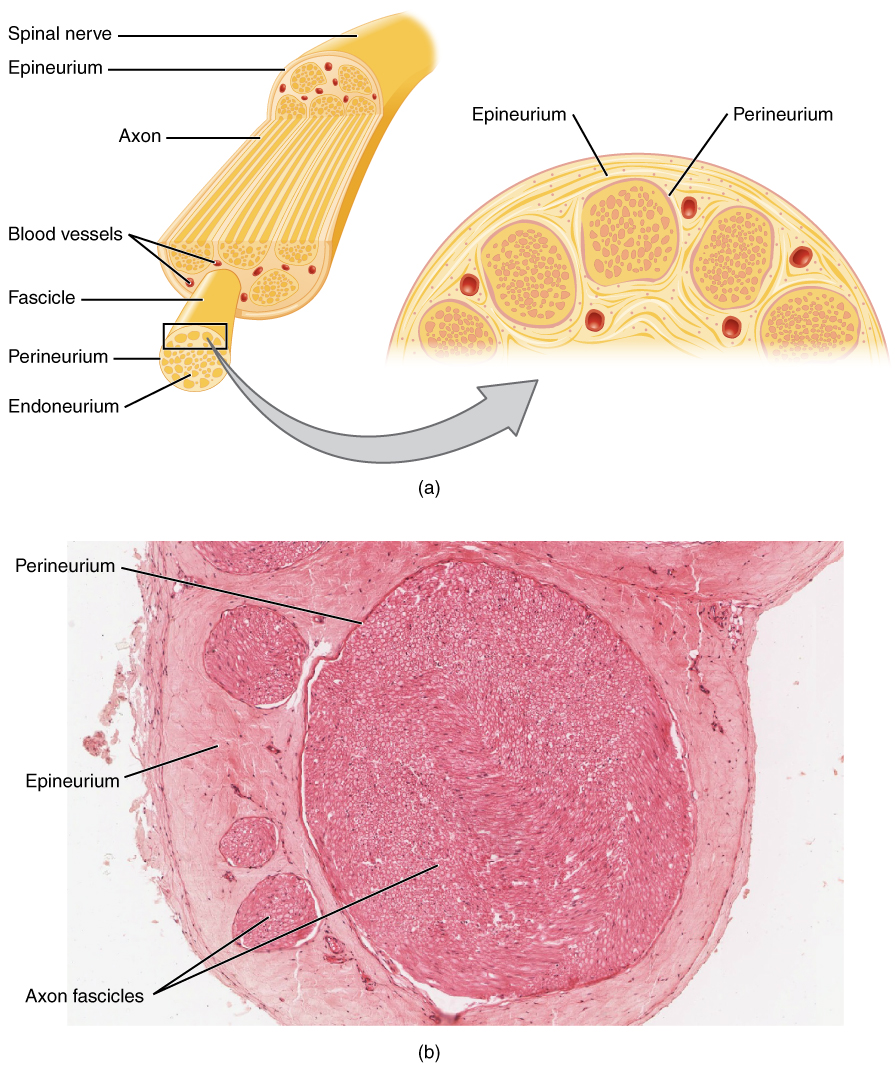
Each axon is surrounded by a layer of connective tissue called the endoneurium. The axons are bundled together into groups called fascicles, and each fascicle is wrapped in a layer of connective tissue called the perineurium. The entire nerve is wrapped in a layer of connective tissue called the epineurium. Nerve cells (often called neurons) are further classified as either sensory or motor.

In the central nervous system, the analogous structures are known as nerve tracts.[1][2]

Structure

[edit]

Each nerve is covered on the outside by a dense sheath of connective tissue, the epineurium. Beneath this is a layer of fat cells, the perineurium, which forms a complete sleeve around a bundle of axons. Perineurial septa extend into the nerve and subdivide it into several bundles of fibres. Surrounding each such fibre is the endoneurium. This forms an unbroken tube from the surface of the spinal cord to the level where the axon synapses with its muscle fibres, or ends in sensory receptors. The endoneurium consists of an inner sleeve of material called the glycocalyx and an outer delicate meshwork of collagen fibres.[2] Nerves are bundled and often travel along with blood vessels, since the neurons of a nerve have fairly high energy requirements.

Within the endoneurium, the individual nerve fibres are surrounded by a low-protein liquid called endoneurial fluid. This acts in a similar way to the cerebrospinal fluid in the central nervous system and constitutes a blood-nerve barrier similar to the blood–brain barrier.[3] Molecules are thereby prevented from crossing the blood into the endoneurial fluid. During the development of nerve edema from nerve irritation (or injury), the amount of endoneurial fluid may increase at the site of irritation. This increase in fluid can be visualized using magnetic resonance (MR) neurography, and thus MR neurography can identify nerve irritation and/or injury.

Categories

[edit]

Nerves are categorized into three groups based on the direction that signals are conducted:

Nerves can be categorized into two groups based on where they connect to the central nervous system:

Terminology

[edit]

Specific terms are used to describe nerves and their actions. A nerve that supplies information to the brain from an area of the body, or controls an action of the body is said to innervate that section of the body or organ. Other terms relate to whether the nerve affects the same side ("ipsilateral") or opposite side ("contralateral") of the body, to the part of the brain that supplies it.

Development

[edit]

Nerve growth normally ends in adolescence but can be re-stimulated with a molecular mechanism known as "notch signaling".[4] If the axons of a neuron are damaged, as long as the cell body of the neuron is not damaged, the axons can regenerate and remake the synaptic connections with neurons with the help of guidepost cells. This is also referred to as neuroregeneration.[5] The nerve begins the process by destroying the nerve distal to the site of injury allowing Schwann cells, basal lamina, and the neurilemma near the injury to begin producing a regeneration tube. Nerve growth factors are produced causing many nerve sprouts to bud. When one of the growth processes finds the regeneration tube, it begins to grow rapidly towards its original destination guided the entire time by the regeneration tube. Nerve regeneration is very slow and can take up to several months to complete. While this process does repair some nerves, there will still be some functional deficit as the repairs are not perfect.[6]

Function

[edit]

A nerve conveys information in the form of electrochemical impulses (as nerve impulses known as action potentials) carried by the individual neurons that make up the nerve. These impulses are extremely fast, with some myelinated neurons conducting at speeds up to 120 m/s. The impulses travel from one neuron to another by crossing a synapse, where the message is converted from electrical to chemical and then back to electrical.[2][1]

Nervous system

[edit]

The nervous system is the part of an animal that coordinates its actions by transmitting signals to and from different parts of its body.[7] In vertebrates it consists of two main parts, the central nervous system (CNS) and the peripheral nervous system (PNS). The CNS consists of the brain and spinal cord. The PNS consists mainly of nerves, which are enclosed bundles of the long fibers or axons, that connect the CNS to all remaining body parts. Nerves that exit from the cranium are called cranial nerves while those exiting from the spinal cord are called spinal nerves.

Clinical significance

[edit]
Micrograph demonstrating perineural invasion of prostate cancer. H&E stain.

Neurologists usually diagnose disorders of nerves by a physical examination, including the testing of reflexes, walking and other directed movements, muscle weakness, proprioception, and the sense of touch. This initial exam can be followed with tests such as nerve conduction study, electromyography (EMG), and computed tomography (CT).[8]

Nerves can be damaged by physical injury as well as conditions like carpal tunnel syndrome (CTS) and repetitive strain injury. Autoimmune diseases such as Guillain–Barré syndrome, neurodegenerative diseases, polyneuropathy, infection, neuritis, diabetes, or failure of the blood vessels surrounding the nerve all cause nerve damage, which can vary in severity. A pinched nerve occurs when pressure is placed on a nerve, usually from swelling due to an injury, or pregnancy and can result in pain, weakness, numbness or paralysis, an example being CTS. Symptoms can be felt in areas far from the actual site of damage, a phenomenon called referred pain. Referred pain can happen when the damage causes altered signalling to other areas.

Cancer can spread by invading the spaces around nerves. This is particularly common in head and neck cancer, prostate cancer and colorectal cancer. Multiple sclerosis is a disease associated with extensive nerve damage. It occurs when the macrophages of an individual's own immune system damage the myelin sheaths that insulate the axon of the nerve.

Other animals

[edit]

A neuron is called identified if it has properties that distinguish it from every other neuron in the same animal—properties such as location, neurotransmitter, gene expression pattern, and connectivity—and if every individual organism belonging to the same species has exactly one neuron with the same set of properties.[9] In vertebrate nervous systems, very few neurons are "identified" in this sense. Researchers believe humans have none—but in simpler nervous systems, some or all neurons may be thus unique.[10]

In vertebrates, the best known identified neurons are the gigantic Mauthner cells of fish.[11]: 38–44  Every fish has two Mauthner cells, located in the bottom part of the brainstem, one on the left side and one on the right. Each Mauthner cell has an axon that crosses over, innervating (stimulating) neurons at the same brain level and then travelling down through the spinal cord, making numerous connections as it goes. The synapses generated by a Mauthner cell are so powerful that a single action potential gives rise to a major behavioral response: within milliseconds the fish curves its body into a C-shape, then straightens, thereby propelling itself rapidly forward. Functionally of this is a fast escape response, triggered most easily by a strong sound wave or pressure wave impinging on the lateral line organ of the fish. Mauthner cells are not the only identified neurons in fish—there are about 20 more types, including pairs of "Mauthner cell analogs" in each spinal segmental nucleus. Although a Mauthner cell is capable of bringing about an escape response all by itself, in the context of ordinary behavior other types of cells usually contribute to shaping the amplitude and direction of the response.

Mauthner cells have been described as command neurons. A command neuron is a special type of identified neuron, defined as a neuron that is capable of driving a specific behavior all by itself.[11]: 112  Such neurons appear most commonly in the fast escape systems of various species—the squid giant axon and squid giant synapse, used for pioneering experiments in neurophysiology because of their enormous size, both participate in the fast escape circuit of the squid. The concept of a command neuron has, however, become controversial, because of studies showing that some neurons that initially appeared to fit the description were really only capable of evoking a response in a limited set of circumstances.[12]

In organisms of radial symmetry, nerve nets serve for the nervous system. There is no brain or centralised head region, and instead there are interconnected neurons spread out in nerve nets. These are found in Cnidaria, Ctenophora and Echinodermata.

History

[edit]

Herophilos (335–280 BC) described the functions of the optic nerve in sight and the oculomotor nerve in eye movement. Analysis of the nerves in the cranium enabled him to differentiate between blood vessels and nerves (Ancient Greek: νεῦρον (neûron) "string, plant fiber, nerve").

Modern research has not confirmed William Cullen's 1785 hypothesis associating mental states with physical nerves,[13] although popular or lay medicine may still invoke "nerves" in diagnosing or blaming any sort of psychological worry or hesitancy, as in the common traditional phrases "my poor nerves",[14] "high-strung", and "nervous breakdown".[15]

See also

[edit]

References

[edit]

Further reading

[edit]
[edit]
Revisions and contributorsEdit on WikipediaRead on Wikipedia
from Grokipedia
A nerve is a cordlike organ of the peripheral nervous system composed of multiple bundles of axons and/or dendrites, along with associated Schwann cells, blood vessels, and three layers of (, , and ), that transmits electrochemical signals known as action potentials between the and the body's peripheral tissues, organs, and systems. Nerves are classified into three main types based on their function and the direction of signal transmission: sensory (afferent) nerves, which carry impulses from sensory receptors toward the ; motor (efferent) nerves, which transmit impulses away from the to effectors such as muscles and glands; and mixed nerves, which contain both sensory and motor fibers and are the most common type in the body. In humans, the peripheral nervous system includes 12 pairs of emerging from the and to primarily innervate the head and , and 31 pairs of arising from the to supply the rest of the body, with each spinal nerve group consisting of 8 cervical, 12 thoracic, 5 , 5 sacral, and 1 coccygeal pair. Structurally, individual nerve fibers (axons or dendrites) are enveloped by the delicate , groups of fibers form fascicles surrounded by the thicker , and the entire nerve is encased by the robust , which also contains larger vessels to nourish the tissue. Functionally, enable essential processes such as sensation (e.g., touch, , ), voluntary and involuntary movement, actions, and regulation of autonomic activities like and through rapid propagation of action potentials at speeds up to 120 meters per second in myelinated fibers. to , known as neuropathy, can result from , , or toxins and may lead to symptoms including numbness, , or , underscoring their critical role in maintaining bodily and coordination.

Anatomy

Gross Structure

A nerve in the peripheral nervous system is defined as a cord-like structure consisting of multiple axons, collectively known as nerve fibers, bundled together and enveloped by successive layers of that provide structural support and protection. These bundles enable coordinated transmission of electrical impulses over distances, forming the pathways that connect the to peripheral tissues. The layers surrounding a nerve are organized hierarchically. The forms the outermost dense, fibrous sheath that encases the entire nerve trunk, containing blood vessels and lymphatics that nourish the nerve. Inside the , axons are grouped into fascicles, each bounded by the , a multilayered that acts as a diffusion barrier and mechanical cushion. Surrounding each individual within a fascicle is the , a thin, delicate layer of that includes fibers, fibroblasts, and endoneurial fluid to maintain the axon's microenvironment. Nerves typically appear as trunks that divide into branches, allowing for targeted innervation of specific body regions; in areas of complex distribution, such as the , multiple nerve roots intertwine to form plexuses like the , which supplies the . Size variations among nerves are substantial, with diameters ranging from under 1 mm for small cutaneous branches to approximately 2 cm for major trunks like the , and lengths extending up to about 1 meter in humans but reaching several meters in large animals such as giraffes. In humans, representative examples include the 31 pairs of spinal nerves, which emerge segmentally from the to innervate the trunk and limbs, and the 12 pairs of , which primarily serve the head and neck.

Microscopic Structure

Nerves at the microscopic level consist primarily of axons, which are elongated projections of neurons specialized for transmitting electrical impulses over long distances. These axons vary in diameter from less than 1 μm to over 20 μm and can extend up to a meter in length in humans. Axons are broadly classified into unmyelinated and myelinated types based on the presence of insulating sheaths. Unmyelinated axons, typically smaller in diameter (0.1–1.5 μm), are enveloped by Schwann cells in the peripheral (PNS) without forming compact layers, allowing multiple axons to share a single Schwann cell's in a mesaxon structure. In contrast, myelinated axons feature a lipid-rich sheath that enhances conduction speed through saltatory propagation. In the PNS, Schwann cells are the primary glial cells responsible for myelination, each associating with a single segment. Myelination occurs as the Schwann cell's plasma membrane spirals around the multiple times (up to 100 layers), compacting to form the multilayered myelin sheath, which consists of approximately 70–80% lipids and 20–30% proteins like myelin basic protein and proteolipid protein. This process begins with the formation of a mesaxon, a double-layered membrane extension that elongates and wraps concentrically, excluding most to create the dense, insulating structure. The myelin sheath interrupts at regular intervals known as nodes of Ranvier, exposing the membrane for clustering that facilitates rapid , where action potentials "jump" between nodes. Myelin thickness typically ranges from 0.1 to 2.5 μm, scaling with diameter to optimize insulation without excessive bulk, while internodal distances in human nerves vary from 100 to 2000 μm, also proportional to axon size for efficient signal propagation. Beyond neurons and Schwann cells, peripheral nerves include supporting connective tissues composed of fibroblasts and components such as . Fibroblasts, mesenchymal-derived cells, synthesize and maintain type I and III fibers that form the structural framework within the , , and , providing mechanical support and tensile strength to withstand deformation. These -rich layers encase axonal bundles, with fibroblasts contributing to the endoneurial matrix that cushions individual axons and facilitates nutrient . The blood-nerve barrier (BNB) regulates the endoneurial microenvironment, preventing uncontrolled exchange between blood and neural tissues. It is formed by the tight junctions of endothelial cells in endoneurial microvessels, combined with the multilayered , which acts as a barrier via its own tight junctions and basement membranes. The endoneurium's and perineurial layers further restrict macromolecular passage, maintaining ionic essential for axonal function, while allowing selective transport of nutrients and ions.

Classification

Nerves are classified according to their functional roles and anatomical origins within the peripheral nervous system (PNS), which consists of bundles of nerve fibers distinct from the tracts found in the (CNS). Functionally, nerves are divided into three main types: sensory (afferent) nerves, which transmit sensory information from peripheral receptors to the CNS; motor (efferent) nerves, which carry motor commands from the CNS to muscles and glands; and mixed nerves, which contain both sensory and motor fibers allowing bidirectional communication. The majority of peripheral nerves in humans are mixed, facilitating integrated sensory-motor functions throughout the body. Anatomically, peripheral nerves are categorized as cranial or spinal based on their points of origin. There are 12 pairs of emerging directly from the or , with varying functional compositions: three are purely sensory (e.g., the , cranial nerve II, which conveys visual information exclusively), five are purely motor, and four are mixed. Spinal nerves, numbering 31 pairs, arise from the and are all mixed, each carrying both sensory and motor fibers; they are segmented into 8 cervical, 12 thoracic, 5 , 5 sacral, and 1 coccygeal pair, reflecting their distribution along the vertebral column. In mixed nerves, the ratio of motor to sensory fibers can vary significantly depending on the nerve's role; for instance, some peripheral nerves contain a higher proportion of motor fibers to support dominant effector functions in specific regions. A specialized subset of peripheral nerves belongs to the autonomic nervous system, which regulates involuntary functions and is divided into sympathetic and parasympathetic branches. The sympathetic nerves originate from the thoracic and lumbar spinal segments, promoting responses such as increased heart rate during stress, while parasympathetic nerves arise from cranial nerves (e.g., III, VII, IX, X) and sacral segments, fostering restorative activities like digestion. These autonomic nerves are primarily efferent but include some afferent components for feedback; a prominent example is the vagus nerve (cranial nerve X), a mixed autonomic nerve that is largely parasympathetic, extending from the brainstem through the thorax and abdomen to innervate organs like the heart and gut, with approximately 80% afferent fibers and 20% efferent fibers.

Development

Embryonic Formation

The embryonic formation of nerves begins with the development of the (CNS) through , a process where the differentiates into to form the . This occurs during the third and fourth weeks of human gestation, when signals from the underlying induce the ectodermal cells to thicken and fold, eventually closing to create the —the precursor to the and . The neural tube's formation establishes the foundational architecture for CNS nerves, with the anterior region developing into the and the posterior into the . In parallel, the peripheral nervous system (PNS) arises primarily from neural crest cells, a transient population that delaminates from the dorsal neural tube during weeks 4 to 8 of embryonic development. These multipotent cells undergo an epithelial-to-mesenchymal transition and migrate extensively along defined pathways to populate peripheral sites, differentiating into sensory neurons, autonomic neurons, Schwann cells, and other glia that form ganglia and nerve trunks. The vast majority of PNS neurons, including those in sensory and autonomic ganglia, originate from these neural crest derivatives, with only a small subset from other sources like placodes. A key example is the formation of dorsal root ganglia (DRG), where neural crest cells coalesce adjacent to the neural tube around weeks 4 to 5, aggregating into segmental clusters that give rise to sensory neuron cell bodies. Axon outgrowth and guidance during this period are directed by chemotactic cues, such as netrins and semaphorins, which create gradients that attract or repel growing axons to establish precise connections. Netrins, secreted from the ventral midline, promote attractive guidance for commissural axons crossing the floor plate, while semaphorins act as repellents to prevent inappropriate pathfinding. These molecular mechanisms ensure the segmental organization of emerging nerves. Additionally, Hox genes play a critical role in patterning this process, providing anteroposterior identity to neural crest cells and axons, thereby coordinating the segmental alignment of PNS structures with the developing somites and vertebrae.

Maturation and Growth

Following the initial formation of neural structures during embryogenesis, nerve maturation involves the progressive refinement of axons, dendrites, and synaptic connections, alongside the establishment of insulating sheaths to optimize signal transmission. Myelination, the process by which in the and Schwann cells in the peripheral wrap axons with , begins in the late fetal period, specifically around the fifth month of gestation for motor roots in humans, and continues extensively postnatally. This timeline aligns with the second trimester onset for broader myelination, which primarily occurs between gestation and the early postnatal years. In humans, the achieves near-complete myelination by the end of the second year of life, though some refinement persists into and adulthood. Synaptogenesis, the formation of synapses between neurons, peaks during early postnatal development, establishing an overabundant network of connections that must be refined for efficient circuit function. This overproduction is followed by , a selective elimination process that removes excess synapses and axons, often through , to sculpt mature neural circuits. plays a pivotal role in this refinement, targeting exuberant neuronal branches and weak connections to enhance specificity and efficiency in the developing . is activity-dependent and region-specific, with sensory and motor areas undergoing significant fine-tuning in the postnatal period to match environmental demands. In the peripheral nervous system, nerve growth continues postnatally to accommodate body elongation, with extending through mechanisms like stretch-induced growth during limb development. This elongation is mediated by axonal stretching and signaling pathways, such as YAP activation, which coordinates sheath adaptation to longer . The rate of peripheral extension during such growth mirrors regenerative processes, reaching up to 1 mm per day, limited by the slow transport of cytoskeletal components. Hormonal factors, particularly , exert significant influence on these maturation processes by accelerating differentiation and deposition. hormone administration promotes the maturation of myelin-forming cells, countering delays seen in and enhancing overall myelination speed. s mark windows of heightened plasticity for development, during which experience shapes circuit maturation; for instance, the in humans exhibits a extending to approximately age 7, after which disruptions like deprivation have reduced impact on acuity and contrast sensitivity. These periods ensure that integrate environmental inputs optimally, with closure around this age reflecting the stabilization of cortical connections.

Physiology

Impulse Conduction

Nerve impulse conduction relies on the generation and propagation of action potentials along axons, driven by voltage-gated ion channels that respond to changes in . When a is stimulated to threshold, typically around -55 mV, voltage-gated sodium (Na⁺) channels open rapidly, allowing Na⁺ ions to influx down their , causing of the toward the Na⁺ equilibrium potential of approximately +60 mV. This influx is followed by inactivation of Na⁺ channels and activation of voltage-gated (K⁺) channels, leading to K⁺ efflux that repolarizes the back toward the K⁺ equilibrium potential of about -90 mV. The action potential follows an all-or-none , meaning once threshold is reached, the response is invariant in amplitude and duration regardless of stimulus strength, ensuring reliable . The electrochemical gradients underlying these ion movements are quantified by the , which calculates the equilibrium potential EE for a specific across the : E=RTzFln([ion]out[ion]in)E = \frac{RT}{zF} \ln \left( \frac{[\text{ion}]_{\text{out}}}{[\text{ion}]_{\text{in}}} \right) where RR is the , TT is in , zz is the ion's valence, and FF is Faraday's constant. This equation derives from balancing the difference (due to concentration gradient) against the electrical potential difference at equilibrium, where the diffusive force equals the electrostatic force on the ; for a monovalent cation like Na⁺, no net flux occurs when the matches ENaE_{\text{Na}}. In unmyelinated fibers, action potentials propagate continuously along the through local circuit currents, depolarizing adjacent segments sequentially at speeds of 0.5–2 m/s, typical for small-diameter C fibers involved in pain transmission. In contrast, myelinated fibers exhibit , where the sheath insulates internodal segments, restricting ion flux to unmyelinated nodes of Ranvier and allowing the action potential to "jump" between nodes via passive current spread, achieving velocities up to 120 m/s in large-diameter A fibers. Conduction velocity is influenced primarily by axon diameter and degree of myelination; larger diameters reduce internal resistance, increasing speed proportionally (velocity ∝ √diameter in unmyelinated axons, linearly in myelinated), while thicker myelin enhances insulation and capacitance reduction, further accelerating propagation.

Neural Integration

Neural integration encompasses the ways in which peripheral nerves facilitate the synthesis of sensory inputs and motor outputs to coordinate bodily responses. A primary mechanism is the reflex arc, where sensory nerves detect peripheral stimuli and relay afferent signals directly to the spinal cord for immediate processing and motor activation, bypassing higher brain centers for speed. In the knee-jerk reflex, for instance, mechanical stretch of the quadriceps tendon activates Ia afferent fibers in muscle spindles, which synapse monosynaptically with alpha motor neurons in the spinal cord, triggering efferent signals that contract the quadriceps and extend the leg. This spinal-level integration ensures rapid, protective responses to environmental changes. Peripheral nerves further contribute to central processing by serving as the primary conduits for bidirectional communication between the body and the (CNS). Afferent peripheral fibers transmit sensory information from receptors in , muscles, and organs to the and , where it is integrated with other inputs to inform and . Efferent peripheral nerves, in turn, carry processed CNS commands to effectors like muscles and glands, enabling coordinated actions. This relaying function is essential for the CNS to maintain awareness of bodily states and execute adaptive behaviors. In the , peripheral nerves integrate involuntary functions through the antagonistic actions of sympathetic and parasympathetic divisions, which together regulate . Sympathetic nerves, originating from the thoracolumbar , mediate fight-or-flight responses by releasing norepinephrine to accelerate , dilate pupils, and redirect blood to skeletal muscles during stress. Conversely, parasympathetic nerves, arising from craniosacral regions, promote rest-and-digest activities via , slowing , enhancing , and conserving energy. Their integrated balance prevents physiological extremes and supports overall coordination. Key concepts in this integration include convergence and , which amplify and refine at spinal levels. Convergence occurs when multiple afferent inputs from peripheral sensory nerves summate onto a single or in the , heightening sensitivity to weak or distributed stimuli, as seen in polysynaptic pathways. , by contrast, enables one presynaptic to excite numerous postsynaptic neurons, spreading a localized input to coordinate widespread motor responses, such as in extensor muscle groups during locomotion. These patterns allow efficient transformation of peripheral signals into orchestrated outputs. Feedback loops involving proprioceptive nerves are vital for precise muscle control and ongoing integration. Proprioceptors, including muscle spindles and Golgi organs embedded in peripheral nerves, continuously relay information about muscle length, tension, and joint position to the and , forming closed-loop circuits that adjust motor commands in real time. For example, during voluntary movement, spindle afferents detect stretch and trigger contractions to stabilize limbs, while organs inhibit excessive force to prevent overload, ensuring smooth and accurate coordination. This sensory feedback refines central motor planning and maintains postural stability.

Clinical Aspects

Injuries and Repair

Peripheral nerve injuries are classified into three main types based on the Seddon system: , , and . represents the mildest form, involving a temporary conduction block due to focal demyelination or compression without axonal disruption, allowing full recovery within weeks to months as remyelination occurs. involves disruption of axons and their surrounding while preserving the and , leading to but potential for spontaneous regeneration if the supportive structures remain intact. is the most severe, characterized by complete severance of the nerve trunk, including all supporting connective tissues, resulting in no spontaneous recovery without surgical intervention. Following axonal injury in or , occurs in the distal segment of the nerve, where the and sheath break down due to loss of trophic support from the neuronal cell body. This process typically begins 24-48 hours after injury, progressing over days to weeks with infiltration clearing , which is essential for subsequent regeneration. In the peripheral nervous system (PNS), regeneration is possible after , with axons sprouting from the proximal stump and advancing via growth cones—dynamic, actin-rich structures at the axon tip that sense the environment and guide elongation along residual endoneurial tubes. The growth rate in humans is approximately 1-3 mm per day, influenced by factors such as age, injury site, and supportive Schwann cells that provide . Surgical interventions are crucial for and significant gaps in to optimize outcomes. End-to-end suturing is preferred for clean, sharp cuts with minimal tension, involving microsurgical approximation of nerve ends to align fascicles and promote accurate regrowth. For defects exceeding 1-2 cm where direct suturing would cause excessive tension, autologous nerve grafts—typically from the —are used to bridge the gap, providing a scaffold for axonal extension, though donor site morbidity is a consideration. Recovery outcomes vary widely, with approximately 50% of patients achieving useful sensory or motor function in major nerve repairs, though results are generally better for clean lacerations repaired early and poorer for mixed or proximal injuries due to misdirected sprouting and . Emerging therapies as of 2025 include processed nerve allografts, mesenchymal stem cell-based approaches, and bioengineered conductive scaffolds, which show promising results in clinical trials for improving regeneration across larger gaps and reducing complications. In contrast, (CNS) injuries, such as trauma, exhibit limited regeneration due to inhibitory molecules like Nogo-A, a myelin-associated protein that binds to receptors on axons, suppressing advance and promoting collapse. This results in scar formation and persistent functional deficits, unlike the more permissive PNS environment.

Disorders and Diseases

Peripheral neuropathies encompass a range of disorders damaging peripheral nerves, often leading to sensory, motor, or autonomic dysfunction. These conditions can arise from metabolic disturbances, such as , or toxic exposures, including alcohol and certain chemicals. Diabetic peripheral neuropathy, the most prevalent form, affects approximately 50% of individuals with over time, primarily due to prolonged damaging nerve fibers. Common symptoms include numbness, tingling, burning pain, and weakness, particularly in the extremities, which can progress to balance issues and increased fall risk. Guillain-Barré syndrome (GBS) is an acute autoimmune disorder characterized by rapid demyelination of peripheral nerves, often triggered by infections. It has an incidence of 1 to 2 cases per 100,000 people annually, with symptoms escalating from mild weakness to severe paralysis within days to weeks. Early signs include symmetrical ascending , , and potential respiratory involvement requiring ventilation in about 25% of cases. Compression syndromes involve mechanical entrapment of nerves, with serving as a prominent example where the is compressed in the wrist's . This condition, often linked to repetitive hand use or conditions like , manifests as numbness, tingling, and weakness in the thumb, index, middle, and part of the ring finger. Management of these disorders typically includes symptom relief and addressing underlying causes. For peripheral neuropathies, analgesics such as or alleviate , while enhances strength, balance, and mobility. In GBS, immunomodulatory therapies like intravenous immunoglobulin (IVIG) at 2 g/kg over 5 days reduce immune-mediated damage and hasten recovery. Certain diseases can also involve peripheral nerves; for instance, although primarily targets central , it can directly affect peripheral nerves, leading to demyelination and dysfunction. Similarly, (ALS) features progressive degeneration of motor neurons, disrupting peripheral nerve function and causing and weakness.

Comparative Biology

Invertebrate Nerves

Invertebrate nervous systems exhibit diverse organizations that reflect early evolutionary adaptations for sensory-motor coordination, often lacking the centralized structures seen in more complex animals. In basal invertebrates like cnidarians, such as (), the consists of a simple composed of interconnected neurons distributed across the body, enabling diffuse signal conduction without a centralized or nerve cord. This facilitates coordinated behaviors like swimming through bell contractions, where electrical signals propagate slowly and non-directionally via bidirectional pathways, optimizing for broad coverage rather than speed. In scyphozoan such as , these nets activate muscles for propulsion by ejecting water, demonstrating a primitive form of neural integration suited to radial symmetry and environmental responsiveness. More advanced invertebrates, including annelids and arthropods, feature ganglia-based systems organized around a ventral nerve cord, representing a step toward segmentation and regional specialization. In annelids like earthworms, the ventral nerve cord runs along the body underside, punctuated by paired segmental ganglia that process local sensory input and coordinate , with a dorsal cerebral ganglion acting as a rudimentary . Arthropods, such as and crustaceans, share this ladder-like architecture, where the ventral cord connects segmental ganglia to integrate reflexes across body segments, enabling adaptive behaviors like walking or evasion. This configuration evolved convergently in these phyla, highlighting how decentralized processing supports modular body plans. Most invertebrate nerves lack myelination, relying instead on uninsulated axons for conduction, which typically results in slower impulse compared to insulated systems. Electrical signaling often occurs via gap junctions, forming electrical synapses that allow direct flow between neurons, facilitating rapid, synchronized activity in networks like those in cnidarians or annelids. A notable exception is the , an unmyelinated fiber up to 1 mm in diameter that achieves fast conduction speeds of 10–25 m/s to mediate escape responses, such as , by minimizing through sheer size. These mechanisms underscore the of structural adaptations in unmyelinated systems for survival-critical functions. Invertebrate nerves represent evolutionary precursors to the vertebrate , diverging over approximately 500 million years since the when bilaterian lineages began to diversify. This ancient foundation, seen in the nerve nets and cords of early metazoans, laid the groundwork for more elaborate neural architectures while retaining simplicity in non-chordate lineages.

Vertebrate Variations

In vertebrates, nerve structure and function exhibit significant variations across classes, reflecting adaptations to diverse environments, body plans, and metabolic strategies. These differences primarily manifest in myelination patterns, conduction velocities, and specialized sensory nerves, which optimize neural signaling for in aquatic, terrestrial, or aerial habitats. Myelination, the formation of insulating layers around axons by glial cells, evolved in jawed vertebrates to enhance impulse speed via , but its extent and thickness vary phylogenetically. In , many peripheral nerves contain a mix of myelinated and unmyelinated axons, with unmyelinated fibers predominant in finer sensory branches to maintain structural flexibility in flexible aquatic bodies. This configuration supports rapid bending during swimming without compromising nerve integrity. A notable specialization is the system, comprising neuromasts innervated by that detect mechanoreceptive water movements for and prey detection in aquatic environments. These nerves often feature thin, partially myelinated or unmyelinated axons suited to low-speed, localized signaling in variable underwater currents. Amphibians and reptiles, as poikilotherms, display partial myelination in peripheral and central , with thinner sheaths compared to higher vertebrates, enabling to fluctuating environmental temperatures. in these groups is highly temperature-sensitive, decreasing linearly with cooling due to reduced kinetics and , which can slow impulses by up to 50% across a 10°C drop. Compensatory mechanisms, such as acclimation-induced changes in composition, partially mitigate this by stabilizing conduction rates over seasonal temperature shifts. In reptiles, cutaneous sensory show diverse myelination degrees, from unmyelinated C-fibers for thermosensation to thinly myelinated Aδ-fibers, supporting temperature-dependent behaviors like basking. Birds and mammals, as endotherms, possess thicker myelin sheaths that facilitate high-speed , with velocities reaching 100-150 m/s in large-diameter axons, far exceeding the 1-10 m/s in unmyelinated nerves. This insulation minimizes energy loss and supports rapid neural processing essential for active lifestyles. Both groups typically have 12 pairs of , enabling complex sensory-motor integration, though avian nerves show adaptations for lightweight structures in flight. Specific anatomical variations highlight evolutionary constraints and specializations. In giraffes, the , a branch of the vagus (cranial nerve X), follows a 4-5 meter detour looping into the chest before ascending to the , an inefficiency inherited from fish-like ancestors where the nerve path was shorter. This is compensated by larger, heavily myelinated fibers for sustained conduction despite the length. In bats, nerves involved in echolocation, such as those in the auditory pathway and laryngeal motor system, exhibit molecular adaptations for ultrasonic processing, including enhanced expression of ion channels tuned to high-frequency echoes (up to 200 kHz), enabling precise prey localization in darkness. Overall, nerve adaptations emphasize insulation differences between endotherms and poikilotherms: endotherms rely on thick, stable for consistent high-speed conduction at fixed body temperatures (~37°C), while poikilotherms feature thinner, more plastic sheaths that acclimate to temperature variations (5-35°C), prioritizing flexibility over to conserve in variable regimes. These variations underscore the evolutionary trade-offs in neural efficiency across lineages.

History

Ancient and Medieval Views

In , during the 5th century BCE, and his followers in the first identified nerves as distinct anatomical structures, viewing them as hollow channels or vessels that conveyed sensations from the periphery to the brain and transmitted commands for motion from the brain to the muscles. This conceptualization positioned the brain as the central organ of intelligence and control, with nerves serving as conduits for , an ethereal air-like substance believed to enable perception and voluntary movement, though the term "animal spirits" for this vital force became more explicitly associated with later thinkers. In the 3rd century BCE, Herophilus and of further advanced the understanding of nerves through systematic dissections, including of human cadavers. Herophilus distinguished nerves from blood vessels and tendons, identified several (such as the optic and oculomotor), and differentiated sensory nerves (leading to the brain) from motor nerves (originating from the brain). contributed to the functional distinction of nerves and explored their role in sensation and movement. Building on these ideas in the CE, the Roman physician advanced through extensive vivisections on animals such as pigs, oxen, and apes, as dissections were restricted by ethical and cultural taboos that deemed the mutilation of corpses impious. distinguished between sensory nerves, which he described as soft and tubular to carry sensations to the , and motor nerves, which he characterized as harder and more solid to transmit impulses from the to muscles for movement. Central to his theory was the concept of , refined into three types—natural from the liver for nutrition, vital from the heart for life force, and animal (or psychic ) produced in the 's ventricles to flow through the hollow nerves, animating sensation, thought, and action. Through experiments, such as ligating nerves in living animals to observe loss of function, demonstrated the 's role in controlling voice via the , a branch of the vagus that he traced looping under the before returning to the —though his description, based on animal models, inaccurately generalized the path and persisted as an authoritative but flawed model until the . During the medieval period, particularly in the Islamic world from the 9th to 12th centuries, scholars preserved and expanded Galenic amid continued ethical constraints on , relying instead on vivisections and textual to nerve pathways. (Ibn Sina), in his 11th-century , a foundational text that synthesized Greek, Persian, and Indian knowledge, detailed the central nervous system's structure, including the brain's ventricles as sites of spirit production and the spinal cord's role in distributing to the body for sensory and motor functions. He described peripheral nerve disorders, attributing them to humoral imbalances like excessive dryness causing anger-related nerve stiffness, and innovated early concepts for surgical repair of severed by aligning and suturing ends to restore continuity. These contributions, disseminated through translations, influenced European medicine while underscoring the era's dependence on non-human models due to religious prohibitions against desecrating remains.

Modern Discoveries

In 1543, published De Humani Corporis Fabrica, which featured highly accurate illustrations of the based on direct dissections, marking a pivotal shift toward empirical and correcting many Galenic errors in nerve depiction. During the 1820s, and François Magendie independently established the law distinguishing the functions of spinal nerve roots, demonstrating that dorsal roots primarily transmit sensory information while ventral roots convey motor signals, a discovery confirmed through experiments on animals. In 1850, Augustus Waller described the process of axonal degeneration following nerve injury, observing the fragmentation and dissolution of myelin sheaths distal to the lesion site in hypoglossal nerves of frogs and rabbits, now termed Wallerian degeneration. The Hodgkin-Huxley model, developed in 1952 by Alan Hodgkin and Andrew Huxley, provided the first quantitative explanation of action potential generation in the squid giant axon, modeling ionic currents through voltage-gated sodium and potassium channels; this work earned them the 1963 Nobel Prize in Physiology or Medicine shared with John Eccles. The model is encapsulated in the following core equations for membrane current and gating dynamics: CmdVdt=IgˉKn4(VEK)gˉNam3h(VENa)gL(VEL)C_m \frac{dV}{dt} = I - \bar{g}_K n^4 (V - E_K) - \bar{g}_{Na} m^3 h (V - E_{Na}) - g_L (V - E_L) where VV is the , II is the applied current, CmC_m is , gˉ\bar{g} terms are maximum conductances, EE terms are reversal potentials, and mm, hh, nn are gating variables obeying: dxdt=αx(1x)βxx(x=m,h,n)\frac{dx}{dt} = \alpha_x (1 - x) - \beta_x x \quad (x = m, h, n) with voltage-dependent rate constants αx\alpha_x and βx\beta_x. In the post-2000 era, optogenetics emerged as a transformative technique for precise nerve control, enabling light-mediated activation or inhibition of neurons via genetically encoded opsins, with initial demonstrations in mammalian peripheral nerves around 2012 facilitating studies of pain pathways and motor function. Concurrently, therapies have advanced peripheral nerve repair, particularly mesenchymal s from or , which secrete to promote axonal regrowth in preclinical models of nerve gaps, with clinical trials in the showing improved functional recovery in peripheral nerve injuries.

References

Add your contribution
Related Hubs
User Avatar
No comments yet.