Respect all members: no insults, harassment, or hate speech.
Be tolerant of different viewpoints, cultures, and beliefs. If you do not agree with others, just create separate note, article or collection.
Clearly distinguish between personal opinion and fact.
Verify facts before posting, especially when writing about history, science, or statistics.
Promotional content must be published on the “Related Services and Products” page—no more than one paragraph per service. You can also create subpages under the “Related Services and Products” page and publish longer promotional text there.
Do not post materials that infringe on copyright without permission.
Always credit sources when sharing information, quotes, or media.
Be respectful of the work of others when making changes.
Discuss major edits instead of removing others' contributions without reason.
If you notice rule-breaking, notify community about it in talks.
Do not share personal data of others without their consent.
A martyr (Greek: μάρτυς, mártys, 'witness' stemμαρτυρ-, martyr-) is someone who suffers persecution and death for advocating, renouncing, or refusing to renounce or advocate, a religious belief or other cause as demanded by an external party. In colloquial usage, the term can also refer to any person who suffers a significant consequence in protest or support of a cause.
In the martyrdom narrative of the remembering community, this refusal to comply with the presented demands results in the punishment or execution of an individual by an oppressor. Accordingly, the status of the 'martyr' can be considered a posthumous title as a reward for those who are considered worthy of the concept of martyrdom by the living, regardless of any attempts by the deceased to control how they will be remembered in advance.[1] Insofar, the martyr is a relational figure of a society's boundary work that is produced by collective memory.[2] Originally applied only to those who suffered for their religious beliefs, the term has come to be used in connection with people killed for a political cause.
Most martyrs are considered holy or are respected by their followers, becoming symbols of exceptional leadership and heroism in the face of difficult circumstances. Martyrs play significant roles in religions. Similarly, martyrs have had notable effects in secular life, including such figures as Socrates, among other political and cultural examples.
Charles I is regarded by many members of the Church of England as a martyr because, it is said,[3] he was offered his life if he would abandon the historic episcopacy in the Church of England. It is said he refused, however, believing that the Church of England was truly "Catholic" and should maintain the Catholic episcopate.
In its original meaning, the word martyr, meaning witness, was used in the secular sphere as well as in the New Testament of the Bible.[4] The process of bearing witness was not intended to lead to the death of the witness, although it is known from ancient writers (e.g., Josephus) and from the New Testament that witnesses often died for their testimonies.
During the early Christian centuries, the term acquired the extended meaning of believers who are called to witness for their religious belief, and on account of this witness, endure suffering or death. The term, in this later sense, entered the English language as a loanword. The death of a martyr or the value attributed to it is called martyrdom.
The early Christians who first began to use the term martyr in its new sense saw Jesus as the first and greatest martyr, on account of his crucifixion.[5][6][7] The early Christians appear to have seen Jesus as the archetypal martyr.[8]
The word martyr is used in English to describe a wide variety of people. However, the following table presents a general outline of common features present in stereotypical martyrdoms.
A female martyr may rarely be referred to as a martyress.[9][10]
In contemporary Middle Eastern cultures, the term for 'martyr’ (Arabic shahid) has more uses than the English word ‘martyr’.[12]
While the term can be narrowly used for a person who is killed because of their religion, it is more generally used to mean a person who died a violent death. Thus it can arguably mean a general ‘victim’.[13]
A person is a martyr if they were killed because of their identity, because of natural disasters like earthquakes,[14] or while performing relief or health care work. For example, İbrahim Bilgen was killed by Israel in the 2010 Gaza flotilla raid. Because he died as a humantiarian activist, he is called a martyr by Al-Jazeera.[15]
Martyrdom is also tied with nationalism, because a martyr can be a person who died in the context of national struggle.[16] For example, in Beirut, Martyrs' Square is a public square that's dedicated to Lebanese nationalists who were executed by the Ottomans.
In Palestine, the word ‘martyr’ is traditionally used to mean a person killed by Israeli forces, regardless of religion.[17][18] For example, Shireen Abu Akleh was a Palestinian Christian journalist who was killed by Israeli forces, and Arabic media calls her a ‘martyr’.[19] This reflects a communal belief that every Palestinian death is part of a resistance against Israeli occupation.[20] Children are likewise called martyrs, such as the children of journalist Wael Al-Dahdouh who were killed in an Israeli airstrike.[21]
The label of martyrdom is used as a form of memoralizing the dead within some narrative, such as how the victims of the 2020 Beirut explosion were called ‘martyrs of corruption’ as a form of protest against the government.[22]
The wide usage of ‘martyr’ is not restricted to Arabic. Armenian culture likewise uses the term for the victims of the Armenian genocide, who are called Holy Martyrs.[23] April 24 is Armenian Genocide Memorial Day, and also called "Armenian Martyrs Day".[24]
Martyrdom was extensively promoted by the Tongmenghui and the Kuomintang party in modern China. Revolutionaries who died fighting against the Qing dynasty in the Xinhai Revolution and throughout the Republic of China period, furthering the cause of the revolution, were recognized as martyrs.[citation needed]
According to Stephen Knapp,[who?] despite the promotion of ahimsa (non-violence) within Sanatana Dharma, and there being no concept of martyrdom,[25] there is the belief of righteous duty (dharma), where violence is used as a last resort to resolution after all other means have failed. Examples of this are found in the Mahabharata. Upon completion of their exile, the Pandavas were refused the return of their portion of the kingdom by their cousin Duryodhana; and following which all means of peace talks by Krishna, Vidura and Sanjaya failed. During the great war which commenced, even Arjuna was brought down with doubts, e.g., attachment, sorrow, fear. This is where Krishna instructs Arjuna in the Bhagavad Gita how to carry out his duty as a righteous warrior and fight.[citation needed]
Martyrdom (called shahadat in Punjabi) is a fundamental concept in Sikhism and represents an important institution of the faith. Sikhs believe in Ibaadat se Shahadat (from love to martyrdom). Some famous Sikh martyrs include:[26]
Guru Arjan, the fifth leader of Sikhism. Guru ji was brutally tortured for almost 5 days before he attained shaheedi, or martyrdom.
Guru Tegh Bahadur, the ninth guru of Sikhism, martyred on 11 November 1675. He is also known as Dharam Di Chadar (i.e. "the shield of Religion"), suggesting that to save Hinduism, the guru gave his life.
Bhai Dayala is one of the Sikhs who was martyred at Chandni Chowk at Delhi in November 1675 due to his refusal to accept Islam.
Bhai Mati Das is considered by some one of the greatest martyrs in Sikh history, martyred at Chandni Chowk at Delhi in November 1675 to save Hindu Brahmins.
Bhai Sati Das is also considered by some one of the greatest martyrs in Sikh history, martyred along with Guru Teg Bahadur at Chandni Chowk at Delhi in November 1675 to save kashmiri pandits.
There are times that the Hebrew Bible records that the Israelites, the ancestors of the Jews, are instructed to wage war against their enemies in the Bible sometimes as instructed by God or their leaders or both. Examples are wars against Amalek and the Seven Nations. Such wars are known as Milkhemet Mitzvah ("war by commandment" in Hebrew, or "Holy War") and any Israelite or Jew who is killed in the course of fighting for the cause is automatically regarded as having died al Kiddush Hashem ("for Sanctifying God's Name") and is hence a Jewish martyr.[28]
In Christianity, a martyr, in accordance with the meaning of the original Greek term martys in the New Testament, is one who brings a testimony, usually written or verbal. In particular, the testimony is that of the Christian Gospel, or more generally, the Word of God. A Christian witness is a biblical witness whether or not death follows.[29]
The concept of Jesus as a martyr has recently received greater attention. Analyses of the Passion narratives in the Gospels have led many scholars to conclude that they are martyrdom accounts in terms of genre and style.[30][31][32] Several scholars have also concluded that Paul the Apostle understood Jesus' death as a martyrdom.[33][34][35][36][37][38] In light of such conclusions, some have argued that the early Christians of the first three centuries would have interpreted the crucifixion of Jesus as a martyrdom.[8][39]
In the context of church history, from the time of the persecution of early Christians in the Roman Empire under the Julio-Claudian dynasty, it developed that a martyr was one who was killed for maintaining a religious belief, knowing that this will almost certainly result in imminent death (though without intentionally seeking death). This definition of martyr is not specifically restricted to the Christian faith. Christianity recognizes certain Old Testament Jewish figures, like Abel and the Maccabees, as holy, and the New Testament mentions the imprisonment and beheading of John the Baptist, Jesus's possible cousin and his prophet and forerunner. The first Christian witness, after the establishment of the Christian faith at Pentecost, to be killed for his testimony was Saint Stephen (whose name means "crown"), and those who suffer martyrdom are said to have been "crowned". From the time of the Roman Emperor Constantine, Christianity was decriminalized, and then, under Theodosius I, became the state religion, which greatly diminished persecution (although not for non-Nicene Christians). As some wondered how then they could most closely follow Christ there was a development of desert spirituality characterized by a eremitic lifestyle, renunciation, self-mortification, and separation from the world, practiced by several desert monks and Christian ascetics in late antiquity (such as Paul the Hermit and Anthony the Great). This was a kind of white martyrdom, dying to oneself every day, as opposed to a red martyrdom, the giving of one's life in a violent death.[40]
Jan Luyken's drawing of the AnabaptistAnna Utenhoven being buried alive at Vilvoorde (present-day Belgium) in 1597. In the engraving, her head is still above the ground and the Catholic priest is exhorting her to recant her faith, while the executioner stands ready to completely cover her up upon her refusal. This engraving was part of a major Protestant outrage praising Utenhoven as a martyr.[citation needed]
Even more modern day accounts of martyrdom for Christ exist, depicted in books such as Jesus Freaks, though the numbers are disputed. The claim that 100,000 Christians are killed for their faith annually is greatly exaggerated according to the BBC, with many of those deaths due to war,[42] but the fact of ongoing Christian martyrdoms remains undisputed.[43][44][45][46]
Shahid is an Arabic term in Islam meaning "witness", and is also used to denote a martyr; a female martyr is named shahida. The term Shahid occurs frequently in the Quran in the generic sense "witness", but only once in the sense "martyr, one who dies for his faith"; this latter sense acquires wider use in the ḥadīth literature. Islam views a martyr as a man or woman who dies while conducting jihad, whether on or off the battlefield (see greater jihad and lesser jihad).[47]
The concept of martyrdom in Islam became prominent during the Islamic Revolution in Iran (1979) and the subsequent Iran–Iraq War (1980–1988), so that the cult of the martyr had a lasting impact on the course of revolution and war.[48] Since the early 2000s, it has been primarily associated with Islamic extremism and jihadism.[49]
In the Baháʼí Faith, martyrs are those who sacrifice their lives serving humanity in the name of God.[50] However, Bahá'u'lláh, the founder of the Baháʼí Faith, discouraged the literal meaning of sacrificing one's life. Instead, he explained that martyrdom is devoting oneself to service to humanity.[50]
1675 – Guru Tegh Bahadur, the ninth guru of Sikhism, referred to as "Hind di Chadar" or "Shield of India" martyred in defense of religious freedom of Hindus.
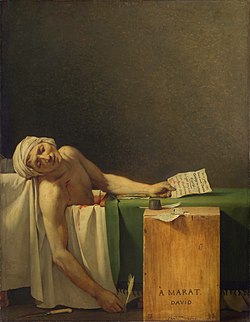
In politics, a martyr is someone who suffers persecution and/or death for advocating, renouncing, refusing to renounce, and/or refusing to advocate a political belief or cause.
The leaders of the 1916 Easter Rising were executed for organising an armed insurrection in Ireland during Easter Week in April 1916. A series of courts martial began on 2 May, in which 187 people were tried. Controversially, Maxwell decided that the courts martial would be held in secret and without a defence, which Crown law officers later ruled to have been illegal.[52][53] Ninety were sentenced to death. Fifteen of those (including all seven signatories of the Proclamation of Independence ) had their sentences confirmed by Maxwell and fourteen were executed by firing squad at Kilmainham Gaol between 3 and 12 May.[54][1].
The Manchester Martyrs were three Irishmen executed after being convicted for the murder of a Manchester City Police officer in 1867. The day after the executions, Frederick Engels wrote to Karl Marx: "Yesterday morning the Tories, by the hand of Mr Calcraft, accomplished the final act of separation between England and Ireland. The only thing that the Fenians still lacked were martyrs. ... To my knowledge, the only time that anybody has been executed for a similar matter in a civilised country was the case of John Brown at Harpers Ferry. The Fenians could not have wished for a better precedent."[55] Ten Irish Republican Army members died during a 1981 hunger strike, including Bobby Sands.
The Belfiore martyrs (in Italian, Martiri di Belfiore) were a group of Italian pro-independence fighters condemned to death by hanging in 1853 during the Italian Risorgimento. They included Tito Speri and the priest Enrico Tazzoli and are named after the site where the sentence was carried out, in the valley of Belfiore at the south entrance to Mantua.
The Tolpuddle Martyrs were a group of 19th century agricultural labourers in Dorset, England, who were arrested for and convicted of swearing a secret oath as members of the Friendly Society of Agricultural Labourers. The rules of the society showed it was clearly structured as a friendly society, that is, a mutual association for the purposes of insurance, pensions, savings or cooperative banking; and it operated as a trade-specific benefit society. But at the time, friendly societies had strong elements of what are now considered to be the principal role of trade unions, and wages were at issue. The Tolpuddle Martyrs were sentenced not to death but to transportation to Australia, a harsh form of exile.[56]
Many communist activists have died as martyrs in India, due to their allegiance to various communist parties, such as the CPI(M) and the CPI. Most of them hail from mainly leftist states such as Kerala, and Tripura. In Kerala, many are killed in protests by the police, and some are assassinated by activists in other political parties, such as the INC and the RSS. The district of Kannur has reported to have had the most political murders. Here, the RSS are known to have used brutal violence to eliminate CPI(M) workers.
A political martyr is someone who suffers persecution or death for advocating, renouncing, refusing to renounce, or refusing to advocate a political belief or cause.
1835 – King Hintsa kaKhawuta, a Xhosa monarch who was shot and killed while attempting to escape captivity during Sixth Frontier War, also known as the Hintsa War.
1859 – John Brown, a militant abolitionist who was executed after his raid on Harper's Ferry. Many abolitionists of the time extolled him as a martyr.
1865 – Abraham Lincoln, 16th U.S. President. Assassinated by a Confederate sympathizer John Wilkes Booth after the end of the American Civil War.
1967 – Che Guevara, an influential Marxist–Leninist revolutionary in Cuba, the Congo, and Bolivia who was executed in Bolivia by counter-revolutionary forces. He has since become a figure of political protests and revolutions worldwide.
2024 – Alexei Navalny, a Russian opposition leader, lawyer, anti-corruption activist, and political prisoner who died while serving a 19-year prison sentence in the corrective colony FKU IK-3.
The term "revolutionary martyr" usually relates to those dying in revolutionary struggle.[57] During the 20th century, the concept was developed in particular in the culture and propaganda of communist or socialist revolutions, although it was and is also used in relation to nationalist revolutions.
In India, the term "revolutionary martyr" is often used when referring to the world history of socialist struggle. Guru Radha Kishan was a notable Indian independence activist and communist politician known to have used this phrasing.
^Episcopal Church. Diocese of Eau Claire (1978). "annual convention". Journal of the Diocese of EAU Claire. The Diocese. Whereas, as Bishop Creighton in 1895 said, 'Had Charles been willing to abandon the Church and give up the episcopacy, he might have saved his throne and his life, but on this point he stood firm. For this dying, saved it for the future'
^See e.g. Alison A. Trites, The New Testament Concept of Witness, ISBN978-0-521-60934-0.
^Frances M. Young, The Use of Sacrificial Ideas in Greek Christian Writers from the New Testament to John Chrysostom (Eugene, OR: Wipf & Stock, 2004), pp. 107.
^Eusebius wrote of the early Christians: "They were so eager to imitate Christ ... they gladly yielded the title of martyr to Christ, the true Martyr and Firstborn from the dead." Eusebius, Church History 5.1.2.
^Scholars believe that Revelation was written during the period when the word for witness was gaining its meaning of martyr. Revelation describes several Christian reh with the term martyr (Rev 17:6, 12:11, 2:10–13), and describes Jesus in the same way ("Jesus Christ, the faithful witness/martyr" in Rev 1:5, and see also Rev 3:14).
^ abA. J. Wallace and R. D. Rusk, Moral Transformation: The Original Christian Paradigm of Salvation (New Zealand: Bridgehead, 2011), pp. 217–229.
^From A. J. Wallace and R. D. Rusk, Moral Transformation: The Original Christian Paradigm of Salvation (New Zealand: Bridgehead, 2011), pp. 218.
^Fierke (2012). "Martyrdom in the contemporary Middle East and north Africa". Political Self-Sacrifice: Agency, Body and Emotion in International Relations: 198. doi:10.1017/CBO9781139248853.011. ISBN9781139248853.
^Fierke (2012). "Martyrdom in the contemporary Middle East and north Africa". Political Self-Sacrifice: Agency, Body and Emotion in International Relations: 216. doi:10.1017/CBO9781139248853.011. ISBN9781139248853.
^See Philippe Bobichon, « Martyre talmudique et martyre chrétien », Kentron : Revue du Monde Antique et de Psychologie Historique 11, 2 (1995) and 12, 1 (1996), pp. 109–129
^J. W. van Henten, "Jewish Martyrdom and Jesus' Death" in Jörg Frey & Jens Schröter (eds.), Deutungen des Todes Jesu im Neuen Testament (Tübingen: Mohr Siebeck, 2005) pp. 157–168.
^Donald W. Riddle, "The Martyr Motif in the Gospel According to Mark." The Journal of Religion, IV.4 (1924), pp. 397–410.
^M. E. Vines, M. E. Vines, "The 'Trial Scene' Chronotype in Mark and the Jewish Novel", in G. van Oyen and T. Shepherd (eds.), The Trial and Death of Jesus: Essays on the Passion Narrative in Mark (Leuven: Peeters, 2006), pp. 189–203.
^Stephen Finlan, The Background and Content of Paul's Cultic Atonement Metaphors (Atlanta, GA: SBL, 2004), pp. 193–210
^Sam K. Williams, Death as Saving Event: The Background and Origin of a Concept (Missoula, MT: Scholars Press for Harvard Theological Review, 1975), pp. 38–41.
^David Seeley, The Noble Death (Sheffield: JSOT Press, 1990), pp. 83–112.
^Stanley Stowers, A Rereading of Romans: Justice, Jews, and Gentiles (Ann Arbor: Yale University Press, 1997), pp. 212ff.
^Jarvis J. Williams, Maccabean Martyr Traditions in Paul's Theology of Atonement (Eugene, OR: Wipf and Stock, 2010)
^S. A. Cummins, Paul and the Crucified Christ in Antioch (Cambridge: Cambridge University Press, 2001).
^Stephen J. Patterson, Beyond the Passion: Rethinking the Death and Life of Jesus (Minneapolis, MN: Fortress, 2004).
^Revolutionary Mexico: The Coming and Process of the Mexican ... p. 250 John Mason Hart – 1987 "They popularized Ricardo Flores Magon as a revolutionary martyr who was harassed by the American and Mexican ..."
^Vietnam At War Mark Philip Bradley – 2009 "As the concept of 'sacrifice' (hi sinh) came to embody the state's narrative of sacred war (chien tranh than thanh), the ultimate sacrifice was considered to be death in battle as a 'revolutionary martyr' (liet si)."
Foster, Claude R. Jr. (1995). Paul Schneider, the Buchenwald apostle: a Christian martyr in Nazi Germany: A Sourcebook on the German Church Struggle. Westchester, PA: SSI Bookstore, West Chester University. ISBN978-1-887732-01-7
History.com Editors. "Abolitionist John Brown Is Hanged". History.com, 4 Mar. 2010, www.history.com/this-day-in-history/john-brown-hanged.
Bélanger, Jocelyn J., et al. "The Psychology of Martyrdom: Making the Ultimate Sacrifice in the Name of a Cause." Journal of Personality & Social Psychology 107.3 (2014): 494–515.
Kateb, George. "Morality and Self-Sacrifice, Martyrdom and Self-Denial." Social Research 75.2 (2008): 353–394.
Olivola, Christopher Y. and Eldar Shafir. "The Martyrdom Effect: When Pain and Effort Increase Prosocial Contributions." Journal of Behavioral Decision Making 26, no. 1 (2013): 91–105.
A martyr is a person who voluntarily suffers persecution or death rather than renounce their deeply held beliefs, particularly religious convictions, with the English term deriving from the Greek martys ("witness"), originally denoting one who testifies to truth through personal endurance.[1][2][3]
The archetype emerged prominently in early Christianity, where believers faced execution under Roman emperors for refusing to offer incense to pagan gods or deny Christ, thereby bearing ultimate witness to their faith and contributing causally to the religion's resilience and expansion amid systemic hostility.[4][5]
Parallel notions appear in Judaism through kiddush ha-Shem, the sanctification of God's name by accepting death to avoid idolatry or grave Torah violations, as in the Maccabean era, though rabbinic tradition prioritizes life preservation and views proactive pursuit of death as contrary to divine will.[6][7]
In Islam, the cognate shahid signifies a witness or one slain fi sabilillah (in God's path), encompassing combatants in defensive jihad alongside non-belligerent deaths like from plague, with scriptural and juristic distinctions emphasizing divine testimony over human judgment.[8][9]
Contemporary applications extend the label to political or ideological self-sacrifice, yet such usages frequently conflate passive testimony with aggressive acts, undermining the empirical pattern wherein authentic martyrdom—rooted in unprovoked refusal to apostatize—historically fortified communities against erasure rather than inciting conquest.[10][11]
Etymology and Core Definition
Linguistic Origins
The English term "martyr" derives from the Late Latin martyr, which in turn comes from the Ancient Greek μάρτυς (mártus), denoting a "witness" or "one who provides testimony," particularly in a legal context such as observing events or giving evidence in court.[1][2] This Greek root emphasized bearing witness through personal observation or recollection, rather than any inherent connotation of suffering or death.[3] The word appears in the New Testament in its original sense of "witness," as in Acts 1:8, where it refers to testifying to observed truths without implying martyrdom.[12]Linguistically, mártus may trace to the Proto-Indo-European root *smer- or *(s)mer-, associated with concepts of remembering, caring for, or recalling, as evidenced in cognates like Sanskritsmarati ("he remembers") and smṛti ("remembrance"), suggesting an underlying idea of preserving memory through testimony.[1] However, this connection remains tentative, with some linguists noting insufficient evidence to firmly link it, as the semantic shift from remembrance to legal witnessing occurred early in Indo-European branches. The term entered ecclesiastical Latin by the 2nd–3rd centuries CE, often applied to those witnessing faith, and was adopted into Old English around the 8th century via Christian texts, retaining the Greek form without significant phonetic alteration.[13][2]In non-Indo-European contexts, no direct linguistic parallels exist, though Semitic languages like Hebrew use ed ("witness") for similar testimonial roles, independent of Greek influence.[13] The evolution from neutral "witness" to "one who dies for beliefs" represents a later semantic specialization in Abrahamic traditions, but the core linguistic origin remains rooted in evidentiary testimony rather than sacrificial death.[1]
Philosophical and Legal Interpretations
In philosophy, the concept of martyrdom centers on the act of bearing witness (martys in Greek) to a truth or principle through voluntary endurance of suffering or death, serving as an ultimate test of conviction's authenticity. This interpretation posits martyrdom not merely as self-destruction but as a performative affirmation where the individual's sacrifice demonstrates the idea's intrinsic value, transcending consequentialist calculations of survival or utility. For example, philosophers like Socrates, executed in 399 BCE for corrupting youth and impiety under Athenian law, exemplify proto-martyrdom by prioritizing philosophical integrity over life, influencing later ethical frameworks on moral heroism.[14] Ethical analyses distinguish martyrdom from suicide by emphasizing its involuntary subjection to external persecution—such as state-imposed execution—rather than autonomous self-killing, thereby aligning with deontological duties to uphold truth amid coercion without violating prohibitions against self-harm.[15]Further philosophical scrutiny frames martyrdom as an altruistic fusion of personal abnegation and superordinate goal pursuit, where the martyr's readiness to die advances collective ideals like justice or divine order, potentially inspiring societal transformation. This view critiques egoistic interpretations, arguing that genuine martyrdom requires reflective rejection of compromise, obligating the individual to accept death as a moral imperative when principles clash with tyrannical demands. Critics, however, caution against romanticizing it as inherently virtuous, noting risks of fanaticism where unexamined zeal masquerades as principled witness, as explored in examinations of self-sacrifice's psychological drivers.[16][17]Legally, "martyr" originated as a term for a courtroom witness providing testimony under oath in ancient Greekjurisprudence, evolving to denote one who "testifies" to belief via refusal to recant amid penal threats. In Roman imperial law, early Christian martyrs faced capital charges for sacrilegium—disloyalty to the state cult—exemplified by executions under emperors like Nero in 64 CE or Decius in 250 CE, where refusal to offer incense to Roman gods constituted legal treason punishable by death.[3] This framework treated martyrdom as involuntary testimony against coercive statutes demanding religious conformity, contrasting with modern secular interpretations.In contemporary international law, martyrdom lacks a codified definition but intersects with human rights norms prohibiting persecution for beliefs, as under Article 18 of the Universal Declaration of Human Rights (1948), which safeguards freedom of thought and religion against state violence. Self-proclaimed "martyrdom operations"—often suicide attacks—complicate jus in bello principles, violating distinctions between combatants and civilians under the Geneva Conventions (1949), as such acts intentionally target non-combatants, undermining claims of legitimate witness. Legal scholars argue this perverts traditional martyrdom's passive endurance into proactive aggression, forfeiting protections against extrajudicial killing or terrorism designations.[18] In ecclesiastical law, such as Catholic canon law codified in 1917 and revised in 1983, martyrdom qualifies for beatification upon evidence of hatred of faith (odium fidei) prompting voluntary death, requiring ecclesiastical tribunals to verify intent sans provocation of persecution.[19]
Distinctions from Related Concepts
The term martyr, derived from the Greek martys meaning "witness," fundamentally differs from hero in that heroes are acclaimed for active exploits, prowess, or societal contributions that often involve triumph or survival, whereas martyrs are honored for their steadfast refusal to recant beliefs under duress, culminating in imposed suffering or death as testimony to truth.[20] This distinction underscores agency: heroic narratives emphasize conquest or benevolence, while martyrdom highlights symbolic endurance, as seen in historical commemorations where heroes like ancient Roman figures survived feats, but martyrs like early Christians perished for non-violent witness.[21]In religious contexts, particularly Christianity, martyrdom contrasts with sainthood, as not all saints are martyrs—saints are canonized for heroic virtue evidenced by miracles and moral exemplarity over a lifetime, whereas martyrs gain presumptive sanctity through execution explicitly for faith, bypassing prolonged scrutiny in traditions like Roman Catholicism.[22] For instance, the Catholic Church presumes heavenly intercession for martyrs killed in odium fidei (in hatred of the faith), as with the 21 Coptic Christians beheaded by ISIS on February 15, 2015, declared saints in 2017, distinct from non-martyred saints like Thomas Aquinas, venerated for doctrinal contributions rather than terminal sacrifice.[23]Theological traditions sharply differentiate martyrdom from suicide, rooted in intent and causality: suicide entails direct self-infliction of death as the willed end, often from despair, while martyrdom involves external persecution where the individual prioritizes fidelity to principle over self-preservation, accepting death as byproduct rather than objective, a view codified by Augustine of Hippo around 413–426 CE in City of God, rejecting voluntary death-seeking as akin to Donatist excesses.[24] Early Church fathers like Tertullian (c. 200 CE) reinforced this by condemning provocative self-endangerment, affirming that true martyrs respond to coercion without courting demise.[25]Within Christianity, martyrs are set apart from confessors, who profess faith amid torture or exile but endure to natural death, lacking the ultimate blood-shedding; this binary emerged by the late second century, with confessors like Athanasius of Alexandria (d. 373 CE) exiled multiple times yet surviving, versus martyrs like Polycarp of Smyrna (d. 155 CE), burned for refusal to deny Christ.[22][26]Martyrdom also diverges from victimhood conceptually, as victims undergo harm passively—due to circumstance, accident, or unchosen aggression—without the deliberate, principled defiance characterizing martyrs; a victim of famine or random violence lacks volitional witness, whereas the martyr, like Sophie Scholl executed on February 22, 1943, for distributing anti-Nazi leaflets, transforms suffering into affirmative testimony against tyranny.[27] This volitional element elevates martyrdom as causal realism in action, where choice under pressure reveals conviction, not mere misfortune.[28]
Historical Origins and Evolution
Ancient Non-Abrahamic Examples
In ancient non-Abrahamic traditions, the concept of martyrdom—dying voluntarily to affirm deeply held beliefs—emerged primarily in philosophical rather than strictly religious contexts, as pagan religions were typically inclusive and intertwined with state cults, reducing incentives for exclusive fidelity unto death.[29] Notable examples include figures who prioritized intellectual integrity or civic ideals over survival, contrasting with later Abrahamic emphases on divine witness.Socrates (c. 470–399 BCE), the Athenian philosopher, exemplifies an early philosophical martyrdom. Convicted by an Athenian jury in 399 BCE on charges of impiety toward the city's gods and corrupting the youth through his questioning methods, Socrates refused opportunities to escape or recant, instead accepting a death sentence by hemlock poison.[30] His defense, as recorded in Plato's Apology, emphasized unwavering commitment to truth and self-examination over compromise, framing his death as a testimony to philosophical virtue rather than religious dogma.[30] This act influenced subsequent views of dying for inquiry, though ancient sources note the trial stemmed from political resentments post-Peloponnesian War, not purely abstract ideals.[31]Marcus Porcius Cato Uticensis (95–46 BCE), known as Cato the Younger, represents a Roman Stoic instance. Opposed to Julius Caesar's consolidation of power, Cato governed Utica during the Civil War and, upon Caesar's victory in 46 BCE, committed suicide by stabbing himself rather than seek pardon or live under what he saw as tyranny. Plutarch's biography portrays this as principled defiance rooted in Stoic emphasis on rational autonomy and republican liberty, rejecting subservience even at personal cost. Cato's death symbolized resistance to autocracy, inspiring later republican martyrs, though it reflected elite political philosophy more than popular pagan piety.[32]Literary evidence of pagan martyrdom appears in the Acts of the Pagan Martyrs, a corpus of Greek papyri from 1st–2nd century CE Alexandria, depicting Egyptian-Greek elites defying Roman emperors in trial scenes modeled on judicial proceedings.[33] For instance, the Acts of Isidorus narrate the 1st-century CE execution of priest Isidorus, beheaded after insulting Emperor Claudius for deifying humans over gods, blending nationalist resentment with defense of traditional cults.[34] These texts, propagandistic and partly fictional, adapt Christian-style martyrdom narratives to anti-Roman sentiment amid Greco-Egyptian cultural clashes, indicating borrowed motifs rather than indigenous religious persecution.[35] Unlike philosophical suicides, they highlight collective ethnic-religious identity under imperial pressure, though real executions were sporadic and tied to sedition.[36]
Early Abrahamic Developments
The concept of martyrdom in Abrahamic traditions first emerged in Judaism during the Seleucid persecution under Antiochus IV Epiphanes around 167 BCE, as recorded in 2 Maccabees.[37] This text details cases of Jews who chose death over violating Torah commandments, such as Eleazar, an elderly scribe tortured for refusing to eat pork, and a mother with her seven sons executed for rejecting idolatry and dietary transgression.[38] These accounts emphasize fidelity to divine law as superior to earthly survival, marking an early valorization of voluntary death for religious principle amid Hellenistic pressures to assimilate.[38][37]While Hebrew scriptures prior to this period lack explicit endorsements of self-inflicted death for faith, the Maccabean narratives adapted elements of Greco-Roman noble death ideals to affirm Jewish covenantal loyalty, influencing later interpretations.[37] Scholarly analysis dates these stories to the 2nd century BCE, viewing them as foundational for Jewish martyrdom traditions, though some debate their precise historicity due to the text's rhetorical style.[37] This framework portrayed suffering and death not as defeat but as pious resistance, setting a precedent for communal memory and emulation.[38]Early Christianity, rooted in Second Temple Judaism, extended this paradigm by framing martyrdom as testimony (from Greek martys, witness) to Jesus' resurrection. The New Testament records Stephen's stoning circa 36 CE as the first such instance, where he accused Jewish leaders of resisting the Holy Spirit before his execution.[39] Subsequent apostolic deaths, like James the brother of John beheaded around 44 CE under Herod Agrippa I, reinforced the imitation of Christ's passion as redemptive witness.[40] Roman persecutions, such as Nero's scapegoating of Christians for the 64 CE Rome fire—where Tacitus reports mass executions including burning alive—intensified this development, transforming sporadic violence into a theological badge of authenticity.[40]The Christian adaptation diverged by emphasizing eschatological victory over immediate national deliverance, unlike Maccabean hopes tied to revolt and temple rededication.[41] Early texts like the Martyrdom of Polycarp (circa 155 CE) codified narratives of endurance, prayer, and divine intervention, fostering a cult of martyrs whose relics and anniversaries bolstered community identity amid intermittent imperial hostility.[4] This evolution reflected causal pressures from Jewish precedents and Roman legal disdain for perceived atheism and disloyalty, yielding a doctrine where blood witness authenticated faith without seeking death proactively.[41][42]
Medieval and Early Modern Shifts
Following the Edict of Milan in 313 CE, which granted tolerance to Christians and effectively ended empire-wide persecutions, the archetype of the martyr as a passive victim of pagan authorities diminished in frequency. With Christianity's institutionalization under Constantine and subsequent emperors, martyrdom shifted toward internal and external conflicts, including ascetic renunciation termed "white martyrdom"—encompassing lifelong exile, fasting, and monastic withdrawal as forms of spiritual witness without bloodshed.[43] This evolution reflected a causal adaptation: absent external threats, believers sought emulation of Christ's suffering through voluntary discipline, as articulated by early medieval Irish ascetics distinguishing "green" (penitential fasting), "white" (exile), and "red" (bloody death) martyrdoms.[44]In the medieval period, from roughly the 11th to 15th centuries, martyrdom expanded to encompass warriors in holy wars, particularly during the Crusades launched in 1095 CE. Crusaders who died combating Muslims or pagans were increasingly venerated as martyrs, with papal indulgences promising remission of sins equivalent to those dying in defense of the faith, thereby blurring lines between military sacrifice and religious witness.[45] Notable cases included voluntary martyrdoms, such as the Martyrs of Córdoba in 850 CE, where approximately 48 Christians in Umayyad Spain deliberately provoked execution by publicly blaspheming Islam, reviving ancient provocative tactics but condemned by church authorities like Eulogius for recklessness.[46] These shifts prioritized active defense of orthodoxy over passive endurance, influenced by feudal militarization and reconquest ideologies, though empirical records show such "martyrs" often numbered in dozens rather than masses.[47]The early modern era, spanning the 16th to 18th centuries, witnessed a resurgence of bloody martyrdom amid the Protestant Reformation and Catholic Counter-Reformation, transforming intra-Christian doctrinal disputes into confessional bloodbaths. Under Queen Mary I of England (r. 1553–1558), over 280 Protestants were burned at the stake for heresy, documented in John Foxe's Acts and Monuments (first published 1563), which framed them as true witnesses against "popish" tyranny and became a cornerstone of Anglican identity.[48] Conversely, Catholic sources chronicled martyrs like English missionary priests executed under Elizabeth I (r. 1558–1603), with figures such as Thomas Maxfield hanged in 1616 for recusancy, emphasizing fidelity to Rome amid Protestant dominance.[49] This period's ~thousands of executions across Europe—far exceeding ancient persecutions in volume but driven by state-enforced uniformity rather than pagan intolerance—highlighted a causal realism: martyrdom claims served polemical purposes, with each side attributing divine favor to their victims while deeming opponents heretics, unsubstantiated by neutral empirical consensus on doctrinal truth.[50] Simultaneously, missionary endeavors in the Americas and Asia produced new martyrs, as Jesuits and Franciscans faced indigenous or colonial resistance, extending the concept beyond Europe.[50]
Religious Martyrdom
In Judaism
In Judaism, martyrdom, known as kiddush hashem ("sanctification of the [divine] name"), refers to dying rather than violating fundamental commandments, thereby publicly affirming faith in God over personal survival.[51] The Talmud in Sanhedrin 74a codifies the halachic basis: a person must choose death over committing idolatry, incest or adultery, or murder, regardless of whether the act would occur in private or public; for all other prohibitions, martyrdom is required only in the presence of ten Jews (a minyan) to prevent public desecration of God's name (chilul hashem).[52] This principle prioritizes the sanctity of divine law amid persecution but contrasts with the broader doctrine of pikuach nefesh, which mandates violating most commandments to preserve life, underscoring that martyrdom is an exceptional duty, not a sought virtue.[6]The concept emerges in Second Temple literature, exemplified by the story of Hannah and her seven sons, who were tortured and executed circa 167 BCE by Seleucid forces for refusing to eat pork and renounce monotheism, as recounted in II Maccabees 7 and elaborated in rabbinic midrashim like Lamentations Rabbah.[7] This narrative, recited in some Jewish liturgies, portrays their deaths as the first explicit acts of Jewish martyrdom, inspiring resistance during the Maccabean Revolt. In the Roman era, the "Ten Martyrs" (Asarah Harugei Malchut)—including Rabbi Akiva, executed by flaying in 135 CE after the Bar Kokhba revolt, and Rabbi Hanina ben Teradion, burned alive with his Torah scroll in the early 2nd century CE—were killed for teaching Torah in defiance of imperial bans.[53] Their martyrdoms are commemorated in the Yom KippurMusaf service through the Eleh Ezkerah elegy, emphasizing collective atonement and resilience.[54]Medieval persecutions further shaped the tradition, notably during the First Crusade in 1096, when thousands of Ashkenazi Jews in the Rhineland communities of Mainz, Worms, and Speyer chose death—often by suicide or mutual killing—over forced baptism by Crusader mobs, framing these acts as kiddush hashem despite halachic prohibitions on suicide.[55] Rabbinic responsa from the period, such as those by Rabbi Ephraim of Bonn, justified such responses under existential threats, distinguishing them from ordinary self-harm. In later history, including pogroms and the Holocaust, victims killed specifically for their Jewish identity have been retrospectively honored as martyrs al kiddush hashem, though Jewish thought stresses prevention and survival over glorification of death.[7]
In Christianity
In Christianity, the term martyr derives from the Greek martys, meaning "witness," as used in the New Testament to denote testimony to the faith in Jesus Christ, with the concept evolving to specifically include those who suffer death rather than renounce their beliefs. The first recorded Christian martyr was Stephen, stoned to death around 36 AD for his proclamation of Christ, as detailed in Acts 7.[56] Early church writings, such as those of Ignatius of Antioch (martyred circa 107 AD), emphasized martyrdom as imitating Christ's passion and bearing witness through endurance, not seeking death proactively.[4] Polycarp, bishop of Smyrna, executed by burning in 155 AD at age 86, exemplifies this; his martyrdom account, one of the earliest preserved, records his refusal to deny Christ despite offers of mercy, stating, "Eighty-six years I have served Him, and He never did me any wrong. How can I blaspheme my King who saved me?"[57]Roman persecutions, sporadic from Nero's reign in 64 AD—blaming Christians for the Great Fire of Rome—to the Great Persecution under Diocletian (303–313 AD), prompted numerous martyrdoms, though scholarly estimates place the total number of Christian deaths attributable to these imperial actions at no more than a few thousand over three centuries, countering inflated traditional figures.[58] Vibia Perpetua, a 22-year-old noblewoman in Carthage, and her companions were martyred in 203 AD under Septimius Severus; her prison diary reveals a theological emphasis on martyrdom as a baptism of blood and victory over Satan.[59] These acts were not suicides but responses to coerced apostasy via sacrifices to Roman gods, with martyrs viewed as confessores (confessors) if surviving torture. The blood of martyrs was seen as seeding the church's growth, per Tertullian (c. 200 AD), influencing conversions through demonstrated conviction.[60]Following the Edict of Milan in 313 AD, which legalized Christianity under Constantine, state-sponsored martyrdoms in the Roman Empire ceased, shifting focus to venerating early saints via relics, basilicas, and annual feasts, as in the Martyrologium Hieronymianum compiled circa 430 AD.[61] However, martyrdom persisted elsewhere: Sassanid Persia executed thousands during anti-Christian purges (e.g., under Shapur II, 341–379 AD), and later under Islamic expansions, such as the 451 AD martyrdom of Christians in Najran. In the modern era, significant martyrdoms occurred under Ottoman genocides (e.g., 1.5 million Armenians, Assyrians, and Greeks killed 1914–1923 for Christian identity) and 20th-century communist regimes, with estimates of 45 million Christian deaths globally, including Soviet purges and Chinese Cultural Revolution executions.[62] Contemporary examples include the 2015 beheading of 21 Coptic Christians by ISIS in Libya, affirmed as martyrs by the Coptic Orthodox Church.[63] Catholic and Orthodox traditions distinguish "red" martyrs (death) from "white" (persecution without death), while Protestant views emphasize biblical fidelity over formal veneration.[64]
In Islam
In Islam, the concept of a martyr, known as shahid (plural: shuhada), derives from the Arabic root meaning "to witness," signifying one who bears ultimate testimony to faith through sacrifice of life in the path of Allah (fi sabilillah). This primarily encompasses those killed while defending Islam, engaging in defensive jihad, or upholding religious principles against oppression, as distinguished from mere accidental death. The Quran emphasizes that such martyrs are not truly dead but alive with their Lord, receiving sustenance and rejoicing in divine favor, with verses promising paradise and great rewards for believers who strive or fight in the cause of Allah and are killed, interpreted as martyrdom in legitimate defensive contexts (Quran 3:169-170; 9:111; 4:74).[65][66][67] Similarly, Quran 2:154 instructs believers not to deem those slain in Allah's cause as dead, for they perceive a form of life imperceptible to others.[68]Islamic tradition, drawing from hadith, expands martyrdom beyond battlefield deaths to include specific categories, though the highest rank (shahadah haqeeqiyyah) is reserved for those dying in jihad against unbelievers or apostates. The Prophet Muhammad reportedly identified seven types: the plague victim, the drowned, the one burned alive or crushed by a falling structure, the one killed defending property or family, and the woman who dies during childbirth.[69] These are considered martyrs in a lesser sense (shahid billah), granted intercession and rewards without the full status of battlefield shuhada, who receive immediate paradise and testimony from angels.[70] Any unjustly killed person—through murder or tyranny—may also qualify as a martyr, underscoring Islam's valuation of innocence under persecution.[71]Sunni and Shia interpretations diverge notably, with Shia Islam placing greater emphasis on martyrdom as a paradigm of redemptive suffering and resistance to tyranny, exemplified by the Imams' sacrifices. In Shia tradition, the martyrdom of Husayn ibn Ali at the Battle of Karbala in 680 CE symbolizes defiance against corrupt authority, commemorated annually during Ashura as a cornerstone of identity and theology.[72] Sunnis, while honoring early martyrs, integrate martyrdom less centrally into ritual or soteriology, focusing more on prophetic example and communal consensus, resulting in historical narratives where shuhada play a subordinate role compared to Shia veneration over 1,400 years.[73] This difference stems from divergent views on rightful leadership post-Prophet Muhammad, influencing perceptions of legitimate sacrifice.Historically, the first martyr was Sumayyah bint Khayyat, an early convert tortured and speared to death around 615 CE in Mecca for refusing to renounce Islam under Abu Jahl's persecution, followed by her husband Yasir.[74] Subsequent examples include the 14 Muslim casualties at the Battle of Badr in 624 CE, such as Harithah ibn Suraqah, who fought despite injury.[75] Early community persecution in Mecca and Medina established martyrdom as a marker of authentic faith, with shuhada from battles like Uhud (625 CE) embodying steadfastness amid defeat.[76]
In Eastern and Other Traditions
In Sikhism, the concept of martyrdom, termed shaheed (witness or martyr), emphasizes sacrificial death in defense of faith, justice, and the oppressed, often under Mughal persecution. Guru Arjan Dev, the fifth Guru, became the first recorded Sikh martyr in 1606 when he was tortured and executed by Emperor Jahangir for refusing to convert to Islam and for compiling the Adi Granth scripture, which promoted Sikh distinctiveness.[77]Guru Tegh Bahadur, the ninth Guru, was beheaded in Delhi on November 11, 1675, by Emperor Aurangzeb's order after protesting forced conversions of Kashmiri Pandits and rejecting demands to abandon Sikh tenets, thereby upholding religious liberty for non-Muslims.[78] Other prominent examples include Bhai Mani Singh, executed by dismemberment in 1738 for refusing to pay a tax imposed by Zakariya Khan to prevent Sikh gatherings at the Harmandir Sahib, and the four sons of Guru Gobind Singh (the Char Sahibzade), aged 6 to 18, who were bricked alive or boiled in cauldrons in 1705 for defying Mughal authority after their father's battles.[79] These acts reinforced Sikh identity through voluntary endurance of suffering without retaliation, distinguishing shaheed from mere warfare casualties.[80]Buddhism lacks a traditional doctrine of martyrdom akin to Abrahamic faiths, as core precepts prohibit suicide and emphasize non-violence (ahimsa), viewing self-inflicted death as generating negative karma unless motivated by profound compassion. However, self-immolation has emerged in modern contexts as a form of ultimate protest against perceived religious oppression. On June 11, 1963, Vietnamese Mahayana monk Thích Quảng Đức set himself ablaze in Saigon to oppose the Catholic-dominated regime of Ngo Dinh Diem, which suppressed Buddhist practices; he remained in meditative stillness amid flames, drawing global attention and contributing to Diem's overthrow later that year.[81] Similarly, since 2009, over 150 Tibetan Buddhists, mostly monks and nuns, have self-immolated in China to protest restrictions on Tibetan Buddhism and Han assimilation policies, with acts concentrated in Sichuan and Qinghai provinces; these are framed by participants as offerings for religious freedom rather than personal escape.[82] Scholars note that such practices draw loosely from historical Chinese Buddhist traditions of body donation or auto-cremation for relic production, but contemporary cases prioritize political witness over doctrinal purity, sparking debates on their alignment with Buddhist ethics.[83]In Jainism, sallekhana (or santhara) constitutes a voluntary, ritualistic fast unto death aimed at spiritual purification by reducing karmic attachments, practiced by both ascetics and lay Jains when facing terminal illness or advanced age. This involves gradual cessation of food and fluids over weeks or months, facing north in contemplation, as exemplified by Emperor Chandragupta Maurya around 297 BCE, who undertook it under Jain monk Bhadrabahu to atone for worldly violence.[84] Unlike martyrdom, sallekhana arises from internal resolve without external persecution, distinguished from suicide by its intentional focus on non-violence and detachment; Indian courts have upheld it as religious freedom, rejecting 2015 petitions to ban it as assisted dying.[85] Historical texts like the Acharanga Sutra prescribe it for monastics nearing life's end, with modern estimates of several hundred annual lay practitioners, predominantly elderly women in Svetambara communities.[86]Hinduism does not formalize a martyrdom paradigm centered on dying for faith under duress, prioritizing instead dharma (righteous duty) in contexts like battlefield sacrifice, where death upholds cosmic order without expectation of posthumous veneration as a witness. Rare historical invocations, such as Kshatriya warriors resisting conversion during medieval invasions, align more with heroic valor (veer) than coerced testimony, lacking the Abrahamic emphasis on refusing apostasy for eternal reward.[87] This reflects Hinduism's diverse, non-proselytizing structure, where persecution responses historically favored adaptation or resistance over cultic martyr commemoration.
Political and Ideological Martyrdom
Nationalism and Sovereignty Contexts
In nationalist contexts, martyrs are individuals who voluntarily face death or execution to advance the cause of national self-determination, often framing their sacrifice as a redemptive act to preserve or achieve sovereignty against foreign domination or internal betrayal. This phenomenon emerged prominently in the 19th and 20th centuries amid waves of anti-colonial and anti-imperial struggles, where deaths were ritualized through public executions or commemorations to symbolize the nation's unbreakable will. Unlike religious martyrdom, nationalist variants emphasize collective ethnic or civic identity over transcendent salvation, though they frequently borrow hagiographic elements like blood sacrifice to forge communal solidarity.[88]A paradigmatic case occurred during Ireland's Easter Rising of 1916, when Irish Republican Brotherhood leaders proclaimed an independent republic on April 24 in Dublin, challenging British sovereignty. British forces suppressed the uprising by April 29, resulting in over 450 deaths, including civilians; in response, 15 ringleaders, including Patrick Pearse and James Connolly, were court-martialed and executed by firing squad between May 3 and May 12 at Kilmainham Gaol. These executions, conducted without appeals and amid reports of hasty trials, transformed the condemned into martyrs, as their final statements invoked sacrificial blood to "redeem" Ireland from English rule, drawing on Gaelic revivalist rhetoric. Public outrage over the killings eroded support for constitutional nationalism, propelling Sinn Féin to victory in the 1918 elections and igniting the Irish War of Independence (1919–1921), which secured partial sovereignty via the Anglo-Irish Treaty.[89][88][90]Similar dynamics appeared in Mexico's revolutionary era, exemplified by Emiliano Zapata, a Zapatista leader advocating agrarian reform and regional autonomy against centralizing Porfirio Díaz and later Venustiano Carranza regimes. Ambushed and killed on April 10, 1919, at Hacienda Chinameca by Carrancista forces, Zapata's death was mythologized as martyrdom for indigenous peasant sovereignty, with his agrarian slogan "Tierra y Libertad" enduring as a nationalist emblem despite internal factionalism. Posthumously, his image fueled Zapatista persistence and broader Mexican identity narratives, influencing 20th-century land redistributions under Lázaro Cárdenas in the 1930s. Academic analyses note how such martyrdoms countered state narratives of banditry, repositioning rebels as sovereign defenders amid caudillo politics.[91]In sovereignty-focused martyrdoms, sacrifices often target perceived erosions of national autonomy, as in Sandinista Nicaragua, where figures like Carlos Fonseca, founder of the FSLN, died in combat on November 8, 1976, against Anastasio Somoza's U.S.-backed dictatorship. Fonseca's demise, alongside other guerrilla losses, was leveraged to claim moral sovereignty over comprador elites, culminating in the 1979 revolution that ousted Somoza and established a provisional junta. This framing persisted in FSLN propaganda, portraying martyrs as guarantors of Nicaraguan self-rule against external interventions, though subsequent civil conflicts with U.S.-supported Contras highlighted causal tensions between ideological purity and pragmatic governance. Such cases illustrate how martyrdom sustains sovereignty claims by imputing illegitimacy to opponents, even as empirical outcomes vary.[92]
Revolutionary and Communist Ideologies
In revolutionary ideologies, the martyr archetype evolved to emphasize self-sacrifice against bourgeois or imperial oppressors, framing death in class struggle as a catalyst for proletarian victory. This motif drew from earlier socialist precedents, such as the Paris Commune of 1871, where an estimated 20,000 to 30,000 communards—workers and radicals who seized Paris from March 18 to May 28—were massacred by Versailles troops during the Bloody Week (Semaine Sanglante) of May 21–28. Karl Marx, in his analysis The Civil War in France (1871), portrayed these deaths not as futile but as exemplary proletarian resistance, influencing later communists to view communal uprisings as harbingers of revolution despite suppression. Bolshevik leaders, including Vladimir Lenin, explicitly invoked the Commune's martyrs to justify armed seizure of power, arguing that such sacrifices exposed the state's counterrevolutionary violence and mobilized the masses.[93]Communist ideology formalized martyrdom as a dialectical necessity, where individual deaths advanced historical materialism by radicalizing survivors and delegitimizing capitalism. In the Russian context, pre-1917 tsarist executions of Bolshevik precursors—such as the 1905 revolutionaries hanged after the failed uprising—were retroactively mythologized as foundational sacrifices, with Lenin citing them in State and Revolution (1917) to underscore the inevitability of violent transition to socialism. Post-October Revolution, figures like Rosa Luxemburg and Karl Liebknecht, murdered on January 15, 1919, by German Freikorps during the Spartacist Revolt, became enduring symbols; communists worldwide commemorate January 15 as a day of revolutionary martyrdom, portraying their killings as proof of bourgeois desperation against proletarian internationalism.[94][95]In the mid-20th century, Latin American guerrilla movements adapted this narrative through foco theory, exemplified by Ernesto "Che" Guevara, executed on October 9, 1967, in Bolivia by army forces aided by U.S. intelligence. Guevara's death, captured in iconic photographs, was leveraged by Castroite and Maoist factions to inspire guerrilla warfare as redemptive martyrdom, though empirical outcomes showed limited success in sparking broader revolts, with most foci collapsing due to isolation from urban proletariat.[96] Similarly, in colonial contexts, Indian communist Bhagat Singh, hanged on March 23, 1931, by British authorities for bombing the Central Legislative Assembly, blended anarcho-communist tactics with martyrdom appeals, using his trial to propagate anti-imperial ideology and influencing post-independence leftists.[97]Critically, communist veneration of martyrs often served propagandistic ends, sustaining morale amid repeated defeats—as in the failed 1923 German uprising or Hungarian Soviet Republic of 1919—by recasting losses as moral victories that hastened capitalism's collapse. However, internal purges, such as Stalin's elimination of old Bolsheviks (e.g., over 700 of the 1917 Central Committee by 1939), complicated this narrative, with victims like Leon Trotsky—assassinated in 1940—later rebranded as traitors rather than martyrs by orthodox Stalinists, revealing ideological flexibility in attributing sacrificial value. Empirical data from declassified archives indicate that while external martyrdom fueled recruitment (e.g., KPD membership spikes post-Luxemburg), it rarely correlated with sustained revolutionary gains, as causal factors like economic isolation and factionalism predominated.[98][99]
Civil Rights, Anti-Colonialism, and Social Movements
In the United States civil rights movement of the 1950s and 1960s, numerous activists were killed by white supremacists and law enforcement in efforts to suppress demands for racial integration and voting rights. Medgar Evers, the Mississippi field secretary for the NAACP, was shot in the back on June 12, 1963, outside his Jackson home by Byron De La Beckwith, a Ku Klux Klan member who targeted him due to his organization of boycotts and voter registration drives. Evers's assassination, occurring amid national debates on civil rights legislation, intensified protests and contributed to the passage of the Civil Rights Act of 1964. Similarly, Jimmie Lee Jackson, a 26-year-old deacon and voter registration advocate, was fatally shot on February 18, 1965, by Alabama state trooper James Bonard Fowler during a peaceful night march in Marion protesting voting discrimination; Jackson intervened to shield his mother and grandfather from trooper beatings inside a café, dying eight days later from abdominal wounds. His killing, one of over 40 documented civil rights deaths in 1965 alone, directly prompted the Selma-to-Montgomery marches, which accelerated federal intervention via the Voting Rights Act of 1965.In anti-colonial struggles, figures executed or killed by imperial authorities became symbols of resistance, often through revolutionary acts challenging foreign domination. Bhagat Singh, a 23-year-old Indian socialist revolutionary, was hanged on March 23, 1931, in Lahore Central Jail alongside comrades Shivaram Rajguru and Sukhdev Thapar, following their 1929 bombing of the British Central Legislative Assembly to protest the Public Safety Bill restricting civil liberties and the murder of a British police officer in retaliation for the death of independence leader Lala Lajpat Rai. Convicted under a sedition trial widely viewed as politically motivated, Singh's defiance—refusing clemency and shouting revolutionary slogans en route to execution—sparked nationwide unrest and elevated him as an icon of militant anti-British nationalism, influencing subsequent generations toward independence achieved in 1947. In post-colonial Africa, Steve Biko, founder of the Black Consciousness Movement opposing apartheid's racial hierarchy—a legacy of Dutch and British colonialism—died on September 12, 1977, at age 30 from brain damage after 22 hours of interrogation and assault by South African security police in Port Elizabeth; authorities initially reported a hunger strike or self-inflicted injury, but post-1994 Truth and Reconciliation Commission testimonies confirmed repeated baton beatings to his head while naked and shackled. Biko's death, amid the Soweto Uprising's aftermath, provoked global sanctions pressure on the regime and amplified black self-reliance ideology.Other social movements invoked martyrdom to highlight sacrifices against entrenched inequalities, though causal links between activism and death sometimes faced scrutiny. In Britain's campaign for women's suffrage, Emily Wilding Davison, a militant member of the Women's Social and Political Union, suffered a skull fracture and internal injuries on June 4, 1913, when she attached a suffrage banner to King George V's racehorse Anmer during the Epsom Derby, an apparent bid to disrupt the event and seize media attention for enfranchisement; she succumbed four days later after pneumonia set in. Eyewitness accounts and recovered footage suggest intentional collision rather than accident, as Davison had previously survived suicide attempts in prison to protest force-feeding of hunger-striking suffragettes, though some historians debate premeditated self-sacrifice versus misjudged timing; her state funeral drew 5,000 mourners and solidified her as a catalyst for wartime policy shifts leading to partial female voting rights in 1918. These cases illustrate how verified deaths from targeted violence or high-risk protest fueled mobilization, yet narratives occasionally amplified symbolic elements over forensic details, as seen in contested inquests like Biko's.
Anti-Totalitarian and Conservative Causes
Individuals opposing totalitarian regimes, particularly communist governments, have frequently been recognized as martyrs when their deaths stemmed from resistance to state-imposed atheism, suppression of religious practice, and erosion of traditional social orders. In the Soviet Union and its satellites, thousands of clergy and believers perished for refusing to renounce their faith, with estimates of Christian martyrs under communism exceeding millions across regimes in Russia, China, Poland, and elsewhere during the 20th century. These figures defended hierarchical, tradition-bound institutions against egalitarian collectivism enforced by violence and indoctrination.[100]A prominent example is Blessed Jerzy Popiełuszko, a Polish Roman Catholic priest assassinated on October 19, 1984, by three agents of the communist Ministry of Internal Security. Popiełuszko's monthly masses for the homeland drew tens of thousands, where he condemned the regime's lies and abuses, drawing on biblical themes of truth versus falsehood; his abduction involved torture before drowning in the Vistula River, an act intended to silence Solidarity-affiliated dissent but instead amplified anti-regime sentiment leading to communism's fall in Poland by 1989. The Catholic Church beatified him in 2010, affirming his death as tied to faith and opposition to totalitarian control over conscience.[101][102]In Spain's Civil War (1936–1939), Republican forces—aligned with anarchist, socialist, and communist factions—systematically targeted Catholic clergy and laity perceived as bolstering conservative monarchy and church-state symbiosis. Over 6,800 religious were killed, including 13 bishops; the Vatican beatified 498 in 2001 as martyrs slain explicitly for their faith, with executions often involving public burnings or shootings amid anti-clerical purges that destroyed thousands of churches. These victims embodied resistance to revolutionary iconoclasm, prioritizing ecclesiastical authority and moral traditions over secular redistribution and class warfare.[103]Conservative martyrdom also manifests in defenses of monarchical legitimacy against parliamentary or revolutionary overreach. King Charles I of England, beheaded on January 30, 1649, following conviction for high treason by a Puritan-dominated court, was portrayed by royalist Anglicans as a martyr for upholding divine-right rule and episcopal church governance against radical egalitarians seeking to dismantle established hierarchies. His Eikon Basilike (published posthumously in 1649) framed his death as pious sacrifice, influencing Restoration-era veneration and canonization as a saint by the Church of England in 1660. This narrative persists among traditionalists viewing the regicide as proto-totalitarian precedent for subordinating crown and creed to popular sovereignty.Eastern European uprisings against Soviet domination produced further icons, such as the 1956 Hungarian Revolution's casualties—over 2,500 killed by Soviet forces crushing bids for national sovereignty and multi-party rule rooted in pre-communist conservative-nationalist legacies. Similarly, Blessed Leonid Feodorov, a Russian Greek Catholic priest, died in 1935 after repeated imprisonments for promoting Eastern-rite loyalty to Rome amid Bolshevik suppression of autonomous religious structures favoring state atheism. These cases highlight causal patterns where totalitarian consolidation provokes sacrificial pushback from defenders of inherited liberties and vertical authority, often at personal cost exceeding survival incentives.[104]
Notable Martyrs
Prominent Religious Figures
Saint Polycarp, bishop of Smyrna, endured martyrdom by burning on February 23, 155 AD, amid localized persecutions under Emperor Antoninus Pius. The Martyrdom of Polycarp, an early second-century account preserved in ecclesiastical letters, records his refusal to deny Christ, stating he had served the faith for 86 years without harm, leading to his execution despite flames failing initially, after which he was stabbed.[57][105] This narrative, valued for its restraint compared to later embellished acts, underscores voluntary witness amid Roman demands for emperor worship.[106]Vibia Perpetua, a 22-year-old Roman noblewoman and recent convert, faced execution by beasts and sword on March 7, 203 AD, in Carthage's amphitheater under Septimius Severus' restrictions on conversions. Her firsthand Passion of Perpetua and Felicity, edited by Tertullian, details prison visions, familial pleas rejected, and a defiant arena entry, emphasizing personal agency in defying patriarchal and imperial norms for faith.[107][108] Accompanied by enslaved Felicity, who birthed days prior, their deaths highlighted Christianity's appeal across classes during empire-wide edicts.[57]Husayn ibn Ali, grandson of Muhammad via Fatima and Ali, met death on October 10, 680 AD (10 Muharram 61 AH), at Karbala, Iraq, where Umayyad forces under Umar ibn Sa'd, loyal to Caliph Yazid I, intercepted his 72-man caravan en route to Kufa. Refusing allegiance to Yazid, deemed illegitimate by supporters invoking early caliphal precedents, Husayn's group suffered thirst from Euphrates blockade before combat; he was beheaded after companions fell, an event chronicled in Abbasid-era histories as resistance to dynastic overreach.[109] Both Shia and Sunni traditions venerate it as tragedy, though Shia emphasize redemptive sacrifice against tyranny, evidenced by enduring Ashura rituals.[110]In Judaism, Rabbi Akiva ben Joseph, tanna and revolt supporter, was tortured and executed circa 135 AD by Romans post-Bar Kokhba failure, reportedly skinned with iron rakes while affirming Shema Yisrael. Commemorated among the Ten Martyrs in Yom Kippur liturgy, derived from midrashic traditions linking Hadrianic persecutions to biblical atonement, his death symbolizes rabbinic endurance against Hadrian's Judea bans and temple rebuilding.[53][54]Guru Tegh Bahadur, ninth Sikh Guru, was publicly beheaded November 11, 1675, in Delhi by Mughal Emperor Aurangzeb's order after refusing conversion to Islam, having advocated for Kashmiri Pandits facing forced circumcision and temple destruction. Contemporary Sikh texts and British-era accounts frame his Delhi journey and execution—preceded by companions' sawing and scalding—as principled stand for dharma protection, galvanizing Sikh martial identity absent direct political rebellion.[111][112]
Influential Political Figures
King Charles I of England, Scotland, and Ireland, executed on January 30, 1649, following his trial for high treason by Parliament after the English Civil War, has been venerated as a political martyr by royalists and Anglicans for his steadfast defense of absolute monarchy and episcopal church governance.[113] His refusal to compromise on royal prerogative, culminating in defeat at the Battle of Naseby in 1645 and subsequent imprisonment, framed his death as a sacrifice for divine right rule against parliamentary rebellion.[114] Posthumously, Charles was canonized by the Church of England in 1660, with his execution site marked as a site of martyrdom, influencing Restoration politics and the cult of royal martyrdom.[115]Patrice Lumumba, the first Prime Minister of independent Congo, was assassinated on January 17, 1961, by forces backed by Belgian interests and Katangese secessionists amid Cold War intrigues, establishing him as a martyr for African sovereignty against neocolonial interference.[116] Elected in 1960 after Congo's June 30 independence from Belgium, Lumumba's appeals for Soviet aid during the Congo Crisis alarmed Western powers, leading to his ouster in a September 1960 coup and eventual execution by firing squad.[117] His death, involving torture and body dissolution in acid to erase evidence, galvanized pan-Africanist movements, with Lumumba's speeches decrying exploitation symbolizing resistance to resource-driven foreign dominance.[118]Steve Biko, founder of South Africa's Black Consciousness Movement, died on September 12, 1977, from brain injuries sustained during police interrogation under apartheid's regime, cementing his status as a political martyr for black self-reliance and opposition to white-minority rule.[119] Banned from public activity since 1973, Biko's arrest in August 1977 under the Terrorism Act followed his underground organizing, with the inquest revealing untreated injuries from beatings, sparking international outrage and contributing to apartheid's delegitimization.[120] His philosophy, emphasizing psychological liberation over integration, influenced youth uprisings like Soweto 1976, positioning Biko as an icon whose death exposed the regime's brutality without direct admission of murder.[121]Benazir Bhutto, twice-elected Prime Minister of Pakistan (1988–1990 and 1993–1996), was assassinated on December 27, 2007, via suicide bombing after a rally in Rawalpindi, revered by supporters as a martyr for democratic secularism against Islamist militancy and military dominance.[122] Returning from exile in 2007 to challenge Pervez Musharraf's rule, Bhutto's killing—initially blamed on al-Qaeda but probed for state complicity—intensified political instability, with her Pakistan People's Party leveraging her "shaheed" image to win 2008 elections.[123] Despite criticisms of her governance marked by corruption allegations, Bhutto's defiance as the first female leader in a Muslim-majority nation underscored her sacrificial role in advocating civilian rule amid threats from extremists.[124]
Sociological, Psychological, and Cultural Dimensions
Motivations and Incentives for Self-Sacrifice
Martyrdom involves the psychological readiness to endure suffering and sacrifice one's life for a perceived greater cause, often driven by a fusion of personal identity with the group's ideology, where the individual's self-concept becomes inseparable from the collective mission.[125] Empirical studies, including eight integrated experiments, demonstrate that this readiness correlates with heightened commitment to the cause, willingness to confront mortality salience, and derogation of alternatives to sacrifice, rather than mere extremism or psychopathology.[126] Unlike clinical suicide, which stems from despair or mental illness, martyrdom motivations emphasize agency and purpose, with perpetrators exhibiting normal psychological profiles absent depression or suicidal ideation in most cases.[127]From an evolutionary standpoint, self-sacrifice aligns with mechanisms of altruism that enhance inclusive fitness, particularly through kin selection, where individuals prioritize genetic relatives' survival, as seen in parental or sibling protection behaviors that outweigh personal reproductive costs.[128] Extended to non-kin, group selection theories posit that costly signaling of commitment—such as extreme sacrifice—bolsters group cohesion and deterrence against free-riders, propagating genes indirectly via enhanced tribal survival in ancestral environments.[129] In modern contexts, this manifests as reputational incentives, where martyrs gain posthumous status, inspiring emulation and resource allocation to kin or allies, as evidenced in analyses of terrorist organizations assigning higher-quality operatives (older, educated individuals) to high-impact missions for maximal group benefit.[130]Incentives often blend ideological conviction with tangible rewards: religious frameworks promise eternal rewards, framing death as a transaction for paradise, while secular variants leverage honor, legacy, and communal validation to override self-preservation.[131] Economic factors, such as stipends to families of suicide attackers, empirically correlate with increased attack frequency, suggesting rational calculus where personal loss is offset by group-provided compensation amid broader deprivation.[132] The "martyrdom effect" further reveals that anticipated pain or effort ascribes greater meaning to prosocial acts, motivating contributions even without guaranteed success, as participants in controlled studies donated more when sacrifices involved discomfort.[133] These drivers underscore causal realism: self-sacrifice persists not as aberration but as adaptive response to perceived existential threats, calibrated by cultural narratives amplifying group-level payoffs over individual survival.
Societal Impacts and Propaganda Uses
Martyr narratives often enhance societal cohesion by serving as potent symbols of collective identity and sacrifice, fostering a sense of shared purpose among group members. Research indicates that recounting martyrdom stories elevates the social status of narrators and builds community bonds among those who endorse the martyr's cause, thereby reinforcing in-group solidarity and motivating sustained adherence to ideological or cultural norms.[134] This dynamic has historically sustained social movements, where the embodied memory of martyrs—through rituals, memorials, and oral traditions—embeds reputational incentives for self-sacrifice, linking individual loss to broader group resilience.[135] Empirical studies further reveal a "martyrdom effect," wherein the anticipation of pain or effort for a prosocial cause amplifies contributions to that cause, suggesting martyrdom veneration incentivizes altruistic behaviors at a societal scale.[133]In political and ideological contexts, martyrdom influences societal structures by legitimizing resistance or authority, often amplifying mobilization during conflicts. For example, in Western historical developments, martyrdom evolved from religious precedents to secular forms that justified national sovereignty claims, embedding sacrificial ideals into state-building narratives and cultural practices.[136] In contemporary America, such narratives carry ongoing social and political weight, shaping public discourse on justice and victimhood without necessarily resolving underlying grievances.[137] However, these impacts can exacerbate divisions when martyr commemorations prioritize emotional resonance over factual verification, potentially entrenching cycles of retaliation in polarized societies.Propaganda frequently exploits martyr figures to manufacture consent for aggressive policies or recruit adherents, reframing deaths to align with regime or group agendas. During the American Revolution, the 1770 Boston Massacre was depicted in engravings and accounts that exaggerated British brutality, portraying victims like Crispus Attucks as martyrs to galvanize anti-colonial sentiment and justify rebellion.[138] In post-revolutionary Iran, state media invoked martyrs' writings to propagate devotion to Islamic governance, using their sacrifices to suppress dissent and sustain revolutionary fervor as of 2010.[139] Similarly, the Islamic State between 2015 and 2016 produced visual propaganda featuring child and youth martyrs to normalize self-sacrifice, targeting vulnerable demographics to expand operational reach.[140]Even non-state actors adapt martyrdom for ideological ends; far-right groups, for instance, have fabricated "warrior-saint" icons from terrorist deaths to inspire lone-actor violence, portraying perpetrators as sacrificial heroes against perceived threats.[141] These uses highlight a causal pattern where propaganda distills complex events into binary moral tales, often sidelining empirical scrutiny of motives or outcomes to prioritize mobilization. Scholarly analyses emphasize that while such narratives can unify followers psychologically—cultivating readiness for ultimate sacrifice—they risk societal destabilization when authenticity is coerced or invented, as evidenced in comparative studies of martyrdom's role in extremism.[142][143]
Psychological Profiles and Causal Factors
Psychological profiles of individuals who pursue martyrdom typically reveal a mix of ideological commitment and personality vulnerabilities rather than pervasive psychopathology. Studies of failed "self-martyrs" or suicide bombers, often framed as modern equivalents in Islamist contexts, indicate that such individuals frequently exhibit dependent and avoidant personality styles, characterized by reliance on group approval and avoidance of interpersonal conflict, contrasting with more independent traits in non-martyrs.[144] A subset display impulsivity and emotional instability, though these are not universal; organizers of martyrdom operations, by contrast, show narcissistic and histrionic tendencies, suggesting differential roles within networks.[144] Empirical assessments, including direct psychological evaluations, find no dominant evidence of clinical depression, psychosis, or suicidal ideation akin to typical suicide; instead, readiness for sacrifice correlates with perceived sacred value of the cause, overriding self-preservation.[127][126]Causal factors emphasize ideological and social mechanisms over innate traits. Martyrdom arises from psychological readiness to endure suffering for a cause rooted in shared beliefs, such as religion or human rights, where the cause's perceived moral imperative activates self-sacrifice; surveys rank religious motivations highly, though secular causes like rights advocacy also feature.[126][145]Indoctrination plays a pivotal role, reframing death as honorable transition—e.g., to paradise in jihadist narratives—bolstered by group socialization that elevates bombers to revered status, fostering deindividuation and norm compliance.[146] External triggers like perceived humiliation, occupation, or injustice amplify this, channeling personal grievances into collective action, though individual agency persists absent coercion.[127] Historical Christian martyrdom accounts, while less empirically studied, suggest similar dynamics of eschatological hope and communal witness, without evident mental disorder predominance.[147]These profiles challenge assumptions of inherent fanaticism, highlighting how ordinary psychological vulnerabilities interact with causal environments: strong group bonds and ideological framing can transform avoidance into resolve, as seen in progression from recruitment to execution in terrorist cells.[148] Longitudinal data on bombers indicate no disproportionate trauma or deviance pre-radicalization, underscoring ideology's causal primacy over pathology.[146] This interplay explains variability across contexts, from voluntary religious deaths to politicized operations, where causal realism prioritizes testable mechanisms like reward expectation over unverified internal states.
Controversies, Criticisms, and Debates
Authenticity and Coercion in Martyr Narratives
Historians have long debated the historical reliability of early Christian martyr narratives, with many scholars concluding that the majority cannot be treated as authentic eyewitness accounts due to their composition decades or even centuries after the purported events. Éric Rebillard, in his analysis of texts from the third and fourth centuries, argues that these narratives—such as the Acts of the Martyrs—were produced not as contemporary records but in later polemical contexts to serve communal and theological purposes, incorporating elements shaped by scriptural models rather than direct observation.[149][150] This view aligns with broader scholarly consensus that approximately 99% of surviving martyr acts contain unreliable historical details, often blending kernel events with legendary embellishments like improbable miracles or dialogues.[151]The inclusion of supernatural or exaggerated elements in hagiographies undermines their use as empirical sources, as these features prioritize inspirational value over factual accuracy; for instance, accounts frequently attribute superhuman endurance to victims, a trope absent from non-Christian contemporary records of executions.[152] Rebillard rejects labeling such texts as deliberate forgeries, emphasizing instead their role in articulating collective memory and identity rather than deceiving about events, though this does not salvage their evidentiary value for reconstructing specific martyrdoms.[153] Critics like Karen L. King note that while these stories may convey "truths" about persecuted communities' resilience and faith, they obscure causal details of individual deaths, such as the extent of voluntary defiance versus pragmatic responses to imperial pressure.[154]Coercion emerges as a complicating factor in assessing narrative authenticity, particularly where accounts depict state officials applying torture not to kill outright but to extract recantations, potentially inflating perceptions of unwavering resolve. In Roman contexts, empirical evidence from legal papyri and non-Christian histories, such as Tacitus's Annals (c. 116 AD), confirms sporadic persecutions under emperors like Nero (64 AD) and Decius (250 AD), but martyr acts often amplify these into systematic campaigns, possibly to underscore divine vindication over mundane coercion.[155] Some narratives, like those of the Scillitan martyrs (180 AD), purport to be trial transcripts, yet linguistic and stylistic analysis reveals post-event redactions, suggesting communal shaping that could introduce bias toward portraying victims as uncoerced heroes rather than individuals navigating survival incentives.[156]In non-Christian traditions, similar patterns appear; for example, Jewish martyr stories from the Maccabean period (2nd century BC), preserved in 2 Maccabees, blend historical resistance against Seleucid coercion with pious legends, where authenticity debates center on Hellenistic influences exaggerating voluntary sacrifice amid forced Hellenization.[157] Political martyr narratives in modern eras, such as those from Soviet show trials (1930s), illustrate coercive fabrication from the opposite angle: state-orchestrated executions framed as self-inflicted martyrdom by dissidents, though primary documents like NKVD archives reveal duress in confessions, challenging posthumous hagiographies by émigré communities. This highlights a recurring causal dynamic: narratives often emerge from groups incentivized to mythologize deaths for morale, sidelining evidence of ambiguity in victims' agency under duress.[158] Overall, empirical scrutiny favors viewing most martyr stories as constructed testimonies to ideological endurance rather than unvarnished histories, with coercion—whether imperial, social, or narrative—frequently blurring lines between choice and constraint.
Glorification vs. Empirical Realities
Martyr narratives frequently idealize self-sacrifice as an unalloyed expression of moral purity and ideological commitment, portraying the martyr as transcending personal motives for a transcendent cause.[159] However, empirical psychological research defines martyrdom as a measurable mindset involving readiness to endure suffering and death for a group-valued cause, often correlated with identity fusion and perceived existential threats rather than isolated altruism.[142] This framework, tested across eight studies with over 1,000 participants, indicates that such readiness can stem from social pressures amplifying group loyalty, challenging the glorified image of autonomous heroism.[142]Historical accounts of religious martyrdom, particularly early Christian ones, reveal systematic embellishment to inspire faith, with scholars estimating that approximately 99% of surviving texts from the second and third centuries contain fictional elements or exaggerations of voluntary endurance.[151] For instance, hagiographies by figures like Eusebius of Caesarea in the fourth century dramatized persecutions to glorify the church's resilience, despite contemporary evidence suggesting many executions involved coercion or resistance to imperial authority rather than passive sanctity.[160] Empirical scrutiny of these narratives, drawing on Roman legal records and non-Christian sources, highlights how glorification served propagandistic ends, obscuring causal factors like state violence and communal survival strategies.[151]In contemporary contexts, such as Islamist suicide bombings, glorification as shahid (martyr) promises paradise and communal honor, yet profile analyses of 219 Palestinian perpetrators from 1993 to 2008 show many were young, unmarried males from lower socioeconomic backgrounds with histories of unemployment, family debt, or minor criminality, rather than exemplars of devout scholarship. Data from broader terrorism studies indicate that while ideological indoctrination plays a role, operational bombers often undergo rapid radicalization under handler coercion, with post-attack incentives like financial aid to families functioning as tangible motivators over abstract theology.[161] This contrasts sharply with glorified depictions in recruitment videos, which omit empirical realities of mental health vulnerabilities or tactical exploitation, as seen in cases where bombers exhibited no prior religious extremism.[161]Critics argue that such glorification perpetuates cycles of violence by romanticizing outcomes that empirically yield high civilian casualties—over 80% of suicide attacks target non-combatants—while ignoring alternative causal explanations like strategic deterrence failures or intra-group power dynamics.[162] Debates persist on whether authentic martyrdom exists absent these distortions, with some analyses positing that psychological profiles of self-immolators, compared to suicide notes, reveal overlapping traits of despair and group validation-seeking, undermining claims of transcendent purpose.[163] Ultimately, privileging empirical data over hagiographic idealization exposes martyrdom as a constructed phenomenon, where societal incentives and narrative control often eclipse individual agency.[159]
Modern Misapplications and Ideological Exploitation
In contemporary discourse, the term "martyr" has been frequently misapplied to individuals whose deaths or sufferings do not align with the historical criterion of voluntary witness to truth under persecution, instead encompassing incidental victims of crime, policy disputes, or self-inflicted harms framed to advance ideological agendas.[164][165] This dilution often serves propagandistic purposes, transforming personal tragedies into symbols that justify retaliation or policy shifts without empirical scrutiny of causality or voluntariness. For instance, in the 2020 George Floyd case, activist narratives invoked martyrdom to depict his death—resulting from a criminal act involving drug influence and resistance—as emblematic of systemic oppression, mobilizing protests that escalated into widespread unrest costing over $2 billion in damages across U.S. cities.[166][165]Ideological exploitation manifests prominently in Islamist extremism, where the shahid (martyr) archetype promises paradisiacal rewards to suicide operatives, incentivizing attacks like the 9/11 hijackings that killed 2,977 people or the 7/7 London bombings claiming 52 lives, framing civilian-targeted violence as sacred self-sacrifice rather than aggression.[11] This rhetoric, rooted in contested interpretations of jihad, has been critiqued for inverting martyrdom's original emphasis on passive endurance into proactive offense, exploiting recruits' vulnerabilities amid socioeconomic grievances in regions like post-2003 Iraq, where insurgent groups glorified over 1,000 suicide bombings between 2003 and 2010.[11][165]Secular political movements similarly co-opt martyr narratives for mobilization, as seen in competitive framings during revolutions or protests, where deaths are selectively sanctified to delegitimize opponents and sustain commitment despite tactical failures.[98] In the U.S. culture wars, figures like Charlie Kirk have been labeled "martyrs" by some evangelical commentators for enduring verbal criticism without physical sacrifice, a usage decried by others for eroding the term's gravity and inflaming partisan divides rather than fostering genuine witness.[167] Such applications, often amplified by media with institutional biases toward sensationalism, prioritize symbolic power over verifiable self-sacrifice, enabling ideologies to evade accountability for causal roles in violence or policy outcomes.[168][159]

.jpg/250px-20,000_martyrs_of_Nicomedia_(Menologion_of_Basil_II).jpg)


.jpg)
.jpg)


.PNG)