


Community hub
Recent from talks
Contribute something
Nothing was collected or created yet.
Shenyang
View on Wikipedia
Key Information


.png)


| Shenyang | |||||||||||||||||||||||||||||||
|---|---|---|---|---|---|---|---|---|---|---|---|---|---|---|---|---|---|---|---|---|---|---|---|---|---|---|---|---|---|---|---|
.svg) "Shenyang" in simplified (top) and traditional (bottom) Chinese characters | |||||||||||||||||||||||||||||||
 "Mukden" in Manchu script | |||||||||||||||||||||||||||||||
| Chinese name | |||||||||||||||||||||||||||||||
| Simplified Chinese | 沈阳 | ||||||||||||||||||||||||||||||
| Traditional Chinese | 瀋陽 | ||||||||||||||||||||||||||||||
| Hanyu Pinyin | ⓘ | ||||||||||||||||||||||||||||||
| Literal meaning | north bank of the Shen River | ||||||||||||||||||||||||||||||
| |||||||||||||||||||||||||||||||
| Mukden | |||||||||||||||||||||||||||||||
| Chinese | 盛京 | ||||||||||||||||||||||||||||||
| Hanyu Pinyin | Shèngjīng | ||||||||||||||||||||||||||||||
| Postal | Mukden | ||||||||||||||||||||||||||||||
| Literal meaning | Prosperous [capital] | ||||||||||||||||||||||||||||||
| |||||||||||||||||||||||||||||||
| Manchu name | |||||||||||||||||||||||||||||||
| Manchu script | ᠰᡳᠮᡳᠶᠠᠨ ᠮᡠᡴ᠋ᡩᡝᠨ | ||||||||||||||||||||||||||||||
| Romanization | simiyan/mukden | ||||||||||||||||||||||||||||||

Shenyang,[b] formerly known by its Manchu name Mukden,[c] is a sub-provincial city in China and the provincial capital of Liaoning province. It is the province's most populous city with a population of 9,070,093 as of the 2020 census,[5] also making it the largest city in Manchuria by urban population, and the second-largest by metropolitan population (behind Harbin).[6] The Shenyang metropolitan area is one of the major megalopolises in China, with a population of over 23 million. The city's administrative region includes the ten metropolitan districts, the county-level city of Xinmin, and the counties of Kangping and Faku.
Shenyang has been controlled by numerous different states and peoples during its history. In the 14th century, the city came under the control of the Ming dynasty (1368–1644), for whom it served as an important military stronghold. The 1621 Battle of Shen-Liao resulted in Shenyang briefly serving as the capital of the Jurchen Later Jin dynasty, the direct predecessor of the Qing dynasty (1644–1912).[7] The 1905 Battle of Mukden took place south of Shenyang as part of the Russo-Japanese War. The subsequent Japanese victory allowed its annexation of the region west of the old city and the increase of Japanese influence in Shenyang. In 1931, the Mukden incident led to the Japanese invasion and occupation of the rest of Manchuria, and the establishment of the puppet state of Manchukuo. After the Japanese surrender in 1945, Shenyang remained a stronghold of the Kuomintang until its capture by the Communists in 1948 following the Liaoshen campaign.
Together with its surrounding cities, Shenyang is an important industrial center in China,[8] and serves as the transportation and commercial hub of China's northeast—particularly involved in links with Japan, Russia, and Korea.[9] A center of heavy industry in China since the 1930s, and the spearhead of the Chinese central government's Northeast Area Revitalization Plan,[10] the city has been diversified its industry in the 21st century, including expanding into the service sector. Growing industries include software, automotive and electronics. Shenyang is also a major city for scientific research and education in Manchuria. As of 2024[update], it was listed among the top 105 cities by scientific output in the world, as tracked by the Nature Index.[11] The city is home to several major universities, notably Northeastern University and Liaoning University, listed as prestigious universities in the Double First-Class Construction.
Name
[edit]Shenyang literally means "the yang side of the Shen River" and refers to the location of the Hun River (formerly called the Shen River, 瀋水; Shěn Shuǐ), on the southern side of the city. According to Chinese naming tradition, a river's north bank and a mountain's south slope are angled more towards direct sunlight and thus are considered the "sunny", or "yang", side.[12]
History
[edit]Early history
[edit]
Archaeological findings show that humans resided in present-day Shenyang as early as 8000 years ago. The remains of the Xinle culture, a late Neolithic period society over 6800–7200 years old,[5] are located in a museum in the north part of Huanggu District. It is complemented by a recreated village on site.
The city now known as Shenyang was first established c. 300 BCE during the Warring States period by Yan general Qin Kai, who conquered the Liaodong region from Gojoseon.[13] It was then named Hou City (侯城; Hóu Chéng). Around 350 years later, during the reign of Emperor Guangwu of Han, the city was sacked and burnt by the Donghu nomads and subsequently abandoned. The area of modern Shenyang was divided between two commanderies called Liaodong and Xuantu c. 107 CE. Liaodong was seized by a Han governor in 189 while Liaodong and Xuantu were briefly united under Cao Wei and the Jin dynasty (266–420). The region was in disarray during the fourth century until the Goguryeo occupied both commanderies in 404. Under Goguryeo, the city was called Gaemo. They established the cities of Xuantucheng and Gaimoucheng in the region. The Sui dynasty recaptured the area and established a new Liaodong Commandery in what is now modern Shenyang. In 645, the Tang dynasty invaded Goguryeo and captured Xuantucheng and Gaimoucheng. Soon after, Liaodong was administratively reorganized and enjoyed nearly 250 years of stability and development.[14]
In 916, the Shenyang region was captured by the Liao dynasty and was known as Shen Prefecture (瀋州; Shěn Zhōu) until the end of Jin dynasty (who conquered the region in 1116). The area became known as the Shenyang Circuit (瀋陽路; Shěnyáng Lù) during the Yuan dynasty.[15] After the fall of the Yuan, Shenyang came under the control of the Ming dynasty, and it was designated a guard town named Shenyang Central Guard (瀋陽中衛; Shěnyáng Zhōngwèi). During the Ming dynasty, Shenyang became one of the most important Chinese military strongholds beyond the Shanhai Pass.
Manchu period
[edit]

In 1625, the Jurchen leader Nurhaci captured Shenyang from the Ming and decided to relocate his entire administrative infrastructure to the city, which was then called Simiyan hoton (Manchu: ᠰᡳᠮᡳᠶᠠᠨ
ᡥᠣᡨᠣᠨ) in the Manchu language, Simiyan itself being the Manchu's homophonic translation of the Korean's rendering of the name Shenyang (심양).[7] The official name was changed to Mukden (Manchu: ᠮᡠᡴ᠋ᡩᡝᠨ), or Shengjing (盛京; Shèng Jīng; 'rising capital') in 1634. The new name derives from the Manchu word, mukdembi (Manchu: ᠮᡠᡴ᠋ᡩᡝᠮᠪᡳ), meaning 'to rise' as reflected also by its Han Chinese name.[16] Under Nurhaci's orders, the Imperial Palace was constructed in 1626, symbolizing the city's emerging status as the Jurchen political center. The palace featured more than 300 ostentatiously decorated rooms and 20 gardens as a symbol of power and grandeur.[16]
After the fall of the Ming dynasty in 1644 and the routing of the Shun army in the Battle of Shanhai Pass just a day later, the Manchus successfully entered the Shanhai Pass to establish the Qing dynasty in China proper. The capital was subsequently relocated from Shenyang to Beijing. However, Shenyang retained considerable importance as the secondary capital and spiritual home of the Qing dynasty through the centuries.[16] Treasures of the royal house were kept at its palaces, and the tombs of the early Qing rulers were once among the most famous monuments in China. In 1657, Fengtian Prefecture (奉天府; Fèngtiān Fǔ; Manchu: ᠠᠪᡴᠠᡳ
ᡳᠮᡳᠶᠠᠩᡤᠠ
ᡶᡠ, Möllendorff: abkai imiyangga fu, Abkai: abkai imiyangga fu or Manchu: ᡶᡠᠩ ᡨᡳᠶᠠᠨ, Möllendorff: fung tiyian, Abkai: fung tiyian) was established in the Shenyang area, and Fengtian was sometimes used synonymously with Shenyang/Mukden.[17]
Russian and Japanese influence
[edit]
After the First Sino-Japanese War of 1894–1895, Japan coerced the annexation of the Liaodong Peninsula with the Treaty of Shimonoseki in 1895, but had to give it up due to diplomatic pressure from the 1895 Triple Intervention. In the aftermath of the Japanese threat, Qing viceroy Li Hongzhang visited Moscow in 1896 and signed a secret treaty with Russian foreign minister Aleksey Lobanov-Rostovsky, allowing the Russian Empire to build a Russian-gauge railway through Manchuria, which opened the door towards further Russian expansionism in the form of another lease convention in 1898, effectively allowing Russia to annex Port Arthur in all but name. However, after the Boxer Rebellion in 1900, Russian forces used that anti-foreigner insurgency as a pretext to formally invade and occupy most of Manchuria, and Mukden became a Russian stronghold in the Far East with the building of what would become the South Manchurian Railway - from Harbin via Mukden to Dalny.[18][19]
During the Russo-Japanese War (1904–1905), Mukden became the site of the Battle of Mukden from February 19 to March 10, 1905.[20][21] Involving more than 600,000 combat participants, it was the largest battle since the Battle of Leipzig in 1813, and also the largest modern-era battle ever fought in Asia before World War II.[22] Following this Japanese victory, Mukden became one of the chief bases of Japanese presence and economic expansion into southern Manchuria. It also became the government seat of Fengtian province in 1910.[23] Mukden became one of the main epicenters of the Manchurian plague (1910–1911), which ultimately resulted in approximately 60,000 deaths.[24]
Warlord Era and Japanese occupation
[edit]

In 1914, the city changed back to its old name Shenyang,[25] but continued to be known as Mukden (sometimes spelled Moukden) in some English sources and in Japan through much of the first half of the 20th century. The postmark of the Chinese postal administration kept the spelling "MOUKDEN/奉天" for usage on international mails until the late 1920s. After that, a Chinese–Manchurian bilingual type "SHENYANG (MUKDEN)/瀋陽 (奉天)" datestamp was used until 1933.
In the early 20th century, Shenyang began expanding out of its old city walls. The Shenyang Railway Station on the South Manchurian Railway and the Shenyang North Railway Station on the Jingfeng Railway, both west of the old city, became the new commercial centers of Shenyang.[26] In the 1920s, Mukden was the capital of the warlord Zhang Zuolin, who was later assassinated when his train was blown up on 4 June 1928[27] at a Japanese-guarded railway bridge.[28] At the time, several factories were built by Zhang to manufacture ammunition in the northern and eastern suburbs. These factories laid the foundation for Shenyang's industrial development.[29]
At around 10:20 pm on 18 September 1931, a small quantity of dynamite was detonated close to a railway line near Mukden owned by the Japanese South Manchuria Railway Company by Kwantung Army Lt. Kawamoto Suemori.[30][31] The Imperial Japanese Army, accusing Chinese dissidents of the act, then used the false flag explosion as pretext to launch a full attack on Mukden, and captured the city the following morning (September 19).[31][32] After the Mukden Incident, the Japanese further invaded and occupied the rest of Manchuria, and created the puppet state of Manchukuo with the deposed emperor Aisin Gioro Puyi as the figurehead.[33] During the Manchukuo era (1932–1945), the city was again called Fengtian (and Mukden in English),[34] and was developed by the Japanese into a center of heavy industry.[34][35] Japan was able to exploit resources in Manchuria using the extensive network of railroads.[36] For example, vast expanses of Manchurian forest were chopped down.[37] The development of Shenyang was also unbalanced in this period; municipal facilities were mostly located in Japanese residential areas, while Chinese residential areas had poor living conditions.[35]
Post-World War II
[edit]
Under Marshal of the Soviet Union Aleksandr Vasilevsky, the Far East Command[38] of the Red Army occupied Manchuria in early August 1945 following the surrender of Japan.[39] On 16 August 1945, Manchurian Emperor Puyi was captured in Shenyang Airport by the Soviets while he was in an airplane fleeing to Japan.[40] On 20 August, Soviet troops captured Shenyang. British and US reports indicate that the Soviet troops that occupied Manchuria and Eastern Inner Mongolia region looted and terrorized the people of Shenyang, and were not discouraged by Soviet occupation authorities from "three days of rape and pillage".[41][42][43][44][45][46][47][48][49]
The Soviets were replaced by the Republic of China Army, who were flown in on U.S. transport planes.[50] During the Chinese Civil War, Shenyang remained a Kuomintang stronghold supplied by Claire Lee Chennault's Civil Air Transport from 1946 to 1948, although the Chinese Communist Party controlled the surrounding countryside.[51][52] By February 1948 the city was suffering from drastic shortages, and by the summer 140,000 refugees per month were fleeing. It was captured by the People's Liberation Army on October 30, 1948, following a series of offensives led by Lin Biao known as the Liaoshen Campaign.[51][47][53]
Over the past 200 years or so, Shenyang managed to grow and increase its industrial might during consecutive wars with Russia and Japan in the late 19th and early 20th centuries, the Second World War, and China's Civil War (Shenyang became the main battleground between the Communists and Nationalists).
21st century
[edit]Directed by state efforts to reduce pollution and close unprofitable industry, the city has undergone deindustrialization, with the shutdown of large plants.[54][55] Most notably, a large 1930s smelter in the central city was closed in 2000.[56][57] The redevelopment of former polluted industrial land has resulted in gentrification.[58]
Old City
[edit]
The old city of Shenyang resided almost entirely within the modern day Shenhe District, and used to have two city walls.[59]
Situated roughly within the area bounded by the four "Shuncheng" (顺城; 'along the city') roads/streets in Shenhe District, the (now-demolished) square-shaped inner city wall marked the bounds of ancient Shenyang. The earliest wall was built in 926 during early Liao dynasty to settle Northern Song civilians the Khitans abducted from raids to use as slave labourers,[citation needed] and was then made of rammed earth because the city was merely a small settlement at the time (historically the administrative center of the Liaodong region was at Liaoyang).[citation needed] However, in 1368, Hongwu Emperor of the newly founded Ming dynasty ordered a new regional military command—the Liaodong Regional Military Commission (遼東都指揮使司)—to be established, and Shenyang was made a prominent regional "guard town" (衛所). In 1388, Min Zhong (閔忠), the newly appointed city commissioner of the Shenyang Central Guard, wrote to Hongwu Emperor immediately upon his tenure requesting permission to upgrade the city wall, and the old wall was made taller and thoroughly reinforced with overlaid bricks.[citation needed] According to History of Ming, the reconstructed Ming-era wall was 2.5 zhàng (8 metres or 26 feet) tall, more than 1 zhàng (3.2 metres or 10.5 feet) wide at the top, and 9 li and 30 bu (about 5.2 kilometres or 3.2 miles) long. It has two layers of moats dug outside, each being 3 zhàng (9.6 metres or 31.5 feet) wide and 8 chi (2.56 metres or 8 feet 4.8 inches) deep, fed with water from the Little Shen River (the present day South Canal). There were four city gates, each at the center of one side, connected by two main roads that intersected at Central Temple of the city's center in a "+" fashion.[citation needed]
This Ming wall was heavily damaged in 1625 when the Manchus laid siege and captured the city, with only the north wall and gate tower (which had undergone reinforcing reconstructions in 1545 under the orders of Jiajing Emperor) remained intact.[citation needed] The Manchu leader Nurhachi however saw the city's strategic value and decided to formally relocate his Later Jin capital from Liaoyang to Shenyang, and ordered the wall to be rebuilt.[citation needed] According to Annals of Mukden (盛京通志), the new city wall was a standard black brick wall standing at a height of 3.5 zhàng (about 12.5 metres or 41.0 feet), a width of 1.8 zhàng (about 6.4 metres or 21.0 feet) and a total length of 9 li and 332 bu (about 6.4 kilometres or 4.0 miles), complete with 12 towers (8 gates and 4 corners) and a widened 14.5-zhàng (about 52-metre or 171-foot) moat. The city gates were increased from four to eight, though the old Ming-era north gate tower was preserved but sealed shut, later known as the "Ninth Gate" (九門).[citation needed]
The outer city wall, called the "peripheral wall" (邊牆; Biān Qiáng) or "pass wall" (關牆; Guān Qiáng), was actually a rammed earth rampart built in 1680 to expand the urban area outside the inner city.[citation needed] It was almost round in shape, standing at a height of 7.5 chi (around 2.7 metres or 8 feet 10.3 inches) and an overall length of 32 li and 24 bu (about 20.7 kilometres or 12.9 miles), and also had eight towerless gates known as the "peripheral gates" (邊門; Biān Mén). The corresponding inner and outer gates were linked by roads that intersected within the inner city in a "#" pattern around the Mukden Palace.[citation needed]
Nearly all of these city walls and gates were demolished after 1949.[citation needed] Two gates and one corner tower of the inner wall were rebuilt during the 1990s.[citation needed] There had, however, been proposals to rebuild the other gates and towers in preparation to the 12th National Games in 2013.
Around 2.5 km (1.6 mi) outside Shenyang's former outer wall, there were four pagodas each located within an associated Tibetan Buddhist temple, namely the East Pagoda in Yongguang Temple (永光寺), the South Pagoda in Guangci Temple (廣慈寺), the West Pagoda in Yanshou Temple (延壽寺) and the North Pagoda in Falun Temple (法輪寺). They were built in 1643 and completed in 1645.[citation needed] The four pagodas are identical white Buddha-stupas as tall as 26 m (85 ft). Nowadays only the temple for the North Pagoda is well preserved, the East and South has only the pagodas left, and the temple for the West Pagoda was rebuilt in 1998.[citation needed]
Both the Temple of Heaven and Temple of Earth were also to be found in the old city during the Qing dynasty.[citation needed] They were smaller replicas of Beijing's counterparts. Neither exists today.
Geography
[edit]
.jpg)
Shenyang ranges in latitude from 41° 11' to 43° 02' N and in longitude from 122° 25' to 123° 48' E, and is located in the central part of Liaoning province. The western parts of the city's administrative area are located on the alluvial plain of the Liao River system, while the eastern part consists of the hinterlands of the Changbai Mountains, and is covered with forests.[60] The highest point in Shenyang is 414 m (1,358 ft) above sea level and the lowest point only 7 m (23 ft).[61] The average elevation of the urban area is 45 m (148 ft).[62]
The city's main urban area is located to the north of Hun River, formerly the largest tributary of the Liao River proper and often locally referred as the city's "mother river". The central urban area is surrounded by three artificial rivers — respectively the South Canal (南运河) from the south and southeast, the Xinkai River (新开河, formerly the North Canal) from the north and northeast, and the Weigong River (卫工河, formerly the Weigong Nullah) from the west, all interconnected by channels as a continuous waterway. The South Canal in particular, famous for the series of linear parks and gardens along it, was canalized from the old course of the Wanquan River (萬泉河; 'ten thousand springs river'), historically also called the Little Shen River (小瀋水) or Wuli River (五里河; 'five-li river'), which was a principal water source for the old city.[63] These are reinforced on the peripheries by smaller rivers such as Xi River (细河), Puhe River (蒲河) and Mantang River (满堂河), and drains into the Hun River at three different locations on the southeast, due south and southwest side of the city. There was also previously another canal on the east side called Huishan Nullah (辉山明渠) that drains into Xinkai River's lower section, but is now no longer existent due to land reclamation from urban constructions.
Environment
[edit]
Shenyang has many parks, among the most famous are the 14.5 km (9.0 mi) South Canal Linear Parks (南运河带状公园) situated along the homonymous river traversing the southern parts of Dadong, Shenhe and Heping Districts. It comprises 6 large parks and 18 riverside gardens covering an area of approximately 1,400,000 m2 (350 acres), with exotic variety of vegetations such as rose, apricot, bladder cherry, honeylocust, natal lily, scarlet sage, morning glory and black-eyed-Susan, and extensive greenspaces of peach, pear, crabapples, ginkgos, weeping willows, pines and black locusts.[63] It is the largest stretch of vegetated urban open space in Shenyang, contributing significantly to the city's 40-percent "greening ratio", and was instrumental in the city being awarded the "national forest city" title in 2005.
According to the Shenyang Environmental Protection Bureau, winter usage of coal by boiler stations for hydronic district heating is the source of 30 percent of the air pollution in Shenyang. Half of the 16 million metric tons of coal consumed by the city during the winter of 2013–2014 were used for heating. Other major factors include dust from construction sites (20 percent), vehicle exhaust (20 percent), industrial emissions (10 percent) and extraterritorial dust (20 percent, mostly yellow dust from Gobi Desert). However, air quality was described by the Bureau as "slowly improving".[64]
Climate
[edit]
(larger western part is Shenyang, eastern part is Fushun), Landsat 5, 2010-09-29.
| Shenyang | ||||||||||||||||||||||||||||||||||||||||||||||||||||||||||||
|---|---|---|---|---|---|---|---|---|---|---|---|---|---|---|---|---|---|---|---|---|---|---|---|---|---|---|---|---|---|---|---|---|---|---|---|---|---|---|---|---|---|---|---|---|---|---|---|---|---|---|---|---|---|---|---|---|---|---|---|---|
| Climate chart (explanation) | ||||||||||||||||||||||||||||||||||||||||||||||||||||||||||||
| ||||||||||||||||||||||||||||||||||||||||||||||||||||||||||||
| ||||||||||||||||||||||||||||||||||||||||||||||||||||||||||||
Shenyang has a monsoon-influenced humid continental climate (Köppen Dwa, Trewartha Dcac) characterised by hot, humid summers due to the monsoon, and dry, cold winters due to the Siberian anticyclone. The four seasons here are distinctive. Nearly half of the annual rainfall occurs in July and August. Monthly mean temperatures range from −11.4 °C (11.5 °F) in January to 24.9 °C (76.8 °F) in July, for an annual average of 8.6 °C (47.5 °F). The frost-free period is 183 days, which is long considering the severity of the winters.[66] The city receives 2,421 hours of bright sunshine annually; monthly percent of possible ranges from 42 percent in July to 64 percent in February. Extreme temperatures range from −33.1 °C (−28 °F) to 38.4 °C (101 °F).[67]
| Climate data for Shenyang, elevation 51 m (167 ft), (1991–2020 normals, extremes 1951–present) | |||||||||||||
|---|---|---|---|---|---|---|---|---|---|---|---|---|---|
| Month | Jan | Feb | Mar | Apr | May | Jun | Jul | Aug | Sep | Oct | Nov | Dec | Year |
| Record high °C (°F) | 8.6 (47.5) |
17.2 (63.0) |
26.1 (79.0) |
30.0 (86.0) |
36.3 (97.3) |
37.5 (99.5) |
38.3 (100.9) |
38.4 (101.1) |
32.9 (91.2) |
29.9 (85.8) |
23.9 (75.0) |
14.1 (57.4) |
38.4 (101.1) |
| Mean daily maximum °C (°F) | −4.8 (23.4) |
0.1 (32.2) |
7.5 (45.5) |
17.1 (62.8) |
23.9 (75.0) |
27.6 (81.7) |
29.5 (85.1) |
28.8 (83.8) |
24.4 (75.9) |
16.3 (61.3) |
5.8 (42.4) |
−2.5 (27.5) |
14.5 (58.0) |
| Daily mean °C (°F) | −11.4 (11.5) |
−6.3 (20.7) |
1.7 (35.1) |
10.8 (51.4) |
17.8 (64.0) |
22.3 (72.1) |
24.9 (76.8) |
23.8 (74.8) |
17.9 (64.2) |
9.8 (49.6) |
0.3 (32.5) |
−8.4 (16.9) |
8.6 (47.5) |
| Mean daily minimum °C (°F) | −17.0 (1.4) |
−12.0 (10.4) |
−3.9 (25.0) |
4.3 (39.7) |
11.5 (52.7) |
16.9 (62.4) |
20.6 (69.1) |
19.4 (66.9) |
12.1 (53.8) |
4.0 (39.2) |
−4.7 (23.5) |
−13.5 (7.7) |
3.1 (37.7) |
| Record low °C (°F) | −33.1 (−27.6) |
−28.4 (−19.1) |
−25.0 (−13.0) |
−12.5 (9.5) |
0.1 (32.2) |
3.6 (38.5) |
12.0 (53.6) |
5.7 (42.3) |
−2.6 (27.3) |
−8.3 (17.1) |
−22.9 (−9.2) |
−30.5 (−22.9) |
−33.1 (−27.6) |
| Average precipitation mm (inches) | 6.0 (0.24) |
9.7 (0.38) |
16.7 (0.66) |
35.2 (1.39) |
63.6 (2.50) |
92.5 (3.64) |
167.0 (6.57) |
167.1 (6.58) |
50.8 (2.00) |
44.1 (1.74) |
22.8 (0.90) |
12.0 (0.47) |
687.5 (27.07) |
| Average precipitation days (≥ 0.1 mm) | 3.7 | 3.4 | 4.8 | 6.6 | 9.0 | 11.7 | 12.2 | 10.6 | 6.5 | 7.0 | 5.8 | 4.8 | 86.1 |
| Average snowy days | 4.8 | 4.5 | 4.3 | 1.1 | 0 | 0 | 0 | 0 | 0 | 0.6 | 4.3 | 5.8 | 25.4 |
| Average relative humidity (%) | 63 | 57 | 52 | 49 | 54 | 67 | 77 | 79 | 72 | 66 | 63 | 64 | 64 |
| Mean monthly sunshine hours | 172.4 | 192.0 | 227.3 | 228.7 | 250.3 | 218.4 | 191.8 | 204.3 | 219.9 | 204.8 | 158.5 | 153.0 | 2,421.4 |
| Percentage possible sunshine | 58 | 64 | 61 | 57 | 55 | 48 | 42 | 48 | 59 | 60 | 54 | 54 | 55 |
| Source: China Meteorological Administration[68][69][65] all-time extreme temperature[67] | |||||||||||||
 | This graph was using the legacy Graph extension, which is no longer supported. It needs to be converted to the new Chart extension. |
See or edit raw graph data.
Administrative divisions
[edit]
Shenyang's metropolitan area traditionally consisted of the 5 small inner urban districts, surrounded by 4 larger outer suburban districts, and accompanied by 4 rural counties on the north and west sides. In general, agriculture, animal husbandry and agricultural product processing dominate northeastern Shenyang; eastern Shenyang is an automotive parts hub; southern Shenyang is a high-tech industrial base; and western Shenyang is home to heavy machinery manufacturing. The city center specialises in retail and financial services.[70]
Out of the rural counties, the Xinmin County was upgraded to a county-level city in 1993, and the Liaozhong County was incorporated into a new suburban district in 2016 as part of the provincial/national development plan.
As a result, Shenyang now officially has direct jurisdiction over 10 city districts, 1 satellite city and 2 rural counties:
| Map | ||||||
|---|---|---|---|---|---|---|
| Name | Simplified Chinese | Hanyu Pinyin | Population (2014) |
Area (km2) | Density (/km2) | |
| City proper | ||||||
| Shenhe District | 沈河区 | Shěnhé Qū | 716,417 | 60 | 12,037 | |
| Heping District | 和平区 | Hépíng Qū | 645,399 | 59 | 10,849 | |
| Dadong District | 大东区 | Dàdōng Qū | 689,576 | 100 | 6,887 | |
| Huanggu District | 皇姑区 | Huánggū Qū | 817,288 | 66 | 12,349 | |
| Tiexi District | 铁西区 | Tiěxī Qū | 907,091 | 286 | 3,171 | |
| Suburban | ||||||
| Hunnan District | 浑南区 | Húnnán Qū | 324,074 | 734 | 442 | |
| Sujiatun District | 苏家屯区 | Sūjiātún Qū | 428,859 | 782 | 548 | |
| Shenbei New Area | 沈北新区 | Shěnběi Xīnqū | 320,370 | 884 | 362 | |
| Yuhong District | 于洪区 | Yúhóng Qū | 435,333 | 499 | 872 | |
| Liaozhong District | 辽中区 | Liáozhōng Qū | 532,900 | 1,645 | 324 | |
| Satellite city | ||||||
| Xinmin City | 新民市 | Xīnmín Shì | 690,703 | 3,297 | 210 | |
| Rural | ||||||
| Kangping County | 康平县 | Kāngpíng Xiàn | 352,434 | 2,167 | 163 | |
| Faku County | 法库县 | Fǎkù Xiàn | 447,952 | 2,281 | 196 | |

Districts
[edit]Shenhe District
[edit]
The Shenhe District (沈河区; 'Shen River district') is a part of the downtown and was also the most developed district in Shenyang. Until 2015, it held the seat of the City Government.[71] The old city wall is entirely located in Shenhe District. It has an area of 60 km2 (23 sq mi)[72] and a registered population of 716,417 (as per 2014).[73] There is the Central Temple (中心庙; Zhōngxīn Mìao), built during the Ming dynasty, showing the center of ancient Shenyang. This temple is located just south of the Middle Street (中街; Zhōng Jiē), one of the most famous shopping streets and the first commercial pedestrian zone in China. Shenhe District is also home to the famous Wu'ai Market (五爱市场; Wǔài Shìchǎng), the largest light industry wholesale trading center in the entire Bohai Economic Rim.
Shenhe District is the site of the Mukden Palace, just south of the Central Temple. It is also the site of Zhang Zuolin's former home and headquarters, Shengjing Ancient Cultural Street. In the western Shenhe District there is a Muslim town, and the South Pagoda (南塔; Nán tǎ) is located in southern Shenhe District. There are a lot of high-end hotels located in Shenhe District, such as Sheraton, Kempinski, Lexington, Marriott (which is the first Marriott Hotel directly named "Marriott" in mainland China, but due to finance conflicts is not administered by Marriott International). The major thoroughfare of Youths Avenue (青年大街; Qīngnián Dà Jiē), the city's primary north–south arterial road that traverses past the City Government Square (市府广场; Shìfǔ Guǎngchǎng) at the modern center of the city linking Beiling Park to the Taoxian Airport, separates the southern portion of Shenhe District from the neighbouring southern Heping District. The iconic 305.5 m (1,002 ft) Liaoning Broadcast and TV Tower is situated alongside this avenue.

Shenhe District is also home to Manchuria's main railway hub, the Shenyang North Railway Station (locally known as the "North Station"). The railways leading to the station forms the border between Shenhe District and the neighbouring eastern portion of Huanggu District. The station building has recently [when?] undergone a major overhaul and extension.
Heping District
[edit]

The Heping District (和平区; 'peace district') is located in the downtown of Shenyang, bordered Shenhe District. It is currently the most developed district in Shenyang. It has an area of 59 km2 (23 sq mi)[72] and a population of 645,399 (2014).[73] Heping District has all manner of commercial businesses that are brightly neon-lit at night, centered around Taiyuan Street (太原街; Taìyuán Jīe), one of the most famous shopping district in the Northeast. The Project 985 university, Northeastern University, is also located in Heping District.
The district, better known as the downtown, sprung up around Shenyang Railway Station (known locally as the "South Station" in contrast to the "North Station" in Shenhe District), the former hub of the South Manchurian Railway.[citation needed] At the center of the district is Zhongshan Square (中山广场; Zhōngshān Guǎngchǎng), which features one of China's largest statues of Chairman Mao—a record of the era of the Cultural Revolution. Northwest of Zhongshan Square lies the West Pagoda Korean Neighborhood or Koreatown. Many of the boulevards in this area are lined of very large ginkgo trees, which become golden in color and produce their distinctive fruits in autumn.[citation needed]
Heping District is also the core area for many political institutions in the Northeast, including CPC Liaoning Provincial Committee, headquarters of the Northern Theater Command (previously the Shenyang Military Region), General Logistics Department and the consulates-general of the United States, Japan. South Korea, North Korea and other countries. Northeast Electricity, China Post, railways, other such industrial hubs and many media outlets such as Liaoning Radio and Television, Shenyang Radio and Television and Shenyang Daily newspaper are also located in this district.
Dadong District
[edit]The Dadong District (大东区; 'great east district') is an industrial zone and used to be the largest of the inner city districts. Its name derives from the fact that the district started off as the residential area immediately outside the old inner city wall's Fujin Gate (撫近門), which is also called Great East Gate (大東門). It has an area of 100 km2 (39 sq mi)[72] and a population of 689,576 (2014).[73]
The district contains popular tourist landmarks such as the 9.18 Historical Museum, the North and East Pagodas, Bawang Temple and the Wanquan Park. The oldest airfield in Shenyang, the now-defunct East Pagoda Airport, is also located in Dadong District.
Huanggu District
[edit]
The Huanggu District (皇姑区; 'royal aunt district') is named after Huanggutun ("tun" means village), where the Huanggutun Incident took place. The name is actually a mis-transliteration of the pronunciation for Fiyanggū (Manchu: ᡶᡳᠶᠠᠩᡤᡡ, Chinese: 費揚武, 1605–1643), the Manchu Prince Jian of the First Rank whose tomb was in the area. It has an area of 66 km2 (25 sq mi)[72] and a population of 817,288 (2014).[73]
The district is the site of Beiling park, the large historical mausoleum of Qing dynasty emperor Huang Taiji, as well as the Liaoning Mansion Hotel. It also hosts the seat of the Provincial Government of Liaoning.
Tiexi District
[edit]The Tiexi District (铁西区; 'railway's west district') is the most populous district and makes up the western part of the inner city, west of the South Manchurian Railway (hence the district's name) and south of the Jingshen Railway, and is famous for its heavy industry. This mixed-use district also contains large blocks of residential complexes, so as well as strips of small to medium-sized shopping districts. It previously had only an area of 39 km2 (15 sq mi)[74] and a population of 764,419.[75] In May 2002, the Shenyang city government annexed a large area of suburban land from the neighbouring Yuhong District to establish a new state-level development zone—the Shenyang Economic and Technological Development Zone (沈阳经济技术开发区), and transferred its administration to Tiexi District to form the Tiexi New District (铁西新区), thus giving Tiexi District the current "necked" shape on the map. The new Tiexi District now has a population of 907,091 (2014),[73] a total area of 286 km2 (110 sq mi),[72] and enjoys the same administrative rank as a municipality (Administrative Committee of Shenyang).
The district is featured in a 9-hour epic documentary film West of the Tracks by a young filmmaker Wang Bing. It shows the transition in this rust belt district—a palimpsest of not only Chinese but also world history. The first factories of this place were built in 1934 by the Japanese to produce war goods for the Imperial Army and nationalized after World War II. As late as the early 1980s, the factories here employed about one million workers, but all of them went jobless in the 1990s.[76]
Hunnan District
[edit]
The Hunnan District (浑南区; 'South of Hun River'), was formerly called the Dongling District (东陵区; 'East Mausoleum district') before June 17, 2014, referring to the UNESCO World Heritage Site-listed tombs dedicated to Nurhachi, the founder of Later Jin, and his empress Monggo-Jerjer. The large suburban district is located on the east and southeast side of urban Shenyang, with most of its territory south of the Hun River, hence its current name. It has an area of 734 km2 (283 sq mi)[72] and a population of 324,074 (2014).[73] The Shenyang municipal government moved to Hunnan District on 13 October 2015.[71] The Shenyang Botanical Garden and the Shenyang International Expo Garden (which hosted the 2006 International Horticultural Exposition) are also located in this district.
Hunnan District hosts the city's only operational commercial airport, the Taoxian International Airport, and is rapidly becoming high-end residential areas with luxury apartments, fine neighbourhoods and commercial developments,[citation needed] as Hunnan becomes the new center of Shenyang steadily with the new government being developed there.[citation needed] The district is traversed by two corridors along two major highways, one leading to the Eastern Mausoleum and the neighbouring city of Fushun, and the other leading to the airport.
Launched in 1988 as the Shenyang National New and High-Tech Industrial Development Zone and elevated to a national-level zone in 1991,[citation needed] the Hunnan New Area (浑南新区) focuses on electronic and information technology products such as software, computers, network systems, communication equipment and audio/visual equipment; advanced manufacturing technologies, especially for automobiles, medical equipment; advanced materials and biological and pharmaceutical products.[citation needed] Foreign companies such as the General Electric Co., Tyco International, and Mitsubishi Group operate in the zone.[citation needed]
Sujiatun District
[edit]The Sujiatun District (苏家屯区; 'Su family village district') forms the southernmost part of the suburbs, located 15 km (9 mi) away from central Shenyang. The 2014 registered population of Sujiatun is 428,859.[73] and it has an area of 782 km2 (302 sq mi).[72] Sujiatun is known mostly for its agricultural and industrial activity. It borders the districts of Yuhong and Heping to the north, Dongling to the northeast, Tiexi to the northwest; it also borders the prefecture-level cities of Fushun to the east, Benxi to the southeast, and Liaoyang to the southwest.
Shenbei New District
[edit]The Shenbei New District (沈北新区; 'Shenyang's north new district'), formerly Xinchengzi District (新城子区; 'new town district'), is a new development zone and forms the majority of the northern suburbs. It has an area of 884 km2 (341 sq mi)[72] and a population of 320,370 (2014).[73] It borders Hunnan District to the southeast, Dadong and Huanggu Districts to the south, Yuhong District to the southwest, Xinmin City and Faku County to the northwest; it also borders the prefecture-level cities of Tieling to the northeast and Fushun to the southeast.
Yuhong District
[edit]The Yuhong District (于洪区; 'Yu and Hong (Chinese surname) district') forms part of the northwestern and western suburbs. It has an area of 499 km2 (193 sq mi)[72] and a population of 435,333 (2014).[73] It borders Shenbei New District to the northeast, Huanggu District to the east, Tiexi District to the south, and Xinmin City to the west. China Resources Beverage, the distributor of C'estbon Water, has its Northeast regional office in the district.
The large southwestern part of the neighbouring Tiexi District also used to belong to Yuhong District, but in May 2002, the southwestern part of Yuhong District was ceded on order of the city government to establish the Shenyang Economic and Technological Development Zone, and the administration of the region was later transferred to Tiexi District instead. This annexation of land left an exclave territory lying between Tiexi District, Heping District and Sujiatun District, separated from the main body of Yuhong District, hence making the Tiexi District flanked at the "neck" by the two parts of Yuhong.
Liaozhong District
[edit]The Liaozhong District (辽中区; 'Liaoning's center district', referring to its central location within the province) is the newest and largest suburban district. Formerly the Liaozhong County (辽中县), its rural county status was made defunct in January 2016, and formally instated as a suburban city district on April 11, 2016. It lies 67 km (42 mi) southwest of downtown Shenyang, near the intersection of G1 Beijing–Harbin Expressway and G91 Liaozhong Ring Expressway. As of 2014[update], it had a population of 532,900[73] residing in an area of 1,645 km2 (635 sq mi).[72] It is the most southwestern part of Shenyang City, bordering Xinmin City to the north, and Tiexi District to the northeast, as well as the prefecture-level cities of Liaoyang to the southeast, Anshan to the south and southwest, and Jinzhou to the west.
Rural counties
[edit]Kangping County
[edit] |
The Kangping County (康平县; 'prosperous and peaceful county') is the northernmost and most remote part of the Greater Shenyang area, and has an area of 2,167 km2 (837 sq mi) with a population of 352,434 (2014). It was historically first established in 1880 under the blessing of the Guangxu Emperor, hence the name. The county borders the Faku County to the south, the prefecture-level cities of Tieling to the east, Fuxin to the southwest and Inner Mongolia's Tongliao to the north. The county is mostly agricultural, with majority of its GDP coming from crop and fruit planting. However, in recent years the synthetic fabric, carbon fiber and alternative energy industries begin to take hold in Kangping. The county currently has the third largest wind farm in the whole province.
Demographics
[edit]_Street.jpg)
Shenyang has a population of 9.07 million, 85.12% of which reside in urban areas.[79][80] Ethnically and culturally diverse, Shenyang has 38 of China's 56 recognized ethnic groups, including the Han Chinese majority that make up 91.26 percent of Shenyang's population. The 37 minority groups are Manchu, Korean, Hui, Xibo, Mongolian, Zhuang, Miao, Tujia, Dong, Daur, Bai, Uyghur, Tibetan, Yi, Taiwanese Aboriginal People, She, Bouyei, Yao, Akha, Kazakh, Dai, Li, Shui, Nakhi, Jingpo, Kyrgyz, Tu, Mulao, Qiang, Maonan, Gelao, Russian, Evenks, Tatars, Oroqen, Nanai and Lhoba.[81] Most of these groups are not native to the Shenyang area; a few, such as the Manchus and the Xibe, are.
Shenyang has numerous temples, mosques, churches and other religious places of worship.
Economy
[edit]
Shenyang is an important industrial center in China and is the core city of the Shenyang Economic Zone, a New Special Reform Zone. It has been focused on heavy industry, particularly aerospace, machine tools, heavy equipment and defence, and recently on software, automotive and electronics.[84] The heavy industry started in the 1920s and was well developed before the second world war.[85][86] During the first five-year plan (1951–1956) many factories were built in Tiexi district.[87] At its peak in the 1970s, Shenyang was one of the top three industrial centers in China alongside Shanghai and Tianjin, and was at one time being considered for upgrading to a direct-controlled municipality. However, as the planned economy fell out of favor after the 1980s, the heavy industry had declined gradually and the city became a rust belt city, with hundreds of thousands of people laid off from bankrupted state-owned factories.[88][89][90] Nonetheless, the economy of the city has revived significantly in recent years, thanks to the central government's "Revitalize Northeast China" campaign and the rapid development of software and auto manufacture industries.[91] Investment subsidies are granted to multinational corporations (MNCs) that set up offices or headquarters in Shenyang.[70]
The services sector—especially banking—has been developing in Shenyang. Shenyang has several foreign banks, such as South Korea's Hana Bank, Japan's Bank of Tokyo-Mitsubishi UFJ, Hong Kong's Bank of East Asia, Singapore's United Overseas Bank and the Britain-based HSBC. In 2006, the city hosted a total of 1,063 banks and bank branches and 144 insurance-related companies. By 2010, it aims to attract 30 foreign banks and 60 non-bank financial institutions.[70][needs update]
The city has been identified by the Economist Intelligence Unit in the November 2010 Access China White Paper as a member of the CHAMPS (Chongqing, Hefei, Anshan, Maanshan, Pingdingshan and Shenyang), an economic profile of the top 20 emerging cities in China.[92]
Shenyang has three development zones:
- Shenyang Finance and Trade Development Zone
- Shenyang High-Tech Industrial Development Zone
- Shenyang Economic & Technological Development Zone
Numerous major industrial companies have their headquarters in Shenyang. Brilliance Auto is a major Chinese automobile manufacturer, and most of its production plants are also located in Shenyang.[93][94] Shenyang Aircraft Corporation produces airplanes for civilian use as well as for the PLAAF.[95] Neusoft Group is the biggest software company in China.[96] Shenyang Machine Tool Group is the largest machine tool manufacturer in China.[97] Tyco International, General Motors and Michelin Shenyang Tyre Corporation are expanding their operations in Shenyang.[citation needed]
The GDP per capita of the city of Shenyang is 78,490 yuan in 2009 (ranked 3rd out of all 58 cities and counties in Liaoning province).[98]
Transportation
[edit]As the transport hub of Northeast China, Shenyang is served by air, rail, a currently Five-line subway system and an extensive network of streets and expressways, with bus services throughout the city.[99] Terminal 3 at Shenyang Taoxian International Airport is the largest terminal in northeast China.[100] A new tram network system was built in the city's south in 2013.
Rail
[edit]
Shenyang is the railway hub of Northeast China. Eight railways connect Shenyang with Beijing, Dalian, Changchun, Harbin and Fushun. The city is also served by the Qinhuangdao–Shenyang high-speed railway, the main passenger transport corridor in and out across the Shanhai Pass, and the first passenger-specific railway line in China. In early 2007, a 200 km/h (120 mph) high-speed train decreased travel time between Beijing and Shenyang by almost three-fold to around 4 hours. The Harbin–Dalian high-speed railway opened in late 2012 and connects Shenyang with other major cities in Northeast China such as Harbin, Changchun and Dalian at speeds of up to 300 km/h (190 mph).[101]
Shenyang has two major railway stations: the Shenyang North railway station in Shenhe District, and the Shenyang railway station in Heping District.[102]


The Shenyang North Railway Station (Chinese: 沈阳北站; pinyin: Shěnyáng Běi Zhàn) was formerly the Liaoning General Station (遼寧總站; Liáoníng Zǒngzhàn) before 1946, and colloquially known as the "Old North Station". The original station building (now an MHCSPNL-listed heritage building), initially named the Fengtian City Station (奉天城站; Fèngtīan Chéng Zhàn) at the time of completion, was built in 1927 at the terminal point of Jingfeng Railway, about 1 km (0.62 mi) southwest of the current station site, on the orders of warlord Zhang Zuolin to compete with the then Japanese-administered Shenyang Railway Station. The Main Station Building (主站房) of the current "New North Station" began construction in 1986 and was commissioned for operation in December 1990, and became one of the five most important railway hubs in China, earning itself the nickname "Northeast's No. 1 Station" (东北第一站).[103][104] In 2011, a huge expansion project known as the "North Station Transport Hub Reconstruction Project" (北站交通枢纽改造工程) was initiated in response to the growing demand of floor area posed by the increasing passenger traffic after introduction of the high-speed rail service. The station now has an additional 3-storey "Sub-Station Building" (子站房) and a "North Square" (北广场) on the northern (Huanggu District) side of the railways, while the old waiting lounge in the original 16-storey Main Station Building is now relocated to a large elevated concourse that bridges over the rail tracks, with a pillar-less roof (the largest in mainland China) doming the platforms. The original South Square (南广场) outside the Main Station Building was rebuilt into a multi-levelled complex, with two above ground forming an elevated airport-style drop-off zone and a large ground-level area for bus stops, as well as a three-level underground city providing shopping malls, parking lots, taxi pick-up and interchange with Subway Line 2, while also capable of rapid conversion into an air raid shelter if needed.

The Shenyang Railway Station (Chinese: 沈阳站; pinyin: Shěnyáng Zhàn) has a history of more than 100 years. It was built by the Russians in 1899 on the eastern side of the South Manchurian Railway and was named the Fengtian Station (Chinese: 奉天站; pinyin: Fèngtiān Zhàn) at the time. It was later expanded by the Japanese after the Russo-Japanese War and renamed to Fengtian Yam (Chinese: 奉天驛; pinyin: Fèngtiān Yì) until the end of the World War II. Before adopting its current name, the station was known as the Shenyang South Railway Station (Chinese: 瀋陽南站; pinyin: Shěnyáng Nán Zhàn) or simply the "South Station" (in contrast to the forementioned "North Station") between 1945 and 1950, a name the locals still use colloquially to present days (though the current Shenyang South railway station is actually at the suburban junction between Hunnan and Sujiatun). Today, the station focuses on regular-speed passenger service and is being refurbished with a large archway and new terminal, reducing access to the boarding platforms by rerouting customers under and over ground while construction is completed. The station was expanded in 2010 with the addition of a new West Station Building (西站房) and a West Square (西广场) on the western side of the railways.[105] The old East Station Building (东站房) is currently on the provincial protected heritage list.
Since 2011, a daily direct container rail service has carried automotive parts 11,000 km (6,800 mi) from Leipzig, Germany to Shenyang through Siberia with a 23-day transit time.[106]
Road
[edit]
In the Manchukuo era, the initial road transportation network was laid out, as is now in the central districts of Shenyang.[citation needed] The city follows a largely grid-style urban layout, with the roads follow a slightly tilted northwest-to-southeast orientation due to the South Manchurian Railway, which runs perpendicular to that direction. The streets in Shenyang are almost always named according to a routine convention — one that runs more in the north–south direction is called a "street" (街; Jīe) or "avenue" (大街; Dà Jīe; 'big street'), and one that runs more east–west are call a "road" (路; Lù) or "boulevard" (大道; Dà Dào; 'big path'). The only exceptions to this rule are the east–west Middle Street in Shenhe District, which takes its historical name from ancient times (though its modern official name is actually the "Middle Street Road"); and the north–south Minzhu Road (民主路) in Heping District that traverses diagonally across the superblock between the Shenyang Railway Station and the Zhongshan Park, but as one of the only three diagonal streets in the entire city it is accommodated as a "road" instead of "street" in keeping with the other two diagonal counterparts that run east–west.
In addition to the grid streets, Shenyang also was developing several ring road systems, going back as early as the "Fengtian City Plan" (奉天都邑計劃) proposed by the Japanese-controlled puppet Manchukuo government in 1932.[citation needed] Outside of the (now demolished) city walls, the city initially planned three beltways, namely the "inner ring", "middle ring" and "outer ring" roads. Gradually with urban development, the inner ring idea faded away into the inner city grids, but the middle ring concept was retained and later transformed into the nowadays 1st Ring Road (一环路, officially called the "Middle Ring Road" until 1995), and the outer ring morphed roughly into parts of the present day 2nd Ring Road (二环路). The 3rd Ring Road (三环路) was completed in 1995, and in 2013 was upgraded into an 8-lane, 82 km (51 mi) freeway—the G1501 Shenyang Ring Expressway (沈阳绕城高速公路). The 10-lane, 132 km (82 mi) 4th Ring Road (四环路) is a limited-access highway about 8 km (5.0 mi) out from the 3rd Ring, completed in 2013. The planned 6-lane, 198 km (123 mi) 5th Ring Road (五环路) and the proposed 399 km (248 mi) 6th Ring Road (六环路), also known as the G91 Liaozhong Ring Expressway (辽中环线高速公路), are both currently under construction.

Shenyang is connected to the other regions by several major expressways in radial pattern. The G15 Shenda Expressway (沈大高速公路) to the southwest is the first expressway built in China and is an 8-lane, 348.5 km (216.5 mi) controlled-access highway with a maximum speed limit of 120 km/h (75 mph), connecting Shenyang to Dalian, one of the largest port city in China. The 222 km (138 mi) Shendan Expressway (沈丹高速公路) to the southeast, part of the G1113 Dandong–Fuxin Expressway that traverses Shenyang from the northwest, is a 4-lane expressway leading to Benxi and Dandong, and also serves Shenyang Taoxian International Airport. The 4-lane G1212 Shenji Expressway (沈吉高速公路) to the east was completed in 2011, linking Shenyang to Jilin via Fushun. The 8-lane Jingshen Expressway (京沈高速公路) to the west is an integral part of the extended G1 Jingha Expressway (京哈高速公路) beyond the northeast, and is a major interprovincial "trunk road" across the Shanhai Pass linking to the national capital Beijing some 658 km (409 mi) away. There are other smaller provincial-level expressways ("S routes") to other cities like Fushun, Liaoyang and Panjin, as well as many long-distance and express bus routes to Beijing and other large Northeastern regional centers via major national roads such as the China National Highways 101, 102, 203 and 304.
Airport
[edit]
The city is served by the Shenyang Taoxian International Airport, located in Hunnan District. It is one of the eight major airline hubs and the 23rd busiest airport in China.[107][108]
There are three other airports in Shenyang, none of them open to public. The East Pagoda Airport (东塔机场) in Dadong District is the oldest airport in Shenyang, opened in 1920s and retired in the 1980s,[109][110] though there has been proposals in 2013 to relocate and reopen it in Xinmin. The Beiling Airport (北陵机场) in Huanggu District is used by Shenyang Aircraft Corporation for test flights. The Yuhong Airport (于洪机场) in Yuhong District is commissioned for military use only by the local Northern Theater Command garrisons.[111]
Public transport
[edit]
In Shenyang, there are more than 160 bus routes.[112] Shenyang used to have about 20 trolley bus routes, one of the biggest trolley bus networks in China.[113] The entire network was demolished in 1999 after a serious electrocution accident that killed 5 passengers on August 12, 1998, and was replaced by gas and diesel-powered buses.
Trams in Shenyang were introduced in 1924, and had 6 lines in operation up until 1945. It suffered major disruptions during the Chinese Civil War from power outage and Kuomintang bombings, but quickly resumed operation after the conclusion of the Liaoshen Campaign. After the establishment of the People's Republic of China, the tram network was gradually replaced by the buses and trolley buses, and eventually closed in 1974.[114] In December 2011, the Shenyang city government announced plans to rebuild the light rail transit network in 2012, comprising 4 lines with 60 km (37 mi) distance in the Hunnan New District. The Shenyang Modern Tram network started operation on August 15, 2013.

Shenyang has been planning an underground rapid transit system since 1940, but was unable to materialize the idea due to the city's geology and engineering limitations.[115] On November 18, 2005, the construction of the first Shenyang Metro line began[116] and the construction of the second line started on November 18, 2006. The first (east–west) line was opened September 27, 2010, and the second (north–south) was opened on January 9, 2012. in 2023, the second line, running north to south, extended its southern portion to connect with the Shenyang Taoxian International airport. As of 2023, there are 5 running lines, with the latest of which (line 4) opening on September 29, 2023. Construction is difficult due to the granite-rich bedrock on which the city is built.[citation needed]
Healthcare
[edit]Shenyang has 731 medical and healthcare centers, 63,000 healthcare staff and 3.02 healthcare worker per 1,000 people. There are 34,033 hospital beds and 45,680 various kinds of medical and technical personnel, among whom there are 17,346 licensed doctors, 1,909 assistant licensed doctors, and 16887 certified nurses.[117] The average expected life-span of the people in Shenyang is 73.8 years.[citation needed]
The China Medical University (中国医科大学; Zhōngguó Yīkē Dàxué) in Huanggu District is one of the top 10 medical schools in China and is IMED-listed. Its diplomas are accredited worldwide.[118]
Shenyang is home to China Medical University Hospital, China Medical University 1st, 2nd (renamed Shengjing Hospital in 2003)[119] and 4th Affiliated Hospital, 202 Hospital, Liaoning Tumor Hospital, Shenyang No.7 People's Hospital, Shenyang Orthopaedics Hospital, Shenyang Army General Hospital, North Hospital, and various other hospitals and clinics.
Military
[edit]Shenyang hosts the headquarters of the People's Liberation Army's Northern Theater Command (formerly the Shenyang Military Region) and garrisons its air force divisions.
Shenyang is also famous for its defense industries, with the Shenyang Aircraft Corporation (SAC), nicknamed "the cradle of Chinese jetfighters" (中国歼击机摇篮)", being the People's Republic's oldest and largest aircraft manufacturer, responsible for the design and manufacturing of the currently operational J-8, J-11, J-15, J-16 fighter aircraft and the in-development J-31 stealth aircraft. The Shenyang Aeroengine Research Institute, a subdivision of SAC, is also responsible for designing the indigenous WS-10, WS-15 and WS-20 turbofan engines.
In 2014, South Korea and China agreed to repatriate the remains of 400 People's Volunteer Army soldiers killed during the Korean War, which had been buried in Paju, and scheduled to be reburied in a state military cemetery in Shenyang.[120]
Culture
[edit]
Shenyang dialect
[edit]People native to Shenyang speak the Shenyang dialect, a variant of Northeastern Mandarin.[121] The dialect was formed in the early period of the Qing dynasty.[122][123] It is similar to the other Northeastern dialects and also to the national standard of Mandarin, Putonghua, but is known as a form of Dongbeihua and has a wide range of vocabulary that is not part of the country's official language.[121]
Art
[edit]
Two northeast folk dances, Errenzhuan and Yangge, are very popular in Shenyang.[124][125] The Big Stage Theatre (大舞台剧场) near Middle Street is famous for its Errenzhuan and Chinese comedy skit performances by Zhao Benshan and his students. Due to the popularity enjoyed by many Shenyang-based comedians, the city is nationally recognized as a stronghold of Chinese comedy.
Shenyang is home of many performance art organizations, such as Shenyang Acrobatic Troupe of China, Liaoning Song and Dance Ensemble, and Liaoning Ballet.[126] Many artists are from Shenyang, such as Zimei, Na Ying and the pianist Lang Lang.
Museums
[edit]
- Liaoning Provincial Museum (辽宁省博物馆), the largest museum in Northeast China. The museum hold many ancient relics and artefacts, including a selection of inscriptions in Chinese and Khitan that are some of the earliest known forms of writing.
- Shenyang Steam Locomotive Museum (沈阳蒸汽机车博物馆), with 16 steam engines from America, Japan, Russia, Belgium, Poland, Germany, Czechoslovakia and China.
- 9.18 Historical Museum (九·一八历史博物馆), a museum in memory of the Mukden Incident on September 18, 1931. The museum is in the shape of an opened calendar, and is located on the site where the Japanese troops destroyed the South Manchuria Railway, the prelude to the invasion of Manchuria.
- Xinle Relic (新乐遗址), located on the location where the Xinle civilisation was first discovered, containing a reconstructed Xinle settlement and housing artefacts discovered there.

Front of statue about Xinle culture

Sports
[edit]Shenyang is famous for its football tradition. The local football club, Liaoning F.C., who last played in the Chinese League One, dissolved in 2020. Liaoning F.C. was once the consecutive national champion for 10 years from 1984 to 1993, and the first Chinese team to win the AFC Champions League in 1990.[125] Another Chinese Super League team, Shenyang Jinde moved to Changsha in 2007. Shenyang Olympic Sports Center Stadium, a 60,000-seated soccer stadium, was a venue for the football preliminary of 2008 Summer Olympics.[127]
Shenyang also has one of the five full-length (400 m) speed skating rink in China, the Bayi Speed Skating Arena (八一速滑馆).
Shenyang Sport University[128] is a professional sports university, and acts as the training base for winter sports in China and has many Olympic champions.[citation needed]
Religion
[edit]The Shenyang city government, legally, recognizes five religious beliefs—Buddhism, Taoism, Islam and Christianity (Catholicism and Protestantism). During the period between 1949 and 1976, religious practices were significantly repressed, but have recovered since the end of the Cultural Revolution. As of 2012[update], Shenyang has seven city-level religious organizations, with 289 legally registered places of worship, 483 clerics and about 400,000 followers.
Famous religious sites include:

Buddhism
- Chang'an Temple (长安寺), a Zen Buddhism temple, first built during the Tang dynasty
- Bore Temple (般若寺), built during the Qing dynasty
- Ci'en Temple (慈恩寺), a Pure Land Buddhism temple,
- Wugoujingguang Śarīra Pagoda (无垢净光舍利塔), a 33-m-high Buddhist pagoda erected in 1044 during the Liao dynasty
- Shisheng Temple (实胜寺), once known as Imperial Temple (皇寺), a Tibetan Buddhist temple built in 1636 for the Qing royal family
- The East Pagoda (东塔), North Pagoda (北塔), West Pagoda (西塔) and South Pagoda (南塔), collectively known as the "Four Pagodas of Early Qing" (清初四塔; Qīngchū Sì Tǎ) are four white Tibetan Buddhist pagodas built by Hong Taiji in 1639.
Taoism
- Taiqing Palace (太清宫), built in 1663
- Pengying Palace (蓬瀛宫), the only female Taoist temple in Northeast China, built in 1994
- Doumu Palace (斗姆宫), formerly the second largest Taoist temple in Shenyang
Christianity
- Sacred Heart Cathedral of Shenyang (沈阳圣心教堂), a Roman Catholic cathedral
- Dongguan Church (东关教会), one of the largest and oldest Protestant churches in Northeast China, also known as the cradle of Christianity of the Koreans in China and in the Korean Peninsula
- Xita Church (西塔教会), a Protestant church for the Korean Chinese
Islam
- South Mosque (清真南寺), the largest mosque in Northeast China, built in Qing dynasty
Cuisine
[edit]Shenyang has classic northeastern Chinese cuisine. Traditional dishes in the region are suan cai (also called Chinese sauerkraut), stewed chicken and mushroom, and meat pie.[129] Korean food, such as rice cake (Korean: 떡; RR: tteok) and cold noodle (Korean: 냉면; Hanja: 冷麵; RR: naengmyeon; Chinese: 冷面; pinyin: Lěng Miàn), is a part of Shenyangers' diet as there is a sizeable ethnic Korean population in the city, specifically in Nanta (Chinese: 南塔; pinyin: Nanta)[129] Also, as the area was traditionally occupied by Manchus, the cuisine in Shenyang was fundamentally influenced by Manchu food, as well as the famous Manchu Han Imperial Feast.[130]
Due to the sizeable Hui population in Shenyang, halal foods are a common and also enjoyed by non-Muslim people.
Tourism
[edit]Attractions
[edit]
- Mukden Palace (沈阳故宫): the former imperial palace of the early Qing dynasty. It is a UNESCO World Heritage Site.
- East Mausoleum (东陵): the tomb of the first Qing emperor, Nurhaci. It is a UNESCO World Heritage Site.
- Beiling Park and North Mausoleum (北陵): the tomb of the second Qing emperor, Huang Taiji. The park covers an area of 3,300,000 square metres (36,000,000 square feet), and is serviced by trams for visitors who do not wish to (or cannot) traverse the length of the park. It is a UNESCO World Heritage Site.
- Qipan Mountain (棋盘山): a recreation resort in Shenbei New District, northeast of Shenyang.
- Strange Slope (怪坡): an 80 m (87 yd)-long, 25 m (82 ft)-wide slope on the western side of Mao Mountain in Shenbei District, famous for the unexplained phenomenon of vehicles seemingly able to move uphill unpowered.
- Shenyang Botanical Garden (沈阳植物园) is located within the Qipanshan Tourism District. With a total area of 2.46 km2 (610 acres), the garden hosted the International Horticultural Exposition in 2006. Since then it has also been known as the Shenyang International Expo Garden (沈阳世博园). A variety of botanical exhibitions are held throughout the year.[131]
- Meteorite Mountain Forest Park (陨石山森林公园), located in the southeast of Shenyang in Hunnan District. The biggest meteorite lies on the Huashitai Mountain of Lixiang County, and is 160 m (520 ft) long, 54 m (177 ft) wide, 42 m (138 ft) tall and about 2,000,000 t (2,200,000 short tons) in weight. It is the oldest meteorite in the world which was formed 4.5 billion years ago and fallen into the Earth 1.9 billion years ago.[citation needed]
- Xiaonan Cathedral of Shenyang (小南天主教堂), the construction of the cathedral started in 1875 and finished in 1878.
- Qipanshan Tourism Development Zone
Shopping areas
[edit] |
Shenyang has many shopping areas that provide necessities, luxuries and entertainments. One of the shopping districts is Middle Street (中街). Middle Street has a history of more than 100 years. In 2005, Middle Street gained the title of China top 10 famous commercial shopping streets and in 2008; it won the International Golden Street title. Middle Street is also the first commercial pedestrian street in China. Middle Street features many western-style stores and restaurants. The largest shopping mall in Shenyang is also located on Middle Street, selling products from all around the world.
Taiyuan Street (太原街) is another shopping area which is similar to Middle Street. Taiyuan Street many restaurants and theaters for people to enjoy. Many spend their holidays shopping on these two streets. There is also a very large underground shopping center, offering many items, especially fashion jewelries, accessories and clothing.
Another area, Wu'ai Market (五爱市场), features a large multi-story shopping center with a size comparable to that of many city blocks. It is famous for wholesaling cheap clothes and household items.
The information technology center is in Sanhao street (三好街) in the southern part of the city. There are large superstores located throughout the city that sell everything from meat and dairy to clothes and electronics.
Research and education
[edit]Shenyang is a major city for scientific research and education in Northeast China. Shenyang has one of the highest concentrations of educational institutes in China. Roughly 30 colleges and universities and numerous research and training institutions are located in Shenyang, including core institutes of the Chinese Academy of Sciences. As of 2024, it was list among the top 105 science cities in the world as tracked by the Nature Index.[11]
Research institutes
- Institute of Metal Research, Chinese Academy of Sciences (中国科学院金属研究所)
- Shenyang Institute of Automation, Chinese Academy of Sciences (中国科学院沈阳自动化研究所)
- Shenyang Institute of Applied Ecology, Chinese Academy of Sciences (中国科学院沈阳应用生态研究所), formerly the Institute of Forestry and Pedology (林业土壤研究所)
- Shenyang Institute of Computing Technology, Chinese Academy of Sciences (中国科学院沈阳计算机技术研究所)
- Shenyang Aircraft Design Institute (沈阳飞机设计研究所), also known as the "601 Institute"
- Shenyang Aeroengine Research Institute (沈阳发动机设计研究所), also known as the "606 Institute"
International schools
[edit]- Shenyang Transformation International School (沈阳国际学校), founded in 1998 by the International Schools of China (ISC), a United States non-profit organization committed to educational work in China.
- Shenyang Pacific International Academy (沈阳太平洋国际学校), located in Shenbei District. The school offers an American-style high school education.
- Canadian International School Shenyang (加拿大国际学校), located in Shenbei District, founded in 2017 with joint co-operation of AKD International Education and the Canadian government. The school offers a Canadian-style education ranging from kindergarten to middle school.
- QSI International School of Shenyang (QSI)[132] (沈阳科爱赛国际学校 中国), founded in 2012 and located at Sekisui House, Hunnan New District
Universities
[edit]- China Medical University (中国医科大学)
- Liaoning University (辽宁大学)
- Liaoning Communication University (辽宁传媒学院)辽宁传媒学院 [zh]
- Liaoning University of Traditional Chinese Medicine (辽宁中医药大学)
- Lu Xun Academy of Fine Arts (鲁迅美术学院)
- Northeastern University (东北大学)
- Shenyang Jianzhu University (沈阳建筑大学)
- Shenyang University (沈阳大学)
- Shenyang City University (沈阳城市学院)
- Shenyang Aerospace University (沈阳航空航天大学)
- Shenyang Agricultural University (沈阳农业大学)
- Shenyang Conservatory of Music (沈阳音乐学院)
- Shenyang Institute of Engineering (沈阳工程学院)
- Shenyang Ligong University (沈阳理工大学)
- Shenyang Medical College (沈阳医学院)
- Shenyang Normal University (沈阳师范大学)
- Shenyang Pharmaceutical University (沈阳药科大学)
- Shenyang Sport University (沈阳体育学院)
- Shenyang University of Chemical Technology (沈阳化工大学)
- Shenyang University of Technology (沈阳工业大学)
Defunct universities
[edit]- Fengyong University (馮庸大學) was the first private university in China to follow western teaching methods. It was established on August 8, 1927, with private funding by retired Fengtian clique major general Feng Yong (馮庸, 1901–1981, later re-enlisted as a ROCAF lieutenant general). It contained the departments of Engineering, Law and Education. After the Mukden Incident, the campus was looted by Japanese troops and converted into an aircraft repair camp. The staffs and students were later forced to evacuate to Beiping, where the university continued teaching for two more years before merging with the National Northeastern University in September, 1933. Many of the university's alumni were active members of anti-Japanese volunteer armies.
International relations
[edit]Foreign consulates
[edit]Japan, Russia, South Korea, France, Germany, North Korea, Australia and the United States all have consulates in Shenyang, located in Heping District. These eight consulates make Shenyang the sixth major city to host more foreign representatives than any other city in China after Beijing, Shanghai, Guangzhou, Chengdu, and Chongqing.[133][134][135][136]
Twin towns – Sister cities
[edit]Shenyang has established sister/friendship city relationships with many other cities around the world. These relationships have sought to promote economic, cultural, educational and other ties.
Sister cities[137]
 Sapporo, Hokkaido, Japan 1980
- Kawasaki, Kanagawa, Japan 1981
 Turin, Italy 1985
 Chicago, United States 1985
 Irkutsk, Russia 1992
 Quezon City, Philippines 1993
 Ramat Gan, Israel 1993
 Gongju, South Chungcheong, South Korea 1996
- Chuncheon, Gangwon Province, South Korea 1998
- Seongnam, Gyeonggi, South Korea 1998
 Yaoundé, Cameroon 1998
 Ho Chi Minh City, Vietnam 1999
- Gumi, North Gyeongsang, South Korea 1999
 Thessaloniki, Greece 2000
 Ostrava, Czech Republic 2006
 Katowice, Poland 2007
- Hamamatsu, Shizuoka, Japan 2010
- Ufa, Bashkortostan, Russia 2011
- Novosibirsk, Russia 2013
- Incheon, South Korea 2014
 La Plata, Argentina 2014
 Belfast, Northern Ireland 2016[138]


Friendship cities
- Pittsburg, California, United States
 Düsseldorf, Germany
 Marabá, Pará, Brazil


In media
[edit]The decline of Shenyang's Tiexi district in the 1990s was recorded by director Wang Bing in the film Tie Xi Qu: West of the Tracks.[139]
See also
[edit]
Notes
[edit]References
[edit]Citations
[edit]- ^ 行政区划 [Administrative division] (in Chinese). Liaoning People's Government. Archived from the original on 7 November 2018. Retrieved 1 October 2018. 截至2016年底, 辽宁省辖14个地级市(其中沈阳、大连为副省级城市
- ^ "China: Liáoníng (Prefectures, Cities, Districts and Counties) - Population Statistics, Charts and Map". www.citypopulation.de.
- ^ "zh: 2024年沈阳市地区生产总值统一核算结果" (Press release). shenyang.gov.cn. 20 January 2025. Retrieved 20 February 2025.
- ^ "Shenyang". Lexico UK English Dictionary. Oxford University Press. Archived from the original on 19 May 2021.
- ^ a b Archaeology of Asia, pp. 129
- ^ "Illuminating China's Provinces, Municipalities and Autonomous Regions-Liaoning". 2001. Archived from the original on 3 March 2014. Retrieved 22 April 2014..
- ^ a b Ebrey, Patricia (2010). The Cambridge Illustrated History of China. Cambridge University Press. pp. 220–224. ISBN 978-0-521-12433-1.
- ^ 陈海波: 坚定不移朝着建设先进装备制造业基地目标加速前行 (in Chinese). Shenyang People's Government. 6 March 2013. Archived from the original on 27 September 2013. Retrieved 28 April 2013.
- ^ 沈阳. Xinhua (in Chinese). 9 October 2012. Archived from the original on 8 December 2013. Retrieved 21 November 2013.
- ^ 东北地区振兴规划 (in Chinese). China State Council. Archived from the original on 22 August 2010. Retrieved 31 August 2010.
- ^ a b "Leading 200 science cities | | Supplements | Nature Index". www.nature.com. Retrieved 27 June 2025.
- ^ 顾奎相 (January 2013). 沈阳名称由来考——因"沈水"而得名,非"合成"说. 《理论界》 (1).
- ^ 陈寿 (2000). 三国志·魏志·东夷传 (in Chinese). 浙江古籍出版社. 昔萁子之后北朝鲜侯, 自称为王, 后子孙稍骄虐, 燕乃遣将秦开, 攻其西方, 取地两千余里, 至满番汗为界, 朝鲜遂弱.
- ^ Schellinger, Paul; Salkin, Robert, eds. (1996). International Dictionary of Historic Places, Volume 5: Asia and Oceania. Chicago: Fitzroy Dearborn. p. 744. ISBN 1-884964-04-4.
- ^ 沈阳历史. 中国网 (in Chinese). Archived from the original on 18 March 2013. Retrieved 29 May 2014.
- ^ a b c 盛京城史话 (in Chinese). 辽宁省档案信息网. Archived from the original on 2 December 2013. Retrieved 28 May 2014.
- ^ 三陵巷 三陵衙门和盛京将军. 中国经济网 (in Chinese). Archived from the original on 15 May 2013. Retrieved 1 May 2013.
- ^ The Century illustrated monthly magazine, Volume 68. NEW YORK: The Century Co. 1904. p. 581. Retrieved 6 July 2011.
mukden russians day before formally.
(Original from Harvard University) - ^ Making of America Project (1904). The Century: a popular quarterly, Volume 68. NEW YORK: Scribner & Co. p. 581. Archived from the original on 27 May 2013. Retrieved 6 July 2011.(Original from the University of Michigan)
- ^ Palmer, Colton & Kramer 2007, p. 673
- ^ Spencer C. Tucker (23 December 2009). A Global Chronology of Conflict: From the Ancient World to the Modern Middle East: From the Ancient World to the Modern Middle East. ABC-CLIO. p. 1542. ISBN 978-1-85109-672-5. Archived from the original on 11 January 2014. Retrieved 27 April 2013.
- ^ Menning p.187
- ^ 刘思铎、陈伯超 (2013). 奉天省咨议局建筑特点研究. 《华中建筑》 (4).
- ^ Meiklejohn, Iain. "Manchurian plague, 1910-11". Disaster History. Retrieved 23 April 2020.
- ^ 沈阳市沈河区外经贸之窗. Ministry of Commerce, Shenhe District. Archived from the original on 21 December 2013. Retrieved 29 May 2014.
- ^ 追溯沈阳行政区划的百年印记. 《沈阳晚报》. 29 October 2013. Archived from the original on 24 December 2013. Retrieved 29 May 2014.
- ^ Hata 288
- ^ 日本早期对华侵略: 皇姑屯事件. Xinhua. Archived from the original on 30 December 2013. Retrieved 29 May 2014.
- ^ 李彤 (12 February 2009). 奉天军械厂. 《沈阳日报》. Archived from the original on 28 December 2013. Retrieved 29 May 2014.
- ^ The Cambridge History of Japan: The twentieth century, p. 294, Peter Duus, John Whitney Hall, Cambridge University Press: 1989. ISBN 978-0-521-22357-7
- ^ a b 82年前"九一八". 《石家庄日报》. 16 September 2013. Archived from the original on 30 November 2014. Retrieved 29 May 2014.
- ^ Behr, Edward (1987). The Last Emperor. Bantam. p. 182. ISBN 0-553-34474-9.
- ^ Fenby, Jonathan. Chiang Kai-shek: China's Generalissimo and the Nation He Lost. Carroll & Graf: 2003, p. 202
- ^ a b 詹德华 (6 April 2012). 初建,一个工业区的诞生. 《沈阳晚报》. Archived from the original on 12 April 2012. Retrieved 29 May 2014.
- ^ a b 卫岚. 沈阳四次编制城市总体规划. 东北新闻网. Archived from the original on 24 December 2013. Retrieved 29 May 2014.
- ^ 辽宁沈阳简介. 农业部都市重点实验室. Archived from the original on 12 December 2013. Retrieved 29 May 2014.
- ^ Prasenjit Duara (2 July 2008). "The New Imperialism and the Post-Colonial Developmental State: Manchukuo in comparative perspective". Archived from the original on 16 June 2010. Retrieved 25 July 2010.
- ^ "Battlefield – Manchuria – The Forgotten Victory", Battlefield (documentary series), 2001, 98 minutes.
- ^ LTC David M. Glantz, "August Storm: The Soviet 1945 Strategic Offensive in Manchuria" Archived March 3, 2016, at the Wayback Machine. Leavenworth Papers No. 7, Combat Studies Institute, February 1983, Fort Leavenworth Kansas.
- ^ Mydans, Seth (11 June 1997). "Li Shuxian, 73, Widow of Last China Emperor". The New York Times.
- ^ Christian Science Monitor, 12 October 1945.
Japanese armies were guilty of appalling excesses, both in China and elsewhere, and had the Russians dealt harshly with only Japanese nationals in Manchuria this would have appeared as just retribution. But the indiscriminate looting and raping inflicted upon the unoffending Chinese by the Russians naturally aroused the keenest indignation. - ^ F. C. Jones (1949). "Chapter XII – Events in Manchuria, 1945–47". Manchuria since 1931 (PDF). London, Oxford University Press: Royal Institute of International Affairs. pp. 224–5, 227–9. Archived from the original (PDF) on 19 December 2013. Retrieved 12 February 2014. (The relevant sections also appear at Talk:Soviet invasion of Manchuria/Events in Manchuria, 1945-47)
- ^ Hannah Pakula (2009). The last empress: Madame Chiang Kai-Shek and the birth of modern China. Simon and Schuster. p. 530. ISBN 978-1-4391-4893-8. Retrieved 12 February 2014.
mukden berlin rape and pillage.
- ^ Dieter Heinzig (2004). The Soviet Union and communist China, 1945–1950: the arduous road to the alliance. M.E. Sharpe. p. 82. ISBN 0-7656-0785-9. Archived from the original on 17 June 2014. Retrieved 12 February 2014.
- ^ Robyn Lim (2003). The geopolitics of East Asia: the search for equilibrium. Psychology Press. p. 86. ISBN 0-415-29717-6. Archived from the original on 14 December 2011. Retrieved 28 November 2010.
- ^ Ronald H. Spector (2008). In the Ruins of Empire: The Japanese Surrender and the Battle for Postwar Asia. Random House, Inc. p. 33. ISBN 978-0-8129-6732-6. Archived from the original on 17 June 2014. Retrieved 12 February 2014.
- ^ a b Yu Huating (于化庭) (2008), 沈阳的解放与成功接管, 《党史纵横》
- ^ 1948年, 沈阳解放改变了中国与世界. 《沈阳晚报》 (in Simplified Chinese). 29 October 2013. Archived from the original on 23 October 2014. Retrieved 21 December 2013.
- ^ 1948年11月2日 沈阳解放. 中国新闻周刊网. Archived from the original on 14 December 2013. Retrieved 29 May 2014.
- ^ Zhang Mingjin (張明金); Liu Liqin (劉立勤) (2007). 《國民黨歷史上的158個軍》. Beijing: 解放軍出版社.
- ^ a b Dikötter, Frank. (2013). The Tragedy of Liberation: A History of the Chinese Revolution, 1945-1957 (1 ed.). London: Bloomsbury Press. ISBN 978-1-62040-347-1.
- ^ Zhu Yuepeng (朱悦鹏). 《东北解放战争纪实》 (in Simplified Chinese). Beijing: 长征出版社.
- ^ 文史资料研究委员会 (April 1992). 辽沈战役亲历记 -原国民党将领的回忆 (in Simplified Chinese) (1992年版 ed.). Beijing: Chinese Literature and History Press. ISBN 7-5034-0559-7.
- ^ Gao, Shuyi (2017). Emerging Identity: Envisioning Eco-cultural Infrastructure in Post Industrial Shenyang, China (MLA thesis). University of Washington.
- ^ Shin, Sangbum (2004). "Economic Globalization and the Environment in China: A Comparative Case Study of Shenyang and Dalian". The Journal of Environment & Development. 13 (3): 263–294. doi:10.1177/1070496504268352. ISSN 1070-4965. JSTOR 44319696. S2CID 154554360.
- ^ Byrd, William. "The Shenyang smelter: a case study of problems and reforms in China's nonferrous metals industry" (PDF). World Bank Staff Working Papers. 766. World Bank.
- ^ "Shenyang Shuts Down Polluting Smelter". People's Daily. Retrieved 26 July 2022.
- ^ Tomba, Luigi (21 August 2017). "Gentrifying China's Urbanization? Why Culture and Capital Aren't Enough: Interventions". International Journal of Urban and Regional Research. 41 (3): 508–517. doi:10.1111/1468-2427.12494.
- ^ "Map of Mukden in 1912". Archived from the original on 14 February 2010. Retrieved 22 January 2010.
- ^ 沈阳区域地质概述. Shenyang Planning and Land and Resources Bureau (沈阳市规划和国土资源局). Archived from the original on 19 February 2014. Retrieved 2 February 2014.
- ^ 沈城母亲河:水光异彩 璀璨浑河. 中国青年网. Archived from the original on 6 November 2013. Retrieved 14 December 2013.
- ^ 孙鸿金 (2012). 近代沈阳城市发展与社会变迁 (博士 thesis).
- ^ a b 南运河的今与昔 (in Chinese). Shenhe District People's Government. Archived from the original on 1 November 2016. Retrieved 31 October 2016.
- ^ Liu Ce (November 13, 2013). "Coal for heating identified as top air polluter in NE China". China Daily. chinadaily.com.cn. Archived from the original on September 24, 2015. Retrieved December 10, 2014.
- ^ a b "Index" 中国气象数据网 - WeatherBk Data. China Meteorological Administration. Archived from the original on 23 September 2017. Retrieved 9 November 2018.
- ^ "A city full of vitality – Shenyang, China". People′s Government of Shenyang. Archived from the original on 7 July 2011. Retrieved 12 March 2011.
- ^ a b Extreme Temperatures around the World Archived 2014-08-04 at the Wayback Machine. Accessed 2010-10-27
- ^ "Experience Template" CMA台站气候标准值(1991-2020) (in Chinese). China Meteorological Administration. Retrieved 11 April 2023.
- ^ 中国地面国际交换站气候标准值月值数据集(1971-2000年) (in Simplified Chinese). China Meteorological Administration. Archived from the original on 21 September 2013. Retrieved 22 January 2010.
- ^ a b c "china business review". china business review. 2009. Archived from the original on 10 July 2012. Retrieved 22 March 2010.
- ^ a b 国务院批复同意沈阳市政府搬迁 新址位于浑南区全运村附近. The Paper [zh]. 14 October 2015 – via guancha.cn.
- ^ a b c d e f g h i j 《沈阳统计年鉴(2015)》——分地区土地面积和人口密度. Shenyang People's Government. Archived from the original on 9 October 2016.
- ^ a b c d e f g h i j 《沈阳统计年鉴(2015)》——分地区户籍人口数. Shenyang People's Government. Archived from the original on 9 October 2016.
- ^ 《沈阳统计年鉴(2004)》——土地面积. Shenyang People's Government. Archived from the original on 9 October 2016. Retrieved 19 September 2016.
- ^ 《沈阳统计年鉴(2004)》——分地区人口数. Shenyang People's Government. Archived from the original on 9 October 2016. Retrieved 19 September 2016.
- ^ ""West of the Tracks" by Jie Li". Ejumpcut.org. 22 February 1999. Archived from the original on 14 June 2011. Retrieved 29 March 2011.
- ^ 世界第二大的朝鲜族风情街, 获称"北方小汉城"的沈阳西塔美食街_聚食国际美食_新浪博客. blog.sina.com.cn. Archived from the original on 21 November 2016. Retrieved 21 November 2016.
- ^ 世界第二大朝鲜风情街--沈阳西塔_走进朝鲜_人文_西祠胡同. www.xici.net. Archived from the original on 21 November 2016. Retrieved 21 November 2016.
- ^ Anthony (21 April 2025). "Shenyang, the largest city in Northeast China #current". Retrieved 25 June 2025.
- ^ "Population: Census: Liaoning: Shenyang | Economic Indicators | CEIC". www.ceicdata.com. Retrieved 25 June 2025.
- ^ http://www.shenyang.cn/lyfw/msfq-ml.htm [dead link]
- ^ 高薇 (2 July 2007). 沈阳中街步行街东延2公里 全长3.5公里. 《沈阳晚报》. Archived from the original on 29 January 2021. Retrieved 27 June 2014.
- ^ 中街"东拓西延"成最长商业街-新闻频道-手机搜狐. m.sohu.com. Archived from the original on 21 November 2016. Retrieved 21 November 2016.
- ^ 刘妮. 沈阳: "共和国装备部"重新"工业立市". 《南风窗》. Archived from the original on 14 December 2013. Retrieved 4 December 2013.
- ^ 沈阳兵工厂. 火器堂. Archived from the original on 2 December 2013. Retrieved 22 November 2013.
- ^ 沈阳解放-中国共产党新闻. 人民网. Archived from the original on 11 May 2012. Retrieved 30 April 2013.
- ^ 张毅 (19 November 2013). 1953, 沈阳人的黄金小时代. 《沈阳晚报》. Archived from the original on 13 December 2013. Retrieved 22 November 2013.
- ^ 皮树义, 孙健, 何勇, 陈仁泽 (30 July 2012). 东北振兴看沈阳. People's Daily. Archived from the original on 20 March 2013. Retrieved 4 December 2013.
{{cite news}}: CS1 maint: multiple names: authors list (link) - ^ 沈阳铁西: 新型工业化引领发展. Workers' Daily. 1 February 2013. Archived from the original on 21 May 2013. Retrieved 7 December 2013.
- ^ 何勇 (29 October 2008). 沈阳——国企破产在这里"破题". People's Daily. Archived from the original on 3 February 2014. Retrieved 1 February 2014.
- ^ 国务院将成立东北办公室. 中国网. Archived from the original on 13 November 2013. Retrieved 30 April 2013.
- ^ "The Rise Of The 'Champs' – New Report Maps Business Opportunity In China's Fastest Growing Cities". Sourcewire.com. 9 November 2010. Archived from the original on 6 April 2012. Retrieved 29 March 2011.
- ^ 2012年沈阳市国民经济和社会发展统计公报. 《沈阳日报》. 19 May 2013. Archived from the original on 9 June 2013. Retrieved 22 January 2014.
- ^ 宝马开启沈阳时代. The Nikkei Chinese. Archived from the original on 23 March 2014. Retrieved 23 March 2014.
- ^ 沈阳飞机工业(集团)有限公司. 人民网. Archived from the original on 15 December 2013. Retrieved 9 December 2013.
- ^ 杨吉平 (29 March 2005). 东软集团成为最大软件外包提供商. Guangming Daily. Archived from the original on 14 December 2013. Retrieved 9 December 2013.
- ^ 熊建 林丽鹂 罗艾桦 何勇 (4 July 2008). 沈阳机床 攀上制高点. People's Daily. Archived from the original on 18 June 2012. Retrieved 9 December 2013.
- ^ Liaoning Statistical Yearbook. 2009.
- ^ 11月19日早晨6时 沈阳主干道全部"打通". 《沈阳日报》. 20 November 2013.
- ^ 潘昱龙 (15 August 2013). 东北地区最大航站楼启用(组图). Sohu. Retrieved 27 June 2014.
- ^ "Harbin-Dalian High-speed railway starts summer schedule". Xinhua. Archived from the original on 1 October 2013. Retrieved 9 August 2013.
- ^ 中国铁道出版社地图制作中心 编. 中华人民共和国铁路地图集. 2008. ISBN 978-7-113-05554-7
- ^ 李淑娟 (26 September 2009). 沈阳北站被称为"东北第一站". 《华商晨报》. Shenyang, Liaoning. Archived from the original on 12 December 2013. Retrieved 11 June 2013.
- ^ 沈阳北站: "京哈铁路"动脉上的心脏. 《沈阳日报》. 23 August 2009. Archived from the original on 3 December 2013. Retrieved 22 November 2013.
- ^ 李莉 (21 December 2010). 沈阳站西出口明年底建成 西广场建设规划已敲定. 《沈阳日报》. 沈阳日报传媒集团. Archived from the original on 12 December 2013. Retrieved 2 August 2013.
- ^ DB Schenker to launch daily freight train to China Archived June 21, 2012, at the Wayback Machine Railway Gazette International, 30 September 2011. Accessed: 4 October 2011.
- ^ 桃仙机场T3航站楼 (in Simplified Chinese). Shenyang Planning and Land and Resources Bureau (沈阳市规划和国土资源局). Archived from the original on 26 July 2013. Retrieved 5 May 2013.
- ^ 沈阳桃仙国际机场T3航站明年投入使用. 中国网 (in Simplified Chinese). Archived from the original on 28 June 2013. Retrieved 5 May 2013.
- ^ Yang Qinglin (杨清林) (9 December 2010). 27年前, 遭劫持的飞机从东塔机场起飞. 《辽宁法制报》. Archived from the original on 27 December 2011. Retrieved 8 January 2014.
- ^ 沈阳东塔机场曾是奉系空军诞生地. Liaoning Daily. 25 May 2013. Archived from the original on 19 December 2013. Retrieved 18 December 2013.
- ^ 于洪全胜机场 (in Simplified Chinese). 中国民用航空局. Archived from the original on 3 December 2007. Retrieved 20 November 2013.
- ^ 沈阳公交线路表(市区线路)-心·路. Archived from the original on 29 September 2007.
- ^ 沈阳市区公共交通史(四)新中国成立后的公共交通(1949–1957. Shenyang Bus. 14 June 2010. Archived from the original on 19 February 2014. Retrieved 19 November 2013.
- ^ 沈阳市人民政府地方志编撰办公室 (1989). 沈阳市志. 沈阳出版社. p. 51. ISBN 7-80556-000-5.
- ^ 沈阳地铁大事记(1940年-2010年). Shenyang Bus. Archived from the original on 5 January 2012. Retrieved 1 May 2012.
- ^ 沈阳地铁官方网站. Symtc.com. Archived from the original on 11 February 2010. Retrieved 22 January 2010.
- ^ "Teach Travel China Liao Ning". Ttcln.com. 19 October 2009. Archived from the original on 17 July 2011. Retrieved 29 March 2011.
- ^ "beth health center US/CMU program". beth health. Archived from the original on 30 March 2010. Retrieved 22 March 2010.
- ^ 中国医科大学附属第二医院恢复"盛京医院"名称. Xinhua News. Archived from the original on 31 December 2003. Retrieved 29 December 2003.
- ^ "S. Korea, China to hold talks on remains of Chinese war dead". GlobalPost. Yonhap. 20 January 2014. Archived from the original on 26 February 2014.; "China to build new site for burial of its war dead from S. Korea". GlobalPost. Yonhap. 16 February 2014. Archived from the original on 17 February 2014.
- ^ a b 别具特色的"沈阳话". 振兴东北网. Archived from the original on 21 August 2009. Retrieved 21 May 2013 – via Xinhua.
- ^ 沈阳话是咋回事, 你"直"道不?. 《沈阳晚报》. 17 December 2013. Archived from the original on 2 February 2014. Retrieved 21 January 2014.
- ^ 陈凤军 (1 November 2011). 专家称"沈阳话"对北京方言影响很大 共同性很多. 《沈阳日报》. Archived from the original on 11 December 2013. Retrieved 6 December 2013.
- ^ 文化志概述 (in Simplified Chinese). 辽宁省地方志. Archived from the original on 4 December 2013. Retrieved 3 May 2013.
- ^ a b 沈阳秧歌 (in Simplified Chinese). 看中国. Archived from the original on 23 May 2012. Retrieved 11 May 2013.
- ^ 辽宁芭蕾舞团. Liaoning Ballet. Archived from the original on 27 January 2007.
- ^ "Shenyang Olympic Sports Center Stadium". The Official Website of the Games of the XXIX Olympiad. Archived from the original on 2 July 2008. Retrieved 18 May 2014.
- ^ 沈阳体育学院欢迎您!. Shenyang Sport University.
- ^ a b 游转沈阳特色美食. 盛京文化网. Archived from the original on 25 July 2012. Retrieved 6 May 2013.
- ^ 盛京满汉全席. 沈阳网. Archived from the original on 19 February 2013. Retrieved 10 December 2013.
- ^ "Shenyang Botanical Garden&Shenyang EXPO Garden". Archived from the original on 19 August 2013. Retrieved 9 August 2013.
- ^ QSI International School of Shenyang (QSI)
- ^ Yongqi, Hu (24 March 2017). "New Australian consulate general planned to facilitate appliers in Northeast China". China Daily. Archived from the original on 1 December 2017. Retrieved 25 November 2017.
- ^ Bishop, Julie (24 November 2017). "Celebrating 45 years of Australia-China relations" (Press release). Australian Government. Archived from the original on 16 March 2018. Retrieved 25 November 2017.
- ^ "The Australian Trade Commission Extends its Reach in China". Australian Embassy, China. DFAT. Archived from the original on 1 December 2017. Retrieved 25 November 2017.
- ^ "Consulates in Shenyang, China". www.embassypages.com.
- ^ 友好城市 (in Chinese). 沈阳市人民政府外事(侨务)办公室 [Shenyang People's Government Foreign Affairs (Overseas Chinese Services) Office]. Archived from the original on 22 October 2016. Retrieved 22 October 2016.
- ^ "Belfast signs Sister City Agreement with Shenyang, China today to collaborate in number of areas". Belfast City Council. 18 May 2016. Archived from the original on 22 October 2016. Retrieved 22 October 2016.
- ^ CATSOULIS, Jeannette (12 February 2012). "West of the Tracks". The New York Times. Archived from the original on 7 December 2007. Retrieved 24 November 2007.
Sources
[edit]- Chisholm, Hugh, ed. (1911). . Encyclopædia Britannica (11th ed.). Cambridge University Press.
- Avila Tàpies, Rosalia (2012) Territorialidad y etnicidad en Manchuria: el ejemplo de la ciudad de Mukden (Shenyang) bajo la ocupación japonesa.Territorialidad y etnicidad en Manchuria: El ejemplo de la ciudad de Mukden (Shenyang) bajo la ocupación japonesa (Territoriality and ethnicity in Manchuria: the example of the city of Mukden (Shenyang) under Japanese occupation ) Archived 2015-10-17 at the Wayback Machine Biblio 3W. Revista Bibliográfica de Geografía y Ciencias Sociales. [En línea]. Barcelona: Universidad de Barcelona, 25 de enero de 2012, Vol. XVII, nº 959. <Territorialidad y etnicidad en Manchuria: el ejemplo de la ciudad de Mukden (Shenyang) bajo la ocupacion japonesa Archived 2022-11-26 at the Wayback Machine>. ISSN 1138-9796.
- Hata, Ikuhiro. "Continental Expansion: 1905–1941". In The Cambridge History of Japan. Vol. 6. Cambridge University Press. 1988.
- Menning, Bruce W. Bayonets before Battle: The Imperial Russian Army, 1861–1914. Indiana University. ISBN 0-253-21380-0.
- Palmer, R. R.; Colton, Joel; Kramer, Lloyd (2007). A History of the Modern World (10th ed.). Boston, MA: McGraw-Hill. ISBN 978-0-07-310748-6.
- Shubert, John. A Biography of Yoshiko Yamaguchi. See www.yoshikoyamaguchi.blogspot.com
 This article incorporates text from The Century illustrated monthly magazine, Volume 68, a publication from 1904, now in the public domain in the United States.
- This article incorporates text from The Century: a popular quarterly, Volume 68, by Making of America Project, a publication from 1904, now in the public domain in the United States.

External links
[edit]

- Shenyang Government website Archived 2017-09-14 at the Wayback Machine
Sub-provincial City of Shenyang | ||
|---|---|---|
| Districts |  | |
| County-level cities | ||
| Counties | ||
| Landmarks | ||
| Culture & demographics | ||
| Education | ||
| Transport | ||
| International | |
|---|---|
| National | |
| Geographic | |
| Other | |

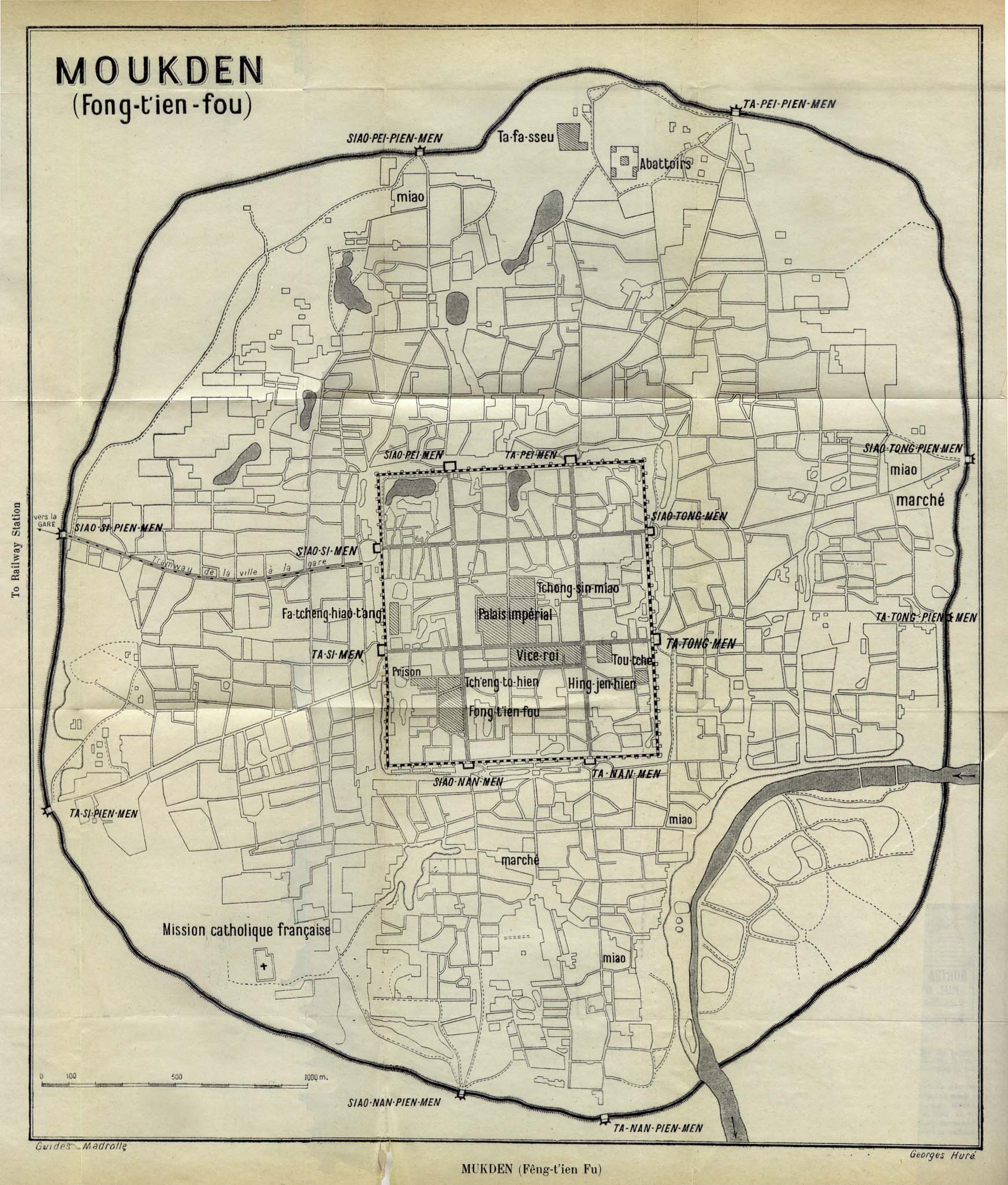

Shenyang
View on GrokipediaName
Etymology and Historical Designations
The name Shenyang (Chinese: 沈阳; pinyin: Shěnyáng) literally translates to "the yang side of the Shen River," denoting the city's position north of the Shen River (沈水; Shěn Shuǐ), now known as the Hun River, which flows along its southern boundary.[7] In traditional Chinese cosmology, yang (阳) signifies the brighter, sunnier, or elevated aspect relative to a waterway, distinguishing the northern bank from the southern yin side.[8] An alternative explanation posits that the name arose from merging two pre-existing administrative units: Shenzhou (沈州) prefecture and Yangshan (阳山) county.[8] Prior to the Qing dynasty, the site bore the name Shenyang as early as the Yuan period (1271–1368), applied to fortifications near the river.[9] In 1625, under Manchu control, Nurhaci designated it Shengjing (盛京; Shèngjīng), meaning "rising capital," with Mukden serving as its Manchu phonetic rendering, evoking "magnificent prosperity."[8] [10] In 1907, amid late Qing reforms, the designation shifted to Fengtian (奉天; Fèngtiān), translating to "to revere heaven," which persisted into the Republican era as both a city and provincial name.[11] Following the 1911 Revolution, Fengtian remained in official use until 1929, when the Nationalist government reinstated Shenyang, though Mukden endured in Western references through the mid-20th century.[9] Post-1949, under the People's Republic, Shenyang solidified as the standard appellation, reflecting its pre-Qing roots.[12]History
Prehistoric and Imperial Foundations
Archaeological excavations reveal that the Shenyang region hosted early human settlements during the Neolithic era, prominently featuring the Xinle culture. Discovered in 1973, the Xinle site in Huanggu District covers 178,000 square meters and includes remnants of approximately 40 houses, along with over 3,000 artifacts such as pottery, stone tools, and wood carvings, dated to over 7,000 years ago.[13] This culture, active from roughly 5500 to 4800 BC along the Liao River, evidences organized communities with advanced craftsmanship for its time in Northeast Asia.[14] Settlement in the area expanded during the Warring States period around 300 BC, when General Qin Kai of the Yan state founded Houcheng, an early fortified outpost against northern tribes.[15] Under Yuan Dynasty rule, the locality adopted the name Shenyang, reflecting its emerging administrative significance.[11] Following the Ming Dynasty's establishment in 1368, which ousted Mongol control, Shenyang solidified as a vital military garrison, with walls and towers constructed to counter Jurchen and Mongol threats in the 14th century.[11] [16] The imperial foundations crystallized in 1625 when Jurchen leader Nurhaci relocated the Later Jin capital to Shenyang, initiating the construction of what became the Shenyang Imperial Palace complex between 1625 and 1637.[3] This move capitalized on the city's defensible position, establishing it as the nascent power base for Manchu expansion southward.[16]Qing Dynasty as Manchu Heartland
In 1625, Nurhaci, founder of the Later Jin dynasty, relocated his capital from Liaoyang to Mukden (present-day Shenyang), transforming the city into the core of Manchu political power and military organization.[17] This move followed the conquest of the Liaodong region and aimed to consolidate control over Jurchen tribes and incorporated Han populations, with the establishment of administrative structures like the banner system centered there.[18] Construction of the Mukden Palace began that year, serving as the imperial residence and symbolizing Manchu sovereignty until the dynasty's conquest of China.[3] Under Nurhaci's successor, Hong Taiji, the dynasty was renamed Qing in 1636 at Mukden, marking the formal adoption of a broader imperial identity while retaining Manchu ethnic foundations.[19] The city, redesignated Shengjing, expanded with fortified walls and temples, including the Mahakala shrine to invoke protection for the Manchu state against Ming forces.[20] Shengjing functioned as the primary hub for Manchu bannermen, who comprised the empire's elite military and administrative class, with strict policies limiting Han Chinese settlement to preserve ethnic homogeneity in the heartland.[21] Following the Qing capture of Beijing in 1644, Shengjing retained its status as a secondary capital, hosting royal visits—such as Qianlong's in the 18th century—and serving as a repository for Manchu ancestral rituals and archives that reinforced dynastic legitimacy rooted in northeastern origins.[22] The Imperial City complex, blending Manchu, Mongol, and Han architectural elements, underscored Shenyang's role in maintaining cultural distinctiveness amid increasing Sinicization elsewhere in the empire.[23] Throughout the Qing era, the city's strategic position governed by the Shengjing General oversaw defense and resource extraction from Manchuria, ensuring the Manchu clan's dominance over the vast territory.[24]Republican Instability and Japanese Control
Following the abdication of the Qing emperor in February 1912, Shenyang (then known as Mukden) fell under the fragmented control of regional warlords amid the collapse of central authority in the early Republic of China. The city became a stronghold of the Fengtian clique, led by Zhang Zuolin, who consolidated power over Manchuria starting in 1916 as both military governor and civil administrator of Fengtian province (modern Liaoning), leveraging Japanese loans and railway concessions to build a personal army exceeding 200,000 troops by the mid-1920s.[25] Zhang's regime modernized infrastructure, including expanding the Mukden Arsenal into a major arms production center capable of manufacturing artillery and aircraft, but it was marked by corruption, opium trafficking, and intermittent clashes with rival warlords during national conflicts like the Zhili-Fengtian Wars (1922–1928).[26] Republican instability peaked with the Huanggutun Incident on June 4, 1928, when officers of the Japanese Kwantung Army detonated explosives under Zhang Zuolin's armored train as it approached Shenyang's Huanggutun railway station, killing the warlord days later from injuries.[27] The assassination, intended to weaken Chinese resistance and facilitate Japanese expansion, instead led to Zhang's son, Zhang Xueliang, assuming control; he initially maintained a delicate balance with Japanese interests but shifted toward alignment with the Nationalist government under Chiang Kai-shek by December 1928, declaring obedience to Nanjing and suppressing communist activities in Manchuria. This non-resistance policy toward Japan, however, failed to deter escalating tensions, as Japanese economic privileges in the South Manchuria Railway zone fueled disputes over sovereignty.[28] The Mukden Incident on September 18, 1931, marked the onset of direct Japanese control: Kwantung Army officers staged a minor explosion on the railway tracks north of Shenyang, falsely attributing it to Chinese saboteurs to justify a rapid military response.[29] Japanese forces seized Shenyang's key installations that night, overcoming minimal resistance from Zhang Xueliang's troops, who withdrew under orders to avoid full-scale war, enabling the occupation of the city within hours and the broader conquest of Manchuria by early 1932.[29] In March 1932, Japan formalized its puppet state of Manchukuo, installing the deposed Qing emperor Puyi as nominal ruler with the capital at Hsinking (Changchun), though Shenyang served as a vital administrative and industrial hub renamed Fengtian Province.[30] Under Japanese occupation from 1931 to 1945, Shenyang underwent forced industrialization to support imperial expansion, with factories repurposed for munitions and aircraft production under the Manchukuo government, which masked exploitative resource extraction benefiting Japanese zaibatsu conglomerates.[31] The Kwantung Army suppressed dissent through militarized policing and concentration camps, while promoting Han-Chinese collaboration via propaganda, though underlying coercion alienated much of the population; Japanese settler numbers in the city swelled to over 100,000 by the late 1930s. Control persisted until the Soviet Union's Manchurian Strategic Offensive in August 1945, which liberated Shenyang on August 16 amid the empire's collapse.[30][31]Communist Takeover and Heavy Industrialization
The People's Liberation Army (PLA) forces, commanded by Lin Biao, captured Shenyang on November 2, 1948, during the Liaoshen Campaign (September 12 to November 2, 1948), which eliminated the primary Kuomintang (KMT) presence in Northeast China and resulted in the surrender or capture of over 130,000 KMT troops in the city.[32][33] This victory secured the Northeast for the Chinese Communist Party (CCP), providing a strategic industrial and resource base inherited from Japanese occupation-era infrastructure, including factories and rail networks, which the CCP rapidly repurposed for military production and civilian use.[34] Post-capture, the CCP implemented land reforms and suppressed KMT remnants, consolidating control by early 1949 amid ongoing civil war nationwide. Following the PRC's founding in October 1949, Shenyang emerged as a cornerstone of the Northeast's heavy industrial complex, prioritized for state investment due to its existing manufacturing capabilities and proximity to coal and iron resources in Liaoning Province.[35] The First Five-Year Plan (1953–1957) allocated significant resources to the region, modeling Soviet-style development with emphasis on steel, machinery, and chemicals; Shenyang's Tiexi District became the epicenter, hosting expansions of plants producing machine tools, cranes, and electromagnets, which achieved milestones like China's first domestically manufactured heavy machinery prototypes.[36][16] Soviet technical aid, part of 156 key projects nationwide, bolstered facilities such as the Shenyang Heavy Machinery Plant, enabling rapid output growth—industrial production in the Northeast rose over 15% annually during the plan period—though reliant on centralized planning and mobilized labor.[37] Under Mao Zedong's leadership through the 1950s and 1960s, Shenyang's role intensified during campaigns like the Great Leap Forward (1958–1962), which aimed to accelerate heavy industry via backyard furnaces and communal production, yielding short-term surges in steel output but inefficiencies due to overambitious targets and quality issues.[38] Key establishments included the Shenyang Aircraft Manufacturing Corporation in 1951, focusing on military aviation, and expansions in automotive and metallurgical sectors, positioning the city as the "eldest son" of the republic's industrial base with over 1,000 state-owned enterprises by the mid-1960s.[39] This state-driven model prioritized quantity over sustainability, fostering expertise in equipment manufacturing while embedding Shenyang in national defense supply chains, though later critiques highlighted resource strain and technological gaps from isolation after the Sino-Soviet split in 1960.[37] ![The Fall of Shenyang to PLA forces][float-right]Deng Era Reforms and State-Driven Growth
The Deng Xiaoping-led reforms, initiated at the Third Plenum of the 11th Central Committee of the Communist Party of China on December 18, 1978, extended to urban industrial centers like Shenyang through targeted adjustments to state-owned enterprises (SOEs). Shenyang's economy, dominated by heavy industries such as machinery, steel, and aircraft manufacturing, adopted the contract responsibility system (CRS) in the early 1980s, which devolved managerial authority to enterprise leaders, permitted retention of a portion of profits for reinvestment and worker bonuses, and tied compensation to performance metrics. This system, applied nationwide to over 90% of SOEs by mid-decade, aimed to address inefficiencies from the Mao-era command economy without relinquishing state control, fostering modest productivity gains in Shenyang's flagship firms like the Shenyang Aircraft Corporation and machine tool factories.[40] In 1980, at the onset of these reforms, Shenyang's gross domestic product (GDP) ranked fifth among Chinese cities, underscoring its entrenched role as a northeastern industrial hub with output exceeding that of emerging southern powerhouses.[39] Urban expansion accelerated from 1980 to 1990, with built-up areas growing in tandem with industrial reconfiguration and infrastructure projects funded by central allocations, including expansions in rail and power capacity to support factory operations. By 1990, Liaoning Province—anchored by Shenyang—achieved the nation's fourth-highest per capita GDP, benefiting from spillover effects of rural decollectivization and nascent township-village enterprises that supplemented SOE production in light manufacturing.[41][42] State-driven growth remained paramount, guided by the Sixth Five-Year Plan (1981–1985) and Seventh Five-Year Plan (1986–1990), which prioritized capital-intensive investments in Shenyang's core sectors despite Deng's emphasis on coastal special economic zones that drew foreign direct investment southward. Unlike privatized experiments in lighter industries elsewhere, Shenyang's reforms preserved SOE dominance, with the central government retaining ownership stakes and directing output toward national priorities like defense and export-oriented machinery; this approach yielded average annual industrial growth rates above 10% in Liaoning during the mid-1980s but sowed seeds of overcapacity as market signals were subordinated to administrative quotas.[43] Full-scale privatization was deferred, reflecting caution against social unrest from mass layoffs in a city of over 4 million reliant on state payrolls.[44]21st-Century Stagnation and State Interventions
In the early 2000s, Shenyang's economy, heavily reliant on state-owned enterprises (SOEs) in heavy industry such as machinery and steel, began exhibiting signs of stagnation amid broader challenges in China's Northeast rust belt, including overcapacity, inefficient resource allocation, and failure to diversify beyond legacy sectors.[39][45] Industrial output in districts like Tiexi declined due to path dependency on uncompetitive SOEs, with firms like Shenyang Machine Tool Group facing bankruptcy risks and requiring repeated bailouts after incomplete reforms initiated in the late 1990s.[46][47] GDP growth, which had peaked at double digits during the Deng-era boom, slowed to an average of around 6-7% annually in the 2010s, lagging national averages and contributing to rising local government debt and youth out-migration to coastal provinces.[48][49] Population dynamics exacerbated the slowdown, with net outflows of working-age residents draining talent and reducing consumer demand; while official figures reported a permanent population rise from 8.11 million in 2010 to 9.07 million by 2021, census data indicated underlying declines in urban core areas due to aging demographics and migration to higher-opportunity regions like the Yangtze Delta.[50][49] Structural rigidities in SOEs, marked by overstaffing, corruption, and resistance to market-oriented restructuring, hindered productivity gains, as evidenced by persistent excess capacity in manufacturing despite national supply-side reforms post-2015.[39][51] To counter these trends, the central government launched the Northeast Area Revitalization Plan in 2003, targeting Shenyang with investments in infrastructure, SOE modernization, and industrial upgrading, allocating funds for projects like high-speed rail links and tech incubators.[52] Subsequent interventions under Xi Jinping intensified, including a 2018 symposium in Shenyang emphasizing innovation alignment with national strategies such as "Made in China 2025," and the establishment of the Shenyang-Fushun Reform and Innovation Demonstration Zone in the 2020s to pilot SOE privatization and opening-up measures.[53][54] Premier Li Qiang's 2023 directives urged discarding support for zombie enterprises while fostering competitive SOEs through mergers and digital transformation.[55] These efforts yielded mixed results: Shenyang's GDP reached 812.21 billion RMB in 2023 with 6.1% year-on-year growth, outpacing the national 5.2% but still reflecting dependency on state subsidies rather than organic private-sector dynamism.[56][57] Critics, including economists analyzing Liaoning province data, argue that interventions perpetuate inefficiencies by favoring industrial subsidies over labor market flexibility and demographic incentives, sustaining stagnation amid national economic headwinds like debt accumulation.[45][58] By 2024, GDP climbed to 902.71 billion RMB, but persistent challenges in SOE profitability and urban decay underscore the limits of top-down directives without deeper property rights reforms.[48]Geography
Topography and Urban Layout
Shenyang lies on a flat, low-lying alluvial plain in the southern part of the Northeast China Plain, positioned just north of the Hun River, the largest tributary of the Liao River.[11] The terrain features vast plains in the central and western sectors, shaped by sediment deposits from the Liaohe and Hunhe river systems, with a gentle slope from northeast to southwest.[59] [60] Eastern areas transition to low hills, gradually rising toward the forested slopes of the distant Changbai Mountains.[11] Urban elevations average 45 meters above sea level, with extremes from 7 meters in lowlands to 414 meters in elevated fringes.[61] Principal waterways, including the Hunhe, Liaohe, Puhe, and Xinkai rivers, traverse the region, influencing drainage and historical settlement patterns.[62][63] The urban layout centers on a historical core in the Shenhe and Heping districts, where the rectangular walled old city—established during the early Qing Dynasty—encloses key sites like the Mukden Palace.[64] This core has expanded radially into surrounding districts, forming a compact metropolitan area north of the Hun River, with Heping serving as the commercial hub, Tiexi as the traditional industrial west, and newer developments like Hunnan to the south.[64] [41] The municipality encompasses ten urban districts—Heping, Shenhe, Dadong, Huanggu, Tiexi, Sujiatun, Dongling, Yuhong, Shenbei New District, and Hunnan—plus suburban counties, reflecting a structure that integrates central administrative-commercial functions with peripheral industrial and residential zones.[64] Over the 20th century, urban expansion shifted from linear growth along rail lines to multi-nucleated patterns, driven by industrialization and post-1949 infrastructure.[41]Climatic Patterns
Shenyang experiences a humid continental climate (Köppen Dwa), characterized by cold, dry winters, warm to hot summers, and pronounced seasonality driven by Siberian air masses in winter and the East Asian monsoon in summer.[65] Winters are dominated by northerly winds bringing frigid, continental air, resulting in average January temperatures around -9°C (16°F), with frequent sub-zero conditions and occasional heavy snowfalls contributing to about 20-30 snowy days per season.[66] Summers, peaking in July with average highs of 29-30°C (84-86°F), feature humid conditions from southerly monsoon flows, though relative humidity averages 60-70% annually, dropping in winter to under 50%.[67] The transitional spring and autumn seasons are short and variable, with spring winds often exceeding 10-15 km/h (6-9 mph) and raising dust, while autumn brings clearer skies but rapid temperature drops.[67] Annual precipitation totals approximately 700-800 mm (27-31 inches), concentrated in the summer months from June to August, which account for over 60% of the yearly total due to monsoon rains, with July often seeing 150-200 mm (6-8 inches).[67] [68] Winters are notably dry, with January precipitation below 10 mm (0.4 inches), primarily as snow. Extreme events include record lows near -30°C (-22°F) during intense cold waves and highs up to 38°C (100°F) in summer heatwaves, with recent records showing monthly precipitation maxima like 501 mm in July 2024.[69]| Month | Avg High (°C) | Avg Low (°C) | Precipitation (mm) |
|---|---|---|---|
| January | -4 | -14 | 5 |
| April | 17 | 4 | 30 |
| July | 30 | 20 | 170 |
| October | 16 | 4 | 40 |
Environmental Degradation and Remediation
Shenyang's environmental degradation stems primarily from its legacy as a hub of heavy industry, including steel production and machinery manufacturing, which intensified during the Communist era's push for industrialization in the 1950s and 1960s.[70] This led to severe air pollution, with particulate matter (PM2.5) concentrations frequently exceeding safe levels, particularly during winter heating seasons when coal combustion spikes; for instance, heavy pollution events in December 2015 and 2016 were driven by stagnant weather and industrial emissions.[71] Soil contamination by heavy metals such as cadmium, lead, and mercury is widespread, resulting from decades of industrial sewage irrigation on farmlands, affecting over 40% of sampled urban soils in studies from the early 2010s.[72] Water bodies, including the Hun River and groundwater aquifers, have suffered from industrial discharges, contributing to elevated risks of multi-media pollution in the region.[73] Air quality data from 2020 onward shows partial improvement amid national campaigns, with annual PM2.5 averages dropping to moderate levels by late 2020 per WHO benchmarks, yet real-time indices often reach "poor" status (AQI 110) due to persistent sources like vehicle exhaust and residual factory emissions.[74] Soil heavy metal pollution remains a concern in brownfield sites, with risk assessments indicating ongoing ecological damage from legacy contaminants.[75] These issues have compounded health risks, including respiratory diseases linked to ozone and PM2.5 synergies, underscoring the causal link between unchecked industrial growth and degraded urban ecosystems.[76] Remediation efforts gained momentum in the early 2010s under local and national directives, including the closure of thousands of small, polluting factories—Shenyang eliminated nearly all such high-emission operations by 2011, per independent analyses—coupled with stricter emission controls and transitions to cleaner technologies.[77] Key projects include waste-to-energy facilities, such as the Shenyang West plant operational since the mid-2010s, processing municipal solid waste to reduce landfill pollution, and expansions in sewage treatment infrastructure to handle industrial effluents.[78] Brownfield redevelopment initiatives have targeted heavy metal remediation through soil inventorying and stabilization, as piloted in contaminated urban sites.[79] Ecological restoration at sites like Qipan Mountain and Wolong Lake involves sewage diversion and afforestation, while public participation programs, established via the Shenyang Environmental Protection Bureau, encourage citizen reporting of violations.[80] Despite these measures, challenges persist in verifying full efficacy, as state-reported improvements may understate residual pollution from entrenched industrial practices.[81]Administrative Divisions
Urban Districts and Their Functions
Shenyang's ten urban districts form the densely populated core of the municipality, encompassing administrative governance, commercial activities, industrial operations, residential zones, and emerging innovation sectors, with a combined area of approximately 3,437 square kilometers and housing the majority of the city's 9.07 million permanent residents as of 2021.[50] These districts evolved from historical cores around the old city walls to expansive modern suburbs, reflecting the city's shift from heavy industrialization to diversified urban functions under state planning.[64] Central districts Heping and Shenhe anchor the traditional urban heart, managing key municipal administration, finance, and retail. Heping District functions primarily as a commercial and entertainment hub, featuring major pedestrian streets like Taiyuan Street and concentrations of international businesses, including Korea Town on Xiaoxibei Street, which supports cross-border trade and consumer services.[82] Shenhe District complements this by hosting government offices, cultural institutions, and heritage sites, facilitating policy implementation and tourism centered on preserved Manchu-era architecture. Tiexi District, west of the center, historically specialized in heavy manufacturing, establishing Shenyang's role as a national industrial base through state-owned enterprises in machinery and metallurgy since the 1950s; it retains significant production capacity while repurposing aging facilities for industrial museums and heritage tourism routes to revitalize local economy.[83][84] Adjacent Dadong and Huanggu districts provide transitional mixed-use areas, balancing legacy light industry with residential development to accommodate urban workforce housing and support central functions. Southern and eastern districts like Dongling, Sujiatun, and Yuhong extend residential and logistical roles, with Sujiatun integrating Taoxian International Airport to drive aviation-related logistics and economic zones. Expansions in Shenbei New District to the north and Hunnan District to the south/southeast prioritize high-tech parks, research institutions, and modern residential clusters, aligning with national strategies for innovation-driven growth in advanced manufacturing and services.[64] Overall, these districts' functions are coordinated via municipal planning to mitigate industrial decline, with central areas emphasizing service-sector density and peripheral ones fostering suburban expansion.Suburban Counties and Zones
Shenyang's suburban counties—Kangping, Faku, and the former Liaozhong County (upgraded to district status)—along with the county-level city of Xinmin, form peripheral administrative units that primarily support agriculture, resource extraction, and limited industrial activities, buffering the core urban districts from rural expanses. These areas, covering expansive territories beyond the metropolitan core, contribute to food security for the city through grain and vegetable production, while facing challenges from rural depopulation and uneven infrastructure development.[85] Kangping County, positioned in Shenyang's northern reaches adjacent to major transport corridors like the G25 Changchun–Shenzhen Expressway, spans significant arable land suited for farming and livestock. Its economy, dominated by agriculture, generated a GDP of 12,515 million RMB in 2022, up marginally from 12,438 million RMB the prior year, indicating modest growth amid regional stagnation in Northeast China.[86] Rural population metrics highlight its agrarian base, with systematic data tracking underscoring reliance on primary sectors rather than urban-style diversification.[87] Faku County, located northeast of the urban center, functions as a key grain-producing zone, leveraging 132,000 hectares of cultivated land to yield 1.5 billion kilograms of grain, alongside 50,000 tons of vegetables and 30,000 tons of meat annually as of 2014 assessments. This output positions it as a vital supplier to Shenyang's food needs, though economic data remains sparse, reflecting slower integration into high-value manufacturing compared to inner districts.[88][85] Liaozhong District, the southernmost subdivision, encompasses broader suburban functions with a recorded population of 442,190 thousand persons in 2020, emphasizing agro-processing and proximity to logistics hubs for southward trade links. Its transitional role supports urban spillover, including early industrial parks, but per capita GDP trails urban averages, at around 19,260 RMB as of earlier benchmarks, signaling persistent rural-urban disparities.[89][90] Xinmin City, a county-level entity to the west, mirrors these patterns as a mixed agricultural-industrial outpost, with emphasis on grain output from counties like itself contributing to Shenyang's overall rural productivity. Development zones in these suburbs, such as peripheral extensions of the Shenyang Economic and Technological Development Zone, aim to attract manufacturing but have yielded limited results, hampered by infrastructure gaps and labor migration to the city proper.[85][64]Demographics
Population Dynamics and Trends
The population of Shenyang municipality stood at 8,106,200 according to the 2010 national census, reflecting steady growth from prior decades fueled by state-led industrialization and rural-to-urban migration in Liaoning Province.[50] By the 2020 census, this figure had risen to 9,070,093, an increase of 963,893 people or 11.89% over the decade, equating to an average annual growth rate of approximately 1.09%.[50] [1] This expansion contrasted with broader stagnation in Northeast China, where the three provinces collectively lost about 11 million residents between 2010 and 2020 due to low fertility, aging demographics, and net out-migration to southern economic hubs.[91] Post-2020, Shenyang's permanent resident population continued modest growth, reaching 9.20 million by the end of 2023 and approximately 9.24 million in 2024, driven primarily by targeted policies attracting interprovincial migrants to offset natural population decline from sub-replacement fertility rates (below 1.0 births per woman regionally) and high elderly dependency ratios exceeding 20%.[2] [92] Net in-migration added roughly 39,000 residents in one recent year, bolstering urban districts while suburban counties experienced slower gains or outflows; without such inflows, the city's population would likely contract at rates similar to peer northeastern municipalities.[92] Urbanization intensified, with 85.12% of residents in urban areas by late 2023, concentrating density in core districts like Heping and Shenhe.[60]| Year | Population (millions) | Annual Growth Rate (%) |
|---|---|---|
| 2010 | 8.106 | - |
| 2020 | 9.070 | 1.09 (decadal avg.) |
| 2023 | 9.20 | ~0.6 (post-2020 avg.) |
Ethnic Makeup and Social Structures
The 2020 national census enumerated Shenyang's permanent resident population at 9,070,093, with Han Chinese comprising approximately 89.73% and ethnic minorities accounting for 10.27%, represented by 55 distinct groups.[93] Among minorities, the Manchu form the largest contingent at 569,951 persons, reflecting the city's historical role as the Qing dynasty's early capital; Mongolians number 135,265, and Koreans 88,676, the latter concentrated due to proximity to the Korean Peninsula and cross-border ties.[93] Smaller groups include Hui, Xibe, and others, often clustered in specific districts or suburbs, with official policies promoting cultural preservation alongside integration into Han-majority urban life. Social structures in Shenyang emphasize collectivist organization under Communist Party committees, with neighborhood mediation and resident committees handling community governance, dispute resolution, and welfare distribution in urban shequ (communities).[94] The hukou system perpetuates stratification by classifying residents as urban or rural/agricultural, limiting migrants' access to local services despite comprising a significant floating population; this has fostered informal networks among ethnic minorities and inter-provincial workers for mutual support in employment and housing.[94] Family units trend toward nuclear structures amid urbanization and past one-child restrictions, though extended kinship persists among some Manchu and Korean communities for cultural and economic resilience.[95]Government and Politics
Municipal Governance Structure
Shenyang's municipal governance integrates the leadership of the Communist Party of China (CPC) with state administrative organs, as formalized in the city's official framework. The Shenyang Municipal Committee of the CPC holds supreme authority, overseeing ideological direction, policy implementation, and personnel appointments through its Standing Committee, which typically comprises 10-12 members including the Party Secretary as its head. This committee ensures alignment with national CPC directives, exercising veto power over government decisions to maintain party control.[96][97] The executive branch, the Shenyang Municipal People's Government, manages operational governance, including urban planning, economic coordination, and public services. Headed by the Mayor—who serves concurrently as a Deputy Party Secretary—the government comprises bureaus for finance, education, public security, and development, reporting to both the party committee and the State Council. As of 2025, Mayor Lü Zhicheng exemplifies this dual role, focusing on initiatives like regional integration while subordinating to party priorities.[98][99] Legislative functions fall to the Shenyang Municipal People's Congress, a unicameral body with deputies elected indirectly through lower-level congresses, convening annually to ratify budgets, ordinances, and major personnel choices. Its Standing Committee handles interim affairs, but all proceedings defer to CPC leadership, reflecting the system's emphasis on party-guided "democratic centralism" rather than independent deliberation. The structure's sub-provincial status grants Shenyang enhanced autonomy in fiscal and administrative matters compared to prefecture-level cities, yet remains firmly under central oversight.[100]CCP Dominance and Party Control Mechanisms
The Chinese Communist Party (CCP) asserts comprehensive dominance over Shenyang's political landscape through its municipal party committee, which operates parallel to and supersedes the formal government apparatus, directing policy priorities, cadre selections, and implementation of central directives. The municipal party secretary, appointed by higher CCP levels, serves as the paramount leader, chairing the standing committee that coordinates across sectors including economy, security, and ideology, with authority to veto government proposals and enforce alignment with national campaigns such as anti-corruption drives and economic revitalization. As of March 2025, this role is held by Huo Bugang, underscoring the centralized nomenklatura system where key positions in state organs, enterprises, and social institutions require party vetting to ensure loyalty.[101] Control mechanisms extend to grassroots levels via over 5 million nationwide party organizations, including branches embedded in Shenyang's state-owned enterprises, residential communities, and public institutions, functioning as "nerve endings" for monitoring compliance and mobilizing resources during initiatives like industrial restructuring in the city's rust-belt economy. In Shenyang, these organizations facilitate party-building campaigns, such as ideological training and cell establishment in private firms since 2012, to embed CCP influence in non-state sectors and preempt dissent, as evidenced by directives emphasizing enhanced grassroots construction issued during visits by senior leaders in 2017. Discipline inspection commissions, subordinate to the municipal committee, enforce internal purity through investigations, with thousands of cases handled annually across Liaoning Province to deter corruption and factionalism.[102][103] Social control integrates digital tools with organizational oversight, including grid-based management systems dividing urban districts into surveillance grids patrolled by party-linked workers, augmented by extensive CCTV networks—China's national total exceeding 400 million cameras by 2023—and data analytics for predictive policing, applied in Shenyang to maintain stability amid economic pressures. These mechanisms, bolstered by the social credit framework piloting behavioral scoring since 2014, enable granular tracking of residents' activities, with party committees leveraging big data for targeted interventions, as seen in nationwide expansions post-2020 that consolidate CCP resilience against unrest. While official narratives frame this as service-oriented governance, empirical patterns reveal prioritization of regime security over individual agency, with limited transparency in enforcement outcomes.[104][105][106]Policy Enforcement and Social Control
In Shenyang, policy enforcement operates through the integrated apparatus of the municipal Chinese Communist Party (CCP) committees and the Shenyang Public Security Bureau (PSB), which directs over 10,000 officers in maintaining order across the city's districts and suburbs. The PSB implements central directives on public security, including crime prevention, traffic regulation, and suppression of unauthorized gatherings, with a focus on preemptive measures like routine patrols and data-driven risk assessments derived from local surveillance feeds. This structure emphasizes party oversight, where PSB actions align with CCP priorities such as ideological stability and economic continuity, often prioritizing collective compliance over individual rights in line with national governance models.[107] A core mechanism is the grid management system, which partitions Shenyang's urban and suburban areas into approximately 300-500 square meter "grids" overseen by dedicated staff, including CCP cadres, PSB auxiliaries, and community volunteers, for real-time monitoring of residents' activities. Introduced nationally in the mid-2000s and adapted locally by 2010, this system facilitates granular enforcement of policies ranging from hukou registration compliance to environmental regulations, using mobile apps for reporting anomalies and coordinating responses. In practice, grids enable causal linkages between observed behaviors—such as unreported migrations or minor infractions—and broader social stability goals, reducing reliance on reactive policing by embedding control at the neighborhood level; data from similar implementations show it has lowered reported "mass incidents" by enabling early intervention. However, implementation relies on self-reported metrics from local authorities, which may understate coercion due to performance incentives within the CCP hierarchy.[108][109] Surveillance underpins enforcement, with Shenyang integrated into China's national Skynet and Sharp Eyes networks, deploying facial recognition and AI analytics across public spaces, residential areas, and transport hubs to track compliance with policies like movement restrictions. While exact figures for Shenyang's cameras remain classified, the city's smart city initiatives since 2017 have expanded coverage to support predictive policing, cross-referencing data with national databases for rapid identification of potential dissenters. This technological layer enforces social norms by linking violations—e.g., jaywalking or uncensored online speech—to penalties under the emerging social credit framework, where local PSB blacklists restrict access to services for non-compliant individuals. Empirical outcomes include heightened deterrence, as evidenced by reduced visible protests, though independent verification is constrained by state control over data release.[110][111] Enforcement intensified during crises, as in the March 2022 COVID-19 lockdown affecting Shenyang's 9 million residents, where PSB and grid teams sealed compounds, mandated 48-hour negative tests for any exit, and deployed health code apps tied to surveillance for quarantine compliance, resulting in over 4,000 daily cases managed through mass testing and isolation. Dissent, including sporadic anti-lockdown expressions, was handled via swift PSB deployments, phone checks, and detentions to prevent escalation, mirroring national patterns where protests are reframed as disruptions to public order rather than legitimate grievances. Such measures underscore causal realism in CCP strategy: enforcement scales with perceived threats to regime stability, leveraging overwhelming state resources to minimize organized opposition, though resident compliance often stems from fear of repercussions over voluntary adherence, as inferred from patterns in leaked enforcement directives.[112][113]Economy
Legacy Heavy Industries
Shenyang emerged as a hub for heavy industry in the 1930s under Japanese control of Manchuria, with foundational enterprises like the Shenyang Blower Works established in 1934 to produce compressors, blowers, and fans, marking China's initial foray into specialized industrial equipment.[114][115] This period laid groundwork for mechanical engineering, though expansion accelerated after 1949 through Soviet-assisted projects. Of the 156 key industrial initiatives aided by the Soviet Union in the 1950s, 56 targeted Northeast China, including three machine tool projects in Shenyang that produced China's first domestically manufactured machine tool and electromagnet.[116] Similarly, the Shenyang Heavy Machinery Group, tracing origins to 1937, became the People's Republic's inaugural heavy machinery producer, fabricating early innovations such as the nation's first high-voltage induction coil, seeder, and crane.[16][117] These industries focused on core sectors like heavy machinery, mining equipment, and metalworking, with the Tiexi district serving as the epicenter of state-owned factories employing hundreds of thousands in steel-related processing, blowers for metallurgy, and large-scale forgings.[118] By the First Five-Year Plan (1953–1957), Shenyang solidified its role in the planned economy, outputting equipment critical to national infrastructure, including 2,000-ton tower cranes and 200,000 KV transformers.[36] The sector's growth relied on centralized Soviet technology transfers and labor mobilization, positioning Northeast China—including Shenyang—as the cradle of the country's heavy industrial base, contributing disproportionately to GDP in the 1950s and 1960s.[119] Post-1978 reforms exposed inefficiencies in these legacy state-owned enterprises (SOEs), characterized by overstaffing, outdated technology, and path dependency on subsidized operations, leading to industrial decline in areas like Tiexi.[47] Output stagnation and rising debts plagued firms, with Northeast SOEs holding about half of regional industrial assets by the 2010s—far above the national 10% average—amid falling demand for traditional heavy goods.[120] Despite mergers, such as the 2006 formation of Northern Heavy Industries from Shenyang's machinery and mining groups, persistent reliance on state support has hindered restructuring, contributing to Shenyang's "rust belt" status with slowed growth and workforce reductions.[121][45]Emerging Sectors and Diversification
Shenyang has pursued economic diversification through state-directed initiatives emphasizing high-technology industries, aiming to reduce reliance on traditional heavy manufacturing. Under the city's 14th Five-Year Plan (2021-2025), priorities include fostering clusters in robotics, artificial intelligence (AI), and intelligent manufacturing, supported by incentives such as tax rebates and R&D subsidies in the Shenyang High-tech Industrial Development Zone.[122] This shift aligns with national strategies like Made in China 2025, which target strategic emerging industries to drive innovation-led growth, though local implementation has yielded mixed results due to persistent skill gaps and overcapacity in legacy sectors.[123] Robotics stands out as a flagship emerging sector, with Shenyang hosting major enterprises like Siasun Robot and Automation Co Ltd, which integrates AI into robotic systems for applications in manufacturing and logistics. By 2024, Siasun reported advancements in "robot plus AI" solutions, contributing to the zone's goal of establishing a core area for next-generation AI innovation and development.[124][125] The high-tech zone prioritizes robotics and new-generation information technology as dual pillars, attracting investments that have expanded the sector's output, though domestic innovation lags behind global leaders in core technologies like advanced sensors.[122][126] The service sector, particularly tourism, has gained traction as a diversification avenue, capitalizing on Shenyang's industrial heritage and cultural sites. In 2024, domestic tourist arrivals rose 38.2% year-over-year, with tourism revenue increasing 46%, positioning the city as a cultural hotspot amid Northeast China's revitalization efforts.[127] Strategies include repurposing former industrial sites into experiential attractions, boosting related services like hospitality and low-altitude air tourism under emerging economic models.[128][129] However, tourism's contribution to GDP remains modest compared to high-tech ambitions, constrained by seasonal demand and infrastructure limitations.[130]Persistent Challenges and Inefficiencies
Shenyang's economy, heavily reliant on state-owned enterprises (SOEs) in legacy sectors like machinery and automotive manufacturing, continues to grapple with systemic inefficiencies rooted in overstaffing, low productivity, and chronic debt accumulation. For instance, Shenyang Machine Tool Group, a flagship SOE, accumulated substantial debts exacerbated by mismanaged R&D investments and operational redundancies, highlighting broader failures in SOE reform efforts that prioritize employment preservation over profitability.[116] Similarly, Liaoning Huachen Automotive, employing over 47,000 workers, exemplifies debt-heavy predicaments common among regional SOEs, where state support sustains uncompetitive operations amid declining demand.[131] These inefficiencies stem from rigid bureaucratic controls and soft budget constraints, which discourage cost-cutting and innovation, perpetuating a cycle of subsidized losses rather than market-driven restructuring.[132] Industrial overcapacity in Shenyang's heavy industries exacerbates resource misallocation and environmental degradation, with excess production in steel and equipment sectors leading to persistent pollution in the Shenyang-Changchun-Harbin urban belt, particularly during winter months.[133] This overcapacity, driven by historical state investments without corresponding demand adjustments, contributes to structural unemployment as factories operate below optimal levels, overwhelming social security systems and fostering an imbalance between outdated industrial structures and emerging needs.[134] Liaoning Province, encompassing Shenyang, reported inflated economic data between 2011 and 2014—later revised downward by over 20%—underscoring underlying fiscal fragilities and governance issues that hinder transparent reform.[135] Labor market distortions manifest in high youth unemployment and a growing exodus of workers from Shenyang seeking higher wages elsewhere, as the city's sluggish domestic demand and employment stagnation contrast with national growth trends.[136] The Northeast's GDP share has plummeted from 13.34% of national output in 1978 to 4.8% in 2023, with Liaoning consistently underperforming, as evidenced by its 2.1% growth in the first half of 2017—far below coastal provinces—and ongoing risks of being sidelined in China's uneven recovery.[137][138] These challenges are compounded by the large SOE-dominated economy acting as a systemic barrier to diversification, where policy inertia favors preserving legacy jobs over fostering agile private sector growth.[39]State-Led Revitalization Efforts
In 2003, the Chinese central government launched the Revitalization of Northeast China strategy to address the decline of heavy industries in regions like Liaoning Province, including Shenyang, by promoting structural adjustments, technological upgrades, and infrastructure investments in state-owned enterprises (SOEs).[139] This initiative allocated substantial fiscal support, with transfer payments to Northeast China totaling nearly 12 trillion yuan from 2003 to 2022, aimed at fostering industrial diversification and market-oriented reforms.[140] In Shenyang, these efforts targeted legacy sectors such as steel and machinery, emphasizing mergers, capacity reductions, and relocation of polluting facilities to industrial parks. The 14th Five-Year Plan (2021–2025) marked a shift toward comprehensive revitalization, integrating self-reliance in science and technology with regional coordinated development, as emphasized by Xi Jinping in 2023.[139][141] Shenyang-specific programs included the establishment of the Shenyang-Fushun Reform and Innovation Demonstration Zone in 2023, guided by Liaoning's Three-Year Action Plan, which prioritized institutional reforms, technological innovation, and openness to attract investment.[54] Local authorities focused on advanced manufacturing clusters, such as robotics and new materials, alongside urban renewal projects like shantytown redevelopment since 2008, which leveraged low-interest state-backed loans to redevelop overaged housing and stimulate construction-related economic activity.[142] Recent initiatives have emphasized outward-oriented growth, with Shenyang positioned as a hub in the Northeast Asia economic circle. In the first half of 2024, the city attracted 172 new foreign trade enterprises, achieving a 118.9 percent year-on-year increase in related imports and exports, through policies promoting integration with Belt and Road corridors and RCEP frameworks.[143] In October 2024, Shenyang was designated an international central city to enhance its leadership in the Northeast Revitalization Strategy, supporting talent attraction and education-industry linkages in high-tech sectors.[144] These state-directed measures, including subsidies for R&D and SOE modernization, aim to transition from resource-dependent growth to innovation-driven models, though outcomes remain constrained by entrenched SOE inefficiencies.[39]Transportation
Rail Infrastructure
Shenyang serves as a pivotal railway junction in Northeast China, integrating conventional lines with an expanding high-speed network that connects the city to Beijing, Harbin, Dalian, and other regional centers. The infrastructure supports both passenger and freight transport, reflecting the city's historical role in industrial logistics since the late Qing era. Key lines passing through include the Jingha Railway and segments of the Beijing-Harbin high-speed corridor, facilitating daily services to over 20 provinces.[145][146][147] The Shenyang Railway Station, operational since 1899, functions primarily as a hub for conventional trains, offering services to destinations like Beijing, Shanghai, Nanjing, Changchun, Dalian, Harbin, and Xi'an. Rebuilt and expanded over time, it handles mixed traffic but has seen upgrades to integrate with high-speed operations since 2014. In contrast, Shenyang North Railway Station, established in 1911 and reconstructed in 1990, specializes in high-speed rail, serving as a terminus for the Beijing-Shenyang and Harbin-Dalian lines with platforms accommodating up to 16 tracks. It connects to bullet trains reaching speeds of 300-350 km/h for routes to Beijing and beyond. Shenyang South Station supplements these, focusing on regional and freight links.[145][148][146] Recent expansions underscore Shenyang's integration into China's national high-speed grid. The Shenyang-Baihe section of the Shenyang-Jiamusi High-Speed Railway opened on September 28, 2025, spanning 430 km with 10 stations and supporting trains at 350 km/h, linking Shenyang North to Changbaishan and enhancing tourism and economic ties in Jilin Province. This follows the Qinhuangdao-Shenyang High-Speed Railway, operational since 2025, which marks the first dedicated high-speed link between Hebei and Liaoning provinces, reducing travel times to coastal ports. Other lines, such as the Shenyang-Dandong Railway, provide onward connections to North Korea, though cross-border services remain limited by geopolitical factors. Freight capacity, vital for Shenyang's heavy industries, relies on electrified double-tracking and dedicated corridors managed by China Railway Shenyang Group.[149][150]Road Networks and Logistics
Shenyang's urban road network totals 4,579 kilometers, supporting connectivity across its districts and suburbs.[151] National Highways 101, 102, 202, and 304 converge in the city, facilitating regional freight and passenger movement.[152] The expressway system includes the G15 Shenyang–Haikou Expressway, a segment of the national Shenhai corridor linking Shenyang southward to Dalian and beyond, which has expanded with additional multi-lane sections exceeding six lanes in recent national upgrades.[153] Logistics infrastructure in Shenyang emphasizes multimodal integration, with road networks feeding into specialized hubs. The city was designated a national production and service-oriented logistics hub in 2022, anchored by Transfar Group's planned CNY 3 billion investment in facilities.[154] In December 2024, Shenyang opened China's first TIR-accredited logistics hub in Liaoning Province, enabling streamlined international road transport under the UN's TIR Convention and boosting cross-border efficiency for Eurasian trade routes.[155][156] Complementing this, major cold chain facilities like the PDA-YIDU Northeastern Distribution Center provide 300,000 tons of storage capacity across 350,000 square meters, supporting perishable goods distribution via road links.[157] Road-based logistics benefit from proximity to rail interchanges, including the 2023-launched China-Europe Railway Express hub at Puhe, spanning 92,000 square meters with 80,000 under customs supervision, which has serviced over 2,000 companies through combined road-rail operations.[158][159] These developments address Northeast China's industrial freight demands, though challenges persist in congestion and seasonal weather impacts on highway throughput.[160] To regulate urban road usage and enhance safety, Shenyang prohibits motorcycles, including cruiser types, from operating on roads within the Third Ring Expressway, pursuant to the Shenyang Road Vehicle Management Measures effective March 1, 2019. Violations are penalized with a 200 yuan fine administered by traffic police. Enforcement includes fixed duty posts, mobile patrols, electronic monitoring, and targeted campaigns, such as the 2024 summer traffic safety initiatives focusing on ban infringements.[161][162]Aviation and Urban Mobility
Shenyang Taoxian International Airport (IATA: SHE), located 20 kilometers southeast of the city center in Dongling District, functions as the principal hub for domestic and international air traffic in the region. Opened for commercial operations in the late 1980s, the facility expanded significantly with the completion of Terminal 3 in 2013, which features modern amenities and supports higher throughput amid rising demand from Northeast China's industrial corridors. The airport connects Shenyang to major Asian destinations via carriers including China Southern Airlines, handling cargo and passenger flows critical to the city's logistics and export sectors.[163][164][165] Passenger volumes at Taoxian have grown steadily, reaching 17.34 million in 2017 and exceeding 20 million in 2019 before pandemic disruptions. By August 2025, it achieved a single-day record of 81,808 passengers and 516 aircraft movements, reflecting post-recovery momentum driven by domestic travel and regional economic ties. Projections indicate potential for 21 million annual passengers by the early 2020s, with long-term designs aiming for 70 million by 2040 through phased infrastructure upgrades. The airport's role extends to supporting Shenyang's aviation manufacturing base, anchored by the Shenyang Aircraft Corporation—a state-owned entity founded in 1951 under AVIC—that produces advanced aircraft components, fostering synergies between civil aviation and industrial output despite primary focus on military applications.[166][164][167][165][168] Urban mobility in Shenyang relies on an integrated network of rail, bus, and micromobility options to navigate its expansive districts and mitigate congestion from heavy industry and population density exceeding 8 million. The Shenyang Metro, operated by the municipal transit authority, began with Line 1 in 2010 as the city's first underground rapid transit corridor, spanning key commercial and residential zones. Expansion continued with Lines 9 and 10 entering service in 2019 and 2020, respectively, enhancing connectivity to suburban areas and integrating with high-speed rail interchanges for intercity travel. Daily ridership averages over 500,000 across approximately 55 kilometers of track, though figures peaked near 900,000 pre-pandemic, underscoring its role in reducing road dependency.[169][170] Complementing the metro, Shenyang's public bus system operates hundreds of routes with modern fleets, including electric and hybrid vehicles introduced via partnerships like Golden Dragon Bus, which added over 870 units across express and standard lines by 2017 to bolster coverage in peripheral districts. Long-distance buses from stations near railway hubs link to nearby cities such as Dalian and Anshan, while urban services prioritize frequency during peak hours. Bike-sharing programs, including dockless systems like CoolQi launched around 2017, provide affordable last-mile solutions, with usage tied to metro feeders and influenced by built-environment factors like station proximity and road density; studies indicate shared bikes enhance satisfaction for short trips amid winter challenges. The Shenyang Modern Tram further aids low-emission mobility in select corridors, collectively forming a multi-modal framework amid ongoing state investments to address inefficiencies from legacy infrastructure.[147][171][172][173][174][147]Military and Defense Industry
Historical Strategic Importance
Shenyang's strategic military significance originated in the early 17th century as the cradle of Manchu power under Nurhaci, who relocated the Later Jin capital there in 1625 following victories against the Ming dynasty, leveraging its position in the Liaodong region to unify Jurchen tribes and organize the Eight Banners system—a hereditary military structure that enabled the conquest of China.[175] [176] As Shengjing, the secondary Qing capital after 1644, it housed imperial palaces and banner garrisons, serving as a forward base for suppressing rebellions and securing the northeast frontier against Russian incursions.[177] In the late 19th and early 20th centuries, Shenyang (then Mukden) gained renewed prominence as a transportation and industrial nexus, exemplified by its role in the Russo-Japanese War, where the 1905 Battle of Mukden—pitting 310,000 Russian troops against 300,000 Japanese—marked the largest land battle before World War I and underscored the city's control over Manchurian rail lines and supply routes critical to regional dominance.[178] During the Republican era, it became the headquarters for warlord Zhang Zuolin's Fengtian clique, whose army exploited the city's arsenals and proximity to resource-rich plains for power projection, until his 1928 assassination at Huanggutun station highlighted Japanese ambitions over the area.[179] The 1931 Mukden Incident crystallized Shenyang's centrality to imperial expansion, as Japanese Kwantung Army officers staged an explosion on the South Manchuria Railway near the city on September 18, providing a pretext to seize Mukden within hours and launch the invasion of all Manchuria, transforming it into a fortified economic and military hub for the puppet state of Manchukuo.[180] [29] This control over Shenyang's railways and Mukden Arsenal—producing artillery and aircraft—bolstered Japan's wartime logistics until Soviet forces captured the city in August 1945, dismantling much of the arsenal for transfer to the USSR.[31] During the Chinese Civil War, Shenyang represented a pivotal Nationalist bastion in the northeast; after Soviet withdrawal in April 1946, Kuomintang forces occupied it on March 12, using its industries to sustain defenses, but the People's Liberation Army's Liaoshen Campaign from September to November 1948 encircled and captured the city on November 2, annihilating over 470,000 Nationalist troops and securing Manchuria's resources, which provided the Communists with a strategic industrial and manpower edge for subsequent offensives.[181] [182] This victory shifted the war's balance, as control of Shenyang's factories enabled rapid PLA rearmament with captured Japanese equipment.[183]State-Owned Aerospace and Armaments
Shenyang serves as a central hub for China's state-owned aerospace and armaments sector, anchored by subsidiaries of the Aviation Industry Corporation of China (AVIC) and the Aero Engine Corporation of China (AECC), both under central government control. The AVIC Shenyang Aircraft Company Limited (SAC), founded in 1951 as one of China's earliest aircraft manufacturers, designs, develops, and produces military aircraft, including multirole fighters integral to the People's Liberation Army Air Force inventory. SAC's output encompasses airframes for advanced combat platforms, contributing to national defense capabilities through integration of avionics, weapons systems, and structural components.[184] [185] As a designated Chinese military company by the U.S. Department of Defense, SAC's operations align with state-directed priorities in aviation defense equipment.[186] Complementing airframe production, the AECC Shenyang Liming Aero-Engine Group Corporation, established in 1954, manufactures turbofan engines critical for military propulsion, such as the WS-10 series powering indigenous fighters. This facility, China's first dedicated jet engine producer, supports engine indigenization efforts, reducing reliance on foreign technology for armaments like afterburning turbofans used in high-performance aircraft. Liming's portfolio includes over 20 engine models, with ongoing R&D focused on high-thrust variants for next-generation platforms.[187] [188] These engines enable armament integration, including internal weapons bays and enhanced maneuverability for air-to-air and air-to-ground munitions.[189] The sector's state ownership facilitates coordinated R&D and production scaling, as evidenced by Shenyang's aviation cluster, which by 2023 encompassed full-spectrum capabilities from design to maintenance of defense-oriented systems. While civilian components, such as fuselages for Boeing 737 MAX, generate revenue, military armaments remain the core focus, with SAC and Liming driving exports and domestic equipping of stealth and carrier-based assets.[168] This concentration has positioned Shenyang as a linchpin in China's aerospace self-sufficiency, though subject to international sanctions for military linkages.[190]Current PLA Operations and Corruption Issues
The Northern Theater Command (NTC), headquartered in Shenyang, oversees PLA ground, air, naval, and rocket force components responsible for defending northeastern China against contingencies involving borders with Russia, Mongolia, and the Korean Peninsula, encompassing a vast area of north-central and northeastern territory.[191] The command maintains rocket force brigades in the region for nuclear and conventional deterrence, including capabilities to target U.S. assets in potential Pacific conflicts.[192] Public details on specific NTC exercises remain limited due to operational secrecy, but the command participates in broader PLA joint operations training emphasizing multi-domain integration, as part of ongoing reforms to enhance combat readiness against complex threats.[193] Shenyang's defense industry supports these operations through the state-owned Shenyang Aircraft Corporation (SAC), which in 2025 has advanced production of carrier-capable fighters, delivering multiple batches of the upgraded J-15T variant to the PLA Navy for integration with aircraft carriers like the Fujian.[194] SAC also unveiled production facilities for fifth-generation stealth aircraft in July 2025, including the J-35, with the air force variant (J-35A) slated for entry into service by 2026–2027 to bolster air superiority in northern and eastern theaters.[195] [196] These efforts align with PLA-wide modernization, though actual deployment rates depend on engine reliability and testing outcomes, as assessed in U.S. Department of Defense analyses.[197] Corruption has persistently undermined PLA effectiveness, with Xi Jinping's campaign leading to the expulsion of nine senior officers—including two theater-level generals—in October 2025 for bribery, promotion-selling, and related graft, as announced by the Central Military Commission Discipline Inspection Commission.[198] [199] These cases, part of a wave affecting all services since mid-2023, highlight systemic issues like cronyism in personnel decisions and procurement fraud, which erode trust and operational cohesion.[200] [201] While no public investigations have been exclusively linked to NTC leadership in Shenyang, the purges' scope—implicating equipment development and political work systems—likely impacts regional commands, delaying modernization and fostering caution among officers.[197][202] Official Chinese statements frame the actions as essential for purifying the force, though critics argue they also serve to consolidate loyalty to the Communist Party leadership.[203]Culture
Dialect and Linguistic Heritage
The primary dialect spoken in Shenyang is Shenyang Mandarin, a variant of Northeastern Mandarin characterized by distinct phonological features that differentiate it from Standard Mandarin, including variations in initial consonants, vowel quality, and tone realization.[204] These traits reflect regional speech patterns common across Northeast China, where Shenyang Mandarin serves as a local standard influenced by migration and urbanization since the early Qing dynasty.[205] Linguistically, Shenyang's heritage traces to its role as Mukden, the early Qing capital established in 1625, where the Manchu language—spoken by the ruling Jurchen-Manchu elite—interacted with incoming Han Chinese dialects.[206] This contact introduced Manchu loanwords into Northeastern Mandarin, particularly in domains like cuisine (sacima for a fried noodle pastry) and expressions of state (lata for coming), embedding substrate elements that persist in everyday vocabulary despite the near-total language shift to Mandarin by the late 19th century.[207] Today, Standard Mandarin dominates formal education, media, and administration in Shenyang, with the local dialect retaining informal, expressive usages among native residents; however, intergenerational transmission has waned due to national language standardization policies since 1956, reducing pure dialect proficiency among younger urban populations.[208] Manchu linguistic remnants are negligible in daily use, confined to scholarly preservation efforts, underscoring a broader pattern of Altaic substrate erosion in northern Chinese varieties.[209]Artistic Traditions and Institutions
Shenyang's artistic traditions are rooted in its historical role as the early capital of the Qing dynasty, with the Shenyang Palace Museum preserving extensive collections of imperial artifacts that reflect Manchu and Han influences in visual arts. The museum holds over 100,000 items, including porcelain, paintings, calligraphy, and lacquerware from the 17th and 18th centuries, showcasing Qing court aesthetics and craftsmanship.[210][211] Regional folk performance arts, such as erren zhuan (two-person rotation), a song-and-dance duet originating from Northeast China's folk traditions around 300 years ago, have been integral to local cultural expression, blending humor, narrative, and rhythmic fan or handkerchief dances typically performed by a male-female pair.[212] This form, popular across Liaoning province including Shenyang, emphasizes earthy storytelling and has been preserved through professional troupes hosting exhibitions of intangible cultural heritage.[213] Key institutions fostering contemporary arts include the Lu Xun Academy of Fine Arts, established in 1938, which offers programs in Chinese painting, calligraphy, oil painting, and sculpture across its Shenyang and Dalian campuses, training artists in both traditional and modern techniques.[214] The Shenyang Conservatory of Music, also founded in 1938, serves as one of China's nine major conservatories, with departments dedicated to composition, vocal opera, and Chinese traditional instruments, operating four campuses to promote national music culture.[215] Theatrical traditions are upheld by the Liaoning People's Art Theater, created in 1951, which produces spoken drama and has contributed to the region's stage arts development.[216] The Shenyang Art Museum complements these by exhibiting historical and contemporary works, hosting educational programs on local artistic heritage.[217]Sports, Cuisine, and Religious Practices
Shenyang's primary sports venue is the Olympic Sports Centre Stadium, a 60,000-capacity facility completed in 2013 that hosted football matches during the 2008 Beijing Olympics and served as the main site for the opening, closing, and athletics events of the 2013 National Games of China.[218][219] The stadium currently supports professional football through teams like Liaoning Tieren FC in the China League One, with home matches held there as of April 2025, and also accommodates concerts and mass events.[219] Due to the region's harsh winters, ice and snow sports gain prominence, exemplified by annual events such as the Ice and Snow Carnival at the Olympic Sports Center and activities at Qipan Mountain Ice and Snow World, promoting public participation in skating and skiing.[220] Cuisine in Shenyang draws from Dongbei (Northeastern Chinese) traditions, emphasizing hearty, meat-heavy dishes influenced by Manchu heritage and cold climates, with staples like boiled pork sausages (bairou) prepared in clear water with seasonings and pig intestines stewed with blood and spices (xuechang).[221] Signature items include Laobian dumplings, a local specialty with over 160 years of history featuring thin wrappers and varied fillings, and Goubangzi smoked chicken, alongside street foods such as fried pork in scoops, bean paste dishes, and wok-stewed vegetables.[222] In May 2025, municipal authorities recognized 18 dishes as emblematic of Shenyang cuisine, highlighting fermented and preserved ingredients suited to preservation in the region's environment.[223] Religious practices in Shenyang occur under strict state regulation, with the government recognizing only five faiths—Buddhism, Taoism, Islam, Protestantism, and Catholicism—and requiring venues to register while prohibiting unregistered groups, as evidenced by inspections of unapproved churches in the city as recently as August 2018.[224][225] Key sites include the Dongguan Church, an early Protestant congregation established in the late 19th century and among the largest in the region, and the Sacred Heart Cathedral for Catholics, both operating within official patriotic associations that align activities with Communist Party directives. Folk practices, including shamanistic elements prevalent in Northeast China, persist informally alongside temple worship, though formal adherence remains low due to mandatory atheism in public institutions and restrictions on proselytizing or large gatherings.[225] An Orthodox presence exists via the Temple of Christ the Savior in Mukden (Shenyang's historical name), reflecting Russian imperial influences from the early 20th century but limited to a small community under similar oversight.[226]Education and Research
Higher Education Landscape
Shenyang hosts over 20 higher education institutions, including comprehensive universities, specialized technical colleges, and medical schools, serving a student population exceeding 300,000 across undergraduate, master's, and doctoral programs.[227][228] The sector emphasizes science, technology, engineering, and mathematics (STEM) fields, aligned with the city's legacy as a hub for heavy industry, metallurgy, and defense manufacturing, alongside growing strengths in medicine and aerospace.[229] Institutions benefit from national initiatives like Project 211 and Double First-Class University plans, which prioritize research output and international collaboration, though rankings reflect a concentration of top-tier programs in select disciplines rather than broad excellence.[230] Northeastern University (China), established in 1923 and designated a "Double First-Class" institution, anchors the landscape as Shenyang's premier research university, with approximately 46,000 students enrolled as of recent data.[230][231] It excels in engineering subfields such as automation, materials science, and mining engineering, producing graduates integral to regional industries like steel production and automation technology.[229] China Medical University, founded in 1931, leads in biomedical sciences and clinical medicine, with specialized programs in oncology and public health, enrolling thousands in health-related degrees.[227] Shenyang Pharmaceutical University focuses on pharmaceutical sciences and biotechnology, contributing to drug development amid China's emphasis on biopharma innovation.[228] Specialized institutions further diversify offerings: Shenyang Aerospace University trains engineers for aviation and astronautics, supporting Liaoning's defense sector with programs in aircraft design and propulsion systems.[232] Shenyang Jianzhu University (Shenyang University of Architecture) specializes in civil engineering, urban planning, and construction management, with a campus incorporating sustainable design elements like functional rice paddies for environmental education.[233] Arts and humanities are represented by the Lu Xun Academy of Fine Arts, emphasizing traditional Chinese painting and modern design.[227] Overall, while Northeastern University dominates global subject rankings (e.g., QS top 300 in engineering-related fields), the landscape features mid-tier institutions with niche strengths, fostering talent retention through industry partnerships but facing competition from coastal hubs like Beijing and Shanghai.[229][227]Specialized Research Facilities
Shenyang hosts several specialized research facilities under the Shenyang Branch of the Chinese Academy of Sciences (CAS), which coordinates nine institutions across Liaoning and Shandong provinces, including six national key laboratories and ten national engineering research centers focused on automation, materials, ecology, and computing.[234] These facilities emphasize applied sciences aligned with China's industrial priorities, such as advanced manufacturing and environmental adaptation in northeastern regions.[235] The Institute of Metal Research (IMR), established in 1953, specializes in materials science, including alloy development, corrosion resistance, and structural materials for aerospace and energy applications; it operates as a national key laboratory and has produced foundational research on high-performance steels critical to Shenyang's heavy industry heritage. Complementing this, the Shenyang National Laboratory for Materials Science (SYNL), founded in 2018 under IMR, pursues fundamental and applied materials research to achieve world-class standards in nanomaterials, biomaterials, and computational modeling.[236] The Shenyang Institute of Automation (SIA), founded in 1958, focuses on robotics, optoelectronic systems, oceanic engineering, and space automation technologies, with departments dedicated to intelligent control and unmanned systems; it supports national defense-related automation amid U.S. export restrictions imposed in June 2022 citing military end-use risks. The Shenyang Institute of Applied Ecology addresses ecological restoration in industrial zones, researching soil remediation and biodiversity in mining-affected areas of Liaoning.[235] Additionally, the Shenyang Institute of Computing Technology develops high-performance computing and software for industrial simulations.[234] Northeastern University in Shenyang maintains state key laboratories in rolling technology and process automation, integral to steel production optimization, reflecting the city's metallurgical specialization.[237] These facilities collectively drive innovation but face challenges from state-directed priorities that prioritize incremental engineering over disruptive basic research, as evidenced by publication patterns favoring applied outputs.[238]Challenges in Innovation and Talent Retention
Shenyang encounters substantial difficulties in retaining talent, mirroring broader brain drain trends across Northeast China, where economic stagnation has driven outflows of educated youth since 2000. The region lost over 1 million residents between 2006 and 2016, predominantly high-income professionals and graduates pursuing superior wages and opportunities in southern economic centers like the Yangtze River Delta.[239] In Liaoning Province, including Shenyang, net migration deficits persist, with young workers citing limited career prospects in legacy industries and an aging demographic exacerbating skill shortages.[240] This exodus stems from structural rigidities, such as hukou restrictions and mismatched vocational training, which fail to align local education with dynamic market demands.[241] Innovation efforts in Shenyang are constrained by dominance of state-owned enterprises (SOEs) in heavy manufacturing, which allocate insufficient resources to research and development (R&D), limiting technological upgrades. Industrial firms in Liaoning exhibit low R&D efficiency due to underinvestment and platform deficiencies, hindering transitions to high-tech sectors like robotics despite designated national innovation centers.[242][243] SOE reforms falter amid debt accumulation and bureaucratic inertia, as evidenced by cases like Shenyang Machine Tool, where legacy operations resist agile innovation models prevalent in private-sector hubs elsewhere in China.[116] Provincial GDP growth, at 5.2% in 2024 for Shenyang, masks underlying vulnerabilities from overreliance on extractive industries rather than knowledge-driven economies.[244][45] Local authorities have responded with policies like the 2024 revision of the Xingshen Talent Plan to incentivize skilled inflows, yet retention lags due to persistent gaps in industry-academia linkages and enterprise training capacities.[245][246] Business feedback highlights recruitment hurdles and digital infrastructure shortfalls, underscoring causal links between SOE-centric models and diminished appeal for innovators.[247] These issues perpetuate a cycle where talent scarcity impedes R&D vitality, reinforcing Shenyang's position as a laggard in China's innovation landscape relative to coastal provinces.[248]Healthcare
Public Health System Framework
The public health system in Shenyang operates within China's national framework under the oversight of the Shenyang Municipal Health Commission (SMHC), a municipal government department established through institutional reforms merging former health, family planning, and medical reform offices. The SMHC implements directives from the National Health Commission and Liaoning Provincial Health Commission, focusing on policy execution, local regulation drafting, and coordination of public health services including disease prevention, emergency response, and medical resource allocation.[249][250] Healthcare delivery follows a tiered structure emphasizing primary care at community health service centers and township clinics, secondary care at district-level hospitals, and tertiary care at specialized municipal institutions, with 57 tertiary hospitals and 252 primary/secondary facilities reported as of recent public data. This hierarchy aims to direct routine cases to lower tiers while reserving advanced services for complex needs, supported by medical consortia that integrate hospitals for resource sharing and referral efficiency. Public funding combines government subsidies, basic medical insurance (covering urban employee and resident schemes), and out-of-pocket payments, achieving near-universal enrollment aligned with national goals.[251][252] The SMHC also manages public health functions such as vaccination programs, chronic disease surveillance via the municipal Center for Disease Control and Prevention, and traditional Chinese medicine integration, with policies promoting spatial equity in facility distribution to address urban-rural disparities. Despite structural advances, implementation relies on state-dominated public hospitals, where operational incentives have historically favored volume over efficiency, though recent reforms emphasize performance-based funding and digital integration for better governance.[249][251]Key Medical Institutions
Shenyang hosts several Grade A tertiary hospitals, representing the highest tier in China's three-level medical system, with many affiliated to China Medical University. As of 2021, the city encompassed 5,218 medical and healthcare centers staffed by 31,037 professionals.[253] The First Hospital of China Medical University, located in the Heping District, ranks 16th overall in China and 1st in Northeast China according to the 2021 Fudan University hospital assessment, leading nationally in laboratory medicine and regionally in general practice, endocrinology, intensive care medicine, plastic surgery, otolaryngology, orthopedics, dermatology, and general surgery.[253] Shengjing Hospital of China Medical University, established in 1883, ranks 33rd in China and 2nd in the Northeast in the same evaluation, with national strengths in pediatric surgery (6th) and pediatric internal medicine (10th), alongside regional leadership in allergic reactions, otolaryngology, orthopedics, general surgery, and recommended status in psychological medicine; it comprises three districts—Nanhu, Huaxiang, and Shenbei—spanning 69,200 square meters.[253][254][255] The General Hospital of Northern Theater Command excels in angiocardiopathy (5th nationally, 1st regionally) and ranks 6th in the Northeast overall.[253] The People's Hospital of Liaoning Province holds the 17th regional position, while specialized centers include the China Medical University Hospital of Stomatology (9th nationally, 1st regionally in stomatology, 15th in Northeast overall) and the Fourth Affiliated Hospital of China Medical University (recommended for ophthalmology), alongside the Shenyang Mental Health Center for psychological medicine.[253]Epidemic Response and Ongoing Risks
Shenyang's epidemic responses have historically emphasized containment through quarantines and travel restrictions, as seen in the 1910–1911 pneumonic plague outbreak originating in Manchuria, which caused over 2,571 deaths in the city by early January 1911 before measures like isolation and border closures curbed transmission.[256][257] Similar strategies addressed hemorrhagic fever with renal syndrome (HFRS), with Shenyang experiencing recurrent outbreaks since 1958, including a 2006 incident at a pharmaceutical university linked to Seoul virus transmission from wild to laboratory rats, prompting enhanced rodent control and surveillance.[258] During the COVID-19 pandemic, Shenyang implemented stringent zero-COVID protocols aligned with national policy, recording its first confirmed case on January 22, 2020, followed by nine cases by month's end, with early cluster investigations tracing infections to imported sources.[259] Lockdowns were enforced starting March 23, 2020, and intensified in March 2022 amid an Omicron surge, restricting 9 million residents' movement unless a 48-hour negative test was obtained and sealing residential compounds after reporting around 4,000 cases.[112] International arrivals faced extended quarantines, such as 28 days of hotel isolation plus 28 days of community monitoring in April 2022, exceeding central guidelines and contributing to effective reproduction number (Re(t)) estimates dropping below 1 by mid-outbreak phases through community-level interventions like mass testing and contact tracing.[260][261] These measures, while reducing transmission, strained local resources, as evidenced by U.S. consular service reductions in December 2022 due to surging cases.[262] More recent infectious outbreaks highlight persistent vulnerabilities in densely populated settings. A 2022 rhinovirus cluster in a Shenyang primary school affected multiple students via respiratory droplets, resolved through classroom closures and ventilation improvements.[263] Scarlet fever incidence reached 31.24 per 100,000 in 2018, with 2,314 cases predominantly among males under direct contact transmission.[264] In August 2025, a norovirus gastroenteritis outbreak at Shenyang Normal University sickened 2,087 students due to well water contamination, underscoring risks from environmental lapses despite rapid response via disinfection and hydration protocols.[265] Ongoing risks stem from Shenyang's industrial legacy and urbanization, where fine particulate matter (PM2.5) exposure correlates with 1.7–2.4% increases in all-cause mortality, amplified among the elderly and females during warmer seasons.[266] Air pollutants like NO2, O3, and PM10 elevate cardiovascular and cerebrovascular hospitalizations, with synergies between ozone and co-pollutants exacerbating respiratory deaths.[267][76] Pulmonary tuberculosis persists, with 189 deaths in 2023 yielding a mortality rate of 2.06 per 100,000, higher among males at 3.46 per 100,000, amid challenges in detection and treatment adherence in high-density areas.[268] These factors, compounded by potential underreporting in official data due to centralized health reporting, necessitate sustained surveillance beyond acute responses.[269]Tourism
Imperial and Historical Landmarks
The Shenyang Imperial Palace, known historically as the Mukden Palace, was the principal residence of the Later Jin and early Qing dynasties. Construction commenced in 1625 under Nurhaci, founder of the Later Jin, with significant expansions completed by 1636 under his son Hong Taiji, who proclaimed the Qing dynasty that year.[3] The complex features 114 buildings erected between 1625 and 1783, including halls, pavilions, and a notable library housing rare Manchu and Han texts.[3] Spanning roughly 60,000 square meters with over 300 rooms, it exemplifies early Manchu palace architecture, incorporating octagonal structures and yellow-tiled roofs distinct from Beijing's Forbidden City. The palace served as home to the first three Qing emperors—Nurhaci, Hong Taiji, and Shunzhi—until 1644, when the capital shifted to Beijing following the dynasty's conquest of China. Designated a UNESCO World Heritage Site in 2004 as part of the Imperial Palaces of the Ming and Qing Dynasties, it preserves artifacts illustrating the transition from nomadic Jurchen roots to imperial governance.[3] Adjacent historical sites include the imperial tombs of the early Qing rulers, integral to Shenyang's role as the dynasty's cradle. Fuling Tomb, situated east of the city center, entombs Nurhaci and his primary consort, Empress Xiaocigao, with construction finalized in 1653 after Nurhaci's 1626 death.[270] This mausoleum adheres to Ming-influenced feng shui principles, featuring a sacred way, spirit path, and stone guardians within a walled enclosure. Zhaoling Tomb, located in Beiling Park to the north, serves as the burial ground for Hong Taiji and Empress Xiaoduanwen, established post-1643 and expanded thereafter.[270] Covering 194,800 square meters amid forested grounds, it includes a central mound, altar halls, and auxiliary structures, reflecting Qing adaptations of traditional tomb layouts.[271] Both tombs, alongside the palace, form part of UNESCO's Imperial Tombs of the Ming and Qing Dynasties, inscribed in 2000 for their exemplification of burial practices during the dynasty's formative northeastern phase.[270] These sites underscore Shenyang's foundational significance to Qing legitimacy, blending Jurchen ancestral rites with Han cosmological elements.[272]Industrial Heritage Sites
Shenyang, a major center of China's heavy industry since the late Qing Dynasty, preserves numerous sites from its manufacturing past, particularly in the Tiexi District, once dubbed the "Oriental Ruhr" for its concentration of factories producing machine tools, steel, and machinery. These heritage sites, often repurposed from defunct plants, document the city's role in national industrialization, including innovations like China's first lathe and electromagnet developed in local facilities during the Republican era.[273][16] The China Industrial Museum, established in 2012 on the remnants of the Shenyang Machine Tool Plant—known as the "Cradle of China's Machine Tools"—stands as the country's largest comprehensive industrial museum. Housed in a former factory structure in Tiexi District, it spans exhibits on 120 years of industrialization, from Qing-era modern machinery to post-1949 advancements, including a replica of China's first metal national emblem cast in 1949 at Shenyang's First Machine Factory and a 10,000-ton blast furnace model. The site highlights Shenyang's production of over one million machine tools historically, underscoring its foundational contributions to the sector. Admission is free, and it attracts visitors for its displays of century-old equipment like the world's largest-caliber cast tube.[274][275][276][273] Other notable repurposed sites include the 1905 Cultural and Creative Park, transformed from a metal workshop of the Shenyang Heavy Machinery Factory established around 1905, now hosting exhibitions, festivals, and creative industries within preserved factory buildings. Similarly, the Hongmei Cultural and Creative Park occupies the site of the former Shenyang Hongmei MSG Factory, blending industrial architecture with modern cultural venues to draw younger demographics. These efforts have revitalized over 700,000 square meters of disused industrial space citywide into tourism assets since the 2010s, reflecting Shenyang's shift from rust-belt decline to heritage-driven renewal amid economic restructuring.[277][278][279]Contemporary Urban Attractions
Shenyang's contemporary urban attractions emphasize pedestrian-friendly commercial zones and landscaped public spaces that support leisure and retail activities amid the city's post-industrial revitalization. Middle Street (Zhongjie), Asia's longest pedestrian shopping street at 1,400 meters, draws visitors with its array of boutiques, street vendors, and illuminated facades, particularly vibrant in evenings with local cuisine stalls offering northeastern specialties like skewers and dumplings.[280] Adjacent Taiyuan Street complements this as a modern pedestrian thoroughfare lined with department stores, fashion outlets, and dining venues, accommodating over 300 shops and serving as a hub for youth-oriented entertainment and festivals.[281] Large-scale shopping complexes represent Shenyang's integration of global retail trends, with facilities like Joy City Mall featuring luxury brands, cinemas, and food courts across multiple floors, attracting urban consumers since its opening in the mid-2010s.[282] The Shenyang Olympic Sports Center, encompassing a 60,000-seat stadium completed in 2013, hosts sports events, concerts, and public gatherings, symbolizing the city's emphasis on modern infrastructure for community engagement.[283] Riverside developments along the Hun River (Hunhe) provide recreational pathways and green belts, with segments featuring illuminated bridges, jogging trails, and seasonal events that enhance urban livability; these areas span approximately 18 kilometers of waterfront parks integrated into the city's ecological planning.[284] Urban parks such as Qingnian Park offer landscaped gardens, lakes, and recreational facilities, serving as popular spots for locals with features like boating and seasonal flower displays covering over 1.3 million square meters.[60] These sites collectively reflect Shenyang's shift toward service-oriented urban amenities, supported by municipal investments exceeding billions of yuan in recent decades to boost tourism and resident quality of life.[285]International Relations
Sister City Agreements
Shenyang has established sister city relationships with multiple cities internationally, primarily to promote exchanges in economy, trade, culture, education, and technology. These agreements, initiated in the late 1970s amid China's opening-up policies, have expanded to include partners across Asia, North America, Europe, and beyond, reflecting the city's role as a northeastern industrial hub. By 2025, Shenyang's municipal entities, including districts, reported over 100 such ties, though core city-level agreements number fewer and emphasize mutual development in manufacturing, urban planning, and youth programs.[286] Key agreements include the inaugural pact with Sapporo, Japan, signed on November 7, 1980, which facilitated early post-reform era collaborations in winter sports and light industry.[287] This was followed by the relationship with Chicago, United States, formalized on September 5, 1985, marking the fifth overall sister city for Shenyang and focusing on aviation, automotive sectors, and people-to-people ties that have endured for four decades despite geopolitical tensions.[288][289]| City | Country | Establishment Date |
|---|---|---|
| Sapporo | Japan | November 7, 1980 |
| Chicago | United States | September 5, 1985 |
| Seongnam | South Korea | August 1998 |
| Belfast | United Kingdom | May 18, 2016 |
| Daejeon | South Korea | July 29, 2022 |
| Paju | South Korea | June 2025 |