


Community hub
Recent from talks
Contribute something
Nothing was collected or created yet.
Solar cell
View on Wikipedia
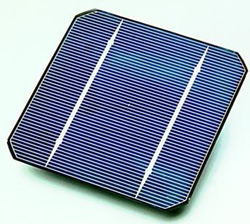
 A conventional crystalline silicon solar cell (as of 2005). Electrical contacts made from busbars (the larger silver-colored strips) and fingers (the smaller ones) are printed on the silicon wafer. | |
| Component type | Active |
|---|---|
| Working principle | Photovoltaic effect |
| Inventor | Edmond Becquerel |
| Invention year | 1839 |
| First produced | 1950s |
| Electronic symbol | |
_8.7.3.svg) | |
A solar cell, also known as a photovoltaic cell (PV cell), is an electronic device that converts the energy of light directly into electricity by means of the photovoltaic effect.[1] It is a type of photoelectric cell, a device whose electrical characteristics (such as current, voltage, or resistance) vary when it is exposed to light. Individual solar cell devices are often the electrical building blocks of photovoltaic modules, known colloquially as "solar panels". Almost all commercial PV cells consist of crystalline silicon, with a market share of 95%. Cadmium telluride thin-film solar cells account for the remainder.[2] The common single-junction silicon solar cell can produce a maximum open-circuit voltage of approximately 0.5 to 0.6 volts.[3]
Photovoltaic cells may operate under sunlight or artificial light. In addition to producing solar power, they can be used as a photodetector (for example infrared detectors), to detect light or other electromagnetic radiation near the visible light range, as well as to measure light intensity.
The operation of a PV cell requires three basic attributes:
- The absorption of light, generating excitons (bound electron-hole pairs), unbound electron-hole pairs (via excitons), or plasmons.
- The separation of charge carriers of opposite types.
- The separate extraction of those carriers to an external circuit.
There are multiple input factors that affect the output power of solar cells, such as temperature, material properties, weather conditions, solar irradiance and more.[4]
A similar type of "photoelectrolytic cell" (photoelectrochemical cell), can refer to devices
- using light to excite electrons that can further be transported by a semiconductor which delivers the energy (like that explored by Edmond Becquerel and implemented in modern dye-sensitized solar cells)
- using light to split water directly into hydrogen and oxygen which can further be used in power generation
In contrast to outputting power directly, a solar thermal collector absorbs sunlight, to produce either
- direct heat as a "solar thermal module" or "solar hot water panel"
- indirect heat to be used to spin turbines in electrical power generation.
Arrays of solar cells are used to make solar modules that generate a usable amount of direct current (DC) from sunlight. Strings of solar modules create a solar array to generate solar power using solar energy, many times using an inverter to convert the solar power to alternating current (AC).
Applications
[edit]Vehicular applications
[edit]
Electric vehicles that operate off of solar energy or sunlight are commonly referred to as solar cars.[5] These vehicles use solar panels to convert absorbed light into electrical energy to be used by electric motors, with any excess energy stored in batteries.[6] Batteries in solar-powered vehicles differ from starting batteries in standard ICE cars because they are fashioned to impart power towards electrical components of the vehicle for a long durations.[7]
The first instance of photovoltaic cells within vehicular applications was around midway through the second half of the 1900s. In an effort to increase publicity and awareness in solar powered transportation Hans Tholstrup decided to set up the first edition of the World Solar Challenge in 1987.[8] It was a 3000 km race across the Australian outback where competitors from industry research groups and top universities around the globe were invited to compete. General Motors ended up winning the event by a significant margin with their Sunraycer vehicle that achieved speeds of over 40 mph. Contrary to popular belief, solar powered cars are one of the oldest alternative energy vehicles.[9]
Cells, modules, panels and systems
[edit]

Multiple solar cells in an integrated group, all oriented in one plane, constitute a solar photovoltaic panel or module. Photovoltaic modules often have a sheet of glass on the sun-facing side, allowing light to pass while protecting the semiconductor wafers. Solar cells connected in series creates an additive higher voltage, while connecting in parallel yields an additive higher current.
Parallel cells without bypass or shunt diodes that experience shade can shut down the weaker (less illuminated) parallel string (each string a number of series connected cells) causing substantial power loss and possible damage because of the reverse bias applied to the shaded cells by their illuminated partners.[10]
Solar modules can be interconnected to create an array with a desired peak DC voltage and loading current capacity. This functionality can also be accomplished with various other solar devices that do more than just create the desired voltages and currents, such as with MPPTs (maximum power point trackers) or module level power electronic (MLPE) units: microinverters or DC-DC optimizers.
Multiple solar cells assembled together in a single plane form a solar photovoltaic (PV) panel or module. These modules typically feature a glass sheet on the sun-facing side, which allows sunlight to pass through while safeguarding the semiconductor wafers from environmental factors. Connecting solar cells in series increases the voltage output, whereas parallel connections enhance the current output.[11]
Solar modules are often equipped with bypass diodes that isolate shaded cells, preventing them from affecting the performance of the entire string. These diodes allow the current to bypass the shaded or underperforming cells, thereby minimizing power loss and reducing the risk of damage.[12]
| Australia | China | France | Germany | Italy | Japan | United Kingdom | United States | |
|---|---|---|---|---|---|---|---|---|
| Residential | 1.8 | 1.5 | 4.1 | 2.4 | 2.8 | 4.2 | 2.8 | 4.9 |
| Commercial | 1.7 | 1.4 | 2.7 | 1.8 | 1.9 | 3.6 | 2.4 | 4.5 |
| Utility-scale | 2.0 | 1.4 | 2.2 | 1.4 | 1.5 | 2.9 | 1.9 | 3.3 |
| Source: IEA – Technology Roadmap: Solar Photovoltaic Energy report, 2014 edition[13]: 15 Note: DOE – Photovoltaic System Pricing Trends reports lower prices for the U.S.[14] | ||||||||
By 2020, the United States cost per watt for a utility scale system had declined to $0.94.[15]
Space
[edit]
Solar cells were first used in a prominent application when they were proposed and flown on the Vanguard satellite in 1958, as an alternative power source to the primary battery power source. By adding cells to the outside of the body, the mission time could be extended with no major changes to the spacecraft or its power systems. In 1959 the United States launched Explorer 6, featuring large wing-shaped solar arrays, which became a common feature in satellites. These arrays consisted of 9600 Hoffman solar cells.
By the 1960s, solar cells were (and still are) the main power source for most Earth orbiting satellites and a number of probes into the Solar System, since they offered the best power-to-weight ratio. The success of the space solar power market drove the development of higher efficiencies in solar cells, due to limited other power options and the desire for the best possible cells, up until the National Science Foundation "Research Applied to National Needs" program began to push development of solar cells for terrestrial applications.
In the early 1990s the technology used for space solar cells diverged from the silicon technology used by terrestrial panels, with the spacecraft application shifting to gallium arsenide-based III-V semiconductor materials, which then evolved into the modern III-V multijunction photovoltaic cell used on spacecraft that are lightweight, compact, flexible, and highly efficient. State of the art technology implemented on satellites uses multi-junction photovoltaic cells, which are composed of different p–n junctions with varying bandgaps in order to utilize a wider spectrum of the Sun's energy. Space solar cells additionally diverged from the protective layer used by terrestrial panels, with space applications using flexible laminate layers.
Additionally, large satellites require the use of large solar arrays to produce electricity. These solar arrays need to be broken down to fit in the geometric constraints of the launch vehicle the satellite travels on before being injected into orbit. Historically, solar cells on satellites consisted of several small terrestrial panels folded together. These small panels would be unfolded into a large panel after the satellite is deployed in its orbit. Newer satellites aim to use flexible rollable solar arrays that are very lightweight and can be packed into a very small volume. The smaller size and weight of these flexible arrays drastically decreases the overall cost of launching a satellite due to the direct relationship between payload weight and launch cost of a launch vehicle.[16]
In 2020, the US Naval Research Laboratory conducted its first test of solar power generation in a satellite, the Photovoltaic Radio-frequency Antenna Module (PRAM) experiment aboard the Boeing X-37.[17][18]
History
[edit]The photovoltaic effect was experimentally demonstrated first by French physicist Edmond Becquerel. In 1839, at age 19, he built the world's first photovoltaic cell in his father's laboratory. Willoughby Smith first described the "Effect of Light on Selenium during the passage of an Electric Current" in a 20 February 1873 issue of Nature. In 1883 Charles Fritts built the first solid state photovoltaic cell by coating the semiconductor selenium with a thin layer of gold to form the junctions; the device was only around 1% efficient.[19] Other milestones include:
- 1888 – Russian physicist Aleksandr Stoletov built the first cell based on the outer photoelectric effect discovered by Heinrich Hertz in 1887.[20]
- 1904 – Julius Elster, together with Hans Friedrich Geitel, devised the first practical photoelectric cell.[21]
- 1905 – Albert Einstein proposed a new quantum theory of light and explained the photoelectric effect in a landmark paper, for which he received the Nobel Prize in Physics in 1921.[22]
- 1941 – Vadim Lashkaryov discovered p–n junctions in Cu2O and Ag2S protocells.[23]
- 1946 – Russell Ohl patented the modern junction semiconductor solar cell,[24] while working on the series of advances that would lead to the transistor.
- 1948 - Introduction to the World of Semiconductors states Kurt Lehovec may have been the first to explain the photo-voltaic effect in the peer-reviewed journal Physical Review.[25][26]
- 1954 – The first practical photovoltaic cell was publicly demonstrated at Bell Laboratories.[27] The inventors were Calvin Souther Fuller, Daryl Chapin and Gerald Pearson.[28]
- 1958 – Solar cells gained prominence with their incorporation onto the Vanguard I satellite.[29]
Improved manufacturing methods post 1960s
[edit]Pricing and efficiency Improvements were gradual over the 1960s. One reason that costs remained high was because space users were willing to pay for the best possible cells, leaving no reason to invest in lower-cost, less-efficient solutions. Also, price was determined largely by the semiconductor industry; their move to integrated circuits in the 1960s led to the availability of larger boules at lower relative prices. As their price fell, the price of the resulting cells did as well. These effects lowered 1971 cell costs to some $100,000 per watt.[30]
In late 1969 Elliot Berman joined Exxon's task force which was looking for projects 30 years in the future and in April 1973 he founded Solar Power Corporation (SPC), a wholly owned subsidiary of Exxon at that time.[31][32][33] The group concluded that electrical power would be much more expensive by 2000, and felt that the increase in price would make alternative energy sources more attractive. He conducted a market study and concluded that a price per watt of about $20/watt would create significant demand.[31] To reduce costs, the team
- eliminated the steps of polishing the wafers and coating them with an anti-reflective layer, by relying on rough-sawn wafer surfaces.
- replaced the expensive materials and hand wiring used in space applications with a printed circuit board on the back, acrylic plastic on the front, and silicone glue between the two, "potting" the cells.[34]
- used solar cells that could be made using cast-off material from the electronics market.
By 1973 they announced a product, and SPC convinced Tideland Signal to use its panels to power navigational buoys, initially for the U.S. Coast Guard.[32]
Research and industrial production post 1970's
[edit]Research into solar power for terrestrial applications became prominent with the U.S. National Science Foundation's Advanced Solar Energy Research and Development Division within the "Research Applied to National Needs" program, which ran from 1969 to 1977,[35] and funded research on developing solar power for ground electrical power systems. A 1973 conference, the "Cherry Hill Conference", set forth the technology goals required to achieve this goal and outlined an ambitious project for achieving them, kicking off an applied research program that would be ongoing for several decades.[36] The program was eventually taken over by the Energy Research and Development Administration (ERDA),[37] which was later merged into the U.S. Department of Energy.
Following the 1973 oil crisis, oil companies used their higher profits to start (or buy) solar firms, and were for decades the largest producers. Exxon, ARCO, Shell, Amoco (later purchased by BP) and Mobil all had major solar divisions during the 1970s and 1980s. Technology companies also participated, including General Electric, Motorola, IBM, Tyco and RCA.[38]
Declining costs and exponential capacity growth
[edit]


Adjusting for inflation, it cost $96 per watt for a solar module in the mid-1970s. Process improvements and a very large boost in production have brought that figure down more than 99%, to 30¢ per watt in 2018 [41] and as low as 20¢ per watt in 2020. [42] Swanson's law is an observation similar to Moore's Law that states that solar cell prices fall 20% for every doubling of industry capacity. It was featured in an article in the British weekly newspaper The Economist in late 2012.[43] Balance of system costs are now higher than the solar panels alone, where in 2018 commercial arrays could be built at below $1.00 a watt, fully commissioned.[15]
Over decades, costs for solar cells and panels has declined for many reasons:
- Larger boules. When the semiconductor industry moved to ever-larger boules, older equipment became inexpensive.
- Larger physical solar cell size. Sizes grew as surplus semiconductor equipment became available. ARCO Solar's original panels used cells 2 to 4 inches (50 to 100 mm) in diameter. Panels in the 1990s and early 2000s generally used 125 mm wafers; since 2008, almost all new panels use greater than 156mm cells,[44] and by 2020 even larger 182mm 'M10' cells.[45]
- Availability of large, high-quality glass sheets to cover the panels. Widespread introduction of flat screen televisions in the late 1990s and early 2000s led to such availability.
- Thinner solar cells. High silicon prices in 2004–2008 encouraged silicon solar cell manufacturers to reduce silicon consumption by making them thinner; whereby 2008, according to Jef Poortmans, director of IMEC's organic and solar department, cells used 8–9 grams (0.28–0.32 oz) of silicon per watt of power generation, with typical wafer thicknesses in the neighborhood of 200 microns.
During the 1990s, polysilicon ("poly") cells became increasingly popular. These cells offer less efficiency than their mono-silicon ("mono") counterparts, but are grown in large vats that reduce cost. By the mid-2000s, poly was dominant in the low-cost panel market, but more recently the mono-silicon cells have returned to widespread use due to the efficiency gains.
Crystalline silicon panels dominate worldwide markets and are mostly manufactured in China and Taiwan. By late 2011, a drop in European demand dropped prices for crystalline solar modules to about $1.09[46] per watt down sharply from 2010. Prices continued to fall in 2012, reaching $0.62/watt by 4Q2012.[47]
It was anticipated that electricity from PV will be competitive with wholesale electricity costs all across Europe and the energy payback time of crystalline silicon modules can be reduced to below 0.5 years by 2020.[48]
Falling costs are considered one of the biggest factors in the rapid growth of renewable energy, of 2016, solar PV is growing fastest in Asia, with China and Japan currently accounting for half of worldwide deployment.[49] Costs of solar photovoltaic electricity fell by ~85% between 2010 (when solar and wind made up 1.7% of global electricity generation) and 2021 (where they made up 8.7%).[50] Global installed PV capacity reached at least 301 gigawatts in 2016, and grew to supply 1.3% of global power by 2016.[51] In 2019 solar cells accounted for ~3 % of the world's electricity generation at 720 Tw-hr.[52]
Subsidies and grid parity
[edit]Solar-specific feed-in tariffs vary by and within country countries. Such tariffs can encourage the development of solar power projects and to achieve grid parity. Grid parity, the point at which photovoltaic electricity is equal to or cheaper than grid power without subsidies, is expected to be first achieved in areas with abundant sun and high electricity costs such as in California and Japan.[53] In 2007 BP claimed grid parity for Hawaii and other islands that otherwise use diesel fuel to produce electricity. George W. Bush set 2015 as the date for grid parity in the US.[54][55] The Photovoltaic Association reported in 2012 that Australia had reached grid parity (ignoring feed in tariffs).[56]
The price of solar panels fell steadily for 40 years, interrupted in 2004 when high subsidies in Germany drastically increased demand there and greatly increased the price of purified silicon (which is used in computer chips as well as solar panels). The Great Recession and the onset of Chinese manufacturing caused prices to resume their decline. In the four years after January 2008 prices for solar modules in Germany dropped from €3 to €1 per peak watt. During that same time production capacity surged with an annual growth of more than 50%. China increased solar panel production market share from 8% in 2008 to over 55% in the last quarter of 2010.[57] In December 2012 the price of Chinese solar panels had dropped to $0.60/Wp (crystalline modules).[58] (The abbreviation Wp stands for watt peak capacity, or the maximum capacity under optimal conditions.[59])
As of the end of 2016, it was reported that spot prices for assembled solar panels (not cells) had fallen to a record-low of US$0.36/Wp. The second largest supplier, Canadian Solar Inc., had reported costs of US$0.37/Wp in the third quarter of 2016, having dropped $0.02 from the previous quarter, and hence was probably still at least breaking even. Many producers expected costs would drop to the vicinity of $0.30 by the end of 2017.[60] It was also reported that new solar installations were cheaper than coal-based thermal power plants in some regions of the world, and this was expected to be the case in most of the world within a decade.[61]
Theory
[edit]

A solar cell is made of semiconducting materials, such as silicon, that have been fabricated into a p–n junction. Such junctions are made by doping one side of the device p-type and the other n-type, for example in the case of silicon by introducing small concentrations of boron or phosphorus respectively.
Solar cells use "doping" of the silicon substrate to lower the activation energy thereby making the cell more efficient in converting photons to retrievable electrons.[63] Doping chemicals such as boron (p-type) are applied into the semiconductor crystal in order to create donor and acceptor energy levels substantially closer to the valence and conductor bands.[64] In doing so, the addition of boron impurity allows the activation energy to decrease twenty-fold from 1.12 eV to 0.05 eV. Since the potential difference (EB) is so low, the boron is able to thermally ionize at room temperatures. This allows for free energy carriers in the conduction and valence bands thereby allowing greater conversion of photons to electrons.
In operation, photons in sunlight hit the solar cell and are absorbed by the semiconductor. When the photons are absorbed, electrons are excited from the valence band to the conduction band (or from occupied to unoccupied molecular orbitals in the case of an organic solar cell), producing electron-hole pairs. If the electron-hole pairs are created near the junction between p-type and n-type materials the local electric field sweeps them apart to opposite electrodes, producing an excess of electrons on one side and an excess of holes on the other. When the solar cell is unconnected (or the external electrical load is very high) the electrons and holes will ultimately restore equilibrium by diffusing back across the junction against the field and recombine with each other giving off heat, but if the load is small enough then it is easier for equilibrium to be restored by the excess electrons going around the external circuit, doing useful work along the way.
The most commonly known solar cell is configured as a large-area p–n junction made from silicon. Other possible solar cell types are organic solar cells, dye sensitized solar cells, perovskite solar cells, quantum dot solar cells, etc. The illuminated side of a solar cell generally has a transparent conducting film for allowing light to enter into the active material and to collect the generated charge carriers. Typically, films with high transmittance and high electrical conductance such as indium tin oxide, conducting polymers, or conducting nanowire networks are used for the purpose.[62]
Efficiency
[edit]
Solar cell efficiency may be broken down into reflectance efficiency, thermodynamic efficiency, charge carrier separation efficiency and conductive efficiency. The overall efficiency is the product of these individual metrics.
The power conversion efficiency of a solar cell is a parameter which is defined by the fraction of incident power converted into electricity.[65]
A solar cell has a voltage dependent efficiency curve, temperature coefficients, and allowable shadow angles.
Due to the difficulty in measuring these parameters directly, other parameters are substituted: thermodynamic efficiency, quantum efficiency, integrated quantum efficiency, VOC ratio, and fill factor. Reflectance losses are a portion of quantum efficiency under "external quantum efficiency". Recombination losses make up another portion of quantum efficiency, VOC ratio, and fill factor. Resistive losses are predominantly categorized under fill factor, but also make up minor portions of quantum efficiency, VOC ratio.
The fill factor is the ratio of the actual maximum obtainable power to the product of the open-circuit voltage and short-circuit current. This is a key parameter in evaluating performance. In 2009, typical commercial solar cells had a fill factor > 0.70. Grade B cells were usually between 0.4 and 0.7.[66] Cells with a high fill factor have a low equivalent series resistance and a high equivalent shunt resistance, so less of the current produced by the cell is dissipated in internal losses.
Single p–n junction crystalline silicon devices are now approaching the theoretical limiting power efficiency of 33.16%,[67] noted as the Shockley–Queisser limit in 1961. In the extreme, with an infinite number of layers, the corresponding limit is 86% using concentrated sunlight.[68]

In 2014, three companies broke the record of 25.6% for a silicon solar cell. Panasonic's was the most efficient. The company moved the front contacts to the rear of the panel, eliminating shaded areas. In addition they applied thin silicon films to the (high quality silicon) wafer's front and back to eliminate defects at or near the wafer surface.[69]
In 2015, a 4-junction GaInP/GaAs//GaInAsP/GaInAs solar cell achieved a new laboratory record efficiency of 46.1% (concentration ratio of sunlight = 312) in a French-German collaboration between the Fraunhofer Institute for Solar Energy Systems (Fraunhofer ISE), CEA-LETI and SOITEC.[70]
In September 2015, Fraunhofer ISE announced the achievement of an efficiency above 20% for epitaxial wafer cells. The work on optimizing the atmospheric-pressure chemical vapor deposition (APCVD) in-line production chain was done in collaboration with NexWafe GmbH, a company spun off from Fraunhofer ISE to commercialize production.[71][72]
For triple-junction thin-film solar cells, the world record is 13.6%, set in June 2015.[73]
In 2016, researchers at Fraunhofer ISE announced a GaInP/GaAs/Si triple-junction solar cell with two terminals reaching 30.2% efficiency without concentration.[74]
In 2017, a team of researchers at National Renewable Energy Laboratory (NREL), EPFL and CSEM (Switzerland) reported record one-sun efficiencies of 32.8% for dual-junction GaInP/GaAs solar cell devices. In addition, the dual-junction device was mechanically stacked with a Si solar cell, to achieve a record one-sun efficiency of 35.9% for triple-junction solar cells.[75]
Materials
[edit]
Solar cells are typically named after the semiconducting material of which they are composed. These materials have varying characteristics to absorb optimal available sunlight spectrum. Some cells are designed to handle sunlight that reaches the Earth's surface, while others are optimized for use in space. Solar cells can be made of a single layer of light-absorbing material (single-junction) or use multiple physical configurations (multi-junctions) to take advantage of various absorption and charge separation mechanisms.
Solar cells can be classified into first, second and third generation:
- First generation cells—also called conventional, traditional or wafer-based cells—are made of crystalline silicon, the commercially predominant PV technology, that includes materials such as polysilicon and monocrystalline silicon.
- Second generation cells are thin film solar cells, that include amorphous silicon, CdTe and CIGS cells and are commercially significant in utility-scale photovoltaic power stations, building integrated photovoltaics or in small stand-alone power system.
- Third generation of solar cells includes a number of thin-film technologies often described as emerging photovoltaics—most of them have not yet been commercially applied and are still in the research or development phase. Many use organic materials, often organometallic compounds as well as inorganic substances. Despite the fact that their efficiencies had been low and the stability of the absorber material was often too short for commercial applications, there is research into these technologies as they promise to achieve the goal of producing low-cost, high-efficiency solar cells.[77]
As of 2016, the most popular and efficient solar cells were those made from thin wafers of silicon which are also the oldest solar cell technology.[78]
Crystalline silicon
[edit]By far, the most prevalent bulk material for solar cells is crystalline silicon (c-Si), also known as "solar grade silicon". Bulk silicon is separated into multiple categories according to crystallinity and crystal size in the resulting ingot, ribbon or wafer. These cells are entirely based around the concept of a p–n junction. Solar cells made of c-Si are made from wafers between 160 and 240 micrometers thick.
Monocrystalline silicon
[edit]
Monocrystalline silicon (mono-Si) solar cells feature a single-crystal composition that enables electrons to move more freely than in a multi-crystal configuration. Consequently, monocrystalline solar panels deliver a higher efficiency than their multicrystalline counterparts.[79] The corners of the cells look clipped, like an octagon, because the wafer material is cut from cylindrical ingots, that are typically grown by the Czochralski process. Solar panels using mono-Si cells display a distinctive pattern of small white diamonds.
Epitaxial silicon development
[edit]Epitaxial wafers of crystalline silicon can be grown on a monocrystalline silicon "seed" wafer by chemical vapor deposition (CVD), and then detached as self-supporting wafers of some standard thickness (e.g., 250 μm) that can be manipulated by hand, and directly substituted for wafer cells cut from monocrystalline silicon ingots. Solar cells made with this "kerfless" technique can have efficiencies approaching those of wafer-cut cells, but at appreciably lower cost if the CVD can be done at atmospheric pressure in a high-throughput inline process.[71][72] The surface of epitaxial wafers may be textured to enhance light absorption.[80][81]
In June 2015, it was reported that heterojunction solar cells grown epitaxially on n-type monocrystalline silicon wafers had reached an efficiency of 22.5% over a total cell area of 243.4 cm.[82]

Polycrystalline silicon
[edit]Polycrystalline silicon, or multicrystalline silicon (multi-Si) cells are made from cast square ingots—large blocks of molten silicon carefully cooled and solidified. They consist of small crystals giving the material its typical metal flake effect. Polysilicon cells are the most common type used in photovoltaics and are less expensive, but also less efficient, than those made from monocrystalline silicon.
Ribbon silicon
[edit]Ribbon silicon is a type of polycrystalline silicon—it is formed by drawing flat thin films from molten silicon and results in a polycrystalline structure. These cells are cheaper to make than multi-Si, due to a great reduction in silicon waste, as this approach does not require sawing from ingots.[83] However, they are also less efficient.
Mono-like-multi silicon (MLM)
[edit]This form was developed in the 2000s and introduced commercially around 2009. Also called cast-mono, this design uses polycrystalline casting chambers with small "seeds" of mono material. The result is a bulk mono-like material that is polycrystalline around the outsides. When sliced for processing, the inner sections are high-efficiency mono-like cells (but square instead of "clipped"), while the outer edges are sold as conventional poly. This production method results in mono-like cells at poly-like prices.[84]
Thin film
[edit]Thin-film technologies reduce the amount of active material in a cell. Most designs sandwich active material between two panes of glass. Since silicon solar panels only use one pane of glass, thin film panels are approximately twice as heavy as crystalline silicon panels, although they have a smaller ecological impact (determined from life cycle analysis).[85][86]
Cadmium telluride
[edit]Cadmium telluride is the only thin film material so far to rival crystalline silicon in cost/watt. However cadmium is highly toxic and tellurium (anion: "telluride") supplies are limited. The cadmium present in the cells would be toxic if released. However, release is impossible during normal operation of the cells and is unlikely during fires in residential roofs.[87] A square meter of CdTe contains approximately the same amount of Cd as a single C cell nickel-cadmium battery, in a more stable and less soluble form.[87]
Copper indium gallium selenide
[edit]Copper indium gallium selenide (CIGS) is a direct band gap material. It has the highest efficiency (~20%) among all commercially significant thin film materials (see CIGS solar cell). Traditional methods of fabrication involve vacuum processes including co-evaporation and sputtering. Recent developments at IBM and Nanosolar attempt to lower the cost by using non-vacuum solution processes.[88]
Silicon thin film
[edit]Silicon thin-film cells are mainly deposited by chemical vapor deposition (typically plasma-enhanced, PE-CVD) from silane gas and hydrogen gas. Depending on the deposition parameters, this can yield amorphous silicon (a-Si or a-Si:H), protocrystalline silicon or nanocrystalline silicon (nc-Si or nc-Si:H), also called microcrystalline silicon.[89]
Amorphous silicon is the most well-developed thin film technology to-date. An amorphous silicon (a-Si) solar cell is made of non-crystalline or microcrystalline silicon. Amorphous silicon has a higher bandgap (1.7 eV) than crystalline silicon (c-Si) (1.1 eV), which means it absorbs the visible part of the solar spectrum more strongly than the higher power density infrared portion of the spectrum. The production of a-Si thin film solar cells uses glass as a substrate and deposits a very thin layer of silicon by plasma-enhanced chemical vapor deposition (PECVD).
Protocrystalline silicon with a low volume fraction of nanocrystalline silicon is optimal for high open-circuit voltage.[90] Nc-Si has about the same bandgap as c-Si and nc-Si and a-Si can advantageously be combined in thin layers, creating a layered cell called a tandem cell. The top cell in a-Si absorbs the visible light and leaves the infrared part of the spectrum for the bottom cell in nc-Si.
Gallium arsenide thin film
[edit]The semiconductor material gallium arsenide (GaAs) is also used for single-crystalline thin film solar cells. Although GaAs cells are very expensive[91], they hold the world's record in efficiency for a single-junction solar cell at 28.8%.[92] Typically fabricated on crystalline silicon wafer[93] with a 41% fill factor, by moving to porous silicon fill factor can be increased to 56% with potentially reduced cost. Using less active GaAs material by fabricating nanowires is another potential pathway to cost reduction.[94] GaAs is more commonly used in multijunction photovoltaic cells for concentrated photovoltaics (CPV, HCPV) and for solar panels on spacecraft, as the industry favours efficiency over cost for space-based solar power.
Multijunction cells
[edit]
Multi-junction cells consist of multiple thin films, each essentially a solar cell grown on top of another, typically using metalorganic vapour phase epitaxy. Each layer has a different band gap energy to allow it to absorb electromagnetic radiation over a different portion of the spectrum. Multi-junction cells were originally developed for special applications such as satellites and space exploration, but are now used increasingly in terrestrial concentrator photovoltaics (CPV), an emerging technology that uses lenses and curved mirrors to concentrate sunlight onto small, highly efficient multi-junction solar cells. By concentrating sunlight up to a thousand times, High concentration photovoltaics (HCPV) has the potential to outcompete conventional solar PV in the future.[95]: 21, 26
Tandem solar cells based on monolithic, series connected, gallium indium phosphide (GaInP), gallium arsenide (GaAs), and germanium (Ge) p–n junctions, are increasing sales, despite cost pressures.[96] Between December 2006 and December 2007, the cost of 4N gallium metal rose from about $350 per kg to $680 per kg. Additionally, germanium metal prices have risen substantially to $1000–1200 per kg this year. Those materials include gallium (4N, 6N and 7N Ga), arsenic (4N, 6N and 7N) and germanium, pyrolitic boron nitride (pBN) crucibles for growing crystals, and boron oxide, these products are critical to the entire substrate manufacturing industry.[97]
A triple-junction cell, for example, may consist of the semiconductors: GaAs, Ge, and GaInP
2.[98] Triple-junction GaAs solar cells were used as the power source of the Dutch four-time World Solar Challenge winners Nuna in 2003, 2005 and 2007 and by the Dutch solar cars Solutra (2005), Twente One (2007) and 21Revolution (2009).[99] GaAs based multi-junction devices are the most efficient solar cells to date. On 15 October 2012, triple junction metamorphic cells reached a record high of 44%.[100] In 2022, researchers at Fraunhofer Institute for Solar Energy Systems ISE in Freiburg, Germany, demonstrated a record solar cell efficiency of 47.6% under 665-fold sunlight concentration with a four-junction concentrator solar cell.[101][102]
GaInP/Si dual-junction solar cells
[edit]In 2016, a new approach was described for producing hybrid photovoltaic wafers combining the high efficiency of III-V multi-junction solar cells with the economies and wealth of experience associated with silicon. The technical complications involved in growing the III-V material on silicon at the required high temperatures, a subject of study for some 30 years, are avoided by epitaxial growth of silicon on GaAs at low temperature by plasma-enhanced chemical vapor deposition (PECVD).[103]
Si single-junction solar cells have been widely studied for decades and are reaching their practical efficiency of ~26% under 1-sun conditions.[104] Increasing this efficiency may require adding more cells with bandgap energy larger than 1.1 eV to the Si cell, allowing to convert short-wavelength photons for generation of additional voltage. A dual-junction solar cell with a band gap of 1.6–1.8 eV as a top cell can reduce thermalization loss, produce a high external radiative efficiency and achieve theoretical efficiencies over 45%.[105] A tandem cell can be fabricated by growing the GaInP and Si cells. Growing them separately can overcome the 4% lattice constant mismatch between Si and the most common III–V layers that prevent direct integration into one cell. The two cells therefore are separated by a transparent glass slide so the lattice mismatch does not cause strain to the system. This creates a cell with four electrical contacts and two junctions that demonstrated an efficiency of 18.1%. With a fill factor (FF) of 76.2%, the Si bottom cell reaches an efficiency of 11.7% (± 0.4) in the tandem device, resulting in a cumulative tandem cell efficiency of 29.8%.[106] This efficiency exceeds the theoretical limit of 29.4%[107] and the record experimental efficiency value of a Si 1-sun solar cell, and is also higher than the record-efficiency 1-sun GaAs device. However, using a GaAs substrate is expensive and not practical. Hence researchers try to make a cell with two electrical contact points and one junction, which does not need a GaAs substrate. This means there will be direct integration of GaInP and Si.
Research in solar cells
[edit]Perovskite solar cells
[edit]Perovskite solar cells are solar cells that include a perovskite-structured material as the active layer. Most commonly, this is a solution-processed hybrid organic-inorganic tin or lead halide based material. Efficiencies have increased from below 5% at their first usage in 2009 to 25.5% in 2020, making them a very rapidly advancing technology and a hot topic in the solar cell field.[108] Researchers at University of Rochester reported in 2023 that significant further improvements in cell efficiency can be achieved by utilizing Purcell effect.[109]
Perovskite solar cells are also forecast to be extremely cheap to scale up, making them a very attractive option for commercialisation. So far most types of perovskite solar cells have not reached sufficient operational stability to be commercialised, although many research groups are investigating ways to solve this.[110] Energy and environmental sustainability of perovskite solar cells and tandem perovskite are shown to be dependent on the structures.[111][112][113] Photonic front contacts for light management can improve the perovskite cells' performance, via enhanced broadband absorption, while allowing better operational stability due to protection against the harmful high-energy (above Visible) radiation.[114] The inclusion of the toxic element lead in the most efficient perovskite solar cells is a potential problem for commercialisation.[115]
Bifacial solar cells
[edit]
With a transparent rear side, bifacial solar cells can absorb light from both the front and rear sides. Hence, they can produce more electricity than conventional monofacial solar cells. The first patent of bifacial solar cells was filed by Japanese researcher Hiroshi Mori, in 1966.[116] Later, it is said that Russia was the first to deploy bifacial solar cells in their space program in the 1970s.[citation needed] In 1976, the Institute for Solar Energy of the Technical University of Madrid, began a research program for the development of bifacial solar cells led by Prof. Antonio Luque. Based on 1977 US and Spanish patents by Luque, a practical bifacial cell was proposed with a front face as anode and a rear face as cathode; in previously reported proposals and attempts both faces were anodic and interconnection between cells was complicated and expensive.[117][118][119] In 1980, Andrés Cuevas, a PhD student in Luque's team, demonstrated experimentally a 50% increase in output power of bifacial solar cells, relative to identically oriented and tilted monofacial ones, when a white background was provided.[120] In 1981 the company Isofoton was founded in Málaga to produce the developed bifacial cells, thus becoming the first industrialization of this PV cell technology. With an initial production capacity of 300 kW/yr of bifacial solar cells, early landmarks of Isofoton's production were the 20kWp power plant in San Agustín de Guadalix, built in 1986 for Iberdrola, and an off grid installation by 1988 also of 20kWp in the village of Noto Gouye Diama (Senegal) funded by the Spanish international aid and cooperation programs.
Due to the reduced manufacturing cost, companies have again started to produce commercial bifacial modules since 2010. By 2017, there were at least eight certified PV manufacturers providing bifacial modules in North America. The International Technology Roadmap for Photovoltaics (ITRPV) predicted that the global market share of bifacial technology will expand from less than 5% in 2016 to 30% in 2027.[121]
Due to the significant interest in the bifacial technology, a recent study has investigated the performance and optimization of bifacial solar modules worldwide.[122][123] The results indicate that, across the globe, ground-mounted bifacial modules can only offer ~10% gain in annual electricity yields compared to the monofacial counterparts for a ground albedo coefficient of 25% (typical for concrete and vegetation groundcovers). However, the gain can be increased to ~30% by elevating the module 1 m above the ground and enhancing the ground albedo coefficient to 50%. Sun et al. also derived a set of empirical equations that can optimize bifacial solar modules analytically.[122] In addition, there is evidence that bifacial panels work better than traditional panels in snowy environments as bifacials on dual-axis trackers made 14% more electricity in a year than their monofacial counterparts and 40% during the peak winter months.[124]
An online simulation tool is available to model the performance of bifacial modules in any arbitrary location across the entire world. It can also optimize bifacial modules as a function of tilt angle, azimuth angle, and elevation above the ground.[125]
Intermediate band
[edit]Intermediate band photovoltaics in solar cell research provides methods for exceeding the Shockley–Queisser limit on the efficiency of a cell. It introduces an intermediate band (IB) energy level in between the valence and conduction bands. Theoretically, introducing an IB allows two photons with energy less than the bandgap to excite an electron from the valence band to the conduction band. This increases the induced photocurrent and thereby efficiency.[126]
Luque and Marti first derived a theoretical limit for an IB device with one midgap energy level using detailed balance. They assumed no carriers were collected at the IB and that the device was under full concentration. They found the IB maximum efficiency to be 63.2%, for a bandgap of 1.95eV with the IB 0.71eV from either the valence or conduction band ans compared to the under one sun illumination limiting efficiency of 47%.[127] Several means are under study to realize IB semiconductors with such optimum 3-bandgap configuration, namely via materials engineering (controlled inclusion of deep level impurities or highly mismatched alloys) and nano-structuring (quantum-dots in host hetero-crystals).[128]
Liquid inks
[edit]In 2014, researchers at California NanoSystems Institute discovered using kesterite and perovskite improved electric power conversion efficiency for solar cells.[129]
In December 2022, it was reported that MIT researchers had developed ultralight fabric solar cells. These cells offer a weight one-hundredth that of traditional panels while generating 18 times more power per kilogram. Thinner than a human hair, these cells can be laminated onto various surfaces, such as boat sails, tents, tarps, or drone wings, to extend their functionality. Using ink-based materials and scalable techniques, researchers coat the solar cell structure with printable electronic inks, completing the module with screen-printed electrodes. Tested on high-strength fabric, the cells produce 370 watts-per-kilogram, representing an improvement over conventional solar cells.[130]
Upconversion and downconversion
[edit]Photon upconversion is the process of using two low-energy (e.g., infrared) photons to produce one higher energy photon; downconversion is the process of using one high energy photon (e.g., ultraviolet) to produce two lower energy photons. Either of these techniques could be used to produce higher efficiency solar cells by allowing solar photons to be more efficiently used. The difficulty, however, is that the conversion efficiency of existing phosphors exhibiting up- or down-conversion is low, and is typically narrow band.
One upconversion technique is to incorporate lanthanide-doped materials (Er3+
, Yb3+
, Ho3+
or a combination), taking advantage of their luminescence to convert infrared radiation to visible light. Upconversion process occurs when two infrared photons are absorbed by rare-earth ions to generate a (high-energy) absorbable photon. As example, the energy transfer upconversion process (ETU), consists in successive transfer processes between excited ions in the near infrared. The upconverter material could be placed below the solar cell to absorb the infrared light that passes through the silicon. Useful ions are most commonly found in the trivalent state. Er+
ions have been the most used. Er3+
ions absorb solar radiation around 1.54 μm. Two Er3+
ions that have absorbed this radiation can interact with each other through an upconversion process. The excited ion emits light above the Si bandgap that is absorbed by the solar cell and creates an additional electron–hole pair that can generate current. However, the increased efficiency was small. In addition, fluoroindate glasses have low phonon energy and have been proposed as suitable matrix doped with Ho3+
ions.[131]
Light-absorbing dyes
[edit]Dye-sensitized solar cells (DSSCs) are made of low-cost materials and do not need elaborate manufacturing equipment, so they can be made in a DIY fashion. In bulk it should be significantly less expensive than older solid-state cell designs. DSSC's can be engineered into flexible sheets and although its conversion efficiency is less than the best thin film cells, its price/performance ratio may be high enough to allow them to compete with fossil fuel electrical generation.
Typically a ruthenium metalorganic dye (Ru-centered) is used as a monolayer of light-absorbing material, which is adsorbed onto a thin film of titanium dioxide. The dye-sensitized solar cell depends on this mesoporous layer of nanoparticulate titanium dioxide (TiO2) to greatly amplify the surface area (200–300 m2/g TiO
2, as compared to approximately 10 m2/g of flat single crystal) which allows for a greater number of dyes per solar cell area (which in term in increases the current). The photogenerated electrons from the light absorbing dye are passed on to the n-type TiO
2 and the holes are absorbed by an electrolyte on the other side of the dye. The circuit is completed by a redox couple in the electrolyte, which can be liquid or solid. This type of cell allows more flexible use of materials and is typically manufactured by screen printing or ultrasonic nozzles, with the potential for lower processing costs than those used for bulk solar cells. However, the dyes in these cells also suffer from degradation under heat and UV light and the cell casing is difficult to seal due to the solvents used in assembly. Due to this reason, researchers have developed solid-state dye-sensitized solar cells that use a solid electrolyte to avoid leakage.[132] The first commercial shipment of DSSC solar modules occurred in July 2009 from G24i Innovations.[133]
Quantum dots
[edit]Quantum dot solar cells (QDSCs) are based on the Gratzel cell, or dye-sensitized solar cell architecture, but employ low band gap semiconductor nanoparticles, fabricated with crystallite sizes small enough to form quantum dots (such as CdS, CdSe, Sb
2S
3, PbS, etc.), instead of organic or organometallic dyes as light absorbers. Due to the toxicity associated with Cd and Pb based compounds there are also a series of "green" QD sensitizing materials in development (such as CuInS2, CuInSe2 and CuInSeS).[134] QD's size quantization allows for the band gap to be tuned by simply changing particle size. They also have high extinction coefficients and have shown the possibility of multiple exciton generation.[135]
In a QDSC, a mesoporous layer of titanium dioxide nanoparticles forms the backbone of the cell, much like in a DSSC. This TiO
2 layer can then be made photoactive by coating with semiconductor quantum dots using chemical bath deposition, electrophoretic deposition or successive ionic layer adsorption and reaction. The electrical circuit is then completed through the use of a liquid or solid redox couple. The efficiency of QDSCs has increased[136] to over 5% shown for both liquid-junction[137] and solid state cells,[138] with a reported peak efficiency of 11.91%.[139] In an effort to decrease production costs, the Prashant Kamat research group[140] demonstrated a solar paint made with TiO
2 and CdSe that can be applied using a one-step method to any conductive surface with efficiencies over 1%.[141] However, the absorption of quantum dots (QDs) in QDSCs is weak at room temperature.[142] The plasmonic nanoparticles can be utilized to address the weak absorption of QDs (e.g., nanostars).[143] Adding an external infrared pumping source to excite intraband and interband transition of QDs is another solution.[142]
Organic/polymer solar cells
[edit]Organic solar cells and polymer solar cells are built from thin films (typically 100 nm) of organic semiconductors including polymers, such as polyphenylene vinylene and small-molecule compounds like copper phthalocyanine (a blue or green organic pigment) and carbon fullerenes and fullerene derivatives such as PCBM.
They can be processed from liquid solution, offering the possibility of a simple roll-to-roll printing process, potentially leading to inexpensive, large-scale production. In addition, these cells could be beneficial for some applications where mechanical flexibility and disposability are important. Current cell efficiencies are, however, very low, and practical devices are essentially non-existent.
Energy conversion efficiencies achieved to date using conductive polymers are very low compared to inorganic materials. However, Konarka Power Plastic reached efficiency of 8.3%[144] and organic tandem cells in 2012 reached 11.1%.[citation needed]
The active region of an organic device consists of two materials, one electron donor and one electron acceptor. When a photon is converted into an electron hole pair, typically in the donor material, the charges tend to remain bound in the form of an exciton, separating when the exciton diffuses to the donor-acceptor interface, unlike most other solar cell types. The short exciton diffusion lengths of most polymer systems tend to limit the efficiency of such devices. Nanostructured interfaces, sometimes in the form of bulk heterojunctions, can improve performance.[145]
In 2011, MIT and Michigan State researchers developed solar cells with a power efficiency close to 2% with a transparency to the human eye greater than 65%, achieved by selectively absorbing the ultraviolet and near-infrared parts of the spectrum with small-molecule compounds.[146][147] Researchers at UCLA more recently developed an analogous polymer solar cell, following the same approach, that is 70% transparent and has a 4% power conversion efficiency.[148][149][150] These lightweight, flexible cells can be produced in bulk at a low cost and could be used to create power generating windows.
In 2013, researchers announced polymer cells with some 3% efficiency. They used block copolymers, self-assembling organic materials that arrange themselves into distinct layers. The research focused on P3HT-b-PFTBT that separates into bands some 16 nanometers wide.[151][152]
Adaptive cells
[edit]Adaptive cells change their absorption/reflection characteristics depending on environmental conditions. An adaptive material responds to the intensity and angle of incident light. At the part of the cell where the light is most intense, the cell surface changes from reflective to adaptive, allowing the light to penetrate the cell. The other parts of the cell remain reflective increasing the retention of the absorbed light within the cell.[153]
In 2014, a system was developed that combined an adaptive surface with a glass substrate that redirect the absorbed to a light absorber on the edges of the sheet. The system also includes an array of fixed lenses/mirrors to concentrate light onto the adaptive surface. As the day continues, the concentrated light moves along the surface of the cell. That surface switches from reflective to adaptive when the light is most concentrated and back to reflective after the light moves along.[153]
Surface texturing
[edit]
Incident light rays onto a textured surface do not reflect out to the air as opposed to rays onto a flat surface, but rather some light rays are bounced back onto the other surface again due to the geometry of the surface; increasing light absorption and light to electricity conversion efficiency. Surface texturing is one technique used to reduce optical losses, primarily in cost-effective, low light absorption thin-film solar cells. In combination with anti-reflective coating, surface texturing technique can effectively trap light rays within a thin film silicon solar cell. Consequently, at the same power output, thickness for solar cells can decrease with the increased absorption of light rays.
Surface texture geometry and texturing techniques can be done in multiple ways. Etching c-Si substrates can produce randomly distributed square based pyramids on the surface using anisotropic etchants.[154] Studies show that c-Si wafers could be etched down to form nano-scale inverted pyramids. In 2012, researchers at MIT reported that c-Si films textured with nanoscale inverted pyramids could achieve light absorption comparable to 30 times thicker planar c-Si.[155] While easier to manufacture, but with less efficiency, multicrystalline solar cells can be surface-textured through isotopic etching or photolithography methods to yield solar energy conversion efficiency comparable to that of monocrystalline silicon cells.[156][157]
This texture effect as well as the interaction with other interfaces in the PV module is a challenging optical simulation task, but at least one efficient method for modeling and optimization that exists is the OPTOS formalism.[158]
Encapsulation
[edit]Solar cells are commonly encapsulated in a transparent polymeric resin to protect the delicate solar cell regions for coming into contact with moisture, dirt, ice, and other environmental conditions expected during operation. Encapsulants are commonly made from polyvinyl acetate or glass. Most encapsulants are uniform in structure and composition, which increases light collection owing to light trapping from total internal reflection of light within the resin. Research has been conducted into structuring the encapsulant to provide further collection of light. Such encapsulants have included roughened glass surfaces,[159] diffractive elements,[160] prism arrays,[161] air prisms,[162] v-grooves,[163] diffuse elements, as well as multi-directional waveguide arrays.[164] Prism arrays show an overall 5% increase in the total solar energy conversion.[162] Arrays of vertically aligned broadband waveguides provide a 10% increase at normal incidence, as well as wide-angle collection enhancement of up to 4%,[165] with optimized structures yielding up to a 20% increase in short circuit current.[166] Active coatings that convert infrared light into visible light have shown a 30% increase.[167] Nanoparticle coatings inducing plasmonic light scattering increase wide-angle conversion efficiency up to 3%. Optical structures have also been created in encapsulation materials to effectively "cloak" the metallic front contacts.[168][169]
Manufacture
[edit] | This section needs additional citations for verification. (June 2014) |

Solar cells share some processing and manufacturing techniques with other semiconductor devices and are commonly used in calculators, watches, and to power satellites in space.[170] However, the strict requirements for cleanliness and quality control of semiconductor fabrication are more relaxed for solar cells, lowering costs.
Polycrystalline silicon wafers are made by wire-sawing block-cast silicon ingots into 180 to 350 micrometer thick wafers. The wafers are usually lightly p-type-doped. A surface diffusion of n-type dopants is performed on the front side of the wafer. This forms a p–n junction a few hundred nanometers below the surface.
Anti-reflection coatings are then typically applied to increase the amount of light coupled into the solar cell. Silicon nitride has gradually replaced titanium dioxide as the preferred material, because of its excellent surface passivation qualities. It prevents carrier recombination at the cell surface. A layer several hundred nanometers thick is applied using plasma-enhanced chemical vapor deposition. Some solar cells have textured front surfaces that, like anti-reflection coatings, increase the amount of light reaching the wafer. Such surfaces were first applied to single-crystal silicon, followed by multicrystalline silicon somewhat later.
A full area metal contact is made on the back surface, and a grid-like metal contact made up of fine "fingers" and larger "bus bars" are screen-printed onto the front surface using a silver paste. This is an evolution of the so-called "wet" process for applying electrodes, first described in a US patent filed in 1981 by Bayer AG.[171] The rear contact is formed by screen-printing a metal paste. To maximize frontal surface area available for sunlight and improve solar cell efficiency, manufacturers use various rear contact electrode techniques:
- Passivated emitter rear contact (PERC) uses a solid aluminum rear contact surface and adds a polymer film to capture light[172]
- Tunnel oxide passivated contact (TOPCon) uses a grid pattern of increasingly smaller silver rear bus bars and adds an oxidation layer to the PERC film to capture more light[173][172][174]
- Interdigitated back contact (IBC)[175]
The paste is then fired at several hundred degrees Celsius to form metal electrodes in ohmic contact with the silicon. Some companies use an additional electroplating step to increase efficiency. After the metal contacts are made, the solar cells are interconnected by flat wires or metal ribbons, and assembled into modules or "solar panels". Solar panels have a sheet of tempered glass on the front, and a polymer or glass encapsulation on the back.
Different types of manufacturing and recycling partly determine how effective it is in decreasing emissions and having a positive environmental effect.[52] Such differences and effectiveness could be quantified[52] for production of the most optimal types of products for different purposes in different regions across time.
Manufacturers and certification
[edit] | This section needs to be updated. (November 2021) |

National Renewable Energy Laboratory tests and validates solar technologies. Three reliable groups certify solar equipment: UL and IEEE (both U.S. standards) and IEC[citation needed].
The IEA's 2022 Special Report highlights China's dominance over the solar PV supply chain, with an investment exceeding US$50 billion and the creation of around 300,000 jobs since 2011. China commands over 80% of all manufacturing stages for solar panels. This control has drastically cut costs but also led to issues like supply-demand imbalances and polysilicon production constraints. Nevertheless, China's strategic policies have reduced solar PV costs by more than 80%, increasing global affordability. In 2021, China's solar PV exports were over US$30 billion.[177]
Meeting global energy and climate targets necessitates a major expansion in solar PV manufacturing, aiming for over 630 GW by 2030 according to the IEA's "Roadmap to Net Zero Emissions by 2050". China's dominance, controlling nearly 95% of key solar PV components and 40% of the world's polysilicon production in Xinjiang, poses risks of supply shortages and cost surges. Critical mineral demand, like silver, may exceed 30% of 2020's global production by 2030.[177]
In 2021, China's share of solar PV module production reached approximately 70%, an increase from 50% in 2010. Other key producers included Vietnam (5%), Malaysia (4%), Korea (4%), and Thailand (2%), with much of their production capacity developed by Chinese companies aimed at exports, notably to the United States.[177]
China
[edit]As of September 2018, sixty percent of the world's solar photovoltaic modules were made in China.[178] As of May 2018, the largest photovoltaic plant in the world is located in the Tengger desert in China.[179] In 2018, China added more photovoltaic installed capacity (in GW) than the next 9 countries combined.[180] In 2021, China's share of solar PV module production reached approximately 70%.[177]
In the first half of 2023, China's production of PV modules exceeded 220 GW, marking an increase of over 62% compared to the same period in 2022. In 2022, China maintained its position as the world's largest PV module producer, holding a dominant market share of 77.8%.[181]
Vietnam
[edit]In 2022, Vietnam was the second-largest PV module producer, only behind China, with its production capacity rising to 24.1 GW, marking a significant 47% increase from the 16.4 GW produced in 2021. Vietnam accounts for 6.4% of the world's photovoltaic production.[181]
Malaysia
[edit]In 2022, Malaysia was the third-largest PV module producer, with a production capacity of 10.8 GW, accounting for 2.8% of global production. This placed it behind China, which dominated with 77.8%, and Vietnam, which contributed 6.4%.[181]
United States
[edit]Solar energy production in the U.S. doubled from 2013 to 2019.[182] This was driven first by the falling price of quality silicon,[183][184][185] and later simply by the globally plunging cost of photovoltaic modules.[179][186] In 2018, the U.S. added 10.8GW of installed solar photovoltaic energy, an increase of 21%.[180]
Latin America: Latin America has emerged as a promising region for solar energy development in recent years, with over 10 GW of installations in 2020. The solar market in Latin America has been driven by abundant solar resources, falling costs, competitive auctions and growing electricity demand. Some of the leading countries for solar energy in Latin America are Brazil, Mexico, Chile and Argentina. However, the solar market in Latin America also faces some challenges, such as political instability, financing gaps and power transmission bottlenecks.[187]
Middle East and Africa: The Middle East and Africa have also experienced significant growth in solar energy deployment in recent years, with over 8 GW installations in 2020. The solar market in the Middle East and Africa has been driven by the low-cost generation of solar energy, the diversification of energy sources, the fight against climate change and rural electrification are motivated. Some of the notable countries for solar energy in the Middle East and Africa are Saudi Arabia, United Arab Emirates, Egypt, Morocco and South Africa. However, the solar market in the Middle East and Africa also faces several obstacles, including social unrest, regulatory uncertainty and technical barriers.[188]
Materials sourcing
[edit]![[icon]](https://en.wikipedia.org/wiki/File:Wiki_letter_w_cropped.svg) | This section needs expansion. You can help by adding to it. (November 2021) |
Like many other energy generation technologies, the manufacture of solar cells, especially its rapid expansion, has many environmental and supply-chain implications. Global mining may adapt and potentially expand for sourcing the needed minerals which vary per type of solar cell.[189][190] Recycling solar panels could be a source for materials that would otherwise need to be mined.[52]
Disposal
[edit]Solar cells degrade over time and lose their efficiency. Solar cells in extreme climates, such as desert or polar, are more prone to degradation due to exposure to harsh UV light and snow loads respectively.[191] Usually, solar panels are given a lifespan of 25–30 years before decommissioning.[192]
The International Renewable Energy Agency estimated that the amount of solar panel electronic waste generated in 2016 was 43,500–250,000 metric tons. This number is estimated to increase substantially by 2030, reaching an estimated waste volume of 60–78 million metric tons in 2050.[193]
Recycling
[edit]The most widely used solar cells in the market are crystalline solar cells. A product is truly recyclable if it can be harvested again. In the 2016 Paris Agreement, 195 countries agreed to reduce their carbon emissions by shifting their focus away from fossil fuels and towards renewable energy sources. Owing to this, Solar will be a major contributor to electricity generation all over the world. So, there will be a plethora of solar panels to be recycled after the end of their life cycle. In fact, many researchers around the globe have voiced their concern about finding ways to use silicon cells after recycling.[194][195][196][197]
Additionally, these cells have hazardous elements/compounds, including lead (Pb), cadmium (Cd) or cadmium sulfide (CdS), selenium (Se), and barium (Ba) as dopants aside from the valuables silicon (Si), aluminum (Al), silver (Ag), and copper (Cu). The harmful elements/compounds if not disposed of with the proper technique can have severe harmful effects on human life and wildlife alike.[198]
There are various ways c-Si can be recycled. Mainly thermal and chemical separation methods are used. This happens in two stages[199]
- PV solar cell separation: in thermal delamination, the ethylene vinyl acetate (EVA) is removed and materials such as glass, Tedlar®, aluminium frame, steel, copper and plastics are separated;
- cleansing the surface of PV solar cells: unwanted layers (antireflection layer, metal coating and p–n semiconductor) are removed from the silicon solar cells separated from the PV modules; as a result, the silicon substrate, suitable for re-use, can be recovered.
The first solar panel recycling plant opened in Rousset, France in 2018. It was set to recycle 1300 tonnes of solar panel waste a year, and can increase its capacity to 4000 tonnes.[200][201][202] If recycling is driven only by market-based prices, rather than also environmental regulations, the economic incentives for recycling remain uncertain and as of 2021 the environmental impact of different types of developed recycling techniques still need to be quantified.[52]
See also
[edit]
- Anomalous photovoltaic effect
- Autonomous building
- Black silicon
- Electromotive force (solar cell)
- Energy development
- Flexible substrate
- Green technology
- Hot spot (photovoltaics)
- Inkjet solar cell
- List of solar engines
- List of types of solar cells
- Metallurgical grade silicon
- Microgeneration
- Nanoflake
- Photovoltaics
- Plasmonic solar cell
- Printed electronics
- Roll-to-roll processing
- Shockley-Queisser limit
- Solar cell research
- Solar Energy Materials and Solar Cells (journal)
- Solar module quality assurance
- Solar roof
- Solar shingles
- Solar tracker
- Spectrophotometry
- Standardization#Environmental protection
- Sustainable development
- Theory of solar cells
- Thermophotovoltaics
- Variable renewable energy
References
[edit]- ^ Solar Cells. chemistryexplained.com
- ^ Special Report on Solar PV Global Supply Chains (PDF). International Energy Agency. August 2022.
- ^ "Solar cells – performance and →use". solarbotic s.net.
- ^ Al-Ezzi, Athil S.; Ansari, Mohamed Nainar M. (8 July 2022). "Photovoltaic Solar Cells: A Review". Applied System Innovation. 5 (4): 67. doi:10.3390/asi5040067. ISSN 2571-5577.
- ^ Messenger, Roger A.; Ventre, Jerry (2010). Photovoltaic Systems Engineering. CRC Press. pp. 455–460.
- ^ Arulious, Jora A; Earlina, D; Harish, D; Sakthi Priya, P; Inba Rexy, A; Nancy Mary, J S (1 November 2021). "Design of solar powered electric vehicle". Journal of Physics: Conference Series. 2070 (1) 012105. Bibcode:2021JPhCS2070a2105A. doi:10.1088/1742-6596/2070/1/012105. ISSN 1742-6588.
- ^ US EPA, OAR (14 May 2021). "Electric Vehicle Myths". United States Environmental Protection Agency. Retrieved 31 May 2025.
- ^ "Recent Advances in Solar Cell Technology and Future Aspects in India" (PDF). International Journal of Trend in Scientific Research and Development. January 2024.
- ^ Connors, John (21–23 May 2007). "On the Subject of Solar Vehicles and the Benefits of the Technology". 2007 International Conference on Clean Electrical Power. Capri, Italy. pp. 700–705. doi:10.1109/ICCEP.2007.384287.
- ^ Özkalay, Ebrar; Valoti, Flavio; Caccivio, Mauro; Virtuani, Alessandro; Friesen, Gabi; Ballif, Christophe (2024). "The effect of partial shading on the reliability of photovoltaic modules in the built-environment". EPJ Photovoltaics. 15: 7. Bibcode:2024EPJPv..15....7O. doi:10.1051/epjpv/2024001. ISSN 2105-0716.
- ^ "Shading losses in PV systems, and techniques to mitigate them". aurora. 17 October 2023. Retrieved 28 March 2025.
- ^ "Shading". PVEducation. Retrieved 28 March 2025.
- ^ "Technology Roadmap: Solar Photovoltaic Energy" (PDF). IEA. 2014. Archived (PDF) from the original on 1 October 2014. Retrieved 7 October 2014.
- ^ "Photovoltaic System Pricing Trends – Historical, Recent, and Near-Term Projections, 2014 Edition" (PDF). NREL. 22 September 2014. p. 4. Archived (PDF) from the original on 26 February 2015.
- ^ a b "Documenting a Decade of Cost Declines for PV Systems". National Renewable Energy Laboratory (NREL). Retrieved 3 June 2021.
- ^ Garcia, Mark (31 July 2017). "International Space Station Solar Arrays". NASA. Archived from the original on 17 June 2019. Retrieved 10 May 2019.
- ^ David, Leonard (4 October 2021). "Air Force's X-37B robotic space plane wings past 500 days in Earth orbit". LiveScience. Retrieved 6 November 2021.
- ^ David, Leonard (3 November 2021). "Space solar power's time may finally be coming". Space.com. Retrieved 6 November 2021.
- ^ Marques Lameirinhas, Ricardo A.; N. Torres, João Paulo; de Melo Cunha, João P. (2022). "A photovoltaic technology review: history, fundamentals and applications". Energies. 15 (5): 1823. doi:10.3390/en15051823.
- ^ Gevorkian, Peter (2007). Sustainable energy systems engineering: the complete green building design resource. McGraw Hill Professional. ISBN 978-0-07-147359-0.
- ^ "Julius (Johann Phillipp Ludwig) Elster: 1854 - 1920". Adventures in Cybersound. Archived from the original on 8 March 2011. Retrieved 15 October 2016.
- ^ "The Nobel Prize in Physics 1921: Albert Einstein", Nobel Prize official page
- ^ Lashkaryov, V. E. (2008). "Investigation of a barrier layer by the thermoprobe method" (PDF). Ukr. J. Phys. 53 (Special Issue): 53–56. ISSN 2071-0194. Archived from the original (PDF) on 28 September 2015. Translated and reprinted from Izv. Akad. Nauk SSSR, Ser. Fiz. 5, No. 4–5, pp. 442–446 (1941)
- ^ "Light sensitive device" U.S. patent 2,402,662 Issue date: June 1946
- ^ Lehovec, K. (15 August 1948). "The Photo-Voltaic Effect". Physical Review. 74 (4): 463–471. Bibcode:1948PhRv...74..463L. doi:10.1103/PhysRev.74.463.
- ^ Lau, W.S. (October 2017). "Introduction to the World of Semiconductors". ULSI Front-End Technology: Covering from the First Semiconductor Paper to CMOS FINFET Technology. p. 7. doi:10.1142/10495. ISBN 978-981-322-215-1.
- ^ "April 25, 1954: Bell Labs Demonstrates the First Practical Silicon Solar Cell". APS News. 18 (4). American Physical Society. April 2009.
- ^ Tsokos, K. A. (28 January 2010). Physics for the IB Diploma Full Colour. Cambridge University Press. ISBN 978-0-521-13821-5.
- ^ "NSSDCA/COSPAR ID: 1958-002B". NASA. Retrieved 8 March 2025.
- ^ Perlin 1999, p. 50.
- ^ a b Perlin 1999, p. 53.
- ^ a b Williams, Neville (2005). Chasing the Sun: Solar Adventures Around the World. New Society Publishers. p. 84. ISBN 978-1-55092-312-4.
- ^ Jones, Geoffrey; Bouamane, Loubna (2012). "Power from Sunshine": A Business History of Solar Energy (PDF). Harvard Business School. pp. 22–23.
- ^ Perlin 1999, p. 54.
- ^ The National Science Foundation: A Brief History, Chapter IV, NSF 88-16, 15 July 1994 (retrieved 20 June 2015)
- ^ Herwig, Lloyd O. (1999). "Cherry Hill revisited: Background events and photovoltaic technology status". National center for photovoltaics (NCPV) 15th program review meeting. Vol. 462. p. 785. Bibcode:1999AIPC..462..785H. doi:10.1063/1.58015.
- ^ Deyo, J. N.; Brandhorst, H. W. Jr.; Forestieri, A. F. (15–18 November 1976). Status of the ERDA/NASA photovoltaic tests and applications project. 12th IEEE Photovoltaic Specialists Conf.
- ^ "The multinational connections-who does what where". New Scientist. Vol. 84, no. 1177. Reed Business Information. 18 October 1979. ISSN 0262-4079.[permanent dead link]
- ^ "Solar (photovoltaic) panel prices vs. cumulative capacity". OurWorldInData.org. 2024. Archived from the original on 24 January 2025. OWID credits source data to: Nemet (2009); Farmer & Lafond (2016); International Renewable Energy Agency (IRENA, 2024).
- ^ Yu, Peng; Wu, Jiang; Liu, Shenting; Xiong, Jie; Jagadish, Chennupati; Wang, Zhiming M. (1 December 2016). "Design and fabrication of silicon nanowires towards efficient solar cells" (PDF). Nano Today. 11 (6): 704–737. doi:10.1016/j.nantod.2016.10.001.
- ^ "U.S. Solar Photovoltaic System Cost Benchmark: Q1 2018" (PDF) (pdf). National Renewable Energy Laboratory (NREL). p. 26. Retrieved 3 June 2021.
- ^ "U.S. Solar Photovoltaic System and Energy Storage Cost Benchmark: Q1 2020" (PDF) (pdf). National Renewable Energy Laboratory (NREL). p. 28. Retrieved 3 June 2021.
- ^ "Sunny Uplands: Alternative energy will no longer be alternative". The Economist. 21 November 2012. Retrieved 28 December 2012.
- ^ "From M0 to M12 - different wafer sizes in the market". IBC SOLAR Blog. 13 December 2019. Retrieved 28 October 2024.
- ^ Bhambhani, Anu (25 June 2020). "Group Proposes M10 As New Silicon Wafer Standard Size". TaiyangNews - All About Solar Power. Retrieved 28 October 2024.
- ^ Solar Stocks: Does the Punishment Fit the Crime?. 24/7 Wall St. (6 October 2011). Retrieved 3 January 2012.
- ^ Parkinson, Giles (7 March 2013). "Plunging Cost of Solar PV (Graphs)". Clean Technica. Retrieved 18 May 2013.
- ^ Mann, Sander A.; de Wild-Scholten, Mariska J.; Fthenakis, Vasilis M.; van Sark, Wilfried G.J.H.M.; Sinke, Wim C. (1 November 2014). "The energy payback time of advanced crystalline silicon PV modules in 2020: a prospective study". Progress in Photovoltaics: Research and Applications. 22 (11): 1180–1194. doi:10.1002/pip.2363. hdl:1874/306424. ISSN 1099-159X. S2CID 97151576.
- ^ "Snapshot of Global PV 1992–2014" (PDF). International Energy Agency – Photovoltaic Power Systems Programme. 30 March 2015. Archived from the original on 7 April 2015.
- ^ Jaeger, Joel (20 September 2021). "Explaining the Exponential Growth of Renewable Energy". Retrieved 8 November 2021.
- ^ "Solar energy – Renewable energy – Statistical Review of World Energy – Energy economics – BP". bp.com. Archived from the original on 23 March 2018. Retrieved 2 September 2017.
- ^ a b c d e "Solar panels are a pain to recycle. These companies are trying to fix that". MIT Technology Review. Retrieved 8 November 2021.
- ^ "BP Global – Reports and publications – Going for grid parity". Archived from the original on 8 June 2011. Retrieved 4 August 2012.. Bp.com. Retrieved 19 January 2011.
- ^ BP Global – Reports and publications – Gaining on the grid. Bp.com. August 2007.
- ^ The Path to Grid Parity. bp.com
- ^ Peacock, Matt (20 June 2012) Solar industry celebrates grid parity, ABC News.
- ^ Baldwin, Sam (20 April 2011) Energy Efficiency & Renewable Energy: Challenges and Opportunities. Clean Energy SuperCluster Expo Colorado State University. U.S. Department of Energy.
- ^ "Small Chinese Solar Manufacturers Decimated in 2012". ENF Solar Trade Platform and Directory of Solar Companies. ENF Ltd. 8 January 2013. Archived from the original on 30 December 2017. Retrieved 1 June 2013.
- ^ "What is a solar panel and how does it work?". Energuide.be. Sibelga. Retrieved 3 January 2017.
- ^ Martin, Chris (30 December 2016). "Solar Panels Now So Cheap Manufacturers Probably Selling at Loss". Bloomberg View. Bloomberg LP. Retrieved 3 January 2017.
- ^ Shankleman, Jessica; Martin, Chris (3 January 2017). "Solar Could Beat Coal to Become the Cheapest Power on Earth". Bloomberg View. Bloomberg LP. Retrieved 3 January 2017.
- ^ a b Kumar, Ankush (3 January 2017). "Predicting efficiency of solar cells based on transparent conducting electrodes". Journal of Applied Physics. 121 (1) 014502. Bibcode:2017JAP...121a4502K. doi:10.1063/1.4973117. ISSN 0021-8979.
- ^ "How Solar Cells Work". HowStuffWorks. April 2000. Retrieved 9 December 2015.
- ^ "Bonding in Metals and Semiconductors". 2012books.lardbucket.org. Retrieved 9 December 2015.
- ^ "Solar Cell Efficiency | PVEducation". www.pveducation.org. Archived from the original on 31 January 2018. Retrieved 31 January 2018.
- ^ "T.Bazouni: What is the Fill Factor of a Solar Panel". Archived from the original on 15 April 2009. Retrieved 17 February 2009.
- ^ Rühle, Sven (8 February 2016). "Tabulated Values of the Shockley-Queisser Limit for Single Junction Solar Cells". Solar Energy. 130: 139–147. Bibcode:2016SoEn..130..139R. doi:10.1016/j.solener.2016.02.015.
- ^ Vos, A. D. (1980). "Detailed balance limit of the efficiency of tandem solar cells". Journal of Physics D: Applied Physics. 13 (5): 839. Bibcode:1980JPhD...13..839D. doi:10.1088/0022-3727/13/5/018. S2CID 250782402.
- ^ Bullis, Kevin (13 June 2014) Record-Breaking Solar Cell Points the Way to Cheaper Power. MIT Technology Review
- ^ Dimroth, Frank; Tibbits, Thomas N.D.; Niemeyer, Markus; Predan, Felix; Beutel, Paul; Karcher, Christian; Oliva, Eduard; Siefer, Gerald; Lackner, David; et al. (2016). "Four-Junction Wafer Bonded Concentrator Solar Cells". IEEE Journal of Photovoltaics. 6 (1): 343–349. doi:10.1109/jphotov.2015.2501729. S2CID 47576267.
- ^ a b Janz, Stefan; Reber, Stefan (14 September 2015). "20% Efficient Solar Cell on EpiWafer". Fraunhofer ISE. Retrieved 15 October 2015.
- ^ a b Drießen, Marion; Amiri, Diana; Milenkovic, Nena; Steinhauser, Bernd; Lindekugel, Stefan; Benick, Jan; Reber, Stefan; Janz, Stefan (2016). "Solar Cells with 20% Efficiency and Lifetime Evaluation of Epitaxial Wafers". Energy Procedia. 92: 785–790. Bibcode:2016EnPro..92..785D. doi:10.1016/j.egypro.2016.07.069. ISSN 1876-6102.
- ^ Zyg, Lisa (4 June 2015). "Solar cell sets world record with a stabilized efficiency of 13.6%". Phys.org.
- ^ 30.2% Efficiency – New Record for Silicon-based Multi-junction Solar Cell. (9 November 2016). Retrieved 15 November 2016.
- ^ Essig, Stephanie; Allebé, Christophe; Remo, Timothy; Geisz, John F.; Steiner, Myles A.; Horowitz, Kelsey; Barraud, Loris; Ward, J. Scott; Schnabel, Manuel (September 2017). "Raising the one-sun conversion efficiency of III–V/Si solar cells to 32.8% for two junctions and 35.9% for three junctions" (PDF). Nature Energy. 2 (9): 17144. Bibcode:2017NatEn...217144E. doi:10.1038/nenergy.2017.144. ISSN 2058-7546. S2CID 115327057.
- ^ "Photovoltaics Report" (PDF). Fraunhofer ISE. 22 September 2022. Archived (PDF) from the original on 23 September 2022.
- ^ Marques Lameirinhas, Ricardo A.; Torres, João Paulo N.; de Melo Cunha, João P. (January 2022). "A Photovoltaic Technology Review: History, Fundamentals and Applications". Energies. 15 (5): 1823. doi:10.3390/en15051823. ISSN 1996-1073.
- ^ Ranabhat, Kiran; Patrikeev, Leev; Antal'evna-Revina, Aleksandra; Andrianov, Kirill; Lapshinsky, Valerii; Sofronova, Elena (2016). "An introduction to solar cell technology". Istrazivanja I Projektovanja Za Privredu. 14 (4): 481–491. doi:10.5937/jaes14-10879. ISSN 1451-4117. S2CID 114726770.
- ^ "Monocrystalline Solar Modules". Retrieved 27 August 2020.
- ^ Gaucher, Alexandre; Cattoni, Andrea; Dupuis, Christophe; Chen, Wanghua; Cariou, Romain; Foldyna, Martin; Lalouat, Loı̈c; Drouard, Emmanuel; Seassal, Christian; Roca i Cabarrocas, Pere; Collin, Stéphane (2016). "Ultrathin Epitaxial Silicon Solar Cells with Inverted Nanopyramid Arrays for Efficient Light Trapping" (PDF). Nano Letters. 16 (9): 5358–64. Bibcode:2016NanoL..16.5358G. doi:10.1021/acs.nanolett.6b01240. PMID 27525513. S2CID 206734456.
- ^ Chen, Wanghua; Cariou, Romain; Foldyna, Martin; Depauw, Valerie; Trompoukis, Christos; Drouard, Emmanuel; Lalouat, Loic; Harouri, Abdelmounaim; Liu, Jia; Fave, Alain; Orobtchouk, Régis; Mandorlo, Fabien; Seassal, Christian; Massiot, Inès; Dmitriev, Alexandre; Lee, Ki-Dong; Cabarrocas, Pere Roca i (2016). "Nanophotonics-based low-temperature PECVD epitaxial crystalline silicon solar cells". Journal of Physics D: Applied Physics. 49 (12) 125603. Bibcode:2016JPhD...49l5603C. doi:10.1088/0022-3727/49/12/125603. ISSN 0022-3727. S2CID 125317340.
- ^ Kobayashi, Eiji; Watabe, Yoshimi; Hao, Ruiying; Ravi, T. S. (2015). "High efficiency heterojunction solar cells on n-type kerfless mono crystalline silicon wafers by epitaxial growth". Applied Physics Letters. 106 (22): 223504. Bibcode:2015ApPhL.106v3504K. doi:10.1063/1.4922196. ISSN 0003-6951.
- ^ Kim, D.S.; et al. (18 May 2003). String ribbon silicon solar cells with 17.8% efficiency (PDF). Vol. 2. pp. 1293–1296. ISBN 978-4-9901816-0-4.
{{cite book}}:|journal=ignored (help) - ^ Wayne McMillan, "The Cast Mono Dilemma" Archived 5 November 2013 at the Wayback Machine, BT Imaging
- ^ Pearce, J.; Lau, A. (2002). "Net Energy Analysis for Sustainable Energy Production from Silicon Based Solar Cells" (PDF). Solar Energy. p. 181. doi:10.1115/SED2002-1051. ISBN 978-0-7918-1689-9.[dead link]
- ^ Edoff, Marika (March 2012). "Thin Film Solar Cells: Research in an Industrial Perspective". Ambio. 41 (2): 112–118. Bibcode:2012Ambio..41S.112E. doi:10.1007/s13280-012-0265-6. ISSN 0044-7447. PMC 3357764. PMID 22434436.
- ^ a b Fthenakis, Vasilis M. (2004). "Life cycle impact analysis of cadmium in CdTe PV production" (PDF). Renewable and Sustainable Energy Reviews. 8 (4): 303–334. Bibcode:2004RSERv...8..303F. doi:10.1016/j.rser.2003.12.001.
- ^ "IBM and Tokyo Ohka Kogyo Turn Up Watts on Solar Energy Production", IBM
- ^ Collins, R. W.; Ferlauto, A. S.; Ferreira, G. M.; Chen, C.; Koh, J.; Koval, R. J.; Lee, Y.; Pearce, J. M.; Wronski, C. R. (2003). "Evolution of microstructure and phase in amorphous, protocrystalline, and microcrystalline silicon studied by real time spectroscopic ellipsometry". Solar Energy Materials and Solar Cells. 78 (1–4): 143. Bibcode:2003SEMSC..78..143C. doi:10.1016/S0927-0248(02)00436-1.
- ^ Pearce, J. M.; Podraza, N.; Collins, R. W.; Al-Jassim, M. M.; Jones, K. M.; Deng, J.; Wronski, C. R. (2007). "Optimization of open circuit voltage in amorphous silicon solar cells with mixed-phase (amorphous+nanocrystalline) p-type contacts of low nanocrystalline content" (PDF). Journal of Applied Physics. 101 (11): 114301–114301–7. Bibcode:2007JAP...101k4301P. doi:10.1063/1.2714507. Archived from the original (PDF) on 13 June 2009.
- ^ Green, Martin A. (2003). Third Generation Photovoltaics: Advanced Solar Energy Conversion. Springer. pp. 112–118.
- ^ Yablonovitch, Eli; Miller, Owen D.; Kurtz, S. R. (2012). "The opto-electronic physics that broke the efficiency limit in solar cells". 2012 38th IEEE Photovoltaic Specialists Conference. 001556. doi:10.1109/PVSC.2012.6317891. ISBN 978-1-4673-0066-7. S2CID 30141399.
- ^ "Thin-Film Trick Makes Gallium Arsenide Devices Cheap". IEEE Spectrum. Retrieved 26 June 2023.
- ^ Gemini, Redaksjonen (5 November 2021). "New ultra-high material efficient, low-cost solar cells — using nanowires". Norwegian SciTech News. Retrieved 26 June 2023.
- ^ "Photovoltaics Report" (PDF). Fraunhofer ISE. 28 July 2014. Archived (PDF) from the original on 9 August 2014. Retrieved 31 August 2014.
- ^ Oku, Takeo; Kumada, Kazuma; Suzuki, Atsushi; Kikuchi, Kenji (June 2012). "Effects of germanium addition to copper phthalocyanine/fullerene-based solar cells". Central European Journal of Engineering. 2 (2): 248–252. Bibcode:2012CEJE....2..248O. doi:10.2478/s13531-011-0069-7. S2CID 136518369.
- ^ Name: Wikipedia contributors, Title: Solar cell, Publisher: Wikipedia, The Free Encyclopedia, Year: 2025, Format: Online article.
- ^ Triple-Junction Terrestrial Concentrator Solar Cells. (PDF) Retrieved 3 January 2012.
- ^ Name: Wikipedia contributors, Title: Solar cell, Publisher: Wikipedia, The Free Encyclopedia, Year: 2025, Format: Online article.
- ^ Clarke, Chris (19 April 2011) San Jose Solar Company Breaks Efficiency Record for PV. Optics.org. Retrieved 19 January 2011.
- ^ "Fraunhofer ISE Develops the World's Most Efficient Solar Cell with 47.6 Percent Efficiency - Fraunhofer ISE". Fraunhofer Institute for Solar Energy Systems ISE. 30 May 2022. Retrieved 23 July 2024.
- ^ Helmers, Henning; Höhn, Oliver; Lackner, David; Schygulla, Patrick; Klitzke, Malte; Schön, Jonas; Pellegrino, Carmine; Oliva, Eduard; Schachtner, Michael; Beutel, Paul; Heckelmann, Stefan; Predan, Felix; Ohlmann, Jens; Siefer, Gerald; Dimroth, Frank (8 March 2024). "Advancing solar energy conversion efficiency to 47.6% and exploring the spectral versatility of III-V photonic power converters". In Freundlich, Alexandre; Hinzer, Karin; Collin, Stéphane; Sellers, Ian R. (eds.). Physics, Simulation, and Photonic Engineering of Photovoltaic Devices XIII. SPIE. p. 36. doi:10.1117/12.3000352. ISBN 978-1-5106-7022-8.
- ^ Cariou, Romain; Chen, Wanghua; Maurice, Jean-Luc; Yu, Jingwen; Patriarche, Gilles; Mauguin, Olivia; Largeau, Ludovic; Decobert, Jean; Roca i Cabarrocas, Pere (2016). "Low temperature plasma enhanced CVD epitaxial growth of silicon on GaAs: a new paradigm for III-V/Si integration". Scientific Reports. 6 25674. Bibcode:2016NatSR...625674C. doi:10.1038/srep25674. ISSN 2045-2322. PMC 4863370. PMID 27166163.
- ^ Smith, David D.; Cousins, Peter; Westerberg, Staffan; Jesus-Tabajonda, Russelle De; Aniero, Gerly; Shen, Yu-Chen (2014). "Toward the Practical Limits of Silicon Solar Cells". IEEE Journal of Photovoltaics. 4 (6): 1465–1469. doi:10.1109/JPHOTOV.2014.2350695. S2CID 33022605.
- ^ Almansouri, Ibraheem; Ho-Baillie, Anita; Bremner, Stephen P.; Green, Martin A. (2015). "Supercharging Silicon Solar Cell Performance by Means of Multijunction Concept". IEEE Journal of Photovoltaics. 5 (3): 968–976. doi:10.1109/JPHOTOV.2015.2395140. S2CID 8477762.
- ^ Essig, Stephanie; Steiner, Myles A.; Allebe, Christophe; Geisz, John F.; Paviet-Salomon, Bertrand; Ward, Scott; Descoeudres, Antoine; Lasalvia, Vincenzo; Barraud, Loris; Badel, Nicolas; Faes, Antonin; Levrat, Jacques; Despeisse, Matthieu; Ballif, Christophe; Stradins, Paul; Young, David L. (2016). "Realization of GaInP/Si Dual-Junction Solar Cells with 29.8% 1-Sun Efficiency". IEEE Journal of Photovoltaics. 6 (4): 1012–1019. doi:10.1109/JPHOTOV.2016.2549746. OSTI 1329999.
- ^ Richter, Armin; Hermle, Martin; Glunz, Stefan W. (2013). "Reassessment of the Limiting Efficiency for Crystalline Silicon Solar Cells". IEEE Journal of Photovoltaics. 3 (4): 1184–1191. Bibcode:2013IJPv....3.1184R. doi:10.1109/JPHOTOV.2013.2270351. S2CID 6013813.
- ^ "Best Research-Cell Efficiencies" (PDF). Archived (PDF) from the original on 27 November 2020. Retrieved 28 September 2020.
- ^ "Perovskites, a 'dirt cheap' alternative to silicon, just got a lot more efficient". 16 February 2023. Retrieved 3 June 2023.
- ^ Kosasih, Felix Utama; Ducati, Caterina (May 2018). "Characterising degradation of perovskite solar cells through in-situ and operando electron microscopy". Nano Energy. 47: 243–256. Bibcode:2018NEne...47..243K. doi:10.1016/j.nanoen.2018.02.055.
- ^ Tian, Xueyu; Stranks, Samuel D.; You, Fengqi (July 2020). "Life cycle energy use and environmental implications of high-performance perovskite tandem solar cells". Science Advances. 6 (31) eabb0055. Bibcode:2020SciA....6...55T. doi:10.1126/sciadv.abb0055. ISSN 2375-2548. PMC 7399695. PMID 32789177.
- ^ Gong, Jian; Darling, Seth B.; You, Fengqi (3 July 2015). "Perovskite photovoltaics: life-cycle assessment of energy and environmental impacts". Energy & Environmental Science. 8 (7): 1953–1968. Bibcode:2015EnEnS...8.1953G. doi:10.1039/C5EE00615E. ISSN 1754-5706.
- ^ Tian, Xueyu; Stranks, Samuel D.; You, Fengqi (24 June 2021). "Life cycle assessment of recycling strategies for perovskite photovoltaic modules". Nature Sustainability. 4 (9): 821–829. Bibcode:2021NatSu...4..821T. doi:10.1038/s41893-021-00737-z. ISSN 2398-9629. S2CID 235630649.
- ^ Haque, Sirazul; Mendes, Manuel J.; Sanchez-Sobrado, Olalla; Águas, Hugo; Fortunato, Elvira; Martins, Rodrigo (1 May 2019). "Photonic-structured TiO2 for high-efficiency, flexible and stable Perovskite solar cells". Nano Energy. 59: 91–101. doi:10.1016/j.nanoen.2019.02.023. ISSN 2211-2855. S2CID 139461077.
- ^ Li, Junming; Cao, Hai-Lei; Jiao, Wen-Bin; Wang, Qiong; Wei, Mingdeng; Cantone, Irene; Lü, Jian; Abate, Antonio (21 January 2020). "Biological impact of lead from halide perovskites reveals the risk of introducing a safe threshold". Nature Communications. 11 (1): 310. Bibcode:2020NatCo..11..310L. doi:10.1038/s41467-019-13910-y. ISSN 2041-1723. PMC 6974608. PMID 31964862.
- ^ Mori Hiroshi (3 October 1961). "Radiation energy transducing device". Google Patents.
- ^ (A1) ES 453575 (A1) A. Luque: "Procedimiento para obtener células solares bifaciales" filing date 5 May 1977
- ^ (A) US 4169738 (A) A. Luque: "Double-sided solar cell with self-refrigerating concentrator" filing date 21 November 1977
- ^ Luque, A.; Cuevas, A.; Eguren, J. (1978). "Solar-Cell Behavior under Variable Surface Recombination Velocity and Proposal of a Novel Structure". Solid-State Electronics. 21 (5): 793–794. Bibcode:1978SSEle..21..793L. doi:10.1016/0038-1101(78)90014-X.
- ^ Cuevas, A.; Luque, A.; Eguren, J.; Alamo, J. del (1982). "50 Per cent more output power from an albedo-collecting flat panel using bifacial solar cells". Solar Energy. 29 (5): 419–420. Bibcode:1982SoEn...29..419C. doi:10.1016/0038-092x(82)90078-0.
- ^ "International Technology Roadmap for Photovoltaic (ITRPV) – Home". www.itrpv.net. Retrieved 20 February 2018.
- ^ a b Sun, Xingshu; Khan, Mohammad Ryyan; Deline, Chris; Alam, Muhammad Ashraful (2018). "Optimization and performance of bifacial solar modules: A global perspective". Applied Energy. 212: 1601–1610. arXiv:1709.10026. Bibcode:2018ApEn..212.1601S. doi:10.1016/j.apenergy.2017.12.041. S2CID 117375370.
- ^ Khan, M. Ryyan; Hanna, Amir; Sun, Xingshu; Alam, Muhammad A. (2017). "Vertical bifacial solar farms: Physics, design, and global optimization". Applied Energy. 206: 240–248. arXiv:1704.08630. Bibcode:2017ApEn..206..240K. doi:10.1016/j.apenergy.2017.08.042. S2CID 115039440.
- ^ Burnham, Performance of Bifacial Photovoltaic Modules on a Dual-Axis Tracker in a High-Latitude, High-Albedo Environment, 2019 IEEE 46th Photovoltaic Specialists Conference (PVSC), Chicago, IL, USA, 2019, pp. 1320-1327.
- ^ Zhao, Binglin; Sun, Xingshu; Khan, Mohammad Ryyan; Alam, Muhammad Ashraful (19 February 2018). "Purdue Bifacial Module Calculator". nanoHUB. doi:10.4231/d3542jb3c.
- ^ Luque, Antonio; Martí, Antonio (1997). "Increasing the Efficiency of Ideal Solar Cells by Photon Induced Transitions at Intermediate Levels". Physical Review Letters. 78 (26): 5014–5017. Bibcode:1997PhRvL..78.5014L. doi:10.1103/PhysRevLett.78.5014.
- ^ Okada, Yoshitaka; Tomah Sogabe; Yasushi Shoji (2014). "Ch. 13: Intermediate Band Solar Cells". In Arthur J. Nozik; Gavin Conibeer; Matthew C. Beard (eds.). Advanced Concepts in Photovoltaics. Energy and Environment Series. Vol. 11. Cambridge, UK: Royal Society of Chemistry. pp. 425–54. doi:10.1039/9781849739955-00425. ISBN 978-1-84973-995-5.
- ^ Ramiro, Iñigo; Martí, Antonio (July 2021). "Intermediate band solar cells: Present and future" (PDF). Progress in Photovoltaics: Research and Applications. 29 (7): 705–713. doi:10.1002/pip.3351. ISSN 1062-7995. S2CID 226335202.
- ^ Mason, Shaun (17 September 2014). "Researchers use liquid inks to create better solar cells". Phys.org.
- ^ "This thin solar cell can turn any surface into an energy source". World Economic Forum. 16 December 2022.
- ^ Hernández-Rodríguez, M.A.; Imanieh, M.H.; Martín, L.L.; Martín, I.R. (September 2013). "Experimental enhancement of the photocurrent in a solar cell using upconversion process in fluoroindate glasses exciting at 1480nm". Solar Energy Materials and Solar Cells. 116: 171–175. Bibcode:2013SEMSC.116..171H. doi:10.1016/j.solmat.2013.04.023.
- ^ Wang, Peng; Zakeeruddin, Shaik M.; Moser, Jacques E.; Nazeeruddin, Mohammad K.; Sekiguchi, Takashi; Grätzel, Michael (June 2003). "A stable quasi-solid-state dye-sensitized solar cell with an amphiphilic ruthenium sensitizer and polymer gel electrolyte". Nature Materials. 2 (6): 402–407. Bibcode:2003NatMa...2..402W. doi:10.1038/nmat904. ISSN 1476-4660. PMID 12754500. S2CID 27383758.
- ^ Dye Sensitized Solar Cells. G24i.com (2 April 2014). Retrieved 20 April 2014.
- ^ Sharma, Darshan; Jha, Ranjana; Kumar, Shiv (1 October 2016). "Quantum dot sensitized solar cell: Recent advances and future perspectives in photoanode". Solar Energy Materials and Solar Cells. 155: 294–322. Bibcode:2016SEMSC.155..294S. doi:10.1016/j.solmat.2016.05.062. ISSN 0927-0248.
- ^ Semonin, O. E.; Luther, J. M.; Choi, S.; Chen, H.-Y.; Gao, J.; Nozik, A. J.; Beard, M. C. (2011). "Peak External Photocurrent Quantum Efficiency Exceeding 100% via MEG in a Quantum Dot Solar Cell". Science. 334 (6062): 1530–3. Bibcode:2011Sci...334.1530S. doi:10.1126/science.1209845. PMID 22174246. S2CID 36022754.
- ^ Kamat, Prashant V. (2012). "Boosting the Efficiency of Quantum Dot Sensitized Solar Cells through Modulation of Interfacial Charge Transfer". Accounts of Chemical Research. 45 (11): 1906–15. doi:10.1021/ar200315d. PMID 22493938.
- ^ Santra, Pralay K.; Kamat, Prashant V. (2012). "Mn-Doped Quantum Dot Sensitized Solar Cells: A Strategy to Boost Efficiency over 5%". Journal of the American Chemical Society. 134 (5): 2508–11. Bibcode:2012JAChS.134.2508S. doi:10.1021/ja211224s. PMID 22280479.
- ^ Moon, Soo-Jin; Itzhaik, Yafit; Yum, Jun-Ho; Zakeeruddin, Shaik M.; Hodes, Gary; GräTzel, Michael (2010). "Sb2S3-Based Mesoscopic Solar Cell using an Organic Hole Conductor". The Journal of Physical Chemistry Letters. 1 (10): 1524. doi:10.1021/jz100308q.
- ^ Du, Jun; Du, Zhonglin; Hu, Jin-Song; Pan, Zhenxiao; Shen, Qing; Sun, Jiankun; Long, Donghui; Dong, Hui; Sun, Litao; Zhong, Xinhua; Wan, Li-Jun (2016). "Zn–Cu–In–Se Quantum Dot Solar Cells with a Certified Power Conversion Efficiency of 11.6%". Journal of the American Chemical Society. 138 (12): 4201–4209. Bibcode:2016JAChS.138.4201D. doi:10.1021/jacs.6b00615. PMID 26962680.
- ^ Solar Cell Research || The Prashant Kamat lab at the University of Notre Dame. Nd.edu (22 February 2007). Retrieved 17 May 2012.
- ^ Genovese, Matthew P.; Lightcap, Ian V.; Kamat, Prashant V. (2012). "Sun-BelievableSolar Paint. A Transformative One-Step Approach for Designing Nanocrystalline Solar Cells". ACS Nano. 6 (1): 865–72. Bibcode:2012ACSNa...6..865G. doi:10.1021/nn204381g. PMID 22147684.
- ^ a b Yu, Peng; Wu, Jiang; Gao, Lei; Liu, Huiyun; Wang, Zhiming (1 March 2017). "InGaAs and GaAs quantum dot solar cells grown by droplet epitaxy" (PDF). Solar Energy Materials and Solar Cells. 161: 377–381. Bibcode:2017SEMSC.161..377Y. doi:10.1016/j.solmat.2016.12.024.
- ^ Wu, Jiang; Yu, Peng; Susha, Andrei S.; Sablon, Kimberly A.; Chen, Haiyuan; Zhou, Zhihua; Li, Handong; Ji, Haining; Niu, Xiaobin (1 April 2015). "Broadband efficiency enhancement in quantum dot solar cells coupled with multispiked plasmonic nanostars". Nano Energy. 13: 827–835. Bibcode:2015NEne...13..827W. doi:10.1016/j.nanoen.2015.02.012. S2CID 98282021.
- ^ Konarka Power Plastic reaches 8.3% efficiency. pv-tech.org. Retrieved 7 May 2011.
- ^ Mayer, A.; Scully, S.; Hardin, B.; Rowell, M.; McGehee, M. (2007). "Polymer-based solar cells". Materials Today. 10 (11): 28. doi:10.1016/S1369-7021(07)70276-6.
- ^ Lunt, R. R.; Bulovic, V. (2011). "Transparent, near-infrared organic photovoltaic solar cells for window and energy-scavenging applications". Applied Physics Letters. 98 (11): 113305. Bibcode:2011ApPhL..98k3305L. doi:10.1063/1.3567516. hdl:1721.1/71948.
- ^ Rudolf, John Collins (20 April 2011). "Transparent Photovoltaic Cells Turn Windows into Solar Panels". green.blogs.nytimes.com.
- ^ "UCLA Scientists Develop Transparent Solar Cell". Enviro-News.com. 24 July 2012. Archived from the original on 27 July 2012.
- ^ Lunt, R. R.; Osedach, T. P.; Brown, P. R.; Rowehl, J. A.; Bulović, V. (2011). "Practical Roadmap and Limits to Nanostructured Photovoltaics". Advanced Materials. 23 (48): 5712–27. Bibcode:2011AdM....23.5712L. doi:10.1002/adma.201103404. hdl:1721.1/80286. PMID 22057647. S2CID 13511794.
- ^ Lunt, R. R. (2012). "Theoretical limits for visibly transparent photovoltaics". Applied Physics Letters. 101 (4): 043902. Bibcode:2012ApPhL.101d3902L. doi:10.1063/1.4738896.
- ^ Guo, C.; Lin, Y. H.; Witman, M. D.; Smith, K. A.; Wang, C.; Hexemer, A.; Strzalka, J.; Gomez, E. D.; Verduzco, R. (2013). "Conjugated Block Copolymer Photovoltaics with near 3% Efficiency through Microphase Separation". Nano Letters. 13 (6): 2957–63. Bibcode:2013NanoL..13.2957G. doi:10.1021/nl401420s. PMID 23687903.
- ^ "Organic polymers create new class of solar energy devices". Kurzweil Accelerating Institute. 31 May 2013. Retrieved 1 June 2013.
- ^ a b Bullis, Kevin (30 July 2014) Adaptive Material Could Cut the Cost of Solar in Half. MIT Technology Review
- ^ Campbell, Patrick; Green, Martin A. (February 1987). "Light Trapping Properties of Pyramidally textured surfaces". Journal of Applied Physics. 62 (1): 243–249. Bibcode:1987JAP....62..243C. doi:10.1063/1.339189.
- ^ Mavrokefalos, Anastassios; Han, Sang Eon.; Yerci, Selcuk; Branham, M.S.; Chen, Gang. (June 2012). "Efficient Light Trapping in Inverted Nanopyramid Thin Crystalline Silicon Membranes for Solar Cell Applications". Nano Letters. 12 (6): 2792–2796. Bibcode:2012NanoL..12.2792M. doi:10.1021/nl2045777. hdl:1721.1/86899. PMID 22612694. S2CID 18134294.
- ^ Zhao, Jianhua; Wang, Aihua; Green, Martin A. (May 1998). "19.8% efficient "honeycomb" textured multicrystalline and 24.4% monocrystalline silicon solar cells". Applied Physics Letters. 73 (14): 1991–1993. Bibcode:1998ApPhL..73.1991Z. doi:10.1063/1.122345.
- ^ Hauser, H.; Michl, B.; Kubler, V.; Schwarzkopf, S.; Muller, C.; Hermle, M.; Blasi, B. (2011). "Nanoimprint Lithography for Honeycomb Texturing of Multicrystalline Silicon". Energy Procedia. 8: 648–653. Bibcode:2011EnPro...8..648H. doi:10.1016/j.egypro.2011.06.196.
- ^ Tucher, Nico; Eisenlohr, Johannes; Gebrewold, Habtamu; Kiefel, Peter; Höhn, Oliver; Hauser, Hubert; Goldschmidt, Jan Christoph; Bläsi, Benedikt (11 July 2016). "Optical simulation of photovoltaic modules with multiple textured interfaces using the matrix-based formalism OPTOS". Optics Express. 24 (14): A1083 – A1093. Bibcode:2016OExpr..24A1083T. doi:10.1364/OE.24.0A1083. PMID 27410896.
- ^ Jaus, J.; Pantsar, H.; Eckert, J.; Duell, M.; Herfurth, H.; Doble, D. (2010). "Light management for reduction of bus bar and gridline shadowing in photovoltaic modules". 2010 35th IEEE Photovoltaic Specialists Conference. p. 000979. doi:10.1109/PVSC.2010.5614568. ISBN 978-1-4244-5890-5. S2CID 30512545.
- ^ Mingareev, I.; Berlich, R.; Eichelkraut, T. J.; Herfurth, H.; Heinemann, S.; Richardson, M. C. (6 June 2011). "Diffractive optical elements utilized for efficiency enhancement of photovoltaic modules". Optics Express. 19 (12): 11397–404. Bibcode:2011OExpr..1911397M. doi:10.1364/OE.19.011397. PMID 21716370.
- ^ Uematsu, T; Yazawa, Y; Miyamura, Y; Muramatsu, S; Ohtsuka, H; Tsutsui, K; Warabisako, T (1 March 2001). "Static concentrator photovoltaic module with prism array". Solar Energy Materials and Solar Cells. PVSEC 11 – PART III. 67 (1–4): 415–423. Bibcode:2001SEMSC..67..415U. doi:10.1016/S0927-0248(00)00310-X.
- ^ a b Chen, Fu-hao; Pathreeker, Shreyas; Kaur, Jaspreet; Hosein, Ian D. (31 October 2016). "Increasing light capture in silicon solar cells with encapsulants incorporating air prisms to reduce metallic contact losses". Optics Express. 24 (22): A1419 – A1430. Bibcode:2016OExpr..24A1419C. doi:10.1364/oe.24.0a1419. PMID 27828526.
- ^ Korech, Omer; Gordon, Jeffrey M.; Katz, Eugene A.; Feuermann, Daniel; Eisenberg, Naftali (1 October 2007). "Dielectric microconcentrators for efficiency enhancement in concentrator solar cells". Optics Letters. 32 (19): 2789–91. Bibcode:2007OptL...32.2789K. doi:10.1364/OL.32.002789. PMID 17909574.
- ^ Hosein, Ian D.; Lin, Hao; Ponte, Matthew R.; Basker, Dinesh K.; Saravanamuttu, Kalaichelvi (3 November 2013). Enhancing Solar Energy Light Capture with Multi-Directional Waveguide Lattices. doi:10.1364/OSE.2013.RM2D.2. ISBN 978-1-55752-986-2.
{{cite book}}:|journal=ignored (help) - ^ Biria, Saeid; Chen, Fu Hao; Pathreeker, Shreyas; Hosein, Ian D. (22 December 2017). "Polymer Encapsulants Incorporating Light-Guiding Architectures to Increase Optical Energy Conversion in Solar Cells". Advanced Materials. 30 (8) 1705382. doi:10.1002/adma.201705382. PMID 29271510. S2CID 3368811.
- ^ Biria, Saeid; Chen, Fu-Hao; Hosein, Ian D. (2019). "Enhanced Wide-Angle Energy Conversion Using Structure-Tunable Waveguide Arrays as Encapsulation Materials for Silicon Solar Cells". Physica Status Solidi A. 216 (2) 1800716. Bibcode:2019PSSAR.21600716B. doi:10.1002/pssa.201800716. S2CID 125253775.
- ^ Huang, Zhiyuan; Li, Xin; Mahboub, Melika; Hanson, Kerry M.; Nichols, Valerie M.; Le, Hoang; Tang, Ming L.; Bardeen, Christopher J. (12 August 2015). "Hybrid Molecule–Nanocrystal Photon Upconversion Across the Visible and Near-Infrared" (PDF). Nano Letters. 15 (8): 5552–5557. Bibcode:2015NanoL..15.5552H. doi:10.1021/acs.nanolett.5b02130. PMID 26161875.
- ^ Schumann, Martin F.; Langenhorst, Malte; Smeets, Michael; Ding, Kaining; Paetzold, Ulrich W.; Wegener, Martin (4 July 2017). "All-Angle Invisibility Cloaking of Contact Fingers on Solar Cells by Refractive Free-Form Surfaces". Advanced Optical Materials. 5 (17) 1700164. doi:10.1002/adom.201700164. S2CID 102931532.
- ^ Langenhorst, Malte; Schumann, Martin F.; Paetel, Stefan; Schmager, Raphael; Lemmer, Uli; Richards, Bryce S.; Wegener, Martin; Paetzold, Ulrich W. (1 August 2018). "Freeform surface invisibility cloaking of interconnection lines in thin-film photovoltaic modules". Solar Energy Materials and Solar Cells. 182: 294–301. Bibcode:2018SEMSC.182..294L. doi:10.1016/j.solmat.2018.03.034. S2CID 102944355.
- ^ "How Do Solar Panels Work?". energy.gov. US Department of Energy. 3 December 2019. Retrieved 4 June 2025.
- ^ Fitzky, Hans G. and Ebneth, Harold (24 May 1983) U.S. patent 4,385,102, "Large-area photovoltaic cell"
- ^ a b "TOPCon Solar Cells: The New PV Module Technology in the Solar Industry". Solar Magazine. Retrieved 21 February 2025.
- ^ Chan, Keng Siew (21 November 2019). "What is a TOPCON solar cell? -". Retrieved 21 February 2025.
- ^ US11824136B2, Yu, Kun; Liu, Changming & Zhang, Xinyu, "Solar cell, manufacturing method thereof, and photovoltaic module", issued 21 November 2023
- ^ "Solar Cell Technology BSF PERC TOPCON HJT IBC - Knowledge - DS New Energy". www.dsneg.com. Retrieved 21 February 2025.
- ^ Pv News November 2012. Greentech Media. Retrieved 3 June 2012.
- ^ a b c d "Special Report on Solar PV Global Supply Chains" (PDF). International Energy Agency. 2022.
- ^ Baraniuk, Chris (4 September 2018). "How China's giant solar farms are transforming world energy". www.bbc.com. Retrieved 24 October 2019.
- ^ a b "IEEFA Report: Advances in Solar Energy Accelerate Global Shift in Electricity Generation". Institute for Energy Economics & Financial Analysis. 21 May 2018. Retrieved 24 October 2019.
- ^ a b "2019 Snapshot of Global PV Markets" (PDF). Archived from the original (PDF) on 21 April 2019.
- ^ a b c "Trends in Photovoltaic Applications 2023" (PDF). International Energy Agency. 2023.
- ^ "Solar Energy Capacity in U.S. Cities Has Doubled in the Last 6 Years". Yale E360. Retrieved 24 October 2019.
- ^ Plunging Cost Of Solar PV (Graphs). CleanTechnica (7 March 2013). Retrieved 20 April 2014.
- ^ Falling silicon prices shakes up solar manufacturing industry Archived 20 December 2013 at the Wayback Machine. Down To Earth (19 September 2011). Retrieved 20 April 2014.
- ^ "Silicon price by type U.S. 2018". Statista. Retrieved 24 October 2019.
- ^ "How Solar Panel Cost & Efficiency Change Over Time | EnergySage". Solar News. 4 July 2019. Retrieved 24 October 2019.
- ^ IRENA (International Renewable Energy Agency). Renewable Energy Statistics 2022. IRENA. 2022.
- ^ "Weltweite Solarenergiemärkte: Wachstum, Trends und Herausforderungen - Arbitrage Solar". 2 November 2023. Retrieved 2 November 2023.
- ^ Herrington, Richard (June 2021). "Mining our green future". Nature Reviews Materials. 6 (6): 456–458. Bibcode:2021NatRM...6..456H. doi:10.1038/s41578-021-00325-9. ISSN 2058-8437. S2CID 235128115.
- ^ Kemp, Deanna; Bainton, Nick (4 November 2021). "More clean energy means more mines – we shouldn't sacrifice communities in the name of climate action". The Conversation. Retrieved 9 November 2021.
- ^ Jordan, Dirk C.; Kurtz, Sarah R. (June 2012). "Photovoltaic Degradation Rates – An Analytical Review" (PDF). Progress in Photovoltaics: Research and Applications. Retrieved 6 March 2019.
- ^ How long do solar panels last?. CleanTechnica (4 February 2019). Retrieved 6 March 2019.
- ^ End-of-Life Management: Solar Photovoltaic Panels. International Renewable Energy Agency (June 2016). Retrieved 6 March 2019.
- ^ Doi, Takuya; Tsuda, Izumi; Unagida, Hiroaki; Murata, Akinobu; Sakuta, Koichi; Kurokawa, Kosuke (March 2001). "Experimental study on PV module recycling with organic solvent method". Solar Energy Materials and Solar Cells. 67 (1–4): 397–403. Bibcode:2001SEMSC..67..397D. doi:10.1016/s0927-0248(00)00308-1. ISSN 0927-0248.
- ^ Yamashita, Katsuya; Miyazawa, Akira; Sannomiya, Hitoshi (2006). "Reserch and Development on Recycling and Reuse Treatment Technologies for Crystalline Silicon Photovoltaic Modules". 2006 IEEE 4th World Conference on Photovoltaic Energy Conference. IEEE. pp. 2254–2257. doi:10.1109/wcpec.2006.279621. ISBN 1-4244-0016-3. S2CID 933430.
- ^ Micheli, Leonardo; Fernández, Eduardo F.; Muller, Matthew; Smestad, Greg P.; Almonacid, Florencia (August 2020). "Selection of optimal wavelengths for optical soiling modelling and detection in photovoltaic modules". Solar Energy Materials and Solar Cells. 212 110539. arXiv:2005.13020. Bibcode:2020SEMSC.21210539M. doi:10.1016/j.solmat.2020.110539. hdl:11573/1625572. ISSN 0927-0248. S2CID 218900846.
- ^ Eberspacher, C.; Fthenakis, V.M. (1997). "Disposal and recycling of end-of-life PV modules". Conference Record of the Twenty Sixth IEEE Photovoltaic Specialists Conference - 1997. IEEE. pp. 1067–1072. doi:10.1109/pvsc.1997.654272. ISBN 0-7803-3767-0. S2CID 118374147.
- ^ Rahman, Md Mokhlesur; Mateti, Srikanth; Sultana, Irin; Hou, Chunping; Falin, Alexey; Cizek, Pavel; Glushenkov, Alexey M.; Chen, Ying (5 May 2021). "End-of-Life Photovoltaic Recycled Silicon: A Sustainable Circular Materials Source for Electronic Industries". Advanced Energy and Sustainability Research. 2 (11) 2100081. Bibcode:2021AdESR...200081R. doi:10.1002/aesr.202100081. hdl:10536/DRO/DU:30152718. ISSN 2699-9412. S2CID 235568140.
- ^ Klugmann-Radziemska, Ewa; Ostrowski, Piotr; Drabczyk, Kazimierz; Panek, Piotr; Szkodo, Marek (December 2010). "Experimental validation of crystalline silicon solar cells recycling by thermal and chemical methods". Solar Energy Materials and Solar Cells. 94 (12): 2275–2282. Bibcode:2010SEMSC..94.2275K. doi:10.1016/j.solmat.2010.07.025. ISSN 0927-0248.
- ^ If Solar Panels Are So Clean, Why Do They Produce So Much Toxic Waste?. Forbes (23 May 2018). Retrieved 6 March 2019.
- ^ Europe's First Solar Panel Recycling Plant Opens in France. Reuters (25 June 2018). Retrieved 6 March 2019.
- ^ solar panel upcycling solutions in Australia. Retrieved 30 November 2019.
Bibliography
[edit]- Perlin, John (1999). From space to Earth: the story of solar electricity. Earthscan. p. 50. ISBN 978-0-937948-14-9.
External links
[edit]
- PV Lighthouse Calculators and Resources for photovoltaic scientists and engineers
- Photovoltaics CDROM online Archived 15 April 2014 at the Wayback Machine
- Solar cell manufacturing techniques
- Solar Energy Laboratory at University of Southampton
- NASA's Photovoltaic Info
- Green, M. A.; Emery, K.; Hishikawa, Y.; Warta, W. (2010). "Solar cell efficiency tables (version 36)". Progress in Photovoltaics: Research and Applications. 18 (5): 346. doi:10.1002/pip.1021.
- "Electric Energy From Sun Produced by Light Cell" Popular Mechanics, July 1931 article on various 1930s research on solar cells
- Wong, Lydia H.; Zakutayev, Andriy; Major, Jonathan D.; Hao, Xiaojing; Walsh, Aron; Todorov, Teodor K.; Saucedo, Edgardo (2019). "Emerging inorganic solar cell efficiency tables (Version 1)". Journal of Physics: Energy. 1 (3): 032001. Bibcode:2019JPEn....1c2001W. doi:10.1088/2515-7655/ab2338. hdl:10044/1/70500. S2CID 250871748.
| Concepts | |||||||||||
|---|---|---|---|---|---|---|---|---|---|---|---|
| Photovoltaic system | |||||||||||
| Applications |
| ||||||||||
| Generation systems |
| ||||||||||
| PV companies |
| ||||||||||

| International | |
|---|---|
| National | |
| Other | |


Solar cell
View on GrokipediaFundamental Principles
Photovoltaic Effect
The photovoltaic effect denotes the generation of a voltage or electric current in a material upon exposure to light, a process fundamental to solar cell operation.[10] This phenomenon arises from the absorption of photons, which provide sufficient energy to excite charge carriers across an energy bandgap, leading to charge separation and net electrical output.[10] First observed in 1839 by French physicist Alexandre-Edmond Becquerel, the effect was demonstrated using an electrochemical cell with platinum electrodes immersed in a dilute sulfuric acid electrolyte, where illumination of one electrode produced a measurable increase in electromotive force compared to darkness.[11] In 1876–1877, William Grylls Adams and Richard Evans Day extended the observation to solid-state materials, reporting that illumination of a selenium-platinum junction generated a current without electrolytic involvement, marking the initial solid photovoltaic response.[11] In semiconductors, the photovoltaic effect relies on the material's band structure, where the valence band is separated from the conduction band by a bandgap energy . Photons with energy (where is Planck's constant and is frequency) are absorbed, promoting electrons from the valence band to the conduction band and leaving holes in the valence band, thus creating electron-hole pairs.[10] Without separation, these carriers recombine, dissipating energy as heat or light; however, an internal electric field—arising from doping gradients or junctions—drives electrons toward one terminal and holes toward the other, establishing a photovoltage.[12] The efficiency of this process depends on factors such as absorption coefficient, carrier lifetime, and diffusion length, with excess photon energy above lost as heat via thermalization.[10] In p-n junction solar cells, the dominant architecture for practical devices, the photovoltaic effect is enhanced by the depletion region's built-in field. Formed at the interface between p-type (hole-rich) and n-type (electron-rich) semiconductors, this field sweeps photogenerated minority carriers—electrons in the p-region and holes in the n-region—toward their respective majority sides, minimizing recombination and yielding open-circuit voltage up to approximately (where is elementary charge) under ideal conditions.[10] Short-circuit current scales with the number of absorbed photons above , while fill factor and overall efficiency are influenced by series/shunt resistances and recombination losses.[12] This junction-based separation distinguishes bulk photovoltaic effects in non-junction materials, where polarization fields enable carrier splitting without diffusion.[10]Device Structure and Operation
A typical crystalline silicon solar cell features a p-n junction structure, where a p-type silicon base wafer, doped with boron to create holes as majority carriers, has an n-type emitter layer formed by diffusing phosphorus atoms into the front surface, introducing electrons as majority carriers.[2] This junction creates a depletion region with a built-in electric field due to the diffusion of carriers across the doping gradient, establishing a potential barrier of approximately 0.6-0.7 volts under open-circuit conditions.[10] The front surface includes a textured pyramid structure, typically 5-10 micrometers high, to reduce reflection and enhance light trapping via total internal reflection, combined with an anti-reflective coating such as silicon nitride (SiNx) deposited to a thickness of about 70-80 nanometers, minimizing broadband reflectance to below 5%.[13] Front contacts consist of evaporated or screen-printed silver grid lines—fine fingers spaced 1-2 millimeters apart connected by wider busbars—to collect current while shading less than 5% of the active area, with the rear featuring a full-area aluminum back contact for ohmic connection to the p-type base.[14] In operation, photons from the solar spectrum with energy exceeding the silicon bandgap of 1.12 electron volts (corresponding to wavelengths shorter than 1100 nanometers) are absorbed within the silicon lattice, exciting electrons from the valence band to the conduction band and generating electron-hole pairs as minority carriers.[15] These photogenerated carriers, with lifetimes on the order of milliseconds in high-quality silicon, diffuse randomly due to thermal motion; electrons in the p-base and holes in the n-emitter migrate toward the depletion region, where the built-in field—arising from ionized dopants—efficiently separates them without recombination, directing electrons to the n-type side and holes to the p-type side.[16] This charge separation establishes a photocurrent density, typically 30-40 milliamperes per square centimeter under standard 1000 W/m² illumination (AM1.5 spectrum), and a photovoltage that drives current through an external load when front and back contacts are connected, converting radiant energy to electrical power with minimal thermalization losses for photons near the bandgap.[17] Advanced cells incorporate a back surface field (BSF) layer, formed by heavy aluminum doping at the rear, to repel minority carriers from the back contact and reduce recombination, or passivation layers like thermal oxide to minimize surface defect states that otherwise trap carriers. Carrier collection efficiency approaches 90-95% in optimized devices, limited primarily by bulk recombination via Shockley-Read-Hall processes and surface leakage, with the overall process governed by the continuity equations for electrons and holes under illumination, solved with boundary conditions at contacts yielding the current-voltage characteristics.[18]Quantum Efficiency and Losses
Quantum efficiency in solar cells quantifies the effectiveness of photon-to-charge-carrier conversion, defined as the ratio of collected charge carriers to incident photons of a specific energy or wavelength.[19] External quantum efficiency (EQE) accounts for all incident photons, incorporating optical losses such as reflection and transmission, while internal quantum efficiency (IQE) measures carriers collected per absorbed photon, isolating material and device collection processes from absorption inefficiencies.[20][19] EQE is typically expressed as EQE(λ) = (number of collected electrons) / (number of incident photons at wavelength λ), enabling spectral analysis to identify wavelength-dependent performance.[21] EQE and IQE are measured using monochromatic illumination across the solar spectrum, with short-circuit current density (J_sc) derived from integration under standard AM1.5 conditions to predict overall efficiency contributions.[22] In high-performing silicon cells, EQE often exceeds 80% in the 600-1000 nm range, but drops below 400 nm due to absorption in surface layers and above 1100 nm from insufficient bandgap energy.[19] IQE approaches unity in optimized absorbers but is limited by carrier extraction dynamics.[20] Losses reducing quantum efficiency arise from optical and electrical mechanisms. Optical losses, including front-surface reflection (typically 4-10% without antireflective coatings) and incomplete absorption in the active layer, primarily degrade EQE, as unabsorbed or reflected photons do not generate carriers.[23] Transmission losses occur for photons with energy below the bandgap, while parasitic absorption in electrodes or encapsulants further diminishes EQE without benefiting photocurrent.[19] Recombination losses, which affect both EQE and IQE, occur when photogenerated electron-hole pairs annihilate before collection, reducing available carriers. Radiative recombination involves photon emission, inherent to the material's bandgap but minimized in indirect semiconductors like silicon; non-radiative paths, including Shockley-Read-Hall (SRH) recombination via defects or traps, dominate in defective materials and can reduce IQE by 10-20% or more in unpassivated cells.[24] Surface recombination at interfaces, if unmanaged, accelerates carrier loss, particularly in thin-film cells, while bulk recombination scales with defect density and lifetime, with Auger recombination becoming prominent at high carrier densities.[24] Effective passivation, such as with silicon nitride or atomic-layer-deposited alumina, can suppress these losses, boosting IQE toward 99% in advanced silicon heterojunction cells.[24] Overall, recombination accounts for 5-20% of potential current loss in practical devices, underscoring the need for high-purity materials and optimized junction designs.[23]Materials and Cell Types
Crystalline Silicon Cells
Crystalline silicon solar cells, the predominant form of photovoltaic technology, utilize high-purity silicon crystals to convert sunlight into electricity via the photovoltaic effect. These cells dominate the global PV market, comprising over 98% of module production in 2024 due to their scalability, reliability, and cost reductions driven by mature manufacturing processes.[25] Silicon's abundance and established semiconductor properties enable efficient carrier generation despite its indirect bandgap, which theoretically limits absorption compared to direct-bandgap materials but is offset by low defect densities in purified crystals.[5] Crystalline silicon cells are categorized into monocrystalline and polycrystalline variants. Monocrystalline cells, derived from single-crystal ingots, achieve higher efficiencies typically ranging from 17% to 22% in commercial modules, owing to uniform crystal structure minimizing recombination losses.[26] Production involves the Czochralski process, where polycrystalline silicon feedstock is melted in a quartz crucible at approximately 1420°C, a seed crystal is dipped and slowly rotated to grow a cylindrical ingot up to 300 mm in diameter, which is then sliced into wafers.[27] This method yields purities exceeding 99.999% ("5N"), essential for photovoltaic performance.[28] Polycrystalline silicon cells, formed from multiple crystal grains via directional solidification of molten silicon in molds, offer lower production costs but reduced efficiencies of 13% to 16%, as grain boundaries introduce recombination sites that degrade charge carrier lifetimes.[26] Their manufacturing is simpler and consumes less energy than monocrystalline processes, contributing to their historical prevalence, though market share has shifted toward monocrystalline, particularly n-type variants, which reached 30% of crystalline silicon production in 2023 with projections for rapid growth due to superior passivation techniques like TOPCon and HJT.[29] Laboratory efficiencies for crystalline silicon cells have reached 26.7% as of recent records, approaching the Shockley-Queisser limit for single-junction silicon devices around 29%, limited primarily by Auger recombination and thermalization losses.[5] Commercial advancements, including passivated emitter rear cell (PERC) architectures and selective emitters, have driven module efficiencies above 22%, with ongoing transitions to n-type doping enhancing stability against light-induced degradation (LID) and potential-induced degradation (PID).[5] Despite high initial energy payback times from wafer production—often 1-2 years under real-world conditions—these cells exhibit proven long-term durability, with field degradation rates below 0.5% annually.[30]Thin-Film Cells
Thin-film solar cells consist of one or more thin layers of photovoltaic material, typically 1–2 micrometers thick, deposited onto a substrate such as glass, metal, or plastic, enabling lower material usage compared to crystalline silicon cells that require hundreds of micrometers of material.[31] This deposition process, often via techniques like chemical vapor deposition or sputtering, allows for scalable manufacturing and flexibility in form factor.[32] The primary types include amorphous silicon (a-Si), cadmium telluride (CdTe), and copper indium gallium selenide (CIGS). Amorphous silicon cells, formed from non-crystalline silicon, achieve module efficiencies of 6–8% but suffer from rapid initial degradation, losing up to 20–30% efficiency in the first year.[33] CdTe cells, utilizing a polycrystalline structure of cadmium telluride paired with cadmium sulfide, have reached laboratory efficiencies exceeding 22%, with commercial modules from manufacturers like First Solar attaining around 19%.[34] [35] CIGS cells, based on chalcopyrite semiconductors, demonstrate laboratory records near 23% and offer better performance under diffuse light conditions due to lower temperature coefficients.[36] [37] Advantages of thin-film cells include reduced semiconductor material requirements, leading to potential cost savings in production, lighter weight for applications like building-integrated photovoltaics, and superior performance in high-temperature or low-irradiance environments compared to crystalline silicon.[38] [39] However, they generally exhibit lower power conversion efficiencies (5–13% for most commercial products), stability challenges such as light-induced degradation in a-Si and potential toxicity from cadmium in CdTe, and shorter operational lifespans, often warranted for 20–25 years versus 30+ for silicon.[31] [40] In terms of market presence, thin-film technologies constitute a minor fraction of global photovoltaic production, with crystalline silicon dominating over 95% of deployments, though CdTe holds a notable share in utility-scale installations due to economies of scale.[41] In the first half of 2024, U.S. module production reached 4.2 GW, split roughly evenly between thin-film (primarily CdTe) and crystalline silicon, reflecting growth in domestic thin-film capacity.[41] The global thin-film market was valued at approximately USD 16 billion in 2023, with projections for compound annual growth exceeding 8% driven by advancements in efficiency and manufacturing.[42]Multijunction and Tandem Cells
Multijunction solar cells consist of multiple p-n junctions fabricated from semiconductors with differing bandgaps, stacked in series to sequentially absorb portions of the solar spectrum and thereby surpass the efficiency limits of single-junction devices.[43] Each junction is engineered to capture photons above its bandgap energy, transmitting lower-energy photons to underlying layers and reducing thermalization losses inherent in single-junction cells.[44] Tandem cells represent a specific configuration with two junctions, though the terms are sometimes used interchangeably; multijunction broadly encompasses two or more junctions.[45] These cells primarily employ III-V compound semiconductors, such as gallium arsenide (GaAs), indium gallium phosphide (InGaP), and germanium (Ge), due to their direct bandgaps, high absorption coefficients, and compatibility with epitaxial growth techniques like metalorganic vapor-phase epitaxy.[46] A common triple-junction architecture features an InGaP top cell (bandgap ~1.9 eV for blue/UV light), a GaAs middle cell (~1.4 eV for green/yellow), and a Ge bottom cell (~0.67 eV for infrared), achieving balanced current matching across subcells.[47] Lattice-matching between layers is critical to minimize defects, often requiring graded buffers or metamorphic growth for non-lattice-matched designs.[48] Laboratory efficiencies for multijunction cells exceed 47% under concentrated illumination, with a National Renewable Energy Laboratory (NREL)-verified six-junction cell reaching 47.1% in 2020 using advanced III-V materials under 143 suns.[49] Under 1-sun conditions, a four-junction inverted metamorphic cell achieved 39.5% efficiency in 2022, leveraging quantum wells for finer bandgap tuning.[50] Triple-junction InGaP/GaAs/Ge cells, standard since the early 2000s, deliver 30-32% efficiency in production for space applications, benefiting from superior radiation tolerance compared to silicon.[51] Primarily deployed in space missions—powering satellites like those in geostationary orbit—and concentrator photovoltaics (CPV) systems, where optics focus sunlight 500-1000 times to exploit high efficiencies and reduce cell area.[46] In CPV, efficiencies up to 46% have been reported for commercial cells, enabling cost-competitive power in sunny regions despite requiring tracking.[52] Terrestrial flat-plate adoption remains limited by fabrication costs exceeding $10/W for III-V materials, versus under $0.30/W for silicon, though emerging perovskite-silicon tandems aim to bridge this gap with projected efficiencies over 30% at lower costs. Challenges include current mismatch from spectral variations, thermal management under concentration, and scalability of epitaxial processes.[48]Emerging Materials
Perovskite materials, typically hybrid organic-inorganic halide compounds like methylammonium lead iodide (MAPbI3), have garnered significant attention for their tunable bandgaps, high absorption coefficients, and solution-processable fabrication, enabling potential cost reductions compared to crystalline silicon.[53] As of 2025, single-junction perovskite solar cells have achieved certified efficiencies exceeding 26%, with inverted structures incorporating ionic salts demonstrating 26% power conversion efficiency and only 2% degradation after 2,100 hours at 65°C under 1-sun illumination.[54] In tandem configurations with silicon, efficiencies have reached 34.85% for two-terminal crystalline silicon-perovskite cells developed by LONGi in April 2025, surpassing the Shockley-Queisser limit for single junctions.[55] Perovskite minimodules have also hit 24% efficiency through collaborations like NREL and CubicPV, marking a U.S. record and highlighting scalability progress despite historical stability issues from ion migration and moisture sensitivity.[56] [57] Colloidal quantum dots (CQDs), such as PbS or perovskite-based QDs, offer size-tunable bandgaps for spectrum optimization and theoretical multiple exciton generation to bypass single-photon efficiency limits, though practical devices face recombination losses.[58] Recent advancements include ligand engineering in PbS CQD p-i-n devices, yielding improved charge extraction and stabilities, with lab efficiencies surpassing 16% in optimized architectures.[59] Perovskite quantum dot solar cells (PQDSCs) have certified efficiencies of 18.1%, enhanced by surface passivation to reduce defects, though commercialization lags due to toxicity concerns with lead and scalability challenges in large-area deposition.[58] Market projections indicate growth from USD 1.24 billion in 2024 to USD 3.10 billion by 2030, driven by ink-based printing for flexible applications.[60] Organic photovoltaics (OPVs) utilize conjugated polymers or small molecules as donors and acceptors, prized for flexibility, lightweight design, and roll-to-roll compatibility, but limited by modest charge mobilities and environmental degradation.[61] High-entropy organic blends have achieved 20% certified efficiency by minimizing energy losses and improving blend morphology, as reported in 2025 studies emphasizing multifunctional interfaces for stability.[62] [63] Progress includes acceptor material innovations like non-fullerene variants, boosting open-circuit voltages, though slow charge transport remains a bottleneck, with current densities constrained by disordered layers in inkjet-printed devices.[64] Efficiencies in indoor OPVs exceed 40% under low-light conditions, positioning them for IoT integration rather than grid-scale.[65] Kesterite materials, such as copper zinc tin sulfide/selenide (CZTSSe), provide earth-abundant, non-toxic alternatives to indium- or cadmium-based thin films, with p-type conductivity suitable for low-cost absorbers.[66] UNSW researchers set a 13.2% efficiency record in January 2025 via defect management and bandgap grading, approaching the 15% threshold for commercial viability and enabling silicon tandems with projected 29% efficiencies in theoretical designs.[67] [68] Secondary phase control remains critical, as unintended Cu2SnS3 formations degrade performance, but sulfurization optimizations have driven gains from 2.3% in 1997 to ~15% in labs by 2025.[69] These materials emphasize sustainability, avoiding rare elements amid supply chain vulnerabilities in CIGS technologies.[70]Efficiency Fundamentals
Theoretical Efficiency Limits
The Shockley–Queisser limit establishes the fundamental theoretical maximum efficiency for a single p-n junction solar cell under unconcentrated air mass 1.5 (AM1.5) solar illumination, assuming detailed balance between absorption and radiative emission, with no non-radiative recombination losses. Derived from thermodynamic considerations of photon absorption above the bandgap energy , thermalization of excess energy, and unavoidable radiative recombination, the limit peaks at 33.7% for an optimal bandgap of 1.34 eV.[71][72] For silicon cells with a bandgap of 1.12 eV, the radiative limit is approximately 29.4%, though practical non-radiative processes like Auger recombination further constrain achievable efficiencies below this value.[72] These calculations incorporate the AM1.5G solar spectrum and blackbody emission at 300 K, highlighting losses from sub-bandgap transmission (unabsorbed low-energy photons) and above-bandgap thermalization (energy loss as heat).[43] Under concentrated sunlight, the single-junction Shockley–Queisser limit increases to about 40.8% due to reduced entropy generation from higher photon flux, which narrows the chemical potential difference relative to thermal equilibrium.[73] Multijunction cells surpass single-junction limits by stacking semiconductors with progressively narrower bandgaps, minimizing spectral mismatch by allocating portions of the solar spectrum to each junction while enforcing current matching in series-connected configurations. Theoretical efficiencies rise with junction count: approximately 45% for dual-junction, 50–60% for triple-junction under 1-sun conditions, and up to 68.7% for an infinite number of junctions without concentration.[73][43] With maximum concentration (e.g., 46,000 suns), the infinite-junction limit approaches 86.8%, approaching but not reaching the ultimate thermodynamic Carnot-like bound adjusted for photovoltaic specifics.[74] These limits derive from extensions of the detailed balance framework to multiple absorbers, assuming ideal tunnel junctions for interconnection, no optical losses, and radiative equilibrium.[73] Real-world deviations arise from non-ideal current matching, lattice mismatch in epitaxial growth, and thermal management, yet multijunction architectures routinely approach theoretical ceilings under concentrated illumination, as validated by detailed balance modeling.[43] Advanced concepts like hot-carrier extraction or intermediate band absorption propose exceeding standard Shockley–Queisser bounds but remain constrained by phonon bottleneck and extraction efficiencies, with no verified surpassing in standard single-junction setups as of 2025.[75]Practical Efficiency Metrics
Practical efficiency of solar cells is primarily assessed through power conversion efficiency (η), calculated as the ratio of maximum electrical power output (P_max) to incident solar irradiance (P_in) multiplied by active area (A), under standard test conditions (STC) of 1000 W/m² irradiance, 25°C cell temperature, and AM1.5G spectrum.[5] This metric integrates key parameters: open-circuit voltage (V_oc), short-circuit current density (J_sc), and fill factor (FF), via η = (V_oc × J_sc × FF) / P_in.[76] V_oc represents the voltage at zero current, typically 0.6-0.7 V for silicon cells, limited by bandgap and recombination losses; J_sc, the current density at zero voltage, depends on absorption and collection efficiency, often 35-42 mA/cm² for single-junction silicon; FF, the ratio of maximum power to V_oc × J_sc, quantifies curve squareness and series/shunt resistance effects, with values above 80% indicating high quality.[77][78] In laboratory settings, confirmed record efficiencies reach 47.6% for concentrated multijunction cells and 26.1% for crystalline silicon, but these apply to small-area (<1 cm²) devices without encapsulation or grid electrodes, inflating values relative to production scales.[5] Commercial modules, incorporating larger areas, wiring losses, and protective layers, achieve lower efficiencies: monocrystalline silicon panels typically 20-23%, with top models like Maxeon's at 22.8% and back-contact variants from AIKO at 24.4% as of mid-2025.[79][80][81] Tandem configurations, such as perovskite-silicon, have demonstrated module efficiencies up to 25% in 2025 prototypes, bridging lab-to-field gaps through improved stability and scalability.[82] Additional metrics evaluate real-world applicability beyond STC η. Specific energy (W/kg) prioritizes lightweight designs for space or portable uses, with multijunction cells exceeding 30 W/kg under concentration.[5] Temperature coefficients quantify output decline, typically -0.3 to -0.5%/°C for silicon, reflecting bandgap narrowing and increased recombination at higher temperatures.[83] Bifacial factor measures rear-side generation gain, up to 30% in optimized setups, while performance ratio (PR) compares field yield to rated capacity, often 75-85% accounting for soiling, mismatch, and inverter losses.[84] These metrics underscore that practical deployment efficiencies lag lab peaks by 20-50% due to manufacturing tolerances, environmental degradation, and system integration.[79]| Technology | Lab Cell η (%) | Commercial Module η (%) | Key Limitation |
|---|---|---|---|
| Crystalline Si | 26.1 | 20-23 | Recombination, area scaling |
| Perovskite Tandem | 33.9 | Up to 25 (proto) | Stability |
| Multijunction III-V | 47.6 (conc.) | 35-40 (conc. modules) | Cost, concentration need |
Degradation and Long-Term Performance
Photovoltaic modules experience gradual degradation in power output over time due to environmental stresses, material interactions, and operational factors, with crystalline silicon modules typically exhibiting annual degradation rates of 0.5% to 1% after initial losses.[85] Field studies of large-scale installations, including an analysis of 8 GW of U.S. PV assets, report a median degradation rate of 0.75% per year, aligning with manufacturer warranties that guarantee 80-90% output retention after 25-30 years.[86] These rates reflect combined effects of intrinsic material changes and extrinsic exposures like temperature cycling, humidity, and mechanical loading, though system-level degradation can exceed module rates due to inverter or wiring issues.[87] Light-induced degradation (LID) primarily affects monocrystalline silicon cells, causing an initial efficiency drop of 1-5% within the first hours to days of exposure to sunlight, attributed to boron-oxygen complex formation that increases recombination losses.[88] This effect stabilizes after the initial period, with subsequent annual losses mitigated in modern cells through gallium doping or passivation techniques, reducing LID to below 1% in high-efficiency p-type cells.[89] Light and elevated temperature-induced degradation (LeTID), a related phenomenon in n-type and some p-type silicon, can cause additional 1-3% losses over months but is less prevalent in recent PERC and TOPCon architectures due to optimized firing processes.[90] Potential-induced degradation (PID) arises from high-voltage stress in modules, leading to sodium ion migration across the glass-cell interface and shunting, which can reduce output by up to 30% in susceptible systems without mitigation.[91] PID is exacerbated in humid environments and large arrays with grounded frames, but contemporary modules incorporate PID-resistant encapsulants and cell designs, limiting field impacts to under 5% in tested populations.[92] Thermal cycling and UV exposure contribute to encapsulant discoloration and backsheet cracking, accelerating after 10-15 years, while mechanical stressors like hail or wind induce microcracks that propagate under thermal expansion mismatch.[93] Long-term field data from NREL's PV Lifetime Project indicate that after accounting for initial LID, silicon modules maintain linear degradation trajectories, with outliers linked to manufacturing defects or site-specific soiling rather than inherent material limits. Scientists in Australia have used lasers to observe UV-induced damage and natural self-repair processes inside operating silicon solar cells, providing insights into mechanisms that enhance long-term durability. Bifacial modules show comparable rates but benefit from rear-side gains offsetting front degradation, while thin-film technologies like CIGS exhibit higher variability, often 1-2% per year due to moisture ingress.[94] Mitigation strategies, including accelerated stress testing per IEC 61215 standards, ensure that deployed systems achieve 25+ year lifespans with predictable performance, supported by real-time monitoring tools that detect anomalies early.[90]Historical Development
Pre-1950s Origins
The photovoltaic effect, the basis for converting light into electricity, was first observed in 1839 by French physicist Alexandre-Edmond Becquerel, who noted an increase in electromotive force in an electrolytic cell consisting of platinum electrodes immersed in an acidic solution when exposed to sunlight.[11][4] This electrochemical phenomenon produced voltages up to 0.1 V but required a liquid electrolyte and was not suitable for practical solid-state devices.[11] In 1876, British scientists William Grylls Adams and Richard Evans Day demonstrated the photovoltaic effect in a solid material by illuminating a bar of selenium in contact with platinum, generating a small current without chemical decomposition or external bias.[95][11] Their experiments, published the following year, confirmed that the effect persisted in solidified selenium, attributing it initially to light-induced crystallization on the surface, though modern understanding recognizes it as charge separation at a junction.[11] These findings shifted focus from electrolytic to solid-state photovoltaics but yielded currents too low—on the order of microamperes—for power applications.[95] The first practical solid-state photovoltaic cell emerged in 1883, when American inventor Charles Fritts constructed a device by depositing a thin semitransparent gold film on a selenium layer backed by an iron plate, achieving an efficiency of approximately 1% under sunlight.[4] Fritts installed panels in New York City and envisioned them powering homes as a coal alternative, but high production costs (over $1.50 per watt) and poor durability limited viability.[4] Selenium-based cells saw incremental improvements in the early 20th century, reaching 1-2% efficiency by the 1910s for use in photoelectric exposure meters and light sensors rather than energy generation.[95] Further advances in the 1920s and 1930s involved Schottky junction cells using metal-semiconductor contacts, such as copper-cuprous oxide (Cu2O) rectifiers developed around 1929, which produced photocurrents suitable for signaling but efficiencies below 1%.[96] Similar nickel oxide cells emerged in experimental work, yet these dry cells suffered from instability, low quantum efficiency, and sensitivity to environmental factors, confining applications to laboratory instruments and early photodetectors.[96] Pre-1950 photovoltaic devices thus prioritized scientific demonstration over scalable power conversion, with no commercial electricity production due to efficiencies under 2% and costs exceeding practical alternatives.[4][95]1950s-1970s Commercialization
The invention of the silicon photovoltaic cell at Bell Laboratories in 1954, achieving initial efficiencies of 4-6%, enabled early commercialization primarily for space applications, where high costs were tolerable for reliable power. In 1955, Western Electric sold the first commercial production licenses for this technology, leading to initial products like automated coin changers and traffic signal controllers.[95] Hoffman Electronics became a leading producer, reaching 8% efficiency by 1957 and introducing 10% efficient commercial cells in 1959 via grid contacts that minimized resistance losses.[95] Space programs drove demand and refinements; the Vanguard 1 satellite, launched March 17, 1958, featured the first orbital solar array with six cells generating under 1 watt total, demonstrating long-term reliability as it transmitted data for over six years.[95][97] Hoffman advanced to 14% efficiency by 1960, but terrestrial adoption remained limited to remote niches like microwave repeaters due to costs exceeding $500 per watt.[95][98] The 1973 oil embargo heightened energy independence concerns, prompting U.S. government intervention via the Energy Research and Development Administration (ERDA) established in 1974, which coordinated federal solar R&D funding.[98] Innovations, including Exxon engineer Elliot Berman's cheaper silicon wafer processing, reduced module prices from about $100 per watt in the early 1970s to $20 per watt by decade's end, enabling off-grid terrestrial uses such as lighthouses and navigation buoys.[95] Emerging firms like Solarex (1973) and ARCO Solar targeted these markets, with Solarex achieving profitability by 1974.[98] In 1977, ERDA and the Department of Energy founded the Solar Energy Research Institute (SERI, predecessor to NREL) to accelerate PV advancements.[95] Federal investments peaked at $3 billion in 1979 under President Carter, supporting pilot projects and tax incentives like the 30% investment credit, though costs still constrained widespread utility-scale deployment.[98] By the late 1970s, prices approached $6 per watt for some producers, laying groundwork for 1980s expansion.[98]1980s-2000s Scale-Up
In 1980, ARCO Solar became the first company to produce more than 1 megawatt of photovoltaic modules annually, marking an early step toward industrial-scale manufacturing of silicon-based solar cells for terrestrial applications.[99] This achievement followed improvements in crystalline silicon processing, which reduced production costs from approximately $10 per watt in the early 1980s to around $5-6 per watt by the decade's end, driven primarily by economies of scale and refinements in wafer slicing and doping techniques.[100] Efficiency for commercial monocrystalline silicon cells reached about 14% by the late 1980s, enabling limited deployment in off-grid systems such as remote telecommunications and water pumping, though high costs confined most production to niche markets.[101] The 1990s saw further scale-up through adoption of screen-printing metallization and edge isolation processes, which boosted manufacturing throughput and pushed commercial cell efficiencies to 15-18% by the mid-1990s.[102] Japanese firms like Sharp and Kyocera dominated global production, with annual output growing from tens of megawatts in the early 1990s to over 100 megawatts by 1999, supported by consistent government R&D investments that prioritized silicon purity and anti-reflection coatings.[103] Utility-scale installations emerged, including ARCO Solar's 1-megawatt plant in California in 1982, expanded in the 1990s with systems like the 6-megawatt Carrizo Plains array, demonstrating viability for grid-connected power despite subsidies.[104] Cost declines continued, with module prices falling to about $4 per watt by 2000, as cumulative production experience allowed for larger ingot casting and automated assembly lines.[105] Into the 2000s, production accelerated with the introduction of polycrystalline silicon cells, which offered lower material costs at slightly reduced efficiencies (12-16%), enabling firms like BP Solar and emerging Chinese manufacturers to ramp up output to several hundred megawatts annually by mid-decade.[103] Global installed capacity grew modestly from around 1 gigawatt in 2000 to over 5 gigawatts by 2007, fueled by feed-in tariffs in Germany and Japan that incentivized utility-scale projects, though solar remained less than 0.1% of total electricity generation due to persistent high upfront costs relative to fossil fuels.[106] These decades' scale-up laid the groundwork for exponential growth post-2010, as manufacturing yields improved and silicon supply chains matured, reducing reliance on space-grade purity standards.[100]2010s-Present Innovations
The 2010s marked a period of rapid refinement in crystalline silicon solar cell architectures, with passivated emitter and rear cell (PERC) technology emerging as the dominant design by 2014, achieving module efficiencies exceeding 20% through rear surface passivation that reduced recombination losses.[107] PERC cells incorporated a dielectric layer on the rear to reflect unabsorbed light back into the cell while minimizing carrier recombination, enabling widespread adoption and contributing to global photovoltaic capacity surpassing 1 TW by 2018.[30] This architecture's scalability and cost-effectiveness drove module prices below $0.50/W by 2015, accelerating deployment despite incremental efficiency gains over prior aluminum back surface field (BSF) cells.[99] Subsequent innovations addressed PERC's saturation limits, with n-type tunnel oxide passivated contact (TOPCon) cells introduced in pilot production around 2018 and entering mass manufacturing by 2022, offering 1-2% higher efficiencies (up to 23-24% for modules) via a thin tunnel oxide layer that further passivates contacts and suppresses recombination.[107] Heterojunction (HJT) technology, combining crystalline silicon with thin amorphous silicon layers, achieved lab efficiencies over 26% by the mid-2010s and commercial module efficiencies approaching 23% by 2023, benefiting from superior passivation and bifaciality but facing higher production costs due to complex deposition processes.[108] Bifacial PERC and TOPCon variants, capturing light from both sides, gained traction post-2015, with energy yields 10-30% higher in reflective environments, influencing utility-scale designs. Parallel to silicon advancements, perovskite solar cells revolutionized research, with power conversion efficiencies surging from 3.8% in 2009 to over 25% by 2019 through halide perovskite absorbers enabling low-cost solution processing and tunable bandgaps.[109] Tandem configurations pairing perovskites with silicon bottoms cells set records exceeding 33% by 2023, surpassing single-junction limits via spectral splitting, though stability issues like degradation under humidity and heat persist, limiting commercialization to niche applications as of 2025.[5] Manufacturing innovations, including larger wafer formats (from 156 mm to 210 mm by 2020) and diamond wire sawing introduced in the early 2010s, reduced kerf losses and material costs, sustaining silicon's market share above 95%.[110] These developments, verified by National Renewable Energy Laboratory (NREL) measurements, underscore empirical progress toward theoretical limits while prioritizing scalable, durable technologies over speculative high-risk alternatives.[5]Manufacturing Processes
Wafer Production and Cell Fabrication
Wafer production for crystalline silicon solar cells begins with high-purity polysilicon feedstock, typically refined to 99.9999% purity via the Siemens process, which involves chemical vapor deposition of trichlorosilane onto heated silicon rods.[111] For monocrystalline silicon, the dominant type comprising over 95% of production, polysilicon is melted in a quartz crucible at approximately 1425–1500°C and formed into cylindrical ingots using the Czochralski (CZ) method, where a seed crystal is dipped into the melt and slowly pulled upward while rotating to grow a single-crystal boule, often 150–300 mm in diameter and up to 2 meters long.[112] Multicrystalline ingots, less common today, are produced via directional solidification in a mold, yielding brick-shaped blocks with multiple crystal orientations.[113] The ingots are then shaped by grinding to precise dimensions, squared into pseudo-square bricks for monocrystalline material to minimize waste, and sliced into thin wafers using multi-wire saws embedded with diamond particles and a coolant slurry, which cuts the ingot parallel to its growth axis.[114] This wire-sawing process, refined since the 1990s, accounts for significant material loss (kerf loss of 100–200 μm per cut, representing up to 50% of the ingot mass), though advancements in wire diameter reduction from 200 μm to under 100 μm have improved yields.[115] Resulting wafers, typically 125–210 mm square or pseudo-square with thicknesses of 130–170 μm as of 2023–2024 (down from 180–300 μm in earlier decades to reduce costs and material use), undergo edge grinding, chemical cleaning to remove saw damage and contaminants, and surface texturing via alkaline (e.g., KOH) etching for monocrystalline wafers to form pyramidal structures that enhance light trapping.[116][117][118] Cell fabrication transforms these p-type doped silicon wafers (boron-doped base) into functional photovoltaic devices through a sequence of diffusion, deposition, and metallization steps conducted in cleanroom environments to minimize defects. The process initiates with emitter formation via phosphorus diffusion at 800–1000°C using phosphorus oxychloride (POCl3) vapor, creating an n-type layer 0.2–0.5 μm thick on the front surface to establish the p-n junction, with sheet resistance typically 80–120 Ω/sq for balancing efficiency and passivation.[119] Edge isolation follows via plasma etching or laser scribing to prevent shunting, followed by removal of the phosphosilicate glass layer through hydrofluoric acid dipping.[111] Subsequent steps include deposition of a 70–80 nm silicon nitride (SiNx) anti-reflective coating via plasma-enhanced chemical vapor deposition (PECVD), which reduces surface reflectance from ~35% to under 5% while providing hydrogen passivation to improve minority carrier lifetime.[119] Metallization involves screen-printing silver paste for fine front-grid fingers (50–100 μm wide) and busbars to minimize shading losses, aluminum paste for the rear contact to form a back surface field (BSF), and sometimes silver or copper for rear fingers in advanced passivated emitter rear cell (PERC) variants.[118] These pastes are dried and fired at 700–800°C in a belt furnace, alloying the metals into the silicon to form ohmic contacts without excessive penetration. Final testing measures electrical parameters like open-circuit voltage (Voc ~0.6–0.7 V) and short-circuit current density (Jsc ~35–40 mA/cm²) under simulated sunlight, yielding cells with efficiencies of 20–24% for commercial PERC designs as of 2024.[120] Variations like TOPCon or heterojunction cells incorporate additional passivation layers (e.g., poly-Si or amorphous silicon), but the core sequence remains similar, with ongoing shifts toward thinner wafers and larger formats (182–210 mm) to lower costs.[111]Module Assembly
Solar photovoltaic module assembly transforms individual fabricated cells into durable, weather-resistant panels suitable for deployment. This process begins with sorting cells by performance characteristics, such as voltage and current, to minimize mismatches that could reduce overall output.[111] Cells are then interconnected in series using automated tabber-stringer machines, which apply solder-coated copper ribbons to connect the front busbars of one cell to the rear contacts of the next, forming strings typically comprising 60 to 72 cells for standard modules.[121] [111] Strings are laid up into a rectangular matrix on an ethylene vinyl acetate (EVA) encapsulant layer atop a glass superstrate or backsheet, with bus ribbons linking parallel strings to balance current. The assembly is then laminated under vacuum and heat—around 140–150°C for 10–15 minutes—to melt the EVA, forming a protective seal that bonds the components and excludes moisture.[111] [122] An aluminum frame is attached for structural support, and a junction box with bypass diodes is affixed to manage shading effects and provide electrical terminals.[111] Throughout assembly, electroluminescence (EL) imaging detects microcracks or defects post-stringing and pre-lamination, while flash testing measures electrical performance against rated power. Cell-to-module efficiency losses during assembly average 2–3% absolute, arising from optical reflections at interfaces (e.g., air-glass, glass-EVA), resistive losses in ribbons, and geometric shading by interconnects.[123] [124] Advances like half-cut cells and multi-busbar designs have reduced these to below 1% in high-efficiency modules by minimizing shading and resistance.[123] Automation in stringing and lamination has scaled production, with modern lines achieving throughputs of 10,000–20,000 modules per shift, supporting terawatt-scale global capacity.[122]Quality Control and Certification
Quality control in solar cell and module production encompasses in-process monitoring, final inspections, and validation testing to minimize defects and ensure adherence to performance specifications. During wafer production and cell fabrication, automated optical inspection detects surface anomalies like cracks or contamination, while inline electrical testing measures parameters such as open-circuit voltage and fill factor under standard test conditions (irradiance of 1000 W/m², 25°C cell temperature, AM1.5 spectrum). Module assembly stages involve checks for proper cell stringing, encapsulation integrity, and framing to prevent issues like voids or misalignment.[125][126] Reliability testing evaluates module endurance against environmental stressors, forming the basis for design qualification. The IEC 61215 standard for crystalline silicon terrestrial photovoltaic modules requires sequential tests including 200 thermal cycles (-40°C to 85°C), 1000 hours of damp heat exposure (85°C, 85% relative humidity), mechanical loading (5400 Pa static load), and hail impact (simulated 25 mm ice balls at 23 m/s). These assess degradation in maximum power output, limited to no more than 5% post-testing. IEC 61646 applies analogous protocols for thin-film modules, accounting for their distinct thermal expansion properties. Safety certification under IEC 61730 evaluates risks like electrical shock, fire ignition, and mechanical hazards through bypass diode testing and wet leakage current measurements.[127][128][129] Supplementary standards address niche stressors: IEC 61701 tests salt mist corrosion for coastal deployments (exposure levels up to 96 hours), while IEC 62716 simulates ammonia exposure for agrivoltaic applications (up to 1500 hours). Potential induced degradation (PID) testing per IEC TS 62804 applies bias voltage under high humidity to quantify ion migration effects, with recovery protocols. These protocols, often extended beyond minimum requirements by manufacturers, correlate with field data showing annual degradation rates of 0.5-1% for certified modules.[130][131] Independent certification bodies, including UL Solutions, Intertek, and VDE Renewables, conduct accredited third-party verification of compliance, issuing certificates valid for module listings and essential for project financing. In the U.S., UL 1703 parallels IEC 61215 for flat-plate modules, incorporating fire classification (Class A, B, or C). Certification facilitates performance warranties, commonly guaranteeing 80-90% power retention after 25 years, backed by empirical data from accelerated aging.[132][133][134] Effective quality control targets prevalent defects like cell microcracks (from handling or thermal stress), encapsulant delamination (adhesion failures under humidity), and interconnect solder joint weaknesses, which contribute to up to 20% of early field failures in non-certified products. Techniques such as electroluminescence imaging during production identify latent cracks invisible to the eye, reducing hotspot formation that can accelerate degradation by 2-3 times. Robust QC correlates with lower warranty claims, as evidenced by industry analyses of over 1 GW deployed capacity.[135]Global Supply Chain Dynamics
Raw Materials Sourcing
Crystalline silicon solar cells, which comprise over 95% of global photovoltaic module production, rely primarily on high-purity polysilicon derived from quartz sand as the foundational raw material. Quartz is mined globally, with major deposits in countries including the United States, Australia, Brazil, and South Africa, but the purification process to solar-grade polysilicon (requiring 99.9999% purity) is highly energy-intensive and concentrated in China, which accounted for approximately 95% of worldwide solar-grade polysilicon output in 2024.[136] [137] The production involves converting metallurgical-grade silicon—obtained via carbothermic reduction of quartz in electric arc furnaces—into trichlorosilane, followed by distillation and deposition, processes that consume substantial electricity, often sourced from coal in China, contributing to a carbon footprint of around 50-100 kg CO2 per kg of polysilicon.[138] China's dominance stems from low energy costs, government subsidies, and scale economies, with its polysilicon capacity reaching 3.25 million tons in 2024, far exceeding global demand. A significant portion—historically up to 45% but still substantial as of recent assessments—originates from the Xinjiang Uyghur Autonomous Region, where U.S. Department of Labor reports document evidence of forced labor involving Uyghur and other Muslim minorities in polysilicon precursor production, including quartz mining and cotton for facility operations, prompting import bans under the Uyghur Forced Labor Prevention Act.[139] [140] Diversification efforts, such as new facilities in the United States and Vietnam, remain limited, covering less than 5% of global capacity as of 2024.[141] Secondary materials include silver for conductive paste in cell contacts (using 10-20 mg per cell, with global PV demand consuming about 10% of annual silver mine output), aluminum for module frames (sourced from bauxite mining in Australia, Guinea, and Brazil), low-iron tempered glass for encapsulation (produced from silica sand, soda ash, and limestone, with China supplying over 70% of PV-grade glass), and smaller quantities of copper for wiring and dopants like boron and phosphorus.[142] [143] Silver mining, concentrated in Mexico, Peru, and China, involves open-pit operations with risks of water contamination from cyanide leaching, while aluminum production emits 10-15 tons of CO2 per ton due to electrolysis.[142] Environmental challenges in sourcing include habitat disruption from quartz and metallurgical silicon mining in regions like Spruce Pine, North Carolina (supplying 50% of global high-purity quartz until a 2024 hurricane interruption), acid waste from purification, and biodiversity loss from silver and aluminum extraction. Efforts to mitigate include recycling (recovering 95% of silver and aluminum from end-of-life panels) and traceability standards from organizations like the International Renewable Energy Agency, though enforcement remains inconsistent amid supply chain opacity.[144] [142] Geopolitical vulnerabilities arise from this concentration, with potential disruptions from trade restrictions or resource nationalism exacerbating price volatility, as seen in 2021-2022 polysilicon spikes.[138]Manufacturing Concentration in China
China controls over 80% of global solar PV manufacturing capacity across key stages, including polysilicon production, wafer slicing, cell fabrication, and module assembly, as of 2024.[138] In 2023, this dominance was particularly pronounced in upstream processes, with Chinese firms producing 98% of the world's solar wafers and 92% of solar cells, while accounting for 85% of module production.[145] This concentration has intensified since the early 2010s, driven by massive scale-up: China's PV manufacturing capacity expanded from under 10% of global totals in 2005 to over 80% by 2023, enabling module prices to fall by more than 90% in real terms over that period through economies of scale and process efficiencies.[146] Leading Chinese companies such as LONGi Green Energy, JinkoSolar, and Trina Solar dominate output, often operating vertically integrated facilities that minimize costs and supply chain dependencies.[147] The roots of this concentration lie in deliberate state industrial policy, including direct subsidies, tax incentives, and access to low-cost financing, which prioritized PV as a strategic sector under China's Five-Year Plans.[148] From 2011 onward, programs like the "Golden Sun" initiative and domestic content requirements stimulated internal demand, creating a protected market that absorbed excess capacity and funded R&D in high-efficiency technologies such as PERC and TOPCon cells.[149] Abundant cheap electricity from coal-fired plants, combined with labor costs roughly one-third of Western levels, further lowered production expenses, allowing Chinese exports to flood global markets and erode competitors' viability—evidenced by the shuttering of U.S. and European cell factories post-2010.[150] Innovations in manufacturing, such as automated diamond wire sawing for wafers, have halved the carbon intensity of Chinese PV production since 2011, sustaining cost leadership despite environmental critiques of energy sources.[138] Regional hotspots amplify this focus: Xinjiang province alone supplies 40% of global polysilicon as of 2024, leveraging local coal and hydropower for energy-intensive refining, though this has drawn scrutiny for opaque supply practices.[138] By September 2024, even accounting for overseas facilities of Chinese firms, over 70% of capacity remained physically located in China, with projections indicating sustained dominance through 2030 absent major disruptions.[151] While diversification efforts elsewhere—such as U.S. capacity additions under the 2022 Inflation Reduction Act—have grown non-Chinese cell production to about 5-10% globally, they trail China's scale by orders of magnitude, underscoring the entrenched advantages of integrated, policy-backed manufacturing clusters.[152]Geopolitical and Trade Risks
China's dominance in the global solar photovoltaic (PV) supply chain, controlling over 80% of polysilicon production, more than 90% of wafer manufacturing, and approximately 80% of cell and module production as of 2022, exposes the industry to significant geopolitical vulnerabilities, including potential disruptions from bilateral tensions with major importing nations.[138] This concentration stems from China's state-supported investments since the 2010s, enabling rapid scale-up but fostering dependencies that amplify risks from export restrictions or retaliatory measures amid escalating US-China rivalry.[153] Diversification efforts, such as those promoted by the International Energy Agency, highlight opportunities in regions like India, Vietnam, and Southeast Asia, yet progress remains limited due to China's cost advantages and entrenched infrastructure.[153] Trade barriers have intensified these risks, with the United States imposing layered tariffs on Chinese solar imports, including Section 301 duties escalated to 50% on solar cells, wafers, and polysilicon effective in 2024, alongside antidumping and countervailing duties averaging 30% or more.[154] These measures, initiated under the Trump administration and continued by Biden, aim to counter subsidized overcapacity but have driven up US import costs by up to 286% for affected hardware, prompting circumvention via third-country assembly in nations like Vietnam, which relies heavily on Chinese inputs.[155] In the European Union, while no broad tariffs on Chinese panels exist as of 2024, investigations into dumping and anti-subsidy practices persist, with calls for aligned industrial policies to mitigate market flooding from China's excess capacity, which contributed to global price collapses and manufacturer losses in 2023-2024.[156] Such protections reflect causal links between state subsidies and trade distortions, though they risk short-term supply shortages without accelerated domestic or allied production.[157] Human rights concerns compound supply risks, particularly regarding polysilicon from China's Xinjiang region, which accounted for about 35% of global solar-grade output in 2022 and has been linked to Uyghur forced labor under the US Uyghur Forced Labor Prevention Act (UFLPA) of 2021, banning imports absent proof of no involvement.[158][159] Enforcement has detained shipments and forced audits, disrupting flows and incentivizing shifts to non-Xinjiang sources, though verification challenges persist due to opaque supply tracing; analogous EU scrutiny under its forced labor regulation adds pressure.[160] Geopolitically, these issues underscore broader tensions, as reliance on adversarial suppliers heightens exposure to sanctions or embargoes, prompting International Renewable Energy Agency recommendations for collaborative diversification to buffer against such interruptions.[161] Overall, these dynamics have spurred policy responses like the US Inflation Reduction Act's incentives for onshore manufacturing, aiming to reduce import reliance, but implementation lags behind China's scale, sustaining volatility in pricing and availability.[159] While trade wars elevate costs—evident in Chinese firms' reported losses amid US barriers in 2024-2025—they also catalyze resilience, though full decoupling remains improbable given economic interdependencies.[162] Empirical assessments indicate that without multilateral standards for ethical sourcing and capacity-building in alternative hubs, geopolitical frictions could impede the solar sector's growth trajectory.[163]Economic Realities
Cost Reduction Drivers
The dominant driver of solar photovoltaic (PV) module cost reductions has been the experience curve effect, whereby unit costs decline predictably with cumulative production volume due to learning-by-doing, process refinements, and economies of scale. This phenomenon, formalized as Swanson's law, indicates that prices fall by about 20% for every doubling of global cumulative shipped volume, a pattern observed consistently since the 1970s and contributing to module prices dropping from over $100 per watt in 1977 to under $0.25 per watt by 2023.[164] Empirical analyses confirm this learning rate, with cumulative capacity reaching over 1 TW by 2022 correlating to a 99% cost reduction from early commercial levels, primarily through iterative manufacturing optimizations rather than singular breakthroughs.[165] Material cost savings, particularly in polysilicon feedstock—which historically comprised 40-70% of module expenses—have been pivotal, driven by overcapacity expansions in the 2010s that slashed prices from $400/kg in 2008 to below $10/kg by 2019 via improved chemical vapor deposition processes and economies of scale in production facilities.[166] Wafer thickness reductions from 300 micrometers in the early 2000s to 150-180 micrometers today have further lowered silicon usage by 30-50% without compromising structural integrity, enabled by advancements in diamond wire sawing and kerf-loss minimization techniques.[167] Technological enhancements in cell efficiency, rising from 15% in standard silicon cells around 2005 to over 22% in PERC and half-cut designs by 2023, have amplified output per unit area, reducing balance-of-system costs and effective levelized expenses.[168] Automation and vertical integration in fabrication lines have curtailed labor and capital expenditures, with robotic handling and inline quality controls cutting defect rates and enabling high-throughput lines producing gigawatt-scale outputs annually.[166] These factors, compounded by competitive pressures in concentrated manufacturing hubs, have sustained annual cost declines of 5-10% even post-2015 market maturation.[169]Role of Subsidies and Policy Interventions
Government subsidies and policy interventions have significantly influenced the solar photovoltaic (PV) industry's growth by reducing financial barriers to adoption and manufacturing, thereby accelerating deployment and scaling production volumes that drive cost reductions through learning-by-doing effects.[138] These measures include tax credits, feed-in tariffs (FiTs), production incentives, and low-interest loans, which create demand-pull for installations and supply-push for manufacturing capacity.[170] Empirical analyses indicate that such policies have contributed to over 80% of global PV capacity additions in subsidized markets, though cost declines primarily correlate with cumulative production rather than subsidy levels alone.[30] In the United States, the Investment Tax Credit (ITC), originally enacted in 1978 at 10% and expanded to 30% under extensions like the 2006 Energy Policy Act and the 2022 Inflation Reduction Act, has lowered effective installation costs by reimbursing a portion of upfront capital expenditures.[171] This incentive spurred residential and commercial solar growth, with studies estimating it increased distributed PV capacity by 20-30% annually during peak extension periods, enabling economies of scale in domestic supply chains.[172] However, the ITC's refundable nature and phase-down schedule—sustained at 30% through 2032 before declining—have faced scrutiny for favoring intermittent generation without addressing integration costs.[173] Europe's FiT mechanisms, pioneered by Germany's Renewable Energy Sources Act (EEG) in 2000, guaranteed above-market payments for solar electricity fed into the grid, triggering a deployment boom that added over 50 GW of PV capacity by 2012.[174] These tariffs, initially as high as €0.50/kWh, fostered rapid market expansion and contributed to global module price drops from $4/W in 2000 to under $0.50/W by 2015 through induced scaling.[175] Subsequent reforms shifted to auctions and reduced FiTs—e.g., Germany's 2023 EEG updates capping subsidies during negative prices—to mitigate fiscal burdens exceeding €30 billion annually by the mid-2010s.[176] China's state-directed subsidies, including VAT rebates, export incentives, and over $50 billion in investments since 2011, have consolidated manufacturing dominance, capturing 80% of global polysilicon, wafer, and module production by 2023.[138] Policies like the Golden Sun program and local government grants enabled overcapacity, slashing production costs via aggressive scaling but prompting accusations of predatory pricing and trade distortions, as evidenced by anti-dumping duties imposed by the US and EU.[177] This supply glut accelerated worldwide cost reductions, with module prices falling 89% from 2010 to 2020, though reliant on non-market supports that risk boom-bust cycles.[178] Critics contend that subsidies distort markets by artificially inflating demand and capacity, leading to inefficient resource allocation, such as the US government's $535 million loan guarantee to Solyndra in 2009 that ended in bankruptcy amid oversupply.[179] Economic models show these interventions can crowd out unsubsidized innovation and impose hidden costs on ratepayers through elevated electricity prices and grid upgrades, with Germany's Energiewende adding €500 billion in surcharges since 2000.[180] Proponents counter that temporary supports bridge early-stage risks, yielding long-term benefits like 20-25% annual learning rate improvements independent of policy intensity.[170] Recent policy shifts, including phase-outs and tariffs, aim to foster unsubsidized competitiveness, as solar's levelized costs approached fossil fuels in sunny regions by 2023 without incentives in some analyses.[181]Levelized Cost of Energy Analysis
The levelized cost of energy (LCOE) for solar photovoltaic (PV) systems is calculated as the net present value of total lifetime costs, including capital expenditures, operations and maintenance, and financing, divided by the discounted total lifetime energy output. This metric assumes a fixed capacity factor, typically 20-30% for utility-scale fixed-tilt systems depending on location and insolation, with annual degradation rates of about 0.5%. LCOE excludes system-level costs such as grid balancing for intermittency or backup generation, focusing instead on generation costs alone.[182] Recent unsubsidized LCOE estimates for utility-scale solar PV have declined significantly due to falling module prices and economies of scale. Lazard's June 2025 analysis reports a range of $38-78 per MWh, averaging $58/MWh, a 4% decrease from 2024, driven by capital cost reductions to around $0.80-1.00 per watt DC. Globally, Wood Mackenzie indicates solar PV maintains the lowest LCOE in 2025, with regional lows of $37/MWh in the Middle East and Africa, reflecting high insolation and low land costs. NREL's 2024 Annual Technology Baseline projects further declines, with conservative scenarios yielding LCOE below $40/MWh by 2030 in optimal U.S. locations, based on capacity factors up to 28% for single-axis tracking systems.[183][184][185][186] Key sensitivities include discount rates (higher rates increase LCOE by emphasizing upfront costs), financing terms, and performance assumptions; for instance, a 7% weighted average cost of capital raises solar LCOE relative to dispatchable sources. Operations and maintenance costs remain low at $10-20/kW-year, with no fuel expenses contributing to competitiveness against gas combined-cycle plants ($45-74/MWh per Lazard). However, integrating storage for firming raises LCOE to $50-131/MWh for solar-plus-battery systems, highlighting trade-offs for reliability.[184][184]| Technology | Unsubsidized LCOE ($/MWh, 2025) | Source |
|---|---|---|
| Utility-Scale Solar PV | 38-78 | Lazard[183] |
| Solar PV + Storage | 50-131 | Lazard[184] |
| Gas Combined Cycle | 45-74 | Lazard[184] |