Hubbry Logo
Fore-and-aft rigFore-and-aft rigMain
Open search
Fore-and-aft rig
Community hub
Fore-and-aft rig
logo
8 pages, 0 posts
0 subscribers
Be the first to start a discussion here.
Fore-and-aft rig
Fore-and-aft rig
from Wikipedia
The gaff-rigged schooner Effie M. Morrissey
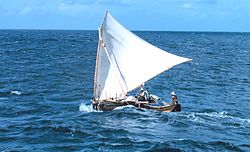
Micronesian wa with crab claw sail
The earliest European fore-and-aft rigs appeared in the form of spritsails in Greco-Roman navigation,[1] as this carving of a 3rd century AD Roman merchant ship

A fore-and-aft rig is a sailing ship rig with sails set mainly in the median plane of the keel, rather than perpendicular to it, as on a square-rigged vessel.[2]

Description

[edit]

Fore-and-aft rigged sails include staysails, Bermuda rigged sails, gaff rigged sails, gunter rig, lateen sails, lug sails, tanja sails, the spanker sail on a square rig, and crab claw sails.

Fore-and-aft rigs include:

Barques and barquentines are partially square rigged and partially fore-and-aft rigged.

A rig which combines both on a foremast is known as a hermaphroditic rig.

History

[edit]

Austronesia

[edit]
One of the ships in Borobudur depicting a double-outrigger vessel with fore-and-aft tanja sails on tripod masts (c. 8th century AD)

The fore-and-aft rig is believed to have been developed independently by the Austronesian peoples some time after 1500 BC with the invention of the crab claw sail. It is suggested that it evolved from a more primitive V-shaped "square" sail with two spars that come together at the hull. Crab claw sails spread from Maritime Southeast Asia to Micronesia, Island Melanesia, Polynesia, and Madagascar via the Austronesian migrations.[3] Austronesians in Southeast Asia also later developed other types of fore-and-aft sails, such as the tanja sail (also known as the canted square sail, canted rectangular sail, or the balance lug sail).[3]

Their use later spread into the Indian Ocean since the first millennium, among vessels from the Middle East, South Asia, and China.[4][5]

Europe

[edit]

The lateen was developed in the Mediterranean as early as the 2nd century AD, during Roman times. It became common by the 5th century.[6]

The square rig had predominated in Europe since the dawn of sea travel, but in the generally gentle climate of southern Europe and the Mediterranean Sea during the last few centuries before the Renaissance the fore-and-aft began to replace it. By 1475, its use increased, and within a hundred years the fore-and-aft rig was in common use on rivers and in estuaries in Britain, northern France, and the Low Countries, though the square rig remained standard for the harsher conditions of the open North Sea as well as for trans-Atlantic sailing.

See also

[edit]

References

[edit]
[edit]
Revisions and contributorsEdit on WikipediaRead on Wikipedia
from Grokipedia
A fore-and-aft rig is a type of rig in which the sails are set along the fore-and-aft line of the vessel, parallel to the , rather than athwartships as in rig. This configuration typically involves s bent to gaffs, booms, or stays, enabling the vessel to sail closer to the wind and requiring a smaller for operation. Fore-and-aft rigs are commonly used on smaller vessels for coastal navigation, fishing, and yachting, though larger examples have undertaken transoceanic voyages. The origins of the fore-and-aft rig trace back to ancient Austronesian maritime traditions with early triangular sails, such as the tanja rig; the variant employed on dhows appeared in the Mediterranean as early as the AD and excelled in upwind but performed poorly downwind. European adaptations emerged in the , influenced by Dutch innovations, leading to more efficient versions for local trade and fishing. By the , naval powers like the Royal Navy increasingly incorporated fore-and-aft sails—such as staysails and spanker sails—into warships to enhance windward ability and maneuverability during global operations and tactical engagements. In the , the rig proliferated in commercial schooners for coastal and transatlantic cargo transport, with designs evolving to include multiple masts for greater capacity while maintaining operational simplicity. Key advantages of the fore-and-aft rig include superior close-hauled performance, allowing vessels to point higher into the wind than square-rigged ships, which is essential for navigating coastal waters and avoiding lee shores. It also offers greater maneuverability in variable winds and reduces the need for large crews, making it economical for fleets and smaller traders—often operable by as few as 6–8 sailors on multi-masted vessels. However, it generally underperforms in downwind conditions compared to square rigs, leading to hybrid configurations in some larger ships. Common types of fore-and-aft rigs include the , featuring a four-sided with a spar at the top (gaff) and bottom (boom), and the Bermudan or Marconi rig, which uses a triangular for streamlined efficiency in modern yachts. Vessel configurations vary widely: single-masted sloops and cutters for simplicity and speed; two-masted ketches and yawls for balanced sail distribution; and multi-masted schooners (from two to seven masts) for cargo hauling, often with gaff sails and additional headsails like jibs. These rigs remain prevalent today in recreational , preserving their historical role in efficient, versatile .

Fundamentals

Definition and Characteristics

A fore-and-aft rig is a configuration of sails on a vessel where the sails are primarily set along the median plane of the , parallel to the vessel's longitudinal axis, rather than athwartships as in square rigs. In this setup, the luff () of each is attached to a mast or a stay, allowing the to be hoisted and trimmed in a fore-and-aft direction to capture wind from either side efficiently. This contrasts with orientations by enabling closer to the wind through adjustable positioning. Key characteristics include sails that are typically triangular or quadrilateral in shape, such as jibs (forward staysails), mainsails (on the mainmast), and spankers (aft sails on the mizzenmast). These sails are attached along their luff to masts or stays, with the foot (bottom edge) often secured to a boom for extension and control, though some may be loose-footed. Quadrilateral sails may incorporate a gaff, a spar that supports the upper edge (roach) to increase sail area without excessive height. Basic components encompass vertical masts for primary support, fore-and-aft stays (ropes or wires) that brace the masts against wind loads, and horizontal booms that hold the sail's foot taut. Sails are hoisted via halyards running through blocks at the masthead and trimmed using sheets attached to the clew (lower aft corner), allowing adjustment of the sail's angle relative to the centerline. In hybrid configurations, such as barques (three or more masts with square sails forward and fore-and-aft on the mizzenmast) or barquentines (square sails only on the foremast), fore-and-aft elements integrate with square rigging for versatility.

Comparison with Square Rig

The fore-and-aft rig features sails set parallel to the ship's longitudinal axis, typically attached to a mast or stay and a boom or gaff, allowing them to lie along the keel line. In contrast, the square rig employs rectangular or trapezoidal sails suspended from horizontal yards that extend perpendicular to the mast, positioned athwartships across the vessel. This fundamental difference in sail orientation affects both setup and operation, with fore-and-aft configurations enabling simpler attachment points and fewer lines compared to the complex network of braces and lifts required for square sails. Functionally, fore-and-aft rigs excel in close-hauled and upwind performance, as the s can be trimmed to pivot and capture wind from either side without needing to rotate the yard, facilitating efficient tacking maneuvers. Square rigs, however, perform optimally on beam reaches and downwind runs, where the broad sail area maximizes power in steady following winds, but they struggle with upwind work due to the fixed yard position and require extensive bracing to adjust sail angle. Additionally, fore-and-aft setups demand fewer members for handling—often manageable by 6–8 sailors on multi-masted vessels—while square rigs necessitate larger teams to manage the intricate and yard adjustments. Historically, the fore-and-aft rig was adopted primarily for coastal and riverine navigation, where its superior maneuverability in variable winds and confined waters proved advantageous, as seen in Dutch adaptations for shallow inland seas during the . Square rigs, conversely, dominated open-ocean and long-distance voyages, leveraging consistent for efficient passage but proving less adaptable in shifting coastal conditions. This divergence in adoption reflected environmental demands, with fore-and-aft designs emerging in regions like the Mediterranean and for localized , while square rigs powered global exploration and commerce from ancient times through the . In terms of sail orientation and wind capture, fore-and-aft sails, such as triangular or gaff types, can be sheeted in or out to optimize airflow on either tack, allowing the vessel to point higher into the wind with minimal reconfiguration. Square sails, hung symmetrically from the yard, capture wind most effectively when aligned broadside but must be squared away or braced sharply for directional changes, often resulting in reduced efficiency during tacks. These setups highlight the fore-and-aft rig's versatility for bidirectional wind use versus the square rig's reliance on favorable wind angles for peak performance.

Historical Development

Origins in Austronesia

The fore-and-aft rig traces its earliest origins to the , who invented the —a distinctive triangular configuration—around 1500 BC in regions encompassing and . This innovation emerged during the period as part of broader advancements in seafaring , including outrigger and double-hulled canoes, which allowed for stable ocean voyages. Archaeological and linguistic evidence links these developments to proto-Austronesian societies in southeastern and , where early bamboo mat sails may have predated the fully formed crab claw design by millennia, evolving from rudimentary wind-capturing structures around 5000 BC. The crab claw sail's key innovation lay in its aerodynamic shape, with the sail apex pointing downward and secured by upper and lower booms to a single mast, facilitating efficient upwind on canoes. This rig enabled Austronesian voyagers to harness effectively, supporting the rapid colonization of island chains across the Pacific and into the . Mounted on double-hulled voyaging canoes capable of carrying dozens of passengers and supplies, the sail allowed for deliberate navigation over vast distances, distinguishing Austronesian maritime capabilities from contemporaneous square-rigged vessels elsewhere. Austronesian migration patterns disseminated the crab claw rig widely, reaching and by approximately 1000 BC through the Lapita cultural expansion from Island Southeast Asia. Adaptations to local wind patterns and vessel designs occurred as communities settled remote archipelagos, with the rig integrated into larger catamaran-style canoes for inter-island trade and exploration. By the first millennium AD, the technology had extended into the , influencing settlements as far as around 700–1200 CE, where Austronesian seafarers carried the fore-and-aft principles alongside crops and linguistic elements. In parallel, the emerged as a variant of the fore-and-aft rig by the first AD, primarily in western Island such as . This evolution modified the crab claw's triangular form into a more rectangular shape with a curved yard, suited to larger prahu vessels and winds, as depicted in temple reliefs from the 8th–9th centuries CE. The tanja's design retained the mast-forward orientation but enhanced cargo capacity, marking a regional adaptation that facilitated trade networks extending to the .

Introduction and Evolution in Europe

The fore-and-aft rig, particularly in the form of the sail, emerged in the Mediterranean by the 2nd century AD, marking a significant shift from predominant square rigs and enabling better upwind sailing capabilities. This development was influenced by trade routes connecting the Mediterranean to the , where Arab mariners had adapted triangular sail designs, possibly derived from earlier Austronesian tanja rigs introduced via South Indian ports around the AD. By the AD, the had become widespread in the region, reflecting its practical advantages in variable winds typical of Mediterranean waters. In Roman and Byzantine maritime practices, the lateen rig was integrated into merchant and naval vessels during , with iconographic evidence from the 4th to 6th centuries AD showing consistent use of triangular or settee sails hoisted on a single mast. These rigs provided enhanced maneuverability for coastal trade and military operations, as seen in depictions of Byzantine dromons and Roman ships navigating the empire's extensive waterways. The rig's establishment by the late 5th century AD underscores its role in sustaining Mediterranean commerce amid the transition from classical to medieval periods, with minimal changes in rigging technology persisting into the . During the , fore-and-aft rigs saw accelerated growth in , particularly for riverine and coastal navigation, where their ability to tack efficiently proved invaluable in confined spaces. By around 1475, such rigs were increasingly adopted on vessels like Venetian galleys, which employed sails on auxiliary masts to enhance close-quarters handling during trade and warfare in the Adriatic and . In , these influences evolved into the , refined by Dutch shipbuilders for better wind adaptation in the ; this is exemplified in the ships of the late 16th century, which combined square sails forward with a mizzen for superior maneuverability in shallow coastal routes and river estuaries.

Global Spread and Regional Adaptations

The fore-and-aft rig disseminated globally during the through the Age of Exploration, as and Dutch mariners adapted triangular sails like the for transoceanic voyages to and the . explorers incorporated rigs into caravels to better navigate and equatorial currents, facilitating direct routes to and the via the . Dutch traders, building on these influences, refined fore-and-aft configurations for efficiency in the , introducing gaff-rigged variants to vessels operating in Indonesian waters and along American colonial coasts. This spread was amplified by colonial routes, where European ships exchanged rigging knowledge with local builders, leading to widespread adoption in merchant and fishing fleets by the late . Regional adaptations emerged as the rig integrated with indigenous designs, enhancing versatility in diverse environments. In Indonesia, the traditional tanja rig— a rectangular lateen variant on perahu vessels—evolved under Dutch influence in the 17th and 18th centuries, incorporating standing gaff elements for better windward performance in the archipelago's variable monsoons. Similarly, in Celtic regions such as Scotland and Cornwall, lug sails adapted into dipping configurations for fishing boats, allowing quick maneuvers in North Atlantic squalls and herring grounds; these were particularly refined in 18th-century drifters like the Fifie, blending local clinker hulls with fore-and-aft efficiency. The lateen rig persisted in Arab dhows of the Indian Ocean and Red Sea, where its triangular form suited downwind trades, while Mediterranean xebecs combined it with oars for agile raiding and commerce, maintaining the setup through Ottoman and Barbary naval traditions into the 18th century. Key events in the further propelled refinements, notably in American schooners along colonial trade routes. These two-masted vessels, rigged fore-and-aft with gaff sails, dominated on the Grand Banks and cargo transport from ports, requiring smaller crews for operations in shallow coastal waters. By mid-century, adaptations like topsails on the mainmast improved speed for and hay shipments, solidifying the rig's role in North American maritime economies. Cultural impacts manifested in hybrid rigs across the and Pacific islands, where European fore-and-aft elements merged with indigenous designs. In the , rigs combined influences with local dugout hulls for inter-island trade, fostering creolized boat-building traditions among enslaved and free communities. In Pacific islands like those of , European gaff sails were grafted onto traditional crab-claw rigs during 19th-century contact, enabling longer voyages while preserving cultural voyaging practices. These fusions not only supported economic resilience but also symbolized cross-cultural exchanges in colonial peripheries.

Types of Fore-and-aft Rigs

Lateen and Tanja Variants

The rig features a triangular hoisted on a long yard that is mounted at an angle to the mast, enabling the vessel to sail effectively with the wind coming from either side by simply swinging the yard around the mast during tacking. The yard is typically attached near its midpoint to the masthead via a parrel or similar , with the forward end positioned lower and angled obliquely forward, while the is secured along the yard's using grommets or lacings, remaining loose-footed at the bottom for flexibility. Trimming involves adjusting the sheet attached to the sail's clew (the aft lower corner) to control the angle of attack, with brailing lines often used to gather the along the yard for or stowing, allowing quick adaptation to varying wind conditions. This configuration originated in the Mediterranean region, with evidence of its use on ships dating to at least the AD, and it became widespread by the for its maneuverability in coastal and trade routes. The rig was prominently employed on vessels such as feluccas, traditional open boats for and Mediterranean trade, and Mediterranean galleys, which combined oars with sails for enhanced versatility in warfare and commerce. The tanja rig, a fore-and-aft sail derived from Austronesian maritime traditions, employs a yard at the head and a boom at the foot to form a rectangular or trapezoidal shape that captures wind efficiently across a broad arc. The yard is hoisted to the masthead via halyards, positioned horizontally or slightly raked, while the boom is attached to the mast foot or a gooseneck fitting, with the laced or grommeted to both for secure hold; this setup allows the to be trimmed by easing or hauling the sheet at the clew, often with additional control lines for the tack to optimize shape against the wind. Unique to the variant, the tanja's positioning facilitates easy rotation around the mast for tacking, with the yard and boom maintaining tension through downhauls and outhauls to prevent flapping. Austronesian in origin, it appeared in networks by the 1st millennium AD, influencing regional vessel designs and spreading via Malay sailors. It was commonly fitted on Southeast Asian perahu, craft used for inter-island voyaging, and contributed to the evolution of junk rigs through adaptations in hull and sail integration for long-haul commerce.

Gaff, Gunter, and Lug Rigs

The gaff rig employs a four-sided mainsail hoisted along a horizontal gaff spar positioned above the boom, enabling greater sail area and height on relatively shorter masts compared to triangular rigs. This configuration, prevalent in European maritime traditions from the 18th century onward, uses two halyards for precise control: the throat halyard elevates the forward end of the gaff near the mast, while the peak halyard lifts the aft end, allowing adjustments to sail tension and shape for optimal performance in varying winds. In spar arrangements, the gaff typically angles slightly upward from the mast, with the mainsail's luff attached via parrel beads or hoops to facilitate hoisting, and the foot secured along the boom. This rig became widespread in 19th-century schooners, particularly those engaged in coastal trade and fishing, such as Nova Scotian vessels that required small crews for efficient operation. The , a variant of the gaff setup, features a vertically sliding gaff or yard that extends nearly parallel to the mast, effectively creating a tall triangular shape from what is technically a configuration. In this arrangement, the yard slides upward along the mast using halyards and fittings like toggles or parrel beads, allowing the to approximate the efficiency of later triangular designs while keeping compact for storage in small boats. is simplified by lowering the entire yard, which reduces the 's center of effort and enhances stability, making it suitable for light craft in moderate conditions. Historically, the served as a precursor to more streamlined triangular rigs and was commonly fitted on European small boats and whaleboats from the 18th to early 20th centuries, valued for its portability and ease of handling. The lug rig utilizes an oblique quadrilateral sail hung from a yard, positioning the sail forward or aft of the mast in a fore-and-aft orientation, and was a staple in European fishing vessels for its simplicity and adaptability. Key variants include the standing lug, where the tack is secured at or near the mast with the yard fixed in place, requiring no repositioning during tacks; the balanced lug, which shifts the tack forward of the mast for better balance and often incorporates a boom, allowing quick hoisting and reefing without dipping; and the dipping lug, in which the yard is lowered and swung to the opposite side of the mast after each tack to maintain optimal sail position. Yard handling in these setups involves downhauls and outhauls for tensioning the sail's edges, with the dipping variant demanding more crew effort but offering superior windward performance in traditional craft. This rig appeared prominently in 18th- and 19th-century French and British fishing boats, such as shallops and luggers, where its light spars and efficient sail shape supported inshore operations.

Bermudan and Modern Triangular Rigs

The Bermudan rig, also known as the Marconi rig, employs a tall, triangular set fore-and-aft without a gaff, with the sail's luff secured directly to the mast using slides in a track or a running in a groove for a smooth, efficient shape. This configuration originated in , where it was first documented in 1670 during a ship's visit, though it remained largely local until British naval adoption in the , after which it became the dominant rig for modern yachts worldwide due to its superior windward performance. The design's streamlined profile eliminates the need for upper spars like gaffs or yards, allowing for a higher that optimizes sail area efficiency and reduces weight aloft compared to earlier fore-and-aft setups. Evolving from the —in which a sliding gaff extended the luff along a shorter mast—the Bermudan rig removed the gaff entirely to create a straighter , simplifying and enhancing upwind pointing ability without the complexity of additional . This transition, prominent in early 20th-century design, prioritized a taller, unencumbered mast that maximizes the sail's aerodynamic profile for greater drive per unit of area, particularly in light to moderate winds. Contemporary Bermudan rigs feature variants such as the fractional rig, where the forestay attaches partway up the mast to enable smaller, more manageable headsails and tighter sheeting angles for balanced power from the , versus the , which secures the forestay at the mast top to support larger overlapping genoas for enhanced upwind speed. Roller-furling systems for jibs and genoas, integrated into these setups since the mid-, allow seamless partial and adjustment from the , improving safety and ease for . In performance-oriented applications, carbon fiber masts have become standard since the late , offering reduced weight and greater stiffness to handle higher loads in racing conditions. These rigs have been widely applied in sloops, cutters, and catamarans from the early 1900s onward, powering vessels like the for coastal work and modern multihulls for offshore racing.

Sailing Performance and Applications

Advantages and Efficiency

Fore-and-aft rigs excel in upwind efficiency, enabling vessels to sail close-hauled at angles of approximately 45 to 60 degrees to the true , which allows for higher compared to square rigs limited to 60 to 70 degrees or more. This capability stems from the triangular shape, which generates lift akin to an when trimmed properly, optimizing propulsion against the wind. Maneuverability is a key advantage, as fore-and-aft sails require minimal adjustment during tacking—simply releasing and sheeting the sails on the new tack—without the need to brace heavy yards as in square rigs. This simplicity makes them ideal for operation, particularly in coastal waters or variable winds where frequent direction changes are necessary. Efficiency metrics further highlight their strengths, with fore-and-aft rigs providing higher effective sail area per unit of mast height through high-aspect-ratio designs that minimize induced drag and enhance lift-to-drag ratios upwind. They perform better in light airs due to adjustable camber, allowing sailors to deepen the sail's curve via controls like the outhaul and for increased power without stalling. Specific concepts like apparent wind optimization contribute to these benefits, as the rig's flexibility permits precise sail trimming to align with the boat's speed-altered , maximizing drive. Additionally, the setup reduces by promoting a more vertical plane that directs force forward, minimizing sideways drift during upwind work.

Limitations and Vessel Uses

Fore-and-aft rigs exhibit poorer downwind compared to square rigs, as their triangular sails capture less when running before the breeze, often necessitating the use of additional sails like spinnakers to achieve comparable speeds. This inefficiency arises because the sails are optimized for pointing close to the , where they generate lift efficiently, but they or blanket each other when sailing off the without specialized downwind configurations. While fore-and-aft rigs require precise trimming for optimal across varying angles—such as adjustments to sheets, halyards, and backstays—they are generally less labor-intensive overall than square rigs due to simpler maneuvers and reduced needs, though such adjustments may still contribute to fatigue on longer passages. In heavy , these rigs are vulnerable to excessive mast bending due to the concentrated loads from the sails pulling aft, potentially leading to structural stress if rig tension is not precisely managed, though controlled bend can be used to depower the sails. Despite these limitations, fore-and-aft rigs have been widely adopted for vessels requiring maneuverability in coastal or variable winds. Traditionally, schooners with gaff-rigged fore-and-aft sails were staples in fishing fleets, such as the 19th-century schooners that dominated the Grand Banks cod fishery, valued for their ability to work short-handed in rough inshore conditions while carrying dories for line fishing. In the and , dhows employing fore-and-aft rigs facilitated regional trade in spices, textiles, and dates, leveraging the rig's windward capability for navigating winds and shallow ports. In modern applications, Bermudan-rigged yachts dominate recreational cruising, offering simplicity for solo or small crews on long-distance voyages, while catamarans with similar rigs excel in due to their stability and speed in upwind legs, as seen in high-performance multihulls. Small catboats, with their single-mast gaff or leg-of-mutton fore-and-aft sails, remain popular for inland and sheltered waters like bays and lakes, where their shallow draft and ease of handling suit day sailing and light utility tasks. Hybrid adaptations like barquentines, combining square sails forward with fore-and-aft mains, balanced speed and capacity for 19th- and early 20th-century bulk carriers, allowing efficient ocean passages with reduced crew needs aft. Lug-rigged workboats, a simple fore-and-aft variant, persist in regional fisheries, such as in and the Pacific, for their durability and quick setup in small-scale operations. Notable examples include the 20th-century yachts, like the J-Class vessels raced in , which utilized Bermudan rigs for superior upwind performance in competitive match .

References

Add your contribution
Related Hubs
User Avatar
No comments yet.