



Community hub
Recent from talks
Contribute something
Nothing was collected or created yet.
Volume integral
View on Wikipedia| Part of a series of articles about |
| Calculus |
|---|
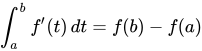
In mathematics (particularly multivariable calculus), a volume integral (∭) is an integral over a 3-dimensional domain; that is, it is a special case of multiple integrals. Volume integrals are especially important in physics for many applications, for example, to calculate flux densities, or to calculate mass from a corresponding density function.
In coordinates
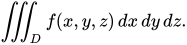
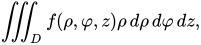
[edit]Often the volume integral is represented in terms of a differential volume element . It can also mean a triple integral within a region of a function and is usually written as: A volume integral in cylindrical coordinates is and a volume integral in spherical coordinates (using the ISO convention for angles with as the azimuth and measured from the polar axis (see more on conventions)) has the form The triple integral can be transformed from Cartesian coordinates to any arbitrary coordinate system using the Jacobian matrix and determinant. Suppose we have a transformation of coordinates from . We can represent the integral as the following. Where we define the Jacobian determinant to be.








Example
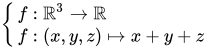
[edit]Integrating the equation over a unit cube yields the following result:
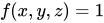

So the volume of the unit cube is 1 as expected. This is rather trivial however, and a volume integral is far more powerful. For instance if we have a scalar density function on the unit cube then the volume integral will give the total mass of the cube. For example for density function: the total mass of the cube is:

See also
[edit]
External links
[edit]Volume integral
View on GrokipediaDefinition
Formal definition
The volume integral of a scalar function over a bounded region is defined as the limit of Riemann sums obtained by partitioning into subregions. For a partition consisting of disjoint rectangular boxes with volumes and sample points in each box, the Riemann sum is , and the triple integral is where denotes the norm of the partition (the maximum diameter of the subregions) and the limit exists for continuous on the closed, bounded set .[6] Here, is the volume element in , corresponding to the Lebesgue measure on measurable subsets. For continuous , the volume integral equals the iterated integral over the projections of onto the coordinate planes, provided the limits reflect the boundaries of ; this follows from Fubini's theorem for product measures.[7] In the more general Lebesgue framework, must be a Lebesgue measurable set with finite measure (i.e., ), and must be integrable over , meaning or .[7] For oriented regions in , the volume integral may yield a signed volume, where the sign is determined by the orientation of relative to a chosen basis, often formalized using differential 3-forms such as .[8] This formulation generalizes the double integral from two to three dimensions in a natural way.[6]Geometric interpretation
The volume integral extends the intuitive notions from lower-dimensional integration. Just as a single integral computes the net area under a curve by summing infinitesimal rectangular areas weighted by the function value, and a double integral computes the net volume under a surface by summing infinitesimal prisms weighted similarly, a triple integral computes a weighted volume over a three-dimensional region . Here, the integrand acts as a density or intensity function, scaling the contribution of each infinitesimal volume element to reflect physical quantities like mass, charge, or probability density.[9] To visualize this, imagine partitioning the solid region into a fine grid of small subvolumes, such as rectangular boxes or irregular tetrahedra, each with a tiny volume . For a representative point within the -th subvolume, the function value multiplies to approximate the local contribution. As the partition refines and the maximum subvolume size approaches zero, the total sum converges to the volume integral, capturing the accumulated weighted content across . This Riemann sum perspective underscores the integral's role in approximating continuous accumulation through discrete summation.[1] For functions that vary in sign, such as oscillatory ones, the geometric interpretation involves signed contributions: regions where add to the total, while those where subtract, potentially leading to cancellation and a net signed volume that may differ from the absolute geometric volume. This allows the integral to model phenomena like net flux or balanced forces, where opposing effects offset each other.[9] The foundational concept of integration traces back to Gottfried Wilhelm Leibniz in the late 17th century, who developed the infinitesimal approach to summation. Volume integrals, as a specific form of multiple integration, were further formalized in the 18th century and integrated into vector calculus by J. Willard Gibbs and Oliver Heaviside in the late 19th century, enabling their application to fields like electromagnetism through theorems relating surface and volume quantities.Evaluation Methods
In Cartesian coordinates
In Cartesian coordinates, the volume element is given by , allowing the volume integral of a function over a region in three-dimensional space to be expressed as an iterated triple integral.[10][11] Specifically, where the limits of integration are determined by the description of the region , with the innermost integral over bounded by functions and , the middle over by and , and the outermost over from to . This form assumes integration in the order , though other orders are possible depending on the region's geometry.[10][11] To set up the integral, project the region onto one of the coordinate planes, such as the -plane, to define the domain of integration there, then determine the bounds for the third variable based on that projection. For instance, if projecting onto the -plane yields a domain , the -limits are the lower and upper surfaces bounding , expressed as functions of and . Next, project onto the -axis to set the -limits as functions of , and finally, the -limits are the endpoints of that projection. This stepwise projection ensures the limits accurately describe without overlap or omission.[10][11] For a simple rectangular box , the limits are constant, simplifying the integral to This form is straightforward to evaluate, as each integral separates independently if is separable. For example, the volume of the box is obtained by setting , yielding .[10][11] Non-rectangular regions, defined by inequalities such as those for spheres or polyhedra, require variable limits derived from the bounding surfaces. For a sphere , project onto the -plane to get the disk , with -limits to ; the -limits are then to for from to . Similarly, for a tetrahedron bounded by planes like , , , and , the projection onto the -plane is the triangle , , with from 0 to . These setups use the inequalities to express bounds explicitly, enabling computation of volumes or other integrals over complex shapes.[10][11]In curvilinear coordinates
In curvilinear coordinates, volume integrals are evaluated by transforming from Cartesian coordinates using a change of variables theorem, which accounts for the distortion introduced by the coordinate transformation through the absolute value of the Jacobian determinant. For a region in Cartesian coordinates and a differentiable transformation mapping a region in the new coordinates to , the volume integral of a function over becomes where is the Jacobian matrix of partial derivatives of the transformation components, and is its determinant.[12][13] This formula generalizes the Cartesian form by incorporating the scaling factor , which adjusts the infinitesimal volume element to match the geometry of the new system.[14] Cylindrical coordinates are particularly useful for regions exhibiting rotational symmetry around the -axis, such as cylinders or cones, where the transformation is , , . The Jacobian determinant for this transformation is , so the volume element is , and the integral takes the form over appropriate bounds, such as , , for a cylinder of radius and height .[15][16] To derive the Jacobian, compute the determinant of the matrix yielding , which reflects the radial stretching in the -plane similar to polar coordinates in 2D.[17] Spherical coordinates suit regions with radial symmetry, like spheres or cones, via , , . Here, the Jacobian determinant is , giving , so the integral is with bounds such as , , for a sphere of radius .[12][15] The derivation involves the 3x3 Jacobian matrix whose determinant simplifies to through cofactor expansion, capturing the combined radial and angular expansions akin to polar systems.[16][17] These systems are chosen over Cartesian coordinates when the region's symmetry aligns with the coordinate axes, simplifying bounds and integrand expressions.[18]Related Theorems
Fubini's theorem
Fubini's theorem justifies the reduction of a volume integral over a domain to an iterated integral, enabling computation by successive single-variable integrations. For an integrable function , the theorem states that if , then where denotes the slice of at fixed , and the equality holds for any permutation of the integration order, with integrals over the corresponding measurable sections.[19][20] The key conditions are that is measurable and absolutely integrable over , ensuring the iterated integrals exist and are finite almost everywhere with respect to the product Lebesgue measure. For continuous functions on bounded rectangular boxes, continuity suffices, as it implies boundedness and thus integrability, while more general domains require the sections to be measurable.[19][20] The proof proceeds via Tonelli's theorem for non-negative measurable functions, which establishes that the multiple integral equals the iterated integrals by approximating with simple functions and applying the monotone convergence theorem, without needing absolute integrability for the equality itself. For signed functions, decompose where and are non-negative, apply Tonelli's theorem to each part, and invoke the absolute integrability of to confirm convergence of the difference.[20] This result is essential for simplifying evaluations by reordering integrations to yield more convenient bounds, particularly over non-rectangular domains. As an analogy, in two dimensions, the theorem equates the double integral to either iterated order, , and the three-dimensional case follows the same iterative logic.[1][19]Divergence theorem
The divergence theorem states that for a vector field with continuous first partial derivatives defined in an open set containing a bounded region whose boundary is piecewise smooth and oriented with the outward-pointing unit normal , the triple integral over of the divergence of equals the flux integral of through : This holds provided the components of and their first partial derivatives are continuous on and in a neighborhood of .[21][22] Geometrically, the theorem equates the net flux of leaving the region —interpreted as the total "outflow" through the boundary—to the total "source strength" within , measured by the integral of the divergence, which quantifies local expansion or contraction of the field at each point. For instance, if represents a velocity field of an incompressible fluid, zero divergence inside implies zero net flux across , conserving volume. This interpretation underscores the theorem's role in linking interior behavior to boundary effects.[22][23] A sketch of the proof applies the fundamental theorem of calculus component-wise to . For the -component, partition into slices perpendicular to the -axis and integrate over each, yielding a difference of integrals over the "end" faces via the one-dimensional fundamental theorem; the contributions from intermediate faces cancel, leaving the projected flux on the boundary faces parallel to the -plane. Analogous steps for the - and -components complete the reduction to the full surface flux. This approach aligns with the original formulation by Gauss, who generalized earlier results in potential theory.[24][23] The theorem was generalized by Carl Friedrich Gauss in 1813 as part of his work on the theory of attraction, providing a rigorous relation between volume distributions and surface effects in three dimensions. It later became foundational in electromagnetism, underpinning Gauss's law, which equates the flux of the electric field through a closed surface to the enclosed charge.[25][22]Applications
In physics
In classical mechanics, volume integrals are essential for determining the center of mass of a continuous body with variable density over a domain . The total mass is given by the volume integral . The coordinates of the center of mass are then computed as , with analogous expressions for and . These formulas arise from the first moments of the mass distribution and are fundamental for analyzing rigid body dynamics and stability.[26] In electromagnetism, volume integrals quantify total charge from a charge density distribution within a volume , yielding the total charge . This integral forms the basis for computing electric potentials and fields, such as the scalar potential , which in turn determines the electric field via . Such applications underpin electrostatics for charge distributions in dielectrics and plasmas.[27] Moments of inertia, crucial for rotational dynamics, are also expressed as volume integrals over the mass density. For instance, the moment of inertia about the x-axis is , with similar tensor components for other axes. These integrals capture the distribution of mass relative to the rotation axis, influencing angular momentum and energy in rotating systems like flywheels or planetary bodies.[28] In fluid dynamics, volume integrals evaluate quantities such as kinetic energy, given by , where is the fluid density and is the speed. This expression represents the total kinetic energy of the fluid within the volume and is used in deriving conservation laws for inviscid flows via the energy equation.[29] Early 20th-century quantum mechanics extended volume integrals to compute expectation values of observables, such as the energy , where is the wave function and is the Hamiltonian operator. This formalism, building on the probabilistic interpretation introduced by Born in 1926, allows prediction of average measurement outcomes for position, momentum, and other properties in quantum systems. Dirac's 1930 principles further formalized these integrals in the operator algebra of quantum states.[30]In engineering and other fields
In structural engineering, volume integrals are essential for computing quantities such as total strain energy in elastic solids, which quantifies the energy stored due to deformation under load. The total strain energy is given by the volume integral , where is the stress tensor, is the strain tensor, and is the domain of the structure.[31] This integral allows engineers to assess material integrity and optimize designs by evaluating stress and strain distributions over complex three-dimensional volumes, such as beams or trusses under varying loads.[32] In probability theory, volume integrals compute expected values for multivariate random variables, providing a foundation for statistical analysis in three dimensions. For a continuous random vector with joint probability density function over support , the expected value of is , where .[33] This formulation extends to higher moments and enables the calculation of probabilities and expectations in applications like risk assessment and spatial statistics. In computer graphics, volume rendering for translucent volumes, such as clouds or medical scans, involves line integrals along rays through the domain to accumulate optical properties, approximating over the path, where the volume data informs . This method, introduced in early volume rendering algorithms, facilitates realistic visualization of scalar fields in three-dimensional datasets.[34][35] Numerical evaluation of volume integrals over complex or irregular domains relies on methods like Monte Carlo integration, which is particularly effective for high-dimensional problems. The approximation uses random points uniformly sampled from domain of volume , converging at a rate independent of dimension.[36] For irregular volumes, finite element methods discretize into simplices or elements, approximating integrals via quadrature over each, as in solving partial differential equations on non-uniform meshes.[37] Computational tools like MATLAB'sintegral3 function support adaptive quadrature for triple integrals over rectangular or parameterized domains, aiding rapid prototyping in engineering workflows.[38]