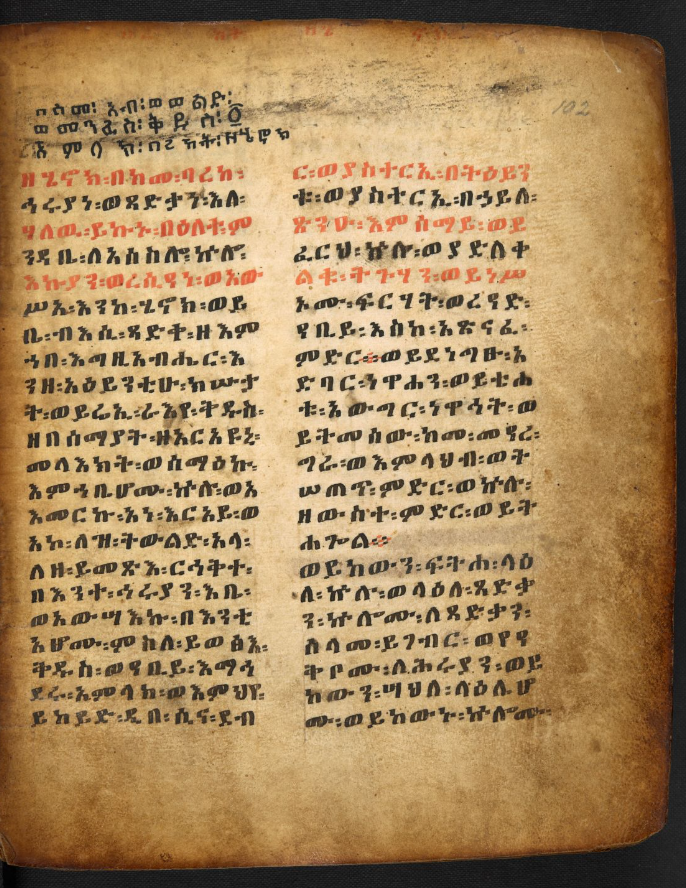

Book of Enoch
View on Wikipedia
 | |||||
| Tanakh (Judaism) | |||||
|---|---|---|---|---|---|
|
|
|||||
| Old Testament (Christianity) | |||||
|
|
|||||
| Bible portal | |||||
The Book of Enoch (also 1 Enoch;[a] Hebrew: סֵפֶר חֲנוֹךְ, Sēfer Ḥănōḵ; Ge'ez: መጽሐፈ ሄኖክ, Maṣḥafa Hēnok) is an ancient Jewish apocalyptic religious text, ascribed by tradition to the patriarch Enoch who was the father of Methuselah and the great-grandfather of Noah.[1][2] The Book of Enoch contains unique material on the origins of demons and Nephilim, why some angels fell from heaven, an explanation of why the Genesis flood was morally necessary, and a prophetic exposition of the thousand-year reign of the Messiah. Three books are traditionally attributed to Enoch, including the distinct works 2 Enoch and 3 Enoch.
1 Enoch is not considered to be canonical scripture by most Jewish or Christian church bodies, although it is part of the biblical canon used by the Ethiopian Jewish community Beta Israel, as well as the Ethiopian Orthodox Tewahedo Church and Eritrean Orthodox Tewahedo Church.
The older sections of 1 Enoch are estimated to date from about 300–200 BCE, and the latest part (Book of Parables) is probably from around 100 BCE.[3] Scholars believe Enoch was originally written in either Aramaic or Hebrew, the languages first used for Jewish texts. Ephraim Isaac suggests that the Book of Enoch, like the Book of Daniel, was composed partially in Aramaic and partially in Hebrew.[4]: 6 No Hebrew version is known to have survived. Copies of the earlier sections of 1 Enoch were preserved in Aramaic among the Dead Sea Scrolls in the Qumran Caves.[2]
Authors of the New Testament were also familiar with some content of the book.[5] A short section of 1 Enoch is cited in the Epistle of Jude, Jude 1:14–15, and attributed there to "Enoch the Seventh from Adam" (1 Enoch 60:8), although this section of 1 Enoch is a midrash on Deuteronomy 33:2, which was written long after the supposed time of Enoch. The full Book of Enoch survives in its entirety only in the Geʽez translation.
Synopsis
[edit]The first part of the Book of Enoch describes the fall of the Watchers, the angels who fathered the angel-human hybrids called Nephilim.[1] The remainder of the book describes Enoch's revelations and his visits to heaven in the form of travels, visions, and dreams.[2]
The book consists of five major sections (see each section for details):[1]
- The Book of the Watchers (1 Enoch 1–36)
- The Book of Parables of Enoch (1 Enoch 37–71) (also called the Similitudes of Enoch)
- The Astronomical Book (1 Enoch 72–82) (also called the Book of the Heavenly Luminaries or Book of Luminaries)
- The Book of Dream Visions (1 Enoch 83–90) (also called the Book of Dreams)
- The Epistle of Enoch (1 Enoch 91–108)
Most scholars believe that these five sections were originally independent works[6] (with different dates of composition), themselves a product of much editorial arrangement, and were only later redacted into what is now called 1 Enoch.[2] Because the Book of Parables is unattested in all except the Ethiopic manuscripts, and because a copy of The Book of Giants appears to be written on the same manuscript as a portion of Enoch, it seems likely that the former may have replaced the latter from the original Enochic Pentateuch.[7][8]
The Book of the Watchers
[edit]This first section of the Book of Enoch describes the fall of the Watchers, the angels who fathered the Nephilim (cf. the bene Elohim, Genesis 6:1–4) and narrates the travels of Enoch in the heavens. This section is said to have been composed in the 4th or 3rd century BC according to Western scholars.[9]
Contents
[edit]- 1–5. Parable of Enoch on the Future Lot of the Wicked and the Righteous.
- 6–11. The Fall of the Angels: the Demoralization of Mankind: the Intercession of the Angels on behalf of Mankind. The Dooms pronounced by God on the Angels of the Messianic Kingdom.
- 12–16. Dream-Vision of Enoch: his Intercession for Azazel and the fallen angels: and his Announcement of their first and final Doom.
- 17–36. Enoch's Journeys through the Earth and Sheol: Enoch also traveled through a portal shaped as a triangle to heaven[citation needed].
- 17–19. The First Journey.
- 20. Names and Functions of the Seven Archangels.
- 21. Preliminary and final Place of Punishment of the fallen Angels (stars).
- 22. Sheol or the Underworld.
- 23. The fire that deals with the Luminaries of Heaven.
- 24–25. The Seven Mountains in the North-West and the Tree of Life.
- 26. Jerusalem and the Mountains, Ravines, and Streams.
- 27. The Purpose of the Accursed Valley.
- 28–33. Further Journey to the East.
- 34–35. Enoch's Journey to the North.
- 36. The Journey to the South.
Description
[edit]The introduction to the book of Enoch tells us that Enoch is "a righteous man, whose eyes were opened by God, saw the vision of the Holy One in the heavens, which the angels showed me, and from them I heard everything, and from them I understood as I saw, but not for this generation, but for a remote one which is for to come"[10]
It discusses God coming to Earth on Mount Sinai with His hosts to pass judgment on mankind. It also tells us about the luminaries rising and setting in the order and in their own time and never change:[11]
"Observe and see how (in the winter) all the trees seem as though they had withered and shed all their leaves, except fourteen trees, which do not lose their foliage but retain the old foliage from two to three years till the new comes."[12]
The book also discusses how all things are ordained by God and take place in his own time. The sinners shall perish and the great and the good shall live on in light, joy and peace.[citation needed]
And all His works go on thus from year to year for ever, and all the tasks which they accomplish for Him, and their tasks change not, but according as God hath ordained so is it done.
The first section of the book depicts the interaction of the fallen angels with mankind; Sêmîazâz compels the other 199 fallen angels to take human wives to "beget us children".
And Semjâzâ, who was their leader, said unto them: "I fear ye will not indeed agree to do this deed, and I alone shall have to pay the penalty of a great sin." And they all answered him and said: "Let us all swear an oath, and all bind ourselves by mutual imprecations not to abandon this plan but to do this thing." Then swore they all together and bound themselves by mutual imprecations upon it. And they were in all two hundred; who descended in the days of Jared on the summit of Mount Hermon, and they called it Mount Hermon, because they had sworn and bound themselves by mutual imprecations upon it.
The names of the leaders are given as "Samyaza (Shemyazaz), their leader, Araqiel, Râmêêl, Kokabiel, Tamiel, Ramiel, Dânêl, Chazaqiel, Baraqiel, Asael, Armaros, Batariel, Bezaliel, Ananiel, Zaqiel, Shamsiel, Satariel, Turiel, Yomiel, Sariel."
This results in the creation of the Nephilim (Genesis) or Anakim / Anak (giants) as they are described in the book:
And they became pregnant, and they bare great giants, whose height was three hundred ells:[b] Who consumed all the acquisitions of men. And when men could no longer sustain them, the giants turned against them and devoured mankind. And they began to sin against birds, and beasts, and reptiles, and fish, and to devour one another's flesh, and drink the blood.
It also discusses the teaching of humans by the fallen angels, chiefly Azâzêl:
And Azâzêl taught men to make swords, and knives, and shields, and breastplates, and made known to them the metals of the earth and the art of working them, and bracelets, and ornaments, and the use of antimony, and the beautifying of the eyelids, and all kinds of costly stones, and all colouring tinctures. And there arose much godlessness, and they committed fornication, and they were led astray, and became corrupt in all their ways. Semjâzâ taught enchantments, and root-cuttings, Armârôs the resolving of enchantments, Barâqîjâl, taught astrology, Kôkabêl the constellations, Ezêqêêl the knowledge of the clouds, Araqiêl the signs of the earth, Shamsiêl the signs of the sun, and Sariêl the course of the moon.
Michael, Uriel, Raphael, and Gabriel appeal to God to judge the inhabitants of the world and the fallen angels.[13] Uriel is then sent by God to tell Noah of the coming cataclysm and what he needs to do.[2]
Then said the Most High, the Holy and Great One spoke, and sent Uriel to the son of Lamech, and said to him: Go to Noah and tell him in my name "Hide thyself!" and reveal to him the end that is approaching: that the whole earth will be destroyed, and a deluge is about to come upon the whole earth, and will destroy all that is on it. And now instruct him that he may escape and his seed may be preserved for all the generations of the world.
God commands Raphael to imprison Azâzêl:
[T]he Lord said to Raphael: "Bind Azâzêl hand and foot, and cast him into the darkness: And make an opening in the desert, which is in Dûdâêl (God's kettle / crucible / cauldron), and cast him therein. And place upon him rough and jagged rocks, and cover him with darkness, and let him abide there for ever, and cover his face that he may not see light. And on the day of the great judgement he shall be cast into the fire. And heal the earth which the angels have corrupted, and proclaim the healing of the earth, that they may heal the plague, and that all the children of men may not perish through all the secret things that the Watchers have disclosed and have taught their sons. And the whole earth has been corrupted through the works that were taught by Azâzêl: To him ascribe all sin."
God gave Gabriel instructions concerning the Nephilim and the imprisonment of the fallen angels:
And to Gabriel said the Lord: "Proceed against the biters and the reprobates, and against the children of fornication: and destroy [the children of fornication and] the children of the Watchers from amongst men [and cause them to go forth]: send them one against the other that they may destroy each other in battle ..."
The Lord commands Michael to bind the fallen angels.
And the Lord said unto Michael: "Go, bind Semjâzâ and his associates who have united themselves with women so as to have defiled themselves with them in all their uncleanness. 12. And when their sons have slain one another, and they have seen the destruction of their beloved ones, bind them fast for seventy generations in the valleys of the earth, till the day of their judgement and of their consummation, till the judgement that is for ever and ever is consummated. 13. In those days they shall be led off to the abyss of fire: (and) to the torment and the prison in which they shall be confined for ever. And whosoever shall be condemned and destroyed will from thenceforth be bound together with them to the end of all generations. ..."
Book of Parables
[edit]Chapters 37–71 of the Book of Enoch are referred to as the 'Book of Parables'. The scholarly debate centers on these chapters. The Book of Parables appears to be based on the Book of the Watchers, but presents a later development of the idea of final judgment and of eschatology, concerned not only with the destiny of the fallen angels but also that of the evil kings of the earth. The Book of Parables uses the expression "The Son of Man" for the eschatological protagonist, who is also called "Righteous One", "Chosen One", and "Messiah", and sits on the throne of glory in the final judgment.[14] The first known use of "Son of Man" as a definite title in Jewish writings is in 1 Enoch, and its use may have played a role in the early Christian understanding and use of the title.[1][2][15]
It has been suggested that the Book of Parables, in its entirety, is a later addition. Pointing to similarities with the Sibylline Oracles and other earlier works, in 1976, J.T. Milik dated the Book of Parables to the third century. He believed that the events in the parables were linked to historic events dating from 260 to 270 AD. [16] According to this theory, these chapters were written in later Christian times by a Jewish Christian, to enhance Christian beliefs with Enoch's authoritative name.[1][2] Knibb[17] followed Milik's[18] reasoning, and suggested that because no fragments of chapters 37–71 were found at Qumran, a later date was likely. Knibb would continue this line of reasoning in later works.[19][20]: 417 In addition to being missing from Qumran, Chapters 37–71 are also missing from the Greek translation.[20]: 417 Currently no firm consensus has been reached among scholars as to the date of the writing of the Book of Parables. Milik's date of as late as 270 CE, however, has been rejected by most scholars. David W. Suter suggests that there is a tendency to date the Book of Parables to between 50 BCE – 117 CE.[20]: 415–416
In 1893, R. Charles judged Chapter 71 to be a later addition. He later changed his opinion[21]: 1 and gave an early date for the work between 94 and 64 BCE.[22]: LIV The 1906 article by Emil G. Hirsch in the Jewish Encyclopedia states that Son of Man is found in the Book of Enoch, but never in the original material. It occurs in the "Noachian interpolations" (lx. 10, lxxi. 14), wherein it has clearly no other meaning than 'man'.[23] The author of the work misuses or corrupts the titles of the angels.[22]: 16 Charles views the title Son of Man, as found in the Book of Parables, as referring to a supernatural person, a Messiah who is not of human descent.[22]: 306–309 In that part of the Book of Enoch known as the Similitudes, it has the technical sense of a supernatural Messiah and judge of the world (xlvi. 2, xlviii. 2, lxx. 27); universal dominion and preexistence are predicated of him (xlviii. 2, lxvii. 6). He sits on God's throne (xlv. 3, li. 3), which is his own throne. Though Charles does not admit it, according to Emil G. Hirsch these passages betray Christian redaction and emendation.[23] A number of scholars[citation needed] have suggested that passages in the Book of Parables are Noachian interpolations. These passages seem to interrupt the flow of the narrative. Darrell D. Hannah suggests that these passages are not, in total, novel interpolations, but rather derived from an earlier Noah apocryphon. He believes that some interpolations refer to Herod the Great and should be dated to around 4 BCE.[20]: 472–477
In addition to the theory of Noachian interpolations, which perhaps a majority of scholars support, most scholars currently believe that Chapters 70–71 are a later addition in part or in whole.[20]: 76 [20]: 472–473 [24] Chapter 69 ends with, "This is the third parable of Enoch." Like Elijah, Enoch is generally thought to have been brought up to Heaven by God while still alive, but some have suggested that the text refers to Enoch as having died a natural death and ascending to Heaven. The Son of Man is identified with Enoch. The text implies that Enoch had previously been enthroned in heaven.[25] Chapters 70–71 seem to contradict passages earlier in the parable where the Son of Man is a separate entity. The parable also switches from third person singular to first person singular.[24] James H. Charlesworth rejects the theory that chapters 70–71 are later additions. He believes that no additions were made to the Book of Parables.[20]: 450–468 [21]: 1–12 In his earlier work, the implication is that a majority of scholars agreed with him.[26]
When J.T. Milik first proposed the late date of the Book of Parables, he proposed that the section had replaced an earlier work, the Book of Giants. The Book of Giants follows the giants, the children of the Watchers, who dream of the coming devastation and ask Enoch to interpret the dreams and to intercede for them. One of the recovered fragments of the Book of the Giants from Qumran was written by the same scribe who transcribed a portion of the Book of Enoch, and it is thought that they could belong to the same manuscript (4QEnGiantsaar and 4QEncar). Although it is not certain, this would make the Book of Giants the missing piece of Qumran's Enochic pentateuch, later replaced by the Book of Parables in the version of 1 Enoch that was translated into Ge’ez.[7][8]
Contents
[edit]37. Superscription and Introduction
38–44. The First Parable
[edit]- 38. The Coming Judgment of the Wicked.
- 39. The Abode of the Righteous and the Elect One: the Praises of the Blessed.
- 40. The Four Archangels.
- 41.1–2. Anticipation of Judgment
- 41.3–9. Astronomical Secrets.
- 42. The Dwelling-places of Wisdom and of Unrighteousness.
- 43–44. Astronomical Secrets.
45–57. The Second Parable
[edit]- 45. The Lot of the Apostates: the New Heaven and the New Earth.
- 46. The Ancient of Days and the Son of Man.
- 47. The Prayer of the Righteous for Vengeance and their Joy at its coming.
- 48. The Fount of Righteousness: the Son of Man - the Stay of the Righteous: Judgment of the Kings and the Mighty.
- 49. The Power and Wisdom of the Elect One.
- 50. The Glorification and Victory of the Righteous: the Repentance of the Gentiles.
- 51. The Resurrection of the Dead, and the Separation by the Judge of the Righteous and the Wicked.
- 52. The Six Metal Mountains and the Elect One.
- 53–54.6. The Valley of Judgment: the Angels of Punishment: the Communities of the Elect One.
- 54.7.–55.2. Noachic Fragment on the first World Judgment.
- 55.3.–56.4. Final Judgment of Azazel, the Watchers and their children.
- 56.5–8. Last Struggle of the Heathen Powers against Israel.
- 57. The Return from the Dispersion.
58–69. The Third Parable
[edit]- 58. The Blessedness of the Saints.
- 59. The Lights and the Thunder.
- 60. Quaking of the Heaven: Behemoth and Leviathan: the Elements.
- 61. Angels go off to measure Paradise: the Judgment of the Righteous by the Elect One: the Praise of the Elect One and of God.
- 62. Judgment of the Kings and the Mighty: Blessedness of the Righteous.
- 63. The unavailing Repentance of the Kings and the Mighty.
- 64. Vision of the Fallen Angels in the Place of Punishment.
- 65. Enoch foretells to Noah the Deluge and his own Preservation.
- 66. The Angels of the Waters bidden to hold them in Check.
- 67. God's Promise to Noah: Places of Punishment of the Angels and of the Kings.
- 68. Michael and Raphael astonished at the Severity of the Judgment.
- 69. The Names and Functions of the (fallen Angels and) Satans: the secret Oath.
70–71. Concluding Appendices
[edit]- 70. The Final Translation of Enoch.
- 71. Two earlier Visions of Enoch.
The Astronomical Book
[edit]| Months 1, 4, 7, 10 | Months 2, 5, 8, 11 | Months 3, 6, 9, 12 | |||||||||||||
| Wed | 1 | 8 | 15 | 22 | 29 | 6 | 13 | 20 | 27 | 4 | 11 | 18 | 25 | ||
| Thurs | 2 | 9 | 16 | 23 | 30 | 7 | 14 | 21 | 28 | 5 | 12 | 19 | 26 | ||
| Fri | 3 | 10 | 17 | 24 | 1 | 8 | 15 | 22 | 29 | 6 | 13 | 20 | 27 | ||
| Sat (Sabbath) | 4 | 11 | 18 | 25 | 2 | 9 | 16 | 23 | 30 | 7 | 14 | 21 | 28 | ||
| Sun | 5 | 12 | 19 | 26 | 3 | 10 | 17 | 24 | 1 | 8 | 15 | 22 | 29 | ||
| Mon | 6 | 13 | 20 | 27 | 4 | 11 | 18 | 25 | 2 | 9 | 16 | 23 | 30 | ||
| Tues | 7 | 14 | 21 | 28 | 5 | 12 | 19 | 26 | 3 | 10 | 17 | 24 | 31 | ||
Four fragmentary editions of the Astronomical Book were found at Qumran, 4Q208-211.[28] 4Q208 and 4Q209 have been dated to the beginning of the 2nd century BCE, providing a terminus ante quem for the Astronomical Book of the 3rd century BCE.[29] The fragments found in Qumran also include material not contained in the later versions of the Book of Enoch.[27][29][30]
This book contains descriptions of the movement of heavenly bodies and of the firmament, as a knowledge revealed to Enoch in his trips to Heaven guided by Uriel, and it describes a Solar calendar that was later described also in the Book of Jubilees which was used by the Dead Sea sect. The use of this calendar made it impossible to celebrate the festivals simultaneously with the Temple of Jerusalem.[1]
The year was composed of 364 days, divided into four equal seasons of 91 days each. Each season was composed of three equal months of thirty days, plus an extra day at the end of the third month. The whole year was thus composed of exactly 52 weeks, and every calendar day occurred always on the same day of the week. Each year and each season started always on Wednesday, which was the fourth day of the creation narrated in Genesis, the day when the lights in the sky, the seasons, the days and the years were created.[27]: 94–95 It is not known how they used to reconcile this calendar with the tropical year of 365.24 days (at least seven suggestions have been made), and it is not even certain that they felt the need to adjust it.[27]: 125–140
Some interpret the words sun and stars in the text as referring to sunlight and starlight, allowing them to interpret the passage in a way that does not conflict greatly with the modern cosmological view. This interpretation is linguistically possible, since the Akkadian cognate of the Hebrew word for sun, šamšum, can mean sunlight or a day; thus, the term could be used to mean sunlight. Likewise, the Akkadian cognate of the Hebrew word for star, kakkabum, can refer to an object resembling a star or even a meteor—hence, the term could be used to mean starlight.
Contents
[edit]- 72. The Sun
- 73. The Moon and its Phases
- 74. The Lunar Year
- 76. The Twelve Winds and their Portals
- 77. The Four Quarters of the World: the Seven Mountains, the Seven Rivers, Seven Great Islands
- 78. The Sun and Moon: the Waxing and Waning of the Moon
- 79–80.1. Recapitulation of several of the Laws
- 80.2–8. Perversion of Nature and the heavenly Bodies due to the Sin of Men
- 81. The Heavenly Tablets and the Mission of Enoch
- 82. Charge given to Enoch: the four Intercalary days: the Stars which lead the Seasons and the Months
The Dream Visions
[edit]The Book of Dream Visions, containing a vision of a history of Israel all the way down to what the majority have interpreted as the Maccabean Revolt, is dated by most to Maccabean times (about 163–142 BCE).
Contents
[edit]- 83–84. First Dream Vision on the Deluge.
- 85–90. Second Dream Vision of Enoch: the History of the World to the Founding of the Messianic Kingdom.
- 86. The Fall of the Angels and the Demoralization of Mankind.
- 87. The Advent of the Seven Archangels.
- 88. The Punishment of the Fallen Angels by the Archangels.
- 89.1–9. The Deluge and the Deliverance of Noah.
- 89.10–27. From the Death of Noah to The Exodus.
- 89.28–40. Israel in the Desert, the Giving of the Law, the Entrance into Canaan.
- 89.41–50. From the Time of the Judges to the Building of the Temple.
- 89.51–67. The Two Kingdoms of Israel and Judah to the Destruction of Jerusalem.
- 89.68–71. First Period of the Angelic Rulers – from the Destruction of Jerusalem to the Return from Captivity.
- 89.72–77. Second Period – from the Time of Cyrus to that of Alexander the Great.
- 90.1–5. Third Period – from Alexander the Great to the Graeco-Syrian Domination.
- 90.6–12. Fourth Period Graeco-Syrian Domination to the Maccabean Revolt (debated).
- 90.13–19. The last Assault of the Gentiles on the Jews (where vv. 13–15 and 16–18 are doublets).
- 90.20–27. Judgment of the Fallen Angels, the Shepherds, and the Apostates.
- 90.28–42. The New Jerusalem, the Conversion of the surviving Gentiles, the Resurrection of the Righteous, the Messiah. Enoch awakes and weeps.
Animal Apocalypse
[edit]The second dream vision in this section of the Book of Enoch is an allegorical account of the history of Israel, that uses animals to represent human beings and human beings to represent angels.[1]
One of several hypothetical reconstructions of the meanings in the dream is as follows based on the works of R. H. Charles and G. H. Schodde:
- White color for moral purity; Black color for sin and contamination of the fallen angels; Red color for blood in reference to martyrdom
- White bull is Adam; Female heifer is Eve; Red calf is Abel; Black calf is Cain; White calf is Seth;
- White bull / man is Noah; White bull is Shem; Red bull is Ham, son of Noah; Black bull is Japheth; Lord of the sheep is God; Fallen star is either Samyaza or Azazel; Elephants are Giants; Camels are Nephilim; Asses are Elioud;
- Sheep are the faithful; Rams are leaders; Herds are the tribes of Israel; Wild Asses are Ishmael, and his descendants including the Midianites; Wild Boars are Esau and his descendants, Edom and Amalek; Bears (Hyenas/Wolves in Ethiopic) are the Egyptians; Dogs are Philistines; Lions and Tigers are Assyrians and Babylonians; Hyenas are Assyrians; Ravens (Crows) are Seleucids (Syrians); Kites are Ptolemies; Eagles are possibly Macedonians; Foxes are Ammonites and Moabites.
Description
[edit] | This subsection includes a list of references, related reading, or external links, but its sources remain unclear because it lacks inline citations. (December 2016) |
There are multiple links between the first book and this one, including the outline of the story and the imprisonment of the leaders and destruction of the Nephilim. The dream includes sections relating to the Book of the Watchers:
And those seventy shepherds were judged and found guilty, and they were cast into that fiery abyss. And I saw at that time how a like abyss was opened in the midst of the earth, full of fire, and they brought those blinded sheep. (The fall of the evil ones)
And all the oxen feared them and were affrighted at them, and began to bite with their teeth and to devour, and to gore with their horns. And they began, moreover, to devour those oxen; and behold all the children of the earth began to tremble and quake before them and to flee from them. (The creation of the Nephilim et al.)
86:4, 87:3, 88:2, and 89:6 all describe the types of Nephilim that are created during the times described in The Book of the Watchers, though this does not mean that the authors of both books are the same. Similar references exist in Jubilees 7:21–22.
The book describes their release from the Ark along with three bulls – white, red, and black, which are Shem, Ham, and Japheth – in 89:9. It also covers the death of Noah, described as the white bull, and the creation of a number of nations:
And they began to bring forth beasts of the field and birds, so that there arose different genera: lions, tigers, wolves, dogs, hyenas, wild boars, foxes, squirrels, swine, falcons, vultures, kites, eagles, and ravens (89:10)
It then describes the story of Moses and Aaron (89:13–15), including the miracle of the river splitting in two for them to pass, and the creation of the stone commandments. Eventually they arrived at a "pleasant and glorious land" (89:40) where they were attacked by dogs (Philistines), foxes (Ammonites, Moabites), and wild boars (Esau).
And that sheep whose eyes were opened saw that ram, which was amongst the sheep, till it forsook its glory and began to butt those sheep, and trampled upon them, and behaved itself unseemly. And the Lord of the sheep sent the lamb to another lamb and raised it to being a ram and leader of the sheep instead of that ram which had forsaken its glory. (David replacing Saul as leader of Israel)
It describes the creation of Solomon's Temple and also the house which may be the tabernacle: "And that house became great and broad, and it was built for those sheep: (and) a tower lofty and great was built on the house for the Lord of the sheep, and that house was low, but the tower was elevated and lofty, and the Lord of the sheep stood on that tower and they offered a full table before Him". This interpretation is accepted by Dillmann (p. 262), Vernes (p. 89), and Schodde (p. 107). It also describes the escape of Elijah the prophet; in 1 Kings 17:2–24, he is fed by "ravens", so if Kings uses a similar analogy, he may have been fed by the Seleucids. "... saw the Lord of the sheep how He wrought much slaughter amongst them in their herds until those sheep invited that slaughter and betrayed His place." This describes the various tribes of Israel "inviting" in other nations "betraying his place" (i.e., the land promised to their ancestors by God).
This part of the book can be taken to be the kingdom splitting into the northern and southern tribes, that is, Israel and Judah, eventually leading to Israel falling to the Assyrians in 721 BCE and Judah falling to the Babylonians a little over a century later 587 BCE. "And He gave them over into the hands of the lions and tigers, and wolves and hyenas, and into the hand of the foxes, and to all the wild beasts, and those wild beasts began to tear in pieces those sheep"; God abandons Israel for they have forsaken him.
There is also mention of 59 of 70 shepherds with their own seasons; there seems to be some debate on the meaning of this section, some suggesting that it is a reference to the 70 appointed times in 25:11, 9:2, and 1:12. Another interpretation is the 70 weeks in Daniel 9:24. However, the general interpretation is that these are simply angels. This section of the book and another section near the end describe the appointment by God of the 70 angels to protect the Israelites from enduring too much harm from the "beasts and birds". The later section (110:14) describes how the 70 angels are judged for causing more harm to Israel than he desired, found guilty, and "cast into an abyss, full of fire and flaming, and full of pillars of fire."
"And the lions and tigers eat and devoured the greater part of those sheep, and the wild boars eat along with them; and they burnt that tower and demolished that house"; this represents the sacking of Solomon's temple and the tabernacle in Jerusalem by the Babylonians as they take Judah in 587–586 BCE, exiling the remaining Jews. "And forthwith I saw how the shepherds pastured for twelve hours, and behold three of those sheep turned back and came and entered and began to build up all that had fallen down of that house". "Cyrus allowed Sheshbazzar, a prince from the tribe of Judah, to bring the Jews from Babylon back to Jerusalem. Jews were allowed to return with the Temple vessels that the Babylonians had taken. Construction of the Second Temple began";[citation needed] this represents the history of ancient Israel and Judah; the temple was completed in 515 BCE.
The first part of the next section of the book seems, according to Western scholars, to clearly describe the Maccabean revolt of 167 BCE against the Seleucids. The following two quotes have been altered from their original form to make the hypothetical meanings of the animal names clear.
And I saw in the vision how the (Seleucids) flew upon those (faithful) and took one of those lambs, and dashed the sheep in pieces and devoured them. And I saw till horns grew upon those lambs, and the (Seleucids) cast down their horns; and I saw till there sprouted a great horn of one of those (faithful), and their eyes were opened. And it looked at them and their eyes opened, and it cried to the sheep, and the rams saw it and all ran to it. And notwithstanding all this those (Macedonians) and vultures and (Seleucids) and (Ptolemies) still kept tearing the sheep and swooping down upon them and devouring them: still the sheep remained silent, but the rams lamented and cried out. And those (Seleucids) fought and battled with it and sought to lay low its horn, but they had no power over it. (109:8–12)
All the (Macedonians) and vultures and (Seleucids) and (Ptolemies) were gathered together, and there came with them all the sheep of the field, yea, they all came together, and helped each other to break that horn of the ram. (110:16)
According to this theory, the first sentence most likely refers to the death of High Priest Onias III, whose murder is described in 1 Maccabees 3:33–35 (died c. 171 BCE). The "great horn" clearly is not Mattathias, the initiator of the rebellion, as he dies a natural death, described in 1 Maccabees 2:49. It is also not Alexander the Great, as the great horn is interpreted as a warrior who has fought the Macedonians, Seleucids, and Ptolemies. Judas Maccabeus (167–160 BCE) fought all three of these, with a large number of victories against the Seleucids over a great period of time; "they had no power over it". He is also described as "one great horn among six others on the head of a lamb", possibly referring to Maccabeus's five brothers and Mattathias. If taken in context of the history from Maccabeus's time, Dillman Chrest Aethiop says the explanation of Verse 13 can be found in 1 Maccabees iii 7; vi. 52; v.; 2 Maccabees vi. 8 sqq., 13, 14; 1 Maccabees vii 41, 42; and 2 Maccabees x v, 8 sqq. Maccabeus was eventually killed by the Seleucids at the Battle of Elasa, where he faced "twenty thousand foot soldiers and two thousand cavalry". At one time, it was believed this passage might refer to John Hyrcanus; the only reason for this was that the time between Alexander the Great and John Maccabeus was too short. However, it has been asserted that evidence shows that this section does indeed discuss Maccabeus.
It then describes: "And I saw till a great sword was given to the sheep, and the sheep proceeded against all the beasts of the field to slay them, and all the beasts and the birds of the heaven fled before their face." This might be simply the "power of God": God was with them to avenge the death. It may also be Jonathan Apphus taking over command of the rebels to battle on after the death of Judas. John Hyrcanus (Hyrcanus I, Hasmonean dynasty) may also make an appearance; the passage "And all that had been destroyed and dispersed, and all the beasts of the field, and all the birds of the heaven, assembled in that house, and the Lord of the sheep rejoiced with great joy because they were all good and had returned to His house" may describe John's reign as a time of great peace and prosperity. Certain scholars also claim Alexander Jannaeus of Judaea is alluded to in this book.
The end of the book describes the new Jerusalem, culminating in the birth of a Messiah:
And I saw that a white bull was born, with large horns and all the beasts of the field and all the birds of the air feared him and made petition to him all the time. And I saw till all their generations were transformed, and they all became white bulls; and the first among them became a lamb, and that lamb became a great animal and had great black horns on its head; and the Lord of the sheep rejoiced over it and over all the oxen.
Still another interpretation, which has just as much as credibility, is that the last chapters of this section simply refer to the infamous battle of Armageddon, where all of the nations of the world march against Israel; this interpretation is supported by the War Scroll, which describes what this epic battle may be like, according to the group(s) that existed at Qumran.
The Epistle of Enoch
[edit]This section can be seen as being made up of five subsections,[31] mixed by the final redactor:
- Apocalypse of Weeks (93:1–10, 91:11–17): this subsection, usually dated to the first half of the 2nd century BCE, narrates the history of the world using a structure of ten periods (said "weeks"), of which seven regard the past and three regard future events (the final judgment). The climax is in the seventh part of the tenth week where "new heaven shall appear" and "there will be many weeks without number for ever, and all shall be in goodness and righteousness".[1]
- Exhortation (91:1–10, 91:18–19): this short list of exhortations to follow righteousness, said by Enoch to his son Methuselah, looks to be a bridge to next subsection.
- Epistle (92:1–5, 93:11–105:2): the first part of the epistle describes the wisdom of the Lord, the final reward of the just and the punishment of the evil, and the two separate paths of righteousness and unrighteousness. Then there are six oracles against the sinners, the witness of the whole creation against them, and the assurance of the fate after death. According to Boccaccini[32]: 131–138 the epistle is composed of two layers: a "proto-epistle", with a theology near the deterministic doctrine of the Qumran group, and a slightly later part (94:4–104:6) that points out the personal responsibility of the individual, often describing the sinners as the wealthy and the just as the oppressed (a theme found also in the Book of Parables).
- Birth of Noah (106–107): this part appears in Qumran fragments separated from the previous text by a blank line, thus appearing to be an appendix. It tells of the deluge and of Noah, who is born already with the appearance of an angel. This text probably derives, as do other small portions of 1 Enoch, from an originally separate book (see Book of Noah), but was arranged by the redactor as direct speech of Enoch himself.
- Conclusion (108): this second appendix was not found in Qumran and is considered to be the work of the final redactor. It highlights the "generation of light" in opposition to the sinners destined to the darkness.
Contents
[edit]- 92, 91.1–10, 18–19. Enoch's Book of Admonition for his Children.
- 91.1–10, 18–19. Enoch's Admonition to his Children.
- 93, 91.12–17. The Apocalypse of Weeks.
- 91.12–17. The Last Three Weeks.
- 94.1–5. Admonitions to the Righteous.
- 94.6–11. Woes for the Sinners.
- 95. Enoch's Grief: fresh Woes against the Sinners.
- 96. Grounds of Hopefulness for the Righteous: Woes for the Wicked.
- 97. The Evils in Store for Sinners and the Possessors of Unrighteous Wealth.
- 98. Self-indulgence of Sinners: Sin originated by Man: all Sin recorded in Heaven: Woes for the Sinners.
- 99. Woes pronounced on the Godless, the Lawbreakers: evil Plight of Sinners in The Last Days: further Woes.
- 100. The Sinners destroy each other: Judgment of the Fallen Angels: the Safety of the Righteous: further Woes for the Sinners.
- 101. Exhortation to the fear of God: all Nature fears Him but not the Sinners.
- 102. Terrors of the Day of Judgment: the adverse Fortunes of the Righteous on the Earth.
- 103. Different Destinies of the Righteous and the Sinners: fresh Objections of the Sinners.
- 104. Assurances given to the Righteous: Admonitions to Sinners and the Falsifiers of the Words of Uprightness.
- 105. God and the Messiah to dwell with Man.
- 106–107. (first appendix) Birth of Noah.
- 108. (second appendix) Conclusion.
Manuscript tradition
[edit]Geʽez
[edit]The most extensive surviving early manuscripts of the Book of Enoch exist in the Geʽez language. Robert Henry Charles's critical edition of 1906 subdivides the Geʽez manuscripts into two families:
Family α: thought to be more ancient and more similar to the earlier Hebrew, Aramaic, and Greek versions:
- A – ms. orient. 485 of the British Museum, 16th century, with Jubilees
- B – ms. orient. 491 of the British Museum, 18th century, with other biblical writings
- C – ms. of Berlin orient. Petermann II Nachtrag 29, 16th century
- D – ms. abbadiano 35, 17th century
- E – ms. abbadiano 55, 16th century
- F – ms. 9 of the Lago Lair, 15th century
Family β: more recent, apparently edited texts
- G – ms. 23 of the John Rylands University Library of Manchester, 18th century
- H – ms. orient. 531 of the Bodleian Library of Oxford, 18th century
- I – ms. Brace 74 of the Bodleian Library of Oxford, 16th century
- J – ms. orient. 8822 of the British Museum, 18th century
- K – ms. property of E. Ullendorff of London, 18th century
- L – ms. abbadiano 99, 19th century
- M – ms. orient. 492 of the British Museum, 18th century
- N – ms. Ethiopian 30 of Munich, 18th century
- O – ms. orient. 484 of the British Museum, 18th century
- P – ms. Ethiopian 71 of the Vatican, 18th century
- Q – ms. orient. 486 of the British Museum, 18th century, lacking chapters 1–60
Additionally, there are the manuscripts[which?] used by the Ethiopian Orthodox Tewahedo Church for preparation of the deuterocanonicals from Geʽez into the targumic Amharic in the bilingual Haile Selassie Amharic Bible (Mashaf qeddus bage'ezenna ba'amaregna yatasafe 4 vols. c. 1935[when?]).[33]
Aramaic
[edit]Eleven Aramaic-language fragments of the Book of Enoch were found in cave 4 of Qumran in 1948[34] and are in the care of the Israel Antiquities Authority. They were translated for and discussed by Józef Milik and Matthew Black in The Books of Enoch.[35] Other translations were released by Geza Vermes and by Garcia-Martinez.[36][37] Milik described the documents as being white or cream in color, blackened in areas, and made of leather that was smooth, thick and stiff. They were also partly damaged, with the ink blurred and faint.
- 4Q201 = 4QEnoch a ar, Enoch 2:1–5:6; 6:4–8:1; 8:3–9:3,6–8
- 4Q202 = 4QEnoch b ar, Enoch 5:9–6:4, 6:7–8:1, 8:2–9:4, 10:8–12, 14:4–6
- 4Q204 = 4QEnoch c ar, Enoch 1:9–5:1, 6:7, 10:13–19, 12:3, 13:6–14:16, 30:1–32:1, 35, 36:1–4, 106:13–107:2
- 4Q205 = 4QEnoch d ar; Enoch 89:29–31, 89:43–44
- 4Q206 = 4QEnoch e ar; Enoch 22:3–7, 28:3–29:2, 31:2–32:3, 88:3, 89:1–6, 89:26–30, 89:31–37
- 4Q207 = 4QEnoch f ar
- 4Q208 = 4QEnastr a ar
- 4Q209 = 4QEnastr b ar; Enoch 79:3–5, 78:17, 79:2 and large fragments that do not correspond to any part of the Ethiopian text
- 4Q210 = 4QEnastr c ar; Enoch 76:3–10, 76:13–77:4, 78:6–8
- 4Q211 = 4QEnastr d ar; large fragments that do not correspond to any part of the Ethiopian text
- 4Q212 = 4QEn g ar; Enoch 91:10, 91:18–19, 92:1–2, 93:2–4, 93:9–10, 91:11–17, 93:11–93:1

Greek
[edit].jpg)
The 8th-century work Chronographia Universalis by the Byzantine historian George Syncellus preserved some passages of the Book of Enoch in Greek (6:1–9:4, 15:8–16:1). Other Greek fragments known are:
- Codex Panopolitanus[38] (Cairo Papyrus 10759), named also Codex Gizeh or Akhmim fragments, consists of fragments of two 6th-century papyri containing portions of chapters 1–32 recovered by a French archeological team at Akhmim in Egypt and published five years later, in 1892.
According to Elena Dugan, this Codex was written by two separate scribes and was previously misunderstood as containing errors. She suggests that the first scribe actually preserves a valuable text that is not erroneous. In fact the text preserves "a thoughtful composition, corresponding to the progression of Enoch's life and culminating in an ascent to heaven". The first scribe may have been working earlier, and was possibly unconnected to the second.[39]
- Vatican Fragments, f. 216v (11th century): including 89:42–49
- Chester Beatty Papyri XII : including 97:6–107:3 (less chapter 105)
- Oxyrhynchus Papyri 2069: including only a few letters, which made the identification uncertain, from 77:7–78:1, 78:1–3, 78:8, 85:10–86:2, 87:1–3
It has been claimed that several small additional fragments in Greek have been found at Qumran (7QEnoch: 7Q4, 7Q8, 7Q10-13), dating about 100 BCE, ranging from 98:11? to 103:15[40] and written on papyrus with grid lines, but this identification is highly contested.
Portions of 1 Enoch were incorporated into the chronicle of Panodoros (c. 400) and thence borrowed by his contemporary Annianos.[41]
Coptic
[edit]A sixth- or seventh-century fragmentary manuscript contains a Coptic version of the Apocalypse of Weeks. How extensive the Coptic text originally was cannot be known. It agrees with the Aramaic text against the Ethiopic, but was probably derived from Greek.[42]
Latin
[edit]Of the Latin translation, only 1:9 and 106:1–18 are known. The first passage occurs in the Pseudo-Cyprianic Ad Novatianum and the Pseudo-Vigilian Contra Varimadum;[43] the second was discovered in 1893 by M. R. James in an 8th-century manuscript in the British Museum and published in the same year.[44]
Syriac
[edit]The only surviving example of 1 Enoch in Syriac is found in the 12th century Chronicle of Michael the Great. It is a passage from Book VI and is also known from Syncellus and papyrus. Michael's source appears to have been a Syriac translation of (part of) the chronicle of Annianos.[45]
History
[edit]Origins
[edit]Ephraim Isaac, the editor and translator of 1 Enoch in The Old Testament Pseudepigrapha, writes that "1 Enoch is clearly composite representing numerous periods and writers". And that the dating of the various sections spans from early pre-Maccabean (i.e. c. 200 BCE) to 160 CE.[46] George W. E. Nickelsburg writes that "1 Enoch is a collection of Jewish apocalyptic traditions that date from the last three centuries before the common era".[47]
Second Temple period
[edit]Paleographic analysis of the Enochic fragments found in the Qumran caves dates the oldest fragments of the Book of the Watchers to 200–150 BCE.[35] Since this work shows evidence of multiple stages of composition, it is probable that this work was already extant in the 3rd century BCE.[48] The same can be said about the Astronomical Book.[1]
Because of these findings, it was no longer possible to claim that the core of the Book of Enoch was composed in the wake of the Maccabean Revolt as a reaction to Hellenization.[49]: 93 Scholars thus had to look for the origins of the Qumranic sections of 1 Enoch in the previous historical period, and the comparison with traditional material of such a time showed that these sections do not draw exclusively on categories and ideas prominent in the Hebrew Bible. David Jackson speaks even of an "Enochic Judaism" from which the writers of Qumran scrolls were descended.[50] Margaret Barker argues, "Enoch is the writing of a very conservative group whose roots go right back to the time of the First Temple".[51] The main peculiar aspects of this Enochic Judaism include:
- the idea that evil and impurity on Earth originated as a result of angels that had intercourse with human women and were subsequently expelled from Heaven;[49]: 90
- the absence of references to terms of the Mosaic covenant (such as the observance of Shabbat or the rite of circumcision), as found in the Torah;[52]: 50–51
- the concept of "End of Days" as the time of final judgment that takes the place of promised earthly rewards;[49]: 92
- the rejection of the Second Temple's sacrifices considered impure: according to Enoch 89:73, the Jews, when returned from the exile, "reared up that tower (the temple) and they began again to place a table before the tower, but all the bread on it was polluted and not pure";[citation needed]
- the presentation of heaven in 1 Enoch 1–36, not in terms of the Jerusalem temple and its priests, but modelling God and his angels as a court, with its king and courtiers;[53]
- a solar calendar in opposition to the lunar calendar used in the Second Temple (an important aspect for the determination of the dates of religious feasts);
- an interest in the angelic world that involves life after death.[54]
Most Qumran fragments are relatively early, with none written from the last period of the Qumranic experience.[55]
The relation between 1 Enoch and the Essenes was noted even before the discovery of the Dead Sea Scrolls.[56] While there is consensus to consider the sections of the Book of Enoch found in Qumran as texts used by the Essenes, the same is not so clear for the Enochic texts not found in Qumran (mainly the Book of Parables): it was proposed[32] to consider these parts as expression of the mainstream, but not-Qumranic, essenic movement. The main peculiar aspects of the not-Qumranic units of 1 Enoch are the following:
- a Messiah called "Son of Man", with divine attributes, generated before the creation, who will act directly in the final judgment and sit on a throne of glory (1 Enoch 46:1–4, 48:2–7, 69:26–29)[57]: 562–563
- the sinners usually seen as the wealthy ones and the just as the oppressed (a theme we find also in the Psalms of Solomon).
Early influence
[edit]Classical rabbinic literature is characterized by near silence concerning Enoch. It is possible that rabbinic polemics against Enochic texts and traditions might have led to the fall from use of these books in Rabbinic Judaism.[58]
However, the book of Enoch plays an important role in the history of Jewish mysticism: the scholar Gershom Scholem wrote, "The main subjects of the later Merkabah mysticism already occupy a central position in the older esoteric literature, best represented by the Book of Enoch."[59] Particular attention is paid to the detailed description of the throne of God included in chapter 14 of 1 Enoch.[1]
For the quotation from the Book of the Watchers in the New Testament Epistle of Jude:
14 And Enoch also, the seventh from Adam, prophesied of these, saying, "Behold, the Lord cometh with ten thousand of His saints 15 to execute judgment upon all, and to convince all who are ungodly among them of all their godless deeds which they have godlessly committed, and of all the harsh speeches which godless sinners have spoken against Him."
There is little doubt that 1 Enoch was influential in molding New Testament doctrines about the Messiah, the Son of Man, the messianic kingdom, demonology, the resurrection, and eschatology.[2][4]: 10 The limits of the influence of 1 Enoch are discussed at length by R.H. Charles,[60] Ephraim Isaac,[4] and G.W. Nickelsburg[61] in their respective translations and commentaries. It is possible that the earlier sections of 1 Enoch had direct textual and content influence on multiple Biblical apocrypha, such as Jubilees, 2 Baruch, 2 Esdras, Apocalypse of Abraham and 2 Enoch, though even in these cases, the connection is typically more branches of a common trunk than direct development.[62]
The Greek text was known to, and quoted, both positively and negatively, by a number of Church Fathers: references can be found in Justin Martyr, Minucius Felix, Irenaeus, Origen, Cyprian, Hippolytus, Commodianus, Lactantius and Cassian.[63]: 430 After Cassian and before the modern "rediscovery", some excerpts are given in the Byzantine Empire by the 8th-century monk George Syncellus in his chronography, and in the 9th century, it is listed as an apocryphon of the New Testament by Patriarch Nicephorus.[64]
Rediscovery
[edit]Sir Walter Raleigh, in his History of the World (written in 1616 while imprisoned in the Tower of London), makes the curious assertion that part of the Book of Enoch "which contained the course of the stars, their names and motions" had been discovered in Saba (Sheba) in the first century and was thus available to Origen and Tertullian. He attributes this information to Origen,[c] although no such statement is found anywhere in extant versions of Origen.[66]
Outside of Ethiopia, the text of the Book of Enoch was considered lost until the beginning of the seventeenth century, when it was confidently asserted that the book was found in a Geʽez translation there, and Nicolas-Claude Fabri de Peiresc bought a book that was claimed to be identical to the one quoted by the Epistle of Jude and the Church Fathers. Hiob Ludolf, the great Ethiopic scholar of the 17th and 18th centuries, soon claimed it to be a forgery produced by Abba Bahaila Michael.[67]
Better success was achieved by the famous Scottish traveller James Bruce, who, in 1773, returned to Europe from six years in Abyssinia with three copies of a Geʽez version.[68] One is preserved in the Bodleian Library, another was presented to the royal library of France, while the third was kept by Bruce. The copies remained unused until the 19th century; Silvestre de Sacy, in "Notices sur le livre d'Enoch",[69] included extracts of the books with Latin translations (Enoch chapters 1, 2, 5–16, 22, and 32). From this a German translation was made by Rink in 1801.[citation needed]
The first English translation of the Bodleian / Ethiopic manuscript was published in 1821 by Richard Laurence.[70] Revised editions appeared in 1833, 1838, and 1842.
In 1838, Laurence also released the first Geʽez text of 1 Enoch published in the West, under the title: Libri Enoch Prophetae Versio Aethiopica. The text, divided into 105 chapters, was soon considered unreliable as it was the transcription of a single Geʽez manuscript.[71]
In 1833, Professor Andreas Gottlieb Hoffmann of the University of Jena released a German translation, based on Laurence's work, called Das Buch Henoch in vollständiger Uebersetzung, mit fortlaufendem Kommentar, ausführlicher Einleitung und erläuternden Excursen. Two other translations came out around the same time: one in 1836 called Enoch Restitutus, or an Attempt (Rev. Edward Murray) and one in 1840 called Prophetae veteres Pseudepigraphi, partim ex Abyssinico vel Hebraico sermonibus Latine bersi (A. F. Gfrörer). However, both are considered to be poor—the 1836 translation most of all—and is discussed in Hoffmann.[72][full citation needed]
The first critical edition, based on five manuscripts, appeared in 1851 as Liber Henoch, Aethiopice, ad quinque codicum fidem editus, cum variis lectionibus, by August Dillmann. It was followed in 1853 by a German translation of the book by the same author with commentary titled Das Buch Henoch, übersetzt und erklärt. It was considered the standard edition of 1 Enoch until the work of Charles.[citation needed]
The generation of Enoch scholarship from 1890 to World War I was dominated by Robert Henry Charles. His 1893 translation and commentary of the Geʽez text already represented an important advancement, as it was based on ten additional manuscripts. In 1906 R.H. Charles published a new critical edition of the Geʽez text, using 23 Geʽez manuscripts and all available sources at his time. The English translation of the reconstructed text appeared in 1912, and the same year in his collection of The Apocrypha and Pseudepigrapha of the Old Testament.[2]
The publication, in the early 1950s, of the first Aramaic fragments of 1 Enoch among the Dead Sea Scrolls profoundly changed the study of the document, as it provided evidence of its antiquity and original text. The official edition of all Enoch fragments appeared in 1976, by Jozef Milik.[73][2]
The renewed interest in 1 Enoch spawned a number of other translations: in Hebrew (A. Kahana, 1956), Danish (Hammershaimb, 1956), Italian (Fusella, 1981), Spanish (1982), French (Caquot, 1984) and other modern languages. In 1978, a new edition of the Geʽez text was edited by Michael Knibb, with an English translation, while a new commentary appeared in 1985 by Matthew Black.[citation needed]
In 2001 George W.E. Nickelsburg published the first volume of a comprehensive commentary on 1 Enoch in the Hermeneia series.[52] Since the year 2000, the Enoch seminar has devoted several meetings to the Enoch literature and has become the center of a lively debate concerning the hypothesis that the Enoch literature attests the presence of an autonomous non-Mosaic tradition of dissent in Second Temple Judaism.[citation needed]
Jay Winter published his translation of the Ethiopian texts in his Complete Book of Enoch, Standard English Version in 2015.[74]
Canonicity
[edit]Judaism
[edit]Judging by the number of copies found in the Dead Sea Scrolls, the Book of Enoch was widely read during the Second Temple period. Today, the Ethiopic Beta Israel community of Haymanot Jews is the only Jewish group that accepts the Book of Enoch as canonical and still preserves it in its liturgical language of Geʽez, where it plays a central role in worship.[75] However, the Book of Enoch was excluded from both the formal canon of the Tanakh and the Septuagint and therefore, also from the writings known today as the Deuterocanon.[76][77] Possible reasons for Enoch's exclusion from the canon of Rabbinic Judaism include that its teachings on fallen angels and the corruptibility of man did not accord with orthodox Jewish teaching. Its focus on mystical and apocolyptic themes rather than legal and ethical concerns also differs from Rabbinic Judaism.[78]
While books like Enoch were fully accepted by the Qumran community, the later rabbis treated them with suspicion and saw them as inauthentic,
- "The term Pseudepigrapha means false writings, i.e., writings whose authors used false names such as biblical heroes like Ezra and Enoch. They did not use their own names because they were considered by the sages of mainstream Judaism to be underground prophets whose writings were inauthentic."[79]
Christianity
[edit]By the fifth century, the Book of Enoch was mostly excluded from Christian biblical canons, and it is now regarded as scripture only by the Ethiopian Orthodox Tewahedo Church and the Eritrean Orthodox Tewahedo Church.[80][81][82]
References in the New Testament
[edit]"Enoch, the seventh from Adam" is quoted in Jude 1:14–15:
- And Enoch also, the seventh from Adam, prophesied of these, saying, Behold, the Lord cometh with ten thousands of his saints, To execute judgment upon all, and to convict all that are ungodly among them of all their ungodly deeds which they have ungodly committed, and of all their hard speeches which ungodly sinners have spoken against him.
Compare this with Enoch 1:9, translated from the Ethiopic (also found in Qumran scroll 4Q204=4QEnochc ar, col I 16–18):[83][57]
- And behold! He cometh with ten thousands of His Saints to execute judgment upon all, and to destroy all the ungodly: And to convict all flesh of all the works of their ungodliness which they have ungodly committed, and of all the hard things which ungodly sinners have spoken against Him.
Compare this also with what may be the original source of 1 Enoch 1:9 in Deuteronomy 33:2: In "He cometh with ten thousands of His holy ones". According to Charles (1912), this "... text reproduces the Masoretic of Deuteronomy 33 in reading אָתָא = ἔρχεται, whereas the three Targums, the Syriac and Vulgate read אִתֹּה, = μετ' αὐτοῦ. Here, the Septuagint diverges wholly.[84] The reading אתא is recognized as original. The writer of 1–5, therefore, used the Hebrew text and presumably wrote in Hebrew."[85][d][e]
Deut 33:2 (English Standard Version [ESV] translation) The Lord came from Sinai and dawned from Seir upon us; he shone forth from Mount Paran; he came from the ten thousands of Saints, with flaming fire at his right hand.
Other English translations of this passage vary widely.[88]
According to John Barton, under the heading of canonicity, it is not enough to merely demonstrate that something is quoted. Instead, it is necessary to demonstrate the nature of the quotation.[89]
In the case of the Jude 1:14 quotation of 1 Enoch 1:9, it would be difficult to argue that Jude does not quote Enoch as a historical prophet since he cites Enoch by name. However, there remains a question as to whether the author of Jude attributed the quotation believing the source to be the historical Enoch before the flood or as a midrash of Deuteronomy 33:2–3.[91][92][93] The Greek text might seem unusual in stating that "Enoch the Seventh from Adam" prophesied "to" (dative case) not "of" (genitive case) the men. However, this Greek grammar might indicate the meaning "against them" – the dative τούτοις as a dative of disadvantage (dativus incommodi).[f]
Davids (2006)[95] points to Dead Sea Scrolls evidence but leaves it open as to whether Jude viewed 1 Enoch as canon, deuterocanon, or otherwise: "Did Jude, then, consider this scripture to be like Genesis or Isaiah? Certainly he did consider it authoritative, a true word from God. We cannot tell whether he ranked it alongside other prophetic books such as Isaiah and Jeremiah. What we do know is, first, that other Jewish groups, most notably those living in Qumran near the Dead Sea, also used and valued 1 Enoch, but we do not find it grouped with the scriptural scrolls."[95]
The attribution "Enoch the Seventh from Adam" is apparently itself a section heading taken from 1 Enoch (1 Enoch 60:8, Jude 1:14a) and not from Genesis.[90][full citation needed]
Enoch is referred to directly in the Epistle to the Hebrews. The epistle mentions that Enoch received testimony from God before his translation,[96] which may be a reference to 1 Enoch.
It has also been alleged that the First Epistle of Peter (1 Peter 3:19–20) and the Second Epistle of Peter (2 Peter 2:4–5) make reference to some Enochian material.[97] Other references also include Jude 1:6,[98] and First Corinthians (1 Corinthians 11:10), according to Heinrich August Wilhelm Meyer.[99] Bible scholar Simon Gathercole indicated that Luke 10:18 may be drawing on eschatological passages and the cosmology of Enoch, with the primeval descent of Satan being related to the downfall of the Watchers. However Gathercole critiques this view on the enigmatic verse, positing the reference is instead a vision about a future event in the last days.[100]
Reception
[edit]The Book of Enoch was considered as scripture in the Epistle of Barnabas (4:3)[101] and by some of the early Church Fathers, such as Athenagoras,[102] Clement of Alexandria,[103] and Tertullian,[104] who wrote c. 200 that the Jews had rejected the Book of Enoch because it purportedly contained prophecies about Jesus.[105]
Church of Jesus Christ of Latter-day Saints
[edit]The Church of Jesus Christ of Latter-day Saints does not consider 1 Enoch to be part of its standard canon, although it believes that a purported "original" Book of Enoch was an inspired book.[106] The Book of Moses, first published in the 1830s by this church, is part of its standard works and has a section that claims to contain extracts from the "original" Book of Enoch. This section has a number of similarities to 1 Enoch and other Enoch texts, including 2 Enoch, 3 Enoch, and The Book of Giants.[107] The Enoch section of the Book of Moses is believed by the Church to contain extracts from "the ministry, teachings, and visions of Enoch", though it does not contain the entire Book of Enoch itself. The Church considers the portions of the other texts that match its Enoch excerpts to be inspired while not rejecting but withholding judgment on the remainder.[108][109][110]
Names of the fallen angels
[edit]Some of the fallen angels that are given in 1 Enoch have other names, such as Rameel ('morning of God'), who becomes Azazel, and is also called Gadriel ('wall of God') in Chapter 68. Another example is that Araqiel ('Earth of God') becomes Aretstikapha ('world of distortion') in Chapter 68.
Azaz, as in Azazel, means strength, so the name Azazel can refer to 'strength of God'. This is also a key point in modern thought that Azazel was one of Lucifer’s chief leaders of the revolt against God.[1][2]
Nathaniel Schmidt states, "the names of the angels apparently refer to their condition and functions before the fall," and lists the likely meanings of the angels' names in the Book of Enoch, noting that "the great majority of them are Aramaic."[111]
The name suffix -el comes from the Hebrew text and the Lord’s name Emmanuel, (see list of names referring to El), and is used in the names of high-ranking angels. The archangels' names all include -el, such as Uriel ('flame of God') and Michael ('who is like God').[112]
Gadreel (Hebrew: גדר האל, romanized: Gader ha-el, lit. 'Wall of God') is listed as one of the chiefs of the fallen Watchers. He is said to have been responsible for deceiving Eve.[113][114] Schmidt lists the name as meaning 'the helper of God.'[111]
Enoch and contemporary theology
[edit]Enochic studies have traditionally been historical, focusing on the meanings of the text for its ancient audiences. 1 Enoch counts as Old Testament scripture in the Ethiopian Orthodox Tewahedo Church and has played a significant role in its theology, especially via the andemta tradition of interpretation.[115] In 2015 a group of scholars from Ethiopia and other countries held meetings in Ethiopia and the UK to explore the significance of Enoch for contemporary theology. The initial outcome was a collection of essays published in 2017 on various theological topics, including justice, political theology, the environment, the identity of the Son of Man, suffering and evil.[116]
Editions, translations, and commentaries
[edit] | This section may require cleanup to meet Wikipedia's quality standards. The specific problem is: Commentaries mixed with translations. (February 2025) |
- Margaret Barker. The Lost Prophet: The Book of Enoch and its influence on Christianity. (London: SPCK, 1998; Sheffield Phoenix Press, 2005)
- John Baty. The Book of Enoch the Prophet (London: Hatchard, 1839)
- Matthew Black (with James C. VanderKam). The Book of Enoch; or, 1 Enoch (Leiden: Brill, 1985) ISBN 90-04-07100-8
- Robert Henry Charles. The Book of Enoch (Oxford: Clarendon, 1893), translated from professor Dillmann's Ethiopic text - The Ethiopic version of the Book of Enoch (Oxford: Clarendon, 1906)
- Robert Henry Charles. The Book of Enoch, or 1 Enoch (Oxford: Clarendon, 1912)
- Charlesworth, James H. (1985) [1983]. The Old Testament Pseudepigrapha and the New Testament (PDF). CUP Archive. Vol. 1 The Old Testament pseudepigrapha. ISBN 1-56338-257-1. Archived from the original (PDF) on 10 August 2016 – via filbluz.ca.
- Sabino Chialà. Libro delle Parabole di Enoc (Brescia: Paideia, 1997) ISBN 88-394-0739-1
- Dillmann, A. (1851). Liber Henoch aethiopice [Ethiopian Book of Enoch] (in German). Leipzig, DE: Vogel.
- Hoffmann, A. G. (1833–1839). Das Buch Henoch [The Book of Enoch] (in German). Jena, DE: Croecker. — 2 vols
- Isaac, Ephraim (1983–1985). "1 (Ethiopic Apocalypse of) Enoch". In Charlesworth, James H. (ed.). The Old Testament Pseudepigrapha. Garden City, NY: Doubleday. ISBN 0-385-09630-5.
- Michael A. Knibb. The Ethiopic Book Of Enoch., 2 vols. (Oxford: Clarendon, 1978; repr. 1982)
- Michael Langlois. The First Manuscript of the Book of Enoch: An epigraphical and philological study of the Aramaic fragments of 4Q201 from Qumran (Paris: Cerf, 2008) ISBN 978-2-204-08692-9
- Richard Laurence. The Book of Enoch (Oxford: Parker, 1821)
- Laurence, Richard (1838). Libri Enoch prophetae versio aethiopica. Oxford: Parker – via JohnPratt.com.
- Nickelsburg, George W. E. (2001). 1 Enoch: A commentary. Minneapolis, MN: Fortress. ISBN 0-8006-6074-9.
- Nickelsburg, George W. E.; van der Kam, James C. (2004). 1 Enoch: A new translation. Minneapolis, MN: Fortress. ISBN 0-8006-3694-5.
- Nibley, H. (1986). Enoch the Prophet. Salt Lake City, UT: Deseret Book. ISBN 978-0-87579-047-3. Archived from the original on 28 March 2019 – via publications.mi.byu.edu.
- Olson, Daniel C. (2004). Enoch: A new translation. North Richland Hills, TX: Bibal. ISBN 0-941037-89-4.
- Schodde, G. H. (1882). The Book of Enoch translated from the Ethiopic with introduction and notes. Andover: Draper – via Holybooks.com.
See also
[edit]- Aramaic Enoch Scroll
- El Shaddai: Ascension of the Metatron, a 2011 video game inspired by the Book of Enoch
- Non-canonical books referenced in the Bible
Notes
[edit]- ^ The Book of Enoch is called 1 Enoch to distinguish it from the similarly titled books abbreviated 2 Enoch and 3 Enoch.
- ^ The Ethiopian text says 300 cubits (135 m), which is probably a corruption of 30 cubits (13.5 m). However, even this figure may itself be the result of a scribal corruption, as the Greek text refers instead to three groups of giants: the Giants, Nephilim, and Elioud (Eljo in Jubilees 7:21-22). John Baty’s translation of the Ethiopian version replaces this verse with the Greek equivalent in The Book of Enoch the Prophet, Wentworth Press, 2019, ISBN 978-0353916043.
- ^
"[I]t is questionless that the use of letters was found out in the very infancy of the world, proved by those prophecies written on pillars of stone and brick by Enoch, of which Josephus affirmeth that one of them remained even in his time ... But of these prophecies of Enoch, Saint Jude testifieth; and some part of his books (which contained the course of the stars, their names, and motions) were afterward found in Arabia fœlix, in the Dominion of the Queene of Saba (saith Origen) of which Tertullian affirmeth that he had seen and read some whole pages."[65]
- ^ "We may note especially that 1:1, 3–4, 9 allude unmistakably to Deuteronomy 33:1–2 (along with other passages in the Hebrew Bible), implying that the author, like some other Jewish writers, read Deuteronomy 33–34, the last words of Moses in the Torah, as prophecy of the future history of Israel, and 33:2 as referring to the eschatological theophany of God as judge".[86]
- ^ "The introduction ... picks up various biblical passages and re-interprets them, applying them to Enoch. Two passages are central to it. The first is Deuteronomy 33:1 ... the second is Numbers 24:3–4."[87]
- ^ ... '14. of these: lit., 'to these'; Jude has some odd use of the dative'. Also see Wallace, D. Greek Grammar beyond the Basics. The unique use of the dative toutois in the Greek text (προεφήτευσεν δὲ καὶ τούτοις) is a departure from normal NT use where the prophet prophesies "to" the audience "concerning" (genitive peri auton) false teachers etc.[94][improper synthesis?]
References
[edit]- ^ a b c d e f g h i j k Barker (2005).
- ^ a b c d e f g h i j k Barker, Margaret. (2005) [1998]. The Lost Prophet: The Book of Enoch and Its Influence on Christianity. London: SPCK; Sheffield Phoenix Press. ISBN 978-1-905048-18-2
- ^ Fahlbusch, E.; Bromiley, G.W. The Encyclopedia of Christianity: P–Sh page 411, ISBN 0-8028-2416-1 (2004)
- ^ a b c Ephraim Isaac, 1 Enoch: A New Translation and Introduction in James Charlesworth (ed.) The Old Testament Pseudoepigrapha, vol. 1, pp. 5-89 (New York, Doubleday, 1983, ISBN 0-385-09630-5)
- ^ Cheyne and Black, Encyclopaedia Biblica (1899), "Apocalyptic Literature" (column 220). "The Book of Enoch as translated into Ethiopic belongs to the last two centuries BC. All of the writers of the NT were familiar with it and were more or less influenced by it in thought"
- ^ Vanderkam, JC. (2004). 1 Enoch: A New Translation. Minneapolis: Fortress. pp. 1ff (ie. preface summary).
{{cite book}}: CS1 maint: publisher location (link); Nickelsburg, GW. (2004). 1 Enoch: A Commentary. Minneapolis: Fortress. pp. 7–8.{{cite book}}: CS1 maint: publisher location (link) - ^ a b Ephraim Isaac, in Old Testament Pseudepigrapha, ed. Charlesworth, Doubleday, 1983
- ^ a b VanderKam, James; Flint, Peter, eds. (2002). The Meaning of the Dead Sea Scrolls. HarperOne. p. 196,447. ISBN 0-567-08468-X. Retrieved 7 May 2017.
- ^ The Origins of Enochic Judaism (ed. Gabriele Boccaccini; Turin: Zamorani, 2002)
- ^ "The Book of Enoch, Section I". ccel.org. Retrieved 2023-10-31.
- ^ "The Book of Enoch, Section I". ccel.org. Retrieved 2020-02-13.
- ^ "Book of Enoch: Book 1". www.ancienttexts.org. Retrieved 2020-02-13.
- ^ Bartlett, Sarah (2011). A Brief History of Angels and Demons. Hachette Book Group.
- ^ Nickelsburg, George W.E.; Neusner, Jacob; Avery-Peck, Alan Jeffery, eds. (2003). Enoch and the Messiah Son of Man: Revisiting the Book of Parables. Brill. pp. 71–74. ISBN 90-04-12985-5. Retrieved 24 February 2014.
- ^ Charles, R.H. (2004). The Apocrypha and Pseudepigrapha of the Old Testament. Vol. Two: Pseudepigrapha. Apocryphile Press. p. 185. ISBN 978-0-9747623-7-1.
- ^ Milik, J.T.; Black, Matthew, eds. (1976). The Books of Enoch: Aramaic fragments of Qumran cave 4. Oxford, UK: Clarendon Press. pp. 95–96. Archived from the original (PDF) on 28 March 2019. Retrieved 19 March 2019.
- ^ Knibb (1979)
- ^ Milik (1976)
- ^ Knibb, M.A. (1979). "The date of the parables of Enoch: A critical review". New Testament Studies. 25 (3). Cambridge University Press: 358–359. doi:10.1017/S0028688500004963. S2CID 162661253. Retrieved 24 February 2014.
- ^ a b c d e f g Boccaccini, Gabriele, ed. (2007). Enoch and the Messiah Son of Man: Revisiting the Book of Parables. Wm.B. Eerdmans. ISBN 978-0-8028-0377-1. Retrieved 24 February 2014 – via Google books.
- ^ a b James H.Charlesworth; Darrell L. Bock, eds. (2013). "To be published in a book: Parables of Enoch: A paradigm shift" (PDF). Retrieved 24 February 2014.
- ^ a b c R. H. Charles (1912). The book of Enoch, or, 1 Enoch. Clarendon Press. Retrieved 24 February 2014.
- ^ a b "SON OF MAN". Jewish Encyclopedia. JewishEncyclopedia.com. Retrieved 24 February 2014.
- ^ a b Pierce, Chad T. (2011). Spirits and the Proclamation of Christ: 1 Peter 3:18-22 in light of sin and punishment traditions in early Jewish and Christian literature. Mohr Siebeck. p. 70. ISBN 978-3-16-150858-5. Retrieved 24 February 2014.
- ^ Michael Anthony Knibb (2009). Essays on the Book of Enoch and Other Early Jewish Texts and Traditions. Brill. pp. 139–142. ISBN 978-90-04-16725-4. Retrieved 24 February 2014.
- ^ Charlesworth, James H. (1985). The Old Testament Pseudepigrapha and the New Testament: Prolegomena for the Study of Christian Origins. CUP Archive. p. 89. ISBN 978-0-521-30190-9. Retrieved 24 February 2014.
- ^ a b c d Beckwith, Roger T. (1996). Calendar and chronology, Jewish and Christian. Leiden: Brill. ISBN 90-04-10586-7.
- ^ Martinez, Florentino Garcia; Tigchelaar, Eibert J.C., eds. (1997). The Dead Sea Scrolls: Study Edition. Brill/Eerdmans. pp. 430–443. ISBN 0-8028-4493-6.
- ^ a b Nickelsburg, George W. (2005). Jewish Literature between the Bible and the Mishnah, 2 ed. Minneapolis: Fortress Press. p. 44. ISBN 0-8006-3779-8.
- ^ Jackson, David R. (2004). Enochic Judaism: three defining paradigm exemplars. Continuum. p. 17. ISBN 978-0-567-08165-0.
- ^ Loren T. Stuckenbruck, 1 Enoch 91–108 (2008) ISBN 3-11-019119-9
- ^ a b Boccaccini (1998).
- ^ Boccaccini, Gabriele (2007). Enoch and the Messiah, Son of Man: Revisiting the book of parables. p. 367.
... Ethiopian scholars who produced the targumic Amharic version of 1 Enoch printed in the great bilingual Bible of Emperor Haile Selassi.
- ^ "1 Enoch". The online critical pseudepigrapha (ocp.acadiau.ca). Archived from the original on 2007-12-31.
- ^ a b Milik, Josef T.; Black, Matthew (1976). The Books of Enoch: Aramaic fragments of Qumran cave 4. Oxford, UK: Clarendon.
- ^ Vermes, Geza (2004). "The Book of Enoch (4Q201-2, 204-12)". The Complete Dead Sea Scrolls In English (Revised ed.). Penguin Classics. pp. 545–8.
- ^ García Martínez, Florentino (1992). "Contributions of the Aramaic Enoch Fragments to Our Understanding of the Book of Enoch". Qumran and Apocalyptic : studies on the Aramaic texts from Qumran. Internet Archive. Leiden ; New York : E.J. Brill. pp. 45–96. ISBN 978-90-04-09586-1.
- ^ The Lexham English Septuagint: A New Translation. Bellingham, WA: Lexham Press. 2020. p. 1412. ISBN 978-1683593447.
- ^ Dugan, Elena (2021). "Enochic Biography and the Manuscript History of 1 Enoch: The Codex Panopolitanus Book of the Watchers". Journal of Biblical Literature. 140 (1). Society of Biblical Literature/SBL Press: 113. doi:10.15699/jbl.1401.2021.6. ISSN 0021-9231. S2CID 234202185.
- ^ P. Flint The Greek fragments of Enoch from Qumran cave 7 in ed.Boccaccini Enoch and Qumran Origins 2005 ISBN 0-8028-2878-7, pp. 224–233.
- ^ Brock (1968), pp. 627–628.
- ^ George W. E. Nickelsburg, 1 Enoch 1: A Commentary on the Book of 1 Enoch, Chapters 1–36; 81–108 (Fortress Press, 2001), p. 15.
- ^ see Beer, Kautzsch, Apokryphen und Pseudepigraphen, l.c. p. 237
- ^ M.R. James, Apocrypha Anecdota T&S 2.3 Cambridge 1893 pp. 146–150.
- ^ Brock (1968), p. 630 has an edition of the text.
- ^ Charlesworth The Old Testament Pseudepigrapha Vol.1 Doubleday 1983 p.6
- ^ Nickelsburg 1 Enoch 1 - Hermeneia Commentary Augsburg 2001 xxiii
- ^ Collins (1998), p. 44.
- ^ a b c Gabriele Boccaccini, Roots of Rabbinic Judaism: An Intellectual History, from Ezekiel to Daniel, (2002) ISBN 0-8028-4361-1
- ^ John W. Rogerson, Judith Lieu, The Oxford Handbook of Biblical Studies Oxford University Press: 2006 ISBN 0-19-925425-7, page 106
- ^ Margaret Barker, The Lost Prophet: The Book of Enoch and Its Influence on Christianity 1998 reprint 2005, ISBN 978-1-905048-18-2, page 19
- ^ a b George W. E. Nickelsburg 1 Enoch: A Commentary on the Book of 1 Enoch, Fortress: 2001 ISBN 0-8006-6074-9
- ^ Esler (2017).
- ^ John J. Collins in ed. Boccaccini Enoch and Qumran Origins: New Light on a Forgotten Connection 2005 ISBN 0-8028-2878-7, page 346
- ^ James C. VanderKam, Peter Flint, Meaning of the Dead Sea Scrolls 2005 ISBN 0-567-08468-X, page 196
- ^ see the page "Essenes" in the 1906 JewishEncyclopedia
- ^ a b
Clontz, T.E.; Clontz, J., eds. (2008). The Comprehensive New Testament. Cornerstone. p. 711. ISBN 978-0-9778737-1-5.
with complete textual variant mapping and references for the Dead Sea Scrolls, Philo, Josephus, Nag Hammadi Library, Pseudepigrapha, Apocrypha, Plato, Egyptian Book of the Dead, Talmud, Old Testament, Patristic Writings, Dhammapada, Tacitus, Epic of Gilgamesh
- ^ Reed (2005), p. 234.
- ^ Gershom Scholem Major Trends in Jewish Mysticism (1995) ISBN 0-8052-1042-3, pag 43
- ^ RH Charles, 1 Enoch SPCK London 1916
- ^ Nickelsburg 1 Enoch, Fortress, 2001
- ^ see Nickelsburg, op.cit.
- ^ P. Sacchi, Apocrifi dell'Antico Testamento 1, ISBN 978-88-02-07606-5
- ^ Cf. Nicephorus (ed. Dindorf), I. 787
- ^ Raleigh, Walter, Sir (1614). History of the World. London, UK: Walter Burre. volume 1, chapter 5, section 6 – via Google books.
{{cite book}}: CS1 maint: multiple names: authors list (link) - ^ For example, consult Origen's Homilies on Numbers. Translated by Scheck, Thomas P. InterVarsity Press. 2009. ISBN 978-0-8308-2905-7 – via Google books.
- ^ Ludolf, Commentarius in Hist. Aethip., p. 347
- ^ Bruce, Travels, vol 2, page 422
- ^ Silvestre de Sacy in Notices sur le livre d'Enoch in the Magazine Encyclopédique, an vi. tome I, p. 382
- ^ Laurence, R., ed. (1821). The Book of Enoch, the prophet. Oxford, UK.
an apocryphal production, supposed to have been lost for ages; but discovered at the close of the last century in Abyssinia; now first translated from an Ethiopic manuscript in the Bodleian Library.
- ^ see the critique of Laurence by Dillmann (1853), p. lvii.
- ^ Hoffmann, Zweiter Excurs, pages 917–965
- ^ J. T. Milik The Books of Enoch: Aramaic Fragments of Qumran Cave 4 Archived 2019-03-28 at the Wayback Machine
- ^ Winter, Jay (2015). The Complete Book of Enoch, Standard English Version (PDF). Winter Publications. ISBN 9781370207848 – via Internet Archive.
- ^ "A review of Zodiac Calendars in the Dead Sea Scrolls and their Reception by Helen Jacobus". Secret knowledge of Dead Sea zodiacs. The Jewish Chronicle (thejc.com) (book review). 2015.
- ^ Tov, Emanuel; Evans, Craig (2008). Exploring the Origins of the Bible: Canon formation in historical, literary, and theological perspective (PDF). Acadia. Archived from the original (PDF) on 15 June 2016.
- ^ Davies, Philip R. (1998). Scribes and Schools: The canonization of the Hebrew scriptures. London, UK: SPCK.
- ^ Samuel Wyndham 2025, The Book of Enoch: The Forbidden Scriptures.
- ^ Joseph P. Schultz 2021, Stepping Stones to a Higher Vision. Pickwick Publications. ISBN 9781532692703, 1532692706 p.97
- ^ Lee, Ralph (1 March 2014). "The Ethiopic 'Andəmta' Commentary on Ethiopic Enoch 2 (1 Enoch 6–9)". Journal for the Study of the Pseudepigrapha. 23 (3): 179–200. doi:10.1177/0951820714528628. ISSN 0951-8207. S2CID 162871589.
- ^ "The Ethiopian Orthodox Tewahedo Church". www.ethiopianorthodox.org. Retrieved 8 January 2021.
- ^ Asale, Bruk A. (14 September 2016). "The Ethiopian Orthodox Tewahedo Church canon of the scriptures: Neither open nor closed". The Bible Translator. 67 (2): 202–222. doi:10.1177/2051677016651486. S2CID 164154859.
- ^ "1 Enoch 1:9, Jude 1:14". intertextual.bible.
- ^ JOHN R. GILHOOLY 2017, Angels: Reconsidering the Septuagint Reading of Deuteronomy 33:2. - academia.edu
- ^
Charles, R.H. (1912). The Book of Enoch. London, UK. p. lviii – via Internet Archive (archive.org).
{{cite book}}: CS1 maint: location missing publisher (link) - ^ Bauckham, Richard (1999). The Jewish World around the New Testament: Collected essays. p. 276.
- ^
Stone, Michael E. (n.d.). Selected Studies in Pseudepigrapha and Apocrypha. Studia in Veteris Testamenti Pseudepigrapha. Vol. 9. p. 422.
with special reference to the Armenian tradition
- ^ Deut 33:2 in biblehub.com
- ^ Barton, John (2007). The Old Testament: Canon, literature, and theology. Society for Old Testament Study.
- ^ a b Nickelsburg (2001). 1 Enoch. Fortress.
- ^ See "Jude" in index of Nickelsburg (2001).[90]
- ^ Bauckham, R. (1983). 2 Peter, Jude. Word Biblical Commentary. Vol. 50.
- ^ Neyrey, Jerome H. (1994). 2 Peter, Jude. The Anchor Yale Bible Commentaries.
- ^ Sidebottom, E.M. (1967). James, Jude, and 2 Peter. London, UK: Nelson. p. 90.
- ^ a b Davids, Peter H. (2006). The Letters of 2 Peter and Jude. The Pillar New Testament Commentary. Grand Rapids, MI: William B. Eerdmans. p. 76.
- ^ Hebrews 11:5
- ^ Williams, Martin (2011). The Doctrine of Salvation in the First Letter of Peter. Cambridge University Press. p. 202. ISBN 978-1-107-00328-6.
- ^ "Jude 1:6 Commentaries: And angels who did not keep their own domain, but abandoned their proper abode, He has kept in eternal bonds under darkness for the judgment of the great day,". biblehub.com. Retrieved 2025-09-25.
- ^ "1 Corinthians 11:10 Commentaries: Therefore the woman ought to have a symbol of authority on her head, because of the angels". biblehub.com. Retrieved 2025-09-25.
- ^ Gathercole, Simon. "Jesus' Eschatological Vision of the Fall of Satan: Luke 10,18 Reconsidered". School of Divinity and Religious Studies.
- ^ "Apocalyptic literature". Encyclopaedia Biblica.
- ^ Athenagoras of Athens. Embassy for the Christians. 24.
- ^ Clement of Alexandria. Eclogae Prophetice. II.
- ^
Tertullian. De cultu foeminarum. I.3.
- and
- ^ Roberts, Alexander; Donaldson, James (eds.). "§I.3: Concerning the genuineness of The Prophecy of Enoch". De cultu foeminarum [On the Apparel of Women]. The Ante-Nicene Fathers (in Latin). Vol. 4.[full citation needed]
- ^ Doctrine and Covenants 107:57
- ^ Nibley, Hugh (1986). Enoch the Prophet. Salt Lake City, UT: Deseret Book. ISBN 978-0-87579-047-3. Archived from the original on 28 March 2019. Retrieved 19 March 2019.
- ^ Pearl of Great Price Student Manual. LDS Church. 2000. pp. 3–27.
- ^ Nibley, Hugh (October 1975). "A strange thing in the land: The return of the Book of Enoch, Part 1". Ensign. ISSN 0013-8606.
- ^ The History of The Church of Jesus Christ of Latter-day Saints. pp. 132–133.[full citation needed]
- ^ a b Nathaniel Schmidt, "Original Language of the Parables of Enoch," pp. 343–345, in William Rainey Harper, Old Testament and Semitic studies in memory of William Rainey Harper, Volume 2, The University of Chicago Press, 1908
- ^ Barker, Margaret (2004). An Extraordinary Gathering of Angels. London: MQ Publications Ltd.
- ^ Davidson, Gustav (1967). A Dictionary of Angels, Including the Fallen Angels. New York: Free Press. p. 120.
- ^ The Book of Enoch. Translated by Charles, R. H. Oxford: Clarendon Press. 1912. p. 137.
- ^ Ralph Lee, 'The Contemporary Influence of Ethiopian Andemta Traditional Commentary: Examples from the Commentary on 1 Enoch and other Texts', in Philip F. Esler, The Blessing of Enoch: 1 Enoch and Contemporary Theology. Eugene, OR: Cascade: 2017, 44-60
- ^ Philip F. Esler (ed) (2017), The Blessing of Enoch: 1 Enoch and Contemporary Theology (Eugene, OR: Cascade).
Works cited
[edit]- Barker, Margaret (2005) [1987]. "The Book of Enoch". The Older Testament: The survival of themes from the ancient royal cult in sectarian Judaism and early Christianity. Sheffield Phoenix Press. ISBN 978-1-905048-19-9.
- Boccaccini, Gabriele (1998). Beyond the Essene Hypothesis: The Parting of the Ways between Qumran and Enochic Judaism. Grand Rapids: Eerdmans. ISBN 0-8028-4360-3.
- Brock, Sebastian P. (1968). "A fragment of Enoch in Syriac". The Journal of Theological Studies. 19 (2): 626–633. doi:10.1093/jts/XIX.2.626. JSTOR 23958598.
- Collins, John J. (1998). The Apocalyptic Imagination (2nd ed.). Grand Rapids: Eermans. ISBN 0-8028-4371-9.
- Dillmann, A. (1853). Das Buch Henoch [The Book of Enoch] (in German). Leipzig, DE: Vogel.
- Esler, Philip F. (2017). God's Court and Courtiers in the Book of the Watchers: Re-interpreting heaven in 1 Enoch 1-36. Eugene, OR: Cascade. ISBN 978-1-62564-908-9.
- Garcia-Martinez, Florentino (1992). Qumran & Apocalyptic: Studies on the Aramaic texts from Qumran. Leiden, NL: Brill. ISBN 90-04-09586-1.
- Milik, Josef T., ed. (1976). The Books of Enoch: Aramaic Fragments of Qumrân Cave 4 (PDF). With the collaboration of Matthew Black. Clarendon Press. ISBN 978-0-19-826161-2.
- Reed, Annette Yoshiko (2005). Fallen Angels and the History of Judaism and Christianity: The reception of Enochic literature. Cambridge: Cambridge University Press. ISBN 0-521-85378-8.
Further reading
[edit]- Charles, Robert Henry (1911). . In Chisholm, Hugh (ed.). Encyclopædia Britannica. Vol. 9 (11th ed.). Cambridge University Press. pp. 650–652.
- Boccaccini, Gabriele; Collins, John J., eds. (2007). The Early Enoch Literature. Leiden: Brill. ISBN 978-90-04-16154-2.
- Dugan, Elena (2023). The Apocalypse of the Birds: 1 Enoch and the Jewish revolt against Rome. Edinburgh: Edinburgh University Press. ISBN 978-1-3995-0865-0.
- Garcia-Martinez, Florentino; Tigchelaar (1999). The Dead Sea Scrolls Study Edition (PDF). Brill. Archived from the original (PDF) on 15 June 2016.
- Kvanvig, Helge S. (1988). Roots of Apocalyptic: The Mesopotamian background of the Enoch figure and of the Son of Man. Neukirchen-Vluyn: Neukirchener. ISBN 3-7887-1248-1.
- Herbermann, Charles, ed. (1913). . Catholic Encyclopedia. New York: Robert Appleton Company.
- Hernández Valencia, Juan S. (2024). "Influence of the Enochic tradition on Qumran: reception and adaptation of the Watchers and Giants as a case study". Perseitas. 12: 34–71. doi:10.21501/23461780.4671.
- Orlov, Andrei A. (2005). The Enoch-Metatron Tradition. Tuebingen: Mohr Siebeck. ISBN 3-16-148544-0.
- Sacchi, Paolo; Short, William J. (1996). Jewish Apocalyptic and its History. Sheffield, UK: Academic. ISBN 1-85075-585-X.
- Sola, D. A. De (1852). Signification of the Proper Names occurring in the Book of Enoch: from the Hebrew and Chaldee languages. London: Isaac Frost.
- Van der Kam, James C. (1984). Enoch and the Growth of an Apocalyptic Tradition. Washington, DC: Catholic Biblical Association of America. ISBN 0-915170-15-9.
- Van der Kam, James C. (1995). Enoch: A man for all generations. Columbia: University of South Carolina. ISBN 1-57003-060-X.
External links
[edit]
- Jewish Roots of Eastern Christian Mysticism: An interdisciplinary seminar at Marquette University
- Ethiopic text online (all 108 chapters)
 Book of Enoch public domain audiobook at LibriVox (Robert Charles translation)
- Book of Enoch Interlinear (Including three English and two Swedish translations)
- Book of Enoch New 2012 Translation with Audio Drama
- August Dillmann (1893). The Book of Enoch (1Enoch) translated from Geez, መጽሐፈ ፡ ሄኖክ ።.
- Apocryphi testamenti veteris, access to the Ethiopic Greek, a Latin translation
- BOOK OF ENOCH From-The Apocrypha and Pseudepigrapha of the Old Testament R.H. Charles Oxford: The Clarendon Press


Book of Enoch
View on GrokipediaOverview and Canonicity
General Description
The Book of Enoch, also known as 1 Enoch, is an ancient Jewish pseudepigraphal text attributed to Enoch, the biblical figure described as the seventh patriarch from Adam and great-grandfather of Noah, who was taken up to heaven without dying (Genesis 5:24).[7][1] This attribution serves to lend authority to the work's revelations, though it was composed by anonymous authors centuries later.[7] The text is structured into five main sections: the Book of the Watchers, the Book of Parables (or Similitudes), the Astronomical Book, the Book of Dream Visions, and the Epistle of Enoch.[7][1] In its complete form, preserved primarily in the Ethiopic (Ge'ez) version, it comprises approximately 108 chapters.[7] As a prime example of apocalyptic literature, the Book of Enoch blends visionary experiences, cosmological descriptions, and moral exhortations to convey divine secrets and eschatological themes.[1][7] Unique elements include Enoch's guided heavenly journeys through celestial realms and direct revelations from angels, such as Uriel, who impart knowledge of cosmic order, judgment, and righteousness.[7][1] The work survives in multiple manuscript traditions, including Aramaic fragments and Greek translations.[7]Canonical Status in Judaism
The Book of Enoch was never included in the Tanakh, the Hebrew Bible, and was excluded from the Jewish canon during the stabilization process in the 2nd century CE, as rabbinic authorities prioritized texts aligned with Mosaic Torah traditions and prophetic authority. However, the Beta Israel (Ethiopian Jews) represent an exception, incorporating the Book of Enoch into their unique Haymanot scriptural tradition, which preserves broader ancient Jewish texts outside the rabbinic canon.[8] This exclusion stemmed from several factors, including the book's pseudepigraphic attribution to Enoch, its heavy emphasis on apocalyptic visions and angelology that diverged from emerging rabbinic emphases on human ethics and Torah observance, and a lack of consensus on its inspired status among Jewish communities.[9] Scholars like Annette Yoshiko Reed highlight how discomfort with the Enochic interpretation of Genesis 6—focusing on fallen angels rather than human sin—led to alternative readings that marginalized such traditions in favor of Torah-centric narratives.[8] References to the Book of Enoch in rabbinic literature are sparse and often ambivalent, reflecting a cautious or critical stance toward the figure of Enoch himself. In the Babylonian Talmud, for instance, Enoch appears in limited contexts, such as b. Yebamot 16b, where he is linked to the angel Metatron, but without endorsement of the broader Enochic corpus.[10] Midrashic texts like Genesis Rabbah 25:1 portray Enoch ambivalently: some rabbis, including R. Hama b. Hanina and R. Aibu, interpret Genesis 5:24 ("Enoch walked with God; then he was no more") as a euphemism for natural death to avert potential sin, suggesting he was "two-faced"—righteous at times but prone to wickedness, prompting God to remove him during a pious phase.[11] This ambivalence underscores rabbinic efforts to downplay Enoch's exalted status and suppress speculative traditions that could challenge Torah authority. The book exerted significant influence on early Jewish sects like the Essenes, evident in the Aramaic fragments discovered at Qumran, which indicate its circulation and theological impact on their views of cosmology, evil, and eschatology.[12] However, Pharisaic and later rabbinic authorities ultimately suppressed such Enochic materials, viewing their apocalyptic and otherworldly focus as incompatible with the normative Judaism that emphasized halakhic observance and historical continuity.[9] In modern Jewish scholarship, the Book of Enoch is regarded as extracanonical but invaluable for illuminating the diversity of Second Temple Judaism, including competing theological streams beyond proto-rabbinic traditions.[13] Works by scholars such as Gabriele Boccaccini emphasize its role in understanding Enochic Judaism as a distinct movement that shaped sectarian thought before rabbinic consolidation.[12] This perspective highlights the book's historical significance without granting it scriptural authority in contemporary Judaism.Canonical Status in Christianity
The Book of Enoch holds a non-canonical status in the majority of Christian denominations, reflecting a historical process of canon formation that prioritized texts with widespread apostolic and ecclesiastical acceptance. In Protestant traditions, the book is excluded from the Old Testament canon primarily because it was not part of the Hebrew Bible (Tanakh), which serves as the Protestant model for the Old Testament, and due to its pseudepigraphal nature and sensationalistic apocalyptic content deemed inconsistent with inspired Scripture.[14] In Catholicism and Eastern Orthodoxy, the Book of Enoch was excluded from the biblical canon as part of the fourth-century developments in canon formation, as it lacked the universal recognition and doctrinal alignment required for inclusion; it was viewed as a valuable but non-inspired Jewish apocalyptic work that had faded from use in the Western and Eastern churches by this period.[15][16][17] An exception exists in the Ethiopian Orthodox Tewahedo Church, the Eritrean Orthodox Tewahedo Church, and among the Beta Israel (Ethiopian Jewish community), where the Book of Enoch, known as Mäṣḥafä Henok, is fully accepted as canonical Scripture. In the Orthodox Tewahedo churches, it is listed as the fourteenth book of the Old Testament in their broader canon of 81 books, preserved in Ge'ez and valued for its insights into pre-Christian Jewish theology. The Beta Israel incorporate it within their Haymanot tradition and scriptural collection, reflecting shared Ethiopian preservation of ancient Jewish texts. In Ethiopian tradition, Enoch is highly regarded alongside Elijah as heavenly witnesses, with their assumption indicating eternal life, and the book's apocalyptic themes of judgment and righteous triumph complement broader Christian apocalyptic literature, including Revelation.[18][19] Early Church Fathers demonstrated ambivalence toward the book, with Tertullian vigorously defending its authenticity and scriptural authority despite its absence from the Jewish canon, while Origen expressed growing skepticism, citing it occasionally but noting its lack of esteem among Hebrew authorities, contributing to its eventual decline amid associations with unorthodox interpretations by the fourth century.[15][20] Despite its non-canonical standing in most traditions, the book exerted influence through direct allusions in the New Testament, notably in Jude 1:14-15, which quotes Enoch 1:9 to describe divine judgment: "Behold, the Lord comes with ten thousands of His saints, to execute judgment on all..." This citation underscores the text's early circulation and perceived truth value without conferring canonical status.[14][16]Status in Other Religions
In Islamic tradition, the figure of Enoch is identified with the prophet Idris, who is mentioned briefly in the Quran as a truthful and patient servant elevated to a high station by God (Quran 19:56-57).[21] While the Quran itself does not reference the Book of Enoch directly, later Islamic apocryphal literature, such as the Qiṣaṣ al-Anbiyāʾ (Stories of the Prophets), expands on Idris's life with narratives that echo Enochic motifs, including his role as a scribe, astronomer, and recipient of divine wisdom, though these expansions draw from broader Judeo-Christian pseudepigraphal traditions rather than 1 Enoch specifically.[22] These stories portray Idris as a pioneer of writing, sewing, and celestial knowledge, attributing to him prophetic visions and moral teachings that parallel the antediluvian sage's heavenly journeys in Enochic texts.[23] The Book of Enoch exerted significant influence on Gnostic and Manichaean traditions through its apocalyptic imagery and cosmology, particularly in depictions of fallen angels, cosmic hierarchies, and the origins of evil. In Gnostic systems, Enochic motifs of divine secrets revealed to a seer inspired texts like the Apocryphon of John, where similar narratives of primordial rebellion and eschatological judgment appear, adapting the Watchers' fall and Enoch's ascent for gnostic dualism.[24] Manichaeism, founded by Mani in the 3rd century CE, incorporated Enochic elements more explicitly; Mani's cosmology, as described in Manichaean scriptures, mirrors 1 Enoch's portrayal of angelic wars and the division of light from darkness, with the Book of Giants—a text closely related to Enochic literature—serving as a direct source for Manichaean myths of primordial giants and their defeat.[25] Scholars note that Mani's familiarity with Aramaic Enochic fragments likely shaped his prophetology, positioning Enoch/Elchasai as a precursor figure in Manichaean hagiography.[26] Within the Church of Jesus Christ of Latter-day Saints (LDS Church), the Book of Enoch holds a peripheral but influential status, with Joseph Smith incorporating Enochic-inspired material into his revelations during the 1830s translation of the Bible (Joseph Smith Translation, or JST). These visions, detailing Enoch's ministry, the City of Zion, and cosmic prophecies, were canonized in the Pearl of Great Price as the Book of Moses (chapters 6-7), where Enoch is depicted as a preacher of repentance who establishes a righteous society taken to heaven.[27] Although the LDS Church does not regard 1 Enoch itself as scripture, Smith's expansions parallel its themes of angelic instruction and premortal existence, viewing them as restored truths rather than direct quotations from the ancient text.[28] In modern esoteric and New Age movements, the Book of Enoch is revered as a repository of ancient wisdom on angelology, extraterrestrial origins, and spiritual ascension, often interpreted through lenses of ufology and occult cosmology. Esoteric traditions, emerging in the 19th and 20th centuries, draw on Enoch's heavenly tours to explore hidden knowledge about fallen angels (Watchers) as alien influencers or multidimensional beings, influencing figures like Helena Blavatsky and later channeled works.[29] New Age appropriations emphasize its apocalyptic prophecies as guides for personal transformation and global awakening, with Enoch symbolizing the enlightened seer who accesses akashic records or etheric realms, as seen in contemporary spiritual literature that blends it with quantum mysticism and ancient astronaut theories.[30] This reception positions 1 Enoch outside orthodox canons as a "lost gospel" unveiling suppressed truths about human divinity and cosmic intervention.[31]Manuscript Tradition
Manuscript Statistics- Ge'ez (Ethiopic): Over 150 manuscripts, primarily from the 15th–20th centuries CE; the only complete surviving version of the Book of Enoch.
- Aramaic (Qumran): Approximately 11 manuscripts (designated 4Q201–4Q212), consisting of fragments dating from 200 BCE to 68 CE, covering parts of the Book of the Watchers, Astronomical Book, Dream Visions, and Epistle (notably absent: Book of Parables); representing about 20–25% of the full text.
- Greek: Partial survivals, including the 6th-century Codex Panopolitanus (preserving much of the Book of the Watchers) and the 4th-century Chester Beatty-Michigan papyrus (covering parts of the Astronomical Book and Epistle).
- Other languages: Scattered minor fragments in Coptic (e.g., 4th-century Epistle portion), Latin, and Syriac, mostly quotations or small excerpts from late antiquity to the medieval period.
Ge'ez (Ethiopic) Version
The Ge'ez version of the Book of Enoch represents the only complete surviving textual tradition of the work, preserved exclusively within the [Ethiopian Orthodox Tewahedo Church](/page/Ethiopian_Orthodox_Tewahedo Church) as part of its 81-book biblical canon. This version, known as Maṣḥafa Hēnok, has been transmitted through over 150 manuscripts, with the majority dating from the 15th to the 20th centuries CE; these codices often place the text at the beginning of Old Testament collections or alongside books like Job and the Pentateuch. The manuscripts exhibit two main recensions: an older one (Eth. I) represented in at least 15–17 witnesses, and a later one (Eth. II) in the remainder, reflecting scribal variations but overall textual stability. This preservation underscores the book's enduring liturgical and theological significance in Ethiopian Christianity, where it outnumbers manuscript evidence for any other Old Testament book except the Psalms. Scholars consensus holds that the Ge'ez translation was made from a Greek Vorlage sometime between the 4th and 7th centuries CE, likely during the early Aksumite period when Christianity was establishing itself in Ethiopia. This rendering serves as the foundational source for all modern critical editions and translations of 1 Enoch, as no complete Aramaic or Hebrew originals survive. The influential translation by R.H. Charles (1917), which includes an introduction, notes, and the complete text, remains a standard reference and is freely available online at sacred-texts.com.[32] The process involved adapting the text into classical Ge'ez, the liturgical language of the Ethiopian Church, which ensured its integration into monastic and ecclesiastical traditions. The Ge'ez manuscripts were first introduced to Western scholarship through the efforts of James Bruce, who acquired several in 1773.[33] A distinctive feature of the Ge'ez tradition is the full inclusion of the Book of Parables (1 Enoch 37–71), a messianic and apocalyptic section absent from the Aramaic fragments discovered at Qumran and the partial Greek translations. This portion, which elaborates on themes of divine judgment and the "Son of Man," survives solely in Ethiopic, highlighting the version's unique contribution to the textual history of the work.[34] Translating the Ge'ez Book of Enoch into modern languages presents significant challenges due to its status as a double translation—from an original Semitic language via Greek—and the archaic vocabulary and idiomatic expressions of classical Ge'ez, which often preserve obscure terms without direct equivalents. These linguistic hurdles require careful philological analysis to reconstruct the underlying Greek and Semitic readings, with variations among manuscripts complicating efforts to establish a definitive text.[33]Aramaic Fragments from Qumran
The discovery of Aramaic fragments of the Book of Enoch among the Dead Sea Scrolls at Qumran has provided crucial evidence for the text's ancient origins and transmission. These fragments, designated as 4Q201 through 4Q212 (with 4Q203 being the Book of Giants, a related but distinct composition), represent the oldest known copies of parts of the Book of Enoch. They consist of eleven manuscripts primarily from Qumran Cave 4, which was discovered by Bedouin in August 1952 and excavated shortly thereafter from 22 to 29 September 1952, with fragments unearthed between 1952 and 1956 during excavations led by the Jordanian Department of Antiquities and international teams.[35][36][2] Paleographic and radiocarbon analyses date these manuscripts to between approximately 200 BCE and 68 CE, spanning the late Second Temple period and aligning with the site's occupation by a Jewish sectarian community, possibly associated with the Essenes. The fragments exhibit multiple scribal hands, with evidence of corrections and orthographic variations typical of Qumran scribal practices, indicating careful copying and revision processes. For instance, 4Q204 shows distinct paleographic features suggesting a Hasmonean-era script, while others like 4Q206 display Herodian characteristics.[37] The surviving portions cover significant sections of the Book of Enoch, including the Book of the Watchers (chapters 1–36), the Astronomical Book (chapters 72–82), the Book of Dreams (chapters 83–90, encompassing the Animal Apocalypse), and the Epistle of Enoch (chapters 91–105, with parts of the Noah fragments in 106–107). Notably absent is the Book of Parables (chapters 37–71), underscoring that this section likely postdates the Qumran copies. These Aramaic texts confirm the book's pre-Christian composition, as they predate the Common Era and demonstrate its circulation in Jewish apocalyptic circles.[36][38] In textual criticism, the Qumran fragments reveal important variants from the later Ge'ez (Ethiopic) version, which preserves the complete text but shows expansions, omissions, and interpretive adaptations. For example, differences in phrasing in the Book of the Watchers, such as in 4Q201's rendering of the watchers' fall, highlight how the Ethiopic transmission incorporated Hellenistic influences not present in the Aramaic originals. This has enabled scholars to reconstruct a more authentic proto-text and assess the book's evolution across linguistic traditions.[35][39]Greek Translations
The Greek translations of the Book of Enoch survive only in fragmentary form, providing essential evidence for textual criticism and reconstruction of the original Aramaic composition. These versions, likely produced between the 2nd century BCE and 1st century CE during the Hellenistic period, reflect an early adaptation for Greek-speaking Jewish audiences and were subsequently utilized by early Christian communities.[40][41] The primary Greek witnesses include the Codex Panopolitanus, dated to the 6th century CE and discovered in a Christian grave near Akhmim, Egypt, in 1886–1887. This parchment manuscript preserves significant portions of the Book of the Watchers (chapters 1–36), including sections such as 1:1–9:4, 10:8–12:3, 13:6–14:5, 19:3–21:10, 22:14–23:1, 26:1–27:5, 31:2–32:6, 33:3–34:8, 35:4–36:4, amounting to roughly one-third of that book's content. Compared to the Aramaic fragments from Qumran, the Greek text in Codex Panopolitanus features notable expansions and interpretive elements, such as the transformation of the spirits of the giants' wives into sirens in 19:2, which adds a mythological layer absent in the earlier Aramaic versions.[42][43] Another key source is the Chester Beatty-Michigan papyrus (P. Chester Beatty-Michigan 1 Enoch), a 4th-century CE codex fragment acquired in the 1930s and now divided between the Chester Beatty Library in Dublin and the University of Michigan. It covers parts of the Astronomical Book (chapters 72–82), including descriptions of celestial movements and calendars, as well as sections of the Epistle of Enoch (97:6–104:13; 106:1–107:3). These fragments demonstrate close correspondence with the complete Ethiopic version but include distinct Greek formulations, such as variations in astronomical terminology that aid in tracing translational choices from the Aramaic original.[44].pdf) The Vatican Greek manuscript (Codex Vaticanus Graecus 1809), an 11th-century copy preserving older material, contains a small fragment from the Book of Dreams (chapter 89:42–49), depicting Enoch's vision of animal symbolism for historical events. Although no substantial Greek manuscript fragments exist for the Book of Parables (chapters 37–71), this section is attested through extensive patristic quotations, revealing its integration into early Christian exegesis.[45][46] These Greek fragments play a pivotal role in textual reconstruction by offering parallels to the Qumran Aramaic materials, where variants like added ethical exhortations in the Watchers narrative highlight evolving interpretive traditions. Moreover, the Greek versions influenced Septuagint-era apocalyptic motifs, such as angelic hierarchies and eschatological judgments, and provided the basis for direct patristic citations, including the quotation of 1 Enoch 1:9 in Jude 14–15.[47][48]Other Language Fragments
In addition to the primary manuscript traditions in Ge'ez, Aramaic, and Greek, the Book of Enoch survives in scattered fragments in Coptic, Latin, and Syriac, all of which are late and limited in scope. These materials, dating from the 3rd to 12th centuries CE, typically consist of quotations embedded in other works rather than complete texts, and they derive largely from Greek intermediaries. Their value lies in offering occasional textual variants that corroborate or slightly diverge from the Ethiopic version, though they do not substantially contribute to textual reconstruction due to their brevity and secondary nature. A notable Coptic fragment, discovered in 1937 during excavations at Antinoë in Egypt and dated to the 4th century CE, preserves a portion of the Epistle of Enoch (1 Enoch 93:3–8), specifically the Apocalypse of the Weeks. This brief excerpt, edited and published by Sergio Donadoni, describes the division of history into ten weeks and aligns closely with the Ethiopic text, providing evidence of Coptic transmission in early Christian contexts but no major new readings.[49] Latin evidence is similarly sparse, with the earliest quotation appearing in the 3rd–4th century CE treatise Ad Novatianum attributed to Pseudo-Cyprian, which cites 1 Enoch 1:9—a theophanic passage echoed in the New Testament's Epistle of Jude (Jude 14–15). An additional fragment from an 8th-century manuscript includes 1 Enoch 106:1–18, recounting the miraculous birth of Noah and the reactions of his father Lamech. These Latin excerpts, preserved in Christian polemical and exegetical literature, indicate the text's limited circulation in the Latin West during late antiquity.[50] Syriac fragments are preserved primarily in the 12th-century Chronicle of Michael the Syrian (also known as Michael the Great), a comprehensive world history compiled by the Syriac Orthodox Patriarch. This work includes excerpts from the Book of the Watchers (1 Enoch 6:1–7 and related verses), quoting the descent of the angels and their unions with human women, drawn from an earlier Syriac translation likely via Greek. These quotations, first identified and analyzed by J. Rendel Harris, serve Michael's historiographical purposes but reveal minor phrasing differences that highlight Eastern Christian engagement with Enochic traditions; no substantial Parables material appears in this source, underscoring the overall rarity of Syriac attestations.[51]Modern Translations
Modern translations of the Book of Enoch into Portuguese have made the text more accessible to contemporary readers, often based on the complete Ge'ez version. Popular and accessible versions include "Uma Tradução Moderna do Livro de Enoque em Etíope," which draws from the Ethiopic text and incorporates an introduction and notes.[52] Another common translation is that by Orlando Jannuzzi Filho of the Ethiopic Book of Enoch. For greater academic rigor, editions with comparative studies are recommended, such as Fabio R. Araujo's "O Livro de Enoque: Com Estudo Comparativo Das Principais Traduções," which examines major international translations, including those informed by Dead Sea Scrolls manuscripts.[53] Free PDFs of Portuguese translations vary in quality; it is advisable to prefer sources from established academic or religious institutions and to verify content against critical English editions, such as the translation by George W.E. Nickelsburg and James C. VanderKam. No translation of the Book of Enoch into Swahili (Kiswahili) is known to exist in publicly available or reliable sources. Searches on the Internet Archive for terms such as "Kitabu cha Enoki" return no relevant results. Furthermore, neither the English Wikipedia article on the Book of Enoch nor the Swahili Wikipedia (which has an empty page at "Kitabu cha Enoki") mentions or provides any links to a Swahili version.Historical Context and Composition
Origins and Authorship
The Book of Enoch is a prime example of pseudepigraphy, a literary practice widespread in Second Temple Judaism where texts were attributed to ancient biblical figures to confer authority and antiquity upon revelations or teachings.[54] This device allowed authors to position their works as complementary to established scriptural traditions, such as those centered on Moses, by invoking pre-Mosaic patriarchs who were seen as recipients of divine secrets.[55] In the case of the Book of Enoch, the attribution to the antediluvian figure Enoch—described briefly in Genesis 5:21–24 as one who "walked with God" and was taken by Him—served to validate esoteric knowledge about heavenly realms, angelic hierarchies, and cosmic order.[7] Scholars universally agree that the biblical Enoch was not the actual author, as the text's composition reflects later interpretive expansions rather than firsthand testimony.[13] Instead, the work employs this pseudepigraphic framework to embed new apocalyptic insights within the patriarchal narrative, drawing directly from Genesis traditions such as Enoch's genealogy (Genesis 5) and the enigmatic "sons of God" episode (Genesis 6:1–4), which it elaborates into detailed accounts of divine judgment and cosmic transgression.[7] Claims that Genesis borrowed from or was influenced by the Book of Enoch, including suggestions that Genesis was 'edited down' from a fuller Enochic tradition, are fringe views not supported by mainstream scholarship, which regards the Book of Enoch as pseudepigraphal and dependent on earlier canonical texts like Genesis.[56] This attribution underscores the text's role in a broader tradition of Jewish literature that sought to uncover hidden meanings in foundational scriptures.[54] The Book of Enoch lacks a single author and is instead a composite creation by multiple anonymous Jewish scribes, likely operating within Palestinian apocalyptic communities during the Second Temple period.[13] These authors, part of sectarian circles that emphasized visionary experiences and eschatological themes, compiled distinct sections over time, reflecting a collaborative or iterative process rather than individual authorship.[57] George W. E. Nickelsburg describes this as evidence of "Enochic Judaism," a distinct strand of thought among diverse Jewish groups that prioritized Enochic revelation alongside, but independent from, Torah-centric traditions.[13] This "Enochic Judaism" refers to a distinct strand emphasizing visionary revelation independent of Torah-centric authority, as described in modern scholarship. The cultural milieu of the text's composition was shaped by the lingering impacts of the Babylonian exile, which introduced Mesopotamian cosmological elements into Jewish thought, and the subsequent Hellenistic influences following Alexander the Great's conquests.[13] These external pressures fostered an environment where Jewish scribes in Palestine adapted and reinterpreted ancestral narratives to address themes of exile, divine sovereignty, and resistance to foreign domination, as noted by scholars like Nickelsburg in analyses of the text's Hellenistic-era context.[13] This synthesis contributed to the Book of Enoch's emergence as a product of communal reflection within apocalyptic Judaism.[7]Dating and Development
The Book of Enoch, also known as 1 Enoch, is a composite work comprising multiple sections composed over several centuries, with scholarly consensus placing its origins in the late Second Temple period of Judaism. The Astronomical Book (chapters 72–82) is widely regarded as the earliest section, dated to the late third century BCE or possibly earlier, based on its proto-scientific cosmological framework and linguistic features consistent with pre-Hellenistic Aramaic texts.[58] The Book of the Watchers (chapters 1–36) follows closely, composed in the third century BCE during the Ptolemaic era in Palestine, as evidenced by its Aramaic language and allusions to the wars of the Diadochi (323–302 BCE) and latent social corruption under foreign dominion; this places its composition after virtually all Old Testament books (Protestant canon excluding Daniel), whose major composition or final forms predate 300–200 BCE, including the Torah/Pentateuch (core 10th–6th centuries BCE, final 5th–4th BCE), historical books (mostly pre-exilic or Persian before ~400 BCE), prophetic books (largely 8th–5th centuries BCE), and most wisdom/poetic books (spanning pre-exilic to Persian/Hellenistic, mostly before 300 BCE).[59][58][60] A 2025 study using AI to analyze handwriting styles, calibrated with radiocarbon data from 24 scroll samples, suggests some Dead Sea Scrolls fragments could date as early as the 4th century BCE, potentially refining estimates for Enoch sections.[61] Chronology of Composition| Section | Chapters | Estimated Date | Key Evidence and Basis for Dating |
|---|---|---|---|
| Astronomical Book | 72–82 | Late 3rd century BCE or earlier | Proto-scientific content, pre-Hellenistic Aramaic features, earliest among Qumran fragments |
| Book of the Watchers | 1–36 | 3rd century BCE | Allusions to Diadochi wars (323–302 BCE), Aramaic paleography, Qumran manuscript dates |
| Book of Dream Visions | 83–90 | ca. 164–160 BCE | Animal Apocalypse allegories of Maccabean Revolt and Seleucid oppression |
| Epistle of Enoch | 91–108 | Late 2nd century BCE | Post-Maccabean ethical exhortations and apocalyptic schema (Apocalypse of Weeks) |
| Book of Parables | 37–71 | 1st century BCE – early 1st century CE | Absence from Qumran, possible allusions to Herodian-era conflicts, scholarly consensus on pre-Christian Jewish origin |
Role in Second Temple Judaism
The Book of Enoch is central to what scholars term "Enochic Judaism," a modern scholarly designation for a cluster of Jewish theological ideas, mythic frameworks, and literary traditions primarily associated with the Book of Enoch (1 Enoch) and related writings from the Second Temple period. Rather than denoting a formal sect with institutional boundaries, Enochic Judaism refers to an intellectual–theological stream within ancient Judaism that emphasized heavenly revelation, angelology, cosmic justice, and eschatology. This tradition emerged between the 3rd century BCE and 1st century CE, primarily in Judea and the broader Hellenistic Near East, and is preserved in Aramaic fragments among the Dead Sea Scrolls as well as in complete Ethiopic form within the Ethiopian Orthodox canon.[63][13] The tradition centers on the biblical figure of Enoch (Genesis 5:24), who "walked with God" and was taken without experiencing death. Enochic authors expanded this brief notice into a vast revelatory narrative. Core theological features include: (1) heavenly revelation and mediated authority, where Enoch ascends to heaven and receives divine knowledge directly from angels, deriving authority from cosmic proximity rather than priestly lineage or Torah mediation through Moses; (2) a developed angelology featuring the myth of the Watchers (עִירִין / ἐγρήγοροι), angels who descend, transgress divine boundaries, and corrupt humanity (1 Enoch 6–16), reframing the origin of evil as cosmic rebellion rather than solely human sin; (3) an emphasis on cosmic justice enforced by heavenly courts rather than cultic atonement through Temple sacrifices, creating tension with Temple-centered theology; and (4) apocalyptic eschatology dividing history into predetermined epochs culminating in final judgment, interpreting history as a moralized theodicy.[63][64] Scholars contrast Enochic traditions with other Jewish frameworks: priestly/Zadokite Judaism, focused on Temple, sacrifice, and ritual purity, against which Enochic texts critique priestly corruption; Deuteronomic/Torah-centered Judaism, emphasizing covenant, law, and obedience, in tension with Enochic reliance on extra-Torah revelation; and wisdom traditions, sharing concerns for cosmic order but differing in the source of wisdom (ascent versus observation). Enochic thought often functioned as a counter-authority tradition, challenging Temple and Torah monopolies on divine revelation.[63] This Enochic tradition enjoyed significant popularity among the Essenes, particularly the community associated with Qumran, where fragments of at least eleven Aramaic manuscripts were discovered primarily in Cave 4, indicating its widespread use and high regard within this sectarian group. These findings, dating primarily to the second and first centuries BCE, suggest that the text formed a core component of the community's theological framework, influencing their eschatological expectations, dualistic worldview, and calendrical practices as outlined in works like the Community Rule (1QS) and the Damascus Document (CD), which echo Enochic motifs of cosmic order and divine judgment. Scholars such as Gabriele Boccaccini have proposed that Enochic literature helped shape the Essene identity as a distinct movement, providing scriptural authority for their withdrawal from mainstream Temple worship and emphasis on priestly purity.[13][63][64] The text circulated both orally and in written form among Palestinian Jews during the Second Temple period, primarily in Aramaic, the vernacular language of the region, which facilitated its dissemination beyond elite scribal circles to broader Jewish audiences in Judea and Galilee. Aramaic fragments from Qumran attest to its composition and transmission in this language from as early as the third century BCE, with sections like the Astronomical Book and Book of the Watchers likely originating in Palestinian Jewish contexts before being recopied and adapted. This mode of transmission underscores the book's role in fostering a shared apocalyptic tradition among diverse Jewish groups, enabling its integration into synagogue teachings and communal recitations despite lacking formal canonical status.[13][65] Structure of the Book of Enoch The Book of Enoch (1 Enoch) is a composite work divided into five major sections, each with distinct content, themes, and approximate dates of composition:| Section | Chapters | Approximate Date | Key Themes and Content |
|---|---|---|---|
| Book of the Watchers | 1–36 | 300–200 BCE | Rebellion of the Watchers, birth of the Nephilim, Enoch's cosmic journeys and visions of judgment |
| Book of Parables (Similitudes) | 37–71 | 1st century BCE – 1st century CE | Eschatological visions, the "Son of Man" as messianic judge, final judgment and resurrection |
| Astronomical Book | 72–82 | 3rd–2nd century BCE | Celestial mechanics, solar and lunar movements, advocacy for a 364-day solar calendar |
| Book of Dream Visions | 83–90 | ca. 165–161 BCE | Two dreams: primordial flood vision and Animal Apocalypse allegorizing world history |
| Epistle of Enoch | 91–108 | 2nd century BCE | Ethical exhortations, Apocalypse of Weeks, woes on sinners, birth of Noah, final destinies |
Preservation and Rediscovery
The Book of Enoch survived into the medieval and early modern periods primarily through its inclusion in the canon of the [Ethiopian Orthodox Tewahedo Church](/page/Ethiopian_Orthodox_Tewahedo Church), where it was preserved in Ge'ez manuscripts within monastic libraries.[18] Following the decline of the original Aramaic versions after the destruction of Jewish communities in the late Second Temple period and the loss of most Greek translations amid the early Christian era's textual shifts, the complete text endured solely in this Ethiopic form, safeguarding its apocalyptic narratives and cosmological teachings for over a millennium.[5] This preservation was bolstered by the Church's reverence for Enoch as a pivotal figure in its broader scriptural tradition, ensuring the book's transmission through handwritten copies in isolated highland scriptoria.[69] The rediscovery of the Book of Enoch in the West occurred in 1773 when Scottish explorer James Bruce returned from Ethiopia with three complete Ge'ez manuscripts, acquired during his travels to document ancient sources.[13] These manuscripts, deposited in the Bodleian Library at Oxford and other European collections, ended a period of obscurity lasting since late antiquity, when the text had faded from Western Jewish and Christian scholarship.[70] Bruce's acquisition sparked initial academic interest, though the manuscripts languished untranslated for decades amid the era's focus on classical philology. Scholarly engagement accelerated in the early 19th century with the first European publications. In 1800, French orientalist Antoine Isaac Silvestre de Sacy issued a partial edition and Latin translation of select passages in his "Notice sur le livre d'Henoch," providing the initial glimpse into the text's contents for continental scholars.[71] This was followed in 1821 by Richard Laurence, Regius Professor of Hebrew at Oxford, who produced the first complete English translation from one of Bruce's Ge'ez manuscripts, titled The Book of Enoch the Prophet, which included extensive notes and introduced the work to English-speaking audiences.[72] Laurence's edition, revised in subsequent printings through 1838, marked a turning point, enabling theological and historical analysis despite challenges in rendering the archaic Ge'ez.[13] The 20th century brought further validation through the discoveries of the Dead Sea Scrolls at Qumran, beginning with the initial finds in 1947. The Aramaic fragments of the Book of Enoch—encompassing parts of the Book of the Watchers, Astronomical Book, and Book of Dream Visions—were specifically unearthed in Qumran Cave 4 in August 1952 by Bedouin, consisting of over 11 manuscripts primarily designated 4Q201–4Q212 and dating from the 3rd century BCE to the 1st century CE.[2] These fragments, published progressively from the 1950s onward, confirmed the text's antiquity and composite origins in Second Temple Judaism, corroborating the Ethiopic version's fidelity while revealing earlier Aramaic compositions lost to history.[73] This archaeological breakthrough revitalized Enochic studies, underscoring the book's influence on early Jewish apocalypticism and bridging ancient traditions with modern scholarship.[63]Content Summary
The Book of the Watchers (Chapters 1-36)
The Book of the Watchers, comprising chapters 1–36 of 1 Enoch, presents an apocalyptic narrative centered on the rebellion of angelic beings known as Watchers, their corruption of humanity, and the prophet Enoch's role as an intermediary and visionary. This section opens with an exordium in which Enoch pronounces blessings on the righteous and woes on the wicked, foretelling God's impending judgment that will shake the earth and reveal divine presence akin to a theophany on Mount Sinai.[59] The introduction establishes a framework of cosmic justice, emphasizing the separation of the elect from sinners in the day of visitation.[74] Chapters 1–5 thus serve as a thematic overture, drawing on prophetic traditions to announce retribution for iniquity and reward for piety.[56] In chapters 6–11, the narrative shifts to the descent of 200 Watchers from heaven, led by the chiefs Semjaza and Azazel, who swear an oath on Mount Hermon to take human wives and produce offspring. These angels impart forbidden knowledge to humanity, with Azazel teaching the crafting of weapons, jewelry, and cosmetics, while others reveal sorcery, astrology, and herbal lore, leading to widespread violence and moral decay. The unions result in the birth of the Nephilim, gigantic hybrids who devour resources, consume humans, and spread bloodshed across the earth, prompting cries from the oppressed to reach heaven. The archangels Michael, Uriel, Raphael, and Gabriel report the chaos to God, who decrees the binding of the Watchers in the earth until the final judgment, the destruction of the Nephilim through mutual slaughter and the flood, and the purification of the polluted land.[59][56][74] Chapters 12–16 depict Enoch's intercession on behalf of the fallen Watchers, who petition him to seek divine mercy; however, God instructs Enoch to relay a message of irreversible condemnation, affirming that the angels' spiritual nature precludes repentance and that their giant progeny are destined for annihilation as evil spirits. Transitioning to Enoch's revelations in chapters 17–36, the text describes his guided tours through the cosmos, conducted by angels such as Uriel, where he beholds the storehouses of winds, stars, and natural phenomena maintaining divine order, as well as the fiery abysses and prisons holding the bound Watchers. Enoch visits the ends of the earth, including paradisiacal realms with fragrant trees reserved for the righteous and the barren wastelands for the wicked, and descends to Sheol, observing its compartments for the spirits of the dead—temporary resting places differentiated by moral conduct. These visions culminate in prophecies of ultimate judgment, where the mighty will be humbled, the haughty punished, and a new heaven established for the elect.[59][56][74] In the judgment section (1 Enoch 10–16), the Watchers are bound and imprisoned in the abyss or dark pits beneath the earth until the final judgment. However, the giants (Nephilim) born from their unions face a different fate: their physical bodies are destroyed (leading to the Flood), but their spirits become evil spirits that remain on the earth. As explained in 1 Enoch 15:8–12, these spirits are called evil spirits upon the earth because they are produced from spirits and flesh; being born on earth, their dwelling is on earth (in contrast to heavenly spirits dwelling in heaven). They afflict, oppress, and cause destruction among humanity until the consummation of the age. This distinction arises from their hybrid origin: not fully heavenly like the Watchers, they cannot return to heaven nor join ordinary human shades in Sheol, resulting in their earthbound existence as sources of demonic affliction.The Book of Parables (Chapters 37-71)
The Book of Parables, spanning chapters 37–71 of 1 Enoch, presents eschatological visions attributed to Enoch, featuring the messianic "Son of Man," "Chosen One," or "Righteous One" as a pre-existent heavenly judge who punishes fallen angels, wicked kings, and oppressors; resurrects and rewards the righteous amid cosmic upheavals; and reveals heavenly secrets including angel names and roles. Unique to the Ethiopic manuscript tradition and absent from the Qumran Aramaic fragments, this section emphasizes final judgment, the elect's vindication, repentance, and a messianic kingdom. It is structured as an introduction (chapter 37), three main parables (chapters 38–44, 45–57, and 58–69), and a concluding ascent narrative (chapters 70–71). It introduces the figure of the "Elect One" or "Son of Man" as a preexistent, messianic judge who executes divine justice, a concept that echoes Daniel 7 but develops it in novel ways. However, the Book of Enoch is not the earliest source of messianic prophecies; such expectations are rooted in older canonical Hebrew Bible texts, including prophetic passages in Isaiah, Psalms, and Micah, predating Enoch by several centuries to a millennium.[75] Scholars generally date the composition to the late first century BCE or early first century CE, noting potential Christian parallels in its portrayal of the Son of Man, though it remains a distinctly Jewish text.[76][7] The First Parable (chapters 37–44) begins with Enoch's visionary journey to the extremities of heaven and earth, where he beholds the "Lord of Spirits" enthroned and the "Son of Man" or "Elect One" at his right hand. This figure is depicted as chosen before creation, named in the presence of the Lord of Spirits, and destined to reveal wisdom to the elect while judging the wicked (1 Enoch 48:2–7). Enoch observes angelic hierarchies, including four archangels—Michael, Raphael, Gabriel, and Phanuel—who intercede for the righteous and record human deeds (1 Enoch 40:1–10). The parable also unveils cosmic secrets, such as the movements of stars, winds, and thunder, underscoring the order of creation under divine sovereignty, and contrasts the fate of the pious, who dwell in eternal light, with the sinners consigned to darkness (1 Enoch 41–43). This section establishes the Son of Man as the central agent of revelation and retribution, building on earlier Enochic traditions but focusing on future vindication rather than primordial angelic falls.[76][7] The Second Parable (chapters 45–57) shifts to vivid depictions of the final judgment, where the Elect One/Son of Man assumes a throne of glory to condemn kings, the mighty, and oppressors who have persecuted the righteous (1 Enoch 46:4–8; 62:1–5). Enoch sees the wicked trembling before this figure, who binds fallen angels like Azazel and pronounces woes upon earthly rulers for their injustice and idolatry (1 Enoch 53–54). A key vision includes an eschatological war involving Parthians and Medes, symbolizing the downfall of empires, followed by the resurrection and eternal blessedness of the elect (1 Enoch 56:5–8; 51:1–5). The parable emphasizes the Son of Man's role in restoring creation, transforming the barren earth into a paradise for the faithful, while the unrighteous face fiery punishment (1 Enoch 57; 52:6–7). This narrative highlights themes of reversal, where the oppressed inherit glory and the powerful are humbled.[76][7] The Third Parable (chapters 58–69) explores further heavenly mysteries, including the rebellion of stars and cosmic elements as analogies for angelic disobedience, and lists the names and functions of seven archangels who oversee natural phenomena and human history (1 Enoch 60:11–22; 69:13–25). It incorporates Noachic material, with Enoch conversing with the angel Uriel about primordial secrets revealed to Noah, such as cosmic upheavals involving Behemoth and Leviathan, the binding of fallen watchers, and the origins of thunder and earthquakes (1 Enoch 60:1–10; 65–67). The Son of Man appears again as the eternal ruler whose name causes the heavens to tremble, ensuring the salvation of the luminous righteous and the annihilation of sinners through sheol's depths (1 Enoch 62:7; 69:27–29). This parable concludes the visionary cycle by affirming divine order amid chaos, with archangels like Raguel and Saraqael enforcing judgment on stars and luminaries that transgress their paths (1 Enoch 60:12–22). Chapters 70–71 depict Enoch's own transformation and ascent, where he is identified with the angelic figure guiding him, reinforcing the text's mystical elevation of the seer.[76][7]The Astronomical Book (Chapters 72-82)
The Astronomical Book, comprising chapters 72–82 of the Book of Enoch, presents a detailed exposition of celestial mechanics and cosmology, framed as revelations granted to Enoch by the angel Uriel. Angel Uriel reveals to Enoch the movements of the sun, moon, stars, winds, and seasons through portals and divine laws; promotes a 364-day solar calendar; criticizes lunar systems; describes the world's quarters, mountains, and rivers; notes that human sin disrupts cosmic harmony; and has Enoch record these teachings for future generations, primarily by instructing his son Methuselah. Themes include God's orderly creation, proper timekeeping for worship, and warnings against astronomical error and idolatry. In this section, Enoch embarks on a guided tour of the heavens, where Uriel elucidates the orderly paths and regulations governing the cosmos, emphasizing divinely ordained harmony contrasted with potential disruption.[77][7] Central to the revelations is the advocacy for a 364-day solar calendar, which divides the year into four equal quarters of 91 days each, supplemented by four intercalary days to align with the equinoxes and solstices. Uriel describes the sun's annual journey through six eastern and six western portals, shifting its position progressively across these gates to mark the changing lengths of day and night, while the moon follows a similar but more variable path through the same portals over 354 days, with its phases calculated using fortnightly intervals. The text structures this knowledge through a series of dialogues, beginning with the luminaries' movements (chapters 72–74), extending to the stars and thunder (75), winds (76), and concluding with exhortations on the calendar's precision (82).[78][77] The cosmological model features twelve portals for the winds—three at each cardinal direction—through which beneficial winds (from the east and south) and destructive ones (from the north and west) emerge to influence earthly seasons and weather. The book further describes the quarters of the world, seven prominent mountains, and great rivers flowing into seas. Stars are portrayed as organized in vast multitudes, each group led by appointed chiefs who ensure their adherence to fixed laws, preventing deviation from their assigned paths. Seasons are overseen by named archangels, such as Uriel for the world and its phenomena, highlighting the hierarchical angelic governance of creation. This framework underscores a contrast between the immutable heavenly order and the potential for disruption due to human sin, as detailed in chapter 80, where alterations in the luminaries and seasons are attributed to the transgressions of humanity, signaling cosmic upheaval. A key polemical element warns against reliance on the lunar calendar, deeming it erroneous because the moon's 354-day cycle fails to synchronize with the solar year, leading to misalignment of festivals and seasons. Uriel stresses that only the 364-day reckoning, inscribed in heavenly tablets, reflects the true divine order, ensuring agricultural and ritual harmony. This emphasis serves a theological purpose by linking precise calendrical observance to righteousness and the avoidance of error in human affairs.[78][79][80][81]The Book of Dream Visions (Chapters 83-90)
The Book of Dream Visions comprises chapters 83–90 of 1 Enoch and consists of two distinct dreams recounted by Enoch to his son Methuselah, serving as an allegorical retelling of world history from creation to the eschatological future.[82] This section transitions from the Astronomical Book by shifting from cosmological descriptions to symbolic visions of divine judgment and human history, dated by scholars to approximately 163 BCE during the Maccabean Revolt.[83] The dreams employ apocalyptic imagery to convey themes of corruption, judgment, and restoration, with the second dream prominently featuring animal symbolism to represent nations and epochs.[13] In the first dream (chapters 83–84), Enoch beholds a cataclysmic vision of the earth's dissolution, where the heavens collapse, the earth is engulfed, and mountains and hills are uprooted, foreshadowing the Great Flood as divine retribution for human wickedness.[82] This vision, shown to Enoch by God before his marriage, prompts a prayer in which Enoch blesses the Lord, intercedes for the righteous remnant, and anticipates a new creation after the deluge, emphasizing God's mercy toward the elect amid universal destruction.[84] The dream links directly to the Noachic flood narrative, portraying it not merely as a historical event but as a paradigm of eschatological cleansing.[83] The second dream, known as the Animal Apocalypse (chapters 85–90), presents a comprehensive allegorical history beginning with creation and extending to the end times, where humans are depicted as animals to symbolize their moral and national identities.[82] Patriarchs such as Adam and Eve appear as white bulls, while their descendants are colored oxen; fallen angels descend as stars to mate with black cattle, producing monstrous giants like elephants and camels, evoking the sin of the Watchers.[13] Post-flood, Noah emerges as a white bull, and the line of Israel transforms into sheep, with seventy appointed shepherds (angels or rulers) overseeing their fate across four periods totaling seventy years, symbolizing eras of guidance and negligence.[84] Enemies of Israel are portrayed as predatory beasts and birds—wolves, foxes, lions, eagles, and ravens—highlighting oppression and idolatry.[83] Key historical events unfold through this symbolism: the Flood wipes out the giants (chapter 87), followed by the exodus where Moses is a ram leading sheep from Egypt (89:26–27); the monarchy rises with David as a great-horned ram and Solomon's temple as a lofty house (89:45–50), only to face division, exile under Babylonian eagles (89:66–72), and the return with a polluted Second Temple where blind sheep offer blemished sacrifices (89:73).[82] The Hellenistic period brings intensified persecution by ravens and dogs under figures like Antiochus IV, but a final ram with a prominent horn—interpreted as Judas Maccabeus—rises to lead resistance (90:9–14).[13] The allegory critiques the shepherds' failures, culminating in divine judgment where books are opened, the wicked animals are slaughtered, and the fallen stars and negligent shepherds are cast into a fiery abyss (90:15–27).[83] The vision reaches its eschatological climax with the construction of a new Jerusalem—a vast, white house without a temple, as God's direct presence suffices—and the purification of all sheep into white bulls, signifying universal righteousness and the ingathering of nations (90:28–36).[82] Seven men clothed in white (archangels) oversee the transformation, and the dead rise for final judgment, establishing an eternal messianic age.[84] Chapter 90 concludes by transitioning to Enoch's ascension, as he awakens from the dream and is taken up to heaven, linking this section to the broader Enochic narrative of heavenly revelation.[13]The Epistle of Enoch (Chapters 91-108)
The Epistle of Enoch, spanning chapters 91–108 of 1 Enoch, consists of advice from Enoch to his son Methuselah and future generations, functioning as a didactic appendix that urges adherence to righteousness amid impending judgment and highlights the inexorable operation of divine justice. This section shifts from the visionary narratives of earlier parts to direct moral exhortations and apocalyptic summaries, portraying history as a progression toward eschatological resolution where the elect are vindicated and the wicked condemned. Scholarly analysis identifies its tone as an "ethical will," integrating ethical imperatives with assurances of cosmic retribution, including judgments and punishments on sinners and fallen angels, to guide future generations through trials of sin and oppression. Themes emphasized include ethical living, accountability, hope for the oppressed, and the separation of light from darkness, with an emphasis on the afterlife where the righteous receive eternal rewards and sinners face torment.[85] Central to the epistle is the Apocalypse of Weeks (91:11–17; 93:1–10), an embedded historical schema dividing time into ten successive "weeks" that trace creation, human development, and ultimate judgment leading to eternal righteousness. The first week marks the emergence of the righteous and pious from heaven, followed in the second by the bestowal of the eternal law upon all generations of humanity; the third witnesses a plant of righteousness springing up amid growing apostasy and violence. By the fourth week, a chosen generation arises to expose the ungodly, leading to the fifth week's great judgment and sword against the mighty. The sixth and seventh weeks bring renewal, with the elect receiving heavenly books of wisdom and a sword devouring the wicked, culminating in the eighth week's emergence of the righteous dominion. The ninth week reveals the world to the righteous and holy, while the tenth establishes an eternal house for the elect, banishing darkness forever. This framework underscores divine sovereignty over history, culminating in the eradication of sin, with creation itself witnessing the evil of the wicked.[86][87] Following this overview, chapters 94–105 deliver a series of exhortations contrasting the fates of the righteous and sinners, structured as blessings and woes to reinforce ethical living and exhort righteousness. Blessings promise the wise and elect—those who uphold truth and endure persecution—eternal remembrance by angels, shining like heavenly luminaries, and companionship with the divine host in unending joy, free from the chains of judgment. In contrast, woes target sinners, including the wealthy oppressors who hoard wealth through injustice, the violent who devour the poor, and those who distort sacred words or practice deceit; their actions are inscribed in heavenly ledgers, leading to inescapable torment in darkness and fire. These pronouncements emphasize that no evasion of accountability is possible, as divine justice will expose and punish all iniquity while rewarding fidelity.[88][89] Appended to the exhortations are the Birth of Noah (106–107) and a final vision (108), which extend the themes of judgment and salvation. In 106–107, Lamech recounts the miraculous birth of his son Noah, whose body gleams white as snow and red as a rose, with hair like wool and eyes radiating like the sun, causing fear of supernatural origin; Noah even speaks at birth, praising the Lord. Enoch interprets this as a sign of Noah's role in preserving humanity through an impending deluge, sent to cleanse the earth of the giants born from angels' illicit unions with women and the ensuing corruption. Chapter 108 concludes with Enoch's admonition to Methuselah and posterity, envisioning the righteous—souls of the faithful from all eras—gathered in eternal light and glory, while sinners wander a chaotic wilderness, their faces darkened, tormented by unquenchable fire and denied rest. This closing reinforces the epistle's core message: divine justice ensures the triumph of righteousness over transience and evil.[90][89][85]Notable or Striking Passages
The Book of Enoch contains several passages that stand out for their vivid, mythological, and sometimes grotesque imagery, expanding on brief biblical hints (e.g., Genesis 6:1–4) into elaborate apocalyptic narratives.Giants and Their Atrocities (Book of the Watchers, Chapter 7)
The fallen Watchers mate with human women, producing giants of enormous size who devastate the earth: "And they became pregnant, and they bare great giants, whose height was three thousand ells: Who consumed all the acquisitions of men. And when men could no longer sustain them, the giants turned against them and devoured mankind. And they began to sin against birds, and beasts, and reptiles, and fish, and to devour one another's flesh, and drink the blood. Then the earth laid accusation against the lawless ones." This portrays the giants not only as cannibals but as violators of natural order, contributing to pre-Flood corruption.Noah's Miraculous Birth (Epistle of Enoch / Book of Noah Fragment, Chapters 106–107)
Lamech fears his newborn son is not human: "And his body was white as snow and red as the blooming of a rose, and the hair of his head and his long locks were white as wool, and his eyes beautiful. And thereupon he arose in the hands of the midwife, opened his mouth, and conversed with the Lord of righteousness... 'I have begotten a strange son, diverse from and unlike man, and resembling the sons of the God of heaven; and his nature is different... his eyes are as the rays of the sun, and his countenance is glorious... he opened his eyes and thereupon lighted up the whole house.'" Enoch reassures that Noah is destined to survive the Flood.Hybrid Offspring in the Animal Apocalypse (Dream Visions, Chapter 86)
Fallen angels ("stars") mate with humans ("cows"), producing bizarre hybrids: "And I looked, and behold they all let out their privy members like horses, and began to mount the cows of the bulls, and they all became pregnant and bore elephants, camels, and asses." These monstrous offspring rampage, symbolizing the chaos from angelic rebellion.Primordial Monsters Leviathan and Behemoth (Parables / Noachic Material, Chapter 60)
God separates two great beasts: "And on that day were two monsters parted, a female monster named Leviathan, to dwell in the abysses of the ocean over the fountains of the waters. But the male is named Behemoth, who occupied with his breast a waste wilderness named Duidain, on the east of the garden where the elect and righteous dwell... And I besought the other angel that he should show me the might of those monsters, how they were parted on one day and cast, the one into the abysses of the sea, and the other unto the dry land of the wilderness." These passages underscore the text's blend of cosmology, demonology, and eschatology, contributing to its "weird" reputation in modern readings while reflecting ancient efforts to explain evil's origins.Themes and Motifs
Angelology: Watchers and Fallen Angels
In the Book of Enoch, angelology presents a structured celestial hierarchy where archangels such as Michael, Gabriel, Raphael, Uriel, and Sariel serve as divine messengers and enforcers of God's will, overseeing the natural order and intervening in human affairs.[91][92] The Watchers, a distinct class of intermediary angels tasked with observing humanity, occupy a subordinate yet authoritative position, bridging the heavenly and earthly realms.[56] This hierarchy underscores a theological motif of divine order, where obedience maintains cosmic balance, and rebellion disrupts it, leading to widespread corruption.[92] The core narrative of the Watchers' rebellion, detailed in 1 Enoch 6–11, describes how 200 of these angels, driven by lust for human women, descended to earth in the days of Jared and swore a collective oath on Mount Hermon to defy God's prohibitions.[93] Led primarily by Semjâzâ (also Shemihazah), who initially hesitated due to fear of divine retribution but ultimately bound the group through their pact, the Watchers took mortal wives, producing giant offspring known as the Nephilim, whose immense size—reaching 3,000 ells—and voracious appetites led to rampant violence, cannibalism, and the devouring of all earthly resources.[93][94] This act of miscegenation not only violated the boundaries between divine and human realms but also introduced profound moral decay, as the giants' spirits persisted as malevolent demons afflicting humanity even after their physical destruction.[56][94] Compounding their sexual transgression, the Watchers imparted forbidden knowledge to humankind, accelerating corruption through technological and esoteric arts that promoted warfare, vanity, and idolatry.[95] Azâzêl (also Asael or Azazel), one of the most central Watchers and a primary leader alongside Semjâzâ, taught metallurgy for crafting weapons like swords, shields, and breastplates, as well as the use of precious metals, dyes, and cosmetics such as antimony for beautifying eyelids, fostering both militarism and seduction.[95][56] Other Watchers contributed specific sins, as outlined below, collectively engendering "great godlessness" and cries of distress that reached heaven.[95]| Watcher Name | Specific Sin/Teaching |
|---|---|
| Semjâzâ | Enchantments and root-cuttings (herbal magic)[95] |
| Armârôs | Resolving (or teaching) enchantments[95] |
| Barâqîjâl | Astrology[95] |
| Kôkabêl | Constellations[95] |
| Ezêqêêl | Knowledge of the clouds[95] |
| Araqiêl | Signs of the earth[95] |
| Shamsiêl | Signs of the sun[95] |
| Sariêl | Course of the moon[95] |
| Azâzêl | Metallurgy, weaponry, cosmetics, and adornments[95] |
Apocalyptic Visions and Eschatology
The Book of Enoch articulates a stark dualistic worldview that bifurcates humanity into the righteous, who adhere to divine law, and sinners, who oppose it through wickedness and oppression. This division culminates in eschatological judgment, where the righteous undergo resurrection to eternal life in luminous, paradisiacal abodes—depicted as verdant realms with the tree of life—while sinners are consigned to a fiery abyss of torment and darkness.[82] Such imagery underscores an irreversible separation, with the righteous inheriting blessings and the sinners facing annihilation or perpetual punishment as retribution for their deeds.[97] Central to these visions are exalted figures like the "Elect One" and "Son of Man," portrayed as preexistent divine agents who execute judgment on behalf of the Most High. In the Parables of Enoch, the Son of Man sits enthroned in glory, revealing hidden truths, condemning the mighty and the wicked, and vindicating the elect; this messianic judge ensures the downfall of oppressors and the salvation of the faithful.[98] These prophetic elements emphasize a cosmic tribunal where divine justice prevails, transforming earthly inequities into eternal order. Enochic eschatology employs historical schemata, such as the Apocalypse of Weeks, to outline salvation history as a progression through ten epochs from creation to ultimate renewal. This schema begins with primordial righteousness, traverses eras of corruption and flood, and advances to a messianic age in the seventh week, where the righteous elect rise amid judgment on the wicked; it culminates in the tenth week with the establishment of a new heaven and new earth, free from sin and inhabited solely by the transformed righteous.[99] This framework reflects a dual trajectory of history: one path of divine favor leading to cosmic renewal for the saved, and another of condemnation for the reprobate, thereby framing human events within a teleological narrative of redemption and purification.[100]Astronomical and Calendrical Knowledge
The Astronomical Book of Enoch presents a detailed cosmological model centered on a 364-day solar year, structured to align precisely with the weekly cycle and sabbaths. This calendar divides the year into four equal seasons of 91 days each, marked by equinoxes and solstices, with 12 months of 30 days plus four intercalary "epagomenal" days positioned at the transitions between seasons to ensure the sabbaths fall consistently on the same days of the week.[101][77] The system's precision underscores a divine harmony, where the year's total of 52 weeks (364 ÷ 7 = 52) prevents any drift in religious observances.[102] Celestial mechanics in the text describe the sun's path through six portals in the east and six in the west, corresponding to the horizons, with the sun entering one eastern portal at dawn and exiting a western one at dusk, its trajectory shifting seasonally to account for varying day lengths.[77][101] The moon's phases are calculated with exactitude, divided into 14 segments for both waxing and waning periods over an idealized 28-day cycle, though its visibility and illumination are meticulously tracked to subordinate lunar motion to the dominant solar framework.[101] Winds emanate from 12 directional portals—three each from the north, south, east, and west—governing weather patterns and symbolizing forces that can bring either blessing or calamity based on their origins.[101] These elements collectively form a geocentric model where luminaries and atmospheric phenomena operate in fixed, observable patterns. The theological purpose of this knowledge, revealed to Enoch during a brief tour guided by the angel Uriel, emphasizes the heavenly order as a reflection of divine law and angelic obedience, where celestial bodies adhere "correctly" or "with justice" to their ordained paths.[101][102] This regularity contrasts with human deviations, portraying the cosmos as an unchanging testament to God's sovereignty and a model for earthly adherence to righteousness.[77] The text mounts a polemic against the 354-day lunar calendar prevalent in official Second Temple Judaism, which relies on 12 lunar months of 29 or 30 days and requires periodic intercalations to align with the solar year.[101] By idealizing a fixed 364-day solar system without lunar adjustments, the Astronomical Book critiques such variability as erroneous and disruptive to sacred timings, implicitly associating the lunar approach with human imperfection and misalignment from divine intent.[102][77] This advocacy for solar primacy likely influenced sectarian groups like the Qumran community, promoting a calendar that prioritized astronomical consistency over traditional observances.[102]Ethical Teachings and Woes
The ethical teachings in the Book of Enoch emphasize righteousness, wisdom, and justice as foundational virtues for the elect, urging adherence to divine law amid societal corruption. In the Epistle of Enoch (chapters 91–108), moral instructions portray righteousness as a path of truth and peace, contrasting sharply with the ways of wickedness that lead to destruction. Enoch, presented as a model of piety, exhorts his children to "love righteousness and walk therein" (1 Enoch 94:1), promoting avoidance of oppression, violence, and deceit as essential to generational faithfulness. This framework draws on wisdom literature traditions, integrating proverbial exhortations with an urgent apocalyptic tone that ties ethical conduct to impending divine judgment.[82] Central to these teachings is a critique of social injustice, particularly the exploitation by the powerful against the vulnerable. The text condemns oppression of the poor and righteous, instructing believers to reject the "double-hearted" who pursue gain through iniquity (1 Enoch 91:4). Justice is depicted as active resistance to corruption, with wisdom guiding the elect to uphold truth in daily life. Rewards for the righteous include eternal light, joy, and inheritance of a renewed creation, as promised: "the righteous shall be victorious in the name of the Lord of Spirits" (1 Enoch 100:6). These blessings underscore a moral order where faithfulness yields divine favor and communal harmony.[82] The pronouncements of woes form a recurring formulaic structure, invoking judgment on the wicked through declarations like "Woe to you who..." to highlight their moral failings. These target the wealthy elite for amassing riches unjustly, such as "Woe to you who acquire silver and gold unjustly" (1 Enoch 97:7–8), warning that they shall be removed from their riches, with trust in money equated to faith in false idols and material hoarders destined to fall like the waning moon (1 Enoch 94:8; 97:8–10). Corrupt leaders and sinners who trust in material wealth face inevitable downfall, with their foundations "built on blood" leading to overthrow (1 Enoch 94:6–7). Punishments entail fiery destruction and erasure from memory, as the wicked "shall perish" without resurrection (1 Enoch 102:3). This series of woes, concentrated in chapters 94–99, serves as a prophetic warning, blending ethical rebuke with apocalyptic inevitability to motivate repentance among the hearers, while contrasting the righteous attainment of eternal light and true prosperity in divine glory over earthly coin.[82][103] Generational righteousness is exemplified through Enoch's legacy, where ethical continuity across lineages ensures blessing for the faithful while dooming the unrepentant to isolation from divine mercy. The text's fusion of wisdom-style exhortations—echoing calls to choose life over death—with vivid depictions of judgment creates a compelling moral urgency, positioning ethical living as preparation for cosmic vindication.[82][103]Biblical Presuppositions and Allusions
The Book of Enoch (1 Enoch) is deeply intertextual with the Hebrew Bible, functioning primarily as an expansive interpretation and elaboration of existing traditions rather than a standalone text. It presupposes familiarity with the early chapters of Genesis (the Primeval History in Genesis 1–11) more than any other scriptural material.- Genesis (especially Genesis 1–11): The strongest presupposition is knowledge of Genesis. The Book of the Watchers (chapters 1–36) extensively builds on the brief notice in Genesis 6:1–4 ("sons of God" mating with human women, producing Nephilim/giants, leading to wickedness and the flood), naming the angels (e.g., Semjaza, Azazel), detailing their teachings of forbidden knowledge, and explaining demonic origins from giant spirits. Enoch's own story expands Genesis 5:21–24 ("Enoch walked with God, and he was not, for God took him") into cosmic journeys. The Flood narrative (Genesis 6–9) is retold with added apocalyptic elements, and creation motifs (Genesis 1) underpin the Astronomical Book's cosmology.
- Other Torah and Prophetic Echoes: The opening judgment oracle (1 Enoch 1:3–9) echoes Deuteronomy 33:2 (God coming from Sinai with holy ones) and blends motifs from theophanies in Habakkuk 3:3, Micah 1:3, and Isaiah 26:21, presenting Enoch's prophecy with scriptural authority. Scattered allusions draw on broader Torah covenant/judgment themes.
- Daniel and Apocalyptic Traditions: The "Son of Man" in the Book of Parables (chapters 37–71) develops imagery from Daniel 7 (one like a son of man), though dating debates suggest interaction with Danielic traditions. The Animal Apocalypse uses symbolic visions akin to Daniel 7–8.
- Psalms and Writings: Occasional echoes appear, such as agricultural/fertility motifs in restoration scenes drawing on Psalm 85.
Influence and Legacy
Impact on the New Testament
The Epistle of Jude contains a direct quotation from 1 Enoch 1:9 in verses 14-15, where it describes the Lord's coming with thousands of his holy ones to execute judgment on the ungodly: "Behold, the Lord came with ten thousands of his holy ones, to execute judgment upon all, and to convict all the ungodly of all their works of ungodliness which they have committed, and of all the harsh things which ungodly sinners have spoken against him."[104] This citation, attributed to Enoch as a prophet, underscores the shared apocalyptic theme of divine judgment and affirms the text's authoritative status in the author's view.[105] Additionally, scholars have identified a thematic parallel between 1 Enoch 92:3 (in the Epistle of Enoch section) and Ephesians 5:14. In 1 Enoch 92:3: "And the righteous one shall arise from sleep, [shall arise] and walk in the paths of righteousness, and all his ways and actions shall be in eternal goodness and grace." This is followed by references to walking in eternal light, with sin perishing in darkness. Ephesians 5:14 states: "Awake, O sleeper, and arise from the dead, and Christ will shine on you." Both passages share motifs of awakening from metaphorical sleep to live in righteousness/light, amid light/darkness dualism, likely drawing from shared Old Testament traditions such as Isaiah 26:19 and 60:1. While not a direct quotation, this illustrates broader influence of Enochic apocalyptic imagery on New Testament ethical exhortations.[106] In 2 Peter 2:4, the reference to God not sparing angels who sinned but casting them into hell (Tartarus) and committing them to chains of gloomy darkness to be kept until judgment echoes the binding of the Watchers in 1 Enoch 10:4-6 and 10:12, where the fallen angels are imprisoned in a dark abyss for their rebellion.[107] This parallel draws on the Enochic tradition of angelic punishment to illustrate God's justice against false teachers and the unrighteous.[104] The Book of Revelation incorporates several motifs from 1 Enoch, including the heavenly throne scene in Revelation 4:2-6, which parallels Enoch's vision of God's crystalline throne surrounded by fire and cherubim in 1 Enoch 14:18-22.[108] The imagery of the righteous multitude clothed in white robes before the throne in Revelation 7:9-14 reflects the white garments of the holy angels and elect in 1 Enoch 14:14 and 90:31, symbolizing purity and salvation.[109] Additionally, Revelation 20:1-3's depiction of the abyss (bottomless pit) as a place of confinement for the dragon and evil forces aligns with the Enochic descriptions of abyssal prisons for fallen stars and angels in 1 Enoch 18:11-16 and 21:7-10, extending to the final judgment where death and Hades are cast into the lake of fire, akin to 1 Enoch 90:25.[110] The concept of the "Son of Man" in the Parables of Enoch (1 Enoch 37-71), portrayed as a preexistent, exalted messianic figure who judges the world and is chosen by God, provides a key parallel to Jesus' self-identification as the Son of Man in the Gospels (e.g., Mark 14:62; Matthew 25:31-32).[111] This Enochic usage, emphasizing divine authority and eschatological role, likely influenced early Christian Christology by offering a Jewish apocalyptic framework for interpreting Jesus' identity and mission.[7]Reception in Early Church Fathers
The Book of Enoch enjoyed significant positive reception among several early Church Fathers in the second and third centuries, who cited it as an authoritative text for understanding angelology and demonology. Tertullian, a prominent North African theologian and later adherent to Montanism, explicitly regarded the Book of Enoch as "Holy Scripture" and defended its canonicity against Jewish rejection, arguing that it prophesied of Christ and thus pertained to Christian doctrine.[112] He drew upon its narrative of the Watchers—fallen angels who descended to earth and taught forbidden knowledge—to explain the origins of idolatry, cosmetics, and demonic influences in human society.[113] Similarly, Irenaeus of Lyons referenced the Enochic account of the fallen angels, particularly Azazel and his companions, to illustrate how these beings corrupted humanity by revealing heavenly secrets such as enchantments, metallurgy, and astrology, which he used to refute Gnostic heresies in his work Against Heresies.[114] Origen of Alexandria also quoted from the Book of Enoch, treating its descriptions of the Watchers and their sins as reliable for discussions on demonic origins and the pre-flood world, though he stopped short of fully endorsing its canonicity.[15] The text's association with sectarian movements, particularly Montanism, further highlighted its appeal in non-mainstream Christian circles before the solidification of Nicene orthodoxy. Tertullian, as a key Montanist figure after around 207 AD, integrated Enochic themes into his ascetic and prophetic emphases, viewing the book's apocalyptic visions and warnings against angelic rebellion as supportive of Montanist rigorism and new revelations.[115] This endorsement reflected broader use in prophetic and chiliastic groups, where Enoch's eschatological motifs aligned with expectations of divine judgment and spiritual warfare, though such reliance contributed to suspicions of heterodoxy among orthodox leaders.[29] Ambivalence and eventual rejection emerged prominently in the fourth and fifth centuries as the Church canonized its scriptures. Augustine of Hippo, in The City of God, acknowledged the existence of Enochic writings but dismissed them as apocryphal due to their inconsistencies, false statements, and lack of inclusion in the Hebrew canon, despite Jude's quotation of Enoch 1:9.[116] He favored a Sethite interpretation of Genesis 6 over the Enochic angel-human unions, influencing Western Christianity to view the book as non-authoritative.[115] By the late fourth century, following councils like Hippo (393 AD) and Carthage (397 AD), the Book of Enoch was largely excluded from emerging Christian canons outside Ethiopia, where it survived intact in Ge'ez translations and retained canonical status in the Ethiopian Orthodox Tewahedo Church.[117] This decline marked a shift toward standardized orthodoxy, prioritizing texts with apostolic attestation over pseudepigraphal works like Enoch.[15]Role in Jewish Mysticism and Kabbalah
The ascension of Enoch, as depicted in the Book of Enoch, served as a foundational model for mystical ascent in Merkabah mysticism, particularly within the Hekhalot literature composed between the 3rd and 8th centuries CE. In texts such as 3 Enoch (also known as Sefer Hekhalot), Enoch's transformation into the archangel Metatron exemplifies the visionary's journey through the heavenly palaces (hekhalot) and chariot (merkabah) visions inspired by Ezekiel, where the human figure achieves angelic status and proximity to the divine throne. This narrative provided a paradigm for Merkabah practitioners, who sought ecstatic experiences of divine glory through adjurations and liturgical recitations, with Enoch-Metatron guiding the ascent and revealing celestial hierarchies.[118] Scholars note that this tradition emphasized Enoch's enthronement and scribal role, recording merits before the divine presence, thereby modeling the mystic's potential for deification and mediation between worlds.[118] In medieval Kabbalah, particularly the 13th-century Zohar, Enoch's identification with Metatron solidified as the "Prince of the Presence" (Sar ha-Panim), a supreme angelic intermediary embodying divine secrets and Torah revelation. The Zohar portrays Metatron as the reincarnation of Enoch's soul, elevated to oversee the heavenly court and facilitate the transmission of esoteric wisdom, such as at Sinai where he aids Moses in receiving the Torah. This role underscores Metatron's function as a bridge for hidden divine knowledge, often linked to the sefirot and the rectification of primordial sin, influencing Kabbalistic theurgy and exegesis.[119] The tradition drew on earlier Enochic angelology, where fallen angels' names and motifs informed Metatron's dominion over celestial orders.[118] Enochic elements, including names of angels like the Watchers and revelations of heavenly secrets, were incorporated into practical Kabbalistic grimoires such as Sefer Raziel HaMalakh, a medieval text attributed to angelic transmission to Adam. This grimoire compiles mystical formulas, angelic invocations, and cosmological diagrams derived from Enoch's visionary tours, enabling practitioners to access divine powers through amulets and incantations. Similar integrations appear in Sefer HaRazim, an earlier Jewish magical handbook listing hundreds of angel names with Greek-influenced etymologies, blending Enochic lore with theurgic rituals for protection and insight.[120] These texts preserved and adapted the Book of Enoch's motifs of forbidden knowledge, transforming them into tools for esoteric practice within Jewish mysticism.[121] Enoch's legacy experienced a revival in 18th-century Hasidic thought, where he symbolized the hidden layers of Torah knowledge accessible through devekut (cleaving to God) and the tzaddik's mediation. Drawing from Lurianic Kabbalah, Hasidic masters like those in the Megaleh Amuqot tradition viewed Enoch-Metatron as the mystical cobbler who rectifies cosmic flaws, unveiling esoteric Torah interpretations that transcend exoteric study. This symbolism emphasized prayer and ethical elevation as paths to divine secrets, with Enoch representing the soul's potential for transcendent wisdom in exile.[122] In Hasidic exegesis, such as interpretations of the Zohar, Enoch's ascension illustrated the neutralization of messianic urgency through inner mystical attainment, prioritizing hidden Torah over apocalyptic revelation.[123]Modern Interpretations and Scholarship
Glossary of Key Terms
- Watchers — A class of angels (also called "sons of God" or "grigori") who descended from heaven, lusted after human women, swore an oath on Mount Hermon, and fathered the Nephilim; they taught humanity forbidden knowledge such as metallurgy, cosmetics, sorcery, and astrology.
- Nephilim — The giant offspring of the Watchers and human women; described as violent and voracious, their existence contributed to the corruption of the earth and the divine decision to send the Flood.
- Azazel — One of the chief fallen angels among the Watchers; credited with teaching humans to make weapons, jewelry, cosmetics, and ornaments, leading to moral corruption.
- Son of Man — A central messianic figure in the Book of Parables; pre-existent, enthroned beside the "Lord of Spirits," he serves as judge of the wicked, champion of the righteous, and revealer of heavenly secrets.
- Apocalypse of Weeks — A schematic division of history into ten "weeks" in the Epistle of Enoch (93:1–10; 91:11–17), outlining stages from creation to final judgment and the establishment of eternal righteousness.
- Animal Apocalypse — The second dream vision (chapters 85–90) in the Book of Dream Visions, an allegorical retelling of biblical history using animals to represent humans, nations, and spiritual beings from creation to the eschaton.
- Archangels — High-ranking angels such as Michael, Raphael, Gabriel, Uriel, and others who intercede, guide Enoch, bind fallen angels, and oversee aspects of creation and judgment. Modern scholarship on the Book of Enoch has evolved significantly since the 19th century, building on earlier rediscoveries to emphasize textual criticism, linguistic analysis, and interdisciplinary interpretations. R.H. Charles's 1912 edition and translation, published by Oxford University Press, remains a foundational work, providing a critical English version based on Ethiopic manuscripts and incorporating Greek and Latin fragments for comparative purposes. This edition introduced systematic numbering of sections still used today and highlighted the text's composite nature, influencing subsequent studies by clarifying its pseudepigraphic framework.
Misconceptions: Relation to Gnosticism
The Book of Enoch is sometimes erroneously referred to as a "Gnostic" text in popular media, online discussions, or compilations of "lost" or "esoteric" scriptures. This label is inaccurate. The text is a product of Second Temple Judaism, composed centuries before Gnosticism emerged as a distinct movement in the 2nd century CE. It belongs firmly to the genre of Jewish apocalyptic literature, emphasizing divine sovereignty, cosmic judgment, and future restoration under the biblical God. Gnosticism, as seen in texts from the Nag Hammadi library (e.g., Apocryphon of John, Gospel of Thomas), features radical dualism: the material world as a flawed prison created by an ignorant or malevolent Demiurge (often equated with the Old Testament God), salvation through inner gnosis awakening a divine spark, and rejection of the creator as evil. In contrast, Enoch affirms the goodness and ultimate control of the creator God, explains evil through angelic rebellion (Watchers), and anticipates earthly renewal rather than escape from matter. Confusion arises from:- Shared motifs of esoteric or revealed knowledge: Enoch unveils heavenly secrets, angelic hierarchies, and cosmic orders, which superficially resembles Gnostic emphasis on gnosis.
- Influence on Gnostic writings: Some Nag Hammadi texts echo Enochic themes (angelic falls, forbidden knowledge, archons as oppressive powers) without direct citation, showing cross-pollination.
- Pseudepigraphic style and "hidden" status: Like many Gnostic works, Enoch is pseudepigraphal and non-canonical in most traditions, leading to bundling in modern "suppressed books" collections.
- Popular anachronism: Online and New Age sources often conflate any esoteric ancient text with "Gnostic" for dramatic effect.