


Community hub
Recent from talks
Contribute something
Nothing was collected or created yet.
Lockheed C-130 Hercules
View on Wikipedia
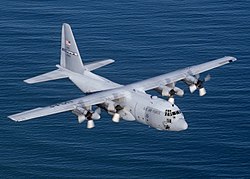
The Lockheed C-130 Hercules is an American four-engine turboprop military transport aircraft designed and built by Lockheed (now Lockheed Martin). Capable of using unprepared runways for takeoffs and landings, the C-130 was originally designed as a troop, medevac, and cargo transport aircraft. The versatile airframe has found uses in other roles, including as a gunship (AC-130), for airborne assault, search and rescue, scientific research support, weather reconnaissance, aerial refueling, maritime patrol, and aerial firefighting. It is now the main tactical airlifter for many military forces worldwide. More than 40 variants of the Hercules, including civilian versions marketed as the Lockheed L-100, operate in more than 60 nations.
Key Information


The C-130 entered service with the U.S. in 1956, followed by Australia and many other nations. During its years of service, the Hercules has participated in numerous military, civilian and humanitarian aid operations. In 2007, the transport became the fifth aircraft[N 1] to mark 50 years of continuous service with its original primary customer, which for the C-130 is the United States Air Force (USAF). The C-130 is the longest continuously produced military aircraft, having achieved 70 years of production in 2024.[3]
Design and development
[edit] | This section needs additional citations for verification. (February 2014) |
Background and requirements
[edit]The Korean War showed that World War II-era piston-engine transports—Fairchild C-119 Flying Boxcars, Douglas C-47 Skytrains and Curtiss C-46 Commandos—were no longer adequate. On 2 February 1951, the United States Air Force issued a General Operating Requirement (GOR) for a new transport to Boeing, Douglas, Fairchild, Lockheed, Martin, Chase Aircraft, North American, Northrop, and Airlifts Inc.
The new transport would have a capacity of 92 passengers, 72 combat troops or 64 paratroopers in a cargo compartment that was approximately 41 ft (12 m) long, 9 ft (2.7 m) high, and 10 ft (3.0 m) wide. Unlike transports derived from passenger airliners, it was to be designed specifically as a combat transport with loading from a hinged loading ramp at the rear of the fuselage. A notable advance for large aircraft was the introduction of a turboprop powerplant, the Allison T56 which was developed for the C-130. It gave the aircraft greater range than a turbojet engine as it used less fuel.[4][5] Turboprop engines also produced much more power for their weight than piston engines. However, the turboprop configuration chosen for the T56, with the propeller connected to the compressor, had the potential to cause structural failure of the aircraft if an engine failed. Safety devices had to be incorporated to reduce the excessive drag from a windmilling propeller.[4][5]
Design phase
[edit]The Hercules resembles a larger, four-engine version of the Fairchild C-123 Provider with a similar wing and cargo ramp layout. The C-123 had evolved from the Chase XCG-20 Avitruc first flown in 1950.[6][7] The Boeing C-97 Stratofreighter had rear ramps, which made it possible to drive vehicles onto the airplane (also possible with the forward ramp on a C-124). The ramp on the Hercules was also used to airdrop cargo, which included a low-altitude parachute-extraction system for Sheridan tanks and even dropping large improvised "daisy cutter" bombs. The new Lockheed cargo plane had a range of 1,100 nmi (1,270 mi; 2,040 km) and it could operate from short and unprepared strips.
Fairchild, North American, Martin, and Northrop declined to participate. The remaining five companies tendered a total of ten designs: Lockheed two, Boeing one, Chase three, Douglas three, and Airlifts Inc. one. The contest was a close affair between the lighter of the two Lockheed (preliminary project designation L-206) proposals and a four-turboprop Douglas design.
The Lockheed design team was led by Willis Hawkins, starting with a 130-page proposal for the Lockheed L-206.[8] Hall Hibbard, Lockheed vice president and chief engineer, saw the proposal and directed it to Kelly Johnson, who did not care for the low-speed, unarmed aircraft, and remarked, "If you sign that letter, you will destroy the Lockheed Company."[8] Both Hibbard and Johnson signed the proposal and the company won the contract for the now-designated Model 82 on 2 July 1951.[9]

The first flight of the YC-130 prototype was made on 23 August 1954 from the Lockheed plant in Burbank, California. The aircraft, serial number 53-3397, was the second prototype, but the first of the two to fly. The YC-130 was piloted by Stanley Beltz and Roy Wimmer on its 61-minute flight to Edwards Air Force Base; Jack Real and Dick Stanton served as flight engineers. Kelly Johnson flew chase in a Lockheed P2V Neptune.[10]
After the two prototypes were completed, production began in Marietta, Georgia, where over 2,300 C-130s have been built through 2009.[11]
The initial production model, the C-130A, was powered by Allison T56-A-9 turboprops with three-blade propellers and originally equipped with the blunt nose of the prototypes. Deliveries began in December 1956, continuing until the introduction of the C-130B model in 1959. Some A-models were equipped with skis and re-designated C-130D. As the C-130A became operational with Tactical Air Command (TAC), the C-130's lack of range became apparent and additional fuel capacity was added with wing pylon-mounted tanks outboard of the engines; this added 6,000 pounds (2,700 kg) of fuel capacity for a total capacity of 40,000 pounds (18,000 kg).[12]
Improved versions
[edit]

.jpg)
The C-130B model was developed to complement the A-models that had previously been delivered, and incorporated new features, particularly increased fuel capacity in the form of auxiliary tanks built into the center wing section and an AC electrical system. Four-bladed Hamilton Standard propellers replaced the Aero Products' three-blade propellers that distinguished the earlier A-models. The C-130B had ailerons operated by hydraulic pressure that was increased from 2,050 to 3,000 psi (14.1 to 20.7 MPa), as well as uprated engines and four-blade propellers that were standard until the J-model.
The B model was originally intended to have "blown controls", a system that blows high-pressure air over the control surfaces to improve their effectiveness during slow flight. It was tested on an NC-130B prototype aircraft with a pair of T-56 turbines providing high-pressure air through a duct system to the control surfaces and flaps during landing. This greatly reduced landing speed to just 63 knots and cut landing distance in half. The system never entered service because it did not improve takeoff performance by the same margin, making the landing performance pointless if the aircraft could not also take off from where it had landed.[13]
An electronic reconnaissance variant of the C-130B was designated C-130B-II. A total of 13 aircraft were converted. The C-130B-II was distinguished by its false external wing fuel tanks, which were disguised signals intelligence (SIGINT) receiver antennas. These pods were slightly larger than the standard wing tanks found on other C-130Bs. Most aircraft featured a swept blade antenna on the upper fuselage, as well as extra wire antennas between the vertical fin and upper fuselage not found on other C-130s. Radio call numbers on the tail of these aircraft were regularly changed to confuse observers and disguise their true mission.
The extended-range C-130E model entered service in 1962 after it was developed as an interim long-range transport for the Military Air Transport Service. Essentially a B-model, the new designation was the result of the installation of 1,360 US gallons (5,100 litres) Sargent Fletcher external fuel tanks under each wing's midsection and more powerful Allison T56-A-7A turboprops. The hydraulic boost pressure to the ailerons was reduced back to 2,050 psi (14.1 MPa) as a consequence of the external tanks' weight in the middle of the wingspan. The E model also featured structural improvements, avionics upgrades, and a higher gross weight. Australia took delivery of 12 C130E Hercules during 1966–67 to supplement the 12 C-130A models already in service with the RAAF. Sweden and Spain fly the TP-84T version of the C-130E fitted for aerial refueling capability.
The KC-130 tankers, originally C-130F procured for the US Marine Corps (USMC) in 1958 (under the designation GV-1) are equipped with a removable 3,600 US gallons (14,000 L) stainless steel fuel tank carried inside the cargo compartment. The two wing-mounted hose and drogue aerial refueling pods each transfer up to 300 US gallons per minute (1,100 L/min) to two aircraft simultaneously, allowing for rapid cycle times of multiple-receiver aircraft formations, (a typical tanker formation of four aircraft in less than 30 minutes). The US Navy's C-130G has increased structural strength allowing higher gross weight operation.
Further developments
[edit]
The C-130H model has updated Allison T56-A-15 turboprops, a redesigned outer wing, updated avionics, and other minor improvements. Later H models had a new, fatigue-life-improved, center wing that was retrofitted to many earlier H-models. For structural reasons, some models are required to land with reduced amounts of fuel when carrying heavy cargo, reducing usable range.[14]
The H model remains in widespread use with the United States Air Force (USAF) and many foreign air forces. Initial deliveries began in 1964 (to the RNZAF), remaining in production until 1996. An improved C-130H was introduced in 1974, with Australia purchasing 12 of the type in 1978 to replace the original 12 C-130A models, which had first entered Royal Australian Air Force (RAAF) service in 1958. The U.S. Coast Guard employs the HC-130H for long-range search and rescue, drug interdiction, illegal migrant patrols, homeland security, and logistics.
C-130H models produced from 1992 to 1996 were designated as C-130H3 by the USAF, with the "3" denoting the third variation in design for the H series. Improvements included ring laser gyros for the INUs, GPS receivers, a partial glass cockpit (ADI and HSI instruments), a more capable APN-241 color radar, night vision device compatible instrument lighting, and an integrated radar and missile warning system. The electrical system upgrade included Generator Control Units (GCU) and Bus Switching units (BSU) to provide stable power to the more sensitive upgraded components.[15]
The equivalent model for export to the UK is the C-130K, known by the Royal Air Force (RAF) as the Hercules C.1. The C-130H-30 (Hercules C.3 in RAF service) is a stretched version of the original Hercules, achieved by inserting a 100 in (2.5 m) plug aft of the cockpit and an 80 in (2.0 m) plug at the rear of the fuselage. A single C-130K was purchased by the Met Office for use by its Meteorological Research Flight, where it was classified as the Hercules W.2. This aircraft was heavily modified, with its most prominent feature being the long red and white striped atmospheric probe on the nose and the move of the weather radar into a pod above the forward fuselage. This aircraft, named Snoopy, was withdrawn in 2001 and was then modified by Marshall of Cambridge Aerospace as a flight testbed for the A400M turbine engine, the TP400. The C-130K is used by the RAF Falcons for parachute drops. Three C-130Ks (Hercules C Mk.1P) were upgraded and sold to the Austrian Air Force in 2002.[16]
Enhanced models
[edit]
The MC-130E Combat Talon was developed for the USAF during the Vietnam War to support special operations missions in Southeast Asia, and led to both the MC-130H Combat Talon II as well as a family of other special missions aircraft. 37 of the earliest models currently operating with the Air Force Special Operations Command (AFSOC) are scheduled to be replaced by new-production MC-130J versions. The EC-130 Commando Solo is another special missions variant within AFSOC, albeit operated solely by an AFSOC-gained wing in the Pennsylvania Air National Guard, and is a psychological operations/information operations (PSYOP/IO) platform equipped as an aerial radio station and television stations able to transmit messaging over commercial frequencies. Other versions of the EC-130, most notably the EC-130H Compass Call, are also special variants, but are assigned to the Air Combat Command (ACC). The AC-130 gunship was first developed during the Vietnam War to provide close air support and other ground-attack duties.
The HC-130 is a family of long-range search and rescue variants used by the USAF and the U.S. Coast Guard. Equipped for the deep deployment of Pararescuemen (PJs), survival equipment, and (in the case of USAF versions) aerial refueling of combat rescue helicopters, HC-130s are usually the on-scene command aircraft for combat SAR missions (USAF only) and non-combat SAR (USAF and USCG). Early USAF versions were also equipped with the Fulton surface-to-air recovery system, designed to pull a person off the ground using a wire strung from a helium balloon. The John Wayne movie The Green Berets features its use. The Fulton system was later removed when aerial refueling of helicopters proved safer and more versatile. The movie The Perfect Storm depicts a real-life SAR mission involving aerial refueling of a New York Air National Guard HH-60G by a New York Air National Guard HC-130P.
The C-130R and C-130T are U.S. Navy and USMC models, both equipped with underwing external fuel tanks. The USN C-130T is similar but has additional avionics improvements. In both models, aircraft are equipped with Allison T56-A-16 engines. The USMC versions are designated KC-130R or KC-130T when equipped with underwing refueling pods and pylons and are fully night vision system compatible.
The RC-130 is a reconnaissance version developed during the Cold War. Sometimes called "ferret" aircraft, these planes were initially retrofitted standard C-130s.[17]
The Lockheed L-100 (L-382) is a civilian variant, equivalent to a C-130E model without military equipment. The L-100 also has two stretched versions.
Next generation
[edit]In the 1970s, Lockheed proposed a C-130 variant with turbofan engines rather than turboprops, but the U.S. Air Force preferred the takeoff performance of the existing aircraft. In the 1980s, the C-130 was intended to be replaced by the Advanced Medium STOL Transport project. The project was canceled and the C-130 has remained in production.
Building on lessons learned, Lockheed Martin modified a commercial variant of the C-130 into a High Technology Test Bed (HTTB). This test aircraft set numerous short takeoff and landing performance records and significantly expanded the database for future derivatives of the C-130.[18] Modifications made to the HTTB included extended chord ailerons, a long chord rudder, fast-acting double-slotted trailing edge flaps, a high-camber wing leading edge extension, a larger dorsal fin and dorsal fins, the addition of three spoiler panels to each wing upper surface, a long-stroke main and nose landing gear system, and changes to the flight controls and a change from direct mechanical linkages assisted by hydraulic boost, to fully powered controls, in which the mechanical linkages from the flight station controls operated only the hydraulic control valves of the appropriate boost unit.[19]
The HTTB first flew on 19 June 1984, with civil registration of N130X. After demonstrating many new technologies, some of which were applied to the C-130J, the HTTB was lost in a fatal accident on 3 February 1993, at Dobbins Air Reserve Base, in Marietta, Georgia.[20] The crash was attributed to disengagement of the rudder fly-by-wire flight control system, resulting in a total loss of rudder control capability while conducting ground minimum control speed tests (Vmcg). The disengagement was a result of the inadequate design of the rudder's integrated actuator package by its manufacturer; the operator's insufficient system safety review failed to consider the consequences of the inadequate design to all operating regimes. A factor that contributed to the accident was the flight crew's lack of engineering flight test training.[21]
In the 1990s, the improved C-130J Super Hercules was developed by Lockheed (later Lockheed Martin). This model is the newest version and the only model in production. Externally similar to the classic Hercules in general appearance, the J model has new turboprop engines, six-bladed propellers, digital avionics, and other new systems.[22]
Upgrades and changes
[edit]_(8-26-2023).jpg)
In 2000, Boeing was awarded a US$1.4 billion contract to develop an Avionics Modernization Program kit for the C-130. The program was beset with delays and cost overruns until project restructuring in 2007.[23] In September 2009, it was reported that the planned Avionics Modernization Program (AMP) upgrade to the older C-130s would be dropped to provide more funds for the F-35, CV-22 and airborne tanker replacement programs.[24] However, in June 2010, Department of Defense approved funding for the initial production of the AMP upgrade kits.[25][26] Under the terms of this agreement, the USAF has cleared Boeing to begin low-rate initial production (LRIP) for the C-130 AMP. A total of 198 aircraft are expected to feature the AMP upgrade. The current cost per aircraft is US$14 million, although Boeing expects that this price will drop to US$7 million for the 69th aircraft.[23]
In the 2000s, Lockheed Martin and the U.S. Air Force began outfitting and retrofitting C-130s with the eight-blade UTC Aerospace Systems NP2000 propellers.[27] An engine enhancement program saving fuel and providing lower temperatures in the T56 engine has been approved, and the US Air Force expects to save $2 billion (~$2.65 billion in 2024) and extend the fleet life.[28]
In 2021, the Air Force Research Laboratory demonstrated the Rapid Dragon system which transforms the C-130 into a lethal strike platform capable of launching 12 JASSM-ER with 500 kg warheads from a standoff distance of 925 km (575 mi). Future anticipated improvements support includes support for JDAM-ER, mine laying, drone dispersal as well as improved standoff range when 1,900 km (1,200 mi) JASSM-XR become available in 2024.[29][30]
Replacement
[edit]In October 2010, the U.S. Air Force released a capability request for information (CRFI) for the development of a new airlifter to replace the C-130. The new aircraft was to carry a 190% greater payload and assume the mission of mounted vertical maneuver (MVM). The greater payload and mission would enable it to carry medium-weight armored vehicles and unload them at locations without long runways. Various options were under consideration, including new or upgraded fixed-wing designs, rotorcraft, tiltrotors, or even an airship. The C-130 fleet of around 450 planes would be replaced by only 250 aircraft.[31] The Air Force had attempted to replace the C-130 in the 1970s through the Advanced Medium STOL Transport project, which resulted in the C-17 Globemaster III that instead replaced the C-141 Starlifter.[32]
The Air Force Research Laboratory funded Lockheed Martin and Boeing demonstrators for the Speed Agile concept, which had the goal of making a STOL aircraft that could take off and land at speeds as low as 70 kn (130 km/h; 81 mph) on airfields less than 2,000 ft (610 m) long and cruise at Mach 0.8-plus. Boeing's design used upper-surface blowing from embedded engines on the inboard wing and blown flaps for circulation control on the outboard wing. Lockheed's design also used blown flaps outboard, but inboard used patented reversing ejector nozzles.[33]
Boeing's design completed over 2,000 hours of wind tunnel tests in late 2009. It was a 5 percent-scale model of a narrow body design with a 55,000 lb (25,000 kg) payload. When the AFRL increased the payload requirement to 65,000 lb (29,000 kg), they tested a 5 percent-scale model of a widebody design with a 303,000 lb (137,000 kg) take-off gross weight and an "A400M-size" 158 in (4.0 m) wide cargo box. It would be powered by four IAE V2533 turbofans.[33]
In August 2011, the AFRL released pictures of the Lockheed Speed Agile concept demonstrator. A 23% scale model went through wind tunnel tests to demonstrate its hybrid powered lift, which combined a low drag airframe with simple mechanical assembly to reduce weight and improve aerodynamics. The model had four engines, including two Williams FJ44 turbofans.[32][34] On 26 March 2013, Boeing was granted a patent for its swept-wing powered lift aircraft.[35]
In January 2014, Air Mobility Command, Air Force Materiel Command and the Air Force Research Lab were in the early stages of defining requirements for the C-X next generation airlifter program[36] to replace both the C-130 and C-17. The aircraft would be produced from the early 2030s to the 2040s.[37]
Operational history
[edit]Military
[edit]_on_30_October_1963_(higher_res).jpg)
The first production batch of C-130A aircraft were delivered beginning in 1956 to the 463d Troop Carrier Wing at Ardmore AFB, Oklahoma, and the 314th Troop Carrier Wing at Sewart AFB, Tennessee. Six additional squadrons were assigned to the 322d Air Division in Europe and the 315th Air Division in the Far East. Additional aircraft were modified for electronics intelligence work and assigned to Rhein-Main Air Base, Germany while modified RC-130As were assigned to the Military Air Transport Service (MATS) photo-mapping division. The C-130A entered service with the U.S. Air Force in December 1956.[38]
In 1958, a U.S. reconnaissance C-130A-II of the 7406th Support Squadron was shot down over Armenia by four Soviet MiG-17s along the Turkish-Armenian border during a routine mission.[39]
Australia became the first non-American operator of the Hercules with 12 examples being delivered from late 1958. The Royal Canadian Air Force became another early user with the delivery of four B-models (Canadian designation CC-130 Mk I) in October / November 1960.[40]
In 1963, a Hercules achieved and still holds the record for the largest and heaviest aircraft to land on an aircraft carrier.[41] During October and November that year, a USMC KC-130F (BuNo 149798), loaned to the U.S. Naval Air Test Center, made 29 touch-and-go landings, 21 unarrested full-stop landings and 21 unassisted take-offs on Forrestal at a number of different weights. The pilot, Lieutenant (later Rear Admiral) James H. Flatley III, USN, was awarded the Distinguished Flying Cross for his role in this test series. The tests were highly successful, but the aircraft was not deployed this way.[citation needed] Flatley denied that C-130 was tested for carrier onboard delivery (COD) operations, or for delivering nuclear weapons. He said that the intention was to support the Lockheed U-2, also being tested on carriers.[42] The Hercules used in the test, most recently in service with Marine Aerial Refueler Squadron 352 (VMGR-352) until 2005, is now part of the collection of the National Museum of Naval Aviation at NAS Pensacola, Florida.[43]
In 1964, C-130 crews from the 6315th Operations Group at Naha Air Base, Okinawa commenced forward air control (FAC; "Flare") missions over the Ho Chi Minh Trail in Laos supporting USAF strike aircraft. In April 1965 the mission was expanded to North Vietnam where C-130 crews led formations of Martin B-57 Canberra bombers on night reconnaissance/strike missions against communist supply routes leading to South Vietnam. In early 1966 Project Blind Bat/Lamplighter was established at Ubon Royal Thai Air Force Base, Thailand. After the move to Ubon, the mission became a four-engine FAC mission with the C-130 crew searching for targets and then calling in strike aircraft. Another little-known C-130 mission flown by Naha-based crews was Operation Commando Scarf (or Operation Commando Lava), which involved the delivery of chemicals onto sections of the Ho Chi Minh Trail in Laos that were designed to produce mud and landslides in hopes of making the truck routes impassable.[44]
In November 1964, on the other side of the globe, C-130Es from the 464th Troop Carrier Wing but loaned to 322d Air Division in France, took part in Operation Dragon Rouge, one of the most dramatic missions in history in the former Belgian Congo. After communist Simba rebels took white residents of the city of Stanleyville hostage, the U.S. and Belgium developed a joint rescue mission that used the C-130s to drop, air-land, and air-lift a force of Belgian paratroopers to rescue the hostages. Two missions were flown, one over Stanleyville and another over Paulis during Thanksgiving week.[45] The headline-making mission resulted in the first award of the prestigious MacKay Trophy to C-130 crews.[46][47]
In the Indo-Pakistani War of 1965, the No. 6 Transport Squadron of the Pakistan Air Force modified its C-130Bs for use as bombers to carry up to 20,000 pounds (9,100 kg) of bombs on pallets. These improvised bombers were used to hit Indian targets such as bridges, heavy artillery positions, tank formations, and troop concentrations, though they were largely unsuccessful.[48][49][50]

In October 1968, a C-130Bs from the 463rd Tactical Airlift Wing dropped a pair of M-121 10,000 pounds (4,500 kg) bombs that had been developed for the massive Convair B-36 Peacemaker bomber but had never been used. The U.S. Army and U.S. Air Force resurrected the huge weapons as a means of clearing landing zones for helicopters and in early 1969 the 463rd commenced Commando Vault missions. Although the stated purpose of Commando Vault was to clear LZs, they were also used on enemy base camps and other targets.[51]
During the late 1960s, the U.S. was eager to get information on Chinese nuclear capabilities. After the failure of the Black Cat Squadron to plant operating sensor pods near the Lop Nur Nuclear Weapons Test Base using a U-2, the CIA developed a plan, named Heavy Tea, to deploy two battery-powered sensor pallets near the base. To deploy the pallets, a Black Bat Squadron crew was trained in the U.S. to fly the C-130 Hercules. The crew of 12, led by Col Sun Pei Zhen, took off from Takhli Royal Thai Air Force Base in an unmarked U.S. Air Force C-130E on 17 May 1969. Flying for six and a half hours at low altitude in the dark, they arrived over the target and the sensor pallets were dropped by parachute near Anxi in Gansu province. After another six and a half hours of low-altitude flight, they arrived back at Takhli. The sensors worked and uploaded data to a U.S. intelligence satellite for six months before their batteries failed. The Chinese conducted two nuclear tests, on 22 September 1969 and 29 September 1969, during the operating life of the sensor pallets. Another mission to the area was planned as Operation Golden Whip, but it was called off in 1970.[52] It is most likely that the aircraft used on this mission was either C-130E serial number 64-0506 or 64-0507 (cn 382-3990 and 382–3991). These two aircraft were delivered to Air America in 1964.[53] After being returned to the U.S. Air Force sometime between 1966 and 1970, they were assigned the serial numbers of C-130s that had been destroyed in accidents. 64-0506 is now flying as 62–1843, a C-130E that crashed in Vietnam on 20 December 1965, and 64-0507 is now flying as 63–7785, a C-130E that had crashed in Vietnam on 17 June 1966.[54]
The A-model continued in service through the Vietnam War, where the aircraft assigned to the four squadrons at Naha AB, Okinawa, and one at Tachikawa Air Base, Japan performed yeoman's service, including operating highly classified special operations missions such as the BLIND BAT FAC/Flare mission and Fact Sheet leaflet mission over Laos and North Vietnam. The A-model was also provided to the Republic of Vietnam Air Force as part of the Vietnamization program at the end of the war, and equipped three squadrons based at Tan Son Nhut Air Base. The last operator in the world is the Honduran Air Force, which is still flying one of five A model Hercules (FAH 558, c/n 3042) as of October 2009.[55] As the Vietnam War wound down, the 463rd Troop Carrier/Tactical Airlift Wing B-models and A-models of the 374th Tactical Airlift Wing were transferred back to the United States where most were assigned to Air Force Reserve and Air National Guard units.

Another prominent role for the B model was with the United States Marine Corps, where Hercules initially designated as GV-1s replaced C-119s. After Air Force C-130Ds proved the type's usefulness in Antarctica, the U.S. Navy purchased several B-models equipped with skis that were designated as LC-130s. C-130B-II electronic reconnaissance aircraft were operated under the SUN VALLEY program name primarily from Yokota Air Base, Japan. All reverted to standard C-130B cargo aircraft after their replacement in the reconnaissance role by other aircraft.[citation needed]
The C-130 was also used in the 1976 Entebbe raid in which Israeli commando forces performed a surprise operation to rescue 103 passengers of an airliner hijacked by Palestinian and German terrorists at Entebbe Airport, Uganda. The rescue force—200 soldiers, jeeps, and a black Mercedes-Benz (intended to resemble Ugandan Dictator Idi Amin's vehicle of state)—was flown over 2,200 nmi (4,074 km; 2,532 mi) almost entirely at an altitude of less than 100 ft (30 m) from Israel to Entebbe by four Israeli Air Force (IAF) Hercules aircraft without mid-air refueling (on the way back, the aircraft refueled in Nairobi, Kenya).[citation needed]
During the Falklands War (Spanish: Guerra de las Malvinas) of 1982, Argentine Air Force C-130s undertook dangerous re-supply night flights as blockade runners to the Argentine garrison on the Falkland Islands. They also performed daylight maritime survey flights. One was shot down by a Royal Navy Sea Harrier using AIM-9 Sidewinders and cannon. The crew of seven were killed. Argentina also operated two KC-130 tankers during the war, and these refueled both the Douglas A-4 Skyhawks and Navy Dassault-Breguet Super Étendards; some C-130s were modified to operate as bombers with bomb-racks under their wings.[56] The British also used RAF C-130s to support their logistical operations.[57]

During the Gulf War of 1991 (Operation Desert Storm), the C-130 Hercules was used operationally by the U.S. Air Force, U.S. Navy, and U.S. Marine Corps, along with the air forces of Australia, New Zealand, Saudi Arabia, South Korea, and the UK. The MC-130 Combat Talon variant also made the first attacks using the largest conventional bombs in the world, the BLU-82 "Daisy Cutter" and GBU-43/B "Massive Ordnance Air Blast" (MOAB) bomb. Daisy Cutters were used to primarily clear landing zones and to eliminate mine fields. The weight and size of the weapons make it impossible or impractical to load them on conventional bombers. The GBU-43/B MOAB is a successor to the BLU-82 and can perform the same function, as well as perform strike functions against hardened targets in a low air threat environment.[citation needed]

Since 1992, two successive C-130 aircraft named Fat Albert have served as the support aircraft for the U.S. Navy Blue Angels flight demonstration team. Fat Albert I was a TC-130G (151891) a former U.S. Navy TACAMO aircraft serving with Fleet Air Reconnaissance Squadron Three (VQ-3) before being transferred to the BLUES,[58] while Fat Albert II is a C-130T (164763).[59] Although Fat Albert supports a Navy squadron, it is operated by the U.S. Marine Corps (USMC) and its crew consists solely of USMC personnel. At some air shows featuring the team, Fat Albert takes part, performing flyovers. Until 2009, it also demonstrated its rocket-assisted takeoff (RATO) capabilities; these ended due to dwindling supplies of rockets.[60]
The AC-130 also holds the record for the longest sustained flight by a C-130. From 22 to 24 October 1997, two AC-130U gunships flew 36 hours nonstop from Hurlburt Field, Florida to Daegu International Airport, South Korea, being refueled seven times by KC-135 tanker aircraft. This record flight beat the previous record longest flight by over 10 hours and the two gunships took on 410,000 lb (190,000 kg) of fuel. The gunship has been used in every major U.S. combat operation since Vietnam, except for Operation El Dorado Canyon, the 1986 attack on Libya.[61]
During the invasion of Afghanistan in 2001 and the ongoing support of the International Security Assistance Force (Operation Enduring Freedom), the C-130 Hercules has been used operationally by Australia, Belgium, Canada, Denmark, France, Italy, the Netherlands, New Zealand, Norway, Portugal, Romania, South Korea, Spain, the UK, and the United States.[citation needed][62]
During the 2003 invasion of Iraq (Operation Iraqi Freedom), the C-130 Hercules was used operationally by Australia, the UK, and the United States. After the initial invasion, C-130 operators as part of the Multinational force in Iraq used their C-130s to support their forces in Iraq.[63]
Since 2004, the Pakistan Air Force has employed C-130s in the War in North-West Pakistan. Some variants had forward looking infrared (FLIR Systems Star Safire III EO/IR) sensor balls, to enable close tracking of militants.[64]
In 2017, France and Germany announced that they will build up a joint air transport squadron at Evreux Air Base, France, comprising ten C-130J aircraft. Six of these will be operated by Germany. Initial operational capability is expected for 2021 while full operational capability is scheduled for 2024.[65]
The Argentine Air Force has five C-130H aircraft that are part of a US-funded security assistance donation. The US has been leasing the aircraft to the Argentine Air Force through the Georgia Air National Guard since June 2023.[citation needed]
Deepwater Horizon Oil Spill
[edit]
For almost two decades, the USAF 910th Airlift Wing's 757th Airlift Squadron and the U.S. Coast Guard have participated in oil spill cleanup exercises to ensure the U.S. military has a capable response in the event of a national emergency. The 757th Airlift Squadron operates the DOD's only fixed-wing Aerial Spray System which was certified by the EPA to disperse pesticides on DOD property to spread oil dispersants onto the Deepwater Horizon oil spill in the Gulf Coast in 2010.[66]
During the 5-week mission, the aircrews flew 92 sorties and sprayed approximately 30,000 acres with nearly 149,000 gallons of oil dispersant to break up the oil. The Deepwater Horizon mission was the first time the US used the oil dispersing capability of the 910th Airlift Wing—its only large area, fixed-wing aerial spray program—in an actual spill of national significance.[67] The Air Force Reserve Command announced the 910th Airlift Wing has been selected as a recipient of the Air Force Outstanding Unit Award for its outstanding achievement from 28 April 2010 through 4 June 2010.[68]
Hurricane Harvey (2017)
[edit].jpg)
C-130s temporarily based at Kelly Field conducted mosquito control aerial spray applications over areas of eastern Texas devastated by Hurricane Harvey. This special mission treated more than 2.3 million acres at the direction of Federal Emergency Management Agency (FEMA) and the Texas Department of State Health Services (DSHS) to assist in recovery efforts by helping contain the significant increase in pest insects caused by large amounts of standing, stagnant water. The 910th Airlift Wing operates the Department of Defense's only aerial spray capability to control pest insect populations, eliminate undesired and invasive vegetation, and disperse oil spills in large bodies of water.[69]
The aerial spray flight also is now able to operate during the night with NVGs, which increases the flight's best case spray capacity from approximately 60 thousand acres per day to approximately 190 thousand acres per day. Spray missions are normally conducted at dusk and nighttime hours when pest insects are most active, the U.S. Air Force Reserve reports.[70]
Aerial firefighting
[edit]
 | The examples and perspective in this section deal primarily with US and do not represent a worldwide view of the subject. (November 2023) |
In the early 1970s, Congress authorized the Modular Airborne Firefighting System (MAFFS), a joint operation between the U.S. Forest Service and the Department of Defense. MAFFS is roll-on/roll-off device that allows C-130s to be temporarily converted into a 3,000-gallon airtanker for fighting wildfires when demand exceeds the supply of privately contracted and publicly available airtankers.[71]
In the late 1980s, 22 retired USAF C-130As were removed from storage and transferred to the U.S. Forest Service, which then transferred them to six private companies to be converted into airtankers. One of these C-130s crashed in June 2002 while operating near Walker, California. The crash was attributed to wing separation caused by fatigue stress cracking and contributed to the grounding of the entire large aircraft fleet.[72] After an extensive review, US Forest Service and the Bureau of Land Management declined to renew the leases on nine C-130A over concerns about the age of the aircraft, which had been in service since the 1950s, and their ability to handle the forces generated by aerial firefighting.[citation needed]
More recently, an updated Retardant Aerial Delivery System known as RADS XL was developed by Coulson Aviation USA. That system consists of a C-130H/Q retrofitted with an in-floor discharge system, combined with a removable 3,500- or 4,000-gallon water tank. The combined system is FAA certified.[73] On 23 January 2020, Coulson's Tanker 134, an EC-130Q registered N134CG, crashed during aerial firefighting operations in New South Wales, Australia, killing all three crew members. The aircraft had taken off out of RAAF Base Richmond and was supporting firefighting operations during Australia's 2019–20 fire season.[74]
Variants
[edit] | This section needs additional citations for verification. (February 2014) |


.jpg)

.jpg)


Significant military variants of the C-130 include:
- C-130A
- Initial production model with four Allison T56-A-11/9 turboprop engines. 219 were ordered and deliveries to the USAF began in December 1956.
- C-130B
- Variant with four Allison T56-A-7 engines. 134 were ordered and entered USAF service in May 1959.
- C-130E
- Same engines as the C-130B but with two 1,290 U.S. gal (4,900 L; 1,070 imp gal) external fuel tanks, and an increased maximum takeoff weight capability. Introduced in August 1962 with 389 were ordered.
- C-130F/G
- Variants procured by the U.S. Navy for Marine Corps refueling missions, and other support/transport operations.
- C-130H
- Identical to the C-130E but with more powerful Allison T56-A-15 turboprop engines. Introduced in June 1964 with 308 ordered.
- C-130K
- Designation for RAF Hercules C1/W2/C3 aircraft (C-130Js in RAF service are the Hercules C.4 and Hercules C.5)
- C-130T
- Improved variants procured by the U.S. Navy for Marine Corps for refueling and other support/transport operations.
- C-130A-II Dreamboat
- Early version Electronic Intelligence/Signals Intelligence (ELINT/SIGINT) aircraft[75]
- C-130J Super Hercules
- Tactical airlifter, with new engines, avionics, and updated systems
- C-130B BLC
- A one-off conversion of C-130B 58–0712, modified with a double Allison YT56 gas generator pod under each outer wing, to provide bleed air for all the control surfaces and flaps.[76]
- AC-130A/E/H/J/U/W
- Gunship variants
- C-130D/D-6
- Ski-equipped version for snow and ice operations United States Air Force / Air National Guard
- CC-130E/H/J Hercules
- Designation for Canadian Armed Forces / Royal Canadian Air Force Hercules aircraft.[77] U.S. Air Force used the CC-130J designation to differentiate the standard C-130J variant from the "stretched" C-130J (company designation C-130J-30). CC-130H(T) is the Canadian tanker variant of the KC-130H.[78]
- C-130M
- Designation used by the Brazilian Air Force for locally modified C-130H aircraft.[79]
- DC-130A/E/H
- USAF and USN Drone control
- E-130J
- Future USN TACAMO aircraft
- EC-130
- EC-130E/J Commando Solo – USAF / Air National Guard psychological operations version
- EC-130E Airborne Battlefield Command and Control Center (ABCCC) – USAF procedural air-to-ground attack control, also provided NRT threat updates
- EC-130E Rivet Rider – Airborne psychological warfare aircraft
- EC-130H Compass Call – Electronic warfare and electronic attack.[80]
- EC-130Q – USN TACAMO aircraft
- EC-130V – Airborne early warning and control (AEW&C) variant used by USCG for counter-narcotics missions[81]
- GC-130
- Permanently grounded instructional airframes
- HC-130
- HC-130B/E/H – Early model combat search and rescue
- HC-130P/N Combat King – USAF aerial refueling tanker and combat search and rescue
- HC-130J Combat King II – Next generation combat search and rescue tanker
- HC-130H/J – USCG long-range surveillance and search and rescue, USAFR Aerial Spray & Airlift
- JC-130
- Temporary conversion for flight test operations; used to recover drones and spy satellite film capsules.
- KC-130F/R/T/J
- United States Marine Corps aerial refueling tanker and tactical airlifter
- LC-130F/H/R
- USAF / Air National Guard – Ski-equipped version for Arctic and Antarctic support operations; LC-130F and R previously operated by USN
- MC-130
- MC-130E/H Combat Talon I/II – Special operations infiltration/extraction variant
- MC-130W Combat Spear/Dragon Spear – Special operations tanker/gunship[82]
- MC-130P Combat Shadow – Special operations tanker – all operational aircraft converted to HC-130P standard
- MC-130J Commando II (formerly Combat Shadow II) – Special operations tanker Air Force Special Operations Command[83]
- YMC-130H – Modified aircraft under Operation Credible Sport for second Iran hostage crisis rescue attempt
- NC-130
- Permanent conversion for flight test operations
- PC-130/C-130-MP
- Maritime patrol
- RC-130A/S
- Surveillance aircraft for reconnaissance
- SC-130J Sea Herc
- Proposed maritime patrol version of the C-130J, designed for coastal surveillance and anti-submarine warfare.[84][85]
- TC-130
- Aircrew training
- VC-130H
- VIP transport
- WC-130A/B/E/H/J
- Weather reconnaissance ("Hurricane Hunter") version for USAF / Air Force Reserve Command's 53d Weather Reconnaissance Squadron in support of the National Weather Service's National Hurricane Center
- C-130(EM/BM) Erciyes
- Turkey's Erciyes modernization program covers modernization of the avionics of C-130B/E variants of the aircraft. In scope of modernization the aircraft is equipped with Digital Cockpit (four-color Multifunctional Display with moving map capability-MFD), two Central Display Units (CDU) and two multifunction Central Control Computers compatible with international navigational requirements, as well as with a multifunction Mission Computer with high operational capability, Flight Management System (FMS), Link-16, Ground Mission Planning Unit compatible with the Air Force Information System, and display and lighting systems compatible with Night Vision Goggles. Other components such as GPS, indicator, anti-collision system, air radar, advanced military and civilian navigation systems, night-time invisible lighting for military missions, black box voice recorder, communication systems, advanced automated flight systems (military and civilian), systems enabling operation in the military network, digital moving map and ground mission planning systems are also included.[86]
- B.L.8
- (Thai: บ.ล.๘) Royal Thai Armed Forces designation for the C-130H.[87]
- B.L.8A
- (Thai: บ.ล.๘ก) Royal Thai Armed Forces designation for the C-130H-30.[87]
- TP 84
- Swedish Air Force designation for the C-130H
Operators
[edit]


_Lockheed_C-130H_Hercules_flying_display_at_last_day_of_the_2019_Australian_International_Airshow_(4).jpg)
 Algeria
 Argentina
 Australia
 Austria
 Bangladesh
 Bolivia
 Botswana
 Cameroon
 Canada
 Chad
Chad Chile
Chile Colombia
 Denmark
 Ecuador
 Egypt
Egypt Ethiopia
 France
 Gabon
Gabon Germany[88]
 Greece
 India
India Indonesia
 Iran
Iran Iraq
Iraq Israel
 Italy
Italy Japan
Japan Jordan
 Kuwait
 Liberia
 Libya
Libya Malaysia
 Mexico
 Morocco
 Netherlands
 New Zealand
 Niger
Niger Nigeria
 Norway
 Oman
Oman Pakistan
 Peru
Peru Philippines
 Poland
 Portugal
 Republic of China (Taiwan)
 Romania
 Saudi Arabia
 Singapore
 South Africa
 South Korea
 Sri Lanka
 Sudan
Sudan Sweden
 Thailand
 Tunisia
 Turkey
 United Arab Emirates
 United States
 Uruguay
 Venezuela
 Zambia


Former operators


Accidents
[edit]The C-130 Hercules has had a low accident rate in general. The Royal Air Force recorded an accident rate of about one aircraft loss per 250,000 flying hours over the last 40 years, placing it behind Vickers VC10s and Lockheed TriStars with no flying losses.[89] USAF C-130A/B/E-models had an overall attrition rate of 5% as of 1989 as compared to 1–2% for commercial airliners in the U.S., according to the NTSB, 10% for B-52 bombers, and 20% for fighters (F-4, F-111), trainers (T-37, T-38), and helicopters (H-3).[90]
Aircraft on display
[edit]Argentina
[edit]- C-130B FAA TC-60. ex USAF 61-0964 received in February 1992 now at Museo Nacional de Aeronáutica since September 2011.[91]
Australia
[edit]- C-130A RAAF A97-214 used by 36 Squadron from early 1959, withdrawn from use late 1978. Stored at RAAF Museum, RAAF Base Williams, Point Cook.[92] Airframe scrapped in February 2022. Cockpit section preserved and gifted to National Vietnam Veterans Museum, Phillip Island.[93]
- C-130E RAAF A97-160 used by 37 Squadron from August 1966, withdrawn from use November 2000; to RAAF Museum, 14 November 2000, cocooned as of September 2005.[94]
- C-130H A97-011 delivered in October 1978, withdrawn from use December 2012 to RAAF Museum, Point Cook where it is currently on display.[95]
Belgium
[edit]- C-130H Belgian Air Component tailnumber CH13 in service from 2009 until May 2021 is on display at the Beauvechain Air Base at the First Wing Historical Center.[96]
Brazil
[edit]- C-130H Brazilian Air Force FAB-2453 is on display at the Museu Aeroespacial in Rio de Janeiro since 2014.[97]
Canada
[edit]- CC-130E RCAF 10313 (later 130313) is on display at the National Air Force Museum of Canada, CFB Trenton[98]
- CC-130E RCAF 10307 (later 130307) is on display in the Reserve Hangar at the Canada Aviation and Space Museum, Ottawa, Ontario[99]
- CC-130E RCAF 130328 is on display at the Greenwood Aviation Museum, CFB Greenwood[100]
Colombia
[edit]- C-130B FAC 1010 (serial number 3521) moved on 14 January 2016 to the Colombian Aerospace Museum in Tocancipá, Cundinamarca, for static display.[101]
- C-130B FAC1011 (serial number 3585, ex 59–1535) preserved at the Colombian Air and Space Museum within CATAM AFB, Bogotá.[102]
Indonesia
[edit]- C-130B Indonesian Air Force A-1301 preserved at Sulaeman Airstrip, Bandung. Also occasionally used for Paskhas Training. The airplane is relocated to Air Force Museum in Yogyakarta in 2017.[103]
New Zealand
[edit]- C-130H(NZ) Royal New Zealand Air Force,[104] aircraft NZ7001 was retired to the Air Force Museum making its final delivery flight into Wigram on 19 February 2025, following 60 years service.[105]
Norway
[edit]- C-130H Royal Norwegian Air Force 953 was retired on 10 June 2007 and moved to the Air Force museum at Oslo Gardermoen in May 2008.[106]
Philippines
[edit]- L-100-20 4512 Philippine Air Force on display at Mactan Air Base aircraft park.[107]
Poland
[edit]- C-130E number 1503 (serial number 70-1272), formerly operated by Polish Air Force and stationed at 33rd Air Base, retired on 30 July 2024. It is currently on display at the Polish Air Force Museum in Dęblin.[108]
Saudi Arabia
[edit]
- C-130H RSAF 460 was operated by 4 Squadron Royal Saudi Air Force from December 1974 until January 1987. It was damaged in a fire at Jeddah in December 1989. Restored for ground training by August 1993. At Royal Saudi Air Force Museum, November 2002, restored for ground display by using a tail from another C-130H.[109]
United Kingdom
[edit]- Hercules C3 XV202 that served with the Royal Air Force from 1967 to 2011, is on display at the Royal Air Force Museum Cosford.[110]
United States
[edit]
- GC-130A, AF Ser. No. 55-037 used by the 773 TCS, 483 TCW, 315 AD, 374 TCW, 815 TAS, 35 TAS, 109 TAS, belly-landed at Duluth, Minnesota, April 1973, repaired; 167 TAS, 180 TAS, to Chanute Technical Training Center as GC-130A, May 1984; now displayed at Museum of Missouri Military History, Missouri National Guard Ike Skelton Training Center, Jefferson City, Missouri. Previously displayed at Octave Chanute Aerospace Museum, (former) Chanute AFB, Rantoul, Illinois until museum closed.[111][112]
- C-130A, AF Ser. No. 56-0518 used by the 314 TCW, 315 AD, 41 ATS, 328 TAS; to Republic of Vietnam Air Force 435 Transport Squadron, November 1972; holds the C-130 record for taking off with the most personnel on board, during the evacuation of SVN, 29 April 1975, with 452. Returned to USAF, 185 TAS, 105 TAS; Flown to Little Rock AFB on 28 June 1989. It was converted to a static display at the LRAFB Visitor Center, Arkansas by Sept. 1989.[113]
- C-130A, AF Ser. No. 57-0453 was operated from 1958 to 1991, last duty with 155th TAS, 164th TAG, Tennessee Air National Guard, Memphis International Airport/ANGB, Tennessee, 1976–1991, named "Nite Train to Memphis"; to AMARC in December 1991, then sent to Texas for modification into a replica of C-130A-II Dreamboat aircraft, AF Ser. No. 56-0528, shot down by Soviet fighters in Soviet airspace near Yerevan, Armenia on 2 September 1958, while on ELINT mission with loss of all crew, displayed in National Vigilance Park, National Security Agency grounds, Fort George Meade, Maryland.[114]
- C-130B, AF Ser. No. 59-0528 was operated by 145th Airlift Wing, North Carolina Air National Guard; placed on static display at Charlotte Air National Guard Base, North Carolina in 2010.[115]
- C-130D, AF Ser. No. 57-0490 used by the 61st TCS, 17th TCS, 139th TAS with skis, July 1975 – April 1983; to MASDC, 1984–1985, GC-130D ground trainer, Chanute AFB, Illinois, 1986–1990; When Chanute AFB closed in September 1993, it moved to the Octave Chanute Aerospace Museum (former Chanute AFB), Rantoul, Illinois. In July 1994, it moved to the Empire State Aerosciences Museum, Schenectady County Airport, New York, until placed on the gate at Stratton Air National Guard Base in October 1994.[116]
- NC-130B, AF Ser. No. 57-0526 was the second B model manufactured, initially delivered as JC-130B; assigned to 6515th Organizational Maintenance Squadron for flight testing at Edwards AFB, California on 29 November 1960; turned over to 6593rd Test Squadron's Operating Location No. 1 at Edwards AFB and spent next seven years supporting Corona Program; "J" status and prefix removed from aircraft in October 1967; transferred to 6593rd Test Squadron at Hickam AFB, Hawaii and modified for mid-air retrieval of satellites; acquired by 6514th Test Squadron at Hill AFB, Utah in Jan. 1987 and used as electronic testbed and cargo transport; aircraft retired January 1994 with 11,000+ flight hours and moved to Hill Aerospace Museum at Hill AFB by January 1994.[117]
- C-130E, AF Ser. No. 62-1787, on display at the National Museum of the United States Air Force, Wright-Patterson AFB, Ohio, was flown to the museum on 18 August 2011. One of the greatest feats of heroism during the Vietnam War involved the C-130E, call sign "Spare 617".[N 2] The C-130E attempted to airdrop ammunition to surround South Vietnamese forces at An Loc, Vietnam. Approaching the drop zone, Spare 617 received heavy enemy ground fire that damaged two engines, ruptured a bleed air duct in the cargo compartment, and set the ammunition on fire. Flight engineer TSgt Sanders was killed, and navigator 1st Lt Lenz and co-pilot 1st Lt Hering were both wounded. Despite receiving severe burns from hot air escaping from the damaged air bleed duct, loadmaster TSgt Shaub extinguished a fire in the cargo compartment, and successfully jettisoned the cargo pallets, which exploded in mid-air. Despite losing a third engine on the final approach, pilot Capt Caldwell landed Spare 617 safely. For their actions, Caldwell and Shaub received the Air Force Cross, the U.S. Air Force's second highest award for valor. TSgt Shaub also received the William H. Pitsenbarger Award for Heroism from the Air Force Sergeants Association.[118]
- KC-130F, USN/USMC BuNo 149798 used in tests in October–November 1963 by the U.S. Navy for unarrested landings and unassisted take-offs from the carrier USS Forrestal (CV-59), it remains the record holder for largest aircraft to operate from a carrier flight deck, and carried the name "Look Ma, No Hook" during the tests. Retired to the National Museum of Naval Aviation, NAS Pensacola, Florida in May 2003.[119]
- C-130G, USN/USMC BuNo 151891; modified to EC-130G, 1966, then testbed for EC-130Q TACAMO in 1981, then changed to TC-130G and used by Fleet Air Reconnaissance Squadron Three (VQ-3) for flight proficiency (bounce bird). In early 1991 it was transferred to AMMARG Davis-Monthan AFB Tucson, AZ. In May 1991 it was assigned as the U.S. Navy's Blue Angels USMC support aircraft, serving as "Fat Albert Airlines" from 1991 to 2002. Retired to the National Museum of Naval Aviation at NAS Pensacola, Florida in November 2002 where it remains on outside static display reflecting the BLUES colors.[58]
- C-130E, AF Ser. No. 64-0525 was on display at the 82nd Airborne Division War Memorial Museum at Fort Bragg, North Carolina. The aircraft was the last assigned to the 43rd AW at Pope AFB, North Carolina before retirement from the USAF.[120]
- C-130E-LM, AF Ser. No. 64-0533 – Taken in December 1964 by 314th Troop Carrier Wing, Sewart AFB, TN. Last assigned to 37th Airlift Squadron, Rhein-Main AB, Germany. Transferred to Elmendorf AFB for display, May 2004. Marked as 53-2453.[121]
- C-130E, AF Ser. No. 69-6579 operated by the 61st TAS, 314th TAW, 50th AS, 61st AS; at Dyess AFB as maintenance trainer as GC-130E, March 1998; to Dyess AFB Linear Air Park, January 2004.[122]
- MC-130E Combat Talon I, AF Ser. No. 64-0567, unofficially known as "Wild Thing". It transported captured Panamanian dictator Manuel Noriega in 1989 during Operation Just Cause and participated in Operation Eagle Claw, the unsuccessful attempt to rescue U.S. hostages from Iran in 1980. Wild Thing was also the first fixed-wing aircraft to employ night-vision goggles. On display at Hurlburt Field, in Florida.[123]
- C-130E, AF Ser. No. 69-6580 operated by the 61st TAS, 314th TAW, 317th TAW, 314th TAW, 317th TAW, 40th AS, 41st AS, 43rd AW, retired after center wing cracks were detected in April 2002; to the Air Mobility Command Museum, Dover AFB, Delaware on 2 February 2004.[122]
- C-130E, AF Ser. No. 70-1269 was used by the 43rd AW and is on display at the Pope Air Park, Pope AFB, North Carolina as of 2006.[124]
- C-130H, AF Ser. No. 74-1686 used by the 463rd TAW; one of three C-130H airframes modified to YMC-130H for an aborted rescue attempt of Iranian hostages, Operation Credible Sport, with rocket packages blistered onto fuselage in 1980, but these were removed after the mission was canceled. Subsequent duty with the 4950th Test Wing, then donated to the Museum of Aviation at Robins AFB, Georgia, in March 1988.[125]
- C-130H, AF Ser. No. 88-4401 operated by the Ohio 179th Airlift Wing has been retired and is on display at the MAPS Air Museum in North Canton, Ohio.[126]
Specifications (C-130H)
[edit]


Data from USAF C-130 Hercules fact sheet,[127] International Directory of Military Aircraft,[128] Complete Encyclopedia of World Aircraft,[129] and Encyclopedia of Modern Military Aircraft.[130]
General characteristics
- Crew: 5 (2 pilots, CSO/navigator, flight engineer and loadmaster)
- Capacity: 42,000 lb (19,000 kg) payload
- C-130E/H/J cargo hold: length, 40 ft (12.19 m); width, 9 ft 11 in (3.02 m); height, 9 ft (2.74 m). Rear ramp: length, 123 in (3.12 m); width, 119 in (3.02 m)
- C-130J-30 cargo hold: length, 55 ft (16.76 m); width, 9 ft 11 in (3.02 m); height, 9 ft (2.74 m). Rear ramp: length, 123 inches (3.12 m); width, 119 in (3.02 m)
- 92 passengers or
- 64 airborne troops or
- 74 litter patients with 5 medical crew or
- 6 pallets or
- 2–3 Humvees or
- 2 M113 armored personnel carriers
- 1 CAESAR self-propelled howitzer
- Length: 97 ft 9 in (29.79 m)
- Wingspan: 132 ft 7 in (40.41 m)
- Height: 38 ft 3 in (11.66 m)
- Wing area: 1,745 sq ft (162.1 m2)
- Airfoil: root: NACA 64A318; tip: NACA 64A412[131]
- Empty weight: 75,800 lb (34,382 kg)
- Max takeoff weight: 155,000 lb (70,307 kg)
- Powerplant: 4 × Allison T56-A-15 turboprop engines, 4,590 shp (3,420 kW) each
- Propellers: 4-bladed Hamilton Standard 54H60 constant-speed fully feathering reversible propellers, 13 ft 6 in (4.11 m) diameter [132]
Performance
- Maximum speed: 320 kn (370 mph, 590 km/h) at 20,000 ft (6,100 m)
- Cruise speed: 292 kn (336 mph, 541 km/h)
- Range: 2,050 nmi (2,360 mi, 3,800 km)
- Ferry range: 3,995 nmi (4,597 mi, 7,399 km)
- Service ceiling: 33,000 ft (10,000 m) empty[133]
- 23,000 ft (7,000 m) with 42,000 lb (19,000 kg) payload
- Rate of climb: 1,830 ft/min (9.3 m/s)
- Takeoff distance: 3,586 ft (1,093 m) at 155,000 lb (70,307 kg) max gross weight;[130]
- 1,400 ft (427 m) at 80,000 lb (36,287 kg) gross weight[134]
Avionics
See also
[edit]
Related development
- Lockheed AC-130
- Lockheed DC-130
- Lockheed EC-130
- Lockheed EC-130H Compass Call
- Lockheed HC-130
- Lockheed L-100 Hercules
- Lockheed LC-130
- Lockheed Martin C-130J Super Hercules
- Lockheed Martin KC-130
- Lockheed MC-130
- Lockheed RC-130
- Lockheed WC-130
Aircraft of comparable role, configuration, and era
- Antonov An-12
- Armstrong Whitworth AW.660 Argosy
- Blackburn Beverley
- Shaanxi Y-8
- Kawasaki C-1
- Short Belfast
- Transall C-160
Related lists
Notes
[edit]- ^ After the English Electric Canberra, B-52 Stratofortress, Tupolev Tu-95, and KC-135 Stratotanker.
- ^ The aircrew of "Spare 617" were: Capt. William Caldwell, pilot; Lt. John Hering, co-pilot; Lt. Richard A. Lenz, navigator; Tech. Sgt. Jon Sanders, flight engineer, loadmasters Tech. Sgt. Charlie Shaub and A1C Dave McAleece
References
[edit]- ^ "Family Ties: Three Generations Contribute to Hercules Legacy". Lockheed Martin. Archived from the original on 9 July 2015. Retrieved 8 July 2015.
- ^ "Hercules History". lockeedmartin.com. Lockheed Martin. 30 April 2018. Archived from the original on 6 April 2019. Retrieved 6 April 2019.
- ^ Roza, David (23 August 2024). "'Workhorse of the Air' C-130 Marks 70 Years Since First Flight". Air & Space Forces Magazine. Retrieved 25 August 2024.
- ^ a b "Today in History – April 21, 1964 – Military version of the C-130 finally takes flight". Super Sabre Society. Retrieved 3 November 2022.
- ^ a b Rogallo, Vernon L.; Yaggy, Paul F.; McCloud, John L. (9 September 1954). "An Investigation in the Ames 40- by 80-Foot Wind Tunnel of a YT-56A Turboprop Engine Incorporating a Decoupler and a Controlled-Feathering Device". Nasa.gov.
- ^ "Fairchild C-123K Provider". National Museum of the United States Air Force™. Retrieved 23 January 2024.
- ^ Gunston 1980, p.170.
- ^ a b Rhodes, Jeff (Third Quarter 2004). "Willis Hawkins and the genesis of the Hercules". Code One Magazine. Vol. 19, no. 3. pp. 16–21.
- ^ Boyne, Walter J. Beyond the Horizons: The Lockheed Story. New York: St. Martin's Press, 1998. ISBN 978-0-312-19237-2.
- ^ Dabney, Joseph E. A. "Mating of the Jeep, the Truck, and the Airplane." lockheedmartin.com, 2004. Excerpted from HERK: Hero of the Skies in Lockheed Martin Service News, Lockheed Martin Air Mobility Support Volume 29, Issue 2, p. 3.
- ^ Olausson 2009, p. 129.
- ^ "C-130 Broad Area Review". Fas.org.
- ^ Memoirs of an aeronautical engineer: flight testing at Ames Research Center. Seth B. Anderson, United States. National Aeronautics and Space Administration. History Office, Ames Research Center. p. 29
- ^ Cassidy, J. "C-130 Transportability of Army Vehicles" p. 3. Defense Technical Information Center, 2001
- ^ Petrescu, Relly Victoria; Petrescu, Florian Ion (2013). Lockheed Martin. Germany: Books on Demand GmBH, Norderstedt. p. 11. ISBN 978-3-8482-6053-9.
- ^ "C-130K in the Austrian Air Force". Archived 5 June 2008 at the Wayback Machine doppeladler.com. Retrieved 2 October 2010.
- ^ Dedication and Sacrifice: National Aerial Reconnaissance During the Cold War (PDF). Center for Cryptologic History, National Security Agency. p. 2. Retrieved 21 June 2024.
- ^ NASA and Lockheed Martin Partners In C-130 Technology Archived 14 June 2013 at the Wayback Machine Retrieved 21 May 2013.
- ^ The High Technology Test Bed Archived 23 January 2013 at the Wayback Machine Lockheed Service News Vol. 12 No. 3, September 1985. Retrieved 21 May 2013.
- ^ Norton, Bill (2002). STOL Progenitors: The Technology Path to a Large STOL Aircraft and the C-17A. Reston, Virginia: American Institute of Aeronautics and Astronautics. ISBN 1-56347-538-3.
- ^ ASN Aircraft Accident Archived 27 May 2013 at the Wayback Machine Retrieved 21 May 2013.
- ^ United States House Committee on Appropriations (1994). "C-130 aircraft". Department of Defense appropriations for 1995, part 3 (Report). pp. 489–491. hdl:2027/uc1.31210014044646. ISBN 0-16-045949-4. OCLC 1097431953.
- ^ a b Trimble, Stephen. "Boeing outlines C-130H and KC-10 cockpit upgrades". Archived 28 June 2010 at the Wayback Machine Flightglobal. Retrieved: 2 October 2010.
- ^ Capaccio, Tony. "Air Force Would Cancel Boeing C-130 Upgrade, 15 Other Programs". Bloomberg, 2 September 2009. Retrieved 2 October 2010.
- ^ Wall, Robert. "Pentagon Approves C-130 AMP Production". Archived 21 September 2011 at the Wayback Machine Aviation Week, 25 June 2010.
- ^ "Boeing C-130 Avionics Modernization Program to Enter Production". Archived 7 October 2011 at the Wayback Machine Boeing, 24 June 2010.
- ^ "AF.MIL". U.S. Air Force. 4 November 2010. Archived from the original on 18 August 2016. Retrieved 11 July 2016.
- ^ "NOAA 'Hurricane Hunters' First To Get T56 Series 3.5 Engine Enhancement Archived 3 December 2013 at the Wayback Machine" Aero News, 14 November 2013. Retrieved 1 December 2013.
- ^ "Rapid Dragon's first live fire test of a Palletized Weapon System deployed from a cargo aircraft destroys target". Air Force Material Command. Air Force Research Laboratory Public Affairs. 16 December 2021. Retrieved 23 July 2022.
- ^ Host, Pat (1 October 2021). "US AFRL plans Rapid Dragon palletized munitions experiments with additional weapons". Janes. Retrieved 23 July 2022.
- ^ USAF asks industry to answer C-130 replacement questions – FlightGlobal, 22 October 2010
- ^ a b Lockheed's stealth C-130 successor revealed – FlightGlobal, 13 September 2011
- ^ a b Fast STOL – Lockheed's Speed Agile Archived 3 February 2014 at the Wayback Machine – Aviationweek.com, 15 October 2010
- ^ Lockheed's New STOL Airlifter Design – Defensetech.org, 15 September 2011
- ^ Boeing awarded patent for Speed Agile stealth transport concept – FlightGlobal, 2 April 2013
- ^ Horizon, Over The (6 March 2017). "C-X: Next-Gen Cargo Plane for the Joint Force". OTH. Archived from the original on 21 February 2019. Retrieved 21 February 2019.
- ^ "Daily Report". Air Force Magazine. Retrieved 22 July 2022.
- ^ "C-130 History". Lockheed Martin. 30 April 2018. Archived from the original on 20 September 2018. Retrieved 25 September 2018.
- ^ "60528's Last Flight" (PDF). nsa.gov. National Security Agency. 31 August 2009. Archived from the original (PDF) on 10 April 2016. Retrieved 13 April 2017.
- ^ "Canadian Military Aircraft". Archived from the original on 2 January 2014. Retrieved 6 September 2013.
- ^ "C-130 Hercules on an Aircraft carrier". Archived 3 December 2008 at the Wayback Machine Defence Aviation, 2 May 2007. Retrieved 2 October 2010.
- ^ Carroll, Ward (3 February 2022). Here's How a Fighter Pilot Landed a Cargo Plane on a Carrier (video) – via YouTube.
- ^ "Vietnam Conflict Aviation Resource Center - A Warbirds Resource Group Site". vietnam.warbirdsresourcegroup.org. Retrieved 4 April 2025.
- ^ "Mud Wars: How the Air Force Tried to Muck up Vietnam". 19 January 2014.
- ^ Odom, Maj. T. "Dragon Operations: Hostage Rescues in the Congo, 1964–1965". Combat Studies Institute, January 2009. Retrieved 2 October 2010.
- ^ "Mackay Trophy". National Aeronautic Association (naa.aero). Retrieved 8 September 2023.
- ^ "Belgian paratroopers in operation Dragon Rouge". Spec Ops Magazine. 29 December 2012. Retrieved 8 September 2023.
- ^ Newdick, Thomas "The Unusual History of Transport Bomber Planes" Archived 22 July 2015 at the Wayback Machine War Is Boring, 2 March 2015. Retrieved 2 September 2015.
- ^ Group Captain (Retd) Sultan M Hali's "PAF's Gallant Christian Heroes Carry Quaid's Message" Archived 3 March 2016 at the Wayback Machine Defence Journal, December 1998. Retrieved 5 September 2015.
- ^ "Pakistan Air Force – Official website". Archived from the original on 19 October 2018. Retrieved 29 April 2019.
- ^ Hinh, Nguyen Duy. "Lam Son 719" (PDF). U.S. Army Center of Military History. p. 133. Archived (PDF) from the original on 18 October 2016. Retrieved 15 October 2016.
- ^ Pocock, Chris. The Black Bats: CIA Spy Flights over China from Taiwan 1951–1969. Atglen, Pennsylvania: Schiffer Military History, 2010. ISBN 978-0-7643-3513-6.
- ^ Leeker, Dr Joe. "Air America: Lockheed C-130 Hercules". Archived 7 September 2012 at the Wayback Machine The University of Texas at Dallas. 23 August 2010. Retrieved 29 January 2012.
- ^ Baugher, Joe 1964 USAF Serial Numbers Archived 8 March 2012 at the Wayback Machine Retrieved: 29 January 2012.
- ^ Olausson 2010, p. 5.
- ^ Prial, Frank J. (9 June 1982). "Tanker Attacked in South Atlantic". The New York Times. ISSN 0362-4331. Retrieved 4 December 2021.
- ^ "About the Hercules (C-130J)". Royal Air Force. Archived from the original on 19 June 2023. Retrieved 29 May 2023.
...the Hercules fleet was crucial to UK operations, a fact emphasised by the 1982 Falklands War
- ^ a b Olausson, Lars, "Lockheed Hercules Production List 1954–2012", 28th ed., self-published, Såtenäs, Sweden, March 2010, p. 43.
- ^ Olausson, Lars, "Lockheed Hercules Production List 1954–2012", 28th ed., self-published, Såtenäs, Sweden, March 2010, p. 120.
- ^ McCullough, Amy. "Abort Launch: Air shows to do without Fat Albert's famed JATO." Marine Corps Times, 9 November 2009. Retrieved 20 November 2009.
- ^ "AFSOC Heritage". Archived 19 March 2014 at the Wayback Machine US Air Force Special Operations Command. Retrieved: 31 July 2009.
- ^ 1. Martel WC. 2001 Invasion of Afghanistan. In: Victory in War: Foundations of Modern Military Policy. Cambridge University Press; 2006:223-242.[1]
- ^ "Vietnam Conflict Aviation Resource Center - A Warbirds Resource Group Site". vietnam.warbirdsresourcegroup.org. Retrieved 5 January 2024.
- ^ PAF conducted 5,500 bombing runs in Fata since 2008 Archived 28 January 2012 at the Wayback Machine, The Express Tribune, 14 November 2011
- ^ Schwarz, Karl (19 October 2017). "C-130J der Luftwaffe werden in Evreux fliegen". Flug Revue (in German).
- ^ "specialized aerial service". Archived from the original on 5 July 2015. Retrieved 4 July 2015.
- ^ Davis, Brent J. (24 June 2010). "Air Force Reserve's 910th Airlift Wing provides initial response to Deepwater Horizon spill". Youngstown Air Reserve Station.
- ^ Davis, Brent (6 March 2010). "910th receives Outstanding Unit Award". Youngstown Air Reserve Station.
- ^ "Aerial Spray Mission". Youngstown Air Reserve Station. Archived from the original on 8 November 2016. Retrieved 21 February 2019.
- ^ "Hurricane Harvey relief: Air Force provides mosquito aerial spray applications : Pest Management Professional". 12 September 2017. Archived from the original on 22 February 2019. Retrieved 21 February 2019.
- ^ "Modular Airborne Fire Fighting Systems (MAFFS)". U.S. Forest Service. 14 July 2017. Retrieved 1 November 2019.
- ^ Anonymous, Anonymous. "NTSB Identification: LAX02GA201". National Transportation Safety Board. Retrieved 1 November 2019.
- ^ "C-130H/Q Fire Fighting Air Tanker" (PDF). Archived from the original (PDF) on 15 April 2015. Retrieved 9 April 2015.
- ^ "Three Americans killed as C-130 firefighting plane crashes in Australia". Los Angeles Times. Associated Press. 23 January 2020. Retrieved 27 May 2024.
- ^ "Criminal Occurrence description". aviation-safety.net. Archived from the original on 13 April 2017. Retrieved 13 April 2017.
- ^ "Now the STOL Hercules (advert)" (PDF). Flight. 78 (2687): 2–3. 9 September 1960. Archived (PDF) from the original on 15 November 2018. Retrieved 14 November 2018.
- ^ "CC-130H Hercules". Royal Canadian Air Force. Government of Canada. 16 June 2020. Retrieved 4 August 2024.
- ^ Jordan, Art (17 November 2020). "A little bit of Hercules history". The Maple Leaf. Government of Canada. Retrieved 4 August 2024.
- ^ "Brazilian Military Airworthiness Certification and KC-390 Project Challenge" (.ppt). Department of Science and Aerospace Technology. p. 13. Archived (PDF) from the original on 18 December 2014. Retrieved 14 May 2017.
- ^ King, Capt. Vince, Jr. "Compass Call continues to 'Jam' enemy". Air Force Link, United States Air Force, 1 November 2006.
- ^ "Lockheed EC-130V Hercules". Archived 3 March 2016 at the Wayback Machine Military Analysis Network, Federation of American Scientists, 10 February 1998. Retrieved 2 October 2010.
- ^ Housman, Damian. "Highly modified C-130 ready for war on terrorism". Air Force Link, United States Air Force, 29 June 2006.
- ^ "MC-130 J name change promotes modern missions, preserves heritage". Archived from the original on 27 February 2013.
- ^ "SC-130J Sea Herc". lockheedmartin.com. Lockheed Martin. Archived from the original on 14 July 2014. Retrieved 12 June 2014.
- ^ "Lockheed Martin's Sea Hercules unveiled". stratpost.com. StratPost. 16 April 2012. Archived from the original on 12 October 2014. Retrieved 12 June 2014.
- ^ "ERCIYES C-130 Modernization Program Will Keep C-130B/E Aircraft in Service Until the 2040s". defenceturkey.com. Retrieved 14 December 2023.
- ^ a b "Thai Military Aircraft Designations". designation-systems.net. Retrieved 19 March 2025.
- ^ Zwerger, Patrick (22 July 2021). "Deutschlands erste Hercules rollt aus der Halle". Flug Revue (in German). Retrieved 8 October 2021.
- ^ "Aircraft Air Accidents and Damage Rates". Defence Analytical Services Agency. Retrieved 2 October 2010. Archived 9 July 2009 at the Wayback Machine
- ^ Diehl 2002, p. 45.
- ^ "Airframe Details for C-130 #3656". C-130.net. Retrieved 20 June 2020.
- ^ "Lockheed C-130A Hercules A97-214". airforce.gov.au. Archived from the original on 26 March 2018. Retrieved 13 October 2018.
- ^ "Last Australian C-130A scrapped". key.aero. 16 April 2022. Archived from the original on 27 June 2022. Retrieved 16 September 2024.
- ^ Olausson 2010, p. 62.
- ^ "Exhibitions - Royal Australia Air Force Museum". airforce.gov.au. Archived from the original on 10 April 2024. Retrieved 16 September 2024.
- ^ "1WING HISTORICAL CENTRE Beauvechain - Bienvenue Welkom". 1winghistoricalcentre.be.
- ^ "C-130H Hércules Lockheed Aircraft Corporation". MUSAL.
- ^ "Hercules National Air Force Museum of Canada". National Air Force Museum of Canada. Archived from the original on 10 February 2017. Retrieved 31 January 2017.
- ^ "Lockheed CC-130E Hercules". Ingenium Collection Highlights CC-103E. Retrieved 15 January 2020.
- ^ "Hercules Greenwood Military Aviation Museum". Greenwood Military Aviation Museum. Retrieved 15 January 2020.
- ^ "Museo Aeroespacial Colombiano Tocancipá, Colombia". Aviationmuseum. Retrieved 26 May 2017.
- ^ TOPPER, Javier Franco. "El Museo Aeroespacial Colombiano". El portal de la Aviación (in European Spanish). Archived from the original on 18 January 2017. Retrieved 16 January 2017.
- ^ Dispenau. "Fuselage C-130 Hercules A-1301 Dalam Perjalanan ke Muspusdirla". TNI AU – TNI Angkatan Udara. Archived from the original on 30 March 2019. Retrieved 30 March 2019.
- ^ "C-130H(NZ) Hercules". New Zealand Defence Force. Retrieved 20 February 2025.
- ^ "C-130H Hercules lands in Christchurch". The Press, Christchurch. 19 February 2025. Retrieved 20 February 2025.
- ^ Olausson 2010, p. 73.
- ^ "Aircraft Photo of 4512 | Lockheed L-100-20 Hercules (382E) | Philippines - Air Force | AirHistory.net #738870".
- ^ "OBLECIAŁ CAŁY ŚWIAT, BY WYLĄDOWAĆ W DĘBLINIE: SAMOLOT C-130 HERCULES W MUZEUM SIŁ POWIETRZNYCH". MUZEUM SIŁ POWIETRZNYCH W DĘBLINIE (in Polish). Retrieved 26 February 2025.
- ^ Olausson 2010, p. 85.
- ^ "Hercules makes final flight into Cosford". Royal Air Force Museum. Retrieved 22 September 2011.
- ^ Olausson 2010, p. 7.
- ^ "USAF Serial Number Search (55-037)". Archived from the original on 16 February 2015. Retrieved 14 February 2018.
- ^ "The Last Herk Out of Vietnam – Only in Arkansas". 16 June 2017. Archived from the original on 21 January 2018. Retrieved 21 January 2018.
- ^ Olausson 2010, p. 14.
- ^ "145th Airlift Wing, North Carolina ANG – Media Gallery". Archived from the original on 25 February 2015. Retrieved 4 July 2015.
- ^ Olausson 2010, p. 16.
- ^ Olausson 2010, p. 19.
- ^ "Factsheet: Lockheed C-130E Hercules". National Museum of the United States Air Force, 29 February 2011.
 This article incorporates public domain material from the United States Air Force
- ^ Olausson 2010, p. 30.
- ^ Olausson 2010, p. 52.
- ^ "Aerial Visuals - Airframe Dossier -". www.aerialvisuals.ca. Retrieved 7 July 2025.
- ^ a b Olausson 2010, p. 74.
- ^ "Combat Talon Dedicated". Archived 27 September 2011 at the Wayback Machine Code One Magazine, 6 May 2011.
- ^ Olausson 2010, p. 78.
- ^ Olausson 2010, p. 91.
- ^ "Lockheed C-130H "Hercules" - MAPS Air Museum". 9 January 2023. Retrieved 10 January 2023.
- ^ "C-130 Hercules" (May 2014 ed.). United States Air Force. 2003. Archived from the original on 14 September 2014.
- ^ Frawley 2002, p. 108.
- ^ Donald 1997
- ^ a b Eden 2004
- ^ Lednicer, David (15 September 2010). "The Incomplete Guide to Airfoil Usage". UIUC Applied Aerodynamics Group, University of Illinois. Archived from the original on 26 March 2019. Retrieved 16 April 2019.
- ^ Webb, L. R. (1999). "The 54H60 Propeller" (PDF). Lockheed Martin Service News. 26 (3): 4–5. Archived (PDF) from the original on 13 August 2019. Retrieved 13 August 2019.
- ^ "Lockheed C-130 Hercules Heavy Transport". aerospaceweb.org. Archived from the original on 9 January 2019. Retrieved 29 May 2019.
- ^ "Aircraft Characteristics: C-130 Hercules". uscost.net. Archived from the original on 27 July 2009. Retrieved 29 May 2019.
- ^ "AN/APN-241 Color Weather/Navigation Radar with Prediction Windshear Detection". Electronic systems sector, Northrop Grumman. Archived from the original on 21 March 2008. Retrieved 29 May 2019.

Sources
[edit]- Borman, Martin W. Lockheed C-130 Hercules. Marlborough, UK: Crowood Press, 1999. ISBN 978-1-86126-205-9.
- Diehl, Alan E., PhD, Former Senior USAF Safety Scientist. Silent Knights: Blowing the Whistle on Military Accidents and Their Cover-ups. Dulles, Virginia: Brassey's Inc., 2002. ISBN 1-57488-544-8.
- Donald, David, ed. "Lockheed C-130 Hercules". The Complete Encyclopedia of World Aircraft. New York: Barnes & Noble Books, 1997. ISBN 0-7607-0592-5.
- Eden, Paul. "Lockheed C-130 Hercules". Encyclopedia of Modern Military Aircraft. London: Amber Books, 2004. ISBN 1-904687-84-9.
- Frawley, Gerard. The International Directory of Military Aircraft, 2002/03. Fyshwick, ACT, Australia: Aerospace Publications Pty Ltd, 2002. ISBN 1-875671-55-2.
- Olausson, Lars. Lockheed Hercules Production List 1954–2011. Såtenäs, Sweden: Self-published, 27th Edition March 2009. No ISBN.
- Olausson, Lars (March 2010). Lockheed Hercules Production List 1954–2012 (28th ed.). Såtenäs, Sweden: Self-published.
- "Pentagon Over the Islands: The Thirty-Year History of Indonesian Military Aviation". Air Enthusiast Quarterly (2): 154–162. n.d. ISSN 0143-5450.
- Reed, Chris. Lockheed C-130 Hercules and Its Variants. Atglen, Pennsylvania: Schiffer Publishing, 1999. ISBN 978-0-7643-0722-5.
External links
[edit]
- Lockheed Martin official C-130 page
- U.S. Air Force C-130 fact sheet
- C-130 U.S. Navy fact file, and C-130E Hercules Fact Sheet, National Museum of the Air Force site
- C-130hercules.net
- C-130 page on amcmuseum.org
- "Herculean Transport" a 1954 Flight article
- C-130 takes off and lands on a Carrier USS Forrestal on YouTube
- Newsreel footage from 1955 of blunt nose Hercules prototype (1955) from British Pathé (Record No:63598) at YouTube
- The short film Staff Film Report 66-12A (1966) is available for free viewing and download at the Internet Archive.
- RNZAF C-130H (NZ) Hercules NZ7001 retired and on display at the Air Force Museum of New Zealand
- Hercules comparison (C-130H and C-130J) | Royal New Zealand Air Force
| International | |
|---|---|
| National | |
| Other | |

Lockheed C-130 Hercules
View on GrokipediaOrigins and Development
Background and Requirements
The United States Air Force's experiences during the Korean War (1950–1953) exposed critical shortcomings in its tactical transport fleet, particularly the inability of piston-engine aircraft like the Fairchild C-119 Flying Boxcar to reliably operate from short, unprepared airstrips amid mountainous and rugged terrain. These limitations hampered the rapid delivery of troops, supplies, and equipment to forward areas, underscoring the need for a more versatile assault transport capable of supporting ground operations with minimal infrastructure.[8][9] On February 2, 1951, the USAF's Tactical Air Command issued a General Operational Requirement (GOR) for a new medium transport aircraft designed specifically for tactical assault roles, including troop and cargo airdrops, medevac, and logistics in combat zones. The specification prioritized short takeoff and landing (STOL) performance on rough fields, a rear-loading cargo ramp for rapid on-offloading, four turboprop engines for enhanced reliability over reciprocating types, and overall ruggedness to withstand frontline conditions without extensive maintenance.[10][11][2] This requirement targeted a payload capacity sufficient for 64 paratroopers or equivalent cargo, operational flexibility across diverse environments, and integration with emerging Allison T56 turboprop technology to achieve higher speeds and altitudes than predecessors. Lockheed's response, the Model 82, was selected in mid-1951 after evaluation of proposals from Boeing, Douglas, Fairchild, and others, leading to contracts for prototype development emphasizing simplicity, low-speed handling, and field adaptability.[1][12]Design Phase and Prototyping
In response to limitations observed during the Korean War, where transports like the Fairchild C-119 struggled with short, unprepared airstrips and required excessive maintenance, the U.S. Air Force Tactical Air Command issued a requirement in early 1951 for a new medium tactical transport aircraft capable of delivering troops and cargo over medium distances to austere fields.[13][2] The specification demanded a capacity for 92 infantrymen or 64 paratroopers, a combat radius of 1,100 nautical miles, short takeoff and landing performance from runways as short as 3,000 feet, and the ability to operate with one engine inoperative.[14] Lockheed Aircraft Corporation, under the leadership of preliminary design engineer Willis Hawkins, proposed the Model 82 design, emphasizing simplicity, rough-field capability, and versatility; despite initial skepticism from Kelly Johnson, who favored jet propulsion, the proposal incorporated four emerging Allison T56 turboprop engines for their superior low-speed torque and reliability over rough terrain.[15][13] The design phase prioritized first-principles engineering for operational realism, including a high-mounted wing for enhanced propeller clearance and obstacle avoidance during steep approaches, a rear roll-on/roll-off ramp for rapid vehicle loading, and a cargo floor rated for 300 pounds per square foot to handle heavy pallets or artillery.[1] Hawkins' team, including engineers like Art Flock and Dick Pulver, integrated 23 cockpit windows for pilot visibility in low-altitude maneuvers and selected Hamilton Standard propellers—initially three-bladed on prototypes, later upgraded to four-bladed for efficiency.[13] Turboprops were chosen over jets for their surplus power margins, enabling short ground rolls of approximately 855 feet and sustained performance from unprepared strips, addressing causal gaps in prior designs reliant on smoother bases.[13] The U.S. Air Force awarded Lockheed a contract on July 2, 1951, to build two YC-130 prototypes at a cost reflecting the era's emphasis on rapid development amid Cold War threats.[1] Prototyping proceeded swiftly at Lockheed's Burbank facility, with the first YC-130 (serial 53-3397) featuring the core airframe at 97.8 feet long and a 132.6-foot wingspan, powered by four Allison T56-A-1A engines each producing 3,750 shaft horsepower.[16] Construction focused on modularity for field repairs, with the pressurized cargo hold designed for quick reconfiguration between troop and freight roles. The maiden flight occurred on August 23, 1954, departing Lockheed Air Terminal in Burbank, California, for Edwards Air Force Base, validating the STOL characteristics and turboprop stability under test pilot Stanley Beltz.[17][1] The second prototype followed for expanded testing, confirming the design's ability to meet USAF thresholds for payload delivery in contested environments, though minor refinements like propeller upgrades were incorporated post-flight to optimize climb rates and fuel efficiency.[13] These prototypes directly informed production, demonstrating the aircraft's causal advantages in real-world logistics over competitors' offerings.Initial Production and Early Variants
The first production Lockheed C-130A Hercules, designated as the initial operational variant, conducted its maiden flight on April 7, 1955, from Lockheed's Marietta, Georgia facility, following the prototype YC-130's initial test flights the previous year.[18][16] Powered by four Allison T56-A-9 turboprop engines each delivering 3,750 shaft horsepower, the C-130A emphasized short takeoff and landing (STOL) capabilities, with a maximum takeoff weight of 124,000 pounds and the ability to operate from unprepared runways as short as 3,000 feet.[19] Deliveries to the United States Air Force commenced in December 1956, marking the aircraft's entry into active service, with 219 units ultimately produced to fulfill initial tactical airlift requirements for troop and cargo transport in diverse environments.[19][20] Early enhancements addressed performance limitations observed in operational testing, leading to the C-130B variant's introduction in 1959. This model upgraded to more powerful and reliable Allison T56-A-7 turboprops, each rated at 4,050 shaft horsepower, which improved climb rates and hot-and-high altitude operations without altering the airframe's core dimensions or STOL characteristics.[21] The C-130B entered U.S. Air Force service in May 1959, enabling expanded roles in intratheater airlift and serving as a bridge to further refinements.[20] The C-130E, rolled out in 1962, built directly on the B model's engine improvements but incorporated structural reinforcements, auxiliary internal fuel tanks, and two 1,300-gallon external wing-mounted fuel tanks, boosting range to approximately 2,370 nautical miles and raising maximum takeoff weight to 155,000 pounds.[22][21] These modifications enhanced endurance for longer missions, such as aerial delivery of up to 42,000 pounds of cargo or 92 passengers, while maintaining compatibility with austere fields; production emphasized rapid scalability to meet escalating demand during the early Cold War era.[1] Together, the A, B, and E variants formed the foundational production series, with over 1,200 units built by the mid-1960s, prioritizing ruggedness and versatility over speed or payload extremes compared to contemporary jet transports.[1]Advanced Variants and Upgrades
Core Military Variants
The core military variants of the Lockheed C-130 Hercules consist of the C-130A, C-130B, C-130E, and C-130H, designed primarily for tactical airlift operations including troop transport, cargo delivery, and airdrops from austere fields. These models feature a high-wing configuration with four turboprop engines, rear-loading ramp, and short takeoff and landing capabilities, enabling operations on runways as short as 3,000 feet.[2][1] The C-130A, the initial production variant, entered service in December 1956 equipped with four Allison T56-A-1A turboprop engines each producing 3,750 shaft horsepower and three-bladed propellers. It demonstrated exceptional short-field performance, achieving takeoff in 800 feet, and could carry up to 92 passengers or equivalent cargo. A total of 231 C-130A aircraft were delivered.[1][2] Introduced in November 1958, the C-130B incorporated improvements over the A model, including more powerful Allison T56-A-7 engines rated at 4,050 shaft horsepower, strengthened wings for higher gross weight, and increased fuel capacity for extended range. These enhancements improved aerodynamics and overall tactical performance while retaining the core airlift mission. Lockheed delivered 230 C-130B aircraft.[1][22][23] The C-130E, entering service in June 1961, extended the B model's capabilities with additional internal fuel tanks for greater range and payload, supporting longer missions and larger airdrops of troops or equipment. It maintained the T56-A-7A engines and featured enhanced avionics for improved navigation. Production totaled 491 units.[1][23] First delivered in March 1965, the C-130H represented a major upgrade with Allison T56-A-15 engines delivering 4,650 shaft horsepower, advanced avionics including better radar and instrumentation, and higher reliability through redesigned components. This variant achieved a service ceiling of 23,000 feet with a 42,000-pound payload and became the most numerous, with 1,202 delivered. All variants share dimensions of 97 feet 9 inches in length, 132 feet 7 inches wingspan, and 38 feet 10 inches height, with a maximum takeoff weight of 155,000 pounds.[1][2]| Variant | Introduction | Engines (shp each) | Key Improvements | Production Delivered |
|---|---|---|---|---|
| C-130A | Dec 1956 | 4 × T56-A-1A (3,750) | Short-field capability, basic tactical lift | 231[1] |
| C-130B | Nov 1958 | 4 × T56-A-7 (4,050) | Stronger wings, more fuel | 230[1] |
| C-130E | Jun 1961 | 4 × T56-A-7A (4,050) | Extended range/payload | 491[1] |
| C-130H | Mar 1965 | 4 × T56-A-15 (4,650) | Upgraded avionics, power | 1,202[1] |
Special Mission and Export Adaptations
The C-130 airframe supports a wide array of special mission configurations, leveraging its rugged design for roles beyond standard airlift, such as aerial refueling, combat search and rescue (CSAR), gunship operations, and electronic warfare. The KC-130 tanker variant, operated primarily by the U.S. Marine Corps, extends mission range through underwing fuel pods and a refueling boom or drogue systems compatible with helicopters and jets; the KC-130J incorporates upgraded avionics and engines for improved efficiency in tactical refueling.[24][22] Similarly, the HC-130 series serves CSAR duties with extended-range fuel tanks, infrared detection systems, and the ability to refuel helicopters mid-flight, as seen in the HC-130J variant flown by the U.S. Coast Guard for over-water rescues.[24][25] Gunship adaptations, exemplified by the AC-130 family, transform the C-130 into a heavily armed, sensor-equipped platform for close air support and armed reconnaissance, featuring side-firing cannons (typically 30mm and 105mm in later models), precision-guided munitions, and advanced targeting sensors like FLIR and radar for nighttime operations.[21] Initial AC-130 conversions began in the mid-1960s for Vietnam-era missions, with ongoing upgrades emphasizing loitering capability and sensor fusion.[21] Electronic warfare variants, such as the EC-130H Compass Call, employ jamming pods and electronic attack systems to disrupt enemy communications and radar, while the EC-130J Commando Solo broadcasts psychological operations or information warfare signals from high-power transmitters.[21][22] The C-130J-SOF configuration further enables special operations forces with integrated electro-optical/infrared sensors, enhanced electrical generation (up to 90 kVA), and provisions for armed overwatch, precision strikes, or infiltration/exfiltration support.[26] Export adaptations of the C-130 often incorporate customer-specific modifications to align with national requirements, including alternative engines, avionics suites, or mission kits while retaining the core Hercules versatility. Over 2,600 C-130s have been delivered to more than 70 operators worldwide, with variants like the C-130H and C-130J tailored for foreign air forces through integration of local radars, defensive aids, or maritime patrol equipment.[2] For instance, export models for nations such as Australia and India feature enhanced navigation for regional operations, while some recipients adapt airframes for airborne early warning with palletized radar systems or tanker roles akin to the KC-130.[3][21] These customizations prioritize interoperability with allied forces and compliance with export regulations, such as reduced-sensitivity avionics or non-U.S. weapon integrations, ensuring operational effectiveness in diverse theaters without compromising the platform's short-field performance.[24]C-130J Super Hercules and Modern Enhancements
The C-130J Super Hercules represents a major redesign of the original C-130 airframe, incorporating new Rolls-Royce AE 2100D3 turboprop engines, a digital glass cockpit, and upgraded avionics systems.[24] Development began in the early 1990s as Lockheed sought to modernize the Hercules fleet amid competition from newer transport aircraft, with the prototype's first flight occurring on April 5, 1996, at Marietta, Georgia.[1] Initial operational capability was achieved in June 1998 with the Royal Air Force, followed by delivery to the U.S. Air Force in 1999.[1] Over 500 C-130J and derivative models have been produced as of 2024, with manufacturing ongoing at Lockheed Martin's Marietta facility.[27] Compared to the C-130H, the C-130J offers enhanced performance through its more powerful engines delivering 4,700 shaft horsepower each—versus the C-130H's Allison T56-A-15 engines at approximately 4,591 shp—and composite six-bladed propellers, enabling a 21% increase in maximum speed to 417 knots, a 40% greater range, and 41% shorter takeoff distance.[2] It requires a reduced crew of three (pilot, co-pilot, and loadmaster), eliminating the need for a navigator due to integrated GPS and inertial navigation systems.[28] Fuel efficiency improvements allow for up to 15% lower operating costs, while maximum takeoff weight reaches 164,000 pounds, supporting payloads of up to 46,700 pounds in the extended-fuselage C-130J-30 variant.[24][29] Modern enhancements to the C-130J include Block Upgrade 8.1, which integrates advanced avionics such as larger multi-function displays, improved data links, and enhanced threat detection for special operations variants like the MC-130J.[30] Since 2009, all new-production C-130Js feature an Enhanced Service Life center wing box, extending structural lifespan by addressing fatigue from high-cycle operations.[7] Additional upgrades encompass Communications, Navigation, and Identification (CNI) software improvements for better interoperability and mission flexibility across variants.[31] The C-130J-SOF variant further incorporates electro-optical/infrared sensors and upgraded generators for intelligence, surveillance, and reconnaissance roles.[3] These modifications sustain the platform's relevance in contested environments, with ongoing sustainment programs ensuring compatibility with evolving tactical requirements.[31]Recent Upgrades and Future Prospects
The C-130J Super Hercules incorporates Rolls-Royce AE 2100D3 turboprop engines delivering 4,700 shaft horsepower each, along with six-bladed composite propellers, enabling a 15-20% increase in maximum speed and significantly reduced operating costs compared to earlier C-130 variants.[3] In June 2025, Lockheed Martin reported that structural testing confirmed the C-130J's wing lifespan exceeds initial estimates by nearly 40%, approaching twice the original design life of 40,000 flight hours, supporting extended fleet viability without major airframe redesigns.[7] Modernization efforts for legacy C-130H models have included avionics upgrades, redesigned outer wings for improved aerodynamics, and enhanced radar systems, as implemented in contracts for operators like Morocco in 2025.[32] The U.S. Coast Guard accepted its 18th HC-130J variant on January 30, 2025, featuring integrated digital flight stations and multifunction displays for long-range surveillance missions.[33] Specialized upgrades, such as the redesignation of the TACAMO E-130J as Phoenix II in October 2024, introduce secure communications enhancements for nuclear command missions.[34] However, some proposed enhancements for U.S. Air Force C-130Hs, including eight-bladed NP2000 propellers promising up to 20% thrust increase and 984-foot shorter takeoff distances, were curtailed in 2025 due to budgetary constraints.[35] Looking ahead, the C-130 platform is projected to remain operational for decades, with U.S. Air Force assessments in 2024 highlighting ongoing engine efficiency gains, propeller advancements, and weight reductions to sustain its tactical airlift role into the mid-21st century.[36] Production of the C-130J continues, with deliveries scheduled for new operators including Mexico's first unit in November 2028, underscoring global demand for its short-takeoff capabilities and mission adaptability.[37] The Block Upgrade program, encompassing incremental powerplant and avionics improvements, positions the aircraft for integration with emerging technologies like advanced sensors, without indications of near-term replacement by competing designs.[38]Operational History
Military Deployments and Combat Roles
The C-130 Hercules entered combat service during the Vietnam War, where it performed tactical airlift operations from 1962 to 1970, delivering up to 15 tons of payload including troops, supplies, and ammunition to forward bases on unprepared airstrips.[39] Its short takeoff and landing capabilities enabled support for isolated outposts, such as the air-drop of supplies to South Vietnamese forces at An Loc on May 3, 1972, amid intense ground fighting.[40] Additionally, C-130s conducted medical evacuations and cargo resupply under fire, with variants adapted for low-level night operations to evade anti-aircraft threats.[41] A specialized combat role emerged with the AC-130 gunship variant, developed from the C-130 airframe to provide close air support and interdiction. First deployed in September 1967 over Laos and South Vietnam, AC-130s used side-firing 20mm cannons, 40mm Bofors guns, and 105mm howitzers to destroy over 10,000 enemy trucks along the Ho Chi Minh Trail by war's end, while offering life-saving fire support to ground troops.[42] The first combat sortie occurred on September 27, 1967, under Project Gunship II, replacing less capable AC-47s with enhanced endurance for prolonged orbiting missions.[43] In subsequent conflicts, C-130s supported Operations Desert Shield and Desert Storm in 1990-1991, conducting intratheater airlift of coalition forces and logistics across the Persian Gulf theater, including resupply from bases in Saudi Arabia to forward areas in Kuwait and Iraq.[44] AC-130 gunships participated in highway interdiction, targeting retreating Iraqi convoys on the "Highway of Death" in February 1991 to disrupt armored advances.[45] During the Iraq and Afghanistan campaigns from 2001 onward, over 140 C-130s were deployed for tactical airlift, including airdrops, casualty evacuation, and special operations resupply, with MC-130 variants enabling infiltration and exfiltration of forces in austere terrain.[46] These roles underscored the platform's adaptability for combat air mobility, often operating from dirt strips under threat of small arms and MANPADS fire.[2]Humanitarian Aid and Disaster Response
The Lockheed C-130 Hercules facilitates humanitarian aid and disaster response through its capacity for tactical airlift, including airdrops of up to 42,000 pounds (19,051 kilograms) of cargo and operations from rough, dirt strips as short as 3,000 feet (914 meters).[47][2] This enables delivery of food, water, medical supplies, and personnel to areas inaccessible by larger aircraft or ground transport following natural disasters or conflicts.[48] During Hurricane Katrina's landfall on August 29, 2005, C-130 Hercules aircraft from Little Rock Air Force Base, Arkansas, executed multiple sorties to airlift emergency supplies into devastated regions such as New Orleans, supporting evacuation and logistics in flooded zones.[49] In the 2010 Haiti earthquake response, starting January 13, U.S. Air Force Special Operations Command deployed MC-130H Combat Talon II and standard C-130 variants to Port-au-Prince, transporting generators, vehicles, fuel bladders, food, and water to aid over 220,000 affected fatalities and millions displaced.[50] For the 2017 Peru floods, two C-130s from Little Rock Air Force Base arrived in Lima on April 4 to ferry humanitarian cargo and personnel, augmenting local relief amid widespread inundation that displaced over 100,000 people.[51] In April 2024, a U.S. C-130 delivered 20 pallets of oral rehydration fluid to Haiti, donated by non-governmental organizations to combat dehydration in ongoing crises.[52] U.S. Central Command C-130s conducted precision airdrops over Gaza in early 2024, including over 38,000 meals ready-to-eat on March 2 along the coastline for civilian access, 30,016 meals on April 23 in northern areas, and more than 50,600 meal equivalents on April 9, addressing acute shortages in conflict zones.[53][54][55] These missions underscore the platform's role in computed delivery systems for palletized aid, often in coordination with allies like the Royal Jordanian Air Force.[56]Civilian Applications Including Firefighting
The Lockheed L-100 (also designated L-382) series represents the primary civilian adaptation of the C-130 Hercules airframe, certified for commercial operations without military avionics or armaments. First entering service in the late 1960s, the L-100 features a maximum payload of approximately 21,000 kg and operates effectively from short, unprepared runways, enabling access to remote sites lacking infrastructure.[57] Stretched variants like the L-100-30 provide increased cargo volume for bulk freight. Operators such as Lynden Air Cargo deploy fleets of nine L-382G models worldwide for heavy-lift missions, including delivery of mining equipment and supplies to austere locations in Alaska and the Pacific.[58] These aircraft support industries requiring robust short-field performance, such as oil and gas exploration, where they transport oversized loads over challenging terrain.[59] The contemporary LM-100J, derived from the C-130J Super Hercules, extends civilian utility with enhanced digital avionics and fuel efficiency, accommodating missions like oversized cargo haulage, aerial surveying, and logistics for resource extraction.[60] Its design permits rapid reconfiguration for specialized tasks, including dispersant application during environmental incidents. C-130-derived platforms have facilitated oil spill responses by spraying chemical dispersants from altitude, as demonstrated in operations supporting coastal cleanup efforts.[61] Civilian firefighting applications leverage the C-130's endurance and payload for retardant delivery, often via converted surplus airframes operated by private contractors or state agencies. Coulson Aviation maintains a fleet of C-130H tankers equipped with the RADS-XXL system, which holds 4,000 US gallons and enables precise drops at low altitudes.[62] These aircraft have conducted suppression missions in North America and Australia, with expansions including four ex-New Zealand Defence Force C-130Hs acquired in 2025 to bolster capacity.[63] California's CAL FIRE, operating as a civilian entity, fields C-130H air tankers with similar 4,000-gallon RADS-XXL setups, marking the state as the first in the U.S. to own two dedicated platforms for wildland fire suppression upon unveiling the second in April 2025.[64] Lockheed Martin's LM-100J FireHerc variant, certified for civil use and introduced in 2018, incorporates roll-on/roll-off tanks for rapid mission shifts, supporting prolonged low-speed loiter over fire zones and potential night operations via advanced sensors.[65] Such configurations capitalize on the Hercules' turboprop reliability for repeated sorties in rugged conditions, dropping up to 3,000-4,000 gallons per pass to contain wildfires.[66]Global Operators
Active Military Operators
As of 2025, the Lockheed C-130 Hercules family remains in active military service across more than 60 countries, with approximately 1,100 aircraft operational worldwide.[67] The United States operates the largest fleet, totaling around 593 aircraft distributed among the Air Force, Marine Corps, Navy, and Coast Guard.[67] The U.S. Air Force alone maintains about 460 C-130 variants for tactical airlift, primarily at bases including Dyess AFB in Texas, Little Rock AFB in Arkansas, Ramstein AB in Germany, and Yokota AB in Japan.[67] [2] The modern C-130J Super Hercules variant supports 28 operators in 23 nations, reflecting ongoing upgrades and new acquisitions.[68] Notable examples include the Royal Australian Air Force's C-130J-30 fleet for regional airlift; the Indian Air Force's mix of C-130H and C-130J for high-altitude operations; and recent expansions such as Botswana's addition of C-130H aircraft in 2025 for enhanced transport capabilities.[67] [69] Mexico's Air Force integrated C-130J models in 2025 to modernize its inventory alongside legacy types.[70]| Branch/Country | Approximate Fleet Size | Primary Variants |
|---|---|---|
| U.S. Air Force | 460 | C-130H, C-130J |
| U.S. Marine Corps | 74 | KC-130J |
| U.S. Coast Guard | 25 (HC-130J) + 18 (HC-130H) | HC-130J/H |
| Australia | Not specified | C-130J-30 |
| India | Not specified | C-130H/J |
Civilian and Former Operators
The Lockheed L-100 series represents the primary civilian freighter adaptation of the C-130 Hercules, with 114 units produced between 1964 and 1992 for commercial cargo operations, including transport of oversized and heavy loads to remote or unprepared airstrips.[73] Surplus military C-130s have also been converted for civilian use in roles such as bulk freight and specialized logistics.[73] As of recent assessments, approximately 55 L-100 variants remain in commercial service worldwide.[74] Lynden Air Cargo, based in Anchorage, Alaska, operates a fleet of L-100 Hercules aircraft for scheduled and charter cargo services, particularly in Arctic and remote international environments, with each capable of hauling up to 48,000 pounds of payload including vehicles and machinery.[59] The company is modernizing its Hercules fleet through avionics upgrades, with the first conversion scheduled for completion in 2026 to enhance reliability in demanding operations.[75] Pallas Aviation serves as the launch operator for the LM-100J, a civil-certified derivative of the C-130J Super Hercules optimized for heavy-lift cargo, managing at least three such aircraft under a 14 CFR Part 125 certificate since initial deliveries in 2019.[76][77] Among former civilian operators, Delta Air Lines utilized three L-100 Hercules aircraft from 1966 to 1973 for short-haul domestic cargo, marking the first commercial introduction of the stretched L-100-20 variant with an extended fuselage for increased capacity.[78][79] Delta later modified its L-100-10 models to the L-100-20 configuration in 1968 to accommodate greater payloads.[80]Safety Record
Major Accidents and Incidents
On September 2, 1958, a U.S. Air Force C-130A-II reconnaissance variant (56-0528) strayed into Soviet airspace over Armenia and was shot down by four MiG-17 fighters, resulting in the deaths of all 17 crew members.[81][82] On August 24, 1965, a U.S. Marine Corps KC-130F (149802) crashed into Kowloon Bay shortly after takeoff from Kai Tak Airport in Hong Kong, veering left due to loss of control and striking a seawall; the accident killed 59 of the 71 aboard, primarily Marines returning from rest and recuperation leave during the Vietnam War.[83][84] On March 23, 1994, at Pope Air Force Base, North Carolina, an F-16D fighter collided mid-air with a U.S. Air Force C-130E Hercules during approach; the F-16 then struck a parked C-141 Starlifter on the ground, igniting a massive fuel-fed fire at the Green Ramp staging area, which killed 24 Army paratroopers and injured over 100 personnel preparing for a jump.[85] The C-130E crew executed an emergency landing without fatalities aboard the aircraft. On June 17, 2002, a civilian-contracted C-130A (N130HP, operating as Tanker 130) disintegrated in mid-air near Walker, California, while dropping fire retardant over the Cannon Fire; the right wing separated at the fuselage attachment point due to fatigue cracking and inadequate maintenance inspections, killing all three crew members.[86] The C-130 fleet has logged millions of flight hours worldwide, with non-combat accident rates reflecting its rugged design and versatility, though structural fatigue in older variants and operational stresses in austere environments have contributed to some losses.[87]Maintenance Challenges and Safety Improvements
The C-130 Hercules fleet, with many airframes exceeding 50,000 flight hours, faces significant maintenance challenges primarily due to structural fatigue in the center wing box, a critical component susceptible to cracking from repeated stress cycles associated with short takeoff and landing operations. In 2019, the U.S. Air Force grounded over 100 C-130 aircraft after routine inspections revealed cracks in the center wing box, prompting mandatory replacements to restore airworthiness. Fatigue propagation often originates at rivet holes, exacerbated by the aircraft's mission profile involving heavy payloads and rough-field landings, with some operators reporting cracks appearing earlier than design life projections of 40,000-50,000 hours.[88][89][90] Propeller maintenance has been another persistent issue, with improper procedures leading to blade damage and fleet-wide groundings. In November 2022, the U.S. Air Force identified that a decade-long practice of etching serial numbers on propeller blades during inspections had caused micro-scratches, resulting in cracks and grounding more than 100 C-130H aircraft for blade replacements. Similar deficiencies contributed to the July 2017 crash of a U.S. Marine Corps KC-130T, where a corroded propeller blade separated in flight due to inadequate depot-level overhaul at a U.S. Air Force facility, which failed to detect and repair corrosion despite visual inspections. These incidents highlight causal factors such as inconsistent maintenance documentation and procedural errors in high-cycle components like the T56 engine propellers.[91][92][93] To address these challenges, operators have implemented enhanced inspection regimes and structural modifications, including non-destructive testing for wing box fatigue and mandatory propeller blade overhauls with improved corrosion detection protocols. Following the 2017 KC-130T incident, the U.S. Air Force revised depot maintenance standards, introducing stricter quality assurance checks and training to prevent recurrence of overlooked defects. The C-130J variant incorporates safety upgrades such as an enhanced cargo-handling system with electrically actuated restraints for precise airdrop control, reducing load-shift risks, alongside improved avionics including Traffic Collision Avoidance Systems (TCAS) and digital fuel quantity indication systems that minimize downtime from legacy analog failures. Retrofit programs for older models, including propeller blade replacements for pre-1971 units susceptible to cracking and center wing box life-extension kits, have extended fleet viability while prioritizing empirical fatigue data over projected lifespans.[94][95][96]Technical Specifications
C-130H Specifications
The C-130H variant incorporates upgraded Allison T56-A-15 turboprop engines providing enhanced power over the C-130E, along with improved avionics and a redesigned outer wing for better performance in tactical airlift roles.[2][97] Crew: 5 (two pilots, navigator, flight engineer, loadmaster).[2][97] Capacity: Up to 92 passengers, 64 paratroopers, 74 litter patients with medical personnel, 6 pallets, or 16 container delivery system (CDS) bundles; cargo compartment measures 41 ft long, 123 in wide, and 9 ft high, with a rear loading ramp 119 in long by 119 in wide.[2][97] Dimensions: Length 97 ft 9 in (29.8 m); wingspan 132 ft 7 in (40.4 m); height 38 ft 10 in (11.8 m).[2][97] Weights: Empty weight approximately 75,000 lb (34,000 kg); maximum takeoff weight 155,000 lb (70,300 kg); maximum payload 42,000 lb (19,100 kg); maximum normal payload 36,500 lb (16,600 kg).[2][97] Powerplant: 4 × Allison T56-A-15 turboprops, each rated at 4,591 shaft horsepower (3,430 kW), driving Hamilton Standard four-bladed propellers.[2][97] Performance: Maximum speed 366 mph (318 kn; 589 km/h, Mach 0.52) at 20,000 ft; cruise speed approximately 348 mph (302 kn; 560 km/h); range 1,208 mi (1,050 nmi; 1,940 km) with maximum normal payload or 1,496 mi (1,300 nmi; 2,410 km) with 35,000 lb payload; service ceiling 23,000 ft (7,000 m) with 42,000 lb payload; rate of climb 1,800 ft/min (9.1 m/s).[2][97]C-130J Specifications
The C-130J Super Hercules represents an advanced variant of the C-130 series, incorporating upgraded Rolls-Royce AE 2100D3 turboprop engines, each delivering 4,591 shaft horsepower, paired with six-bladed composite propellers for improved efficiency and performance over earlier models.[3] This configuration enables a maximum cruise speed of 365 knots true airspeed (675 km/h) and enhanced short-field capabilities, with landing distances as short as 3,000 feet (914 m) for the standard C-130J.[3] The aircraft maintains the core high-wing design but features digital avionics and a reduced crew requirement, typically two pilots and a loadmaster.[2] Key general characteristics include a wingspan of 132 feet 7 inches (40.41 m), height of 38 feet 10 inches (11.84 m), and length of 97 feet 9 inches (29.79 m) for the standard model, extending to 112 feet 9 inches (34.37 m) for the stretched C-130J-30 variant to accommodate greater cargo volume.[3] Maximum takeoff weight stands at 164,000 pounds (74,389 kg) across variants, with payload capacities reaching 46,700 pounds (21,183 kg) for the C-130J-30 and up to 47,000 pounds (21,319 kg) for tanker or combat search-and-rescue configurations.[3]| Category | Specification (C-130J Standard) | Specification (C-130J-30) |
|---|---|---|
| Maximum Payload | 42,000 lb (19,051 kg) | 46,700 lb (21,183 kg) |
| Range (with payload) | 2,360 nm (4,370 km) with 35,000 lb payload | 2,400 nm (4,440 km) with 35,000 lb payload |
| Service Ceiling | 28,000 ft (8,534 m) with 42,000 lb payload | 26,000 ft (7,925 m) with 44,500 lb payload |
| Airdrop Capacity | Up to 42,000 lb low/high-velocity | Up to 42,000 lb low/high-velocity |