
_climbs_aboard_one_of_the_team's_SEAL_Delivery_Vehicles_(SDV)_before_launching_from_the_back_of_the_Los_Angeles-class_attack_submarine_USS_Philadelph.jpg/250px-thumbnail.jpg)


_climbs_aboard_one_of_the_team's_SEAL_Delivery_Vehicles_(SDV)_before_launching_from_the_back_of_the_Los_Angeles-class_attack_submarine_USS_Philadelph.jpg/1331px-thumbnail.jpg)
Community hub
Recent from talks
Contribute something
Nothing was collected or created yet.
Frogman
View on Wikipedia_climbs_aboard_one_of_the_team%27s_SEAL_Delivery_Vehicles_(SDV)_before_launching_from_the_back_of_the_Los_Angeles-class_attack_submarine_USS_Philadelph.jpg)
| Part of a series on |
| War (outline) |
|---|
 |
A frogman is someone who is trained in scuba diving or swimming underwater. The term often applies more to professional rather than recreational divers, especially those working in a tactical capacity that includes military, and in some European countries, police work. Such personnel are also known by the more formal names of combat diver, combatant diver, or combat swimmer. The word frogman first arose in the stage name the "Fearless Frogman" of Paul Boyton in the 1870s[1] and later was claimed by John Spence, an enlisted member of the U.S. Navy and member of the OSS Maritime Unit, to have been applied to him while he was training in a green waterproof suit.[2]
The term frogman is occasionally used to refer to a civilian scuba diver, such as in a police diving role.[3]
In the United Kingdom, police divers have often been called "police frogmen".[4] Some countries' tactical diver organizations include a translation of the word frogman in their official names, e.g., Denmark's Frømandskorpset; others call themselves "combat divers" or similar.
Scope of operations
[edit]Tactical diving is a branch of professional diving carried out by armed forces and tactical units. They may be divided into:[citation needed]
- Combat or assault divers.
- Special mission work divers (called "clearance divers" in the British Royal Navy and Royal Australian Navy), who do general work underwater.
- Work divers who are trained in defusing mines and removing other explosives underwater.
These groups may overlap, and the same men may serve as assault divers and work divers, such as the Australian Clearance Diving Branch (RAN).
The range of operations performed by these operatives includes:[citation needed]
- Amphibious assault: stealthy deployment of land or boarding forces. The vast majority of combat swimmer missions are simply to get "from here to there" and arrive suitably equipped and in sufficient physical condition to fight on arrival. The deployment of tactical forces by water to assault land targets, oil platforms, or surface ship targets (as in boardings for seizure of evidence) is a major driver behind the equipping and training of combat swimmers. The purposes are many, but include feint and deception, counter-drug, law enforcement, counter-terrorism, and counter-proliferation missions.
- Sabotage: This includes putting limpet mines on ships.
- Clandestine surveying and reconnaissance: Surveying a beach before a troop landing, or other forms of unauthorized underwater surveying and reconnaissance in denied waters.
- Clandestine underwater work, e.g.:
- Recovering underwater objects.
- Clandestine fitting of monitoring devices on submarine communications cables in enemy waters.
- Investigating unidentified divers, or a sonar echo that may be unidentified divers. Police diving work may be included.
- Checking ships, boats, structures, and harbors for limpet mines and other sabotage; and ordinary routine maintenance in war conditions.
- Underwater mine clearance and bomb disposal.
Typically, a diver with closed circuit oxygen rebreathing equipment will stay within a depth limit of 20 feet (6.1 m) with limited deeper excursions to a maximum of 50 feet (15 m) because of the risk of seizure due to acute oxygen toxicity.[5] The use of nitrox or mixed gas rebreathers can extend this depth range considerably, but this may be beyond the scope of operations, depending on the unit.
Mission descriptions
[edit]US and UK forces use these official definitions for mission descriptors:[citation needed]
- Stealthy
- keeping out of sight (e.g., underwater) when approaching the target.[citation needed]
- Covert
- carrying out an action of which the enemy may become aware, but whose perpetrator cannot easily be discovered or apprehended. Covert action often involves military force which cannot be hidden once it has happened. Stealth on approach, and frequently on departure, may be used.[citation needed]
- Clandestine
- it is intended that the enemy does not find out then or afterwards that the action has happened – for example, installing eavesdropping devices. Approach, installing the devices, and departure are all to be kept from the knowledge of the enemy. If the operation or its purpose is exposed, then the actor will usually make sure that the action at least remains "covert", or unattributable.[This quote needs a citation]
Defending against frogmen
[edit]Anti-frogman techniques are security methods developed to protect watercraft, ports and installations, and other sensitive resources both in or nearby vulnerable waterways from potential threats or intrusions by frogmen.
Equipment
[edit]Frogmen on clandestine operations use rebreathers, as the bubbles released by open-circuit scuba would reveal them to surface lookouts and make a noise which hydrophones could easily detect.[citation needed]
Origins of the name
[edit]A few different explanations have been given for the origin of the term frogman.
- Paul Boyton adopted the stage name The Fearless Frogman. In the 1870s, he was a long distance swimmer who wore a rubber immersion suit, with hood.[1]
- In an interview with historian Erick Simmel, John Spence claimed that the name "frogman" was coined while he was training in a green waterproof suit, "Someone saw me surfacing one day and yelled out, 'Hey, frogman!' The name stuck for all of us."[2]
History
[edit]
In ancient Roman and Greek times, there were instances of men swimming or diving for combat, sometimes using a hollow plant stem or a long bone as a snorkel. Diving with snorkel is mentioned by Aristotle (4th century BC).[6] The earliest descriptions of frogmen in war are found in Thucydides' History of the Peloponnesian War. The first instance was in 425 BC, when the Athenian fleet besieged the Spartans on the small island of Sphacteria. The Spartans managed to get supplies from the mainland by underwater swimmers towing submerged sacks of supplies. In another incident of the same war, in 415 BC, the Athenians used combat divers in the port of Syracuse, Sicily. The Syracuseans had planted vertical wooden poles in the bottom around their port, to prevent the Athenian triremes from entering. The poles were submerged, not visible above the sea level. The Athenians used various means to cut these obstacles, including divers with saws.[7] It is believed that the underwater sawing required snorkels for breathing and diving weights to keep the divers stable.[8]
Also, in the writings of Al-Maqrizi, it is also claimed that the naval forces of the Fatimid Caliphate, in an engagement with Byzantine forces off the coast of Messina henceforth referred to as the Battle of the Straits, employed a novel strategy with strong similarities to modern-day frogmen tactics. In the writings of Heinz Halm, who studied and translated the writings of Al-Maqrizi and other contemporary Islamic historians, it is described: "They would dive from their own ship and swim over to the enemy ship; they would fasten ropes to its rudder, along which earthenware pots containing Greek fire were then made to slide over to the enemy ship, and shattered on the sternpost." Apparently, this tactic succeeded in destroying many Byzantine vessels, and the battle ended in a major Fatimid victory; according to the Arab historians, a thousand prisoners were taken, including the Byzantine admiral, Niketas, with many of his officers, as well as a heavy Indian sword which bore an inscription indicating that it had once belonged to Muhammad.[citation needed]
The Hungarian Chronicon Pictum claims that Henry III's 1052 invasion of Hungary was defeated by a skillful diver who sabotaged Henry's supply fleet. The unexpected sinking of the ships is confirmed by German chronicles.[citation needed] On 4 November 1918, during World War I, Italian frogmen sunk the Austro-Hungarian ship Viribus Unitis.
Italy started World War II with a commando frogman force already trained. Britain, Germany, the United States, and the Soviet Union started commando frogman forces during World War II.[citation needed]
First frogmen
[edit]The word frogman appeared first in the stage name The Fearless Frogman of Paul Boyton, who since the 1870s broke records in long distance swimming to demonstrate a newly invented rubber immersion suit, with an inflated hood.[1]
The first modern frogmen were the World War II Italian commando frogmen of Decima Flottiglia MAS (now "ComSubIn": Comando Raggruppamento Subacquei e Incursori Teseo Tesei) which formed in 1938 and was first in action in 1940. Originally these divers were called "Uomini Gamma" because they were members of the top secret special unit called "Gruppo Gamma", which originated from the kind of Pirelli rubber skin-suit[9] nicknamed muta gamma used by these divers. Later they were nicknamed "Uomini Rana," Italian for "frog men", because of an underwater swimming frog kick style, similar to that of frogs, or because their fins looked like frog's feet.[10][verification needed][need quotation to verify]
This special corps used an early oxygen rebreather scuba set, the Auto Respiratore ad Ossigeno (A.R.O), a development of the Dräger oxygen self-contained breathing apparatus designed for the mining industry and of the Davis Submerged Escape Apparatus made by Siebe, Gorman & Co and by Bergomi, designed for escaping from sunken submarines. This was used from about 1920 for spearfishing by Italian sport divers, modified and adapted by the Italian navy engineers for safe underwater use and built by Pirelli and SALVAS from about 1933, and so became a precursor of the modern diving rebreather.[11][12]
For this new way of underwater diving, the Italian frogmen trained in La Spezia, Liguria, using the newly available Genoese free diving spearfishing equipment; diving mask, snorkel, swimfins, and rubber dry suit, the first specially made diving watch (the luminescent Panerai), and the new A.R.O. scuba unit.[13] This was a revolutionary alternative way to dive, and the start of the transition from the usual heavy underwater diving equipment of the hard hat divers which had been in general use since the 18th century, to self-contained divers, free of being tethered by an air line and rope connection.[citation needed]
Wartime operations
[edit]After Italy declared war, the Decima Flottiglia MAS (Xª MAS) attempted several frogmen attacks on British naval bases in the Mediterranean between June 1940 and July 1941, but none were successful, because of equipment failure or early detection by British forces. On September 10, 1941, eight Xª MAS frogmen were inserted by submarine close to the British harbour at Gibraltar, where using human torpedoes to penetrate the defences, sank three merchant ships before escaping through neutral Spain. An even more successful attack, the Raid on Alexandria, was mounted on 19 December on the harbour at Alexandria, again using human torpedoes. The raid resulted in disabling the battleships HMS Queen Elizabeth and HMS Valiant together with a destroyer and an oil tanker, but all six frogmen were captured.[14] Frogmen were deployed by stealth in Algeciras, Spain, from where they launched a number of limpet-mine attacks on Allied shipping at anchor off Gibraltar.[15] Some time later they refitted the interned Italian tanker Olterra as a mothership for human torpedoes, carrying out three assaults on ships at Gibraltar between late 1942 and early 1943, sinking six of them.[16][17]
Nazi Germany raised a number of frogmen units under the auspices of both the Kriegsmarine and the Abwehr, often relying on Italian expertise and equipment. In June 1944, a K-Verband frogman unit failed to destroy the bridge at Bénouville, now known as Pegasus Bridge, during the Battle of Normandy. In March 1945, a frogman squad from the Brandenburgers was deployed from their base in Venice to destroy the Ludendorff Bridge over the Rhine which had been captured by the US Army in the Battle of Remagen. Seven frogmen swam 17 kilometres (11 mi) downriver to the bridge carrying explosives, but were spotted by Canal Defence Lights. Four died, two from hypothermia, and the rest were captured.[18]
The British Royal Navy had captured an Italian human torpedo during a failed attack on Malta; they developed a copy called the Chariot and formed a unit called the Experimental Submarine Flotilla, which later merged with the Special Boat Service. A number of Chariot operations were attempted, most notably Operation Title in October 1942, an attack on the German battleship Tirpitz, which had to be abandoned when a storm hit the fishing boat which was towing the Chariots into position.[19] Operation Principal in January 1943 was an attack by eight Chariots on La Maddalena and Palermo harbours; although all the Chariots were lost, the new Italian cruiser Ulpio Traiano was sunk.[20] The last and most successful British operation resulted in sinking two liners in Phuket harbour in Thailand in October 1944.[21] Royal Navy divers did not use fins until December 1942.[citation needed]
Wartime developments
[edit]In 1933 Italian companies were already producing underwater oxygen rebreathers, but the first diving set known as SCUBA was invented in 1939[22] by Christian Lambertsen, who originally called it the Lambertsen Amphibious Respirator Unit (LARU)[23] and patented it in 1940.[24] He later renamed it the Self Contained Underwater Breathing Apparatus, which, contracted to SCUBA, eventually became the generic term for both open circuit and rebreather autonomous underwater breathing equipment.
Lambertsen demonstrated it to the Office of Strategic Services (OSS) (after already being rejected by the U.S. Navy) in a pool at a hotel in Washington D.C.[25] OSS not only bought into the concept, they hired Lambertsen to lead the program and build up the dive element of their Maritime Unit.[25] The OSS was the predecessor of the Central Intelligence Agency; the maritime element still exists inside the CIA's Special Activities Division.[26]
John Spence, an enlisted member of the U.S. Navy, was the first man selected to join the OSS group.[2]
Postwar operations
[edit]In April 1956, Commander Lionel Crabb, a wartime pioneer of Royal Navy combat diving, disappeared during a covert inspection of the hull of the Soviet Navy Sverdlov-class cruiser, Ordzhonikidze, while she was moored in Portsmouth Harbour.[27]
The Shayetet 13 commandos of the Israeli Navy have carried out a number of underwater raids on harbors. They were initially trained by veterans of Xª MAS and used Italian equipment.[28] As part of Operation Raviv in 1969, eight frogmen used two human torpedoes to enter Ras Sadat naval base near Suez, where they destroyed two motor torpedo boats with mines.[29]
During the 1982 Falklands War, the Argentinian Naval Intelligence Service planned an attack on British warships at Gibraltar. Code named Operation Algeciras, three frogmen, recruited from a former anti-government insurgent group, were to plant mines on the ships' hulls. The operation was abandoned when the divers were arrested by Spanish police and deported.[30]
In 1985, the French nuclear weapons tests at Moruroa in the Pacific Ocean was being contested by environmental protesters led by the Greenpeace campaign ship, Rainbow Warrior. The Action Division of the French Directorate-General for External Security devised a plan to sink the Rainbow Warrior while it was berthed in harbor at Auckland in New Zealand. Two divers from the Division posed as tourists and attached two limpet mines to the ship's hull; the resulting explosion sank the ship and killed a Netherlands citizen on board. Two agents from the team, but not the divers, were arrested by the New Zealand Police and later convicted of manslaughter. The French government finally admitted responsibility two months later.[31]
In the U.S. Navy, frogmen were officially phased out in 1983 and all active duty frogmen were transferred to SEAL units. In 1989, during the U.S. invasion of Panama, a team of four U.S. Navy SEALs using rebreathers conducted a combat swimmer attack on the Presidente Porras, a gunboat and yacht belonging to Manuel Noriega. The commandos attached explosives to the vessel as it was tied to a pier in the Panama Canal, escaping only after being attacked with grenades.[32] Three years later during Operation Restore Hope, members of SEAL Team One swam to shore in Somalia to measure beach composition, water depth, and shore gradient ahead of a Marine landing. The mission resulted in several of the SEALs becoming ill as Somalia's waters were contaminated with raw sewage.[33]
In 1978, the U.S. Navy Special Operations Officer (1140) community was established by combining Explosive Ordnance Disposal (EOD) and Expendable Ordnance Management officers with Diving and Salvage officers. Special Ops Officers would become qualified in at least two functional areas - normally EOD or Diving and Salvage, and Expendable Ordnance management. Officers trained in diving and salvage techniques were now allowed to follow a career pattern that took advantage of their training, and Unrestricted line officers were now permitted to specialize in salvage, with repeat tours of duty, and advanced training. Career patterns were developed to ensure that officers assigned to command were seasoned in salvage operations and well qualified in the technical aspects of their trade. "The combination gave a breadth and depth of professionalism to Navy salvage that had not been possible before."[34]
Gallery
[edit]-
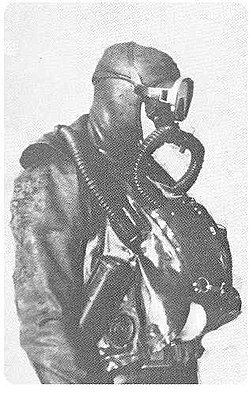 A French frogman with chest counterlung loop rebreather with two breathing tubes (model "Oxygers", 1957).
 -
 Italian World War II frogman of "Gruppo Gamma"
 -
 Royal Navy divers in Sladen suits during World War II
 -
 USMC 2nd Reconnaissance Battalion refreshing in combatant diving with the Draeger LAR V rebreather.
 -
 Mannequin wearing Finnish Navy combat diver equipment. The chest rebreather is likely a Viper S-10.
 -
 The "maiale" or "siluro a lenta corsa": first underwater transport way used by Italian frogmen in World War II
 -
 Diver lock for frogmen on a type XXI U-boat.
 -
 A Navy diver and special operator from SEAL Delivery Team (SDV) 2 perform SDV operations with the nuclear-powered guided-missile submarine USS Florida
 -
 US Navy SDV MK IX Swimmer Delivery Vehicle. Non-watertight submersible held two scuba-equipped swimmers.
 -
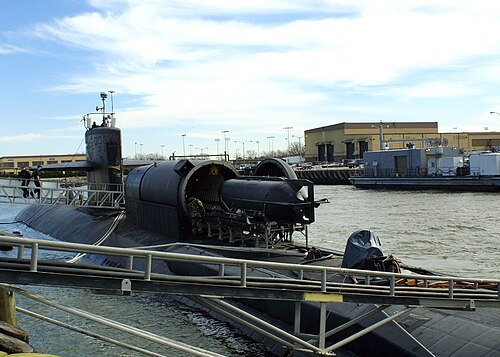 A SEAL Delivery Vehicle (SDV) is loaded aboard the Los Angeles-class fast attack submarine USS Dallas. A Dry Deck Shelter (DDS) is attached to the submarine's forward escape trunk to provide a dry environment for Navy Seals to prepare for special warfare exercises or operations. DDS is the primary supporting craft for the SDV
 -
 A member of SEAL Delivery Vehicle Team Two prepares to launch one of the team's SEAL Delivery Vehicles from the back of USS Philadelphia on a training exercise. The SDVs are used to carry Navy SEALs from a submerged submarine to enemy targets while staying underwater and undetected.
 -
 Navy divers and special operators attached to SEAL Delivery Team 2, perform SDV operations with USS Florida


.jpg)


_prepares_to_launch_one_of_the_team%27s_SEAL_Delivery_Vehicles_(SDV)_from_the_back_of_the_Los_Angeles-class_attack_submarine_USS_Philadelphia_(SSN_690).jpg)

See also
[edit]- List of military diving units
- Lionel Crabb – Royal Navy frogman and MI6 diver
- Military diving
- Underwater Demolition Team
References
[edit]- ^ a b c Kehoe, Pat (2020-08-29). "Paul Boyton - Fearless Frogman from Co Kildare". Ireland Calling. Retrieved 2021-06-09.
- ^ a b c Perry, Tony (2013-11-03). "John Spence dies at 95; Navy diver and pioneering WWII 'frogman'". Los Angeles Times. Retrieved 2013-11-27.
- ^ "The hidden world of police divers". 2010-06-14. Retrieved 2023-03-07.
- ^ "APPENDIX'D' Relationship between the Police and the Schools". www.gov.scot. Retrieved 2023-03-07.
- ^ US Navy (2006). "19". US Navy Diving Manual, 6th revision. United States: US Naval Sea Systems Command. p. 13. Archived from the original on 2008-05-02. Retrieved 2008-06-15.
- ^ Aristotle, On the Parts of Animals, ii, 16, transl. by W.Ogle, London, 1882, p. 51:
"Just then as divers are sometimes provided with instruments for respiration, through which they can draw air from above the water, and thus may remain for a long time under the sea, so also have elephants been furnished by nature with their lengthened nostril, and, whenever they have to traverse the water, they lift this up above the surface and breathe through it." - ^ Thukydides, History of the Peloponnesian War, edition Ambrosio Firmin Didot, Paris, 1842, book 4, 26, and b. 7, 25. In Greek and Latin.
- ^ Pierros D. Nick, The tactics of the enemies in the sea warfare during the Peloponnesian War. 1st Pan-Corinthian Congress, Corinth, Greece, 2008. In Greek. N. Pierros is a Civil Engineer and author of historical essays.
- ^ "Pirelli Diving Suit". www.therebreathersite.nl. Retrieved 2021-03-17.
- ^ Manuale Federale di Immersione - author Duilio Marcante
- ^ Marí, Alejandro Sergio. "Pirelli ARO WW II". Therebreathersite.nl (Janwillem Bech).
- ^ "Rebreathers - Rebreather Autorespiratori per l'Immersione Subacquea a recupero di gas". Archived from the original on 2012-07-10.
- ^ "Libri. Teseo Tesei e gli Assaltatori della Regia Marina, di Gianni Bianchi". December 13, 2005. Archived from the original on Oct 2, 2011. Retrieved Sep 3, 2022.
- ^ O'Hara, Vincent P.; Cernuschi, Enrico. "Frogmen against a fleet: The Italian Attack on Alexandria 18/19 December 1941". www.usnwc.edu. Naval War College Review. Archived from the original on 12 February 2017. Retrieved 19 September 2016.
- ^ Borghese, Valerio (1995). Sea Devils: Italian Navy Commandos in World War II. Naval Institute Press. pp. 208–09. ISBN 1-55750-072-X.
- ^ Borghese (1995), pp. 242-43
- ^ Borghese (1995), pp. 257-59
- ^ Blocksdorf, Helmut (2008). Hitler's Secret Commandos: Operations of the K-Verband. Barnsley, South Yorkshire: Pen & Sword Military. ISBN 978-1844157839.
- ^ "Information sheet no 101 - Attack on the Tirpitz" (PDF). www.nmrn-portsmouth.org.uk. National Museum of the Royal Navy. 2014. Retrieved 26 September 2016.
- ^ Chant, Christoper. "Operation Principal (iii)". codenames.info. Retrieved 24 May 2023.
- ^ Hood, Jean, ed. (2007). Submarine. Conway Maritime. pp. 505–506. ISBN 978-1-84486-090-6.
- ^ Downey, Sally A. (2011-02-21). "Christian J. Lambertsen, 93, developer of the first scuba gear". The Philadelphia Inquirer. Retrieved 2021-06-09.
- ^ Shapiro, T Rees (18 February 2011). "Christian J. Lambertsen, OSS officer who created early scuba device, dies at 93". Washington Post. Retrieved 16 May 2011.
- ^ "Lambertsen's patent in Google Patents". Retrieved Sep 3, 2022.[dead link]
- ^ a b Shapiro, T. Rees (2011-02-19). "Christian J. Lambertsen, OSS officer who created early scuba device, dies at 93". The Washington Post.
- ^ "CIA Special Operations Group | Special Activities Division". cia.americanspecialops.com. Retrieved Sep 3, 2022.
- ^ Hoole, Rob (2007). "The Buster Crabb Enigma". mcdoa.org.uk. Minewarfare & Clearance Diving Officers' Association. Retrieved 21 July 2017.
- ^ Isseroff, Ami (2005). "Zionism and Israel - Encyclopedic Dictionary - Shayetet 13". www.zionism-israel.com. Retrieved 12 March 2017.
- ^ Gawrych, George Walter (2000). The Albatross of Decisive Victory: War and Policy Between Egypt and Israel in the 1967 and 1973 Arab-Israeli Wars. Praeger. p. 111. ISBN 978-0313313028.
- ^ "Operation Algeciras: How Argentina planned to attack Gibraltar". newhistories.group.shef.ac.uk. New Histories. 21 May 2011. Retrieved 12 March 2017.
- ^ Reports of International Arbitral Awards : Case concerning the differences between New Zealand and France arising from the Rainbow Warrior affair (PDF). United Nations. 6 July 1986. p. 200. Retrieved 12 March 2017.
- ^ Hoyt, Edwin P. (15 June 2011). SEALs at War. Random House Publishing Group. pp. 159–. ISBN 978-0-307-57006-2.
- ^ Mann, Don (5 August 2014). How to Become a Navy SEAL: Everything You Need to Know to Become a Member of the US Navy's Elite Force. Skyhorse Publishing. pp. 18–. ISBN 978-1-62873-487-4.
- ^ url=https://apps.dtic.mil/sti/citations/ADA278438
Further reading
[edit]- Frogman operations: Decima Flottiglia MAS, Underwater Demolition Team, human torpedo, Sinking of the Rainbow Warrior, Russian commando frogmen
- Bush, Elizabeth Kauffman (2004). America's first frogman : the Draper Kauffman story. Naval Institute Press. ISBN 1-59114-098-6. OCLC 55699399.
- Fraser, Ian (1957). Frogman V.C. Angus & Robertson. OCLC 1599838.
- Pugh, Marshal (1956). Frogman: Commander Crabb's story. OCLC 1280137.
- Welham, Michael G.; Welham, Jacqui (1990). Frogman Spy: the mysterious disappearance of Commander 'Buster' Crabb. W.H. Allen. ISBN 1-85227-138-8. OCLC 21979335.
- Tony Groom: DIVER. Royal Naval Clearance Divers work in the Falklands conflict. ISBN 978-1574092691.
External links
[edit] Media related to Naval frogmen at Wikimedia Commons
- Panerai during World War Two Archived 2019-04-14 at the Wayback Machine
- Frogman - Training, Equipment, and Operations of Our Navy's Undersea Fighters - C.B. Colby Archived 2019-03-09 at the Wayback Machine
- List of books about frogmen


Frogman
View on GrokipediaTerminology and Origins
Etymology and Naming
The term "frogman" originated in the late 19th century, predating its military application, when adventurer Paul Boyton adopted the stage name "Fearless Frogman" for his publicity stunts involving a rubber survival suit that allowed him to float and paddle long distances in rough waters.[8] Boyton, an Irish-American showman born in 1848, used the suit—complete with inflatable pouches for buoyancy—to perform feats like drifting 30 miles offshore during storms, drawing crowds and media attention across Europe and the United States in the 1870s and 1880s.[9] This non-military usage emphasized the frog-like propulsion and amphibious appearance enabled by the gear, though it was theatrical rather than tactical. In the military context, the term gained prominence during World War II, applied to early combat divers due to their resemblance to frogs from bulky drysuits, large swim fins, and awkward underwater movements observed from ships.[10] U.S. Navy diver John Spence, who enlisted in 1936 and trained as America's first operational combat frogman in the Office of Strategic Services (OSS) maritime unit around 1943–1944, is credited with coining or popularizing the label during training; an onlooker reportedly likened his green waterproof suit and finned silhouette emerging from water to a frog.[11] Spence's unit pioneered underwater demolition and reconnaissance, setting precedents for later formations like the Underwater Demolition Teams (UDTs), which adopted "frogmen" as a nickname by the mid-1940s.[12] "Frogman" specifically denotes a trained military operative specializing in underwater combat, sabotage, or infiltration, distinguishing such roles from civilian or recreational divers; it evokes the animal's leaping, webbed-foot agility adapted to aquatic stealth.[13] Alternative designations include "combat swimmer" or "combat diver" in broader international usage, with equivalents like Germany's Kampfschwimmer (literally "combat swimmer") reflecting functional rather than descriptive naming.[3] In the U.S. Navy, the term endures for Naval Special Warfare personnel tracing to UDTs, though officially phased for "SEALs" after 1962 to encompass expanded capabilities beyond diving.[14]Pre-Modern Precursors
According to ancient Greek accounts recorded by Pausanias, during the Persian invasion in 480 BCE, the diver Scyllis of Scione and his daughter Hydna undertook a nocturnal underwater sabotage mission against the anchored Persian fleet near Artemisium, severing anchor cables to cause vessels to drift onto rocky shores and disrupt preparations for battle.[15] This operation, covering an estimated 13 kilometers of open-water swimming under breath-hold conditions, exemplifies early tactical use of freediving for naval interdiction, relying on stealth and physical endurance without mechanical aids.[16] During Alexander the Great's Siege of Tyre in 332 BCE, Tyrian defenders employed skilled freedivers to repeatedly cut the anchor ropes of Macedonian supply ships, compelling Alexander to adapt by substituting chains for ropes to thwart further sabotage.[17] In response, Alexander deployed his own divers to breach the harbor's protective boom, enabling the construction of a causeway and ultimate capture of the island fortress after seven months.[18] These actions highlight reciprocal use of underwater operatives in ancient siege warfare, where divers targeted vulnerabilities like moorings and barriers to gain naval advantage. The Peloponnesian War (431–404 BCE) saw further organized employment of military divers, as evidenced by accounts of Athenian and Spartan forces using breath-hold techniques for harbor incursions and ship sabotage during sieges.[19] Such pre-modern operations prefigured modern frogman tactics by emphasizing covert approach, tool-assisted cutting (e.g., knives for ropes), and exploitation of water's concealment properties, though limited by human physiology to shallow depths and short durations without breathing apparatus. These freediving precedents, drawn from classical historiography, underscore causal links between ancient naval necessities and later specialized combat diving units.Historical Evolution
World War II Foundations
The concept of the modern frogman emerged during World War II, primarily through Italian naval innovations aimed at covert underwater sabotage against enemy shipping. In 1939, Italy established the 1st Assault Vehicle Flotilla (MAS), which evolved into the Decima Flottiglia MAS under Prince Valerio Borghese, specializing in manned torpedoes known as "maiali" or Siluro Lenta Corsa (SLC). These slow-running human torpedoes, piloted by two frogmen equipped with rebreathers and limpet mines, enabled attacks on anchored warships without detection.[20] A pivotal operation occurred on December 19, 1941, when six Italian frogmen from Decima MAS penetrated Alexandria harbor, attaching explosives to the British battleships HMS Queen Elizabeth and HMS Valiant, as well as the cruiser HMS Jervis, sinking the battleships and damaging the cruiser despite the pilots' capture. This raid demonstrated the efficacy of frogman tactics, forcing Allied navies to adopt countermeasures like harbor nets and patrols. Similar successes followed in Gibraltar, where frogmen from a covert base aboard the scuttled tanker Olterra damaged or sank multiple vessels between 1942 and 1943.[21][22] Britain responded by developing commando frogmen units using Sladen suits—heavy drysuits with flip-up viewports paired with Siebe Gorman rebreathers—for mine clearance and counter-sabotage. These suits, designed by Commander Geoffrey Sladen, allowed divers to operate in cold waters with extended bottom times via oxygen rebreathers, though British offensive efforts with "Chariot" human torpedoes yielded limited results compared to Italian precision. Royal Navy clearance divers employed these in operations like port reconnaissance, influencing postwar diving doctrine.[23] Germany's Kampfschwimmer, part of the Kleinkampfverbände (K-Verbande), formed later in the war around 1943-1944, focusing on defensive sabotage such as bridge demolitions during retreats. In June 1944, frogmen attempted to destroy bridges near Caen, and on September 28, 1944, a team targeted the Nijmegen railway bridge with limpet mines, though with minimal strategic impact due to late-war resource constraints. In the United States, frogman precursors appeared as Underwater Demolition Teams (UDTs) in 1943, trained under Lieutenant Commander Draper Kauffman for Pacific amphibious assaults. UDT-1 conducted initial reconnaissance at Saipan in June 1944, mapping reefs and removing obstacles ahead of landings, marking the shift toward reconnaissance and demolition roles that laid groundwork for postwar special warfare. These WWII efforts collectively established frogmen as vital for asymmetric naval warfare, emphasizing stealth, endurance, and specialized equipment.[24][25]Postwar Expansions
In the immediate aftermath of World War II, the United States Navy's Underwater Demolition Teams (UDTs), the primary frogman units, faced demobilization, reducing from thirty teams to just four 50-man units by 1947, concentrated at Coronado, California, and Little Creek, Virginia.[26] These surviving teams maintained core competencies in underwater demolition and reconnaissance amid budget cuts, while experimenting with emerging scuba technologies through the Navy Experimental Diving Unit (NEDU), which tested dozens of self-contained underwater breathing apparatus (SCUBA) prototypes starting in 1946 to enhance stealth and endurance.[27] The Korean War (1950–1953) prompted rapid reactivation and operational expansion of UDTs, with Teams 1, 3, and 5 deploying to the Pacific Fleet and conducting over 300 missions, including hydrographic surveys, beach obstacle removal, and direct-action raids along the North and South Korean coasts.[28] Notable early actions included UDT-3's infiltration raid on August 5, 1950, from USS Diachenko, targeting enemy shipping and coastal defenses, and operations like "Fishnet" to clear minefields at Wonsan Harbor in October 1950.[29] These efforts extended frogman roles beyond wartime demolition to sustained intelligence gathering and sabotage, often in coordination with CIA assets and South Korean trainees, while introducing limited use of rebreathers for covert swims.[30] Internationally, postwar expansions mirrored U.S. developments, with France establishing the Nageurs de Combat (combat swimmers) in 1953 under Captain Bob Maloubier, leveraging inventor Jacques Cousteau's Aqua-Lung for maritime sabotage and reconnaissance in Algeria and Indochina.[31] Italy's Decima Flottiglia MAS evolved into the Comando Raggruppamento Subacquei e Incursori (COMSUBIN) in 1954, focusing on minisubmarine incursions and diver-delivered ordnance.[21] The Soviet Navy similarly scaled up its post-1945 naval infantry swimmer detachments for coastal reconnaissance and minelaying, emphasizing closed-circuit rebreathers to counter NATO amphibious threats.[32] By the early 1960s, U.S. frogman capabilities formalized under Naval Special Warfare, with President Kennedy's 1961 directive for counterinsurgency forces leading to the creation of SEAL Teams 1 and 2 on January 1, 1962, from UDT volunteers, integrating underwater infiltration with airborne and ground operations for Vietnam-era missions.[33] This marked a doctrinal shift from specialized demolition to versatile special operations, influencing allied units like Britain's Special Boat Squadron expansions.[3]Cold War Adaptations
During the Cold War, frogman operations adapted to the imperatives of nuclear submarine deterrence and undersea confrontation between NATO and Warsaw Pact forces, shifting emphasis toward stealthy sabotage of enemy ports, reconnaissance of submarine bases, and defense against adversary incursions. Units prioritized closed-circuit rebreathers to eliminate detectable bubbles, enabling undetected approaches in shallow or contested waters. Improved underwater communications and electronic search equipment enhanced coordination for complex missions, such as targeting naval infrastructure.[34] Swimmer delivery vehicles (SDVs), prototyped as early as the 1960s with models like the Mk VI introduced in 1964, extended operational range and payload capacity, allowing teams to launch from submerged submarines for clandestine insertions.[35] In the United States, the Navy SEALs, formed in 1962 amid escalating global tensions, integrated SDV capabilities to counter Soviet naval expansion, with dedicated teams operational by the 1980s using dry deck shelters on attack submarines for mission preparation.[36] These adaptations supported potential operations against Warsaw Pact shipping and facilities in Europe and Asia. Soviet naval Spetsnaz, evolving from World War II precedents, established specialized anti-sabotage detachments (PDSS) in 1967 within the Black Sea Fleet, expanding to other fleets by 1969 to protect Soviet vessels and counter NATO frogman threats; these units conducted reconnaissance and sabotage in support of proxy conflicts in regions like Angola and Vietnam during the 1970s.[37] Canadian Royal Navy clearance divers, formalized in a dedicated branch in 1954, adapted for Arctic environments by developing techniques for ice clearance and beach preparation using C3 and PE3A explosives, supporting DEW Line radar site construction from the 1950s to 1960s in harsh northern conditions where standard equipment like Pirelli wetsuits required modifications for extreme cold.[38] Such specialized training addressed the strategic need to secure northern sea routes and infrastructure against potential Soviet incursions. Overall, these evolutions reflected causal priorities of stealth, endurance, and integration with submarine forces to maintain undersea parity.Contemporary Developments
 fleet and explored alternative underwater insertion methods to maintain operational reach in contested maritime environments.[39] These efforts include enhancing dry deck shelters on submarines for SDV launches and integrating advanced propulsion systems to extend mission durations without surface detection.[40] Advancements in rebreather technology have improved stealth and endurance for combat divers. The U.S. Navy introduced a mixed-gas rebreather helmet system in 2018 featuring 3D-printed titanium components for lighter weight and corrosion resistance, enabling faster deployments and reduced logistical burdens.[41] More recently, in September 2025, JFD Global launched the Stealth Multi-Role rebreather, a software-upgradable closed-circuit system designed for integration with mission-specific sensors and extended dive times in special operations.[42] Training infrastructure for special forces combat diving has undergone modernization, with the U.S. Army's Special Forces Underwater Operations School initiating comprehensive facility upgrades in July 2025 to support advanced maritime skills amid great power competition.[43] These developments emphasize interoperability with unmanned underwater vehicles (UUVs) for reconnaissance and hybrid warfare scenarios, reflecting a doctrinal shift toward distributed maritime operations.[44] International exercises, such as U.S. Naval Special Warfare training with Indian Marine Commando Force in November 2024, highlight growing emphasis on multinational underwater tactics.[45] Contemporary frogman units face heightened threats from peer adversaries' naval special forces, prompting investments in counter-diver detection and asymmetric capabilities. The Office of Naval Research continues funding bio-inspired diving innovations to enhance human performance in extreme depths and durations.[46] Operational focus has expanded to include undersea infrastructure protection, driven by incidents like suspected sabotage of pipelines and cables, though attribution remains contested.[47]Training and Selection
Physical and Psychological Requirements
Candidates for frogman roles in military special operations units must demonstrate exceptional physical conditioning tailored to the demands of underwater infiltration, prolonged submersion, and load-bearing in aquatic environments. Core assessments typically include timed swims evaluating combat sidestroke proficiency, as swimming efficiency directly correlates with operational stealth and endurance; for example, U.S. Navy SEAL candidates must complete a 500-yard swim in no more than 12 minutes 30 seconds.[48] Upper-body and core strength tests measure capacity for handling equipment and propulsion systems, requiring minimums of 50 push-ups and 50 sit-ups within two minutes each, alongside at least 10 pull-ups.[49] Cardiovascular stamina is gauged via a 1.5-mile run completed in under 10 minutes 30 seconds, reflecting the need to transition rapidly between swimming, running, and combat tasks.[50] These standards, established by naval special warfare commands, ensure recruits can sustain high-intensity efforts in cold water and adverse conditions, with failure rates exceeding 70% in initial screenings due to insufficient preparation.[51] Medical prerequisites further enforce physical robustness, including a Class II diving physical certifying lung capacity, absence of decompression sickness risks, and correctable vision to 20/20 without color blindness, as uncorrected impairments compromise navigation and target identification underwater.[52] Age limits, often capping at 28 years for entry-level programs, prioritize physiological peak performance, while body composition standards exclude obesity to mitigate buoyancy control issues and injury susceptibility during rebreather operations.[53] Psychological screening identifies individuals capable of withstanding isolation, sensory deprivation, and acute stress from missions involving nitrogen narcosis risks and enemy detection threats. Special forces selection emphasizes traits like high intelligence—measured via aptitude batteries requiring scores in the top percentiles—and emotional resilience to endure multi-week evolutions with minimal sleep, hypothermia exposure, and peer-evaluated peer pressure simulations.[54] Mental fortitude is causal to success in handling phobic responses to drowning simulations and confined-space dives, where panic can induce fatal errors; programs like those for combat divers report that psychological attrition accounts for up to 50% of dropouts, underscoring the need for intrinsic motivation and adaptive coping over rote discipline.[7] Assessments, including clinical interviews and performance under duress, filter for low neuroticism and high conscientiousness, as these predict sustained focus during covert hydrographic reconnaissance.[55]Skill Acquisition and Drills
Skill acquisition for frogmen emphasizes progressive mastery of underwater endurance, equipment handling, and tactical proficiency through structured military courses such as the U.S. Navy's Basic Underwater Demolition/SEAL (BUD/S) combat diving phase or the Army Special Forces Combat Diver Qualification Course (CDQC).[56][57] These programs build from foundational water confidence to mission-specific competencies, incorporating physical conditioning, technique drills, and simulated operations to ensure operatives can perform in low-visibility, high-stress environments.[58] Training prioritizes efficiency to minimize detection and fatigue, with failure rates often exceeding 50% due to the physiological demands of hypoxia, cold exposure, and load-bearing swims.[56] Core drills begin with drown-proofing to instill survival instincts without reliance on equipment. In this exercise, candidates enter a 9-foot-deep pool with hands bound behind the back and ankles tied, performing 20 bobs (submerging face then resurfacing), a 5-minute float using a modified survival position, and a 100-meter dolphin-kick swim to the shallow end and back without touching the bottom.[59][57] Additional pool-based skills include underwater breath-hold swims (25-50 yards), mask retrieval and clearing while treading water for 1.5-10 minutes (hands-free in some variants), and equipment ditching/donning under duress to simulate gear loss in combat.[56][60] Swimming proficiency drills focus on the Combat Side Stroke (CSS), a hybrid of sidestroke, scissor kick, and arm pull optimized for finned propulsion and stealth; trainees complete 500-2,000-yard sessions, progressing from intervals (e.g., 10x50m with 10-second rests) to continuous efforts.[56][61] Advanced acquisition shifts to open-water and rebreather drills, integrating navigation and combat application. Underwater navigation employs compass courses (1-2 miles) with attack boards, requiring straight-line swims using natural cues, gear towing (20-40% body weight), and adaptation to currents or 56°F water via scissor kicks.[56] Dräger LAR V or similar closed-circuit systems are introduced for bubble-free operations, with drills like 2,000m finned swims or 3-hour submerged evolutions to train gas management and nitrogen narcosis resistance.[56] Knot-tying, demolition handling, and buddy breathing under blackout conditions further refine skills, often in night or low-light scenarios to replicate infiltration tactics.[57] Weekly progressions include 1,000+ yards of finned CSS, fartlek variations for speed-endurance, and mock physical screening tests (e.g., 500-yard swim in under 12:30 minutes) to benchmark readiness.[58][57]Equipment and Technology
Breathing and Propulsion Systems
Frogmen rely on closed-circuit rebreathers for breathing apparatus to ensure stealth by eliminating visible bubble trails produced by open-circuit scuba systems. These devices recirculate exhaled gas through a loop, where carbon dioxide is chemically absorbed by soda lime scrubbers, and oxygen is metered from high-pressure cylinders to replenish consumed gas. This configuration supports extended dive times—often exceeding two hours—while maintaining near-silent operation, critical for covert insertions. Depth limits vary by model and gas mixture; pure oxygen rebreathers are restricted to shallow depths around 6-8 meters to avoid oxygen toxicity, whereas mixed-gas variants extend to over 50 meters.[62] Early examples include World War II-era Italian ARO 49/Bis oxygen rebreathers, which featured a simple pendular design with a single hose for gas exchange, enabling frogmen to conduct sabotage missions without detection. German forces utilized Dräger DM20 and DM40 series rebreathers, which incorporated compact oxygen systems suitable for helmeted and free-swimming divers. Postwar advancements introduced full-face mask systems like the French Oxygers model of 1957, employing chest-mounted counterlungs for balanced buoyancy and reduced profile. Contemporary military units, such as U.S. Navy SEALs, favor robust mixed-gas rebreathers with electronic monitoring for precise gas management and hypoxia warnings, prioritizing reliability in combat conditions over recreational dive durations.[63][62] Propulsion systems augment human-powered swimming with mechanical aids to conserve energy and extend operational range. Basic fins provide agile, low-signature movement for short distances, but diver propulsion vehicles (DPVs)—handheld or tow-behind scooters—offer speeds up to 4.5 km/h with runtimes of 30-60 minutes on rechargeable batteries, ideal for reconnaissance swims. Military-grade DPVs, such as STIDD's Diver Propulsion Device, feature dual-propeller configurations for tandem diver use and modular attachments for weapons or sensors, emphasizing durability in saltwater and low acoustic signatures.[64][65] For team-scale transport, swimmer delivery vehicles (SDVs) function as wet minisubmersibles, propelled by silent electric motors powered by silver-zinc batteries in a twin-screw arrangement. The U.S. Navy's SDV series, including the Mk IX, accommodates 2-6 operators plus pilot, achieving submerged speeds of 4-6 knots over distances up to 30 nautical miles, launched from submarine dry deck shelters for undetected approach. Historical precedents trace to Italian "maiale" SLC human torpedoes of World War II, pedal- or battery-driven craft carrying two frogmen to targets at low speeds. Modern SDVs integrate inertial navigation and periscope masts, balancing payload capacity with hydrodynamic efficiency for special operations.[66][67]Weapons and Demolition Tools
Frogmen primarily rely on demolition tools for sabotage missions, as underwater firefights are rare due to environmental constraints like water resistance and low visibility, which render most conventional firearms ineffective beyond short ranges. Close-quarters weapons include robust combat knives, such as the Ka-Bar used by World War II-era U.S. Underwater Demolition Teams (UDTs) for cutting lines, prying, and self-defense against marine threats. These units also carried Tetryl explosive packs in canvas bags for placing charges on beach obstacles or ship hulls during reconnaissance and clearance operations.[5] Historical demolition emphasized limpet mines, magnetically or adhesively attached devices containing high explosives—typically 4.5 kg charges—detonated by timers or contact. Italian frogmen from the Decima Flottiglia MAS, operating in 1941, affixed limpet mines to British warships in Alexandria harbor, severely damaging HMS Valiant and causing HMS Queen Elizabeth to settle on the harbor bottom. Such tools required manual placement by swimmers, often under cover of darkness, exploiting stealth over firepower.[21][68] In modern naval special warfare, demolition tools have evolved to include waterproof plastic explosives like C4, which maintain stability and pliability underwater, paired with detonators for precise placement on vessels or infrastructure. U.S. SEALs and UDT predecessors employed MK 138 Mod-1 charges, consisting of canvas bags filled with high explosives for hull breaches or propeller sabotage. These are often delivered via swimmer or submersible, with remote or timed fuzing to minimize detection risk.[69] Underwater firearms serve mainly for self-defense against guards or aquatic hazards rather than primary assault. Specialized designs counter cavitation by firing steel darts or flechettes at high velocity. The Soviet APS-95 underwater rifle, adopted in 1975, fires 5.66 mm darts to 30 meters submerged, arming Spetsnaz frogmen with a 26-round magazine. Western equivalents include the Heckler & Koch P11 pistol, developed in 1976, which propels five explosive-tipped darts to 15 meters and has been utilized by SEALs, British SBS, and other NATO-aligned units. The earlier U.S. Mk 1 Underwater Defense Gun, a six-round pistol, offered 10-meter range but saw limited SEAL/UDT adoption due to bulkiness. Spear guns, such as the French Rebikof model tested by U.S. forces in the 1970s, provide non-lethal or anti-shark options with compressed-air propulsion.[70][71][70]Navigation and Communication Aids
Combat divers rely on specialized navigation aids to maintain orientation in low-visibility underwater environments, where traditional surface-based methods like GPS are limited by water attenuation. Basic tools include wrist-mounted analog compasses, depth gauges, and dive chronometers, often integrated into tactical navigation boards for dead reckoning and timing calculations.[72] Advanced digital platforms, such as the Northern Diver Navigation Platform (NPS), provide lightweight, compact solutions combining inertial sensors, digital displays, and environmental data logging for professional and military operations.[73] For enhanced precision, systems like the RNAV3 diver navigation platform incorporate state-of-the-art mobility aids, including Doppler velocity logs and attitude sensors, enabling safer route planning and obstacle avoidance during combat swims.[74] In swimmer delivery vehicles (SDVs) used by units like U.S. Navy SEALs, navigation employs Doppler inertial navigation systems (DINS) coupled with forward-looking sonar for submerged transit from submarines to targets, supporting undetected insertion over distances up to several nautical miles.[66] Hands-free options, such as the U.S. Navy's Shadow Nav module developed with JFD in 2018, allow divers to interface with augmented reality displays or helmet-mounted units for real-time positioning without manual input.[75] The Collins Aerospace ArtemisPro-M handheld system further integrates M-Code GPS for near-surface or aided underwater navigation, prioritizing military-grade accuracy in contested environments.[76] Underwater communication aids for frogmen emphasize acoustic technologies due to the propagation challenges of radio waves in water. Hydroacoustic systems enable voice telephony between divers, surface vessels, or submersibles, as documented in assessments of Western naval capabilities from the 1980s, often using low-frequency modems for ranges up to several kilometers in shallow waters.[77] Modern portable acoustic modems, inspired by dolphin-like signals for covert operations, facilitate data and voice links between divers or unmanned vehicles, achieving bit rates sufficient for tactical updates while minimizing detection.[78] Full-duplex systems, such as those from Ocean Technology Systems (OTS), support wireless helmet-integrated communications with full-face masks, allowing team coordination during reconnaissance or assault missions.[79] Specialized diver intercoms like the Ocean Plan Commander-10 provide networked voice channels for formation swimming, integrating with propulsion devices for synchronized movements in multi-frogman teams.[80] These aids often combine with non-verbal signals—hand gestures or light pulses—for short-range, low-tech reliability, but electronic systems dominate in high-stakes scenarios to reduce error and enable command links.[81]Operational Roles
Offensive Underwater Missions
Offensive underwater missions conducted by frogmen primarily target enemy naval vessels, harbor infrastructure, and maritime supply lines through sabotage, demolition, and direct assault, leveraging stealthy sub-surface infiltration to bypass surface defenses. These operations typically involve attaching limpet mines or explosives to hulls, severing moorings, or employing human-guided torpedoes for precision strikes, minimizing detection risks inherent in open-water approaches.[66][82] During World War II, Italian frogmen of the Decima Flottiglia MAS pioneered such tactics, executing high-impact raids using the maiale (slow-running torpedo), a manned underwater vehicle carrying two operators and explosive warheads. On December 19, 1941, in the Raid on Alexandria (Operazione EA 3), six frogmen infiltrated the harbor aboard three maiali launched from the submarine Scirè, successfully attaching mines to the battleships HMS Queen Elizabeth and HMS Valiant, rendering both inoperable for months despite the capture of most operators.[21][83] Over the course of the war, Decima MAS operations sank or damaged five warships and 20 merchant vessels totaling 130,000 gross register tons, demonstrating the asymmetric effectiveness of small underwater teams against superior naval forces.[84] The British Royal Navy adapted similar methods with X-class midget submarines, crewed by four personnel including divers for final placement of charges. In Operation Source on September 22, 1943, X-5, X-6, and X-7 penetrated Norwegian fjords to attack the German battleship Tirpitz, with X-6 and X-7 successfully detonating mines under the vessel, causing extensive damage that sidelined it for six months and required 120,000 man-hours of repairs, though both submarines were lost.[85][86] In contemporary operations, U.S. Navy SEALs employ SEAL Delivery Vehicles (SDVs), wet submersibles carrying up to eight swimmers, for clandestine harbor attacks and sabotage in denied areas. These platforms enable undetected transit from submarines to targets, supporting missions like ship assaults or infrastructure disruption, as refined from WWII techniques for peer conflicts.[66][87] During Operation Just Cause in 1989, a four-man SEAL team used combat diving to sink Panamanian President Noriega's gunboat Presidente Porras with explosives, neutralizing a key asset in the invasion's opening phase.[88] Such missions underscore the persistent value of underwater offensive capabilities, where small, elite units can achieve disproportionate strategic effects through surprise and precision.[82]Defensive and Reconnaissance Tasks
, precursors to modern SEALs, conducted such beach reconnaissance ahead of major landings, including Normandy on June 6, 1944, where teams cleared paths through obstacles under fire, and Iwo Jima in February 1945, where swimmers gathered sand samples and surf data to guide Marine advances.[89][5] Similarly, Combined Operations Pilotage Parties (COPPs) of British forces performed covert surveys for Pacific and European invasions, using swim-throughs to mark safe channels.[90] In defensive roles, frogmen patrol harbors and coastal installations to detect and counter enemy swimmer sabotage, employing rebreathers for silent approaches to inspect hulls, moorings, and seabeds for limpet mines or intruders. This port security function protects anchored vessels and infrastructure from underwater threats, as demonstrated in post-World War II exercises where U.S. and allied divers simulated breaches to refine countermeasures like sonar nets and patrol dives. During the Korean War, UDTs extended these efforts by raiding coastal rail lines but also secured friendly beaches from North Korean incursions, blending reconnaissance with immediate threat neutralization. Modern units, such as U.S. Marine Reconnaissance Battalions, maintain certification through annual combatant dives focused on surveillance and obstacle assessment to defend expeditionary bases.[91] Frogmen may also emplace underwater sensors for persistent monitoring, enhancing defensive awareness without kinetic engagement.[92]Support and Auxiliary Functions
Frogmen have historically provided critical auxiliary support to non-combat naval and joint operations, particularly in recovery and salvage tasks that enable broader mission success. A prominent example is their role in the U.S. space program's capsule recoveries during the Mercury, Gemini, and Apollo missions from 1961 to 1972. Underwater Demolition Teams (UDTs), the predecessors to Navy SEALs, deployed frogmen via helicopter to splashdown sites in the Atlantic and Pacific Oceans, where they swam to floating capsules, attached stabilization collars and recovery lines, conducted biohazard assessments, and secured the area for astronaut extraction by surface vessels like the USS Hornet. This function ensured the safe return of high-value assets and personnel, with UDT-11 frogmen specifically handling Apollo 11's recovery on July 24, 1969, preventing potential capsule instability or drift hazards.[93][94] In military contexts, frogmen contribute to salvage operations by retrieving submerged equipment, ordnance, or wreckage to mitigate security risks and support logistics. For instance, combat swimmers assist in recovering lost weapons systems or aircraft debris from operational areas, preventing adversary exploitation or environmental contamination from unexploded munitions. These tasks often integrate with explosive ordnance disposal (EOD) units, where frogmen provide underwater access and initial site preparation, as seen in joint Navy EOD and SEAL support missions. Such auxiliary efforts extend operational readiness, with documented recoveries including post-mission salvage during Cold War-era submarine exercises to test and retrieve prototype gear.[95] Frogmen also fulfill support functions in training and evaluation, simulating underwater threats for conventional forces or testing naval equipment like submarine escape systems. During World War II and subsequent conflicts, UDT frogmen conducted auxiliary hydrographic surveys and channel marking to aid amphibious landings, though these bordered on reconnaissance; in peacetime, they validate rebreather technologies and swimmer delivery vehicles for fleet integration. These roles underscore frogmen's versatility beyond direct action, enhancing overall naval capability through specialized underwater expertise.[96]Notable Units and Missions
Pioneering National Units
Italy established the world's first specialized military frogman unit with the Decima Flottiglia MAS in March 1939, initially focused on antisubmarine motorboats but evolving into an elite underwater sabotage force using manned torpedoes known as maiali (pigs) or SLC (Siluro a Lenta Corsa).[97] This unit pioneered offensive underwater operations, conducting raids such as the December 18-19, 1941, attack on Alexandria harbor, where frogmen severely damaged the British battleships HMS Queen Elizabeth and HMS Valiant and the cruiser HMS Jervis, disabling over 60,000 tons of Allied shipping without loss of personnel.[21] Over the course of World War II, Decima MAS claimed responsibility for sinking or damaging approximately 72,190 tons of enemy vessels through frogman-delivered limpet mines and torpedoes, demonstrating the tactical viability of covert underwater assault.[20] Inspired by Italian innovations, Britain began developing frogman capabilities in April 1942 at a secret Portsmouth training facility, forming commando units for harbor reconnaissance and sabotage as precursors to the Special Boat Service (SBS).[98] British frogmen, including pioneers like Lionel "Buster" Crabb, employed early rebreathers and conducted trials for operations like clearing obstacles ahead of amphibious landings, though their offensive raids were limited compared to Italian efforts.[99] The United States Navy formed Underwater Demolition Teams (UDTs) in 1943, initially for Pacific theater beach reconnaissance and obstacle clearance, with personnel like John Spence credited as among the first American combat frogmen during operations such as the Saipan invasion in June 1944.[11] UDTs emphasized demolition expertise over direct assault, clearing underwater mines and barriers for invasions like Normandy and Iwo Jima, laying groundwork for later SEAL units.[100] Germany's Kriegsmarine organized Kampfschwimmer (combat swimmer) units from 1943, with initial deployments in June 1944 for bridge demolition near Caen, but these efforts achieved limited success and came after Allied and Italian precedents.[101] These early national units collectively established core doctrines for underwater special operations, influencing post-war developments despite varying operational scales and outcomes.Key Historical Operations
Frogmen of Italy's Decima Flottiglia MAS executed one of the most successful early underwater commando raids on December 19, 1941, in Alexandria harbor. Three teams, launched from the submarine Scirè on December 3, piloted SLC "maiale" human torpedoes to attach limpet mines to British warships; despite the loss of operator Alessandro Tesei en route, Luigi Faggioni and Emilio Bianchi successfully targeted the battleship HMS Queen Elizabeth (sunk) and battleship HMS Valiant (severely damaged), along with the tanker Sagona and a floating dock, disrupting British naval operations in the Mediterranean.[21] [20] The Decima MAS conducted additional operations, including attacks in Gibraltar harbor in 1942 from a concealed underwater base, where frogmen damaged or sank multiple Allied vessels using similar tactics, contributing to over 130,000 gross register tons of shipping lost or crippled across their campaigns.[20] [22] In the Allied effort, U.S. Underwater Demolition Teams (UDTs), precursors to modern SEALs, performed their first combat mission during the Saipan invasion on June 15, 1944, reconnoitering beaches and demolishing coral reefs and obstacles to facilitate amphibious landings, a role repeated at Iwo Jima and Okinawa with minimal casualties despite intense enemy fire.[102] British commando frogmen from units like the Special Boat Section supported the Normandy landings on June 6, 1944, as the first ground forces ashore, swimming in to mark channels, locate mines, and clear underwater defenses ahead of the main D-Day assault waves.[103]Modern Deployments
In the 21st century, frogman deployments have adapted to great power competition, emphasizing underwater infiltration, reconnaissance, and sabotage against peer adversaries like Russia and China. U.S. Naval Special Warfare commands, including SEAL teams, maintain capabilities for combat swimmer insertions and SEAL Delivery Vehicle (SDV) operations from submerged submarines to access denied areas for intelligence collection and strikes.[40][104] These tactics revive Cold War-era methods, shifting from post-9/11 counterterrorism to maritime denial operations amid rising tensions in regions like the Indo-Pacific and Arctic.[105] Russian naval Spetsnaz frogmen have seen active deployment in the Black Sea during the ongoing conflict with Ukraine. On August 22, 2025, five elite combat divers from the Russian Black Sea Fleet's Spetsnaz unit attempted to recover a Ukrainian maritime drone in Novorossiysk Bay, but the device detonated, killing all involved in the operation.[106][107] This incident highlights the risks of underwater counter-drone and sabotage missions in contested waters. U.S. Army Special Forces conduct Special Forces Underwater Operations (SFUWO) for over-the-beach infiltration, supporting joint maritime tasks in littoral zones against advanced adversaries.[108] British Special Boat Service (SBS) units similarly prioritize amphibious special operations, though specific recent frogman deployments remain classified. Overall, modern frogmen integrate with submarines and unmanned systems for stealthy power projection, with training emphasizing rebreathers and swimmer propulsion devices to evade detection.[44]Achievements, Criticisms, and Impact
Empirical Successes and Strategic Value
One of the most empirically verified successes of frogman operations occurred during the Italian Decima Flottiglia MAS raid on Alexandria harbor on the night of December 18-19, 1941, when six divers, using manned torpedoes equipped with limpet mines, penetrated British defenses and disabled the battleships HMS Queen Elizabeth and HMS Valiant.[97][83] The attacks rendered both vessels inoperable for over six months, disrupting Royal Navy operations in the Mediterranean and enabling Axis convoys to Malta to proceed with reduced interference until Allied repairs restored the ships.[21] This operation, conducted with minimal resources against a superior fleet, highlighted the disproportionate impact achievable through stealthy underwater infiltration. In the Pacific Theater of World War II, U.S. Navy Underwater Demolition Teams (UDTs) achieved repeated successes in pre-invasion reconnaissance and obstacle clearance, such as during the June 1944 assault on Saipan, where teams surveyed coral reefs and removed barriers under Japanese fire, facilitating the landing of over 70,000 troops with minimized navigational hazards.[25][100] Similar efforts at Guam cleared more than 930 underwater obstacles in six days, while operations at Iwo Jima and Okinawa demolished mines and pilings, contributing to the overall success of amphibious campaigns by reducing landing craft losses estimated at up to 40% without such preparations.[100] These missions, executed by small teams of 20-30 divers per operation, directly enabled larger-scale invasions that turned the tide against Japanese defenses. The strategic value of frogman units derives from their exploitation of the underwater domain for covert access to denied coastal and port targets, allowing sabotage, intelligence gathering, and force insertion undetected by surface surveillance systems like radar or electro-optical sensors.[109] In great power competition, this capability supports undersea warfare by enabling low-signature operations against adversary infrastructure, such as harbors or submarine cables, where conventional naval forces face high detection risks and escalation costs.[108] Historically, such units have amplified force multipliers in asymmetric scenarios, as evidenced by the Alexandria raid's temporary neutralization of battleship firepower equivalent to thousands of tons of displacement using only six operators and portable ordnance.[97]