
.jpg/250px-The_Hajj_kicks_into_full_gear_-_Flickr_-_Al_Jazeera_English_(8).jpg)


.jpg/2000px-The_Hajj_kicks_into_full_gear_-_Flickr_-_Al_Jazeera_English_(8).jpg)
Community hub
Recent from talks
Contribute something
Nothing was collected or created yet.
| Hajj حَجّ | |
|---|---|
.jpg) Pilgrims at the Masjid al-Haram performing Tawaf during Hajj | |
| Status | Active |
| Genre | Religious pilgrimage |
| Begins | 8th day of Dhu al-Hijja |
| Ends | 12th or 13th day of Dhu al-Hijja |
| Frequency | Annual |
| Location | Mecca |
| Coordinates | 21°25′22.3″N 39°49′32.6″E / 21.422861°N 39.825722°E |
| Country | Saudi Arabia |
| Founder | |
| Participants | Muslims |
| Attendance | 1,845,045 (2023) |
| Organised by | Ministry of Hajj and Umrah |
| Part of a series on |
| Islam |
|---|
 |

Hajj (/hɑːdʒ/;[1] Arabic: حَجّ, romanized: Ḥajj; also spelled Hadj or Haj) is an annual Islamic pilgrimage to Mecca, Saudi Arabia,[2] the holiest city for Muslims. Hajj is a mandatory religious duty for capable Muslims that must be carried out at least once in their lifetime by all adult Muslims who are physically and financially capable of undertaking the journey, and of supporting their family during their absence from home.[3][4][5]
In Islamic terminology, Hajj is a pilgrimage made to the Kaaba, the "House of Allah", in the sacred city of Mecca in Saudi Arabia. It is one of the Five Pillars of Islam, alongside Shahadah (oath that one believes there is no god but Allah),[6] salat (prayer), zakat (almsgiving), and sawm (fasting during Ramadan). The Hajj is an annual practice when Muslim brotherhood is on display and their solidarity with fellow Muslim people and submission to God (Allah) is fulfilled.[7][8] The Hajj is taken by Muslims to cleanse their souls of all worldly sins, which connotes both the outward act of a journey after death and the inward act of good intentions.[9] The rites of pilgrimage are performed over five to six days, extending from the 8th to the 12th or 13th[10] of Dhu al-Hijjah, the last month of the Islamic calendar.[11] Because the Islamic calendar is lunar and the Islamic year is about eleven-twelve days shorter than the Gregorian year, the Gregorian date of Hajj changes from year to year. In 2024 AD (1445 AH), Dhu al-Hijjah extends from 7 June to 6 July. In 2025 AD (1446 AH), Dhu al-Hijjah will extend from 28 May to 25 June; and in 2026 AD (1447 AH), Dhu al-Hijjah will extend from 18 May to 15 June.
The Hajj is associated with the life of the Islamic prophet Muhammad from the 7th century AD, but the ritual of pilgrimage to Mecca stated in Muslim sources stretches back to the time of Abraham. During Hajj, pilgrims join processions of millions of Muslim people, who simultaneously converge on Mecca for the week of the Hajj, and perform a series of pre-Islamic rituals (reformed by Muhammad): each person wears a single piece of unstitched white clothing (Ihram), walks counter-clockwise seven times around the Kaaba (a cube-shaped building and the direction of prayer for Muslims), kisses the black stone mounted on the corner wall of Kaaba, walks briskly back and forth between the hills of Safa and Marwah seven times, then drinks from the Zamzam Well, goes to the plains of Mount Arafat to stand in vigil, spends a night in the plain of Muzdalifa, and performs symbolic Stoning of the Devil by throwing stones at three pillars. After the sacrifice of cattle (which can be accomplished by using a voucher), the pilgrims then are required to either shave or trim their heads (if male) or trim the ends of their hair (if female). A celebration of the four-day global festival of Eid al-Adha proceeds afterwards.[12][13][14] Muslims may also undertake an Umrah (Arabic: عُمرَة), or "lesser pilgrimage" to Mecca at other times of the year. However, the Umrah is not a substitute for the Hajj and Muslims are still obliged to perform the Hajj at some other point in their lifetime if they have the means to do so.[15]
According to the official published statistics between 2000 and 2019,[16][17][18] the average number of attendees is 2,269,145 per year, of which 1,564,710 come from outside Saudi Arabia and 671,983 are local. The year 2012 marks the highest number of participants with 3,161,573.[19] In June 2020, while not cancelling the Hajj outright, the Saudi Government announced that they would only welcome "very limited numbers" of pilgrims who are residents of Saudi Arabia due to the global COVID-19 pandemic.[20] Similar restrictions applied in 2021, but women were permitted to attend without a male guardian (mahram) provided they went in a trustworthy group.[21]
Etymology
[edit]The word in Arabic: حج ḥajj is similar to the Hebrew: חג ḥag, which means "festival", from the triliteral Semitic root ح-ج-ج. The term was used to refer to the three pilgrimage festivals Israelites would make to the Temple in Jerusalem each year.[22] Similarly, the Arabic: حج ḥajj in Islam refers to act of traveling to Mecca to perform the various rituals associated with the pilgrimage.
History
[edit]

The present pattern of Hajj was established by Muhammad.[23] However, according to the Quran, elements of Hajj trace back to the time of Abraham. According to Islamic tradition, Abraham was ordered by God to leave his wife Hajar and his son Ishmael alone in the desert of ancient Mecca. In search of water, Hajar desperately ran seven times between the two hills of Safa and Marwah but found none. Returning in despair to Ishmael, she saw the baby scratching the ground with his leg and a water fountain sprang forth underneath his foot.[24] Later, Abraham was commanded to build the Kaaba (which he did with the help of Ishmael) and to invite people to perform pilgrimage there.[25] The Quran refers to these incidents in verses 2:124–127 and 22:27–30.[n 1] According to the tafsir of Zamakhshari (d. 1144 C.E.), the archangel Gabriel brought the Black Stone from Heaven to be attached to the Kaaba when it was built by the Prophet Abraham.[26]
In pre-Islamic Arabia, a time known as Age of Ignorance (Jahiliyya), the Kaaba became surrounded by pagan idols.[27] In AD 630, Muhammad led his followers from Medina to Mecca, cleansed the Kaaba by destroying all the pagan idols, and then consecrated the building to God.[28] In AD 632 (9 Zil Hajj 10 AH = 9 March 632 AD, a Friday), Muhammad performed his first and last pilgrimage with a large number of followers, and instructed them on the rites of Hajj.[29] From this point onward, the Hajj became one of the five pillars of Islam.
During medieval times, pilgrims would gather in the big cities of Syria, Egypt, and Iraq to go to Mecca in groups and caravans comprising tens of thousands of pilgrims,[30] often under state patronage.[31] Hajj caravans, particularly with the advent of the Mamluk Sultanate and its successor, the Ottoman Empire, were escorted by a military force accompanied by physicians under the command of an amir al-hajj.[32][33] This was done to protect the caravan from Bedouin robbers or natural hazards,[n 2][32][33] and to ensure that the pilgrims were supplied with the necessary provisions.[32] Muslim travelers like Ibn Jubayr and Ibn Battuta have recorded detailed accounts of Hajj journeys in medieval times.[34] The caravans followed well-established routes called in Arabic darb al-hajj (path of the hajj), literally: "pilgrimage road", which usually followed ancient routes such as the King's Highway.
Timing of Hajj
[edit]The date of Hajj is determined by the Islamic calendar (known as the Hijri calendar or AH), which is based on the lunar year.[35][36] Every year, the events of Hajj take place in a ten-day period, starting on 1 and ending on 10 Dhu al-Hijjah, the twelfth and last month of the Islamic calendar. Among these ten days, the 9th Dhul-Hijjah is known as Day of Arafah, and this day is called the day of Hajj. Because the Islamic calendar is lunar and the Islamic year is about eleven days shorter than the Gregorian year, the Gregorian date for Hajj changes from year to year. Thus, each year in the Gregorian calendar, the pilgrimage starts eleven days (sometimes ten days) earlier.[36][37] This makes it possible for the Hajj season to fall twice in one Gregorian year, and it does so every 33 years. The last time this phenomenon occurred was in 2006.[38]
The table below shows the Gregorian dates of Hajj in recent years (the dates correspond to 9 Dhul-Hijjah of the Hijri calendar). Prospective dates are approximate:
| AH | Gregorian date |
|---|---|
| 1432 | 2011, 5 November[39] |
| 1433 | 2012, 25 October |
| 1434 | 2013, 14 October[40][41] |
| 1435 | 2014, 3 October[42] |
| 1436 | 2015, 23 September[43] |
| 1437 | 2016, 11 September[44][45] |
| 1438 | 2017, 31 August[46] |
| 1439 | 2018, 20 August[47] |
| 1440 | 2019, 10 August[47] |
| 1441 | 2020, 30 July[47] |
| 1442 | 2021, 19 July[47] |
| 1443 | 2022, 8 July[47] |
| 1444 | 2023, 27 June[47] |
| 1445 | 2024, 15 June[47] |
| 1446 | 2025, 4 June to 9 June[48] |
Rites
[edit]
Fiqh literature describes in detail the manners of carrying out the rites of Hajj, and pilgrims generally follow handbooks and expert guides to successfully fulfill the requirements of Hajj.[49] In performing the rites of Hajj, the pilgrims not only follow the model of Muhammad, but also commemorate the events associated with Abraham.[50]
Ihram
[edit]Ihram is the name given to the special spiritual state, state of holiness, which marks the start of the ritual of Hajj for each person.[7][51] Ihram is initiated upon the arrival to the Miqat or prior to reaching it, depending on where they have come from.
When pilgrims enter into the state of Ihram, they are required to abstain from certain actions.[52] While in ihram, males are required to wear two white seamless cloths, with one wrapped around the waist reaching below the knee and the other draped over the left shoulder and tied at the right side. For females this involves wearing ordinary dress that fulfills the Islamic condition of public dress with hands and face uncovered;[53][page needed]. Other prohibitions include refraining from clipping nails, shaving any part of the body, having sexual relations; using perfumes, damaging plants, killing animals, covering the head (for men) or the face and hands (for women); getting married; or carrying weapons.[7][51]
The Ihram is meant to show equality of all pilgrims in front of God, with no difference between the rich and the poor.[50] Donning such unsewn white garments entirely is believed to distance man from material ostentation, and engross him in a world of purity and spirituality, since clothes are believed to show individuality and distinction and create superficial barriers that separate individuals. The garments of Ihram are seen as the antithesis of that individualism. Ihram clothing is also a reminder of shrouds worn after death.[54]
Tawaf and sa'ay
[edit]
The ritual of tawaf involves walking seven times counterclockwise around the Kaaba.[55] Upon arriving at Al-Masjid Al-Ḥarām, pilgrims perform an arrival tawaf either as part of Umrah or as a welcome tawaf.[56] During tawaf, pilgrims also include Hateem – an area at the north side of the Kaaba – inside their path. Each circuit starts and ends with the kissing or touching of the Black Stone. Pilgrims also point to the stone and recite a prayer known as Talbiyah.[57] If kissing or touching the stone is not possible because of crowds, pilgrims may simply point towards the stone with their right hand on each circuit. Eating is not permitted but the drinking of water is permitted and encouraged, because of the risk of dehydration. Men are encouraged to perform the first three circuits at a hurried pace, known as Ramal, and the following four at a more leisurely pace.[53][page needed][57]
The completion of Tawaf is followed by two Rakaat prayers at the Place of Abraham (Muqam Ibrahim), a site near the Kaaba inside the mosque.[57][58] However, again because of large crowds during the days of Hajj, they may instead pray anywhere in the mosque. After prayer, pilgrims also drink water from the Zamzam well, which is made available in coolers throughout the Mosque.[59]
Although the circuits around the Kaaba are traditionally done on the ground level, tawaf is now also performed on the first floor and roof of the mosque because of the large crowds.
This rite is said to be the manifestation of Tawhid, the Oneness of God. The heart and soul of the pilgrim should move around Kaaba, the symbol of the House of God, in a way that no worldly attraction distracts him from this path. Only Tawhid should attract him. Tawaf also represents Muslims' unity. During tawaf, everyone encircles Kaaba collectively.[54]
Tawaf is followed by sa'ay, running or walking seven times between the hills of Safa and Marwah, located near the Kaaba.[55][58] Previously in the open air, the place is now entirely enclosed by the Sacred Mosque, and can be accessed via air-conditioned tunnels.[60] Pilgrims are advised to walk the circuit, though two green pillars mark a short section of the path where they run. There is also an internal "express lane" for elderly or disabled people. After sa'ay, male pilgrims shave or trim their hair and women generally clip a portion of their hair, which completes the Umrah.
-
 Sa'yee towards Safa
 -
 Central section reserved for the elderly and the disabled. It is also divided into two directions of travel.
 -
 Sa'yee returning from Safa


First day of Hajj: 8th Dhu al-Hijjah (Tarwiyah Day)
[edit]On the 8th Dhu al-Hijjah, the pilgrims are reminded of their duties. They again don the Ihram garments and confirm their intention to make the pilgrimage. The prohibitions of Ihram start now.
The name of Tarwiyah refers to a narration of Ja'far al-Sadiq. He described the reason that there was no water at Mount Arafat on the 8th day of Dhu al-Hijjah. If pilgrims wanted to stay at Arafat, they would have prepared water from Mecca and carried it by themselves there. So they told each other to drink enough. Finally, this day called Tarwiyah[61] that means to quench thirst in the Arabic language.[62] Tarwiyah Day is the first day of Hajj ritual. Also on this day, Husayn ibn Ali began to go to Karbala from Mecca.[63] Muhammad nominated to Tarwiyah Day as one of the four chosen days.[62]
Mina
[edit]
After the morning prayer on the 8th of Dhu al-Hijjah, the pilgrims proceed to Mina where they spend the whole day and offer noon (Note: On Friday, Friday Prayer is Offered, instead of Dhuhr Prayer, at Mina), afternoon, evening, and night prayers.[64] The next morning after morning prayer, they leave Mina to go to Arafat.
Second day: 9th Dhu al-Hijjah (Arafah Day)
[edit]The 9th Dhul-Hijjah is known as Day of Arafah, and this day is called the Day of Hajj.[45]
Arafat
[edit]

On 9th Dhu al-Hijjah before noon, pilgrims arrive at Arafat, a barren and plain land some 20 kilometres (12 mi) east of Mecca,[65] where they stand in contemplative vigil: they offer supplications, repent on and atone for their past sins, and seek the mercy of God, and listen to the sermon from the Islamic scholars who deliver it from near Jabal al-Rahmah (The Mount of Mercy)[64] from where Muhammad is said to have delivered his last sermon. Lasting from noon through sunset,[65] this is known as 'standing before God' (wuquf), one of the most significant rites of Hajj.[7] At Masjid al-Namirah, pilgrims offer noon and afternoon prayers together at noontime.[64] A pilgrim's Hajj is considered invalid if they do not spend the afternoon on Arafat.[65]
Muzdalifah
[edit]
Pilgrims must leave Arafat for Muzdalifah after sunset without performing their maghrib (sunset) prayer at Arafat.[66] Muzdalifah is an area between Arafat and Mina. Upon reaching there, pilgrims perform Maghrib and Isha prayer jointly, spend the night praying and sleeping on the ground with open sky, and gather pebbles for the next day's ritual of the stoning of the Devil (Shaytan).[67]
Third day: 10th Dhu al-Hijjah (Qurban Day)
[edit]After the morning prayer, the Pilgrims move from Muzdalifah to Mina.
Ramy al-Jamarat
[edit]
At Mina, the pilgrims perform symbolic Stoning of the Devil (Ramy al-Jamarat) by throwing seven stones from sunrise to sunset at only the largest of the three pillars, known as Jamrat al-Aqabah.[68][self-published source?] The remaining two pillars (jamarah) are not stoned on this day.[69] These pillars are said to represent Satan.[70] Pilgrims climb ramps to the multi-levelled Jamaraat Bridge, from which they can throw their pebbles at the jamarat. Because of safety reasons, in 2004 the pillars were replaced by long walls, with catch basins below to collect the pebbles.[71][72]
Animal sacrificing
[edit]After the stoning of the Devil, cattle (Surah 22:34-36) are sacrificed to commemorate the story of Ibrahim and Ismael. Traditionally the pilgrims slaughtered the animal themselves or oversaw the slaughtering. Today many pilgrims buy a sacrifice voucher in Mecca before the greater Hajj begins, which allows an animal to be slaughtered in the name of God (Allah) on the 10th, without the pilgrim being physically present. Modern abattoirs complete the processing of the meat, which is then sent as a charity to poor people around the world.[60] At the same time as the sacrifices occur at Mecca, Muslims worldwide perform similar sacrifices, in a three-day global festival called Eid al-Adha.[13]
Hair removal
[edit]After sacrificing an animal, another important rite of Hajj is the shaving or trimming of head hair (known as Halak). All male pilgrims shave their head or trim their hair on the day of Eid al Adha and female pilgrims cut the tips of their hair.[73][74][75]
Tawaf Ziyarat/Ifadah
[edit]
On the same or the following day, the pilgrims re-visit the Sacred Mosque in Mecca for another tawaf, known as Tawaf al-Ifadah, an essential part of Hajj.[74] It symbolizes being in a hurry to respond to God and show love for Him, an obligatory part of Hajj. The night of the 10th is spent back at Mina.
Fourth day: 11th Dhu al-Hijjah
[edit]Starting from noon to sunset on the 11 Dhu al-Hijjah (and again the following day), the pilgrims again throw seven pebbles at each of the three pillars in Mina. This is commonly known as the "Stoning of the Devil".[68]
Fifth day: 12th Dhu al-Hijjah
[edit]On 12 Dhu al-Hijjah, the same process of the stoning of the pillars as of 11 Dhu al-Hijjah takes place.[68] Pilgrims may leave Mina for Mecca before sunset on the 12th.
Last day at Mina: 13th Dhu al-Hijjah
[edit]If unable to leave on the 12th before sunset or opt to stay longer, they must perform the stoning ritual again on the 13th before returning to Mecca.[68]
Tawaf al-Wadaa
[edit]Finally, before leaving Mecca, pilgrims perform a farewell tawaf called the Tawaf al-Wadaa. 'Wadaa' means 'to bid farewell'. The pilgrims circle the Kaaba seven times counter-clockwise, and if they can, attempt to touch or kiss the Kaaba.[76]
Journey to Medina
[edit]During their journey for Hajj, pilgrims traditionally also travel to the city of Medina (approximately 450 kilometres (280 mi) to the northeast), in particular to pray at the Al-Masjid an-Nabawi (Mosque of the Prophet),[77] which contains the tomb of Muhammad.[60] The Quba Mosque and Masjid al-Qiblatayn are also usually visited.[78]
Significance
[edit]To Muslims, Hajj is associated with religious as well as social significance.[79] The obligation for performing this pilgrimage is only fulfilled if it is done on the eighth to twelfth day of the last month of the Islamic calendar. If in a given year, an adult Muslim is in good health and their life and wealth are safe, they must perform the Hajj in the same year. Delaying it is considered sinful unless the delay is caused by reasons beyond their control.[80]
Apart from being an obligatory religious duty, the Hajj is seen to have a spiritual merit that provides Muslims with an opportunity of self-renewal.[79] Hajj serves as a reminder of the Day of Judgment when Muslims believe people will stand before God.[81] Hadith literature (sayings of Muhammad) lists various merits a pilgrim achieves upon successful completion of their Hajj.[n 3] After successful pilgrimage, pilgrims can prefix their names with the title "Al-Hajji", and are held with respect in Muslim society.[82] However, Islamic scholars suggest Hajj should signify a Muslim's religious commitment, and should not be a measurement of their social status.[82] Hajj brings together and unites Muslims from different parts of the world irrespective of their race, colour, and culture, which acts as a symbol of equality.[7][73]
A 2008 study on the impact of participating in the Islamic pilgrimage found that Muslim communities become more positive and tolerant after Hajj. Titled Estimating the Impact of the Hajj: Religion and Tolerance in Islam's Global Gathering and conducted in conjunction with Harvard University's John F. Kennedy School of Government, the study noted that the Hajj "increases belief in equality and harmony among ethnic groups and Islamic sects and leads to more favourable attitudes toward women, including greater acceptance of female education and employment" and that "Hajjis show increased belief in peace, equality and harmony among adherents of different religions."[83]
Malcolm X, an American activist during the Civil Rights Movement, describes the sociological atmosphere he experienced at his Hajj in the 1960s as follows:
There were tens of thousands of pilgrims, from all over the world. They were of all colors, from blue-eyed blondes to black-skinned Africans. But we were all participating in the same ritual, displaying a spirit of unity and brotherhood that my experiences in America had led me to believe never could exist between the white and the non-white. America needs to understand Islam because this is the one religion that erases from its society the race problem. You may be shocked by these words coming from me. But on this pilgrimage, what I have seen, and experienced, has forced me to rearrange much of my thought-patterns previously held.[84]
Differences between Hajj and Umrah
[edit]- Both are Islamic pilgrimages; the main difference is their level of importance and the method of observance.[85]
- Hajj is one of the Five Pillars of Islam. It is obligatory for every Muslim once in their lifetime, provided they are physically fit and financially capable.[86]
- Hajj is performed over specific days during a designated Islamic month (Dhu al-Hijjah). However, Umrah can be performed at any time.
- Although they share common rites, Umrah can be performed in less than a few hours while Hajj is more time-consuming, and involves more rituals.
Arrangement and facilities
[edit].jpg)
Most of the Hajj-related issues are handled by the Ministry of Hajj and Umrah. Making necessary arrangements each year for the growing number of pilgrims poses a logistic challenge for the government of Saudi Arabia, which has, since the 1950s, spent more than $100 billion to increase pilgrimage facilities.[31][35] Major issues like housing, transportation, sanitation, and health care have been addressed and improved greatly by the government by introducing various development programs, with the result that pilgrims now enjoy modern facilities and perform various rites at ease.[60] The Saudi government often sets quotas for various countries to keep the pilgrims' number at a manageable level, and arranges huge security forces and CCTV cameras to maintain overall safety during Hajj.[31][35][87][88] Various institutions and government programs, such as the Haj subsidy offered in Pakistan or the Tabung Haji based in Malaysia assist pilgrims in covering the costs of the journey.[89] For the 2014 Hajj, special Hajj information desks were set up at Pakistani airports to assist the pilgrims.[90] For the benefit of pilgrims from India and Pakistan, Urdu signs were also introduced at the mosques.[91]
Technology solutions
[edit]The Saudi government employs technology to protect the safety, and enhance the experience, of the pilgrim's journey. Recently, the Ministry of Hajj and Umrah has introduced the Hajj pilgrims' e-bracelet program that stores pilgrims' essential data and which helps to provide them with the necessary support.[92] In 2018, SAFCSP organized the Hajj Hackathon event in Jeddah, with 2,950 participants from over 100 countries. The event aims at exploring the use of technology to provide solutions for Hajj pilgrims.[93][94] In 2019, the "Fatwa Robot" service was launched to provide pilgrims with fatwas and other religious advice.[95] Two interactive apps were launched by Hajj authorities to provide pilgrims with a range of services through their smartphones. The services, which are available in nine languages, help pilgrims in finding emergency service centres, holy sites, currency exchanges, restaurants, and accommodation.[96]
Visa requirements
[edit]To enter Saudi Arabia to participate in the Hajj as a Muslim, visa requirements have to be satisfied.[97][98] Saudi Arabia's Ministry of Hajj and Umrah is planning to ease visas issuance by enabling Hajj and Umrah pilgrims to obtain e-visa within minutes through campaigns and companies.[99] For the upcoming Umrah season, visas can be electronically issued within 24 hours via a special platform established by the Ministry of Hajj and Umrah.[100] For passengers traveling from the United States, they must purchase a package from a licensed Hajj agency. People from Gulf Cooperation Council countries do not need a visa to enter Saudi Arabia and vice versa. People with Saudi visas are not allowed to enter the site unless they are Muslim.
Makkah Route Initiative
[edit]Makkah Route Initiative is an initiative made by the Saudi government to facilitate pilgrims' entry into Saudi Arabia by completing certain steps in their airport of departure. The initiative has been implemented since 2018 by the Saudi Ministry of Foreign Affairs.[101] In 2019, the initiative is planned to provide service to around 225,000 pilgrims from airports in Malaysia, Indonesia, Pakistan, Bangladesh and Tunisia.[102] The provided services include:
- Issuance of visas.
- Making sure that the pilgrims' health conditions comply with the requirements and to make certain that the potential pilgrims have taken preventive measures related to the epidemiological situation in the world.[103]
- Codifying and sorting luggage at the pilgrims' airports and delivering them to the pilgrims' hotels directly upon arrival.[102]
Transportation
[edit]Traditionally, the pilgrimage to Mecca was mainly an overland journey using camels as a means of transport. During the second half of the nineteenth century (after the 1850s), steamships began to be used in the pilgrimage journey to Mecca, and the number of pilgrims traveling on sea routes increased.[104] This continued for some time,[105] until air travel came to predominate; Egypt introduced the first airline service for Hajj pilgrims in 1937.[106][107] Today, many airlines and travel agents offer Hajj packages, and arrange for transportation and accommodation for the pilgrims.[108] King Abdulaziz International Airport in Jeddah and Prince Mohammad Bin Abdulaziz Airport in Medina have dedicated pilgrim terminals to assist with the large numbers of pilgrims.[109][110] Other international airports around the world, such as Indira Gandhi Airport in New Delhi, Rajiv Gandhi International Airport in Hyderabad, Jinnah in Karachi and Soekarno-Hatta in Jakarta also have dedicated terminals or temporary facilities to service pilgrims as they depart for the Hajj and return home.[111] During Hajj, many airlines run extra flights to accommodate the large number of pilgrims.[35][109]
During official Hajj days, pilgrims travel between the different locations by metro, bus or on foot. The Saudi government strictly controls vehicles access into these heavily congested areas. However, the journey can take many hours due to heavy vehicular and pedestrian traffic. In 2010, the Saudi government started operating the Al Mashaaer Al Mugaddassah Metro line as an exclusive shuttle train for pilgrims between Arafat, Muzdalifa and Mina. The service, which operates only during the days of Hajj, shortens the travel time during the critical "Nafrah" from Arafat to Muzdalifah to minutes. Due to its limited capacity, the use of the metro is not open to all pilgrims.
Sustainability
[edit]Hajj has a considerable environmental impact, with the average pilgrim contributing about 60.5 kg CO2-eq per day. Transport, lodging, food, and waste generated an estimated 3.0 million tonnes of carbon dioxide equivalent during the 2011 Hajj season.[112] Most pilgrims travel to Mecca by air[113] and long-haul air travel accounts for 60% of greenhouse gas emissions created by Hajj.[112]
Rising global temperatures mean that in the future, people undertaking Hajj could face "extreme danger" due to heat and humidity.[114][115][116] Projected temperature rises of 1.5° to 2° could have significant impacts on the health of participants, many of whom are elderly.[117][118] In 2021 Ummah for Earth and Greenpeace Middle East published research which suggested climate actions which included adapting the Great Mosque for solar power.[119] In the summer of 2024, Saudi officials reported treating more than 2,000 people for heat stress. As of 21 June, 550 people had died from heat stroke. At least 320 of the dead were from Egypt.[120] As of 23 June 2024, more than 1000 people had died,[121] more than half of them from Egypt. The government revoked the licenses of 16 travel agencies that helped unauthorized pilgrims travel to Saudi Arabia.[121] As of 2 July the Saudi government said that 1301 people had died doing the Hajj.[122]
Green Hajj Camp
[edit]In 2011, Husna Ahmad created the first green guide to Hajj.[115] In 2019, Saudi Arabia launched an environment-friendly Hajj initiative under the auspices of the environmental technologist Magda Abu Ras.[123] One aspect discouraged the consumption of plastics and was entitled Hajj without Plastic.[123] The project is implemented in 30 camps in Mina where pilgrims are encouraged to sort out their waste. Moreover, the proceeds are used for charitable purposes.[124] The project has a number of objectives as follows:
- Decreasing environmental harm.
- Improving the management system of solid waste.
- Preserving pilgrims' and camps' safety.[124]
Incidents
[edit]Crowd-control problems
[edit]Pilgrim numbers have greatly increased in recent years, which has led to numerous accidents and deaths due to overcrowding. The first major accident during Hajj in modern times occurred in 1990, when a tunnel stampede led to the death of 1,462 people.[125] Afterwards, various crowd-control techniques were adopted to improve safety. Because of large crowds, some of the rituals have become more symbolic. For example, it is no longer necessary to kiss the Black Stone. Instead, pilgrims simply point at it on each circuit around the Kaaba. Also, the large pillars used for pebble throwing were changed into long walls in 2004 with basins below to catch the stones.[71][72] Another example is that animal sacrifice is now done at slaughterhouses appointed by the Saudi authorities, without the pilgrims being present there.[53][126][127]
Despite safety measures, incidents may happen during the Hajj as pilgrims are trampled or ramps collapse under the weight of the many visitors. During 2015 Hajj, a stampede resulted in 769 deaths and injuries to 934 others, according to the Saudi authorities.[128][129] A report from Associated Press totalled at least 2,411 deaths from official reports from other countries, making it the most deadly such episode to date.[130][128] Concerns were raised in 2013 and 2014 about the spread of MERS because of mass gatherings during the Hajj.[131][132] Saudi Health Minister Abdullah Al-Rabia said authorities have detected no cases of MERS among the pilgrims so far.[133] He also said that, despite few cases of MERS, Saudi Arabia was ready for the 2014 pilgrimage.[134][135][needs update]
In November 2017, Saudi authorities banned selfies at the two holy sites.[136]
COVID-19
[edit]In February 2020, Saudi Arabia temporarily banned foreign pilgrims from entering Mecca and Medina to prevent the spread of COVID-19 in the Kingdom.[137] It later temporarily suspended the pilgrimage of Umrah.[138] In June, the Saudi government announced that only "very limited numbers" of pilgrims already resident in Saudi Arabia would be permitted to participate in the Hajj.[20]
Hajj and the Saudi economy
[edit]In 2014, Saudi Arabia was expected to have earned up to $8.5 billion from Hajj.[139] Saudi Arabia's highest source of revenue after oil and gas is Hajj and the country is expected to depend more on Hajj as the amounts of available oil and gas for sale decline.[140]
Furthermore, the increase of religious tourism from about 12 million Muslims annually to almost 17 million by 2025 has given rise to increasing luxury hotel businesses in the area to accommodate pilgrims. The Abraj al-Bait firm intends to build hotels, shopping malls and apartments which is claimed to be an estimated value of three billion dollars.[141] According to The Embassy of Saudi Arabia, the Saudi government are working towards establishing programs which promote sanitation, housing, transportation, and welfare as the number of visiting pilgrims increases.
Most pilgrims, from countries such as the United States, Australia and the United Kingdom decide to purchase packages from licensed Hajj agencies in their countries. This helps direct the flow of traffic into the Kingdom and allows for pilgrims to work directly with a business responsible for their services instead of dealing directly with Saudi Arabia's government.[142]
In July 2020, the WSJ reported that following the COVID-19 pandemic, the Saudi authorities curtailed the five-day event in Mecca to fewer than 10,000 people already residing in the country. It also noted that the hospitality and housing industries that rely entirely on Hajj revenue would face severe loss of revenue.[143]
In 2017, the Hajj and Umrah revenues were expected to exceed US$150 billion by 2022.[144] Hajj revenues are expected to cross US$350 billion by 2032, according to a report published by The Moodie Davitt.[145]
Number of pilgrims per year
[edit]
There has been a substantial increase in the number of pilgrims during the last 92 years, and the number of foreign pilgrims has increased by approximately 2,824 percent, from 58,584 in 1920 to 1,712,962 in 2012.[147] Because of development and expansion work at Masjid al-Haram, the authority restricted the number of pilgrims in 2013.[148][149]
Between 1940 and 1945, foreign pilgrims were restricted from arriving in Saudi Arabia as a result of World War II;[150] the pilgrimages in 2020 and 2021 were severely restricted while the country was dealing with the COVID-19 pandemic. In the most recent 2023 Hajj, there were 1,845,045 total pilgrims, including about 184,000 Saudis.[151]
The following number of pilgrims arrived in Saudi Arabia each year to perform Hajj:
| Gregorian year | Hijri year | Local pilgrims | Foreign pilgrims | Total |
|---|---|---|---|---|
| 1920 | 1338 | 58,584[147] | ||
| 1921 | 1339 | 57,255[147] | ||
| 1922 | 1340 | 56,319[147] | ||
| 1950 | 1369 | 100,000 (approx.)[3] | ||
| 1950s | 150,000 (approx.)[152] | |||
| 1960s | 300,000 (approx.)[152] | |||
| 1970s | 700,000 (approx.)[152] | |||
| 1980s | 900,000 (approx.)[152] | |||
| 1989 | 1409 | 774,600[153] | ||
| 1990 | 1410 | 827,200[153] | ||
| 1991 | 1411 | 720,100[153] | ||
| 1992 | 1412 | 1,015,700[153] | ||
| 1993 | 1413 | 992,800[153] | ||
| 1994 | 1414 | 997,400[153] | ||
| 1995 | 1415 | 1,046,307[153] | ||
| 1996 | 1416 | 784,769 | 1,080,465[153][17] | 1,865,234 |
| 1997 | 1417 | 774,260 | 1,168,591[153][17] | 1,942,851 |
| 1998 | 1418 | 699,770 | 1,132,344 | 1,832,114[153][154] |
| 1999 | 1419 | 775,268 | 1,056,730 | 1,831,998 |
| 2000 | 1420 | 466,430[155] | 1,267,355 | 1,733,785[155] |
| 2001 | 1421 | 440,808 | 1,363,992 | 1,804,800[156] |
| 2002 | 1422 | 590,576 | 1,354,184 | 1,944,760 |
| 2003 | 1423 | 493,230 | 1,431,012 | 1,924,242[157] |
| 2004 | 1424 | 473,004[158] | 1,419,706[159] | 1,892,710[158] |
| 2005 | 1425 | 1,030,000 (approx.) | 1,534,769 | 2,560,000 (approx.)[160] |
| 2006 | 1426 | 573,147 | 1,557,447 | 2,130,594[161] |
| 2006 | 1427 | 724,229 | 1,654,407 | 2,378,636[162] |
| 2007 | 1428 | 746,511 | 1,707,814 | 2,454,325[163][164] |
| 2008 | 1429 | 1,729,841[18] | ||
| 2009 | 1430 | 154,000 | 1,613,000 | 2,521,000[165] |
| 2010 | 1431 | 989,798 | 1,799,601 | 2,854,345[166] |
| 2011 | 1432 | 1,099,522 | 1,828,195 | 2,927,717[167] |
| 2012 | 1433 | 1,408,641 | 1,752,932 | 3,161,573[19] |
| 2013 | 1434 | 600,718[168] | 1,379,531[169] | 1,980,249[168] |
| 2014 | 1435 | 696,185[168] | 1,389,053[170] | 2,085,238[168] |
| 2015 | 1436 | 567,876[168] | 1,384,941[171] | 1,952,817[168] |
| 2016 | 1437 | 537,537[172] | 1,325,372[172] | 1,862,909[172] |
| 2017 | 1438 | 600,108 | 1,752,014 | 2,352,122[16] |
| 2018 | 1439 | 612,953 | 1,758,722 | 2,371,675[173] |
| 2019 | 1440 | 634,379 | 1,855,027 | 2,489,406[174] |
| 2020 | 1441 | 1,000[175] | ||
| 2021 | 1442 | 58,745[176][177] | 0[176] | 58,745[177] |
| 2022 | 1443 | 119,434[178] | 779,919[178] | 899,353[178] |
| 2023 | 1444 | 184,000[151] | 1,845,045[151] | |
| 2024 | 1445 | 221,854[179] | 1,611,310[179] | 1,833,164[179] |
Gallery
[edit]-
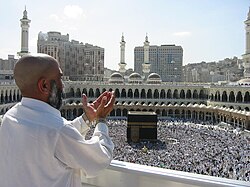 Pilgrim in supplication at the Al-Masjid Al-Haram in Mecca.
 -
 The largest Jamarah (pillar). These pillars depict the evils in Islam and are stoned by the devotees.
 -
 Pilgrims visiting the well of Zamzam.
 -
 Mount Safa within the Al-Masjid Al-Haram in Mecca.
 -
 Mount Marwah within the Al-Masjid Al-Haram in Mecca.
 -
 Tents at Mina.
 -
 Mount Arafat during Ḥajj with Pilgrims supplicating.
 -
 Mount Arafat, a few miles away from Mecca.


.jpg)

See also
[edit]References
[edit]Notes
[edit]- ^ The verses read: "And remember that Abraham was tried by his Lord with certain commands, which he fulfilled.... Remember We made the House a place of assembly for men and a place of safety, and take ye the station of Abraham as a place of prayer; and We covenanted with Abraham and Ishmael, that they should sanctify My House for those who compass it round or use it as a retreat, or bow, or prostrate themselves (therein in prayer).... And remember Abraham and Ishmael raised the foundations of the House (2:124–127)" and "And proclaim the Pilgrimage among men: they will come to thee on foot and (mounted) on every kind of camel, through deep and distant mountain highways, that they may witness the benefits (provided) for them, and celebrate the name of Allah, through the Days appointed, over the cattle which He has provided for them (for sacrifice): then eat ye thereof and feed the distressed one, the needy. Then let them complete the rites prescribed for them, perform their vows, and (again) circumambulate the Ancient House." (22:27–29)
- ^ Ibn Jubayr noted the skeletons of the faithful who had died of thirst en route. In the 17th century, a group of Egyptian pilgrims lost over 1,500 people and 900 camels. In 1924 around one-fifth of a group of Syrian pilgrims died and two years later, 12,000 are thought to have died during the journey. [Islam in the World by Malise Ruthven. Granta Publications, 2006. p. 2. ISBN 1-86207-906-4.]
- ^ For example, one such Hadith says Abu Huraira quoted Muhammad as saying: "Whoever performs Hajj for God's pleasure and does not have sexual relations with his wife, and does not do evil or sins then he will return (after Hajj free from all sins) as if he were born anew."Sahih al-Bukhari, 2:26:596
Citations
[edit]- ^ "Hajj" Archived 30 December 2014 at the Wayback Machine. Random House Webster's Unabridged Dictionary.
- ^ Mohammad Taqi al-Modarresi (26 March 2016). The Laws of Islam (PDF). San Bernardino: Enlight Press. p. 471. ISBN 978-0-9942409-8-9. Archived from the original (PDF) on 2 August 2019. Retrieved 22 December 2017.
- ^ a b Long, Matthew (2011). Islamic Beliefs, Practices, and Cultures. Tarrytown, N.Y.: Marshall Cavendish Corporation. p. 86. ISBN 978-0-7614-7926-0. Archived from the original on 16 October 2015. Retrieved 2 September 2014.
- ^ Nigosian, S. A. (2004). Islam: Its History, Teaching, and Practices. Bloomington, Indiana: Indiana University Press. p. 110. ISBN 0-253-21627-3.
- ^ Berkley Center for Religion, Peace, and World Affairs - Islam Archived 2 October 2011 at the Wayback Machine See drop-down essay on "Islamic Practices"
- ^ "Surah Al-An'am - 19".
- ^ a b c d e Nigosian, S. A. (2004). Islam: Its History, Teaching, and Practices. Indiana: Indiana University Press. p. 111. ISBN 0-253-21627-3.
- ^ Hooker, M. B. (2008). Indonesian Syariah: Defining a National School of Islamic Law. Institute of Southeast Asian Studies. p. 228. ISBN 978-981-230-802-3. Archived from the original on 17 October 2015. Retrieved 6 October 2014.
- ^ Adelowo, E. Dada, ed. (2014). Perspectives in Religious Studies: Volume III. Ibadan: HEBN Publishers Plc. p. 395. ISBN 978-978-081-447-2. Archived from the original on 28 November 2015. Retrieved 12 August 2015.
- ^ 13th of Zil Hajj, heliohost.org, archived from the original on 28 October 2019, retrieved 29 March 2015
- ^ "Hajj The Holy Pilgrimage". Salamislam. 3 January 2021. Archived from the original on 31 May 2022. Retrieved 31 May 2022.
- ^ Karen Armstrong (2002). Islam: A Short History. Modern Library Chronicles (Revised Updated ed.). Modern Library. pp. 10–12. ISBN 0-8129-6618-X.
- ^ a b "Eid ul Adha". BBC. 7 September 2009. Archived from the original on 4 October 2019. Retrieved 30 December 2012.
- ^ Sahih Bukhari-hadith No-732-733
- ^ Matt Stefon, ed. (2010). Islamic Beliefs and Practices. New York City: Britannica Educational Publishing. p. 73. ISBN 978-1-61530-060-0.
- ^ a b "Haj Statistics". General Authority for Statistics, Kingdom of Saudi Arabia. 2017. Archived from the original on 20 June 2018.
- ^ a b c "Record number of pilgrims arrive for 1417 Hajj". Royal Embassy of Saudi Arabia. 15 April 1997. Archived from the original on 18 March 2020. Retrieved 7 October 2014.
- ^ a b "Record number of pilgrims arrive for Hajj". Royal Embassy of Saudi Arabia. 6 December 2008. Archived from the original on 12 June 2010. Retrieved 30 July 2009.
- ^ a b "3,161,573 pilgrims perform Hajj this year". Royal Embassy of Saudi Arabia. 27 October 2012. Archived from the original on 26 April 2013. Retrieved 12 March 2013.
- ^ a b "Saudi Arabia will sharply limit Hajj Pilgrimage". Live Global Coronavirus News. The New York Times. 22 June 2020. Archived from the original on 22 June 2020. Retrieved 15 June 2020.
- ^ AFP (20 July 2021). "In Mecca, Women Take Part in Hajj as 'Guardian' Rule Dropped". VOA. Archived from the original on 20 July 2021. Retrieved 20 July 2021.
- ^ Moše Flôrenṭîn (2005). Late Samaritan Hebrew: A Linguistic Analysis of Its Different Types. BRILL. p. 138. ISBN 978-90-04-13841-4. Archived from the original on 2 January 2022. Retrieved 19 October 2020.
- ^ "Hajj". Encyclopædia Britannica. 2014. Archived from the original on 24 September 2014. Retrieved 12 August 2014.
- ^ Haykal, Muhammad Husayn (1994). The Life of Muhammad. The Other Press. p. 29. ISBN 978-983-9154-17-7. Archived from the original on 27 November 2015. Retrieved 12 August 2015.
- ^ Peters, F. E. (1994). The Hajj: The Muslim Pilgrimage to Mecca and the Holy Places. New Jersey: Princeton University Press. pp. 4–7. ISBN 0-691-02120-1. Archived from the original on 23 November 2015. Retrieved 12 August 2015.
- ^ F.E. Peters (1994), The Hajj: The Muslim Pilgrimage To Mecca and The Holy Places, Princeton University Press, p.6
- ^ Al Mubarakpuri, Safi ur Rahman (2002). "Religions of the Arabs". The Sealed Nectar: Biography of the Noble Prophet. Darussalam. p. 45. ISBN 9960-899-55-1. Archived from the original on 2 November 2015. Retrieved 12 August 2015.
- ^ Husayn Haykal, Muhammad (2008). The Life of Muhammad. Selangor: Islamic Book Trust. pp. 439–40. ISBN 978-983-9154-17-7. Archived from the original on 27 November 2015. Retrieved 12 August 2015.
- ^ Campo, Juan E., ed. (2009). "Muhammad". Encyclopedia of Islam. Facts On File. p. 494. ISBN 978-0-8160-5454-1. Archived from the original on 30 September 2015. Retrieved 19 October 2020.
- ^ Peters, F. E. (1994). The Hajj: The Muslim Pilgrimage to Mecca and the Holy Places. Princeton University Press. p. 164. ISBN 978-0-691-02619-0. Archived from the original on 22 November 2015. Retrieved 12 August 2015.
- ^ a b c Campo, Juan E., ed. (2009). "Hajj". Encyclopedia of Islam. Facts On File. p. 283. ISBN 978-0-8160-5454-1. Archived from the original on 6 April 2022. Retrieved 19 October 2020.
- ^ a b c Singer, Amy (2002), Constructing Ottoman Beneficence: An Imperial Soup Kitchen in Jerusalem, SUNY Press, p. 141, ISBN 978-0-7914-5351-3, archived from the original on 6 April 2022, retrieved 19 October 2020
- ^ a b Philipp, Thomas (1998), The Mamluks in Egyptian Politics and Society, Cambridge University Press, pp. 102–104, ISBN 978-0-521-59115-7, archived from the original on 6 April 2022, retrieved 19 October 2020
- ^ Peters, F. E. (1994). The Hajj: The Muslim Pilgrimage to Mecca and the Holy Places. Princeton University Press. p. 71. ISBN 978-0-691-02619-0. Archived from the original on 22 November 2015. Retrieved 12 August 2015.
- ^ a b c d Harrison, David, ed. (2001). Tourism and the Less Developed World: Issues and Case Studies. CABI. p. 156. ISBN 978-0-85199-433-8. Archived from the original on 27 November 2015. Retrieved 6 October 2014.
- ^ a b Reynolds, Gabriel said (2012). The Emergence of Islam: Classical Traditions in Contemporary Perspective. Fortress Press. p. 33. ISBN 978-1-4514-0812-6. Archived from the original on 16 February 2020. Retrieved 26 November 2019.
- ^ Sheikh, Aziz, ed. (2008). Caring for Muslim Patients. Radcliffe Publishing. p. 95. ISBN 978-1-85775-812-2. Archived from the original on 29 November 2015. Retrieved 15 November 2014.
- ^ "Principal Islamic Days of Observance according to Umm al-Qura Calendar". The Umm al-Qura Calendar of Saudi Arabia. 2014. Archived from the original on 28 October 2019. Retrieved 24 November 2014.
- ^ Penprase, Bryan E (2010). The Power of Stars: How Celestial Observations Have Shaped Civilization. Springer Science & Business Media. p. 142. ISBN 978-1-4419-6803-6. Archived from the original on 26 November 2015. Retrieved 12 August 2015.
- ^ "Hajj celebrated by Muslims in Mecca - video". The Guardian. 15 October 2013. Archived from the original on 29 November 2014. Retrieved 16 November 2014.
- ^ "Hajj today". The Daily Star. 14 October 2013. Archived from the original on 29 November 2014. Retrieved 16 November 2014.
- ^ "Islamic State militants are enemies of humanity: Saudi Grand Mufti". Dawn. 3 October 2014. Archived from the original on 16 March 2020. Retrieved 16 November 2014.
- ^ "Hajj Performed: 2 million pilgrims pray for world peace". The Daily Star. 24 September 2015. Archived from the original on 16 March 2020. Retrieved 26 September 2015.
- ^ "Rituals of the hajj – World – Dunya News". 14 February 2008. Archived from the original on 9 April 2019. Retrieved 10 September 2016.
- ^ a b Hilleary, Cecily (11 September 2016). "Muslims Mark Most Important Day of Hajj in Saudi Arabia". Archived from the original on 20 August 2018. Retrieved 11 September 2016.
- ^ "Hajj 2017: When is it and how long does it take?". Al Jazeera. Archived from the original on 31 March 2020. Retrieved 22 August 2017.
- ^ a b c d e f g van Gent, Robert Harry. "The Umm al-Qura Calendar of Saudi Arabia". Archived from the original on 17 May 2021. Retrieved 7 May 2021.
- ^ Sheikh Saalim Al-Azhari (20 November 2024). "When is Hajj 2025?". Islamic Relief UK.
- ^ Campo, Juan E., ed. (2009). "Hajj". Encyclopedia of Islam. Facts On File. p. 282. ISBN 978-0-8160-5454-1. Archived from the original on 21 July 2021. Retrieved 19 October 2020.
- ^ a b Neusner, Jacob (2000). World Religions in America: An Introduction. Westminster John Knox Press. p. 178. ISBN 978-0-664-25839-9. Archived from the original on 6 April 2022. Retrieved 6 October 2014.
- ^ a b "ihram". Encyclopædia Britannica. 2014. Archived from the original on 7 October 2014. Retrieved 6 October 2014.
- ^ "Ihram – Summary". Hajj Portal. Archived from the original on 21 July 2008. Retrieved 20 November 2013.
- ^ a b c Mohamed, Mamdouh N. (1996). Hajj to Umrah: From A to Z. Amana Publications. ISBN 0-915957-54-X.
- ^ a b "The Philosophy of Hajj Rituals". 3 January 2021. Archived from the original on 11 April 2021. Retrieved 31 May 2022.
- ^ a b Long, Matthew (2011). Islamic Beliefs, Practices, and Cultures. Marshall Cavendish Corporation. p. 89. ISBN 978-0-7614-7926-0. Archived from the original on 23 November 2015. Retrieved 2 September 2014.
- ^ Long, David E. (1979). The Hajj Today: A Survey of the Contemporary Pilgrimage to Makkah. SUNY Press. p. 16. ISBN 0-87395-382-7. Archived from the original on 19 February 2020. Retrieved 29 August 2017.
- ^ a b c Long, David E. (1979). The Hajj Today: A Survey of the Contemporary Pilgrimage to Makkah. SUNY Press. p. 17. ISBN 978-0-87395-382-5. Archived from the original on 17 February 2020. Retrieved 29 August 2017.
- ^ a b Adelowo, E. Dada, ed. (2014). Perspectives in Religious Studies: Volume III. Ibadan: HEBN Publishers Plc. p. 401. ISBN 978-978-081-447-2. Archived from the original on 1 November 2015. Retrieved 12 August 2015.
- ^ "Pilgrims complain of Zamzam water shortage in Makkah". Arab News. 7 July 2014. Archived from the original on 22 December 2016. Retrieved 7 September 2014.
- ^ a b c d "Hajj". Royal Embassy of Saudi Arabia. Archived from the original on 15 August 2014. Retrieved 12 August 2014.
- ^ Reyshahri, Mohammad. "Hajj in Quran and Hadith". lib.eshia. Archived from the original on 17 February 2020. Retrieved 2 September 2018.
- ^ a b "the reason for naming Tarwiyah day". farsnews. 22 September 2015. Archived from the original on 12 October 2018. Retrieved 22 September 2015.
- ^ Reyshahri, Mohammad. "Enclopedia of Imam Husain based on Quran and Hadith". lib.eshia. Archived from the original on 1 March 2020. Retrieved 2 September 2018.
- ^ a b c Adelowo, E. Dada, ed. (2014). Perspectives in Religious Studies: Volume III. Ibadan: HEBN Publishers Plc. p. 403. ISBN 978-978-081-447-2. Archived from the original on 3 January 2017. Retrieved 12 August 2015.
- ^ a b c Long, David E. (1979). The Hajj Today: A Survey of the Contemporary Pilgrimage to Makkah. SUNY Press. p. 19. ISBN 0-87395-382-7. Archived from the original on 4 August 2018. Retrieved 29 August 2017.
- ^ Sahih Muslim-Hadith No 2941.2944
- ^ Sahih Bukhari Hadith No: 732,733, and 734
- ^ a b c d al-Hasani, Abu Qanit al-Sharif (2009). The Guiding Helper: Main Text and Explanatory Notes. Lulu.com. p. 220. ISBN 978-1-4452-3791-6. Archived from the original on 2 November 2015. Retrieved 12 August 2015.
- ^ "easyhajj.co.uk". easyhajj.co.uk. Archived from the original on 11 August 2011. Retrieved 19 December 2011.
- ^ Nigosian (2004). Islam: Its History, Teaching, and Practices. Indiana University Press. p. 112. ISBN 0-253-21627-3.
- ^ a b Islamic Beliefs, Practices, and Cultures. Marshall Cavendish Corporation. 2011. p. 90. ISBN 978-0-7614-7926-0. Archived from the original on 23 November 2015. Retrieved 2 September 2014.
- ^ a b Gad-el-Hak, Mohamed, ed. (2008). Large-Scale Disasters: Prediction, Control, and Mitigation. Cambridge University Press. p. 54. ISBN 978-1-139-47229-6. Archived from the original on 29 November 2015. Retrieved 13 January 2015.
- ^ a b "Hajj: pilgrimage to Mecca". BBC. 8 September 2009. Archived from the original on 3 November 2019. Retrieved 6 October 2014.
- ^ a b Long (1979). The Hajj Today: A Survey of the Contemporary Pilgrimage to Makkah. SUNY Press. p. 21. ISBN 0-87395-382-7. Archived from the original on 16 February 2020. Retrieved 29 August 2017.
- ^ Sahih Muslim Hadith no:2985,2994
- ^ Sheikho, Mohammad Amin; Al-Dayrani, A. K. John Alias (19 July 2017). Pilgrimage "Hajj": The Fifth High Grade of Al-Taqwa. BookRix. ISBN 978-3-7309-9606-5. Archived from the original on 8 July 2022. Retrieved 5 July 2022.
- ^ Al Masry, Ahmed (15 September 2006). "Muslim pilgrims flock to Medina after performing Hajj". aa.com.tr. Anadolu Agency. Archived from the original on 6 April 2022. Retrieved 24 July 2021.
- ^ Norani Noridin; Nordin Yusof (2008). A life that matters: a spiritual experience. The Other Press. p. 32. ISBN 978-967-5062-02-5. Archived from the original on 6 April 2022. Retrieved 19 October 2020.
- ^ a b Sheikh, Aziz, ed. (2008). Caring for Muslim Patients. Radcliffe Publishing. p. 96. ISBN 978-1-85775-812-2. Archived from the original on 29 November 2015. Retrieved 2 September 2014.
- ^ Musharraf, Hussain (2012). The Five Pillars of Islam: Laying the Foundations of Divine Love and Service to Humanity. Leicestershire, UK: Kube Publishing. pp. 204–205. ISBN 9781847740236.
- ^ Powell, William (1982). Saudi Arabia and Its Royal Family. Lyle Stuart. p. 113. ISBN 978-0-8184-0326-2. Retrieved 7 October 2014.
- ^ a b Andrea Schulte-Peevers (2010). Oman, UAE & Arabian Peninsula. Lonely Planet. p. 67. ISBN 978-1-74179-145-7. Archived from the original on 26 October 2015. Retrieved 12 August 2015.
- ^ Clingingsmith, David; Khwaja, Asim Ijaz; Kremer, Michael (August 2009). "Estimating the Impact of the Hajj: Religion and Tolerance in Islam's Global Gathering *". Quarterly Journal of Economics. 124 (3): 1133–1170. doi:10.1162/qjec.2009.124.3.1133. Retrieved 20 September 2025.
- ^ Malcolm X; Alex Haley (1999). The Autobiography of Malcolm X. Ballantine Books. p. 346. ISBN 978-0-345-35068-8. Archived from the original on 29 May 2013. Retrieved 26 February 2013.
- ^ Gannon, Martin Joseph; Baxter, Ian W. F.; Collinson, Elaine; Curran, Ross; Farrington, Thomas; Glasgow, Steven; et al. (11 June 2017). "Travelling for Umrah: destination attributes, destination image, and post-travel intentions" (PDF). The Service Industries Journal. 37 (7–8): 448–465. doi:10.1080/02642069.2017.1333601. ISSN 0264-2069. S2CID 54745153. Archived (PDF) from the original on 27 April 2019. Retrieved 11 July 2019.
- ^ Edgar, Scott (2002). "The Five Pillars of Islam in the Hadith". Studia Antiqua. 2 (1). Archived from the original on 28 July 2018.
- ^ "Dhaka seeks reconsidering 20pc cut in Hajj pilgrims quota". The Daily Star. 19 February 2014. Archived from the original on 7 March 2020. Retrieved 2 September 2014.
- ^ "Hajj pilgrimage 2011: by numbers". The Daily Telegraph. 3 November 2011. Archived from the original on 11 January 2022. Retrieved 1 September 2014.
- ^ "History of Haj Announcement India". Government of Uttar Pradesh, India. Archived from the original on 4 September 2019. Retrieved 1 September 2014.
- ^ "First Hajj flight leaves for Jeddah". The News International. 29 August 2014. Archived from the original on 4 September 2014. Retrieved 3 September 2014.
- ^ "Pakistani pilgrims praise Saudi authorities for introducing Urdu signage at Holy Mosques". Arab News PK. 1 November 2022. Retrieved 6 January 2023.
- ^ "Hajj safety: Saudi Arabia introduces hi-tech bracelets for all pilgrims". Al Arabiya. July 2016. Archived from the original on 8 May 2019. Retrieved 8 May 2019.
- ^ "With 2,950 participants from 100 countries, Hajj Hackathon makes Guinness Record". Al Arabiya. 2 August 2018. Archived from the original on 8 May 2019. Retrieved 8 May 2019.
- ^ "Saudi Arabia looks to technology to make hajj pilgrims safer – Huff Point". Archived from the original on 8 May 2019. Retrieved 8 May 2019.
- ^ "Saudi ministry offers Hajj hotline and 'Fatwa Robot' service". Arab News. 11 August 2019. Archived from the original on 12 August 2019. Retrieved 13 August 2019.
- ^ "Hajj chiefs launch two smart apps to help pilgrims". Arab News. 7 August 2019. Archived from the original on 10 August 2019. Retrieved 13 August 2019.
- ^ umrahexpert. "Hajj Visa | Umrah Expert". www.umrahexpert.co.uk. Archived from the original on 3 August 2017. Retrieved 30 May 2017.
- ^ "Entry requirements – Saudi Arabia travel advice – GOV.UK". Government of the United Kingdom. Archived from the original on 2 August 2017. Retrieved 25 May 2017.
- ^ "Hajj and Umrah e-visas to be issued in minutes". EZ Hajj Groups. 12 March 2019. Archived from the original on 10 January 2019. Retrieved 15 April 2019.
- ^ "e-visa for Umrah in less than 24 hours". Saudigazette. 17 August 2019. Archived from the original on 22 August 2019. Retrieved 22 August 2019.
- ^ "Mecca Road Initiative launches for second year to ease Hajj journey". Al Arabiya. 8 July 2019. Archived from the original on 15 July 2019. Retrieved 15 July 2019.
- ^ a b "Nearly 37,000 Hajj pilgrims arrive in Saudi Arabia via Makkah Route initiative". Arab News. 14 July 2019. Archived from the original on 15 July 2019. Retrieved 15 July 2019.
- ^ "Makkah Route: Health services presented to Hajjis in their home countries". Arab News. 21 July 2019. Archived from the original on 30 July 2019. Retrieved 30 July 2019.
- ^ Tagliacozzo, Eric; Toorawa, Shawkat, eds. (2016). The Hajj: Pilgrimage in Islam. New York: Cambridge University Press. p. 178. ISBN 978-1-107-61280-8. Archived from the original on 16 February 2017. Retrieved 10 February 2017.
- ^ Elfenbein, Caleb Heart Iyer (2008). Differentiating Islam: Colonialism, Sayyid Qutb, and Religious Transformation in Modern Egypt. University of California, Santa Barbara. p. 209. ISBN 978-0-549-98771-0. Archived from the original on 21 November 2015. Retrieved 29 August 2014.
- ^ Long, David E. (1979). The Hajj Today: A Survey of the Contemporary Pilgrimage to Makkah. SUNY Press. p. 48. ISBN 0-87395-382-7. Archived from the original on 18 October 2015. Retrieved 12 August 2015.
- ^ Miller, M. B. (2006). "Pilgrims' Progress: The Business of the Hajj". Past & Present (191): 189–228. doi:10.1093/pastj/gtj009. ISSN 0031-2746. S2CID 162153634.
- ^ Harrison, David, ed. (2001). Tourism and the Less Developed World: Issues and Case Studies. CABI. p. 157. ISBN 978-0-85199-433-8. Archived from the original on 31 October 2015. Retrieved 29 August 2014.
- ^ a b "Air Travel". Royal Embassy of Saudi Arabia. 2013. Archived from the original on 10 October 2014. Retrieved 29 August 2014.
- ^ "Pilgrims Start Arriving From India, Pakistan as Haj Terminal Is Officially Opened". Arab News. Archived from the original on 22 December 2016. Retrieved 26 February 2013.
- ^ "New Delhi Indira Gandhi International Airport (DEL) Information". World Guides. TravelSmart Ltd. 2014. Archived from the original on 15 February 2020. Retrieved 29 August 2014.
- ^ a b El Hanandeh, Ali (August 2013). "Quantifying the carbon footprint of religious tourism: the case of Hajj". Journal of Cleaner Production. 52: 53–60. Bibcode:2013JCPro..52...53E. doi:10.1016/j.jclepro.2013.03.009. ISSN 0959-6526. S2CID 154817617.
- ^ Maher, Ahmed (27 October 2012). "Mecca seeks 'green Hajj'". BBC News.
- ^ "Study: Climate change could pose danger for Muslim pilgrimage". MIT News | Massachusetts Institute of Technology. 22 August 2019. Retrieved 24 November 2022.
- ^ a b "With hajj under threat, it's time Muslims joined the climate movement". the Guardian. 30 August 2019. Retrieved 24 November 2022.
- ^ "How climate change is affecting Hajj". The Muslim News. Retrieved 24 November 2022.
- ^ Saeed, Fahad; Schleussner, Carl-Friedrich; Almazroui, Mansour (1 February 2021). "From Paris to Makkah: heat stress risks for Muslim pilgrims at 1.5 °C and 2 °C". Environmental Research Letters. 16 (2): 024037. Bibcode:2021ERL....16b4037S. doi:10.1088/1748-9326/abd067. ISSN 1748-9326. S2CID 229428683.
- ^ Masters, Jeff; Henson, Bob (15 July 2021). "More warming a threat to the Hajj - and human habitation - in the Middle East". Yale Climate Connections. Retrieved 24 November 2022.
- ^ Mahmood, Zainab (5 October 2022). "Is the climate emergency making Hajj even more exclusive?". gal-dem. Archived from the original on 24 November 2022. Retrieved 24 November 2022.
- ^ Agence France-Presse (18 June 2024). "More than 550 hajj pilgrims die in Mecca as temperatures exceed 50C". The Guardian. ISSN 0261-3077. Retrieved 21 June 2024.
- ^ a b "Egypt to prosecute travel agents for 'fraudulent' hajj trips". The Guardian. 22 June 2024. ISSN 0261-3077. Retrieved 28 June 2024.
- ^ "Saudi Arabia says 1,301 died on Hajj this year". CNN. 23 June 2024.
- ^ a b "حج / تطبيق مبادرة "حج بلا بلاستيك" في موسم حج هذا العام وكالة الأنباء السعودية". 2 January 2020. Archived from the original on 2 January 2020. Retrieved 24 November 2022.
- ^ a b "Saudi Arabia expands 'Green Haj'". Gulf News. 18 July 2019. Archived from the original on 6 August 2019. Retrieved 6 August 2019.
- ^ "Glance at major hajj-related incidents in Saudi Arabia". Associated Press. 11 September 2015. Archived from the original on 27 September 2015. Retrieved 10 October 2015.
- ^ "Rituals of Haj Sacrifice". Consulate General of India, Jeddah. 3 October 2013. Archived from the original on 28 January 2016. Retrieved 24 October 2015.
- ^ "The Saudi Project for Use of Hajj Meat". ADAHI. Archived from the original on 21 October 2015. Retrieved 24 October 2015.
- ^ a b "Saudi crush was deadliest hajj tragedy ever". Associated Press. 10 October 2015. Archived from the original on 14 October 2015. Retrieved 10 October 2015.
- ^ "Hajj stampede: Saudis face growing criticism over deaths". BBC. 25 September 2015. Archived from the original on 27 September 2015. Retrieved 25 September 2015.
- ^ "AP count: Over 2,400 killed in Saudi hajj stampede, crush". AP NEWS. 10 December 2015. Archived from the original on 15 November 2021. Retrieved 15 March 2022.
- ^ Katz, Andrew (16 October 2013). "As the Hajj Unfolds in Saudi Arabia, A Deep Look Inside the Battle Against MERS". Time. Archived from the original on 29 February 2020. Retrieved 17 October 2013.
- ^ Eaves, Elisabeth (9 June 2014). "WHO's Maurizio Barbeschi Talks About MERS and Mass Events". Bulletin of the Atomic Scientists. Archived from the original on 4 March 2016. Retrieved 9 June 2014.
- ^ Branswell, Helen (7 November 2013). "Spain reports its first MERS case; woman travelled to Saudi Arabia for Hajj". Vancouver Sun. The Canadian Press. Archived from the original on 9 November 2013. Retrieved 12 November 2013.
- ^ Barasheed, Osamah; Rashid, Harunor; Heron, Leon; Ridda, Iman; Haworth, Elizabeth; Nguyen-Van-Tam, Jonathan; Dwyer, Dominic E.; Booy, Robert (November 2014). "Influenza Vaccination Among Australian Hajj Pilgrims: Uptake, Attitudes, and Barriers". Journal of Travel Medicine. 21 (6): 384–390. doi:10.1111/jtm.12146. PMID 25145836.
- ^ "Hajj pilgrimage to continue despite deadly MERS Epidemic". news.biharprabha.com. Indo-Asian News Service. Archived from the original on 25 April 2014. Retrieved 23 April 2014.
- ^ "Selfie at Mecca at Median banned by Saudi Kingdom". theindependent.in. 26 November 2017. Archived from the original on 8 July 2022. Retrieved 26 November 2017.
- ^ "Coronavirus: Saudi Arabia suspends entry for pilgrims visiting holy sites". BBC News. 27 February 2020. Archived from the original on 29 April 2020. Retrieved 1 March 2020.
- ^ Ebrahim, Shahul H; Memish, Ziad A (28 February 2020). "Saudi Arabia's drastic measures to curb the COVID-19 outbreak: temporary suspension of the Umrah pilgrimage". Journal of Travel Medicine. 27 (3). doi:10.1093/jtm/taaa029. ISSN 1195-1982. PMC 7107544. PMID 32109274.
- ^ "Saudi Arabia: $8.5 billion income from hajj expected". Al-Arabiya English. 26 August 2014. Archived from the original on 30 September 2016. Retrieved 14 September 2016.
- ^ Walker, Stuart (30 December 2020). Design and Spirituality: A Philosophy of Material Cultures. Routledge. ISBN 978-1-000-24595-0. Archived from the original on 8 July 2022. Retrieved 8 July 2022.
- ^ Butt, Riazat (14 November 2010). "Mecca makeover: how the hajj has become big business for Saudi Arabia". The Guardian. Archived from the original on 26 June 2018. Retrieved 20 July 2018.
- ^ "US Hajj Company: For Hajj & Umrah Packages". EZ Hajj Groups. Archived from the original on 14 January 2022. Retrieved 8 July 2022.
- ^ "Saudi Arabia's Latest Challenge: Containing Covid-19 During the Hajj". Wall Street Journal. 25 July 2020. Archived from the original on 26 July 2020. Retrieved 25 July 2020.
- ^ "Hajj revenues poised to exceed $150bn by 2022: Experts". Arab News. 28 August 2017.
- ^ "Saudi Arabia Hajj tourism to become US$350 billion market by 2032". The Moodie Davitt Report. 13 August 2022.
- ^ McCarthy, Niall (14 February 2018). "Chinese New Year: The World's Largest Human Migration Is About To Begin". Forbes.
- ^ a b c d "Number of foreign Hajis grows by 2,824 percent in 92 years". The News International. Archived from the original on 2 November 2012. Retrieved 9 October 2016.
- ^ "Reduction in Hajj 2013 Quota" (Press release). Ministry of External Affairs, Government of India. 8 July 2013. Archived from the original on 28 January 2016. Retrieved 17 September 2014.
- ^ "Saudi Arabia cuts Hajj Quota for foreign pilgrims by 20 percent". Yahoo News. 19 June 2013. Archived from the original on 6 October 2014. Retrieved 17 September 2013.
- ^ Supratman, Frial Ramadhan (30 December 2020). "Hajj and the chaos of the Great War: Pilgrims of the Dutch East Indies in World War I (1914-1918)". Wawasan: Jurnal Ilmiah Agama Dan Sosial Budaya. 5 (2): 167–178. doi:10.15575/jw.v5i2.8584. ISSN 2502-3489. S2CID 233386606.
- ^ a b c "Saudi Arabia: Hajj draws 1.8 million pilgrims, falls short of pre-pandemic record". The New Arab. 27 June 2023. Retrieved 27 October 2023.
- ^ a b c d Tagliacozzo, Eric; Toorawa, Shawkat, eds. (2016). The Hajj: Pilgrimage in Islam. New York: Cambridge University Press. p. 132. ISBN 978-1-107-61280-8. Archived from the original on 17 February 2017. Retrieved 14 February 2017.
- ^ a b c d e f g h i j Harrison, David, ed. (2001). Tourism and the Less Developed World: Issues and Case Studies. CABI Publishing. p. 156. ISBN 978-0-85199-433-8. Archived from the original on 27 November 2015. Retrieved 12 August 2015.
- ^ "Final statistics for Hajj 1418 pilgrims". Royal Embassy of Saudi Arabia. 8 April 1998. Archived from the original on 3 March 2020. Retrieved 7 October 2014.
- ^ a b "Ministry of Pilgrimage figures released for 1420 Haj". Royal Embassy of Saudi Arabia. 20 March 2000. Archived from the original on 31 March 2020. Retrieved 7 October 2014.
- ^ "Successful culmination of Hajj 1421". Royal Embassy of Saudi Arabia. 9 March 2001. Archived from the original on 11 March 2020. Retrieved 7 October 2014.
- ^ "Tragic deaths reported in crowding at Mina". Royal Embassy of Saudi Arabia. 11 February 2003. Archived from the original on 7 March 2020. Retrieved 7 October 2014.
- ^ a b "Culmination of 1424 Hajj witnesses stampede deaths". Royal Embassy of Saudi Arabia. 1 February 2004. Archived from the original on 5 March 2020. Retrieved 7 October 2014.
- ^ "Hajj proceeding without incident". Royal Embassy of Saudi Arabia. 30 January 2004. Archived from the original on 5 March 2020. Retrieved 7 October 2014.
- ^ "Prince Abdulmajeed declares Hajj 1425 a success". Royal Embassy of Saudi Arabia. 25 January 2005. Archived from the original on 26 August 2019. Retrieved 30 July 2009.
- ^ "Number of Hajj pilgrims tops 2 million". Royal Embassy of Saudi Arabia. 10 January 2006. Archived from the original on 16 March 2020. Retrieved 16 January 2015.
- ^ "More than 2.3 million pilgrims perform the Hajj this year". Royal Embassy of Saudi Arabia. 30 December 2006. Archived from the original on 29 February 2020. Retrieved 30 July 2009.
- ^ "More than 1.7 million pilgrims have arrived in Saudi Arabia for the Hajj". Royal Embassy of Saudi Arabia. 17 December 2007. Archived from the original on 2 March 2020. Retrieved 30 July 2009.
- ^ "How Many Attended the Hajj?". Crossroads Arabia. 23 December 2007. Archived from the original on 25 December 2007.
- ^ "2,521,000 million pilgrims participated in Hajj 1430". Royal Embassy of Saudi Arabia. 29 November 2009. Archived from the original on 12 June 2010. Retrieved 8 December 2009.
- ^ "2.8 million pilgrims participated in Hajj 1431". Royal Embassy of Saudi Arabia. 18 November 2010. Archived from the original on 15 December 2010. Retrieved 28 December 2010.
- ^ "2,927,717 pilgrims performed Hajj this year". Royal Embassy of Saudi Arabia. 6 November 2011. Archived from the original on 28 June 2012. Retrieved 16 November 2012.
- ^ a b c d e f "2018-1439 Hajj Statistics" (PDF). General Authority for Statistics Kingdom of Saudi Arabia. Archived (PDF) from the original on 18 September 2020. Retrieved 19 May 2020.
- ^ "1,379,531 pilgrims from 188 countries arrived for Hajj". Royal Embassy of Saudi Arabia. 13 October 2013. Archived from the original on 21 February 2014. Retrieved 13 February 2014.
- ^ "Small increase in foreign pilgrims". Royal Embassy of Saudi Arabia. 2 October 2014. Archived from the original on 9 October 2014. Retrieved 7 October 2014.
- ^ "1,384,941 foreign pilgrims participated in Hajj". Royal Embassy of Saudi Arabia. 22 September 2015. Archived from the original on 16 February 2017. Retrieved 15 February 2017.
- ^ a b c "Saudi Arabia says Hajj 2016 receives 1.8 million pilgrims". Al Arabiya English. 12 September 2016. Archived from the original on 9 October 2016. Retrieved 15 February 2017.
- ^ "Haj Statistics". General Authority of Statistics, Kingdom of Saudi Arabia. 22 August 2018. Archived from the original on 18 April 2020. Retrieved 22 August 2018.
- ^ "Around 2.5 million pilgrims take part in Hajj this year". Arab News. 10 August 2019. Archived from the original on 16 August 2019. Retrieved 13 August 2019.
- ^ "Saudi Arabia to restrict domestic haj pilgrims amid coronavirus fears". Reuters. 23 June 2020. Archived from the original on 5 May 2022. Retrieved 5 May 2022.
- ^ a b "Saudi Arabia says hajj to be limited to 60,000 in kingdom". Associated Press. 12 June 2021. Archived from the original on 5 May 2022. Retrieved 5 May 2022.
- ^ a b "Hajj Statistics 1442 (2021)" (PDF). General Authority for Statistics. Archived from the original (PDF) on 6 June 2023. Retrieved 16 January 2025.
- ^ a b c "GASTAT: A total of 899,353 pilgrims perform Hajj". Saudi Gazette. 8 July 2022. Retrieved 20 July 2022.
- ^ a b c للإحصاء, الهيئة العامة (15 June 2024). "GASTAT: Total number of pilgrims in 1445 H Hajj season is 1,833,164". General Authority for Statistics. Archived from the original on 25 July 2024. Retrieved 31 July 2024.
Further reading
[edit]- Bianchi, Robert R. (2004). Guests of God: Pilgrimage and Politics in the Islamic World. Oxford University Press. ISBN 978-0-19-517107-5.
- Hammoudi, Abdellah (2006). A Season in Mecca: Narrative of a Pilgrimage. Hill and Wang. ISBN 978-0-8090-7609-3.
- Khan, Qaisra (2014). "Hajj & 'Umra". In Fitzpatrick, Coeli; Walker, Adam Hani (eds.). Muhammad in History, Thought, and Culture: An Encyclopedia of the Prophet of God. Vol. I. Santa Barbara: ABC-CLIO. pp. 239–245. OCLC 857754274.
- Patler, Nicholas (2017). From Mecca to Selma: Malcolm X, Islam, and the Journey tnto the American Civil Rights Movement. The Islamic Monthly. Archived from the original on 30 December 2022. Retrieved 4 April 2017.
- Trojanow, Ilija (2007). Mumbai to Mecca: A Pilgrimage to the Holy Sites of Islam. Haus Publishing. ISBN 978-1-904950-29-5.
External links
[edit] Definitions from Wiktionary
 Media from Commons
 News from Wikinews
 Quotations from Wikiquote
 Texts from Wikisource
 Textbooks from Wikibooks
 Resources from Wikiversity
 Travel information from Wikivoyage
 Data from Wikidata


- Hajj: a Cultural History – online exhibition
- Mapping Faith: The Pilgrimage to Mecca Archived 4 August 2023 at the Wayback Machine – CNN interactive feature
- Virtual Hajj by PBS
- The Hajj Goes High Tech –Time magazine photo essay
- Sequence of Hajj explained through Google Earth Archived 20 January 2012 at the Wayback Machine
- [permanent dead link] [permanent dead link]
Every year, from the eighth to the twelfth day of Dhu al-Hijjah. | ||
| Preparation |  | |
| Sequence | ||
| Mosques | ||
| Related | ||
Islam topics | |||||||||||||
|---|---|---|---|---|---|---|---|---|---|---|---|---|---|
| |||||||||||||
| |||||||||||||
| |||||||||||||
| |||||||||||||


Hajj is the annual Islamic pilgrimage to Mecca, Saudi Arabia, undertaken by Muslims during the month of Dhu al-Hijjah as one of the Five Pillars of Islam, obligatory at least once in a lifetime for those who are physically and financially able.[1][2] The rituals, which include donning simple white garments symbolizing purity (ihram), circumambulating the Kaaba seven times (tawaf), hastening between the hills of Safa and Marwah (sa'i), standing in prayer at the plain of Arafat, collecting pebbles at Muzdalifah, and stoning three pillars representing Satan (rami), originated in pre-Islamic Arabian traditions of pilgrimage to the Kaaba—a pagan shrine housing 360 idols—before being reformed and monotheized by Muhammad in the 7th century CE.[3][4] Empirical evidence from pre-Islamic poetry confirms the practice of these core rites, including seasonal gatherings at Mecca, prior to Islam's emergence.[4] Managed by Saudi Arabia's Ministry of Hajj and Umrah with strict quotas to mitigate risks, the event drew 1,833,164 pilgrims in 2024, predominantly from abroad, underscoring its role as the world's largest annual human migration yet marked by persistent causal hazards from extreme density, including recurrent stampedes and environmental stressors that have caused thousands of deaths over decades.[5][6][7]
Definition and Obligations
Scriptural Basis in Quran and Hadith
The Quran mandates Hajj as a fundamental religious obligation for Muslims capable of undertaking it, positioning it as one of the Five Pillars of Islam. Surah Al-Imran (3:97) explicitly states: "In it are clear signs [such as] the standing place of Abraham. And whoever enters it shall be safe. And [due] to Allah from the people is a pilgrimage to the House—for whoever is able to find thereto a way. But whoever disbelieves—then indeed, Allah is free from need of the worlds." This verse underscores the pilgrimage to the Kaaba in Mecca as a duty owed to God by those with the physical and financial means to travel there, linking it to Abrahamic tradition while emphasizing divine independence from human compliance. [8] Surah Al-Baqarah (2:196–203) provides detailed guidance on performing Hajj and Umrah, requiring their completion for Allah's sake and prescribing rules such as sacrificial offerings if obstructed, avoidance of sexual relations and adornments during ihram (ritual consecration), and observance of the sacred months (Shawwal, Dhul-Qadah, and Dhul-Hijjah). These verses outline prohibitions against disputes and emphasize remembrance of God at sites like Arafat and Muzdalifah, framing Hajj as an act of devotion amid potential worldly bounties. Surah Al-Hajj (22:27–29) further commands Abraham to proclaim Hajj to humanity, instructing pilgrims to attend in clean garments, complete rites without sinning, and fulfill vows and tawaf (circumambulation) around the Kaaba. Collectively, these passages establish Hajj's universality, ritual framework, and spiritual purification, without prescribing every procedural detail left to prophetic exemplification. [9] The Hadith literature, particularly in Sahih Bukhari and Sahih Muslim, elaborates the Quranic basis through the Prophet Muhammad's practices and statements, confirming Hajj's obligation as part of Islam's foundations. A foundational narration in Sahih Bukhari recounts the Prophet declaring: "Islam is built on five [pillars]: the testimony that there is no deity worthy of worship except Allah..., establishing the prayer, paying the zakat, Hajj to the House, and fasting in Ramadan." This positions Hajj as fard (obligatory) once in a lifetime for eligible individuals, with the Prophet clarifying during his lifetime that it suffices annually only if repeated without excess, as queried by companions. [10] The Prophet's Farewell Pilgrimage (Hajjat al-Wada') in 10 AH (632 CE) serves as the primary model for rites, detailed extensively in Sahih Bukhari's Book of Hajj (Volume 2, Book 25). Narrations describe entering ihram at specified miqats (boundaries), tawaf around the Kaaba, sa'i between Safa and Marwah, standing at Arafat on the 9th of Dhul-Hijjah as the pilgrimage's essence ("Hajj is Arafah," per the Prophet), overnight stay at Muzdalifah, stoning of Jamarat symbolizing rejection of Satan, and animal sacrifice on Eid al-Adha. [11] The Prophet emphasized purity, stating: "Whoever performs Hajj for Allah's pleasure and avoids obscenity and sin will return sinless as on the day his mother bore him." These authentic reports (sahih) from companions like Ibn Abbas and Aisha authenticate the rites' sequence and intent, prohibiting innovations (bid'ah) and proxy performance except in cases of incapacity, as in the hadith of a weak father delegating Hajj. [12] Hadith collections thus operationalize Quranic commands, ensuring fidelity to the Prophet's sunna (example) for ritual validity. [11]Eligibility and Frequency Requirements
Hajj is classified as fard 'ayn, an individual obligation incumbent upon every Muslim who fulfills specific preconditions, as derived from Quranic injunctions and prophetic traditions emphasizing capability (istita'ah).[13] The primary scriptural basis is Quran 3:97, which states that pilgrimage to the Kaaba is due from those who can find a way thereto, interpreted by scholars across major Sunni and Shia schools to require both physical and financial ability without undue hardship.[14] Failure to perform it when able constitutes a grave sin, though exemptions apply to those unable to meet the criteria at the time the obligation arises.[15] The essential preconditions for Hajj's obligation include: being Muslim, as non-Muslims are excluded from Islamic rites; attaining adulthood, typically marked by puberty (around 15 lunar years for males and 9 for females in some juristic views, though exact onset varies); possessing soundness of mind, excluding the insane or those with severe cognitive impairments; and freedom from enslavement, a condition rooted in historical contexts but irrelevant post-abolition of slavery.[13][16] Additionally, istita'ah demands physical fitness to withstand the pilgrimage's rigors—such as walking long distances and enduring desert conditions—and financial means covering travel costs, provisions for the journey, sustenance for dependents left behind, settlement of debts, and return provisions, ensuring no harm to family or self.[17][18] Women face the same obligations but, in Hanbali and some Hanafi rulings, require a mahram (close male relative) for safe accompaniment, though this does not negate the duty if unfeasible.[19] The obligation arises upon meeting these conditions and persists until fulfilled, but it is limited to once in a lifetime; subsequent pilgrimages are voluntary (sunnah or mustahabb) and not required, even if ability recurs.[20] This singularity aligns with the rite's purpose as a transformative act of devotion, avoiding undue burden, as affirmed in hadith narrations and juristic consensus rejecting periodic repetition like every five years—a view held by a minority and unsupported by primary texts.[21] Those who performed Hajj before puberty or insanity must repeat it upon maturity or recovery if still able, but prepubescent or coerced performances do not discharge the duty.[22] Delaying without valid excuse incurs sin, prompting calls in prophetic traditions to perform it immediately upon ability.[13]Etymology and Terminology
Linguistic Origins
The word ḥajj (حَجْج) originates from the Arabic triliteral root ḥāʾ-jīm-jīm (ح-ج-ج), a Semitic root associated with concepts of resolute intention, argumentation, proof, and purposeful striving toward a goal.[23][24] This root appears 33 times in the Quran across derived forms, including the verb ḥajja (حَجَّ), denoting to intend or set out determinedly, often implying a journey or effort aimed at resolution or demonstration.[24][25] Linguistically, ḥajj as a noun specifically signifies the pilgrimage to Mecca, derived from the verb ḥajja, which conveys exerting effort to reach a significant destination or to argue a case conclusively, reflecting the pilgrim's deliberate commitment to the rite.[26][27] The term's semantics emphasize not mere travel but a directed aspiration or "aiming" for a sacred objective, akin to traversing a main path (maḥajja) toward fulfillment.[28] Within broader Semitic linguistics, the root parallels Hebrew ḥāg (חָג), meaning "festival" or cyclical observance, suggesting ancient shared connotations of ritual gathering and periodic devotion, though Arabic usage crystallized ḥajj around the Meccan pilgrimage by the early Islamic period.[29] No pre-Islamic Arabic attestation ties the term exclusively to Mecca prior to Quranic prescription, but the root's pre-Islamic presence in South Arabian inscriptions indicates general notions of pilgrimage or festal intent.[29][30]Associated Concepts and Variations
Umrah, known as the "lesser pilgrimage," is a non-obligatory Islamic rite that shares core elements with Hajj, such as entering the state of ihram, circumambulating the Kaaba (tawaf), and walking between the hills of Safa and Marwah (sa'i), but lacks the extended rituals at Arafat, Muzdalifah, and Mina.[31] Unlike Hajj, which is mandated once in a lifetime for capable Muslims and confined to specific dates in Dhul-Hijjah, Umrah can be performed year-round and multiple times, serving as a voluntary act of devotion that pilgrims often undertake en route to or alongside Hajj.[32] Hajj itself admits three principal variations in performance, each defined by the pilgrim's intent (niyyah) and sequencing of Umrah relative to Hajj: Hajj al-Ifrad, Hajj al-Qiran, and Hajj al-Tamattu'.[33] In Hajj al-Ifrad, the pilgrim assumes ihram solely for Hajj upon approaching Mecca, postponing any Umrah until after completing Hajj's rites, with no mandatory sacrificial offering (hadi) required beyond the standard post-Hajj animal slaughter.[34] This form suits non-residents of Mecca who prioritize Hajj independently.[35] Hajj al-Qiran integrates Umrah and Hajj under a single, continuous ihram, where the pilgrim performs Umrah's tawaf and sa'i immediately upon arrival but maintains ihram through Hajj's subsequent days, necessitating a sacrificial animal as atonement for utilizing items prohibited in ihram (e.g., perfume or tailored garments) during the interim.[36] This combined approach is recommended for those arriving from afar, as it aligns with prophetic practice reported in hadith collections like Sahih al-Bukhari.[37] Hajj al-Tamattu' ("enjoyment" Hajj) involves completing a full Umrah upon entry to Mecca—exiting ihram afterward to resume normal activities—followed by re-entering ihram specifically for Hajj on the 8th of Dhul-Hijjah, also requiring a hadi sacrifice.[38] The Prophet Muhammad is said to have urged this form for pilgrims from outside Mecca, citing its facilitation of rest and preparation, though all types fulfill the Hajj obligation if executed validly.[39] While Sunni schools of jurisprudence (e.g., Hanafi, Maliki, Shafi'i, Hanbali) accept all three variations with minor procedural differences—such as the timing of tawaf al-ifadah—Shia Twelver jurisprudence predominantly endorses Qiran or Tamattu', viewing Ifrad as permissible but less optimal, and adapts prayer postures (e.g., hands at sides rather than folded) during congregational rites to maintain unity under Saudi oversight.[40] Core Hajj rituals remain uniform across sects, emphasizing equality in devotion, though historical tensions have occasionally surfaced in non-ritual aspects like sermon content at Arafat.[41]Historical Development
Pre-Islamic Antecedents
In pre-Islamic Arabia, the Kaaba in Mecca functioned as a polytheistic shrine central to tribal worship, drawing pilgrims for an annual gathering that featured rituals paralleling elements of the Islamic Hajj. Literary evidence from pre-Islamic poetry, such as verses by Zuhayr ibn Abi Sulma in the sixth century CE, describes assemblies at Arafat, overnight stays at Muzdalifah, processions to Mina, and the stoning of pillars symbolizing rejection of evil—practices conducted amid pagan devotions rather than monotheistic observance.[4][42] These accounts, preserved in oral traditions later recorded, indicate the pilgrimage was localized primarily to tribes near Mecca, serving both religious and commercial purposes during sacred months when intertribal warfare was suspended.[43] Core rites included tawaf, the circumambulation of the Kaaba, performed naked or in simple garments by some participants as a sign of humility and equality, alongside sa'y, the ritual pacing between the hills of Safa and Marwah, originally linked to local deities or fertility symbols rather than Abrahamic figures.[44] The Kaaba itself housed numerous idols, reportedly numbering 360 representing Arabian tribal deities, with Hubal as a prominent god installed by the Quraysh tribe, who acted as custodians and profited from pilgrimage trade.[44] Animal sacrifices at Mina and collective supplications at Arafat—termed the "Day of Standing"—fostered unity among disparate Bedouin groups, though archaeological corroboration remains sparse due to Mecca's arid environment and Saudi restrictions on excavations, leaving reliance on textual sources like poetry and early Islamic hadith retrospectives.[42][45] While Islamic tradition retroactively traces these practices to Prophet Abraham's construction of the Kaaba around 2000 BCE with his son Ishmael, establishing a monotheistic origin corrupted by later idolatry, no empirical archaeological or extrabiblical historical evidence supports this Abrahamic foundation; instead, the rituals reflect indigenous Arabian polytheism evolving from at least the fourth century CE, with Mecca's prominence likely amplified by Quraysh control over trade routes.[46] Revisionist analyses highlight the absence of pre-seventh-century inscriptions or artifacts mentioning Mecca in broader Near Eastern records, suggesting its ritual significance may have been regionally confined and exaggerated in later Muslim historiography.[47][48] This pre-Islamic framework provided a cultural continuum that Muhammad reformed in 630 CE by purging idols and reorienting rites toward exclusive worship of Allah, as detailed in Quranic verses like Surah Al-Hajj 22:26-30.[49]Prophetic and Early Islamic Establishment
The Prophet Muhammad established the standardized rites of Hajj in their Islamic form during his Farewell Pilgrimage (Hujjat al-Wada') in 632 CE (10 AH), the only full Hajj he performed after the Hijra to Medina in 622 CE.[50] This event, attended by over 100,000 Muslims, demonstrated the core sequence of rituals, including entering the state of ihram (ritual consecration) at the designated miqat boundary, circumambulation (tawaf) of the Kaaba seven times in the counterclockwise direction, the run (sa'i) between the hills of Safa and Marwah, symbolic stoning (rami) of the devil at Mina, and the essential vigil (wuquf) at Arafat on the 9th of Dhu al-Hijjah.[51] These practices purged pre-Islamic elements such as idol worship and tribal excesses, aligning the pilgrimage with monotheistic devotion as commanded in the Quran, such as in Surah Al-Imran (3:97), which declares pilgrimage to the Kaaba a duty for capable believers. At Mount Arafat during the pilgrimage, Muhammad delivered the Farewell Sermon, emphasizing equality among Muslims regardless of race or tribe, the sanctity of life and property, and the completion of religious obligations, stating, "O People, just as you regard this month, this day, this city as Sacred, so regard the life and property of every Muslim as a sacred trust."[51] [52] This address, transmitted through multiple companions' narrations in hadith collections, codified ethical guidelines for Hajj and reinforced its role in unifying the nascent Muslim community.[11] The rites were not merely reenactments but causal mechanisms for spiritual renewal and communal solidarity, drawing from Quranic injunctions like Surah Al-Hajj (22:27-28), which instruct proclamation of pilgrimage to witness benefits and invoke God's name. Following Muhammad's death in 632 CE, the early caliphs adhered strictly to this model, with Abu Bakr dispatching Ali ibn Abi Talib in 631 CE (9 AH) to announce disavowal of polytheism during Hajj and enforce monotheistic exclusivity at the Kaaba.[53] Under Umar ibn al-Khattab (r. 634-644 CE), Hajj continued annually under centralized oversight from Medina, with the caliph personally leading delegations to maintain ritual purity and prevent reversion to pre-Islamic corruptions like naked circumambulation or blood sacrifices to idols.[54] Hadith reports, such as those in Sahih al-Bukhari, preserve these practices as binding sunnah, ensuring Hajj's continuity as a pillar of Islam without significant deviation in the Rashidun era.[11] This establishment transformed Hajj from a regional Arabian festival into a global Islamic obligation, verifiable through consistent eyewitness accounts in early biographical sources despite potential hagiographic emphases.[55]Expansion Under Successive Empires
Following the early Islamic consolidation, the Umayyad Caliphate (661–750 CE) initiated key infrastructural developments for the Hajj, including the establishment of dedicated pilgrimage roads such as the Syro-Jordanian routes from Damascus through Wadi Sirhan to Mecca, featuring pilgrim camps marked by stone circles for guidance and security.[56] Caliphs like Abd al-Malik ibn Marwan appointed workers to maintain the Masjid al-Haram and assist pilgrims, enhancing accessibility amid territorial expansions that connected distant provinces to the Hijaz.[57] The Abbasid Caliphate (750–1258 CE) markedly expanded Hajj infrastructure, with Caliph Abu al-Abbas al-Saffah ordering improvements to the Iraq-to-Mecca road in 751 CE, including milestones and fire-signal stations for safe navigation.[58] Zubayda bint Ja'far, wife of Caliph Harun al-Rashid, sponsored the Darb Zubaydah route, which incorporated 27 main stations and substations between Kufa and Mecca, equipped with wells, reservoirs, and rest houses spaced for camel and donkey travel, facilitating pilgrim flows from Mesopotamia.[59] Caliph al-Mansur further enlarged the Masjid al-Haram, marbling its floors and enclosing the Zamzam well, while road construction peaked around 780 CE under al-Mahdi.[57] During the Fatimid (909–1171 CE) and subsequent Ayyubid (1171–1260 CE) periods, control over the Hejaz involved taxation on pilgrims by local rulers under Fatimid overlordship, though the Ayyubids, under Saladin, emphasized Sunni restoration and pilgrimage support, as evidenced by official Hajj certificates issued in 1205 CE.[57] The Mamluk Sultanate (1250–1517 CE) institutionalized protection via military-escorted caravans and constructed khans (rest stations) along the Egyptian Hajj route, bolstering security against Bedouin raids and enabling larger delegations from Cairo.[60] Under the Ottoman Empire (1517–1918 CE), which assumed custodianship of Mecca and Medina, the Hajj saw systematic organization through the appointment of an Amir al-Hajj to lead and secure caravans, particularly the prominent Damascus route serving as the empire's primary gateway to the Hijaz.[61] Annual expenditures reached approximately 400,000 gold coins for logistics, including military escorts and provisions, while Sultan Abdul Hamid II's Hejaz Railway, initiated in 1900 CE, revolutionized overland travel by linking Damascus to Medina, reducing reliance on perilous sea voyages and bandit-prone paths.[62] This era integrated the pilgrimage into imperial administration, drawing participants from across the Ottoman domains and beyond, with control extending to Red Sea ports for maritime arrivals.[63]Saudi Modernization and Control
Saudi Arabia assumed control over the Hajj following the conquest of the Hijaz region in 1924–1925, ousting the Hashemite rulers and securing Mecca by the 1925 pilgrimage season.[64] This marked the centralization of pilgrimage management under the emerging Saudi state, formalized with the kingdom's establishment in 1932, granting Riyadh stewardship of Islam's holiest sites and leveraging Hajj oversight for monarchical legitimacy.[65] The government regulates all aspects, including visa issuance, pilgrim quotas allocated per country in coordination with the Organization of Islamic Cooperation, and prohibitions on unauthorized participation to maintain order.[66] Quotas, introduced in the 1980s, cap annual attendance at approximately 2 million to mitigate overcrowding risks, with temporary reductions such as the 1,000-pilgrim limit in 2020 due to pandemic concerns.[67] [68] Modernization efforts began under King Abdulaziz, who initiated the first expansion of Masjid al-Haram in 1955, enlarging the site to 160,168 square meters and accommodating over 300,000 worshipers with added prayer areas and pathways.[69] Subsequent projects under Kings Fahd (1988–1993) and Abdullah (starting 2008) further expanded capacity, culminating in the third Saudi expansion completed in stages by 2023, boosting Masjid al-Haram to 1.85 million worshipers via multi-level additions and a Mataf area for circumambulation accommodating 120,000 per hour.[70] [71] Infrastructure upgrades include the 1946 and 1948 establishment of transport companies for pilgrim mobility, and the 2011 modernization of the Hajj Terminal at King Abdulaziz International Airport, handling 3,800 arrivals and 3,500 departures per hour across 90,000 square meters.[72] Security protocols encompass advanced surveillance, AI-driven crowd monitoring, and comprehensive strategies to prevent incidents, as deployed for the 2025 Hajj season.[73] [74] Under Vision 2030, launched in 2016, the Pilgrim Experience Program integrates digital tools like the Nusuk app for bookings, smart technology for navigation, and data analytics for satisfaction tracking, aiming to enhance services while targeting 30 million annual religious visitors by 2030 through sustainable infrastructure and reduced congestion.[75] [76] Recent initiatives for Hajj 1446 (2025) include Kidana-led upgrades to holy sites for safety and flow, alongside AI for spiritual and logistical support, reflecting a blend of tradition with technological efficiency.[77] [78] These measures address historical challenges like stampedes but have drawn critique for potential exclusion via digital barriers and age limits, though they prioritize verifiable safety enhancements over broader access demands.[79]Timing and Calendar
Islamic Lunar Calendar Framework
The Hijri calendar, also known as the Islamic lunar calendar, structures time around the cycles of the moon, comprising twelve months that begin upon the sighting—or, in modern Saudi practice, calculation—of the new crescent moon, with each month spanning 29 or 30 days to form a year of 354 or 355 days.[80] This purely lunar system lacks intercalation to align with the solar year, causing Hijri dates to shift backward by about 10 to 12 days annually against the Gregorian calendar, which influences the seasonal timing of observances like Hajj.[81] The months proceed as follows: Muharram, Safar, Rabi' al-Awwal, Rabi' al-Thani, Jumada al-Awwal, Jumada al-Thani, Rajab, Sha'ban, Ramadan, Shawwal, Dhu al-Qa'dah, and Dhu al-Hijjah, the latter being the designated period for Hajj.[82] Hajj is tethered to fixed dates within Dhu al-Hijjah, the twelfth month, commencing on the 8th day (Yaum al-Tarwiyah) when pilgrims proceed to Mina, peaking on the 9th (Yawm Arafah, the standing at Arafat), and extending through the 10th (Eid al-Adha, involving sacrifice and stoning) to the 12th or 13th, depending on whether pilgrims opt for an additional day of rites.[83] This framework underscores Hajj's annual obligation for eligible Muslims, with the lunar basis ensuring its occurrence aligns with the Qur'anic prescription in Surah al-Baqarah 2:197, which ties the pilgrimage to "appointed months" without seasonal fixation.[84] In administering Hajj, Saudi Arabia employs the Umm al-Qura calendar for official date-setting, which relies on astronomical computations to predict the new moon's visibility from Mecca rather than variable human sightings, enabling advance logistical coordination for over two million participants amid the pilgrimage's scale.[85] This calculated approach, introduced in the mid-20th century, diverges from classical reliance on eyewitness testimony but maintains lunar fidelity by referencing Mecca's horizon, thus standardizing Hajj scheduling while accommodating global pilgrims' travel preparations.[86] For 1446 AH (2025 CE), Dhu al-Hijjah is projected to begin around May 28, placing Hajj from June 4 to June 9.[87]Annual Date Determination and Adjustments
The Hajj pilgrimage is scheduled from the 8th to the 12th or 13th day of Dhu al-Hijjah, the twelfth month of the Islamic lunar calendar, with the 9th day (Yawm Arafah) as the central rite. This calendar comprises 12 lunar months totaling 354 or 355 days, lacking synchronization with the solar year, which causes Hajj dates to advance approximately 10–11 days earlier each Gregorian year. Over roughly 33 years, the Islamic dates cycle fully through the solar calendar, exposing pilgrims to varying seasonal conditions, from summer heat to winter cold in Mecca's subtropical climate.[83] The annual start of Dhu al-Hijjah—and thus Hajj—is established through the sighting of the new crescent moon (hilal) on the 29th of the preceding month, Dhu al-Qadah. Saudi Arabia's Supreme Judicial Council oversees this via regional committees that collect eyewitness testimonies of the crescent at sunset; if no sighting occurs despite the moon's astronomical birth (conjunction with the sun), calculations predict visibility from Mecca's longitude. The council announces the month's onset publicly, often aligning with the Umm al-Qura calendar's projections, which use lunar visibility algorithms tied to the Kaaba's location but defer to confirmed sightings for religious finality. This method, practiced since the early caliphate, prioritizes empirical observation over precomputed global uniformity, though Saudi determinations influence many Muslim communities worldwide.[88][89] Projected dates for the Hajj season in 2026 are 25 May to 30 May (Gregorian calendar), corresponding to 8–13 Dhul-Hijjah 1447 AH. These are tentative, based on astronomical calculations and the Umm al-Qura calendar; actual dates are confirmed by moon sighting by Saudi authorities. Key dates include the Day of Arafat (9 Dhul-Hijjah) on 26 May 2026 and Eid al-Adha (10 Dhul-Hijjah) on 27 May 2026.[90] No systematic adjustments or intercalations alter these dates, as the Prophet Muhammad abolished pre-Islamic nasi (periodic extra months) in 632 CE to preserve the calendar's strictly lunar nature, per Quranic injunction against tampering (9:36–37). Caliph Umar formalized this in 637 CE, rejecting solar alignments to maintain seasonal drift, which underscores Hajj's detachment from agricultural cycles and emphasizes its perpetual obligation. Saudi Arabia's Umm al-Qura system, while computationally predictive for administrative consistency, incorporates no leap mechanisms, ensuring the calendar's 19-year Metonic-like variance remains unmitigated and Hajj's timing unadjusted beyond moon-based confirmation.[91]Preparation and Initial Rites
Entering the State of Ihram
Pilgrims enter the state of ihram, a ritual consecration marking the commencement of Hajj obligations, at designated boundary points known as miqats, which serve as geographical limits beyond which one must assume this consecrated status.[92] These miqats were specified by the Prophet Muhammad in 632 CE to standardize the pilgrimage approach, preventing entry into the sacred precincts without proper ritual preparation.[93] The five primary miqats include Dhu'l-Hulayfah (also called Abyar Ali, approximately 450 km north of Mecca near Medina), Al-Juhfah (about 190 km northwest of Mecca), Qarn al-Manazil (94 km east of Mecca), Yalamlam (south of Mecca toward Yemen), and Dhat Irq (further east).[92][94] For residents of Mecca or those already within the Haram boundaries, alternative points like Masjid Aisha (Tan'im, 8 km northeast of Mecca) allow entry into ihram.[94] Prior to crossing the miqat, pilgrims perform preparatory acts to achieve ritual purity, including a recommended full-body ablution (ghusl) even if menstruating for women, trimming nails, removing underarm and pubic hair, and perfuming the body as a final act before donning ihram attire.[95][96] Men then wear two seamless white cotton sheets—one wrapped around the waist (izar) reaching the knees and another draped over the upper body (rida), leaving the right shoulder uncovered during certain rites—with no undergarments, head covering, or stitched clothing permitted; open sandals or similar non-covering footwear are allowed, as the Prophet Muhammad performed Tawaf around the Kaaba and Sa'i between Safa and Marwah wearing sandals and instructed muhrims to wear sandals if available.[97][98] Women assume ihram by wearing loose, modest garments covering the body except the face and hands, avoiding face veils or gloves that fully cover those areas to distinguish from male attire, though head covering remains obligatory.[97][99] Entry into ihram is formalized by inwardly forming the intention (niyyah) to perform Hajj—specific to one's chosen type such as ifrād, qirān, or tamattu'—followed by aloud recitation of the talbiyah: "Labbayk Allāhumma labbayk, labbayka lā sharīka laka labbayk, inna'l-ḥamda wa'n-ni'mata laka wa'l-mulk, lā sharīka lak." This declaration, rooted in prophetic practice, signifies submission and response to divine invitation.[100][32] Pilgrims may optionally perform two units of prayer (rak'ahs) before or after the intention to invoke spiritual focus.[101] Once uttered, ihram binds the pilgrim to its disciplines until completion of core rites, with violations requiring expiation such as fasting or sacrifice.[84] Facilities at miqats, including Saudi-provided prayer areas and garment distribution, facilitate this transition for millions annually.[102]Prohibitions and Preparatory Disciplines
Pilgrims prepare for entering the state of ihram through a series of physical and spiritual disciplines, including performing ghusl (full ritual ablution) to cleanse the body, trimming nails and removing any hair from the pubic and armpit areas if not already done recently, and ensuring overall bodily purity.[103] These acts symbolize detachment from worldly vanities and readiness for ritual consecration, typically undertaken at or before the miqat (designated boundary points) such as Dhu'l-Hulaifah for those approaching from Medina.[100] Additionally, pilgrims study the prescribed rites in advance to avoid errors, cultivate patience for the pilgrimage's rigors, and engage in repentance (tawbah) to purify intentions, focusing on fulfilling the obligation solely for divine acceptance rather than social display.[104] Upon assuming ihram by donning the specified garments—two unstitched white sheets for men, with the right shoulder uncovered initially—and reciting the intention (niyyah), pilgrims enter a consecrated state imposing strict prohibitions to enforce spiritual discipline and equality.[101] These include abstaining from sexual intercourse, kissing, touching with desire, or any discourse leading thereto; using perfume or scented products on body, clothing, or belongings; trimming or shaving hair and nails; hunting or killing land game (though pointing out or assisting in capture is also forbidden); and for men, wearing stitched garments, head coverings, or gloves.[105] [106] Women face similar restrictions but wear modest, unstitched or loose clothing without face veils (niqab) that touch the face or gloves, though they may cover the face if necessary without direct contact from the veil.[107] Other bans encompass marital intimacy discussions, applying henna or makeup, and actions like quarreling or harming others, all aimed at fostering humility and focus on worship; violations require expiatory acts such as fasting, charity, or animal sacrifice, varying by severity.[108] Some jurisprudential traditions enumerate up to 25 specific prohibitions, including ogling women or using deceptive beauty enhancements, underscoring the emphasis on moral restraint during this phase.[106] These rules persist until the pilgrim exits ihram after completing core rites, such as the farewell tawaf.[109]Core Pilgrimage Rites
Tawaf, Sa'i, and Circumambulation
Tawaf constitutes the ritual circumambulation of the Kaaba in Mecca's Masjid al-Haram, performed by pilgrims during Hajj by completing seven circuits in an anti-clockwise direction.[110] Each circuit, known as a shawt, begins and ends at the Black Stone embedded in the Kaaba's eastern corner, with pilgrims ideally attempting to touch or kiss the stone at the start of each round if feasible amid crowds.[111] Men are required to uncover their right shoulder (idhtiba') and stride briskly (ramal) during the first three circuits to emulate the Prophet Muhammad's practice, while women maintain normal pace.[112] Supplications and Quranic recitations accompany the tawaf, emphasizing devotion and unity, as pilgrims maintain physical and spiritual focus without interruption.[113] In Hajj, multiple tawafs occur: Tawaf al-Qudum upon arrival for certain pilgrimage types, the obligatory Tawaf al-Ifadah post-Arafat standing to fulfill core rites, and optional Tawaf al-Wada as farewell before departure.[114] Tawaf al-Ifadah, a pillar of Hajj, symbolizes spiritual purification and submission, requiring completion for Hajj validity, with performance typically following the Day of Arafat.[115] The Kaaba's centrality underscores tawaf's role in orienting worship toward the qibla, the direction of prayer for Muslims worldwide.[116] Sa'i follows tawaf in Hajj sequence, involving seven traversals between the hills of Safa and Marwah within the Masjid al-Haram's elevated walkway.[112] Pilgrims commence at Safa, ascending to recite takbir and salutations upon the Prophet, then proceed to Marwah—counting one circuit—before returning, repeating until the seventh arrival at Marwah.[117] This rite commemorates Hajar's desperate search for water for her son Ismail, culminating in Zamzam's emergence, with men performing ramal in the first three outbound legs.[118] The pathway, modernized with air-conditioned covering since expansions, spans approximately 394 meters one way, accommodating millions annually under Saudi management.[117] Sa'i qualifies as a pillar for Hajj validity in non-Qiran types, integrable after initial or Ifadah tawaf depending on pilgrimage variant, reinforcing themes of perseverance and divine provision.[119] Recited supplications invoke Allah's mercy, linking the act to Quranic affirmation of Safa and Marwah as symbols of faith.[120] Physical demands, including green-lit zones for hastening, adapt for elderly and disabled via dedicated sections, ensuring inclusivity while preserving ritual integrity.[112]Tarwiyah Day in Mina
Tarwiyah Day, observed on the eighth of Dhu al-Hijjah, initiates the principal rites of Hajj as pilgrims proceed from Mecca to the valley of Mina, approximately 7 kilometers east, to encamp there until the following dawn.[121][122] This movement aligns with the Sunnah of the Prophet Muhammad, who departed for Mina mid-morning with his companions after performing prayers in Mecca.[123] Pilgrims performing Hajj al-Tamattu', having previously completed Umrah and exited ihram, re-enter the state of ihram specifically for Hajj prior to departure, typically after Fajr prayer or upon leaving their accommodations in Mecca or nearby areas like Aziziyah.[124][125] The journey to Mina, often by foot in emulation of prophetic practice or via organized transport, culminates in assignment to vast tent cities designed to accommodate millions, where pilgrims perform the obligatory prayers—Dhuhr, Asr, Maghrib, Isha, and Fajr—shortened due to travel but offered at their standard times without combination except as permitted for Fajr following the prior night's Isha.[122][121][123] The day's designation as Tarwiyah derives from the Arabic root "rawa," connoting quenching thirst or provisioning water, reflecting pre-modern practices where pilgrims and their mounts, such as camels, were abundantly watered in Mina to sustain the subsequent arid traversal to Arafat and Muzdalifah.[126][122] Beyond prayers and supplications, activities emphasize spiritual preparation through dhikr and reflection, devoid of rites like stoning the Jamarat, which commence post-Arafat; the overnight encampment in Mina fosters communal devotion and readiness for the pivotal standing at Arafat on the ninth.[124][121] While permissible to proceed directly to Arafat, the normative sequence via Mina upholds the prophetic model and ensures logistical provisioning amid the pilgrimage's scale.[127][123]Arafat Standing and Muzdalifah Vigil
The standing at Arafat, or wuquf, constitutes the central rite of Hajj, performed on the ninth day of Dhu al-Hijjah. Pilgrims, having departed Mina after Fajr prayer, arrive at the plains of Arafat by mid-morning and remain from the time of Zuhr prayer until sunset.[128] During this period, participants engage primarily in supplication (dua), recitation of the Quran, and reflection, with presence at Arafat itself fulfilling the ritual obligation rather than specific actions.[129] The site's boundaries extend across a broad plain east of Mecca, encompassing Mount Arafat (Jabal al-Rahmah), where the Prophet Muhammad delivered his Farewell Sermon in 632 CE.[130] This rite holds paramount theological weight, as the Prophet Muhammad declared, "Hajj is Arafah," emphasizing that attendance at Arafat validates the pilgrimage; absence renders Hajj incomplete.[128][131] The Quran references Arafat in Surah Al-Baqarah (2:198), permitting pilgrims to seek provision there while underscoring the day's sanctity for worship.[132] Historically, the Prophet's hadith collections, such as those in Sunan Abi Dawud and Jami' al-Tirmidhi, affirm Arafat's role as the essence of Hajj, where forgiveness and spiritual renewal are sought en masse.[128][131] Upon sunset marking the conclusion of wuquf, pilgrims proceed approximately 10 kilometers to Muzdalifah for the overnight vigil. En route or upon arrival, they perform the combined Maghrib and Isha prayers (shortened to three rak'ahs each as qasr).[133] The vigil entails remaining under the open sky until Fajr prayer, during which pilgrims collect 49 to 70 small pebbles—typically the size of chickpeas—from the ground for the subsequent stoning of the Jamarat pillars.[134] This collection symbolizes rejection of temptation, drawing from the narrative of Abraham's trial, though pebbles may permissibly be gathered elsewhere if necessary.[133][135] The Muzdalifah stay reinforces communal endurance and devotion, with participants reciting takbir and engaging in further supplication amid minimal shelter.[136] Post-Fajr, pilgrims depart for Mina by dawn, carrying the pebbles for the rites commencing on Eid al-Adha. Official Saudi guidelines, as in Al-Mansak Al-Muyassar, classify Muzdalifah attendance as obligatory for Hajj validity, akin to Arafat, while permitting exemptions for the elderly or ill under supervised conditions.[137] In practice, millions converge nightly, managed by Saudi authorities to mitigate overcrowding risks observed in past pilgrimages.[138]Eid al-Adha: Stoning, Sacrifice, and Completion Rites
On the 10th of Dhul-Hijjah, known as Yawm an-Nahr or the Day of Sacrifice, pilgrims commence Eid al-Adha rites following the vigil at Muzdalifah, marking a pivotal phase in Hajj fulfillment. This day integrates symbolic rejection of temptation, atonement through sacrifice, and preparatory acts for ritual completion, aligning with global Muslim observance of Eid al-Adha.[139][140] The initial rite, Rami al-Jamarat al-Kubra, involves pilgrims throwing seven pebbles collected from Muzdalifah at the largest pillar, Jamarat al-Aqabah, in Mina, performed from sunrise after Fajr prayer until before sunset. This act symbolizes Prophet Ibrahim's rejection of Satan's temptations during his obedience to divine command for sacrifice, with the pillar representing the devil's third interception. Performed individually while reciting "Bismillah, Allahu Akbar," the ritual underscores personal defiance of evil, limited to the single large pillar on this day to prioritize subsequent obligations.[141][139][142] Following stoning, pilgrims undertake Udhiyah, the animal sacrifice, obligatory for those financially able, commemorating Ibrahim's willingness to sacrifice Ismail. Acceptable animals include sheep or goats (one per person, aged at least six months), camels or cows (shared by up to seven persons, aged two or five years respectively), slaughtered humanely by facing the Qibla after Takbir recitation. In practice, Saudi authorities facilitate centralized slaughter for efficiency, distributing meat to the needy worldwide; portions are divided into thirds for family consumption, gifting, and charity. The rite must precede sunset and enables the first Tahallul, partially lifting Ihram restrictions.[143][144][145] Subsequently, Halq (shaving the head for men) or Taqsir (trimming hair for both genders, fingertip length for women) symbolizes renewal and submission, completing the first stage of purification from Ihram, allowing resumption of permissible acts like perfume use and marital relations. Men are encouraged to shave fully for greater reward, performed by licensed barbers in Mina or Mecca.[115][84] Pilgrims then proceed to Mecca for Tawaf al-Ifadah (or Tawaf al-Qudum in some contexts), an essential pillar involving seven circumambulations of the Kaaba counterclockwise, followed by two rak'ahs prayer, reinforcing devotion post-Arafat. For Tamattu and Qiran Hajj types, Sa'i between Safa and Marwah may follow if not previously completed. This Tawaf solidifies Hajj validity, after which pilgrims return to Mina for Tashriq days' stoning, transitioning to partial Ihram.[140][115]Post-Eid Stoning and Farewell Tawaf
Following the rites of Eid al-Adha on the 10th of Dhu al-Hijjah, pilgrims proceed to the Days of Tashriq on the 11th, 12th, and optionally the 13th of Dhu al-Hijjah, during which they perform the Rami al-Jamarat, or stoning of the three pillars in Mina.[141] On each of these days, after sunrise and before sunset, participants throw seven pebbles at each of the three Jamarat—al-Ula (small), al-Wusta (middle), and al-Kubra (large or Aqabah)—totaling 21 pebbles per day.[146] This ritual commemorates Prophet Ibrahim's rejection of Satan's temptations by pelting him with stones during his journey to sacrifice Ismail, as narrated in hadith collections.[147] The pebbles used are typically small, smooth stones gathered from Muzdalifah on the previous night or procured locally, each throw symbolizing the pilgrim's personal defiance of evil and affirmation of submission to God.[148] Modern infrastructure, including multi-level bridges over the Jamarat site, facilitates the rite for millions, with designated time slots to manage crowds and reduce risks of trampling, as implemented by Saudi authorities since the 2000s following past incidents.[149] Pilgrims who complete the stoning on the 12th may depart Mina before sunset to shorten their stay, while those remaining until the 13th perform an additional round, after which they are permitted to leave without further obligation.[146] Upon concluding the stonings and returning to Mecca, pilgrims must perform Tawaf al-Wada, or the Farewell Tawaf, as the final obligatory rite before departing the city.[150] This consists of seven counterclockwise circumambulations of the Kaaba in the Masjid al-Haram, similar in procedure to the initial Tawaf al-Qudum but without the subsequent Sa'i, undertaken after exiting the state of Ihram.[151] It is mandatory for all Hajj performers except menstruating women, serving as a parting act of devotion to the Kaaba, with the Prophet Muhammad exemplifying it before leaving Mecca.[152] Failure to perform Tawaf al-Wada invalidates the Hajj unless compensated by a subsequent pilgrimage, underscoring its role in sealing the spiritual journey.[150] Performed ideally just prior to exit from Mecca, it allows pilgrims to exit the mosque normally, stepping out with the left foot first as a sunnah practice.[152] This rite emphasizes gratitude and closure, distinct from Umrah where it is recommended but not required.[151]Theological and Spiritual Significance
Quranic and Prophetic Symbolism
The Quranic foundation of Hajj emphasizes its role as a prescribed act of worship symbolizing human submission to divine will and communal unity under monotheism. Surah Al-Hajj (22:27) instructs the proclamation of Hajj to draw people from distant lands on foot and camelback, underscoring the pilgrimage's symbolism as a global convergence toward the Kaaba, representing the focal point of tawhid (divine oneness) and transcending tribal divisions. This gathering evokes the archetype of collective devotion, where pilgrims shed worldly distinctions to affirm equality before God, as implied in the verse's call to fulfill associated rites without sin. Surah Al-Baqarah (2:196-197) further details the completion of Hajj and Umrah despite hardships, symbolizing perseverance in faith and reliance on divine provision, with the "well-known months" denoting fixed temporal discipline akin to life's structured trials. These verses portray Hajj not merely as ritual but as an embodied rejection of self-sufficiency, mirroring the prophets' trials in submission to Allah's commands. Sacrificial elements in Hajj carry profound Quranic symbolism tied to gratitude and redemption. Surah Al-Hajj (22:34) declares beasts of sacrifice as "symbols of Allah" yielding benefit for humanity, invoked by pronouncing His name upon slaughter, which signifies the transfer of devotion from material provision to spiritual acknowledgment of the Creator's sovereignty. This act recalls the primordial covenant of life for worship, where pilgrims' fasting from certain meats during ihram reinforces detachment from worldly desires, paralleling the broader Islamic ethic of halal restraint as a safeguard against idolatry. The Kaaba's centrality, as a "safe sanctuary" in Surah Al-Baqarah (2:125), symbolizes refuge in divine protection, with its circumambulation evoking celestial order—much like angels orbiting the throne—wherein human movement affirms cosmic hierarchy under Allah's unity. Prophetic traditions elucidate Hajj's symbolism through Muhammad's demonstrated rites, framing them as reenactments of Abrahamic submission authenticated by revelation. In Sahih Bukhari, the Prophet states that an accepted Hajj—free of obscenity or sin—yields return "as the day his mother bore him," symbolizing spiritual rebirth and erasure of past sins through ritual purity, akin to purification from iron impurities via bellows. The Farewell Hajj (10 AH/632 CE) exemplified this, where tawaf, sa'i between Safa and Marwah, and stoning at Mina ritually commemorate Hagar's desperate search for water—yielding Zamzam as divine mercy—and Abraham's rejection of Satan's temptations during Ismail's near-sacrifice, respectively. These acts, per hadith, reject evil whispers (as in stoning the jamarat) and embody jihad of the soul against base impulses, without physical combat, elevating Hajj as "jihad" for the weak.[153] The Prophet's emphasis on Hajj's acceptance depending on sincerity underscores its symbolism as ultimate tawhid, purging polytheistic residues and restoring primordial fidelity to Allah, as verified in his performance aligning with Quranic imperatives.Personal and Communal Obligations Fulfilled
Hajj constitutes the fulfillment of a core personal religious obligation for Muslims, designated as one of the five pillars of Islam and mandated by Quranic injunction for those possessing the physical and financial capacity to undertake it without undue hardship. This duty applies specifically to adult, sane, free Muslims who can perform the pilgrimage at least once in their lifetime, emphasizing direct submission to divine command as an act of worship that renews faith and atones for prior sins.[154] Prophetic traditions affirm that successful completion of Hajj erases sins, rendering the pilgrim spiritually akin to a newborn, thereby achieving personal purification and alignment with Islamic tenets of accountability and redemption.[8] On a communal level, Hajj reinforces collective obligations by assembling millions of Muslims from diverse backgrounds into a unified body, the ummah, where participants don identical white ihram garments that erase distinctions of wealth, nationality, or status, fostering equality and mutual solidarity under God.[155] This annual convergence, drawing over 2 million pilgrims as observed in recent iterations, symbolizes the interconnectedness of the global Muslim community and strengthens fraternal bonds through shared rituals, promoting a collective consciousness of humility, gratitude, and devotion that transcends individual pursuits.[156] The rites, particularly the standing at Arafat, serve as a communal vigil that underscores Islam's emphasis on unity as a pillar of social cohesion and resilience.[157] These personal and communal dimensions intertwine to realize Hajj's broader imperative of embodying Islamic principles in practice, where individual piety contributes to the fortification of the collective faith, as evidenced by the pilgrimage's role in eliciting shared experiences of self-reflection, thankfulness, and interpersonal harmony among participants.[158] Empirical observations of Hajj gatherings highlight its function in cultivating a sense of global brotherhood, though logistical strains occasionally test communal discipline.[159]Comparison with Umrah
Ritual Overlaps and Distinctions
Both Hajj and Umrah share core rituals that symbolize devotion and reenactment of prophetic traditions, including entering the state of ihram—a consecrated condition marked by donning simple white garments for men and modest attire for women, along with prohibitions on certain activities like hunting, perfume, and marital relations—performed at designated miqats (boundary points) before approaching Mecca.[32][31] Pilgrims in both pilgrimages then undertake tawaf, the counterclockwise circumambulation of the Kaaba seven times, beginning and ending at the Black Stone, followed by sa'i, the brisk walking and jogging between the hills of Safa and Marwah seven times to commemorate Hagar's search for water.[32][112] These acts conclude with taqsir (trimming hair) or halq (shaving the head), signifying spiritual renewal, though halq is preferred for men completing Hajj.[31] Despite these overlaps, Umrah is a streamlined pilgrimage comprising solely ihram, tawaf, sa'i, and hair trimming, performable at any time of year without fixed sequencing beyond these elements.[32][160] Hajj, by contrast, mandates an extended sequence of rites confined to the Islamic months of Shawwal, Dhu al-Qadah, and Dhu al-Hijjah, incorporating Umrah-like acts (in the tamattu' variant, where Umrah precedes Hajj proper) alongside unique obligations such as overnighting in Mina on Tarwiyah Day (8th Dhu al-Hijjah), the essential standing (wuquf) at Arafat on the 9th for supplication until sunset—deemed the pilgrimage's core by prophetic tradition—collecting pebbles at Muzdalifah, stoning the Jamarat pillars over three days starting Eid al-Adha (10th), animal sacrifice commemorating Abraham's obedience, and a farewell tawaf before departure.[31][32] These additions in Hajj emphasize communal assembly, atonement, and emulation of the Prophet Muhammad's final pilgrimage in 632 CE, distinguishing it as the obligatory pillar absent in Umrah's voluntary framework.[31]Theological Prioritization of Hajj
In Islamic theology, Hajj is elevated as the fifth of the Five Pillars of Islam, establishing it as an obligatory act (fard 'ayn) for every adult Muslim of sound mind who possesses the physical capability and financial resources to perform it without undue hardship, required at least once in a lifetime.[161] This prioritization stems from its explicit commandment in the Quran, such as in Surah Al-Imran 3:97, which states that pilgrimage to the Kaaba "is a duty from Allah upon every able-bodied person," underscoring its role in fulfilling a divine covenant tracing back to Prophet Ibrahim (Abraham), who constructed the Kaaba as a focal point for monotheistic worship.[9] Unlike other devotional acts, Hajj's mandatory status reflects its function as a collective affirmation of submission to Allah, transcending individual piety to embody communal unity and equality before God, with participants donning simple white garments (ihram) to erase social distinctions.[162] Prophetic traditions further amplify Hajj's theological precedence, with the Prophet Muhammad declaring it a pillar whose performance, if undertaken sincerely without sin, expiates prior transgressions, likening the pilgrim's return to the state of a newborn free of sin.[11] Hadiths emphasize urgency, as in the narration where the Prophet urged, "He who intends to perform Hajj should hasten to do so," highlighting its irreplaceable role in spiritual purification and jihad-like striving against the self.[163] This elevates Hajj above supererogatory practices, positioning it as a capstone of faith that integrates physical exertion, ritual symbolism, and moral discipline, with failure to perform it when able constituting a grave omission in eschatological judgment.[10] In contrast to Umrah, which shares rituals like tawaf (circumambulation) and sa'i (walking between Safa and Marwah) but remains a recommended (sunnah or mustahabb) act performable year-round without fixed obligations, though performing it during Ramadan yields reward equivalent to Hajj performed with the Prophet Muhammad,[164] Hajj's prioritization arises from its temporal specificity during Dhul-Hijjah and comprehensive rites, including the standing at Arafat deemed the pilgrimage's essence.[165] Theologically, Umrah serves as a lesser emulation of prophetic devotion but lacks the Quranic imperative and pillar designation that bind Hajj as indispensable for completing the Islamic covenant, rendering it secondary in doctrinal hierarchy despite its spiritual merits.[32] This distinction ensures Hajj's unique capacity to forge a global ummah (community) in ritual reenactment of prophetic history, prioritizing it as the ultimate test of faith's sincerity and capability.[166]Modern Organization and Logistics
Saudi Governmental Management
The Saudi government oversees the Hajj pilgrimage through a centralized framework led by the Ministry of Hajj and Umrah, which implements national policies, coordinates inter-agency efforts, and supervises services for pilgrims at the holy sites.[167] This ministry develops operational plans, monitors ritual execution, and ensures logistical support, including accommodation and sanitation, in collaboration with entities such as the Ministry of Health and the General Directorate of Passports.[168] The Supreme Hajj Committee, chaired by the Minister of Interior Prince Abdulaziz bin Saud bin Naif and reporting directly to the Custodian of the Two Holy Mosques—the title held by King Salman bin Abdulaziz—provides high-level supervision to integrate security, health, and transportation protocols across the pilgrimage season.[169] [102] The ministry's Command Center further manages real-time operations, tracking pilgrim movements and resource allocation during peak rites like Arafat.[170] Saudi stewardship of Hajj management traces to the 1925 conquest of the Hijaz by King Abdulaziz Al Saud, who issued an invitation for Muslims to perform the pilgrimage under his protection, marking the onset of systematic organization by the nascent kingdom.[171] Prior to this, Ottoman and Hashemite administrations handled logistics with varying efficacy, but Saudi rule introduced enduring expansions, such as dedicated transport companies in the 1940s to ferry pilgrims from ports to Mecca.[172] Over the subsequent century, policies evolved to prioritize pilgrim welfare as a custodial duty, with the government investing in infrastructure to accommodate growing numbers, from under 100,000 attendees in the early 20th century to quotas exceeding 2 million today.[171] In practice, this management involves multi-agency coordination, exemplified by joint task forces that synchronize over 94,000 personnel—including government employees and private contractors—for the 1445 AH (2024 CE) season, supplemented by 3,000 volunteers at 107 service points.[173] [174] Policies emphasize pre-season planning, such as registering approved tour operators by Rajab (preceding Dhul-Hijjah), and enforce compliance through digital verification to prevent unauthorized access.[175] While official narratives highlight efficiency, the system's scale underscores reliance on hierarchical command to mitigate risks inherent to mass gatherings, though empirical outcomes vary by year.[176]Quota Systems, Visas, and Access Controls
The Saudi government allocates Hajj quotas to countries primarily based on the size of their resident Muslim populations, using a formula of approximately one pilgrim visa per 1,000 Muslims, though adjustments occur for logistical or diplomatic reasons.[177][178] This system aims to limit total foreign pilgrims to around 1-1.5 million annually, complementing domestic Saudi participants, for a combined total of roughly 2 million to manage infrastructure capacity and safety.[179] For instance, in 2024 and 2025, India received a quota of 175,025 pilgrims, reflecting its Muslim population exceeding 200 million, following bilateral negotiations that restored slots after an initial cut.[180][181] Quotas are distributed within countries via government schemes or licensed operators, with waiting lists common due to high demand; for 2025, Pakistan's policy allocated 70% to government-managed Hajj and 30% to private operators.[182] Hajj visas, distinct from tourist or Umrah visas, are issued free of charge by the Saudi Ministry of Hajj and Umrah through diplomatic channels or authorized agents in applicants' home countries.[183] Requirements include a passport valid for at least six months beyond the pilgrimage period, recent photographs, vaccination certificates (e.g., against meningitis and COVID-19 variants as mandated), and for women under 45, proof of accompaniment by a male relative or group travel.[184][185] Applications must be submitted via approved tour operators who handle bookings for accommodations and transport, ensuring compliance with Saudi regulations; entry is restricted to specific dates, such as 31 May to 2 June 2025 for Hajj 1446 AH, with departure required by 6 July 2025.[185][186] Access to Mecca and the pilgrimage sites is strictly controlled to enforce Islamic prohibitions on non-Muslims entering the sacred precincts, as stipulated in the Quran (Surah At-Tawbah 9:28), with Saudi law imposing checkpoints, electronic permits, and security patrols.[187][188] Non-Muslims face absolute exclusion, while even Muslim residents or workers require a valid Hajj permit during the season; unauthorized participation, often by visa overstayers or locals without quotas, results in fines up to SAR 100,000 (about $26,600) and potential deportation for foreigners.[189][190] From April 2025, enhanced measures mandated Hajj permits or Mecca-specific residency IDs for entry, with violations leading to expulsion to curb overcrowding and security risks.[190] These controls, supported by extensive CCTV and forces, prioritize ritual integrity and crowd management amid recurrent incidents of illicit access.[191]Infrastructure, Transportation, and Technology
Saudi Arabia has undertaken extensive infrastructure expansions to accommodate the millions of pilgrims attending Hajj, particularly around the Masjid al-Haram in Mecca and the tent city of Mina. The Masjid al-Haram, encompassing the Kaaba, has been enlarged through multiple Saudi-led projects, achieving a capacity of up to 4 million worshippers as of 2025.[192] In Mina, located approximately 7 kilometers east of Mecca, infrastructure includes a vast array of tents forming the world's largest temporary tent city, with a total capacity for up to 3 million pilgrims.[193] Recent developments feature the completion of the first phase of double-decker tents in Mina in 2025, designed to house up to 20,000 pilgrims upon full implementation ahead of the subsequent Hajj season, utilizing advanced construction technologies for enhanced durability and space efficiency.[194] Transportation systems facilitate the influx of pilgrims, primarily arriving via air at King Abdulaziz International Airport in Jeddah, which handles the majority of international flights during Hajj.[195] From there, the Haramain High-Speed Railway provides rapid connectivity between Jeddah Airport, Mecca, and Medina, transporting over 2 million pilgrims in the lead-up to Hajj 2025, with dedicated services ensuring luggage is delivered directly to accommodations in Mecca.[196] Ground transport includes extensive bus networks and shuttle services, such as free shuttles from Mecca's train station to the Masjid al-Haram, supplemented by taxis for shorter distances, all coordinated to manage peak flows during rituals like the movement to Arafat and Muzdalifah.[197] Technological integrations enhance logistics and safety, including AI-driven systems like the Baseer platform, which tracks over a million worshippers daily to optimize crowd flow and avert congestion at the Grand Mosque during Hajj 2025.[78] Mobile applications and free high-speed WiFi across holy sites provide real-time navigation, ritual guidance, and health alerts, while AI surveillance monitors pilgrim movements for security.[198] RFID technologies, including chipless tags, support identification and resource allocation, integrated with IoT for broader crowd management frameworks.[199] These tools, part of Saudi Arabia's digital transformation efforts, aim to mitigate risks from the event's scale, though their efficacy depends on implementation amid dense gatherings.[200]
Safety, Health, and Incidents
Recurrent Crowd Control Failures
Crowd control failures during Hajj have repeatedly led to deadly crushes, particularly at bottlenecks in Mina during the stoning ritual and en route to Arafat, resulting in thousands of pilgrim deaths over decades despite Saudi infrastructure investments exceeding billions of dollars.[201] These incidents stem from excessive pilgrim densities—often exceeding 6-10 people per square meter—triggered by unmanaged surges, non-compliance with staggered schedules, and inadequate real-time monitoring, rather than spontaneous "stampedes" as popularly described; experts emphasize that such crushes are preventable managerial lapses, not inherent crowd behaviors.[202] [203] Major incidents include:- On July 2, 1990, a crush in the Al-Ma'aisim pedestrian tunnel near Mecca killed 1,426 pilgrims due to ventilation failures and overcrowding during evacuation to Mina.[204] [205]
- On February 1, 2004, during the stoning of the Jamarat pillars in Mina, a pilgrim surge caused a crush killing 251 people and injuring 244 others, attributed to poor crowd flow around the original pillar structures.[206] [207]
- On January 12, 2006, another Mina crush at the Jamarat Bridge during stoning resulted in 346-364 deaths and over 280 injuries, linked to overlapping pilgrim groups ignoring time slots.[208] [209]
- The September 24, 2015, Mina intersection crush near streets 204 and 223 killed at least 769 according to Saudi officials, though independent tallies from affected nations reached 2,070-2,431, with causes including a camel convoy blocking flow and failure to enforce pilgrim quotas, exacerbating densities at the Jamaraat approach.[210] [211] [212]