


Community hub
Recent from talks
Contribute something
Nothing was collected or created yet.
Hydroelectricity
View on Wikipedia
 | This article needs to be updated. The reason given is: IEA 2021 report https://www.iea.org/reports/hydropower-special-market-report. (January 2022) |

| Part of a series on |
| Renewable energy |
|---|
 |
Hydroelectricity, or hydroelectric power, is electricity generated from hydropower (water power). Hydropower supplies 15% of the world's electricity, almost 4,210 TWh in 2023,[1] which is more than all other renewable sources combined and also more than nuclear power.[2] Hydropower can provide large amounts of low-carbon electricity on demand, making it a key element for creating secure and clean electricity supply systems.[2] A hydroelectric power station that has a dam and reservoir is a flexible source, since the amount of electricity produced can be increased or decreased in seconds or minutes in response to varying electricity demand. Once a hydroelectric complex is constructed, it produces no direct waste, and almost always emits considerably less greenhouse gas than fossil fuel-powered energy plants.[3] However, when constructed in lowland rainforest areas, where part of the forest is inundated, substantial amounts of greenhouse gases may be emitted.[4]
Construction of a hydroelectric complex can have significant environmental impact, principally in loss of arable land and population displacement.[5][6] They also disrupt the natural ecology of the river involved, affecting habitats and ecosystems, and siltation and erosion patterns. While dams can ameliorate the risks of flooding, dam failure can be catastrophic.
In 2021, global installed hydropower electrical capacity reached almost 1,400 GW, the highest among all renewable energy technologies.[7] Hydroelectricity plays a leading role in countries like Brazil, Norway and China.[8] but there are geographical limits and environmental issues.[9] Tidal power can be used in coastal regions.
China added 24 GW in 2022, accounting for nearly three-quarters of global hydropower capacity additions. Europe added 2 GW, the largest amount for the region since 1990. Meanwhile, globally, hydropower generation increased by 70 TWh (up 2%) in 2022 and remains the largest renewable energy source, surpassing all other technologies combined.[10]
History
[edit]
Hydropower has been used since ancient times to grind flour and perform other tasks. In the late 18th century hydraulic power provided the energy source needed for the start of the Industrial Revolution.[12] In the mid-1700s, French engineer Bernard Forest de Bélidor published Architecture Hydraulique, which described vertical- and horizontal-axis hydraulic machines, and in 1771 Richard Arkwright's combination of water power, the water frame, and continuous production played a significant part in the development of the factory system, with modern employment practices.[13] In the 1840s, hydraulic power networks were developed to generate and transmit hydro power to end users.
By the late 19th century, the electrical generator was developed and could now be coupled with hydraulics.[14] The growing demand arising from the Industrial Revolution would drive development as well.[15] In 1878, the world's first hydroelectric power scheme was developed at Cragside in Northumberland, England, by William Armstrong. It was used to power a single arc lamp in his art gallery.[16] The old Schoelkopf Power Station No. 1, US, near Niagara Falls, began to produce electricity in 1881. The first Edison hydroelectric power station, the Vulcan Street Plant, began operating September 30, 1882, in Appleton, Wisconsin, with an output of about 12.5 kilowatts.[17] By 1886 there were 45 hydroelectric power stations in the United States and Canada; and by 1889 there were 200 in the United States alone.[14]

At the beginning of the 20th century, many small hydroelectric power stations were being constructed by commercial companies in mountains near metropolitan areas. Grenoble, France held the International Exhibition of Hydropower and Tourism,[18] with over one million visitors 1925. By 1920, when 40% of the power produced in the United States was hydroelectric, the Federal Power Act was enacted into law. The Act created the Federal Power Commission to regulate hydroelectric power stations on federal land and water. As the power stations became larger, their associated dams developed additional purposes, including flood control, irrigation and navigation. Federal funding became necessary for large-scale development, and federally owned corporations, such as the Tennessee Valley Authority (1933) and the Bonneville Power Administration (1937) were created.[15] Additionally, the Bureau of Reclamation which had begun a series of western US irrigation projects in the early 20th century, was now constructing large hydroelectric projects such as the 1928 Hoover Dam.[19] The United States Army Corps of Engineers was also involved in hydroelectric development, completing the Bonneville Dam in 1937 and being recognized by the Flood Control Act of 1936 as the premier federal flood control agency.[20]
Hydroelectric power stations continued to become larger throughout the 20th century. Hydropower was referred to as "white coal".[21] Hoover Dam's initial 1,345 MW power station was the world's largest hydroelectric power station in 1936; it was eclipsed by the 6,809 MW Grand Coulee Dam in 1942.[22] The Itaipu Dam opened in 1984 in South America as the largest, producing 14 GW, but was surpassed in 2008 by the Three Gorges Dam in China at 22.5 GW. Hydroelectricity would eventually supply some countries, including Norway, Democratic Republic of the Congo, Paraguay and Brazil, with over 85% of their electricity.
Future potential
[edit]In 2021 the International Energy Agency (IEA) said that more efforts are needed to help limit climate change.[23] Some countries have highly developed their hydropower potential and have very little room for growth: Switzerland produces 88% of its potential and Mexico 80%.[24] In 2022, the IEA released a main-case forecast of 141 GW generated by hydropower over 2022–2027, which is slightly lower than deployment achieved from 2017–2022. Because environmental permitting and construction times are long, they estimate hydropower potential will remain limited, with only an additional 40 GW deemed possible in the accelerated case.[7]
Modernization of existing infrastructure
[edit]In 2021 the IEA said that major modernisation refurbishments are required.[2]: 67
Generating methods
[edit]


Conventional (dams)
[edit]Most hydroelectric power comes from the potential energy of dammed water driving a water turbine and generator. The power extracted from the water depends on the volume and on the difference in height between the source and the water's outflow. This height difference is called the head. A large pipe (the "penstock") delivers water from the reservoir to the turbine.[25]
Pumped-storage
[edit]This method produces electricity to supply high peak demands by moving water between reservoirs at different elevations. At times of low electrical demand, the excess generation capacity is used to pump water into the higher reservoir, thus providing demand side response.[2] When the demand becomes greater, water is released back into the lower reservoir through a turbine. In 2021 pumped-storage schemes provided almost 85% of the world's 190 GW of grid energy storage[2] and improve the daily capacity factor of the generation system. Pumped storage is not an energy source, and appears as a negative number in listings.[26]
Run-of-the-river
[edit]Run-of-the-river hydroelectric stations are those with small or no reservoir capacity, so that only the water coming from upstream is available for generation at that moment, and any oversupply must pass unused. A constant supply of water from a lake or existing reservoir upstream is a significant advantage in choosing sites for run-of-the-river.[27]
Tide
[edit]A tidal power station makes use of the daily rise and fall of ocean water due to tides; such sources are highly predictable, and if conditions permit construction of reservoirs, can also be dispatchable to generate power during high demand periods. Less common types of hydro schemes use water's kinetic energy or undammed sources such as undershot water wheels. Tidal power is viable in a relatively small number of locations around the world.[28]
Conduit
[edit]Conduit hydroelectricity stations use mechanical energy of water as part of the water delivery system through man-made conduits to generate electricity. Generally, the conduits are existing water pipelines such as in public water supply.[29] Some definitions expand the definition of conduits to be existing tunnels, canals, or aqueducts that are used primarily for other water delivery purposes than electricity generation.[30][31]
Sizes, types and capacities of hydroelectric facilities
[edit]The classification of hydropower plants starts with two top-level categories:[32]
- small hydropower plants (SHP) and
- large hydropower plants (LHP).
The classification of a plant as an SHP or LHP is primarily based on its nameplate capacity, the threshold varies by the country, but in any case a plant with the capacity of 50 MW or more is considered an LHP.[33] As an example, for China, SHP power is below 25 MW, for India - below 15 MW, most of Europe - below 10 MW.[34]
The SHP and LHP categories are further subdivided into many subcategories that are not mutually exclusive.[33] For example, a low-head hydro power plant with hydrostatic head of few meters to few tens of meters can be classified either as an SHP or an LHP.[35] The other distinction between SHP and LHP is the degree of the water flow regulation: a typical SHP primarily uses the natural water discharge with very little regulation in comparison to an LHP. Therefore, the term SHP is frequently used as a synonym for the run-of-the-river power plant.[33]
Large facilities
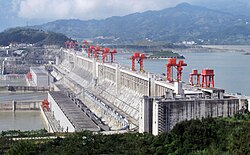
[edit]The largest power producers in the world are hydroelectric power stations, with some hydroelectric facilities capable of generating more than double the installed capacities of the current largest nuclear power stations.
Although no official definition exists for the capacity range of large hydroelectric power stations, facilities from over a few hundred megawatts are generally considered large hydroelectric facilities.[36]
Currently, only seven facilities over 10 GW (10,000 MW) are in operation worldwide, see table below.[37]
| Rank | Station | Country | Location | Capacity (MW) |
|---|---|---|---|---|
| 1. | Three Gorges Dam |  China China |
30°49′15″N 111°00′08″E / 30.82083°N 111.00222°E | 22,500 |
| 2. | Baihetan Dam | China |
27°13′23″N 102°54′11″E / 27.22306°N 102.90306°E | 16,000 |
| 3. | Itaipu Dam |  Brazil Brazil Paraguay Paraguay |
25°24′31″S 54°35′21″W / 25.40861°S 54.58917°W | 14,000 |
| 4. | Xiluodu Dam | China |
28°15′35″N 103°38′58″E / 28.25972°N 103.64944°E | 13,860 |
| 5. | Belo Monte Dam | Brazil |
03°06′57″S 51°47′45″W / 3.11583°S 51.79583°W | 11,233 |
| 6. | Guri Dam |  Venezuela Venezuela |
07°45′59″N 62°59′57″W / 7.76639°N 62.99917°W | 10,235 |
| 7. | Wudongde Dam | China |
26°20′2″N 102°37′48″E / 26.33389°N 102.63000°E | 10,200 |

Small
[edit]Small hydro is hydroelectric power on a scale serving a small community or industrial plant. The definition of a small hydro project varies but a generating capacity of up to 10 megawatts (MW) is generally accepted as the upper limit. This may be stretched to 25 MW and 30 MW in Canada and the United States.[39][40]


Small hydro stations may be connected to conventional electrical distribution networks as a source of low-cost renewable energy. Alternatively, small hydro projects may be built in isolated areas that would be uneconomic to serve from a grid, or in areas where there is no national electrical distribution network. Since small hydro projects usually have minimal reservoirs and civil construction work, they are seen as having a relatively low environmental impact compared to large hydro. This decreased environmental impact depends strongly on the balance between stream flow and power production.[41][citation needed]
Micro
[edit]Micro hydro means hydroelectric power installations that typically produce up to 100 kW of power. These installations can provide power to an isolated home or small community, or are sometimes connected to electric power networks. There are many of these installations around the world, particularly in developing nations as they can provide an economical source of energy without purchase of fuel.[42] Micro hydro systems complement photovoltaic solar energy systems because in many areas water flow, and thus available hydro power, is highest in the winter when solar energy is at a minimum.
Pico
[edit]Pico hydro is hydroelectric power generation of under 5 kW. It is useful in small, remote communities that require only a small amount of electricity. For example, the 1.1 kW Intermediate Technology Development Group Pico Hydro Project in Kenya supplies 57 homes with very small electric loads (e.g., a couple of lights and a phone charger, or a small TV/radio).[43] Even smaller turbines of 200–300 W may power a few homes in a developing country with a drop of only 1 m (3 ft). A Pico-hydro setup is typically run-of-the-river, meaning that dams are not used, but rather pipes divert some of the flow, drop this down a gradient, and through the turbine before returning it to the stream.
Underground
[edit]An underground power station is generally used at large facilities and makes use of a large natural height difference between two waterways, such as a waterfall or mountain lake. A tunnel is constructed to take water from the high reservoir to the generating hall built in a cavern near the lowest point of the water tunnel and a horizontal tailrace taking water away to the lower outlet waterway.

Calculating available power
[edit]A simple formula for approximating electric power production at a hydroelectric station is:

where
- is power (in watts)
- (eta) is the coefficient of efficiency (a unitless, scalar coefficient, ranging from 0 for completely inefficient to 1 for completely efficient).
- (rho) is the density of water (~1000 kg/m3)
- is the volumetric flow rate (in m3/s)
- is the mass flow rate (in kg/s)
- (Delta h) is the change in height (in meters)
- is acceleration due to gravity (9.8 m/s2)


Efficiency is often higher (that is, closer to 1) with larger and more modern turbines. Annual electric energy production depends on the available water supply. In some installations, the water flow rate can vary by a factor of 10:1 over the course of a year.[44][citation needed]
Properties
[edit]Advantages
[edit]
Flexibility
[edit]Hydropower is a flexible source of electricity since stations can be ramped up and down very quickly to adapt to changing energy demands.[37] Hydro turbines have a start-up time of the order of a few minutes.[45] Although battery power is quicker its capacity is tiny compared to hydro.[2] It takes less than 10 minutes to bring most hydro units from cold start-up to full load; this is quicker than nuclear and almost all fossil fuel power.[46] Power generation can also be decreased quickly when there is a surplus power generation.[47] Hence the limited capacity of hydropower units is not generally used to produce base power except for vacating the flood pool or meeting downstream needs.[48] Instead, it can serve as backup for non-hydro generators.[47]
High value power
[edit]The major advantage of conventional hydroelectric dams with reservoirs is their ability to store water at low cost for dispatch later as high value clean electricity. In 2021, the IEA estimated that the "reservoirs of all existing conventional hydropower plants combined can store a total of 1,500 terawatt-hours (TWh) of electrical energy in one full cycle" which was "about 170 times more energy than the global fleet of pumped storage hydropower plants".[2] Battery storage capacity is not expected to overtake pumped storage during the 2020s.[2] When used as peak power to meet demand, hydroelectricity has a higher value than baseload power and a much higher value compared to intermittent energy sources such as wind and solar.
Hydroelectric stations have long economic lives, with some plants still in service after 50–100 years.[49] Operating labor cost is also usually low, as plants are automated and have few personnel on site during normal operation.
Where a dam serves multiple purposes, a hydroelectric station may be added with relatively low construction cost, providing a useful revenue stream to offset the costs of dam operation. It has been calculated that the sale of electricity from the Three Gorges Dam will cover the construction costs after 5 to 8 years of full generation.[50] However, some data shows that in most countries large hydropower dams will be too costly and take too long to build to deliver a positive risk adjusted return, unless appropriate risk management measures are put in place.[51]
Suitability for industrial applications
[edit]While many hydroelectric projects supply public electricity networks, some are created to serve specific industrial enterprises. Dedicated hydroelectric projects are often built to provide the substantial amounts of electricity needed for aluminium electrolytic plants, for example. The Grand Coulee Dam switched to support Alcoa aluminium in Bellingham, Washington, United States for American World War II airplanes before it was allowed to provide irrigation and power to citizens (in addition to aluminium power) after the war. In Suriname, the Brokopondo Reservoir was constructed to provide electricity for the Alcoa aluminium industry. New Zealand's Manapouri Power Station was constructed to supply electricity to the aluminium smelter at Tiwai Point.
Reduced CO2 emissions
[edit]Since hydroelectric dams do not use fuel, power generation does not produce carbon dioxide. While carbon dioxide is initially produced during construction of the project, and some methane is given off annually by reservoirs, hydro has one of the lowest lifecycle greenhouse gas emissions for electricity generation.[52] The low greenhouse gas impact of hydroelectricity is found especially in temperate climates. Greater greenhouse gas emission impacts are found in the tropical regions because the reservoirs of power stations in tropical regions produce a larger amount of methane than those in temperate areas.[53]
Like other non-fossil fuel sources, hydropower also has no emissions of sulfur dioxide, nitrogen oxides, or other particulates.
Other uses of the reservoir
[edit]Reservoirs created by hydroelectric schemes often provide facilities for water sports, and become tourist attractions themselves. In some countries, aquaculture in reservoirs is common. Multi-use dams installed for irrigation support agriculture with a relatively constant water supply. Large hydro dams can control floods, which would otherwise affect people living downstream of the project.[54] Managing dams which are also used for other purposes, such as irrigation, is complicated.[2]
Disadvantages
[edit]In 2021 the IEA called for "robust sustainability standards for all hydropower development with streamlined rules and regulations".[2]
Ecosystem damage and loss of land
[edit]
Large reservoirs associated with traditional hydroelectric power stations result in submersion of extensive areas upstream of the dams, sometimes destroying biologically rich and productive lowland and riverine valley forests, marshland and grasslands. Damming interrupts the flow of rivers and can harm local ecosystems, and building large dams and reservoirs often involves displacing people and wildlife.[37] The loss of land is often exacerbated by habitat fragmentation of surrounding areas caused by the reservoir.[55]
Hydroelectric projects can be disruptive to surrounding aquatic ecosystems both upstream and downstream of the plant site. Generation of hydroelectric power changes the downstream river environment. Water exiting a turbine usually contains very little suspended sediment, which can lead to scouring of river beds and loss of riverbanks.[56] The turbines also will kill large portions of the fauna passing through, for instance 70% of the eel passing a turbine will perish immediately.[57][58][59] Since turbine gates are often opened intermittently, rapid or even daily fluctuations in river flow are observed.[60]
Drought and water loss by evaporation
[edit]Drought and seasonal changes in rainfall can severely limit hydropower.[2] Water may also be lost by evaporation.[61]
Siltation and flow shortage
[edit]When water flows it has the ability to transport particles heavier than itself downstream. This has a negative effect on dams and subsequently their power stations, particularly those on rivers or within catchment areas with high siltation. Siltation can fill a reservoir and reduce its capacity to control floods along with causing additional horizontal pressure on the upstream portion of the dam. Eventually, some reservoirs can become full of sediment and useless or over-top during a flood and fail.[62][63]
Changes in the amount of river flow will correlate with the amount of energy produced by a dam. Lower river flows will reduce the amount of live storage in a reservoir therefore reducing the amount of water that can be used for hydroelectricity. The result of diminished river flow can be power shortages in areas that depend heavily on hydroelectric power. The risk of flow shortage may increase as a result of climate change.[64] One study from the Colorado River in the United States suggest that modest climate changes, such as an increase in temperature in 2 degree Celsius resulting in a 10% decline in precipitation, might reduce river run-off by up to 40%.[64] Brazil in particular is vulnerable due to its heavy reliance on hydroelectricity, as increasing temperatures, lower water flow and alterations in the rainfall regime, could reduce total energy production by 7% annually by the end of the century.[64]
Methane emissions (from reservoirs)
[edit]
Lower positive impacts are found in the tropical regions. In lowland rainforest areas, where inundation of a part of the forest is necessary, it has been noted that the reservoirs of power plants produce substantial amounts of methane.[65] This is due to plant material in flooded areas decaying in an anaerobic environment and forming methane, a greenhouse gas. According to the World Commission on Dams report,[66] where the reservoir is large compared to the generating capacity (less than 100 watts per square metre of surface area) and no clearing of the forests in the area was undertaken prior to impoundment of the reservoir, greenhouse gas emissions from the reservoir may be higher than those of a conventional oil-fired thermal generation plant.[67]
In boreal reservoirs of Canada and Northern Europe, however, greenhouse gas emissions are typically only 2% to 8% of any kind of conventional fossil-fuel thermal generation. A new class of underwater logging operation that targets drowned forests can mitigate the effect of forest decay.[68]
Relocation
[edit]Another disadvantage of hydroelectric dams is the need to relocate the people living where the reservoirs are planned. In 2000, the World Commission on Dams estimated that dams had physically displaced 40–80 million people worldwide.[69]
Failure risks
[edit]Because large conventional dammed-hydro facilities hold back large volumes of water, a failure due to poor construction, natural disasters or sabotage can be catastrophic to downriver settlements and infrastructure.
During Typhoon Nina in 1975 Banqiao Dam in Southern China failed when more than a year's worth of rain fell within 24 hours (see 1975 Banqiao Dam failure). The resulting flood resulted in the deaths of 26,000 people, and another 145,000 from epidemics. Millions were left homeless.[70]
The creation of a dam in a geologically inappropriate location may cause disasters such as 1963 disaster at Vajont Dam in Italy, where almost 2,000 people died.[71]
The Malpasset Dam failure in Fréjus on the French Riviera (Côte d'Azur), southern France, collapsed on December 2, 1959, killing 423 people in the resulting flood.[72]
Smaller dams and micro hydro facilities create less risk, but can form continuing hazards even after being decommissioned. For example, the small earthen embankment Kelly Barnes Dam failed in 1977, twenty years after its power station was decommissioned, causing 39 deaths.[73]
Comparison and interactions with other methods of power generation
[edit] | This section needs to be updated. The reason given is: solar panels on reservoirs, also Tasmania link. (January 2022) |
Hydroelectricity eliminates the flue gas emissions from fossil fuel combustion, including pollutants such as sulfur dioxide, nitric oxide, carbon monoxide, dust, and mercury in the coal. Hydroelectricity also avoids the hazards of coal mining and the indirect health effects of coal emissions. In 2021 the IEA said that government energy policy should "price in the value of the multiple public benefits provided by hydropower plants".[2]
Nuclear power
[edit]Nuclear power is relatively inflexible; although it can reduce its output reasonably quickly. Since the cost of nuclear power is dominated by its high infrastructure costs, the cost per unit energy goes up significantly with low production. Because of this, nuclear power is mostly used for baseload. By way of contrast, hydroelectricity can supply peak power at much lower cost. Hydroelectricity is thus often used to complement nuclear or other sources for load following. Country examples where they are paired in a close to 50/50 share include the electric grid in Switzerland, the Electricity sector in Sweden and to a lesser extent, Ukraine and the Electricity sector in Finland.[74]
Wind power
[edit]Wind power goes through predictable variation by season, but is intermittent on a daily basis. Maximum wind generation has little relationship to peak daily electricity consumption, the wind may peak at night when power is not needed or be still during the day when electrical demand is highest. Occasionally weather patterns can result in low wind for days or weeks at a time, a hydroelectric reservoir capable of storing weeks of output is useful to balance generation on the grid. Peak wind power can be offset by minimum hydropower and minimum wind can be offset with maximum hydropower. In this way the easily regulated character of hydroelectricity is used to compensate for the intermittent nature of wind power. Conversely, in some cases wind power can be used to spare water for later use in dry seasons.
An example of this is Norway's trading with Sweden, Denmark, the Netherlands, Germany and the UK.[75][76] Norway is 98% hydropower, while its flatland neighbors have wind power. In areas that do not have hydropower, pumped storage serves a similar role, but at a much higher cost and 20% lower efficiency.[77][citation needed]
Hydro power by country
[edit]

In 2022, hydro generated 4,289 TWh, 15% of total electricity and half of renewables. Of the world total, China (30%) produced the most, followed by Brazil (10%), Canada (9.2%), the United States (5.8%) and Russia (4.6%).[79]
Paraguay produces nearly all of its electricity from hydro and exports far more than it uses.[80] Larger plants tend to be built and operated by national governments, so most capacity (70%) is publicly owned, despite the fact that most plants (nearly 70%) are owned and operated by the private sector, as of 2021.[2]
The following table lists these data for each country:
- total generation from hydro in terawatt-hours,
- percent of that country's generation that was hydro,
- total hydro capacity in gigawatts,
- percent growth in hydro capacity, and
- the hydro capacity factor for that year.
Data are sourced from Ember dating to the year 2023 unless otherwise specified.[78] Only includes countries with more than 1 TWh of generation. Links for each location go to the relevant hydro power page, when available.
| Country | Gen (TWh) |
% gen. |
Cap. (GW) |
% cap. growth |
Cap. fac. |
|---|---|---|---|---|---|
| World | 4183.41 | 14.2 | 1267.90 | 0.6 | 38% |
| China |
1226.00 | 13.0 | 370.60 | 0.8 | 38% |
| Brazil |
428.65 | 60.4 | 109.90 | 0.1 | 50% |
 Canada Canada |
364.20 | 57.5 | 83.31 | 0.0 | 50% |
 United States United States |
233.96 | 5.5 | 86.66 | 0.0 | 31% |
 Russia Russia |
200.87 | 17.1 | 50.57 | -1.6 | 45% |
 India India |
149.17 | 7.6 | 47.33 | 0.2 | 36% |
 Norway Norway |
135.96 | 88.5 | 34.40 | 0.4 | 45% |
 Vietnam Vietnam |
80.90 | 29.3 | 22.64 | 0.5 | 41% |
 Japan Japan |
74.50 | 7.4 | 28.22 | 0.1 | 30% |
 Sweden Sweden |
66.07 | 39.7 | 16.40 | 0.0 | 46% |
| Venezuela (2022) |
65.68 | 77.6 | 16.81 | 0.0 | 45% |
 Turkey Turkey |
63.72 | 19.9 | 31.78 | 0.7 | 23% |
 Colombia Colombia |
54.24 | 62.5 | 13.21 | 5.3 | 47% |
 France France |
53.19 | 10.4 | 24.14 | -0.4 | 25% |
| Paraguay (2022) |
43.87 | 99.7 | 8.81 | 0.0 | 57% |
 Austria Austria |
39.79 | 59.4 | 14.71 | -1.4 | 31% |
 Switzerland Switzerland |
39.00 | 54.8 | 15.28 | 1.4 | 29% |
 Italy Italy |
37.94 | 14.5 | 18.85 | -0.4 | 23% |
 Pakistan Pakistan |
37.90 | 23.5 | 10.64 | 0.0 | 41% |
 Laos (2022) Laos (2022) |
33.40 | 72.7 | 9.65 | 7.7 | 40% |
 Malaysia Malaysia |
31.51 | 16.8 | 6.21 | 0.0 | 58% |
 Peru Peru |
31.51 | 52.6 | 5.50 | 0.0 | 65% |
 Argentina Argentina |
29.90 | 20.4 | 10.39 | 0.0 | 33% |
 Ecuador Ecuador |
26.61 | 76.4 | 5.19 | 0.0 | 59% |
 New Zealand New Zealand |
26.04 | 58.5 | 5.68 | 0.0 | 52% |
 Indonesia Indonesia |
24.59 | 7.0 | 6.78 | 1.3 | 41% |
 Chile Chile |
23.90 | 28.6 | 7.47 | 2.5 | 37% |
 Iran Iran |
22.65 | 5.9 | 11.68 | 1.6 | 22% |
 Mexico Mexico |
20.40 | 5.8 | 13.30 | 0.0 | 18% |
 Spain Spain |
20.01 | 7.4 | 16.81 | 0.0 | 14% |
 Germany Germany |
19.47 | 3.9 | 5.74 | 2.1 | 39% |
 Tajikistan (2022) Tajikistan (2022) |
18.66 | 89.4 | 5.76 | 0.3 | 37% |
 Romania Romania |
18.30 | 32.5 | 6.57 | 0.0 | 32% |
 Zambia (2022) Zambia (2022) |
17.09 | 87.8 | 3.17 | 17.0 | 62% |
 Mozambique (2022) Mozambique (2022) |
15.49 | 81.4 | 2.19 | 0.0 | 81% |
 Australia Australia |
15.26 | 5.6 | 8.44 | 9.5 | 21% |
 Finland Finland |
15.11 | 18.9 | 3.18 | 0.3 | 54% |
 Ethiopia (2022) Ethiopia (2022) |
14.75 | 95.7 | 4.82 | 18.4 | 35% |
 Iceland (2022) Iceland (2022) |
13.94 | 70.2 | 2.11 | 0.0 | 75% |
 Egypt Egypt |
13.82 | 6.3 | 2.83 | 0.0 | 56% |
 North Korea (2022) North Korea (2022) |
12.82 | 57.5 | 4.89 | 0.6 | 30% |
 Angola (2022) Angola (2022) |
12.64 | 74.6 | 3.73 | 0.0 | 39% |
 Serbia Serbia |
12.19 | 32.0 | 2.49 | 0.0 | 56% |
 Kyrgyzstan (2022) Kyrgyzstan (2022) |
11.90 | 85.9 | 2.78 | 0.0 | 49% |
 Ukraine (2022) Ukraine (2022) |
11.10 | 9.9 | 4.82 | 0.0 | 26% |
 DR Congo (2022) DR Congo (2022) |
11.00 | 99.6 | 2.93 | 12.3 | 43% |
 Sudan (2022) Sudan (2022) |
11.00 | 61.6 | 1.48 | 0.0 | 85% |
 Portugal Portugal |
10.98 | 24.5 | 8.19 | 0.0 | 15% |
 Georgia Georgia |
10.85 | 75.5 | 3.45 | 2.1 | 36% |
 Nepal (2022) Nepal (2022) |
9.67 | 98.5 | 2.20 | 11.7 | 50% |
 Myanmar Myanmar |
9.37 | 51.6 | 3.27 | 0.0 | 33% |
 Panama (2022) Panama (2022) |
9.24 | 69.2 | 1.84 | 1.7 | 57% |
 Philippines Philippines |
9.08 | 7.7 | 3.09 | 1.6 | 34% |
 Bhutan (2022) Bhutan (2022) |
9.00 | 100.0 | 2.33 | 0.0 | 44% |
 Kazakhstan Kazakhstan |
8.79 | 7.8 | 2.90 | 3.2 | 35% |
 Costa Rica Costa Rica |
8.45 | 70.5 | 2.37 | 1.7 | 41% |
 Nigeria Nigeria |
8.28 | 20.4 | 2.85 | 32.6 | 33% |
 Croatia Croatia |
7.87 | 46.5 | 2.21 | 0.0 | 41% |
 Ghana (2022) Ghana (2022) |
7.50 | 33.3 | 1.58 | 0.0 | 54% |
 Albania (2022) Albania (2022) |
6.96 | 99.4 | 2.49 | -0.8 | 32% |
 Thailand Thailand |
6.59 | 3.5 | 3.11 | 0.0 | 24% |
 Bosnia and Herzegovina Bosnia and Herzegovina |
6.37 | 37.4 | 1.84 | 0.0 | 40% |
 Zimbabwe (2022) Zimbabwe (2022) |
5.88 | 65.9 | 1.08 | 0.0 | 62% |
 United Kingdom United Kingdom |
5.19 | 1.8 | 2.19 | 0.0 | 27% |
 Sri Lanka (2022) Sri Lanka (2022) |
5.11 | 29.4 | 1.83 | 1.7 | 32% |
 Guatemala (2022) Guatemala (2022) |
5.08 | 38.6 | 1.57 | 0.0 | 37% |
 Cameroon (2022) Cameroon (2022) |
5.00 | 61.6 | 0.81 | 0.0 | 70% |
 Uzbekistan (2022) Uzbekistan (2022) |
4.97 | 6.7 | 2.23 | 8.8 | 25% |
 Slovenia Slovenia |
4.96 | 32.6 | 1.16 | -0.9 | 49% |
 Uganda (2022) Uganda (2022) |
4.81 | 89.2 | 1.03 | 2.0 | 53% |
 Slovakia Slovakia |
4.63 | 15.6 | 1.62 | 0.0 | 33% |
 Cambodia (2022) Cambodia (2022) |
4.00 | 45.4 | 1.68 | 26.3 | 27% |
 Honduras (2022) Honduras (2022) |
4.00 | 33.3 | 0.91 | 7.1 | 50% |
 Taiwan Taiwan |
3.96 | 1.4 | 2.10 | 0.0 | 22% |
 Greece Greece |
3.87 | 7.8 | 3.43 | 0.3 | 13% |
 Latvia Latvia |
3.80 | 60.8 | 1.57 | -1.3 | 28% |
 South Korea South Korea |
3.72 | 0.6 | 1.80 | -0.6 | 24% |
 Uruguay Uruguay |
3.62 | 27.4 | 1.54 | 0.0 | 27% |
 Ivory Coast (2022) Ivory Coast (2022) |
3.35 | 30.1 | 0.88 | 0.0 | 43% |
 Bulgaria Bulgaria |
3.11 | 7.8 | 2.53 | 0.0 | 14% |
 Tanzania (2022) Tanzania (2022) |
2.82 | 31.3 | 0.60 | 1.7 | 54% |
 Kenya Kenya |
2.70 | 22.1 | 0.86 | 0.0 | 36% |
 Iraq (2022) Iraq (2022) |
2.65 | 2.3 | 1.56 | 0.0 | 19% |
 Poland Poland |
2.38 | 1.4 | 0.98 | 0.0 | 28% |
 Czech Republic Czech Republic |
2.34 | 3.1 | 1.12 | 0.9 | 24% |
 Bolivia Bolivia |
2.31 | 19.0 | 0.74 | 0.0 | 36% |
 Montenegro Montenegro |
2.13 | 52.1 | 0.70 | 0.0 | 35% |
 Armenia (2022) Armenia (2022) |
2.00 | 22.8 | 1.35 | 0.0 | 17% |
 Guinea (2022) Guinea (2022) |
2.00 | 65.8 | 0.81 | 37.3 | 28% |
 South Africa South Africa |
1.69 | 0.7 | 0.75 | 0.0 | 26% |
 North Macedonia North Macedonia |
1.65 | 23.5 | 0.70 | 0.0 | 27% |
 El Salvador El Salvador |
1.62 | 21.8 | 0.57 | 0.0 | 32% |
 Azerbaijan (2022) Azerbaijan (2022) |
1.60 | 5.5 | 1.16 | 0.0 | 16% |
 Mali (2022) Mali (2022) |
1.40 | 37.3 | 0.46 | 43.8 | 35% |
 Malawi (2022) Malawi (2022) |
1.05 | 77.8 | 0.39 | 0.0 | 31% |
 Dominican Republic (2022) Dominican Republic (2022) |
1.00 | 4.6 | 0.62 | 0.0 | 18% |
Economics
[edit]![[icon]](https://en.wikipedia.org/wiki/File:Wiki_letter_w_cropped.svg) |
The weighted average cost of capital is a major factor.[2]
See also
[edit]


- Energy transition
- Hydraulic engineering
- International Hydropower Association
- International Rivers
- List of energy storage power plants
- List of hydroelectric power station failures
- List of largest power stations
- List of renewable energy topics by country and territory
- Lists of hydroelectric power stations
- Marine current power – electricity from sea currents
- National Hydropower Association (US)
References
[edit]- ^ "Global Electricity Review 2024". Ember. 2024-05-07. Retrieved 2024-09-02.
- ^ a b c d e f g h i j k l m n "Hydropower Special Market Report – Analysis". IEA. 30 June 2021. Retrieved 2022-01-30.
- ^ Renewables 2011 Global Status Report, page 25, Hydropower, REN21, published 2011, accessed 2016-02-19.
- ^ de Faria, Felipe A M; Jaramillo, Paulina; Sawakuchi, Henrique O; Richey, Jeffrey E; Barros, Nathan (2015-12-01). "Estimating greenhouse gas emissions from future Amazonian hydroelectric reservoirs". Environmental Research Letters. 10 (12). Bibcode:2015ERL....10l4019D. doi:10.1088/1748-9326/10/12/124019. ISSN 1748-9326.
- ^ Fearnside, Philip M. (1989-07-01). "Brazil's Balbina Dam: Environment versus the legacy of the Pharaohs in Amazonia". Environmental Management. 13 (4): 401–423. Bibcode:1989EnMan..13..401F. doi:10.1007/BF01867675. ISSN 1432-1009. S2CID 154405904.
- ^ Yardley, Jim (2007-11-19). "Chinese Dam Projects Criticized for Their Human Costs". The New York Times. ISSN 0362-4331. Archived from the original on April 21, 2023. Retrieved 2023-04-21.
- ^ a b December 2022, "Renewables 2022", IEA, Paris, license: CC BY 4.0.
- ^ "BP Statistical Review of World Energy 2019" (PDF). BP. Retrieved 28 March 2020.
- ^ "Large hydropower dams not sustainable in the developing world". BBC News. 5 November 2018. Retrieved 27 March 2020.
- ^ "Hydroelectricity". IEA – International Energy Agency. 28 April 2024.
- ^ One of the Oldest Hydroelectric Power Plants in Europa Built on Tesla's Principels, Explorations in the History of Machines and Mechanisms: Proceedings of HMM2012, Teun Koetsier and Marco Ceccarelli, 2012.
- ^ "The Early History of Water Power: From Medieval Mills to Water Hydroelectric Plants". Fuergy. Retrieved 2025-04-13.
- ^ Maxine Berg, The age of manufactures, 1700-1820: Industry, innovation and work in Britain (Routledge, 2005).
- ^ a b "History of Hydropower". U.S. Department of Energy.
- ^ a b "Hydroelectric Power". Water Encyclopedia.
- ^ Association for Industrial Archaeology (1987). Industrial archaeology review, Volumes 10-11. Oxford University Press. p. 187.
- ^ "Hydroelectric power - energy from falling water". Clara.net.
- ^ "International Exhibition of Hydropower and Tourism", Wikipedia, 2024-01-18, retrieved 2025-04-13
- ^ "Boulder Canyon Project Act" (PDF). December 21, 1928. Archived from the original (PDF) on June 13, 2011.
- ^ The Evolution of the Flood Control Act of 1936, Joseph L. Arnold, United States Army Corps of Engineers, 1988
- ^ "Hydropower". The Book of Knowledge. Vol. 9 (1945 ed.). p. 3220.
- ^ "Hoover Dam and Lake Mead". U.S. Bureau of Reclamation.
- ^ "Hydropower – Analysis". IEA. Retrieved 2022-01-30.
- ^ "Renewable Energy Essentials: Hydropower" (PDF). IEA.org. International Energy Agency. Archived from the original (PDF) on 2017-03-29. Retrieved 2017-01-16.
- ^ "Hydroelectricity - Renewable Energy Generation". www.electricityforum.com.
- ^ "Pumped Storage, Explained". Archived from the original on December 31, 2012.
- ^ "Run-of-the-River Hydropower Goes With the Flow". 31 January 2012.
- ^ "Energy Resources: Tidal power". www.darvill.clara.net.
- ^ "Conduit Projects: Energy Recovery from Public Water Systems". Canyon Industries, Inc. Retrieved 14 September 2013.
- ^ "Conduit Hydropower". National Hydropower Association. Archived from the original on 27 September 2013. Retrieved 14 September 2013.
- ^ "Capturing Untapped Potential: Small Hydro in Irrigation Canals". Hydro Review. 2017-10-01. Retrieved 2019-09-28.
- ^ Kuriqi & Jurasz 2022, pp. 505–506.
- ^ a b c Kuriqi & Jurasz 2022, p. 505.
- ^ Nelson, V.C. (2011). Introduction to Renewable Energy. Taylor & Francis. p. 246. ISBN 978-1-4398-3450-3. Retrieved 2024-04-27.
- ^ Kuriqi & Jurasz 2022, p. 506.
- ^ "These are the world's largest hydroelectric dams".
- ^ a b c Hemanth Kumar (March 2021). "World's biggest hydroelectric power plants". Retrieved 2022-02-05.
- ^ Pope, Gregory T. (December 1995), "The seven wonders of the modern world", Popular Mechanics, pp. 48–56
- ^ Renewables Global Status Report 2006 Update Archived July 18, 2011, at the Wayback Machine, REN21, published 2006
- ^ Renewables Global Status Report 2009 Update Archived July 18, 2011, at the Wayback Machine, REN21, published 2009
- ^ Turbulent (2018-12-08). "Pros & Cons of Mini Hydropower Plants". Turbulent. Retrieved 2025-04-13.
- ^ "Micro Hydro in the fight against poverty". Tve.org. Archived from the original on 2012-04-26. Retrieved 2012-07-22.
- ^ "Pico Hydro Power". T4cd.org. Archived from the original on 2009-07-31. Retrieved 2010-07-16.
- ^ Zmijewski, Nicholas; Wörman, Anders (2016). "Hydrograph variances over different timescales in hydropower production networks". Water Resources Research. 52 (8): 5829–5846. Bibcode:2016WRR....52.5829Z. doi:10.1002/2015WR017775. ISSN 1944-7973.
- ^ Robert A. Huggins (1 September 2010). Energy Storage. Springer. p. 60. ISBN 978-1-4419-1023-3.
- ^ "About 25% of U.S. power plants can start up within an hour - Today in Energy - U.S. Energy Information Administration (EIA)". www.eia.gov. Retrieved 2022-01-30.
- ^ a b Bent Sørensen (2004). Renewable Energy: Its Physics, Engineering, Use, Environmental Impacts, Economy, and Planning Aspects. Academic Press. pp. 556–. ISBN 978-0-12-656153-1.
- ^ Geological Survey (U.S.) (1980). Geological Survey Professional Paper. U.S. Government Printing Office. p. 10.
- ^ Hydropower – A Way of Becoming Independent of Fossil Energy? Archived 28 May 2008 at the Wayback Machine
- ^ "Beyond Three Gorges in China". Waterpowermagazine.com. 2007-01-10. Archived from the original on 2011-06-14.
- ^ Ansar, Atif; Flyvbjerg, Bent; Budzier, Alexander; Lunn, Daniel (March 2014). "Should We Build More Large Dams? The Actual Costs of Hydropower Megaproject Development". Energy Policy. 69: 43–56. arXiv:1409.0002. Bibcode:2014EnPol..69...43A. doi:10.1016/j.enpol.2013.10.069. S2CID 55722535. SSRN 2406852.
- ^ "2018 Hydropower Status Report: Sector Trends and Insights" (PDF). International Hydropower Association. 2018. p. 16. Retrieved 19 March 2022.
- ^ Wehrli, Bernhard (1 September 2011). "Climate science: Renewable but not carbon-free". Nature Geoscience. 4 (9): 585–586. Bibcode:2011NatGe...4..585W. doi:10.1038/ngeo1226.
- ^ Atkins, William (2003). "Hydroelectric Power". Water: Science and Issues. 2: 187–191.
- ^ Robbins, Paul (2007). "Hydropower". Encyclopedia of Environment and Society. 3.
- ^ "Sedimentation Problems with Dams". Internationalrivers.org. Archived from the original on 2010-10-01. Retrieved 2010-07-16.
- ^ "Loss of European silver eel passing a hydropower station | Request PDF".
- ^ "One in five fish dies from passing hydroelectric turbines".
- ^ "Another nail in the coffin for endangered eels". 26 August 2019.
- ^ Glowa, Sarah E.; Kneale, Andrea J.; Watkinson, Douglas A.; Ghamry, Haitham K.; Enders, Eva C.; Jardine, Timothy D. (10 February 2023). "Applying a 2D-Hydrodynamic Model to Estimate Fish Stranding Risk Downstream from a Hydropeaking Hydroelectric Station". Ecohydrology. E2530. doi:10.1002/eco.2530. hdl:10388/14866. S2CID 256818410.
- ^ John Macknick and others, A Review of Operational Water Consumption and Withdrawal Factors for Electricity Generating Technologies, National Renewable Energy Laboratory, Technical Report NREL/TP-6A20-50900.
- ^ Patrick James, H Chansen (1998). "Teaching Case Studies in Reservoir Siltation and Catchment Erosion" (PDF). Great Britain: TEMPUS Publications. pp. 265–275. Archived from the original (PDF) on 2009-09-02.
- ^ Șentürk, Fuat (1994). Hydraulics of dams and reservoirs (reference. ed.). Highlands Ranch, Colo.: Water Resources Publications. p. 375. ISBN 0-918334-80-2.
- ^ a b c Frauke Urban and Tom Mitchell 2011. Climate change, disasters and electricity generation Archived September 20, 2012, at the Wayback Machine. London: Overseas Development Institute and Institute of Development Studies
- ^ "Deliberate drowning of Brazil's rainforest is worsening climate change", Daniel Grossman 18 September 2019, New Scientist; retrieved 30 September 2020
- ^ "WCD Findal Report". Dams.org. 2000-11-16. Archived from the original on 2013-08-21.
- ^ Graham-Rowe, Duncan (24 February 2005). "Hydroelectric power's dirty secret revealed". NewScientist.com.
- ^ "'Rediscovered' Wood & The Triton Sawfish". Inhabitat. 2006-11-16.
- ^ "Briefing of World Commission on Dams". Internationalrivers.org. 2008-02-29. Archived from the original on 2008-09-13. Retrieved 2008-09-03.
- ^ "Typhoon Nina–Banqiao dam failure | 1975 Banqiao Dam Disaster, Chinese History | Britannica". www.britannica.com. Retrieved 2025-04-13.
- ^ References may be found in the list of Dam failures.
- ^ Bruel, Frank. "La catastrophe de Malpasset en 1959". Retrieved 2 September 2015.
- ^ Toccoa Flood USGS Historical Site, retrieved 02sep2009
- ^ "Finland - Countries & Regions". IEA. Retrieved 2025-04-13.
- ^ "Norway is Europe's cheapest 'battery'". SINTEF. 18 December 2014.
- ^ "Germany and Norway commission NordLink power cable". Power Technology. 2021-05-28. Retrieved 2022-01-29.
- ^ "Pumped Storage Hydropower". Energy.gov. Retrieved 2025-04-13.
- ^ a b c "Yearly electricity data". ember-climate.org. 6 Dec 2023. Retrieved 20 August 2024.
- ^ "Global Use of Hydroelectricity | EARTH 104: Earth and the Environment (Development)". www.e-education.psu.edu. Retrieved 2025-04-13.
- ^ "Paraguay: a significant electricity exporter, but citizens suffer outages". Dialogo China. 14 Jun 2022. Retrieved 30 Dec 2023.
Sources
[edit]- Kuriqi, Alban; Jurasz, Jakub (2022). "Small hydropower plants proliferation and fluvial ecosystem conservation nexus". Complementarity of Variable Renewable Energy Sources. Elsevier. doi:10.1016/b978-0-323-85527-3.00027-3. ISBN 978-0-323-85527-3.
External links
[edit]
- Hydropower Reform Coalition
- Interactive demonstration on the effects of dams on rivers
- European Small Hydropower Association
- IEC TC 4: Hydraulic turbines (International Electrotechnical Commission - Technical Committee 4) IEC TC 4 portal with access to scope, documents and TC 4 website Archived 2015-04-27 at the Wayback Machine


| Hydroelectricity generation | | |
|---|---|---|
| Hydroelectricity equipment | ||
| |||||||||||||
| |||||||||||||
| |||||||||||||
| |||||||||||||
| |||||||||||||
| |||||||||||||
| |||||||||||||


| Principles | |
|---|---|
| Consumption |
|
| World population | |
| Technology | |
| Biodiversity | |
| Energy | |
| Food | |
| Water |
|
| Accountability | |
| Economic | |
| Applications |
|
| Sustainable management | |
| Agreements and conferences |
|

Hydroelectricity
View on GrokipediaHistory
Early Utilization and Technological Foundations
The utilization of water power originated in ancient civilizations for mechanical tasks such as grain milling and irrigation. In China, rotary water mills for grinding grain emerged around the 2nd century BC, paralleling developments in Europe where horizontal water wheels lifted water for irrigation.[11] Roman engineers employed vertical water wheels to power mills, as evidenced by descriptions in Vitruvius's De Architectura from the 1st century BC, harnessing the kinetic energy of flowing water to drive rotary motion via simple wheel and paddle mechanisms.[12] These early systems relied on overshot, undershot, or breastshot configurations, with efficiencies limited by wooden construction and rudimentary gearing, typically converting less than 20-30% of water's potential energy into useful mechanical work based on site-specific flow and head variations. Empirical improvements focused on optimizing blade angles and reducing friction, but mechanical power remained localized to mills and forges until the Industrial Revolution. In the 19th century, engineering advancements enabled more efficient turbines. French inventor Benoît Fourneyron developed the first practical outward-flow reaction turbine in 1827, a compact device producing approximately 6 horsepower by directing water radially across curved vanes, marking a shift from bulky water wheels to high-speed rotors suitable for greater heads and flows.[13] This design achieved higher rotational speeds and power density through enclosed flow paths, laying the groundwork for modern hydraulic machinery via iterative testing of prototypes.[14] The transition to electrical generation began in the late 19th century, coupling turbines with dynamos to produce usable current. The earliest documented hydroelectric setup powered a single lamp at Cragside House in England in 1878, using a water-driven dynamo for incandescent lighting.[13] In 1881, a turbine-equipped dynamo in a Niagara Falls flour mill supplied direct current (DC) to illuminate nearby streetlights, demonstrating initial scalability for urban applications.[15] Culminating this foundational phase, the Niagara Falls power station opened in 1895 as the world's first large-scale alternating current (AC) hydroelectric facility, transmitting power over 20 miles via high-voltage lines, which resolved DC's transmission limitations through Tesla's polyphase system and enabled broader grid integration.[16] These developments underscored causal dependencies on head, flow rate, and generator efficiency, prioritizing sites with substantial hydraulic drop for viable output.Expansion in the Industrial Era
The development of hydroelectric power accelerated in the late 19th century, coinciding with the Second Industrial Revolution and the demand for reliable electricity to support expanding factories and urban centers. The first commercial hydroelectric plant in the United States opened in Appleton, Wisconsin, in 1882, harnessing water from the Fox River to generate 12.5 kilowatts for a paper mill and local lighting.[15] This marked the transition from mechanical water wheels to electrical generation, with similar small-scale installations proliferating across North America and Europe by the 1890s. In Europe, hydraulic networks evolved into electrical systems, powering early industrial sites in regions like the Alps and northern England, where water abundance facilitated integration with manufacturing.[13] By 1900, hundreds of such plants operated worldwide, supplying electricity that supplanted steam engines in many applications due to its lower operational costs and higher efficiency.[17] A pivotal advancement occurred at Niagara Falls, where the Adams Power Plant began operations on August 26, 1895, producing 11,000 horsepower through alternating current generators designed by engineers including Nikola Tesla and George Westinghouse.[18] This facility enabled long-distance transmission of power—initially to Buffalo, New York, 32 kilometers away—demonstrating hydroelectricity's scalability for urban electrification and heavy industry, such as aluminum smelting by the Pittsburgh Reduction Company.[19] In North America and Europe, such projects spurred widespread adoption post-1880s, with hydroelectric capacity growing rapidly to meet electrification needs; by 1920, it accounted for 25% of U.S. electricity production, fueling economic expansion in manufacturing sectors reliant on consistent, low-cost energy.[20] This causal linkage is evident in the correlation between hydropower deployment from 1880 to 1930 and the electric power sector's dominance in regional development, as dams provided dispatchable energy that supported factory electrification without the fuel dependencies of coal or steam.[21] By the early 20th century, planners recognized hydroelectric dams' potential beyond power generation, incorporating flood control and navigation improvements. In the United States, the Tennessee Valley Authority (TVA), established in 1933, exemplified this multi-purpose approach, with initial planning in the late 1920s leading to dams designed for flood mitigation, river transport enhancement, and electricity production across seven states.[15] The TVA's framework integrated these functions to address regional vulnerabilities, such as recurrent Tennessee River flooding, while generating power for rural and industrial electrification, underscoring hydroelectricity's role in coordinated infrastructure for sustained economic resilience.[22]Major 20th-Century Projects and Global Spread
In the United States, the Hoover Dam, completed in 1936 with an initial generating capacity of 1,345 megawatts that was later expanded to 2,080 megawatts, exemplified New Deal-era public works investments aimed at economic recovery, flood control, irrigation, and reliable electricity supply for the southwestern states.[23] This project not only tamed the Colorado River but also provided long-term energy security, generating approximately 4 billion kilowatt-hours annually to support urban and industrial growth. Similarly, the Grand Coulee Dam on the Columbia River, finished in 1942 with a capacity of 6,809 megawatts, powered aluminum production critical to World War II efforts and enabled extensive irrigation in the Columbia Basin, transforming arid lands into productive farmland while bolstering national electrification.[24] The Soviet Union pursued ambitious hydroelectric developments as part of its industrialization drive under the GOELRO plan and five-year plans, with the Dnieper Hydroelectric Station, operational from 1932 at 560 megawatts—Europe's largest at the time—symbolizing rapid technological advancement before its destruction in 1941 and postwar reconstruction to 1,312 megawatts by 1979.[25] Post-World War II, the USSR expanded with projects like the Volga River cascade, including the Volga Hydroelectric Station, which contributed to centralized power grids supporting heavy industry and urban expansion across vast territories, reflecting state-directed resource mobilization for economic self-sufficiency.[26] Hydropower's global dissemination accelerated after 1945, driven by geopolitical imperatives for energy independence in emerging economies. In Latin America, the Itaipu Dam, shared between Brazil and Paraguay with first power in 1984 and full capacity of 14 gigawatts by 1991, became the world's largest hydroelectric facility at the time, supplying over 10% of Brazil's electricity and fostering binational cooperation amid regional development needs.[27] In China, the Gezhouba Dam on the Yangtze River, completed in 1981 with 2.715 gigawatts capacity, marked a significant step in harnessing domestic rivers for industrial power, generating 14.1 billion kilowatt-hours yearly and laying groundwork for national grid integration.[28] These feats, alongside similar initiatives in Africa and Asia, propelled worldwide installed capacity from under 100 gigawatts before 1950 to exceed 500 gigawatts by 1990, underscoring hydropower's role in state-led modernization despite environmental trade-offs.[13]Developments Since 2000
The Three Gorges Dam in China reached substantial completion in 2006, achieving an installed capacity of 22.5 GW and establishing itself as the world's largest hydroelectric power station at the time.[29] This mega-project exemplified the scale of post-2000 developments driven by rising energy demands in developing economies, facilitating large-scale industrial electrification and flood control while underscoring advancements in dam construction technology.[30] Global hydropower capacity additions averaged around 26 GW annually from 2000 to 2023, reflecting sustained investment amid growing electricity needs, though growth rates have shown variability influenced by regional policies and resource availability.[31] In 2024, additions totaled 24.6 GW, including 16.2 GW of conventional hydropower, with China contributing 14.4 GW—over half the global total—and solidifying Asia's dominance in new installations.[32] China's hydropower capacity reached approximately 435 GW by 2024, comprising nearly 30% of the worldwide total and enabling its leadership in integrating hydropower with expanding renewable portfolios.[33][34] Pumped-storage hydropower (PSH) experienced accelerated growth since 2000 to enhance grid stability and support intermittent renewables like wind and solar, with annual additions nearly doubling in recent years to a five-year average of 6 GW.[35] In 2024, PSH accounted for 8.4 GW of the global increase, highlighted by China's Fengning facility, which entered operation at 3.6 GW—the largest PSH plant worldwide—demonstrating technological refinements for energy arbitrage and peak demand management.[32][36] This trend underscores a shift toward flexible hydropower configurations to complement modern energy systems, particularly in high-growth regions.[37]Technical Principles
Fundamental Physics of Hydropower Generation
The fundamental physics of hydropower generation centers on the conversion of gravitational potential energy in elevated water masses to electrical energy via controlled flow and mechanical intermediaries. Water impounded at a height possesses potential energy quantified as , where is the mass of water, is the acceleration due to gravity, and is the vertical head or elevation difference between the water source and turbine inlet.[38] As water descends under gravity, this potential energy transforms into kinetic energy, which turbines extract to produce rotational mechanical power, subsequently driving synchronous generators to produce alternating current (AC) electricity.[39] The process exploits the invariant force of gravity and the density of water (), yielding predictable energy yields contingent on hydrological inflow rather than stochastic atmospheric variables like solar irradiance or wind speed.[40] The instantaneous electrical power output is derived from the rate of potential energy release, expressed as , where is the volumetric flow rate (), is the effective net head accounting for hydraulic losses (), and is the overall system efficiency encompassing turbine, generator, and conduit losses.[38] [41] This equation reflects first-principles conservation of energy, with theoretical power reduced by , which modern installations achieve at 85-90% due to optimized blade profiles and minimized friction.[42] [43] Deviations arise from viscous dissipation, cavitation, and mechanical inefficiencies, but the causal chain remains direct: head dictates energy per unit mass, flow rate scales total power, and efficiency bounds realizable output.[44] Turbine selection optimizes energy extraction across head regimes, as impulse and reaction designs align with specific hydraulic conditions. Pelton wheels, impulse turbines employing high-velocity jets against cupped buckets, suit high-head sites (>300 m, up to 1600 m), maximizing momentum transfer for heads where flow is pressurized.[45] Francis turbines, mixed-flow reaction types, dominate medium-head applications (10-300 m), with radial inflow transitioning to axial for balanced pressure and velocity gradients.[45] Kaplan turbines, axial-flow variants with adjustable blades, excel in low-head scenarios (2-70 m), akin to propellers, to accommodate variable flows while minimizing stall.[45] [46] These configurations ensure near-reversible flow paths, approaching thermodynamic limits per Euler's turbomachinery equation. Downstream, synchronous generators convert mechanical torque to AC electrical power, requiring precise synchronization to the grid's frequency (typically 50 or 60 Hz), phase sequence, and voltage magnitude to avoid destructive currents.[47] Governors modulate turbine speed via wicket gates to match grid frequency, while automatic voltage regulators (AVRs) adjust excitation for voltage parity; phase alignment is verified via synchroscopes or lamps before breaker closure.[48] Once paralleled, the generator locks into grid phase via electromagnetic coupling, with real power controlled by prime mover input and reactive power by field excitation, enabling stable energy dispatch.[47] This integration underscores hydropower's grid-forming capability, rooted in the steady gravitational driver absent in weather-dependent renewables.[40]Site Assessment and Power Calculation
Flow duration curves, derived from streamflow gauge data maintained by agencies such as the United States Geological Survey (USGS), provide a cumulative frequency distribution of daily or instantaneous flows, enabling assessment of a site's hydrological reliability by showing the percentage of time specific discharge rates are equaled or exceeded over the record period.[49] These curves are constructed from unregulated flow records to represent natural variability, with statistics like the 50% exceedance flow (median) or 90% exceedance flow used to estimate dependable water availability for power generation, avoiding overestimation in low-flow periods.[50] For ungauged sites, regional regression models extrapolate flow-duration statistics from nearby gauged basins, incorporating basin characteristics such as drainage area and precipitation.[51] Gross head, the static vertical elevation difference between the upstream water surface and the downstream tailwater at the turbine inlet, is measured through topographic surveys or differential GPS, often yielding values from tens to hundreds of meters depending on terrain.[52] Net head subtracts hydraulic losses from gross head, including pipe friction (calculated via Darcy-Weisbach equation using pipe material, diameter, and length), entrance/exit losses, and bends, typically reducing effective head by 10-30% in practical installations.[53] For instance, a site with 100 m gross head and 20 m³/s mean flow from a duration curve (50% exceedance) might yield a net head of 75 m after 25% losses, estimating 12.4 MW potential at 85% turbine-generator efficiency using standard hydrological data integration.[54] Geographic Information Systems (GIS) integrate digital elevation models, land use, and soil data with hydrological models like SWAT to delineate watersheds, predict flow variability under climate scenarios, and simulate long-term siltation rates that could diminish reservoir storage and effective head by 1-2% annually in sediment-prone basins.[55] Siltation modeling employs empirical equations such as Universal Soil Loss Equation (USLE) within GIS frameworks to forecast trap efficiency and sediment yield, informing site viability by quantifying head loss over decades.[56] These tools prioritize sites with low variability (e.g., coefficient of variation <0.5 from modeled inflows) to ensure stable MW-scale output projections.[57]Types of Hydroelectric Systems
Conventional Impoundment Dams
Conventional impoundment dams form the core of reservoir-based hydroelectric systems, where a barrier is constructed across a river or valley to create an upstream reservoir for storing large volumes of water. This stored water is then released through turbines to generate electricity on demand, distinguishing these facilities from flow-dependent alternatives. Such systems dominate global hydroelectric infrastructure, underpinning the majority of installed capacity due to their ability to harness gravitational potential energy from accumulated water heads.[58] Dam construction in impoundment systems typically employs either embankment or concrete designs, selected based on site geology, material availability, and hydraulic requirements. Embankment dams, including earthfill variants made from compacted soil and rockfill types using quarried stone, rely on their mass and slope stability to resist water pressure and are suited to wide valleys with abundant fill materials. Concrete dams, by contrast, encompass gravity structures that depend on weight for stability, arch dams that transfer loads to abutments via curvature, and buttress designs that use reinforced supports to reduce material needs; these are preferred in narrower, rocky terrains where precise engineering can exploit natural features.[59][60] Operational flexibility arises from the reservoir's capacity for seasonal and diurnal water regulation, where excess inflows during wet periods—such as spring snowmelt or monsoons—are impounded to mitigate floods and replenish storage, enabling sustained generation during dry seasons or low-river-flow conditions. This storage facilitates peaking operations, wherein water releases are timed to match electricity demand spikes, achieving rapid ramp-up rates and high dispatchability that exceed the constraints of unregulated flows. Compared to run-of-river setups, impoundment dams empirically demonstrate superior controllability, as evidenced by their role in grid stabilization through adjustable output, though this requires ongoing management of reservoir levels to balance power production with downstream ecological flows.[58][61]Pumped-Storage Hydroelectricity
Pumped-storage hydroelectricity functions as a large-scale energy storage system by transferring water between two reservoirs at differing elevations using reversible turbines that operate as pumps or generators. During periods of excess electricity generation, typically from intermittent sources like wind or solar, surplus power drives pumps to elevate water from a lower reservoir to an upper one, converting electrical energy into potential energy stored in the elevated water mass. When electricity demand peaks or renewable output falls, water flows downhill through the same turbines to produce power, discharging into the lower reservoir. This closed-loop process enables rapid response times, often within minutes, making it suitable for frequency regulation and load balancing on electrical grids.[62][63] The round-trip efficiency of pumped-storage systems, defined as the ratio of energy output during generation to energy input during pumping, typically ranges from 70% to 80%, accounting for hydraulic, mechanical, and electrical losses in the reversible turbine-generator units. This efficiency supports its role in mitigating the variability of renewable energy integration by storing off-peak surplus and dispatching stored energy during high-demand periods, thereby enhancing grid stability and reducing reliance on fossil fuel peaker plants. Unlike conventional hydropower, which depends on natural inflow, pumped-storage decouples generation from river flows, prioritizing storage over net water consumption, though it requires significant terrain elevation differences—often 100 to 500 meters—for viability.[64][65][66] As of 2025, the global development pipeline for pumped-storage capacity stands at approximately 600 gigawatts within a broader hydropower pipeline exceeding 1,075 gigawatts, reflecting its growing importance for renewable-heavy grids. In the United States, the Bath County Pumped Storage Station in Virginia holds the largest operational capacity at 3,003 megawatts across six units, commissioned in 1985 and capable of storing up to 24,000 megawatt-hours. China leads in expansion, with over 89 gigawatts under construction as of 2023 and projections to surpass its 120-gigawatt target by 2030, potentially reaching 130 gigawatts, exemplified by the 3.6-gigawatt Fengning Station completed in 2024, which integrates with regional wind and solar resources. These facilities underscore pumped-storage's dispatchable nature, providing ancillary services like inertia and black-start capability essential for grid resilience amid rising variable renewable penetration.[35][67][68][69][70]
Run-of-the-River Installations
Run-of-the-river hydroelectric installations generate electricity by diverting a portion of a river's natural flow into a channel or penstock to drive turbines, with water returned to the main channel downstream after power extraction, featuring little to no storage reservoir.[7][71] These systems rely on diversion weirs—low structures that minimally impound water—to facilitate intake, thereby avoiding extensive flooding and sedimentation issues associated with larger dams.[7] The design minimizes land use and habitat alteration, making run-of-the-river suitable for rivers exhibiting consistent flow regimes and steep hydraulic gradients that provide adequate head for efficient turbine operation. However, output remains directly tied to instantaneous river discharge, exposing facilities to fluctuations from seasonal variations and prolonged dry spells; global hydropower generation fell 5% in 2023 due to droughts in major producing regions, with non-storage systems like run-of-the-river experiencing disproportionate impacts absent buffering reservoirs.[72] Environmental mitigation often includes fish ladders or passes integrated into weirs to enable upstream and downstream migration of aquatic species, though effectiveness varies by species and site-specific hydrology, and dewatered bypass reaches can still disrupt local ecosystems.[73][74] Despite lower overall ecological footprint compared to reservoir-based hydropower, run-of-the-river projects necessitate careful flow management to preserve downstream water quality and biodiversity.[75]Emerging and Specialized Variants
Tidal barrages capture energy from tidal inflows and outflows using dam-like structures with turbines. The Sihwa Lake Tidal Power Station in South Korea, commissioned in 2011, holds the record as the largest such facility at 254 MW capacity, producing 552.7 GWh annually through ten 25.4 MW inflow turbines.[76][77] Conduit hydropower generates electricity by installing turbines in existing pressurized pipes or open channels originally designed for water supply, irrigation, or wastewater, avoiding new impoundments. The U.S. Department of Energy estimates untapped potential exceeding 1 GW from such retrofits, with recent assessments identifying 1.4 GW feasible from ditches and conduits alone as of 2024.[78][79] Underground hydroelectric plants, housing turbines and generators in caverns, predominate in Norway where over 200 such facilities leverage mountainous topography to shorten headrace tunnels and reduce environmental surface disruption. These designs, comprising tunnels, shafts, and subsurface powerhouses, account for a substantial portion of Norway's 60 TWh annual hydropower output.[80][81] Marine hydrokinetics encompass devices extracting kinetic energy from ocean waves, currents, or tides without dams, remaining largely in prototype and trial phases. In July 2024, Ocean Energy USA deployed the first grid-scale wave energy converter at a U.S. Navy test site in Hawaii, marking a milestone after years of subscale testing.[82][83] Advancements in 2024-2025 include novel turbine configurations, such as high-head impulse designs achieving over 82% efficiency via computational fluid dynamics-optimized runners, and power injectors that boost performance in low-head or variable-flow conduits. These innovations target efficiency gains of 5-10% in retrofits while enhancing adaptability to fluctuating water resources.[84][85]Scale and Facility Classifications
Large-Scale Facilities
Large-scale hydroelectric facilities, defined as those with installed capacities exceeding 100 MW, dominate global hydropower generation due to their substantial output relative to smaller installations. These plants leverage vast reservoirs and high-head turbines to produce multi-gigawatt-scale power, enabling them to serve as cornerstones of national grids and support energy independence in countries with suitable topography. For instance, China's Three Gorges Dam, the world's largest by installed capacity at 22.5 GW, features 34 turbo-generators and a designed annual output of 88.2 TWh, contributing significantly to reducing reliance on coal-fired generation.[30][86] The Itaipu Dam, straddling Brazil and Paraguay with 14 GW capacity across 20 units of 700 MW each, exemplifies cross-border engineering feats that power large economies; it supplies nearly 90% of Paraguay's electricity and about 15% of Brazil's.[87][27] Such facilities achieve capacity factors typically between 40% and 60%, outperforming variable renewables like wind and solar in consistent baseload provision, though subject to hydrological variability.[88] Their scale demands extensive civil engineering, including dams spanning kilometers and reservoirs displacing millions of cubic meters of water, but yields outsized energy returns that underpin over 1,200 GW of global hydropower capacity as of 2024.[89]Small, Micro, and Pico Systems
Small hydroelectric systems are typically defined as installations with capacities under 10 MW, suitable for community or rural electrification where grid extension is uneconomical.[58] These systems often employ run-of-river designs, minimizing reservoir construction and associated land inundation compared to larger facilities. Micro hydroelectric systems range from 5 kW to 100 kW, powering off-grid homes, farms, or small clusters in remote areas by harnessing nearby streams or irrigation channels. Pico systems, under 5 kW, serve individual households or small enterprises, often using portable turbines in low-head flows without significant civil works.[90] In developing regions, small, micro, and pico systems have expanded to address electrification gaps, with global small hydro capacity reaching 79 GW by 2023, driven by untapped potential in areas lacking centralized grids.[91] For instance, programs in sub-Saharan Africa and Asia target rural access, fostering local economic activity through reliable power for irrigation, milling, and small industries.[92] In the United States, retrofitting non-powered dams—existing barriers without generation—advances distributed hydro, with 78 such projects in active development pipelines contributing to a 1.12 GW total capacity as of late 2024.[93] These systems exhibit a reduced environmental footprint relative to large dams, as they generally avoid extensive flooding and ecosystem disruption from reservoirs, though cumulative effects from multiple installations can impact aquatic habitats and sediment flow.[94] Scalability remains constrained by hydrological site specificity, requiring consistent water flow and suitable topography, which limits widespread deployment without geographic advantages.[95] Maintenance challenges in remote settings and regulatory hurdles for licensing further restrict expansion, despite their role in decentralized renewable energy.[96]Operational Characteristics
Dispatchability and Grid Integration
Hydroelectric power plants exhibit strong dispatchability, defined as the ability to adjust generation output rapidly in response to grid demands, owing to their mechanical simplicity and water-based energy storage. Conventional impoundment facilities can typically ramp from zero to full load in under 10 minutes, with ramp rates often reaching 10-30% of installed capacity per minute, enabling precise load following and peaking operations.[97][98] In contrast, coal-fired plants require 10-20 hours to reach 70% of capacity from a cold start, limiting their flexibility to slower baseload roles.[97][99] This inherent responsiveness stems from turbine designs that adjust water flow via gates and valves with minimal inertia delays, allowing hydroelectricity to causally underpin grid reliability where variable sources like wind and solar cannot provide on-demand power without extensive backups. Beyond ramping, hydroelectric facilities deliver critical ancillary services, including frequency regulation and black-start capabilities essential for grid restoration after outages. Governors on hydro turbines enable real-time output adjustments to maintain 50 or 60 Hz grid frequency, responding to imbalances in seconds via droop control mechanisms that modulate power based on detected deviations.[100] Black-start functionality permits plants to restart independently using on-site water reservoirs and minimal auxiliary power, energizing isolated grid segments without external supply—a role hydro fulfills in 37% of U.S. black-start resources due to its quick synchronization and voltage stabilization.[101] These attributes integrate hydro seamlessly into modern grids, compensating for renewable intermittency by providing inertial response and reserve margins. Empirical evidence underscores hydro's stabilizing role, as seen in California where facilities buffered severe droughts from 2000-2020 by sustaining 80% of average output levels, mitigating supply shortfalls and averting greater reliance on less flexible thermal generation.[102] During the 2021 drought, hydro's remaining capacity supported grid operations despite halved summer generation shares, demonstrating its value in maintaining balance amid hydrological variability.[103] This dispatchable nature positions hydroelectricity as a causal enabler of high-renewable penetration, where its stored potential energy allows deterministic output control absent in weather-dependent alternatives.Efficiency, Capacity Factors, and Maintenance
Hydroelectric power plants achieve conversion efficiencies of 80% to 95% of the potential energy in falling water to electrical output, surpassing most other generation technologies due to minimal thermodynamic losses in the hydroelectric process.[104][105] This range accounts for variations in turbine type (e.g., Francis or Pelton), generator performance (typically 95-99% efficient), and site-specific hydraulic conditions, with modern installations often exceeding 90%.[105][106] Capacity factors for hydroelectric facilities, representing the ratio of actual output to nameplate capacity over time, average 30-60% globally, reflecting dependence on hydrological cycles rather than continuous full-load operation.[72] In 2023, the worldwide net capacity factor stood at 39%, a decline of 2 percentage points from 2022, attributable to droughts and reduced precipitation in key regions like Europe and South America.[72] Run-of-river plants often exhibit lower factors (20-40%) due to flow variability, while reservoir-based systems can reach 50-60% with storage buffering seasonal inflows.[107] Operations and maintenance costs remain low at 1-2% of initial capital costs per year for large-scale plants, primarily involving inspections, lubrication, and minor repairs rather than fuel expenses.[108][109] Reservoir siltation poses a long-term challenge, as sediment accumulation reduces effective head height and storage volume by 0.1-2% annually in many basins, eroding efficiency through turbine abrasion and diminished water flow.[110][111] Periodic refurbishments, such as dredging, turbine runner replacements, and intake redesigns, mitigate these effects and extend plant lifespans to 50-100 years beyond initial design expectations of 40-50 years.[112][113]Benefits
Reliability as Baseload and Peaking Power
Hydroelectric facilities with reservoirs enable reliable baseload power generation by storing water to produce consistent electricity output regardless of short-term weather variations, as operators can regulate turbine flow based on demand.[107] This dispatchability stems from gravitational potential energy harnessed on command, allowing plants to maintain steady production for extended periods when inflows permit.[4] In 2024, global hydroelectric generation reached 4,578 terawatt-hours, a 10% increase from 2023 levels depressed by droughts, demonstrating recovery and sustained contribution to continuous supply.[89][5] For peaking power, hydroelectric systems offer rapid response times, ramping output from zero to full capacity in seconds to minutes, far outperforming fossil fuel alternatives in flexibility without fuel dependency. Reservoir-based plants achieve this by releasing stored water during demand spikes, providing ancillary services like frequency regulation essential for grid stability.[107] Unlike intermittent renewables such as wind and solar, which exhibit capacity factors of 25-40% with unpredictable variability requiring constant backups, hydro maintains higher operational uptime and controllability, often exceeding 90% plant availability when water is available.[114][115] This dual capability positions hydroelectricity as a cornerstone for grid reliability, quantifying superiority through metrics like average capacity factors of 40-50% for run-of-river and peaking facilities, adjustable via storage to match baseload needs.[116] Empirical data from regions with mature hydro infrastructure, such as Canada and Brazil, confirm its role in averting blackouts during peaks without relying on weather-dependent generation patterns.[117]Economic and Multi-Use Advantages
Multipurpose hydroelectric installations often integrate non-power functions such as irrigation, flood control, navigation, and recreation, which amplify their overall economic returns by generating additional revenue streams and societal benefits beyond electricity production. For instance, reservoirs enable controlled water releases for agricultural irrigation, supporting vast farmlands; in the United States, federal projects managed by the Bureau of Reclamation provide irrigation water to approximately 10 million acres of farmland, sustaining productivity in water-scarce regions of the West.[118] Similarly, flood control capabilities mitigate downstream damages, with dams absorbing peak flows to prevent economic losses from inundation, as demonstrated by systems that have historically reduced flood-related costs through storage and regulated discharge.[119] Navigation improvements from stabilized river levels facilitate commercial transport, lowering logistics expenses, while reservoirs attract tourism for boating, fishing, and other activities, yielding direct revenues from fees and indirect boosts to local economies.[120] The extended operational lifespan of hydroelectric facilities, typically ranging from 50 to 100 years with proper maintenance, allows high initial capital expenditures to be amortized over decades, enhancing long-term cost-effectiveness when combined with multi-use outputs.[7] This durability contrasts with shorter-lived alternatives, enabling sustained value from infrastructure investments without frequent rebuilds. In developing economies, such dams serve as infrastructure multipliers, spurring regional growth through integrated services like irrigation expansion and flood risk reduction, which correlate with increased agricultural output, population density, and sectoral employment in project vicinities.[121] Empirical analyses indicate these projects can double local population density over 50 years in some cases by fostering ancillary economic activities, though benefits depend on effective management and transmission infrastructure to distribute gains.[122]Lifecycle Emissions and Resource Efficiency
Lifecycle assessments of hydroelectric power plants reveal greenhouse gas emissions ranging from approximately 10 to 50 grams of CO2 equivalent per kilowatt-hour (g CO2eq/kWh), encompassing construction, operation, and decommissioning phases.[123] [124] These figures derive primarily from empirical studies aggregating data across diverse sites, with variations attributed to factors such as reservoir flooding of organic matter, which can elevate biogenic methane (CH4) and CO2 releases.[125] For large-scale facilities, median values often fall around 24 g CO2eq/kWh, while small hydropower systems may achieve lower rates near 21 g CO2eq/kWh due to reduced reservoir impacts.[123] Reservoir emissions, particularly methane from anaerobic decomposition of submerged vegetation, represent a debated component, with tropical dams showing higher fluxes—sometimes approaching levels seen in individual fossil fuel plants—though global aggregates remain far below coal's 400–1,000 g CO2eq/kWh.[126] [127] These biogenic gases peak within 3–5 years post-impoundment and decline over time, influenced by factors like latitude, reservoir age, and organic carbon inputs; boreal sites emit comparably to natural lakes, underscoring site-specific causality over blanket "zero-emission" characterizations.[126] [128] Empirical inventories confirm net lifecycle footprints orders of magnitude lower than fossil alternatives, even accounting for such dynamics.[124] In terms of resource efficiency, hydroelectricity demands no imported fuels, eliminating ongoing extraction, transport, and combustion waste streams associated with thermal generation.[2] Upfront material inputs—primarily concrete, steel, and aggregates for dams—yield high energy return on investment over operational lifespans exceeding 50–100 years, with minimal decommissioning residues due to durable infrastructure.[129] Water utilization leverages renewable hydrological cycles, with run-of-river systems exhibiting near-zero net consumption through downstream return flows, while reservoir evaporation averages 68 liters per kWh delivered but recirculates via precipitation without depleting finite stocks.[130] [131] This contrasts with non-renewable resource drains in fuel-based systems, positioning hydropower as resource-conserving when sited appropriately.Costs and Risks
Environmental Impacts
Hydroelectric dams cause habitat fragmentation by inundating upstream areas and creating barriers that divide riverine ecosystems, leading to biodiversity loss in affected regions. Large dams alter flow regimes and sediment transport, negatively impacting vertebrate species richness globally, with studies showing reduced community diversity downstream and in reservoirs. In tropical landscapes, rapid hydropower expansion has resulted in extensive habitat degradation, exacerbating threats to species like jaguars and tigers through loss of contiguous forested and riparian zones.[132][133][134] Fish passage barriers posed by dams significantly reduce migratory populations, particularly anadromous species such as salmon. In the Columbia River Basin, dams block over 40% of historical spawning and rearing habitat for salmon and steelhead, contributing to population declines through impeded upstream migration and higher mortality during downstream passage. On the U.S. West Coast, hydroelectric facilities interfere with salmon life cycles by altering river hydrology and creating entrainment risks at turbines, with cumulative survival rates notably lower for juveniles navigating multiple dams. Atlantic salmon face similar downstream losses exceeding typical natural mortality, as quantified by federal assessments.[135][136][137] Reservoirs trap sediments and associated nutrients, reducing downstream delivery and altering geomorphic processes in river deltas and estuaries. This sediment starvation leads to channel incision, loss of floodplain fertility, and degradation of coastal habitats, as observed in tropical systems where dammed rivers deliver far less material to estuaries compared to undammed counterparts. For instance, mega-dams in Asia have reduced sediment loads to deltas like the Mekong by over 12%, intensifying erosion and subsidence risks independent of sea-level rise.[138][139][140] In arid and semi-arid regions, large reservoirs experience substantial evaporative water losses, diminishing effective water availability for ecosystems and downstream uses. Annual evaporation can account for up to 15.8% of reservoir inflows in water-stressed areas, with some systems losing approximately 40% of stored volume to this process, exacerbating scarcity in basins reliant on hydroelectric impoundments.[141][142] Hydroelectric reservoirs emit greenhouse gases, primarily methane from anaerobic decomposition of submerged organic matter, with emissions varying by climate and reservoir age. Tropical reservoirs produce higher methane yields due to vegetation inundation, but global median lifecycle emissions for hydropower average 24 gCO₂eq/kWh, far below natural gas (490 gCO₂eq/kWh) or coal (820 gCO₂eq/kWh). Approximately 23% of reservoirs act as net carbon sinks, offsetting emissions through burial of organic carbon.[143][144][145]Social and Economic Drawbacks
The construction of large hydroelectric dams has frequently necessitated the involuntary relocation of substantial populations, imposing significant social disruptions. For instance, the Three Gorges Dam in China displaced over 1.3 million residents between 1992 and 2008, submerging 13 cities, 140 towns, and 1,350 villages, with many resettled to areas lacking adequate infrastructure or employment opportunities.[146] Globally, dam projects, predominantly hydroelectric, have displaced an estimated 80 million people since the mid-20th century, often resulting in loss of ancestral lands, heightened poverty, and social fragmentation among affected communities.[147] Cultural heritage losses compound these displacements, as reservoirs inundate archaeological sites, historical structures, and sacred places integral to indigenous and local identities. Examples include the Ilisu Dam in Turkey, which flooded the 10,000-year-old town of Hasankeyf, obliterating Mesopotamian-era ruins and displacing up to 78,000 people while erasing tangible links to ancient civilizations.[148] Similarly, underground remains and culturally significant buildings have been lost in various dam projects, with inadequate salvage efforts failing to preserve intangible heritage like traditional practices tied to submerged landscapes. Economic benefits from hydroelectricity often accrue unevenly, with local populations bearing disproportionate costs while national or urban centers reap energy and revenue gains. Displaced communities frequently experience diminished livelihoods, as flooded farmlands and fisheries preclude alternative economic activities, leading to persistent income disparities despite resettlement promises.[149] Opportunity costs arise from dedicating vast lands to reservoirs—equivalent to thousands of square kilometers per major project—that could otherwise support agriculture, forestry, or other revenue-generating uses, exacerbating regional underdevelopment in rural areas.[150] Hydrological variability introduces economic vulnerabilities, as droughts can sharply reduce output, necessitating costly reliance on fossil fuel backups and inflating energy prices. In 2023, global hydroelectric generation declined by approximately 5% due to widespread droughts, particularly in China, contributing to a record shortfall that accounted for 40% of the year's rise in energy-related emissions as alternative sources filled the gap.[72] This intermittency, driven by climate patterns rather than dam design alone, underscores the risk of supply instability, with affected nations facing higher operational expenses and potential blackouts during low-water periods.[151]Operational and Safety Hazards
Hydroelectric dams face rare but potentially catastrophic structural failures, primarily due to overtopping from extreme floods or foundation weaknesses. The 1975 Banqiao Dam failure in China, triggered by Typhoon Nina's unprecedented rainfall, exemplifies such high-consequence events, resulting in an estimated 26,000 direct deaths from flooding and over 100,000 additional fatalities from subsequent famine and disease.[152] This incident, which also caused the failure of 61 downstream dams, highlighted vulnerabilities in early designs lacking adequate spillway capacity and instrumentation. Modern engineering standards, including rigorous probabilistic risk assessments and seismic reinforcements, have substantially reduced failure probabilities; for instance, U.S. data indicate a historical failure rate of approximately 0.00045 per dam-year across millions of dam-years of operation.[153] Globally, large dam failure rates stand at about 0.136% as of 2023, with most incidents involving smaller, older structures rather than contemporary hydroelectric facilities.[154] Sedimentation poses a chronic operational hazard by progressively filling reservoirs with silt, eroding storage volume and hydraulic head, which diminishes power output and shortens facility lifespan. This process traps upstream sediments, reducing effective capacity by up to 1-2% annually in heavily silt-laden rivers, potentially cutting projected lifespans from decades to years for affected sites.[110] For roughly 50% of dams worldwide, siltation can reduce operational life by decades without mitigation like upstream sediment traps or dredging, while also straining turbine efficiency through abrasive wear and elevating flood risks by impairing spillway functions.[155] Variable water availability, exacerbated by droughts, introduces operational vulnerabilities that can sharply curtail generation capacity. In 2023, global hydropower output declined notably due to prolonged dry conditions; China's production fell amid severe droughts in Yunnan province, while Mexico's federal hydroelectric generation dropped 43% year-over-year.[156] Such events underscore hydroelectricity's dependence on consistent inflows, with climate-amplified droughts challenging dispatchability and necessitating backup thermal generation, as observed in multiple regions including Brazil and the U.S. western states.[157] Reservoir-induced seismicity represents another debated hazard, where fluctuating water loads can trigger earthquakes in tectonically stressed areas by altering pore pressures in underlying faults. Notable examples include the 1967 M6.3 Koyna earthquake in India, linked to rapid reservoir filling, though such events typically advance pre-existing seismic activity without exceeding natural magnitudes.[158] Risks are mitigated through site-specific monitoring and gradual impoundment, but debates persist over long-term cumulative effects in high-seismicity zones like the Himalayas, where cascading failures could amplify impacts.[159] Empirically, hydroelectricity's safety record per unit energy produced remains superior to coal mining, with death rates around 0.02-1.3 per TWh (varying by inclusion of historical outliers like Banqiao) compared to coal's 24-32 per TWh from accidents and pollution.[160] Local hazards, however, demand vigilant maintenance and risk assessment to prevent rare but severe incidents.[161]Comparisons with Alternative Energy Sources
Versus Fossil Fuels
Hydroelectricity offers dispatchable power generation comparable to fossil fuel plants, enabling rapid response to grid demand fluctuations through reservoir control, without reliance on continuous fuel combustion or supply chains vulnerable to disruptions.[162][114] In contrast, coal and natural gas plants, while also dispatchable, depend on fuel extraction, transportation, and delivery, which can introduce operational risks from supply shortages or price volatility.[163] Lifecycle greenhouse gas emissions from hydroelectricity are substantially lower than those from fossil fuels, with medians of 24 gCO₂-eq/kWh for hydro versus 820 gCO₂-eq/kWh for coal and 490 gCO₂-eq/kWh for natural gas combined cycle plants, according to IPCC and UNECE assessments.[164][165] This disparity extends to air quality impacts, as fossil fuel combustion contributes to ambient particulate matter and other pollutants linked to an estimated 5.13 million excess deaths annually worldwide, primarily from coal and oil sources.[166] Hydroelectric facilities, by avoiding such emissions, eliminate these health costs associated with fossil fuel pollution. Hydroelectricity promotes fuel independence by harnessing local water resources, reducing exposure to geopolitical tensions over fossil fuel imports that affect many nations' energy security.[163] Fossil-dependent systems, conversely, tie electricity production to global commodity markets, as seen in supply disruptions from conflicts or sanctions. Deployment of hydropower has enabled direct displacement of fossil fuels in electricity mixes, with studies showing near one-to-one substitution in OECD countries, maintaining grid stability without increased blackout risks.[167] In lifecycle resource terms, hydroelectricity's high evaporative water consumption—often tens of cubic meters per MWh from reservoirs—remains localized to the project site, contrasting with fossil fuels' dispersed global impacts from fuel mining and processing, including extensive land scarring from coal extraction.[168] While coal plants require significant cooling water withdrawals (up to 19,000 gallons per MWh in some U.S. cases), their operational footprint includes upstream water use in mining that contributes to broader environmental degradation.[169] This localized versus distributed burden underscores hydro's advantage in containing certain resource externalities.Versus Nuclear Power
Both hydroelectricity and nuclear power serve as reliable baseload electricity sources, capable of continuous operation with high capacity factors exceeding 50% on average. Hydroelectric plants offer greater dispatchability, enabling rapid ramping for peaking demands—typically within minutes—due to their reliance on stored water reservoirs, whereas nuclear reactors provide steady, non-intermittent output but require longer shutdowns for refueling and maintenance, often every 12-24 months. However, hydroelectricity is geographically constrained to regions with adequate precipitation, river flow, and topography suitable for dams, limiting deployment, while nuclear power plants can be sited more flexibly with access to cooling water and transportation for fuel, though they depend on a secure uranium supply chain.[163] Lifecycle greenhouse gas emissions for both technologies remain low, with nuclear power averaging approximately 12 gCO₂-eq/kWh and hydroelectricity a median of 24 gCO₂-eq/kWh, though hydro emissions can vary significantly based on reservoir methane releases from organic decay in tropical climates. Construction timelines differ markedly: large hydroelectric dams typically require 5-10 years from groundbreaking to operation, as exemplified by the Hoover Dam's 4.5-year build in the 1930s, while modern nuclear plants average 6-8 years but frequently exceed 10 years due to regulatory approvals, safety engineering, and supply chain complexities. Capital costs per megawatt also favor hydro, ranging from $1.6-3 million/MW for conventional plants versus $6-9 million/MW for nuclear, reflecting hydro's simpler technology but site-specific engineering challenges.[164][170][171][172] Hydroelectric systems incur higher evaporative water losses—up to 18 gallons per kWh from reservoir surfaces—compared to nuclear plants' cooling processes, which withdraw large volumes but consume far less through recyclable systems or dry cooling options. Despite these differences, the technologies exhibit synergies in integrated grids, where nuclear provides firm baseload and hydro handles variability; in France, for instance, nuclear accounts for 69% of electricity while hydro contributes 13%, allowing hydro to balance seasonal nuclear maintenance and export demands effectively. This complementarity enhances overall system reliability without relying on fossil fuel backups.[173][174][175][176]Versus Intermittent Renewables
Hydroelectric power plants achieve average capacity factors of 40-60%, significantly higher than onshore wind at 25-35% or solar photovoltaic systems at 10-25%, due to their ability to store water in reservoirs and release it on demand for controllable generation.[177][151] In contrast, wind and solar output fluctuates unpredictably with weather conditions, often requiring curtailment during oversupply or backup during lulls, whereas hydro operators can adjust turbine flow independently of immediate meteorological variability, enabling precise matching to grid needs.[107][114] This dispatchability positions hydroelectricity as a natural complement to intermittent renewables, providing storage-equivalent flexibility through reservoirs or pumped-storage facilities that can absorb excess wind or solar generation and dispatch it later.[107] Empirical studies, such as those in California, demonstrate hydro's role in buffering intermittency by ramping up during low renewable output, reducing reliance on fossil fuel peakers and maintaining grid stability without equivalent battery-scale storage.[178] Unlike wind and solar, which cannot guarantee output beyond probabilistic forecasts tied to variable resource availability, hydro's causal reliability stems from hydrological management—seasonal inflows stored for year-round use—countering narratives that normalize intermittency as equivalent to firm power.[179] In 2024, global hydroelectric generation rebounded amid surging solar capacity additions, with pumped-storage expansions exceeding 600 GW in development pipelines, underscoring hydro's stabilizing function as intermittent sources like solar grew to comprise over 70% of new capacity in regions such as the United States.[180][181] This integration highlights hydro's empirical advantage in enabling higher penetrations of weather-dependent renewables, as seen in systems where hydro flexes to offset diurnal solar drops or multi-day wind droughts, preserving overall system inertia and frequency control absent in pure intermittent setups.[182][107]Global Production and Distribution
Current Capacity and Output Statistics
As of the end of 2024, global installed hydropower capacity reached approximately 1,450 GW, encompassing both conventional run-of-river and reservoir facilities as well as pumped storage hydropower (PSH).[183] This total reflects an addition of 24.6 GW during 2024, including 16.2 GW from new conventional capacity and 8.4 GW from PSH expansions.[184] Excluding PSH, conventional hydropower capacity stood at around 1,283 GW.[185] Global hydropower electricity generation rebounded to 4,578 TWh in 2024, a 10% increase from 2023 levels that had been constrained by widespread droughts affecting reservoir inflows.[35] This output equates to roughly 14-15% of worldwide electricity production, underscoring hydropower's role as the largest source of renewable electricity.[89] Average capacity factors for large-scale hydropower facilities hovered around 40-44% globally, influenced by seasonal water availability and operational variability.[186] Capacity growth has stabilized at 15-26 GW annually in recent years, with projections maintaining a similar pace through 2030 amid a pipeline exceeding 1,000 GW of planned projects, predominantly in Asia which holds over 60% of current installed capacity.[31] These additions have partially offset stagnation in mature regions, though long-term trends show a declining five-year rolling average due to permitting delays and environmental constraints.[187]Production by Major Countries
China leads global hydroelectric production, with installed capacity reaching 421 GW in 2024, representing nearly 30% of the worldwide total of approximately 1,443 GW.[188] This dominance stems from extensive development of large-scale projects on major river systems, including the Yangtze, enabled by state-driven infrastructure investments and favorable topography for high-head dams. In 2024, China added 14.4 GW of new capacity, accounting for the majority of global additions and underscoring its role in hydropower expansion amid rising energy demands.[189] [5] Brazil ranks second among major producers, generating around 427 TWh annually, which constitutes over 70% of its national electricity mix, supported by the Paraná River basin and binational projects like Itaipu Dam shared with Paraguay.[190] [36] Canada's hydroelectric output, approximately 398 TWh, supplies about 60% of its electricity, leveraging vast northern river networks and provincial developments in Quebec and British Columbia.[190] [191] The United States maintains around 80 GW of capacity, producing roughly 249 TWh, primarily from facilities in the Pacific Northwest and focusing on upgrades rather than new large builds due to environmental regulations and mature infrastructure.[190] Norway exemplifies high per capita production in Europe, with hydropower comprising over 88% of its electricity generation, totaling about 144 TWh from alpine reservoirs and fjord systems that enable efficient seasonal storage.[192] Russia and India follow as significant producers, with capacities contributing to global totals, while regions like Africa and parts of Asia hold substantial untapped potential due to underutilized river resources, though development lags behind due to financing and geopolitical challenges.[4]| Country | Approximate Annual Generation (TWh) | Installed Capacity (GW, approx.) | National Share (%) |
|---|---|---|---|
| China | 1,300+ | 421 | ~15-20 |
| Brazil | 427 | 110+ | 70+ |
| Canada | 398 | 81 | 60 |
| USA | 249 | 80 | 6 |
| Norway | 144 | 33+ | 88+ |