


Community hub
Recent from talks
Contribute something
Nothing was collected or created yet.
Heraklion
View on WikipediaHeraklion, Herakleion (/hɪˈrækliən/ hih-RAK-lee-ən; Greek: Ηράκλειο, Irákleio, pronounced [iˈrakli.o][4], not to be mistaken with Heracleion, Egypt) or Iraklion, is the largest city and the administrative capital of the island of Crete and capital of Heraklion regional unit. It is the fourth largest city in Greece, and the largest city in the Greek islands, with a municipal population of 179,302 (2021)[3] and 211,370 in its wider metropolitan area,[5] according to the 2011 census. The greater area of Heraklion has been continuously inhabited since at least 7000 BCE, making it one of the oldest inhabited regions in Europe. It is also home to the ancient Knossos Palace, a major center of the Minoan civilization dating back to approximately 2000-1350 BCE, often considered Europe's oldest city. The palace is one of the most significant archaeological sites in Greece, second only to the Parthenon in terms of visitor numbers.
Key Information


Heraklion was Europe's fastest growing tourism destination for 2017, according to Euromonitor, with an 11.2% growth in international arrivals.[6] According to the ranking, Heraklion was ranked as the 20th most visited region in Europe, as the 66th area on the planet and as the 2nd in Greece for the year 2017, with 3.2 million visitors[7] and the 19th in Europe for 2018, with 3.4 million visitors.[8]
Etymology
[edit]The name Herakleion (Ηράκλειον) is derived from an ancient port of Heracleium that served as the harbour for Knossos.[9][10] The port, bearing the same name, was named in honour of the hero Heracles (Hercules).[11] In antiquity, it was located about 20 stadia (approximately 3.7 kilometers) from Knossos.[12] Strabo also confirms the connection between the two.[13]
The site of the ancient port falls within the boundaries of the modern city, near today’s port area. Although ecclesiastical records do not list it as a bishopric, a bishop named Theodoros of Heracleopolis is mentioned at the Second Council of Nicaea.[14]
The name was revived in the 19th century and was in use by locals as early as 1867.[15]
Other names
[edit]1. In antiquity: The area that would later become the city of Heraklion served as the port for the ancient city of Knossos, one of the centers of the Minoan civilization. This strategic location facilitated trade and communication across the Mediterranean. Over time, as Knossos declined, the port area grew in significance, eventually becoming a prominent urban center.
2. Rabḍ al-ḫandaq (ربض الخندق): In 824 CE, Arab exiles from al-Andalus (Iberia) who conquered Crete and founded the Emirate of Crete moved the island's capital from Gortyna to a new castle they called rabḍ al-ḫandaq ("Castle of the Moat").[16]
3. Chándax (Χάνδαξ) / Chándakas (Χάνδακας): The Arabic name rabḍ al-ḫandaq was Hellenized to Χάνδαξ (Chándax) or Χάνδακας (Chándakas).
4. Candia: This name, derived from Chándax, was Latinized as Candia and adopted into other European languages: in Italian and Latin as Candia, in Spanish as Candía, in French as Candie, and in English as Candy. These names could refer to the island of Crete as a whole as well as to the city alone; the Ottoman name for the city was Kandiye.[17]
5. Megalo Kastro (Μεγάλο Κάστρο): After the Byzantine reconquest of Crete, the city was locally known as Megalo Kastro (Μεγάλο Κάστρο, 'Big Castle' in Greek) and its inhabitants were called Kastrinoi (Καστρινοί, "castle-dwellers").[18]
History
[edit]
Minoan era
[edit]Heraklion is home to the ruins of the palace of Knossos, located in the southern periphery of the city and part of the Heraklion municipality. In Minoan times, Knossos was the largest centre of population on Crete and is considered by many to be the oldest city in Europe.[20]
Knossos itself had a port at the site of Heraklion (in the modern area of Poros-Katsambas[21] neighborhood) from the beginning of the Early Minoan period (3500 to 2100 BC).
.JPG)
Antiquity
[edit]After the fall of the Minoans, Heraklion, as well as the rest of Crete in general, fared poorly, with very little development in the area. Only with the arrival of the Romans did some construction in the area begin, yet especially early into Byzantine times the area abounded with pirates and bandits.[22]
Emirate of Crete
[edit]Heraklion was chosen as capital in 824, with fortifications starting being built the following year, by the Moors under Abu Hafs Umar who had been expelled from Al-Andalus by Emir Al-Hakam I and had taken over the island from the Eastern Roman Empire.[citation needed] They built a moat around the city for protection, and named the city rabḍ al-ḫandaq (ربض الخندق, "Castle of the Moat", hellenized as Χάνδαξ, Chandax). It became the capital of the Emirate of Crete (c. 827–961). The Saracens allowed the port to be used as a safe haven for pirates who operated against Imperial (Byzantine) shipping and raided Imperial territory around the Aegean.[citation needed]
Byzantine era
[edit]In 960, Byzantine forces under the command of Nikephoros Phokas, later to become Emperor, landed in Crete and attacked the city. After a prolonged siege, the city fell in March 961. The Saracen inhabitants were slaughtered, the city looted and burned to the ground.[citation needed] Soon rebuilt, the town remained under Byzantine control for the next 243 years.[citation needed]
Venetian era
[edit]
In 1204, the city was bought by the Republic of Venice as part of a complicated political deal which involved, among other things, the Crusaders of the Fourth Crusade restoring the deposed Eastern Roman Emperor Isaac II Angelus to his throne. The Venetians improved on the ditch of the city by building enormous fortifications, most of which are still in place, including a giant wall, in places up to 40 metres (130 ft) thick, with seven bastions, and a fortress in the harbour. Chandax was renamed Candia and became the seat of the Duke of Candia, and the Venetian administrative district of Crete became known as "Regno di Candia" (Kingdom of Candia). The city retained the name of Candia for centuries and the same name was often used to refer to the whole island of Crete as well. To secure their rule, the Venetians began in 1212 to settle families from Venice on Crete. The coexistence of two different cultures and the stimulus of the Italian Renaissance led to a flourishing of letters and the arts in Candia and Crete in general, that is today known as the Cretan Renaissance.
Ottoman era
[edit]During the Cretan War (1645–1669), the Ottomans besieged the city for 21 years, from 1648 to 1669, the longest siege in history up until that time. In its final phase, which lasted for 22 months, 70,000 Turks, 38,000 Cretans and slaves and 29,088 of the city's Christian defenders perished.[23] The Ottoman army under an Albanian grand vizier, Köprülü Fazıl Ahmed Pasha conquered the city in 1669.

Under the Ottomans, Kandiye (Ottoman Turkish قنديه) was the capital of Crete (Girit Eyâleti) until 1849, when Chania (Hanya) became the capital, and Kandiye became a sancak.[24] In Greek, it was commonly called Megalo Castro (Μεγάλο Κάστρο 'Big Castle').
During the Ottoman period, the harbour silted up, so most shipping shifted to Chania in the west of the island.
Modern era
[edit]
An earthquake located off the northern coast of Crete on October 12, 1856, destroyed most of the over 3,600 homes in the city. Only 18 homes were left intact. The disaster claimed 538 victims in Heraklion.[25]
In 1898, the autonomous Cretan State was created, under Ottoman suzerainty, with Prince George of Greece as its High Commissioner and under international supervision. During the period of direct occupation of the island by the Great Powers (1898–1908), Candia was part of the British zone. At this time the ancient name of "Heraklion" was revived.
In 1913, with the rest of Crete, Heraklion was incorporated into the Kingdom of Greece. Heraklion was severely damaged in the bombing campaign in May 1941 during the German invasion in the Battle of Crete. The city remained under German rule until 1945. Heraklion again became capital of Crete in 1971, replacing Chania. The city, and Crete generally, became a major tourist destination from the 1980s onwards.[26]
Architecture, urban sculpture and fortifications
[edit]The oldest monument of architecture is the palace in Knossos on the outskirts of the city.
Two largest medieval churches in the city were the Dominican church of St. Peter (built between 1248 and 1253) and the San Salvatore, belonging to the Augustinian Friars. The latter one stood in Kornaros Square, but was demolished in 1970.[27]
Other monuments of architecture from Venetian times include the Saint Mark's Basilica and the Renaissance loggia next to Lions Square (1626–28).
Around the historic city center of Heraklion there are also a series of defensive walls, bastions and other fortifications which were built earlier in the Middle Ages, but were completely rebuilt by the Republic of Venice. The fortifications managed to withstand the longest siege in history for 21 years, before the city fell to the Ottomans in 1669. The Koules Fortress (Castello a Mare), the ramparts and the arsenal dominate the port area.
Many fountains of the Venetian era are preserved, such as the Bembo fountain, the Priuli fountain, Palmeti fountain, Sagredo fountain and Morosini fountain in Lions Square (1628).
Architecture from the 19th century is represented by the St Titus Cathedral, built in 1869 as the Yeni Cami ("New Mosque"), and the Agios Minas Cathedral (1862–95).
An example of modern architecture in Heraklion is the Heraklion Archaeological Museum built between 1937 and 1940 by architect Patroklos Karantinos.
Several sculptures, statues and busts commemorating significant events and figures of the city's and island's history, like El Greco, Vitsentzos Kornaros, Nikos Kazantzakis and Eleftherios Venizelos can be found around the city.
-
 Knossos Palace
 -
 Dominican church of St. Peter
 -

-
 Venetian Loggia
 -
 Morosini fountain in Lions Square
 -
 Venetian walls, Pantokratoras Gate
 -

-

-


.jpg)


Municipality
[edit]
The municipality Heraklion was formed at the 2011 local government reform by the merger of the following 5 former municipalities, that became municipal units:[28]
- Gorgolainis
- Heraklion
- Nea Alikarnassos
- Paliani
- Temenos
The municipality has an area of 244.613 km2, the municipal unit 109.026 km2.[29]
Neighborhoods
[edit]
| • Agia Ekaterini | • Dimokratias | • Marathitis |
| • Agia Erini Chrisovalantou | • Estavromenos | • Mastabas |
| • Agia Marina | • Filothei | • Mesabelies |
| • Agia Triada | • Fortetsa | • Mpentevi |
| • Agios Dimitrios | • Ilioupoli | • Nea Alatsata |
| • Agios Ioannis Chostos | • Kamaraki | • Pananio |
| • Agios Minas | • Kaminia | • Papatitou Metochi |
| • Agios Titos | • Katsampas | • Pateles |
| • Akadimia | • Kenouria Porta | • Poros |
| • Ampelokipoi | • Kipoupoli | • Therissos |
| • Analipsi | • Komeno Mpenteni | • Tris Vagies |
| • Atsalenio | • Korakovouni | • Xiropotamos |
| • Chanioporta | • Koroni Magara | |
| • Chrisopigi | • Knossos | |
| • Dilina | • Lido |
Suburbs
[edit].jpg)
| • Agia Erini | • Finikia | • Ksirokabos |
| • Agia Marina | • Gazi urban area | • Malades |
| • Agioi Theodoroi | • Giofyrakia | • Nea Alikarnassos urban area |
| • Agios Syllas | • Gournes Temenous | • Sillamos |
| • Ammoudara | • Kallithea | • Skafidaras |
| • Amnisos | • Karteros | • Skalani |
| • Ano Kalesia | • Kato Kalesia | • Vasilies |
| • Athanati | • Kavrochori | • Voutes |
| • Dafnes | • Kollyvas |
Transportation
[edit]Port
[edit]Heraklion is an important shipping port and ferry dock. Travellers can take ferries and boats from Heraklion to destinations including Santorini, Ios Island, Paros, Mykonos, and Rhodes. There are direct ferries to Naxos, Karpathos, Kasos, Sitia, Anafi, Chalki and Diafani.[30] There are also several daily ferries to Piraeus, the port of Athens in mainland Greece. The port of Heraklion was built by Sir Robert McAlpine and completed in 1928.[31]

Airport
[edit]
Heraklion International Airport, or Nikos Kazantzakis Airport is located about 5 kilometres (3 miles) east of the city. The airport is named after Heraklion native Nikos Kazantzakis, a writer and a philosopher. It is the second busiest airport of Greece after Athens International Airport, first in charter flights and the 59th busiest in Europe, because of Crete being a major holiday destination with 8,066,000 passengers in 2022 (List of the busiest airports in Europe).
The airfield is shared with the 126th Combat Group of the Hellenic Air Force.
Highway network
[edit]European route E75 runs through the city and connects Heraklion with the three other major cities of Crete: Agios Nikolaos, Chania, and Rethymno.
Public transit
[edit]
Urban buses serve the city, with 39 different routes.[32] Intercity buses connect Heraklion to many major destinations in Crete.[33]
Railway
[edit]From 1922 to 1937, a working industrial railway connected the Koules in Heraklion to Xiropotamos for the construction of the harbor.[34]
In the summer of 2007, at the Congress of Cretan emigrants held in Heraklion, two engineers, George Nathenas and Vassilis Economopoulos, recommended the development of a railway line in Crete, linking Chania, Rethymno, and Heraklion. No official plans exist for implementing this idea.[35]
Climate
[edit]Heraklion has a hot-summer Mediterranean climate (Csa in the Köppen climate classification). Summers are warm to hot and dry with clear skies. Dry hot days are often relieved by seasonal breezes. Winters are mild with moderate rain. Because Heraklion is further south than Athens, it has a warmer climate during winter but cooler during summer because of the Aegean Sea. The maximum temperature during the summer period is usually not more than 28 - 30 °C (Athens normal maximum temperature is about 5 °C higher). The minimum temperature record is -0.8 °C in the airport while in the port it has never dropped below 0 °C. Snowfalls are rare with the last significant snowfall with a measurable amount on the ground occurring in February 2004.[36] Heraklion falls in 11a hardiness zone.[37]
| Climate data for Heraklion Port 10 m a.s.l. (2007-2024) | |||||||||||||
|---|---|---|---|---|---|---|---|---|---|---|---|---|---|
| Month | Jan | Feb | Mar | Apr | May | Jun | Jul | Aug | Sep | Oct | Nov | Dec | Year |
| Record high °C (°F) | 29.7 (85.5) |
29.4 (84.9) |
26.4 (79.5) |
33.5 (92.3) |
38.3 (100.9) |
37.2 (99.0) |
36.6 (97.9) |
38.0 (100.4) |
37.3 (99.1) |
32.8 (91.0) |
31.7 (89.1) |
29.6 (85.3) |
38.3 (100.9) |
| Mean daily maximum °C (°F) | 15.7 (60.3) |
16.1 (61.0) |
17.2 (63.0) |
19.9 (67.8) |
23.1 (73.6) |
26.2 (79.2) |
28.3 (82.9) |
28.3 (82.9) |
26.4 (79.5) |
23.1 (73.6) |
20.8 (69.4) |
17.5 (63.5) |
21.9 (71.4) |
| Daily mean °C (°F) | 13.1 (55.6) |
13.5 (56.3) |
14.6 (58.3) |
17.2 (63.0) |
20.5 (68.9) |
24.1 (75.4) |
26.6 (79.9) |
26.7 (80.1) |
24.4 (75.9) |
20.9 (69.6) |
18.4 (65.1) |
15.0 (59.0) |
19.6 (67.3) |
| Mean daily minimum °C (°F) | 10.5 (50.9) |
10.8 (51.4) |
11.9 (53.4) |
14.5 (58.1) |
17.8 (64.0) |
21.9 (71.4) |
24.9 (76.8) |
25.1 (77.2) |
22.4 (72.3) |
18.7 (65.7) |
15.9 (60.6) |
12.5 (54.5) |
17.2 (63.0) |
| Record low °C (°F) | 1.4 (34.5) |
2.4 (36.3) |
3.4 (38.1) |
9.1 (48.4) |
12.9 (55.2) |
15.6 (60.1) |
19.9 (67.8) |
20.7 (69.3) |
15.8 (60.4) |
11.6 (52.9) |
9.3 (48.7) |
5.0 (41.0) |
1.4 (34.5) |
| Average rainfall mm (inches) | 61.7 (2.43) |
49.0 (1.93) |
31.4 (1.24) |
13.0 (0.51) |
12.8 (0.50) |
4.1 (0.16) |
0.2 (0.01) |
1.6 (0.06) |
15.2 (0.60) |
43.8 (1.72) |
32.4 (1.28) |
53.4 (2.10) |
318.6 (12.54) |
| Source 1: National Observatory of Athens Monthly Bulletins (May 2007 - Jan 2024) [37] | |||||||||||||
| Source 2: Heraklion Port N.O.A station [38] and World Meteorological Organization[39] | |||||||||||||
| Climate data for Heraklion 1955-2010 (HNMS) | |||||||||||||
|---|---|---|---|---|---|---|---|---|---|---|---|---|---|
| Month | Jan | Feb | Mar | Apr | May | Jun | Jul | Aug | Sep | Oct | Nov | Dec | Year |
| Record high °C (°F) | 29.9 (85.8) |
28.8 (83.8) |
34.0 (93.2) |
37.5 (99.5) |
38.0 (100.4) |
41.3 (106.3) |
43.6 (110.5) |
44.5 (112.1) |
39.5 (103.1) |
37.0 (98.6) |
32.8 (91.0) |
28.5 (83.3) |
44.5 (112.1) |
| Mean daily maximum °C (°F) | 15.3 (59.5) |
15.5 (59.9) |
17.0 (62.6) |
20.1 (68.2) |
23.6 (74.5) |
27.3 (81.1) |
28.9 (84.0) |
28.8 (83.8) |
26.6 (79.9) |
23.6 (74.5) |
20.2 (68.4) |
17.1 (62.8) |
22.0 (71.6) |
| Daily mean °C (°F) | 12.1 (53.8) |
12.2 (54.0) |
13.6 (56.5) |
16.6 (61.9) |
20.4 (68.7) |
24.5 (76.1) |
26.4 (79.5) |
26.3 (79.3) |
23.7 (74.7) |
20.3 (68.5) |
16.8 (62.2) |
13.8 (56.8) |
18.9 (66.0) |
| Mean daily minimum °C (°F) | 9.1 (48.4) |
8.9 (48.0) |
9.8 (49.6) |
12.0 (53.6) |
15.1 (59.2) |
19.2 (66.6) |
21.9 (71.4) |
22.0 (71.6) |
19.5 (67.1) |
16.7 (62.1) |
13.5 (56.3) |
10.9 (51.6) |
14.9 (58.8) |
| Record low °C (°F) | 0.0 (32.0) |
−0.8 (30.6) |
0.3 (32.5) |
4.2 (39.6) |
6.0 (42.8) |
12.2 (54.0) |
14.5 (58.1) |
16.6 (61.9) |
12.0 (53.6) |
8.7 (47.7) |
4.2 (39.6) |
2.4 (36.3) |
−0.8 (30.6) |
| Average rainfall mm (inches) | 91.0 (3.58) |
69.0 (2.72) |
53.4 (2.10) |
28.2 (1.11) |
13.4 (0.53) |
2.9 (0.11) |
0.8 (0.03) |
0.9 (0.04) |
16.7 (0.66) |
59.4 (2.34) |
59.6 (2.35) |
85.6 (3.37) |
480.9 (18.94) |
| Average precipitation days (≥ 1.0 mm) | 10.1 | 9.1 | 6.9 | 3.4 | 1.9 | 0.5 | 0.1 | 0.1 | 1.3 | 4.9 | 6.0 | 8.9 | 53.2 |
| Average rainy days | 16.0 | 13.6 | 11.4 | 7.6 | 4.6 | 1.3 | 0.3 | 0.5 | 2.8 | 7.5 | 10.6 | 15.2 | 91.4 |
| Average relative humidity (%) | 68.4 | 66.4 | 65.9 | 62.3 | 61.2 | 57.0 | 57.1 | 59.1 | 61.9 | 65.7 | 67.9 | 68.3 | 63.4 |
| Average dew point °C (°F) | 6.1 (43.0) |
6.0 (42.8) |
7.1 (44.8) |
8.9 (48.0) |
12.1 (53.8) |
14.9 (58.8) |
16.8 (62.2) |
17.0 (62.6) |
15.6 (60.1) |
13.2 (55.8) |
10.4 (50.7) |
7.8 (46.0) |
11.3 (52.4) |
| Mean monthly sunshine hours | 119.9 | 132.3 | 181.5 | 234.8 | 298.5 | 356.2 | 368.3 | 343.5 | 275.8 | 206.9 | 145.5 | 115.4 | 2,778.6 |
| Source 1: HNMS[40][41] | |||||||||||||
| Source 2: meteo-climat (extremes)[42] | |||||||||||||
| Climate data for Heraklion | |||||||||||||
|---|---|---|---|---|---|---|---|---|---|---|---|---|---|
| Month | Jan | Feb | Mar | Apr | May | Jun | Jul | Aug | Sep | Oct | Nov | Dec | Year |
| Mean number of days with thunder | 3.6 | 3.0 | 2.9 | 1.8 | 1.5 | 0.9 | 0.2 | 0.1 | 1.2 | 4.1 | 3.5 | 4.4 | 27.2 |
| Mean number of days with hail | 0.3 | 0.6 | 0.5 | 0.0 | 0.1 | 0.0 | 0.0 | 0.0 | 0.0 | 0.0 | 0.0 | 0.3 | 1.8 |
| Average sea temperature °C (°F) | 17.1 (62.8) |
16.4 (61.5) |
16.5 (61.7) |
17.1 (62.8) |
19.5 (67.1) |
23.0 (73.4) |
25.4 (77.7) |
26.1 (79.0) |
25.4 (77.7) |
23.3 (73.9) |
20.6 (69.1) |
18.4 (65.1) |
20.7 (69.3) |
| Mean daily daylight hours | 10.0 | 11.0 | 12.0 | 13.0 | 14.0 | 15.0 | 14.0 | 13.0 | 12.0 | 11.0 | 10.0 | 10.0 | 12.1 |
| Average Ultraviolet index | 3 | 4 | 5 | 7 | 9 | 10 | 11 | 10 | 8 | 5 | 3 | 2 | 6.4 |
| Source 1: NOAA (days with thunder and hail 1961-1990)[43] | |||||||||||||
| Source 2: Weather Atlas [44] | |||||||||||||

Educational and Research Institutions
[edit]Culture
[edit]
.jpg)


Museums
[edit]- Heraklion Archaeological Museum
- Cretaquarium
- Historical Museum of Crete
- Natural History Museum
- The Battle of Crete and National Resistance Museum
- Nikos Kazantzakis Museum
- Collection of Agia Aikaterini of Sinai
- Museum of Visual Arts
Arts
[edit]The Cultural and Conference Center of Heraklion is a centre for the performing arts.
Sports
[edit]The city is home to several sports clubs. Most notably, Heraklion hosts OFI and Ergotelis, two football clubs with earlier presence in the Greek Superleague, the top tier of the Greek football league system. Furthermore, the city is the headquarters of the Heraklion Football Clubs Association, which administers football in the entire region. Other notable sport clubs include Iraklio B.C. (basketball), Atsalenios (football) and Irodotos (football) in the suburbs of Atsalenio and Nea Alikarnassos respectively.
| Notable Sport clubs based in Heraklion | |||
|---|---|---|---|
| Club | Founded | Sports | Current Season |
| OFI | 1925 | Football, Basketball | Superleague, Greek C Basket League |
| Ergotelis | 1929 | Football, Basketball | Football League, Cretan Basket League |
| Iraklio | 1928 | Basketball | Cretan Basket League |
| Irodotos | 1932 | Football, Basketball | Football League, Cretan Basket League |
| Atsalenios | 1951 | Football | Gamma Ethniki |
Local TV stations
[edit]- Channel 4
- Creta Channel
- Kriti TV
- MyTV
Notable people
[edit].jpg)


Heraklion has been the home town of some of Greece's most significant people, including the novelist Nikos Kazantzakis (best known for Zorba the Greek), the poet and Nobel Prize winner Odysseas Elytis and the world-famous painter Domenicos Theotokopoulos (El Greco).
Literature
[edit]- Elli Alexiou (1894–1988) author
- Minás Dimákis (1913–1980) poet
- Odysseas Elytis (1911–1996) Nobel awarded poet
- Tess Fragoulis, Greek-Canadian author
- Rea Galanaki (born 1947) author
- Giritli Ali Aziz Efendi (1749–1798), author and diplomat
- Nikos Kazantzakis (1883–1957) author
- Menelaos Parlamas (1911–1997) author and scholar
- Pedro de Candia, (1485–1542) author and travel writer, recorded the Spanish Conquest of the Americas
- Stephanos Sahlikis (1330 – after 1391) poet
- Lili Zografou (1922–1998) author
Scientists and academia
[edit]- Nicholas Kalliakis (1645–1707) Greek Cretan scholar and philosopher[46]
- Niccolò Comneno Papadopoli (1655–1740) lawyer, historian and librarian
- Andreas Musalus (c. 1665 – c. 1721) Greek Cretan professor of mathematics, philosopher and architectural theorist[47]
- Francesco Barozzi (1537–1604) mathematician and astronomer
- Joseph Solomon Delmedigo (1591–1655) rabbi, author, physician, mathematician and musical theorist
- Fotis Kafatos biologist, President of the European Research Council
- Spyros Kokotos (1933–present) architect
- Marcus Musurus (Markos Mousouros) (1470–1517) scholar and philosopher
- Peter of Candia also known as Antipope Alexander V: philosopher and scholar
- Joseph Sifakis (1946–present) computer scientist, co-recipient of the 2007 Turing Award
- Michael N. Katehakis (1952–present) applied mathematician and operations researcher at Rutgers University
- Gerasimos Vlachos (1607–1685), scholar
- Simone Stratigo (c. 1733–1824), Greek mathematician and an Nautical science expert, whose family was from Heraklion (Candia)[48]
Painting and sculpture
[edit]- Theophanes (c. 1500–1559) painter of icons
- Michael Damaskinos (1530/35–1592/93) painter of icons
- Georgios Klontzas (1535–1608) painter
- El Greco (1541–1614) mannerist painter, sculptor and architect
- Yiannis Parmakelis (born 1932), sculptor
- Andreas Ritzos (1422–1492) painter of icons
- Aristidis Vlassis (1947–2015) painter
- Konstantinos Volanakis (1837–1907) painter
- George Sfougaras (born 1959) painter
Film industry
[edit]- Rika Diallina (born 1934), actress and model, Miss Hellas
- Ilya Livykou (1919–2002), actress
- Sapfo Notara (1907–1985), actress
- Yannis Smaragdis (born 1946), film director
Music
[edit]- Rena Kyriakou (1918–1994) pianist
- Francisco Leontaritis (Francesco Londarit) (1518–1572) composer
- Giannis Markopoulos (born 1939) composer
- Myron Michailidis (born 1968) conductor
- Manolis Rasoulis (1945–2011) lyrics writer
- Notis Sfakianakis (born 1959) singer
- Lena Platonos, pianist

Spirituality
[edit]- Maria Papapetros - psychic, spiritual healer, spiritual consultant
Sports
[edit]- Kyle Hamilton (born 2001), American football player[49]
- Nikos Machlas (born 1973), footballer
- Georgios Samaras (born 1985), footballer
- Greg Massialas (born 1956), American fencer
- Michalis Karlis (born 2003), basketball player
- Giorgos Giakoumakis (born 1994), footballer
Business
[edit]- Constantine Corniaktos (1517–1603) wine merchant and wealthiest man in the Eastern European city of Lviv[50]
- Gianna Angelopoulos-Daskalaki (born 1955) business woman, lawyer and politician
Politics and law
[edit]- Emin Ali Bedir Khan (1851–1926), Kurdish diplomat
- Leonidas Kyrkos (1924–2011), politician
- Aristidis Stergiadis (1861–1950) High Commissioner of Smyrna
- Georgios Voulgarakis (born 1959) conservative politician
- Romilos Kedikoglou (born 1940) President of the Court of Cassation of Greece
Clergy
[edit]- Maximos Margunios (1549–1602), bishop of Cyrigo (Kythira)
- Kyrillos Loukaris (1572–1637) theologian, Pope & Patriarch of Alexandria as Cyril III and Ecumenical Patriarch of Constantinople as Cyril I
- Meletius Pegas, Pope & Patriarch of Alexandria
- Theodore II (born 1954) Pope & Patriarch of Alexandria and all Africa
- Peter Phillarges (c. 1339–1410) (also Pietro Di Candia, later Pope Alexander V)
- Makarios Griniezakis (born 1973) Greek Orthodox Archbishop of the Holy Archdiocese of Australia
- Arsenios Kardamakis (born 1973) Greek Orthodox Metropolitan of Austria and Exarch of Hungary

Fashion
[edit]- Maria Spiridaki (1984) fashion model and television presenter
International relations
[edit] | This section needs additional citations for verification. (April 2017) |

Consulates
[edit]


Twin towns and sister cities
[edit]Heraklion is twinned with:


Location
[edit]
Gallery
[edit]-
 View of the port from the fortress
 -
 View of the port
 -
 The harbour
 -
 Α part of the Venetian harbour (used as shipyards)
 -
 The Phaistos Disk (2nd millennium BC) in Heraklion Archaeological Museum
 -
 Depiction of Candia, 1487
 -
 Idomeneas fountain
 -
 Jesus Gate, part of the Fortifications of Heraklion
 -
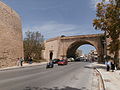 Chanioporta and Pantokratoras Gate
 -
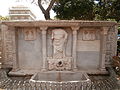 Bembo fountain
 -
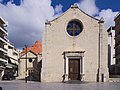 Saint Catherine Church
 -
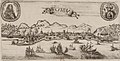 Depiction of the Siege of Candia
 -
 St. Matthew of the Sinaites Byzantine church
 -
 Theodoros Vardinogiannis Stadium, home ground of OFI FC
 -
 Interior of the Fortress
 -
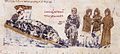 A monk shows the Saracens where to build Chandax
 -
 Map of Heraklion and its fortifications in 1651
 -
 Minoan fresco depicting a bull leaping scene, found in Knossos, 1600-1400 BC, Heraklion Archaeological Museum


.jpg)
See also
[edit]References
[edit]- ^ Municipality of Heraklion, Municipal elections – October 2023 Archived 2024-05-08 at the Wayback Machine, Ministry of Interior
- ^ "appsso.eurostat.ec.europa.eu". Archived from the original on 2020-12-20. Retrieved 2020-07-17.
- ^ a b "Αποτελέσματα Απογραφής Πληθυσμού - Κατοικιών 2021, Μόνιμος Πληθυσμός κατά οικισμό" [Results of the 2021 Population - Housing Census, Permanent population by settlement] (in Greek). Hellenic Statistical Authority. 29 March 2024.
- ^ "Pronunciation for Ηράκλειο". Archived from the original on 2019-03-31. Retrieved 2016-08-16.
- ^ "Population on 1 January by age groups and sex - functional urban areas". Eurostat. Archived from the original on 20 December 2020. Retrieved 1 June 2022.
- ^ "Top 100 City Destination Ranking 2017". Market Research Blog. 2017-01-26. Archived from the original on 2020-11-29. Retrieved 2019-04-01.
- ^ "Top 100 City Destinations Ranking: WTM London 2017 Edition". Market Research Blog. Archived from the original on 2019-04-01. Retrieved 2019-04-01.
- ^ Geerts, Wouter (2018). "Top 100 City Destinations 2018" (PDF). Euromonitor International. Archived (PDF) from the original on 2019-04-01. Retrieved 2019-04-01.
- ^ Richard Talbert, ed. (2000). Barrington Atlas of the Greek and Roman World. Princeton University Press. p. 60, and directory notes accompanying. ISBN 978-0-691-03169-9.
- ^ Lund University. Digital Atlas of the Roman Empire.
- ^ Stephanus of Byzantium. Ethnica. Vol. s.v.
- ^ Stadiasmus Maris Magni §§ 348–349.
- ^ Strabo. Geographica. Vol. x. pp. 476, 484. Page numbers refer to those of Isaac Casaubon's edition.
- ^ Cornel. Creta Sacr. vol. i. p. 254.
- ^ Howe, Samuel Gridley (1868). The Cretan refugees and their American helpers. Boston: Lee and Shepard. p. 33 – via archive.org.
- ^ Encyclopaedia of Islam, Second Edition, s.v. "Iḳrīṭish".
- ^ Sezen, Tahir (2017). Osmanlı Yer Adları [Ottoman Place Names] (in Turkish). Ankara: T.C. Başbakanlık Devlet Arşivleri Genel Müdürlüğü. p. 410. ISBN 978-975-19-3945-6.
- ^ Greene, Molly (2000). A Shared World: Christians and Muslims in the Early Modern Mediterranean. Princeton University Press. p. 41. ISBN 978-0-691-00898-1.
- ^ Whitelaw, Todd; Morgan, Catherine (November 2009). "Crete". Archaeological Reports. 55: 79. doi:10.1017/s0570608400001307. ISSN 0570-6084. S2CID 231735198.
- ^ Whitelaw, Todd (2000). "Beyond the palace: A century of investigation at Europe's oldest city". Bulletin of the Institute of Classical Studies: 223, 226.
- ^ Dimopoulou, N.; Wilson, D.E.; Day, P.M. (2007). "The Earlier Prepalatial Settlement of Poros-Katsambas: craft production and exchange at the harbour town of Knossos". In Day, P.M.; Doonan, R. (eds.). Metallurgy in the Early Bronze Age Aegean. Sheffield Studies in Aegean Archaeology. Oxbow Books. pp. 84–97. Archived from the original on 2023-04-20. Retrieved 2019-01-31.
- ^ "History of Heraklion in Crete island - Greeka.com". Greeka. Archived from the original on 12 February 2019. Retrieved 11 February 2019.
- ^ "The War for Candia". Archived from the original on 2016-03-04. Retrieved 2006-08-05.
- ^ Tahir Sezen, Osmanlı Yer Adları, Ankara 2017, T.C. Başbakanlık Devlet Arşivleri Genel Müdürlüğü Yayın No: 26 s.v., p. 410 Archived 2023-03-05 at the Wayback Machine
- ^ National Geophysical Data Center / World Data Service (NGDC/WDS) (1972), Significant Earthquake Database (Data Set), National Geophysical Data Center, NOAA, doi:10.7289/V5TD9V7K, archived from the original on 2023-02-27, retrieved 2022-06-05
- ^ "Heraklion". visit-ancient-greece.com. Archived from the original on 28 April 2019. Retrieved 2 September 2015.
- ^ Ilko, Krisztina (2021). "Recovering the Augustinian Convent of San Salvatore in Venetian Candia". Journal of Ecclesiastical History. 72 (2): 259–263. doi:10.1017/S0022046920000755. S2CID 228866606. Archived from the original on 21 November 2020. Retrieved 7 April 2021.
- ^ "ΦΕΚ A 87/2010, Kallikratis reform law text" (in Greek). Government Gazette. Archived from the original on 2010-07-18. Retrieved 2021-09-07.
- ^ "Population & housing census 2001 (incl. area and average elevation)" (PDF) (in Greek). National Statistical Service of Greece. Archived from the original (PDF) on 2015-09-21.
- ^ "Heraklion ferry, compare prices, times and book tickets". Archived from the original on 2017-09-25. Retrieved 2017-09-25.
- ^ "Sir Robert McAlpine". Grace's Guide. Archived from the original on 16 December 2019. Retrieved 16 December 2019.
- ^ "Iraklio urban buses". Archived from the original on 2015-02-24. Retrieved 2015-02-23.
- ^ "ΚΤΕΛ Ηρακλείου - Λασιθίου Κρήτης | Online Κράτηση εισιτηρίων για λεωφορεία - Δρομολόγια Λεωφορεία Κρήτης". Archived from the original on 2017-08-28. Retrieved 2017-08-27.
- ^ Tzikas, Polykarpos; Konstantinos, Mamalakis; Tertipis, Dimitrios; Charitopoulos, Evangelos. «Μέσα σταθερής τροχιάς στην Κρήτη: Δίκτυα βιομηχανικών σιδηροδρόμων κατά το πρώτο μισό του 20ου αιώνα». Proceedings of the 12th International Congress of Cretan Studies.
- ^ "No Plans for Crete Railway Project". Ekathimerini. 15 August 2021. Retrieved 2023-10-10.
- ^ "ΠΑΤΡΙΣ - ΑΡΧΕΙΟ ΗΛΕΚΤΡΟΝΙΚΗΣ ΕΚΔΟΣΗΣ". archive.patris.gr. Archived from the original on 2023-05-25. Retrieved 2023-05-25.
- ^ a b "Meteo.gr - Προγνώσεις καιρού για όλη την Ελλάδα". Archived from the original on 2023-02-02. Retrieved 2024-01-15.
- ^ "Latest Conditions in Heraklion Port". Archived from the original on 2024-01-08. Retrieved 2024-01-15.
- ^ "World Meteorological Organization". Archived from the original on 20 June 2023. Retrieved 14 July 2023.
- ^ "Climatic Data for selected stations in Greece: Heraklion (Crete)". Archived from the original on 26 September 2020. Retrieved 17 September 2019.
- ^ "Climate Atlas of Greece (for sunshine 1977-2002)". HNMS. Archived from the original on 9 July 2021. Retrieved 20 July 2021.
- ^ "STATION HERAKLION". meteo-climat. Retrieved December 2, 2018.
- ^ a b "World Meteorological Organization Climate Normals for 1961-1990: Iraklion" (TXT). ncei.noaa.gov. National Centers for Environmental Information. Archived from the original on 14 February 2024. Retrieved 15 April 2024.
WMO Station Number: 16754
- ^ "Heraklion, Greece - Monthly weather forecast and Climate data". Weather Atlas. Archived from the original on 27 January 2019. Retrieved 25 January 2019.
- ^ Lathrop C. Harper (1886). Catalogue / Harper (Lathrop C.) inc., New York, Issue 232. Lathrop C. Harper, Inc. p. 36. OCLC 11558801.
Calliachius (1645–1707) was born on Crete and went to Italy at an early age, where he soon became one of the outstanding teachers of Greek and Latin.
- ^ Rose, Hugh James; Rose, Henry John; Wright, Thomas (1857). A new general biographical dictionary, Volume 5. T. Fellowes. p. 425. OCLC 309809847.
CALLIACHI, (Nicholas,) a native of Candia, where he was born in 1645. He studied at Rome for ten years, at the end of which time he was made doctor of philosophy and theology. In 1666 he was invited to Venice, to take the chair of professor of the Greek and Latin languages, and of the Aristotelic philosophy; and in 1677 he was appointed professor of belles-lettres at Padua, where he died in 1707. His works on antiquities are valuable, and have been published by the marquis Poloni in the third volume of his Supplement to the Thesaurus Antiquitatum.
- ^ Convegno internazionale nuove idee e nuova arte nell '700 italiano, Roma, 19–23 maggio 1975. Accademia nazionale dei Lincei. 1977. p. 429. OCLC 4666566.
Nicolò Duodo riuniva alcuni pensatori ai quali Andrea Musalo, oriundo greco, professore di matematica e dilettante di architettura chiariva le nuove idée nella storia dell'arte.
- ^ Carlo Capra; Franco Della Peruta; Fernando Mazzocca (2002). Napoleone e la repubblica italiana: 1802–1805. Skira. p. 200. ISBN 978-88-8491-415-6.
Simone Stratico, nato a Zara nel 1733 da famiglia originaria di Creta (abbandonata a seguito della conquista turca del 1669)
- ^ "Notre Dame RB Mick Assaf: Mick's Mickstape Season 2 Volume 1".
- ^ I︠A︡roslav Dmytrovych Isai︠e︡vych (2006). Voluntary brotherhood: confraternities of laymen in early modern Ukraine. Canadian Institute of Ukrainian Studies Press. p. 47. ISBN 1-894865-03-0.
…the Greek merchants Constantine Korniakt and Manolis Arphanes Marinetos are added. This second redaction appeared no earlier than 1589, as wealthy Greeks began to join the confraternity at a later date, once it had expanded its activities. Korniakt was actually the wealthiest man in Lviv: he traded in Eastern, Western, and local goods, collected customs duty on behalf of the king, and owned a number of villages.
- ^ "Limassol Twinned Cities". Limassol (Lemesos) Municipality. Archived from the original on 2013-04-01. Retrieved 2013-07-29.
- ^ "Cu ce oraşe este înfrăţit municipiul Constanţa?". Ziua de Constanța. 7 April 2019. Archived from the original on 2019-04-08. Retrieved 2019-04-07.
- ^ "Twinnings" (PDF). Central Union of Municipalities & Communities of Greece. Archived from the original (PDF) on 2016-01-15. Retrieved 2013-08-25.
External links
[edit]

 Heraklion travel guide from Wikivoyage
- Municipality of Heraklion
- Heraklion information
- Heraklion - The Greek National Tourism Organization
- Vikelaia Library
- Old maps of Heraklion Archived 2022-03-16 at the Wayback Machine - Eran Laor Cartographic Collection, The National Library of Israel, in Historic Cities Archived 2022-03-25 at the Wayback Machine

Administrative division of the Crete Region | ||
|---|---|---|
| Regional unit of Chania |  | |
| Regional unit of Heraklion | ||
| Regional unit of Lasithi | ||
| Regional unit of Rethymno | ||
| ||
| International | |
|---|---|
| National | |
| Geographic | |
| Other | |

Heraklion
View on GrokipediaGeography
Location and Topography
Heraklion is positioned at 35°20′N 25°08′E along the north-central coast of Crete, Greece's largest island, bordering the Cretan Sea.[10] The city functions as the capital of the Heraklion regional unit and Crete as a whole, with its metropolitan area extending across a coastal plain that includes bays and is abutted by low-lying hills to the interior.[11] South of Heraklion stretches the Messara Plain, a basin spanning roughly 611 km² located approximately 50 km southward, bordered northward by the Psiloritis massif.[12] Mount Psiloritis, known anciently as Ida and standing at 2,456 meters as Crete's loftiest summit, rises prominently to the southwest, originating rivers like the Giofyros that drain toward the coast and defining the rugged highland topography.[11] Heraklion's placement within the Hellenic Arc subduction zone engenders pronounced seismic risk, evidenced by at least two earthquakes exceeding magnitude 6 in the regional unit since 1900.[13] The topography's fertile coastal sediments and sea access have underpinned enduring settlement, with archaeological strata at nearby Knossos documenting occupation from circa 7000 BCE onward.[14]Climate and Environmental Risks
Heraklion features a Mediterranean climate (Köppen Csa) with hot, dry summers and mild, rainy winters. Average daily high temperatures range from 15°C in January to 29°C in July and August, while lows vary from 9°C in winter to 22°C in summer; annual means hover around 18°C. Precipitation averages 500 mm yearly, with over 70% falling from October to March, often in intense bursts, and negligible rainfall during summer months.[15][16] The region faces elevated seismic hazards from the Hellenic Arc, a subduction zone where the African plate converges with the Eurasian plate at rates of 3-5 cm per year, generating frequent earthquakes. Crete records high microseismic activity, with events clustered along fault lines east of Heraklion at depths under 20 km; probabilistic assessments indicate peak ground accelerations up to 0.4g for 475-year return periods in the city. Historical ruptures include the magnitude 8.0 earthquake on July 21, 365 AD, which uplifted western Crete by up to 9 meters and triggered tsunamis devastating Alexandria, and the magnitude 7.7-8.3 event on May 16, 1856, that razed much of Heraklion, killing hundreds. Recent sequences, such as the 2021 Arkalochori swarm (mainshock magnitude 6.0 on September 27), underscore ongoing risks, with over 100 aftershocks exceeding magnitude 4.0 near the city.[17][18][19][20][21] Climate trends amplify drought and wildfire vulnerabilities, with meteorological data showing prolonged dry spells and rising temperatures since the 1950s. Standardized precipitation indices for Heraklion indicate increasingly severe droughts from 1955-2021, driven by reduced winter rains and higher evapotranspiration. Wildfires, fueled by summer aridity and vegetation dryness, have intensified; conditions enabling large blazes in Greece, including Crete, are now 10 times more probable due to 1.2°C global warming, exacerbating fuel loads from tourism-related land pressures. These hazards strain water resources, with annual deficits worsened by seasonal influxes of over 4 million visitors demanding irrigation and supply.[22][23][24]History
Prehistoric and Minoan Era
Archaeological evidence indicates Neolithic settlements in the vicinity of modern Heraklion dating to approximately 7000 BCE, with Knossos emerging as one of the earliest inhabited sites in the Aegean, featuring early pottery and evidence of arboricultural practices such as almond cultivation adapted to local resources.[25][26] Continuous occupation through the Final Neolithic (circa 3600–3000 BCE) transitioned into the Bronze Age, marked by increasing complexity in material culture including obsidian tools and domesticated animal remains, suggesting maritime contacts with the mainland.[27] The Minoan civilization peaked during the Middle and Late Bronze Age (circa 2000–1450 BCE), with the Knossos palace complex—initially constructed around 2000 BCE and rebuilt on a grander scale after earthquakes circa 1700 BCE—serving as a central hub near Heraklion. This multi-story structure, spanning over 20,000 square meters with more than 1,300 rooms, incorporated advanced hydraulic engineering, including terracotta pipes for water supply, sophisticated drainage systems to manage rainfall and sewage, and lustral basins for ritual purification, technologies verified through excavations revealing functional terracotta conduits and stone-lined channels.[28] Vibrant frescoes adorning walls depicted natural motifs, bull-leaping rituals, and processions, while administrative tablets inscribed with Linear A script—an undeciphered syllabic system used from circa 1800 BCE for recording commodities like olive oil and grains—attest to a literate, trade-oriented society with extensive networks across the Mediterranean.[25] The decline of Minoan palatial society at Knossos around 1450 BCE followed the Thera (Santorini) eruption dated to circa 1620 BCE via radiocarbon analysis of organic remains, which deposited ash layers identifiable in Cretan stratigraphy and potentially disrupted agriculture and trade through tsunamis and climatic cooling, though stratigraphic continuity shows palace functions persisted for over a century post-eruption before Mycenaean Linear B script supplanted Linear A.[29][30] Excavations by Arthur Evans beginning in 1900 uncovered these layers and artifacts, confirming the sequence without reliance on later mythic interpretations.[25]Classical Antiquity and Hellenistic Period
The settlement at the site of modern Heraklion emerged during the Early Iron Age, with archaeological evidence including a rock-cut chamber tomb, pit grave, and Protogeometric larnax dated to the 10th–9th centuries BCE, indicating initial habitation amid the broader Dorian migrations that reshaped Crete's polities after the Bronze Age collapse.[31] As the natural harbor for inland Knossos, Crete's dominant city-state, it functioned primarily as a maritime outlet, referenced by ancient geographers like Strabo as Knossos' port and named Herakleion after the hero Heracles, whose cult linked to Dorian Heraclid traditions symbolized the settlers' identity.[32] This port role supported Knossos' regional hegemony, facilitating trade in commodities like olive oil, timber, and metals across the Aegean, though Crete's city-states maintained autonomy without unified thalassocratic ambitions rivaling those of Athens or Syracuse. By the Archaic and Classical periods (c. 700–323 BCE), Herakleion's development intertwined with Knossos' expansion, evidenced by seventh-century BCE sanctuary sculptures depicting bovids and a goddess, reused in later structures, pointing to ritual and economic activity in the coastal zone.[31] Knossos grew to 50–60 hectares by the 8th–7th centuries BCE, with Herakleion handling maritime commerce that sustained its temple economies and military ventures, including conflicts with rivals like Lyttos. Inscriptions and pottery scatters attest to a nucleated urban pattern without evidence of disruptive Dorian synoecism, suggesting organic growth under Dorian institutions such as communal messes and land-tenure systems.[31] Coinage from Knossos, featuring labyrinth motifs and Europa, circulated regionally from the 5th century BCE, underscoring economic integration, though Herakleion itself lacked independent minting until possible late issues around 220 BCE.[33] During the Hellenistic period (323–31 BCE), Herakleion benefited from Knossos' alliances with Ptolemaic Egypt, as seen in Knossos' 220 BCE sack of Lyttos with Egyptian naval support, enhancing trade networks in grain and mercenaries that persisted into Roman incorporation.[34] Continuity in port functions is evident from ongoing finds of Hellenistic pottery and architecture in urban excavations, reflecting Crete's federal leagues (koinon) that balanced local autonomy with external Hellenistic influences, without major disruptions until Roman provincialization.[31] This era marked Herakleion's transition from subordinate harbor to integral node in Crete's interconnected poleis economy, prioritizing empirical trade over ideological expansions.Roman and Byzantine Periods
In 67 BCE, following the campaigns of Quintus Caecilius Metellus Creticus, Crete was annexed by Rome and combined with Cyrene to form a single province under Roman administration, with Gortyn serving as the provincial capital.[35] The area encompassing modern Heraklion, linked to ancient Knossos and nearby settlements, benefited from Roman engineering feats, including aqueducts that channeled spring water over distances exceeding 10 kilometers using gravity-fed contour channels and inverted siphons to irrigate fields and supply urban centers.[36] [37] Late Roman archaeological evidence from the region includes basilicas and mosaics indicative of early Christian communities, reflecting the province's integration into the empire's Christianizing framework by the 4th century CE.[38] Crete transitioned to Byzantine rule after the empire's division in 395 CE, maintaining administrative continuity until Arab incursions disrupted control.[35] Early Byzantine sites in the Heraklion vicinity, such as basilicas predating the 7th century, demonstrate cultural persistence amid thematic military organization, though the island's exposed position invited raids.[38] The iconoclastic periods (726–787 CE and 814–842 CE) imposed empire-wide prohibitions on religious images, likely affecting Cretan ecclesiastical art through destruction or avoidance of figural representations, as evidenced by the scarcity of surviving pre-9th-century icons from the island; however, structural persistence of churches underscores resilience in local Christian practice before the full Arab takeover in 826 CE.[39] The Byzantine reconquest commenced in 960 CE under general Nikephoros Phokas, who assembled a fleet of over 300 ships and 27,000 troops to besiege Chandax—the fortified Arab capital at the site of modern Heraklion—for eight months, culminating in its capture by March 961 CE through sustained assaults and siege engines.[40] Phokas subsequently reinforced Chandax's defenses with walls and towers to counter residual Arab threats and potential naval incursions, establishing it as a key Byzantine stronghold on Crete.[41] This restoration integrated the city into the empire's Catepanate of the East, fostering renewed Christian infrastructure, including early foundations for structures like the Church of Saint Titus, which symbolized the reassertion of Orthodox continuity amid prior disruptions.[42]Arab and Emirate of Crete
In 824 or 827, Andalusian Arabs exiled from al-Andalus after a failed revolt against the Umayyad emirate of Córdoba, led by Abu Hafs Umar al-Iqritishi, landed on Crete's southern coast and rapidly conquered the island from Byzantine control, exploiting local unrest and weak defenses. They established the Emirate of Crete, an independent Islamic state nominally acknowledging Abbasid caliphal authority but operating autonomously, with Chandax—modern Heraklion—as its capital, where they built rudimentary mud-brick walls and a harbor for naval operations. This conquest marked a strategic loss for Byzantium, transforming Crete into a forward base that disrupted maritime trade routes.[43][44] The emirate's economy relied heavily on piracy, with fleets—sometimes commanded by Byzantine defectors—launching frequent raids across the Aegean, targeting Byzantine islands, Asia Minor coasts, and the Peloponnese, peaking in intensity during the 870s and 930s–940s. These operations captured thousands in slaves for labor, ransom, or sale in eastern markets, while plundering goods and ships, which causally depopulated coastal settlements as inhabitants fled inland or perished, weakening Byzantine naval dominance and forcing resource diversion to defenses. Arab settlement on Crete, initially numbering in the thousands but augmented by reinforcements and enslaved converts, shifted demographics through intermarriage, forced Islamization, and displacement of Christian populations, fostering a mixed but Arab-dominated society sustained by raid spoils rather than agriculture.[45][46] Byzantine reconquest intensified under Emperor Nikephoros II Phokas, who in 960 dispatched a fleet of 308 ships carrying 27,000 oarsmen and 24,000 marines, landing near Chandax and initiating a prolonged siege with fire projectors and sapping. The city capitulated on March 7, 961, after Cretan water supplies failed and internal defenses collapsed, leading to the systematic execution of adult male Muslims—estimated in the tens of thousands—and enslavement or expulsion of survivors, effectively dismantling the emirate and restoring Byzantine administration amid scorched-earth tactics to prevent resurgence. This campaign, costing vast resources but securing the Aegean, highlighted the emirate's vulnerability once deprived of naval mobility.[47][46]Venetian Rule and Fortifications
Following the sack of Constantinople during the Fourth Crusade in 1204, the Republic of Venice secured control over Crete through conquests spanning 1205 to 1212, establishing the Kingdom of Candia with the city of Heraklion redesignated as Candia to serve as the administrative and commercial capital.[48] This colonial foothold facilitated Venice's dominance in eastern Mediterranean trade routes, positioning Candia as a key export center for Cretan wheat and olive oil, which bolstered Venice's grain supplies amid the island's agricultural productivity despite recurrent shortages driven by heavy taxation and export demands.[49] Venetian governance imposed a Latin Catholic elite over the predominantly Greek Orthodox population, enforcing feudal structures that sparked periodic revolts, including the major Rebellion of Saint Titus from 1361 to 1365, which required Venetian military reinforcement to suppress.[50] To fortify against internal rebellions and external threats, Venetian engineers undertook extensive defensive projects, commencing construction of the city's bastioned walls in 1462 under architects like Michele Sanmicheli, a endeavor that extended over a century until approximately 1562 and represented one of the Mediterranean's largest fortification efforts, encompassing 4 kilometers of walls with 7 bastions and 4 gates.[51] Complementing these land defenses, the Koules Fortress (Rocca a Mare) was erected at the harbor entrance between 1523 and 1540, utilizing innovative techniques such as filling obsolete ships with stone for embankment foundations, enhancing naval protection for the vital port infrastructure including the Neoria shipyards.[52] These engineering achievements, blending Renaissance military architecture with local adaptations, underscored Venice's strategic investment in sustaining colonial control through superior defensive capabilities. The enduring legacy of this Venetian infrastructural emphasis is evident in contemporary preservation efforts, such as the October 2025 agreement for a €10.1 million restoration of the Neoria shipyards, integrating them into regional development programs to rehabilitate these 14th-16th century covered arsenals originally designed for galleys, thereby highlighting the fortifications' adaptive resilience over centuries.[53]Ottoman Occupation and Resistance
The Ottoman Empire seized control of Candia—renamed Megalokastro—on 27 September 1669, after a grueling 21-year siege that commenced in 1648 and stands as one of the longest in military history. Ottoman forces, deployed under four successive sultans and numbering over 60,000 at peak, faced fierce Venetian resistance bolstered by European reinforcements, including from the Holy Roman Empire and Knights of Malta; the besiegers incurred massive losses estimated at up to 200,000 soldiers from combat, disease, and attrition. Venetian defenders, initially around 4,000 garrisoned troops supplemented by local militia, suffered approximately 29,000 fatalities amid relentless assaults and internal hardships like famine. The city's fortifications, including the Koules harbor fortress, held until negotiated surrender terms allowed Venetian evacuation, but the conquest devastated infrastructure and initiated two centuries of Ottoman dominion marked by administrative centralization and resource extraction. Under Ottoman governance, Heraklion functioned as Crete's administrative hub, with Islamic legal frameworks imposed alongside the devshirme system of levying Christian boys for elite Janissary corps—practices fostering deep resentment among the Orthodox Greek majority subjected to jizya taxes and sporadic forced conversions. Economic pressures prompted 30–40% of Crete's population to adopt Islam by the 19th century, often to evade discriminatory burdens, though this masked underlying coercion and cultural erosion. Population stagnation and decline ensued from imperial levies, intertribal conflicts, and recurrent plagues; 19th-century outbreaks alone inflicted thousands of deaths across urban centers like Heraklion, compounding war-induced depopulation and emigration. The Orthodox Church emerged as the primary bastion of Greek identity preservation, embedding Hellenic language, liturgy, and historical memory within its institutions despite Phanariot oversight from Constantinople, thereby sustaining communal cohesion against assimilation. Clergy and monasteries covertly fostered resistance ethos, transmitting classical heritage and anti-Ottoman sentiment through religious networks. Local uprisings punctuated the era, reflecting causal links between exploitative policies and organized defiance; the 1821 revolt, aligned with mainland Greek independence efforts, saw Cretan fighters clash with Ottoman-Egyptian forces under Ibrahim Pasha, culminating in defeats like the Battle of Amourgelles (20 August 1823) where hundreds of rebels perished amid broader massacres and village razings. Subsequent insurrections, including the 1866–1869 revolt, amplified demands for autonomy, underscoring persistent Orthodox-led opposition that eroded Ottoman control by the late 19th century. These movements prioritized cultural survival over accommodation, prioritizing empirical grievances like taxation and religious suppression.Modern Greek Era and Independence Struggles
The Cretan Revolt of 1897–1898, sparked by clashes between Greek Orthodox Christians and Ottoman Muslims, culminated in international intervention by Britain, France, Italy, Russia, and other powers, who blockaded Crete and compelled Ottoman withdrawal, establishing the Autonomous Cretan State on December 29, 1898.[54] This entity operated under nominal Ottoman suzerainty but with de facto independence, governed by a High Commissioner—initially Prince George of Greece—and an executive council of Christian Cretans, alongside international military garrisons to enforce order. Heraklion, as the island's largest city and administrative hub, hosted key governance functions and saw tensions ease with Ottoman evacuation, though Muslim communities persisted amid fragile coexistence.[54] Dissatisfaction with the autonomy's restrictions fueled the Theriso Revolt in March 1905, organized by Eleftherios Venizelos—a Heraklion-born lawyer and politician—who rallied thousands in the Theriso gorge near Chania, demanding Enosis (union with Greece) and constitutional reforms against High Commissioner Prince George's perceived conservatism.[55] The uprising, involving armed bands and civil unrest across Crete including Heraklion, led to over 1,000 casualties and international mediation, resulting in Prince George's resignation in 1906 and partial concessions, but full Enosis remained deferred due to Great Power opposition.[56] Venizelos's leadership elevated him as a national figure, later enabling his role as Greek Prime Minister from 1910, where he advanced Cretan interests. Crete's legislative assembly unilaterally declared union with Greece on May 30, 1913, following Greek victories in the First Balkan War (1912–1913) that weakened Ottoman control in the region; this was ratified de jure by the Treaty of London (May 1913) and formalized on December 1, 1913, integrating Crete into the Kingdom of Greece with Heraklion designated as the regional capital of Crete.[57] Administrative reforms ensued, including alignment of Cretan laws with Greek codes, establishment of a prefecture system, and investment in infrastructure like ports and roads in Heraklion to support economic ties with mainland Greece.[58] The Treaty of Lausanne (July 24, 1923) mandated compulsory population exchanges between Greece and Turkey, compelling approximately 27,000 Cretan Muslims—many from urban centers like Heraklion—to relocate to Turkey, while over 150,000 Orthodox Greeks from Anatolia resettled in Crete, fundamentally homogenizing the island's demographics and reducing Muslim holdings in Heraklion from around 20% pre-exchange to negligible levels.[59] This shift, enforced despite exemptions for some integrated communities, spurred property redistributions and social realignments in Heraklion, where incoming refugees bolstered the Greek Orthodox majority but strained local resources amid post-war recovery.[60]20th Century Conflicts and Post-War Development
The Battle of Heraklion, fought from May 20 to 29, 1941, as part of the broader Battle of Crete, saw German paratroopers suffer severe casualties against Allied forces including British, Greek, and local Cretan defenders holding the airfield and port.[61] German airborne troops, numbering around 3,000 for the Heraklion sector, faced intense resistance that inflicted disproportionate losses, contributing to overall Axis fatalities exceeding 3,000 dead across the island campaign.[62] Allied casualties in the full Battle of Crete totaled approximately 4,000 killed, with over 11,000 captured, as German air superiority eventually forced evacuations from Heraklion amid convoy attacks that claimed hundreds more lives.[61] Cretan civilians actively participated in the defense, using improvised weapons to target parachutists, which foreshadowed sustained guerrilla opposition.[62] German and Italian occupation of Crete from 1941 to 1944 imposed harsh control on Heraklion, marked by reprisals against resistance networks that executed over 3,000 Cretan civilians island-wide through firing squads and massacres in response to sabotage and Allied commando raids.[62] Economic exploitation exacerbated famine conditions, as Crete's agricultural output was requisitioned, leading to widespread starvation despite the island's prior role as a food producer; by 1944, reprisal escalations included village burnings and forced deportations.[63] Local resistance groups, often coordinated with British agents, conducted ambushes and intelligence operations that disrupted German logistics, though at the cost of retaliatory destruction in urban areas like Heraklion.[62] The Greek Civil War of 1946–1949 brought ideological divisions to Heraklion, pitting communist insurgents aligned with the Democratic Army of Greece against government forces backed by British and later American aid, though fighting on Crete remained sporadic compared to mainland theaters due to the island's geographic isolation and predominant anti-communist sentiment among locals.[64] Communist efforts to establish footholds in rural Crete faced suppression, resulting in executions and displacements, but the conflict's economic toll—exacerbated by prior wartime devastation—delayed regional recovery, with Heraklion's port and trade networks strained by national instability.[65] The communists' defeat in 1949, following U.S. intervention under the Truman Doctrine, solidified non-communist governance but left lingering factionalism that influenced local politics into the 1950s. The military junta's rule from 1967 to 1974 curtailed civil liberties in Heraklion, imposing martial law and censoring dissent while prioritizing infrastructure projects to foster economic growth, including expansions at the port and airport to accommodate rising tourism.[66] This authoritarian push, justified by the regime as anti-communist stabilization, facilitated initial tourism booms by promoting Crete's archaeological sites and beaches, though it suppressed labor unions and cultural expression, contributing to underground opposition networks.[67] Post-junta democratization in 1974 aligned with Greece's 1981 entry into the European Economic Community, which channeled funds for Heraklion's modernization, including road networks and hotel developments that by the 1980s supported millions of annual tourist bed-nights, transforming the local economy from agrarian reliance to service-oriented recovery.[68] This integration accelerated infrastructure like expanded air links, yielding sustained growth despite uneven distribution of benefits amid rapid urbanization.[69]Demographics
Population Trends and Statistics
The Municipality of Heraklion recorded a population of 179,302 in the 2021 Greek census conducted by ELSTAT, marking a modest increase from 173,993 in the 2011 census, with an average annual growth rate of 0.28% over the decade.[8] This growth reflects administrative expansions under the 2010 Kallikratis reform, which merged surrounding areas into the municipality, alongside limited organic increase. The Heraklion regional unit, encompassing the municipality and rural districts, had 303,017 residents in 2021, down slightly from prior peaks due to broader Cretan demographic shifts. Historical census data indicate steady expansion in the late 20th century, with the municipality population rising from 163,115 in 2001 to the 2021 figure, a cumulative increase of about 10% over two decades. Urban agglomeration estimates for Heraklion reached approximately 211,000 by 2021, signaling suburban sprawl into adjacent areas like Nea Alikarnassos, though municipal boundaries constrain core density metrics.[1] Population density within the 243.4 km² municipality stood at 736.6 inhabitants per square kilometer in 2021, concentrated in the historic center and port districts, with sparser suburban peripheries.| Census Year | Municipality Population |
|---|---|
| 2001 | 163,115 |
| 2011 | 173,993 |
| 2021 | 179,302 |
Ethnic and Cultural Composition
The ethnic composition of Heraklion is predominantly Greek, with Greek citizens accounting for approximately 92% of the regional population in Crete per 2021 census data on citizenship, a figure that aligns closely with ethnic Greek predominance given the area's historical demographic shifts. This core has remained stable since the 1923 Greco-Turkish population exchange mandated by the Treaty of Lausanne, which expatriated the island's Muslim minority—estimated at around 20-25% of Crete's population pre-exchange, mostly ethnic Greek converts to Islam under Ottoman rule—to Turkey, while resettling Orthodox Greeks from Anatolia, thereby reinforcing the Hellenic character without subsequent large-scale alterations.[59] Culturally, Greek Orthodoxy underpins this composition, practiced by over 90% of residents and intertwined with ethnic identity through traditions, festivals, and institutions like the Agios Minas Cathedral, reflecting continuity from Byzantine roots amid minimal non-Orthodox influences today.[73] The pre-World War II Jewish community, one of Crete's oldest dating to the Hellenistic era and centered in Heraklion with multiple synagogues, numbered fewer than 500 individuals island-wide by 1941; nearly all were deported by German occupiers in June 1944, perishing en route or in extermination camps, eradicating organized Jewish presence.[74] [75] Foreign nationals, totaling about 8% regionally, include small cohorts of EU citizens (around 2%) and non-EU groups from Albania, Asia (e.g., Pakistan, Bangladesh), and recently arriving African asylum seekers via maritime routes, but these remain marginal in cultural impact, concentrated in transient or low-wage sectors without shifting the Greek Orthodox majority. [76] Traces of historical Venetian Catholic or Ottoman-era elements persist only in architectural or nominal family lineages, not demographically.[77]Migration Patterns and Integration Challenges
Following the collapse of communist regimes in the 1990s, Greece experienced a significant influx of labor migrants from Albania and other Balkan countries, with estimates indicating over 500,000 Albanians entering irregularly by the mid-2000s, many seeking seasonal work in agriculture and construction on Crete, including around Heraklion.[78] These early arrivals, often undocumented and concentrated in low-skilled sectors, contributed to rapid demographic shifts in rural and peri-urban areas of the island, where native populations were already declining due to emigration and low birth rates averaging below 1.4 children per woman since the early 2000s.[79] In recent years, migration patterns to Heraklion and Crete have shifted toward irregular sea arrivals from North Africa, primarily via Libya, dominated by young males aged 18-30 from Egypt, Sudan, and Somalia, classified largely as economic migrants rather than qualifying refugees under international standards.[80] Arrivals surged dramatically, with 7,336 documented landings on Crete and nearby Gavdos in the first half of 2025 alone—a sixfold increase from 2024 levels—overwhelming reception capacities and prompting the Greek government to suspend asylum processing for sea arrivals from this route in July 2025.[76] [81] By September 2025, nearly 12,000 had reached the island that year, exacerbating pressure on Heraklion's municipal services, including ad-hoc housing in warehouses and ports, where basic sanitation and healthcare provisions strained local resources amid a native population of approximately 175,000 facing chronic underfunding.[82] [83] Integration challenges persist due to cultural and linguistic barriers, with low assimilation rates evidenced by persistent segregation in informal economies and high dependency on state aid, amplifying Greece's broader demographic crisis of an aging society and fertility rates hovering around 1.3.[84] National data show migrants comprising 55% of prison populations and overrepresented in serious crimes—36% of homicide arrests and 47% of rape arrests—correlating with localized disruptions in Heraklion, including petty theft and harassment affecting tourism, which accounts for over 80% of the local economy.[85] [86] Resident protests in 2025 highlighted tensions, as unchecked inflows disrupted public order and strained services in a context of institutional corruption, with Greece ranking 59th out of 180 on the 2024 Corruption Perceptions Index (score 49/100), hindering effective policy enforcement.[87] [88] This pattern underscores causal pressures from unvetted mass entries on homogeneous communities, with minimal long-term skill transfer or cultural convergence observed among recent cohorts.[89]Government and Administration
Municipal Structure
The Municipality of Heraklion operates as the capital of both the Heraklion regional unit and the Crete Region, serving as the primary administrative hub for regional governance under Greece's decentralized framework. It is structured as a dímos (municipality) following the Kallikratis administrative reform of 2010, which consolidated local entities to enhance efficiency and service delivery. The governing body consists of a directly elected mayor, supported by deputy mayors, and a municipal council of 49 members, all selected through local elections held every five years; the council oversees policy, budgeting, and operations via committees on finance, urban planning, and public services.[90][91] The municipality encompasses an area of 244.6 km² and is subdivided into five municipal units—Heraklion (the core urban area), Gorgolaini, Nea Alikarnassos, Paliani, and Temenos—each managing localized services like waste collection and community facilities while coordinating with the central municipal authority. This division facilitates tailored administration for the urban center and peri-urban extensions, with the mayor delegating specific portfolios to deputies for decentralized decision-making.[92] Municipal revenues derive primarily from ordinary sources, including property taxes, municipal fees, and allocations from national government transfers, augmented by tourism-specific levies such as overnight stay taxes collected via hotels and cruise operations; extraordinary funding includes EU cohesion funds and loans for infrastructure, exemplified by a €50 million European Investment Bank facility in 2010 for environmental projects and ongoing operational program grants under the EU's Cohesion Policy. In 2024, the municipality faced a budget shortfall, borrowing €27 million to bridge a €27 million gap between obligations (€41.5 million) and available funds (€14.5 million), underscoring reliance on external financing amid fiscal pressures.[93][94] To address urban challenges like traffic congestion, the municipality has implemented the Sustainable Urban Mobility Plan (SUMP), targeting a 10% reduction in private car and motorcycle dependency through expanded public transit, pedestrian prioritization, and smart infrastructure. Key initiatives include the deployment of three free circular bus lines (one electric) to decongest central routes and enhance accessibility, alongside 13 automated parking stations piloted in 2023 to optimize vehicle flow and encourage multimodal transport. These measures align with EU-funded smart city strategies, integrating traffic management systems for real-time data-driven adjustments.[95][96][97]Political History and Governance Issues
Following Crete's union with Greece on December 1, 1913, Heraklion established formal municipal governance, electing its first mayor, Ioannis Vogiatzakis, in 1916 under a charter emphasizing local autonomy amid national integration challenges.[98] Local politics reflected the broader Venizelist-monarchist schism, with Venizelists—advocating republicanism, territorial expansion, and liberal reforms—drawing strong support from Crete as the homeland of Eleftherios Venizelos, while monarchists upheld conservative royalist traditions and resisted rapid secular changes.[99] This divide influenced municipal decisions on infrastructure and administration, fostering factional tensions that persisted through the interwar period and World War II, though local governance prioritized stability over ideological purges. After the fall of the military junta on July 24, 1974, Heraklion's municipal elections aligned with restored democracy, emphasizing decentralized authority under the 1975 constitution. Center-right parties, particularly New Democracy, gained consistent control in local contests, reflecting voter preference for pragmatic, pro-business policies over leftist alternatives amid economic recovery needs. In the October 8, 2023, municipal elections, New Democracy-backed candidates prevailed regionally, including in Heraklion, underscoring a resilience to center-left appeals despite national fluctuations.[100] Persistent governance issues include corruption risks in permitting and urban planning, mirroring Greece's 2024 Corruption Perceptions Index score of 49 out of 100, ranking 59th globally per Transparency International's assessment of public sector integrity.[87] Local manifestations involve delays in building approvals for tourism expansions, where surveys indicate three-fifths of Greeks view permit-issuing officials as corrupt, leading to informal payments that inflate costs and deter investment.[101] Bureaucratic inefficiencies, evidenced by prolonged approval processes averaging months longer than EU peers, empirically constrain development in Heraklion's coastal zones, as noted in U.S. State Department analyses of barriers to market entry via redundant regulations and opaque procedures.[102] These factors, rooted in centralized oversight and weak enforcement, have slowed infrastructure upgrades despite municipal efforts at digitization since the 2010s.Economy
Tourism and Hospitality Sector
Heraklion's tourism and hospitality sector dominates the local economy, serving as the primary driver of growth and employment through attractions like the ancient Minoan Palace of Knossos and the city's vibrant waterfront. In 2024, Knossos alone attracted 1,026,113 visitors, establishing it as one of Greece's most visited archaeological sites and contributing to the sector's appeal for cultural tourism.[103] Passenger traffic at Heraklion International Airport, a key indicator of tourist inflows, reached 1,693,791 in July 2025, up 4.7% from July 2024, reflecting robust summer demand primarily from European markets.[104] The sector generates substantial revenue, with Crete's tourism turnover accounting for approximately 26% of Greece's total, reaching €5.2 billion in recent years, much of which flows through Heraklion as the island's main gateway.[105] This economic activity supports extensive job creation in hospitality, guiding, and retail, helping to mitigate unemployment during peak seasons when tourism-related positions surge.[106] However, the predominance of summer-focused visitation exacerbates seasonal unemployment, leaving many workers underemployed in winter months and straining local resources.[107] Emerging hospitality investments signal efforts to diversify and upscale offerings, including the ÉRA Hotel Heraklion, a 56-room Tapestry Collection by Hilton scheduled to open in early 2026, which aims to attract year-round visitors with boutique accommodations blending local heritage and modern amenities.[108] Despite these advancements, over-reliance on tourism poses risks, including vulnerability to external shocks like economic downturns or geopolitical events, alongside pressures on cultural sites from high visitor volumes that could accelerate erosion if not managed sustainably.[109]Trade, Agriculture, and Other Industries
Heraklion's agricultural sector centers on the fertile Messara Plain south of the city, which produces significant quantities of olives, olive oil, citrus fruits, and vegetables for both domestic consumption and export. Olive cultivation dominates, with the region's groves yielding extra virgin olive oil and table olives, supported by the plain's alluvial soils and irrigation from sources like the Faneromeni Dam.[110] [111] Citrus production, including oranges, complements these outputs, with exporters like AGROCRETA handling shipments of fresh fruits alongside olive products from Crete.[112] These goods form a core of regional exports, processed locally into value-added items such as canned olives and olive oil derivatives.[113] The Port of Heraklion serves as the primary gateway for these agricultural exports and general cargo, managing over 6 million tonnes annually as of 2024, including bulk shipments of olives, citrus, and related processed foods.[114] This throughput underscores the city's role in Crete's agro-food trade, facilitating connections to mainland Greece and international markets via container and bulk vessels, though volumes fluctuate with seasonal harvests.[115] Other industries remain modest in scale, with food processing prominent for handling local produce into packaged goods, dairy, and preserves, contributing to the agro-food sector's stability amid Greece's broader economic shifts.[116] Small-scale manufacturing includes facilities like those of Karatzis S.A., producing agricultural nets and packaging materials with a capacity of 15,000 tons per year, supporting farming efficiency but not dominating the local economy.[117] These activities link causally to agriculture by enhancing supply chain resilience, though they represent a minor share compared to services elsewhere in Heraklion.[115]Economic Challenges and Recent Developments
Heraklion's economy, predominantly driven by tourism and related services, experienced significant contraction following Greece's 2008 financial crisis and subsequent austerity measures, which led to widespread business closures and reduced visitor arrivals across Crete. The city's reliance on seasonal tourism amplified vulnerabilities, with employment in hospitality sectors plummeting amid national GDP declines of over 20% by 2012 and unemployment rates exceeding 25% in peak crisis years.[118][119] Recovery has been uneven, as austerity-imposed fiscal constraints limited public investment and perpetuated structural inefficiencies in labor markets.[120] As of 2024-2025, national unemployment has declined to approximately 9%, though regional disparities persist in Crete, where tourism-dependent areas like Heraklion face higher seasonal underemployment and youth joblessness compared to EU averages.[121] Despite a tourism rebound with over 40 million international arrivals nationwide in 2024 generating €30 billion in revenue, local benefits in Heraklion have been muted by stagnant average tourist spending—remaining level with 2024 figures—and persistent wage suppression in low-skill service roles.[122][123] This decoupling of sectoral growth from household prosperity reflects broader Greek paradoxes, including rising housing costs and limited productivity gains outside tourism.[124] Infrastructure initiatives aim to address logistical bottlenecks, including the Kastelli Airport project, which reached 55% completion by mid-2025 and is slated for 2027 operation to replace the capacity-constrained Heraklion facility.[125] Parallel efforts on Crete's northern highway, with a €3.5 billion investment for enhanced connectivity, target improved goods transport but face implementation delays and funding dependencies.[126] These developments, however, coincide with exacerbated urban challenges: severe traffic congestion in Heraklion's core and peri-urban zones hampers daily mobility and raises operational costs for businesses, while unchecked coastal development has fueled sprawl, reducing green spaces and straining water resources.[127][128]Infrastructure and Transportation
Port and Maritime Facilities
The Port of Heraklion functions as Crete's principal maritime facility and a vital ferry hub linking the island to Piraeus on the Greek mainland, with daily sailings operated by companies such as ANEK Lines, Minoan Lines, and Blue Star Ferries.[129] [130] Crossing durations typically range from 7.5 to 10.5 hours, accommodating passengers, vehicles, and Ro-Ro cargo via high-capacity ferries.[131] The port's infrastructure includes dedicated passenger terminals for ferries and cruise vessels, supporting operations around the clock with a total pier length of 4,800 meters.[132] Cruise operations have expanded significantly, with the port recording 422,996 passengers in the first nine months of 2024, reflecting a 53.83% year-over-year increase and over 250 ship calls per season.[133] In September 2024, the Grimaldi Group acquired a 67% stake in Heraklion Port Authority S.A., initiating plans to upgrade facilities, boost berth capacity, and integrate sustainable practices to handle growing traffic.[134][135] While primarily oriented toward passenger and Ro-Ro services, the port manages general cargo alongside its free trade zone status, though container throughput remains modest at approximately 3,000 TEU capacity.[136] Historically, the port incorporates Venetian-era Neoria shipyards, domed structures originally built for vessel maintenance during the 16th-17th centuries under Candia rule. A Cultural Development Program Agreement signed on October 23, 2025, commits €22.57 million over ten years—funded by the Greek Culture Ministry, Heraklion Municipality, and Crete Region—to restore these fortifications and Neoria for preservation and cultural reuse, including event hosting.[53]Airport and Air Connectivity
Heraklion International Airport "Nikos Kazantzakis" (IATA: HER), located approximately 5 km east of the city center, serves as the main gateway for air travel to Crete, primarily facilitating seasonal tourism from Europe. In 2024, the airport handled over 9 million passengers, reflecting a 7.5% increase from the previous year, with aircraft movements exceeding 62,000. Passenger traffic is dominated by intra-European Union routes, accounting for the vast majority of flights, particularly from Germany, the United Kingdom, and other EU nations during peak summer months.[137] In July 2025, the airport recorded 1,693,791 passengers, marking a 4.7% year-on-year growth amid sustained demand for Cretan destinations. August 2025 saw further expansion to 1,789,861 passengers, a 6.9% rise, underscoring the facility's role in handling high-volume seasonal surges despite operational constraints like runway length and urban proximity.[104][138] To address capacity limitations and safety concerns in a seismically active region, operations are transitioning to the new Kastelli International Airport, situated 39 km southeast of Heraklion. Construction, managed by a consortium including GEK TERNA, progressed to 60% completion by mid-2025, with an expected opening in 2027. The facility will initially accommodate 10 million passengers annually, expandable to 18 million over the concession period, effectively tripling current throughput while incorporating modern seismic-resistant design standards.[137][139][140]Road Networks and Highway Projects
Heraklion's road network primarily revolves around its integration with the Northern Road Axis of Crete (BOAK), designated as National Road 90 (EO 90) and part of the European route E75, facilitating east-west connectivity across the island's northern coast. The A90 motorway sections bypass key urban centers, including Heraklion, with dual-carriageway segments already operational, such as the 2019-opened stretch between Heraklion and Malia, spanning approximately 30 kilometers and designed to alleviate intercity bottlenecks.[141] This infrastructure handles substantial daily traffic volumes, estimated at over 20,000 vehicles per direction in peak seasons near Heraklion, reflecting the city's role as Crete's primary economic hub.[142] Ongoing highway projects emphasize expanding BOAK into a full modern motorway, with the Chania-Heraklion section—covering 157 kilometers—securing a €1.75 billion concession deal in May 2025 to construct and operate dual-lane infrastructure, including bridges and tunnels, aiming for completion by the early 2030s.[143] In 2025, northern phases advanced with EU-approved state aid for two BOAK segments totaling about 300 kilometers island-wide, funded under cohesion policy to enhance safety and capacity amid rising tourism-driven demand.[142] These upgrades incorporate features like variable speed limits and emergency lanes, projected to reduce accident rates by up to 30% based on similar Greek motorway implementations.[144] Post-2010 developments have relied heavily on EU structural funds for piecemeal improvements, such as the Heraklion axis extensions completed in the mid-2010s, which included 2.8 kilometers of earthworks, underpasses, and asphalt paving to boost connectivity to peripheral areas.[145] Traffic congestion persists due to vehicle proliferation—Crete's car ownership rate exceeds 500 per 1,000 inhabitants—and seasonal influxes, with empirical data showing average urban speeds dropping to 29 km/h during peaks, prompting these highway expansions to divert through-traffic.[146][96] As of October 2025, BOAK remains Greece's largest active road initiative, with technical complexities like seismic retrofitting delaying full rollout but underscoring commitments to resilient infrastructure.[147]Public Transit and Urban Mobility
Public transportation in Heraklion primarily relies on a network of urban buses operated by the Heraklion Urban Bus authority, which provides local routes within the city and its immediate suburbs.[148] These services include fixed itineraries accessible via telematics for real-time bus arrival tracking at stops, with ticket options such as single fares and multi-trip cards available for purchase on board or at designated offices.[149] Fares for urban routes, such as the connection from Heraklion city center to Heraklion International Airport, are set at €2.00, making buses an affordable option for short-distance travel.[150] Regional connectivity supplements urban mobility through KTEL buses, which operate inter-municipal lines from Heraklion's central station to destinations like Lassithi prefecture, though these are less focused on intra-city movement.[151] Crete lacks active rail lines for passenger transport, resulting in negligible rail usage and reliance on road-based systems for all public transit needs.[152] Cycling infrastructure includes the Easybike shared electric bicycle system, a dockless service managed by the Municipality of Heraklion, accessible via a mobile app for residents and visitors aged 18 and over, promoting short urban trips with real-time usage billing.[153] Plans are underway to upgrade this system to enhance 24/7 availability and integration with other mobility apps.[154] A proposed tram network aims to introduce light rail for improved urban connectivity, with technical specifications finalized in 2022 by city officials to address growing demand.[155] To mitigate traffic issues, the municipality has developed park-and-ride facilities with approximately 700 parking spaces outside the city center, encouraging transfers to circular bus lines, including one electric route.[96] Urban mobility faces challenges from heavy dependence on private vehicles, which dominate modal splits in Greek cities like Heraklion, exacerbating congestion and parking shortages.[156] Street parking is regulated with time limits and permits, but availability remains limited in central areas, prompting ongoing efforts to expand awareness campaigns on alternative transport modes.[157]Urban Structure
Neighborhoods and Suburbs
Heraklion's historical core, known as the Old Town, centers around Lion Square and features a compact urban layout with narrow streets blending residential and commercial spaces, reflecting its Venetian-era origins while serving as the city's vibrant social hub. This central district maintains high population density due to limited space and historical preservation constraints.[158] Adjacent areas like the New Town extend the urban fabric eastward, incorporating mid-20th-century developments with broader avenues and mixed-use buildings to accommodate post-war population influxes. Suburbs such as Nea Alikarnassos and Karteros lie to the east and south, respectively, offering lower-density residential environments with single-family homes, local markets, and green spaces that appeal to families seeking affordability away from the core. Nea Alikarnassos, in particular, embodies suburban Cretan life through its authentic eateries and community-oriented amenities.[159] Coastal suburbs like Ammoudara provide beachfront living with expanding residential zones.[158] Urban expansion has driven growth in these peripheries, with Heraklion's municipal population increasing from 173,993 in 2011 to 179,302 in 2021, a 3.1% rise attributed partly to outward migration for cheaper housing and space.[115] This shift contrasts with the intensifying density in central zones, where habitat quality varies amid ongoing regeneration efforts in deteriorated western sectors. Overall urban growth accelerated to 4.32% annually from 2006 to 2018, fueling suburban development.[160]Architecture, Fortifications, and Urban Planning
The Venetian fortifications encircling Heraklion comprise a triangular circuit roughly 7 kilometers in length, reinforced with seven bastions along the landward front, constructed from 1462 onward using advanced techniques to withstand sieges.[161] The Koules Fortress at the harbor, erected between 1523 and 1540, features thick perimeter walls up to several meters wide and a multi-tiered design for artillery defense, integral to protecting the port against naval threats.[162] Ottoman architectural imprints include mosques such as the Vezir Mosque, rebuilt in 1869 with a rectangular plan and minaret after its 1856 earthquake collapse, blending local stonework with Islamic elements.[163] These structures, predominantly unreinforced masonry, face acute seismic risks in Heraklion's tectonically active setting, where probabilistic models forecast peak ground accelerations exceeding 0.16g with notable probability over 50-year horizons, exacerbating vulnerabilities in dense urban contexts.[18] Empirical assessments highlight how aging fortifications and mosques, lacking modern damping, amplify damage propagation to surrounding built environments during quakes, as evidenced by historical events like the 1856 tremor.[164] Post-World War II expansion unleashed uncontrolled concrete overbuilding and peri-urban sprawl, with coastal zones absorbing intensive development that fragmented historical perimeters and overlaid fragile terrains, diminishing the coherence of Venetian layouts.[127] This pattern, fueled by demographic surges and lax zoning, has intensified landscape alterations, straining heritage integrity amid competing infrastructural demands.[165] Restoration endeavors, such as the October 2025 cultural agreement allocating €22.5 million for Venetian walls rehabilitation—including bastion reinforcement and pathway reconstructions—strive to counter sprawl's erosive effects by prioritizing seismic retrofitting and adaptive reuse, though tensions persist between preservation mandates and developmental pressures.[53][166]Culture and Heritage
Museums and Archaeological Sites
The Heraklion Archaeological Museum, established in 1937 and reopened in 2014 after extensive renovations, houses over 15,000 artifacts spanning more than 5,500 years of Cretan history from the Neolithic period to Roman times, with a primary focus on Minoan civilization.[167] Its collections include iconic Minoan items such as the Phaistos Disc, a clay tablet inscribed with undeciphered symbols dated to around 1700 BCE; the Snake Goddess figurines, faience statuettes depicting a bare-breasted female holding snakes, interpreted as priestesses or deities from circa 1600 BCE; and vibrant frescoes like the Saffron Gatherers and the Prince of the Lilies, illustrating Minoan daily life, rituals, and architecture.[168] These exhibits, primarily excavated from sites across Crete including Knossos, provide empirical evidence of advanced Minoan engineering, art, and possibly religious practices, though interpretations of symbolic elements remain debated among scholars due to limited textual records.[169] The museum attracts significant visitor numbers, contributing to Greece's archaeological tourism revenue, with paired visits to nearby sites like Knossos enhancing understanding of contextual artifact origins.[170] Conservation efforts address challenges such as seismic vulnerabilities from past earthquakes and the need for climate-controlled storage to prevent degradation of organic materials like ivory and textiles.[171] The Palace of Knossos, the largest Bronze Age archaeological site in Crete located approximately 5 kilometers south of Heraklion, was excavated primarily by British archaeologist Arthur Evans from 1900 to 1935, uncovering a multi-story complex with over 1,300 rooms dating to 2000–1400 BCE.[172] Evans' reconstructions, employing reinforced concrete for upper structures and painted replicas to evoke Minoan aesthetics, facilitated public visualization of the palace's layout—including features like light wells, drainage systems, and the Throne Room with its gypsum throne and griffin frescoes—but have drawn criticism for prioritizing interpretive restoration over strict conservation of original remains.[172] Critics argue these interventions, such as added columns and vibrant color schemes based on partial evidence, introduce modern fabric that can mislead visitors about authentic Minoan appearances and accelerate deterioration through material incompatibilities.[173] Empirical assessments highlight causal issues like concrete's expansion causing cracks in underlying stone, compounded by exposure to elements.[174] Ongoing conservation at Knossos grapples with high visitor traffic—exceeding 5,000 daily in peak summer months—and structural failures, exemplified by the 2025 collapse of a replica Dolphin Fresco section due to weathering and adhesive failure, prompting urgent stabilization projects focused on removing unstable reconstructions and enhancing site management.[175][176] These efforts aim to balance accessibility with preservation, using non-invasive techniques like 3D scanning for documentation while addressing overtourism's wear on fragile gypsum and limestone elements.[177]Arts, Literature, and Performing Arts
Heraklion has produced prominent figures in modern Greek literature, most notably Nikos Kazantzakis, born in the city on February 18, 1883. Kazantzakis, a novelist, poet, and philosopher, drew extensively from Cretan landscapes, folklore, and existential struggles in works such as Zorba the Greek (1946) and The Last Temptation of Christ (1955), which reflect the island's rugged individualism and cultural tensions.[178] His oeuvre, translated into over 40 languages, embodies a philosophical quest influenced by his Heraklion upbringing amid Ottoman rule and Cretan revolts.[179] In visual arts, Heraklion connects to the Cretan School of painting, a post-Byzantine style flourishing under Venetian rule from the 15th to 17th centuries, blending Eastern iconography with Western realism. Key artists include Domenikos Theotokopoulos (El Greco), whose early works like The Baptism of Christ are held in local collections, and Michael Damaskinos, active in the late 16th century, whose icons fused Byzantine tradition with Italian influences from Titian and Bellini.[180] Later, Konstantinos Volanakis (1837–1907), born in Heraklion, pioneered Greek seascape painting, capturing maritime scenes with precise light and composition reflective of Crete's coastal heritage.[181] Performing arts in Heraklion thrive through seasonal festivals emphasizing theater, music, and dance rooted in local traditions. The Heraklion Summer Festival, held annually from June to August at the Nikos Kazantzakis Open-Air Theatre, features Greek plays, international concerts, and contemporary performances, sustaining a venue with capacity for over 3,000 spectators since its establishment in the mid-20th century.[182] Complementing this, the Crete Music and Dance Festival in June showcases traditional Cretan lyra music and folk dances alongside modern interpretations, drawing on empirical patronage from tourism revenues exceeding €2 billion annually for Crete, which bolsters cultural infrastructure without distorting artistic authenticity.[183]Religious Sites and Traditions
Heraklion's religious life centers on the Greek Orthodox Church, which claims the adherence of over 90% of the local population, reflecting broader patterns in Crete where traditional faith practices persist amid Greece's national average of approximately 90% Orthodox identification.[184] Key sites include the Agios Minas Metropolitan Cathedral, dedicated to Saint Menas, the city's patron saint martyred around 309 AD, whose intercession is credited with protecting residents during historical crises such as the 1821 Greek War of Independence revolt.[185] Construction began on March 25, 1862, under architect Athanasios Moussis, with completion in 1895 after interruptions from conflicts and earthquakes; the structure can accommodate up to 8,000 worshippers and features ornate frescoes and icons.[186] [187] The Cathedral of Saint Titus, dedicated to the apostle Titus—a disciple of Saint Paul—houses his relic skull and exemplifies architectural endurance, with origins tracing to a 961 AD basilica that endured Venetian Catholic use, Ottoman conversion to a mosque in the 17th century, and post-1922 reconstruction following 19th-century earthquakes.[188] Located on 25th August Street, it was reconsecrated as Orthodox after Crete's liberation from Ottoman rule in 1898, underscoring the faith's role in cultural continuity during foreign dominations.[189] Other surviving structures, such as the former Dominican Church of Saint Peter, now serve Orthodox functions, having navigated conversions and restorations that preserved Christian elements despite Ottoman-era impositions where numerous churches were repurposed as mosques post-1669 conquest.[190][191] Local traditions reinforce Orthodox identity, particularly through paniyiri—community feasts honoring patron saints that blend liturgy, music, dance, and feasting, often held in summer villages but prominently in Heraklion for Saint Menas on November 11, drawing processions and communal meals that historically sustained ethnic cohesion under Ottoman suppression by evading outright bans on overt gatherings.[192] These events, rooted in Byzantine customs, continue to foster social bonds and resist secular drift, with Crete exhibiting sustained participation rates higher than urban Greek mainland averages due to insular traditions.[193]Sports and Local Customs
OFI Crete FC, founded in 1925 as Omilos Filathlon Irakleiou in Heraklion, is the city's premier football club and the most consistent Cretan representative in Greece's top division, with notable achievements including the 1986–87 Greek Cup victory and the 1988–89 Balkans Cup.[194][195] The club competes in the Super League Greece and draws large local crowds to its home matches, fostering community identity through fan support and regional rivalries. Basketball holds prominence via OFI Crete's team and Iraklio B.C., both based in Heraklion, participating in national leagues and hosting events like the annual Crete International Basketball Tournament, which attracts international teams and enhances youth engagement.[196][197] Traditional Cretan wrestling, known as avlites or kampos, remains a folk athletic practice in Heraklion, emphasizing grip techniques and endurance in outdoor arenas, often integrated into local festivals and municipal sports programs at venues like the Heraklion Indoor Sports Arena. These events, alongside modern variants like beach wrestling held during the 2023 Mediterranean Beach Games in Heraklion, preserve physical traditions while promoting communal participation.[198] Local customs revolve around oral poetry and distillation rites. Mantinades, improvised 15-syllable rhyming couplets sung to the accompaniment of the Cretan lyra during social gatherings, articulate themes of love, honor, and daily life, serving as a spontaneous expressive medium at weddings, feasts, and tavernas in Heraklion.[199] Raki (tsikoudia) production, a seasonal ritual from October to December following grape harvest, involves communal distillation at village kazania, where participants share the spirit with meze platters, reinforcing hospitality and bonds—visitors are typically offered raki upon arrival as a gesture of welcome.[200][201] These practices, embedded in Heraklion's annual events like harvest festivals, cultivate social cohesion through shared labor and revelry.[202]Education and Research Institutions
Universities and Academic Centers
The University of Crete, established in 1973, maintains major facilities in Heraklion at the Voutes campus, hosting the School of Sciences and Technology and the School of Medicine. These schools provide undergraduate and postgraduate education in fields including physics, chemistry, biology, materials science, computer science, mathematics and informatics, and various medical specialties. The university enrolls over 18,000 undergraduates and 3,000 postgraduates across its Rethymno and Heraklion sites, with the Heraklion campus accommodating a significant share focused on STEM and health disciplines.[203] The Hellenic Mediterranean University, formed by the 2020 merger of Crete's former technological educational institutes, operates its main campus in Heraklion alongside branches in other Cretan cities. It enrolls about 21,500 students in 11 undergraduate and 17 postgraduate programs emphasizing practical training in applied sciences such as engineering, health and welfare, agriculture, business administration, and tourism management. Departments like Business Administration and Tourism equip students for sectors leveraging Crete's archaeological heritage and visitor economy through specialized curricula in hospitality, sustainable tourism, and operational management.[204][205] Smaller institutions include the private MBS College of Crete in Heraklion, which offers business-oriented degrees in management, marketing, and tourism, drawing on partnerships with UK universities for validated programs. Enrollment figures for such private entities remain under 1,000 annually, serving a niche for vocational and international students.[206]Research Facilities and Innovations
The Foundation for Research and Technology-Hellas (FORTH), established in 1983 and headquartered in Heraklion, operates multiple institutes specializing in interdisciplinary research, including the Institute of Computer Science (ICS-FORTH), which advances computational technologies and novel algorithms for knowledge-based systems; the Institute of Molecular Biology and Biotechnology (IMBB-FORTH), focusing on genetic and biotechnological applications; and the Institute of Applied and Computational Mathematics (IACM-FORTH), which models geophysical phenomena such as seismic activity in the seismically active Heraklion region.[207][208] These efforts have produced outputs like advanced seismic hazard assessments, drawing on local data from networks monitoring microseismic events along Crete's tectonic margins, with depths typically under 20 km.[17] FORTH's work receives substantial EU and national funding, contributing to over 1,000 peer-reviewed publications annually across its institutes and fostering spin-offs in high-tech sectors.[209] In biotechnology and agriculture, IMBB-FORTH collaborates on enzymatic processes for agro-food safety and energy crop enhancements tailored to Crete's olive and horticultural economy, yielding innovations such as improved biofuel production from local biomass.[210] Complementary facilities like the Hellenic Centre for Marine Research (HCMR), based in Heraklion, drive aquaculture advancements, including a demonstration center opened in June 2025 that integrates scientific training with practical applications for sustainable fish farming amid Mediterranean environmental pressures.[211] These initiatives emphasize empirical testing of biotech interventions, such as genetic markers for disease-resistant crops, supported by EU Horizon programs and yielding measurable impacts like reduced post-harvest losses in regional agri-exports. The Science and Technology Park of Crete (STEP-C), founded in 1993 in Heraklion, incubates over 100 startups in a 2,000 m² facility, facilitating technology transfer from FORTH and HCMR outputs into commercial innovations, including precision agriculture tools and environmental monitoring sensors.[212] This ecosystem has generated patents in seismic data analytics and marine biotech, with funding from Greek innovation grants enabling scalability metrics like a 20% annual increase in tech firm revenues tied to local R&D.[213]Notable Individuals
Scholars, Scientists, and Thinkers
Arthur Evans, a British archaeologist, led excavations at Knossos near Heraklion from 1900 to 1935, unearthing the Minoan palace complex and establishing the existence of a sophisticated Bronze Age civilization predating classical Greece by over a millennium. His systematic digs revealed frescoes, Linear B tablets, and architectural features indicating advanced engineering, such as multi-story buildings with plumbing systems dating to circa 2000 BCE. Evans's multi-volume work, The Palace of Minos (1921–1935), synthesized these findings, arguing for a thalassocratic Minoan society influenced by Near Eastern trade rather than mainland Mycenaean dominance, though later scholars critiqued his reconstructive methods for potential over-interpretation of mythic elements like the Minotaur labyrinth. Fotis C. Kafatos (1940–2017), born in Heraklion, advanced molecular biology through studies on insect immunity and developmental genetics, notably sequencing the Anopheles gambiae mosquito genome in 2002 as part of the international Malaria Genome Project, enabling targeted research on vector-borne diseases affecting over 200 million people annually.[214] Kafatos's early work at Harvard and Rockefeller University on silk moth gene regulation laid groundwork for understanding metamorphosis, with empirical data from hybrid dysgenesis experiments demonstrating causal links between transposon activity and sterility in over 90% of tested Drosophila strains. His later leadership at the European Research Council emphasized data-driven biosecurity, countering biases in funding toward speculative models over verifiable genomic assays.[215] Joseph Sifakis, born in Heraklion in 1946, pioneered model checking in computer science, earning the 2007 Turing Award for developing algorithms that exhaustively verify software and hardware systems against temporal logic specifications, reducing errors in embedded systems like aircraft controls by orders of magnitude through formal proofs. At Verimag Laboratory, his SPIN model checker, released in 1989, has been applied to over 10,000 industrial designs, providing causal evidence that bounded model checking outperforms simulation-based testing in detecting concurrency bugs missed in 70% of traditional validations. Sifakis's contributions underscore the primacy of mathematical rigor over heuristic approximations in safety-critical computing. Eleftherios Goulielmakis, born in Heraklion in 1975 and educated at the University of Crete, has driven attosecond science, capturing electron dynamics in atoms and molecules with laser pulses as short as 43 attoseconds, revealing real-time causal mechanisms in photoionization processes that inform quantum control for applications in photochemistry.[216] His 2004 experiment at the Max Planck Institute generated isolated attosecond pulses, enabling streak-camera measurements that quantified electron ejection delays to femtosecond precision, challenging prior assumptions of instantaneous responses and supported by ab initio simulations matching experimental spectra within 5% error. This work, published in Science and Nature, prioritizes empirical ultrafast spectroscopy over theoretical models lacking direct temporal resolution. The University of Crete in Heraklion hosts the Crete Center for Theoretical Physics, where faculty like Demetrios Christodoulou have advanced general relativity through proofs of nonlinear stability in Einstein's equations, demonstrating via numerical simulations and analytic bounds that initial data perturbations evolve without singularities in over 99% of spherically symmetric cases, grounding cosmological models in verifiable mathematics rather than untested assumptions.[217] These efforts reflect Heraklion's role in fostering rigorous, data-validated inquiry amid institutional pressures favoring consensus-driven narratives.Artists, Writers, and Musicians
Nikos Kazantzakis (1883–1957), born in Heraklion on February 18, 1883, stands as one of Greece's most influential 20th-century writers and philosophers. His novels, including Zorba the Greek (1946) and The Last Temptation of Christ (1955), explore themes of existential struggle and human potential, drawing from Cretan cultural roots; Zorba the Greek alone has been translated into more than 50 languages and adapted into an Academy Award-nominated film in 1964.[218][219] Konstantinos Volanakis (1837–1907), born in Heraklion, pioneered Greek seascape painting in the post-Venetian era, producing over 300 works that captured Aegean maritime life with realistic detail and luminous effects, influencing subsequent generations of Greek artists through exhibitions in Munich and Athens.[181] Among musicians, Yannis Markopoulos (1939–2023), born in Heraklion on March 18, 1939, composed symphonic and choral pieces fusing Cretan folk traditions with classical forms, such as the Cretan Mass (1980s), performed internationally and earning acclaim for revitalizing regional musical heritage amid modernism.[220] Heraklion's creative output also reflects the broader Cretan lyra tradition, where local players have preserved rhythmic dances like the pentozali, though individual virtuosos from the city have gained recognition through recordings rather than global awards.[221]Political Figures and Military Leaders
Manolis Bandouvas (1904–1996) emerged as a key military leader in the Cretan resistance against Nazi occupation during World War II, commanding a large guerrilla band in the Heraklion regional unit, particularly around Viannos, where his forces conducted sabotage operations against German supply lines and garrisons.[222] His activities contributed to the broader disruption of Axis control on the island following the Battle of Crete in May 1941, drawing severe reprisals including the 1943 Viannos massacres that killed over 500 civilians.[222] Andreas Nathenas, born in Gonies in the Malevizi municipality near Heraklion, served as the Military Commander of Heraklion in 1944 amid the turbulent liberation period, later holding the position of prefect and influencing local post-occupation governance and security efforts.[223] In modern Greek politics, Georgios Voulgarakis, born in Heraklion in 1959, held ministerial positions including Minister for Mercantile Marine, Islands and Air Transport from 2004 to 2007, focusing on maritime policy and Aegean issues under the New Democracy government.[224] Gianna Angelopoulos-Daskalaki, born in Heraklion in 1955, served as a New Democracy member of parliament and chaired the Athens 2004 Olympic Games Organizing Committee, overseeing the successful hosting of the event on August 13–29, 2004, which involved coordination of over 10,500 athletes and 200 nations.[225] Nikos Androulakis, born in Heraklion in 1979, leads the PASOK – Movement for Change party since December 2021, having previously served as a Member of the European Parliament from 2014 to 2019 and advocated for center-left policies on economic recovery and EU integration.[226]Business Leaders and Athletes
Gianna Angelopoulos-Daskalaki, born in Heraklion on December 12, 1955, emerged as a key figure in Greek business after marrying shipping and steel magnate Theodore Angelopoulos in 1990, subsequently managing aspects of the Angelopoulos Group, which operated over 100 vessels and steel production facilities employing thousands.[227] Her business portfolio expanded to include real estate and international investments, reflecting resilience amid Greece's economic challenges, including the post-2008 debt crisis that strained shipping revenues.[228] In athletics, Heraklion natives have contributed to Greece's Olympic presence, particularly in track events. Sprinter Irini Vasiliou, from Heraklion, competed for Greece in the women's 400 meters at the 2020 Tokyo Olympics, qualifying with a personal best of 52.36 seconds in the semifinals.[229] Race walker Argyro Strataki, associated with Heraklion's sports community, represented Greece at four Olympics (2000–2012) and secured a bronze medal in the 20 km walk at the 2006 European Championships in Gothenburg with a time of 1:28:20.[230] These achievements underscore local training programs' role in fostering endurance sports amid Crete's rugged terrain and post-earthquake recovery efforts in the 1970s and 1990s.International Relations
Twin Cities and Partnerships
Heraklion has established formal twin city agreements with Limassol, Cyprus, formalized on March 25, 1989, to promote cultural and economic cooperation between the two Mediterranean ports.[231] The partnership emphasizes joint initiatives in tourism and heritage preservation, leveraging shared historical ties to ancient civilizations.[231] In 2018, Heraklion signed a twinning agreement with Toledo, Spain, integrating into Toledo's network of twelve partner cities to enhance mutual cultural exchanges and urban development projects.[232] This collaboration focuses on historical city management and tourism promotion, with reciprocal visits by municipal leaders.[233] Heraklion formalized sister city status with Ningbo, China, in 2019, aiming to bridge cultural, touristic, and business opportunities rather than mere formality.[234] High-level delegations from Ningbo visited Heraklion in May 2024 and July 2025, discussing expanded trade in agriculture and logistics, alongside cultural events to strengthen bilateral ties.[235][236] A sister city agreement with Tampa, Florida, United States, was signed on January 31, 2019, to facilitate cultural exchanges and leverage Tampa's Greek-American community for educational and business programs.[237][238] Heraklion also maintains ties with Čukarica municipality in Belgrade, Serbia, supporting collaborative efforts in tourism and urban planning through reciprocal delegations.[239]| Twin City | Country | Year Established | Key Focus Areas |
|---|---|---|---|
| Limassol | Cyprus | 1989 | Tourism, heritage |
| Toledo | Spain | 2018 | Culture, urban development |
| Ningbo | China | 2019 | Trade, logistics, culture |
| Tampa | USA | 2019 | Education, business |
| Čukarica (Belgrade) | Serbia | Undated (active post-2023) | Tourism, planning |
Consulates and Diplomatic Presence
Heraklion hosts a network of honorary consulates representing over 20 foreign countries, primarily serving as liaison points for trade promotion, cultural exchange, and limited consular assistance to nationals, rather than full diplomatic missions which are concentrated in Athens.[240] These honorary consulates, often staffed by local residents or business figures appointed by their respective embassies, provide services such as document notarization, emergency aid for citizens (e.g., lost passports or legal referrals), and information on visas, but direct visa issuance or complex migration processing is typically referred to embassies in the capital.[241] The United States maintains no permanent consulate in Heraklion, with American citizens relying on periodic outreach visits from the Athens embassy for passport renewals and notarial services, as occurred in April 2019 and similar events thereafter.[242] [243] Russia operates an honorary consulate in Heraklion, facilitating citizen support and bilateral ties, though major consular functions like visa processing occur via the Athens embassy.[244] As a European Union member state, Greece lacks a distinct EU diplomatic presence in Heraklion; EU-related services for residents or visitors, such as citizenship or mobility queries, are handled through national authorities or the EU delegation in Athens, with specialized agencies like ENISA maintaining an operational office in the city for cybersecurity collaboration rather than diplomacy.[245]| Country | Type | Key Services | Contact Example |
|---|---|---|---|
| United Kingdom | Vice Consulate | Emergency assistance, document certification | 17 Thalita Street, Heraklion; +30 2810 224012[246] |
| France | Honorary Consulate | Notarizations, citizen aid | 22 Kritovoulidou Str.; +30 2811 102185[247] |
| Germany | Honorary Consulate | Trade promotion, legal referrals | Dikeosinis 7; +30 2810 226288[248] |
| Sweden | Honorary Consulate | Passport assistance, cultural links | Papalexandrou 4; +30 2810 242525[249] |
| Czech Republic | Honorary Consulate | Visa info, emergency support | +30 2810 222852[250] |