


Community hub
Recent from talks
Contribute something
Nothing was collected or created yet.
Linear Pottery culture
View on Wikipedia
 | |
| Horizon | Old Europe |
|---|---|
| Geographical range | Central Europe |
| Period | Neolithic |
| Dates | c. 5500 BC — c. 4500 BC |
| Major sites | Langweiler, Bylany, Nitra, Zwenkau, Brunn am Gebirge, Elsloo, Sittard, Lindenthal, Aldenhoven, Flomborn, Rixheim, Rössen, Osłonki, Eythra, Vrable |
| Preceded by | Starčevo–Kőrös–Criș culture, Mesolithic Europe |
| Followed by | Stroke-ornamented ware culture, Rössen culture, Lengyel culture, Cucuteni-Trypillian culture, Michelsberg culture, Funnelbeaker culture, Hinkelstein culture, Cerny culture, Chasséen culture, Boian culture, Tisza culture |

The Linear Pottery culture (LBK) is a major archaeological horizon of the European Neolithic period, flourishing c. 5500–4500 BC. Derived from the German Linearbandkeramik, it is also known as the Linear Band Ware, Linear Ware, Linear Ceramics or Incised Ware culture, falling within the Danubian I culture of V. Gordon Childe.
Most cultural evidence has been found on the middle Danube, the upper and middle Elbe, and the upper and middle Rhine. It represents a major event in the initial spread of agriculture in Europe. The pottery consists of simple cups, bowls, vases, jugs without handles and, in a later phase, with pierced lugs, bases, and necks.[1]
Important sites include Vráble and Nitra in Slovakia; Bylany in the Czech Republic; Langweiler and Zwenkau (Eythra) in Germany; Brunn am Gebirge in Austria; Elsloo, Sittard, Köln-Lindenthal, Aldenhoven, Flomborn, and Rixheim on the Rhine; Lautereck and Hienheim on the upper Danube; and Rössen and Sonderhausen on the middle Elbe. In 2019, two large Rondel complexes were discovered east of the Vistula River near Toruń in Poland.[2]
A number of cultures ultimately replaced the Linear Pottery culture over its range, but without a one-to-one correspondence between its variants and the replacing cultures. Some of the successor cultures are the Hinkelstein, Großgartach, Rössen, Lengyel, Cucuteni-Trypillian, and Boian-Maritza cultures.
Name
[edit]
The term "Linear Band Ware" derives from the pottery's decorative technique. The "Band Ware" or Bandkeramik part of it began as an innovation of the German archaeologist, Friedrich Klopfleisch (1831–1898).[3] The earliest generally accepted name in English was the Danubian of V. Gordon Childe. Most names in English are attempts to translate Linearbandkeramik.[citation needed]
Since Starčevo-Körös pottery was earlier than the LBK and was located in a contiguous food-producing region, the early investigators looked for precedents there. Much of the Starčevo-Körös pottery features decorative patterns composed of convolute bands of paint: spirals, converging bands, vertical bands, and so on. The LBK appears to imitate and often improve these convolutions with incised lines; hence the term, linear, to distinguish incised band ware from painted band ware.[citation needed]
The name depends on specialized meanings of "linear" and "band", whether in English or in German. These words without the qualifiers do not describe the decoration. There are few bands going around the pottery and the lines are mainly not straight.[citation needed]
Geography and chronology
[edit]It began in regions of densest occupation on the middle Danube (Bohemia, Moravia, Hungary) and spread over about 1,500 km (930 mi) along the rivers in 360 years. The rate of expansion was therefore about 4 km (2.5 mi) per year.[4]
The LBK was concentrated somewhat inland from the coastal areas; i.e., it is not evidenced in Denmark or the northern coastal strips of Germany and Poland, or the coast of the Black Sea in Romania. The northern coastal regions remained occupied by Mesolithic cultures exploiting the then rich Atlantic salmon runs. There are lighter concentrations of LBK in the Netherlands, such as at Elsloo, Netherlands, with the sites of Darion, Remicourt, Fexhe, or Waremme-Longchamps and at the mouths of the Oder and Vistula. Evidently, the Neolithics and Mesolithics were not excluding each other.[citation needed]
The LBK at maximum extent ranged from about the line of the Seine–Oise (Paris Basin) eastward to the line of the Dnieper,[5] and southward to the line of the upper Danube down to the big bend. An extension ran through the Southern Bug valley, leaped to the valley of the Dniester, and swerved southward from the middle Dniester to the lower Danube in eastern Romania, east of the Carpathians.[citation needed]
-
 Danube lands near Vienna
 -
 The Danube bend in Hungary
 -
 The Elbe
 -
 The Oder


Periodization
[edit]A significant number of C-14 dates has been estimated for the LBK, making possible statistical analyses, which have been performed on different sample groups. One such analysis by Stadler and Lennais[6] sets 68.2% confidence limits at about 5430–5040 BC; that is, 68.2% of possible dates allowed by variation of the major factors that influence measurement, calculation, and calibration fall within that range. The 95.4% confidence interval is 5600–4750 BC.
Data continue to be acquired and therefore any single analysis only serves as a rough guideline. Overall, it is probable that the Linear Pottery culture spanned several hundred years of continental European prehistory in the late sixth and early fifth millennia BC, with local variations. Data from Belgium indicate a late survival of LBK there, as late as 4100 BC.[7]
The Linear Pottery culture was not the only culture in prehistoric Europe. It is distinguished from the Neolithic cultures, which is done by dividing the Neolithic of Europe into chronological phases. These have varied a great deal. An approximation is:[8][9][10]
- Early Neolithic, 6000–5500. The first appearance of food-producing cultures in the south of the future Linear Pottery culture range: the Körös of southern Hungary and the Dniester culture in Ukraine.
- Middle Neolithic, 5500–5000. Early and Middle Linear Pottery culture.
- Late Neolithic, 5000–4500. Late Linear Pottery and legacy cultures.
The last phase is no longer the end of the Neolithic. A "Final Neolithic" has been added to the transition between the Neolithic and the Bronze Age.[11] All numbers depend to some extent on the geographic region.
The pottery styles of the LBK allow some division of its window in time. Conceptual schemes have varied somewhat. One is:[10]
- Early: The Eastern and Western LBK cultures, originating on the middle Danube
- Middle: Musical Note pottery – the incised lines of the decoration are broken or terminated by punctures, or "strokes", giving the appearance of musical notes. The culture expanded to its maximum extent, and regional variants appeared. One variant is the late Bug-Dniester culture.
- Late: Stroked pottery – lines of punctures are substituted for the incised lines.
Early or Western
[edit]


The early or earliest Western Linear Pottery culture began conventionally at 5500 BC, possibly as early as 5700 BC, developed on the middle Danube, including western Hungary, and was carried down the Rhine, Elbe, Oder, and Vistula.[12] It is sometimes called the Central European Linear Pottery (CELP) to distinguish it from the ALP phase of the Eastern Linear Pottery culture. In Hungarian, it is called dunántúli vonaldíszes kerámia (DVK), translated as "Transdanubian Linear Pottery". A number of local styles and phases of ware are defined.[13]
The end of the early phase can be dated to its arrival in the Netherlands at about 5200 BC. The population there was already food-producing to some extent. The early phase went on there, but meanwhile the Music Note Pottery (Notenkopfkeramik) phase of the Middle Linear Band Pottery culture appeared in Austria at about 5200 BC and moved eastward into Romania and Ukraine. The late phase, or Stroked Pottery culture (Stichbandkeramik (SBK), 5000–4500 BC) evolved in central Europe and went eastward, moving down the Vistula and Elbe.
Eastern
[edit]The Eastern Linear Pottery culture developed in eastern Hungary and Transylvania roughly contemporaneously with, perhaps a few hundred years after, the Transdanubian.[12] The great plain there (Hungarian Alföld) had been occupied by the Starčevo-Körös-Criş culture of "gracile Mediterraneans" from the Balkans as early as 6100 BC.[14] Hertelendi and others give a reevaluated date range of 5860–5330 for the Early Neolithic, 5950–5400 for the Körös.[15] The Körös Culture went as far north as the edge of the upper Tisza and stopped. North of it the Alföld plain and the Bükk Mountains were intensively occupied by Mesolithics thriving on the flint tool trade.
At around 5330 BC, the classical Alföld culture of the LBK appeared to the north of the Körös culture and flourished until about 4940.[16] This time also is the Middle Neolithic. The Alföld culture has been abbreviated AVK from its Hungarian name, Alföldi Vonaldíszes Kerámia, or ALP for Alföld Linear Pottery culture, the earliest variant of the Eastern Linear Pottery culture.
In one view, the AVK came "directly out of" the Körös.[8] The brief, short-ranged Szatmár group on the northern edge of the Körös culture seems transitional.[8] Some place it with the Körös, some with the AVK. The latter's pottery is decorated with white painted bands with incised edges. Körös pottery was painted.
As is presented above, however, no major population movements occurred across the border. The Körös went on into a late phase in its accustomed place, 5770–5230.[16] The late Körös is also called the Proto-Vinča, which was succeeded by the Vinča-Tordo, 5390–4960. There is no necessity to view the Körös and the AVK as closely connected. The AVK economy is somewhat different: it used cattle and swine, both of which occur wild in the region, instead of the sheep of the Balkans and Mediterranean. The percentage of wild animal bones is greater. Barley, millet and lentils were added.
Around 5100 or so, towards the end of the Middle Neolithic, the classical AVK descended into a complex of pronounced local groups called the Szakálhát-Esztár-Bükk,[8][16] which flourished about 5260–4880:
- The Szakálhát group was located on the lower and middle Tisza and the Körös Rivers, taking the place of the previous Körös culture. Its pottery went on with the painted white bands and incised edge.
- The Esztár group to the north featured pottery with bands painted in dark paint.
- The Szilmeg group was located in the foothills of the Bükk Mountains.
- The Tiszadob group was located in the Sajó Valley.
- The Bükk group was located in the mountains.
-
 Pottery
 -
 Pottery reconstruction


These are all characterised by finely crafted and decorated ware. The entire group is considered by the majority of the sources listed in this article to have been in the LBK. Before the chronology and many of the sites were known, the Bükk was thought to be a major variant; in fact, Gimbutas[17] at one point believed it to be identical with the Eastern Linear Pottery culture. Since 1991, the predominance of the Alföld has come to light.
The end of the Eastern Linear Pottery culture and the LBK is less certain. The Szakálhát-Esztár-Bükk descended into another Late Neolithic legacy complex, the Tisza-Hérpály-Csöszhalom, which is either not LBK or is transitional from the LBK to the Tiszapolgar, a successor culture.
Origins
[edit]Culture
[edit]
The earliest theory of Linear Pottery culture origin is that it came from the Starčevo-Körös culture of Serbia and Hungary.[12] Supporting this view is the fact that the LBK appeared earliest about 5600–5400 BC on the middle Danube in the Starčevo range. Presumably, the expansion northwards of early Starčevo-Körös produced a local variant reaching the upper Tisza that may have well been created by contact with native epi-Paleolithic people. This small group began a new tradition of pottery, substituting engravings for the paintings of the Balkanic cultures.
A site at Brunn am Gebirge just south of Vienna seems to document the transition to LBK. The site was densely settled in a long house pattern around 5550–5200. The lower layers feature Starčevo-type plain pottery, with large number of stone tools made of material from near Lake Balaton, Hungary. Over the time frame, LBK pottery and animal husbandry increased, while the use of stone tools decreased.
A second theory proposes an autochthonous development out of the local Mesolithic cultures.[19] Although the Starčevo-Körös entered southern Hungary about 6000 BC and the LBK spread very rapidly, there appears to be a hiatus of up to 500 years[12] in which a barrier seems to have been in effect.[8][20] Moreover, the cultivated species of the near and middle eastern Neolithic do not do well over the Linear Pottery culture range. And finally, the Mesolithics in the region prior to the LBK used some domestic species, such as wheat and flax. The La Hoguette culture on the northwest of the LBK range developed their own food production from native plants and animals.
A third theory attributes the start of Linear Pottery to an influence from the Mesolithic cultures of the east European plain.[21] The pottery was used in intensive food gathering.
The rate at which it spread was no faster than the spread of the Neolithic in general. Accordingly, Dolukhanov and others postulate that an impulse from the steppe to the southeast of the barrier stimulated the Mesolithics north of it to innovate their own pottery. This view only accounts for the pottery; presumably, the Mesolithics combined it de novo with local food production, which began to spread very rapidly throughout a range that was already producing some food.
-
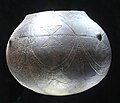 Pottery
 -
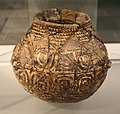 Pottery
 -
 Pottery
 -
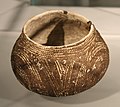 Pottery
 -
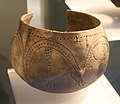 Pottery
 -
 Pottery
 -
 Pottery
 -
 Pedestal bowl
 -
 Pottery
 -
 Anthropomorphic vessel
 -
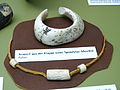 Spondylus shell bracelet
 -
 Shell jewellery
 -
 Bone and shell jewellery
 -
 Bone comb
 -
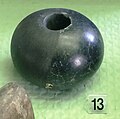 Stone mace head
 -
 Decorated bone tip
,_Landesmuseum_f%C3%BCr_Vorgeschichte,_gro%C3%9Fer_Kumpf.jpg)


Population
[edit]The initial LBK population theory hypothesized that the culture was spread by farmers moving up the Danube practicing slash-and-burn methods. The presence of the Mediterranean sea shell, Spondylus gaederopus, and the similarity of the pottery to gourds, which did not grow in the north, seemed to be evidence of the immigration,[22] as does the genetic evidence cited below. The lands into which they moved were believed untenanted or too sparsely populated by hunter-gatherers to be a significant factor.[citation needed]
Genetic evidence
[edit]
In 2005, scientists successfully sequenced mtDNA coding region 15997–16409 derived from twenty-four 7,500- to 7,000-year-old human remains associated with the LBK culture. Of those remains, 22 were from locations in Germany near the Harz Mountains and the upper Rhine Valley, while one was from Austria and one from Hungary. The scientists did not reveal the detailed hypervariable segment I (HVSI) sequences for all the samples, but identified that seven of the samples belonged to H or V branch of the mtDNA phylogenetic tree, six belonged to the N1a branch, five belonged to the T branch, four belonged to the K(U8) branch, one belonged to the J branch, and one belonged to the U3 branch. All branches are extant in the current European population, although the K branch was present in roughly twice the percentages as would be found in Europe today (15% vs. 8% now.).
Comparison of the N1a HVSI sequences with sequences of living individuals found three of them to correspond with those of individuals currently living in Europe. Two of the sequences corresponded to ancestral nodes predicted to exist or to have existed on the European branch of the phylogenetic tree. One of the sequences is related to European populations, but with no apparent descendants amongst the modern population.[23] The N1a evidence supports the notion that the descendants of LBK culture have lived in Europe for more than 7,000 years and have become an integral part of the current European population. The lack of mtDNA haplogroup U5 supports the notion that U5 at this time is uniquely associated with Mesolithic European cultures.
A 2010 study of ancient DNA suggested the LBK population had affinities to modern-day populations from the Near East and Anatolia, such as an overall prevalence of G2.[24] The study also found some unique features, such as the prevalence of the now-rare Y-haplogroup H2 and mitochondrial haplogroup frequencies.[24] However subsequent studies based on full-genome analysis have found that the LBK population was similar genetically to modern southern Europeans, and did not resemble modern Near Eastern or Anatolian populations. Neolithic Anatolian farmers have also been found to be more similar to modern southern Europeans than to modern Near Easterners or Anatolians.[25][26][27][28][29][30][31]
Lipson et al. (2017) and Narasimhan et al. (2019) analyzed a large number of skeletons ascribed to the Linear Pottery Culture. Most of the Y-DNA belonged to G2a and subclades of it, some to I2 and subclades of it, beside few samples of T1a, CT, and C1a2. The samples of mtDNA extracted were various subclades of T, H, N, U, K, J, X, HV, and V.[32][33]
Economy
[edit]Land use
[edit]

The LBK people settled on fluvial terraces and in the proximity of rivers in regions with fertile loess. They raised a mix of crops and associated weeds in small plots, an economy that Gimbutas called a "garden type of civilization".[34] The difference between a crop and a weed in LBK contexts is the frequency. Crop foods are:
- Triticum dicoccum, emmer wheat
- Triticum monococcum, einkorn wheat
- Pisum sativum, pea
- Lens culinaris, lentil
Species that are found so rarely as to warrant classification as possible weeds are:
- Hordeum, barley
- Panicum miliaceum, broom corn millet
- Secale cereale rye
- Vicia ervilia, bitter vetch
- Vicia faba, broad or field bean
The emmer and the einkorn were sometimes grown as maslin, or mixed crops. The lower-yield einkorn predominates over emmer, which has been attributed to its better resistance to heavy rain.[35] Hemp (Cannabis sativum) and flax (Linum usitatissimum) gave the LBK people the raw material of rope and cloth, which they no doubt manufactured at home as a cottage industry. From poppies (Papaver somniferum), introduced later from the Mediterranean, they may have manufactured palliative medicine.
The LBK people were stock-raisers as well, with cattle favoured, though goats and swine are also recorded. Like farmers today, they may have used the better grain for themselves and the lower grades for the animals. The dogs are present here too, but scantly. Substantial wild faunal remains are found. The LBK supplemented their diets by hunting deer and wild boar in the open forests of Europe as it was then.
A 2020 study by the University of Kiel found that the fields in the Vráble settlement were being used as pastures to produce manure, which in turn increased crop yields. This intensive subsistence system may have contributed to higher productivity in Vráble and could have been a factor in the settlement's high population density and concentration.[36]
A 2022 study by the University of Bristol found dairy fat residues in pottery dating as early as 7,400 years ago. Researchers analyzed residues from over 4,300 vessels recovered from 70 LBK archaeological sites. Milk use was detected in about 65% of these Neolithic sites.[37]
Demographic history
[edit]


Although no significant population transfers were associated with the start of the LBK, population diffusion along the wetlands of the mature civilisation (about 5200 BC) had levelled the high percentage of the rare gene sequence mentioned above by the late LBK. The population was much greater by then, a phenomenon termed the Neolithic demographic transition (NDT). According to Bocquet-Appel[38] beginning from a stable population of "small connected groups exchanging migrants" among the "hunter-gatherers and horticulturalists" the LBK experienced an increase in birth rate caused by a "reduction in the length of the birth interval". The author hypothesizes a decrease in the weaning period made possible by division of labor. At the end of the LBK, the NDT was over and the population growth disappeared due to an increase in the mortality rate, caused, the author speculates, by new pathogens passed along by increased social contact.[citation needed]
The new population was sedentary up to the capacity of the land, and then the excess population moved to less-inhabited land. An in-depth GIS study by Ebersbach and Schade of an 18 km2 (6.9 sq mi) region in the wetlands region of Wetterau, Hesse, traces the land use in detail and discovers the limiting factor.[39] In the study region, 82% of the land is suitable for agriculture, 11% for grazing (even though wetland), and 7% steep slopes. The investigators found that the LBK occupied this land for about 400 years. They began with 14 settlements, 53 houses, and 318 people, using the wetlands for cattle pasture. Settlement gradually spread over the wetlands, reaching a maximum of 47 settlements, 122 houses, and 732 people in the late period.[citation needed]
Toward the end, the population suddenly dropped to initial levels, though much of the arable land was still available. The investigators concluded cattle were the main economic interest and available grazing land was the limiting factor in settlement. The Neolithic of the Middle East featured urban concentrations of people subsisting mainly on grain. Beef and dairy products, however, were the mainstay of LBK diet. When the grazing lands were all in use, they moved elsewhere in search of them. As the relatively brief window of the LBK falls roughly in the centre of the Atlantic climate period, a maximum of temperature and rainfall, a conclusion that the spread of wetlands at that time encouraged the growth and spreading of the LBK is to some degree justified.[citation needed]
With some exceptions, population levels rose rapidly at the beginning of the Neolithic. This was followed by a population collapse of "enormous magnitude" after 5000 BC, with levels remaining low during the next 1,500 years.[40]
Investigation of the Neolithic skeletons found in the Talheim Death Pit (c. 5000 BC) suggests that prehistoric men from neighboring tribes were prepared to fight and kill each other in order to capture and secure women.[41] The mass grave at Talheim in southern Germany is one of the earliest known sites in the archaeological record that shows evidence of organised violence in Early Neolithic Europe, among various LBK tribes.[42] Other speculations as to the reasons for violence between settlements include vengeance, conflicts over land and resources, and kidnapping slaves. Some of these theories related to the lack of resources are supported by the discovery that various LBK fortifications bordering indigenously inhabited areas appear to have not been in use for very long. The mass burial site at Schletz was also fortified, which serves as evidence of violent conflict among tribes and means that these fortifications were built as a form of defense against aggressors. The massacre of Schletz occurred at the same time as the massacre at Talheim and several other known massacres.[43][44][45] Findings from Herxheim and Vráble also show that significant changes in ritual practises emerged at the end of the LBK, which however were not associated to violence necessarily.[46]
Material culture
[edit]Tool kit
[edit]The tool kit was appropriate to the economy. Flint and obsidian were the main materials used for points and cutting edges.[47] There is no sign of metal. For example, they harvested with sickles manufactured by inserting flint blades into the inside of curved pieces of wood. One tool, the "shoe-last celt", was made of a ground stone chisel blade tied to a handle,[48] with shape and wear showing that they were used as adzes to fell trees and to work wood. Augers were made of flint points tied to sticks that could be rotated. Scrapers and knives are found in abundance. The use of flint pieces, or microliths, descended from the Mesolithic, while the ground stone is characteristic of the Neolithic.
These materials are evidence both of specialization of labor and commerce. The flint used came from southern Poland; the obsidian came from the Bükk and Tatra mountains. Settlements in those regions specialized in mining and manufacture. The products were exported to all the other LBK regions, which must have had something to trade. This commerce is a strong argument for an ethnic unity between the scattered pockets of the culture.
-
 Various artefacts
 -
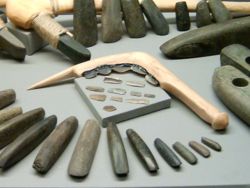 Stone axes and sickle
 -
 Stone axe
 -
 Grinding stone
 -
 Bone chisel reconstruction
 -
 Small bone chisel reconstruction


Settlement patterns
[edit]


The unit of residence was the long house, a rectangular structure, 5.5 to 7.0 m (18.0 to 23.0 ft) wide, of variable length; for example, a house at Bylany was 45 m (148 ft). Outer walls were wattle-and-daub, sometimes alternating with split logs, with slanted, thatched roofs, supported by rows of poles, three across.[49] The exterior wall of the home was solid and massive, oak posts being preferred. Clay for the daub was dug from pits near the house, which were then used for storage. Extra posts at one end may indicate a partial second story. Some LBK houses were occupied for as long as 30 years.[50] Linear Pottery longhouses were the largest free-standing buildings in the world at the time.[51][52]
It is thought that these houses had no windows and only one doorway. The door was located at one end of the house. Internally, the house had one or two partitions creating up to three areas. Interpretations of the use of these areas vary. Working activities might be carried out in the better lit door end, the middle used for sleeping and eating and the end farthest from the door could have been used for grain storage. According to another view, the interior was divided in areas for sleeping, common life and a fenced enclosure at the back end for keeping animals.[50]
Ditches went along part of the outer walls, especially at the enclosed end. Their purpose is not known, but they probably are not defensive works, as they were not much of a defense. More likely, the ditches collected waste water and rain water.
Trash was regularly removed and placed in external pits. The waste-producing work, such as hide preparation and flint-working, was done outside the house.
Pottery has been found in long houses, as well as in graves. Analysis of the home pottery reveals that each house had its own tradition. The occurrence of pottery primarily in female graves indicates the women of the long house probably made the pottery; in fact, lineages have been defined. Gimbutas goes so far as to assert, "The indirect results indicate an endogamous, matrilocal residence."[53]
Easy access to fresh water also would have been mandatory, which is another reason why settlements were in bottom lands near water. A number of timber-built wells from the times have been discovered, with a log-cabin type lining constructed one layer at a time as the previous layers sank into the well.[54][55] Analysis of preserved wells has shown that the LBK culture possessed sophisticated carpentry skills and were capable of complex timber constructions.[55]
The LBK culture also built timber trackways, the remains of some of which have been preserved, for example at the Campemoor bog in Lower Saxony (Germany), dated to c. 4630–4550 BC (trackway Pr31).[56]
Long houses were gathered into villages of five to eight houses, spaced about 20 m (66 ft) apart, occupying 300–1,250 acres (120–510 ha). Nearby villages formed settlement cells, some as dense as 20 per 25 km2 (9.7 sq mi), others as sparse as one per 32 km2 (12 sq mi).[49] This structuring of settlements does not support a view that the LBK population had no social structure, or was anarchic. However, the structure remains obscure and interpretational. One long house may have supported one extended family, but the short lifespan would have precluded more than two generations. The houses required too much labor to be the residences of single families; consequently, communal houses are postulated.[50] Though the known facts are tantalizing, the correct social interpretation of the layout of a long house and the arrangement of villages will have to wait for clearer evidence. At least some villages were fortified for some time with a palisade and outer ditch.[57]
The LBK settlement at Vrable in Slovakia had an estimated 70 contemporaneous longhouses and a population of up to 1725 people at its peak in c. 5100 BC, making it one of the largest LBK settlements of the period. The longhouses were grouped into three 'neighbourhoods', one of which was surrounded by trenches and a palisade. The remains of at least 313 longhouses have been found at the Vrable site.[58][59] The remains of 300 longhouses have also been found at the settlement of Eythra in Germany, indicating a similar sized-population within the same time-frame as that at Vrable.[60]
Excavations at Oslonki in Poland revealed a large, fortified settlement (dating to 4300 BC, i.e., Late LBK), covering an area of 4000m2. Nearly 30 trapezoidal longhouses and over 80 graves were discovered. The rectangular longhouses were between 7 and 45 m (23 and 148 ft) long and between 5 and 7 m (16 and 23 ft) wide. They were built of massive timber posts chinked with wattle and daub mortar.[61][62]
An earlier view saw the Linear Pottery culture as living a "peaceful, unfortified lifestyle".[63] Since then, as well as settlements with palisades, weapon-traumatized skeletons have also been discovered, such as at Herxheim in Germany.[64] Whether it was the site of a massacre or of a martial ritual, the Herxheim remains demonstrate "systematic violence between groups". In 2015 a study published in Proceedings of the National Academy of Sciences detailed findings at a site near Schöneck-Kilianstädten, including the skeletons of 26 adults and children who were killed by "devastating strikes to the head or arrow wounds." The skull fractures are classic signs of blunt force injuries caused by basic Stone Age weapons.[65][66] Most of the known settlements, however, left no trace of violence.
Religion
[edit]

As is true of all prehistoric cultures, the details of actual belief systems maintained by the Linear Pottery culture population are poorly understood relative to beliefs and religions of historical periods. The extent to which prehistoric beliefs formed a systematic religious canon is also the subject of some debate. Nevertheless, comparative, detailed, scientific study of cultural artifacts and iconography has led to the proposal of models.
The mother goddess model is the major one applied to the Neolithic of the Middle and Near East, the civilization of the Aegean and Europe. The iconography was inherited from the Palaeolithic. The Gravettian culture introduced it into the range of the future LBK from western Asia and south Russia.[67] From there, it diffused throughout Europe in the Upper Palaeolithic, which was inhabited by Cro-Magnon man and was responsible for many works of art, such as the Venus of Willendorf.[68]
With the transition to the Neolithic, "the female principle continued to predominate the cultures that had grown up around the mysterious processes of birth and generation."[69] The LBK, therefore, did not bring anything new spiritually to Europe, nor was the cult in any way localized to Europe. It is reflected in the vase paintings, figurines, graves and grave goods, and surviving customs and myths of Europe. In the north, the goddess could manifest herself as the mistress of animals, grain, distaff and loom, household, and life and death.[70]
The works of the noted late archaeologist Marija Gimbutas present a major study of the iconography and surviving beliefs of the European Neolithic, including the Linear Pottery culture. She was able to trace the unity of reproductive themes in cultural objects previously unsuspected of such themes. For example, the burial pits of the Linear Pottery culture, which were lined with stone, clay, or plaster, may have been intended to represent eggs. The deceased returns to the egg, so to speak, there to await rebirth.[71]
The presence of such pits contemporaneously with the burial of women and children under the floors of houses suggests an assortment of religious convictions, as does the use of both cremation and inhumation. Some of the figurines are not of females but are androgynous.[72]
Funerary customs
[edit]
The early Neolithic in Europe featured burials of women and children under the floors of personal residences. Remains of adult males are missing. Probably, Neolithic culture featured sex discrimination in funerary customs, and women and children were important in ideology concerning the home.[73]
Burials beneath the floors of homes continued until about 4000 BC. However, in the Balkans and central Europe, the cemetery also came into use at about 5000 BC. LBK cemeteries contained from 20 to 200 graves arranged in groups that appear to have been based on kinship. Males and females of any age were included. Both cremation and inhumation were practiced. The inhumed were placed in a flexed position in pits lined with stones, plaster, or clay. Cemeteries were close to, but distinct from, residential areas.[citation needed]
The presence of grave goods indicates both a sex and a dominance discrimination. Male graves included stone celts, flint implements, and money or jewelry of Spondylus shells. Female graves contained many of the same artifacts as male graves, but also most of the pottery and containers of ochre. The goods have been interpreted as gifts to the departed or personal possessions.[citation needed]
Only about 30% of the graves have goods. This circumstance has been interpreted as some sort of distinction in dominance, but the exact nature is not known. If the goods were gifts, then some were more honored than others; if they were possessions, then some were wealthier than others.[citation needed]
These practices are contrasted to mass graves, such as the Talheim Death Pit, the Herxheim archeological site and the settlement of Vráble.[74][citation needed] Herxheim was a ritual center and a mass grave that contained the scattered remains of at least 450 individuals.[43]
See also
[edit]| The Neolithic |
|---|
| ↑ Mesolithic |
| ↓ Chalcolithic |
- Cardium pottery culture
- Danubian Plain
- Demic diffusion
- Ertebolle culture
- Great Hungarian Plain
- Goseck circle
- Haplogroup N1a (mtDNA)
- Hunter-gatherer
- Little Hungarian Plain
- Mesolithic
- Middle interglacial (Atlantic) and history of the Central European Forest
- Neolithic: Europe, founder crops, long house, Revolution
- Old European culture
- Pannonian basin before Hungary
References
[edit]- ^ Hibben, page 121.
- ^ Szymon Zdziebłowski (28 November 2019). "Giant 7,000-Year-Old 'Religious' Structures Found near Łysomice". Science in Poland. Retrieved 28 August 2022.
- ^ Klopfleisch (1882), Die Grabhügel von Leubingen, Sömmerda und Nienstädt, in the Voraufgehend: allgemeine Einleitung, section entitled Charakteristik und Zeitfolge der Keramik. Brief recognition of his authorship is given in English by Fagan, Brian Murray (1996), The Oxford Companion to Archaeology, Oxford University Press, ISBN 0-19-507618-4 p. 84.
- ^ Dolukhanov under External links, Models. The numbers are stated in the abstract. Note that figures such as this although true given the parameters depend on data that was selected by the investigator and are best regarded as approximations.
- ^ Gaskevych, Dmytro. (2006). "Vita-Poshtova 2 – New The Easternmost Site of The Linear Band Pottery Culture". Sprawozdania Archeologiczne. 58: 205–221.
- ^ External links, Dates below
- ^ See the article The Interaction Between Early Farmers and Indigenous People in Central Belgium included under External links, People below.
- ^ a b c d e KRAP (2007) under External Links, Places.
- ^ Hertelendi and others (1995) under External links, Places, especially p. 242.
- ^ a b Gimbutas (1991) pp. 35–45.
- ^ "Chronology of North, Central and Southern Germany". www.comp-archaeology.org. Archived from the original on 4 February 2007.
- ^ a b c d Baldia (2006) The Earliest Bandkeramik..
- ^ This article does not have space for all the names, but they can for the most part be found in the sources.
- ^ Baldia (2003) Starcevo-Koros-Cris under External links, Places.
- ^ External links, Places. These numbers are their 1σ range. For the tolerances, see the article.
- ^ a b c Hertelendi and others, External links, Places.
- ^ 1991 pp. 43–46
- ^ "Neolithic Double-faced pot, Hungary, 5200-4900 BC". europeanvirtualmuseum.it.
- ^ Price, pages 13–16, gives an overview of the theory's development.
- ^ The article by Kertész covers the research on the area and the concepts of hiatus and barrier.
- ^ Dolukhanov and others (2005) pages 1453–1457.
- ^ Clark & Piggott, pp. 240–246.
- ^ Haak, Wolfgang et al, Ancient DNA from the first European Farmers in 7,500-Year-Old Neolithic Sites, Vol. 310, Science, 11 November 2005, page 1018
- ^ a b Haak, Wolfgang (9 November 2010). "Ancient DNA from European Early Neolithic Farmers Reveals Their Near Eastern Affinities". PLOS Biology. 8 (11) e1000536. doi:10.1371/journal.pbio.1000536. PMC 2976717. PMID 21085689.
- ^ Mathieson, Iain (2015). "Genome-wide patterns of selection in 230 ancient Eurasians". Nature. 528 (7583): 499–503. Bibcode:2015Natur.528..499M. doi:10.1038/nature16152. PMC 4918750. PMID 26595274.
Principal component (PCA) and ADMIXTURE analysis, shows that the Anatolian Neolithic samples do not resemble any present-day Near Eastern populations but are shifted towards Europe, clustering with Neolithic European farmers (EEF) from Germany, Hungary, and Spain.
- ^ Gunther, Torsten (2016). "Genes mirror migrations and cultures in prehistoric Europe — a population genomic perspective". Current Opinion in Genetics & Development. 41: 115–123. doi:10.1016/j.gde.2016.09.004. PMID 27685850.
Early farmers exhibit marked genetic similarities with modern-day southwestern Europeans, but not with modern-day groups from the Near and Middle East. The affinity of Neolithic Europeans to modern Southern Europeans is particularly pronounced for the population isolates of Sardinia and Basques.
- ^ Omrak, Ayça (2016). "Genomic Evidence Establishes Anatolia as the Source of the European Neolithic Gene Pool". Current Biology. 26 (2): 270–275. Bibcode:2016CBio...26..270O. doi:10.1016/j.cub.2015.12.019. PMID 26748850. S2CID 16238333.
modern-day Anatolians carry signatures of several admixture events from different populations that have diluted this early Neolithic farmer component, explaining why modern-day Sardinian populations, instead of modern-day Anatolian populations, are genetically more similar to the people that drove the Neolithic expansion into Europe. … These results were confirmed by outgroup f3 statistics where, among modern-day groups, Kum6 shows the greatest genetic similarity to Sardinians, Greeks, and Cypriots … Modern-day Anatolian groups display a variety of admixture traces originating from groups in the Middle East, Central Asia, and Siberia, which cause Kum6 to be genetically more similar to modern-day Europeans than to modern-day Anatolians.
- ^ Kılınç, Gülşah (2016). "The Demographic Development of the First Farmers in Anatolia". Current Biology. 26 (19): 2659–2666. Bibcode:2016CBio...26.2659K. doi:10.1016/j.cub.2016.07.057. PMC 5069350. PMID 27498567.
All individuals from the central Anatolian Neolithic were positioned within the genetic variation of present day southern European populations.
- ^ Marchi, Nina (2022). "The genomic origins of the world's first farmers". Cell. 185 (11): 1842–1859. doi:10.1016/j.cell.2022.04.008. PMC 9166250. PMID 35561686.
western EFs [Early Farmers from Europe and Anatolia] show strongest affinities with modern Sardinians, with the exception of one English (CarsPas1) and two Northwest Anatolian EFs (Bar8 and AKT16), who are found to cluster with modern individuals from other parts of Southern Europe. ... on the whole-genome MDS plot western EFs are closer to some other Southern Europeans than to Sardinians.
- ^ Diallo, Mame (2022). "Circum-Saharan Prehistory through the Lens of mtDNA Diversity". Genes (Basel). 13 (3): 533. doi:10.3390/genes13030533. PMC 8951852. PMID 35328086.
ancient Near Eastern [Anatolian] farmers are genetically better represented by the current populations of central and western Mediterranean, such as the Sardinians and the Basques, than by the current populations of the Near East.
- ^ Skoglund, Pontus (2012). "Origins and genetic legacy of Neolithic farmers and hunter-gatherers in Europe". Science. 336 (6080): 466–469. Bibcode:2012Sci...336..466S. doi:10.1126/science.1216304. PMID 22539720. S2CID 13371609.
We obtained 249 million base pairs of genomic DNA from ~5000-year-old remains of three hunter-gatherers and one farmer excavated in Scandinavia and find that the farmer is genetically most similar to extant southern Europeans, contrasting sharply to the hunter-gatherers, whose distinct genetic signature is most similar to that of extant northern Europeans. … We found that compared to a worldwide set of 1638 individuals, all four Neolithic individuals clustered within European variation. … the Neolithic farmer clustered with southern Europeans but was differentiated from Levantine individuals. … Individuals from Turkey stand out because of low levels of allele sharing with both Neolithic groups, possibly due to gene flow from outside of Europe … the Neolithic farmer appears most related to extant Mediterranean European populations.
- ^ Lipson 2017.
- ^ Narasimhan 2019.
- ^ Gimbutas (1991) p. 38.
- ^ The crop and weed information is indebted to Kreuz and others, cited under External links, Economy.
- ^ Gillis, Rosalind E.; Eckelmann, Rebekka; Filipović, Dragana; Müller-Scheeßel, Nils; Cheben, Ivan; Furholt, Martin; Makarewicz, Cheryl A. (13 October 2020). "Stable isotopic insights into crop cultivation, animal husbandry, and land use at the Linearbandkeramik site of Vráble-Veľké Lehemby (Slovakia)". Archaeological and Anthropological Sciences. 12 (11): 256. Bibcode:2020ArAnS..12..256G. doi:10.1007/s12520-020-01210-2. ISSN 1866-9565.
- ^ "Pioneering research directly dates the earliest milk use in prehistoric Europe". 17 October 2022.
- ^ 2002, External links, People.
- ^ 2003, under External links, Economy.
- ^ Shennan, Stephen; Edinborough, Kevan (2007). "Prehistoric population history: From the Late Glacial to the Late Neolithic in Central and Northern Europe". Journal of Archaeological Science. 34 (8): 1339–45. Bibcode:2007JArSc..34.1339S. doi:10.1016/j.jas.2006.10.031.
- ^ Highfield, Roger (2 June 2008). "Neolithic men were prepared to fight for their women". The Daily Telegraph. ISSN 0307-1235. Archived from the original on 12 January 2022.
- ^ "German mass grave records prehistoric warfare". BBC News. 17 August 2015.
- ^ a b Golitko, M. & Keeley, L.H. (2007). "Beating ploughshares back into swords: warfare in the Linearbandkeramik." Antiquity, 81, 332–342.
- ^ Schulting, Rick (17 August 2015). "Mass grave reveals organised violence among Europe's first farmers". The Conversation.
- ^ Metcalfe, Tom (3 October 2022). "7,000-year-old mass grave in Slovakia may hold human sacrifice victims". Live Science.
- ^ "Digs & Discoveries - Neolithic Mass Grave Mystery - Archaeology Magazine - May/June 2023". Archaeology Magazine. Retrieved 20 January 2025.
- ^ A brief discussion of tools is to be found in Gimbutas (1991) p. 39, and a fuller presentation with pictures of the tool kit in Lodewijckx & Bakels (2005) under External links, People.
- ^ R. Elburg, W. Hein, A. Probst and P. Walter, Field Trials in Neolithic Woodworking – (Re)Learning to Use Early Neolithic Stone Adzes. Experimental Archaeology, Issue 2015/2
- ^ a b The numbers are from Gimbutas (1991) pp. 39–41. However, they are approximately the same as the numbers given by other researchers and can therefore be taken as true measurements within a tolerance.
- ^ a b c Marciniak, Chapter 1.
- ^ Bogucki, Peter (2001). "Recent research on early farming in central Europe". Documenta Praehistorica. 28: 85–97. doi:10.4312/dp.28.6.
- ^ Bogucki, Peter (1996). "The spread of early farming in Europe". American Scientist. 83 (3): 242–253. Bibcode:1996AmSci..84..242B.
- ^ 1991 p. 331.
- ^ Baldia (2000) The Oldest Dated Well under External links, People, describes an LBK well.
- ^ a b Tegel W, Elburg R, Hakelberg D, Stäuble H, Büntgen U (2012). "Early Neolithic Water Wells Reveal the World's Oldest Wood Architecture". PLOS ONE. 7 (12) e51374. Bibcode:2012PLoSO...751374T. doi:10.1371/journal.pone.0051374. PMC 3526582. PMID 23284685.
- ^ Achterberg, Inke; Bauerochse, Andreas; Giesecke, Thomas; Metzler, Alf; Leuschner, Hanns (2015). "Contemporaneousness of Trackway Construction and Environmental Change: a Dendrochronological Study in Northwest-German Mires". Interdisciplinaria Archaeologica. 6 (1): 19–29. Bibcode:2015IANSA2015...19A. doi:10.24916/iansa.2015.1.2.
- ^ Krause (1998) under External links, places.
- ^ Müller, Johannes; Müller-Scheeße, Nils; Cheben, Ivan; Wunderlich, Maria; Furholt, Martin (2020). "6.1 On the demographic development of the LBK and Zeliezovce settlement sites of Vrable and the Upper Zitava Valley". In Furholt, Martin; Cheben, Ivan; Müller, Johannes; Bistáková, Alena; Wunderlich, Maria; Müller-Scheeßel, Nils (eds.). Archaeology in the Zitava valley I. Sidestone Press. pp. 493–502. ISBN 978-90-8890-897-2.
- ^ Müller-Scheeßel, Nils; Müller, Johannes; Cheben, Ivan; Mainusch, Wiebke; Rassmann, Knut; Rabbel, Wolfgang; Corradini, Erica; Furholt, Martin (10 January 2020). "A new approach to the temporal significance of house orientations in European Early Neolithic settlements". PLOS ONE. 15 (1) e0226082. Bibcode:2020PLoSO..1526082M. doi:10.1371/journal.pone.0226082. ISSN 1932-6203. PMC 6953813. PMID 31923265.
- ^ Mecking, Oliver; Hohle, Isabel; Wolfram, Sabine (2017). "The development of pottery technology in Eythra from the Early Linear Pottery culture to the Late Stroke Ornamented Pottery culture". Archeologicke Rozhledy. 69 (2): 187–208.
- ^ "Archaeological Research at Oslonki, Poland". Princeton.edu. Retrieved 23 April 2013.
- ^ "Linearbandkeramik Culture – The First Farmers of Europe". Archaeology.about.com. 17 January 2013. Archived from the original on 7 November 2011. Retrieved 23 April 2013.
- ^ Gimbutas (1991) page 143.
- ^ Orschiedt (2006) under External links, Places.
- ^ "Mass grave reveals prehistoric warfare in ancient European farming community". The Guardian. 17 August 2015. Archived from the original on 18 February 2023.
- ^ The massacre mass grave of Schöneck-Kilianstädten reveals new insights into collective violence in Early Neolithic Central Europe
- ^ James Chapter 1 page 13.
- ^ James pp. 20–22.
- ^ James, p. 22.
- ^ The reader may find a thorough recapitulation in Davidson (1998), whose chapter titles the above list repeats; however, the topic has received attention from many noted scholars and writers.
- ^ The works of Gimbutas listed in the Bibliography are sufficient to give the reader an overall view of her study. However, those interested in an immediately available comprehensive view from a Gimbutas supporter may access Marler (2005) under External links, Models.
- ^ An outstanding advocacy of complexity can be found in Hayden (1998) cited under External links, Models. Hayden discovers some of the limitations of Gimbutas' thought. His view was answered in detail in Marler (1999), External links, Models. The reader should be aware that all of Gimbutas' career was surrounded by controversy, perhaps fueled by sexist allegations and counter-allegations. Nevertheless Marler and Hayden are professionals with something valuable to contribute, as are Renfrew and other protagonists of Gimbutas' ongoing debates.
- ^ This section is heavily indebted to Gimbutas (1991) pp. 331–332.
- ^ a.s, Petit Press. "Archaeologists make grisly discovery in Vráble - The Slovak Spectator". www.sme.sk. Retrieved 20 January 2025.
Bibliography
[edit]- Braidwood, Robert, Prehistoric men, William Morrow and Company, many editions
- Childe, Vere Gordon (1951). Man Makes Himself. New York: the New American Library (a Mentor Book).
- Christensen, Jonas (2004). "Warfare in the European Neolithic". Acta Archaeologica. 75 (142, 144, 136): 129. doi:10.1111/j.0065-001X.2004.00014.x.
- Clark, Grahame; Piggott, Stuart (1967). Prehistoric Societies. New York: Alfred A. Knopf. ISBN 978-0-14-021149-8.
- Davidson, Hilda Ellis (1998). Roles of the Northern Goddess. Routledge. ISBN 978-0-415-13610-5.
- Ehrich, Robert W. (1965). Chronologies in Old World Archaeology. Chicago and London: The University of Chicago Press. ISBN 978-0-226-19445-5.
- Gimbutas, Marija (1982). The Goddesses and Gods of Old Europe 6500–3500 BC: Myths and Cult Images: New and Updated Edition. Berkeley, Los Angeles: University of California Press. p. 27. ISBN 978-0-520-04655-9.
- Gimbutas, Marija (1991). The Civilization of the Goddess: The World of Old Europe. San Francisco: HarperCollins Publishers (HarperSanFrancisco). ISBN 978-0-06-250368-8.
- Hawkes, Jacquetta (1965). Prehistory. New York: the New American Library (a Mentor Book).
- Hibben, Frank (1958). Prehistoric Man in Europe. Norman, Oklahoma: University of Oklahoma Press.
- James, E.O. (1994). The Cult of the Mother-Goddess. New York: Barnes&Noble. ISBN 978-1-56619-600-0.
- Kertész, Róbert (2002). "Mesolithic Hunter-Gatherers in the Northwestern Part of the Great Hungarian Plain" (PDF). Praehistoria. 3. Archived from the original (PDF) on 27 September 2007.
- Mallory, J.P. (1997). "Linear Band Ware Culture". Encyclopedia of Indo-European Culture. Fitzroy Dearborn.
- Marciniak, Arkadiusz (2005). Placing Animals in the Neolithic: Social Zooarchaeology of Prehistoric Farming Communities. Routledge Cavendish. ISBN 978-1-84472-092-7.
- Renfrew, Colin (1990). Archaeology and Language: The Puzzle of Indo-European Origins. Cambridge University Press. ISBN 978-0-521-38675-3.
- Stäuble, Harald (2005). Häuser und absolute Datierung der Ältesten Bandkeramik. Habelt.
Further reading
[edit]- Shennan, Stephen (2018). The First Farmers of Europe: An Evolutionary Perspective. Cambridge World Archaeology. Cambridge University Press. doi:10.1017/9781108386029. ISBN 978-1-108-42292-5.
- Martin Furholt, I. Cheben, J. Müller, A. Bistáková, M. Wunderlich, N. Müller-Scheeßel 2020: Archaeology in the Žitava valley I. The LBK and Želiezovce settlement site of Vráble, Scales of Transformation in Prehistoric and Archaic Societies 09. Leiden: Sidestone Press. (Online).
- Ivan Cheben, M. Furholt, K. Rassmann, A. Bistakova, M. Wunderlich, N. Müller-Scheeßel 2024: Archaeology in the Žitava valley II. The neolithic landscape of south-western Slovakia, Scales of Transformation in Prehistoric and Archaic Societies 20. Leiden: Sidestone Press. (Online).
External links
[edit] Media related to Linear Pottery culture at Wikimedia Commons
- Reconstruction of a Neolithic longhouse (2021) Halle State Museum of Prehistory (video in German – English subtitles available)
- The People from Longhouses 3D reconstructions
- Below are some relevant links to sites publishing current research or recapitulating recent thinking concerning the Neolithic of Europe. Many of the sites referenced contain links to other sites not mentioned here.
- Digital exhibition of the site of Vráble.
Overall
[edit]- Dolukhanov, Pavel; Shukurov, A; Gronenborn, D; Sokoloff, D; Timofeev, V; Zaitseva, G; et al. (2005). "The Chronology of Neolithic Dispersal in Central and Eastern Europe" (PDF). Journal of Archaeological Science. 32 (10): 1441–1458. Bibcode:2005JArSc..32.1441D. doi:10.1016/j.jas.2005.03.021.
- Price, T. Douglas (2000). "Europe's First Farmers: an Introduction" (PDF). In Price, T. Douglas (ed.). Europe's First Farmers. Cambridge: Cambridge University Press. ISBN 978-0-521-66203-1. Hardcover Softcover.
- "10th Neolithic Seminar". Neolithic Seminars. Ljubljana University, Slovenia. 2003. Archived from the original on 27 March 2006.
- Matthias Schulz (2010). "How Middle Eastern Milk Drinkers Conquered Europe". Spiegel Online International.
Models
[edit]- Dolukhanov, Pavel; Shukurov, Anvar (2003). "Modelling the Neolithic Dispersal in Northern Eurasia" (PDF). Documenta Praehistorica XXXI. Department of Archaeology, Faculty of Arts, University of Ljubljana. Archived from the original (PDF) on 27 September 2007.
- Hayden, Brian (1998). "An Archaeological Evaluation of the Gimbutas Paradigm". The Virtual Pomegranate. 6 (6): 35–46. doi:10.1558/pome.v13i6.35.
- Marler, Joan (1999). "A Response to Brian Hayden's article". The Virtual Pomegranate (10). doi:10.1558/pome.v13i10.37.
- Marler, Joan (2005). "The Iconography and Social Structure of Old Europe: The Archaeomythological Research of Marija Gimbutas". Societies of Peace. 2nd World Congress on Matriarchal Studies.
- Richards, Martin (2003). "The Neolithic Transition in Europe: archaeological models and genetic evidence" (PDF). Documenta Praehistorica XXX. Department of Archaeology, Faculty of Arts, University of Ljubljana. Archived from the original (PDF) on 27 September 2007.
Dates
[edit]- Stadler, P.; Lenneis, E. (1996). "Zur Absolutchronologie der Linearbandkeramik aufgrund von 14C-Daten". Archäologie Österreichs. 6 (2): 4–13. Archived from the original on 16 April 2005. Select Zur Absolutchronologie der Linearbandkeramik and under that Abb.01 for the calibration curve and Abb.02 for the sample frequency per year. The latter is also given at [1].
People
[edit]- Bentley, R. Alexander; Knipper, Corina (December 2005). "Transhumance at the early Neolithic settlement at Vaihingen (Germany)". Antiquity. 79 (306). Archived from the original on 16 May 2006.
- Bocquet-Appel, Jean-Pierre (August–October 2002). "Paleoanthropological Traces of a Neolithic Demographic Transition" (PDF). Current Anthropology. 43 (4): 637–650. doi:10.1086/342429. S2CID 145158218. Archived from the original (PDF) on 18 October 2005.
- Bogucki, Peter (2004). "The Neolithic Mosaic on the North European Plain". Princeton University. The article includes an extensive bibliography.
- Dienekes (2005). "mtDNA of early central European farmers". Dienekes' Anthropology Blog. Dienekes summarizes and reviews Haak, Wolfgang; others (11 November 2005). "Ancient DNA from the First European Farmers in 7500-Year-Old Neolithic Sites". Science. 310 (5750): 1016–1018. Bibcode:2005Sci...310.1016H. doi:10.1126/science.1118725. PMID 16284177. S2CID 11546893. No charge for abstract. The article is also reviewed by Kling, Jim (2005). "The Origins of Modern Europeans". Chemistry Org. American Chemical Society. Archived from the original on 27 September 2006.
- Hawks, John (2005). "Early European mtDNA: only mysterious if you want it to be". john hawks weblog. Archived from the original on 5 April 2006.Hawks reviews and comments on three articles.
- Graphic reconstruction of the Linear Pottery: Everyday life by Karol Schauer 1 Archived 11 April 2020 at the Wayback Machine
- Graphic reconstruction of the Linear Pottery: Everyday life by Karol Schauer 3
- Graphic reconstruction of the Linear Pottery: Everyday life by Karol Schauer 4
- Lipson, Mark (16 November 2017). "Parallel palaeogenomic transects reveal complex genetic history of early European farmers". Nature. 551 (7680). Nature Research: 368–372. Bibcode:2017Natur.551..368L. doi:10.1038/nature24476. PMC 5973800. PMID 29144465.
- Lodewijckx, Marc; Bakels, Corrie (2005). "The Interaction Between Early Farmers and Indigenous People in Central Belgium". Western European Archaeology. Katholieke Universiteit Leuven. Archived from the original on 12 July 2006.
- Narasimhan, Vagheesh M. (6 September 2019). "The formation of human populations in South and Central Asia". Science. 365 (6457) eaat7487. American Association for the Advancement of Science. bioRxiv 10.1101/292581. doi:10.1126/science.aat7487. PMC 6822619. PMID 31488661.
Places
[edit]- Czerniak, Lech; Raczkowski, Wlodzimierz; Sosnowski, Wojciech (September 2003). "New prospects for the study of Early Neolithic longhouses in the Polish Lowlands". Antiquity. 77 (297). Archived from the original on 3 April 2006.
- Domoróczki, László, ed. (2006). "Heves county". cultural heritage activities and institutes network (CHAIN). Archived from the original on 29 September 2007.
- Hertelendi, Ede; et al. (1995). "Re-Evaluation of the Neolithic in Eastern Hungary Based on Calibrated Radiocarbon Dates". Radiocarbon. 37 (2): 239–244. Bibcode:1995Radcb..37..239H. doi:10.1017/S0033822200030691.
- Körös Regional Archaeological Project (2007). "The Archaeological Background". Florida State University. Archived from the original on 11 February 2007.
- Krause, Rüdiger (1998). "An enclosed Bandkeramik village and cemetery from the 6th millennium BC near Vaihingen/Enz". Archaeological Excavation in Baden-Wurttemberg. Schalk, Emily (trans.). Wolfgang M. Werner. Archived from the original on 5 July 2007.
- Louwe Kooijmans, Leendert P. (1976). "The Neolithic at the Lower Rhine" (PDF). Leiden University. Archived from the original (PDF) on 26 July 2007.
- Orschiedt, Joerg; Haidle, Miriam Noel (2006). "The LBK Enclosure at Herxheim: Theatre of War or Ritual Centre? References from Osteoarchaeological Investigation" (PDF). University of Tübingen. Archived from the original (PDF) on 27 September 2007.
- Lodewijckx, Marc; Waegeman, Tony; Barten, Merle (1989). "Cimetière rubané à Millen? (Belgique, prov. du Limbourg)" (PDF). Notae Praehistoricae. Archived from the original (PDF) on 28 September 2011.
Economy
[edit]- Ebersbach, Renate; Schade, Christoph (2003). "Modelling the Intensity of Linear Pottery Land Use – An Example from the Mörlener Bucht in the Wetterau Basin, Hesse, Germany" (PDF). University of Basel. Archived from the original (PDF) on 27 September 2007.
- Kreuz, Angela; Marinova, Elena; Schäfer, Eva; Wiethold, Julian (2005). "A comparison of early Neolithic crop and weed assemblages from the Linearbandkeramik and the Bulgarian Neolithic cultures: differences and similarities" (PDF). Vegetation History and Archaeobotany. 14 (4): 237. Bibcode:2005VegHA..14..237K. doi:10.1007/s00334-005-0080-0. S2CID 55932126. Archived from the original (PDF) on 11 June 2007.
- https://link.springer.com/article/10.1007/s12520-020-01210-2
| International | |
|---|---|
| National | |
| Other | |


![[1]](http://www.nhm-wien.ac.at/NHM/Prehist/Stadler/LVAS/QAM/14C/Images/Neol_Abb02.gif)


