
_distribution.svg/250px-Malayalam_language_(ml,_Q36236)_distribution.svg.png)


_distribution.svg/1834px-Malayalam_language_(ml,_Q36236)_distribution.svg.png)
Community hub
Recent from talks
Contribute something
Nothing was collected or created yet.
Malayalam
View on Wikipedia

_distribution.svg)
| Person | Malayāḷi |
|---|---|
| People | Malayāḷikaḷ |
| Language | Malayāḷam |
| Country | Malayāḷa Nāṭu |
Malayalam (മലയാളം, Malayāḷam, [mɐlɐjaːɭɐm] ⓘ)[a] is a Dravidian language, primarily spoken by the Malayali people, native to the Indian state of Kerala and the union territories of Lakshadweep and Puducherry (Mahé district). It is one of 22 scheduled languages, as well as one of 11 classical languages, of India.[10][11] Malayalam has official language status in Kerala, Lakshadweep and Puducherry (Mahé).[2][3][12]
Malayalam is spoken by significant numbers of people in India[13] and is the majority language in the state of Kerala. Malayalam is also spoken by linguistic minorities in the neighbouring states; with a significant number of speakers in the Kodagu and Dakshina Kannada districts of Karnataka, and Kanyakumari, Coimbatore and Nilgiris district of Tamil Nadu. It is also spoken by the Malayali Diaspora worldwide, especially in the Persian Gulf countries, due to the large populations of Malayali expatriates there. They are a significant population in each city in India including Mumbai, Bengaluru, Chennai, Delhi, Hyderabad etc.
The origin of Malayalam remains a matter of dispute among scholars. The mainstream view holds that Malayalam descends from a western coastal dialect of early Middle Tamil and separated from it sometime between the 9th and 13th centuries,[14][15] although this medieval western dialect also preserved some archaisms suggesting an earlier divergence of the spoken dialects in the prehistoric period. A second view argues for the development of the two languages out of "Proto-Dravidian" or "Proto-Tamil-Malayalam" either in the prehistoric period or in the middle of the first millennium A.D.,[16][17][18] although this is generally rejected by historical linguists.[19] The Quilon Syrian copper plates of 849/850 CE are considered by some to be the oldest available inscription written in Old Malayalam. However, the existence of Old Malayalam is sometimes disputed by scholars.[20] They regard the Chera Perumal inscriptional language as a diverging dialect or variety of contemporary Tamil.[20][21] The oldest extant literary work in Malayalam distinct from the Tamil tradition is Ramacharitam (late 12th or early 13th century).[22]
The earliest script used to write Malayalam was the Vatteluttu script.[15] The current Malayalam script is based on the Vatteluttu script, which was extended with Grantha script letters to adopt Indo-Aryan loanwords.[15][23] It bears high similarity with the Tigalari script, a historical script that was used to write the Tulu language in South Canara, and Sanskrit in the adjacent Malabar region.[24] The modern Malayalam grammar is based on the book Kerala Panineeyam written by A. R. Raja Raja Varma in late 19th century CE.[25] The first travelogue in any Indian language is the Malayalam Varthamanappusthakam, written by Paremmakkal Thoma Kathanar in 1785.[26][27]
Robert Caldwell describes the extent of Malayalam in the 19th century as extending from the vicinity of Kumbla in the north where it supersedes with Tulu to Kanyakumari in the south, where it begins to be superseded by Tamil,[28] beside the inhabited islands of Lakshadweep in the Arabian Sea.
Etymology
[edit]In a 7th-century poem written by the Tamil poet Sambandar the people of Kerala are referred to as malaiyāḷar (mountain people).[29] The word Malayalam is also said to originate from the words mala, meaning 'mountain', and alam, meaning 'region' or '-ship' (as in "township"); Malayalam thus translates directly as 'the mountain region'. The term Malabar was used as an alternative term for Malayalam in foreign trade circles to denote the southwestern coast of the Indian peninsula, which also means The land of hills.[30][31][32][33] The term originally referred to the western hilly land of the Chera dynasty (later Zamorins and the Kingdom of Cochin), Kingdom of Ezhimala (later Kolathunadu), and Ay kingdom (later Travancore), and only later became the name of its language.[34] The language Malayalam was alternatively called Alealum, Malayalani, Malayali, Malabari, Malean, Maliyad, Mallealle, and Kerala Bhasha until the early 19th century CE.[35][36][37]
The earliest extant literary works in the regional language of present-day Kerala probably date back to as early as the 12th century. At that time, the language was differentiated by the name Kerala Bhasha. The earliest mention of Malayalam as a language is found outside of Kerala in the 15th century Telugu work Śrībhīmēśvarapurāṇamu by Śrīnātha.[38] The distinctive "Malayalam" named identity of this language appears to have come into existence in Kerala only around the 16th century, when it was known as "Malayayma" or "Malayanma"; the words were also used to refer to the script and the region.[39] According to Duarte Barbosa, a Portuguese visitor who visited Kerala in the early 16th century CE, the people in the southwestern Malabar coast of India from Kumbla in north to Kanyakumari in south had a unique language, which was called "Maliama" by them.[40][41]
Prior to this period, the people of Kerala usually referred to their language as "Tamil", and both terms overlapped into the colonial period.[note 1]
History
[edit].jpg)
Due to the geographical isolation of the Malabar Coast from the rest of the Indian peninsula due to the presence of the Western Ghats mountain ranges which lie parallel to the coast, the dialect of Old Tamil spoken in Kerala was different from that spoken in Tamil Nadu.[36] The mainstream view holds that Malayalam began to grow as a distinct literary language from the western coastal dialect of Middle Tamil[44] and the linguistic separation completed sometime between the 9th and 13th centuries.[18][45] The renowned poets of Classical Tamil such as Paranar (1st century CE), Ilango Adigal (2nd–3rd century CE), and Kulasekhara Alvar (9th century CE) were Keralites.[36] The Sangam works can be considered as the ancient predecessor of Malayalam.[46]
Some scholars however believe that both Tamil and Malayalam developed during the prehistoric period from a common ancestor, "Proto-Tamil-Malayalam", and that the notion of Malayalam being a "daughter" of early middle Tamil is misplaced.[16] This is based on the fact that Malayalam and several Dravidian languages on the Western Coast have common archaic features which are not found even in the oldest historical forms of literary Tamil.[47] Despite this, Malayalam shares many common innovations with Tamil that emerged during the early Middle Tamil period, thus making independent descent untenable.[14][note 2] For example, Old Tamil lacks the first and second person plural pronouns with the ending kaḷ. It is in the Early Middle Tamil stage that kaḷ first appears:[49]
| Language | Plural Pronouns |
|---|---|
| Old Tamil | yām, nām, nīr, nīyir |
| Middle Tamil | nānkaḷ, nām, nīnkaḷ, enkaḷ |
| Malayalam | ñaṅṅaḷ, nām, niṅṅaḷ, nammaḷ |
Indeed, most features of Malayalam morphology are derivable from a form of speech corresponding to early Middle Tamil.[50]
Robert Caldwell, in his 1856 book "A Comparative Grammar of the Dravidian or South-Indian Family of Languages", opined that literary Malayalam branched from Classical Tamil and over time gained a large amount of Sanskrit vocabulary and lost the personal terminations of verbs.[34] As the language of scholarship and administration, Old-Tamil, which was written in Tamil-Brahmi and the Vatteluttu alphabet later, greatly influenced the early development of Malayalam as a literary language. The Malayalam script began to diverge from the Vatteluttu and the Western Grantha scripts in the 8th and 9th centuries of Common Era. By the end of the 13th century, a written form of the language emerged which was unique from the Vatteluttu script that was used to write Tamil on the eastern coast.[51]
Old Malayalam
[edit]Old Malayalam (Paḻaya Malayāḷam), an inscriptional language found in Kerala from the 9th to the 13th century CE,[52] is the earliest attested form of Malayalam.[53][54] The development of Old Malayalam from a western coastal dialect of Middle Tamil began around the 8th century CE.[55][15][56] It remained a west coast dialect until circa 9th century CE or a little later.[57][55] The origin of Malayalam calendar dates back to year 825 CE.[58][59][60] It is generally agreed that the western coastal dialect of Tamil began to separate, diverge, and grow as a distinct language due to geographical separation of Kerala from the Tamil country[57] and the influence of Sanskrit and Prakrit from the Nambudiri Brahmins of the Malabar Coast.[53][36]
The Old Malayalam language was employed in several official records and transactions (at the level of the Chera Perumal kings, as well as the upper-caste (Nambudiri) village temples).[53] Most of the inscriptions in Old Malayalam were found from the northern districts of Kerala, which lie adjacent to Tulu Nadu.[53] Old Malayalam was mostly written in Vatteluttu script (with Pallava/Southern Grantha characters).[53] Old Malayalam had several features distinct from the contemporary Tamil, including the nasalisation of adjoining sounds, substitution of palatal sounds for dental sounds, contraction of vowels, and the rejection of gender verbs.[53][61][62] Ramacharitam and Thirunizhalmala are the possible literary works of Old Malayalam found so far.
Middle Malayalam
[edit]Old Malayalam gradually developed into Middle Malayalam (Madhyakaala Malayalam) by the 13th century CE.[63] Malayalam literature also completely diverged from Tamil literature during this period. Works including Unniyachi Charitham, Unnichiruthevi Charitham, and Unniyadi Charitham, are written in Middle Malayalam, and date back to the 13th and 14th centuries of the Common Era.[64][36] The Sandesha Kavyas of 14th century CE written in Manipravalam language include Unnuneeli Sandesam.[64][36] Kannassa Ramayanam and Kannassa Bharatham by Rama Panikkar of the Niranam poets who lived between 1350 and 1450, are representative of this language.[65] Ulloor has opined that Rama Panikkar holds the same position in Malayalam literature that Edmund Spenser does in English literature.[65] The Champu Kavyas written by Punam Nambudiri, one among the Pathinettara Kavikal (Eighteen and a half poets) in the court of the Zamorin of Calicut, also belong to Middle Malayalam.[36][64] The literary works of this period were heavily influenced by Manipravalam, which was a combination of contemporary Tamil and Sanskrit.[36] The word Mani-Pravalam literally means Diamond-Coral or Ruby-Coral. The 14th-century Lilatilakam text states Manipravalam to be a Bhashya (language) where "Dravida and Sanskrit should combine together like ruby and coral, without the least trace of any discord".[66][67] The scripts of Kolezhuthu and Malayanma were also used to write Middle Malayalam. In addition to Vatteluthu and Grantha script, those were used to write Old Malayalam.[36] The literary works written in Middle Malayalam were heavily influenced by Sanskrit and Prakrit, while comparing them with the modern Malayalam literature.[64][36]

Modern Malayalam
[edit]The Middle Malayalam was succeeded by Modern Malayalam (Aadhunika Malayalam) by 15th century CE.[36] The poem Krishnagatha written by Cherusseri Namboothiri, who was the court poet of the king Udaya Varman Kolathiri (1446–1475) of Kolathunadu, is written in modern Malayalam.[64] The language used in Krishnagatha is the modern spoken form of Malayalam.[64] During the 16th century CE, Thunchaththu Ezhuthachan from the Kingdom of Tanur and Poonthanam Nambudiri from the Kingdom of Valluvanad, followed the new trend initiated by Cherussery in their poems. The Adhyathmaramayanam Kilippattu and Mahabharatham Kilippattu, written by Ezhuthachan, and Jnanappana, written by Poonthanam, are also included in the earliest form of Modern Malayalam.[64]
| Letter | |||||
|---|---|---|---|---|---|
| Script | ka | kha | ga | gha | ṅa |
| Malayalam | ക | ഖ | ഗ | ഘ | ങ |
| Grantha | 𑌕 | 𑌖 | 𑌗 | 𑌘 | 𑌙 |
| Tigalari | | | | | |
| Tamil | க | ங | |||
| Sinhala | ක් | ඛ | ග | ඝ | ණ |
| Kannada | ಕ | ಖ | ಗ | ಘ | ಙ |
Thunchaththu Ezhuthachan is also credited with developing the Malayalam script into the current form through the intermixing and modification of the erstwhile scripts of Vatteluttu, Kolezhuthu, and Grantha script, which were used to write the inscriptions and literary works of Old and Middle Malayalam.[64] He further eliminated excess and unnecessary letters from the modified script.[64] Hence, Ezhuthachan is also known as The Father of modern Malayalam.[64] The development of modern Malayalam script was also heavily influenced by the Tigalari script, which was used to write Sanskrit, due to the influence of Tuluva Brahmins in Kerala.[64] The language used in the Arabi Malayalam works of the 16th–17th century CE is a mixture of Modern Malayalam and Arabic.[64] They follow the syntax of modern Malayalam, though written in a modified form of Arabic script, which is known as Arabi Malayalam script.[64] P. Shangunny Menon ascribes the authorship of the medieval work Keralolpathi, which describes the Parashurama legend and the departure of the final Cheraman Perumal king to Mecca, to Thunchaththu Ramanujan Ezhuthachan.[68]
Kunchan Nambiar introduced a new literary form called Thullal, and Unnayi Variyar introduced reforms in Attakkatha literature.[64] The printing, prose literature, and Malayalam journalism, developed after the latter-half of the 18th century CE. Modern literary movements in Malayalam literature began in the late 19th century with the rise of the famous Modern Triumvirate consisting of Kumaran Asan,[69] Ulloor S. Parameswara Iyer[70] and Vallathol Narayana Menon.[71] In the second half of the 20th century, Jnanpith winning poets and writers like G. Sankara Kurup, S. K. Pottekkatt, Thakazhi Sivasankara Pillai, M. T. Vasudevan Nair, O. N. V. Kurup, and Akkitham Achuthan Namboothiri, had made valuable contributions to the modern Malayalam literature.[72][73][74][75][76] The life and works of Edasseri Govindan Nair have assumed greater socio-literary significance after his death and Edasseri is now recognised as an important poet of Malayalam.[77] Later, writers like O. V. Vijayan, Kamaladas, M. Mukundan, Arundhati Roy, and Vaikom Muhammed Basheer, have gained international recognition.[78][79][80] Malayalam has also borrowed a lot of its words from various foreign languages: mainly from the Semitic languages including Arabic, and the European languages including Dutch and Portuguese, due to the long heritage of Indian Ocean trade and the Portuguese-Dutch colonization of the Malabar Coast.[36][64]
Dialects
[edit]Variations in intonation patterns, vocabulary, and distribution of grammatical and phonological elements are observable along the parameters of region, religion, community, occupation, social stratum, style and register.
According to the Dravidian Encyclopedia, the regional dialects of Malayalam can be divided into fifteen dialect areas.[7] They are as follows:
- Kasaragod
- North Malabar
- Wayanad
- Kozhikode
- Eranad
- Valluvanad (South Malabar)
- Palakkad
- Thrissur-Kochi
- North Travancore
- West Vembanad
- Central Travancore
- South Travancore
- Lakshadweep
- Beary
- Ravula
According to Ethnologue, the dialects are:[35] Malabar, Nagari-Malayalam, North Kerala, Central Kerala, South Kerala, Kayavar, Namboodiri, Nair, Mappila, Beary, Jeseri, Yerava, Pulaya, Nasrani, and Kasargod. The community dialects are: Namboodiri, Nair, Arabi Malayalam, Pulaya, and Nasrani.[35] Whereas both the Namboothiri and Nair dialects have a common nature, the Arabi Malayalam is among the most divergent of dialects, differing considerably from literary Malayalam.[35] Jeseri is a dialect of Malayalam spoken mainly in the Union territory of Lakshadweep and Beary is spoken in Tulu Nadu which are nearer to Kerala. Of the total 33,066,392 Malayalam speakers in India in 2001, 33,015,420 spoke the standard dialects, 19,643 spoke the Yerava dialect and 31,329 spoke non-standard regional variations like Eranadan.[81]
The dialects of Malayalam spoken in the districts like Kasaragod, Kannur, Wayanad, Kozhikode, and Malappuram in the former Malabar District have few influences from Kannada.[36] For example, the words those start with the sound "V" in Malayalam become "B" in these districts as in Kannada.[36] Also the Voiced retroflex approximant (/ɻ/) which is seen in both Tamil and the standard form of Malayalam, are not seen in the northern dialects of Malayalam, as in Kannada.[36] For example, the words Vazhi (Path), Vili (Call), Vere (Another), and Vaa (Come/Mouth), become Bayi, Bili, Bere, and Baa in the northern dialects of Malayalam.[36] Similarly the Malayalam spoken in the southern districts of Kerala, i.e., Thiruvananthapuram-Kollam-Pathanamthitta area is influenced by Tamil.[36]
Labels such as "Nampoothiri Dialect", "Mappila Dialect", and "Nasrani Dialect" refer to overall patterns constituted by the sub-dialects spoken by the subcastes or sub-groups of each such caste. The most outstanding features of the major communal dialects of Malayalam are summarized below:
- Lexical items with phonological features reminiscent of Sanskrit (e.g., viddhi meaning 'fool'), bhosku 'lie', musku 'impudence', dustu 'impurity', and eebhyan and sumbhan (both meaning 'good-for-nothing fellow') abound in Nampoothiri dialect.[82]
- The Muslim dialect, also known as Arabi Malayalam, shows maximum divergence from the literary Standard Dialect of Malayalam. It is very much influenced by Arabic and Persian rather than by Sanskrit or by English. The retroflex continuant zha of the literary dialect is realised in the Muslim dialect as the palatal ya. In some other dialects of Northern Kerala too, zha of the literary dialect is realised as ya.
- The Syrian Christian or Nasrani dialect of Malayalam is quite close to the Nair dialect, especially in phonology. The speech of the educated section among Syrian Christians and that of those who are close to the church are peculiar in having a number of assimilated as well as unassimilated loan words from English and Syriac. The few loan words which have found their way into the Christian dialect are assimilated in many cases through the process of de-aspiration.[83][84]
- The Ravula is a tribal dialect of Malayalam spoken by the members of Ravula, an indigenous people's tribe who are primarily inhabitants of the Kodagu district of Karnataka.[85]
- Tamil spoken in the Kanyakumari district has influences from Malayalam language.[86]
External influences and loanwords
[edit]Malayalam has incorporated many elements from other languages over the years, the most notable of these being Sanskrit and later, English.[87] According to Sooranad Kunjan Pillai who compiled the authoritative Malayalam lexicon, the other principal languages whose vocabulary was incorporated over the ages were Arabic, Dutch, Hindustani, Pali, Persian, Portuguese, Prakrit, and Syriac.[88]
- Many medieval liturgical texts were written in an admixture of Sanskrit and early Malayalam, called Manipravalam.[89] The influence of Sanskrit was very prominent in formal Malayalam used in the medieval literature. Malayalam has a substantially high number of Sanskrit loanwords but these are seldom used.[90]
- Some Arabic loanwords like adālattŭ (court of justice), jāmyaṃ (bail), japti (foreclosure), jilla (district), tālukkŭ (subdistrict), etc., are used in the formal literary Malayalam for administrative purposes.
- Loanwords and influences also from Hebrew, Syriac, and Ladino abound in the Jewish Malayalam dialects, as well as English, Portuguese, Syriac, and Greek in the Christian dialects, while Arabic and Persian elements predominate in the Muslim dialects.
- The Muslim dialect known as Mappila Malayalam is predominantly in the northern districts of Kerala. Another Muslim dialect called Beary bashe is used in the extreme northern part of Kerala along with the southern part of Karnataka in a former region called Tulu Nadu.
| Malayalam word | Source |
|---|---|
| ഉമ്മ, u=amma, 'mother' | Arabic: أُمّ, ʔumm |
| മാമോദീസ, māmōdīsa, 'baptism' | Classical Syriac: ܡܥܡܘܕܝܬܐ, maʿmōdīṯā |
| തപാല്, tapāl, 'post or mail' | Dutch: de paal |
| ആപ്പിൾ, āppiḷ, 'apple' | English: apple |
| നങ്കൂരം, naṅkūraṁ, 'anchor' | Ancient Greek: ἄγκῡρα, ánkūra |
| മിനിയാൻ, miniyāṉ, 'quorum' | Hebrew: מניין, minyán |
| പഞ്ചായത്ത്, pañcāyattŭ, 'panchayat' | Hindi: पंचायत, pañcāyat |
| അച്ഛൻ, acchaṉ, 'father' | Māhārāṣṭri Prākrit: 𑀅𑀚𑁆𑀚, ajja |
| പടക്, paṭakŭ, 'boat' | Malayo-Polynesian languages: *paʀaqu |
| പത്തേമാരി, pattēmāri, 'a type of boat' | Marathi: पतेमारी, patemārī |
| വാത്ത, vātta, 'duck' | Persian: بط, baṭ |
| ജനാല, jaṉāla, 'window' | Portuguese: janela |
| ലക്ഷം, lakṣam, 'lakh' | Sanskrit: लक्ष, lakṣa |
Geographic distribution and population
[edit]| State/Union Territory | Malayalam speakers 2011[5] | Proportion |
|---|---|---|
| Kerala | 32,413,213 | 97.03% |
| Lakshadweep | 54,264 | 84.17% |
| Andaman and Nicobar Islands | 27,475 | 7.22% |
| Puducherry | 47,973 | 3.84% |
| Karnataka | 7,74,057 | 2.22% |
| Tamil Nadu | 7,26,096 | 2.08% |
| India | 34,838,819 | 2.88% |
Malayalam is a language spoken by the native people of southwestern India and the islands of Lakshadweep in the Arabian Sea. According to the Indian census of 2011, there were 32,413,213 speakers of Malayalam in Kerala, making up 93.2% of the total number of Malayalam speakers in India, and 97.03% of the total population of the state. There were a further 7,74,057 (2.22% of the total number) in Karnataka, 7,26,096 (2.05%) in Tamil Nadu, and 406,358 (1.2%) in Maharashtra.
The number of Malayalam speakers in Lakshadweep is 51,100, which is only 0.15% of the total number, but is as much as about 84% of the population of Lakshadweep. Malayalam was the most spoken language in erstwhile Gudalur taluk (now Gudalur and Panthalur taluks) of Nilgiris district in Tamil Nadu which accounts for 48.8% population and it was the second most spoken language in Mangalore and Puttur taluks of South Canara accounting for 21.2% and 15.4% respectively according to 1951 census report.[91] 25.57% of the total population in the Kodagu district of Karnataka are Malayalis, and they form the single largest linguistic group accounting for 35.5% in the Virajpet Taluk.[92] Around one-third of the Malayalis in Kodagu district speak the Yerava dialect according to the 2011 census, which is native to Kodagu and Wayanad.[92]
In all, Malayalis made up 3.22% of the total Indian population in 2011. Of the total 34,713,130 Malayalam speakers in India in 2011, 33,015,420 spoke the standard dialects, 19,643 spoke the Yerava dialect and 31,329 spoke non-standard regional variations like Eranadan.[93] As per the 1991 census data, 28.85% of all Malayalam speakers in India spoke a second language and 19.64% of the total knew three or more languages.
Just before independence, Malaya attracted many Malayalis. Large numbers of Malayalis have settled in Chennai, Bengaluru, Mangaluru, Hyderabad, Mumbai, Navi Mumbai, Pune, Mysuru and Delhi. Many Malayalis have also emigrated to the Middle East, the United States, and Europe. There were 179,860 speakers of Malayalam in the United States, according to the 2000 census, with the highest concentrations in Bergen County, New Jersey, and Rockland County, New York.[94] There are 144,000 of Malayalam speakers in Malaysia.[citation needed] There were 11,687 Malayalam speakers in Australia in 2016.[95] The 2001 Canadian census reported 7,070 people who listed Malayalam as their mother tongue, mainly in Toronto. The 2006 New Zealand census reported 2,139 speakers.[96] 134 Malayalam speaking households were reported in 1956 in Fiji. There is also a considerable Malayali population in the Persian Gulf regions, especially in Dubai, Kuwait and Doha.
Phonology
[edit]
For the consonants and vowels, the International Phonetic Alphabet (IPA) symbol is given, followed by the Malayalam character and the ISO 15919 transliteration.[98] The current Malayalam script bears high similarity with Tigalari script, which was used for writing the Tulu language, spoken in coastal Karnataka (Dakshina Kannada and Udupi districts) and the northernmost Kasargod district of Kerala.[24] Tigalari script was also used for writing Sanskrit in Malabar region.
Vowels
[edit]
| Short | Long | |||||
|---|---|---|---|---|---|---|
| Front | Central | Back | Front | Central | Back | |
| Close | /i/ ഇ i | /ɨ̆/ ് ŭ | /u/ ഉ u | /iː/ ഈ ī | /uː/ ഊ ū | |
| Mid | /e/എ e | /o/ ഒ o | /eː/ ഏ ē | /oː/ ഓ ō | ||
| Open | /a/ അ a | /aː/ ആ ā | ||||
- ⟨്⟩ /ɨ̆/ formed from word final short /u/'s but now there are /u/'s finally as well, mostly in loanwords but also natively like in guru, kuru, puẓu and native pērŭ, there are minimal pairs as well: appŭ "water", appu a given name, naṭŭ "plant! (imperative)", naṭu "middle"; It is also added to the end of loanwords ending in some consonants, e.g. Sanskrit manas, suhr̥t, Malayalam manassŭ, suhr̥ttŭ, English current Ml. karaṇṭŭ. It is the saṁvr̥tōkāram, an epenthentic vowel in Malayalam. Therefore, it has no independent vowel letter (because it never occurs at the beginning of words) but, when it comes after a consonant, there are various ways of representing it. In medieval times, it was just represented with the symbol for /u/ ⟨കു⟩, but later on it was just completely omitted (that is, written as an inherent vowel ⟨ക⟩, thus, ⟨പേര്⟩ pērŭ "name" was once written as ⟨പേര⟩ pēra which means "guava"). In modern times, it is written in two different ways – the Northern style, in which a chandrakkala is used ⟨ക്⟩, and the Southern or Travancore style, in which the diacritic for a /u/ is attached to the preceding consonant and a chandrakkala is written above ⟨കു്⟩. According to one author, this alternative form ⟨കു്⟩ is historically more correct, though the simplified form without a vowel sign u is common nowadays.[99]
- /a/ (phonetically central: [ä]) is represented as basic or the "default" vowel in the abugida script.
Malayalam has also borrowed the Sanskrit diphthongs of /ai̯/ (represented in Malayalam as ഐ, ai) and /au̯/ (represented in Malayalam as ഔ, au) although these mostly occur only in Sanskrit loanwords. Traditionally (as in Sanskrit), four vocalic consonants (usually pronounced in Malayalam as consonants followed by the saṁvr̥tōkāram, which is not officially a vowel, and not as actual vocalic consonants) have been classified as vowels: vocalic r (ഋ, /rɨ̆/, r̥), long vocalic r (ൠ, /rɨː/, r̥̄), vocalic l (ഌ, /lɨ̆/, l̥) and long vocalic l (ൡ, /lɨː/, l̥̄). Except for the first, the other three have been omitted from the current script used in Kerala as there are no words in current Malayalam that use them.
Some authors say that Malayalam has no diphthongs and /ai̯, au̯/ are clusters of V+glide j/ʋ[15] while others consider all V+glide clusters to be diphthongs /ai̯, aːi̯, au̯, ei̯, oi̯, i̯a/ as in kai, vāypa, auṣadhaṁ, cey, koy and kāryaṁ[98]
Vowel length is phonemic and all of the vowels have minimal pairs; for example kaṭṭi "thickness", kāṭṭi "showed", koṭṭi "tapped", kōṭṭi "twisted, stick, marble", er̠i "throw", ēr̠i "lots"[98]
Some speakers also have /æː/, /ɔː/, /ə/ from English loanwords; e.g. /bæːŋgɨ̆/ "bank" but most speakers replace it with /aː/, /eː/ or /ja/; /oː/ or /aː/ and /e/ or /a/.[15]
Consonants
[edit]| Labial | Dental | Alveolar | Retroflex | Postalveolar/ Palatal |
Velar | Glottal | ||
|---|---|---|---|---|---|---|---|---|
| Nasal | m മ ⟨m⟩ | n̪ ന ⟨n⟩ | n ന / ഩ[b] ⟨ṉ⟩ | ɳ ണ ⟨ṇ⟩ | ɲ ഞ ⟨ñ⟩ | ŋ ങ ⟨ṅ⟩ | ||
| Plosive/ Affricate |
voiceless | p പ ⟨p⟩ | t̪ ത ⟨t⟩ | t റ്റ ⟨ṟṟ⟩ | ʈ ട ⟨ṭ⟩ | t͡ɕ~t͡ʃ ച ⟨c⟩ | k ക ⟨k⟩ | |
| aspirated | pʰ ഫ ⟨ph⟩ | t̪ʰ ഥ ⟨th⟩ | ʈʰ ഠ ⟨ṭh⟩ | t͡ɕʰ~t͡ʃʰ ഛ ⟨ch⟩ | kʰ ഖ ⟨kh⟩ | |||
| voiced | b ബ ⟨b⟩ | d̪ ദ ⟨d⟩ | (d)[c] ന്റ ⟨nṟ⟩ |
ɖ ഡ ⟨ḍ⟩ | d͡ʑ~d͡ʒ ജ ⟨j⟩ | ɡ ഗ ⟨g⟩ | ||
| breathy | bʱ ഭ ⟨bh⟩ | d̪ʱ ധ ⟨dh⟩ | ɖʱ ഢ ⟨ḍh⟩ | d͡ʑʱ~d͡ʒʱ ഝ ⟨jh⟩ | ɡʱ ഘ ⟨gh⟩ | |||
| Fricative | f ഫ ⟨f⟩ | s, (z) സ ⟨s⟩ | ʂ ഷ ⟨ṣ⟩ | ɕ~ʃ ശ ⟨ś⟩ | h ഹ ⟨h⟩ | |||
| Approx. | central | ʋ വ ⟨v⟩ | ɻ ഴ ⟨ḻ⟩[d] | j യ ⟨y⟩ | ||||
| lateral | l ല ⟨l⟩ | ɭ ള ⟨ḷ⟩ | ||||||
| Tap | ɾ ര ⟨r⟩ | |||||||
| Trill | r റ ⟨ṟ⟩ | |||||||
- As in other Dravidian languages, the retroflex series are true subapical consonants, in which the underside of the tongue contacts the roof.[100]
- All of the alveolars except /s/ are apical.[98]
- /ɕ ~ ʃ, t͡ɕ ~ t͡ʃ, t͡ɕʰ ~ t͡ʃʰ, d͡ʑ ~ d͡ʒ, d͡ʑʱ ~ d͡ʒʱ/ can either be postalveolar or alveolo-palatal depending upon the speaker and dialect; the postalveolar and alveolo-palatal realizations are in free variation.[97]
- The alveolar nasal once had a separate character ⟨ഩ⟩ that is now obsolete and the sound is now almost always represented by the symbol that was originally used only for the dental nasal. However, both sounds are extensively used in current colloquial and official Malayalam, and although they were allophones in Old Malayalam, they now occasionally contrast in gemination – for example, eṉṉāl ('by me', first person singular pronoun in the instrumental case) and ennāl ('if that is so'), which are both written ennāl (എന്നാൽ) and tiṉṉŭ "eat!", tinnŭ "ate".
- The unaspirated alveolar stop also had a separate character ⟨ഺ⟩ but it has become obsolete, as the sound only occurs in geminate form (when geminated it is written with a റ below another റ ⟨റ്റ⟩) or immediately following other consonants (in these cases, റ or ററ are usually written in small size underneath the first consonant).
- The proto Dravidian alveolar stop *ṯ developed into an alveolar trill /r/ in many of the Dravidian languages and *ṉṯ became nn in Malayalam while *ṯṯ remained.[15] Currently Malayalam only has [nd] in the genitive case ending -ṉṟe and a word formed with it taṉṟēṭam; Malayalam regained it from the older genitive case ending -ṉuṭaiya > -ṉuṭe > -ṉṭe > -ṉṟe, Malayalam still retains both forms in words like eṉṉuṭe and eṉṟe though the former is dated, a similar process happened in some Sri Lankan Tamil dialects.[101]
- ന്റ is pronounced as [nd] but ൻറ can be pronounced as [nd] or [nr]; [nr] doesn't occur natively but it occurs in loans like എൻറോൾ (en̠r̠ōḷ) 'enroll' or ഹെൻറി (hen̠r̠i) 'Henry'.[102]
- All non geminated voiceless stops and affricate become voiced intervocalically and after a nasal as in Tamil.[98][15]
- The geminated velars /kk/ and /ŋŋ/ are sometimes palatalized word medially after /j, i(:), e(:)/ like in the words കിടക്കുക [kiɖɐk:ugɐ] vs ഇരിക്കുക [iɾikʲ:ugɐ] and മങ്ങൽ [mɐŋ:ɐl] vs. മത്തങ്ങ [mɐt̪:ɐŋʲ:ɐ], their distribution is unpredictable e.g. it doesn't palatalize in vikkŭ but does in irikkŭ. If the palatalization is from /j/ it is sometimes deleted e.g. poykko can be [pojkʲːo] or [pokʲːo], aḍaykka as [ɐɖɐjkʲːɐ] or [ɐɖɐkʲːɐ]. Some of the northern dialects might pronounce them without palatalization.[97][98]
- The letter ഫ represents both /pʰ/, a phoneme occurring in Sanskrit loanwords, and /f/, which is mostly found in comparatively recent borrowings from European languages. Though nowadays most people (especially youngsters) pronounce /pʰ/ as /f/ like in the word ഫലം /falam/.[98] In the Jesari dialect the native word-initial /p/ is also spirantized to [f].[103][page needed]
- /m, n, ɳ, l, ɭ/ are unreleased word finally.[98] Words will never begin or end with a geminated consonant. /ɻ/ never occurs word initially. All consonants appear word medially.[98]
- The plain stops, affricates, nasals, laterals, the fricatives /s/ and /ʃ/ and approximants other than /ɻ/ can be geminated and gemination can sometimes change the meaning of the word, e.g. kaḷam 'cell', kaḷḷam 'lie'.[98] /n̪, ɲ, ŋ, t/ only occur in geminated form intervocalically.[97]
- The approximant /ɻ/ has both rhotic and lateral qualities, and is indeterminate between an approximant and a fricative. The articulation of /ɻ/ changes part-way through, perhaps explaining why it behaves as both a rhotic and a lateral, both an approximant and a fricative, but the nature of the change is not understood.[104]
- /n, t, ɾ, l, ɻ/ are weakly palatalized and have an advanced tongue root while /n̪, r, ɭ/ are clear or velarized and have a retracted tongue root, particularly noticeable in geminates.[97][105]
- /ʋ/ may be realized as [ʋ], [v], [w] or [β̞].[97]
- Around 75% of nk and 50% of ñc and nt from Old Malayalam got assimilated to ṅṅ, ññ and nn, almost all of the ṉṯ merged with nn suggesting an earlier merger of some of the n̠t̠ and nt (for e.g. the cognate of Tamil nan̠r̠i is spelt as nandi and pronounced nanni); mp and ṇṭ were unchanged, e.g. Tamil mūṉṟu, maruntu, kañci, teṅku, but Malayalam mūnnŭ, marunnŭ, kaññi, teṅṅŭ.[106] Word final ai, āy and ey became a unless the word is monosyllabic, e.g. Tamil avai, māṅgāy, veṇṇey but Malayalam ava, māṅṅa, veṇṇa. Final āy in monosyllabic words became āya e.g. Tamil kāy, but Malayalam kāya.
- Loanwords with /z/ are replaced with /s/ and not with /d͡ʒ/ like in Hindi or Telugu e.g. /brasi:l/ English "Brazil" unless it was loaned through Indo-Aryan then the Indo-Aryan pronunciation is taken e.g. /d͡ʒilla/ Hi. /d͡ʒilaː/ Per. /zilʔ/, other Perso-Arabic phonemes like /q, x, ɣ, ħ, Cˤ, ʕ, ʔ/ are replaced with /k, kʰ, g, h, C, ∅, ∅/, sometimes /q, x/ are replaced with /kʰ, k/ e.g. Arabic قطر qaṭar, خَطّ xaṭṭ became ഖത്തർ khattaṟ, കത്ത് kattŭ. English loans with /θ, ð, ʒ/ are replaced with /t̪, d̪, ʃ/; the dentals do not clash with English loans with /t, d/, which are replaced with [t, d] or [ʈ, ɖ], though [d] is rare because of the limited distribution natively e.g. "taxi" as ṯāksi or more commonly ṭāksi. The English /ɹ/ is loaned as either /ɾ/ or /r/ unpredictably, for e.g. 'current' got loaned as karaṇḍŭ but 'maroon' got loaned as mar̠ūṇ or mer̠ūṇ but the cluster /ɹs/ is loaned as /ɻs/ other clusters are loaned as /rC/ or /ɾC/, /ɻ/ only occurs in words with /ɹs/ e.g. 'force' as fōḻsŭ. Speakers with non rhotic English accents don't have /ɹC/ clusters in English loans and pronounce it as fōs(ŭ). In Sanskrit, loans with /t̪C/ and /d̪C/ (unless C is a sonorant or a dental stop) sometimes the /t̪, d̪/ becomes /l/ especially in /t̪s/ e.g. utsava > ulsavam, utpādana > ulpādaṉam, udghāṭana > ulghāḍaṉam.[107] There are some native words with /s/ (urasŭ), /ʃ/ (vīśŭ) and /ʂ/ (muṣiyuka) but rest of the fricatives (except /f/ in native words of Jesari) and aspirates are only found in loans.
- Rarely, some speakers pronounce the voiced aspirated consonants as voiceless so words like dhaṉam as thaṉam, it is more commonly deaspirated so dhaṉam as daṉam and kharam as karam, intervocalically the voiceless aspirate also becomes voiced so mukham as mogam.[108]
Colloquial language
[edit]Source:[107]
- i, u gets lowered to e, o when before Ca, eg. iṭam, mukham > eṭam, mogam, this change is seen in 10th century inscriptions, irunnaṭattu instead of irunniṭattu.[109] Exceptions include ivan uḷḷa > ivan, oḷḷa (south), ŭḷḷa iḷḷa, eḷḷa, ḷḷa in other dialects. The latter word and uṇṭŭ have seen such variation since old Malayalam of the south. u can become ŭ sporadically in other dialects as with the previous word.
- Medial u's maybe pronounced as a kuttiyalugaram in the north and center, in central it may even merge with a for some, eg. kaṟuppŭ > kaṟ(a)ppŭ, appuṟam > app(a)ṟam, taṇuttŭ > taṇ(a)ttŭ. In center and north, ru can become ri when there is a non back vowel preceding it, eg. ceruppŭ, irumpŭ, parutti > cerippŭ, irimpŭ, paritti. This change is also seen in the standard form.
- Sporadic cases of a > e, eg. laḍḍu, gaṅga, daśa, karayuka, raktam, raṇṭŭ, śani, bahu, jalam > leḍḍu, geṅṅa, deśa, kareyuka, rektam, reṇṭŭ, śeni, behu, jelam, but not in calam, śaśi or nagaram.
- Cases of aya, ava > ē, ō, most commonly in the north and in some castelects, ef. avaḷuṭe > ōḷṭe.
- A general feature is that the overall length of vowels decrease further north you go.
- In fast speech initial consonants may be dropped, eg. ceytu koḷḷām > ceytōḷām; ḍraivŭ cey > ḍraivey; iṭṭu vaccu > iṭṭēccu; pōkuka vēṇam eṭā > pōkēṇam ḍā/pōkaṇam ḍa/pōṇōḍa; pōkuka vēṇṭā eṭī > pōkēṇṭā ḍī/pōkaṇṭa ḍi/pōṇḍṟi; paḻam āyi > paḻōy; pōyi koḷḷuka vēṇam > poykkōḷaṇam > pokkyōṇam.
- l, ḷ, ḻ dropped in coda, eg. tāḻttŭ, vilkkŭ, ñaṅṅaḷuṭe (>ñaṅṅaḷṭe), taṇṇīrmattaṉ, ippōḷ > tāttŭ, vikkŭ, ñaṅṅaṭe, taṇṇimattaṉ, ippō. Northern and Southern dialects might hypercorrect the last and similar words to ippam. Word finally it happens only if the next word starts with a consonant.
- Medial k maybe lenited to a fricative or completely lost in center and north, eg. varukayilla > SK. varilla, NK. CK. varūla; pōkunnŭ > CK. pōṇŭ.
- ḻ merged with y in certain Mappila and castelects, eg. paḻam > payam. Judeo-Malayalam used to made them t Intervocalically and s before another t, there are also cases of hypercorrection like kaḻa < katha, but they are only attested in writting and wasn't present during aliyah. This was also done by certain northern Thiyya speakers affirming the affinity of Judeo Malayalam and northern Malayalam.[110]
- More cases of nasal assimilation, eg. candaṉam, bhaṅgi > cannaṉam, baṅṅi. In some dialects neñcŭ, kuṭumbam > neññŭ, kuṭummam.
- Loss of aspiration, eg. dhaṉam, mukham > daṉam, mogam/mōm.
- śc > śś, sometimes cc too, eg. niścayam, talaccēri > niśśayam, talaśśēri.
- Merger of v with b farther north and sporadically in center, particularly among Mappila speech, e.g. vā, vēṇam > bā, bēṇam. In some areas like Malappuram it's merged with m instead, so vēṇam > mēṇam.[111]
Sample text
[edit]The following text is Article 1 of the Universal Declaration of Human Rights.
English
[edit]All human beings are born free and equal in dignity and rights. They are endowed with reason and conscience and should act towards one another in a spirit of brotherhood.
Malayalam
[edit]മനുഷ്യരെല്ലാവരും തുല്യാവകാശങ്ങളോടും അന്തസ്സോടും സ്വാതന്ത്ര്യത്തോടുംകൂടി ജനിച്ചിട്ടുള്ളവരാണ്. അന്യോന്യം ഭ്രാതൃഭാവത്തോടെ പെരുമാറുവാനാണ് മനുഷ്യന് വിവേകബുദ്ധിയും മനസാക്ഷിയും സിദ്ധമായിരിക്കുന്നത്.
Romanisation (ISO 15919)
[edit]manuṣyarellāvaruṁ tulyāvakāśaṅṅaḷōṭuṁ antassōṭuṁ svātantryattōṭuṅkūṭi janicciṭṭuḷḷavarāṇŭ. anyōnyaṁ bhrātr̥bhāvattōṭe perumāṟuvānāṇŭ manuṣyanŭ vivēkabuddhiyuṁ manasākṣiyuṁ siddhamāyirikkunnatŭ.
IPA
[edit]/manuʂjaɾellaːʋaɾum t̪uljaːʋakaːʃaŋŋaɭoːʈum an̪t̪assoːʈum sʋaːt̪an̪t̪rjat̪t̪oːʈuŋkuːʈi d͡ʒanit͡ʃt͡ʃiʈʈuɭɭaʋaɾaːɳɨ̆ ǁ anjoːnjam bʱraːt̪rɨ̆bʱaːʋat̪t̪oːʈe peɾumaːruʋaːnaːɳɨ̆ manuʂjanɨ̆ ʋiʋeːkabud̪d̪ʱijum manasaːkʂijum sid̪d̪ʱamaːjiɾikkun̪ːat̪ɨ̆ ǁ/
Grammar
[edit]Malayalam has a canonical word order of SOV (subject–object–verb), as do other Dravidian languages.[112] A rare OSV word order occurs in interrogative clauses when the interrogative word is the subject.[113] Both adjectives and possessive adjectives precede the nouns they modify. Malayalam has 6[114] or 7[115][unreliable source?] grammatical cases. Verbs are conjugated for tense, mood and aspect, but not for person, gender nor number except in archaic or poetic language. The modern Malayalam grammar is based on the book Kerala Panineeyam written by A. R. Raja Raja Varma in late 19th century CE.[25]
Nouns
[edit]The declensional paradigms for some common nouns and pronouns are given below. As Malayalam is an agglutinative language, it is difficult to delineate the cases strictly and determine how many there are, although seven or eight is the generally accepted number. Alveolar plosives and nasals (although the modern Malayalam script does not distinguish the latter from the dental nasal) are underlined for clarity, following the convention of the National Library at Kolkata romanization.
Personal pronouns
[edit]Vocative forms are given in parentheses after the nominative, as the only pronominal vocatives that are used are the third person ones, which only occur in compounds.
| Case
വിഭക്തി |
1st person | 2nd person informal[i] | 3rd person (distal)[ii] | |||
|---|---|---|---|---|---|---|
| masculine | feminine | neutral | ||||
| Nominative
സംബോധന |
ñāṉ | nī | avaṉ (voc. avaṉē) | avaḷ (voc. avaḷē) | adŭ (voc. athinē) | |
| Accusative
പ്രതിഗ്രാഹിക |
eṉṉe | niṉṉe | avaṉe | avaḷe | atiṉe | |
| Genitive
സംബന്ധിക |
eṉte (also eṉ, eṉṉute) | niṉte (also niṉ, niṉṉute) | avaṉte (also avaṉute) | avaḷute | atiṉte | |
| Dative
ഉദ്ദേശിക |
eṉikkŭ | niṉakkŭ | avaṉŭ | avaḷkkŭ | atiṉŭ | |
| Instrumental
പ്രായോജിക |
eṉṉāl | niṉṉāl | avaṉāl | avaḷāl | atiṉāl | |
| Locative
ആധാരിക |
eṉṉil | niṉṉil | avaṉil | avaḷil | atil | |
| Sociative
സംയോജിക |
eṉṉōḍŭ | niṉṉōḍŭ | avaṉōḍŭ | avaḷōḍŭ | adinōḍŭ | |
| Notes: | ||||||
| Case
വിഭക്തി |
1st person | 2nd person | 3rd person | |
|---|---|---|---|---|
| exclusive | inclusive | |||
| Nominative
സംബോധന |
ñaṅṅaḷ | nām/ nammaḷ | niṅṅaḷ | avar̠ (voc. avarē) |
| Accusative
പ്രതിഗ്രാഹിക |
ñaṅṅaḷe | nammaḷe | niṅṅaḷe | avare |
| Genitive
സംബന്ധിക |
ñaṅṅaḷuḍe (also ñaṅṅuḍe) | nammuḍe | niṅṅaḷuḍe | avaruḍe |
| Dative
ഉദ്ദേശിക |
ñaṅṅaḷkkŭ | nammaḷkkŭ (also namukkŭ) | niṅṅaḷkkŭ | avar̠kkŭ |
| Instrumental
പ്രായോജിക |
ñaṅṅaḷāl (also ñaṅṅāl) | nammāl | niṅṅaḷāl | avarāl |
| Locative
ആധാരിക |
ñaṅṅaḷil | nammil | niṅṅaḷil | avaril (also avaṟkal) |
| Sociative
സംയോജിക |
ñaṅṅaḷōḍŭ | nammōḍŭ | niṅṅaḷōḍŭ | avarōḍŭ |
Other nouns
[edit]The following are examples of some of the most common declension patterns.
| Word (translated) | "Tree" | "Elephant" | "Human" | "Dog" | ||||
|---|---|---|---|---|---|---|---|---|
| Case | Singular | Plural | Singular | Plural | Singular | Plural | Singular | Plural |
| Nominative | മരം maram |
മരങ്ങൾ maraṅṅaḷ |
ആന āṉa |
ആനകൾ āṉakaḷ |
മനുഷ്യൻ maṉuṣyaṉ |
മനുഷ്യർ maṉuṣyaṟ |
പട്ടി paṭṭi |
പട്ടികൾ paṭṭigaḷ |
| Vocative | മരമേ maramē |
മരങ്ങളേ maraṅṅaḷē |
ആനേ āṉē |
ആനകളേ āṉakaḷē |
മനുഷ്യാ maṉuṣyā |
മനുഷ്യരേ maṉuṣyarē |
പട്ടീ paṭṭī |
പട്ടികളേ paṭṭikaḷē |
| Accusative | മരത്തെ maratte |
മരങ്ങളെ maraṅṅaḷe |
ആനയെ āṉaye |
ആനകളെ āṉakaḷe |
മനുഷ്യനെ maṉuṣyaṉe |
മനുഷ്യരെ maṉuṣyare |
പട്ടിയെ paṭṭiye |
പട്ടികളെ paṭṭikaḷe |
| Genitive | മരത്തിൻ്റെ marattiṉd̠e |
മരങ്ങളുടെ maraṅṅaḷuḍe |
ആനയുടെ āṉayuḍe |
ആനകളുടെ āṉagaḷuḍe |
മനുഷ്യൻ്റെ maṉuṣyaṉd̠e |
മനുഷ്യരുടെ maṉuṣyaruḍe |
പട്ടിയുടെ paṭṭiyuḍe |
പട്ടികളുടെ paṭṭikaḷuḍe |
| Dative | മരത്തിന് marattiṉŭ |
മരങ്ങൾക്ക് maraṅṅaḷkkŭ |
ആനയ്ക്ക് āṉaykkŭ |
ആനകൾക്ക് āṉakaḷkkŭ |
മനുഷ്യന് maṉuṣyaṉŭ |
മനുഷ്യർക്ക് maṉuṣyaṟkkŭ |
പട്ടിയ്ക്ക് paṭṭiykkŭ |
പട്ടികൾക്ക് paṭṭikaḷkkŭ |
| Instrumental | മരത്താൽ marattāl |
മരങ്ങളാൽ maraṅṅaḷāl |
ആനയാൽ āṉayāl |
ആനകളാൽ āṉakaḷāl |
മനുഷ്യനാൽ maṉuṣyaṉāl |
മനുഷ്യരാൽ maṉuṣyarāl |
പട്ടിയാൽ paṭṭiyāl |
പട്ടികളാൽ paṭṭikaḷāl |
| Locative | മരത്തിൽ marattil |
മരങ്ങളിൽ maraṅṅaḷil |
ആനയിൽ āṉayil |
ആനകളിൽ āṉakaḷil |
മനുഷ്യനിൽ maṉuṣyaṉil |
മനുഷ്യരിൽ maṉuṣyaril |
പട്ടിയിൽ paṭṭiyil |
പട്ടികളിൽ paṭṭikaḷil |
| Sociative | മരത്തോട് marattōḍŭ |
മരങ്ങളോട് maraṅṅaḷōḍŭ |
ആനയോട് āṉayōḍŭ |
ആനകളോട് āṉakaḷōḍŭ |
മനുഷ്യനോട് maṉuṣyaṉōḍŭ |
മനുഷ്യരോട് maṉuṣyarōḍŭ |
പട്ടിയോട് paṭṭiyōḍŭ |
പട്ടികളോട് paṭṭikaḷōḍŭ |
Words adopted from Sanskrit
[edit]When words are adopted from Sanskrit, their endings are usually changed to conform to Malayalam norms:
Nouns
[edit]- Masculine Sanskrit nouns with a word stem ending in a short /a/ take the ending /an/ in the nominative singular. For example, Kr̥ṣṇa → Kr̥ṣṇan. The final /n/ is dropped before masculine surnames, honorifics, or titles ending in /an/ and beginning with a consonant other than /n/ – e.g., "Krishna Menon", "Krishna Kaniyaan" etc., but "Krishnan Ezhutthachan". Surnames ending with /ar/ or /aḷ/ (where these are plural forms of "an" denoting respect) are treated similarly – "Krishna Pothuval", "Krishna Chakyar", but "Krishnan Nair", "Krishnan Nambiar", as are Sanskrit surnames such "Varma(n)", "Sharma(n)", or "Gupta(n)" (rare) – e.g., "Krishna Varma", "Krishna Sharman". If a name is a compound, only the last element undergoes this transformation – e.g., "Kr̥ṣṇa" + "dēva" = "Kr̥ṣṇadēvan", not "Kr̥ṣṇandēvan".
- Feminine words ending in a long /ā/ or /ī/ are changed to end in a short /a/ or /i/, for example "Sītā" → "Sīta" and "Lakṣmī" → "Lakṣmi". However, the long vowel still appears in compound words, such as "Sītādēvi" or" Lakṣmīdēvi". The long ī is generally reserved for the vocative forms of these names, although in Sanskrit the vocative actually takes a short /i/. There are also a small number of nominative /ī/ endings that have not been shortened – a prominent example being the word "strī" for "woman".
- Nouns that have a stem in /-an/ and which end with a long /ā/ in the masculine nominative singular have /vŭ/ added to them, for example "Brahmā" (stem "Brahman") → "Brahmāvŭ". When the same nouns are declined in the neuter and take a short /a/ ending in Sanskrit, Malayalam adds an additional /m/, e.g. "Brahma" (neuter nominative singular of "Brahman") becomes "Brahmam". This is again omitted when forming compounds.
- Words whose roots end in /-an/ but whose nominative singular ending is /-a-/ (for example, the Sanskrit root of "karma" is actually "karman") are also changed. The original root is ignored and "karma" (the form in Malayalam being "karmam" because it ends in a short /a/) is taken as the basic form of the noun when declining.[116] However, this does not apply to all consonant stems, as "unchangeable" stems such as "manas" ("mind") and "suhr̥t" ("friend") are identical to the Malayalam nominative singular forms (although the regularly derived "manam" sometimes occurs as an alternative to "manas").
- Sanskrit words describing things or animals rather than people with a stem in short /a/ end with an /m/ in Malayalam. For example, "Rāmāyaṇa" → "Rāmāyaṇam". In most cases, this is actually the same as the Sanskrit accusative case ending, which is also /m/ (or, allophonically, anusvara due to the requirements of the sandhi word-combining rules) in the neuter nominative. However, "things and animals" and "people" are not always differentiated based on whether or not they are sentient beings; for example, "Narasimha" becomes "Narasiṃham" and not "Narasiṃhan", whereas "Ananta" becomes "Anantan" even though both are sentient. This does not strictly correspond to the Sanskrit neuter gender, as both "Narasiṃha" and "Ananta" are masculine nouns in the original Sanskrit.
- Nouns with short vowel stems other than /a/, such as "Viṣṇu", "Prajāpati" etc. are declined with the Sanskrit stem acting as the Malayalam nominative singular (the Sanskrit nominative singular is formed by adding a visarga, e.g., as in "Viṣṇuḥ")
- The original Sanskrit vocative is often used in formal or poetic Malayalam, e.g. "Harē" (for "Hari") or "Prabhō" (for "Prabhu" – "Lord"). This is restricted to certain contexts – mainly when addressing deities or other exalted individuals, so a normal man named Hari would usually be addressed using a Malayalam vocative such as "Harī". The Sanskrit genitive is also occasionally found in Malayalam poetry, especially the personal pronouns "mama" ("my" or "mine") and "tava" ("thy" or "thine"). Other cases are less common and generally restricted to the realm of Maṇipravāḷam.
- Along with these tatsama borrowings, there are also many tadbhava words in common use. These were incorporated via borrowing before the separation of Malayalam and Tamil. As the language did not then accommodate Sanskrit phonology as it now does, words were changed to conform to the Old Tamil phonological system, for example "Kr̥ṣṇa" → "Kaṇṇan".[117] Most of his works are oriented on the basic Malayalam family and cultures and many of them were path-breaking in the history of Malayalam literature
Writing system
[edit]Aside from the Malayalam script, the Malayalam language has been written in other scripts like Latin, Syriac[118][84][119] and Arabic. Suriyani Malayalam was used by Saint Thomas Christians (also known as Nasranis) until the 19th century.[118][84] Arabic scripts particularly were taught in madrasahs in Kerala and the Lakshadweep Islands.[120][121]
Malayalam script
[edit]
.jpg)
Historically, several scripts were used to write Malayalam. Among these were the Vatteluttu, Kolezhuthu and Malayanma scripts. But it was the Grantha script, another Southern Brahmi variation, which gave rise to the modern Malayalam script. The modern Malayalam script bears high similarity to Tigalari script, which was used for writing Tulu language in Coastal Karnataka (Dakshina Kannada and Udupi districts) and the northernmost Kasaragod district of Kerala.[24] It is syllabic in the sense that the sequence of graphic elements means that syllables have to be read as units, though in this system the elements representing individual vowels and consonants are for the most part readily identifiable. In the 1960s Malayalam dispensed with many special letters representing less frequent conjunct consonants and combinations of the vowel /u, u:/ with different consonants.
Malayalam script consists of a total of 578 characters. The script contains 52 letters including 16 vowels and 36 consonants, which forms 576 syllabic characters, and contains two additional diacritic characters named anusvāra and visarga.[122][123] The earlier style of writing has been superseded by a new style as of 1981. This new script reduces the different letters for typesetting from 900 to fewer than 90. This was mainly done to include Malayalam in the keyboards of typewriters and computers.
In 1999 a group named "Rachana Akshara Vedi" produced a set of free fonts containing the entire character repertoire of more than 900 glyphs. This was announced and released along with a text editor in the same year at Thiruvananthapuram, the capital of Kerala. In 2004, the fonts were released under the GPL license by Richard Stallman.[124] A dedicated Malayalam operating system was released in 2006.[125]
Chillu letters
[edit]A chillu (ചില്ല്, cillŭ), or a chillaksharam (ചില്ലക്ഷരം, cillakṣaram), is a special consonant letter that represents a pure consonant independently, without help of a virama. Unlike a consonant represented by an ordinary consonant letter, this consonant is never followed by an inherent vowel. Anusvara and visarga fit this definition but are not usually included. ISCII and Unicode 5.0 treat a chillu as a glyph variant of a normal ("base") consonant letter.[126] In Unicode 5.1 and later, chillu letters are treated as independent characters, encoded atomically.
| Letter | Unicode name | Base | Remarks | Examples |
|---|---|---|---|---|
| ൺ | CHILLU NN | ṇa ണ | കൂൺ (kūṇ, "mushroom") | |
| ൻ | CHILLU N | ṉa ന | Chillu of dental – alveolar nasal ṉa. | അവൻ (avaṉ, "he") |
| ർ | CHILLU RR | ṟa റ | Historically stood for ra ര, not ṟa റ. | അവർ (avar̠, "they") |
| ൽ | CHILLU L | la ല | കാൽ (kāl, "foot") | |
| ൾ | CHILLU LL | ḷa ള | അവൾ (avaḷ, "she") | |
| ൿ | CHILLU K | ka ക | Not in modern use | വാൿചാതുരി (doesn't occur word finally.) |
| ൔ | CHILLU M | ma മ | Not in modern use | |
| ൕ | CHILLU Y | ya യ | Not in modern use | |
| ൖ | CHILLU LLL | ḻa ഴ | Not in modern use |
Number system and other symbols
[edit]| Praślēṣam | ഽ | Corresponds to Devanagari avagraha, used when a Sanskrit phrase containing an avagraha is written in Malayalam script. The symbol indicates the elision of the word-initial vowel a after a word that ends in ā, ē, or ō, and is transliterated as an apostrophe ('), or sometimes as a colon + an apostrophe (:'). (Malayalam: പ്രശ്ലേഷം, praślēṣam) |
|---|---|---|
| Malayalam date mark | ൹ | Used in an abbreviation of a date. |
| Danda | । | Archaic punctuation marks. |
| Double danda | ॥ |
Numerals
[edit]Malayalam numbers and fractions are written as follows. These are archaic and no longer used. Instead, the common Hindu-Arabic numeral system is followed. There is a confusion about the glyph of Malayalam digit zero. The correct form is oval-shaped, but occasionally the glyph for 1⁄4 (൳) is erroneously shown as the glyph for 0.
| 0 | 1 | 2 | 3 | 4 | 5 | 6 | 7 | 8 | 9 | 10 | 100 | 1000 | 1⁄4 | 1⁄2 | 3⁄4 |
|---|---|---|---|---|---|---|---|---|---|---|---|---|---|---|---|
| ൦ | ൧ | ൨ | ൩ | ൪ | ൫ | ൬ | ൭ | ൮ | ൯ | ൰ | ൱ | ൲ | ൳ | ൴ | ൵ |
Number "11" is written as "൰൧" and not "൧൧". "32" is written as "൩൰൨" similar to the Tamil numeral system.
| 11 | 20 | 21 | 30 | 110 | 10,099 |
|---|---|---|---|---|---|
| ൰൧ | ൨൰ | ൨൰൧ | ൩൰ | ൱൰ | ൰൲൯൰൯ |
For example, the number "2013" is read in Malayalam as രണ്ടായിരത്തി പതിമൂന്ന് (raṇḍāyiratti padimūnnŭ). It is split into:
- രണ്ട് (raṇḍŭ): 2 – ൨
- ആയിരം (āyiram): 1000 – ൲
- പത്ത് (pattŭ): 10 – ൰
- മൂന്ന് (mūnnŭ): 3 – ൩
Combine them together to get the Malayalam number ൨൲൰൩.[127]
And 1,00,000 as "൱൲" = hundred(൱), thousand(൲) (100×1000), 10,00,000 as "൰൱൲" = ten(൰), hundred(൱), thousand(൲) (10×100×1000) and 1,00,00,000 as "൱൱൲" = hundred(൱), hundred(൱), thousand(൲) (100×100×1000).
Later on this system got reformed to be more similar to the Hindu-Arabic numerals so 10,00,000 in the reformed numerals it would be ൧൦൦൦൦൦൦.[128]
Fractions
[edit]In Malayalam you can transcribe any fraction by affixing (-il) after the denominator followed by the numerator, so a fraction like 7⁄10 would be read as പത്തിൽ ഏഴ് (pattil ēḻŭ) 'out of ten, seven' but fractions like 1⁄2 1⁄4 and 3⁄4 have distinct names (ara, kāl, mukkāl) and 1⁄8 (arakkāl) 'half quarter'.[128]
Vattezhuthu alphabet
[edit]
Vatteluttu (Malayalam: വട്ടെഴുത്ത്, Vaṭṭezhuthŭ, "round writing") is a script that had evolved from Tamil-Brahmi and was once used extensively in the southern part of present-day Tamil Nadu and in Kerala.
Malayalam was first written in Vattezhuthu. The Vazhappally inscription issued by Rajashekhara Varman is the earliest example, dating from about 830 CE.[129][130] During the medieval period, the Tigalari script that was used for writing Tulu in South Canara, and Sanskrit in the adjacent Malabar region, had a close similarity to the modern Malayalam script.[24] In the Tamil country, the modern Tamil script had supplanted Vattezhuthu by the 15th century, but in the Malabar region, Vattezhuthu remained in general use up to the 17th century,[131] or the 18th century.[132] A variant form of this script, Kolezhuthu, was used until about the 19th century mainly in the Malabar-Cochin area.[133]
Vatteluttu was in general use, but was not suitable for literature where many Sanskrit words were used. Like Tamil-Brahmi, it was originally used to write Tamil, and as such, did not have letters for voiced or aspirated consonants used in Sanskrit but not used in Tamil. For this reason, Vatteluttu and the Grantha alphabet were sometimes mixed, as in the Manipravalam. One of the oldest examples of the Manipravalam literature, Vaishikatantram (വൈശികതന്ത്രം, Vaiśikatantram), dates back to the 12th century,[134][135] where the earliest form of the Malayalam script was used, which seems to have been systematized to some extent by the first half of the 13th century.[129][132]
Another variant form, Malayanma, was used in the south of Thiruvananthapuram.[133] By the 19th century, old scripts like Kolezhuthu had been supplanted by Arya-eluttu – that is the current Malayalam script. Nowadays, it is widely used in the press of the Malayali population in Kerala.[136]
Grantha
[edit]
According to Arthur Coke Burnell, one form of the Grantha alphabet, originally used in the Chola dynasty, was imported into the southwest coast of India in the 8th or 9th century, which was then modified in course of time in this secluded area, where communication with the east coast was very limited.[137] It later evolved into Tigalari-Malayalam script was used by the Malayali, Havyaka Brahmins and Tulu Brahmin people, but was originally only applied to write Sanskrit. This script split into two scripts: Tigalari and Malayalam. While Malayalam script was extended and modified to write vernacular language Malayalam, the Tigalari was written for Sanskrit only.[137][138] In Malabar, this writing system was termed Arya-eluttu (ആര്യ എഴുത്ത്, Ārya eḻuttŭ),[139] meaning "Arya writing" (Sanskrit is Indo-Aryan language while Malayalam is a Dravidian language).
Karshoni
[edit]
Suriyani Malayalam (സുറിയാനി മലയാളം, ܣܘܪܝܢܝ ܡܠܝܠܡ), also known as Karshoni, Syro-Malabarica or Syriac Malayalam, is a version of Malayalam written in a variant form of the Syriac alphabet which was popular among the Saint Thomas Christians (also known as Syrian Christians or Nasranis) of Kerala in India.[140][118][84] It uses Malayalam grammar, the Maḏnḥāyā or "Eastern" Syriac script with special orthographic features, and vocabulary from Malayalam and East Syriac. This originated in the South Indian region of the Malabar Coast (modern-day Kerala). Until the 20th century, the script was widely used by Syrian Christians in Kerala.
Ponnani script
[edit]
The Arabi Malayalam script, otherwise known as the Ponnani script,[141][142][143] is a writing system – a variant form of the Arabic script with special orthographic features – which was developed during the early medieval period and used to write Arabi Malayalam until the early 20th century CE.[144][145] Though the script originated and developed in Kerala, today it is predominantly used in Malaysia and Singapore by the migrant Muslim community.[146][147]
Literature
[edit]The Sangam literature can be considered as the ancient predecessor of Malayalam.[46] According to Iravatham Mahadevan, the earliest Malayalam inscription discovered until now is the Edakal-5 inscription (ca. late 4th century – early 5th century) reading ī pazhama (transl. 'this is old').[148] Although this has been disputed by many scholars who regard it as a regional dialect of Old Tamil.[149] The use of the pronoun ī and the lack of the literary Tamil -ai ending are archaisms from Proto-Dravidian rather than unique innovations of Malayalam.[note 3]
The early literature of Malayalam comprised three types of composition:[64] Malayalam Nada, Tamil Nada and Sanskrit Nada.[64]
- Classical songs known as Nadan Pattu[64]
- Manipravalam of the Sanskrit tradition, which permitted a generous interspersing of Sanskrit with Malayalam. Niranam poets[151] Manipravalam Madhava Panikkar, Sankara Panikkar and Rama Panikkar wrote Manipravalam poetry in the 14th century.[64]
- The folk song rich in native elements
Malayalam literature has been profoundly influenced by poets Cherusseri Namboothiri,[152][64] Thunchaththu Ezhuthachan,[64] and Poonthanam Nambudiri,[64][153] in the 15th and the 16th centuries of Common Era.[64][154] Unnayi Variyar, a probable 17th–18th century poet,[155] and Kunchan Nambiar, a poet of 18th century,[156] also greatly influenced Malayalam literature in its early form.[64] The words used in many of the Arabi Malayalam works those date back to 16th–17th centuries of Common Era are also very closer to the modern Malayalam language.[64][157] The prose literature, criticism, and Malayalam journalism began after the latter half of 18th century CE. Contemporary Malayalam literature deals with social, political, and economic life context. The tendency of the modern poetry is often towards political radicalism.[158] Malayalam literature has been presented with six Jnanapith awards, the second-most for any Dravidian language and the third-highest for any Indian language.[159][160]
Malayalam poetry to the late 20th century betrays varying degrees of the fusion of the three different strands. The oldest examples of Pattu and Manipravalam, respectively, are Ramacharitam and Vaishikatantram, both from the 12th century.[161][64]
The earliest extant prose work in the language is a commentary in simple Malayalam, Bhashakautalyam (12th century) on Chanakya's Arthashastra. Adhyatmaramayanam by Thunchaththu Ramanujan Ezhuthachan (known as the father of modern Malayalam literature) who was born in Tirur, one of the most important works in Malayalam literature. Unnunili Sandesam written in the 14th century is amongst the oldest literary works in Malayalam language.[162] Cherusseri Namboothiri of 15th century (Kannur-based poet), Poonthanam Nambudiri of 16th century (Perinthalmanna-based poet), Unnayi Variyar of 17th–18th centuries (Thrissur-based poet), and Kunchan Nambiar of 18th century (Palakkad-based poet), have played a major role in the development of Malayalam literature into current form.[64] The words used in many of the Arabi Malayalam works, which dates back to 16th–17th centuries are also very closer to modern Malayalam language.[64] The basin of the river Bharathappuzha, which is otherwise known as River Ponnani, and its tributaries, have played a major role in the development of modern Malayalam Literature.[163][64]
By the end of the 18th century some of the Christian missionaries from Kerala started writing in Malayalam but mostly travelogues, dictionaries and religious books. Varthamanappusthakam (1778), written by Paremmakkal Thoma Kathanar[164] is considered to be the first travelogue in an Indian language. The modern Malayalam grammar is based on the book Kerala Panineeyam written by A. R. Raja Raja Varma in late 19th century CE.[25]
Folk Songs
[edit]For the first 600 years of the Malayalam calendar, Malayalam literature remained in a preliminary stage. During this time, Malayalam literature consisted mainly of various genres of songs (Pattu).[64] Folk songs are the oldest literary form in Malayalam.[25] They were just oral songs.[25] Many of them were related to agricultural activities, including Pulayar Pattu, Pulluvan Pattu, Njattu Pattu, Koythu Pattu, etc.[25] Other Ballads of Folk Song period include the Vadakkan Pattukal (Northern songs) in North Malabar region and the Thekkan Pattukal (Southern songs) in Southern Travancore.[25] Some of the earliest Mappila songs (Muslim songs) were also folk songs.[25]
Old and Middle Malayalam
[edit]The earliest known poems in Malayalam, Ramacharitam and Thirunizhalmala, dated to the 12th to 14th century, were completed before the introduction of the Sanskrit alphabet. It was written by a poet with the pen name Cheeramakavi who, according to poet Ulloor S Parameswara Iyer, was Sree Veerarama Varman, a king of southern Kerala from AD 1195 to 1208.[165] However the claim that it was written in Southern Kerala is expired on the basis of new discoveries.[166] Other experts, like Chirakkal T Balakrishnan Nair, K.M. George, M. M. Purushothaman Nair, and P.V. Krishnan Nair, state that the origin of the book is in Kasaragod district in North Malabar region.[166] They cite the use of certain words in the book and also the fact that the manuscript of the book was recovered from Nileshwaram in North Malabar.[167] The influence of Ramacharitam is mostly seen in the contemporary literary works of Northern Kerala.[166] The words used in Ramacharitam such as Nade (Mumbe), Innum (Iniyum), Ninna (Ninne), Chaaduka (Eriyuka) are special features of the dialect spoken in North Malabar (Kasaragod-Kannur region).[166] Furthermore, the Thiruvananthapuram mentioned in Ramacharitham is not the Thiruvananthapuram in Southern Kerala.[166] But it is Ananthapura Lake Temple of Kumbla in the northernmost Kasaragod district of Kerala.[166] The word Thiru is used just by the meaning Honoured.[166] Today it is widely accepted that Ramacharitham was written somewhere in North Malabar (most likely near Kasaragod).[166]
But the period of the earliest available literary document cannot be the sole criterion used to determine the antiquity of a language. In its early literature, Malayalam has songs, Pattu, for various subjects and occasions, such as harvesting, love songs, heroes, gods, etc. A form of writing called Campu emerged from the 14th century onwards. It mixed poetry with prose and used a vocabulary strongly influenced by Sanskrit, with themes from epics and Puranas.[51]
The works including Unniyachi Charitham, Unnichirudevi Charitham, and Unniyadi Charitham, are written in Middle Malayalam, those date back to 13th and 14th centuries of Common Era.[64][36] The Sandesha Kavyas of 14th century CE written in Manipravalam language include Unnuneeli Sandesam[64][36] The literary works written in Middle Malayalam were heavily influenced by Sanskrit and Prakrit, while comparing them with the modern Malayalam literature.[64][36] The word Manipravalam literally means Diamond-Coral or Ruby-Coral. The 14th-century Lilatilakam text states Manipravalam to be a Bhashya (language) where "Malayalam and Sanskrit should combine together like ruby and coral, without the least trace of any discord".[66][67] The Champu Kavyas written by Punam Nambudiri, one among the Pathinettara Kavikal (Eighteen and a half poets) in the court of the Zamorin of Calicut, also belong to Middle Malayalam.[36][64]
Modern Malayalam
[edit]The poem Krishnagatha written by Cherusseri Namboothiri, who was the court poet of the king Udaya Varman Kolathiri (1446–1475) of Kolathunadu, is written in modern Malayalam.[64] The language used in Krishnagatha is the modern spoken form of Malayalam.[64] It appears to be the first literary work written in the present-day language of Malayalam.[64] During the 16th century CE, Thunchaththu Ezhuthachan from the Kingdom of Tanur and Poonthanam Nambudiri from the Kingdom of Valluvanad followed the new trend initiated by Cherussery in their poems. The Adhyathmaramayanam Kilippattu and Mahabharatham Kilippattu written by Ezhuthachan and Jnanappana written by Poonthanam are also included in the earliest form of Modern Malayalam.[64] The words used in most of the Arabi Malayalam works, which dates back to 16th–17th centuries, are also very closer to modern Malayalam language.[64] P. Shangunny Menon ascribes the authorship of the medieval work Keralolpathi, which describes the Parashurama legend and the departure of the final Cheraman Perumal king to Mecca, to Thunchaththu Ramanujan Ezhuthachan.[68]

Kunchan Nambiar, the founder of Thullal movement, was a prolific literary figure of the 18th century.[64]
Impact of European scholars
[edit]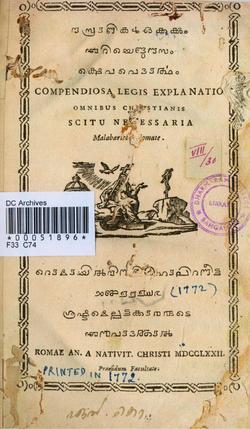
The British printed Malabar English Dictionary[168] by Graham Shaw in 1779 was still in the form of a Tamil-English Dictionary.[169] Paremmakkal Thoma Kathanar wrote the first Malayalam travelogue called Varthamanappusthakam in 1789.
Hermann Gundert, (1814–1893), a German missionary and scholar of exceptional linguistic talents, played a distinguishable role in the development of Malayalam literature. His major works are Keralolpathi (1843), Pazhancholmala (1845), Malayalabhaasha Vyakaranam (1851), Paathamala (1860) the first Malayalam school text book, Kerala pazhama (1868), the first Malayalam dictionary (1872), Malayalarajyam (1879) – Geography of Kerala, Rajya Samacharam (1847 June) the first Malayalam news paper, Paschimodayam (1879) – Magazine.[170] He lived in Thalassery for around 20 years. He learned the language from well established local teachers Ooracheri Gurukkanmar from Chokli, a village near Thalassery and consulted them in works. He also translated the Bible into Malayalam.[171][172]
In 1821, the Church Mission Society (CMS) at Kottayam in association with the Syriac Orthodox Church started a seminary at Kottayam in 1819 and started printing books in Malayalam when Benjamin Bailey, an Anglican priest, made the first Malayalam types. In addition, he contributed to standardizing the prose.[173] Hermann Gundert from Stuttgart, Germany, started the first Malayalam newspaper, Rajya Samacaram in 1847 at Talasseri. It was printed at Basel Mission.[174] Malayalam and Sanskrit were increasingly studied by Christians of Kottayam and Pathanamthitta. The Marthomite movement in the mid-19th century called for replacement of Syriac by Malayalam for liturgical purposes. By the end of the 19th century Malayalam replaced Syriac as language of Liturgy in all Syrian Christian churches.
1850–1904
[edit]
Vengayil Kunhiraman Nayanar, (1861–1914) from Thalassery was the author of first Malayalam short story, Vasanavikriti. After him innumerable world class literature works by was born in Malayalam.[64]
O. Chandu Menon wrote his novels "Indulekha" and "Saradha" while he was the judge at Parappanangadi Munciff Court. Indulekha is also the first Major Novel written in Malayalam language.[175]

.[64]
The third quarter of the 19th century CE bore witness to the rise of a new school of poets devoted to the observation of life around them and the use of pure Malayalam. The major poets of the Venmani School were Venmani Achhan Nambudiripad (1817–1891), Venmani Mahan Nambudiripad (1844–1893), Poonthottam Achhan Nambudiri (1821–1865), Poonthottam Mahan Nambudiri (1857–1896) and the members of the Kodungallur Kovilakam (Royal Family) such as Kodungallur Kunjikkuttan Thampuran. The style of these poets became quite popular for a while and influenced even others who were not members of the group like Velutheri Kesavan Vaidyar (1839–1897) and Perunlli Krishnan Vaidyan (1863–1894). The Venmani school pioneered a style of poetry that was associated with common day themes, and the use of pure Malayalam (Pachcha Malayalam) rather than Sanskrit.[64]
Twentieth century
[edit]In the second half of the 20th century, Jnanpith winning poets and writers like G. Sankara Kurup, S. K. Pottekkatt, Thakazhi Sivasankara Pillai, M. T. Vasudevan Nair, O. N. V. Kurup, Edasseri Govindan Nair and Akkitham Achuthan Namboothiri, had made valuable contributions to the modern Malayalam literature.[72][73][74][75][76] Later, writers like O. V. Vijayan, Kamaladas, M. Mukundan, Arundhati Roy, and Vaikom Muhammed Basheer, have gained international recognition.[78][79][80][176]
Prose
[edit]The travelogues written by S. K. Pottekkatt were turning point in the travelogue literature.[64] The writers like Kavalam Narayana Panicker have contributed much to Malayalam drama.[25]
Thakazhi Sivasankara Pillai turned away from party politics and produced a moving romance in Chemmeen (Shrimps) in 1956. For S. K. Pottekkatt and Vaikom Muhammad Basheer, who had not dabbled in politics, the continuity is marked in the former's Vishakanyaka (Poison Maid, 1948) and the latter's Ntuppuppakkoranendarnnu (My Grandpa had an Elephant, 1951). The non-political social or domestic novel was championed by P. C. Kuttikrishnan (Uroob) with his Ummachu (1955) and Sundarikalum Sundaranmarum (Men and Women of Charm, 1958).[64]
In 1957 Basheer's Pathummayude Aadu (Pathumma's Goat) brought in a new kind of prose tale, which perhaps only Basheer could handle with dexterity. The fifties thus mark the evolution of a new kind of fiction, which had its impact on the short stories as well. This was the auspicious moment for the entry of M. T. Vasudevan Nair and T. Padmanabhan upon the scene. Front runners in the post-modern trend include Kakkanadan, O. V. Vijayan, E. Harikumar, M. Mukundan and Anand.[64]
Kerala has the highest media exposure in India with newspapers publishing in nine languages, mainly English and Malayalam.[177][178]
Poetry
[edit]Contemporary Malayalam poetry deals with social, political, and economic life context. The tendency of the modern poetry is often towards political radicalism.[158]
See also
[edit]

References
[edit]- ^ 52nd Report of the Commissioner for Linguistic Minorities in India (PDF). Government of India (Report). 9 August 2021. p. 124. Archived from the original (PDF) on 7 August 2023. Retrieved 6 November 2021.
- ^ a b "Official Language (Legislative) Commission". Archived from the original on 25 March 2015. Retrieved 5 April 2015.
- ^ a b "P&ARD Official Languages". Archived from the original on 1 April 2015. Retrieved 5 April 2015.
- ^ a b c Malayalam at Ethnologue (28th ed., 2025)

- ^ a b "Census of India Website: Office of the Registrar General & Census Commissioner, India". Archived from the original on 15 August 2018. Retrieved 26 December 2019.
- ^ Statement 1: Abstract of speakers' strength of languages and mother tongues – 2011". www.censusindia.gov.in. Office of the Registrar General & Census Commissioner, India. [1] Archived 14 November 2018 at the Wayback Machine
- ^ a b Subramoniam, V. I. (1997). Dravidian encyclopaedia. vol. 3, Language and literature. Thiruvananthapuram: International School of Dravidian Linguistics. Cit-P-487. Dravidian Encyclopedia Archived 29 September 2007 at the Wayback Machine
- ^ Official languages, UNESCO, archived from the original on 28 September 2005, retrieved 10 May 2007
- ^ Laurie Bauer, 2007, The Linguistics Student's Handbook, Edinburgh, p. 300.
- ^ "'Classical' status for Malayalam". The Hindu. Thiruvananthapuram, India. 24 May 2013. Archived from the original on 27 September 2013. Retrieved 25 May 2013.
- ^ "Malayalam gets classical language status". The Indian Express. 24 May 2013. Archived from the original on 7 September 2021. Retrieved 7 September 2021.
- ^ "Languages in Lakshadweep". Archived from the original on 11 April 2015. Retrieved 5 April 2015.
- ^ "Malayalam". Ethnologue. Retrieved 3 March 2024.
- ^ a b Ayyar, Ramaswami (1936). The Evolution of Malayalam Morphology (1st ed.). Cochin, Kerala: Cochin government press. pp. 1–37.
- ^ a b c d e f g h Krishnamurti, Bhadriraju (2003). The Dravidian Languages. Cambridge University Press. ISBN 978-1-139-43533-8. Archived from the original on 29 July 2021. Retrieved 16 November 2020.
- ^ a b Asher & Kumari 1997, p. xxiv.
- ^ Shulman, David (2016). Tamil: A Biography. Harvard University Press. doi:10.2307/j.ctt1g69zdt. ISBN 978-0-674-05992-4. JSTOR j.ctt1g69zdt."There has been a tendency among historical linguists to think of Malayalam as having diverged directly from Tamil (the Tamil spoken from ancient times in what is today Kerala), perhaps as late as the thirteenth century. But this view is almost certainly wrong. Tamil and Malayalam must have separated from one another at a much earlier stage, perhaps around the middle of the first millennium A.D., as we can see from several surviving archaic features of Malayalam."
- ^ a b Karashima 2014, p. 6: Other sources date this split to the 7th and 8th centuries.
- ^ S.V. Shanmugam (1976). "Formation and Development of Malayalam", Indian Literature, Vol. 19, No. 3 (May–June 1976), pp. 5–30. JSTOR 24157306 "Yet, some scholars of Malayalam still believe that Malayalam should have originated independently from the Proto-Dravidian at a very early stage [...] The native scholars are unwilling to accept Malayalam as an ausbau language; instead they take it to be an abstand language 'language by distance' contrary to historical evidence (pp.9–10)".
- ^ a b Freeman, Rich (2003). "The Literary Culture of Premodern Kerala". In Sheldon, Pollock (ed.). Literary Cultures in History. University of California Press. pp. 445–46. ISBN 978-0-520-22821-4.
- ^ Tintu, K.J. (2019). "The Syrian Christian Copper Plate of Tarisāppaḷḷy, and the Jewish and Muslim Merchants of Early Malabar". Proceedings of the Indian History Congress. 80: 184–191. ISSN 2249-1937. JSTOR 27192872.
- ^ "Malayalam literature | Facts, Writers, Poetry, & Examples". Encyclopedia Britannica. Archived from the original on 21 March 2023. Retrieved 21 March 2023.
- ^ Venu Govindaraju; Srirangaraj Setlur (2009). Guide to OCR for Indic Scripts: Document Recognition and Retrieval – Advances in Pattern Recognition. Springer. p. 126. ISBN 978-1-84800-329-3. Archived from the original on 29 April 2016. Retrieved 15 November 2015.
- ^ a b c d Vaishnavi Murthy K Y; Vinodh Rajan. "L2/17-378 Preliminary proposal to encode Tigalari script in Unicode" (PDF). unicode.org. Archived (PDF) from the original on 8 February 2018. Retrieved 28 June 2018.
- ^ a b c d e f g h i Mathrubhumi Yearbook Plus – 2019 (Malayalam ed.). Kozhikode: P. V. Chandran, Managing Editor, Mathrubhumi Printing & Publishing Company Limited, Kozhikode. 2018. p. 454. ASIN 8182676444.
- ^ Menon, A. Sreedhara (2008). The legacy of Kerala (1st DCB ed.). Kottayam, Kerala: D C Books. ISBN 978-81-264-2157-2.
- ^ "August 23, 2010 Archives". Archived from the original on 27 April 2013.
- ^ Caldwell, Robert (1998). A Comparative Grammar of the Dravidian Or South-Indian Family of Languages. Asian Educational Services. pp. 6, 16, 17–19, 20, 21–25. ISBN 978-81-206-0117-8.
Malayalam is spoken along the Malabar coast, on the western side of the Ghauts, or Malaya range of mountains, from the vicinity of Kumbla near Mangalore, where it supersedes Tuļu, to Kanyakumari, where it begins to be superseded by Tamil. (Pages 6, 16, 20, 31)
- ^ Chevillard, Jean-Luc (1 January 2008). Kannan, M. (ed.). "The concept of ticai-c-col in Tamil grammatical literature and the regional diversity of Tamil classical literature". Streams of Language: Dialects in Tamil. French Institute of Pondicherry: 12. (p.21-50 of journal)
- ^ V. Nagam Aiya (1906). The Travancore State Manual. Travancore Government Press.
- ^ C. A. Innes and F. B. Evans, Malabar and Anjengo, volume 1, Madras District Gazetteers (Madras: Government Press, 1915), p. 2.
- ^ M. T. Narayanan, Agrarian Relations in Late Medieval Malabar Archived 3 May 2022 at the Wayback Machine (New Delhi: Northern Book Centre, 2003), xvi–xvii.
- ^ Sreedhara Menon, A. (January 2007). Kerala Charitram (2007 ed.). Kottayam: DC Books. ISBN 9788126415885. Archived from the original on 13 November 2021. Retrieved 19 July 2020.
- ^ a b Caldwell, Robert (1875). A Comparative Grammar of the Dravidian or South-Indian Family of Languages Archived 16 March 2016 at the Wayback Machine, second edition. London: Trübner & Co.
- ^ a b c d "Ethnologue report for language code: mal". Ethnologue.com. Archived from the original on 28 June 2013. Retrieved 20 February 2012.
- ^ a b c d e f g h i j k l m n o p q r s t u Sreedhara Menon, A. (January 2007). Kerala Charitram (2007 ed.). Kottayam: DC Books. p. 27. ISBN 978-81-264-1588-5. Archived from the original on 13 November 2021. Retrieved 19 July 2020.
- ^ Malabar Manual (1887), William Logan, Calicut
- ^ Veluthat, Kesavan (2018). "History and historiography in constituting a region: The case of Kerala". Studies in People's History. 5 (1): 13–31. doi:10.1177/2348448918759852. ISSN 2348-4489.
- ^ a b Sheldon Pollock; Arvind Raghunathan Professor of South Asian Studies Sheldon Pollock (19 May 2003). Literary Cultures in History: Reconstructions from South Asia. University of California Press. pp. 441–442. ISBN 978-0-520-22821-4. Archived from the original on 26 December 2016. Retrieved 18 May 2018.
- ^ Barbosa, Duarte (1989). The Book of Duarte Barbosa: An Account of the countries bordering on the Indian Ocean and their inhabitants (Volume 2). Asian Educational Services. pp. 1–7. ISBN 9788120604513.
Per Barbosa, Malabar begins at the point where the kingdom of Narasyngua or Vijayanagar ends, that is at Cumbola (Cambola) on the Chandragiri river.
- ^ Barbosa, Duarte; Dames, Mansel Longworth (1918). "PDF.js viewer" (PDF). indianculture.gov.in. Asian Educational Services. pp. 194–198. Archived (PDF) from the original on 24 April 2022. Retrieved 24 April 2022.
- ^ Narayanan, M. G. S. (2013) [1972]. Perumals of Kerala: Brahmin Oligarchy and Ritual Monarchy. Thrissur (Kerala): CosmoBooks. ISBN 9788188765072. Archived from the original on 7 June 2021. Retrieved 7 June 2021.
- ^ Cereti, C. G. (2009). "The Pahlavi Signatures on the Quilon Copper Plates". In Sundermann, W.; Hintze, A.; de Blois, F. (eds.). Exegisti Monumenta: Festschrift in Honour of Nicholas Sims-Williams. Wiesbaden: Harrassowitz. ISBN 978-3-447-05937-4. Archived from the original on 5 May 2021. Retrieved 7 June 2021.
- ^ "Dravidian languages – History, Grammar, Map, & Facts". Archived from the original on 9 July 2017. Retrieved 22 May 2017.
- ^ Gopinathan Nair (2009), p. 682: "[...] Malayalam emerged from Proto-Tamil–Malayalam; divergence occurred over a period of four or five centuries, from the 8th century onward".
- ^ a b Mathrubhumi Yearbook Plus – 2019 (Malayalam ed.). Kozhikode: P. V. Chandran, Managing Editor, Mathrubhumi Printing & Publishing Company Limited, Kozhikode. 2018. p. 450. ASIN 8182676444.
- ^ A. Govindankutty (1972) – From proto-Tamil-Malayalam to West Coast dialects. Indo-Iranian Journal, Vol. 14 No. (1/2), pp. 52–60
- ^ Variar, K. M. Prabhakara (1980). "Early Malayalam and ancient Tamil works". In S.V., Subramanian (ed.). Heritage of the Tamils - Language and Grammar. International Institute of Tamil Studies. pp. 382–392.
- ^ Ayyar, Ramaswami (1936). The Evolution of Malayalam Morphology (1st ed.). Cochin, Kerala: Cochin government press. pp. 35–37.
- ^ Ayyar, Ramaswami (1936). The Evolution of Malayalam Morphology (1st ed.). Cochin, Kerala: Cochin government press. p. 2.
- ^ a b Mahapatra 1989, p. 307.
- ^ M. G. S. Narayanan. "Kozhikkodinte Katha". Malayalam/Essays. Mathrubhumi Books. Second Edition (2017) ISBN 978-81-8267-114-0
- ^ a b c d e f Narayanan, M. G. S. (2013). Perumals of Kerala. Thrissur: CosmoBooks. pp. 380–82. ISBN 9788188765072. Archived from the original on 7 June 2021. Retrieved 7 June 2021.
- ^ Ayyar, L. V. Ramaswami (1936). The Evolution of Malayalam Morphology (1st ed.). Trichur: Rama Varma Research Institute. p. 3.
- ^ a b Karashima 2014, pp. 152–153.
- ^ Krishnamurti, Bhadriraju. "Malayalam language". Encyclopædia Britannica. Archived from the original on 16 November 2018. Retrieved 27 October 2018.
- ^ a b Krishnamurti, Bhadriraju. "Dravidian Languages". Encyclopædia Britannica. Archived from the original on 7 June 2021.
- ^ "Kollam Era" (PDF). Indian Journal History of Science. Archived from the original (PDF) on 27 May 2015. Retrieved 30 December 2014.
- ^ Broughton Richmond (1956), Time measurement and calendar construction, p. 218, archived from the original on 9 June 2021, retrieved 9 June 2021
- ^ R. Leela Devi (1986). History of Kerala. Vidyarthi Mithram Press & Book Depot. p. 408. Archived from the original on 9 June 2021. Retrieved 9 June 2021.
- ^ Veluthat, Kesavan (2018). "History and Historiography in Constituting a Region: The Case of Kerala". Studies in People's History. 5 (1): 13–31. doi:10.1177/2348448918759852. ISSN 2348-4489. S2CID 166060066. Archived from the original on 13 September 2021. Retrieved 7 June 2021.
- ^ Narayanan, M. G. S. (1972). Cultural Symbiosis in Kerala. Kerala: Kerala Historical Society. p. 18.
- ^ Menon, T. K. Krishna (1990) [Originally published 1939]. A Primer of Malayalam Literature. Asian Educational Services. ISBN 9788120606036. Archived from the original on 7 June 2021. Retrieved 7 June 2021 – via Google Books.
- ^ a b c d e f g h i j k l m n o p q r s t u v w x y z aa ab ac ad ae af ag ah ai aj ak al am an ao ap aq ar as at Dr. K. Ayyappa Panicker (2006). A Short History of Malayalam Literature. Thiruvananthapuram: Department of Information and Public Relations, Kerala.
- ^ a b Kerala (India), Dept. of Public Relations (2003), District Handbooks of Kerala: Pathanamthitta (Volume 7 of District Handbooks of Kerala, Kerala (India). Dept. of Public Relations
- ^ a b Sheldon Pollock; Arvind Raghunathan (19 May 2003). Literary Cultures in History: Reconstructions from South Asia. University of California Press. pp. 449, 455–472. ISBN 978-0-520-22821-4. Archived from the original on 27 February 2020. Retrieved 18 May 2018.
- ^ a b Ke Rāmacandr̲an Nāyar (1971). Early Manipravalam: a study. Anjali. Foreign Language Study. pp. 78
- ^ a b History of Travancore by Shungunny Menon, page 28
- ^ "Kumaran Asan – Kumaran Asan Poems – Poem Hunter". poemhunter.com. Archived from the original on 29 July 2017. Retrieved 15 September 2017.
- ^ "Ulloor S. Parameswara Iyer – Ulloor S. Parameswara Iyer Poems – Poem Hunter". poemhunter.com. Archived from the original on 29 July 2017. Retrieved 15 September 2017.
- ^ "Vallathol Narayana Menon – Vallathol Narayana Menon Poems – Poem Hunter". poemhunter.com. Archived from the original on 29 July 2017. Retrieved 15 September 2017.
- ^ a b Subodh Kapoor (2002). The Indian Encyclopaedia: Biographical, Historical, Religious, Administrative, Ethnological, Commercial and Scientific. Mahi-Mewat. Cosmo. p. 4542. ISBN 978-8177552720. Archived from the original on 27 May 2013. Retrieved 18 November 2012.
- ^ a b Accessions List, South Asia. E.G. Smith for the U.S. Library of Congress Office, New Delhi. 1994. p. 21. Archived from the original on 2 January 2014. Retrieved 18 November 2012.
- ^ a b Indian Writing Today. Nirmala Sadanand Publishers. 1967. p. 21. Archived from the original on 2 January 2014. Retrieved 18 November 2012.
- ^ a b Amaresh Datta; Sahitya Akademi (1987). Encyclopaedia of Indian Literature: K to Navalram. Sahitya Akademi. p. 2394. ISBN 978-0-8364-2423-2. Archived from the original on 27 May 2013. Retrieved 18 November 2012.
- ^ a b Malayalam Literary Survey. Kerala Sahitya Akademi. 1993. p. 19. Retrieved 18 November 2012.
- ^ "Edasseri Govindan Nair" Archived 1 March 2023 at the Wayback Machine. Edasseri.org. Retrieved 7 March 2023.
- ^ a b Eṃ Mukundan; C. Gopinathan Pillai (2004). Eng Adityan Radha And Others. Sahitya Akademi. p. 3. ISBN 978-8126018833. Archived from the original on 27 May 2013. Retrieved 18 November 2012.
- ^ a b Ed. Vinod Kumar Maheshwari (2002). Perspectives on Indian English Literature. Atlantic Publishers & Dist. p. 126. ISBN 978-8126900930. Archived from the original on 2 January 2014. Retrieved 18 November 2012.
- ^ a b Amit Chaudhuri (2008). Clearing a Space: Reflections on India, Literature, and Culture. Peter Lang. pp. 44–45. ISBN 978-1-906165-01-7. Archived from the original on 27 May 2013. Retrieved 18 November 2012.
- ^ [2] Archived 10 January 2012 at the Wayback Machine, censusindia.net
- ^ Malayalam (Namboodiri Dialect) Archived 28 October 2020 at the Wayback Machine – Cambridge University Press
- ^ "US News: US News, Top News in India, US election news, Business news, Sports & International News | Times of India". The Times of India. Archived from the original on 25 May 2019.
- ^ a b c d A sacred language is vanishing from State Archived 10 July 2013 at the Wayback Machine, The Hindu
- ^ "Ravula". Ethnologue. Archived from the original on 21 September 2022. Retrieved 14 June 2022.
- ^ "Nagercoil slang was my biggest challenge: Vijay Sethupathi". The Times of India. 16 January 2017. Archived from the original on 17 November 2021. Retrieved 16 July 2021.
- ^ Asher & Kumari 1997, pp. xxiv, xxv.
- ^ S. Kunjan Pillai (1965) – Malayalam Lexicon, pg xxii–xxiv
- ^ Manipravalam Archived 10 June 2011 at the Wayback Machine The Information & Public Relations Department, Government of Kerala.
- ^ "Dravidian languages." Encyclopædia Britannica. Ultimate Reference Suite. Chicago: Encyclopædia Britannica, 2008.
- ^ "South Kanara, The Nilgiris, Malabar and Coimbators Districts". Archived from the original on 2 October 2022. Retrieved 29 April 2021.
- ^ a b "Census of India – Language". censusindia.gov.in. Archived from the original on 1 November 2021. Retrieved 17 April 2020.
- ^ "Census of India – Data on Language". Censusindia.gov.in. Archived from the original on 10 January 2012. Retrieved 30 March 2012.
- ^ [3] Archived 4 March 2016 at the Wayback Machine. Retrieved 22 November 2014.
- ^ "Census 2011 Australia – ABS Population Income". Sbs.com.au. Archived from the original on 17 July 2013. Retrieved 10 July 2013.
- ^ Statistics New Zealand:Language spoken (total responses) for the 1996–2006 censuses (Table 16), stats.govt.nz
- ^ a b c d e f Namboodiripad, Savithry (2016). Malayalam (Namboodiri Dialect) (Thesis). Cambridge University Press. Archived from the original on 2 March 2022. Retrieved 22 December 2020.
- ^ a b c d e f g h i j Haowen Jiang (April 2010). "Malayalam: a Grammatical Sketch and a Text" (PDF). Department of Linguistics, Rice University. Archived from the original (PDF) on 11 September 2012. Retrieved 8 January 2022.
- ^ Muller, Eric (2006). "Malayalam cillaksarams" (PDF). JTC1/SC2/WG2 N3126 L2/06-207. Archived (PDF) from the original on 24 November 2020. Retrieved 10 September 2009.
- ^ Hamann, Silke (2003). The Phonetics and Phonology of Retroflexes (PDF) (Thesis). Utrecht, Netherlands. Archived (PDF) from the original on 16 January 2021. Retrieved 13 January 2021.
- ^ Zvelebil, Kamil (1965). Some features of Ceylon Tamil. Indo-Iranian Journal. Vol. 9. JSTOR. pp. 113–138. JSTOR 24650188.
- ^ The Unicode Standard Version 13.0 – Core Specification, South and Central Asia-I, Official Scripts of India pg. 514
- ^ Andronov, Mikhail Sergeevich (2003). A Comparative Grammar of the Dravidian Languages. Otto Harrassowitz Verlag. ISBN 978-3-447-04455-4. Archived from the original on 2 October 2022. Retrieved 25 June 2022.
- ^ Scobbie, Punnoose & Khattab (2013) "Articulating five liquids: a single speaker ultrasound study of Malayalam". In Rhotics: New Data and Perspectives. BU Press, Bozen-Bolzano.
- ^ Dowla Khan, Sameer ud (2021). Palatalization and velarization in Malayalam nasals: a preliminary acoustic study of the dental–alveolar contrast (PDF). Reed College.
- ^ Krishnamurti (2003), p. 167.
- ^ a b Shekhar, A. C.; Sankaran, C. R. (1944). "Notes on Colloquial Malayāḷam". Bulletin of the Deccan College Research Institute. 6 (1/2): 49–52. JSTOR 42929361.
- ^ Steever (2015), p. 63.
- ^ Sekhar, A. C. (1951). "[Evolution of Malayalam]". Bulletin of the Deccan College Research Institute. 12 (1/2). JSTOR 42929457.
- ^ https://www.academia.edu/34133186/Fading_memories_and_Linguistic_Fossils_in_the_religiolect_of_Kerala_Jews
- ^ Ravi Sankar S. Nair (7 July 2013). "Tribal Languages of Kerala" (PDF). Language in India. 13. Bloomington, MN: M. S. Thirumalai. ISSN 1930-2940. Archived (PDF) from the original on 12 March 2025. Retrieved 11 August 2025.
- ^ "Wals.info". Wals.info. Archived from the original on 20 May 2011. Retrieved 20 February 2012.
- ^ Jayaseelan, Karattuparambil (2001). IP-internal topic and focus phrases. p. 40.
- ^ Asher, R. E. and Kumari, T. C. (1997). Malayalam. Routledge Pub.: London.
- ^ "The Samyojika Vibhakthi and Its Unique Application in Malayalam Grammar" (PDF). Archived from the original (PDF) on 31 July 2012. Retrieved 20 February 2012.
- ^ Varma, A.R. Rajaraja (2005). Keralapanineeyam. Kottayam: D C Books. p. 303. ISBN 978-81-7130-672-5.
- ^ Varma, A.R. Rajaraja (2005). Keralapanineeyam. Kottayam: D C Books. pp. 301–302. ISBN 978-81-7130-672-5.
- ^ a b c Suriyani Malayalam Archived 11 June 2014 at the Wayback Machine, Nasrani Foundation
- ^ Prayer from the Past Archived 4 April 2014 at the Wayback Machine, India Today
- ^ Gaṅgopādhyāẏa, Subrata (2004). Symbol, Script, and Writing: From Petrogram to Printing and Further. Sharada Pub. House. p. 158. Archived from the original on 8 November 2015. Retrieved 15 November 2015.
- ^ "Education in Lakshadweep – Discovering the past chapters". Archived from the original on 5 October 2010. Retrieved 24 June 2010.
- ^ Don M. de Z. Wickremasinghe; T.N. Menon (2004). Malayalam Self-Taught. Asian Educational Services. p. 7. ISBN 978-81-206-1903-6. Archived from the original on 28 May 2016. Retrieved 15 November 2015.
- ^ "Language". kerala.gov.in. Archived from the original on 11 October 2007. Retrieved 28 May 2007.
- ^ Venugopal, Aiswarya (9 November 2024). "Exclusive Part II: 'I saw Thallumaala first cut a year before release'". Mathrubhumi. Retrieved 9 September 2025.
- ^ "Malayalam gets its own operating system". The Hindu. 15 February 2006. Archived from the original on 5 January 2007. Retrieved 12 September 2025.
- ^ "South Asian Scripts-I" (PDF). The Unicode Standard 5.0 – Electronic Edition. Unicode, Inc. 1991–2007. pp. 42–44. Archived (PDF) from the original on 25 February 2021. Retrieved 8 September 2009.
- ^ Alex, Shiju (22 August 2013). "മലയാള അക്കങ്ങൾ". ഗ്രന്ഥപ്പുര (in Malayalam). Archived from the original on 2 December 2020. Retrieved 12 April 2020.
- ^ a b Alex, Shiju (22 August 2013). "മലയാള അക്കങ്ങൾ". ഗ്രന്ഥപ്പുര. Archived from the original on 2 December 2020. Retrieved 12 April 2020.
- ^ a b Ager, Simon (1998). "Malayalam alphabet, pronunciation and language". Omniglot. Archived from the original on 10 May 2021. Retrieved 8 September 2009.
- ^ "Vazhapally Temple". Vazhappally Sree Mahadeva Temple. Archived from the original on 9 January 2011. Retrieved 31 October 2009.
- ^ Burnell (1874), p. 39.
- ^ a b "The Script". Malayalam Resource Centre. Archived from the original on 25 July 2011. Retrieved 20 November 2009.
- ^ a b "Alphabets". Government of Kerala. Archived from the original on 9 November 2009. Retrieved 29 October 2009.
- ^ Nampoothiri, N. M. (1999), "Cultural Traditions in Medieval Kerala"[permanent dead link] (PDF) in Cherian, P. J., Perspectives on Kerala History: The Second Millennium, Kerala Council for Historical Research, ISBN 81-85499-35-7, retrieved 2009-11-20.
- ^ "Development of Literature". Malayalam Resource Centre. Archived from the original on 4 July 2013. Retrieved 20 November 2009.
- ^ Andronov, Mikhail Sergeevich. A Grammar of the Malayalam Language in Historical Treatment. Wiesbaden: Harrassowitz, 1996.
- ^ a b Burnell (1874), p. 35.
- ^ "Grantha alphabet". Encyclopædia Britannica. 2009. Archived from the original on 16 December 2014. Retrieved 28 October 2009.
- ^ "EPIGRAPHY – Inscriptions in Grantha Script". Department of Archaeology, government of Tamil Nadu. Archived from the original on 11 January 2010. Retrieved 11 November 2009.
- ^ "City Youth Learn Dying Language, Preserve It". The New Indian Express. 9 May 2016. Archived from the original on 3 June 2016. Retrieved 9 May 2016.
- ^ Kunnath, Ammad (15 September 2015). The rise and growth of Ponnani from 1498 AD To 1792 AD (PhD). Department of History. hdl:10603/49524. Archived from the original on 2 October 2022. Retrieved 27 May 2021.
- ^ Panakkal, Abbas (2016). Islam in Malabar (1460–1600): a socio-cultural study /. Kulliyyah Islamic Revealed Knowledge and Human Sciences, International Islamic University Malaysia. Archived from the original on 27 May 2021. Retrieved 27 May 2021.
- ^ Randathani, Hussain (4–6 December 2018). Trade and Culture: Indian ocean interaction on the coast of Malabar in medieval period. 2nd International IBNU Batuta Conference. Archived from the original on 15 April 2022. Retrieved 27 May 2021.
- ^ Miller, Roland. E., "Mappila" in "The Encyclopedia of Islam". Volume VI. E. J. Brill, Leiden. 1987. pp. 458–56.
- ^ "Malayalam Resource Centre". Archived from the original on 12 September 2012. Retrieved 28 December 2021.
- ^ Menon. T. Madhava. "A Handbook of Kerala, Volume 2", International School of Dravidian Linguistics, 2002. pp. 491–493.
- ^ "National Virtual Translation Center – Arabic script for Malayalam". Archived from the original on 17 January 2009. Retrieved 27 May 2021.
- ^ Mahadevan, Iravatham (7 June 2012). "The earliest inscription in Malayalam". The Hindu. Archived from the original on 19 June 2018. Retrieved 28 August 2018.
- ^ Sasibhooshan, Gayathri (12 July 2012). "Historians contest antiquity of Edakkal inscriptions". The Hindu. Archived from the original on 6 December 2020. Retrieved 21 October 2020.
- ^ Krishnamurti 2003.
- ^ "official website of INFORMATION AND PUBLIC RELATION DEPARTMENT". prd.kerala.gov.in. Archived from the original on 14 October 2014. Retrieved 5 April 2015.
- ^ "Cherussery (Krishnagadha) Malayalam author books". keralaliterature.com. Archived from the original on 7 April 2019.
- ^ Arun Narayanan (25 October 2018). "The Charms of Poonthanam Illam". The Hindu. Archived from the original on 21 November 2021. Retrieved 6 April 2021.
- ^ Freeman, Rich (2003). "Genre and Society: The Literary Culture of Premodern Kerala". In Literary Cultures in History: Reconstructions from South Asia
- ^ Krishna Kaimal, Aymanam (1989). Attakatha sahithyam. Trivandrum: State Institute of Language. Archived from the original on 21 November 2021. Retrieved 1 May 2021.
- ^ "prd-Kunchan Nambiar (1705–1770)". Department of Public Relations, Government of Kerala. 23 March 2006. Archived from the original on 23 March 2006. Retrieved 2 March 2019.
- ^ "New university centre for Arabi Malayalam". Deccan Chronicle. 15 October 2017. Archived from the original on 24 October 2020. Retrieved 20 October 2020.
- ^ a b "South Asian arts". Archived from the original on 10 September 2014. Retrieved 15 September 2017.
- ^ Naha, Abdul Latheef (24 September 2020). "Jnanpith given to Akkitham". The Hindu. Archived from the original on 22 November 2021. Retrieved 12 June 2021.
- ^ ANI (29 November 2019). "Celebrated Malayalam poet Akkitham wins 2019 Jnanpith Award". Business Standard. Archived from the original on 21 November 2021. Retrieved 12 June 2021.
- ^ "History of Malayalam Literature". Archived from the original on 4 July 2013. Retrieved 19 March 2014.
- ^ Kamil Zvelebil (1973). The Smile of Murugan: On Tamil Literature of South India. BRILL. p. 3. ISBN 978-90-04-03591-1. Archived from the original on 30 March 2019. Retrieved 18 March 2018.
- ^ Binoy, Rasmi (27 September 2018). "The river sutra". The Hindu. Archived from the original on 21 November 2021. Retrieved 24 January 2021.
- ^ "Syro Malabar Church". Archived from the original on 17 March 2015. Retrieved 5 April 2015.
- ^ S. Parameshwara Aiyer, Ulloor (1990), Kerala Sahithya Chrithram (History of literature of Kerala), Thiruvananthapuram, Kerala: University of Kerala
- ^ a b c d e f g h "School of Distance Education, University of Calicut" (PDF). Archived (PDF) from the original on 8 June 2021. Retrieved 8 June 2021.
- ^ Leelavathi, M., Malayala Kavitha Sahithya Chrithram (History of Malayalam poetry)
- ^ "Malabar English Dictionary". Archived from the original on 7 September 2006.
- ^ "Kerala / Kozhikode News: Copy of first book printed in Kerala released". The Hindu. 14 October 2005. Archived from the original on 27 March 2010. Retrieved 30 March 2012.
- ^ Rajyasamacharam | Kerala Press Academy Archived 12 July 2013 at the Wayback Machine. Pressacademy.org. Retrieved 28 July 2013.
- ^ Herman Gundert | Kerala Press Academy Archived 14 May 2013 at the Wayback Machine. Pressacademy.org. Retrieved 28 July 2013.
- ^ S. C. Bhatt and Gopal K. Bhargava (2005). Land and people of Indian states and union territories. Gyan Publishing House. p. 289. ISBN 978-81-7835-370-8. Archived from the original on 27 May 2016. Retrieved 15 November 2015.
This Bungalow in Tellicherry ... was the residence of Dr. Herman Gundert .He lived here for 20 years
- ^ "Banjamin Bailey" Archived 10 February 2010 at the Wayback Machine, The Hindu, 5 February 2010
- ^ Rajya Samacaram, "1847 first Newspaper in Malayalam", Kerala Government
- ^ Visakham thirunal. [Place of publication not identified]: Duc. 2012. ISBN 978-613-9-12064-2. OCLC 940373421.
- ^ Lyall, Sarah (15 October 1997). "Indian's First Novel Wins Booker Prize in Britain". The New York Times. Archived from the original on 21 November 2021. Retrieved 11 November 2007.
- ^ "The DHS Program – India: Standard DHS, 2015–16". dhsprogram.com. Archived from the original on 21 October 2020. Retrieved 12 June 2021.
- ^ "National Family Health Survey". rchiips.org. Archived from the original on 3 October 2021. Retrieved 12 June 2021.

Sources
[edit]- Gopinathan Nair, B. (2009). "Malayalam". In Keith Brown; Sarah Ogilvie (eds.). Concise Encyclopedia of Languages of the World. pp. 680–683.
- Karashima, Noboru (2014). A Concise History of South India: Issues and Interpretations. Oxford University Press. ISBN 978-0-19-809977-2.
- Mahapatra, B. P. (1989). Constitutional Languages. The Written Languages of the World: A Survey of the Degree and Modes of Use. Vol. 2. Presses Université Laval. ISBN 978-2-7637-7186-1.
- Asher, R. E.; Kumari, T. C. (1997). Malayalam. Psychology Press. ISBN 978-0-415-02242-2.
- Govindankutty, A. "From Proto-Tamil-Malayalam to West Coast Dialects", 1972. Indo-Iranian Journal, Vol. XIV, Nr. 1/2, pp. 52–60.
- Steever, Sanford B. (15 April 2015). The Dravidian Languages. Routledge. ISBN 978-1-136-91171-2.
Further reading
[edit]- English
- Joseph Peet (1841). A Grammar of the Malayalim Language. Cottayam: Church Missionary Society.
- Hermann Gundert (1867). Catechism of Malayalam Grammar (PDF). Translated by L. Grathwaite. Cannanore: Government Book Depot. Archived (PDF) from the original on 15 March 2023. Retrieved 5 February 2023.
- Hermann Gundert (1872). A Malayalam and English Dictionary. Mangalore: C. Stolz.
- T. K. Krishna Menon (1990) [Originally published 1939]. A Primer of Malayalam Literature. New Delhi: Asian Educational Services. ISBN 9788120606036.
- A. C. Sekhar (1953). Evolution of Malayalam. Deccan College Dissertation Series. Poona: Deccan College.
- P. K. Parameswaran Nair (1967). History of Malayalam Literature. Translated by E. M. J. Venniyoor. New Delhi: Sahitya Akademi.
- A. Sreedhara Menon (1967). A Survey of Kerala History. Kottayam: S.P.C.S. ISBN 9788126415786.
- K. M. George (1968). A Survey of Malayalam Literature. Bombay: Asia Publishing House.
- Verghese Ittiavira (1968). Social Novels in Malayalam. Bangalore: Christian Institute for the Study of Religion and Society.
- T. Bhaskaran (1970). Malayalam poetics with special reference to Krishnagatha (PhD Thesis). Trivandrum: Kerala University. hdl:10603/147356. Archived from the original on 5 February 2023. Retrieved 5 February 2023.
- Krishna Chaitanya (1971). A History of Malayalam Literature. New Delhi: Orient Longman. ISBN 9788125004882.
- K. M. George (1972). Western Influence on Malayalam Language and Literature. New Delhi: Sahitya Akademi. ISBN 9788126004133.
- K. Ayyappa Panicker (1977). A Short History of Malayalam Literature. Trivandrum: Department of Information and Public Relations, Kerala.
- R. Leela Devi (1977). History of Malayalam Literature. Trivandrum: Educational Supplies Depot.
- N. V. Krishna Warrier (1977). A History of Malayalam Metre. Trivandrum: Dravidian Linguistics Association.
- K. M. Prabhakara Variar, ed. (1985). History of Malayalam Language. Madras: Madras University.
- Ganga Ram Garg (1988). International Encyclopaedia of Indian Literature. Vol. 6. Delhi: Mittal Publications.
- K. M. Tharakan (1990). A Brief Survey of Malayalam Literature. Kottayam: N.B.S.
- K. Ayyappa Panicker (1990). A Perspective of Malayalam Literature. Madras: Annu Chithra Publications.
- R. E. Asher; T. C. Kumari (1997). Malayalam. London: Routledge. ISBN 978-0-415-02242-2.
- Malayalam
- P. Govindapilla (1881). മലയാളഭാഷാചരിത്രം [Malayala Bhasha Charitram].
- Ulloor S. Parameswara Iyer (1953). കേരളസാഹിത്യചരിത്രം [Kerala Sahitya Charitram]. Trivandrum: Travancore University. Archived from the original on 5 February 2023. Retrieved 5 February 2023.
- P. K. Parameswaran Nair (1956). മലയാള സാഹിത്യചരിത്രം [Malayala Sahitya Charitram]. New Delhi: Sahitya Akademi.
- Erumeli Parameswaran Pillai (1966). മലയാളസാഹിത്യം കാലഘട്ടങ്ങളിലൂടെ [Malayala Sahityam Kalaghattangaliloode]. Kottayam: Vidyarthi Mithram.
Notes
[edit]- ^ "Prior to this relatively modern coining of "Malayalam", the identity is even more fraught, for Kerala folk more usually referred to their language as "Tamil", just as those in the dominant kingdoms of Tamilnadu, east of the Western Ghats, had from the early centuries C.E. Use of the label "Tamil" continued to overlap with that of "Malayalam" into the colonial period".[39]
- ^ Linguist K.M Prabhakar Variar further adds: "It is an accepted principle in comparative linguistics that 'innovations' rather than 'retentions' or 'losses' are to be relied on for sub-grouping of genetically related language. Every member of a language family has a stock of 'retentions of a few proto-features' together with a stock 'innovations'. It is the later that would show the relative distances among the member languages. Therefore, retention of a few proto-features in a particular language does not prove the earlier branching of the same from the proto-language. Malayalam, of course, has retained certain phonological and morphological features which can be reconstructed as belonging to the Proto-Dravidian and which have been lost or have suffered shape changes in the other member-languages. Which language in the Dravidian family doesn't have such retentions? Has anyone measured the relative percentages of retentions of archaic features in the twenty and odd Dravidian languages?".[48]
- ^ "*aH and *iH are demonstrative adjectives reconstructed for Proto-Dravidian, as they show variation in vowel length. When they occur in isolation they occur as ā, and ī but when they are followed by a consonant initial word then they appear as a- and i- as in Ta. appoẓutu 'that time'.,: Te. appuḍu id. and Ta. ippoẓutu 'that time'.,: Te.ippuḍu id. However, Modern Tamil has replaced ā, and ī with anda and inda but most Dravidian languages have preserved it."[150][page needed]
External links
[edit]


Languages of Kerala | ||
|---|---|---|
| Non-tribal languages | | |
| Tribal languages | ||
| Other languages and creoles | ||
| Related topics | ||

Malayalam
View on GrokipediaOrigins
Etymology
The name "Malayalam" derives from the ancient Tamil words mala, meaning "mountain" or "hill," and alam, meaning "place," "region," or "locality," collectively denoting the "land of the mountains" or the geographical area nestled between the Western Ghats and the Arabian Sea.[10][11] This etymology reflects the topography of Kerala, where the language developed, emphasizing its roots in the Dravidian linguistic tradition.[12] The earliest historical attestation of the term "Malayalam" appears in the Vazhappally copper-plate inscription dated to 832 CE, issued during the reign of King Rajasekhara Varman of the Kulasekhara dynasty in Kerala.[13] This inscription, written in an early form of the Malayalam script derived from Vatteluttu, marks one of the first documented uses of the name to refer to the region and its emerging linguistic identity, distinct yet influenced by neighboring Tamil-speaking areas.[11] Subsequent records, such as the Quilon Syrian copper plates of 849 CE, further illustrate the term's usage in administrative and trade contexts, solidifying its association with the local dialect and culture.[14] Linguistically, "Malayalam" evolved from Proto-Tamil-Malayalam, a hypothesized common ancestor shared with Tamil within the South Dravidian subgroup, where early forms exhibited strong Tamil influences in vocabulary, phonology, and syntax.[15][16] This proto-language, spoken across parts of ancient Tamilakam including Kerala, began diverging around the 9th century CE due to geographical isolation along the western coast, leading to innovations like simplified consonant clusters and increased Sanskrit borrowings, while retaining core Dravidian features such as agglutinative morphology.[12] The divergence marked "Malayalam" as a distinct entity, though early texts often referred to it simply as a western variant of Tamil until the term gained prominence in the medieval period.[11]Linguistic Classification
Malayalam belongs to the Dravidian language family, one of the major language families of South Asia, and is classified within the South Dravidian I (SD I) subgroup. This subgroup, also known as Tamil-Kannada, includes languages such as Tamil, Kannada, Tulu, Kodagu, Toda, Kota, Irula, and Badaga, all descending from Proto-South Dravidian (PSD), an intermediate stage between Proto-Dravidian and the modern southern languages. The Dravidian family as a whole is estimated to have originated around 4,500 years ago based on phylogenetic analyses, with SD I branching off early in the diversification process.[17][18] Within SD I, Malayalam forms part of the Tamil-Malayalam branch alongside Tamil, characterized by shared archaisms and innovations that distinguish it from other SD I languages like Tulu and Kodagu, which split earlier. Retained archaisms include a ten-vowel system (short and long /i, e, a, o, u/) and coronal obstruents (/t, ɖ, ɭ/), inherited from PSD. Common innovations encompass the umlaut shift where *i and *u become *e and *o before a following *a (e.g., Proto-Dravidian *kiḷi > Tamil/Malayalam *keḷi "parrot"), the loss of initial *c- to zero (via intermediate *s or *h), and morphological developments such as the plural inclusive *ñāñ from *ñām and the emphatic use of reflexive *tān. These features highlight the close genetic relationship, with Malayalam and Tamil retaining more PSD traits compared to Kannada, which underwent further mergers.[18] Malayalam diverged from PSD after the separation of Tulu and Kodagu, emerging as a distinct language from a western coastal dialect of early Middle Tamil around the 9th century CE, with the split completing between the 9th and 13th centuries. This divergence involved phonological changes like the merger of *ṇṭ and *ṉṭ to /nː/ (e.g., Proto-Dravidian *kaṇṭu > Malayalam /kaṉṉu/ "eye") and the development of secondary geminate contrasts, alongside morphological innovations such as the conditional marker -āl and question clitics -ō/-ē, which differ from Tamil equivalents. Despite these distinctions, the core typological features—agglutinative morphology, subject-object-verb word order, and non-finite verb constructions—remain quintessentially Dravidian.[18] Although Malayalam preserves a fundamentally Dravidian structure, it exhibits significant influences from neighboring language families, primarily Indo-Aryan languages like Sanskrit and Prakrit, through lexical borrowing (up to 40-50% of vocabulary in formal registers), phonological adaptations (introduction of voiced stops /b, d, g/ and aspirates /pʰ, tʰ/), and syntactic elements like the clitic -api from Sanskrit. Austroasiatic influences, potentially from pre-Dravidian substrates in the region, are evident in scattered lexical items and possible contributions to numeral systems or agricultural terms, but these are less extensive and primarily affect the broader Dravidian family rather than reshaping Malayalam's core grammar. These contacts have enriched Malayalam without altering its genetic Dravidian affiliation.[18][19]History
Old Malayalam
Old Malayalam, spanning approximately the 9th to 13th centuries CE, represents the earliest attested phase of the language, emerging as a distinct variety diverging from Middle Tamil through regional adaptations in the Kerala region. This period is primarily documented via inscriptions, which provide the first tangible evidence of Malayalam's independence. The Vazhappally copper plate inscription, dated to 832 CE, is widely regarded as the earliest recorded instance of Malayalam writing, issued by Chera king Rajasekhara Varman and detailing temple land grants and rituals in the Pallava Grantha script with Sanskrit influences.[13] Similarly, the Quilon Syrian copper plates of 849–850 CE, granted by Chera ruler Sthanu Ravi Varman, record privileges for a Christian merchant community in Kollam, incorporating local terms and reflecting early multilingual interactions in trade and religion. These epigraphic sources illustrate Old Malayalam's script evolution from Vatteluttu and Grantha, marking its separation from Tamil through localized phonetic and lexical features.[13] The literary tradition of Old Malayalam began to take shape in the late 12th century with the Ramacharitam, an epic poem attributed to the poet Ceraman and considered the earliest extant literary work in the language. Comprising over 1,700 verses, it narrates episodes from the Ramayana in a style blending colloquial Old Malayalam with Dravidian syntax and auxiliary verbs such as arul and iru, while drawing on regional folklore. This text exemplifies the pattu school of poetry, characterized by its use of native Dravidian sounds rather than heavy Sanskritization. Concurrently, influences from Manipravalam—a hybrid style mixing Malayalam (keralabhasha) with Sanskrit—began to appear, as defined later in the 14th-century Lilatilakam treatise, enriching vocabulary and enabling sophisticated expression among elite circles.[20] Phonologically, Old Malayalam diverged from Tamil through processes like the loss of intervocalic stops, where sounds such as /k/ lenited to /v/ or were elided (e.g., pokuka > povuka), contributing to smoother prosody and distinguishing it from Tamil's retention of such consonants. Additionally, unique vowel harmony developed, involving contractions and assimilations like ai > a (e.g., maiyal > mayal) and shifts in mid vowels toward high vowels in certain contexts, reflecting regional speech patterns and Sanskrit borrowings. These changes, evident in inscriptions and early texts, established Malayalam's phonological inventory, including merged nasals and simplified clusters, setting the foundation for its later evolution.[20]Middle Malayalam
The Middle Malayalam period, spanning the 13th to 18th centuries, marked a phase of significant literary maturation in the language, building on the foundational elements of Old Malayalam while incorporating sophisticated poetic forms and external linguistic influences from trade and religious interactions.[21] This era saw the proliferation of Manipravalam, a hybrid literary style blending Sanskrit (likened to coral) with Malayalam (likened to ruby), which was patronized by elite Nambudiri Brahmins and used extensively in poetry to synthesize Aryan and Dravidian traditions.[22] Manipravalam works, often in the form of champus (prose-poetry hybrids) and sandesa kavyas (messenger poems), provided vivid depictions of medieval Kerala's social and material life, including the roles of dancers and courtly customs, and flourished particularly from the 13th to 16th centuries following the decline of the second Chera dynasty.[22] Among the era's landmark compositions is Unnunili Sandesam, a 14th-century sandesa kavya of 240 stanzas attributed to an anonymous court poet, which employs Manipravalam to narrate a lover's message sent via a parrot from Thiruvananthapuram to Kollam, offering rich ethnographic insights into 14th-century Kerala's geography, flora, and urban life while excelling in erotic imagery and rhythmic verse.[21] This work exemplifies the increased sophistication of Manipravalam poetry, which by the 13th century had already appeared in texts like Vaisika Tantram and continued to evolve through champus such as Unniyachi Charitham (with 27 poems and 30 prose sections) and Unnichirutevi Charitham, highlighting themes of romance and elite patronage.[22] In the 15th century, Cherusseri Nambudiri's Krishnagatha, a devotional epic on Lord Krishna's life composed in accessible spoken Malayalam using Dravidian folk meters, represented a shift toward vernacular bhakti literature, promoting simplicity and emotional devotion over ornate Sanskrit influences and becoming one of the most enduring popular works of the period.[21] European trade contacts profoundly shaped Middle Malayalam's lexicon, particularly through Portuguese arrivals in the early 16th century, which introduced over a hundred loanwords for novel concepts in navigation, agriculture, and daily life, such as mesa (table) from mesa and janela (window) from janela.[23] The Dutch, who displaced Portuguese control in coastal enclaves by the mid-17th century, further contributed lexical influences, evident in borrowings related to trade goods and maritime terms, reflecting sustained commercial exchanges until the 18th century.[24] Concurrently, the Malayalam script transitioned from the rounded Vattezhuthu—a descendant of the ancient Brahmi script used since the 9th century—toward proto-Malayalam forms in the early 13th century, developing a more angular, syllabic system capable of representing complex vowel-consonant combinations influenced by both Tamil and Sanskrit orthography.[25] Religious literature also diversified during this time, with the emergence of Syriac-Malayalam (known as Garshuni or Karshoni), a dialect of Malayalam transcribed in an adapted Syriac script enriched by additional Malayalam letters and diacritics, used by Saint Thomas Christians for liturgical and devotional texts from at least the 16th century onward.[26] This script facilitated the preservation of early Indian Christian writings, including biblical commentaries and hymns, blending Syriac phonetics with Malayalam grammar to serve the community's spiritual needs amid growing European missionary activities.[27]Modern Malayalam
The introduction of the printing press in 1821 marked a pivotal advancement in Malayalam's dissemination, with Rev. Benjamin Bailey establishing the CMS Press in Kottayam, which produced the first printed Malayalam book, Sampathavali, in 1824.[28] This innovation facilitated the broader circulation of texts, bridging the gap between manuscript traditions and mass production, and laid the groundwork for linguistic documentation during colonial encounters. Subsequent reforms in the mid-19th century further standardized the language; German missionary Hermann Gundert published A Grammar of Malayalam in 1868, providing a systematic analysis that influenced orthography and pedagogy, while his Malayalam and English Dictionary in 1872 offered the first comprehensive bilingual resource, aiding cross-cultural exchange and formal education.[29][30] The 20th century saw intensified efforts toward standardization, culminating in the Kerala government's orthographic reform order issued on March 23, 1971, which took effect on April 15, 1971, and simplified the script by reducing the number of graphemes from over 1,000 to 90, primarily by standardizing ligatures and eliminating redundant forms for efficiency in printing and typing.[31] This reform addressed longstanding complexities inherited from earlier scripts, promoting uniformity while preserving core phonetic elements. Subsequent digital-era adaptations, including Unicode support since 1991, have further simplified representation for computing, aligning with ongoing efforts to reduce complexity. Concurrently, the formation of Kerala state on November 1, 1956, under the States Reorganisation Act, unified Malayalam-speaking regions from Travancore-Cochin, Malabar district, and parts of South Canara, reinforcing the language's administrative and cultural cohesion through linguistic boundaries. Post-independence, Malayalam experienced robust expansion in media and education, becoming the official language of Kerala and Lakshadweep, where it serves as the primary medium for governance and instruction.[32][33] In media, the post-1947 period witnessed a surge in vernacular publications, with newspapers like Malayala Manorama and Mathrubhumi achieving widespread circulation amid rising literacy rates, which reached over 90% by the 1990s, fostering public discourse and regional identity.[34] Educationally, state policies emphasized Malayalam as the instructional language from primary levels, contributing to Kerala's high human development indices through accessible schooling and literacy campaigns that integrated the language into curricula across disciplines.[35]Geographic Distribution
Population and Speakers
Malayalam is spoken by approximately 38 million native speakers worldwide (2023 estimates derived from population growth projections from the 2011 Indian Census data and recent migration surveys).[36] The vast majority reside in India, with about 34 million speakers concentrated in the state of Kerala (2023 estimate), where it serves as the primary language for over 97% of the population.[36] Significant diaspora communities exist abroad, particularly in the Middle East, where approximately 2.2 million Malayalam speakers live (2023 estimate), with the majority (around 1.8 million) in Gulf Cooperation Council countries such as the United Arab Emirates, Saudi Arabia, and Qatar, driven by labor migration from Kerala. Recent data from the 2023 Kerala Migration Survey indicate a rise in student emigrants, comprising 11.3% of the total, contributing to the diaspora's growth.[37][38] Smaller but growing populations are found in the United States and Europe, totaling several hundred thousand speakers, often in professional and student migrant networks.[37] These speakers contribute to the language's vitality in multilingual contexts, though precise counts of non-native proficiency are challenging due to limited census tracking. Malayalam holds official language status in the Indian state of Kerala, the union territory of Lakshadweep, and the Mahe district of Puducherry, where it is used in administration, education, and legal proceedings alongside other regional languages.[39] In 2013, the Government of India recognized Malayalam as a classical language, acknowledging its ancient literary heritage and granting it support for preservation and promotion initiatives.[40] This status underscores its cultural significance among India's linguistic diversity.Dialects and Varieties
Malayalam exhibits significant regional variation across Kerala, broadly classified into three major dialects: Northern (also known as Malabar, encompassing areas like Kasaragod and Kannur), Central (including Thrissur and Kochi), and Southern (covering Trivandrum and Kollam).[41] The Northern dialect features distinct phonological and morphological traits, such as heavier intonation influenced by neighboring languages like Tulu and Kannada, and is often associated with formal speech in northern Kerala to assert regional identity.[41] In contrast, the Central dialect serves as the foundation for the standard spoken form, characterized by smoother vowel transitions and reduced aspiration in consonants compared to the North.[41] The Southern dialect, particularly in Trivandrum, shows variations like a more pronounced alveolar flap for /r/ sounds and influences from Tamil, leading to softer consonant realizations in mid-word positions (e.g., /k/ shifting toward /v/ or elision in words like "pōkām" becoming "pōvām").[42] Beyond regional divides, Malayalam includes jati or communal dialects tied to caste and community identities, such as those spoken by Nambudiri Brahmins, Nairs, and Ezhavas. The Nambudiri dialect incorporates extensive Sanskrit borrowings, resulting in archaic vocabulary and formal structures distinct from other varieties.[43] Nair dialects, often overlapping with upper-caste Northern varieties like Valluvanadan, emphasize clear enunciation and are prominent in traditional literature and cinema.[44] Ezhava and other lower-caste dialects tend to blend regional features with simpler syntax, reflecting socioeconomic contexts, though they receive less representation in mainstream media.[44] Additionally, pidgin varieties have emerged among the Gulf Malayali diaspora, blending Malayalam with English and Arabic elements to navigate multicultural labor environments, as seen in literary depictions of working-class speech in the UAE.[45] Standardization efforts since the 1970s have prioritized the Central dialect for education and media, driven by high literacy rates and print modernity, which transformed it into the normative spoken form used in schools and broadcasting.[41] This convergence has marginalized Northern and Southern traits, promoting a unified "acchadi bhasha" (print-based variety) aligned with upper-caste Central norms, though recent cultural works like new-wave cinema occasionally highlight dialectal diversity to challenge this hegemony.[44]Phonology
Vowels
Malayalam features a vowel system with eleven phonemes, consisting of short and long variants for five vowels plus a short central vowel without a long counterpart, where length is phonemic and can distinguish meaning (e.g., /kaɭi/ 'play' vs. /kaːɭi/ 'thief'). The short vowels are /a/ (open central), /i/ (close front unrounded), /u/ (close back rounded), /e/ (close-mid front unrounded), /o/ (close-mid back rounded), and /ə/ (mid central unrounded). The long vowels are /aː/ (open central), /iː/ (close front unrounded), /uː/ (close back rounded), /eː/ (close-mid front unrounded), and /oː/ (close-mid back rounded).[46][9] The qualities of these vowels are generally stable, but allophonic variations occur, particularly for /ə/, which realizes as a schwa [ə] in unstressed positions and may reduce further or elide in fast speech. This reduction is common in word-medial or final syllables, contributing to the language's rhythmic flow (e.g., /atə/ 'that' pronounced [ət̪ə] or [ət̪]). Vowel distribution is syllable-based, with short vowels more frequent in closed syllables and long vowels often in open ones, though both can appear in various positions.[9] Malayalam also has four phonemic diphthongs: /ai̯/, /ei̯/, /au̯/, and /oi̯/, which occur in both native words and loans (e.g., /pai̯/ 'pay'). These diphthongs contrast with monophthongs and contribute to the language's phonological richness.[9]| Vowel Quality | Short IPA | Example Word | Long IPA | Example Word |
|---|---|---|---|---|
| Open central | /a/ | /kaɭi/ 'play' | /aː/ | /kaːɭi/ 'thief' |
| Close front | /i/ | /kiɭi/ 'parrot' | /iː/ | /kiːɭi/ 'small parrot' |
| Close back | /u/ | /kuʈʈəm/ 'meeting' | /uː/ | /kuːʈʈəm/ 'group' |
| Close-mid front | /e/ | /keɭə/ 'field' | /eː/ | /keːɭə/ 'to play' |
| Close-mid back | /o/ | /koɭɭə/ 'chicken' | /oː/ | /koːɭɭə/ 'to hold' |
| Mid central | /ə/ | /atə/ 'that' | — | — |
Consonants
The consonant system of Malayalam comprises a rich inventory of approximately 40 phonemes, reflecting its Dravidian roots, with distinctions in place and manner of articulation. These include stops across multiple places of articulation, nasals, laterals, rhotics, approximants, and a limited set of fricatives. The system features a notable retroflex series (/ʈ, ɖ, ɳ, ɭ, ɻ/), characteristic of Dravidian languages, which arose from historical sound changes in the proto-Dravidian consonant inventory.[47][48] Stops form the largest category, with voiceless unaspirated phonemes at bilabial (/p/), dental (/t̪/), retroflex (/ʈ/), palatal (/t͡ɕ/), and velar (/k/) places, alongside their geminate forms (/pː, t̪ː, ʈː, t͡ɕː, kː/). Voiced stops (/b, d̪, ɖ, d͡ʒ, g/) occur mainly in loanwords from Sanskrit, Persian, and English, and are typically realized as approximants or fricatives in native contexts due to spirantization rules. Articulation of stops involves complete closure, with aspiration limited to loans; native voiceless stops are unaspirated and tense.[48][47] Nasals include bilabial (/m, mː/), dental (/n̪, n̪ː/), retroflex (/ɳ, ɳː/), palatal (/ɲ/), and velar (/ŋ/), where the velar lacks a geminate counterpart. These are articulated with nasal airflow through the velum, and place assimilation is common before following stops. Laterals consist of alveolar (/l, lː/) and retroflex (/ɭ, ɭː/), with the retroflex lateral involving the tongue tip curling back toward the hard palate. Rhotics include alveolar flap (/ɾ/) and trill (/r/), with a retroflex approximant (/ɻ/) in intervocalic positions. Approximants are palatal (/j/) and labiodental (/ʋ/). Fricatives are restricted to sibilants (/s, ʃ/) and glottal (/h/), with /f/ emerging in modern borrowings but not native to the core inventory.[47][48][9] Gemination, the phonemic lengthening of consonants, is a core feature distinguishing lexical items, particularly in intervocalic positions where long consonants maintain closure twice as long as shorts (e.g., approximately 150-175 ms vs. 50-60 ms duration). Minimal pairs illustrate this contrast, such as /mula/ 'breast' versus /mulːa/ 'jasmine' (lateral gemination) and /kaɾli/ 'game' versus /kaɾlːi/ 'lie' (alveolar lateral). This length distinction extends to most stops and nasals, serving both lexical and morphological functions, such as in verb conjugation. The retroflex series underscores Dravidian inheritance, with geminates preserving apical articulation.[48][49] Consonant clusters are rare in native Malayalam, usually limited to two members (e.g., /nd/ in /pəɳɖɨ/ 'screwdriver'), and often resolve via assimilation in sandhi processes, such as nasal place agreement before stops. More complex clusters appear in Sanskrit-derived words (e.g., /kʃ/ in /vidʒɲanəm/ 'knowledge'), but these may simplify in colloquial speech. Overall, the system prioritizes open syllables (CV), with clusters primarily at word boundaries or in loans.[47]| Manner/Place | Bilabial | Dental | Alveolar | Retroflex | Palatal | Velar | Glottal |
|---|---|---|---|---|---|---|---|
| Stops (voiceless) | p, pː | t̪, t̪ː | ʈ, ʈː | t͡ɕ, t͡ɕː | k, kː | ||
| Stops (voiced) | b | d̪ | ɖ | d͡ʒ | g | ||
| Nasals | m, mː | n̪, n̪ː | ɳ, ɳː | ɲ | ŋ | ||
| Rhotics | r, ɾ | ɻ | |||||
| Laterals | l, lː | ɭ, ɭː | |||||
| Approximants | j | ||||||
| Fricatives | s | ʃ | h, f |
Prosody and Intonation
Malayalam lacks lexical stress contrast, where stress placement does not serve to distinguish meanings between words, a feature common among Dravidian languages. Instead, stress is predictable and weight-sensitive, primarily determined by vowel length rather than syllable position or coda consonants, which are weightless. Primary stress typically falls on the leftmost heavy syllable (containing a long vowel, bimoraic); if all syllables are light (short vowel, monomoraic), a trochaic pattern assigns stress from the left edge. In disyllabic words, this often results in stress on the first syllable unless the second bears a long vowel, shifting stress there—for example, kaɾjati ('factory') stresses the initial syllable, while kaɾijaːɾa ('storyteller') stresses the second due to the long vowel. Loans from other languages may introduce exceptions, preserving original stress patterns that deviate from native rules.[50][51][52][53] Intonation in Malayalam operates at the level of prosodic phrases, with patterns that delineate syntactic and informational structure. Declarative sentences feature a rising contour (low pitch accent followed by high boundary tone, notated as L_P H_P) in non-final prosodic phrases, creating an overall ascending melody, while the utterance-final phrase ends in a falling contour (high pitch accent followed by low boundary tone, H_P L_I), often with downstepped high tones producing a terraced effect. Yes-no questions typically exhibit a rising intonation at the end, contrasting with the falling declarative pattern to signal interrogative intent. These contours align with phrase boundaries, where topicalized elements may form independent intonational phrases.[53][54] The rhythm of Malayalam is syllable-timed, characterized by near-equal durations across syllables without prominent vowel reduction, fostering a steady, uniform cadence distinct from stress-timed languages. Empirical analysis of speech corpora reveals that the distribution of syllables within prosodic phrases and between adjacent phrases adheres to a Gamma distribution (shape parameter ≈1.65, scale ≈0.81), confirming the regularity of syllable production even in longer utterances. This rhythmic structure supports the language's prosodic phrasing, where connected speech maintains consistent timing despite varying phrase lengths.[55] Prosodic boundaries in Malayalam are marked by external sandhi processes in connected speech, which involve phonological adjustments such as elision, insertion, doubling, or substitution to ensure euphonic transitions between words, particularly at phrase edges. Common rules include the deletion of a final echo vowel before another vowel (e.g., taṇuppŭ + uṇṭŭ → taṇuppŭṇṭŭ, 'there is cold'), doubling of consonants in compounds (e.g., kai + tōḻil → kaittōḻil, 'handwork'), or substitution like aṁ changing to ttŭ before vowel-initial endings (e.g., paṇam + inte → paṇattinte, 'of the money'). These sandhi phenomena smooth prosodic flow, influencing intonation alignment and rhythm by merging word boundaries into cohesive units, though they are optional in slower or careful speech.[56]Grammar
Nouns and Pronouns
Malayalam nouns are classified primarily based on animacy, distinguishing between human (animate) and non-human (inanimate) categories, with morphological marking for number and case but no inherent gender system for non-human nouns.[3] Human nouns, however, exhibit gender distinctions limited to masculine, feminine, and neuter forms, often realized through suffixes such as -an for masculine (e.g., kallaṉ "thief" [male]) and -i for feminine (e.g., kallī "thief" [female]), while neuter applies contextually to non-human or abstract entities without dedicated suffixes.[58] Pluralization for non-human nouns typically uses the suffix -kaḷ (e.g., pustakaṅṅaḷ "books"), whereas human plurals may employ -mār for kinship terms or collectives (e.g., ammamār "mothers").[59] Malayalam employs an agglutinative case system with eight cases, marked by postpositional suffixes that attach to the noun stem, varying slightly based on the noun's phonological ending.[58] The nominative case is unmarked (e.g., muri "wall"), serving as the default form for subjects.[59] The accusative uses -e for direct objects, particularly animate ones (e.g., muri-ye "the wall" [as object]).[3] Dative, indicating indirect objects or purpose, is formed with -inē or -kku (e.g., eṉiṉē "to me").[58] Locative employs -il for "in/on/at" (e.g., muri-yil "in the wall/room").[59] Instrumental uses -āl for "by/with" (e.g., kaḷḷan-āl "by the thief").[3] Genitive, expressing possession, takes -uṭe (e.g., eṉṟe "my").[58] Sociative indicates accompaniment with -ōṭe (e.g., skuḷ-ōṭe "with school").[59] Ablative denotes source or separation via -ninne (e.g., kōci-yil ninne "from Cochin").[3] These case suffixes are obligatorily inflected on nouns and pronouns, contributing to the language's rich morphological structure.[58] Pronouns in Malayalam inflect for person, number, gender (in third person human forms), and case, mirroring noun morphology while showing some suppletive stems.[59] Personal pronouns include first person singular ñāṉ ("I"), plural ñāṅṅaḷ (exclusive "we") or nammaḷ (inclusive "we"); second person singular nī (informal "you"), plural niṅṅaḷ (polite "you"); and third person singular human ivaṉ (proximate masculine "this one [male]"), ivaḷ (proximate feminine "this one [female]"), avaṉ (distant masculine "that one [male]"), avaḷ (distant feminine "that one [female]"), with epicene plural avar ("they" [human]).[3] Demonstrative pronouns derive from proximal i- (e.g., itu "this" [neuter]) and distal a- bases (e.g., atu "that" [neuter]), extending to human forms like ivaṉ and avaṉ.[58] Possessive pronouns are formed by attaching the genitive suffix -uṭe to personal or demonstrative stems, yielding forms such as eṉṟe ("my"), ninṟe ("your"), and avaṉṟe ("his"), which precede the possessed noun (e.g., eṉṟe pustakam "my book").[59] Like nouns, pronouns decline fully for all cases except vocative, ensuring consistent syntactic roles.[3]Verbs
Malayalam verbs exhibit an agglutinative morphology, where verbal roots combine with suffixes to indicate tense, aspect, and mood (TAM).[60][61] The core structure typically consists of a verb stem—often derived from a root through affixation—followed by TAM markers, with variations based on stem type (e.g., underived or derived via causative or intensive affixes like -kk-).[60] For instance, the root para ("speak") forms paray- as the stem, to which suffixes attach sequentially.[58] Finite verbs are fully inflected for TAM and function as predicates in independent clauses, agreeing with the subject only in TAM categories rather than person, number, or gender.[61] They contrast with non-finite verbs, which lack complete TAM specification and appear in subordinate or embedded contexts, such as infinitives (e.g., parayuka "to speak") or participles (e.g., parayunna "speaking").[58] Non-finite forms often end in vowels like -a or -u and serve roles like nominalization or adverbial modification without carrying independent tense.[61] The tense system distinguishes past, present, and future, marked by dedicated suffixes appended to the stem. The present tense uses the suffix -unnu, denoting ongoing or habitual action, as in parayunnu "is speaking" or "speaks."[60][58] Past tense markers vary across 12 verb classes due to phonological alternations, including -i for heavy underived stems (e.g., pooyi "went" from pōka), -tu or -ntu for derived or sonorant-final stems (e.g., vanntu "came"), and -ññu or -ccu for others (e.g., paraññu "spoke").[60][61] Future tense employs -um, indicating prospective action, such as parayum "will speak."[60][58] Aspectual distinctions, particularly perfective, modify the tense markers to convey completion or resultativity. The perfective aspect often incorporates -tu, as in ceytu "did" or "made" (from ceyya "to do"), signaling a bounded event.[60][61] Progressive aspect combines present tense with auxiliaries like uṇṭə (e.g., parayunnu uṇṭə "is speaking"), while perfect forms use -ittɨ on past stems (e.g., paadiittɨ "has sung").[58][61] Negation in finite verbs is primarily expressed through the suffix -illa or the post-verbal particle illa, attached to the affirmative form, as in parayunnilla "is not speaking."[60][61] For imperatives and certain non-finite contexts, variants like -aarilla appear (e.g., pōkkaarilla "don't go").[58] A prefix a- occasionally negates in adjectival or modal derivations, but verbal negation relies more on -illa.[61] Modal distinctions for possibility, obligation, and permission are realized through dedicated suffixes or auxiliary constructions, often with dative subjects for experiencer roles. For possibility, -aam indicates permission or ability (e.g., parayaam "may/can speak"); obligation uses -aṇam (e.g., varuvaṇam "should come"); and desiderative/necessitative employs veenam (e.g., pōkaveenam "must go" or "want to go").[60][58][61] These modals integrate with the TAM system, allowing nuanced expressions like enikku parayuvaṇam "I should speak."[61]Syntax and Sentence Structure
Malayalam exhibits a basic Subject-Object-Verb (SOV) word order, characteristic of Dravidian languages, where the verb typically occupies the final position in the clause.[62] This order is flexible due to overt case marking on nouns, which clearly signals grammatical roles such as subject (nominative, unmarked) and object (accusative -e for animates), allowing constituents to be reordered for emphasis or discourse purposes without ambiguity.[3] For instance, in the sentence Rajan avan-e kaṇṭu ("Rajan saw him"), the object can precede or follow the subject while maintaining clarity through case suffixes.[47] Unlike Indo-European languages, Malayalam employs postpositions rather than prepositions to indicate spatial, temporal, or relational meanings; these follow the noun and require specific case endings, such as the locative -il in viṭṭil ("in the house").[62] Unlike many other Dravidian languages, modern Malayalam lacks subject-verb agreement; verbs do not inflect for the person, number, or gender of the subject or object, relying instead on context, pronouns, or case markers to convey such distinctions.[63] This results in invariant verb forms across subjects, as seen in the present tense marker -unnu used uniformly for all persons and numbers, e.g., ñān varunnu ("I am coming") and nammal varunnu ("we are coming").[3] Gender is absent from verbal morphology entirely, with no distinctions like those found in Tamil or Telugu.[62] Verb conjugation focuses primarily on tense, mood, and aspect, with finiteness marked by modals or negation rather than agreement paradigms.[63] Complex sentences in Malayalam maintain the verb-final tendency, integrating subordinate clauses seamlessly through non-finite forms. Relative clauses are typically verb-final and adjoined to the head noun using adjectival participles, such as the present relative -unna in viṭṭil irikkunna ārkkə ("the one sitting in the house"), where the relative verb precedes the main clause verb.[47] Causative constructions derive from base verbs via morphological processes, often inserting -ppi- to indicate induced action, as in poṭṭippicu ("made [it] break") from poṭṭu ("broke").[3] Conditionals employ the conjunction -engil ("if"), which attaches to the verb of the protasis, followed by the apodosis, e.g., varengil varām ("if [he] comes, [we] will come").[47] These structures allow for embedded clauses without relative pronouns in many cases, enhancing conciseness while preserving the SOV framework.[3]Writing System
Malayalam Script
The Malayalam script is an abugida writing system used for writing the Malayalam language, primarily spoken in the Indian state of Kerala. It evolved from the ancient Brahmi script through the intermediary Grantha script, adapting to the phonetic needs of Dravidian languages like Malayalam. This derivation traces back to the 8th or 9th century CE, when Grantha influences began shaping early forms of Malayalam writing, though the modern script standardized later. The script consists of 56 primary letters: 15 vowels and 41 consonants, forming the core of its syllabic structure. As an abugida, each consonant inherently carries the vowel sound /a/, which can be modified or suppressed using diacritic marks called matras. For instance, the consonant ക (ka) represents /ka/, but attaching the matra ി (i) modifies it to കി (ki), pronounced /ki/. Independent vowel forms are used when vowels stand alone, such as അ (/a/) or ഇ (/i/), while matras combine with preceding consonants to indicate other vowels like ു for /u/ in കു (ku). This system efficiently encodes syllables, with the script written from left to right in a cursive, rounded style that distinguishes it from more angular northern Indian scripts. Consonant clusters, known as conjuncts, are formed by combining consonants without intervening vowels, often resulting in ligatures or stacked forms for readability. Traditional Malayalam featured highly complex conjuncts, sometimes involving up to five or more components, which contributed to its ornate appearance but also posed challenges for learners and printing. To address these issues, orthographic reforms were implemented in 1971 by the Kerala government and linguistic experts, effective from 15 April 1971.[64] These changes reduced the complexity of conjuncts by promoting chillu (standalone consonant) forms over intricate ligatures and simplified the overall grapheme inventory, eliminating redundant forms no longer needed in contemporary Malayalam. The reforms standardized the script to 56 letters, facilitating easier typesetting and digital encoding, while preserving its aesthetic and phonetic fidelity. In 2022, a further reform was approved to unify traditional and reformed elements, with implementation in school textbooks starting from the 2025-26 academic year, as of November 2025.[65]Historical and Variant Scripts
The Vattezhuthu script, an early rounded form derived from the ancient Tamil-Brahmi script, served as one of the primary writing systems for Old Malayalam during the 9th to 11th centuries CE.[66] It featured circular and curved letterforms suited to palm-leaf inscriptions and was prominently used in historical records such as the Vazhappalli inscription from 830 CE, marking the oldest known Malayalam text.[67] This script facilitated the documentation of early Malayalam's Dravidian phonology but lacked sufficient consonants for Sanskrit borrowings, prompting later adaptations.[67] The Grantha script, introduced to southwestern India around the 8th or 9th century CE primarily for writing Sanskrit, profoundly influenced Malayalam's script evolution by providing additional consonant forms for voiced and aspirated sounds absent in Vattezhuthu.[67] Adapted for local use, Grantha's angular characters were integrated to accommodate Sanskrit loanwords, contributing to the development of a hybrid system that evolved into the Tigalari-Malayalam script by the medieval period.[67] A notable variant, Karshoni (also known as Garshuni Malayalam), employed the Syriac alphabet—augmented with 8–9 Malayalam-specific letters and diacritics—to transcribe Malayalam texts among Saint Thomas Christian communities on the Malabar Coast.[68] This adaptation, originating from early East Syriac Christian migrations, preserved religious and literary works until the 19th century, highlighting cross-cultural scribal practices.[68] In the 16th century, the Ponnani script emerged as a regional variant of Arabi Malayalam, characterized by thick, square-like letters and specialized vocalization marks within the Arabic script tradition.[69] Named after the coastal town of Ponnani, a hub of Islamic scholarship, it was used for transcribing Malayalam prose and poetry, with the earliest documented text, Muḥy al-Dīn Māla by Qāḍī Muhammad al-Kālikūtī, dating to 1607.[69] This script reflected the Mappila Muslim community's linguistic needs, blending Arabic orthography with Malayalam phonetics for religious and educational manuscripts.[69] Modern variants of the Malayalam script include the reformed orthography, implemented in 1971 to simplify traditional forms for printing and digital applications by reducing complex ligatures to about 90 basic graphemes.[64] This reform, supported by fonts like AnjaliNewLipi, addressed typewriter and encoding challenges, easing the transition from archaic scripts to contemporary usage while preserving readability in education and media.[64]Numerals and Symbols
In contemporary Malayalam writing, Arabic numerals (0 through 9) are the standard for numerical representation in most contexts, including education, commerce, and digital media, reflecting the widespread adoption of the international numeral system across India.[70] However, traditional Malayalam digits—encoded as ൦ (zero), ൧ (one), ൨ (two), ൩ (three), ൪ (four), ൫ (five), ൬ (six), ൭ (seven), ൮ (eight), and ൯ (nine) in Unicode—persist in specific traditional applications such as temple inscriptions, astrological charts, and classical literature editions.[71] These digits evolved from the ancient Brahmi numeral system, the progenitor of many Indic scripts, through intermediate forms like the Grantha script, adapting the rounded, cursive shapes characteristic of southern Indian writing traditions.[72] Fractions in Malayalam are typically expressed verbally through terms derived from Dravidian roots, such as oṉṉŭ for one-fourth (literally "one part" out of four), aṟ for half, mukkāl for three-fourths, and pāth or oṇṇāṁ for one-eighth, often combined with the base number (e.g., nāḷ-pāth for one-fourth of four).[73] In printed and digital texts, these are commonly rendered using Western fractional symbols like ¼, ½, ¾, or decimal notations for precision, especially in technical or mathematical contexts, while traditional fractional glyphs—such as ൴ for one-half or proposed forms for finer divisions like 1/16 (kāni) and 1/320 (munṟiri)—appear in historical manuscripts and regional measurements.[71][73] Beyond numerals, Malayalam employs special symbols to enhance script efficiency and readability. Chillu letters, or chillakṣaram, are abbreviated, vowel-less forms of select consonants used at the end of syllables to denote pure consonantal sounds without the inherent a vowel, including forms for ṇ (ൺ), n (ൻ), r (ർ), l (ൽ), and ḷ (ൾ).[71] These half-forms, which streamline writing by avoiding the full virāma (halant) diacritic, are integral to natural word endings in Malayalam, such as in paḷḷi (mosque) using the chillu ḷ. Punctuation in modern Malayalam largely adopts English conventions, including the comma (,), full stop (.), question mark (?), exclamation mark (!), and quotation marks (" "), integrated seamlessly into the script for clarity in prose and dialogue. Traditionally, the danda (।) served as a verse delimiter or full stop in poetic and scriptural texts, but its use has diminished in favor of Western marks.Vocabulary
Core Lexicon
The core lexicon of Malayalam draws predominantly from Proto-Dravidian roots, forming the foundational vocabulary for everyday concepts and reflecting the language's indigenous Dravidian heritage.[74] These roots are typically monosyllabic and serve as bases for semantic fields related to human experience, environment, and subsistence activities.[75] Basic terms for body parts illustrate this preservation, such as kai 'hand', directly inherited from Proto-South Dravidian kai.[76] Kinship vocabulary includes amma 'mother', derived from Proto-South Dravidian ammā.[77] Terms denoting natural elements, like nīr 'water' (often used in compounds such as kaṇṇīr 'tears'), trace to Proto-South Dravidian nīr.[74] In semantic domains tied to daily life and economy, agriculture features prominently with words like nel 'paddy' or 'unhusked rice', reconstructed from Proto-Dravidian nel and central to Kerala's agrarian context.[78] Other daily life terms, such as those for tools or actions, build on these roots, emphasizing subsistence and social interactions inherent to Proto-Dravidian speakers.[75] Malayalam's core lexicon employs agglutinative derivations to extend meanings within these domains, attaching suffixes to roots for nuanced semantics. For instance, the root ciɾi 'laugh' derives ciɾiykkuka 'to laugh' via the causative suffix -yykk-, illustrating how native verbs form from nominal bases.[61] Such processes maintain conceptual clarity, with each suffix adding specific attributes like transitivity or intensity. Dravidian features like agglutination and reduplication are well-preserved in this lexicon, enabling expressive derivations without altering root forms. Agglutination allows stacking of morphemes for case, number, or derivation, as in kiɭi-kaɭ 'birds' (root kiɭi 'bird' + plural -kaɭ), highlighting plurality in animate non-humans.[61] Reduplication reinforces emphasis or distributivity, such as nalla nalla 'very good' from nalla 'good', intensifying adjectives in spoken usage.[75] These mechanisms underscore the lexicon's efficiency in conveying gradations within native semantic fields.Loanwords and Influences
Malayalam's vocabulary has been significantly enriched by loanwords from Sanskrit and Tamil, reflecting historical, cultural, and literary interactions. Sanskrit loanwords form a substantial part of the language's lexicon, particularly in literary and formal registers, with thousands of nouns, hundreds of verbs, and various indeclinables borrowed directly. For instance, the term vidya ('knowledge') is adopted from Sanskrit vidyā, illustrating how abstract and scholarly concepts were integrated. These borrowings often undergo phonological adaptation to fit Malayalam's sound system, such as the handling of Sanskrit consonant clusters like kṣ, which is represented as /kʃ/ in spoken forms while retaining orthographic fidelity in writing. Due to Malayalam's origins as a divergence from medieval Tamil, many foundational words are shared or adapted from Tamil, contributing to the core vocabulary in everyday and regional usage.[25][79] Colonial encounters introduced numerous loanwords from European languages, primarily Portuguese, Dutch, and English, especially in domains related to trade, administration, and daily life. Portuguese influence, stemming from 16th-century contacts in Kerala, is evident in words like mesa ('table', from Portuguese mesa) and janala ('window', from Portuguese janela), which entered via maritime trade and missionary activities. Dutch loans, from the 17th-18th century VOC presence, include tapāl ('post' or 'mail', from Dutch de paal), reflecting administrative and postal innovations. English borrowings, accelerated during British rule and persisting in modern contexts, often remain unadapted for technical terms; for example, computer is used directly as computer, alongside neologisms in science and technology. These European loans typically adapt to Malayalam phonology by simplifying foreign sounds, such as nasalization or vowel shifts, and are now fully integrated into spoken and written forms.[80] Arabic and Persian influences arrived through ancient trade routes, Islamic scholarship, and Mappila community interactions, primarily affecting religious, legal, and commercial terminology. Arabic loanwords, mediated via Arab traders from the 7th century onward, include kitaab ('book', from Arabic kitāb) and adaalat ('court', from Arabic ʿadālah), which are prevalent in Muslim dialects and formal discourse. Persian terms, introduced during medieval Indo-Persian cultural exchanges and later Mughal influences, contributed words like vātta ('duck', from Persian baṭ), often blending with Arabic elements in administrative contexts. These loans exhibit phonological modifications, such as epenthetic vowels to break consonant clusters (e.g., Arabic qāf becoming /kāf/), ensuring compatibility with Dravidian syllable structure, and they remain vital in specific socio-religious spheres.[81]Literature
Early and Folk Literature
The earliest extant literary work in Malayalam is the Ramacharitam, a 12th-century epic poem that narrates the story of Rama from the Ramayana, focusing on heroic battles and moral themes.[82] This text, composed in a blend of Tamil and emerging Malayalam elements, marks the transition from oral traditions to written literature in the language, often regarded by scholars as the foundational classic of Malayalam poetry.[82] Its structure follows the epic style, with vivid descriptions of warfare and devotion, reflecting the cultural synthesis in medieval Kerala. Folk literature in Malayalam encompasses vibrant oral and performative traditions that preserved community histories, rituals, and social values long before widespread literacy. Villu paatu, or bow songs, is a traditional storytelling form using a large bow-like instrument to accompany rhythmic narratives on themes of love, harvest, and moral lessons, performed during festivals and communal gatherings in southern Kerala.[83] Similarly, Mappila paattu, a genre of Muslim ballads sung in Arabi-Malayalam script, originated among the Mappila community in Malabar, drawing from indigenous folk melodies and Islamic influences to explore topics like devotion, romance, and resistance, with roots traceable to pre-modern Tamil literary traditions.[84] These songs, often collective and improvisational, served as vehicles for cultural identity and social commentary in agrarian and coastal societies.[85] Manipravalam literature, characterized by its fusion of Sanskrit vocabulary and Malayalam grammar—termed "Manipravalam" meaning "gems and corals"—emerged in the 12th to 14th centuries as a sophisticated early written form. Sandesa Kavyas, or message poems, exemplify this style, modeled after Sanskrit classics like Kalidasa's Meghaduta, where a messenger (often a bird or cloud) conveys a lover's longing across Kerala's landscapes, blending poetic elegance with descriptions of topography, festivals, and daily life.[86] These works, such as Unnunilisandesam, highlight the linguistic hybridity that enriched early Malayalam expression. Oral epics, compiled later but rooted in pre-modern folklore, include collections like Aithihyamala, which gathers legends of kings, heroes, and supernatural events from Kerala's oral heritage, underscoring the enduring role of storytelling in folk traditions.[87]Medieval and Classical Literature
Medieval Malayalam literature, from the 14th to 18th centuries, represented a pivotal phase in the language's evolution, characterized by the maturation of poetic forms and the infusion of bhakti devotionalism into formalized texts. This period witnessed a shift from predominantly Manipravalam (Sanskrit-Malayalam hybrid) compositions to more vernacular expressions, fostering a distinct literary identity amid patronage from regional rulers and temples. Key developments included epic retellings, mixed-genre works, and religious poetry that emphasized personal devotion to deities like Krishna and Rama, laying the groundwork for modern Malayalam's syntactic and lexical standardization. Cherusseri Namboothiri, active in the 15th century, stands as a foundational figure with his Krishnagatha, a lyrical poem narrating Krishna's life and leelas in accessible Malayalam verse, composed around the court of Kolathiri king Udayavarman (r. 1446–1475). This work, spanning over 1,500 stanzas, marked an early triumph of pure Malayalam over Sanskrit-heavy styles, influencing subsequent devotional poetry by prioritizing rhythmic, folk-inspired meters for widespread recitation.[88] Thunchaththu Ezhuthachan (ca. 1495–1575), often hailed as the architect of modern Malayalam, revolutionized the literary landscape in the 16th century through his Adhyatma Ramayanam, a kilippattu (bird-song meter) adaptation of the Sanskrit Ramayana emphasizing spiritual allegory over martial narrative. Composed in the early 16th century, this epic not only popularized the Grantha-Malayalam script but also democratized epic literature by rendering it in idiomatic prose-poetry, earning Ezhuthachan enduring recognition for elevating Malayalam's status as a vehicle for profound philosophical discourse.[89][90] Prominent genres included the champu, a seamless blend of prose and verse drawn from Sanskrit models, which dominated medieval compositions for its narrative flexibility; notable examples encompass the Ramayanam Champu by 15th-century Niranam poet Rama Panikkar, integrating epic translation with original bhakti reflections. Attakatha, verse librettos for Kathakali dance dramas, emerged prominently in the 17th–18th centuries, scripting epic episodes like the Kiratam by Erattukulangara Ramawarrier for staged performances that fused literature with ritualistic theater. The bhakti movement, rooted in Vaishnava and Shaiva traditions, permeated these genres, inspiring emotive hymns and ethical explorations that challenged ritual orthodoxy while promoting egalitarian devotion.[91][92] Regional nuances enriched this era, particularly through the satirical thullal performances pioneered by Kunchan Nambiar (1705–1770) in northern Kerala, where his 18th-century plays like Kuchellapattu employed colloquial dialects and humor to lampoon social hypocrisies, diverging from epic solemnity toward accessible, performative critique. The influence of Nalayira Divya Prabandham, the 6th–9th-century Tamil Vaishnava anthology of 4,000 hymns by the Alvars, extended into medieval Malayalam via adaptations and temple recitations, notably shaping bhakti poetry in Kerala through translated excerpts that glorified Divyadesams like Tiruvalla, thereby embedding Tamil devotional motifs into local literary and liturgical practices.[93].pdf)Modern and Contemporary Literature
The modern period of Malayalam literature, beginning in the 19th century, marked a shift toward prose forms and linguistic standardization, influenced by colonial encounters and internal reforms. Kerala Varma Valiya Koil Thampuran (1845–1914), a prominent poet and scholar from Travancore, pioneered modern prose through translations like his 1881 rendition of Kalidasa's Abhijnanasakuntalam, which introduced accessible narrative styles blending Sanskrit aesthetics with vernacular expression.[94] His poetic work Mayura Sandesam (1891), inspired by Meghaduta, exemplified neo-classical innovation, while his prose contributions, such as the historical narrative Akbar, elevated Malayalam as a medium for educational and biographical writing as chairman of the Vernacular Text-book Committee.[94] European scholars like Hermann Gundert (1814–1893), a German missionary, profoundly impacted this era by compiling the first scientific Malayalam-English dictionary in 1872, which standardized vocabulary by distinguishing native terms from Sanskrit loans and drew from diverse sources including folklore and inscriptions.[95] Gundert's translations, including the Bible (completed over 40 years starting in 1842) and works like Keralopathi (1843), fostered modern prose development by promoting bilingual education and linking Malayalam to global literary currents.[96] In the 20th century, poetry flourished with social reformist themes, led by figures like Kumaran Asan (1873–1924), whose Veena Poovu (1907) revolutionized form through introspective mysticism and critique of caste oppression, influenced by Sree Narayana Guru's philosophy.[97] Asan's later works, such as Chintavishtayaya Sita (1919) and Karuna (1923), reimagined epics from marginalized perspectives, blending transcendentalism with feminist undertones to challenge patriarchal norms.[98] Ulloor S. Parameswara Iyer (1877–1949), alongside Asan and Vallathol, ushered in a neo-classical renaissance, incorporating Western forms like sonnets into mythological narratives for political commentary, thus modernizing poetic expression.[98] Novelists like C.V. Raman Pillai (1852–1922) advanced prose fiction with historical epics such as Marthandavarma (1891), Dharmaraja (1914), and Ramaraja Bahadur (1928), which depicted Travancore's royal intrigues and reinforced Nair elite identity amid colonial nationalism.[99] Post-1950s progressive literature emphasized social realism and modernism, responding to independence and urbanization. Writers like Thakazhi Sivasankara Pillai in Chemmeen (1956) explored caste and economic struggles through naturalistic narratives, while O.V. Vijayan's Khasakkinte Itihasam (1969) introduced postmodern fragmentation to critique rural alienation.[100] This era saw experimental poetry from Ayyappa Paniker and K. Sachidanandan, incorporating symbolism and anti-romanticism to address existential themes.[100] Contemporary Malayalam literature reflects globalization and diaspora experiences, with authors like Benyamin (born 1971) portraying Gulf migrant hardships in novels such as Aadujeevitham (Goat Days, 2008) and Jasmine Days (2014), which blend realism with Arab Spring politics to highlight identity fluidity.[101] Feminist fiction has gained prominence through K.R. Meera's Hangwoman (2012), a memory-driven narrative challenging gendered violence and patriarchal memory in Indian history.[102] Science fiction emerges in works like C. Radhakrishnan's Deep Within (2013), fusing Indian philosophy with speculative elements on consciousness and technology.[103] Recent works continue to explore social issues, such as Akhil P. Dharmajan's Ram c/o Anandi (2024), a bestselling novel on interpersonal relationships and societal norms that won the 2025 Sahitya Akademi Yuva Puraskar.[104] Rabindranath Tagore's influence persists, with over 21 Malayalam translations of Gitanjali (1910) inspiring poets since the 1920s and informing cross-regional studies of Nobel-level mysticism.[105]Sample Text
Original and Translation
Article 1 of the Universal Declaration of Human Rights serves as a neutral, widely recognized sample of modern standard Malayalam prose, commonly used in multilingual contexts to demonstrate the language. The text in Malayalam script reads: മനുഷ്യരെല്ലാവരും തുല്യാവകാശങ്ങളോടും അന്തസ്സോടും സ്വാതന്ത്ര്യത്തോടുംകൂടി ജനിച്ചിട്ടുള്ളവരാണ്. അന്യോന്യം ഭ്രാതൃഭാവത്തോടെ പെരുമാറുവാനാണ് മനുഷ്യന് വിവേകബുദ്ധിയും മനസാക്ഷിയും സിദ്ധമായിരിക്കുന്നത്.[106] The standard English text of Article 1 is: All human beings are born free and equal in dignity and rights. They are endowed with reason and conscience and should act towards one another in a spirit of brotherhood.[107] This sample highlights the use of Sanskrit-influenced terms in modern Malayalam, such as "തുല്യ" (equal), "അവകാശം" (right), "സ്വാതന്ത്ര്യം" (freedom), "വിവേകബുദ്ധി" (reason), and "മനസാക്ഷി" (conscience), which enable precise expression of abstract concepts in formal and international texts.[106]Transliteration and Pronunciation
Malayalam transliteration into the Latin script employs the ISO 15919 standard, a widely adopted international scheme for romanizing Indic languages, which uses diacritics to distinguish vowel length (e.g., ā for /aː/), retroflex consonants (e.g., ṭ for /ʈ/), and gemination via doubled letters. This system ensures precise representation of the script's syllabic structure and phonological distinctions, facilitating accessibility for learners and computational applications. For the sample text, the romanization adheres strictly to ISO 15919 conventions, converting the Malayalam script into a readable Latin form while preserving phonetic nuances.[108] A key excerpt from the sample, "swarggattil ninnu" (rendering the concept of descent from a celestial realm), is transliterated as svarggattil ninnu, where the doubled g and t mark geminated consonants, and the inherent short vowels are left unmarked as a. This example illustrates how ISO 15919 handles consonant clusters and the script's tendency toward gemination in derived forms.[108] The International Phonetic Alphabet (IPA) provides a detailed phonetic transcription of the sample: /swərɡːɐtːil ninnu/. Here, the initial syllable features a schwa /ə/ in an unstressed position, followed by a geminated velar stop /ɡː/ and alveolar stop /tː/ (indicated by length markers), with the central vowel /ɐ/ as the inherent short a sound typical in open syllables. Prosodic elements include a slight stress on the penultimate syllable, common in Malayalam intonation.[47] Pronunciation in Malayalam emphasizes gemination for durational contrast, as in /kaʈːi/ [kaʈːi] 'thick' versus /kaʈi/ [kaʈi] 'bite', where doubled consonants prolong the stop closure. Vowel length is equally phonemic, altering semantics (e.g., /vaːnam/ [vaːnam] 'sky' versus /vanam/ [vanam] 'forest'), and is realized with greater intensity and duration in the sample's long vowels if present. These features, rooted in Dravidian phonology, underscore the language's rhythmic flow and require attention to avoid confusion in spoken reproduction.[47]References
- https://www.[researchgate](/page/ResearchGate).net/publication/262597696_External_Sandhi_and_its_Relevance_to_Syntactic_Treebanking