Hubbry Logo
search
logo
Mandala
Mandala
current hub
2299583

Mandala

logo
Community Hub0 Subscribers
Read side by side
from Wikipedia
Thangka painting of Manjuvajra mandala
The Womb Realm mandala. The center square represents the young stage of Vairocana. He is surrounded by eight Buddhas and bodhisattvas (clockwise from top: Ratnasambhava, Samantabhadra, Saṅkusumitarāja, Manjushri, Amitābha, Avalokiteśvara, Amoghasiddhi and Maitreya)

A mandala (Sanskrit: मण्डल, romanizedmaṇḍala, lit.'circle', [ˈmɐɳɖɐlɐ]) is a geometric configuration of symbols. In various spiritual traditions, mandalas may be employed for focusing attention of practitioners and adepts, as a spiritual guidance tool, for establishing a sacred space and as an aid to meditation and trance induction. In the Eastern religions of Hinduism, Buddhism, Jainism and Shinto it is used as a map representing deities, or especially in the case of Shinto, paradises, kami or actual shrines.[1][2]

Hinduism

[edit]
Mandala of Vishnu

In Hinduism, a basic mandala, also called a yantra, takes the form of a square with four gates containing a circle with a centre point. Each gate is in the general shape of a T.[3] Mandalas often have radial balance.[4]

A yantra is similar to a mandala, usually smaller and using a more limited colour palette. It may be a two- or three-dimensional geometric composition used in sadhanas, puja or meditative rituals, and may incorporate a mantra into its design. It is considered to represent the abode of the deity. Each yantra is unique and calls the deity into the presence of the practitioner through the elaborate symbolic geometric designs. According to one scholar, "Yantras function as revelatory symbols of cosmic truths and as instructional charts of the spiritual aspect of human experience"[5]

Many situate yantras as central focus points for Hindu tantric practice. Yantras are not representations, but are lived, experiential, nondual realities. As Khanna describes:

Despite its cosmic meanings a yantra is a reality lived. Because of the relationship that exists in the Tantras between the outer world (the macrocosm) and man's inner world (the microcosm), every symbol in a yantra is ambivalently resonant in inner–outer synthesis, and is associated with the subtle body and aspects of human consciousness.[6]

The term 'mandala' appears in the Rigveda as the name of the sections of the work, and Vedic rituals use mandalas such as the Navagraha mandala to this day.[7]

For each tantric tradition, its mandala is the most important visual form. Abhinavagupta in his Tantrāloka textually describes the four key mandalas of the Trika tradition, which were translated, decoded and illustrated by Christian de Vietri in his book Trika Maṇḍala Prakāśa.[8]

Buddhism

[edit]
Painted 17th-century Tibetan 'Five Deity Mandala', in the centre is Rakta Yamari (the Red Enemy of Death) embracing his consort Vajra Vetali, in the corners are the Red, Green, White and Yellow Yamaris, Rubin Museum of Art
Sandpainting showing Buddha mandala, which is made as part of the death rituals among Buddhist Newars of Nepal

Vajrayana

[edit]

In Vajrayana Buddhism, mandalas have been developed also into sandpainting. They are also a key part of Anuttarayoga Tantra meditation practices.[9]

Visualisation of Vajrayana teachings

[edit]

The man mandala can be shown to represent in visual form the core essence of the Vajrayana teachings. The mandala represents the nature of the Pure Land, Enlightened mind.

An example of this type of mandala is Vajrabhairava mandala a silk tapestry woven with gilded paper depicting lavish elements like crowns and jewelry, which gives a three-dimensional effect to the piece.[10][11]

Mount Meru
[edit]

A mandala can also represent the entire universe, which is traditionally depicted with Mount Meru as the axis mundi in the center, surrounded by the continents.[12] One example is the Cosmological Mandala with Mount Meru, a silk tapestry from the Yuan dynasty that serves as a diagram of the Tibetan cosmology, which was given to China from Nepal and Tibet.[13][14]

Wisdom and impermanence
[edit]

In the mandala, the outer circle of fire usually symbolises wisdom. The ring of eight charnel grounds[15] represents the Buddhist exhortation to be always mindful of death, and the impermanence with which samsara is suffused: "such locations were utilized in order to confront and to realize the transient nature of life".[16] Described elsewhere: "within a flaming rainbow nimbus and encircled by a black ring of dorjes, the major outer ring depicts the eight great charnel grounds, to emphasize the dangerous nature of human life".[17] Inside these rings lie the walls of the mandala palace itself, specifically a place populated by deities and Buddhas.

Five Buddhas
[edit]

One well-known type of mandala is the mandala of the "Five Buddhas", archetypal Buddha forms embodying various aspects of enlightenment. Such Buddhas are depicted depending on the school of Buddhism, and even the specific purpose of the mandala. A common mandala of this type is that of the Five Wisdom Buddhas (a.k.a. Five Jinas), the Buddhas Vairocana, Aksobhya, Ratnasambhava, Amitabha and Amoghasiddhi. When paired with another mandala depicting the Five Wisdom Kings, this forms the Mandala of the Two Realms.

Practice

[edit]
Tantric mandala of Vajrayogini

Mandalas are commonly used by tantric Buddhists as an aid to meditation.

The mandala is "a support for the meditating person",[18] something to be repeatedly contemplated to the point of saturation, such that the image of the mandala becomes fully internalised in even the minutest detail and can then be summoned and contemplated at will as a clear and vivid visualized image. With every mandala comes what Tucci calls "its associated liturgy ... contained in texts known as tantras",[19] instructing practitioners on how the mandala should be drawn, built and visualised, and indicating the mantras to be recited during its ritual use.

By visualizing "pure lands", one learns to understand experience itself as pure, and as the abode of enlightenment. The protection that we need, in this view, is from our own minds, as much as from external sources of confusion. In many tantric mandalas, this aspect of separation and protection from the outer samsaric world is depicted by "the four outer circles: the purifying fire of wisdom, the vajra circle, the circle with the eight tombs, the lotus circle".[18] The ring of vajras forms a connected fence-like arrangement running around the perimeter of the outer mandala circle.[20]

As a meditation on impermanence (a central teaching of Buddhism), after days or weeks of creating the intricate pattern of a sand mandala, the sand is brushed together into a pile and spilled into a body of running water to spread the blessings of the mandala.

Kværne[21] in his extended discussion of sahaja, discusses the relationship of sadhana interiority and exteriority in relation to mandala thus:

...external ritual and internal sadhana form an indistinguishable whole, and this unity finds its most pregnant expression in the form of the mandala, the sacred enclosure consisting of concentric squares and circles drawn on the ground and representing that adamant plane of being on which the aspirant to Buddha hood wishes to establish himself. The unfolding of the tantric ritual depends on the mandala; and where a material mandala is not employed, the adept proceeds to construct one mentally in the course of his meditation."[22]

Mandala Hindu Rangoli art form

Offerings

[edit]
Chenrezig sand mandala created at the House of Commons of the United Kingdom on the occasion of the Dalai Lama's visit in May 2008

A "mandala offering"[23] in Tibetan Buddhism is a symbolic offering of the entire universe. Every intricate detail of these mandalas is fixed in the tradition and has specific symbolic meanings, often on more than one level.

Whereas the above mandala represents the pure surroundings of a Buddha, this mandala represents the universe. This type of mandala is used for the mandala-offerings, during which one symbolically offers the universe to the Buddhas or to one's teacher. Within Vajrayana practice, 100,000 of these mandala offerings (to create merit) can be part of the preliminary practices before a student even begins actual tantric practices.[24] This mandala is generally structured according to the model of the universe as taught in a Buddhist classic text the Abhidharma-kośa, with Mount Meru at the centre, surrounded by the continents, oceans and mountains, etc.

Theravada Buddhism

[edit]

Various Mandalas are described in many Pali Buddhist texts. Some of the examples of the Theravada Buddhist Mandalas are:

  • Mandala of Eight Disciples of Buddha describing the Shakyamuni Buddha at center and Eight great disciple in eight major directions.
  • Mandala of Buddhas is the mandala consisting of nine major Buddhas of the past and the present Gautama Buddha occupying the ten directions.
  • Mandala of Eight Devis includes the eight Devis occupying and protecting the eight corners of the Universe.

In Sigālovāda Sutta, Buddha describes the relationships of a common lay persons in Mandala style.

Shingon Buddhism

[edit]

One Japanese branch of Mahayana Buddhism – Shingon Buddhism – makes frequent use of mandalas in its rituals as well, though the actual mandalas differ. When Shingon's founder, Kūkai, returned from his training in China, he brought back two mandalas that became central to Shingon ritual: the Mandala of the Womb Realm and the Mandala of the Diamond Realm.

These two mandalas are engaged in the abhiseka initiation rituals for new Shingon students, more commonly known as the Kechien Kanjō (結縁灌頂). A common feature of this ritual is to blindfold the new initiate and to have them throw a flower upon either mandala. Where the flower lands assists in the determination of which tutelary deity the initiate should follow.

Nichiren Buddhism

[edit]
Nichiren bowing before MOJI-MANDALA which he wrote.

The mandala in Nichiren Buddhism is a moji-mandala (文字曼陀羅), which is a paper hanging scroll or wooden tablet whose inscription consists of Chinese characters and medieval-Sanskrit script representing elements of the Buddha's enlightenment, protective Buddhist deities, and certain Buddhist concepts. Called the Gohonzon, it was originally inscribed by Nichiren, the founder of this branch of Japanese Buddhism, during the late 13th Century. The Gohonzon is the primary object of veneration in some Nichiren schools and the only one in others, which consider it to be the supreme object of worship as the embodiment of the supreme Dharma and Nichiren's inner enlightenment. The seven characters Namu Myōhō Renge Kyō, considered to be the name of the supreme Dharma, as well as the invocation that believers chant, are written down the center of all Nichiren-sect Gohonzons, whose appearance may otherwise vary depending on the particular school and other factors.[citation needed]

Pure Land Buddhism

[edit]
Pure Land Taima Mandala, Kamakura period, 14th century, Japan (Kyushu National Museum)

Mandalas have sometimes been used in Pure Land Buddhism to graphically represent Pure Lands, based on descriptions found in the Larger Sutra and the Contemplation Sutra. The most famous mandala in Japan is the Taima mandala, dated to about 763 CE. The Taima mandala is based on the Contemplation Sutra, but other similar mandalas have been made subsequently. Unlike mandalas used in Vajrayana Buddhism, it is not used as an object of meditation or for esoteric ritual. Instead, it provides a visual representation of the Pure Land texts, and is used as a teaching aid.[citation needed]

Also in Jodo Shinshu Buddhism, Shinran and his descendant, Rennyo, sought a way to create easily accessible objects of reverence for the lower-classes of Japanese society. Shinran designed a mandala using a hanging scroll, and the words of the nembutsu (念仏) written vertically. This style of mandala is still used by some Jodo Shinshu Buddhists in home altars, or butsudan.[citation needed]

Bodhimandala

[edit]

Bodhimaṇḍala is a term in Buddhism that means "circle of awakening".[25]

Sand mandalas

[edit]
Sand Mandala in the making

Sand mandalas are colorful mandalas made from sand that are ritualistically destroyed. They originated in India in the 8th–12th century but are now practiced in Tibetan Buddhism.[26] Each mandala is dedicated to specific deities. In Buddhism Deities represent states of the mind to be obtained on the path to enlightenment, the mandala itself is representative of the deity's palace which also represents the mind of the deity.[26] Each mandala is a pictorial representation of a tantra. for the process of making Sand mandalas they are created by monks who have trained for three–five years in a monastery.[27] These sand mandalas are made to be destroyed to symbolize impermanence, the Buddhist belief that death is not the end, and that one's essence will always return to the elements. It is also related to the belief that one should not become attached to anything.[28] To create these mandalas, the monks first create a sketch,[29] then take colorful sand traditionally made from powdered stones and gems into copper funnels called Cornetts[27] and gently tap sand out of them to create the sand mandala. Each color represents attributes of deities. While making the mandalas the monks will pray and meditate, each grain of sand represents a blessing.[28] Monks will travel to demonstrate this art form to people, often in museums.

Western psychological interpretations

[edit]

The re-introduction of mandalas into modern Western thought is largely credited[according to whom?] to psychologist Carl Gustav Jung. In his exploration of the unconscious through art, Jung observed the common appearance of a circle motif across religions and cultures. He hypothesized that the circle drawings reflected the mind's inner state at the moment of creation and were a kind of symbolic archetype in the collective unconscious. Familiarity with the philosophical writings of India prompted Jung to adopt the word "mandala" to describe these drawings created by himself and his patients. In his autobiography, Jung wrote:

I sketched every morning in a notebook a small circular drawing, [...] which seemed to correspond to my inner situation at the time. [...] Only gradually did I discover what the mandala really is: [...] the Self, the wholeness of the personality, which if all goes well is harmonious.

— Carl Jung, Memories, Dreams, Reflections, pp. 195–196. p.232 Vintage books revised edition (Doubleday)

When I began drawing the mandalas, however, I saw that everything, all the paths I had been following, all the steps I had taken, were leading back to a single point—namely, to the mid-point. It became increasingly plain to me that the mandala is the center. It is the exponent of all paths. It is the path to the center, to individuation....I saw that here the goal had been revealed. One could not go beyond the center. The center is the goal, and everything is directed toward that center. Through this dream, I understood that the self is the principle and archetype of orientation and meaning. Therein lies its healing function. For me, this insight signified an approach to the center and therefore to the goal.

— Carl Jung, Memories, Dreams, Reflections, pp. 233–235 Vintage Books revised edition (Doubleday)

Jung claimed that the urge to make mandalas emerges during moments of intense personal growth. He further hypothesized their appearance indicated a "profound re-balancing process" is underway in the psyche; the result of the process would be a more complex and better integrated personality.

The mandala serves a conservative purpose – namely, to restore a previously existing order. But it also serves the creative purpose of giving expression and form to something that does not yet exist, something new and unique. [...] The process is that of the ascending spiral, which grows upward while simultaneously returning again and again to the same point.

— Marie-Louise von Franz, In Man and His Symbols (C. G. Jung, Ed.), p. 225,

American art therapist Joan Kellogg later created the MARI card test, a free response measure, based on Jung's work.[30]

Transpersonal psychologist David Fontana proposed that the symbolic nature of a mandala may help one "to access progressively deeper levels of the unconscious, ultimately assisting the meditator to experience a mystical sense of oneness with the ultimate unity from which the cosmos in all its manifold forms arises."[31]

In architecture

[edit]

Buddhist architecture often applied mandala as the blueprint or plan to design Buddhist structures, including temple complex and stupas.[citation needed] A notable example of mandala in architecture is the 9th century Borobudur in Central Java, Indonesia. It is built as a large stupa surrounded by smaller ones arranged on terraces formed as a stepped pyramid, and when viewed from above, takes the form of a giant tantric Buddhist mandala, simultaneously representing the Buddhist cosmology and the nature of mind.[32] Other temples from the same period that also have mandala plans include Sewu, Plaosan and Prambanan. Similar mandala designs are also observable in Cambodia, Thailand and Myanmar.

In science

[edit]
Circular phylogenetic subtree of fungi.

Circular diagrams are often used in phylogenetics, especially for the graphical representation of phylogenetic relationships. Evolutionary trees often encompass numerous species that are conveniently shown on a circular tree, with images of the species shown on the periphery of a tree. Such diagrams have been called phylogenetic mandalas.[33]

In art

[edit]

Mandala as an art form first appeared in Buddhist art that were produced in India during the first century B.C.E.[34] These can also be seen in Rangoli designs in Indian households.

In archaeology

[edit]

One of the most intense archaeological discoveries in recent years that could redefine the history of eastern thought and tradition of mandala is the discovery of five giant mandalas in the valley of Manipur, India, made with Google Earth imagery. Located in the paddy field in the west of Imphal, the capital of Manipur, the Maklang geoglyph is perhaps the world's largest mandala built entirely of mud. The site wasn't discovered until 2013 as its whole structure could only be visible via Google Earth satellite imagery. The whole paddy field, locally known as Bihu Loukon, is now protected and announced as historical monument and site by the government of Manipur in the same year. The site is situated 12 km aerial distance from Kangla with the GPS coordinates of 24° 48' N and 93° 49' E. It covers a total area of around 224,161.45 square meters. This square mandala has four similar protruding rectangular ‘gates’ in the cardinal directions guarded each by similar but smaller rectangular ‘gates’ on the left and right. Within the square there is an eight petalled flower or rayed-star, recently called as Maklang ‘Star fort’ by the locals, in the centre covering a total area of around 50,836.66 square meters. The discovery of other five giant mandalas in the valley of Manipur is also made with Google Earth. The five giant mandalas, viz., Sekmai mandala, Heikakmapal mandala, Phurju twin mandalas and Sangolmang mandala are located on the western bank of the Iril River.[35] Another two fairly large mandala shaped geoglyph at Nongren and Keinou are also reported from Manipur valley, India, in 2019. They are named as Nongren mandala and Keinou mandala.[36]

In politics

[edit]

The Rajamandala (or Raja-mandala; circle of states) was formulated by the Indian author Kautilya in his work on politics, the Arthashastra (written between 4th century BCE and 2nd century BCE). It describes circles of friendly and enemy states surrounding the king's state.[37]

In historical, social and political sense, the term "mandala" is also employed to denote traditional Southeast Asian political formations (such as federation of kingdoms or vassalized states). It was adopted by 20th century Western historians from ancient Indian political discourse as a means of avoiding the term 'state' in the conventional sense. Not only did Southeast Asian polities not conform to Chinese and European views of a territorially defined state with fixed borders and a bureaucratic apparatus, but they diverged considerably in the opposite direction: the polity was defined by its centre rather than its boundaries, and it could be composed of numerous other tributary polities without undergoing administrative integration.[38] Empires such as Bagan, Ayutthaya, Champa, Khmer, Srivijaya and Majapahit are known as "mandala" in this sense.

In contemporary use

[edit]

Fashion designer Mandali Mendrilla designed an interactive art installation called Mandala of Desires (Blue Lotus Wish Tree) made in peace silk and eco friendly textile ink, displayed at the China Art Museum in Shanghai in November 2015. The pattern of the dress was based on the Goloka Yantra mandala, shaped as a lotus with eight petals. Visitors were invited to place a wish on the sculpture dress, which will be taken to India and offered to a genuine living Wish Tree.[39][40]

[edit]

See also

[edit]
  • Architectural drawing – Technical drawing of a building (or building project)
  • Astrological symbols – Symbols denoting astrological concepts
  • Bhavacakra – Symbolic representation of cyclic existence
  • Chakra – Subtle body centers in esoteric traditions
  • Form constant – Recurringly observed geometric pattern
  • Ganachakra – Tantric assemblies or feasts
  • Great chain of being – Medieval Christian hierarchy of living beings
  • Hilya – Artform and genre of Ottoman literature
  • Ley line – Straight alignments between historic structures and landmarks
  • Luoshu Square – Ancient Chinese diagram
  • Magic circle – Protective device in ritual magic
  • Mandylion – Painting of Jesus Christ's face
  • Namkha – Tibetan form of yarn or thread cross
  • Rangoli - art form originating from the Indian subcontinent
  • Rose window – Circular window found in Gothic churches
  • Shamsa – Intricately decorated rosette or medallion
  • Shri Yantra – Form of mystical diagram used in the Shri Vidya school of Hinduism
  • Sriramachakra – Device used in astrolgy in Tamil Nadu
  • Tree of life (Kabbalah) – Diagram used in various mystical traditions
  • Yantra – Mystical diagram in Tantric traditions

Citations

[edit]
  1. ^ "mandala". Merriam–Webster Online Dictionary. 2008. Archived from the original on 2018-12-26. Retrieved 2008-11-19.
  2. ^ Tanabe, Willa Jane (2001). "Japanese Mandalas: Representations of Sacred Geography". Japanese Journal of Religious Studies. 28 (1/2): 186–188. JSTOR 30233691.
  3. ^ "Kheper,The Buddhist Mandala – Sacred Geometry and Art". Archived from the original on 2011-05-14. Retrieved 2010-05-08.
  4. ^ www.sbctc.edu (adapted). "Module 4: The Artistic Principles" (PDF). Saylor.org. Archived (PDF) from the original on 20 January 2013. Retrieved 2 April 2012.
  5. ^ Khanna Madhu, Yantra: The Tantric Symbol of Cosmic Unity. Thames and Hudson, 1979, p. 12.
  6. ^ Khanna, Madhu, Yantra: The Tantric Symbol of Cosmic Unity. Thames and Hudson, 1979, pp. 12-22
  7. ^ "Handbook to the Study of the Rigveda: Part II-The Seventh Mandala of the Rig Veda". INDIAN CULTURE. Archived from the original on 2022-10-15. Retrieved 2022-10-10.
  8. ^ de Vietri, Christian (2024-10-09). Trika Maṇḍala Prakāśa: Illuminating the mandalas of Abhinavagupta's Tantrāloka (in English and Sanskrit). Perth, Australia: The Magnetic Citadel Press. ISBN 978-1763555310.
  9. ^ "Mandala in Buddhism | Buddhist Art". www.buddhist-art.com. Retrieved 2024-03-14.
  10. ^ "Vajrabhairava Mandala". The Metropolitan Museum of Art. Archived from the original on 2 December 2017. Retrieved 19 November 2017.
  11. ^ Watt, James C.Y. (1997). When Silk was Gold: Central Asian and Chinese Textiles. New York: The Metropolitan Museum of Art. p. 95. Archived from the original on 2017-12-19. Retrieved 2017-11-19.
  12. ^ Mipham (2000) pp. 65,80
  13. ^ "Cosmological Mandala with Mount Meru". The Metropolitan Museum of Art. Archived from the original on 5 December 2017. Retrieved 19 November 2017.
  14. ^ Watt, James C.Y. (2010). The World of Khubilai Khan: Chinese Art in the Yuan Dynasty. New York: Yale University Press. p. 247. Archived from the original on 7 December 2017. Retrieved 19 November 2017.
  15. ^ O'Donnell, Julie; White, Pennie; Oellien, Rilla; Halls, Evelin (13 August 2003). "A Monograph on a Vajrayogini Thanka Painting". Consultant: John D. Hughes. Archived from the original on 13 August 2003.
  16. ^ Camphausen, Rufus C. "Charnel- and Cremation Grounds". Archived from the original on 4 March 2016. Retrieved 10 October 2016.
  17. ^ "Tibet and the Himalayas". Sootze Oriental Antiques. Archived from the original on 2006-03-03. Retrieved 2006-11-25.
  18. ^ a b "Mandala". Archived from the original on 23 December 2016. Retrieved 10 October 2016.
  19. ^ "The Mandala in Tibet". Archived from the original on 13 August 2016. Retrieved 10 October 2016.
  20. ^ "Mandala". Archived from the original on 23 December 2016. Retrieved 10 October 2016.
  21. ^ Per Kvaerne 1975: p. 164
  22. ^ Kvaerne, Per (1975). On the Concept of Sahaja in Indian Buddhist Tantric Literature. (NB: article first published in Temenos XI (1975): pp.88-135). Cited in: Williams, Jane (2005). Buddhism: Critical Concepts in Religious Studies, Volume 6. Routledge. ISBN 0-415-33226-5, ISBN 978-0-415-33226-2. Routledge. ISBN 9780415332323. Archived from the original on September 25, 2021. Retrieved April 16, 2010.
  23. ^ "What Is a Mandala?". studybuddhism.com. Archived from the original on 2019-09-17. Retrieved 2016-06-06.
  24. ^ "Preliminary practice (ngöndro) overview". September 2009. Archived from the original on 4 July 2014. Retrieved 10 October 2016.
  25. ^ Thurman, Robert. The Holy Teaching of Vimalakīrti: A Mahāyāna Scripture. 1992. p. 120
  26. ^ a b Bryant, Barry (1992). Wheel of time Sand Mandala. San Francisco: HarperSanFrancisco.
  27. ^ a b Berkeley Media (2002). "Sand Painting: Sacred Art of Tibet". Alexander Street.
  28. ^ a b "Sand mandala: Tibetan Buddhist ritual". YouTube. Wellcome Collection. 28 July 2016. Archived from the original on 2021-07-15. Retrieved 2021-07-21.
  29. ^ "TIBETAN MONKS CREATE SAND MANDALA LIVE". The Rubin. Archived from the original on 2021-07-15. Retrieved 2021-07-21.
  30. ^ Kellogg, Joan. (1984). Mandala : path of beauty. Lightfoot, VA: MARI. ISBN 0-9631949-1-7. OCLC 30430100.
  31. ^ Fontana, David. (2006). Meditating with Mandalas: 52 New Mandalas to Help You Grow in Peace and Awareness. Duncan Baird. ISBN 978-1-84-483117-3.
  32. ^ A. Wayman (1981). "Reflections on the Theory of Barabudur as a Mandala". Barabudur History and Significance of a Buddhist Monument. Berkeley: Asian Humanities Press.
  33. ^ Hasegawa, Masami (2017). "Phylogeny mandalas for illustrating the Tree of Life". Molecular Phylogenetics and Evolution. 117: 168–178. Bibcode:2017MolPE.117..168H. doi:10.1016/j.ympev.2016.11.001. PMID 27816710.
  34. ^ "Exploring the Mandala". Asia Society. Archived from the original on 2020-02-14. Retrieved 2021-03-15.
  35. ^ Wangam, Somorjit (2018). World's Largest Mandalas from Manipur and Carl Jung's Archetype of the Self, p. 25-33. NeScholar, ed. Dr. R.K.Nimai Singh, Imphal. ISSN 2350-0336.
  36. ^ Wangam, Somorjit (2019). Emerging The Lost Civilization of The Manipur Valley, p. 30-39. NeScholar, ed. Dr. R.K.Nimai Singh, Imphal. ISSN 2350-0336.
  37. ^ Singh, Prof. Mahendra Prasad (2011). Indian Political Thought: Themes and Thinkers Archived 2016-06-10 at the Wayback Machine. Pearson Education India. ISBN 8131758516. pp. 11-13.
  38. ^ Dellios, Rosita (2003-01-01). "Mandala: from sacred origins to sovereign affairs in traditional Southeast Asia". Bond University Australia. Archived from the original on 2015-02-03. Retrieved 2011-12-11.
  39. ^ "China Art Museum in Shanghai - Forms of Devotion". 14 November 2015. Archived from the original on 28 October 2016. Retrieved 10 October 2016.
  40. ^ "Haljinu "Mandala of Desires" dnevno posjećuje čak 30 000 ljudi!". 3 December 2015. Archived from the original on 2015-12-22. Retrieved 2015-12-15.

General sources

[edit]
  • Brauen, M. (1997). The Mandala, Sacred circle in Tibetan Buddhism Serindia Press, London.
  • Bucknell, Roderick & Stuart-Fox, Martin (1986). The Twilight Language: Explorations in Buddhist Meditation and Symbolism. Curzon Press: London. ISBN 0-312-82540-4
  • Cammann, S. (1950). Suggested Origin of the Tibetan Mandala Paintings The Art Quarterly, Vol. 8, Detroit.
  • Cowen, Painton (2005). The Rose Window, London and New York, (offers the most complete overview of the evolution and meaning of the form, accompanied by hundreds of colour illustrations.)
  • Crossman, Sylvie and Barou, Jean-Pierre (1995). Tibetan Mandala, Art & Practice The Wheel of Time, Konecky and Konecky.
  • Fontana, David (2005). "Meditating with Mandalas", Duncan Baird Publishers, London.
  • Gold, Peter (1994). Navajo & Tibetan sacred wisdom: the circle of the spirit. Inner Traditions/Bear. ISBN 0-89281-411-X. Rochester, Vermont: Inner Traditions International.
  • Mipham, Sakyong Jamgön (2002) 2000 Seminary Transcripts Book 1 Vajradhatu Publications ISBN 1-55055-002-0
  • Somorjit, Wangam (2018). "World's Largest Mandalas from Manipur and Carl Jung's Archetype of the Self", neScholar, vol.04, Issue 01, ed.Dr. R.K. Nimai Singh ISSN 2350-0336
  • Tucci, Giuseppe (1973). The Theory and Practice of the Mandala trans. Alan Houghton Brodrick, New York, Samuel Weisner.
  • Vitali, Roberto (1990). Early Temples of Central Tibet London, Serindia Publications.
  • Wayman, Alex (1973). "Symbolism of the Mandala Palace" in The Buddhist Tantras Delhi, Motilal Banarsidass.

Further reading

[edit]
[edit]
Revisions and contributorsEdit on WikipediaRead on Wikipedia
from Grokipedia
A mandala (Sanskrit: maṇḍala, meaning "circle," "disc," or "totality") is a symbolic geometric diagram originating in ancient Indian religious traditions, principally employed in the tantric practices of Hinduism and Buddhism as a representation of the cosmos or the enlightened mind.[1] These intricate, symmetrical designs typically feature a central deity or focal point encircled by attendant figures, protective gates, and architectonic elements symbolizing a sacred palace or bounded realm, facilitating visualization during meditation and ritual initiations.[1] In Vajrayana Buddhism, mandalas often take ephemeral forms, such as those meticulously crafted from colored sands only to be ritually dismantled, underscoring doctrines of impermanence and non-attachment.[1] Hindu variants, including yantras, serve analogous functions in worship and yogic contemplation, mapping divine energies and cosmic order.[2] Beyond two-dimensional art, the mandala principle extends to architecture, exemplified by the ninth-century Borobudur temple in Java, whose terraced, pyramidal structure functions as a three-dimensional mandala, guiding pilgrims through layered representations of Buddhist cosmology toward enlightenment at the summit stupa.[3] Jainism incorporates cosmological mandalas depicting the universe's hierarchical divisions, often in manuscript illustrations or diagrams.[4]

Etymology and Historical Origins

Linguistic and Conceptual Roots

The term mandala originates from the Sanskrit noun maṇḍala (मण्डल), denoting a "circle," "disc," or "orb," evoking notions of circular completeness and spatial enclosure.[5] This linguistic form appears in early Indo-Aryan texts, where it extends to meanings like a district, zone, or cyclic arrangement, as cataloged in classical Sanskrit lexicons.[6] The word's structure ties to broader Vedic vocabulary for rounded or encompassing forms, such as celestial bodies or ritual perimeters, without direct attestation of a deeper Proto-Indo-European root in surviving philological records. In the Rigveda, the oldest Vedic composition dated to approximately 1500–1200 BCE, mandala designates the ten primary books or divisions (maṇḍala) organizing its 1,028 hymns into structured collections.[7] Each mandala functions as a self-contained cycle of suktas (hymns), reflecting an underlying conceptual framework of wholeness and periodicity, analogous to orbital paths or communal assemblies. This textual usage predates diagrammatic representations, grounding the term in oral and liturgical traditions that emphasized radial symmetry and centrality as metaphors for cosmic order (ṛta). Conceptually, mandala roots in ancient Indian cosmology as a symbol of the universe's integrated structure, where the circle signifies eternity and containment of essences—encompassing microcosmic (human) and macrocosmic (divine) realms—distinct from acyclic or fragmented models in contemporaneous cultures.[8] Early references imply causal linkages between ritual encirclement and universal harmony, as seen in Vedic invocations of solar or lunar maṇḍalas for invoking protective wholeness, evolving later into tantric visualizations but originating in empirical observations of natural cycles like planetary motions.[9]

Earliest References in Ancient Texts

The term maṇḍala (Sanskrit: मण्डल, meaning "circle," "disk," or "section") first appears in the Rigveda, the oldest extant Indo-European text, composed circa 1500–1200 BCE, where it designates the primary divisions organizing its 10,552 hymns into ten books.[7] Each maṇḍala comprises hymns (sūktas) attributed to specific seer families, with maṇḍalas 2–7 representing the core family books from the early Vedic period (circa 1500–1000 BCE).[7] This structural usage evokes a conceptual grouping akin to a bounded circuit, though without geometric or diagrammatic implications; the Rigveda employs the term solely for textual arrangement, not ritual diagrams or cosmic models.[10] Subsequent Vedic texts, such as the Atharvaveda (circa 1200–900 BCE), retain this organizational sense, incorporating hymns from the Rigveda's tenth maṇḍala while lacking references to symbolic maṇḍalas as visual or meditative constructs.[11] Vedic ritual literature, including the Brāhmaṇas (circa 900–700 BCE), describes altar constructions (vedi) with circular elements for fire rituals, such as the agnicayana bird-altar incorporating disk-like layers, but does not explicitly term these maṇḍalas or prescribe diagrammatic forms for contemplation or invocation.[12] The transition to maṇḍala as a geometric diagram symbolizing the cosmos or deity palace emerges in post-Vedic tantric traditions, with the earliest detailed textual descriptions in Buddhist tantras from the 7th–8th centuries CE, such as the Cakrasamvara Tantra, which outlines multi-tiered palace maṇḍalas for initiation rites involving deity visualization.[13] In Hindu tantric scriptures, comparable ritual maṇḍalas—often overlapping with yantras (geometric instruments)—appear by the 8th–9th centuries CE, predating comprehensive expositions like Abhinavagupta's Tantrāloka (circa 990–1014 CE), which catalogs four principal maṇḍalas for non-dual Śaiva practice.[14] These tantric references build on proto-tantric elements traceable to a 423 CE inscription alluding to esoteric practices, but lack the explicit diagrammatic prescriptions of later texts.[15] Earlier Vedic sources prioritize linear or sacrificial geometries over concentric maṇḍala schemas, indicating the symbolic form's development as a tantric innovation rather than a direct Vedic inheritance.

Religious Contexts

In Hinduism

In Hinduism, mandalas function primarily as yantras—geometric diagrams employed in Tantric rituals to represent the cosmos, facilitate meditation, and invoke deities through precise symbolic configurations. Derived from the Sanskrit root mand, signifying "to adorn" or "circle," these structures encode metaphysical principles, with intersecting lines and shapes embodying the interplay of primal energies such as Shiva and Shakti. Tantric texts, emerging prominently from the 5th to 12th centuries CE, prescribe yantras for harnessing subtle forces (shakti) via visualization or inscription on materials like copper or birch bark, often accompanied by mantras to align the practitioner's consciousness with universal order.[14][16] The Sri Yantra exemplifies this tradition, comprising nine interlaced triangles—four upward for Shiva, five downward for Shakti—enclosed within lotus petals, a circle, and an outer square with gates, symbolizing the journey from material to transcendent realms. Medieval Shakta texts like the Lalita Sahasranama and Tantric Agamas detail its construction and efficacy in worship of the goddess Tripura Sundari, where precise proportions (e.g., ratios derived from transcendental numbers akin to √3 in bindu placement) purportedly generate vibrational resonances for spiritual ascent. Scholarly analyses confirm its use in rituals for prosperity and liberation, though empirical validation remains limited to phenomenological reports from practitioners.[14] Architecturally, the Vastu Purusha Mandala underpins Hindu temple and site planning in Vastu Shastra, portraying a squared grid (typically 8x8, 9x9, or up to 32x32 divisions) as the body of Vastu Purusha, a cosmic entity subdued by Vedic gods and oriented supine with head northwest. This framework, referenced in texts like the Mayamata (circa 9th-11th century CE), assigns directional deities to padma (squares)—e.g., Brahma at center, Indra east—for harmonic alignment with cosmic forces, influencing structures from domestic hearths to monumental temples like those at Khajuraho. The 81-pada variant, dividing the square into 9x9 cells, ensures proportional sanctity, with the garbha griha (sanctum) positioned over auspicious pads to mitigate inauspicious energies.[17][18] Folk expressions include rangoli, ephemeral floor mandalas drawn with colored powders or rice flour at household thresholds, particularly during festivals like Diwali, to ward off malevolent forces and invite prosperity via symmetrical motifs echoing yantric geometry. These practices, rooted in Dravidian and North Indian traditions predating 1000 CE, adapt mandala principles for daily protection, with patterns often featuring dots (bindu) as generative centers mirroring Tantric cosmology.

In Buddhism

In Vajrayana Buddhism, mandalas function as symbolic diagrams representing the enlightened universe and the abode of a principal deity, employed in meditation, visualization, and ritual initiations to cultivate realization of non-dual awareness.[19] The term maṇḍala, from Sanskrit for "circle" or "disc," denotes a geometric arrangement—typically a square palace inscribed within concentric circles—that maps the cosmos with a central figure surrounded by retinues, symbolizing the integration of form and emptiness.[20] Emerging from Indian tantric texts between the 8th and 12th centuries CE, mandalas were adapted into Tibetan Buddhism during its transmission from India, with the earliest documented physical models in Tibet appearing in the 14th century at monasteries like Ganden.[19] In practice, they support deity yoga, where meditators visualize themselves as the central deity within the mandala to dissolve dualistic perceptions and embody buddha qualities such as the five wisdoms.[20] Ritual uses include empowerments (abhiṣeka), where a constructed mandala—painted on cloth, formed from colored sands, or built three-dimensionally—serves as the basis for transmitting vows and blessings; initiates mentally enter the structure, approaching the deities for purification and insight.[19] Sand mandalas, a Tibetan specialty documented from the 11th century, are meticulously assembled over several days using metal funnels to pour fine sands, then ritually deconstructed and dispersed into water to underscore impermanence (anicca) and generate merit.[21] Architectural mandalas manifest in structures like the Borobudur temple complex in Java, constructed circa 800 CE under the Śailendra dynasty, whose nine terraced levels form a massive three-dimensional mandala symbolizing the path from samsara to nirvana, with 2,672 relief panels and 504 Buddha statues guiding circumambulation.[22] Advanced types encompass inner mandalas (body as palace), secret mandalas (subtle energies and voidness), and thusness mandalas (ultimate reality), while preliminary practices require offering representations of mandalas 100,000 times to accumulate positive potential.[20] The Kalachakra mandala, with its 722 deities arrayed across three tiers denoting body, speech, and mind, illustrates cosmological depth, as seen in a 1690s gilt-brass model at the Potala Palace measuring over 20 feet in diameter.[19]

In Other Indian Traditions

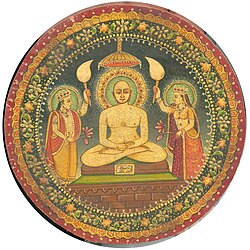
In Jainism, mandalas function primarily as cosmological diagrams depicting the eternal, uncreated universe termed loka, divided into three realms: the upper world (ūrdhva-loka) for celestial beings, the middle world (madhya-loka) for mortals including humans and animals, and the lower world (adho-loka) for infernal entities.[23] These structures emphasize the cyclical samsara and the pursuit of liberation (mokṣa) through ascetic practices, serving as meditative tools for visualizing the soul's journey amid infinite karmic matter.[24] The middle world, central to mortal existence, is rendered as concentric rings of alternating continents and oceans, with Mount Meru at the core symbolizing the axis mundi.[23] Such mandalas appear in illustrated manuscripts, wall paintings, and portable shrines, often originating from western India like Gujarat and Rajasthan, with examples dating to the 16th century.[25] A notable 16th-century specimen from Gujarat features the Tirthankara Vardhamana (Mahavira) at the center in gouache on cotton, integrating iconography with cosmic mapping.[25] These diagrams, distinct from ritual yantras yet sharing geometric symmetry, facilitate doctrinal study and ritual contemplation by outlining the universe's immutable layers without creator deity. Jain texts describe eternal icons within this cosmology, influencing temple layouts and hymns that invoke spatial visualization for ethical and metaphysical insight.[26] Beyond core doctrinal uses, Jain mandalas extend to symbolic artifacts like hinged lotus forms enshrining Jinas, folding into portable buds for devotion, though these blend artistry with cosmology rather than pure diagrammatics.[27] In contrast, other Indian traditions such as Sikhism lack historical mandala practices, with modern artistic adaptations like Ik Onkar designs representing contemporary rather than scriptural elements.[28]

Symbolism and Geometry

Core Symbolic Meanings

Mandalas serve as symbolic diagrams representing the universe in its idealized, harmonious structure, functioning as microcosmic models of cosmic order and wholeness.[29] The circular form embodies completeness and the integration of diverse elements into unity, reflecting principles of balance and totality inherent in sacred geometries across traditions.[30] In Buddhist contexts, particularly Vajrayana practices, mandalas depict the divine palace of a central deity, symbolizing the transformation of a world of suffering into one of enlightenment and joy.[29] The concentric layers guide meditative visualization from periphery to core, mirroring the practitioner's inward journey toward ultimate reality, with the center point signifying the origin, sustenance, and dissolution of all phenomena.[30] This structure underscores impermanence alongside eternal truth, as the mandala's creation and ritual destruction reinforce detachment from transient forms.[29] Within Hinduism, mandalas, often termed yantras, embody cosmic principles and deities, aiding concentration in rituals and meditation by externalizing abstract metaphysical realities.[2] Geometric motifs like the lotus evoke purity and enlightenment emerging from chaos, paralleling the soul's ascent through layered realities toward divine unity.[2] Such symbols facilitate alignment with universal rhythms, promoting spiritual integration without reliance on narrative mythology.[31] Common across these traditions, the mandala's radial symmetry and enclosed boundaries represent protective containment of sacred space, harmonizing opposites like chaos and order or microcosm and macrocosm.[30] Gates or portals at cardinal directions symbolize transitions between profane and sacred realms, emphasizing directed progression toward central enlightenment.[29]

Geometric Principles and Construction

Mandalas adhere to geometric principles rooted in symmetry and proportional scaling to embody cosmic order. Core elements include a central point or bindu representing unity, surrounded by concentric layers of circles and squares that delineate hierarchical realms from core essence to periphery. In tantric Buddhist mandalas, the design follows the dkyil 'khor structure, denoting "center-circumference," with a primary square palace subdivided into an 8 by 8 grid of units for spatial organization.[32] This square, aligned east-west, is bounded by enclosing walls pierced by four gates at cardinal points, while inscribed circles demarcate inner sanctums from outer protective zones.[32] Symmetry manifests as four-fold rotational and reflectional balance across quadrants, mirroring Vedic altar geometries and ensuring equilibrium in representation of enlightened space.[32] Hindu yantras and vastu purusha mandalas extend these via square grids—often 64 or 81 divisions—formed by orthogonal lines intersecting to map cosmic entities, with added triangles or lotuses for energetic polarity between static form and dynamic flow.[33] [34] Construction employs Euclidean tools: a straightedge for radial axes and linear divisions, a compass for precise arcs, circles, and proportional radii derived from textual canons.[32] Practitioners, such as Tibetan monks, first sketch faint chalk guidelines on prepared surfaces, adhering to memorized dimensions—e.g., gate widths and palace depths scaled to the central deity's symbolic stature—before inking or applying medium like colored sands.[32] [35] This method enforces mathematical rigor, with deviations minimized through iterative verification against ritual proportions to achieve visual and metaphysical coherence.[32] In vastu applications, the mandala is ritually inscribed on-site via measured grids, orienting construction to align human endeavor with universal geometry.[33]

Ritual and Artistic Practices

Sand Mandalas and Impermanence

Sand mandalas constitute a transient artistic and ritual practice within Tibetan Vajrayana Buddhism, wherein monks meticulously construct intricate geometric designs using finely ground colored sands to represent deities, cosmic structures, or healing energies.[21] The creation process typically spans 3 to 10 days, beginning with consecration rituals involving chants and invocations to invoke protective energies, followed by outlining the mandala's symmetry on a flat surface using strings or chalk lines measured precisely for geometric accuracy.[36] Monks then employ specialized metal funnels called chak-pur to dispense sand grains, layer by layer, achieving resolutions finer than 1 millimeter per line, often working in teams under senior guidance to depict central deities encircled by retinues, gates, and symbolic motifs.[36] Upon completion, the mandala undergoes ceremonial dissolution to underscore the Buddhist principle of anicca—the impermanence of all conditioned phenomena—wherein the central figure is first scraped away by the lead monk, followed by radial dismantling to avoid asymmetry, symbolizing the dissolution of ego attachments and the transient nature of existence.[21] The collected sands are then funneled into a heap, blessed through additional rituals, and dispersed into flowing water such as rivers or oceans, purportedly disseminating the mandala's positive energies while illustrating life's cyclical flux and the futility of clinging to material forms.[37] This destruction phase, integral since the practice's transmission from Indian tantric traditions to Tibet around the 11th-12th centuries, counters any potential for idolization of the artwork, reinforcing doctrinal emphasis on non-attachment and the ephemeral quality of samsaric reality.[38] Historically, sand mandalas evolved from earlier Indian prototypes using crushed precious stones, adapting to colored sands in Tibet for accessibility, with earliest textual references appearing in The Blue Annals (compiled circa 1476 CE), chronicling their use in meditative and healing contexts.[37] Common themes include the Chenrezig (Avalokiteshvara) mandala for compassion or the Medicine Buddha for healing, each configuration calibrated to invoke specific soteriological benefits without implying permanence in the artifacts themselves.[21] Empirical observations from monastic demonstrations, such as those by Drepung Gomang monks since the 1990s in global tours, confirm the ritual's consistency in embodying impermanence, as the labor-intensive creation yields no enduring object, training participants and observers in detachment from sensory impermanence.[38]

Painted, Sculpted, and Architectural Forms

Painted mandalas, often rendered on cloth as thangkas or on temple walls and ceilings, serve as meditative aids in Vajrayana Buddhism, depicting hierarchical arrangements of deities within geometric frameworks symbolizing the cosmos.[39] These works, such as those from 17th-century Tibet featuring central figures like Rakta Yamari, employ vibrant mineral pigments to outline palaces, gates, and concentric circles, facilitating visualization during tantric initiations.[19] In Hinduism, painted forms akin to yantras appear in ritual contexts, though less emphasized than geometric diagrams for worship.[29] Sculpted mandalas extend into three dimensions, typically as metal or wooden models representing divine palaces for ritual use in Tibetan Buddhism. Examples include cloisonné bases supporting miniature structures with towers and loggias, as seen in artifacts from the 18th century onward, which replicate the flat painted versions in physical form to enhance practitioner immersion.[40] Contemporary artists like Pema Namdol Thaye continue this tradition, crafting detailed bronze or mixed-media sculptures that embody the mandala's spatial cosmology.[41] Architectural mandalas manifest in temple layouts governed by principles like the Hindu Vastu Purusha Mandala, a square grid divided into 64 or 81 sectors representing cosmic forces and deities, used since at least the 5th century CE in texts like the Mayamata to orient structures toward harmony.[42] In Buddhism, the 9th-century Borobudur temple in Java embodies a three-dimensional mandala through its nine stacked platforms forming a stepped pyramid, viewed from above as concentric squares and circles symbolizing the path to enlightenment, constructed by the Sailendra dynasty with over 2,600 relief panels.[43]

Mandala in Architecture and Cosmology

Temple and City Planning

In Hindu temple architecture, the Vastu Purusha Mandala serves as a foundational geometric grid for site selection and layout, typically comprising a square divided into 64 subsidiary squares representing the cosmic being Vastu Purusha.[44] This mandala embodies the alignment of earthly structures with universal energies, with the central square reserved for the primary deity's sanctum while peripheral zones accommodate subsidiary shrines and functional spaces.[45] The grid's orientation, often with Brahma at the center, dictates the placement of entrances and rooms to harmonize with directional cosmic forces, as prescribed in ancient Vastu Shastra texts.[46] Buddhist temple planning similarly employs mandala principles to symbolize the cosmos, as exemplified by the 9th-century Borobudur monument in Indonesia, whose terraced structure follows a mandala layout with concentric squares ascending to a circular stupa summit, representing the path from earthly desires to enlightenment.[47] This design integrates over 2,600 relief panels and 500 Buddha statues within a stepped pyramid form, encapsulating realms of existence (Kamadhatu, Rupadhatu, Arupadhatu) in a three-dimensional mandala.[48] Comparable layouts appear in monasteries like the 7th-century Somapura Mahavihara in Bangladesh, where central stupas and surrounding cells form a quadrangular mandala grid for monastic life and ritual circumambulation.[49] For city planning, Vastu Shastra extends mandala grids to urban scales, endorsing symmetrical layouts such as the square Chandura form for fortified settlements, with cardinal gates and a central palace or temple mirroring cosmic order.[50] The 18th-century city of Jaipur exemplifies this, its nine-block grid derived from a Vastu Purusha Mandala variant, ensuring directional harmony and defensive efficacy through radial streets converging on the central fortress.[51] In Buddhist contexts, such as early Bangkok's 1782 plan under King Rama I, the urban mandala integrated palace, temples, and walls in concentric symmetry, reflecting hierarchical cosmology and protective symbolism.[52] These applications underscore mandalas' role in fostering spatial equilibrium believed to promote prosperity and spiritual alignment, though empirical validation remains limited to historical and architectural analysis rather than controlled studies.[53]

Cosmic Representations

In Buddhist cosmology, mandalas frequently depict the universe with Mount Meru as the central axis mundi, rising 84,000 yojanas into the sky and extending equally below the surrounding ocean.[54] This sacred mountain serves as the pivot connecting earthly and celestial realms, encircled by seven concentric mountain ranges, intervening oceans, and four main continents, with Jambudvīpa positioned to the south as the human abode.[54] The summit of Mount Meru hosts the Trāyastriṃśa Heaven, governed by Śakra, underscoring a hierarchical arrangement of divine and mortal spheres that emphasizes spiritual ascent and the transient nature of existence.[54] Tibetan Buddhist mandalas, such as the three-dimensional Mount Meru Palace Mandala from Yachengar Monastery in eastern Tibet, render this cosmology in gilt metal repoussé form, approximately 71 inches tall, with tiered structures symbolizing the cosmic palace atop Mount Meru.[55] These representations facilitate meditative visualization of the universe's ordered structure, where the central mountain integrates purity symbols like the lotus atop pyramidal forms.[55] In Hindu traditions, the Sri Yantra functions as a cosmic diagram embodying the universe's emanation from a primordial point, structured around nine interlocking triangles—four upward denoting Shiva's male principle and five downward for Shakti's female energy—forming 43 subsidiary triangles within concentric circles and lotus petals.[56] The central bindu represents the origin of creation, while the outer bhupura square with four T-shaped gates evokes a temple enclosing the material world, mirroring Mount Meru as the generative core of cosmic cycles including formation, sustenance, and dissolution.[56] Jain cosmological mandalas illustrate the universe as a vertically stratified cosmos divided into upper heavenly realms, a middle zone of mortal continents like Adhaidvīpa comprising two and a half landmasses inhabited by humans, and lower infernal layers, often diagrammed to convey the eternal, uncreated structure without a creator deity.[26] These diagrams, appearing in manuscripts and wall hangings, map the interconnected realms emphasizing karmic progression across planar and vertical dimensions.[57]

Political and Social Models

Southeast Asian Mandala Theory

The Southeast Asian mandala theory, also known as the mandala model or galactic polity, conceptualizes pre-colonial political organization in the region as a fluid, concentric system of power radiating from a sacred central authority rather than fixed territorial boundaries. Coined by historian O.W. Wolters in his 1968 analysis of Khmer polity and elaborated in his 1982 book History, Culture, and Region in Southeast Asian Perspectives, the model draws from Sanskrit maṇḍala meaning "circle," evoking cosmological diagrams where a divine king at the center—often likened to Mount Meru—exerted ritual suzerainty over lesser lords and tributary states in overlapping spheres of influence.[58][59] This structure emphasized personal loyalties, marriage alliances, and periodic tribute rather than centralized bureaucracy or permanent armies, allowing polities to expand and contract based on the charisma and divine mandate of the ruler.[60] Key features included a core mueang (city-state) under the king's direct control, surrounded by intermediate zones of semi-autonomous vassals who owed fealty but retained local autonomy, and outer rims of nominal tributaries prone to defection toward rival centers. Wolters argued this pattern arose from indigenous adaptations of Indian political ideas, such as Kautilya's mandala in the Arthashastra, blended with Theravada Buddhist and Hindu cosmologies that sacralized the ruler as a world axis.[61] Historical examples span from the 5th to 15th centuries, including the Srivijaya maritime empire (7th–13th centuries) in Sumatra, which controlled trade routes through tributary networks without contiguous territory; the Angkorian Khmer Empire (9th–15th centuries), where Jayavarman VII's expansions created layered mandalas around Angkor Thom; and the Majapahit Empire (13th–16th centuries) in Java, whose Nagarakretagama chronicle of 1365 describes a hierarchical cosmos of 98 tributaries under King Hayam Wuruk.[62] Similar dynamics appeared in Ayutthaya (14th–18th centuries), where 17th-century designs under King Naresuan formalized multi-layered hierarchies integrating cosmology with governance.[60] Anthropologist Stanley Tambiah refined the theory in 1976 as a "galactic polity" or "segmentary state," highlighting how peripheral units mirrored the center in ritual form but lacked integrative administration, leading to chronic instability and cycles of rise and fall.[60] While influential in explaining the absence of durable empires comparable to China's, the model has faced critiques for oversimplifying variations; for instance, some scholars argue it underemphasizes economic factors like wet-rice agriculture or trade in sustaining core-periphery ties, and its applicability wanes in later periods with emerging gunpowder states.[59] Others note that not all polities, such as Vietnam's more centralized bureaucracy, fit neatly, suggesting the mandala as an interpretive lens rather than universal template.[62] Wolters' framework, grounded in epigraphic and chronicle evidence, remains a cornerstone for analyzing Southeast Asia's pre-modern international relations as heterarchical networks rather than Westphalian sovereigns.[58]

Modern Political Analogies

In contemporary international relations scholarship, Kautilya's Mandala Theory from the Arthashastra—positing concentric circles of states where immediate neighbors are natural enemies (ari), their enemies are allies (mitra), and further rings alternate accordingly—has been analogized to modern geopolitical strategies, particularly in multipolar settings lacking rigid bipolar alliances.[63] This framework emphasizes pragmatic realism, where states prioritize relative power balances over ideological commitments, adapting to fluid threats from proximate actors.[64] Analysts apply it to explain hedging behaviors, such as forming temporary coalitions against dominant neighbors while cultivating distant partnerships, contrasting with Westphalian models of fixed sovereignty.[65] For India, the theory informs interpretations of its foreign policy toward South Asian neighbors, viewing Pakistan as a core ari due to shared borders and historical conflicts, prompting alliances with Afghanistan and Iran as secondary friends to counterbalance.[63] This extends to broader engagements, like deepening ties with the United States and Quad partners (Australia, Japan) as tertiary allies against Chinese influence, reflecting the theory's dictum to exploit divisions in enemy coalitions.[64] India's "multi-alignment" approach—maintaining relations with Russia amid Western sanctions while countering Pakistan via Israel—mirrors the Mandala's non-static alliances, evolving with events like the 2022 Ukraine crisis.[65] Such applications underscore the theory's utility in asymmetric power dynamics, where smaller states navigate great-power rivalries through concentric diplomacy rather than outright confrontation.[66] Globally, analogies extend to Sino-Indian competition, framing rising powers as constructing "new mandalas" of economic and military influence, with China's Belt and Road Initiative encircling neighbors akin to ancient tribute systems, prompting India to build counter-networks in the Indo-Pacific.[66] In European contexts post-Brexit, some invoke mandala-like fluidity to describe overlapping EU dependencies and NATO commitments, though critics argue the theory's pre-modern roots—absent formal treaties or nuclear deterrence—limit direct parallels to contemporary fixed-border states.[63] Empirical assessments, such as India's successful isolation of Pakistan in multilateral forums like the UN (e.g., blocking its NSG entry in 2008 and 2016), validate selective applications, yet over-reliance risks ignoring domestic economic constraints on expansionist policies.[64] These analogies persist in policy discourse, as evidenced by Indian strategic think tanks adapting the model for 21st-century challenges like cyber threats and supply-chain vulnerabilities.[67]

Western Psychological Interpretations

Jungian Archetypal Analysis

Carl Gustav Jung interpreted mandalas as spontaneous archetypal expressions of the Self, the central archetype representing the totality and wholeness of the psyche, encompassing both conscious and unconscious elements. He first encountered the symbolic significance of mandalas during his personal psychological experiments in 1916, when he began creating them amid visions and fantasies documented in his Black Books and later The Red Book, viewing them as innate psychic structures emerging to restore order during periods of inner chaos. In his analytical psychology, mandalas symbolize the process of individuation, wherein fragmented aspects of the personality—such as the shadow, anima, and animus—are integrated toward psychic unity, with the circular form denoting completeness and the central motif embodying the transcendent Self distinct from the ego.[68][69] Jung observed that mandalas appear involuntarily in patients' dreams, drawings, and visions, particularly during therapeutic crises or disorientation, serving as a "protective circle" that counters psychic disorder and facilitates self-regulation. He documented numerous examples from clinical practice, including sequences of patient artwork from 1930 to 1938 that illustrated progressive centering and quaternity motifs—such as crosses, stars, or lotuses—symbolizing the unification of opposites and emergence of cosmic order from subjective turmoil. These forms, often quartered or radially symmetric, reflect universal archetypes rather than cultural borrowing, as similar patterns arose independently in Western patients unfamiliar with Eastern traditions, underscoring their basis in the collective unconscious. Jung emphasized the mandala's role as a "symbol of order" opposing chaos, with the center functioning as the developmental goal of psychological maturity, akin to alchemical rotundum or the infinite divine circle.[68] In therapeutic application, Jung encouraged patients to draw mandalas as a means to amplify unconscious contents and achieve inner harmony, noting their appearance as "birth-places" or vessels for psychic rebirth, comparable to lotus motifs in which wholeness manifests. This practice, observed in cases like "Miss X" and others spanning 1926 to 1945, revealed mandalas as mediators reconciling internal conflicts, promoting balance without directive interpretation. While Jung linked mandalas to broader archetypal phenomena, such as the quaternity representing totality, he cautioned that their efficacy stems from experiential confrontation rather than intellectual analysis, positioning them as empirical manifestations of the psyche's self-healing propensity.[68][70]

Therapeutic Coloring and Mindfulness

Mandala coloring has gained popularity in contemporary therapeutic practices as a tool for promoting mindfulness and reducing stress, often integrated into art therapy sessions or self-guided activities using adult coloring books featuring intricate geometric designs. Proponents suggest that the repetitive, symmetrical patterns of mandalas facilitate a meditative state by encouraging focused attention and rhythmic hand movements, akin to mindfulness meditation techniques.[71] This approach draws from broader art therapy traditions but emphasizes mandalas' structured forms to anchor the mind away from ruminative thoughts.[72] Empirical studies have yielded mixed results on the efficacy of mandala coloring for anxiety reduction and mindfulness enhancement. A 2005 experimental study involving 84 undergraduate students found that 20 minutes of coloring a mandala significantly lowered state anxiety scores compared to free-form coloring or coloring a plaid design, with effect sizes indicating moderate benefits (Cohen's d = 0.45).[71] Similarly, a 2019 study reported that completing mandalas improved mood and state mindfulness while decreasing anxiety in participants, attributing gains to the activity's capacity to induce absorption and present-moment awareness.[73] In clinical contexts, mindfulness-based mandala coloring conducted in natural settings reduced pain, psychological stress, and salivary cortisol levels in patients with chronic widespread pain, suggesting physiological as well as subjective benefits.[74] However, systematic reviews and meta-analyses question the unique superiority of mandala coloring over other creative activities. A 2022 meta-review of 10 studies concluded that mandala coloring does not reduce state anxiety more effectively than free drawing, with no significant differences in effect sizes across interventions (Hedges' g ≈ 0.20-0.30 for both).[72] Researchers hypothesize that any benefits may stem from general coloring-induced flow states rather than mandala-specific geometry, as evidenced by comparable anxiety reductions in free coloring conditions.[75] Limitations in existing research include small sample sizes (often n < 100), reliance on self-reported measures like the State-Trait Anxiety Inventory, and short-term assessments, which preclude conclusions about long-term mindfulness cultivation or generalizability beyond non-clinical populations.[76] Recent applications extend to self-guided practices and specialized groups. A 2024 study on university students demonstrated that at least six sessions of self-guided mandala coloring significantly improved mental health metrics, wellbeing, and mindfulness scores, with participants reporting sustained engagement without therapist facilitation.[77] In pediatric settings, mindfulness-based mandala interventions enhanced attention and social-emotional competencies in children, though causal mechanisms remain under-explored.[78] Despite these findings, methodological critiques persist, including potential placebo effects from expectation of relaxation and the need for randomized controlled trials comparing mandalas to non-art mindfulness practices like breathwork. Overall, while mandala coloring offers accessible entry into mindfulness for some, evidence does not substantiate it as uniquely superior for therapeutic outcomes.[79]

Scientific and Empirical Perspectives

Neuroscientific and Psychological Studies

Empirical investigations into the psychological effects of mandalas have primarily focused on coloring or drawing activities as interventions for anxiety reduction and mood enhancement. A 2005 study involving 50 undergraduate students exposed to a stressor found that coloring mandala designs significantly lowered state anxiety levels compared to a control group engaged in unstructured coloring, with self-reported anxiety decreasing by approximately 15% post-activity, though effects were comparable to coloring geometric plaid patterns rather than uniquely superior to other structured designs.[71] Subsequent research, including a 2022 meta-analysis of nine randomized controlled trials encompassing 619 adults, concluded that mandala coloring yields a small but statistically significant reduction in state anxiety (standardized mean difference of -0.46), yet it does not outperform free-form drawing in direct comparisons, suggesting benefits may stem from the act of focused coloring rather than mandala geometry specifically.[72] In clinical populations, mandala-based interventions show promise for targeted outcomes. For instance, a 2023 randomized trial with 60 children exhibiting attention-deficit/hyperactivity disorder symptoms demonstrated that six weeks of mandala coloring sessions improved executive functioning scores by 12-18% on tasks measuring inhibition and emotional regulation, alongside self-reported reductions in hyperactivity, attributing effects to enhanced mindfulness and creative expression without pharmacological intervention.[80] Similarly, a 2024 study of 80 burn patients undergoing dressing changes reported that 20-minute mandala coloring sessions decreased pain perception by 22% and anxiety by 28% on visual analog scales, outperforming distraction techniques, likely due to the repetitive, symmetrical patterns promoting attentional diversion and parasympathetic activation.[81] However, results vary; a 2024 trial with bereaved college students found group mandala art therapy reduced negative emotions but did not significantly enhance personal growth metrics beyond standard counseling.[82] Neuroscientific research on mandalas remains sparse and indirect, with few studies employing imaging techniques to isolate effects. Preliminary work integrating mandala coloring with EEG-based brain-computer interfaces has detected shifts toward alpha wave dominance during focused coloring, indicative of relaxed wakefulness akin to mindfulness states, though causal links to mandala structure versus general engagement require further validation.[83] A 2020 investigation using peripheral neurofeedback during mandala coloring as a mindfulness proxy observed modulated autonomic responses, including lowered heart rate variability, but lacked fMRI correlates to pinpoint cortical involvement.[84] Broader meta-analyses of meditation practices, occasionally incorporating visual aids like mandalas, report deactivation in the default mode network and increased prefrontal activity, yet no large-scale neuroimaging trials specifically attribute these to mandala contemplation over other focal tasks.[85] Methodological limitations, such as small sample sizes (often n<50) and reliance on self-reports, underscore the need for replicated, sham-controlled designs to distinguish genuine neural mechanisms from placebo or attentional effects.

Criticisms and Methodological Limitations

Scientific studies on mandalas, particularly in psychological and neuroscientific contexts, face several methodological challenges that undermine claims of robust efficacy. Many investigations into mandala coloring or drawing as a therapeutic tool rely on small sample sizes, often under 50 participants, limiting generalizability and statistical power.[72] For instance, randomized controlled trials examining anxiety reduction frequently lack blinding or adequate control groups, such as comparing mandala activities to unstructured drawing or other relaxation techniques, which introduces potential placebo effects and confounds causality.[86] Systematic reviews and meta-analyses have highlighted that mandala-based interventions do not demonstrate significantly greater benefits for reducing state anxiety compared to free-form coloring or drawing.[72] [75] A 2022 meta-review of multiple studies concluded that while some short-term improvements in mood or mindfulness are reported, these effects are not uniquely attributable to mandala geometry, suggesting outcomes may stem from general creative engagement rather than specific symbolic or structural elements.[72] Selection bias is prevalent in non-randomized designs, where participants with pre-existing interest in art therapy self-select, skewing results toward positive perceptions.[87] Neuroscientific research on mandalas remains sparse and preliminary, with few functional imaging studies directly linking mandala perception or creation to distinct brain activation patterns beyond those elicited by similar visual stimuli. Existing work often employs subjective self-reports alongside physiological measures like heart rate variability, but lacks longitudinal designs to assess enduring neural changes or causal mechanisms.[88] Critics note overreliance on correlational data, where associations between mandala exposure and reduced cortisol or enhanced alpha wave activity fail to isolate mandala-specific effects from expectancy biases or meditative components.[89] Individual differences, including prior exposure to mindfulness practices or baseline anxiety levels, further complicate interpretations, as these factors can moderate outcomes without being adequately controlled.[90] Overall, the evidence base suffers from heterogeneity in protocols and outcome measures, with many studies published in lower-impact journals prone to publication bias favoring positive findings. High-quality, large-scale trials are needed to substantiate claims, as current data indicate uncertain therapeutic value beyond nonspecific relaxation.[86] This paucity of rigorous empirical support tempers enthusiasm for mandalas as a evidence-based intervention in clinical psychology.

Archaeological and Historical Evidence

Discoveries and Interpretations

Archaeological excavations at the Ellora Caves in India, dating to the 6th-8th centuries CE during the Buddhist phase, have revealed some of the earliest known mandala carvings, particularly in shallow relief on the walls of Cave 6. These geometric diagrams, integrated into rock-cut architecture, represent ritualistic and meditative aids symbolizing the cosmos. In the 8th century CE, the Somapura Mahavihara at Paharpur, Bangladesh—constructed under the Pala Empire's Dharmapala—was designed as a cruciform quadrangular complex enclosing a central stupa and 177 monastic cells, interpreted by scholars as a three-dimensional mandala layout embodying sacred geometry and the Buddhist universe.[91] Excavations by the Archaeological Survey of India in the 1920s uncovered this structure, highlighting its adherence to yantra principles for spiritual harmony and monastic circulation via pradakshina paths.[91] The site's UNESCO designation underscores its role in demonstrating mandala's application in vihara architecture to map cosmic order.[92] Borobudur Temple in Java, Indonesia, erected circa 800 CE under the Sailendra dynasty, features a nine-tiered pyramid with square terraces transitioning to circular ones topped by stupas, forming a massive three-dimensional mandala that pilgrims ascend to symbolize enlightenment's path.[47] Archaeological reconstructions and inscriptions describe it as a salvific monument encapsulating Buddhist teachings, with debates persisting on whether it functions primarily as a stupa or a Tantric Diamond Realm mandala due to its layered deity arrangements.[93][94] Interpretations emphasize its polysemic form, integrating microcosmic human journey with macrocosmic realms, as evidenced by relief panels narrating karmic cycles. These discoveries illustrate mandala's evolution from carved reliefs to monumental architecture, grounded in empirical site plans and epigraphic evidence, rather than later textual retrojections, affirming causal links between geometric symbolism and ritual efficacy in ancient South and Southeast Asian contexts.[47][91] Claims of pre-1st millennium BCE origins, such as in the Indus Valley, lack direct artifactual corroboration and rely on interpretive analogies to geometric motifs, warranting skepticism absent stratified evidence.[95]

Contemporary Applications and Criticisms

Cultural Appropriation and Commercialization

In Western consumer markets, mandalas have undergone extensive commercialization, particularly since the mid-2010s through products like adult coloring books, tattoos, tapestries, and jewelry, often marketed for relaxation or aesthetic appeal rather than ritual use. The adult coloring book sector, featuring numerous mandala designs, experienced a boom in 2015 with over 12 million units sold in the U.S., driven by titles emphasizing stress reduction via intricate patterns.[96] This trend contributed to an industry valued at approximately USD 500 million globally by 2023, with mandala-themed books comprising a significant portion due to their perceived therapeutic benefits in secular contexts.[97] Such products frequently omit the cosmological and meditative significance of mandalas in Hindu, Buddhist, and Jain traditions, where they represent the universe's structure and impermanence, transforming sacred diagrams into disposable commodities.[98] Critics from cultural preservation perspectives argue that this commodification dilutes the symbols' spiritual depth, reducing them to trendy decor or profit vehicles in New Age and wellness industries. For example, mass-produced mandala tapestries sold at retailers like Walmart are often styled as "bohemian" accents for dorm rooms or yoga studios, evoking an exotic vibe without reference to their origins in meditative visualization or sand rituals that embody transience.[99] In tattoo culture, mandala designs have proliferated for their geometric appeal, yet this application on the body—absent traditional initiations or vows—has drawn objections for treating consecrated geometries as fashion statements.[100] Debates over cultural appropriation intensify when Western adaptations prioritize vanity or commerce over reverence, though empirical assessments note mandalas' cross-cultural geometric precedents mitigate strict ownership claims. Respectful engagements, such as studying mandalas via authentic sources before artistic use, are generally endorsed by Buddhist commentators, but profit-oriented reproductions by outsiders—lacking ties to originating communities—are seen as extractive, bypassing the rigorous tantric training required in Tibetan traditions.[101] [20] This pattern echoes broader New Age appropriations, where symbols like mandalas fund Western self-help markets without reciprocity to source cultures, potentially eroding their ritual potency through desacralization.[102]

Recent Therapeutic and Artistic Developments

In therapeutic contexts, mandala-based interventions have shown preliminary efficacy in reducing anxiety and improving quality of life among specific patient populations. A 2025 scoping review of randomized controlled trials found that mandala painting therapy alleviated negative emotions such as anxiety and depression in cancer patients, while also enhancing treatment compliance and psychological well-being, though the review noted limitations in study sample sizes and long-term follow-up data.[103] Similarly, a July 2025 randomized trial demonstrated that mandala coloring improved quality of life metrics in breast cancer patients, with participants reporting reduced emotional distress after structured sessions.[104] Clinical trials registered in 2025, including one evaluating mandala art therapy for practical examination anxiety among nursing students, reported reductions in self-reported anxiety scores through visual focus and self-expression protocols.[105] Applications have extended to vulnerable groups, with evidence suggesting benefits for mental health in transplant recipients and bereaved individuals. A randomized controlled study on bone marrow transplant patients indicated that nurse-led mandala practices significantly lowered depression and anxiety levels, attributing effects to the structured, repetitive nature of the activity fostering emotional regulation.[106] For bereaved college students, group mandala art therapy sessions reduced stress and enhanced psychological adjustment, as measured by validated scales, though researchers emphasized the need for larger cohorts to confirm generalizability.[82] Ongoing protocols, such as a 2025 randomized trial on mandala coloring for anxiety in pregnant women, aim to quantify impacts on general health status, building on prior observations of improved self-compassion and focus.[107] Artistically, contemporary mandala creations have incorporated modern materials and themes, often blending traditional symbolism with current socio-environmental concerns. In January 2025, the Mandala Project exhibition at Florida CraftArt featured works from over 80 artists, including a live sand mandala created by Tibetan monks from January 13-18, highlighting ephemeral artistry and communal participation.[108] Tenzing Rigdol's 2024-2025 installation at the Metropolitan Museum of Art presented a contemporary mandala addressing global issues like displacement and ecology, using mixed media to map Buddhist motifs onto modern existential challenges.[109] An August 2025 exhibition, "Climate Mandalas In A Burning World," showcased new circular compositions as portals for transformation, employing dot painting and sustainable materials to evoke healing amid environmental crises.[110] These developments reflect a shift toward interactive and digital adaptations, though critics note potential dilution of symbolic depth in commercialized forms.[111]

References

User Avatar
No comments yet.